1/6/2013


 Out of the Wilds and Into Your Garden

                                                                                   Life-friendly ‘Lawns’:
                                                                                     native groundcover ideas that
                                                                                      provide bird & insect habitat

                                                                                     C.M. Vadheim and T. Drake
                                                                              CSUDH & Madrona Marsh Preserve


                                                                                     Madrona Marsh Preserve
 Gardening with Calif. Native Plants in Western L.A. County                               January 5 & 8, 2013
               Project SOUND – 2013 (our 9th year)
                                                     © Project SOUND                                                           © Project SOUND


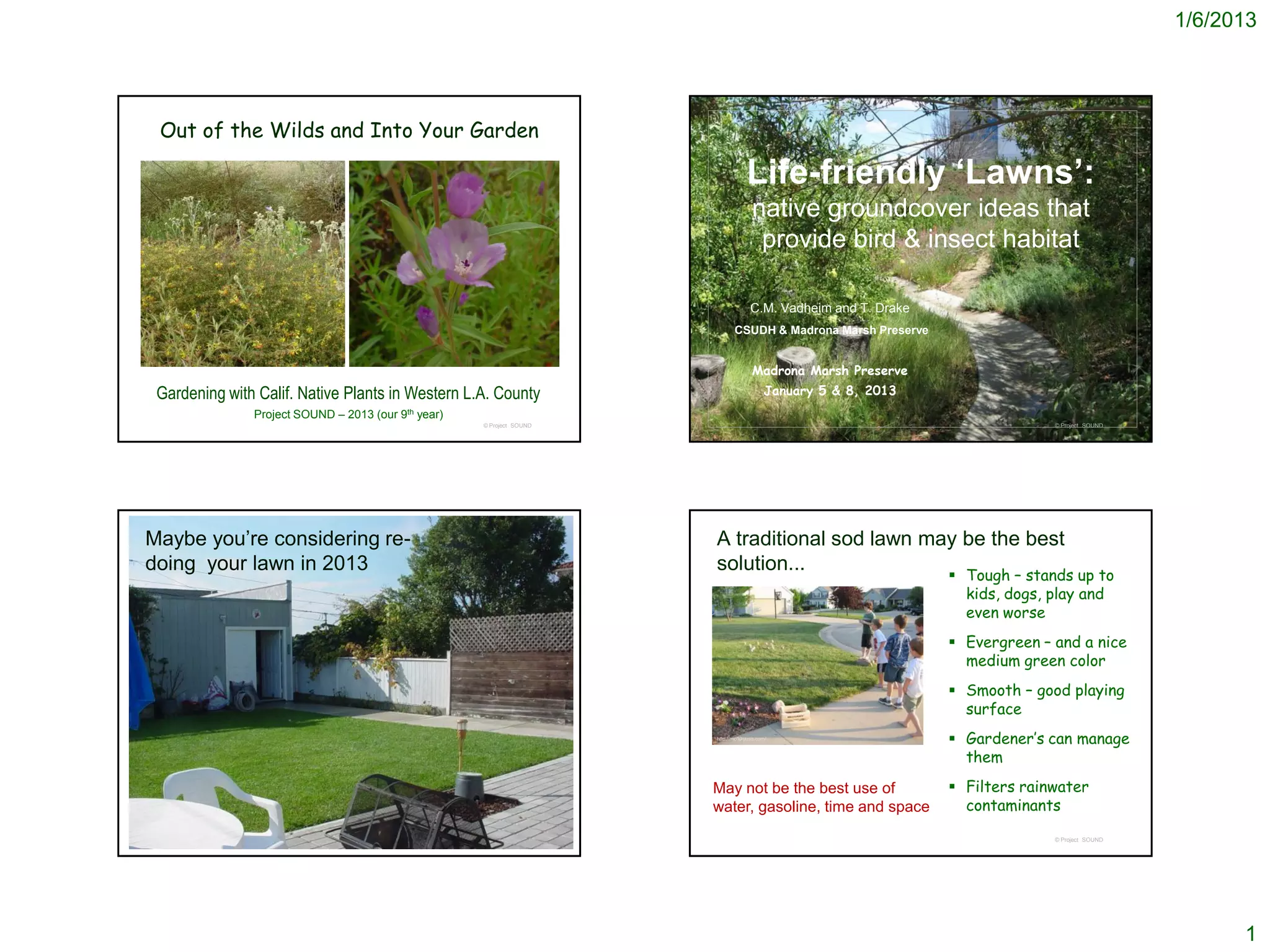
Maybe you’re considering re-                                           A traditional sod lawn may be the best
doing your lawn in 2013                                                solution...
                                                                                                                  Tough – stands up to
                                                                                                                   kids, dogs, play and
                                                                                                                   even worse
                                                                                                                  Evergreen – and a nice
                                                                                                                   medium green color
                                                                                                                  Smooth – good playing
                                                                                                                   surface
                                                                       http://molkkyusa.com/
                                                                                                                  Gardener’s can manage
                                                                                                                   them
                                                                       May not be the best use of                 Filters rainwater
                                                                       water, gasoline, time and space             contaminants

                                                     © Project SOUND                                                           © Project SOUND


                                                                                                                                                       1
1/6/2013


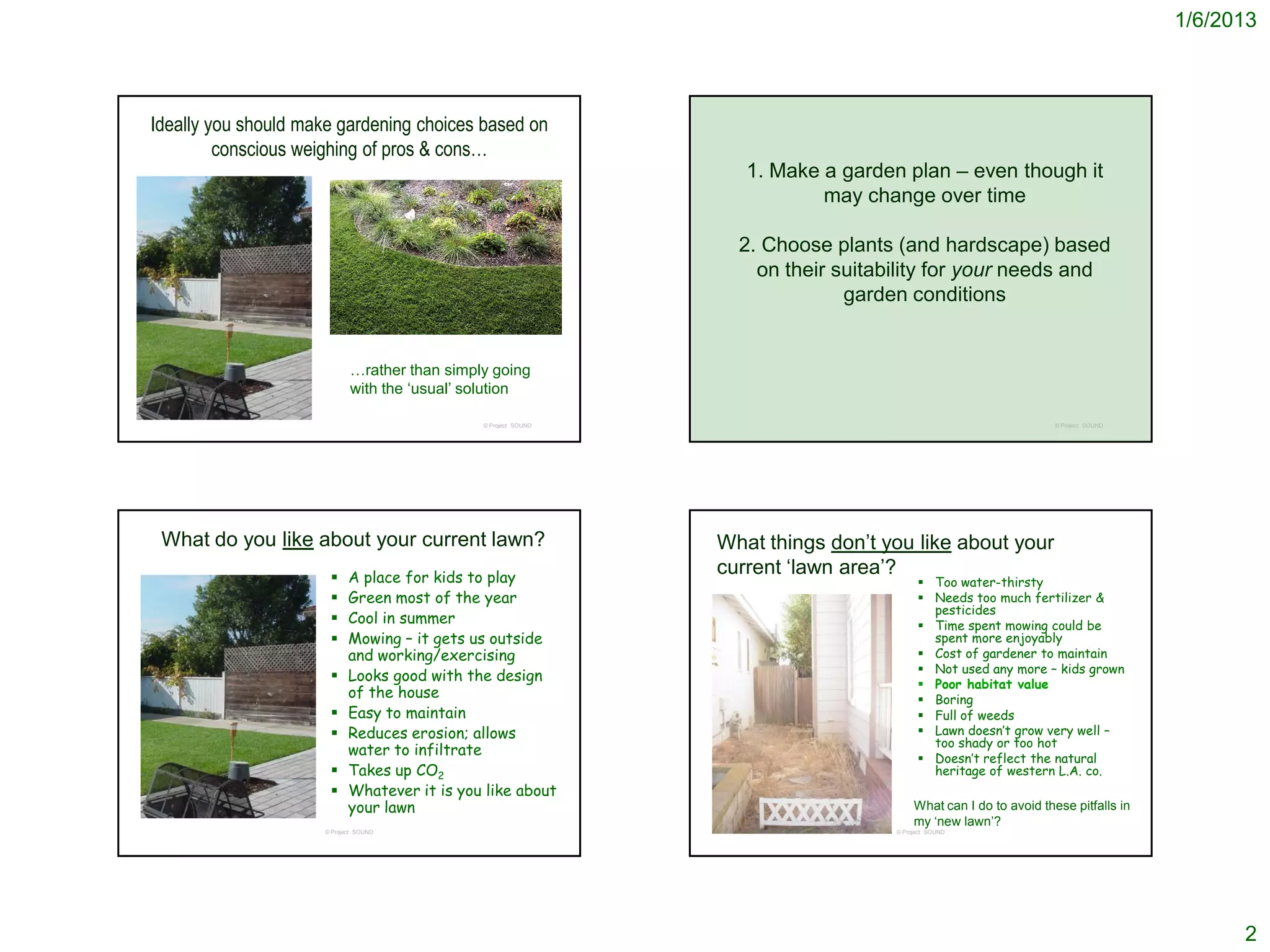
Ideally you should make gardening choices based on
         conscious weighing of pros & cons…
                                                                   1. Make a garden plan – even though it
                                                                           may change over time

                                                                  2. Choose plants (and hardscape) based
                                                                    on their suitability for your needs and
                                                                              garden conditions


                            …rather than simply going
                            with the ‘usual’ solution

                                              © Project SOUND                                                     © Project SOUND


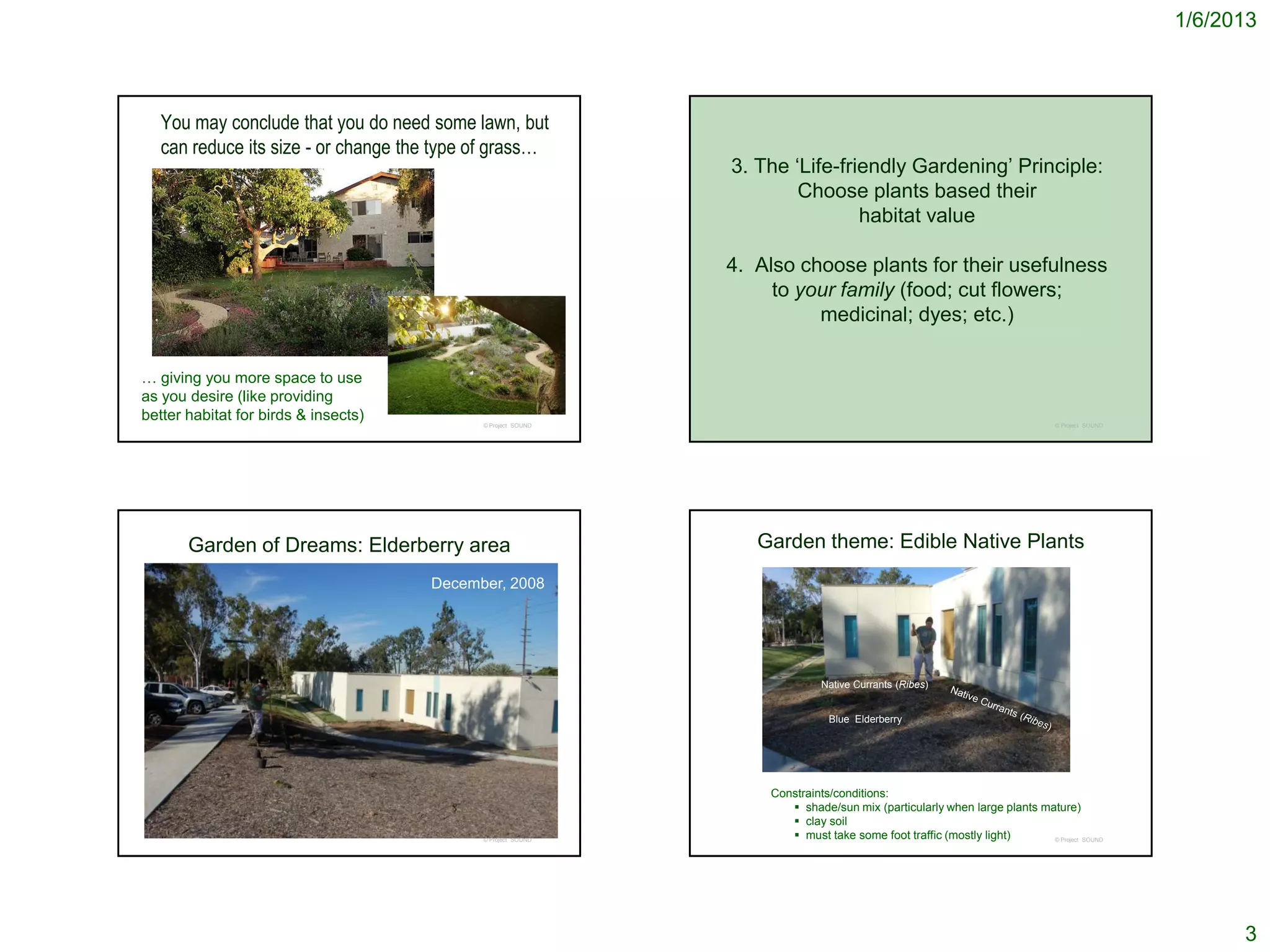
 What do you like about your current lawn?                      What things don’t you like about your
                           A place for kids to play
                                                                current ‘lawn area’?
                                                                                          Too water-thirsty
                           Green most of the year                                        Needs too much fertilizer &
                                                                                           pesticides
                           Cool in summer                                                Time spent mowing could be
                           Mowing – it gets us outside                                    spent more enjoyably
                            and working/exercising                                        Cost of gardener to maintain
                                                                                          Not used any more – kids grown
                           Looks good with the design
                                                                                          Poor habitat value
                            of the house                                                  Boring
                           Easy to maintain                                              Full of weeds
                           Reduces erosion; allows                                       Lawn doesn’t grow very well –
                                                                                           too shady or too hot
                            water to infiltrate
                                                                                          Doesn’t reflect the natural
                           Takes up CO2                                                   heritage of western L.A. co.
                           Whatever it is you like about
                            your lawn                                                   What can I do to avoid these pitfalls in
                                                                                        my ‘new lawn’?
                     © Project SOUND                                               © Project SOUND


                                                                                                                                          2
1/6/2013


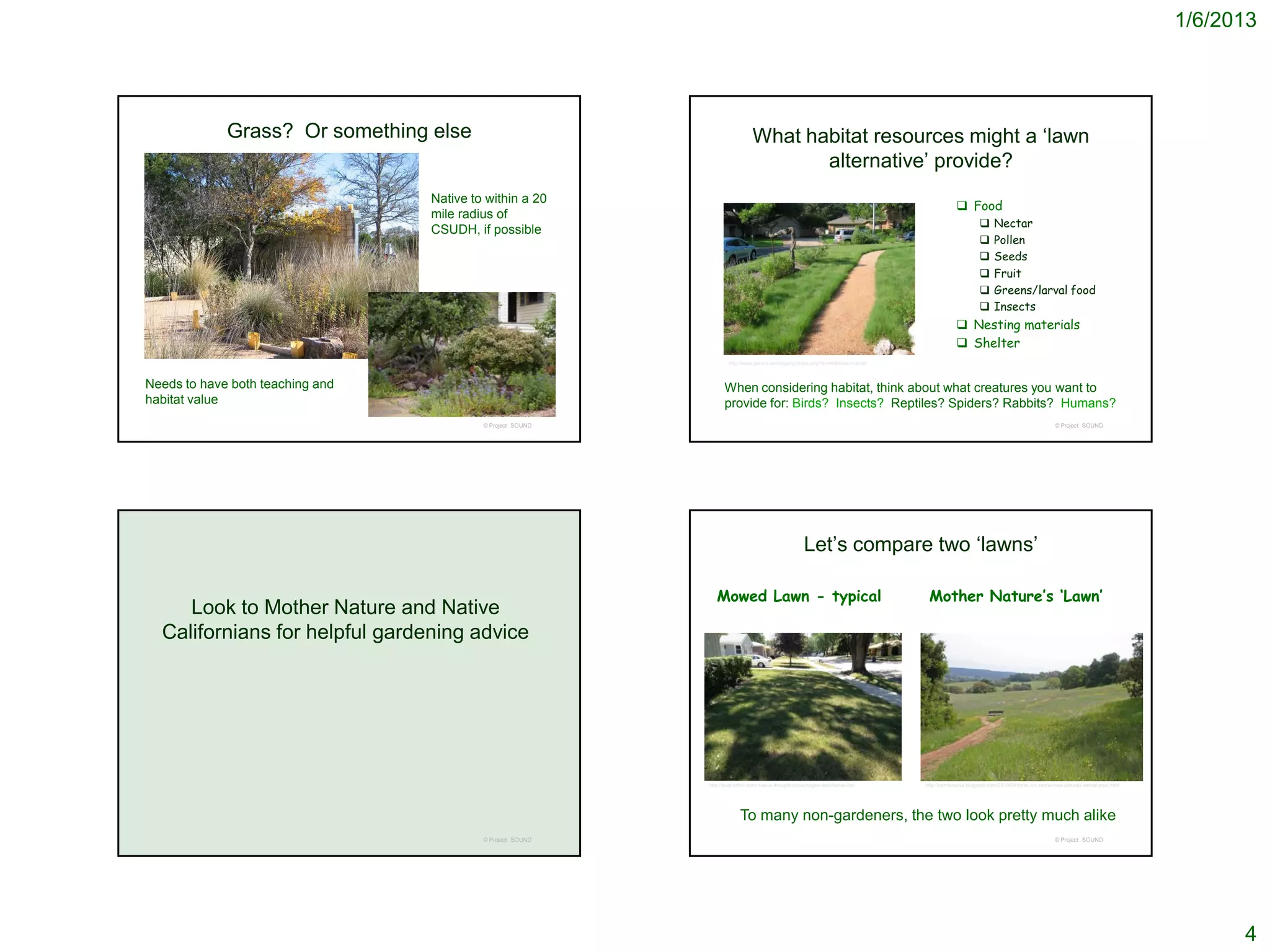
   You may conclude that you do need some lawn, but
   can reduce its size - or change the type of grass…
                                                              3. The ‘Life-friendly Gardening’ Principle:
                                                                      Choose plants based their
                                                                              habitat value

                                                              4. Also choose plants for their usefulness
                                                                   to your family (food; cut flowers;
                                                                        medicinal; dyes; etc.)

… giving you more space to use
as you desire (like providing
better habitat for birds & insects)         © Project SOUND                                                                 © Project SOUND


       Garden of Dreams: Elderberry area                         Garden theme: Edible Native Plants
                                      December, 2008


                                                                            Native Currants (Ribes)


                                                                             Blue Elderberry


                                                                  Constraints/conditions:
                                                                      shade/sun mix (particularly when large plants mature)
                                                                      clay soil
                                            © Project SOUND           must take some foot traffic (mostly light)      © Project SOUND


                                                                                                                                                    3
1/6/2013


                                 Grass? Or something else                                                   What habitat resources might a ‘lawn
                                                                                                                   alternative’ provide?
                                                              Native to within a 20
                                                                                                                                                                             Food
                                                              mile radius of
                                                                                                                                                                                           Nectar
                                                              CSUDH, if possible
                                                                                                                                                                                           Pollen
                                                                                                                                                                                           Seeds
                                                                                                                                                                                           Fruit
                                                                                                                                                                                           Greens/larval food
                                                                                                                                                                                           Insects
                                                                                                                                                                             Nesting materials
http://www.penick.net/digging/index.php?s=wildflower+center
                                                                                                                                                                             Shelter
                                                                                                 http://www.penick.net/digging/index.php?s=wildflower+center


Needs to have both teaching and                                                                When considering habitat, think about what creatures you want to
habitat value                                                                                  provide for: Birds? Insects? Reptiles? Spiders? Rabbits? Humans?
                                                                       © Project SOUND                                                                                                                                © Project SOUND


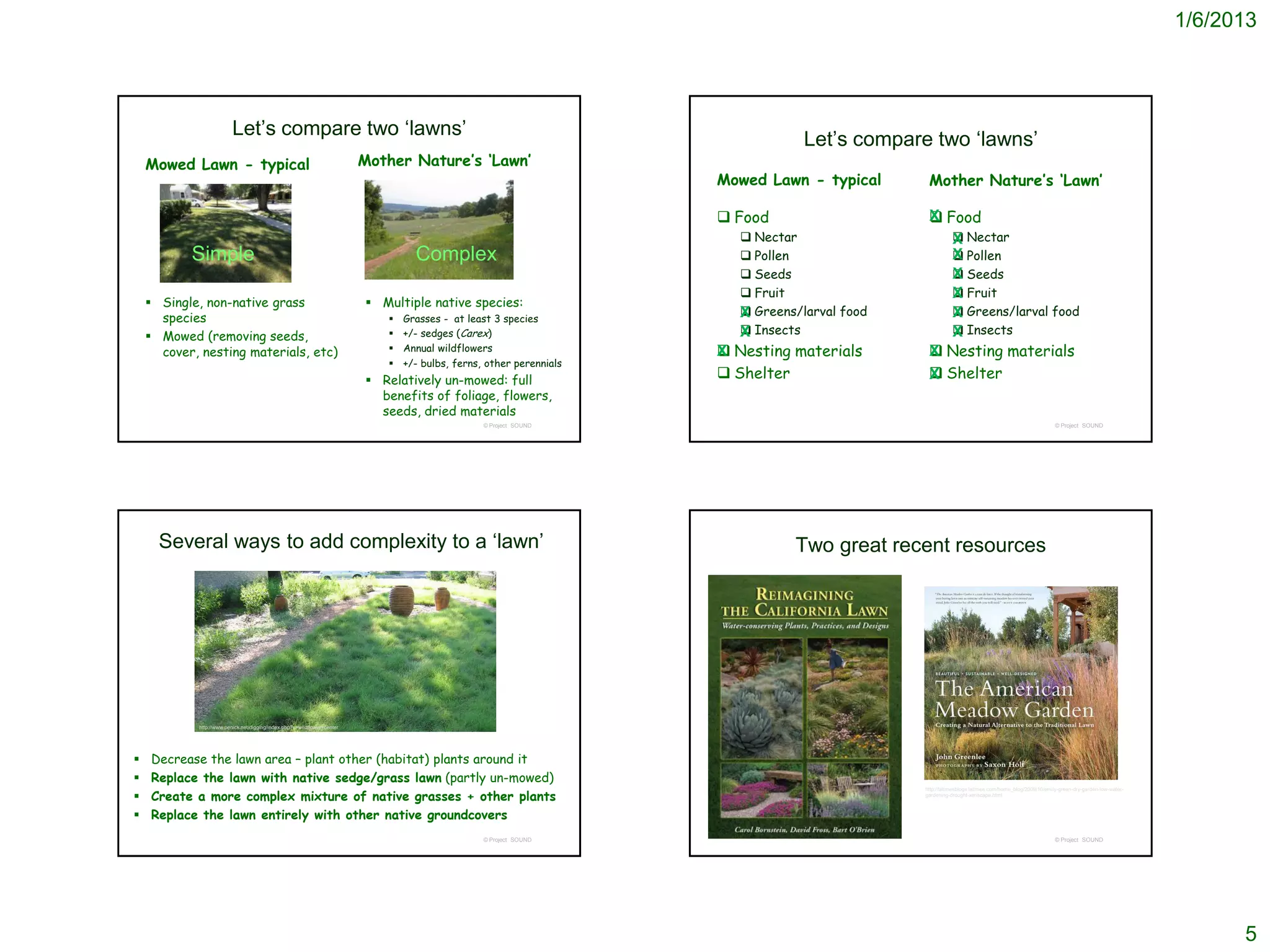
                                                                                                                                  Let’s compare two ‘lawns’

                                                                                            Mowed Lawn - typical                                                Mother Nature’s ‘Lawn’
        Look to Mother Nature and Native
     Californians for helpful gardening advice


                                                                                         http://austindhill.com/how-a-drought-encourages-devotional-life/      http://camissonia.blogspot.com/2010/04/treks-on-santa-rosa-plateau-vernal-pool.html


                                                                                                      To many non-gardeners, the two look pretty much alike
                                                                       © Project SOUND                                                                                                                                © Project SOUND


                                                                                                                                                                                                                                                           4
1/6/2013


                         Let’s compare two ‘lawns’
                                                                                                                                   Let’s compare two ‘lawns’
    Mowed Lawn - typical                                                  Mother Nature’s ‘Lawn’
                                                                                                                      Mowed Lawn - typical       Mother Nature’s ‘Lawn’

                                                                                                                       Food                      Food
                                                                                                                                                 X
                                                                                                                          Nectar                    Nectar
                                                                                                                                                    X
           Simple                                                                  Complex                                Pollen                    Pollen
                                                                                                                                                    X
                                                                                                                          Seeds                     Seeds
                                                                                                                                                    X
                                                                                                                          Fruit                     Fruit
                                                                                                                                                    X
     Single, non-native grass                                             Multiple native species:
      species                                                                   Grasses - at least 3 species            X Greens/larval food
                                                                                                                                                    Greens/larval food
                                                                                                                                                    X
     Mowed (removing seeds,                                                    +/- sedges (Carex)                      X Insects
                                                                                                                                                    Insects
                                                                                                                                                    X
      cover, nesting materials, etc)                                            Annual wildflowers                    Nesting materials
                                                                                                                      X                           Nesting materials
                                                                                                                                                 X
                                                                                +/- bulbs, ferns, other perennials
                                                                           Relatively un-mowed: full                  Shelter                   Shelter
                                                                                                                                                 X
                                                                            benefits of foliage, flowers,
                                                                            seeds, dried materials
                                                                                                  © Project SOUND                                                                                     © Project SOUND


      Several ways to add complexity to a ‘lawn’                                                                                 Two great recent resources


            http://www.penick.net/digging/index.php?s=wildflower+center


   Decrease the lawn area – plant other (habitat) plants around it
   Replace the lawn with native sedge/grass lawn (partly un-mowed)
    Create a more complex mixture of native grasses + other plants
                                                                                                                                                http://latimesblogs.latimes.com/home_blog/2009/10/emily-green-dry-garden-low-water-
                                                                                                                                               gardening-drought-xeriscape.html


   Replace the lawn entirely with other native groundcovers
                                                                                                  © Project SOUND                                                                                     © Project SOUND


                                                                                                                                                                                                                                            5
1/6/2013


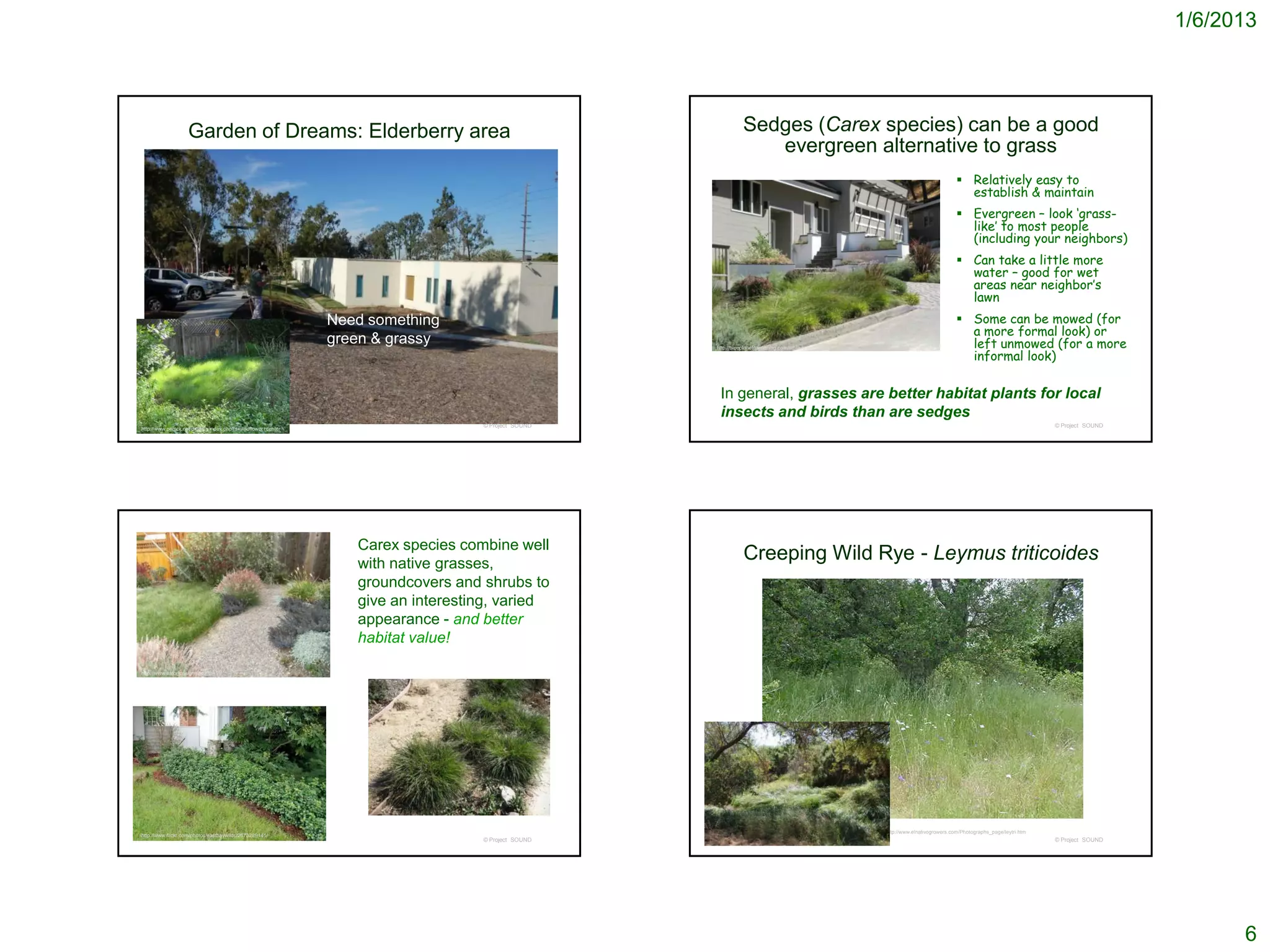
                   Garden of Dreams: Elderberry area                                                           Sedges (Carex species) can be a good
                                                                                                                  evergreen alternative to grass
                                                                                                                                                                                     Relatively easy to
                                                                                                                                                                                      establish & maintain
                                                                                                                                                                                     Evergreen – look ‘grass-
                                                                                                                                                                                      like’ to most people
                                                                                                                                                                                      (including your neighbors)
                                                                                                                                                                                     Can take a little more
                                                                                                                                                                                      water – good for wet
                                                                                                                                                                                      areas near neighbor’s
                                                                                                                                                                                      lawn
                                                              Need something                                                                                                         Some can be mowed (for
                                                                                                                                                                                      a more formal look) or
                                                              green & grassy                        http://blueplanetgardening.com/art-lawnsubs.html                                  left unmowed (for a more
                                                                                                                                                                                      informal look)

                                                                                                     In general, grasses are better habitat plants for local
                                                                                                     insects and birds than are sedges
                                                                                  © Project SOUND                                                                                                                   © Project SOUND
http://www.penick.net/digging/index.php?s=wildflower+center


                                                                 Carex species combine well
                                                                 with native grasses,
                                                                                                               Creeping Wild Rye - Leymus triticoides
                                                                 groundcovers and shrubs to
                                                                 give an interesting, varied
                                                                 appearance - and better
                                                                 habitat value!

http://www.satoridesigns.net/?p=19


                                                                                                                                                       http://www.elnativogrowers.com/Photographs_page/leytri.htm
http://www.flickr.com/photos/eastbaywilds/2673289141/
                                                                                  © Project SOUND                                                                                                                   © Project SOUND


                                                                                                                                                                                                                                            6
1/6/2013


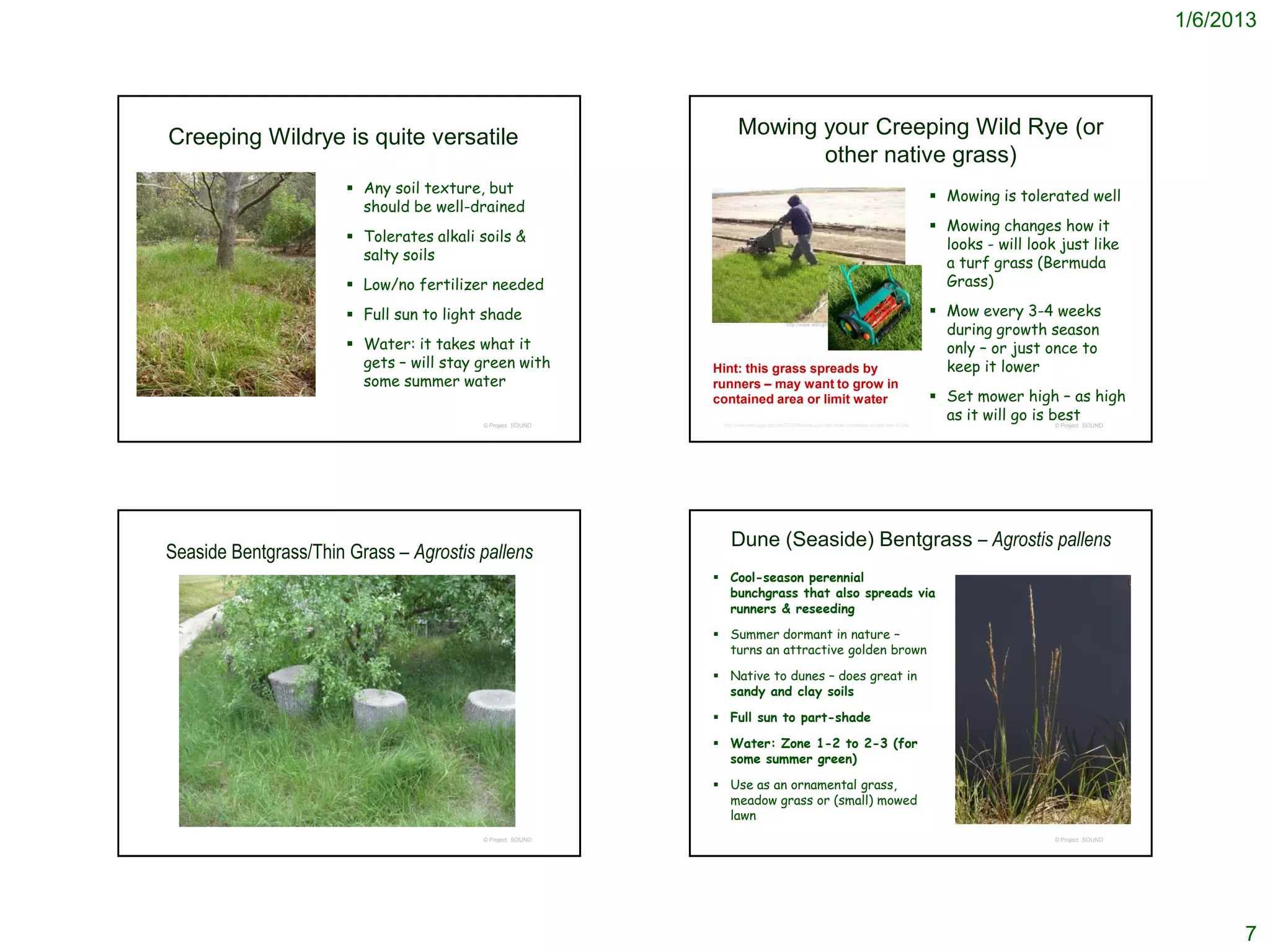
Creeping Wildrye is quite versatile                                Mowing your Creeping Wild Rye (or
                                                                          other native grass)
                        Any soil texture, but                                                                                                              Mowing is tolerated well
                         should be well-drained
                                                                                                                                                            Mowing changes how it
                        Tolerates alkali soils &                                                                                                            looks - will look just like
                         salty soils                                                                                                                         a turf grass (Bermuda
                        Low/no fertilizer needed                                                                                                            Grass)

                        Full sun to light shade                                                                                                            Mow every 3-4 weeks
                                                                                                                                                             during growth season
                                                                                           http://www.albrightseed.com/wildryeswalefilter.htm


                        Water: it takes what it                                                                                                             only – or just once to
                         gets – will stay green with        Hint: this grass spreads by                                                                      keep it lower
                         some summer water                  runners – may want to grow in
                                                            contained area or limit water                                                                   Set mower high – as high
                                          © Project SOUND    http://www.treehugger.com/files/2008/09/review-push-reel-mower-lawnmower-sunlawn-lmm-40.php
                                                                                                                                                             as it will go is best
                                                                                                                                                                              © Project SOUND


                                                                Dune (Seaside) Bentgrass – Agrostis pallens
Seaside Bentgrass/Thin Grass – Agrostis pallens
                                                             Cool-season perennial
                                                              bunchgrass that also spreads via
                                                              runners & reseeding

                                                             Summer dormant in nature –
                                                              turns an attractive golden brown

                                                             Native to dunes – does great in
                                                              sandy and clay soils

                                                             Full sun to part-shade

                                                             Water: Zone 1-2 to 2-3 (for
                                                              some summer green)

                                                             Use as an ornamental grass,
                                                              meadow grass or (small) mowed
                                                              lawn
                                          © Project SOUND                                                                                                                     © Project SOUND


                                                                                                                                                                                                      7
1/6/2013


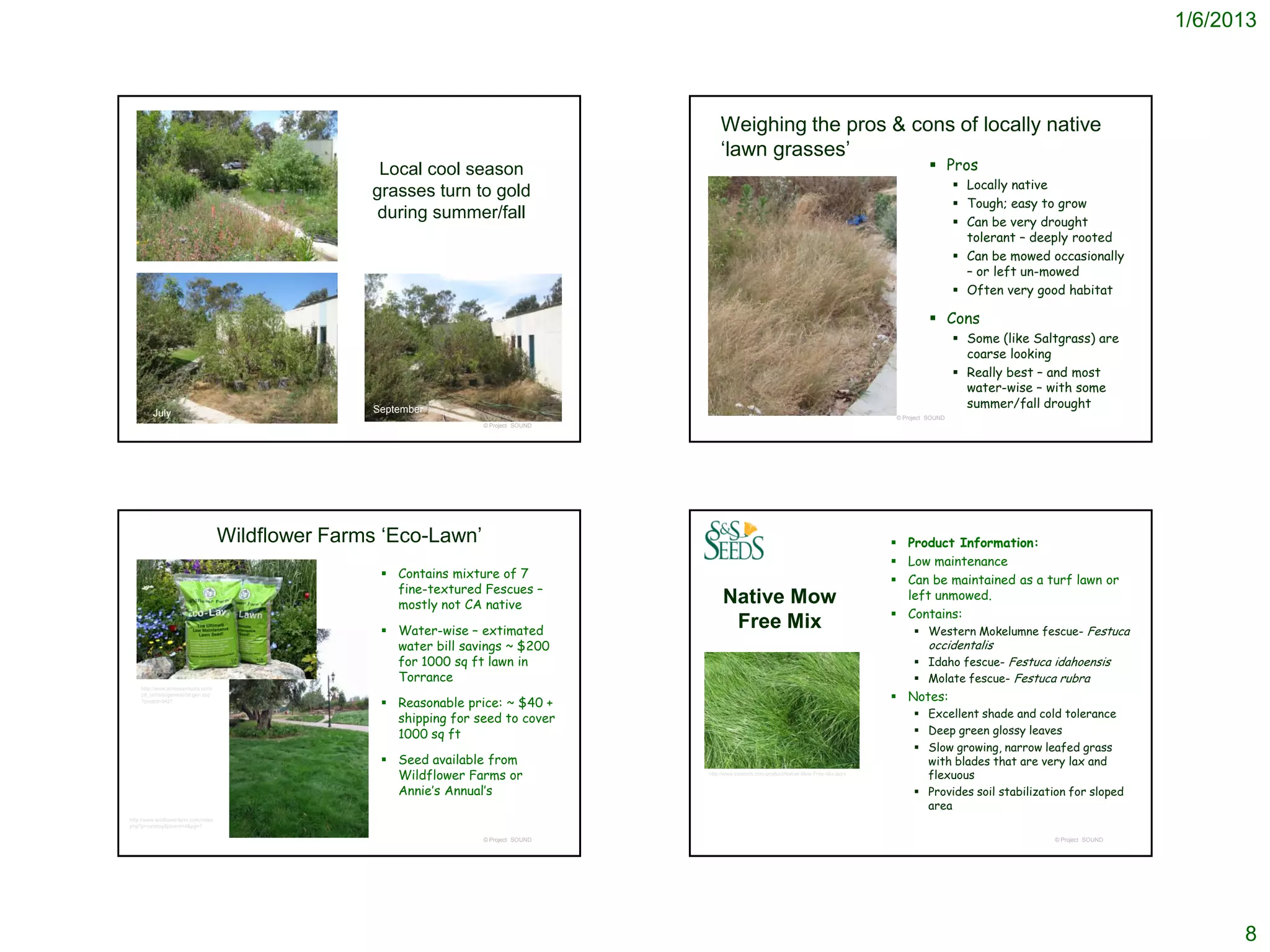
                                                                                              Weighing the pros & cons of locally native
                                                                                              ‘lawn grasses’
                                                        Local cool season                                                                                      Pros
                                                                                                                                                                       Locally native
                                                       grasses turn to gold
                                                                                                                                                                       Tough; easy to grow
                                                        during summer/fall                                                                                             Can be very drought
                                                                                                                                                                        tolerant – deeply rooted
                                                                                                                                                                       Can be mowed occasionally
                                                                                                                                                                        – or left un-mowed
                                                                                                                                                                       Often very good habitat

                                                                                                                                                               Cons
                                                                                                                                                                       Some (like Saltgrass) are
                                                                                                                                                                        coarse looking
                                                                                                                                                                       Really best – and most
                                                                                                                                                                        water-wise – with some
                                                       September
                                                                                                                                                                        summer/fall drought
         July                                                                                                                                       © Project SOUND
                                                                        © Project SOUND


                                        Wildflower Farms ‘Eco-Lawn’                                                                                  Product Information:
                                                                                                                                                     Low maintenance
                                                         Contains mixture of 7                                                                      Can be maintained as a turf lawn or
                                                          fine-textured Fescues –                                                                     left unmowed.
                                                          mostly not CA native                 Native Mow
                                                                                                                                                     Contains:
                                                         Water-wise – extimated
                                                                                                Free Mix                                                Western Mokelumne fescue- Festuca
                                                          water bill savings ~ $200                                                                       occidentalis
                                                          for 1000 sq ft lawn in                                                                        Idaho fescue- Festuca idahoensis
                                                          Torrance                                                                                      Molate fescue- Festuca rubra
                                                                                                                                                     Notes:
    http://www.anniesannuals.com/
    plt_lst/lists/general/lst.gen.asp
    ?prodid=3421
                                                         Reasonable price: ~ $40 +
                                                          shipping for seed to cover                                                                      Excellent shade and cold tolerance
                                                          1000 sq ft                                                                                      Deep green glossy leaves
                                                                                                                                                          Slow growing, narrow leafed grass
                                                         Seed available from                                                                              with blades that are very lax and
                                                          Wildflower Farms or             http://www.ssseeds.com/product/Native-Mow-Free-Mix.aspx
                                                                                                                                                           flexuous
                                                          Annie’s Annual’s                                                                                Provides soil stabilization for sloped
                                                                                                                                                           area
http://www.wildflowerfarm.com/index.
php?p=catalog&parent=4&pg=1

                                                                        © Project SOUND                                                                                               © Project SOUND


                                                                                                                                                                                                              8
1/6/2013


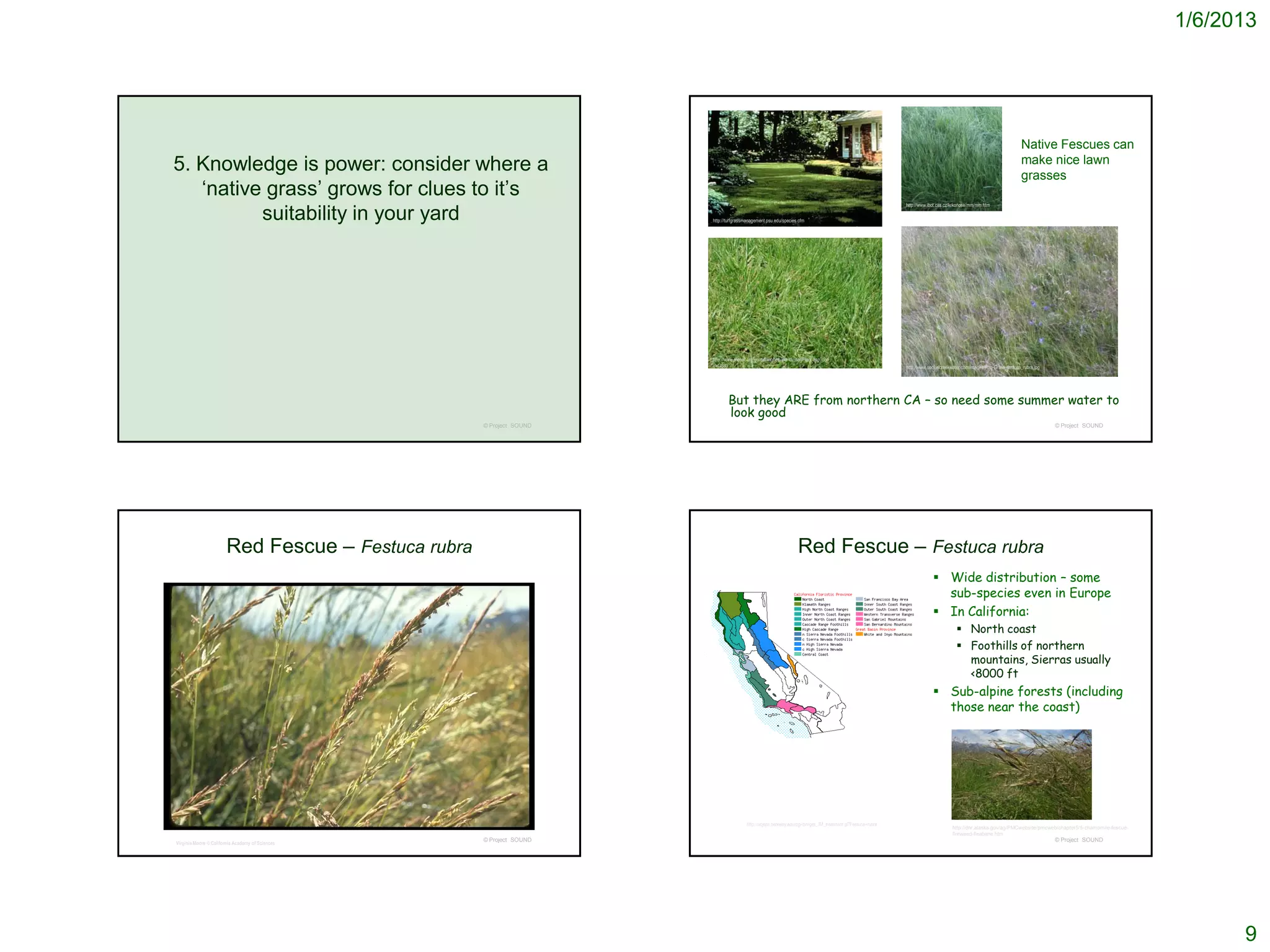
                                                                                                                                                                                                                      Native Fescues can
5. Knowledge is power: consider where a                                                                                                                                                                               make nice lawn
                                                                                                                                                                                                                      grasses
   ‘native grass’ grows for clues to it’s
                                                                                                                                                              http://www.ibot.cas.cz/krkonose/mm/mm.htm

          suitability in your yard                                    http://turfgrassmanagement.psu.edu/species.cfm


                                                                      http://www.mobot.org/gardeninghelp/plantfinder/Plant.asp?cod
                                                                      e=G880                                                                                  http://www.soquelcreekwater.com/images/Pho-Grass_festuca_rubra.jpg


                                                                             But they ARE from northern CA – so need some summer water to
                                                                             look good
                                                    © Project SOUND                                                                                                                                                                © Project SOUND


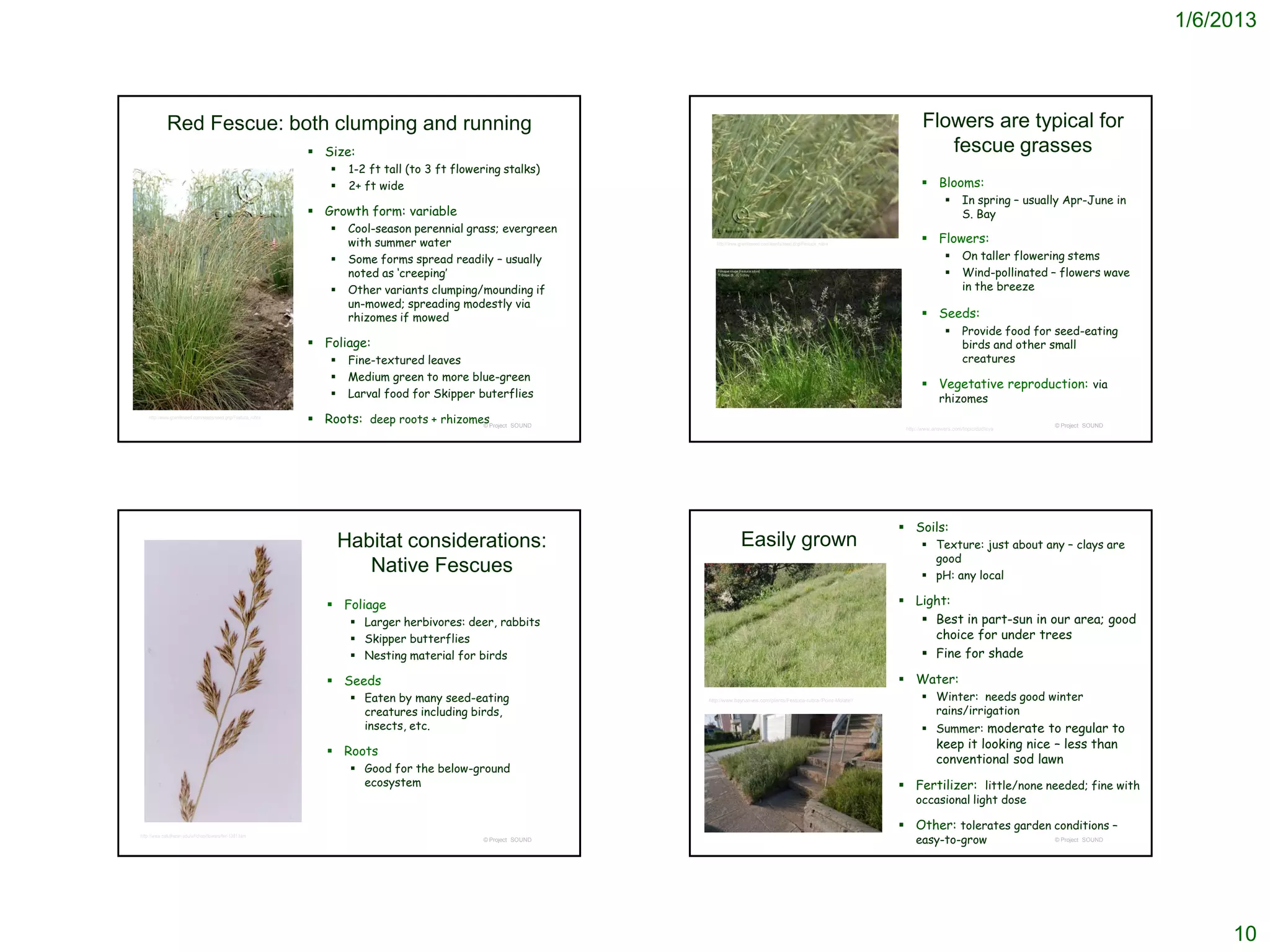
                       Red Fescue – Festuca rubra                                                                 Red Fescue – Festuca rubra
                                                                                                                                                                            Wide distribution – some
                                                                                                                                                                             sub-species even in Europe
                                                                                                                                                                            In California:
                                                                                                                                                                                       North coast
                                                                                                                                                                                       Foothills of northern
                                                                                                                                                                                        mountains, Sierras usually
                                                                                                                                                                                        <8000 ft
                                                                                                                                                                            Sub-alpine forests (including
                                                                                                                                                                             those near the coast)


                                                                                       http://ucjeps.berkeley.edu/cgi-bin/get_JM_treatment.pl?Festuca+rubra
                                                                                                                                                                                    http://dnr.alaska.gov/ag/PMCwebsite/pmcweb/chapter5/5-chamomile-fescue-
                                                                                                                                                                                    fireweed-fleabane.htm
                                                    © Project SOUND                                                                                                                                                                © Project SOUND
Virginia Moore © California Academy of Sciences


                                                                                                                                                                                                                                                                    9
1/6/2013


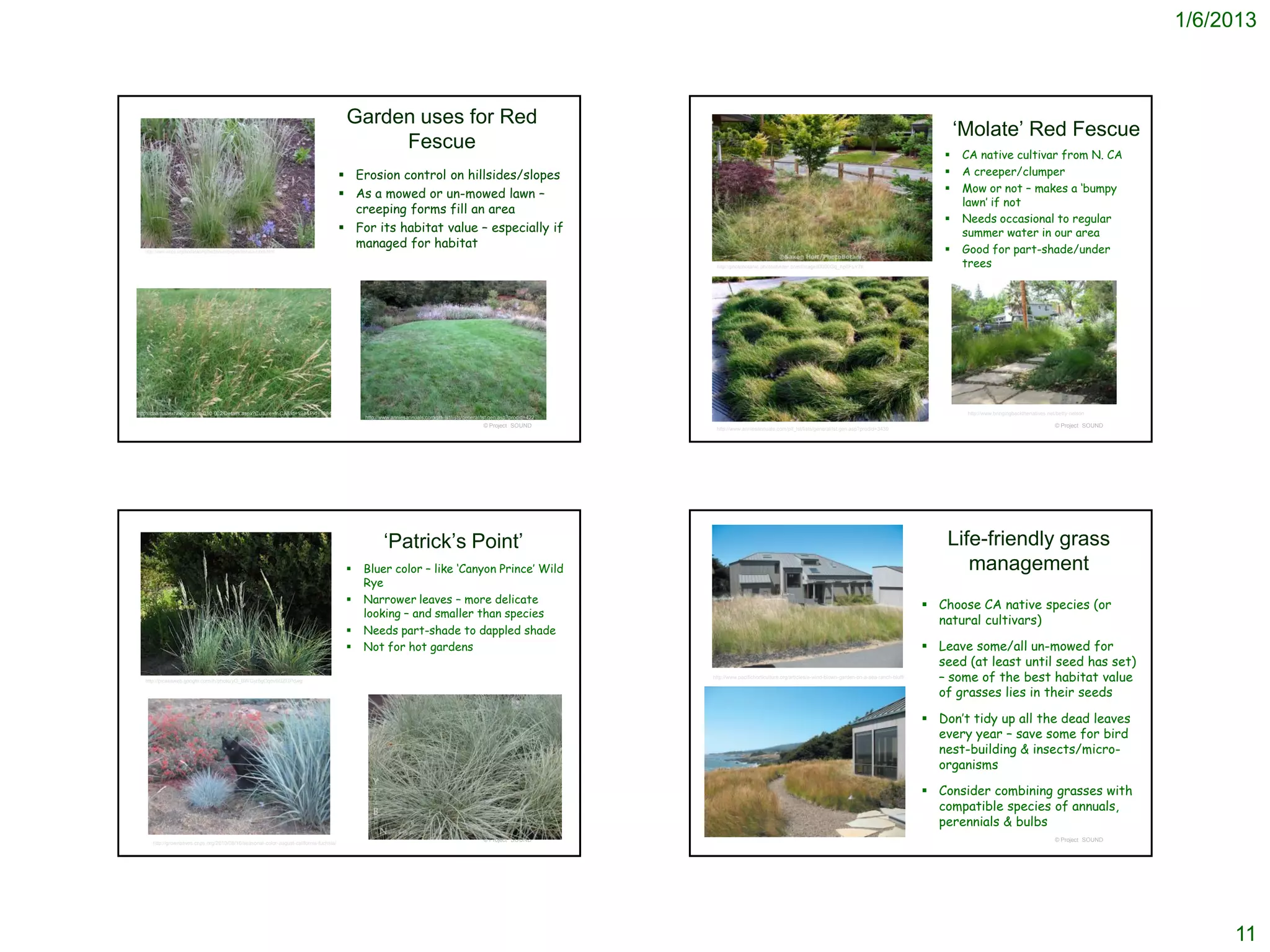
             Red Fescue: both clumping and running                                                                                                                                         Flowers are typical for
                                                               Size:                                                                                                                         fescue grasses
                                                                      1-2 ft tall (to 3 ft flowering stalks)
                                                                      2+ ft wide                                                                                                           Blooms:
                                                                                                                                                                                                           In spring – usually Apr-June in
                                                               Growth form: variable                                                                                                                       S. Bay
                                                                      Cool-season perennial grass; evergreen
                                                                       with summer water                              http://www.graniteseed.com/seeds/seed.php/Festuca_rubra
                                                                                                                                                                                            Flowers:
                                                                      Some forms spread readily – usually                                                                                                 On taller flowering stems
                                                                       noted as ‘creeping’                                                                                                                 Wind-pollinated – flowers wave
                                                                      Other variants clumping/mounding if                                                                                                  in the breeze
                                                                       un-mowed; spreading modestly via
                                                                       rhizomes if mowed                                                                                                    Seeds:
                                                                                                                                                                                                           Provide food for seed-eating
                                                               Foliage:                                                                                                                                    birds and other small
                                                                      Fine-textured leaves                                                                                                                 creatures
                                                                      Medium green to more blue-green
                                                                                                                                                                                            Vegetative reproduction: via
                                                                      Larval food for Skipper buterflies                                                                                         rhizomes
    http://www.graniteseed.com/seeds/seed.php/Festuca_rubra
                                                               Roots: deep roots + rhizomesProject SOUND
                                                                                           ©                                                                                                                                 © Project SOUND
                                                                                                                                                                                     http://www.answers.com/topic/dudleya


                                                                                                                                                                                     Soils:
                                                                      Habitat considerations:                                    Easily grown                                               Texture: just about any – clays are
                                                                                                                                                                                             good
                                                                         Native Fescues                                                                                                     pH: any local

                                                                  Foliage                                                                                                           Light:
                                                                        Larger herbivores: deer, rabbits                                                                               Best in part-sun in our area; good
                                                                        Skipper butterflies                                                                                             choice for under trees
                                                                        Nesting material for birds                                                                                     Fine for shade

                                                                  Seeds                                                                                                             Water:
                                                                        Eaten by many seed-eating                 http://www.baynatives.com/plants/Festuca-rubra-'Point-Molate'/           Winter: needs good winter
                                                                         creatures including birds,                                                                                          rains/irrigation
                                                                         insects, etc.                                                                                                      Summer: moderate to regular to
                                                                                                                                                                                                 keep it looking nice – less than
                                                                  Roots
                                                                                                                                                                                                 conventional sod lawn
                                                                        Good for the below-ground
                                                                         ecosystem                                                                                                   Fertilizer: little/none needed; fine with
                                                                                                                                                                                         occasional light dose

                                                                                                                                                                                     Other: tolerates garden conditions –
                                                                                                                                                                                         easy-to-grow
http://www.callutheran.edu/wf/chap/flowers/fwr-1381.htm
                                                                                                 © Project SOUND                                                                                                             © Project SOUND


                                                                                                                                                                                                                                                    10
1/6/2013


                                                                                          Garden uses for Red
                                                                                                                                                                                                                                                                         ‘Molate’ Red Fescue
                                                                                               Fescue
                                                                                                                                                                                                                                                                        CA native cultivar from N. CA
                                                                                          Erosion control on hillsides/slopes                                                                                                                                          A creeper/clumper
                                                                                          As a mowed or un-mowed lawn –                                                                                                                                                Mow or not – makes a ‘bumpy
                                                                                                                                                                                                                                                                         lawn’ if not
                                                                                           creeping forms fill an area
                                                                                                                                                                                                                                                                        Needs occasional to regular
                                                                                          For its habitat value – especially if                                                                                                                                         summer water in our area
   http://www.wnps.org/landscaping/herbarium/pages/festuca-rubra.html
                                                                                           managed for habitat                                                                                                                                                          Good for part-shade/under
                                                                                                                                                                           http://photobotanic.photoshelter.com/image/I0000Gq_hp6FuY7k                                   trees


http://daamaaextweb.gnb.ca/010-002/Details.aspx?Culture=fr-CA&Id=194&Pid=1884                                                                                                                                                                                             http://www.bringingbackthenatives.net/betty-nelson
                                                                                              http://www.anniesannuals.com/plt_lst/lists/general/lst.gen.asp?prodid=422
                                                                                                                                                 © Project SOUND                                                                                                                                               © Project SOUND
                                                                                                                                                                           http://www.anniesannuals.com/plt_lst/lists/general/lst.gen.asp?prodid=3439


                                                                                                     ‘Patrick’s Point’                                                                                                                                                Life-friendly grass
                                                                                             Bluer color – like ‘Canyon Prince’ Wild                                                                                                                                    management
                                                                                              Rye
                                                                                             Narrower leaves – more delicate                                                                                                                                      Choose CA native species (or
                                                                                              looking – and smaller than species
                                                                                                                                                                                                                                                                    natural cultivars)
                                                                                             Needs part-shade to dappled shade
                                                                                             Not for hot gardens                                                                                                                                                  Leave some/all un-mowed for
                                                                                                                                                                                                                                                                    seed (at least until seed has set)
   http://picasaweb.google.com/lh/photo/yG_BWGyr5gCqdv6QZGPdwg
                                                                                                                                                                          http://www.pacifichorticulture.org/articles/a-wind-blown-garden-on-a-sea-ranch-bluff/     – some of the best habitat value
                                                                                                                                                                                                                                                                    of grasses lies in their seeds

                                                                                                                                                                                                                                                                   Don’t tidy up all the dead leaves
                                                                                                                                                                                                                                                                    every year – save some for bird
                                                                                                                                                                                                                                                                    nest-building & insects/micro-
                                                                                                                                                                                                                                                                    organisms

                                                                                                                                                                                                                                                                   Consider combining grasses with
                                                                                                                                                                                                                                                                    compatible species of annuals,
                                                                                                                                                                                                                                                                    perennials & bulbs
                                                                                                                                                 © Project SOUND                                                                                                                                               © Project SOUND
      http://grownatives.cnps.org/2010/08/16/seasonal-color-august-california-fuchsia/


                                                                                                                                                                                                                                                                                                                                      11
1/6/2013


                                                                                                                                    Some bunchgrasses combine the traits of
                                                                                                                                      bunching and sod-forming grasses

                                                                                                                                                                                                                    Some Fescues [Example:
                                                                                                                                                                                                                      Festuca rubra – Red Fescue]
                                                                                             Red Fescue managed for
Carex pansa with Nassella tenuissima (Mexican Feather Grass) and Muhlenbergia rigens (Deer
Grass)
                                                                                             habitat                                                                                                                Bentgrasses (Agrostis)
#holt_829_520


                                                                                                                                                                                                                    Wild Ryes (Elymus;
© Saxon Holt


      http://www.saxonholt.com/webgalleries/Harris_StockPhotos/link3.html                                                                                                                                            Lymus)
                                                                                                                              http://geoimages.berkeley.edu/geoImages/BainCalif/CAL400/BUNGRASS.HTML

                                                                                                                                                                                                                    Gramma grasses
                                                                                                                              These grasses are often used both                                                      (Bouteloua)
                                                                                                                              as ornamental grasses (specimen
                                                                                                                              plants) as well as for natural ‘lawns’                                                Native Bluegrass (Poa)
                                                                                                                              (mowed or un-mowed)

                                                                                                         © Project SOUND                                                                                                                  © Project SOUND


    Idaho Fescue/Blue Bunchgrass – Festuca idahoensis                                                                      Idaho Fescue: useful in shady areas – or with
                                                                                                                           regular water
                                                                                                                                                                                                            Soils:
                                                                                                                                                                                                               Texture: any well-drained soil, but
                                                                                                                                                                                                                prefer sandy; not salt-tolerant
                                                                                                                                                                                                               pH: any local

                                                                                                                                                                                                            Light: extremely adaptable
                                                                                                                                                                                                               Best in part-shade in most gardens;
                                                                                                                                                                                                                fine under trees, shrubs, north-facing
                                                                                                                                                                                                               Full sun in cool gardens only

                                                                                                                                                                                                            Water: extremely adaptable
                                                                                                                                                                                                               Young plants: keep well-watered (Zone
                                                                                                                                                                                                                2-3 tapering to 2) until established (1
                                                                                                                                                                                                                year)
                                                                                                                                                                                                               Summer: Zone 1-2 (will turn golden) to
                                                                                                                                                                                                                Zone 2-3 (fairly regular)
                                                                                                                           http://biology.burke.washington.edu/herbarium/imagecollection.php?Genus=Festu

                                                                                                                                                                                                            Fertilizer: very tolerant
                                                                                                                           ca&Species=idahoensis
             USDA-NRCS PLANTS Database


                                                                                                         © Project SOUND                                                                                                                  © Project SOUND
       J.S. Peterson @ USDA-NRCS PLANTS Database


                                                                                                                                                                                                                                                                 12
1/6/2013


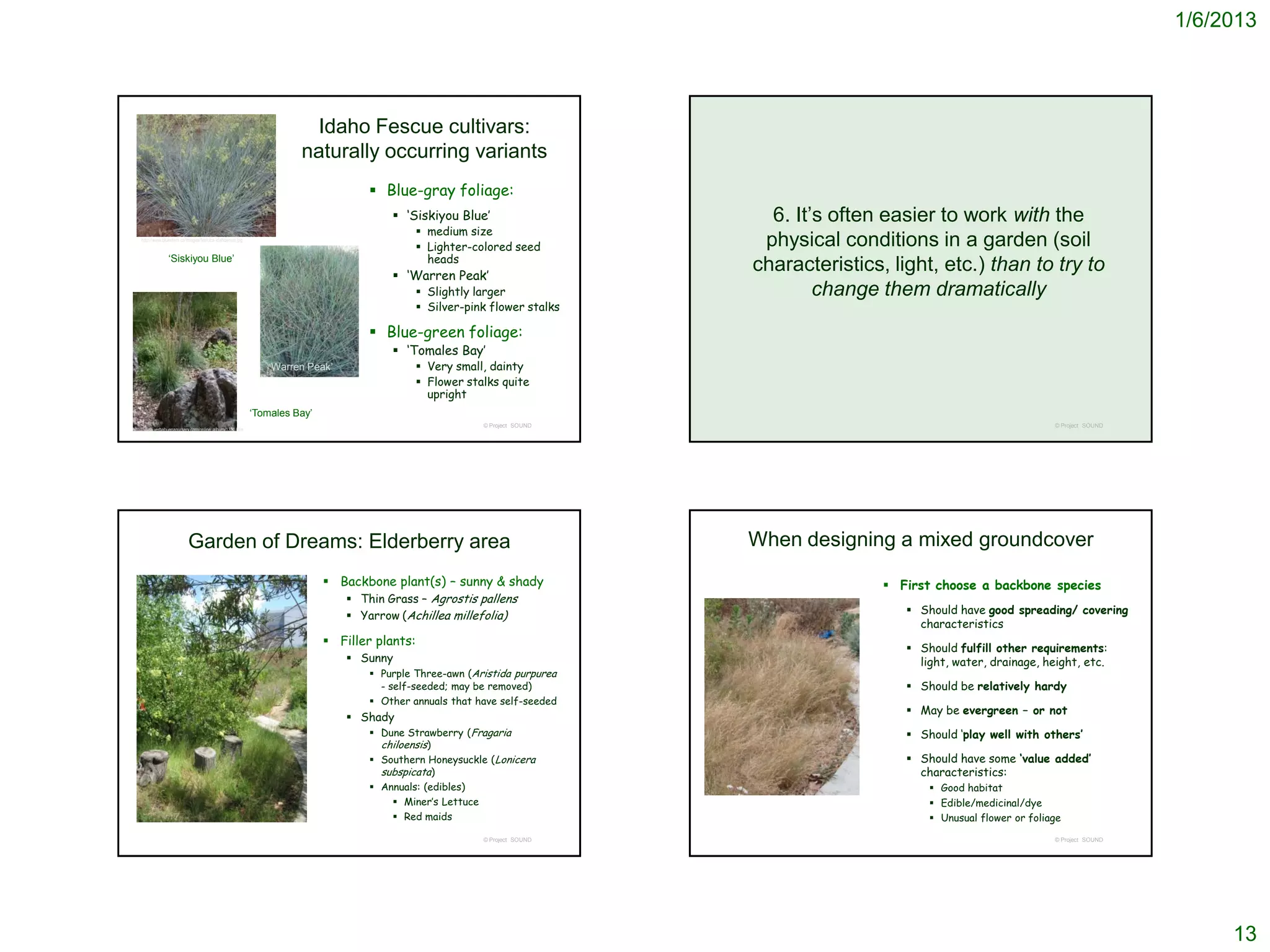
                                                                      Idaho Fescue cultivars:
                                                                     naturally occurring variants
                                                                                   Blue-gray foliage:
                                                                                        ‘Siskiyou Blue’                      6. It’s often easier to work with the
                                                                                               medium size
    http://www.bluestem.ca/images/festuca-idahoensis.jpg
                                                                                               Lighter-colored seed         physical conditions in a garden (soil
                 ‘Siskiyou Blue’                                                                heads
                                                                                        ‘Warren Peak’
                                                                                                                            characteristics, light, etc.) than to try to
                                                                                               Slightly larger                     change them dramatically
                                                                                               Silver-pink flower stalks

                                                                                   Blue-green foliage:
                                                                                        ‘Tomales Bay’
                                                               ‘Warren Peak’                   Very small, dainty
                                                                                               Flower stalks quite
                                                                                                upright
                                                           ‘Tomales Bay’
                                                                                                          © Project SOUND                                                   © Project SOUND
http://www.yerbabuenanursery.com/online_album/1311.htm


                            Garden of Dreams: Elderberry area                                                               When designing a mixed groundcover
                                                                            Backbone plant(s) – sunny & shady                               First choose a backbone species
                                                                               Thin Grass – Agrostis pallens
                                                                               Yarrow (Achillea millefolia)                                    Should have good spreading/ covering
                                                                                                                                                 characteristics
                                                                            Filler plants:
                                                                                                                                                Should fulfill other requirements:
                                                                                Sunny                                                           light, water, drainage, height, etc.
                                                                                    Purple Three-awn (Aristida purpurea
                                                                                     - self-seeded; may be removed)                             Should be relatively hardy
                                                                                    Other annuals that have self-seeded
                                                                                                                                                May be evergreen – or not
                                                                                Shady
                                                                                    Dune Strawberry (Fragaria                                  Should ‘play well with others’
                                                                                     chiloensis)
                                                                                    Southern Honeysuckle (Lonicera                             Should have some ‘value added’
                                                                                     subspicata)                                                 characteristics:
                                                                                    Annuals: (edibles)                                             Good habitat
                                                                                        Miner’s Lettuce                                            Edible/medicinal/dye
                                                                                        Red maids                                                  Unusual flower or foliage

                                                                                                          © Project SOUND                                                   © Project SOUND


                                                                                                                                                                                                   13
1/6/2013


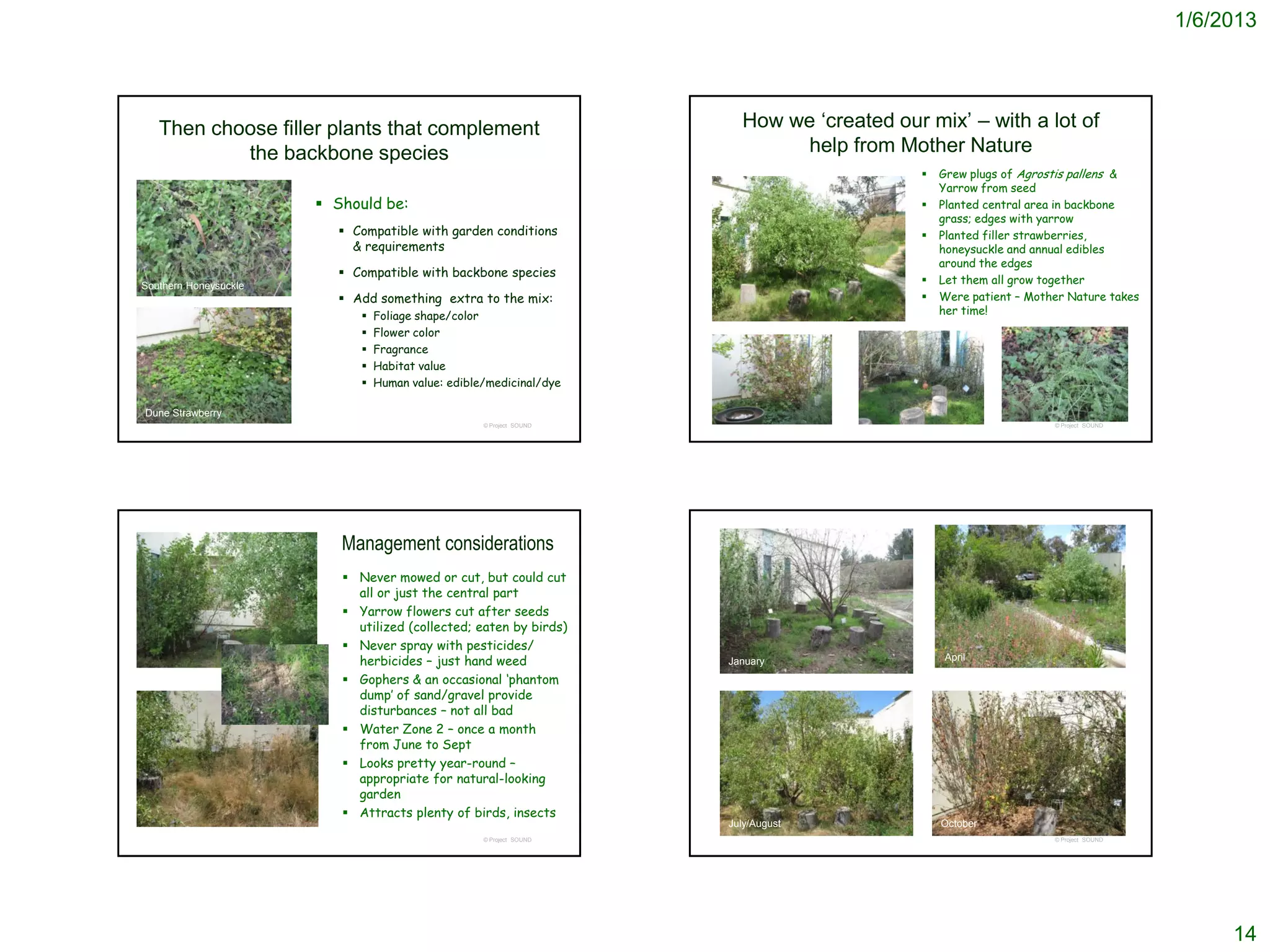
   Then choose filler plants that complement                            How we ‘created our mix’ – with a lot of
           the backbone species                                              help from Mother Nature
                                                                                               Grew plugs of Agrostis pallens &
                                                                                                Yarrow from seed
                        Should be:                                                            Planted central area in backbone
                                                                                                grass; edges with yarrow
                          Compatible with garden conditions                                   Planted filler strawberries,
                           & requirements                                                       honeysuckle and annual edibles
                                                                                                around the edges
                          Compatible with backbone species
Southern Honeysuckle
                                                                                               Let them all grow together
                          Add something extra to the mix:                                     Were patient – Mother Nature takes
                                Foliage shape/color                                            her time!
                                Flower color
                                Fragrance
                                Habitat value
                                Human value: edible/medicinal/dye

Dune Strawberry
                                                    © Project SOUND                                                © Project SOUND


                          Management considerations
                           Never mowed or cut, but could cut
                            all or just the central part
                           Yarrow flowers cut after seeds
                            utilized (collected; eaten by birds)
                           Never spray with pesticides/
                            herbicides – just hand weed               January                   April

                           Gophers & an occasional ‘phantom
                            dump’ of sand/gravel provide
                            disturbances – not all bad
                           Water Zone 2 – once a month
                            from June to Sept
                           Looks pretty year-round –
                            appropriate for natural-looking
                            garden
                           Attracts plenty of birds, insects
                                                                      July/August               October
                                                    © Project SOUND                                                © Project SOUND


                                                                                                                                          14
1/6/2013


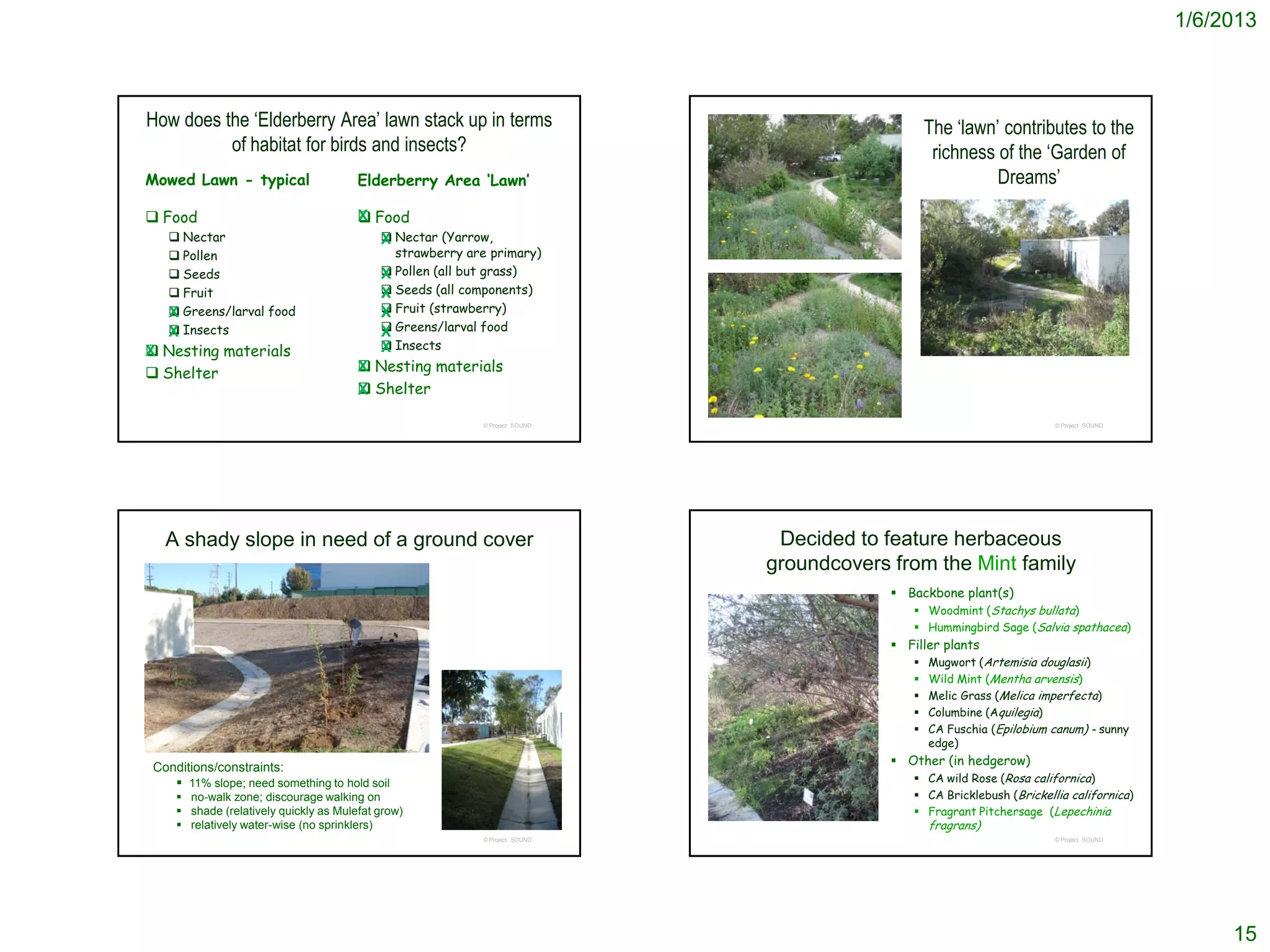
How does the ‘Elderberry Area’ lawn stack up in terms                                           The ‘lawn’ contributes to the
          of habitat for birds and insects?                                                      richness of the ‘Garden of
Mowed Lawn - typical                    Elderberry Area ‘Lawn’                                            Dreams’
 Food                                   Food
                                        X
    Nectar                                 Nectar (Yarrow,
                                           X
    Pollen                                   strawberry are primary)
    Seeds                                   Pollen (all but grass)
                                            X
    Fruit                                   Seeds (all components)
                                            X
   X Greens/larval food
                                            Fruit (strawberry)
                                            X
   X Insects
                                            Greens/larval food
                                            X
 Nesting materials
X                                            Insects
                                            X
 Shelter                                Nesting materials
                                        X
                                         Shelter
                                        X

                                                           © Project SOUND                                             © Project SOUND


   A shady slope in need of a ground cover                                    Decided to feature herbaceous
                                                                             groundcovers from the Mint family
                                                                                           Backbone plant(s)
                                                                                              Woodmint (Stachys bullata)
                                                                                              Hummingbird Sage (Salvia spathacea)
                                                                                           Filler plants
                                                                                              Mugwort (Artemisia douglasii)
                                                                                              Wild Mint (Mentha arvensis)
                                                                                              Melic Grass (Melica imperfecta)
                                                                                              Columbine (Aquilegia)
                                                                                              CA Fuschia (Epilobium canum) - sunny
                                                                                                edge)

 Conditions/constraints:                                                                   Other (in hedgerow)
     11% slope; need something to hold soil                                                  CA wild Rose (Rosa californica)
      no-walk zone; discourage walking on                                                    CA Bricklebush (Brickellia californica)
      shade (relatively quickly as Mulefat grow)                                             Fragrant Pitchersage (Lepechinia
      relatively water-wise (no sprinklers)                                                   fragrans)
                                                           © Project SOUND                                             © Project SOUND


                                                                                                                                              15
1/6/2013


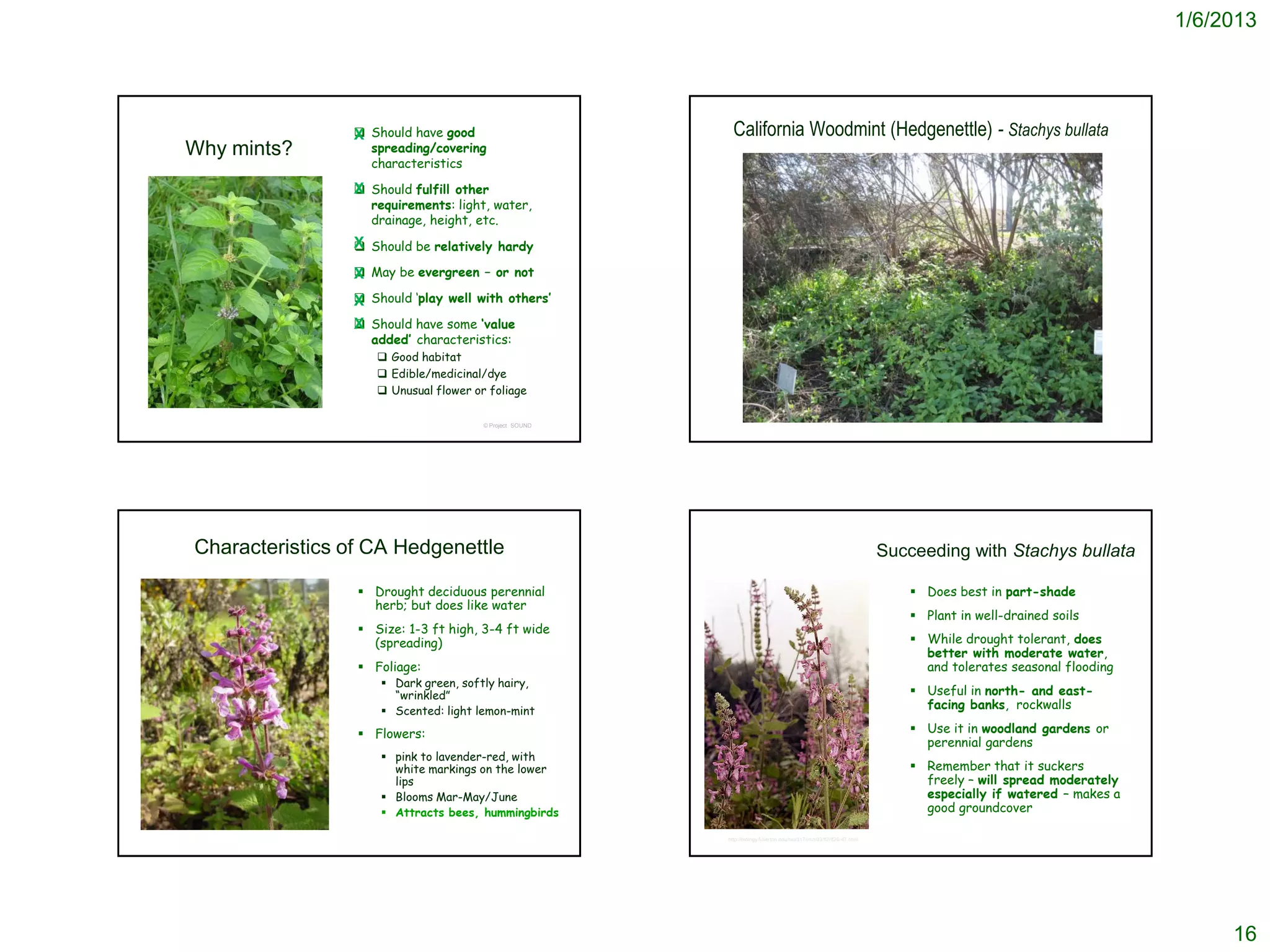
                 Should have good
                X                                          California Woodmint (Hedgenettle) - Stachys bullata
Why mints?         spreading/covering
                   characteristics

                 Should fulfill other
                X
                   requirements: light, water,
                   drainage, height, etc.

                 Should be relatively hardy
                X
                 May be evergreen – or not
                X
                 Should ‘play well with others’
                X
                 Should have some ‘value
                X
                   added’ characteristics:
                     Good habitat
                     Edible/medicinal/dye
                     Unusual flower or foliage

                                       © Project SOUND


Characteristics of CA Hedgenettle                                                                                       Succeeding with Stachys bullata

                  Drought deciduous perennial                                                                               Does best in part-shade
                   herb; but does like water
                                                                                                                             Plant in well-drained soils
                  Size: 1-3 ft high, 3-4 ft wide
                   (spreading)                                                                                               While drought tolerant, does
                                                                                                                              better with moderate water,
                  Foliage:                                                                                                   and tolerates seasonal flooding
                     Dark green, softly hairy,
                      “wrinkled”                                                                                             Useful in north- and east-
                     Scented: light lemon-mint                                                                               facing banks, rockwalls

                  Flowers:                                                                                                  Use it in woodland gardens or
                                                                                                                              perennial gardens
                     pink to lavender-red, with
                      white markings on the lower                                                                            Remember that it suckers
                      lips                                                                                                    freely – will spread moderately
                     Blooms Mar-May/June                                                                                     especially if watered – makes a
                     Attracts bees, hummingbirds                                                                             good groundcover

                                                         http://biology.fullerton.edu/biol317/im/s03/ft2/ft20-47.html


                                                                                                                                                                     16
1/6/2013


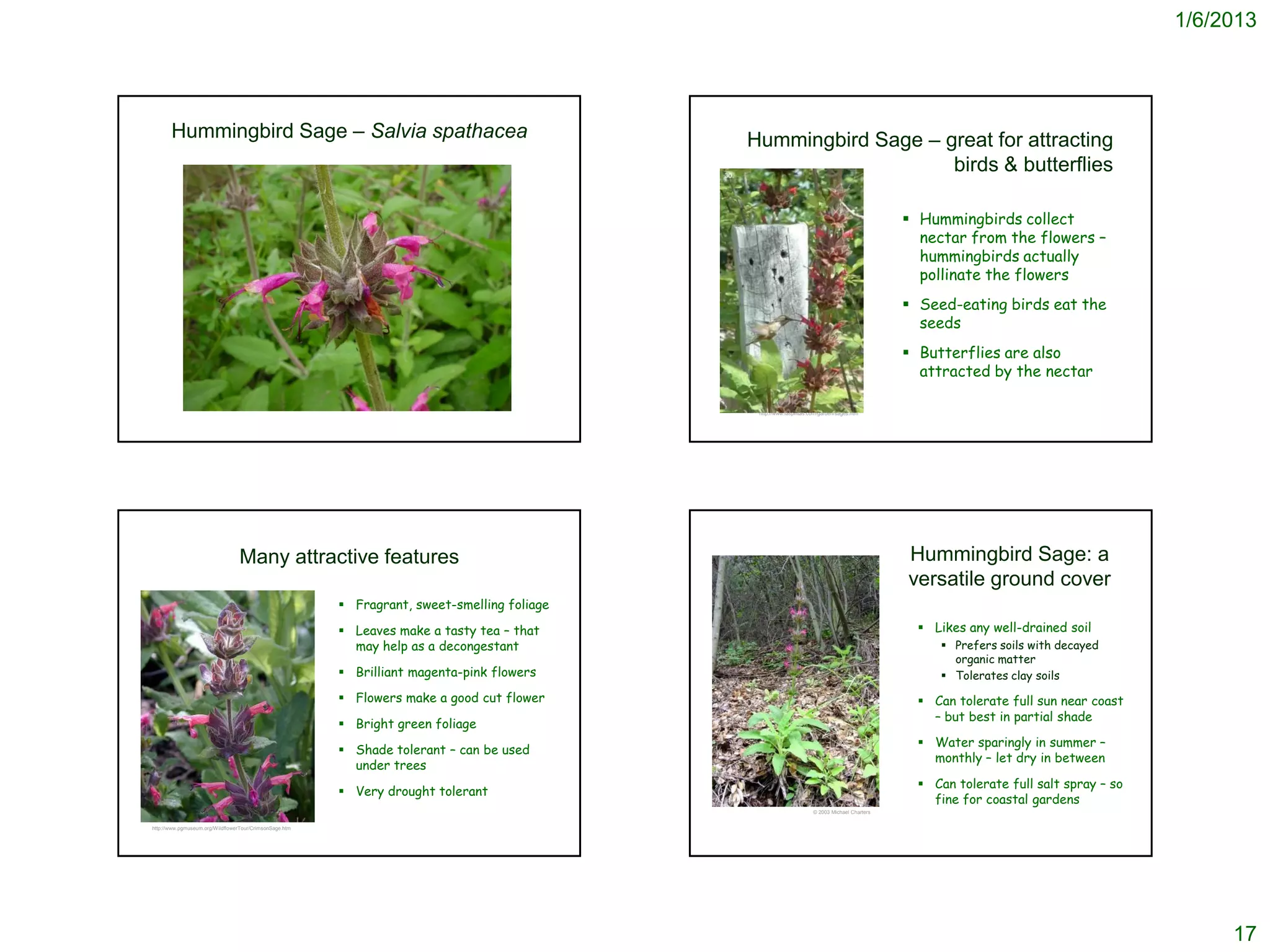
       Hummingbird Sage – Salvia spathacea                                                    Hummingbird Sage – great for attracting
                                                                                                                  birds & butterflies

                                                                                                                                                Hummingbirds collect
                                                                                                                                                 nectar from the flowers –
                                                                                                                                                 hummingbirds actually
                                                                                                                                                 pollinate the flowers
                                                                                                                                                Seed-eating birds eat the
                                                                                                                                                 seeds
                                                                                                                                                Butterflies are also
                                                                                                                                                 attracted by the nectar

                                                                                               http://www.laspilitas.com/garden/sages.htm


                                  Many attractive features                                                                                     Hummingbird Sage: a
                                                                                                                                               versatile ground cover
                                                          Fragrant, sweet-smelling foliage

                                                          Leaves make a tasty tea – that                                                         Likes any well-drained soil
                                                           may help as a decongestant                                                                Prefers soils with decayed
                                                                                                                                                      organic matter
                                                          Brilliant magenta-pink flowers                                                            Tolerates clay soils
                                                          Flowers make a good cut flower                                                         Can tolerate full sun near coast
                                                                                                                                                   – but best in partial shade
                                                          Bright green foliage
                                                                                                                                                  Water sparingly in summer –
                                                          Shade tolerant – can be used
                                                                                                                                                   monthly – let dry in between
                                                           under trees
                                                                                                                                                  Can tolerate full salt spray – so
                                                          Very drought tolerant
                                                                                                                                                   fine for coastal gardens
                                                                                                                     © 2003 Michael Charters


http://www.pgmuseum.org/WildflowerTour/CrimsonSage.htm


                                                                                                                                                                                            17
1/6/2013


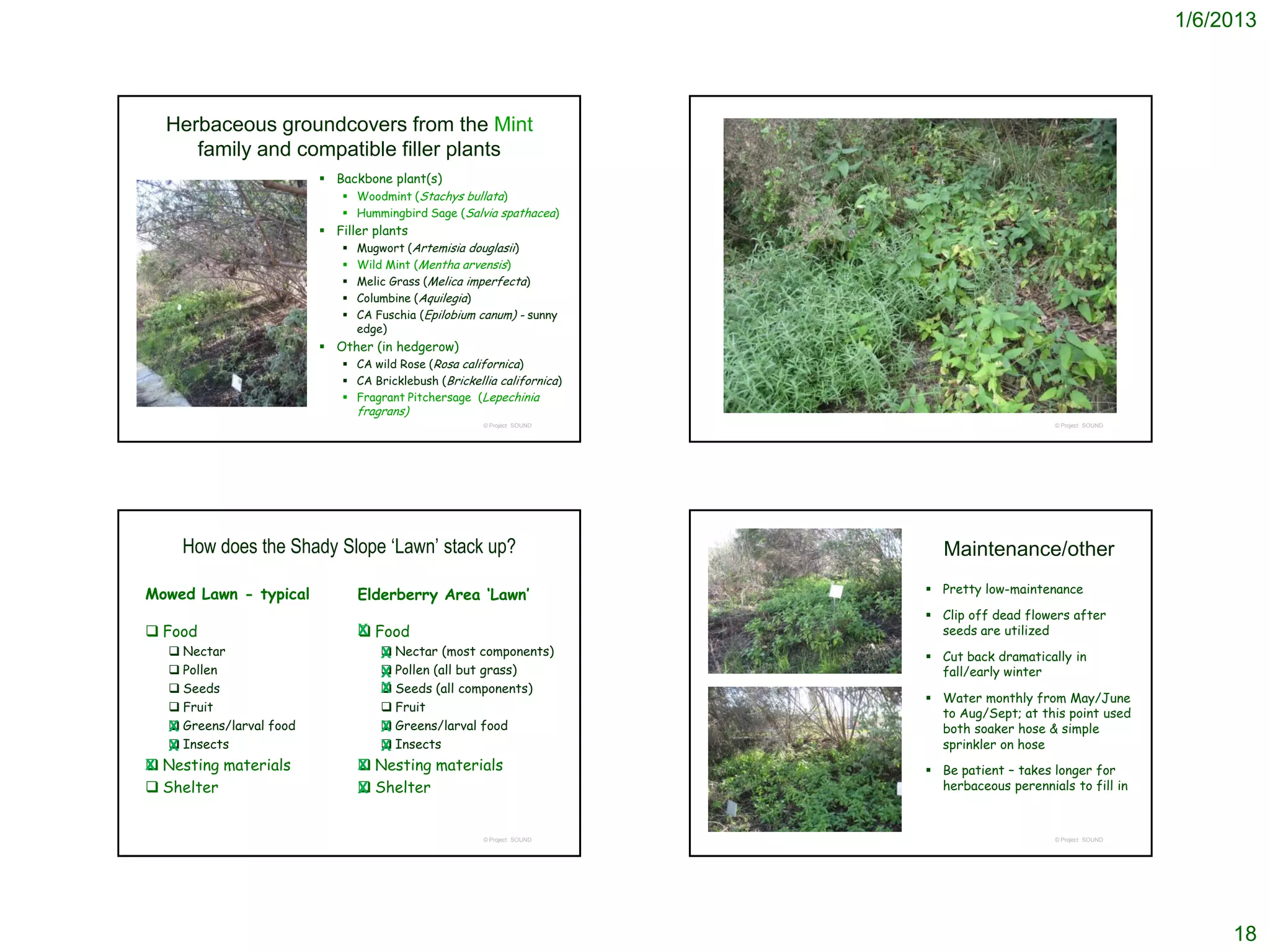
  Herbaceous groundcovers from the Mint
     family and compatible filler plants
                           Backbone plant(s)
                              Woodmint (Stachys bullata)
                              Hummingbird Sage (Salvia spathacea)
                           Filler plants
                              Mugwort (Artemisia douglasii)
                              Wild Mint (Mentha arvensis)
                              Melic Grass (Melica imperfecta)
                              Columbine (Aquilegia)
                              CA Fuschia (Epilobium canum) - sunny
                                edge)
                           Other (in hedgerow)
                              CA wild Rose (Rosa californica)
                              CA Bricklebush (Brickellia californica)
                              Fragrant Pitchersage (Lepechinia
                               fragrans)
                                                       © Project SOUND                        © Project SOUND


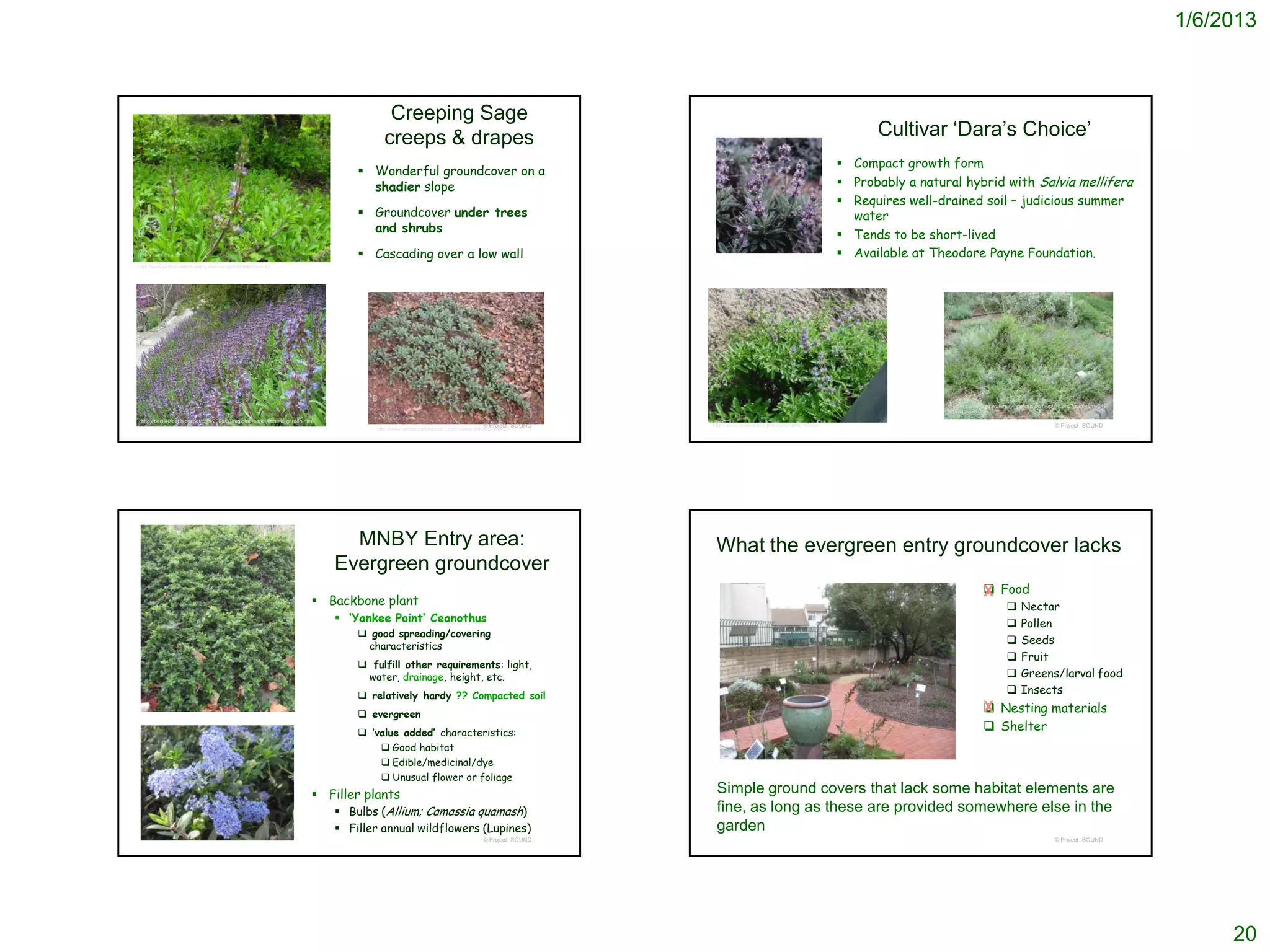
     How does the Shady Slope ‘Lawn’ stack up?                              Maintenance/other

Mowed Lawn - typical            Elderberry Area ‘Lawn’                    Pretty low-maintenance

                                                                          Clip off dead flowers after
 Food                           Food
                                X                                          seeds are utilized
    Nectar                         Nectar (most components)
                                   X                                      Cut back dramatically in
    Pollen                         Pollen (all but grass)
                                   X                                       fall/early winter
    Seeds                          Seeds (all components)
                                   X
                                                                          Water monthly from May/June
    Fruit                            Fruit                               to Aug/Sept; at this point used
   X Greens/larval food
                                     Greens/larval food
                                     X                                     both soaker hose & simple
   X Insects
                                     Insects
                                     X                                     sprinkler on hose
 Nesting materials
X                                Nesting materials
                                X                                         Be patient – takes longer for
 Shelter                        Shelter
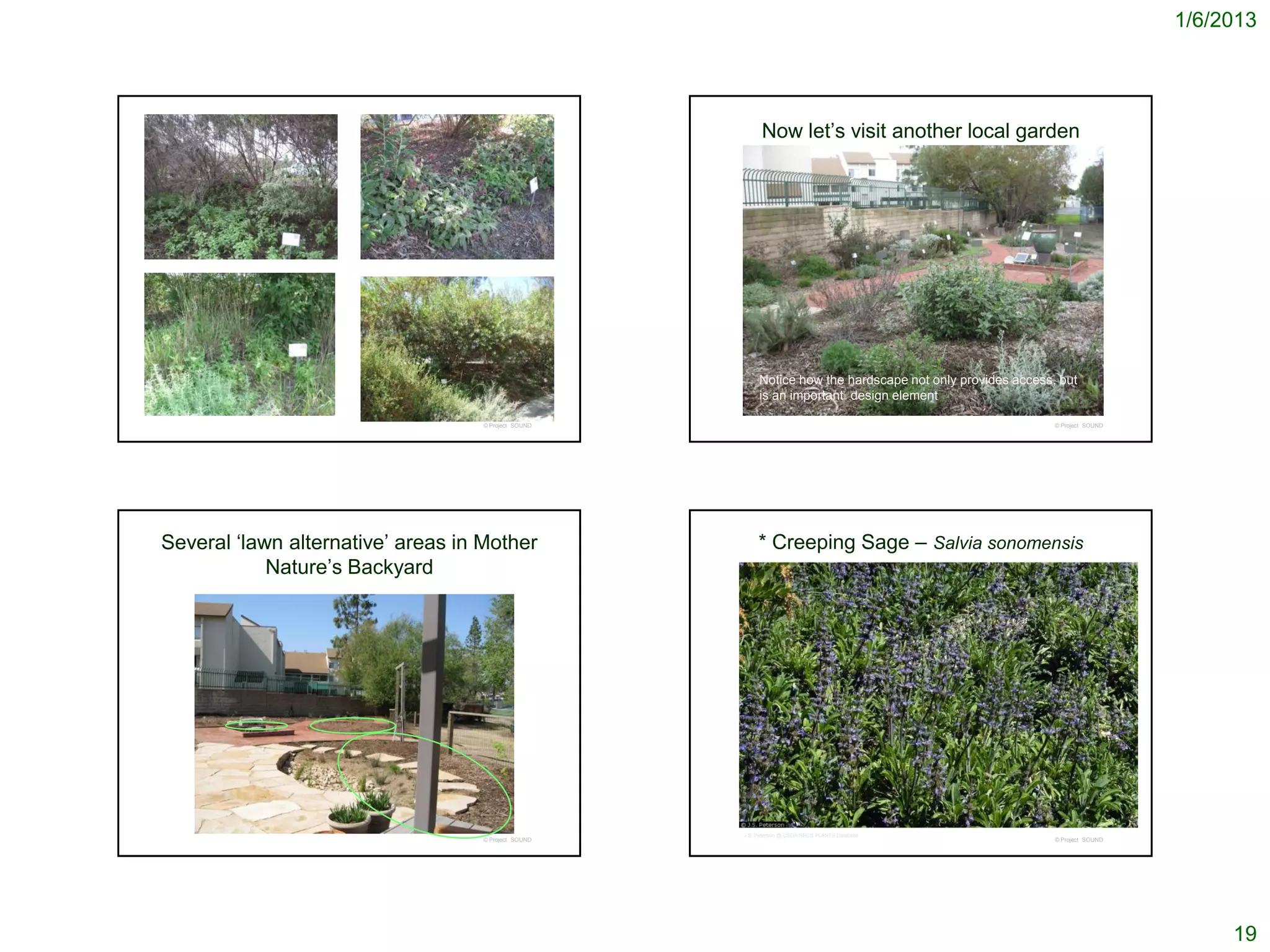
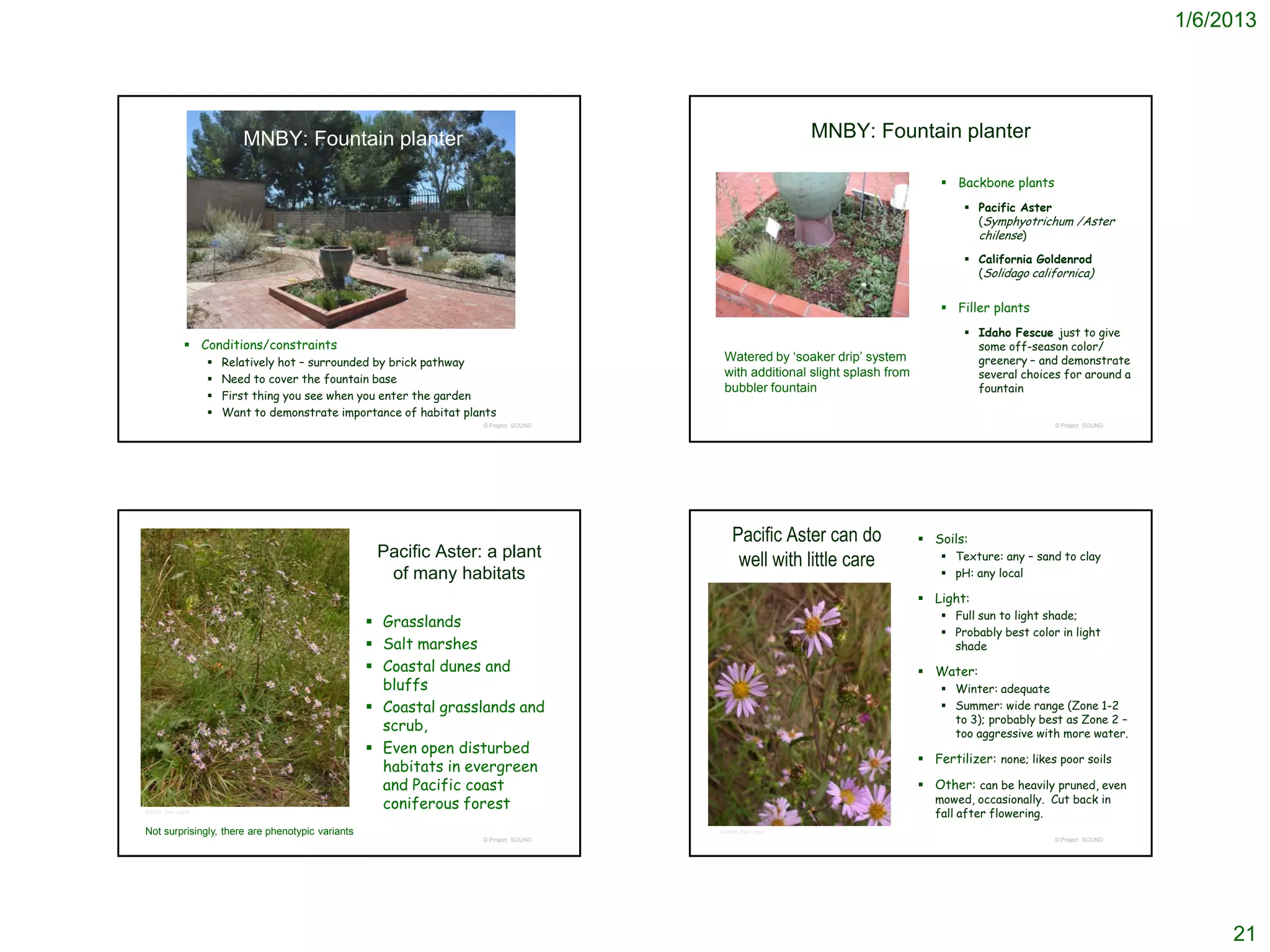
                                X                                          herbaceous perennials to fill in


                                                       © Project SOUND                        © Project SOUND


                                                                                                                     18
1/6/2013


                                                           Now let’s visit another local garden


                                                          Notice how the hardscape not only provides access, but
                                                          is an important design element

                                   © Project SOUND                                                          © Project SOUND


Several ‘lawn alternative’ areas in Mother                * Creeping Sage – Salvia sonomensis
            Nature’s Backyard


                                                     J.S. Peterson @ USDA-NRCS PLANTS Database
                                   © Project SOUND                                                          © Project SOUND


                                                                                                                                   19
1/6/2013


                                                                                       Creeping Sage
                                                                                      creeps & drapes                                                                                                 Cultivar ‘Dara’s Choice’
                                                                                                                                                                                                 Compact growth form
                                                                                  Wonderful groundcover on a
                                                                                   shadier slope                                                                                                 Probably a natural hybrid with Salvia mellifera
                                                                                                                                                                                                 Requires well-drained soil – judicious summer
                                                                                  Groundcover under trees                                                                                        water
                                                                                   and shrubs
                                                                                                                                                                                                 Tends to be short-lived
                                                                                  Cascading over a low wall                                                                                     Available at Theodore Payne Foundation.
http://www.yerbabuenanursery.com/viewplant.php?pid=33


                                                                                                                                                                                                                  http://www.ventura.watersavingplants.com/eplant.php?plantnum=242
                                                                                                                                                                                                                  95&return=b_aS
 http://back40feet.blogspot.com/2008/03/regional-parks-botanic-garden.html
                                                                                                                              © Project SOUND   http://ohric.ucdavis.edu/photos/ornament8.htm                                                                © Project SOUND
                                                                                    http://www.yerbabuenanursery.com/viewplant.php?pid=33


                                                                               MNBY Entry area:                                                  What the evergreen entry groundcover lacks
                                                                             Evergreen groundcover
                                                                                                                                                                                                                                 Food
                                                                                                                                                                                                                                X
                                                                          Backbone plant                                                                                                                                                     Nectar
                                                                              ‘Yankee Point‘ Ceanothus                                                                                                                                       Pollen
                                                                                  good spreading/covering
                                                                                  characteristics
                                                                                                                                                                                                                                              Seeds
                                                                                                                                                                                                                                              Fruit
                                                                                  fulfill other requirements: light,
                                                                                  water, drainage, height, etc.                                                                                                                               Greens/larval food
                                                                                  relatively hardy ?? Compacted soil
                                                                                                                                                                                                                                              Insects

                                                                                  evergreen
                                                                                                                                                                                                                                X Nesting materials
                                                                                                                                                                                                                                
                                                                                  ‘value added’ characteristics:
                                                                                                                                                                                                                                 Shelter
                                                                                      Good habitat
                                                                                      Edible/medicinal/dye
                                                                                      Unusual flower or foliage
                                                                          Filler plants                                                         Simple ground covers that lack some habitat elements are
                                                                             Bulbs (Allium; Camassia quamash)                                   fine, as long as these are provided somewhere else in the
                                                                              Filler annual wildflowers (Lupines)                               garden
                                                                                                                              © Project SOUND                                                                                                                © Project SOUND


                                                                                                                                                                                                                                                                                          20
1/6/2013


                            MNBY: Fountain planter                                                           MNBY: Fountain planter

                                                                                                                                   Backbone plants
                                                                                                                                       Pacific Aster
                                                                                                                                        (Symphyotrichum /Aster
                                                                                                                                        chilense)
                                                                                                                                       California Goldenrod
                                                                                                                                        (Solidago californica)


                                                                                                                                   Filler plants
                                                                                                                                       Idaho Fescue just to give
                Conditions/constraints                                                                                                 some off-season color/
                        Relatively hot – surrounded by brick pathway                    Watered by ‘soaker drip’ system                greenery – and demonstrate
                        Need to cover the fountain base
                                                                                         with additional slight splash from             several choices for around a
                                                                                         bubbler fountain                               fountain
                        First thing you see when you enter the garden
                        Want to demonstrate importance of habitat plants
                                                                      © Project SOUND                                                                  © Project SOUND


                                                                                            Pacific Aster can do               Soils:
                                                    Pacific Aster: a plant                   well with little care                 Texture: any – sand to clay
                                                     of many habitats                                                              pH: any local

                                                                                                                               Light:
                                                                                                                                   Full sun to light shade;
                                                   Grasslands
                                                                                                                                   Probably best color in light
                                                   Salt marshes                                                                    shade
                                                   Coastal dunes and                                                          Water:
                                                    bluffs                                                                         Winter: adequate
                                                   Coastal grasslands and                                                         Summer: wide range (Zone 1-2
                                                                                                                                    to 3); probably best as Zone 2 –
                                                    scrub,                                                                          too aggressive with more water.
                                                   Even open disturbed
                                                                                                                               Fertilizer: none; likes poor soils
                                                    habitats in evergreen
                                                    and Pacific coast                                                          Other: can be heavily pruned, even
                                                    coniferous forest                                                            mowed, occasionally. Cut back in
© 2004, Ben Legler
                                                                                                                                 fall after flowering.
Not surprisingly, there are phenotypic variants                                         © 2004, Ben Legler
                                                                      © Project SOUND                                                                  © Project SOUND


                                                                                                                                                                              21
1/6/2013


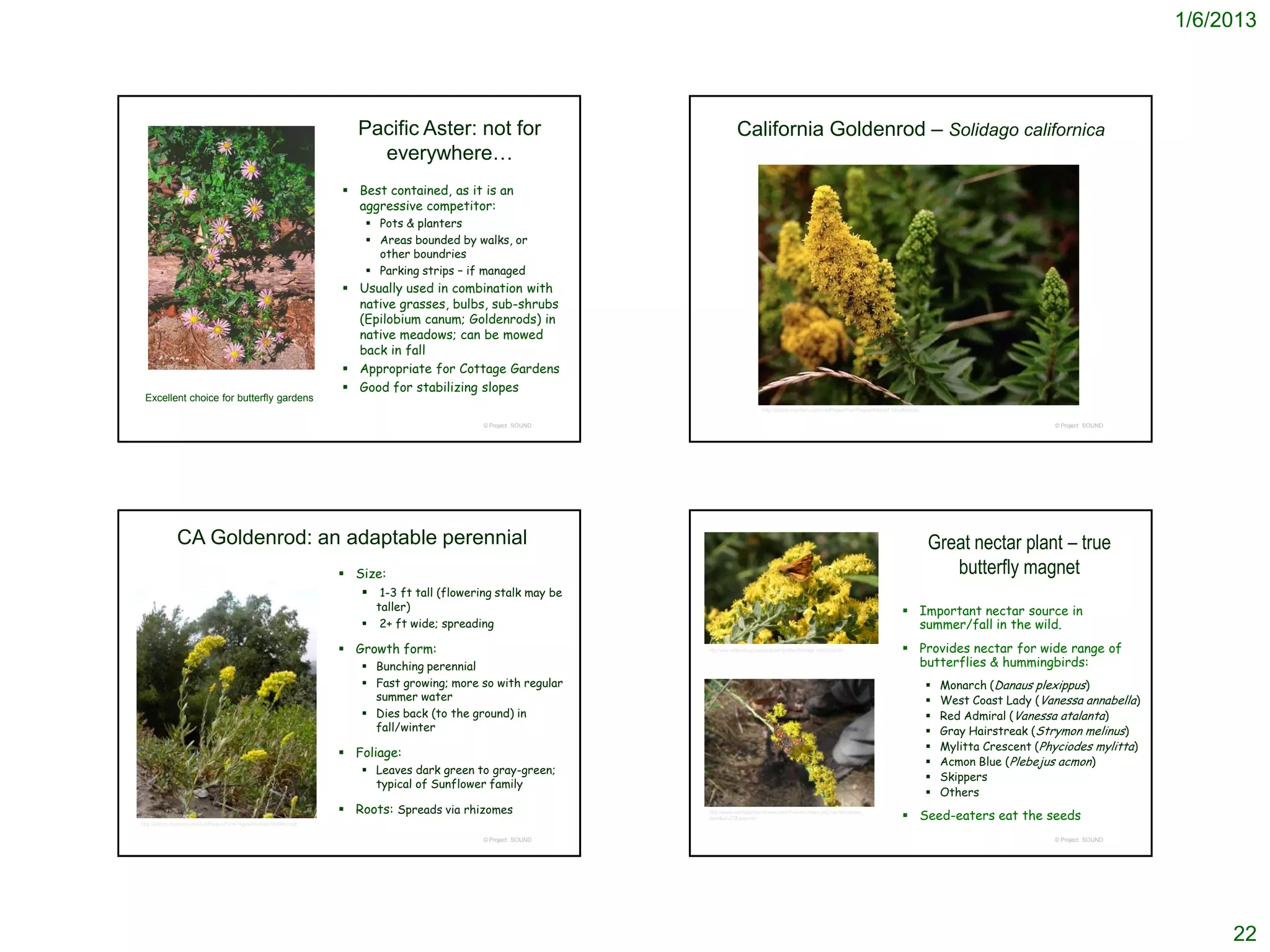
                                                                      Pacific Aster: not for                                   California Goldenrod – Solidago californica
                                                                        everywhere…
                                                                    Best contained, as it is an
                                                                     aggressive competitor:
                                                                        Pots & planters
                                                                        Areas bounded by walks, or
                                                                         other boundries
                                                                        Parking strips – if managed
                                                                    Usually used in combination with
                                                                     native grasses, bulbs, sub-shrubs
                                                                     (Epilobium canum; Goldenrods) in
                                                                     native meadows; can be mowed
                                                                     back in fall
      © 2005 Andrea Jesse
                                                                    Appropriate for Cottage Gardens
                                                                    Good for stabilizing slopes
 Excellent choice for butterfly gardens
                                                                                                                                             http://plants.montara.com/ListPages/FamPages/Astera7.html#solcan


                                                                                               © Project SOUND                                                                                                                          © Project SOUND


              CA Goldenrod: an adaptable perennial                                                                                                                                                              Great nectar plant – true
                                                                    Size:                                                                                                                                         butterfly magnet
                                                                       1-3 ft tall (flowering stalk may be
                                                                           taller)                                                                                                                     Important nectar source in
                                                                           2+ ft wide; spreading                                                                                                       summer/fall in the wild.
                                                                    Growth form:                                http://www.wildscaping.com/plants/plantprofiles/Solidago_californica.htm              Provides nectar for wide range of
                                                                        Bunching perennial                                                                                                             butterflies & hummingbirds:
                                                                        Fast growing; more so with regular                                                                                                        Monarch (Danaus plexippus)
                                                                         summer water                                                                                                                              West Coast Lady (Vanessa annabella)
                                                                        Dies back (to the ground) in                                                                                                              Red Admiral (Vanessa atalanta)
                                                                         fall/winter                                                                                                                               Gray Hairstreak (Strymon melinus)
                                                                                                                                                                                                                   Mylitta Crescent (Phyciodes mylitta)
                                                                    Foliage:
                                                                                                                                                                                                                   Acmon Blue (Plebejus acmon)
                                                                        Leaves dark green to gray-green;
                                                                                                                                                                                                                   Skippers
                                                                         typical of Sunflower family
                                                                                                                                                                                                                   Others
                                                                    Roots: Spreads via rhizomes                 http://www.santabarbarahikes.com/flowers/index.php?action=show_
                                                                                                                                                                                                       Seed-eaters eat the seeds
                                                                                                                 item&id=27&search=
http://plants.montara.com/ListPages/FamPages/Astera3.html#cirocc


                                                                                               © Project SOUND                                                                                                                          © Project SOUND


                                                                                                                                                                                                                                                                22
1/6/2013


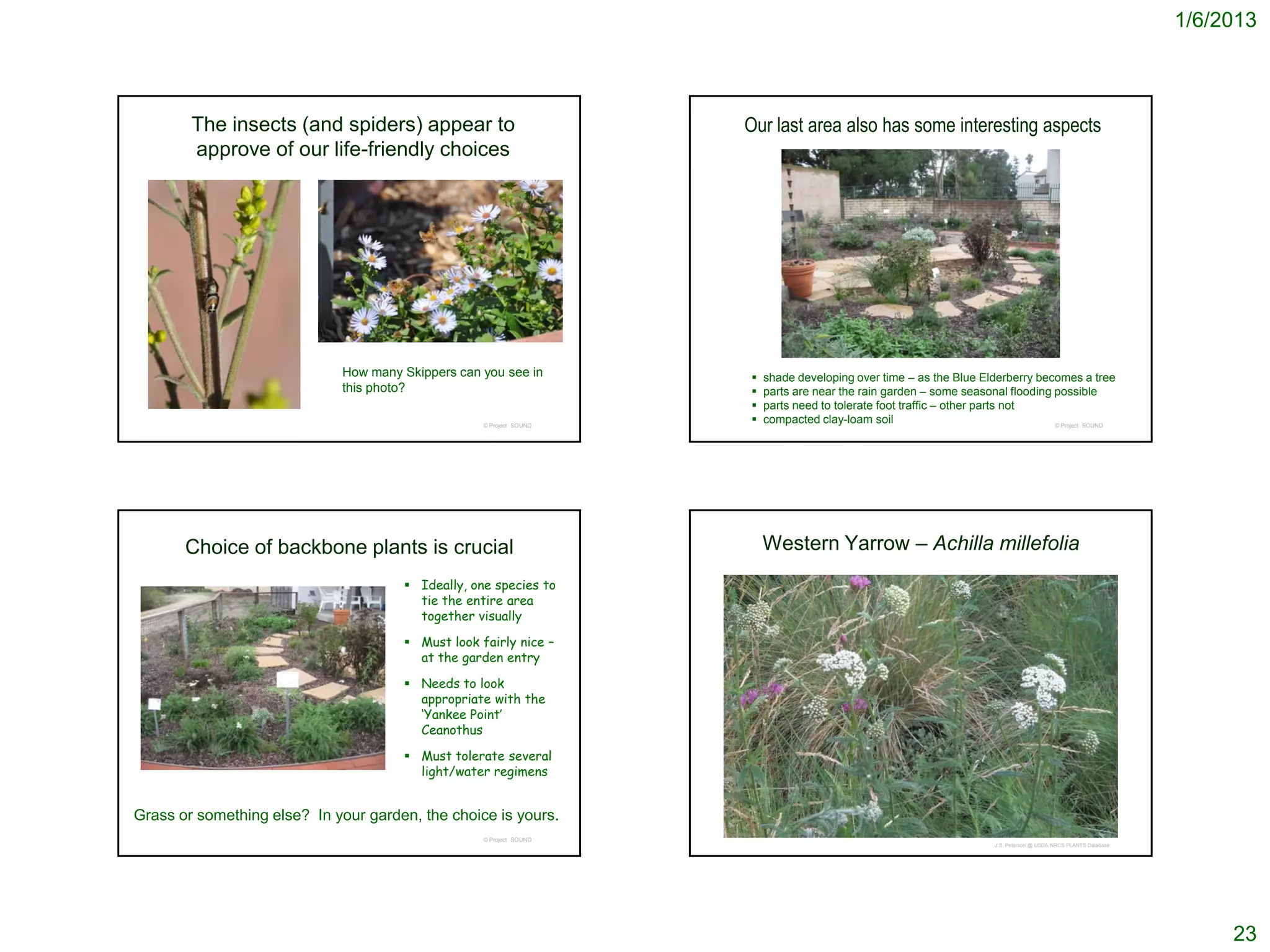
        The insects (and spiders) appear to                          Our last area also has some interesting aspects
        approve of our life-friendly choices


                             How many Skippers can you see in           shade developing over time – as the Blue Elderberry becomes a tree
                             this photo?                                parts are near the rain garden – some seasonal flooding possible
                                                                        parts need to tolerate foot traffic – other parts not
                                                   © Project SOUND
                                                                        compacted clay-loam soil                                © Project SOUND


       Choice of backbone plants is crucial                              Western Yarrow – Achilla millefolia
                                       Ideally, one species to
                                        tie the entire area
                                        together visually

                                       Must look fairly nice –
                                        at the garden entry

                                       Needs to look
                                        appropriate with the
                                        ‘Yankee Point’
                                        Ceanothus

                                       Must tolerate several
                                        light/water regimens


Grass or something else? In your garden, the choice is yours.
                                                   © Project SOUND
                                                                                                                       J.S. Peterson @ USDA-NRCS PLANTS Database


                                                                                                                                                                        23
1/6/2013


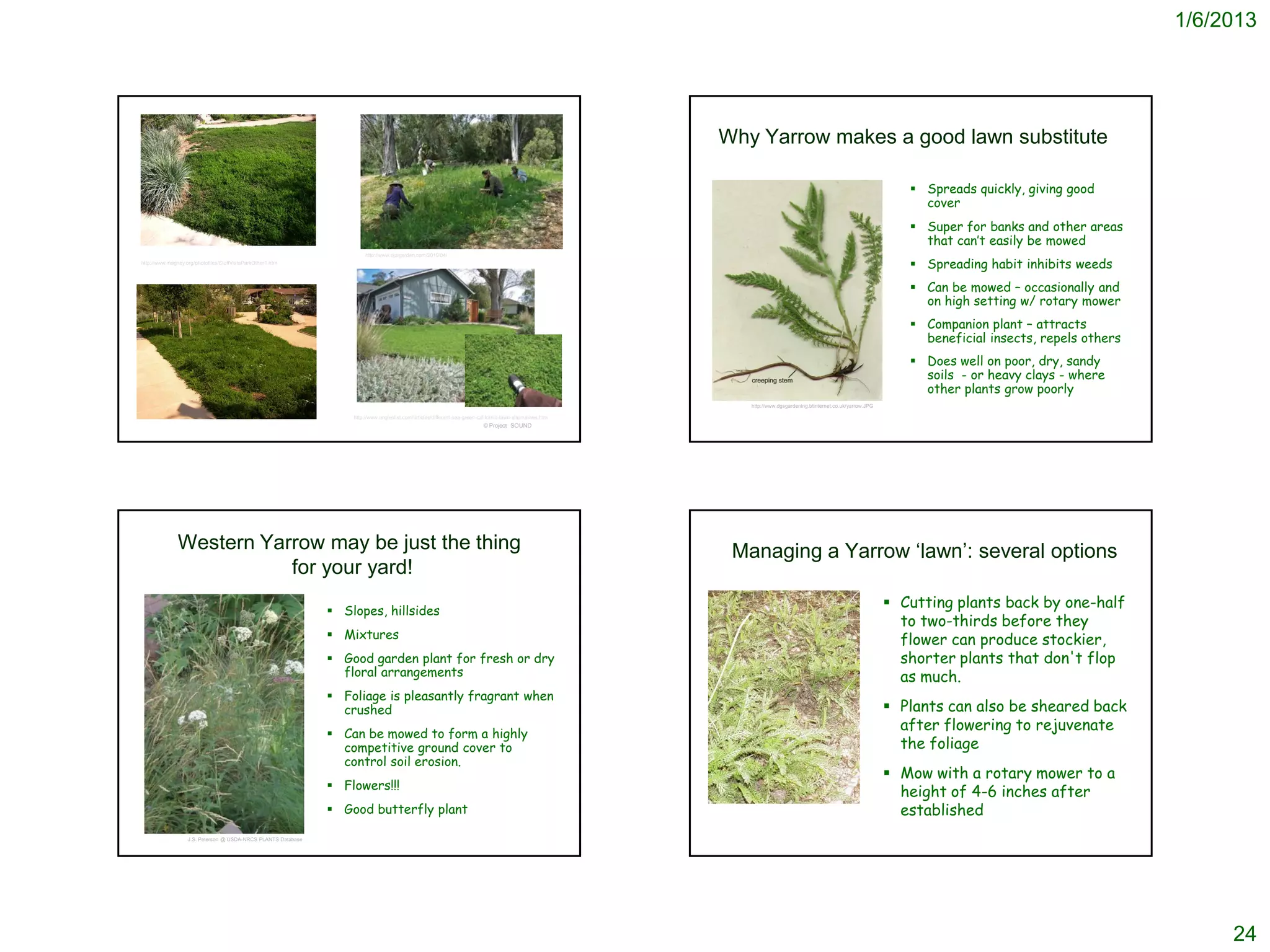
                                                                                                                                                             Why Yarrow makes a good lawn substitute

                                                                                                                                                                                                                          Spreads quickly, giving good
                                                                                                                                                                                                                           cover
                                                                                                                                                                                                                          Super for banks and other areas
                                                                                                                                                                                                                           that can’t easily be mowed
                                                                        http://www.ojaigarden.com/2010/04/
http://www.magney.org/photofiles/CluffVistaParkOther1.htm
                                                                                                                                                                                                                          Spreading habit inhibits weeds
                                                                                                                                                                                                                          Can be mowed – occasionally and
                                                                                                                                                                                                                           on high setting w/ rotary mower
                                                                                                                                                                                                                          Companion plant – attracts
                                                                                                                                                                                                                           beneficial insects, repels others
                                                                                                                                                                                                                          Does well on poor, dry, sandy
                                                                                                                                                                                                                           soils - or heavy clays - where
                                                                                                                                                                                                                           other plants grow poorly
                                                                                                                                                                http://www.dgsgardening.btinternet.co.uk/yarrow.JPG

                                                                   http://www.angieslist.com/articles/different-sea-green-california-lawn-alternatives.htm
                                                                                                                             © Project SOUND


               Western Yarrow may be just the thing                                                                                                           Managing a Yarrow ‘lawn’: several options
                          for your yard!

                                                                Slopes, hillsides
                                                                                                                                                                                                                       Cutting plants back by one-half
                                                                                                                                                                                                                        to two-thirds before they
                                                                Mixtures                                                                                                                                               flower can produce stockier,
                                                                Good garden plant for fresh or dry                                                                                                                     shorter plants that don't flop
                                                                 floral arrangements                                                                                                                                    as much.
                                                                Foliage is pleasantly fragrant when
                                                                 crushed                                                                                                                                               Plants can also be sheared back
                                                                                                                                                                                                                        after flowering to rejuvenate
                                                                Can be mowed to form a highly
                                                                 competitive ground cover to                                                                                                                            the foliage
                                                                 control soil erosion.
                                                                                                                                                                                                                       Mow with a rotary mower to a
                                                                Flowers!!!
                                                                                                                                                                                                                        height of 4-6 inches after
                                                                Good butterfly plant                                                                                                                                   established
                   J.S. Peterson @ USDA-NRCS PLANTS Database


                                                                                                                                                                                                                                                                    24
1/6/2013


           Yarrow has importance in many cultures                                                                 MNBY: around the Elderberry & rain garden
                                                                                                                                  Backbone plant(s)
                                                            Medicinal
                                                                                                                                     Yarrow (Achillea millefolia) – sunny &
                                                            Young leaves can be used in salads – have a                               shady areas
                                                             peppery flavor                                                           Woodmint (Stachys bullata) – shady
                                                                                                                                       areas
                                                            Mystical uses:                                                           Catalina Perfume (Ribes viburnifolium) –
                                                               It was once associated with evil, as evidenced                         shady areas; no-walk area at back of bed
        http://www.viable-                                      by its alternative names Devil's Nettle,                          Filler plants
                                                                Devil's Plaything, and Bad Man's Plaything,
        herbal.com/singles/herbs/s585.htm


                                                                                                                                      Sun/part-sun
                                                                and was used in spells.
                                                                                                                                            Salty Susan
                                                               In France and Ireland, people wanting to be
                                                                                                                                            Blue-eyed grass
                                                                more clairvoyant hold Yarrow over their eyes.
                                                                                                                                            Carex
                                                               Dried stalks were used to throw the I Ching,
                                                                                                                                            Juncus
                                                                an ancient Chinese system for guidance and
                                                                wisdom.                                                               Shady
                                                                                                                                          Strawberry
                                                               The Druids used Yarrow stems to foretell the
                                                                                                                                          Melic grass
                                                                weather.
http://www.ceres-co.com/store/images/products/yarrow.jpg
                                                                                                                                          Southern and Purple native Honeysuckles
                                                                                                                                                                    © Project SOUND


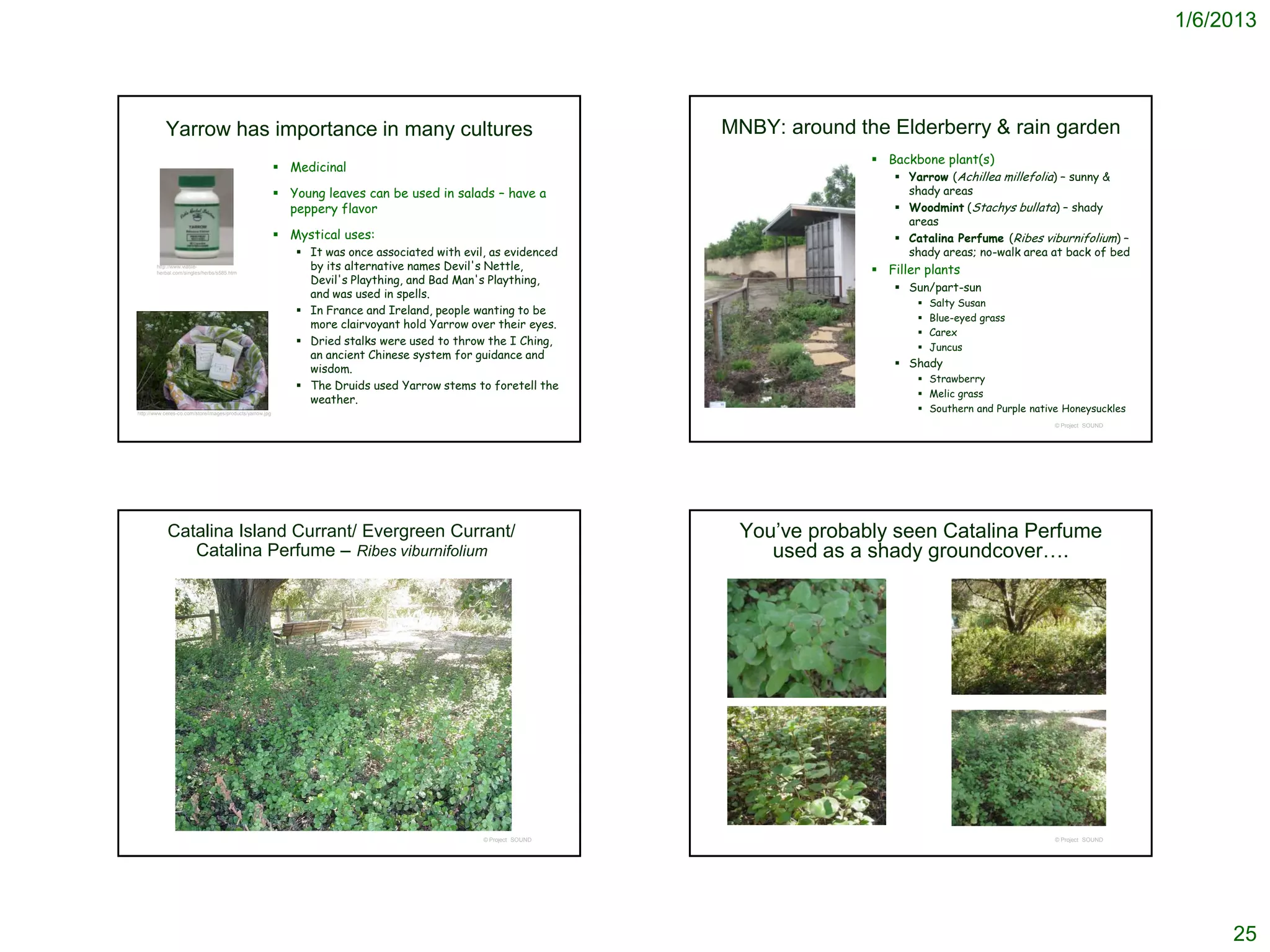
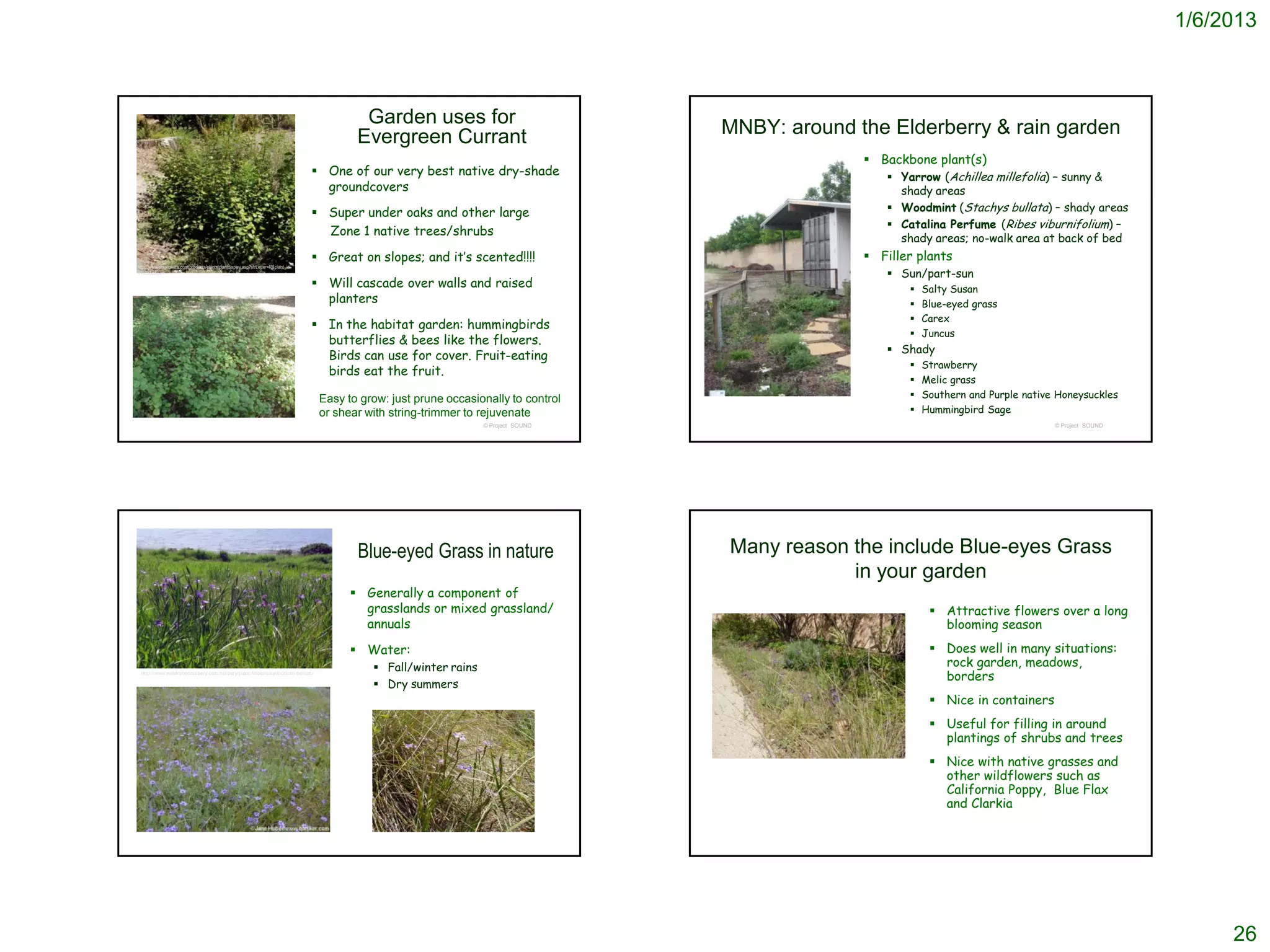
            Catalina Island Currant/ Evergreen Currant/                                                            You’ve probably seen Catalina Perfume
               Catalina Perfume – Ribes viburnifolium                                                                 used as a shady groundcover….


                                                                                                © Project SOUND                                                     © Project SOUND


                                                                                                                                                                                           25
1/6/2013


                                                                                          Garden uses for
                                                                                         Evergreen Currant                           MNBY: around the Elderberry & rain garden
                                                                                                                                                    Backbone plant(s)
                                                                                  One of our very best native dry-shade                               Yarrow (Achillea millefolia) – sunny &
                                                                                   groundcovers                                                          shady areas
                                                                                  Super under oaks and other large                                     Woodmint (Stachys bullata) – shady areas
                                                                                                                                                        Catalina Perfume (Ribes viburnifolium) –
                                                                                   Zone 1 native trees/shrubs
                                                                                                                                                         shady areas; no-walk area at back of bed
                                                                                  Great on slopes; and it’s scented!!!!                            Filler plants
http://www.smgrowers.com/products/plants/plantdisplay.asp?strLetter=R&plant_id
=1363&page=                                                                                                                                             Sun/part-sun
                                                                                  Will cascade over walls and raised                                         Salty Susan
                                                                                   planters                                                                   Blue-eyed grass
                                                                                                                                                              Carex
                                                                                  In the habitat garden: hummingbirds
                                                                                                                                                              Juncus
                                                                                   butterflies & bees like the flowers.
                                                                                                                                                        Shady
                                                                                   Birds can use for cover. Fruit-eating
                                                                                                                                                              Strawberry
                                                                                   birds eat the fruit.
                                                                                                                                                              Melic grass
                                                                                  Easy to grow: just prune occasionally to control                            Southern and Purple native Honeysuckles
                                                                                  or shear with string-trimmer to rejuvenate                                  Hummingbird Sage
                                                                                                                  © Project SOUND                                                        © Project SOUND


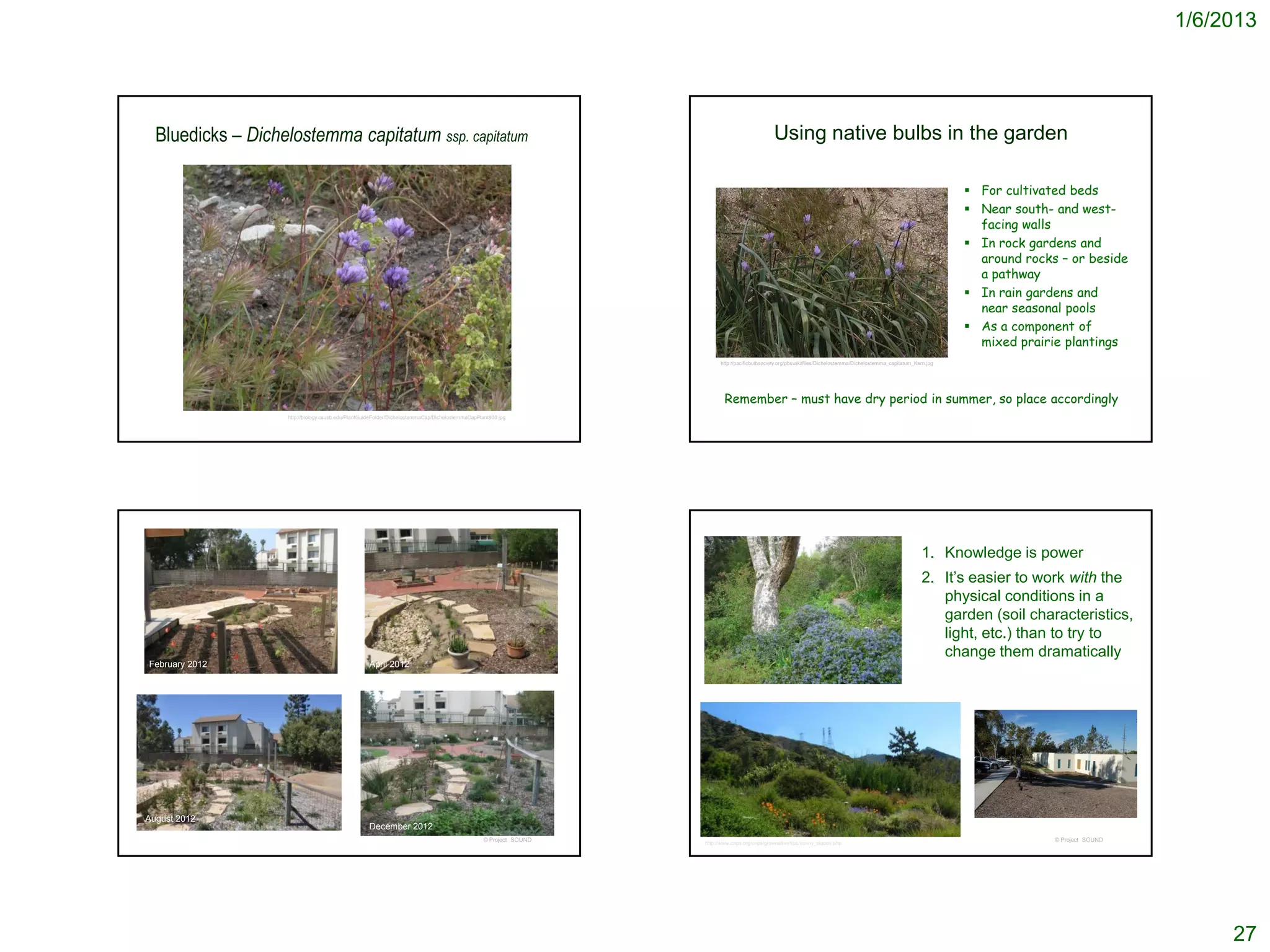
                                                                                         Blue-eyed Grass in nature                   Many reason the include Blue-eyes Grass
                                                                                                                                                 in your garden
                                                                                         Generally a component of
                                                                                          grasslands or mixed grassland/                                         Attractive flowers over a long
                                                                                          annuals                                                                 blooming season
                                                                                         Water:                                                                 Does well in many situations:
                                                                                             Fall/winter rains                                                   rock garden, meadows,
 http://www.watershednursery.com/nursery/plant-finder/sisyrinchium-bellum/
                                                                                                                                                                  borders
                                                                                             Dry summers
                                                                                                                                                                 Nice in containers
                                                                                                                                                                 Useful for filling in around
                                                                                                                                                                  plantings of shrubs and trees
                                                                                                                                                                 Nice with native grasses and
                                                                                                                                                                  other wildflowers such as
                                                                                                                                                                  California Poppy, Blue Flax
                                                                                                                                                                  and Clarkia


                                                                                                                                                                                                                26
1/6/2013


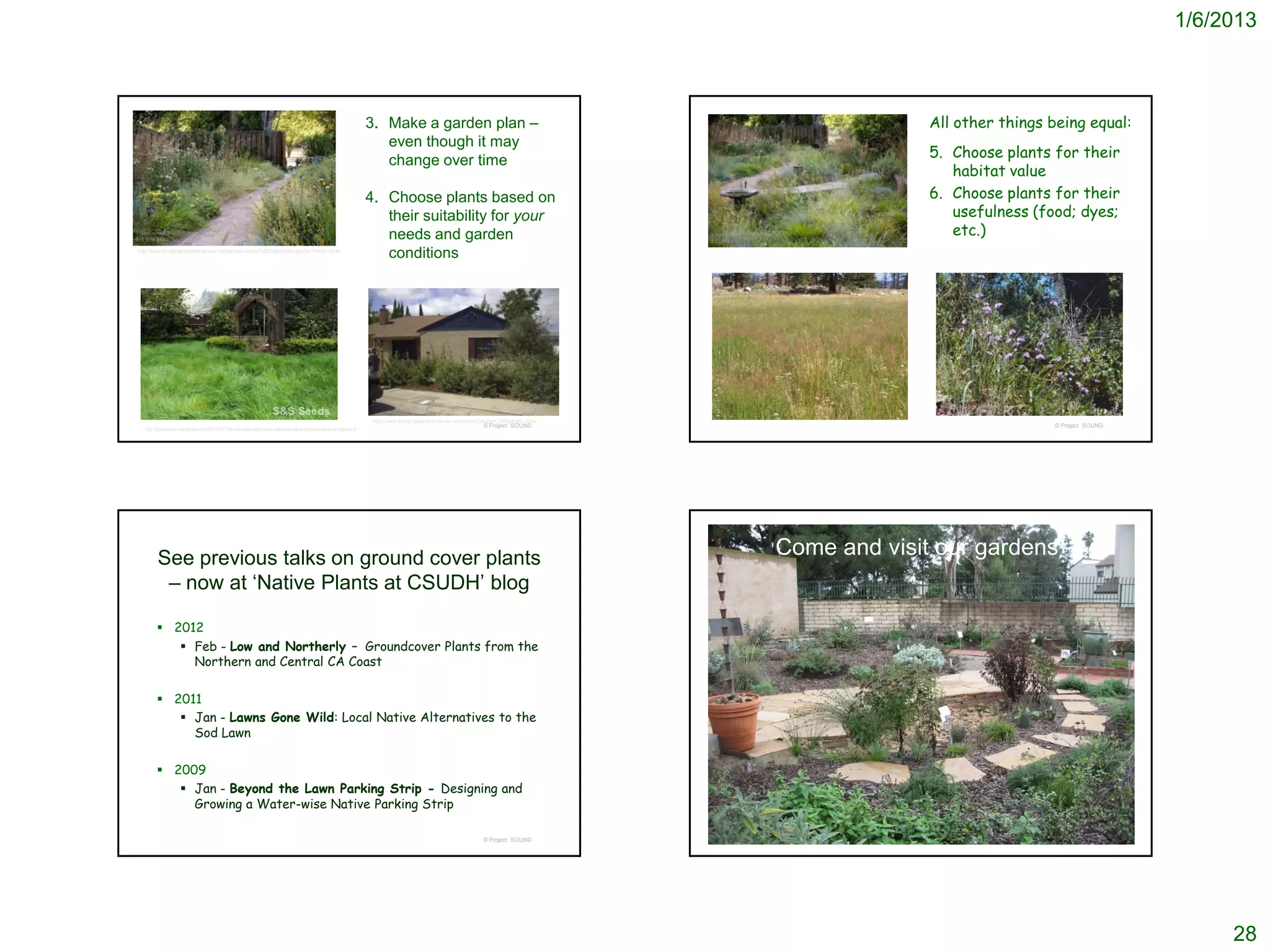
  Bluedicks – Dichelostemma capitatum ssp. capitatum                                                                                           Using native bulbs in the garden

                                                                                                                                                                                                                       For cultivated beds
                                                                                                                                                                                                                       Near south- and west-
                                                                                                                                                                                                                        facing walls
                                                                                                                                                                                                                       In rock gardens and
                                                                                                                                                                                                                        around rocks – or beside
                                                                                                                                                                                                                        a pathway
                                                                                                                                                                                                                       In rain gardens and
                                                                                                                                                                                                                        near seasonal pools
                                                                                                                                                                                                                       As a component of
                                                                                                                                                                                                                        mixed prairie plantings
                                                                                                                         http://pacificbulbsociety.org/pbswiki/files/Dichelostemma/Dichelostemma_capitatum_Kern.jpg


                                                                                                                           Remember – must have dry period in summer, so place accordingly
                   http://biology.csusb.edu/PlantGuideFolder/DichelostemmaCap/DichelostemmaCapPlant800.jpg


                                                                                                                                                                                                              1. Knowledge is power
                                                                                                                                                                                                              2. It’s easier to work with the
                                                                                                                                                                                                                 physical conditions in a
                                                                                                                                                                                                                 garden (soil characteristics,
                                                                                                                                                                                                                 light, etc.) than to try to
                                                                                                                                                                                                                 change them dramatically
February 2012                                      April 2012


August 2012
                                                   December 2012
                                                                                                 © Project SOUND                                                                                                                    © Project SOUND
                                                                                                                   http://www.cnps.org/cnps/grownative/tips/sunny_slopes.php


                                                                                                                                                                                                                                                           27
1/6/2013


                                                                                                                     3. Make a garden plan –                                                                All other things being equal:
                                                                                                                        even though it may
                                                                                                                        change over time                                                                    5. Choose plants for their
                                                                                                                                                                                                               habitat value
                                                                                                                     4. Choose plants based on                                                              6. Choose plants for their
                                                                                                                        their suitability for your                                                             usefulness (food; dyes;
                                                                                                                        needs and garden                                                                       etc.)
http://www.bringingbackthenatives.net/barbara-leitner%E2%80%99s-garden?show=slide
                                                                                                                        conditions


                                                                                                                                                                                                             copyright © Lee Dittmann


                                                                                                                      http://www.bringingbackthenatives.net/slides/Callahan_2008/index.html
                                                                                                                                                                    © Project SOUND                                                     © Project SOUND
   http://joansbolton.wordpress.com/2012/03/13/a-new-lawn-alternative-california-native-sod/webnative-bentgrass-2/


         See previous talks on ground cover plants                                                                                                                                            Come and visit our gardens
          – now at ‘Native Plants at CSUDH’ blog

          2012
             Feb - Low and Northerly – Groundcover Plants from the
              Northern and Central CA Coast

          2011
             Jan - Lawns Gone Wild: Local Native Alternatives to the
              Sod Lawn

          2009
             Jan - Beyond the Lawn Parking Strip - Designing and
              Growing a Water-wise Native Parking Strip

                                                                                                                                                                    © Project SOUND                                                     © Project SOUND


                                                                                                                                                                                                                                                               28

Lawn Alternatives (habitat) - notes

  • 1.
    1/6/2013 Out ofthe Wilds and Into Your Garden Life-friendly ‘Lawns’: native groundcover ideas that provide bird & insect habitat C.M. Vadheim and T. Drake CSUDH & Madrona Marsh Preserve Madrona Marsh Preserve Gardening with Calif. Native Plants in Western L.A. County January 5 & 8, 2013 Project SOUND – 2013 (our 9th year) © Project SOUND © Project SOUND Maybe you’re considering re- A traditional sod lawn may be the best doing your lawn in 2013 solution...  Tough – stands up to kids, dogs, play and even worse  Evergreen – and a nice medium green color  Smooth – good playing surface http://molkkyusa.com/  Gardener’s can manage them May not be the best use of  Filters rainwater water, gasoline, time and space contaminants © Project SOUND © Project SOUND 1
  • 2.
    1/6/2013 Ideally you shouldmake gardening choices based on conscious weighing of pros & cons… 1. Make a garden plan – even though it may change over time 2. Choose plants (and hardscape) based on their suitability for your needs and garden conditions …rather than simply going with the ‘usual’ solution © Project SOUND © Project SOUND What do you like about your current lawn? What things don’t you like about your  A place for kids to play current ‘lawn area’?  Too water-thirsty  Green most of the year  Needs too much fertilizer & pesticides  Cool in summer  Time spent mowing could be  Mowing – it gets us outside spent more enjoyably and working/exercising  Cost of gardener to maintain  Not used any more – kids grown  Looks good with the design  Poor habitat value of the house  Boring  Easy to maintain  Full of weeds  Reduces erosion; allows  Lawn doesn’t grow very well – too shady or too hot water to infiltrate  Doesn’t reflect the natural  Takes up CO2 heritage of western L.A. co.  Whatever it is you like about your lawn What can I do to avoid these pitfalls in my ‘new lawn’? © Project SOUND © Project SOUND 2
  • 3.
    1/6/2013 You may conclude that you do need some lawn, but can reduce its size - or change the type of grass… 3. The ‘Life-friendly Gardening’ Principle: Choose plants based their habitat value 4. Also choose plants for their usefulness to your family (food; cut flowers; medicinal; dyes; etc.) … giving you more space to use as you desire (like providing better habitat for birds & insects) © Project SOUND © Project SOUND Garden of Dreams: Elderberry area Garden theme: Edible Native Plants December, 2008 Native Currants (Ribes) Blue Elderberry Constraints/conditions:  shade/sun mix (particularly when large plants mature)  clay soil © Project SOUND  must take some foot traffic (mostly light) © Project SOUND 3
  • 4.
    1/6/2013 Grass? Or something else What habitat resources might a ‘lawn alternative’ provide? Native to within a 20  Food mile radius of  Nectar CSUDH, if possible  Pollen  Seeds  Fruit  Greens/larval food  Insects  Nesting materials http://www.penick.net/digging/index.php?s=wildflower+center  Shelter http://www.penick.net/digging/index.php?s=wildflower+center Needs to have both teaching and When considering habitat, think about what creatures you want to habitat value provide for: Birds? Insects? Reptiles? Spiders? Rabbits? Humans? © Project SOUND © Project SOUND Let’s compare two ‘lawns’ Mowed Lawn - typical Mother Nature’s ‘Lawn’ Look to Mother Nature and Native Californians for helpful gardening advice http://austindhill.com/how-a-drought-encourages-devotional-life/ http://camissonia.blogspot.com/2010/04/treks-on-santa-rosa-plateau-vernal-pool.html To many non-gardeners, the two look pretty much alike © Project SOUND © Project SOUND 4
  • 5.
    1/6/2013 Let’s compare two ‘lawns’ Let’s compare two ‘lawns’ Mowed Lawn - typical Mother Nature’s ‘Lawn’ Mowed Lawn - typical Mother Nature’s ‘Lawn’  Food  Food X  Nectar  Nectar X Simple Complex  Pollen  Pollen X  Seeds  Seeds X  Fruit  Fruit X  Single, non-native grass  Multiple native species: species  Grasses - at least 3 species X Greens/larval food   Greens/larval food X  Mowed (removing seeds,  +/- sedges (Carex) X Insects   Insects X cover, nesting materials, etc)  Annual wildflowers  Nesting materials X  Nesting materials X  +/- bulbs, ferns, other perennials  Relatively un-mowed: full  Shelter  Shelter X benefits of foliage, flowers, seeds, dried materials © Project SOUND © Project SOUND Several ways to add complexity to a ‘lawn’ Two great recent resources http://www.penick.net/digging/index.php?s=wildflower+center  Decrease the lawn area – plant other (habitat) plants around it  Replace the lawn with native sedge/grass lawn (partly un-mowed) Create a more complex mixture of native grasses + other plants http://latimesblogs.latimes.com/home_blog/2009/10/emily-green-dry-garden-low-water-  gardening-drought-xeriscape.html  Replace the lawn entirely with other native groundcovers © Project SOUND © Project SOUND 5
  • 6.
    1/6/2013 Garden of Dreams: Elderberry area Sedges (Carex species) can be a good evergreen alternative to grass  Relatively easy to establish & maintain  Evergreen – look ‘grass- like’ to most people (including your neighbors)  Can take a little more water – good for wet areas near neighbor’s lawn Need something  Some can be mowed (for a more formal look) or green & grassy http://blueplanetgardening.com/art-lawnsubs.html left unmowed (for a more informal look) In general, grasses are better habitat plants for local insects and birds than are sedges © Project SOUND © Project SOUND http://www.penick.net/digging/index.php?s=wildflower+center Carex species combine well with native grasses, Creeping Wild Rye - Leymus triticoides groundcovers and shrubs to give an interesting, varied appearance - and better habitat value! http://www.satoridesigns.net/?p=19 http://www.elnativogrowers.com/Photographs_page/leytri.htm http://www.flickr.com/photos/eastbaywilds/2673289141/ © Project SOUND © Project SOUND 6
  • 7.
    1/6/2013 Creeping Wildrye isquite versatile Mowing your Creeping Wild Rye (or other native grass)  Any soil texture, but  Mowing is tolerated well should be well-drained  Mowing changes how it  Tolerates alkali soils & looks - will look just like salty soils a turf grass (Bermuda  Low/no fertilizer needed Grass)  Full sun to light shade  Mow every 3-4 weeks during growth season http://www.albrightseed.com/wildryeswalefilter.htm  Water: it takes what it only – or just once to gets – will stay green with Hint: this grass spreads by keep it lower some summer water runners – may want to grow in contained area or limit water  Set mower high – as high © Project SOUND http://www.treehugger.com/files/2008/09/review-push-reel-mower-lawnmower-sunlawn-lmm-40.php as it will go is best © Project SOUND Dune (Seaside) Bentgrass – Agrostis pallens Seaside Bentgrass/Thin Grass – Agrostis pallens  Cool-season perennial bunchgrass that also spreads via runners & reseeding  Summer dormant in nature – turns an attractive golden brown  Native to dunes – does great in sandy and clay soils  Full sun to part-shade  Water: Zone 1-2 to 2-3 (for some summer green)  Use as an ornamental grass, meadow grass or (small) mowed lawn © Project SOUND © Project SOUND 7
  • 8.
    1/6/2013 Weighing the pros & cons of locally native ‘lawn grasses’ Local cool season  Pros  Locally native grasses turn to gold  Tough; easy to grow during summer/fall  Can be very drought tolerant – deeply rooted  Can be mowed occasionally – or left un-mowed  Often very good habitat  Cons  Some (like Saltgrass) are coarse looking  Really best – and most water-wise – with some September summer/fall drought July © Project SOUND © Project SOUND Wildflower Farms ‘Eco-Lawn’  Product Information:  Low maintenance  Contains mixture of 7  Can be maintained as a turf lawn or fine-textured Fescues – left unmowed. mostly not CA native Native Mow  Contains:  Water-wise – extimated Free Mix  Western Mokelumne fescue- Festuca water bill savings ~ $200 occidentalis for 1000 sq ft lawn in  Idaho fescue- Festuca idahoensis Torrance  Molate fescue- Festuca rubra  Notes: http://www.anniesannuals.com/ plt_lst/lists/general/lst.gen.asp ?prodid=3421  Reasonable price: ~ $40 + shipping for seed to cover  Excellent shade and cold tolerance 1000 sq ft  Deep green glossy leaves  Slow growing, narrow leafed grass  Seed available from with blades that are very lax and Wildflower Farms or http://www.ssseeds.com/product/Native-Mow-Free-Mix.aspx flexuous Annie’s Annual’s  Provides soil stabilization for sloped area http://www.wildflowerfarm.com/index. php?p=catalog&parent=4&pg=1 © Project SOUND © Project SOUND 8
  • 9.
    1/6/2013 Native Fescues can 5. Knowledge is power: consider where a make nice lawn grasses ‘native grass’ grows for clues to it’s http://www.ibot.cas.cz/krkonose/mm/mm.htm suitability in your yard http://turfgrassmanagement.psu.edu/species.cfm http://www.mobot.org/gardeninghelp/plantfinder/Plant.asp?cod e=G880 http://www.soquelcreekwater.com/images/Pho-Grass_festuca_rubra.jpg But they ARE from northern CA – so need some summer water to look good © Project SOUND © Project SOUND Red Fescue – Festuca rubra Red Fescue – Festuca rubra  Wide distribution – some sub-species even in Europe  In California:  North coast  Foothills of northern mountains, Sierras usually <8000 ft  Sub-alpine forests (including those near the coast) http://ucjeps.berkeley.edu/cgi-bin/get_JM_treatment.pl?Festuca+rubra http://dnr.alaska.gov/ag/PMCwebsite/pmcweb/chapter5/5-chamomile-fescue- fireweed-fleabane.htm © Project SOUND © Project SOUND Virginia Moore © California Academy of Sciences 9
  • 10.
    1/6/2013 Red Fescue: both clumping and running Flowers are typical for  Size: fescue grasses  1-2 ft tall (to 3 ft flowering stalks)  2+ ft wide  Blooms:  In spring – usually Apr-June in  Growth form: variable S. Bay  Cool-season perennial grass; evergreen with summer water http://www.graniteseed.com/seeds/seed.php/Festuca_rubra  Flowers:  Some forms spread readily – usually  On taller flowering stems noted as ‘creeping’  Wind-pollinated – flowers wave  Other variants clumping/mounding if in the breeze un-mowed; spreading modestly via rhizomes if mowed  Seeds:  Provide food for seed-eating  Foliage: birds and other small  Fine-textured leaves creatures  Medium green to more blue-green  Vegetative reproduction: via  Larval food for Skipper buterflies rhizomes http://www.graniteseed.com/seeds/seed.php/Festuca_rubra  Roots: deep roots + rhizomesProject SOUND © © Project SOUND http://www.answers.com/topic/dudleya  Soils: Habitat considerations: Easily grown  Texture: just about any – clays are good Native Fescues  pH: any local  Foliage  Light:  Larger herbivores: deer, rabbits  Best in part-sun in our area; good  Skipper butterflies choice for under trees  Nesting material for birds  Fine for shade  Seeds  Water:  Eaten by many seed-eating http://www.baynatives.com/plants/Festuca-rubra-'Point-Molate'/  Winter: needs good winter creatures including birds, rains/irrigation insects, etc.  Summer: moderate to regular to keep it looking nice – less than  Roots conventional sod lawn  Good for the below-ground ecosystem  Fertilizer: little/none needed; fine with occasional light dose  Other: tolerates garden conditions – easy-to-grow http://www.callutheran.edu/wf/chap/flowers/fwr-1381.htm © Project SOUND © Project SOUND 10
  • 11.
    1/6/2013 Garden uses for Red ‘Molate’ Red Fescue Fescue  CA native cultivar from N. CA  Erosion control on hillsides/slopes  A creeper/clumper  As a mowed or un-mowed lawn –  Mow or not – makes a ‘bumpy lawn’ if not creeping forms fill an area  Needs occasional to regular  For its habitat value – especially if summer water in our area http://www.wnps.org/landscaping/herbarium/pages/festuca-rubra.html managed for habitat  Good for part-shade/under http://photobotanic.photoshelter.com/image/I0000Gq_hp6FuY7k trees http://daamaaextweb.gnb.ca/010-002/Details.aspx?Culture=fr-CA&Id=194&Pid=1884 http://www.bringingbackthenatives.net/betty-nelson http://www.anniesannuals.com/plt_lst/lists/general/lst.gen.asp?prodid=422 © Project SOUND © Project SOUND http://www.anniesannuals.com/plt_lst/lists/general/lst.gen.asp?prodid=3439 ‘Patrick’s Point’ Life-friendly grass  Bluer color – like ‘Canyon Prince’ Wild management Rye  Narrower leaves – more delicate  Choose CA native species (or looking – and smaller than species natural cultivars)  Needs part-shade to dappled shade  Not for hot gardens  Leave some/all un-mowed for seed (at least until seed has set) http://picasaweb.google.com/lh/photo/yG_BWGyr5gCqdv6QZGPdwg http://www.pacifichorticulture.org/articles/a-wind-blown-garden-on-a-sea-ranch-bluff/ – some of the best habitat value of grasses lies in their seeds  Don’t tidy up all the dead leaves every year – save some for bird nest-building & insects/micro- organisms  Consider combining grasses with compatible species of annuals, perennials & bulbs © Project SOUND © Project SOUND http://grownatives.cnps.org/2010/08/16/seasonal-color-august-california-fuchsia/ 11
  • 12.
    1/6/2013 Some bunchgrasses combine the traits of bunching and sod-forming grasses  Some Fescues [Example: Festuca rubra – Red Fescue] Red Fescue managed for Carex pansa with Nassella tenuissima (Mexican Feather Grass) and Muhlenbergia rigens (Deer Grass) habitat  Bentgrasses (Agrostis) #holt_829_520  Wild Ryes (Elymus; © Saxon Holt http://www.saxonholt.com/webgalleries/Harris_StockPhotos/link3.html Lymus) http://geoimages.berkeley.edu/geoImages/BainCalif/CAL400/BUNGRASS.HTML  Gramma grasses These grasses are often used both (Bouteloua) as ornamental grasses (specimen plants) as well as for natural ‘lawns’  Native Bluegrass (Poa) (mowed or un-mowed) © Project SOUND © Project SOUND Idaho Fescue/Blue Bunchgrass – Festuca idahoensis Idaho Fescue: useful in shady areas – or with regular water  Soils:  Texture: any well-drained soil, but prefer sandy; not salt-tolerant  pH: any local  Light: extremely adaptable  Best in part-shade in most gardens; fine under trees, shrubs, north-facing  Full sun in cool gardens only  Water: extremely adaptable  Young plants: keep well-watered (Zone 2-3 tapering to 2) until established (1 year)  Summer: Zone 1-2 (will turn golden) to Zone 2-3 (fairly regular) http://biology.burke.washington.edu/herbarium/imagecollection.php?Genus=Festu  Fertilizer: very tolerant ca&Species=idahoensis USDA-NRCS PLANTS Database © Project SOUND © Project SOUND J.S. Peterson @ USDA-NRCS PLANTS Database 12
  • 13.
    1/6/2013 Idaho Fescue cultivars: naturally occurring variants  Blue-gray foliage:  ‘Siskiyou Blue’ 6. It’s often easier to work with the  medium size http://www.bluestem.ca/images/festuca-idahoensis.jpg  Lighter-colored seed physical conditions in a garden (soil ‘Siskiyou Blue’ heads  ‘Warren Peak’ characteristics, light, etc.) than to try to  Slightly larger change them dramatically  Silver-pink flower stalks  Blue-green foliage:  ‘Tomales Bay’ ‘Warren Peak’  Very small, dainty  Flower stalks quite upright ‘Tomales Bay’ © Project SOUND © Project SOUND http://www.yerbabuenanursery.com/online_album/1311.htm Garden of Dreams: Elderberry area When designing a mixed groundcover  Backbone plant(s) – sunny & shady  First choose a backbone species  Thin Grass – Agrostis pallens  Yarrow (Achillea millefolia)  Should have good spreading/ covering characteristics  Filler plants:  Should fulfill other requirements:  Sunny light, water, drainage, height, etc.  Purple Three-awn (Aristida purpurea - self-seeded; may be removed)  Should be relatively hardy  Other annuals that have self-seeded  May be evergreen – or not  Shady  Dune Strawberry (Fragaria  Should ‘play well with others’ chiloensis)  Southern Honeysuckle (Lonicera  Should have some ‘value added’ subspicata) characteristics:  Annuals: (edibles)  Good habitat  Miner’s Lettuce  Edible/medicinal/dye  Red maids  Unusual flower or foliage © Project SOUND © Project SOUND 13
  • 14.
    1/6/2013 Then choose filler plants that complement How we ‘created our mix’ – with a lot of the backbone species help from Mother Nature  Grew plugs of Agrostis pallens & Yarrow from seed  Should be:  Planted central area in backbone grass; edges with yarrow  Compatible with garden conditions  Planted filler strawberries, & requirements honeysuckle and annual edibles around the edges  Compatible with backbone species Southern Honeysuckle  Let them all grow together  Add something extra to the mix:  Were patient – Mother Nature takes  Foliage shape/color her time!  Flower color  Fragrance  Habitat value  Human value: edible/medicinal/dye Dune Strawberry © Project SOUND © Project SOUND Management considerations  Never mowed or cut, but could cut all or just the central part  Yarrow flowers cut after seeds utilized (collected; eaten by birds)  Never spray with pesticides/ herbicides – just hand weed January April  Gophers & an occasional ‘phantom dump’ of sand/gravel provide disturbances – not all bad  Water Zone 2 – once a month from June to Sept  Looks pretty year-round – appropriate for natural-looking garden  Attracts plenty of birds, insects July/August October © Project SOUND © Project SOUND 14
  • 15.
    1/6/2013 How does the‘Elderberry Area’ lawn stack up in terms The ‘lawn’ contributes to the of habitat for birds and insects? richness of the ‘Garden of Mowed Lawn - typical Elderberry Area ‘Lawn’ Dreams’  Food  Food X  Nectar  Nectar (Yarrow, X  Pollen strawberry are primary)  Seeds  Pollen (all but grass) X  Fruit  Seeds (all components) X X Greens/larval food   Fruit (strawberry) X X Insects   Greens/larval food X  Nesting materials X  Insects X  Shelter  Nesting materials X  Shelter X © Project SOUND © Project SOUND A shady slope in need of a ground cover Decided to feature herbaceous groundcovers from the Mint family  Backbone plant(s)  Woodmint (Stachys bullata)  Hummingbird Sage (Salvia spathacea)  Filler plants  Mugwort (Artemisia douglasii)  Wild Mint (Mentha arvensis)  Melic Grass (Melica imperfecta)  Columbine (Aquilegia)  CA Fuschia (Epilobium canum) - sunny edge) Conditions/constraints:  Other (in hedgerow)  11% slope; need something to hold soil  CA wild Rose (Rosa californica)  no-walk zone; discourage walking on  CA Bricklebush (Brickellia californica)  shade (relatively quickly as Mulefat grow)  Fragrant Pitchersage (Lepechinia  relatively water-wise (no sprinklers) fragrans) © Project SOUND © Project SOUND 15
  • 16.
    1/6/2013  Should have good X California Woodmint (Hedgenettle) - Stachys bullata Why mints? spreading/covering characteristics  Should fulfill other X requirements: light, water, drainage, height, etc.  Should be relatively hardy X  May be evergreen – or not X  Should ‘play well with others’ X  Should have some ‘value X added’ characteristics:  Good habitat  Edible/medicinal/dye  Unusual flower or foliage © Project SOUND Characteristics of CA Hedgenettle Succeeding with Stachys bullata  Drought deciduous perennial  Does best in part-shade herb; but does like water  Plant in well-drained soils  Size: 1-3 ft high, 3-4 ft wide (spreading)  While drought tolerant, does better with moderate water,  Foliage: and tolerates seasonal flooding  Dark green, softly hairy, “wrinkled”  Useful in north- and east-  Scented: light lemon-mint facing banks, rockwalls  Flowers:  Use it in woodland gardens or perennial gardens  pink to lavender-red, with white markings on the lower  Remember that it suckers lips freely – will spread moderately  Blooms Mar-May/June especially if watered – makes a  Attracts bees, hummingbirds good groundcover http://biology.fullerton.edu/biol317/im/s03/ft2/ft20-47.html 16
  • 17.
    1/6/2013 Hummingbird Sage – Salvia spathacea Hummingbird Sage – great for attracting birds & butterflies  Hummingbirds collect nectar from the flowers – hummingbirds actually pollinate the flowers  Seed-eating birds eat the seeds  Butterflies are also attracted by the nectar http://www.laspilitas.com/garden/sages.htm Many attractive features Hummingbird Sage: a versatile ground cover  Fragrant, sweet-smelling foliage  Leaves make a tasty tea – that  Likes any well-drained soil may help as a decongestant  Prefers soils with decayed organic matter  Brilliant magenta-pink flowers  Tolerates clay soils  Flowers make a good cut flower  Can tolerate full sun near coast – but best in partial shade  Bright green foliage  Water sparingly in summer –  Shade tolerant – can be used monthly – let dry in between under trees  Can tolerate full salt spray – so  Very drought tolerant fine for coastal gardens © 2003 Michael Charters http://www.pgmuseum.org/WildflowerTour/CrimsonSage.htm 17
  • 18.
    1/6/2013 Herbaceousgroundcovers from the Mint family and compatible filler plants  Backbone plant(s)  Woodmint (Stachys bullata)  Hummingbird Sage (Salvia spathacea)  Filler plants  Mugwort (Artemisia douglasii)  Wild Mint (Mentha arvensis)  Melic Grass (Melica imperfecta)  Columbine (Aquilegia)  CA Fuschia (Epilobium canum) - sunny edge)  Other (in hedgerow)  CA wild Rose (Rosa californica)  CA Bricklebush (Brickellia californica)  Fragrant Pitchersage (Lepechinia fragrans) © Project SOUND © Project SOUND How does the Shady Slope ‘Lawn’ stack up? Maintenance/other Mowed Lawn - typical Elderberry Area ‘Lawn’  Pretty low-maintenance  Clip off dead flowers after  Food  Food X seeds are utilized  Nectar  Nectar (most components) X  Cut back dramatically in  Pollen  Pollen (all but grass) X fall/early winter  Seeds  Seeds (all components) X  Water monthly from May/June  Fruit  Fruit to Aug/Sept; at this point used X Greens/larval food   Greens/larval food X both soaker hose & simple X Insects   Insects X sprinkler on hose  Nesting materials X  Nesting materials X  Be patient – takes longer for  Shelter  Shelter X herbaceous perennials to fill in © Project SOUND © Project SOUND 18
  • 19.
    1/6/2013 Now let’s visit another local garden Notice how the hardscape not only provides access, but is an important design element © Project SOUND © Project SOUND Several ‘lawn alternative’ areas in Mother * Creeping Sage – Salvia sonomensis Nature’s Backyard J.S. Peterson @ USDA-NRCS PLANTS Database © Project SOUND © Project SOUND 19
  • 20.
    1/6/2013 Creeping Sage creeps & drapes Cultivar ‘Dara’s Choice’  Compact growth form  Wonderful groundcover on a shadier slope  Probably a natural hybrid with Salvia mellifera  Requires well-drained soil – judicious summer  Groundcover under trees water and shrubs  Tends to be short-lived  Cascading over a low wall  Available at Theodore Payne Foundation. http://www.yerbabuenanursery.com/viewplant.php?pid=33 http://www.ventura.watersavingplants.com/eplant.php?plantnum=242 95&return=b_aS http://back40feet.blogspot.com/2008/03/regional-parks-botanic-garden.html © Project SOUND http://ohric.ucdavis.edu/photos/ornament8.htm © Project SOUND http://www.yerbabuenanursery.com/viewplant.php?pid=33 MNBY Entry area: What the evergreen entry groundcover lacks Evergreen groundcover  Food X  Backbone plant  Nectar  ‘Yankee Point‘ Ceanothus  Pollen  good spreading/covering characteristics  Seeds  Fruit  fulfill other requirements: light, water, drainage, height, etc.  Greens/larval food  relatively hardy ?? Compacted soil  Insects  evergreen X Nesting materials   ‘value added’ characteristics:  Shelter  Good habitat  Edible/medicinal/dye  Unusual flower or foliage  Filler plants Simple ground covers that lack some habitat elements are  Bulbs (Allium; Camassia quamash) fine, as long as these are provided somewhere else in the  Filler annual wildflowers (Lupines) garden © Project SOUND © Project SOUND 20
  • 21.
    1/6/2013 MNBY: Fountain planter MNBY: Fountain planter  Backbone plants  Pacific Aster (Symphyotrichum /Aster chilense)  California Goldenrod (Solidago californica)  Filler plants  Idaho Fescue just to give  Conditions/constraints some off-season color/  Relatively hot – surrounded by brick pathway Watered by ‘soaker drip’ system greenery – and demonstrate  Need to cover the fountain base with additional slight splash from several choices for around a bubbler fountain fountain  First thing you see when you enter the garden  Want to demonstrate importance of habitat plants © Project SOUND © Project SOUND Pacific Aster can do  Soils: Pacific Aster: a plant well with little care  Texture: any – sand to clay of many habitats  pH: any local  Light:  Full sun to light shade;  Grasslands  Probably best color in light  Salt marshes shade  Coastal dunes and  Water: bluffs  Winter: adequate  Coastal grasslands and  Summer: wide range (Zone 1-2 to 3); probably best as Zone 2 – scrub, too aggressive with more water.  Even open disturbed  Fertilizer: none; likes poor soils habitats in evergreen and Pacific coast  Other: can be heavily pruned, even coniferous forest mowed, occasionally. Cut back in © 2004, Ben Legler fall after flowering. Not surprisingly, there are phenotypic variants © 2004, Ben Legler © Project SOUND © Project SOUND 21
  • 22.
    1/6/2013 Pacific Aster: not for California Goldenrod – Solidago californica everywhere…  Best contained, as it is an aggressive competitor:  Pots & planters  Areas bounded by walks, or other boundries  Parking strips – if managed  Usually used in combination with native grasses, bulbs, sub-shrubs (Epilobium canum; Goldenrods) in native meadows; can be mowed back in fall © 2005 Andrea Jesse  Appropriate for Cottage Gardens  Good for stabilizing slopes Excellent choice for butterfly gardens http://plants.montara.com/ListPages/FamPages/Astera7.html#solcan © Project SOUND © Project SOUND CA Goldenrod: an adaptable perennial Great nectar plant – true  Size: butterfly magnet  1-3 ft tall (flowering stalk may be taller)  Important nectar source in  2+ ft wide; spreading summer/fall in the wild.  Growth form: http://www.wildscaping.com/plants/plantprofiles/Solidago_californica.htm  Provides nectar for wide range of  Bunching perennial butterflies & hummingbirds:  Fast growing; more so with regular  Monarch (Danaus plexippus) summer water  West Coast Lady (Vanessa annabella)  Dies back (to the ground) in  Red Admiral (Vanessa atalanta) fall/winter  Gray Hairstreak (Strymon melinus)  Mylitta Crescent (Phyciodes mylitta)  Foliage:  Acmon Blue (Plebejus acmon)  Leaves dark green to gray-green;  Skippers typical of Sunflower family  Others  Roots: Spreads via rhizomes http://www.santabarbarahikes.com/flowers/index.php?action=show_  Seed-eaters eat the seeds item&id=27&search= http://plants.montara.com/ListPages/FamPages/Astera3.html#cirocc © Project SOUND © Project SOUND 22
  • 23.
    1/6/2013 The insects (and spiders) appear to Our last area also has some interesting aspects approve of our life-friendly choices How many Skippers can you see in  shade developing over time – as the Blue Elderberry becomes a tree this photo?  parts are near the rain garden – some seasonal flooding possible  parts need to tolerate foot traffic – other parts not © Project SOUND  compacted clay-loam soil © Project SOUND Choice of backbone plants is crucial Western Yarrow – Achilla millefolia  Ideally, one species to tie the entire area together visually  Must look fairly nice – at the garden entry  Needs to look appropriate with the ‘Yankee Point’ Ceanothus  Must tolerate several light/water regimens Grass or something else? In your garden, the choice is yours. © Project SOUND J.S. Peterson @ USDA-NRCS PLANTS Database 23
  • 24.
    1/6/2013 Why Yarrow makes a good lawn substitute  Spreads quickly, giving good cover  Super for banks and other areas that can’t easily be mowed http://www.ojaigarden.com/2010/04/ http://www.magney.org/photofiles/CluffVistaParkOther1.htm  Spreading habit inhibits weeds  Can be mowed – occasionally and on high setting w/ rotary mower  Companion plant – attracts beneficial insects, repels others  Does well on poor, dry, sandy soils - or heavy clays - where other plants grow poorly http://www.dgsgardening.btinternet.co.uk/yarrow.JPG http://www.angieslist.com/articles/different-sea-green-california-lawn-alternatives.htm © Project SOUND Western Yarrow may be just the thing Managing a Yarrow ‘lawn’: several options for your yard!  Slopes, hillsides  Cutting plants back by one-half to two-thirds before they  Mixtures flower can produce stockier,  Good garden plant for fresh or dry shorter plants that don't flop floral arrangements as much.  Foliage is pleasantly fragrant when crushed  Plants can also be sheared back after flowering to rejuvenate  Can be mowed to form a highly competitive ground cover to the foliage control soil erosion.  Mow with a rotary mower to a  Flowers!!! height of 4-6 inches after  Good butterfly plant established J.S. Peterson @ USDA-NRCS PLANTS Database 24
  • 25.
    1/6/2013 Yarrow has importance in many cultures MNBY: around the Elderberry & rain garden  Backbone plant(s)  Medicinal  Yarrow (Achillea millefolia) – sunny &  Young leaves can be used in salads – have a shady areas peppery flavor  Woodmint (Stachys bullata) – shady areas  Mystical uses:  Catalina Perfume (Ribes viburnifolium) –  It was once associated with evil, as evidenced shady areas; no-walk area at back of bed http://www.viable- by its alternative names Devil's Nettle,  Filler plants Devil's Plaything, and Bad Man's Plaything, herbal.com/singles/herbs/s585.htm  Sun/part-sun and was used in spells.  Salty Susan  In France and Ireland, people wanting to be  Blue-eyed grass more clairvoyant hold Yarrow over their eyes.  Carex  Dried stalks were used to throw the I Ching,  Juncus an ancient Chinese system for guidance and wisdom.  Shady  Strawberry  The Druids used Yarrow stems to foretell the  Melic grass weather. http://www.ceres-co.com/store/images/products/yarrow.jpg  Southern and Purple native Honeysuckles © Project SOUND Catalina Island Currant/ Evergreen Currant/ You’ve probably seen Catalina Perfume Catalina Perfume – Ribes viburnifolium used as a shady groundcover…. © Project SOUND © Project SOUND 25
  • 26.
    1/6/2013 Garden uses for Evergreen Currant MNBY: around the Elderberry & rain garden  Backbone plant(s)  One of our very best native dry-shade  Yarrow (Achillea millefolia) – sunny & groundcovers shady areas  Super under oaks and other large  Woodmint (Stachys bullata) – shady areas  Catalina Perfume (Ribes viburnifolium) – Zone 1 native trees/shrubs shady areas; no-walk area at back of bed  Great on slopes; and it’s scented!!!!  Filler plants http://www.smgrowers.com/products/plants/plantdisplay.asp?strLetter=R&plant_id =1363&page=  Sun/part-sun  Will cascade over walls and raised  Salty Susan planters  Blue-eyed grass  Carex  In the habitat garden: hummingbirds  Juncus butterflies & bees like the flowers.  Shady Birds can use for cover. Fruit-eating  Strawberry birds eat the fruit.  Melic grass Easy to grow: just prune occasionally to control  Southern and Purple native Honeysuckles or shear with string-trimmer to rejuvenate  Hummingbird Sage © Project SOUND © Project SOUND Blue-eyed Grass in nature Many reason the include Blue-eyes Grass in your garden  Generally a component of grasslands or mixed grassland/  Attractive flowers over a long annuals blooming season  Water:  Does well in many situations:  Fall/winter rains rock garden, meadows, http://www.watershednursery.com/nursery/plant-finder/sisyrinchium-bellum/ borders  Dry summers  Nice in containers  Useful for filling in around plantings of shrubs and trees  Nice with native grasses and other wildflowers such as California Poppy, Blue Flax and Clarkia 26
  • 27.
    1/6/2013 Bluedicks– Dichelostemma capitatum ssp. capitatum Using native bulbs in the garden  For cultivated beds  Near south- and west- facing walls  In rock gardens and around rocks – or beside a pathway  In rain gardens and near seasonal pools  As a component of mixed prairie plantings http://pacificbulbsociety.org/pbswiki/files/Dichelostemma/Dichelostemma_capitatum_Kern.jpg Remember – must have dry period in summer, so place accordingly http://biology.csusb.edu/PlantGuideFolder/DichelostemmaCap/DichelostemmaCapPlant800.jpg 1. Knowledge is power 2. It’s easier to work with the physical conditions in a garden (soil characteristics, light, etc.) than to try to change them dramatically February 2012 April 2012 August 2012 December 2012 © Project SOUND © Project SOUND http://www.cnps.org/cnps/grownative/tips/sunny_slopes.php 27
  • 28.
    1/6/2013 3. Make a garden plan – All other things being equal: even though it may change over time 5. Choose plants for their habitat value 4. Choose plants based on 6. Choose plants for their their suitability for your usefulness (food; dyes; needs and garden etc.) http://www.bringingbackthenatives.net/barbara-leitner%E2%80%99s-garden?show=slide conditions copyright © Lee Dittmann http://www.bringingbackthenatives.net/slides/Callahan_2008/index.html © Project SOUND © Project SOUND http://joansbolton.wordpress.com/2012/03/13/a-new-lawn-alternative-california-native-sod/webnative-bentgrass-2/ See previous talks on ground cover plants Come and visit our gardens – now at ‘Native Plants at CSUDH’ blog  2012  Feb - Low and Northerly – Groundcover Plants from the Northern and Central CA Coast  2011  Jan - Lawns Gone Wild: Local Native Alternatives to the Sod Lawn  2009  Jan - Beyond the Lawn Parking Strip - Designing and Growing a Water-wise Native Parking Strip © Project SOUND © Project SOUND 28