1/6/2013


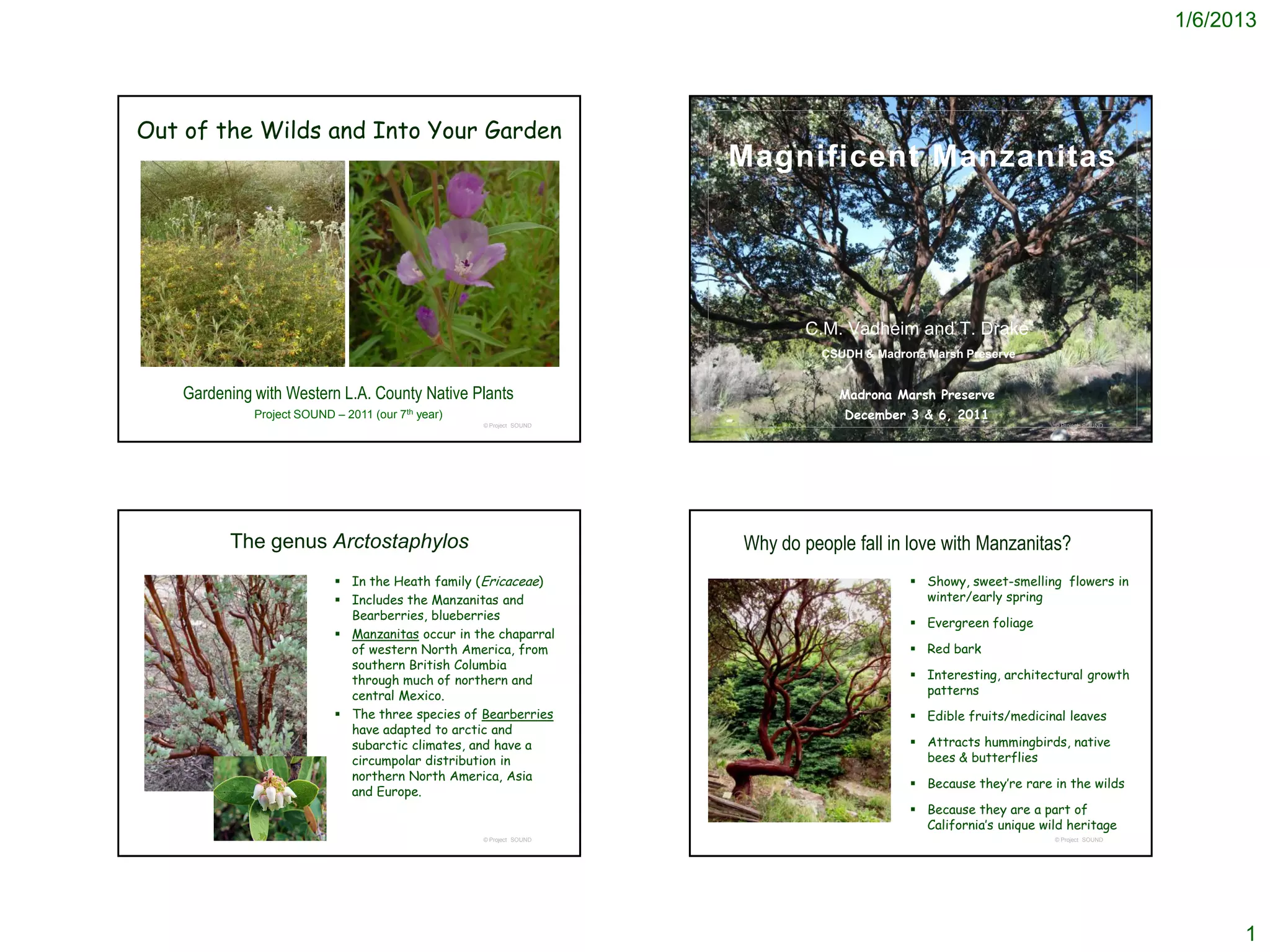
Out of the Wilds and Into Your Garden
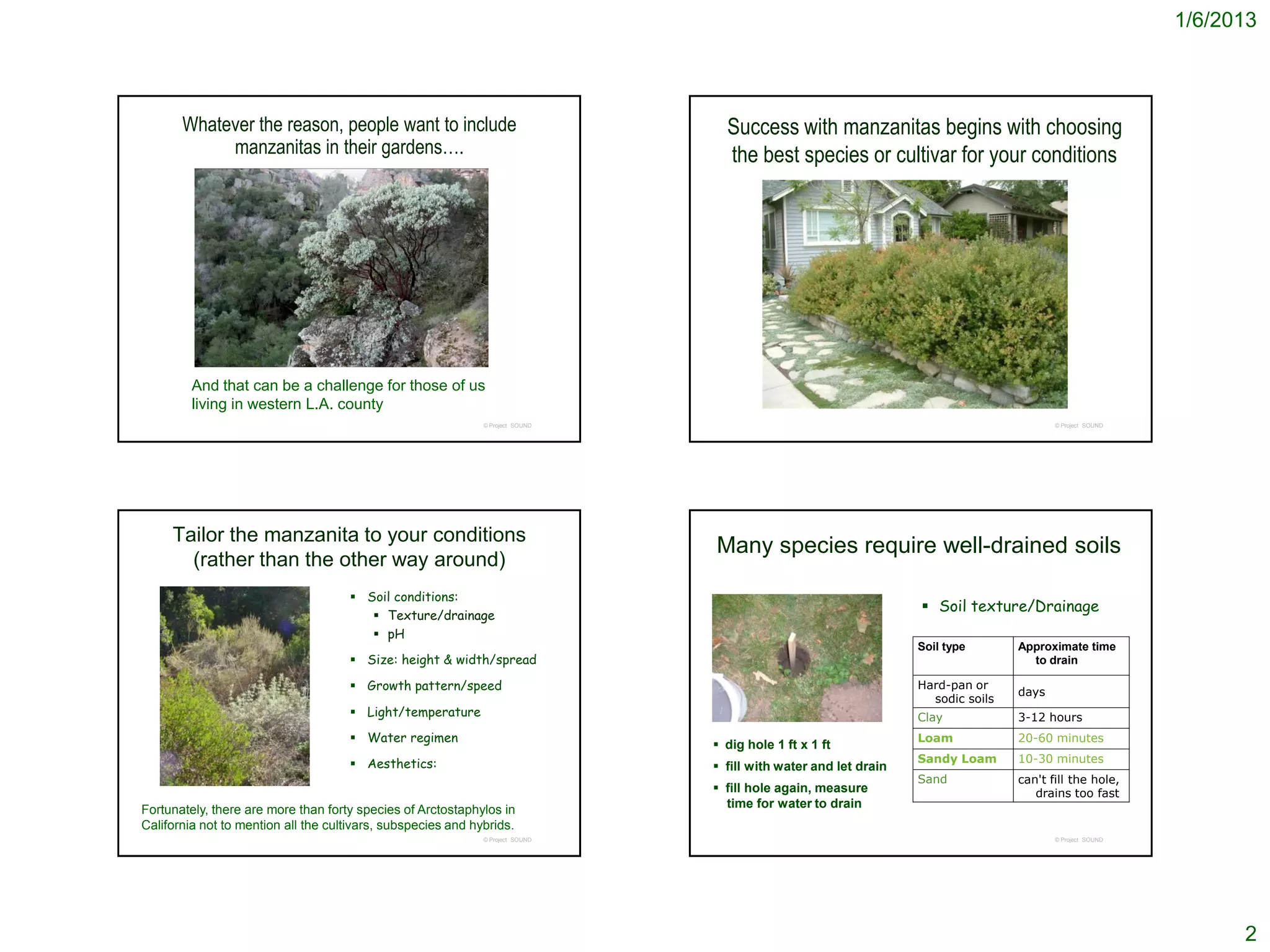
                                                                      Magnificent Manzanitas


                                                                              C.M. Vadheim and T. Drake
                                                                                CSUDH & Madrona Marsh Preserve


    Gardening with Western L.A. County Native Plants                              Madrona Marsh Preserve
              Project SOUND – 2011 (our 7th year)                                  December 3 & 6, 2011
                                                    © Project SOUND                                                  © Project SOUND


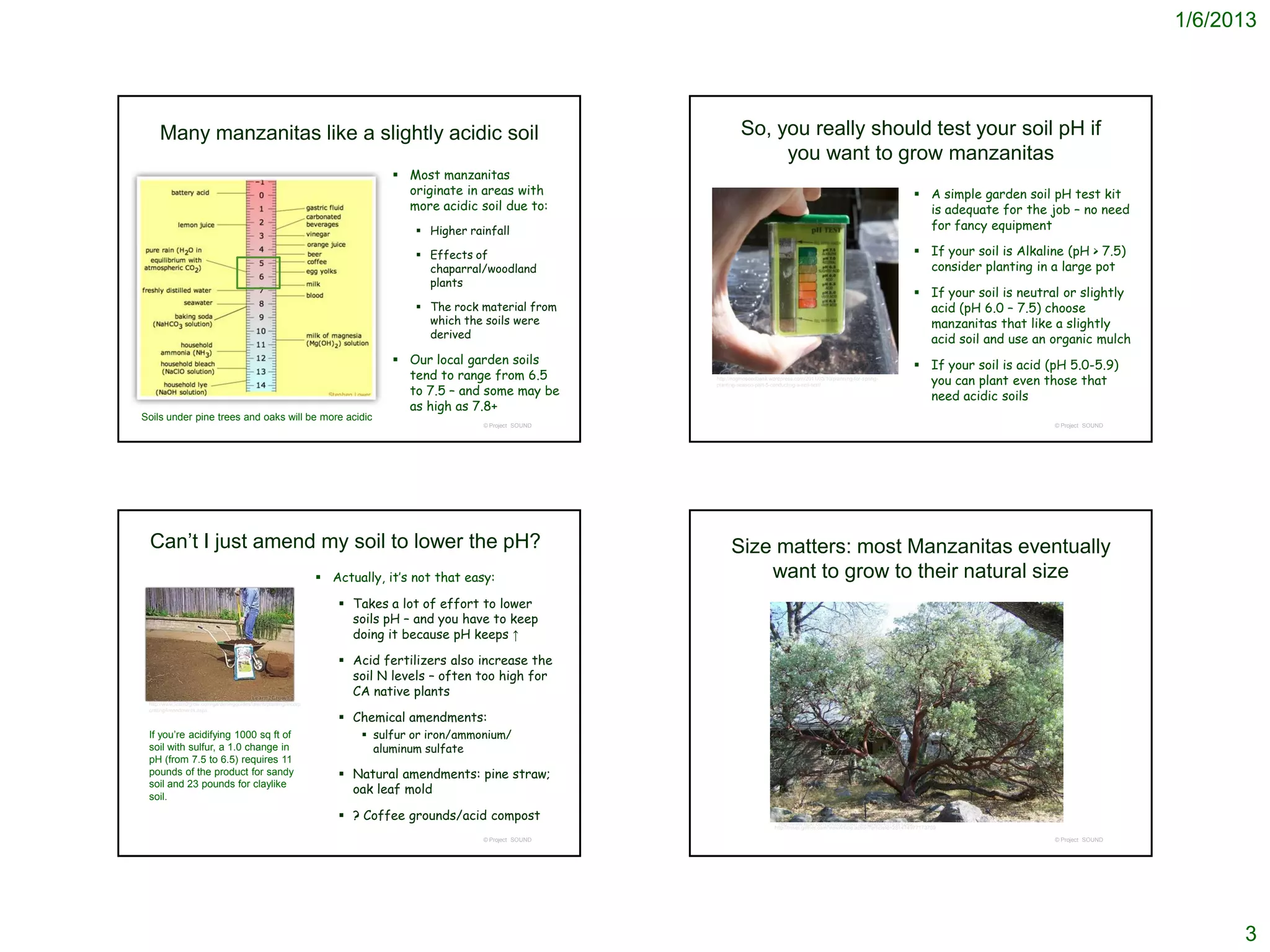
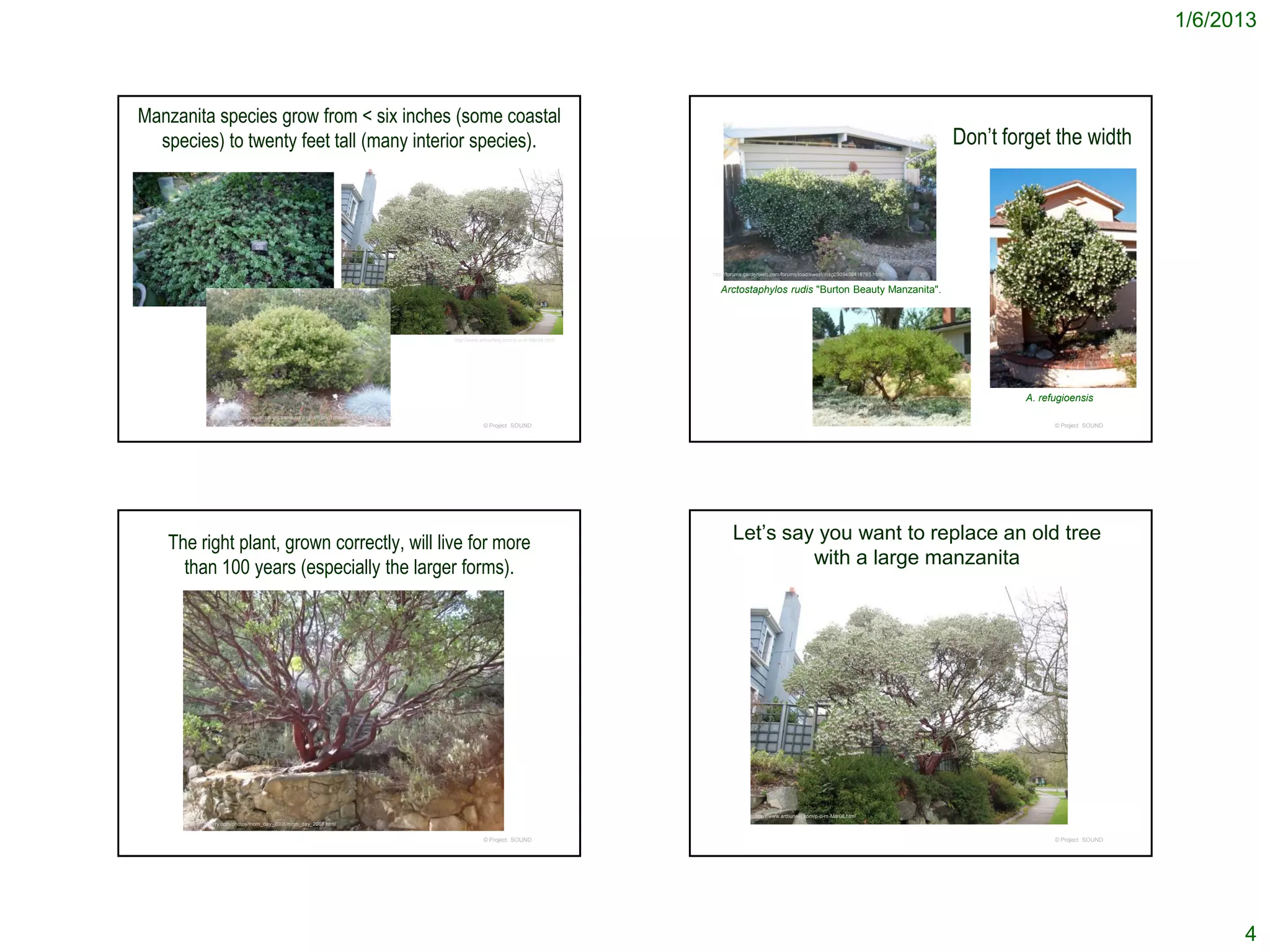
          The genus Arctostaphylos                                    Why do people fall in love with Manzanitas?
                             In the Heath family (Ericaceae)                                 Showy, sweet-smelling flowers in
                             Includes the Manzanitas and                                      winter/early spring
                              Bearberries, blueberries
                                                                                              Evergreen foliage
                             Manzanitas occur in the chaparral
                              of western North America, from                                  Red bark
                              southern British Columbia
                              through much of northern and                                    Interesting, architectural growth
                              central Mexico.                                                  patterns
                             The three species of Bearberries                                Edible fruits/medicinal leaves
                              have adapted to arctic and
                              subarctic climates, and have a                                  Attracts hummingbirds, native
                              circumpolar distribution in                                      bees & butterflies
                              northern North America, Asia
                                                                                              Because they’re rare in the wilds
                              and Europe.
                                                                                              Because they are a part of
                                                                                               California’s unique wild heritage
                                                    © Project SOUND                                                  © Project SOUND


                                                                                                                                             1
1/6/2013


       Whatever the reason, people want to include                                Success with manzanitas begins with choosing
            manzanitas in their gardens….                                         the best species or cultivar for your conditions


         And that can be a challenge for those of us
         living in western L.A. county
                                                              © Project SOUND                                                            © Project SOUND


     Tailor the manzanita to your conditions
                                                                                Many species require well-drained soils
       (rather than the other way around)
                                      Soil conditions:
                                                                                                                   Soil texture/Drainage
                                         Texture/drainage
                                         pH
                                                                                                                  Soil type       Approximate time
                                      Size: height & width/spread                                                                  to drain

                                      Growth pattern/speed                                                       Hard-pan or
                                                                                                                                  days
                                                                                                                    sodic soils
                                      Light/temperature                                                          Clay            3-12 hours
                                      Water regimen                                                              Loam            20-60 minutes
                                                                                 dig hole 1 ft x 1 ft
                                      Aesthetics:                                                                Sandy Loam      10-30 minutes
                                                                                 fill with water and let drain
                                                                                                                  Sand            can't fill the hole,
                                                                                 fill hole again, measure                           drains too fast
Fortunately, there are more than forty species of Arctostaphylos in               time for water to drain
California not to mention all the cultivars, subspecies and hybrids.
                                                              © Project SOUND                                                            © Project SOUND


                                                                                                                                                                 2
1/6/2013


     Many manzanitas like a slightly acidic soil                                                                           So, you really should test your soil pH if
                                                                                                                                you want to grow manzanitas
                                                                                 Most manzanitas
                                                                                  originate in areas with                                                                                            A simple garden soil pH test kit
                                                                                  more acidic soil due to:                                                                                            is adequate for the job – no need
                                                                                     Higher rainfall                                                                                                 for fancy equipment

                                                                                     Effects of                                                                                                     If your soil is Alkaline (pH > 7.5)
                                                                                      chaparral/woodland                                                                                              consider planting in a large pot
                                                                                      plants
                                                                                                                                                                                                     If your soil is neutral or slightly
                                                                                     The rock material from                                                                                          acid (pH 6.0 – 7.5) choose
                                                                                      which the soils were                                                                                            manzanitas that like a slightly
                                                                                      derived                                                                                                         acid soil and use an organic mulch
                                                                                 Our local garden soils                                                                                             If your soil is acid (pH 5.0-5.9)
                                                                                  tend to range from 6.5          http://nogmoseedbank.wordpress.com/2011/03/10/planning-for-spring-
                                                                                                                                                                                                      you can plant even those that
                                                                                  to 7.5 – and some may be
                                                                                                                  planting-season-part-5-conducting-a-soil-test/

                                                                                                                                                                                                      need acidic soils
                                                                                  as high as 7.8+
Soils under pine trees and oaks will be more acidic
                                                                                                © Project SOUND                                                                                                             © Project SOUND


 Can’t I just amend my soil to lower the pH?                                                                           Size matters: most Manzanitas eventually
                                                                    Actually, it’s not that easy:                         want to grow to their natural size
                                                                        Takes a lot of effort to lower
                                                                         soils pH – and you have to keep
                                                                         doing it because pH keeps ↑

                                                                        Acid fertilizers also increase the
                                                                         soil N levels – often too high for
                                                                         CA native plants
 http://www.learn2grow.com/gardeningguides/lawns/planting/Incorp


                                                                        Chemical amendments:
 oratingAmendments.aspx


 If you’re acidifying 1000 sq ft of                                        sulfur or iron/ammonium/
 soil with sulfur, a 1.0 change in                                          aluminum sulfate
 pH (from 7.5 to 6.5) requires 11
 pounds of the product for sandy                                        Natural amendments: pine straw;
 soil and 23 pounds for claylike
 soil.
                                                                         oak leaf mold

                                                                        ? Coffee grounds/acid compost                                     http://www.flickr.com/photos/97607362@N00/4375161245/
                                                                                                                                         http://travel.gather.com/viewArticle.action?articleId=281474977173759

                                                                                                © Project SOUND                                                                                                             © Project SOUND


                                                                                                                                                                                                                                                    3
1/6/2013


Manzanita species grow from < six inches (some coastal
  species) to twenty feet tall (many interior species).                                                                                                                                                       Don’t forget the width


                                                                                                                                        http://forums.gardenweb.com/forums/load/swest/msg0309450418785.html


                                                                                                                                           Arctostaphylos rudis "Burton Beauty Manzanita".


                                                                                           http://www.arthurleej.com/p-o-m-Mar08.html


                                                                                                                                                                                                                      A. refugioensis
              http://www.fresno.watersavingplants.com/eplant.php?plantnum=24200&letter=b
              &return=s_aP                                                                             © Project SOUND                                                                                                      © Project SOUND


   The right plant, grown correctly, will live for more                                                                                        Let’s say you want to replace an old tree
     than 100 years (especially the larger forms).                                                                                                      with a large manzanita


                                                                                                                                                        http://www.arthurleej.com/p-o-m-Mar08.html
      http://123terry.com/photos/mom_day_2008/mom_day_2008.html


                                                                                                       © Project SOUND                                                                                                      © Project SOUND


                                                                                                                                                                                                                                                    4
1/6/2013


                                                                                                                                                                                Bigberry Manzanita:
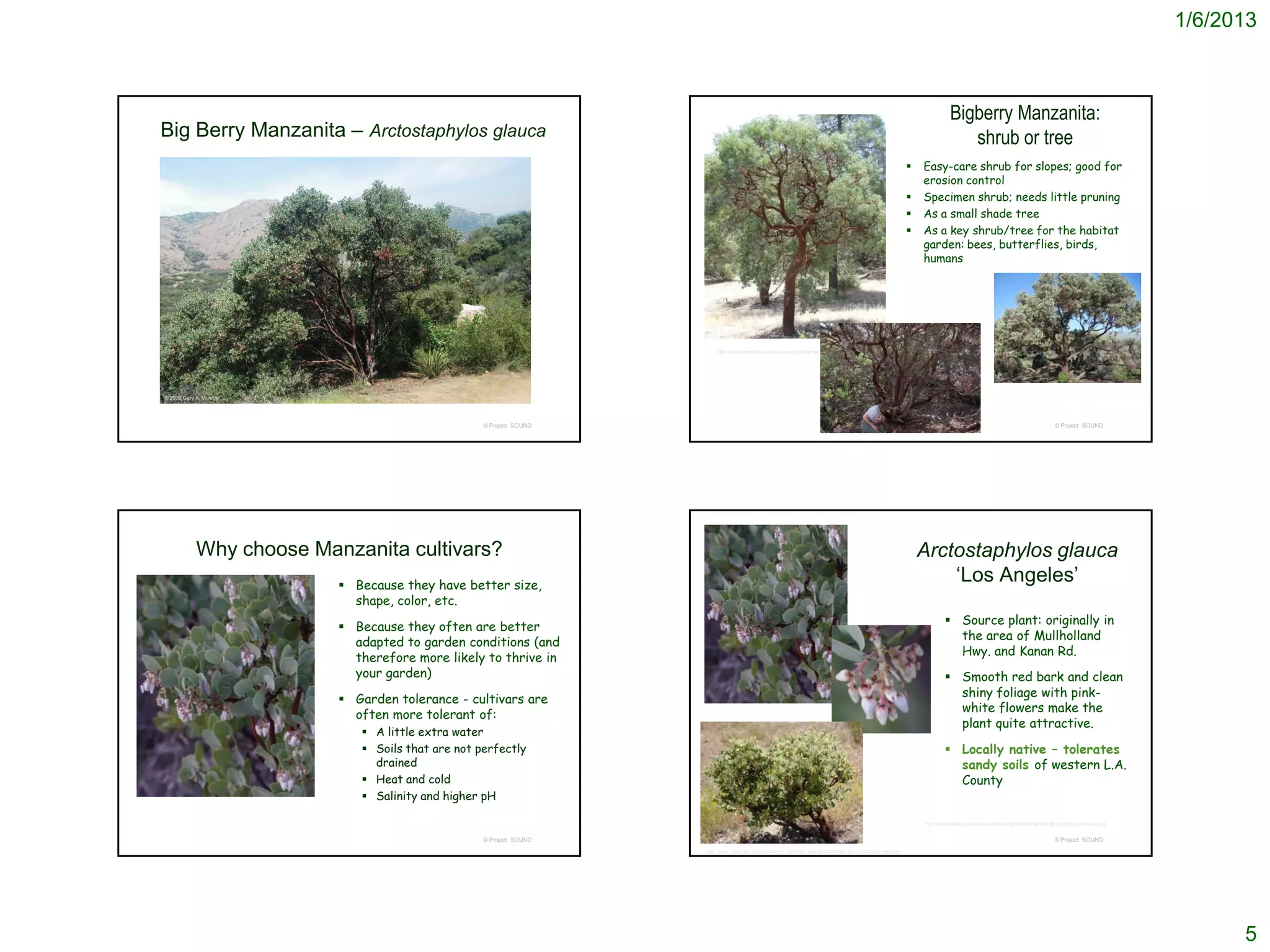
Big Berry Manzanita – Arctostaphylos glauca                                                                                                                                        shrub or tree
                                                                                                                                                                  Easy-care shrub for slopes; good for
                                                                                                                                                                   erosion control
                                                                                                                                                                  Specimen shrub; needs little pruning
                                                                                                                                                                  As a small shade tree
                                                                                                                                                                  As a key shrub/tree for the habitat
                                                                                                                                                                   garden: bees, butterflies, birds,
                                                                                                                                                                   humans


                                                                          http://www.laspilitas.com/nature-of-california/plants/arctostaphylos-glauca


© 2008 Gary A. Monroe


                                                   © Project SOUND                                                                                                                                                                       © Project SOUND


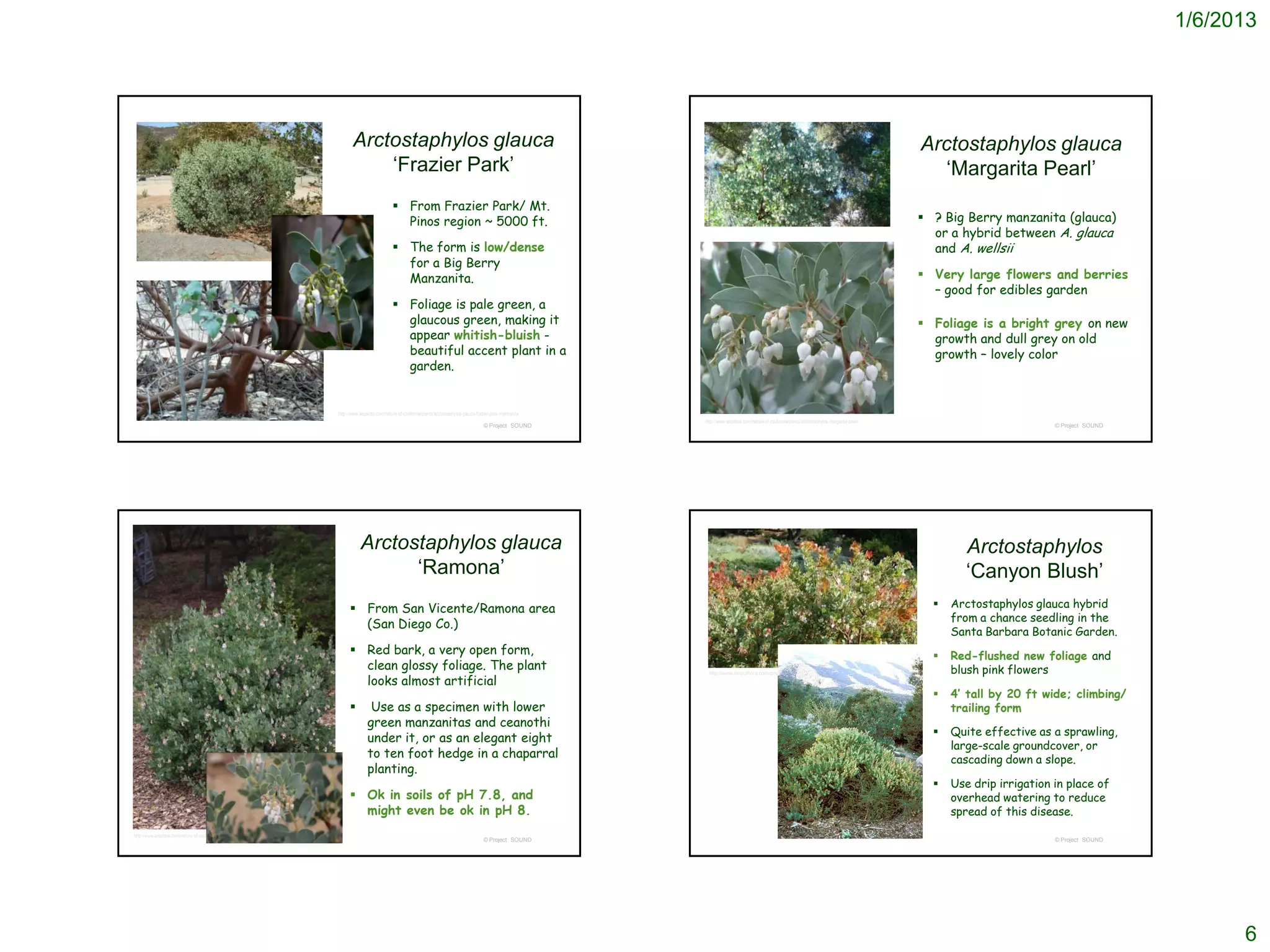
            Why choose Manzanita cultivars?                                                                                                                        Arctostaphylos glauca
                           Because they have better size,
                                                                                                                                                                       ‘Los Angeles’
                            shape, color, etc.
                                                                                                                                                                              Source plant: originally in
                           Because they often are better
                                                                                                                                                                               the area of Mullholland
                            adapted to garden conditions (and
                                                                                                                                                                               Hwy. and Kanan Rd.
                            therefore more likely to thrive in
                            your garden)                                                                                                                                      Smooth red bark and clean
                                                                                                                                                                               shiny foliage with pink-
                           Garden tolerance - cultivars are
                                                                                                                                                                               white flowers make the
                            often more tolerant of:
                                                                                                                                                                               plant quite attractive.
                              A little extra water
                              Soils that are not perfectly                                                                                                                   Locally native – tolerates
                               drained                                                                                                                                         sandy soils of western L.A.
                              Heat and cold                                                                                                                                   County
                              Salinity and higher pH

                                                                                                                                                                   http://www.laspilitas.com/nature-of-california/plants/arctostaphylos-glauca-frazier-park-manzanita


                                                   © Project SOUND                                                                                                                                                                       © Project SOUND
                                                                     http://www.laspilitas.com/nature-of-california/plants/arctostaphylos-glauca-los-angeles


                                                                                                                                                                                                                                                                              5
1/6/2013


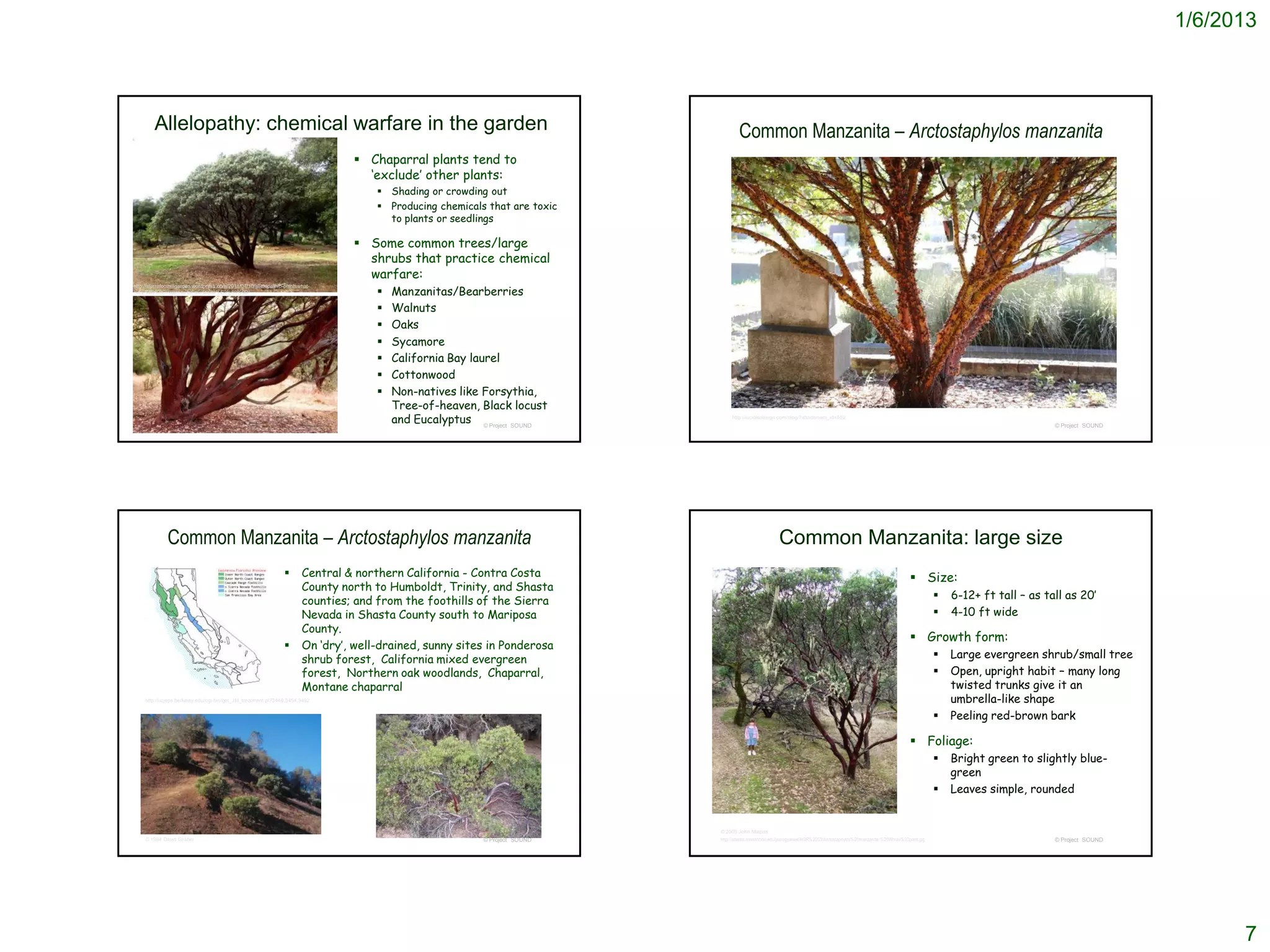
                                                                                                      Arctostaphylos glauca                                                                                                                                                                Arctostaphylos glauca
                                                                                                          ‘Frazier Park’                                                                                                                                                                     ‘Margarita Pearl’
                                                                                                                             From Frazier Park/ Mt.
                                                                                                                              Pinos region ~ 5000 ft.                                                                                                                                       ? Big Berry manzanita (glauca)
                                                                                                                                                                                                                                                                                             or a hybrid between A. glauca
                                                                                                                             The form is low/dense                                                                                                                                          and A. wellsii
                                                                                                                              for a Big Berry
                                                                                                                              Manzanita.                                                                                                                                                    Very large flowers and berries
                                                                                                                                                                                                                                                                                             – good for edibles garden
                                                                                                                             Foliage is pale green, a
                                                                                                                              glaucous green, making it                                                                                                                                     Foliage is a bright grey on new
                                                                                                                              appear whitish-bluish -                                                                                                                                        growth and dull grey on old
                                                                                                                              beautiful accent plant in a                                                                                                                                    growth – lovely color
                                                                                                                              garden.


                                                                                               http://www.laspilitas.com/nature-of-california/plants/arctostaphylos-glauca-frazier-park-manzanita
                                                                                                                                                                                                    http://www.laspilitas.com/nature-of-california/plants/arctostaphylos-margarita-pearl
                                                                                                                                                                             © Project SOUND                                                                                                                         © Project SOUND


                                                                                                           Arctostaphylos glauca                                                                                                                                                                    Arctostaphylos
                                                                                                                 ‘Ramona’                                                                                                                                                                           ‘Canyon Blush’
                                                                                                      From San Vicente/Ramona area                                                                                                                                                             Arctostaphylos glauca hybrid
                                                                                                                                                                                                                                                                                                 from a chance seedling in the
                                                                                                       (San Diego Co.)
                                                                                                                                                                                                                                                                                                 Santa Barbara Botanic Garden.
                                                                                                      Red bark, a very open form,                                                                                                                                                              Red-flushed new foliage and
                                                                                                       clean glossy foliage. The plant                                                                                                                                                           blush pink flowers
                                                                                                       looks almost artificial
                                                                                                                                                                                                      http://www.faroutflora.com/page/12/


                                                                                                                                                                                                                                                                                                4’ tall by 20 ft wide; climbing/
                                                                                                              Use as a specimen with lower                                                                                                                                                      trailing form
                                                                                                              green manzanitas and ceanothi
                                                                                                                                                                                                                                                                                                Quite effective as a sprawling,
                                                                                                              under it, or as an elegant eight
                                                                                                                                                                                                                                                                                                 large-scale groundcover, or
                                                                                                              to ten foot hedge in a chaparral                                                                                                                                                   cascading down a slope.
                                                                                                              planting.
                                                                                                                                                                                                                                                                                                Use drip irrigation in place of
                                                                                                      Ok in soils of pH 7.8, and                                                                                                                                                                overhead watering to reduce
                                                                                                       might even be ok in pH 8.                                                                                                                                                                 spread of this disease.
http://www.laspilitas.com/nature-of-california/plants/arctostaphylos-glauca-ramona-manzanita
                                                                                                                                                                             © Project SOUND                                                                                                                         © Project SOUND


                                                                                                                                                                                                                                                                                                                                             6
1/6/2013


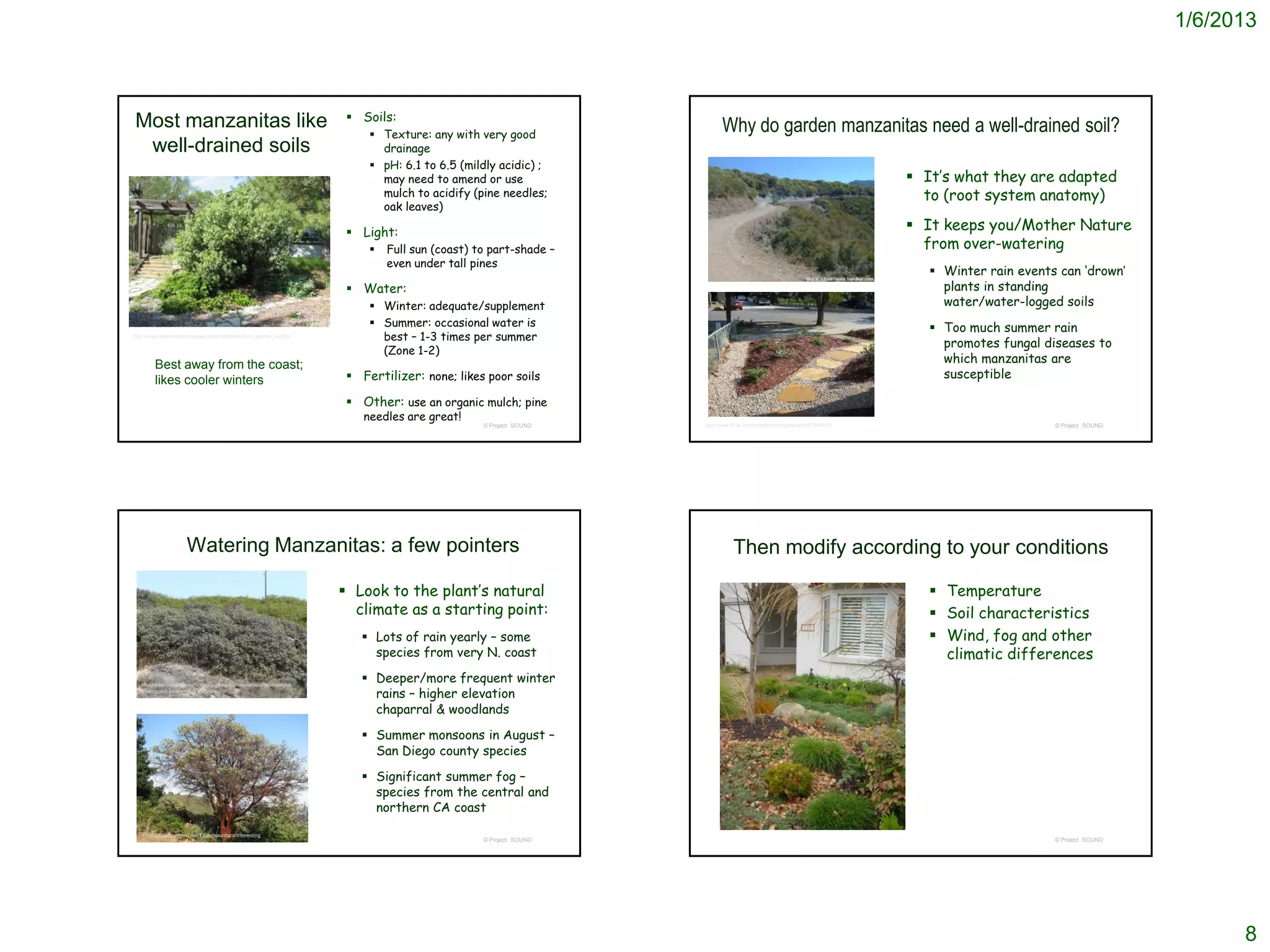
         Allelopathy: chemical warfare in the garden                                                                                  Common Manzanita – Arctostaphylos manzanita
                                                                                   Chaparral plants tend to
                                                                                    ‘exclude’ other plants:
                                                                                        Shading or crowding out
                                                                                        Producing chemicals that are toxic
                                                                                         to plants or seedlings

                                                                                   Some common trees/large
                                                                                    shrubs that practice chemical
                                                                                    warfare:
                                                                                           Manzanitas/Bearberries
http://sierrafoothillgarden.wordpress.com/2011/04/10/allelopathic-plantswhat-
%E2%80%9Ci-want-to-be-aloooone%E2%80%9D/                                               
                                                                                          Walnuts
                                                                                          Oaks
                                                                                          Sycamore
                                                                                          California Bay laurel
                                                                                          Cottonwood
                                                                                          Non-natives like Forsythia,
                                                                                           Tree-of-heaven, Black locust
                                                                                           and Eucalyptus © Project SOUND          http://lucioledesign.com/blog/?attachment_id=552
                                                                                                                                                                                                                                                            © Project SOUND


              Common Manzanita – Arctostaphylos manzanita                                                                                                 Common Manzanita: large size
                                                                        Central & northern California - Contra Costa                                                                                                    Size:
                                                                         County north to Humboldt, Trinity, and Shasta
                                                                         counties; and from the foothills of the Sierra                                                                                                               6-12+ ft tall – as tall as 20’
                                                                         Nevada in Shasta County south to Mariposa                                                                                                                    4-10 ft wide
                                                                         County.
                                                                                                                                                                                                                         Growth form:
                                                                        On ‘dry’, well-drained, sunny sites in Ponderosa
                                                                         shrub forest, California mixed evergreen                                                                                                                     Large evergreen shrub/small tree
                                                                         forest, Northern oak woodlands, Chaparral,                                                                                                                   Open, upright habit – many long
                                                                         Montane chaparral                                                                                                                                             twisted trunks give it an
     http://ucjeps.berkeley.edu/cgi-bin/get_JM_treatment.pl?3449,3454,3492                                                                                                                                                             umbrella-like shape
                                                                                                                                                                                                                                      Peeling red-brown bark

                                                                                                                                                                                                                         Foliage:
                                                                                                                                                                                                                                      Bright green to slightly blue-
                                                                                                                                                                                                                                       green
                                                                                                                                                                                                                                      Leaves simple, rounded


                                                                                                                              © 2009 John Malpas
     © 1994 David Graber                                                                                    © Project SOUND   http://atlantis.mendocino.edu/jxerogeanes/AGR%2053/Arctostaphylos%20manzanita-%20Whole%20plant.jpg                            © Project SOUND


                                                                                                                                                                                                                                                                                    7
1/6/2013


Most manzanitas like                                                         Soils:
                                                                                 Texture: any with very good
                                                                                                                               Why do garden manzanitas need a well-drained soil?
 well-drained soils                                                               drainage
                                                                                 pH: 6.1 to 6.5 (mildly acidic) ;
                                                                                  may need to amend or use                                                                         It’s what they are adapted
                                                                                  mulch to acidify (pine needles;                                                                   to (root system anatomy)
                                                                                  oak leaves)

                                                                             Light:                                                                                               It keeps you/Mother Nature
                                                                                   Full sun (coast) to part-shade –                                                                from over-watering
                                                                                    even under tall pines
                                                                                                                                                                                      Winter rain events can ‘drown’
                                                                             Water:                                                                                                   plants in standing
                                                                                 Winter: adequate/supplement                                                                          water/water-logged soils
                                                                                 Summer: occasional water is                                                                         Too much summer rain
                                                                                  best – 1-3 times per summer
                                                                                                                                                                                       promotes fungal diseases to
http://www.intermountainnursery.com/demonstration_garden_list.htm


                                                                                  (Zone 1-2)
         Best away from the coast;                                                                                                                                                     which manzanitas are
         likes cooler winters                                                Fertilizer: none; likes poor soils                                                                       susceptible

                                                                             Other: use an organic mulch; pine
                                                                               needles are great!
                                                                                                      © Project SOUND   http://www.flickr.com/photos/starlingfeather/297644619/                          © Project SOUND


                       Watering Manzanitas: a few pointers                                                                          Then modify according to your conditions

                                                                            Look to the plant’s natural                                                                              Temperature
                                                                             climate as a starting point:                                                                             Soil characteristics
                                                                               Lots of rain yearly – some                                                                            Wind, fog and other
                                                                                species from very N. coast                                                                             climatic differences
   http://www.laspilitas.com/nature-of-california/plants/arctostaphylos-
                                                                               Deeper/more frequent winter
   morroensis-park-view-manzanita
                                                                                rains – higher elevation
                                                                                chaparral & woodlands

                                                                               Summer monsoons in August –
                                                                                San Diego county species

                                                                               Significant summer fog –
                                                                                species from the central and
                                                                                northern CA coast
    http://flickrhivemind.net/Tags/mounttam/Interesting
                                                                                                      © Project SOUND                                                                                    © Project SOUND


                                                                                                                                                                                                                                 8
1/6/2013


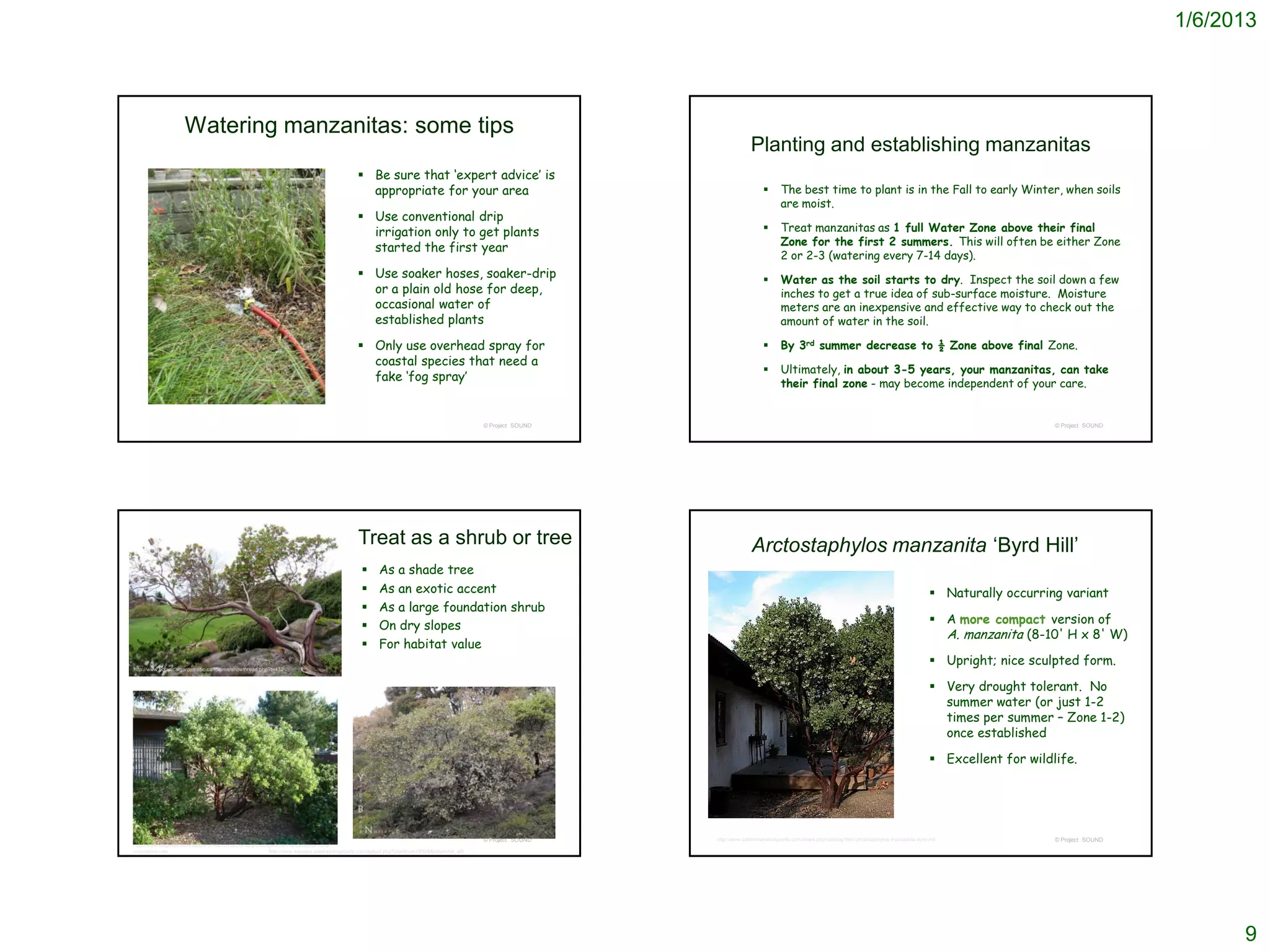
                     Watering manzanitas: some tips
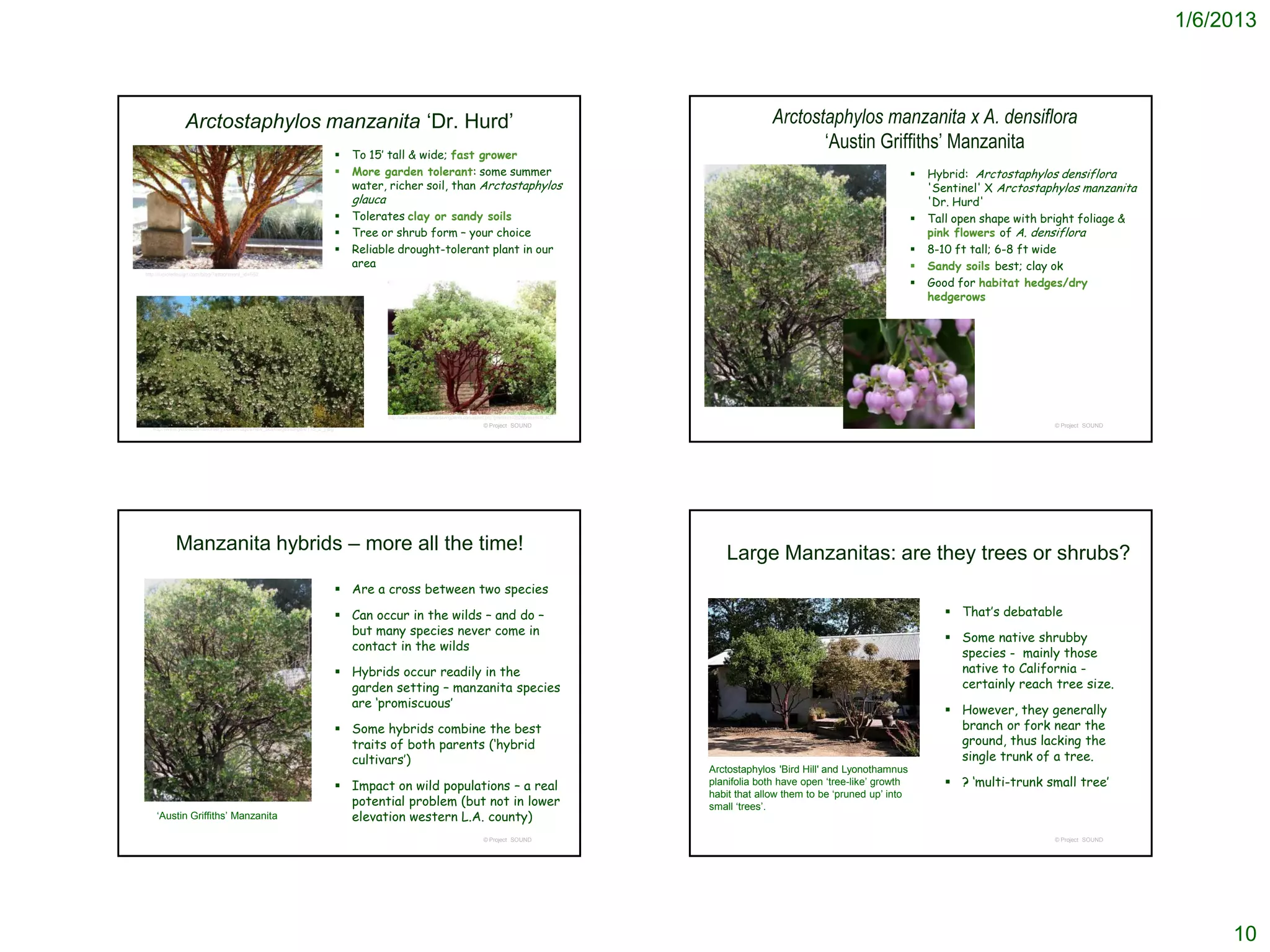
                                                                                                                                                                               Planting and establishing manzanitas
                                                                                                Be sure that ‘expert advice’ is
                                                                                                 appropriate for your area                                                                 The best time to plant is in the Fall to early Winter, when soils
                                                                                                                                                                                            are moist.
                                                                                                Use conventional drip
                                                                                                 irrigation only to get plants                                                             Treat manzanitas as 1 full Water Zone above their final
                                                                                                                                                                                            Zone for the first 2 summers. This will often be either Zone
                                                                                                 started the first year
                                                                                                                                                                                            2 or 2-3 (watering every 7-14 days).
                                                                                                Use soaker hoses, soaker-drip                                                             Water as the soil starts to dry. Inspect the soil down a few
                                                                                                 or a plain old hose for deep,                                                              inches to get a true idea of sub-surface moisture. Moisture
                                                                                                 occasional water of                                                                        meters are an inexpensive and effective way to check out the
                                                                                                 established plants                                                                         amount of water in the soil.

                                                                                                Only use overhead spray for                                                               By 3rd summer decrease to ½ Zone above final Zone.
                                                                                                 coastal species that need a
                                                                                                                                                                                           Ultimately, in about 3-5 years, your manzanitas, can take
                                                                                                 fake ‘fog spray’
                                                                                                                                                                                            their final zone - may become independent of your care.


                                                                                                                                               © Project SOUND                                                                                                                    © Project SOUND


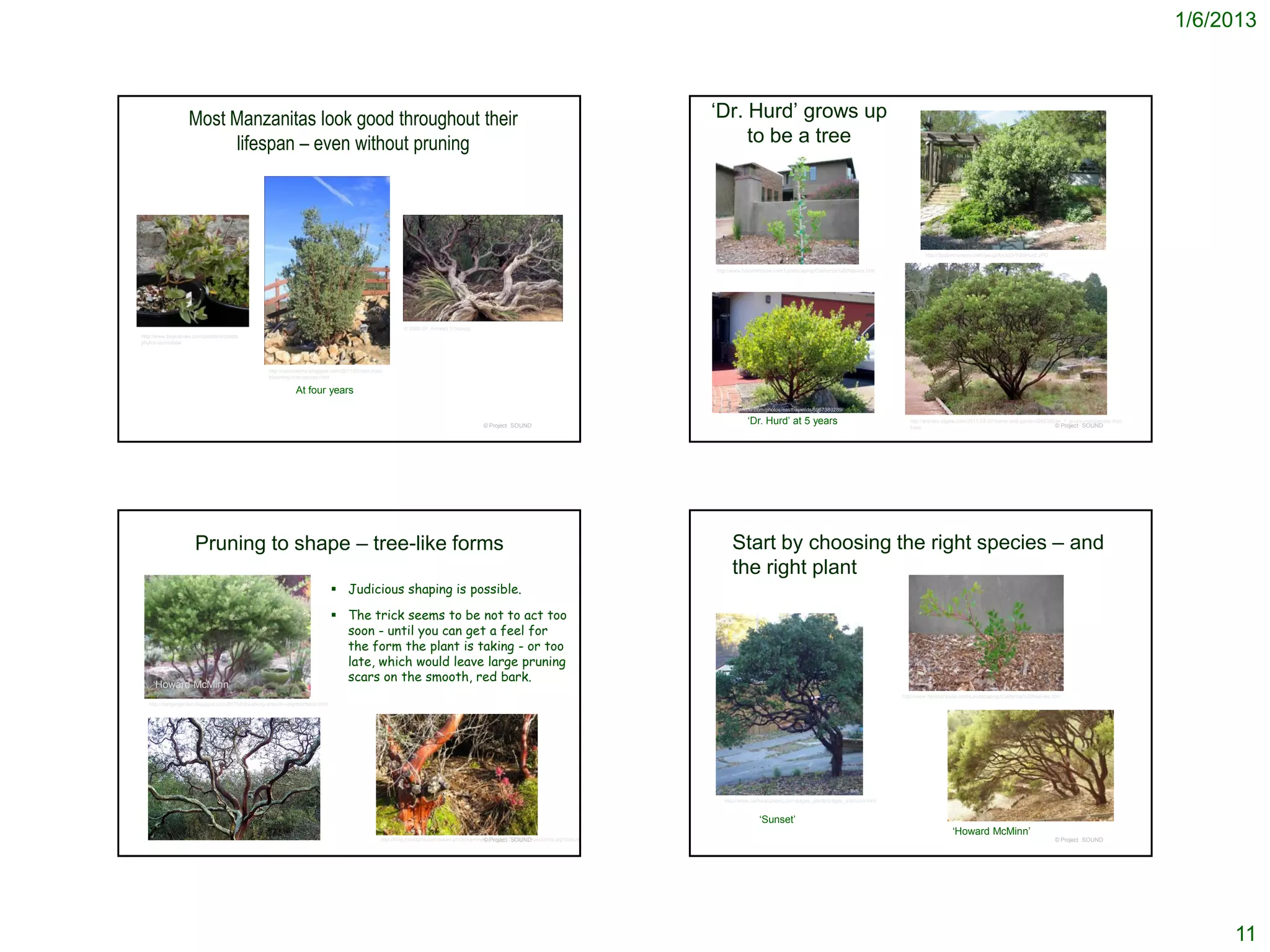
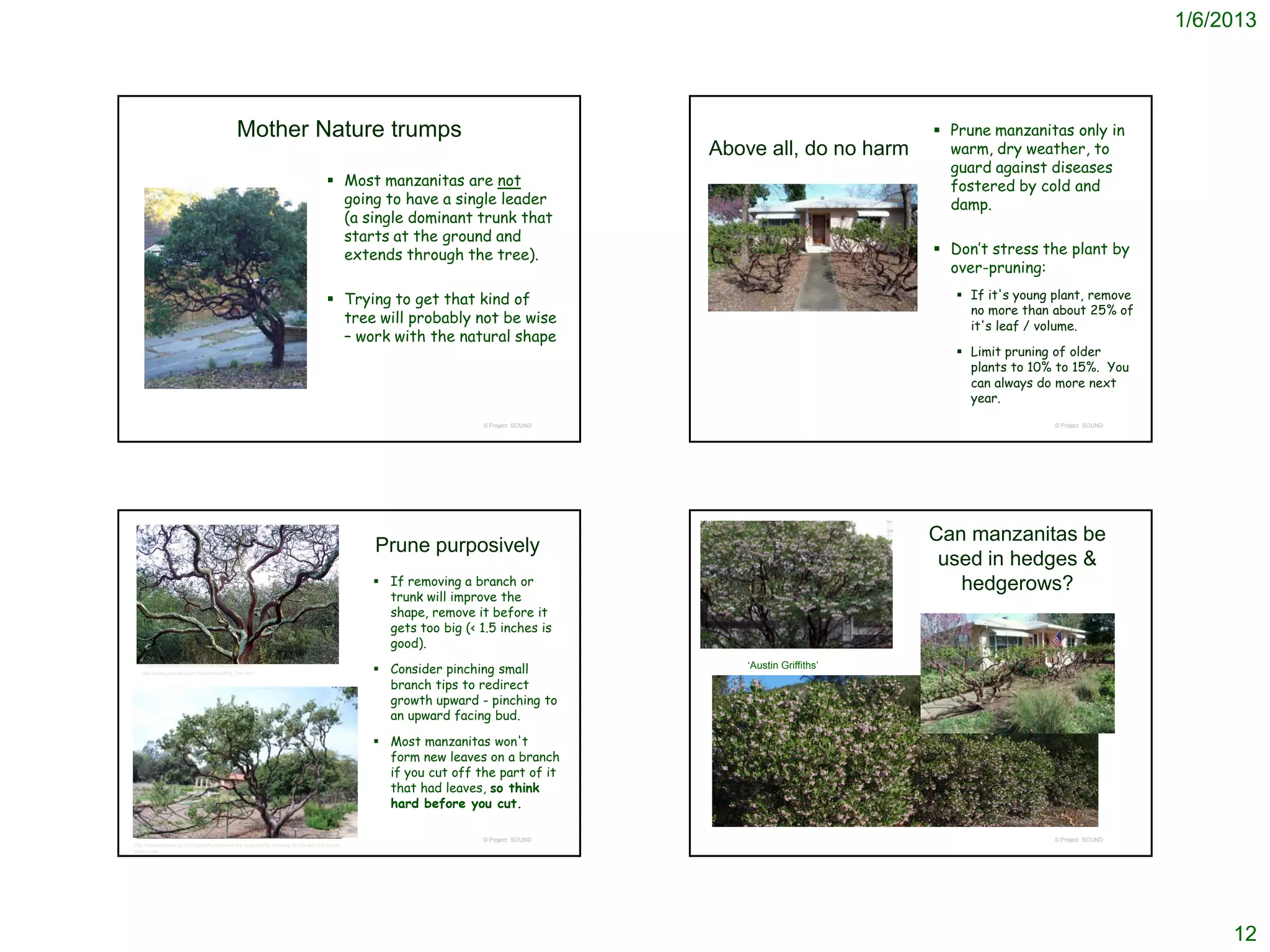
                                                                                               Treat as a shrub or tree                                                         Arctostaphylos manzanita ‘Byrd Hill’
                                                                                                       As a shade tree
                                                                                                       As an exotic accent                                                                                                                                   Naturally occurring variant
                                                                                                       As a large foundation shrub
                                                                                                       On dry slopes                                                                                                                                         A more compact version of
                                                                                                                                                                                                                                                               A. manzanita (8-10' H x 8' W)
                                                                                                       For habitat value
http://www.botanicalgarden.ubc.ca/forums/showthread.php?t=432
                                                                                                                                                                                                                                                              Upright; nice sculpted form.

                                                                                                                                                                                                                                                              Very drought tolerant. No
                                                                                                                                                                                                                                                               summer water (or just 1-2
                                                                                                                                                                                                                                                               times per summer – Zone 1-2)
                                                                                                                                                                                                                                                               once established

                                                                                                                                                                                                                                                              Excellent for wildlife.


                                                                                                                                               © Project SOUND   http://www.californianativeplants.com/index.php/catalog/item/arctostaphylos-manzanita-byrd-hill                  © Project SOUND
http://www.laspilitas.com/nature-of-california/plants/arctostaphylos-manzanita-dr-hurd-
manzanita-tree                                                http://www.sanjose.watersavingplants.com/eplant.php?plantnum=2528&return=l4_aD


                                                                                                                                                                                                                                                                                                          9
1/6/2013


                Arctostaphylos manzanita ‘Dr. Hurd’                                                                                                                                         Arctostaphylos manzanita x A. densiflora
                                                                                                                                                                                                   ‘Austin Griffiths’ Manzanita
                                                                                 To 15’ tall & wide; fast grower
                                                                                 More garden tolerant: some summer                                                                                                              Hybrid: Arctostaphylos densiflora
                                                                                  water, richer soil, than Arctostaphylos                                                                                                         'Sentinel' X Arctostaphylos manzanita
                                                                                  glauca                                                                                                                                          'Dr. Hurd'
                                                                                 Tolerates clay or sandy soils                                                                                                                  Tall open shape with bright foliage &
                                                                                 Tree or shrub form – your choice                                                                                                                pink flowers of A. densiflora
                                                                                 Reliable drought-tolerant plant in our                                                                                                         8-10 ft tall; 6-8 ft wide
                                                                                  area                                                                                                                                           Sandy soils best; clay ok
http://lucioledesign.com/blog/?attachment_id=552

                                                                                                                                                                                                                                 Good for habitat hedges/dry
                                                                                                                                                                                                                                  hedgerows


                                                                                           http://www.santacruz.watersavingplants.com/eplant.php?plantnum=2528&return=l9_aC
                                                                                                                                         © Project SOUND                                                                                                © Project SOUND
   http://www.yerbabuenanursery.com/images/new_botimages/large/0118_2_j.jpg


            Manzanita hybrids – more all the time!                                                                                                                               Large Manzanitas: are they trees or shrubs?
                                                                               Are a cross between two species

                                                                               Can occur in the wilds – and do –                                                                                                                     That’s debatable
                                                                                but many species never come in
                                                                                                                                                                                                                                      Some native shrubby
                                                                                contact in the wilds
                                                                                                                                                                                                                                       species - mainly those
                                                                               Hybrids occur readily in the                                                                                                                           native to California -
                                                                                garden setting – manzanita species                                                                                                                     certainly reach tree size.
                                                                                are ‘promiscuous’
                                                                                                                                                                                                                                      However, they generally
                                                                               Some hybrids combine the best                                                                                                                          branch or fork near the
                                                                                traits of both parents (‘hybrid                                                                                                                        ground, thus lacking the
                                                                                cultivars’)                                                                                                                                            single trunk of a tree.
                                                                                                                                                                              Arctostaph​ylos 'Bird Hill' and Lyonothamn​us
                                                                               Impact on wild populations – a real                                                           planifolia both have open ‘tree-like’ growth            ? ‘multi-trunk small tree’
                                                                                                                                                                              habit that allow them to be ‘pruned up’ into
                                                                                potential problem (but not in lower                                                           small ‘trees’.
    ‘Austin Griffiths’ Manzanita                                                elevation western L.A. county)
                                                                                                                                         © Project SOUND                                                                                                © Project SOUND


                                                                                                                                                                                                                                                                               10
1/6/2013


                    Most Manzanitas look good throughout their                                                                                                                               ‘Dr. Hurd’ grows up
                         lifespan – even without pruning                                                                                                                                          to be a tree


                                                                                                                                                                                                                                                                           http://3palmsnursery.com/ywup/ArctoDr%20Hurd.JPG


                                                                                                                                                                                             http://www.heronshouse.com/Landscaping/California%20Natives.htm


                                                                                                             © 2008 Dr. Amadej Trnkoczy
http://www.baynatives.com/plants/Arctosta
phylos-auriculata/


                                                   http://camissonia.blogspot.com/2011/01/rain-frost-
                                                   blooming-manzanitas.html

                                                              At four years
                                                                                                                                                                                             http://www.flickr.com/photos/eastbaywilds/5967389289/


                                                                                                                                               © Project SOUND
                                                                                                                                                                                                         ‘Dr. Hurd’ at 5 years                                       http://articles.sfgate.com/2011-02-27/home-and-garden/28632634_1_prune-manzanitas-fruit-
                                                                                                                                                                                                                                                                     trees                                                       © Project SOUND


                      Pruning to shape – tree-like forms                                                                                                                                           Start by choosing the right species – and
                                                                                                                                                                                                   the right plant
                                                                                Judicious shaping is possible.

                                                                                The trick seems to be not to act too
                                                                                 soon - until you can get a feel for
                                                                                 the form the plant is taking - or too
                                                                                 late, which would leave large pruning
                                                                                 scars on the smooth, red bark.
    ‘Howard McMinn’
                                                                                                                                                                                                                                                                  http://www.heronshouse.com/Landscaping/California%20Natives.htm
   http://dangergarden.blogspot.com/2010/03/walking-around-neighborhood.html


                                                                                                                                                                                                http://www.calfloranursery.com/pages_plants/pages_a/arcsun.html


                                                                                                                                                                                                              ‘Sunset’
                                                                                                                                                                                                                                                                                      ‘Howard McMinn’
                                                                                                    http://blog.travelpod.com/travel-photo/keeleyhope/1/1267709433/manzanita.jpg/tpod.html
                                                                                                                                                 © Project SOUND                                                                                                                                                                © Project SOUND


                                                                                                                                                                                                                                                                                                                                                                     11
1/6/2013


                                             Mother Nature trumps                                                                                            Prune manzanitas only in
                                                                                                                                   Above all, do no harm      warm, dry weather, to
                                                                                                                                                              guard against diseases
                                                                                      Most manzanitas are not                                                fostered by cold and
                                                                                       going to have a single leader                                          damp.
                                                                                       (a single dominant trunk that
                                                                                       starts at the ground and
                                                                                       extends through the tree).                                            Don’t stress the plant by
                                                                                                                                                              over-pruning:

                                                                                      Trying to get that kind of                                               If it's young plant, remove
                                                                                                                                                                 no more than about 25% of
                                                                                       tree will probably not be wise                                            it's leaf / volume.
                                                                                       – work with the natural shape
                                                                                                                                                                Limit pruning of older
                                                                                                                                                                 plants to 10% to 15%. You
                                                                                                                                                                 can always do more next
                                                                                                                                                                 year.
                                                                                                                 © Project SOUND                                               © Project SOUND


                                                                                                                                                            Can manzanitas be
                                                                                              Prune purposively
                                                                                                                                                             used in hedges &
                                                                                               If removing a branch or                                        hedgerows?
                                                                                                trunk will improve the
                                                                                                shape, remove it before it
                                                                                                gets too big (< 1.5 inches is
                                                                                                good).
     http://en.wikipedia.org/wiki/File:Manzanita.JPG
   http://www.juniperridge.com/wildcrafting_use.htm                                            Consider pinching small                ‘Austin Griffiths’

                                                                                                branch tips to redirect
                                                                                                growth upward - pinching to
                                                                                                an upward facing bud.

                                                                                               Most manzanitas won't
                                                                                                form new leaves on a branch
                                                                                                if you cut off the part of it
                                                                                                that had leaves, so think
                                                                                                hard before you cut.

                                                                                                                 © Project SOUND                                               © Project SOUND
http://truevisiondesign.com/janet/fun/around-the-property/86-clearing-brush-and-the-joy-of-
poison-oak


                                                                                                                                                                                                      12
1/6/2013


                      Pointleaf Manzanita – Arctostaphylos pungens                                                                                                            Pointleaf Manzanita – Arctostaphylos pungens
                                                                                                                                                                                                                                                       Foothills & mtns of the U.S.
                                                                                                                                                                                                                                                        Southwest and NW Mexico –
                                                                                                                                                                                                                                                        2500-8000 ft.

                                                                                                                                                                                                                                                       Locally: San Gabriel & San
                                                                                                                                                                                                                                                        Bernardino Mtns.

                                                                                                                                                                                                                                                       Rocky slopes, ridges, in
                                                                                                                                                     http://ucjeps.berkeley.edu/cgi-
                                                                                                                                                                                                        http://www.efloras.org/florataxon.aspx?flor
                                                                                                                                                                                                        a_id=1&taxon_id=250092319                       chaparral, coniferous forest
                                                                                                                                                     bin/get_JM_treatment.pl?3449,3454,3522


                     http://www.delange.org/ManzanitaPointleaf/ManzanitaPointleaf.htm
                                                                                                                                                                             http://www.cas.vanderbilt.edu/bioimages/species/arpu5.htm
                                                                                                                                   © Project SOUND                                                                                                                                                   © Project SOUND
                                                                                                                                                                                                                                                        http://www.birdandhike.com/Veg/Species/Shrubs/Arctos_pun/_Arc_pun.htm


      Pointleaf Manzanita: variable over its range                                                                                                                  Manzanitas are primarily chaparral plants
                                                                                          Size:
                                                                                                          3-10 ft tall – often 3-6 ft
                                                                                                                                                                  Environmental
                                                                                                          3-8 ft wide – often 3-6 ft
                                                                                                                                                                     Higher total moisture
                                                                                          Growth form:                                                                  Rain & snow
                                                                                                         Evergreen shrub/small tree                                     May also have summer rains
                                                                                                         Upright, open habit                                        Wider temperature extremes
                                                                                                         Smooth, red-brown peeling bark
                                                                                                                                                                     More natural mulch
                                                                                                         In nature may grow in dense
                                                                                                          thickets                                                Growth patterns
                                                                                          Foliage:                                                                  Evergreen
                                                                                                         Thick, leathery leaves                                     Longer growth season – spring through summer
                                                                                                         Shiny wax coating                                          May have growth/flowering after summer rains
                                                                                                         Produces volatile chemicals –
                                                                                                                                                                  Role of fire: essential for many species
                                                                                                          helps to burn

                                                                                          Roots: shallow, fibrous
                                                                                                                                   © Project SOUND                                                                                                                                                   © Project SOUND
http://www.cas.vanderbilt.edu/bioimages/species/arpu5.htm          http://www.ugcs.caltech.edu/~greywolf/spectra/spec_curve.html


                                                                                                                                                                                                                                                                                                                                     13
1/6/2013


                                                                       Manzanitas contain a high percentage
 Manzanitas and fire                                                    of volatile compounds, which burn like
                                                                                                                             If you need to worry about fire: choices
                                                                        a torch when ignited.

                                                                       They also carry a large amount of dead
                                                                        wood, making them all the more                                                                           Plant something other than a
                                                                        flammable.                                                                                                manzanita
                                                                        Manzanita can act as a ladder fuel in
                                                                    
                                                                                                                                                                                 Plant species from Northern
                                                                        landscapes, especially when planted
                                                                        adjacent to flammable structures such                                                                     CA or cultivars that can take
                                                                        as homes, decks, fences, and trees.                                                                       a little more water; then
                                                                        Ladder fuels carry fire from the
  http://sandiegohiker.net/?p=408
                                                                                                                                                                                  water them
                                                                        ground where it can be controlled to
Tough seed coats and sprouting                                          treetops where it is difficult to
roots/ burls are manzanita                                              control.
                                                                                                                                                                                 Choose Bearberries, which
adaptations to life with fire                                                                                                                                                     are not so flammable but
                                                                       Flame lengths of manzanita can reach
                                                                        eight times the height of the shrub
                                                                                                                                                                                  have the ‘manzanita look’
                                                                        (i.e. a five foot tall manzanita can
                                                                        generate a 40 foot flame).

                                                                                               © Project SOUND                                                                                            © Project SOUND


                                                                          Flowers and fruits                                Growing Manzanita from seed: difdicult
                                                                         Blooms:                                                                                               Very difficult to germinate: have
                                                                              Winter to early spring – in our                                                                   both a hard seedcoat and embryo
                                                                               area may be as early as                                                                           dormancy
                                                                               Nov/Dec.
                                                                                                                                                                                In nature, manzanita seeds germinate
                                                                              Provide needed winter color,
                                                                                                                                                                                 following fire. Fire provides exposure
                                                                               nectar
 http://www.delange.org/ManzanitaPointleaf/ManzanitaPointleaf.htm                                                                                                                to heat/smoke and seedbed
                                                                         Flowers:                               http://hazmac.biz/041206b/041206bArctostaphylosPungens.html
                                                                                                                                                                                 preparation.
                                                                              Typical for the genus: small,
                                                                                                                                                                                To mimic this natural process, some
                                                                               white (pink blush) urn-shaped
                                                                                                                                                                                 propagators sow seeds in a flat
                                                                         Fruits:                                                                                                (wooden flat covered with aluminum
                                                                              Small (1/4 inch)                                                                                  foil) and burn a 3-4 inch layer of pine
                                                                              Ripen to showy red in summer;                                                                     needles on top of the seedbed.
                                                                               retained through fall
                                                                                                                                                                                Seeds may take a year to germinate.
                                                                         Vegetative reproduction: natural                                                                       Once seedlings germinate, they are
                                                                          layering                                                                                               transplanted to nursery containers.
                                                                                               © Project SOUND                                                                                            © Project SOUND


                                                                                                                                                                                                                                 14
1/6/2013


                                                                                                                                                                                                                                   Soils:
       Propagating manzanitas by layering is easy                                                                                        Plant Requirements                                                                            Texture: well-drained – sandy or
                                                                                                                                                                                                                                        rocky best, but others ok on
                                                                     Propagate existing manzanita plants                                                                                                                               slopes
                                                                      using Mother Nature’s method - the
                                                                                                                                                                                                                                       pH: slightly acidic - 5.1-7.5
                                                                      layering technique.
                                                                                                                                                                                                                                   Light:
                                                                     A tender shoot is "pinned" (using a "U"
                                                                                                                                                                                                                                         Full sun
                                                                      shaped piece of wire) into the soil
                                                                      where it is left to take root for a                                                                                                                                Can take plenty of heat
                                                                      growing season.                                                                                                                                              Water:
                                                                     Slightly wound the stem with a sharp,                                                                                                                            Winter: adequate
                                                                      clean knife and give supplemental                                                                                                                                Summer: in our area, best with
      http://generalhorticulture.tamu.edu/YouthAdventureProgra
      m/AsexualPropagation/AsexaulPropagation.html
                                                                      water to promote root growth.                                                                                                                                     occasional water (once a month
                                                                                                                                                                                                                                        in summer – Zone 1-2) but very
 Natural ‘layering’ allows                                           After roots become established, the                                                                                                                               drought tolerant; likes ‘summer
 some plants to form a thicket                                        rooted plant can be severed from the                                                                                                                              monsoon’
 generated from a single                                              mother plant, grown up in a pot, and                                                                                                                         Fertilizer: none; likes poor soils
 plant                                                                transplanted in fall following recovery.
                                                                                                                                         http://www.educacionambiental.org.mx/atlas/anexo/CONABIO/Arctostaphylos%20pungens2.jpg    Other: organic mulch
                                                                                                                       © Project SOUND                                                                                                                      © Project SOUND


                                                                           Pointleaf Manzanita thrives
                                                                                  in dry gardens                                                          For a chaparral garden, plant with its
                                                                              Nice background shrub or in                                                         usual associates
                                                                               informal hedges
                                                                              Hot, dry hills & slopes – erosion                                                                                                       Wedgeleaf ceanothus (Ceanothus cuneatus)
                                                                               control                                                                                                                                 California buckthorn (Frangula californica)
                                                                              Place where you can enjoy flowers                                                                                                       Common snowberry (Symphoricarpos albus)
                                                                               & fruits
                                                                                                                                                                                                                       Birchleaf mountain-mahogany
                                                                                                                                                                                                                        Thickleaf yerba santa (E. crassifolium)
 http://www.delange.org/ManzanitaPointleaf/ManzanitaPointleaf.htm
                                                                                                                                                                                                                
                                                                                                                                                                                                                       Flannelbush (Fremontodendron species)
                                                                                                                                                                                                                       CA coffeeberry (Rhamnus californica)
                                                                                                                                                                                                                       Tecate cypress (Cupressus forbesii)
                                                                                                                                                                                                                       Laurel sumac (Malosma laurina)
                                                                                                                                                                                                                       Black & White Sages (Salvia mellifera, Apiana)


                                                                               http://www.fireflyforest.com/flowers/   © Project SOUND                                                                                                                      © Project SOUND
http://www.delange.org/ManzanitaPointleaf/ManzanitaPointleaf.htm
http://www.wildflower.org/plants/result.php?id_plant=ARPU5


                                                                                                                                                                                                                                                                                   15
1/6/2013


  Pruning Manzanitas for a hedge or pot                                     Aesthetic and other considerations when
                                                                                     choosing a manzanita
                       Choose the right species: should have a
                        more dense (less open) growth habit                                                                                   Open or dense growth
                                                                                                                                               pattern
                       Prune out branches that are ‘wrong’
                                                                                                                                              Growth speed
                       Tip-prune/pinch new growth to
                        promote fuller, bushy growth if                                                                                       Foliage color
                        desired
                                                                                                                                              Flower color
                                                                                                                                              Size/color of fruits
                                                                                                                                              ‘Garden hardiness’ – length of
                                                                                                                                               time used in gardens

                                                   © Project SOUND                                                                                                                                   © Project SOUND


        * Otay Manzanita – Arctostaphylos otayensis                                     * Otay Manzanita – Arctostaphylos otayensis
                                                                                                                              Endemic to mountains of southern San
                                                                                                                               Diego County (e.g., Guatay, Jamul, Otay),
                                                                                                                               near border with Baja California & nearby
                                                                                                                               S. Riverside County and northern Baja

                                                                                                                              Shallow volcanic soils, rock outcrops in
                                                                                                                               chaparral, woodlands (1500-5200‘ elev.)

                                                                     http://ucjeps.berkeley.edu/cgi-bin/get_JM_treatment.pl?3449,3454,3513


© 2003 David Graber                                                  © 2003 David Graber                                                          http://www.willhiteweb.com/california_climbing/trip_reports_099.htm
                                                   © Project SOUND                                                                                                                                   © Project SOUND


                                                                                                                                                                                                                             16
1/6/2013


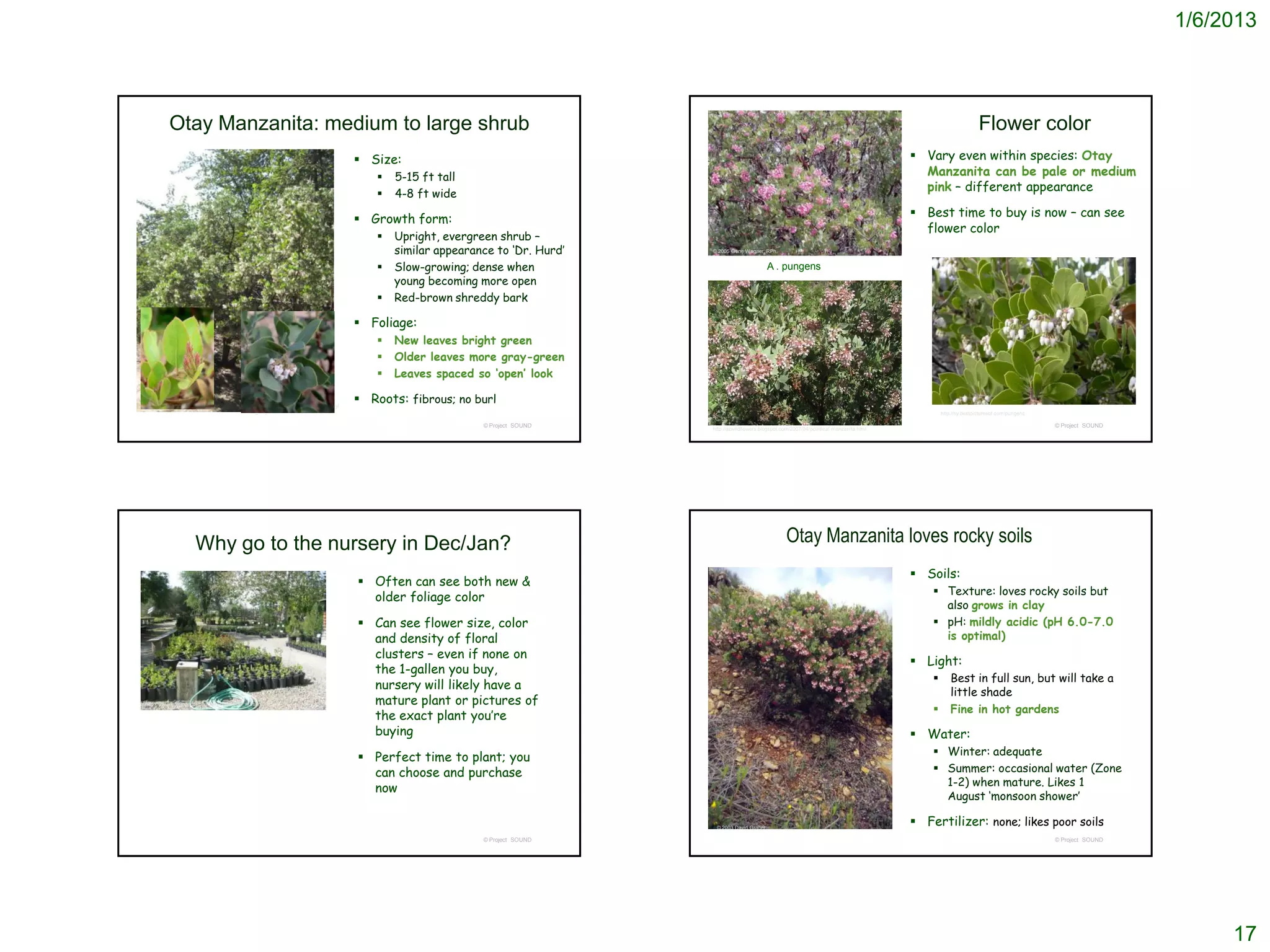
          Otay Manzanita: medium to large shrub                                                                                                                                                                                 Flower color
                                                                                         Size:                                                                                                          Vary even within species: Otay
                                                                                               5-15 ft tall                                                                                              Manzanita can be pale or medium
                                                                                                                                                                                                          pink – different appearance
                                                                                               4-8 ft wide

                                                                                         Growth form:                                                                                                   Best time to buy is now – can see
                                                                                                                                                                                                          flower color
                                                                                               Upright, evergreen shrub –
                                                                                                similar appearance to ‘Dr. Hurd’   © 2005 Gene Wagner, RPh.


                                                                                               Slow-growing; dense when                                  A . pungens
                                                                                                young becoming more open
                                                                                               Red-brown shreddy bark

                                                                                         Foliage:
                                                                                               New leaves bright green
                                                                                               Older leaves more gray-green
                                                                                               Leaves spaced so ‘open’ look

                                            http://en.wikipedia.org/wiki/Arctostaphyl
                                                                                         Roots: fibrous; no burl
                                            os_otayensis                                                                                                                                                        http://hy.bestpicturesof.com/pungens

                                                                                                                © Project SOUND                                                                                                                        © Project SOUND
                                                                                                                                   http://azwildflowers.blogspot.com/2007/04/pointleaf-manzanita.html


                     Why go to the nursery in Dec/Jan?                                                                                                            Otay Manzanita loves rocky soils
                                                                                                                                                                                                         Soils:
                                                                                         Often can see both new &
                                                                                                                                                                                                             Texture: loves rocky soils but
                                                                                          older foliage color
                                                                                                                                                                                                              also grows in clay
                                                                                         Can see flower size, color                                                                                         pH: mildly acidic (pH 6.0-7.0
                                                                                          and density of floral                                                                                               is optimal)
                                                                                          clusters – even if none on
                                                                                                                                                                                                         Light:
                                                                                          the 1-gallen you buy,
                                                                                                                                                                                                                   Best in full sun, but will take a
                                                                                          nursery will likely have a
                                                                                                                                                                                                                    little shade
                                                                                          mature plant or pictures of
                                                                                                                                                                                                                    Fine in hot gardens
http://www.intermountainnursery.com/retail_nursery.htm
                                                                                                                                                                                                            
                                                                                          the exact plant you’re
                                                                                          buying                                                                                                         Water:
                                                                                         Perfect time to plant; you                                                                                         Winter: adequate
                                                                                          can choose and purchase                                                                                            Summer: occasional water (Zone
                                                                                                                                                                                                              1-2) when mature. Likes 1
                                                                                          now
                                                                                                                                                                                                              August ‘monsoon shower’

                                                                                                                                    © 2003 David Graber
                                                                                                                                                                                                         Fertilizer: none; likes poor soils
                                                                                                                © Project SOUND                                                                                                                        © Project SOUND


                                                                                                                                                                                                                                                                              17
1/6/2013


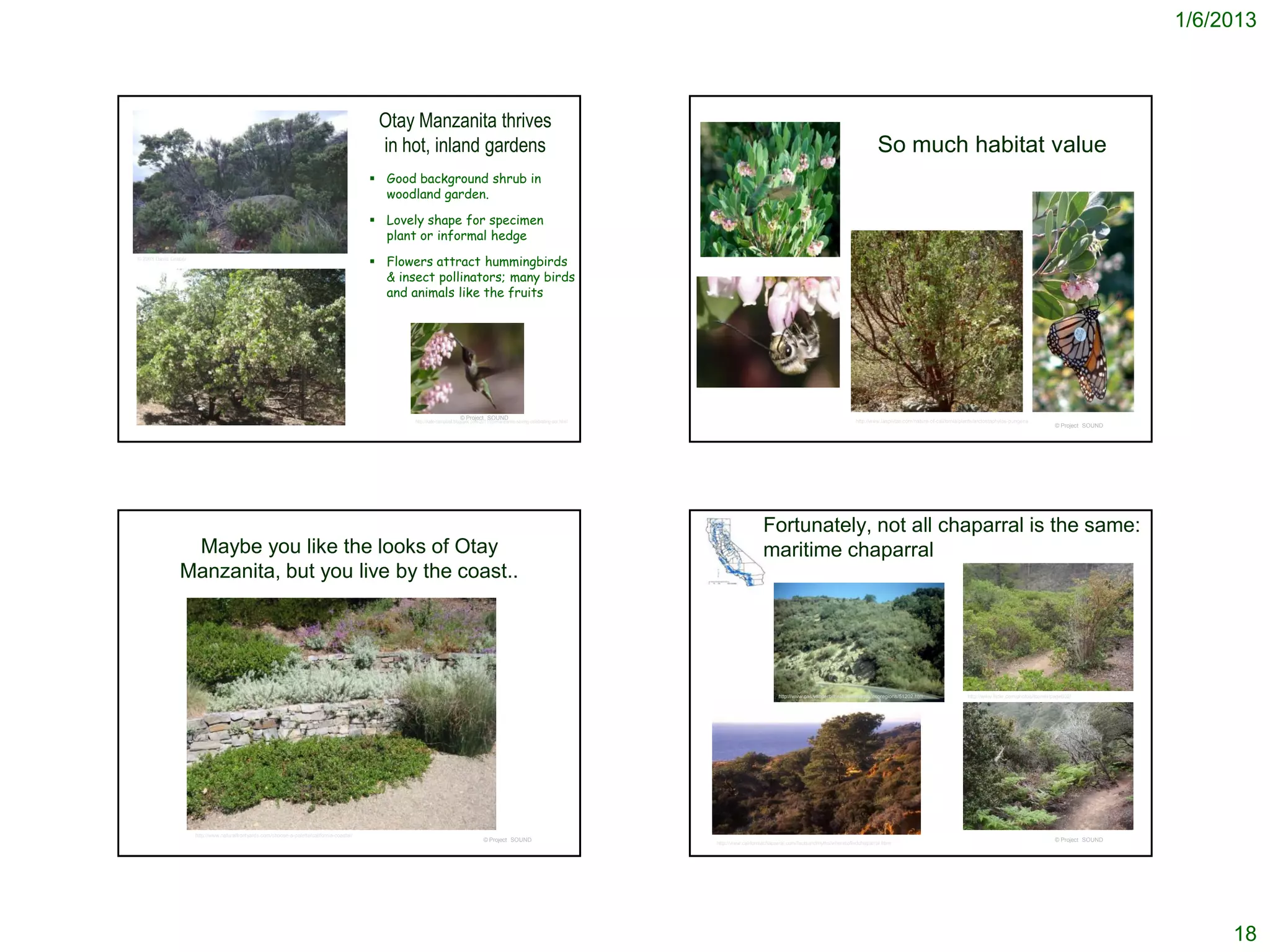
                                                                                               Otay Manzanita thrives
                                                                                               in hot, inland gardens                                                                                                                                      So much habitat value
                                                                                               Good background shrub in
                                                                                                woodland garden.

                                                                                               Lovely shape for specimen
                                                                                                plant or informal hedge
© 2003 David Graber
                                                                                               Flowers attract hummingbirds
                                                                                                & insect pollinators; many birds
                                                                                                and animals like the fruits


                                                                                                                            © Project SOUND
                                                                                                     http://kate-campbell.blogspot.com/2011/09/manzanita-saving-celebrating-our.html                                                              http://www.laspilitas.com/nature-of-california/plants/arctostaphylos-pungens
                                                                                                                                                                                                                                                                                                                                         © Project SOUND


                                                                                                                                                                                                          Fortunately, not all chaparral is the same:
                 Maybe you like the looks of Otay                                                                                                                                                         maritime chaparral
                Manzanita, but you live by the coast..


                                                                                                                                                                                                                 http://www.cas.vanderbilt.edu/bioimages/ecoregions/51202.htm                      http://www.flickr.com/photos/tcorelli/page602/


                      http://www.naturalfrontyards.com/choose-a-palette/california-coastal/
                                                                                                                                        © Project SOUND                                                                                                                                                                                  © Project SOUND
                                                                                                                                                                                       http://www.californiachaparral.com/factsandmyths/wheretofindchaparral.html


                                                                                                                                                                                                                                                                                                                                                                18
1/6/2013


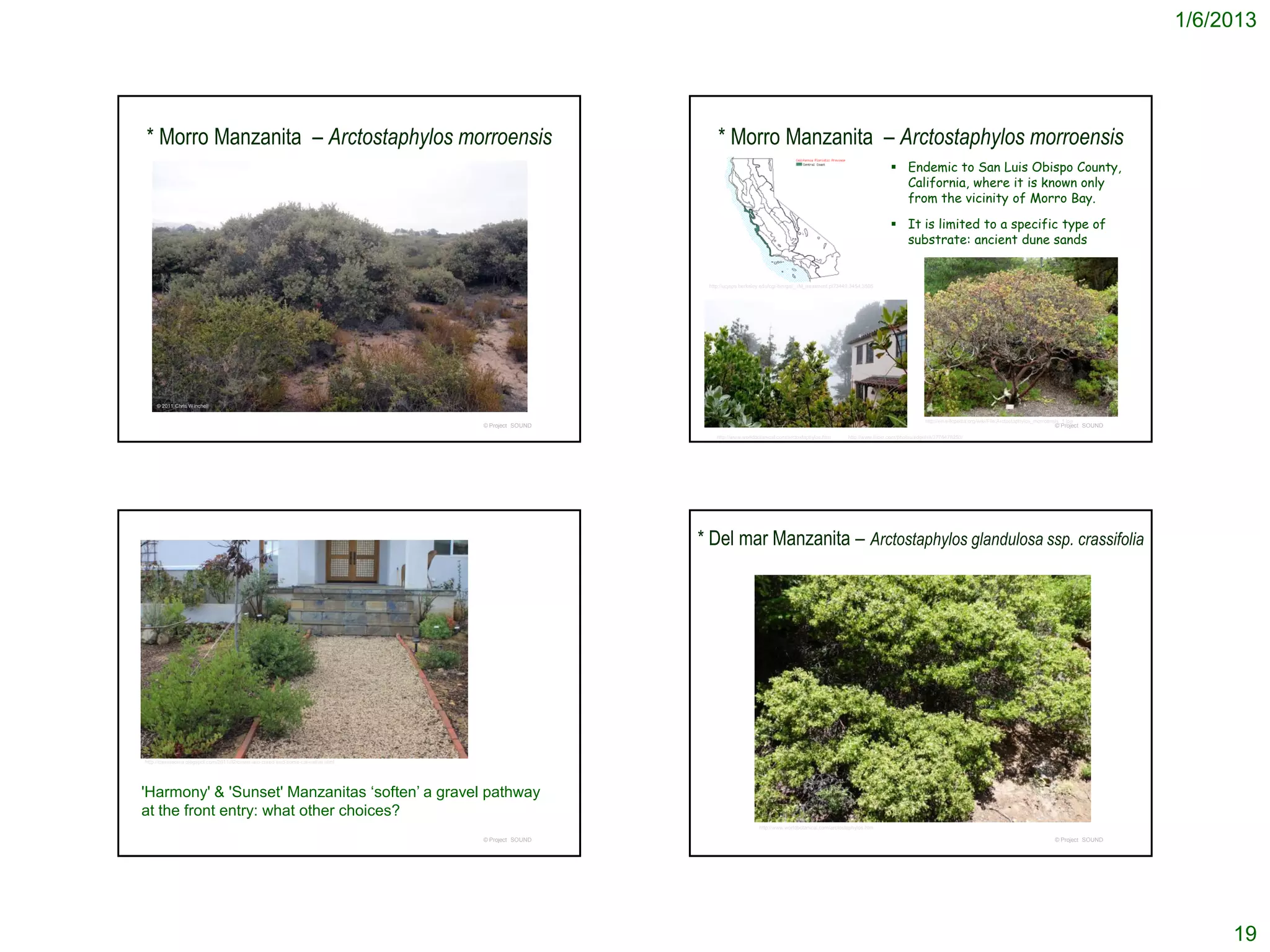
* Morro Manzanita – Arctostaphylos morroensis                                                            * Morro Manzanita – Arctostaphylos morroensis
                                                                                                                                                                                   Endemic to San Luis Obispo County,
                                                                                                                                                                                    California, where it is known only
                                                                                                                                                                                    from the vicinity of Morro Bay.

                                                                                                                                                                                   It is limited to a specific type of
                                                                                                                                                                                    substrate: ancient dune sands


                                                                                                      http://ucjeps.berkeley.edu/cgi-bin/get_JM_treatment.pl?3449,3454,3505


    © 2011 Chris Winchell


                                                                                                                                                                                                http://en.wikipedia.org/wiki/File:Arctostaphylos_morroensis_1.jpg
                                                                                   © Project SOUND                                                                                                                                                       © Project SOUND
                                                                                                         http://www.worldbotanical.com/arctostaphylos.htm       http://www.flickr.com/photos/edgehill/3776478253/


                                                                                                     * Del mar Manzanita – Arctostaphylos glandulosa ssp. crassifolia


http://camissonia.blogspot.com/2011/02/olives-are-cured-and-some-cal-native.html


'Harmony' & 'Sunset' Manzanitas ‘soften’ a gravel pathway
at the front entry: what other choices?
                                                                                                                           http://www.worldbotanical.com/arctostaphylos.htm

                                                                                   © Project SOUND                                                                                                                                                       © Project SOUND


                                                                                                                                                                                                                                                                                19
1/6/2013


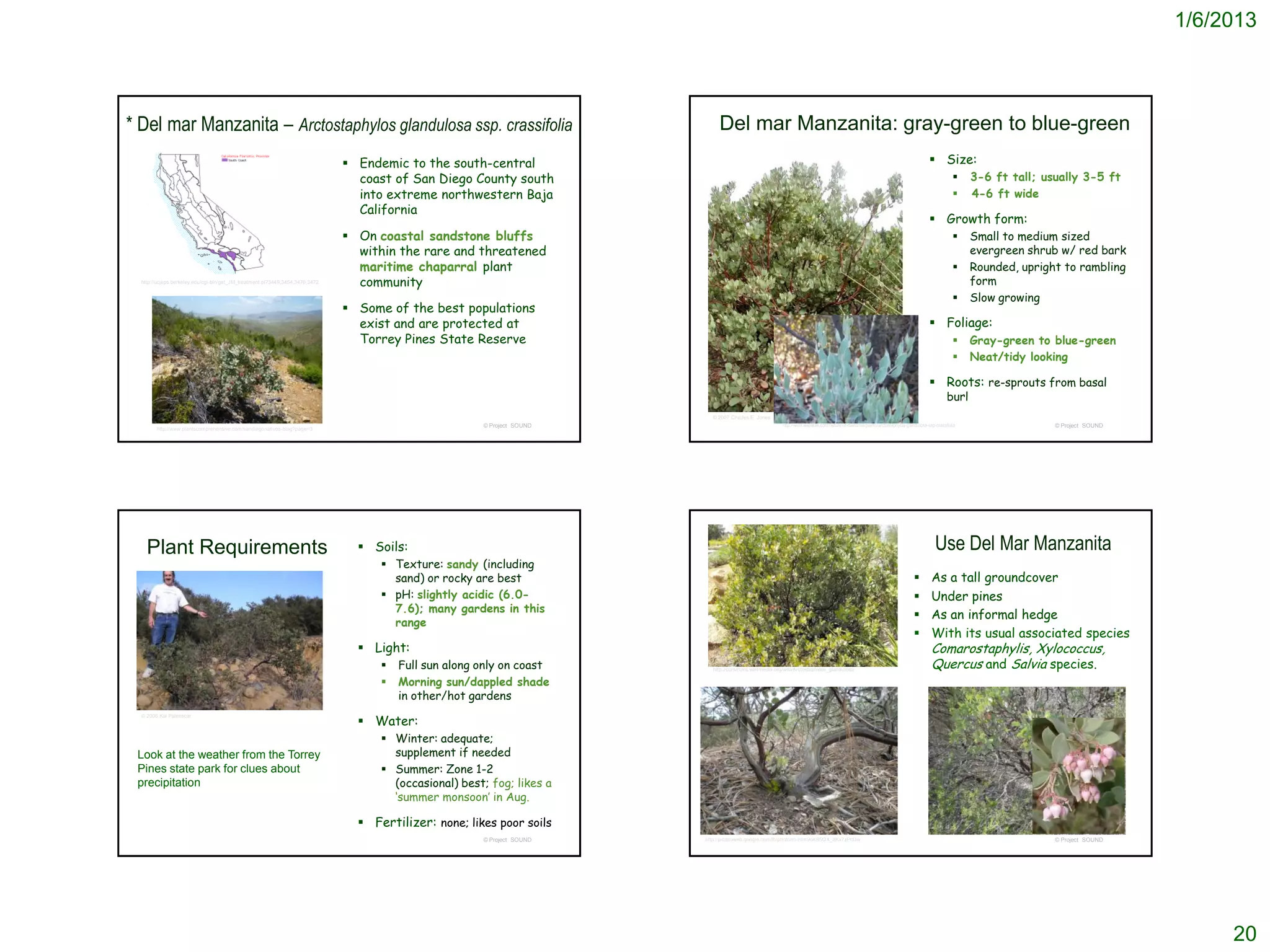
* Del mar Manzanita – Arctostaphylos glandulosa ssp. crassifolia                                                               Del mar Manzanita: gray-green to blue-green
                                                                                Endemic to the south-central                                                                                                                             Size:
                                                                                 coast of San Diego County south                                                                                                                                          3-6 ft tall; usually 3-5 ft
                                                                                 into extreme northwestern Baja                                                                                                                                           4-6 ft wide
                                                                                 California
                                                                                                                                                                                                                                          Growth form:
                                                                                On coastal sandstone bluffs                                                                                                                                              Small to medium sized
                                                                                 within the rare and threatened                                                                                                                                            evergreen shrub w/ red bark
                                                                                 maritime chaparral plant                                                                                                                                                 Rounded, upright to rambling
  http://ucjeps.berkeley.edu/cgi-bin/get_JM_treatment.pl?3449,3454,3470,3472     community                                                                                                                                                                 form
                                                                                                                                                                                                                                                          Slow growing
                                                                                Some of the best populations
                                                                                 exist and are protected at                                                                                                                               Foliage:
                                                                                 Torrey Pines State Reserve                                                                                                                                               Gray-green to blue-green
                                                                                                                                                                                                                                                          Neat/tidy looking

                                                                                                                                                                                                                                          Roots: re-sprouts from basal
                                                                                                                                                                                                                                                   burl
                                                                                                                            © 2007 Charles E. Jones
                                                                                                        © Project SOUND                                  http://www.laspilitas.com/nature-of-california/plants/arctostaphylos-glandulosa-ssp-crassifolia                  © Project SOUND
        http://www.plantscomprehensive.com/sandiegonatives-blog?page=3


    Plant Requirements                                                            Soils:                                                                                                                                                   Use Del Mar Manzanita
                                                                                      Texture: sandy (including
                                                                                       sand) or rocky are best                                                                                                                           As a tall groundcover
                                                                                      pH: slightly acidic (6.0-                                                                                                                         Under pines
                                                                                       7.6); many gardens in this
                                                                                                                                                                                                                                         As an informal hedge
                                                                                       range
                                                                                                                                                                                                                                         With its usual associated species
                                                                                  Light:                                                                                                                                                 Comarostaphylis, Xylococcus,
                                                                                        Full sun along only on coast       http://commons.wikimedia.org/wiki/Arctostaphylos_glandulosa
                                                                                                                                                                                                                                          Quercus and Salvia species.
                                                                                        Morning sun/dappled shade
                                                                                         in other/hot gardens

                                                                                  Water:
  © 2006 Kai Palenscar


                                                                                      Winter: adequate;
 Look at the weather from the Torrey                                                   supplement if needed
 Pines state park for clues about                                                     Summer: Zone 1-2
 precipitation                                                                         (occasional) best; fog; likes a
                                                                                       ‘summer monsoon’ in Aug.

                                                                                  Fertilizer: none; likes poor soils
                                                                                                        © Project SOUND   http://picasaweb.google.com/lh/photo/m-Htm9oK65QX_9Kx7zPcDw                                                                                     © Project SOUND


                                                                                                                                                                                                                                                                                                 20
1/6/2013


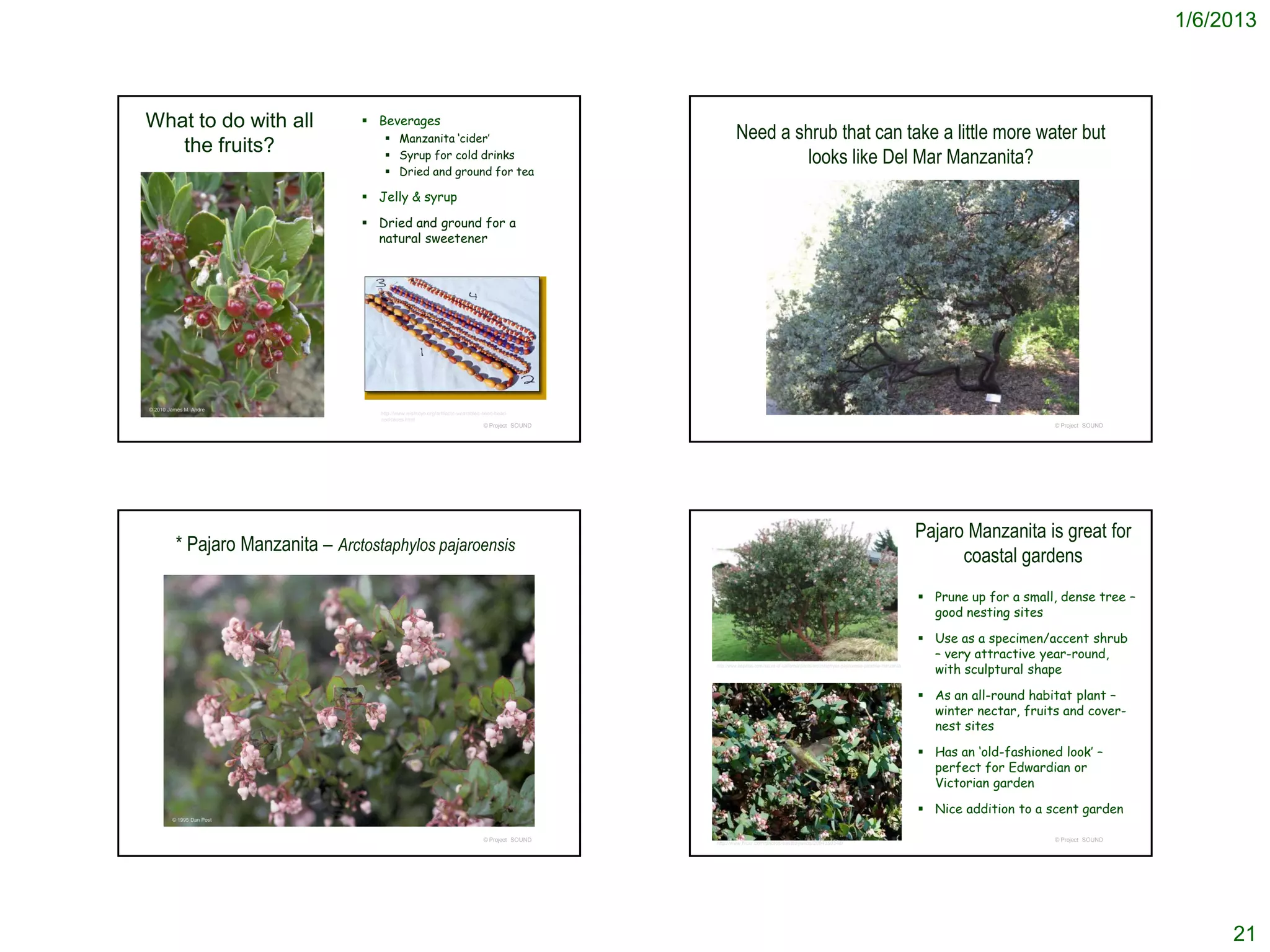
What to do with all                 Beverages
                                        Manzanita ‘cider’                                                   Need a shrub that can take a little more water but
   the fruits?                          Syrup for cold drinks                                                       looks like Del Mar Manzanita?
                                        Dried and ground for tea

                                    Jelly & syrup

                                    Dried and ground for a
                                     natural sweetener


© 2010 James M. Andre
                                      http://www.wishtoyo.org/artifacts-wearables-seed-bead-
                                      necklaces.html
                                                                                 © Project SOUND                                                                                                                               © Project SOUND


                                                                                                                                                                                                         Pajaro Manzanita is great for
          * Pajaro Manzanita – Arctostaphylos pajaroensis
                                                                                                                                                                                                               coastal gardens
                                                                                                                                                                                                          Prune up for a small, dense tree –
                                                                                                                                                                                                           good nesting sites

                                                                                                                                                                                                          Use as a specimen/accent shrub
                                                                                                                                                                                                           – very attractive year-round,
                                                                                                   http://www.laspilitas.com/nature-of-california/plants/arctostaphylos-pajaroensis-paradise-manzanita
                                                                                                                                                                                                           with sculptural shape

                                                                                                                                                                                                          As an all-round habitat plant –
                                                                                                                                                                                                           winter nectar, fruits and cover-
                                                                                                                                                                                                           nest sites

                                                                                                                                                                                                          Has an ‘old-fashioned look’ –
                                                                                                                                                                                                           perfect for Edwardian or
                                                                                                                                                                                                           Victorian garden

                                                                                                                                                                                                          Nice addition to a scent garden
        © 1995 Dan Post


                                                                                 © Project SOUND                                                                                                                               © Project SOUND
                                                                                                   http://www.flickr.com/photos/eastbaywilds/2994359348/


                                                                                                                                                                                                                                                      21
1/6/2013


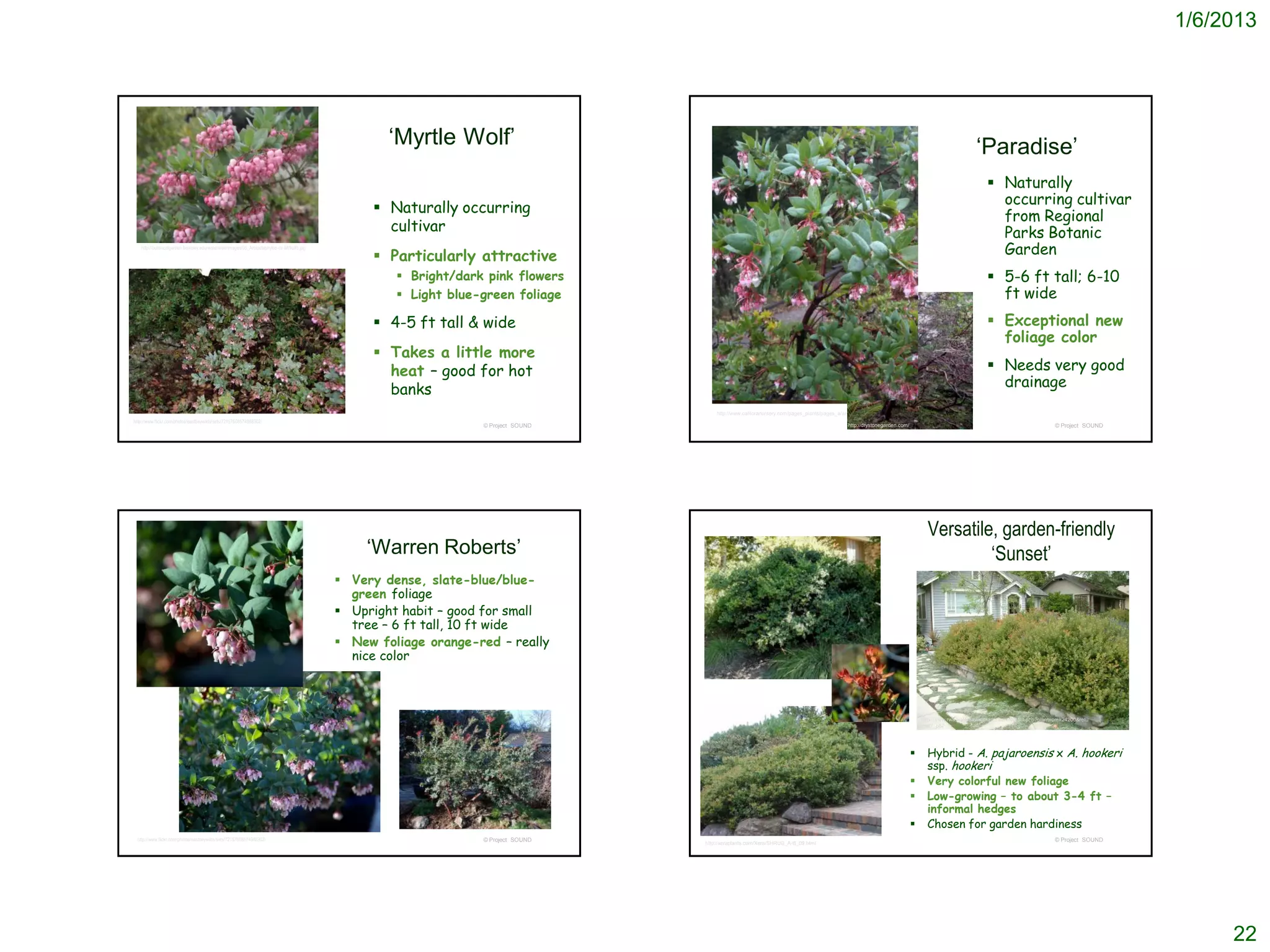
                                                                                                  ‘Myrtle Wolf’                                                                                                                                   ‘Paradise’
                                                                                                                                                                                                                                                        Naturally
                                                                                                                                                                                                                                                         occurring cultivar
                                                                                                Naturally occurring
                                                                                                                                                                                                                                                         from Regional
                                                                                                 cultivar                                                                                                                                                Parks Botanic
   http://botanicalgarden.berkeley.edu/waterwise/images/05_Arctostaphylos-cv-MWolf5.jpg

                                                                                                Particularly attractive                                                                                                                                 Garden
                                                                                                    Bright/dark pink flowers                                                                                                                           5-6 ft tall; 6-10
                                                                                                    Light blue-green foliage                                                                                                                            ft wide
                                                                                                4-5 ft tall & wide                                                                                                                                     Exceptional new
                                                                                                                                                                                                                                                         foliage color
                                                                                                Takes a little more
                                                                                                 heat – good for hot                                                                                                                                    Needs very good
                                                                                                 banks                                                                                                                                                   drainage
                                                                                                                                      http://www.calfloranursery.com/pages_plants/pages_a/arcpajpar.html
http://www.flickr.com/photos/eastbaywilds/sets/72157608574988902/
                                                                                                                © Project SOUND                                                             http://drystonegarden.com/                                                            © Project SOUND


                                                                                                                                                                                                                               Versatile, garden-friendly
                                                                                              ‘Warren Roberts’                                                                                                                          ‘Sunset’
                                                                                           Very dense, slate-blue/blue-
                                                                                            green foliage
                                                                                           Upright habit – good for small
                                                                                            tree – 6 ft tall, 10 ft wide
                                                                                           New foliage orange-red – really
                                                                                            nice color


                                                                                                                                                                                                                             http://www.rwa.watersavingplants.com/eplant.php?plantnum=24200&retu
                                                                                                                                                                                                                             rn=l7_p87


                                                                                                                                                                                                                              Hybrid - A. pajaroensis x A. hookeri
                                                                                                                                                                                                                               ssp. hookeri
                                                                                                                                                                                                                              Very colorful new foliage
                                                                                                                                                                                                                              Low-growing – to about 3-4 ft –
                                                                                                                                                                                                                               informal hedges
                                                                                                                                                                                                                              Chosen for garden hardiness
 http://www.flickr.com/photos/eastbaywilds/sets/72157608574988902/                                              © Project SOUND                                                                                                                                                   © Project SOUND
                                                                                                                                  http://xeraplants.com/Xera/SHRUB_A-B_09.html


                                                                                                                                                                                                                                                                                                         22
1/6/2013


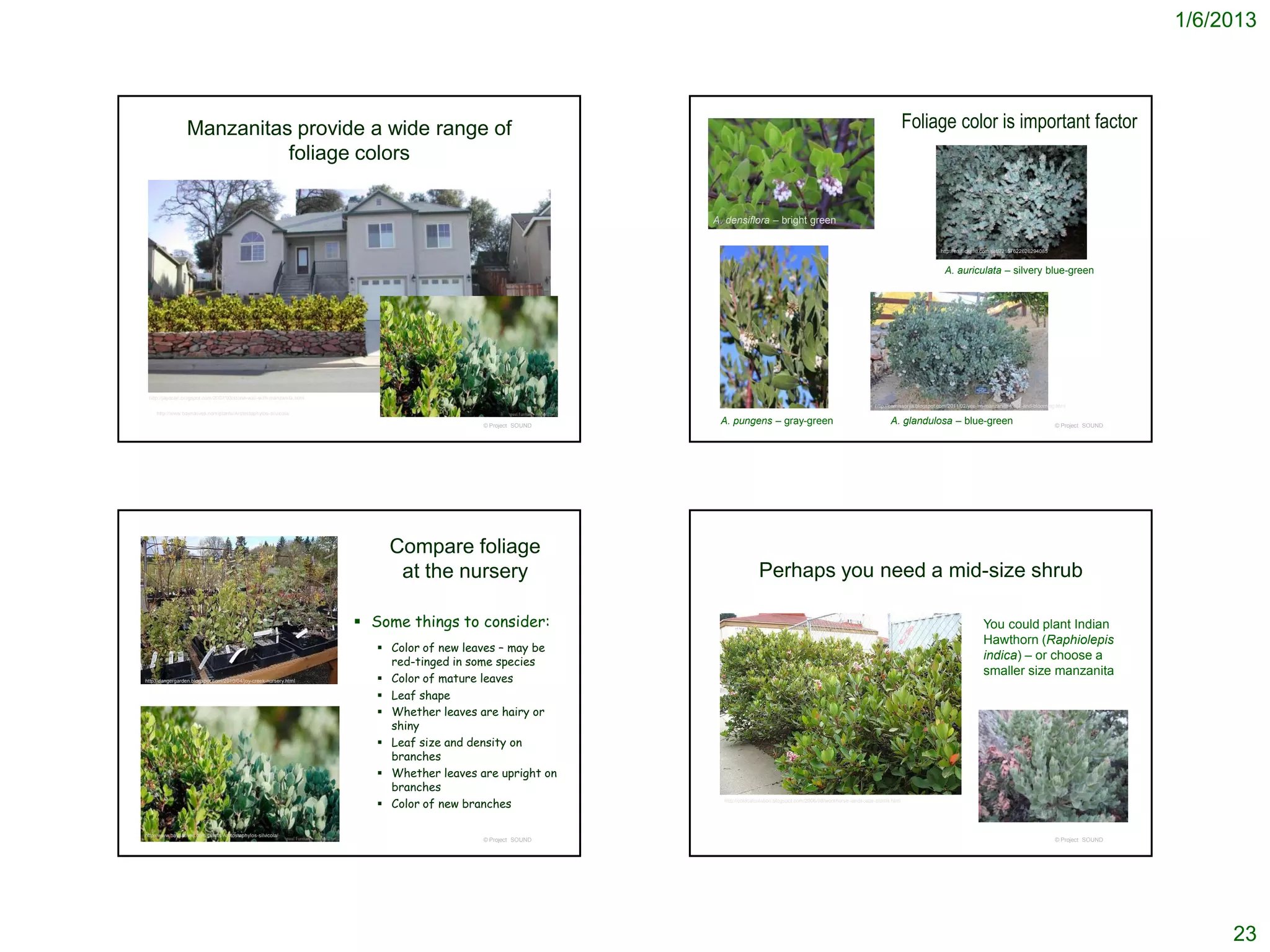
                  Manzanitas provide a wide range of                                                                                                                                          Foliage color is important factor
                            foliage colors


                                                                                                              A. densiflora – bright green

                                                                                                                                                                                                           http://en.flickeflu.com/set/72157622626294085


                                                                                                                                                                                                            A. auriculata – silvery blue-green


 http://jayacarl.blogspot.com/2007/03/stone-wall-with-manzanita.html
                                                                                                                                                                                http://camissonia.blogspot.com/2011/02/yes-im-manzanita-freak-and-blooming.html
     http://www.baynatives.com/plants/Arctostaphylos-silvicola/

                                                                                            © Project SOUND
                                                                                                               A. pungens – gray-green                                                A. glandulosa – blue-green                                           © Project SOUND


                                                                            Compare foliage
                                                                             at the nursery                                   Perhaps you need a mid-size shrub

                                                                        Some things to consider:                                                                                                                           You could plant Indian
                                                                                                                                                                                                                            Hawthorn (Raphiolepis
                                                                           Color of new leaves – may be
                                                                            red-tinged in some species
                                                                                                                                                                                                                            indica) – or choose a
                                                                                                                                                                                                                            smaller size manzanita
http://dangergarden.blogspot.com/2010/04/joy-creek-nursery.html            Color of mature leaves
                                                                           Leaf shape
                                                                           Whether leaves are hairy or
                                                                            shiny
                                                                           Leaf size and density on
                                                                            branches
                                                                           Whether leaves are upright on
                                                                            branches
                                                                           Color of new branches               http://coldcalculation.blogspot.com/2006/09/workhorse-landscape-plants.html


http://www.baynatives.com/plants/Arctostaphylos-silvicola/
                                                                                            © Project SOUND                                                                                                                                                © Project SOUND


                                                                                                                                                                                                                                                                                  23
1/6/2013


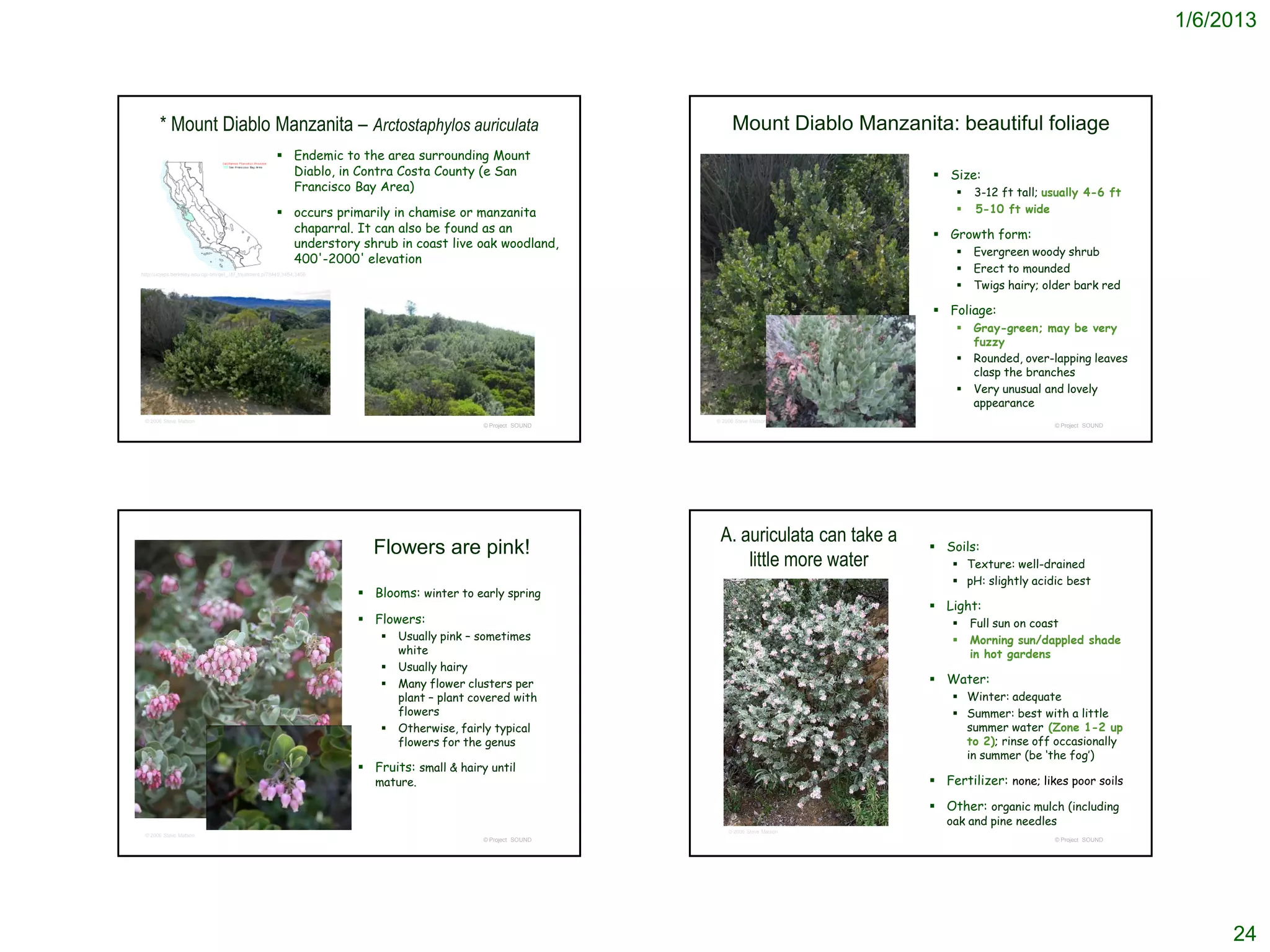
       * Mount Diablo Manzanita – Arctostaphylos auriculata                                                           Mount Diablo Manzanita: beautiful foliage
                                                         Endemic to the area surrounding Mount
                                                          Diablo, in Contra Costa County (e San                                               Size:
                                                          Francisco Bay Area)                                                                        3-12 ft tall; usually 4-6 ft
                                                         occurs primarily in chamise or manzanita                                                   5-10 ft wide
                                                          chaparral. It can also be found as an                                               Growth form:
                                                          understory shrub in coast live oak woodland,
                                                                                                                                                     Evergreen woody shrub
                                                          400'-2000' elevation
http://ucjeps.berkeley.edu/cgi-bin/get_JM_treatment.pl?3449,3454,3456
                                                                                                                                                     Erect to mounded
                                                                                                                                                     Twigs hairy; older bark red

                                                                                                                                              Foliage:
                                                                                                                                                     Gray-green; may be very
                                                                                                                                                      fuzzy
                                                                                                                                                     Rounded, over-lapping leaves
                                                                                                                                                      clasp the branches
                                                                                                                                                     Very unusual and lovely
                                                                                                                                                      appearance
 © 2006 Steve Matson                                                                                             © 2006 Steve Matson
                                                                                               © Project SOUND                                                       © Project SOUND


                                                                                                                  A. auriculata can take a    Soils:
                                                                          Flowers are pink!
                                                                                                                      little more water           Texture: well-drained
                                                                                                                                                  pH: slightly acidic best
                                                                         Blooms: winter to early spring
                                                                                                                                              Light:
                                                                         Flowers:                                                                   Full sun on coast
                                                                               Usually pink – sometimes                                             Morning sun/dappled shade
                                                                                white                                                                 in hot gardens
                                                                               Usually hairy
                                                                               Many flower clusters per                                      Water:
                                                                                plant – plant covered with                                        Winter: adequate
                                                                                flowers                                                           Summer: best with a little
                                                                               Otherwise, fairly typical                                          summer water (Zone 1-2 up
                                                                                flowers for the genus                                              to 2); rinse off occasionally
                                                                                                                                                   in summer (be ‘the fog’)
                                                                         Fruits: small & hairy until
                                                                           mature.                                                            Fertilizer: none; likes poor soils

                                                                                                                                              Other: organic mulch (including
                                                                                                                                                oak and pine needles
                                                                                                                     © 2006 Steve Matson
 © 2006 Steve Matson
                                                                                               © Project SOUND                                                       © Project SOUND


                                                                                                                                                                                            24
1/6/2013


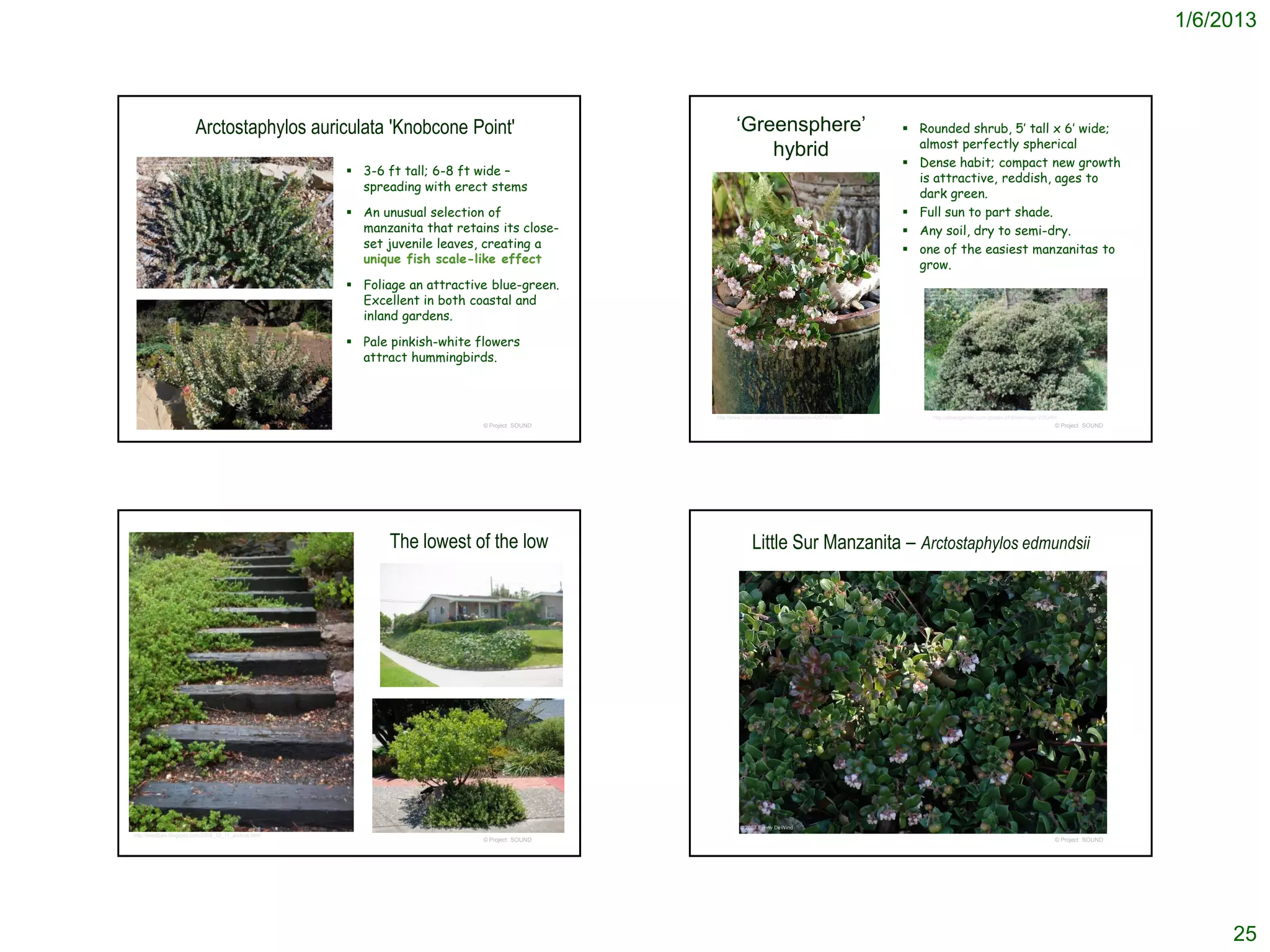
                         Arctostaphylos auriculata 'Knobcone Point'                                    ‘Greensphere’                                    Rounded shrub, 5’ tall x 6’ wide;
                                                                                                                                                         almost perfectly spherical
                                                                                                           hybrid
                                                                                                                                                        Dense habit; compact new growth
                                                        3-6 ft tall; 6-8 ft wide –
                                                                                                                                                         is attractive, reddish, ages to
                                                         spreading with erect stems
                                                                                                                                                         dark green.
                                                        An unusual selection of                                                                        Full sun to part shade.
                                                         manzanita that retains its close-                                                              Any soil, dry to semi-dry.
                                                         set juvenile leaves, creating a                                                                one of the easiest manzanitas to
                                                         unique fish scale-like effect                                                                   grow.
                                                        Foliage an attractive blue-green.
                                                         Excellent in both coastal and
                                                         inland gardens.

                                                        Pale pinkish-white flowers
                                                         attract hummingbirds.


                                                                                               http://www.flickr.com/photos/eastbaywilds/4297456024/       http://davesgarden.com/guides/pf/showimage/235340/
                                                                             © Project SOUND                                                                                                                © Project SOUND


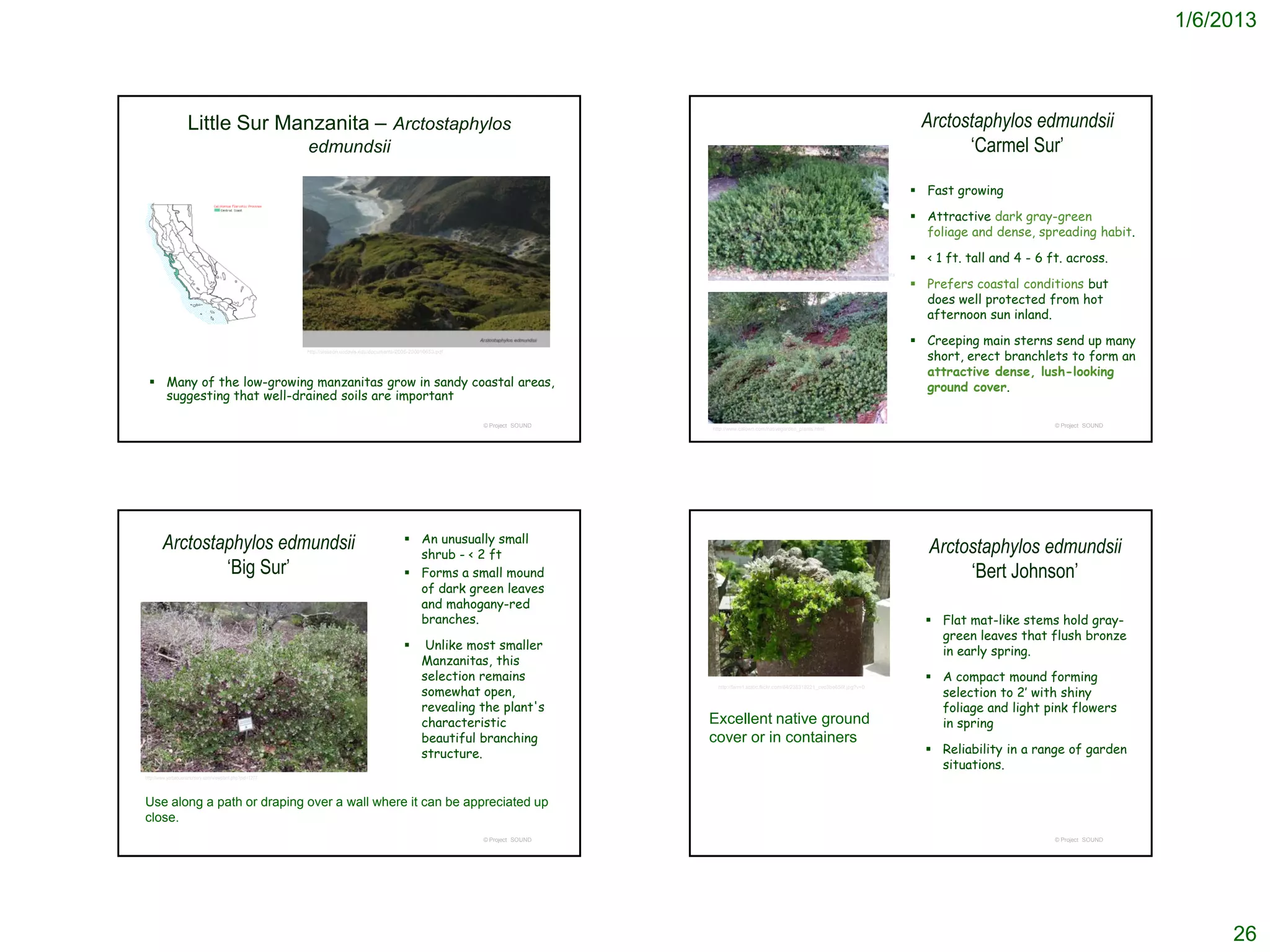
                                                              The lowest of the low                          Little Sur Manzanita – Arctostaphylos edmundsii


                                                                                                        © 2007 Penny DeWind
http://seedbyte.blogspot.com/2009_12_11_archive.html
                                                                             © Project SOUND                                                                                                                © Project SOUND


                                                                                                                                                                                                                                   25
1/6/2013


                    Little Sur Manzanita – Arctostaphylos                                                                                                                                                                                     Arctostaphylos edmundsii
                                                          edmundsii                                                                                                                                                                                 ‘Carmel Sur’

                                                                                                                                                                                                                                             Fast growing

                                                                                                                                                                                                                                             Attractive dark gray-green
                                                                                                                                                                                                                                              foliage and dense, spreading habit.

                                                                                                                                                                                                                                             < 1 ft. tall and 4 - 6 ft. across.
                                                                                                                                      http://www.laspilitas.com/nature-of-california/plants/arctostaphylos-edmundsii-carmel-sur-manzanita

                                                                                                                                                                                                                                             Prefers coastal conditions but
                                                                                                                                                                                                                                              does well protected from hot
                                                                                                                                                                                                                                              afternoon sun inland.

                                                                                                                                                                                                                                             Creeping main sterns send up many
                                                                                                                                                                                                                                              short, erect branchlets to form an
                                                          http://slosson.ucdavis.edu/documents/2005-200610653.pdf


                                                                                                                                                                                                                                              attractive dense, lush-looking
  Many of the low-growing manzanitas grow in sandy coastal areas,                                                                                                                                                                            ground cover.
   suggesting that well-drained soils are important

                                                                                                                    © Project SOUND                                                                                                                                   © Project SOUND
                                                                                                                                        http://www.calown.com/nativegarden_plants.html


        Arctostaphylos edmundsii                                                                  An unusually small
                                                                                                   shrub - < 2 ft                                                                                                                              Arctostaphylos edmundsii
                ‘Big Sur’                                                                         Forms a small mound                                                                                                                              ‘Bert Johnson’
                                                                                                   of dark green leaves
                                                                                                   and mahogany-red
                                                                                                   branches.                                                                                                                                   Flat mat-like stems hold gray-
                                                                                                                                                                                                                                                green leaves that flush bronze
                                                                                                        Unlike most smaller                                                                                                                    in early spring.
                                                                                                        Manzanitas, this
                                                                                                        selection remains                                                                                                                      A compact mound forming
                                                                                                        somewhat open,                                                                                                                          selection to 2’ with shiny
                                                                                                                                          http://farm1.static.flickr.com/84/238318221_cec3be656f.jpg?v=0


                                                                                                        revealing the plant's                                                                                                                   foliage and light pink flowers
                                                                                                        characteristic                Excellent native ground                                                                                   in spring
                                                                                                        beautiful branching           cover or in containers
                                                                                                        structure.                                                                                                                             Reliability in a range of garden
                                                                                                                                                                                                                                                situations.
http://www.yerbabuenanursery.com/viewplant.php?pid=1277


Use along a path or draping over a wall where it can be appreciated up
close.
                                                                                                                    © Project SOUND                                                                                                                                   © Project SOUND


                                                                                                                                                                                                                                                                                             26
1/6/2013


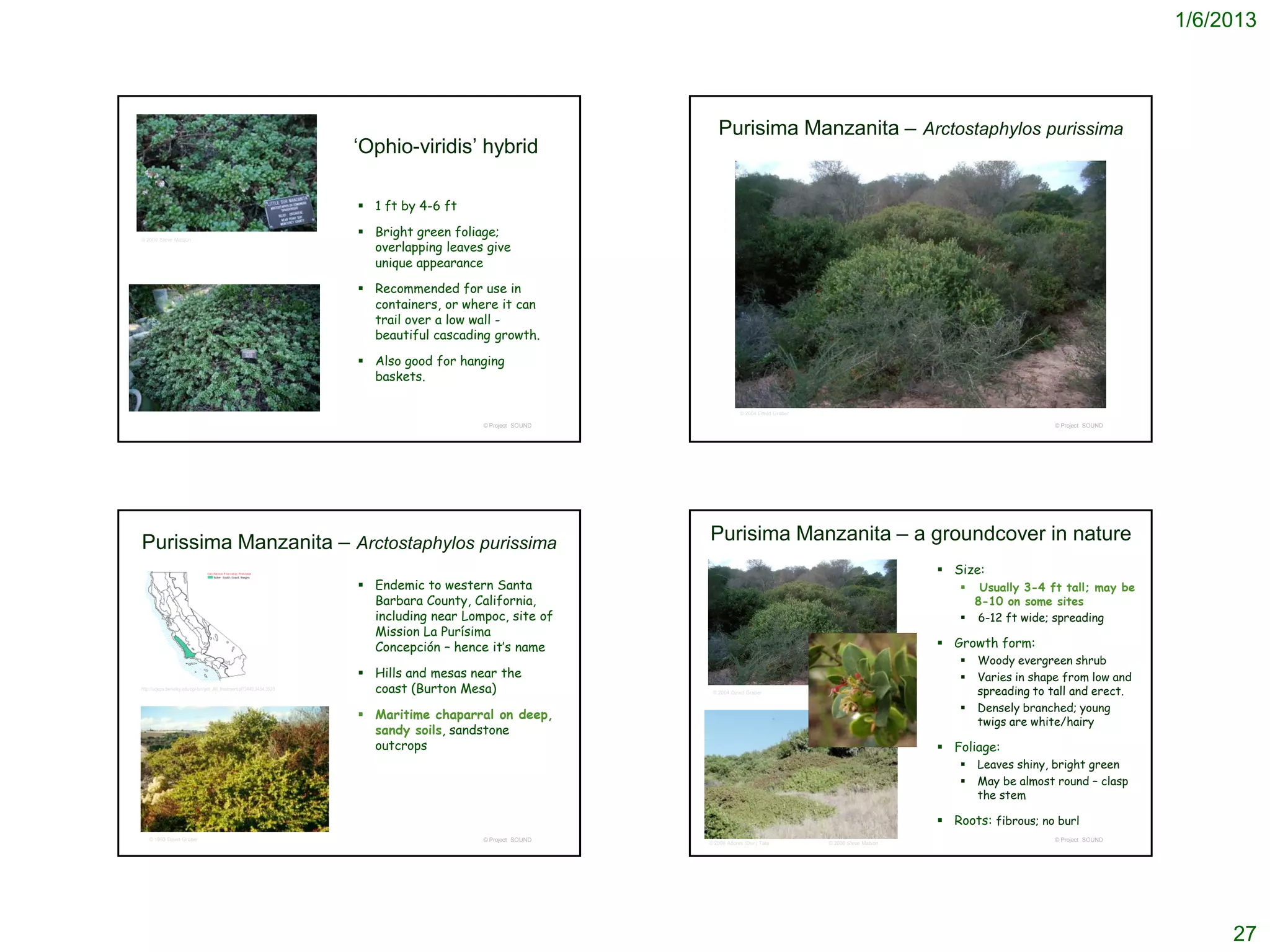
                                                                                                                 Purisima Manzanita – Arctostaphylos purissima
                                                                        ‘Ophio-viridis’ hybrid

                                                                         1 ft by 4-6 ft

                                                                         Bright green foliage;
                                                                          overlapping leaves give
© 2006 Steve Matson


                                                                          unique appearance

                                                                         Recommended for use in
                                                                          containers, or where it can
                                                                          trail over a low wall -
                                                                          beautiful cascading growth.

                                                                         Also good for hanging
                                                                          baskets.

                                                                                                                          © 2004 David Graber

                                                                                            © Project SOUND                                                                                 © Project SOUND


Purissima Manzanita – Arctostaphylos purissima                                                                Purisima Manzanita – a groundcover in nature
                                                                                                                                                                       Size:
                                                                         Endemic to western Santa                                                                          Usually 3-4 ft tall; may be
                                                                          Barbara County, California,                                                                       8-10 on some sites
                                                                          including near Lompoc, site of                                                                   6-12 ft wide; spreading
                                                                          Mission La Purísima
                                                                          Concepción – hence it’s name                                                                 Growth form:
                                                                                                                                                                             Woody evergreen shrub
                                                                         Hills and mesas near the                                                                           Varies in shape from low and
http://ucjeps.berkeley.edu/cgi-bin/get_JM_treatment.pl?3449,3454,3523     coast (Burton Mesa)                  © 2004 David Graber                                            spreading to tall and erect.
                                                                                                                                                                             Densely branched; young
                                                                         Maritime chaparral on deep,
                                                                                                                                                                              twigs are white/hairy
                                                                          sandy soils, sandstone
                                                                          outcrops                                                                                     Foliage:
                                                                                                                                                                             Leaves shiny, bright green
                                                                                                                                                                             May be almost round – clasp
                                                                                                                                                                              the stem

                                                                                                                                                                       Roots: fibrous; no burl
    © 1993 David Graber                                                                     © Project SOUND                                                                                 © Project SOUND
                                                                                                              © 2006 Adonis (Don) Tate          © 2006 Steve Matson


                                                                                                                                                                                                                   27
1/6/2013


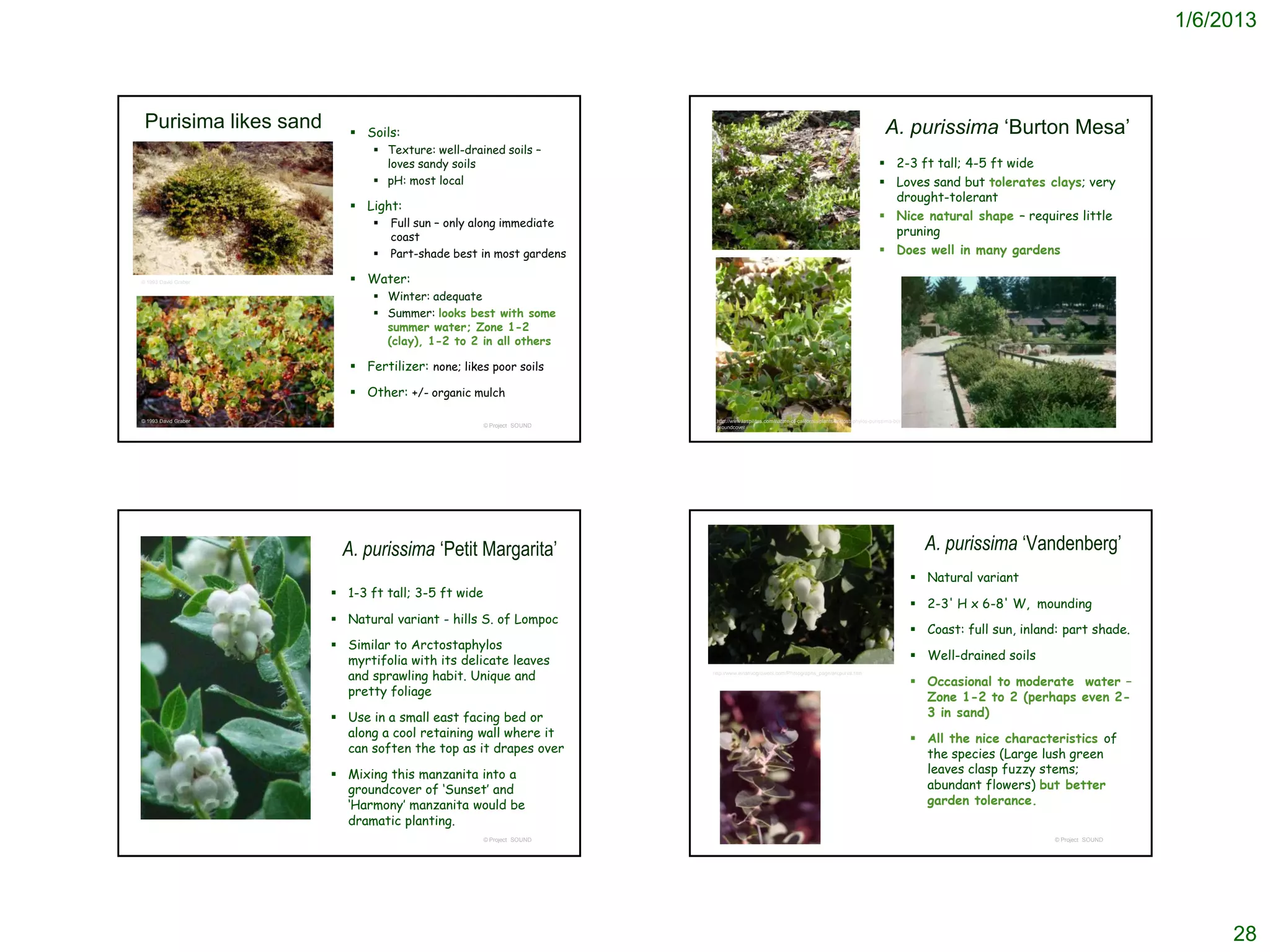
 Purisima likes sand       Soils:                                                                                                              A. purissima ‘Burton Mesa’
                               Texture: well-drained soils –
                                loves sandy soils                                                                                              2-3 ft tall; 4-5 ft wide
                               pH: most local                                                                                                 Loves sand but tolerates clays; very
                                                                                                                                                drought-tolerant
                           Light:
                                                                                                                                               Nice natural shape – requires little
                                 Full sun – only along immediate
                                  coast                                                                                                         pruning
                                 Part-shade best in most gardens                                                                              Does well in many gardens

© 1993 David Graber        Water:
                               Winter: adequate
                               Summer: looks best with some
                                summer water; Zone 1-2
                                (clay), 1-2 to 2 in all others

                           Fertilizer: none; likes poor soils

                           Other: +/- organic mulch

© 1993 David Graber                                                    http://www.laspilitas.com/nature-of-california/plants/arctostaphylos-purissima-burton-mesa-
                                                    © Project SOUND    groundcover                                                                                                   © Project SOUND


                        A. purissima ‘Petit Margarita’                                                                                                               A. purissima ‘Vandenberg’
                                                                                                                                                            Natural variant
                        1-3 ft tall; 3-5 ft wide
                                                                                                                                                            2-3' H x 6-8' W, mounding
                        Natural variant - hills S. of Lompoc
                                                                                                                                                            Coast: full sun, inland: part shade.
                        Similar to Arctostaphylos
                         myrtifolia with its delicate leaves                                                                                                Well-drained soils
                         and sprawling habit. Unique and              http://www.elnativogrowers.com/Photographs_page/arcpurva.htm

                                                                                                                                                            Occasional to moderate water –
                         pretty foliage                                                                                                                      Zone 1-2 to 2 (perhaps even 2-
                        Use in a small east facing bed or                                                                                                   3 in sand)
                         along a cool retaining wall where it                                                                                               All the nice characteristics of
                         can soften the top as it drapes over                                                                                                the species (Large lush green
                        Mixing this manzanita into a                                                                                                        leaves clasp fuzzy stems;
                         groundcover of ‘Sunset’ and                                                                                                         abundant flowers) but better
                         ‘Harmony’ manzanita would be                                                                                                        garden tolerance.
                         dramatic planting.
                                                    © Project SOUND                                                                                                                  © Project SOUND


                                                                                                                                                                                                            28
1/6/2013


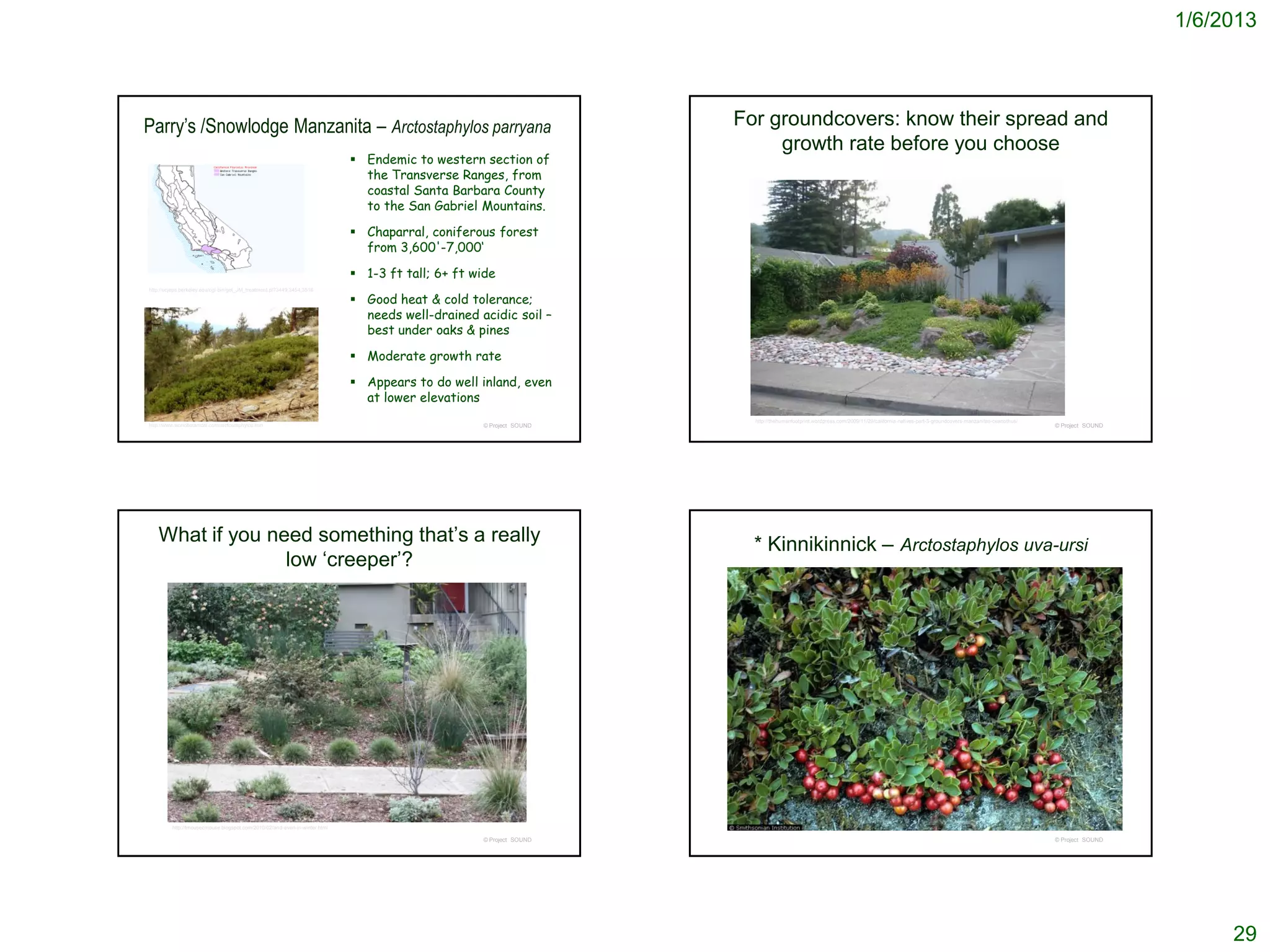
Parry’s /Snowlodge Manzanita – Arctostaphylos parryana                                                              For groundcovers: know their spread and
                                                                                                                         growth rate before you choose
                                                                             Endemic to western section of
                                                                              the Transverse Ranges, from
                                                                              coastal Santa Barbara County
                                                                              to the San Gabriel Mountains.

                                                                             Chaparral, coniferous forest
                                                                              from 3,600'-7,000‘

                                                                             1-3 ft tall; 6+ ft wide
http://ucjeps.berkeley.edu/cgi-bin/get_JM_treatment.pl?3449,3454,3516

                                                                             Good heat & cold tolerance;
                                                                              needs well-drained acidic soil –
                                                                              best under oaks & pines

                                                                             Moderate growth rate

                                                                             Appears to do well inland, even
                                                                              at lower elevations
                                                                                                                      http://thehumanfootprint.wordpress.com/2009/11/29/california-natives-part-3-groundcovers-manzanitas-ceanothus/
http://www.worldbotanical.com/arctostaphylos.htm                                                  © Project SOUND                                                                                                                      © Project SOUND


   What if you need something that’s a really                                                                         * Kinnikinnick – Arctostaphylos uva-ursi
                 low ‘creeper’?


         http://tmousecmouse.blogspot.com/2010/02/and-even-in-winter.html

                                                                                                  © Project SOUND                                                                                                                      © Project SOUND


                                                                                                                                                                                                                                                              29
1/6/2013


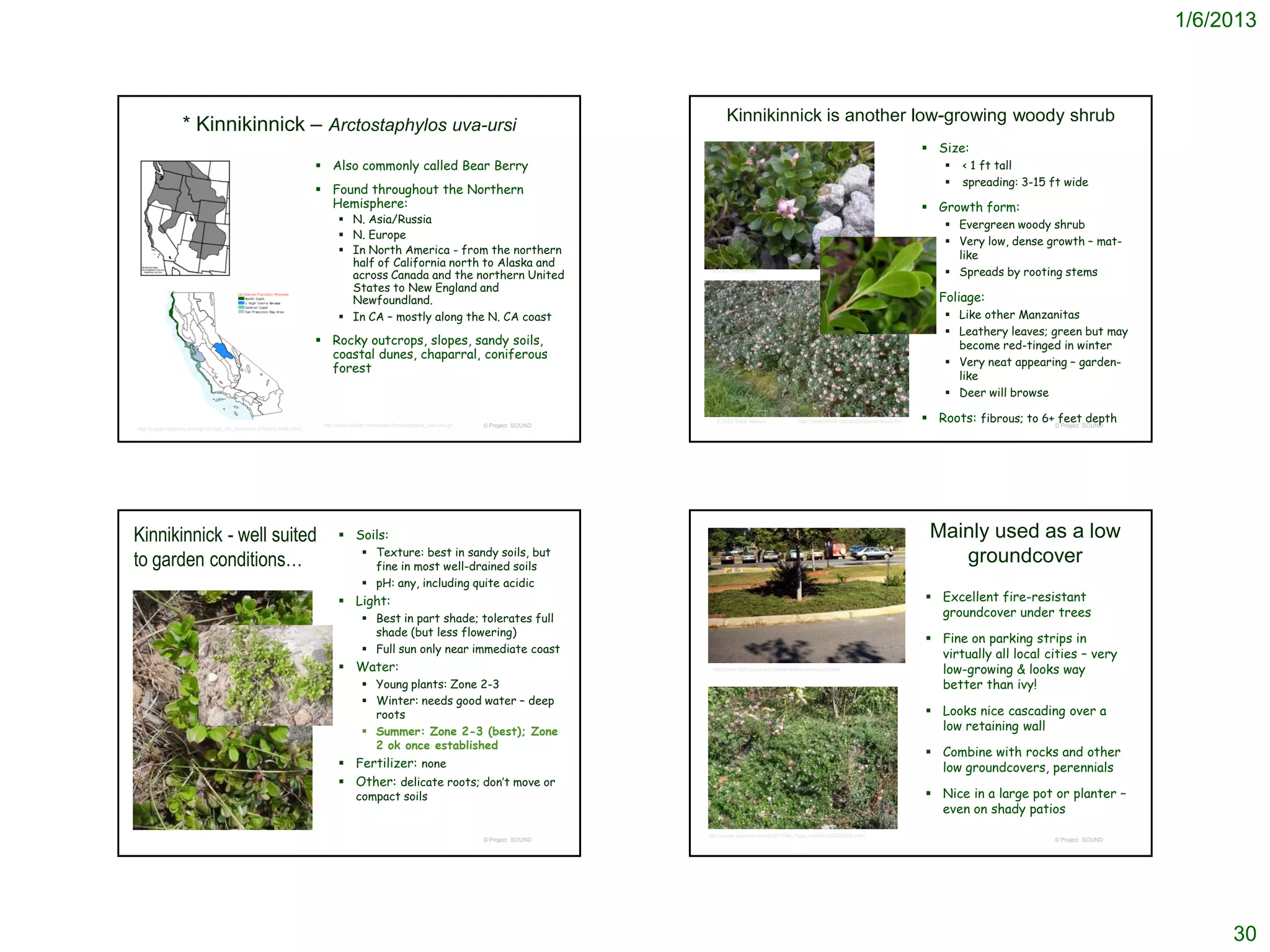
                                                                                                                                                           Kinnikinnick is another low-growing woody shrub
                  * Kinnikinnick – Arctostaphylos uva-ursi
                                                                                                                                                                                                                                                Size:
                                                                         Also commonly called Bear Berry                                                                                                                                             < 1 ft tall
                                                                                                                                                                                                                                                      spreading: 3-15 ft wide
                                                                         Found throughout the Northern
                                                                          Hemisphere:                                                                                                                                                           Growth form:
                                                                                N. Asia/Russia                                                                                                                                                     Evergreen woody shrub
                                                                                N. Europe
                                                                                                                                                                                                                                                    Very low, dense growth – mat-
                                                                                In North America - from the northern                                                                                                                                like
                                                                                 half of California north to Alaska and
                                                                                 across Canada and the northern United
                                                                                                                                                    © 2007 Matt Below
                                                                                                                                                                                                                                                    Spreads by rooting stems
                                                                                 States to New England and
                                                                                 Newfoundland.                                                                                                                                                  Foliage:
                                                                                In CA – mostly along the N. CA coast                                                                                                                               Like other Manzanitas
                                                                                                                                                                                                                                                    Leathery leaves; green but may
                                                                         Rocky outcrops, slopes, sandy soils,                                                                                                                                       become red-tinged in winter
                                                                          coastal dunes, chaparral, coniferous
                                                                                                                                                                                                                                                    Very neat appearing – garden-
                                                                          forest
                                                                                                                                                                                                                                                     like
                                                                                                                                                                                                                                                    Deer will browse

                                                                         http://www.swsbm.com/maps/Arctostaphylos_uva-ursi.gif   © Project SOUND
                                                                                                                                                      © 2005 Steve Matson                     http://oregonstate.edu/dept/ldplants/aruv2.htm    Roots: fibrous; to 6+ ©feetSOUND
                                                                                                                                                                                                                                                                        Project
                                                                                                                                                                                                                                                                                depth
http://ucjeps.berkeley.edu/cgi-bin/get_JM_treatment.pl?3449,3454,3542


Kinnikinnick - well suited                                                      Soils:                                                                                                                                                         Mainly used as a low
                                                                                         Texture: best in sandy soils, but
to garden conditions…                                                                     fine in most well-drained soils
                                                                                                                                                                                                                                                   groundcover
                                                                                         pH: any, including quite acidic
                                                                                Light:                                                                                                                                                         Excellent fire-resistant
                                                                                         Best in part shade; tolerates full                                                                                                                     groundcover under trees
                                                                                          shade (but less flowering)
                                                                                                                                                                                                                                                Fine on parking strips in
                                                                                         Full sun only near immediate coast                          http://www.hort.uconn.edu/plants/a/arcuva/arcuva3.html                                     virtually all local cities – very
                                                                                Water:                                                             http://www.hort.uconn.edu/plants/a/arcuva/arcuva3.html                                       low-growing & looks way
                                                                                         Young plants: Zone 2-3                                                                                                                                 better than ivy!
                                                                                         Winter: needs good water – deep
                                                                                          roots                                                                                                                                                 Looks nice cascading over a
                                                                                         Summer: Zone 2-3 (best); Zone                                                                                                                          low retaining wall
                                                                                          2 ok once established
                                                                                                                                                                                                                                                Combine with rocks and other
                                                                                Fertilizer: none                                                                                                                                                low groundcovers, perennials
                                                                                Other: delicate roots; don’t move or
                                                                                      compact soils                                                                                                                                             Nice in a large pot or planter –
                                                                                                                                                                                                                                                 even on shady patios
                                                                                                                                                   http://courses.washington.edu/ehuf331/Plant_Pages_subfolders/ERICACEAE.shtml
                                                                                                                                 © Project SOUND                                                                                                                        © Project SOUND


                                                                                                                                                                                                                                                                                               30
1/6/2013


                                                                                                                                                                                                                                 The leaves of manzanita/bearberry used
                Pruning groundcover Arctostaphylos                                                                                                        Medicinal uses                                                          internally to reduce the accumulation of
                                                                                                                                                                                                                                  uric acid and relieve pain of bladder
                                                                                                                                                                                                                                  stones and cystitis.

                                                                                                                                                                                                                                 Bearberry has been reported to be
                                                                                                         Most are naturally                                                                                                      effective against E. coli.
                                                                                                          dense, so don’t
                                                                                                                                                                                                                                  For external use, it has been used as an
                                                                                                          need to do                                                                                                         
                                                                                                                                                                                                                                  astringent wash for cuts and scrapes.
                                                                                                          anything to
                                                                                                          promote this                               The active medicinal compound in                                            Preparation:
                                                                                                                                                     Arctostaphylos uva ursi is the                                                 Infusion in hot water: 2 tsp
                                                                                                                                                     Hydroquinone glycoside, Arbutin
                                                                                                         Just trim back                                                                                                             leaves/cup – 3 times/day + lots of
                                                                                                                                                                                                                                     water to flush system
                                                                                                          when it grows
http://laurries.blogspot.com/2010_11_01_archive.html


                                                                                                                                                                                                                                    Make a tincture by allowing the
                                                                                                          where you don’t                                                                                                            leaves to soak in brandy for 1 week
                                                                                                          want it                                                                                                                    before preparing the infusion.
                                                                                                                                                                                                                                    Add 1 teaspoon of the brandy
                                                                                                                                                                                                                                     tincture to one cup of boiling water
                                                                                                                                                                                                                                     to make and infusion which can be
                        http://www.hillkeep.ca/ts%20A-B.htm                                                                                                                                                                          taken 3-4 times per day.
                                                                                                                               © Project SOUND                                                                                                             © Project SOUND


                                                                                                                                                                                                                                        The cultivars have very
                                                                                                                                                                                                                                        different ‘looks’ – shop ‘til
                                                                                                                                                                                                                                        you find the right one for
http://www.yerbabuenanursery.com/viewplant.php?pid=407
                                                                    http://www.tinytreasuresnursery.com/Genus/Plants%20A.htm
                                                                                                                                                                                                                                        your needs
                                                                                 ‘Wood’s Compact’
             ‘Point Reyes’
                                                                                                                                                 http://www.rwa.watersavingplants.com/eplant.php?plantnum=2532&letter=d&return=s_p319


         Several Bearberry and hybrid cultivars available


                                                              http://www.jamesdeandesign.com/Slide_Show/Pl
                                                                                                                                                                                                                                         ‘Green Supreme’
                                                              ant_Catalog/SHRUBS/                                                                http://www.sm.watersavingplants.com/eplant.php?plantnum=2532&return=l2_aP


         ‘Radiant’                                                         ‘Pacific Mist’                                      © Project SOUND
                                                                                                                                                                     ‘Pacific Mist’                                                                        © Project SOUND


                                                                                                                                                                                                                                                                                  31
1/6/2013


                                                                                 We’ve come to the end of our journey
            Versatile ‘Emerald
           Carpet’: groundcover
            to very low hedge


http://www.pasadena.watersavingplants.com/eplant.php?plantnum=243&return=l8_aK


                                                © Project SOUND                                                  © Project SOUND


                                                                                                                                        32

Magnificant Manzanitas - Notes

  • 1.
    1/6/2013 Out of theWilds and Into Your Garden Magnificent Manzanitas C.M. Vadheim and T. Drake CSUDH & Madrona Marsh Preserve Gardening with Western L.A. County Native Plants Madrona Marsh Preserve Project SOUND – 2011 (our 7th year) December 3 & 6, 2011 © Project SOUND © Project SOUND The genus Arctostaphylos Why do people fall in love with Manzanitas?  In the Heath family (Ericaceae)  Showy, sweet-smelling flowers in  Includes the Manzanitas and winter/early spring Bearberries, blueberries  Evergreen foliage  Manzanitas occur in the chaparral of western North America, from  Red bark southern British Columbia through much of northern and  Interesting, architectural growth central Mexico. patterns  The three species of Bearberries  Edible fruits/medicinal leaves have adapted to arctic and subarctic climates, and have a  Attracts hummingbirds, native circumpolar distribution in bees & butterflies northern North America, Asia  Because they’re rare in the wilds and Europe.  Because they are a part of California’s unique wild heritage © Project SOUND © Project SOUND 1
  • 2.
    1/6/2013 Whatever the reason, people want to include Success with manzanitas begins with choosing manzanitas in their gardens…. the best species or cultivar for your conditions And that can be a challenge for those of us living in western L.A. county © Project SOUND © Project SOUND Tailor the manzanita to your conditions Many species require well-drained soils (rather than the other way around)  Soil conditions:  Soil texture/Drainage  Texture/drainage  pH Soil type Approximate time  Size: height & width/spread to drain  Growth pattern/speed Hard-pan or days sodic soils  Light/temperature Clay 3-12 hours  Water regimen Loam 20-60 minutes  dig hole 1 ft x 1 ft  Aesthetics: Sandy Loam 10-30 minutes  fill with water and let drain Sand can't fill the hole,  fill hole again, measure drains too fast Fortunately, there are more than forty species of Arctostaphylos in time for water to drain California not to mention all the cultivars, subspecies and hybrids. © Project SOUND © Project SOUND 2
  • 3.
    1/6/2013 Many manzanitas like a slightly acidic soil So, you really should test your soil pH if you want to grow manzanitas  Most manzanitas originate in areas with  A simple garden soil pH test kit more acidic soil due to: is adequate for the job – no need  Higher rainfall for fancy equipment  Effects of  If your soil is Alkaline (pH > 7.5) chaparral/woodland consider planting in a large pot plants  If your soil is neutral or slightly  The rock material from acid (pH 6.0 – 7.5) choose which the soils were manzanitas that like a slightly derived acid soil and use an organic mulch  Our local garden soils  If your soil is acid (pH 5.0-5.9) tend to range from 6.5 http://nogmoseedbank.wordpress.com/2011/03/10/planning-for-spring- you can plant even those that to 7.5 – and some may be planting-season-part-5-conducting-a-soil-test/ need acidic soils as high as 7.8+ Soils under pine trees and oaks will be more acidic © Project SOUND © Project SOUND Can’t I just amend my soil to lower the pH? Size matters: most Manzanitas eventually  Actually, it’s not that easy: want to grow to their natural size  Takes a lot of effort to lower soils pH – and you have to keep doing it because pH keeps ↑  Acid fertilizers also increase the soil N levels – often too high for CA native plants http://www.learn2grow.com/gardeningguides/lawns/planting/Incorp  Chemical amendments: oratingAmendments.aspx If you’re acidifying 1000 sq ft of  sulfur or iron/ammonium/ soil with sulfur, a 1.0 change in aluminum sulfate pH (from 7.5 to 6.5) requires 11 pounds of the product for sandy  Natural amendments: pine straw; soil and 23 pounds for claylike soil. oak leaf mold  ? Coffee grounds/acid compost http://www.flickr.com/photos/97607362@N00/4375161245/ http://travel.gather.com/viewArticle.action?articleId=281474977173759 © Project SOUND © Project SOUND 3
  • 4.
    1/6/2013 Manzanita species growfrom < six inches (some coastal species) to twenty feet tall (many interior species). Don’t forget the width http://forums.gardenweb.com/forums/load/swest/msg0309450418785.html Arctostaphylos rudis "Burton Beauty Manzanita". http://www.arthurleej.com/p-o-m-Mar08.html A. refugioensis http://www.fresno.watersavingplants.com/eplant.php?plantnum=24200&letter=b &return=s_aP © Project SOUND © Project SOUND The right plant, grown correctly, will live for more Let’s say you want to replace an old tree than 100 years (especially the larger forms). with a large manzanita http://www.arthurleej.com/p-o-m-Mar08.html http://123terry.com/photos/mom_day_2008/mom_day_2008.html © Project SOUND © Project SOUND 4
  • 5.
    1/6/2013 Bigberry Manzanita: Big Berry Manzanita – Arctostaphylos glauca shrub or tree  Easy-care shrub for slopes; good for erosion control  Specimen shrub; needs little pruning  As a small shade tree  As a key shrub/tree for the habitat garden: bees, butterflies, birds, humans http://www.laspilitas.com/nature-of-california/plants/arctostaphylos-glauca © 2008 Gary A. Monroe © Project SOUND © Project SOUND Why choose Manzanita cultivars? Arctostaphylos glauca  Because they have better size, ‘Los Angeles’ shape, color, etc.  Source plant: originally in  Because they often are better the area of Mullholland adapted to garden conditions (and Hwy. and Kanan Rd. therefore more likely to thrive in your garden)  Smooth red bark and clean shiny foliage with pink-  Garden tolerance - cultivars are white flowers make the often more tolerant of: plant quite attractive.  A little extra water  Soils that are not perfectly  Locally native – tolerates drained sandy soils of western L.A.  Heat and cold County  Salinity and higher pH http://www.laspilitas.com/nature-of-california/plants/arctostaphylos-glauca-frazier-park-manzanita © Project SOUND © Project SOUND http://www.laspilitas.com/nature-of-california/plants/arctostaphylos-glauca-los-angeles 5
  • 6.
    1/6/2013 Arctostaphylos glauca Arctostaphylos glauca ‘Frazier Park’ ‘Margarita Pearl’  From Frazier Park/ Mt. Pinos region ~ 5000 ft.  ? Big Berry manzanita (glauca) or a hybrid between A. glauca  The form is low/dense and A. wellsii for a Big Berry Manzanita.  Very large flowers and berries – good for edibles garden  Foliage is pale green, a glaucous green, making it  Foliage is a bright grey on new appear whitish-bluish - growth and dull grey on old beautiful accent plant in a growth – lovely color garden. http://www.laspilitas.com/nature-of-california/plants/arctostaphylos-glauca-frazier-park-manzanita http://www.laspilitas.com/nature-of-california/plants/arctostaphylos-margarita-pearl © Project SOUND © Project SOUND Arctostaphylos glauca Arctostaphylos ‘Ramona’ ‘Canyon Blush’  From San Vicente/Ramona area  Arctostaphylos glauca hybrid from a chance seedling in the (San Diego Co.) Santa Barbara Botanic Garden.  Red bark, a very open form,  Red-flushed new foliage and clean glossy foliage. The plant blush pink flowers looks almost artificial http://www.faroutflora.com/page/12/  4’ tall by 20 ft wide; climbing/  Use as a specimen with lower trailing form green manzanitas and ceanothi  Quite effective as a sprawling, under it, or as an elegant eight large-scale groundcover, or to ten foot hedge in a chaparral cascading down a slope. planting.  Use drip irrigation in place of  Ok in soils of pH 7.8, and overhead watering to reduce might even be ok in pH 8. spread of this disease. http://www.laspilitas.com/nature-of-california/plants/arctostaphylos-glauca-ramona-manzanita © Project SOUND © Project SOUND 6
  • 7.
    1/6/2013 Allelopathy: chemical warfare in the garden Common Manzanita – Arctostaphylos manzanita  Chaparral plants tend to ‘exclude’ other plants:  Shading or crowding out  Producing chemicals that are toxic to plants or seedlings  Some common trees/large shrubs that practice chemical warfare: Manzanitas/Bearberries http://sierrafoothillgarden.wordpress.com/2011/04/10/allelopathic-plantswhat- %E2%80%9Ci-want-to-be-aloooone%E2%80%9D/   Walnuts  Oaks  Sycamore  California Bay laurel  Cottonwood  Non-natives like Forsythia, Tree-of-heaven, Black locust and Eucalyptus © Project SOUND http://lucioledesign.com/blog/?attachment_id=552 © Project SOUND Common Manzanita – Arctostaphylos manzanita Common Manzanita: large size  Central & northern California - Contra Costa  Size: County north to Humboldt, Trinity, and Shasta counties; and from the foothills of the Sierra  6-12+ ft tall – as tall as 20’ Nevada in Shasta County south to Mariposa  4-10 ft wide County.  Growth form:  On ‘dry’, well-drained, sunny sites in Ponderosa shrub forest, California mixed evergreen  Large evergreen shrub/small tree forest, Northern oak woodlands, Chaparral,  Open, upright habit – many long Montane chaparral twisted trunks give it an http://ucjeps.berkeley.edu/cgi-bin/get_JM_treatment.pl?3449,3454,3492 umbrella-like shape  Peeling red-brown bark  Foliage:  Bright green to slightly blue- green  Leaves simple, rounded © 2009 John Malpas © 1994 David Graber © Project SOUND http://atlantis.mendocino.edu/jxerogeanes/AGR%2053/Arctostaphylos%20manzanita-%20Whole%20plant.jpg © Project SOUND 7
  • 8.
    1/6/2013 Most manzanitas like  Soils:  Texture: any with very good Why do garden manzanitas need a well-drained soil? well-drained soils drainage  pH: 6.1 to 6.5 (mildly acidic) ; may need to amend or use  It’s what they are adapted mulch to acidify (pine needles; to (root system anatomy) oak leaves)  Light:  It keeps you/Mother Nature  Full sun (coast) to part-shade – from over-watering even under tall pines  Winter rain events can ‘drown’  Water: plants in standing  Winter: adequate/supplement water/water-logged soils  Summer: occasional water is  Too much summer rain best – 1-3 times per summer promotes fungal diseases to http://www.intermountainnursery.com/demonstration_garden_list.htm (Zone 1-2) Best away from the coast; which manzanitas are likes cooler winters  Fertilizer: none; likes poor soils susceptible  Other: use an organic mulch; pine needles are great! © Project SOUND http://www.flickr.com/photos/starlingfeather/297644619/ © Project SOUND Watering Manzanitas: a few pointers Then modify according to your conditions  Look to the plant’s natural  Temperature climate as a starting point:  Soil characteristics  Lots of rain yearly – some  Wind, fog and other species from very N. coast climatic differences http://www.laspilitas.com/nature-of-california/plants/arctostaphylos-  Deeper/more frequent winter morroensis-park-view-manzanita rains – higher elevation chaparral & woodlands  Summer monsoons in August – San Diego county species  Significant summer fog – species from the central and northern CA coast http://flickrhivemind.net/Tags/mounttam/Interesting © Project SOUND © Project SOUND 8
  • 9.
    1/6/2013 Watering manzanitas: some tips Planting and establishing manzanitas  Be sure that ‘expert advice’ is appropriate for your area  The best time to plant is in the Fall to early Winter, when soils are moist.  Use conventional drip irrigation only to get plants  Treat manzanitas as 1 full Water Zone above their final Zone for the first 2 summers. This will often be either Zone started the first year 2 or 2-3 (watering every 7-14 days).  Use soaker hoses, soaker-drip  Water as the soil starts to dry. Inspect the soil down a few or a plain old hose for deep, inches to get a true idea of sub-surface moisture. Moisture occasional water of meters are an inexpensive and effective way to check out the established plants amount of water in the soil.  Only use overhead spray for  By 3rd summer decrease to ½ Zone above final Zone. coastal species that need a  Ultimately, in about 3-5 years, your manzanitas, can take fake ‘fog spray’ their final zone - may become independent of your care. © Project SOUND © Project SOUND Treat as a shrub or tree Arctostaphylos manzanita ‘Byrd Hill’  As a shade tree  As an exotic accent  Naturally occurring variant  As a large foundation shrub  On dry slopes  A more compact version of A. manzanita (8-10' H x 8' W)  For habitat value http://www.botanicalgarden.ubc.ca/forums/showthread.php?t=432  Upright; nice sculpted form.  Very drought tolerant. No summer water (or just 1-2 times per summer – Zone 1-2) once established  Excellent for wildlife. © Project SOUND http://www.californianativeplants.com/index.php/catalog/item/arctostaphylos-manzanita-byrd-hill © Project SOUND http://www.laspilitas.com/nature-of-california/plants/arctostaphylos-manzanita-dr-hurd- manzanita-tree http://www.sanjose.watersavingplants.com/eplant.php?plantnum=2528&return=l4_aD 9
  • 10.
    1/6/2013 Arctostaphylos manzanita ‘Dr. Hurd’ Arctostaphylos manzanita x A. densiflora ‘Austin Griffiths’ Manzanita  To 15’ tall & wide; fast grower  More garden tolerant: some summer  Hybrid: Arctostaphylos densiflora water, richer soil, than Arctostaphylos 'Sentinel' X Arctostaphylos manzanita glauca 'Dr. Hurd'  Tolerates clay or sandy soils  Tall open shape with bright foliage &  Tree or shrub form – your choice pink flowers of A. densiflora  Reliable drought-tolerant plant in our  8-10 ft tall; 6-8 ft wide area  Sandy soils best; clay ok http://lucioledesign.com/blog/?attachment_id=552  Good for habitat hedges/dry hedgerows http://www.santacruz.watersavingplants.com/eplant.php?plantnum=2528&return=l9_aC © Project SOUND © Project SOUND http://www.yerbabuenanursery.com/images/new_botimages/large/0118_2_j.jpg Manzanita hybrids – more all the time! Large Manzanitas: are they trees or shrubs?  Are a cross between two species  Can occur in the wilds – and do –  That’s debatable but many species never come in  Some native shrubby contact in the wilds species - mainly those  Hybrids occur readily in the native to California - garden setting – manzanita species certainly reach tree size. are ‘promiscuous’  However, they generally  Some hybrids combine the best branch or fork near the traits of both parents (‘hybrid ground, thus lacking the cultivars’) single trunk of a tree. Arctostaph​ylos 'Bird Hill' and Lyonothamn​us  Impact on wild populations – a real planifolia both have open ‘tree-like’ growth  ? ‘multi-trunk small tree’ habit that allow them to be ‘pruned up’ into potential problem (but not in lower small ‘trees’. ‘Austin Griffiths’ Manzanita elevation western L.A. county) © Project SOUND © Project SOUND 10
  • 11.
    1/6/2013 Most Manzanitas look good throughout their ‘Dr. Hurd’ grows up lifespan – even without pruning to be a tree http://3palmsnursery.com/ywup/ArctoDr%20Hurd.JPG http://www.heronshouse.com/Landscaping/California%20Natives.htm © 2008 Dr. Amadej Trnkoczy http://www.baynatives.com/plants/Arctosta phylos-auriculata/ http://camissonia.blogspot.com/2011/01/rain-frost- blooming-manzanitas.html At four years http://www.flickr.com/photos/eastbaywilds/5967389289/ © Project SOUND ‘Dr. Hurd’ at 5 years http://articles.sfgate.com/2011-02-27/home-and-garden/28632634_1_prune-manzanitas-fruit- trees © Project SOUND Pruning to shape – tree-like forms Start by choosing the right species – and the right plant  Judicious shaping is possible.  The trick seems to be not to act too soon - until you can get a feel for the form the plant is taking - or too late, which would leave large pruning scars on the smooth, red bark. ‘Howard McMinn’ http://www.heronshouse.com/Landscaping/California%20Natives.htm http://dangergarden.blogspot.com/2010/03/walking-around-neighborhood.html http://www.calfloranursery.com/pages_plants/pages_a/arcsun.html ‘Sunset’ ‘Howard McMinn’ http://blog.travelpod.com/travel-photo/keeleyhope/1/1267709433/manzanita.jpg/tpod.html © Project SOUND © Project SOUND 11
  • 12.
    1/6/2013 Mother Nature trumps  Prune manzanitas only in Above all, do no harm warm, dry weather, to guard against diseases  Most manzanitas are not fostered by cold and going to have a single leader damp. (a single dominant trunk that starts at the ground and extends through the tree).  Don’t stress the plant by over-pruning:  Trying to get that kind of  If it's young plant, remove no more than about 25% of tree will probably not be wise it's leaf / volume. – work with the natural shape  Limit pruning of older plants to 10% to 15%. You can always do more next year. © Project SOUND © Project SOUND Can manzanitas be Prune purposively used in hedges &  If removing a branch or hedgerows? trunk will improve the shape, remove it before it gets too big (< 1.5 inches is good). http://en.wikipedia.org/wiki/File:Manzanita.JPG http://www.juniperridge.com/wildcrafting_use.htm  Consider pinching small ‘Austin Griffiths’ branch tips to redirect growth upward - pinching to an upward facing bud.  Most manzanitas won't form new leaves on a branch if you cut off the part of it that had leaves, so think hard before you cut. © Project SOUND © Project SOUND http://truevisiondesign.com/janet/fun/around-the-property/86-clearing-brush-and-the-joy-of- poison-oak 12
  • 13.
    1/6/2013 Pointleaf Manzanita – Arctostaphylos pungens Pointleaf Manzanita – Arctostaphylos pungens  Foothills & mtns of the U.S. Southwest and NW Mexico – 2500-8000 ft.  Locally: San Gabriel & San Bernardino Mtns.  Rocky slopes, ridges, in http://ucjeps.berkeley.edu/cgi- http://www.efloras.org/florataxon.aspx?flor a_id=1&taxon_id=250092319 chaparral, coniferous forest bin/get_JM_treatment.pl?3449,3454,3522 http://www.delange.org/ManzanitaPointleaf/ManzanitaPointleaf.htm http://www.cas.vanderbilt.edu/bioimages/species/arpu5.htm © Project SOUND © Project SOUND http://www.birdandhike.com/Veg/Species/Shrubs/Arctos_pun/_Arc_pun.htm Pointleaf Manzanita: variable over its range Manzanitas are primarily chaparral plants  Size:  3-10 ft tall – often 3-6 ft  Environmental  3-8 ft wide – often 3-6 ft  Higher total moisture  Growth form:  Rain & snow  Evergreen shrub/small tree  May also have summer rains  Upright, open habit  Wider temperature extremes  Smooth, red-brown peeling bark  More natural mulch  In nature may grow in dense thickets  Growth patterns  Foliage:  Evergreen  Thick, leathery leaves  Longer growth season – spring through summer  Shiny wax coating  May have growth/flowering after summer rains  Produces volatile chemicals –  Role of fire: essential for many species helps to burn  Roots: shallow, fibrous © Project SOUND © Project SOUND http://www.cas.vanderbilt.edu/bioimages/species/arpu5.htm http://www.ugcs.caltech.edu/~greywolf/spectra/spec_curve.html 13
  • 14.
    1/6/2013  Manzanitas contain a high percentage Manzanitas and fire of volatile compounds, which burn like If you need to worry about fire: choices a torch when ignited.  They also carry a large amount of dead wood, making them all the more  Plant something other than a flammable. manzanita Manzanita can act as a ladder fuel in   Plant species from Northern landscapes, especially when planted adjacent to flammable structures such CA or cultivars that can take as homes, decks, fences, and trees. a little more water; then Ladder fuels carry fire from the http://sandiegohiker.net/?p=408 water them ground where it can be controlled to Tough seed coats and sprouting treetops where it is difficult to roots/ burls are manzanita control.  Choose Bearberries, which adaptations to life with fire are not so flammable but  Flame lengths of manzanita can reach eight times the height of the shrub have the ‘manzanita look’ (i.e. a five foot tall manzanita can generate a 40 foot flame). © Project SOUND © Project SOUND Flowers and fruits Growing Manzanita from seed: difdicult  Blooms:  Very difficult to germinate: have  Winter to early spring – in our both a hard seedcoat and embryo area may be as early as dormancy Nov/Dec.  In nature, manzanita seeds germinate  Provide needed winter color, following fire. Fire provides exposure nectar http://www.delange.org/ManzanitaPointleaf/ManzanitaPointleaf.htm to heat/smoke and seedbed  Flowers: http://hazmac.biz/041206b/041206bArctostaphylosPungens.html preparation.  Typical for the genus: small,  To mimic this natural process, some white (pink blush) urn-shaped propagators sow seeds in a flat  Fruits: (wooden flat covered with aluminum  Small (1/4 inch) foil) and burn a 3-4 inch layer of pine  Ripen to showy red in summer; needles on top of the seedbed. retained through fall  Seeds may take a year to germinate.  Vegetative reproduction: natural Once seedlings germinate, they are layering transplanted to nursery containers. © Project SOUND © Project SOUND 14
  • 15.
    1/6/2013  Soils: Propagating manzanitas by layering is easy Plant Requirements  Texture: well-drained – sandy or rocky best, but others ok on  Propagate existing manzanita plants slopes using Mother Nature’s method - the  pH: slightly acidic - 5.1-7.5 layering technique.  Light:  A tender shoot is "pinned" (using a "U"  Full sun shaped piece of wire) into the soil where it is left to take root for a  Can take plenty of heat growing season.  Water:  Slightly wound the stem with a sharp,  Winter: adequate clean knife and give supplemental  Summer: in our area, best with http://generalhorticulture.tamu.edu/YouthAdventureProgra m/AsexualPropagation/AsexaulPropagation.html water to promote root growth. occasional water (once a month in summer – Zone 1-2) but very Natural ‘layering’ allows  After roots become established, the drought tolerant; likes ‘summer some plants to form a thicket rooted plant can be severed from the monsoon’ generated from a single mother plant, grown up in a pot, and  Fertilizer: none; likes poor soils plant transplanted in fall following recovery. http://www.educacionambiental.org.mx/atlas/anexo/CONABIO/Arctostaphylos%20pungens2.jpg  Other: organic mulch © Project SOUND © Project SOUND Pointleaf Manzanita thrives in dry gardens For a chaparral garden, plant with its  Nice background shrub or in usual associates informal hedges  Hot, dry hills & slopes – erosion  Wedgeleaf ceanothus (Ceanothus cuneatus) control  California buckthorn (Frangula californica)  Place where you can enjoy flowers  Common snowberry (Symphoricarpos albus) & fruits  Birchleaf mountain-mahogany Thickleaf yerba santa (E. crassifolium) http://www.delange.org/ManzanitaPointleaf/ManzanitaPointleaf.htm   Flannelbush (Fremontodendron species)  CA coffeeberry (Rhamnus californica)  Tecate cypress (Cupressus forbesii)  Laurel sumac (Malosma laurina)  Black & White Sages (Salvia mellifera, Apiana) http://www.fireflyforest.com/flowers/ © Project SOUND © Project SOUND http://www.delange.org/ManzanitaPointleaf/ManzanitaPointleaf.htm http://www.wildflower.org/plants/result.php?id_plant=ARPU5 15
  • 16.
    1/6/2013 PruningManzanitas for a hedge or pot Aesthetic and other considerations when choosing a manzanita  Choose the right species: should have a more dense (less open) growth habit  Open or dense growth pattern  Prune out branches that are ‘wrong’  Growth speed  Tip-prune/pinch new growth to promote fuller, bushy growth if  Foliage color desired  Flower color  Size/color of fruits  ‘Garden hardiness’ – length of time used in gardens © Project SOUND © Project SOUND * Otay Manzanita – Arctostaphylos otayensis * Otay Manzanita – Arctostaphylos otayensis  Endemic to mountains of southern San Diego County (e.g., Guatay, Jamul, Otay), near border with Baja California & nearby S. Riverside County and northern Baja  Shallow volcanic soils, rock outcrops in chaparral, woodlands (1500-5200‘ elev.) http://ucjeps.berkeley.edu/cgi-bin/get_JM_treatment.pl?3449,3454,3513 © 2003 David Graber © 2003 David Graber http://www.willhiteweb.com/california_climbing/trip_reports_099.htm © Project SOUND © Project SOUND 16
  • 17.
    1/6/2013 Otay Manzanita: medium to large shrub Flower color  Size:  Vary even within species: Otay  5-15 ft tall Manzanita can be pale or medium pink – different appearance  4-8 ft wide  Growth form:  Best time to buy is now – can see flower color  Upright, evergreen shrub – similar appearance to ‘Dr. Hurd’ © 2005 Gene Wagner, RPh.  Slow-growing; dense when A . pungens young becoming more open  Red-brown shreddy bark  Foliage:  New leaves bright green  Older leaves more gray-green  Leaves spaced so ‘open’ look http://en.wikipedia.org/wiki/Arctostaphyl  Roots: fibrous; no burl os_otayensis http://hy.bestpicturesof.com/pungens © Project SOUND © Project SOUND http://azwildflowers.blogspot.com/2007/04/pointleaf-manzanita.html Why go to the nursery in Dec/Jan? Otay Manzanita loves rocky soils  Soils:  Often can see both new &  Texture: loves rocky soils but older foliage color also grows in clay  Can see flower size, color  pH: mildly acidic (pH 6.0-7.0 and density of floral is optimal) clusters – even if none on  Light: the 1-gallen you buy,  Best in full sun, but will take a nursery will likely have a little shade mature plant or pictures of Fine in hot gardens http://www.intermountainnursery.com/retail_nursery.htm  the exact plant you’re buying  Water:  Perfect time to plant; you  Winter: adequate can choose and purchase  Summer: occasional water (Zone 1-2) when mature. Likes 1 now August ‘monsoon shower’ © 2003 David Graber  Fertilizer: none; likes poor soils © Project SOUND © Project SOUND 17
  • 18.
    1/6/2013 Otay Manzanita thrives in hot, inland gardens So much habitat value  Good background shrub in woodland garden.  Lovely shape for specimen plant or informal hedge © 2003 David Graber  Flowers attract hummingbirds & insect pollinators; many birds and animals like the fruits © Project SOUND http://kate-campbell.blogspot.com/2011/09/manzanita-saving-celebrating-our.html http://www.laspilitas.com/nature-of-california/plants/arctostaphylos-pungens © Project SOUND Fortunately, not all chaparral is the same: Maybe you like the looks of Otay maritime chaparral Manzanita, but you live by the coast.. http://www.cas.vanderbilt.edu/bioimages/ecoregions/51202.htm http://www.flickr.com/photos/tcorelli/page602/ http://www.naturalfrontyards.com/choose-a-palette/california-coastal/ © Project SOUND © Project SOUND http://www.californiachaparral.com/factsandmyths/wheretofindchaparral.html 18
  • 19.
    1/6/2013 * Morro Manzanita– Arctostaphylos morroensis * Morro Manzanita – Arctostaphylos morroensis  Endemic to San Luis Obispo County, California, where it is known only from the vicinity of Morro Bay.  It is limited to a specific type of substrate: ancient dune sands http://ucjeps.berkeley.edu/cgi-bin/get_JM_treatment.pl?3449,3454,3505 © 2011 Chris Winchell http://en.wikipedia.org/wiki/File:Arctostaphylos_morroensis_1.jpg © Project SOUND © Project SOUND http://www.worldbotanical.com/arctostaphylos.htm http://www.flickr.com/photos/edgehill/3776478253/ * Del mar Manzanita – Arctostaphylos glandulosa ssp. crassifolia http://camissonia.blogspot.com/2011/02/olives-are-cured-and-some-cal-native.html 'Harmony' & 'Sunset' Manzanitas ‘soften’ a gravel pathway at the front entry: what other choices? http://www.worldbotanical.com/arctostaphylos.htm © Project SOUND © Project SOUND 19
  • 20.
    1/6/2013 * Del marManzanita – Arctostaphylos glandulosa ssp. crassifolia Del mar Manzanita: gray-green to blue-green  Endemic to the south-central  Size: coast of San Diego County south  3-6 ft tall; usually 3-5 ft into extreme northwestern Baja  4-6 ft wide California  Growth form:  On coastal sandstone bluffs  Small to medium sized within the rare and threatened evergreen shrub w/ red bark maritime chaparral plant  Rounded, upright to rambling http://ucjeps.berkeley.edu/cgi-bin/get_JM_treatment.pl?3449,3454,3470,3472 community form  Slow growing  Some of the best populations exist and are protected at  Foliage: Torrey Pines State Reserve  Gray-green to blue-green  Neat/tidy looking  Roots: re-sprouts from basal burl © 2007 Charles E. Jones © Project SOUND http://www.laspilitas.com/nature-of-california/plants/arctostaphylos-glandulosa-ssp-crassifolia © Project SOUND http://www.plantscomprehensive.com/sandiegonatives-blog?page=3 Plant Requirements  Soils: Use Del Mar Manzanita  Texture: sandy (including sand) or rocky are best  As a tall groundcover  pH: slightly acidic (6.0-  Under pines 7.6); many gardens in this  As an informal hedge range  With its usual associated species  Light: Comarostaphylis, Xylococcus,  Full sun along only on coast http://commons.wikimedia.org/wiki/Arctostaphylos_glandulosa Quercus and Salvia species.  Morning sun/dappled shade in other/hot gardens  Water: © 2006 Kai Palenscar  Winter: adequate; Look at the weather from the Torrey supplement if needed Pines state park for clues about  Summer: Zone 1-2 precipitation (occasional) best; fog; likes a ‘summer monsoon’ in Aug.  Fertilizer: none; likes poor soils © Project SOUND http://picasaweb.google.com/lh/photo/m-Htm9oK65QX_9Kx7zPcDw © Project SOUND 20
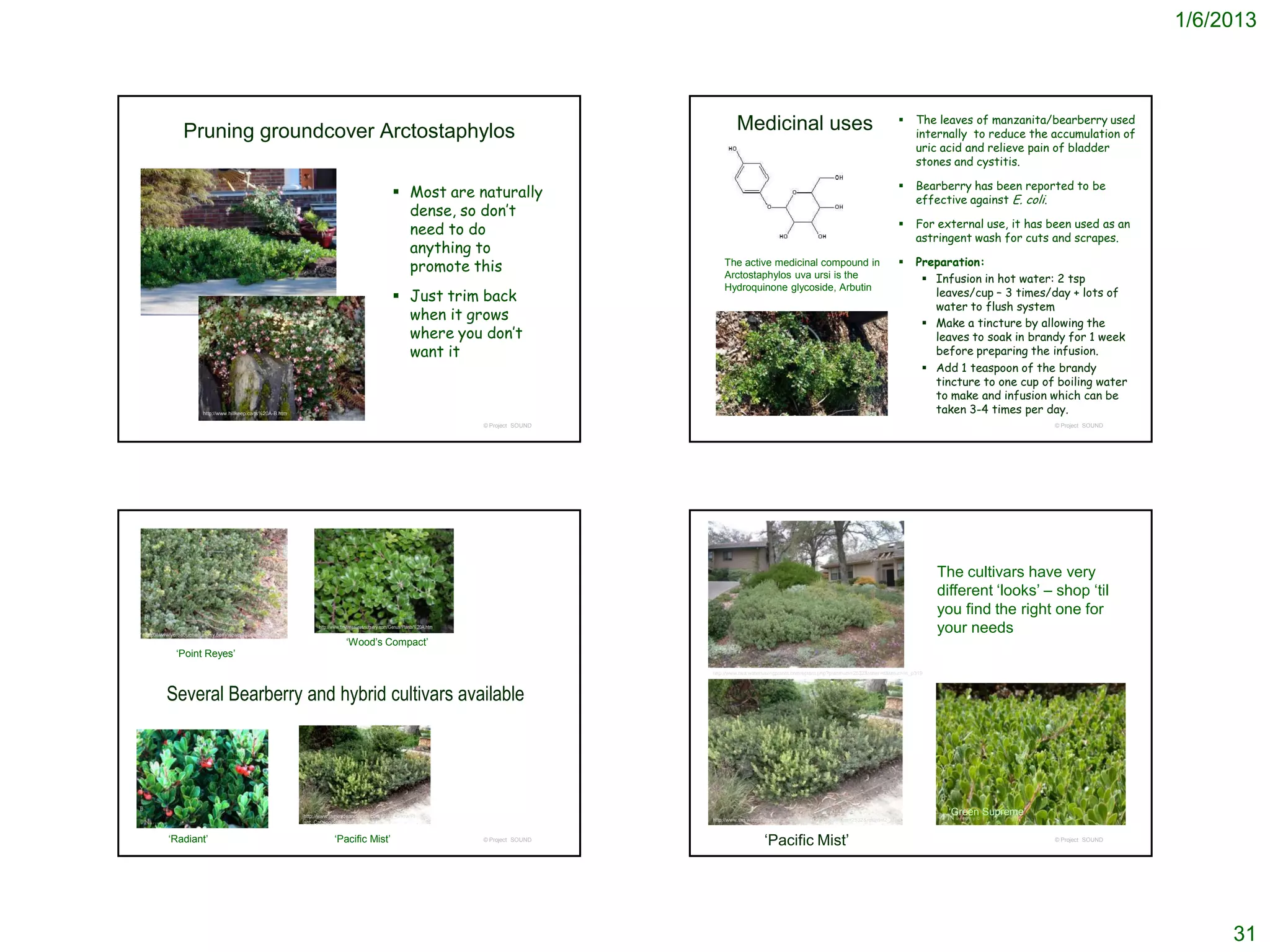
  • 21.
    1/6/2013 What to dowith all  Beverages  Manzanita ‘cider’ Need a shrub that can take a little more water but the fruits?  Syrup for cold drinks looks like Del Mar Manzanita?  Dried and ground for tea  Jelly & syrup  Dried and ground for a natural sweetener © 2010 James M. Andre http://www.wishtoyo.org/artifacts-wearables-seed-bead- necklaces.html © Project SOUND © Project SOUND Pajaro Manzanita is great for * Pajaro Manzanita – Arctostaphylos pajaroensis coastal gardens  Prune up for a small, dense tree – good nesting sites  Use as a specimen/accent shrub – very attractive year-round, http://www.laspilitas.com/nature-of-california/plants/arctostaphylos-pajaroensis-paradise-manzanita with sculptural shape  As an all-round habitat plant – winter nectar, fruits and cover- nest sites  Has an ‘old-fashioned look’ – perfect for Edwardian or Victorian garden  Nice addition to a scent garden © 1995 Dan Post © Project SOUND © Project SOUND http://www.flickr.com/photos/eastbaywilds/2994359348/ 21
  • 22.
    1/6/2013 ‘Myrtle Wolf’ ‘Paradise’  Naturally occurring cultivar  Naturally occurring from Regional cultivar Parks Botanic http://botanicalgarden.berkeley.edu/waterwise/images/05_Arctostaphylos-cv-MWolf5.jpg  Particularly attractive Garden  Bright/dark pink flowers  5-6 ft tall; 6-10  Light blue-green foliage ft wide  4-5 ft tall & wide  Exceptional new foliage color  Takes a little more heat – good for hot  Needs very good banks drainage http://www.calfloranursery.com/pages_plants/pages_a/arcpajpar.html http://www.flickr.com/photos/eastbaywilds/sets/72157608574988902/ © Project SOUND http://drystonegarden.com/ © Project SOUND Versatile, garden-friendly ‘Warren Roberts’ ‘Sunset’  Very dense, slate-blue/blue- green foliage  Upright habit – good for small tree – 6 ft tall, 10 ft wide  New foliage orange-red – really nice color http://www.rwa.watersavingplants.com/eplant.php?plantnum=24200&retu rn=l7_p87  Hybrid - A. pajaroensis x A. hookeri ssp. hookeri  Very colorful new foliage  Low-growing – to about 3-4 ft – informal hedges  Chosen for garden hardiness http://www.flickr.com/photos/eastbaywilds/sets/72157608574988902/ © Project SOUND © Project SOUND http://xeraplants.com/Xera/SHRUB_A-B_09.html 22
  • 23.
    1/6/2013 Manzanitas provide a wide range of Foliage color is important factor foliage colors A. densiflora – bright green http://en.flickeflu.com/set/72157622626294085 A. auriculata – silvery blue-green http://jayacarl.blogspot.com/2007/03/stone-wall-with-manzanita.html http://camissonia.blogspot.com/2011/02/yes-im-manzanita-freak-and-blooming.html http://www.baynatives.com/plants/Arctostaphylos-silvicola/ © Project SOUND A. pungens – gray-green A. glandulosa – blue-green © Project SOUND Compare foliage at the nursery Perhaps you need a mid-size shrub  Some things to consider: You could plant Indian Hawthorn (Raphiolepis  Color of new leaves – may be red-tinged in some species indica) – or choose a smaller size manzanita http://dangergarden.blogspot.com/2010/04/joy-creek-nursery.html  Color of mature leaves  Leaf shape  Whether leaves are hairy or shiny  Leaf size and density on branches  Whether leaves are upright on branches  Color of new branches http://coldcalculation.blogspot.com/2006/09/workhorse-landscape-plants.html http://www.baynatives.com/plants/Arctostaphylos-silvicola/ © Project SOUND © Project SOUND 23
  • 24.
    1/6/2013 * Mount Diablo Manzanita – Arctostaphylos auriculata Mount Diablo Manzanita: beautiful foliage  Endemic to the area surrounding Mount Diablo, in Contra Costa County (e San  Size: Francisco Bay Area)  3-12 ft tall; usually 4-6 ft  occurs primarily in chamise or manzanita  5-10 ft wide chaparral. It can also be found as an  Growth form: understory shrub in coast live oak woodland,  Evergreen woody shrub 400'-2000' elevation http://ucjeps.berkeley.edu/cgi-bin/get_JM_treatment.pl?3449,3454,3456  Erect to mounded  Twigs hairy; older bark red  Foliage:  Gray-green; may be very fuzzy  Rounded, over-lapping leaves clasp the branches  Very unusual and lovely appearance © 2006 Steve Matson © 2006 Steve Matson © Project SOUND © Project SOUND A. auriculata can take a  Soils: Flowers are pink! little more water  Texture: well-drained  pH: slightly acidic best  Blooms: winter to early spring  Light:  Flowers:  Full sun on coast  Usually pink – sometimes  Morning sun/dappled shade white in hot gardens  Usually hairy  Many flower clusters per  Water: plant – plant covered with  Winter: adequate flowers  Summer: best with a little  Otherwise, fairly typical summer water (Zone 1-2 up flowers for the genus to 2); rinse off occasionally in summer (be ‘the fog’)  Fruits: small & hairy until mature.  Fertilizer: none; likes poor soils  Other: organic mulch (including oak and pine needles © 2006 Steve Matson © 2006 Steve Matson © Project SOUND © Project SOUND 24
  • 25.
    1/6/2013 Arctostaphylos auriculata 'Knobcone Point' ‘Greensphere’  Rounded shrub, 5’ tall x 6’ wide; almost perfectly spherical hybrid  Dense habit; compact new growth  3-6 ft tall; 6-8 ft wide – is attractive, reddish, ages to spreading with erect stems dark green.  An unusual selection of  Full sun to part shade. manzanita that retains its close-  Any soil, dry to semi-dry. set juvenile leaves, creating a  one of the easiest manzanitas to unique fish scale-like effect grow.  Foliage an attractive blue-green. Excellent in both coastal and inland gardens.  Pale pinkish-white flowers attract hummingbirds. http://www.flickr.com/photos/eastbaywilds/4297456024/ http://davesgarden.com/guides/pf/showimage/235340/ © Project SOUND © Project SOUND The lowest of the low Little Sur Manzanita – Arctostaphylos edmundsii © 2007 Penny DeWind http://seedbyte.blogspot.com/2009_12_11_archive.html © Project SOUND © Project SOUND 25
  • 26.
    1/6/2013 Little Sur Manzanita – Arctostaphylos Arctostaphylos edmundsii edmundsii ‘Carmel Sur’  Fast growing  Attractive dark gray-green foliage and dense, spreading habit.  < 1 ft. tall and 4 - 6 ft. across. http://www.laspilitas.com/nature-of-california/plants/arctostaphylos-edmundsii-carmel-sur-manzanita  Prefers coastal conditions but does well protected from hot afternoon sun inland.  Creeping main sterns send up many short, erect branchlets to form an http://slosson.ucdavis.edu/documents/2005-200610653.pdf attractive dense, lush-looking  Many of the low-growing manzanitas grow in sandy coastal areas, ground cover. suggesting that well-drained soils are important © Project SOUND © Project SOUND http://www.calown.com/nativegarden_plants.html Arctostaphylos edmundsii  An unusually small shrub - < 2 ft Arctostaphylos edmundsii ‘Big Sur’  Forms a small mound ‘Bert Johnson’ of dark green leaves and mahogany-red branches.  Flat mat-like stems hold gray- green leaves that flush bronze  Unlike most smaller in early spring. Manzanitas, this selection remains  A compact mound forming somewhat open, selection to 2’ with shiny http://farm1.static.flickr.com/84/238318221_cec3be656f.jpg?v=0 revealing the plant's foliage and light pink flowers characteristic Excellent native ground in spring beautiful branching cover or in containers structure.  Reliability in a range of garden situations. http://www.yerbabuenanursery.com/viewplant.php?pid=1277 Use along a path or draping over a wall where it can be appreciated up close. © Project SOUND © Project SOUND 26
  • 27.
    1/6/2013 Purisima Manzanita – Arctostaphylos purissima ‘Ophio-viridis’ hybrid  1 ft by 4-6 ft  Bright green foliage; overlapping leaves give © 2006 Steve Matson unique appearance  Recommended for use in containers, or where it can trail over a low wall - beautiful cascading growth.  Also good for hanging baskets. © 2004 David Graber © Project SOUND © Project SOUND Purissima Manzanita – Arctostaphylos purissima Purisima Manzanita – a groundcover in nature  Size:  Endemic to western Santa  Usually 3-4 ft tall; may be Barbara County, California, 8-10 on some sites including near Lompoc, site of  6-12 ft wide; spreading Mission La Purísima Concepción – hence it’s name  Growth form:  Woody evergreen shrub  Hills and mesas near the  Varies in shape from low and http://ucjeps.berkeley.edu/cgi-bin/get_JM_treatment.pl?3449,3454,3523 coast (Burton Mesa) © 2004 David Graber spreading to tall and erect.  Densely branched; young  Maritime chaparral on deep, twigs are white/hairy sandy soils, sandstone outcrops  Foliage:  Leaves shiny, bright green  May be almost round – clasp the stem  Roots: fibrous; no burl © 1993 David Graber © Project SOUND © Project SOUND © 2006 Adonis (Don) Tate © 2006 Steve Matson 27
  • 28.
    1/6/2013 Purisima likessand  Soils: A. purissima ‘Burton Mesa’  Texture: well-drained soils – loves sandy soils  2-3 ft tall; 4-5 ft wide  pH: most local  Loves sand but tolerates clays; very drought-tolerant  Light:  Nice natural shape – requires little  Full sun – only along immediate coast pruning  Part-shade best in most gardens  Does well in many gardens © 1993 David Graber  Water:  Winter: adequate  Summer: looks best with some summer water; Zone 1-2 (clay), 1-2 to 2 in all others  Fertilizer: none; likes poor soils  Other: +/- organic mulch © 1993 David Graber http://www.laspilitas.com/nature-of-california/plants/arctostaphylos-purissima-burton-mesa- © Project SOUND groundcover © Project SOUND A. purissima ‘Petit Margarita’ A. purissima ‘Vandenberg’  Natural variant  1-3 ft tall; 3-5 ft wide  2-3' H x 6-8' W, mounding  Natural variant - hills S. of Lompoc  Coast: full sun, inland: part shade.  Similar to Arctostaphylos myrtifolia with its delicate leaves  Well-drained soils and sprawling habit. Unique and http://www.elnativogrowers.com/Photographs_page/arcpurva.htm  Occasional to moderate water – pretty foliage Zone 1-2 to 2 (perhaps even 2-  Use in a small east facing bed or 3 in sand) along a cool retaining wall where it  All the nice characteristics of can soften the top as it drapes over the species (Large lush green  Mixing this manzanita into a leaves clasp fuzzy stems; groundcover of ‘Sunset’ and abundant flowers) but better ‘Harmony’ manzanita would be garden tolerance. dramatic planting. © Project SOUND © Project SOUND 28
  • 29.
    1/6/2013 Parry’s /Snowlodge Manzanita– Arctostaphylos parryana For groundcovers: know their spread and growth rate before you choose  Endemic to western section of the Transverse Ranges, from coastal Santa Barbara County to the San Gabriel Mountains.  Chaparral, coniferous forest from 3,600'-7,000‘  1-3 ft tall; 6+ ft wide http://ucjeps.berkeley.edu/cgi-bin/get_JM_treatment.pl?3449,3454,3516  Good heat & cold tolerance; needs well-drained acidic soil – best under oaks & pines  Moderate growth rate  Appears to do well inland, even at lower elevations http://thehumanfootprint.wordpress.com/2009/11/29/california-natives-part-3-groundcovers-manzanitas-ceanothus/ http://www.worldbotanical.com/arctostaphylos.htm © Project SOUND © Project SOUND What if you need something that’s a really * Kinnikinnick – Arctostaphylos uva-ursi low ‘creeper’? http://tmousecmouse.blogspot.com/2010/02/and-even-in-winter.html © Project SOUND © Project SOUND 29
  • 30.
    1/6/2013 Kinnikinnick is another low-growing woody shrub * Kinnikinnick – Arctostaphylos uva-ursi  Size:  Also commonly called Bear Berry  < 1 ft tall  spreading: 3-15 ft wide  Found throughout the Northern Hemisphere:  Growth form:  N. Asia/Russia  Evergreen woody shrub  N. Europe  Very low, dense growth – mat-  In North America - from the northern like half of California north to Alaska and across Canada and the northern United © 2007 Matt Below  Spreads by rooting stems States to New England and Newfoundland.  Foliage:  In CA – mostly along the N. CA coast  Like other Manzanitas  Leathery leaves; green but may  Rocky outcrops, slopes, sandy soils, become red-tinged in winter coastal dunes, chaparral, coniferous  Very neat appearing – garden- forest like  Deer will browse http://www.swsbm.com/maps/Arctostaphylos_uva-ursi.gif © Project SOUND © 2005 Steve Matson http://oregonstate.edu/dept/ldplants/aruv2.htm  Roots: fibrous; to 6+ ©feetSOUND Project depth http://ucjeps.berkeley.edu/cgi-bin/get_JM_treatment.pl?3449,3454,3542 Kinnikinnick - well suited  Soils: Mainly used as a low  Texture: best in sandy soils, but to garden conditions… fine in most well-drained soils groundcover  pH: any, including quite acidic  Light:  Excellent fire-resistant  Best in part shade; tolerates full groundcover under trees shade (but less flowering)  Fine on parking strips in  Full sun only near immediate coast http://www.hort.uconn.edu/plants/a/arcuva/arcuva3.html virtually all local cities – very  Water: http://www.hort.uconn.edu/plants/a/arcuva/arcuva3.html low-growing & looks way  Young plants: Zone 2-3 better than ivy!  Winter: needs good water – deep roots  Looks nice cascading over a  Summer: Zone 2-3 (best); Zone low retaining wall 2 ok once established  Combine with rocks and other  Fertilizer: none low groundcovers, perennials  Other: delicate roots; don’t move or compact soils  Nice in a large pot or planter – even on shady patios http://courses.washington.edu/ehuf331/Plant_Pages_subfolders/ERICACEAE.shtml © Project SOUND © Project SOUND 30
  • 31.
    1/6/2013  The leaves of manzanita/bearberry used Pruning groundcover Arctostaphylos Medicinal uses internally to reduce the accumulation of uric acid and relieve pain of bladder stones and cystitis.  Bearberry has been reported to be  Most are naturally effective against E. coli. dense, so don’t For external use, it has been used as an need to do  astringent wash for cuts and scrapes. anything to promote this The active medicinal compound in  Preparation: Arctostaphylos uva ursi is the  Infusion in hot water: 2 tsp Hydroquinone glycoside, Arbutin  Just trim back leaves/cup – 3 times/day + lots of water to flush system when it grows http://laurries.blogspot.com/2010_11_01_archive.html  Make a tincture by allowing the where you don’t leaves to soak in brandy for 1 week want it before preparing the infusion.  Add 1 teaspoon of the brandy tincture to one cup of boiling water to make and infusion which can be http://www.hillkeep.ca/ts%20A-B.htm taken 3-4 times per day. © Project SOUND © Project SOUND The cultivars have very different ‘looks’ – shop ‘til you find the right one for http://www.yerbabuenanursery.com/viewplant.php?pid=407 http://www.tinytreasuresnursery.com/Genus/Plants%20A.htm your needs ‘Wood’s Compact’ ‘Point Reyes’ http://www.rwa.watersavingplants.com/eplant.php?plantnum=2532&letter=d&return=s_p319 Several Bearberry and hybrid cultivars available http://www.jamesdeandesign.com/Slide_Show/Pl ‘Green Supreme’ ant_Catalog/SHRUBS/ http://www.sm.watersavingplants.com/eplant.php?plantnum=2532&return=l2_aP ‘Radiant’ ‘Pacific Mist’ © Project SOUND ‘Pacific Mist’ © Project SOUND 31
  • 32.
    1/6/2013 We’ve come to the end of our journey Versatile ‘Emerald Carpet’: groundcover to very low hedge http://www.pasadena.watersavingplants.com/eplant.php?plantnum=243&return=l8_aK © Project SOUND © Project SOUND 32