Bay-Friendly
Gardening
  your backy
From   yard to the Bay
T
      he Bay-Friendly Gardening Program was developed to encourage residents to make environmentally
      friendly gardening choices. It is not a particular style, but an approach that works with nature to reduce
      waste and protect the watersheds of the San Francisco Bay. Bay-Friendly Gardening is a program of the
Alameda County Waste Management Authority and Source Reduction & Recycling Board, also known as
StopWaste.Org.

Resources available to Alameda County residents through the Bay-Friendly Gardening Program include:

  •   Bay-Friendly Gardening Workshop Series
  •   Bay-Friendly Garden Tour                                                         Bay-Friendly Gardening
  •   Bay-Friendly Garden Registration                                                 is a trademark and
  •   Master Composter Training                                                        servicemark developed
  •   Bay-Friendly Partner Nurseries                                                   and owned by
  •   Low-Cost Compost Bins                                                            StopWaste.Org.
  •   Compost Information Hotline

Visit www.BayFriendly.org for more information, or call the Compost Info Hotline at (510) 444-SOIL (7645).

Project Team

  Jeanne Nader - Alameda County Waste Management Authority • jnader@stopwaste.org
  Jennifer Ketring - Green Logic Consulting • jketring@stopwaste.org
  Anne Hayes, Principal Writer
  Cindy Nelson, Associate Writer

Thanks to the following agencies and representatives for contributing to the first edition:

  Alameda Countywide Clean Water Program
    Louise Cervantes
  Bio-Integral Resource Center
    Tanya Drlik
  East Bay Municipal Utility District
    Susan Handjian and Chris Finch
  The Watershed Project
    Sharon Farrell and Jen Brown

A special thanks to the following Alameda County gardeners for sharing their gardening wisdom:

  Mike Geltz and Grant Minix, Oakland
  Ann Hutcheson-Wilcox, Oakland
  Marla Lee, Alameda
  Kathleen McCabe-Martin, Fremont
  Bill Merrill and Ellen Train, Fremont
  Wanda Nusted, Berkeley
  Jim O’Laughlin, Sunol
  Gail Schino, San Leandro
  Libby Teel, Oakland                                                     Disclaimer
  Kat Weiss, Livermore                                                    The information presented in this
                                                                          guide is provided as a public service
Credits                                                                   by the Alameda County Waste
                                                                          Management Authority and Recycling
  David Gilmore, Graphic Design                                           Board, also known as StopWaste.Org.
  Joal Morris, Illustrations                                              This information is not a substitute
  Kwai Lam, Rachel Michaelsen, Richard Rollins,                           for the exercise of sound judgement in
   Tamara Shulman, Photographs                                            particular circumstances and is not
                                                                          intended as recommendations for
Printed on 100% post-consumer recycled paper with soy-based inks.         particular products or services.
2nd Edition. January 2008

                                                          4
Table of Contents
 Chapter 1: Gardening for a Sense of Place . . . . . . . . . . . . . . . . . . . . . . . . . . . . . . . . . . . . . . . . . . . . . 7
 Chapter 2: Into the Garden — Look Before You Leap . . . . . . . . . . . . . . . . . . . . . . . . . . . . . . . . . . . . . 18
 Chapter 3: Gardening from the Ground Up . . . . . . . . . . . . . . . . . . . . . . . . . . . . . . . . . . . . . . . . . . . . 27
    • The Nitty Gritty on Soil . . . . . . . . . . . . . . . . . . . . . . . . . . . . . . . . . . . . . . . . . . . . . . . . . . . . . 27
    • Building and Protecting Healthy Soil . . . . . . . . . . . . . . . . . . . . . . . . . . . . . . . . . . . . . . . . . . . . 29
    • Choosing Appropriate Plants . . . . . . . . . . . . . . . . . . . . . . . . . . . . . . . . . . . . . . . . . . . . . . . . . . 30
    • Putting Plants in Their Place . . . . . . . . . . . . . . . . . . . . . . . . . . . . . . . . . . . . . . . . . . . . . . . . . . 36
 Chapter 4: Gardening Day to Day and Through the Seasons . . . . . . . . . . . . . . . . . . . . . . . . . . . . . . . . 40
    • All About Composting . . . . . . . . . . . . . . . . . . . . . . . . . . . . . . . . . . . . . . . . . . . . . . . . . . . . . . . 41
    • Worm Composting . . . . . . . . . . . . . . . . . . . . . . . . . . . . . . . . . . . . . . . . . . . . . . . . . . . . . . . . . . 45
    • About Feed the Soil . . . . . . . . . . . . . . . . . . . . . . . . . . . . . . . . . . . . . . . . . . . . . . . . . . . . . . . . . 49
    • Mulch Basics. . . . . . . . . . . . . . . . . . . . . . . . . . . . . . . . . . . . . . . . . . . . . . . . . . . . . . . . . . . . . . . 52
    • Grasscycling Is Easy . . . . . . . . . . . . . . . . . . . . . . . . . . . . . . . . . . . . . . . . . . . . . . . . . . . . . . . . . 55
    • Water Conservation and Bay-Friendly Gardening . . . . . . . . . . . . . . . . . . . . . . . . . . . . . . . . . . . 57
    • Pruning for Plant Health . . . . . . . . . . . . . . . . . . . . . . . . . . . . . . . . . . . . . . . . . . . . . . . . . . . . . 60
    • Pruning for Plant Structure. . . . . . . . . . . . . . . . . . . . . . . . . . . . . . . . . . . . . . . . . . . . . . . . . . . . 60
    • Integrated Pest Management. . . . . . . . . . . . . . . . . . . . . . . . . . . . . . . . . . . . . . . . . . . . . . . . . . . 62
    • Contending with Weeds . . . . . . . . . . . . . . . . . . . . . . . . . . . . . . . . . . . . . . . . . . . . . . . . . . . . . . 65
 Chapter 5: Gardening for the Birds and the Bees . . . . . . . . . . . . . . . . . . . . . . . . . . . . . . . . . . . . . . . . 70
 Chapter 6: If You Don’t Own the Land . . . . . . . . . . . . . . . . . . . . . . . . . . . . . . . . . . . . . . . . . . . . . . . . 75
    • Hiring Help . . . . . . . . . . . . . . . . . . . . . . . . . . . . . . . . . . . . . . . . . . . . . . . . . . . . . . . . . . . . . . . 78
 Chapter 7: Resources. . . . . . . . . . . . . . . . . . . . . . . . . . . . . . . . . . . . . . . . . . . . . . . . . . . . . . . . . . . . . . 79
 Garden Design Survey. . . . . . . . . . . . . . . . . . . . . . . . . . . . . . . . . . . . . . . . . . . . . . . . . . . . . . . . . . . . 81

East Bay Garden Profiles

 Local and Appropriate: Blending Styles in San Leandro . . . . . . . . . . . . . . . . . . . . . . . . . . . . . . . . . . 16
 Low Cost, High Satisfaction: Reuse and Renovation in an Oakland Garden . . . . . . . . . . . . . . . . . . . 17
 The Play of Air and Light: Kid-Friendly Gardening in Berkeley . . . . . . . . . . . . . . . . . . . . . . . . . . . . 26
 Calm and Colorful: Creating an Urban Retreat in Oakland . . . . . . . . . . . . . . . . . . . . . . . . . . . . . . . 34
 Doing Away with the Lawn: From Conventional to Bay-Friendly in Livermore . . . . . . . . . . . . . . . . 39
 A Tradition of Innovation: Growing Organic Edibles in Sunol . . . . . . . . . . . . . . . . . . . . . . . . . . . . . 46
 If You Build It: Gardening for Wildlife in Fremont . . . . . . . . . . . . . . . . . . . . . . . . . . . . . . . . . . . . . 72


             Gardening Tips
                                                                                                      Words from the Wise:
            Gardening tips have been gathered from
                                                                                                   Host gardeners from past Bay-
             local landscapers, organizations, books
                                                                                                   Friendly Garden Tours share
               and other resources.Tips of all sorts                                            insights from their gardening
               can be found in each chapter.                                        experiences. Look for these anecdotes
                                                                                    scattered throughout the guide.


                                                                       5
We live in an
1
amazing place.


                                                                                                    Gardening for a Sense of Place
                                                                                                    Gardening for a Sense of Place
                         n the edge of a continent, bounded by deserts and
                          mountains, California is a land of spectacular natural beauty. It is

                          also a land of extremes — within our borders are the highest and

                        lowest points in the lower 48 states.


 California also boasts a Mediterranean          our towns and neighborhoods. The Sausal
 climate. A handful of places — regions that     Creek watershed in Oakland covers just over
 lie between 30 and 40 degrees latitude on       four square miles; Alameda Creek drains an
 the western limits of a continent — share       area of almost 700 square miles, carrying
 California’s exceptional climate. The           water from the inland cities of Livermore,
 Mediterranean basin, the Western Cape of        Dublin, and Pleasanton into the bay.
 Africa, Central Chile, southwest and south
 Australia, and much of the state of             The bay is a great mixing ground that is
 California: these are the only areas on the     tremendously fertile and full of life. Fresh
 planet that experience our mild                 water meets salt water in its northeastern
 temperatures. Furthermore, each of these        reaches; drifting phytoplankton form the
 regions is defined for half the year by the     base of a complex food web that includes
 absence of rain.                                hundreds of thousands of resident and
                                                 migratory birds. The bay is also a repository
 The Watershed of the                            for many abiotic elements — including
 San Francisco Bay                               urban runoff.
 Seventy-five percent of California’s annual     Wherever there are surfaces that water can
 precipitation falls north of Sacramento.        not penetrate, such as rooftops, driveways,
 Some of this area — 40 percent of the state     streets, and parking lots, rain quickly runs
 — lies in the watershed of the San Francisco    off. It picks up whatever it flows across —
 Bay. Two rivers, the Sacramento and San         litter, motor oil, sediment, pesticides and fer-
 Joaquin, are the main channels of a system      tilizers, plant debris — and carries it to near-
 that covers 60,000 square miles.                by storm drains, which lead to our creeks,
 Immediately surrounding the bay are many        which empty into the bay.
 smaller watersheds — the hills and valleys of


                                                     7
The bay contains high levels of some pesticides,             Standard gardening practice is to remove all plant
including diazinon. All Bay Area creeks have been            debris off-site, to landfills or large compost facili-
listed by the EPA as impaired by diazinon, which             ties, which effectively mines our soils of organic
is toxic to birds, mammals, honey bees, and other            matter. Urban soils have often been compacted,
beneficial insects.                                          eroded, and so depleted that they are no longer
                                                             able to function naturally. By keeping plant debris
                            The ubiquity of diazi-           and fruit and vegetable trimmings on-site in the
  Diazinon is highly        non in Bay Area water-           form of mulch and compost, we restore the soil’s
  toxic to freshwater       ways illustrates the             ability to absorb water or filter pollutants.
  fish and invertebrates    impact that gardeners            Returning organic matter to the soil is the link
  following acute expo-     can have in harming or           between protecting our watersheds and conserving
  sure. A typical 1,000-    protecting our natural           landfill space.
  square-foot urban         resources. Because of
  application of diazi-     its toxicity, diazinon is
  non contains enough       being phased out of the            What Is a Watershed?
  active ingredient to      consumer market, but               A watershed is the area of land that water flows
  pollute 170 million       there are dozens of                across on its way to a creek, river, lake, bay, or
  gallons of fresh          other equally harmful              ocean.
  water.                    products available to
                            take its place. Through
changing our gardening practices, many of the
contaminants in stormwater runoff could be elimi-
nated. Just as important, solid waste can also be
significantly reduced.

Watersheds and Wastesheds — What’s
the Connection?
The passage of AB939 in 1989 set a statewide goal
of reducing California’s waste stream in half by the           What Is a Wasteshed?
year 2000. (As of 2004, waste diversion statewide              A wasteshed is the area of land from which all
has reached 48 percent.) Some counties set local               of the “streams” of refuse — from individuals
goals to reach beyond the 50 percent. For example,             and their communities — flow into the same
in 1990 the voters of Alameda County set the                   landfill.
ambitious goal to reduce waste by a total of 75
percent by the year 2010. To achieve this, county
residents will have to not only reduce the quantity          Introducing Bay-Friendly Gardening
of materials they discard, but also divert more of
them — that is, reuse and recycle valuable materi-           Retaining organic materials on site is one of the
als, instead of throwing them away.                          most important practices a gardener can engage in.
                                                             There are also many other ways that gardeners can
In Alameda County, nineteen percent of the waste             protect and care for the environment both near
stream is food and plant debris (that’s 294,110              and far.
tons). Food, at 12 percent, is the single largest cat-
egory of landfilled waste in Alameda County. By              The Bay-Friendly Gardening program was devel-
recycling these materials at home — composting               oped to encourage residents to make environmen-
kitchen scraps, converting plant trimmings into              tally friendly gardening choices. Bay-Friendly
mulch, leaving grass clippings on the lawn — we              Gardeners work with nature to reduce waste and
keep valuable resources out of our landfills and we          protect the local creeks, waterways, and watersheds
replenish the soil.                                          of the San Francisco Bay.


                                                         8
Bay-Friendly Gardening mimics natural systems,
which recycle everything — water, debris, and
nutrients — endlessly. It pays attention to climate        A Bay-Friendly Garden:
and local conditions and uses plants that are
adapted to those conditions. It follows
maintenance practices that support the goals of                             Builds Healthy Soil
conserving resources and reducing waste. This
approach to gardening:
 • Landscapes locally                                                       Reduces Waste
 • Landscapes for less to the landfill                                      in the Garden
 • Nurtures soil health
 • Protects air and water quality
 • Conserves water
 • Conserves energy                                                         Conserves Water
 • Provides wildlife habitat

Bay-Friendly Gardening does not advocate a
particular style of gardening. Bay-Friendly
Gardens aren’t a mold you have to fit into — they                           Creates Wildlife
offer endless opportunities, from backyard wildlife                         Habitat
gardens and native plant communities to vegetable
gardens, flower beds, and more.
                                                                            Protects Local Watersheds
The Benefits of Bay-Friendly Gardening                                      and the Bay
Because it works with nature, rather than against
it, Bay-Friendly Gardening simplifies garden care.
Using fewer resources, such as water and fertilizer,
can mean less maintenance. And because it                                   Contributes to a
emphasizes natural gardening techniques, Bay-                               Healthy Community
Friendly Gardening offers a way to make our
communities healthier, safer places.
Research has shown that children are particularly                           Saves Energy
vulnerable to contaminants in the environment.
They are also especially open to the opportunities
for discovery and play that a garden can provide.
Inviting children to go for a snail hunt on summer         In the following pages, you will find guide-
nights is a safer way to eliminate the pest than           lines for a variety of Bay-Friendly Gardening
setting out poison.                                        practices.They cover all the main activities a
                                                           gardener undertakes — planning the garden,
It has also been shown that looking out on a
garden helps hospital patients recover more                choosing plants, caring for the soil, planting,
quickly. Even when glimpsed from a moving car,             watering, pruning, and so on.The icons shown
natural scenery soothes the viewer. Whether you            above appear throughout this handbook, to
want an attractive yard to view from your home             signal the benefits offered by every gardening
or a place where you can get your hands dirty,             practice described. For a detailed list of the
growing a Bay-Friendly Garden can help make                practices, see pages 10-11.
you a healthier individual and help you make your
community a healthier place.


                                                       9
Putting Bay-Friendly Practices into Place
Incorporating Bay-Friendly practices into your             You may also find that your current gardening
garden does not have to be difficult. In fact, many        habits are already Bay-Friendly. You do not need
Bay-Friendly techniques can make gardening                 to do all of the following techniques to capture
chores less of a chore. Using mulch for example,           the spirit of Bay-Friendly in your garden.
helps to build healthy soil, reduce waste and              Including even one practice will reap multiple
conserve water, but it can also save time spent            benefits. Take the case of choosing California
weeding and watering in the garden.                        natives — this practice conserves water by
                                                           selecting plants adapted to a Mediterranean
The following checklist can be used as a guiding           climate, and creates wildlife habitat by providing
tool for incorporating Bay-Friendly practices.             food for local wildlife.

Build Healthy Soil

      Amend soil with compost.
      Prepare garden beds by hand rather than with a tiller.
      Maintain garden beds with little or no tilling.
      Sheet mulch to establish planting areas or pathways, or to control weeds while improving soil.
      Create clearly defined paths and or raised beds to protect soil from compaction.
      Grow cover crops to enrich the soil.

Reduce Waste in the Garden

      Create and maintain an active compost or worm bin for garden and/or food waste.
      Use your green waste cart for any plant wastes that are difficult to compost on site.
      Use leaves, chipped plant debris, compost, or other organic materials as mulch.
      Minimize plant waste by not overplanting, overwatering, or overfertilizing.
      Minimize pruning by choosing plants that are appropriate for the space.
      Avoid sheared hedges in the garden.
      Leave clippings on the lawn after mowing.
      Use recycled or salvaged products for artistic or functional purposes.


Conserve Water

      Emphasize Mediterranean climate or California native plants. (Try to use these plants for at least
      half of your garden area.)
      Group plants in the landscape by water needs.
      Minimize or eliminate lawn area.
      Install efficient irrigation (drip, timers, soaker hoses, etc.).
      Water according to plants’ needs, not just on a fixed schedule.
      Use mulch in garden beds.
      Install a rainwater collection or gray water system.

                                                      10
Create Wildlife Habitat

     Provide food for wildlife with a variety of plants that flower and set fruit at different times of year.
     Provide water with a small pond, bird bath, or water dish.
     Create year-round protective cover with a planting of evergreen trees/shrubs, logs, rocks, or brush pile.
     Diversify your garden structure with layers of ground covers, herbaceous vegetation (non-woody)
     and/or grasses, shrubs of various heights, and trees.
     Leave some areas of the garden somewhat untidy — let flowers go to seed to provide food for
     birds, and leave dead leaves and stalks to shelter over-wintering insects.
     Feature native plants. (Plant more than 50% of your garden with California natives.)


Protect Local Watersheds and the Bay

     For patios, driveways, or other hard surfaces, choose permeable materials that allow water to soak
     in rather than run off.
     Terrace steep slopes to reduce rainwater run-off and prevent erosion.
     Cover nearly all soil with mulch or plants.
     Avoid the use of synthetic fertilizers.
     Avoid the use of plants considered invasive in local wildlands (see page 33).


Contribute to a Healthy Community
     Use an integrated approach for controlling weeds, insect pests and diseases with least toxic controls
     used first for safety of children, pets and wildlife.
     Tolerate pests as much as possible.
     Select disease resistant varieties of plants.
     Include plants that attract beneficial insects in the landscape.
     Grow vegetables organically for food and enjoyment.
     Plan outdoor lighting that is dim or directed downwards to minimize light pollution.
     Use hand or electric tools instead of gas-powered tools.
     Consider and control potential neighborhood hazards — including fire awareness, weed seed dis-
     bursement, and rodent habitat.

Save Energy

     Place trees and shrubs to reduce energy requirements. For example, plant deciduous trees on the
     west side of the house to provide shade during the summer and allow sunlight to warm the house
     in the winter.
     Shade parking asphalt areas and air conditioners, if applicable.
     Select local garden products and suppliers.
     Choose outdoor lights that are energy efficient or solar.
     Select pumps for water features that are solar powered or energy efficient.
     Include space in the garden for a clothesline.
                                                      11
Gardening Locally
Bay-Friendly Gardening recognizes that what we do in our yards has impacts on pesticide loads in the
San Francisco Bay and capacity at the Altamont Landfill. One way to reduce such impacts is to garden
locally — that is, with an awareness of local conditions and the land’s natural inhabitants.
As a part of this, Bay-Friendly Gardening uses natural plant communities as models for the garden.
Plant communities are in large part determined by the conditions that a gardener needs to consider
when selecting plants — such as soil, light, moisture, drainage, and exposure — so plant communities
can provide inspiration for how to group plants in the garden and what plants to choose. Whether filled
with native plants or with exotics that do well in these settings, any garden can have a version of all of
the following California plant communities.
East Bay gardeners Gail Schino, Grant Minix, and Mike Geltz have individual approaches to the
concept of Gardening Locally. Gail Schino takes inspiration from nearby open spaces to create plant
communities in her San Leandro garden. Grant Minix and Mike Geltz rely on local resources to
transform an urban lot in Oakland. See garden profiles on pages 16-17.


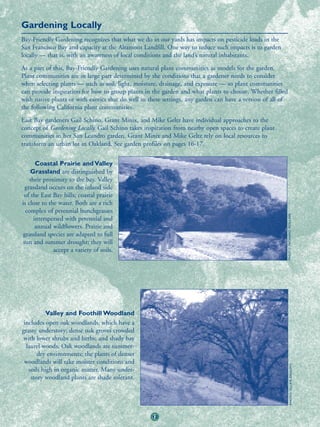
       Coastal Prairie and Valley
    Grassland are distinguished by
    their proximity to the bay. Valley
  grassland occurs on the inland side
 of the East Bay hills; coastal prairie
is close to the water. Both are a rich
  complex of perennial bunchgrasses


                                                                                                             PHOTO: RICHARD ROLLINS
      interspersed with perennial and
       annual wildflowers. Prairie and
 grassland species are adapted to full
 sun and summer drought; they will
              accept a variety of soils.


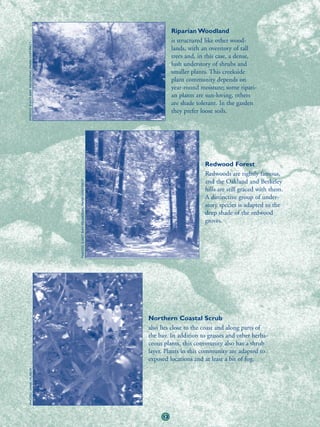
           Valley and Foothill Woodland
 includes open oak woodlands, which have a
grassy understory; dense oak groves crowded
 with lower shrubs and herbs; and shady bay
  laurel woods. Oak woodlands are summer-
       dry environments; the plants of denser
 woodlands will take moister conditions and
                                                                                                                      PHOTO: ELLEN ZAGORY


   soils high in organic matter. Many under-
    story woodland plants are shade tolerant.


                                                   12
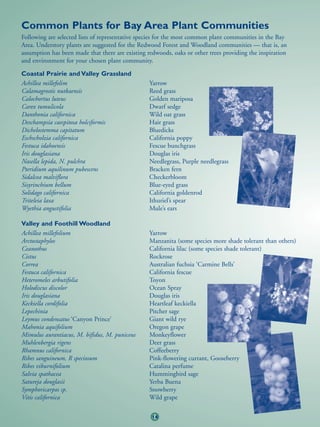
Riparian Woodland
                                                                                            is structured like other wood-
PHOTO: EAST BAY REGIONAL PARK DISTRICT


                                                                                            lands, with an overstory of tall
                                                                                            trees and, in this case, a dense,
                                                                                            lush understory of shrubs and
                                                                                            smaller plants. This creekside
                                                                                            plant community depends on
                                                                                            year-round moisture; some ripari-
                                                                                            an plants are sun-loving, others
                                                                                            are shade tolerant. In the garden
                                                                                            they prefer loose soils.


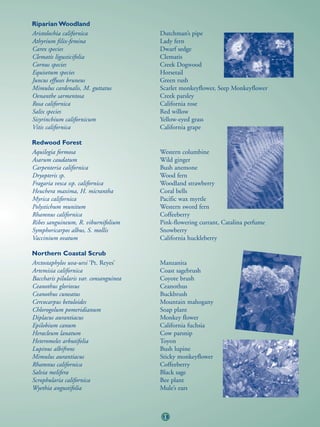
                                                                                                         Redwood Forest
                                                                                                         Redwoods are rightly famous,
                                                                                                         and the Oakland and Berkeley
                                         PHOTO: EAST BAY REGIONAL PARK DISTRICT


                                                                                                         hills are still graced with them.
                                                                                                         A distinctive group of under-
                                                                                                         story species is adapted to the
                                                                                                         deep shade of the redwood
                                                                                                         groves.


                                                                                  Northern Coastal Scrub
                                                                                  also lies close to the coast and along parts of
                                                                                  the bay. In addition to grasses and other herba-
                                                                                  ceous plants, this community also has a shrub
                                                                                  layer. Plants in this community are adapted to
                                                                                  exposed locations and at least a bit of fog.
   PHOTO: JANE HUBER


                                                                                       13
Common Plants for Bay Area Plant Communities
Following are selected lists of representative species for the most common plant communities in the Bay
Area. Understory plants are suggested for the Redwood Forest and Woodland communities — that is, an
assumption has been made that there are existing redwoods, oaks or other trees providing the inspiration
and environment for your chosen plant community.

Coastal Prairie and Valley Grassland
Achillea millefolim                               Yarrow
Calamagrostis nutkaensis                          Reed grass
Calochortus luteus                                Golden mariposa
Carex tumulicola                                  Dwarf sedge
Danthonia californica                             Wild oat grass
Deschampsia caespitosa holciformis                Hair grass
Dichelostemma capitatum                           Bluedicks
Eschscholzia californica                          California poppy
Festuca idahoensis                                Fescue bunchgrass
Iris douglasiana                                  Douglas iris
Nasella lepida, N. pulchra                        Needlegrass, Purple needlegrass
Pteridium aquilinum pubescens                     Bracken fern
Sidalcea malviflora                               Checkerbloom
Sisyrinchium bellum                               Blue-eyed grass
Solidago californica                              California goldenrod
Triteleia laxa                                    Ithuriel’s spear
Wyethia angustifolia                              Mule’s ears

Valley and Foothill Woodland
Achillea millefolium                              Yarrow
Arctostaphylos                                    Manzanita (some species more shade tolerant than others)
Ceanothus                                         California lilac (some species shade tolerant)
Cistus                                            Rockrose
Correa                                            Australian fuchsia ‘Carmine Bells’
Festuca californica                               California fescue
Heteromeles arbutifolia                           Toyon
Holodiscus discolor                               Ocean Spray
Iris douglasiana                                  Douglas iris
Keckiella cordifolia                              Heartleaf keckiella
Lepechinia                                        Pitcher sage
Leymus condensatus ‘Canyon Prince’                Giant wild rye
Mahonia aquifolium                                Oregon grape
Mimulus aurantiacus, M. bifidus, M. puniceus      Monkeyflower
Muhlenbergia rigens                               Deer grass
Rhamnus californica                               Coffeeberry
Ribes sanguineum, R speciosum                     Pink-flowering currant, Gooseberry
Ribes viburnifolium                               Catalina perfume
Salvia spathacea                                  Hummingbird sage
Satureja douglasii                                Yerba Buena
Symphoricarpos sp.                                Snowberry
Vitis californica                                 Wild grape

                                                   14
Riparian Woodland
Aristolochia californica                Dutchman’s pipe
Athyrium filix-femina                   Lady fern
Carex species                           Dwarf sedge
Clematis ligusticifolia                 Clematis
Cornus species                          Creek Dogwood
Equisetum species                       Horsetail
Juncus effuses bruneus                  Green rush
Mimulus cardenalis, M. guttatus         Scarlet monkeyflower, Seep Monkeyflower
Oenanthe sarmentosa                     Creek parsley
Rosa californica                        California rose
Salix species                           Red willow
Sisyrinchium californicum               Yellow-eyed grass
Vitis californica                       California grape

Redwood Forest
Aquilegia formosa                       Western columbine
Asarum caudatum                         Wild ginger
Carpenteria californica                 Bush anemone
Dryopteris sp.                          Wood fern
Fragaria vesca ssp. californica         Woodland strawberry
Heuchera maxima, H. micrantha           Coral bells
Myrica californica                      Pacific wax myrtle
Polystichum munitum                     Western sword fern
Rhamnus californica                     Coffeeberry
Ribes sanguineum, R. viburnifolium      Pink-flowering currant, Catalina perfume
Symphoricarpos albus, S. mollis         Snowberry
Vaccinium ovatum                        California huckleberry

Northern Coastal Scrub
Arctostaphylos uva-ursi ‘Pt. Reyes’     Manzanita
Artemisia californica                   Coast sagebrush
Baccharis pilularis var. consanguinea   Coyote brush
Ceanothus gloriosus                     Ceanothus
Ceanothus cuneatus                      Buckbrush
Cercocarpus betuloides                  Mountain mahogany
Chlorogolum pomeridianum                Soap plant
Diplacus aurantiacus                    Monkey flower
Epilobium canum                         California fuchsia
Heracleum lanatum                       Cow parsnip
Heteromeles arbutifolia                 Toyon
Lupinus albifrons                       Bush lupine
Mimulus aurantiacus                     Sticky monkeyflower
Rhamnus californica                     Coffeeberry
Salvia melifera                         Black sage
Scrophularia californica                Bee plant
Wyethia angustifolia                    Mule’s ears


                                        15
Local and Appropriate: Blending Styles in San Leandro

           estled at the foot of the East Bay hills           Leandro Creek. Thilgen pulled the ivy blanketing

N          along the flanks of San Leandro Creek,
           the Le Brun Park neighborhood of San
Leandro was developed in the ‘50s and ‘60s. When
                                                              the creek bank and replaced it with a diversity of
                                                              shrubs and herbs common to creek corridors. To
                                                              further increase the wildlife value of the garden,
Gail Schino bought a home there, the landscaping              Schino and Thilgen built a large pond at the top
reflected the era in which the house was built.               of the creek bank. Many tree frogs have since
There were “spaceship” junipers — the tall, skinny            moved in, migrating from creekside herbs and
kind — and camellias in front of all the windows.             trees. Having laid eggs and developed in the pond,
“They were fifty-year-old trees — I tried to live             the mature frogs — some no more than an inch
with them,” says Schino. “It wasn't feasible.”                long — take shelter in the rushes, sedges, scarlet
                                                              monkeyflower, and tule potato planted beside it.
Although Schino describes the main
                                                                                 To keep the ground around the
gardening model in her neighborhood
                                                                                 pond moist, as it would be in
as “mowers and blowers,” she wanted
                                                                                 the wild, Thilgen extended the
something different. She didn't want
                                                                                 pond liner beyond the lip of
to use pesticides, for example, because
                                                                                 basin. Water seeps out to the
of her proximity to San Leandro
                                                                                 fabric's edges and into the sur-
Creek and because she has pets. So
                                                                                 rounding soil. A little farther
she began thinking about plants that
                                                                                 away, at the corner of the lot
can thrive without toxic inputs. And
                                                                                 under an old, spreading oak,
as she walked around nearby Lake
                                                                                 Thilgen planted local natives —
Chabot, where the creek
                                                                                    snowberry, Douglas iris,
originates, she started pay-
                                                                                    California fescue — that,
ing attention to the plants
                                                                                    like oaks, don't want summer
native to her watershed.
                                                                                    water.
To learn more about native
                                                                                   To take the intense heat of
plants, Schino made sever-
                                                                                   the south-facing front of the
al trips to Yerba Buena
                                                                                   house, Thilgen created a
Nursery in Woodside, one
                                                                                   prairie. He seeded red fescue,
of the oldest native plant
                                                                                   purple needlegrass, and wild-
nurseries in the Bay Area.
                                                                                  flowers in beds on either side
Schino also took several
                                                                                  of the walkway to the door,
local garden tours. She noticed the work of
                                                              bordering them with white yarrow. These sun-
Michael Thilgen, a landscape architect known for
                                                              lovers can withstand the glare from a large expanse
his expertise in sustainable landscaping. “It got so I
                                                              of asphalt where four streets meet in front of
could recognize his gardens,” Schino says, and she
                                                              Schino's house.
decided to hire his company, Four Dimensions
Landscape Development. She asked Thilgen to                   On the warm and sunny southeast side of the
help her create a garden that would be compatible             house, a chaparral theme prevails. The tangy scent
with the oak woodland and creek plant communi-                of Cleveland sage entices hummingbirds and bum-
ties bordering her house.                                     blebees; ceanothus and manzanita offer fragrance
                                                              and bloom in early spring.
The back of Schino's lot slopes down to San
                                                         16
Low Cost, High Satisfaction: Reuse and Renovation in an
                Oakland Garden

         rant Minix and Michael Geltz are such             Even the plants they have put in are ones they

G        good recyclers that their garbage
         company, Waste Management, gave them
a $60 credit and six months’ free service. Minix
                                                           recovered or were given by friends. Always
                                                           focusing on ways to make more from less, Minix
                                                           and Geltz favor plants that can be propagated
and Geltz take out a single bag of garbage once a          from divisions or cuttings. In the spring, the
month.                                                     backyard is a riot of daffodils, tulips, dahlias, and
                                                           iris; the front yard is graced year-round by the
The waste-not ethic so evident inside the house            steady, undemanding presence of succulents.
has also been put to work outside it, where Minix
and Geltz have built a happy,                                     Minix and Geltz say they’re not garage sale
opportunistic garden from                                                       types — they don’t go
reclaimed materials. They                                                       scouting for materials —
estimate that 60 percent of their                                              they just pick up what they
garden — plants, benches,                                                      come across. The two don’t
ornaments, and so on — is                                                      consider themselves
material they personally                                                      scavengers or salvagers
recovered or recycled. The cost                                               (they’re recyclers), nor are
to renovate their entire lot,                                                 they packrats. Geltz
which is just under 6,000                                                    maintains a strict statute of
square feet, was less than                                                   limitations: “If you haven’t
$5,000.                                                                      used it or touched it in a
                                                                                    year,” he says, “give it
Where Minix and Geltz                                                               away or sell it.” With
needed a path along                                                                 shirts, both men follow
one side of the                                                                     the one-in, one-out
backyard, they made                                                                 rule.
simple paving stones
from concrete. They                                                                 Another economy they
built a frame from Trex                                                             exercise is that of
decking boards, then                                                                bartering. “If you've got
laid it on a plastic tarp.                                                          a skill, trade with
They ruffled the tarp,                                                              someone who can do
intentionally creating                                                              what you can’t,” says
folds that gave each                                                                Minix. He and Geltz
stepping stone a                                                                    have traded plants for
different texture. To                                                               painting a room and for
finish the path, they set the stones in pea gravel.        cleaning someone’s garden. They also exchange
                                                           plant materials with many neighbors and friends.
They also salvaged bags of hardened concrete —
“they were in somebody’s trash,” Minix says —              When asked where his zeal comes from, Minix
and stacked them two-high to build border edges            says he’s always had the recycling bug. “I’ve just
in the backyard. Along the side of the house,              always believed I should be doing it,” he says.
where they needed to edge a narrow garden bed,             When pressed further, he says he follows a maxim
they pushed the cut tops of dozens of leftover             passed on by a friend. “Don’t think of what it is,
fence stakes into the ground, one right next to the        think of what it could become.”
other, at varying heights.

                                                      17
2
Into the Garden: Look Before You Leap   Many an eager gardener                                                    can tell a tale of plant-
                                        ing first and then considering the consequences. Whether you create a garden yourself or hire
                                        someone to do it for you, the process can be made clearer — and the end result more successful
                                        — by taking the time to think things through at the outset.

                                        This chapter covers how to plan a garden and provides a visual example of all the elements a
                                        Bay-Friendly garden might contain. For help with assessing your site and planning the garden,
                                        use the tear out Garden Design Survey located at the back of this book.

                                        How to Plan a Garden                               4. Think about how you use the space . . .
                                        The following is a general overview of the         Every outdoor space has functions. Make a
                                        factors to consider when you want to reno-         list of how you use the areas surrounding
                                        vate all or some part of your garden. The          your home — do your children play in the
                                        best approach is to think first about form         yard? Do you spend much time gardening?
                                        and function — what the conditions of              Do you like to look out on the yard from
                                        your site are and how you use the garden           different rooms in the house?
                                        — then consider details such as plant
                                                                                           . . . and how you’d like to use it. Very
                                        choice. See page 30.
                                                                                           likely you have ideas about the purposes
                                        1. Get to know what you have. Spend                you want your yard to serve. Perhaps you
                                        some time puttering. Knock around out              want an outside dining area, or a patio
                                        there. Prune a few things, pull weeds, put a       where none exists. Or you need a site for a
                                        few plants in the ground. The point is to          bigger and better compost pile. Think
                                        get to know the place, to build first-hand         about those things next, and make a list of
                                        experience of your little piece of the earth.      them.

                                        2. Consider the structure of the place.
                                        This means the hard features — driveway,
                                        buildings, fences, paved paths. It also                       Words from the Wise:
                                        means plant materials — what’s already                              Know What You
                                        growing in the yard and what shape does it                          Want, But Accept
                                        give your garden? For help inventorying                             a Bit of Chaos
                                        your site, see the Garden Design Survey on
                                        page 81.                                                          akland gardener Libby Teel
                                        3. Make a simple plan of the property.
                                        A property survey was completed for your
                                        home at the time it was built, and if you
                                                                                             O            suggests that when you're
                                                                                                          starting out, it's worthwhile
                                                                                             to spend a lot of time thinking about
                                                                                             how you want the space to feel. Are
                                        obtain a copy (available in the county
                                                                                             you looking for something sculptured,
                                        assessor’s office), it can serve as a base plan.     or more chaotic? “A garden offers the
                                        If you don’t have the survey or don’t want           opportunity to have slightly organized
                                        to track it down, you can make one your-             chaos,” she says. It is a creative space
                                        self. See “How to Draw a Site Plan,”                 that you do not control entirely—
                                        page 20.                                             “sometimes you have to let it tell you a
                                                                                             little bit too.”


                                                                               18
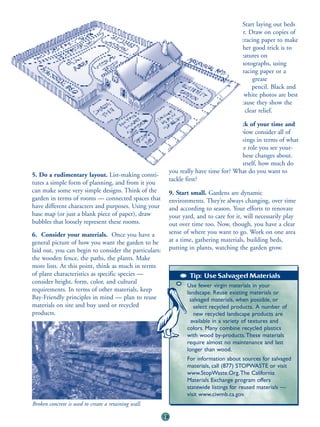
7. Try out various designs. Start laying out beds
                                                               in your mind and on paper. Draw on copies of
                                                                    your site plan or use tracing paper to make
                                                                            overlays. Another good trick is to
                                                                                   draw features on
                                                                                          photographs, using
                                                                                           tracing paper or a
                                                                                                grease
                                                                                                pencil. Black and
                                                                                            white photos are best
                                                                                         because they show the
                                                                                     site in clear relief.

                                                                                8. Take stock of your time and
                                                                            your budget. Now consider all of
                                                                         your lists and drawings in terms of what
                                                                     you can afford and the role you see your-
                                                                 self playing in bringing these changes about.
                                                             If you’re doing the work yourself, how much do
                                                            you really have time for? What do you want to
5. Do a rudimentary layout. List-making consti-
                                                            tackle first?
tutes a simple form of planning, and from it you
can make some very simple designs. Think of the             9. Start small. Gardens are dynamic
garden in terms of rooms — connected spaces that            environments. They’re always changing, over time
have different characters and purposes. Using your          and according to season. Your efforts to renovate
base map (or just a blank piece of paper), draw             your yard, and to care for it, will necessarily play
bubbles that loosely represent these rooms.                 out over time too. Now, though, you have a clear
6. Consider your materials. Once you have a                 sense of where you want to go. Work on one area
general picture of how you want the garden to be            at a time, gathering materials, building beds,
laid out, you can begin to consider the particulars:        putting in plants, watching the garden grow.
the wooden fence, the paths, the plants. Make
more lists. At this point, think as much in terms
of plant characteristics as specific species —                      Tip: Use Salvaged Materials
consider height, form, color, and cultural
                                                                   Use fewer virgin materials in your
requirements. In terms of other materials, keep                    landscape. Reuse existing materials or
Bay-Friendly principles in mind — plan to reuse                     salvaged materials, when possible, or
materials on site and buy used or recycled                            select recycled products. A number of
products.                                                             new recycled landscape products are
                                                                     available in a variety of textures and
                                                                   colors. Many combine recycled plastics
                                                                   with wood by-products. These materials
                                                                   require almost no maintenance and last
                                                                   longer than wood.
                                                                   For information about sources for salvaged
                                                                   materials, call (877) STOPWASTE or visit
                                                                   www.StopWaste.Org.The California
                                                                   Materials Exchange program offers
                                                                   statewide listings for reused materials —
                                                                   visit www.ciwmb.ca.gov.
Broken concrete is used to create a retaining wall.

                                                       19
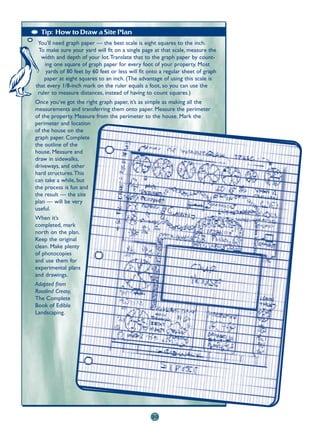
Tip: How to Draw a Site Plan
 You’ll need graph paper — the best scale is eight squares to the inch.
 To make sure your yard will fit on a single page at that scale, measure the
  width and depth of your lot.Translate that to the graph paper by count-
    ing one square of graph paper for every foot of your property. Most
    yards of 80 feet by 60 feet or less will fit onto a regular sheet of graph
    paper at eight squares to an inch. (The advantage of using this scale is
that every 1/8-inch mark on the ruler equals a foot, so you can use the
 ruler to measure distances, instead of having to count squares.)
Once you’ve got the right graph paper, it’s as simple as making all the
measurements and transferring them onto paper. Measure the perimeter
of the property. Measure from the perimeter to the house. Mark the
perimeter and location
of the house on the
graph paper. Complete
the outline of the
house. Measure and
draw in sidewalks,
driveways, and other
hard structures.This
can take a while, but
the process is fun and
the result — the site
plan — will be very
useful.
When it’s
completed, mark
north on the plan.
Keep the original
clean. Make plenty
of photocopies
and use them for
experimental plans
and drawings.
Adapted from
Rosalind Creasy,
The Complete
Book of Edible
Landscaping.


                                                  20
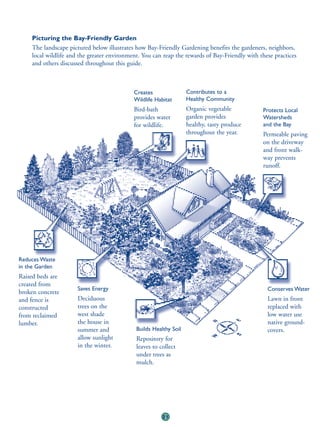
Picturing the Bay-Friendly Garden
    The landscape pictured below illustrates how Bay-Friendly Gardening benefits the gardeners, neighbors,
    local wildlife and the greater environment. You can reap the rewards of Bay-Friendly with these practices
    and others discussed throughout this guide.


                                            Creates                Contributes to a
                                            Wildlife Habitat       Healthy Community
                                            Bird-bath              Organic vegetable           Protects Local
                                            provides water         garden provides             Watersheds
                                            for wildlife.          healthy, tasty produce      and the Bay
                                                                   throughout the year.        Permeable paving
                                                                                               on the driveway
                                                                                               and front walk-
                                                                                               way prevents
                                                                                               runoff.


Reduces Waste
in the Garden
Raised beds are
created from
                      Saves Energy                                                               Conserves Water
broken concrete
and fence is          Deciduous                                                                  Lawn in front
constructed           trees on the                                                               replaced with
from reclaimed        west shade                                                                 low water use
lumber.               the house in                                                               native ground-
                      summer and             Builds Healthy Soil                                 covers.
                      allow sunlight         Repository for
                      in the winter.         leaves to collect
                                             under trees as
                                             mulch.


                                                        21
Tackle Climate Change with Bay-Friendly Gardening

          he news of global warming is                     We can expect a warmer and dryer environment

T         incontrovertible. Signs of climate change
          are most evident in the polar regions —
photos of stranded polar bears and glacial melt
                                                           locally, and the plants and animals that inhabit
                                                           our gardens will respond accordingly. The
                                                           development of plants is temperature dependent,
                                                           so many will leaf out and bloom earlier. Insect life
convey in no uncertain terms that the cooler
                                                           cycles are also temperature dependent, so their
regions of our planet are warming quickly. But
                                                           seasonal patterns will be altered as well. One study
even in temperate climes such as our own,
                                                           estimates that global warming will be a boon for
scientists are seeing changes. Animals in                  aphids in California — warmer temperatures
mountainous areas of the United States are                 could enable them to reproduce in numbers three
migrating to higher elevations, seeking the cooler         times greater than they do now.
conditions they’re accustomed to. In the Sierra
Nevada, as snow pack decreases, wetlands fed by            Change is upon us, but all is not lost. Even as we
                                                           begin to see the effects of global warming in our
snow-melt groundwater are drying up.
                                                           own backyards, there are also steps we can take to
These trends will soon be playing out in our               arrest climate change.
gardens as well. Before long, our Sunset gardening
zones may no longer apply. The Arbor Day
Foundation, an organization dedicated to
encouraging people to grow trees, recently revised
the national USDA hardiness zones. According to
the new map, parts of coastal California, including
areas both north and south of the San Francisco
Bay Area, have been moved into a planting zone
about 10 degrees warmer than in 1990.


 Greenhouse Gases and Bay-Friendly Gardening
 Global warming is caused by the accumulation of several gases—carbon
 dioxide (CO2) is the best-known among them — that persist in the upper
 atmosphere, trapping the heat of the sun like the glass panes of a greenhouse. These gases are
 primarily the result of burning fossil fuels, so this is the ultimate cause of the climate change we are
 now experiencing. Methane, which is a byproduct of some microbial decomposition processes, also
 helps contribute to global warming.
 Collectively, the residents of Alameda County are emitting more than 5,700,000 tons of CO2
 annually. Burning fossil fuels in vehicles and for energy use in buildings and facilities is a major
 contributor to the county’s greenhouse gas emissions. Fuel consumption in the transportation sector
 is the single largest source of emissions, contributing 44 percent of total emissions.
 Bay-Friendly Gardening helps reduce greenhouse gases by:
     • Reducing transport of materials to the landfill = less CO2
     • Reducing organic debris in the landfill = less CH4 (methane)
     • Reducing fertilizers = less N2O (nitrous oxide, another greenhouse gas)
     • Reducing water consumption = less electricity use = less CO2
     • Increasing soil organic matter = greater absorption of CO2


                                                      22
Reduce Your Direct Output of Greenhouse                    Also Reduce Your Indirect Output
Gases                                                      The single largest source of greenhouse gas
If the problem of global warming is the result of          emissions is the generation of electricity. So keep
an increase in greenhouse gases, then part of the          in mind that when you use electricity, you are
solution clearly lies in reducing our output of            burning fossil fuels indirectly, and thus
these gases. Take steps to reduce the amount of            contributing to global warming. Here are some
emissions released from related activities.                ways to reduce your electricity use.
Use hand-                                                  Reconsider your need for outdoor lighting.
powered tools                                              Most outdoor lighting is for decorative or security
whenever
                                                           purposes. Evaluate where you actually need
possible. All hand
                                                           lighting. In many cases you may find that you can
tools are zero-
                                                           do without — particularly in those areas where
emission and
therefore should                                           lighting is used for decoration. Consider motion
be preferred in the                                        sensors where lighting is used for security.
garden.
                                                           Where outdoor light is necessary, use compact
Choose electric                                            fluorescent bulbs. Compact fluorescent lights use
tools when more                                            75% less energy and last up to 10 times longer
power is needed.                                           than traditional bulbs. And they are especially
Electricity has its                                        good for outdoor use because they maximize
own climate-change impacts, but it is the lesser of        efficiency when in operation for long duration,
two evils. Quieter and less energy-intensive,              such as overnight. For each compact fluorescent
electric tools are lower impact than gas-powered.
                                                           bulb that replaces an incandescent, almost 700
Use gas-powered tools as a last resort. When               pounds of carbon dioxide are kept out of the
you do use gas-powered tools, choose the smallest,         atmosphere. Since all compact fluorescents contain
most efficient, lowest-emission equipment — and            mercury, be sure to dispose of them with other
keep it well tuned. You can improve overall fuel           household hazardous waste.
efficiency in a car by as much as 30% just
through basic maintenance, and it stands to reason         Use solar-powered path lighting and water
that the results would be similar for power tools.         features. Reduce your impacts even more by
A machine that runs well runs cleanly, emitting            stepping off the grid entirely and using the power
fewer pollutants.                                          of the sun to power your outdoor lights and
                                                           fountains.
Avoid excessive fertilizer applications. Nitrogen
based fertilizers are a source of nitrous oxide —
the third largest greenhouse gas contributor to
global warming. Be careful to use the appropriate
amount of fertilizer, whether organic or synthetic,
and time your applications when plants most need
the additional nutrients and will absorb the
nitrogen.


                                                      23
Design and maintain your garden for low water                Plant a tree. Over its lifetime, a single tree can
use. According to Assemblymember John Laird,                 remove more than a ton of carbon dioxide from
moving water from place to place in California is            the atmosphere. If sited appropriately around your
the greatest single consumer of electricity in our           house, trees can also help reduce your energy use.
state. So by reducing your water use, you reduce
                                                             Grow your own food. The benefits of growing
your greenhouse-gas output.
                                                             and eating your own food are many. In terms of
The current water usage for landscaping in                   global warming, you reduce transportation and
California Coastal Zones (such as San Francisco              related emissions and you increase carbon uptake.
Bay Area) is about 55,000 gallons per year per               Organic methods such as minimal- and no-till
garden. In Alameda County, a 50% reduction in                gardening, improve the soil’s ability to capture and
water demand — which is possible through Bay-                stabilize carbon.
Friendly Gardening — would result in a cut in                Last But Not Least
energy use equivalent to a reduction of 9,450 tons
                                                             Bay-Friendly gardening is environmentally-friendly
of CO2 per year overall, or 54 pounds of CO2 per
                                                             gardening. All its practices can help reduce your

year per garden. For tips on how to reduce water
                                                             contribution to global warming. Especially
use — including using efficient irrigation — see
                                                             important are these two simple practices.
pages 57-59 in this guide.
                                                                    Don’t forget to compost. In addition to
                                                                    reducing the gas required to haul your
                                                                    garbage to the landfill, when you compost at
                                                                    home, you reduce methane gas emissions.
                                                                    At the landfill, organic materials decompose
                                                                    anaerobically — without oxygen — which
                                                                    results in the release of methane, a potent
                                                                    greenhouse gas. Compost those leaves, grass,
                                                                    plant trimmings and kitchen scraps at home
                                                                    and they’ll break down in the presence of
                                                                    oxygen. No methane added. Soil quality and
Hang your clothes out to dry. After the
                                                             quantity is expected to decline as a result of global
refrigerator, the dryer is one of the biggest
                                                             warming — making and using compost will help
consumers of energy in your house. So make space
                                                             to alleviate that.
in the garden for a clothesline, and reap the
benefits: lower energy use, lower utility bills, more        Use leaves and trimmings for mulch. In
time spent outside, and good-smelling clothes.               addition to offering the same benefits as
                                                             composting, using mulch helps keep soil moist,
Increase Your Intake
                                                             thus reducing water needs. It also builds the soil
In addition to reducing outputs, you can also                and increases its ability to store carbon.
employ a variety of strategies for increasing the
intake of greenhouse gases, resulting in a net
reduction to the atmosphere. Plants take in carbon
dioxide; so can the soil. Take advantage of these
natural processes to decrease the planet’s
greenhouse-gas load.

                                                        24
Build a Green Roof
        uilding a green roof — one that has plants on it — can conserve energy by keeping the

B       house insulated. Oakland gardener Greg Powell says his green roof reduces heat
        retention, reduces glare, and increases rainwater infiltration.

The idea for a green roof came when Powell and his wife were remodeling their home. Their
parcel is sloped and they had sited a detached garage below the house. Rather than look out on
a bare rooftop, they began to think about planting it. They dug into the slope to recess the
garage into the hillside and converted the roof, Powell says, into “a planter box.”

Building and having a green roof is not as scary as it sounds, says Powell. “We build floors
strong enough to support grand pianos, so we can build roofs strong enough to support dirt,”
he says. To figure out how to do it, Powell first went online; he found descriptions of large-scale
projects such as the living roof on the new Academy of Sciences in San Francisco, and adapted
this information to his needs. He used housing foundation materials to provide waterproofing
and drainage, added a layer of horticultural pumice on top of that for extra drainage and as a
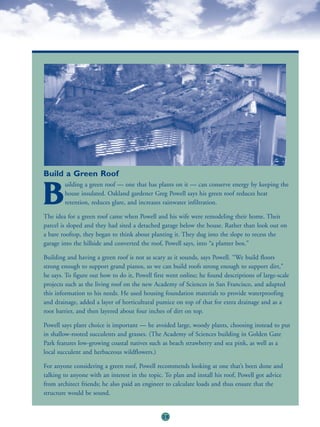
root barrier, and then layered about four inches of dirt on top.

Powell says plant choice is important — he avoided large, woody plants, choosing instead to put
in shallow-rooted succulents and grasses. (The Academy of Sciences building in Golden Gate
Park features low-growing coastal natives such as beach strawberry and sea pink, as well as a
local succulent and herbaceous wildflowers.)

For anyone considering a green roof, Powell recommends looking at one that’s been done and
talking to anyone with an interest in the topic. To plan and install his roof, Powell got advice
from architect friends; he also paid an engineer to calculate loads and thus ensure that the
structure would be sound.


                                               25
The Play of Air and Light: Kid-Friendly Gardening in Berkeley


                hen Wanda Nusted retired from the          Nusted has also brought art into the garden.

W               classroom, she didn't want to stop
                working with kids, she wanted a
different setting. An art teacher with little prior
                                                           Always using plants as an inspiration, she painted
                                                           abstract flowers on canvas and hung them along
                                                           the fence. She also involved the children in
gardening experience, Nusted turned her backyard           painting a garden mural on the side of the house.
into a playground                                                           Nusted made large ceramic beads
where, on any given day,                                                    that she slipped over old standing
her three grandchildren                                                     lamp posts, creating tall, narrow,
and two or three                                                            colorful sculptures—“plant
neighborhood friends                                                        shapes,” Nusted says, “that don't
might be playing                                                            have to be watered.” Using
tetherball, searching for                                                   inverted flower pots as a base, she
spider webs, or driving                                                     made mosaic statues that give the
handmade cardboard                                                          garden even more color and
cars between peaceful                                                       variety.
garden beds.
                                                                           Sometimes, when it is raining
The garden serves as                                                       lightly, Nusted and the kids stand
creative inspiration for                                                   under her photinia, a small
Nusted, who goes into                                                                evergreen tree. They look
the yard as soon as she                                                                    at the wind in the
gets up each day, and as a varied                                                          leaves and watch as
and stimulating play space for the                                                         some of them fall,
children. Nusted has created a                                                            later collecting them
series of playrooms along the fence                                                       for the mulch pile.
around the perimeter of the yard;                                                         (Nusted is also good
in the center is a large garden bed.                                                     about keeping leaf
Each playroom is furnished with                                                          litter in place; in
toys or tools to engage the                                                             autumn, her garden
imagination, encourage hand-eye                                                         beds all wear a loose
coordination, and so on.                                                                mantle of their own
                                                                                        organic matter.)
In the back corner is a ball
court—a short pole is strung with                                   As an artist, Nusted is enchanted by the
a tennis ball, and there are plastic                                movement of air and the ever-changing
racquets nearby. A couple five-                                      light in the garden, and she encourages
gallon pots hold the tennis racquets                                 the children to notice these things too. A
as well as plastic golf clubs waiting                                 homemade windsock announces wind
to be picked up and swung. The                                        direction and pace. A small grove of
golf holes—plastic ramps and                                          mylar pinwheels, planted in Nusted's
traps—have been placed along the                                      center garden bed, share the same news.
edge of garden beds and the path.                                      Along the fence, she has tacked up a
Elsewhere, a milk crate loaded with                         couple dozen CDs that sparkle and flash when
trucks and a plastic jar filled with figurines and         the sun catches them. The kids make bubbles,
farm animals await the animation that only                 chasing them as they float.
children can give them.

                                                      26
Gardening is                           about plants, but it’s also about what plants grow
in — dirt. Without soil, very few plants can survive; without the organic material that plants
provide, most soils become lifeless. Bay-Friendly Gardening starts here, on the ground floor,
with a look at what soil is and how to care for it. Plant selection and plant placement are
                                                                                                    3


                                                                                                    Gardening from the Ground Up
                                                                                                    Gardening from the Ground Up
also considered in this chapter, which concludes with a brief description how to plant.


The Nitty Gritty on Soil                          Structure
Every gardener’s ideal is a soil called loam.     While constituent particles determine the
Dark and wonderfully crumbly, a good              texture of a soil, the arrangement of those
quality loam has high organic content, is         particles determines its structure. Just as
teeming with life, contains all the               water clings to particles’ surfaces, the
nutrients that plants need, holds moisture        particles themselves cling to one another,
well, and drains well. It has excellent           forming aggregates. These define a soil’s
structure and texture, and provides the           structure. Like texture, structure influences
optimum combination of soil’s main                how much water the soil can hold, how
components: minerals, air, water, organic         easily the soil releases nutrients, and how
matter, and soil-dwelling organisms.              much air the soil contains. Unlike texture,
                                                                              however, which is
Minerals                                                                      more or less
Gardeners categorize soils based upon the                                     immutable,
size of their mineral particles. Coarse sand                    Sandy Soil gardeners can
(which has the largest particles) is at one                                   change their soil’s
end of the continuum and fine clay (the                                       structure, either
smallest of the small) is at the other. In the                                for good or for
middle is silt. The physical character of any                                 bad.
garden soil is determined by how much                          Clay Soil
sand, silt, and clay it contains.                                            When a gardener
                                                                             digs in the soil,
You can feel this character — a soil’s tex-                                  he or she creates
ture — between your fingers. Clay soil is                                    openings and
smooth to the touch, and if you squeeze it                     Silty Soil    introduces air
when it’s wet, it holds together. Sand, on                                   into the soil.
the other hand, is loose and grainy regard-                                  This is good.
less of whether it’s wet or dry, and the                                     But too much
grains are visible to the naked eye.                                         digging, or
                                                               Loam          digging in the
Soil texture greatly influences a soil’s water-                              wrong circum-
holding capacity, because water molecules                                    stances, can
are attracted to the surfaces of the mineral                                 degrade soil
particles. Clay soils, because the particle       structure. Shoveling or hoeing dry soils
sizes are small, have greater surface area        diminishes aggregation — instead of
and can become quite sodden. The larger,          hanging together, soil particles are torn
fewer grains of sand give water less to cling     apart. Aggregation is also lost by handling
to. Texture also plays a large role in deter-     very wet soils. Instead of being torn apart,
mining a soil’s nutrient-holding capacity         though, soils become too packed and
and how quickly or slowly a soil warms in         clumpy.
the spring.
                                                       27
Tilling should be done initially to install a planting
bed and then only infrequently or not at all after                   Tip: Testing Your Soil
that. The preferred method for improving soil
structure over time is mulching or top dressing                     Soil tests typically tell you the nutrient
with organic materials.                                              levels in your soil, what its pH is, and
                                                                       whether or not it contains any
Compost                                                                contaminants, such as lead. Consider
Organic material is different forms of living or                     doing a soil test when:
dead plant and animal material. Fallen leaves.
                                                                   • You begin gardening in a new house and
Grass clippings. Wood chips. Sawdust.
Manure. Kitchen scraps. It is compost, which is                    want to identify nutrient deficiencies or
the cornerstone of organic gardening and a                        any contaminants left by previous owners.
universally recognized soil amendment. Above all,
                                                                • You are designing or redesigning and
compost is food for the living organisms in the
                                                                  installing a new garden.
soil. And keeping soil critters well fed ensures that
all the other qualities a gardener seeks in soil will           • Plants are having consistent and serious
gradually increase. Adding compost ensures that                   problems.
soil will have:
                                                                • You live in an older home with lead-based
  • Good structure
                                                                  paint on exterior walls.
  • Sufficient water retention
  • Proper drainage                                             • You live within half a mile of a major road-
  • Nutrient supply and cycling                                   way, freeway, or industrial area, and want to
  • Disease resistance
                                                                  produce food in your home garden.

                                                                To obtain a home soil test kit,
                                                                order from:

                                                                    Peaceful Valley Farm
                                                                    P.O. Box 2209
                                                                    Grass Valley, CA 95945
                                                                    (530) 272-4769
                                                                    Order line: 1-888-784-1722
                                                                    www.groworganic.com

                                                                To have your soil tested and a report
                                                                returned to you, contact:

                                                                    A and L Western Laboratories
                                                                    1311 Woodland Avenue #1
                                                                    Modesto, CA 95251
                                                                    (209) 529-4080
                                                                    www.al-labs-west.com/index.html

  Compost helps loosen clay soil, allowing air and water        Lead Prevention
  to penetrate. Compost unites fine particles in sandy
                                                                Lead poisoning prevention programs can pro-
  soil, allowing greater water-holding capacity.
                                                                vide more information about lead testing and
                                                                prevention in the home and garden. Check the
                                                                phone book for your local program


                                                           28
Building & Protecting Healthy Soil                           easily and retain its integrity as you move it
                                                             around. If possible, loosen soil with a fork instead
              hether or not you are one of the

W             lucky gardeners who already have
              loam, there are plenty of things you
can do to protect and improve your soil.
                                                             of a shovel or rototiller. Once its structure has
                                                             improved, minimize tillage.
                                                             Add compost and mulch. Mulching is an easy
                                                             way to begin. Grasscycling — leaving clippings on
Guard against erosion. Plant bare soil or keep
                                                             the lawn — is another simple way to restore soil
it covered with mulch. Organic mulches are
                                                             health. Compost, the foremost form of organic
preferable to inorganic ones, as they will slowly
                                                             recycling, can be dug into the soil or laid on as
decompose, adding nutrients to the soil and
                                                             topdressing.
improving its structure over time.
                                                             Encourage earthworms in the garden.
Prevent compaction. Keep most areas in the                   Earthworms are the true tillers of the soil, digging
garden relatively untrodden. Use consistent                  tunnels, carrying leaves down into their burrows,
pathways to navigate your yard. (A thick layer of            and mixing and sifting the earth. To encourage
wood chips on your paths can also help prevent               earthworms in the home garden, keep a layer of
compaction.) Avoid walking on wet soils and areas            mulch on the soil year-round, and use
where you have recently loosened the soil. In                gardening methods that are environmentally- (and
general, don’t tread on areas under cultivation.             earthworm-) friendly. In particular, avoid quick-
                                                             release synthetic fertilizers and over-tilling, which
Cultivate with care. Till the soil when it is moist,
                                                             can kill or harm earthworms.
but not wet. Experiment a little to get a feel for
the desired moisture level — the soil will handle


         Tip: Checking Soil Texture by Feel
         Take a one- or two-tablespoon sample of soil in your hand.
         Slowly add water and knead the sample until moist.Try to
         form the sample into a ball. Squeeze it to see if you can make a
         cast (an impression of your fingers). Gently stretch the soil out
         between thumb and forefinger and try to make a ribbon. Note
         the feel of the soil as you are working it and use the table
         below to determine its texture.

    Characteristics of Soil Sample                                Soil
                                                                  Texture
    Soil will not stay in a ball. Loose and single grained with Sand
    a gritty feeling when moistened
    A cast will form but it can’t be handled without break-       Loamy
    ing and will not form a ribbon. Soil feels slightly gritty.   sand
    A short ribbon can be formed but breaks when about            Loam
    1/2 inch long.
    A ribbon can be formed. It is moderately strong until it Clay loam
    breaks at about 3/4 inch length. Soil feels slightly sticky.
    The soil can easily be formed into a ribbon that is an        Clay
    inch or longer. Soil feels very sticky.

   Adapted from S. J. Thein, “A Flow Diagram for Teaching Texture by
   Feel Analysis,” Journal of Agronomy Education


                                                        29
Choosing Appropriate Plants                                 Know your microclimates. In addition to the
         ince Charles Darwin introduced it some             broader conditions that influence your garden,

S        150 years ago, much has been made of the
         idea of natural selection, that mechanism
through which evolution occurs. Far less attention
                                                            every site also creates its own conditions, or micro-
                                                            climates. Those shady spots or dry patches, or the
                                                            place where the soil’s rocky — these and myriad
                                                            other factors specific to your home territory will
has been paid, however, to the fact that gardeners
exercise the power of selection all the time, and           influence what plants will do well, and where, in
that their choices also have powerful consequences          your garden.
in the natural world.
                                                            Know your soil. Since soil is the matrix in which
Plant selection is one of the most important                all plants grow, knowing your soil and choosing
aspects of Bay-Friendly Gardening. Today, in                plants that grow well in it will go a long way
addition to choosing plants for their beauty and            toward ensuring success. Most plants will thrive in
fragrance, we also take into account a plant’s              soil that is well amended with compost, but a few
fitness for the environment in which it will grow.          plants, such as buckwheat or cactus, thrive in poor
Appropriately chosen and placed plants will:                soils.

  • have greater pest resistance                            Grow Mediterranean climate plants. Almost any
  • require less care                                       plant can be made to survive in a Bay Area
  • use fewer resources                                     garden. But a plant that is native to an area with a
  • generate less waste
Selecting Plants                                                              Words from the Wise:
But how to choose? This section provides a wealth
                                                                               Take Advantage of
of suggestions designed to help you do just that.
                                                                               Microclimates and Go
Though these considerations may seem numerous,                                 for the Slow Growers
they are all of a piece, each reinforcing the other.
                                                                        ill Merrill, an avid home gardener who
As you try plants out in the garden, running
through these guidelines becomes second nature.

Know your climate. California’s mild
                                                                B       manages a nursery in Fremont,
                                                                        demonstrates that in every yard, there
                                                                are many microclimates the gardener can
                                                                take advantage of. He points to a lemon tree,
temperatures and persistent sunshine are famous                 which, he says, “creates the equivalent of a
for a reason: they’re uncommon. Few places in the               lathe house.” In the winter, Merrill hangs
world share with California its wet winters and                 potted Christmas cactuses, begonias, and
sunny, dry summers. These are the characteristics               cyclamen from the branches of the tree,
                                                                where they receive some sunlight and are
of a Mediterranean climate, and they bring with
                                                                protected from frost and wind. Similarly, he
them special growing conditions — most notably                  has planted subtropical guava and cherimoya
the need to choose plants that are well adapted to              trees in the shelter of a taller, hardier
an annual six-month drought.                                    avocado.
                                                                Merrill also suggests avoiding fast-growing
Know your climate zone. The Sunset Western                      plants, as they can be a liability in the garden.
Garden Book identifies 24 climate zones in an area              They’re “a pain in the rump,” says Merrill,
that extends from Montana, Wyoming, Colorado,                   when it comes to maintenance. “Their root
and New Mexico to the West Coast. The Bay Area                  systems are often highly invasive; the cost to
                                                                remove such plants can become very
includes zones 14-17; knowing your particular
                                                                significant in a short frame of time, and they
zone provides a useful shorthand for many of the                can also be more susceptible to insects and
factors that influence which plants are likely to               disease. Plants that grow at a slow to
succeed in your garden.                                         moderate rate,” Merrill concludes, “are good.”


                                                       30
Mediterranean climate often requires less water,
fewer pesticides and fertilizers, and possibly less          Sources of California Natives
pruning than a species that originated in, say, a            Although there are more than 1,500 plants
humid rainforest. Regions that enjoy a Mediter-              native to the Bay Area, local natives have
ranean climate, such as South Africa and                     only recently become popular in the nursery
Southwestern Australia are the source of thousands           industry. Look for them, or California
of garden plants, so the gardener will find no               natives, at the following nurseries:
shortage of choices.
                                                             California Flora Nursery
                                                             Fulton, CA
                                                             (707) 528-8813

                                                             Cornflower Farms
                                                             Elk Grove, CA
                                                             (916) 689-1015
                                                             www.cornflowerfarms.com

                                                             Larner Seeds
                                                             Bolinas, CA
Grow California native plants. California native             (415) 686-9407
plants are ones that occur naturally somewhere in            www.larnerseeds.com
the state. Just like garden plants that originated in
more far-flung locales, California natives have been         Mostly Natives Nursery
collected by botanists and horticulturalists and             Tomales, CA
developed for use in the garden. Most are drought-           (707) 878-2009
tolerant; many are a good bet for your yard.                 www.mostlynatives.com

Grow local native plants. In the same way that               Native Here Nursery
there can be microclimates within a garden,                  Berkeley, CA
conditions can vary in small but significant ways            (510) 549-0211
on the landscape scale as well. When gardening               www.ebcnps.org
with local natives, you are celebrating these
differences and upholding them. And you are                  Ploughshares Nursery
literally going to the source — you can’t find               Alameda, CA
plants that are better adapted to life in the San            (510) 898-7811
Francisco Bay Area or are better fitted to support           www.ploughsharesnursery.com
local wildlife — than the ones that evolved here.
                                                             The Watershed Nursery
Learn about local plant communities and use                  Berkeley, CA
them as models. Whether you are using a palette              (510) 548-4714
of Mediterranean climate plants, California                  www.thewatershednursery.com.
natives, local natives, or a mix, you can look to
open spaces in the Bay Area for inspiration in the           Yerba Buena Nursery
garden. Taking hikes on your own or with a group             Woodside, CA
such as the California Native Plant Society is a             (650) 851-1668
great way to spark your creative genius. Visiting            www.yerbabuenanursery.com
local creek restoration sites, demonstration gar-
dens, and botanic gardens are also great inspira-            Also ask your current nursery if they’ll supply
tion. (For a simple description of Bay Area plant            more local CA natives.
communities, see pages 12-15.)

                                                        31
Choose diversity of plants. If nature abhors a
vacuum, it loves diversity. To support maximum
garden health and promote wildlife from the
microfauna on up, plant varying sizes and types of
plants. Having plants of different heights — from
trees to groundcovers — will provide for the needs
of more bird, insect, and animal species. It will
also help shape your garden, giving you a frame-
work or structure within which to work. To ensure
year-round interest in the garden for both humans
and wildlife, grow deciduous species as well as
evergreens, and choose plants that flower and fruit
at different times.

Choose perennials. A diverse garden will include
annuals, biennials, and perennials — but the
majority of plants will be perennials. Because they
make garden maintenance easy, often require less
irrigation, and result in less waste, perennials are
the plants of choice for the Bay-Friendly Garden.
In addition to using large and small shrubs, try
herbaceous perennials — those that die back to
the ground each year. There are many perennial
grasses, too, that make great wildlife plants and
excellent garden subjects.
                                                            40%. Trees provide shelter for a variety of birds
Minimize the lawn. An appreciation of green                 and insects, and they also catch the rain, keeping
lawns is deeply imbedded in our society and,                more water on site and improving groundwater
perhaps, even in our psyches. But in a climate that         flows. Small trees should be at least 10 feet and
undergoes six months of drought annually, a big             large trees at least 20 feet from the house to avoid
lawn can be a costly and wasteful proposition.              root damage to the structure.
If the lawn is a must-have for you, keep a smaller
                                                            Avoid invasive species. Of the thousands of
one as a picnic area or a play space for children,
                                                            plants that have been brought to California either
and consider other ways to satisfy that visual and
                                                            intentionally or inadvertently, a few have become
physical need for inviting, open spaces in a
                                                            pest plants — weeds of wildlands and open
garden. Substituting a native bunchgrass such as
                                                            spaces. These plants can spread across the land-
red fescue for conventional turfgrass, planting a
                                                            scape quickly, crowding out a variety of other
drought-tolerant groundcover such as wooly
                                                            plants and the animals that depend upon them.
thyme, or paving paths and garden rooms with
                                                            Despite these tendencies, some of these plants,
wood chips are just a few of the possibilities.
                                                            including periwinkle, English ivy, French and
Plant trees. If Americans love lawns, we love trees         Scotch broom, and pampas grass, are still sold for
even more. Their beauty and longevity intimate              ornamental uses. Do not buy them, and ask your
great things; their tall limbs offer us protection          nursery to stop carrying them.
from sun and wind. Evergreen trees make the best
windbreaks, while deciduous trees will shade your
house in the summer and permit it to be warmed
by the sun during winter. Plant on the west and
southwest side of the house to shade it — your
cooling costs could be reduced by as much as

                                                       32
Avoid Invasive Garden Plants of the Greater San Francisco Bay Area
    Invasive Plants                                              Non-Invasive Plants
    Latin Name                    Common Name                                                 Instead Try

 Carpobrotus edulis               Iceplant or                    Delosperma cooperi (Hardy Iceplant) or Osteospermum fruticsum and
                                  Hottentot Fig                  hybrids (Freeway Daisy) or Drosanthemum floribundum (Showy
                                                                 Dewflower)

 Cortaderia selloana              Pampasgrass                    Chondropetalum tectorum (Cape Thatching Reed) or Muhlenbergia
                                                                 lindheimeri (Lindheimer’s Muhly Grass) or Carex spissa (San Diego
                                                                 Sedge) or Nolina bigelovii (Bigelow’s Bear Grass)

 Cotoneaster lacteus,             Cotoneaster                    Heteromeles arbutifolia and cultivars (Toyon) or Feijoa sellowiana
 C. pannosus                                                     (Pineapple Guava) or Arbutus unedo (Strawberry Tree) or Viburnum
                                                                 suspensum (Sandankwa Viburnum) or Cistrus mitis or x
                                                                 Citrofortunella microcarpa (Calamondin Orange)

 Cytisus scoparius,               Scotch, Portuguese,            Jasminum nudiflorum (Winter Jasmine) or Cornus mas (Cornelian-
 C. striatus,                     Spanish or                     cherry Dogwood) or Kerria japonica (Japanese Kerria) or Ribes
                                                                 aureum (Golden Currant) or Phlomis fructicosa (Jerusalem Sage) or
 Spartium junceum,                French Broom                   Hypericum rowallane (Shrub Hypericum)
 Genista monspessulana

 Hedera helix,                    English Ivy,                   Campanula poscharskyana (Serbian Bellflower) or Trachelospermum
 H. canariensis,                  Algerian Ivy,                  asiasticum (Ivory Star Jasmine) or
                                                                 or Rubus pentalobus (Taiwan Raspberry) or Heuchera maxima and
 Vinca major                      Periwinkle                     hybrids (Giant Alumroot) or Asarum caudatum (Wild Ginger) or
                                                                 Helleborus foetidus (Bear’s Foot Hellebore) or Bergenia cordifolia and
                                                                 hybrids (Winter Saxifrage)

 Helichrysum petiolare            Licorice Plant                 Salvia leucophylia (Coast Purple Sage) or Teucrium fructicans and
                                                                 cultivars (Bush Germander) or Phlomis fructicosa (Jerusalem Sage) or
                                                                 Artemisia ‘Powis Castle’ or Eriogonum giganteum (St. Catherine’s
                                                                 Lace)

 Sesbania punicea                 Scarlet Wisteria               Calliandra tweedii (Brazilian Flame Bush) or Lagerstroemia species
                                                                 (Crape Myrtle) or Cassia leptophylla (Gold Medallion Tree) or
                                                                 Galvezi speciosa (Showy Island Snapdragon)

ADAPTED FROM: DON’T PLANT A PEST! GIVE THEM AN INCH AND THEY’LL TAKE AN ACRE...., CALIFORNIA INVASIVE PEST COUNCIL

SUGGESTED ALTERNATIVES IN BOLD ARE CALIFORNIA NATIVE SPECIES.


Invasive                              Instead Try                        Invasive                          Instead Try


Cortaderia selloana                   Muhlenbergia lindheimeri            Genista monspessulana            Cornus mas
(Pampas Grass)                        (Lindheimer’s Muhly Grass)          (French Broom)                   (Cornelian-cherry Dogwood)
PHOTO: BRIANNA RICHARDSON, 2003       PHOTO: BLUESTEM NURSERY,            PHOTO: BARRY RICE, THE           PHOTO: MISSOURI BOTANICAL
                                      WWW.BLUESTEM.COM                    NATURE CONSERVANCY               GARDEN


                                                                       33
Calm and Colorful: Creating an Urban Retreat in Oakland

       ibby Teel’s gardening career began years ago,        their base, a golden sphere lends sculptural interest

L      when she put in a few plants at the base of
       a tree. “I had one little vision of something
pretty,” she says. Now her whole yard, back and
                                                            and sends out a glow. Three kinds of gaillardia, a
                                                            sunflower family plant, add other warm hues while
                                                            orange calibrachoa, a low-growing perennial that
front, is filled with Mediterranean climate plants          resembles a petunia, completes the tableau. Viewed
that offer endless possibilities for composition and        from another direction, the smoke tree enters into
combination.                                                conversation with the dark blues of a hibiscus and
                                                            a ‘storm cloud’ lily of the Nile.
Mediterranean plants — which
come from one of five small                                                   Libby recommends spending a
areas on the planet that have a                                               lot of time going to nurseries
wet-winter, dry-summer                                                        without buying anything. “Stock
climate like ours — offer a                                                   at nurseries is seasonal,” she
dynamic range of possibilities                                                points out, so it changes. She
for ornamental gardening.                                                     wanders the aisles of the East

They are appropriate for our                                                  Bay Nursery and Berkley
region, but impose no limits                                                  Horticultural Nursery, but she
on plant choice. Libby's                                                      also peruses plants at her local
garden, which exemplifies this,                                               Longs and Ace Hardware. She
is an international symphony                                                  makes her choices based on what
of color, texture, leaf shape,                                                these places carry. Her chief
and flower.                                                                   reference is the Sunset Western
                                                                              Garden Book.
“With very few exceptions, I've
got all perennials,” says Libby                                                In the front yard, Libby
as she surveys her backyard                                                           originally planted olive
from the deck behind                                                                  trees and lavender. The
the house. At the                                                                     trees have grown beyond
bottom of her sloping                                                                 her wildest expectations,
lot, she has put in tall,                                                              she says, making the beds
showy shrubs that lift up                                                              much shadier. So she is
the lower end of the                                                                   experimenting with new
yard and don't require a                                                                plantings. A yellow
lot of care, including                                                                  Graham Thomas rose
flannel bush, wild lilac,                                                               droops gracefully over a
and California anemone.                                                                 collection of sages,
Other large specimens                                                                   catmint, and yellow
provide focal points in                                                                  shasta daisies. Evergold
the beds that run                                                                 sedge rubs shoulders with
alongside the fences of this narrow, pie-shaped             several green-and-white hebes, showing just a hint
backyard. Libby's favorite colors are strong, warm          of purple. The palette is yellow, white, and
ones, and she has given them full play.                     lavender — no gaudy pinks or magentas allowed.
                                                            The evergold sedge, one of Libby's favorites
In an area near the deck, for example, the deep             plants, inspired her to use more plants with
purple leaves of smoke tree contrast in shape and           variegated leaves. “Since I get more shade now,”
color with the long blades of New Zealand flax. At          she says, “I have to find light in leaf color.”

                                                       34
Getting Started with Bay-Friendly Plants
Among the many Mediterranean climate and California native plants that are well-suited to our unique
Bay Area ecosystem, the following list includes plants that offer a good start for creating a Bay-Friendly
Garden. In addition, these plants:
  • Thrive in the Bay Area’s micro-climates.                       • Are drought tolerant.
  • Grow fairly easily.                                            • Are relatively disease resistant.

 Trees                                                               Vines
 Arbutus ‘Marina’, Arbutus unedo        Strawberry tree              Clytostoma Callistegioides   Violet trumpet vine
 Cercis occidentalis*                   Western redbud
 Leptospermum laevigatum                Australian tea tree          Hardenbergia Violecea        Lilac vine
 Shrubs                                                              Vitis californica*           California wild grape
 Abelia x grandiflora                   Glossy abelia                Wisteria spp.                Wisteria
 Arctostaphylos species and cultivars   Manzanita
 Artemisia californica*                 California sagebrush         *Denotes plants native to California.
 Buddleja davidii and cultivars         Butterfly bush               ** Certain species are native to California.
 Ceanothus spp.*                        California lilac
 Correa species and cultivars           Australian fuchsia
 Cotinus coggygria and cultivars        Smoke tree
 Garrya elliptica*                      Silktassel
 Heteromeles arbutifolia*               Toyon
 Lavatera spp*                          Tree mallow
 Mahonia spp.*                          Mahonia, OR grape
 Phlomis fruticosa                      Jerusalem sage
 Rhamnus californica*                   Coffeeberry
 Ribes sanguineum*                      Red flowering currant
 Rosmarinus officinalis                 Rosemary
 Teucrium fruticans                     Germander
 Westringia fruticosa                   Coast rosemary
 Perennials
 Achillea millefolium*                  Yarrow
 Alstroemeria hybrids                   Peruvian lily
 Calamagrostis foliosa*                 Reed grass
 Carex tumulicola*                      Berkeley sedge
 Epilobium canum                        California fuchsia
 Erigeron spp.**                        Fleabane
 Guara lindheimeri                      Gaura
 Heuchera micrantha*                    Coral bells
 Iris douglasiana*
                                        Douglas iris
 (or Pacific Coast hybrids)
 Lavandula species and cultivars        Lavender
 Mimulus aurantiacus*                   Sticky monkey flower
 Muhlenbergia rigens*                   Deer grass
 Penstemon species and cultivars        Beard tongue
 Phlomis fruticosa                      Phlomis
 Perovskia atriplicifolia               Russian sage
 Polystichum munitum*                   Western sword fern
 Salvia spp.**                          Sage
 Sesleria autumnalis                    Autumn moor grass
 Sisyrinchium*                          Blue-eyed grass
 Thymus spp.                            Thyme

                                                              35
Putting Plants in Their Place
          ot only the plant itself but its placement
                                                                               Words from the Wise:

N         in the garden will influence its success.
          This means taking a plant’s needs and
growth habits into account. When choosing where
                                                                                Your Drought-Tolerant
                                                                                Plants Might
                                                                                Appreciate a Mound
to plant, consider these few guidelines.
                                                                     or gardeners contending with difficult
Remember this motto: the right plant in the
right place. Though we know that plants have
different needs, it is all too easy to forget them
                                                                F    soils, Livermore landscape architect Kat
                                                                     Weiss recommends making mounds.
                                                                Plants that like good drainage, as many
                                                                drought-tolerant plants do, especially
when it comes to planting. Whether you’re
                                                                appreciate a little lift. “Even six inches,” says
considering putting in one plant or an entire bed,              Weiss, “can make a big difference.” Adding
make note of the plant’s cultural requirements                  mounds also adds interest to the garden by
before you put it in the ground, and match them                 changing its topography.
to the sites in your yard.

Plant with mature size in mind. One of the most
common mistakes gardeners make is to crowd
plants into spots that are too small for them. The
consequence of this is that plants have to be
pruned severely or pulled out and replaced — both
of which mean more waste. To avoid this mistake,
get to know the habits of your plants before
installing them.

Plan for plant succession. The look and feel of a
newly planted garden is very different from one
that’s five or ten years old. Think of the future
when you are planting, and choose a variety of
plant types and sizes (from annuals to perennials
and groundcovers to trees) to provide interest in
the garden at every stage of its development.


                                                                                                        One year later.
        Tip: Overseed with Wildflowers

      It’s easy to misjudge the mature size of
       your plants when planting. Figure out
        ahead of time how large your perennials
        will grow to be and plant accordingly —
        which means giving them plenty of space.            Lawn replaced with diverse plant choices.
       In the meantime, you can get that filled-in
      look fast by seeding the bare spots with
      wildflowers.


                                                       36
Planting Well
                                                                             1
Though most plants can handle being trans-
planted without too much coddling, taking
care is nonetheless worthwhile — you’ll lose
fewer plants and thus generate less waste. In
this section, the how-to of planting is briefly
described.
1. Clear the ground first. More than one
gardener has planted first and then weeded
ever after. If you are working in a yard that                                2
hosts a robust collection of weeds, take the
time to deal with them before you plant —
ultimately it will make your gardening
experience a more agreeable one. To make
the task manageable, clear one section at a
time. (For more on handling weeds, see
“Contending with Weeds,” page 65 and
“Sheet Mulching Basics,” on the following
page.)                                                                       3

2. Dig a hole. Using a shovel, dig a hole that
is as deep as the rootball and 3 times wider
than it. Rough up the sides of the hole.
3. Rough up the root ball, and cut away any
large roots that have circled at the bottom of
the container.
4. Partially backfill the hole with soil mixed                               4
with compost, creating a mound at the bot-
tom, and place the plant on it. Give attention
to the straightness of the plant (it should be
perpendicular to the ground, not leaning at an
angle), and to the arrangement of its branches
in relation to the other plants and objects
around it. Is the plant’s best side facing out?
5. Mix compost into the garden soil. Some
gardeners have found that putting a lot of
organic matter in a planting hole can make it            Tip: Recycle Your Pots
hard for the plant to extend its roots past the
edge of the hole into the heavier soil. To avoid         Many nurseries will take back empty
                                                         plastic plant containers. Berkeley
this (but still give the plant the benefit of an
                                                         Horticultural Nursery sends them back
extra dose of compost), mix 1 part compost               to growers; Alden Lane Nursery in
with 3 to 5 parts soil to backfill the hole after        Livermore reuses them on-site. Some of
putting the plant in.                                    the local native plant nurseries and prop-
                                                         agation groups also accept donations of
                                                         containers. Make a few calls to locate the
                                                         place to recycle pots nearest you.


                                                    37
Sheet Mulching Basics                                             three layers may be required to achieve an adequate
Sheet mulching is a layered mulch system. It is a simple          thickness. But, if the weed barrier is applied too
and underutilized technique for optimizing the benefits           thickly, the soil can become anaerobic. Overlap pieces
of mulch. Sheet mulching can be used either in                    6-8 inches to completely cover the ground without any
establishing a landscape, or to enrich existing plantings.        breaks, except where there are established plants you
In both cases, mulch is applied to bare soil or on top of         want to save. Leave a generous opening for air
cut or flattened weeds. Trees, shrubs, herbaceous                 circulation around the root crown. Wet down the
perennials and annuals are planted through the mulch,             cardboard or paper barrier to keep it in place.
or a small area is left open to accommodate established      Step 4: Layer compost and mulch. The top layer
plants.                                                      mimics the newly fallen organic matter of the forest.


                                                                                                                                    PHOTOS (T0P): KAMALA BENNET, SENTIENT LANDSCAPE, INC. (BOTTOM): KAMALA BENNETT, SUSTAINABLE LIVING DESIGN, INC.
Sheet mulch can:                                             Good materials for this layer include chipped plant
                                                                                    debris, tree prunings, leaves or
  • Suppress weed growth
                                                                                    straw. They must be free of
  • Reduce labor and mainte-
                                                                                    weed seeds. Well decomposed,
    nance costs: weeds are
                                                                                    weed-free compost is also a
    composted in place
  • Improve nutrient and water                                                      good material but it should be
    retention in the soil                                                           spread directly over the weed
  • Encourage favorable soil                                                        barrier and covered with bulkier
    microbial activity and                                                          materials such as chipped tree
    worms                                                                           prunings, to optimize weed
  • Enhance soil structure                                                          control. In total, the
  • Improve plant vigor and           Recycled cardboard is a good weed barrier.    compost/mulch layer should be
    health, often leading to                                                        2-5 inches deep. Many
    improved resistance to pests                                                    materials suitable for the top
    and diseases                                                                    layer often have an attractive
Step 1: Prepare the site. Knock                                                     appearance, making sheet
down or mow existing                                                                mulch a versatile practice.
vegetation so that it lies flat.                                                       Step 5: Plant. Punch a hole in
Remove only woody or bulky                                                             the cardboard and place plants
plant material. The organic                                                            in the soil under the sheet
matter left will decay and add         Sheet mulched site is ready for planting.
                                                                                       mulch. Smaller plants can often
nutrients to the soil. Add                                                             be planted right into the
fertizilers and amendments to this layer if a soil analysis mulch/compost layer. Add a small amount of compost
indicates the need. Optional: "jump start" the decay of        around the rootball if compost has not been included
weeds and grass by adding compost or manure at the             in the top layer.
rate of about 50 lbs/100 square feet. Soak with water to
                                                               In most cases, the benefits of sheet mulching outweigh
start the natural process of decomposition. It is much
                                                               the costs. However, take care to prevent these potential
easier to soak the ground now, before the remaining
                                                               problems:
layers of mulch are applied.
                                                                  • As with any mulch, do not pile materials up against
Step 2: Plant 5 gallon and larger plants.                           the trunks or stems of plants to prevent disease.
Step 3: Add a weed barrier. The next layer is an                  • Especially during the dry season, small seedlings
organic weed barrier that breaks down with time. It is              will need protection from snails and slugs that will
essential that the barrier is permeable to water and air.           seek cover under the mulch.
Do not use plastic. Recycled cardboard, a thick layer of          • Protect young trees from rodents with physical
newspaper, burlap bags or old carpets of natural fiber              guards.
                                                                  ADAPTED FROM: C.R. ELEVITCH AND K.M. WILKINSON, SHEET MULCHING:
work well. Many paper companies offer recycled                    GREATER PLANT AND SOIL HEALTH FOR LESS WORK, PERMANENT AGRI-
                                                                  CULTURE RESOURCES AND GEOFF HALL, SHEET MULCH, SENTIENT
cardboard or paper in rolls of varying widths. Two or             LANDSCAPE, INC.


                                                             38
Doing Away with the Lawn:
                 From Conventional to Bay-Friendly in Livermore

                hen she and her family moved in,           She used a flat-head spade to dig out a twelve-inch

W               the yard surrounding Kat Weiss's
                suburban Livermore home was
almost entirely lawn. Her husband liked it. “Fine,”
                                                           strip of sod around the perimeter of her front yard.
                                                           She tossed the uprooted chunks of lawn, dirt-side
                                                           up, onto the remaining lawn and proceeded to
Kat told him, “you water it, mow it, and fertilize         cover the whole of it with cardboard. On top of
it, if that's how you want to spend your                   that, she laid down a six-inch layer of wood chips.
Saturdays.” Two weeks later, she says, he came to          The strip she'd cleared at the edges, being lower
her and asked, “Okay.                                                                   than the pavement
What do you want to                                                                     around it, kept the
do instead?”                                                                            chips from spilling over
                                                                                        onto the sidewalk and
Kat wanted California                                                                   driveway. Weiss let it
natives and a                                                                           rest for a few months,
sustainable design.                                                                     and then began to
A mechanical engineer                                                                   plant into it.
who went back to
school to become a                                                                      The front yard is now
landscape architect, she                                                                a mixed habitat of
wanted a freer, more                                                                    grasses and perennial
varied garden that                                                                      shrubs. “I love the
would need less water                                                                   grasses,” says Weiss,
and maintenance. But first                                                    “because there's always
she had to get rid of the                                                     movement.” For best effect,
lawn. After seeing a speaker                                                   Weiss suggests grouping them.
at the local garden club                                                       The exception is deer grass —
demonstrate sheet mulching                                                     “it's very architectural,” Weiss
as a technique to suppress                                                     explains. “It stands on its
unwanted plants, Kat                                                           own.” The side of the house,
decided to give it a try —                                                     where Weiss broke up a
and ended up converting her                                                    concrete RV pad, is now a
entire yard using this                                                          vegetable garden. She moved
technique.                                                                      the slabs of concrete into a
                                                                                corner of the back yard to
She started in the front, in the                                                make a low, stepped wall.
summer. It’s good to do this                                                    Weiss retained a hedge of
work in the fall, Weiss says, to                                                 roses planted by the previous
take advantage of winter rains.                                                  owner but has furnished
Sheet mulching is essentially a                                                  much of the backyard with a
form of composting, and every                              fescue meadow. A blue door with mirrors leans
composting process requires moisture. But it was           against the back wall, extending the size of the
the height of summer and Kat was rearing to go,            yard and suggesting a secret passageway. Nearby,
so she watered the lawn to moisten the ground and          three big blue pots sit on the lowest steps of the
encourage a flush of growth that would, ultimately,        corner wall. Weiss says she often uses pottery and
become natural fertilizer.                                 sculpture to enliven a dry landscape.

                                                      39
4                                              Like any activity                                     that takes place over time, gardening is
                                               both an immediate and a cumulative experience. We garden day to day and through the sea-
                                               sons, experiencing the satisfaction of tucking a seedling into the ground one morning and of
                                               seeing it flower or produce food months later.
Gardening Day to Day and Through the Seasons


                                               It is in the day to day that gardeners have
                                               the greatest opportunity to be Bay-Friendly.
                                               Whether or not you compost, how you
                                               prune, what you do with your grass
                                               clippings, how you water — these kinds
                                               of practices determine how environmentally
                                               friendly your garden will be.

                                               In this chapter, core Bay-Friendly
                                               Gardening practices are described, in these
                                               separate sections:

                                                 • All About Composting
                                                 • Worm Composting
                                                 • About Feeding the Soil
                                                 • Mulch Basics
                                                 • Grasscycling is Easy
                                                 • Water Conservation
                                                 • Pruning for Plant Health
                                                 • Integrated Pest Management


                                                   Builds           Reduces    Conserves      Creates     Protects      Contributes      Saves
                                                   Healthy           Waste      Water         Wildlife      Local          to a         Energy
                                                    Soil             in the                   Habitat    Watersheds      Healthy
                                                                    Garden                               and the Bay    Community

                                                 In the following pages, the icons shown above signal the benefits offered by each
                                                 gardening practice.


                                                                                      40
t is something of a miracle to see broccoli stems, orange peels, and fallen

I   leaves change into dark, sweet-smelling earth. Composting — collecting
    organic materials and combining them in a manner that will encourage their
breakdown — makes use of the natural process of decomposition to create a
high-quality soil conditioner.

All About Composting
Composting appeals to the thrifty person in all of us. It feels good to keep mate-
rials on site and cycle them back into the yard. And composting results in a very
valuable product. The best soil amendment — your own homemade compost —
is one that money can’t buy.

                                                  Waste reduction is another
                                                  good reason for composting.
                                                  For example, almost 20% of
                                                  the waste stream in Alameda
                                                  County is plant and vegetable
                                                  trimmings that could be
                                                  recycled as home compost.
                                                  Recycling organic resources
                                                  not only extends the life of
                                                  our landfills, it can also save
                                                  you money. Your garbage bills
                                                  will go down. Your water bills
                                                  may drop too, since a soil
                                                  that’s well amended with
                                                  compost holds moisture better
                                                  and reduces runoff.
                                                  Your garden will benefit as
                                                     well. As the health of your
                                                            soil improves, so
                                                                will the health of
                                                                   your plants.


Benefits of Composting . . .


                                                    41
Composting Basics                                          Compost has four main ingredients: Browns,
The microorganisms that break down                             Greens, Air, and Water. Browns are dry,
organic material in your soil will happily                         woody materials such as fallen leaves,
do the same job in a pile of fallen                                   pruned shrubbery, pine needles,
leaves and plant trimmings.                                             newspaper, and so on. Greens are
The composter creates optimal                                           moist, nitrogen-rich materials such
conditions for nature’s crew of                                         as fruit and vegetable trimmings,
decomposers — the bacteria, fungi,                                      grass clippings, and fresh weeds. Air
and bigger creatures such as sow bugs                                  and Water are the essential ingredients
and worms — to go to work.                                          without which our industrious
                                                                  microfauna could not transform Browns
                                                           and Greens into compost.

  Become a Master Composter                                To make compost, simply combine Browns and
  Composting offers the opportunity to transform           Greens in more-or-less equal proportion, and
  organic matter into a rich soil amendment and to         make sure the pile has enough air and water.
  transform yourself — into a Master Composter!            The formula looks like this:
  Through a comprehensive four-month training
  that includes classroom presentations, hands-on          • Chop materials to help them to break down
  activities, and field trips, Alameda County resi-          more quickly.
  dents can learn about soil health, the art and
                                                           • Mix Browns and Greens.
  science of composting, and Bay-Friendly
  Gardening techniques.                                    • Maintain air and water balance by keeping
  An integral component of the program is                    compost as moist as a wrung-out sponge.
  community outreach. Upon completion of the
  training, Master Composters provide 40 hours             Compost is ready to be used when it has a nice,
  of community service, teaching others about              earthy smell and a dark, crumbly appearance —
  composting and Bay-Friendly Gardening.                   like coffee grounds, only moister and not so uni-

                                                           form. If any items of food are still discernable, they
                                                           can be screened out and added back to the bin.

                                                           Composting Methods
                                                           From these basic steps, a variety of composting
                                                           methods have been developed. Which you choose
                                                           depends on the material you’re composting and
                                                           how much effort you want to put into it. Provided
                                                           below is a brief description of the most common
                                                           methods of composting.
  Master Composters come from all walks of life,           Plant Trimmings Only
  and their outreach projects reflect their diverse
                                                           The simplest way to compost is by collecting your
  backgrounds and experiences.
                                                           yard trimmings and making a pile of them. The pile
  Participants pay a $25 enrollment fee (that may
                                                           can be an open one, or you can keep it in a bin.
  be waived upon request) and receive a free
  compost or worm bin. Certification is awarded
                                                           No Fuss Compost. Add chopped or unchopped
  based on class attendance and completion of an
  outreach project. For more information, call
                                                           yard trimmings to a rodent-resistant bin on an
  (510) 444-SOIL (7645).Visit www.BayFriendly.org          ongoing basis. Maintain the pile by keeping it as
  for a list of other Bay Area Master Composter            moist as a wrung-out sponge. Harvest finished
  programs.                                                compost from the bottom and center of the pile
                                                           after 12 to 18 months.

                                                      42
vegetable trimmings alone. All of them are
 For more information on compost bins, and                    designed to take advantage of the high nutrient
 how-to materials, call 510-444-SOIL (7645) or                content and quick breakdown of these materials.
 visit www.BayFriendly.org.                                   Whenever you compost fruit and vegetable trim-
 Note: the County Environmental Health                        mings, make certain to use a rodent-resistant bin
 Department requires rodent-resistant systems for             or bury them at least one foot under the soil
 composting fruit and vegetable trimmings. Use a              surface. Use a container with a lid, a floor, and no
 container with a lid, a floor, and no opening
                                                              opening greater than 1/4 inch, or bury food scraps
 greater than 1/4 inch.
                                                              at least one foot under the soil surface.

Active Compost. Chop yard trimmings into pieces               Underground Composting. Dig an 18-inch
6 inches or smaller and combine them in an open               hole in any empty part of the garden.
                    pile or simple bin. Be sure to            Chop and mix food scraps into the
                       balance Browns with Greens.            soil. Cover with at least 12 inches of
                       Add new materials as often as          soil. No harvesting is neces-
                       you like. Maintain the pile by         sary with this system — the
                       turning or mixing it about             compost enriches the soil
                        once a week and keeping it            directly. One to three months
                      as moist as a wrung-out                 later, you can bury more com-
             sponge (if it’s an open pile, covering it        postables in the same place.
         with a plastic tarp will help retain mois-
ture). Harvest finished compost by sifting out                Closed-Air Systems or Food Digesters. Rather
coarse, unfinished materials after 3 to 8 months.             than bury food scraps, you can put them in a
                                                              container that holds 6 to 10
Fruit,Vegetable, and Plant Trimmings                          months’ worth. Closed-air bins
Combined                                                      have tight-fitting lids and
When adding fruit and vegetable trimmings to a                holes or a wire screen on the
pile, one must take into account that these high-             bottom to provide contact
moisture, high-nitrogen materials break down                  with the soil and prevent
quickly and can be a bit soppy. A good rule of                rodent entry. They can be
thumb is to never let fruit and vegetable trimmings           made from garbage cans or
make up more than a third of the compost pile.                bought from a garden supply
Fresh food trimmings can also attract animals, so             catalog. Your best bet is to buy or make two, so
use a rodent-resistant bin, mix them with plenty of           you can add new materials to one while compost
Browns, and bury them deep. Never dump food                   is maturing in the other.
and run!
                                                              Select a convenient, well-drained location in the
Mixed Compost. Chop yard trimmings into                       garden, dig a hole, and bury the bottom 12 to 18
pieces 6 inches or smaller and put them in a                  inches of the bin. Pack the soil firmly around the
rodent-resistant bin. Bury food scraps in the center          bin to make sure it is secure. Add food trimmings
of the pile, mixing well as you add them. Add                 to the bin on an ongoing basis, and cover each
material as often as you like, keeping a balance of           addition with a layer of shredded newspaper, dry
Browns and Greens. Maintain the pile by turning               soil, or sawdust (this will keep odors down and
or mixing it about once a week and keeping it as              discourage fruit flies). Keep the lid on tight.
moist as a wrung-out sponge. Harvest finished                 When the first bin is three-quarters full, dig a hole
compost by sifting out coarse, unfinished materials           for the second one and begin to fill it. When it is
after 3 to 8 months.                                          three-quarters full, the first bin should be ready
                                                              for use in the garden. Empty it and begin the
Fruit and Vegetable Trimmings Alone                           process again.
There are several systems for composting fruit and

                                                         43
Do Compost                   Don’t Compost
 (Browns)                     Grains, beans, or breads
 Fallen leaves                Sawdust from
 Chopped, woody prunings      plywood/treated wood
 Pine needles                 Meat, bones, or fish
 Most sawdust                 Dog, cat, or bird feces
                              Diseased plants
 (Greens)
                              Dairy products or grease
 Grass clippings
 Plant trimmings
 Leaves
 Weeds without seed heads
 Fruit and vegetable trim-
 mings
 Coffee grounds and filters
 Citrus rinds
 Tea bags
 Herbivore manures


                                                              Harvest finished compost by sifting out coarse,
                                                              unfinished materials.


Troubleshooting for Basic Composting
For additional information, visit www.BayFriendly.org, or call the Compost Information Hotline at
(510) 444-SOIL (7645).

 Symptoms                  Causes                               Solutions

Pile not composting      Too dry                                Add water until slightly damp and
                                                                turn.
                         Too much brown matter                  Add fresh green matter, herbivore
                                                                manures, or fruit and vegetable trim-
                                                                mings and turn.

Pile smells rotten and/or Too wet and/or too many food scraps Turn and add browns or dry soil.
attracts flies            or lawn clippings
                          Food scraps exposed                 Bury and mix food scraps into pile.

                         Non-compostables in pile               Remove meat, dairy products, grease,
                                                                etc. and turn.

Rodents in pile          Food scraps in open bin or bin with Use traps or baits, rodent proof bin,
                         holes larger than 1/4 inch and/or non remove meat, grease, etc. and turn.
                         compostables

                                                 44
Worm Composting                                             bedding. Do not use glossy paper or magazines.
        his method of composting began to be pop-           Sprinkle bedding with a few handfuls of soil.

T       ularized in the United States about 20 years
        ago, when Mary Appelhof published Worms
Eat My Garbage. Appelhof found that red
                                                            4. Adopt some worms. Compost worms are often
                                                            called “red worms” or “red wigglers.” Their
                                                            scientific name is Eisenia fetida. They are different
wiggler earthworms don’t mind living                        from earthworms and nightcrawlers, which live
in a box, and will gladly eat the                           underground. You can find red wigglers in an old
same things we                                              compost pile, get them from a friend’s worm bin,
do. A pound of                                              or buy them from a worm farm (call the Hotline
red worms can                                               for a list of sources). Start with one half to one
eat 65 pounds of                                            pound of worms, or two nice big handfuls.
food trimmings in
less than three                                             5. Feed your worms. Give your worms about a
months. The worm castings, or vermicompost, are             quart (one pound) of fruit and vegetable trim-
a high-quality soil amendment that can be used for          mings, then leave them alone for a couple of weeks
house and garden plants. To get started with worm           while they get used to their new home. After that,
composting, follow these steps.                             feed your worms about a quart of food scraps per
                                                            square foot of surface area in your bin per week.
1. Buy a bin or build one out of wood, plastic,
                                                            To avoid fruit flies and odors, bury food under the
an old dresser drawer, shipping crate, or barrel.
                                                            bedding.
Your bin needs to be 10 to 16 inches deep, have
holes in the bottom or sides for ventilation, and           6. Maintain your worm bin.
have a snug-fitting lid. To keep rodents out, the           Always keep a 4- to 6-inch layer
holes need to be 1/4 inch or smaller. The rule of           of fresh bedding over the
thumb for bin size is two square feet of surface            worms and food in your bin.
area per person. An average two-person house                Add fresh bedding every time
would need a bin about 4 square feet, or two bins           you feed the worms. Keep bed-
that are 2 square feet each.                                ding as moist as a wrung-out sponge.
                                                            In a plastic bin, add dry bedding to absorb excess
2. Pick a place. Locate your bin where it will not
                                                            moisture. Wooden bins may require adding water
freeze or overheat — in a pantry, kitchen corner,
                                                            occasionally.
laundry room, garage, basement, patio, deck, or in
your garden.                                                7. Harvest and use your worm compost. You can
                                                            start harvesting worm compost 2 to 3 months after
3. Make a worm bed. Worms like to live under
                                                            you set up your bin. Simply reach in and scoop
lots of moist paper or leaves. This helps keep them
                                                            out the brown crumbly compost, worms and all.
cool and moist, gives them fiber to eat, and
                                                            You can also move the contents of the bin to one
prevents fruit flies from getting to their food. To
                                                            side, place fresh bedding and a handful of soil in
make your worm bed, tear black and white news-
                                                            the empty space and bury food there for a month
papers into one-inch strips, fluff them up, then
                                                            or two. Harvest the compost after the worms have
moisten them with a
                                                             migrated to the new food and bedding. To keep
spray bottle so they are
                                                             your worms healthy, harvest at least once a year.
completely wet but not
dripping. Fill your bins                                    By adding nutrients and humus to the soil, worm
three-quarters full with this                               compost will help your plants thrive. Sprinkle a
moist bedding. Shredded                                     1/2-inch to 1-inch layer of worm compost at the
cardboard, leaves, com-                                     base of indoor or outdoor plants, or blend no
post, sawdust, and straw                                    more than 20% worm compost into potting mix
can also be added in as                                     or garden soil.
                                                                              See Troubleshooting Tips on page 48.
                                                       45
A Tradition of Innovation: Growing Organic Edibles in Sunol


           rganic gardening is a tradition that runs         seed, you are producing seed for your garden, and,

O          deep in Jim O’Laughlin’s family. His par-
           ents gardened in Sunol, the small town in
southern Alameda County where Jim still lives —
                                                             by careful selection over several generations of
                                                             plants, you can produce plants best suited to your
                                                             climate and your gardening conditions.” In the
and so did his grandparents. O’Laughlin’s forbears           late summer and early fall, for example,
were all “organic-minded,” he says. They preferred to        O’Laughlin collects seeds from his lettuce plants
rely on natural processes to raise their fresh fruit,        and immediately sows them again. He gets great
vegetables, and flowers. O’Laughlin’s dad subscribed         germination rates and keeps himself in salad year-
to Organic Gardening magazine; Jim does too. And             round.
he buys seeds, tools, and other goods from the same
                                                             Many of the plants from which O’Laughlin saves
suppliers his father patronized.
                                                                                seed — lettuce, carrots, beets,
                                                                                shallots, swiss chard — are
Saving Seeds, Growing                                                           plants that can be grown year-
Edibles Year-Round                                                              round. A few vegetables, such
O’Laughlin has always liked to                                                  as corn squash, and tomatoes,
“be outside, digging in the                                                     require more heat and are
ground, planting, watching things                                               summer-only growers. And the
grow,” and he keeps three-quar-                                                 slow-growers — shallots,
ters of an acre in year-round culti-                                            garlic, onions — take a full
vation behind his house. On one                                                 nine months to mature. Most
side of his garden, O’Laughlin                                                  plants, however, can be
built a greenhouse in order to be                                               planted in the fall for a late
able grow his own starts. “I used                                               winter harvest and then
to plant veggie seeds                                                           planted again in the spring for
in the ground,” says                                                            summertime eating.
O’Laughlin, “but I
got spotty results.”                                                                Raising Chickens
O’Laughlin sows seed                                                                At the back of the garden
in six-packs, then                                                  there’s a chicken coop — at least, that’s
moves the seedlings to                                              where it is sometimes. This coop — called a
four-inch pots before                                                tractor — is movable. Following guidelines
they go into the                                                     in the book Chicken Tractor (Good Earth
ground. Using this                                                    Publications, 2000), O’Laughlin built a
technique, he gets                                                    rectangular frame that is wire-covered over
“100% take” when the                                                  one half; this end also has a lid that opens
plants go in.                                                          from the top. The other end is an
                                                                       enclosed, two-story house, where the hens
In addition, O’Laughlin                                                 sleep by night and lay eggs by day. The
saves seed. “I get better                                     tractor can be moved the same way a wheelbarrow
germination from saved                                       is — one end has arms you lift; the other, small
seed than from bought seed,” O’Laughlin says,                wheels to roll on.
“especially if the seed is a year old or less.” Marc
Rogers, author of Saving Seeds (Storey Publishing,           O’Laughlin keeps ten Rhode Island Reds,
1990) makes the point that “if you raise and save            dependable layers known for their easy
                                                        46
disposition. He feeds them garden wastes —
the armfuls of swiss chard, for example, that                 Chicken Basics
O’Laughlin tossed in the tractor one day were                 ∑ When you keep chickens you’re keeping
gone the next — as well as a laying mash. They                hens. Hens can lay eggs without a rooster —
also dine on organic wastes from the kitchen.                 the eggs are just infertile.
                                                              ∑ A chicken coop is the “entire hen habitat,
Aside from providing the freshest eggs possible,
                                                              which includes a chicken run and a hen-
O’Laughlin’s chickens offer many other benefits.
                                                              house.”
First, they scratch — that is, they turn the earth.
                                                              ∑ A chicken run is the outside space. The
And they add first-class fertilizer to the soil
                                                              henhouse is “a fully enclosed wood structure
wherever their coop is parked. They provide pest
                                                              inside or adjoining the chicken run.” Inside
control — they eat insects and weeds. Roll the
                                                              the henhouse are perches, where the hens
tractor to a weed patch and those unwelcome
                                                              sleep, and nest boxes — “small, private cubi-
plants will be nibbled to the ground in no time.
                                                              cles where hens lay their eggs.”
Chickens also provide a sort of companionship;
                                                              ∑ Chickens need no less than two square feet
they are another living element in the garden
                                                              in the henhouse and four square feet in the
ecosystem.
                                                              run. (Bantams, which are smaller, only need
                                                              half those amounts.)
                                                              ∑ Know your city or county’s code regarding
                                                              backyard chickens. Most municipalities allow
                                                              residents to keep chickens, but they may have
                                                              rules regarding the numbers you can keep
                                                              and the coop’s proximity to property lines.
                                                              — Adapted from Keep Chickens! by Barbara
                                                              Kilarski (Storey Publishing, 2003).


                                                            In keeping with the rest of the garden,
                                                            O’Laughlin’s compost operation is large-scale.
                                                            “Whatever comes out of the garden” goes into the
                                                            compost pile, says O’Laughlin. “Nothing is taken
Growing Soil                                                away.” O’Laughlin uses the compost to make his
In a garden, O’Laughlin says you’re growing two             own potting soil, roughly in a proportion of five
things: plants and the soil. Of the two, he feels           parts screened compost to one part each of sand,
growing the soil is more important. “If you grow            vermiculite, and perlite. He also topdresses his veg-
the soil,” he says, “then when you start growing            gie and flower beds.
plants, you have a much better chance.”                     Besides conserving water and adding organic mat-
O’Laughlin cares for his soil through composting,           ter to the soil, mulch also keeps plants — and
mulching, and using cover crops.                            their produce, such as squash and cucumbers—off
Cover crops add nutrients to the soil both through          the ground, which in turn keeps them clean. For
their root systems and by being cut when green              growing potatoes, O’Laughlin puts the seed pota-
and turned into the ground. O’Laughlin uses a               toes on the soil surface, then adds one to two inch-
mix that includes vetch, fava, field peas, and oats.        es of compost and eight inches of straw. “Then it’s
Three out of four of these plants are members of            easy to pick the potatoes without disturbing the
the pea family, a group of plants known for fixing          soil,” he explains. O’Laughlin kneels down and,
nitrogen — that is, they draw nitrogen from the             rustling through the straw, pulls out a half-dozen
air and incorporate it into their bodies, much as           good-sized Yukon golds that, when steamed later
we humans do with oxygen.                                   the same day, were so sweet they tasted like candy.

                                                       47
Troubleshooting for Worm Composting
For additional information, visit www.BayFriendly.org, or call the Compost Information Hotline at
(510) 444-SOIL(7645).

 Symptoms              Causes                                     Solutions

                                                                  Harvest compost, add fresh bedding and
 Worms are dying        Food and bedding all eaten
                                                                  food.

                                                                  Add water until slightly damp. Add moist
                        Too dry
                                                                  bedding if needed.

                                                                  Move bin so temp is between 55o and
                        Extreme temperatures
                                                                  77 o F. Make sure bedding is adequate.

                                                                  Add a 4- to 6-inch layer of bedding and
 Bin attracts flies     Food exposed or overfeeding
                                                                  stop feeding for 2 to 3 weeks.
 and/or smells bad
                        Non compostables                          Remove meat, dairy, etc.
 Sowbugs, beetles       These are good for your worm compost!
 in bin


              Order a Low-Cost Compost Bin
Alameda County residents can special order an easy, clean, and low-cost home composting bin. And we’ll
deliver the bin right to your doorstep. Maybe the only thing more convenient is home composting itself.
  • You must be a resident of Alameda County to receive a bin. Because these are publicly subsidized,
    residents are limited to one Smith & Hawken Biostack backyard composting bin and one Wriggly
    Wranch worm bin at the reduced price.
  • All bins come with free information on how to start and maintain a compost pile. Bins include a free
    copy of the DVD “Do the Rot Thing.”
Order a bin on-line at www.StopWaste.Org or by calling (510) 444-SOIL
(7645). Find a discount compost bin program in other counties of the Bay Area
by visiting www.BayFriendly.org.


                  Check
                      or call for
          the website
                      on current
         information
                       shipping.
           pricing and
                                                                                         Biostack


                                                     Wriggly Wranch

                                                     48
aving learned the ins and outs of                Incorporating compost into the soil delivers

H         composting, you’ll also want to consider
          how to use it in your garden. This
section describes how to amend or topdress garden
                                                           organic material directly to plant roots and micro-
                                                           organisms. Care must be taken, however, not to
                                                           till the soil too often. Cultivate the first year, then
soil with compost. It also explains the difference         eliminate tilling over time by simply topdressing.
between soil amendments and fertilizers and                Soil can be aerated by gentle use of a digging fork.
describes the benefits of natural amendments over
aesthetic ones.                                            Maintain good soil structure. Till your soils no
                                                           more than once or twice a year. Unless you have
About Feeding the Soil                                     very heavy clay, use hand tools instead of a
                                                           rototiller. (As its structure begins to improve, even
Products that promote plant growth through
                                                           clay soils can be loosened with a shovel or fork
indirect, physical means — that is, by adding to
                                                           instead of a rotary tiller.) Also avoid compacting
the soil — are amendments. Compost is defined
                                                           freshly tilled soils. Once you’ve turned the soil,
as a soil amendment; so are straw
                                                                                don’t turn it again, and try not
and aged manure. These
                                                                                to tread on it.
products help plants along by
improving soil structure and                                                  Dig in. Compost can be added
texture. Fertilizers, on the other                                            to soil wherever you have plant-
hand, support plant growth                                                    ings. If you are creating a new
directly by providing essential                                               bed, spread 2 to 4 inches of
plant nutrients. Though soil is                                               compost over the soil and then
the vehicle for the delivery of                                               dig it into the top 6 to 12 inches
nutrients, fertilizers are not                                                of the bed. If you are putting in
considered an amendment to it.                                                individual plants, dig a hole that
                                                                              is as deep as the rootball and 3
Your own homegrown compost is
                                                                              times wider than it. Rough up
a slow-release fertilizer, but when
                                                                              the sides of the hole. Mix 1 part
you dig it into the soil, you are
                                                                              compost with 3 to 5 parts soil to
amending the soil and ultimately
increasing its nutrient- content, holding, and             backfill the hole after putting the plant in.
cycling capacity.                                          Topdress freely. Spread fully decomposed compost
Adding Compost and Mulch                                   around new and existing plantings. Put it under
                                                           trees and shrubs and in garden beds, but leave 6 to
Because healthy soils grow healthy gardens, adding         12 inches uncovered at the base of every plant.
compost to the soil is an important Bay-Friendly           Use a layer no more than 2 inches thick, to ensure
Gardening practice. Compost can be added to the            that air and water can easily pass through.
surface of the soil or they can be dug in.                 Replenish every 6 months to a year, as needed.
Topdressing, or laying an amendment on the sur-            Using a coarse mulch as the final top layer will
face, keeps soil in place and helps it retain mois-        help suppress annual weeds.
ture. Another plus for topdressing is that there is
no risk of damaging soil structure because no dig-
ging is involved.


Benefits of Soil Amendments . . .


                                                      49
Why Feed the Soil?                                           Organic fertilizers are those made solely from plant
Like humans, plants require certain nutritional ele-         and animal materials. They are not always labeled
ments for optimal growth and health. Some of                 with the nutrients they provide because levels vary
these — carbon, hydrogen, and oxygen — they                  and can be hard to determine (many gardening
take from air or water. The rest come from the               books however, provide estimates). Common
soil.                                                        organic fertilizers include manure, alfalfa meal,
                                                             bone meal, and kelp.
There are three primary nutrients: nitrogen, phos-
phorus, potassium. These are the N, P, and K,                Natural inorganic fertilizers are rock minerals such
respectively, that one sees on fertilizer packages. A        as greensand and rock phosphate. They are derived
plant needs more of these elements than any other,           from natural sources and typically are used to
so they have to be more frequently replenished in            address specific nutrient deficiencies.
the soil. Each supports a particular function, such
                                                             Synthetics are just what the name suggests: man-
as the growth of leaves (nitrogen), the formation
                                                             made materials. They are inexpensive and fast-
of fruit (potassium), and the ripening of seeds
                                                             acting, but do not contribute to overall soil health.
(phosphorus). There are three secondary nutrients
                                                             Though synthetic fertilizers provide nutrients, they
(calcium, magnesium, and sulfur) and fourteen
                                                             often do so at the expense of beneficial organisms.
micronutrients.
                                                             Synthetic fertilizers can turn soil into a lifeless
In general, Alameda County soils contain all the             medium over time. Synthetic nitrogen and phos-
nutrients plants require, and the regular addition           phates, in particular, have been identified as major
of organic matter is adequate to replace what’s              sources of pollution and should be avoided.
used by ornamental plants. But if you’re growing
fruits and vegetables, you may be taking more out                      Tip: Make a Tea for Your Plants
of the soil, in the form of fresh greens and toma-                     to Drink
toes, than the regular application of compost can
put back in. In that case, more nutrients may need                   Many gardeners make liquid fertilizer from
to be added, by using a cover crop or by applying                      compost or worm castings. In addition to
slow-acting fertilizers. It is always better to feed                    adding nutrients to the soil, compost tea
the soil than to feed the plant alone; quick                            also helps control plant diseases. Use
release fertilizers can destroy soil life.                             about a pound of solids for every couple
                                                                     gallons of water, and let the tea steep in a
About Fertilizers                                                  covered container for eight hours. Aerate
                                                                  the mix using a bubbler, such as those used
The purpose of all fertilizers is to provide plants
                                                                 in fish tanks. When it has “steeped,” drain off
with the nutrients that are essential to their health           the tea and use it to water your plants; pour
and growth. Using soil tests, plant appearance,                 the slurry into your compost pile or anywhere
intuition, and experience, gardeners decide which               that it can be left to break down.
nutrients are needed. “Complete” fertilizers pro-
vide the big three — nitrogen, phosphorus, and
potassium. Others provide one or two of these                Some Low-Impact Approaches to
nutrients or are sources of secondary or micro-              Fertilizing
nutrients.                                                   To build overall soil health and tilth, use a recycled
Having determined what nutrients their plants                material such as compost. To provide more target-
need, gardeners must also give thought to how                ed fertilization, try the following techniques.
those nutrients will be provided — they must                 Use worm castings. Worm manure, which goes by
decide, that is, what kind of fertilizers to use.            the name of castings, is one of the best fertilizers
There are three main types: organic, natural                 around. Worm castings are available commercially
inorganic, and synthetic.                                    but can also be generated at home. (For more
                                                             about this process, see page 45.)

                                                        50
Use green manures. Instead of composting them,
gardeners can add organic matter to the soil by                     Tip: Obtaining Compost
turning plants back into the ground. In this tech-                 Homemade compost is usually the best
nique, which is also called cover cropping, plants                 kind, of course, but there may be a time
are turned under before they flower. Legumes,                       when you need more than you can gener-
such as clover, fava, and alfalfa, are most often                   ate on your own. Commercial compost is
used. Ryegrass is another common cover crop.                        available at most nurseries; so are various
                                                                   manures.
Use aged herbivore manures. It has been used
to increase soil fertility for thousands of years.               Many municipal waste services also collect
Nutrient levels vary from animal to animal and                  organic materials and recycle them — contact
                                                              your service provider for more information.
batch to batch, but all can be relied upon to
increase nitrogen and provide other trace nutrients.          Indicators of Quality Compost
However, it does carry diseases and should not be             • Dark brown color.
used for edible beds or vegetables that are close to          • Sweet, earthy smell.
the ground. Every gardener should also be aware               • Small, fairly uniform particle size.
that manures contain natural salts, which can                 • No weed sprouts.
build up in the soil with repeated use. Also beware
                                                              • Composted items are no longer recognizable.
that fresh manures can spread E.coli to humans.
                                                              • The producer can tell you the peak
Try grasscycling. Lawns are often heavily                       temperatures (and how long the compost
fertilized, sometimes with negative effects on the              stayed at those temperatures).
environment. Fertilizing the lawn with its own                • A nutrient analysis is available from the
clippings can protect the environment and                       producer upon request.
improve lawn health at low cost. (For more on                 • Compost is certified by the US Composting
grasscycling, see page 55.)                                     Council’s (USCC) Seal of Testing Assurance
                                                                (STA) program.


                                                            Use slow-release fertilizers. Though they can be
                  Words from the Wise:                      more expensive, fertilizers such as Mag-Amp or
                    Build Your Soil with                    polymer-coated urea are worth the investment and
                    Cover Crops                             ultimately are more effective because they release
                                                            nutrients over time instead of all at once. This
         over crops add nutrients to the soil both
  C      through their root systems and by being
  cut when green and turned into the ground.
                                                            helps prevent runoff and leaching of these nutri-
                                                            ents into groundwater. Avoid fast-release fertilizers.
  Sunol gardener Jim O’Laughlin uses a mix that
  includes vetch, fava, field beans, and oats.Three
  out of four of these plants are members of the
  pea family, a group known for fixing nitrogen—
  that is, they draw nitrogen from the air and
  incorporate it into their bodies, much as we
  humans do with oxygen. Some of this nitrogen
  is transported to the plants’ root system and,
  eventually, once the plant dies, is released into
  the soil. In the spring and summer, O’Laughlin
  mows the cover crops, then tills them into the
  soil. In some cases, he leaves the cuttings on the
  ground, creating a mulch over which spreading
  plants such as squash can grow.                           Compost fruit and vegetable trimmings at home to make
                                                            your own worm castings.

                                                       51
eaves and clippings rank six out of ten of

L      the most prevalent materials found in the
       state’s waste stream. In Alameda County
alone, plant debris accounts for almost 10% of
what is thrown away annually. Most, if not all, of
this green waste could be recycled for use as
mulch.
Any material evenly spread over the surface of the
soil is a mulch. It may have a humble name, but              spread a 4-6 inch layer. For a finer mulch such as
mulch is great stuff. By reusing local materials             compost or shredded leaves, apply no more than 2
such as tree prunings, brush cuttings, grass                 inches.
clippings, and leaves, we maintain natural patterns
of nutrient cycling in our own yards. Mulch will             Recycled Mulches
help you create beautiful, healthy landscapes that           Tree prunings, brush, grass clippings, and leaves
cost less and require less maintenance. Mulch can:           that are chipped or shredded are called recycled
                                                             mulches. They are the best mulches to use because
  • retain soil moisture
                                                             they are made from local organic debris. Green
  • moderate soil temperature
                                                             waste ranges from clean wood chips of a uniform
  • suppress weeds
                                                             size and color to mixed plant debris of various sizes
  • prevent erosion
                                                             and colors. Brief descriptions of the most common
  • prevent soil compaction
                                                             green waste mulches are given below.
  • conserve landfill space
  • improve soil life and health                             Chipped or shredded wood from used pallets
                                                             and lumber. This is mulch made from untreated
Mulch Basics                                                 lumber with nails and other metal removed prior
Strictly speaking, inorganic materials such as gravel        to chipping or shredding. The pieces are some-
and crushed rock can also be used as mulch. Bay-             times dyed; undyed chips will age to a soft gray.
Friendly Gardening emphasizes the use of plant               This coarse, long-lasting mulch contains fewer
materials as mulch because as they break down,               nutrients than mulch made from tree trimmings.
they contribute to the health of the soil.                   It need only be replenished every 2 or 3 years.

Fine vs. coarse mulch. Fine mulches decompose                Chipped or shredded wood from trees. Can be
more quickly and need to be replenished more                 made from most trees (though see the precautions
often than coarse, woody mulches. Coarse mulches             on page 54 about how to avoid spreading Sudden
are better at preventing weeds; finer mulch is a             Oak Death and other diseases). Depending on the
better soil conditioner. Fine mulch typically has a          tree, the wood will age to brown or gray. This
particle size of a half-inch or less.                        coarse mulch will also last 2 to 3 years. The best
                                                             source is arborists and tree trimmers who, when
How thick a layer? How much mulch you lay                    they have them, usually give chips for free. The
down depends upon the type of mulch and your                 catch is catching these folks at the right time. Call
purpose in using it. In general, a 2-4 inch layer of         your local tree businesses to let them know you’d
mulch material will be sufficient. For weed con-             like a load when they’re working in your area.
trol, use a coarse mulch such as wood chips and              Alternately, if you hear the buzz of chainsaws in
                                                             your neighborhood, find the site and ask if there
                                                             will be any wood chips available.
Benefits of Mulch . . .


                                                        52
Compost. This dark, rich, crumbly stuff is very
  Recycled Local vs. Forest Compost                         soil-like. An inch or two on top of your garden
  and Mulch Products                                        beds will make the microbes happy. Compost
  Many mulches and compost products are made                breaks down fairly quickly; plan to replenish annu-
  from lumber and paper mill byproducts and                 ally. This is a fine mulch that probably will not
  have long been sold commercially but are best             control weeds, since seeds can germinate in it. To
  avoided if possible. Rather than being local,
                                                            prevent this, lay down compost, then spread wood
  these composts and mulches support distant
  forest industries. They are relatively expensive
                                                            chips on top. Commercial compost is available
  and do not supply as many nutrients to the soil           from nurseries, municipal waste agencies, and
  as compost and mulches made from local,                   large-scale suppliers such as American Soil
  urban, mixed plant debris. Local, recycled                Products. Better yet, make your own. (For more
  compost and mulches reduce negative                       information on buying compost, see Obtaining
  transportation impacts of energy consumption              Compost on page 51.)
  and pollution, create markets to recycle local
  materials, and often produce a product that               Grass clippings. The best place for grass clippings
  more readily breaks down into soil nutrients.             is on the lawn. If they are too long for the lawn,
  Ask your local nursery where their mulch and              use them elsewhere as a fine mulch. Mow before
  compost comes from and if it is a forest                  weeds go to seed and distribute clippings in a thin
  product; ask them to stock recycled compost
  and mulch from local sources.
                                                                    Tip: Calculating How Much
                                                                    to Apply
Pine needles. Pine needles are slightly acidic, but
don’t significantly impact soil pH. This mulch                      • One cubic yard covers 108 square
easily lets water through to the ground, and its red                  feet, 3 inches deep.
color (when dry) can nicely offset plantings. It
is fairly coarse and long-lasting. Use with                          • Six cubic yards cover 1,000 square
caution around some structures since dry                               feet, 2 inches deep.
needles can be flammable under certain
conditions.
                                                            layer to prevent matting. Avoid using clippings
Leaves. Use all kinds, from trees and shrubs, as            from invasive turf species such as kikuyu. Also
they are rich in mineral content. Let oak, beech,           avoid using pesticides that can contaminate
and sycamore leaves lie where they fall, to return          mulch. Picloram and
nutrients to the soil. Chop other leaves with a             clopyralid are
mower — especially maple, birch, and elm leaves,            especially resistant to
which tend to form a mat that blocks the passage            decomposition. Grass
of air and water. Leaf mulches break down quickly           clippings are high in
and will need to be replenished annually. Use your          nitrogen, break down
own or beg bags of leaves from neighbors.                   quickly, and can be
                                                            reapplied frequently.
Mixed green waste. A combination of any or all
of the above, plus chipped brush and other plant            Where and How
trimmings, mixed green waste is a great way to              to Use Mulch
recycle all the vegetative odds and ends you’ve got         Mulch can be a
lying around. Because of the leaves and green               decorative element in
materials in this mulch, it adds extra nutrients to         your garden. It can be used to define garden beds
the soil. It also breaks down quicker than a stiff          and provide contrast to plantings and buildings.
mix. If you’ve got a chipper/shredder, make mulch           While mulch materials vary, most give the garden
at home, but avoid introducing weed seeds into it.          a tidy, well-cared-for look.


                                                       53
Put mulch under your trees. Mulching under
trees mimics nature and minimizes competition                   About Sudden Oak Death
from grass for water and nutrients. Young trees
                                                                Sudden Oak Death kills tanoaks and other
establish better and grow stronger roots under
                                                                oak species by infecting the tree trunk. It
mulch than in bare ground. To prevent rot or
disease, start mulch 6 to 12 inches away from                   affects the leaves and twigs of dozens of other
the base of the tree. Extend mulch to the tree’s                forest trees and shrubs but does not necessarily
drip line.                                                      kill them. Bay trees, Douglas fir, and rhodo-
                                                                dendrons are all hosts for SOD — disease-
Put mulch along edges and around poles.                         carrying spores infect their leaves. The disease
Maintenance and weed control is easier when                     is transmitted to more susceptible species by
there’s a band of mulch around poles and other                  wind-blown rain.
structures.
                                                                If you have uninfected oaks on or near your
Mulch shrubbery beds with small cuttings and                    property, do not accept oak-tree wood chips
leaves. As you are pruning, clip branches into                  without confirmation that the tree was free of
smaller pieces and sprinkle them on the ground.                 SOD. For more information, call SODBusters
Leaves can also be distributed at the base of shrubs            at (866) SOD-7411 or visit the web site of
and perennials.                                                 the California Oak Mortality Task Force at
                                                                www.suddenoakdeath.org.
Leave grass clippings on the lawn. Clippings on
the lawn build lawn health. (See Grasscycling on
following page.) If you have too many for the                 Precautions
lawn, hide grass clippings under a broadleaf
                                                              In moving any kind of garden material, there is
groundcover or low-growing shrubs. Evenly dis-
                                                              always the risk of transporting weeds and diseases.
perse clippings over the canopy, then rake lightly
                                                              It is every gardener’s responsibility to take steps to
so they settle to the soil surface.
                                                              reduce the spread of pest plants and pathogens.

                                                              If you are getting a pile of chips from a tree
                                                              service, ask the following questions, and reject any
                                                              chips you feel may be suspect:
                                                                • What kinds of trees or shrubs do the chips
                                                                  come from?
                                                                • Is there anything mixed with the chips?
                                                                • Is there any likelihood of weed seeds being
                                                                  present?
                                                              To prevent the spread of disease, follow these
                                                              general rules:
Keep mulches on top of the soil. Any wood
                                                                • Keep mulch away from tree trunks and the
material that is incorporated into the soil will tem-
                                                                  crowns of woody ornamentals.
porarily inhibit the soil’s ability to supply nitrogen
                                                                • Keep mulch on the soil surface.
to plants. To prevent nitrogen drag, do not turn
                                                                • Consult an arborist to determine whether or
woody mulches into the soil.
                                                                  not a tree is diseased before cutting it down.
Remove weeds and water thoroughly before                        • In general, if trees are clearly diseased, avoid
laying down mulch. You’ll get the best weed                       using their prunings for mulch unless they
control when you weed before spreading mulch.                     have been composted to kill disease-causing
And it is easier to wet the soil before applying                  organisms.
mulch than after.
                                                         54
s its name suggests, grasscycling is a              Maintain your mower. Keep the mower deck clean

A         form of recycling — it means leaving
          your grass clippings on the lawn. The
clippings quickly decompose, releasing their
                                                              and blades sharp. A clean cut keeps grass healthy by
                                                              limiting water stress, lowering the chance of disease
                                                              entry, and minimizing brown tips.
nutrients back into the ground.
                                                              Leave the clippings on the lawn! You don’t need
                         Grasscycling fertilizes the          special equipment for grasscycling. Simply remove
                         soil and improves the                the bag from your mower. For the avid grasscycler,
                         health of your lawn.                 or for owners of rear-discharge mowers, consider
                         While some gardeners                 these options:
                         believe that grasscycling
                         can cause thatch, this is              • Find a mulching retrofit kit. It includes a
                         not the case. Nor is it true             mulching blade and block for the discharge
                         that grasscycling promotes               chute.
                         turf diseases. Grasscycling            • Use an electric mulching mower. These are
                         promotes lawn health by                  designed with a special blade that repeatedly
                         increasing nutrient cycling              chops the grass blades into small pieces.
                         and supporting a healthy               • Use a push reel mower. This offers a non-
                         soil fauna.                              polluting solution — powered by you!

                          Grasscycling will save you
                          time and money by reduc-
                          ing mowing time, cutting              A Word in Favor of Push Mowers
disposal costs, and lowering fertilizer costs. It also          There’s no denying that using a power mower
benefits the environment by saving water, reducing              can be a satisfying and enjoyable experience. It’s
fertilizer runoff, and conserving landfill space.               quick and effective. It gets the job done.
                                                                A push mower will also get the job done, and it
Grasscycling is Easy                                            offers more subtle satisfactions, such as peace
Making the transition to grasscycling is simple:                and quiet. Power mowers create an impenetra-
stop collecting the clippings. Take these few steps             ble wall of sound around the user and often
                                                                reach the ears of neighbors two or three doors
and you’ll be on your way.
                                                                away. The gentle rasp of a reel mower harms or
Mow often. Mowing frequency depends on the                      offends no one. One can hear birdsong over it.
season, but a general guideline to follow is the                Push mowers also protect our
one-third rule. Mow often enough that no more                   health. Per hour of use, gas
than a third of the grass blade is cut. When the                mowers emit 11 times more
                                                                pollution than late-model
grass is tall, this means raising the mower deck to
                                                                cars. Reel mowers emit
the highest setting, then gradually lowering it over            nothing.The person
the next few weeks of mowing. The shorter the                   pushing it, on the
clipping the faster it decomposes.                              other hand,
                                                                might break a
Mow when the grass is dry. Dry clippings can be                 healthy sweat.
evenly distributed between the living blades of
grass, where they will filter down and disappear
from view.

Benefits of Grasscycling . . .


                                                         55
Words from the Wise:
                   Grasscycling is Green
                           aster Gardener Marla Lee
                 M         used to put her grass
    clippings in the compost bin. Now she leaves
    them on the lawn. She says she likes her com-
    post better without the clippings and she sees
    real improvements in the condition of her
    lawn. “I do believe in grasscycling now for
    greening up the lawn and keeping it healthy,”
    she adds. “I read about it for years, I finally
    tried it, and I believe in it.”


Other Natural Lawn Care Techniques                            Consider planting something besides grass,
The lawn can be the most time-consuming part of               especially on steep slopes, in shady areas, and near
the yard to maintain. Take these simple steps to              streams and lakes. Substituting a native grass such
make lawn care easier and more pleasurable.                   as red fescue for conventional turfgrass, planting a
                                                              drought-tolerant groundcover such as woolly
Water deeply. Deep, infrequent watering produces              thyme, or lining paths and garden rooms with
a deeper, more extensive root system, which                   wood chips are just a few of the possibilities.
enables turf to resist disease and stress. Over-
watering causes lawns to grow faster and require               Functional Lawn Alternatives
more mowing.                                                  Achillea millefolium           Yarrow
Fertilize appropriately. Lightly apply an organic             Bouteloua gracilis             Blue grama
fertilizer or slow-release synthetic fertilizer that
                                                              Carex divulsa
allows the grass to absorb nutrients efficiently.                                            Berkeley sedge
                                                              (aka.C. tumulicola)
Fertilize once a year in the fall.
                                                              Carex pansa
                                                                                             Pacific dune sedge
Topdress with compost. An excellent practice is               (aka C. praegracilis)
to aerate and then spread a mixture of fine finished          Chamaemelum nobile             Chamomile
compost into the holes made by the aerator.
                                                              Dymondia margaretae            Silver carpet
Reduce the use of pesticides, soluble fertilizers,            Festuca idahoensis             Idahoe fescue
and “weed and feed” products. Though we want
our lawns to look good, we also want them to be               Festuca rubra                  Red fescue
safe places for children and pets to play. Reducing           Fragaria chilensis             Beach strawberrty
or refraining from the use of fast-release fertilizers
and pest control products creates a safer and                 Fragaris vesca                 Woodland strawberry
healthier environment for all living things. Target           Melica torreyana               Torrey’s melic
problem weeds with hand weeding or, as a last
                                                              Nasella lepida                 Foothill needle grass
resort, spot-spraying.
                                                              Nasella pulchra                Purple needlegrass
Minimize lawn areas. If the lawn is a must-have
for you, keep a smaller one as a picnic area or a             Nepeta racemosa                Cat mint
play space for children. Grass grows best in sunny            Thymus sp.                     Thyme
areas with well-drained soil.
                                                              Trifolium repens               White clover

                                                         56
hat water conservation is a necessary part

T       of life in California is broadly understood.
        Less well-known is the fact that residential
landscapes, which account for at least 30% of
the water used in urban areas, are routinely
overwatered. Aside from simply wasting water,
overwatering contributes to 80-90% of plant
diseases. Most gardeners use about 40% more
water than they need.

Water Conservation and
Bay-Friendly Gardening
Conserving water is a natural part of Bay-Friendly              Hydrozones:
Gardening. Choosing locally adapted plants is one                   = Thirstier zone

important component; the Bay-Friendly Gardener                     = Drier zone
                                                                 = Dry zone
can also use the techniques described below to
make the most of this precious resource.
                                                             Water according to need. The amount of water
Use locally adapted plants. Plants that are well
                                                             a plant needs is not absolutely fixed — it changes
suited to conditions in the Bay Area should be the
                                                             over the course of the seasons. Day length, temper-
principle building blocks of your Bay-Friendly
                                                             ature, rainfall, and winds all influence how much
Garden. They are adapted to the soil and weather,
                                                             you should water and how often. Turn off fixed
are generally pest- and disease-free, and thrive with
                                                             systems during the rainy season.
less water and less work. They are colorful and
make strong additions to your garden.                        Monitor your soil. Soils influence a plant’s water
                                                             needs, since their water-holding capacities differ.
Learn how much water your plants need.
                                                             Use a spading fork or soil-sampling tube to exam-
General information about a plant’s water needs
                                                             ine the ground before and after you have watered.
should be provided when you buy it. Gardening
                                                             Feel the soil for moistness. Look to see how far
reference books can provide more detailed infor-
                                                             below the surface the moisture extends. The goal is
mation. Using this knowledge, begin to notice
                                                             to water the entire depth of the root system.
how your plants respond to the water you give
them. Look for signs of stress, such as leaf drop            Use compost to create drought-resistant soils.
and leaf color change, which can occur from either           The organic content of soil affects its ability to
too little water or too much.                                hold moisture. Adding compost to your soil will
                                                                increase its permeability and water-holding
Group plants by water needs. This irrigation
                                                                    capacity. Once or twice a year, spread 2 to
design, called hydrozoning, groups plants by their
                                                                           4 inches of compost over the soil and
water, soil, and exposure needs. One common
                                                                                                  then dig it into
strategy is to put the thirstiest plants near the
                                                                                                     the top 6 to
house, where they’re easy to water and will show
                                                                                                       12 inches
best, and create drier zones as you move toward
                                                                                                       of the bed.
the perimeter of the property.


Benefits of Water Conservation . . .


                                                        57
Use mulch to prevent water loss. In addition to              Minimize the lawn. Lawns are heavy water users.
adding organic matter to the soil, mulch reduces             Keep yours to a minimum, reserving it for chil-
the amount of moisture that soil loses through               dren’s play areas or picnic areas in the backyard.
evaporation and plant transpiration, moderates the           Use lawns as an accent rather than as the founda-
temperature of the soil in both summer and                   tion of your front landscape, and always place a
winter, protects irrigation components from the              minimum 18-inch planted buffer between the
elements, and prevents weed growth. Depending                lawn and sidewalk or driveway to minimize runoff.
on the type of mulch used, apply a 2- to 4-inch              Do not keep or plant lawns on slopes.
layer on all open soil. Mulch should never touch
the trunk or stem of any plant — leave open                  A Brief Introduction to Irrigation
space around the crown of each plant.                        Some gardeners never water. Having established a
                                                             garden with native and/or drought-adapted plants,
Water to encourage deep root growth. Deeply
                                                             they work the garden during the rainy season and
rooted plants are better able to withstand the
                                                             into spring; then, as the plants become quiescent
vagaries of wind and weather. A general rule of
                                                             during the dry time, so do the gardeners. This is a
thumb is to water enough to
                                                             fine way to go. Many gardeners, however, prefer to
wet a plant’s entire root
                                                             irrigate for at least some part of the year.
zone. With the exception
of lawn, deep, infrequent                                    When it comes to watering, the gardener has two
irrigation is most beneficial                                main choices: watering by hand or using an auto-
for plants. Shallow,                                         matic system. For large yards, a system will make
frequent watering is                                         life easier. For smaller yards, manual watering is
detrimental. It encourages                                   more efficient. Hand-waterers use 34% less water
shallow roots that are                                       than those with automatic irrigation.
vulnerable to hot weather
because they dry out very quickly.                           Drip Irrigation
                                                             Drip irrigation is the most water-conserving
Make every drop of irrigation water count. The               method of irrigation. It delivers slowly over a long
best time to water is in the early morning. The air          period of time to targeted areas. There is no runoff
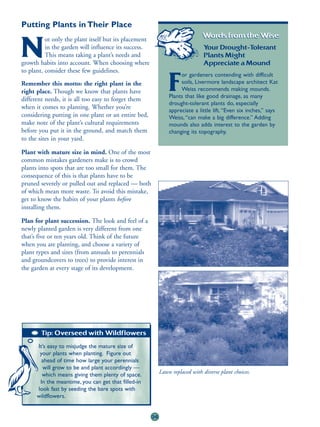
is calm then, and your plants will not be left with          and little water is lost to evaporation. One criticism
standing water on the leaves overnight, which can            of drip is that it requires a good deal of monitoring;
promote disease. Be sure that all water falls on soil        nonetheless, a properly functioning drip system
and plants, not sidewalks or other impervious sur-           produces the healthiest, best-looking garden.
faces. Also, give attention to how quickly your soil
absorbs water. If puddles form on the soil surface,          If you’ve opted for a system, you’ll have both drip
stop watering and wait until the water has been              and mini-spray emitters to choose from. If you
absorbed. Repeat this process until the soil is wet-         choose a system that delivers to both spray and
ted to the appropriate depth. If you have an auto-           drip, they must be on separate valves, as they
matic system, irrigation controllers allow you to            require different pressures and run times to operate
break your watering times into smaller intervals.            efficiently. A drip system should have its own dedi-
Observe your irrigation system in action and                 cated valve; the setup also includes piping, filter-
regularly check it for leaks.                                flush valves, and regulators. For more information
                                                             regarding drip systems, get a copy of Drip
Control weeds. Weeds compete with other plants               Irrigation Guidelines, published jointly by the East
for nutrients and water in the soil. Eliminating             Bay Municipal Utility District and the Contra
weeds from garden beds and lawns will make more              Costa Water District and available free from
resources available for your chosen plants. A thick          EBMUD.
layer of mulch is the best weed deterrent.


                                                        58
If you’re watering by hand, use soaker hoses to do
the dripping. Choose between flat hoses with holes
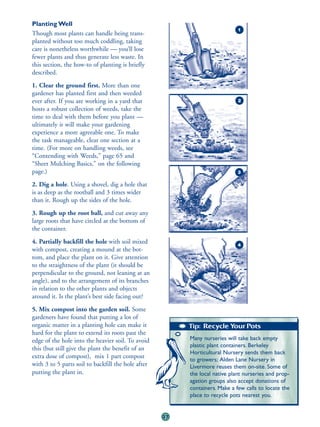
                                                                           Words from the Wise:
on top and round “ooze-type” hoses that gently
release water over their entire surface.                                      Rainwater Collection
                                                                              Using Reclaimed
Sprinklers                                                                    Materials
While drip emitters deliver water in gallons per
                                                                     hen Oakland gardeners Grant Minix and
hour, sprinklers flow in gallons per minute. They
deliver water fast and send it far. Because of this,
                                                            W        Mike Geltz moved into their fixer-upper
                                                            in East Oakland, they found, among other things,
sprinklers should be used with great care. To               two 50-gallon metal barrels had been left
prevent runoff when operating sprinklers, break             behind. Looking for a way to reuse them, Minix
up the total run time into shorter intervals, with          and Geltz ran flexible rainspout tubing from the
time in between for absorption into the soil.               eaves of the garage into the barrels and began
                                                            to collect rainwater.They have since added a
When you have a fixed system, be sure that                  third barrel — a 30-gallon plastic bin they got
sprinkler heads are placed to avoid overwatering,           for free. It once contained olive oil — Minix
underwatering, and water falling in the wrong               says that stores like Whole Foods and the
place. Never mix fixed spray heads with rotors or           Berkeley Bowl routinely have such empty bulk
impact heads on the same valve; they require                containers, and that they want to give them
different run times and pressure to operate                 away.
efficiently. Lower the volume of water coming
through the hose or system and target your
watering areas, much in the way one would with                    Tip: Understanding Native
a drip system.                                                    Plants’ Water Needs
To further control water delivery with sprinklers,
                                                                Many gardeners new to native plant make
install a timer — but remember that this tool is
                                                                  the mistake of thinking they shouldn’t be
only as good as you are. Learn how to use it to                    watered. Generally speaking, this is not
your best advantage. Even a simple timer for                       the case. Just like any other garden plant,
your spigot, used correctly, can be a water-                     natives have cultural preferences based
saving tool.                                                    on where they grew in the wild — native
                                                               plants that are found beside streams, for
                                                              example, are going to require moisture and
                                                             shade while shrubs that occur in hot, dry
                                                            chaparral will be more comfortable in the sun.
                                                            Similarly, the garden itself is a specialized
                                                            environment where a plant’s behavior and
                                                            needs will be subtly changed. Longtime native-
                                                            plant gardener Jake Sigg has written that
                                                            natives “frequently need a bit more water in
                                                            cultivation than in the wild.” He advocates
                                                            “extending the rainy season into May or June,
                                                            and starting to wake the garden in autumn by
                                                            commencing irrigation in October. This
                                                            supplemental watering should be on the light
                                                            side,” he adds, “not the heavy irrigation
                                                            customary in English-style gardens.” It’s also
                                                            true that new plantings—whether native or
                                                            not — may need a bit more water at the
                                                            outset, to get established.


                                                       59
ontributors to gardening literature

C        generally agree: pruning is one of the
         most misunderstood gardening tasks. If
you are fond of plants, however, you will find that
                                                                                Words from the Wise:
                                                                                 Look Before You Clip
pruning is not so hard. It can be a delightful exer-
                                                                                      akland resident Ann
cise in getting to know your plants — and work-
ing with them to enhance their appearance. Bay-
                                                                               O      Hutcheson-Wilcox had a
                                                                perennial that, for several years, she refrained
Friendly Gardening recommends a structural                      from cutting back. She and her children had
approach to pruning that emphasizes generating                  watched swallowtail butterflies using the plant
the least amount of waste.                                      and they wanted to give the insects full play. “It’s
                                                                important to pay enough attention to not
Pruning for Plant Health                                        prune,” says Hutcheson-Wilcox, “if you’ve got
                                                                something there that’s special and fleeting.”
Much pruning is only necessary because of other
gardening choices we make. Strategic, structural
pruning to improve plant health can mean less
pruning.                                                      Pruning for Plant Structure
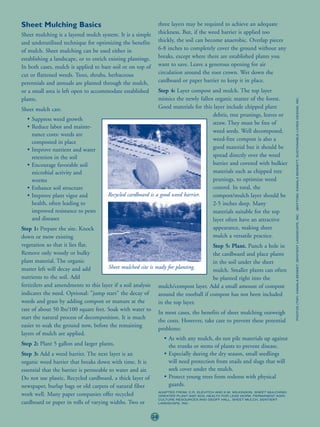
                                                              The following guidelines were written with
Select slow-growing species. Flashy, fast-growing             perennial shrubs and small trees in mind. For
trees and shrubs are often shallow-rooted, prone to           anything over about 15 feet tall, consider hiring a
wind damage, and short-lived. They require more               professional to do the pruning.

maintenance in general and their quick growth, in
particular, requires more pruning.                            Take out the dead wood first. This is an easy way

                                                              to start working with the plant. You can start at
Anticipate the plant’s mature size. If you think at           the bottom of the plant and move up, selectively
the outset about the height your plants will finally          clipping. For large shrubs, reach into the plant,
attain, you won’t end up in the unfortunate posi-             trimming from the interior first. Take out branches
tion of having to top off trees or shrubs that have           that rub or cross each other. Begin to discern the
grown too tall. Similarly, consider the mature                plant’s form and how it could be shaped by
plant’s breadth. Give your plants adequate room to            pruning.
grow, and they’ll need less pruning.
                                                              Pay attention to a plant’s growth patterns.
Go easy on the fertilizer. Most perennials, and               To prune is, essentially, to direct a plant’s growth.
California natives in particular, don’t need fertiliz-        A plant will sprout from just below where it is cut,
ers. The extra growth that these products promote             or it will put more energy into growing the limbs
inevitably leads to more pruning.                             the gardener chooses to retain. Depending upon
                                                              where a gardener prunes, he or she can force a
Keep wildlife in mind. Birds need spots to perch.             plant to either grow tall and straight or bush out
They also appreciate berries and seeds left on the            laterally.
plant. Wait to prune or leave some plants
unpruned each year.


Benefits of Pruning . . .


                                                         60
Avoid shearing. According to the Sunset Western
Garden Book, shearing is “the only form of pruning                    Tip: Mulch Your Prunings
that could be called indiscriminate.” It also creates               Whether you’re doing a bit of snipping and
unnecessary waste. In addition, sheared hedges can
                                                                      clipping by hand or you’ve hired someone
be a greater fire hazard, as their interiors contain so
                                                                       with a chainsaw to make major cuts,
much dead wood.
                                                                        your prunings can be converted into
Avoid topping. The practice of topping —                              mulch. Leave the mulch where you make
cutting main limbs off to stubs — is often used                     it or distribute it elsewhere in the garden.
to shorten tall trees and shrubs. The growth
that follows is a profusion of slender, upright
branches, which sprout from just below the cuts,
making the plant look as if it’s wearing a toupee.
Besides destroying its natural form, topping can
compromise a plant; the new branches are but
weakly attached.

Prune plants by thinning instead. Thinning
selectively removes branches to open the plant to
more sunlight and channel its growth into chosen
stems and branches. The focus is on cutting
branches back to where they originate, rather than
cutting mid-stem.

Start pruning early. Don’t wait until a shrub or
tree has reached something close to its full stature
before beginning to prune. Thin young trees and
shrubs as they grow. A few well-chosen cuts each
year will save you time and energy, and prevent
greater waste, as the plant matures.

Cut at the right time. When to prune depends
upon your goals and the plant itself. Thinning can             Prune selectively and avoid lopping. Adapted from
be done in any season. To promote flowering,                   illustration by Craig Farnsworth in Sustainable
prune after a plant has bloomed. To provide for                Landscape Construction.
the needs of wildlife, wait until well after berries
and seeds have formed.

Take your time. Do each pruning job in two ses-
sions instead of one. Step back from the plant to
see the effects of your work as you go. Enjoy the
process.


                                                          61
very gardener has to contend

E      with unwelcome guests. Persistent
       dandelions in the driveway or
snails that make midnight raids are just
                                              Beneficial Insects and Plants for
                                              Controlling Major Pests
                                              Attract these
two amongst the not-so-heavenly host of       beneficial
interlopers a gardener can encounter. It      insects            By planting these species
can feel as though it’s us against them
                                              Bigeyed bug        Polygonum sp. (Silver Lace Vine)
out there, and often it seems as if they’re
                                                                 Native grasses
winning. To gain the upper hand against
pests, be they plant or insect, you must      Hoverflies         Achillea sp. (Yarrow)
be more persistent than they are, and you                        Asclepias fascicularis (Narrowleaf Milkweed)
must be strategic. Keeping pests to toler-                       Baccharis sp. (Coyote brush, Mulefat)
able levels (rather than trying to elimi-                        Ceanothus sp. (California Lilac)
nate them completely) can be part of                             Eriogonum sp. (Buckwheat)
this; using more than one means to con-                          Prunis ilicifolia (Hollyleaf Cherry)
trol pests is another effective strategy.
                                              Lady beetles       Achillea sp. (Yarrow)
Integrated Pest                                                  Asclepias fascicularis (Narrowleaf Milkweed)
Management (IPM)                                                 Atriplex sp. (Quailbush, Saltbush)
Taking a more holistic approach is the                           Ceanothus sp. (California Lilac)
foundation of Integrated Pest Manage-                            Rhamnus californica (Coffeeberry)
ment. The suite of practices now known                           Native grasses
as IPM began as “integrated control” in                          Salix sp. (Willow)
the 1950s, when it was recognized that
preserving some insects (the “benefi-         Lacewings          Prunus Ilicifolia (Hollyleaf Cherry)
cials”) could boost the effectiveness of                         Ceanothus sp. (California Lilac)
pesticides applied to walnut trees in
                                              Minute pirate bug Achillea sp. (Yarrow)
California. Today, Integrated Pest
                                                                Baccharis sp. (Coyote brush, Mulefat)
Management is used around the globe to
                                                                Eriogonum sp. (Buckwheat)
contend with a variety of organisms that


                                                                                                                 ADAPTED FROM CORNFLOWER FARMS CATALOG, 2001
threaten the well-being of agricultural
                                              Parasitic &        Achillea sp. (Yarrow)
crops, garden plants, and households.
                                              Predatory Wasps    Aesclepias fascicularis (Narrowleaf Milkweed)
Integrated Pest Management considers                             Eriogonum sp. (Buckwheat)
context. It looks at the whole picture and                       Myoporum sp. (Boobialla)
stresses solutions that cause the least
environmental damage. Whether you’re          Tachnid flies      Achillea sp. (Yarrow)
dealing with weeds or insects, rust or                           Eriogonum sp. (Buckwheat)
blight, the first step in IPM is gaining an                      Heteromeles arbutifolia (Toyon)
understanding of the problem. (Some                              Myoporum sp. (Boobialla)
suggestions for how to do that are pro-                          Rhamnus californica (Coffeeberry)
vided on the following page.)


Benefits of Integrated Pest Management . . .


                                                     62
Notice what’s going on. Make daytime sweeps                  and a more achievable definition of success.
and nighttime forays into the yard. When you’re
pulling weeds or turning the compost, do a little            IPM identifies four management strategies for
poking around. Play garden sleuth. Where are you             dealing with pests: cultural, mechanical, biological,
seeing damage? Check the underside of those                  and chemical. There is no set order in which these
leaves. Look around for who might have done it. If           should be employed; use as many different tactics
there doesn’t appear to be an insect problem, theo-          from these categories as you can, with the excep-
rize other causes — but don’t give up if you don’t           tion of chemical controls, which should be used
expect to come up with an answer right away.                 only as a last resort. The following sections provide
Observation is best practiced with patience.                 examples of how these strategies can be used to
                                                             deal with two of the major classes of pests —
Get to know the players — learn their habits                 insects and weeds.
and needs. A small white grub that looks entirely
anonymous could turn into the kind of beetle who
                                                                     Tip: Plant Disease — Check for
likes to eat slugs for breakfast. Likewise, knowing
                                                                     Other Causes First
sow thistle by name and bloom time will make it
easier to prevent its return next year. Field guides                 Plant diseases are difficult to identify, so do
and gardening books are your aids here, as are                         not assume your plant has one based on
Master Gardeners and county extension agents.                           appearance alone. Use a magnifying glass
                                                                       to look for insect pests that may be
Avail yourself of the experience gained by                            causing the damage. Also analyze your
others. It’s very likely that someone else has                       maintenance practices to see if they might
struggled with the same problem you have, and                       explain the symptoms. If a disease is still
that they’ve written about it. No one resource will                suspected, go to the Sick Plant Clinic on the
give you everything you need, so consult several.                first Saturday of every month at the UC
It’s worth the time and effort. As one garden writer            Botanical Garden — (510) 643-2755 for more
says, “an hour spent reading about control strate-              information. Or, visit www.mastergardeners.org
gies is likely to save many hours of actually pulling           and ask a local Master Gardener for advice.
weeds.”

Learn to live with low levels of pests. One of               Contending with Insect Pests
the most important things in IPM is to figure out            (and a Few Other Ills)
how many pests you can tolerate and whether or               Perhaps it is because insects look so different from
not the “pest” is actually a problem that needs              humans that so many of us have such a deep
attention. Lots of aphids on a tree are usually just         antipathy for them. These otherworldly creatures
a nuisance. Lots of aphids on a potted tomato                do have faces and eyes, however, and fascinating
could do the plant in. A few aphids, anywhere in             lives. Many of them also provide valuable services
the garden, will provide food for bird and                   to humankind. Pollination is the best-known of
beneficial insects.                                          these, but the work of the decomposers who cease-
IPM Offers Practical Steps for Tackling                      lessly cycle organic matter into forms that other
Pests                                                        organisms can use is also a huge boon to humanity.
Integrated Pest Management takes the very sensible           Less than 2% of the insects you encounter in the
position that completely eliminating a pest is nei-          garden will be pests. Looked at the other way, the
ther possible nor desirable. A healthy garden                vast majority of insects in your yard are not harm-
ecosystem includes a variety of insects, the majority        ful — they’re either beneficial or neutral. In the
of which are either beneficial to your garden or will        interest of keeping them alive, take a targeted,
have no impact on it. It probably even includes a            selective approach to dealing with the insects that
few weeds. Aiming for something less than total              are pests.
annihilation of all pests means a healthier garden

                                                        63
Cultural Controls                                            from climbing tree trunks and plant stems to reach
These controls are defensive, or preventative, ones.         honeydew-producing insects; copper strips can
Cultural controls have to do with how you take               keep snails out of areas where they are not already
care of the garden. They are horticultural controls,         established, such as new raised beds. Mesh covers
if you will: improving soil conditions, choosing             can be used to protect your vegetables from flying
pest-resistant plants, pruning moderately, watering          insects and slugs and snails.
attentively, and so on will help your plants resist
predation.
The right plant in the right place is also an impor-                           Words from the Wise:
tant form of pest control. Plants that are healthy
and growing in the right conditions are less likely                            Knocking Back Aphids
to be attractive to pests and, if they are attacked,
                                                                                    hough he doesn’t get too
they are in better shape to fend off or outgrow the
pests. If you have a plant or plants that are always
                                                                              T     many aphids in the garden,
                                                               Sunol gardener Jim O’Laughlin says he usually
sickly, consider removing them. They are probably
                                                               finds them in the spring, especially on seedlings
in the wrong place.
                                                               in the greenhouse. He washes them off using a
Mechanical Controls                                            mist spray from the hose. “You want a strong
With these tactics, which are also called physical             mist,” he advises, “but not something that’s
                                                               going to break up your plants.” On roses, you
controls, the gardener begins to take the offensive.
                                                               can use a heavier spray setting; either way,
These are direct, but nontoxic, interventions.
                                                               O’Laughlin says, the aphids come off pretty
Hand-picking is particularly effective against large           easily.
and slow-moving pests like slugs, snails, caterpil-            If the aphids aren’t permanently discouraged by
lars, and potato beetles. The idea may make some               this approach, O’Laughlin resorts to insecticidal
a bit squeamish, but it’s not hard to do. Wear                 soap. He uses Safer brand, though it would
gloves if you’d rather not touch the creatures. You            probably be nearly as effective, he says, to make
can kill them by squashing them or dropping them               your own from dish soap.
into soapy water.

Spraying water is a technique best used on sturdy
plants that can withstand the force of water under           Biological Controls
pressure. Bring your garden hose out and direct a            These controls make use of parasites, predators,
fine spray of water to the leaves and stems of               and competitors to help keep down populations of
plants that are suffering infestation of spider mites        insect pests. These organisms are called beneficials
and aphids.                                                  — they benefit the gardener. Some natural preda-
                                                             tors, such as lady beetles and lacewings, can be
Setting traps does not necessarily involve a trip to         purchased from commercial suppliers, but the
the nursery or hardware store; rolled up newspaper           effectiveness of doing so has been questioned.
is an adequate enticement for earwigs, and boards            (Introduced ladybugs usually fly away to some
lying on the ground will attract sowbugs and slugs.          other home!) A gardener’s best bet is to promote
A shallow cup of beer not only attracts slugs and            the biological control already going on in the gar-
snails, it kills them. (Also see Controlling Snails          den by learning to recognize resident beneficials,
and Slugs in Your Garden, pages 68-69.)                      growing plants that will support them, and keep-
Setting up barriers such as mulch has been dis-              ing pesticide use to a minimum.
cussed for dealing with weeds; the same principle
                                                             Compost tea might not immediately come to mind
can be applied to the control of some insects.
                                                             as a biological control, but it is loaded with good
Sticky barriers such as Tanglefoot will deter ants
                                                             organisms that outcompete pest organisms, some of

                                                        64
which can help reduce leaf and root diseases. Many           thetic that makes them longer-lived and more
studies are now being conducted to explore new               harmful to the environment.
applications for compost tea, such as containing
mildew on golf course turf. To make a quick com-             Microbial pesticides include Bacillus thuringiensis,
post tea, leave a shovel-full of mature compost              which is better known as Bt. It is a bacterium that
overnight in a bucket of water. Drain the “tea”              kills a variety of caterpillars and worms, including
off in the morning and apply as needed. (To make             many non-pest butterflies and moths. Use it with
larger batches, see the instructions on page 50.)            caution.

Chemical Controls                                            Contending with Weeds
Home gardeners should look for pesticides that               If there were a Plant Olympics, weeds would be
have low toxicity and break down quickly. Buying             the gold medal winners. They are adaptable and
in small quantities is also a good idea, so that one         do well in a variety of conditions. Weeds also have
can avoid generating hazardous waste. Only least-            very successful reproductive strategies, such as
toxic chemical controls are described below.                 profuse seed production, sturdy underground
                                                             structures, or the ability to reproduce from their
Insecticidal soaps have been used against pests for          stems and leaves.
about two centuries. They are effective against
soft-bodied insects such as mites and aphids as well         Weeds are not without their virtues. They are
as other plant-sucking arthropods like whiteflies.           plants, after all, and they do the same things that
Soap kills only the insects that it touches, so be           other plants do — produce flowers and fruit, pro-
sure to spray the undersides of leaves as well. Soap         vide habitat for some species (though they may
does not leave a residue of poison behind, so                eliminate it for others), secure the ground with
repeat applications may be necessary.                        their roots, loosen heavy soils, add nutrients and
                                                             organic matter, and so on. And because, like any
Horticultural oils kill insects on contact as well,          other organism, they have needs and habits, weeds
and they work against a broad array of pests, but            can also tell us about the place in which they’re
unlike many chemical sprays, they have no residual           growing. They can give us clues to soil conditions,
impact. Oils are often used against scale, leaf min-         moisture levels, and more.
ers, mealybugs, and caterpillars.

Minerals are used primarily to treat fungal diseases                 Tip: Composting Your Weeds
and mildew. Sulfur can be used against scab, rust,
                                                                    Go ahead and compost your annual and
leaf curl, and powdery mildew. Boron, in its many
                                                                     perennial weeds, as long as they have no
forms (boric acid, borate, borax), is an effective                   mature reproductive structures such as
pesticide against a number of insects. Iron phos-                     seeds or bulbs. (Also avoid composting
phate slug baits are less toxic than other slug and                   weeds that can resprout from stems,
snail baits.                                                        leaves, or other plant parts.) You can even
                                                                   compost these plants in place — lay them
Botanicals are plant-derived insecticides that                    on the ground where you have pulled or cut
break down quickly in soil and sunlight.                         them. If the dying weeds seem unsightly, cover
Depending upon the formulation, they can be very                them with mulch.The weeds themselves are
concentrated and quite potent when first applied,               good mulch and good fertilizer.
so they should be used as a last resort. They are               Whether you compost weeds in a bin or in
effective against many pests, but some botanicals               place, keeping them in the garden is good for
can also be toxic to people, pets and wildlife, fish,           the garden. Every time you remove organic
and other aquatic species. Pyrethrums, ryania, and              material from your yard, you are essentially
sabadilla are the most common botanicals. Avoid                 mining the soil. Keeping these materials on site
                                                                keeps them out of the waste stream and
synthetic pyrethrums — called pyrethroids —
                                                                restores nutrients to the soil.
they’re often combined with PBO, another syn-

                                                        65
Nonetheless, if given leave to, a weed will assert
itself at the expense of other plants. To root out
weeds, use the following guidelines and controls.

General Guidelines
Over time, we can change the habitat in our gar-
dens so that weeds will have very few places to
grow. Attention to cultural controls as well as to
the weeds themselves can make all the difference.
                                                            key to controlling any given weed. Since annual
Build good soil to make weeding easier. A loose,            weeds sprout, flower, set seed, and die in a single
friable soil yields weeds easily. Amend your soil           year, getting rid of them before they produce seeds
with organic material and reap several kinds of             will reduce your weed problem the following year.
harvests. It is also very important to use mulch to         Perennials live for a longer time — two to many
suppress weeds and make them easier to pull out if          years. While many generate seeds, they also often
they do sprout.                                             rely on underground structures — deep roots, a
                                                            taproot, bulbs, and so on — to keep them alive
Manage irrigation to keep weeds down. Use drip              from year to year. Getting rid of them usually
emitters to deliver water to desirable plants; avoid        requires finding a way to kill their underground
using sprinklers that water everything and encour-          parts, either by pulling, or cutting, or smothering
age weeds to keep growing.                                  them.
Use dense ground covers or thick foliage to                 Prevent weeds from forming seeds. Whether they
shade out weeds. Plants compete for resources —             are annuals or perennials, preventing seed forma-
sunlight, water, nutrients. Use this to your advan-         tion will make a huge difference in the number of
tage in the garden, putting in plants that can              weeds you have. It is crucial to get to those weeds
compete successfully with the weeds.                        before they go to seed. If you can’t remove them
                                                            entirely, plants should be at least cut down before
Learn the growth habits and life cycles of your
                                                            they set seed.
weeds. Plants have different life spans and differ-
ent ways of surviving. Understanding these is the           Weed when the soil is moderately moist. Trying
                                                            to pull roots out of dry soil is at best difficult, at
                                                            worst futile. Removing plants from very wet
                  Words from the Wise:                      ground is a muddy mess that harms soil
                  Less Watering Means                       structure. Weed when the soil is moist
                                                            but not wet.
                  Fewer Weeds
           hen you choose to grow plants that               A Few Specific Weed
  W        depend on a lot of water, you could also
  be encouraging a host of unwanted plants.
                                                            Control Techniques
                                                            The ways to tackle a plant are
  Weeds are great opportunists—where condi-                 many, and the intrepid gardener
  tions are favorable, they’ll grow. Even in estab-
                                                            should use all that are appropriate to the particular
  lished plantings, more water means more weeds.
  Consider, for example, a lawn.
                                                            weed. Be persistent and work smart — focus on
                                                            the weeds that will flower soonest and scale your
  “With lawns,” says San Leandro gardener Gail
                                                            efforts to the size of the problem. If you have a
  Schino, “you just soak them.Water, water, water.
  I used to spend more time weeding because of
                                                            huge weed patch, for example, hand-pulling will
  all that watering.” Schino took out her lawn, she         not be as effective as cutting the weeds and cover-
  waters less, and, she says, “I enjoy my garden            ing them. Following is a brief summary of the
  much more.”                                               basic techniques for dealing with weeds.


                                                       66
Pulling weeds usually involves using a tool to
loosen the soil and then pulling the plant by hand.                Tip: Beware of Weed and Feed
Depending on the size of the plant you’re working                  Like the adage about killing two birds with
with, a hand fork, spading fork, or mattock can                     one stone, weed and feed lawn products
make weeding easier; for big shrubs, a Weed                          suggest a certain economy of effort.
Wrench is very effective and satisfying to use.                       However, rather than providing one
Wearing gloves is always a good idea, too.                            quick fix, weed and feed products spell
                                                                   double trouble. Since weed and feed prod-
Scraping can help you take out shallow-rooted                     ucts are often broadcast over large areas
plants or kill weeds when they’re young. The                     such as the lawn, pesticides are applied to
most common tool for this a hoe, which comes in                nonweed vegetation and soil — at unneces-
a variety of hand-held and long-handled forms.                sary cost to you and the environment.The
                                                              “feed” part of most of these products is a
While scraping is an effective control for both
                                                              quick-release fertilizer that can cause a flush
annuals and perennials, avoid cultivating the soil            of growth which in the short term leads to
any more than necessary to remove the weeds. You              more pruning and mowing and in the long
don’t want to turn over the soil and bring up new             term can result in soil depletion. Both compo-
weed seeds, or disrupt the food web in the soil, or           nents — the pesticides and the fertilizers —
damage soil structure.                                        can also end up contaminating our waterways
                                                              if the product is applied before a storm or
Cutting down weeds may be necessary if there are              “watered in” to such an extent that water
extensive weed problems or you’re dealing with                runs off.
large plants. Cutting may also be needed to
remove bushy overgrowth, such as blackberry
vines, before you can remove the roots. Where              bination with a barrier such as newspaper, card-
“soft” weeds such as grass predominate, use an             board, or decomposable fabrics (nondecomposable
electric mower or weed whacker to keep growth in           fabrics become both a blight and disposal prob-
check and prevent plants from flowering. For vines         lem), mulch will keep most perennials down. The
and shrubs, cut them away with pruners, loppers,           best approach is to pull or cut down perennials
or a pruning saw, then dig them out or cover them          first, then lay down a barrier and mulch.
with mulch.
                                                           Applying least-toxic herbicides. There are a few
                                                           less-harmful products on the market that can be
                                                           used in combination with other weed control
                                                           efforts. Corn gluten meal — a waste product of
                                                           corn syrup processing — is a fine, yellow powder
                                                           applied to soil. It suppresses germination of many
                                                           common annual grasses and broadleaf weeds, but
                                                           its effect is short-lived, so applications must be
                                                           carefully timed to coincide with seed germination.
                                                           Herbicidal “soaps” and acetic acid (vinegar) kill
                                                           plant tissue that they contact by disrupting plant
                                                           cell membranes. They are more effective against
                                                           annuals than perennials — tough weeds resist
                                                           these herbicides or resprout from roots. In many
Mulching works in two ways — by blocking sun-              cases it is just as effective to pull, cut, and mulch
light and creating a barrier to growth. It prevents        as to use least-toxic herbicides because they have to
many annuals from germinating. Since perennials            be used again and again.
have sturdy underground structures, mulch alone
is less effective at suppressing them. Used in com-


                                                      67
Case Study: Controlling Snails and Slugs
                                   in Your Garden

            re your vegetable and flower seedlings being devoured overnight? Are you finding large,

A
Detection
            ragged holes in your prized ornamentals? Do you see slime trails across your walkways?
            If so, your garden is probably harboring snails and slugs.


Snails and slugs are active mostly at night and on           Use Barriers
dark, cloudy days. On sunny days, they can be                 • Before using barriers, hand-pick for a couple
found in moist, shady spots. Look for their eggs in             of nights. After the barriers are in place, check
the soil (about an inch down) or under rocks,                   for snails and slugs caught inside the barrier.
boards, or plant debris. The eggs are laid in masses          • Wrap a strip of copper (Surefire Slug and Snail
of up to 100 and resemble small pearls. When you                Copper Barrier Tape) around a tree trunk,
find eggs, crush them or scoop them into a plastic              flower pot, or the wooden sides of garden beds
bag, seal it, and put the bag in the garbage.                   or fences. Snails and slugs are repelled by the
                                                                unpleasant reaction between their bodies and
Less-Toxic Controls                                             the copper.
Keeping down the population of slugs and snails               • Cover seedlings with small cages made from
requires persistence. By using a combination of                 plastic or galvanized metal window screen.
two or more of the following methods, you should                Push the cages into the soil so snails and slugs
be able to reduce their numbers, and keep snails                can’t squeeze under.
and slugs at acceptable levels in the garden.                                    • Cover rows of vegetables
                                                                                   with horticultural fabric (Fast
Hand-Pick at Night                                                                 Start, Seed Blanket) that lets
 • To be effective, hand-picking                                                 in light and water but excludes
   must be thorough and it must                                              snails and slugs.
   be done regularly. Collect nightly                                 • Use a product like SlugStop (coconut
   until it’s hard to find snails and slugs, then               oil soap) to repel slugs and snails. Apply the
   check once a week.                                           material in a ring around individual plants.
 • The best time for hand-picking is after 10:00              • Snails and slugs may cross barriers such as
   or 11:00 p.m., when snails come out to feed.                 diatomaceous earth, lime, sawdust, ashes, etc.,
   You can go out earlier, but you won’t find as                especially when these barriers are wet.
   many.
 • A flashlight and a pair of gloves or tongs will           Use Traps
   make collecting these slimy creatures easier.              • Snails and slugs can be trapped under upside-
 • Crush snails completely (otherwise they may                  down flower pots, dark-colored plastic sheet-
   recover) or drown them in a pail of soapy                    ing, and wooden boards. Place these traps
   water (they survive in plain water). A few dead              around the garden and collect snails and slugs
   slug and snail bodies left on the soil surface               in early morning or night.
   will attract more snails and slugs and make                • Homemade or commercial pit traps that use
   your collecting easier, but large piles will breed           beer or yeast mixtures to lure snails and slugs
   flies. Burying crushed mollusks 3 or 4 inches                to a drowning death may help, but hand-pick-
   underground will add nutrients to the soil and               ing will probably still be necessary.
   avoid fly problems.


                                                        68
Encourage Natural Predators                                   Our Water Our World was originally developed by
Many common ground beetles kill snails and slugs.             the Central Contra Costa Sanitary District. It is
Most of these beetles are large (1-2 inches), black,          supported by the Bay Area Pollution Prevention
tank-like creatures. They are found in the same               Group, the Bay Area Stormwater Management
moist habitats as their prey: under rocks, boards,            Agencies Association, and Bay Area water pollu-
leaves, etc. Avoid killing these allies.                      tion prevention agencies.

Use Iron Phosphate Bait                                       Our Water Our World has developed a series of
Chose a bait product carefully. Baits containing              information pieces and store displays aimed at
methiocarb kill earthworms and beneficial insects.            educating Bay Area residents about less-toxic pest
                                                              management. Look for the Our Water Our World
Baits containing iron phosphate (such as Sluggo,              logo next to products in participating hardware
Escar-go, or Worry Free) are safer for children and           stores and nurseries throughout the Bay Area.
pets than baits containing metaldehyde. Never-
theless, always keep this and all other pesticides            Visit www.ourwaterourworld.org for information
out of the reach of children and pets.                        on finding pesticide alternatives, buying least-toxic
                                                              products, identifying bugs, and more. You can
After eating iron phosphate, snails and slugs stop            also “Ask the Expert” about your personal pest
feeding and die within 3 to 6 days. They often                problem.
crawl into secluded places, so you may not see
dead bodies.
Reapply iron phosphate baits every 2 weeks.

Prevention
  • Snails and slugs find large expanses of ivy, nas-
    turtiums, and other succulent groundcovers
    particularly attractive, and they also hide in
    clumps of agapanthus, lilies, daffodils, and iris.
    They are less attracted to plants with dry, hard
    leaves like rhododendrons, junipers, and bam-
    boo. If you can’t remove the attractive plants,
    regularly search them for pests.
  • Moisture makes an area much more attractive
    to snails and slugs. Avoid over-watering and
    use drip emitters to deliver water only where it
    is needed. Water early in the day to allow the
    area to dry out before nightfall.
  • Remove any boards and flower pots that you
    aren’t using as traps.

Reproduced from a fact sheet produced by the
Our Water Our World program, which promotes
less-toxic pest control. Written by Tanya Drlik.


                                                         69
5
Gardening for the Birds and the Bees
                                       The vegetation in our cities                                                     and towns
                                       is remarkably diverse, and from the point of view of some animals, we’ve been spectacularly
                                       successful in creating habitat. The once-migratory Anna’s hummingbird has become a year-
                                       round resident in coastal California, largely because of the abundance of food sources (both
                                       feeders and flowering plants) that humans have made available.

                                       Our residential environments are essentially an open woodland growing over scattered
                                       impervious surfaces. This architecture favors certain species, including many of the perching
                                       birds, who like shrubs and edges and can easily move between patches of habitat.
                                       Terrestrial species have a harder time making a go of it in suburbia, but many persist and,
                                       along with their winged brethren, they will gladly make use of your yard if given a little
                                       incentive.

                                       Gardening for Wildlife
                                       Many organizations promote gardening for wildlife, and their recommendations have
                                       much in common with Bay-Friendly Gardening. They exhort the gardener to (among
                                       other things) quit pesticides, embrace bugs, lose the lawn, and use native plants. Most
                                       recommend an architecture of low, medium, and high plantings, and most follow
                                       tenets set down by the National Wildlife Federation: food, water, places to hide, and
                                                places to raise young are what makes wildlife at home in that habitat also
                                                        known as the backyard, apartment balcony, or patio.
                                                           At its root, gardening for wildlife is an attempt to provide for the
                                                          needs of wildlife. This can be as simple as hanging a bird feeder or
                                                    as complex as overhauling an entire yard. For most people, the pursuit lies
                                               somewhere in between, and typically it involves learning something about the
                                           wild flora as well as fauna. To get started, try the following steps.
                                       Take notice of the wildlife that’s already present. Butterflies and birds are often
                                       more easily viewed from inside the house — and through binoculars. Situate your
                                       furnishings so that where ever you spend time regularly, you’re next to a window.
                                       That makes observation easy and an enjoyable respite from whatever else may occupy
                                       you. Also be sure to go outside and play! When you’re in the yard, give yourself the
                                       time to sit and watch or turn over rocks and investigate.

                                       Use field guides and natural histories to learn more about what you’re seeing.
                                       Opening these texts is like peeking into some wizard’s book of mysteries — the
                                       secrets of the world are laid bare, in a language of beauty and poetry. But far from
                                       being hidden or arcane, these magical volumes are available to anyone who cares to
                                       look. Enjoy them. Make use of them.

                                       Consider the surrounding environment. Your success as a wildlife gardener will be
                                       influenced by the lands around you. Creeks or other water bodies, and areas of open
                                       space (including vacant lots), will bring more wildlife to your area. Sometimes even a

                                                                          70
single tree in the neighborhood, such as a willow                  Places to raise young
or an oak, can support a host of species, from                     means different things to
humble bugs to haughty raptors.                                    different species. Anna’s
                                                                   hummingbirds will use a variety of
Consider the needs of wildlife. Food, water,                       trees to anchor their tiny nests of
shelter, and places to raise young are the essential               spider web strands and lichen. Skipper
elements of wildlife habitat.                                      butterflies lay eggs on blades of grass.
                                                                   Diverse plantings will provide reproductive space
Food means all things plant-related: pollen, nectar,
                                                                   for more species. Leave leaf litter in place, use
berries, seeds, stems, and leaves. It also means
                                                                   mulch, and allow some open ground.
bugs; they’re the food for other bugs, for birds, for
mammals, reptiles, and amphibians.                                 Use a few extra native plants. Natives provide
                                                                   some of the best food sources for wildlife,
Moving water attracts more species than still
                                                                   particularly at the lower end of the food chain.
water, but even a shallow basin on the ground,
                                                                   Some native plants, such as coyote bush,
kept clean and refilled regularly, will offer birds a
                                                                   coffeeberry, and oaks, are host to hundreds of
place to drink and bathe. It can also offer frogs
                                                                   species of insects which in turn provide important
and salamanders a place to lay eggs.
                                                                   food sources for other insects, reptiles,
                        To provide shelter for the                 amphibians, birds, and mammals.
                          greatest number of species,
                                                                   Grow a diversity of plants. Wildlife gardeners
                          diversify the architecture of
                                                                   have one advantage over Mother Nature — they
                        the garden — that is, select
                                                                   can create a super abundance of food sources such
                        plants that will stand at
                                                                   as would never occur in the wild. Grow plants
                   different heights when mature.
                                                                   with different flowering times, shapes, and sizes.
              Plant different kinds of plants as well
                                                                   Include plants and shrubs that provide berries.
    — use herbaceous perennials as well as woody
                                                                   Avoid, however, the one-of-everything approach;
ones, plant bulbs, grow grasses, and so on.
                                                                   many kinds of wildlife, especially pollinators,
                                                                   prefer mass plantings of their favorite food
                                                                   sources.
                                                                                                 Continued on page 74.

 Flowering Periods of Selected Beneficial Insect Plants

                                                Jan   Feb   Mar    Apr   May   Jun   Jul   Aug   Sep   Oct   Nov Dec
 Salix sp. (Willow sp.)
 Ceanothus sp.
                                                                                                                         ADAPTED FROM CORNFLOWER FARMS CATALOG, 2001.


 Baccharis viminea (Mule Fat)
 Achillea sp. (Yarrow sp.)
 Rhamnus californica (Coffeeberry)
 Prunus ilicifolia (Holly-Leaf Cherry)
 Eriogonum sp. (Buckwheat sp.)
 Sambucus sp. (Elderberry sp.)
 Heteromeles arbutifolia (Toyon)
 Myoporum parvifolium (Creeping Boobialla)
 Asclepias fascicularis (Narrowleaf Milkweed)
 Baccharis pilularis (Coyote Brush)


                                                              71
If You Build It: Gardening for Wildlife in Fremont


               hen asked how she created her

W              teeming wildlife garden in Fremont,
               Kathleen McCabe-Martin answers
simply, “I planted flowers and trees and shrubs
                                                             McCabe-Martin also plants plenty of spring
                                                             wildflowers, such as baby blue eyes, sea foam, and
                                                             tidy tips, that can provide pollen and nectar to
                                                             early-spring insect foragers. In late spring, another
that attract more wildlife.” She wanted to increase          annual wildflower, tansy-leaved phacelia, begins
plant food sources and, she says, attract insects            blooming. Its flowers are visited by many species
that could be food to birds.                                 of native bees. California has about 1,500 native
                                                                         bees; there are probably more than 100
McCabe-Martin recognizes
                                                                          different species in the Bay Area alone.
that wildlife includes not
just charismatic animals,                                                A wildlife garden means more than just
but humble ones as well.                                                 a steady supply of flowers, however.
Small creatures, from soil                                               Seeds and berries also provide food to
microbes to pill bugs, are a                                             wildlife. McCabe-Martin has five
vital part of any garden                                                 feeders in the back yard — mourning
ecosystem. Even “pest”                                                    doves and squirrels take advantage of
insects can sometimes be                                                  the flat-pan feeder filled with corn
tolerated — McCabe-                                                       and sunflower seeds; American
Martin ignores the aphids                                                 goldfinches flock to the vertical feeder
on her plants because that                                                 loaded with nyjer (thistle) seed.
way she has more ladybugs.
                                                                                           McCabe-Martin has also
This Fremont gardener has                                                                  chosen plants that
created an explosion of informal                                                           produce plenty of berries.
diversity in both her front and back                                                      California honeysuckle, a
yards. “The neighbors thought I was                                                       twining native vine,
crazy,” she says. They were very                                                         produces pretty pairs of
nervous about the loose and easy                                                         scarlet fruit eaten by
grasses, shrubs, and herbs that                                                         purple finches and spotted
McCabe-Martin planted in the front                                                      towhees. And cuttings of
yard. “Now,” she concludes, “they                                                      wild grape from a nearby
come to look at all the flowers.”                                                      creek, which McCabe-
                                                                                       Martin simply slipped into
Something is always in bloom.
                                                                                      the ground along the fence,
McCabe-Martin's pink-flowering
                                                                                      produce shiny berries that
currant starts to flower by the end of
                                                                                      provide sustenance to birds
January; then the wild lilac — ceanothus —
                                                             and mammals alike — not to mention spectacular
comes on. “Grasses are popping out at the end of
                                                             fall color that is a feast for any gardener's eye.
spring,” she says, “as well as a lot of bushes. The
salvias start at various times and just keep on              McCabe-Martin also keeps five birdbaths in her
blooming.” In late summer, the bright red flowers            backyard and two in front. Water is the single
of California fuchsia are still brightening the yard,        most important element of a wildlife garden — it
a banner call to carpenter bees and                          alone will bring new creatures into the yard and
hummingbirds.                                                help sustain the ones already there.


                                                        72
If You Plant it,They Will Come
        o help build diversity in her yard, Fremont gardener Kathleen McCabe-Martin grows herbaceous

T       perennials—plants that live for more than a single growing season but aren’t woody. McCabe-
        Martin grows one such plant, cow parsnip, at the edge of a wildflower meadow in her backyard.
Reaching heights of more than six feet in a single season, cow parsnip dies back by the end of summer,
then sprouts again in the spring. It blooms annually, putting forth broad platforms of small flowers that
attract a host of beneficial insects.
Like many herbaceous perennials, cow parsnip relies on underground structures—in this case, a sturdy
taproot—to remain alive all year. Plants that have varied ways of living help vary a garden’s structure,
both above and below ground, and they provide varied resources for animals in the garden.
Whether it is for a seasonal stopover or
setting up house, including plants in your       Butterfly Attracting Plants
garden that provide food, shelter and places     Antirrhinum majus               Snapdragon
to raise young will entice wildlife visitors.
Consider who you are most interested in          Asclepias sp.                   Milkweed
providing habitat for and then learn more        Aster chilensis                 California aster
about their habits and needs. For those
captivated by Bay Area butterflies, the plant    Buddleja davidii                Butterfly bush
list on this page provides a selection of host   Carex tumicola and others       Carex
and nectar plants.
                                                 Ceanothus spp.                  California lilac
                                                 Erigeron spp.                   Fleabane
                                                 Eriogonum spp.                  Native buckwheats
                                                 Festuca californica,
                                                                                 Grasses
                                                 Melica californica and others
                                                 Lantana                         Lantana
                                                 Lupinus sp.                     Lupines
                                                 Malacothamnus sp.               Mallow
                                                 Monardella villosa              Coyote mint
                                                 Nepeta spp.                     Catmint
                                                 Penstemon spp.                  Penstemon
                                                 Phacelia spp.                   Phacelia
                                                 Rhamnus californica             Coffeeberry
                                                 Rudbeckia spp.                  Rudbeckia
                                                 Salvia spp.                     Sages
                                                 Sedum spp.                      Stonecrop
                                                 Sidalcea malviflora             Checkerbloom
                                                 Solidago californica            Goldenrod
                                                 Tagetes lemmonii                Mexican Bush Marigold

                                                     73
Build a diversity of layers. Intentionally build
edges — areas of transition from plants of one                Dealing with Unwanted Wildlife
height or type to another — into your garden’s                (Including Mosquitoes)
architecture. In wild nature, edges are where the             Some people are concerned that if we garden
greatest diversity of wildlife is found. The structure        for wildlife, we may attract animals we don’t
of most wildlife gardens attempts, on a small scale,          want in our yards. In addition, with the
to mimic this effect, right down to the herb layer            arrival of West Nile Virus in California, many
and ground level.                                             gardeners worry that water features will attract
                                                              mosquitoes. According to the National
Provide water. The single most important element              Wildlife Federation, “having a Backyard
of any homemade habitat is water. A large ceramic             Wildlife Habitat site does not put you at a
jar tilted on its side, dug into the ground slightly,         higher risk of catching West Nile virus if you
and filled with water can host damselflies and                follow these basic suggestions:
Pacific tree frogs; moving water attracts all manner
                                                              • Protect yourself by taking simple precau-
of birds. Whether it’s a birdbath or a six-by-six pond
                                                                tionary measures, such as avoiding peak
with a small waterfall, a consistent source of water
                                                                times of mosquito activity, using insect
will invite and help many kinds of wildlife to sur-
                                                                repellent, and wearing long pants and
vive in your yard.
                                                                sleeves.”
                    Get down to specifics. Who                • Help control sources of mosquito breeding
                    have you gotten to know in                  by cleaning gutters each year and
                     your yard and who are you                  regularly draining flower pots, wading
                     hoping to attract? Put in what             pools, and other objects that collect water in
                   they need and like. Pineapple                your back yard. Change the water in bird
             sage or California fuchsia for Anna’s              baths, wildlife water sources, and pet
           hummingbirds. Buckwheats for the                     dishes frequently.”
acmon blue. Downed wood and moist soil for the                • Where mosquito outbreaks are not control-
slender salamander. If you create habitat, be                   lable, careful management of mosquito
assured, they will come.                                        breeding sites through limited use of
                                                                natural larvicides should be considered.
                                                                Adulticides should not be used.”
                                                              As far as other animals are concerned, few if
                                                              any will become a nuisance. If they do, it’s
                                                              because your yard or home has got something
                                                              they want — a warm dry place to raise young,
                                                              perhaps, or an easy source of food. To deal
                                                              with such problems, use basic principles of
                                                              Integrated Pest Management. Identify what’s
                                                              attracting them and remove it or address the
                                                              issue.


                                                         74
Bay-Friendly Gardening is flexible.
There’s no one style or right way to go about it. In this chapter a few different approaches to
gardening are discussed, including gardening as a renter, community gardening, container
gardening and hiring a landscaper.
                                                                                                  6


                                                                                                  If You Don’t Own the Land
                                                                                                  If You Don’t Own the Land
Breaking Ground
If you are a renter and your landlord is open to letting you garden, then dig right in.
Here are a few words of advice.

Keep the lines of communication open. Even if your landlord is a bit laissez-faire,
keep him or her informed about what you’re up to. Invite him to come by from time
to time to see what the place looks like. If she likes what you’re doing, you may be able
to negotiate a reduction in rent or reimbursement for the cost of plants. At the very
least, you’ll prevent any misunderstandings.

Grow annuals. It’s easy to sneak a few annuals into most garden beds and foundation
plantings and, since they’ll bloom and die in a single year, you can return the garden to
its prior state, leaving no lasting traces of your activity.

Put in perennials that you can take out again. All bulbs, corms, and rhizomes —
such as iris, gladiolas, and the like — are good bets for the renter, since they divide eas-
ily and travel well. Plants like yarrow, which have matting, fleshy root systems, are also
easy to put in and take out as required by circumstance.

Moving the Ground Around
Growing plants in pots is a great option for renters — so good, in fact, that it gets a
separate section. (See page 77.)

Finding Common Ground
The late Karl Linn, a Berkeley resident who founded community gardens across the
US, made the argument that community gardens are more than gardens — they are
neighborhood commons. The commons, Linn said are the “shared natural environ-
ments” of air, water, and land. Both community gardens and community restoration
sites offer all people access to these fundamental elements.

Sign up for a plot at a community garden. As a renter, you have the freedom to at
least consider moving close to a community garden. Turnover can be fairly quick, so it’s
possible to get a plot within six months to a year. To find the one closest to you, surf
the Web or call your town’s Parks and Recreation Department.

Start a community garden. The web site of the American Community Gardening
Association warns that starting a community garden is not a quick process, but it can
be done. Linn said “start with the land bank of the city” — work with a public agency
that administers land. “It is never secure,” he said, “to start a garden on private land.
Then form a group that wants to create and use the garden. Either they come to you,
or you can attract them by drawing attention to the land.”


                                                        75
Carole Bennett-Simmons, one of the founders of
Peralta Community Garden in north Berkeley, says
it’s good to start a garden next to a place where
people don’t have land. Apartment dwellers, she
says, are “automatic customers.” Beyond that, she
suggests looking for a place with a nice open sky.

Help care for a school garden. Many schools
have or would like to start a garden, and all of
them are likely to welcome help. Put out feelers at
the school nearest to your home, or talk to teach-
ers you know.
Join a community stewardship group. In spite of
so much urban development, the East Bay has a
surprising number of wild nooks and crannies, and
an ever-increasing number of people are joining
together to care for them. There are 20 creek groups
in Alameda and Contra Costa County, for example,
and each one of them offers opportunities to pull
weeds, grow seeds, and plant plants. Many parks
have “Friends” groups that would welcome your
inquiries; some high schools have environmental
clubs that might provide a way for you to connect
                                                            ©ELLIOTT SMITH


with nature and with other people. The benefits of
participating in the activities of such groups are
many; the results can truly change your life.


                                                       76
Container Gardening
               hether you live in an apartment or

W              have a big backyard, containers offer
               great versatility. Plants can be moved
from place to place, and the gardener can compose
ever-changing tableaus of color, placement, and
seasonality. The downside of containers is that you
can’t neglect them for too long without dire conse-
quences. Don Mahoney, horticulture manager for
the Strybing Arboretum Society in San Francisco,
has the following advice for container gardeners.

Container gardening doesn’t have to be a short-
term proposition. Bonsai trees, the ultimate con-
tainer plant, can live for 400 years. Manzanitas
can be grown in pots for a
dozen years or more. Instead
of this year’s impatiens, grow
longer-lived plants in contain-
ers, ones that will last at least a
few years.

Soil and water should be seen
as a team. In a hot area, inland,
you’ll have to water more — or
use a heavier soil mix. In the fog                                     Start with the right soil mix. The best
belts of San Francisco and                                             potting soil is not one brand but the
Berkeley, where there’s so much                                        right mix of ingredients for your
moisture in the air, a mix that has                                     location, your watering habits, and the
more sand or perlite will be                                   plants you want to grow. You will need a
required. Gardeners who water their container                component that ensures good drainage — such as
plants often will also want a soil mix that drains           sand — and an element that will hold moisture,
well. If you want to conserve water, it’s perfectly          such as compost. For commercial mixes, many
easy to do so; use a heavier soil in the mix — you           gardeners recommend Gardner & Bloome,
can even include a bit of garden clay — or use very          produced by Kellogg Garden Products. Edna’s Best
drought-tolerant plants, such as succulents.                 by E. B. Stone is also popular.

                                                             Plant singly. Mahoney keeps a lot of his treasure
                                                             plants alone in a pot, so he can keep an eye on
         Tip: Water Containers
                                                             them. Caring for these individuals is easy, as each
         with Care
                                                             plant can be matched to the appropriate soil, sun,
       Artist and garden consultant Sarah                    and watering regime.
         Ginskey has several beautiful container
          plantings that feature low-maintenance             Or plant in combination. For that filled in and
        succulents and grasses. She says she                 bountiful look, put a lot of plants in a single pot.
       applies the same principles to watering
     her pots as she does the rest of her garden.            When you do this, make sure all the plants take
    “You have to pay attention to sun and mois-              the same culture. One approach is to sort the
   ture, and to how well you water — is the soil             plants by their place of origin. Mahoney has con-
   compacted? Is the water percolating?”                     tainers of all South African plants, all California

                                                        77
natives, and a grouping of “true Mediterraneans”
— rosemary, lavender, and thyme.                                     Tip: Add Worm Castings
                                                                     to the Mix
Have fun with the combinations. Mix and match
                                                                    Topdress your container plants with worm
summer plants. Play with combinations of decidu-                      castings — this balanced, nutrient-rich
ous and evergreen. Mahoney has a Japanese maple                        amendment will really give your potted
in a pot that’s underplanted with California poly-                   plants something to grow on. Unlike
pody (a native fern). In the fall and winter,                       other fresh manures, worm castings will
when the maple is bare, the fern grows up and                     not burn plants.They are also rich in benefi-
fills in the picture. In the summer, when the tree               cial organisms, so, when adding worm cast-
leafs out, the fern goes dormant. Similarly,                   ings to potting soil, you are inoculating the soil
Mahoney raises a lot of California wildflowers from            with new life.
seed and each spring transplants them into pots that
are also home to more permanent woody species.              into storm drains, which lead to our creeks,
                                                            waterways and eventually the Bay. Choosing a
Keep your container plants happy year after                 landscape professional who uses Bay-Friendly
year. After two or three years, add three to four           practices can eliminate or minimize these hazards.
inches more soil to the top of the pot or, better
yet, to the bottom. Amend pots with a couple                As more homeowners are interested in creating
handfuls of homemade compost before the rainy               gardens that mimic natural systems, it stands to
season begins each year, and the rain will work the         reason that more landscapers will offer comple-
nutrients down into the soil.                               mentary services. Here are a few tips for finding a
                                                            landscape professional who fits your needs:
Hiring Help
                                                              • Consider hiring a Bay-Friendly Qualified
While creating and maintaining your own garden                  Landscape Professional. Qualified landscape
can be a satisfying experience, hiring help is                  professionals have completed a comprehensive
sometimes also appropriate, and even necessary.                 training program, including passing an exam.
Whether you want to hire a professional for help                Equipped with the know-how, these
with design or are considering a landscaping                    maintenance professionals are enthusiastic
company for regular maintenance, look for a                     about offering a holistic approach to the
landscaper whose practices are compatible with                  management of your landscape. A list of
Bay-Friendly principles.                                        professionals who have participated in this
How a landscape professional manages your yard                  program can be found at
and garden — from using pesticides to choosing                  www.BayFriendly.org/BF-qualified.
plants — has an impact on your garden, our                    • Visit professionally designed or maintained
natural resources and the San Francisco Bay                     gardens on the spring Bay-Friendly Garden
watershed. Urban runoff carries                                 Tour. Featured residential gardens showcase
pesticides, sediment, and fertilizer                            natural gardening techniques and provide real-
                                                                life models of what Bay-Friendly offers. A list
                                                                of landscapers whose client gardens have been
                                                                included on this tour can be found at
                                                                www.BayFriendly.org/designer.
                                                            StopWaste.Org’s Bay-Friendly Landscaping
                                                            Program also provides other resources, including
                                                            Bay-Friendly Landscape Guidelines, for
                                                            professionals. Encourage professional landscapers
                                                            to visit www.BayFriendly.org or call (510) 444-
                                                            SOIL for more information.

                                                       78
Books
Bauer, Nancy. The Habitat Garden Book: Wildlife Landscaping for the San Francisco Bay Region.
       Coyote Ridge Press, 2001.
Beidleman, Linda H. and Eugene N. Kozloff. Plants of the San Francisco Bay Region, revised
       edition. University of California Press, 2003.
Bornstein, Carol, David Fross, and Bart O’Brien. California Native Plants for the Garden.
                                                                                                     7


                                                                                                     Resources
                                                                                                     Resources
       Cachuma Press, 2005.
Bradley, Fern Marshall and Barbara W. Ellis, editors. Rodale’s All-New Encyclopedia of Organic
       Gardening: The Indispensable Resource for Every Gardener. Rodale Press, 1992.
Creasy, Rosalind. The Complete Book of Edible Landscaping: Home Landscaping with Food-Bearing
       Plants and Resource-Saving Techniques. Sierra Club Books, 1982.
Cutler, Karan Davis, editor. Essential Tools: Equipment and Supplies for Home Gardeners. Brooklyn
       Botanic Garden, 2002.
East Bay Municipal Utility District. Plants and Landscapes for Summer-Dry Climates of the San
       Francisco Bay Region. East Bay Municipal Utility District, 2004.
Francis, Mark and Andreas Reimann. The California Landscape Garden: Ecology, Culture, and
       Design. University of California Press, 1999.
Gardening for Wildlife: Protecting Water Quality Using California Native Plants. Aquatic Outreach
       Institute, 2002.
Hayes, Anne and Shannah Anderson. The Gardener’s Guide to Native Plants of the East Bay.
       Aquatic Outreach Institute, 2001.
Hayes, Anne, Sue Rosenthal, and Mike Koslosky. “Gardening for Wildlife with Native Plants,”
       Bay Nature, January-March 2003.
Johnson, Hugh. The Principles of Gardening: The Classic Guide to the Gardener’s Art. Simon and
       Schuster, 1979.
Keater, Glenn and Middlebrook, Alrie. Designing California Native Gardens. University of
       California Press, 2007.
Lowry, Judith Larner. Gardening with a Wild Heart: Restoring California’s Native Landscapes at
       Home. University of California Press, 1999.
Peirce, Pam. Golden Gate Gardening: The Complete Guide to Year-Round Food Gardening in the
       San Francisco Bay Area and Coastal California. AgAccess, 1993.
Pittenger, Dennis R., editor. California Master Gardener Handbook. University of California
       Agriculture and Natural Resources, 2002.
Stein, Sara. My Weeds: A Gardener’s Botany. University Press of Florida, 1988.
Sunset Western Garden Book. Sunset Publishing Corporation, 1996.

Web Resources
Visit www.BayFriendly.org for more on-line resources to help with your Bay-Friendly garden.

Biocontrol Network. www.bioconet.com. Information on insect identification, insect biology,
      organic farm and garden products, and educational materials.
CalFlora: Botanical Resource for California. www.calflora.org. This online database allows you to
      call up pictures and information on hundreds of native and naturalized California plants.
Mediterranean Garden Society. www.mediterraneangardensociety.org. A membership organization
      “devoted to furthering knowledge and appreciation of plants and gardens suited to the
      Mediterranean climate regions of the world.” Web site links to a Mediterranean climate
      discussion group.
National Wildlife Federation. www.nwf.org. A starting place for information about backyard habitat
      gardening.
UC Integrated Pest Management. www.ipm.ucdavis.edu. Photos of insects, weeds, and other pests
      with detailed information about their ecology and natural enemies.


                                                         79
Local and Statewide Organizations                                        Marin County Stormwater Pollution Prevention Program
                                                                         (MCSTOPPP) is a consortium of all Marin municipalities.
Alameda County Water District (ACWD) is committed to
                                                                         Working to protect water quality in our creeks and wetlands
running cost effective and beneficial conservation program-
                                                                         since 1993, MCSTOPPP offers technical assistance, work-
ming to help ensure a high quality water supply as well as
                                                                         shops, and educational materials for the general public —
enhance the quality of our environment.
                                                                         including information on less toxic alternatives to pesticides.
(510) 668-4200 www.acwd.org                                              (415) 499-6528 www.mcstoppp.org
Alameda Countywide Clean Water Program (ACCWP)                           Master Gardeners — Alameda County. Alameda County
is a consortium of local agencies working to educate residents,          Master Gardeners are volunteers trained by the University of
businesses, and employees about stormwater pollution to                  California Extension to help the residents of Alameda County
restore the health of local watersheds, creeks, and the San              with their gardening questions. Master Gardeners stress
Francisco Bay. (510) 670-5543 www.cleanwaterprogram.com                  research based integrated pest management techniques that
                                                                         can help reduce pesticide and herbicide use in Alameda
The Bio-Integral Resource Center has specialized in IPM
                                                                         County homes. Program Information: (510) 639-1275,
research and education for 25 years. This nonprofit organiza-
                                                                         Plant Doctor Hotline: (510) 639-1371 www.acmg.ucdavis.edu
tion publishes two useful and user-friendly journals for mem-
bers and also makes available pamphlets and fact sheets on a             The Merritt College Landscape Horticulture department
variety of IPM-related topics. (510) 524-2567 www.birc.org               holds a plant sale each spring and fall. (510) 436-2418
                                                                         www.merritlandhort.com The Environmental Studies Program
The California Invasive Plant Council works to protect
                                                                         offers classes in Wildlife Gardening, Restoration Landscaping
California wildlands from invasive plants through research,
                                                                         and Ecological Design. (510) 434-3840
restoration, and education. Holds an annual symposium, pub-
                                                                         ecomerritt@sbc.global.net
lishes books and other educational materials, and occasional
workshops. (510) 843-3902 www.cal-ipc.org                                The Regional Parks Botanic Garden at Tilden Park features
                                                                         native plants from throughout the state. Nursery plants are
The California Native Plant Society has both statewide and
                                                                         sold April through December, with a large sale held each
local programs. The East Bay chapter offers field trips, restora-
                                                                         April. (510) 841-8732 www.nativeplants.org
tion work parties, plant propagation programs, and a monthly
newsletter. (510) 464-4977 www.ebcnps.org                                The City of San Jose has established a national reputation for
                                                                         environmental leadership and innovation through the pro-
Contra Costa County offers free composting and vermicom-
                                                                         grams and services of its Environmental Services Department
posting workshops, instructional composting video loan, and
                                                                         — ensuring healthy streams, rivers, marshlands, and Bay
reduced price compost bins in most areas of the County.
                                                                         waters; managing reliable water, garbage and recycling servic-
Contra Costa County Recycling Hotline: 1-800-750-4096
                                                                         es; developing clean and green air, land and energy policies;
www.cccrecycle.org/compost Central and South County:
                                                                         and providing community education aimed at environmental
Central Contra Costa Solid Waste Authority. (925)906-1806
                                                                         sustainability. (408) 535-8500 www.sanjoseca.gov/esd
www.wastediversion.org West County: West Contra Costa
Integrated Waste Management Authority. (510) 215-3021                    San Mateo Countywide Water Pollution Prevention
www.recyclemore.com                                                      Program (SMCWPPP) is a partnership of the County and
The Davis Street Station for Material Recycling and                      the Cities in San Mateo County focused on protecting and
Transfer (SMaRT) in San Leandro is a great source for inex-              enhancing water quality in creeks, wetlands, the Bay and
pensive soil products, compost, and mulch made from yard                 Pacific Ocean. (650) 363-4305
trimmings. (510) 638-2303.                                               pollutionprevention@co.sanmateo.ca.us • www.flowstobay.org

The East Bay Municipal Utility District (EBMUD)                          The UC Botanical Garden showcases a large collection of
is a publicly owned utility formed in 1923 and serving por-              plants from around the world, including Mediterranean-
tions of Alameda and Contra Costa counties. Their mission is             climate areas and California. (510) 643-2755
to manage the natural resources with which the District is               www.botanicalgarden.berkeley.edu/
entrusted; to provide reliable, high-quality water and waste-
water services at fair and reasonable rates for the people of the        City of Vallejo Water Conservation Program provides infor-
East Bay; and to preserve and protect the environment for                mational materials and other services to its customers to help
future generations. (510) 287-0591 www.ebmud.com                         them better manage their water usage.
                                                                         (707) 648-4479 or e-mail waterinfo@ci.vallejo.ca.us
The Ecology Center in Berkeley offers classes and has a store
                                                                         The Watershed Project (formerly the Aquatic Outreach
that carries organic soil amendments, nontoxic pest control
                                                                         Institute) coordinates the work of several community-based
products, tools, and books. (510) 548-2220
                                                                         groups doing gardening and restoration projects and offers
www.ecologycenter.org
                                                                         workshops on gardening for wildlife.
                                                                         (510) 665-3546 www.thewatershedproject.org


                                                                    80
Garden Design Survey
                                                      b
Survey Your Site
It helps to start by identifying what you have, and then building a design around that. Take a few minutes to think
about the possibilities and limitations of your site.

1.   What is your general exposure?
     ❑ Full sun                 ❑ Partial shade               ❑ Full shade

2.   What type of soil do you have?
     ❑ Clay                     ❑ Sand                        ❑ Loam

3.   Is there a slope?
     ❑ Gentle                   ❑ Steep                       ❑ Flat

4.   How does water flow? (For example, are there seasonal wet spots or surface water.)

5.   How does the soil drain? Will the existing soil need to be amended with compost to improve drainage?

6.   Are there areas to avoid? (For example, underground cables, water and sewer pipes, or contaminated soil.)

7.   Are wind breaks needed?

8.   Is there existing landscaping?

9.   Are there plants and other features that you would like to retain from the existing landscape?

10. Where are water spigots? Is there an existing irrigation system?

11. What kind of garden do you have? (Check all that apply.)

     ❑ Flower                   ❑ Vegetable                   ❑ Edible

     ❑ Herb                     ❑ Fruit                       ❑ Rock

     ❑ Woodland                 ❑ Large tree                  ❑ Collector’s plant

     ❑ Wildlife                 ❑ Butterfly                   ❑ Hummingbird               ❑ Insect-attracting
     ❑ Drought-tolerant         ❑ Native plant                ❑ Permaculture              ❑ Low-maintenance
     ❑ Other


                                                                                      Continued on other side


                                                         81
A Garden for Your Lifestyle
Function is an important design element that precedes and determines plant selection. So before heading out to
the nursery, consider the many functions of your garden.

1.   What do you want to do in your garden?

     ❑ Create a children’s play area. ❑ Entertain and enjoy meals.          ❑ Grow food.

     ❑ Attract wildlife.             ❑ Construct a privacy screen.          ❑ Create a welcoming entrance.

     ❑ Add color.                    ❑ Add interest to front of house.      ❑ Make a utility area.

     ❑ Feature garden art.           ❑ Create a quiet sitting area.         ❑ Include room for pets.

     ❑ Other                         ❑ Other

2.   What kind of outdoor structures and features do you want to include?

     ❑ Benches                ❑ Barbeque                    ❑ Children’s play structure

     ❑ Birdbath               ❑ Fountain                    ❑ Pond                        ❑ Outdoor furniture

     ❑ Greenhouse             ❑ Potting bench               ❑ Deck                        ❑ Patio

     ❑ Storage shed           ❑ Fence                       ❑ Trellis                     ❑ Gazebo

     ❑ Garden art             ❑ Outdoor lighting            ❑ Other


3.   What kind of garden do you want?

     ❑ Flower                 ❑ Vegetable                   ❑ Edible

     ❑ Herb                   ❑ Fruit                       ❑ Rock

     ❑ Woodland               ❑ Large tree                  ❑ Collector’s plant

     ❑ Wildlife               ❑ Butterfly                   ❑ Hummingbird

     ❑ Insect-attracting      ❑ Drought-tolerant            ❑ Native plant

     ❑ Permaculture           ❑ Low-maintenance             ❑ Other


4.   How much time do you currently spend gardening (per month)?

5.   How much time do you want to spend gardening?


                                                       82

Bay Friendly Gardening: From Your Backyard to the Bay

  • 1.
    Bay-Friendly Gardening yourbacky From yard to the Bay
  • 2.
    T he Bay-Friendly Gardening Program was developed to encourage residents to make environmentally friendly gardening choices. It is not a particular style, but an approach that works with nature to reduce waste and protect the watersheds of the San Francisco Bay. Bay-Friendly Gardening is a program of the Alameda County Waste Management Authority and Source Reduction & Recycling Board, also known as StopWaste.Org. Resources available to Alameda County residents through the Bay-Friendly Gardening Program include: • Bay-Friendly Gardening Workshop Series • Bay-Friendly Garden Tour Bay-Friendly Gardening • Bay-Friendly Garden Registration is a trademark and • Master Composter Training servicemark developed • Bay-Friendly Partner Nurseries and owned by • Low-Cost Compost Bins StopWaste.Org. • Compost Information Hotline Visit www.BayFriendly.org for more information, or call the Compost Info Hotline at (510) 444-SOIL (7645). Project Team Jeanne Nader - Alameda County Waste Management Authority • jnader@stopwaste.org Jennifer Ketring - Green Logic Consulting • jketring@stopwaste.org Anne Hayes, Principal Writer Cindy Nelson, Associate Writer Thanks to the following agencies and representatives for contributing to the first edition: Alameda Countywide Clean Water Program Louise Cervantes Bio-Integral Resource Center Tanya Drlik East Bay Municipal Utility District Susan Handjian and Chris Finch The Watershed Project Sharon Farrell and Jen Brown A special thanks to the following Alameda County gardeners for sharing their gardening wisdom: Mike Geltz and Grant Minix, Oakland Ann Hutcheson-Wilcox, Oakland Marla Lee, Alameda Kathleen McCabe-Martin, Fremont Bill Merrill and Ellen Train, Fremont Wanda Nusted, Berkeley Jim O’Laughlin, Sunol Gail Schino, San Leandro Libby Teel, Oakland Disclaimer Kat Weiss, Livermore The information presented in this guide is provided as a public service Credits by the Alameda County Waste Management Authority and Recycling David Gilmore, Graphic Design Board, also known as StopWaste.Org. Joal Morris, Illustrations This information is not a substitute Kwai Lam, Rachel Michaelsen, Richard Rollins, for the exercise of sound judgement in Tamara Shulman, Photographs particular circumstances and is not intended as recommendations for Printed on 100% post-consumer recycled paper with soy-based inks. particular products or services. 2nd Edition. January 2008 4
  • 3.
    Table of Contents Chapter 1: Gardening for a Sense of Place . . . . . . . . . . . . . . . . . . . . . . . . . . . . . . . . . . . . . . . . . . . . . 7 Chapter 2: Into the Garden — Look Before You Leap . . . . . . . . . . . . . . . . . . . . . . . . . . . . . . . . . . . . . 18 Chapter 3: Gardening from the Ground Up . . . . . . . . . . . . . . . . . . . . . . . . . . . . . . . . . . . . . . . . . . . . 27 • The Nitty Gritty on Soil . . . . . . . . . . . . . . . . . . . . . . . . . . . . . . . . . . . . . . . . . . . . . . . . . . . . . 27 • Building and Protecting Healthy Soil . . . . . . . . . . . . . . . . . . . . . . . . . . . . . . . . . . . . . . . . . . . . 29 • Choosing Appropriate Plants . . . . . . . . . . . . . . . . . . . . . . . . . . . . . . . . . . . . . . . . . . . . . . . . . . 30 • Putting Plants in Their Place . . . . . . . . . . . . . . . . . . . . . . . . . . . . . . . . . . . . . . . . . . . . . . . . . . 36 Chapter 4: Gardening Day to Day and Through the Seasons . . . . . . . . . . . . . . . . . . . . . . . . . . . . . . . . 40 • All About Composting . . . . . . . . . . . . . . . . . . . . . . . . . . . . . . . . . . . . . . . . . . . . . . . . . . . . . . . 41 • Worm Composting . . . . . . . . . . . . . . . . . . . . . . . . . . . . . . . . . . . . . . . . . . . . . . . . . . . . . . . . . . 45 • About Feed the Soil . . . . . . . . . . . . . . . . . . . . . . . . . . . . . . . . . . . . . . . . . . . . . . . . . . . . . . . . . 49 • Mulch Basics. . . . . . . . . . . . . . . . . . . . . . . . . . . . . . . . . . . . . . . . . . . . . . . . . . . . . . . . . . . . . . . 52 • Grasscycling Is Easy . . . . . . . . . . . . . . . . . . . . . . . . . . . . . . . . . . . . . . . . . . . . . . . . . . . . . . . . . 55 • Water Conservation and Bay-Friendly Gardening . . . . . . . . . . . . . . . . . . . . . . . . . . . . . . . . . . . 57 • Pruning for Plant Health . . . . . . . . . . . . . . . . . . . . . . . . . . . . . . . . . . . . . . . . . . . . . . . . . . . . . 60 • Pruning for Plant Structure. . . . . . . . . . . . . . . . . . . . . . . . . . . . . . . . . . . . . . . . . . . . . . . . . . . . 60 • Integrated Pest Management. . . . . . . . . . . . . . . . . . . . . . . . . . . . . . . . . . . . . . . . . . . . . . . . . . . 62 • Contending with Weeds . . . . . . . . . . . . . . . . . . . . . . . . . . . . . . . . . . . . . . . . . . . . . . . . . . . . . . 65 Chapter 5: Gardening for the Birds and the Bees . . . . . . . . . . . . . . . . . . . . . . . . . . . . . . . . . . . . . . . . 70 Chapter 6: If You Don’t Own the Land . . . . . . . . . . . . . . . . . . . . . . . . . . . . . . . . . . . . . . . . . . . . . . . . 75 • Hiring Help . . . . . . . . . . . . . . . . . . . . . . . . . . . . . . . . . . . . . . . . . . . . . . . . . . . . . . . . . . . . . . . 78 Chapter 7: Resources. . . . . . . . . . . . . . . . . . . . . . . . . . . . . . . . . . . . . . . . . . . . . . . . . . . . . . . . . . . . . . 79 Garden Design Survey. . . . . . . . . . . . . . . . . . . . . . . . . . . . . . . . . . . . . . . . . . . . . . . . . . . . . . . . . . . . 81 East Bay Garden Profiles Local and Appropriate: Blending Styles in San Leandro . . . . . . . . . . . . . . . . . . . . . . . . . . . . . . . . . . 16 Low Cost, High Satisfaction: Reuse and Renovation in an Oakland Garden . . . . . . . . . . . . . . . . . . . 17 The Play of Air and Light: Kid-Friendly Gardening in Berkeley . . . . . . . . . . . . . . . . . . . . . . . . . . . . 26 Calm and Colorful: Creating an Urban Retreat in Oakland . . . . . . . . . . . . . . . . . . . . . . . . . . . . . . . 34 Doing Away with the Lawn: From Conventional to Bay-Friendly in Livermore . . . . . . . . . . . . . . . . 39 A Tradition of Innovation: Growing Organic Edibles in Sunol . . . . . . . . . . . . . . . . . . . . . . . . . . . . . 46 If You Build It: Gardening for Wildlife in Fremont . . . . . . . . . . . . . . . . . . . . . . . . . . . . . . . . . . . . . 72 Gardening Tips Words from the Wise: Gardening tips have been gathered from Host gardeners from past Bay- local landscapers, organizations, books Friendly Garden Tours share and other resources.Tips of all sorts insights from their gardening can be found in each chapter. experiences. Look for these anecdotes scattered throughout the guide. 5
  • 4.
  • 5.
    1 amazing place. Gardening for a Sense of Place Gardening for a Sense of Place n the edge of a continent, bounded by deserts and mountains, California is a land of spectacular natural beauty. It is also a land of extremes — within our borders are the highest and lowest points in the lower 48 states. California also boasts a Mediterranean our towns and neighborhoods. The Sausal climate. A handful of places — regions that Creek watershed in Oakland covers just over lie between 30 and 40 degrees latitude on four square miles; Alameda Creek drains an the western limits of a continent — share area of almost 700 square miles, carrying California’s exceptional climate. The water from the inland cities of Livermore, Mediterranean basin, the Western Cape of Dublin, and Pleasanton into the bay. Africa, Central Chile, southwest and south Australia, and much of the state of The bay is a great mixing ground that is California: these are the only areas on the tremendously fertile and full of life. Fresh planet that experience our mild water meets salt water in its northeastern temperatures. Furthermore, each of these reaches; drifting phytoplankton form the regions is defined for half the year by the base of a complex food web that includes absence of rain. hundreds of thousands of resident and migratory birds. The bay is also a repository The Watershed of the for many abiotic elements — including San Francisco Bay urban runoff. Seventy-five percent of California’s annual Wherever there are surfaces that water can precipitation falls north of Sacramento. not penetrate, such as rooftops, driveways, Some of this area — 40 percent of the state streets, and parking lots, rain quickly runs — lies in the watershed of the San Francisco off. It picks up whatever it flows across — Bay. Two rivers, the Sacramento and San litter, motor oil, sediment, pesticides and fer- Joaquin, are the main channels of a system tilizers, plant debris — and carries it to near- that covers 60,000 square miles. by storm drains, which lead to our creeks, Immediately surrounding the bay are many which empty into the bay. smaller watersheds — the hills and valleys of 7
  • 6.
    The bay containshigh levels of some pesticides, Standard gardening practice is to remove all plant including diazinon. All Bay Area creeks have been debris off-site, to landfills or large compost facili- listed by the EPA as impaired by diazinon, which ties, which effectively mines our soils of organic is toxic to birds, mammals, honey bees, and other matter. Urban soils have often been compacted, beneficial insects. eroded, and so depleted that they are no longer able to function naturally. By keeping plant debris The ubiquity of diazi- and fruit and vegetable trimmings on-site in the Diazinon is highly non in Bay Area water- form of mulch and compost, we restore the soil’s toxic to freshwater ways illustrates the ability to absorb water or filter pollutants. fish and invertebrates impact that gardeners Returning organic matter to the soil is the link following acute expo- can have in harming or between protecting our watersheds and conserving sure. A typical 1,000- protecting our natural landfill space. square-foot urban resources. Because of application of diazi- its toxicity, diazinon is non contains enough being phased out of the What Is a Watershed? active ingredient to consumer market, but A watershed is the area of land that water flows pollute 170 million there are dozens of across on its way to a creek, river, lake, bay, or gallons of fresh other equally harmful ocean. water. products available to take its place. Through changing our gardening practices, many of the contaminants in stormwater runoff could be elimi- nated. Just as important, solid waste can also be significantly reduced. Watersheds and Wastesheds — What’s the Connection? The passage of AB939 in 1989 set a statewide goal of reducing California’s waste stream in half by the What Is a Wasteshed? year 2000. (As of 2004, waste diversion statewide A wasteshed is the area of land from which all has reached 48 percent.) Some counties set local of the “streams” of refuse — from individuals goals to reach beyond the 50 percent. For example, and their communities — flow into the same in 1990 the voters of Alameda County set the landfill. ambitious goal to reduce waste by a total of 75 percent by the year 2010. To achieve this, county residents will have to not only reduce the quantity Introducing Bay-Friendly Gardening of materials they discard, but also divert more of them — that is, reuse and recycle valuable materi- Retaining organic materials on site is one of the als, instead of throwing them away. most important practices a gardener can engage in. There are also many other ways that gardeners can In Alameda County, nineteen percent of the waste protect and care for the environment both near stream is food and plant debris (that’s 294,110 and far. tons). Food, at 12 percent, is the single largest cat- egory of landfilled waste in Alameda County. By The Bay-Friendly Gardening program was devel- recycling these materials at home — composting oped to encourage residents to make environmen- kitchen scraps, converting plant trimmings into tally friendly gardening choices. Bay-Friendly mulch, leaving grass clippings on the lawn — we Gardeners work with nature to reduce waste and keep valuable resources out of our landfills and we protect the local creeks, waterways, and watersheds replenish the soil. of the San Francisco Bay. 8
  • 7.
    Bay-Friendly Gardening mimicsnatural systems, which recycle everything — water, debris, and nutrients — endlessly. It pays attention to climate A Bay-Friendly Garden: and local conditions and uses plants that are adapted to those conditions. It follows maintenance practices that support the goals of Builds Healthy Soil conserving resources and reducing waste. This approach to gardening: • Landscapes locally Reduces Waste • Landscapes for less to the landfill in the Garden • Nurtures soil health • Protects air and water quality • Conserves water • Conserves energy Conserves Water • Provides wildlife habitat Bay-Friendly Gardening does not advocate a particular style of gardening. Bay-Friendly Gardens aren’t a mold you have to fit into — they Creates Wildlife offer endless opportunities, from backyard wildlife Habitat gardens and native plant communities to vegetable gardens, flower beds, and more. Protects Local Watersheds The Benefits of Bay-Friendly Gardening and the Bay Because it works with nature, rather than against it, Bay-Friendly Gardening simplifies garden care. Using fewer resources, such as water and fertilizer, can mean less maintenance. And because it Contributes to a emphasizes natural gardening techniques, Bay- Healthy Community Friendly Gardening offers a way to make our communities healthier, safer places. Research has shown that children are particularly Saves Energy vulnerable to contaminants in the environment. They are also especially open to the opportunities for discovery and play that a garden can provide. Inviting children to go for a snail hunt on summer In the following pages, you will find guide- nights is a safer way to eliminate the pest than lines for a variety of Bay-Friendly Gardening setting out poison. practices.They cover all the main activities a gardener undertakes — planning the garden, It has also been shown that looking out on a garden helps hospital patients recover more choosing plants, caring for the soil, planting, quickly. Even when glimpsed from a moving car, watering, pruning, and so on.The icons shown natural scenery soothes the viewer. Whether you above appear throughout this handbook, to want an attractive yard to view from your home signal the benefits offered by every gardening or a place where you can get your hands dirty, practice described. For a detailed list of the growing a Bay-Friendly Garden can help make practices, see pages 10-11. you a healthier individual and help you make your community a healthier place. 9
  • 8.
    Putting Bay-Friendly Practicesinto Place Incorporating Bay-Friendly practices into your You may also find that your current gardening garden does not have to be difficult. In fact, many habits are already Bay-Friendly. You do not need Bay-Friendly techniques can make gardening to do all of the following techniques to capture chores less of a chore. Using mulch for example, the spirit of Bay-Friendly in your garden. helps to build healthy soil, reduce waste and Including even one practice will reap multiple conserve water, but it can also save time spent benefits. Take the case of choosing California weeding and watering in the garden. natives — this practice conserves water by selecting plants adapted to a Mediterranean The following checklist can be used as a guiding climate, and creates wildlife habitat by providing tool for incorporating Bay-Friendly practices. food for local wildlife. Build Healthy Soil Amend soil with compost. Prepare garden beds by hand rather than with a tiller. Maintain garden beds with little or no tilling. Sheet mulch to establish planting areas or pathways, or to control weeds while improving soil. Create clearly defined paths and or raised beds to protect soil from compaction. Grow cover crops to enrich the soil. Reduce Waste in the Garden Create and maintain an active compost or worm bin for garden and/or food waste. Use your green waste cart for any plant wastes that are difficult to compost on site. Use leaves, chipped plant debris, compost, or other organic materials as mulch. Minimize plant waste by not overplanting, overwatering, or overfertilizing. Minimize pruning by choosing plants that are appropriate for the space. Avoid sheared hedges in the garden. Leave clippings on the lawn after mowing. Use recycled or salvaged products for artistic or functional purposes. Conserve Water Emphasize Mediterranean climate or California native plants. (Try to use these plants for at least half of your garden area.) Group plants in the landscape by water needs. Minimize or eliminate lawn area. Install efficient irrigation (drip, timers, soaker hoses, etc.). Water according to plants’ needs, not just on a fixed schedule. Use mulch in garden beds. Install a rainwater collection or gray water system. 10
  • 9.
    Create Wildlife Habitat Provide food for wildlife with a variety of plants that flower and set fruit at different times of year. Provide water with a small pond, bird bath, or water dish. Create year-round protective cover with a planting of evergreen trees/shrubs, logs, rocks, or brush pile. Diversify your garden structure with layers of ground covers, herbaceous vegetation (non-woody) and/or grasses, shrubs of various heights, and trees. Leave some areas of the garden somewhat untidy — let flowers go to seed to provide food for birds, and leave dead leaves and stalks to shelter over-wintering insects. Feature native plants. (Plant more than 50% of your garden with California natives.) Protect Local Watersheds and the Bay For patios, driveways, or other hard surfaces, choose permeable materials that allow water to soak in rather than run off. Terrace steep slopes to reduce rainwater run-off and prevent erosion. Cover nearly all soil with mulch or plants. Avoid the use of synthetic fertilizers. Avoid the use of plants considered invasive in local wildlands (see page 33). Contribute to a Healthy Community Use an integrated approach for controlling weeds, insect pests and diseases with least toxic controls used first for safety of children, pets and wildlife. Tolerate pests as much as possible. Select disease resistant varieties of plants. Include plants that attract beneficial insects in the landscape. Grow vegetables organically for food and enjoyment. Plan outdoor lighting that is dim or directed downwards to minimize light pollution. Use hand or electric tools instead of gas-powered tools. Consider and control potential neighborhood hazards — including fire awareness, weed seed dis- bursement, and rodent habitat. Save Energy Place trees and shrubs to reduce energy requirements. For example, plant deciduous trees on the west side of the house to provide shade during the summer and allow sunlight to warm the house in the winter. Shade parking asphalt areas and air conditioners, if applicable. Select local garden products and suppliers. Choose outdoor lights that are energy efficient or solar. Select pumps for water features that are solar powered or energy efficient. Include space in the garden for a clothesline. 11
  • 10.
    Gardening Locally Bay-Friendly Gardeningrecognizes that what we do in our yards has impacts on pesticide loads in the San Francisco Bay and capacity at the Altamont Landfill. One way to reduce such impacts is to garden locally — that is, with an awareness of local conditions and the land’s natural inhabitants. As a part of this, Bay-Friendly Gardening uses natural plant communities as models for the garden. Plant communities are in large part determined by the conditions that a gardener needs to consider when selecting plants — such as soil, light, moisture, drainage, and exposure — so plant communities can provide inspiration for how to group plants in the garden and what plants to choose. Whether filled with native plants or with exotics that do well in these settings, any garden can have a version of all of the following California plant communities. East Bay gardeners Gail Schino, Grant Minix, and Mike Geltz have individual approaches to the concept of Gardening Locally. Gail Schino takes inspiration from nearby open spaces to create plant communities in her San Leandro garden. Grant Minix and Mike Geltz rely on local resources to transform an urban lot in Oakland. See garden profiles on pages 16-17. Coastal Prairie and Valley Grassland are distinguished by their proximity to the bay. Valley grassland occurs on the inland side of the East Bay hills; coastal prairie is close to the water. Both are a rich complex of perennial bunchgrasses PHOTO: RICHARD ROLLINS interspersed with perennial and annual wildflowers. Prairie and grassland species are adapted to full sun and summer drought; they will accept a variety of soils. Valley and Foothill Woodland includes open oak woodlands, which have a grassy understory; dense oak groves crowded with lower shrubs and herbs; and shady bay laurel woods. Oak woodlands are summer- dry environments; the plants of denser woodlands will take moister conditions and PHOTO: ELLEN ZAGORY soils high in organic matter. Many under- story woodland plants are shade tolerant. 12
  • 11.
    Riparian Woodland is structured like other wood- PHOTO: EAST BAY REGIONAL PARK DISTRICT lands, with an overstory of tall trees and, in this case, a dense, lush understory of shrubs and smaller plants. This creekside plant community depends on year-round moisture; some ripari- an plants are sun-loving, others are shade tolerant. In the garden they prefer loose soils. Redwood Forest Redwoods are rightly famous, and the Oakland and Berkeley PHOTO: EAST BAY REGIONAL PARK DISTRICT hills are still graced with them. A distinctive group of under- story species is adapted to the deep shade of the redwood groves. Northern Coastal Scrub also lies close to the coast and along parts of the bay. In addition to grasses and other herba- ceous plants, this community also has a shrub layer. Plants in this community are adapted to exposed locations and at least a bit of fog. PHOTO: JANE HUBER 13
  • 12.
    Common Plants forBay Area Plant Communities Following are selected lists of representative species for the most common plant communities in the Bay Area. Understory plants are suggested for the Redwood Forest and Woodland communities — that is, an assumption has been made that there are existing redwoods, oaks or other trees providing the inspiration and environment for your chosen plant community. Coastal Prairie and Valley Grassland Achillea millefolim Yarrow Calamagrostis nutkaensis Reed grass Calochortus luteus Golden mariposa Carex tumulicola Dwarf sedge Danthonia californica Wild oat grass Deschampsia caespitosa holciformis Hair grass Dichelostemma capitatum Bluedicks Eschscholzia californica California poppy Festuca idahoensis Fescue bunchgrass Iris douglasiana Douglas iris Nasella lepida, N. pulchra Needlegrass, Purple needlegrass Pteridium aquilinum pubescens Bracken fern Sidalcea malviflora Checkerbloom Sisyrinchium bellum Blue-eyed grass Solidago californica California goldenrod Triteleia laxa Ithuriel’s spear Wyethia angustifolia Mule’s ears Valley and Foothill Woodland Achillea millefolium Yarrow Arctostaphylos Manzanita (some species more shade tolerant than others) Ceanothus California lilac (some species shade tolerant) Cistus Rockrose Correa Australian fuchsia ‘Carmine Bells’ Festuca californica California fescue Heteromeles arbutifolia Toyon Holodiscus discolor Ocean Spray Iris douglasiana Douglas iris Keckiella cordifolia Heartleaf keckiella Lepechinia Pitcher sage Leymus condensatus ‘Canyon Prince’ Giant wild rye Mahonia aquifolium Oregon grape Mimulus aurantiacus, M. bifidus, M. puniceus Monkeyflower Muhlenbergia rigens Deer grass Rhamnus californica Coffeeberry Ribes sanguineum, R speciosum Pink-flowering currant, Gooseberry Ribes viburnifolium Catalina perfume Salvia spathacea Hummingbird sage Satureja douglasii Yerba Buena Symphoricarpos sp. Snowberry Vitis californica Wild grape 14
  • 13.
    Riparian Woodland Aristolochia californica Dutchman’s pipe Athyrium filix-femina Lady fern Carex species Dwarf sedge Clematis ligusticifolia Clematis Cornus species Creek Dogwood Equisetum species Horsetail Juncus effuses bruneus Green rush Mimulus cardenalis, M. guttatus Scarlet monkeyflower, Seep Monkeyflower Oenanthe sarmentosa Creek parsley Rosa californica California rose Salix species Red willow Sisyrinchium californicum Yellow-eyed grass Vitis californica California grape Redwood Forest Aquilegia formosa Western columbine Asarum caudatum Wild ginger Carpenteria californica Bush anemone Dryopteris sp. Wood fern Fragaria vesca ssp. californica Woodland strawberry Heuchera maxima, H. micrantha Coral bells Myrica californica Pacific wax myrtle Polystichum munitum Western sword fern Rhamnus californica Coffeeberry Ribes sanguineum, R. viburnifolium Pink-flowering currant, Catalina perfume Symphoricarpos albus, S. mollis Snowberry Vaccinium ovatum California huckleberry Northern Coastal Scrub Arctostaphylos uva-ursi ‘Pt. Reyes’ Manzanita Artemisia californica Coast sagebrush Baccharis pilularis var. consanguinea Coyote brush Ceanothus gloriosus Ceanothus Ceanothus cuneatus Buckbrush Cercocarpus betuloides Mountain mahogany Chlorogolum pomeridianum Soap plant Diplacus aurantiacus Monkey flower Epilobium canum California fuchsia Heracleum lanatum Cow parsnip Heteromeles arbutifolia Toyon Lupinus albifrons Bush lupine Mimulus aurantiacus Sticky monkeyflower Rhamnus californica Coffeeberry Salvia melifera Black sage Scrophularia californica Bee plant Wyethia angustifolia Mule’s ears 15
  • 14.
    Local and Appropriate:Blending Styles in San Leandro estled at the foot of the East Bay hills Leandro Creek. Thilgen pulled the ivy blanketing N along the flanks of San Leandro Creek, the Le Brun Park neighborhood of San Leandro was developed in the ‘50s and ‘60s. When the creek bank and replaced it with a diversity of shrubs and herbs common to creek corridors. To further increase the wildlife value of the garden, Gail Schino bought a home there, the landscaping Schino and Thilgen built a large pond at the top reflected the era in which the house was built. of the creek bank. Many tree frogs have since There were “spaceship” junipers — the tall, skinny moved in, migrating from creekside herbs and kind — and camellias in front of all the windows. trees. Having laid eggs and developed in the pond, “They were fifty-year-old trees — I tried to live the mature frogs — some no more than an inch with them,” says Schino. “It wasn't feasible.” long — take shelter in the rushes, sedges, scarlet monkeyflower, and tule potato planted beside it. Although Schino describes the main To keep the ground around the gardening model in her neighborhood pond moist, as it would be in as “mowers and blowers,” she wanted the wild, Thilgen extended the something different. She didn't want pond liner beyond the lip of to use pesticides, for example, because basin. Water seeps out to the of her proximity to San Leandro fabric's edges and into the sur- Creek and because she has pets. So rounding soil. A little farther she began thinking about plants that away, at the corner of the lot can thrive without toxic inputs. And under an old, spreading oak, as she walked around nearby Lake Thilgen planted local natives — Chabot, where the creek snowberry, Douglas iris, originates, she started pay- California fescue — that, ing attention to the plants like oaks, don't want summer native to her watershed. water. To learn more about native To take the intense heat of plants, Schino made sever- the south-facing front of the al trips to Yerba Buena house, Thilgen created a Nursery in Woodside, one prairie. He seeded red fescue, of the oldest native plant purple needlegrass, and wild- nurseries in the Bay Area. flowers in beds on either side Schino also took several of the walkway to the door, local garden tours. She noticed the work of bordering them with white yarrow. These sun- Michael Thilgen, a landscape architect known for lovers can withstand the glare from a large expanse his expertise in sustainable landscaping. “It got so I of asphalt where four streets meet in front of could recognize his gardens,” Schino says, and she Schino's house. decided to hire his company, Four Dimensions Landscape Development. She asked Thilgen to On the warm and sunny southeast side of the help her create a garden that would be compatible house, a chaparral theme prevails. The tangy scent with the oak woodland and creek plant communi- of Cleveland sage entices hummingbirds and bum- ties bordering her house. blebees; ceanothus and manzanita offer fragrance and bloom in early spring. The back of Schino's lot slopes down to San 16
  • 15.
    Low Cost, HighSatisfaction: Reuse and Renovation in an Oakland Garden rant Minix and Michael Geltz are such Even the plants they have put in are ones they G good recyclers that their garbage company, Waste Management, gave them a $60 credit and six months’ free service. Minix recovered or were given by friends. Always focusing on ways to make more from less, Minix and Geltz favor plants that can be propagated and Geltz take out a single bag of garbage once a from divisions or cuttings. In the spring, the month. backyard is a riot of daffodils, tulips, dahlias, and iris; the front yard is graced year-round by the The waste-not ethic so evident inside the house steady, undemanding presence of succulents. has also been put to work outside it, where Minix and Geltz have built a happy, Minix and Geltz say they’re not garage sale opportunistic garden from types — they don’t go reclaimed materials. They scouting for materials — estimate that 60 percent of their they just pick up what they garden — plants, benches, come across. The two don’t ornaments, and so on — is consider themselves material they personally scavengers or salvagers recovered or recycled. The cost (they’re recyclers), nor are to renovate their entire lot, they packrats. Geltz which is just under 6,000 maintains a strict statute of square feet, was less than limitations: “If you haven’t $5,000. used it or touched it in a year,” he says, “give it Where Minix and Geltz away or sell it.” With needed a path along shirts, both men follow one side of the the one-in, one-out backyard, they made rule. simple paving stones from concrete. They Another economy they built a frame from Trex exercise is that of decking boards, then bartering. “If you've got laid it on a plastic tarp. a skill, trade with They ruffled the tarp, someone who can do intentionally creating what you can’t,” says folds that gave each Minix. He and Geltz stepping stone a have traded plants for different texture. To painting a room and for finish the path, they set the stones in pea gravel. cleaning someone’s garden. They also exchange plant materials with many neighbors and friends. They also salvaged bags of hardened concrete — “they were in somebody’s trash,” Minix says — When asked where his zeal comes from, Minix and stacked them two-high to build border edges says he’s always had the recycling bug. “I’ve just in the backyard. Along the side of the house, always believed I should be doing it,” he says. where they needed to edge a narrow garden bed, When pressed further, he says he follows a maxim they pushed the cut tops of dozens of leftover passed on by a friend. “Don’t think of what it is, fence stakes into the ground, one right next to the think of what it could become.” other, at varying heights. 17
  • 16.
    2 Into the Garden:Look Before You Leap Many an eager gardener can tell a tale of plant- ing first and then considering the consequences. Whether you create a garden yourself or hire someone to do it for you, the process can be made clearer — and the end result more successful — by taking the time to think things through at the outset. This chapter covers how to plan a garden and provides a visual example of all the elements a Bay-Friendly garden might contain. For help with assessing your site and planning the garden, use the tear out Garden Design Survey located at the back of this book. How to Plan a Garden 4. Think about how you use the space . . . The following is a general overview of the Every outdoor space has functions. Make a factors to consider when you want to reno- list of how you use the areas surrounding vate all or some part of your garden. The your home — do your children play in the best approach is to think first about form yard? Do you spend much time gardening? and function — what the conditions of Do you like to look out on the yard from your site are and how you use the garden different rooms in the house? — then consider details such as plant . . . and how you’d like to use it. Very choice. See page 30. likely you have ideas about the purposes 1. Get to know what you have. Spend you want your yard to serve. Perhaps you some time puttering. Knock around out want an outside dining area, or a patio there. Prune a few things, pull weeds, put a where none exists. Or you need a site for a few plants in the ground. The point is to bigger and better compost pile. Think get to know the place, to build first-hand about those things next, and make a list of experience of your little piece of the earth. them. 2. Consider the structure of the place. This means the hard features — driveway, buildings, fences, paved paths. It also Words from the Wise: means plant materials — what’s already Know What You growing in the yard and what shape does it Want, But Accept give your garden? For help inventorying a Bit of Chaos your site, see the Garden Design Survey on page 81. akland gardener Libby Teel 3. Make a simple plan of the property. A property survey was completed for your home at the time it was built, and if you O suggests that when you're starting out, it's worthwhile to spend a lot of time thinking about how you want the space to feel. Are obtain a copy (available in the county you looking for something sculptured, assessor’s office), it can serve as a base plan. or more chaotic? “A garden offers the If you don’t have the survey or don’t want opportunity to have slightly organized to track it down, you can make one your- chaos,” she says. It is a creative space self. See “How to Draw a Site Plan,” that you do not control entirely— page 20. “sometimes you have to let it tell you a little bit too.” 18
  • 17.
    7. Try outvarious designs. Start laying out beds in your mind and on paper. Draw on copies of your site plan or use tracing paper to make overlays. Another good trick is to draw features on photographs, using tracing paper or a grease pencil. Black and white photos are best because they show the site in clear relief. 8. Take stock of your time and your budget. Now consider all of your lists and drawings in terms of what you can afford and the role you see your- self playing in bringing these changes about. If you’re doing the work yourself, how much do you really have time for? What do you want to 5. Do a rudimentary layout. List-making consti- tackle first? tutes a simple form of planning, and from it you can make some very simple designs. Think of the 9. Start small. Gardens are dynamic garden in terms of rooms — connected spaces that environments. They’re always changing, over time have different characters and purposes. Using your and according to season. Your efforts to renovate base map (or just a blank piece of paper), draw your yard, and to care for it, will necessarily play bubbles that loosely represent these rooms. out over time too. Now, though, you have a clear 6. Consider your materials. Once you have a sense of where you want to go. Work on one area general picture of how you want the garden to be at a time, gathering materials, building beds, laid out, you can begin to consider the particulars: putting in plants, watching the garden grow. the wooden fence, the paths, the plants. Make more lists. At this point, think as much in terms of plant characteristics as specific species — Tip: Use Salvaged Materials consider height, form, color, and cultural Use fewer virgin materials in your requirements. In terms of other materials, keep landscape. Reuse existing materials or Bay-Friendly principles in mind — plan to reuse salvaged materials, when possible, or materials on site and buy used or recycled select recycled products. A number of products. new recycled landscape products are available in a variety of textures and colors. Many combine recycled plastics with wood by-products. These materials require almost no maintenance and last longer than wood. For information about sources for salvaged materials, call (877) STOPWASTE or visit www.StopWaste.Org.The California Materials Exchange program offers statewide listings for reused materials — visit www.ciwmb.ca.gov. Broken concrete is used to create a retaining wall. 19
  • 18.
    Tip: How toDraw a Site Plan You’ll need graph paper — the best scale is eight squares to the inch. To make sure your yard will fit on a single page at that scale, measure the width and depth of your lot.Translate that to the graph paper by count- ing one square of graph paper for every foot of your property. Most yards of 80 feet by 60 feet or less will fit onto a regular sheet of graph paper at eight squares to an inch. (The advantage of using this scale is that every 1/8-inch mark on the ruler equals a foot, so you can use the ruler to measure distances, instead of having to count squares.) Once you’ve got the right graph paper, it’s as simple as making all the measurements and transferring them onto paper. Measure the perimeter of the property. Measure from the perimeter to the house. Mark the perimeter and location of the house on the graph paper. Complete the outline of the house. Measure and draw in sidewalks, driveways, and other hard structures.This can take a while, but the process is fun and the result — the site plan — will be very useful. When it’s completed, mark north on the plan. Keep the original clean. Make plenty of photocopies and use them for experimental plans and drawings. Adapted from Rosalind Creasy, The Complete Book of Edible Landscaping. 20
  • 19.
    Picturing the Bay-FriendlyGarden The landscape pictured below illustrates how Bay-Friendly Gardening benefits the gardeners, neighbors, local wildlife and the greater environment. You can reap the rewards of Bay-Friendly with these practices and others discussed throughout this guide. Creates Contributes to a Wildlife Habitat Healthy Community Bird-bath Organic vegetable Protects Local provides water garden provides Watersheds for wildlife. healthy, tasty produce and the Bay throughout the year. Permeable paving on the driveway and front walk- way prevents runoff. Reduces Waste in the Garden Raised beds are created from Saves Energy Conserves Water broken concrete and fence is Deciduous Lawn in front constructed trees on the replaced with from reclaimed west shade low water use lumber. the house in native ground- summer and Builds Healthy Soil covers. allow sunlight Repository for in the winter. leaves to collect under trees as mulch. 21
  • 20.
    Tackle Climate Changewith Bay-Friendly Gardening he news of global warming is We can expect a warmer and dryer environment T incontrovertible. Signs of climate change are most evident in the polar regions — photos of stranded polar bears and glacial melt locally, and the plants and animals that inhabit our gardens will respond accordingly. The development of plants is temperature dependent, so many will leaf out and bloom earlier. Insect life convey in no uncertain terms that the cooler cycles are also temperature dependent, so their regions of our planet are warming quickly. But seasonal patterns will be altered as well. One study even in temperate climes such as our own, estimates that global warming will be a boon for scientists are seeing changes. Animals in aphids in California — warmer temperatures mountainous areas of the United States are could enable them to reproduce in numbers three migrating to higher elevations, seeking the cooler times greater than they do now. conditions they’re accustomed to. In the Sierra Nevada, as snow pack decreases, wetlands fed by Change is upon us, but all is not lost. Even as we begin to see the effects of global warming in our snow-melt groundwater are drying up. own backyards, there are also steps we can take to These trends will soon be playing out in our arrest climate change. gardens as well. Before long, our Sunset gardening zones may no longer apply. The Arbor Day Foundation, an organization dedicated to encouraging people to grow trees, recently revised the national USDA hardiness zones. According to the new map, parts of coastal California, including areas both north and south of the San Francisco Bay Area, have been moved into a planting zone about 10 degrees warmer than in 1990. Greenhouse Gases and Bay-Friendly Gardening Global warming is caused by the accumulation of several gases—carbon dioxide (CO2) is the best-known among them — that persist in the upper atmosphere, trapping the heat of the sun like the glass panes of a greenhouse. These gases are primarily the result of burning fossil fuels, so this is the ultimate cause of the climate change we are now experiencing. Methane, which is a byproduct of some microbial decomposition processes, also helps contribute to global warming. Collectively, the residents of Alameda County are emitting more than 5,700,000 tons of CO2 annually. Burning fossil fuels in vehicles and for energy use in buildings and facilities is a major contributor to the county’s greenhouse gas emissions. Fuel consumption in the transportation sector is the single largest source of emissions, contributing 44 percent of total emissions. Bay-Friendly Gardening helps reduce greenhouse gases by: • Reducing transport of materials to the landfill = less CO2 • Reducing organic debris in the landfill = less CH4 (methane) • Reducing fertilizers = less N2O (nitrous oxide, another greenhouse gas) • Reducing water consumption = less electricity use = less CO2 • Increasing soil organic matter = greater absorption of CO2 22
  • 21.
    Reduce Your DirectOutput of Greenhouse Also Reduce Your Indirect Output Gases The single largest source of greenhouse gas If the problem of global warming is the result of emissions is the generation of electricity. So keep an increase in greenhouse gases, then part of the in mind that when you use electricity, you are solution clearly lies in reducing our output of burning fossil fuels indirectly, and thus these gases. Take steps to reduce the amount of contributing to global warming. Here are some emissions released from related activities. ways to reduce your electricity use. Use hand- Reconsider your need for outdoor lighting. powered tools Most outdoor lighting is for decorative or security whenever purposes. Evaluate where you actually need possible. All hand lighting. In many cases you may find that you can tools are zero- do without — particularly in those areas where emission and therefore should lighting is used for decoration. Consider motion be preferred in the sensors where lighting is used for security. garden. Where outdoor light is necessary, use compact Choose electric fluorescent bulbs. Compact fluorescent lights use tools when more 75% less energy and last up to 10 times longer power is needed. than traditional bulbs. And they are especially Electricity has its good for outdoor use because they maximize own climate-change impacts, but it is the lesser of efficiency when in operation for long duration, two evils. Quieter and less energy-intensive, such as overnight. For each compact fluorescent electric tools are lower impact than gas-powered. bulb that replaces an incandescent, almost 700 Use gas-powered tools as a last resort. When pounds of carbon dioxide are kept out of the you do use gas-powered tools, choose the smallest, atmosphere. Since all compact fluorescents contain most efficient, lowest-emission equipment — and mercury, be sure to dispose of them with other keep it well tuned. You can improve overall fuel household hazardous waste. efficiency in a car by as much as 30% just through basic maintenance, and it stands to reason Use solar-powered path lighting and water that the results would be similar for power tools. features. Reduce your impacts even more by A machine that runs well runs cleanly, emitting stepping off the grid entirely and using the power fewer pollutants. of the sun to power your outdoor lights and fountains. Avoid excessive fertilizer applications. Nitrogen based fertilizers are a source of nitrous oxide — the third largest greenhouse gas contributor to global warming. Be careful to use the appropriate amount of fertilizer, whether organic or synthetic, and time your applications when plants most need the additional nutrients and will absorb the nitrogen. 23
  • 22.
    Design and maintainyour garden for low water Plant a tree. Over its lifetime, a single tree can use. According to Assemblymember John Laird, remove more than a ton of carbon dioxide from moving water from place to place in California is the atmosphere. If sited appropriately around your the greatest single consumer of electricity in our house, trees can also help reduce your energy use. state. So by reducing your water use, you reduce Grow your own food. The benefits of growing your greenhouse-gas output. and eating your own food are many. In terms of The current water usage for landscaping in global warming, you reduce transportation and California Coastal Zones (such as San Francisco related emissions and you increase carbon uptake. Bay Area) is about 55,000 gallons per year per Organic methods such as minimal- and no-till garden. In Alameda County, a 50% reduction in gardening, improve the soil’s ability to capture and water demand — which is possible through Bay- stabilize carbon. Friendly Gardening — would result in a cut in Last But Not Least energy use equivalent to a reduction of 9,450 tons Bay-Friendly gardening is environmentally-friendly of CO2 per year overall, or 54 pounds of CO2 per gardening. All its practices can help reduce your year per garden. For tips on how to reduce water contribution to global warming. Especially use — including using efficient irrigation — see important are these two simple practices. pages 57-59 in this guide. Don’t forget to compost. In addition to reducing the gas required to haul your garbage to the landfill, when you compost at home, you reduce methane gas emissions. At the landfill, organic materials decompose anaerobically — without oxygen — which results in the release of methane, a potent greenhouse gas. Compost those leaves, grass, plant trimmings and kitchen scraps at home and they’ll break down in the presence of oxygen. No methane added. Soil quality and Hang your clothes out to dry. After the quantity is expected to decline as a result of global refrigerator, the dryer is one of the biggest warming — making and using compost will help consumers of energy in your house. So make space to alleviate that. in the garden for a clothesline, and reap the benefits: lower energy use, lower utility bills, more Use leaves and trimmings for mulch. In time spent outside, and good-smelling clothes. addition to offering the same benefits as composting, using mulch helps keep soil moist, Increase Your Intake thus reducing water needs. It also builds the soil In addition to reducing outputs, you can also and increases its ability to store carbon. employ a variety of strategies for increasing the intake of greenhouse gases, resulting in a net reduction to the atmosphere. Plants take in carbon dioxide; so can the soil. Take advantage of these natural processes to decrease the planet’s greenhouse-gas load. 24
  • 23.
    Build a GreenRoof uilding a green roof — one that has plants on it — can conserve energy by keeping the B house insulated. Oakland gardener Greg Powell says his green roof reduces heat retention, reduces glare, and increases rainwater infiltration. The idea for a green roof came when Powell and his wife were remodeling their home. Their parcel is sloped and they had sited a detached garage below the house. Rather than look out on a bare rooftop, they began to think about planting it. They dug into the slope to recess the garage into the hillside and converted the roof, Powell says, into “a planter box.” Building and having a green roof is not as scary as it sounds, says Powell. “We build floors strong enough to support grand pianos, so we can build roofs strong enough to support dirt,” he says. To figure out how to do it, Powell first went online; he found descriptions of large-scale projects such as the living roof on the new Academy of Sciences in San Francisco, and adapted this information to his needs. He used housing foundation materials to provide waterproofing and drainage, added a layer of horticultural pumice on top of that for extra drainage and as a root barrier, and then layered about four inches of dirt on top. Powell says plant choice is important — he avoided large, woody plants, choosing instead to put in shallow-rooted succulents and grasses. (The Academy of Sciences building in Golden Gate Park features low-growing coastal natives such as beach strawberry and sea pink, as well as a local succulent and herbaceous wildflowers.) For anyone considering a green roof, Powell recommends looking at one that’s been done and talking to anyone with an interest in the topic. To plan and install his roof, Powell got advice from architect friends; he also paid an engineer to calculate loads and thus ensure that the structure would be sound. 25
  • 24.
    The Play ofAir and Light: Kid-Friendly Gardening in Berkeley hen Wanda Nusted retired from the Nusted has also brought art into the garden. W classroom, she didn't want to stop working with kids, she wanted a different setting. An art teacher with little prior Always using plants as an inspiration, she painted abstract flowers on canvas and hung them along the fence. She also involved the children in gardening experience, Nusted turned her backyard painting a garden mural on the side of the house. into a playground Nusted made large ceramic beads where, on any given day, that she slipped over old standing her three grandchildren lamp posts, creating tall, narrow, and two or three colorful sculptures—“plant neighborhood friends shapes,” Nusted says, “that don't might be playing have to be watered.” Using tetherball, searching for inverted flower pots as a base, she spider webs, or driving made mosaic statues that give the handmade cardboard garden even more color and cars between peaceful variety. garden beds. Sometimes, when it is raining The garden serves as lightly, Nusted and the kids stand creative inspiration for under her photinia, a small Nusted, who goes into evergreen tree. They look the yard as soon as she at the wind in the gets up each day, and as a varied leaves and watch as and stimulating play space for the some of them fall, children. Nusted has created a later collecting them series of playrooms along the fence for the mulch pile. around the perimeter of the yard; (Nusted is also good in the center is a large garden bed. about keeping leaf Each playroom is furnished with litter in place; in toys or tools to engage the autumn, her garden imagination, encourage hand-eye beds all wear a loose coordination, and so on. mantle of their own organic matter.) In the back corner is a ball court—a short pole is strung with As an artist, Nusted is enchanted by the a tennis ball, and there are plastic movement of air and the ever-changing racquets nearby. A couple five- light in the garden, and she encourages gallon pots hold the tennis racquets the children to notice these things too. A as well as plastic golf clubs waiting homemade windsock announces wind to be picked up and swung. The direction and pace. A small grove of golf holes—plastic ramps and mylar pinwheels, planted in Nusted's traps—have been placed along the center garden bed, share the same news. edge of garden beds and the path. Along the fence, she has tacked up a Elsewhere, a milk crate loaded with couple dozen CDs that sparkle and flash when trucks and a plastic jar filled with figurines and the sun catches them. The kids make bubbles, farm animals await the animation that only chasing them as they float. children can give them. 26
  • 25.
    Gardening is about plants, but it’s also about what plants grow in — dirt. Without soil, very few plants can survive; without the organic material that plants provide, most soils become lifeless. Bay-Friendly Gardening starts here, on the ground floor, with a look at what soil is and how to care for it. Plant selection and plant placement are 3 Gardening from the Ground Up Gardening from the Ground Up also considered in this chapter, which concludes with a brief description how to plant. The Nitty Gritty on Soil Structure Every gardener’s ideal is a soil called loam. While constituent particles determine the Dark and wonderfully crumbly, a good texture of a soil, the arrangement of those quality loam has high organic content, is particles determines its structure. Just as teeming with life, contains all the water clings to particles’ surfaces, the nutrients that plants need, holds moisture particles themselves cling to one another, well, and drains well. It has excellent forming aggregates. These define a soil’s structure and texture, and provides the structure. Like texture, structure influences optimum combination of soil’s main how much water the soil can hold, how components: minerals, air, water, organic easily the soil releases nutrients, and how matter, and soil-dwelling organisms. much air the soil contains. Unlike texture, however, which is Minerals more or less Gardeners categorize soils based upon the immutable, size of their mineral particles. Coarse sand Sandy Soil gardeners can (which has the largest particles) is at one change their soil’s end of the continuum and fine clay (the structure, either smallest of the small) is at the other. In the for good or for middle is silt. The physical character of any bad. garden soil is determined by how much Clay Soil sand, silt, and clay it contains. When a gardener digs in the soil, You can feel this character — a soil’s tex- he or she creates ture — between your fingers. Clay soil is openings and smooth to the touch, and if you squeeze it Silty Soil introduces air when it’s wet, it holds together. Sand, on into the soil. the other hand, is loose and grainy regard- This is good. less of whether it’s wet or dry, and the But too much grains are visible to the naked eye. digging, or Loam digging in the Soil texture greatly influences a soil’s water- wrong circum- holding capacity, because water molecules stances, can are attracted to the surfaces of the mineral degrade soil particles. Clay soils, because the particle structure. Shoveling or hoeing dry soils sizes are small, have greater surface area diminishes aggregation — instead of and can become quite sodden. The larger, hanging together, soil particles are torn fewer grains of sand give water less to cling apart. Aggregation is also lost by handling to. Texture also plays a large role in deter- very wet soils. Instead of being torn apart, mining a soil’s nutrient-holding capacity though, soils become too packed and and how quickly or slowly a soil warms in clumpy. the spring. 27
  • 26.
    Tilling should bedone initially to install a planting bed and then only infrequently or not at all after Tip: Testing Your Soil that. The preferred method for improving soil structure over time is mulching or top dressing Soil tests typically tell you the nutrient with organic materials. levels in your soil, what its pH is, and whether or not it contains any Compost contaminants, such as lead. Consider Organic material is different forms of living or doing a soil test when: dead plant and animal material. Fallen leaves. • You begin gardening in a new house and Grass clippings. Wood chips. Sawdust. Manure. Kitchen scraps. It is compost, which is want to identify nutrient deficiencies or the cornerstone of organic gardening and a any contaminants left by previous owners. universally recognized soil amendment. Above all, • You are designing or redesigning and compost is food for the living organisms in the installing a new garden. soil. And keeping soil critters well fed ensures that all the other qualities a gardener seeks in soil will • Plants are having consistent and serious gradually increase. Adding compost ensures that problems. soil will have: • You live in an older home with lead-based • Good structure paint on exterior walls. • Sufficient water retention • Proper drainage • You live within half a mile of a major road- • Nutrient supply and cycling way, freeway, or industrial area, and want to • Disease resistance produce food in your home garden. To obtain a home soil test kit, order from: Peaceful Valley Farm P.O. Box 2209 Grass Valley, CA 95945 (530) 272-4769 Order line: 1-888-784-1722 www.groworganic.com To have your soil tested and a report returned to you, contact: A and L Western Laboratories 1311 Woodland Avenue #1 Modesto, CA 95251 (209) 529-4080 www.al-labs-west.com/index.html Compost helps loosen clay soil, allowing air and water Lead Prevention to penetrate. Compost unites fine particles in sandy Lead poisoning prevention programs can pro- soil, allowing greater water-holding capacity. vide more information about lead testing and prevention in the home and garden. Check the phone book for your local program 28
  • 27.
    Building & ProtectingHealthy Soil easily and retain its integrity as you move it around. If possible, loosen soil with a fork instead hether or not you are one of the W lucky gardeners who already have loam, there are plenty of things you can do to protect and improve your soil. of a shovel or rototiller. Once its structure has improved, minimize tillage. Add compost and mulch. Mulching is an easy way to begin. Grasscycling — leaving clippings on Guard against erosion. Plant bare soil or keep the lawn — is another simple way to restore soil it covered with mulch. Organic mulches are health. Compost, the foremost form of organic preferable to inorganic ones, as they will slowly recycling, can be dug into the soil or laid on as decompose, adding nutrients to the soil and topdressing. improving its structure over time. Encourage earthworms in the garden. Prevent compaction. Keep most areas in the Earthworms are the true tillers of the soil, digging garden relatively untrodden. Use consistent tunnels, carrying leaves down into their burrows, pathways to navigate your yard. (A thick layer of and mixing and sifting the earth. To encourage wood chips on your paths can also help prevent earthworms in the home garden, keep a layer of compaction.) Avoid walking on wet soils and areas mulch on the soil year-round, and use where you have recently loosened the soil. In gardening methods that are environmentally- (and general, don’t tread on areas under cultivation. earthworm-) friendly. In particular, avoid quick- release synthetic fertilizers and over-tilling, which Cultivate with care. Till the soil when it is moist, can kill or harm earthworms. but not wet. Experiment a little to get a feel for the desired moisture level — the soil will handle Tip: Checking Soil Texture by Feel Take a one- or two-tablespoon sample of soil in your hand. Slowly add water and knead the sample until moist.Try to form the sample into a ball. Squeeze it to see if you can make a cast (an impression of your fingers). Gently stretch the soil out between thumb and forefinger and try to make a ribbon. Note the feel of the soil as you are working it and use the table below to determine its texture. Characteristics of Soil Sample Soil Texture Soil will not stay in a ball. Loose and single grained with Sand a gritty feeling when moistened A cast will form but it can’t be handled without break- Loamy ing and will not form a ribbon. Soil feels slightly gritty. sand A short ribbon can be formed but breaks when about Loam 1/2 inch long. A ribbon can be formed. It is moderately strong until it Clay loam breaks at about 3/4 inch length. Soil feels slightly sticky. The soil can easily be formed into a ribbon that is an Clay inch or longer. Soil feels very sticky. Adapted from S. J. Thein, “A Flow Diagram for Teaching Texture by Feel Analysis,” Journal of Agronomy Education 29
  • 28.
    Choosing Appropriate Plants Know your microclimates. In addition to the ince Charles Darwin introduced it some broader conditions that influence your garden, S 150 years ago, much has been made of the idea of natural selection, that mechanism through which evolution occurs. Far less attention every site also creates its own conditions, or micro- climates. Those shady spots or dry patches, or the place where the soil’s rocky — these and myriad other factors specific to your home territory will has been paid, however, to the fact that gardeners exercise the power of selection all the time, and influence what plants will do well, and where, in that their choices also have powerful consequences your garden. in the natural world. Know your soil. Since soil is the matrix in which Plant selection is one of the most important all plants grow, knowing your soil and choosing aspects of Bay-Friendly Gardening. Today, in plants that grow well in it will go a long way addition to choosing plants for their beauty and toward ensuring success. Most plants will thrive in fragrance, we also take into account a plant’s soil that is well amended with compost, but a few fitness for the environment in which it will grow. plants, such as buckwheat or cactus, thrive in poor Appropriately chosen and placed plants will: soils. • have greater pest resistance Grow Mediterranean climate plants. Almost any • require less care plant can be made to survive in a Bay Area • use fewer resources garden. But a plant that is native to an area with a • generate less waste Selecting Plants Words from the Wise: But how to choose? This section provides a wealth Take Advantage of of suggestions designed to help you do just that. Microclimates and Go Though these considerations may seem numerous, for the Slow Growers they are all of a piece, each reinforcing the other. ill Merrill, an avid home gardener who As you try plants out in the garden, running through these guidelines becomes second nature. Know your climate. California’s mild B manages a nursery in Fremont, demonstrates that in every yard, there are many microclimates the gardener can take advantage of. He points to a lemon tree, temperatures and persistent sunshine are famous which, he says, “creates the equivalent of a for a reason: they’re uncommon. Few places in the lathe house.” In the winter, Merrill hangs world share with California its wet winters and potted Christmas cactuses, begonias, and sunny, dry summers. These are the characteristics cyclamen from the branches of the tree, where they receive some sunlight and are of a Mediterranean climate, and they bring with protected from frost and wind. Similarly, he them special growing conditions — most notably has planted subtropical guava and cherimoya the need to choose plants that are well adapted to trees in the shelter of a taller, hardier an annual six-month drought. avocado. Merrill also suggests avoiding fast-growing Know your climate zone. The Sunset Western plants, as they can be a liability in the garden. Garden Book identifies 24 climate zones in an area They’re “a pain in the rump,” says Merrill, that extends from Montana, Wyoming, Colorado, when it comes to maintenance. “Their root and New Mexico to the West Coast. The Bay Area systems are often highly invasive; the cost to remove such plants can become very includes zones 14-17; knowing your particular significant in a short frame of time, and they zone provides a useful shorthand for many of the can also be more susceptible to insects and factors that influence which plants are likely to disease. Plants that grow at a slow to succeed in your garden. moderate rate,” Merrill concludes, “are good.” 30
  • 29.
    Mediterranean climate oftenrequires less water, fewer pesticides and fertilizers, and possibly less Sources of California Natives pruning than a species that originated in, say, a Although there are more than 1,500 plants humid rainforest. Regions that enjoy a Mediter- native to the Bay Area, local natives have ranean climate, such as South Africa and only recently become popular in the nursery Southwestern Australia are the source of thousands industry. Look for them, or California of garden plants, so the gardener will find no natives, at the following nurseries: shortage of choices. California Flora Nursery Fulton, CA (707) 528-8813 Cornflower Farms Elk Grove, CA (916) 689-1015 www.cornflowerfarms.com Larner Seeds Bolinas, CA Grow California native plants. California native (415) 686-9407 plants are ones that occur naturally somewhere in www.larnerseeds.com the state. Just like garden plants that originated in more far-flung locales, California natives have been Mostly Natives Nursery collected by botanists and horticulturalists and Tomales, CA developed for use in the garden. Most are drought- (707) 878-2009 tolerant; many are a good bet for your yard. www.mostlynatives.com Grow local native plants. In the same way that Native Here Nursery there can be microclimates within a garden, Berkeley, CA conditions can vary in small but significant ways (510) 549-0211 on the landscape scale as well. When gardening www.ebcnps.org with local natives, you are celebrating these differences and upholding them. And you are Ploughshares Nursery literally going to the source — you can’t find Alameda, CA plants that are better adapted to life in the San (510) 898-7811 Francisco Bay Area or are better fitted to support www.ploughsharesnursery.com local wildlife — than the ones that evolved here. The Watershed Nursery Learn about local plant communities and use Berkeley, CA them as models. Whether you are using a palette (510) 548-4714 of Mediterranean climate plants, California www.thewatershednursery.com. natives, local natives, or a mix, you can look to open spaces in the Bay Area for inspiration in the Yerba Buena Nursery garden. Taking hikes on your own or with a group Woodside, CA such as the California Native Plant Society is a (650) 851-1668 great way to spark your creative genius. Visiting www.yerbabuenanursery.com local creek restoration sites, demonstration gar- dens, and botanic gardens are also great inspira- Also ask your current nursery if they’ll supply tion. (For a simple description of Bay Area plant more local CA natives. communities, see pages 12-15.) 31
  • 30.
    Choose diversity ofplants. If nature abhors a vacuum, it loves diversity. To support maximum garden health and promote wildlife from the microfauna on up, plant varying sizes and types of plants. Having plants of different heights — from trees to groundcovers — will provide for the needs of more bird, insect, and animal species. It will also help shape your garden, giving you a frame- work or structure within which to work. To ensure year-round interest in the garden for both humans and wildlife, grow deciduous species as well as evergreens, and choose plants that flower and fruit at different times. Choose perennials. A diverse garden will include annuals, biennials, and perennials — but the majority of plants will be perennials. Because they make garden maintenance easy, often require less irrigation, and result in less waste, perennials are the plants of choice for the Bay-Friendly Garden. In addition to using large and small shrubs, try herbaceous perennials — those that die back to the ground each year. There are many perennial grasses, too, that make great wildlife plants and excellent garden subjects. 40%. Trees provide shelter for a variety of birds Minimize the lawn. An appreciation of green and insects, and they also catch the rain, keeping lawns is deeply imbedded in our society and, more water on site and improving groundwater perhaps, even in our psyches. But in a climate that flows. Small trees should be at least 10 feet and undergoes six months of drought annually, a big large trees at least 20 feet from the house to avoid lawn can be a costly and wasteful proposition. root damage to the structure. If the lawn is a must-have for you, keep a smaller Avoid invasive species. Of the thousands of one as a picnic area or a play space for children, plants that have been brought to California either and consider other ways to satisfy that visual and intentionally or inadvertently, a few have become physical need for inviting, open spaces in a pest plants — weeds of wildlands and open garden. Substituting a native bunchgrass such as spaces. These plants can spread across the land- red fescue for conventional turfgrass, planting a scape quickly, crowding out a variety of other drought-tolerant groundcover such as wooly plants and the animals that depend upon them. thyme, or paving paths and garden rooms with Despite these tendencies, some of these plants, wood chips are just a few of the possibilities. including periwinkle, English ivy, French and Plant trees. If Americans love lawns, we love trees Scotch broom, and pampas grass, are still sold for even more. Their beauty and longevity intimate ornamental uses. Do not buy them, and ask your great things; their tall limbs offer us protection nursery to stop carrying them. from sun and wind. Evergreen trees make the best windbreaks, while deciduous trees will shade your house in the summer and permit it to be warmed by the sun during winter. Plant on the west and southwest side of the house to shade it — your cooling costs could be reduced by as much as 32
  • 31.
    Avoid Invasive GardenPlants of the Greater San Francisco Bay Area Invasive Plants Non-Invasive Plants Latin Name Common Name Instead Try Carpobrotus edulis Iceplant or Delosperma cooperi (Hardy Iceplant) or Osteospermum fruticsum and Hottentot Fig hybrids (Freeway Daisy) or Drosanthemum floribundum (Showy Dewflower) Cortaderia selloana Pampasgrass Chondropetalum tectorum (Cape Thatching Reed) or Muhlenbergia lindheimeri (Lindheimer’s Muhly Grass) or Carex spissa (San Diego Sedge) or Nolina bigelovii (Bigelow’s Bear Grass) Cotoneaster lacteus, Cotoneaster Heteromeles arbutifolia and cultivars (Toyon) or Feijoa sellowiana C. pannosus (Pineapple Guava) or Arbutus unedo (Strawberry Tree) or Viburnum suspensum (Sandankwa Viburnum) or Cistrus mitis or x Citrofortunella microcarpa (Calamondin Orange) Cytisus scoparius, Scotch, Portuguese, Jasminum nudiflorum (Winter Jasmine) or Cornus mas (Cornelian- C. striatus, Spanish or cherry Dogwood) or Kerria japonica (Japanese Kerria) or Ribes aureum (Golden Currant) or Phlomis fructicosa (Jerusalem Sage) or Spartium junceum, French Broom Hypericum rowallane (Shrub Hypericum) Genista monspessulana Hedera helix, English Ivy, Campanula poscharskyana (Serbian Bellflower) or Trachelospermum H. canariensis, Algerian Ivy, asiasticum (Ivory Star Jasmine) or or Rubus pentalobus (Taiwan Raspberry) or Heuchera maxima and Vinca major Periwinkle hybrids (Giant Alumroot) or Asarum caudatum (Wild Ginger) or Helleborus foetidus (Bear’s Foot Hellebore) or Bergenia cordifolia and hybrids (Winter Saxifrage) Helichrysum petiolare Licorice Plant Salvia leucophylia (Coast Purple Sage) or Teucrium fructicans and cultivars (Bush Germander) or Phlomis fructicosa (Jerusalem Sage) or Artemisia ‘Powis Castle’ or Eriogonum giganteum (St. Catherine’s Lace) Sesbania punicea Scarlet Wisteria Calliandra tweedii (Brazilian Flame Bush) or Lagerstroemia species (Crape Myrtle) or Cassia leptophylla (Gold Medallion Tree) or Galvezi speciosa (Showy Island Snapdragon) ADAPTED FROM: DON’T PLANT A PEST! GIVE THEM AN INCH AND THEY’LL TAKE AN ACRE...., CALIFORNIA INVASIVE PEST COUNCIL SUGGESTED ALTERNATIVES IN BOLD ARE CALIFORNIA NATIVE SPECIES. Invasive Instead Try Invasive Instead Try Cortaderia selloana Muhlenbergia lindheimeri Genista monspessulana Cornus mas (Pampas Grass) (Lindheimer’s Muhly Grass) (French Broom) (Cornelian-cherry Dogwood) PHOTO: BRIANNA RICHARDSON, 2003 PHOTO: BLUESTEM NURSERY, PHOTO: BARRY RICE, THE PHOTO: MISSOURI BOTANICAL WWW.BLUESTEM.COM NATURE CONSERVANCY GARDEN 33
  • 32.
    Calm and Colorful:Creating an Urban Retreat in Oakland ibby Teel’s gardening career began years ago, their base, a golden sphere lends sculptural interest L when she put in a few plants at the base of a tree. “I had one little vision of something pretty,” she says. Now her whole yard, back and and sends out a glow. Three kinds of gaillardia, a sunflower family plant, add other warm hues while orange calibrachoa, a low-growing perennial that front, is filled with Mediterranean climate plants resembles a petunia, completes the tableau. Viewed that offer endless possibilities for composition and from another direction, the smoke tree enters into combination. conversation with the dark blues of a hibiscus and a ‘storm cloud’ lily of the Nile. Mediterranean plants — which come from one of five small Libby recommends spending a areas on the planet that have a lot of time going to nurseries wet-winter, dry-summer without buying anything. “Stock climate like ours — offer a at nurseries is seasonal,” she dynamic range of possibilities points out, so it changes. She for ornamental gardening. wanders the aisles of the East They are appropriate for our Bay Nursery and Berkley region, but impose no limits Horticultural Nursery, but she on plant choice. Libby's also peruses plants at her local garden, which exemplifies this, Longs and Ace Hardware. She is an international symphony makes her choices based on what of color, texture, leaf shape, these places carry. Her chief and flower. reference is the Sunset Western Garden Book. “With very few exceptions, I've got all perennials,” says Libby In the front yard, Libby as she surveys her backyard originally planted olive from the deck behind trees and lavender. The the house. At the trees have grown beyond bottom of her sloping her wildest expectations, lot, she has put in tall, she says, making the beds showy shrubs that lift up much shadier. So she is the lower end of the experimenting with new yard and don't require a plantings. A yellow lot of care, including Graham Thomas rose flannel bush, wild lilac, droops gracefully over a and California anemone. collection of sages, Other large specimens catmint, and yellow provide focal points in shasta daisies. Evergold the beds that run sedge rubs shoulders with alongside the fences of this narrow, pie-shaped several green-and-white hebes, showing just a hint backyard. Libby's favorite colors are strong, warm of purple. The palette is yellow, white, and ones, and she has given them full play. lavender — no gaudy pinks or magentas allowed. The evergold sedge, one of Libby's favorites In an area near the deck, for example, the deep plants, inspired her to use more plants with purple leaves of smoke tree contrast in shape and variegated leaves. “Since I get more shade now,” color with the long blades of New Zealand flax. At she says, “I have to find light in leaf color.” 34
  • 33.
    Getting Started withBay-Friendly Plants Among the many Mediterranean climate and California native plants that are well-suited to our unique Bay Area ecosystem, the following list includes plants that offer a good start for creating a Bay-Friendly Garden. In addition, these plants: • Thrive in the Bay Area’s micro-climates. • Are drought tolerant. • Grow fairly easily. • Are relatively disease resistant. Trees Vines Arbutus ‘Marina’, Arbutus unedo Strawberry tree Clytostoma Callistegioides Violet trumpet vine Cercis occidentalis* Western redbud Leptospermum laevigatum Australian tea tree Hardenbergia Violecea Lilac vine Shrubs Vitis californica* California wild grape Abelia x grandiflora Glossy abelia Wisteria spp. Wisteria Arctostaphylos species and cultivars Manzanita Artemisia californica* California sagebrush *Denotes plants native to California. Buddleja davidii and cultivars Butterfly bush ** Certain species are native to California. Ceanothus spp.* California lilac Correa species and cultivars Australian fuchsia Cotinus coggygria and cultivars Smoke tree Garrya elliptica* Silktassel Heteromeles arbutifolia* Toyon Lavatera spp* Tree mallow Mahonia spp.* Mahonia, OR grape Phlomis fruticosa Jerusalem sage Rhamnus californica* Coffeeberry Ribes sanguineum* Red flowering currant Rosmarinus officinalis Rosemary Teucrium fruticans Germander Westringia fruticosa Coast rosemary Perennials Achillea millefolium* Yarrow Alstroemeria hybrids Peruvian lily Calamagrostis foliosa* Reed grass Carex tumulicola* Berkeley sedge Epilobium canum California fuchsia Erigeron spp.** Fleabane Guara lindheimeri Gaura Heuchera micrantha* Coral bells Iris douglasiana* Douglas iris (or Pacific Coast hybrids) Lavandula species and cultivars Lavender Mimulus aurantiacus* Sticky monkey flower Muhlenbergia rigens* Deer grass Penstemon species and cultivars Beard tongue Phlomis fruticosa Phlomis Perovskia atriplicifolia Russian sage Polystichum munitum* Western sword fern Salvia spp.** Sage Sesleria autumnalis Autumn moor grass Sisyrinchium* Blue-eyed grass Thymus spp. Thyme 35
  • 34.
    Putting Plants inTheir Place ot only the plant itself but its placement Words from the Wise: N in the garden will influence its success. This means taking a plant’s needs and growth habits into account. When choosing where Your Drought-Tolerant Plants Might Appreciate a Mound to plant, consider these few guidelines. or gardeners contending with difficult Remember this motto: the right plant in the right place. Though we know that plants have different needs, it is all too easy to forget them F soils, Livermore landscape architect Kat Weiss recommends making mounds. Plants that like good drainage, as many drought-tolerant plants do, especially when it comes to planting. Whether you’re appreciate a little lift. “Even six inches,” says considering putting in one plant or an entire bed, Weiss, “can make a big difference.” Adding make note of the plant’s cultural requirements mounds also adds interest to the garden by before you put it in the ground, and match them changing its topography. to the sites in your yard. Plant with mature size in mind. One of the most common mistakes gardeners make is to crowd plants into spots that are too small for them. The consequence of this is that plants have to be pruned severely or pulled out and replaced — both of which mean more waste. To avoid this mistake, get to know the habits of your plants before installing them. Plan for plant succession. The look and feel of a newly planted garden is very different from one that’s five or ten years old. Think of the future when you are planting, and choose a variety of plant types and sizes (from annuals to perennials and groundcovers to trees) to provide interest in the garden at every stage of its development. One year later. Tip: Overseed with Wildflowers It’s easy to misjudge the mature size of your plants when planting. Figure out ahead of time how large your perennials will grow to be and plant accordingly — which means giving them plenty of space. Lawn replaced with diverse plant choices. In the meantime, you can get that filled-in look fast by seeding the bare spots with wildflowers. 36
  • 35.
    Planting Well 1 Though most plants can handle being trans- planted without too much coddling, taking care is nonetheless worthwhile — you’ll lose fewer plants and thus generate less waste. In this section, the how-to of planting is briefly described. 1. Clear the ground first. More than one gardener has planted first and then weeded ever after. If you are working in a yard that 2 hosts a robust collection of weeds, take the time to deal with them before you plant — ultimately it will make your gardening experience a more agreeable one. To make the task manageable, clear one section at a time. (For more on handling weeds, see “Contending with Weeds,” page 65 and “Sheet Mulching Basics,” on the following page.) 3 2. Dig a hole. Using a shovel, dig a hole that is as deep as the rootball and 3 times wider than it. Rough up the sides of the hole. 3. Rough up the root ball, and cut away any large roots that have circled at the bottom of the container. 4. Partially backfill the hole with soil mixed 4 with compost, creating a mound at the bot- tom, and place the plant on it. Give attention to the straightness of the plant (it should be perpendicular to the ground, not leaning at an angle), and to the arrangement of its branches in relation to the other plants and objects around it. Is the plant’s best side facing out? 5. Mix compost into the garden soil. Some gardeners have found that putting a lot of organic matter in a planting hole can make it Tip: Recycle Your Pots hard for the plant to extend its roots past the edge of the hole into the heavier soil. To avoid Many nurseries will take back empty plastic plant containers. Berkeley this (but still give the plant the benefit of an Horticultural Nursery sends them back extra dose of compost), mix 1 part compost to growers; Alden Lane Nursery in with 3 to 5 parts soil to backfill the hole after Livermore reuses them on-site. Some of putting the plant in. the local native plant nurseries and prop- agation groups also accept donations of containers. Make a few calls to locate the place to recycle pots nearest you. 37
  • 36.
    Sheet Mulching Basics three layers may be required to achieve an adequate Sheet mulching is a layered mulch system. It is a simple thickness. But, if the weed barrier is applied too and underutilized technique for optimizing the benefits thickly, the soil can become anaerobic. Overlap pieces of mulch. Sheet mulching can be used either in 6-8 inches to completely cover the ground without any establishing a landscape, or to enrich existing plantings. breaks, except where there are established plants you In both cases, mulch is applied to bare soil or on top of want to save. Leave a generous opening for air cut or flattened weeds. Trees, shrubs, herbaceous circulation around the root crown. Wet down the perennials and annuals are planted through the mulch, cardboard or paper barrier to keep it in place. or a small area is left open to accommodate established Step 4: Layer compost and mulch. The top layer plants. mimics the newly fallen organic matter of the forest. PHOTOS (T0P): KAMALA BENNET, SENTIENT LANDSCAPE, INC. (BOTTOM): KAMALA BENNETT, SUSTAINABLE LIVING DESIGN, INC. Sheet mulch can: Good materials for this layer include chipped plant debris, tree prunings, leaves or • Suppress weed growth straw. They must be free of • Reduce labor and mainte- weed seeds. Well decomposed, nance costs: weeds are weed-free compost is also a composted in place • Improve nutrient and water good material but it should be retention in the soil spread directly over the weed • Encourage favorable soil barrier and covered with bulkier microbial activity and materials such as chipped tree worms prunings, to optimize weed • Enhance soil structure control. In total, the • Improve plant vigor and Recycled cardboard is a good weed barrier. compost/mulch layer should be health, often leading to 2-5 inches deep. Many improved resistance to pests materials suitable for the top and diseases layer often have an attractive Step 1: Prepare the site. Knock appearance, making sheet down or mow existing mulch a versatile practice. vegetation so that it lies flat. Step 5: Plant. Punch a hole in Remove only woody or bulky the cardboard and place plants plant material. The organic in the soil under the sheet matter left will decay and add Sheet mulched site is ready for planting. mulch. Smaller plants can often nutrients to the soil. Add be planted right into the fertizilers and amendments to this layer if a soil analysis mulch/compost layer. Add a small amount of compost indicates the need. Optional: "jump start" the decay of around the rootball if compost has not been included weeds and grass by adding compost or manure at the in the top layer. rate of about 50 lbs/100 square feet. Soak with water to In most cases, the benefits of sheet mulching outweigh start the natural process of decomposition. It is much the costs. However, take care to prevent these potential easier to soak the ground now, before the remaining problems: layers of mulch are applied. • As with any mulch, do not pile materials up against Step 2: Plant 5 gallon and larger plants. the trunks or stems of plants to prevent disease. Step 3: Add a weed barrier. The next layer is an • Especially during the dry season, small seedlings organic weed barrier that breaks down with time. It is will need protection from snails and slugs that will essential that the barrier is permeable to water and air. seek cover under the mulch. Do not use plastic. Recycled cardboard, a thick layer of • Protect young trees from rodents with physical newspaper, burlap bags or old carpets of natural fiber guards. ADAPTED FROM: C.R. ELEVITCH AND K.M. WILKINSON, SHEET MULCHING: work well. Many paper companies offer recycled GREATER PLANT AND SOIL HEALTH FOR LESS WORK, PERMANENT AGRI- CULTURE RESOURCES AND GEOFF HALL, SHEET MULCH, SENTIENT cardboard or paper in rolls of varying widths. Two or LANDSCAPE, INC. 38
  • 37.
    Doing Away withthe Lawn: From Conventional to Bay-Friendly in Livermore hen she and her family moved in, She used a flat-head spade to dig out a twelve-inch W the yard surrounding Kat Weiss's suburban Livermore home was almost entirely lawn. Her husband liked it. “Fine,” strip of sod around the perimeter of her front yard. She tossed the uprooted chunks of lawn, dirt-side up, onto the remaining lawn and proceeded to Kat told him, “you water it, mow it, and fertilize cover the whole of it with cardboard. On top of it, if that's how you want to spend your that, she laid down a six-inch layer of wood chips. Saturdays.” Two weeks later, she says, he came to The strip she'd cleared at the edges, being lower her and asked, “Okay. than the pavement What do you want to around it, kept the do instead?” chips from spilling over onto the sidewalk and Kat wanted California driveway. Weiss let it natives and a rest for a few months, sustainable design. and then began to A mechanical engineer plant into it. who went back to school to become a The front yard is now landscape architect, she a mixed habitat of wanted a freer, more grasses and perennial varied garden that shrubs. “I love the would need less water grasses,” says Weiss, and maintenance. But first “because there's always she had to get rid of the movement.” For best effect, lawn. After seeing a speaker Weiss suggests grouping them. at the local garden club The exception is deer grass — demonstrate sheet mulching “it's very architectural,” Weiss as a technique to suppress explains. “It stands on its unwanted plants, Kat own.” The side of the house, decided to give it a try — where Weiss broke up a and ended up converting her concrete RV pad, is now a entire yard using this vegetable garden. She moved technique. the slabs of concrete into a corner of the back yard to She started in the front, in the make a low, stepped wall. summer. It’s good to do this Weiss retained a hedge of work in the fall, Weiss says, to roses planted by the previous take advantage of winter rains. owner but has furnished Sheet mulching is essentially a much of the backyard with a form of composting, and every fescue meadow. A blue door with mirrors leans composting process requires moisture. But it was against the back wall, extending the size of the the height of summer and Kat was rearing to go, yard and suggesting a secret passageway. Nearby, so she watered the lawn to moisten the ground and three big blue pots sit on the lowest steps of the encourage a flush of growth that would, ultimately, corner wall. Weiss says she often uses pottery and become natural fertilizer. sculpture to enliven a dry landscape. 39
  • 38.
    4 Like any activity that takes place over time, gardening is both an immediate and a cumulative experience. We garden day to day and through the sea- sons, experiencing the satisfaction of tucking a seedling into the ground one morning and of seeing it flower or produce food months later. Gardening Day to Day and Through the Seasons Gardening Day to Day and Through the Seasons It is in the day to day that gardeners have the greatest opportunity to be Bay-Friendly. Whether or not you compost, how you prune, what you do with your grass clippings, how you water — these kinds of practices determine how environmentally friendly your garden will be. In this chapter, core Bay-Friendly Gardening practices are described, in these separate sections: • All About Composting • Worm Composting • About Feeding the Soil • Mulch Basics • Grasscycling is Easy • Water Conservation • Pruning for Plant Health • Integrated Pest Management Builds Reduces Conserves Creates Protects Contributes Saves Healthy Waste Water Wildlife Local to a Energy Soil in the Habitat Watersheds Healthy Garden and the Bay Community In the following pages, the icons shown above signal the benefits offered by each gardening practice. 40
  • 39.
    t is somethingof a miracle to see broccoli stems, orange peels, and fallen I leaves change into dark, sweet-smelling earth. Composting — collecting organic materials and combining them in a manner that will encourage their breakdown — makes use of the natural process of decomposition to create a high-quality soil conditioner. All About Composting Composting appeals to the thrifty person in all of us. It feels good to keep mate- rials on site and cycle them back into the yard. And composting results in a very valuable product. The best soil amendment — your own homemade compost — is one that money can’t buy. Waste reduction is another good reason for composting. For example, almost 20% of the waste stream in Alameda County is plant and vegetable trimmings that could be recycled as home compost. Recycling organic resources not only extends the life of our landfills, it can also save you money. Your garbage bills will go down. Your water bills may drop too, since a soil that’s well amended with compost holds moisture better and reduces runoff. Your garden will benefit as well. As the health of your soil improves, so will the health of your plants. Benefits of Composting . . . 41
  • 40.
    Composting Basics Compost has four main ingredients: Browns, The microorganisms that break down Greens, Air, and Water. Browns are dry, organic material in your soil will happily woody materials such as fallen leaves, do the same job in a pile of fallen pruned shrubbery, pine needles, leaves and plant trimmings. newspaper, and so on. Greens are The composter creates optimal moist, nitrogen-rich materials such conditions for nature’s crew of as fruit and vegetable trimmings, decomposers — the bacteria, fungi, grass clippings, and fresh weeds. Air and bigger creatures such as sow bugs and Water are the essential ingredients and worms — to go to work. without which our industrious microfauna could not transform Browns and Greens into compost. Become a Master Composter To make compost, simply combine Browns and Composting offers the opportunity to transform Greens in more-or-less equal proportion, and organic matter into a rich soil amendment and to make sure the pile has enough air and water. transform yourself — into a Master Composter! The formula looks like this: Through a comprehensive four-month training that includes classroom presentations, hands-on • Chop materials to help them to break down activities, and field trips, Alameda County resi- more quickly. dents can learn about soil health, the art and • Mix Browns and Greens. science of composting, and Bay-Friendly Gardening techniques. • Maintain air and water balance by keeping An integral component of the program is compost as moist as a wrung-out sponge. community outreach. Upon completion of the training, Master Composters provide 40 hours Compost is ready to be used when it has a nice, of community service, teaching others about earthy smell and a dark, crumbly appearance — composting and Bay-Friendly Gardening. like coffee grounds, only moister and not so uni- form. If any items of food are still discernable, they can be screened out and added back to the bin. Composting Methods From these basic steps, a variety of composting methods have been developed. Which you choose depends on the material you’re composting and how much effort you want to put into it. Provided below is a brief description of the most common methods of composting. Master Composters come from all walks of life, Plant Trimmings Only and their outreach projects reflect their diverse The simplest way to compost is by collecting your backgrounds and experiences. yard trimmings and making a pile of them. The pile Participants pay a $25 enrollment fee (that may can be an open one, or you can keep it in a bin. be waived upon request) and receive a free compost or worm bin. Certification is awarded No Fuss Compost. Add chopped or unchopped based on class attendance and completion of an outreach project. For more information, call yard trimmings to a rodent-resistant bin on an (510) 444-SOIL (7645).Visit www.BayFriendly.org ongoing basis. Maintain the pile by keeping it as for a list of other Bay Area Master Composter moist as a wrung-out sponge. Harvest finished programs. compost from the bottom and center of the pile after 12 to 18 months. 42
  • 41.
    vegetable trimmings alone.All of them are For more information on compost bins, and designed to take advantage of the high nutrient how-to materials, call 510-444-SOIL (7645) or content and quick breakdown of these materials. visit www.BayFriendly.org. Whenever you compost fruit and vegetable trim- Note: the County Environmental Health mings, make certain to use a rodent-resistant bin Department requires rodent-resistant systems for or bury them at least one foot under the soil composting fruit and vegetable trimmings. Use a surface. Use a container with a lid, a floor, and no container with a lid, a floor, and no opening opening greater than 1/4 inch, or bury food scraps greater than 1/4 inch. at least one foot under the soil surface. Active Compost. Chop yard trimmings into pieces Underground Composting. Dig an 18-inch 6 inches or smaller and combine them in an open hole in any empty part of the garden. pile or simple bin. Be sure to Chop and mix food scraps into the balance Browns with Greens. soil. Cover with at least 12 inches of Add new materials as often as soil. No harvesting is neces- you like. Maintain the pile by sary with this system — the turning or mixing it about compost enriches the soil once a week and keeping it directly. One to three months as moist as a wrung-out later, you can bury more com- sponge (if it’s an open pile, covering it postables in the same place. with a plastic tarp will help retain mois- ture). Harvest finished compost by sifting out Closed-Air Systems or Food Digesters. Rather coarse, unfinished materials after 3 to 8 months. than bury food scraps, you can put them in a container that holds 6 to 10 Fruit,Vegetable, and Plant Trimmings months’ worth. Closed-air bins Combined have tight-fitting lids and When adding fruit and vegetable trimmings to a holes or a wire screen on the pile, one must take into account that these high- bottom to provide contact moisture, high-nitrogen materials break down with the soil and prevent quickly and can be a bit soppy. A good rule of rodent entry. They can be thumb is to never let fruit and vegetable trimmings made from garbage cans or make up more than a third of the compost pile. bought from a garden supply Fresh food trimmings can also attract animals, so catalog. Your best bet is to buy or make two, so use a rodent-resistant bin, mix them with plenty of you can add new materials to one while compost Browns, and bury them deep. Never dump food is maturing in the other. and run! Select a convenient, well-drained location in the Mixed Compost. Chop yard trimmings into garden, dig a hole, and bury the bottom 12 to 18 pieces 6 inches or smaller and put them in a inches of the bin. Pack the soil firmly around the rodent-resistant bin. Bury food scraps in the center bin to make sure it is secure. Add food trimmings of the pile, mixing well as you add them. Add to the bin on an ongoing basis, and cover each material as often as you like, keeping a balance of addition with a layer of shredded newspaper, dry Browns and Greens. Maintain the pile by turning soil, or sawdust (this will keep odors down and or mixing it about once a week and keeping it as discourage fruit flies). Keep the lid on tight. moist as a wrung-out sponge. Harvest finished When the first bin is three-quarters full, dig a hole compost by sifting out coarse, unfinished materials for the second one and begin to fill it. When it is after 3 to 8 months. three-quarters full, the first bin should be ready for use in the garden. Empty it and begin the Fruit and Vegetable Trimmings Alone process again. There are several systems for composting fruit and 43
  • 42.
    Do Compost Don’t Compost (Browns) Grains, beans, or breads Fallen leaves Sawdust from Chopped, woody prunings plywood/treated wood Pine needles Meat, bones, or fish Most sawdust Dog, cat, or bird feces Diseased plants (Greens) Dairy products or grease Grass clippings Plant trimmings Leaves Weeds without seed heads Fruit and vegetable trim- mings Coffee grounds and filters Citrus rinds Tea bags Herbivore manures Harvest finished compost by sifting out coarse, unfinished materials. Troubleshooting for Basic Composting For additional information, visit www.BayFriendly.org, or call the Compost Information Hotline at (510) 444-SOIL (7645). Symptoms Causes Solutions Pile not composting Too dry Add water until slightly damp and turn. Too much brown matter Add fresh green matter, herbivore manures, or fruit and vegetable trim- mings and turn. Pile smells rotten and/or Too wet and/or too many food scraps Turn and add browns or dry soil. attracts flies or lawn clippings Food scraps exposed Bury and mix food scraps into pile. Non-compostables in pile Remove meat, dairy products, grease, etc. and turn. Rodents in pile Food scraps in open bin or bin with Use traps or baits, rodent proof bin, holes larger than 1/4 inch and/or non remove meat, grease, etc. and turn. compostables 44
  • 43.
    Worm Composting bedding. Do not use glossy paper or magazines. his method of composting began to be pop- Sprinkle bedding with a few handfuls of soil. T ularized in the United States about 20 years ago, when Mary Appelhof published Worms Eat My Garbage. Appelhof found that red 4. Adopt some worms. Compost worms are often called “red worms” or “red wigglers.” Their scientific name is Eisenia fetida. They are different wiggler earthworms don’t mind living from earthworms and nightcrawlers, which live in a box, and will gladly eat the underground. You can find red wigglers in an old same things we compost pile, get them from a friend’s worm bin, do. A pound of or buy them from a worm farm (call the Hotline red worms can for a list of sources). Start with one half to one eat 65 pounds of pound of worms, or two nice big handfuls. food trimmings in less than three 5. Feed your worms. Give your worms about a months. The worm castings, or vermicompost, are quart (one pound) of fruit and vegetable trim- a high-quality soil amendment that can be used for mings, then leave them alone for a couple of weeks house and garden plants. To get started with worm while they get used to their new home. After that, composting, follow these steps. feed your worms about a quart of food scraps per square foot of surface area in your bin per week. 1. Buy a bin or build one out of wood, plastic, To avoid fruit flies and odors, bury food under the an old dresser drawer, shipping crate, or barrel. bedding. Your bin needs to be 10 to 16 inches deep, have holes in the bottom or sides for ventilation, and 6. Maintain your worm bin. have a snug-fitting lid. To keep rodents out, the Always keep a 4- to 6-inch layer holes need to be 1/4 inch or smaller. The rule of of fresh bedding over the thumb for bin size is two square feet of surface worms and food in your bin. area per person. An average two-person house Add fresh bedding every time would need a bin about 4 square feet, or two bins you feed the worms. Keep bed- that are 2 square feet each. ding as moist as a wrung-out sponge. In a plastic bin, add dry bedding to absorb excess 2. Pick a place. Locate your bin where it will not moisture. Wooden bins may require adding water freeze or overheat — in a pantry, kitchen corner, occasionally. laundry room, garage, basement, patio, deck, or in your garden. 7. Harvest and use your worm compost. You can start harvesting worm compost 2 to 3 months after 3. Make a worm bed. Worms like to live under you set up your bin. Simply reach in and scoop lots of moist paper or leaves. This helps keep them out the brown crumbly compost, worms and all. cool and moist, gives them fiber to eat, and You can also move the contents of the bin to one prevents fruit flies from getting to their food. To side, place fresh bedding and a handful of soil in make your worm bed, tear black and white news- the empty space and bury food there for a month papers into one-inch strips, fluff them up, then or two. Harvest the compost after the worms have moisten them with a migrated to the new food and bedding. To keep spray bottle so they are your worms healthy, harvest at least once a year. completely wet but not dripping. Fill your bins By adding nutrients and humus to the soil, worm three-quarters full with this compost will help your plants thrive. Sprinkle a moist bedding. Shredded 1/2-inch to 1-inch layer of worm compost at the cardboard, leaves, com- base of indoor or outdoor plants, or blend no post, sawdust, and straw more than 20% worm compost into potting mix can also be added in as or garden soil. See Troubleshooting Tips on page 48. 45
  • 44.
    A Tradition ofInnovation: Growing Organic Edibles in Sunol rganic gardening is a tradition that runs seed, you are producing seed for your garden, and, O deep in Jim O’Laughlin’s family. His par- ents gardened in Sunol, the small town in southern Alameda County where Jim still lives — by careful selection over several generations of plants, you can produce plants best suited to your climate and your gardening conditions.” In the and so did his grandparents. O’Laughlin’s forbears late summer and early fall, for example, were all “organic-minded,” he says. They preferred to O’Laughlin collects seeds from his lettuce plants rely on natural processes to raise their fresh fruit, and immediately sows them again. He gets great vegetables, and flowers. O’Laughlin’s dad subscribed germination rates and keeps himself in salad year- to Organic Gardening magazine; Jim does too. And round. he buys seeds, tools, and other goods from the same Many of the plants from which O’Laughlin saves suppliers his father patronized. seed — lettuce, carrots, beets, shallots, swiss chard — are Saving Seeds, Growing plants that can be grown year- Edibles Year-Round round. A few vegetables, such O’Laughlin has always liked to as corn squash, and tomatoes, “be outside, digging in the require more heat and are ground, planting, watching things summer-only growers. And the grow,” and he keeps three-quar- slow-growers — shallots, ters of an acre in year-round culti- garlic, onions — take a full vation behind his house. On one nine months to mature. Most side of his garden, O’Laughlin plants, however, can be built a greenhouse in order to be planted in the fall for a late able grow his own starts. “I used winter harvest and then to plant veggie seeds planted again in the spring for in the ground,” says summertime eating. O’Laughlin, “but I got spotty results.” Raising Chickens O’Laughlin sows seed At the back of the garden in six-packs, then there’s a chicken coop — at least, that’s moves the seedlings to where it is sometimes. This coop — called a four-inch pots before tractor — is movable. Following guidelines they go into the in the book Chicken Tractor (Good Earth ground. Using this Publications, 2000), O’Laughlin built a technique, he gets rectangular frame that is wire-covered over “100% take” when the one half; this end also has a lid that opens plants go in. from the top. The other end is an enclosed, two-story house, where the hens In addition, O’Laughlin sleep by night and lay eggs by day. The saves seed. “I get better tractor can be moved the same way a wheelbarrow germination from saved is — one end has arms you lift; the other, small seed than from bought seed,” O’Laughlin says, wheels to roll on. “especially if the seed is a year old or less.” Marc Rogers, author of Saving Seeds (Storey Publishing, O’Laughlin keeps ten Rhode Island Reds, 1990) makes the point that “if you raise and save dependable layers known for their easy 46
  • 45.
    disposition. He feedsthem garden wastes — the armfuls of swiss chard, for example, that Chicken Basics O’Laughlin tossed in the tractor one day were ∑ When you keep chickens you’re keeping gone the next — as well as a laying mash. They hens. Hens can lay eggs without a rooster — also dine on organic wastes from the kitchen. the eggs are just infertile. ∑ A chicken coop is the “entire hen habitat, Aside from providing the freshest eggs possible, which includes a chicken run and a hen- O’Laughlin’s chickens offer many other benefits. house.” First, they scratch — that is, they turn the earth. ∑ A chicken run is the outside space. The And they add first-class fertilizer to the soil henhouse is “a fully enclosed wood structure wherever their coop is parked. They provide pest inside or adjoining the chicken run.” Inside control — they eat insects and weeds. Roll the the henhouse are perches, where the hens tractor to a weed patch and those unwelcome sleep, and nest boxes — “small, private cubi- plants will be nibbled to the ground in no time. cles where hens lay their eggs.” Chickens also provide a sort of companionship; ∑ Chickens need no less than two square feet they are another living element in the garden in the henhouse and four square feet in the ecosystem. run. (Bantams, which are smaller, only need half those amounts.) ∑ Know your city or county’s code regarding backyard chickens. Most municipalities allow residents to keep chickens, but they may have rules regarding the numbers you can keep and the coop’s proximity to property lines. — Adapted from Keep Chickens! by Barbara Kilarski (Storey Publishing, 2003). In keeping with the rest of the garden, O’Laughlin’s compost operation is large-scale. “Whatever comes out of the garden” goes into the compost pile, says O’Laughlin. “Nothing is taken Growing Soil away.” O’Laughlin uses the compost to make his In a garden, O’Laughlin says you’re growing two own potting soil, roughly in a proportion of five things: plants and the soil. Of the two, he feels parts screened compost to one part each of sand, growing the soil is more important. “If you grow vermiculite, and perlite. He also topdresses his veg- the soil,” he says, “then when you start growing gie and flower beds. plants, you have a much better chance.” Besides conserving water and adding organic mat- O’Laughlin cares for his soil through composting, ter to the soil, mulch also keeps plants — and mulching, and using cover crops. their produce, such as squash and cucumbers—off Cover crops add nutrients to the soil both through the ground, which in turn keeps them clean. For their root systems and by being cut when green growing potatoes, O’Laughlin puts the seed pota- and turned into the ground. O’Laughlin uses a toes on the soil surface, then adds one to two inch- mix that includes vetch, fava, field peas, and oats. es of compost and eight inches of straw. “Then it’s Three out of four of these plants are members of easy to pick the potatoes without disturbing the the pea family, a group of plants known for fixing soil,” he explains. O’Laughlin kneels down and, nitrogen — that is, they draw nitrogen from the rustling through the straw, pulls out a half-dozen air and incorporate it into their bodies, much as good-sized Yukon golds that, when steamed later we humans do with oxygen. the same day, were so sweet they tasted like candy. 47
  • 46.
    Troubleshooting for WormComposting For additional information, visit www.BayFriendly.org, or call the Compost Information Hotline at (510) 444-SOIL(7645). Symptoms Causes Solutions Harvest compost, add fresh bedding and Worms are dying Food and bedding all eaten food. Add water until slightly damp. Add moist Too dry bedding if needed. Move bin so temp is between 55o and Extreme temperatures 77 o F. Make sure bedding is adequate. Add a 4- to 6-inch layer of bedding and Bin attracts flies Food exposed or overfeeding stop feeding for 2 to 3 weeks. and/or smells bad Non compostables Remove meat, dairy, etc. Sowbugs, beetles These are good for your worm compost! in bin Order a Low-Cost Compost Bin Alameda County residents can special order an easy, clean, and low-cost home composting bin. And we’ll deliver the bin right to your doorstep. Maybe the only thing more convenient is home composting itself. • You must be a resident of Alameda County to receive a bin. Because these are publicly subsidized, residents are limited to one Smith & Hawken Biostack backyard composting bin and one Wriggly Wranch worm bin at the reduced price. • All bins come with free information on how to start and maintain a compost pile. Bins include a free copy of the DVD “Do the Rot Thing.” Order a bin on-line at www.StopWaste.Org or by calling (510) 444-SOIL (7645). Find a discount compost bin program in other counties of the Bay Area by visiting www.BayFriendly.org. Check or call for the website on current information shipping. pricing and Biostack Wriggly Wranch 48
  • 47.
    aving learned theins and outs of Incorporating compost into the soil delivers H composting, you’ll also want to consider how to use it in your garden. This section describes how to amend or topdress garden organic material directly to plant roots and micro- organisms. Care must be taken, however, not to till the soil too often. Cultivate the first year, then soil with compost. It also explains the difference eliminate tilling over time by simply topdressing. between soil amendments and fertilizers and Soil can be aerated by gentle use of a digging fork. describes the benefits of natural amendments over aesthetic ones. Maintain good soil structure. Till your soils no more than once or twice a year. Unless you have About Feeding the Soil very heavy clay, use hand tools instead of a rototiller. (As its structure begins to improve, even Products that promote plant growth through clay soils can be loosened with a shovel or fork indirect, physical means — that is, by adding to instead of a rotary tiller.) Also avoid compacting the soil — are amendments. Compost is defined freshly tilled soils. Once you’ve turned the soil, as a soil amendment; so are straw don’t turn it again, and try not and aged manure. These to tread on it. products help plants along by improving soil structure and Dig in. Compost can be added texture. Fertilizers, on the other to soil wherever you have plant- hand, support plant growth ings. If you are creating a new directly by providing essential bed, spread 2 to 4 inches of plant nutrients. Though soil is compost over the soil and then the vehicle for the delivery of dig it into the top 6 to 12 inches nutrients, fertilizers are not of the bed. If you are putting in considered an amendment to it. individual plants, dig a hole that is as deep as the rootball and 3 Your own homegrown compost is times wider than it. Rough up a slow-release fertilizer, but when the sides of the hole. Mix 1 part you dig it into the soil, you are compost with 3 to 5 parts soil to amending the soil and ultimately increasing its nutrient- content, holding, and backfill the hole after putting the plant in. cycling capacity. Topdress freely. Spread fully decomposed compost Adding Compost and Mulch around new and existing plantings. Put it under trees and shrubs and in garden beds, but leave 6 to Because healthy soils grow healthy gardens, adding 12 inches uncovered at the base of every plant. compost to the soil is an important Bay-Friendly Use a layer no more than 2 inches thick, to ensure Gardening practice. Compost can be added to the that air and water can easily pass through. surface of the soil or they can be dug in. Replenish every 6 months to a year, as needed. Topdressing, or laying an amendment on the sur- Using a coarse mulch as the final top layer will face, keeps soil in place and helps it retain mois- help suppress annual weeds. ture. Another plus for topdressing is that there is no risk of damaging soil structure because no dig- ging is involved. Benefits of Soil Amendments . . . 49
  • 48.
    Why Feed theSoil? Organic fertilizers are those made solely from plant Like humans, plants require certain nutritional ele- and animal materials. They are not always labeled ments for optimal growth and health. Some of with the nutrients they provide because levels vary these — carbon, hydrogen, and oxygen — they and can be hard to determine (many gardening take from air or water. The rest come from the books however, provide estimates). Common soil. organic fertilizers include manure, alfalfa meal, bone meal, and kelp. There are three primary nutrients: nitrogen, phos- phorus, potassium. These are the N, P, and K, Natural inorganic fertilizers are rock minerals such respectively, that one sees on fertilizer packages. A as greensand and rock phosphate. They are derived plant needs more of these elements than any other, from natural sources and typically are used to so they have to be more frequently replenished in address specific nutrient deficiencies. the soil. Each supports a particular function, such Synthetics are just what the name suggests: man- as the growth of leaves (nitrogen), the formation made materials. They are inexpensive and fast- of fruit (potassium), and the ripening of seeds acting, but do not contribute to overall soil health. (phosphorus). There are three secondary nutrients Though synthetic fertilizers provide nutrients, they (calcium, magnesium, and sulfur) and fourteen often do so at the expense of beneficial organisms. micronutrients. Synthetic fertilizers can turn soil into a lifeless In general, Alameda County soils contain all the medium over time. Synthetic nitrogen and phos- nutrients plants require, and the regular addition phates, in particular, have been identified as major of organic matter is adequate to replace what’s sources of pollution and should be avoided. used by ornamental plants. But if you’re growing fruits and vegetables, you may be taking more out Tip: Make a Tea for Your Plants of the soil, in the form of fresh greens and toma- to Drink toes, than the regular application of compost can put back in. In that case, more nutrients may need Many gardeners make liquid fertilizer from to be added, by using a cover crop or by applying compost or worm castings. In addition to slow-acting fertilizers. It is always better to feed adding nutrients to the soil, compost tea the soil than to feed the plant alone; quick also helps control plant diseases. Use release fertilizers can destroy soil life. about a pound of solids for every couple gallons of water, and let the tea steep in a About Fertilizers covered container for eight hours. Aerate the mix using a bubbler, such as those used The purpose of all fertilizers is to provide plants in fish tanks. When it has “steeped,” drain off with the nutrients that are essential to their health the tea and use it to water your plants; pour and growth. Using soil tests, plant appearance, the slurry into your compost pile or anywhere intuition, and experience, gardeners decide which that it can be left to break down. nutrients are needed. “Complete” fertilizers pro- vide the big three — nitrogen, phosphorus, and potassium. Others provide one or two of these Some Low-Impact Approaches to nutrients or are sources of secondary or micro- Fertilizing nutrients. To build overall soil health and tilth, use a recycled Having determined what nutrients their plants material such as compost. To provide more target- need, gardeners must also give thought to how ed fertilization, try the following techniques. those nutrients will be provided — they must Use worm castings. Worm manure, which goes by decide, that is, what kind of fertilizers to use. the name of castings, is one of the best fertilizers There are three main types: organic, natural around. Worm castings are available commercially inorganic, and synthetic. but can also be generated at home. (For more about this process, see page 45.) 50
  • 49.
    Use green manures.Instead of composting them, gardeners can add organic matter to the soil by Tip: Obtaining Compost turning plants back into the ground. In this tech- Homemade compost is usually the best nique, which is also called cover cropping, plants kind, of course, but there may be a time are turned under before they flower. Legumes, when you need more than you can gener- such as clover, fava, and alfalfa, are most often ate on your own. Commercial compost is used. Ryegrass is another common cover crop. available at most nurseries; so are various manures. Use aged herbivore manures. It has been used to increase soil fertility for thousands of years. Many municipal waste services also collect Nutrient levels vary from animal to animal and organic materials and recycle them — contact your service provider for more information. batch to batch, but all can be relied upon to increase nitrogen and provide other trace nutrients. Indicators of Quality Compost However, it does carry diseases and should not be • Dark brown color. used for edible beds or vegetables that are close to • Sweet, earthy smell. the ground. Every gardener should also be aware • Small, fairly uniform particle size. that manures contain natural salts, which can • No weed sprouts. build up in the soil with repeated use. Also beware • Composted items are no longer recognizable. that fresh manures can spread E.coli to humans. • The producer can tell you the peak Try grasscycling. Lawns are often heavily temperatures (and how long the compost fertilized, sometimes with negative effects on the stayed at those temperatures). environment. Fertilizing the lawn with its own • A nutrient analysis is available from the clippings can protect the environment and producer upon request. improve lawn health at low cost. (For more on • Compost is certified by the US Composting grasscycling, see page 55.) Council’s (USCC) Seal of Testing Assurance (STA) program. Use slow-release fertilizers. Though they can be Words from the Wise: more expensive, fertilizers such as Mag-Amp or Build Your Soil with polymer-coated urea are worth the investment and Cover Crops ultimately are more effective because they release nutrients over time instead of all at once. This over crops add nutrients to the soil both C through their root systems and by being cut when green and turned into the ground. helps prevent runoff and leaching of these nutri- ents into groundwater. Avoid fast-release fertilizers. Sunol gardener Jim O’Laughlin uses a mix that includes vetch, fava, field beans, and oats.Three out of four of these plants are members of the pea family, a group known for fixing nitrogen— that is, they draw nitrogen from the air and incorporate it into their bodies, much as we humans do with oxygen. Some of this nitrogen is transported to the plants’ root system and, eventually, once the plant dies, is released into the soil. In the spring and summer, O’Laughlin mows the cover crops, then tills them into the soil. In some cases, he leaves the cuttings on the ground, creating a mulch over which spreading plants such as squash can grow. Compost fruit and vegetable trimmings at home to make your own worm castings. 51
  • 50.
    eaves and clippingsrank six out of ten of L the most prevalent materials found in the state’s waste stream. In Alameda County alone, plant debris accounts for almost 10% of what is thrown away annually. Most, if not all, of this green waste could be recycled for use as mulch. Any material evenly spread over the surface of the soil is a mulch. It may have a humble name, but spread a 4-6 inch layer. For a finer mulch such as mulch is great stuff. By reusing local materials compost or shredded leaves, apply no more than 2 such as tree prunings, brush cuttings, grass inches. clippings, and leaves, we maintain natural patterns of nutrient cycling in our own yards. Mulch will Recycled Mulches help you create beautiful, healthy landscapes that Tree prunings, brush, grass clippings, and leaves cost less and require less maintenance. Mulch can: that are chipped or shredded are called recycled mulches. They are the best mulches to use because • retain soil moisture they are made from local organic debris. Green • moderate soil temperature waste ranges from clean wood chips of a uniform • suppress weeds size and color to mixed plant debris of various sizes • prevent erosion and colors. Brief descriptions of the most common • prevent soil compaction green waste mulches are given below. • conserve landfill space • improve soil life and health Chipped or shredded wood from used pallets and lumber. This is mulch made from untreated Mulch Basics lumber with nails and other metal removed prior Strictly speaking, inorganic materials such as gravel to chipping or shredding. The pieces are some- and crushed rock can also be used as mulch. Bay- times dyed; undyed chips will age to a soft gray. Friendly Gardening emphasizes the use of plant This coarse, long-lasting mulch contains fewer materials as mulch because as they break down, nutrients than mulch made from tree trimmings. they contribute to the health of the soil. It need only be replenished every 2 or 3 years. Fine vs. coarse mulch. Fine mulches decompose Chipped or shredded wood from trees. Can be more quickly and need to be replenished more made from most trees (though see the precautions often than coarse, woody mulches. Coarse mulches on page 54 about how to avoid spreading Sudden are better at preventing weeds; finer mulch is a Oak Death and other diseases). Depending on the better soil conditioner. Fine mulch typically has a tree, the wood will age to brown or gray. This particle size of a half-inch or less. coarse mulch will also last 2 to 3 years. The best source is arborists and tree trimmers who, when How thick a layer? How much mulch you lay they have them, usually give chips for free. The down depends upon the type of mulch and your catch is catching these folks at the right time. Call purpose in using it. In general, a 2-4 inch layer of your local tree businesses to let them know you’d mulch material will be sufficient. For weed con- like a load when they’re working in your area. trol, use a coarse mulch such as wood chips and Alternately, if you hear the buzz of chainsaws in your neighborhood, find the site and ask if there will be any wood chips available. Benefits of Mulch . . . 52
  • 51.
    Compost. This dark,rich, crumbly stuff is very Recycled Local vs. Forest Compost soil-like. An inch or two on top of your garden and Mulch Products beds will make the microbes happy. Compost Many mulches and compost products are made breaks down fairly quickly; plan to replenish annu- from lumber and paper mill byproducts and ally. This is a fine mulch that probably will not have long been sold commercially but are best control weeds, since seeds can germinate in it. To avoided if possible. Rather than being local, prevent this, lay down compost, then spread wood these composts and mulches support distant forest industries. They are relatively expensive chips on top. Commercial compost is available and do not supply as many nutrients to the soil from nurseries, municipal waste agencies, and as compost and mulches made from local, large-scale suppliers such as American Soil urban, mixed plant debris. Local, recycled Products. Better yet, make your own. (For more compost and mulches reduce negative information on buying compost, see Obtaining transportation impacts of energy consumption Compost on page 51.) and pollution, create markets to recycle local materials, and often produce a product that Grass clippings. The best place for grass clippings more readily breaks down into soil nutrients. is on the lawn. If they are too long for the lawn, Ask your local nursery where their mulch and use them elsewhere as a fine mulch. Mow before compost comes from and if it is a forest weeds go to seed and distribute clippings in a thin product; ask them to stock recycled compost and mulch from local sources. Tip: Calculating How Much to Apply Pine needles. Pine needles are slightly acidic, but don’t significantly impact soil pH. This mulch • One cubic yard covers 108 square easily lets water through to the ground, and its red feet, 3 inches deep. color (when dry) can nicely offset plantings. It is fairly coarse and long-lasting. Use with • Six cubic yards cover 1,000 square caution around some structures since dry feet, 2 inches deep. needles can be flammable under certain conditions. layer to prevent matting. Avoid using clippings Leaves. Use all kinds, from trees and shrubs, as from invasive turf species such as kikuyu. Also they are rich in mineral content. Let oak, beech, avoid using pesticides that can contaminate and sycamore leaves lie where they fall, to return mulch. Picloram and nutrients to the soil. Chop other leaves with a clopyralid are mower — especially maple, birch, and elm leaves, especially resistant to which tend to form a mat that blocks the passage decomposition. Grass of air and water. Leaf mulches break down quickly clippings are high in and will need to be replenished annually. Use your nitrogen, break down own or beg bags of leaves from neighbors. quickly, and can be reapplied frequently. Mixed green waste. A combination of any or all of the above, plus chipped brush and other plant Where and How trimmings, mixed green waste is a great way to to Use Mulch recycle all the vegetative odds and ends you’ve got Mulch can be a lying around. Because of the leaves and green decorative element in materials in this mulch, it adds extra nutrients to your garden. It can be used to define garden beds the soil. It also breaks down quicker than a stiff and provide contrast to plantings and buildings. mix. If you’ve got a chipper/shredder, make mulch While mulch materials vary, most give the garden at home, but avoid introducing weed seeds into it. a tidy, well-cared-for look. 53
  • 52.
    Put mulch underyour trees. Mulching under trees mimics nature and minimizes competition About Sudden Oak Death from grass for water and nutrients. Young trees Sudden Oak Death kills tanoaks and other establish better and grow stronger roots under oak species by infecting the tree trunk. It mulch than in bare ground. To prevent rot or disease, start mulch 6 to 12 inches away from affects the leaves and twigs of dozens of other the base of the tree. Extend mulch to the tree’s forest trees and shrubs but does not necessarily drip line. kill them. Bay trees, Douglas fir, and rhodo- dendrons are all hosts for SOD — disease- Put mulch along edges and around poles. carrying spores infect their leaves. The disease Maintenance and weed control is easier when is transmitted to more susceptible species by there’s a band of mulch around poles and other wind-blown rain. structures. If you have uninfected oaks on or near your Mulch shrubbery beds with small cuttings and property, do not accept oak-tree wood chips leaves. As you are pruning, clip branches into without confirmation that the tree was free of smaller pieces and sprinkle them on the ground. SOD. For more information, call SODBusters Leaves can also be distributed at the base of shrubs at (866) SOD-7411 or visit the web site of and perennials. the California Oak Mortality Task Force at www.suddenoakdeath.org. Leave grass clippings on the lawn. Clippings on the lawn build lawn health. (See Grasscycling on following page.) If you have too many for the Precautions lawn, hide grass clippings under a broadleaf In moving any kind of garden material, there is groundcover or low-growing shrubs. Evenly dis- always the risk of transporting weeds and diseases. perse clippings over the canopy, then rake lightly It is every gardener’s responsibility to take steps to so they settle to the soil surface. reduce the spread of pest plants and pathogens. If you are getting a pile of chips from a tree service, ask the following questions, and reject any chips you feel may be suspect: • What kinds of trees or shrubs do the chips come from? • Is there anything mixed with the chips? • Is there any likelihood of weed seeds being present? To prevent the spread of disease, follow these general rules: Keep mulches on top of the soil. Any wood • Keep mulch away from tree trunks and the material that is incorporated into the soil will tem- crowns of woody ornamentals. porarily inhibit the soil’s ability to supply nitrogen • Keep mulch on the soil surface. to plants. To prevent nitrogen drag, do not turn • Consult an arborist to determine whether or woody mulches into the soil. not a tree is diseased before cutting it down. Remove weeds and water thoroughly before • In general, if trees are clearly diseased, avoid laying down mulch. You’ll get the best weed using their prunings for mulch unless they control when you weed before spreading mulch. have been composted to kill disease-causing And it is easier to wet the soil before applying organisms. mulch than after. 54
  • 53.
    s its namesuggests, grasscycling is a Maintain your mower. Keep the mower deck clean A form of recycling — it means leaving your grass clippings on the lawn. The clippings quickly decompose, releasing their and blades sharp. A clean cut keeps grass healthy by limiting water stress, lowering the chance of disease entry, and minimizing brown tips. nutrients back into the ground. Leave the clippings on the lawn! You don’t need Grasscycling fertilizes the special equipment for grasscycling. Simply remove soil and improves the the bag from your mower. For the avid grasscycler, health of your lawn. or for owners of rear-discharge mowers, consider While some gardeners these options: believe that grasscycling can cause thatch, this is • Find a mulching retrofit kit. It includes a not the case. Nor is it true mulching blade and block for the discharge that grasscycling promotes chute. turf diseases. Grasscycling • Use an electric mulching mower. These are promotes lawn health by designed with a special blade that repeatedly increasing nutrient cycling chops the grass blades into small pieces. and supporting a healthy • Use a push reel mower. This offers a non- soil fauna. polluting solution — powered by you! Grasscycling will save you time and money by reduc- ing mowing time, cutting A Word in Favor of Push Mowers disposal costs, and lowering fertilizer costs. It also There’s no denying that using a power mower benefits the environment by saving water, reducing can be a satisfying and enjoyable experience. It’s fertilizer runoff, and conserving landfill space. quick and effective. It gets the job done. A push mower will also get the job done, and it Grasscycling is Easy offers more subtle satisfactions, such as peace Making the transition to grasscycling is simple: and quiet. Power mowers create an impenetra- stop collecting the clippings. Take these few steps ble wall of sound around the user and often reach the ears of neighbors two or three doors and you’ll be on your way. away. The gentle rasp of a reel mower harms or Mow often. Mowing frequency depends on the offends no one. One can hear birdsong over it. season, but a general guideline to follow is the Push mowers also protect our one-third rule. Mow often enough that no more health. Per hour of use, gas than a third of the grass blade is cut. When the mowers emit 11 times more pollution than late-model grass is tall, this means raising the mower deck to cars. Reel mowers emit the highest setting, then gradually lowering it over nothing.The person the next few weeks of mowing. The shorter the pushing it, on the clipping the faster it decomposes. other hand, might break a Mow when the grass is dry. Dry clippings can be healthy sweat. evenly distributed between the living blades of grass, where they will filter down and disappear from view. Benefits of Grasscycling . . . 55
  • 54.
    Words from theWise: Grasscycling is Green aster Gardener Marla Lee M used to put her grass clippings in the compost bin. Now she leaves them on the lawn. She says she likes her com- post better without the clippings and she sees real improvements in the condition of her lawn. “I do believe in grasscycling now for greening up the lawn and keeping it healthy,” she adds. “I read about it for years, I finally tried it, and I believe in it.” Other Natural Lawn Care Techniques Consider planting something besides grass, The lawn can be the most time-consuming part of especially on steep slopes, in shady areas, and near the yard to maintain. Take these simple steps to streams and lakes. Substituting a native grass such make lawn care easier and more pleasurable. as red fescue for conventional turfgrass, planting a drought-tolerant groundcover such as woolly Water deeply. Deep, infrequent watering produces thyme, or lining paths and garden rooms with a deeper, more extensive root system, which wood chips are just a few of the possibilities. enables turf to resist disease and stress. Over- watering causes lawns to grow faster and require Functional Lawn Alternatives more mowing. Achillea millefolium Yarrow Fertilize appropriately. Lightly apply an organic Bouteloua gracilis Blue grama fertilizer or slow-release synthetic fertilizer that Carex divulsa allows the grass to absorb nutrients efficiently. Berkeley sedge (aka.C. tumulicola) Fertilize once a year in the fall. Carex pansa Pacific dune sedge Topdress with compost. An excellent practice is (aka C. praegracilis) to aerate and then spread a mixture of fine finished Chamaemelum nobile Chamomile compost into the holes made by the aerator. Dymondia margaretae Silver carpet Reduce the use of pesticides, soluble fertilizers, Festuca idahoensis Idahoe fescue and “weed and feed” products. Though we want our lawns to look good, we also want them to be Festuca rubra Red fescue safe places for children and pets to play. Reducing Fragaria chilensis Beach strawberrty or refraining from the use of fast-release fertilizers and pest control products creates a safer and Fragaris vesca Woodland strawberry healthier environment for all living things. Target Melica torreyana Torrey’s melic problem weeds with hand weeding or, as a last Nasella lepida Foothill needle grass resort, spot-spraying. Nasella pulchra Purple needlegrass Minimize lawn areas. If the lawn is a must-have for you, keep a smaller one as a picnic area or a Nepeta racemosa Cat mint play space for children. Grass grows best in sunny Thymus sp. Thyme areas with well-drained soil. Trifolium repens White clover 56
  • 55.
    hat water conservationis a necessary part T of life in California is broadly understood. Less well-known is the fact that residential landscapes, which account for at least 30% of the water used in urban areas, are routinely overwatered. Aside from simply wasting water, overwatering contributes to 80-90% of plant diseases. Most gardeners use about 40% more water than they need. Water Conservation and Bay-Friendly Gardening Conserving water is a natural part of Bay-Friendly Hydrozones: Gardening. Choosing locally adapted plants is one = Thirstier zone important component; the Bay-Friendly Gardener = Drier zone = Dry zone can also use the techniques described below to make the most of this precious resource. Water according to need. The amount of water Use locally adapted plants. Plants that are well a plant needs is not absolutely fixed — it changes suited to conditions in the Bay Area should be the over the course of the seasons. Day length, temper- principle building blocks of your Bay-Friendly ature, rainfall, and winds all influence how much Garden. They are adapted to the soil and weather, you should water and how often. Turn off fixed are generally pest- and disease-free, and thrive with systems during the rainy season. less water and less work. They are colorful and make strong additions to your garden. Monitor your soil. Soils influence a plant’s water needs, since their water-holding capacities differ. Learn how much water your plants need. Use a spading fork or soil-sampling tube to exam- General information about a plant’s water needs ine the ground before and after you have watered. should be provided when you buy it. Gardening Feel the soil for moistness. Look to see how far reference books can provide more detailed infor- below the surface the moisture extends. The goal is mation. Using this knowledge, begin to notice to water the entire depth of the root system. how your plants respond to the water you give them. Look for signs of stress, such as leaf drop Use compost to create drought-resistant soils. and leaf color change, which can occur from either The organic content of soil affects its ability to too little water or too much. hold moisture. Adding compost to your soil will increase its permeability and water-holding Group plants by water needs. This irrigation capacity. Once or twice a year, spread 2 to design, called hydrozoning, groups plants by their 4 inches of compost over the soil and water, soil, and exposure needs. One common then dig it into strategy is to put the thirstiest plants near the the top 6 to house, where they’re easy to water and will show 12 inches best, and create drier zones as you move toward of the bed. the perimeter of the property. Benefits of Water Conservation . . . 57
  • 56.
    Use mulch toprevent water loss. In addition to Minimize the lawn. Lawns are heavy water users. adding organic matter to the soil, mulch reduces Keep yours to a minimum, reserving it for chil- the amount of moisture that soil loses through dren’s play areas or picnic areas in the backyard. evaporation and plant transpiration, moderates the Use lawns as an accent rather than as the founda- temperature of the soil in both summer and tion of your front landscape, and always place a winter, protects irrigation components from the minimum 18-inch planted buffer between the elements, and prevents weed growth. Depending lawn and sidewalk or driveway to minimize runoff. on the type of mulch used, apply a 2- to 4-inch Do not keep or plant lawns on slopes. layer on all open soil. Mulch should never touch the trunk or stem of any plant — leave open A Brief Introduction to Irrigation space around the crown of each plant. Some gardeners never water. Having established a garden with native and/or drought-adapted plants, Water to encourage deep root growth. Deeply they work the garden during the rainy season and rooted plants are better able to withstand the into spring; then, as the plants become quiescent vagaries of wind and weather. A general rule of during the dry time, so do the gardeners. This is a thumb is to water enough to fine way to go. Many gardeners, however, prefer to wet a plant’s entire root irrigate for at least some part of the year. zone. With the exception of lawn, deep, infrequent When it comes to watering, the gardener has two irrigation is most beneficial main choices: watering by hand or using an auto- for plants. Shallow, matic system. For large yards, a system will make frequent watering is life easier. For smaller yards, manual watering is detrimental. It encourages more efficient. Hand-waterers use 34% less water shallow roots that are than those with automatic irrigation. vulnerable to hot weather because they dry out very quickly. Drip Irrigation Drip irrigation is the most water-conserving Make every drop of irrigation water count. The method of irrigation. It delivers slowly over a long best time to water is in the early morning. The air period of time to targeted areas. There is no runoff is calm then, and your plants will not be left with and little water is lost to evaporation. One criticism standing water on the leaves overnight, which can of drip is that it requires a good deal of monitoring; promote disease. Be sure that all water falls on soil nonetheless, a properly functioning drip system and plants, not sidewalks or other impervious sur- produces the healthiest, best-looking garden. faces. Also, give attention to how quickly your soil absorbs water. If puddles form on the soil surface, If you’ve opted for a system, you’ll have both drip stop watering and wait until the water has been and mini-spray emitters to choose from. If you absorbed. Repeat this process until the soil is wet- choose a system that delivers to both spray and ted to the appropriate depth. If you have an auto- drip, they must be on separate valves, as they matic system, irrigation controllers allow you to require different pressures and run times to operate break your watering times into smaller intervals. efficiently. A drip system should have its own dedi- Observe your irrigation system in action and cated valve; the setup also includes piping, filter- regularly check it for leaks. flush valves, and regulators. For more information regarding drip systems, get a copy of Drip Control weeds. Weeds compete with other plants Irrigation Guidelines, published jointly by the East for nutrients and water in the soil. Eliminating Bay Municipal Utility District and the Contra weeds from garden beds and lawns will make more Costa Water District and available free from resources available for your chosen plants. A thick EBMUD. layer of mulch is the best weed deterrent. 58
  • 57.
    If you’re wateringby hand, use soaker hoses to do the dripping. Choose between flat hoses with holes Words from the Wise: on top and round “ooze-type” hoses that gently release water over their entire surface. Rainwater Collection Using Reclaimed Sprinklers Materials While drip emitters deliver water in gallons per hen Oakland gardeners Grant Minix and hour, sprinklers flow in gallons per minute. They deliver water fast and send it far. Because of this, W Mike Geltz moved into their fixer-upper in East Oakland, they found, among other things, sprinklers should be used with great care. To two 50-gallon metal barrels had been left prevent runoff when operating sprinklers, break behind. Looking for a way to reuse them, Minix up the total run time into shorter intervals, with and Geltz ran flexible rainspout tubing from the time in between for absorption into the soil. eaves of the garage into the barrels and began to collect rainwater.They have since added a When you have a fixed system, be sure that third barrel — a 30-gallon plastic bin they got sprinkler heads are placed to avoid overwatering, for free. It once contained olive oil — Minix underwatering, and water falling in the wrong says that stores like Whole Foods and the place. Never mix fixed spray heads with rotors or Berkeley Bowl routinely have such empty bulk impact heads on the same valve; they require containers, and that they want to give them different run times and pressure to operate away. efficiently. Lower the volume of water coming through the hose or system and target your watering areas, much in the way one would with Tip: Understanding Native a drip system. Plants’ Water Needs To further control water delivery with sprinklers, Many gardeners new to native plant make install a timer — but remember that this tool is the mistake of thinking they shouldn’t be only as good as you are. Learn how to use it to watered. Generally speaking, this is not your best advantage. Even a simple timer for the case. Just like any other garden plant, your spigot, used correctly, can be a water- natives have cultural preferences based saving tool. on where they grew in the wild — native plants that are found beside streams, for example, are going to require moisture and shade while shrubs that occur in hot, dry chaparral will be more comfortable in the sun. Similarly, the garden itself is a specialized environment where a plant’s behavior and needs will be subtly changed. Longtime native- plant gardener Jake Sigg has written that natives “frequently need a bit more water in cultivation than in the wild.” He advocates “extending the rainy season into May or June, and starting to wake the garden in autumn by commencing irrigation in October. This supplemental watering should be on the light side,” he adds, “not the heavy irrigation customary in English-style gardens.” It’s also true that new plantings—whether native or not — may need a bit more water at the outset, to get established. 59
  • 58.
    ontributors to gardeningliterature C generally agree: pruning is one of the most misunderstood gardening tasks. If you are fond of plants, however, you will find that Words from the Wise: Look Before You Clip pruning is not so hard. It can be a delightful exer- akland resident Ann cise in getting to know your plants — and work- ing with them to enhance their appearance. Bay- O Hutcheson-Wilcox had a perennial that, for several years, she refrained Friendly Gardening recommends a structural from cutting back. She and her children had approach to pruning that emphasizes generating watched swallowtail butterflies using the plant the least amount of waste. and they wanted to give the insects full play. “It’s important to pay enough attention to not Pruning for Plant Health prune,” says Hutcheson-Wilcox, “if you’ve got something there that’s special and fleeting.” Much pruning is only necessary because of other gardening choices we make. Strategic, structural pruning to improve plant health can mean less pruning. Pruning for Plant Structure The following guidelines were written with Select slow-growing species. Flashy, fast-growing perennial shrubs and small trees in mind. For trees and shrubs are often shallow-rooted, prone to anything over about 15 feet tall, consider hiring a wind damage, and short-lived. They require more professional to do the pruning. maintenance in general and their quick growth, in particular, requires more pruning. Take out the dead wood first. This is an easy way to start working with the plant. You can start at Anticipate the plant’s mature size. If you think at the bottom of the plant and move up, selectively the outset about the height your plants will finally clipping. For large shrubs, reach into the plant, attain, you won’t end up in the unfortunate posi- trimming from the interior first. Take out branches tion of having to top off trees or shrubs that have that rub or cross each other. Begin to discern the grown too tall. Similarly, consider the mature plant’s form and how it could be shaped by plant’s breadth. Give your plants adequate room to pruning. grow, and they’ll need less pruning. Pay attention to a plant’s growth patterns. Go easy on the fertilizer. Most perennials, and To prune is, essentially, to direct a plant’s growth. California natives in particular, don’t need fertiliz- A plant will sprout from just below where it is cut, ers. The extra growth that these products promote or it will put more energy into growing the limbs inevitably leads to more pruning. the gardener chooses to retain. Depending upon where a gardener prunes, he or she can force a Keep wildlife in mind. Birds need spots to perch. plant to either grow tall and straight or bush out They also appreciate berries and seeds left on the laterally. plant. Wait to prune or leave some plants unpruned each year. Benefits of Pruning . . . 60
  • 59.
    Avoid shearing. Accordingto the Sunset Western Garden Book, shearing is “the only form of pruning Tip: Mulch Your Prunings that could be called indiscriminate.” It also creates Whether you’re doing a bit of snipping and unnecessary waste. In addition, sheared hedges can clipping by hand or you’ve hired someone be a greater fire hazard, as their interiors contain so with a chainsaw to make major cuts, much dead wood. your prunings can be converted into Avoid topping. The practice of topping — mulch. Leave the mulch where you make cutting main limbs off to stubs — is often used it or distribute it elsewhere in the garden. to shorten tall trees and shrubs. The growth that follows is a profusion of slender, upright branches, which sprout from just below the cuts, making the plant look as if it’s wearing a toupee. Besides destroying its natural form, topping can compromise a plant; the new branches are but weakly attached. Prune plants by thinning instead. Thinning selectively removes branches to open the plant to more sunlight and channel its growth into chosen stems and branches. The focus is on cutting branches back to where they originate, rather than cutting mid-stem. Start pruning early. Don’t wait until a shrub or tree has reached something close to its full stature before beginning to prune. Thin young trees and shrubs as they grow. A few well-chosen cuts each year will save you time and energy, and prevent greater waste, as the plant matures. Cut at the right time. When to prune depends upon your goals and the plant itself. Thinning can Prune selectively and avoid lopping. Adapted from be done in any season. To promote flowering, illustration by Craig Farnsworth in Sustainable prune after a plant has bloomed. To provide for Landscape Construction. the needs of wildlife, wait until well after berries and seeds have formed. Take your time. Do each pruning job in two ses- sions instead of one. Step back from the plant to see the effects of your work as you go. Enjoy the process. 61
  • 60.
    very gardener hasto contend E with unwelcome guests. Persistent dandelions in the driveway or snails that make midnight raids are just Beneficial Insects and Plants for Controlling Major Pests Attract these two amongst the not-so-heavenly host of beneficial interlopers a gardener can encounter. It insects By planting these species can feel as though it’s us against them Bigeyed bug Polygonum sp. (Silver Lace Vine) out there, and often it seems as if they’re Native grasses winning. To gain the upper hand against pests, be they plant or insect, you must Hoverflies Achillea sp. (Yarrow) be more persistent than they are, and you Asclepias fascicularis (Narrowleaf Milkweed) must be strategic. Keeping pests to toler- Baccharis sp. (Coyote brush, Mulefat) able levels (rather than trying to elimi- Ceanothus sp. (California Lilac) nate them completely) can be part of Eriogonum sp. (Buckwheat) this; using more than one means to con- Prunis ilicifolia (Hollyleaf Cherry) trol pests is another effective strategy. Lady beetles Achillea sp. (Yarrow) Integrated Pest Asclepias fascicularis (Narrowleaf Milkweed) Management (IPM) Atriplex sp. (Quailbush, Saltbush) Taking a more holistic approach is the Ceanothus sp. (California Lilac) foundation of Integrated Pest Manage- Rhamnus californica (Coffeeberry) ment. The suite of practices now known Native grasses as IPM began as “integrated control” in Salix sp. (Willow) the 1950s, when it was recognized that preserving some insects (the “benefi- Lacewings Prunus Ilicifolia (Hollyleaf Cherry) cials”) could boost the effectiveness of Ceanothus sp. (California Lilac) pesticides applied to walnut trees in Minute pirate bug Achillea sp. (Yarrow) California. Today, Integrated Pest Baccharis sp. (Coyote brush, Mulefat) Management is used around the globe to Eriogonum sp. (Buckwheat) contend with a variety of organisms that ADAPTED FROM CORNFLOWER FARMS CATALOG, 2001 threaten the well-being of agricultural Parasitic & Achillea sp. (Yarrow) crops, garden plants, and households. Predatory Wasps Aesclepias fascicularis (Narrowleaf Milkweed) Integrated Pest Management considers Eriogonum sp. (Buckwheat) context. It looks at the whole picture and Myoporum sp. (Boobialla) stresses solutions that cause the least environmental damage. Whether you’re Tachnid flies Achillea sp. (Yarrow) dealing with weeds or insects, rust or Eriogonum sp. (Buckwheat) blight, the first step in IPM is gaining an Heteromeles arbutifolia (Toyon) understanding of the problem. (Some Myoporum sp. (Boobialla) suggestions for how to do that are pro- Rhamnus californica (Coffeeberry) vided on the following page.) Benefits of Integrated Pest Management . . . 62
  • 61.
    Notice what’s goingon. Make daytime sweeps and a more achievable definition of success. and nighttime forays into the yard. When you’re pulling weeds or turning the compost, do a little IPM identifies four management strategies for poking around. Play garden sleuth. Where are you dealing with pests: cultural, mechanical, biological, seeing damage? Check the underside of those and chemical. There is no set order in which these leaves. Look around for who might have done it. If should be employed; use as many different tactics there doesn’t appear to be an insect problem, theo- from these categories as you can, with the excep- rize other causes — but don’t give up if you don’t tion of chemical controls, which should be used expect to come up with an answer right away. only as a last resort. The following sections provide Observation is best practiced with patience. examples of how these strategies can be used to deal with two of the major classes of pests — Get to know the players — learn their habits insects and weeds. and needs. A small white grub that looks entirely anonymous could turn into the kind of beetle who Tip: Plant Disease — Check for likes to eat slugs for breakfast. Likewise, knowing Other Causes First sow thistle by name and bloom time will make it easier to prevent its return next year. Field guides Plant diseases are difficult to identify, so do and gardening books are your aids here, as are not assume your plant has one based on Master Gardeners and county extension agents. appearance alone. Use a magnifying glass to look for insect pests that may be Avail yourself of the experience gained by causing the damage. Also analyze your others. It’s very likely that someone else has maintenance practices to see if they might struggled with the same problem you have, and explain the symptoms. If a disease is still that they’ve written about it. No one resource will suspected, go to the Sick Plant Clinic on the give you everything you need, so consult several. first Saturday of every month at the UC It’s worth the time and effort. As one garden writer Botanical Garden — (510) 643-2755 for more says, “an hour spent reading about control strate- information. Or, visit www.mastergardeners.org gies is likely to save many hours of actually pulling and ask a local Master Gardener for advice. weeds.” Learn to live with low levels of pests. One of Contending with Insect Pests the most important things in IPM is to figure out (and a Few Other Ills) how many pests you can tolerate and whether or Perhaps it is because insects look so different from not the “pest” is actually a problem that needs humans that so many of us have such a deep attention. Lots of aphids on a tree are usually just antipathy for them. These otherworldly creatures a nuisance. Lots of aphids on a potted tomato do have faces and eyes, however, and fascinating could do the plant in. A few aphids, anywhere in lives. Many of them also provide valuable services the garden, will provide food for bird and to humankind. Pollination is the best-known of beneficial insects. these, but the work of the decomposers who cease- IPM Offers Practical Steps for Tackling lessly cycle organic matter into forms that other Pests organisms can use is also a huge boon to humanity. Integrated Pest Management takes the very sensible Less than 2% of the insects you encounter in the position that completely eliminating a pest is nei- garden will be pests. Looked at the other way, the ther possible nor desirable. A healthy garden vast majority of insects in your yard are not harm- ecosystem includes a variety of insects, the majority ful — they’re either beneficial or neutral. In the of which are either beneficial to your garden or will interest of keeping them alive, take a targeted, have no impact on it. It probably even includes a selective approach to dealing with the insects that few weeds. Aiming for something less than total are pests. annihilation of all pests means a healthier garden 63
  • 62.
    Cultural Controls from climbing tree trunks and plant stems to reach These controls are defensive, or preventative, ones. honeydew-producing insects; copper strips can Cultural controls have to do with how you take keep snails out of areas where they are not already care of the garden. They are horticultural controls, established, such as new raised beds. Mesh covers if you will: improving soil conditions, choosing can be used to protect your vegetables from flying pest-resistant plants, pruning moderately, watering insects and slugs and snails. attentively, and so on will help your plants resist predation. The right plant in the right place is also an impor- Words from the Wise: tant form of pest control. Plants that are healthy and growing in the right conditions are less likely Knocking Back Aphids to be attractive to pests and, if they are attacked, hough he doesn’t get too they are in better shape to fend off or outgrow the pests. If you have a plant or plants that are always T many aphids in the garden, Sunol gardener Jim O’Laughlin says he usually sickly, consider removing them. They are probably finds them in the spring, especially on seedlings in the wrong place. in the greenhouse. He washes them off using a Mechanical Controls mist spray from the hose. “You want a strong With these tactics, which are also called physical mist,” he advises, “but not something that’s going to break up your plants.” On roses, you controls, the gardener begins to take the offensive. can use a heavier spray setting; either way, These are direct, but nontoxic, interventions. O’Laughlin says, the aphids come off pretty Hand-picking is particularly effective against large easily. and slow-moving pests like slugs, snails, caterpil- If the aphids aren’t permanently discouraged by lars, and potato beetles. The idea may make some this approach, O’Laughlin resorts to insecticidal a bit squeamish, but it’s not hard to do. Wear soap. He uses Safer brand, though it would gloves if you’d rather not touch the creatures. You probably be nearly as effective, he says, to make can kill them by squashing them or dropping them your own from dish soap. into soapy water. Spraying water is a technique best used on sturdy plants that can withstand the force of water under Biological Controls pressure. Bring your garden hose out and direct a These controls make use of parasites, predators, fine spray of water to the leaves and stems of and competitors to help keep down populations of plants that are suffering infestation of spider mites insect pests. These organisms are called beneficials and aphids. — they benefit the gardener. Some natural preda- tors, such as lady beetles and lacewings, can be Setting traps does not necessarily involve a trip to purchased from commercial suppliers, but the the nursery or hardware store; rolled up newspaper effectiveness of doing so has been questioned. is an adequate enticement for earwigs, and boards (Introduced ladybugs usually fly away to some lying on the ground will attract sowbugs and slugs. other home!) A gardener’s best bet is to promote A shallow cup of beer not only attracts slugs and the biological control already going on in the gar- snails, it kills them. (Also see Controlling Snails den by learning to recognize resident beneficials, and Slugs in Your Garden, pages 68-69.) growing plants that will support them, and keep- Setting up barriers such as mulch has been dis- ing pesticide use to a minimum. cussed for dealing with weeds; the same principle Compost tea might not immediately come to mind can be applied to the control of some insects. as a biological control, but it is loaded with good Sticky barriers such as Tanglefoot will deter ants organisms that outcompete pest organisms, some of 64
  • 63.
    which can helpreduce leaf and root diseases. Many thetic that makes them longer-lived and more studies are now being conducted to explore new harmful to the environment. applications for compost tea, such as containing mildew on golf course turf. To make a quick com- Microbial pesticides include Bacillus thuringiensis, post tea, leave a shovel-full of mature compost which is better known as Bt. It is a bacterium that overnight in a bucket of water. Drain the “tea” kills a variety of caterpillars and worms, including off in the morning and apply as needed. (To make many non-pest butterflies and moths. Use it with larger batches, see the instructions on page 50.) caution. Chemical Controls Contending with Weeds Home gardeners should look for pesticides that If there were a Plant Olympics, weeds would be have low toxicity and break down quickly. Buying the gold medal winners. They are adaptable and in small quantities is also a good idea, so that one do well in a variety of conditions. Weeds also have can avoid generating hazardous waste. Only least- very successful reproductive strategies, such as toxic chemical controls are described below. profuse seed production, sturdy underground structures, or the ability to reproduce from their Insecticidal soaps have been used against pests for stems and leaves. about two centuries. They are effective against soft-bodied insects such as mites and aphids as well Weeds are not without their virtues. They are as other plant-sucking arthropods like whiteflies. plants, after all, and they do the same things that Soap kills only the insects that it touches, so be other plants do — produce flowers and fruit, pro- sure to spray the undersides of leaves as well. Soap vide habitat for some species (though they may does not leave a residue of poison behind, so eliminate it for others), secure the ground with repeat applications may be necessary. their roots, loosen heavy soils, add nutrients and organic matter, and so on. And because, like any Horticultural oils kill insects on contact as well, other organism, they have needs and habits, weeds and they work against a broad array of pests, but can also tell us about the place in which they’re unlike many chemical sprays, they have no residual growing. They can give us clues to soil conditions, impact. Oils are often used against scale, leaf min- moisture levels, and more. ers, mealybugs, and caterpillars. Minerals are used primarily to treat fungal diseases Tip: Composting Your Weeds and mildew. Sulfur can be used against scab, rust, Go ahead and compost your annual and leaf curl, and powdery mildew. Boron, in its many perennial weeds, as long as they have no forms (boric acid, borate, borax), is an effective mature reproductive structures such as pesticide against a number of insects. Iron phos- seeds or bulbs. (Also avoid composting phate slug baits are less toxic than other slug and weeds that can resprout from stems, snail baits. leaves, or other plant parts.) You can even compost these plants in place — lay them Botanicals are plant-derived insecticides that on the ground where you have pulled or cut break down quickly in soil and sunlight. them. If the dying weeds seem unsightly, cover Depending upon the formulation, they can be very them with mulch.The weeds themselves are concentrated and quite potent when first applied, good mulch and good fertilizer. so they should be used as a last resort. They are Whether you compost weeds in a bin or in effective against many pests, but some botanicals place, keeping them in the garden is good for can also be toxic to people, pets and wildlife, fish, the garden. Every time you remove organic and other aquatic species. Pyrethrums, ryania, and material from your yard, you are essentially sabadilla are the most common botanicals. Avoid mining the soil. Keeping these materials on site keeps them out of the waste stream and synthetic pyrethrums — called pyrethroids — restores nutrients to the soil. they’re often combined with PBO, another syn- 65
  • 64.
    Nonetheless, if givenleave to, a weed will assert itself at the expense of other plants. To root out weeds, use the following guidelines and controls. General Guidelines Over time, we can change the habitat in our gar- dens so that weeds will have very few places to grow. Attention to cultural controls as well as to the weeds themselves can make all the difference. key to controlling any given weed. Since annual Build good soil to make weeding easier. A loose, weeds sprout, flower, set seed, and die in a single friable soil yields weeds easily. Amend your soil year, getting rid of them before they produce seeds with organic material and reap several kinds of will reduce your weed problem the following year. harvests. It is also very important to use mulch to Perennials live for a longer time — two to many suppress weeds and make them easier to pull out if years. While many generate seeds, they also often they do sprout. rely on underground structures — deep roots, a taproot, bulbs, and so on — to keep them alive Manage irrigation to keep weeds down. Use drip from year to year. Getting rid of them usually emitters to deliver water to desirable plants; avoid requires finding a way to kill their underground using sprinklers that water everything and encour- parts, either by pulling, or cutting, or smothering age weeds to keep growing. them. Use dense ground covers or thick foliage to Prevent weeds from forming seeds. Whether they shade out weeds. Plants compete for resources — are annuals or perennials, preventing seed forma- sunlight, water, nutrients. Use this to your advan- tion will make a huge difference in the number of tage in the garden, putting in plants that can weeds you have. It is crucial to get to those weeds compete successfully with the weeds. before they go to seed. If you can’t remove them entirely, plants should be at least cut down before Learn the growth habits and life cycles of your they set seed. weeds. Plants have different life spans and differ- ent ways of surviving. Understanding these is the Weed when the soil is moderately moist. Trying to pull roots out of dry soil is at best difficult, at worst futile. Removing plants from very wet Words from the Wise: ground is a muddy mess that harms soil Less Watering Means structure. Weed when the soil is moist but not wet. Fewer Weeds hen you choose to grow plants that A Few Specific Weed W depend on a lot of water, you could also be encouraging a host of unwanted plants. Control Techniques The ways to tackle a plant are Weeds are great opportunists—where condi- many, and the intrepid gardener tions are favorable, they’ll grow. Even in estab- should use all that are appropriate to the particular lished plantings, more water means more weeds. Consider, for example, a lawn. weed. Be persistent and work smart — focus on the weeds that will flower soonest and scale your “With lawns,” says San Leandro gardener Gail efforts to the size of the problem. If you have a Schino, “you just soak them.Water, water, water. I used to spend more time weeding because of huge weed patch, for example, hand-pulling will all that watering.” Schino took out her lawn, she not be as effective as cutting the weeds and cover- waters less, and, she says, “I enjoy my garden ing them. Following is a brief summary of the much more.” basic techniques for dealing with weeds. 66
  • 65.
    Pulling weeds usuallyinvolves using a tool to loosen the soil and then pulling the plant by hand. Tip: Beware of Weed and Feed Depending on the size of the plant you’re working Like the adage about killing two birds with with, a hand fork, spading fork, or mattock can one stone, weed and feed lawn products make weeding easier; for big shrubs, a Weed suggest a certain economy of effort. Wrench is very effective and satisfying to use. However, rather than providing one Wearing gloves is always a good idea, too. quick fix, weed and feed products spell double trouble. Since weed and feed prod- Scraping can help you take out shallow-rooted ucts are often broadcast over large areas plants or kill weeds when they’re young. The such as the lawn, pesticides are applied to most common tool for this a hoe, which comes in nonweed vegetation and soil — at unneces- a variety of hand-held and long-handled forms. sary cost to you and the environment.The “feed” part of most of these products is a While scraping is an effective control for both quick-release fertilizer that can cause a flush annuals and perennials, avoid cultivating the soil of growth which in the short term leads to any more than necessary to remove the weeds. You more pruning and mowing and in the long don’t want to turn over the soil and bring up new term can result in soil depletion. Both compo- weed seeds, or disrupt the food web in the soil, or nents — the pesticides and the fertilizers — damage soil structure. can also end up contaminating our waterways if the product is applied before a storm or Cutting down weeds may be necessary if there are “watered in” to such an extent that water extensive weed problems or you’re dealing with runs off. large plants. Cutting may also be needed to remove bushy overgrowth, such as blackberry vines, before you can remove the roots. Where bination with a barrier such as newspaper, card- “soft” weeds such as grass predominate, use an board, or decomposable fabrics (nondecomposable electric mower or weed whacker to keep growth in fabrics become both a blight and disposal prob- check and prevent plants from flowering. For vines lem), mulch will keep most perennials down. The and shrubs, cut them away with pruners, loppers, best approach is to pull or cut down perennials or a pruning saw, then dig them out or cover them first, then lay down a barrier and mulch. with mulch. Applying least-toxic herbicides. There are a few less-harmful products on the market that can be used in combination with other weed control efforts. Corn gluten meal — a waste product of corn syrup processing — is a fine, yellow powder applied to soil. It suppresses germination of many common annual grasses and broadleaf weeds, but its effect is short-lived, so applications must be carefully timed to coincide with seed germination. Herbicidal “soaps” and acetic acid (vinegar) kill plant tissue that they contact by disrupting plant cell membranes. They are more effective against annuals than perennials — tough weeds resist these herbicides or resprout from roots. In many Mulching works in two ways — by blocking sun- cases it is just as effective to pull, cut, and mulch light and creating a barrier to growth. It prevents as to use least-toxic herbicides because they have to many annuals from germinating. Since perennials be used again and again. have sturdy underground structures, mulch alone is less effective at suppressing them. Used in com- 67
  • 66.
    Case Study: ControllingSnails and Slugs in Your Garden re your vegetable and flower seedlings being devoured overnight? Are you finding large, A Detection ragged holes in your prized ornamentals? Do you see slime trails across your walkways? If so, your garden is probably harboring snails and slugs. Snails and slugs are active mostly at night and on Use Barriers dark, cloudy days. On sunny days, they can be • Before using barriers, hand-pick for a couple found in moist, shady spots. Look for their eggs in of nights. After the barriers are in place, check the soil (about an inch down) or under rocks, for snails and slugs caught inside the barrier. boards, or plant debris. The eggs are laid in masses • Wrap a strip of copper (Surefire Slug and Snail of up to 100 and resemble small pearls. When you Copper Barrier Tape) around a tree trunk, find eggs, crush them or scoop them into a plastic flower pot, or the wooden sides of garden beds bag, seal it, and put the bag in the garbage. or fences. Snails and slugs are repelled by the unpleasant reaction between their bodies and Less-Toxic Controls the copper. Keeping down the population of slugs and snails • Cover seedlings with small cages made from requires persistence. By using a combination of plastic or galvanized metal window screen. two or more of the following methods, you should Push the cages into the soil so snails and slugs be able to reduce their numbers, and keep snails can’t squeeze under. and slugs at acceptable levels in the garden. • Cover rows of vegetables with horticultural fabric (Fast Hand-Pick at Night Start, Seed Blanket) that lets • To be effective, hand-picking in light and water but excludes must be thorough and it must snails and slugs. be done regularly. Collect nightly • Use a product like SlugStop (coconut until it’s hard to find snails and slugs, then oil soap) to repel slugs and snails. Apply the check once a week. material in a ring around individual plants. • The best time for hand-picking is after 10:00 • Snails and slugs may cross barriers such as or 11:00 p.m., when snails come out to feed. diatomaceous earth, lime, sawdust, ashes, etc., You can go out earlier, but you won’t find as especially when these barriers are wet. many. • A flashlight and a pair of gloves or tongs will Use Traps make collecting these slimy creatures easier. • Snails and slugs can be trapped under upside- • Crush snails completely (otherwise they may down flower pots, dark-colored plastic sheet- recover) or drown them in a pail of soapy ing, and wooden boards. Place these traps water (they survive in plain water). A few dead around the garden and collect snails and slugs slug and snail bodies left on the soil surface in early morning or night. will attract more snails and slugs and make • Homemade or commercial pit traps that use your collecting easier, but large piles will breed beer or yeast mixtures to lure snails and slugs flies. Burying crushed mollusks 3 or 4 inches to a drowning death may help, but hand-pick- underground will add nutrients to the soil and ing will probably still be necessary. avoid fly problems. 68
  • 67.
    Encourage Natural Predators Our Water Our World was originally developed by Many common ground beetles kill snails and slugs. the Central Contra Costa Sanitary District. It is Most of these beetles are large (1-2 inches), black, supported by the Bay Area Pollution Prevention tank-like creatures. They are found in the same Group, the Bay Area Stormwater Management moist habitats as their prey: under rocks, boards, Agencies Association, and Bay Area water pollu- leaves, etc. Avoid killing these allies. tion prevention agencies. Use Iron Phosphate Bait Our Water Our World has developed a series of Chose a bait product carefully. Baits containing information pieces and store displays aimed at methiocarb kill earthworms and beneficial insects. educating Bay Area residents about less-toxic pest management. Look for the Our Water Our World Baits containing iron phosphate (such as Sluggo, logo next to products in participating hardware Escar-go, or Worry Free) are safer for children and stores and nurseries throughout the Bay Area. pets than baits containing metaldehyde. Never- theless, always keep this and all other pesticides Visit www.ourwaterourworld.org for information out of the reach of children and pets. on finding pesticide alternatives, buying least-toxic products, identifying bugs, and more. You can After eating iron phosphate, snails and slugs stop also “Ask the Expert” about your personal pest feeding and die within 3 to 6 days. They often problem. crawl into secluded places, so you may not see dead bodies. Reapply iron phosphate baits every 2 weeks. Prevention • Snails and slugs find large expanses of ivy, nas- turtiums, and other succulent groundcovers particularly attractive, and they also hide in clumps of agapanthus, lilies, daffodils, and iris. They are less attracted to plants with dry, hard leaves like rhododendrons, junipers, and bam- boo. If you can’t remove the attractive plants, regularly search them for pests. • Moisture makes an area much more attractive to snails and slugs. Avoid over-watering and use drip emitters to deliver water only where it is needed. Water early in the day to allow the area to dry out before nightfall. • Remove any boards and flower pots that you aren’t using as traps. Reproduced from a fact sheet produced by the Our Water Our World program, which promotes less-toxic pest control. Written by Tanya Drlik. 69
  • 68.
    5 Gardening for theBirds and the Bees The vegetation in our cities and towns is remarkably diverse, and from the point of view of some animals, we’ve been spectacularly successful in creating habitat. The once-migratory Anna’s hummingbird has become a year- round resident in coastal California, largely because of the abundance of food sources (both feeders and flowering plants) that humans have made available. Our residential environments are essentially an open woodland growing over scattered impervious surfaces. This architecture favors certain species, including many of the perching birds, who like shrubs and edges and can easily move between patches of habitat. Terrestrial species have a harder time making a go of it in suburbia, but many persist and, along with their winged brethren, they will gladly make use of your yard if given a little incentive. Gardening for Wildlife Many organizations promote gardening for wildlife, and their recommendations have much in common with Bay-Friendly Gardening. They exhort the gardener to (among other things) quit pesticides, embrace bugs, lose the lawn, and use native plants. Most recommend an architecture of low, medium, and high plantings, and most follow tenets set down by the National Wildlife Federation: food, water, places to hide, and places to raise young are what makes wildlife at home in that habitat also known as the backyard, apartment balcony, or patio. At its root, gardening for wildlife is an attempt to provide for the needs of wildlife. This can be as simple as hanging a bird feeder or as complex as overhauling an entire yard. For most people, the pursuit lies somewhere in between, and typically it involves learning something about the wild flora as well as fauna. To get started, try the following steps. Take notice of the wildlife that’s already present. Butterflies and birds are often more easily viewed from inside the house — and through binoculars. Situate your furnishings so that where ever you spend time regularly, you’re next to a window. That makes observation easy and an enjoyable respite from whatever else may occupy you. Also be sure to go outside and play! When you’re in the yard, give yourself the time to sit and watch or turn over rocks and investigate. Use field guides and natural histories to learn more about what you’re seeing. Opening these texts is like peeking into some wizard’s book of mysteries — the secrets of the world are laid bare, in a language of beauty and poetry. But far from being hidden or arcane, these magical volumes are available to anyone who cares to look. Enjoy them. Make use of them. Consider the surrounding environment. Your success as a wildlife gardener will be influenced by the lands around you. Creeks or other water bodies, and areas of open space (including vacant lots), will bring more wildlife to your area. Sometimes even a 70
  • 69.
    single tree inthe neighborhood, such as a willow Places to raise young or an oak, can support a host of species, from means different things to humble bugs to haughty raptors. different species. Anna’s hummingbirds will use a variety of Consider the needs of wildlife. Food, water, trees to anchor their tiny nests of shelter, and places to raise young are the essential spider web strands and lichen. Skipper elements of wildlife habitat. butterflies lay eggs on blades of grass. Diverse plantings will provide reproductive space Food means all things plant-related: pollen, nectar, for more species. Leave leaf litter in place, use berries, seeds, stems, and leaves. It also means mulch, and allow some open ground. bugs; they’re the food for other bugs, for birds, for mammals, reptiles, and amphibians. Use a few extra native plants. Natives provide some of the best food sources for wildlife, Moving water attracts more species than still particularly at the lower end of the food chain. water, but even a shallow basin on the ground, Some native plants, such as coyote bush, kept clean and refilled regularly, will offer birds a coffeeberry, and oaks, are host to hundreds of place to drink and bathe. It can also offer frogs species of insects which in turn provide important and salamanders a place to lay eggs. food sources for other insects, reptiles, To provide shelter for the amphibians, birds, and mammals. greatest number of species, Grow a diversity of plants. Wildlife gardeners diversify the architecture of have one advantage over Mother Nature — they the garden — that is, select can create a super abundance of food sources such plants that will stand at as would never occur in the wild. Grow plants different heights when mature. with different flowering times, shapes, and sizes. Plant different kinds of plants as well Include plants and shrubs that provide berries. — use herbaceous perennials as well as woody Avoid, however, the one-of-everything approach; ones, plant bulbs, grow grasses, and so on. many kinds of wildlife, especially pollinators, prefer mass plantings of their favorite food sources. Continued on page 74. Flowering Periods of Selected Beneficial Insect Plants Jan Feb Mar Apr May Jun Jul Aug Sep Oct Nov Dec Salix sp. (Willow sp.) Ceanothus sp. ADAPTED FROM CORNFLOWER FARMS CATALOG, 2001. Baccharis viminea (Mule Fat) Achillea sp. (Yarrow sp.) Rhamnus californica (Coffeeberry) Prunus ilicifolia (Holly-Leaf Cherry) Eriogonum sp. (Buckwheat sp.) Sambucus sp. (Elderberry sp.) Heteromeles arbutifolia (Toyon) Myoporum parvifolium (Creeping Boobialla) Asclepias fascicularis (Narrowleaf Milkweed) Baccharis pilularis (Coyote Brush) 71
  • 70.
    If You BuildIt: Gardening for Wildlife in Fremont hen asked how she created her W teeming wildlife garden in Fremont, Kathleen McCabe-Martin answers simply, “I planted flowers and trees and shrubs McCabe-Martin also plants plenty of spring wildflowers, such as baby blue eyes, sea foam, and tidy tips, that can provide pollen and nectar to early-spring insect foragers. In late spring, another that attract more wildlife.” She wanted to increase annual wildflower, tansy-leaved phacelia, begins plant food sources and, she says, attract insects blooming. Its flowers are visited by many species that could be food to birds. of native bees. California has about 1,500 native bees; there are probably more than 100 McCabe-Martin recognizes different species in the Bay Area alone. that wildlife includes not just charismatic animals, A wildlife garden means more than just but humble ones as well. a steady supply of flowers, however. Small creatures, from soil Seeds and berries also provide food to microbes to pill bugs, are a wildlife. McCabe-Martin has five vital part of any garden feeders in the back yard — mourning ecosystem. Even “pest” doves and squirrels take advantage of insects can sometimes be the flat-pan feeder filled with corn tolerated — McCabe- and sunflower seeds; American Martin ignores the aphids goldfinches flock to the vertical feeder on her plants because that loaded with nyjer (thistle) seed. way she has more ladybugs. McCabe-Martin has also This Fremont gardener has chosen plants that created an explosion of informal produce plenty of berries. diversity in both her front and back California honeysuckle, a yards. “The neighbors thought I was twining native vine, crazy,” she says. They were very produces pretty pairs of nervous about the loose and easy scarlet fruit eaten by grasses, shrubs, and herbs that purple finches and spotted McCabe-Martin planted in the front towhees. And cuttings of yard. “Now,” she concludes, “they wild grape from a nearby come to look at all the flowers.” creek, which McCabe- Martin simply slipped into Something is always in bloom. the ground along the fence, McCabe-Martin's pink-flowering produce shiny berries that currant starts to flower by the end of provide sustenance to birds January; then the wild lilac — ceanothus — and mammals alike — not to mention spectacular comes on. “Grasses are popping out at the end of fall color that is a feast for any gardener's eye. spring,” she says, “as well as a lot of bushes. The salvias start at various times and just keep on McCabe-Martin also keeps five birdbaths in her blooming.” In late summer, the bright red flowers backyard and two in front. Water is the single of California fuchsia are still brightening the yard, most important element of a wildlife garden — it a banner call to carpenter bees and alone will bring new creatures into the yard and hummingbirds. help sustain the ones already there. 72
  • 71.
    If You Plantit,They Will Come o help build diversity in her yard, Fremont gardener Kathleen McCabe-Martin grows herbaceous T perennials—plants that live for more than a single growing season but aren’t woody. McCabe- Martin grows one such plant, cow parsnip, at the edge of a wildflower meadow in her backyard. Reaching heights of more than six feet in a single season, cow parsnip dies back by the end of summer, then sprouts again in the spring. It blooms annually, putting forth broad platforms of small flowers that attract a host of beneficial insects. Like many herbaceous perennials, cow parsnip relies on underground structures—in this case, a sturdy taproot—to remain alive all year. Plants that have varied ways of living help vary a garden’s structure, both above and below ground, and they provide varied resources for animals in the garden. Whether it is for a seasonal stopover or setting up house, including plants in your Butterfly Attracting Plants garden that provide food, shelter and places Antirrhinum majus Snapdragon to raise young will entice wildlife visitors. Consider who you are most interested in Asclepias sp. Milkweed providing habitat for and then learn more Aster chilensis California aster about their habits and needs. For those captivated by Bay Area butterflies, the plant Buddleja davidii Butterfly bush list on this page provides a selection of host Carex tumicola and others Carex and nectar plants. Ceanothus spp. California lilac Erigeron spp. Fleabane Eriogonum spp. Native buckwheats Festuca californica, Grasses Melica californica and others Lantana Lantana Lupinus sp. Lupines Malacothamnus sp. Mallow Monardella villosa Coyote mint Nepeta spp. Catmint Penstemon spp. Penstemon Phacelia spp. Phacelia Rhamnus californica Coffeeberry Rudbeckia spp. Rudbeckia Salvia spp. Sages Sedum spp. Stonecrop Sidalcea malviflora Checkerbloom Solidago californica Goldenrod Tagetes lemmonii Mexican Bush Marigold 73
  • 72.
    Build a diversityof layers. Intentionally build edges — areas of transition from plants of one Dealing with Unwanted Wildlife height or type to another — into your garden’s (Including Mosquitoes) architecture. In wild nature, edges are where the Some people are concerned that if we garden greatest diversity of wildlife is found. The structure for wildlife, we may attract animals we don’t of most wildlife gardens attempts, on a small scale, want in our yards. In addition, with the to mimic this effect, right down to the herb layer arrival of West Nile Virus in California, many and ground level. gardeners worry that water features will attract mosquitoes. According to the National Provide water. The single most important element Wildlife Federation, “having a Backyard of any homemade habitat is water. A large ceramic Wildlife Habitat site does not put you at a jar tilted on its side, dug into the ground slightly, higher risk of catching West Nile virus if you and filled with water can host damselflies and follow these basic suggestions: Pacific tree frogs; moving water attracts all manner • Protect yourself by taking simple precau- of birds. Whether it’s a birdbath or a six-by-six pond tionary measures, such as avoiding peak with a small waterfall, a consistent source of water times of mosquito activity, using insect will invite and help many kinds of wildlife to sur- repellent, and wearing long pants and vive in your yard. sleeves.” Get down to specifics. Who • Help control sources of mosquito breeding have you gotten to know in by cleaning gutters each year and your yard and who are you regularly draining flower pots, wading hoping to attract? Put in what pools, and other objects that collect water in they need and like. Pineapple your back yard. Change the water in bird sage or California fuchsia for Anna’s baths, wildlife water sources, and pet hummingbirds. Buckwheats for the dishes frequently.” acmon blue. Downed wood and moist soil for the • Where mosquito outbreaks are not control- slender salamander. If you create habitat, be lable, careful management of mosquito assured, they will come. breeding sites through limited use of natural larvicides should be considered. Adulticides should not be used.” As far as other animals are concerned, few if any will become a nuisance. If they do, it’s because your yard or home has got something they want — a warm dry place to raise young, perhaps, or an easy source of food. To deal with such problems, use basic principles of Integrated Pest Management. Identify what’s attracting them and remove it or address the issue. 74
  • 73.
    Bay-Friendly Gardening isflexible. There’s no one style or right way to go about it. In this chapter a few different approaches to gardening are discussed, including gardening as a renter, community gardening, container gardening and hiring a landscaper. 6 If You Don’t Own the Land If You Don’t Own the Land Breaking Ground If you are a renter and your landlord is open to letting you garden, then dig right in. Here are a few words of advice. Keep the lines of communication open. Even if your landlord is a bit laissez-faire, keep him or her informed about what you’re up to. Invite him to come by from time to time to see what the place looks like. If she likes what you’re doing, you may be able to negotiate a reduction in rent or reimbursement for the cost of plants. At the very least, you’ll prevent any misunderstandings. Grow annuals. It’s easy to sneak a few annuals into most garden beds and foundation plantings and, since they’ll bloom and die in a single year, you can return the garden to its prior state, leaving no lasting traces of your activity. Put in perennials that you can take out again. All bulbs, corms, and rhizomes — such as iris, gladiolas, and the like — are good bets for the renter, since they divide eas- ily and travel well. Plants like yarrow, which have matting, fleshy root systems, are also easy to put in and take out as required by circumstance. Moving the Ground Around Growing plants in pots is a great option for renters — so good, in fact, that it gets a separate section. (See page 77.) Finding Common Ground The late Karl Linn, a Berkeley resident who founded community gardens across the US, made the argument that community gardens are more than gardens — they are neighborhood commons. The commons, Linn said are the “shared natural environ- ments” of air, water, and land. Both community gardens and community restoration sites offer all people access to these fundamental elements. Sign up for a plot at a community garden. As a renter, you have the freedom to at least consider moving close to a community garden. Turnover can be fairly quick, so it’s possible to get a plot within six months to a year. To find the one closest to you, surf the Web or call your town’s Parks and Recreation Department. Start a community garden. The web site of the American Community Gardening Association warns that starting a community garden is not a quick process, but it can be done. Linn said “start with the land bank of the city” — work with a public agency that administers land. “It is never secure,” he said, “to start a garden on private land. Then form a group that wants to create and use the garden. Either they come to you, or you can attract them by drawing attention to the land.” 75
  • 74.
    Carole Bennett-Simmons, oneof the founders of Peralta Community Garden in north Berkeley, says it’s good to start a garden next to a place where people don’t have land. Apartment dwellers, she says, are “automatic customers.” Beyond that, she suggests looking for a place with a nice open sky. Help care for a school garden. Many schools have or would like to start a garden, and all of them are likely to welcome help. Put out feelers at the school nearest to your home, or talk to teach- ers you know. Join a community stewardship group. In spite of so much urban development, the East Bay has a surprising number of wild nooks and crannies, and an ever-increasing number of people are joining together to care for them. There are 20 creek groups in Alameda and Contra Costa County, for example, and each one of them offers opportunities to pull weeds, grow seeds, and plant plants. Many parks have “Friends” groups that would welcome your inquiries; some high schools have environmental clubs that might provide a way for you to connect ©ELLIOTT SMITH with nature and with other people. The benefits of participating in the activities of such groups are many; the results can truly change your life. 76
  • 75.
    Container Gardening hether you live in an apartment or W have a big backyard, containers offer great versatility. Plants can be moved from place to place, and the gardener can compose ever-changing tableaus of color, placement, and seasonality. The downside of containers is that you can’t neglect them for too long without dire conse- quences. Don Mahoney, horticulture manager for the Strybing Arboretum Society in San Francisco, has the following advice for container gardeners. Container gardening doesn’t have to be a short- term proposition. Bonsai trees, the ultimate con- tainer plant, can live for 400 years. Manzanitas can be grown in pots for a dozen years or more. Instead of this year’s impatiens, grow longer-lived plants in contain- ers, ones that will last at least a few years. Soil and water should be seen as a team. In a hot area, inland, you’ll have to water more — or use a heavier soil mix. In the fog Start with the right soil mix. The best belts of San Francisco and potting soil is not one brand but the Berkeley, where there’s so much right mix of ingredients for your moisture in the air, a mix that has location, your watering habits, and the more sand or perlite will be plants you want to grow. You will need a required. Gardeners who water their container component that ensures good drainage — such as plants often will also want a soil mix that drains sand — and an element that will hold moisture, well. If you want to conserve water, it’s perfectly such as compost. For commercial mixes, many easy to do so; use a heavier soil in the mix — you gardeners recommend Gardner & Bloome, can even include a bit of garden clay — or use very produced by Kellogg Garden Products. Edna’s Best drought-tolerant plants, such as succulents. by E. B. Stone is also popular. Plant singly. Mahoney keeps a lot of his treasure plants alone in a pot, so he can keep an eye on Tip: Water Containers them. Caring for these individuals is easy, as each with Care plant can be matched to the appropriate soil, sun, Artist and garden consultant Sarah and watering regime. Ginskey has several beautiful container plantings that feature low-maintenance Or plant in combination. For that filled in and succulents and grasses. She says she bountiful look, put a lot of plants in a single pot. applies the same principles to watering her pots as she does the rest of her garden. When you do this, make sure all the plants take “You have to pay attention to sun and mois- the same culture. One approach is to sort the ture, and to how well you water — is the soil plants by their place of origin. Mahoney has con- compacted? Is the water percolating?” tainers of all South African plants, all California 77
  • 76.
    natives, and agrouping of “true Mediterraneans” — rosemary, lavender, and thyme. Tip: Add Worm Castings to the Mix Have fun with the combinations. Mix and match Topdress your container plants with worm summer plants. Play with combinations of decidu- castings — this balanced, nutrient-rich ous and evergreen. Mahoney has a Japanese maple amendment will really give your potted in a pot that’s underplanted with California poly- plants something to grow on. Unlike pody (a native fern). In the fall and winter, other fresh manures, worm castings will when the maple is bare, the fern grows up and not burn plants.They are also rich in benefi- fills in the picture. In the summer, when the tree cial organisms, so, when adding worm cast- leafs out, the fern goes dormant. Similarly, ings to potting soil, you are inoculating the soil Mahoney raises a lot of California wildflowers from with new life. seed and each spring transplants them into pots that are also home to more permanent woody species. into storm drains, which lead to our creeks, waterways and eventually the Bay. Choosing a Keep your container plants happy year after landscape professional who uses Bay-Friendly year. After two or three years, add three to four practices can eliminate or minimize these hazards. inches more soil to the top of the pot or, better yet, to the bottom. Amend pots with a couple As more homeowners are interested in creating handfuls of homemade compost before the rainy gardens that mimic natural systems, it stands to season begins each year, and the rain will work the reason that more landscapers will offer comple- nutrients down into the soil. mentary services. Here are a few tips for finding a landscape professional who fits your needs: Hiring Help • Consider hiring a Bay-Friendly Qualified While creating and maintaining your own garden Landscape Professional. Qualified landscape can be a satisfying experience, hiring help is professionals have completed a comprehensive sometimes also appropriate, and even necessary. training program, including passing an exam. Whether you want to hire a professional for help Equipped with the know-how, these with design or are considering a landscaping maintenance professionals are enthusiastic company for regular maintenance, look for a about offering a holistic approach to the landscaper whose practices are compatible with management of your landscape. A list of Bay-Friendly principles. professionals who have participated in this How a landscape professional manages your yard program can be found at and garden — from using pesticides to choosing www.BayFriendly.org/BF-qualified. plants — has an impact on your garden, our • Visit professionally designed or maintained natural resources and the San Francisco Bay gardens on the spring Bay-Friendly Garden watershed. Urban runoff carries Tour. Featured residential gardens showcase pesticides, sediment, and fertilizer natural gardening techniques and provide real- life models of what Bay-Friendly offers. A list of landscapers whose client gardens have been included on this tour can be found at www.BayFriendly.org/designer. StopWaste.Org’s Bay-Friendly Landscaping Program also provides other resources, including Bay-Friendly Landscape Guidelines, for professionals. Encourage professional landscapers to visit www.BayFriendly.org or call (510) 444- SOIL for more information. 78
  • 77.
    Books Bauer, Nancy. TheHabitat Garden Book: Wildlife Landscaping for the San Francisco Bay Region. Coyote Ridge Press, 2001. Beidleman, Linda H. and Eugene N. Kozloff. Plants of the San Francisco Bay Region, revised edition. University of California Press, 2003. Bornstein, Carol, David Fross, and Bart O’Brien. California Native Plants for the Garden. 7 Resources Resources Cachuma Press, 2005. Bradley, Fern Marshall and Barbara W. Ellis, editors. Rodale’s All-New Encyclopedia of Organic Gardening: The Indispensable Resource for Every Gardener. Rodale Press, 1992. Creasy, Rosalind. The Complete Book of Edible Landscaping: Home Landscaping with Food-Bearing Plants and Resource-Saving Techniques. Sierra Club Books, 1982. Cutler, Karan Davis, editor. Essential Tools: Equipment and Supplies for Home Gardeners. Brooklyn Botanic Garden, 2002. East Bay Municipal Utility District. Plants and Landscapes for Summer-Dry Climates of the San Francisco Bay Region. East Bay Municipal Utility District, 2004. Francis, Mark and Andreas Reimann. The California Landscape Garden: Ecology, Culture, and Design. University of California Press, 1999. Gardening for Wildlife: Protecting Water Quality Using California Native Plants. Aquatic Outreach Institute, 2002. Hayes, Anne and Shannah Anderson. The Gardener’s Guide to Native Plants of the East Bay. Aquatic Outreach Institute, 2001. Hayes, Anne, Sue Rosenthal, and Mike Koslosky. “Gardening for Wildlife with Native Plants,” Bay Nature, January-March 2003. Johnson, Hugh. The Principles of Gardening: The Classic Guide to the Gardener’s Art. Simon and Schuster, 1979. Keater, Glenn and Middlebrook, Alrie. Designing California Native Gardens. University of California Press, 2007. Lowry, Judith Larner. Gardening with a Wild Heart: Restoring California’s Native Landscapes at Home. University of California Press, 1999. Peirce, Pam. Golden Gate Gardening: The Complete Guide to Year-Round Food Gardening in the San Francisco Bay Area and Coastal California. AgAccess, 1993. Pittenger, Dennis R., editor. California Master Gardener Handbook. University of California Agriculture and Natural Resources, 2002. Stein, Sara. My Weeds: A Gardener’s Botany. University Press of Florida, 1988. Sunset Western Garden Book. Sunset Publishing Corporation, 1996. Web Resources Visit www.BayFriendly.org for more on-line resources to help with your Bay-Friendly garden. Biocontrol Network. www.bioconet.com. Information on insect identification, insect biology, organic farm and garden products, and educational materials. CalFlora: Botanical Resource for California. www.calflora.org. This online database allows you to call up pictures and information on hundreds of native and naturalized California plants. Mediterranean Garden Society. www.mediterraneangardensociety.org. A membership organization “devoted to furthering knowledge and appreciation of plants and gardens suited to the Mediterranean climate regions of the world.” Web site links to a Mediterranean climate discussion group. National Wildlife Federation. www.nwf.org. A starting place for information about backyard habitat gardening. UC Integrated Pest Management. www.ipm.ucdavis.edu. Photos of insects, weeds, and other pests with detailed information about their ecology and natural enemies. 79
  • 78.
    Local and StatewideOrganizations Marin County Stormwater Pollution Prevention Program (MCSTOPPP) is a consortium of all Marin municipalities. Alameda County Water District (ACWD) is committed to Working to protect water quality in our creeks and wetlands running cost effective and beneficial conservation program- since 1993, MCSTOPPP offers technical assistance, work- ming to help ensure a high quality water supply as well as shops, and educational materials for the general public — enhance the quality of our environment. including information on less toxic alternatives to pesticides. (510) 668-4200 www.acwd.org (415) 499-6528 www.mcstoppp.org Alameda Countywide Clean Water Program (ACCWP) Master Gardeners — Alameda County. Alameda County is a consortium of local agencies working to educate residents, Master Gardeners are volunteers trained by the University of businesses, and employees about stormwater pollution to California Extension to help the residents of Alameda County restore the health of local watersheds, creeks, and the San with their gardening questions. Master Gardeners stress Francisco Bay. (510) 670-5543 www.cleanwaterprogram.com research based integrated pest management techniques that can help reduce pesticide and herbicide use in Alameda The Bio-Integral Resource Center has specialized in IPM County homes. Program Information: (510) 639-1275, research and education for 25 years. This nonprofit organiza- Plant Doctor Hotline: (510) 639-1371 www.acmg.ucdavis.edu tion publishes two useful and user-friendly journals for mem- bers and also makes available pamphlets and fact sheets on a The Merritt College Landscape Horticulture department variety of IPM-related topics. (510) 524-2567 www.birc.org holds a plant sale each spring and fall. (510) 436-2418 www.merritlandhort.com The Environmental Studies Program The California Invasive Plant Council works to protect offers classes in Wildlife Gardening, Restoration Landscaping California wildlands from invasive plants through research, and Ecological Design. (510) 434-3840 restoration, and education. Holds an annual symposium, pub- ecomerritt@sbc.global.net lishes books and other educational materials, and occasional workshops. (510) 843-3902 www.cal-ipc.org The Regional Parks Botanic Garden at Tilden Park features native plants from throughout the state. Nursery plants are The California Native Plant Society has both statewide and sold April through December, with a large sale held each local programs. The East Bay chapter offers field trips, restora- April. (510) 841-8732 www.nativeplants.org tion work parties, plant propagation programs, and a monthly newsletter. (510) 464-4977 www.ebcnps.org The City of San Jose has established a national reputation for environmental leadership and innovation through the pro- Contra Costa County offers free composting and vermicom- grams and services of its Environmental Services Department posting workshops, instructional composting video loan, and — ensuring healthy streams, rivers, marshlands, and Bay reduced price compost bins in most areas of the County. waters; managing reliable water, garbage and recycling servic- Contra Costa County Recycling Hotline: 1-800-750-4096 es; developing clean and green air, land and energy policies; www.cccrecycle.org/compost Central and South County: and providing community education aimed at environmental Central Contra Costa Solid Waste Authority. (925)906-1806 sustainability. (408) 535-8500 www.sanjoseca.gov/esd www.wastediversion.org West County: West Contra Costa Integrated Waste Management Authority. (510) 215-3021 San Mateo Countywide Water Pollution Prevention www.recyclemore.com Program (SMCWPPP) is a partnership of the County and The Davis Street Station for Material Recycling and the Cities in San Mateo County focused on protecting and Transfer (SMaRT) in San Leandro is a great source for inex- enhancing water quality in creeks, wetlands, the Bay and pensive soil products, compost, and mulch made from yard Pacific Ocean. (650) 363-4305 trimmings. (510) 638-2303. pollutionprevention@co.sanmateo.ca.us • www.flowstobay.org The East Bay Municipal Utility District (EBMUD) The UC Botanical Garden showcases a large collection of is a publicly owned utility formed in 1923 and serving por- plants from around the world, including Mediterranean- tions of Alameda and Contra Costa counties. Their mission is climate areas and California. (510) 643-2755 to manage the natural resources with which the District is www.botanicalgarden.berkeley.edu/ entrusted; to provide reliable, high-quality water and waste- water services at fair and reasonable rates for the people of the City of Vallejo Water Conservation Program provides infor- East Bay; and to preserve and protect the environment for mational materials and other services to its customers to help future generations. (510) 287-0591 www.ebmud.com them better manage their water usage. (707) 648-4479 or e-mail waterinfo@ci.vallejo.ca.us The Ecology Center in Berkeley offers classes and has a store The Watershed Project (formerly the Aquatic Outreach that carries organic soil amendments, nontoxic pest control Institute) coordinates the work of several community-based products, tools, and books. (510) 548-2220 groups doing gardening and restoration projects and offers www.ecologycenter.org workshops on gardening for wildlife. (510) 665-3546 www.thewatershedproject.org 80
  • 79.
    Garden Design Survey b Survey Your Site It helps to start by identifying what you have, and then building a design around that. Take a few minutes to think about the possibilities and limitations of your site. 1. What is your general exposure? ❑ Full sun ❑ Partial shade ❑ Full shade 2. What type of soil do you have? ❑ Clay ❑ Sand ❑ Loam 3. Is there a slope? ❑ Gentle ❑ Steep ❑ Flat 4. How does water flow? (For example, are there seasonal wet spots or surface water.) 5. How does the soil drain? Will the existing soil need to be amended with compost to improve drainage? 6. Are there areas to avoid? (For example, underground cables, water and sewer pipes, or contaminated soil.) 7. Are wind breaks needed? 8. Is there existing landscaping? 9. Are there plants and other features that you would like to retain from the existing landscape? 10. Where are water spigots? Is there an existing irrigation system? 11. What kind of garden do you have? (Check all that apply.) ❑ Flower ❑ Vegetable ❑ Edible ❑ Herb ❑ Fruit ❑ Rock ❑ Woodland ❑ Large tree ❑ Collector’s plant ❑ Wildlife ❑ Butterfly ❑ Hummingbird ❑ Insect-attracting ❑ Drought-tolerant ❑ Native plant ❑ Permaculture ❑ Low-maintenance ❑ Other Continued on other side 81
  • 80.
    A Garden forYour Lifestyle Function is an important design element that precedes and determines plant selection. So before heading out to the nursery, consider the many functions of your garden. 1. What do you want to do in your garden? ❑ Create a children’s play area. ❑ Entertain and enjoy meals. ❑ Grow food. ❑ Attract wildlife. ❑ Construct a privacy screen. ❑ Create a welcoming entrance. ❑ Add color. ❑ Add interest to front of house. ❑ Make a utility area. ❑ Feature garden art. ❑ Create a quiet sitting area. ❑ Include room for pets. ❑ Other ❑ Other 2. What kind of outdoor structures and features do you want to include? ❑ Benches ❑ Barbeque ❑ Children’s play structure ❑ Birdbath ❑ Fountain ❑ Pond ❑ Outdoor furniture ❑ Greenhouse ❑ Potting bench ❑ Deck ❑ Patio ❑ Storage shed ❑ Fence ❑ Trellis ❑ Gazebo ❑ Garden art ❑ Outdoor lighting ❑ Other 3. What kind of garden do you want? ❑ Flower ❑ Vegetable ❑ Edible ❑ Herb ❑ Fruit ❑ Rock ❑ Woodland ❑ Large tree ❑ Collector’s plant ❑ Wildlife ❑ Butterfly ❑ Hummingbird ❑ Insect-attracting ❑ Drought-tolerant ❑ Native plant ❑ Permaculture ❑ Low-maintenance ❑ Other 4. How much time do you currently spend gardening (per month)? 5. How much time do you want to spend gardening? 82