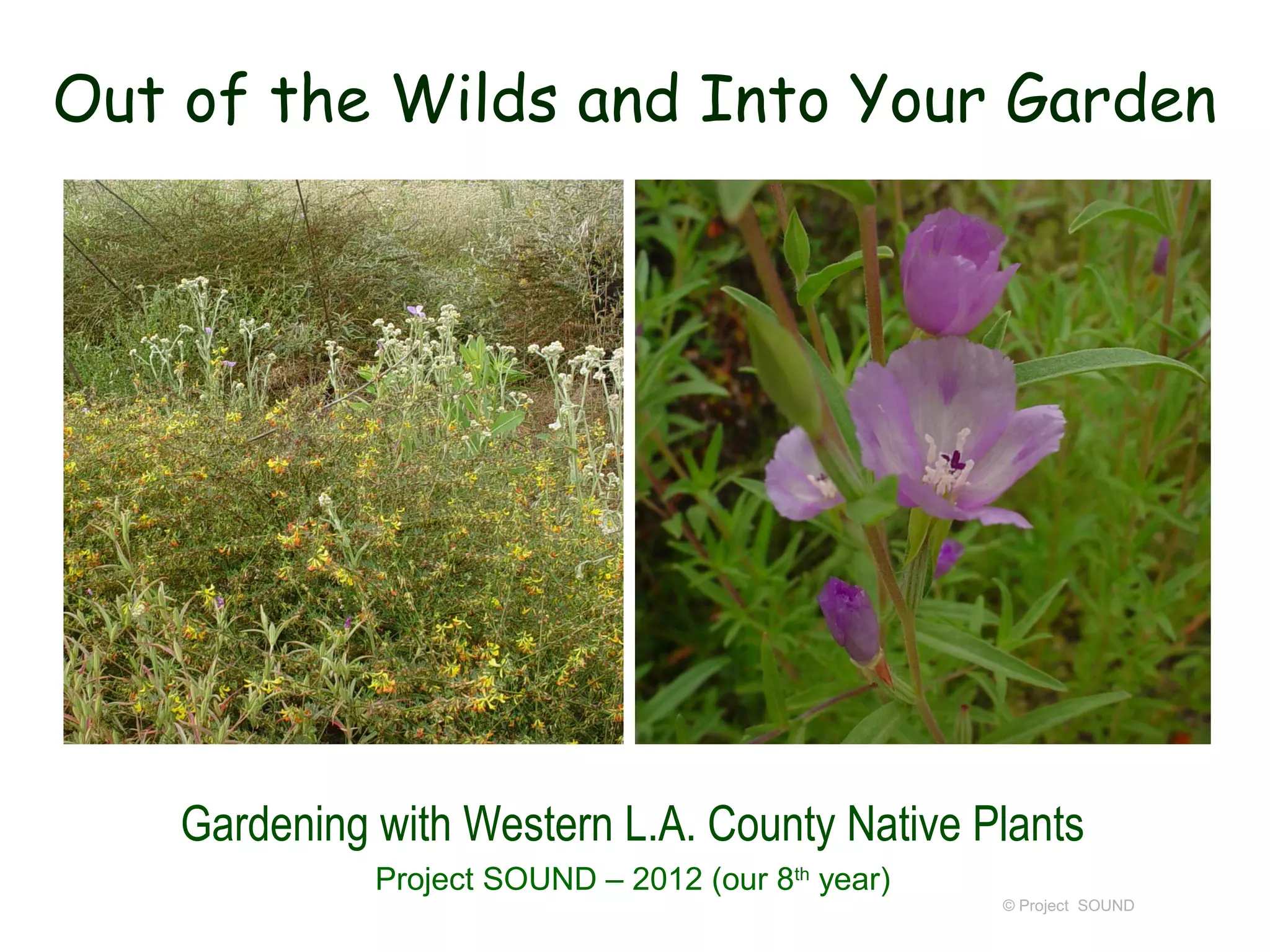
Out of the Wilds and Into Your Garden


    Gardening with Western L.A. County Native Plants
              Project SOUND – 2012 (our 8th year)
                                                    © Project SOUND
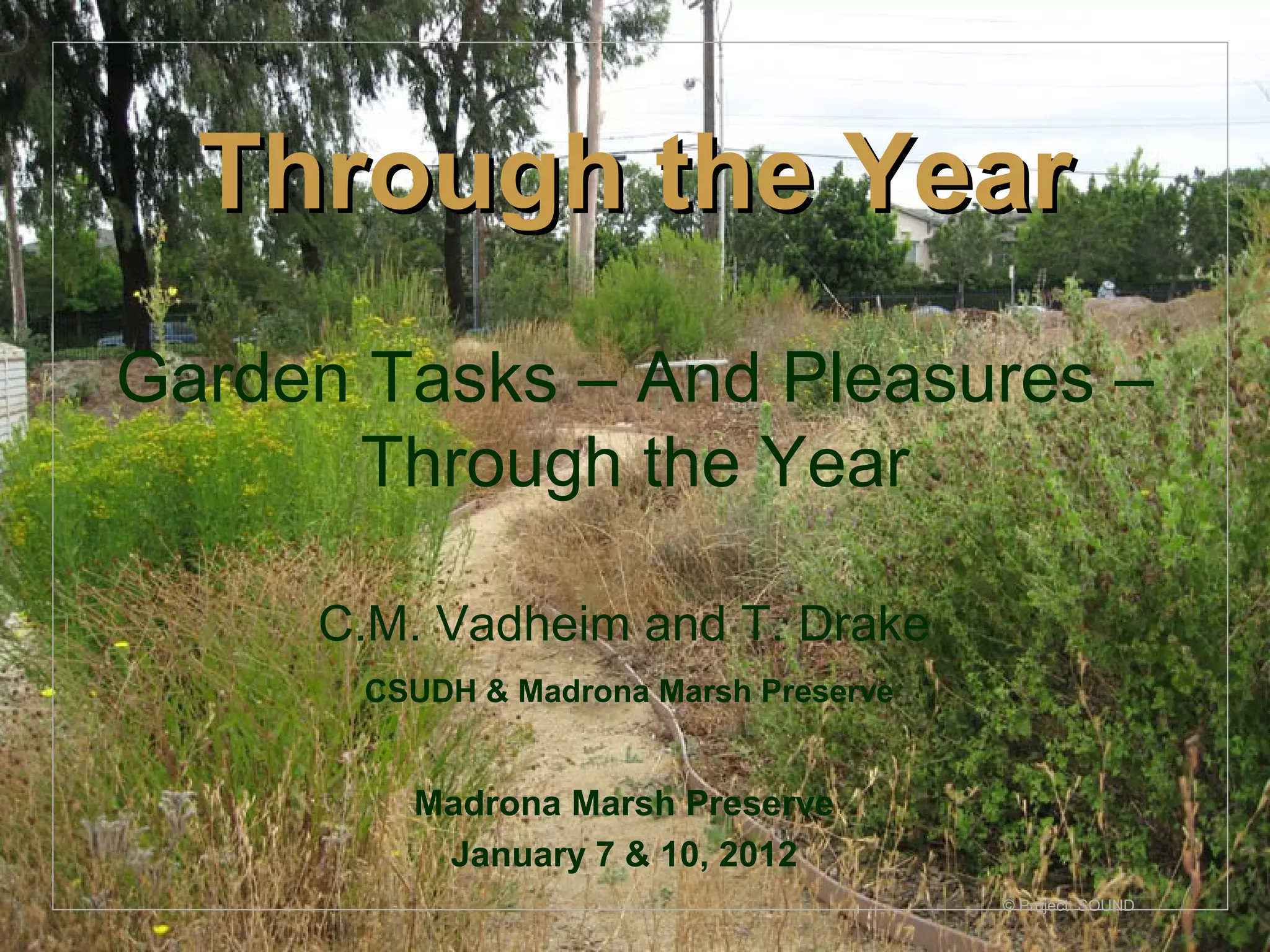
Through the Year
Garden Tasks – And Pleasures –
       Through the Year

     C.M. Vadheim and T. Drake
       CSUDH & Madrona Marsh Preserve


         Madrona Marsh Preserve
          January 7 & 10, 2012
                                        © Project SOUND
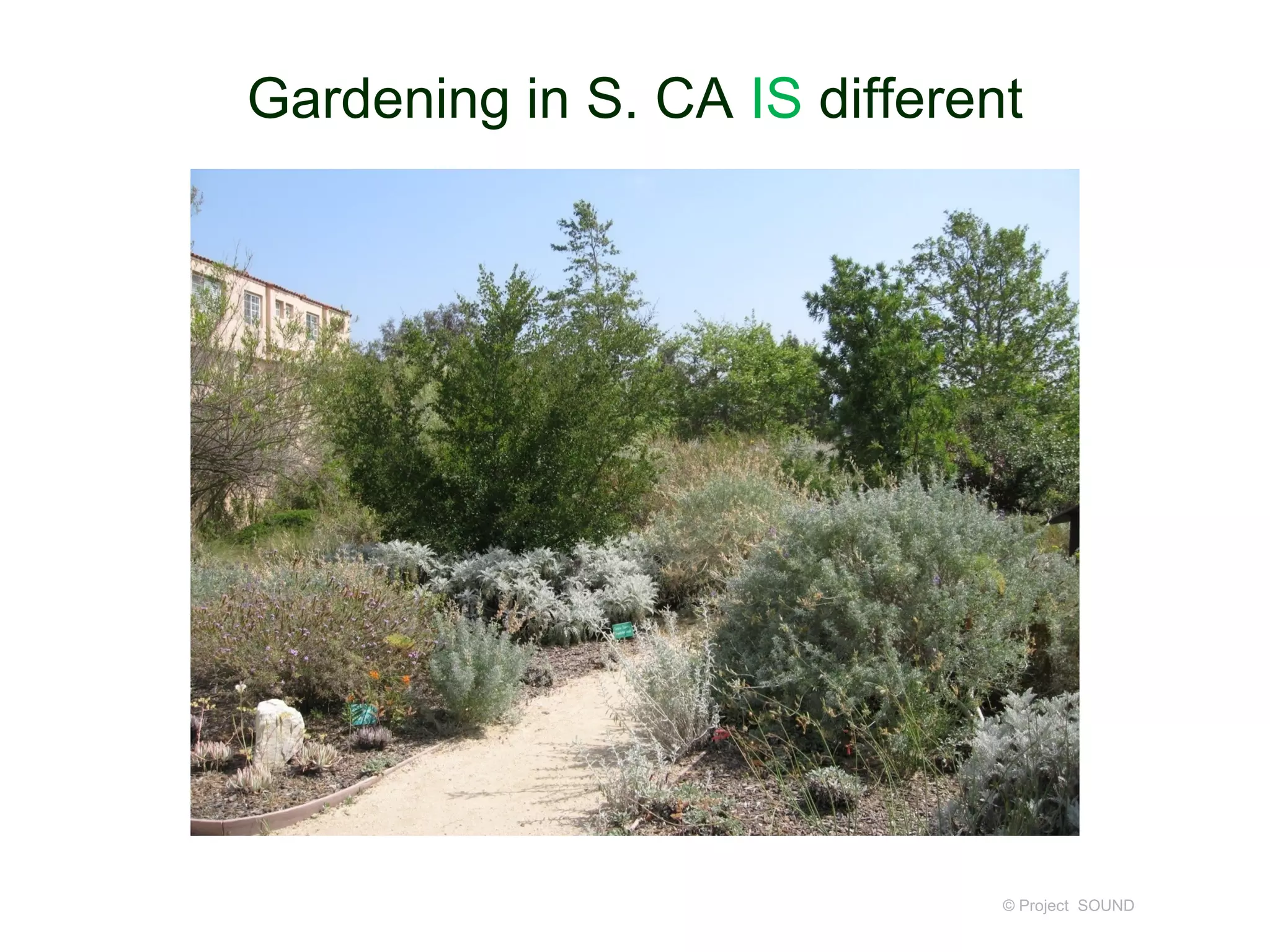
Gardening in S. CA IS different


                              © Project SOUND
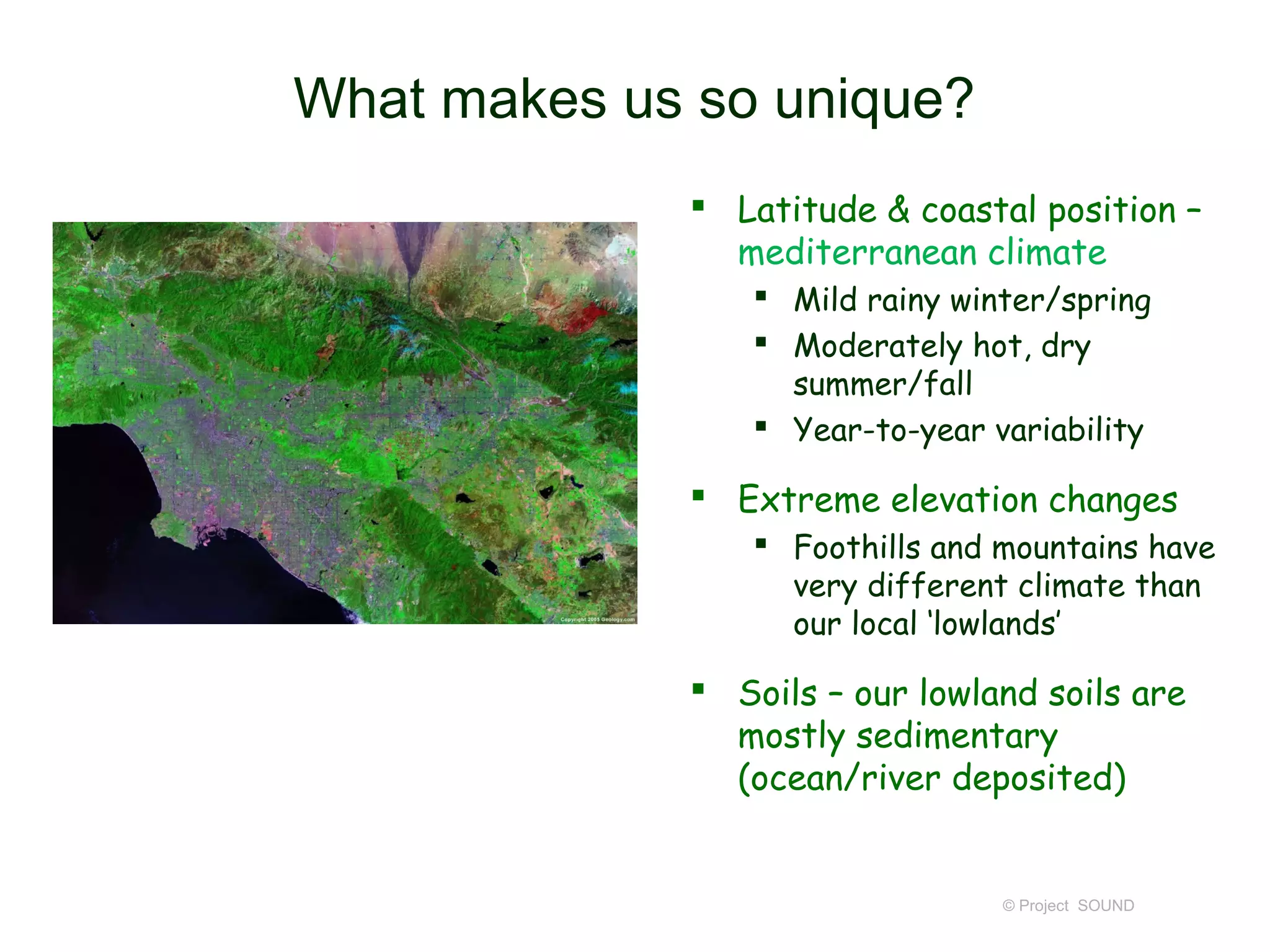
What makes us so unique?
              Latitude & coastal position –
               mediterranean climate
                 Mild rainy winter/spring
                 Moderately hot, dry
                  summer/fall
                 Year-to-year variability

              Extreme elevation changes
                 Foothills and mountains have
                  very different climate than
                  our local ‘lowlands’

              Soils – our lowland soils are
               mostly sedimentary
               (ocean/river deposited)


                                © Project SOUND
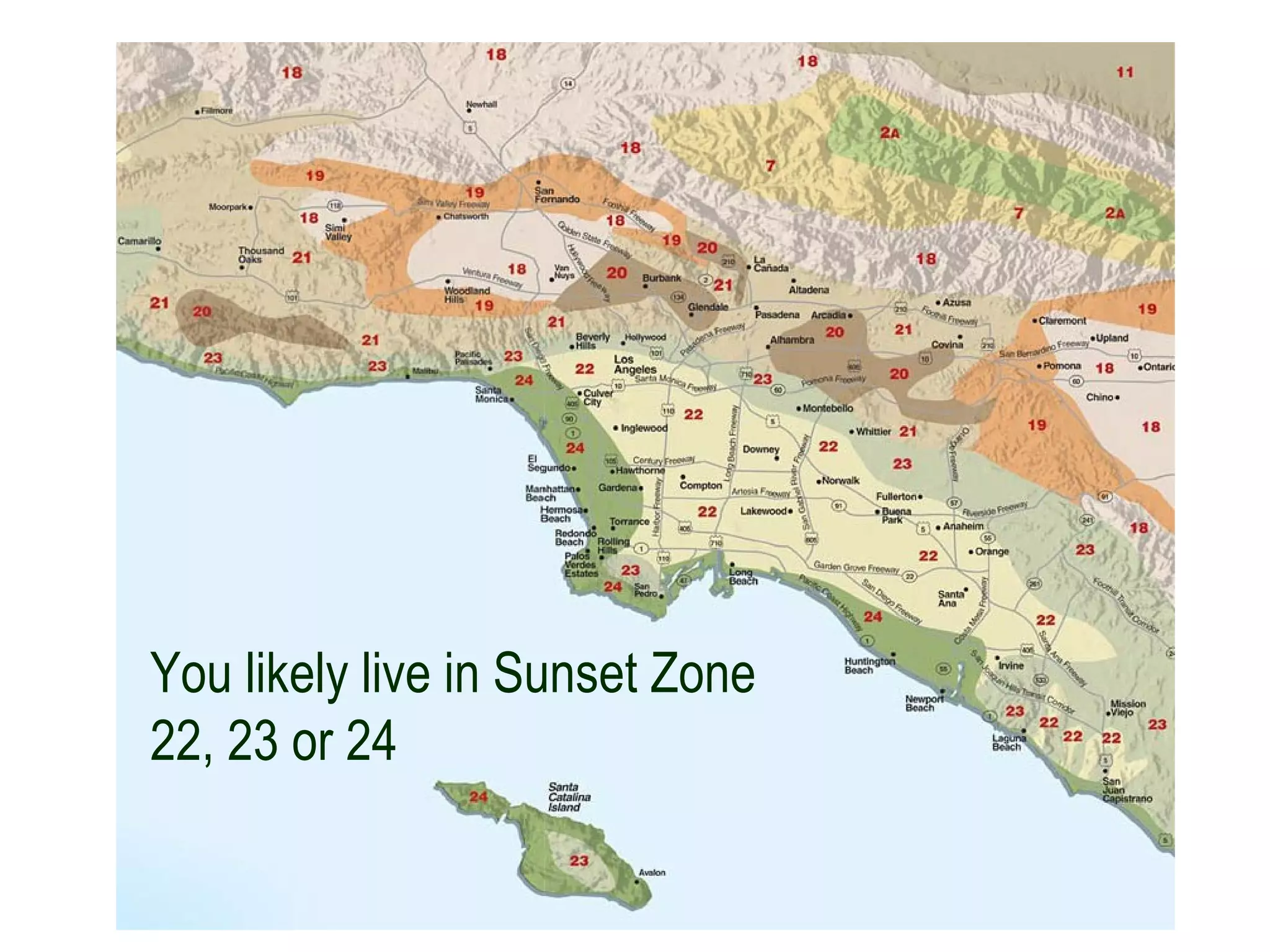
You likely live in Sunset Zone
22, 23 or 24

  http://www.sunset.com/garden/climate-zones/sunset-climate-zone-los-angeles-area-00418000067298/
                                                                                                    © Project SOUND
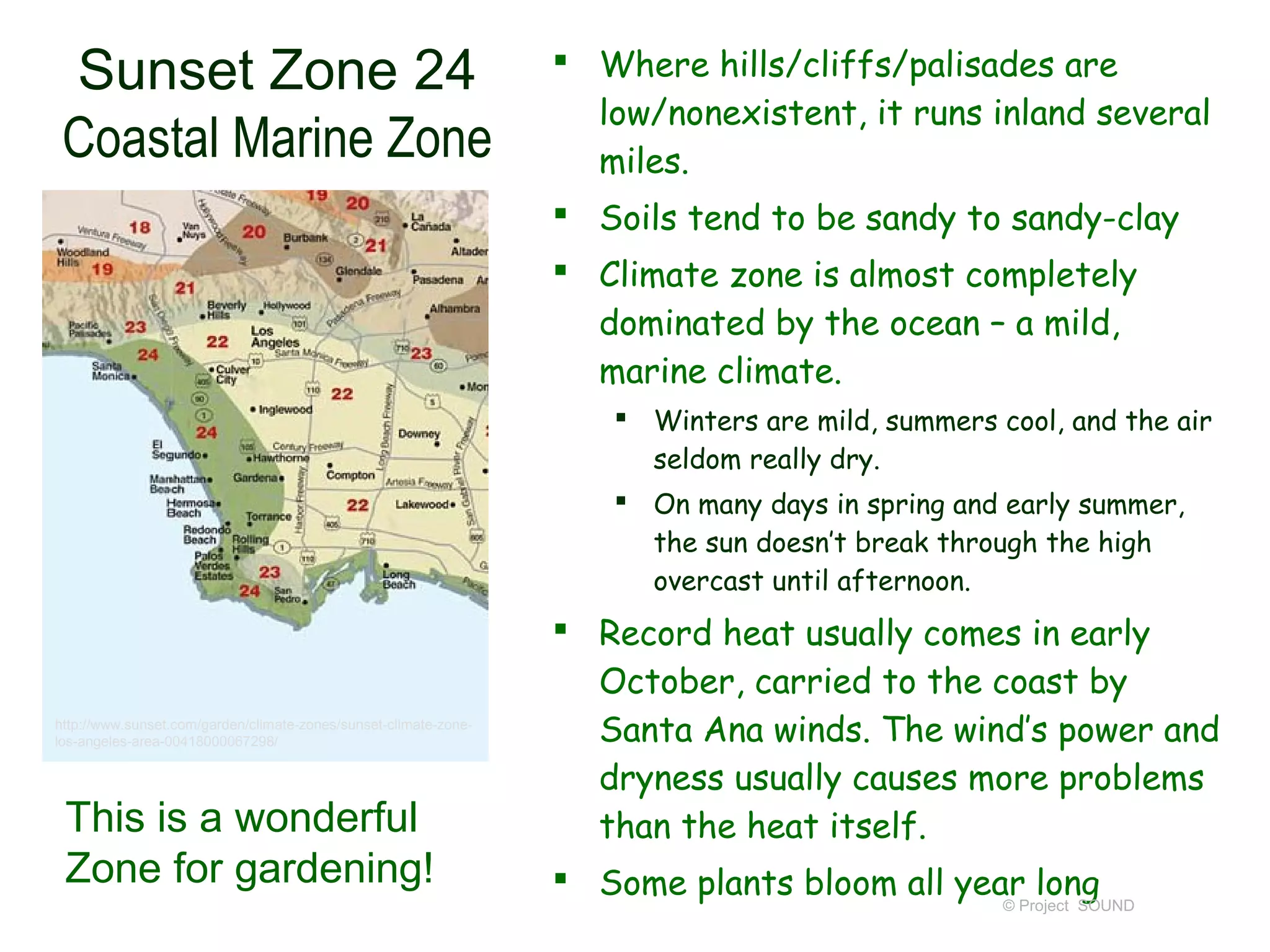
Sunset Zone 24                                                    Where hills/cliffs/palisades are
                                                                    low/nonexistent, it runs inland several
 Coastal Marine Zone                                                miles.
                                                                   Soils tend to be sandy to sandy-clay
                                                                   Climate zone is almost completely
                                                                    dominated by the ocean – a mild,
                                                                    marine climate.
                                                                       Winters are mild, summers cool, and the air
                                                                        seldom really dry.
                                                                       On many days in spring and early summer,
                                                                        the sun doesn’t break through the high
                                                                        overcast until afternoon.
                                                                   Record heat usually comes in early
                                                                    October, carried to the coast by
http://www.sunset.com/garden/climate-zones/sunset-climate-zone-
los-angeles-area-00418000067298/                                    Santa Ana winds. The wind’s power and
                                                                    dryness usually causes more problems
 This is a wonderful                                                than the heat itself.
 Zone for gardening!                                               Some plants bloom all year long
                                                                                             © Project SOUND
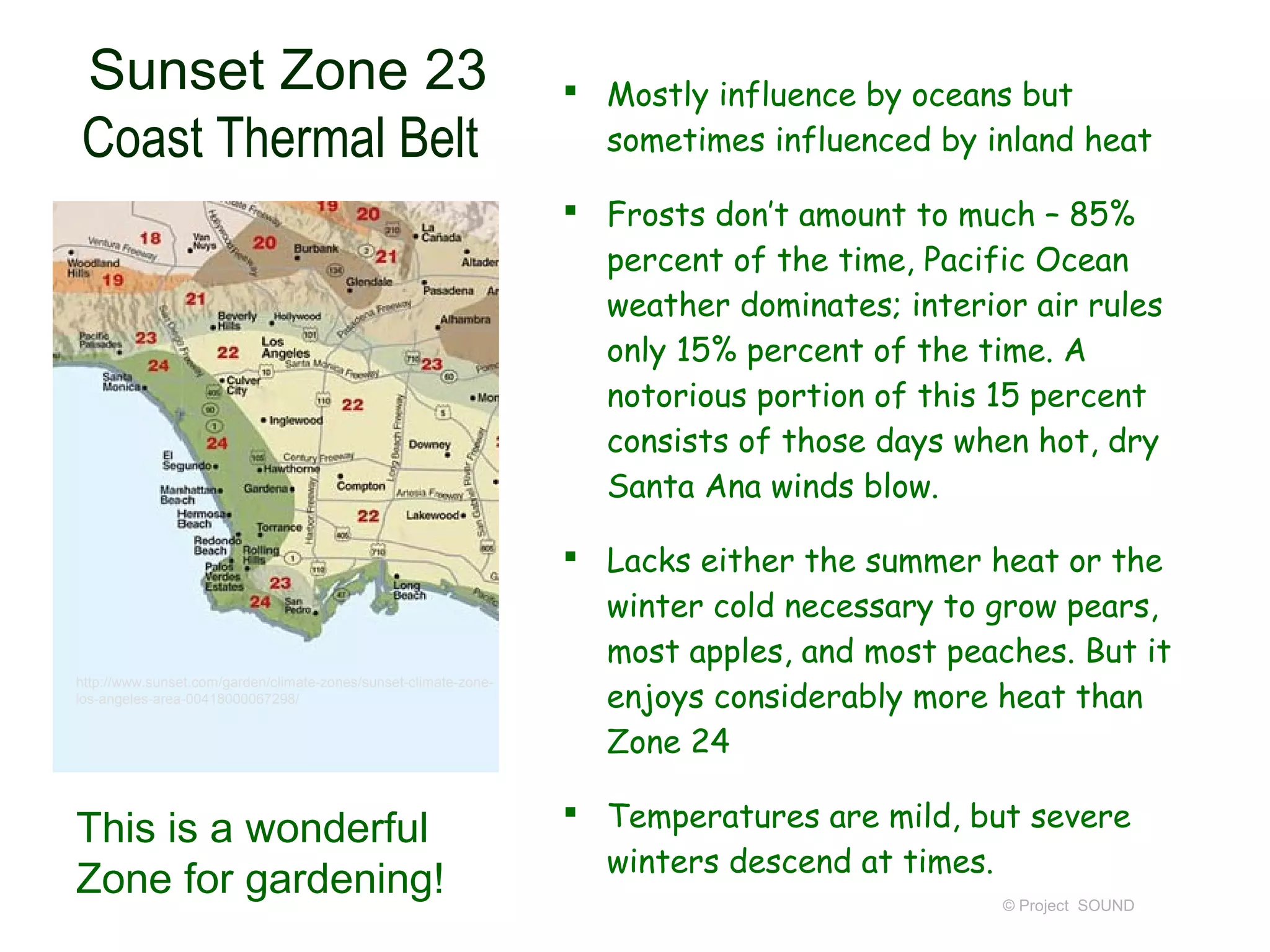
Sunset Zone 23                                                     Mostly influence by oceans but
Coast Thermal Belt                                                  sometimes influenced by inland heat

                                                                   Frosts don’t amount to much – 85%
                                                                    percent of the time, Pacific Ocean
                                                                    weather dominates; interior air rules
                                                                    only 15% percent of the time. A
                                                                    notorious portion of this 15 percent
                                                                    consists of those days when hot, dry
                                                                    Santa Ana winds blow.

                                                                   Lacks either the summer heat or the
                                                                    winter cold necessary to grow pears,
                                                                    most apples, and most peaches. But it
                                                                    enjoys considerably more heat than
http://www.sunset.com/garden/climate-zones/sunset-climate-zone-
los-angeles-area-00418000067298/


                                                                    Zone 24

                                                                   Temperatures are mild, but severe
This is a wonderful
                                                                    winters descend at times.
Zone for gardening!                                                                           © Project SOUND
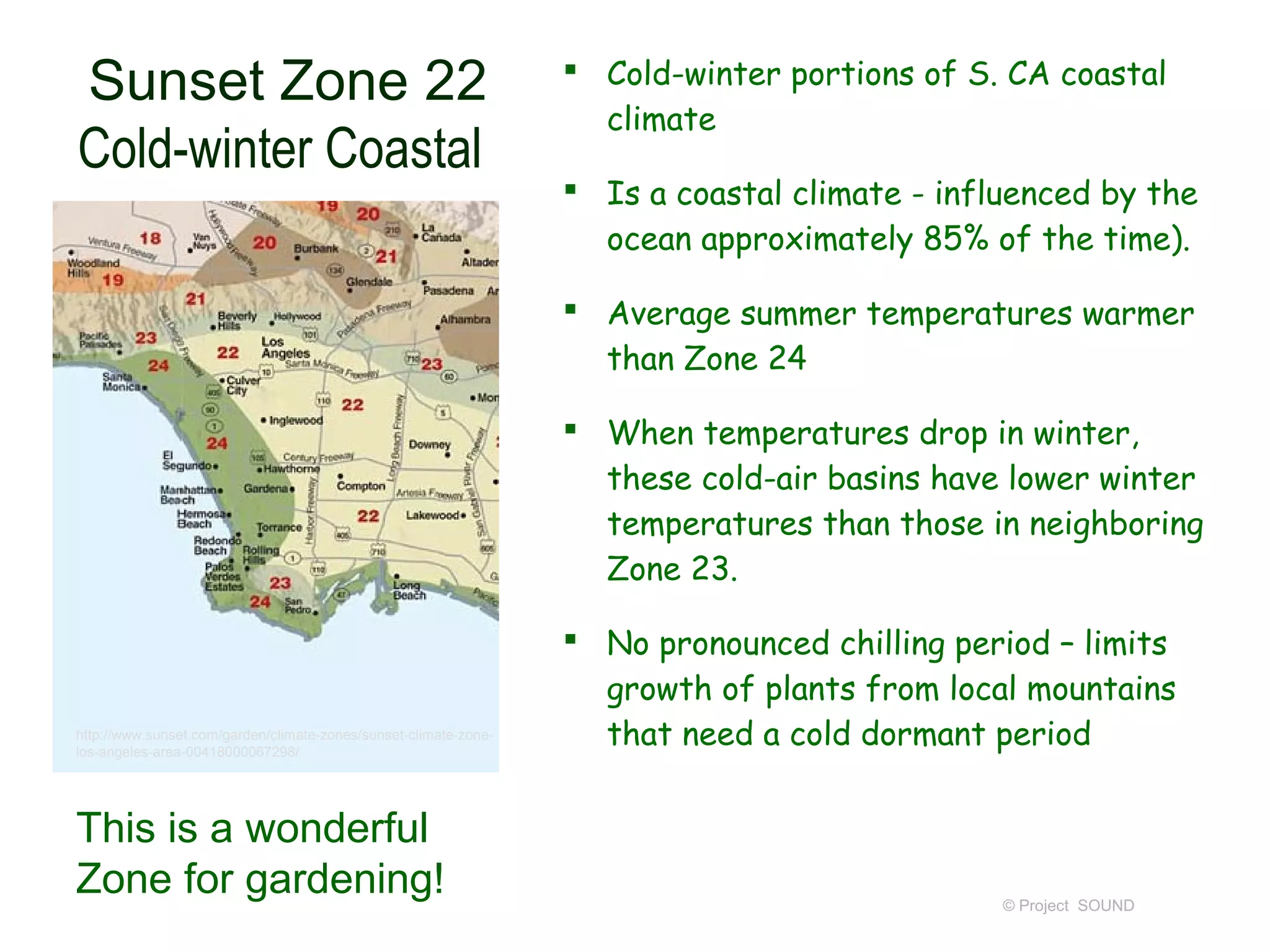
 Cold-winter portions of S. CA coastal
Sunset Zone 22
                                                                    climate
Cold-winter Coastal
                                                                   Is a coastal climate - influenced by the
                                                                    ocean approximately 85% of the time).

                                                                   Average summer temperatures warmer
                                                                    than Zone 24

                                                                   When temperatures drop in winter,
                                                                    these cold-air basins have lower winter
                                                                    temperatures than those in neighboring
                                                                    Zone 23.

                                                                   No pronounced chilling period – limits
                                                                    growth of plants from local mountains
http://www.sunset.com/garden/climate-zones/sunset-climate-zone-
los-angeles-area-00418000067298/
                                                                    that need a cold dormant period


This is a wonderful
Zone for gardening!                                                                            © Project SOUND
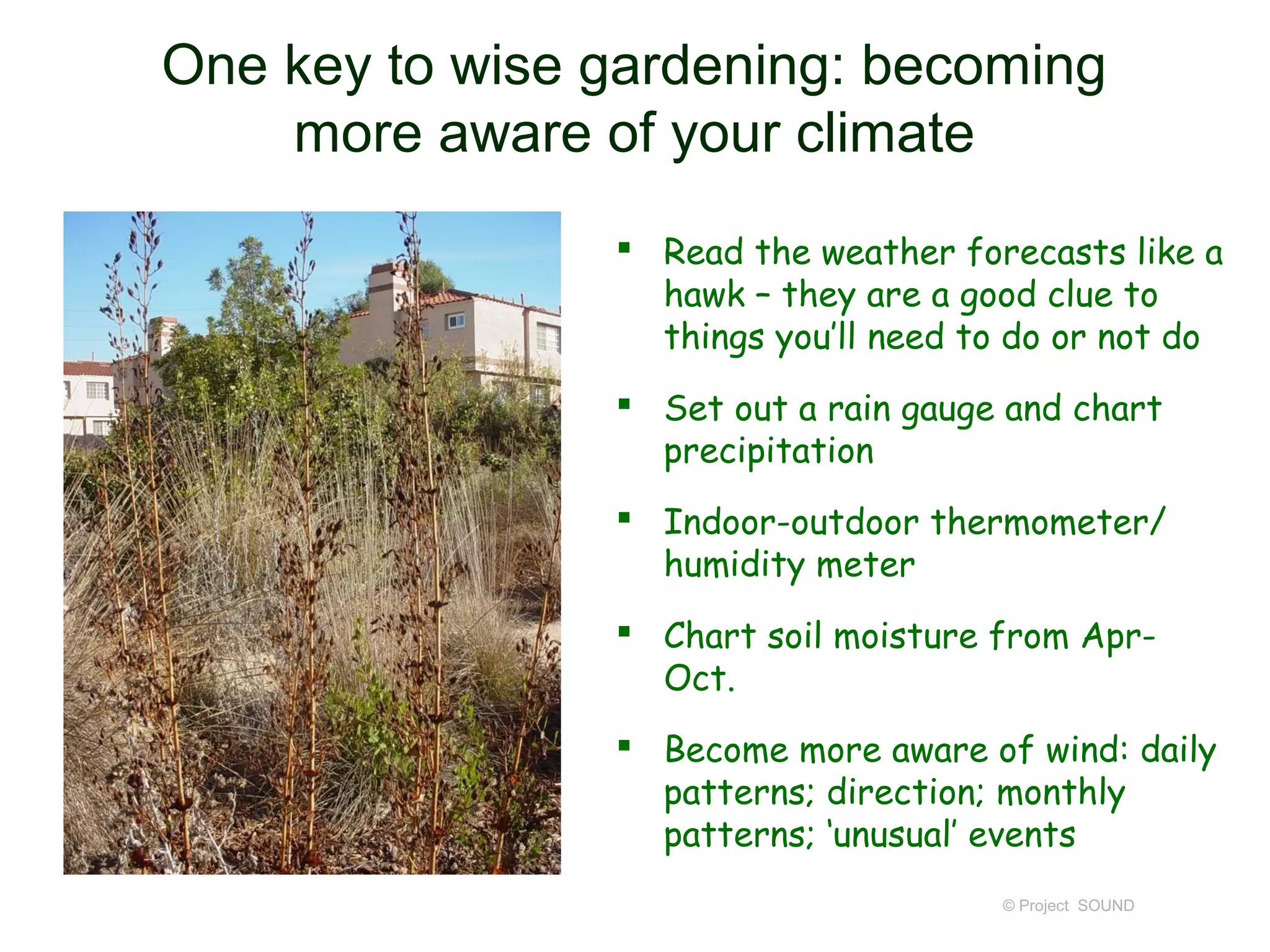
One key to wise gardening: becoming
    more aware of your climate
                 Read the weather forecasts like a
                  hawk – they are a good clue to
                  things you’ll need to do or not do
                 Set out a rain gauge and chart
                  precipitation
                 Indoor-outdoor thermometer/
                  humidity meter
                 Chart soil moisture from Apr-
                  Oct.
                 Become more aware of wind: daily
                  patterns; direction; monthly
                  patterns; ‘unusual’ events
                                      © Project SOUND
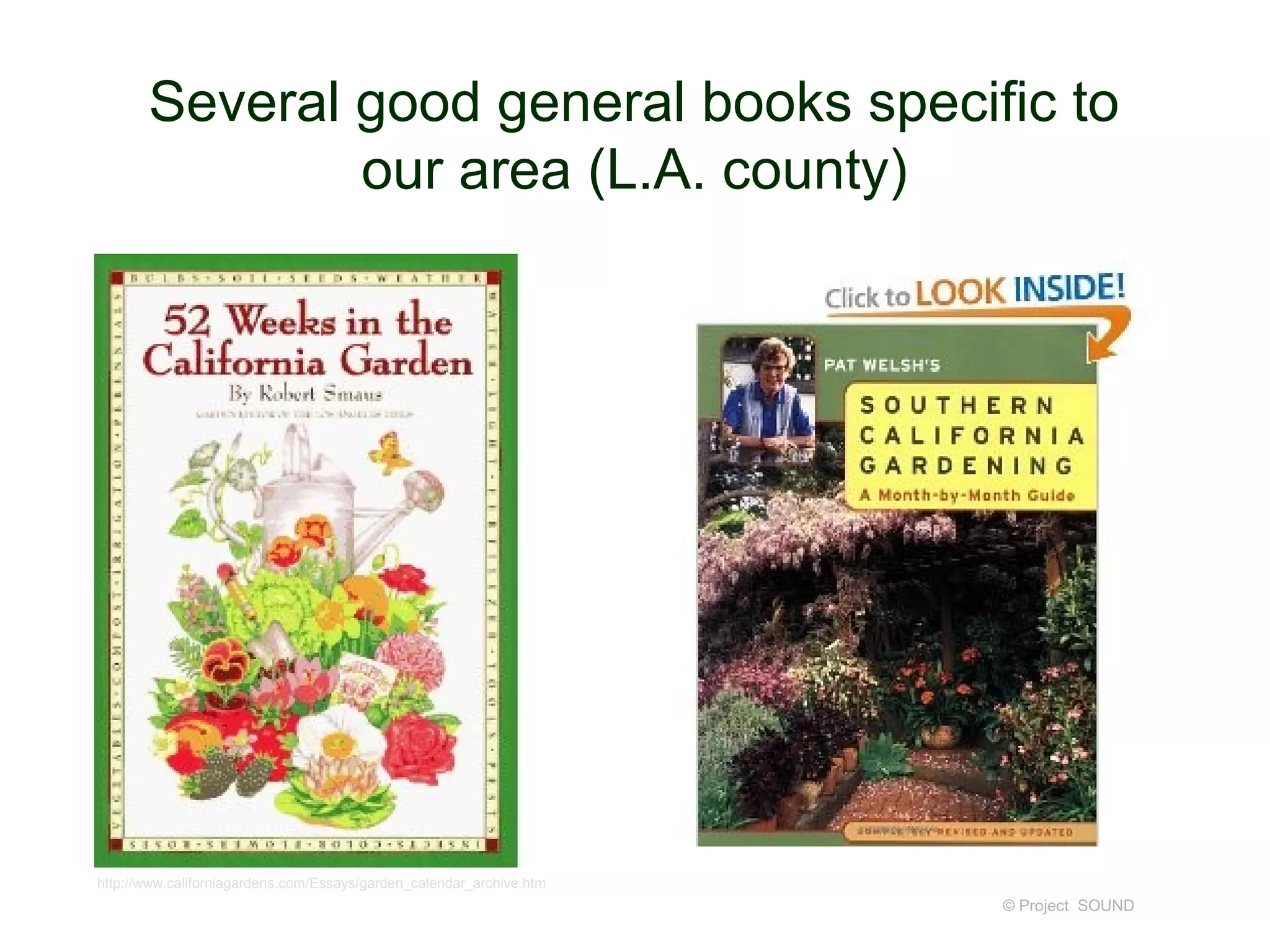
Several good general books specific to
               our area (L.A. county)


http://www.californiagardens.com/Essays/garden_calendar_archive.htm
                                                                      © Project SOUND
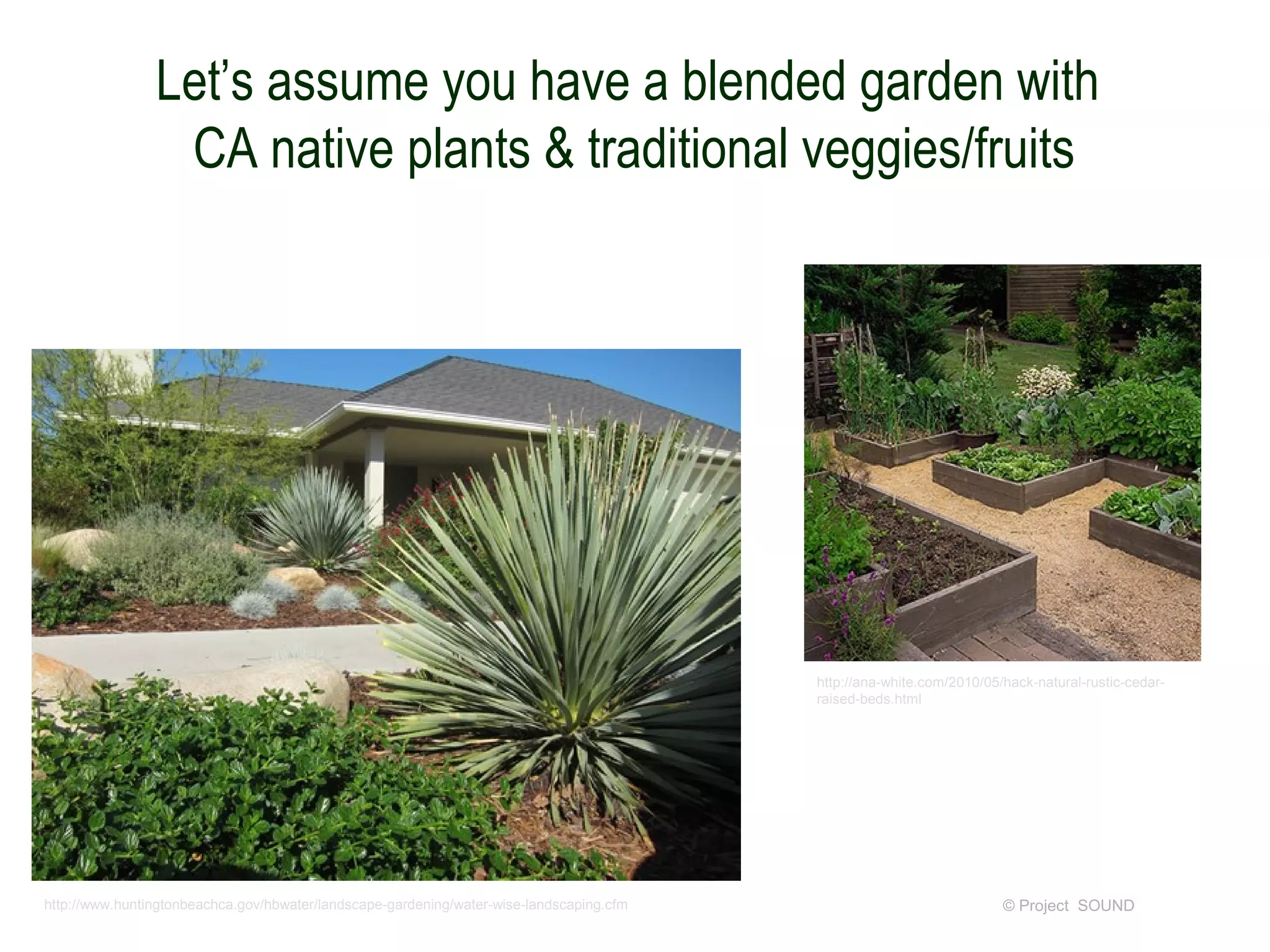
Let’s assume you have a blended garden with
                 CA native plants & traditional veggies/fruits


                                                                                          http://ana-white.com/2010/05/hack-natural-rustic-cedar-
                                                                                          raised-beds.html


http://www.huntingtonbeachca.gov/hbwater/landscape-gardening/water-wise-landscaping.cfm                                © Project SOUND
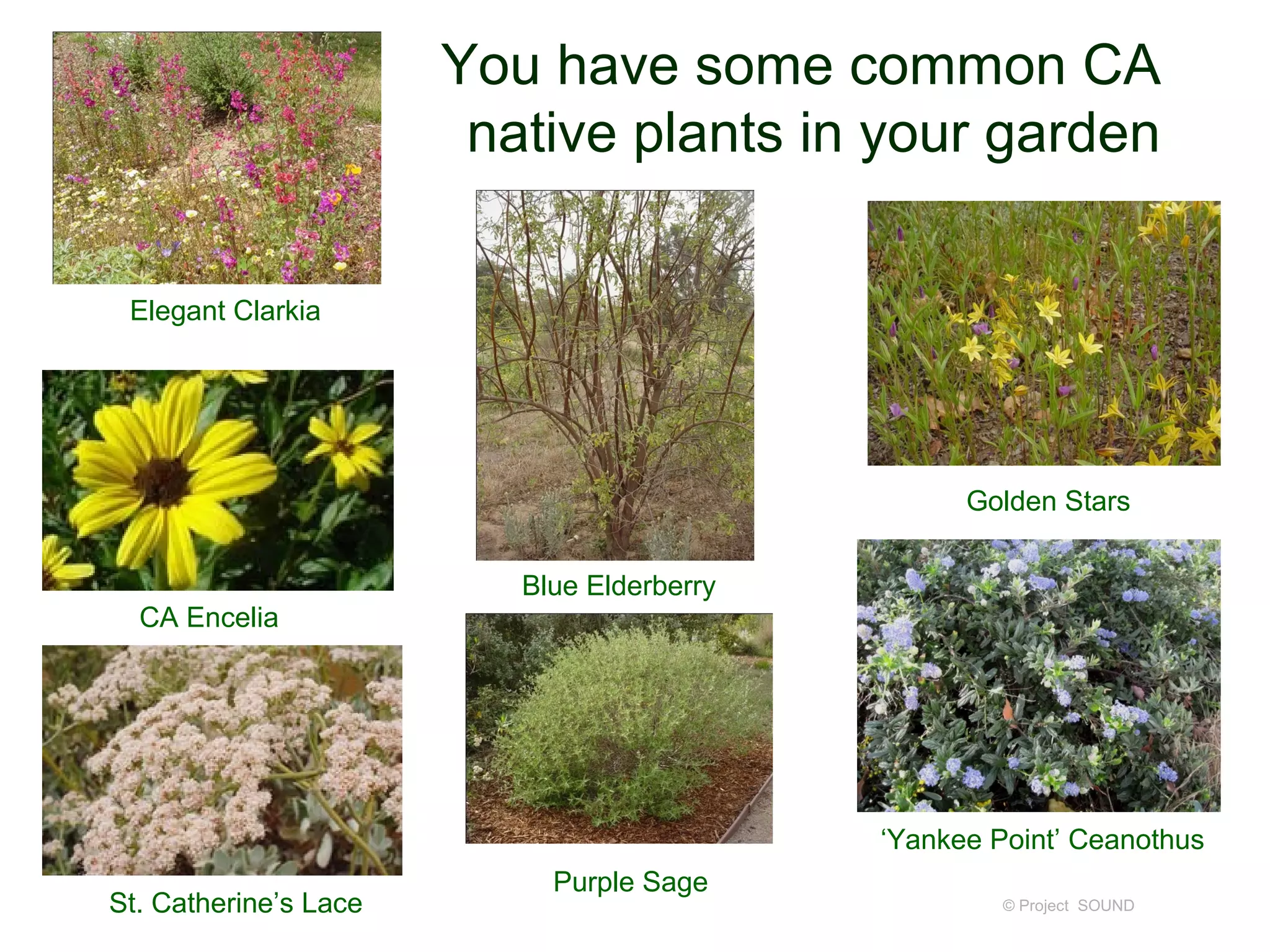
You have some common CA
                        native plants in your garden

 Elegant Clarkia


                                                  Golden Stars


                          Blue Elderberry
  CA Encelia


                                            ‘Yankee Point’ Ceanothus
                            Purple Sage
St. Catherine’s Lace                                 © Project SOUND
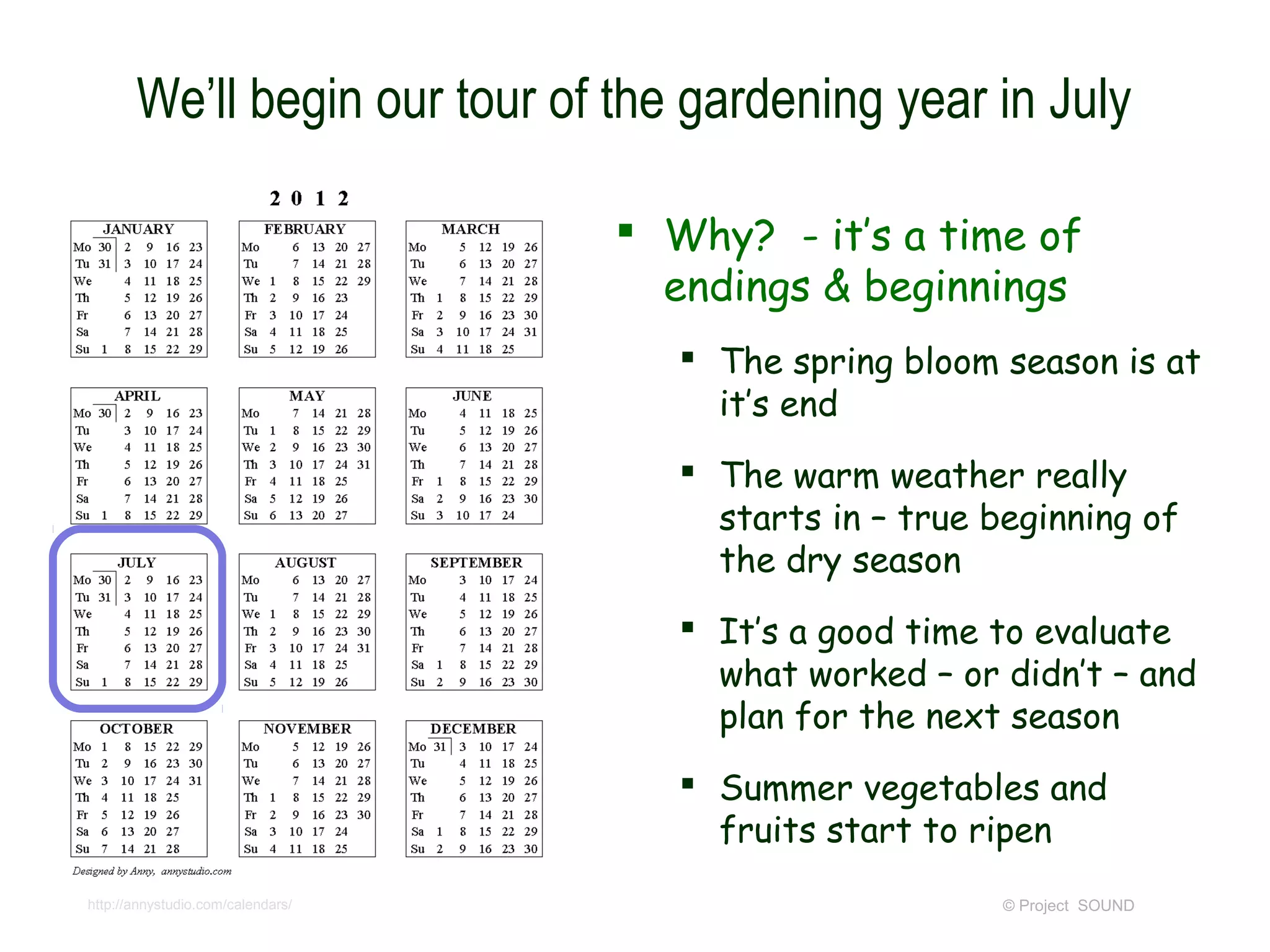
We’ll begin our tour of the gardening year in July

                                    Why? - it’s a time of
                                     endings & beginnings
                                       The spring bloom season is at
                                        it’s end
                                       The warm weather really
                                        starts in – true beginning of
                                        the dry season
                                       It’s a good time to evaluate
                                        what worked – or didn’t – and
                                        plan for the next season
                                       Summer vegetables and
                                        fruits start to ripen
http://annystudio.com/calendars/                          © Project SOUND
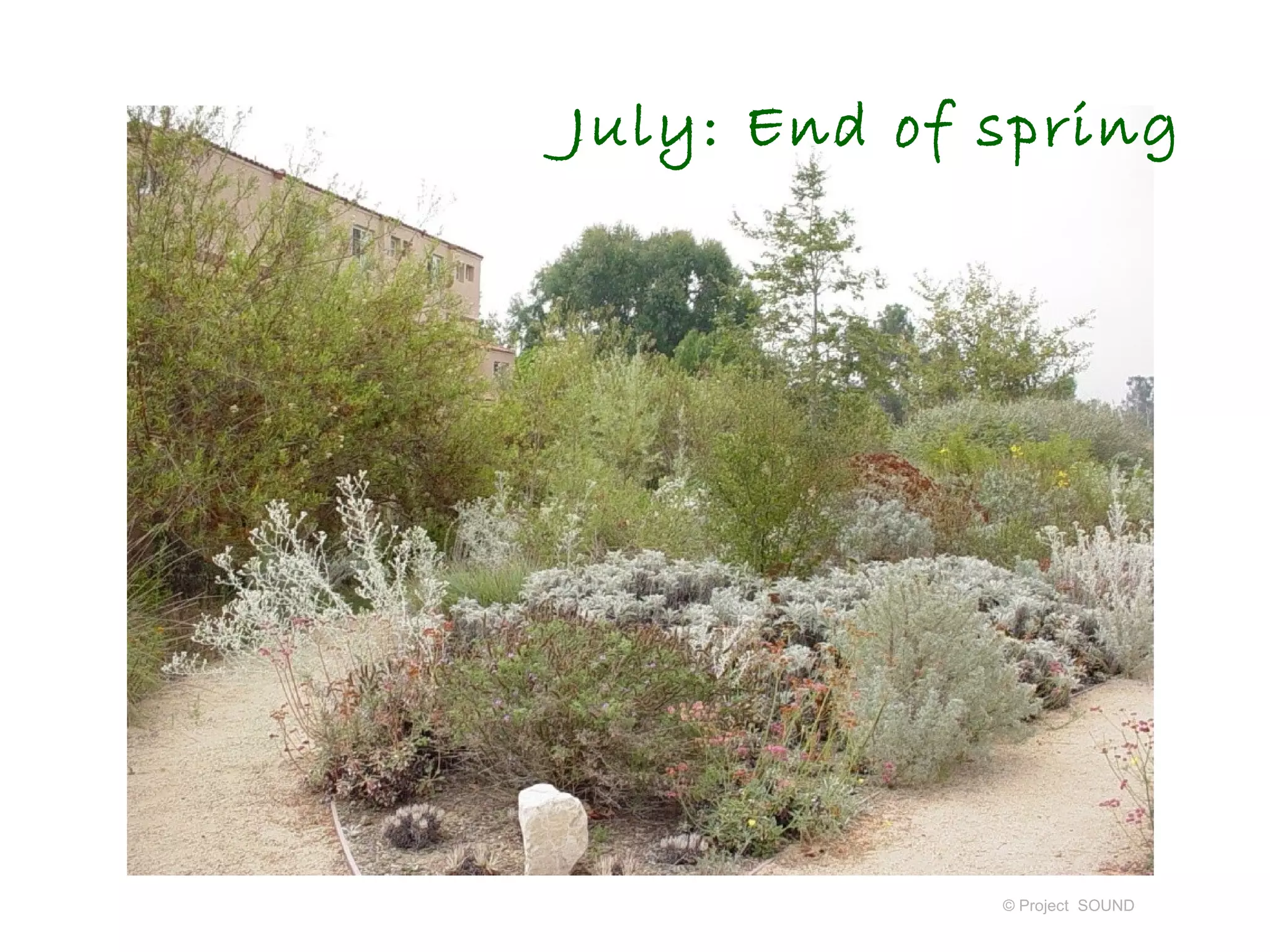
July: End of spring


             © Project SOUND
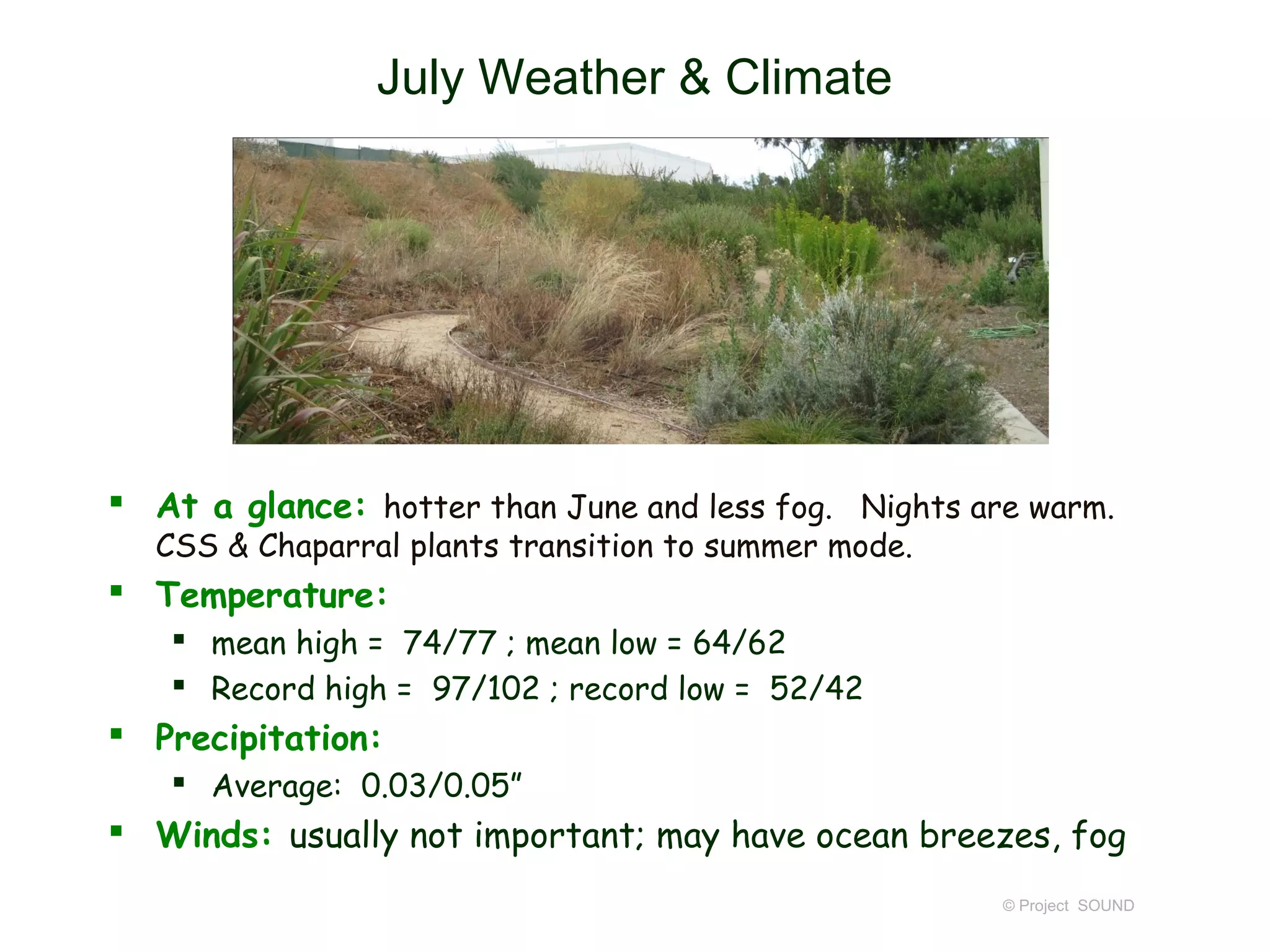
July Weather & Climate


 At a glance: hotter than June and less fog. Nights are warm.
  CSS & Chaparral plants transition to summer mode.
 Temperature:
    mean high = 74/77 ; mean low = 64/62
    Record high = 97/102 ; record low = 52/42
 Precipitation:
    Average: 0.03/0.05”
 Winds: usually not important; may have ocean breezes, fog
                                                       © Project SOUND
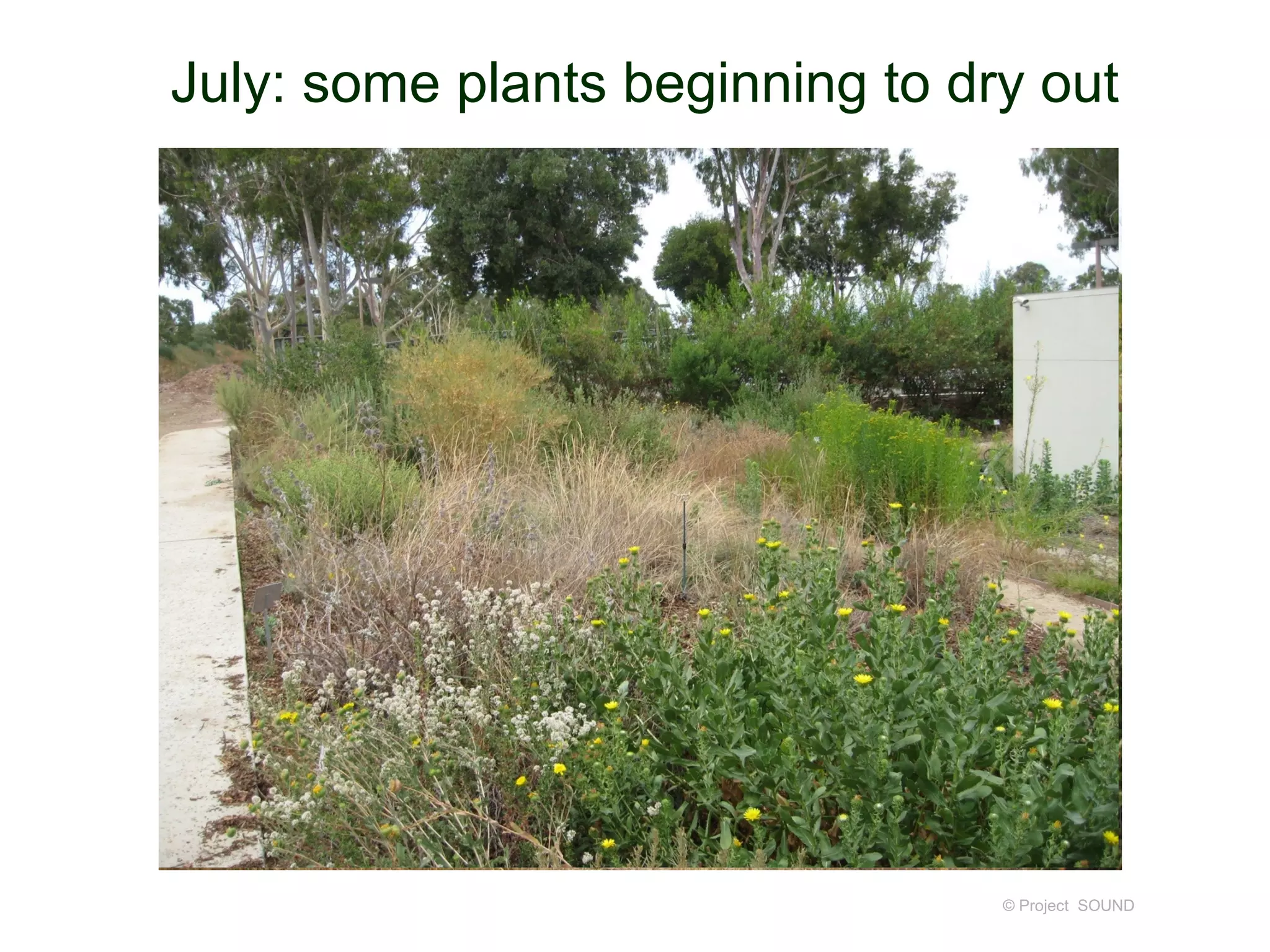
July: some plants beginning to dry out


                                 © Project SOUND
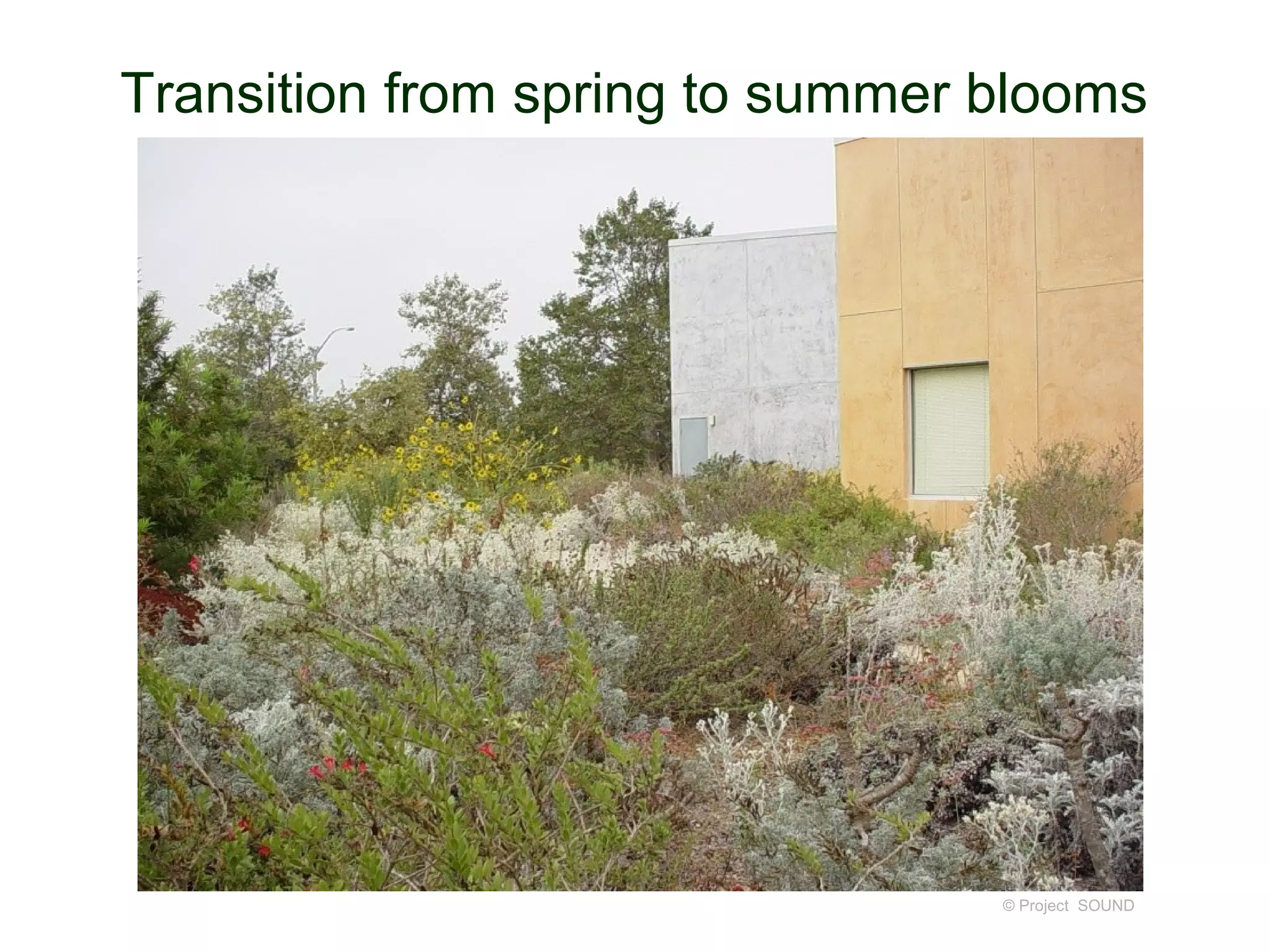
Transition from spring to summer blooms


                                 © Project SOUND
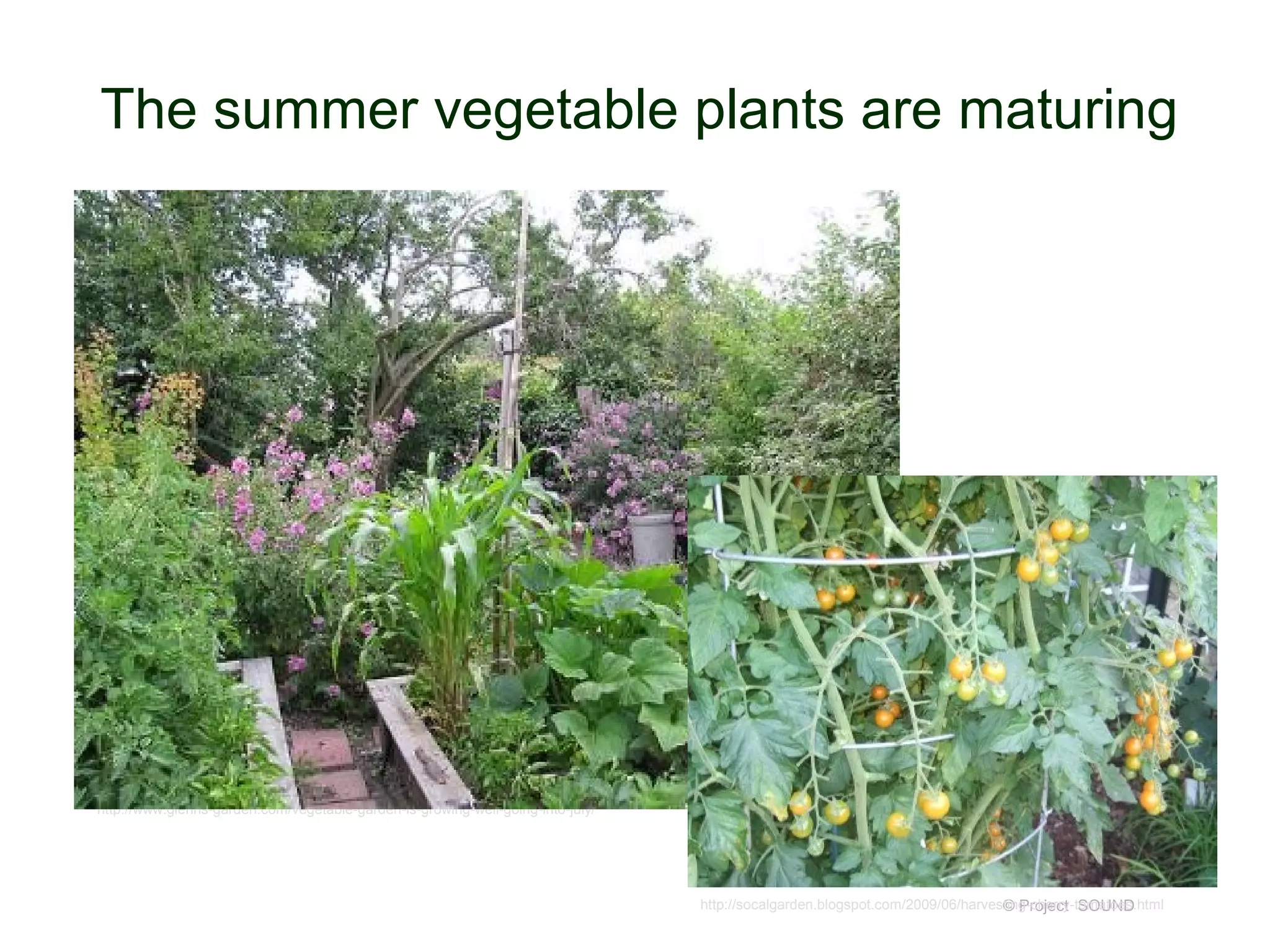
The summer vegetable plants are maturing


http://www.glenns-garden.com/vegetable-garden-is-growing-well-going-into-july/


                                                                                 http://socalgarden.blogspot.com/2009/06/harvesting-cherry-tomatoes.html
                                                                                                                               © Project SOUND
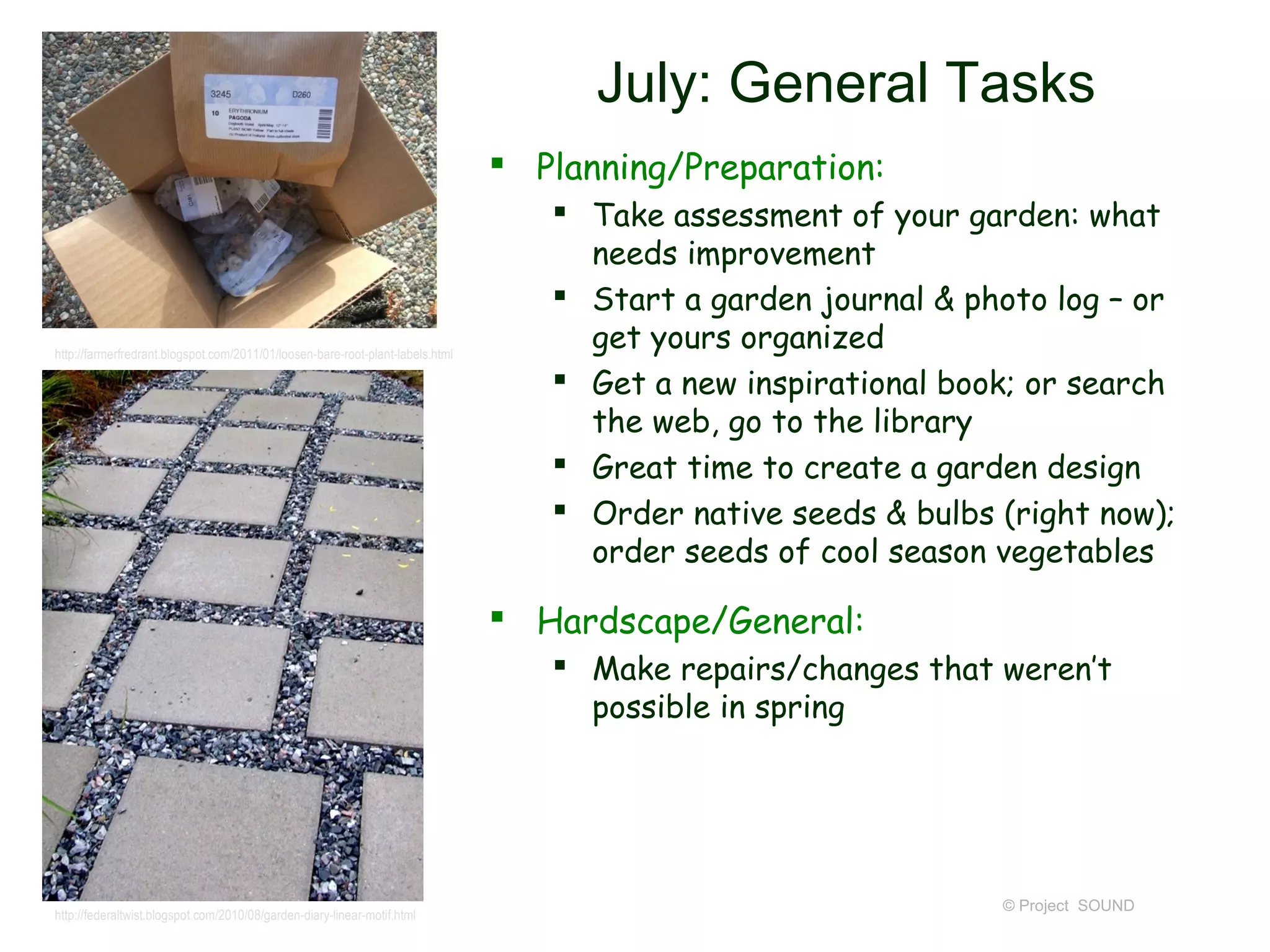
July: General Tasks
                                                                                 Planning/Preparation:
                                                                                    Take assessment of your garden: what
                                                                                     needs improvement
                                                                                    Start a garden journal & photo log – or
http://farmerfredrant.blogspot.com/2011/01/loosen-bare-root-plant-labels.html
                                                                                     get yours organized
                                                                                    Get a new inspirational book; or search
                                                                                     the web, go to the library
                                                                                    Great time to create a garden design
                                                                                    Order native seeds & bulbs (right now);
                                                                                     order seeds of cool season vegetables

                                                                                 Hardscape/General:
                                                                                    Make repairs/changes that weren’t
                                                                                     possible in spring


                                                                                                                © Project SOUND
http://federaltwist.blogspot.com/2010/08/garden-diary-linear-motif.html
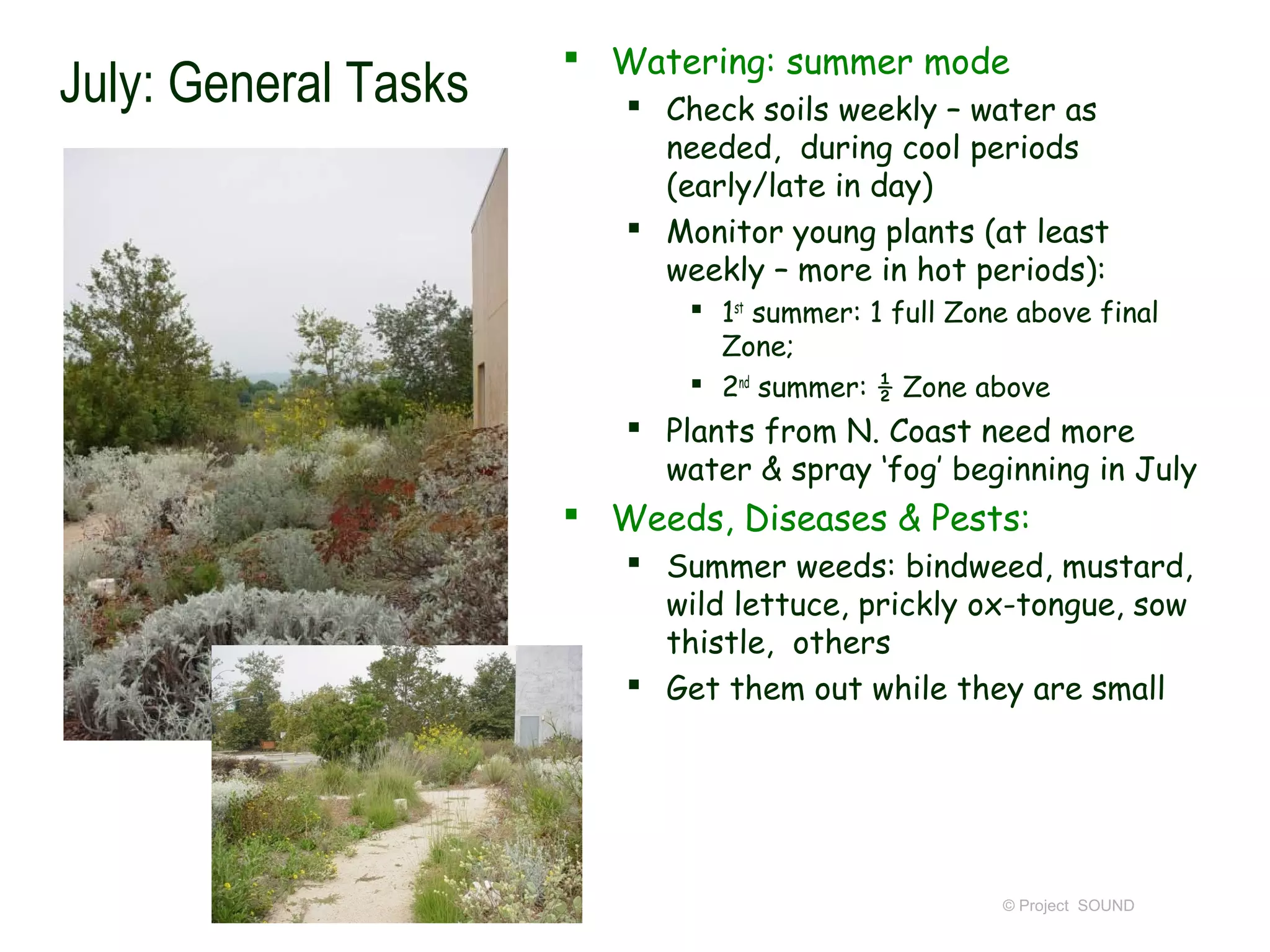
 Watering: summer mode
July: General Tasks       Check soils weekly – water as
                           needed, during cool periods
                           (early/late in day)
                          Monitor young plants (at least
                           weekly – more in hot periods):
                              1st summer: 1 full Zone above final
                               Zone;
                              2nd summer: ½ Zone above
                          Plants from N. Coast need more
                           water & spray ‘fog’ beginning in July
                       Weeds, Diseases & Pests:
                          Summer weeds: bindweed, mustard,
                           wild lettuce, prickly ox-tongue, sow
                           thistle, others
                          Get them out while they are small


                                                     © Project SOUND
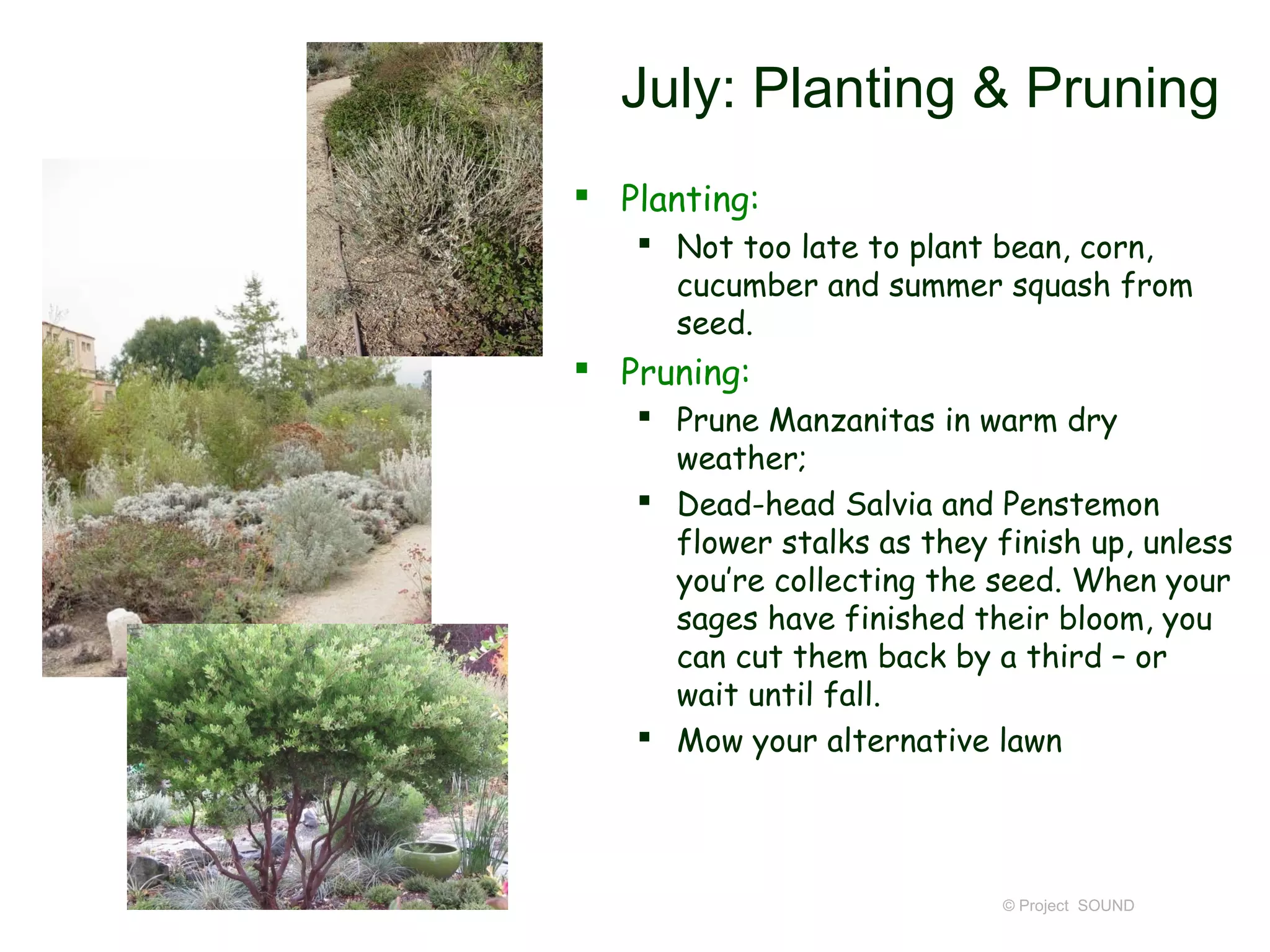
July: Planting & Pruning
 Planting:
    Not too late to plant bean, corn,
     cucumber and summer squash from
     seed.
 Pruning:
    Prune Manzanitas in warm dry
     weather;
    Dead-head Salvia and Penstemon
     flower stalks as they finish up, unless
     you’re collecting the seed. When your
     sages have finished their bloom, you
     can cut them back by a third – or
     wait until fall.
    Mow your alternative lawn


                            © Project SOUND
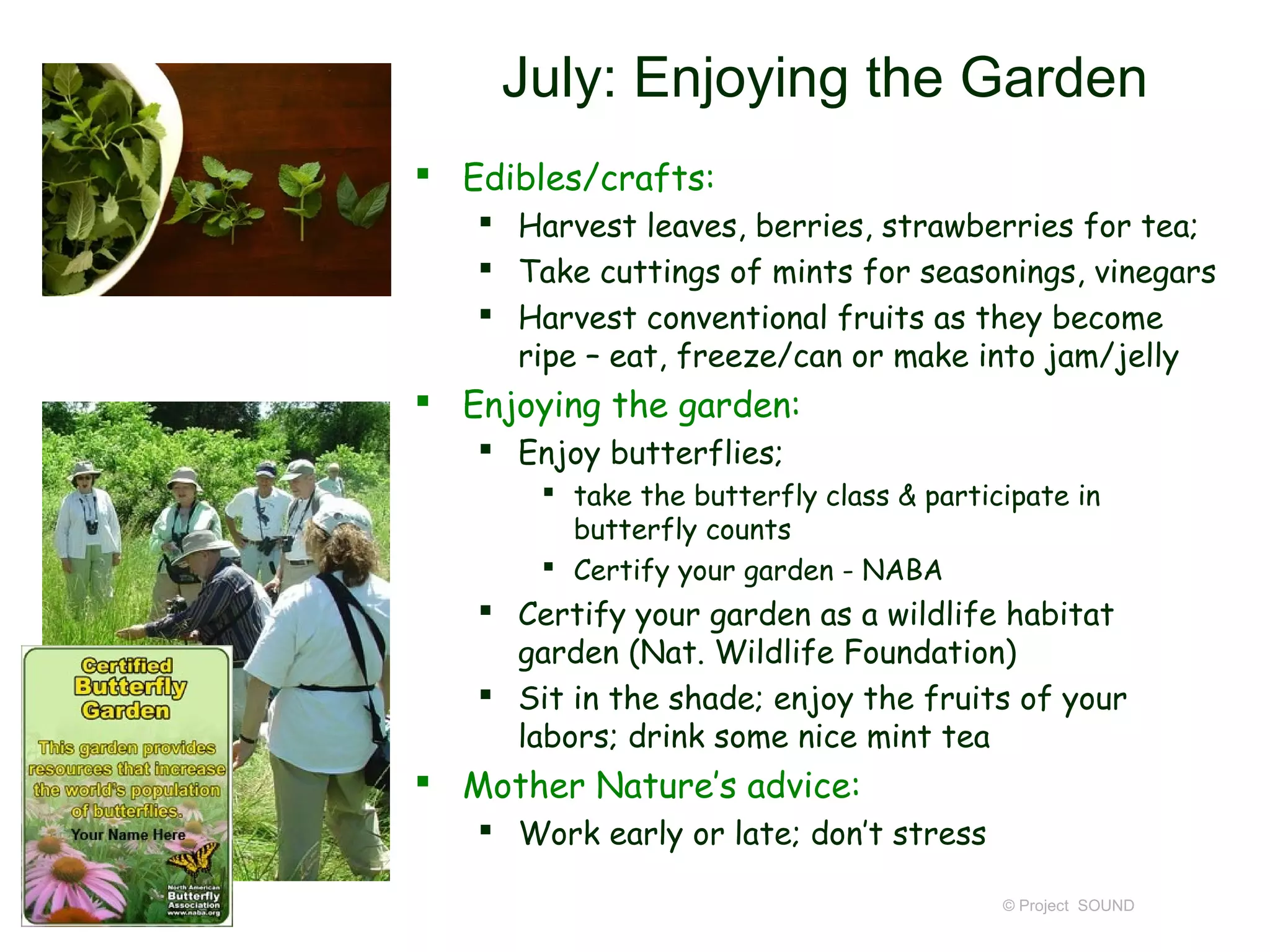
July: Enjoying the Garden
 Edibles/crafts:
    Harvest leaves, berries, strawberries for tea;
    Take cuttings of mints for seasonings, vinegars
    Harvest conventional fruits as they become
     ripe – eat, freeze/can or make into jam/jelly
 Enjoying the garden:
    Enjoy butterflies;
        take the butterfly class & participate in
         butterfly counts
        Certify your garden - NABA
    Certify your garden as a wildlife habitat
     garden (Nat. Wildlife Foundation)
    Sit in the shade; enjoy the fruits of your
     labors; drink some nice mint tea
 Mother Nature’s advice:
    Work early or late; don’t stress

                                          © Project SOUND
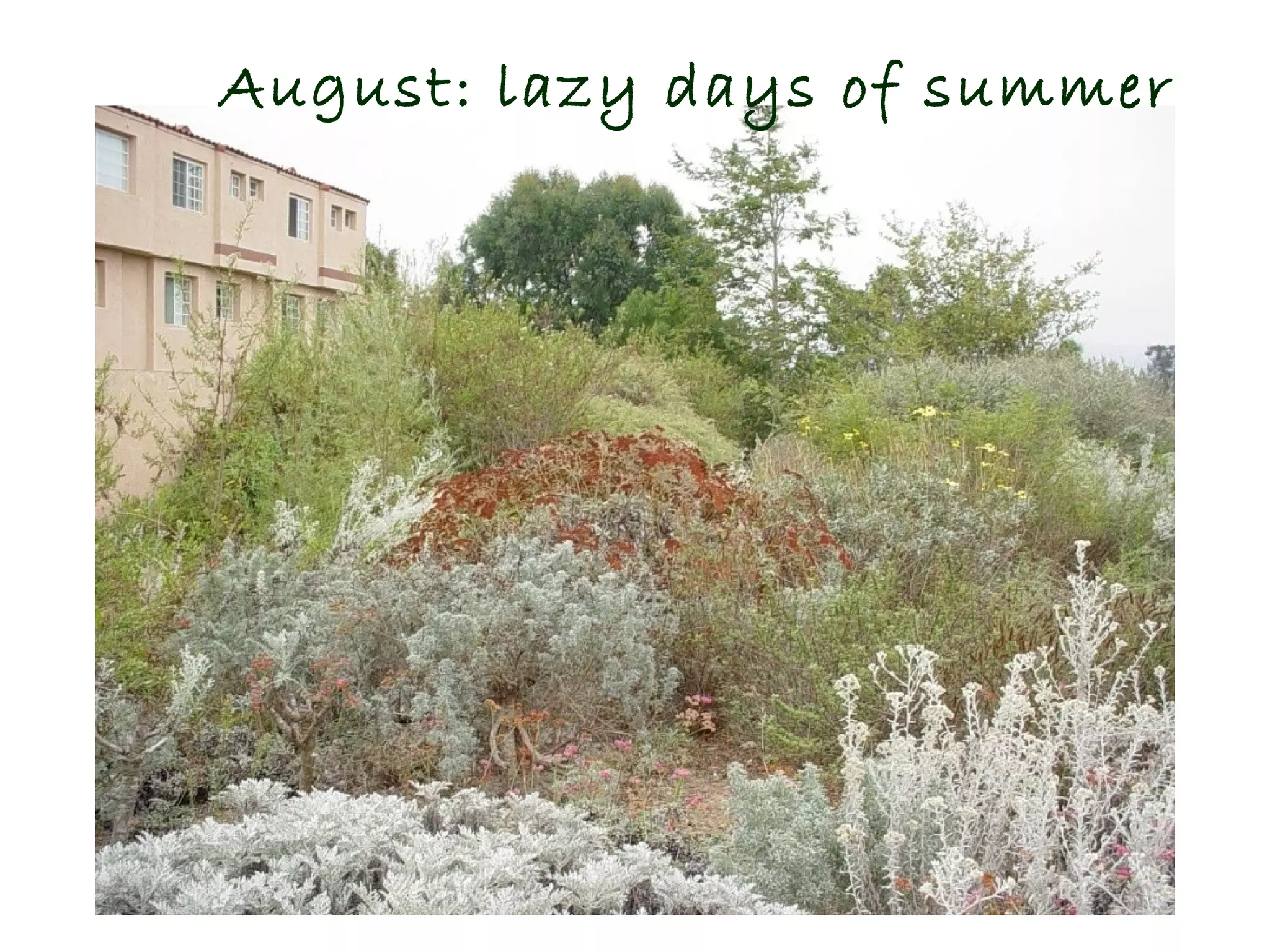
August: lazy days of summer


                      © Project SOUND
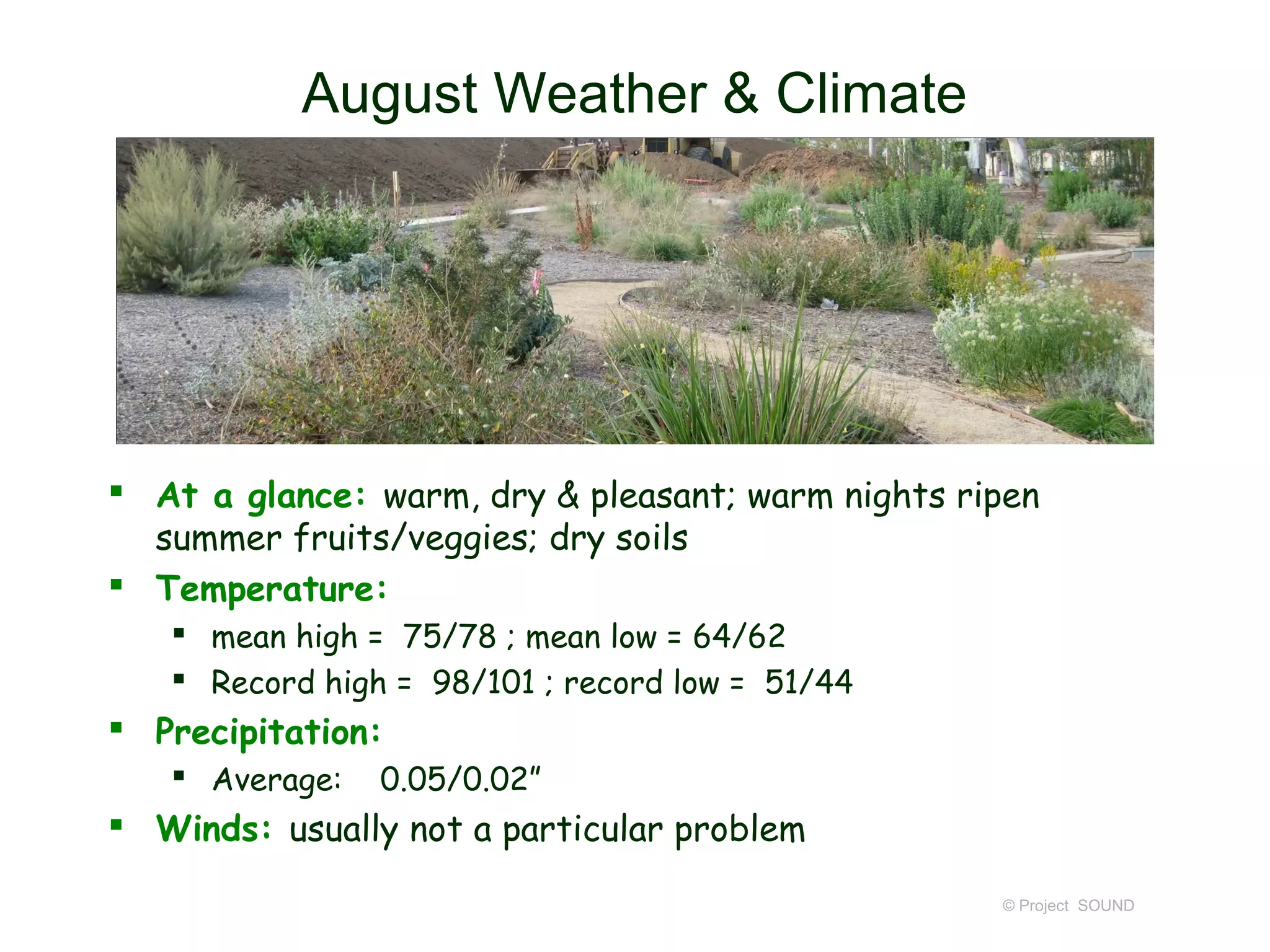
August Weather & Climate


 At a glance: warm, dry & pleasant; warm nights ripen
  summer fruits/veggies; dry soils
 Temperature:
    mean high = 75/78 ; mean low = 64/62
    Record high = 98/101 ; record low = 51/44
 Precipitation:
    Average:   0.05/0.02”
 Winds: usually not a particular problem

                                                   © Project SOUND
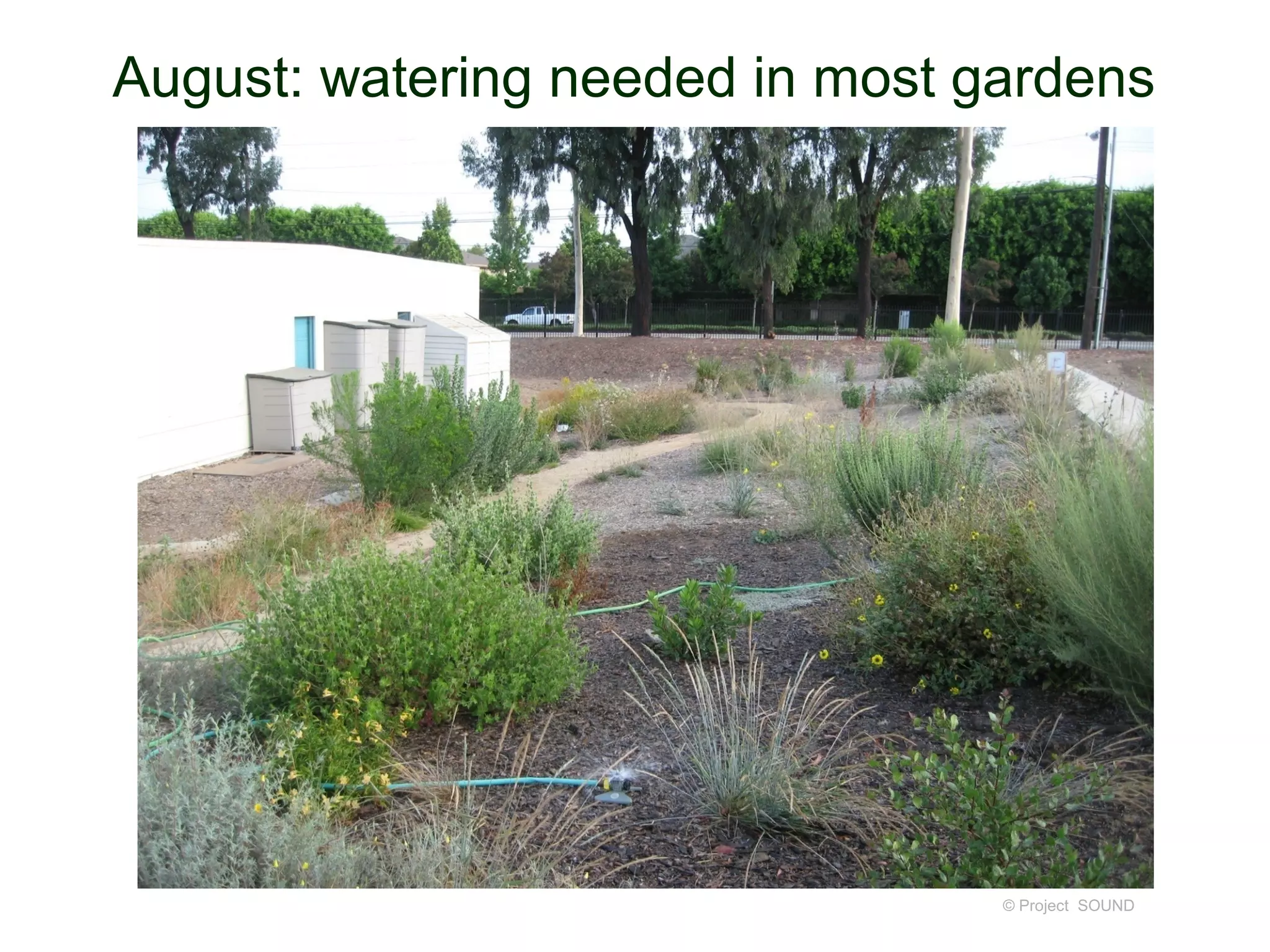
August: watering needed in most gardens


                                 © Project SOUND
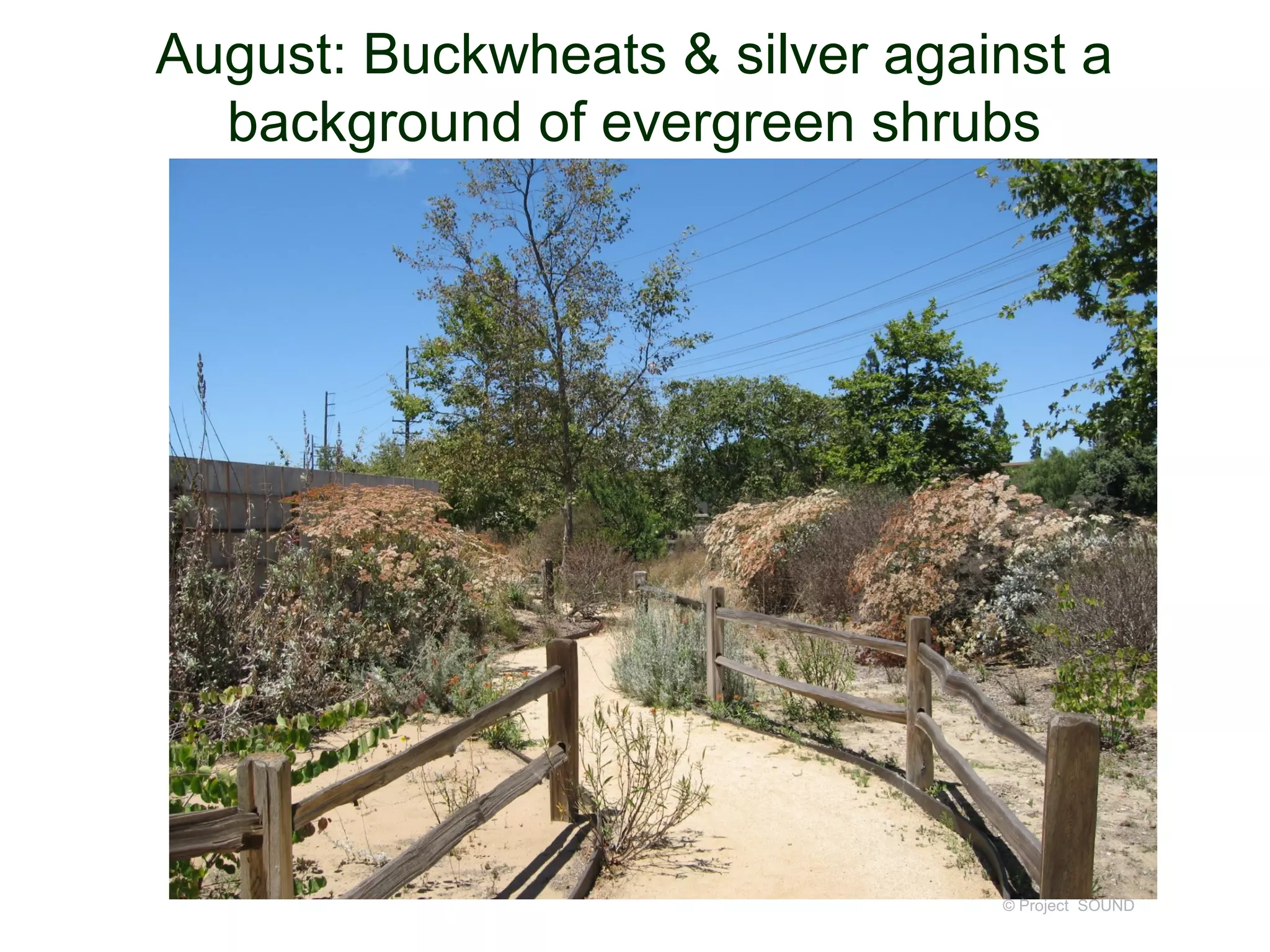
August: Buckwheats & silver against a
  background of evergreen shrubs


                                © Project SOUND
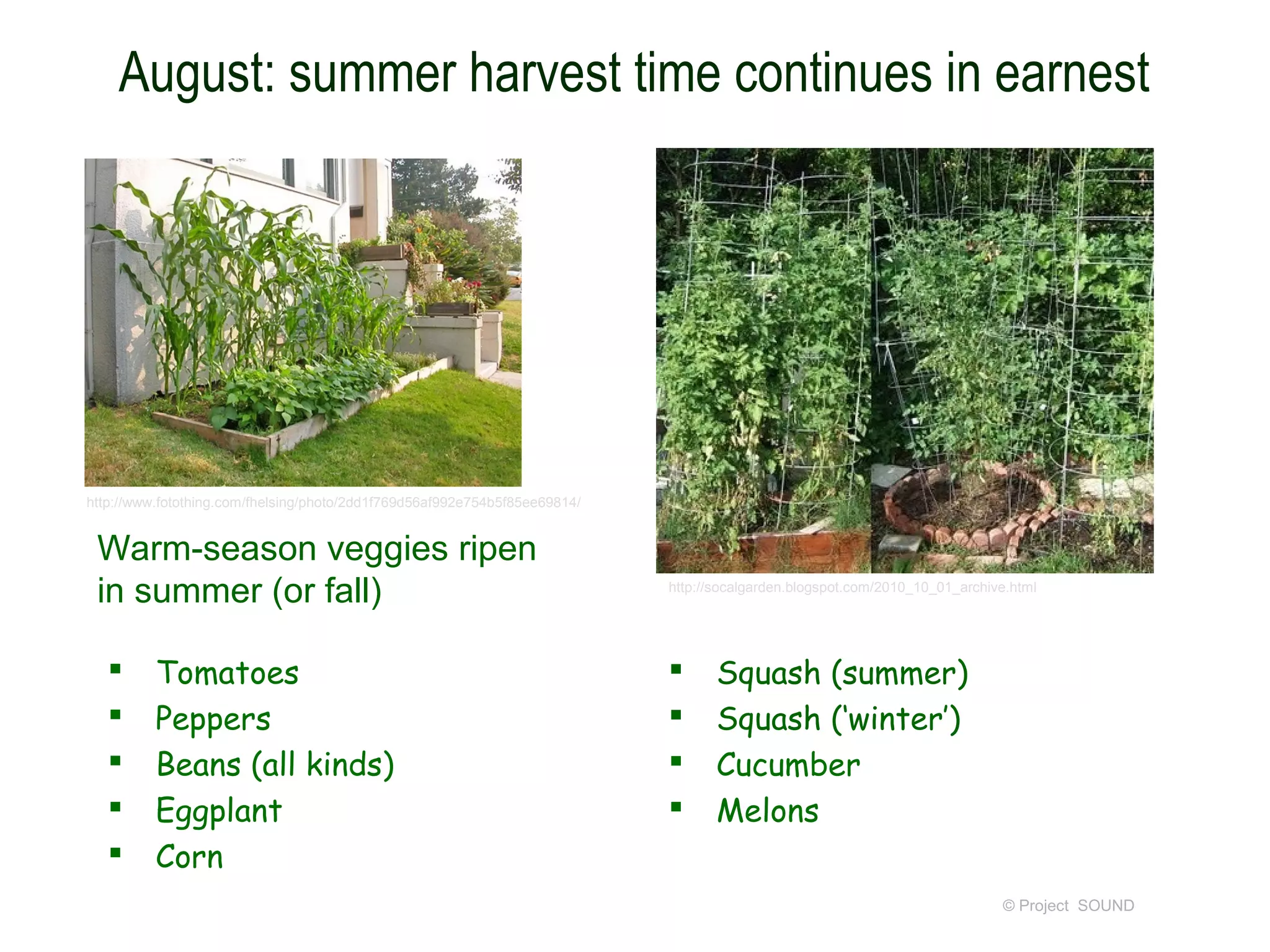
August: summer harvest time continues in earnest


http://www.fotothing.com/fhelsing/photo/2dd1f769d56af992e754b5f85ee69814/


 Warm-season veggies ripen
 in summer (or fall)                                                        http://socalgarden.blogspot.com/2010_10_01_archive.html


         Tomatoes                                                                Squash (summer)
         Peppers                                                                 Squash (‘winter’)
         Beans (all kinds)                                                       Cucumber
         Eggplant                                                                Melons
         Corn
                                                                                                                             © Project SOUND
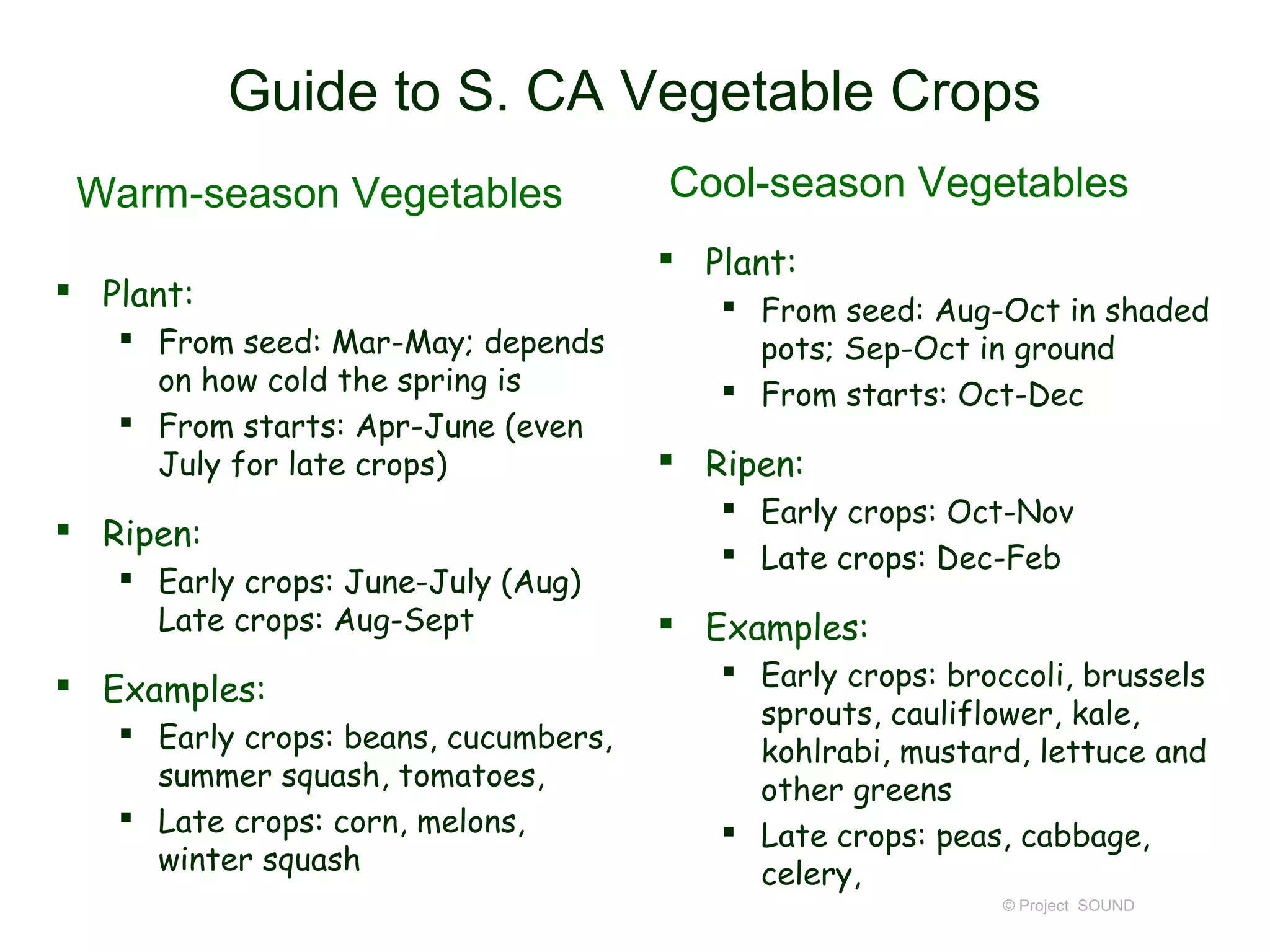
Guide to S. CA Vegetable Crops
 Warm-season Vegetables               Cool-season Vegetables
                                       Plant:
 Plant:                                  From seed: Aug-Oct in shaded
    From seed: Mar-May; depends           pots; Sep-Oct in ground
     on how cold the spring is            From starts: Oct-Dec
    From starts: Apr-June (even
     July for late crops)              Ripen:
                                          Early crops: Oct-Nov
 Ripen:
                                          Late crops: Dec-Feb
    Early crops: June-July (Aug)
     Late crops: Aug-Sept              Examples:
 Examples:                               Early crops: broccoli, brussels
                                           sprouts, cauliflower, kale,
    Early crops: beans, cucumbers,
                                           kohlrabi, mustard, lettuce and
     summer squash, tomatoes,              other greens
    Late crops: corn, melons,            Late crops: peas, cabbage,
     winter squash                         celery,
                                                            © Project SOUND
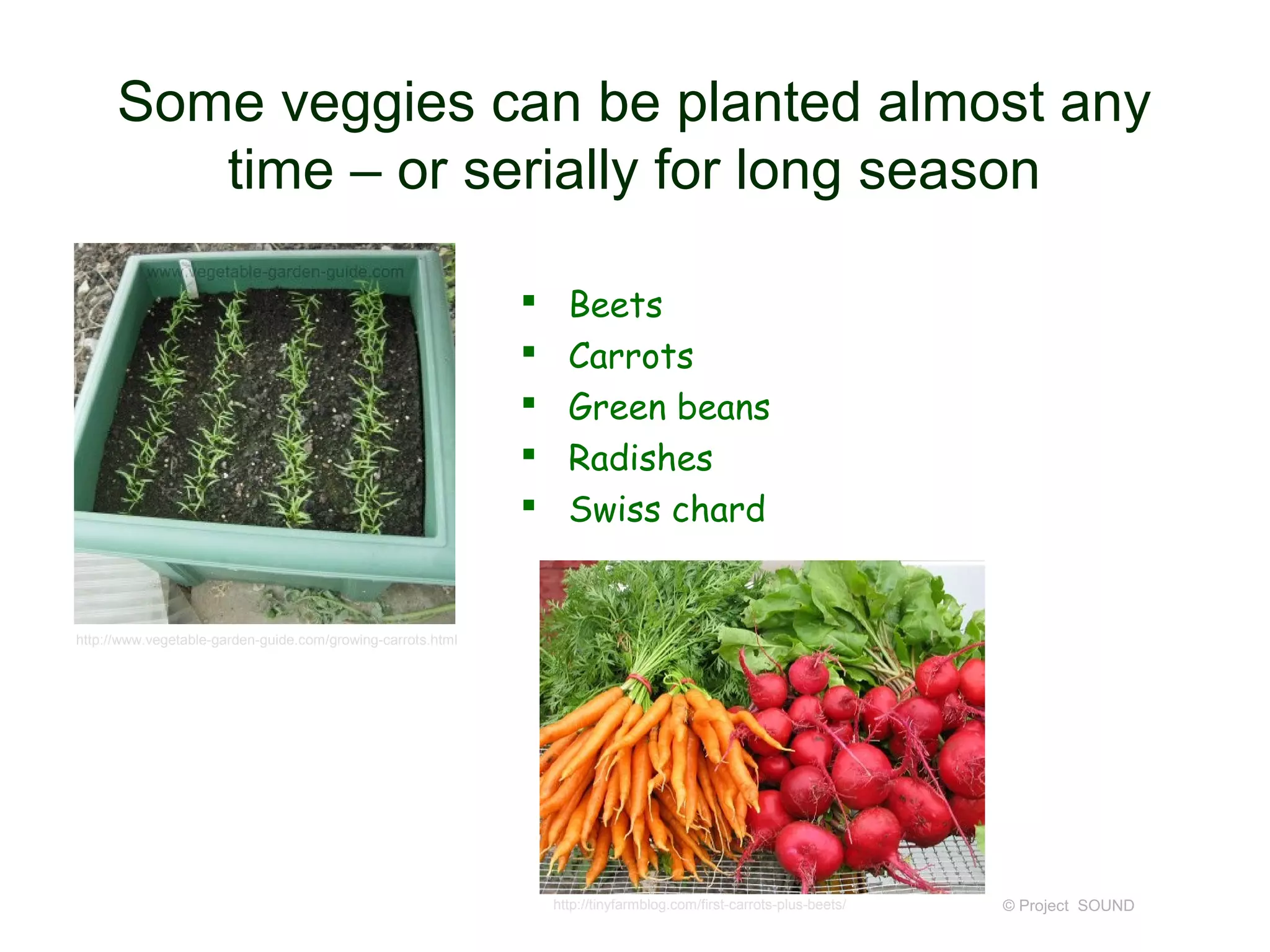
Some veggies can be planted almost any
         time – or serially for long season

                                                                  Beets
                                                                  Carrots
                                                                  Green beans
                                                                  Radishes
                                                                  Swiss chard


http://www.vegetable-garden-guide.com/growing-carrots.html


                                                                 http://tinyfarmblog.com/first-carrots-plus-beets/   © Project SOUND
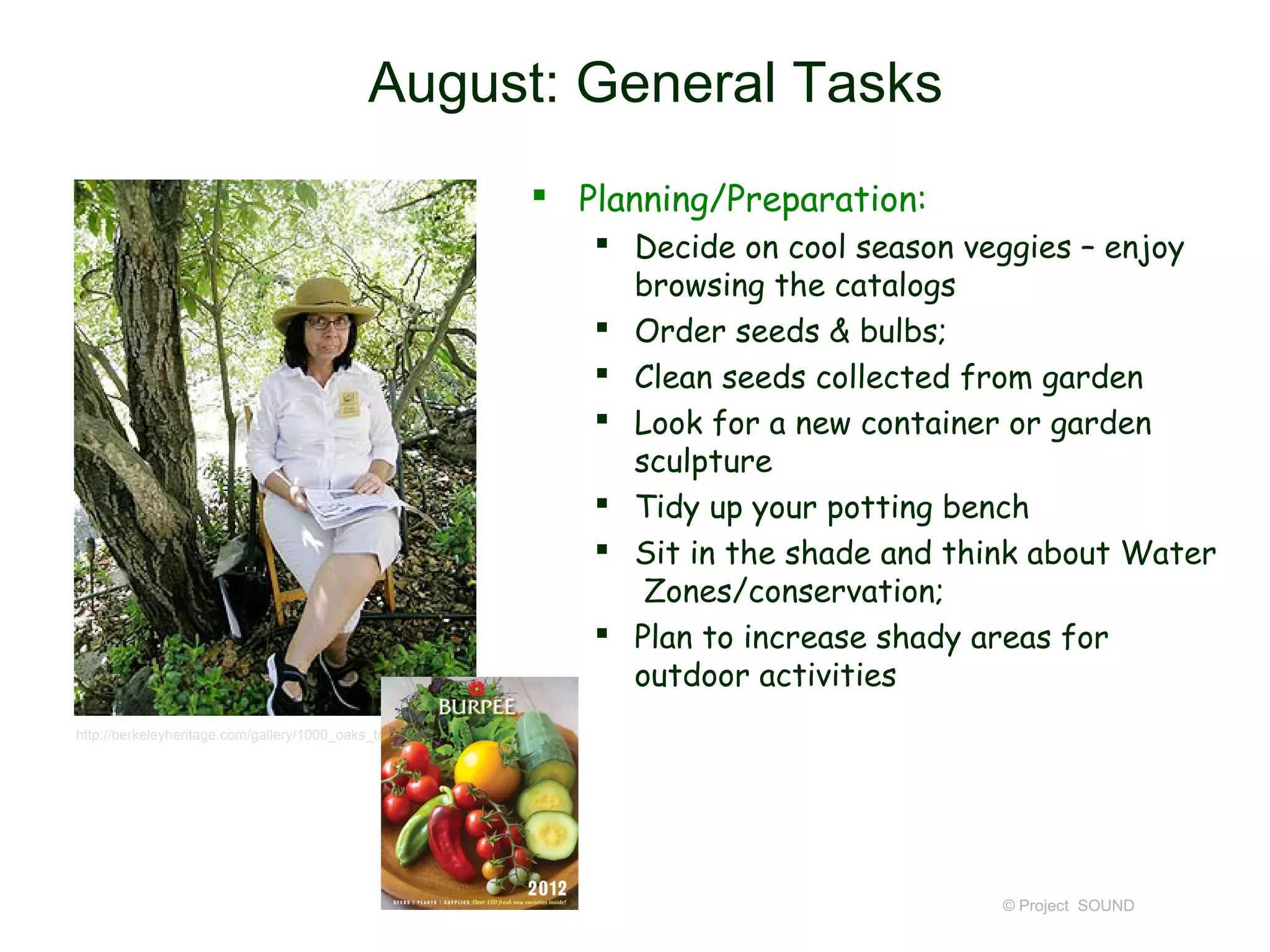
August: General Tasks
                                                                 Planning/Preparation:
                                                                    Decide on cool season veggies – enjoy
                                                                     browsing the catalogs
                                                                    Order seeds & bulbs;
                                                                    Clean seeds collected from garden
                                                                    Look for a new container or garden
                                                                     sculpture
                                                                    Tidy up your potting bench
                                                                    Sit in the shade and think about Water
                                                                      Zones/conservation;
                                                                    Plan to increase shady areas for
                                                                     outdoor activities
http://berkeleyheritage.com/gallery/1000_oaks_tour2007.8.html


                                                                                             © Project SOUND
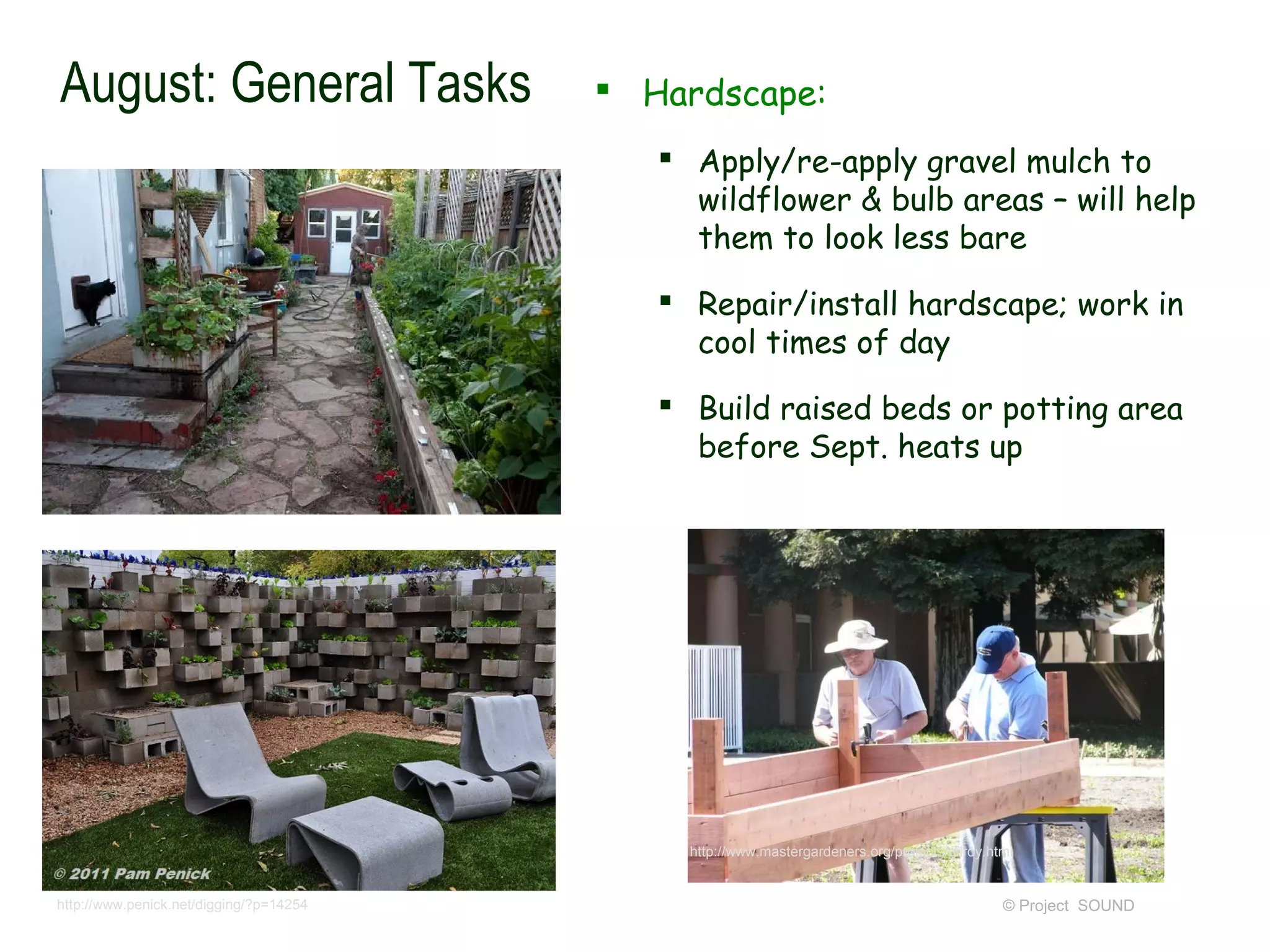
August: General Tasks                     Hardscape:
                                             Apply/re-apply gravel mulch to
                                              wildflower & bulb areas – will help
                                              them to look less bare
                                             Repair/install hardscape; work in
                                              cool times of day
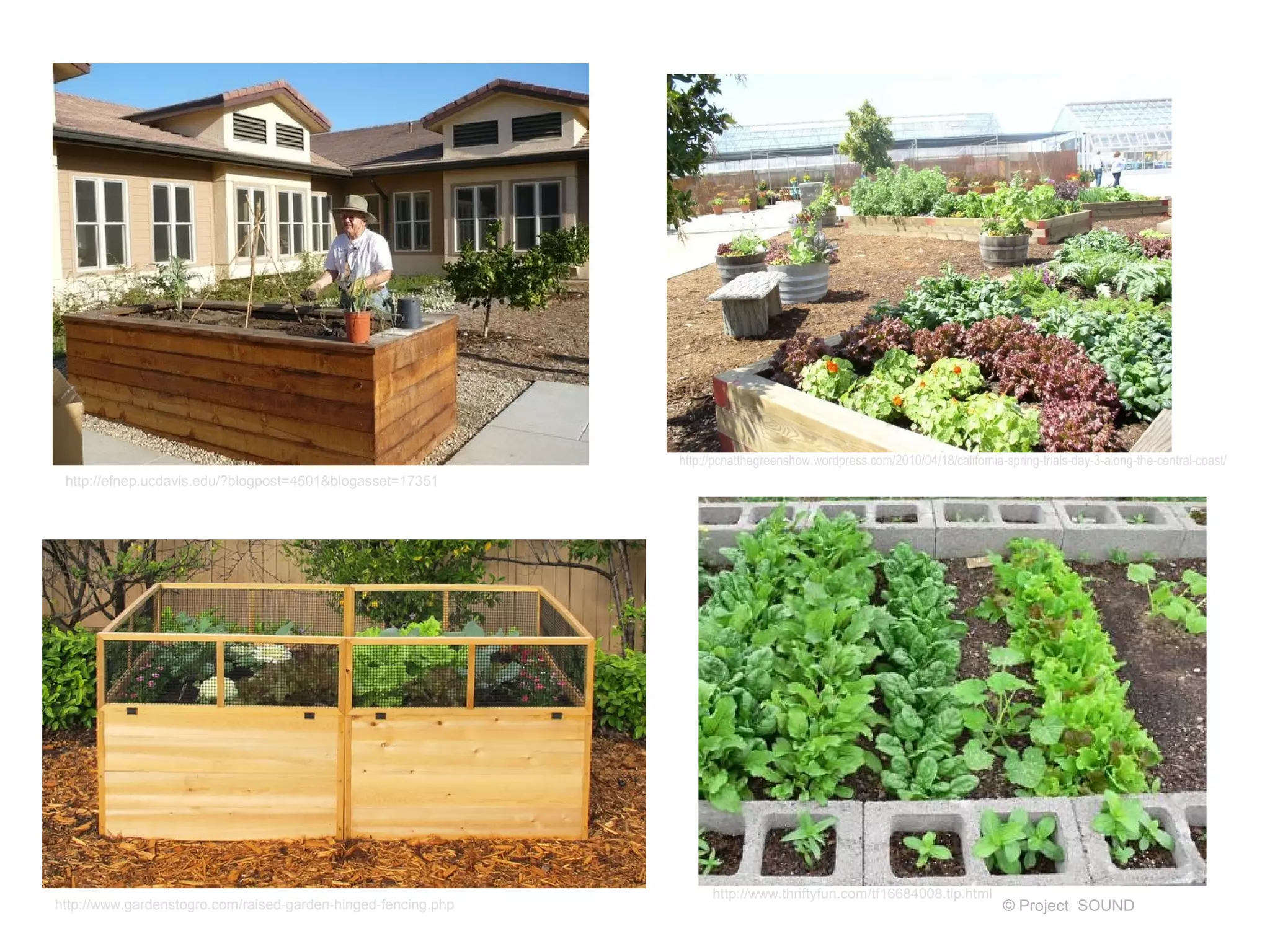
                                             Build raised beds or potting area
                                              before Sept. heats up


                                              http://www.mastergardeners.org/projects/gilroy.html


http://www.penick.net/digging/?p=14254                                                         © Project SOUND
http://pcnatthegreenshow.wordpress.com/2010/04/18/california-spring-trials-day-3-along-the-central-coast/
 http://efnep.ucdavis.edu/?blogpost=4501&blogasset=17351


                                                                     http://www.thriftyfun.com/tf16684008.tip.html
http://www.gardenstogro.com/raised-garden-hinged-fencing.php                                                                 © Project SOUND
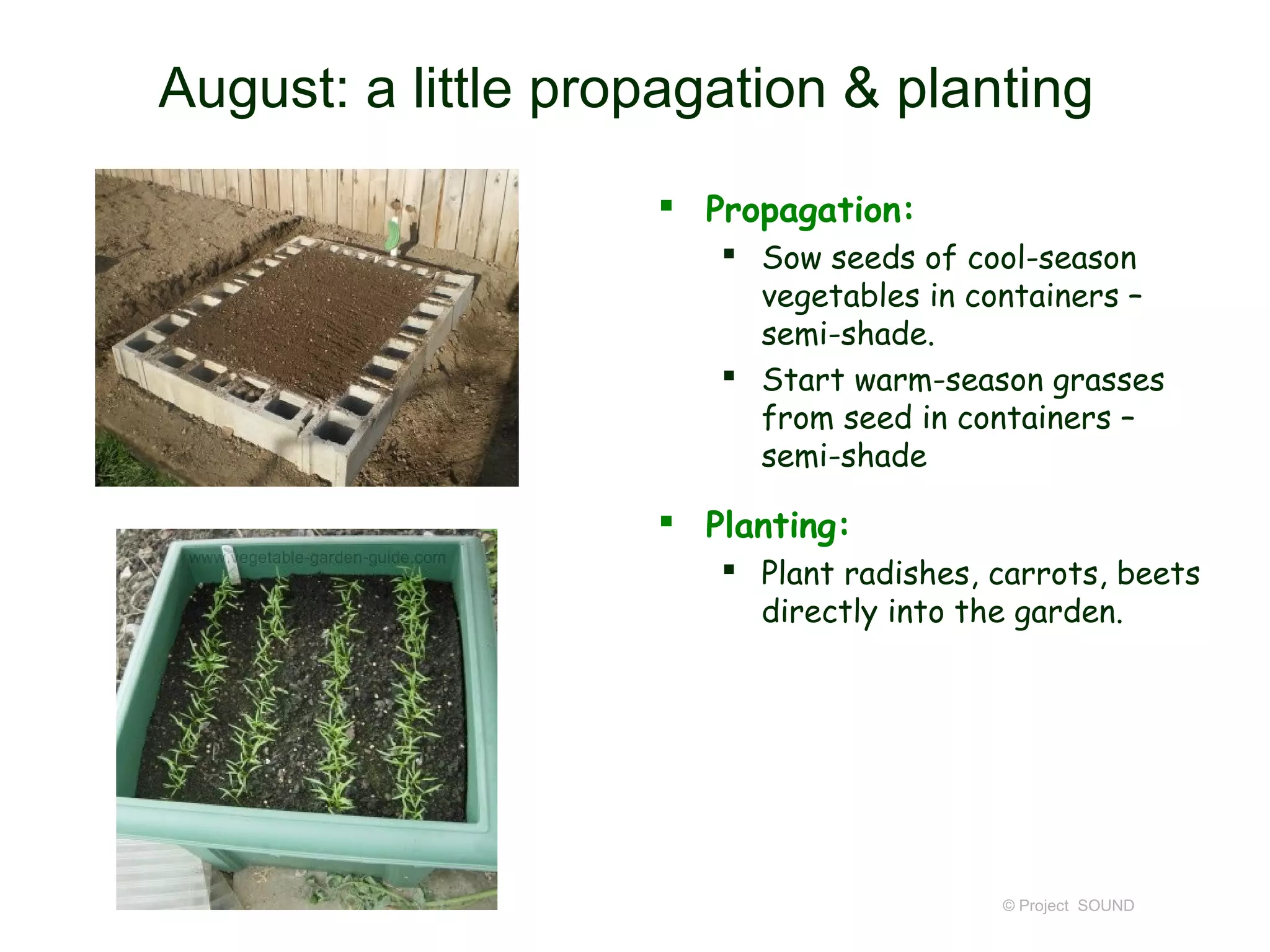
August: General Tasks
                                                 Watering:
                                                    Taper off water to native plants
                                                     except Zone 3 & Chaparral and Sonoran
                                                     Desert plants – give them a good
                                                     ‘monsoon’;


http://www.thriftyfun.com/tf16684008.tip.html
                                                 Weeds, Diseases & Pests:
                                                    Most summer weeds are winding down –
                                                     particularly in drier areas; still a
                                                     challenge in vegetable garden
                                                    Look for signs of fungal disease; prune
                                                     out diseased branches


                                                                               © Project SOUND
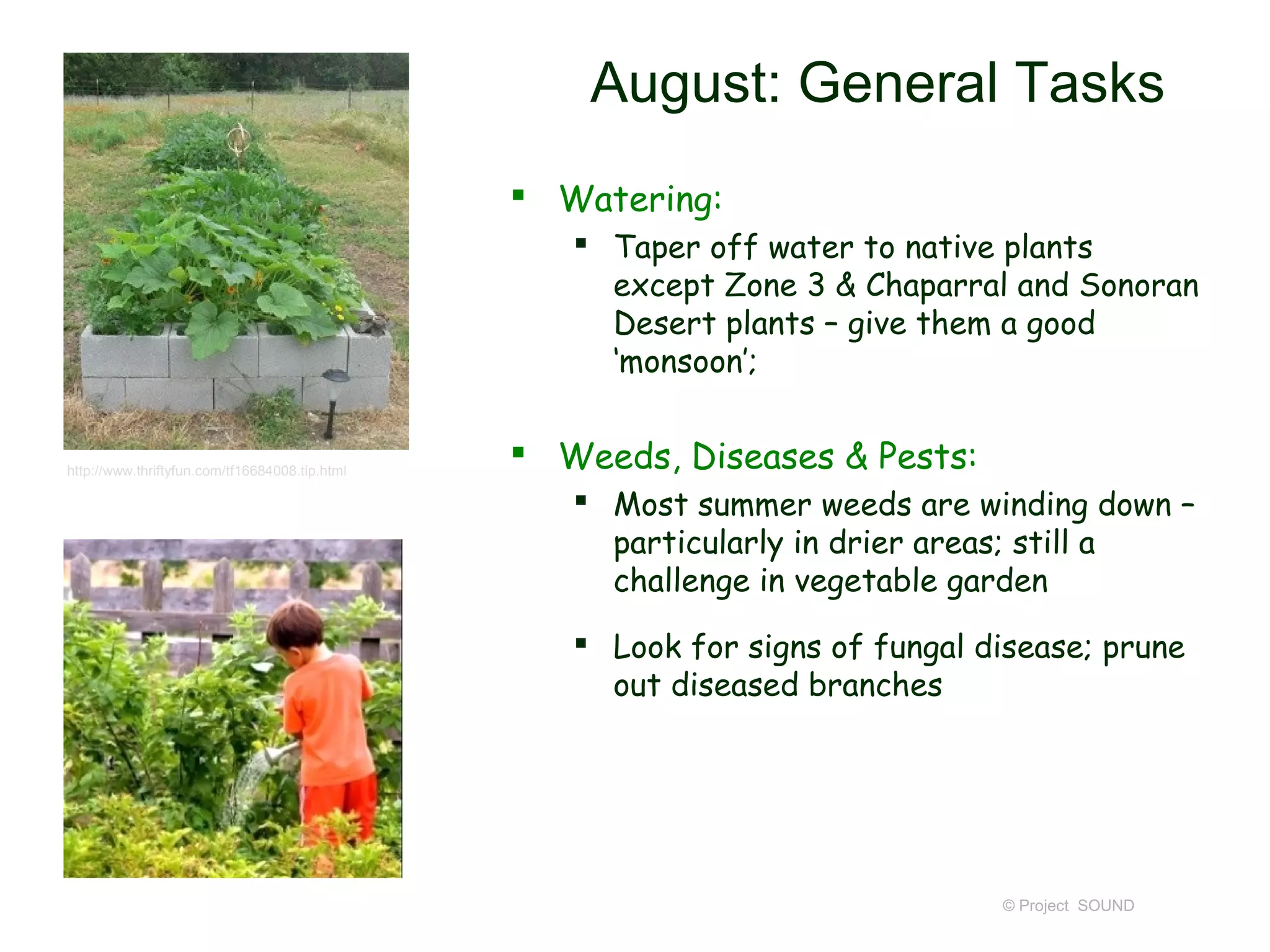
August: a little propagation & planting
                     Propagation:
                        Sow seeds of cool-season
                         vegetables in containers –
                         semi-shade.
                        Start warm-season grasses
                         from seed in containers –
                         semi-shade

                     Planting:
                        Plant radishes, carrots, beets
                         directly into the garden.


                                         © Project SOUND
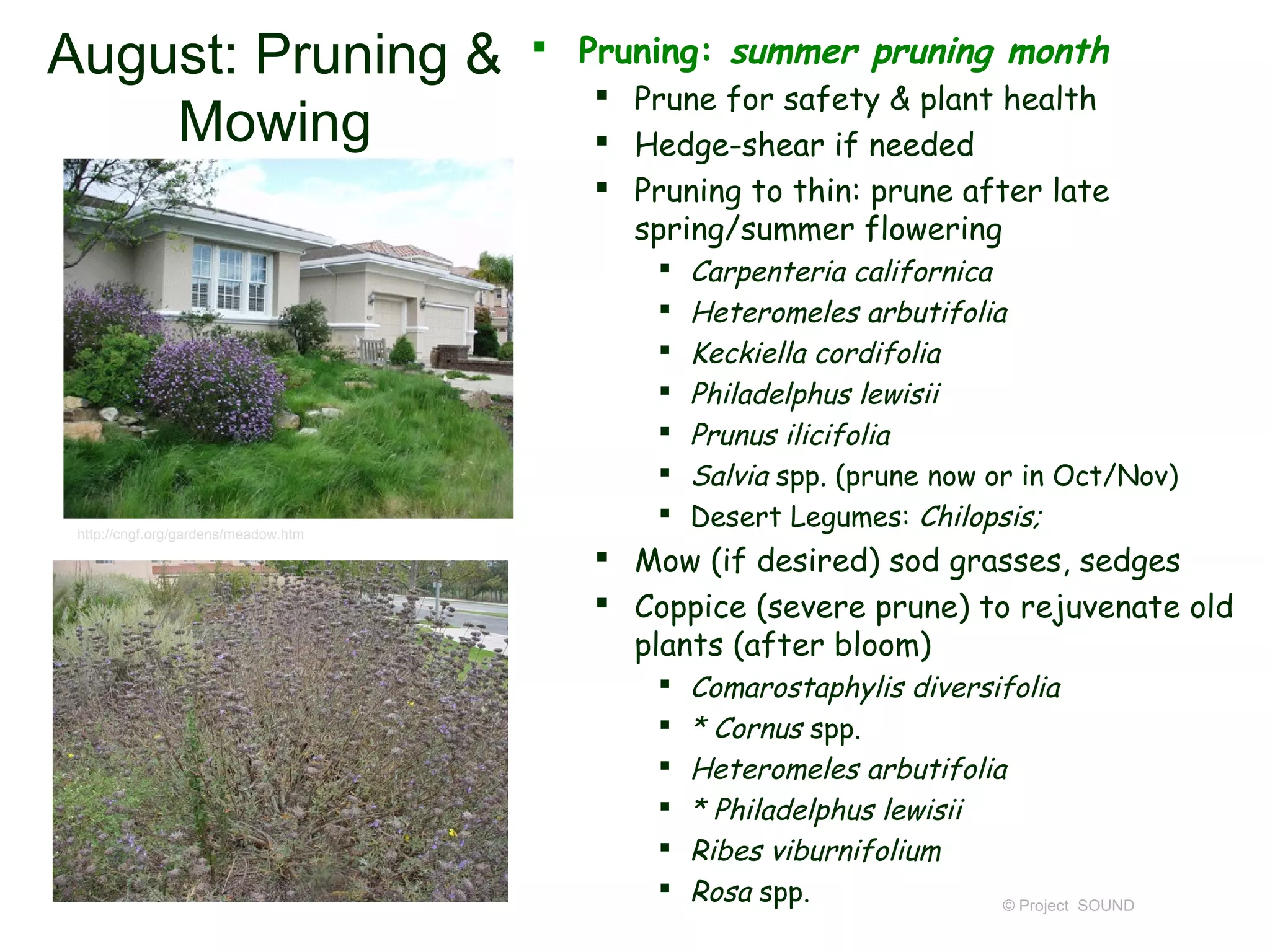
August: Pruning &                      Pruning: summer pruning month
                                          Prune for safety & plant health
    Mowing                                Hedge-shear if needed
                                          Pruning to thin: prune after late
                                           spring/summer flowering
                                                Carpenteria californica
                                                Heteromeles arbutifolia
                                                Keckiella cordifolia
                                                Philadelphus lewisii
                                                Prunus ilicifolia
                                                Salvia spp. (prune now or in Oct/Nov)
 http://cngf.org/gardens/meadow.htm
                                                Desert Legumes: Chilopsis;
                                          Mow (if desired) sod grasses, sedges
                                          Coppice (severe prune) to rejuvenate old
                                           plants (after bloom)
                                                Comarostaphylis diversifolia
                                                * Cornus spp.
                                                Heteromeles arbutifolia
                                                * Philadelphus lewisii
                                                Ribes viburnifolium
                                                Rosa spp.              © Project   SOUND
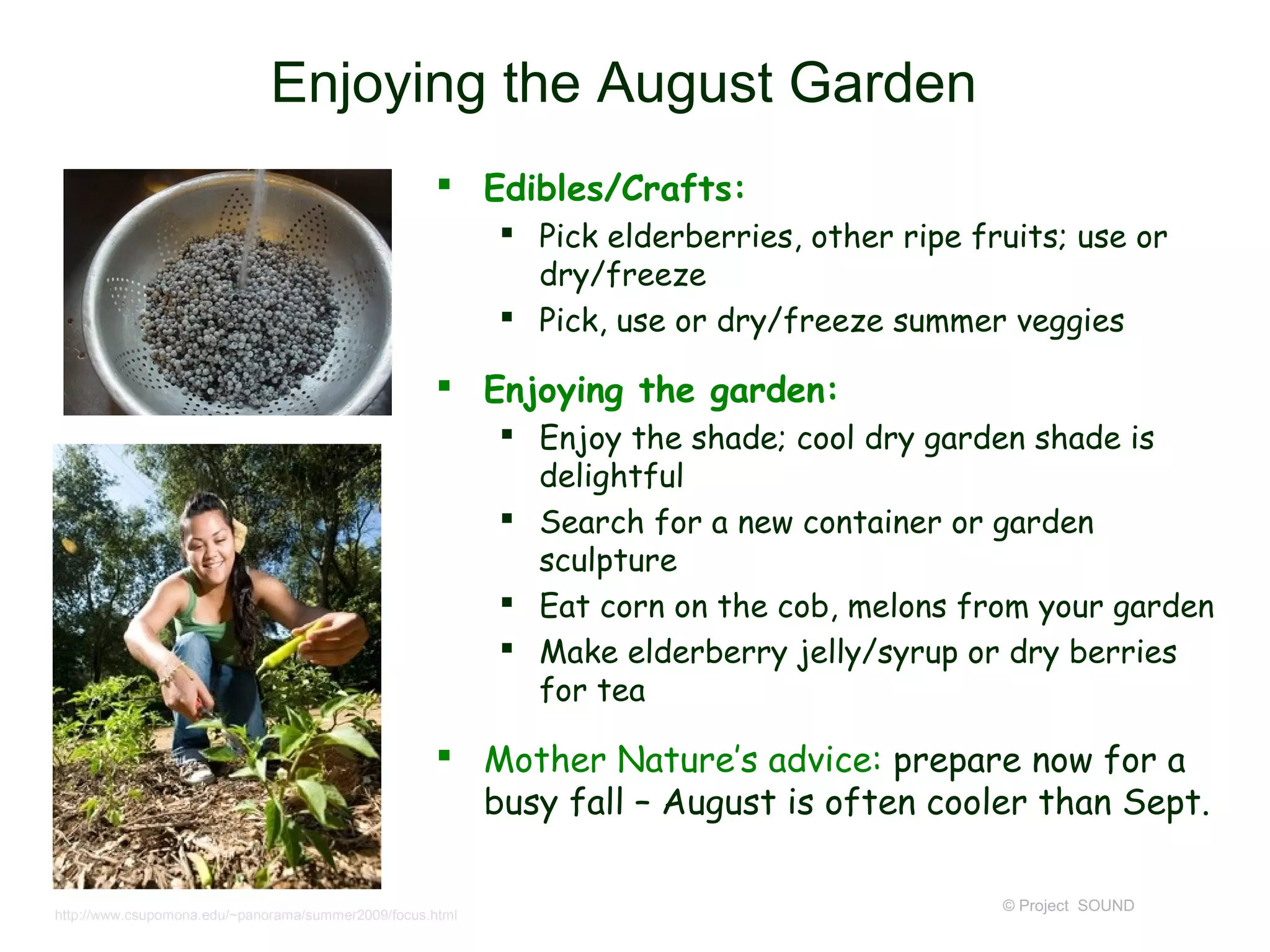
Enjoying the August Garden
                                                      Edibles/Crafts:
                                                            Pick elderberries, other ripe fruits; use or
                                                             dry/freeze
                                                            Pick, use or dry/freeze summer veggies

                                                      Enjoying the garden:
                                                            Enjoy the shade; cool dry garden shade is
                                                             delightful
                                                            Search for a new container or garden
                                                             sculpture
                                                            Eat corn on the cob, melons from your garden
                                                            Make elderberry jelly/syrup or dry berries
                                                             for tea

                                                      Mother Nature’s advice: prepare now for a
                                                       busy fall – August is often cooler than Sept.

                                                                                             © Project SOUND
http://www.csupomona.edu/~panorama/summer2009/focus.html
Scorching September


                      © Project SOUND
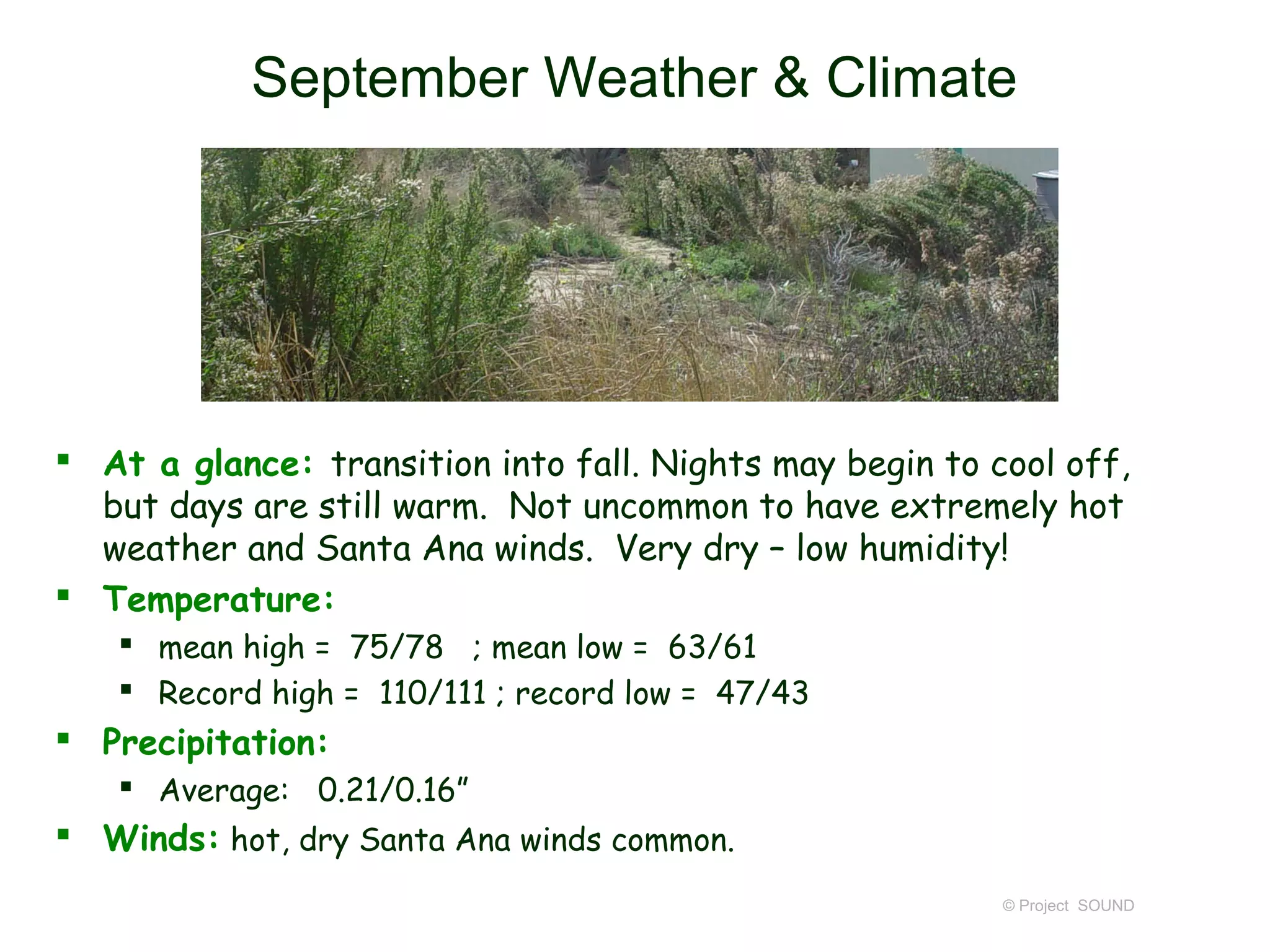
September Weather & Climate


 At a glance: transition into fall. Nights may begin to cool off,
  but days are still warm. Not uncommon to have extremely hot
  weather and Santa Ana winds. Very dry – low humidity!
 Temperature:
    mean high = 75/78 ; mean low = 63/61
    Record high = 110/111 ; record low = 47/43
 Precipitation:
    Average: 0.21/0.16”
 Winds: hot, dry Santa Ana winds common.
                                                          © Project SOUND
Summer veggies – end of game


http://cagardenweb.ucdavis.edu/?repository=10369                                           © Project SOUND
                                                   http://www.slowfamilyonline.com/tag/victory-gardens/
September: General
                                                                                                Tasks
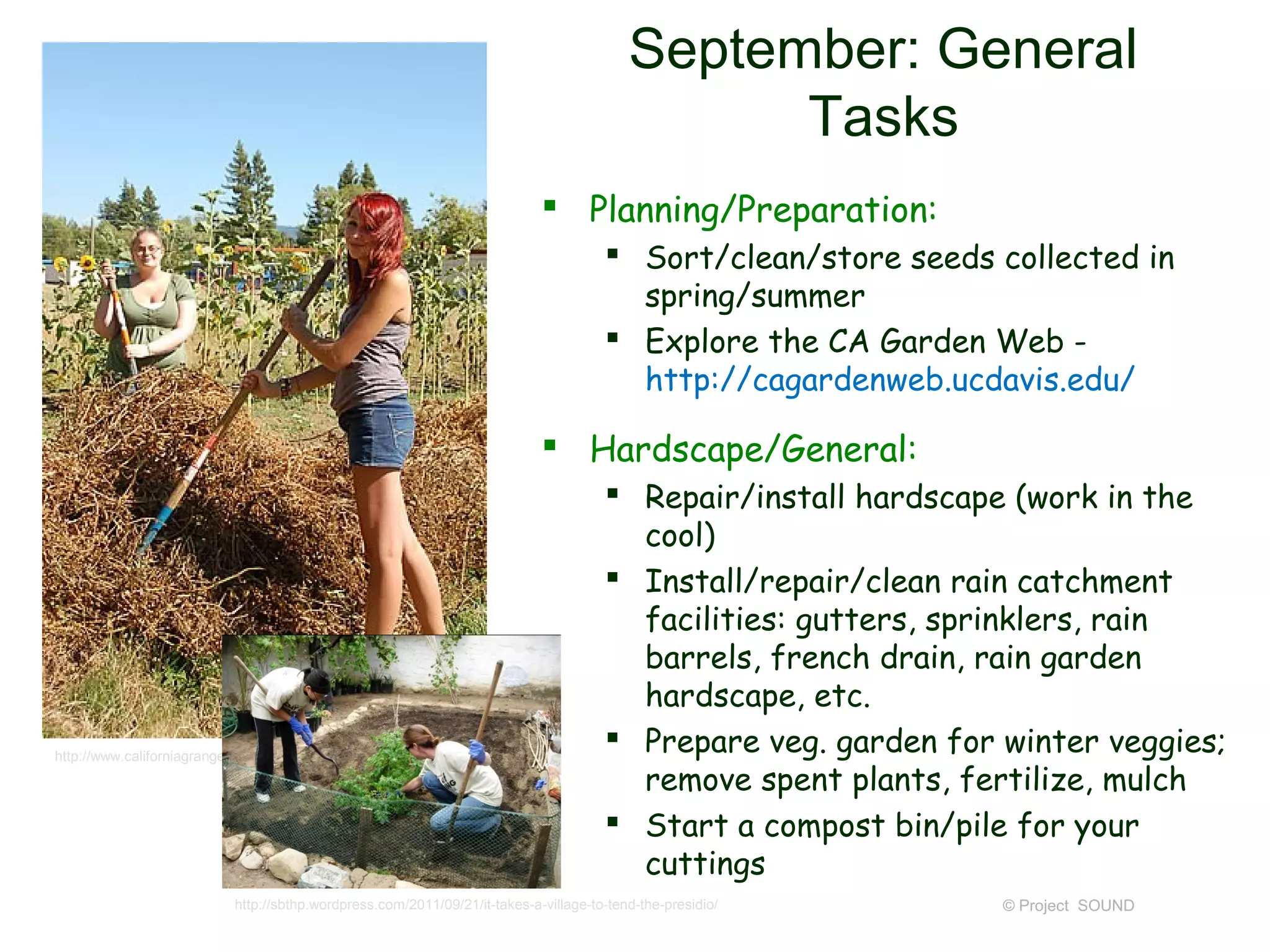
                                                                             Planning/Preparation:
                                                                                       Sort/clean/store seeds collected in
                                                                                        spring/summer
                                                                                       Explore the CA Garden Web -
                                                                                        http://cagardenweb.ucdavis.edu/

                                                                             Hardscape/General:
                                                                                       Repair/install hardscape (work in the
                                                                                        cool)
                                                                                       Install/repair/clean rain catchment
                                                                                        facilities: gutters, sprinklers, rain
                                                                                        barrels, french drain, rain garden
                                                                                        hardscape, etc.
http://www.californiagrange.org/news/garden_grow.html
                                                                                       Prepare veg. garden for winter veggies;
                                                                                        remove spent plants, fertilize, mulch
                                                                                       Start a compost bin/pile for your
                                                                                        cuttings
                           http://sbthp.wordpress.com/2011/09/21/it-takes-a-village-to-tend-the-presidio/       © Project SOUND
September: General                                                             Watering: major watering month
                                                                                for Zone 2-3 & 3
      Tasks                                                                       Taper off all but Zone 2-3 & 3; keep
                                                                                   vegetable gardens, containers, other
                                                                                   Zone 3 plants watered – particularly
                                                                                   if Santa Anna winds are predicted
                                                                               Weeds, Diseases & Pests:
                                                                                  Grasshoppers and gophers may be
                                                                                   getting desperate
                                                                               Pruning:
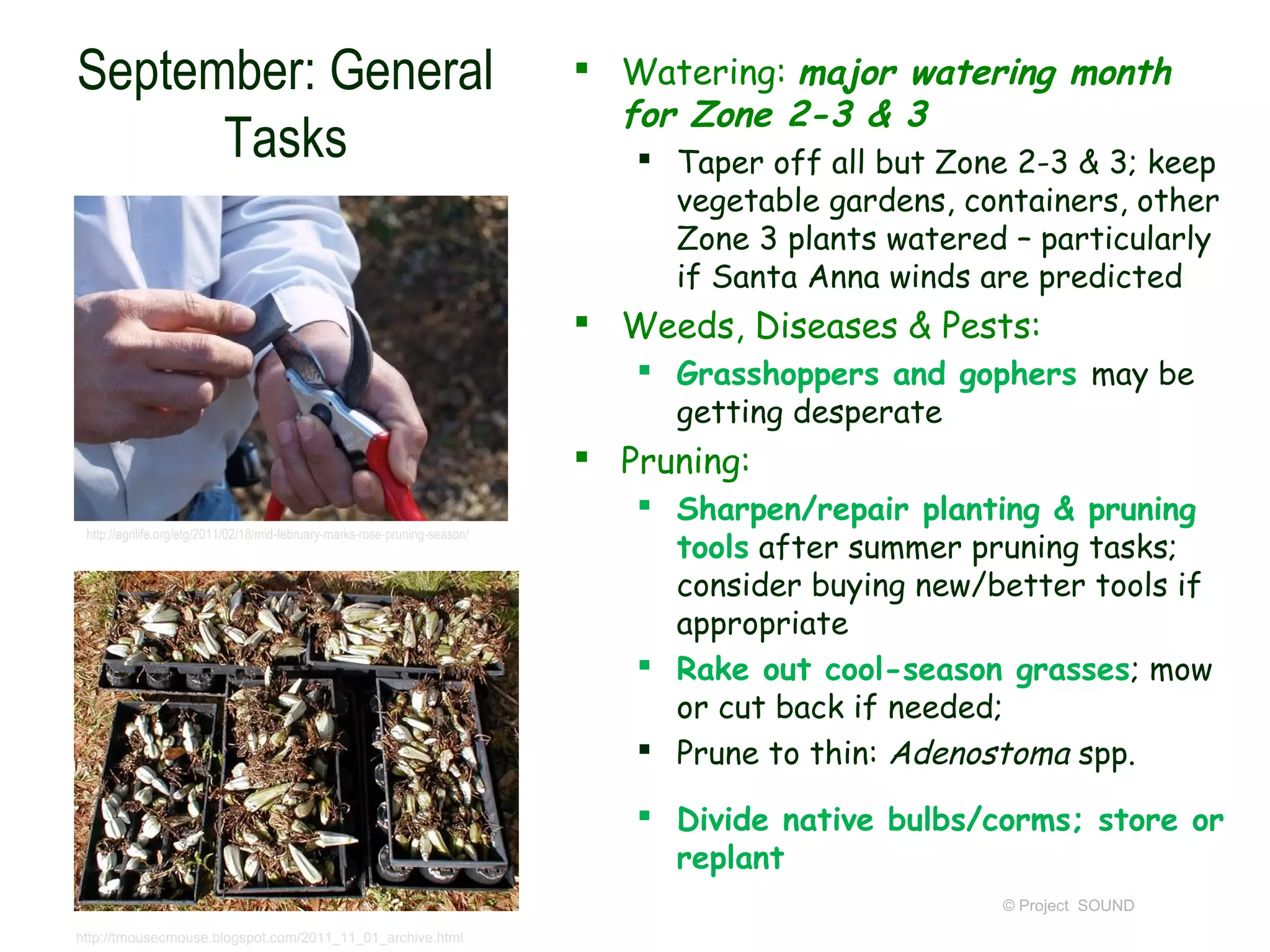
                                                                                  Sharpen/repair planting & pruning
                                                                                   tools after summer pruning tasks;
 http://agrilife.org/etg/2011/02/18/mid-february-marks-rose-pruning-season/


                                                                                   consider buying new/better tools if
                                                                                   appropriate
                                                                                  Rake out cool-season grasses; mow
                                                                                   or cut back if needed;
                                                                                  Prune to thin: Adenostoma spp.

                                                                                  Divide native bulbs/corms; store or
                                                                                   replant
                                                                                                        © Project SOUND
http://tmousecmouse.blogspot.com/2011_11_01_archive.html
Propagation & planting
                                                     Propagation from seed: give seedlings
                                                      part-shade and keep well-watered
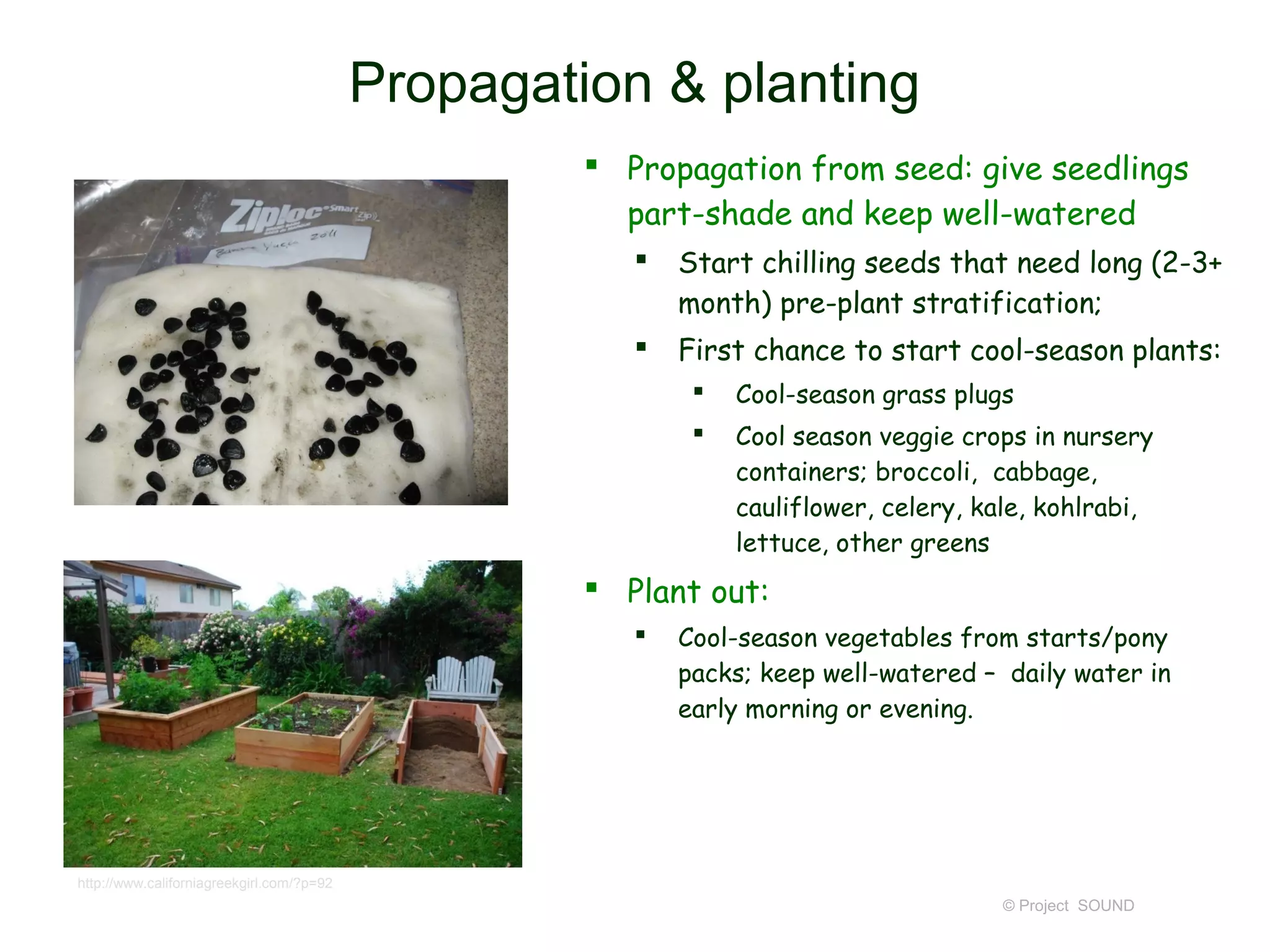
                                                          Start chilling seeds that need long (2-3+
                                                           month) pre-plant stratification;
                                                          First chance to start cool-season plants:
                                                               Cool-season grass plugs
                                                               Cool season veggie crops in nursery
                                                                containers; broccoli, cabbage,
                                                                cauliflower, celery, kale, kohlrabi,
                                                                lettuce, other greens
                                                     Plant out:
                                                          Cool-season vegetables from starts/pony
                                                           packs; keep well-watered – daily water in
                                                           early morning or evening.


http://www.californiagreekgirl.com/?p=92
                                                                                       © Project SOUND
Enjoying the September Garden
                                                            Edibles/crafts:
                                                               Pick ripe winter squash, tomatoes,
                                                                peppers; enjoy a new recipe
                                                               Pick fresh sweet corn near coast
                                                            Enjoying the garden:
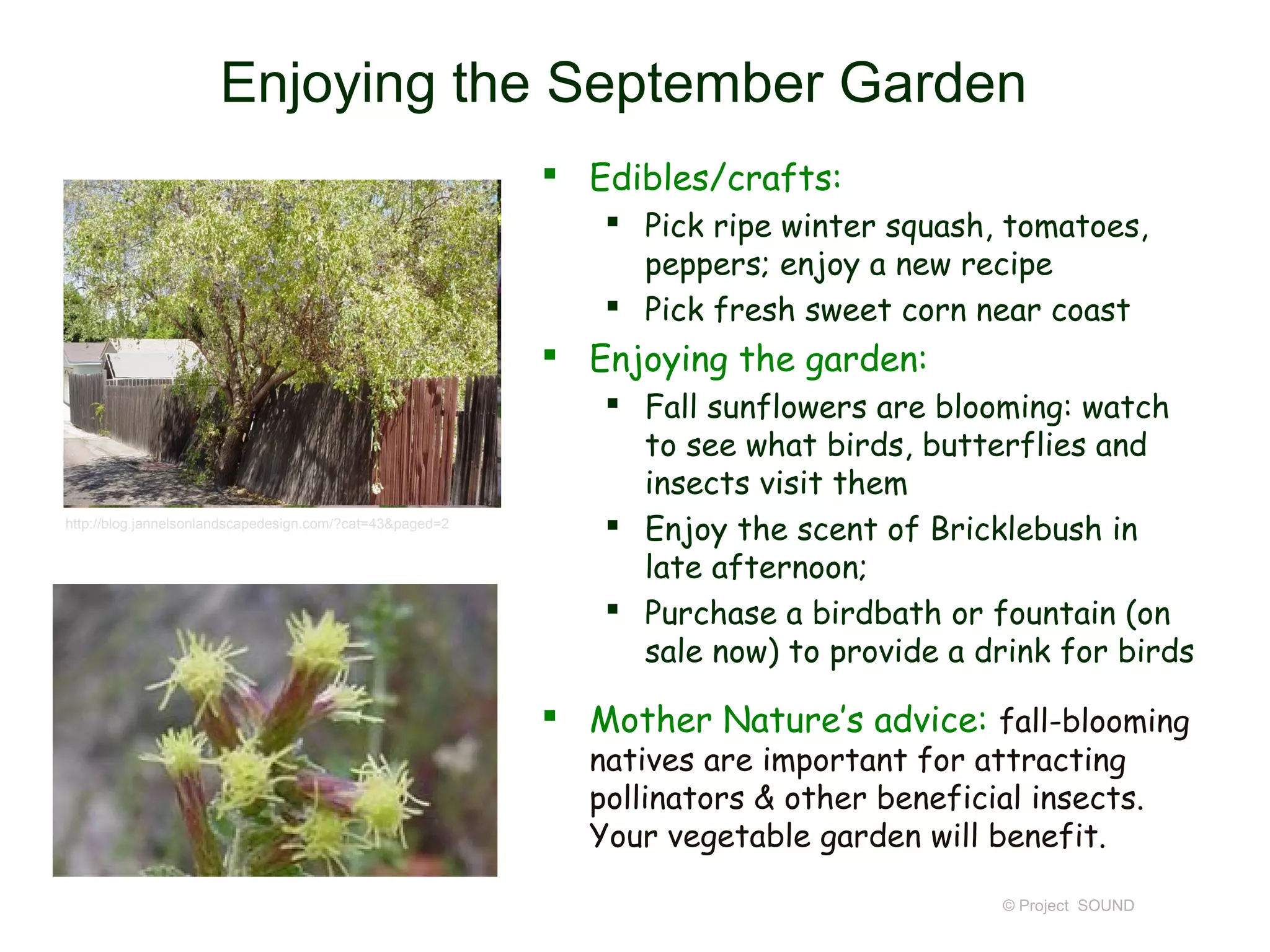
                                                               Fall sunflowers are blooming: watch
                                                                to see what birds, butterflies and
                                                                insects visit them
http://blog.jannelsonlandscapedesign.com/?cat=43&paged=2
                                                               Enjoy the scent of Bricklebush in
                                                                late afternoon;
                                                               Purchase a birdbath or fountain (on
                                                                sale now) to provide a drink for birds

                                                            Mother Nature’s advice: fall-blooming
                                                             natives are important for attracting
                                                             pollinators & other beneficial insects.
                                                             Your vegetable garden will benefit.

                                                                                          © Project SOUND
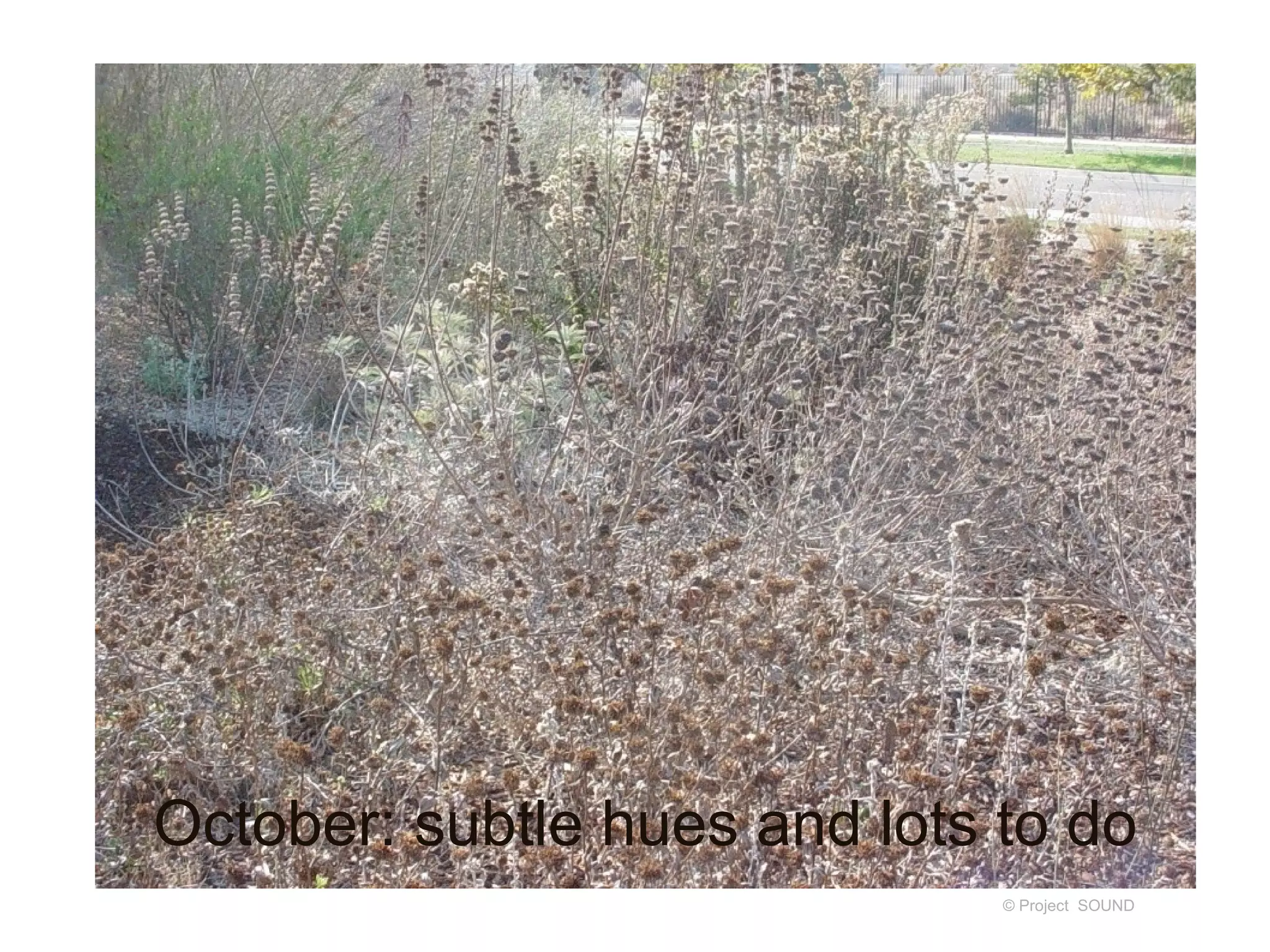
October: subtle hues and lots to do
                              © Project SOUND
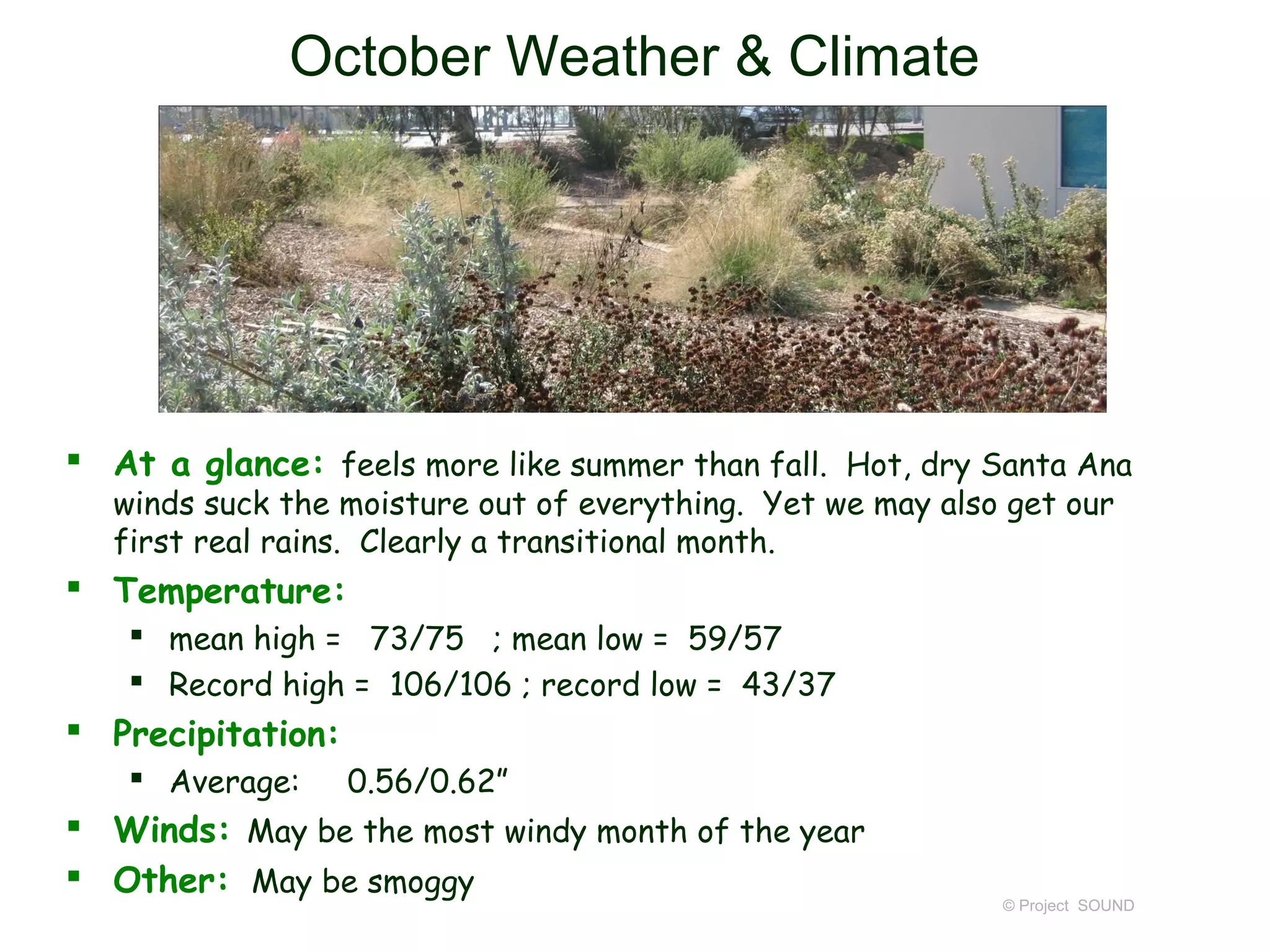
October Weather & Climate


 At a glance: feels more like summer than fall. Hot, dry Santa Ana
  winds suck the moisture out of everything. Yet we may also get our
  first real rains. Clearly a transitional month.
 Temperature:
    mean high = 73/75 ; mean low = 59/57
    Record high = 106/106 ; record low = 43/37
 Precipitation:
    Average:      0.56/0.62”
 Winds: May be the most windy month of the year
 Other: May be smoggy
                                                            © Project SOUND
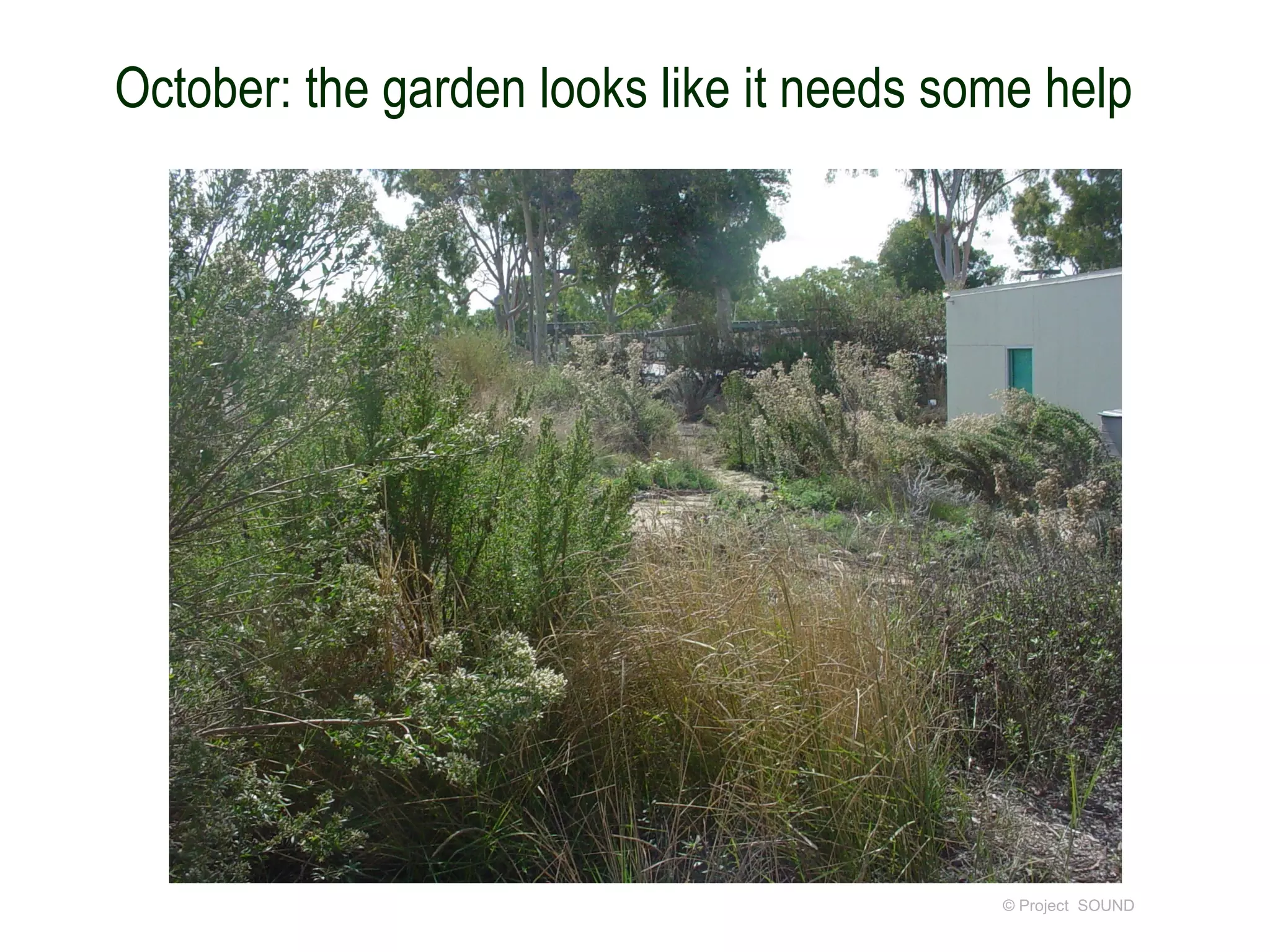
October: the garden looks like it needs some help


                                          © Project SOUND
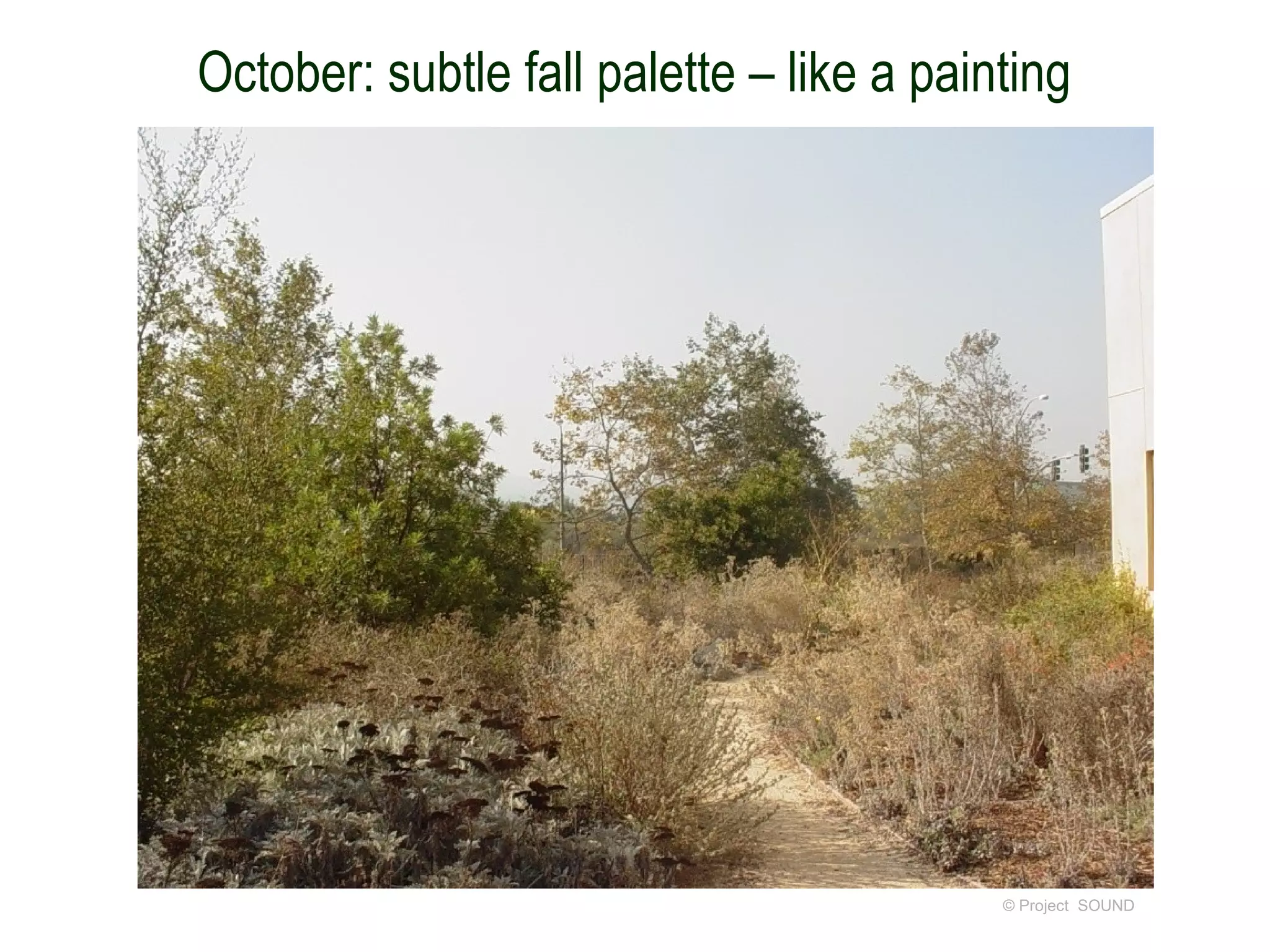
October: subtle fall palette – like a painting


                                          © Project SOUND
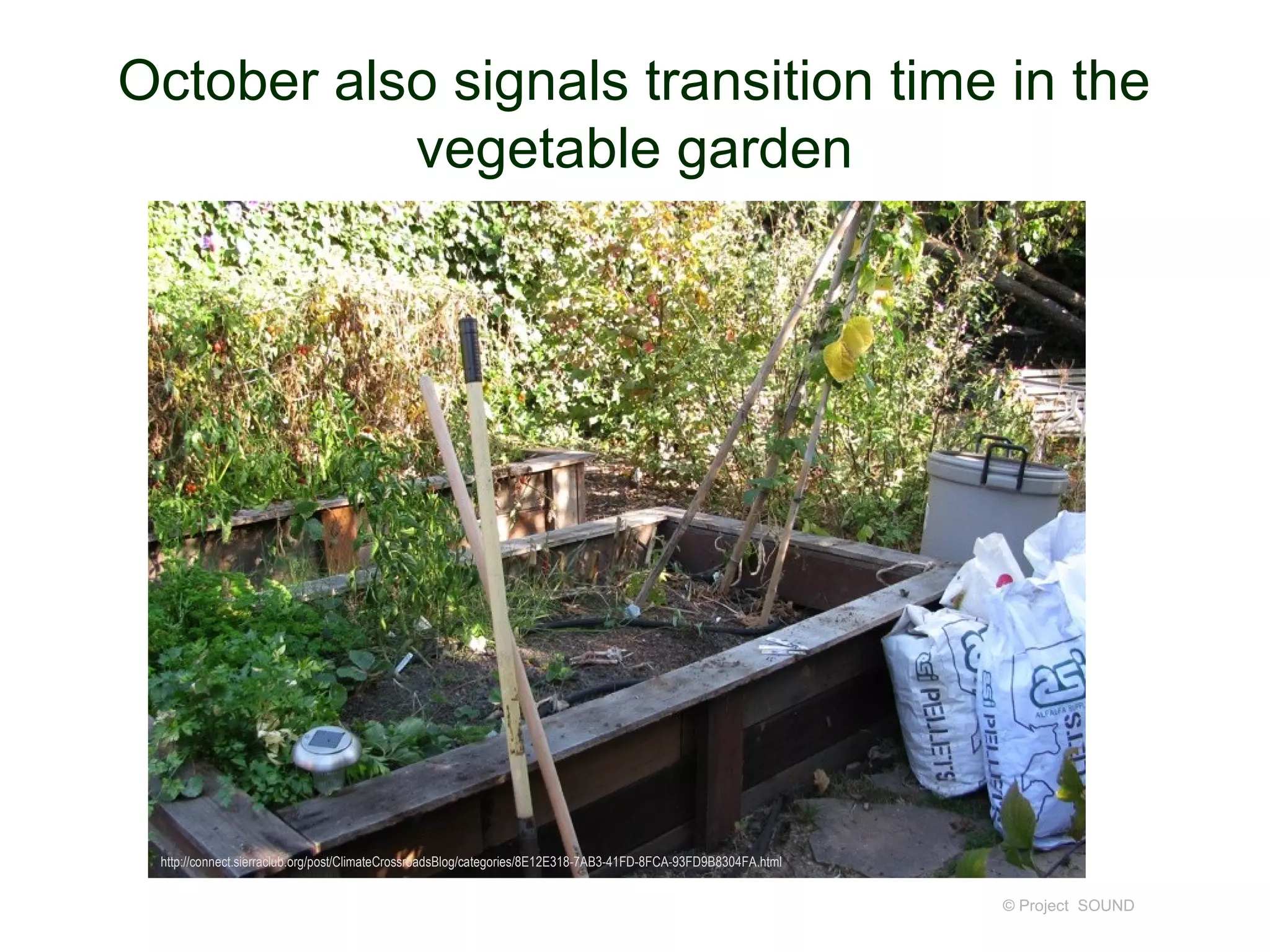
October also signals transition time in the
           vegetable garden


 http://connect.sierraclub.org/post/ClimateCrossroadsBlog/categories/8E12E318-7AB3-41FD-8FCA-93FD9B8304FA.html


                                                                                                                 © Project SOUND
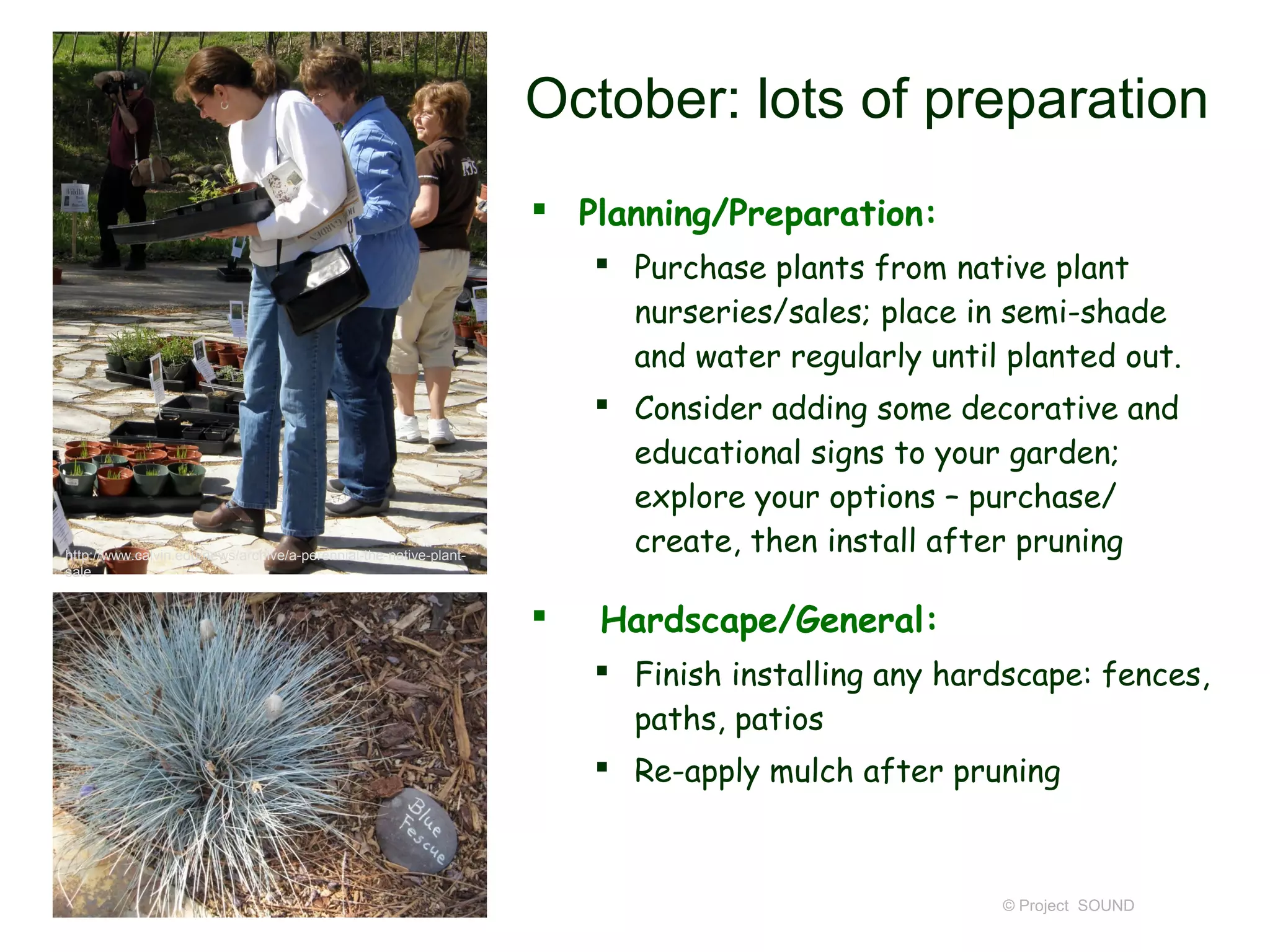
October: lots of preparation
                                                                    Planning/Preparation:
                                                                       Purchase plants from native plant
                                                                        nurseries/sales; place in semi-shade
                                                                        and water regularly until planted out.
                                                                       Consider adding some decorative and
                                                                        educational signs to your garden;
                                                                        explore your options – purchase/
http://www.calvin.edu/news/archive/a-perennial-the-native-plant-
                                                                        create, then install after pruning
sale


                                                                      Hardscape/General:
                                                                       Finish installing any hardscape: fences,
                                                                        paths, patios
                                                                       Re-apply mulch after pruning


                                                                                                 © Project SOUND
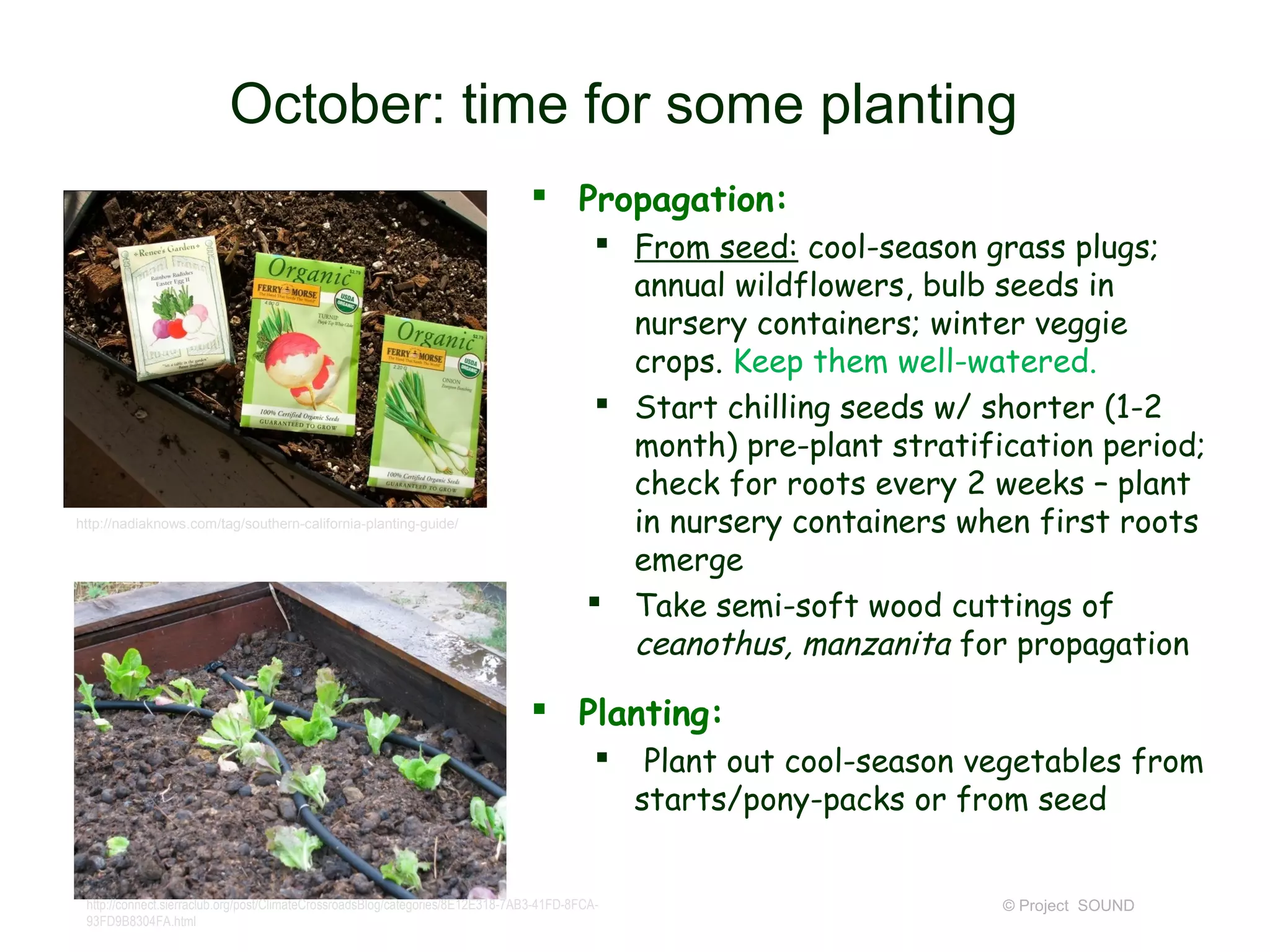
October: time for some planting
                                                                                 Propagation:
                                                                                            From seed: cool-season grass plugs;
                                                                                             annual wildflowers, bulb seeds in
                                                                                             nursery containers; winter veggie
                                                                                             crops. Keep them well-watered.
                                                                                            Start chilling seeds w/ shorter (1-2
                                                                                             month) pre-plant stratification period;
                                                                                             check for roots every 2 weeks – plant
http://nadiaknows.com/tag/southern-california-planting-guide/                                in nursery containers when first roots
                                                                                             emerge
                                                                                           Take semi-soft wood cuttings of
                                                                                             ceanothus, manzanita for propagation

                                                                                 Planting:
                                                                                                Plant out cool-season vegetables from
                                                                                                starts/pony-packs or from seed


 http://connect.sierraclub.org/post/ClimateCrossroadsBlog/categories/8E12E318-7AB3-41FD-8FCA-                           © Project SOUND
 93FD9B8304FA.html
Watering: prepare for the rainy season – but water like
summer if needed
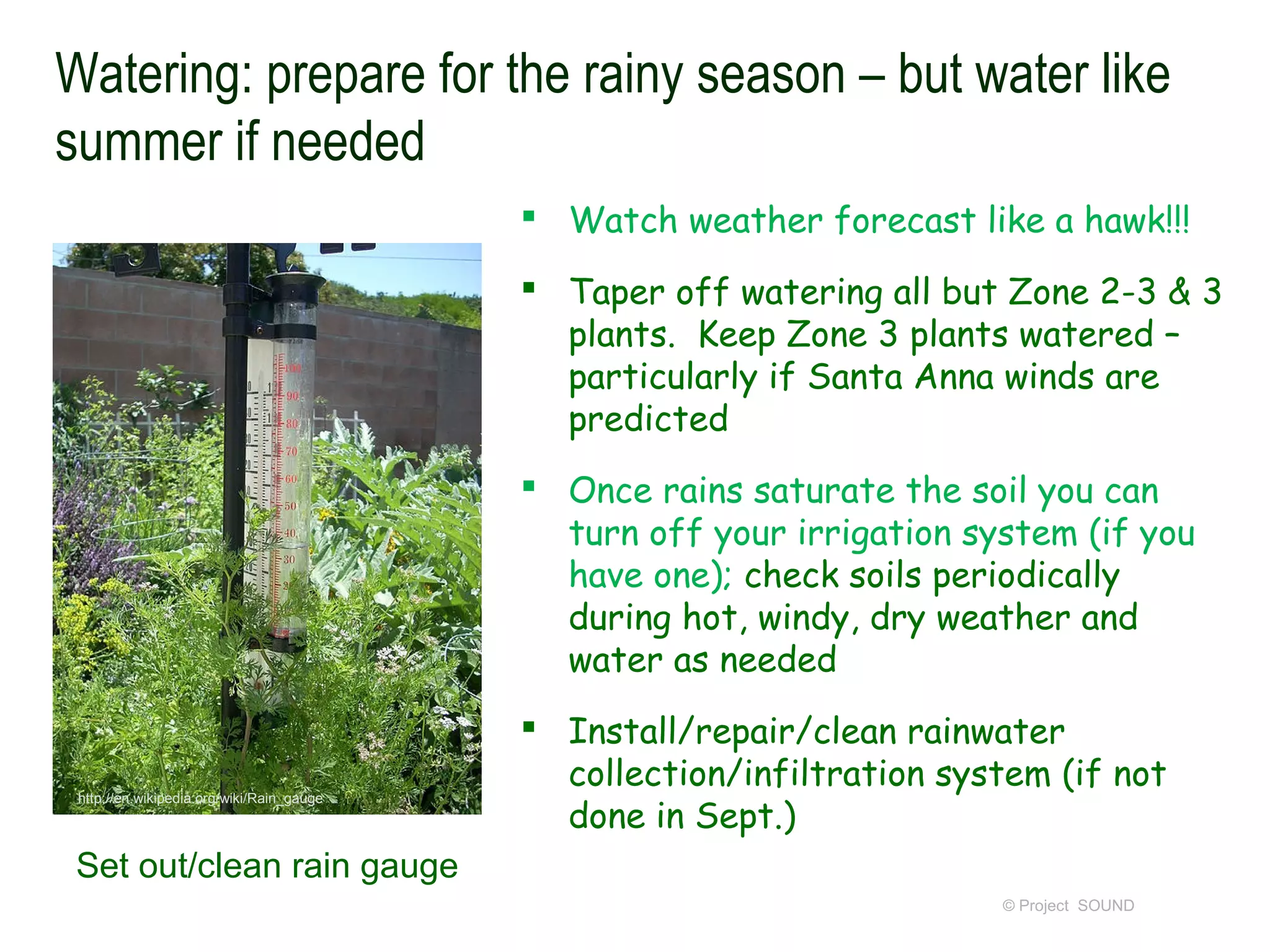
                                            Watch weather forecast like a hawk!!!

                                            Taper off watering all but Zone 2-3 & 3
                                             plants. Keep Zone 3 plants watered –
                                             particularly if Santa Anna winds are
                                             predicted
                                            Once rains saturate the soil you can
                                             turn off your irrigation system (if you
                                             have one); check soils periodically
                                             during hot, windy, dry weather and
                                             water as needed
                                            Install/repair/clean rainwater
                                             collection/infiltration system (if not
                                             done in Sept.)
 http://en.wikipedia.org/wiki/Rain_gauge


 Set out/clean rain gauge
                                                                        © Project SOUND
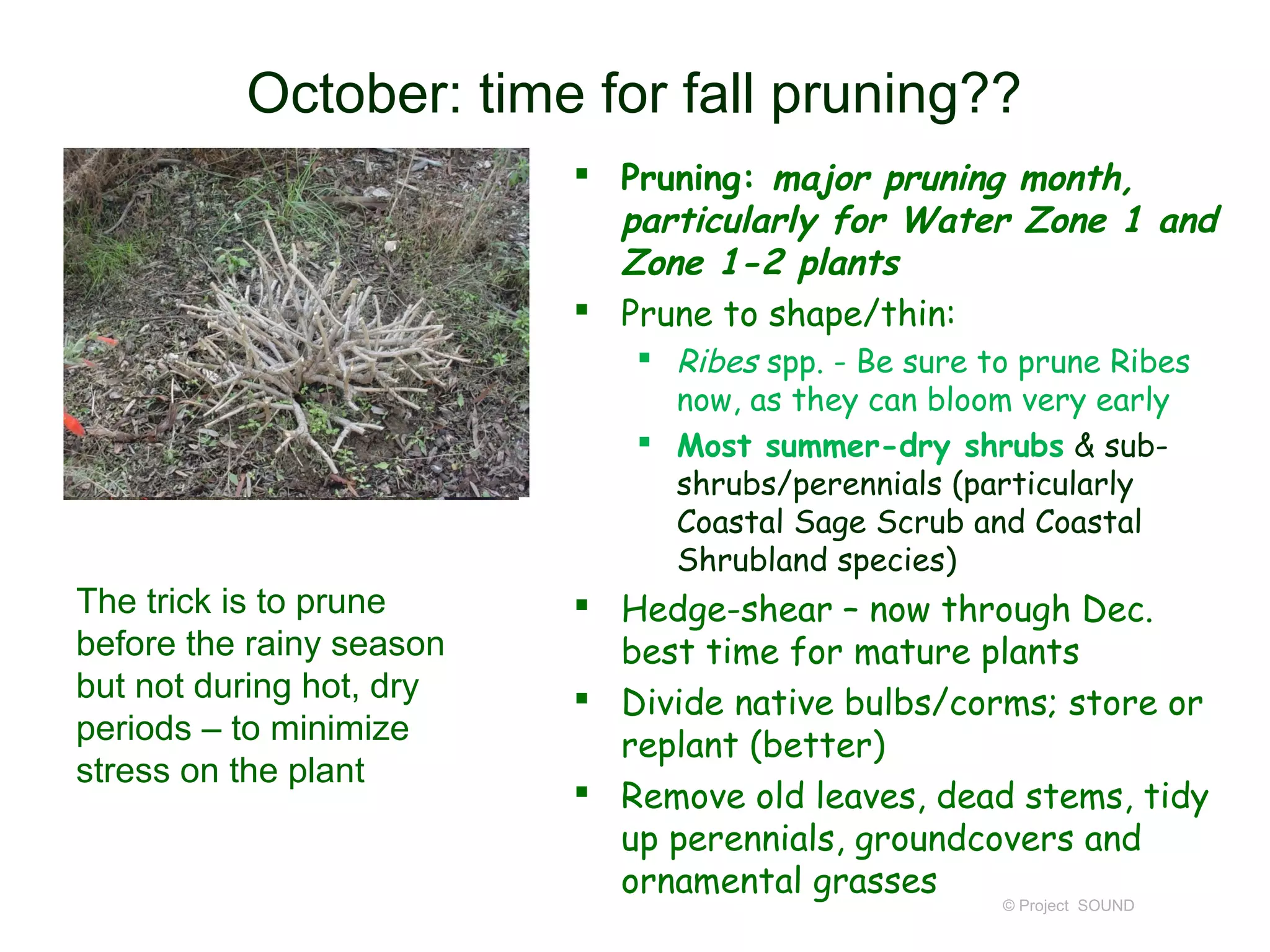
October: time for fall pruning??
                           Pruning: major pruning month,
                            particularly for Water Zone 1 and
                            Zone 1-2 plants
                           Prune to shape/thin:
                              Ribes spp. - Be sure to prune Ribes
                               now, as they can bloom very early
                              Most summer-dry shrubs & sub-
                               shrubs/perennials (particularly
                               Coastal Sage Scrub and Coastal
                               Shrubland species)
The trick is to prune      Hedge-shear – now through Dec.
before the rainy season     best time for mature plants
but not during hot, dry    Divide native bulbs/corms; store or
periods – to minimize       replant (better)
stress on the plant
                           Remove old leaves, dead stems, tidy
                            up perennials, groundcovers and
                            ornamental grasses
                                                     © Project SOUND
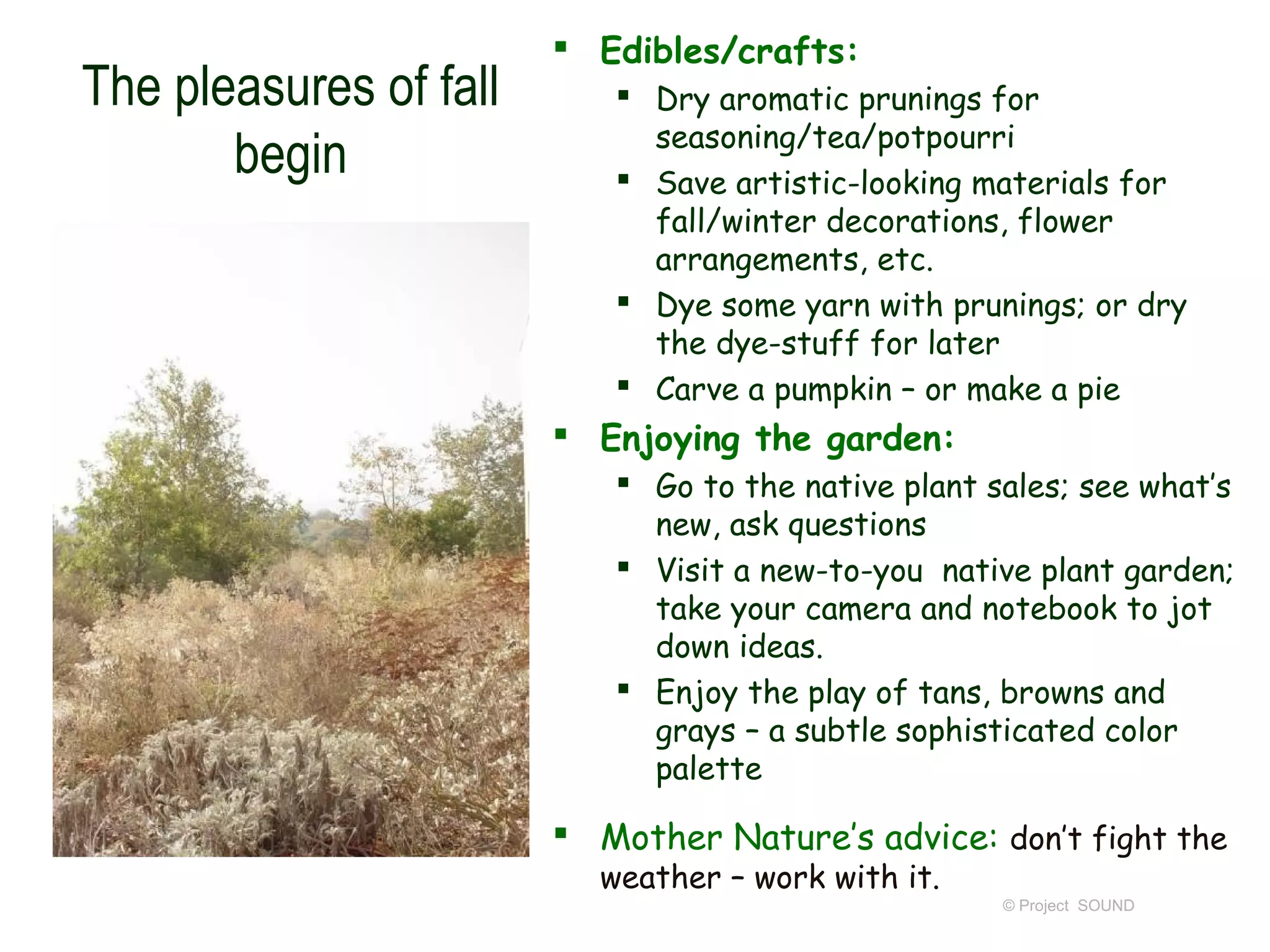
 Edibles/crafts:
The pleasures of fall       Dry aromatic prunings for
                             seasoning/tea/potpourri
       begin                Save artistic-looking materials for
                             fall/winter decorations, flower
                             arrangements, etc.
                            Dye some yarn with prunings; or dry
                             the dye-stuff for later
                            Carve a pumpkin – or make a pie
                         Enjoying the garden:
                            Go to the native plant sales; see what’s
                             new, ask questions
                            Visit a new-to-you native plant garden;
                             take your camera and notebook to jot
                             down ideas.
                            Enjoy the play of tans, browns and
                             grays – a subtle sophisticated color
                             palette

                         Mother Nature’s advice: don’t fight the
                          weather – work with it.
                                                     © Project SOUND
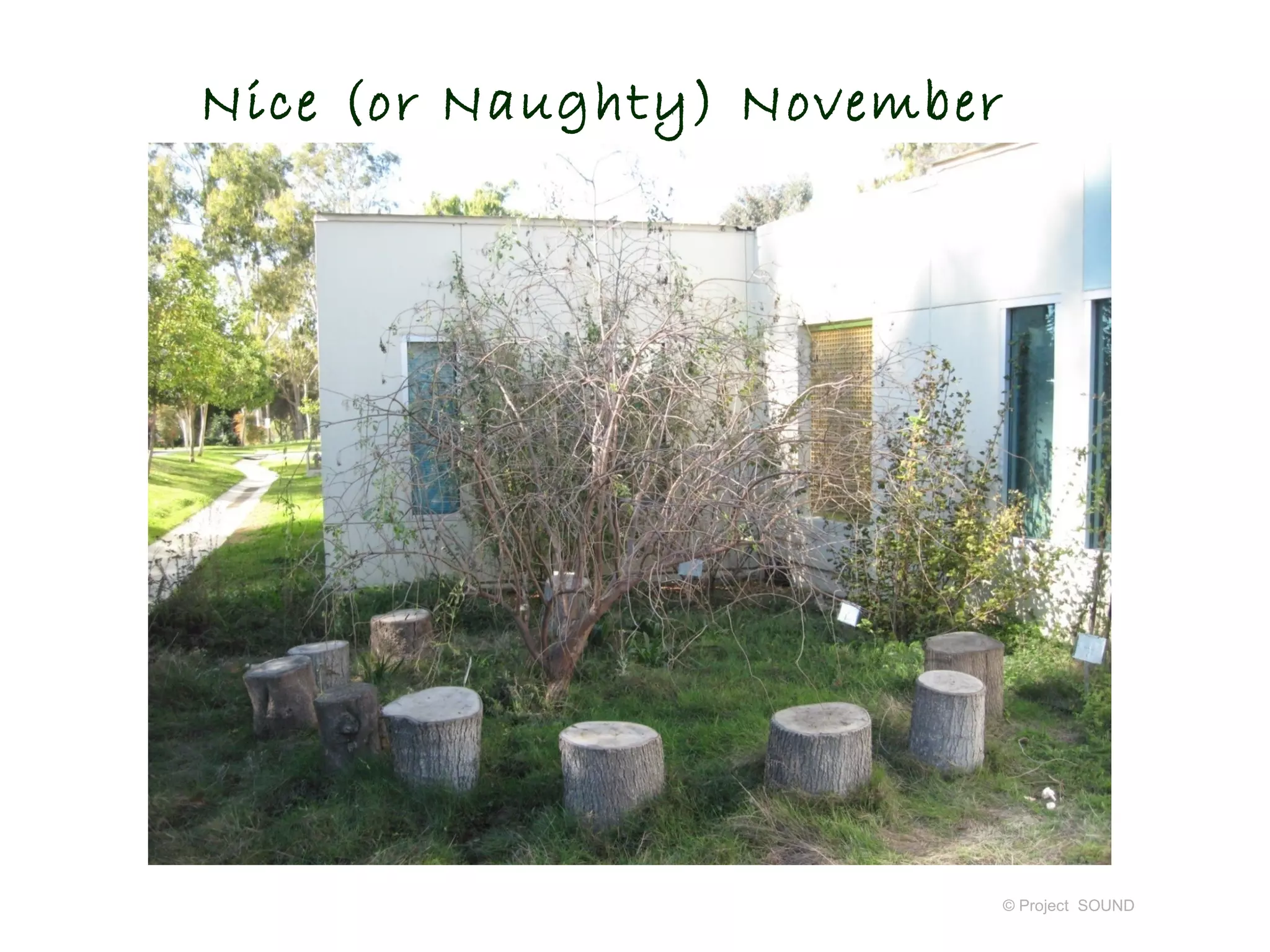
Nice (or Naughty) November


                             © Project SOUND
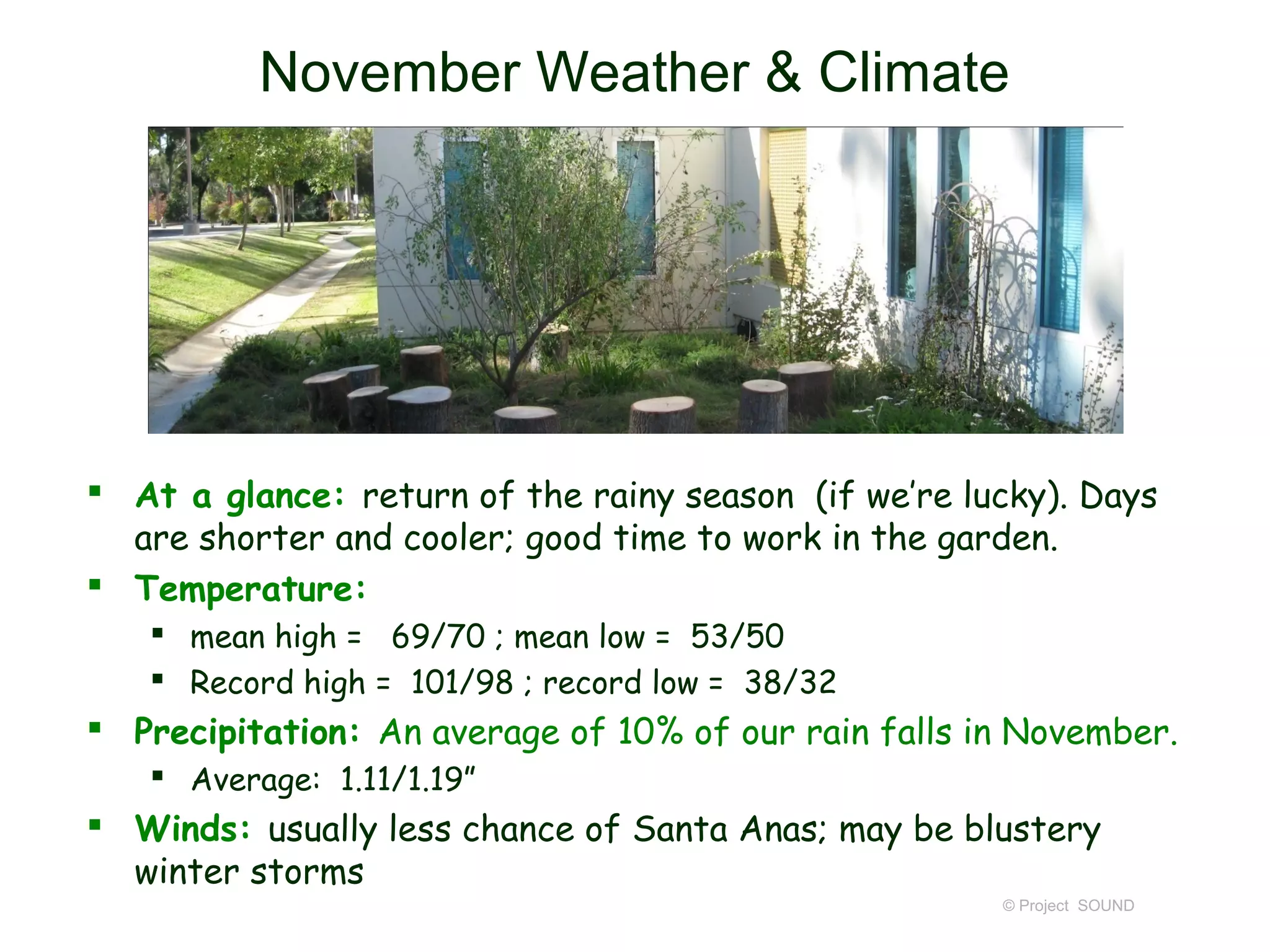
November Weather & Climate


 At a glance: return of the rainy season (if we’re lucky). Days
  are shorter and cooler; good time to work in the garden.
 Temperature:
    mean high = 69/70 ; mean low = 53/50
    Record high = 101/98 ; record low = 38/32
 Precipitation: An average of 10% of our rain falls in November.
    Average: 1.11/1.19”
 Winds: usually less chance of Santa Anas; may be blustery
  winter storms
                                                      © Project SOUND
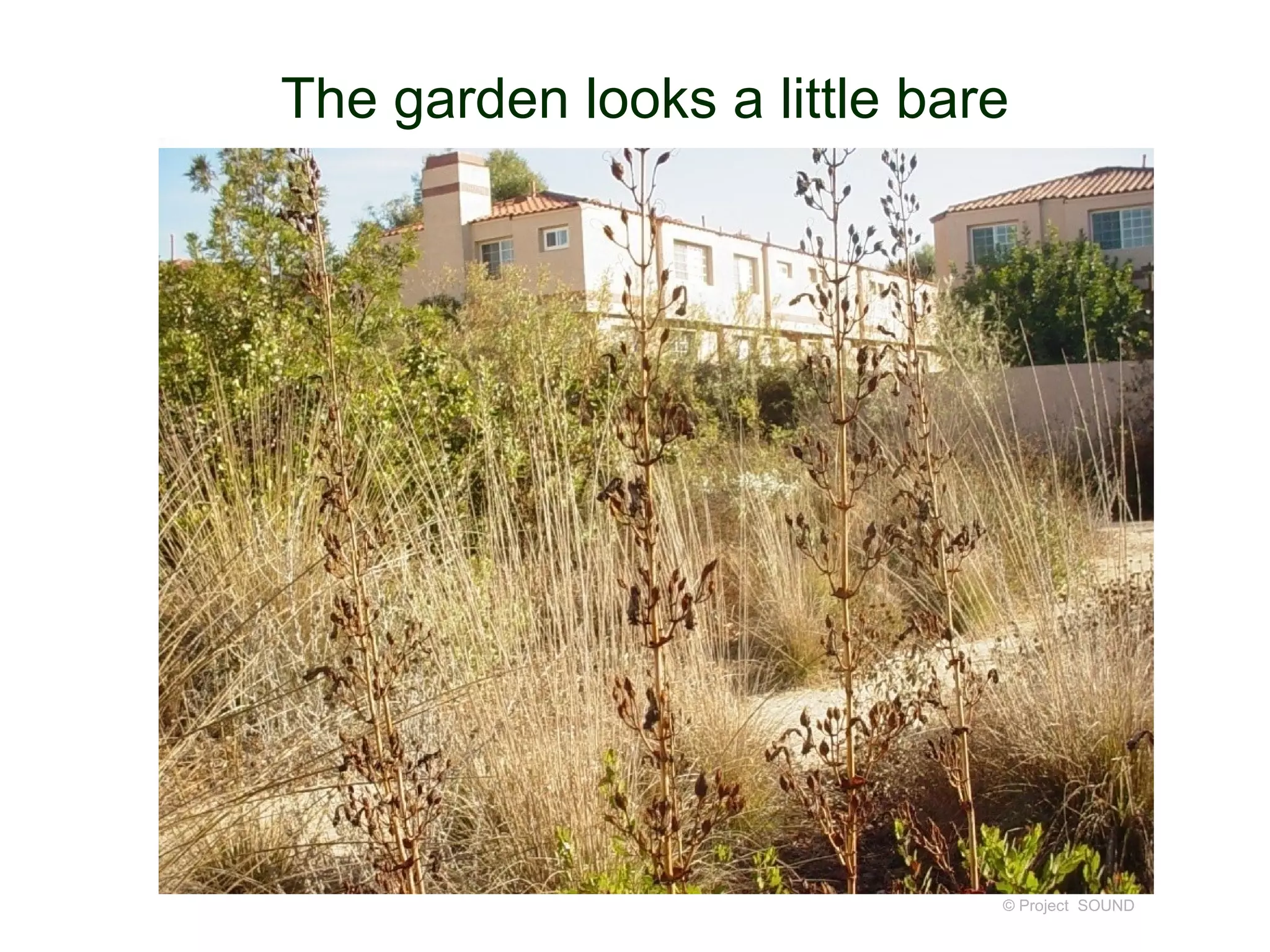
The garden looks a little bare


                             © Project SOUND
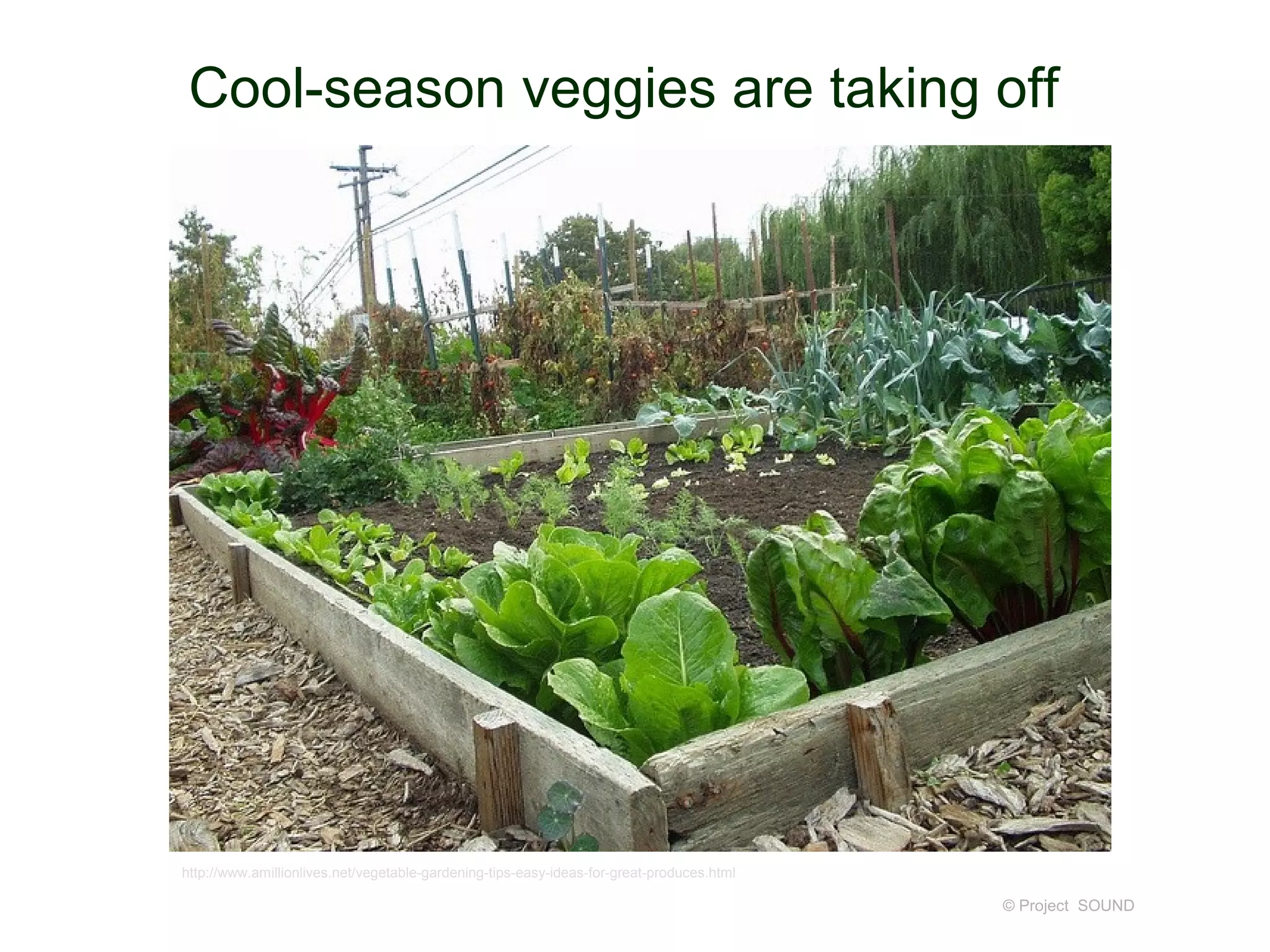
Cool-season veggies are taking off


http://www.amillionlives.net/vegetable-gardening-tips-easy-ideas-for-great-produces.html

                                                                                           © Project SOUND
Tidying up this
                                                                     Planning:
         month                                                          Purchase plants at native plant
                                                                         nurseries/sales; place in semi-shade
                                                                         and water until planted out.

                                                                     Hardscape/General:
                                                                        Renew mulch after pruning – so much
                                                                         easier!
                                                                        Complete your clean-up of summer
                                                                         blooming perennials and shrubs
http://a1mowing.com/shrub.htm
                                                                     Watering: usually into winter mode
                                                                        Once rains saturate the soil you can
                                                                         turn off your irrigation system (if
                                                                         you have one); check soils periodically
                                                                         during hot, windy, dry weather and
                                                                         water as needed
                                                                        Water garden well if soils become
                                                                         dry or if no rain for 3 weeks or
                                                                         longer
                                                                                                © Project SOUND
http://www.ucrealty.com/blog/F036CE3C-0903-4FFC-BA58-0510C054C0F3
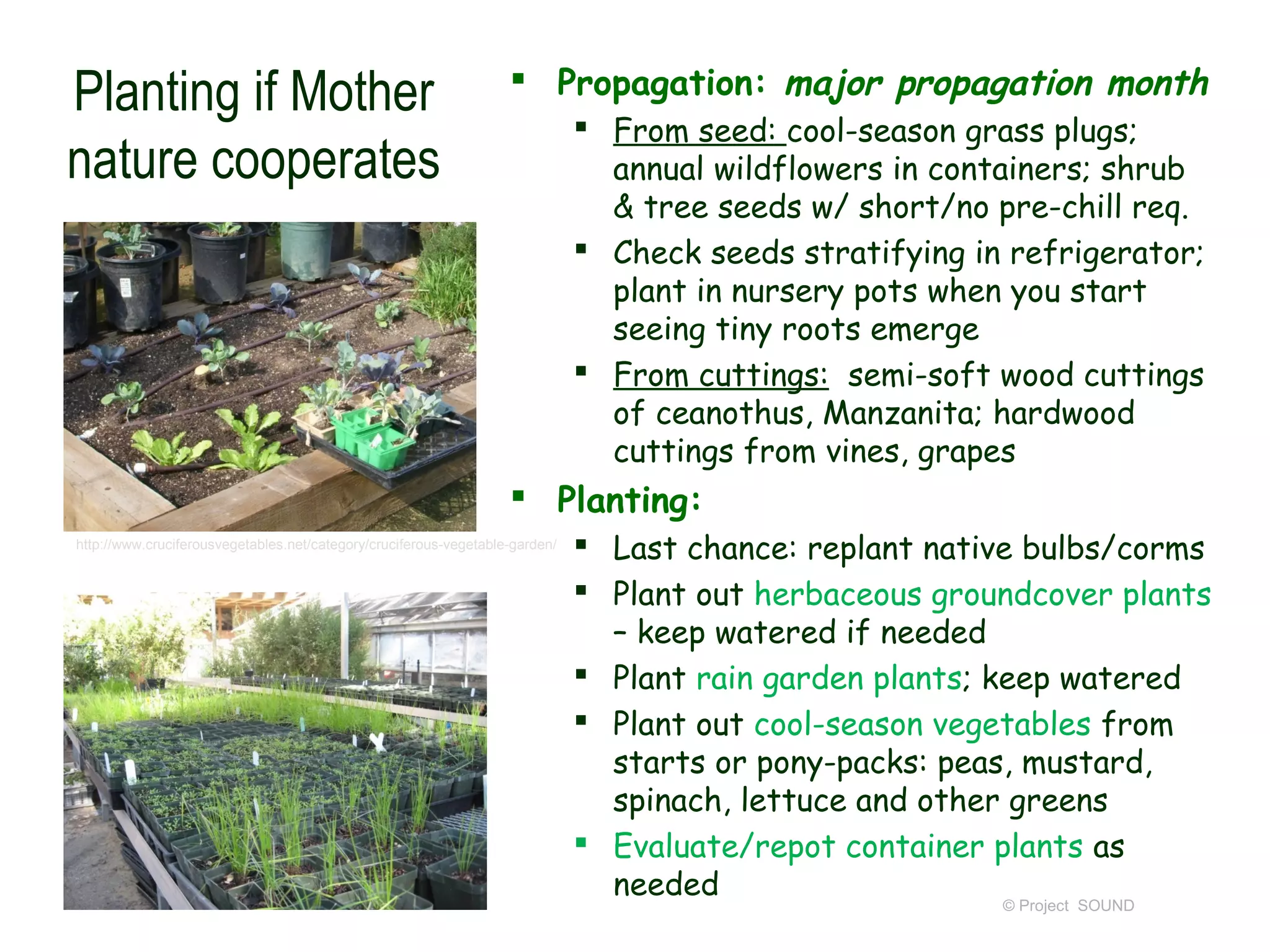
 Propagation: major propagation month
Planting if Mother                                                             From seed: cool-season grass plugs;
nature cooperates                                                               annual wildflowers in containers; shrub
                                                                                & tree seeds w/ short/no pre-chill req.
                                                                               Check seeds stratifying in refrigerator;
                                                                                plant in nursery pots when you start
                                                                                seeing tiny roots emerge
                                                                               From cuttings: semi-soft wood cuttings
                                                                                of ceanothus, Manzanita; hardwood
                                                                                cuttings from vines, grapes
                                                                    Planting:
http://www.cruciferousvegetables.net/category/cruciferous-vegetable-garden/    Last chance: replant native bulbs/corms
                                                                               Plant out herbaceous groundcover plants
                                                                                – keep watered if needed
                                                                               Plant rain garden plants; keep watered
                                                                               Plant out cool-season vegetables from
                                                                                starts or pony-packs: peas, mustard,
                                                                                spinach, lettuce and other greens
                                                                               Evaluate/repot container plants as
                                                                                needed
                                                                                                          © Project SOUND
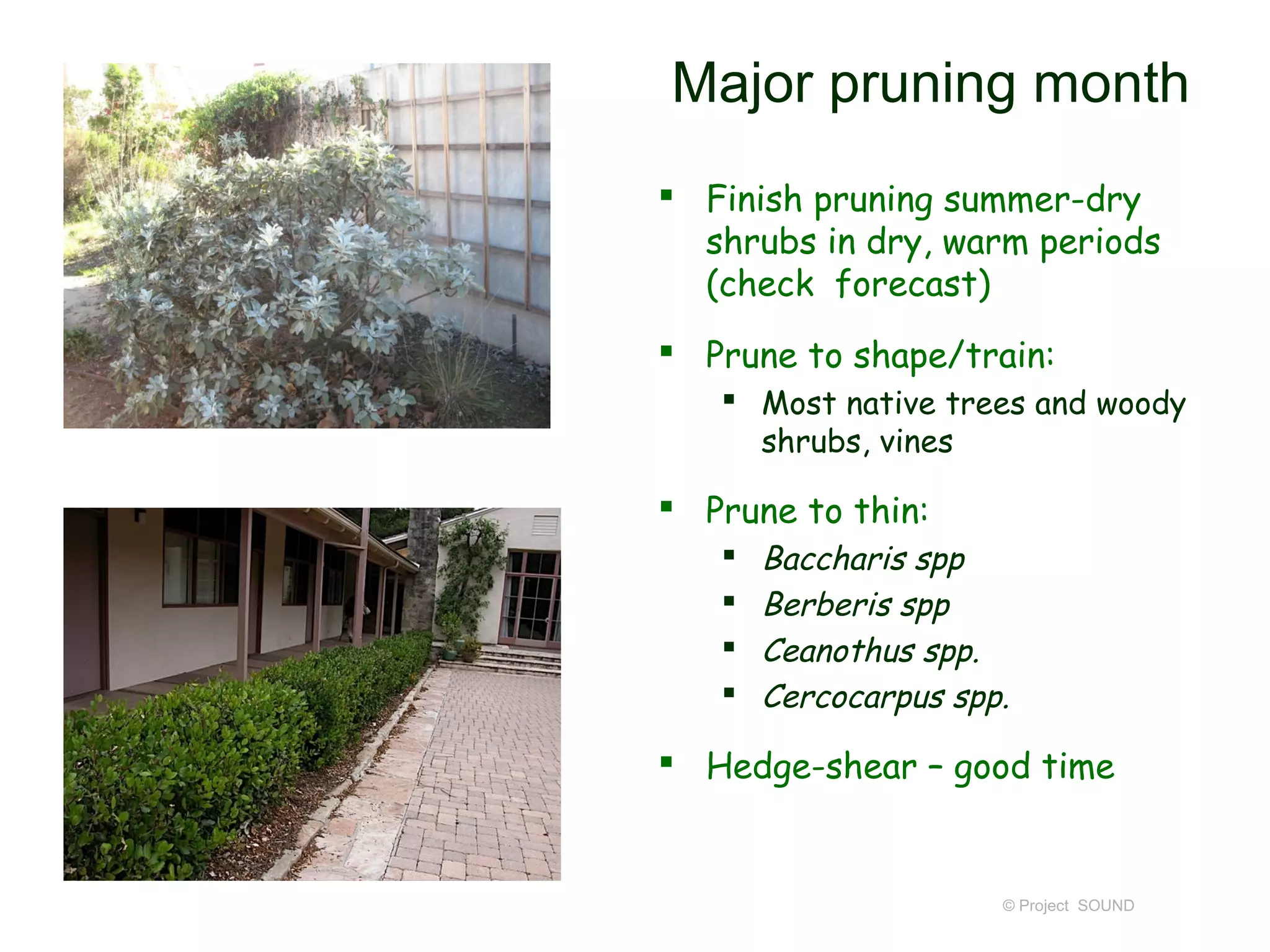
Major pruning month
 Finish pruning summer-dry
  shrubs in dry, warm periods
  (check forecast)
 Prune to shape/train:
    Most native trees and woody
     shrubs, vines

 Prune to thin:
      Baccharis spp
      Berberis spp
      Ceanothus spp.
      Cercocarpus spp.

 Hedge-shear – good time


                      © Project SOUND
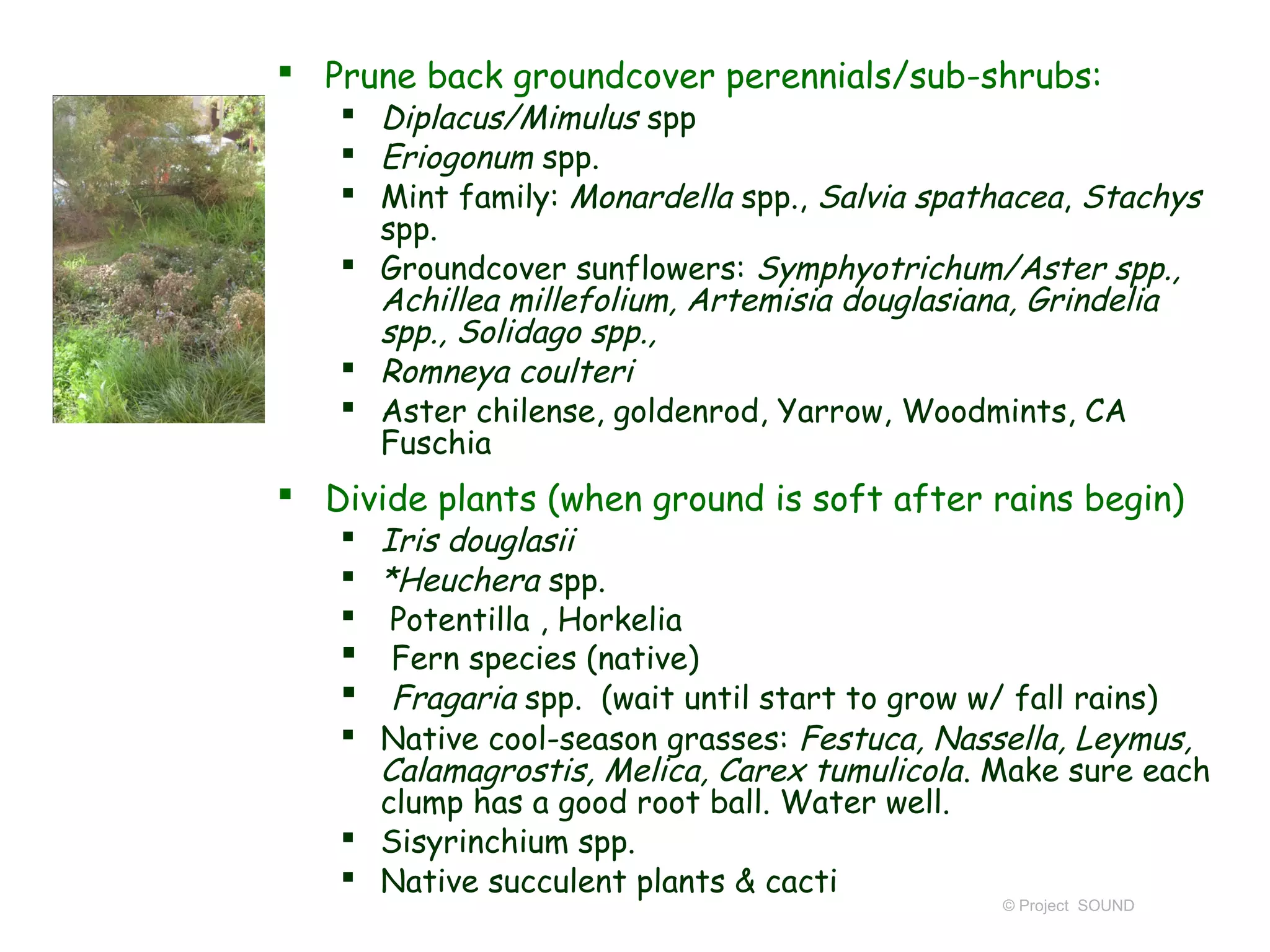
 Prune back groundcover perennials/sub-shrubs:
    Diplacus/Mimulus spp
    Eriogonum spp.
    Mint family: Monardella spp., Salvia spathacea, Stachys
     spp.
    Groundcover sunflowers: Symphyotrichum/Aster spp.,
     Achillea millefolium, Artemisia douglasiana, Grindelia
     spp., Solidago spp.,
    Romneya coulteri
    Aster chilense, goldenrod, Yarrow, Woodmints, CA
     Fuschia
 Divide plants (when ground is soft after rains begin)
    Iris douglasii
    *Heuchera spp.
    Potentilla , Horkelia
    Fern species (native)
    Fragaria spp. (wait until start to grow w/ fall rains)
    Native cool-season grasses: Festuca, Nassella, Leymus,
     Calamagrostis, Melica, Carex tumulicola . Make sure each
     clump has a good root ball. Water well.
    Sisyrinchium spp.
    Native succulent plants & cacti
                                               © Project SOUND
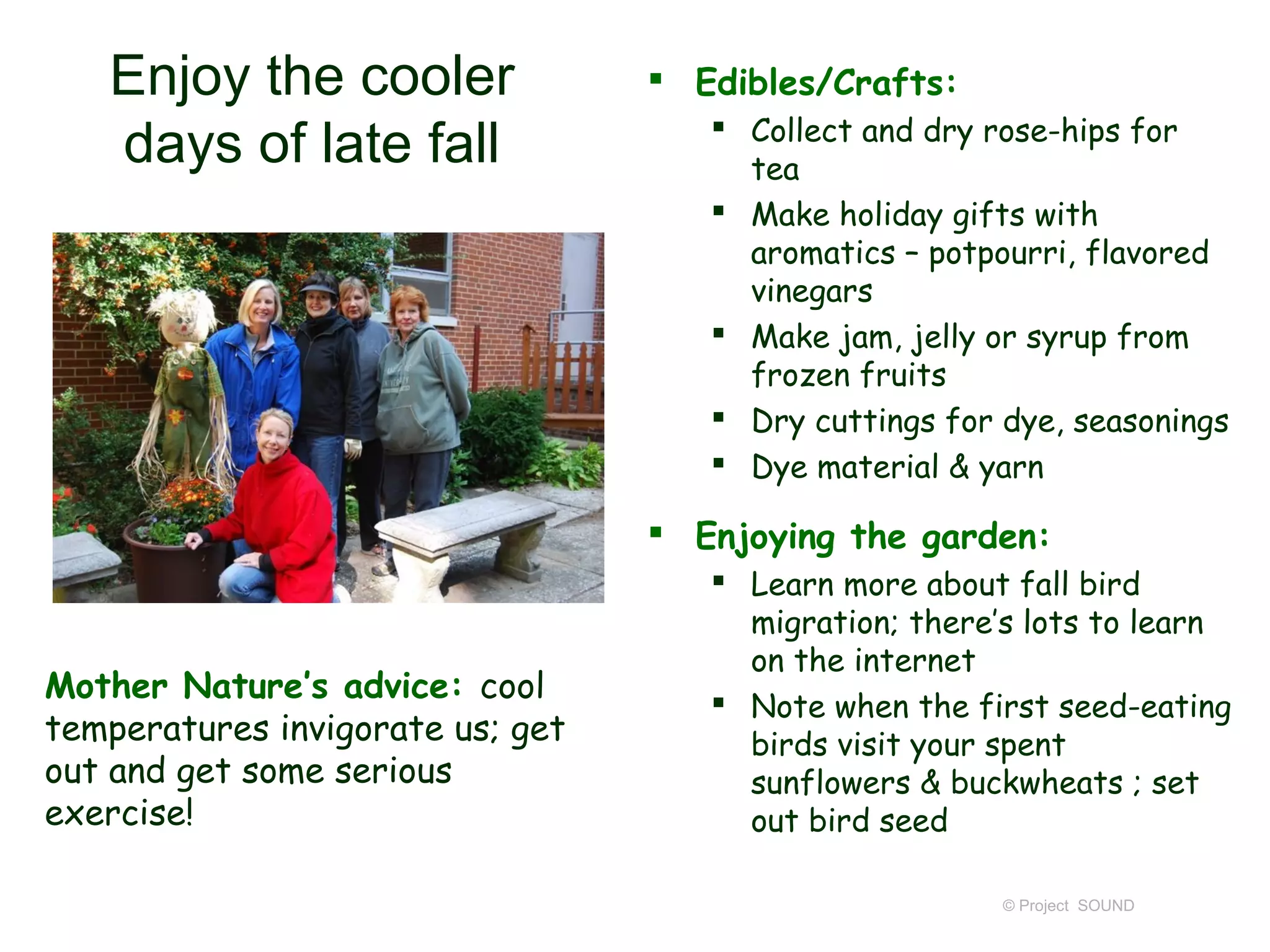
Enjoy the cooler                Edibles/Crafts:
                                      Collect and dry rose-hips for
   days of late fall                   tea
                                      Make holiday gifts with
                                       aromatics – potpourri, flavored
                                       vinegars
                                      Make jam, jelly or syrup from
                                       frozen fruits
                                      Dry cuttings for dye, seasonings
                                      Dye material & yarn

                                   Enjoying the garden:
                                      Learn more about fall bird
                                       migration; there’s lots to learn
                                       on the internet
Mother Nature’s advice: cool          Note when the first seed-eating
temperatures invigorate us; get        birds visit your spent
out and get some serious               sunflowers & buckwheats ; set
exercise!                              out bird seed

                                                        © Project SOUND
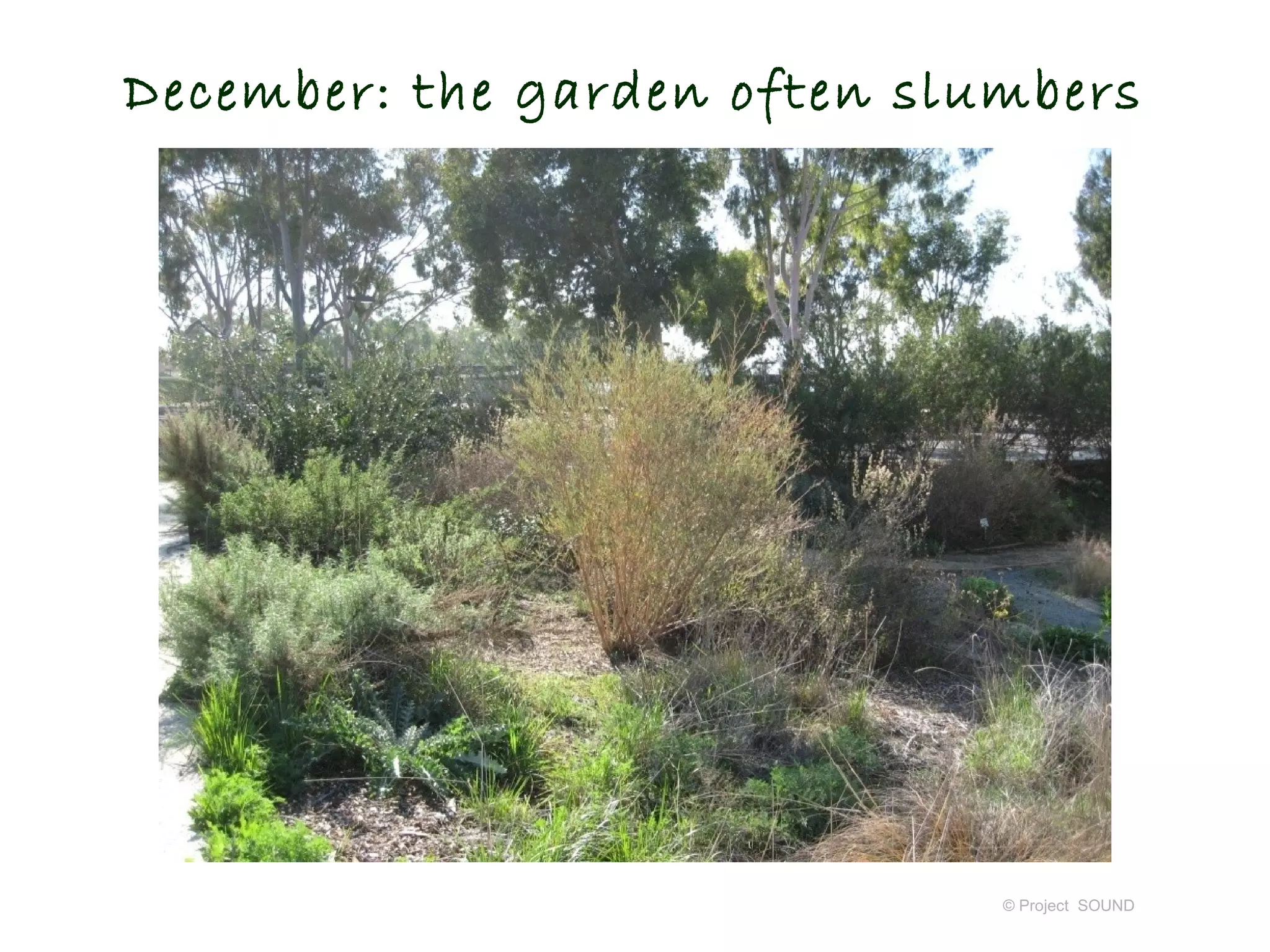
December: the garden often slumbers


                              © Project SOUND
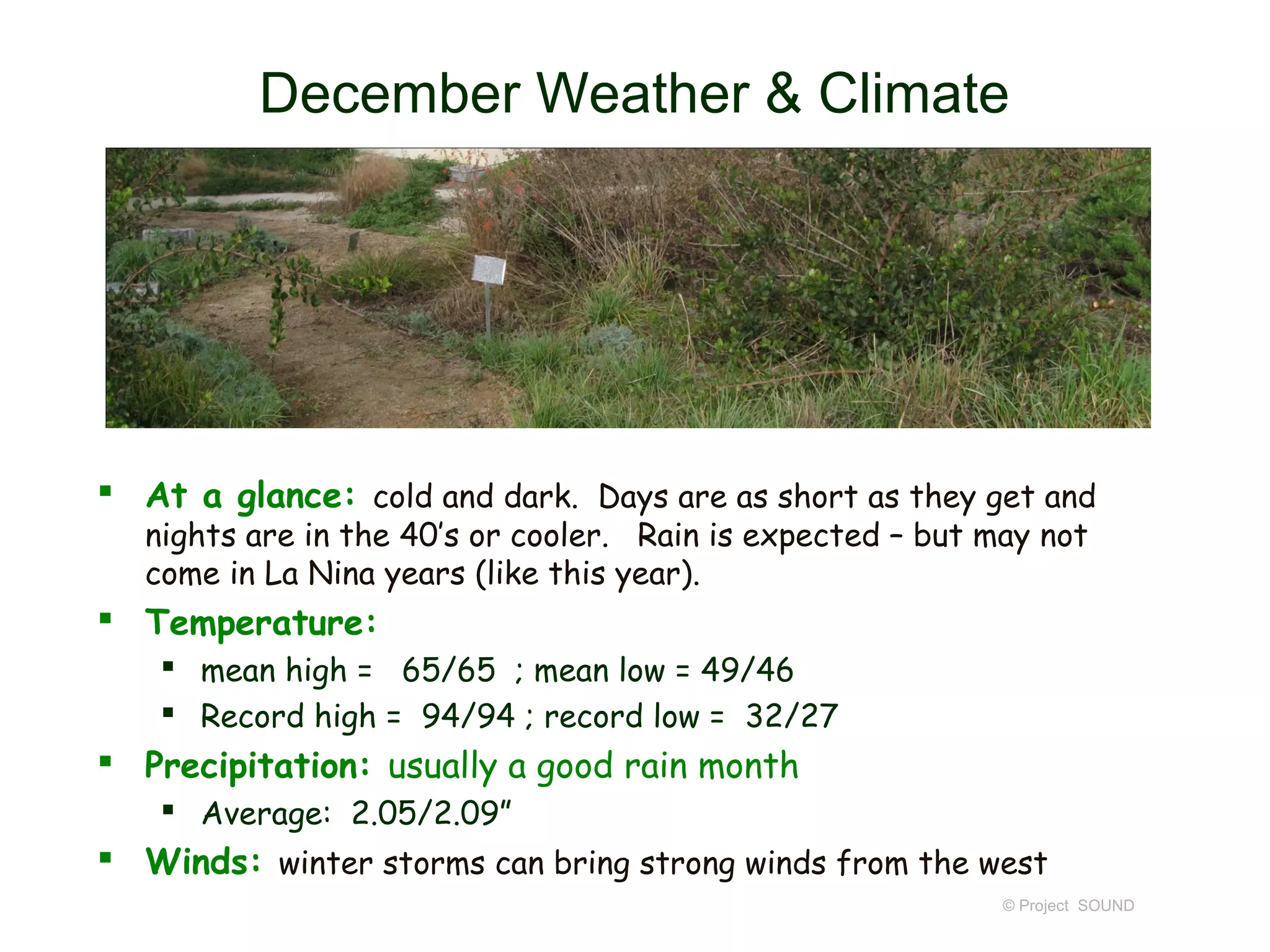
December Weather & Climate


 At a glance: cold and dark. Days are as short as they get and
   nights are in the 40’s or cooler. Rain is expected – but may not
   come in La Nina years (like this year).
 Temperature:
     mean high = 65/65 ; mean low = 49/46
     Record high = 94/94 ; record low = 32/27
 Precipitation: usually a good rain month
     Average: 2.05/2.09”
 Winds: winter storms can bring strong winds from the west
                                                             © Project SOUND
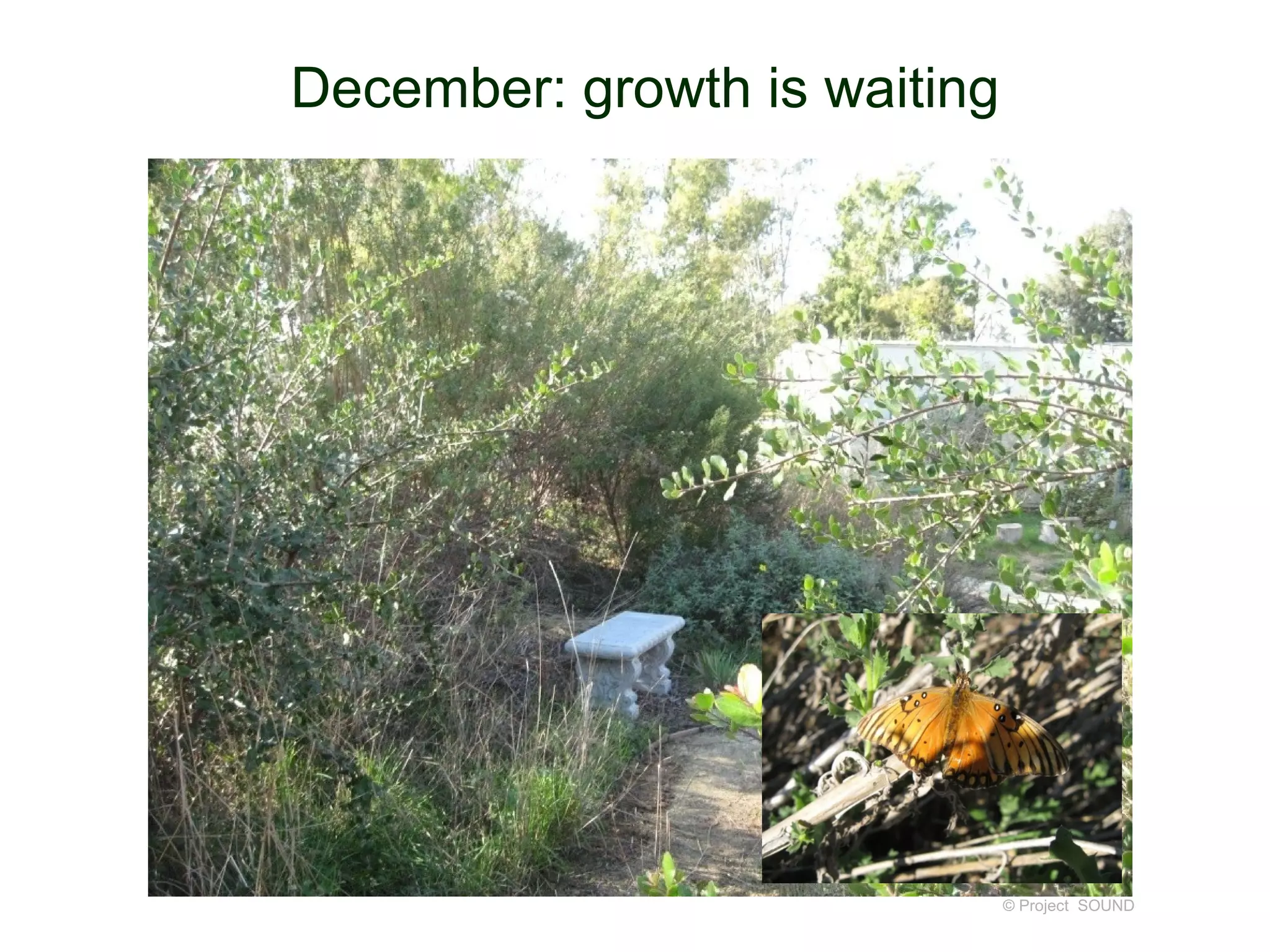
December: growth is waiting


                              © Project SOUND
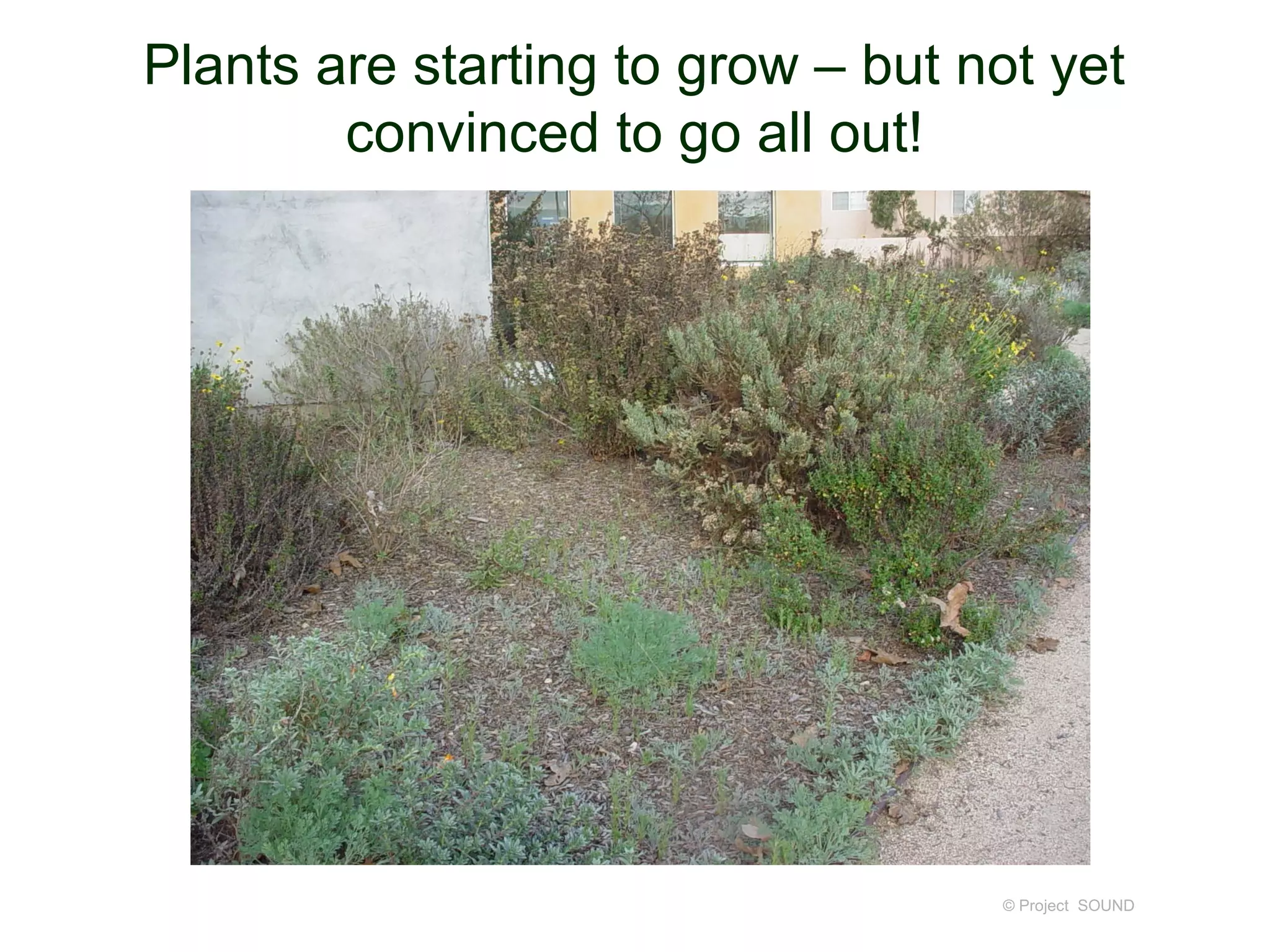
Plants are starting to grow – but not yet
        convinced to go all out!


                                   © Project SOUND
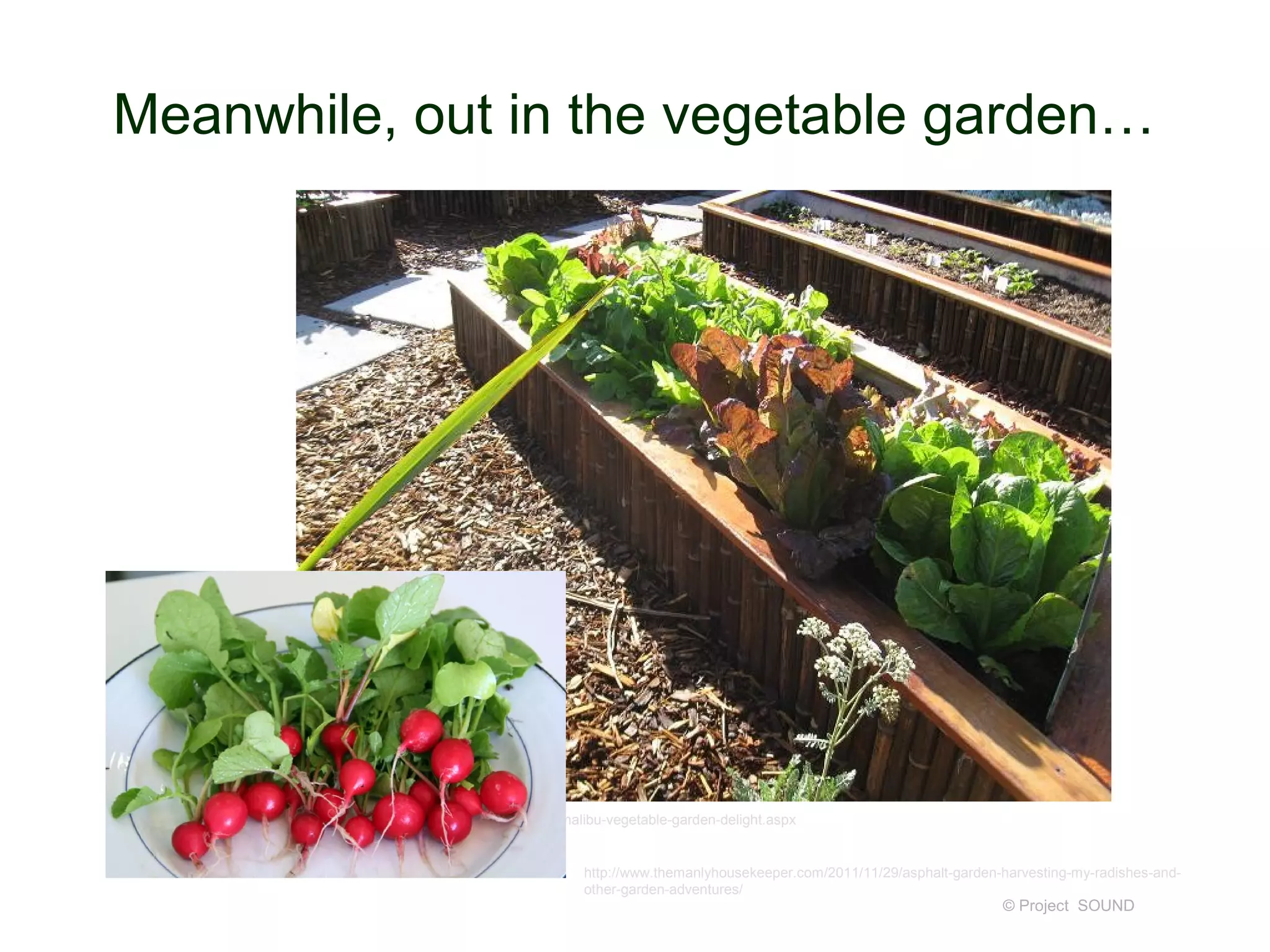
Meanwhile, out in the vegetable garden…


       http://blog.gardenerd.com/2009/12/16/malibu-vegetable-garden-delight.aspx


                                               http://www.themanlyhousekeeper.com/2011/11/29/asphalt-garden-harvesting-my-radishes-and-
                                               other-garden-adventures/
                                                                                                            © Project SOUND
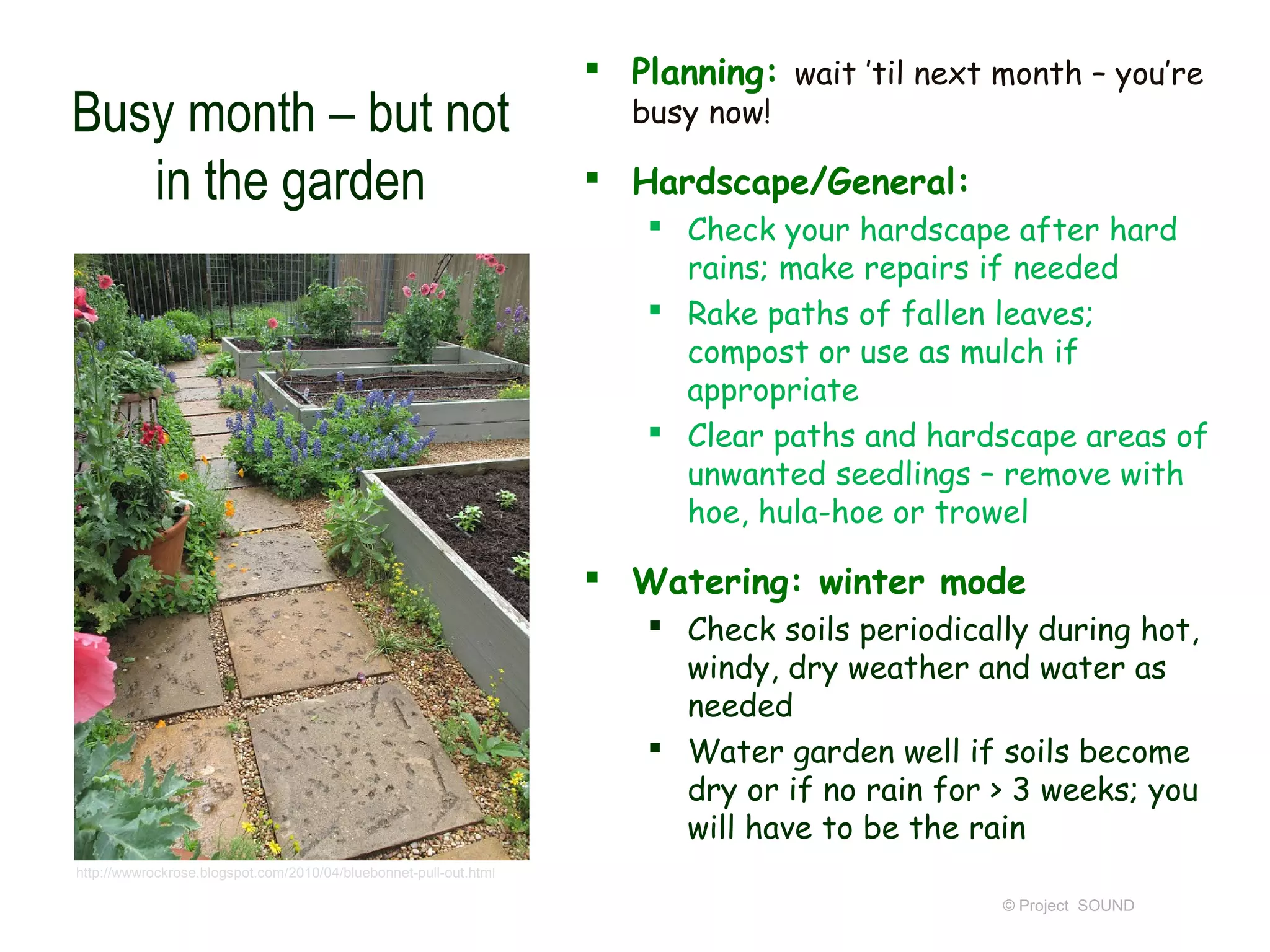
 Planning: wait ’til next month – you’re
Busy month – but not                                                  busy now!

   in the garden                                                    Hardscape/General:
                                                                        Check your hardscape after hard
                                                                         rains; make repairs if needed
                                                                        Rake paths of fallen leaves;
                                                                         compost or use as mulch if
                                                                         appropriate
                                                                        Clear paths and hardscape areas of
                                                                         unwanted seedlings – remove with
                                                                         hoe, hula-hoe or trowel

                                                                    Watering: winter mode
                                                                        Check soils periodically during hot,
                                                                         windy, dry weather and water as
                                                                         needed
                                                                        Water garden well if soils become
                                                                         dry or if no rain for > 3 weeks; you
                                                                         will have to be the rain
http://wwwrockrose.blogspot.com/2010/04/bluebonnet-pull-out.html

                                                                                               © Project SOUND
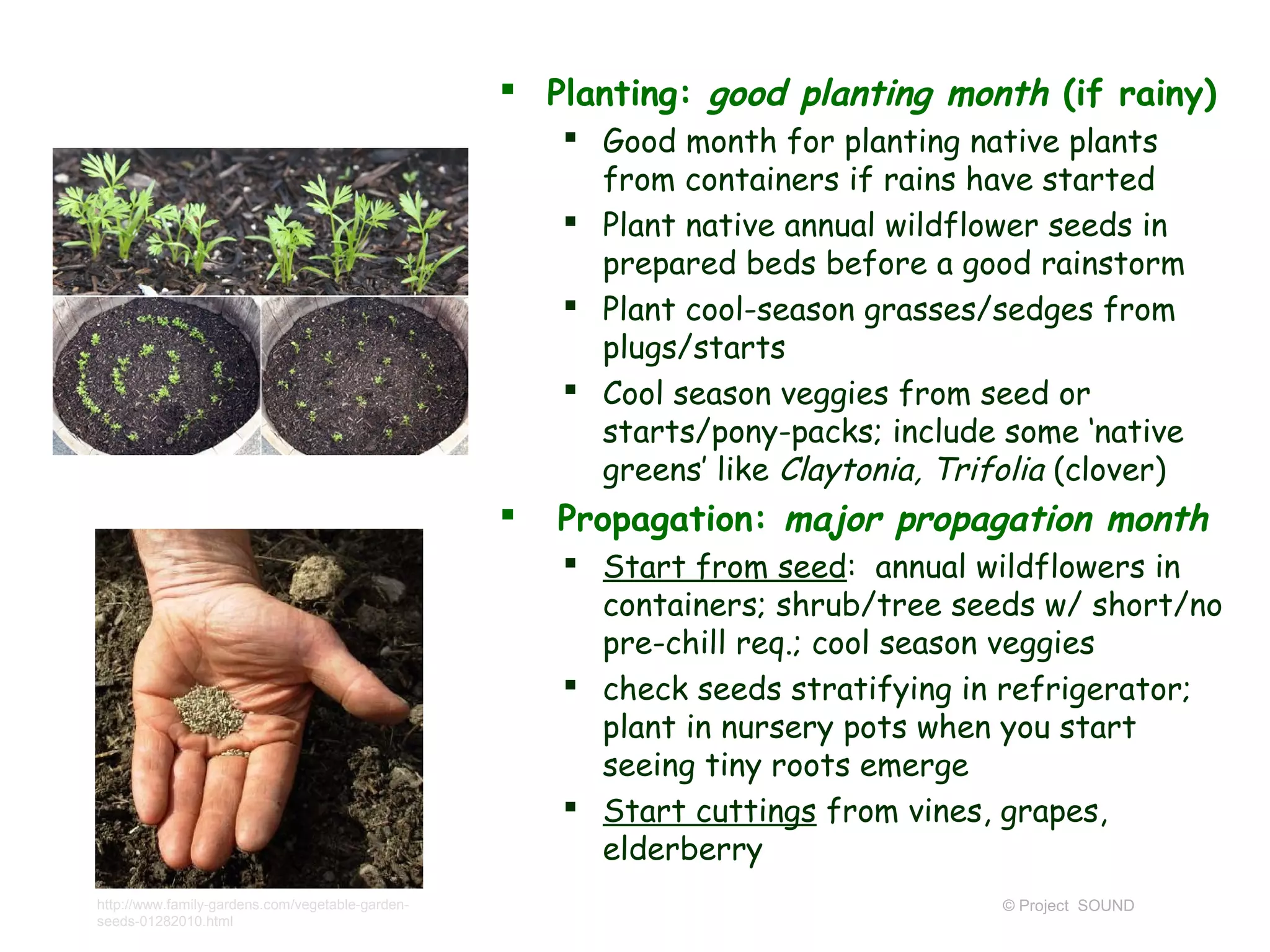
 Planting: good planting month (if rainy)
                                                      Good month for planting native plants
                                                       from containers if rains have started
                                                      Plant native annual wildflower seeds in
                                                       prepared beds before a good rainstorm
                                                      Plant cool-season grasses/sedges from
                                                       plugs/starts
                                                      Cool season veggies from seed or
                                                       starts/pony-packs; include some ‘native
                                                       greens’ like Claytonia, Trifolia (clover)
                                                    Propagation: major propagation month
                                                      Start from seed: annual wildflowers in
                                                       containers; shrub/tree seeds w/ short/no
                                                       pre-chill req.; cool season veggies
                                                      check seeds stratifying in refrigerator;
                                                       plant in nursery pots when you start
                                                       seeing tiny roots emerge
                                                      Start cuttings from vines, grapes,
                                                       elderberry
http://www.family-gardens.com/vegetable-garden-                                    © Project SOUND
seeds-01282010.html
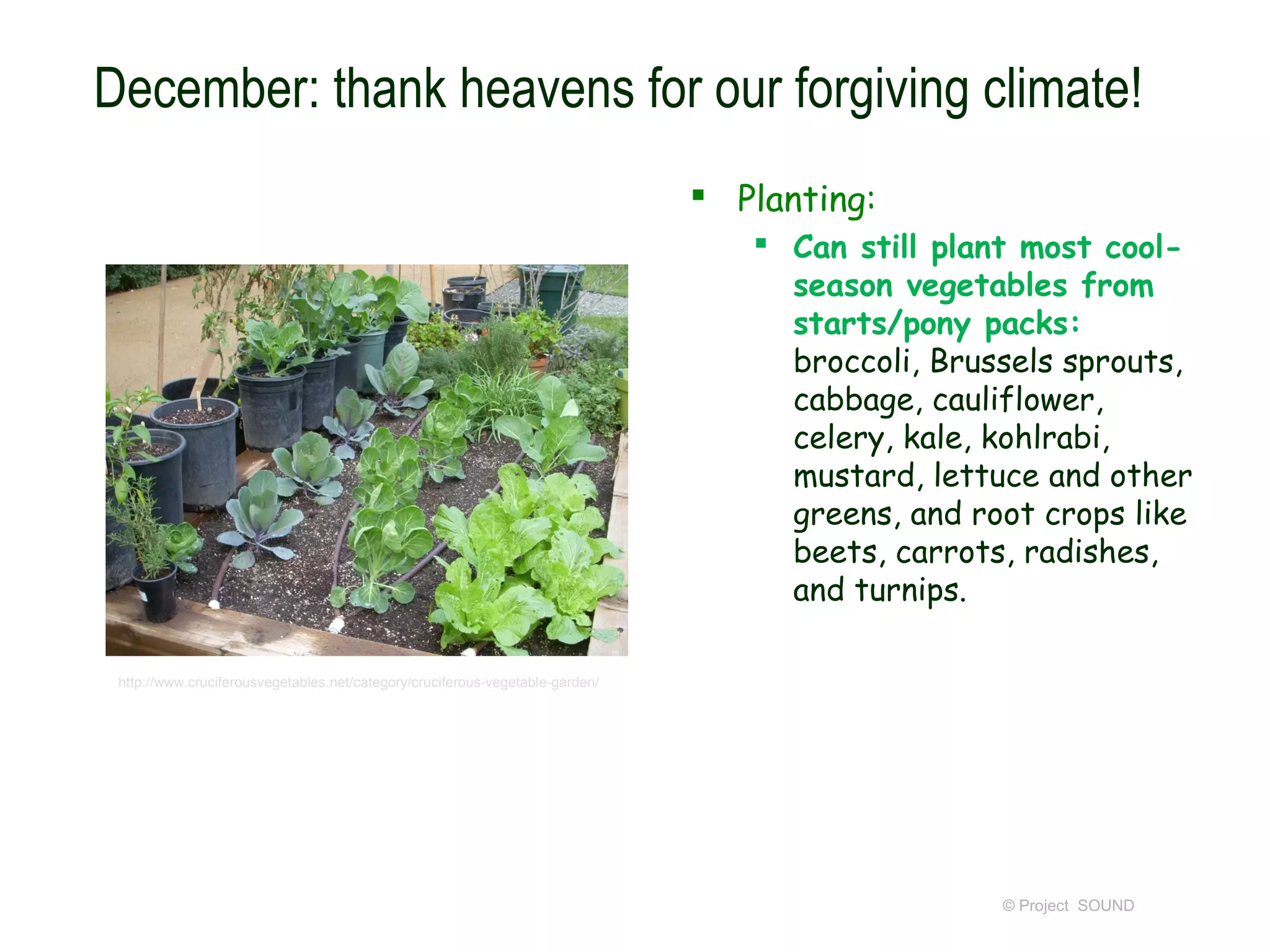
December: thank heavens for our forgiving climate!
                                                                                Planting:
                                                                                   Can still plant most cool-
                                                                                    season vegetables from
                                                                                    starts/pony packs:
                                                                                    broccoli, Brussels sprouts,
                                                                                    cabbage, cauliflower,
                                                                                    celery, kale, kohlrabi,
                                                                                    mustard, lettuce and other
                                                                                    greens, and root crops like
                                                                                    beets, carrots, radishes,
                                                                                    and turnips.

 http://www.cruciferousvegetables.net/category/cruciferous-vegetable-garden/


                                                                                                  © Project SOUND
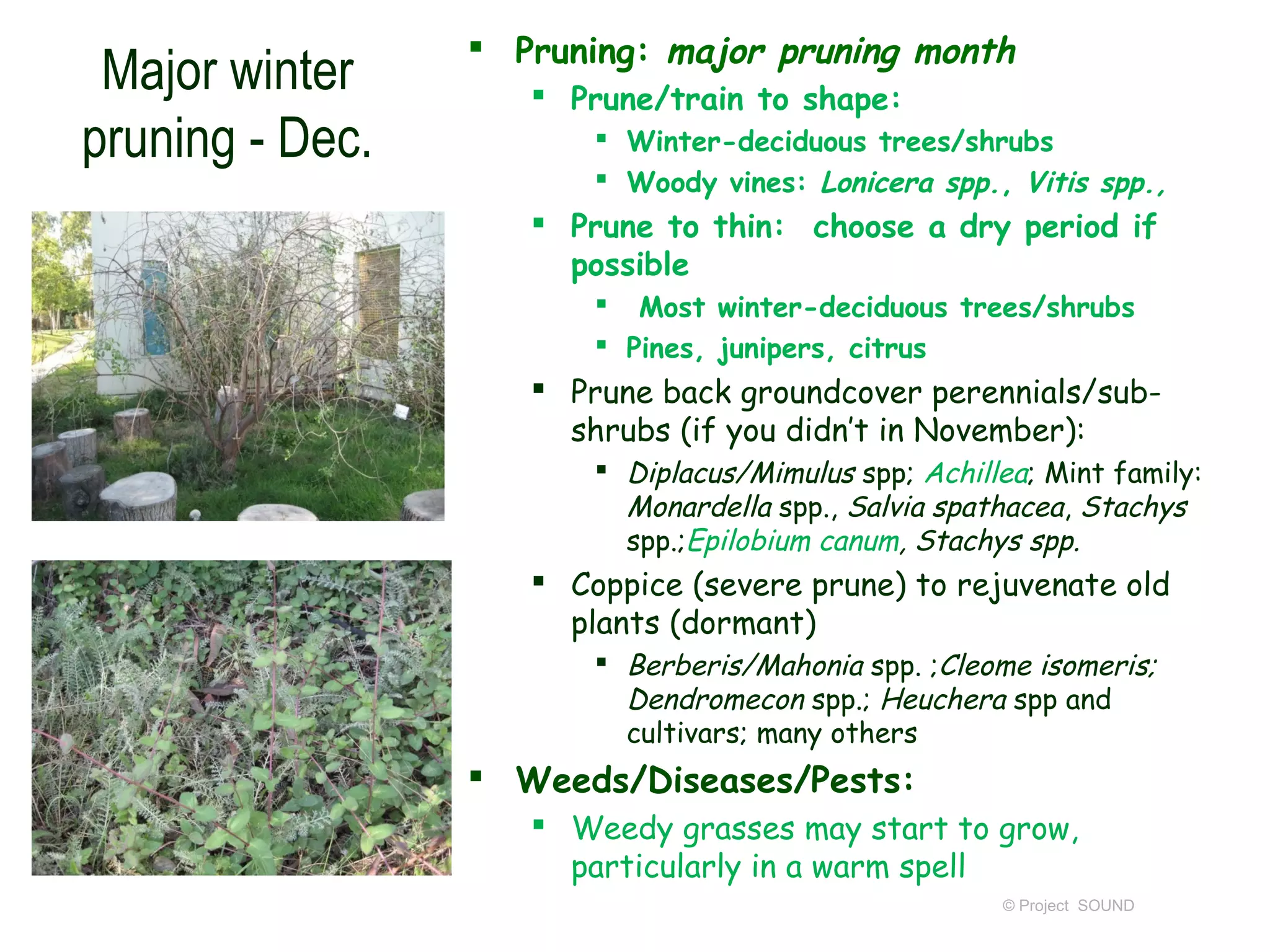
 Pruning: major pruning month
 Major winter        Prune/train to shape:
pruning - Dec.           Winter-deciduous trees/shrubs
                         Woody vines: Lonicera spp., Vitis spp.,
                     Prune to thin: choose a dry period if
                      possible
                         Most winter-deciduous trees/shrubs
                         Pines, junipers, citrus
                     Prune back groundcover perennials/sub-
                      shrubs (if you didn’t in November):
                         Diplacus/Mimulus spp; Achillea; Mint family:
                          Monardella spp., Salvia spathacea, Stachys
                          spp.;Epilobium canum, Stachys spp.
                     Coppice (severe prune) to rejuvenate old
                      plants (dormant)
                         Berberis/Mahonia spp. ;Cleome isomeris;
                          Dendromecon spp.; Heuchera spp and
                          cultivars; many others
                  Weeds/Diseases/Pests:
                     Weedy grasses may start to grow,
                      particularly in a warm spell
                                                      © Project SOUND
Enjoy the quiet moments…
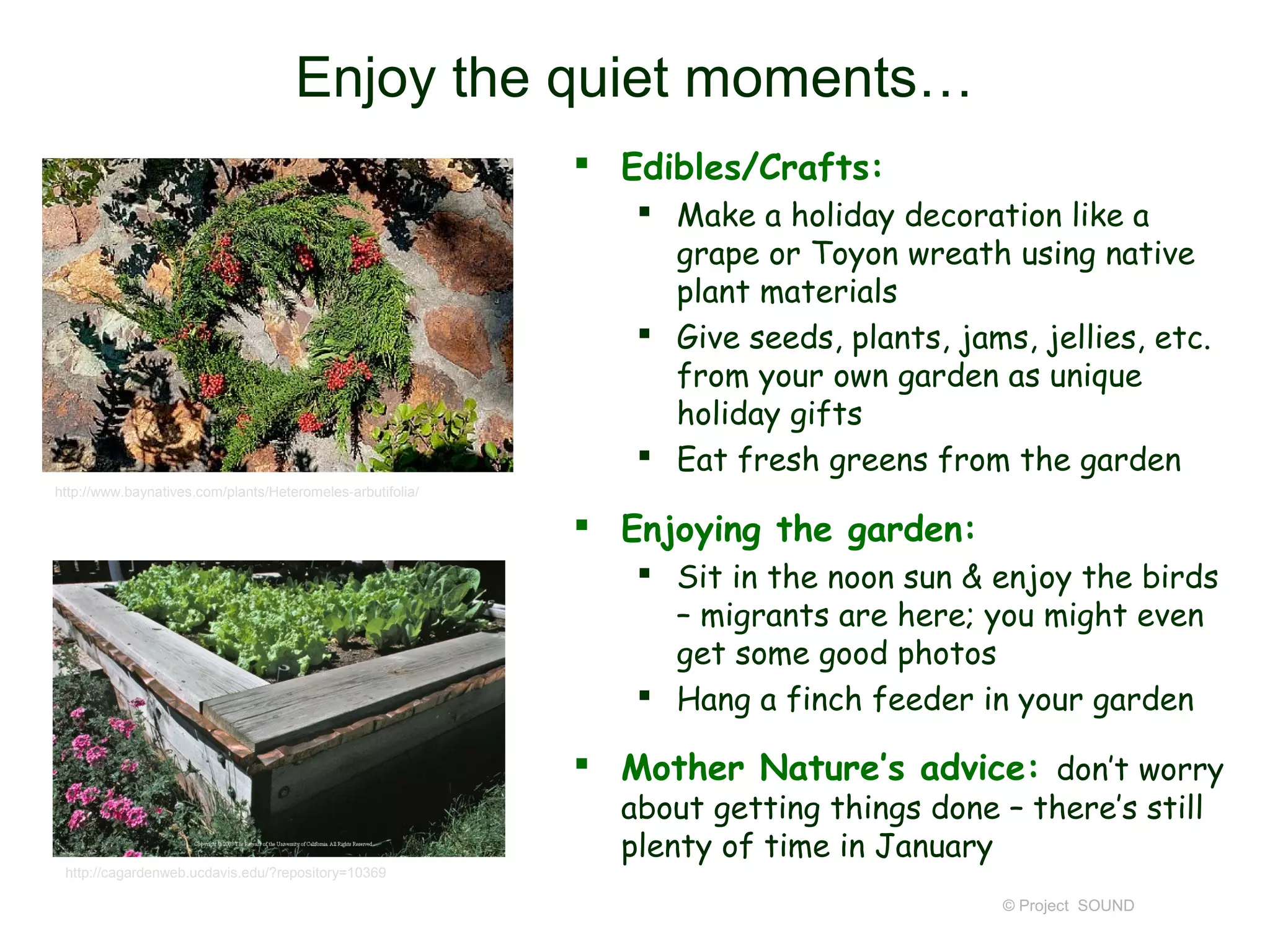
                                                             Edibles/Crafts:
                                                                Make a holiday decoration like a
                                                                 grape or Toyon wreath using native
                                                                 plant materials
                                                                Give seeds, plants, jams, jellies, etc.
                                                                 from your own garden as unique
                                                                 holiday gifts
                                                                Eat fresh greens from the garden
http://www.baynatives.com/plants/Heteromeles-arbutifolia/

                                                             Enjoying the garden:
                                                                Sit in the noon sun & enjoy the birds
                                                                 – migrants are here; you might even
                                                                 get some good photos
                                                                Hang a finch feeder in your garden

                                                             Mother Nature’s advice: don’t worry
                                                              about getting things done – there’s still
                                                              plenty of time in January
 http://cagardenweb.ucdavis.edu/?repository=10369

                                                                                         © Project SOUND
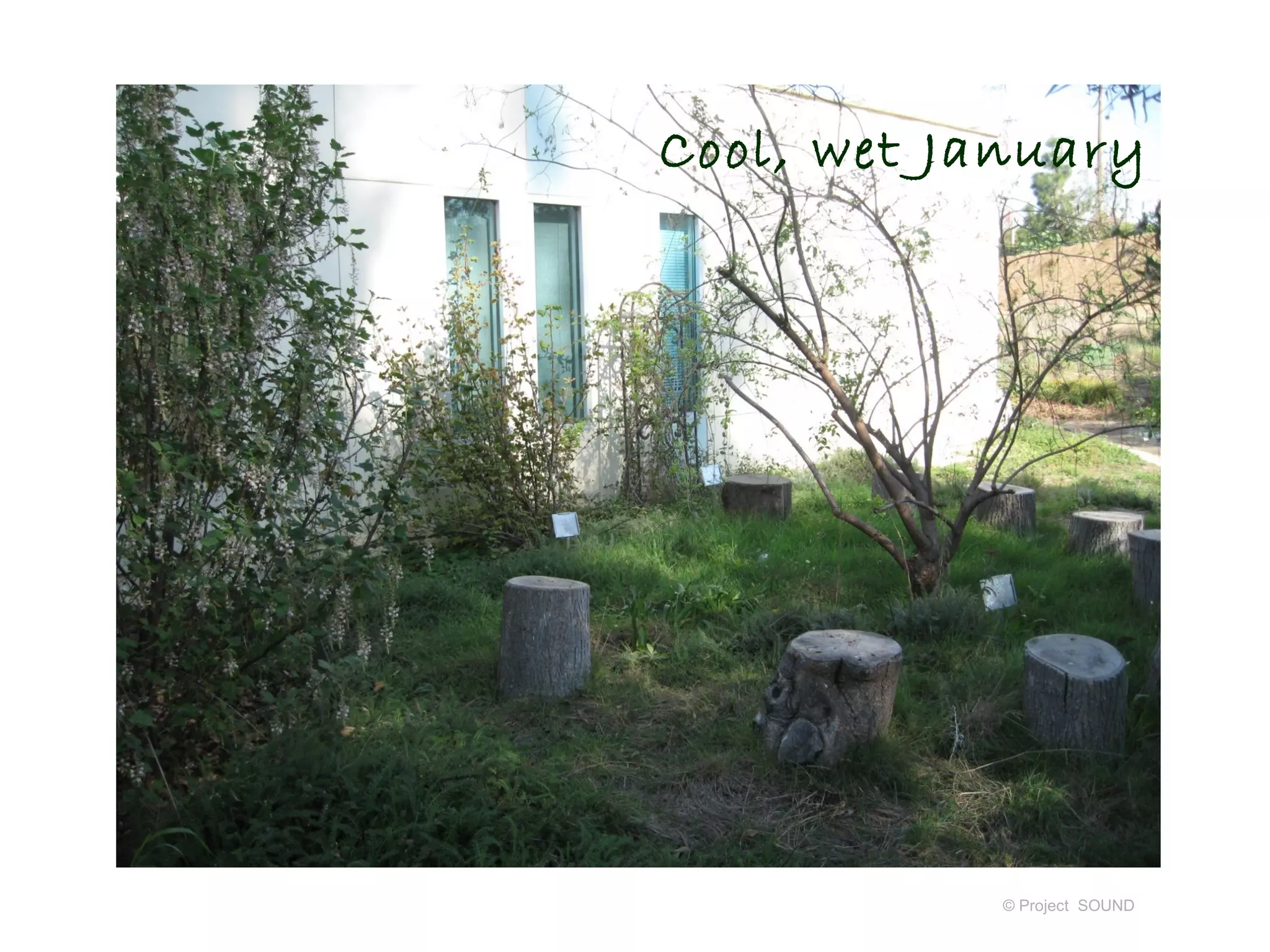
Cool, wet January


            © Project SOUND
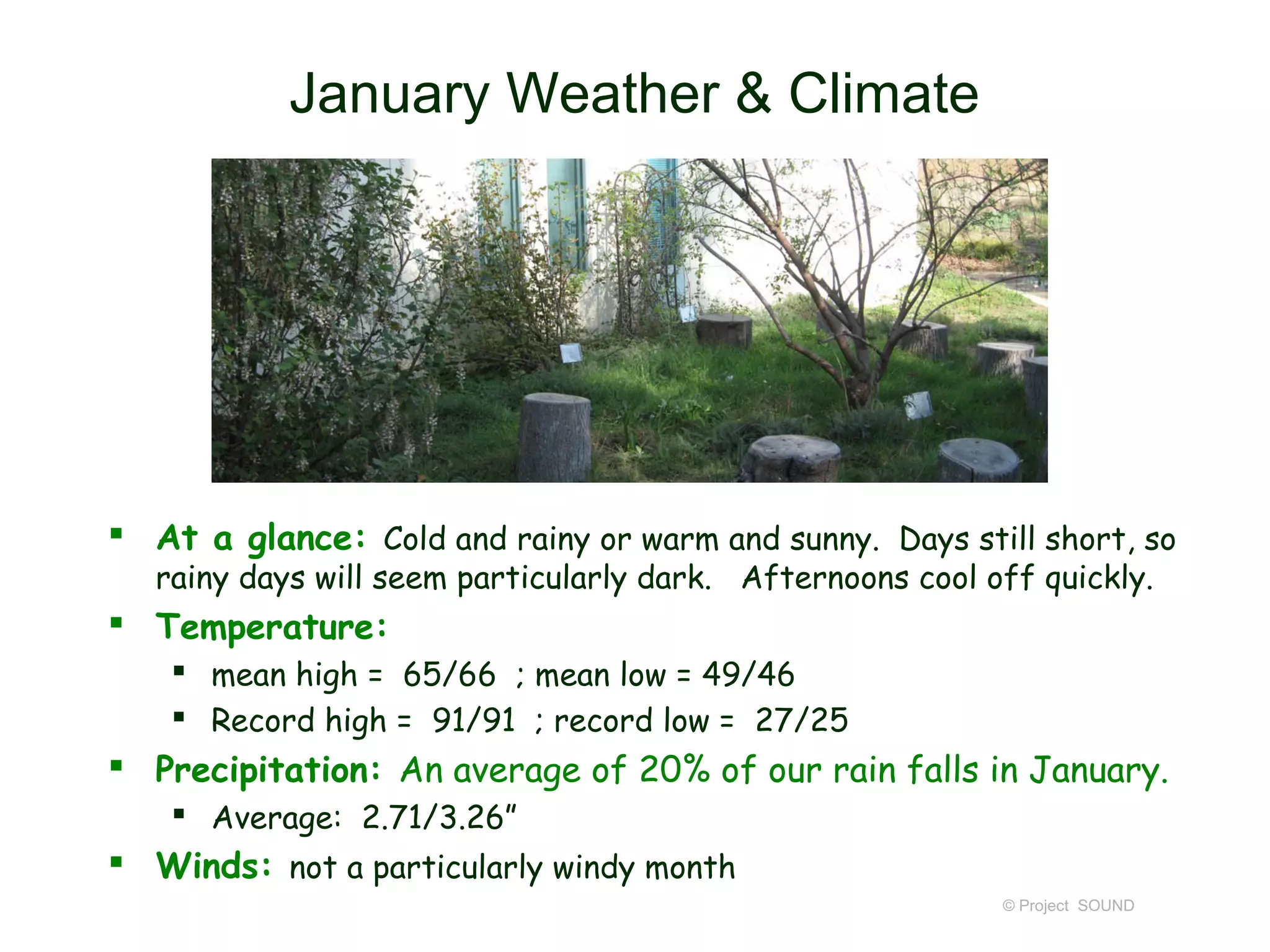
January Weather & Climate


 At a glance: Cold and rainy or warm and sunny. Days still short, so
   rainy days will seem particularly dark. Afternoons cool off quickly.
 Temperature:
     mean high = 65/66 ; mean low = 49/46
     Record high = 91/91 ; record low = 27/25
 Precipitation: An average of 20% of our rain falls in January.
     Average: 2.71/3.26”
 Winds: not a particularly windy month
                                                            © Project SOUND
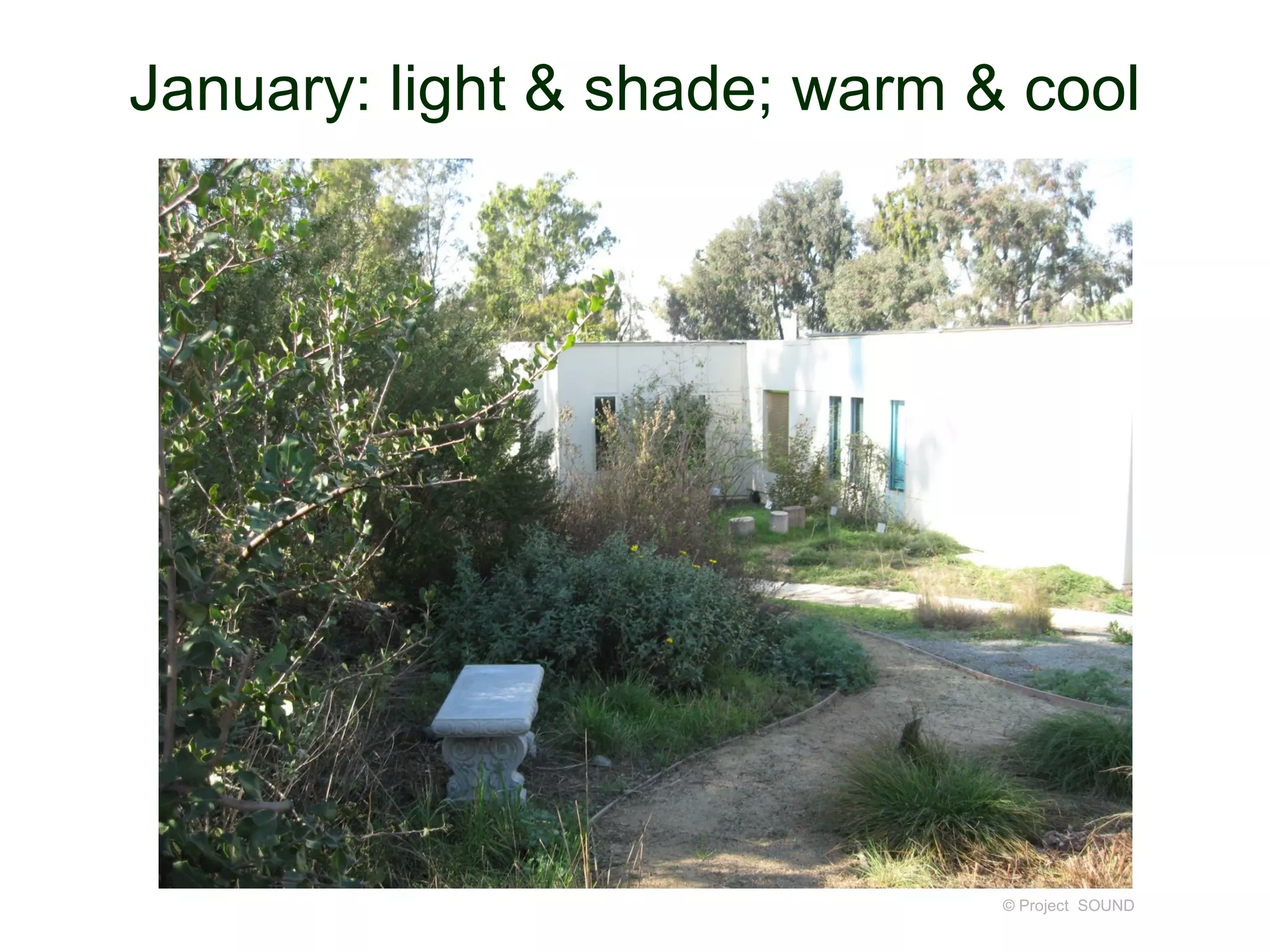
January: light & shade; warm & cool


                              © Project SOUND
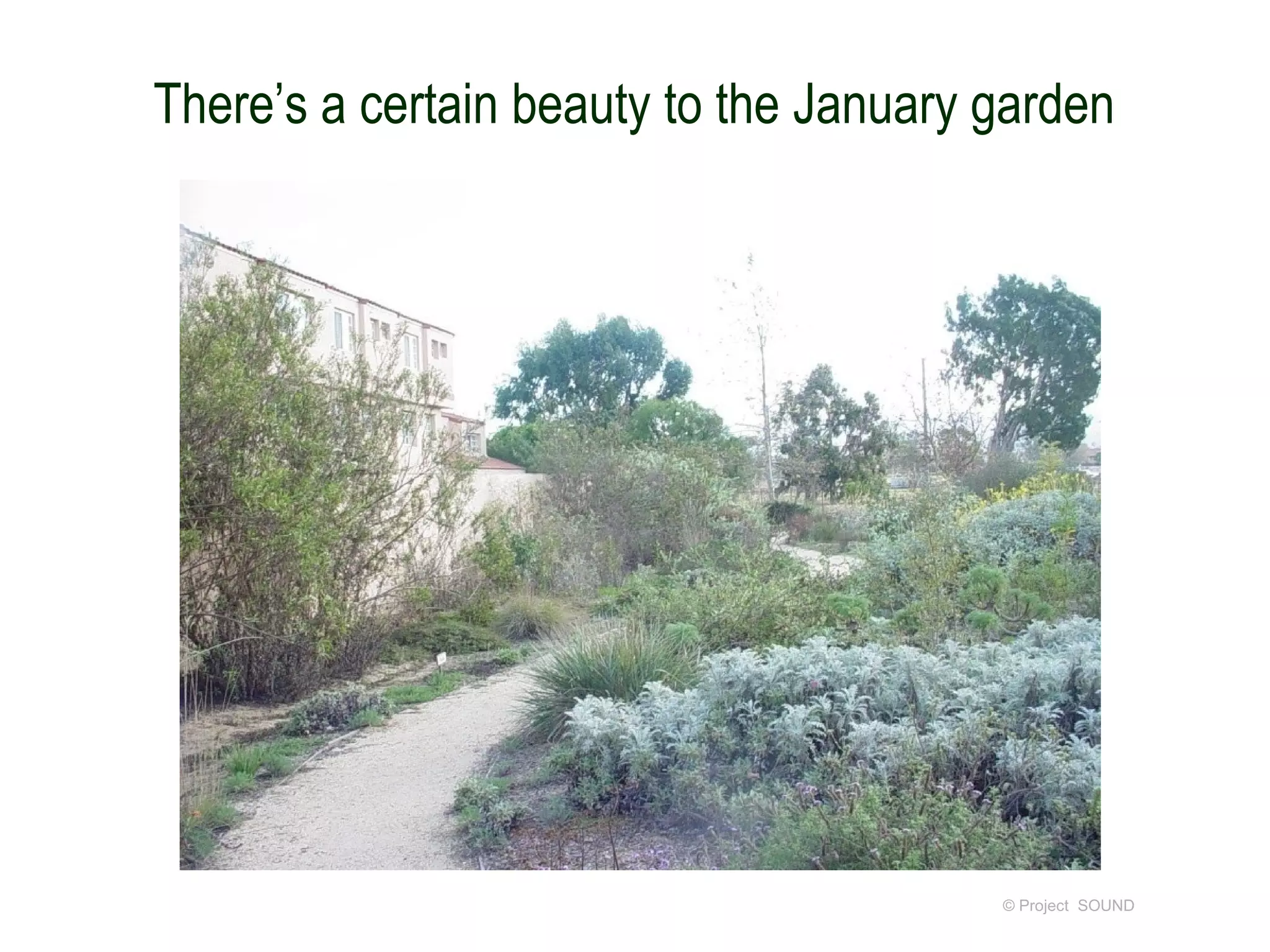
There’s a certain beauty to the January garden


                                        © Project SOUND
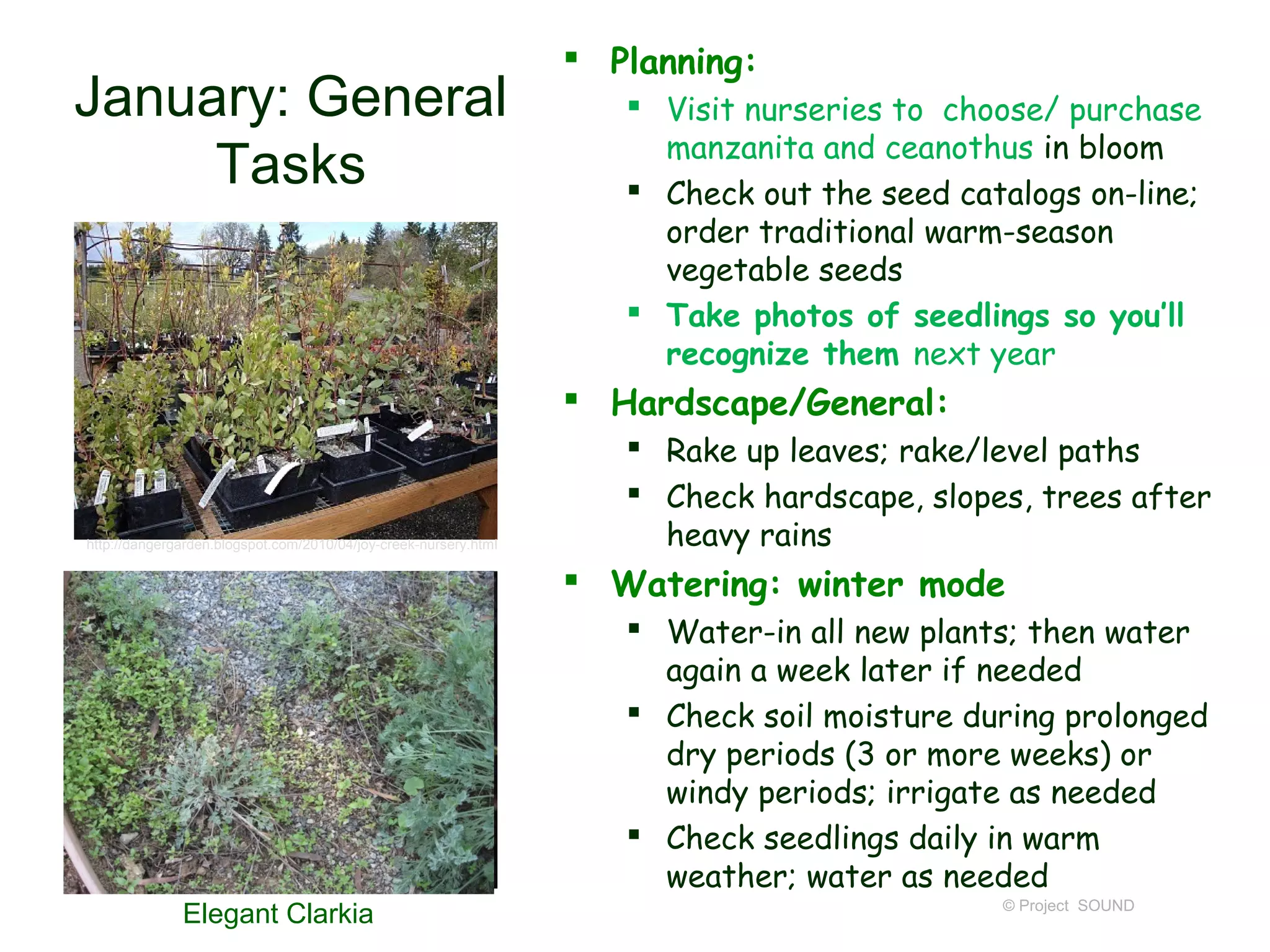
 Planning:
January: General                                                      Visit nurseries to choose/ purchase
                                                                       manzanita and ceanothus in bloom
     Tasks                                                            Check out the seed catalogs on-line;
                                                                       order traditional warm-season
                                                                       vegetable seeds
                                                                      Take photos of seedlings so you’ll
                                                                       recognize them next year
                                                                   Hardscape/General:
                                                                      Rake up leaves; rake/level paths
                                                                      Check hardscape, slopes, trees after
http://dangergarden.blogspot.com/2010/04/joy-creek-nursery.html        heavy rains
                                                                   Watering: winter mode
                                                                      Water-in all new plants; then water
                                                                       again a week later if needed
                                                                      Check soil moisture during prolonged
                                                                       dry periods (3 or more weeks) or
                                                                       windy periods; irrigate as needed
                                                                      Check seedlings daily in warm
                                                                       weather; water as needed
                                                                                             © Project SOUND
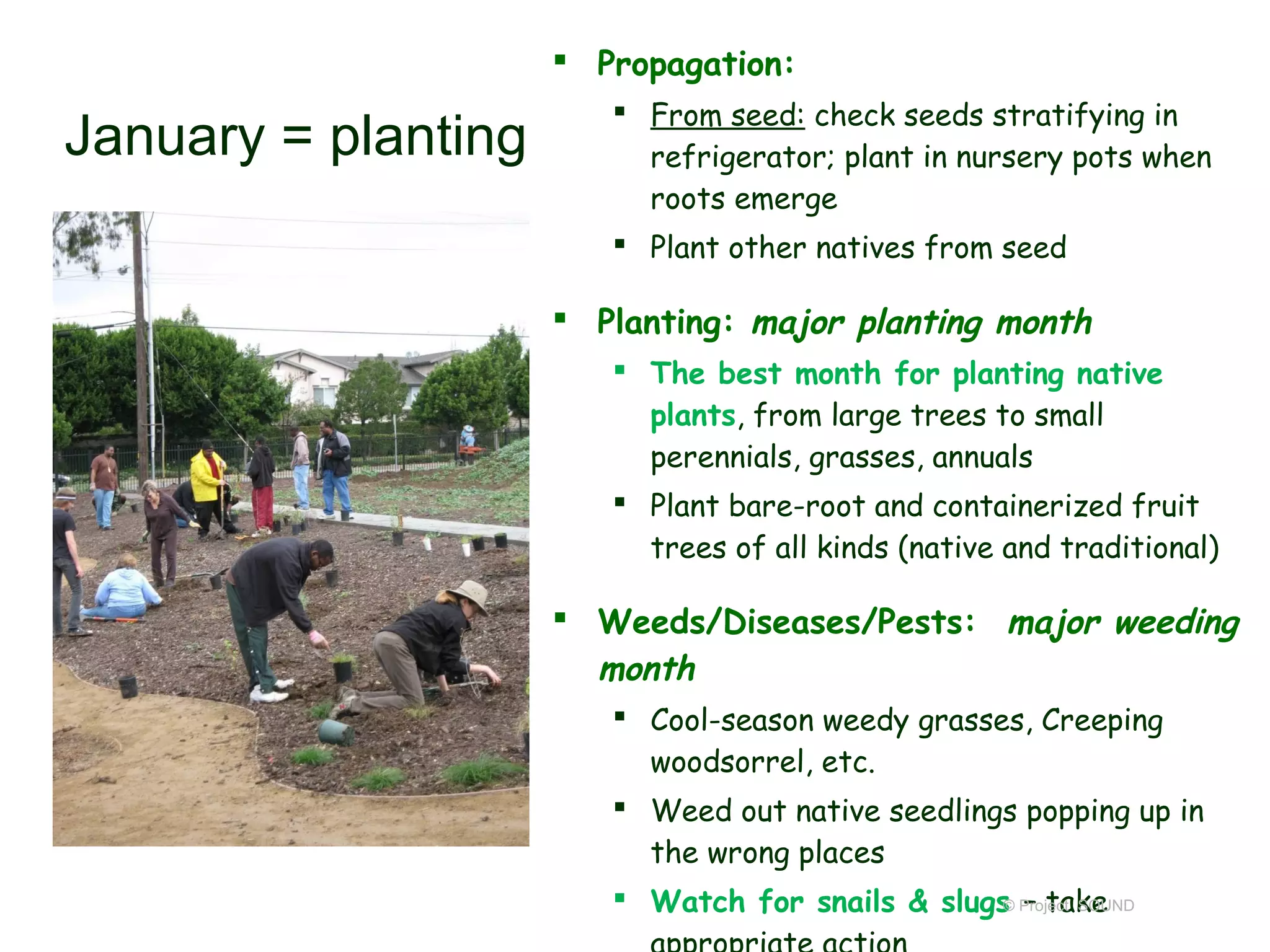
              Elegant Clarkia
 Propagation:
                         From seed: check seeds stratifying in
January = planting        refrigerator; plant in nursery pots when
                          roots emerge
                         Plant other natives from seed

                      Planting: major planting month
                         The best month for planting native
                          plants, from large trees to small
                          perennials, grasses, annuals
                         Plant bare-root and containerized fruit
                          trees of all kinds (native and traditional)

                      Weeds/Diseases/Pests: major weeding
                       month
                         Cool-season weedy grasses, Creeping
                          woodsorrel, etc.
                         Weed out native seedlings popping up in
                          the wrong places
                         Watch for snails & slugs Project SOUND
                                                  © – take
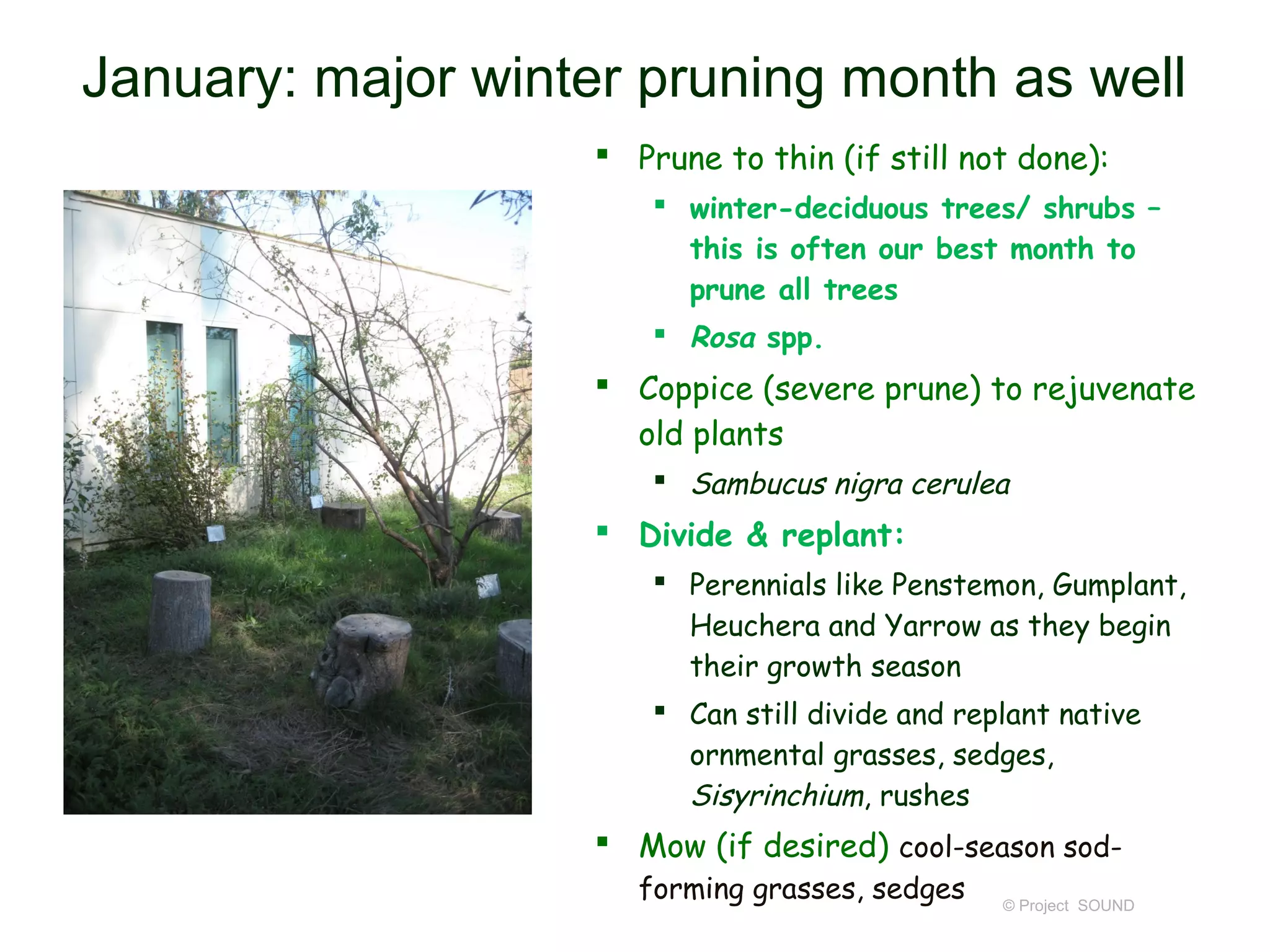
January: major winter pruning month as well
                    Prune to thin (if still not done):
                        winter-deciduous trees/ shrubs –
                         this is often our best month to
                         prune all trees
                        Rosa spp.
                    Coppice (severe prune) to rejuvenate
                     old plants
                        Sambucus nigra cerulea
                    Divide & replant:
                        Perennials like Penstemon, Gumplant,
                         Heuchera and Yarrow as they begin
                         their growth season
                        Can still divide and replant native
                         ornmental grasses, sedges,
                         Sisyrinchium, rushes
                    Mow (if desired) cool-season sod-
                      forming grasses, sedges    © Project SOUND
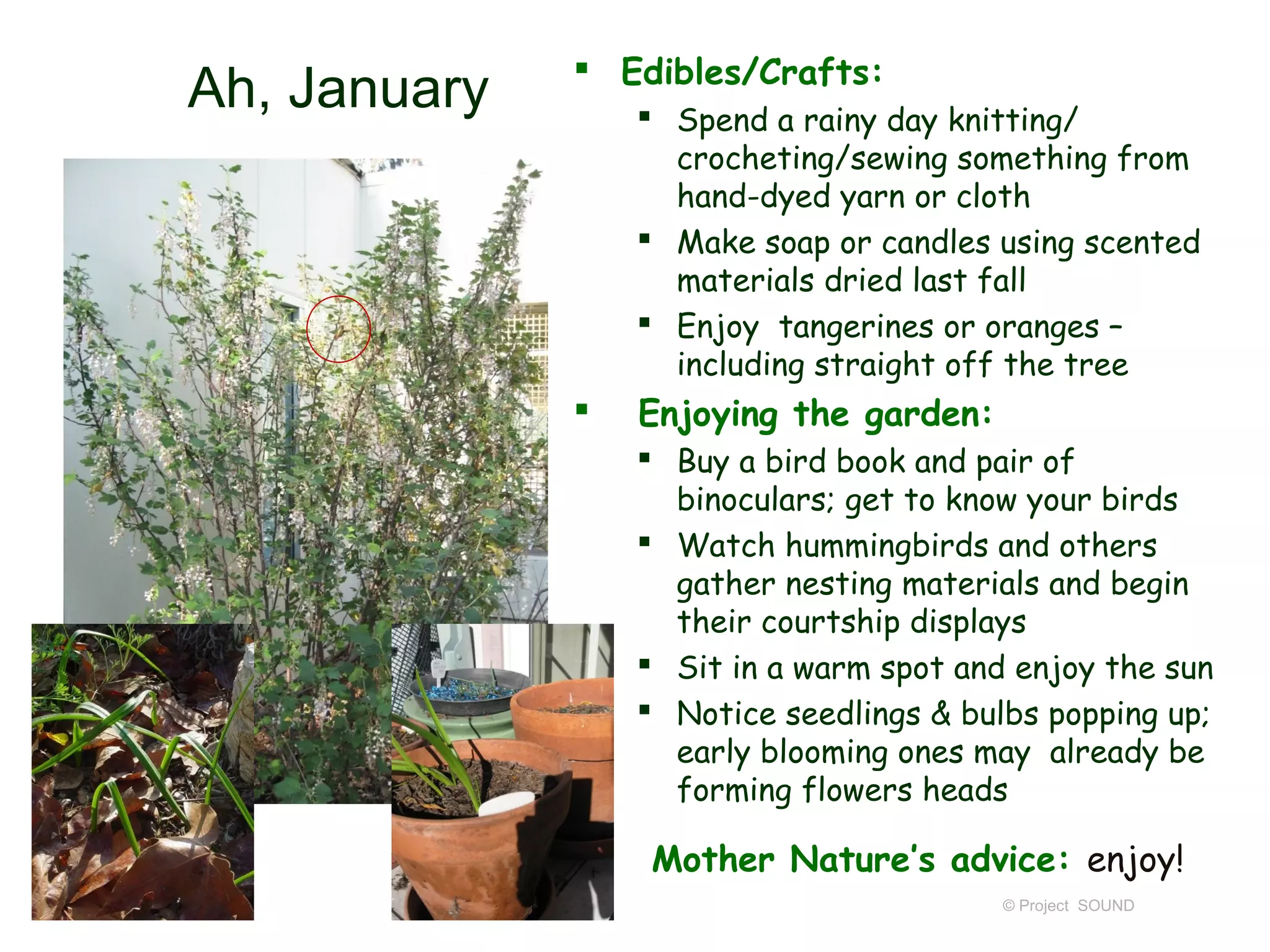
 Edibles/Crafts:
Ah, January        Spend a rainy day knitting/
                    crocheting/sewing something from
                    hand-dyed yarn or cloth
                   Make soap or candles using scented
                    materials dried last fall
                   Enjoy tangerines or oranges –
                    including straight off the tree
                Enjoying the garden:
                   Buy a bird book and pair of
                    binoculars; get to know your birds
                   Watch hummingbirds and others
                    gather nesting materials and begin
                    their courtship displays
                   Sit in a warm spot and enjoy the sun
                   Notice seedlings & bulbs popping up;
                    early blooming ones may already be
                    forming flowers heads

                 Mother Nature’s advice: enjoy!
                                          © Project SOUND
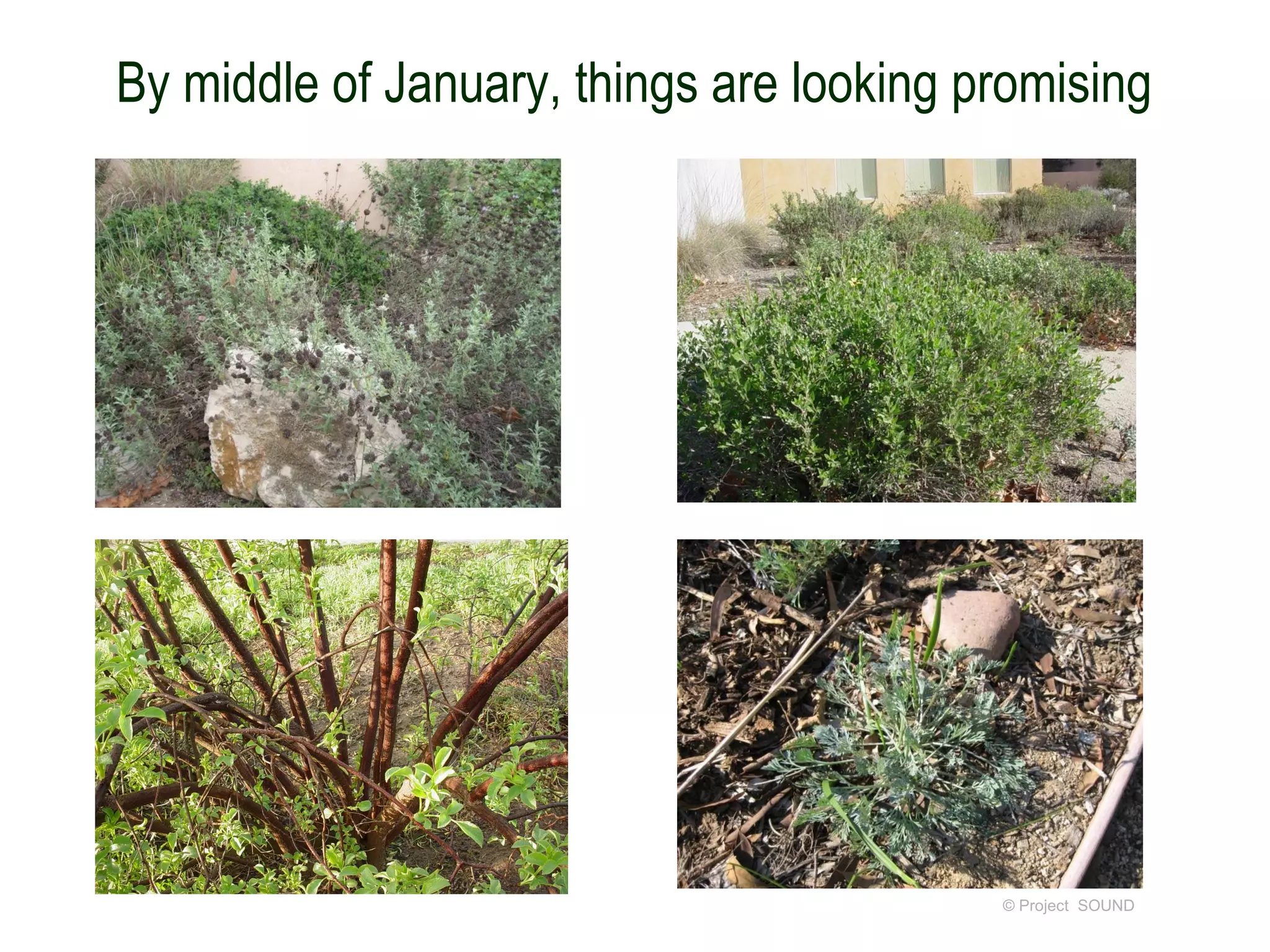
By middle of January, things are looking promising


                                          © Project SOUND
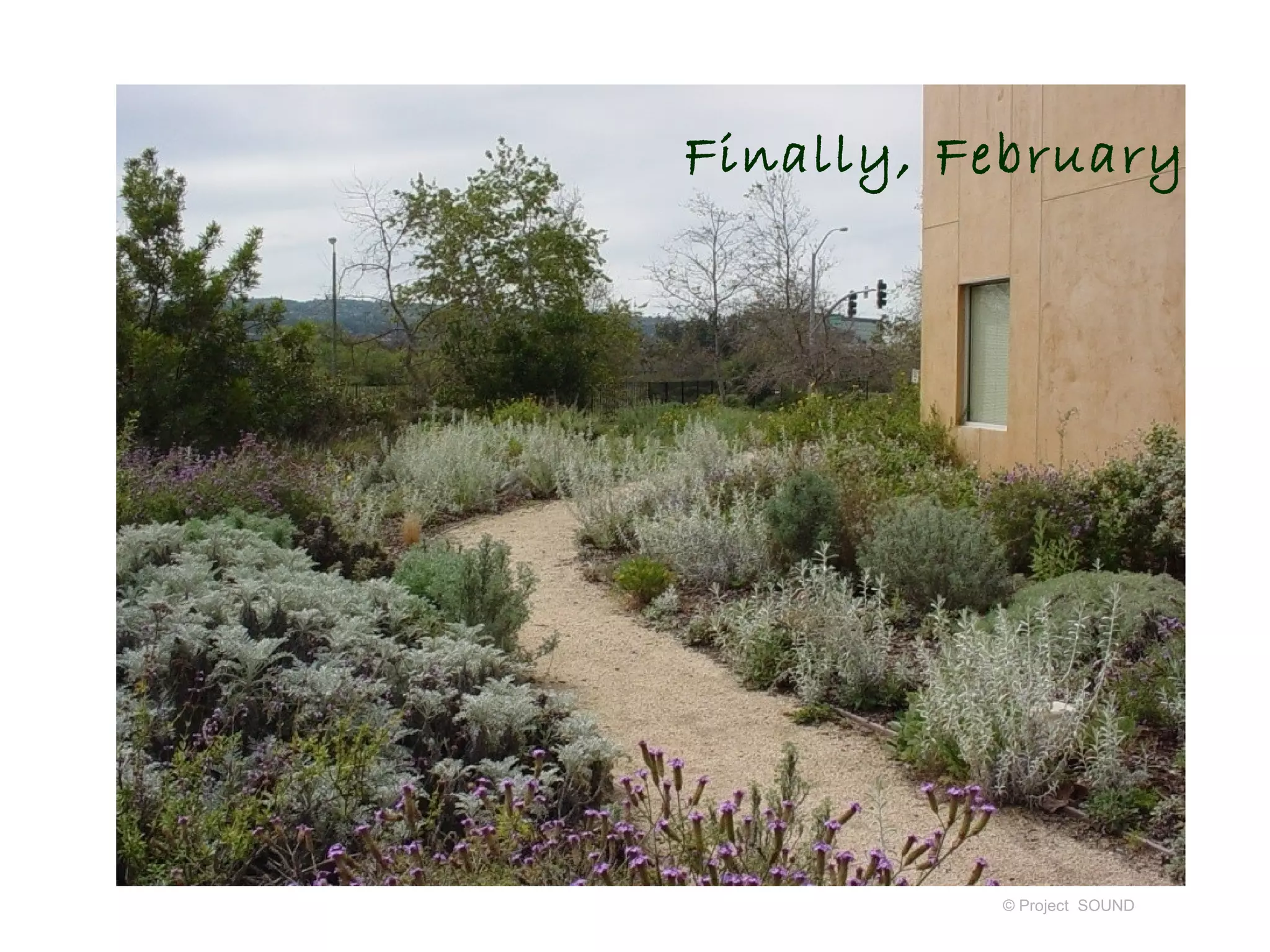
Finally, February


          © Project SOUND
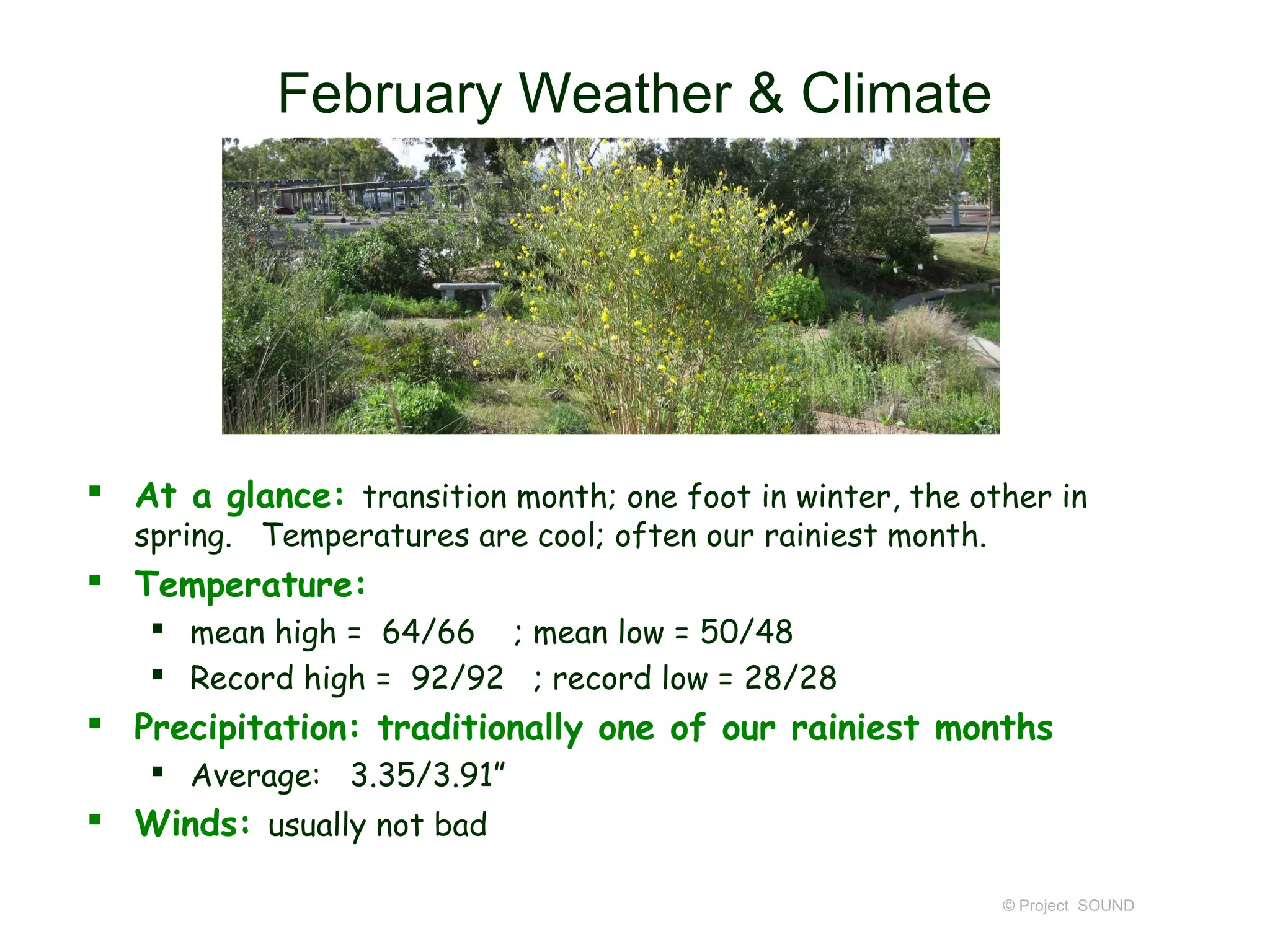
February Weather & Climate


 At a glance: transition month; one foot in winter, the other in
   spring. Temperatures are cool; often our rainiest month.
 Temperature:
     mean high = 64/66 ; mean low = 50/48
     Record high = 92/92 ; record low = 28/28
 Precipitation: traditionally one of our rainiest months
     Average: 3.35/3.91”
 Winds: usually not bad

                                                              © Project SOUND
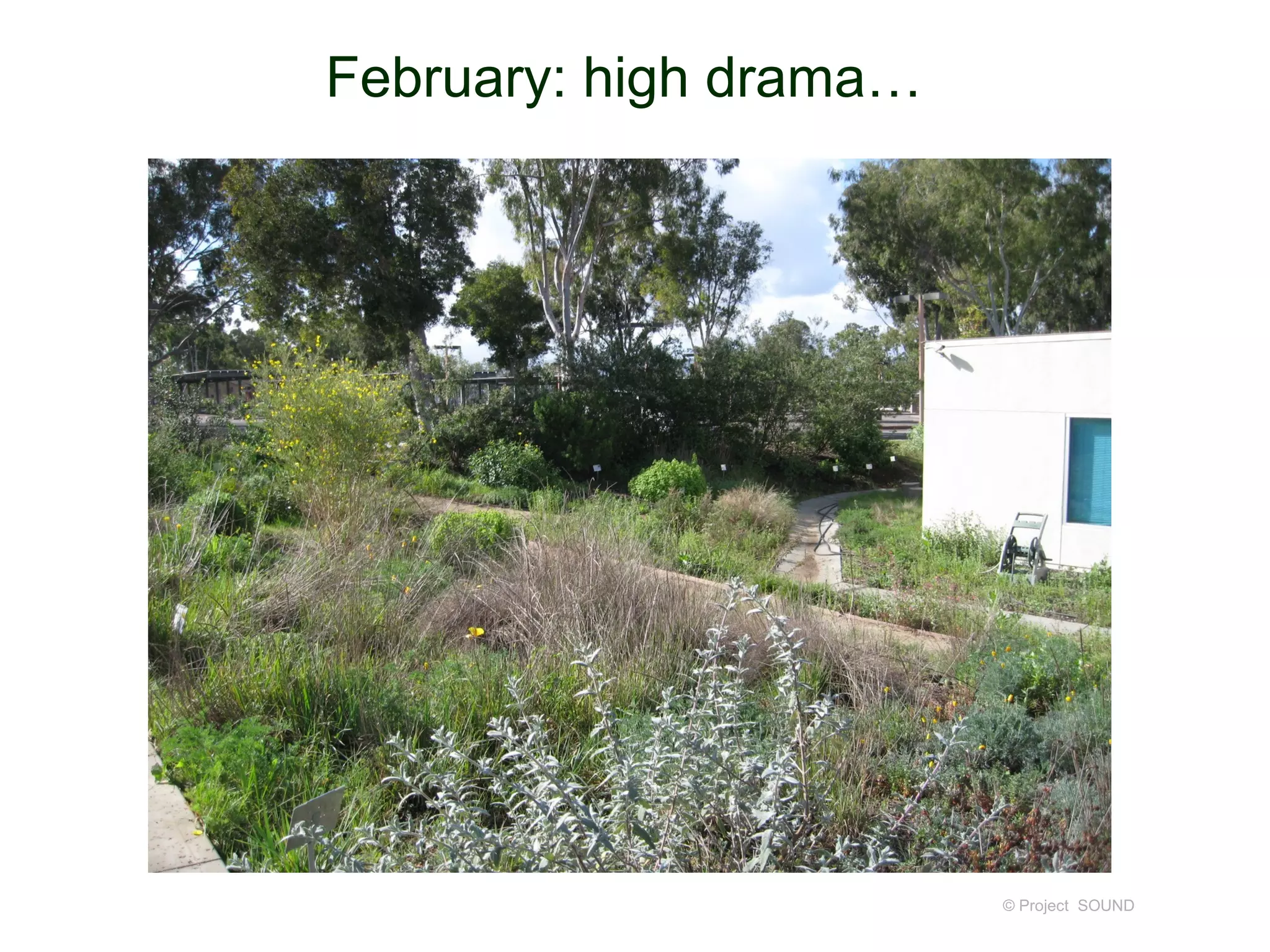
February: high drama…


                        © Project SOUND
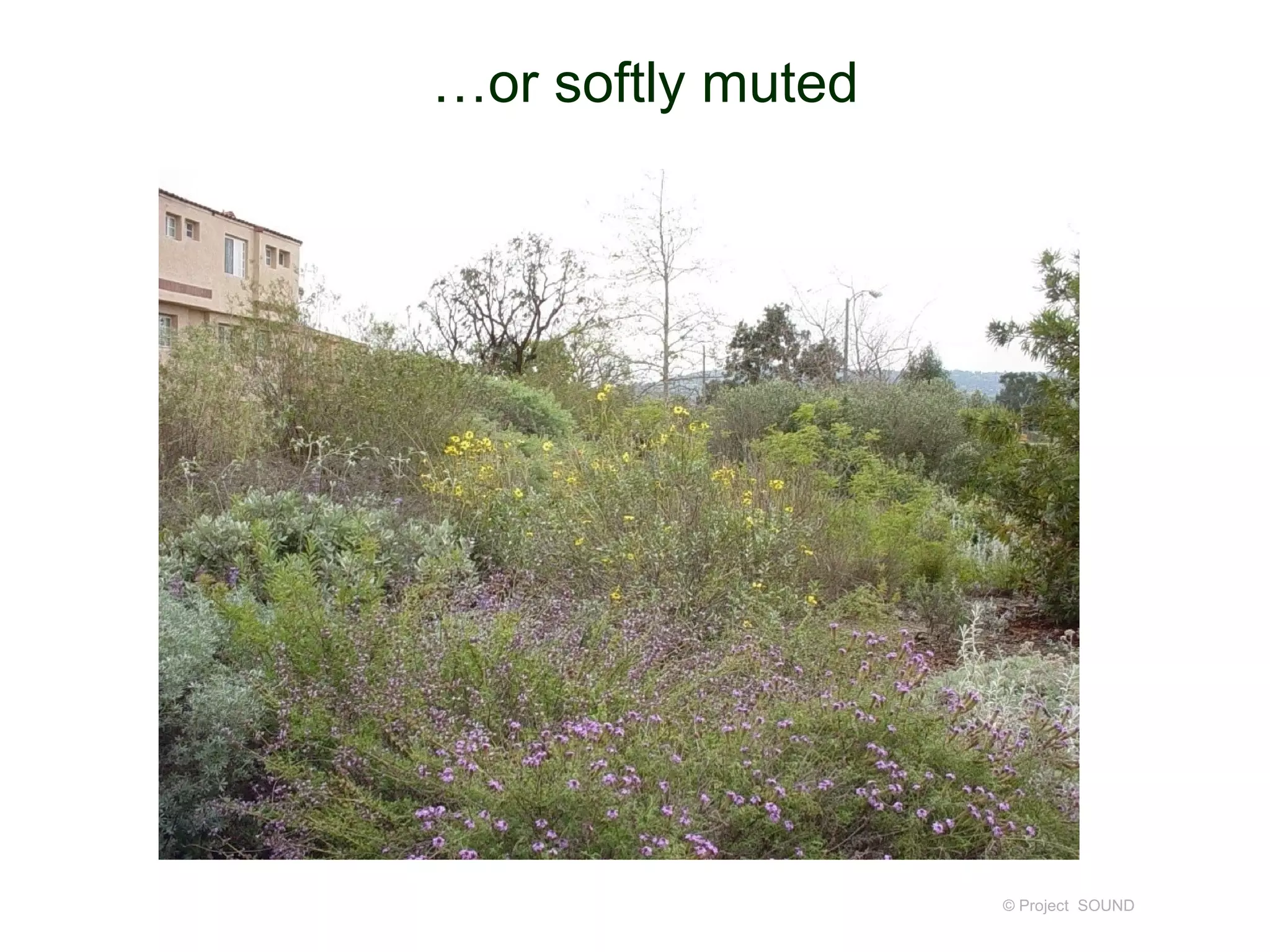
…or softly muted


                   © Project SOUND
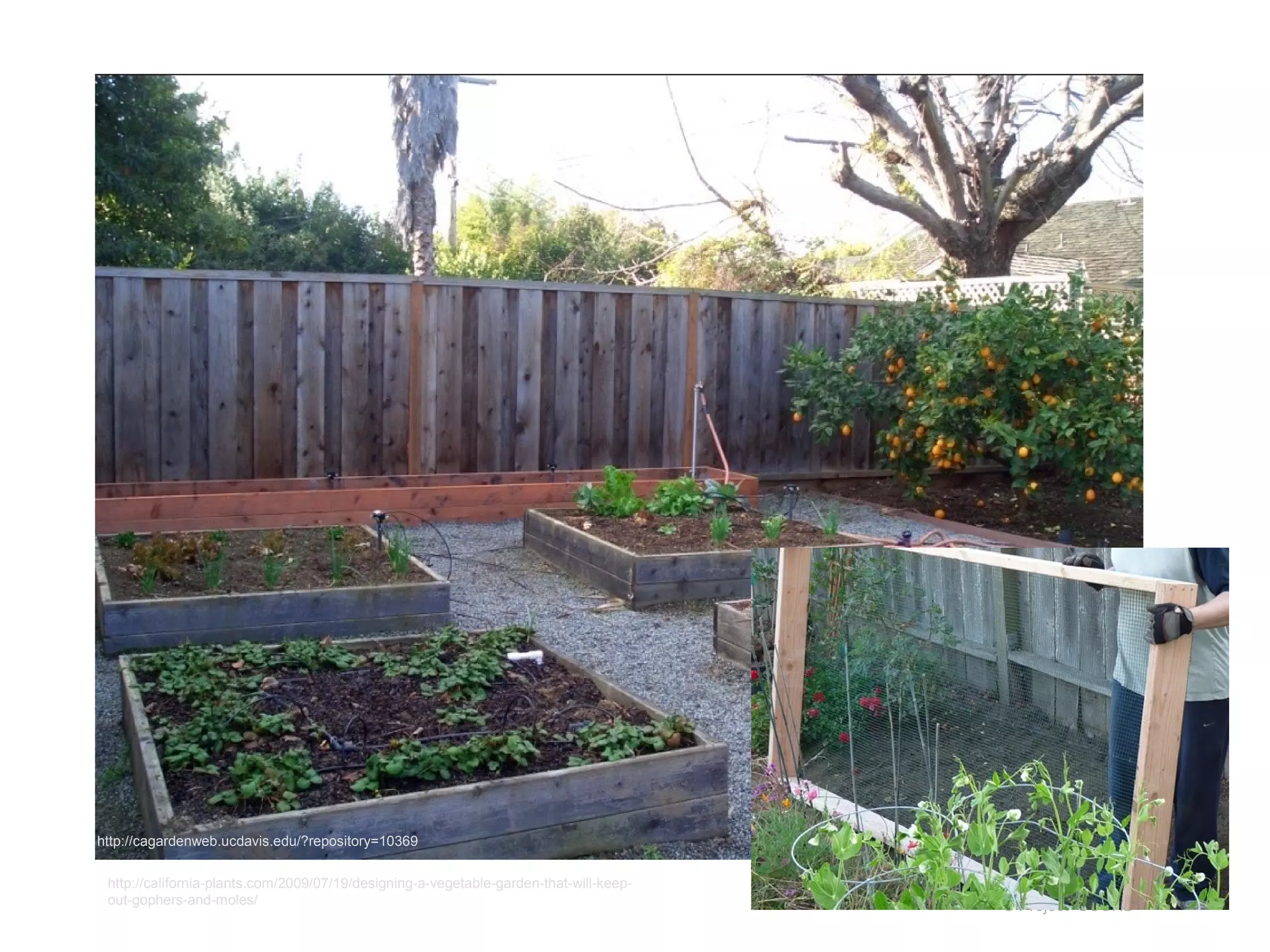
http://cagardenweb.ucdavis.edu/?repository=10369


 http://california-plants.com/2009/07/19/designing-a-vegetable-garden-that-will-keep-
 out-gophers-and-moles/                                                                 © Project SOUND
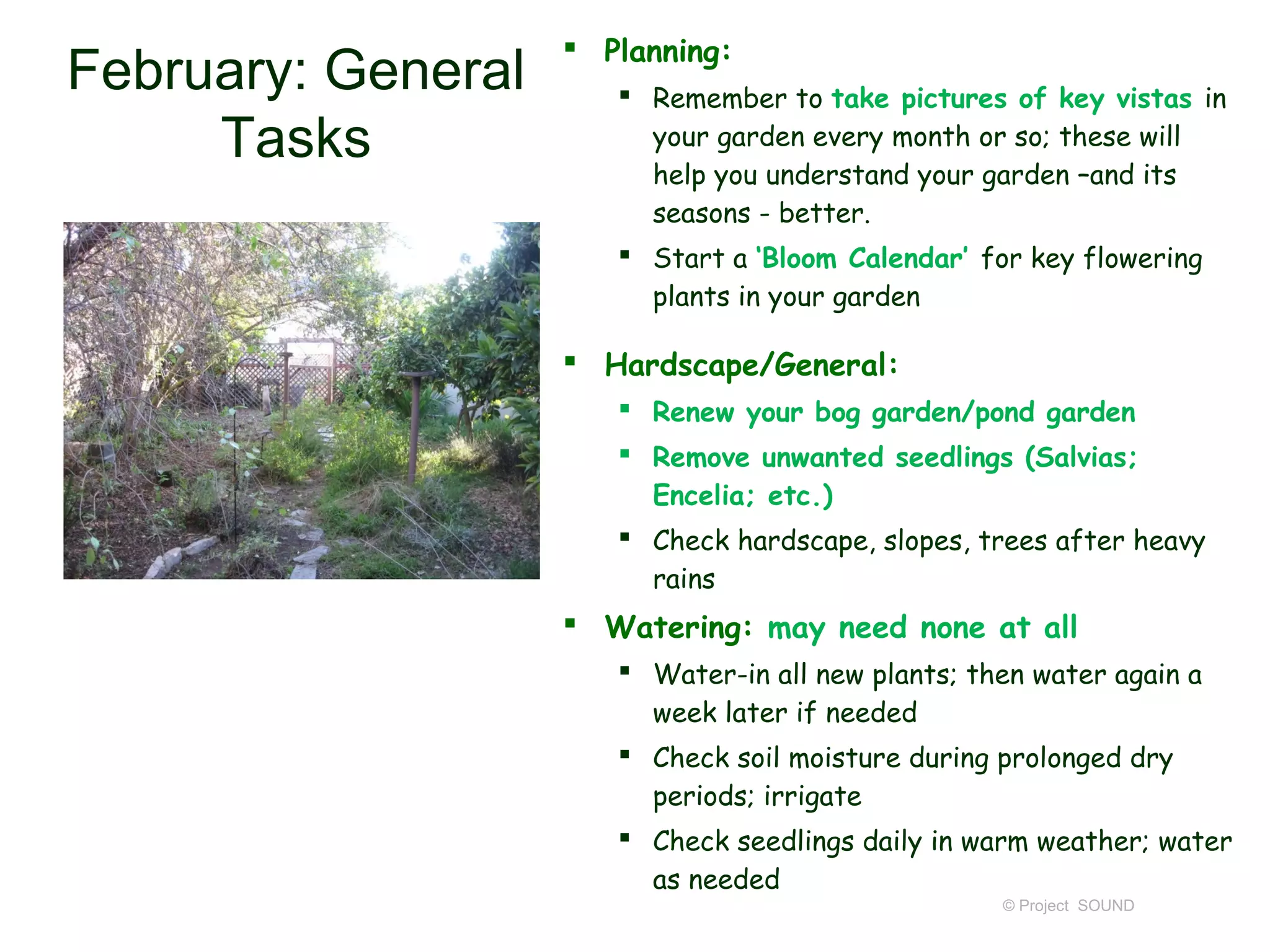
 Planning:
February: General       Remember to take pictures of key vistas in
     Tasks               your garden every month or so; these will
                         help you understand your garden –and its
                         seasons - better.
                        Start a ‘Bloom Calendar’ for key flowering
                         plants in your garden

                     Hardscape/General:
                        Renew your bog garden/pond garden
                        Remove unwanted seedlings (Salvias;
                         Encelia; etc.)
                        Check hardscape, slopes, trees after heavy
                         rains
                     Watering: may need none at all
                        Water-in all new plants; then water again a
                         week later if needed
                        Check soil moisture during prolonged dry
                         periods; irrigate
                        Check seedlings daily in warm weather; water
                         as needed
                                                    © Project SOUND
 Propagation:
The planting frenzy       From seed: good time to start native
   continues…              shrubs/perennials, warm-season grasses in
                           containers; start traditional summer veggies
                           in nursery containers – protect from frost
                          Divide: rushes, cattails, other ‘bog garden’
                           plants;

                       Planting: major planting month
                          Excellent month for planting most native
                           plants; especially perennials/sub-shrubs,
                           bunch grasses
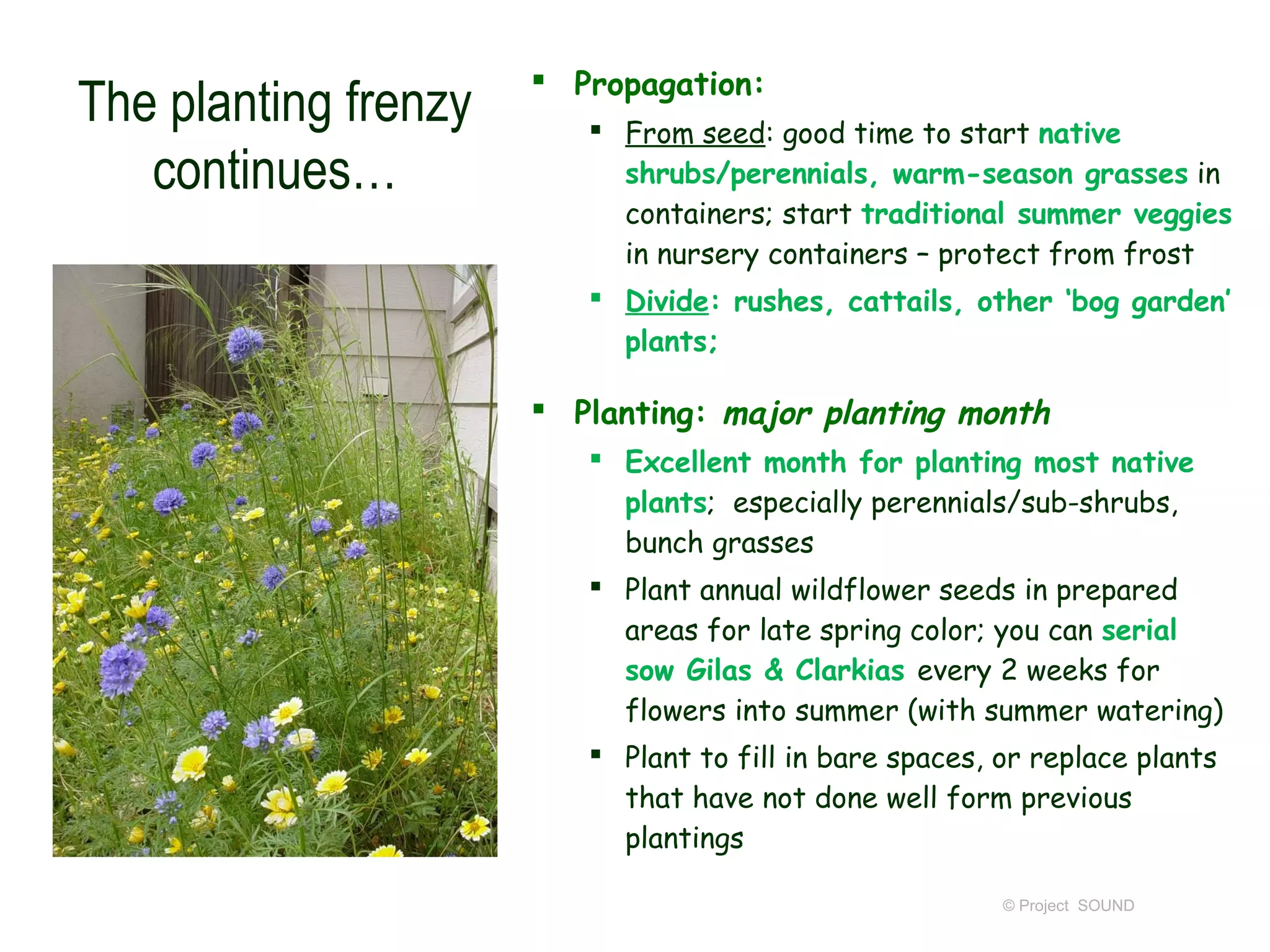
                          Plant annual wildflower seeds in prepared
                           areas for late spring color; you can serial
                           sow Gilas & Clarkias every 2 weeks for
                           flowers into summer (with summer watering)
                          Plant to fill in bare spaces, or replace plants
                           that have not done well form previous
                           plantings

                                                         © Project SOUND
February: a little pruning, a
                                                           lot of weeding
                                                        Pruning:
                                                           Prune to thin:
                                                               Clematis spp.; Constancea/Eriophyllum
                                                                nevinii, Lepechina spp. – now or after
                                                                flowering
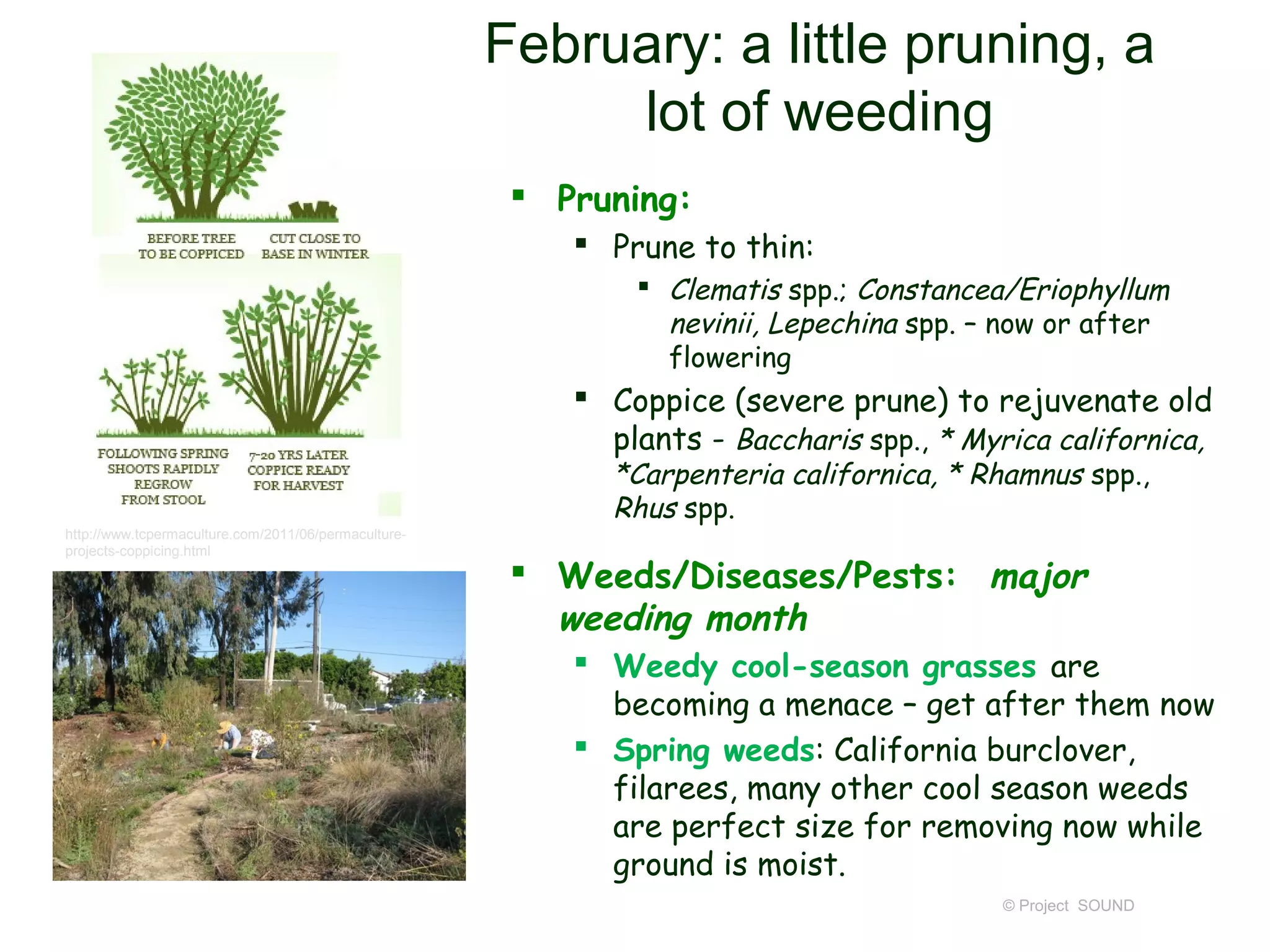
                                                           Coppice (severe prune) to rejuvenate old
                                                            plants - Baccharis spp., * Myrica californica,
                                                            *Carpenteria californica, * Rhamnus spp.,
                                                            Rhus spp.
http://www.tcpermaculture.com/2011/06/permaculture-
projects-coppicing.html

                                                        Weeds/Diseases/Pests: major
                                                         weeding month
                                                           Weedy cool-season grasses are
                                                            becoming a menace – get after them now
                                                           Spring weeds: California burclover,
                                                            filarees, many other cool season weeds
                                                            are perfect size for removing now while
                                                            ground is moist.
                                                                                          © Project SOUND
 Edibles/Crafts:
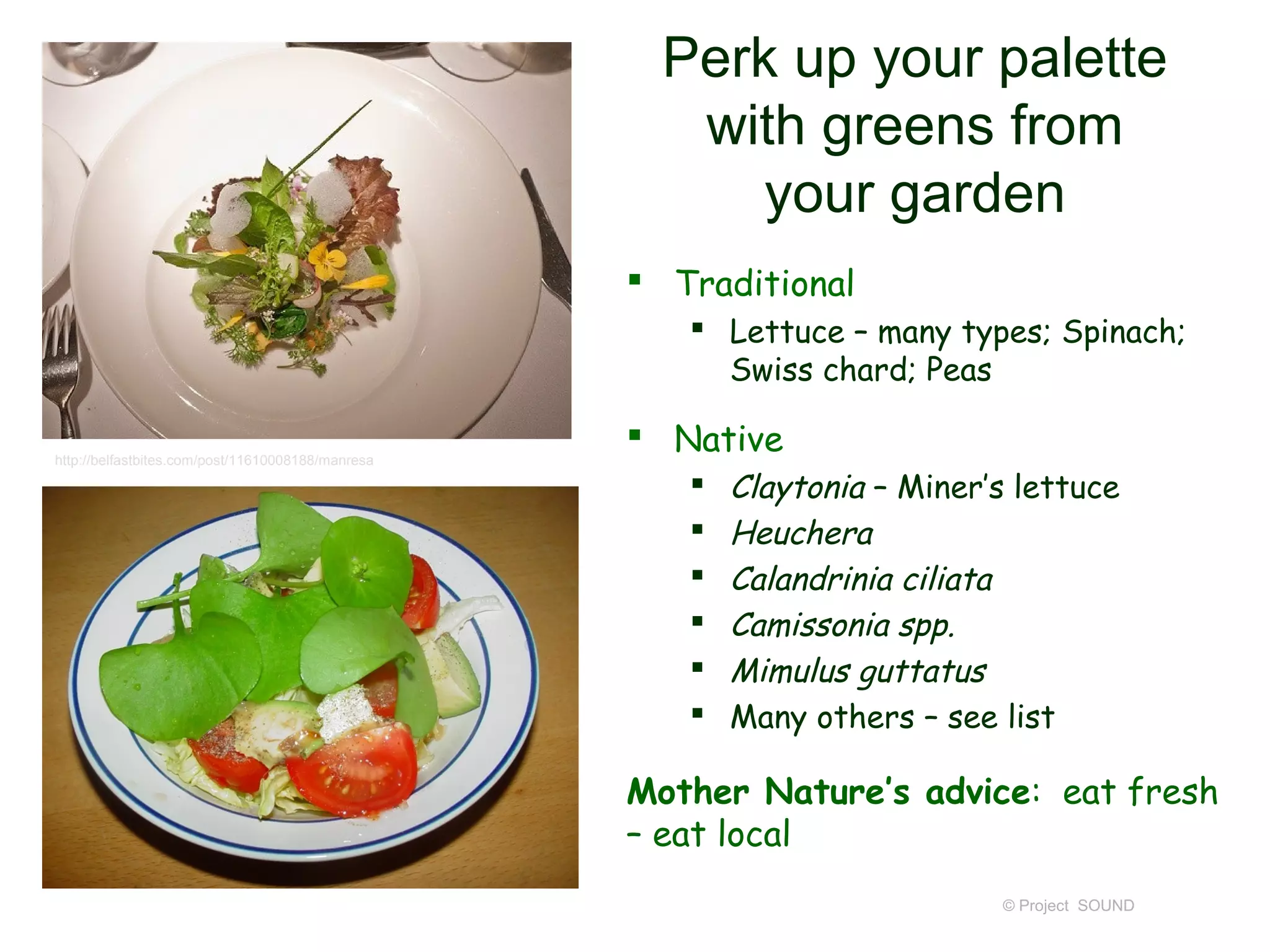
February delights       Enjoy native CA greens in salads,
                         cooked as greens or in stews, soups
                        Enjoy a cup of herb tea from you
                         selection of teas dried last fall
                        Continue to enjoy citrus fruits; find
                         some new recipes to use them – or
                         give them away

                     Enjoying the garden:
                        Look for early-blooming bulbs – they
                         are enchanting
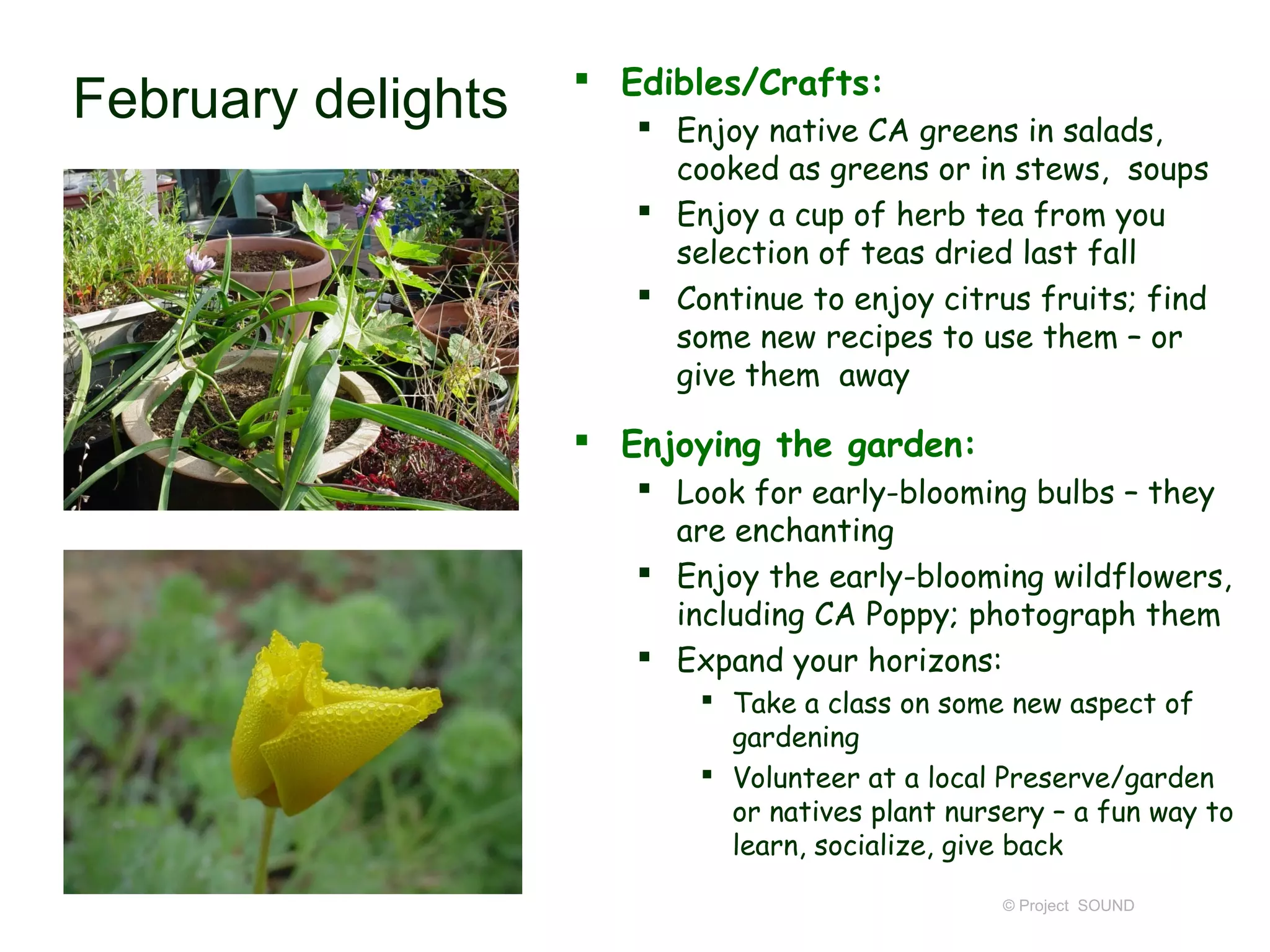
                        Enjoy the early-blooming wildflowers,
                         including CA Poppy; photograph them
                        Expand your horizons:
                            Take a class on some new aspect of
                             gardening
                            Volunteer at a local Preserve/garden
                             or natives plant nursery – a fun way to
                             learn, socialize, give back
                                                  © Project SOUND
Perk up your palette
                                                      with greens from
                                                         your garden
                                                    Traditional
                                                       Lettuce – many types; Spinach;
                                                        Swiss chard; Peas

http://belfastbites.com/post/11610008188/manresa
                                                    Native
                                                         Claytonia – Miner’s lettuce
                                                         Heuchera
                                                         Calandrinia ciliata
                                                         Camissonia spp.
                                                         Mimulus guttatus
                                                         Many others – see list

                                                   Mother Nature’s advice: eat fresh
                                                   – eat local
                                                                            © Project SOUND
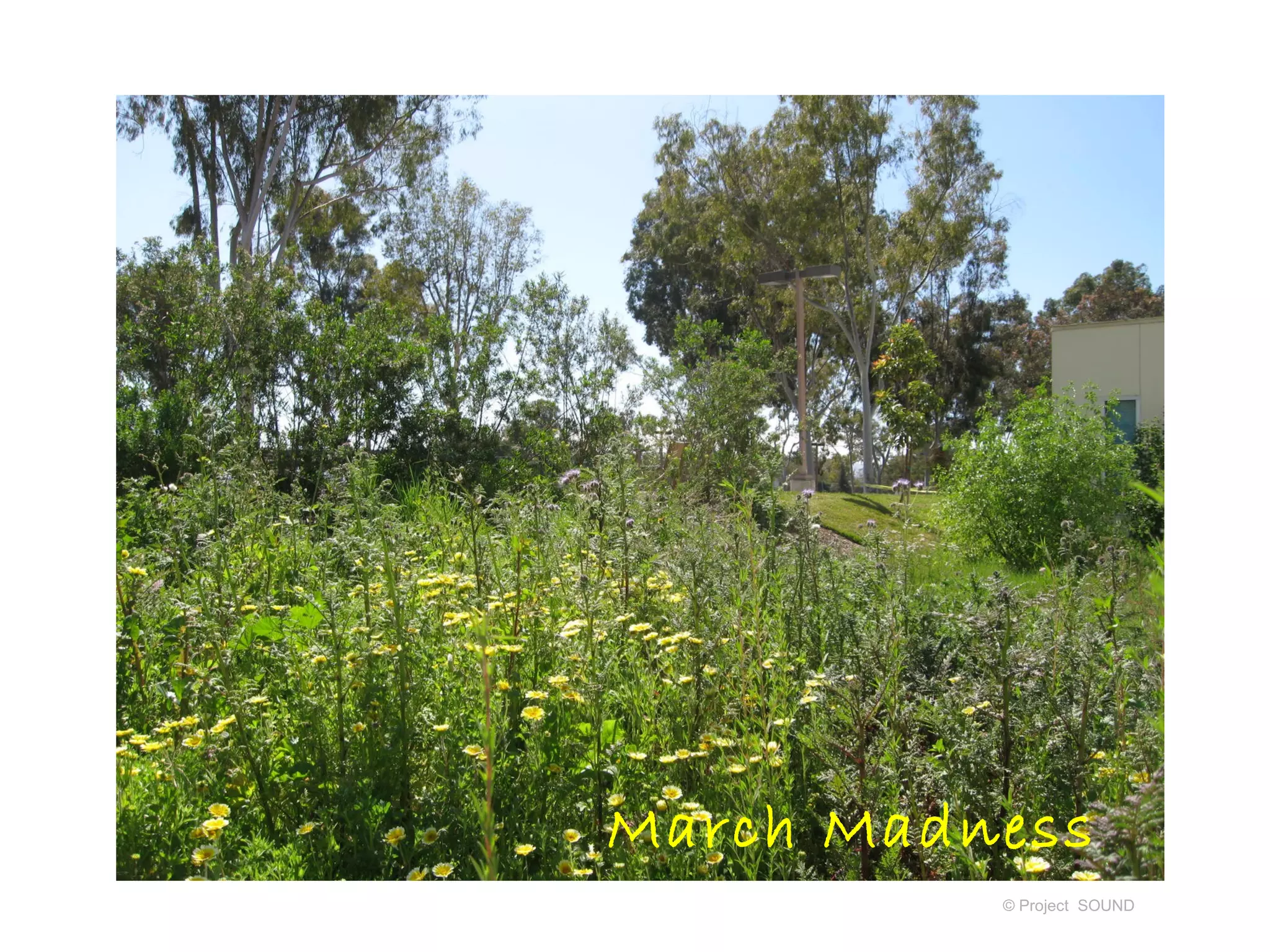
March Madness
          © Project SOUND
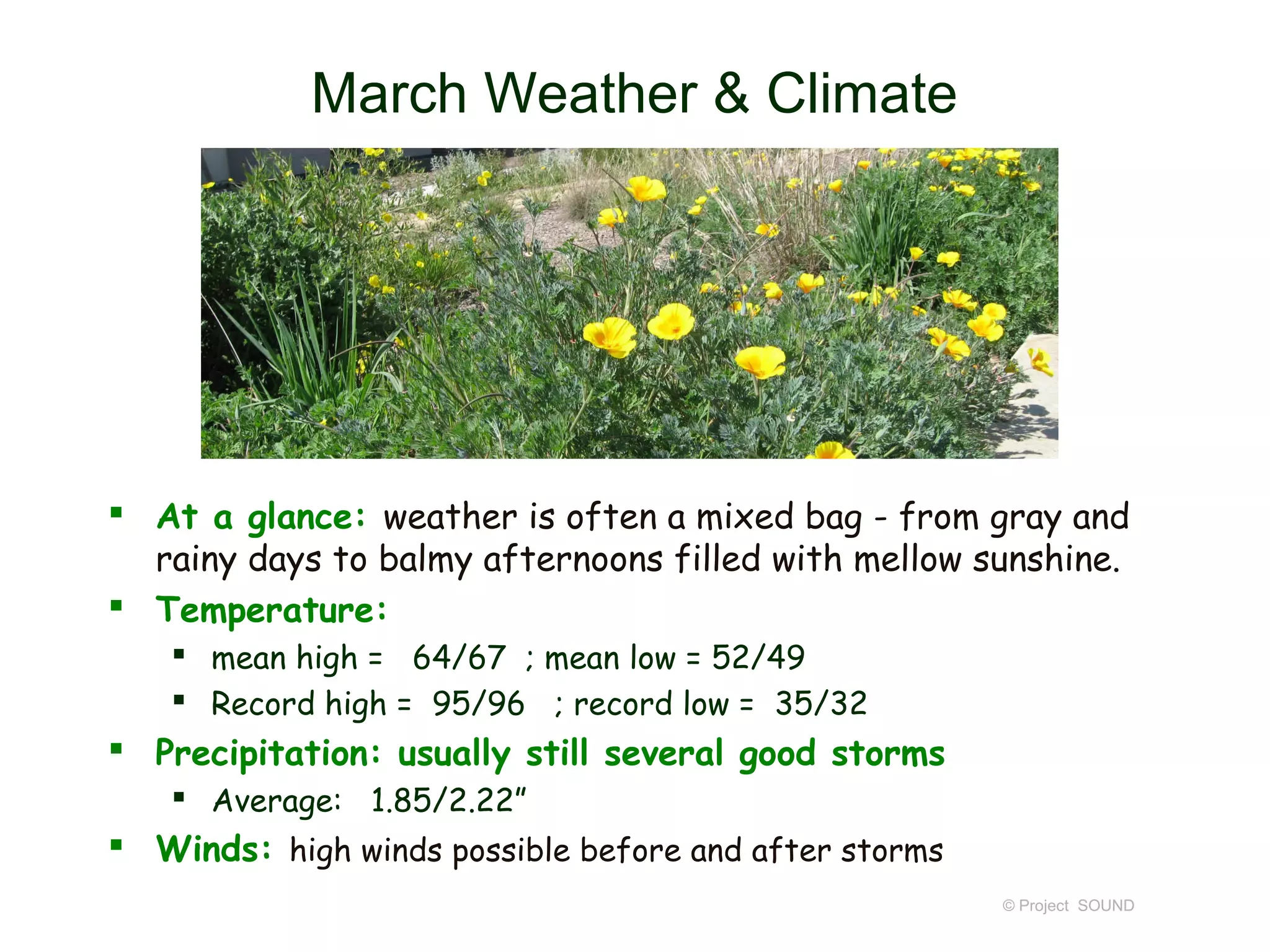
March Weather & Climate


 At a glance: weather is often a mixed bag - from gray and
  rainy days to balmy afternoons filled with mellow sunshine.
 Temperature:
    mean high = 64/67 ; mean low = 52/49
    Record high = 95/96 ; record low = 35/32
 Precipitation: usually still several good storms
    Average: 1.85/2.22”
 Winds: high winds possible before and after storms
                                                       © Project SOUND
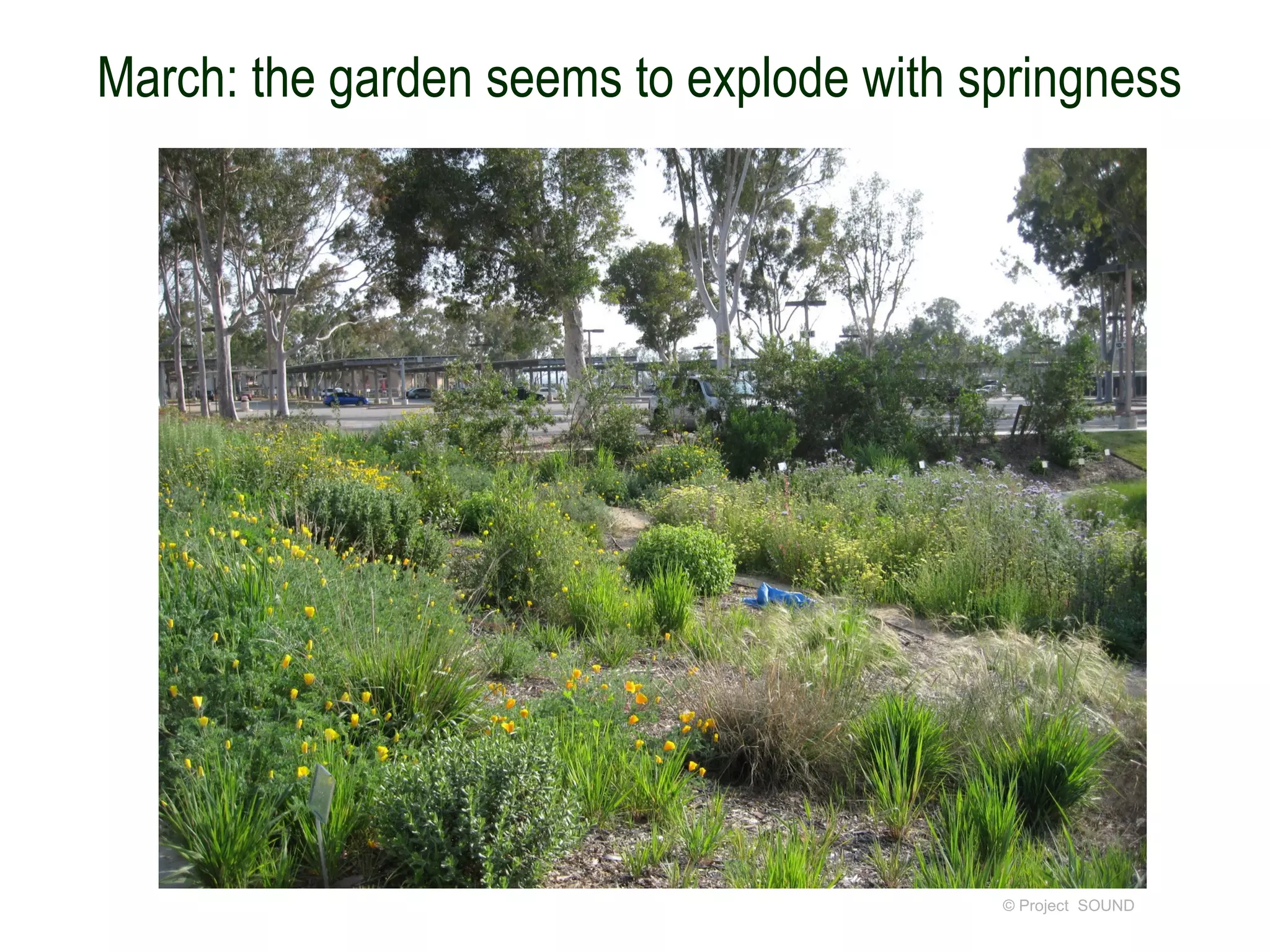
March: the garden seems to explode with springness


                                         © Project SOUND
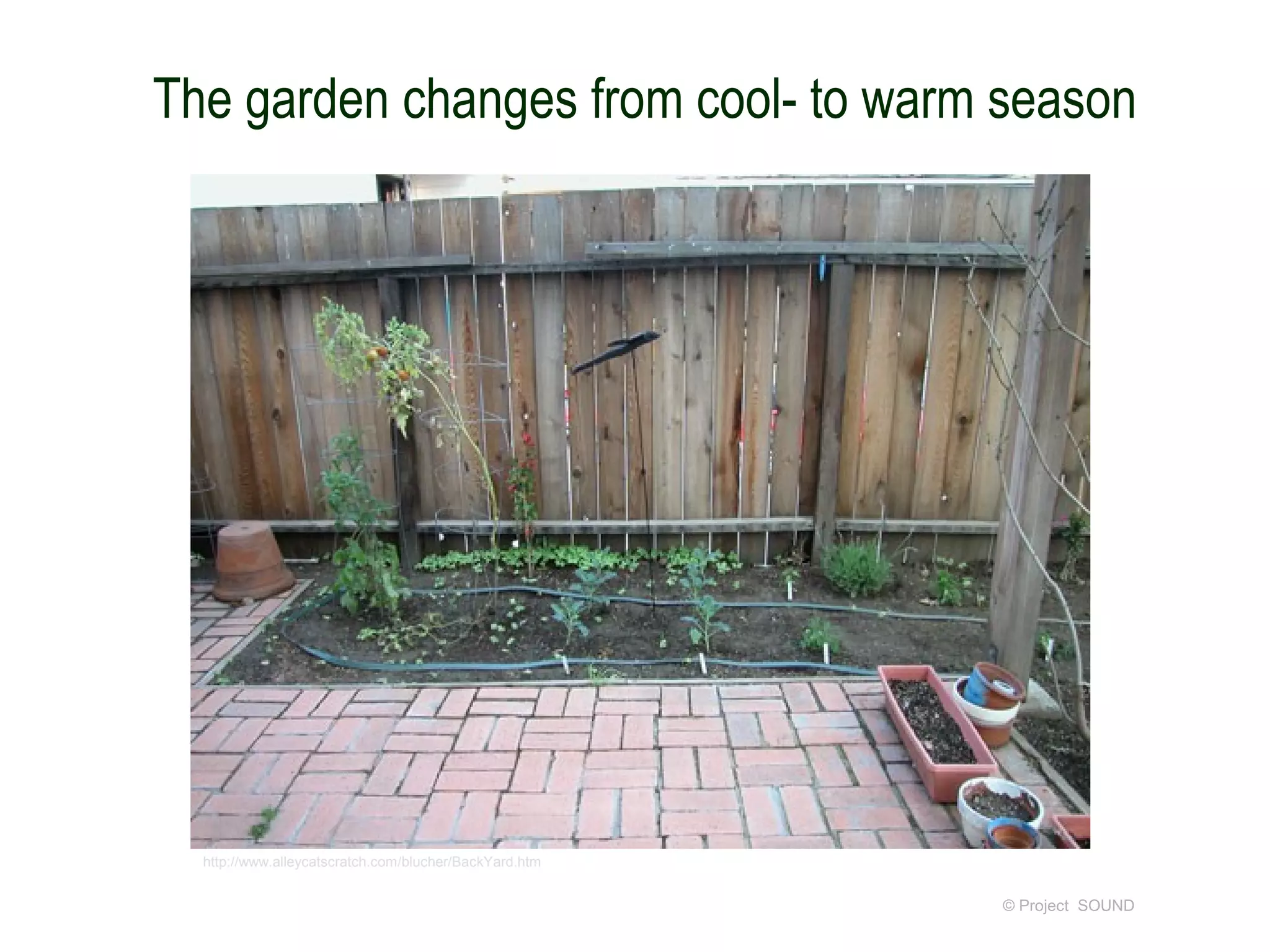
The garden changes from cool- to warm season


  http://www.alleycatscratch.com/blucher/BackYard.htm


                                                        © Project SOUND
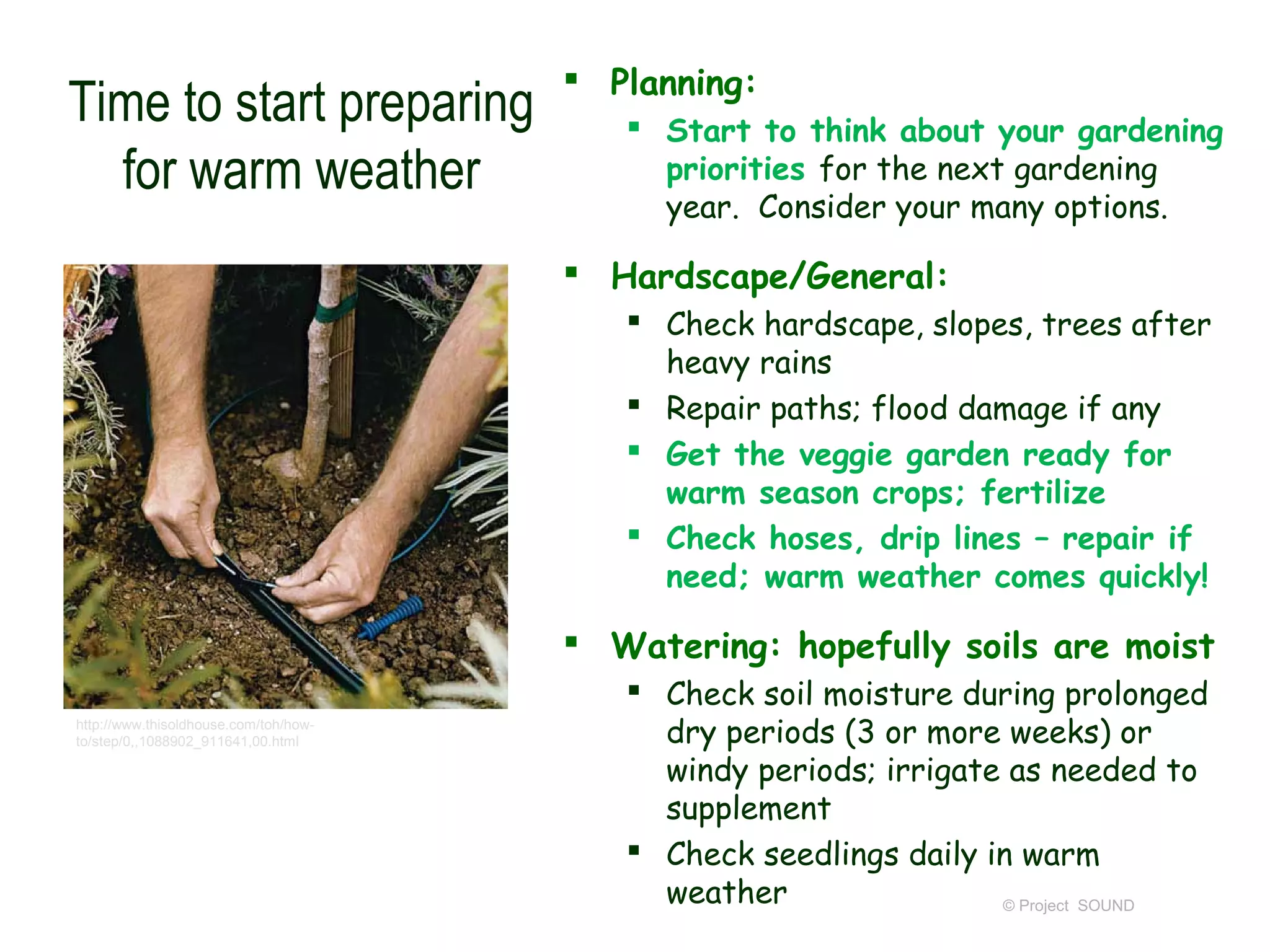
 Planning:
Time to start preparing                    Start to think about your gardening
  for warm weather                          priorities for the next gardening
                                            year. Consider your many options.

                                        Hardscape/General:
                                           Check hardscape, slopes, trees after
                                            heavy rains
                                           Repair paths; flood damage if any
                                           Get the veggie garden ready for
                                            warm season crops; fertilize
                                           Check hoses, drip lines – repair if
                                            need; warm weather comes quickly!

                                        Watering: hopefully soils are moist
                                           Check soil moisture during prolonged
http://www.thisoldhouse.com/toh/how-
to/step/0,,1088902_911641,00.html           dry periods (3 or more weeks) or
                                            windy periods; irrigate as needed to
                                            supplement
                                           Check seedlings daily in warm
                                            weather                © Project SOUND
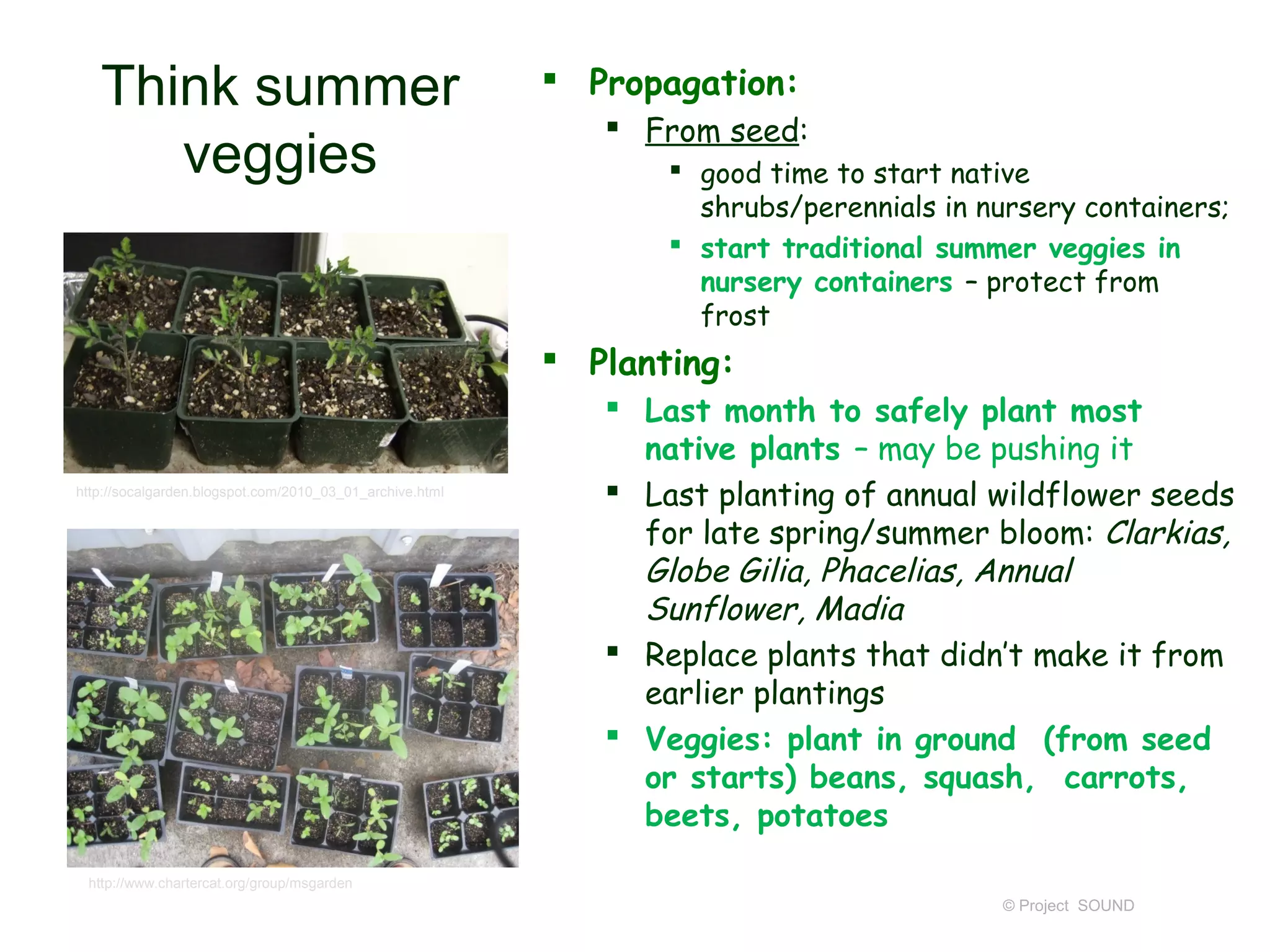
Think summer                                            Propagation:
                                                              From seed:
      veggies                                                     good time to start native
                                                                   shrubs/perennials in nursery containers;
                                                                  start traditional summer veggies in
                                                                   nursery containers – protect from
                                                                   frost
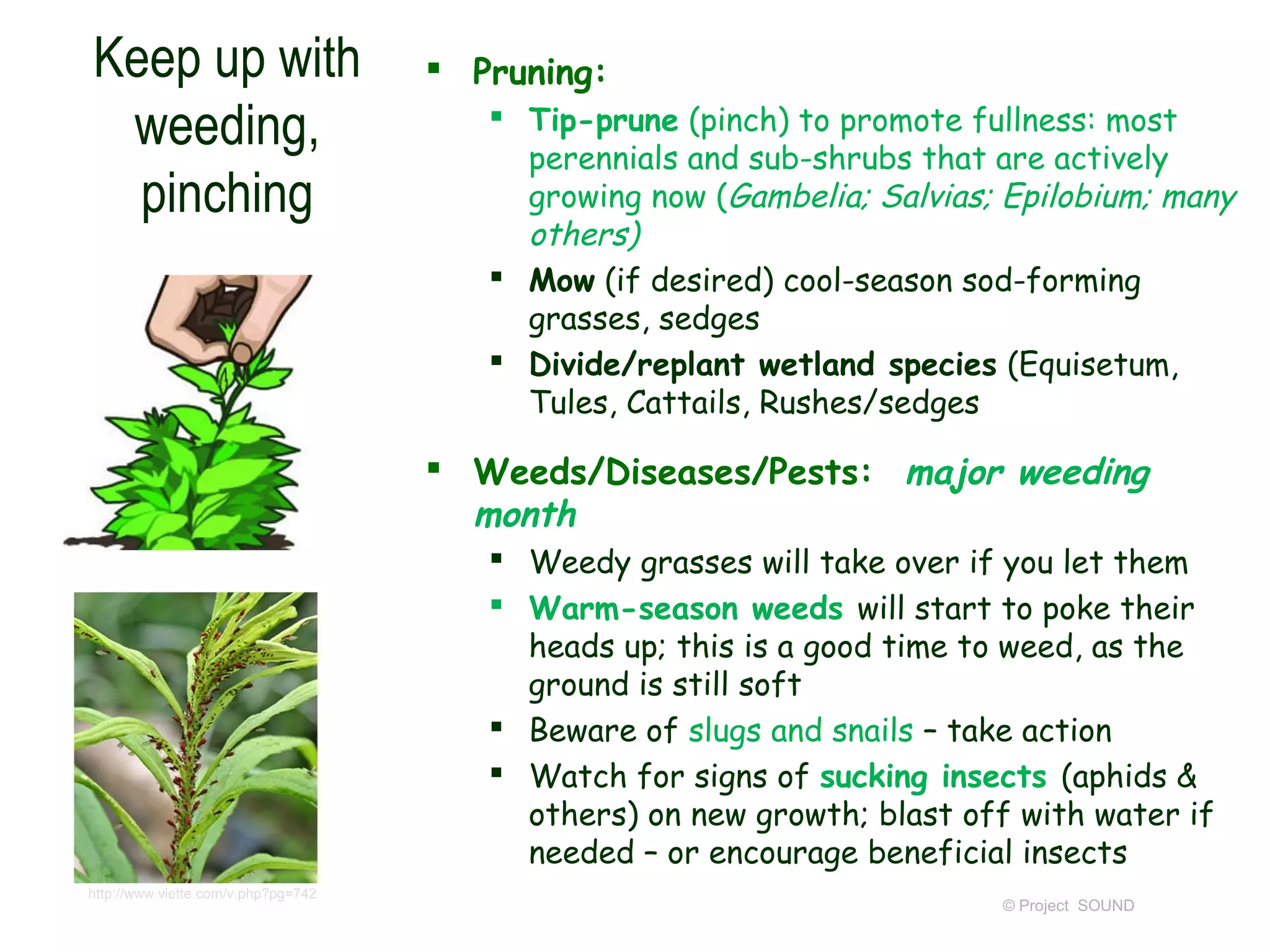
                                                           Planting:
                                                              Last month to safely plant most
                                                               native plants – may be pushing it
http://socalgarden.blogspot.com/2010_03_01_archive.html       Last planting of annual wildflower seeds
                                                               for late spring/summer bloom: Clarkias,
                                                               Globe Gilia, Phacelias, Annual
                                                               Sunflower, Madia
                                                              Replace plants that didn’t make it from
                                                               earlier plantings
                                                              Veggies: plant in ground (from seed
                                                               or starts) beans, squash, carrots,
                                                               beets, potatoes
 http://www.chartercat.org/group/msgarden
                                                                                          © Project SOUND
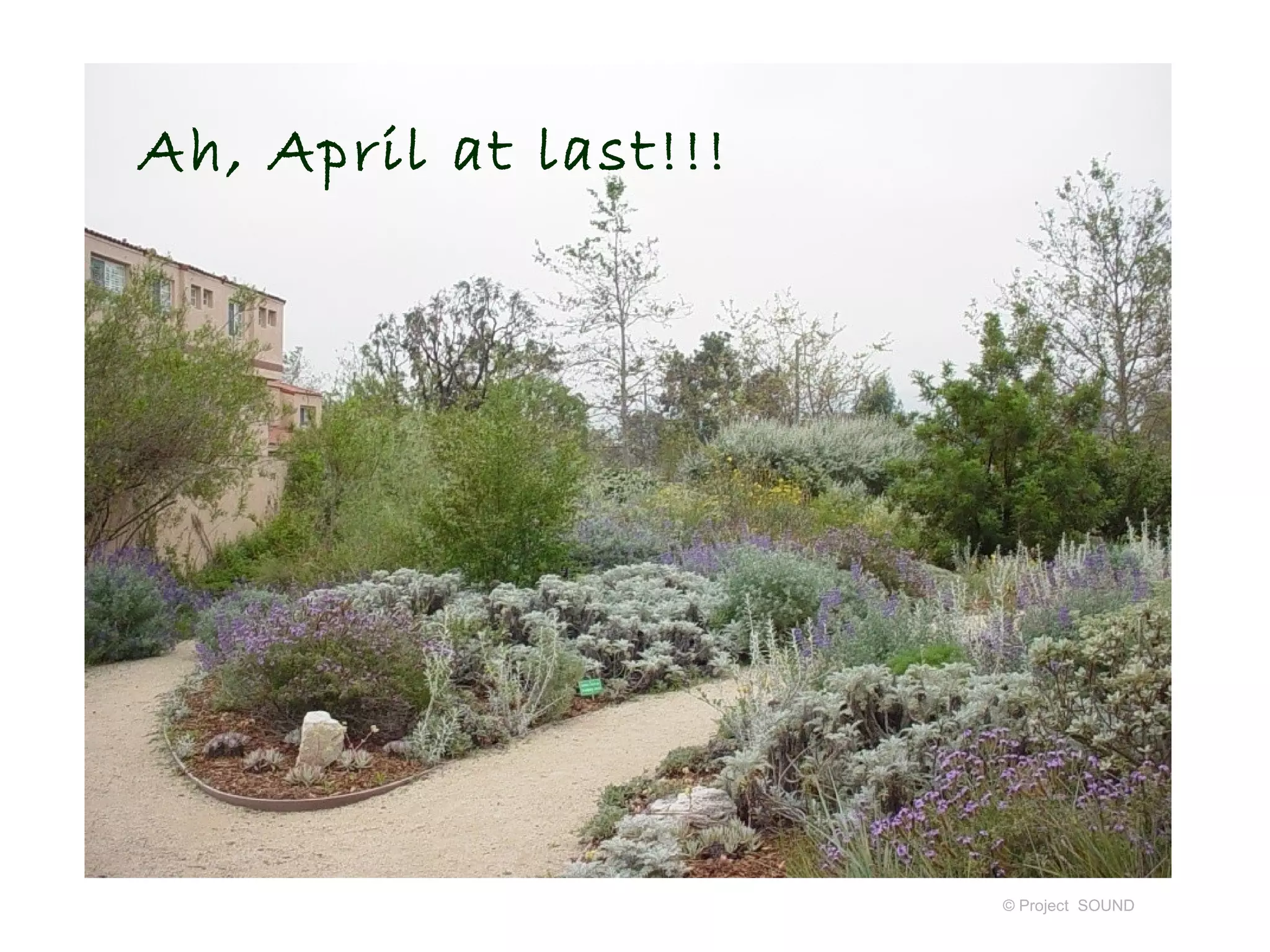
Keep up with                          Pruning:
 weeding,                                Tip-prune (pinch) to promote fullness: most
                                          perennials and sub-shrubs that are actively
  pinching                                growing now (Gambelia; Salvias; Epilobium; many
                                          others)
                                         Mow (if desired) cool-season sod-forming
                                          grasses, sedges
                                         Divide/replant wetland species (Equisetum,
                                          Tules, Cattails, Rushes/sedges

                                      Weeds/Diseases/Pests: major weeding
                                       month
                                         Weedy grasses will take over if you let them
                                         Warm-season weeds will start to poke their
                                          heads up; this is a good time to weed, as the
                                          ground is still soft
                                         Beware of slugs and snails – take action
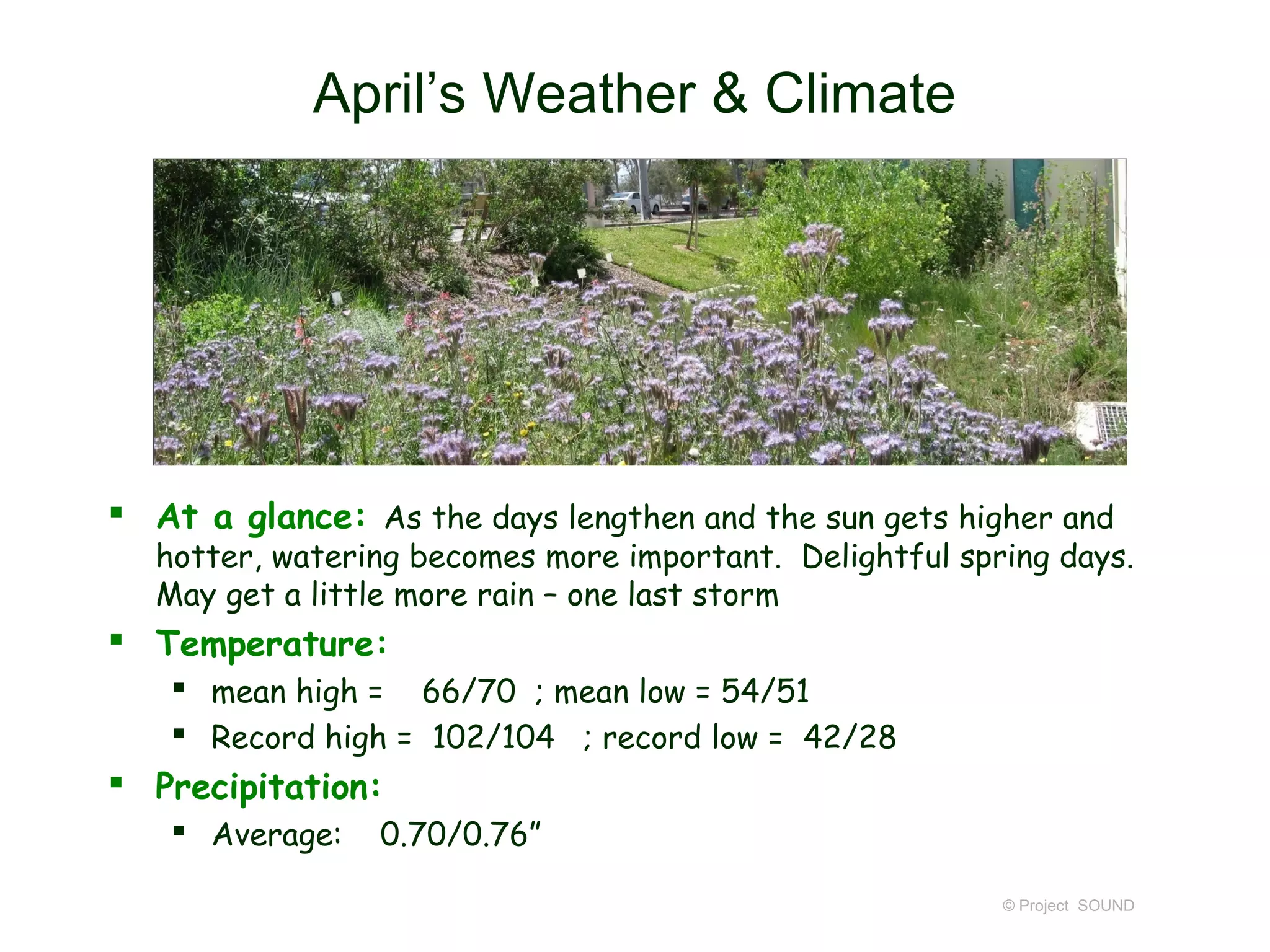
                                         Watch for signs of sucking insects (aphids &
                                          others) on new growth; blast off with water if
                                          needed – or encourage beneficial insects
http://www.viette.com/v.php?pg=742
                                                                         © Project SOUND
Major month to enjoy    Edibles/Crafts:
                           Press wildflowers – or just
    the outdoors            photograph them – and make note
                            cards or bookmarks with them
                           Enjoy native CA greens in salads,
                            cooked as greens or in stews, soups
                           Take a native crafts or cooking class

                        Enjoying the garden: major
                         enjoying month
                           Plant a tree for CA Arbor Day;
                           Visit a native plant garden/botanic
                            garden – see how the designers use
                            native plants in interesting ways
                           Spend as much time as possible just
                            enjoying being out in your garden –
                            this month begins the enchantment!

                        Mother Nature’s advice: get
                         outdoors: hike, visit preserves
                                                   © Project SOUND
Ah, April at last!!!


                       © Project SOUND
April’s Weather & Climate


 At a glance: As the days lengthen and the sun gets higher and
  hotter, watering becomes more important. Delightful spring days.
  May get a little more rain – one last storm
 Temperature:
    mean high = 66/70 ; mean low = 54/51
    Record high = 102/104 ; record low = 42/28
 Precipitation:
    Average:    0.70/0.76”

                                                         © Project SOUND
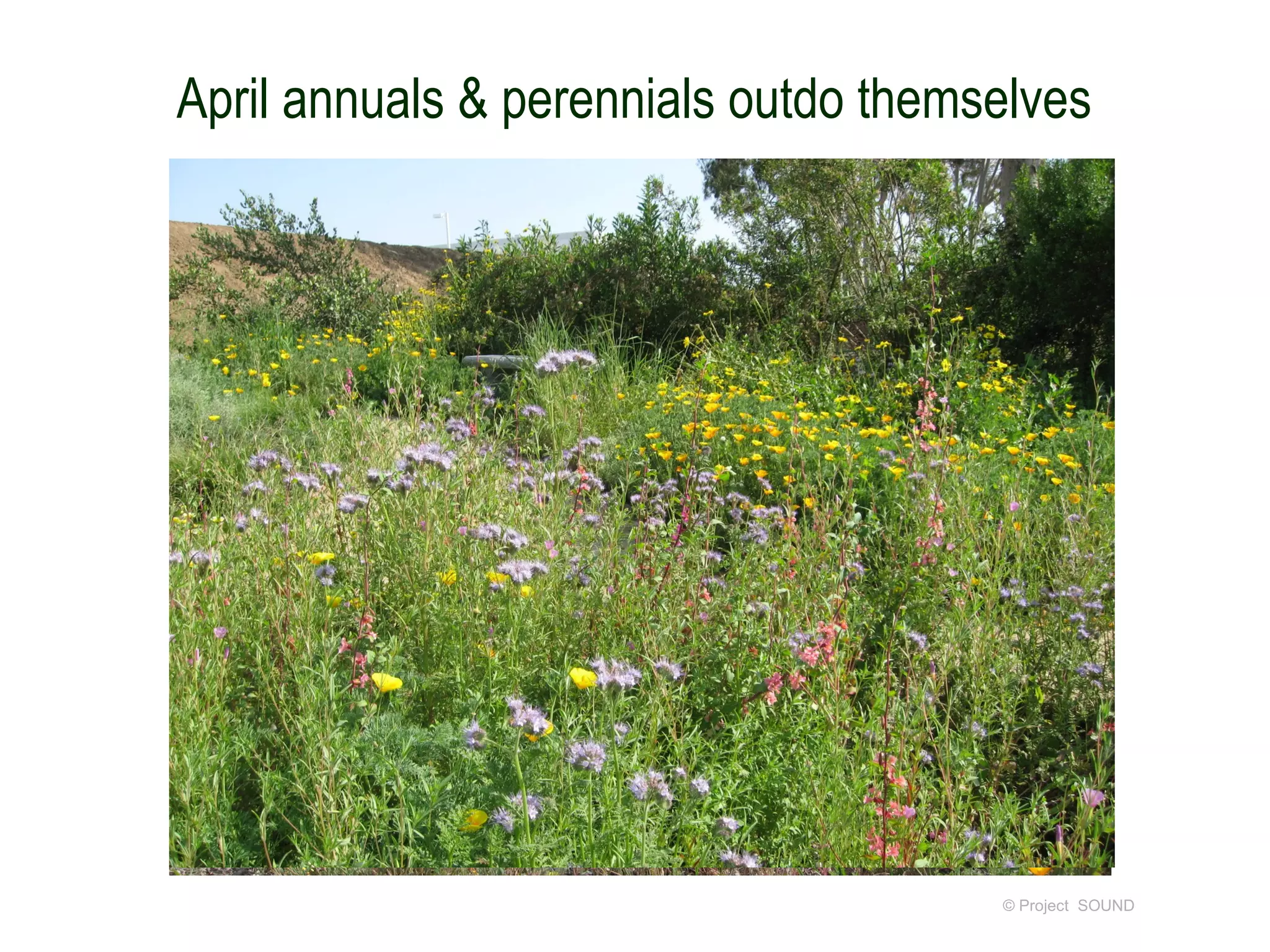
April annuals & perennials outdo themselves


                                      © Project SOUND
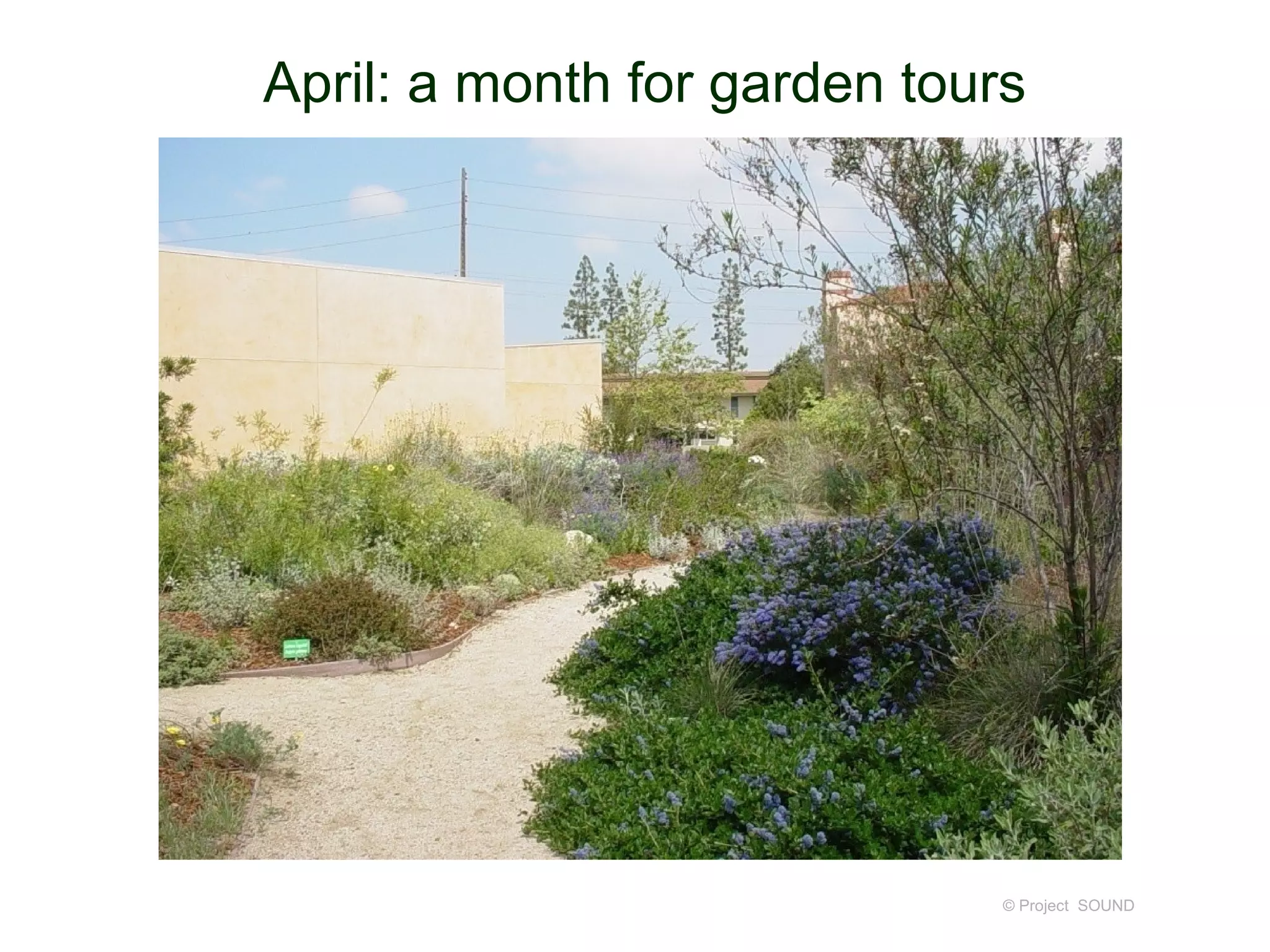
April: a month for garden tours


                              © Project SOUND
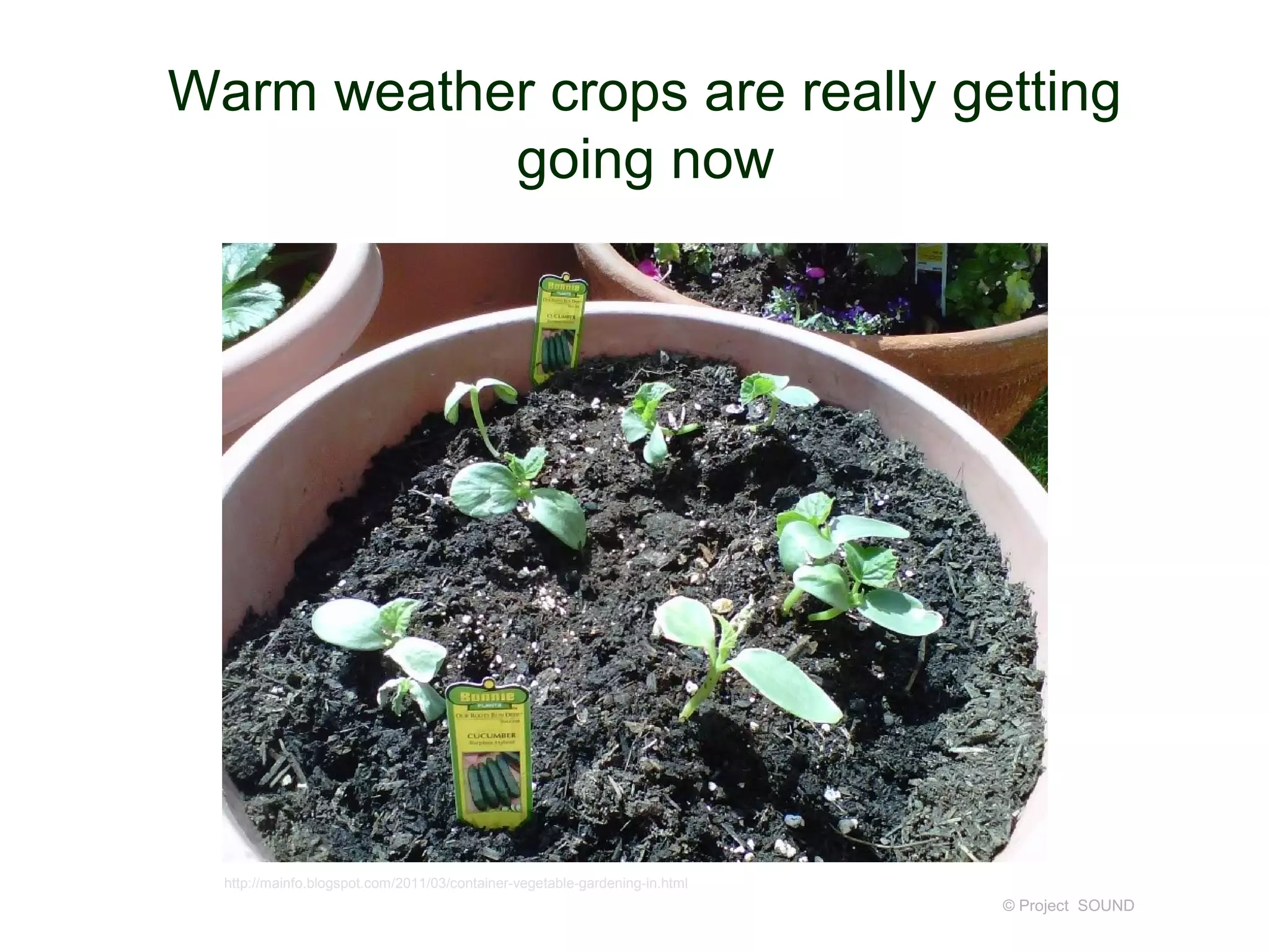
Warm weather crops are really getting
           going now


  http://mainfo.blogspot.com/2011/03/container-vegetable-gardening-in.html
                                                                             © Project SOUND
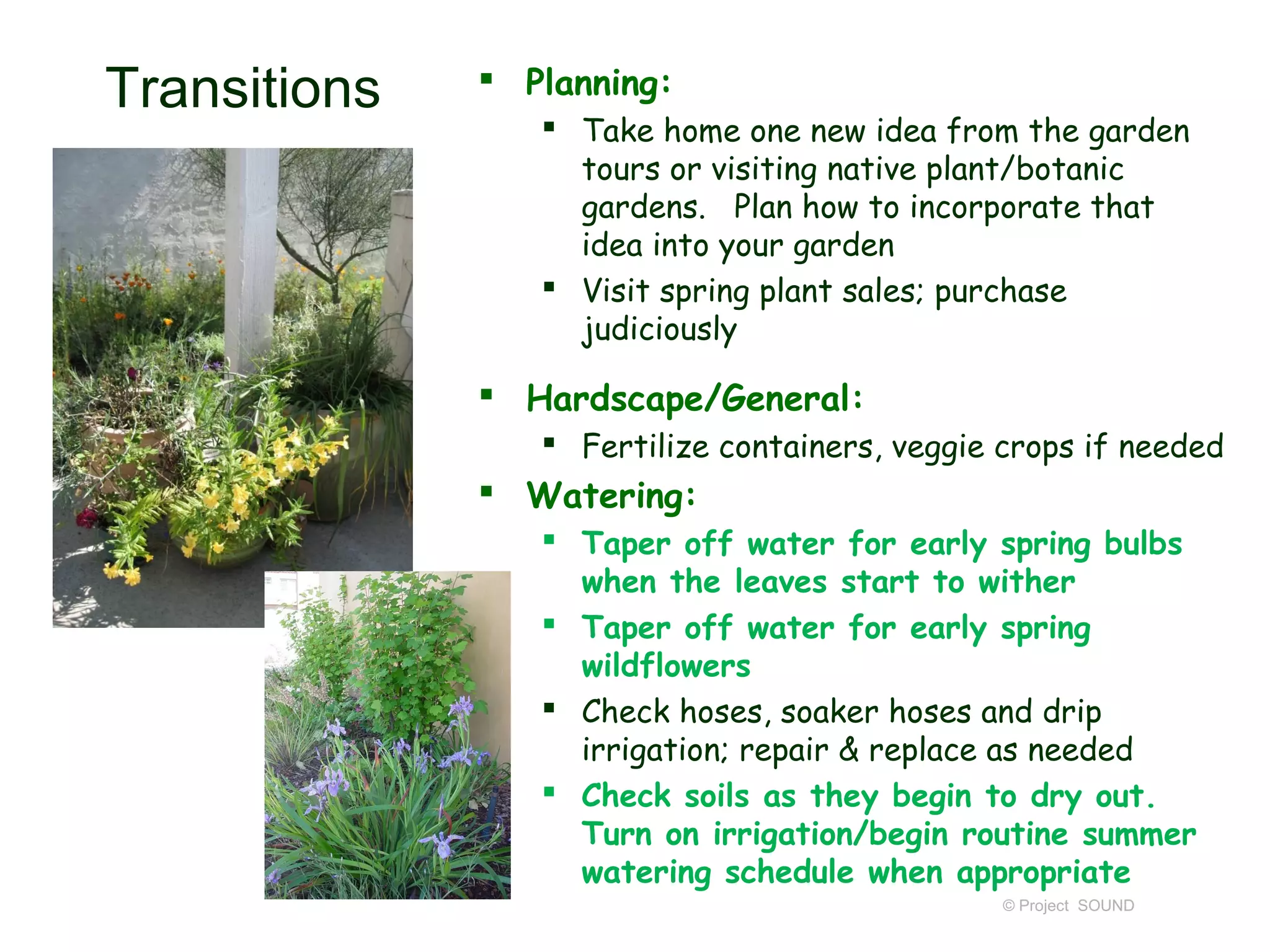
Transitions    Planning:
                  Take home one new idea from the garden
                   tours or visiting native plant/botanic
                   gardens. Plan how to incorporate that
                   idea into your garden
                  Visit spring plant sales; purchase
                   judiciously

               Hardscape/General:
                  Fertilize containers, veggie crops if needed
               Watering:
                  Taper off water for early spring bulbs
                   when the leaves start to wither
                  Taper off water for early spring
                   wildflowers
                  Check hoses, soaker hoses and drip
                   irrigation; repair & replace as needed
                  Check soils as they begin to dry out.
                   Turn on irrigation/begin routine summer
                   watering schedule when appropriate
                                                © Project SOUND
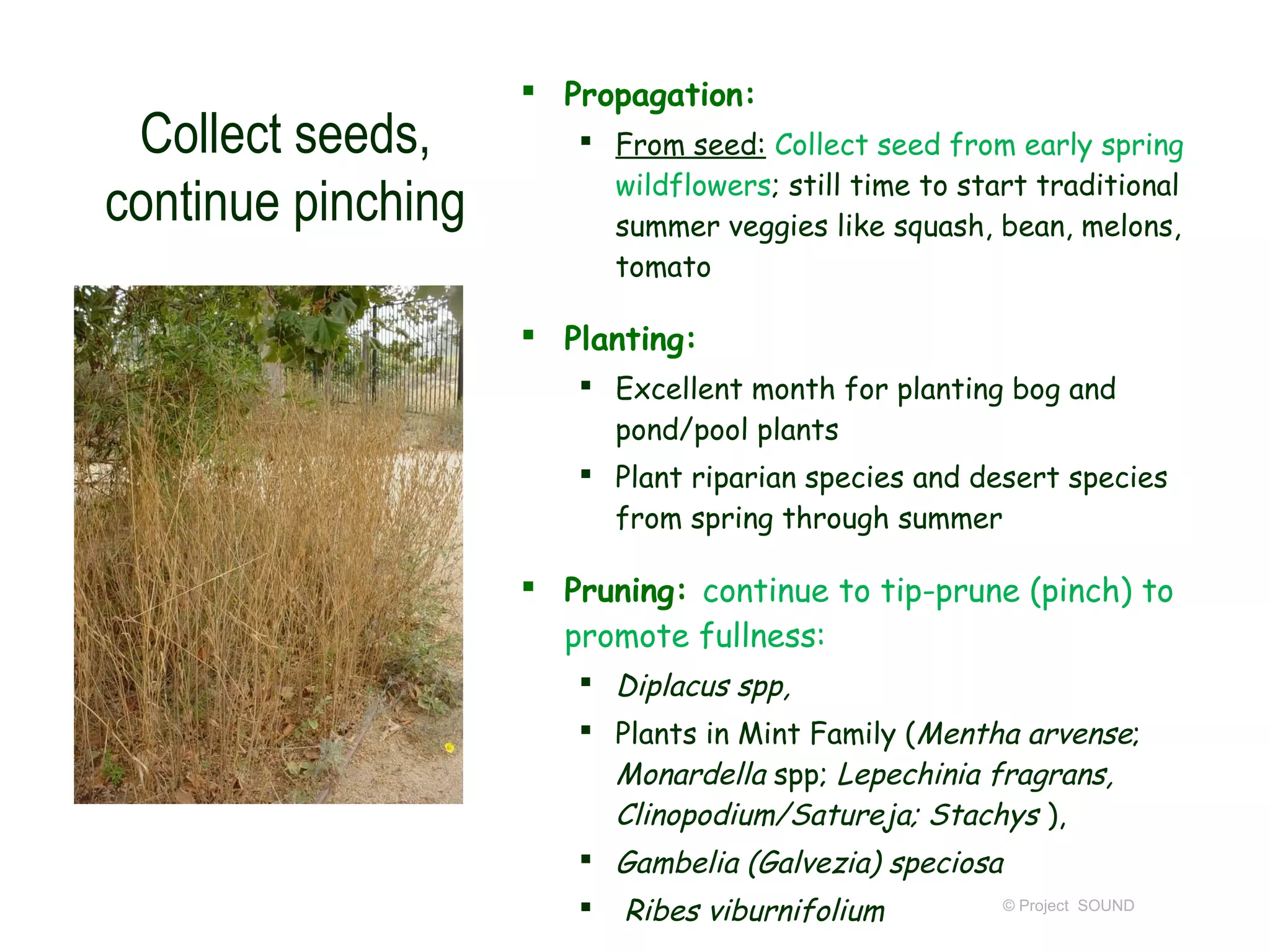
 Propagation:
 Collect seeds,         From seed: Collect seed from early spring
                         wildflowers; still time to start traditional
continue pinching        summer veggies like squash, bean, melons,
                         tomato

                     Planting:
                        Excellent month for planting bog and
                         pond/pool plants
                        Plant riparian species and desert species
                         from spring through summer

                     Pruning: continue to tip-prune (pinch) to
                      promote fullness:
                        Diplacus spp,
                        Plants in Mint Family (Mentha arvense;
                         Monardella spp; Lepechinia fragrans,
                         Clinopodium/Satureja; Stachys ),
                        Gambelia (Galvezia) speciosa
                          Ribes viburnifolium          © Project SOUND
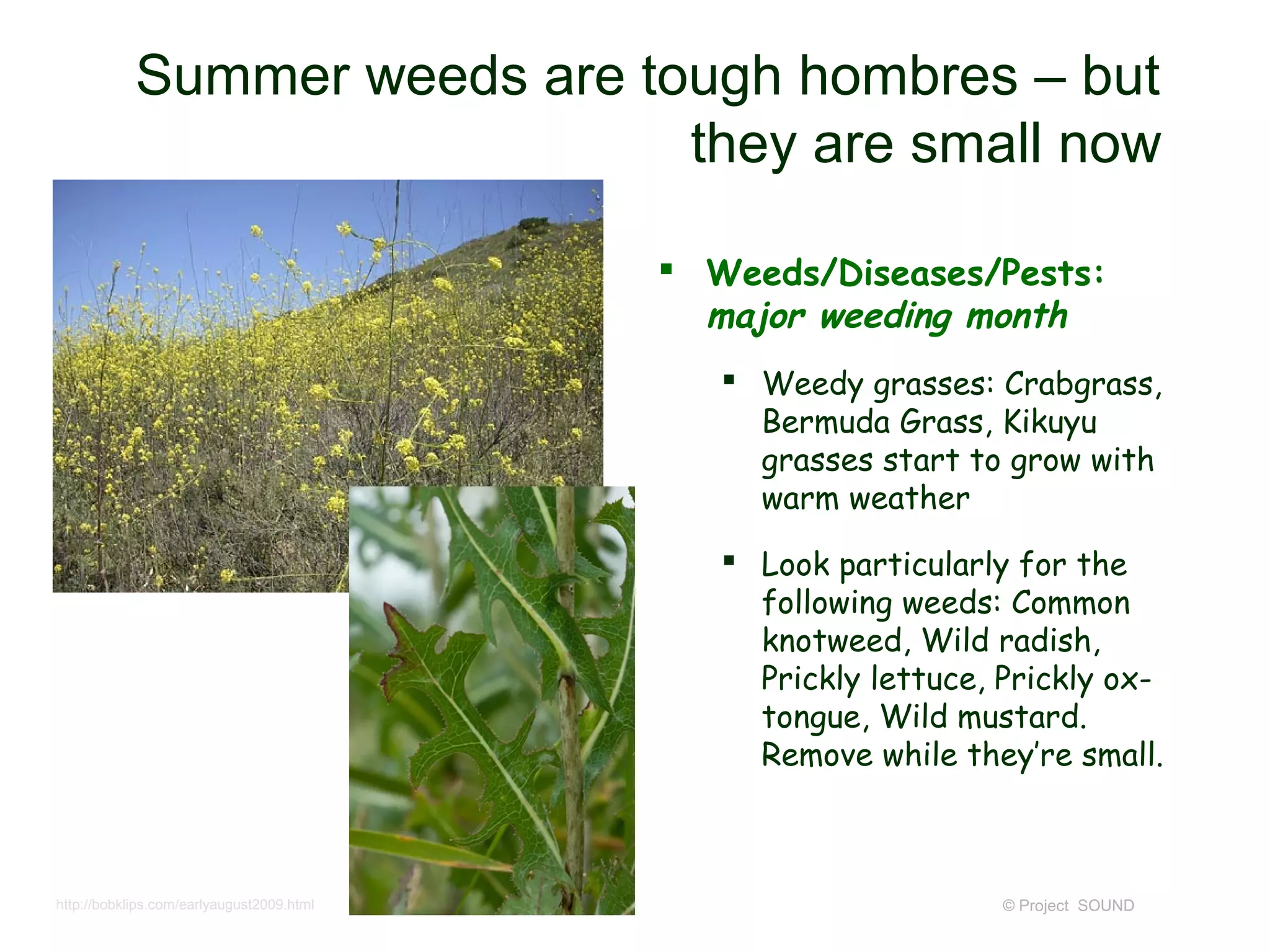
Summer weeds are tough hombres – but
                               they are small now

                                            Weeds/Diseases/Pests:
                                             major weeding month
                                               Weedy grasses: Crabgrass,
                                                Bermuda Grass, Kikuyu
                                                grasses start to grow with
                                                warm weather
                                               Look particularly for the
                                                following weeds: Common
                                                knotweed, Wild radish,
                                                Prickly lettuce, Prickly ox-
                                                tongue, Wild mustard.
                                                Remove while they’re small.


http://bobklips.com/earlyaugust2009.html                         © Project SOUND
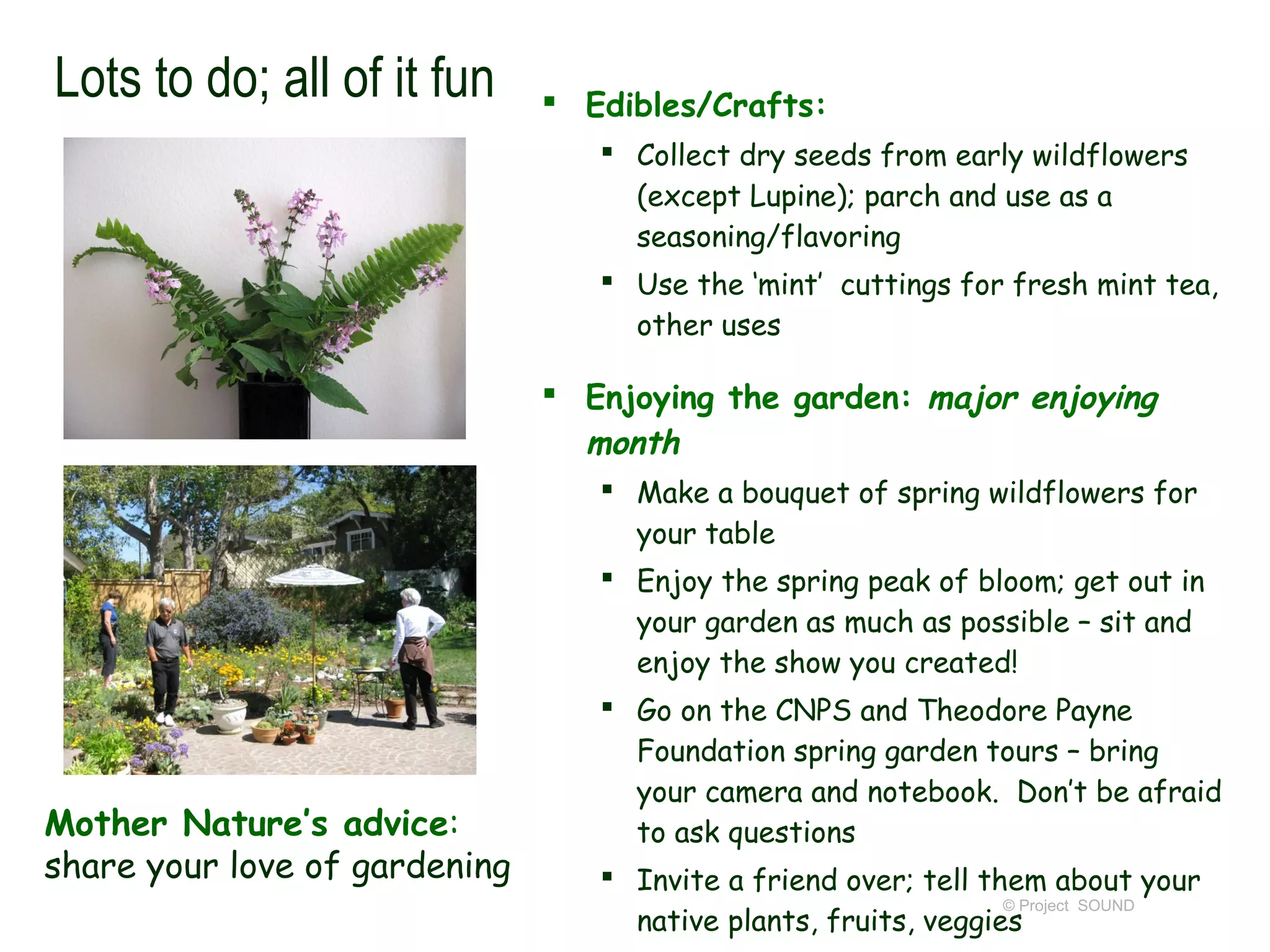
Lots to do; all of it fun       Edibles/Crafts:
                                   Collect dry seeds from early wildflowers
                                    (except Lupine); parch and use as a
                                    seasoning/flavoring
                                   Use the ‘mint’ cuttings for fresh mint tea,
                                    other uses

                                Enjoying the garden: major enjoying
                                 month
                                   Make a bouquet of spring wildflowers for
                                    your table
                                   Enjoy the spring peak of bloom; get out in
                                    your garden as much as possible – sit and
                                    enjoy the show you created!
                                   Go on the CNPS and Theodore Payne
                                    Foundation spring garden tours – bring
                                    your camera and notebook. Don’t be afraid
Mother Nature’s advice:             to ask questions
share your love of gardening       Invite a friend over; tell them about your
                                                                 © Project SOUND
                                    native plants, fruits, veggies
http://rareplanttreasurehunt.blogspot.com/2011/08/highlights-of-season.html


                                                                              © Project SOUND
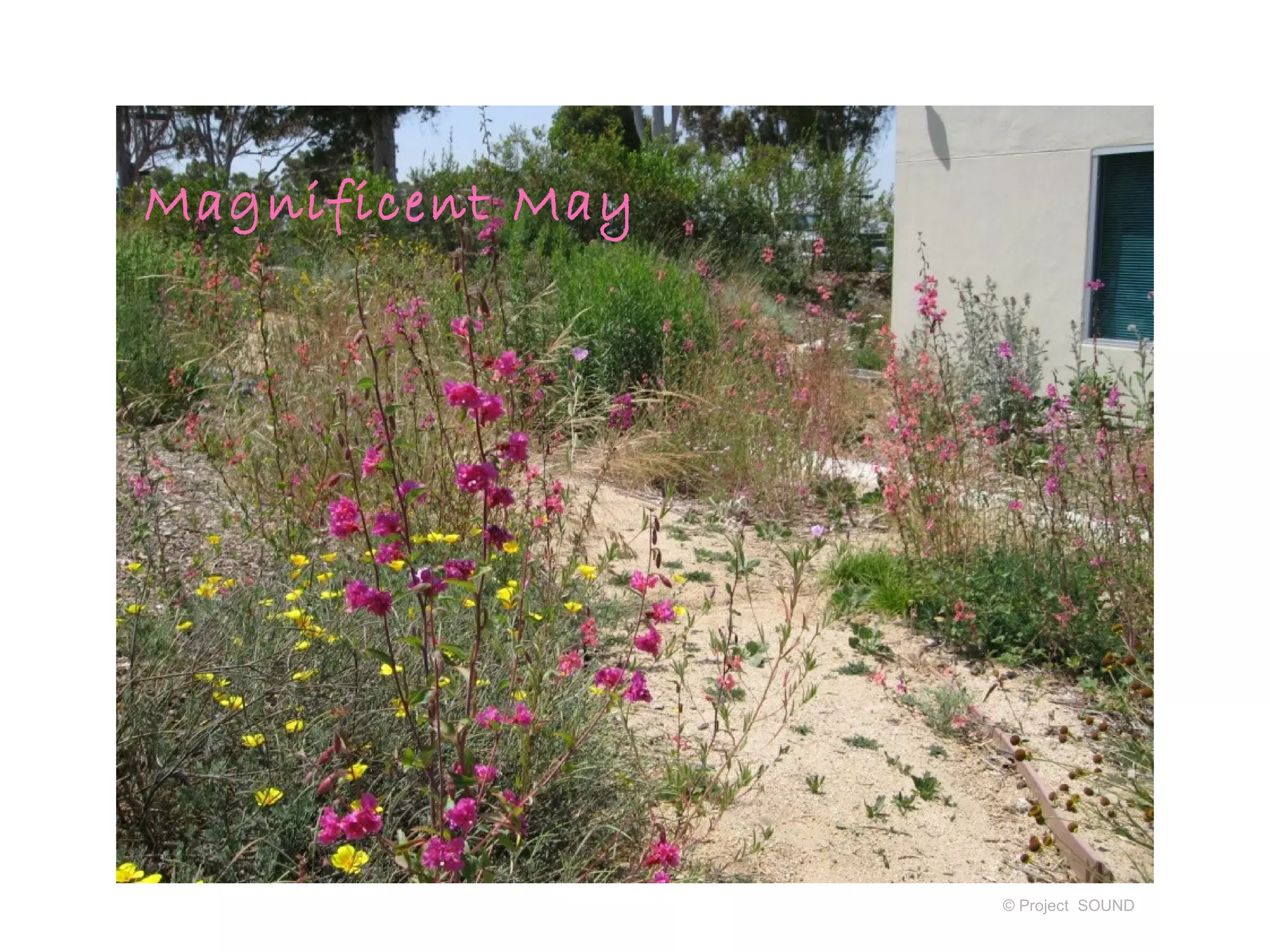
Magnificent May


                  © Project SOUND
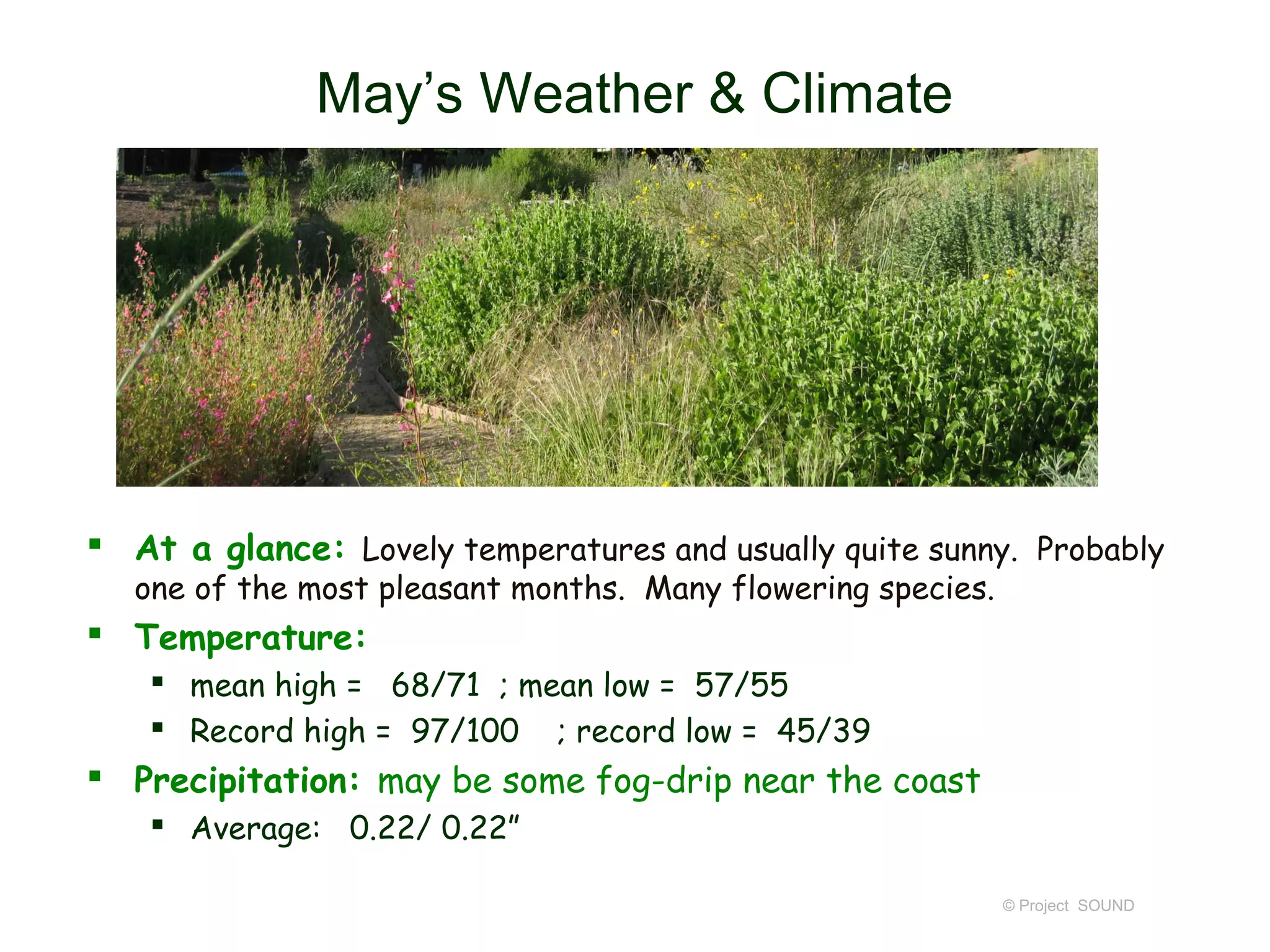
May’s Weather & Climate


 At a glance: Lovely temperatures and usually quite sunny. Probably
   one of the most pleasant months. Many flowering species.
 Temperature:
     mean high = 68/71 ; mean low = 57/55
     Record high = 97/100 ; record low = 45/39
 Precipitation: may be some fog-drip near the coast
     Average: 0.22/ 0.22”

                                                              © Project SOUND
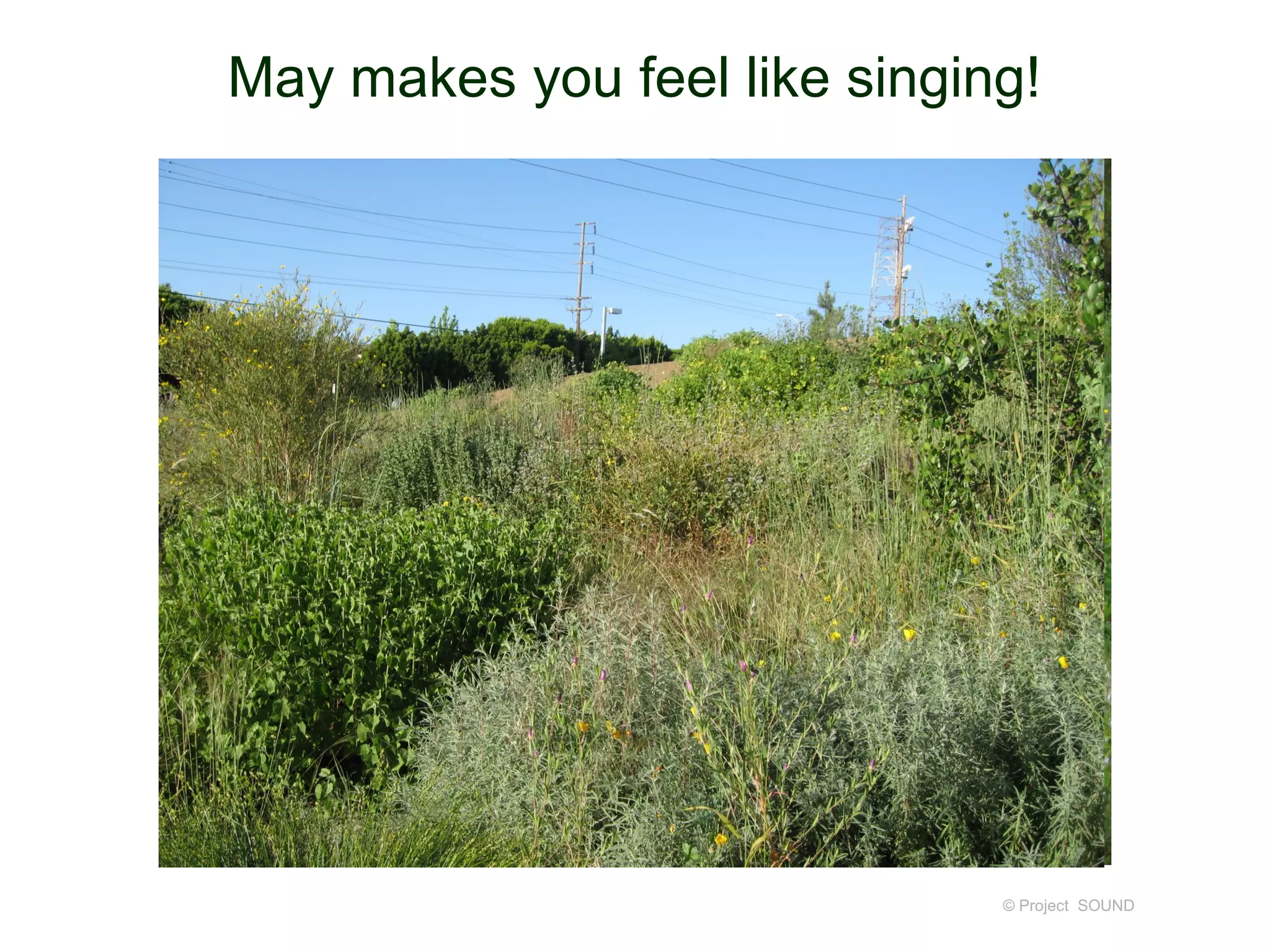
May makes you feel like singing!


                              © Project SOUND
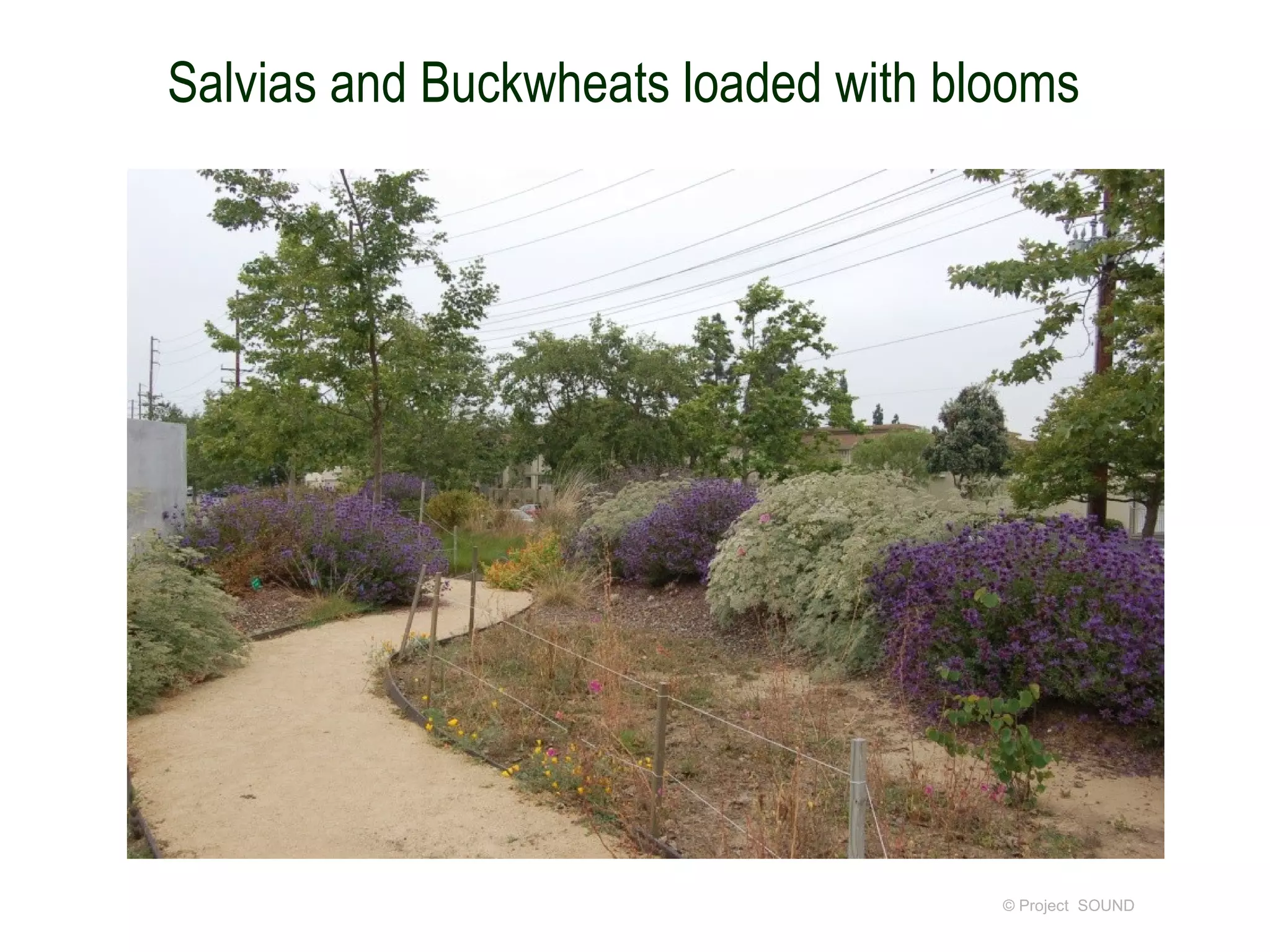
Salvias and Buckwheats loaded with blooms


                                     © Project SOUND
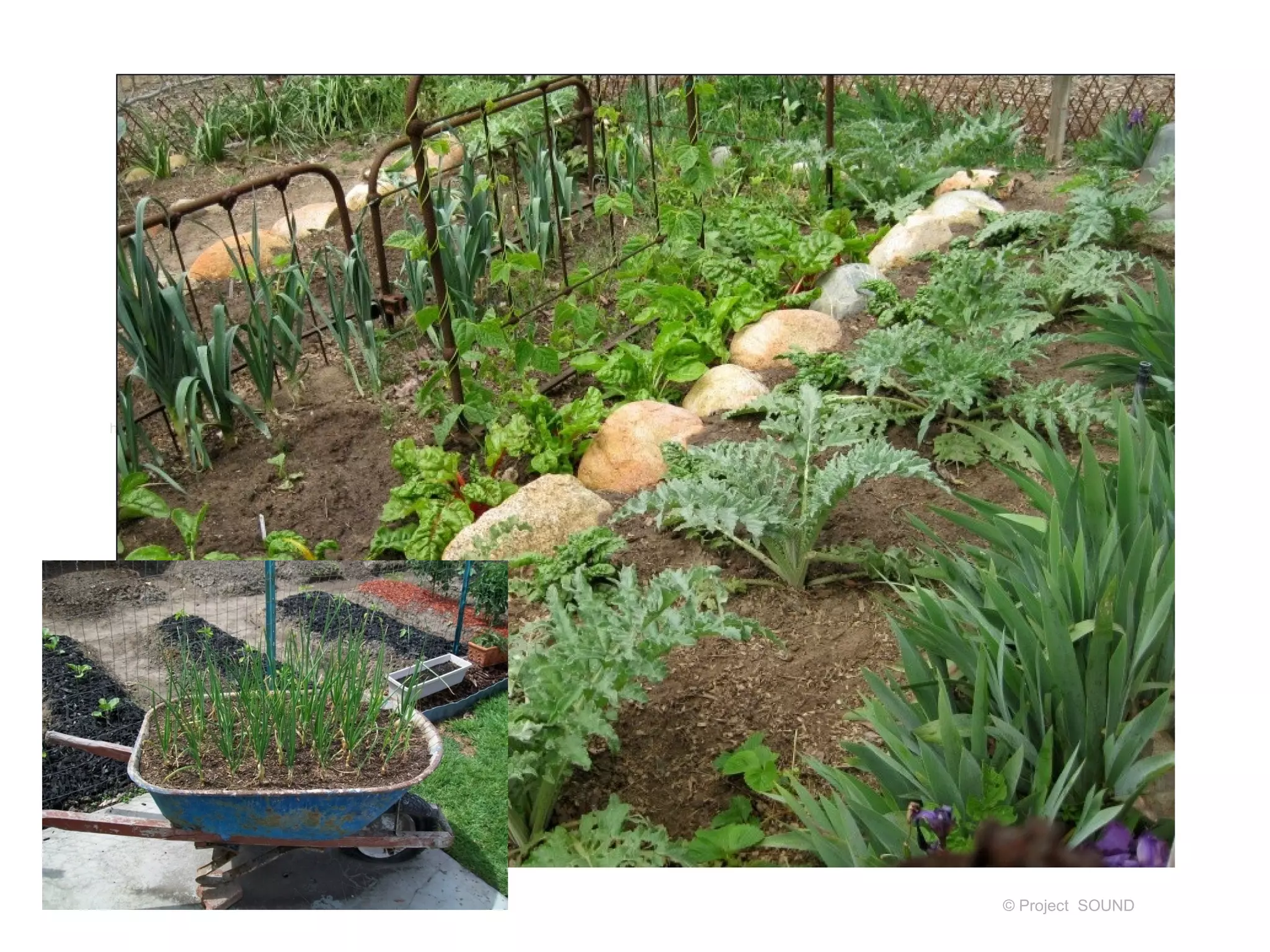
http://californiavegetablegarden.blogspot.com/


                                                 © Project SOUND
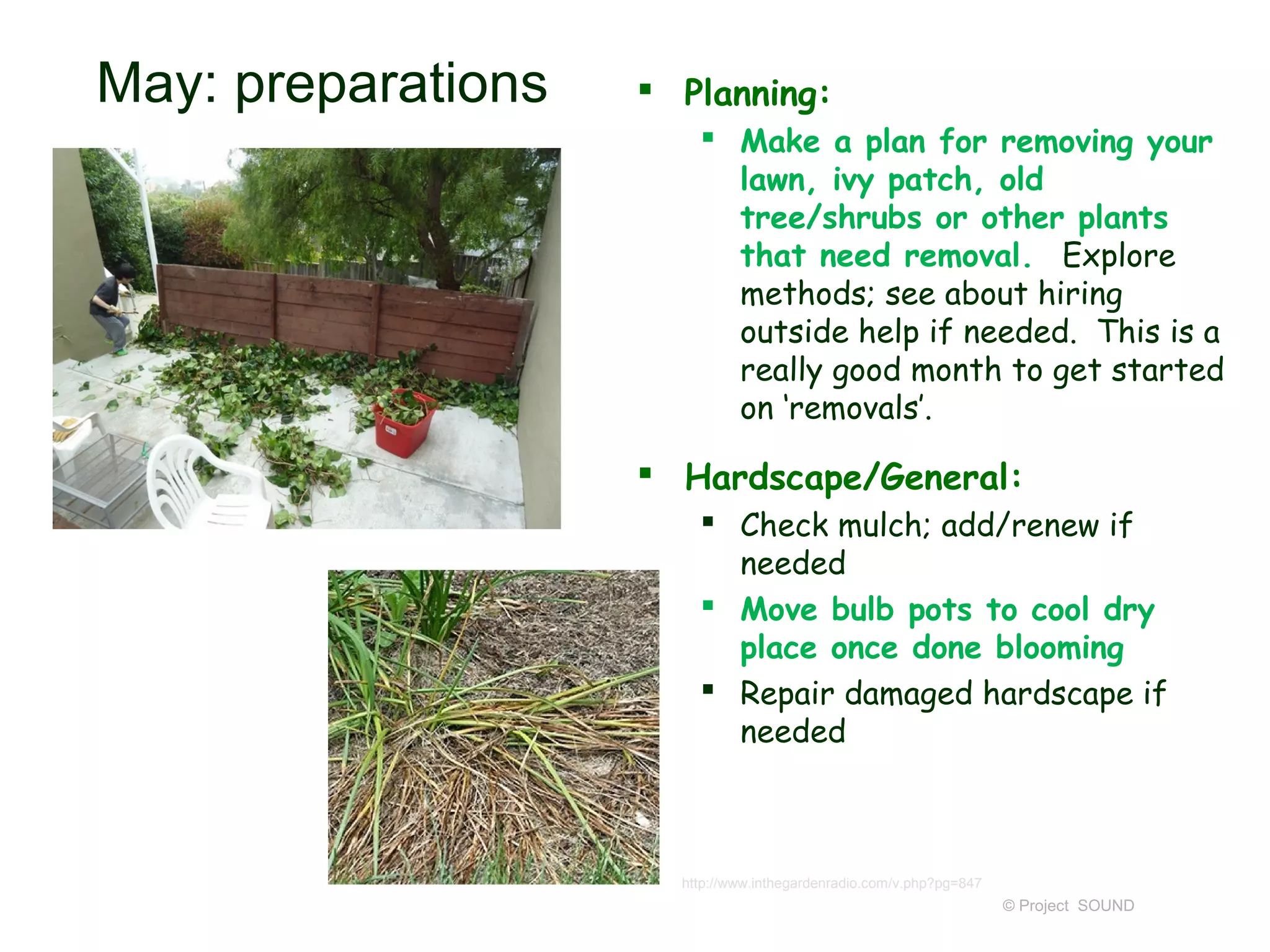
May: preparations    Planning:
                         Make a plan for removing your
                          lawn, ivy patch, old
                          tree/shrubs or other plants
                          that need removal. Explore
                          methods; see about hiring
                          outside help if needed. This is a
                          really good month to get started
                          on ‘removals’.

                     Hardscape/General:
                         Check mulch; add/renew if
                          needed
                         Move bulb pots to cool dry
                          place once done blooming
                         Repair damaged hardscape if
                          needed


                      http://www.inthegardenradio.com/v.php?pg=847
                                                                     © Project SOUND
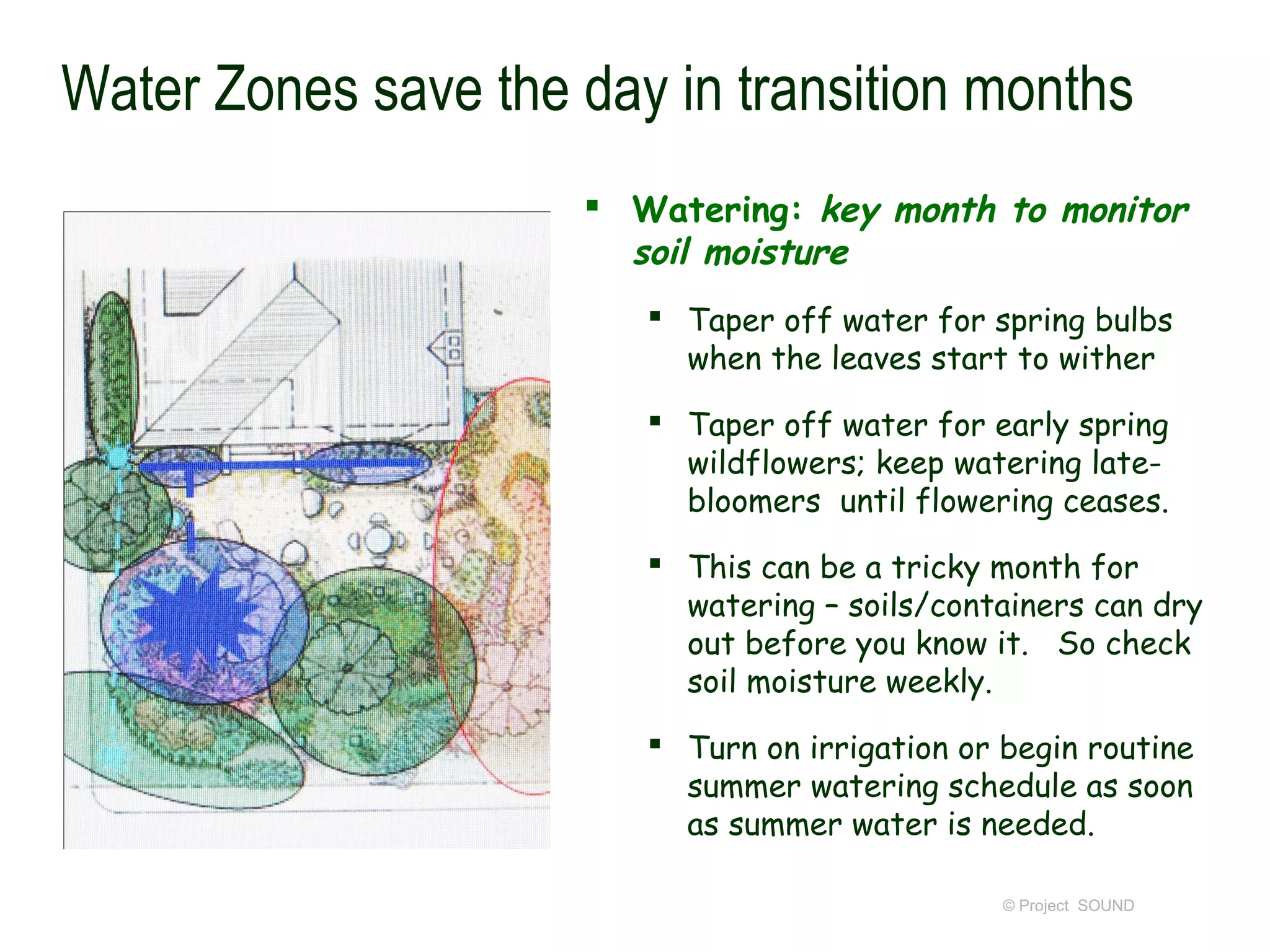
Water Zones save the day in transition months
                      Watering: key month to monitor
                       soil moisture
                         Taper off water for spring bulbs
                          when the leaves start to wither
                         Taper off water for early spring
                          wildflowers; keep watering late-
                          bloomers until flowering ceases.
                         This can be a tricky month for
                          watering – soils/containers can dry
                          out before you know it. So check
                          soil moisture weekly.
                         Turn on irrigation or begin routine
                          summer watering schedule as soon
                          as summer water is needed.

                                                © Project SOUND
 Propagation:
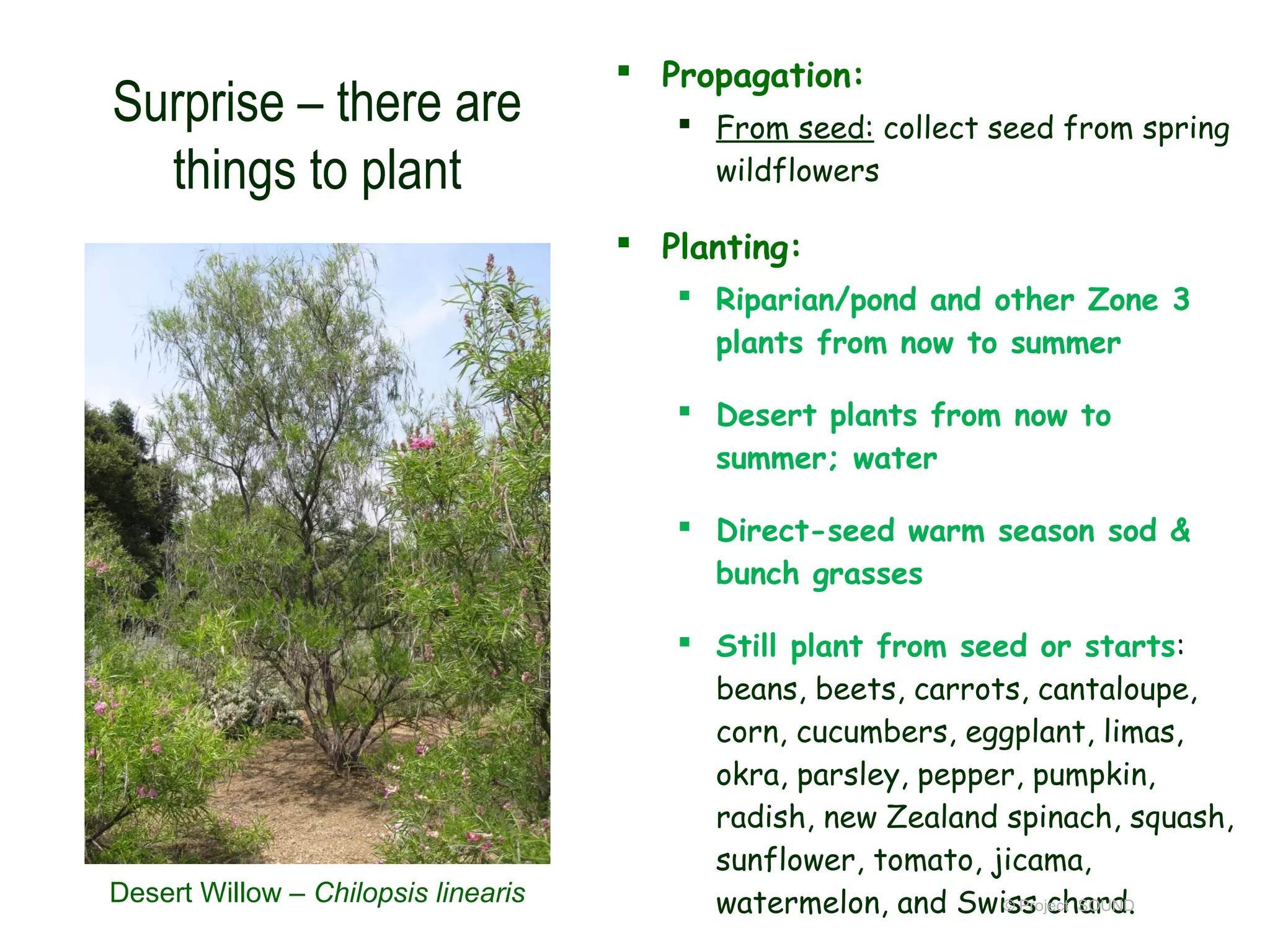
Surprise – there are                     From seed: collect seed from spring
  things to plant                         wildflowers

                                      Planting:
                                         Riparian/pond and other Zone 3
                                          plants from now to summer

                                         Desert plants from now to
                                          summer; water

                                         Direct-seed warm season sod &
                                          bunch grasses

                                         Still plant from seed or starts:
                                          beans, beets, carrots, cantaloupe,
                                          corn, cucumbers, eggplant, limas,
                                          okra, parsley, pepper, pumpkin,
                                          radish, new Zealand spinach, squash,
                                          sunflower, tomato, jicama,
Desert Willow – Chilopsis linearis        watermelon, and Swiss chard.
                                                              © Project SOUND
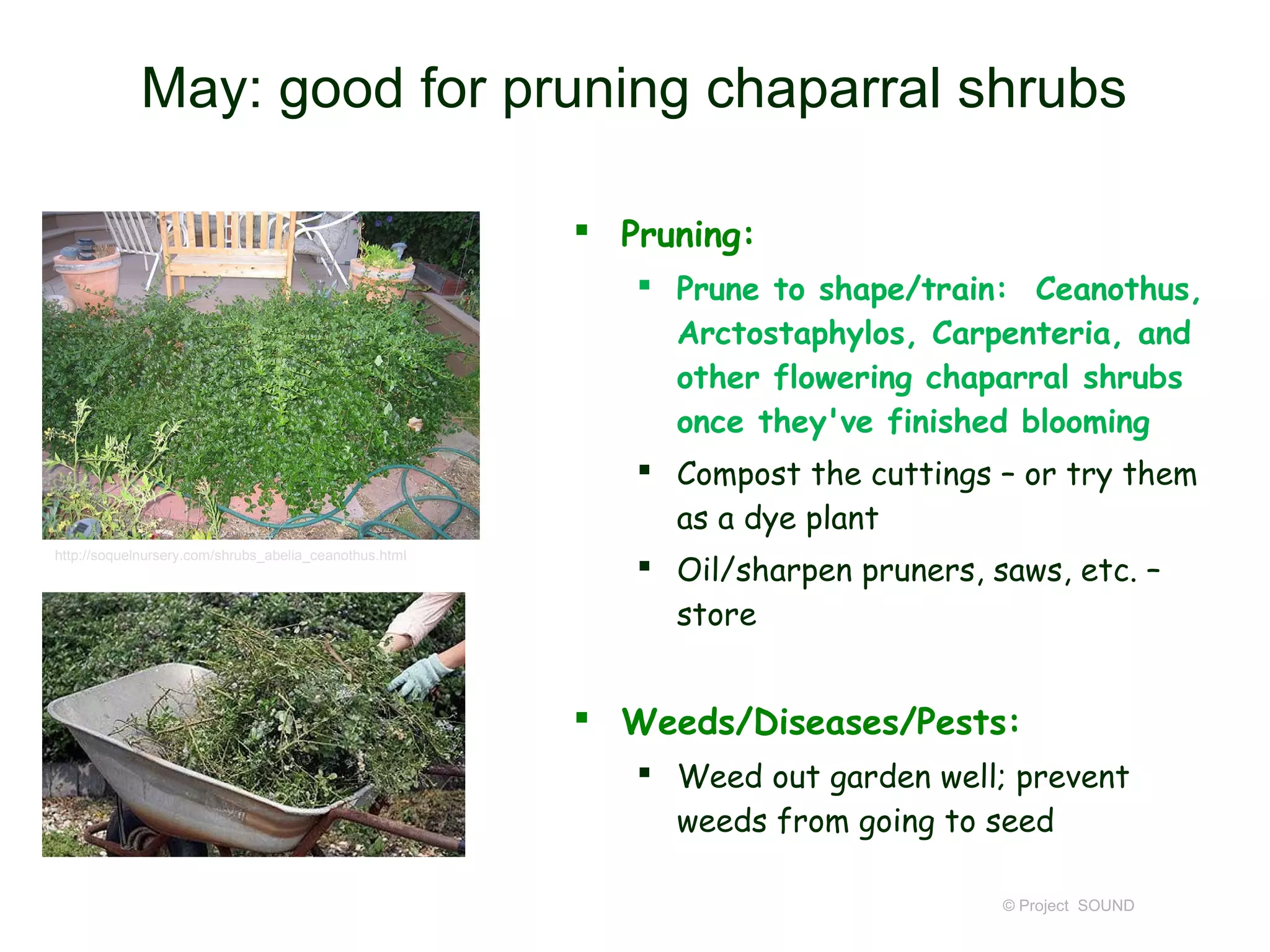
May: good for pruning chaparral shrubs

                                                         Pruning:
                                                            Prune to shape/train: Ceanothus,
                                                             Arctostaphylos, Carpenteria, and
                                                             other flowering chaparral shrubs
                                                             once they've finished blooming
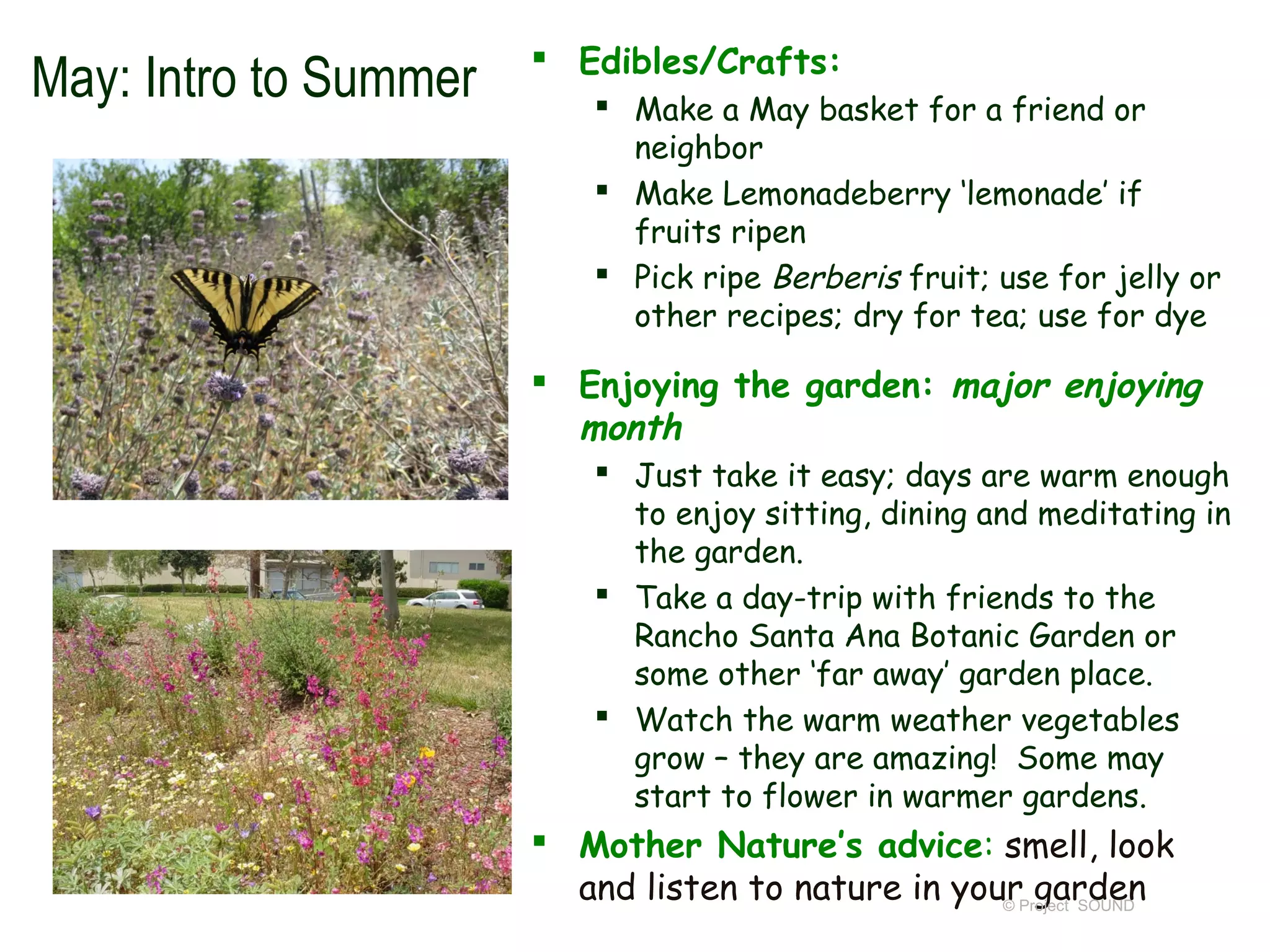
                                                            Compost the cuttings – or try them
                                                             as a dye plant
                                                            Oil/sharpen pruners, saws, etc. –
http://soquelnursery.com/shrubs_abelia_ceanothus.html


                                                             store


                                                         Weeds/Diseases/Pests:
                                                            Weed out garden well; prevent
                                                             weeds from going to seed

                                                                                   © Project SOUND
 Edibles/Crafts:
May: Intro to Summer        Make a May basket for a friend or
                             neighbor
                            Make Lemonadeberry ‘lemonade’ if
                             fruits ripen
                            Pick ripe Berberis fruit; use for jelly or
                             other recipes; dry for tea; use for dye

                        Enjoying the garden: major enjoying
                         month
                            Just take it easy; days are warm enough
                             to enjoy sitting, dining and meditating in
                             the garden.
                            Take a day-trip with friends to the
                             Rancho Santa Ana Botanic Garden or
                             some other ‘far away’ garden place.
                            Watch the warm weather vegetables
                             grow – they are amazing! Some may
                             start to flower in warmer gardens.
                        Mother Nature’s advice: smell, look
                         and listen to nature in yourProject SOUND
                                                    ©
                                                       garden
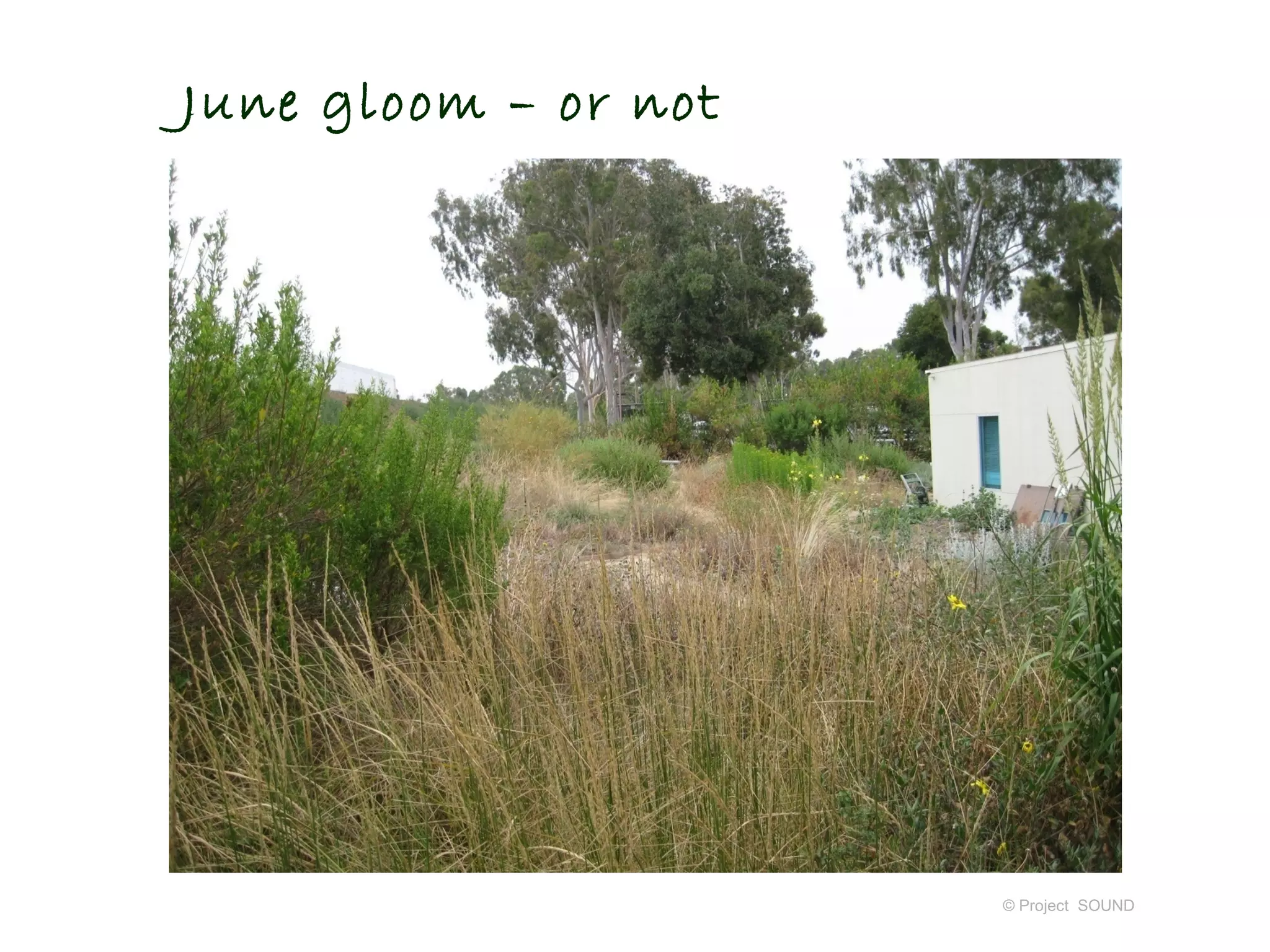
June gloom – or not


                      © Project SOUND
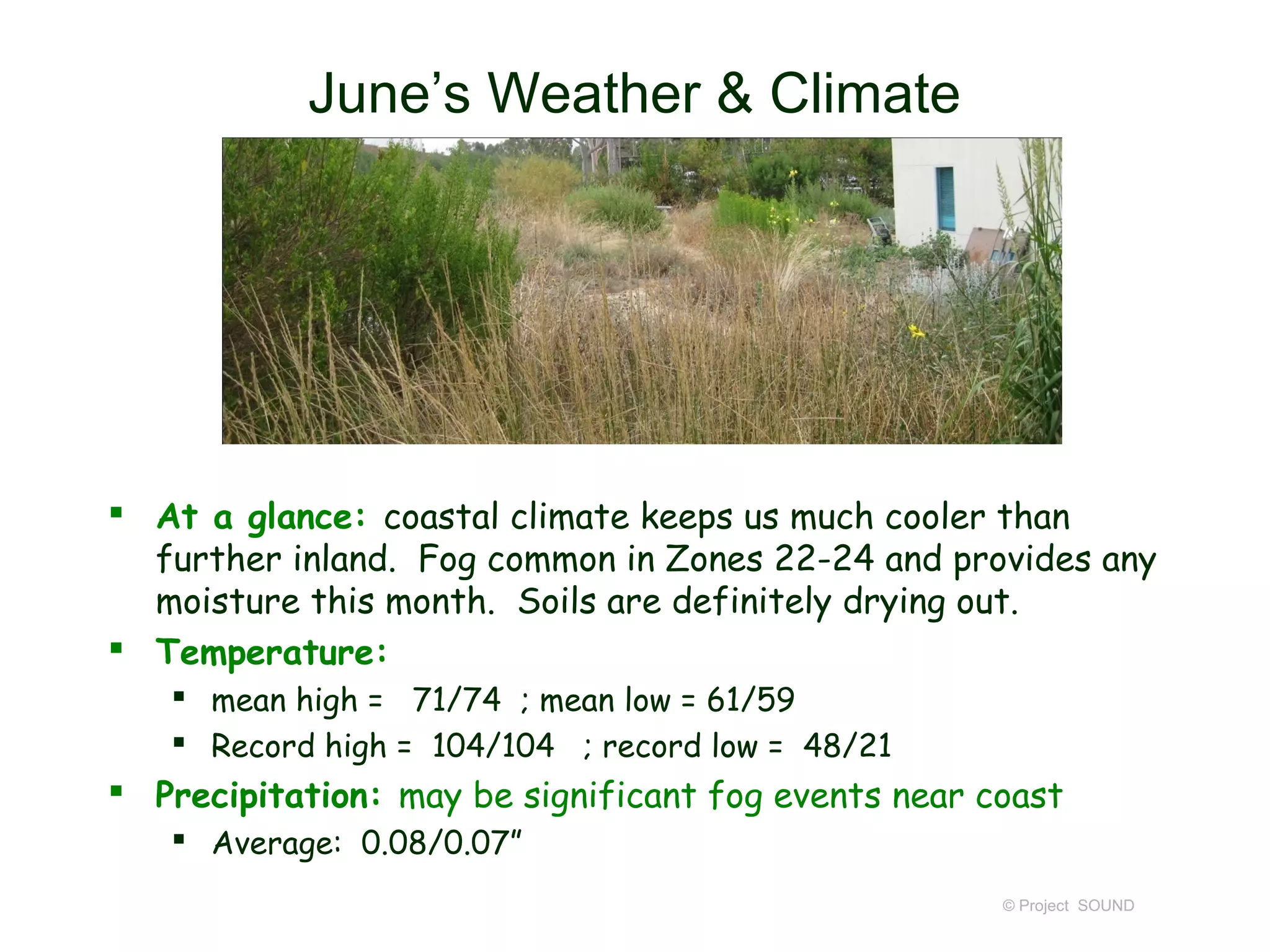
June’s Weather & Climate


 At a glance: coastal climate keeps us much cooler than
  further inland. Fog common in Zones 22-24 and provides any
  moisture this month. Soils are definitely drying out.
 Temperature:
    mean high = 71/74 ; mean low = 61/59
    Record high = 104/104 ; record low = 48/21
 Precipitation: may be significant fog events near coast
    Average: 0.08/0.07”
                                                     © Project SOUND
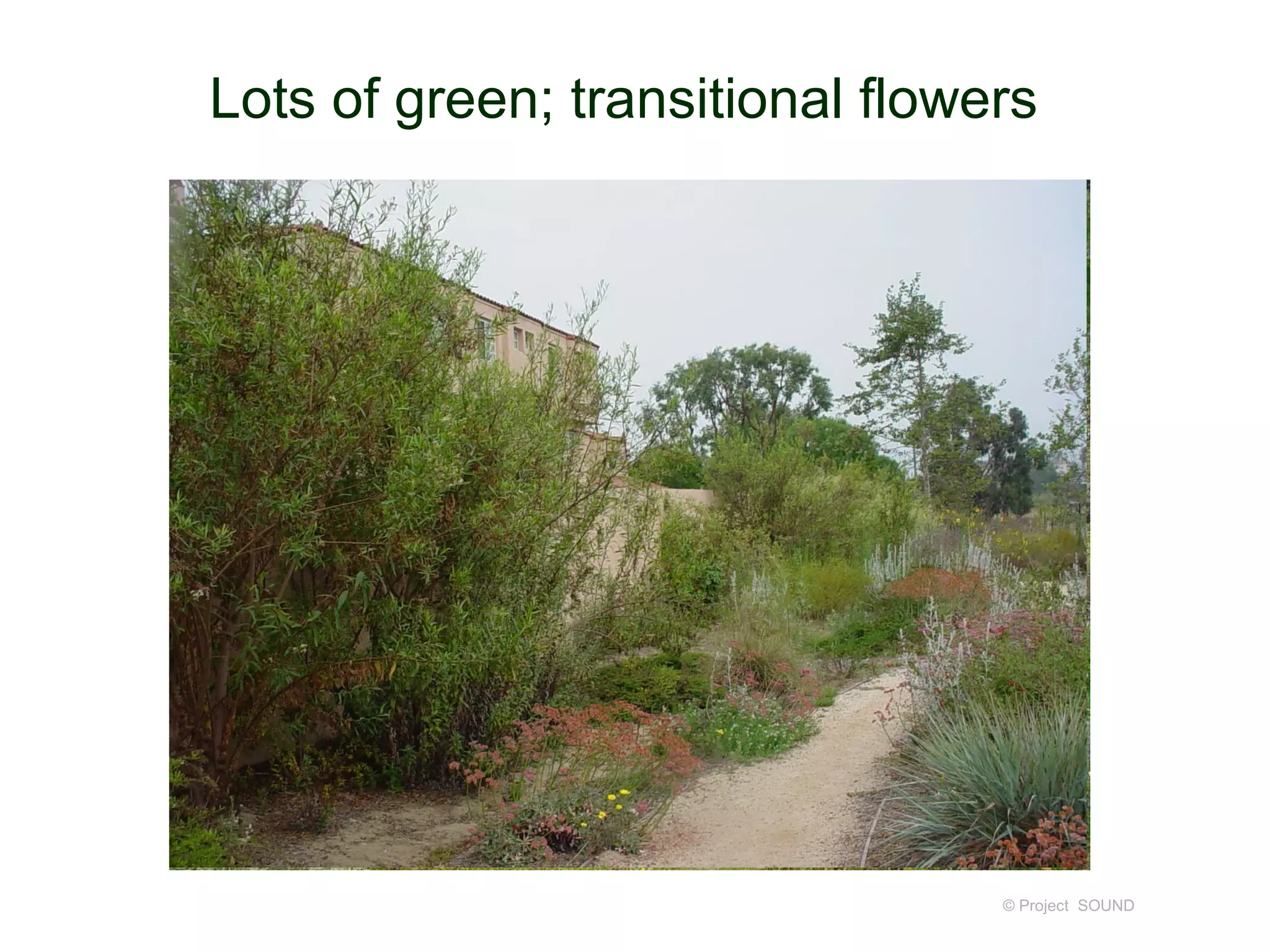
Lots of green; transitional flowers


                                 © Project SOUND
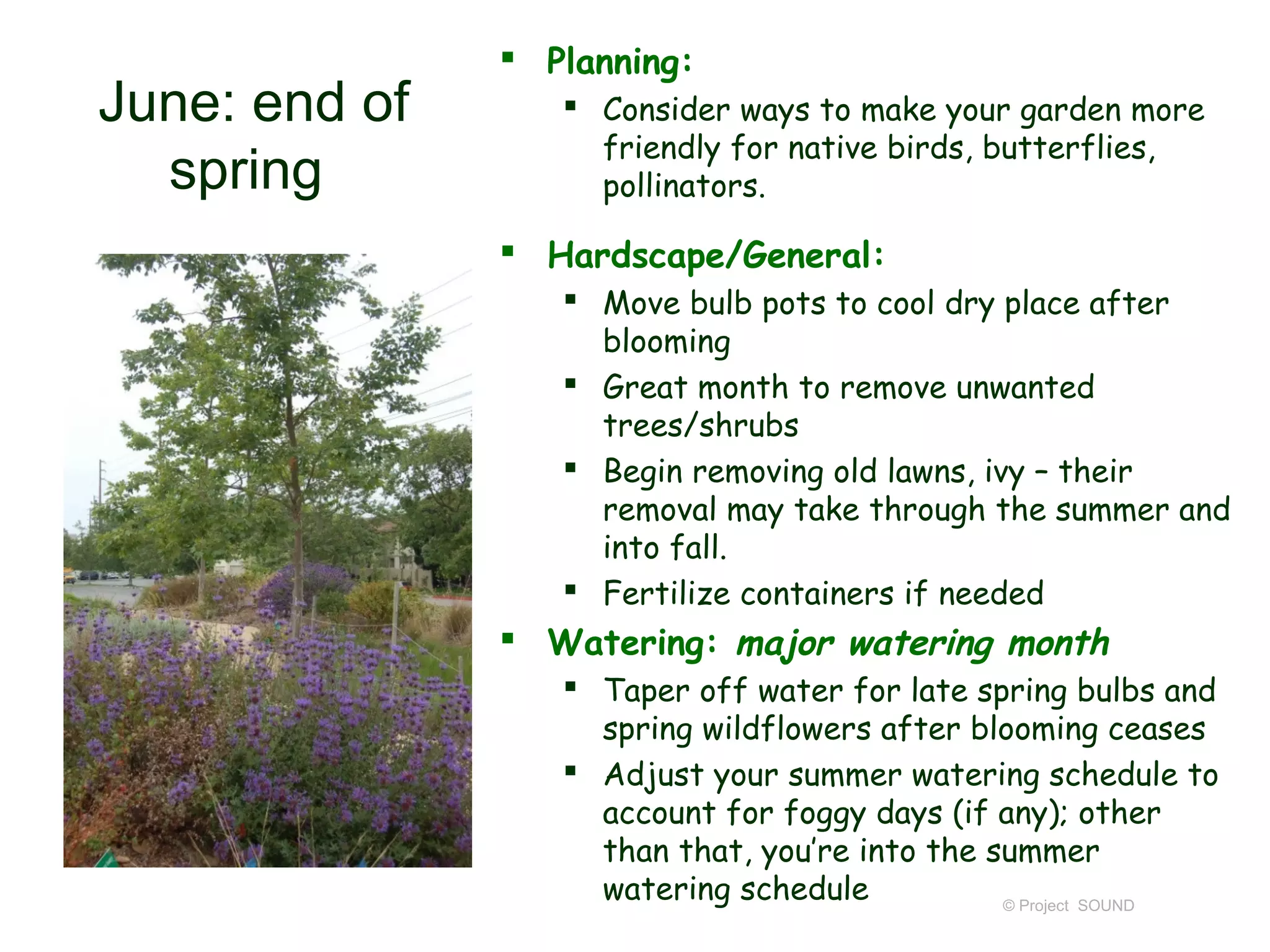
 Planning:
June: end of       Consider ways to make your garden more
                    friendly for native birds, butterflies,
  spring            pollinators.

                Hardscape/General:
                   Move bulb pots to cool dry place after
                    blooming
                   Great month to remove unwanted
                    trees/shrubs
                   Begin removing old lawns, ivy – their
                    removal may take through the summer and
                    into fall.
                   Fertilize containers if needed
                Watering: major watering month
                   Taper off water for late spring bulbs and
                    spring wildflowers after blooming ceases
                   Adjust your summer watering schedule to
                    account for foggy days (if any); other
                    than that, you’re into the summer
                    watering schedule           © Project SOUND
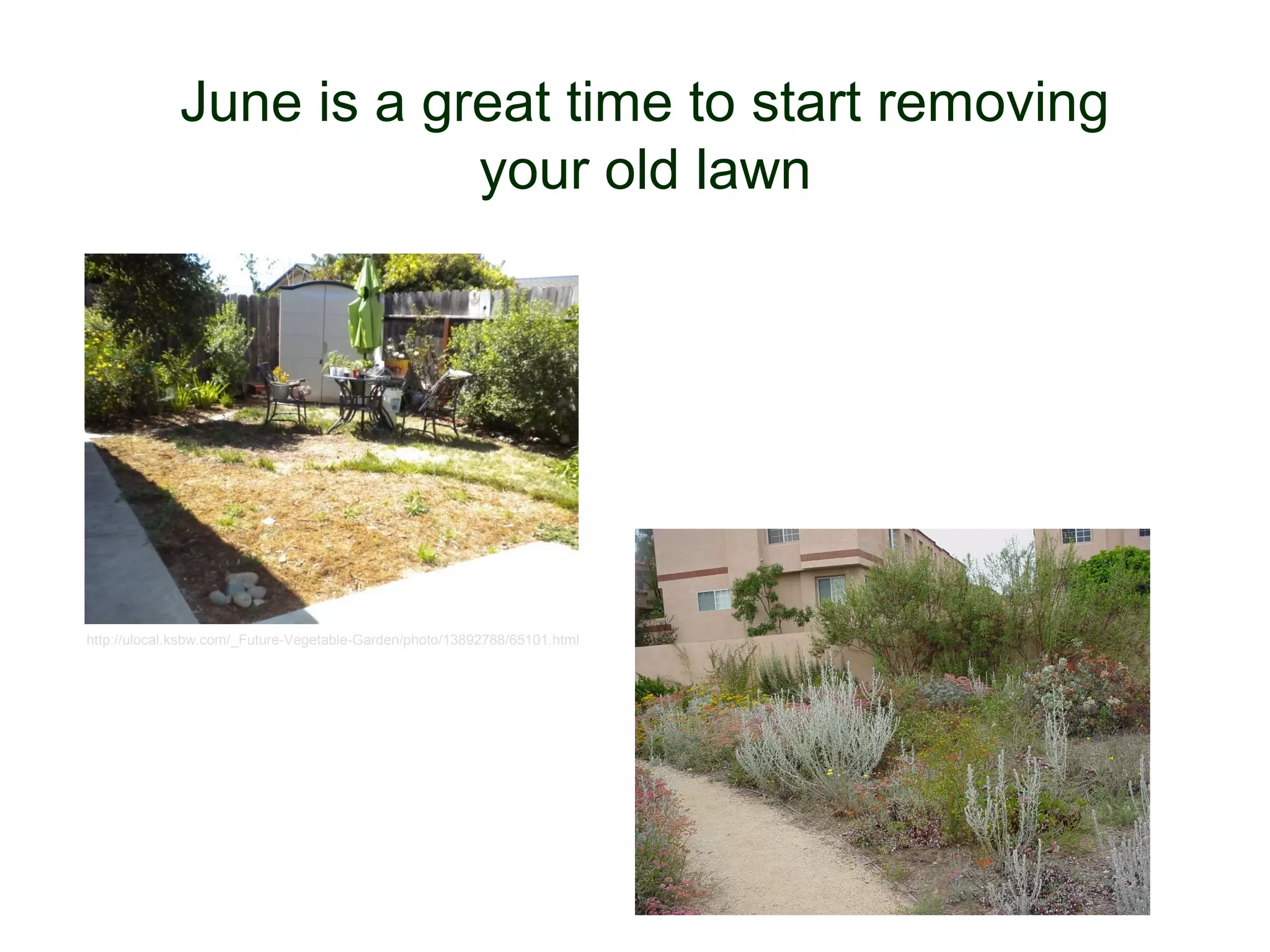
June is a great time to start removing
                         your old lawn


http://ulocal.ksbw.com/_Future-Vegetable-Garden/photo/13892788/65101.html


                                                                            © Project SOUND
June: Planting, Pruning, Dividing
                       Pruning: into summer pruning mode
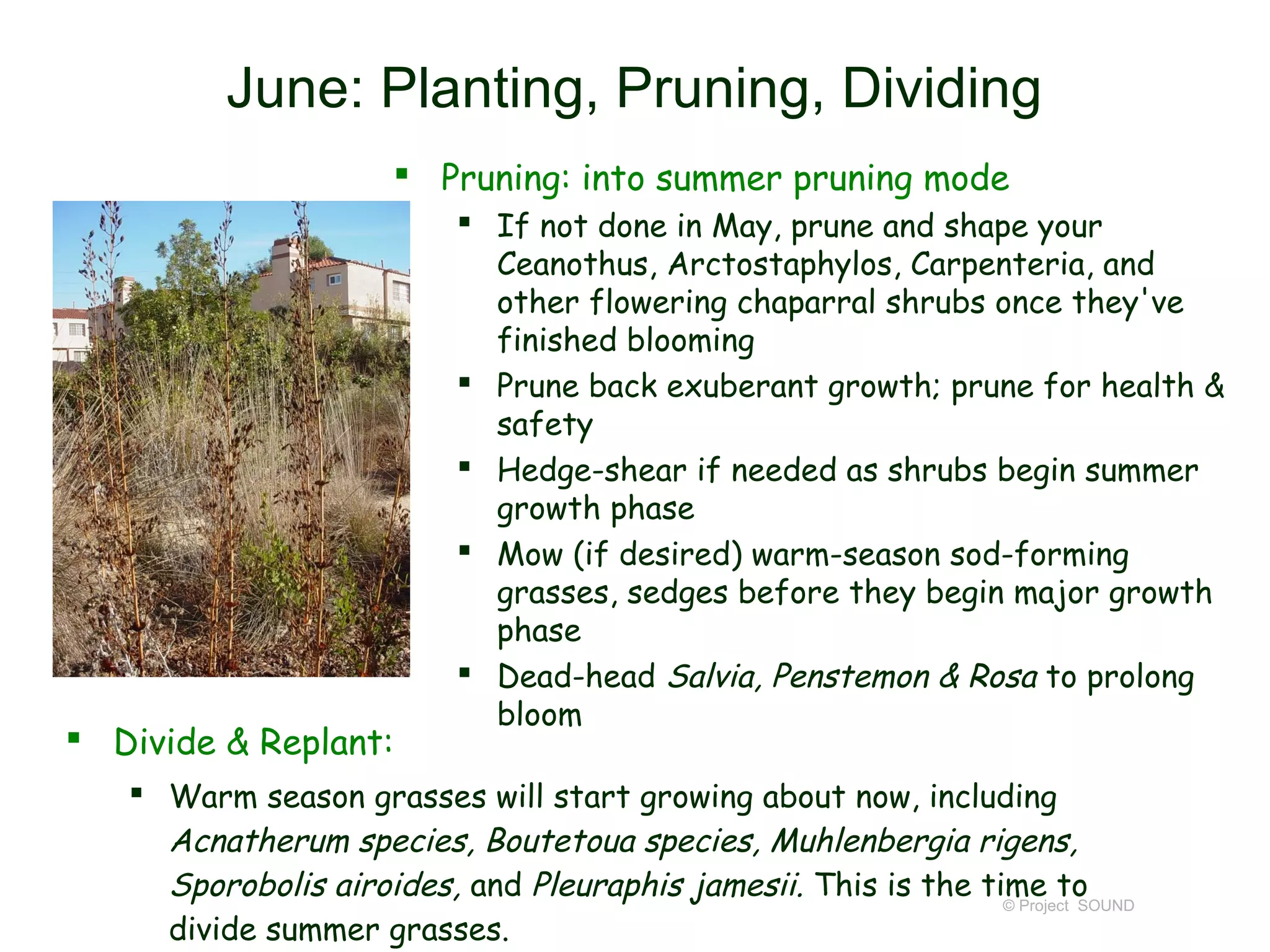
                            If not done in May, prune and shape your
                             Ceanothus, Arctostaphylos, Carpenteria, and
                             other flowering chaparral shrubs once they've
                             finished blooming
                            Prune back exuberant growth; prune for health &
                             safety
                            Hedge-shear if needed as shrubs begin summer
                             growth phase
                            Mow (if desired) warm-season sod-forming
                             grasses, sedges before they begin major growth
                             phase
                            Dead-head Salvia, Penstemon & Rosa to prolong
                             bloom
 Divide & Replant:
    Warm season grasses will start growing about now, including
     Acnatherum species, Boutetoua species, Muhlenbergia rigens,
     Sporobolis airoides, and Pleuraphis jamesii. This is the time to
                                                                © Project SOUND
     divide summer grasses.
Last chance to plant                                            Propagation:
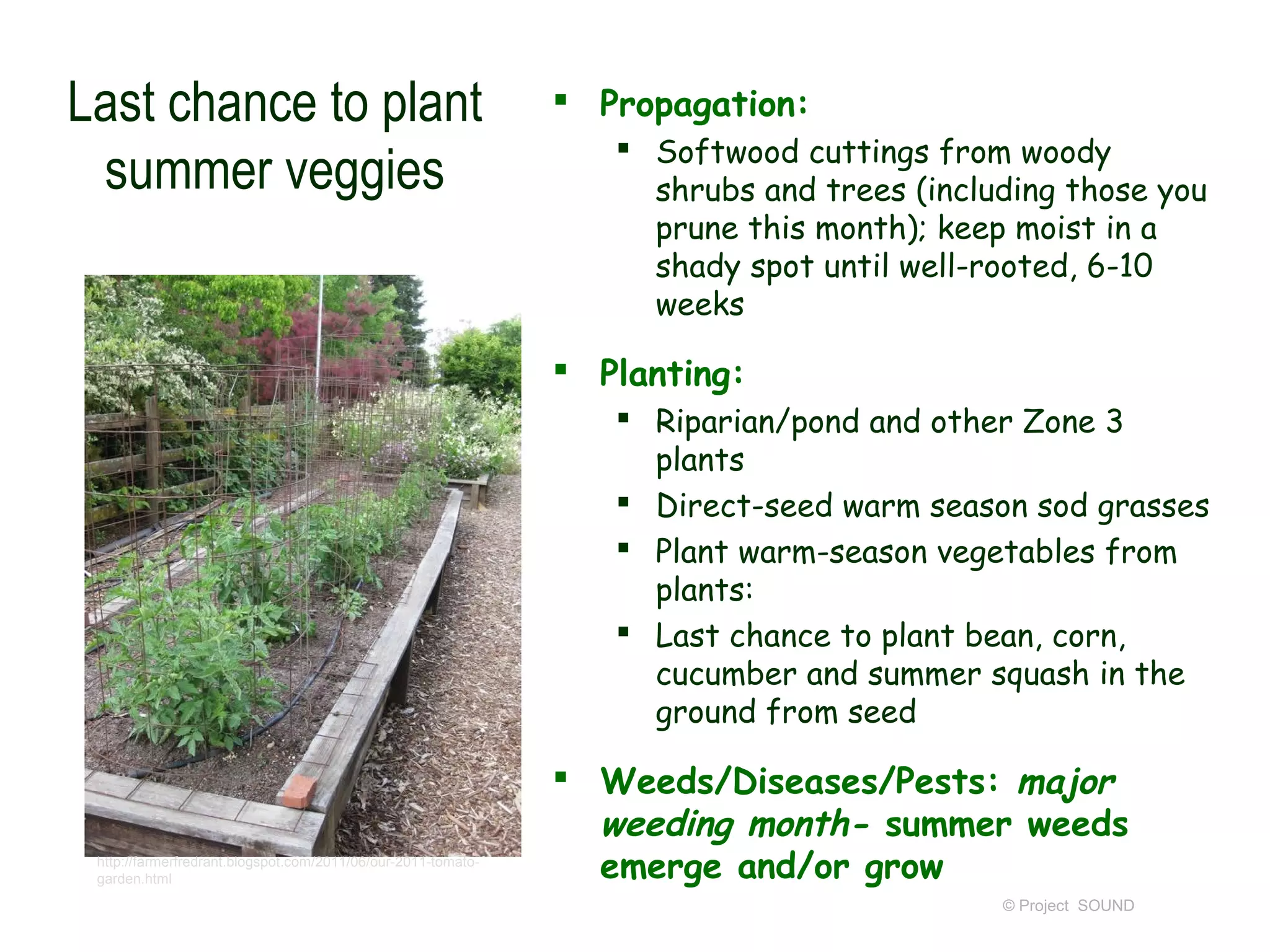
                                                                   Softwood cuttings from woody
 summer veggies                                                     shrubs and trees (including those you
                                                                    prune this month); keep moist in a
                                                                    shady spot until well-rooted, 6-10
                                                                    weeks

                                                                Planting:
                                                                   Riparian/pond and other Zone 3
                                                                    plants
                                                                   Direct-seed warm season sod grasses
                                                                   Plant warm-season vegetables from
                                                                    plants:
                                                                   Last chance to plant bean, corn,
                                                                    cucumber and summer squash in the
                                                                    ground from seed

                                                                Weeds/Diseases/Pests: major
                                                                 weeding month- summer weeds
 http://farmerfredrant.blogspot.com/2011/06/our-2011-tomato-
 garden.html                                                     emerge and/or grow
                                                                                           © Project SOUND
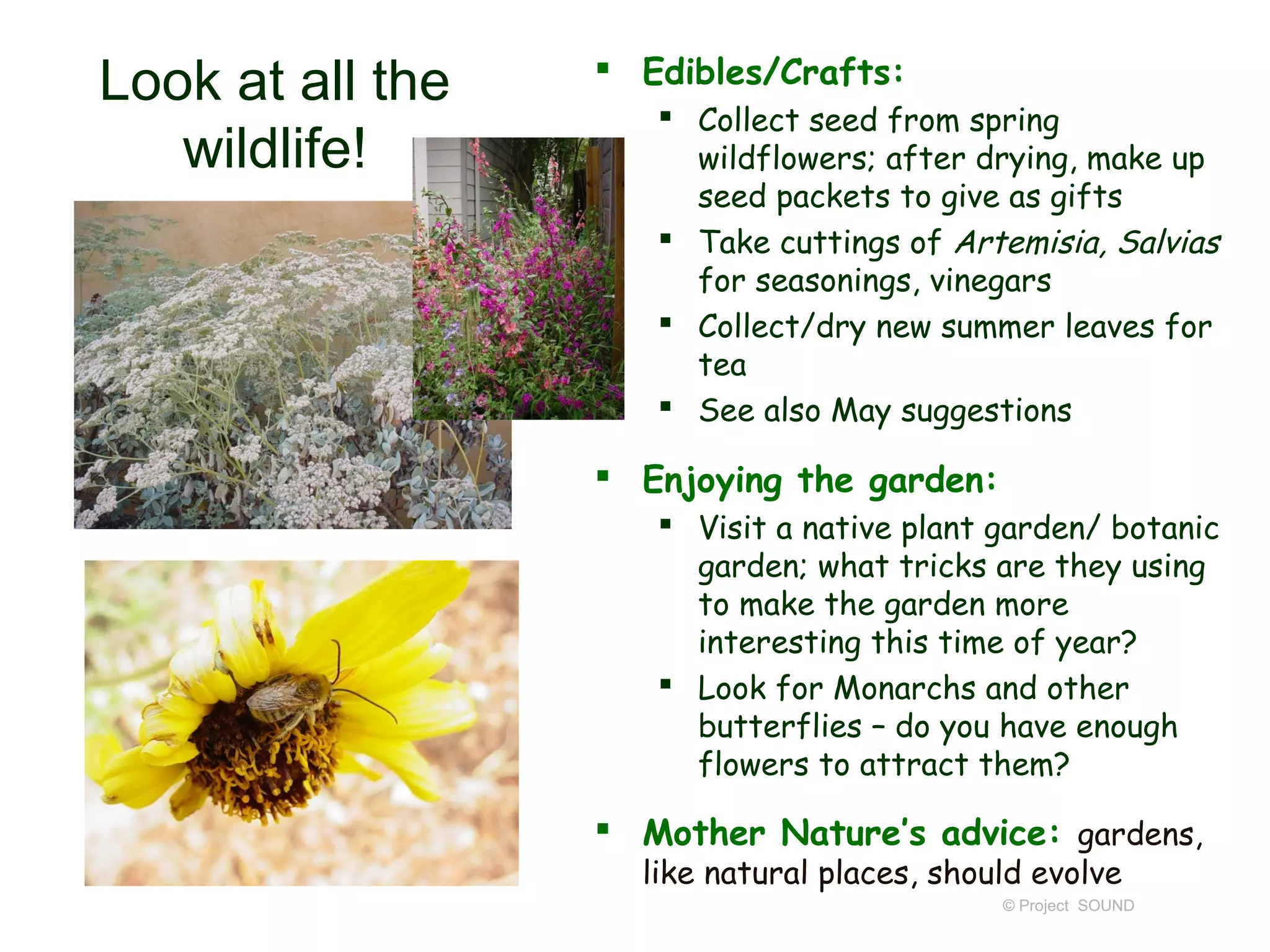
 Edibles/Crafts:
Look at all the       Collect seed from spring
   wildlife!           wildflowers; after drying, make up
                       seed packets to give as gifts
                      Take cuttings of Artemisia, Salvias
                       for seasonings, vinegars
                      Collect/dry new summer leaves for
                       tea
                      See also May suggestions

                   Enjoying the garden:
                      Visit a native plant garden/ botanic
                       garden; what tricks are they using
                       to make the garden more
                       interesting this time of year?
                      Look for Monarchs and other
                       butterflies – do you have enough
                       flowers to attract them?

                   Mother Nature’s advice: gardens,
                    like natural places, should evolve
                                             © Project SOUND
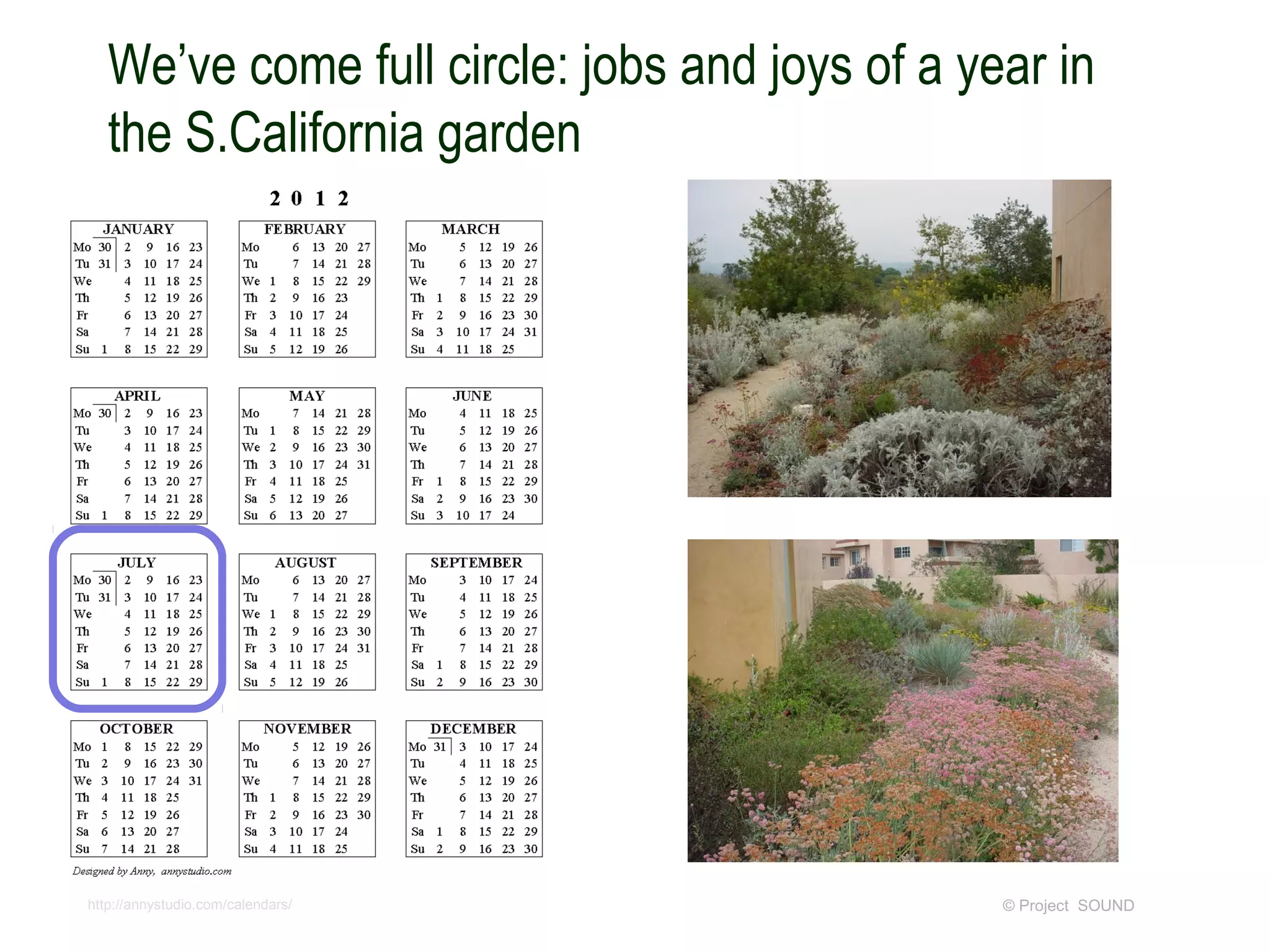
We’ve come full circle: jobs and joys of a year in
   the S.California garden


http://annystudio.com/calendars/                © Project SOUND
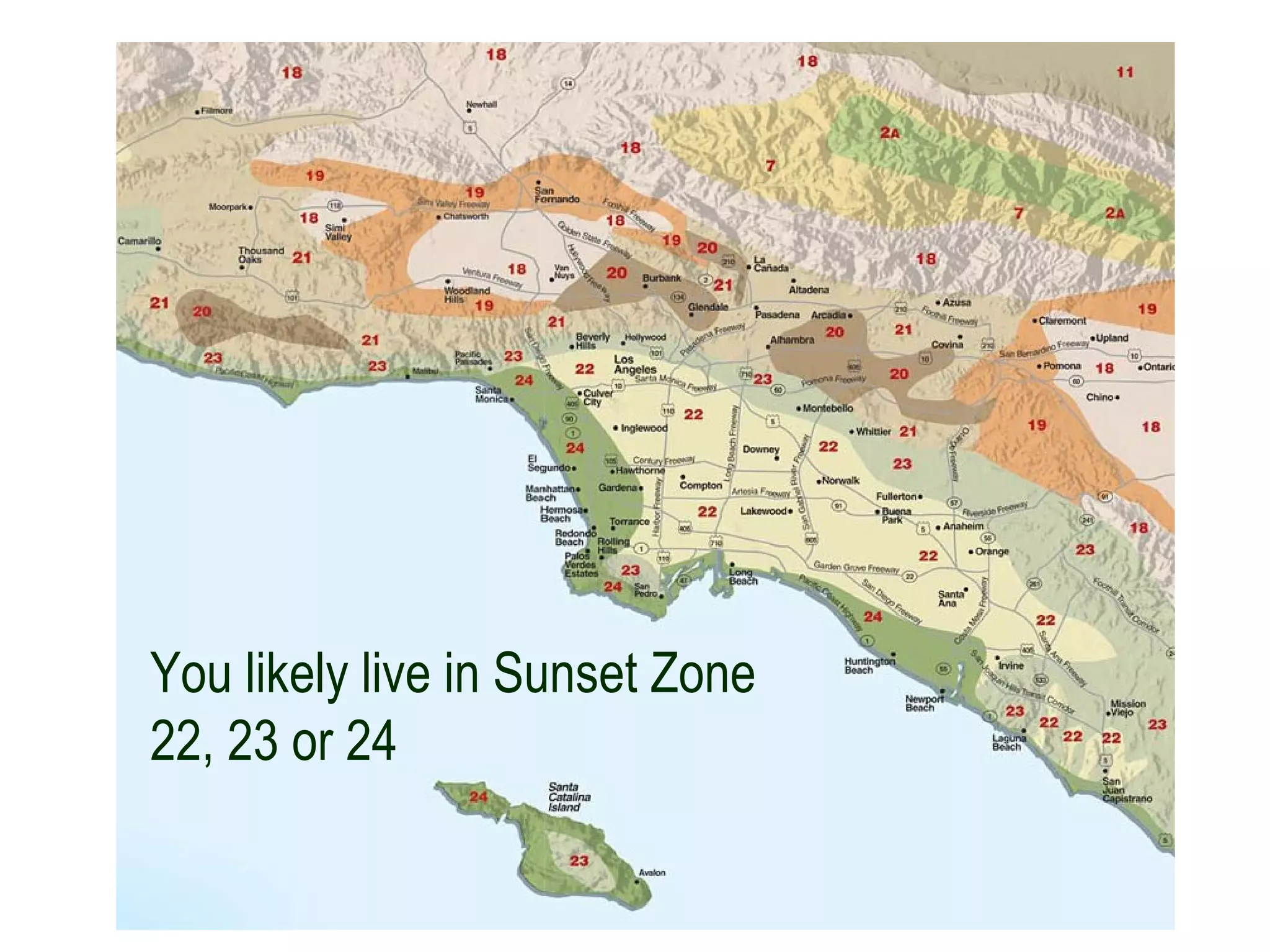
You likely live in Sunset Zone
22, 23 or 24

  http://www.sunset.com/garden/climate-zones/sunset-climate-zone-los-angeles-area-00418000067298/
                                                                                                    © Project SOUND
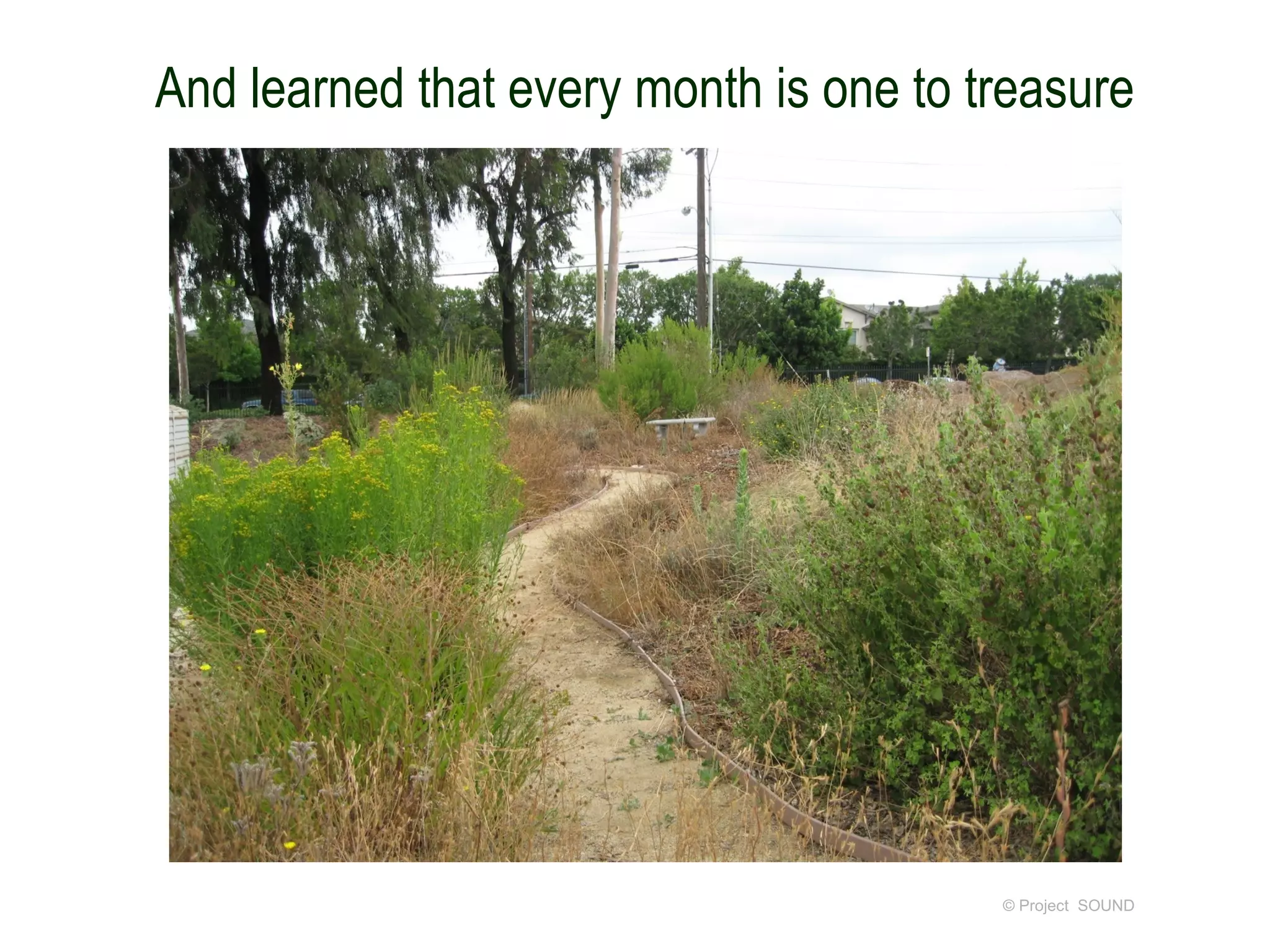
And learned that every month is one to treasure


                                        © Project SOUND

Garden tasks though the year 2012

  • 1.
    Out of theWilds and Into Your Garden Gardening with Western L.A. County Native Plants Project SOUND – 2012 (our 8th year) © Project SOUND
  • 2.
    Through the Year GardenTasks – And Pleasures – Through the Year C.M. Vadheim and T. Drake CSUDH & Madrona Marsh Preserve Madrona Marsh Preserve January 7 & 10, 2012 © Project SOUND
  • 3.
    Gardening in S.CA IS different © Project SOUND
  • 4.
    What makes usso unique?  Latitude & coastal position – mediterranean climate  Mild rainy winter/spring  Moderately hot, dry summer/fall  Year-to-year variability  Extreme elevation changes  Foothills and mountains have very different climate than our local ‘lowlands’  Soils – our lowland soils are mostly sedimentary (ocean/river deposited) © Project SOUND
  • 5.
    You likely livein Sunset Zone 22, 23 or 24 http://www.sunset.com/garden/climate-zones/sunset-climate-zone-los-angeles-area-00418000067298/ © Project SOUND
  • 6.
    Sunset Zone 24  Where hills/cliffs/palisades are low/nonexistent, it runs inland several Coastal Marine Zone miles.  Soils tend to be sandy to sandy-clay  Climate zone is almost completely dominated by the ocean – a mild, marine climate.  Winters are mild, summers cool, and the air seldom really dry.  On many days in spring and early summer, the sun doesn’t break through the high overcast until afternoon.  Record heat usually comes in early October, carried to the coast by http://www.sunset.com/garden/climate-zones/sunset-climate-zone- los-angeles-area-00418000067298/ Santa Ana winds. The wind’s power and dryness usually causes more problems This is a wonderful than the heat itself. Zone for gardening!  Some plants bloom all year long © Project SOUND
  • 7.
    Sunset Zone 23  Mostly influence by oceans but Coast Thermal Belt sometimes influenced by inland heat  Frosts don’t amount to much – 85% percent of the time, Pacific Ocean weather dominates; interior air rules only 15% percent of the time. A notorious portion of this 15 percent consists of those days when hot, dry Santa Ana winds blow.  Lacks either the summer heat or the winter cold necessary to grow pears, most apples, and most peaches. But it enjoys considerably more heat than http://www.sunset.com/garden/climate-zones/sunset-climate-zone- los-angeles-area-00418000067298/ Zone 24  Temperatures are mild, but severe This is a wonderful winters descend at times. Zone for gardening! © Project SOUND
  • 8.
     Cold-winter portionsof S. CA coastal Sunset Zone 22 climate Cold-winter Coastal  Is a coastal climate - influenced by the ocean approximately 85% of the time).  Average summer temperatures warmer than Zone 24  When temperatures drop in winter, these cold-air basins have lower winter temperatures than those in neighboring Zone 23.  No pronounced chilling period – limits growth of plants from local mountains http://www.sunset.com/garden/climate-zones/sunset-climate-zone- los-angeles-area-00418000067298/ that need a cold dormant period This is a wonderful Zone for gardening! © Project SOUND
  • 9.
    One key towise gardening: becoming more aware of your climate  Read the weather forecasts like a hawk – they are a good clue to things you’ll need to do or not do  Set out a rain gauge and chart precipitation  Indoor-outdoor thermometer/ humidity meter  Chart soil moisture from Apr- Oct.  Become more aware of wind: daily patterns; direction; monthly patterns; ‘unusual’ events © Project SOUND
  • 10.
    Several good generalbooks specific to our area (L.A. county) http://www.californiagardens.com/Essays/garden_calendar_archive.htm © Project SOUND
  • 11.
    Let’s assume youhave a blended garden with CA native plants & traditional veggies/fruits http://ana-white.com/2010/05/hack-natural-rustic-cedar- raised-beds.html http://www.huntingtonbeachca.gov/hbwater/landscape-gardening/water-wise-landscaping.cfm © Project SOUND
  • 12.
    You have somecommon CA native plants in your garden Elegant Clarkia Golden Stars Blue Elderberry CA Encelia ‘Yankee Point’ Ceanothus Purple Sage St. Catherine’s Lace © Project SOUND
  • 13.
    We’ll begin ourtour of the gardening year in July  Why? - it’s a time of endings & beginnings  The spring bloom season is at it’s end  The warm weather really starts in – true beginning of the dry season  It’s a good time to evaluate what worked – or didn’t – and plan for the next season  Summer vegetables and fruits start to ripen http://annystudio.com/calendars/ © Project SOUND
  • 14.
    July: End ofspring © Project SOUND
  • 15.
    July Weather &Climate  At a glance: hotter than June and less fog. Nights are warm. CSS & Chaparral plants transition to summer mode.  Temperature:  mean high = 74/77 ; mean low = 64/62  Record high = 97/102 ; record low = 52/42  Precipitation:  Average: 0.03/0.05”  Winds: usually not important; may have ocean breezes, fog © Project SOUND
  • 16.
    July: some plantsbeginning to dry out © Project SOUND
  • 17.
    Transition from springto summer blooms © Project SOUND
  • 18.
    The summer vegetableplants are maturing http://www.glenns-garden.com/vegetable-garden-is-growing-well-going-into-july/ http://socalgarden.blogspot.com/2009/06/harvesting-cherry-tomatoes.html © Project SOUND
  • 19.
    July: General Tasks  Planning/Preparation:  Take assessment of your garden: what needs improvement  Start a garden journal & photo log – or http://farmerfredrant.blogspot.com/2011/01/loosen-bare-root-plant-labels.html get yours organized  Get a new inspirational book; or search the web, go to the library  Great time to create a garden design  Order native seeds & bulbs (right now); order seeds of cool season vegetables  Hardscape/General:  Make repairs/changes that weren’t possible in spring © Project SOUND http://federaltwist.blogspot.com/2010/08/garden-diary-linear-motif.html
  • 20.
     Watering: summermode July: General Tasks  Check soils weekly – water as needed, during cool periods (early/late in day)  Monitor young plants (at least weekly – more in hot periods):  1st summer: 1 full Zone above final Zone;  2nd summer: ½ Zone above  Plants from N. Coast need more water & spray ‘fog’ beginning in July  Weeds, Diseases & Pests:  Summer weeds: bindweed, mustard, wild lettuce, prickly ox-tongue, sow thistle, others  Get them out while they are small © Project SOUND
  • 21.
    July: Planting &Pruning  Planting:  Not too late to plant bean, corn, cucumber and summer squash from seed.  Pruning:  Prune Manzanitas in warm dry weather;  Dead-head Salvia and Penstemon flower stalks as they finish up, unless you’re collecting the seed. When your sages have finished their bloom, you can cut them back by a third – or wait until fall.  Mow your alternative lawn © Project SOUND
  • 22.
    July: Enjoying theGarden  Edibles/crafts:  Harvest leaves, berries, strawberries for tea;  Take cuttings of mints for seasonings, vinegars  Harvest conventional fruits as they become ripe – eat, freeze/can or make into jam/jelly  Enjoying the garden:  Enjoy butterflies;  take the butterfly class & participate in butterfly counts  Certify your garden - NABA  Certify your garden as a wildlife habitat garden (Nat. Wildlife Foundation)  Sit in the shade; enjoy the fruits of your labors; drink some nice mint tea  Mother Nature’s advice:  Work early or late; don’t stress © Project SOUND
  • 23.
    August: lazy daysof summer © Project SOUND
  • 24.
    August Weather &Climate  At a glance: warm, dry & pleasant; warm nights ripen summer fruits/veggies; dry soils  Temperature:  mean high = 75/78 ; mean low = 64/62  Record high = 98/101 ; record low = 51/44  Precipitation:  Average: 0.05/0.02”  Winds: usually not a particular problem © Project SOUND
  • 25.
    August: watering neededin most gardens © Project SOUND
  • 26.
    August: Buckwheats &silver against a background of evergreen shrubs © Project SOUND
  • 27.
    August: summer harvesttime continues in earnest http://www.fotothing.com/fhelsing/photo/2dd1f769d56af992e754b5f85ee69814/ Warm-season veggies ripen in summer (or fall) http://socalgarden.blogspot.com/2010_10_01_archive.html  Tomatoes  Squash (summer)  Peppers  Squash (‘winter’)  Beans (all kinds)  Cucumber  Eggplant  Melons  Corn © Project SOUND
  • 28.
    Guide to S.CA Vegetable Crops Warm-season Vegetables Cool-season Vegetables  Plant:  Plant:  From seed: Aug-Oct in shaded  From seed: Mar-May; depends pots; Sep-Oct in ground on how cold the spring is  From starts: Oct-Dec  From starts: Apr-June (even July for late crops)  Ripen:  Early crops: Oct-Nov  Ripen:  Late crops: Dec-Feb  Early crops: June-July (Aug) Late crops: Aug-Sept  Examples:  Examples:  Early crops: broccoli, brussels sprouts, cauliflower, kale,  Early crops: beans, cucumbers, kohlrabi, mustard, lettuce and summer squash, tomatoes, other greens  Late crops: corn, melons,  Late crops: peas, cabbage, winter squash celery, © Project SOUND
  • 29.
    Some veggies canbe planted almost any time – or serially for long season  Beets  Carrots  Green beans  Radishes  Swiss chard http://www.vegetable-garden-guide.com/growing-carrots.html http://tinyfarmblog.com/first-carrots-plus-beets/ © Project SOUND
  • 30.
    August: General Tasks  Planning/Preparation:  Decide on cool season veggies – enjoy browsing the catalogs  Order seeds & bulbs;  Clean seeds collected from garden  Look for a new container or garden sculpture  Tidy up your potting bench  Sit in the shade and think about Water Zones/conservation;  Plan to increase shady areas for outdoor activities http://berkeleyheritage.com/gallery/1000_oaks_tour2007.8.html © Project SOUND
  • 31.
    August: General Tasks  Hardscape:  Apply/re-apply gravel mulch to wildflower & bulb areas – will help them to look less bare  Repair/install hardscape; work in cool times of day  Build raised beds or potting area before Sept. heats up http://www.mastergardeners.org/projects/gilroy.html http://www.penick.net/digging/?p=14254 © Project SOUND
  • 32.
    http://pcnatthegreenshow.wordpress.com/2010/04/18/california-spring-trials-day-3-along-the-central-coast/ http://efnep.ucdavis.edu/?blogpost=4501&blogasset=17351 http://www.thriftyfun.com/tf16684008.tip.html http://www.gardenstogro.com/raised-garden-hinged-fencing.php © Project SOUND
  • 33.
    August: General Tasks  Watering:  Taper off water to native plants except Zone 3 & Chaparral and Sonoran Desert plants – give them a good ‘monsoon’; http://www.thriftyfun.com/tf16684008.tip.html  Weeds, Diseases & Pests:  Most summer weeds are winding down – particularly in drier areas; still a challenge in vegetable garden  Look for signs of fungal disease; prune out diseased branches © Project SOUND
  • 34.
    August: a littlepropagation & planting  Propagation:  Sow seeds of cool-season vegetables in containers – semi-shade.  Start warm-season grasses from seed in containers – semi-shade  Planting:  Plant radishes, carrots, beets directly into the garden. © Project SOUND
  • 35.
    August: Pruning &  Pruning: summer pruning month  Prune for safety & plant health Mowing  Hedge-shear if needed  Pruning to thin: prune after late spring/summer flowering  Carpenteria californica  Heteromeles arbutifolia  Keckiella cordifolia  Philadelphus lewisii  Prunus ilicifolia  Salvia spp. (prune now or in Oct/Nov) http://cngf.org/gardens/meadow.htm  Desert Legumes: Chilopsis;  Mow (if desired) sod grasses, sedges  Coppice (severe prune) to rejuvenate old plants (after bloom)  Comarostaphylis diversifolia  * Cornus spp.  Heteromeles arbutifolia  * Philadelphus lewisii  Ribes viburnifolium  Rosa spp. © Project SOUND
  • 36.
    Enjoying the AugustGarden  Edibles/Crafts:  Pick elderberries, other ripe fruits; use or dry/freeze  Pick, use or dry/freeze summer veggies  Enjoying the garden:  Enjoy the shade; cool dry garden shade is delightful  Search for a new container or garden sculpture  Eat corn on the cob, melons from your garden  Make elderberry jelly/syrup or dry berries for tea  Mother Nature’s advice: prepare now for a busy fall – August is often cooler than Sept. © Project SOUND http://www.csupomona.edu/~panorama/summer2009/focus.html
  • 37.
    Scorching September © Project SOUND
  • 38.
    September Weather &Climate  At a glance: transition into fall. Nights may begin to cool off, but days are still warm. Not uncommon to have extremely hot weather and Santa Ana winds. Very dry – low humidity!  Temperature:  mean high = 75/78 ; mean low = 63/61  Record high = 110/111 ; record low = 47/43  Precipitation:  Average: 0.21/0.16”  Winds: hot, dry Santa Ana winds common. © Project SOUND
  • 39.
    Summer veggies –end of game http://cagardenweb.ucdavis.edu/?repository=10369 © Project SOUND http://www.slowfamilyonline.com/tag/victory-gardens/
  • 40.
    September: General Tasks  Planning/Preparation:  Sort/clean/store seeds collected in spring/summer  Explore the CA Garden Web - http://cagardenweb.ucdavis.edu/  Hardscape/General:  Repair/install hardscape (work in the cool)  Install/repair/clean rain catchment facilities: gutters, sprinklers, rain barrels, french drain, rain garden hardscape, etc. http://www.californiagrange.org/news/garden_grow.html  Prepare veg. garden for winter veggies; remove spent plants, fertilize, mulch  Start a compost bin/pile for your cuttings http://sbthp.wordpress.com/2011/09/21/it-takes-a-village-to-tend-the-presidio/ © Project SOUND
  • 41.
    September: General  Watering: major watering month for Zone 2-3 & 3 Tasks  Taper off all but Zone 2-3 & 3; keep vegetable gardens, containers, other Zone 3 plants watered – particularly if Santa Anna winds are predicted  Weeds, Diseases & Pests:  Grasshoppers and gophers may be getting desperate  Pruning:  Sharpen/repair planting & pruning tools after summer pruning tasks; http://agrilife.org/etg/2011/02/18/mid-february-marks-rose-pruning-season/ consider buying new/better tools if appropriate  Rake out cool-season grasses; mow or cut back if needed;  Prune to thin: Adenostoma spp.  Divide native bulbs/corms; store or replant © Project SOUND http://tmousecmouse.blogspot.com/2011_11_01_archive.html
  • 42.
    Propagation & planting  Propagation from seed: give seedlings part-shade and keep well-watered  Start chilling seeds that need long (2-3+ month) pre-plant stratification;  First chance to start cool-season plants:  Cool-season grass plugs  Cool season veggie crops in nursery containers; broccoli, cabbage, cauliflower, celery, kale, kohlrabi, lettuce, other greens  Plant out:  Cool-season vegetables from starts/pony packs; keep well-watered – daily water in early morning or evening. http://www.californiagreekgirl.com/?p=92 © Project SOUND
  • 43.
    Enjoying the SeptemberGarden  Edibles/crafts:  Pick ripe winter squash, tomatoes, peppers; enjoy a new recipe  Pick fresh sweet corn near coast  Enjoying the garden:  Fall sunflowers are blooming: watch to see what birds, butterflies and insects visit them http://blog.jannelsonlandscapedesign.com/?cat=43&paged=2  Enjoy the scent of Bricklebush in late afternoon;  Purchase a birdbath or fountain (on sale now) to provide a drink for birds  Mother Nature’s advice: fall-blooming natives are important for attracting pollinators & other beneficial insects. Your vegetable garden will benefit. © Project SOUND
  • 44.
    October: subtle huesand lots to do © Project SOUND
  • 45.
    October Weather &Climate  At a glance: feels more like summer than fall. Hot, dry Santa Ana winds suck the moisture out of everything. Yet we may also get our first real rains. Clearly a transitional month.  Temperature:  mean high = 73/75 ; mean low = 59/57  Record high = 106/106 ; record low = 43/37  Precipitation:  Average: 0.56/0.62”  Winds: May be the most windy month of the year  Other: May be smoggy © Project SOUND
  • 46.
    October: the gardenlooks like it needs some help © Project SOUND
  • 47.
    October: subtle fallpalette – like a painting © Project SOUND
  • 48.
    October also signalstransition time in the vegetable garden http://connect.sierraclub.org/post/ClimateCrossroadsBlog/categories/8E12E318-7AB3-41FD-8FCA-93FD9B8304FA.html © Project SOUND
  • 49.
    October: lots ofpreparation  Planning/Preparation:  Purchase plants from native plant nurseries/sales; place in semi-shade and water regularly until planted out.  Consider adding some decorative and educational signs to your garden; explore your options – purchase/ http://www.calvin.edu/news/archive/a-perennial-the-native-plant- create, then install after pruning sale    Hardscape/General:  Finish installing any hardscape: fences, paths, patios  Re-apply mulch after pruning © Project SOUND
  • 50.
    October: time forsome planting  Propagation:  From seed: cool-season grass plugs; annual wildflowers, bulb seeds in nursery containers; winter veggie crops. Keep them well-watered.  Start chilling seeds w/ shorter (1-2 month) pre-plant stratification period; check for roots every 2 weeks – plant http://nadiaknows.com/tag/southern-california-planting-guide/ in nursery containers when first roots emerge  Take semi-soft wood cuttings of ceanothus, manzanita for propagation  Planting:  Plant out cool-season vegetables from starts/pony-packs or from seed http://connect.sierraclub.org/post/ClimateCrossroadsBlog/categories/8E12E318-7AB3-41FD-8FCA- © Project SOUND 93FD9B8304FA.html
  • 51.
    Watering: prepare forthe rainy season – but water like summer if needed  Watch weather forecast like a hawk!!!  Taper off watering all but Zone 2-3 & 3 plants. Keep Zone 3 plants watered – particularly if Santa Anna winds are predicted  Once rains saturate the soil you can turn off your irrigation system (if you have one); check soils periodically during hot, windy, dry weather and water as needed  Install/repair/clean rainwater collection/infiltration system (if not done in Sept.) http://en.wikipedia.org/wiki/Rain_gauge Set out/clean rain gauge © Project SOUND
  • 52.
    October: time forfall pruning??  Pruning: major pruning month, particularly for Water Zone 1 and Zone 1-2 plants  Prune to shape/thin:  Ribes spp. - Be sure to prune Ribes now, as they can bloom very early  Most summer-dry shrubs & sub- shrubs/perennials (particularly Coastal Sage Scrub and Coastal Shrubland species) The trick is to prune  Hedge-shear – now through Dec. before the rainy season best time for mature plants but not during hot, dry  Divide native bulbs/corms; store or periods – to minimize replant (better) stress on the plant  Remove old leaves, dead stems, tidy up perennials, groundcovers and ornamental grasses © Project SOUND
  • 53.
     Edibles/crafts: The pleasuresof fall  Dry aromatic prunings for seasoning/tea/potpourri begin  Save artistic-looking materials for fall/winter decorations, flower arrangements, etc.  Dye some yarn with prunings; or dry the dye-stuff for later  Carve a pumpkin – or make a pie  Enjoying the garden:  Go to the native plant sales; see what’s new, ask questions  Visit a new-to-you native plant garden; take your camera and notebook to jot down ideas.  Enjoy the play of tans, browns and grays – a subtle sophisticated color palette  Mother Nature’s advice: don’t fight the weather – work with it. © Project SOUND
  • 54.
    Nice (or Naughty)November © Project SOUND
  • 55.
    November Weather &Climate  At a glance: return of the rainy season (if we’re lucky). Days are shorter and cooler; good time to work in the garden.  Temperature:  mean high = 69/70 ; mean low = 53/50  Record high = 101/98 ; record low = 38/32  Precipitation: An average of 10% of our rain falls in November.  Average: 1.11/1.19”  Winds: usually less chance of Santa Anas; may be blustery winter storms © Project SOUND
  • 56.
    The garden looksa little bare © Project SOUND
  • 57.
    Cool-season veggies aretaking off http://www.amillionlives.net/vegetable-gardening-tips-easy-ideas-for-great-produces.html © Project SOUND
  • 58.
    Tidying up this  Planning: month  Purchase plants at native plant nurseries/sales; place in semi-shade and water until planted out.  Hardscape/General:  Renew mulch after pruning – so much easier!  Complete your clean-up of summer blooming perennials and shrubs http://a1mowing.com/shrub.htm  Watering: usually into winter mode  Once rains saturate the soil you can turn off your irrigation system (if you have one); check soils periodically during hot, windy, dry weather and water as needed  Water garden well if soils become dry or if no rain for 3 weeks or longer © Project SOUND http://www.ucrealty.com/blog/F036CE3C-0903-4FFC-BA58-0510C054C0F3
  • 59.
     Propagation: majorpropagation month Planting if Mother  From seed: cool-season grass plugs; nature cooperates annual wildflowers in containers; shrub & tree seeds w/ short/no pre-chill req.  Check seeds stratifying in refrigerator; plant in nursery pots when you start seeing tiny roots emerge  From cuttings: semi-soft wood cuttings of ceanothus, Manzanita; hardwood cuttings from vines, grapes  Planting: http://www.cruciferousvegetables.net/category/cruciferous-vegetable-garden/  Last chance: replant native bulbs/corms  Plant out herbaceous groundcover plants – keep watered if needed  Plant rain garden plants; keep watered  Plant out cool-season vegetables from starts or pony-packs: peas, mustard, spinach, lettuce and other greens  Evaluate/repot container plants as needed © Project SOUND
  • 60.
    Major pruning month Finish pruning summer-dry shrubs in dry, warm periods (check forecast)  Prune to shape/train:  Most native trees and woody shrubs, vines  Prune to thin:  Baccharis spp  Berberis spp  Ceanothus spp.  Cercocarpus spp.  Hedge-shear – good time © Project SOUND
  • 61.
     Prune backgroundcover perennials/sub-shrubs:  Diplacus/Mimulus spp  Eriogonum spp.  Mint family: Monardella spp., Salvia spathacea, Stachys spp.  Groundcover sunflowers: Symphyotrichum/Aster spp., Achillea millefolium, Artemisia douglasiana, Grindelia spp., Solidago spp.,  Romneya coulteri  Aster chilense, goldenrod, Yarrow, Woodmints, CA Fuschia  Divide plants (when ground is soft after rains begin)  Iris douglasii  *Heuchera spp.  Potentilla , Horkelia  Fern species (native)  Fragaria spp. (wait until start to grow w/ fall rains)  Native cool-season grasses: Festuca, Nassella, Leymus, Calamagrostis, Melica, Carex tumulicola . Make sure each clump has a good root ball. Water well.  Sisyrinchium spp.  Native succulent plants & cacti © Project SOUND
  • 62.
    Enjoy the cooler  Edibles/Crafts:  Collect and dry rose-hips for days of late fall tea  Make holiday gifts with aromatics – potpourri, flavored vinegars  Make jam, jelly or syrup from frozen fruits  Dry cuttings for dye, seasonings  Dye material & yarn  Enjoying the garden:  Learn more about fall bird migration; there’s lots to learn on the internet Mother Nature’s advice: cool  Note when the first seed-eating temperatures invigorate us; get birds visit your spent out and get some serious sunflowers & buckwheats ; set exercise! out bird seed © Project SOUND
  • 63.
    December: the gardenoften slumbers © Project SOUND
  • 64.
    December Weather &Climate  At a glance: cold and dark. Days are as short as they get and nights are in the 40’s or cooler. Rain is expected – but may not come in La Nina years (like this year).  Temperature:  mean high = 65/65 ; mean low = 49/46  Record high = 94/94 ; record low = 32/27  Precipitation: usually a good rain month  Average: 2.05/2.09”  Winds: winter storms can bring strong winds from the west © Project SOUND
  • 65.
    December: growth iswaiting © Project SOUND
  • 66.
    Plants are startingto grow – but not yet convinced to go all out! © Project SOUND
  • 67.
    Meanwhile, out inthe vegetable garden… http://blog.gardenerd.com/2009/12/16/malibu-vegetable-garden-delight.aspx http://www.themanlyhousekeeper.com/2011/11/29/asphalt-garden-harvesting-my-radishes-and- other-garden-adventures/ © Project SOUND
  • 68.
     Planning: wait’til next month – you’re Busy month – but not busy now! in the garden  Hardscape/General:  Check your hardscape after hard rains; make repairs if needed  Rake paths of fallen leaves; compost or use as mulch if appropriate  Clear paths and hardscape areas of unwanted seedlings – remove with hoe, hula-hoe or trowel  Watering: winter mode  Check soils periodically during hot, windy, dry weather and water as needed  Water garden well if soils become dry or if no rain for > 3 weeks; you will have to be the rain http://wwwrockrose.blogspot.com/2010/04/bluebonnet-pull-out.html © Project SOUND
  • 69.
     Planting: goodplanting month (if rainy)  Good month for planting native plants from containers if rains have started  Plant native annual wildflower seeds in prepared beds before a good rainstorm  Plant cool-season grasses/sedges from plugs/starts  Cool season veggies from seed or starts/pony-packs; include some ‘native greens’ like Claytonia, Trifolia (clover)   Propagation: major propagation month  Start from seed: annual wildflowers in containers; shrub/tree seeds w/ short/no pre-chill req.; cool season veggies  check seeds stratifying in refrigerator; plant in nursery pots when you start seeing tiny roots emerge  Start cuttings from vines, grapes, elderberry http://www.family-gardens.com/vegetable-garden- © Project SOUND seeds-01282010.html
  • 70.
    December: thank heavensfor our forgiving climate!  Planting:  Can still plant most cool- season vegetables from starts/pony packs: broccoli, Brussels sprouts, cabbage, cauliflower, celery, kale, kohlrabi, mustard, lettuce and other greens, and root crops like beets, carrots, radishes, and turnips. http://www.cruciferousvegetables.net/category/cruciferous-vegetable-garden/ © Project SOUND
  • 71.
     Pruning: majorpruning month Major winter  Prune/train to shape: pruning - Dec.  Winter-deciduous trees/shrubs  Woody vines: Lonicera spp., Vitis spp.,  Prune to thin: choose a dry period if possible  Most winter-deciduous trees/shrubs  Pines, junipers, citrus  Prune back groundcover perennials/sub- shrubs (if you didn’t in November):  Diplacus/Mimulus spp; Achillea; Mint family: Monardella spp., Salvia spathacea, Stachys spp.;Epilobium canum, Stachys spp.  Coppice (severe prune) to rejuvenate old plants (dormant)  Berberis/Mahonia spp. ;Cleome isomeris; Dendromecon spp.; Heuchera spp and cultivars; many others  Weeds/Diseases/Pests:  Weedy grasses may start to grow, particularly in a warm spell © Project SOUND
  • 72.
    Enjoy the quietmoments…  Edibles/Crafts:  Make a holiday decoration like a grape or Toyon wreath using native plant materials  Give seeds, plants, jams, jellies, etc. from your own garden as unique holiday gifts  Eat fresh greens from the garden http://www.baynatives.com/plants/Heteromeles-arbutifolia/  Enjoying the garden:  Sit in the noon sun & enjoy the birds – migrants are here; you might even get some good photos  Hang a finch feeder in your garden  Mother Nature’s advice: don’t worry about getting things done – there’s still plenty of time in January http://cagardenweb.ucdavis.edu/?repository=10369 © Project SOUND
  • 73.
    Cool, wet January © Project SOUND
  • 74.
    January Weather &Climate  At a glance: Cold and rainy or warm and sunny. Days still short, so rainy days will seem particularly dark. Afternoons cool off quickly.  Temperature:  mean high = 65/66 ; mean low = 49/46  Record high = 91/91 ; record low = 27/25  Precipitation: An average of 20% of our rain falls in January.  Average: 2.71/3.26”  Winds: not a particularly windy month © Project SOUND
  • 75.
    January: light &shade; warm & cool © Project SOUND
  • 76.
    There’s a certainbeauty to the January garden © Project SOUND
  • 77.
     Planning: January: General  Visit nurseries to choose/ purchase manzanita and ceanothus in bloom Tasks  Check out the seed catalogs on-line; order traditional warm-season vegetable seeds  Take photos of seedlings so you’ll recognize them next year  Hardscape/General:  Rake up leaves; rake/level paths  Check hardscape, slopes, trees after http://dangergarden.blogspot.com/2010/04/joy-creek-nursery.html heavy rains  Watering: winter mode  Water-in all new plants; then water again a week later if needed  Check soil moisture during prolonged dry periods (3 or more weeks) or windy periods; irrigate as needed  Check seedlings daily in warm weather; water as needed © Project SOUND Elegant Clarkia
  • 78.
     Propagation:  From seed: check seeds stratifying in January = planting refrigerator; plant in nursery pots when roots emerge  Plant other natives from seed  Planting: major planting month  The best month for planting native plants, from large trees to small perennials, grasses, annuals  Plant bare-root and containerized fruit trees of all kinds (native and traditional)  Weeds/Diseases/Pests: major weeding month  Cool-season weedy grasses, Creeping woodsorrel, etc.  Weed out native seedlings popping up in the wrong places  Watch for snails & slugs Project SOUND © – take
  • 79.
    January: major winterpruning month as well  Prune to thin (if still not done):  winter-deciduous trees/ shrubs – this is often our best month to prune all trees  Rosa spp.  Coppice (severe prune) to rejuvenate old plants  Sambucus nigra cerulea  Divide & replant:  Perennials like Penstemon, Gumplant, Heuchera and Yarrow as they begin their growth season  Can still divide and replant native ornmental grasses, sedges, Sisyrinchium, rushes  Mow (if desired) cool-season sod- forming grasses, sedges © Project SOUND
  • 80.
     Edibles/Crafts: Ah, January  Spend a rainy day knitting/ crocheting/sewing something from hand-dyed yarn or cloth  Make soap or candles using scented materials dried last fall  Enjoy tangerines or oranges – including straight off the tree   Enjoying the garden:  Buy a bird book and pair of binoculars; get to know your birds  Watch hummingbirds and others gather nesting materials and begin their courtship displays  Sit in a warm spot and enjoy the sun  Notice seedlings & bulbs popping up; early blooming ones may already be forming flowers heads  Mother Nature’s advice: enjoy! © Project SOUND
  • 81.
    By middle ofJanuary, things are looking promising © Project SOUND
  • 82.
    Finally, February © Project SOUND
  • 83.
    February Weather &Climate  At a glance: transition month; one foot in winter, the other in spring. Temperatures are cool; often our rainiest month.  Temperature:  mean high = 64/66 ; mean low = 50/48  Record high = 92/92 ; record low = 28/28  Precipitation: traditionally one of our rainiest months  Average: 3.35/3.91”  Winds: usually not bad © Project SOUND
  • 84.
    February: high drama… © Project SOUND
  • 85.
    …or softly muted © Project SOUND
  • 86.
  • 87.
     Planning: February: General  Remember to take pictures of key vistas in Tasks your garden every month or so; these will help you understand your garden –and its seasons - better.  Start a ‘Bloom Calendar’ for key flowering plants in your garden  Hardscape/General:  Renew your bog garden/pond garden  Remove unwanted seedlings (Salvias; Encelia; etc.)  Check hardscape, slopes, trees after heavy rains  Watering: may need none at all  Water-in all new plants; then water again a week later if needed  Check soil moisture during prolonged dry periods; irrigate  Check seedlings daily in warm weather; water as needed © Project SOUND
  • 88.
     Propagation: The plantingfrenzy  From seed: good time to start native continues… shrubs/perennials, warm-season grasses in containers; start traditional summer veggies in nursery containers – protect from frost  Divide: rushes, cattails, other ‘bog garden’ plants;  Planting: major planting month  Excellent month for planting most native plants; especially perennials/sub-shrubs, bunch grasses  Plant annual wildflower seeds in prepared areas for late spring color; you can serial sow Gilas & Clarkias every 2 weeks for flowers into summer (with summer watering)  Plant to fill in bare spaces, or replace plants that have not done well form previous plantings © Project SOUND
  • 89.
    February: a littlepruning, a lot of weeding  Pruning:  Prune to thin:  Clematis spp.; Constancea/Eriophyllum nevinii, Lepechina spp. – now or after flowering  Coppice (severe prune) to rejuvenate old plants - Baccharis spp., * Myrica californica, *Carpenteria californica, * Rhamnus spp., Rhus spp. http://www.tcpermaculture.com/2011/06/permaculture- projects-coppicing.html  Weeds/Diseases/Pests: major weeding month  Weedy cool-season grasses are becoming a menace – get after them now  Spring weeds: California burclover, filarees, many other cool season weeds are perfect size for removing now while ground is moist. © Project SOUND
  • 90.
     Edibles/Crafts: February delights  Enjoy native CA greens in salads, cooked as greens or in stews, soups  Enjoy a cup of herb tea from you selection of teas dried last fall  Continue to enjoy citrus fruits; find some new recipes to use them – or give them away  Enjoying the garden:  Look for early-blooming bulbs – they are enchanting  Enjoy the early-blooming wildflowers, including CA Poppy; photograph them  Expand your horizons:  Take a class on some new aspect of gardening  Volunteer at a local Preserve/garden or natives plant nursery – a fun way to learn, socialize, give back © Project SOUND
  • 91.
    Perk up yourpalette with greens from your garden  Traditional  Lettuce – many types; Spinach; Swiss chard; Peas http://belfastbites.com/post/11610008188/manresa  Native  Claytonia – Miner’s lettuce  Heuchera  Calandrinia ciliata  Camissonia spp.  Mimulus guttatus  Many others – see list Mother Nature’s advice: eat fresh – eat local © Project SOUND
  • 92.
    March Madness © Project SOUND
  • 93.
    March Weather &Climate  At a glance: weather is often a mixed bag - from gray and rainy days to balmy afternoons filled with mellow sunshine.  Temperature:  mean high = 64/67 ; mean low = 52/49  Record high = 95/96 ; record low = 35/32  Precipitation: usually still several good storms  Average: 1.85/2.22”  Winds: high winds possible before and after storms © Project SOUND
  • 94.
    March: the gardenseems to explode with springness © Project SOUND
  • 95.
    The garden changesfrom cool- to warm season http://www.alleycatscratch.com/blucher/BackYard.htm © Project SOUND
  • 96.
     Planning: Time tostart preparing  Start to think about your gardening for warm weather priorities for the next gardening year. Consider your many options.  Hardscape/General:  Check hardscape, slopes, trees after heavy rains  Repair paths; flood damage if any  Get the veggie garden ready for warm season crops; fertilize  Check hoses, drip lines – repair if need; warm weather comes quickly!  Watering: hopefully soils are moist  Check soil moisture during prolonged http://www.thisoldhouse.com/toh/how- to/step/0,,1088902_911641,00.html dry periods (3 or more weeks) or windy periods; irrigate as needed to supplement  Check seedlings daily in warm weather © Project SOUND
  • 97.
    Think summer  Propagation:  From seed: veggies  good time to start native shrubs/perennials in nursery containers;  start traditional summer veggies in nursery containers – protect from frost  Planting:  Last month to safely plant most native plants – may be pushing it http://socalgarden.blogspot.com/2010_03_01_archive.html  Last planting of annual wildflower seeds for late spring/summer bloom: Clarkias, Globe Gilia, Phacelias, Annual Sunflower, Madia  Replace plants that didn’t make it from earlier plantings  Veggies: plant in ground (from seed or starts) beans, squash, carrots, beets, potatoes http://www.chartercat.org/group/msgarden © Project SOUND
  • 98.
    Keep up with  Pruning: weeding,  Tip-prune (pinch) to promote fullness: most perennials and sub-shrubs that are actively pinching growing now (Gambelia; Salvias; Epilobium; many others)  Mow (if desired) cool-season sod-forming grasses, sedges  Divide/replant wetland species (Equisetum, Tules, Cattails, Rushes/sedges  Weeds/Diseases/Pests: major weeding month  Weedy grasses will take over if you let them  Warm-season weeds will start to poke their heads up; this is a good time to weed, as the ground is still soft  Beware of slugs and snails – take action  Watch for signs of sucking insects (aphids & others) on new growth; blast off with water if needed – or encourage beneficial insects http://www.viette.com/v.php?pg=742 © Project SOUND
  • 99.
    Major month toenjoy  Edibles/Crafts:  Press wildflowers – or just the outdoors photograph them – and make note cards or bookmarks with them  Enjoy native CA greens in salads, cooked as greens or in stews, soups  Take a native crafts or cooking class  Enjoying the garden: major enjoying month  Plant a tree for CA Arbor Day;  Visit a native plant garden/botanic garden – see how the designers use native plants in interesting ways  Spend as much time as possible just enjoying being out in your garden – this month begins the enchantment!  Mother Nature’s advice: get outdoors: hike, visit preserves © Project SOUND
  • 100.
    Ah, April atlast!!! © Project SOUND
  • 101.
    April’s Weather &Climate  At a glance: As the days lengthen and the sun gets higher and hotter, watering becomes more important. Delightful spring days. May get a little more rain – one last storm  Temperature:  mean high = 66/70 ; mean low = 54/51  Record high = 102/104 ; record low = 42/28  Precipitation:  Average: 0.70/0.76” © Project SOUND
  • 102.
    April annuals &perennials outdo themselves © Project SOUND
  • 103.
    April: a monthfor garden tours © Project SOUND
  • 104.
    Warm weather cropsare really getting going now http://mainfo.blogspot.com/2011/03/container-vegetable-gardening-in.html © Project SOUND
  • 105.
    Transitions  Planning:  Take home one new idea from the garden tours or visiting native plant/botanic gardens. Plan how to incorporate that idea into your garden  Visit spring plant sales; purchase judiciously  Hardscape/General:  Fertilize containers, veggie crops if needed  Watering:  Taper off water for early spring bulbs when the leaves start to wither  Taper off water for early spring wildflowers  Check hoses, soaker hoses and drip irrigation; repair & replace as needed  Check soils as they begin to dry out. Turn on irrigation/begin routine summer watering schedule when appropriate © Project SOUND
  • 106.
     Propagation: Collectseeds,  From seed: Collect seed from early spring wildflowers; still time to start traditional continue pinching summer veggies like squash, bean, melons, tomato  Planting:  Excellent month for planting bog and pond/pool plants  Plant riparian species and desert species from spring through summer  Pruning: continue to tip-prune (pinch) to promote fullness:  Diplacus spp,  Plants in Mint Family (Mentha arvense; Monardella spp; Lepechinia fragrans, Clinopodium/Satureja; Stachys ),  Gambelia (Galvezia) speciosa  Ribes viburnifolium © Project SOUND
  • 107.
    Summer weeds aretough hombres – but they are small now  Weeds/Diseases/Pests: major weeding month  Weedy grasses: Crabgrass, Bermuda Grass, Kikuyu grasses start to grow with warm weather  Look particularly for the following weeds: Common knotweed, Wild radish, Prickly lettuce, Prickly ox- tongue, Wild mustard. Remove while they’re small. http://bobklips.com/earlyaugust2009.html © Project SOUND
  • 108.
    Lots to do;all of it fun  Edibles/Crafts:  Collect dry seeds from early wildflowers (except Lupine); parch and use as a seasoning/flavoring  Use the ‘mint’ cuttings for fresh mint tea, other uses  Enjoying the garden: major enjoying month  Make a bouquet of spring wildflowers for your table  Enjoy the spring peak of bloom; get out in your garden as much as possible – sit and enjoy the show you created!  Go on the CNPS and Theodore Payne Foundation spring garden tours – bring your camera and notebook. Don’t be afraid Mother Nature’s advice: to ask questions share your love of gardening  Invite a friend over; tell them about your © Project SOUND native plants, fruits, veggies
  • 109.
  • 110.
    Magnificent May © Project SOUND
  • 111.
    May’s Weather &Climate  At a glance: Lovely temperatures and usually quite sunny. Probably one of the most pleasant months. Many flowering species.  Temperature:  mean high = 68/71 ; mean low = 57/55  Record high = 97/100 ; record low = 45/39  Precipitation: may be some fog-drip near the coast  Average: 0.22/ 0.22” © Project SOUND
  • 112.
    May makes youfeel like singing! © Project SOUND
  • 113.
    Salvias and Buckwheatsloaded with blooms © Project SOUND
  • 114.
  • 115.
    May: preparations  Planning:  Make a plan for removing your lawn, ivy patch, old tree/shrubs or other plants that need removal. Explore methods; see about hiring outside help if needed. This is a really good month to get started on ‘removals’.  Hardscape/General:  Check mulch; add/renew if needed  Move bulb pots to cool dry place once done blooming  Repair damaged hardscape if needed http://www.inthegardenradio.com/v.php?pg=847 © Project SOUND
  • 116.
    Water Zones savethe day in transition months  Watering: key month to monitor soil moisture  Taper off water for spring bulbs when the leaves start to wither  Taper off water for early spring wildflowers; keep watering late- bloomers until flowering ceases.  This can be a tricky month for watering – soils/containers can dry out before you know it. So check soil moisture weekly.  Turn on irrigation or begin routine summer watering schedule as soon as summer water is needed. © Project SOUND
  • 117.
     Propagation: Surprise –there are  From seed: collect seed from spring things to plant wildflowers  Planting:  Riparian/pond and other Zone 3 plants from now to summer  Desert plants from now to summer; water  Direct-seed warm season sod & bunch grasses  Still plant from seed or starts: beans, beets, carrots, cantaloupe, corn, cucumbers, eggplant, limas, okra, parsley, pepper, pumpkin, radish, new Zealand spinach, squash, sunflower, tomato, jicama, Desert Willow – Chilopsis linearis watermelon, and Swiss chard. © Project SOUND
  • 118.
    May: good forpruning chaparral shrubs  Pruning:  Prune to shape/train: Ceanothus, Arctostaphylos, Carpenteria, and other flowering chaparral shrubs once they've finished blooming  Compost the cuttings – or try them as a dye plant  Oil/sharpen pruners, saws, etc. – http://soquelnursery.com/shrubs_abelia_ceanothus.html store  Weeds/Diseases/Pests:  Weed out garden well; prevent weeds from going to seed © Project SOUND
  • 119.
     Edibles/Crafts: May: Introto Summer  Make a May basket for a friend or neighbor  Make Lemonadeberry ‘lemonade’ if fruits ripen  Pick ripe Berberis fruit; use for jelly or other recipes; dry for tea; use for dye  Enjoying the garden: major enjoying month  Just take it easy; days are warm enough to enjoy sitting, dining and meditating in the garden.  Take a day-trip with friends to the Rancho Santa Ana Botanic Garden or some other ‘far away’ garden place.  Watch the warm weather vegetables grow – they are amazing! Some may start to flower in warmer gardens.  Mother Nature’s advice: smell, look and listen to nature in yourProject SOUND © garden
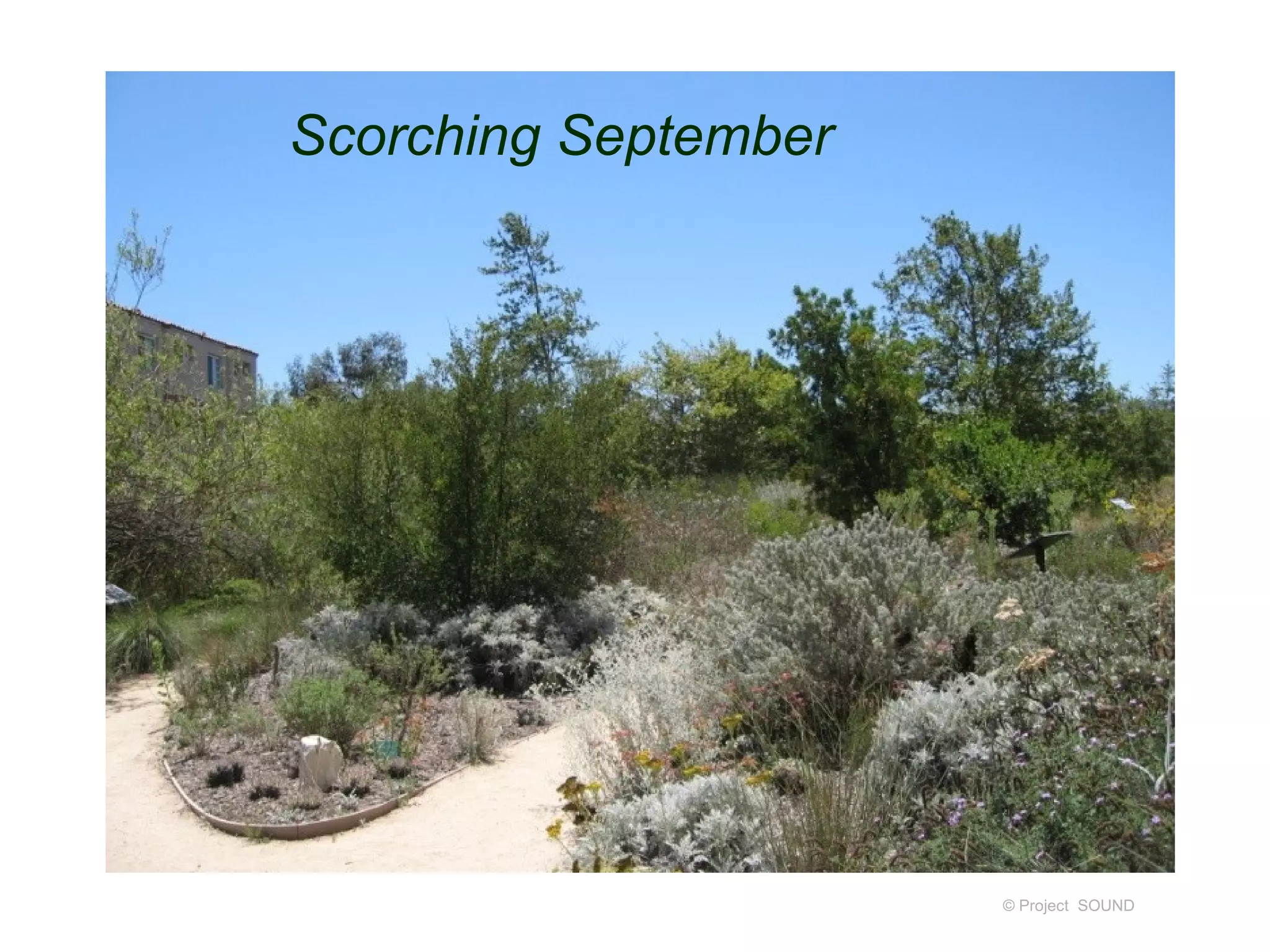
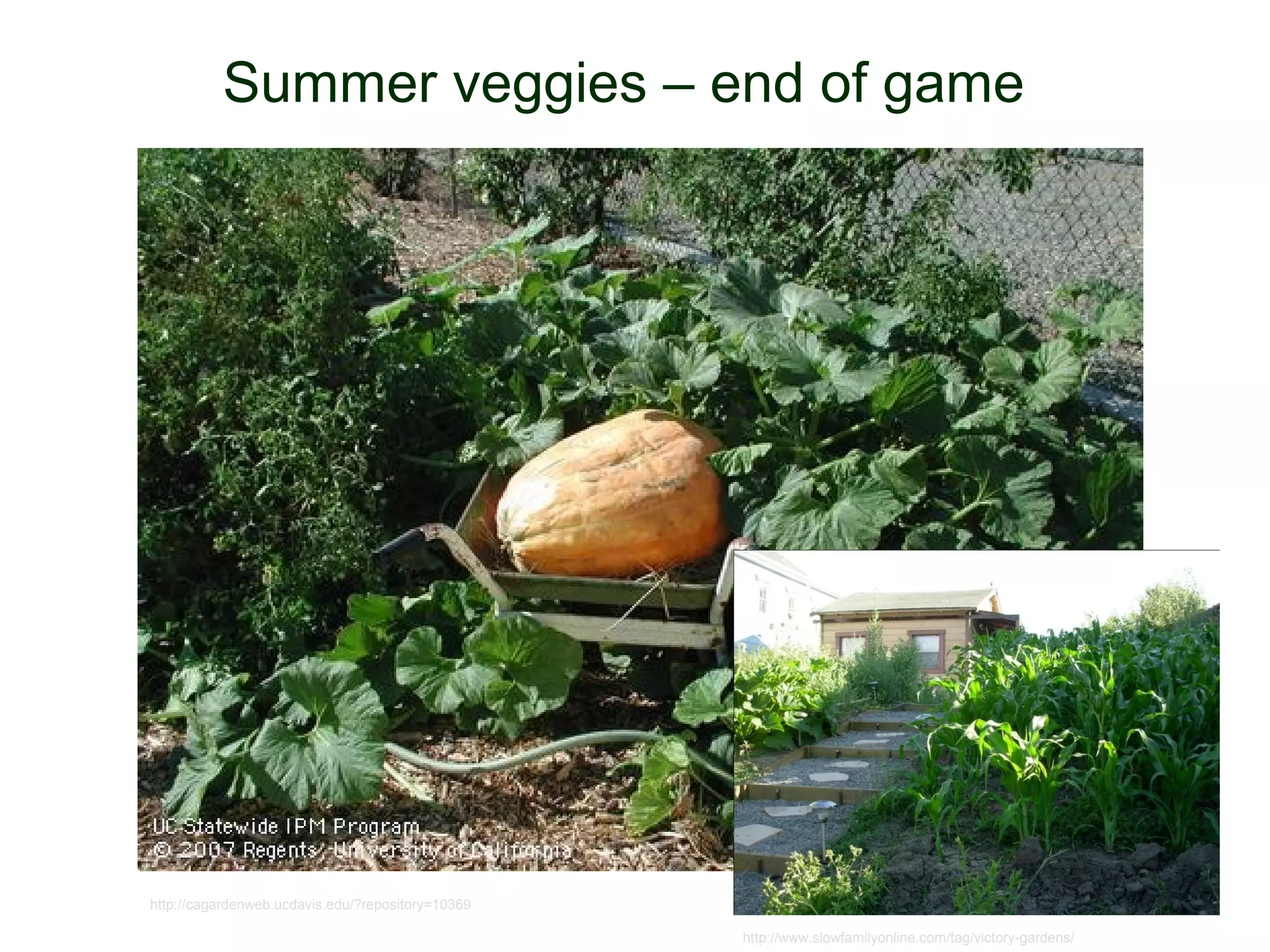
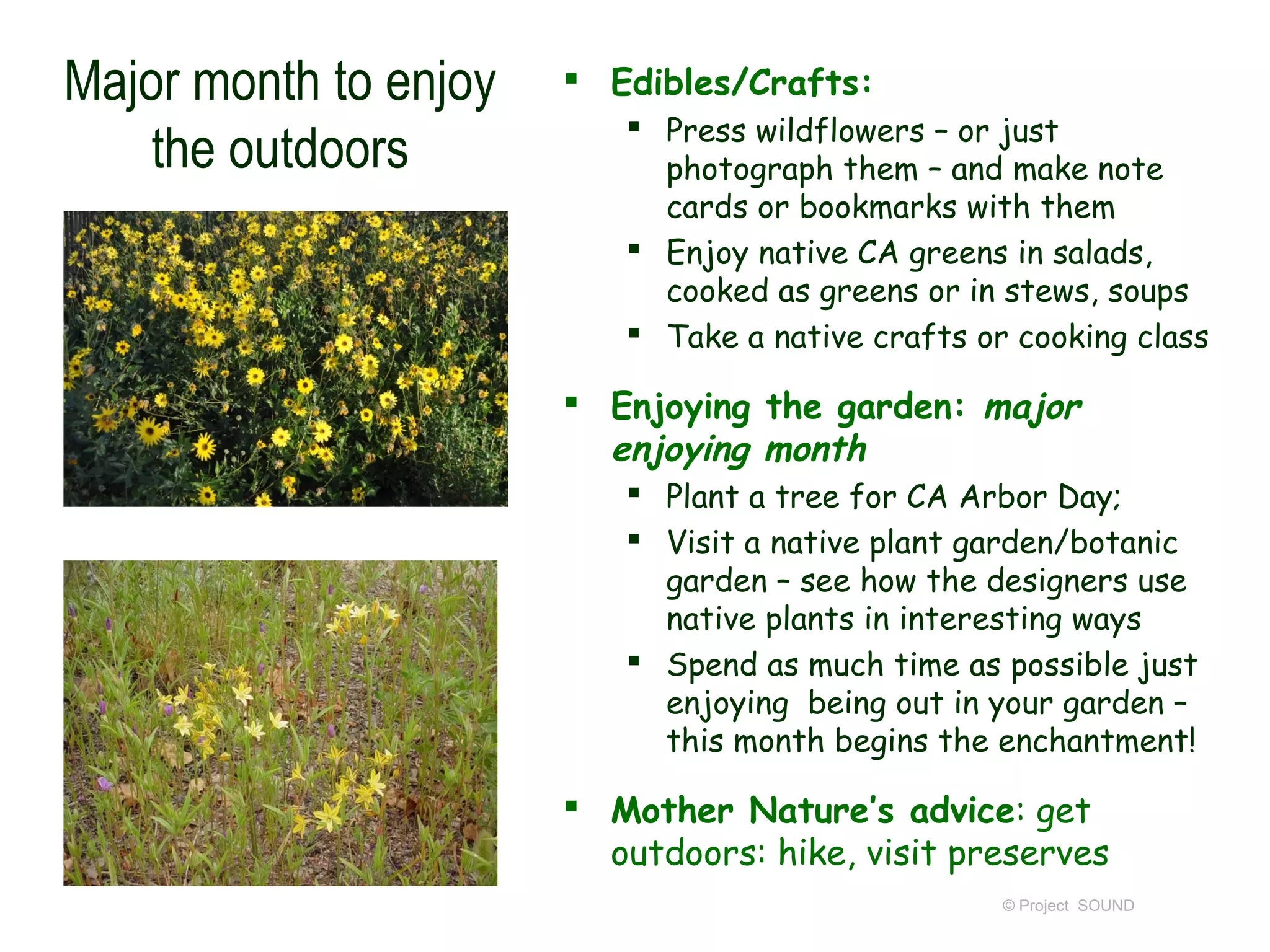
  • 120.
    June gloom –or not © Project SOUND
  • 121.
    June’s Weather &Climate  At a glance: coastal climate keeps us much cooler than further inland. Fog common in Zones 22-24 and provides any moisture this month. Soils are definitely drying out.  Temperature:  mean high = 71/74 ; mean low = 61/59  Record high = 104/104 ; record low = 48/21  Precipitation: may be significant fog events near coast  Average: 0.08/0.07” © Project SOUND
  • 122.
    Lots of green;transitional flowers © Project SOUND
  • 123.
     Planning: June: endof  Consider ways to make your garden more friendly for native birds, butterflies, spring pollinators.  Hardscape/General:  Move bulb pots to cool dry place after blooming  Great month to remove unwanted trees/shrubs  Begin removing old lawns, ivy – their removal may take through the summer and into fall.  Fertilize containers if needed  Watering: major watering month  Taper off water for late spring bulbs and spring wildflowers after blooming ceases  Adjust your summer watering schedule to account for foggy days (if any); other than that, you’re into the summer watering schedule © Project SOUND
  • 124.
    June is agreat time to start removing your old lawn http://ulocal.ksbw.com/_Future-Vegetable-Garden/photo/13892788/65101.html © Project SOUND
  • 125.
    June: Planting, Pruning,Dividing  Pruning: into summer pruning mode  If not done in May, prune and shape your Ceanothus, Arctostaphylos, Carpenteria, and other flowering chaparral shrubs once they've finished blooming  Prune back exuberant growth; prune for health & safety  Hedge-shear if needed as shrubs begin summer growth phase  Mow (if desired) warm-season sod-forming grasses, sedges before they begin major growth phase  Dead-head Salvia, Penstemon & Rosa to prolong bloom  Divide & Replant:  Warm season grasses will start growing about now, including Acnatherum species, Boutetoua species, Muhlenbergia rigens, Sporobolis airoides, and Pleuraphis jamesii. This is the time to © Project SOUND divide summer grasses.
  • 126.
    Last chance toplant  Propagation:  Softwood cuttings from woody summer veggies shrubs and trees (including those you prune this month); keep moist in a shady spot until well-rooted, 6-10 weeks  Planting:  Riparian/pond and other Zone 3 plants  Direct-seed warm season sod grasses  Plant warm-season vegetables from plants:  Last chance to plant bean, corn, cucumber and summer squash in the ground from seed  Weeds/Diseases/Pests: major weeding month- summer weeds http://farmerfredrant.blogspot.com/2011/06/our-2011-tomato- garden.html emerge and/or grow © Project SOUND
  • 127.
     Edibles/Crafts: Look atall the  Collect seed from spring wildlife! wildflowers; after drying, make up seed packets to give as gifts  Take cuttings of Artemisia, Salvias for seasonings, vinegars  Collect/dry new summer leaves for tea  See also May suggestions  Enjoying the garden:  Visit a native plant garden/ botanic garden; what tricks are they using to make the garden more interesting this time of year?  Look for Monarchs and other butterflies – do you have enough flowers to attract them?  Mother Nature’s advice: gardens, like natural places, should evolve © Project SOUND
  • 128.
    We’ve come fullcircle: jobs and joys of a year in the S.California garden http://annystudio.com/calendars/ © Project SOUND
  • 129.
    You likely livein Sunset Zone 22, 23 or 24 http://www.sunset.com/garden/climate-zones/sunset-climate-zone-los-angeles-area-00418000067298/ © Project SOUND
  • 130.
    And learned thatevery month is one to treasure © Project SOUND