
DELIVERY PLATFORM AND TECHNOLOGY OVERVIEW


       OpenDNS Enterprise Secures Internet Connections with 100% Uptime
       Our global security network, Anycast routing and SmartCache™ technologies deliver a simpler, faster
       and more reliable Internet experience without requiring you to change your network topology.
       Let’s face it, if there were no security and compliance         However, even if we lived in a threat-free world, you
       threats to protect users and devices from, you wouldn’t         still would deal with the inherent complexity and
       complicate and risk your network infrastructure by              inconsistency of several, less-than-100%-reliable
       installing countless network devices (e.g. firewalls, in-line   recursive DNS services provided by your ISPs. This
       filters, proxies). You would deploy the minimum number of       common situation impacts organizations that use
       switches and routers between your devices and the               redundant Internet pipes with more than one ISP or
       Internet. Traffic would flow at the maximum speed and           have multiple network locations with different ISPs.
       throughput provided by your ISPs (Internet Service              OpenDNS addresses both these problems, while
       Providers), and there would be no additional points of          securing every Internet connection, by eliminating
       failure (or complication) to manage and maintain daily.         the common requirement to add network devices or
       You would be happy, and your end users would be happy.          in any way change your network topology, and
       Regrettably, the risk of data loss, identity theft,             simultaneously consolidating all these disparate
       inappropriate or malicious resource consumption, brand          recursive DNS services into one ultra-reliable global
       damage, etc. is great enough to justify adding network          DNS service with the same two consistent IP
       infrastructure risks and investing your time.                   addresses (208.67.222.222 and 208.67.220.220).

       Connected at Internet’s Core Fabric for a Faster, More Global Service
       The Internet is often referred to as a “Network of              networks and OpenDNS’s services, as well as
       Networks”, as it consists of over 5,000 ISPs                    between authoritative DNS servers and OpenDNS’s
       interconnected with one another in a sparsely meshed            services. More geographic isolation between IXPs,
       fabric. The core of the Internet’s fabric is created using      translates to fewer issues in one region spilling over
       peering agreements at IXPs (Internet Exchange Points),          and impacting another (e.g. disaster at datacenter,
       which allow first-tier ISPs or other service providers like     large-scale
       OpenDNS to exchange traffic bound for one another’s             routing
       customers. Millions of business networks and billions of        errors).
       home networks are connected via transit agreements for
       DIA (direct Internet access) from each ISP’s PoP (points
       of presence). Transit agreements are also used to connect
       OpenDNS to first-tier ISPs and first-tier ISPs to smaller
       ISPs, commonly at the Internet’s edges.
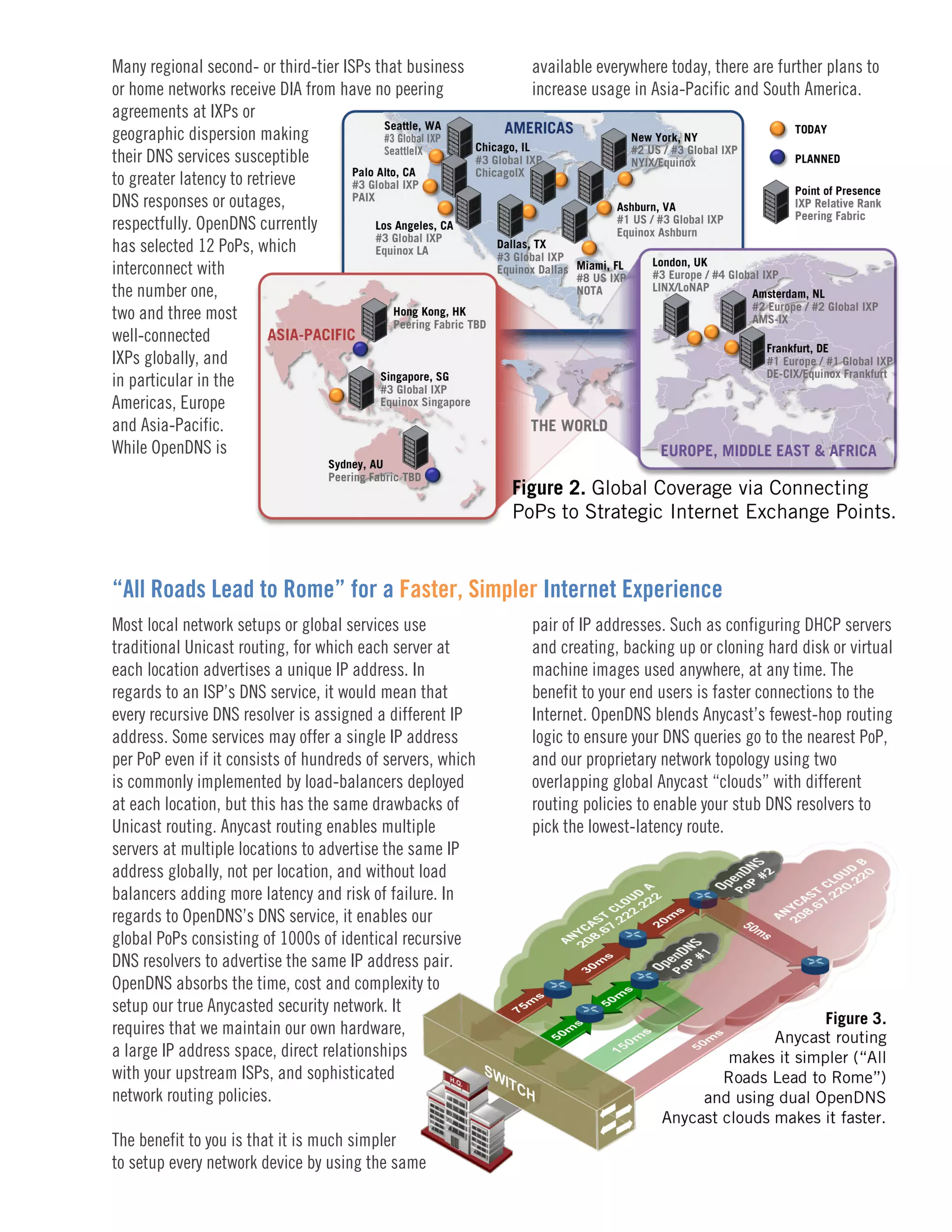
       OpenDNS selects strategic IXPs to connect
       our PoPs to the Internet’s core using two
       criteria – Internet connectivity and
       geography. More peering and transit
       agreements established with ISPs
       at a IXP, translates to fewer
       connection hops and latency
       incurred between the customer’s


For more information please visit: www.opendns.com or call 877-811-2367
Many regional second- or third-tier ISPs that business      available everywhere today, there are further plans to
       or home networks receive DIA from have no peering           increase usage in Asia-Pacific and South America.
       agreements at IXPs or
       geographic dispersion making
       their DNS services susceptible
       to greater latency to retrieve
       DNS responses or outages,
       respectfully. OpenDNS currently
       has selected 12 PoPs, which
       interconnect with
       the number one,
       two and three most
       well-connected
       IXPs globally, and
       in particular in the
       Americas, Europe
       and Asia-Pacific.
       While OpenDNS is


       “All Roads Lead to Rome” for a Faster, Simpler Internet Experience
       Most local network setups or global services use            pair of IP addresses. Such as configuring DHCP servers
       traditional Unicast routing, for which each server at       and creating, backing up or cloning hard disk or virtual
       each location advertises a unique IP address. In            machine images used anywhere, at any time. The
       regards to an ISP’s DNS service, it would mean that         benefit to your end users is faster connections to the
       every recursive DNS resolver is assigned a different IP     Internet. OpenDNS blends Anycast’s fewest-hop routing
       address. Some services may offer a single IP address        logic to ensure your DNS queries go to the nearest PoP,
       per PoP even if it consists of hundreds of servers, which   and our proprietary network topology using two
       is commonly implemented by load-balancers deployed          overlapping global Anycast “clouds” with different
       at each location, but this has the same drawbacks of        routing policies to enable your stub DNS resolvers to
       Unicast routing. Anycast routing enables multiple           pick the lowest-latency route.
       servers at multiple locations to advertise the same IP
       address globally, not per location, and without load
       balancers adding more latency and risk of failure. In
       regards to OpenDNS’s DNS service, it enables our
       global PoPs consisting of 1000s of identical recursive
       DNS resolvers to advertise the same IP address pair.
       OpenDNS absorbs the time, cost and complexity to
       setup our true Anycasted security network. It
       requires that we maintain our own hardware,
       a large IP address space, direct relationships
       with your upstream ISPs, and sophisticated
       network routing policies.

       The benefit to you is that it is much simpler
       to setup every network device by using the same
	
  
Self-Healing Routes Lead to a More
Reliable Internet Experience
Rather than crude round-robin
methods or physical load
balancers, Anycast uses load-
balanced routing
logic, which is
invisible to
individual servers or
entire PoPs. If a
server or entire PoP
is taken offline for
maintenance, disasters,
failures or attacks, it ceases
to advertise its shared IP address and upstream                                                                     as other
layer-3 network devices will transparently re-route                                                             global services
the traffic. So when you send a DNS query to                                                             claiming 99.999% up-
OpenDNS, it will always return a response from the                                                 time SLAs (service level
quickest, closest available DNS resolver! This                                               agreements) so often do. It’s that
eliminates you ever needing to make changes because                                   reliable and why we can truly claim that
we are conducting maintenance on servers closest to                      we’ve had 100% uptime since we launched our
your network locations or we experience a major failure,                 services in 2006.


SmartCache Leads to a Even Faster and Smarter Internet Experience
OpenDNS receives billions of DNS queries daily from                      Many authoritative DNS outages, attacks or failures
almost 2% of the Internet’s users and their devices.                     have impacted business-critical sites such as
When OpenDNS receives each subsequent DNS query,                         salesforce.com, amazon.com and petco.com, or even
we already know the answer (much more often than                         millions of domain, such as when the top-level domain
your regional ISPs), so we do not make you wait on the                   used by Germany (.de) was unreachable. When such
authoritative DNS servers to return this same answer.                    incidents occur, which is not uncommon, OpenDNS still
While we know almost every server’s address across                       returns the last-known correct address using our
entire global Internet at any given, this is not what                    exclusive caching logic, whereas the rest of the
makes our caching technology unique.                                     Internet’s users will not be able to reach the domain.
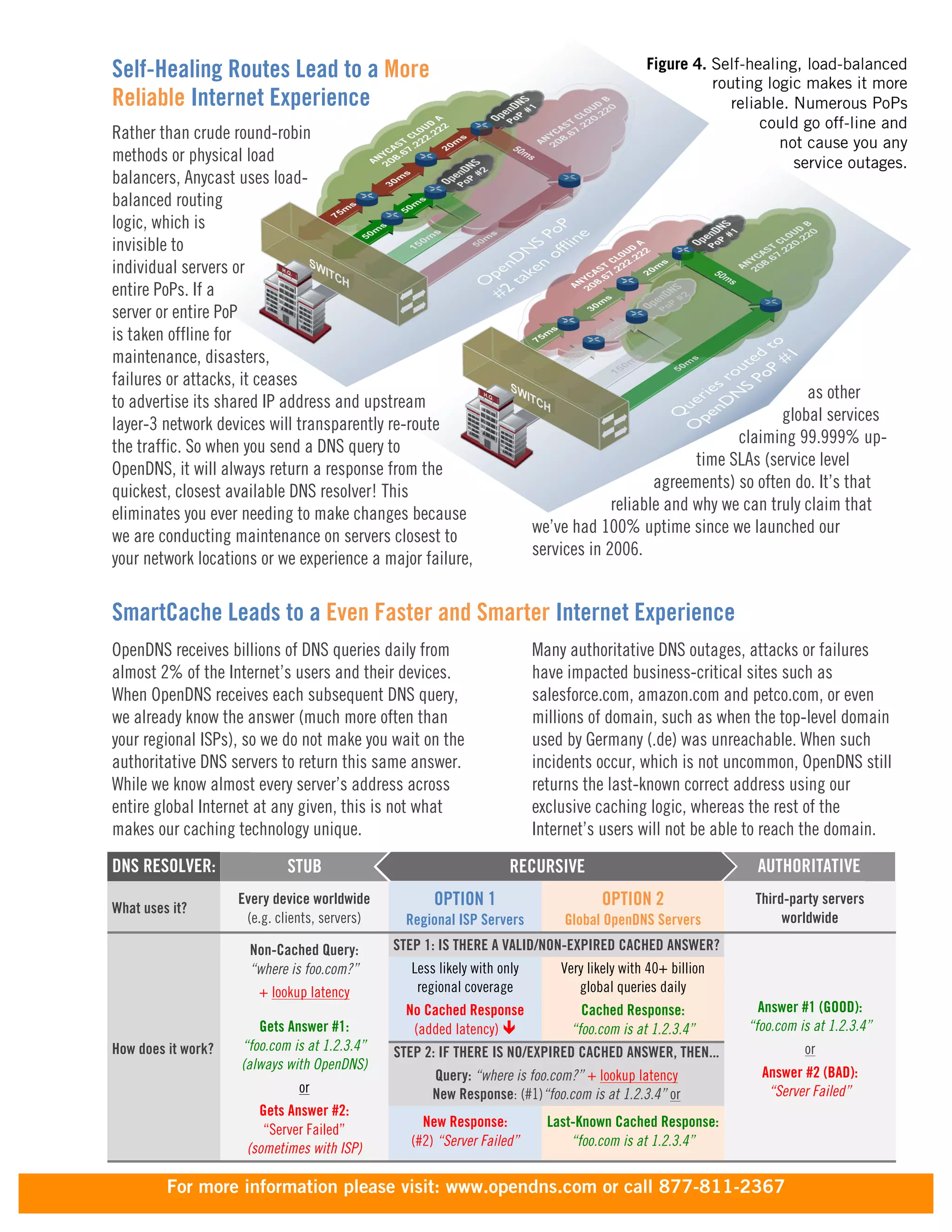
DNS RESOLVER:               STUB	
                                  RECURSIVE                                AUTHORITATIVE	
  

What uses it?
                    Every device worldwide           OPTION 1                       OPTION 2                 Third-party servers
                     (e.g. clients, servers)     Regional ISP Servers        Global OpenDNS Servers               worldwide

                      Non-Cached Query:        STEP 1: IS THERE A VALID/NON-EXPIRED CACHED ANSWER?
                      “where is foo.com?”        Less likely with only       Very likely with 40+ billion
                       + lookup latency           regional coverage             global queries daily
                                                 No Cached Response             Cached Response:              Answer #1 (GOOD):
                       Gets Answer #1:            (added latency) ê          “foo.com is at 1.2.3.4”       “foo.com is at 1.2.3.4”
How does it work?   “foo.com is at 1.2.3.4”    STEP 2: IF THERE IS NO/EXPIRED CACHED ANSWER, THEN...                  or
                    (always with OpenDNS)
                                                     Query: “where is foo.com?” + lookup latency              Answer #2 (BAD):
                               or                    New Response: (#1)“foo.com is at 1.2.3.4” or              “Server Failed”
                       Gets Answer #2:
                                                   New Response:           Last-Known Cached Response:
                        “Server Failed”
                     (sometimes with ISP)        (#2) “Server Failed”          “foo.com is at 1.2.3.4”


         For more information please visit: www.opendns.com or call 877-811-2367

OpenDNS Whitepaper: Platform Technology

  • 1.
    DELIVERY PLATFORM ANDTECHNOLOGY OVERVIEW OpenDNS Enterprise Secures Internet Connections with 100% Uptime Our global security network, Anycast routing and SmartCache™ technologies deliver a simpler, faster and more reliable Internet experience without requiring you to change your network topology. Let’s face it, if there were no security and compliance However, even if we lived in a threat-free world, you threats to protect users and devices from, you wouldn’t still would deal with the inherent complexity and complicate and risk your network infrastructure by inconsistency of several, less-than-100%-reliable installing countless network devices (e.g. firewalls, in-line recursive DNS services provided by your ISPs. This filters, proxies). You would deploy the minimum number of common situation impacts organizations that use switches and routers between your devices and the redundant Internet pipes with more than one ISP or Internet. Traffic would flow at the maximum speed and have multiple network locations with different ISPs. throughput provided by your ISPs (Internet Service OpenDNS addresses both these problems, while Providers), and there would be no additional points of securing every Internet connection, by eliminating failure (or complication) to manage and maintain daily. the common requirement to add network devices or You would be happy, and your end users would be happy. in any way change your network topology, and Regrettably, the risk of data loss, identity theft, simultaneously consolidating all these disparate inappropriate or malicious resource consumption, brand recursive DNS services into one ultra-reliable global damage, etc. is great enough to justify adding network DNS service with the same two consistent IP infrastructure risks and investing your time. addresses (208.67.222.222 and 208.67.220.220). Connected at Internet’s Core Fabric for a Faster, More Global Service The Internet is often referred to as a “Network of networks and OpenDNS’s services, as well as Networks”, as it consists of over 5,000 ISPs between authoritative DNS servers and OpenDNS’s interconnected with one another in a sparsely meshed services. More geographic isolation between IXPs, fabric. The core of the Internet’s fabric is created using translates to fewer issues in one region spilling over peering agreements at IXPs (Internet Exchange Points), and impacting another (e.g. disaster at datacenter, which allow first-tier ISPs or other service providers like large-scale OpenDNS to exchange traffic bound for one another’s routing customers. Millions of business networks and billions of errors). home networks are connected via transit agreements for DIA (direct Internet access) from each ISP’s PoP (points of presence). Transit agreements are also used to connect OpenDNS to first-tier ISPs and first-tier ISPs to smaller ISPs, commonly at the Internet’s edges. OpenDNS selects strategic IXPs to connect our PoPs to the Internet’s core using two criteria – Internet connectivity and geography. More peering and transit agreements established with ISPs at a IXP, translates to fewer connection hops and latency incurred between the customer’s For more information please visit: www.opendns.com or call 877-811-2367
  • 2.
    Many regional second-or third-tier ISPs that business available everywhere today, there are further plans to or home networks receive DIA from have no peering increase usage in Asia-Pacific and South America. agreements at IXPs or geographic dispersion making their DNS services susceptible to greater latency to retrieve DNS responses or outages, respectfully. OpenDNS currently has selected 12 PoPs, which interconnect with the number one, two and three most well-connected IXPs globally, and in particular in the Americas, Europe and Asia-Pacific. While OpenDNS is “All Roads Lead to Rome” for a Faster, Simpler Internet Experience Most local network setups or global services use pair of IP addresses. Such as configuring DHCP servers traditional Unicast routing, for which each server at and creating, backing up or cloning hard disk or virtual each location advertises a unique IP address. In machine images used anywhere, at any time. The regards to an ISP’s DNS service, it would mean that benefit to your end users is faster connections to the every recursive DNS resolver is assigned a different IP Internet. OpenDNS blends Anycast’s fewest-hop routing address. Some services may offer a single IP address logic to ensure your DNS queries go to the nearest PoP, per PoP even if it consists of hundreds of servers, which and our proprietary network topology using two is commonly implemented by load-balancers deployed overlapping global Anycast “clouds” with different at each location, but this has the same drawbacks of routing policies to enable your stub DNS resolvers to Unicast routing. Anycast routing enables multiple pick the lowest-latency route. servers at multiple locations to advertise the same IP address globally, not per location, and without load balancers adding more latency and risk of failure. In regards to OpenDNS’s DNS service, it enables our global PoPs consisting of 1000s of identical recursive DNS resolvers to advertise the same IP address pair. OpenDNS absorbs the time, cost and complexity to setup our true Anycasted security network. It requires that we maintain our own hardware, a large IP address space, direct relationships with your upstream ISPs, and sophisticated network routing policies. The benefit to you is that it is much simpler to setup every network device by using the same  
  • 3.
    Self-Healing Routes Leadto a More Reliable Internet Experience Rather than crude round-robin methods or physical load balancers, Anycast uses load- balanced routing logic, which is invisible to individual servers or entire PoPs. If a server or entire PoP is taken offline for maintenance, disasters, failures or attacks, it ceases to advertise its shared IP address and upstream as other layer-3 network devices will transparently re-route global services the traffic. So when you send a DNS query to claiming 99.999% up- OpenDNS, it will always return a response from the time SLAs (service level quickest, closest available DNS resolver! This agreements) so often do. It’s that eliminates you ever needing to make changes because reliable and why we can truly claim that we are conducting maintenance on servers closest to we’ve had 100% uptime since we launched our your network locations or we experience a major failure, services in 2006. SmartCache Leads to a Even Faster and Smarter Internet Experience OpenDNS receives billions of DNS queries daily from Many authoritative DNS outages, attacks or failures almost 2% of the Internet’s users and their devices. have impacted business-critical sites such as When OpenDNS receives each subsequent DNS query, salesforce.com, amazon.com and petco.com, or even we already know the answer (much more often than millions of domain, such as when the top-level domain your regional ISPs), so we do not make you wait on the used by Germany (.de) was unreachable. When such authoritative DNS servers to return this same answer. incidents occur, which is not uncommon, OpenDNS still While we know almost every server’s address across returns the last-known correct address using our entire global Internet at any given, this is not what exclusive caching logic, whereas the rest of the makes our caching technology unique. Internet’s users will not be able to reach the domain. DNS RESOLVER: STUB   RECURSIVE AUTHORITATIVE   What uses it? Every device worldwide OPTION 1 OPTION 2 Third-party servers (e.g. clients, servers) Regional ISP Servers Global OpenDNS Servers worldwide Non-Cached Query: STEP 1: IS THERE A VALID/NON-EXPIRED CACHED ANSWER? “where is foo.com?” Less likely with only Very likely with 40+ billion + lookup latency regional coverage global queries daily No Cached Response Cached Response: Answer #1 (GOOD): Gets Answer #1: (added latency) ê “foo.com is at 1.2.3.4” “foo.com is at 1.2.3.4” How does it work? “foo.com is at 1.2.3.4” STEP 2: IF THERE IS NO/EXPIRED CACHED ANSWER, THEN... or (always with OpenDNS) Query: “where is foo.com?” + lookup latency Answer #2 (BAD): or New Response: (#1)“foo.com is at 1.2.3.4” or “Server Failed” Gets Answer #2: New Response: Last-Known Cached Response: “Server Failed” (sometimes with ISP) (#2) “Server Failed” “foo.com is at 1.2.3.4” For more information please visit: www.opendns.com or call 877-811-2367