The scale of our solar system
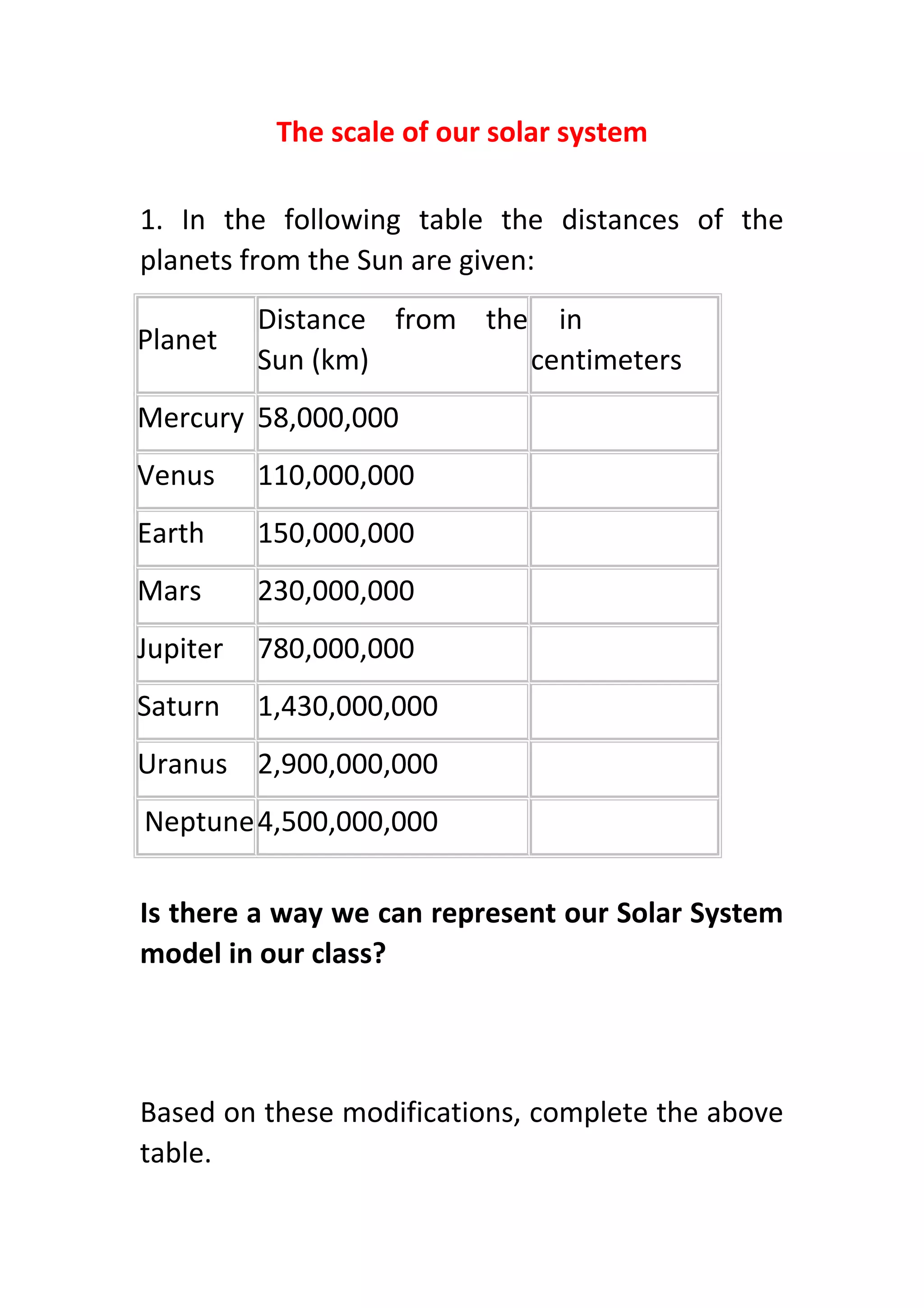
1. In the following table the distances of the
planets from the Sun are given:
Planet
Distance from the
Sun (km)
in
centimeters
Mercury 58,000,000
Venus 110,000,000
Earth 150,000,000
Mars 230,000,000
Jupiter 780,000,000
Saturn 1,430,000,000
Uranus 2,900,000,000
Neptune4,500,000,000
Is there a way we can represent our Solar System
model in our class?
Based on these modifications, complete the above
table.
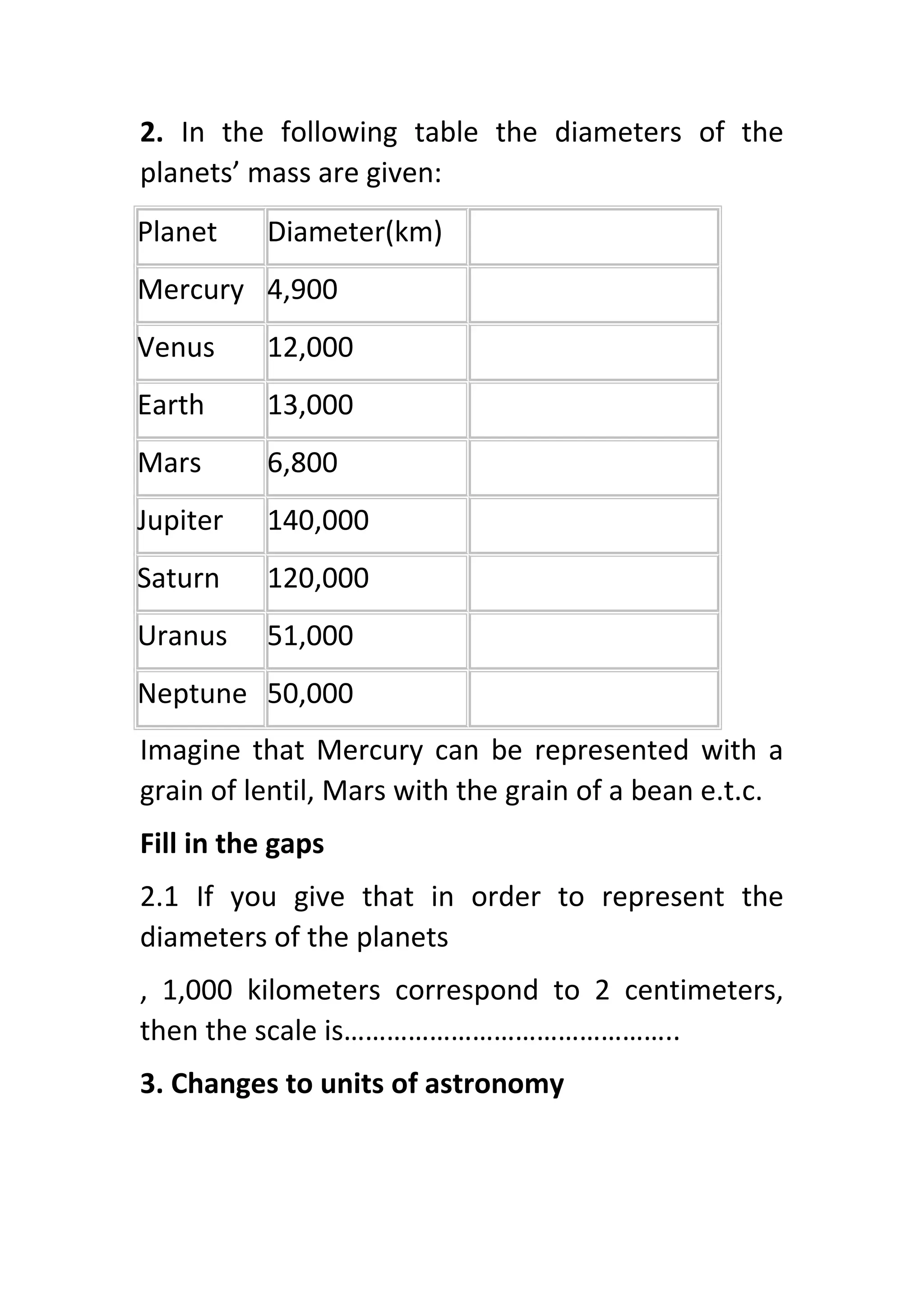
2. In the following table the diameters of the
planets’ mass are given:
Planet Diameter(km)
Mercury 4,900
Venus 12,000
Earth 13,000
Mars 6,800
Jupiter 140,000
Saturn 120,000
Uranus 51,000
Neptune 50,000
Imagine that Mercury can be represented with a
grain of lentil, Mars with the grain of a bean e.t.c.
Fill in the gaps
2.1 If you give that in order to represent the
diameters of the planets
, 1,000 kilometers correspond to 2 centimeters,
then the scale is………………………………………..
3. Changes to units of astronomy
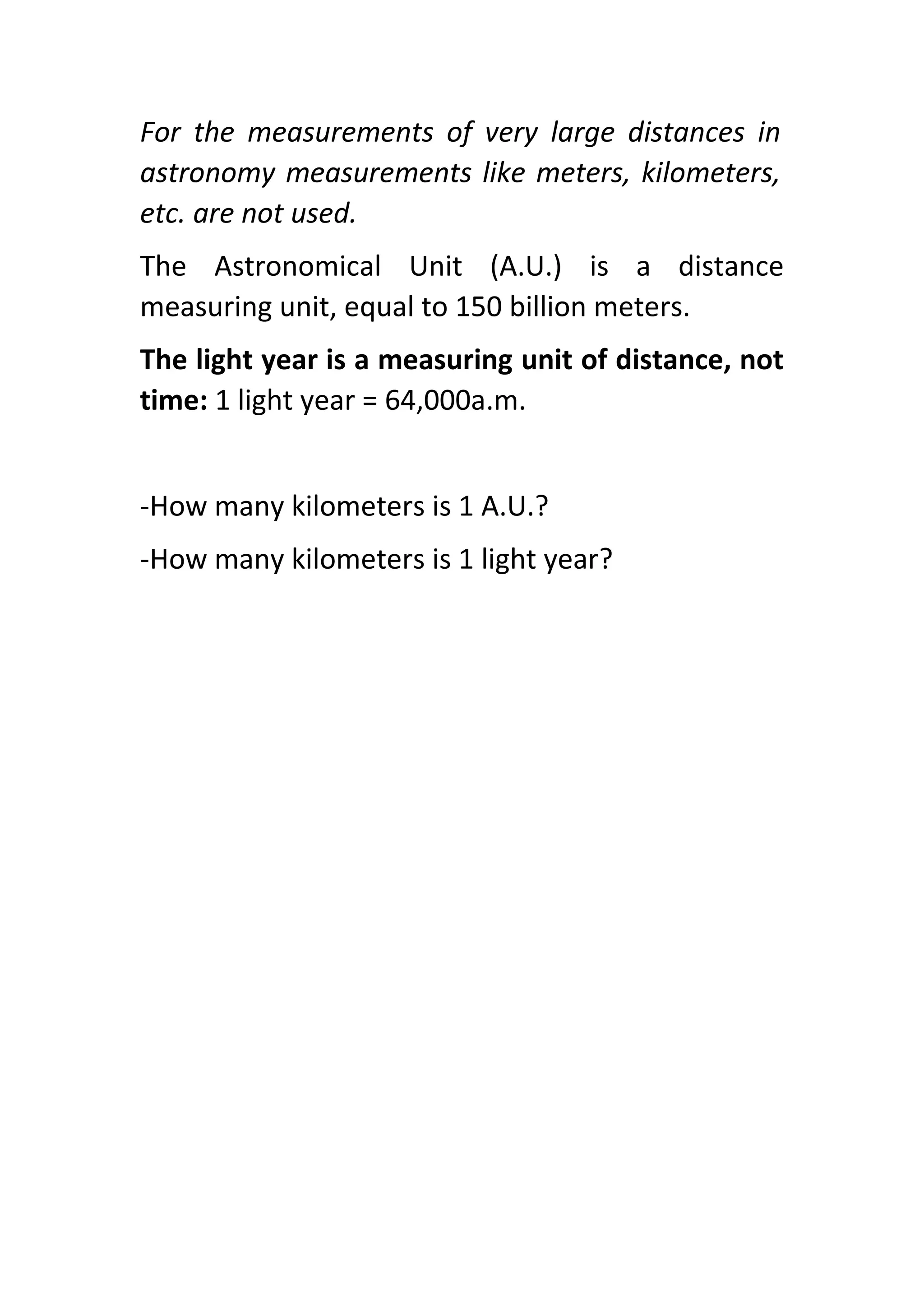
For the measurements of very large distances in
astronomy measurements like meters, kilometers,
etc. are not used.
The Astronomical Unit (A.U.) is a distance
measuring unit, equal to 150 billion meters.
The light year is a measuring unit of distance, not
time: 1 light year = 64,000a.m.
-How many kilometers is 1 A.U.?
-How many kilometers is 1 light year?

Scale of solar system

  • 1.
    The scale ofour solar system 1. In the following table the distances of the planets from the Sun are given: Planet Distance from the Sun (km) in centimeters Mercury 58,000,000 Venus 110,000,000 Earth 150,000,000 Mars 230,000,000 Jupiter 780,000,000 Saturn 1,430,000,000 Uranus 2,900,000,000 Neptune4,500,000,000 Is there a way we can represent our Solar System model in our class? Based on these modifications, complete the above table.
  • 2.
    2. In thefollowing table the diameters of the planets’ mass are given: Planet Diameter(km) Mercury 4,900 Venus 12,000 Earth 13,000 Mars 6,800 Jupiter 140,000 Saturn 120,000 Uranus 51,000 Neptune 50,000 Imagine that Mercury can be represented with a grain of lentil, Mars with the grain of a bean e.t.c. Fill in the gaps 2.1 If you give that in order to represent the diameters of the planets , 1,000 kilometers correspond to 2 centimeters, then the scale is……………………………………….. 3. Changes to units of astronomy
  • 3.
    For the measurementsof very large distances in astronomy measurements like meters, kilometers, etc. are not used. The Astronomical Unit (A.U.) is a distance measuring unit, equal to 150 billion meters. The light year is a measuring unit of distance, not time: 1 light year = 64,000a.m. -How many kilometers is 1 A.U.? -How many kilometers is 1 light year?