TOWARDS CORPORATE UX
MATURITY
24/02/2011
CHRISTOPHER KHALIL
DIRECTOR OF USER EXPERIENCE
NEWS DIGITAL MEDIA
INTRO…
  A framework for determining your organisational maturity
   Neilsen 2006
   http://www.useit.com/alertbox/maturity.html
  Goal is to become a User Driven Organisation
    – User data helps determines projects that are funded
    – User research helps determines company direction
    – Experience design extended beyond IxD into Customer
      Experience
STAGES OF MATURITY
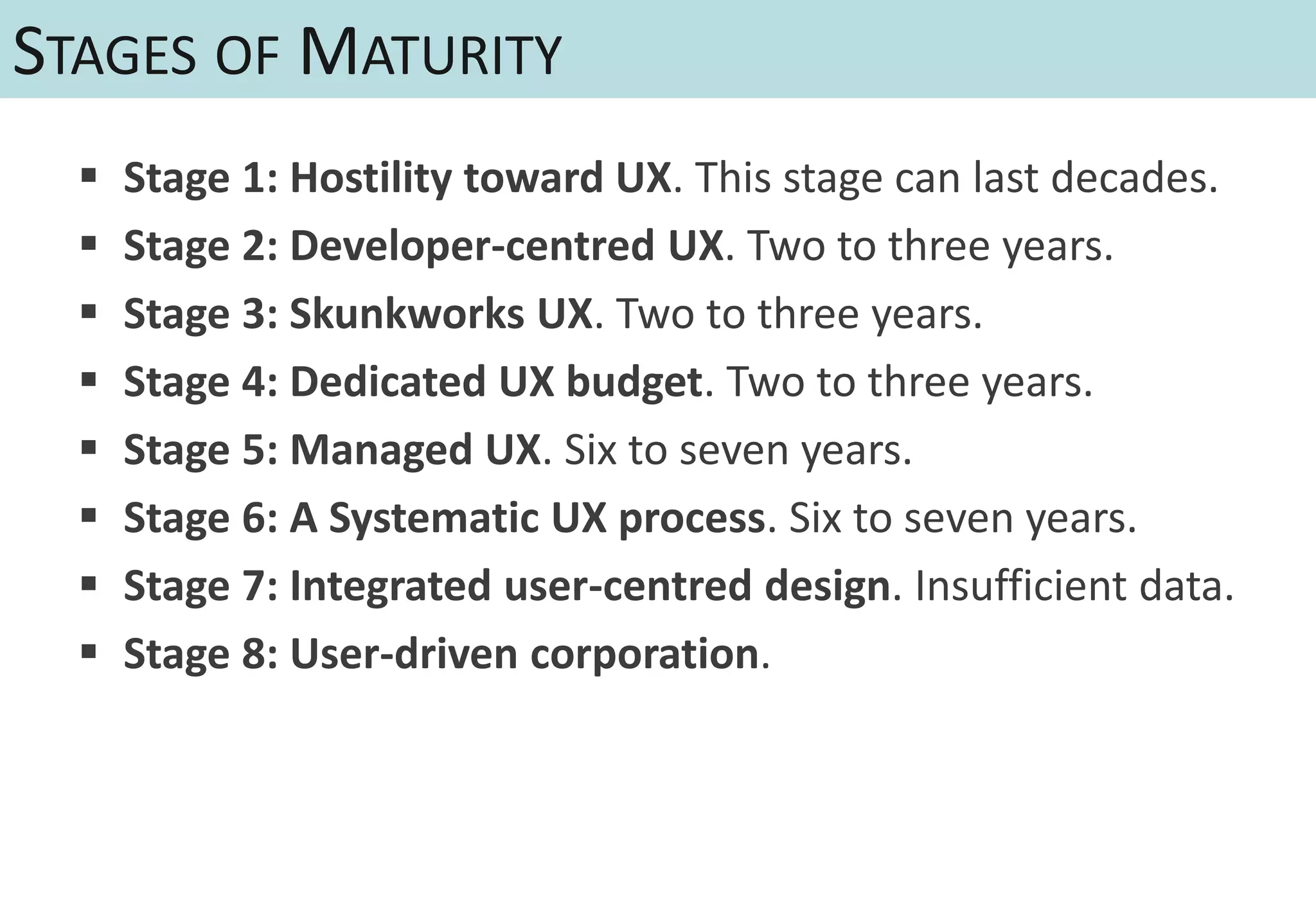
     Stage 1: Hostility toward UX. This stage can last decades.
     Stage 2: Developer-centred UX. Two to three years.
     Stage 3: Skunkworks UX. Two to three years.
     Stage 4: Dedicated UX budget. Two to three years.
     Stage 5: Managed UX. Six to seven years.
     Stage 6: A Systematic UX process. Six to seven years.
     Stage 7: Integrated user-centred design. Insufficient data.
     Stage 8: User-driven corporation.
STAGE 1: HOSTILITY TOWARD UX
   In this mindset, humans are irrelevant—they're told to
    use the system, regardless of whether doing so is easy or
    pleasant.
   Throwback to early days of computing where hardware
    costs etc meant it made sense to subjugate people to
    computers needs.
   Hard to change behaviour.
   Timescale: This stage can last decades.
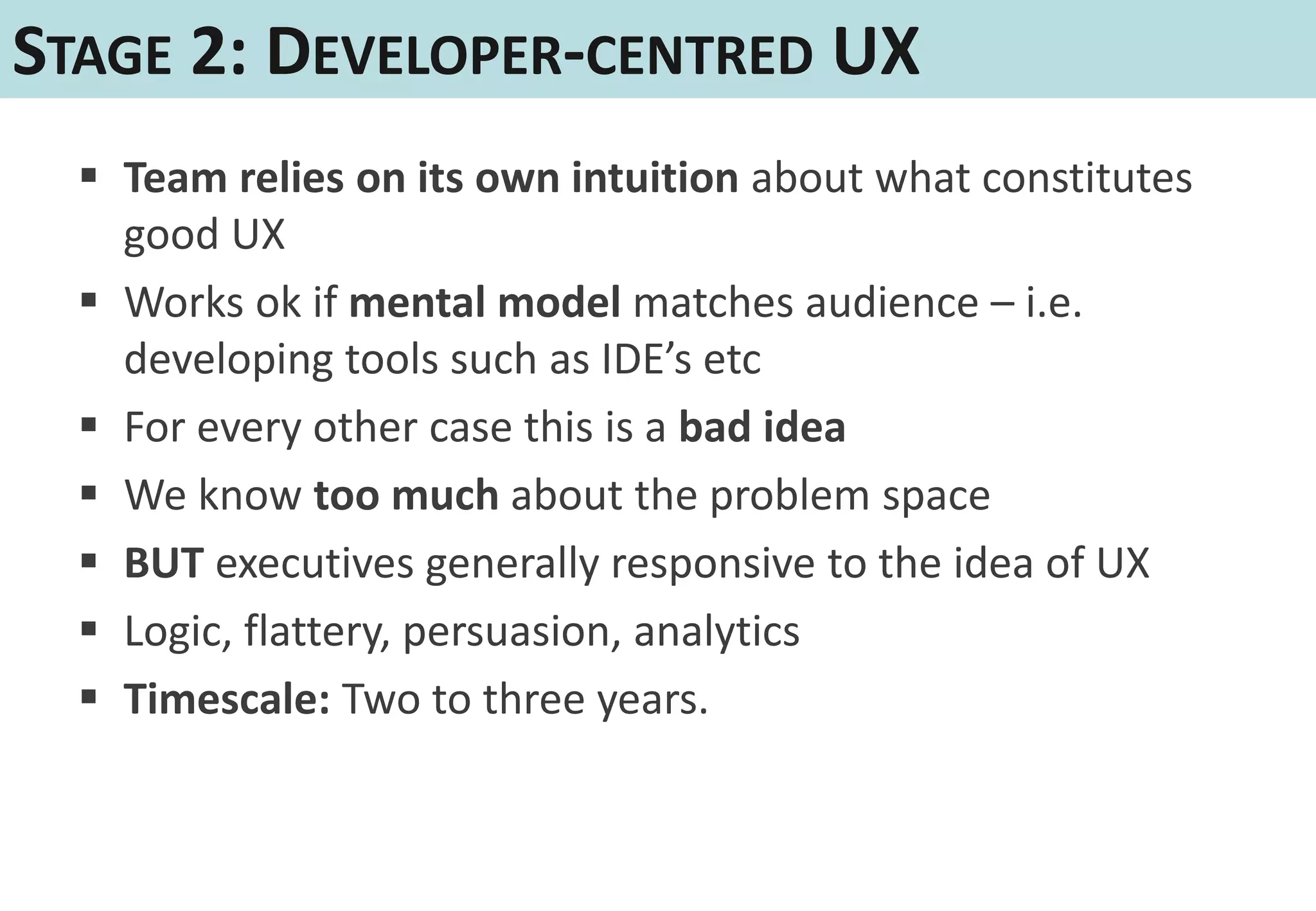
STAGE 2: DEVELOPER-CENTRED UX
   Team relies on its own intuition about what constitutes
    good UX
   Works ok if mental model matches audience – i.e.
    developing tools such as IDE’s etc
   For every other case this is a bad idea
   We know too much about the problem space
   BUT executives generally responsive to the idea of UX
   Logic, flattery, persuasion, analytics
   Timescale: Two to three years.
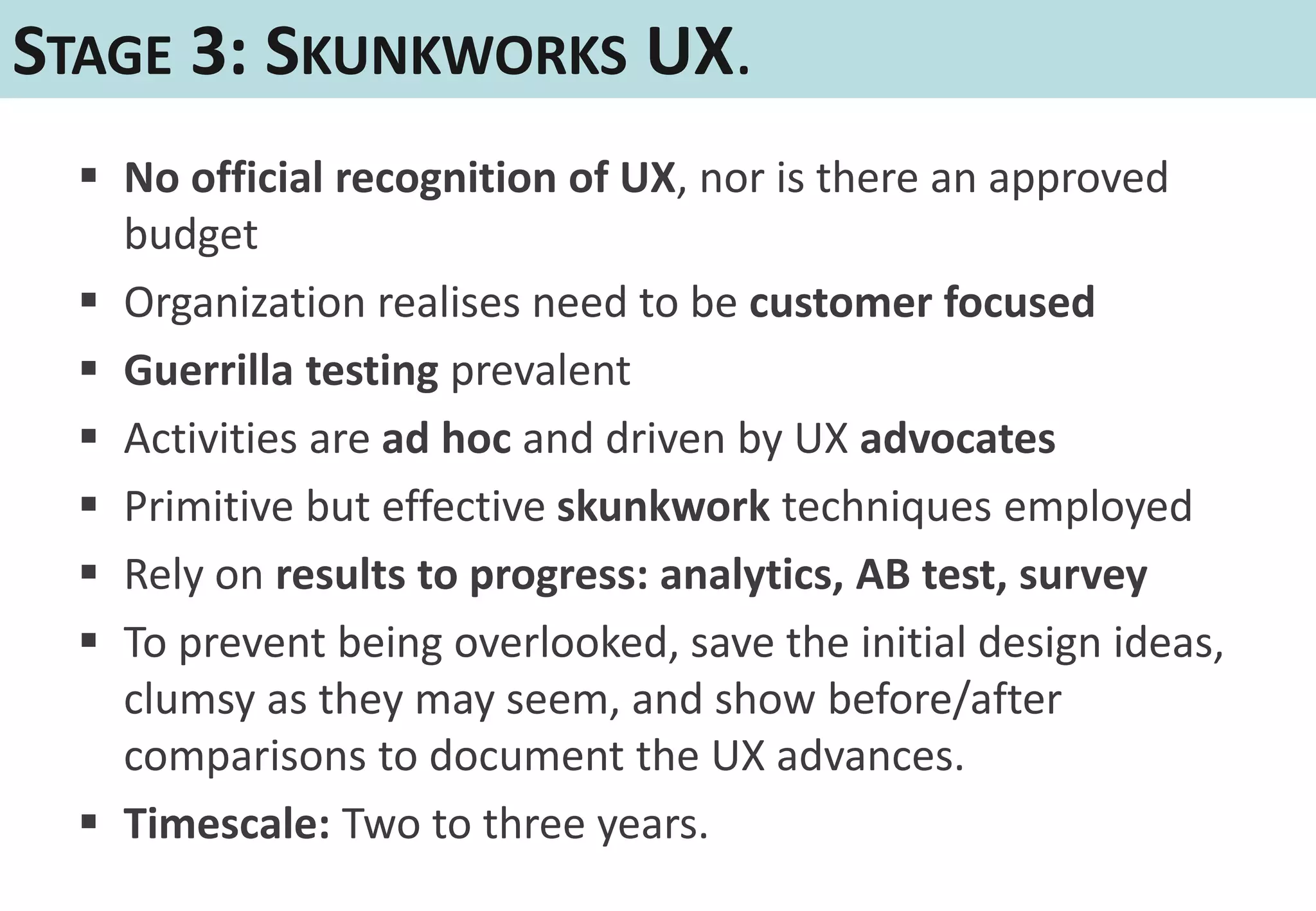
STAGE 3: SKUNKWORKS UX.
   No official recognition of UX, nor is there an approved
    budget
   Organization realises need to be customer focused
   Guerrilla testing prevalent
   Activities are ad hoc and driven by UX advocates
   Primitive but effective skunkwork techniques employed
   Rely on results to progress: analytics, AB test, survey
   To prevent being overlooked, save the initial design ideas,
    clumsy as they may seem, and show before/after
    comparisons to document the UX advances.
   Timescale: Two to three years.
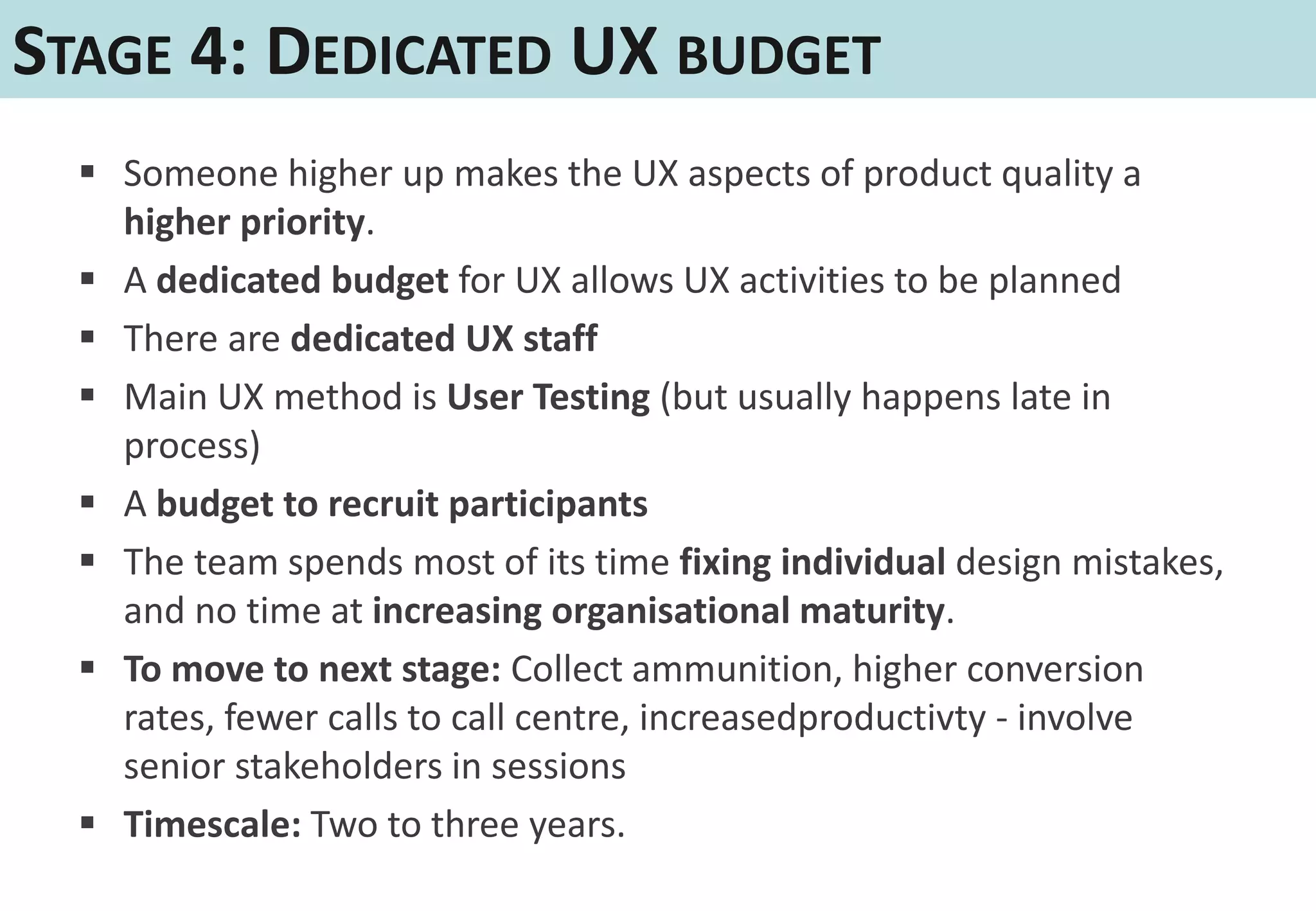
STAGE 4: DEDICATED UX BUDGET
   Someone higher up makes the UX aspects of product quality a
    higher priority.
   A dedicated budget for UX allows UX activities to be planned
   There are dedicated UX staff
   Main UX method is User Testing (but usually happens late in
    process)
   A budget to recruit participants
   The team spends most of its time fixing individual design mistakes,
    and no time at increasing organisational maturity.
   To move to next stage: Collect ammunition, higher conversion
    rates, fewer calls to call centre, increasedproductivty - involve
    senior stakeholders in sessions
   Timescale: Two to three years.
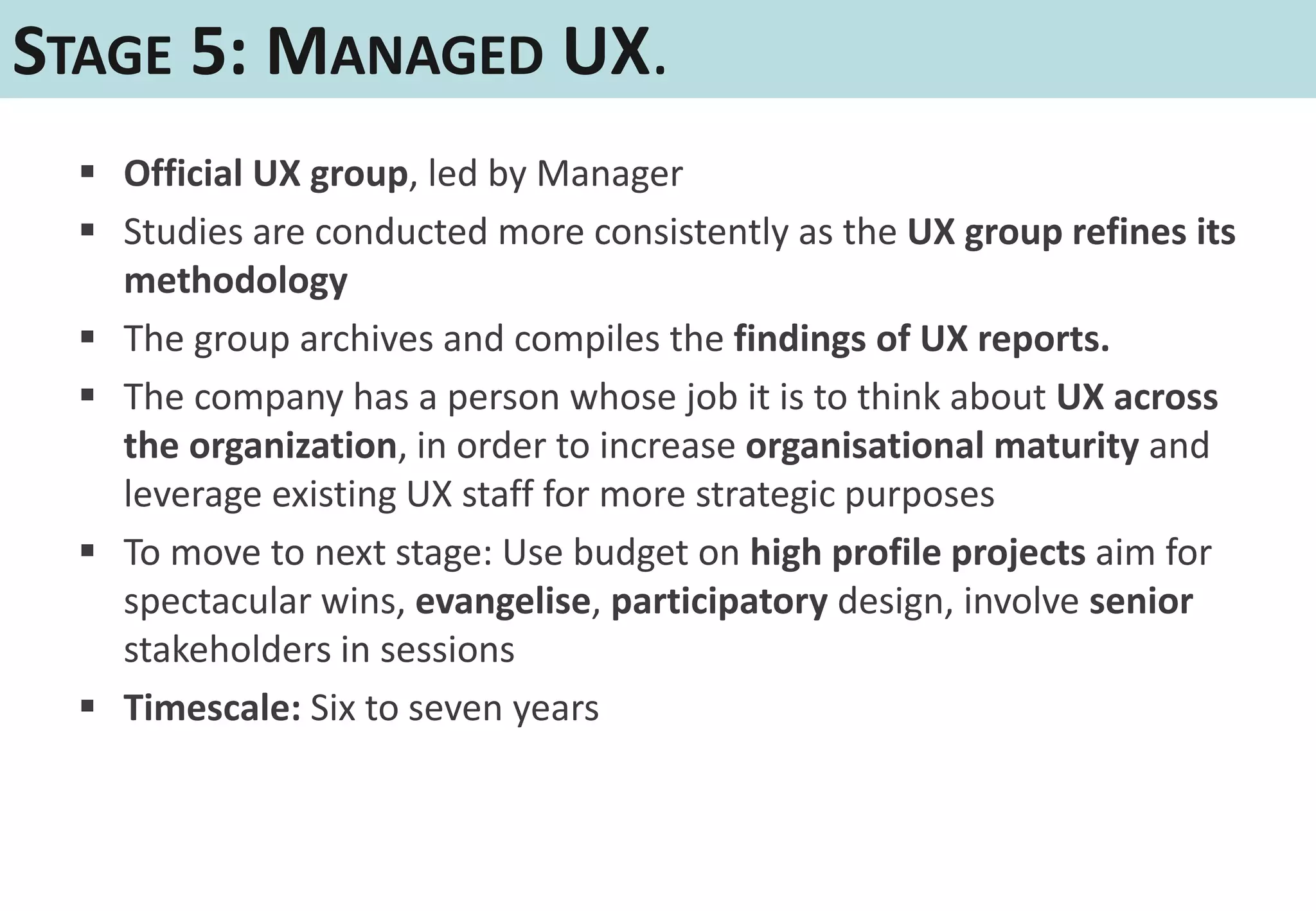
STAGE 5: MANAGED UX.
   Official UX group, led by Manager
   Studies are conducted more consistently as the UX group refines its
    methodology
   The group archives and compiles the findings of UX reports.
   The company has a person whose job it is to think about UX across
    the organization, in order to increase organisational maturity and
    leverage existing UX staff for more strategic purposes
   To move to next stage: Use budget on high profile projects aim for
    spectacular wins, evangelise, participatory design, involve senior
    stakeholders in sessions
   Timescale: Six to seven years
STAGE 6: A SYSTEMATIC UX PROCESS.
     The company has recognized the need for an actual user-centred design process, with
      multiple activities and milestones
     Iterative design is more common because the company realizes that the best UI quality
      requires several rounds of UX
     Projects are prioritized according to the business value of their user experience.
     Even projects that don't get a lot of UX resources go through at least some form of UX
      review before they're approved for release
     The UX budget large enough that key projects receive sufficient resources
     The company starts doing field studies
     To move to the next stage
     Use participatory & iterative design to bring stakeholders on the journey.
     Lobby for Field Studies
     Timescale: Six to seven years
STAGE 7: INTEGRATED USER-CENTRED DESIGN.
   Field studies, as a form of very early user research is in the DNA.
   Each step in the development process is infused with user data,
    including the project definition and the requirements phase.
   Beyond simply estimating user experience quality, the company
    tracks quality through quantitative UX metrics.
   Each project has defined UX goals that these measurements must
    surpass for the design to be greenlighted for release.
   The company begins to employ UX data to determine what it
    should build.
STAGE 8: USER-DRIVEN CORPORATION.
   User data now determines the type of projects that are funded.
   User research determines the company’s overall direction and
    priorities. The concept of total user experience is extended beyond
    the screen to other customer-company interaction.
   The company uses the same UX methods, but these now affect
    corporate strategy & activities beyond interaction design.
   Corporate decision-making takes a mixed methody approach
    including data from behavioural observation of real users—data
    about what customers do.
CONCLUSION
  The timing obviously differs among organizations
  Start-ups are lucky and can begin the maturity process at
   stage 3 or stage 4
  Steps must be addressed in order, hard to skip a stage
  Too many simultaneous changes are likely to result in
   failure
  Find the best ‘buttons’ in your organisation to press and
   keep punching them.

Towards corporate usability maturity

  • 1.
    TOWARDS CORPORATE UX MATURITY 24/02/2011 CHRISTOPHERKHALIL DIRECTOR OF USER EXPERIENCE NEWS DIGITAL MEDIA
  • 2.
    INTRO…  Aframework for determining your organisational maturity Neilsen 2006 http://www.useit.com/alertbox/maturity.html  Goal is to become a User Driven Organisation – User data helps determines projects that are funded – User research helps determines company direction – Experience design extended beyond IxD into Customer Experience
  • 3.
    STAGES OF MATURITY  Stage 1: Hostility toward UX. This stage can last decades.  Stage 2: Developer-centred UX. Two to three years.  Stage 3: Skunkworks UX. Two to three years.  Stage 4: Dedicated UX budget. Two to three years.  Stage 5: Managed UX. Six to seven years.  Stage 6: A Systematic UX process. Six to seven years.  Stage 7: Integrated user-centred design. Insufficient data.  Stage 8: User-driven corporation.
  • 4.
    STAGE 1: HOSTILITYTOWARD UX  In this mindset, humans are irrelevant—they're told to use the system, regardless of whether doing so is easy or pleasant.  Throwback to early days of computing where hardware costs etc meant it made sense to subjugate people to computers needs.  Hard to change behaviour.  Timescale: This stage can last decades.
  • 5.
    STAGE 2: DEVELOPER-CENTREDUX  Team relies on its own intuition about what constitutes good UX  Works ok if mental model matches audience – i.e. developing tools such as IDE’s etc  For every other case this is a bad idea  We know too much about the problem space  BUT executives generally responsive to the idea of UX  Logic, flattery, persuasion, analytics  Timescale: Two to three years.
  • 6.
    STAGE 3: SKUNKWORKSUX.  No official recognition of UX, nor is there an approved budget  Organization realises need to be customer focused  Guerrilla testing prevalent  Activities are ad hoc and driven by UX advocates  Primitive but effective skunkwork techniques employed  Rely on results to progress: analytics, AB test, survey  To prevent being overlooked, save the initial design ideas, clumsy as they may seem, and show before/after comparisons to document the UX advances.  Timescale: Two to three years.
  • 7.
    STAGE 4: DEDICATEDUX BUDGET  Someone higher up makes the UX aspects of product quality a higher priority.  A dedicated budget for UX allows UX activities to be planned  There are dedicated UX staff  Main UX method is User Testing (but usually happens late in process)  A budget to recruit participants  The team spends most of its time fixing individual design mistakes, and no time at increasing organisational maturity.  To move to next stage: Collect ammunition, higher conversion rates, fewer calls to call centre, increasedproductivty - involve senior stakeholders in sessions  Timescale: Two to three years.
  • 8.
    STAGE 5: MANAGEDUX.  Official UX group, led by Manager  Studies are conducted more consistently as the UX group refines its methodology  The group archives and compiles the findings of UX reports.  The company has a person whose job it is to think about UX across the organization, in order to increase organisational maturity and leverage existing UX staff for more strategic purposes  To move to next stage: Use budget on high profile projects aim for spectacular wins, evangelise, participatory design, involve senior stakeholders in sessions  Timescale: Six to seven years
  • 9.
    STAGE 6: ASYSTEMATIC UX PROCESS.  The company has recognized the need for an actual user-centred design process, with multiple activities and milestones  Iterative design is more common because the company realizes that the best UI quality requires several rounds of UX  Projects are prioritized according to the business value of their user experience.  Even projects that don't get a lot of UX resources go through at least some form of UX review before they're approved for release  The UX budget large enough that key projects receive sufficient resources  The company starts doing field studies  To move to the next stage  Use participatory & iterative design to bring stakeholders on the journey.  Lobby for Field Studies  Timescale: Six to seven years
  • 10.
    STAGE 7: INTEGRATEDUSER-CENTRED DESIGN.  Field studies, as a form of very early user research is in the DNA.  Each step in the development process is infused with user data, including the project definition and the requirements phase.  Beyond simply estimating user experience quality, the company tracks quality through quantitative UX metrics.  Each project has defined UX goals that these measurements must surpass for the design to be greenlighted for release.  The company begins to employ UX data to determine what it should build.
  • 11.
    STAGE 8: USER-DRIVENCORPORATION.  User data now determines the type of projects that are funded.  User research determines the company’s overall direction and priorities. The concept of total user experience is extended beyond the screen to other customer-company interaction.  The company uses the same UX methods, but these now affect corporate strategy & activities beyond interaction design.  Corporate decision-making takes a mixed methody approach including data from behavioural observation of real users—data about what customers do.
  • 12.
    CONCLUSION  Thetiming obviously differs among organizations  Start-ups are lucky and can begin the maturity process at stage 3 or stage 4  Steps must be addressed in order, hard to skip a stage  Too many simultaneous changes are likely to result in failure  Find the best ‘buttons’ in your organisation to press and keep punching them.