An Exploration of the
Phenomenology of Software
      Development


           Charles Tolman
             ct@acm.org
      http://charlestolman.com
   ACCU 2013         12th April 2013
                                       ยฉ Charles Tolman 2013
Why Explore Phenomenology?

โ€ข And just what has it got to do with Software Development?
    โ€ข There has been a major change in the form of tools, from physical to virtual.
       Dijkstra 1972: โ€œ[computers] have had a great impact on our society in their capacity as toolsโ€ฆ[this] will be
       but a rippleโ€ฆcompared with the much more profound influence they will have in their capacity of
       intellectual challenge which will be without precedence in the cultural history of mankind.โ€

    โ€ข In tune with the underlying Cartesian, dualistic world-view, we focus primarily on
      results. Though necessary - there are significant negative consequences.
    โ€ข Phenomenology can lead us to a more integrated world-view which I believe this
      industry needs to be more balanced, and human, if it is to progress.


                                                                                                    ยฉ Charles Tolman 2013
Talk Structure

   โ€ข Background : Novice โ€“ Journeyman โ€“ Old Grump.
   โ€ข Key Observations : Boundary Crossing.
   โ€ข Philosophy : Descartes โ€“ Goethe.
   โ€ข Software : Knowledge โ€“ Imagination โ€“ Patterns.
   โ€ข The Future?


                                                      ยฉ Charles Tolman 2013
Background: Novice โ€“ The Early Years

โ€ข Started out with Electronics at 17 back in 1974!
  Originally a shy young adolescent โ€˜nerdโ€™.
  Found comfort within the โ€˜inner worldโ€™ of thought.
โ€ข Southampton University Electronic Engineering Degree in 1979.
  Moving swiftly from hardware to software developer in 1980.
โ€ข Moved into the field of Media. TV/Film Editing systems.
  Worked with cool tech and was enticed by the faerie glamour of the toys!
  Implemented a multi-tasking scheduler in Assembler.


                                                                             ยฉ Charles Tolman 2013
Background: Journeyman - The Dangerous Years!

โ€ข Playing with more complex, generic, structures. Many of which donโ€™t get used.
  Focusing on the tools rather than the problem.
  Creating unnecessarily complex solutions.
  Letting the Idea overshadow the Problem Context.
โ€ข Optimism & arrogance about what can be done, soon followed byโ€ฆ

    SHEER PANIC as the system gets away from you.
โ€ข Lack of realisation that debugging requires more complex thought than coding.
โ€ข Highlighting the fact that the programmer needs to become more self-aware in order
  to progress through this phase.


                                                                            ยฉ Charles Tolman 2013
Background: The Grumpy Old Programmer

โ€ข Very aware of the limitations of oneโ€™s thinking:
   One is too frequently WRONG! Again and Again and Again and Againโ€ฆ
   Particularly easy to see when debugging.
โ€ข Maintenance becomes a priority, leading to:
   A drive towards simplicity/clarity/minimalism.
   Code can look like novice code but will use complexity when required.
โ€ข This Appropriate Minimalism shows the wish to find the TRUE ESSENCE of a problem:
   Yet there is balanced judgement between Perfection and Pragmatism.


                                                                           ยฉ Charles Tolman 2013
Key Observations: The Importance of Energy

โ€ข It takes a significant amount of mental energy to do this job.
โ€ข We are making many decisions minute to minute.
โ€ข The difference in the rate of progress when there is more energy.
  As a technical lead a significant concern is the level of ENERGY in a team.
โ€ข Obvious points: but easily forgotten in the heat of trying to hit deadlines.


                                                                                 ยฉ Charles Tolman 2013
Key Observations: The Foundation in Play

โ€ข Many early programmers were amateur electronics/radio enthusiasts.
  Then the amateurs turned professional.
โ€ข At the beginning of the PC โ€˜revolutionโ€™ many programs were games.
โ€ข Transition from programming as PLAY to programming as ECONOMIC.
  But we forget this foundation in PLAY at our peril:
    โ€ข It is a fundamentally human activity that fosters resourcefulness.
    โ€ข It helps us to understand the world.
โ€ข Of course there is always a need to balance:
   โ€ข Play & Economics
   โ€ข Quality & Utility
โ€ข But the scales have tipped too far away from Play.


                                                                           ยฉ Charles Tolman 2013
Key Observations: Boundary Crossing

โ€ข Tools/Technology are Amplifiers.
  Industrial Revolution:   Devices to amplify physical capabilities.
  Information Technology: Devices to amplify thought.
  The need to be more awake, not less.
โ€ข This is a transition of many people from EXTERNAL to INTERNAL problem solving.
  It is a significant shift and has many side-effects.
                    THIS HAS LARGELY GONE UNNOTICED!
โ€ข Robert Glassโ€™ Fact 13:
  โ€œThere is a disconnect between management and their programmers.โ€
โ€ข This means that we are not โ€˜justโ€™ programming and will need a larger view of the
  discipline in order for there to be constructive progress.


                                                                             ยฉ Charles Tolman 2013
Key Observations: The Inner World

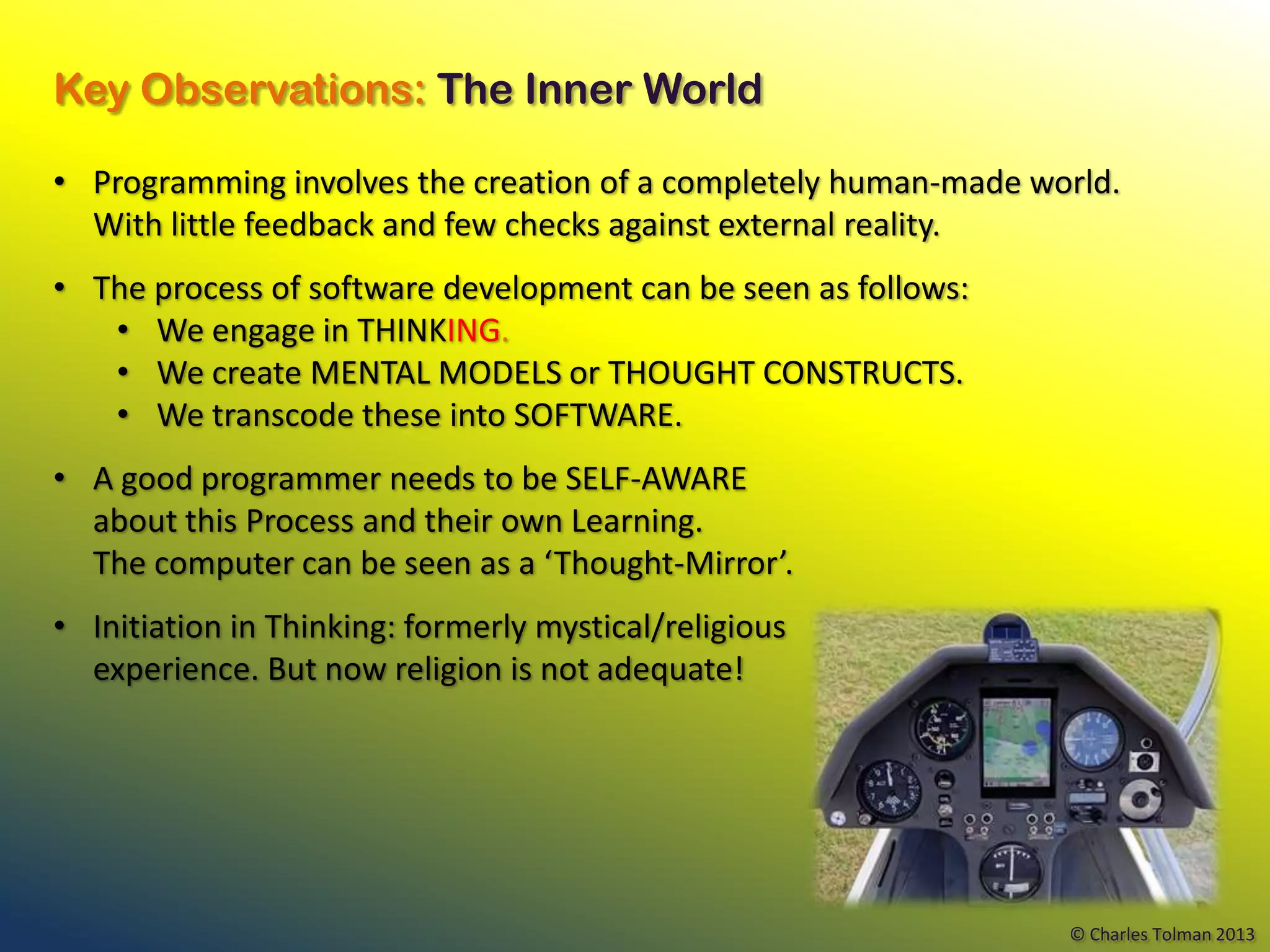
โ€ข Programming involves the creation of a completely human-made world.
  With little feedback and few checks against external reality.
โ€ข The process of software development can be seen as follows:
   โ€ข We engage in THINKING.
   โ€ข We create MENTAL MODELS or THOUGHT CONSTRUCTS.
   โ€ข We transcode these into SOFTWARE.
โ€ข A good programmer needs to be SELF-AWARE
  about this Process and their own Learning.
  The computer can be seen as a โ€˜Thought-Mirrorโ€™.
โ€ข Initiation in Thinking: formerly mystical/religious
  experience. But now religion is not adequate!


                                                                 ยฉ Charles Tolman 2013
Philosophical Interlude: Some Dudes From History

โ€ข Bacon       1561 โ€“ 1625
โ€ข Descartes   1596 โ€“ 1650
โ€ข Newton      1642 โ€“ 1727


โ€ข Goethe      1749 โ€“ 1832
โ€ข Gadamer     1900 โ€“ 2002


                                               ยฉ Charles Tolman 2013
Philosophical Interlude: Descartes : Dualism

โ€ข Descartes : 1596-1650
   โ€ข Cleared the decks to be sure of what we can really know.
      Cutting down to the minimum by getting away from the senses.
    โ€ข Split between Mind/Body.
    โ€ข But trying to fit in with the churchโ€™s religious ideas.
      e.g. 4th Law of Impact!
    โ€ข Subject vs Object
      res cogitans : Thinking โ€“ Mind/Soul : Active.
      res extensa : Extension โ€“ Body/Nature : Passive.


                                                                     ยฉ Charles Tolman 2013
Philosophical Interlude: Goethe : Delicate Empiricism

โ€ข Goethe : 1749-1832
   โ€ข Natural Scientist around at the time of the Industrial Revolution.
      Against the Baconian approach of the separation from natural world.
    โ€ข Focus on the phenomenon - not on abstract ideas.
      Warned of the danger of over-hypothesizingโ€ฆ
    โ€ข The need for a Delicate Empiricism during observation.
      The importance of Exact Sensorial Imagination - not ungrounded fantasy!
    โ€ข Rudolf Steiner (1861-1925) realised that the same methods could be used for
      thinking. i.e treating Thought as a Phenomenon in the same way.


                                                                            ยฉ Charles Tolman 2013
Philosophical Interlude: Phenomenology

โ€ข The process of โ€˜Coming into Beingโ€™, i.e. Appearance (verb), of a Thing.
  A very difficult concept for us to understand.
  But it is this idea that deals with, and heals, the destructive consequences of the
  Cartesian subject-object split.
โ€ข We need to understand that the Appearance and the Thing are ONE item.
โ€ข The primary enduring insight about brain function [McGilchrist]:
  RIGHT:     Immediacy of Lived Experience.                    Appearance
  LEFT:      Re-Presents what is Lived โ€“ in order to Know.     Thing
โ€ข We cannot continue to keep focusing on Results as primary.
  [Agile does have the beginnings of this focus on process
   - but primarily as an externalised idea.]


                                                                                ยฉ Charles Tolman 2013
Software: Knowledge or Preconceptions?

โ€ข The โ€˜Tracer Bulletsโ€™ experience of knowledge generation highlighted
  the dangers inherent in over-hypothesizing.
  It is too easy to become automatic and habituated in oneโ€™s thinking.
   [Workshop at OT2001 facilitated by Paul Simmons/Tom Ayerst]

โ€ข Just how aware are we about:
    โ€ข The limits of our own knowledge?
    โ€ข The process by which we expand our knowledge?
โ€ข How often do we jump to conclusions rather than carefully collect data
  or information โ€“ whether it be debugging or problem analysis?


โ€ข A DELICATELY EMPIRICAL method is a MUST HAVE
  when dealing with fault-finding or user requirements.


                                                                           ยฉ Charles Tolman 2013
Software: Imagination

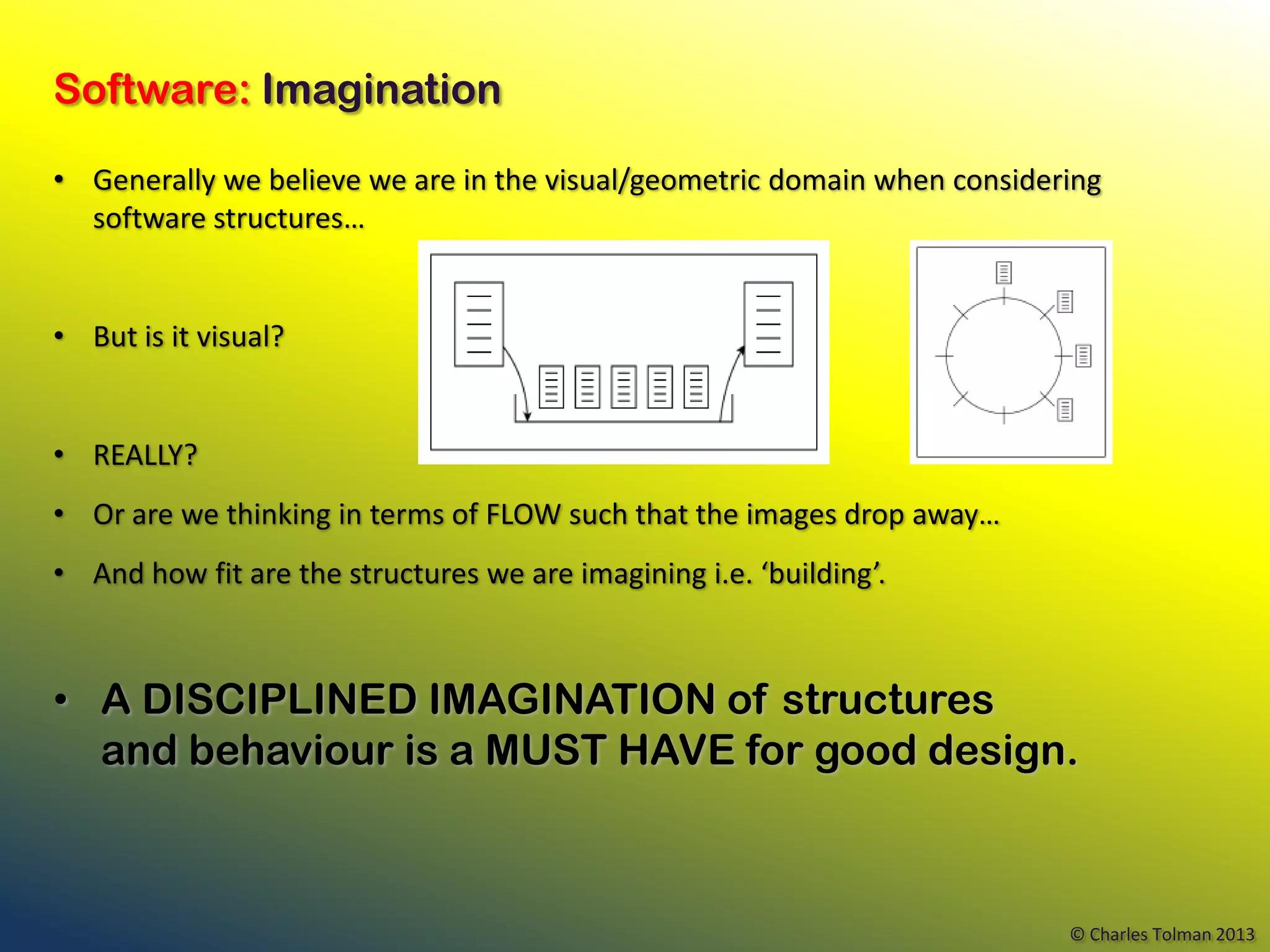
โ€ข Generally we believe we are in the visual/geometric domain when considering
  software structuresโ€ฆ


โ€ข But is it visual?


โ€ข REALLY?
โ€ข Or are we thinking in terms of FLOW such that the images drop awayโ€ฆ
โ€ข And how fit are the structures we are imagining i.e. โ€˜buildingโ€™.


โ€ข A DISCIPLINED IMAGINATION of structures
  and behaviour is a MUST HAVE for good design.


                                                                          ยฉ Charles Tolman 2013
Software: Christopher Alexander & Patterns

โ€ข Alexanderโ€™s comments about Patterns relate to PHYSICAL space.
  Software deals with a MENTAL space, yet his world-view is still relevant.
โ€ข There is a difference between True Liking and Apparent Liking.
  Alexander uses the concept of the Mirror of the Self test to tell the difference.
  True Liking is an art and a skill that needs developing.
โ€ข I agree with Jim Coplien that we need to โ€œrevisit the Alexandrian roots of Patternsโ€.
  Although Agile is based upon Alexanderโ€™s core values
  we have not properly embraced his idea of patterns.
  [See http://www.youtube.com/watch?v=VV4KXKa5ZdQ]

โ€ข If these ideas are developed we can get away from the
  subjectivity of โ€˜Beauty is in the eye of the beholderโ€™.
  But we need to put ourselves into the picture.

โ€ข We need to properly understand
  the perspective of PERSONAL &
  PROFESSIONAL DEVELOPMENT
  implicit in Alexanderโ€™s world-view.
                                                                                ยฉ Charles Tolman 2013
Cartesian Split or Goethean Unity?

This underlying dynamic of โ€˜The Splitโ€™ occurs in many places:
โ€ข Descartes:          Subject & Object.
โ€ข Brain Function:     Left & Right Hemisphere.
โ€ข Career:             Playful Child & Clever Adult.
โ€ข Problem-Solving: Abstract Idea & Grounded Perception.
โ€ข Judgement:          Perfection & Pragmatism.


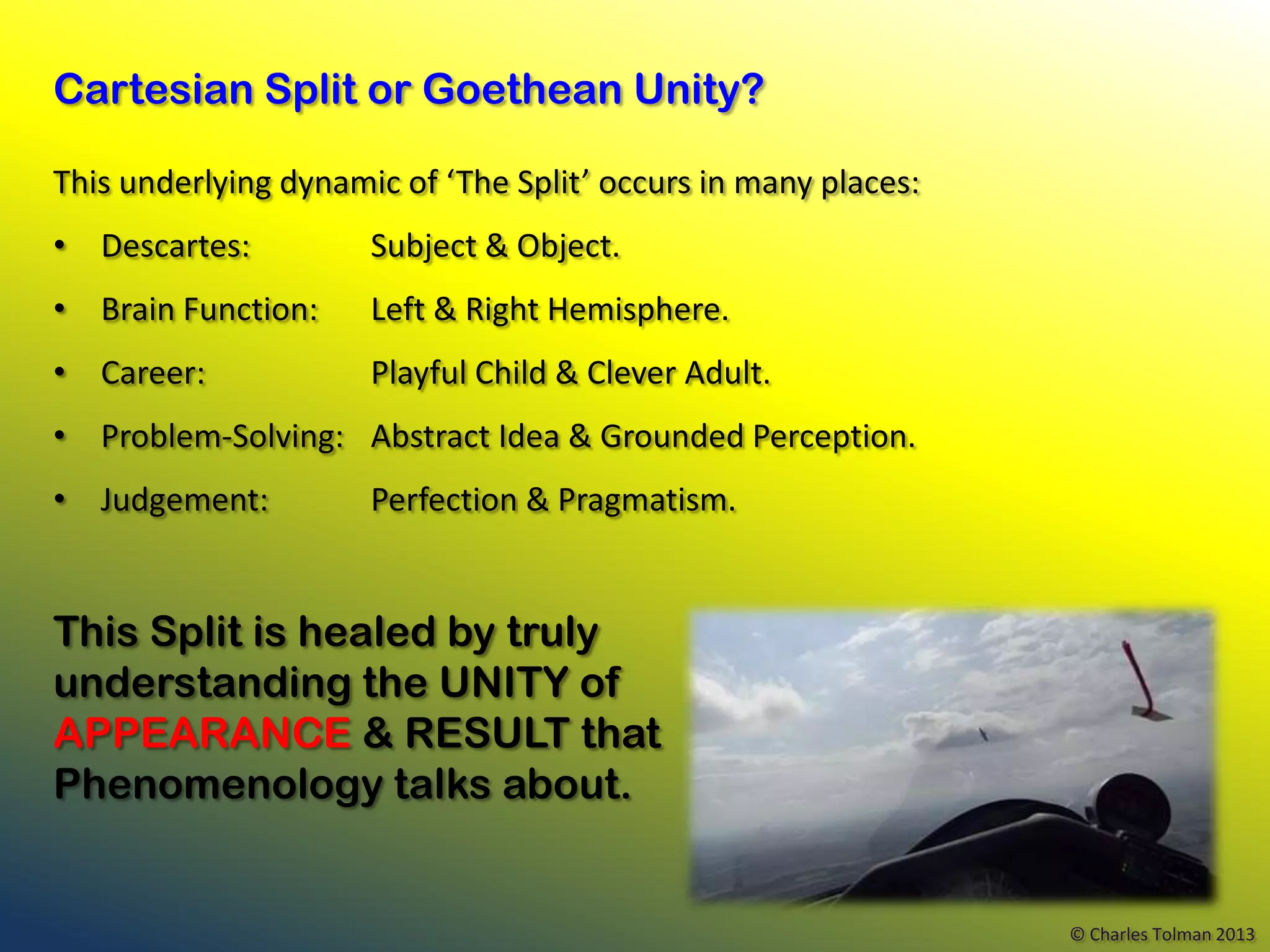
This Split is healed by truly
understanding the UNITY of
APPEARANCE & RESULT that
Phenomenology talks about.


                                                                ยฉ Charles Tolman 2013
A VISION FOR THE FUTURE : A CHOICE

We can either:
   A. BE UNCONSCIOUS:
      Allow humans to become harnessed to the technology & the economics,
      so they become just a more effective Software Development Tool
      within a mechanistic world-view.
OR
   B. BE CONSCIOUS:
      Re-assess our world view and work with both our personal and technical
      development so we can better shape technology towards human needs.


                                                                   ยฉ Charles Tolman 2013
Todo list if you want to take it further:

โ€ข READ:
  โ€˜Taking Appearance Seriouslyโ€™ by Henri Bortoft.
    Probably the best introduction to Goetheโ€™s method and Phenomenology
    and a very good historical overview of the pertinent philosophy.

โ€ข STUDY:
  โ€˜The Nature of Orderโ€™ by Christopher Alexander.
    A lot to read but a master work giving insight into Alexanderโ€™s world-view.

โ€ข READ:
  โ€˜The Master and His Emissaryโ€™ by Iain McGilchrist.
    Another excellent master work dealing with brain function.
โ€ข   DISCUSS:
    Get in touch!


                                                                                  ยฉ Charles Tolman 2013
Thank you

       Blog
charlestolman.com


     Email
   ct@acm.org
                    ยฉ Charles Tolman 2013

ACCU 2013 Exploration of Phenomenology of Software Development

  • 1.
    An Exploration ofthe Phenomenology of Software Development Charles Tolman ct@acm.org http://charlestolman.com ACCU 2013 12th April 2013 ยฉ Charles Tolman 2013
  • 2.
    Why Explore Phenomenology? โ€ขAnd just what has it got to do with Software Development? โ€ข There has been a major change in the form of tools, from physical to virtual. Dijkstra 1972: โ€œ[computers] have had a great impact on our society in their capacity as toolsโ€ฆ[this] will be but a rippleโ€ฆcompared with the much more profound influence they will have in their capacity of intellectual challenge which will be without precedence in the cultural history of mankind.โ€ โ€ข In tune with the underlying Cartesian, dualistic world-view, we focus primarily on results. Though necessary - there are significant negative consequences. โ€ข Phenomenology can lead us to a more integrated world-view which I believe this industry needs to be more balanced, and human, if it is to progress. ยฉ Charles Tolman 2013
  • 3.
    Talk Structure โ€ข Background : Novice โ€“ Journeyman โ€“ Old Grump. โ€ข Key Observations : Boundary Crossing. โ€ข Philosophy : Descartes โ€“ Goethe. โ€ข Software : Knowledge โ€“ Imagination โ€“ Patterns. โ€ข The Future? ยฉ Charles Tolman 2013
  • 4.
    Background: Novice โ€“The Early Years โ€ข Started out with Electronics at 17 back in 1974! Originally a shy young adolescent โ€˜nerdโ€™. Found comfort within the โ€˜inner worldโ€™ of thought. โ€ข Southampton University Electronic Engineering Degree in 1979. Moving swiftly from hardware to software developer in 1980. โ€ข Moved into the field of Media. TV/Film Editing systems. Worked with cool tech and was enticed by the faerie glamour of the toys! Implemented a multi-tasking scheduler in Assembler. ยฉ Charles Tolman 2013
  • 5.
    Background: Journeyman -The Dangerous Years! โ€ข Playing with more complex, generic, structures. Many of which donโ€™t get used. Focusing on the tools rather than the problem. Creating unnecessarily complex solutions. Letting the Idea overshadow the Problem Context. โ€ข Optimism & arrogance about what can be done, soon followed byโ€ฆ SHEER PANIC as the system gets away from you. โ€ข Lack of realisation that debugging requires more complex thought than coding. โ€ข Highlighting the fact that the programmer needs to become more self-aware in order to progress through this phase. ยฉ Charles Tolman 2013
  • 6.
    Background: The GrumpyOld Programmer โ€ข Very aware of the limitations of oneโ€™s thinking: One is too frequently WRONG! Again and Again and Again and Againโ€ฆ Particularly easy to see when debugging. โ€ข Maintenance becomes a priority, leading to: A drive towards simplicity/clarity/minimalism. Code can look like novice code but will use complexity when required. โ€ข This Appropriate Minimalism shows the wish to find the TRUE ESSENCE of a problem: Yet there is balanced judgement between Perfection and Pragmatism. ยฉ Charles Tolman 2013
  • 7.
    Key Observations: TheImportance of Energy โ€ข It takes a significant amount of mental energy to do this job. โ€ข We are making many decisions minute to minute. โ€ข The difference in the rate of progress when there is more energy. As a technical lead a significant concern is the level of ENERGY in a team. โ€ข Obvious points: but easily forgotten in the heat of trying to hit deadlines. ยฉ Charles Tolman 2013
  • 8.
    Key Observations: TheFoundation in Play โ€ข Many early programmers were amateur electronics/radio enthusiasts. Then the amateurs turned professional. โ€ข At the beginning of the PC โ€˜revolutionโ€™ many programs were games. โ€ข Transition from programming as PLAY to programming as ECONOMIC. But we forget this foundation in PLAY at our peril: โ€ข It is a fundamentally human activity that fosters resourcefulness. โ€ข It helps us to understand the world. โ€ข Of course there is always a need to balance: โ€ข Play & Economics โ€ข Quality & Utility โ€ข But the scales have tipped too far away from Play. ยฉ Charles Tolman 2013
  • 9.
    Key Observations: BoundaryCrossing โ€ข Tools/Technology are Amplifiers. Industrial Revolution: Devices to amplify physical capabilities. Information Technology: Devices to amplify thought. The need to be more awake, not less. โ€ข This is a transition of many people from EXTERNAL to INTERNAL problem solving. It is a significant shift and has many side-effects. THIS HAS LARGELY GONE UNNOTICED! โ€ข Robert Glassโ€™ Fact 13: โ€œThere is a disconnect between management and their programmers.โ€ โ€ข This means that we are not โ€˜justโ€™ programming and will need a larger view of the discipline in order for there to be constructive progress. ยฉ Charles Tolman 2013
  • 10.
    Key Observations: TheInner World โ€ข Programming involves the creation of a completely human-made world. With little feedback and few checks against external reality. โ€ข The process of software development can be seen as follows: โ€ข We engage in THINKING. โ€ข We create MENTAL MODELS or THOUGHT CONSTRUCTS. โ€ข We transcode these into SOFTWARE. โ€ข A good programmer needs to be SELF-AWARE about this Process and their own Learning. The computer can be seen as a โ€˜Thought-Mirrorโ€™. โ€ข Initiation in Thinking: formerly mystical/religious experience. But now religion is not adequate! ยฉ Charles Tolman 2013
  • 11.
    Philosophical Interlude: SomeDudes From History โ€ข Bacon 1561 โ€“ 1625 โ€ข Descartes 1596 โ€“ 1650 โ€ข Newton 1642 โ€“ 1727 โ€ข Goethe 1749 โ€“ 1832 โ€ข Gadamer 1900 โ€“ 2002 ยฉ Charles Tolman 2013
  • 12.
    Philosophical Interlude: Descartes: Dualism โ€ข Descartes : 1596-1650 โ€ข Cleared the decks to be sure of what we can really know. Cutting down to the minimum by getting away from the senses. โ€ข Split between Mind/Body. โ€ข But trying to fit in with the churchโ€™s religious ideas. e.g. 4th Law of Impact! โ€ข Subject vs Object res cogitans : Thinking โ€“ Mind/Soul : Active. res extensa : Extension โ€“ Body/Nature : Passive. ยฉ Charles Tolman 2013
  • 13.
    Philosophical Interlude: Goethe: Delicate Empiricism โ€ข Goethe : 1749-1832 โ€ข Natural Scientist around at the time of the Industrial Revolution. Against the Baconian approach of the separation from natural world. โ€ข Focus on the phenomenon - not on abstract ideas. Warned of the danger of over-hypothesizingโ€ฆ โ€ข The need for a Delicate Empiricism during observation. The importance of Exact Sensorial Imagination - not ungrounded fantasy! โ€ข Rudolf Steiner (1861-1925) realised that the same methods could be used for thinking. i.e treating Thought as a Phenomenon in the same way. ยฉ Charles Tolman 2013
  • 14.
    Philosophical Interlude: Phenomenology โ€ขThe process of โ€˜Coming into Beingโ€™, i.e. Appearance (verb), of a Thing. A very difficult concept for us to understand. But it is this idea that deals with, and heals, the destructive consequences of the Cartesian subject-object split. โ€ข We need to understand that the Appearance and the Thing are ONE item. โ€ข The primary enduring insight about brain function [McGilchrist]: RIGHT: Immediacy of Lived Experience. Appearance LEFT: Re-Presents what is Lived โ€“ in order to Know. Thing โ€ข We cannot continue to keep focusing on Results as primary. [Agile does have the beginnings of this focus on process - but primarily as an externalised idea.] ยฉ Charles Tolman 2013
  • 15.
    Software: Knowledge orPreconceptions? โ€ข The โ€˜Tracer Bulletsโ€™ experience of knowledge generation highlighted the dangers inherent in over-hypothesizing. It is too easy to become automatic and habituated in oneโ€™s thinking. [Workshop at OT2001 facilitated by Paul Simmons/Tom Ayerst] โ€ข Just how aware are we about: โ€ข The limits of our own knowledge? โ€ข The process by which we expand our knowledge? โ€ข How often do we jump to conclusions rather than carefully collect data or information โ€“ whether it be debugging or problem analysis? โ€ข A DELICATELY EMPIRICAL method is a MUST HAVE when dealing with fault-finding or user requirements. ยฉ Charles Tolman 2013
  • 16.
    Software: Imagination โ€ข Generallywe believe we are in the visual/geometric domain when considering software structuresโ€ฆ โ€ข But is it visual? โ€ข REALLY? โ€ข Or are we thinking in terms of FLOW such that the images drop awayโ€ฆ โ€ข And how fit are the structures we are imagining i.e. โ€˜buildingโ€™. โ€ข A DISCIPLINED IMAGINATION of structures and behaviour is a MUST HAVE for good design. ยฉ Charles Tolman 2013
  • 17.
    Software: Christopher Alexander& Patterns โ€ข Alexanderโ€™s comments about Patterns relate to PHYSICAL space. Software deals with a MENTAL space, yet his world-view is still relevant. โ€ข There is a difference between True Liking and Apparent Liking. Alexander uses the concept of the Mirror of the Self test to tell the difference. True Liking is an art and a skill that needs developing. โ€ข I agree with Jim Coplien that we need to โ€œrevisit the Alexandrian roots of Patternsโ€. Although Agile is based upon Alexanderโ€™s core values we have not properly embraced his idea of patterns. [See http://www.youtube.com/watch?v=VV4KXKa5ZdQ] โ€ข If these ideas are developed we can get away from the subjectivity of โ€˜Beauty is in the eye of the beholderโ€™. But we need to put ourselves into the picture. โ€ข We need to properly understand the perspective of PERSONAL & PROFESSIONAL DEVELOPMENT implicit in Alexanderโ€™s world-view. ยฉ Charles Tolman 2013
  • 18.
    Cartesian Split orGoethean Unity? This underlying dynamic of โ€˜The Splitโ€™ occurs in many places: โ€ข Descartes: Subject & Object. โ€ข Brain Function: Left & Right Hemisphere. โ€ข Career: Playful Child & Clever Adult. โ€ข Problem-Solving: Abstract Idea & Grounded Perception. โ€ข Judgement: Perfection & Pragmatism. This Split is healed by truly understanding the UNITY of APPEARANCE & RESULT that Phenomenology talks about. ยฉ Charles Tolman 2013
  • 19.
    A VISION FORTHE FUTURE : A CHOICE We can either: A. BE UNCONSCIOUS: Allow humans to become harnessed to the technology & the economics, so they become just a more effective Software Development Tool within a mechanistic world-view. OR B. BE CONSCIOUS: Re-assess our world view and work with both our personal and technical development so we can better shape technology towards human needs. ยฉ Charles Tolman 2013
  • 20.
    Todo list ifyou want to take it further: โ€ข READ: โ€˜Taking Appearance Seriouslyโ€™ by Henri Bortoft. Probably the best introduction to Goetheโ€™s method and Phenomenology and a very good historical overview of the pertinent philosophy. โ€ข STUDY: โ€˜The Nature of Orderโ€™ by Christopher Alexander. A lot to read but a master work giving insight into Alexanderโ€™s world-view. โ€ข READ: โ€˜The Master and His Emissaryโ€™ by Iain McGilchrist. Another excellent master work dealing with brain function. โ€ข DISCUSS: Get in touch! ยฉ Charles Tolman 2013
  • 21.
    Thank you Blog charlestolman.com Email ct@acm.org ยฉ Charles Tolman 2013

Editor's Notes

  • #3ย This is still a work in progress.
  • #6ย Idea/Perception: Christopher Alexander reference โ€œNature of Orderโ€ Book 2 p130 cf Le Corbusier etc.
  • #7ย Truth & Method extracts. Gadamer.P350:โ€œBeing experiencedโ€ does not consist in the fact that someone already knows everything and knows better than anyone else. Rather, the experienced person proves to be, on the contrary, someone who is radically undogmatic; who, because of the many experiences he has had and the knowledge he has drawn from them, is particularly well equipped to have new experiences and to learn from them.ย P351:The truly experienced person is one who has taken this to heart, who knows that he is master neither of time nor the future. The experienced man knows that all foresight is limited and all plans uncertain. In him is realised the true value of experience.
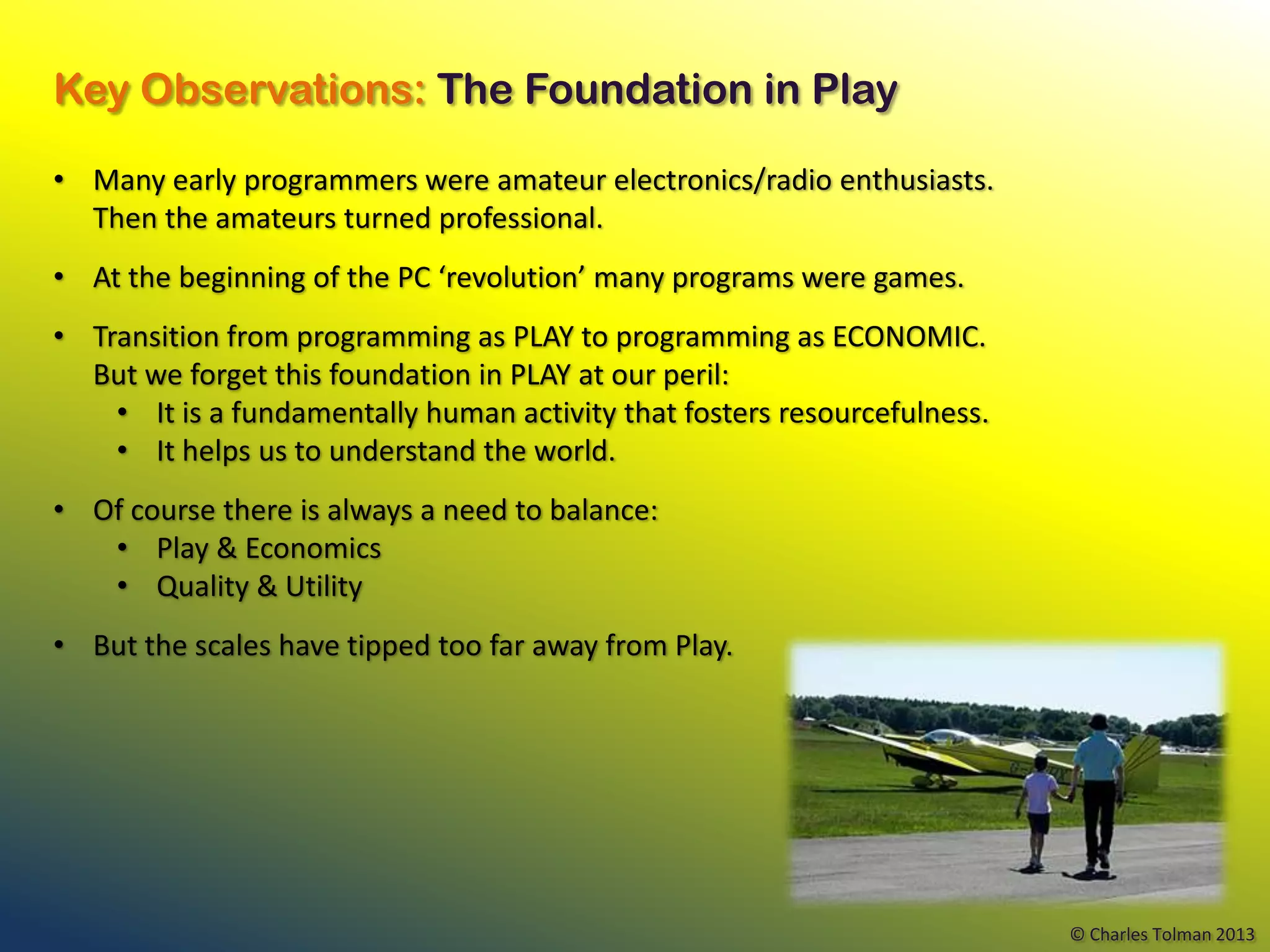
  • #9ย SergioPellis notes about self-directed play.Picture encapsulates how I wish to be remembered โ€“ sharing the playing of flying!
  • #10ย THIS IS A KEY SLIDE!Dijkstra 1972:Automatic computers have now been with us for a quarter of a century. They have had a great impact on our society in their capacity of tools, but in that capacity their influence will be but a ripple on the surface of our culture, compared with the much more profound influence they will have in their capacity of intellectual challenge without precedent in the cultural history of mankind.Rober Glassโ€™ Fact 13:419% Over Budget.193% Over Schedule - 27 months vs estimate of 14130% Over Size for SW, 800% Over Size for FirmwareSuccessfully completed.Did what it was supposed to do (control a medical instrument).Fulfilled its requirement of "no postrelease software defects.โ€
  • #11ย THIS IS A KEY SLIDE!We run THOUGHT networks in our heads.Attitude is as important as technical ability โ€“ if not more so.Cannot take ideas from Eastern traditions as-is.East and West are different!
  • #12ย Please note that I am not an academic philosopher!
  • #14ย Psychologists call this process where we go from sensory experience direct toabstract generalisation without thinking, โ€˜automatisationโ€™ or โ€˜habituationโ€™.
  • #15ย McGilchrist:LEFT:Static, Isolated, Fixed, Decontextualised, Abstract -> Clarity, Denotative.Deals with Closed Systems, Perfection.RIGHT:Individual, Changing, Evolving, Interconnected, Implicit, Incarnate, Living.Never fully Graspable, Never Perfectly known.ย Epistemologically:When we look at something we do not understand or have the concepts to fit, we take some part and SPLIT it out from the context (Cartesian), but then we know it only when we reunite the concept with the percept (Steiner).There is no difference in the external world but now we have knowledge about what we are looking at.
  • #18ย Nature of Order: Book1p342/3 Liking.p453 Appendix 3 Cognitive Difficulty in Seeing WholenessAlexander seemed Bemused at OOPSLA 96.At Stanford, Sceptical about prevailing perspectives in the software industry.We have focused too much on Results rather than Inner Process
  • #20ย Plan A is the hired gun protocol.Time for Plan B.A parting thought:Lest we think that when we talk about technology we are only considering software and hardware:The Hungarian psychology professor MihalyCsikszentmihalyi (author of Flow) considers that human culture can be seen as a technology for mediating interactions.We are NOT just talking about programmingโ€ฆ
  • #21ย References:Christopher Alexander : The Nature of Order.Henri Bortoft : Taking Appearance Seriously.Robert Glass : Facts and Fallacies of Software Development.Iain McGilchrist : The Master and His Emissary.