USINGTECHNOLOGYTOOLS
TO UNDERSTAND COMPLEX
PHENOMENA
FOR GLOBAL CITIZENSHIP
VishnuteerthAgnihotri
TECH 2019,Vishakhapatnam, Dec 11, 2019
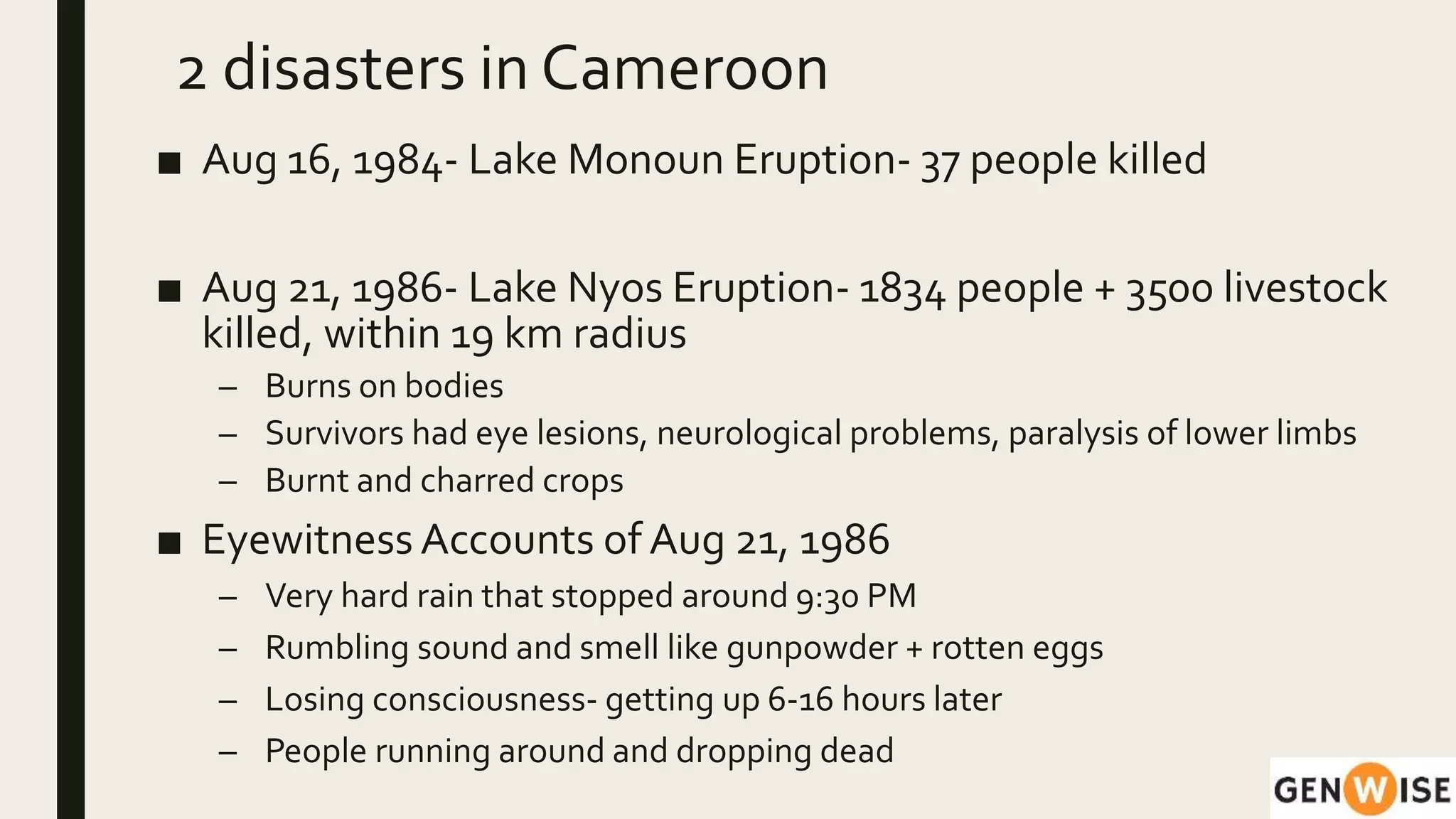
2 disasters in Cameroon
■ Aug 16, 1984- Lake Monoun Eruption- 37 people killed
■ Aug 21, 1986- Lake Nyos Eruption- 1834 people + 3500 livestock
killed, within 19 km radius
– Burns on bodies
– Survivors had eye lesions, neurological problems, paralysis of lower limbs
– Burnt and charred crops
■ Eyewitness Accounts of Aug 21, 1986
– Very hard rain that stopped around 9:30 PM
– Rumbling sound and smell like gunpowder + rotten eggs
– Losing consciousness- getting up 6-16 hours later
– People running around and dropping dead
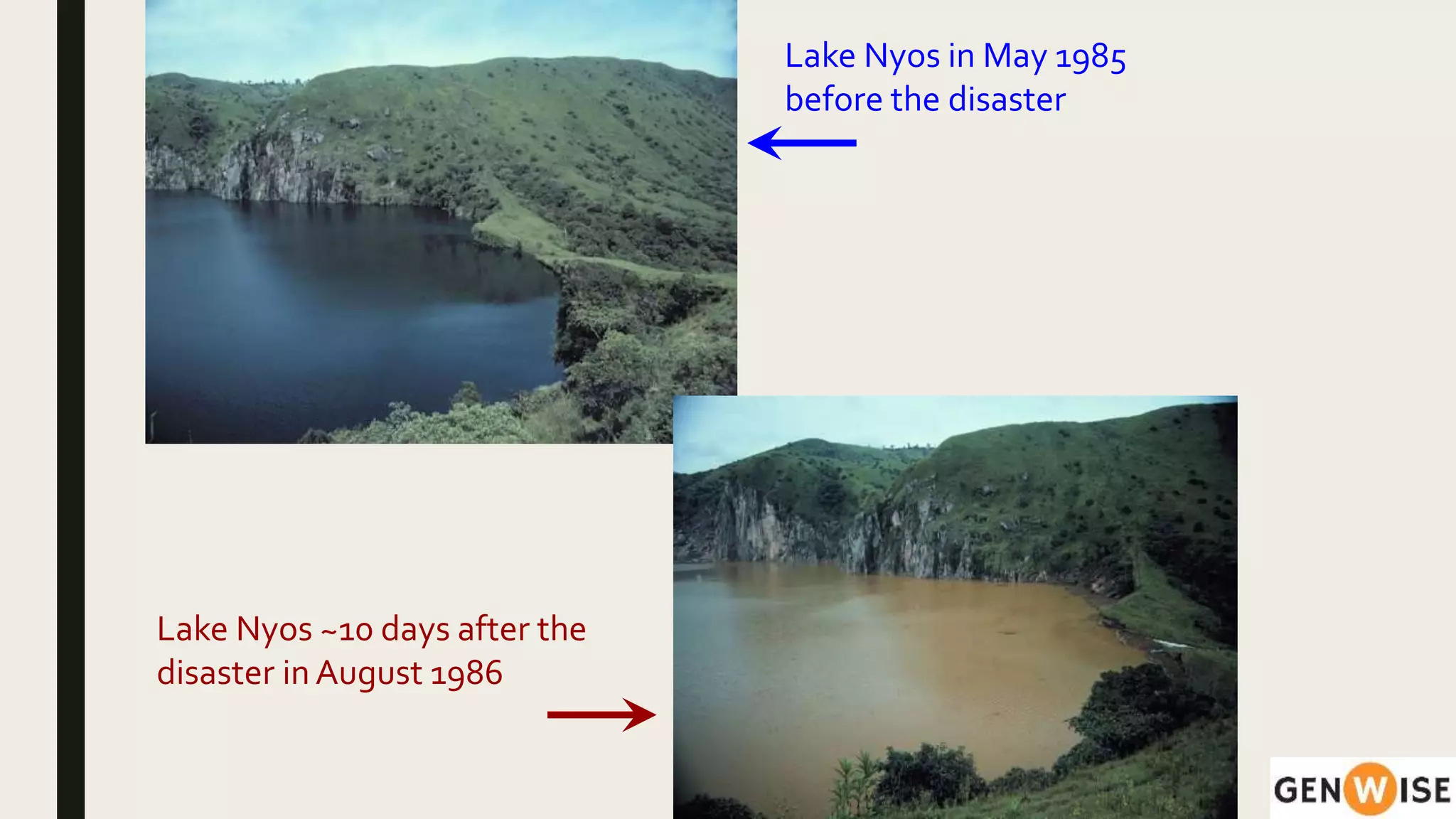
Lake Nyos in May 1985
before the disaster
Lake Nyos ~10 days after the
disaster in August 1986
Possible Causes?
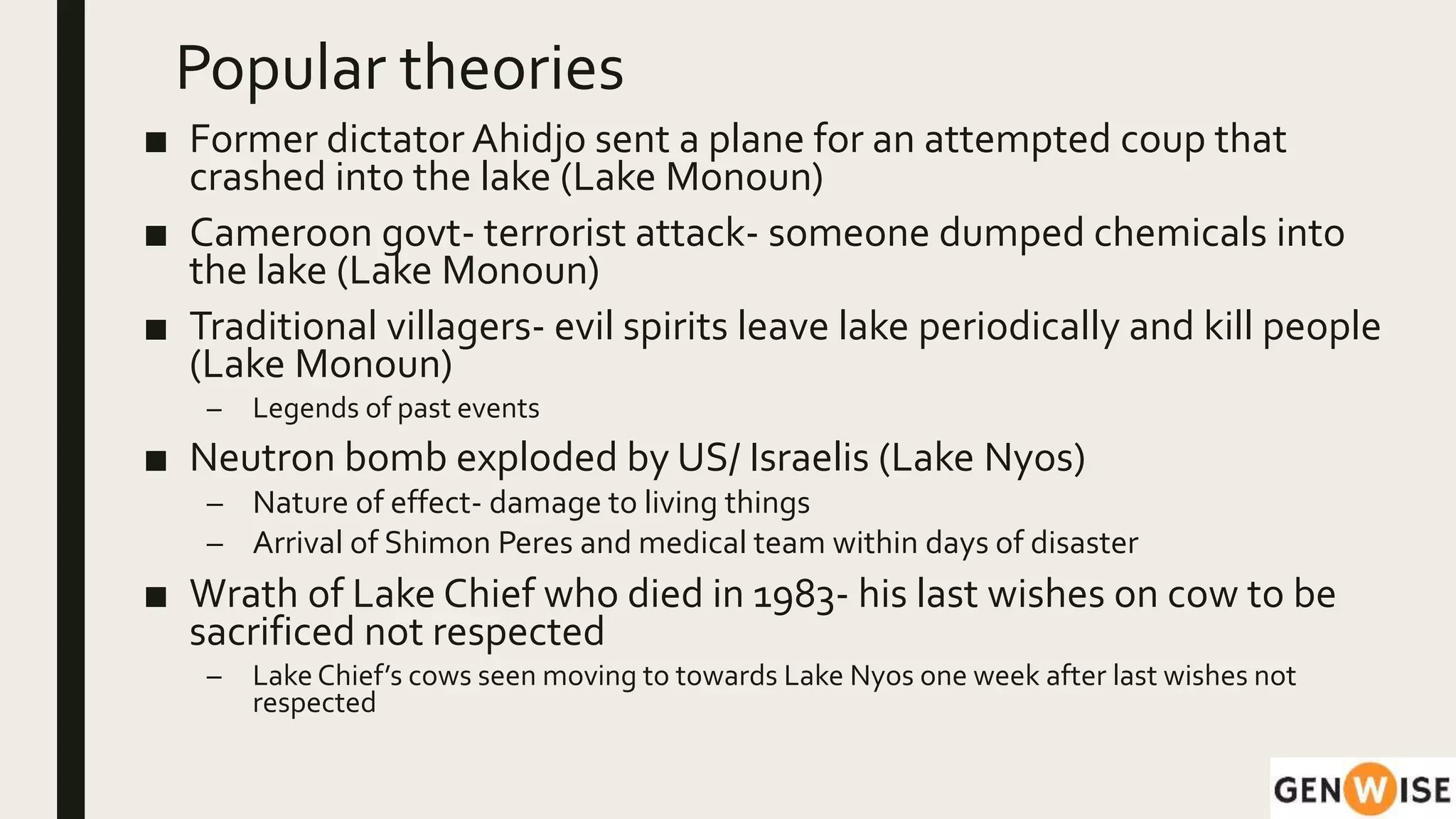
Popular theories
■ Former dictator Ahidjo sent a plane for an attempted coup that
crashed into the lake (Lake Monoun)
■ Cameroon govt- terrorist attack- someone dumped chemicals into
the lake (Lake Monoun)
■ Traditional villagers- evil spirits leave lake periodically and kill people
(Lake Monoun)
– Legends of past events
■ Neutron bomb exploded by US/ Israelis (Lake Nyos)
– Nature of effect- damage to living things
– Arrival of Shimon Peres and medical team within days of disaster
■ Wrath of Lake Chief who died in 1983- his last wishes on cow to be
sacrificed not respected
– Lake Chief’s cows seen moving to towards Lake Nyos one week after last wishes not
respected
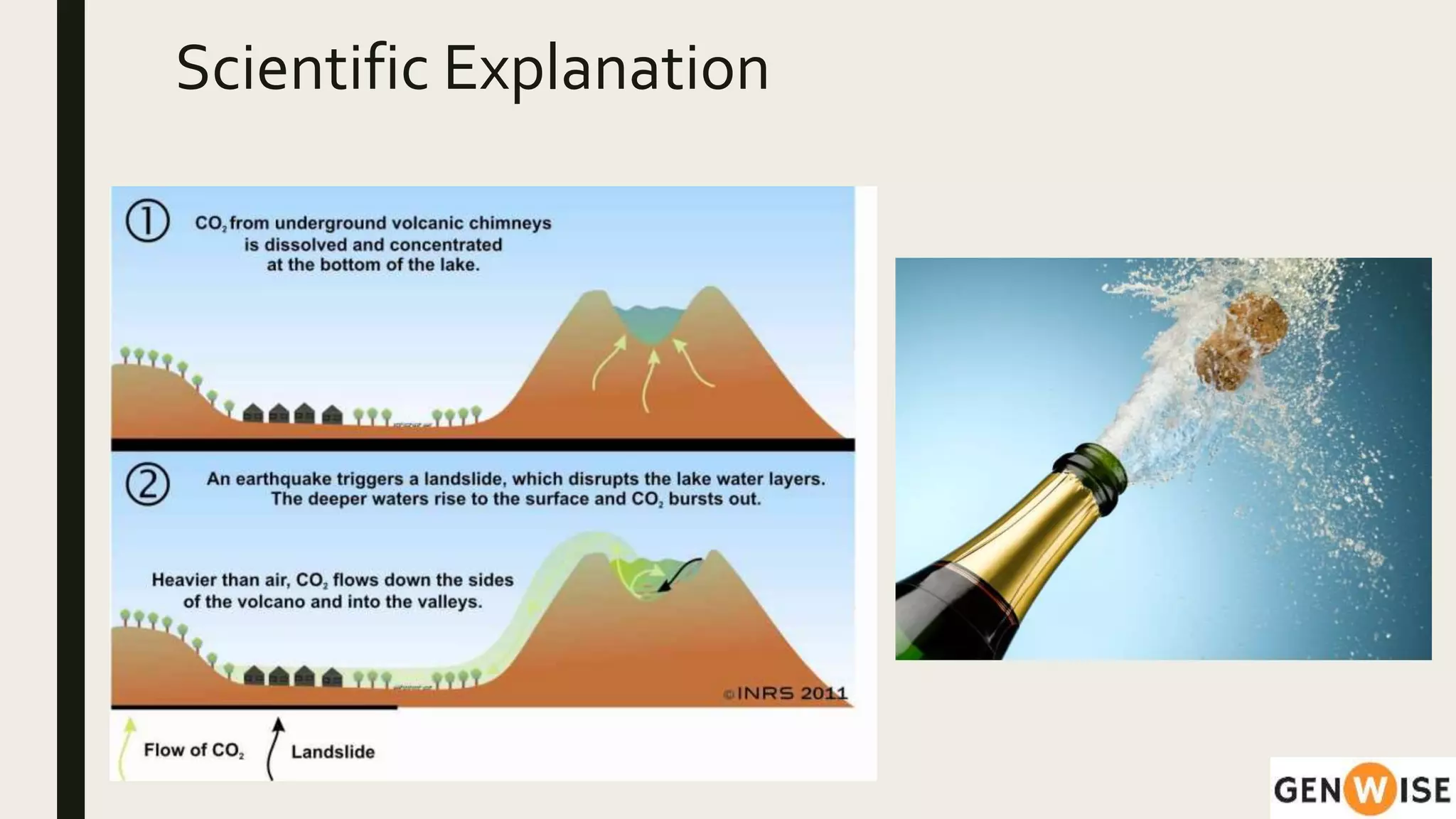
Scientific Explanation
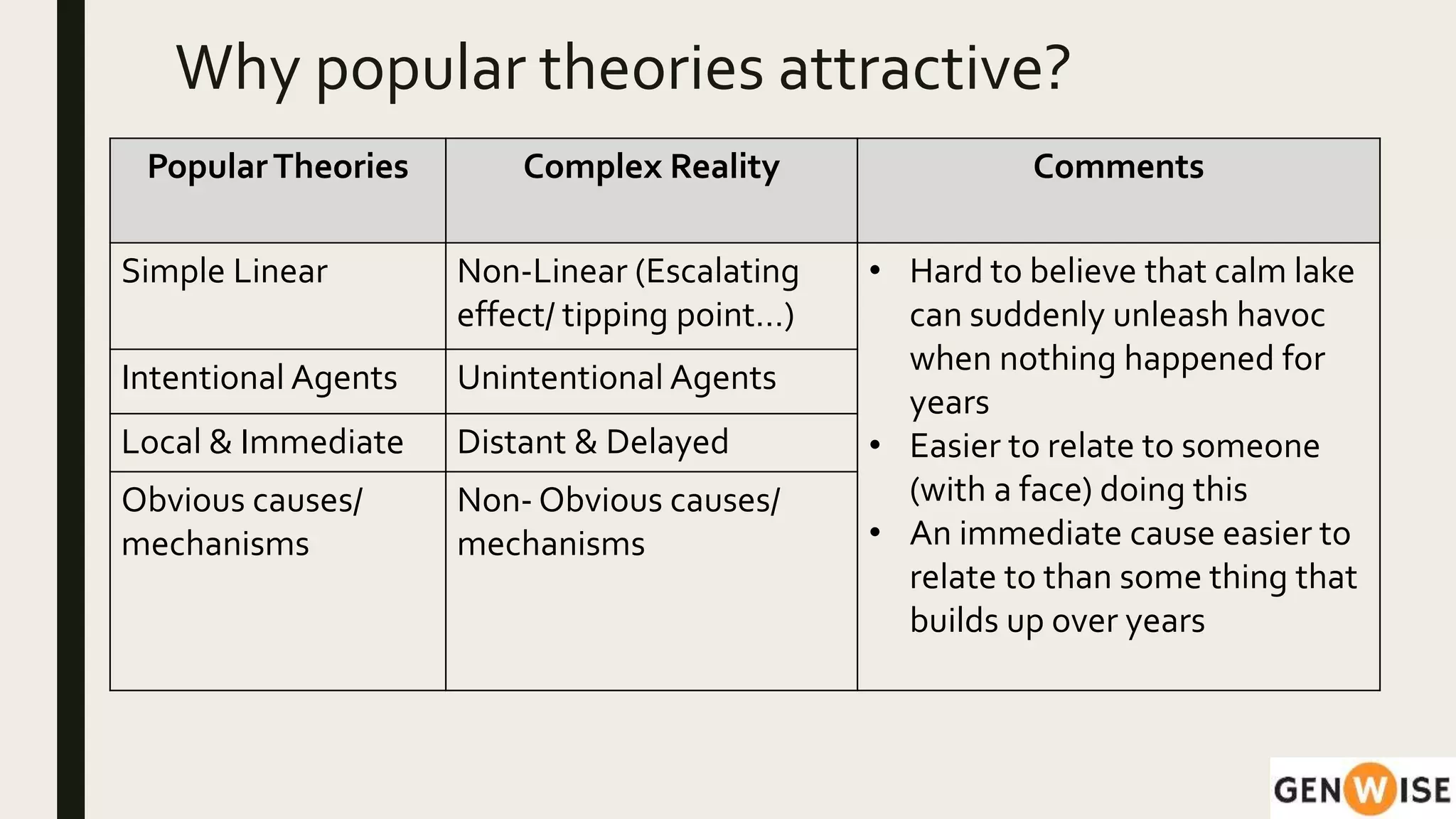
Why popular theories attractive?
PopularTheories Complex Reality Comments
Simple Linear Non-Linear (Escalating
effect/ tipping point…)
• Hard to believe that calm lake
can suddenly unleash havoc
when nothing happened for
years
• Easier to relate to someone
(with a face) doing this
• An immediate cause easier to
relate to than some thing that
builds up over years
Intentional Agents Unintentional Agents
Local & Immediate Distant & Delayed
Obvious causes/
mechanisms
Non- Obvious causes/
mechanisms
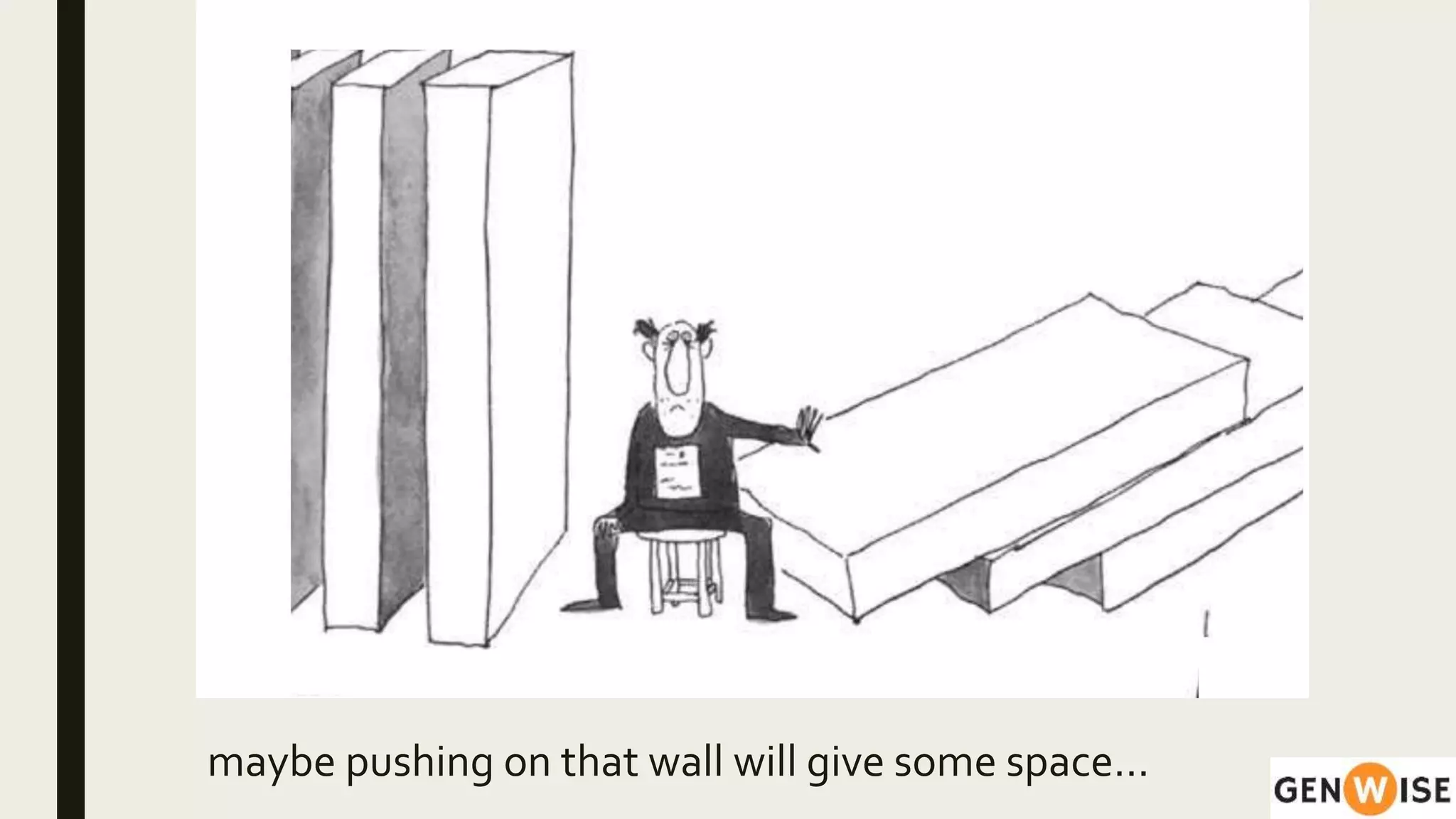
maybe pushing on that wall will give some space…
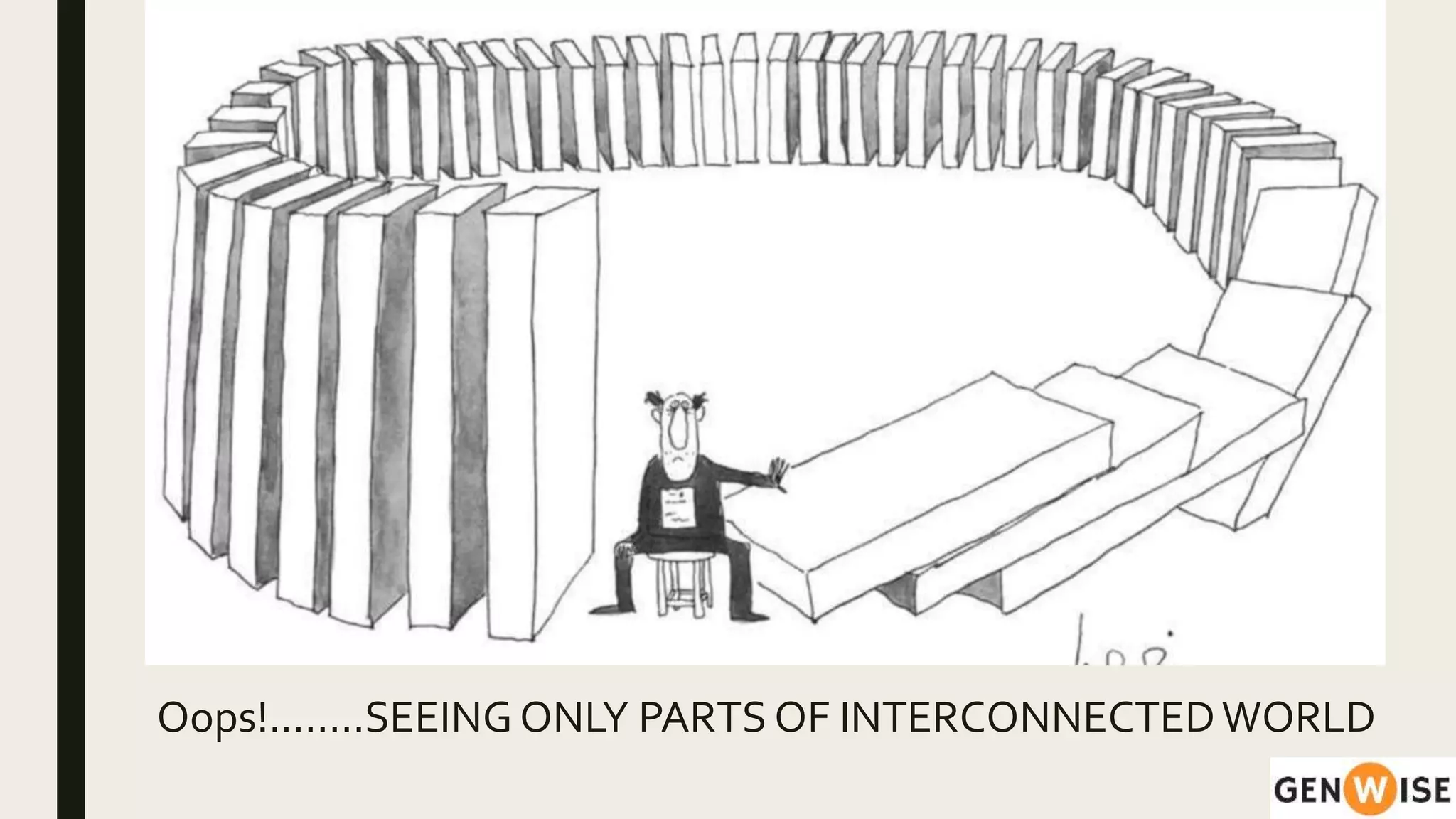
Oops!........SEEINGONLY PARTS OF INTERCONNECTEDWORLD
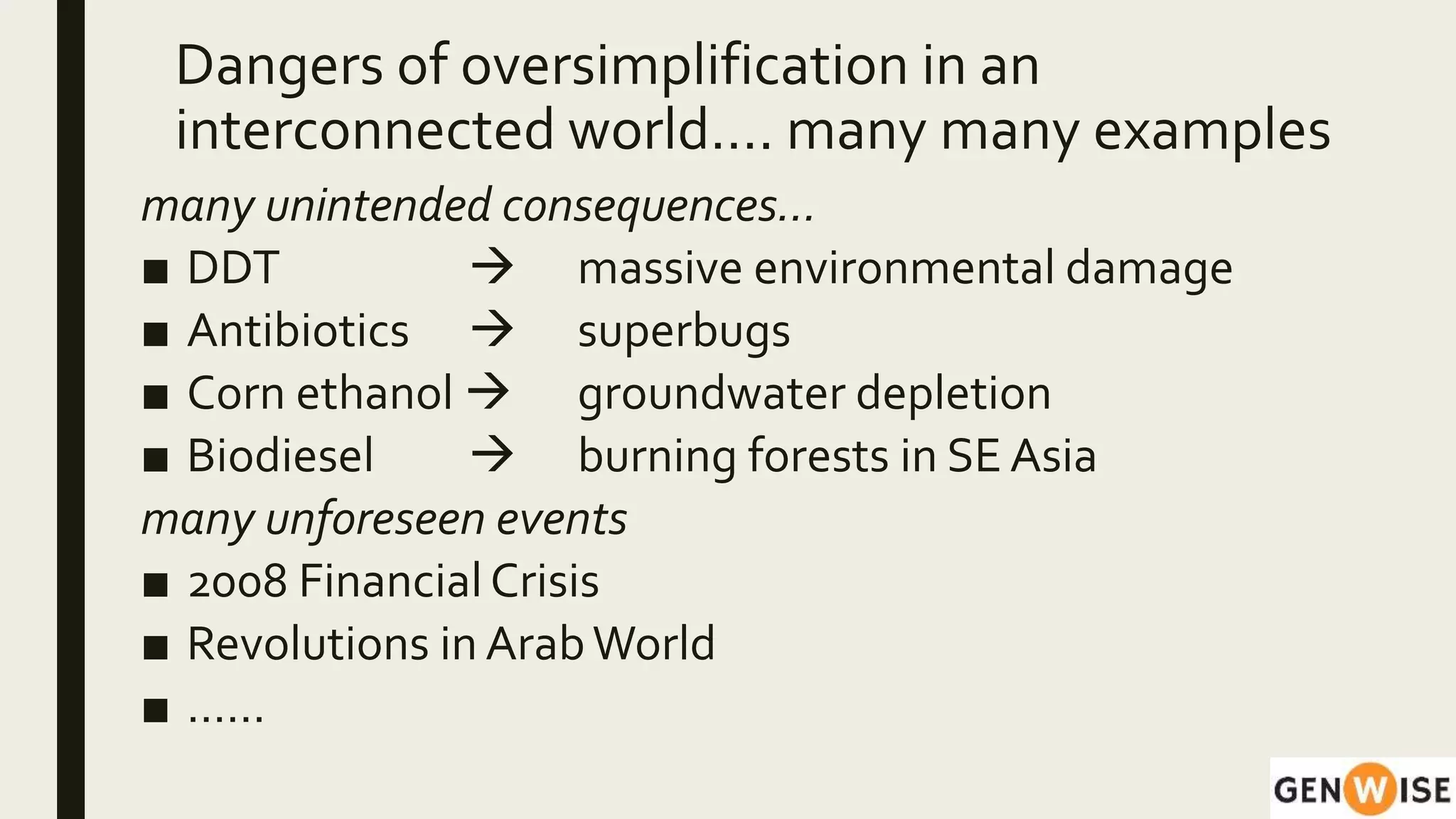
Dangers of oversimplification in an
interconnected world…. many many examples
many unintended consequences…
■ DDT  massive environmental damage
■ Antibiotics  superbugs
■ Corn ethanol  groundwater depletion
■ Biodiesel  burning forests in SE Asia
many unforeseen events
■ 2008 Financial Crisis
■ Revolutions in ArabWorld
■ ……
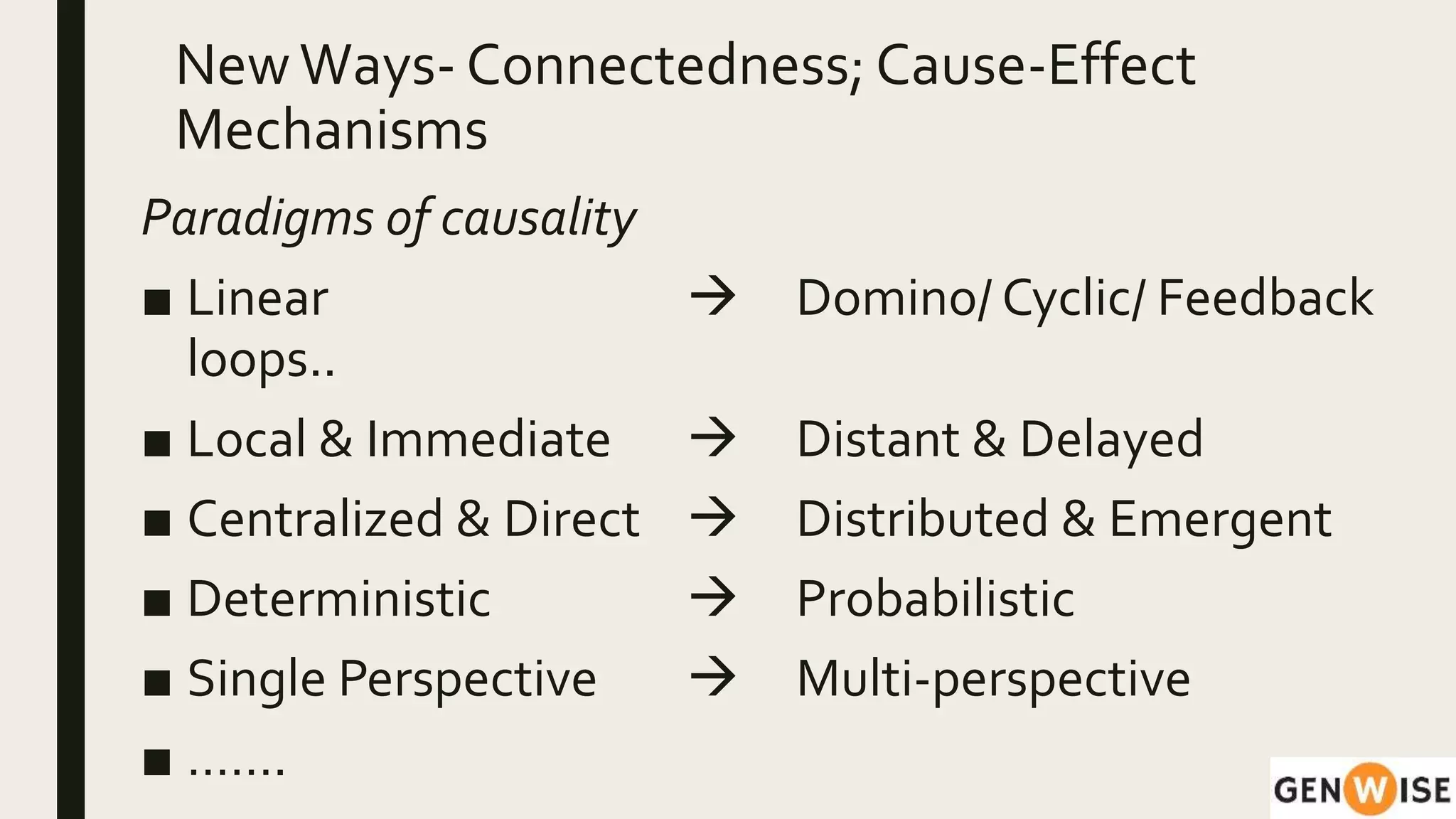
NewWays- Connectedness; Cause-Effect
Mechanisms
Paradigms of causality
■ Linear  Domino/ Cyclic/ Feedback
loops..
■ Local & Immediate  Distant & Delayed
■ Centralized & Direct  Distributed & Emergent
■ Deterministic  Probabilistic
■ Single Perspective  Multi-perspective
■ …….
Key Messages
1. We have a tendency to think in simple/ disconnected
terms but reality is often far more complex/ connected
2. Complexity needs to be appreciated for the sake of
humanity’s future
3. Simulation tools have the power to educate our intuition
for complexity
4. These tools, along with contextual understanding and
experiences help in responding more effectively to
situations.The ‘habits of mind’ developed can be
applied across domains.
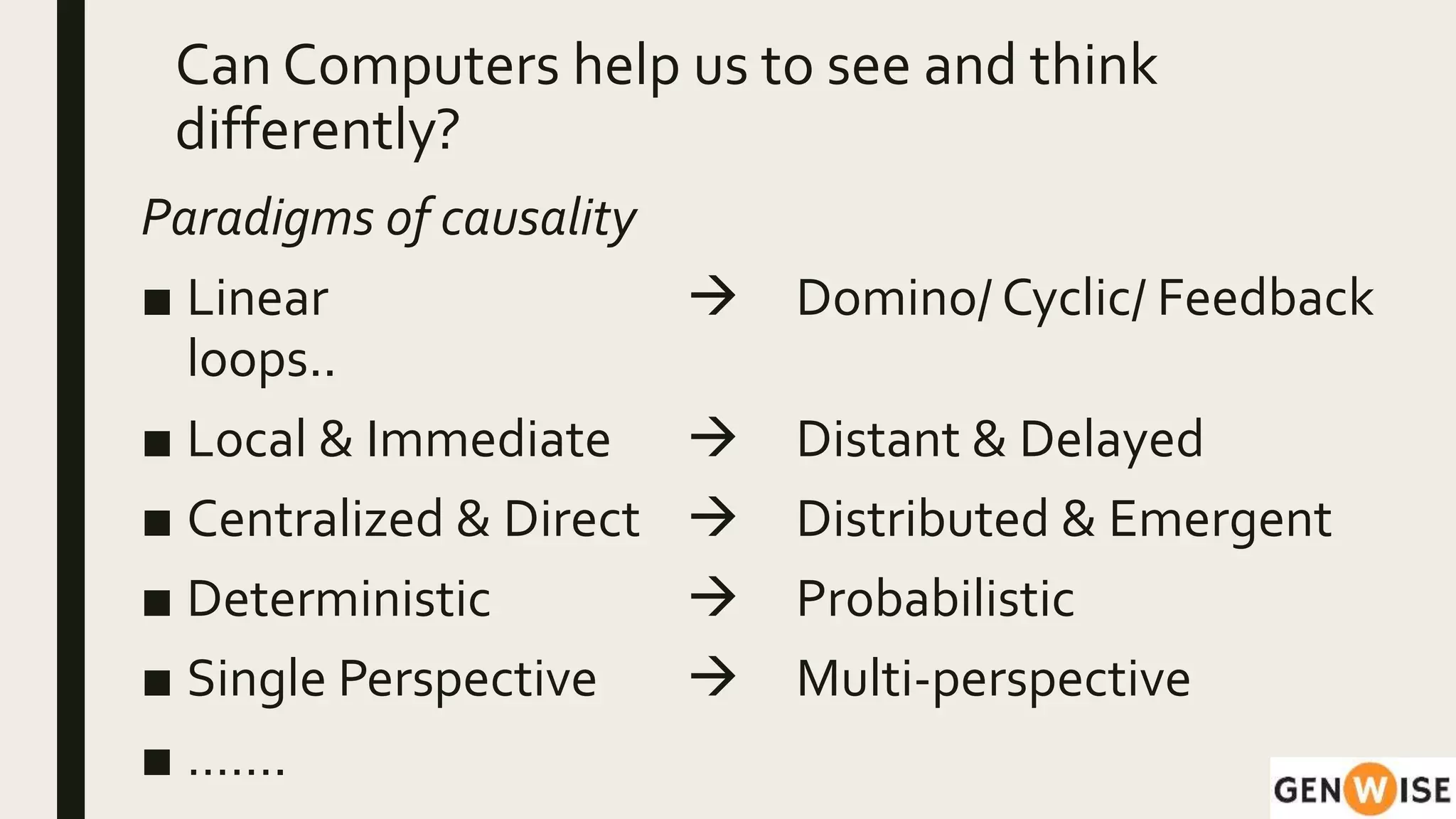
Can Computers help us to see and think
differently?
Paradigms of causality
■ Linear  Domino/ Cyclic/ Feedback
loops..
■ Local & Immediate  Distant & Delayed
■ Centralized & Direct  Distributed & Emergent
■ Deterministic  Probabilistic
■ Single Perspective  Multi-perspective
■ …….
Extending human intelligence using computers
■ The medium is an extension of the mind- text literacy
revolutionized human thinking; Arabic numerals did
■ Using a computer can be similarly revolutionary (this
is NOT how computers are normally used)
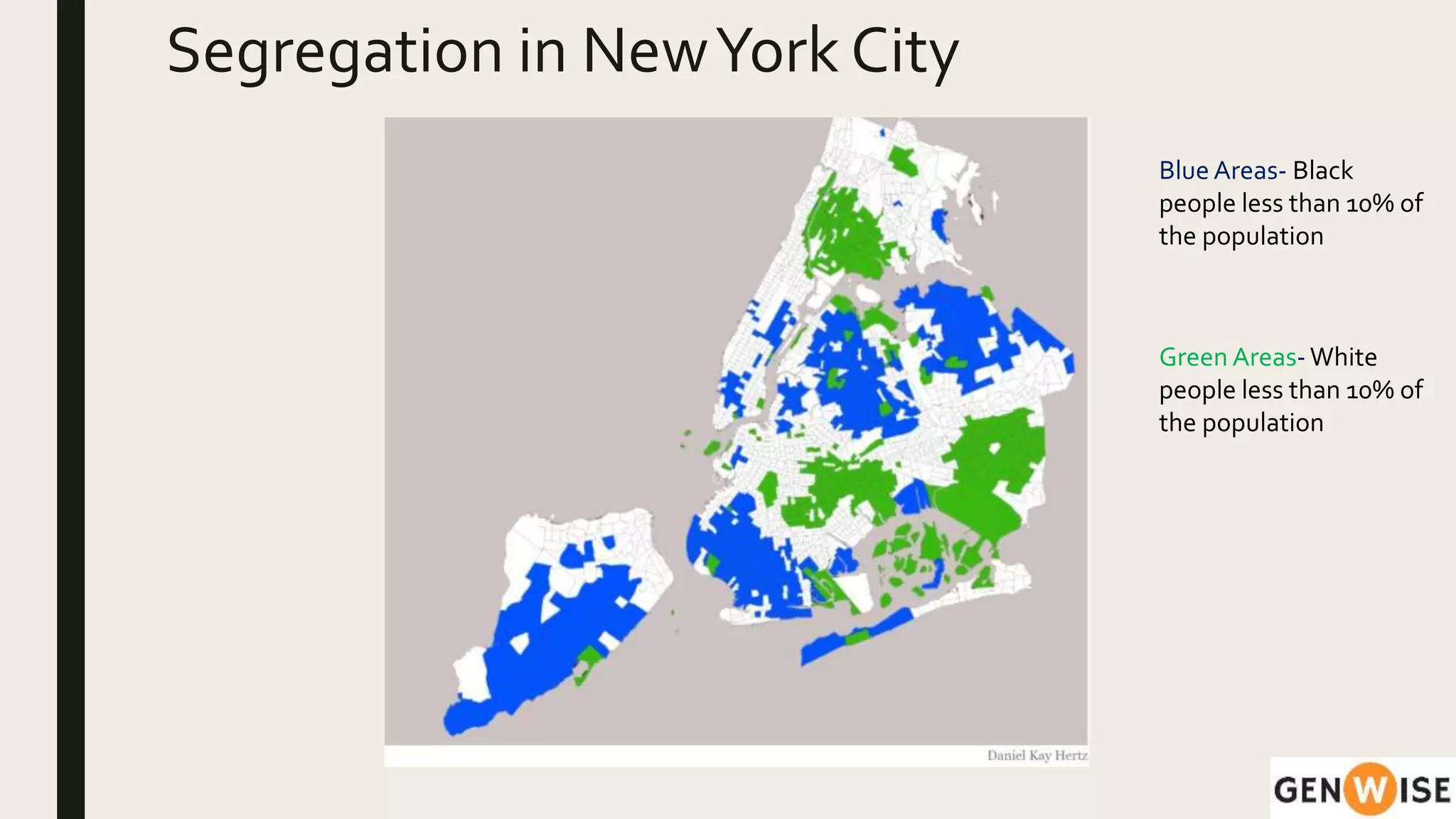
Segregation in NewYork City
Blue Areas- Black
people less than 10% of
the population
Green Areas-White
people less than 10% of
the population
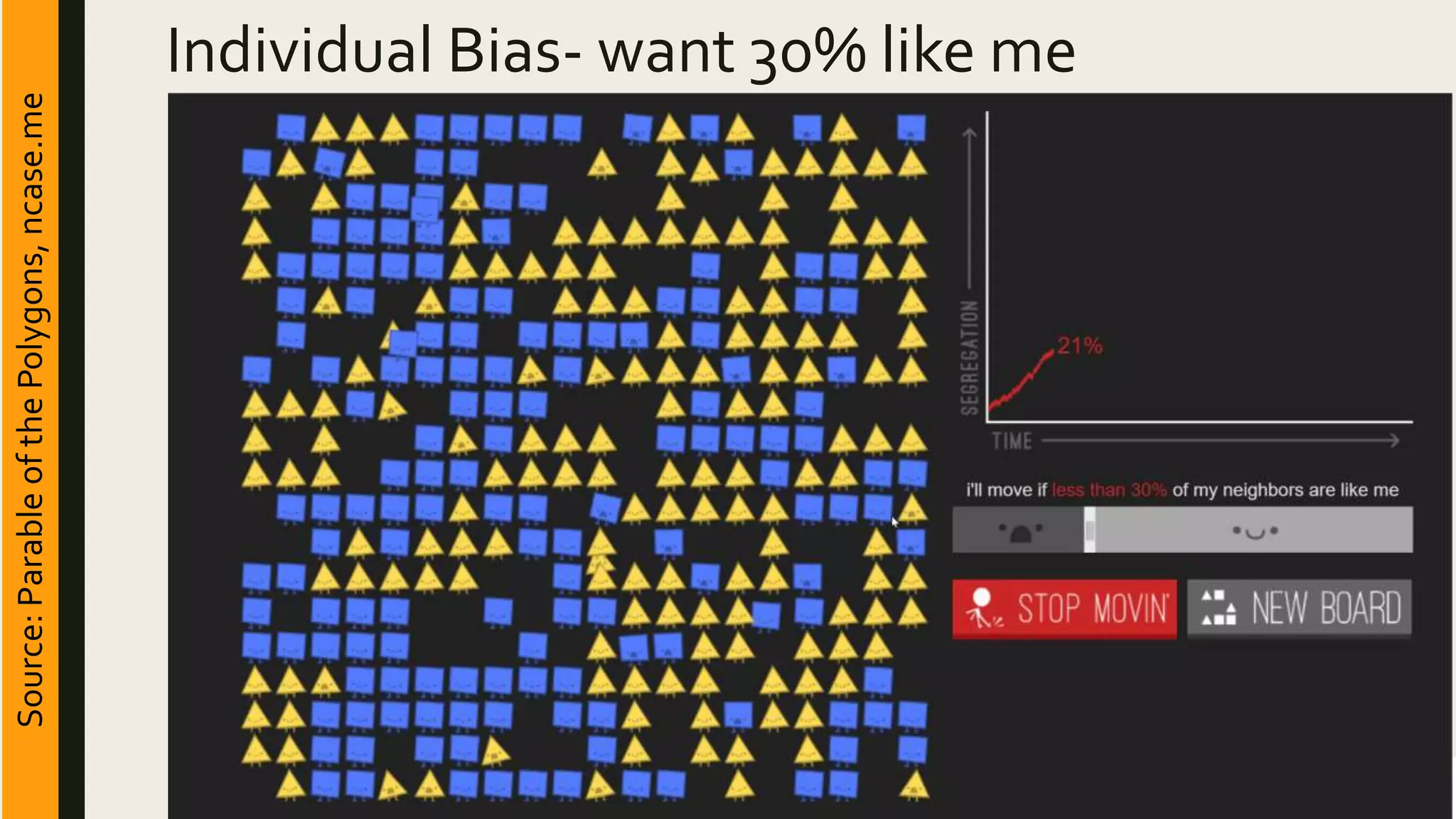
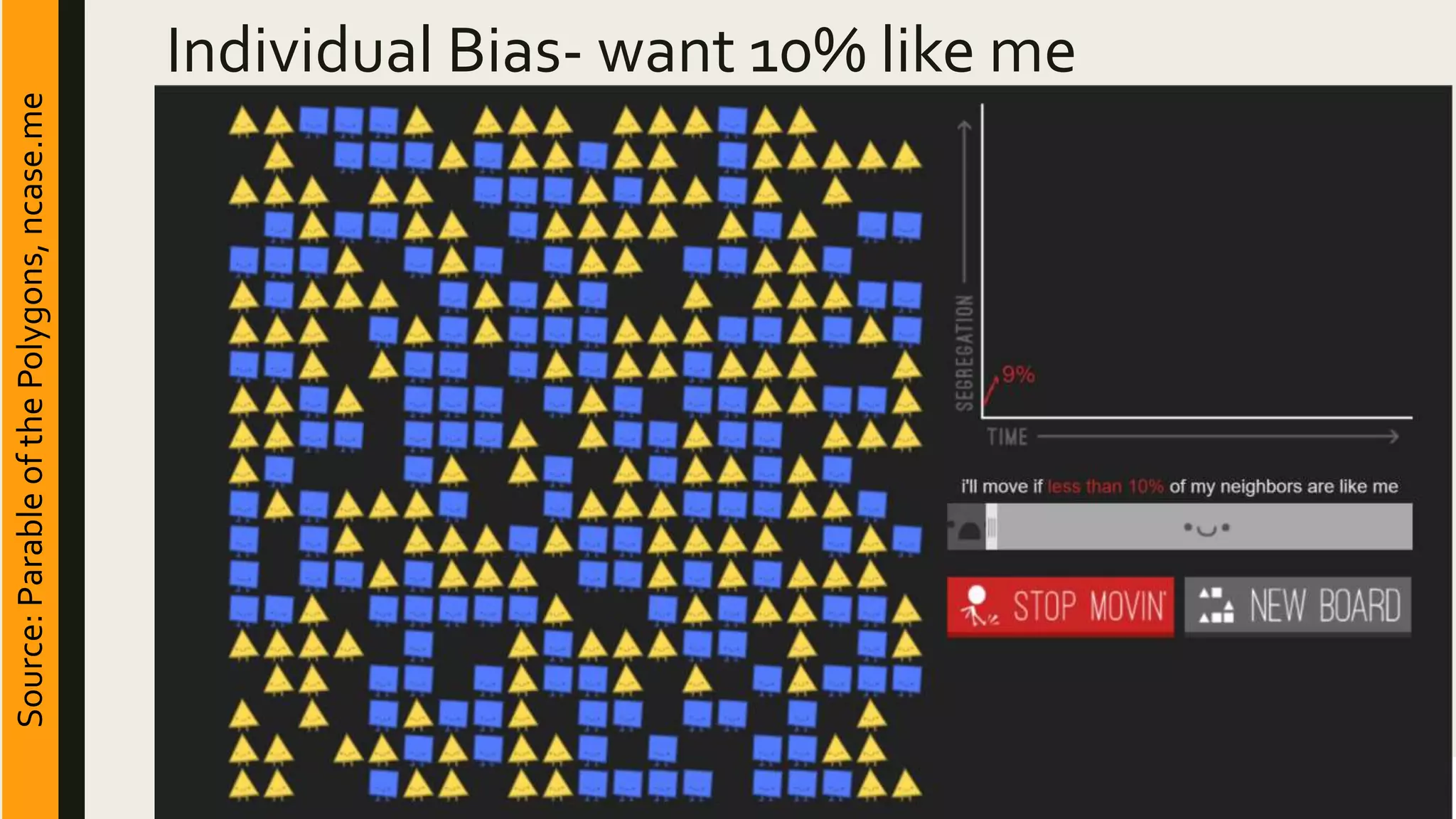
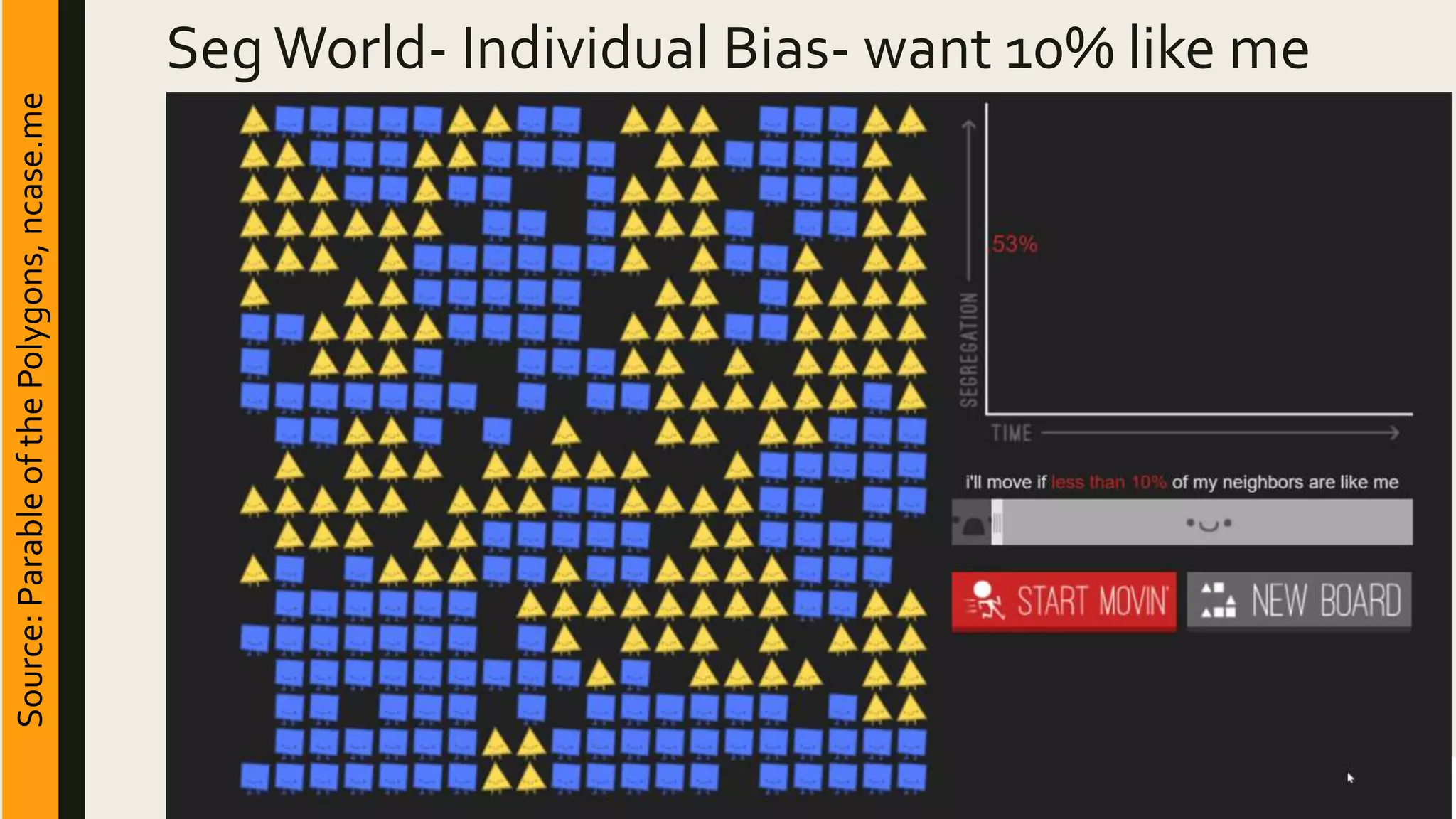
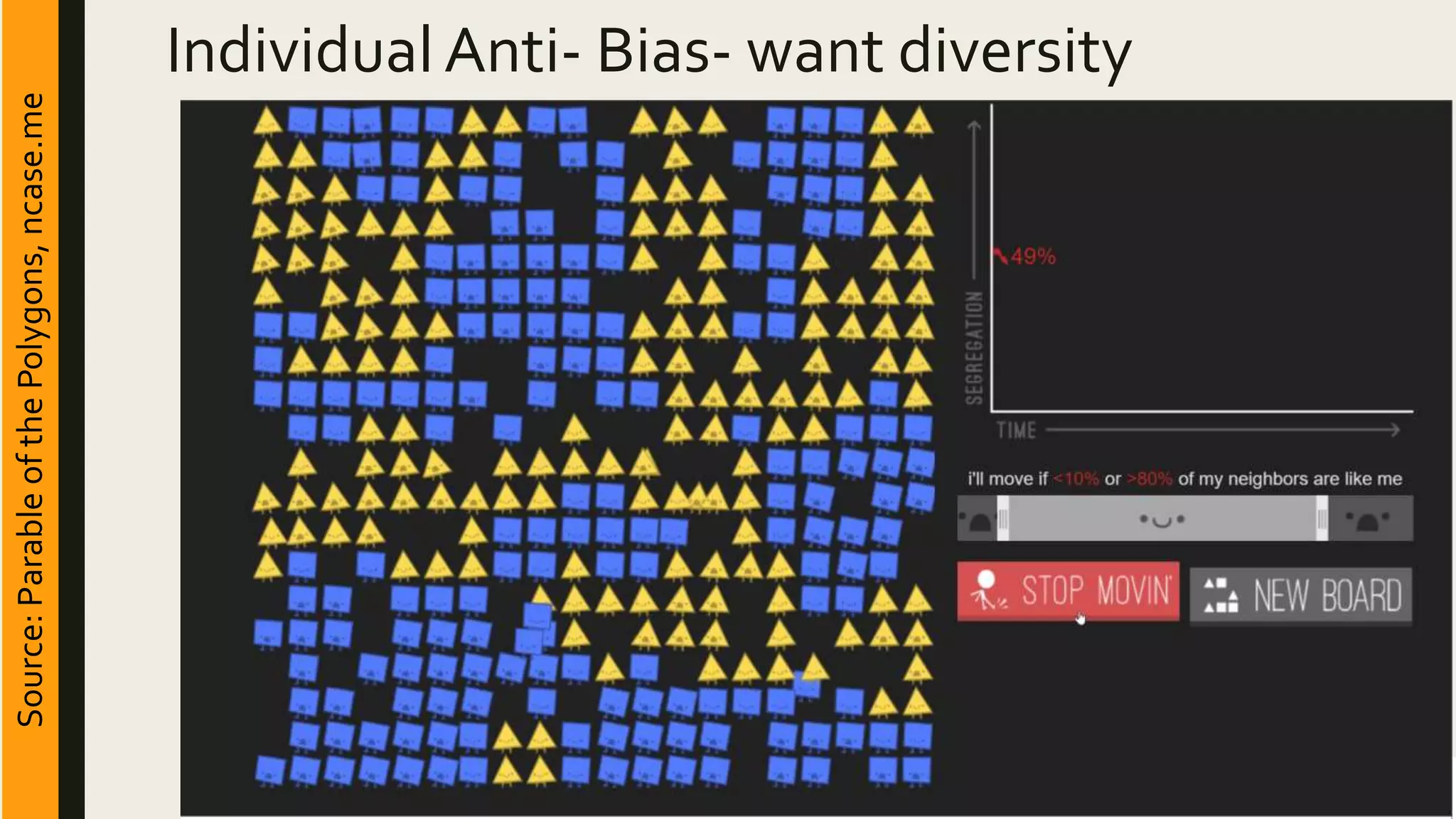
■ Are people biased?
■ How much bias would lead to high segregation?
■ What if each person was ok with 70% of
neighborhood being unlike him/ her?
Why such high segregation?
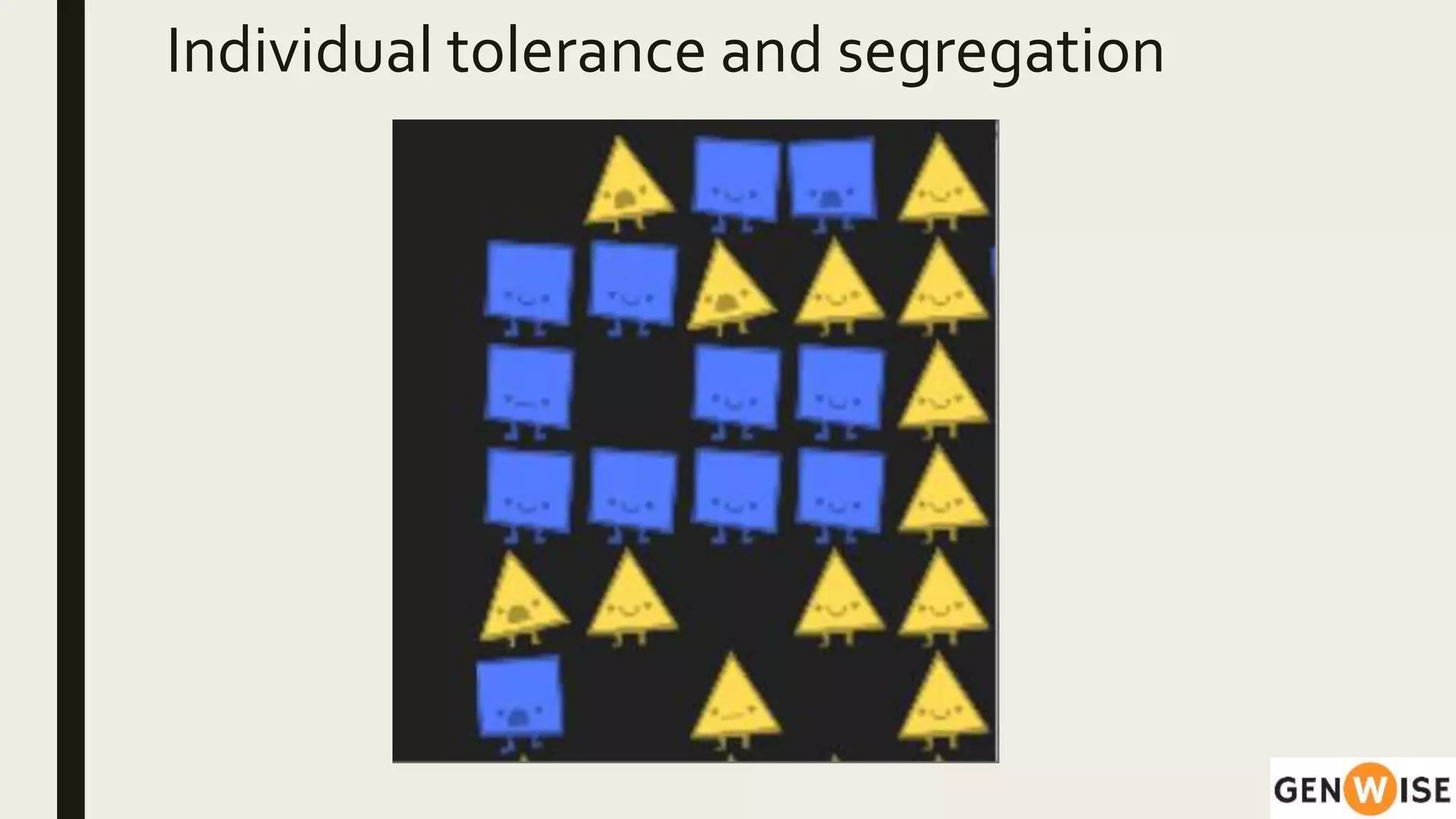
Individual tolerance and segregation
Individual Bias- want 30% like meSource:ParableofthePolygons,ncase.me
Individual Bias- want 10% like meSource:ParableofthePolygons,ncase.me
SegWorld- Individual Bias- want 10% like meSource:ParableofthePolygons,ncase.me
Individual Anti- Bias- want diversitySource:ParableofthePolygons,ncase.me
Key InsightsSource:ParableofthePolygons,ncase.me
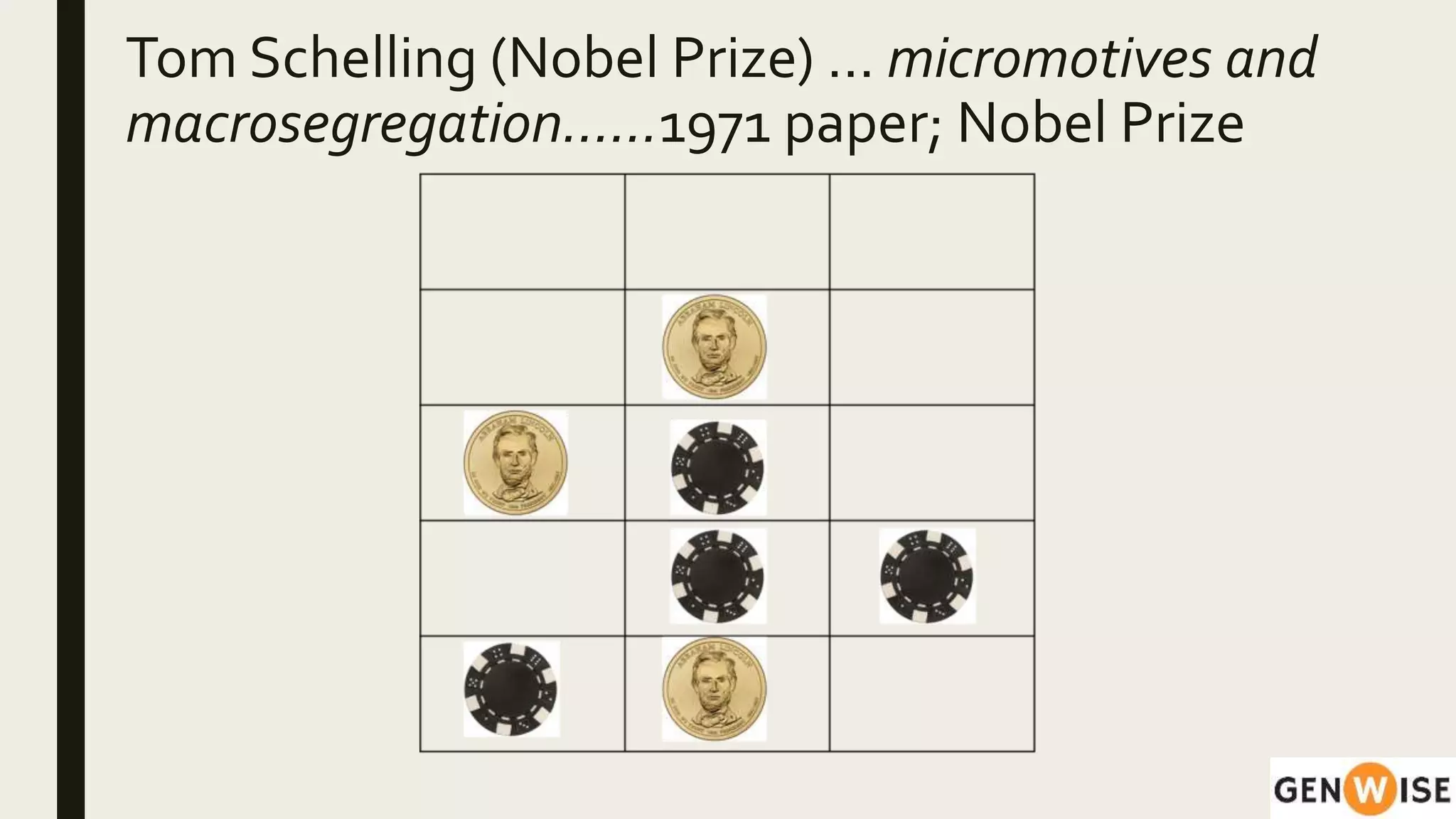
Tom Schelling (Nobel Prize) … micromotives and
macrosegregation……1971 paper; Nobel Prize
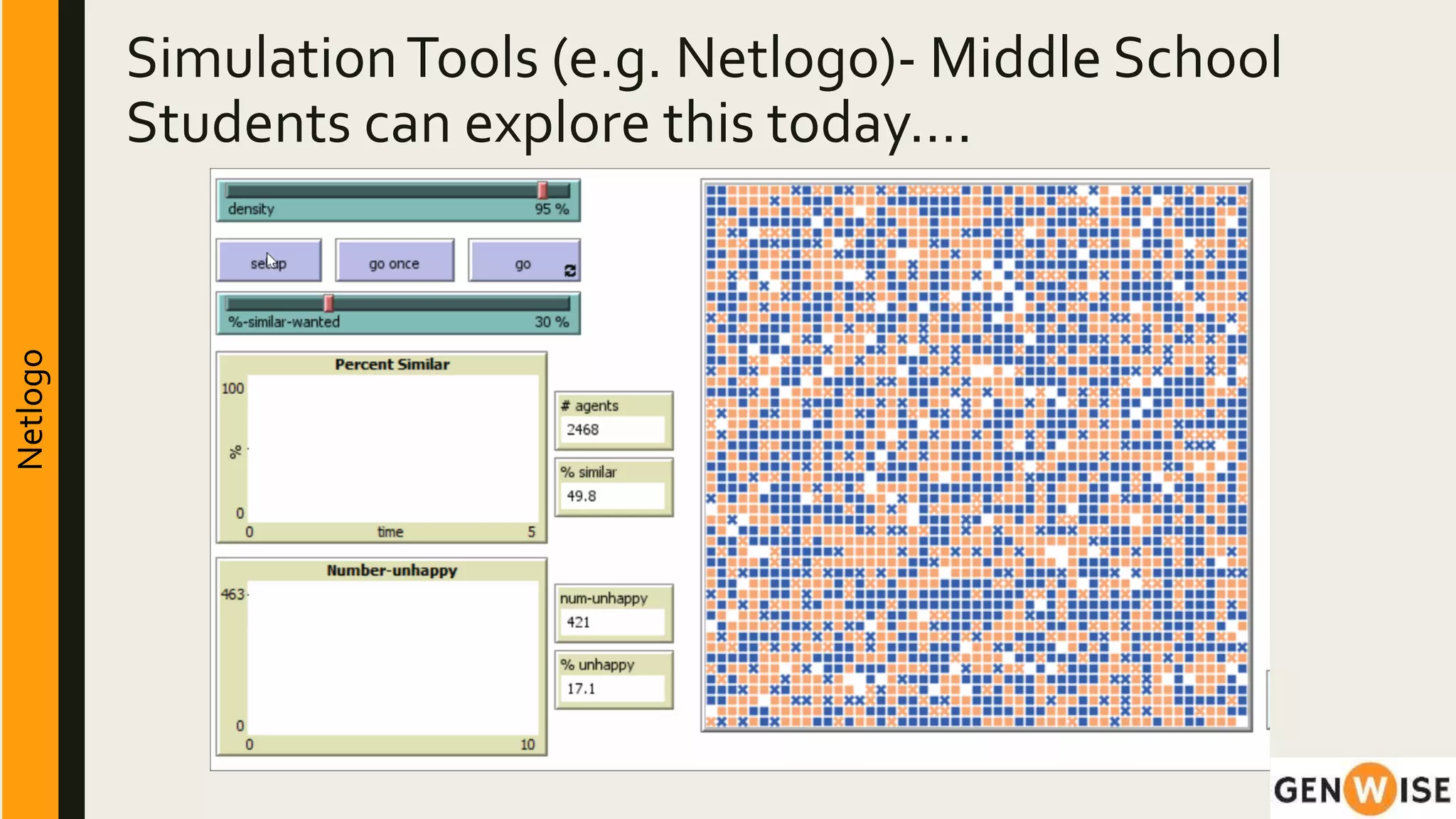
SimulationTools (e.g. Netlogo)- Middle School
Students can explore this today….
Netlogo
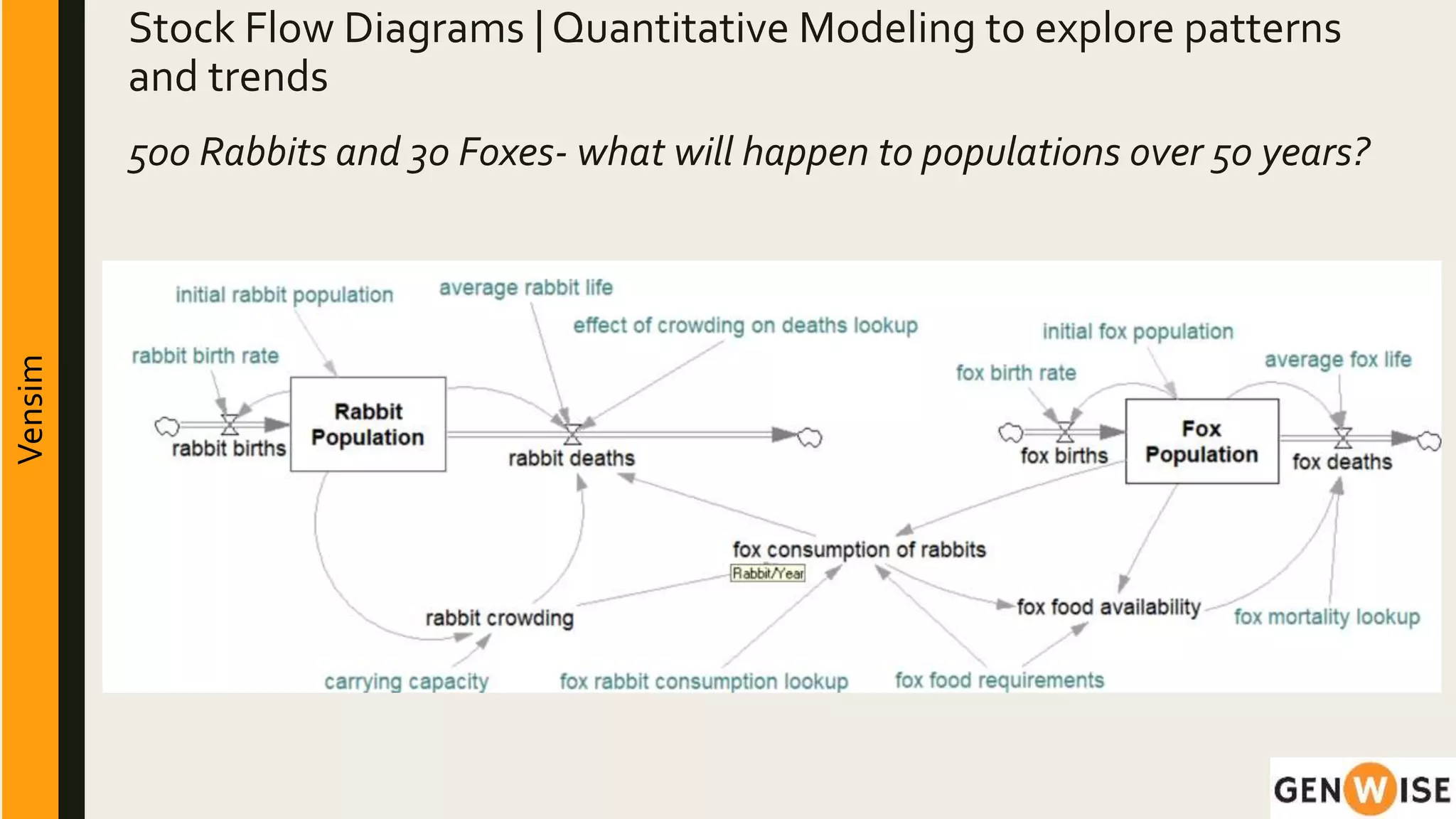
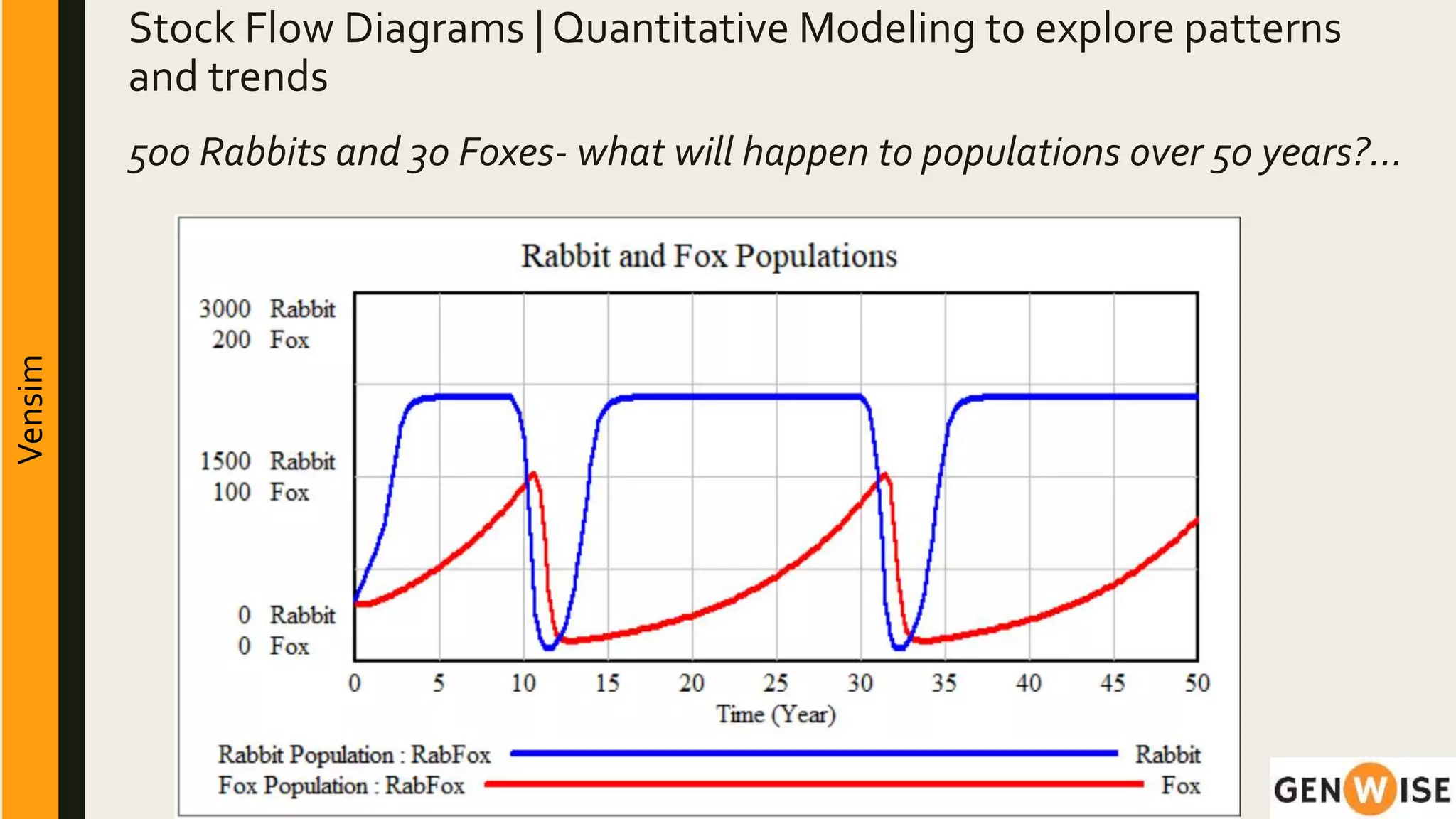
Vensim Stock Flow Diagrams | Quantitative Modeling to explore patterns
and trends
500 Rabbits and 30 Foxes- what will happen to populations over 50 years?
Vensim Stock Flow Diagrams | Quantitative Modeling to explore patterns
and trends
500 Rabbits and 30 Foxes- what will happen to populations over 50 years?...
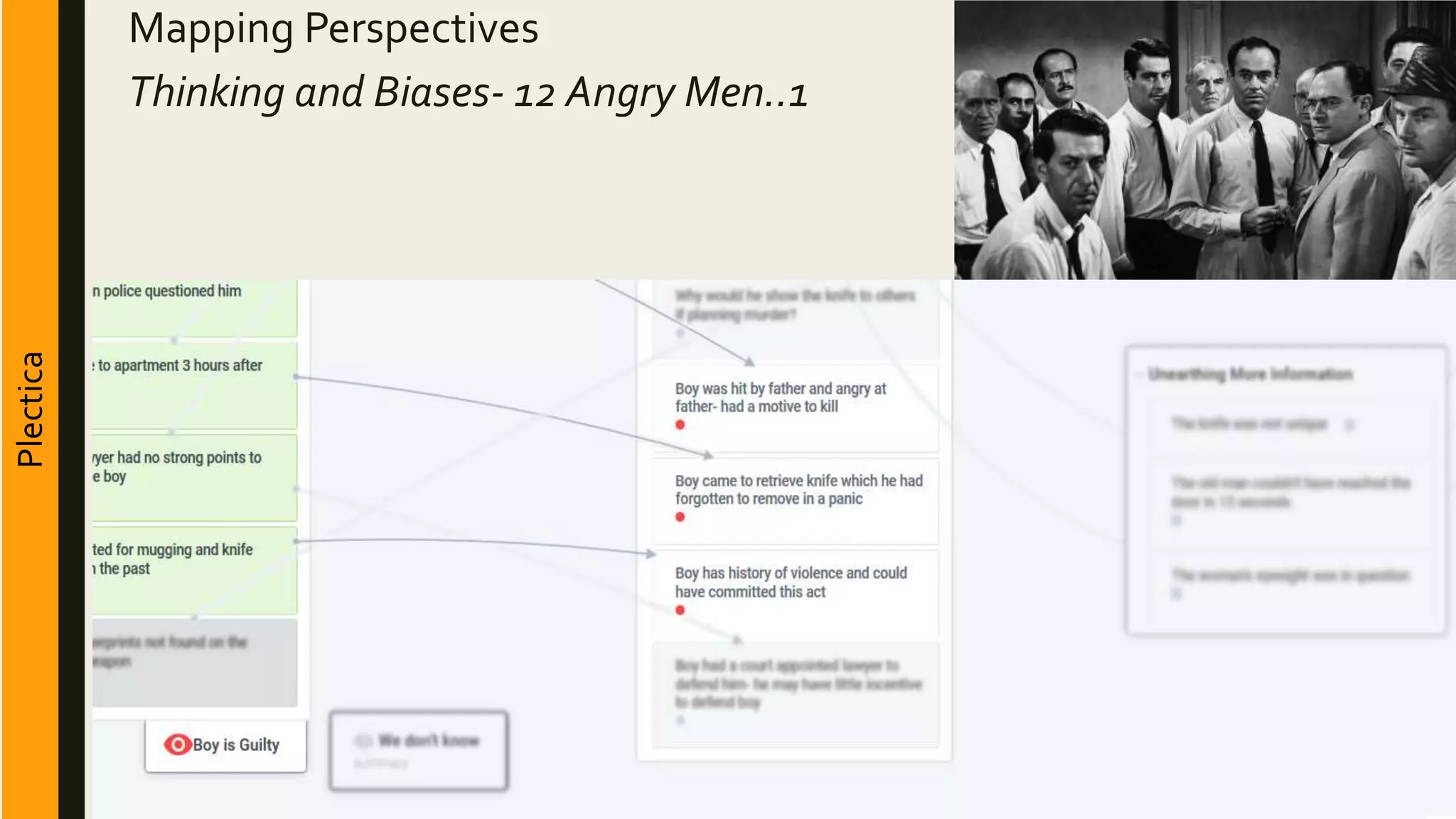
Plectica Mapping Perspectives
Thinking and Biases- 12 Angry Men..1
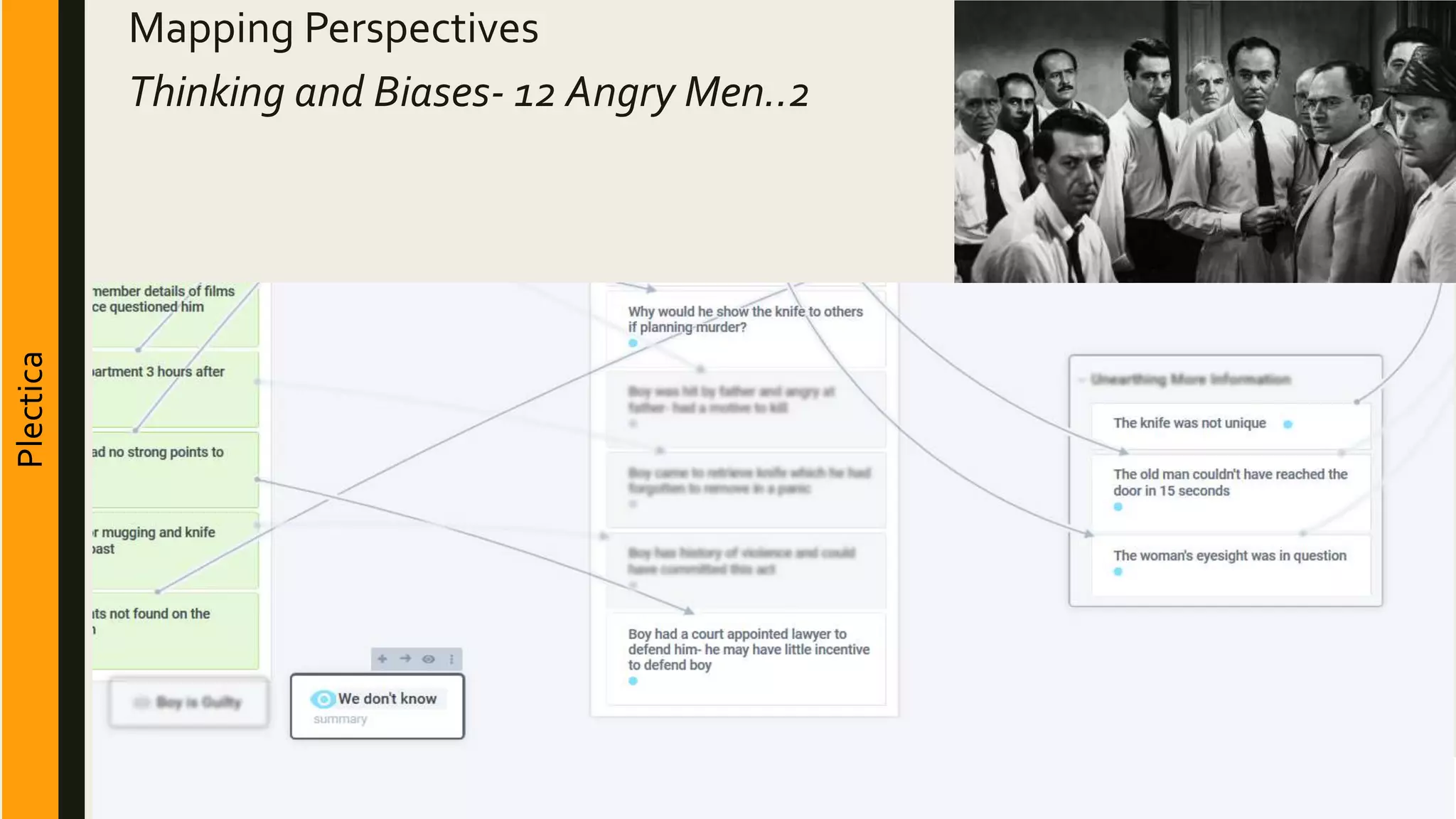
Plectica Mapping Perspectives
Thinking and Biases- 12 Angry Men..2
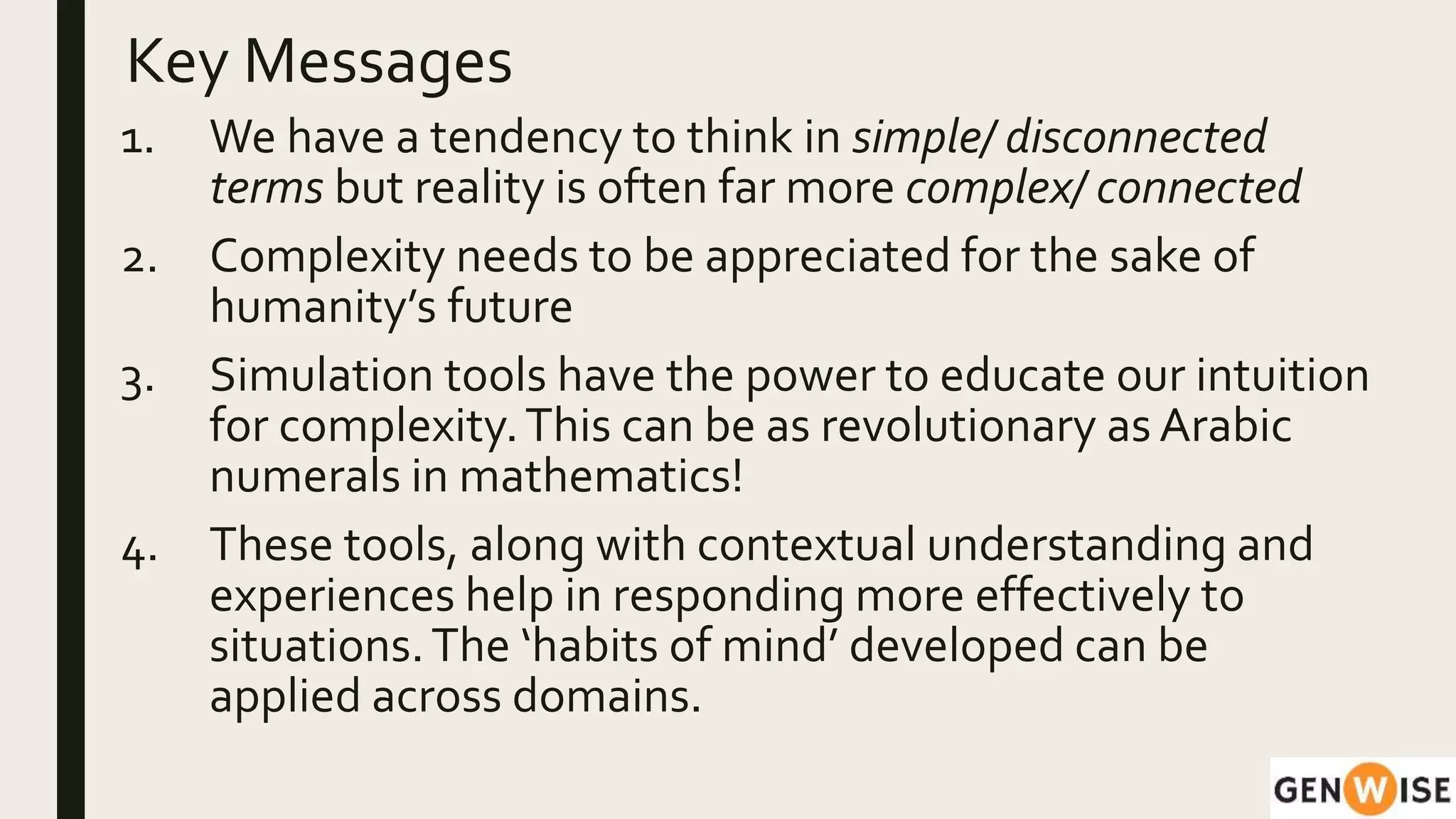
Key Messages
1. We have a tendency to think in simple/ disconnected
terms but reality is often far more complex/ connected
2. Complexity needs to be appreciated for the sake of
humanity’s future
3. Simulation tools have the power to educate our intuition
for complexity.This can be as revolutionary as Arabic
numerals in mathematics!
4. These tools, along with contextual understanding and
experiences help in responding more effectively to
situations.The ‘habits of mind’ developed can be
applied across domains.
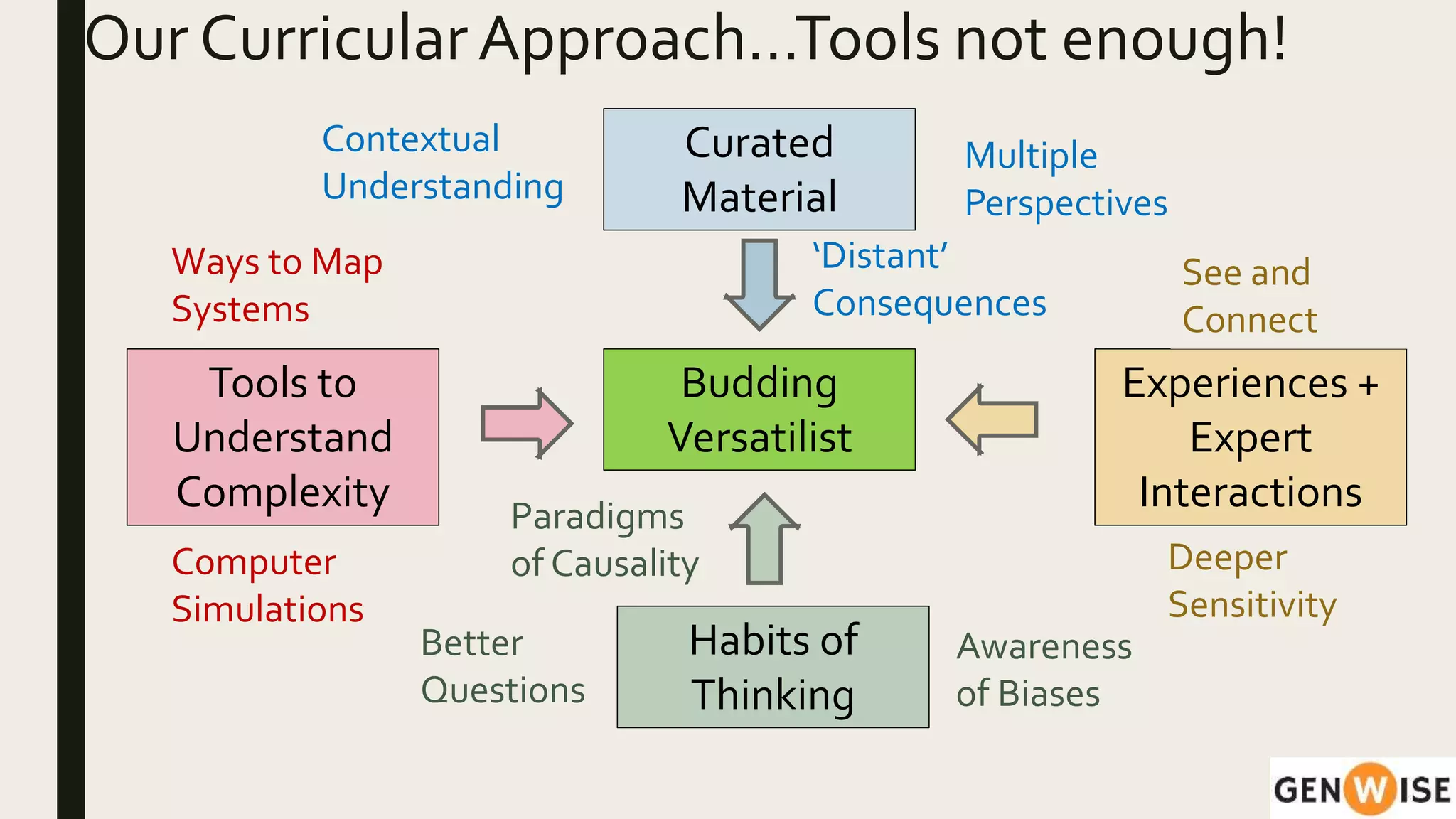
Our CurricularApproach…Tools not enough!
Budding
Versatilist
Tools to
Understand
Complexity
Computer
Simulations
Ways to Map
Systems
Curated
Material
Contextual
Understanding
‘Distant’
Consequences
Multiple
Perspectives
Habits of
Thinking
Awareness
of Biases
Paradigms
of Causality
Better
Questions
Experiences +
Expert
Interactions
See and
Connect
Deeper
Sensitivity
Key Messages
1. We have a tendency to think in simple/ disconnected
terms but reality is often far more complex/ connected
2. Complexity needs to be appreciated for the sake of
humanity’s future
3. Simulation tools have the power to educate our intuition
for complexity.This can be as revolutionary as Arabic
numerals in mathematics!
4. These tools, along with contextual understanding and
experiences help in responding more effectively to
situations.The ‘habits of mind’ developed can be
applied across domains.
Links toTools & Resources
■ Tools
■ Loopy- https://ncase.me/loopy/
■ Vensim- https://vensim.com/vensim-personal-learning-edition/ (check
models library)
■ Plectica- https://www.plectica.com/
■ Netlogo- https://ccl.northwestern.edu/netlogo/
■ Resources
■ Learning Causality in a ComplexWorld- Book byTina Grotzer
■ Explorable Explanations- Interactive simulations on the web-
https://explorabl.es/
■ Complexity Explorer, Santa Fe Institute-
https://www.complexityexplorer.org/
vishnu@genwise.in
+91 9342247734
https://GenWise.in
https://www.facebook.com/GenWise.in/
https://twitter.com/GenWise_
Be inTouch

Tech tools for complex phenomena tech2019

  • 1.
    USINGTECHNOLOGYTOOLS TO UNDERSTAND COMPLEX PHENOMENA FORGLOBAL CITIZENSHIP VishnuteerthAgnihotri TECH 2019,Vishakhapatnam, Dec 11, 2019
  • 2.
    2 disasters inCameroon ■ Aug 16, 1984- Lake Monoun Eruption- 37 people killed ■ Aug 21, 1986- Lake Nyos Eruption- 1834 people + 3500 livestock killed, within 19 km radius – Burns on bodies – Survivors had eye lesions, neurological problems, paralysis of lower limbs – Burnt and charred crops ■ Eyewitness Accounts of Aug 21, 1986 – Very hard rain that stopped around 9:30 PM – Rumbling sound and smell like gunpowder + rotten eggs – Losing consciousness- getting up 6-16 hours later – People running around and dropping dead
  • 3.
    Lake Nyos inMay 1985 before the disaster Lake Nyos ~10 days after the disaster in August 1986
  • 4.
  • 5.
    Popular theories ■ Formerdictator Ahidjo sent a plane for an attempted coup that crashed into the lake (Lake Monoun) ■ Cameroon govt- terrorist attack- someone dumped chemicals into the lake (Lake Monoun) ■ Traditional villagers- evil spirits leave lake periodically and kill people (Lake Monoun) – Legends of past events ■ Neutron bomb exploded by US/ Israelis (Lake Nyos) – Nature of effect- damage to living things – Arrival of Shimon Peres and medical team within days of disaster ■ Wrath of Lake Chief who died in 1983- his last wishes on cow to be sacrificed not respected – Lake Chief’s cows seen moving to towards Lake Nyos one week after last wishes not respected
  • 6.
  • 7.
    Why popular theoriesattractive? PopularTheories Complex Reality Comments Simple Linear Non-Linear (Escalating effect/ tipping point…) • Hard to believe that calm lake can suddenly unleash havoc when nothing happened for years • Easier to relate to someone (with a face) doing this • An immediate cause easier to relate to than some thing that builds up over years Intentional Agents Unintentional Agents Local & Immediate Distant & Delayed Obvious causes/ mechanisms Non- Obvious causes/ mechanisms
  • 8.
    maybe pushing onthat wall will give some space…
  • 9.
  • 10.
    Dangers of oversimplificationin an interconnected world…. many many examples many unintended consequences… ■ DDT  massive environmental damage ■ Antibiotics  superbugs ■ Corn ethanol  groundwater depletion ■ Biodiesel  burning forests in SE Asia many unforeseen events ■ 2008 Financial Crisis ■ Revolutions in ArabWorld ■ ……
  • 11.
    NewWays- Connectedness; Cause-Effect Mechanisms Paradigmsof causality ■ Linear  Domino/ Cyclic/ Feedback loops.. ■ Local & Immediate  Distant & Delayed ■ Centralized & Direct  Distributed & Emergent ■ Deterministic  Probabilistic ■ Single Perspective  Multi-perspective ■ …….
  • 12.
    Key Messages 1. Wehave a tendency to think in simple/ disconnected terms but reality is often far more complex/ connected 2. Complexity needs to be appreciated for the sake of humanity’s future 3. Simulation tools have the power to educate our intuition for complexity 4. These tools, along with contextual understanding and experiences help in responding more effectively to situations.The ‘habits of mind’ developed can be applied across domains.
  • 13.
    Can Computers helpus to see and think differently? Paradigms of causality ■ Linear  Domino/ Cyclic/ Feedback loops.. ■ Local & Immediate  Distant & Delayed ■ Centralized & Direct  Distributed & Emergent ■ Deterministic  Probabilistic ■ Single Perspective  Multi-perspective ■ …….
  • 14.
    Extending human intelligenceusing computers ■ The medium is an extension of the mind- text literacy revolutionized human thinking; Arabic numerals did ■ Using a computer can be similarly revolutionary (this is NOT how computers are normally used)
  • 15.
    Segregation in NewYorkCity Blue Areas- Black people less than 10% of the population Green Areas-White people less than 10% of the population
  • 16.
    ■ Are peoplebiased? ■ How much bias would lead to high segregation? ■ What if each person was ok with 70% of neighborhood being unlike him/ her? Why such high segregation?
  • 17.
  • 18.
    Individual Bias- want30% like meSource:ParableofthePolygons,ncase.me
  • 19.
    Individual Bias- want10% like meSource:ParableofthePolygons,ncase.me
  • 20.
    SegWorld- Individual Bias-want 10% like meSource:ParableofthePolygons,ncase.me
  • 21.
    Individual Anti- Bias-want diversitySource:ParableofthePolygons,ncase.me
  • 22.
  • 23.
    Tom Schelling (NobelPrize) … micromotives and macrosegregation……1971 paper; Nobel Prize
  • 24.
    SimulationTools (e.g. Netlogo)-Middle School Students can explore this today…. Netlogo
  • 25.
    Vensim Stock FlowDiagrams | Quantitative Modeling to explore patterns and trends 500 Rabbits and 30 Foxes- what will happen to populations over 50 years?
  • 26.
    Vensim Stock FlowDiagrams | Quantitative Modeling to explore patterns and trends 500 Rabbits and 30 Foxes- what will happen to populations over 50 years?...
  • 27.
    Plectica Mapping Perspectives Thinkingand Biases- 12 Angry Men..1
  • 28.
    Plectica Mapping Perspectives Thinkingand Biases- 12 Angry Men..2
  • 29.
    Key Messages 1. Wehave a tendency to think in simple/ disconnected terms but reality is often far more complex/ connected 2. Complexity needs to be appreciated for the sake of humanity’s future 3. Simulation tools have the power to educate our intuition for complexity.This can be as revolutionary as Arabic numerals in mathematics! 4. These tools, along with contextual understanding and experiences help in responding more effectively to situations.The ‘habits of mind’ developed can be applied across domains.
  • 30.
    Our CurricularApproach…Tools notenough! Budding Versatilist Tools to Understand Complexity Computer Simulations Ways to Map Systems Curated Material Contextual Understanding ‘Distant’ Consequences Multiple Perspectives Habits of Thinking Awareness of Biases Paradigms of Causality Better Questions Experiences + Expert Interactions See and Connect Deeper Sensitivity
  • 31.
    Key Messages 1. Wehave a tendency to think in simple/ disconnected terms but reality is often far more complex/ connected 2. Complexity needs to be appreciated for the sake of humanity’s future 3. Simulation tools have the power to educate our intuition for complexity.This can be as revolutionary as Arabic numerals in mathematics! 4. These tools, along with contextual understanding and experiences help in responding more effectively to situations.The ‘habits of mind’ developed can be applied across domains.
  • 32.
    Links toTools &Resources ■ Tools ■ Loopy- https://ncase.me/loopy/ ■ Vensim- https://vensim.com/vensim-personal-learning-edition/ (check models library) ■ Plectica- https://www.plectica.com/ ■ Netlogo- https://ccl.northwestern.edu/netlogo/ ■ Resources ■ Learning Causality in a ComplexWorld- Book byTina Grotzer ■ Explorable Explanations- Interactive simulations on the web- https://explorabl.es/ ■ Complexity Explorer, Santa Fe Institute- https://www.complexityexplorer.org/
  • 33.