Federal Debt Held by the Public, Historically and                                                                                                          August 2012
                                                                                                                                                 http://go.usa.gov/7QY


As Projected in CBO’s Baseline and Under an
Alternative Fiscal Scenario
(Percentage of GDP)
140                                                                                                                                 Actual         Projected


120


100                                                                                                                                                 Alternative
                                                                                                                                                  Fiscal Scenario

 80


 60
                                                                                                                                                  CBO’s Baseline
                                                                                                                                                    Projection
 40


 20


  0
  1940     1945      1950      1955     1960      1965     1970      1975     1980      1985     1990      1995     2000       2005       2010      2015      2020


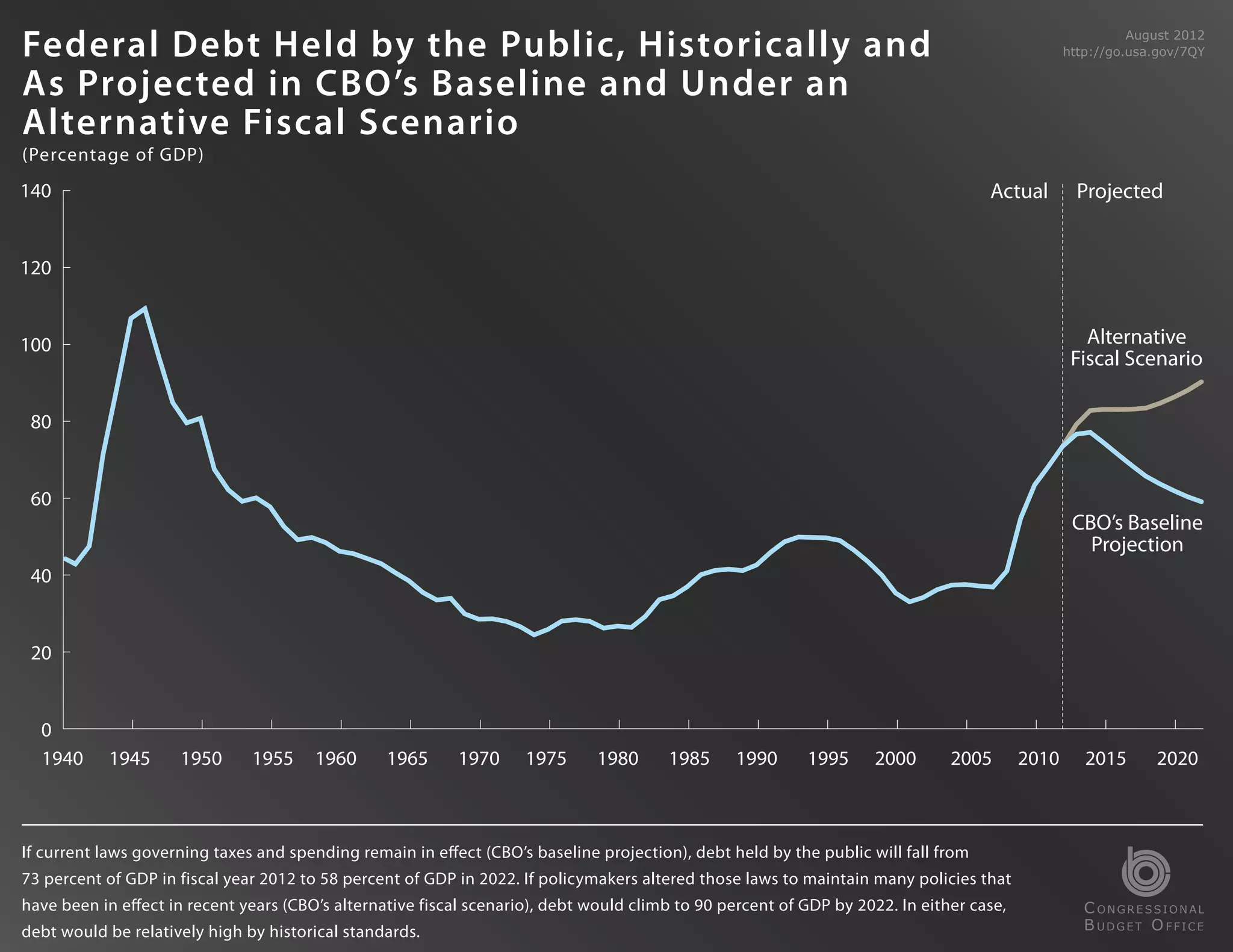
If current laws governing taxes and spending remain in effect (CBO’s baseline projection), debt held by the public will fall from
73 percent of GDP in fiscal year 2012 to 58 percent of GDP in 2022. If policymakers altered those laws to maintain many policies that
have been in effect in recent years (CBO’s alternative fiscal scenario), debt would climb to 90 percent of GDP by 2022. In either case,             C ONGRESSIONAL
debt would be relatively high by historical standards.                                                                                              B UDGET O FFICE
Congressional Budget Office
                An Update to the
   Budget and Economic Outlook:
        Fiscal Years 2012 to 2022
                           August 2012


                  The Budget Outlook
Def i cits Projected in CBO’s Baseline and                                                                                                       August 2012
                                                                                                                                       http://go.usa.gov/7QY


Under an Alternative Fiscal Scenario
(Percentage of GDP)


   8


   7


   6


   5                                                                                                                     Additional Debt Service

   4                                                                                                                     Prevent Spending Cuts


   3

                                                                                                                         Extend Tax Policies
   2


   1

                                                                                                                         Baseline
   0
        2012       2013       2014       2015      2016      2017       2018      2019        2020      2021      2022


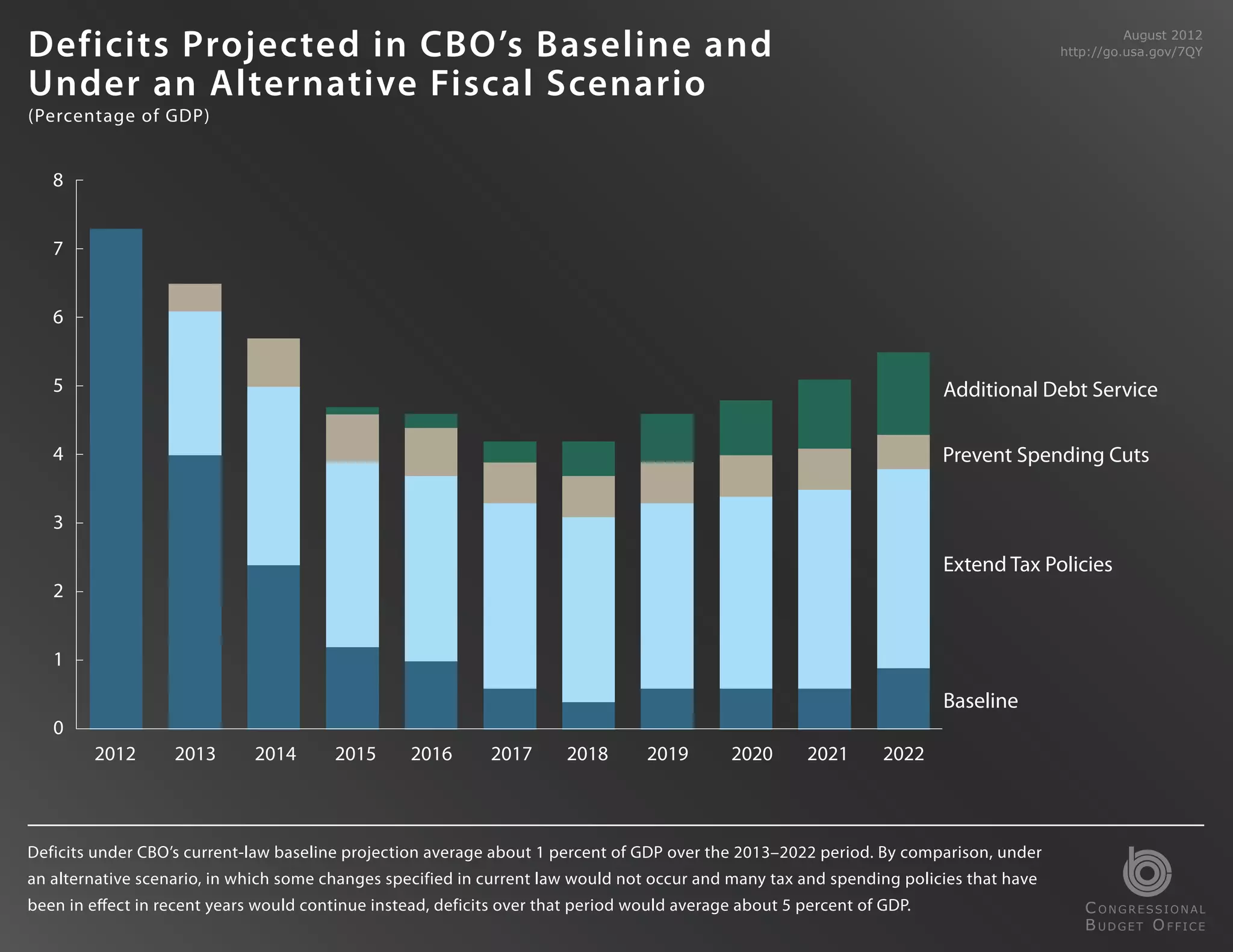
Deficits under CBO’s current-law baseline projection average about 1 percent of GDP over the 2013–2022 period. By comparison, under
an alternative scenario, in which some changes specified in current law would not occur and many tax and spending policies that have
been in effect in recent years would continue instead, deficits over that period would average about 5 percent of GDP.                    C ONGRESSIONAL
                                                                                                                                          B UDGET O FFICE
Total Discretionary Budget Authority Excluding War
                                                                                                                                                    August 2012
                                                                                                                                          http://go.usa.gov/7QY


Funding, Disaster Relief, and Program Integrity Initiatives
(Percentage of GDP)


   12                                                                                                   Actual      Projected


   10
                                  Historical Funding and
                                      CBO’s Baseline
    8
                                                                                                                                 Funding for 2012
                                                                                                                                Adjusted for Inflation
    6


    4                                                                                                                       Excluding Enforcement
                                                                                                                                  Procedures


    2


    0
    1986 1988        1990    1992 1994        1996    1998     2000 2002 2004          2006 2008 2010          2012     2014 2016        2018     2020 2022


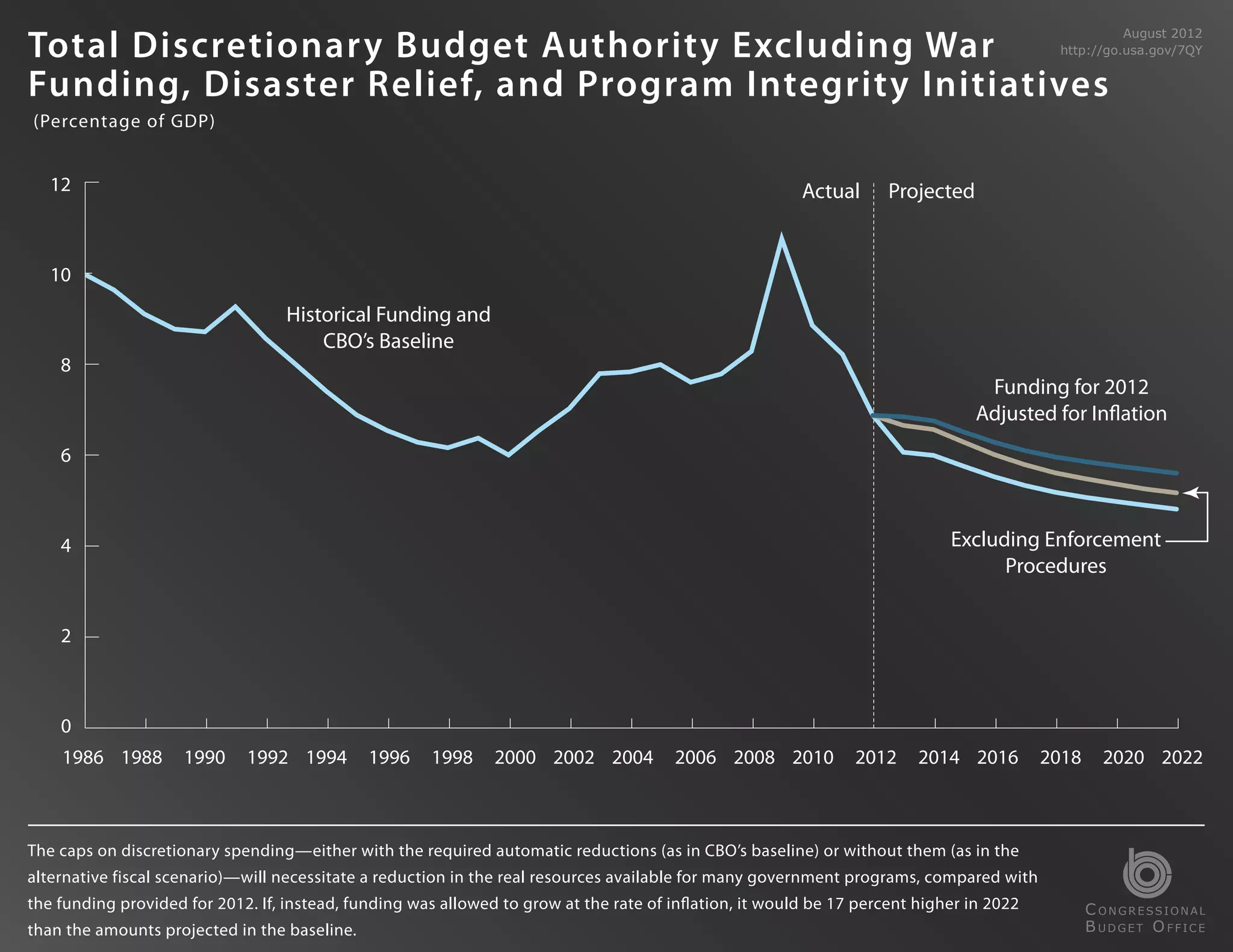
The caps on discretionary spending—either with the required automatic reductions (as in CBO’s baseline) or without them (as in the
alternative fiscal scenario)—will necessitate a reduction in the real resources available for many government programs, compared with
the funding provided for 2012. If, instead, funding was allowed to grow at the rate of inflation, it would be 17 percent higher in 2022          C ONGRESSIONAL
than the amounts projected in the baseline.                                                                                                     B UDGET O FFICE
Congressional Budget Office
                An Update to the
   Budget and Economic Outlook:
        Fiscal Years 2012 to 2022
                           August 2012


                The Economic Outlook
Federal Debt Held byProduct
Real Gross Domestic the Public, Historically and                                                                                                      January 2012
                                                                                                                                                       August 2012
                                                                                                                                             http://go.usa.gov/7QY
                                                                                                                                              http://go.usa.gov/nPi

As Projected in CBO’s Baseline and Under an
(Percentage change, fourth quarter to fourth quarter)

Alternative Fiscal Scenario
(Percentage of GDP)
      4                 Recession
                                                  3.9                                                        Recession


               2.9                                           2.9
      3                                                                  2.8
                                                                                     2.4                                               2.4               First
                                                                                                2.2                                                      Half
      2                               1.9                                                                                                      2.0
                                                                                                                                                         1.7


      1
                          0.4
      0
                                                                                                                         -0.1

     -1


     -2


     -3

                                                                                                            -3.3
     -4
              2000       2001        2002       2003        2004        2005       2006        2007        2008          2009     2010        2011         2012


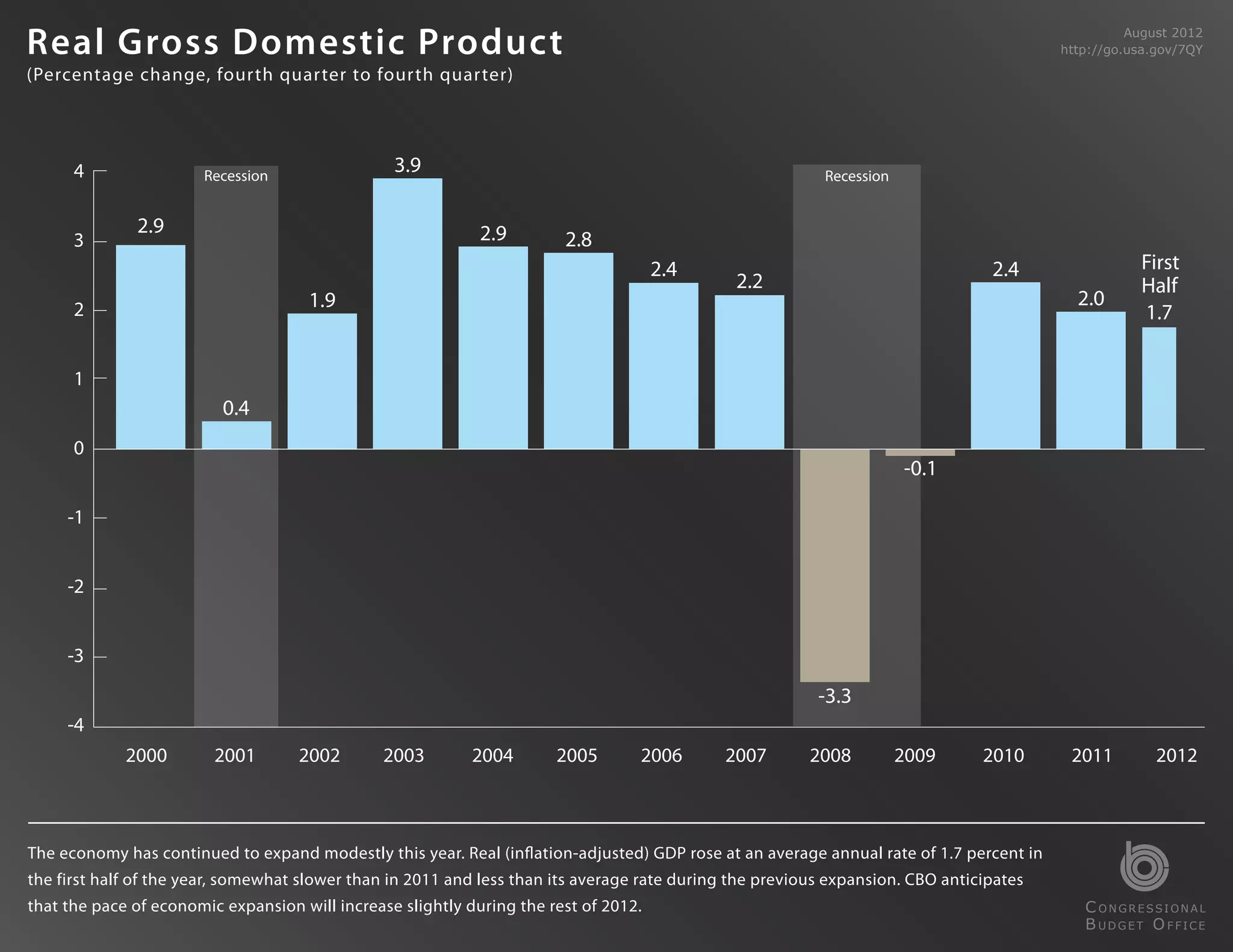
Witheconomydeficits anticipated for much of the 10-year projection period of CBO’s GDP rose at an average annual rate the1.7 percent in
The modest has continued to expand modestly this year. Real (inflation-adjusted) current-law baseline, debt held by of public
the first half of the year, of GDP. However, than in 2011 changes specified in current law did not occur and certain current policies
recedes as a percentage somewhat slower if some of theand less than its average rate during the previous expansion. CBO anticipates
werethe pace of instead, debt held by will increase slightly during percent of GDP by the end of 2022, the highest figure since just
that continued economic expansion the public would rise to 94 the rest of 2012.                                                                 C ONGRESSIONAL
                                                                                                                                                B UDGET O FFICE
after World War II.
Real Business Fixed Investment                                                                                                                  August 2012
                                                                                                                                      http://go.usa.gov/7QY
(Percentage change from same quarter of previous year)


      20


                                                                                                                                              12.5
            11.0
      10                                                                                                                                             10.2


       0


     -10
                               -9.5


     -20
                                                                                                                 -20.1


     -30
        2000                   2002                  2004                    2006                  2008                   2010                2012


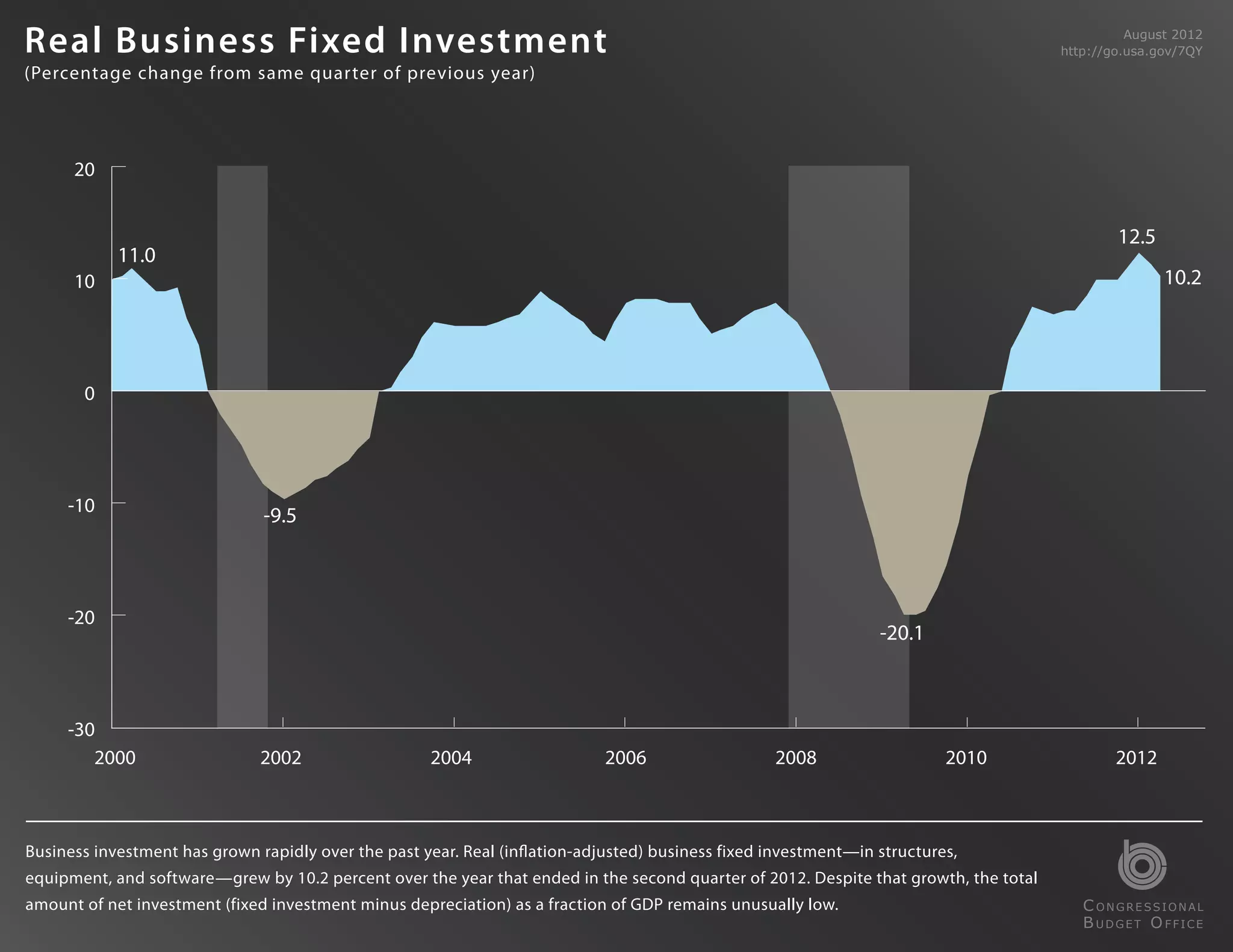
Business investment has grown rapidly over the past year. Real (inflation-adjusted) business fixed investment—in structures,
equipment, and software—grew by 10.2 percent over the year that ended in the second quarter of 2012. Despite that growth, the total
amount of net investment (fixed investment minus depreciation) as a fraction of GDP remains unusually low.                               C ONGRESSIONAL
                                                                                                                                         B UDGET O FFICE
Housing Market Indicators                                                                                                                    August 2012
                                                                                                                                   http://go.usa.gov/7QY

(Percentage change from same quarter of previous year)


    20


                                                                                                                                            10.7
                                                                                  House Prices
    10


                                                                                                                                             2.2
      0

                                              Real Residential Investment

   -10


   -20


   -30
          2000                2002                   2004                  2006                  2008               2010                 2012


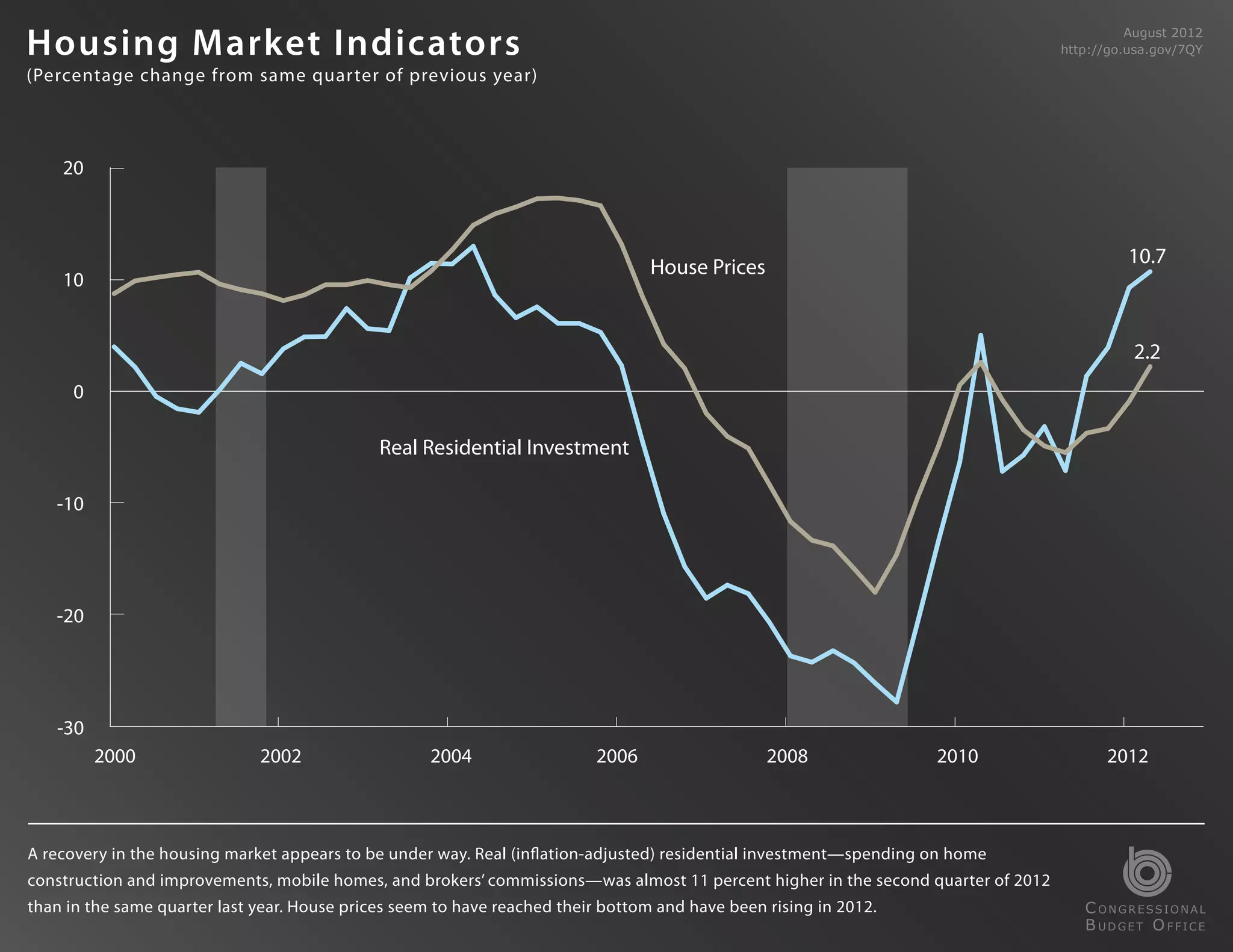
A recovery in the housing market appears to be under way. Real (inflation-adjusted) residential investment—spending on home
construction and improvements, mobile homes, and brokers’ commissions—was almost 11 percent higher in the second quarter of 2012
than in the same quarter last year. House prices seem to have reached their bottom and have been rising in 2012.                      C ONGRESSIONAL
                                                                                                                                      B UDGET O FFICE
Economic Growth in the United States and                                                                                                        August 2012
                                                                                                                                      http://go.usa.gov/7QY


Among Its Leading Trading Partners
(Percentage change from same quarter of previous year)


       6                                                                         Actual      Projected


       4                                                                                                                             Leading Trading
                                                                                                                                            Partners

       2
                                                                                                                                        United States


       0


      -2


      -4


      -6
           2000                         2005                            2010                            2015                         2020


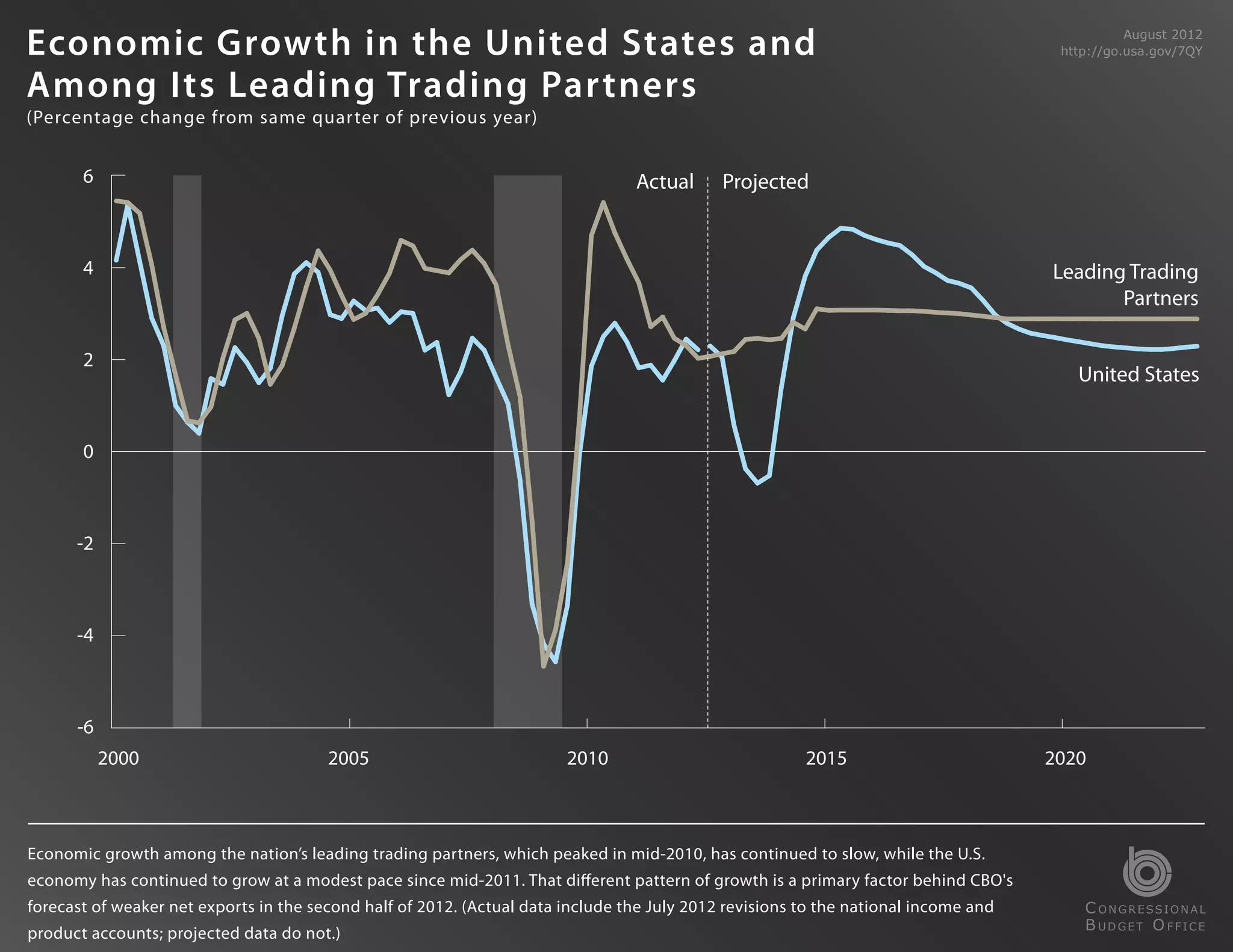
Economic growth among the nation’s leading trading partners, which peaked in mid-2010, has continued to slow, while the U.S.
economy has continued to grow at a modest pace since mid-2011. That different pattern of growth is a primary factor behind CBO's
forecast of weaker net exports in the second half of 2012. (Actual data include the July 2012 revisions to the national income and       C ONGRESSIONAL
                                                                                                                                         B UDGET O FFICE
product accounts; projected data do not.)
Long-Term Unemployment                                                                                                                      August 2012
                                                                                                                                  http://go.usa.gov/7QY

(Percent)


  50
                       Recession                                                                       Recession
                                                                                                                                               First
                                                                                                                                     43.8      Half
                                                                                                                           43.3
                                                                                                                                               42.2
  40


                                                                                                                    31.5
  30


                                                22.1          21.8
  20
                                                                     19.6                             19.7
                                    18.4                                       17.6       17.6


             11.4       11.8
  10


    0
            2000        2001        2002        2003          2004   2005      2006       2007        2008          2009   2010      2011      2012


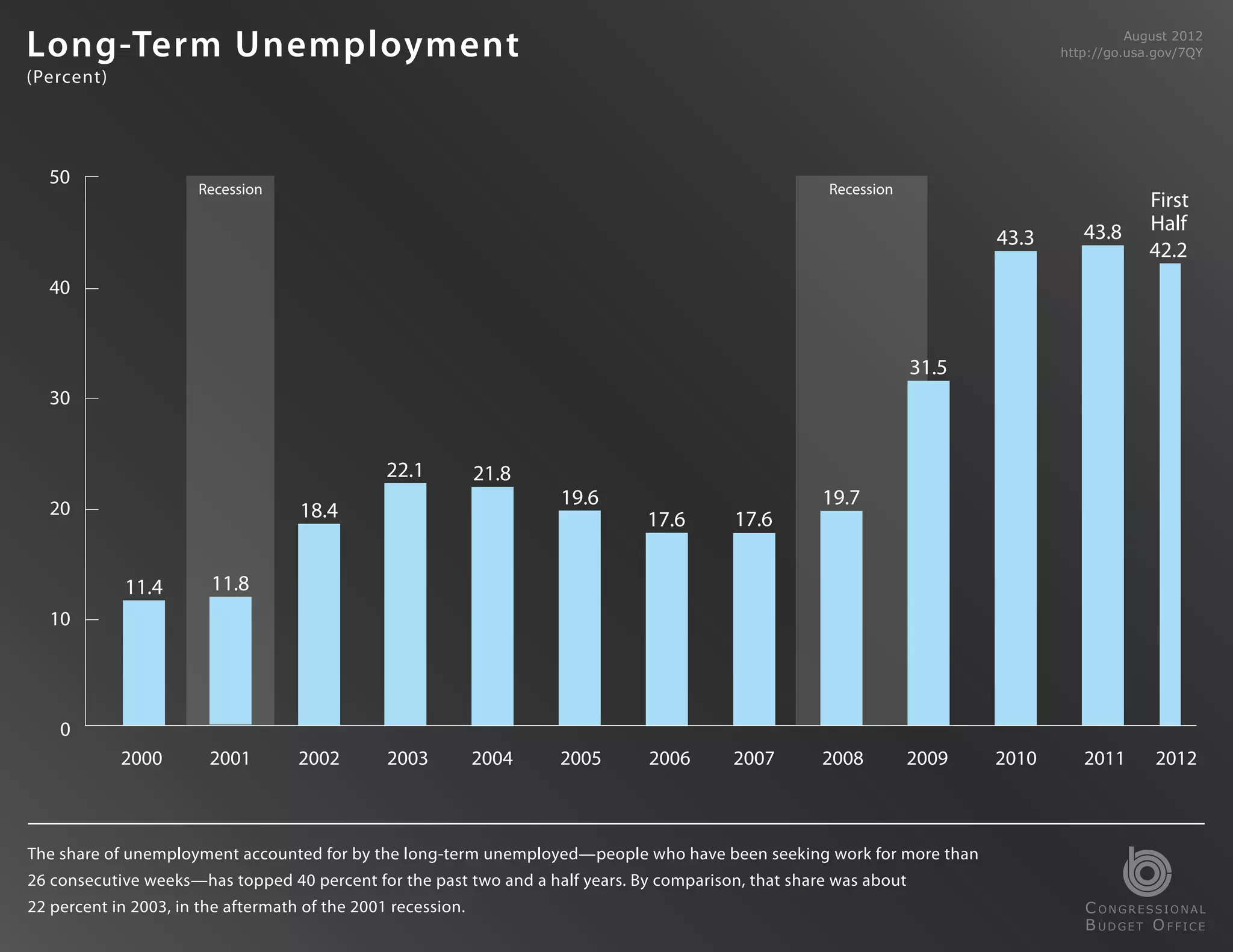
The share of unemployment accounted for by the long-term unemployed—people who have been seeking work for more than
26 consecutive weeks—has topped 40 percent for the past two and a half years. By comparison, that share was about
22 percent in 2003, in the aftermath of the 2001 recession.                                                                          C ONGRESSIONAL
                                                                                                                                     B UDGET O FFICE
Inf l ation                                                                                                                              August 2012
                                                                                                                               http://go.usa.gov/7QY

(Percentage change in prices from same quarter of previous year)


       5


       4

                                                                          Overall
       3


       2                                                                 Core


       1


       0


      -1
           2000                2002                  2004                   2006                  2008                  2010         2012


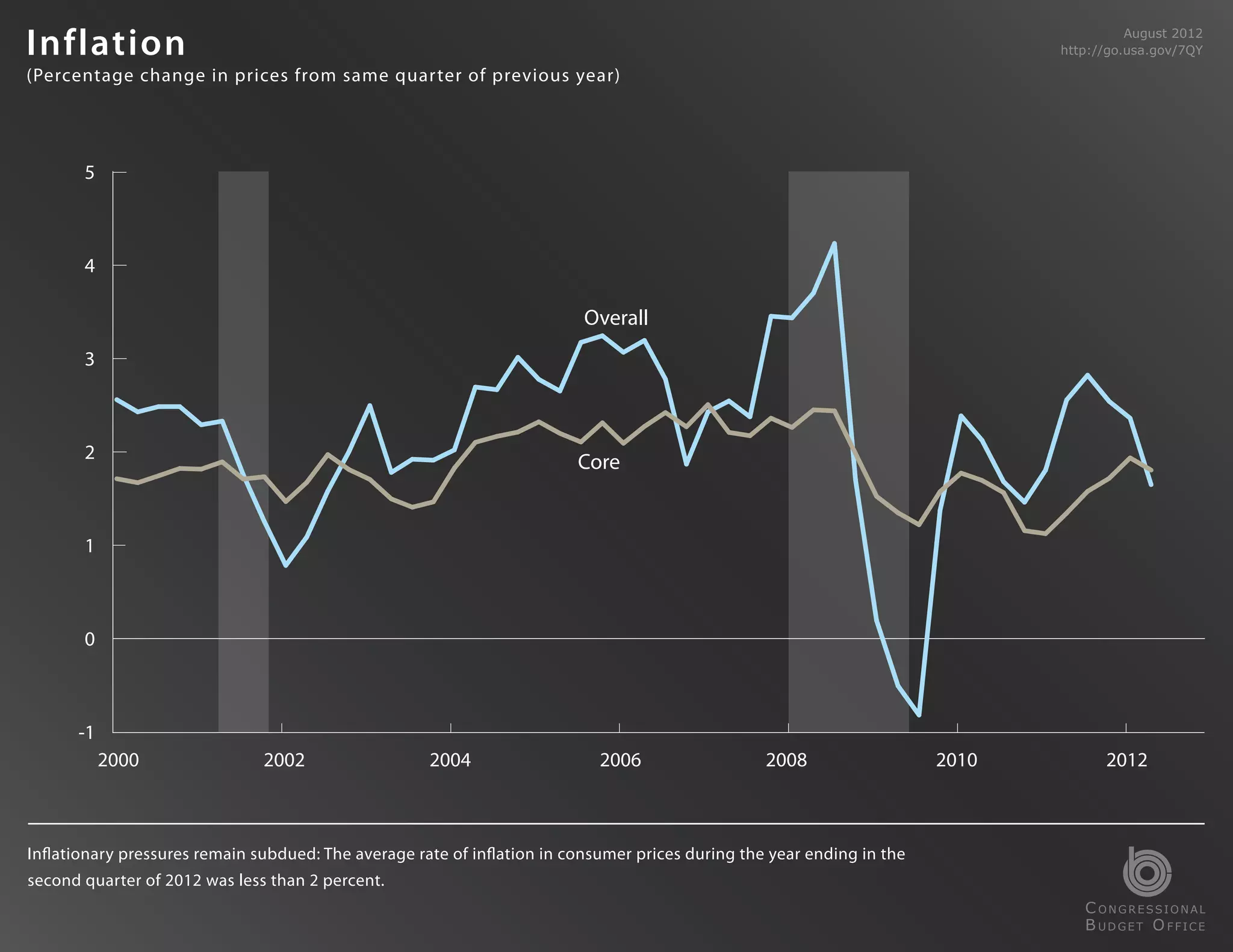
Inflationary pressures remain subdued: The average rate of inflation in consumer prices during the year ending in the
second quarter of 2012 was less than 2 percent.
                                                                                                                                  C ONGRESSIONAL
                                                                                                                                  B UDGET O FFICE
Unemployment Rate                                                                                                                                   August 2012
                                                                                                                                          http://go.usa.gov/7QY

(Percent)


       12                                                                         Actual      Projected

                                                                       9.9
                                                                     2009, 4Q
       10                                                                                       9.1
                                                                                              2013, 4Q

                                                                                                                       CBO’s
         8                                                                             8.2                            Baseline
                                                                                     2012, 2Q                        Projection
                               5.8
                             2003, 4Q                                                            8.0
         6                                                                                     2013, 4Q
                                                                                                        Alternative
                                                                                                      Fiscal Scenario
         4                                          4.4
                3.9                               2006, 4Q
              2000, 4Q

         2


         0
             2000                         2005                            2010                           2015                            2020


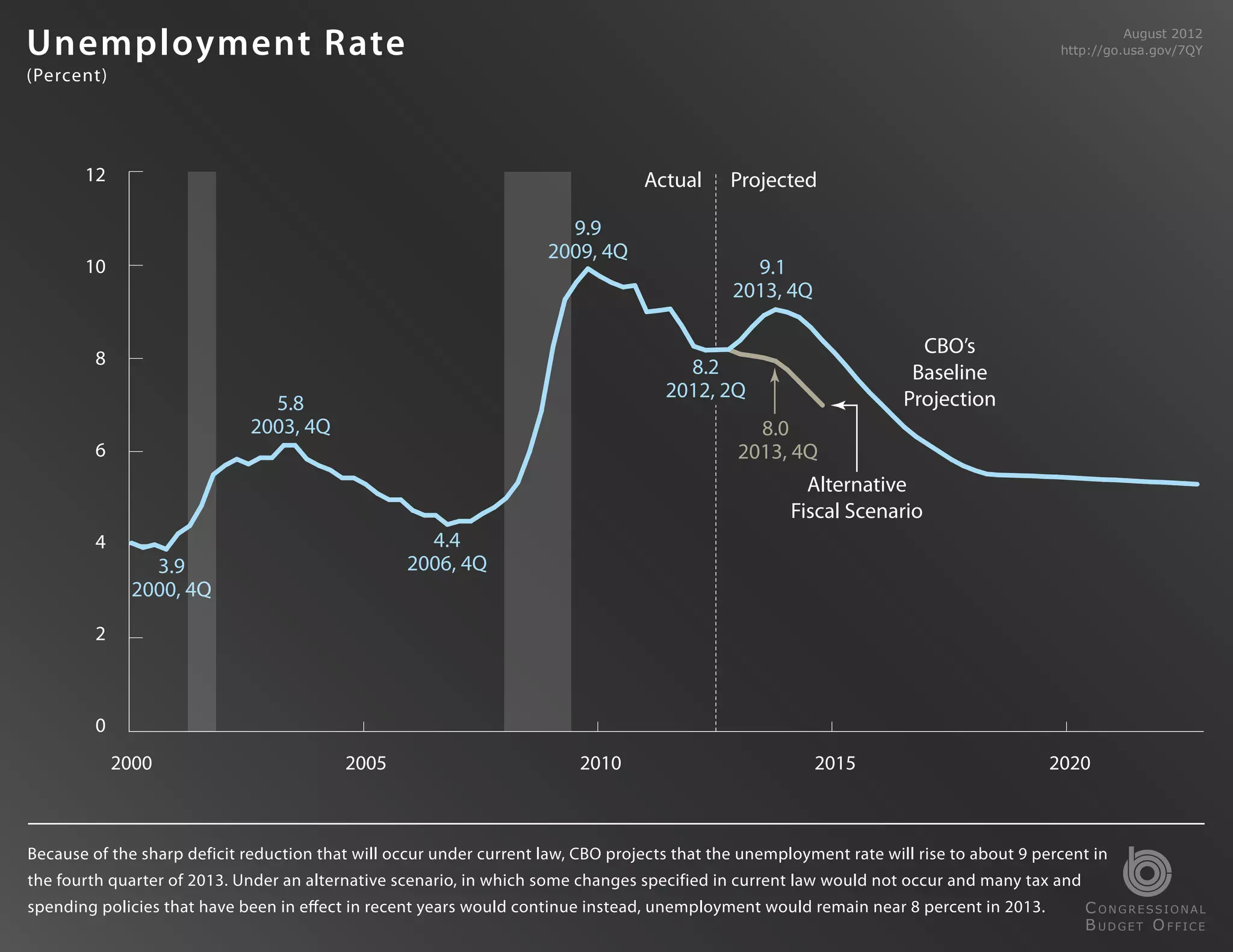
Because of the sharp deficit reduction that will occur under current law, CBO projects that the unemployment rate will rise to about 9 percent in
the fourth quarter of 2013. Under an alternative scenario, in which some changes specified in current law would not occur and many tax and
spending policies that have been in effect in recent years would continue instead, unemployment would remain near 8 percent in 2013.         C ONGRESSIONAL
                                                                                                                                             B UDGET O FFICE
GDP and Potential GDP                                                                                                                             August 2012
                                                                                                                                        http://go.usa.gov/7QY

( Trillions of 2005 dollars)


       20                                                                          Actual      Projected


       18


       16

                                                                      Potential GDP
       14


                                                                                 GDP
       12


       10


         0
             2000                          2005                           2010                            2015                          2020


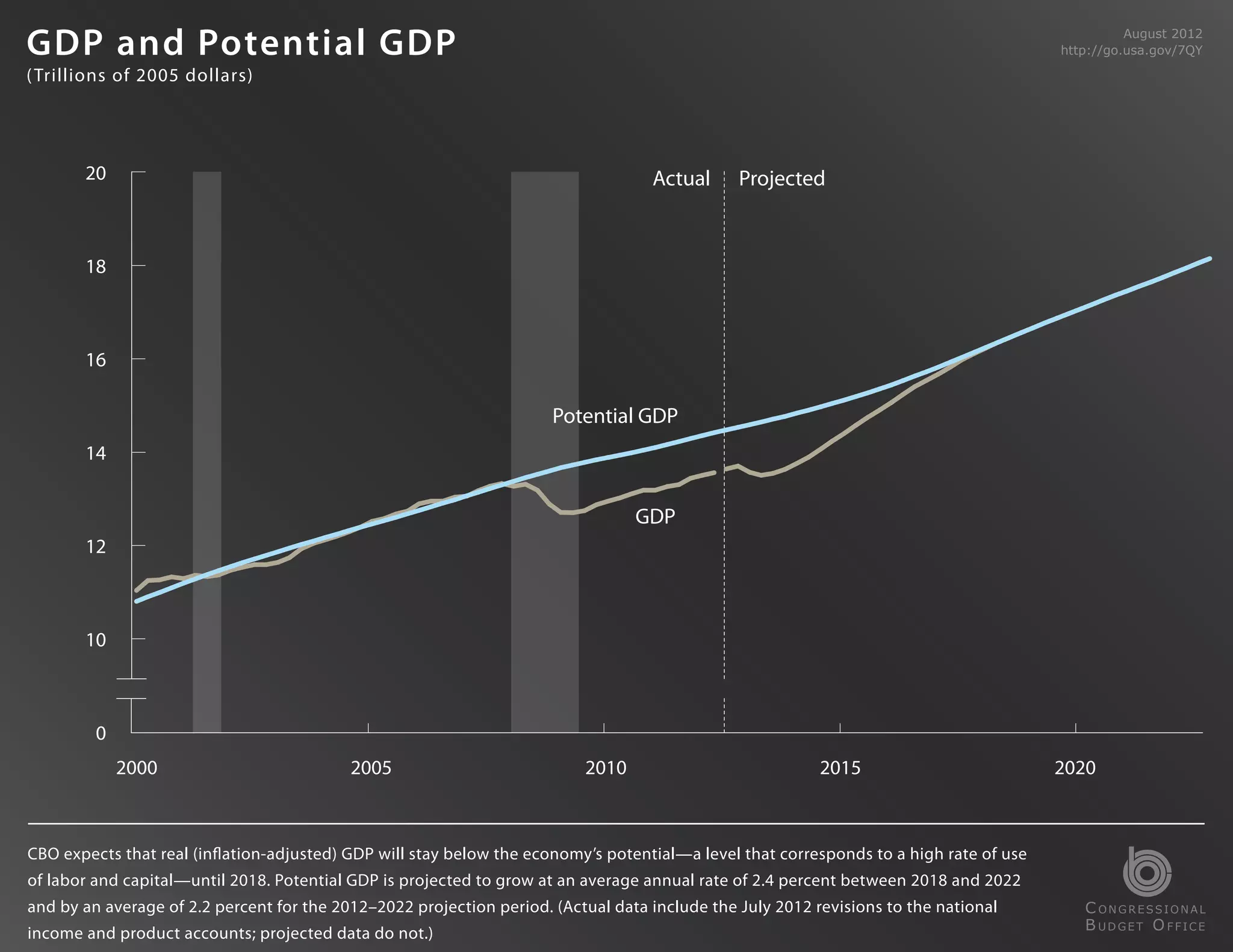
CBO expects that real (inflation-adjusted) GDP will stay below the economy’s potential—a level that corresponds to a high rate of use
of labor and capital—until 2018. Potential GDP is projected to grow at an average annual rate of 2.4 percent between 2018 and 2022
and by an average of 2.2 percent for the 2012–2022 projection period. (Actual data include the July 2012 revisions to the national         C ONGRESSIONAL
                                                                                                                                           B UDGET O FFICE
income and product accounts; projected data do not.)
Labor Income                                                                                                                                           August 2012
                                                                                                                                             http://go.usa.gov/7QY

(Percentage of gross domestic income)


        65                                                                                                      Actual      Projected


        64


        63

                                                                                                                                  Average, 1980 to 2011
        62
                                                                                                                                                (61.9%)


        61


        60


        59


         0
             1980           1985            1990              1995             2000             2005            2010              2015              2020


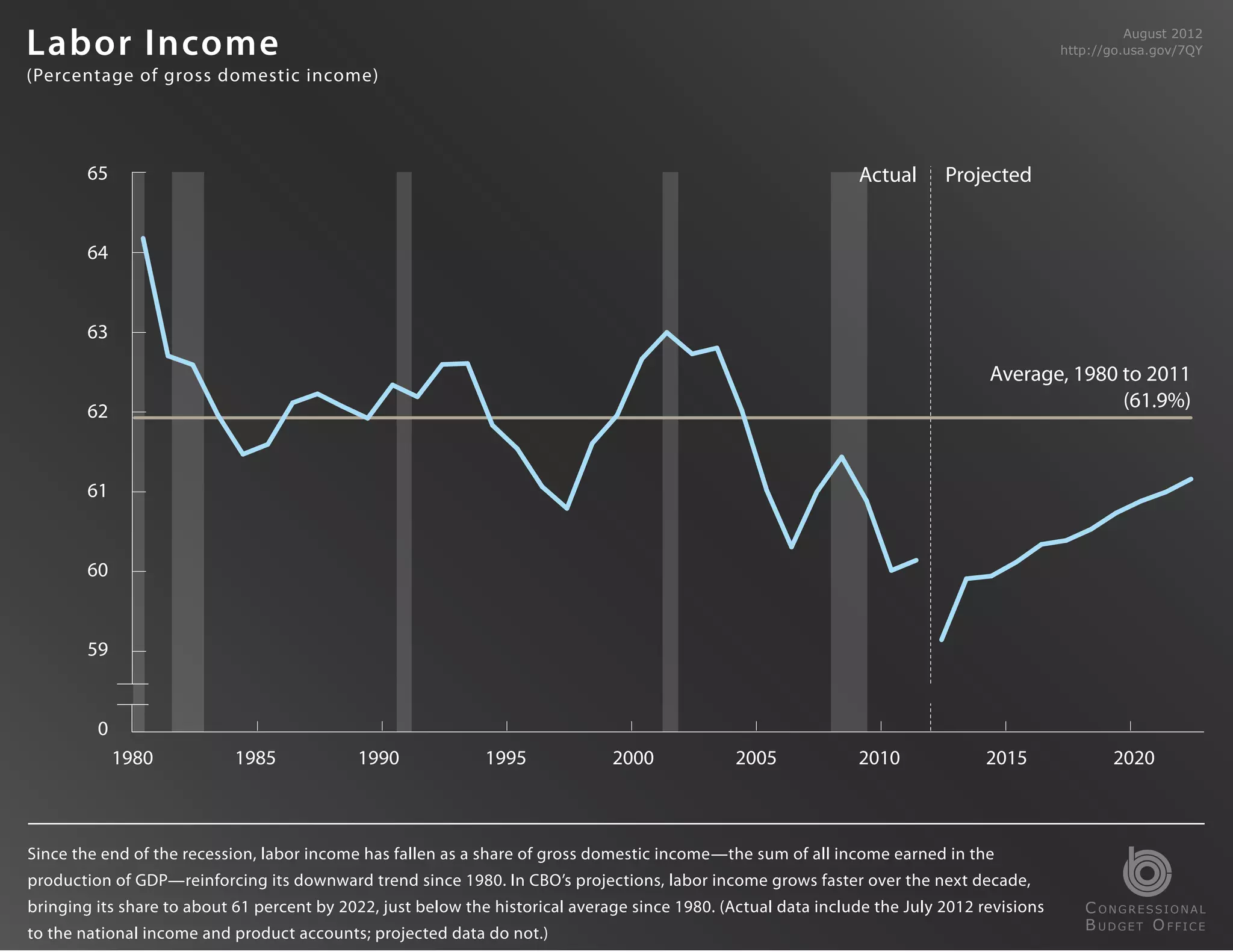
Since the end of the recession, labor income has fallen as a share of gross domestic income—the sum of all income earned in the
production of GDP—reinforcing its downward trend since 1980. In CBO’s projections, labor income grows faster over the next decade,
bringing its share to about 61 percent by 2022, just below the historical average since 1980. (Actual data include the July 2012 revisions      C ONGRESSIONAL
                                                                                                                                                B UDGET O FFICE
to the national income and product accounts; projected data do not.)

Charts from CBO's August 2012 Budget and Economic Outlook

  • 1.
    Federal Debt Heldby the Public, Historically and August 2012 http://go.usa.gov/7QY As Projected in CBO’s Baseline and Under an Alternative Fiscal Scenario (Percentage of GDP) 140 Actual Projected 120 100 Alternative Fiscal Scenario 80 60 CBO’s Baseline Projection 40 20 0 1940 1945 1950 1955 1960 1965 1970 1975 1980 1985 1990 1995 2000 2005 2010 2015 2020 If current laws governing taxes and spending remain in effect (CBO’s baseline projection), debt held by the public will fall from 73 percent of GDP in fiscal year 2012 to 58 percent of GDP in 2022. If policymakers altered those laws to maintain many policies that have been in effect in recent years (CBO’s alternative fiscal scenario), debt would climb to 90 percent of GDP by 2022. In either case, C ONGRESSIONAL debt would be relatively high by historical standards. B UDGET O FFICE
  • 2.
    Congressional Budget Office An Update to the Budget and Economic Outlook: Fiscal Years 2012 to 2022 August 2012 The Budget Outlook
  • 3.
    Def i citsProjected in CBO’s Baseline and August 2012 http://go.usa.gov/7QY Under an Alternative Fiscal Scenario (Percentage of GDP) 8 7 6 5 Additional Debt Service 4 Prevent Spending Cuts 3 Extend Tax Policies 2 1 Baseline 0 2012 2013 2014 2015 2016 2017 2018 2019 2020 2021 2022 Deficits under CBO’s current-law baseline projection average about 1 percent of GDP over the 2013–2022 period. By comparison, under an alternative scenario, in which some changes specified in current law would not occur and many tax and spending policies that have been in effect in recent years would continue instead, deficits over that period would average about 5 percent of GDP. C ONGRESSIONAL B UDGET O FFICE
  • 4.
    Total Discretionary BudgetAuthority Excluding War August 2012 http://go.usa.gov/7QY Funding, Disaster Relief, and Program Integrity Initiatives (Percentage of GDP) 12 Actual Projected 10 Historical Funding and CBO’s Baseline 8 Funding for 2012 Adjusted for Inflation 6 4 Excluding Enforcement Procedures 2 0 1986 1988 1990 1992 1994 1996 1998 2000 2002 2004 2006 2008 2010 2012 2014 2016 2018 2020 2022 The caps on discretionary spending—either with the required automatic reductions (as in CBO’s baseline) or without them (as in the alternative fiscal scenario)—will necessitate a reduction in the real resources available for many government programs, compared with the funding provided for 2012. If, instead, funding was allowed to grow at the rate of inflation, it would be 17 percent higher in 2022 C ONGRESSIONAL than the amounts projected in the baseline. B UDGET O FFICE
  • 5.
    Congressional Budget Office An Update to the Budget and Economic Outlook: Fiscal Years 2012 to 2022 August 2012 The Economic Outlook
  • 6.
    Federal Debt HeldbyProduct Real Gross Domestic the Public, Historically and January 2012 August 2012 http://go.usa.gov/7QY http://go.usa.gov/nPi As Projected in CBO’s Baseline and Under an (Percentage change, fourth quarter to fourth quarter) Alternative Fiscal Scenario (Percentage of GDP) 4 Recession 3.9 Recession 2.9 2.9 3 2.8 2.4 2.4 First 2.2 Half 2 1.9 2.0 1.7 1 0.4 0 -0.1 -1 -2 -3 -3.3 -4 2000 2001 2002 2003 2004 2005 2006 2007 2008 2009 2010 2011 2012 Witheconomydeficits anticipated for much of the 10-year projection period of CBO’s GDP rose at an average annual rate the1.7 percent in The modest has continued to expand modestly this year. Real (inflation-adjusted) current-law baseline, debt held by of public the first half of the year, of GDP. However, than in 2011 changes specified in current law did not occur and certain current policies recedes as a percentage somewhat slower if some of theand less than its average rate during the previous expansion. CBO anticipates werethe pace of instead, debt held by will increase slightly during percent of GDP by the end of 2022, the highest figure since just that continued economic expansion the public would rise to 94 the rest of 2012. C ONGRESSIONAL B UDGET O FFICE after World War II.
  • 7.
    Real Business FixedInvestment August 2012 http://go.usa.gov/7QY (Percentage change from same quarter of previous year) 20 12.5 11.0 10 10.2 0 -10 -9.5 -20 -20.1 -30 2000 2002 2004 2006 2008 2010 2012 Business investment has grown rapidly over the past year. Real (inflation-adjusted) business fixed investment—in structures, equipment, and software—grew by 10.2 percent over the year that ended in the second quarter of 2012. Despite that growth, the total amount of net investment (fixed investment minus depreciation) as a fraction of GDP remains unusually low. C ONGRESSIONAL B UDGET O FFICE
  • 8.
    Housing Market Indicators August 2012 http://go.usa.gov/7QY (Percentage change from same quarter of previous year) 20 10.7 House Prices 10 2.2 0 Real Residential Investment -10 -20 -30 2000 2002 2004 2006 2008 2010 2012 A recovery in the housing market appears to be under way. Real (inflation-adjusted) residential investment—spending on home construction and improvements, mobile homes, and brokers’ commissions—was almost 11 percent higher in the second quarter of 2012 than in the same quarter last year. House prices seem to have reached their bottom and have been rising in 2012. C ONGRESSIONAL B UDGET O FFICE
  • 9.
    Economic Growth inthe United States and August 2012 http://go.usa.gov/7QY Among Its Leading Trading Partners (Percentage change from same quarter of previous year) 6 Actual Projected 4 Leading Trading Partners 2 United States 0 -2 -4 -6 2000 2005 2010 2015 2020 Economic growth among the nation’s leading trading partners, which peaked in mid-2010, has continued to slow, while the U.S. economy has continued to grow at a modest pace since mid-2011. That different pattern of growth is a primary factor behind CBO's forecast of weaker net exports in the second half of 2012. (Actual data include the July 2012 revisions to the national income and C ONGRESSIONAL B UDGET O FFICE product accounts; projected data do not.)
  • 10.
    Long-Term Unemployment August 2012 http://go.usa.gov/7QY (Percent) 50 Recession Recession First 43.8 Half 43.3 42.2 40 31.5 30 22.1 21.8 20 19.6 19.7 18.4 17.6 17.6 11.4 11.8 10 0 2000 2001 2002 2003 2004 2005 2006 2007 2008 2009 2010 2011 2012 The share of unemployment accounted for by the long-term unemployed—people who have been seeking work for more than 26 consecutive weeks—has topped 40 percent for the past two and a half years. By comparison, that share was about 22 percent in 2003, in the aftermath of the 2001 recession. C ONGRESSIONAL B UDGET O FFICE
  • 11.
    Inf l ation August 2012 http://go.usa.gov/7QY (Percentage change in prices from same quarter of previous year) 5 4 Overall 3 2 Core 1 0 -1 2000 2002 2004 2006 2008 2010 2012 Inflationary pressures remain subdued: The average rate of inflation in consumer prices during the year ending in the second quarter of 2012 was less than 2 percent. C ONGRESSIONAL B UDGET O FFICE
  • 12.
    Unemployment Rate August 2012 http://go.usa.gov/7QY (Percent) 12 Actual Projected 9.9 2009, 4Q 10 9.1 2013, 4Q CBO’s 8 8.2 Baseline 2012, 2Q Projection 5.8 2003, 4Q 8.0 6 2013, 4Q Alternative Fiscal Scenario 4 4.4 3.9 2006, 4Q 2000, 4Q 2 0 2000 2005 2010 2015 2020 Because of the sharp deficit reduction that will occur under current law, CBO projects that the unemployment rate will rise to about 9 percent in the fourth quarter of 2013. Under an alternative scenario, in which some changes specified in current law would not occur and many tax and spending policies that have been in effect in recent years would continue instead, unemployment would remain near 8 percent in 2013. C ONGRESSIONAL B UDGET O FFICE
  • 13.
    GDP and PotentialGDP August 2012 http://go.usa.gov/7QY ( Trillions of 2005 dollars) 20 Actual Projected 18 16 Potential GDP 14 GDP 12 10 0 2000 2005 2010 2015 2020 CBO expects that real (inflation-adjusted) GDP will stay below the economy’s potential—a level that corresponds to a high rate of use of labor and capital—until 2018. Potential GDP is projected to grow at an average annual rate of 2.4 percent between 2018 and 2022 and by an average of 2.2 percent for the 2012–2022 projection period. (Actual data include the July 2012 revisions to the national C ONGRESSIONAL B UDGET O FFICE income and product accounts; projected data do not.)
  • 14.
    Labor Income August 2012 http://go.usa.gov/7QY (Percentage of gross domestic income) 65 Actual Projected 64 63 Average, 1980 to 2011 62 (61.9%) 61 60 59 0 1980 1985 1990 1995 2000 2005 2010 2015 2020 Since the end of the recession, labor income has fallen as a share of gross domestic income—the sum of all income earned in the production of GDP—reinforcing its downward trend since 1980. In CBO’s projections, labor income grows faster over the next decade, bringing its share to about 61 percent by 2022, just below the historical average since 1980. (Actual data include the July 2012 revisions C ONGRESSIONAL B UDGET O FFICE to the national income and product accounts; projected data do not.)