The Federal Budget Outlook and
                          Aid to States

Presentation to the National Lieutenant Governors Association

                                               Jeffrey R. Kling
                     Associate Director for Economic Analysis
                                              March 21, 2012


       CONGRESSIONAL BUDGET OFFICE                            1
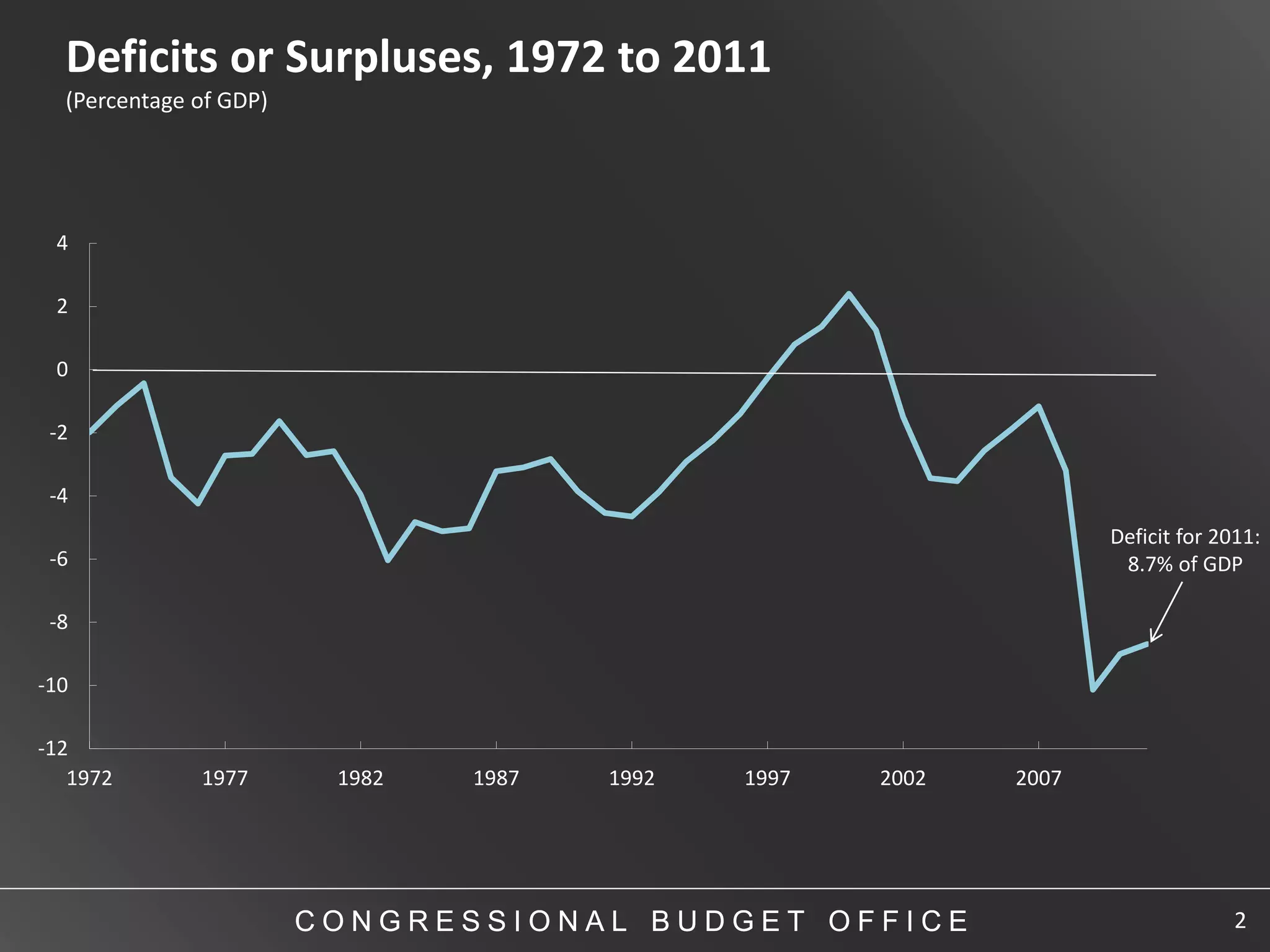
Deficits or Surpluses, 1972 to 2011
  (Percentage of GDP)


 4

 2

 0

 -2

 -4
                                                                   Deficit for 2011:
 -6                                                                 8.7% of GDP

 -8

-10

-12
   1972       1977       1982   1987   1992   1997   2002   2007


                        CONGRESSIONAL BUDGET OFFICE                              2
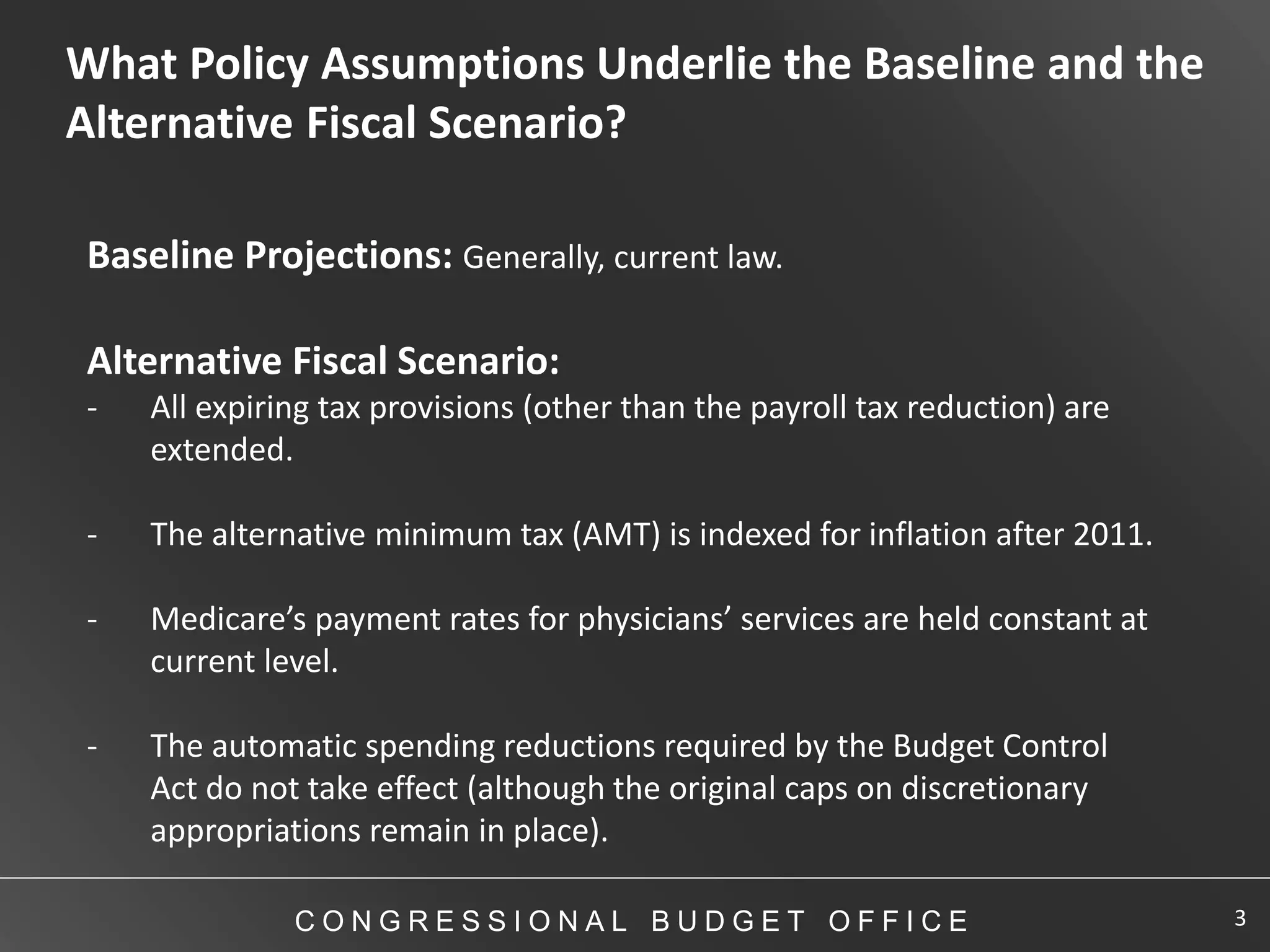
What Policy Assumptions Underlie the Baseline and the
Alternative Fiscal Scenario?

Baseline Projections: Generally, current law.

Alternative Fiscal Scenario:
-   All expiring tax provisions (other than the payroll tax reduction) are
    extended.

-   The alternative minimum tax (AMT) is indexed for inflation after 2011.

-   Medicare’s payment rates for physicians’ services are held constant at
    current level.

-   The automatic spending reductions required by the Budget Control
    Act do not take effect (although the original caps on discretionary
    appropriations remain in place).

              CONGRESSIONAL BUDGET OFFICE                                    3
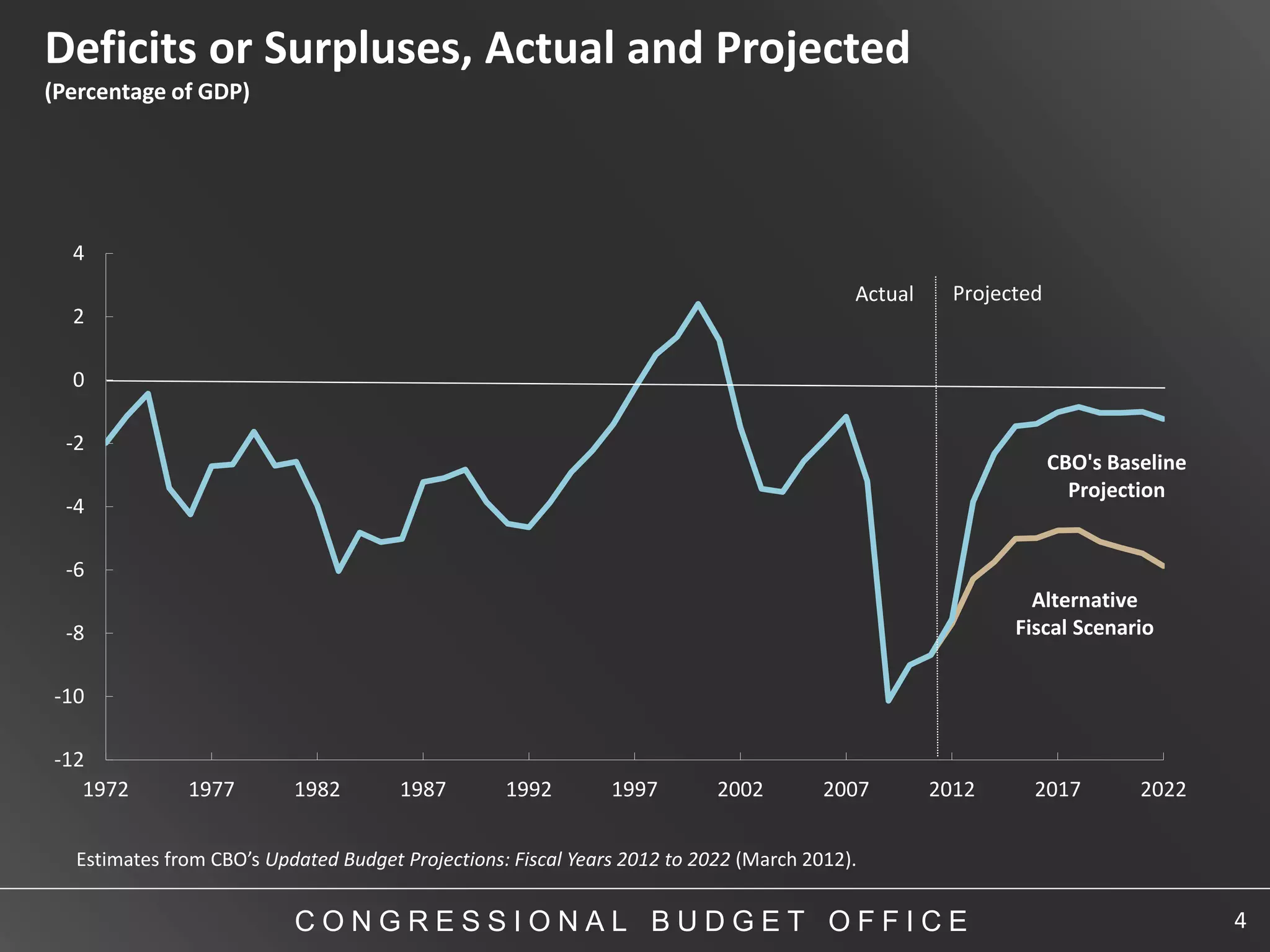
Deficits or Surpluses, Actual and Projected
(Percentage of GDP)


  4
                                                                                         Actual     Projected
  2

  0

 -2
                                                                                                                CBO's Baseline
                                                                                                                  Projection
 -4

 -6
                                                                                                            Alternative
 -8                                                                                                       Fiscal Scenario


-10

-12
   1972       1977        1982        1987        1992        1997        2002        2007        2012      2017         2022


  Estimates from CBO’s Updated Budget Projections: Fiscal Years 2012 to 2022 (March 2012).


                          CONGRESSIONAL BUDGET OFFICE                                                                            4
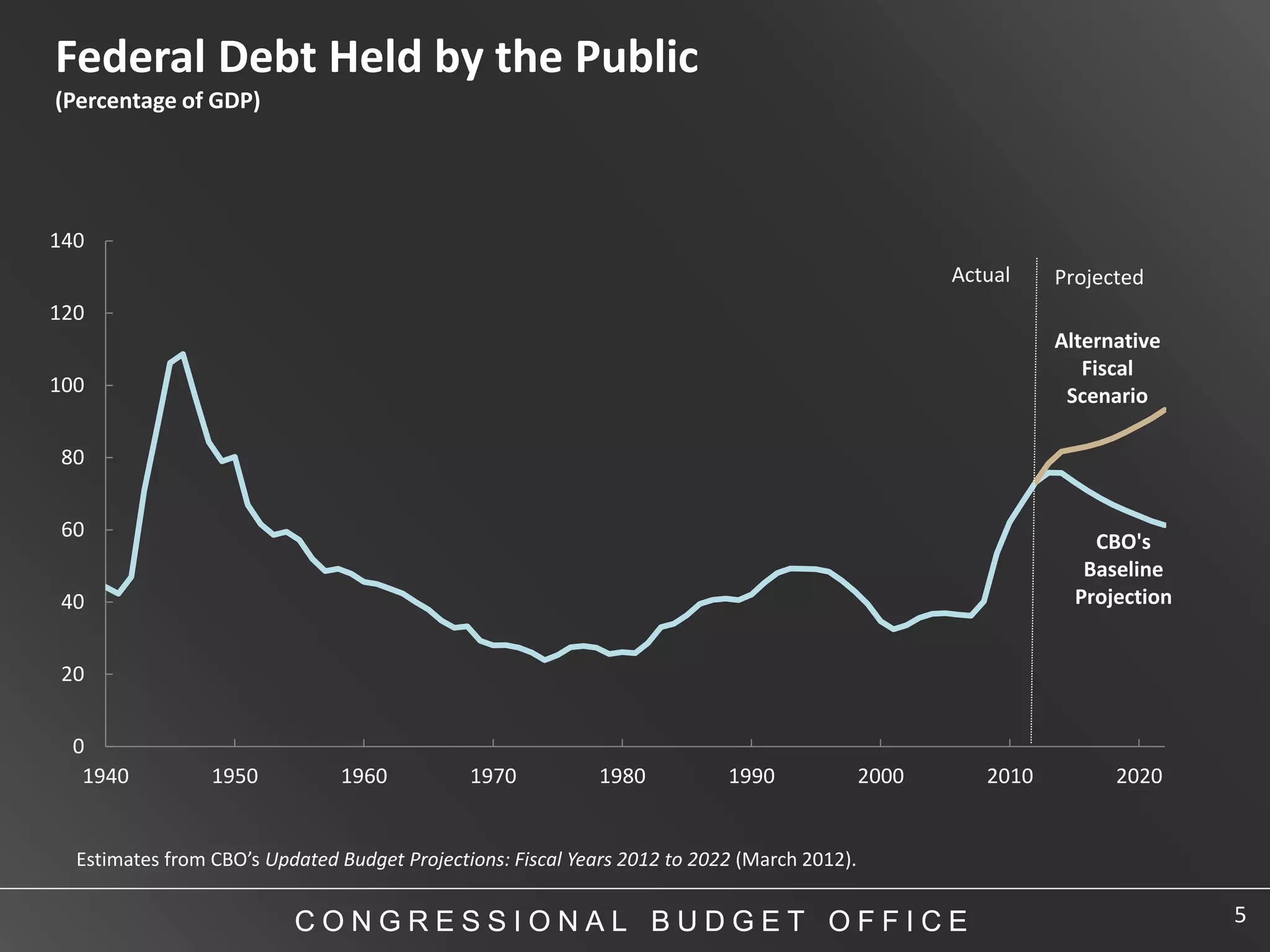
Federal Debt Held by the Public
(Percentage of GDP)


140
                                                                                                    Actual    Projected
120
                                                                                                              Alternative
                                                                                                                 Fiscal
100                                                                                                            Scenario

80


60
                                                                                                                  CBO's
                                                                                                                 Baseline
40                                                                                                              Projection


20


 0
  1940           1950          1960           1970          1980           1990              2000      2010         2020


  Estimates from CBO’s Updated Budget Projections: Fiscal Years 2012 to 2022 (March 2012).


                          CONGRESSIONAL BUDGET OFFICE                                                                        5
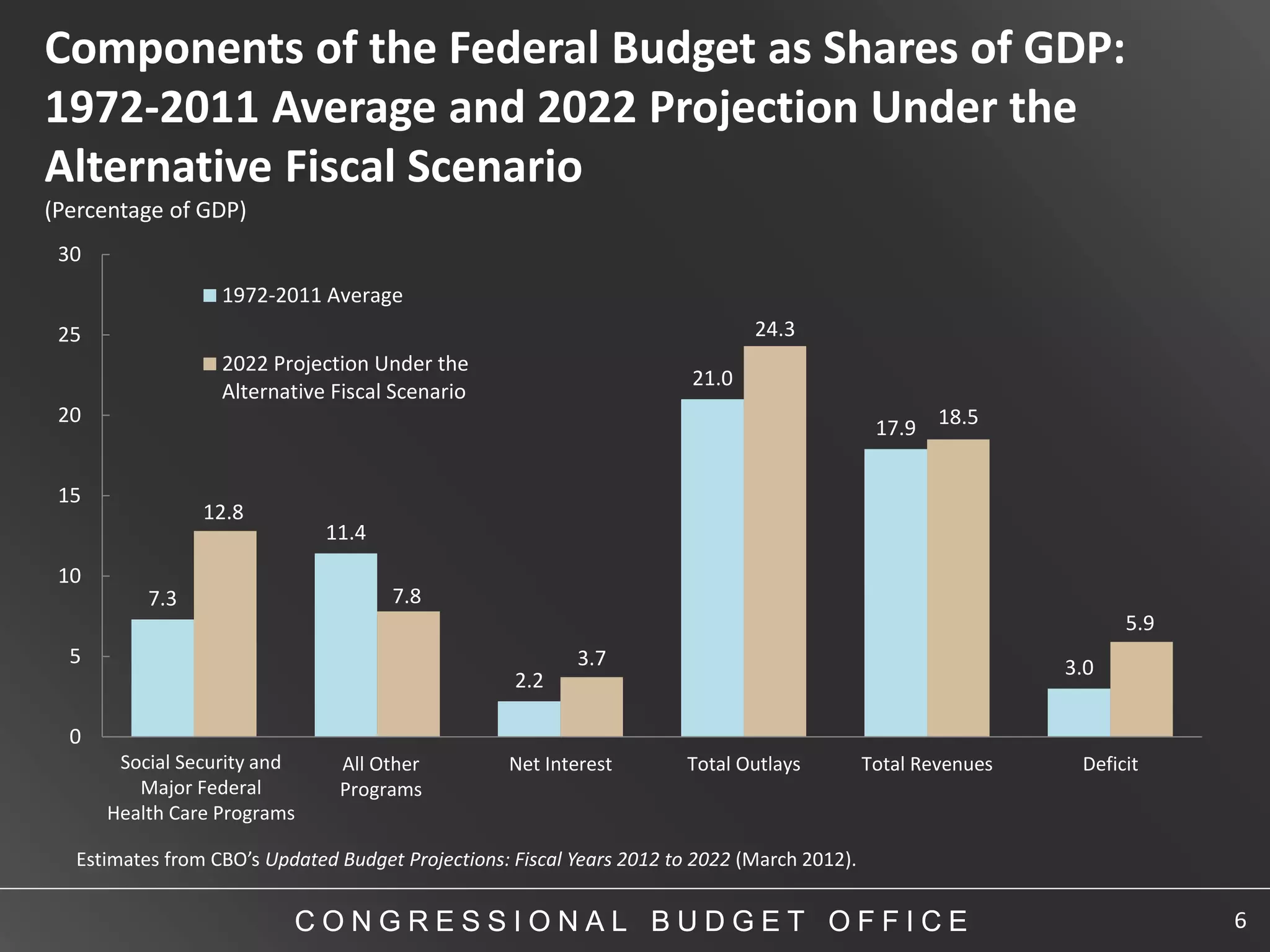
Components of the Federal Budget as Shares of GDP:
1972-2011 Average and 2022 Projection Under the
Alternative Fiscal Scenario
(Percentage of GDP)
 30
                  1972-2011 Average
 25                                                                           24.3
                  2022 Projection Under the
                                                                       21.0
                  Alternative Fiscal Scenario
 20
                                                                                              17.9 18.5

 15
                12.8
                              11.4
 10
          7.3                        7.8
                                                                                                                    5.9
  5                                                       3.7                                                 3.0
                                                   2.2

  0
       Social Security and     All Other          Net Interest        Total Outlays          Total Revenues    Deficit
         Major Federal         Programs
      Health Care Programs

  Estimates from CBO’s Updated Budget Projections: Fiscal Years 2012 to 2022 (March 2012).


                          CONGRESSIONAL BUDGET OFFICE                                                                     6
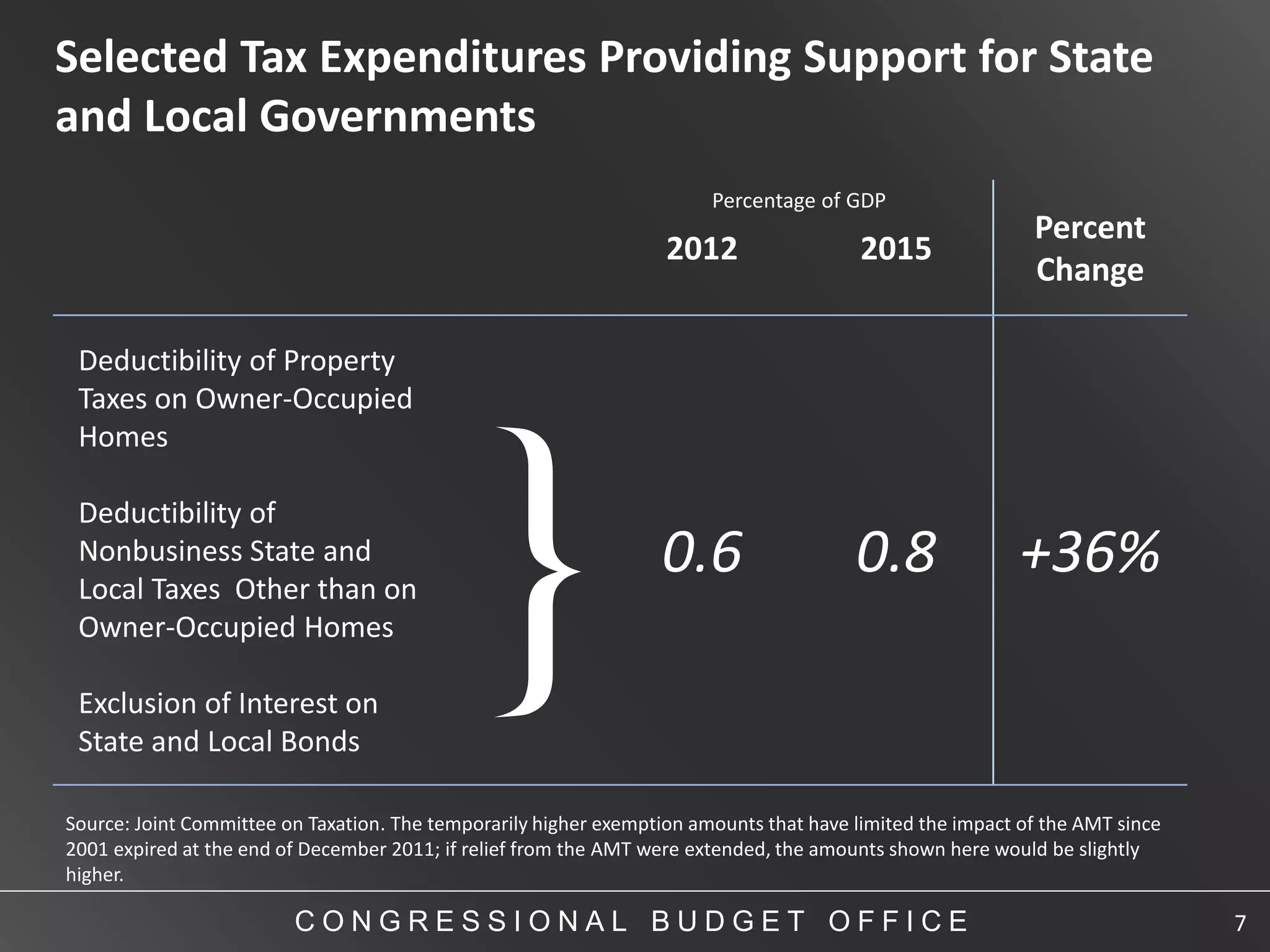
Selected Tax Expenditures Providing Support for State
and Local Governments
                                                                        Percentage of GDP
                                                                                                            Percent
                                                                   2012                  2015
                                                                                                            Change

 Deductibility of Property


                                               }
 Taxes on Owner-Occupied
 Homes

 Deductibility of
 Nonbusiness State and
 Local Taxes Other than on
                                                                  0.6                   0.8                +36%
 Owner-Occupied Homes

 Exclusion of Interest on
 State and Local Bonds

Source: Joint Committee on Taxation. The temporarily higher exemption amounts that have limited the impact of the AMT since
2001 expired at the end of December 2011; if relief from the AMT were extended, the amounts shown here would be slightly
higher.

                         CONGRESSIONAL BUDGET OFFICE                                                                          7
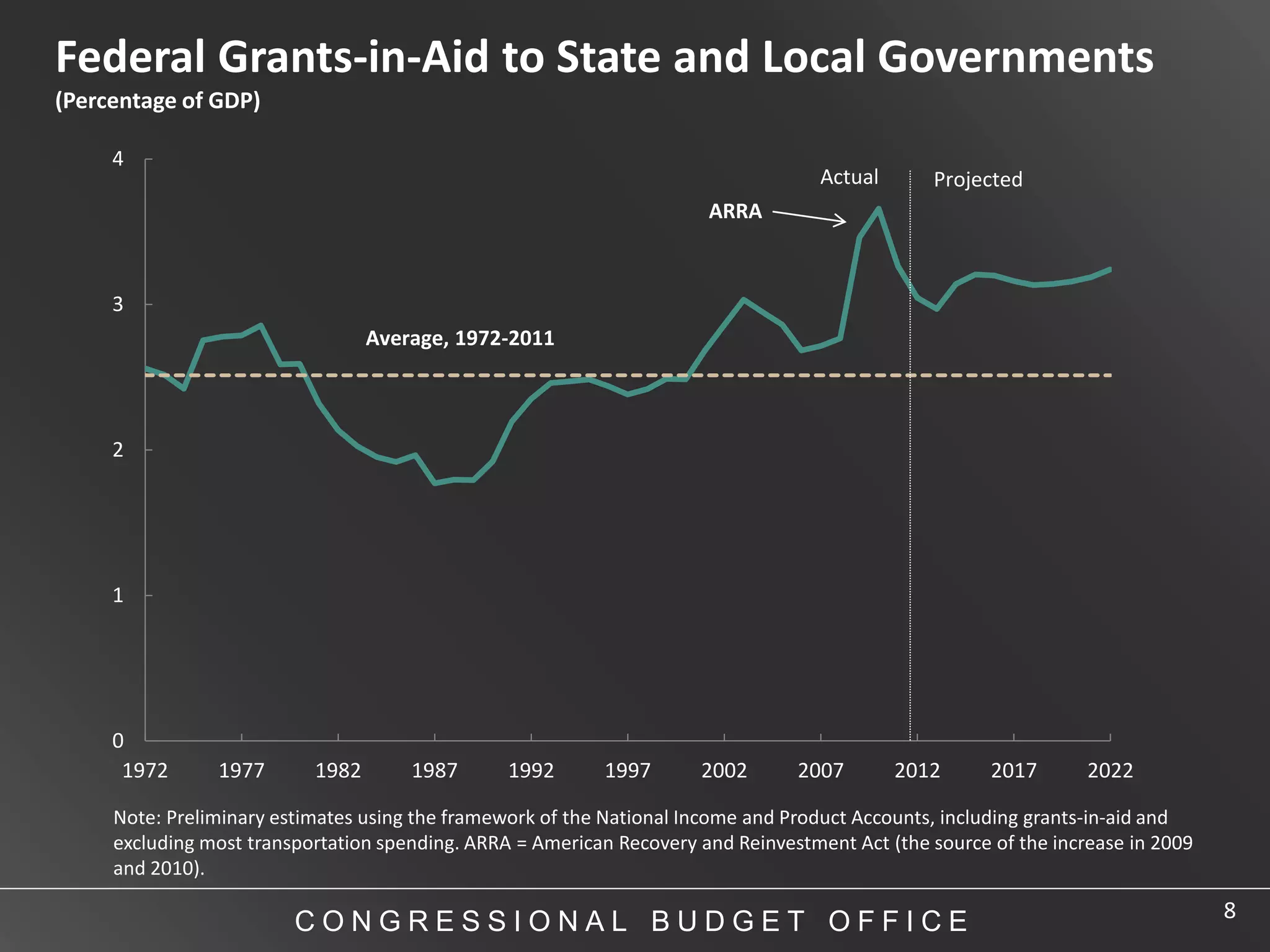
Federal Grants-in-Aid to State and Local Governments
(Percentage of GDP)

     4
                                                                                    Actual      Projected
                                                                       ARRA


     3
                                  Average, 1972-2011


     2


     1


     0
      1972      1977       1982       1987       1992       1997      2002       2007        2012      2017       2022

     Note: Preliminary estimates using the framework of the National Income and Product Accounts, including grants-in-aid and
     excluding most transportation spending. ARRA = American Recovery and Reinvestment Act (the source of the increase in 2009
     and 2010).

                                                                                                                                 8
                         CONGRESSIONAL BUDGET OFFICE
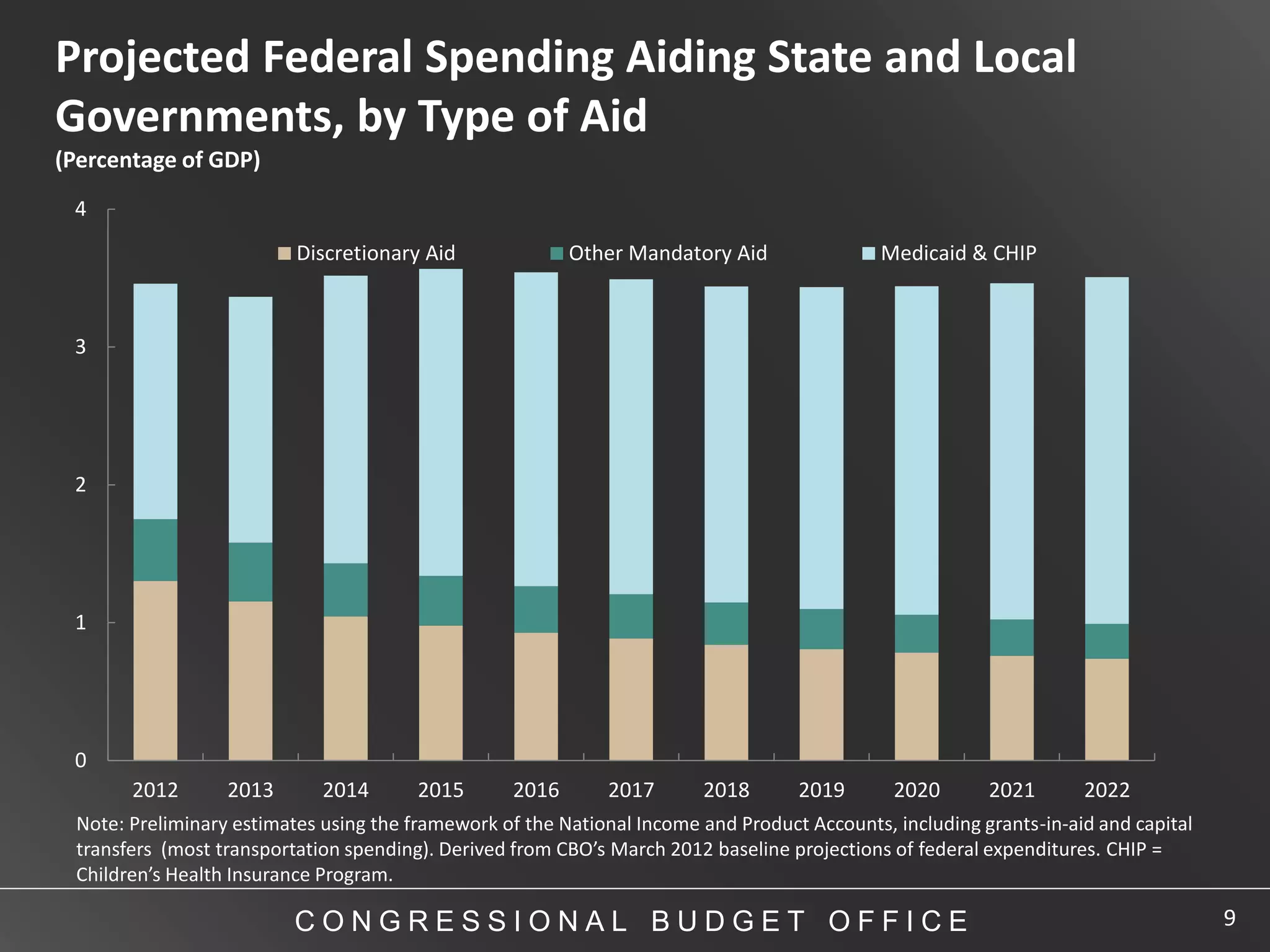
Projected Federal Spending Aiding State and Local
Governments, by Type of Aid
(Percentage of GDP)
 4
                          Discretionary Aid               Other Mandatory Aid                Medicaid & CHIP


 3


 2


 1


 0
       2012       2013       2014       2015       2016      2017       2018       2019       2020       2021       2022
 Note: Preliminary estimates using the framework of the National Income and Product Accounts, including grants-in-aid and capital
 transfers (most transportation spending). Derived from CBO’s March 2012 baseline projections of federal expenditures. CHIP =
 Children’s Health Insurance Program.

                          CONGRESSIONAL BUDGET OFFICE                                                                               9
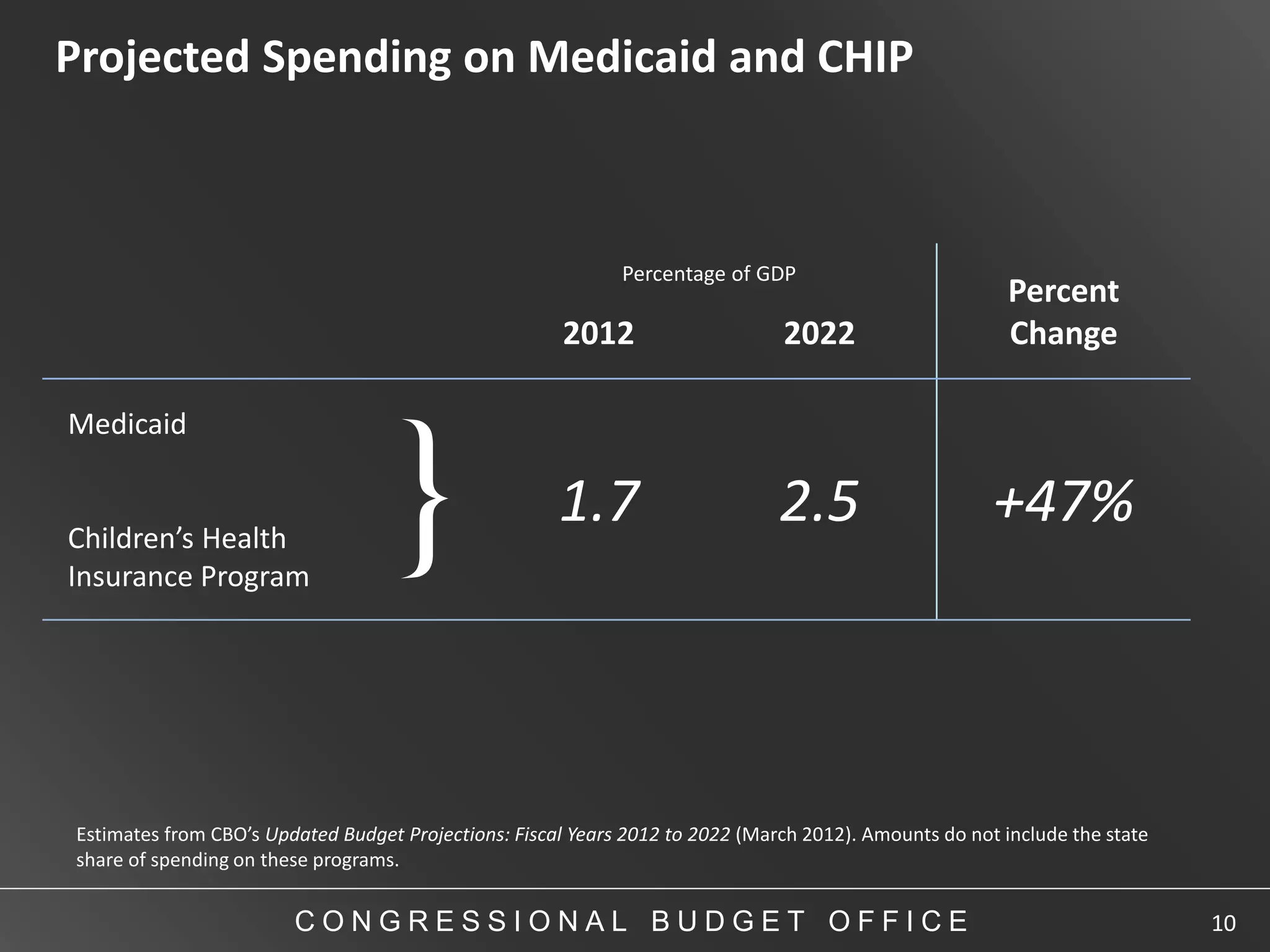
Projected Spending on Medicaid and CHIP


                                                             Percentage of GDP
                                                                                                         Percent
                                                      2012                     2022                      Change


                                    }
Medicaid


Children’s Health
                                                      1.7                      2.5                     +47%
Insurance Program


Estimates from CBO’s Updated Budget Projections: Fiscal Years 2012 to 2022 (March 2012). Amounts do not include the state
share of spending on these programs.


                        CONGRESSIONAL BUDGET OFFICE                                                                         10
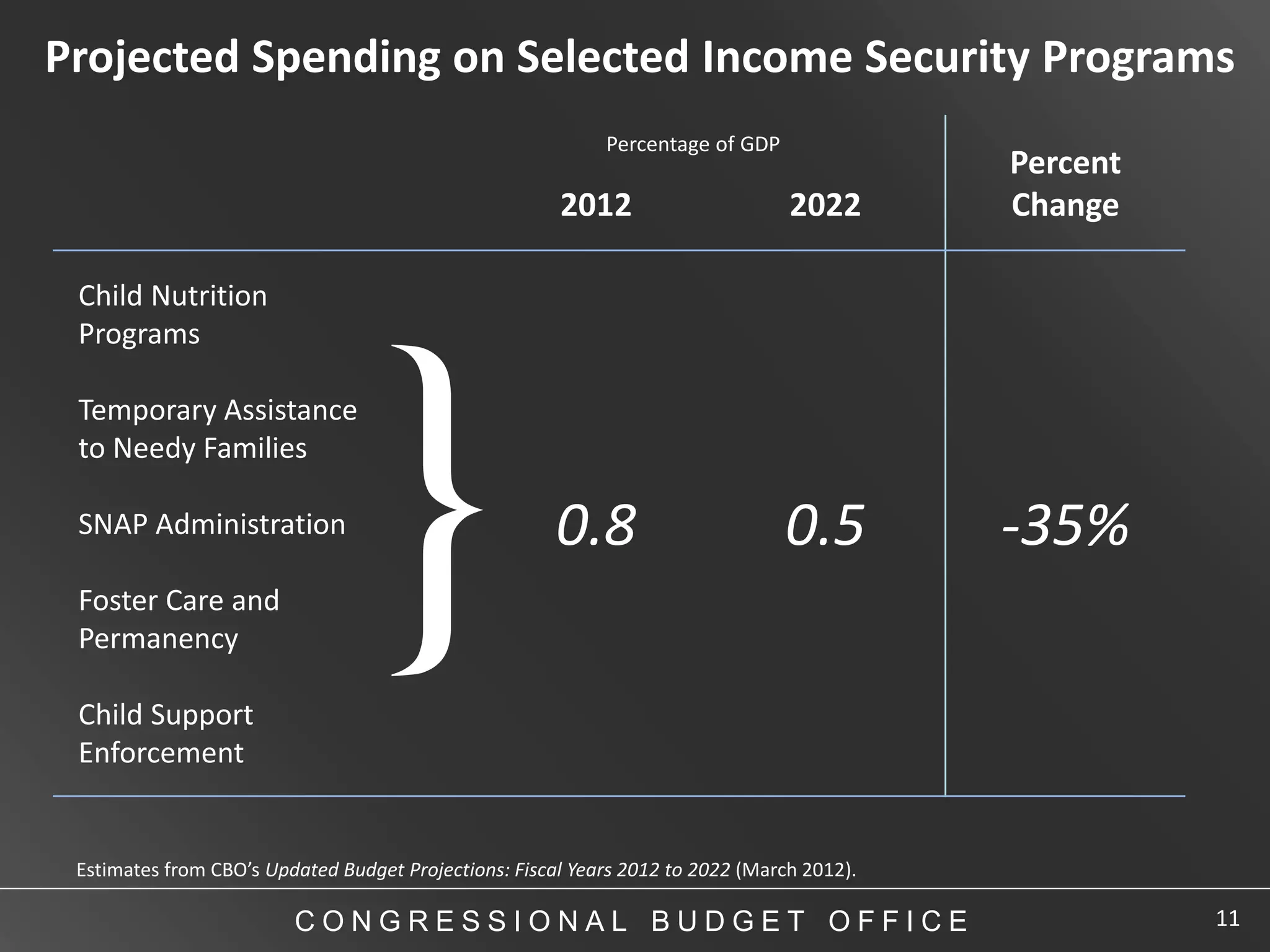
Projected Spending on Selected Income Security Programs
                                                            Percentage of GDP
                                                                                            Percent
                                                       2012                      2022       Change


                                   }
 Child Nutrition
 Programs

 Temporary Assistance
 to Needy Families

 SNAP Administration                                   0.8                      0.5         -35%
 Foster Care and
 Permanency

 Child Support
 Enforcement


 Estimates from CBO’s Updated Budget Projections: Fiscal Years 2012 to 2022 (March 2012).

                         CONGRESSIONAL BUDGET OFFICE                                                  11
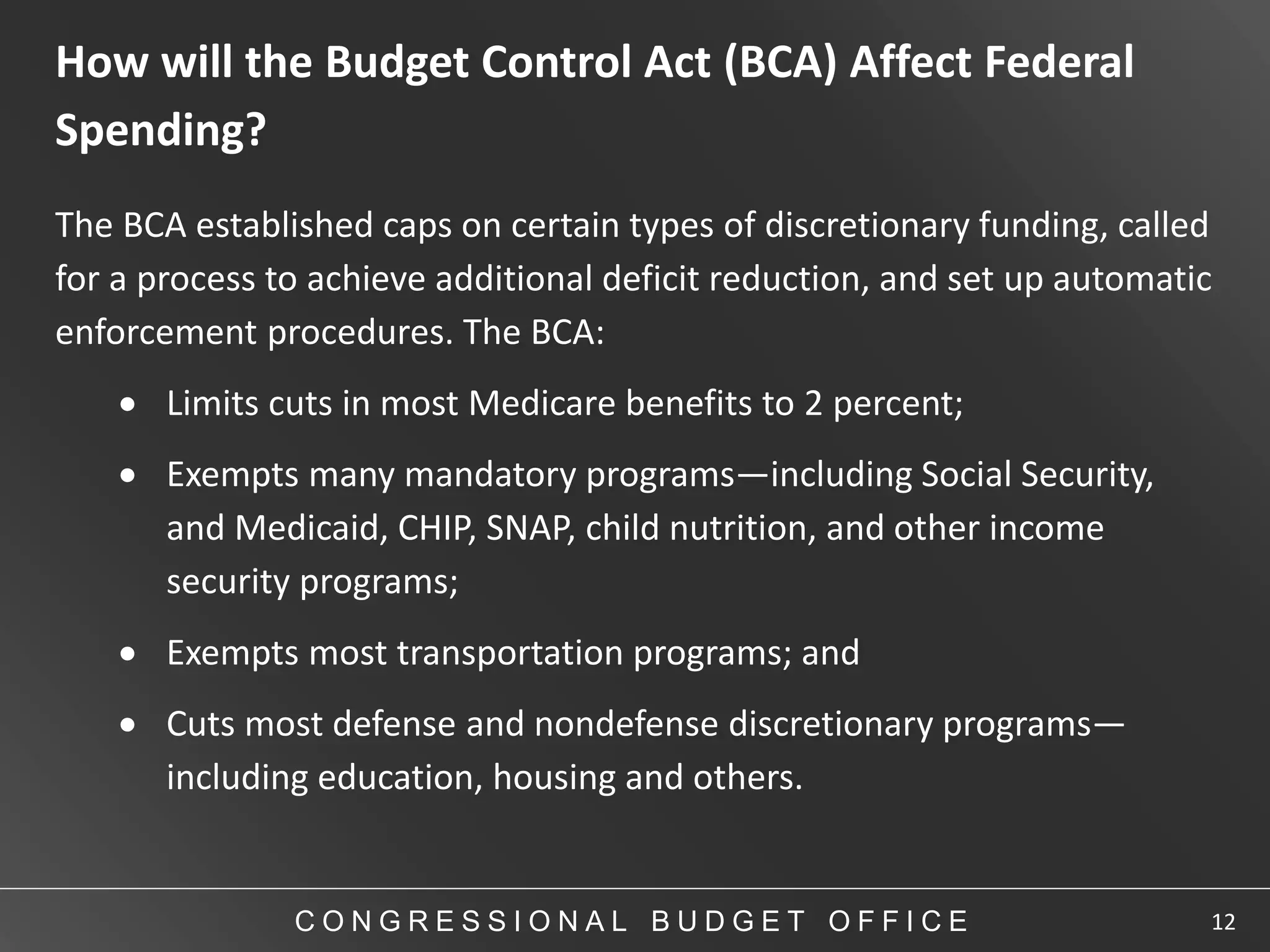
How will the Budget Control Act (BCA) Affect Federal
Spending?
The BCA established caps on certain types of discretionary funding, called
for a process to achieve additional deficit reduction, and set up automatic
enforcement procedures. The BCA:
     Limits cuts in most Medicare benefits to 2 percent;
     Exempts many mandatory programs—including Social Security,
      and Medicaid, CHIP, SNAP, child nutrition, and other income
      security programs;
     Exempts most transportation programs; and
     Cuts most defense and nondefense discretionary programs—
      including education, housing and others.


               CONGRESSIONAL BUDGET OFFICE                                12
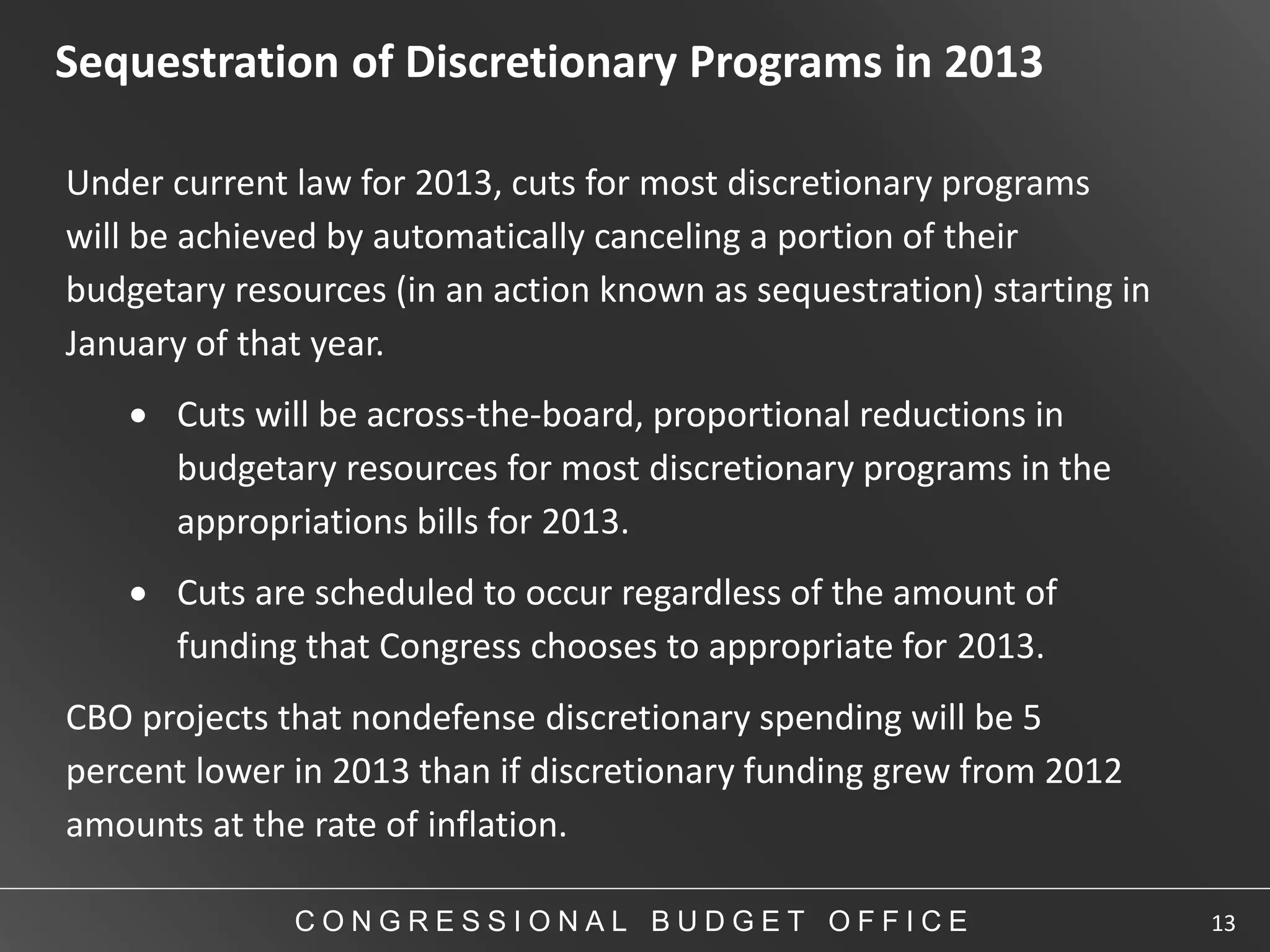
Sequestration of Discretionary Programs in 2013

Under current law for 2013, cuts for most discretionary programs
will be achieved by automatically canceling a portion of their
budgetary resources (in an action known as sequestration) starting in
January of that year.
     Cuts will be across-the-board, proportional reductions in
      budgetary resources for most discretionary programs in the
      appropriations bills for 2013.
     Cuts are scheduled to occur regardless of the amount of
      funding that Congress chooses to appropriate for 2013.
CBO projects that nondefense discretionary spending will be 5
percent lower in 2013 than if discretionary funding grew from 2012
amounts at the rate of inflation.

              CONGRESSIONAL BUDGET OFFICE                               13
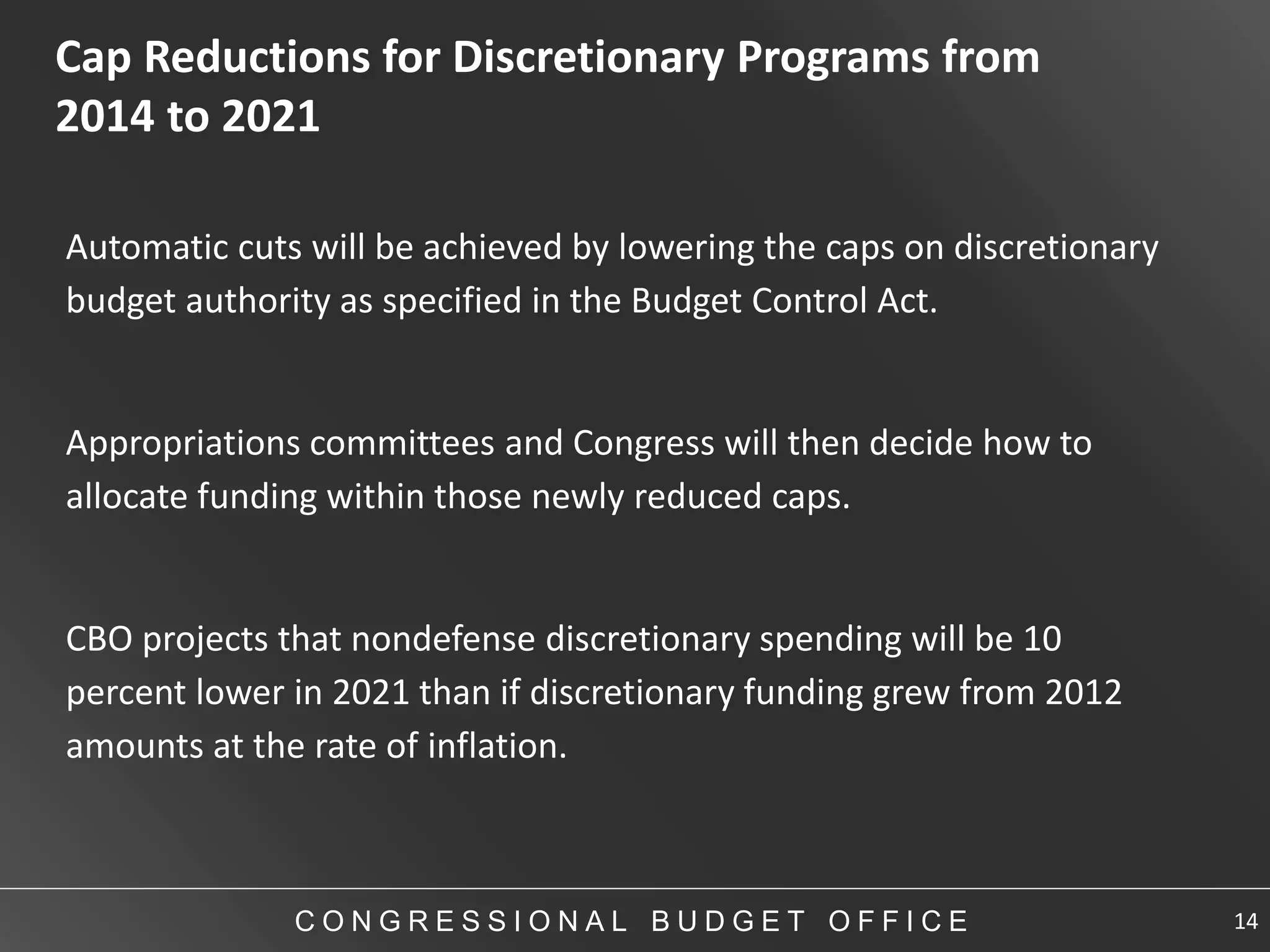
Cap Reductions for Discretionary Programs from
2014 to 2021

Automatic cuts will be achieved by lowering the caps on discretionary
budget authority as specified in the Budget Control Act.


Appropriations committees and Congress will then decide how to
allocate funding within those newly reduced caps.


CBO projects that nondefense discretionary spending will be 10
percent lower in 2021 than if discretionary funding grew from 2012
amounts at the rate of inflation.


              CONGRESSIONAL BUDGET OFFICE                               14
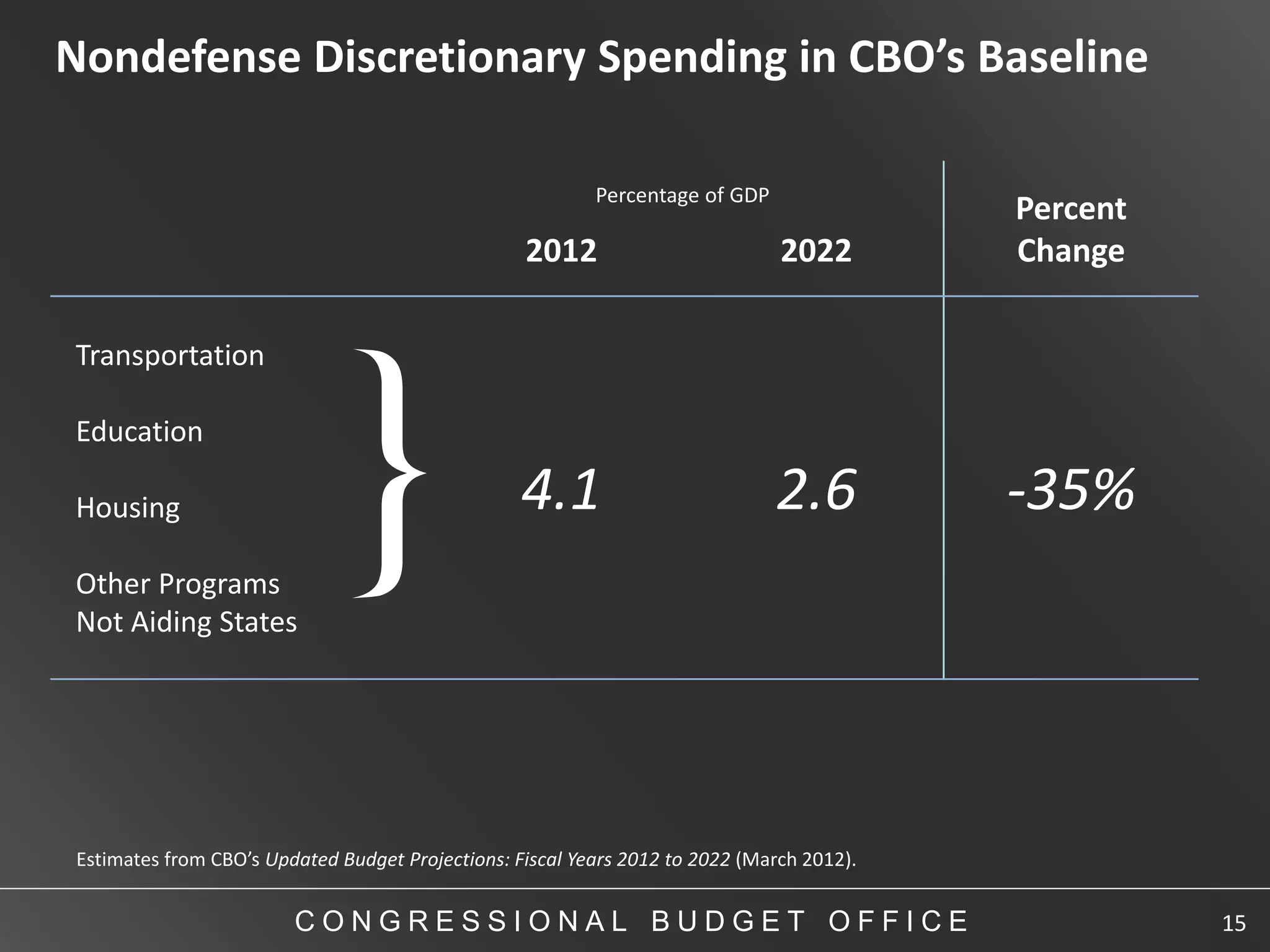
Nondefense Discretionary Spending in CBO’s Baseline

                                                          Percentage of GDP
                                                                                           Percent
                                                  2012                         2022        Change


                              }
Transportation

Education

Housing                                           4.1                         2.6          -35%
Other Programs
Not Aiding States


Estimates from CBO’s Updated Budget Projections: Fiscal Years 2012 to 2022 (March 2012).


                        CONGRESSIONAL BUDGET OFFICE                                                  15
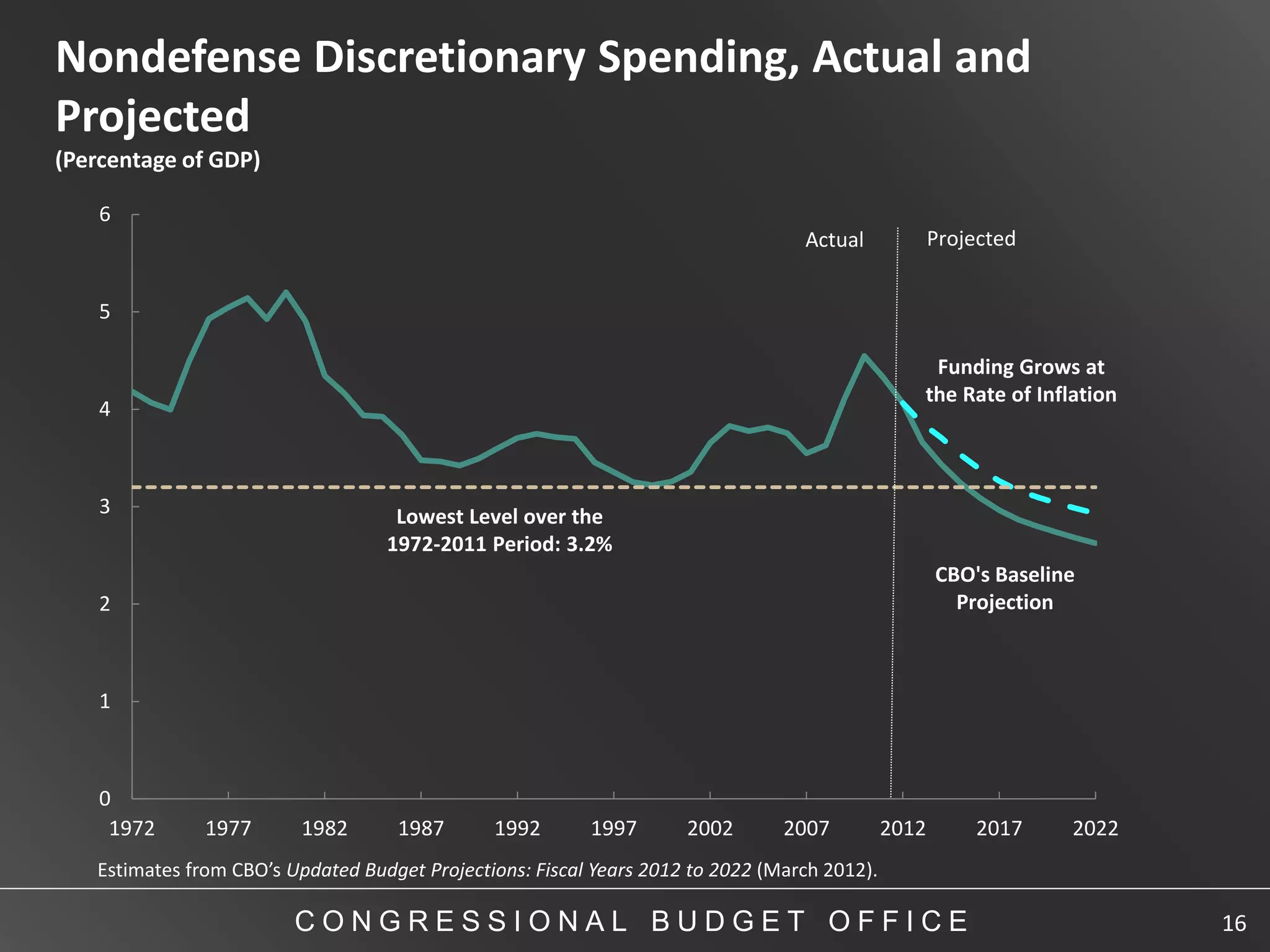
Nondefense Discretionary Spending, Actual and
Projected
(Percentage of GDP)

    6
                                                                                  Actual             Projected


    5

                                                                                                  Funding Grows at
                                                                                                 the Rate of Inflation
    4


    3                               Lowest Level over the
                                   1972-2011 Period: 3.2%
                                                                                                     CBO's Baseline
    2                                                                                                  Projection


    1


    0
     1972      1977       1982      1987       1992       1997       2002       2007          2012       2017     2022
   Estimates from CBO’s Updated Budget Projections: Fiscal Years 2012 to 2022 (March 2012).

                         CONGRESSIONAL BUDGET OFFICE                                                                     16

The Federal Budget Outlook and Aid to States

  • 1.
    The Federal BudgetOutlook and Aid to States Presentation to the National Lieutenant Governors Association Jeffrey R. Kling Associate Director for Economic Analysis March 21, 2012 CONGRESSIONAL BUDGET OFFICE 1
  • 2.
    Deficits or Surpluses,1972 to 2011 (Percentage of GDP) 4 2 0 -2 -4 Deficit for 2011: -6 8.7% of GDP -8 -10 -12 1972 1977 1982 1987 1992 1997 2002 2007 CONGRESSIONAL BUDGET OFFICE 2
  • 3.
    What Policy AssumptionsUnderlie the Baseline and the Alternative Fiscal Scenario? Baseline Projections: Generally, current law. Alternative Fiscal Scenario: - All expiring tax provisions (other than the payroll tax reduction) are extended. - The alternative minimum tax (AMT) is indexed for inflation after 2011. - Medicare’s payment rates for physicians’ services are held constant at current level. - The automatic spending reductions required by the Budget Control Act do not take effect (although the original caps on discretionary appropriations remain in place). CONGRESSIONAL BUDGET OFFICE 3
  • 4.
    Deficits or Surpluses,Actual and Projected (Percentage of GDP) 4 Actual Projected 2 0 -2 CBO's Baseline Projection -4 -6 Alternative -8 Fiscal Scenario -10 -12 1972 1977 1982 1987 1992 1997 2002 2007 2012 2017 2022 Estimates from CBO’s Updated Budget Projections: Fiscal Years 2012 to 2022 (March 2012). CONGRESSIONAL BUDGET OFFICE 4
  • 5.
    Federal Debt Heldby the Public (Percentage of GDP) 140 Actual Projected 120 Alternative Fiscal 100 Scenario 80 60 CBO's Baseline 40 Projection 20 0 1940 1950 1960 1970 1980 1990 2000 2010 2020 Estimates from CBO’s Updated Budget Projections: Fiscal Years 2012 to 2022 (March 2012). CONGRESSIONAL BUDGET OFFICE 5
  • 6.
    Components of theFederal Budget as Shares of GDP: 1972-2011 Average and 2022 Projection Under the Alternative Fiscal Scenario (Percentage of GDP) 30 1972-2011 Average 25 24.3 2022 Projection Under the 21.0 Alternative Fiscal Scenario 20 17.9 18.5 15 12.8 11.4 10 7.3 7.8 5.9 5 3.7 3.0 2.2 0 Social Security and All Other Net Interest Total Outlays Total Revenues Deficit Major Federal Programs Health Care Programs Estimates from CBO’s Updated Budget Projections: Fiscal Years 2012 to 2022 (March 2012). CONGRESSIONAL BUDGET OFFICE 6
  • 7.
    Selected Tax ExpendituresProviding Support for State and Local Governments Percentage of GDP Percent 2012 2015 Change Deductibility of Property } Taxes on Owner-Occupied Homes Deductibility of Nonbusiness State and Local Taxes Other than on 0.6 0.8 +36% Owner-Occupied Homes Exclusion of Interest on State and Local Bonds Source: Joint Committee on Taxation. The temporarily higher exemption amounts that have limited the impact of the AMT since 2001 expired at the end of December 2011; if relief from the AMT were extended, the amounts shown here would be slightly higher. CONGRESSIONAL BUDGET OFFICE 7
  • 8.
    Federal Grants-in-Aid toState and Local Governments (Percentage of GDP) 4 Actual Projected ARRA 3 Average, 1972-2011 2 1 0 1972 1977 1982 1987 1992 1997 2002 2007 2012 2017 2022 Note: Preliminary estimates using the framework of the National Income and Product Accounts, including grants-in-aid and excluding most transportation spending. ARRA = American Recovery and Reinvestment Act (the source of the increase in 2009 and 2010). 8 CONGRESSIONAL BUDGET OFFICE
  • 9.
    Projected Federal SpendingAiding State and Local Governments, by Type of Aid (Percentage of GDP) 4 Discretionary Aid Other Mandatory Aid Medicaid & CHIP 3 2 1 0 2012 2013 2014 2015 2016 2017 2018 2019 2020 2021 2022 Note: Preliminary estimates using the framework of the National Income and Product Accounts, including grants-in-aid and capital transfers (most transportation spending). Derived from CBO’s March 2012 baseline projections of federal expenditures. CHIP = Children’s Health Insurance Program. CONGRESSIONAL BUDGET OFFICE 9
  • 10.
    Projected Spending onMedicaid and CHIP Percentage of GDP Percent 2012 2022 Change } Medicaid Children’s Health 1.7 2.5 +47% Insurance Program Estimates from CBO’s Updated Budget Projections: Fiscal Years 2012 to 2022 (March 2012). Amounts do not include the state share of spending on these programs. CONGRESSIONAL BUDGET OFFICE 10
  • 11.
    Projected Spending onSelected Income Security Programs Percentage of GDP Percent 2012 2022 Change } Child Nutrition Programs Temporary Assistance to Needy Families SNAP Administration 0.8 0.5 -35% Foster Care and Permanency Child Support Enforcement Estimates from CBO’s Updated Budget Projections: Fiscal Years 2012 to 2022 (March 2012). CONGRESSIONAL BUDGET OFFICE 11
  • 12.
    How will theBudget Control Act (BCA) Affect Federal Spending? The BCA established caps on certain types of discretionary funding, called for a process to achieve additional deficit reduction, and set up automatic enforcement procedures. The BCA:  Limits cuts in most Medicare benefits to 2 percent;  Exempts many mandatory programs—including Social Security, and Medicaid, CHIP, SNAP, child nutrition, and other income security programs;  Exempts most transportation programs; and  Cuts most defense and nondefense discretionary programs— including education, housing and others. CONGRESSIONAL BUDGET OFFICE 12
  • 13.
    Sequestration of DiscretionaryPrograms in 2013 Under current law for 2013, cuts for most discretionary programs will be achieved by automatically canceling a portion of their budgetary resources (in an action known as sequestration) starting in January of that year.  Cuts will be across-the-board, proportional reductions in budgetary resources for most discretionary programs in the appropriations bills for 2013.  Cuts are scheduled to occur regardless of the amount of funding that Congress chooses to appropriate for 2013. CBO projects that nondefense discretionary spending will be 5 percent lower in 2013 than if discretionary funding grew from 2012 amounts at the rate of inflation. CONGRESSIONAL BUDGET OFFICE 13
  • 14.
    Cap Reductions forDiscretionary Programs from 2014 to 2021 Automatic cuts will be achieved by lowering the caps on discretionary budget authority as specified in the Budget Control Act. Appropriations committees and Congress will then decide how to allocate funding within those newly reduced caps. CBO projects that nondefense discretionary spending will be 10 percent lower in 2021 than if discretionary funding grew from 2012 amounts at the rate of inflation. CONGRESSIONAL BUDGET OFFICE 14
  • 15.
    Nondefense Discretionary Spendingin CBO’s Baseline Percentage of GDP Percent 2012 2022 Change } Transportation Education Housing 4.1 2.6 -35% Other Programs Not Aiding States Estimates from CBO’s Updated Budget Projections: Fiscal Years 2012 to 2022 (March 2012). CONGRESSIONAL BUDGET OFFICE 15
  • 16.
    Nondefense Discretionary Spending,Actual and Projected (Percentage of GDP) 6 Actual Projected 5 Funding Grows at the Rate of Inflation 4 3 Lowest Level over the 1972-2011 Period: 3.2% CBO's Baseline 2 Projection 1 0 1972 1977 1982 1987 1992 1997 2002 2007 2012 2017 2022 Estimates from CBO’s Updated Budget Projections: Fiscal Years 2012 to 2022 (March 2012). CONGRESSIONAL BUDGET OFFICE 16