
CONCEPTS OF VALUES FOR PUBLIC RELATIONS Bruno Amaral Online PR Consultant http://www.imago.pt http://www.brunoamaral.eu
Values and Values Systems Reviving a Dormant Concept Hitlin and Piliavin 2004 Rokeach Hofstede Schwartz
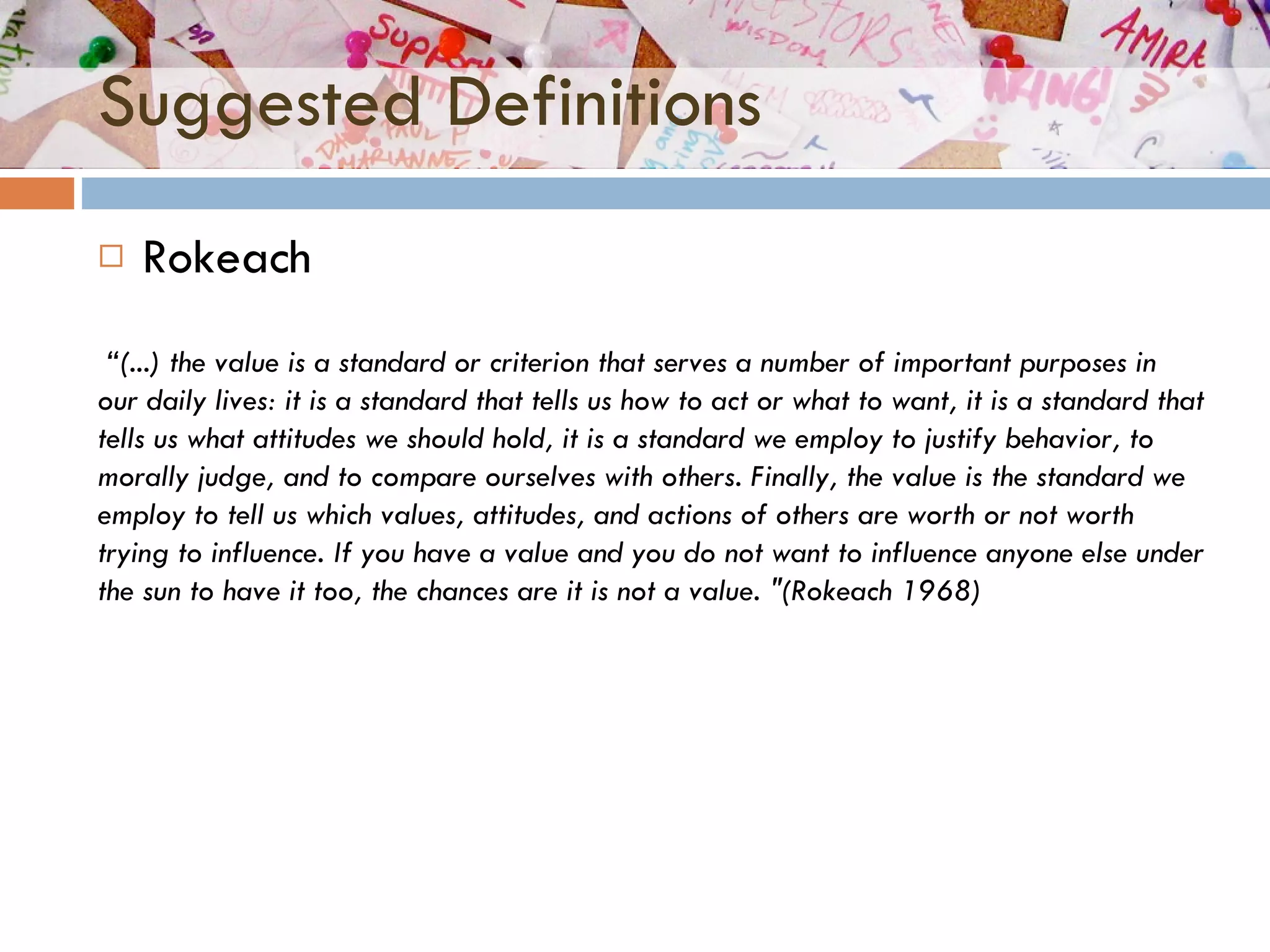
Suggested Definitions Rokeach  “ (...) the value is a standard or criterion that serves a number of important purposes in our daily lives: it is a standard that tells us how to act or what to want, it is a standard that tells us what attitudes we should hold, it is a standard we employ to justify behavior, to morally judge, and to compare ourselves with others. Finally, the value is the standard we employ to tell us which values, attitudes, and actions of others are worth or not worth trying to influence. If you have a value and you do not want to influence anyone else under the sun to have it too, the chances are it is not a value. "(Rokeach 1968)
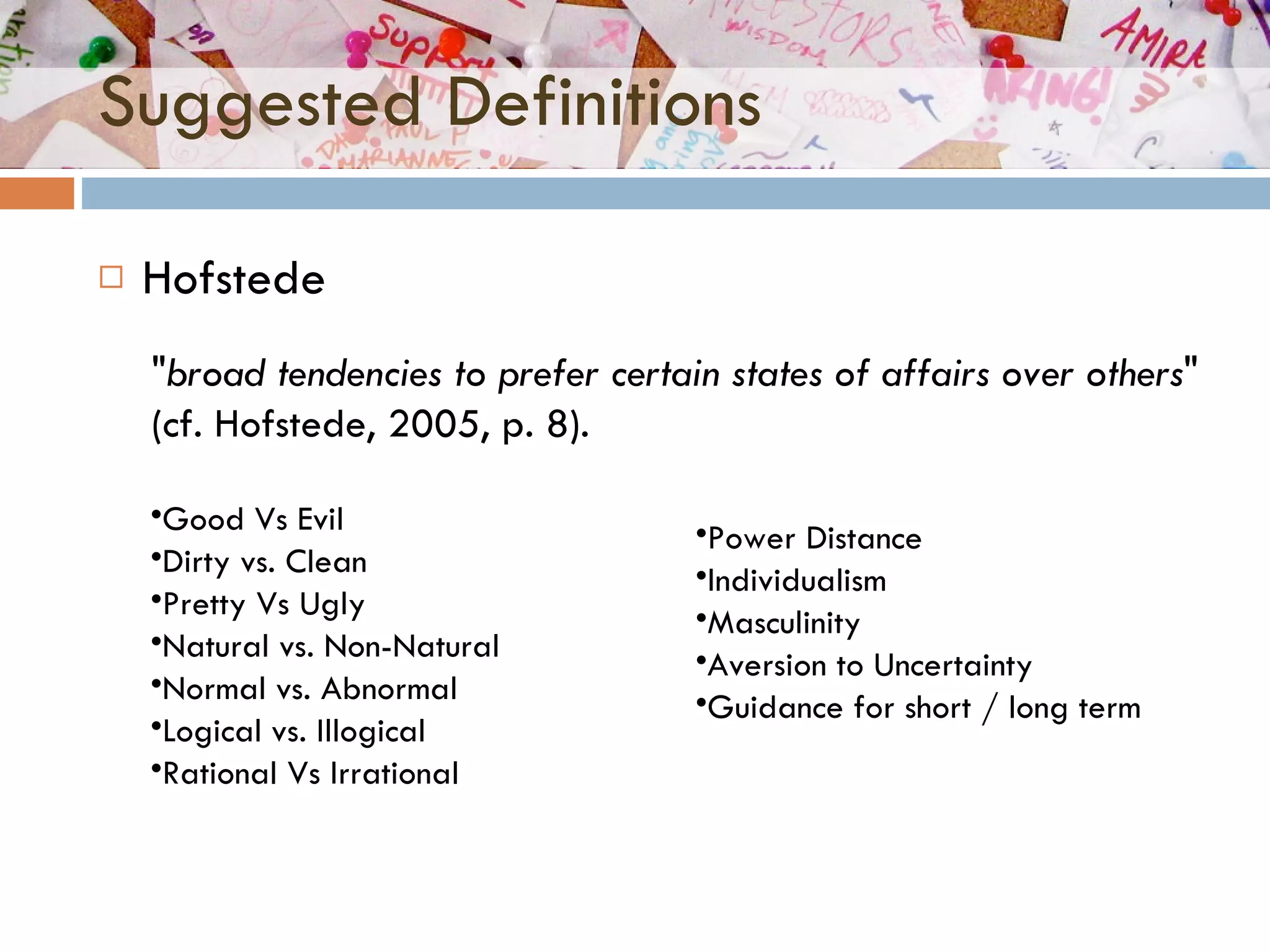
Suggested Definitions Hofstede  " broad tendencies to prefer certain states of affairs over others " (cf. Hofstede, 2005, p. 8).  Good Vs Evil  Dirty vs. Clean  Pretty Vs Ugly  Natural vs. Non-Natural  Normal vs. Abnormal  Logical vs. Illogical  Rational Vs Irrational  Power Distance  Individualism  Masculinity  Aversion to Uncertainty  Guidance for short / long term
Suggested Definitions Schwartz “ According to the literature, values are (a) concepts or beliefs, (b) about desirable end states or behaviors, (c) that transcend specific situations, (d) guide selection or evaluation of behavior and events, and (e) are ordered by relative importance. "Schwartz (1992) emphasizes that values are cognitive representations of three universal human requirements: (a) biologically based organism needs, (b) social interactional requirements for interpersonal coordination, and (c) social institutional demands for group welfare and survival.” Schwartz & Bilsky (1987, p. 551)
What are Values NeuroScience tells us we are prone to build relationships and that our brain is built to adapt to different social contexts  ( Quartz and Sejnowski 2004) Psychology tells us that the “perceived partner responsiveness” is essential to build relationships  (Reis 2002 Reis, Clark and Holmes 2004 Reis 2007)
What are Values We use values to relate to each other and to describe others (people or organisations) We refer to our values to guide ou behaviour and as part of the decision making process However, the current definitions are too broad and the values systems presented are not neutral in nature
How are values used in PR?
How are values used in PR? Ethics Corporate Identity Corporate Culture Core values Brands  …
New Approaches to Values and PR David Phillips Jon Iwata Camarinha-Matos and Macedo
New Approaches to Values and PR David Phillips A relationship occurs when Actors attribute identical or similar values to a given occurrence (token) Relationships are formed around values
New Approaches to Values and PR Jon Iwata IBM’s Values System “ We call it the IBM System Brand. Picture a framework with five columns. From left to right the columns are labeled  what it means to look like IBM ,  to sound like IBM ,  to think like IBM ,  to perform like IBM   and ultimately   to be IBM ”
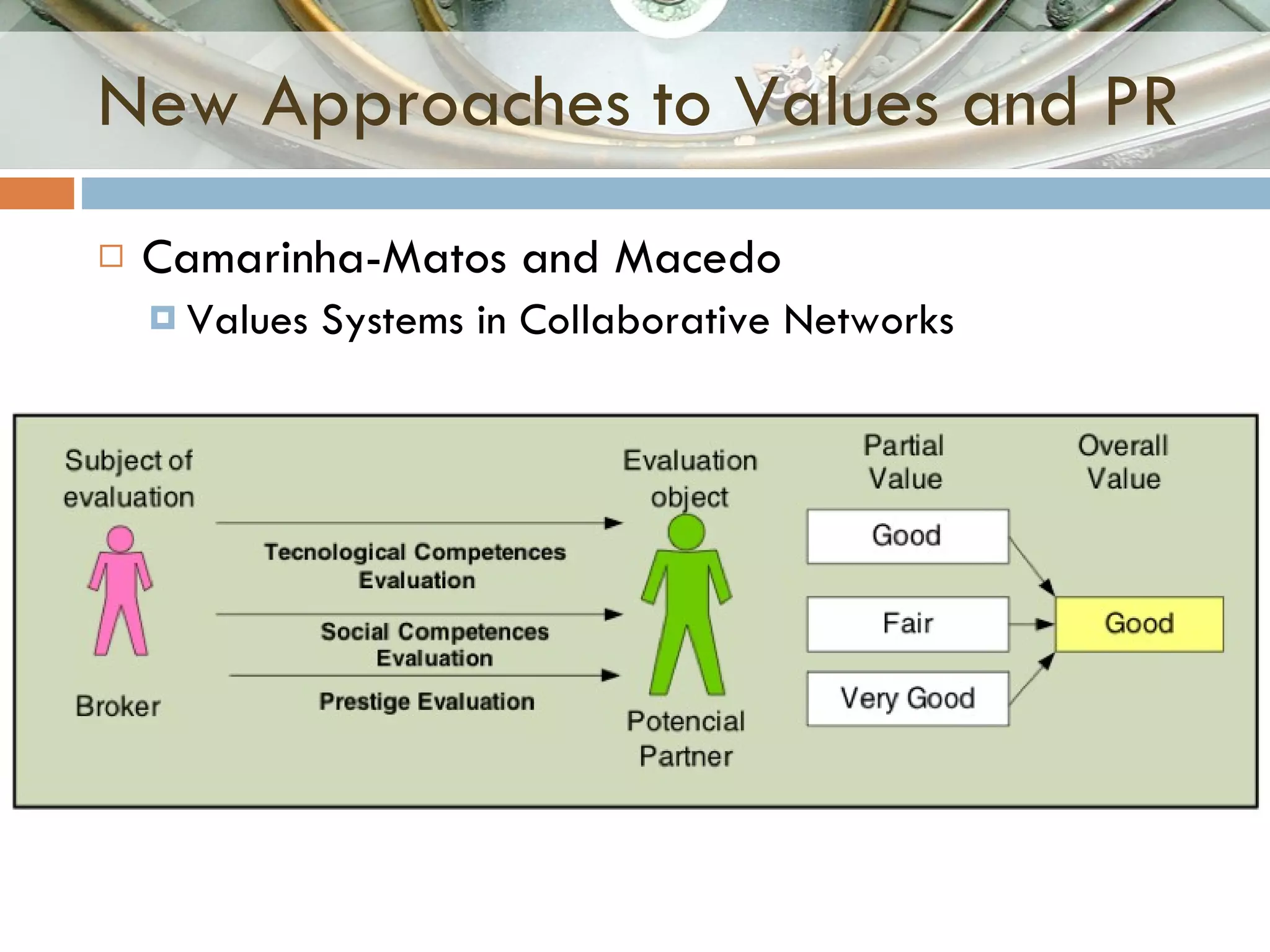
New Approaches to Values and PR Camarinha-Matos and Macedo Values Systems in Collaborative Networks
Values and Social Media Do we display values online? Donath and Boyd Back et al. Each Social Media Instrument Allows for Values to be Demonstrated in Different Ways
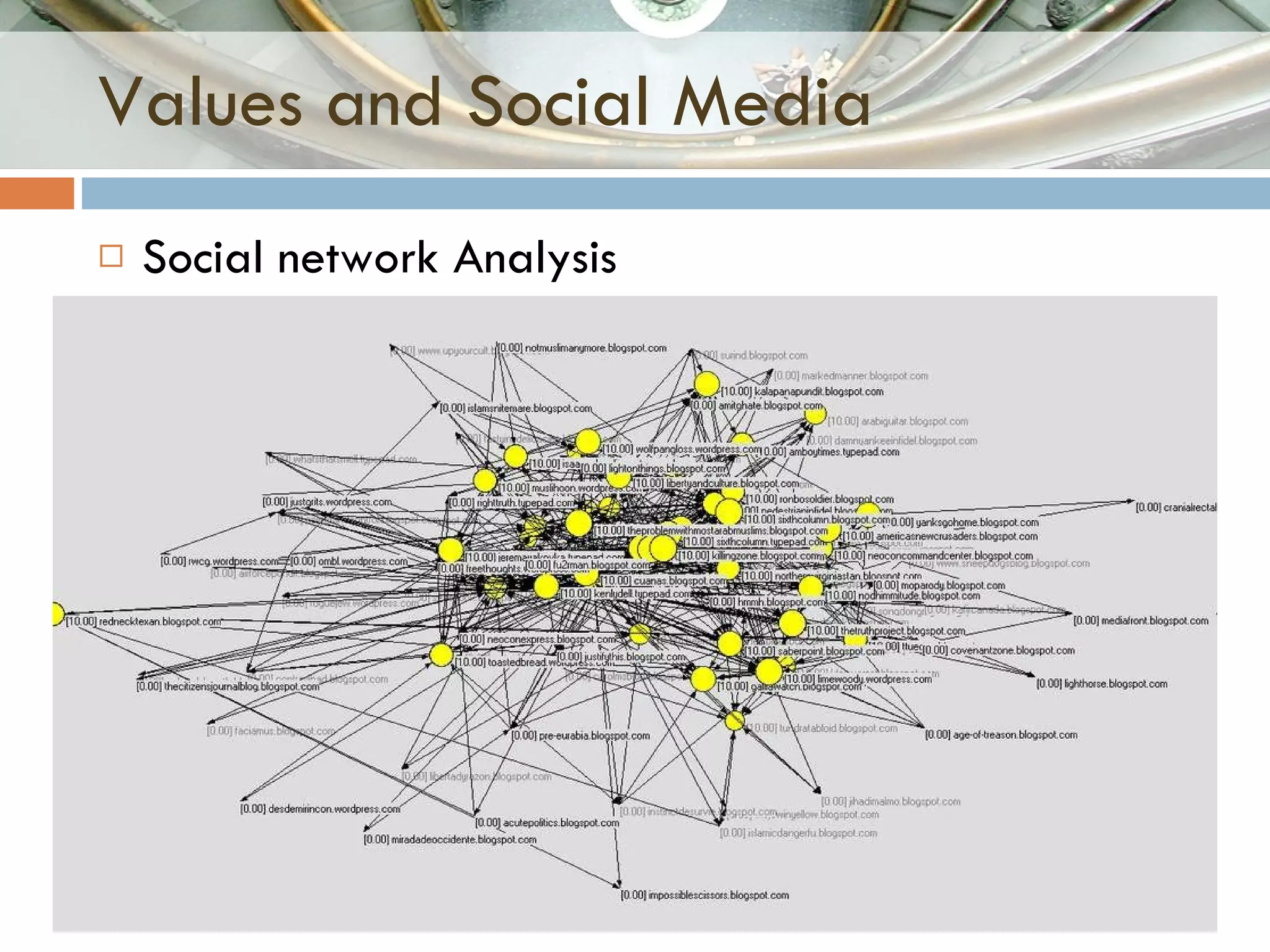
Values and Social Media Social network Analysis
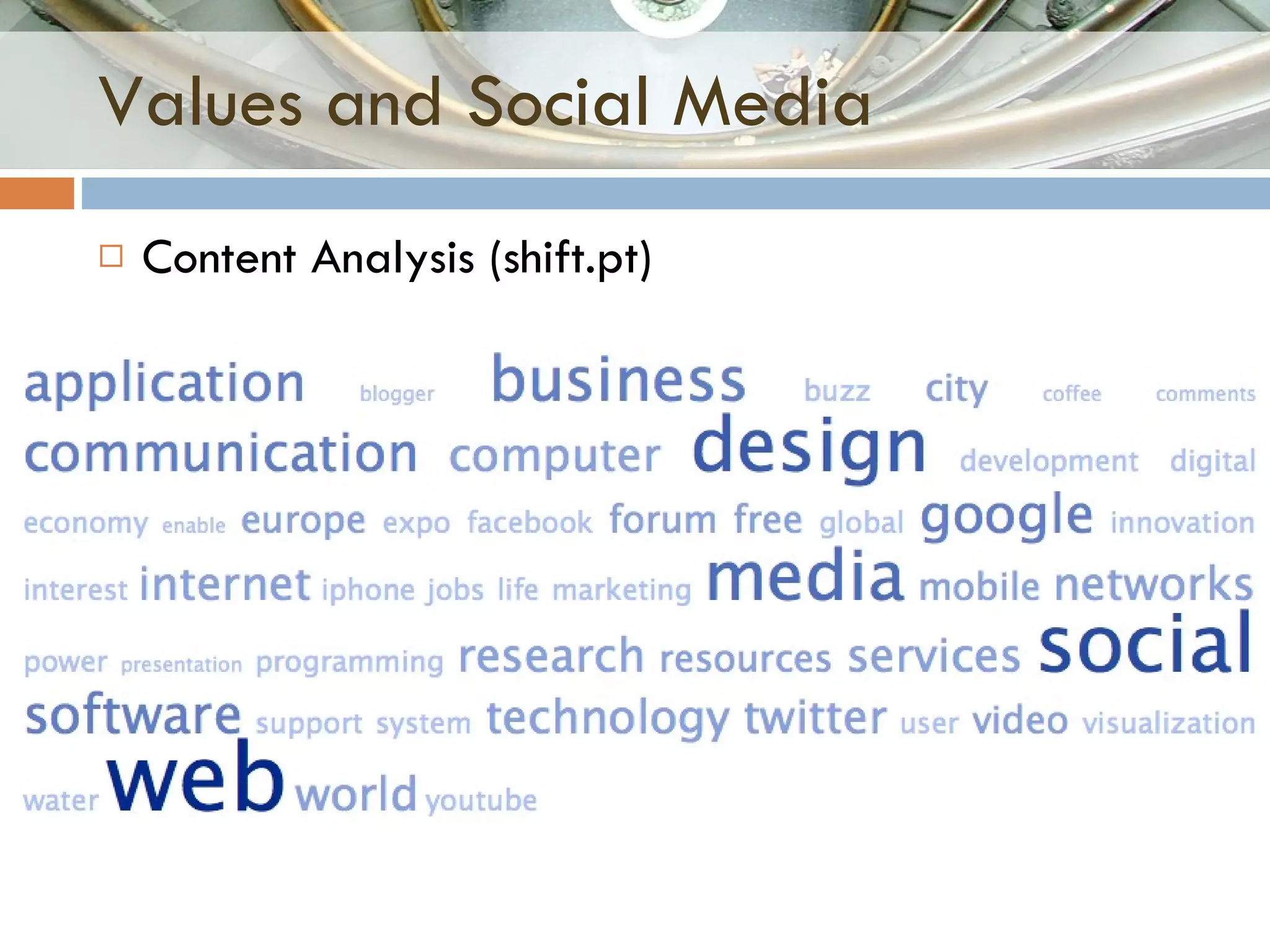
Values and Social Media Content Analysis (shift.pt)
Values and Social Media Situational Theory of Problem Solving (Kim and Grunig) Introduces concepts that help us understand communicative action across the stages of problem solving
A Call to Action
A Call to Action We now have tools that allow for a greater level of research on values and values systems; An opportunity to quantify the results of corporate communication in real time; If we do not take the lead, someone else will

Concepts of Values for Public Relations

  • 1.
    CONCEPTS OF VALUESFOR PUBLIC RELATIONS Bruno Amaral Online PR Consultant http://www.imago.pt http://www.brunoamaral.eu
  • 2.
    Values and ValuesSystems Reviving a Dormant Concept Hitlin and Piliavin 2004 Rokeach Hofstede Schwartz
  • 3.
    Suggested Definitions Rokeach “ (...) the value is a standard or criterion that serves a number of important purposes in our daily lives: it is a standard that tells us how to act or what to want, it is a standard that tells us what attitudes we should hold, it is a standard we employ to justify behavior, to morally judge, and to compare ourselves with others. Finally, the value is the standard we employ to tell us which values, attitudes, and actions of others are worth or not worth trying to influence. If you have a value and you do not want to influence anyone else under the sun to have it too, the chances are it is not a value. "(Rokeach 1968)
  • 4.
    Suggested Definitions Hofstede " broad tendencies to prefer certain states of affairs over others " (cf. Hofstede, 2005, p. 8). Good Vs Evil Dirty vs. Clean Pretty Vs Ugly Natural vs. Non-Natural Normal vs. Abnormal Logical vs. Illogical Rational Vs Irrational Power Distance Individualism Masculinity Aversion to Uncertainty Guidance for short / long term
  • 5.
    Suggested Definitions Schwartz“ According to the literature, values are (a) concepts or beliefs, (b) about desirable end states or behaviors, (c) that transcend specific situations, (d) guide selection or evaluation of behavior and events, and (e) are ordered by relative importance. "Schwartz (1992) emphasizes that values are cognitive representations of three universal human requirements: (a) biologically based organism needs, (b) social interactional requirements for interpersonal coordination, and (c) social institutional demands for group welfare and survival.” Schwartz & Bilsky (1987, p. 551)
  • 6.
    What are ValuesNeuroScience tells us we are prone to build relationships and that our brain is built to adapt to different social contexts ( Quartz and Sejnowski 2004) Psychology tells us that the “perceived partner responsiveness” is essential to build relationships (Reis 2002 Reis, Clark and Holmes 2004 Reis 2007)
  • 7.
    What are ValuesWe use values to relate to each other and to describe others (people or organisations) We refer to our values to guide ou behaviour and as part of the decision making process However, the current definitions are too broad and the values systems presented are not neutral in nature
  • 8.
    How are valuesused in PR?
  • 9.
    How are valuesused in PR? Ethics Corporate Identity Corporate Culture Core values Brands …
  • 10.
    New Approaches toValues and PR David Phillips Jon Iwata Camarinha-Matos and Macedo
  • 11.
    New Approaches toValues and PR David Phillips A relationship occurs when Actors attribute identical or similar values to a given occurrence (token) Relationships are formed around values
  • 12.
    New Approaches toValues and PR Jon Iwata IBM’s Values System “ We call it the IBM System Brand. Picture a framework with five columns. From left to right the columns are labeled what it means to look like IBM , to sound like IBM , to think like IBM , to perform like IBM and ultimately to be IBM ”
  • 13.
    New Approaches toValues and PR Camarinha-Matos and Macedo Values Systems in Collaborative Networks
  • 14.
    Values and SocialMedia Do we display values online? Donath and Boyd Back et al. Each Social Media Instrument Allows for Values to be Demonstrated in Different Ways
  • 15.
    Values and SocialMedia Social network Analysis
  • 16.
    Values and SocialMedia Content Analysis (shift.pt)
  • 17.
    Values and SocialMedia Situational Theory of Problem Solving (Kim and Grunig) Introduces concepts that help us understand communicative action across the stages of problem solving
  • 18.
    A Call toAction
  • 19.
    A Call toAction We now have tools that allow for a greater level of research on values and values systems; An opportunity to quantify the results of corporate communication in real time; If we do not take the lead, someone else will