Protection & Security

   Organized By: V.A.


                          V.A.
                        CSED,TU
Disclaimer


  This is NOT A COPYRIGHT           MATERIAL

Content has been taken mainly from the following books:
   Operating Systems Concepts By Silberschatz & Galvin ,
          Operating systems By D M Dhamdhere,
          System Programming By John J Donovan
                         etc…


               VA.
               CSED,TU
Protection – Goals & Principle
    Each Object has a Unique Name and can be accessed through a well-defined set
     of Operations.


    Ensure that each Object is accessed correctly and only by those Processes that
     are allowed to do so.


    Guiding Principle – Principle of Least Privilege
       Programs, users and systems should be given just enough privileges to
         perform their tasks


                            VA.
                            CSED,TU
Domain Structure
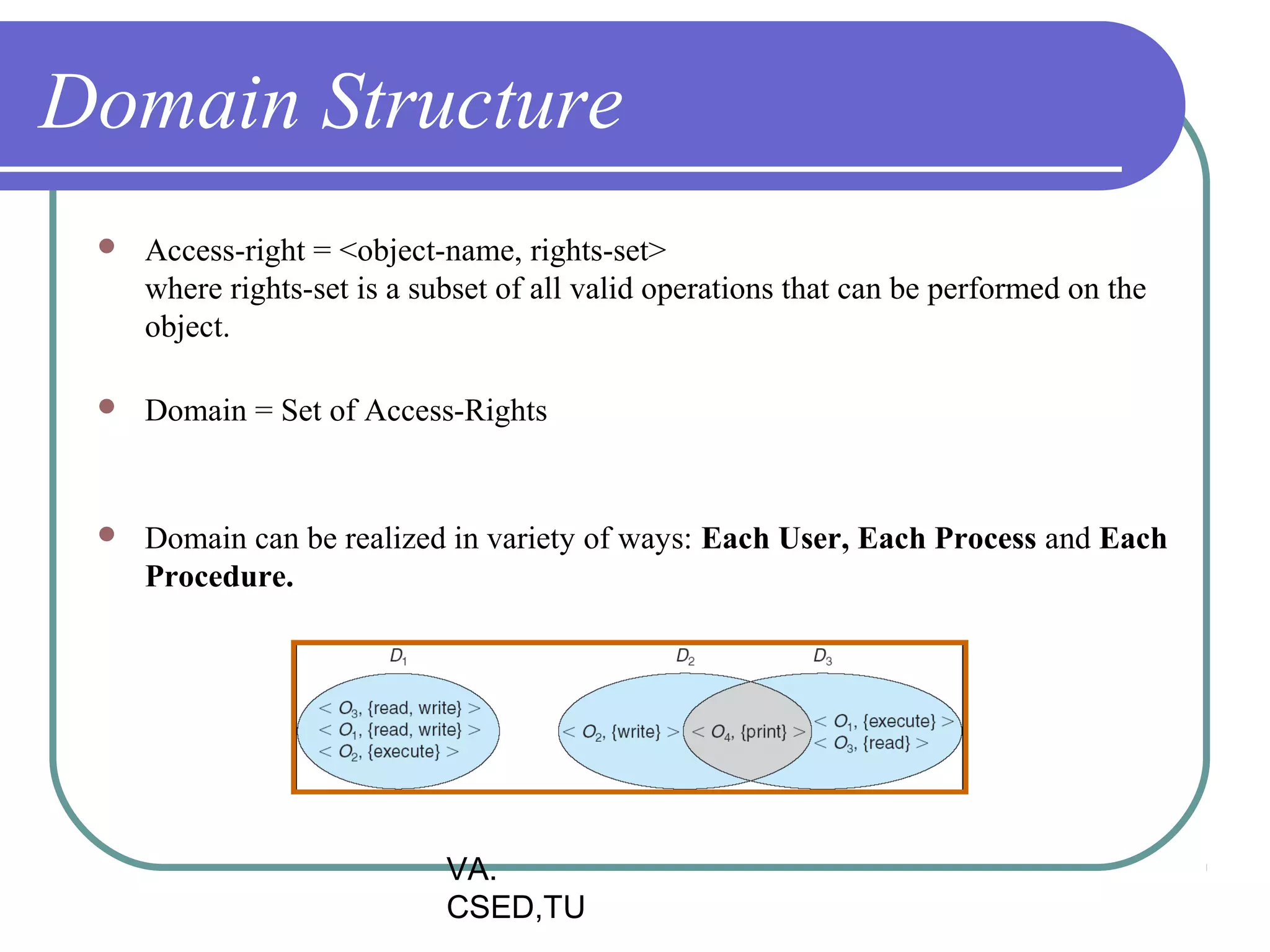
    Access-right = <object-name, rights-set>
     where rights-set is a subset of all valid operations that can be performed on the
     object.

    Domain = Set of Access-Rights


    Domain can be realized in variety of ways: Each User, Each Process and Each
     Procedure.


                             VA.
                             CSED,TU
Access Matrix
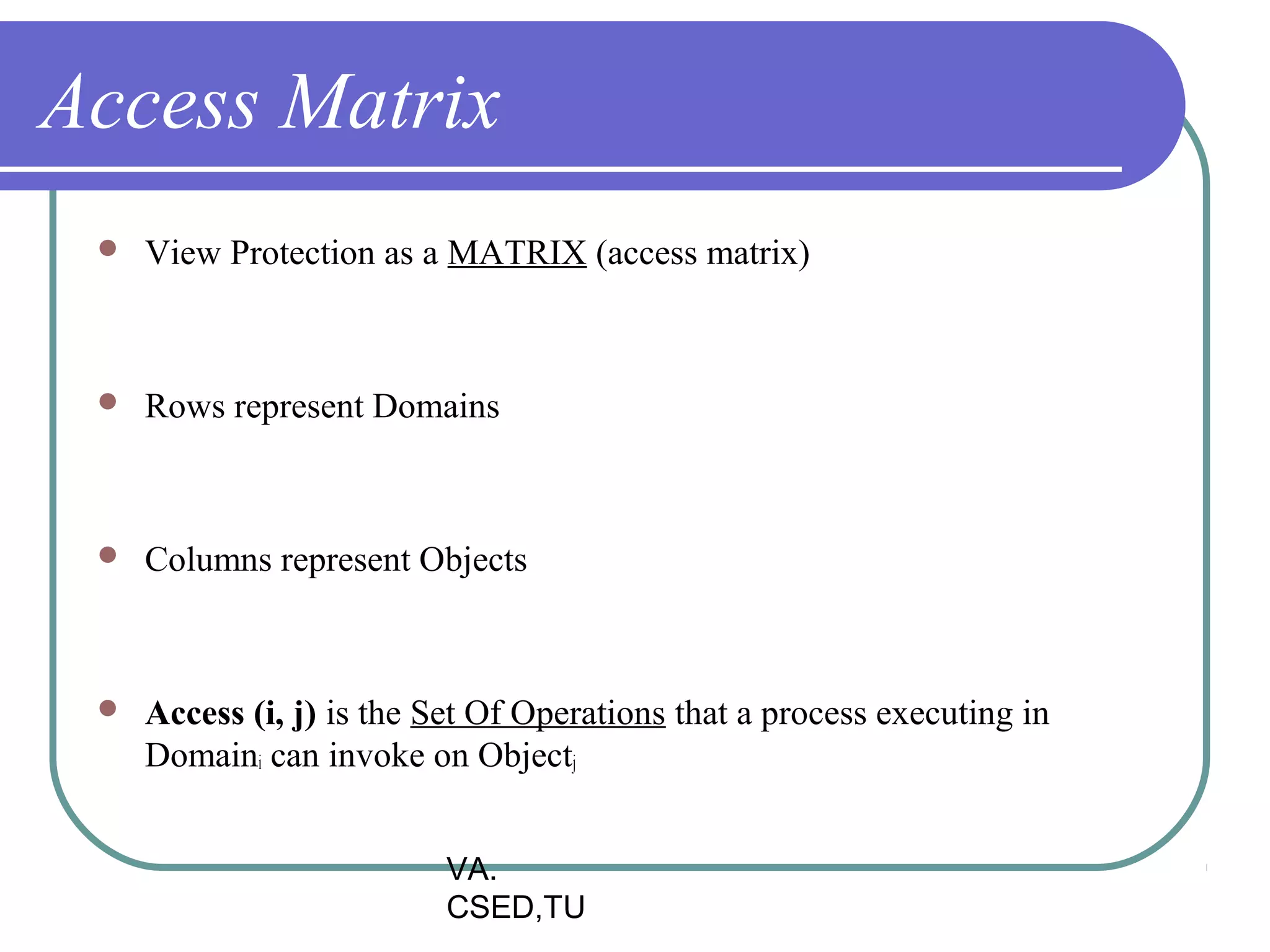
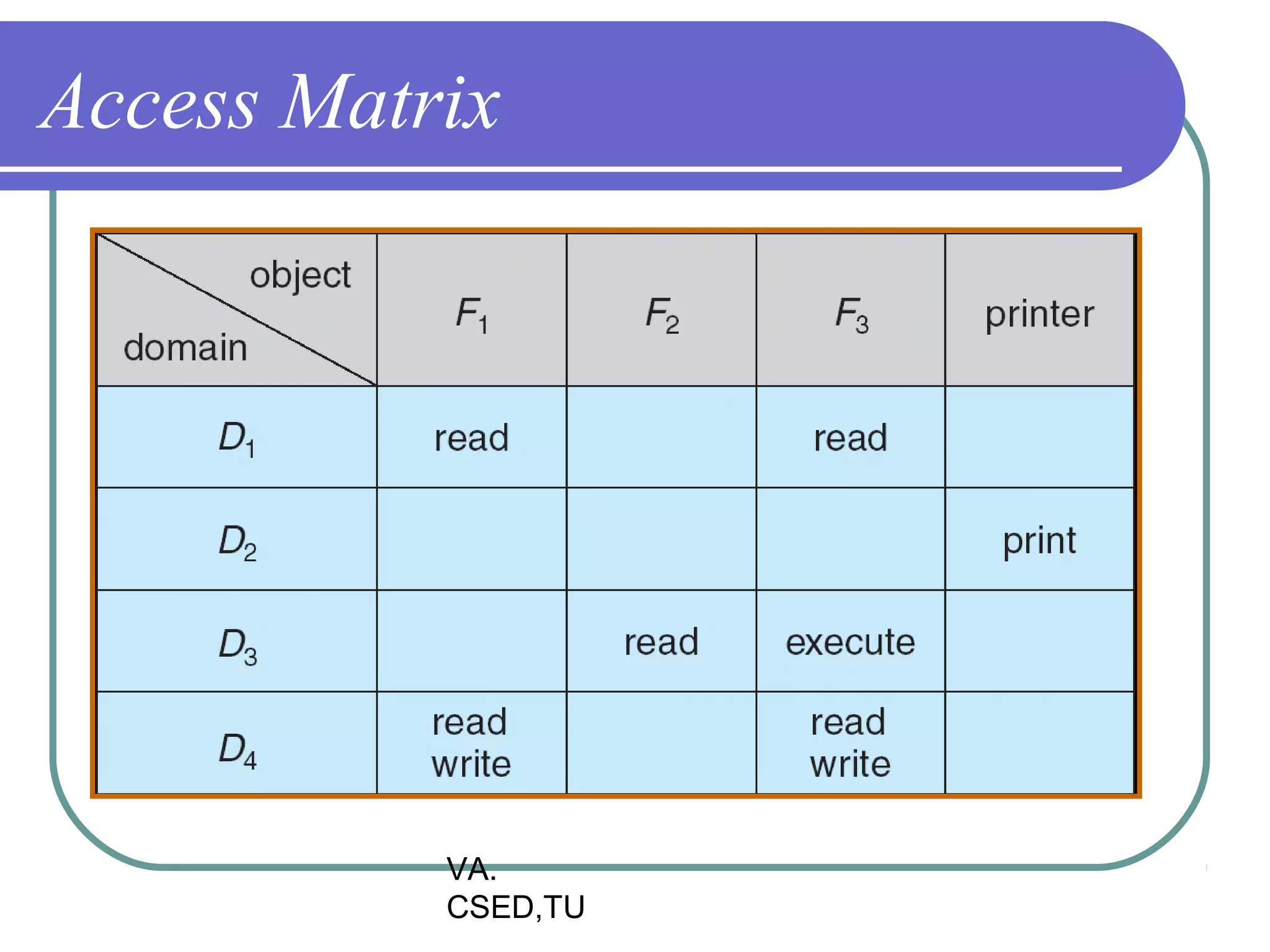
    View Protection as a MATRIX (access matrix)


    Rows represent Domains


    Columns represent Objects


    Access (i, j) is the Set Of Operations that a process executing in
     Domaini can invoke on Objectj


                           VA.
                           CSED,TU
Access Control Matrix
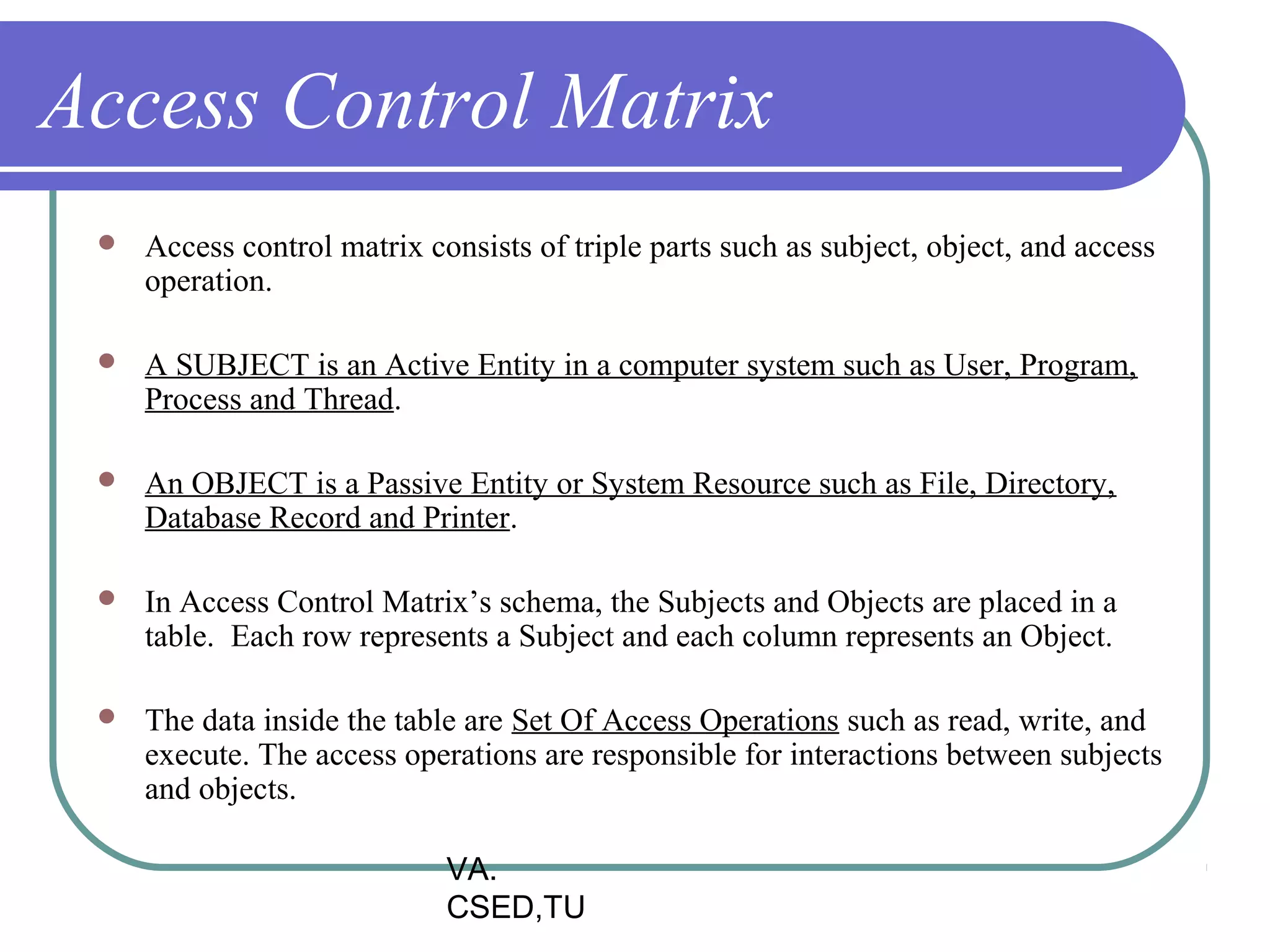
    Access control matrix consists of triple parts such as subject, object, and access
     operation.

    A SUBJECT is an Active Entity in a computer system such as User, Program,
     Process and Thread.

    An OBJECT is a Passive Entity or System Resource such as File, Directory,
     Database Record and Printer.

    In Access Control Matrix’s schema, the Subjects and Objects are placed in a
     table. Each row represents a Subject and each column represents an Object.

    The data inside the table are Set Of Access Operations such as read, write, and
     execute. The access operations are responsible for interactions between subjects
     and objects.

                             VA.
                             CSED,TU
Access Matrix


           VA.
           CSED,TU
Use of Access Matrix
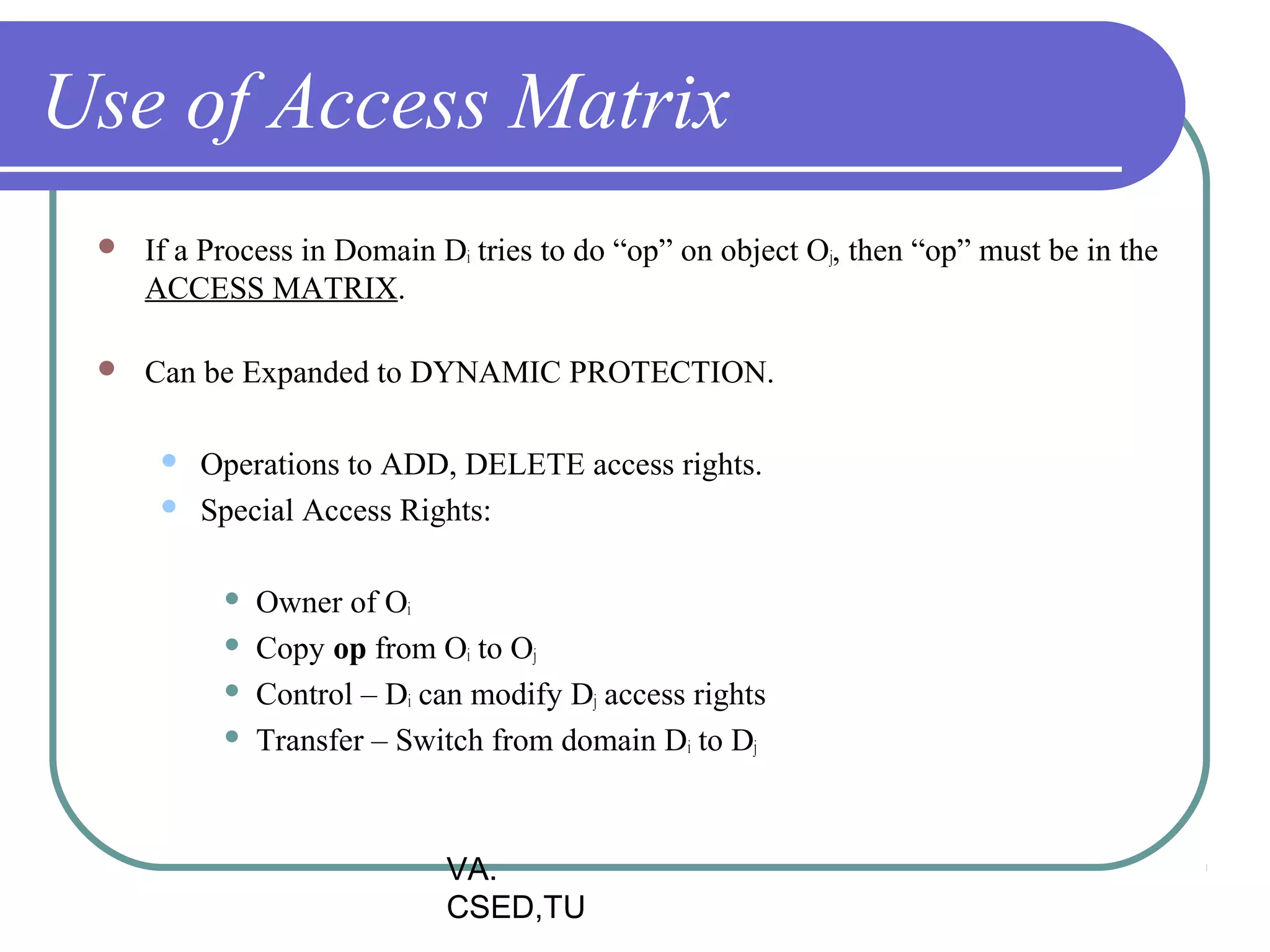
    If a Process in Domain Di tries to do “op” on object Oj, then “op” must be in the
     ACCESS MATRIX.

    Can be Expanded to DYNAMIC PROTECTION.

         Operations to ADD, DELETE access rights.
         Special Access Rights:

              Owner of Oi
              Copy op from Oi to Oj
              Control – Di can modify Dj access rights
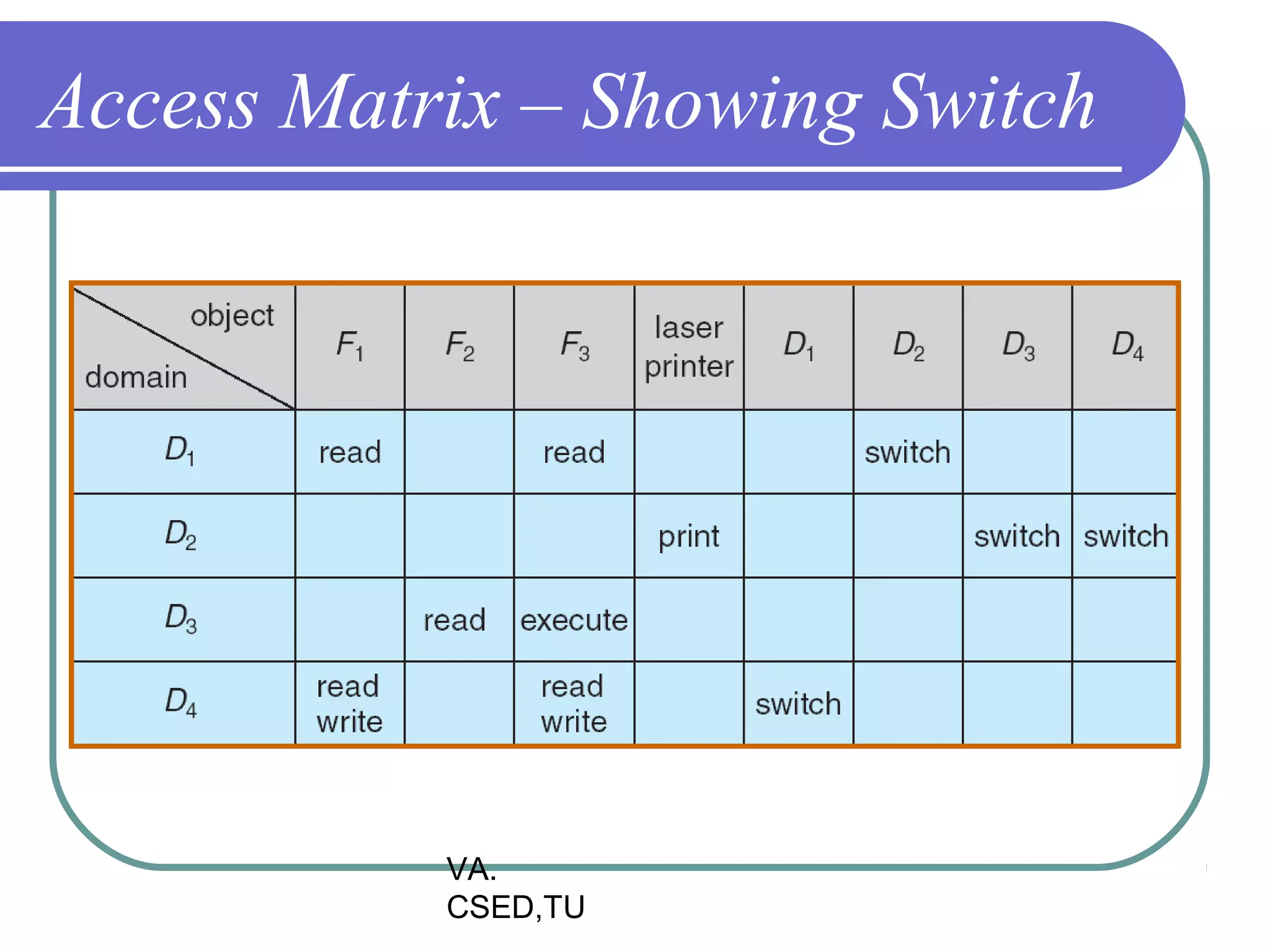
              Transfer – Switch from domain Di to Dj


                             VA.
                             CSED,TU
Access Matrix – Showing Switch


           VA.
           CSED,TU
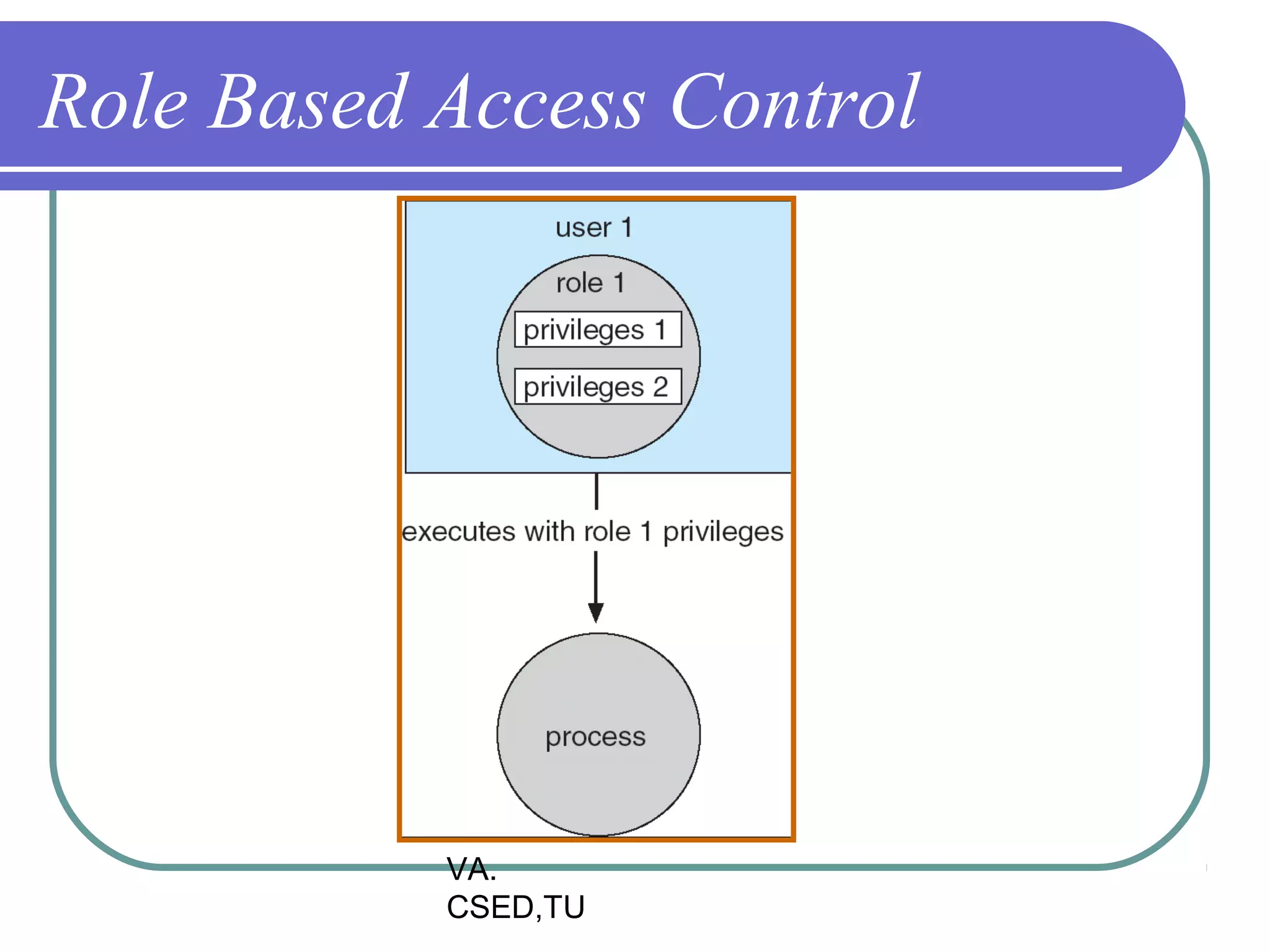
Role Based Access Control


           VA.
           CSED,TU
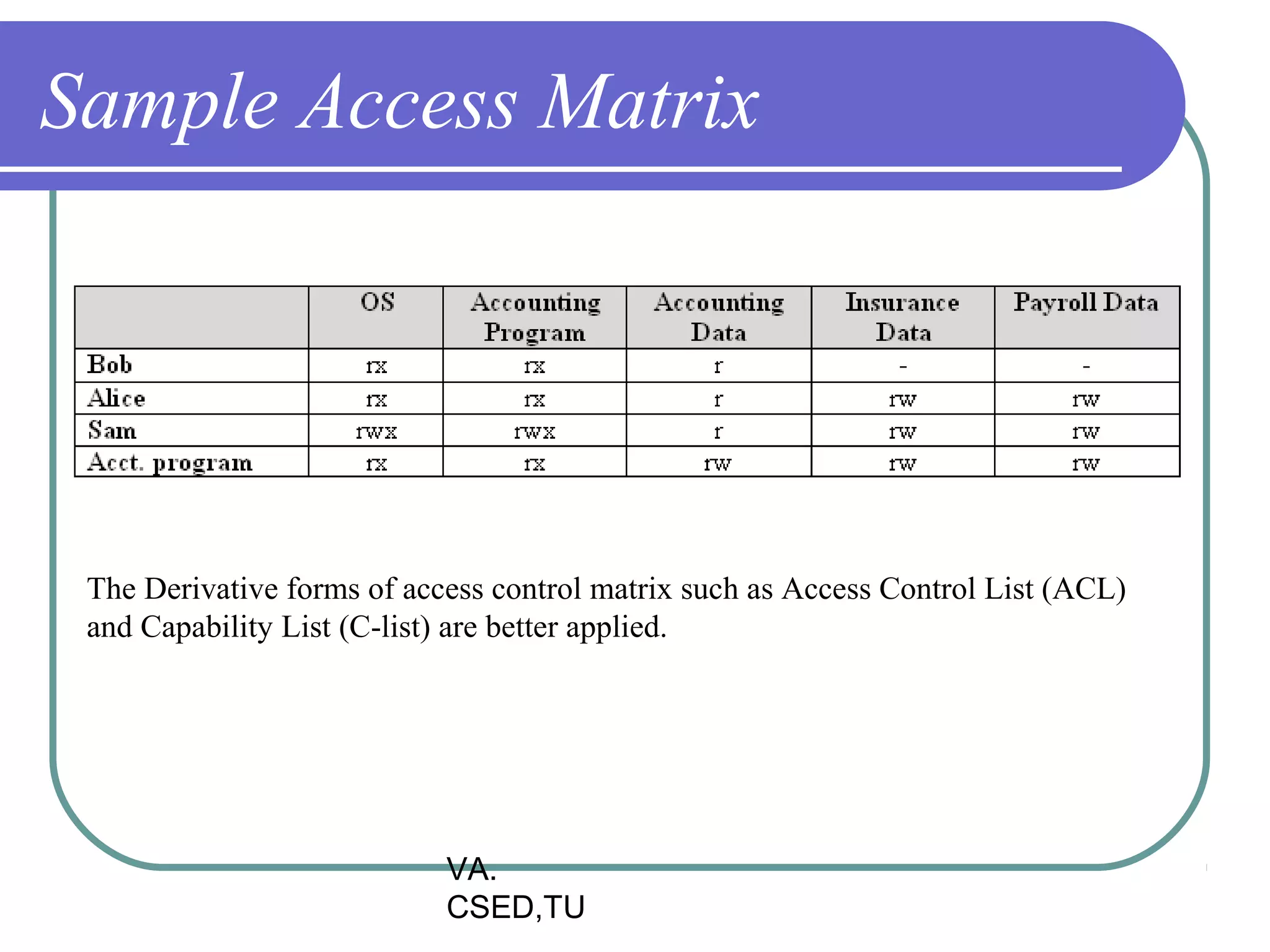
Sample Access Matrix


 The Derivative forms of access control matrix such as Access Control List (ACL)
 and Capability List (C-list) are better applied.


                            VA.
                            CSED,TU
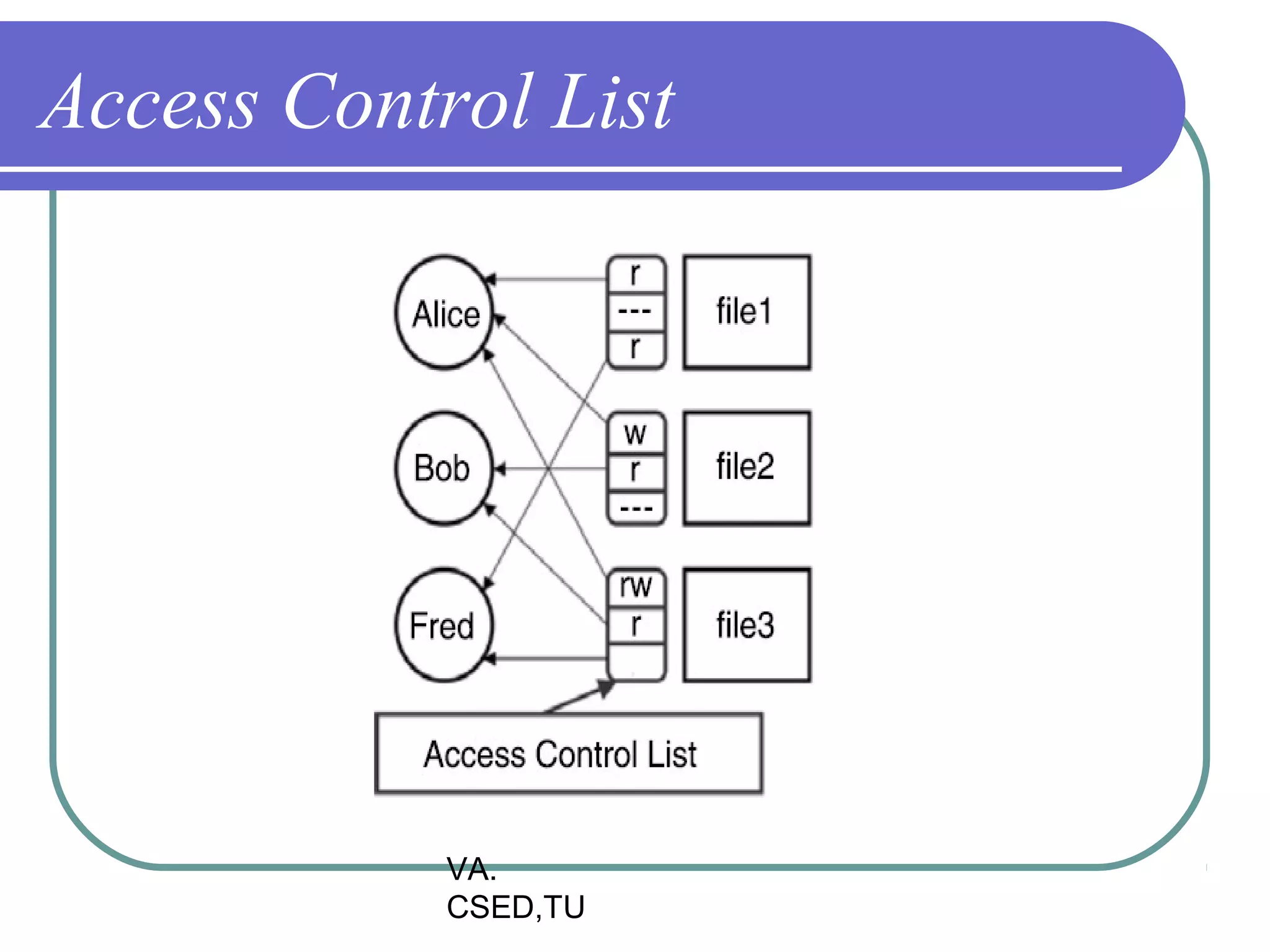
Access Control List


            VA.
            CSED,TU
ACL


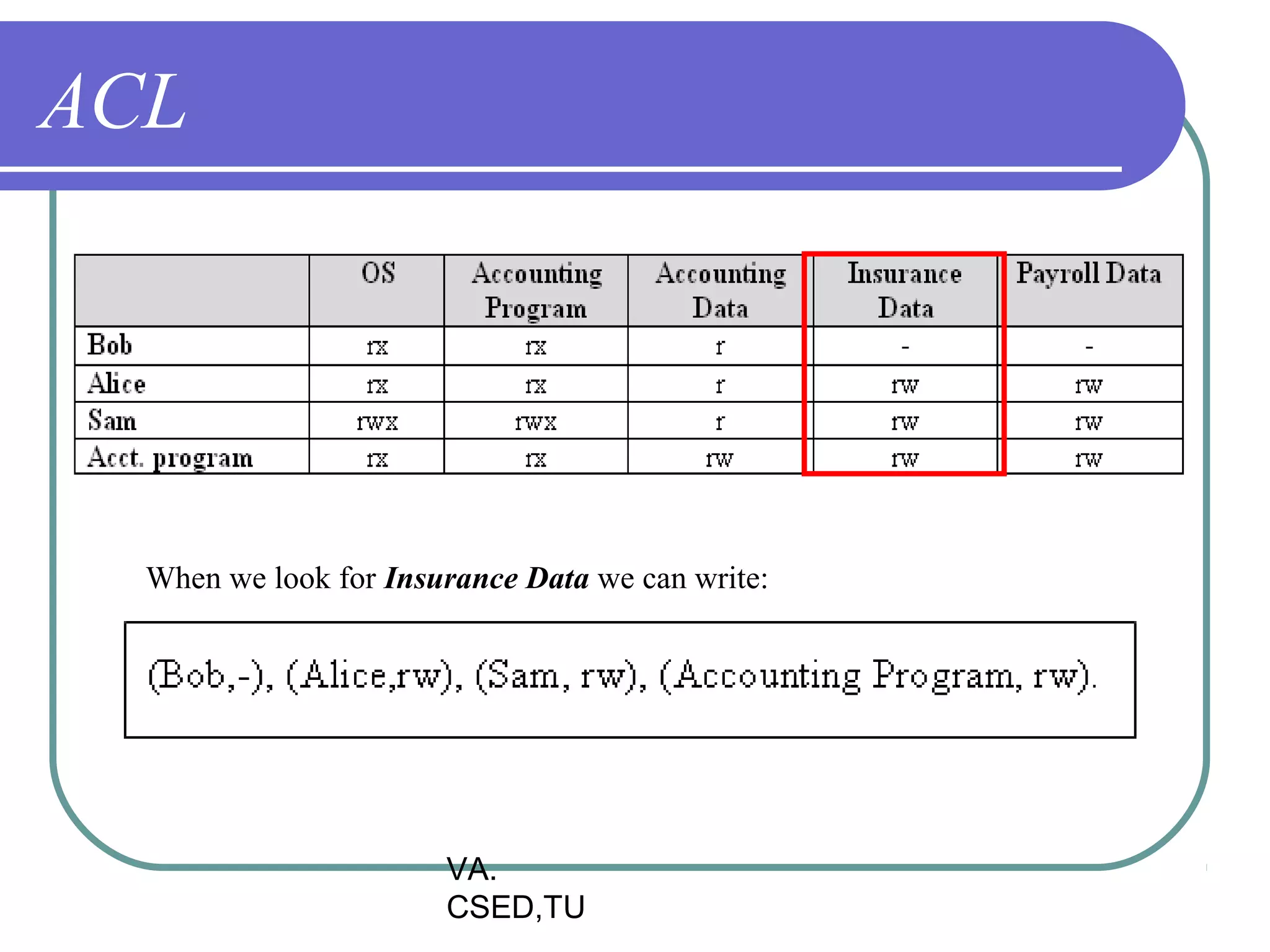
  When we look for Insurance Data we can write:


                       VA.
                       CSED,TU
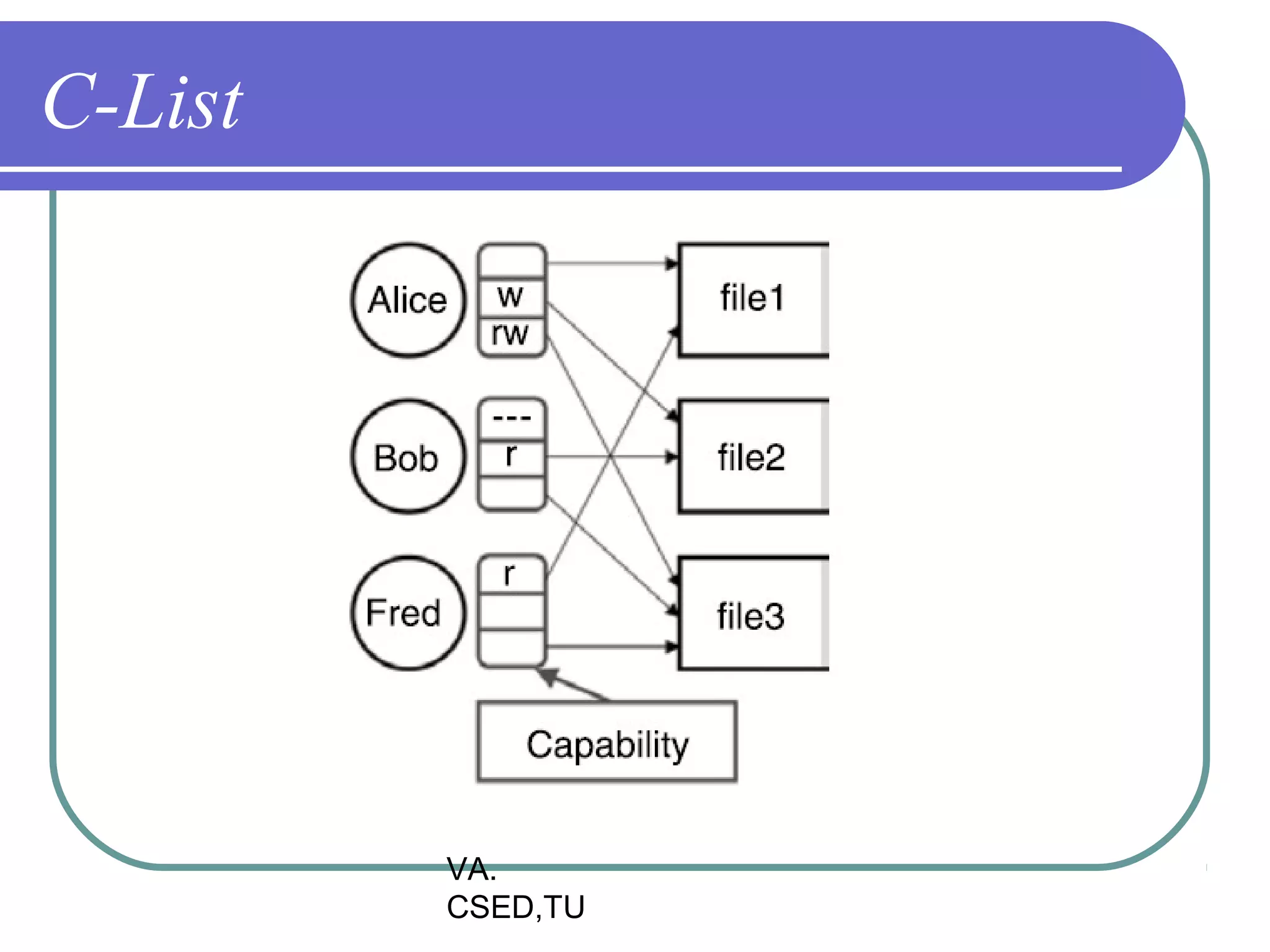
C-List


         VA.
         CSED,TU
C-List


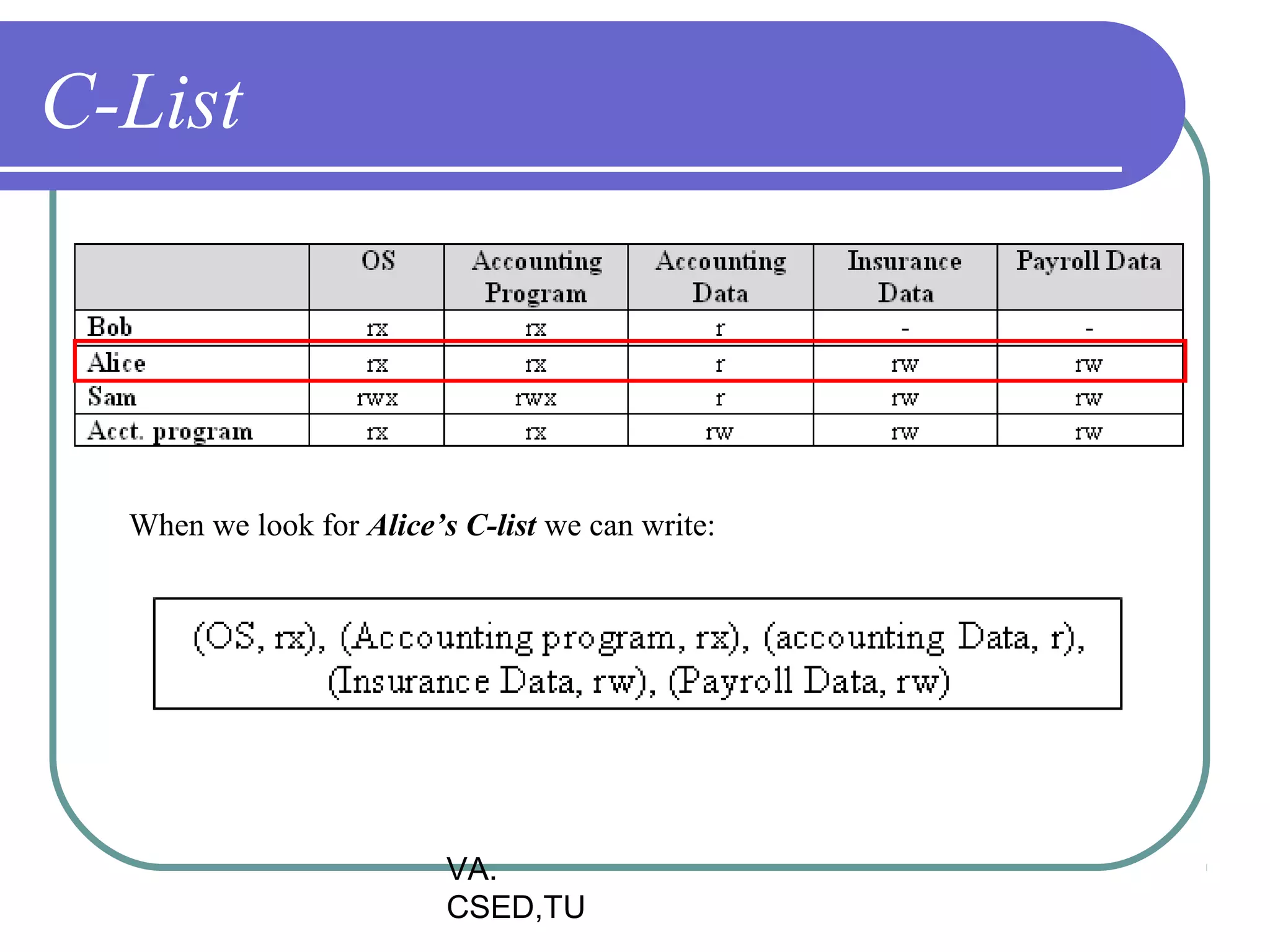
  When we look for Alice’s C-list we can write:


                          VA.
                          CSED,TU
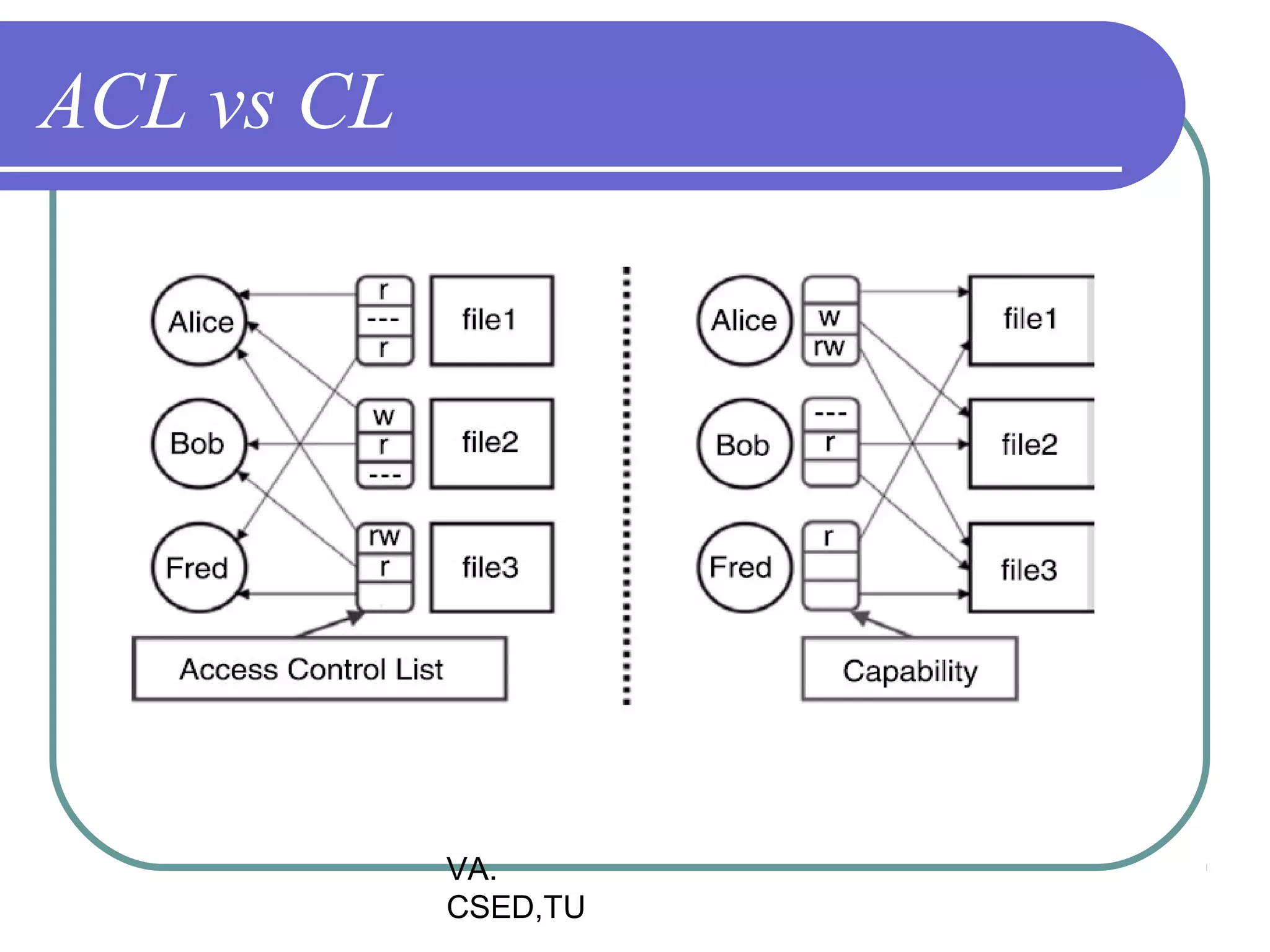
ACL vs CL


            VA.
            CSED,TU
Security
    Security must consider External Environment of the System and protect
     the system resources

    Intruders (crackers) attempt to breach security

    THREAT is potential security violation

    ATTACK is attempt to breach security

    Attack can be accidental or malicious

    Easier to protect against accidental than malicious misuse
                          VA.
                          CSED,TU
Security Violations
    Categories

         Breach of confidentiality
         Breach of integrity
         Breach of availability
         Theft of service
         Denial of service

    Methods

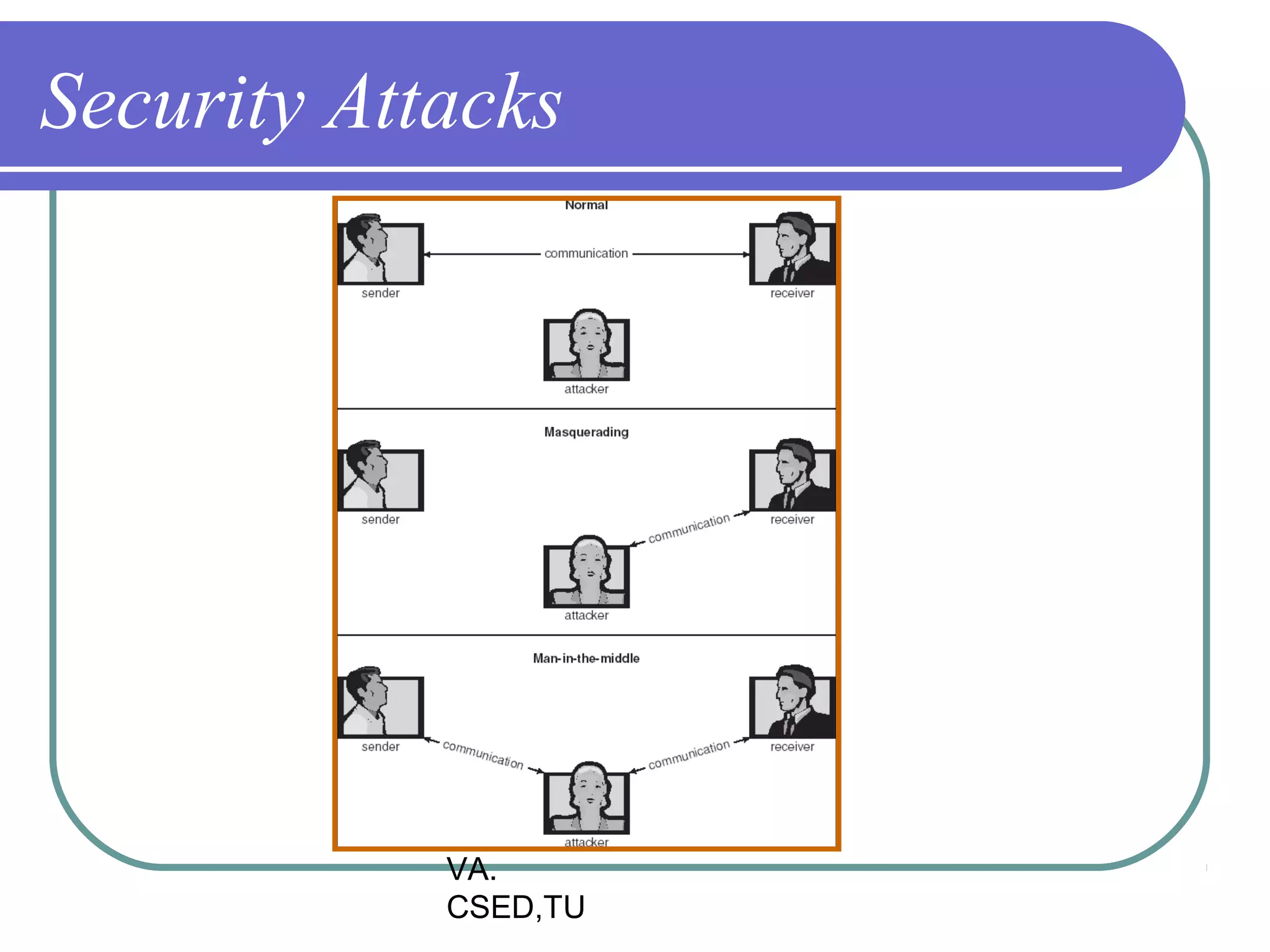
         Masquerading (breach authentication)
         Replay attack
            Message modification
         Man-in-the-middle attack
         Session hijacking

                             VA.
                             CSED,TU
Security Attacks


            VA.
            CSED,TU
Reference List


Operating Systems Concepts By Silberschatz & Galvin,
       Operating systems By D M Dhamdhere,
      System Programming By John J Donovan,

                    www.os-book.com
    www.cs.jhu.edu/~yairamir/cs418/os2/sld001.htm
http://gaia.ecs.csus.edu/~zhangd/oscal/pscheduling.html
  http://www.edugrid.ac.in/iiitmk/os/os_module03.htm
     http://williamstallings.com/OS/Animations.html
                        etc…


             VA.
             CSED,TU
Thnx…


VA.
CSED,TU

Security & Protection

  • 1.
    Protection & Security Organized By: V.A. V.A. CSED,TU
  • 2.
    Disclaimer Thisis NOT A COPYRIGHT MATERIAL Content has been taken mainly from the following books: Operating Systems Concepts By Silberschatz & Galvin , Operating systems By D M Dhamdhere, System Programming By John J Donovan etc… VA. CSED,TU
  • 3.
    Protection – Goals& Principle  Each Object has a Unique Name and can be accessed through a well-defined set of Operations.  Ensure that each Object is accessed correctly and only by those Processes that are allowed to do so.  Guiding Principle – Principle of Least Privilege  Programs, users and systems should be given just enough privileges to perform their tasks VA. CSED,TU
  • 4.
    Domain Structure  Access-right = <object-name, rights-set> where rights-set is a subset of all valid operations that can be performed on the object.  Domain = Set of Access-Rights  Domain can be realized in variety of ways: Each User, Each Process and Each Procedure. VA. CSED,TU
  • 5.
    Access Matrix  View Protection as a MATRIX (access matrix)  Rows represent Domains  Columns represent Objects  Access (i, j) is the Set Of Operations that a process executing in Domaini can invoke on Objectj VA. CSED,TU
  • 6.
    Access Control Matrix  Access control matrix consists of triple parts such as subject, object, and access operation.  A SUBJECT is an Active Entity in a computer system such as User, Program, Process and Thread.  An OBJECT is a Passive Entity or System Resource such as File, Directory, Database Record and Printer.  In Access Control Matrix’s schema, the Subjects and Objects are placed in a table. Each row represents a Subject and each column represents an Object.  The data inside the table are Set Of Access Operations such as read, write, and execute. The access operations are responsible for interactions between subjects and objects. VA. CSED,TU
  • 7.
    Access Matrix VA. CSED,TU
  • 8.
    Use of AccessMatrix  If a Process in Domain Di tries to do “op” on object Oj, then “op” must be in the ACCESS MATRIX.  Can be Expanded to DYNAMIC PROTECTION.  Operations to ADD, DELETE access rights.  Special Access Rights:  Owner of Oi  Copy op from Oi to Oj  Control – Di can modify Dj access rights  Transfer – Switch from domain Di to Dj VA. CSED,TU
  • 9.
    Access Matrix –Showing Switch VA. CSED,TU
  • 10.
    Role Based AccessControl VA. CSED,TU
  • 11.
    Sample Access Matrix The Derivative forms of access control matrix such as Access Control List (ACL) and Capability List (C-list) are better applied. VA. CSED,TU
  • 12.
  • 13.
    ACL Whenwe look for Insurance Data we can write: VA. CSED,TU
  • 14.
    C-List VA. CSED,TU
  • 15.
    C-List Whenwe look for Alice’s C-list we can write: VA. CSED,TU
  • 16.
    ACL vs CL VA. CSED,TU
  • 17.
    Security  Security must consider External Environment of the System and protect the system resources  Intruders (crackers) attempt to breach security  THREAT is potential security violation  ATTACK is attempt to breach security  Attack can be accidental or malicious  Easier to protect against accidental than malicious misuse VA. CSED,TU
  • 18.
    Security Violations  Categories  Breach of confidentiality  Breach of integrity  Breach of availability  Theft of service  Denial of service  Methods  Masquerading (breach authentication)  Replay attack  Message modification  Man-in-the-middle attack  Session hijacking VA. CSED,TU
  • 19.
    Security Attacks VA. CSED,TU
  • 20.
    Reference List Operating SystemsConcepts By Silberschatz & Galvin, Operating systems By D M Dhamdhere, System Programming By John J Donovan, www.os-book.com www.cs.jhu.edu/~yairamir/cs418/os2/sld001.htm http://gaia.ecs.csus.edu/~zhangd/oscal/pscheduling.html http://www.edugrid.ac.in/iiitmk/os/os_module03.htm http://williamstallings.com/OS/Animations.html etc… VA. CSED,TU
  • 21.