Platform Strategy &
Ecosystems
Open Business Conference
May 6th 2014
Warming Up
Let’s take a look at the 5-year predictable horizon
The world will be faster, more connected, with a billion
more participants in the global economy.
A rising middle class in Brazil, India, China, and Indonesia will adopt
devices first and computers second, leaping the digital divide.
Gen-Y consumers and employees will be in their 30s, defining the
conventions for work and play styles.
4G wireless will be broadly available and
5G will be in limited deployment.
Carrier networks will be optimized for traffic
against specific services and media types.
Consumer devices will be dominant, but small devices for data sensing
and processing will make up a significant percentage of mobile and
Internet traffic.
Most commerce will be initiated via mobile devices and completed on a
range of platforms.
Most transactions, when executed, will be multi-party:
between the app and the underlying services.
Social media with effective partitions and channels will be the dominant
mode of communication.
User attention will continue to fragment, alternately directing and being
directed by a range of apps.
Data will be a unit of value and a mechanism of lock-in.
Industries will be platform-shaped,
with a dominant player occupying the high-margin platform position
and pushing others to supporting roles.
What is a Platform Business Model?
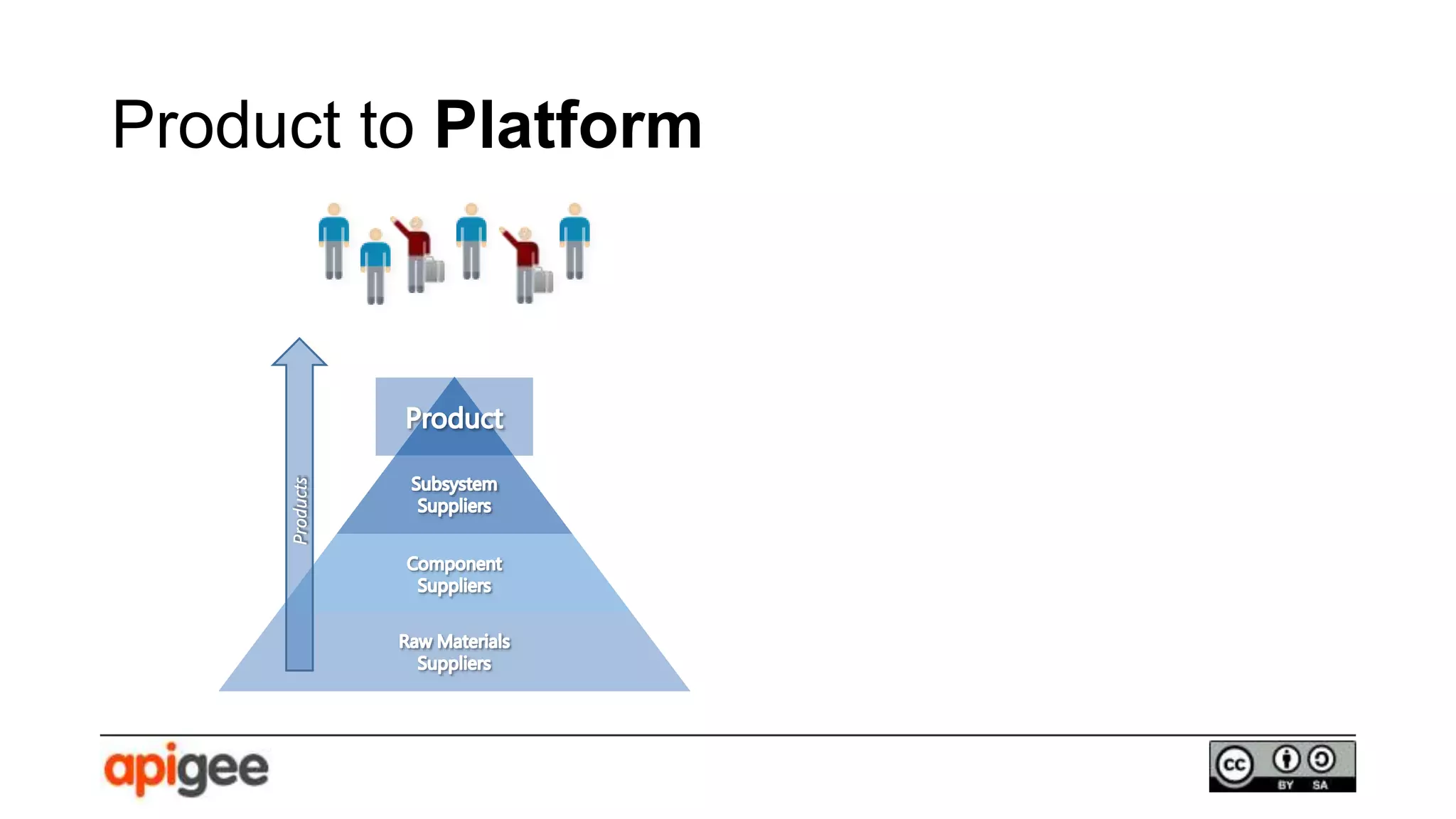
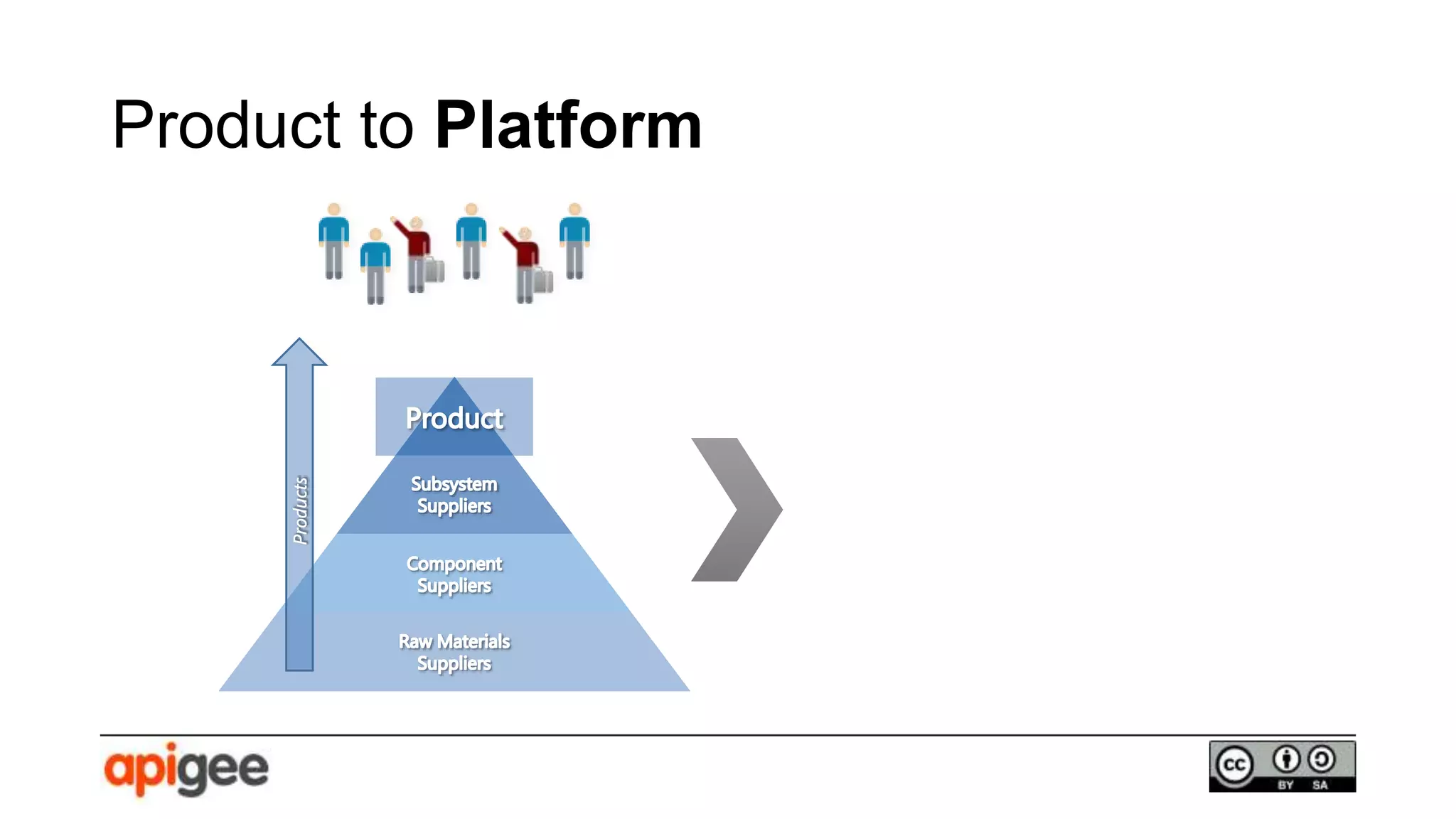
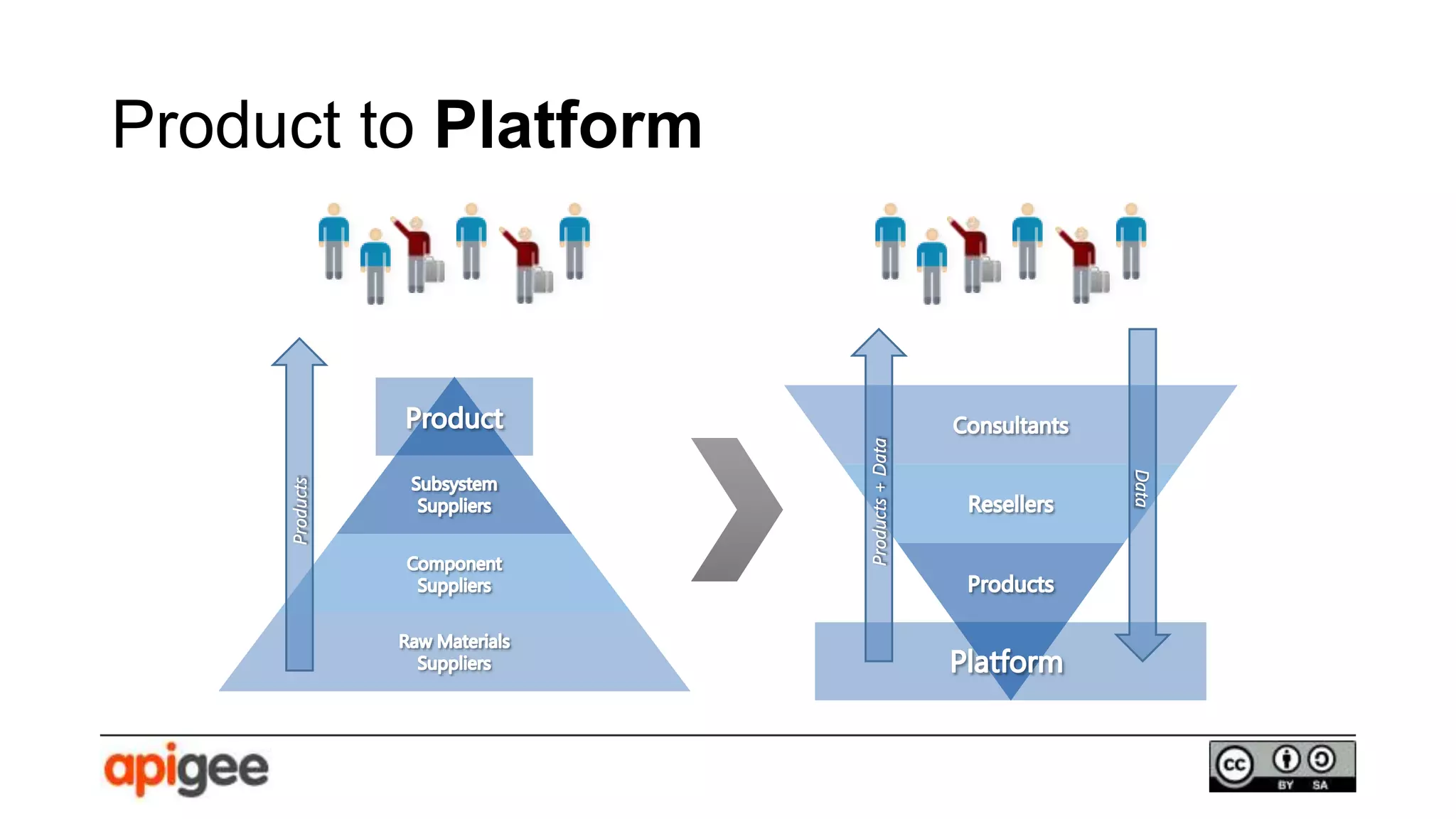
Product to Platform
Product to Platform
Product to Platform
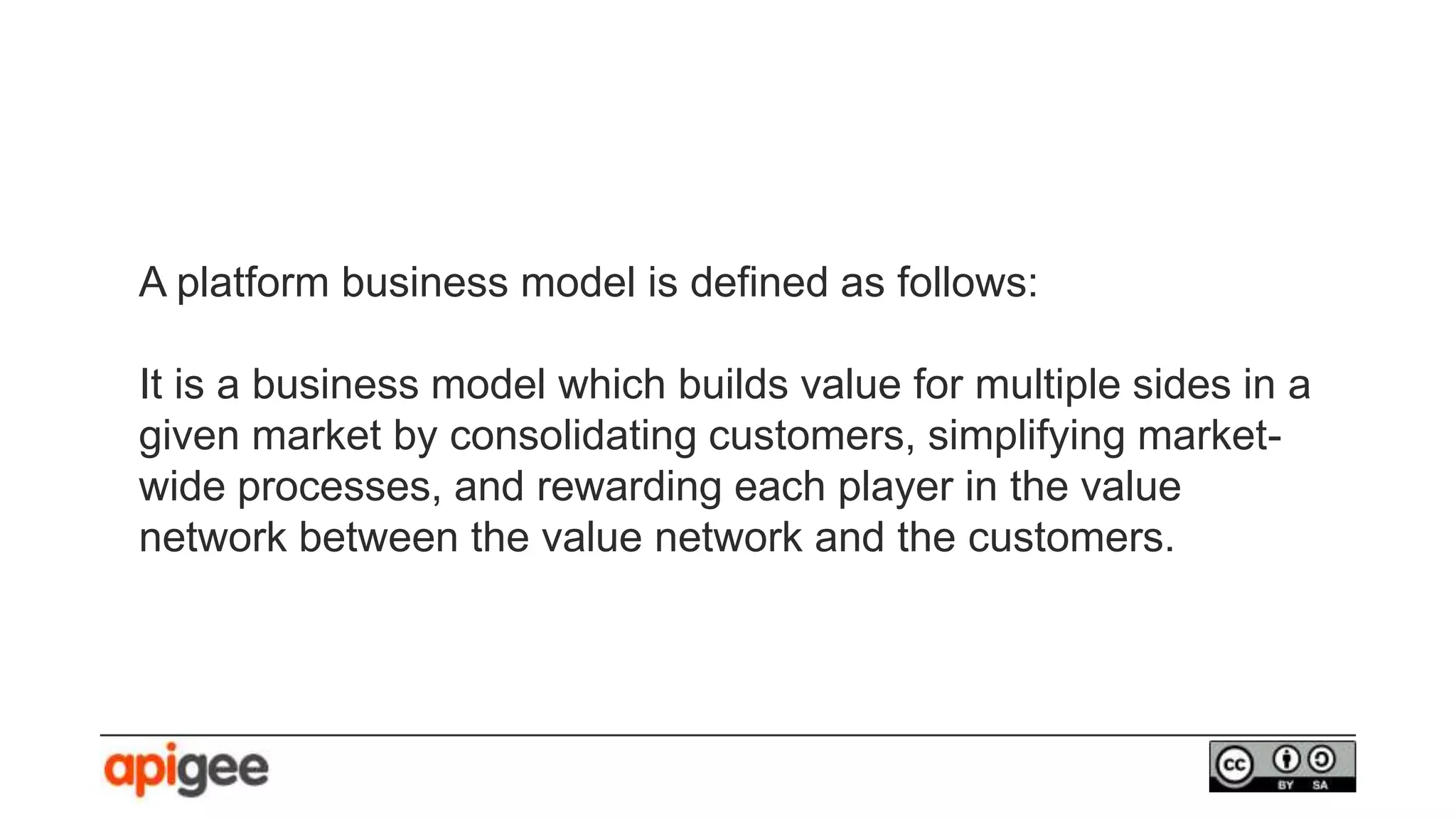
A platform business model is defined as follows:
It is a business model which builds value for multiple sides in a
given market by consolidating customers, simplifying market-
wide processes, and rewarding each player in the value
network between the value network and the customers.
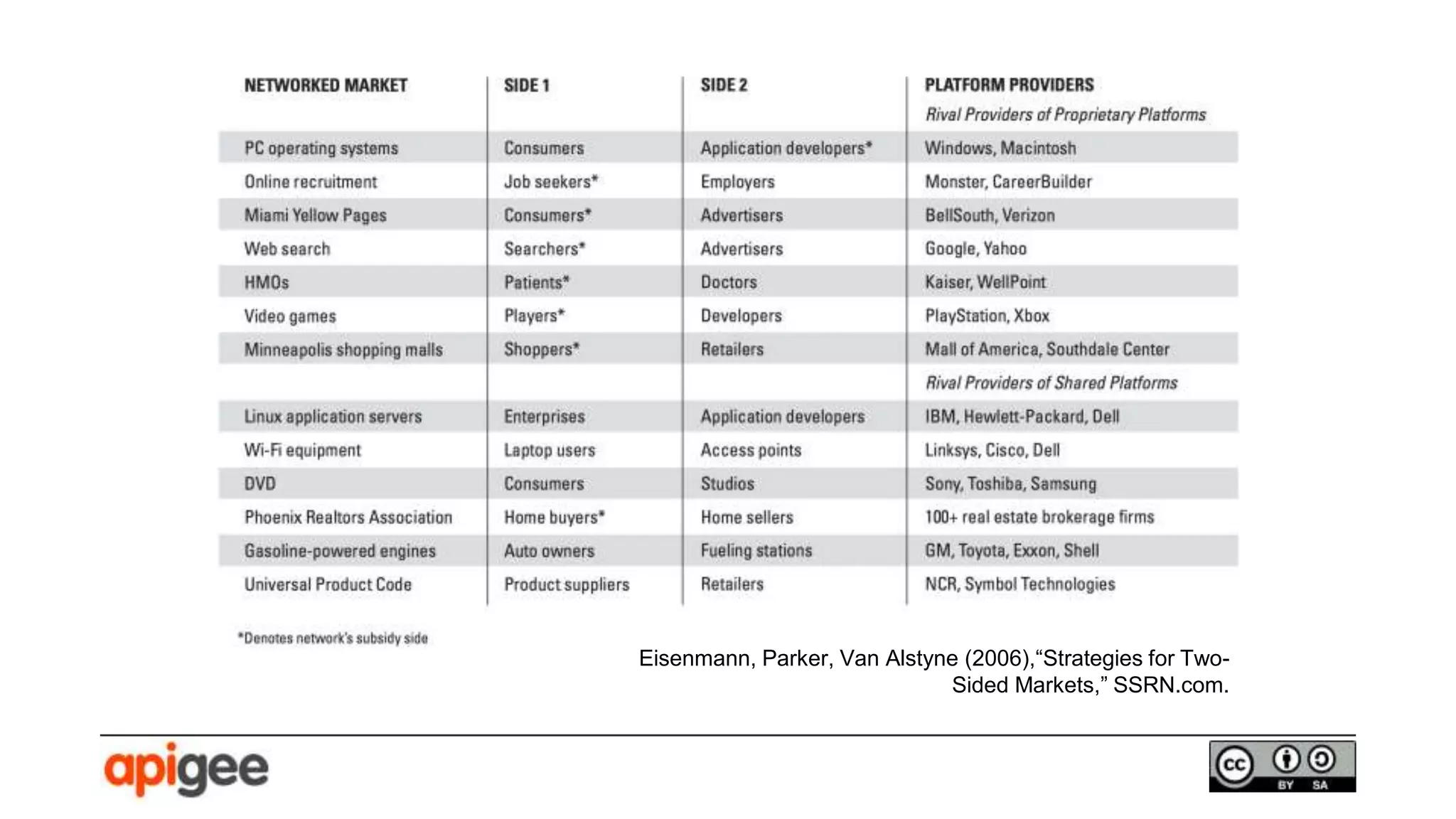
There are many examples of platform business models
in action today.
Eisenmann, Parker, Van Alstyne (2006),“Strategies for Two-
Sided Markets,” SSRN.com.
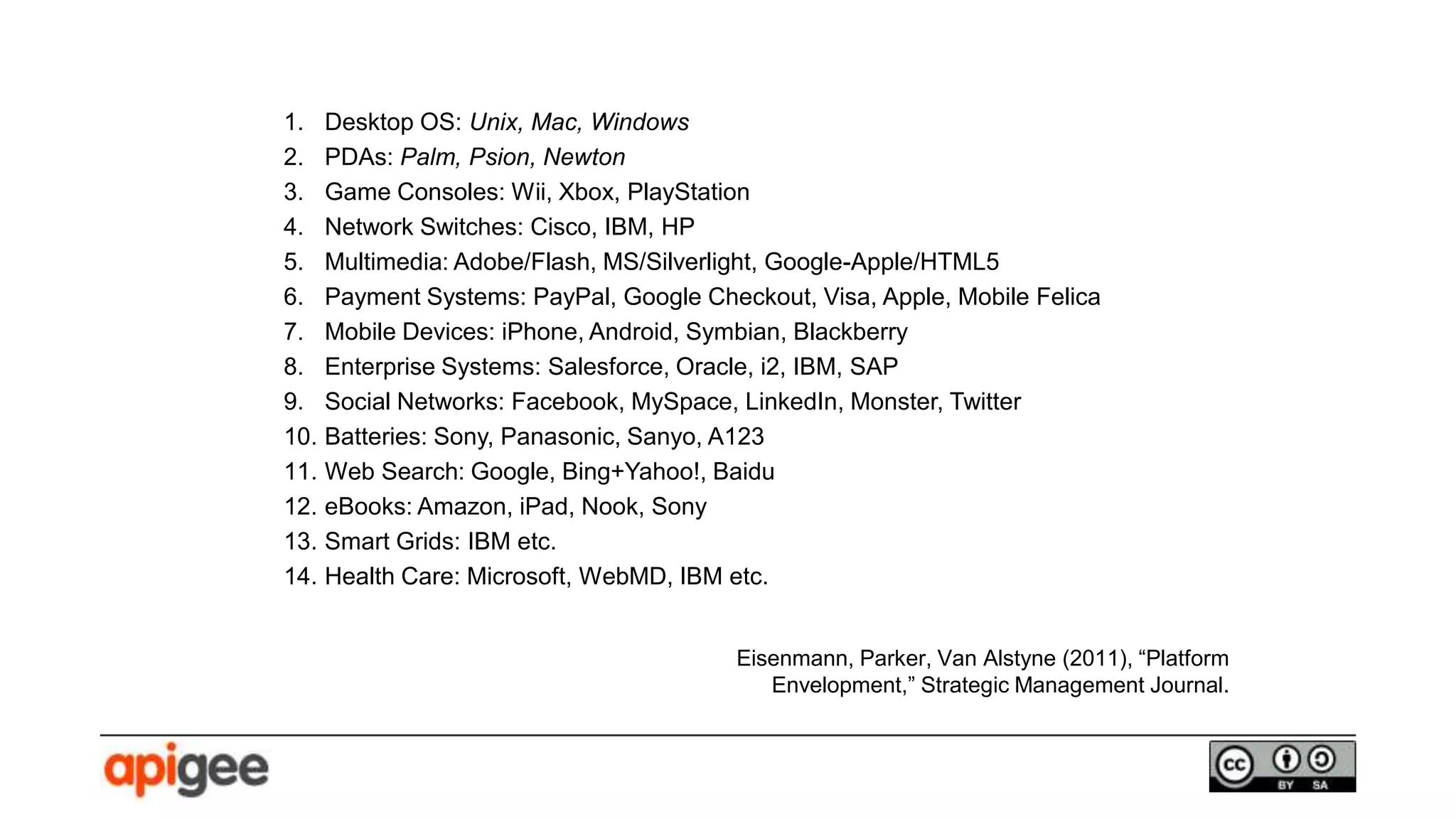
There are many examples of digital platform business models
in action today.
1. Desktop OS: Unix, Mac, Windows
2. PDAs: Palm, Psion, Newton
3. Game Consoles: Wii, Xbox, PlayStation
4. Network Switches: Cisco, IBM, HP
5. Multimedia: Adobe/Flash, MS/Silverlight, Google-Apple/HTML5
6. Payment Systems: PayPal, Google Checkout, Visa, Apple, Mobile Felica
7. Mobile Devices: iPhone, Android, Symbian, Blackberry
8. Enterprise Systems: Salesforce, Oracle, i2, IBM, SAP
9. Social Networks: Facebook, MySpace, LinkedIn, Monster, Twitter
10. Batteries: Sony, Panasonic, Sanyo, A123
11. Web Search: Google, Bing+Yahoo!, Baidu
12. eBooks: Amazon, iPad, Nook, Sony
13. Smart Grids: IBM etc.
14. Health Care: Microsoft, WebMD, IBM etc.
Eisenmann, Parker, Van Alstyne (2011), “Platform
Envelopment,” Strategic Management Journal.
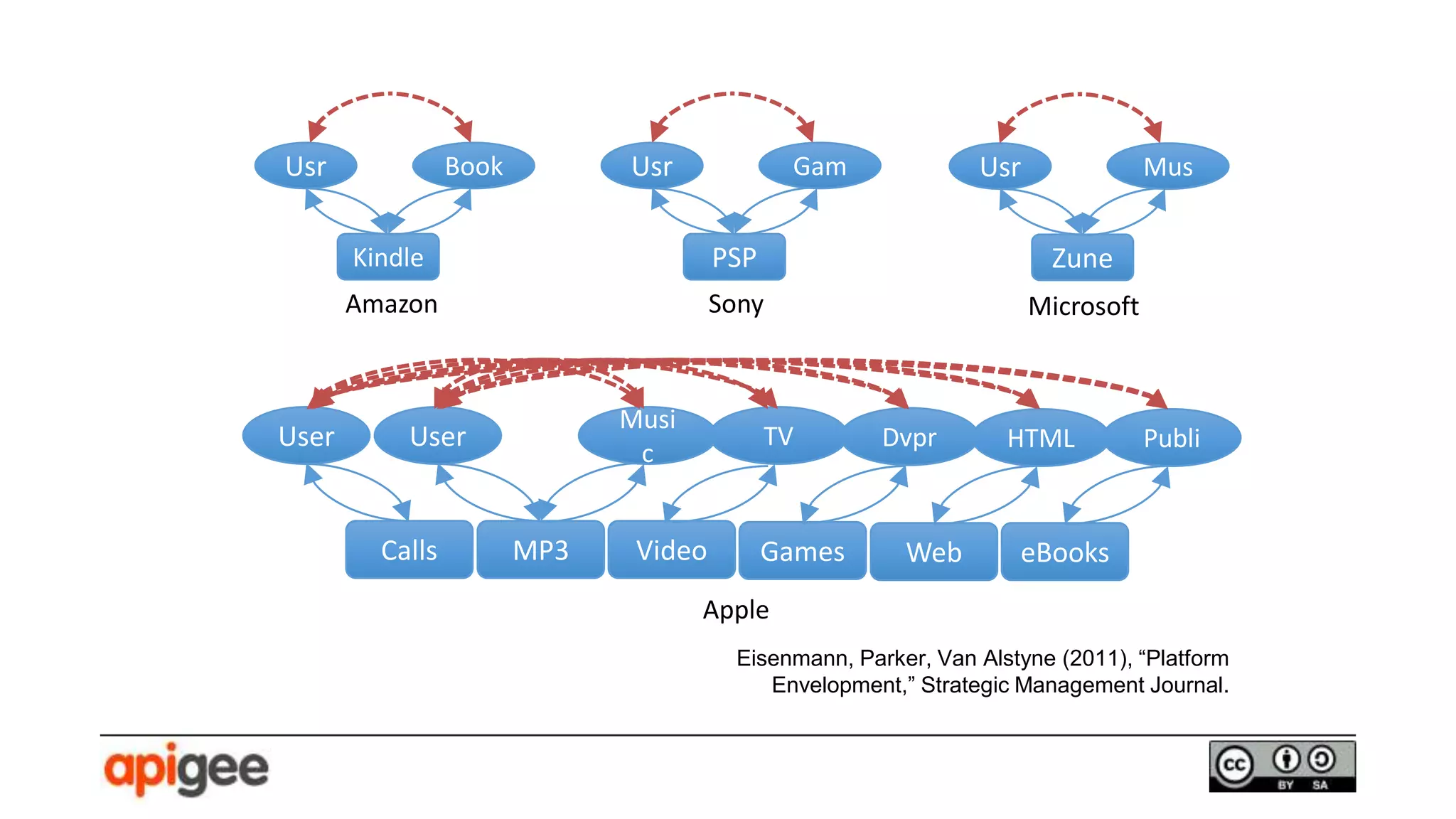
Platform businesses are built on network effects.
The more network effects, the stronger the platform.
Kindle
Usr Book
PSP
Usr Gam
Zune
Usr Mus
MicrosoftSonyAmazon
Eisenmann, Parker, Van Alstyne (2011), “Platform
Envelopment,” Strategic Management Journal.
MP3
User
Musi
c
Video
TV
Games
Dvpr
Web
HTML
eBooks
Publi
Calls
User
Apple
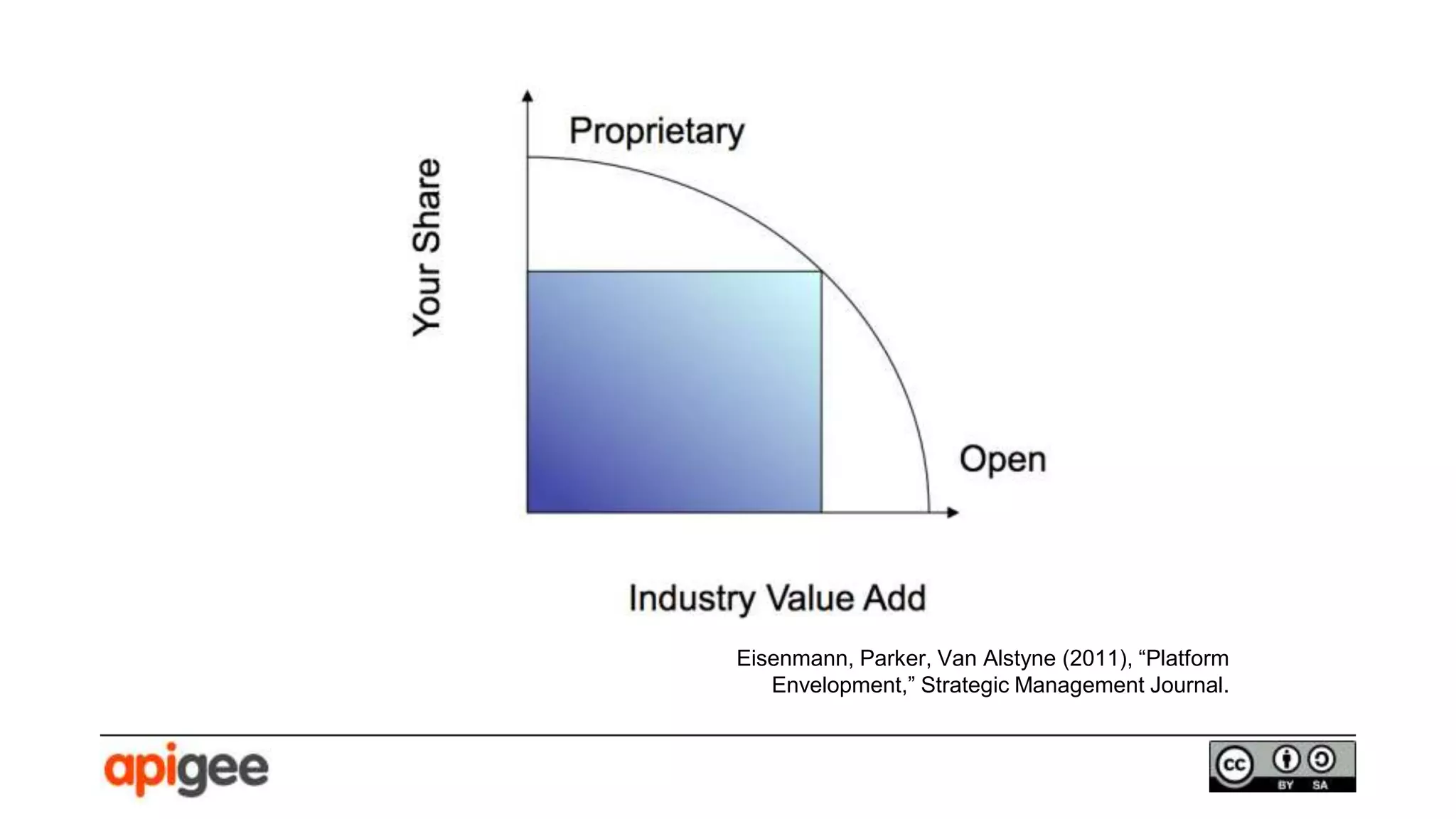
Openness is a critical element of all platform businesses.
Eisenmann, Parker, Van Alstyne (2011), “Platform
Envelopment,” Strategic Management Journal.
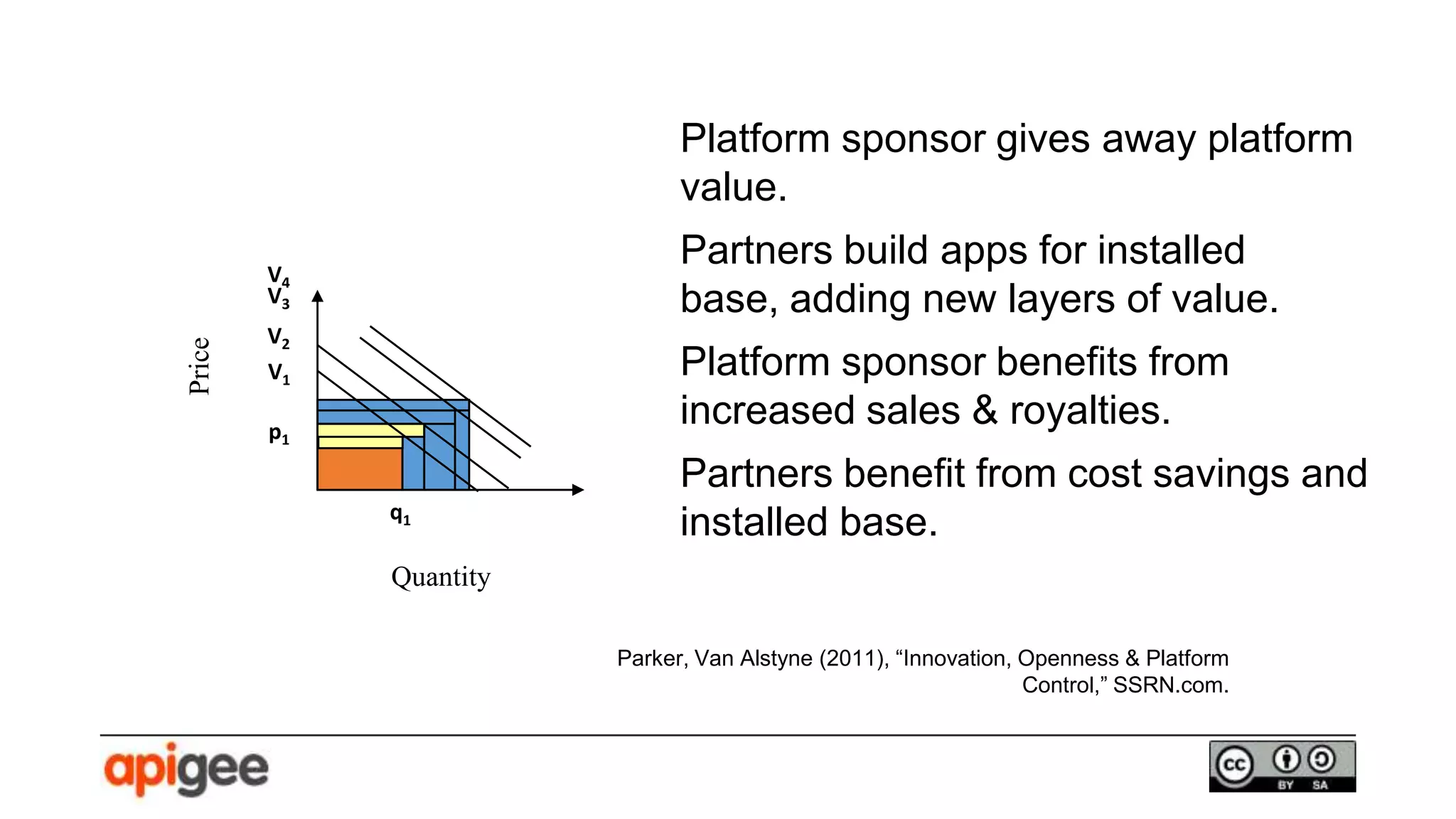
V4
V3
Price
q1
p1
Quantity
V1
V2
Platform sponsor gives away platform
value.
Partners build apps for installed
base, adding new layers of value.
Platform sponsor benefits from
increased sales & royalties.
Partners benefit from cost savings and
installed base.
Parker, Van Alstyne (2011), “Innovation, Openness & Platform
Control,” SSRN.com.
Platform models generate profit through
first and third party usage.
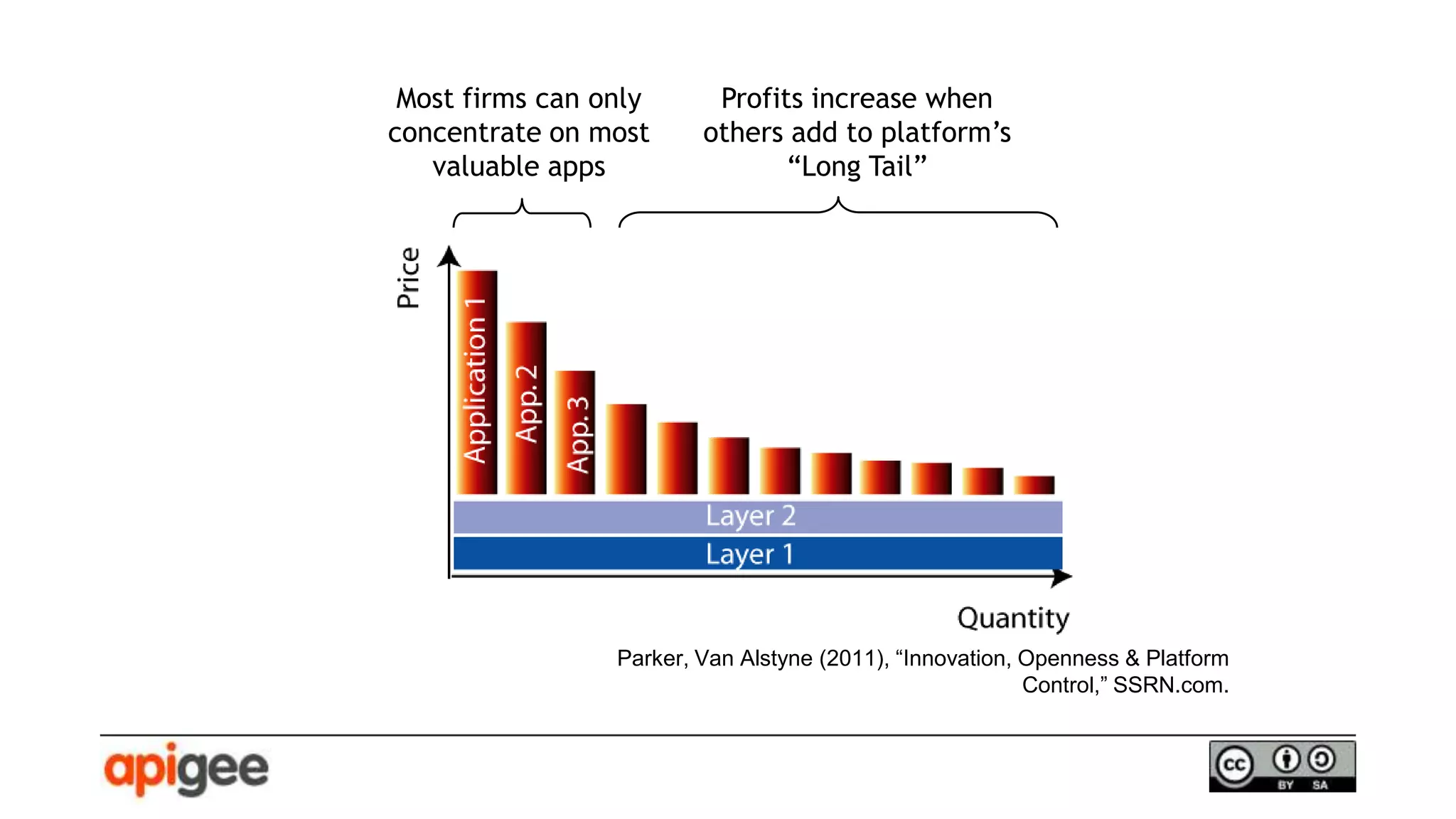
Most firms can only
concentrate on most
valuable apps
Profits increase when
others add to platform’s
“Long Tail”
Parker, Van Alstyne (2011), “Innovation, Openness & Platform
Control,” SSRN.com.
Platform models build digital ecosystems
through virtuous cycles.
We view Digital Ecosystems to be the digital counterparts of biological ecosystems,
exploiting the self-organising properties of biological ecosystems, which are
considered to be robust, self-organising and scalable architectures that can
automatically solve complex, dynamic problems. Digital Ecosystems are a novel
optimisation technique where the optimisation works at two levels: a first optimisation,
migration of agents (representing services) which are distributed in a decentralised
peer-to-peer network, operating continuously in time; this process feeds a second
optimisation based on evolutionary computing that operates locally on single peers
and is aimed at finding solutions to satisfy locally relevant constraints.
“
G. Briscoe, P. DeWilde
IEEE Conference on BIONETICS (2006)
A digital ecosystem is a distributed, adaptive, open socio-technical
system with properties of self-organization, scalability and
sustainability inspired from natural ecosystems.
Digital ecosystem models are informed by knowledge of natural
ecosystems, especially for aspects related to competition and
collaboration among diverse entities.
“
Various authors
Wikipedia: Digital Ecosystem
[Ecosystem Competition]
Kishore S. Swaminathan (2009), Chief Scientist, Accenture
This approach of common platforms
and shared incentives
is the path to digital ecosystem success.
One Last Thought
Given current abundance of choices and
scarcity of user attention,
compelling experiences
must deliver platform capabilities and content to users.
Without such experiences, an ecosystem fails to thrive.
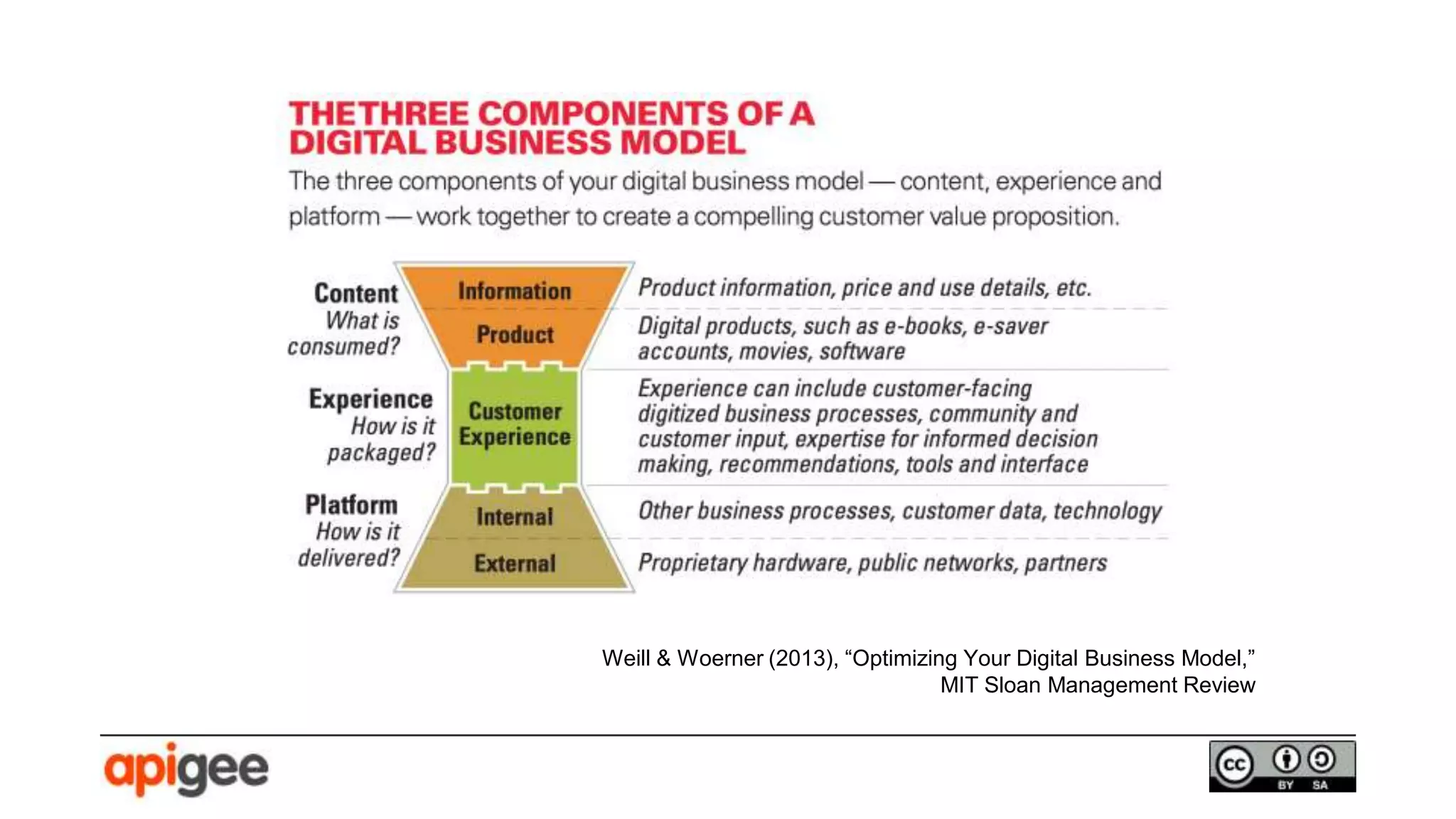
Weill & Woerner (2013), “Optimizing Your Digital Business Model,”
MIT Sloan Management Review
Thank you
Please send questions and comments to:
@sramji
sramji@apigee.com

Platform Strategy and Digital Ecosystems

  • 1.
    Platform Strategy & Ecosystems OpenBusiness Conference May 6th 2014
  • 2.
  • 3.
    Let’s take alook at the 5-year predictable horizon
  • 4.
    The world willbe faster, more connected, with a billion more participants in the global economy.
  • 5.
    A rising middleclass in Brazil, India, China, and Indonesia will adopt devices first and computers second, leaping the digital divide.
  • 6.
    Gen-Y consumers andemployees will be in their 30s, defining the conventions for work and play styles.
  • 7.
    4G wireless willbe broadly available and 5G will be in limited deployment.
  • 8.
    Carrier networks willbe optimized for traffic against specific services and media types.
  • 9.
    Consumer devices willbe dominant, but small devices for data sensing and processing will make up a significant percentage of mobile and Internet traffic.
  • 10.
    Most commerce willbe initiated via mobile devices and completed on a range of platforms.
  • 11.
    Most transactions, whenexecuted, will be multi-party: between the app and the underlying services.
  • 12.
    Social media witheffective partitions and channels will be the dominant mode of communication.
  • 13.
    User attention willcontinue to fragment, alternately directing and being directed by a range of apps.
  • 14.
    Data will bea unit of value and a mechanism of lock-in.
  • 15.
    Industries will beplatform-shaped, with a dominant player occupying the high-margin platform position and pushing others to supporting roles.
  • 16.
    What is aPlatform Business Model?
  • 17.
  • 18.
  • 19.
  • 20.
    A platform businessmodel is defined as follows: It is a business model which builds value for multiple sides in a given market by consolidating customers, simplifying market- wide processes, and rewarding each player in the value network between the value network and the customers.
  • 21.
    There are manyexamples of platform business models in action today.
  • 22.
    Eisenmann, Parker, VanAlstyne (2006),“Strategies for Two- Sided Markets,” SSRN.com.
  • 23.
    There are manyexamples of digital platform business models in action today.
  • 24.
    1. Desktop OS:Unix, Mac, Windows 2. PDAs: Palm, Psion, Newton 3. Game Consoles: Wii, Xbox, PlayStation 4. Network Switches: Cisco, IBM, HP 5. Multimedia: Adobe/Flash, MS/Silverlight, Google-Apple/HTML5 6. Payment Systems: PayPal, Google Checkout, Visa, Apple, Mobile Felica 7. Mobile Devices: iPhone, Android, Symbian, Blackberry 8. Enterprise Systems: Salesforce, Oracle, i2, IBM, SAP 9. Social Networks: Facebook, MySpace, LinkedIn, Monster, Twitter 10. Batteries: Sony, Panasonic, Sanyo, A123 11. Web Search: Google, Bing+Yahoo!, Baidu 12. eBooks: Amazon, iPad, Nook, Sony 13. Smart Grids: IBM etc. 14. Health Care: Microsoft, WebMD, IBM etc. Eisenmann, Parker, Van Alstyne (2011), “Platform Envelopment,” Strategic Management Journal.
  • 25.
    Platform businesses arebuilt on network effects. The more network effects, the stronger the platform.
  • 26.
    Kindle Usr Book PSP Usr Gam Zune UsrMus MicrosoftSonyAmazon Eisenmann, Parker, Van Alstyne (2011), “Platform Envelopment,” Strategic Management Journal. MP3 User Musi c Video TV Games Dvpr Web HTML eBooks Publi Calls User Apple
  • 27.
    Openness is acritical element of all platform businesses.
  • 28.
    Eisenmann, Parker, VanAlstyne (2011), “Platform Envelopment,” Strategic Management Journal.
  • 29.
    V4 V3 Price q1 p1 Quantity V1 V2 Platform sponsor givesaway platform value. Partners build apps for installed base, adding new layers of value. Platform sponsor benefits from increased sales & royalties. Partners benefit from cost savings and installed base. Parker, Van Alstyne (2011), “Innovation, Openness & Platform Control,” SSRN.com.
  • 30.
    Platform models generateprofit through first and third party usage.
  • 31.
    Most firms canonly concentrate on most valuable apps Profits increase when others add to platform’s “Long Tail” Parker, Van Alstyne (2011), “Innovation, Openness & Platform Control,” SSRN.com.
  • 32.
    Platform models builddigital ecosystems through virtuous cycles.
  • 33.
    We view DigitalEcosystems to be the digital counterparts of biological ecosystems, exploiting the self-organising properties of biological ecosystems, which are considered to be robust, self-organising and scalable architectures that can automatically solve complex, dynamic problems. Digital Ecosystems are a novel optimisation technique where the optimisation works at two levels: a first optimisation, migration of agents (representing services) which are distributed in a decentralised peer-to-peer network, operating continuously in time; this process feeds a second optimisation based on evolutionary computing that operates locally on single peers and is aimed at finding solutions to satisfy locally relevant constraints. “ G. Briscoe, P. DeWilde IEEE Conference on BIONETICS (2006)
  • 34.
    A digital ecosystemis a distributed, adaptive, open socio-technical system with properties of self-organization, scalability and sustainability inspired from natural ecosystems. Digital ecosystem models are informed by knowledge of natural ecosystems, especially for aspects related to competition and collaboration among diverse entities. “ Various authors Wikipedia: Digital Ecosystem
  • 35.
    [Ecosystem Competition] Kishore S.Swaminathan (2009), Chief Scientist, Accenture
  • 36.
    This approach ofcommon platforms and shared incentives is the path to digital ecosystem success.
  • 37.
  • 38.
    Given current abundanceof choices and scarcity of user attention, compelling experiences must deliver platform capabilities and content to users. Without such experiences, an ecosystem fails to thrive.
  • 39.
    Weill & Woerner(2013), “Optimizing Your Digital Business Model,” MIT Sloan Management Review
  • 40.
    Thank you Please sendquestions and comments to: @sramji sramji@apigee.com

Editor's Notes

  • #29 2011 Parker & Van Alstyne
  • #34 We created an Ecosystem-Oriented Architecture of Digital Ecosystems by extending Service-Oriented Architectures with distributed evolutionary computing, allowing services to recombine and evolve over time, constantly seeking to improve their effectiveness for the user base. Individuals within our Digital Ecosystem will be applications (groups of services), created in response to user requests by using evolutionary optimisation to aggregate the services. These individuals will migrate through the Digital Ecosystem and adapt to find niches where they are useful in fulfilling other user requests for applications. Simulation results imply that the Digital Ecosystem performs better at large scales than a comparable Service-Oriented Architecture, suggesting that incorporating ideas from theoretical ecology can contribute to useful self-organising properties in digital ecosystems. http://arxiv.org/abs/0712.4102