Account	
  Sharing	
  in	
  the	
  Context	
  of	
  	
  
Networked	
  Hospitality	
  Exchange	


Airi Lampinen @airi_!
Helsinki Institute for Information Technology HIIT!
*Research done at Microsoft Research New England!
Couchsurfing.org:	
  Non-­‐monetary	
  
Networked	
  Hospitality	
  Exchange	
  
Network	
  hospitality	
  (Molz,	
  2011):	
  	
  
The	
  ways	
  users	
  of	
  hospitality	
  exchange	
  services	
  
connect	
  with	
  one	
  another	
  via	
  online	
  tools,	
  	
  
and	
  the	
  kinds	
  of	
  relaAonships	
  they	
  perform	
  when	
  
they	
  meet	
  each	
  other	
  offline	
  and	
  face	
  to	
  face	
  
Why	
  are	
  account	
  sharing	
  and	
  network	
  
hospitality	
  important	
  for	
  CSCW?	


•  Many	
  popular	
  and	
  emerging	
  online	
  sharing	
  
and	
  collaboraAve	
  consumpAon	
  systems	
  allow	
  
people	
  to	
  engage	
  in	
  network	
  hospitality	
  and	
  in	
  
other	
  types	
  social	
  exchange	
  of	
  goods	
  and	
  
services	


•  People	
  oFen	
  live	
  together	
  with	
  others	
  and	
  co-­‐
own	
  resources	
  -­‐	
  services	
  that	
  support	
  opening	
  
up	
  domesAc	
  spaces	
  and	
  sharing	
  other	
  types	
  of	
  
resources	
  need	
  to	
  take	
  this	
  into	
  account	


•  This	
  project	
  sheds	
  light	
  on	
  the	
  account	
  
sharing	
  challenges	
  encountered	
  by	
  mulF-­‐
person	
  households	
  who	
  offer	
  to	
  host	
  
strangers	
  in	
  their	
  homes	
  through	
  
Couchsurfing.org	
  
Case	
  Study	
  of	
  Account	
  Sharing	
  
on	
  Couchsurfing.org	
  
•  In-­‐depth,	
  semi-­‐structured	
  interviews	
  with	
  

16	
  individuals	
  from	
  8	
  households	
  of	
  more	
  
than	
  one	
  people	
  who	
  offer	
  to	
  host	
  
couchsurfers	
  in	
  their	
  domesAc	
  spaces	
  

•  Primary	
  focal	
  points	
  of	
  the	
  analysis:	
  
1.  SeNng	
  up	
  and	
  maintaining	
  profiles	
  
2.  Handling	
  CouchRequests	
  
3.  WriAng	
  and	
  receiving	
  references	
  
aFer	
  hosAng	
  couchsurfers	
  
Challenges	
  Related	
  to	
  Account	
  Sharing	
  	
  
in	
  the	
  Context	
  of	
  Network	
  Hospitality	
  
1.  PresenAng	
  mulAple	
  people	
  in	
  a	
  single	
  
profile	
  
2.  CoordinaAng	
  negoAaAons	
  over	
  access	
  to	
  
domesAc	
  space	
  
3.  RepresenAng	
  in	
  a	
  fair	
  way	
  the	
  reputaAon	
  
hosts	
  have	
  accumulated	
  together	
  over	
  
Ame	
  
Challenge	
  I:	
  

PresenFng	
  MulFple	
  People	
  in	
  One	
  Profile	


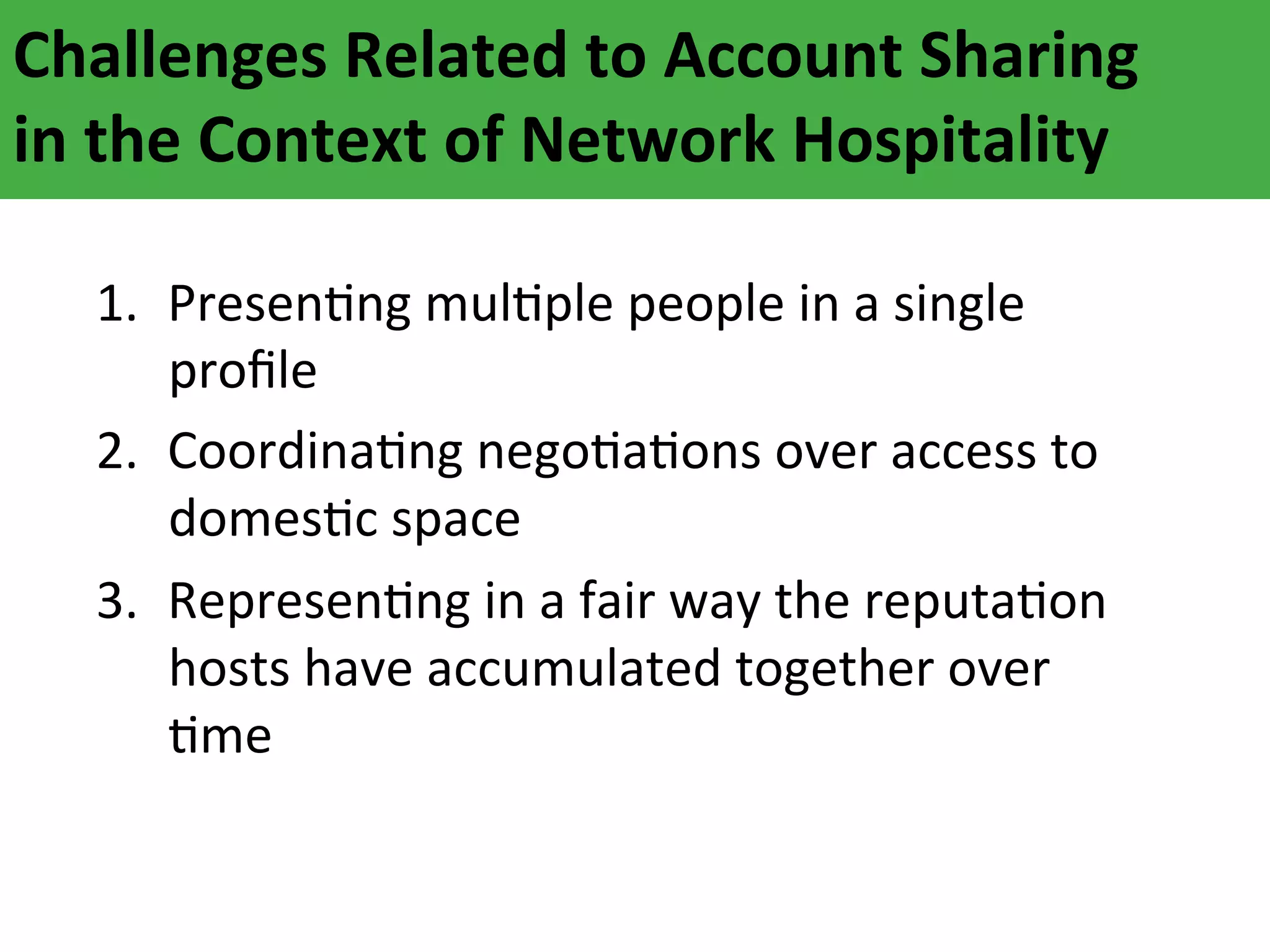
   “Right	
  now,	
  it’s	
  just	
  male,	


female,	
  or	
  mul5ple	
  people.	
  
And	
  then	
  you	
  can	
  put	
  mul5ple	
  
pictures	
  or	
  you	
  can	
  describe,	
  
but	
  there’s	
  no	
  way	
  to	
  actually	
  
say	
  we	
  are	
  this	
  person,	
  this	
  
person	
  and	
  this	
  person.	
  And	
  
not	
  all	
  of	
  us	
  have	
  a	
  way	
  to	
  log	
  
in	
  and	
  see	
  the	
  site	
  unless	
  we	
  
just	
  share	
  my	
  login.”	
  	
  
"
Challenge	
  II:	


NegoFaFng	
  over	
  	
  
Access	
  to	
  DomesFc	
  Spaces	


“We	
  definitely	
  always	
  look	
  at	
  
the	
  request	
  and	
  talk	
  about	
  it	
  
together	
  [..]	
  I	
  don’t	
  think	
  one	
  of	
  
us	
  would	
  say	
  yes	
  or	
  no	
  to	
  
someone	
  before	
  we	
  had	
  talked	
  
about	
  it.”	


"
Challenge	
  II:	


NegoFaFng	
  over	
  	
  
Access	
  to	
  DomesFc	
  Spaces	


”Yeah	
  usually	
  the	
  way	
  we	
  do	
  it	
  is	
  
he	
  checks	
  the	
  account,	
  but	
  he	
  
sends	
  me	
  the	
  details	
  and	
  then	
  
we	
  discuss	
  whether	
  those	
  days	
  
work	
  and	
  then	
  I	
  respond	
  to	
  him	
  
and	
  he	
  writes	
  back	
  and	
  then	
  he	
  
starts	
  cc'ing	
  me	
  on	
  any	
  email	
  
exchanges	
  he	
  has.”	


"
Challenge	
  III:	


Sharing	
  the	
  Benefits	
  of	
  	
  
a	
  Trustworthy	
  ReputaFon	


ould	
   uess	
  that	
   e'd	
  
	
   “Yeah,	
  I	
  wwrite	
  gt,	
  because	
  w	
  bet,	
  like,	
  
probably	
  
i
I
if	
  we	
  had	
  a	
  really	
  fun	
  5me,	
  then	
  we	
  
would	
  probably	
  want	
  to,	
  like,	
  sit	
  
together,	
  and	
  say,	
  oh,	
  this	
  was	
  fun,	
  
that	
  was	
  fun,	
  and	
  write	
  about	
  it.	
  
And	
  if	
  we	
  were	
  like,	
  a	
  liIle	
  peeved,	
  
then	
  I	
  think	
  we	
  would	
  want	
  to,	
  like,	
  
talk	
  together	
  about	
  how	
  to	
  be	
  polite	
  
but	
  also	
  be	
  honest”.	


Challenge	
  III:	


Sharing	
  the	
  Benefits	
  of	
  	
  
a	
  Trustworthy	
  ReputaFon	


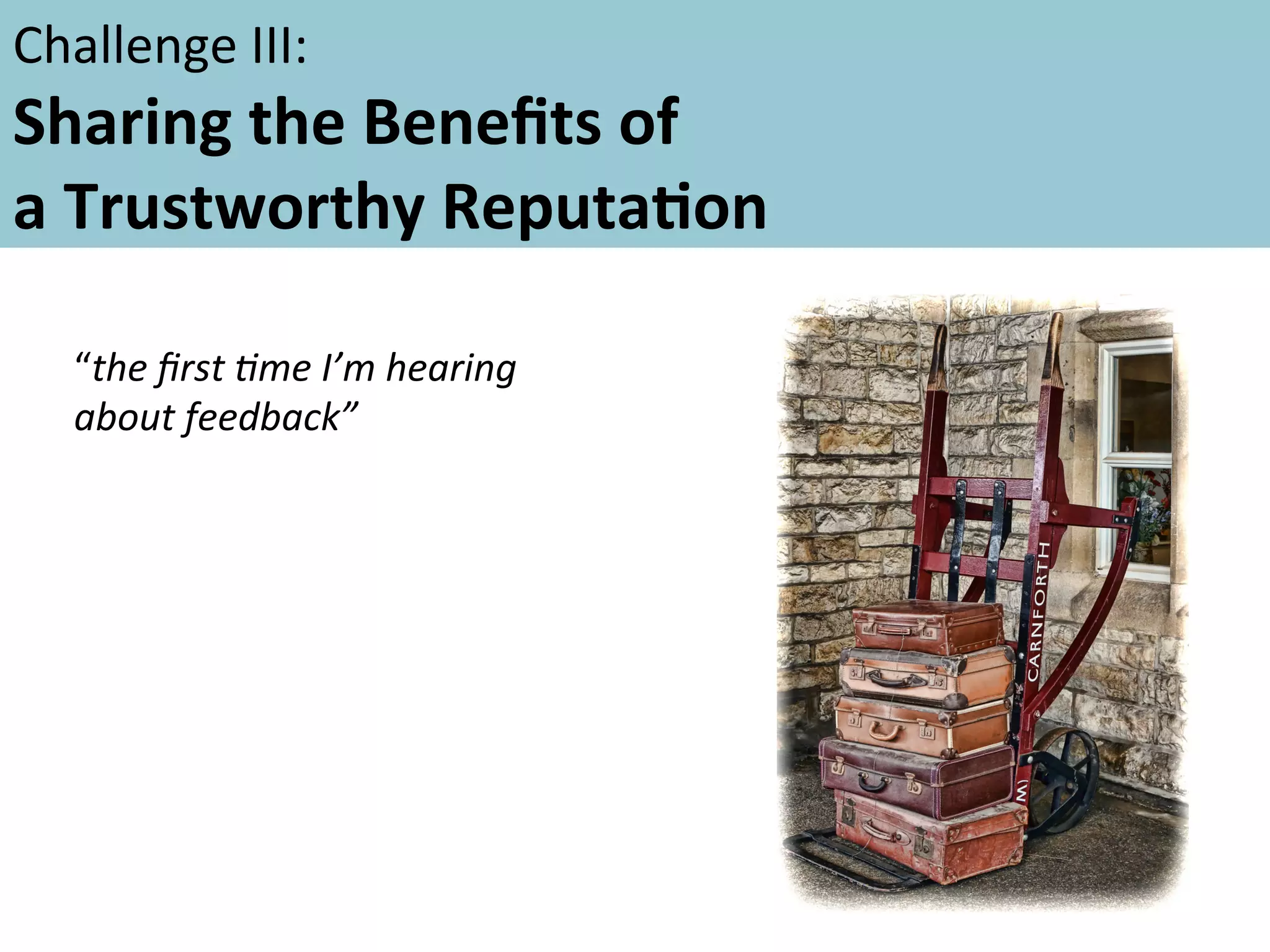
   “the	
  first	
  5me	
  I’m	
  hearing	
  
about	
  feedback”	
  	
  
Challenge	
  III:	


Sharing	
  the	
  Benefits	
  of	
  	
  
a	
  Trustworthy	
  ReputaFon	


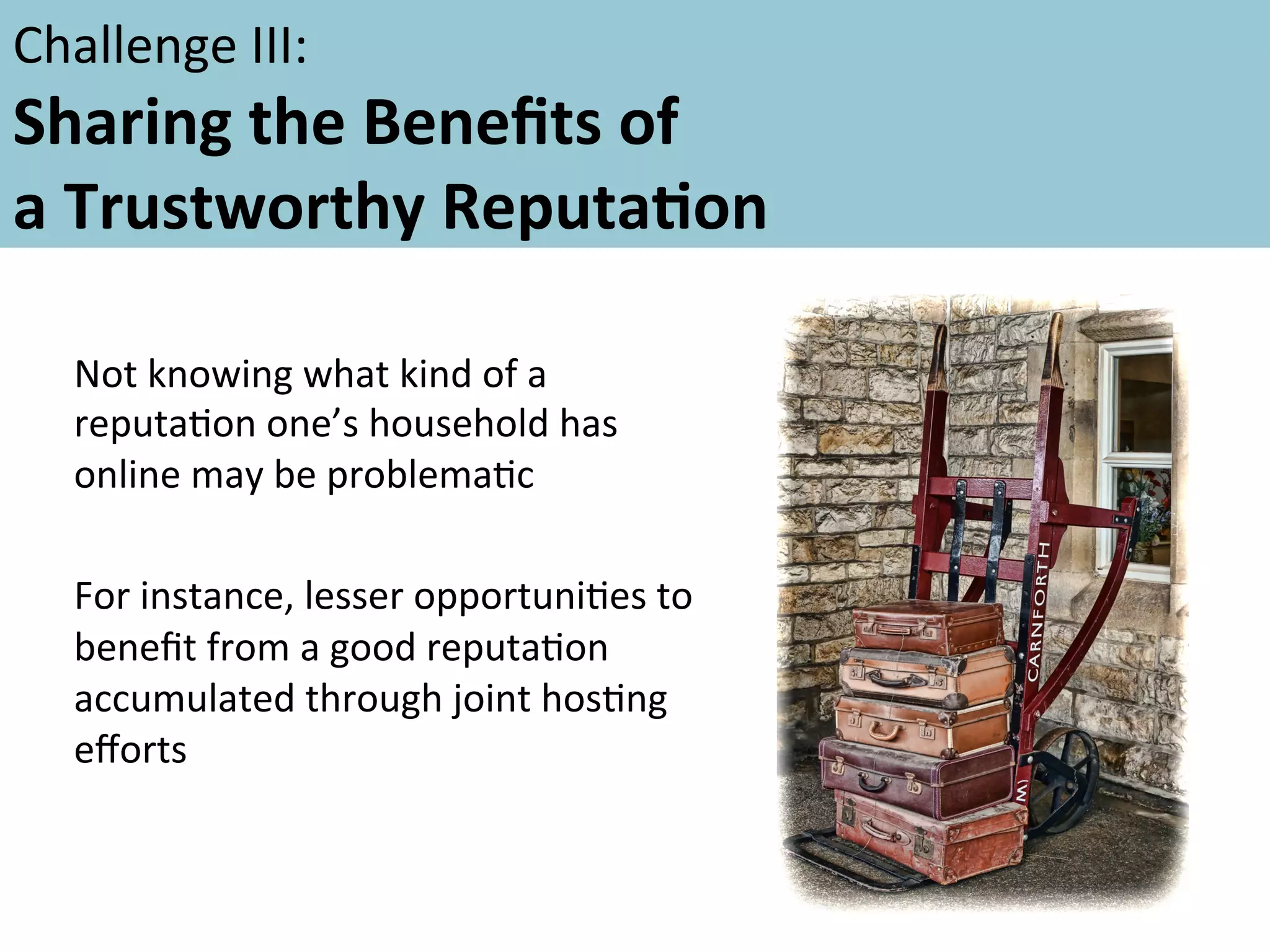
   Not	
  knowing	
  what	
  kind	
  of	
  a	
  
reputaAon	
  one’s	
  household	
  has	
  
online	
  may	
  be	
  problemaAc	


For	
  instance,	
  lesser	
  opportuniAes	
  to	
  
benefit	
  from	
  a	
  good	
  reputaAon	
  
accumulated	
  through	
  joint	
  hosAng	
  
efforts	
  
Designing	
  for	
  Shared	
  Use:	


Shared	
  Profiles	
  and	
  ReputaFon	


•  A	
  profile	
  that	
  showcases	
  posiAve	
  references	
  is	
  likely	
  to	
  

increase	
  its	
  owners’	
  success	
  in	
  requesAng	
  a	
  place	
  to	
  
stay	
  (or	
  in	
  receiving	
  visitors	
  to	
  host)	
  –	
  how	
  to	
  allow	
  
everyone	
  involved	
  in	
  hosFng	
  to	
  benefit	
  fairly?	


•  Current	
  design	
  provides	
  li`le	
  assistance	
  for	
  
transferring	
  reputaAon	
  to	
  a	
  new	
  context	
  –	
  how	
  to	
  
support	
  conFnuing	
  parFcipaFon	
  as	
  a	
  reputed	
  
member	
  aOer	
  a	
  life	
  change?	
  	
  
•  How	
  about	
  designing	
  mulF-­‐person	
  profiles	
  as	
  
collecFons	
  of	
  components	
  that	
  can	
  be	
  combined	
  and	
  
decomposed	
  as	
  needed?	
  (Consider	
  the	
  trade-­‐offs!)	
  
Designing	
  for	
  Shared	
  Use:	


Shared	
  Access	
  and	
  Awareness	


Some	
  parAcipants	
  were	
  not	
  c
the	
  
	
   •  affordances	
  Couchsurfing.org	
  ontented	
  with	
  ooperaFve	
  
provides	
  for	
  c
coordinaFon	
  

•  When	
  it	
  comes	
  to	
  facilitaAng	
  cooperaAon	
  among	
  
mulAple	
  household	
  members	
  who	
  are	
  sharing	
  an	
  
account,	
  however,	
  seemingly	
  easy	
  fixes,	
  such	
  as	
  
allowing	
  mulAple	
  redirect	
  addresses,	
  may	
  introduce	
  
inadvertent	
  challenges	
  
•  Group-­‐level	
  coordinaAon	
  is	
  not	
  an	
  issue	
  that	
  could	
  be	
  
‘solved	
  by	
  design’,	
  rather	
  provide	
  users	
  with	
  
meaningful	
  choice	
  and	
  encourage	
  joint	
  reflecFon	
  
Designing	
  for	
  Shared	
  Use:	


Shared	
  Access	
  and	
  Awareness	


Asking	
  people	
  
rFculated	
  
	
   •  when	
  they	
  are	
  tso	
  consider	
  c	
  slearly	
  aaccount	
  in	
  choices	
  
eNng	
  up	
  a hared	
  
an	
  online	
  
system	
  could	
  help	
  them	
  reflect	
  on	
  and	
  discuss	
  
together	
  how	
  to	
  handle	
  their	
  account	
  

•  Next	
  to	
  opAons	
  from	
  which	
  to	
  select	
  in	
  seNng	
  up	
  a	
  
profile,	
  the	
  setup	
  process	
  could	
  be	
  accompanied	
  with	
  
a	
  short	
  list	
  of	
  issues	
  household	
  members	
  should	
  
agree	
  upon	
  and	
  examples	
  of	
  how	
  others	
  have	
  
resolved	
  them:	
  
–  who	
  maintains	
  the	
  profile?	
  
–  how	
  are	
  decisions	
  over	
  whom	
  to	
  host	
  made?	
  
–  who	
  answers	
  messages	
  and	
  writes	
  references?	
  
Conclusion	
  
	
   •  Key	
  challenges	
  of	
  account	
  sharing	
  in	
  the	
  context	
  of	
  
networked	
  hospitality	
  exchange	
  include	


1.  presenAng	
  mulAple	
  people	
  with	
  a	
  single	
  profile	
  
2.  coordinaAng	
  and	
  negoAaAng	
  responding	
  to	
  CouchRequests	
  
3.  sharing	
  the	
  benefits	
  of	
  a	
  good	
  reputaAon	
  in	
  a	
  fair	
  way	


•  Similar	
  issues	
  may	
  occur	
  in	
  other	
  instances	
  of	
  network	
  
hospitality	
  as	
  well	
  as	
  in	
  systems	
  that	
  facilitate	
  online	
  
exchange	
  or	
  ridesharing	


•  Amidst	
  the	
  rising	
  rhetoric	
  of	
  a	
  ‘reputaFon	
  economy’,	
  
what	
  are	
  the	
  inclusions,	
  exclusions,	
  and	
  inequaliAes	
  that	
  
reputaAon	
  metrics	
  may	
  renew	
  or	
  create,	
  especially	
  if	
  they
	
  
fail	
  to	
  acknowledge	
  people’s	
  account	
  sharing	
  pracAces?	
  
Future	
  DirecFons	


•  Money:	
  Account	
  sharing	
  pracAces	
  in	
  non-­‐monetary	
  vs	
  
monetary	
  networked	
  hospitality	
  exchange	
  
•  Household	
  types:	
  Differences	
  in	
  terms	
  of	
  preferences	
  and	
  
pracAces	
  for	
  account	
  sharing	
  	
  
•  Beyond	
  network	
  hospitality:	
  Account	
  sharing	
  when	
  it	
  
comes	
  to	
  sharing	
  other	
  types	
  of	
  resources,	
  such	
  as	
  cars,	
  
bikes,	
  or	
  other	
  tangible	
  items	
  

Acknowledgements	
  
The	
  research	
  for	
  this	
  paper	
  was	
  conducted	
  while	
  at	
  MicrosoF	
  Research	
  New	
  England.	


  I	
  wish	
  to	
  thank	
  the	
  parAcipants	
  and	
  acknowledge	
  rMary	
  L.	
  Gray,	
  iNancy	
  Baym,	
  the	
  S	
  ocial	
  Media	
  
CollecAve,	
  colleagues	
  at	
  HIIT	
  and	
  the	
  anonymous	
   eviewers	
  for	
   nvaluable	
  advice.	
  
The	
  work	
  was	
  finalized	
  with	
  funding	
  from	
  the	
  TEKES	
  project	
  FuNeSoMo.	
  
Photo	
  credits:	


•  h`p://www.flickr.com/photos/donnagrayson/109052424/
sizes/l/	
  
•  h`p://www.flickr.com/photos/katewares/9505200323/sizes/
l/	
  
•  h`p://www.flickr.com/photos/alisonchrisAne/11288183315/
sizes/l/	
  
•  h`p://www.flickr.com/photos/49024304@N00/4521267075/	


Account Sharing in the Context of Networked Hospitality Exchange

  • 1.
    Account  Sharing  in  the  Context  of     Networked  Hospitality  Exchange     Airi Lampinen @airi_! Helsinki Institute for Information Technology HIIT! *Research done at Microsoft Research New England!
  • 2.
    Couchsurfing.org:  Non-­‐monetary   Networked  Hospitality  Exchange   Network  hospitality  (Molz,  2011):     The  ways  users  of  hospitality  exchange  services   connect  with  one  another  via  online  tools,     and  the  kinds  of  relaAonships  they  perform  when   they  meet  each  other  offline  and  face  to  face  
  • 3.
    Why  are  account  sharing  and  network   hospitality  important  for  CSCW?     •  Many  popular  and  emerging  online  sharing   and  collaboraAve  consumpAon  systems  allow   people  to  engage  in  network  hospitality  and  in   other  types  social  exchange  of  goods  and   services     •  People  oFen  live  together  with  others  and  co-­‐ own  resources  -­‐  services  that  support  opening   up  domesAc  spaces  and  sharing  other  types  of   resources  need  to  take  this  into  account     •  This  project  sheds  light  on  the  account   sharing  challenges  encountered  by  mulF-­‐ person  households  who  offer  to  host   strangers  in  their  homes  through   Couchsurfing.org  
  • 4.
    Case  Study  of  Account  Sharing   on  Couchsurfing.org   •  In-­‐depth,  semi-­‐structured  interviews  with   16  individuals  from  8  households  of  more   than  one  people  who  offer  to  host   couchsurfers  in  their  domesAc  spaces   •  Primary  focal  points  of  the  analysis:   1.  SeNng  up  and  maintaining  profiles   2.  Handling  CouchRequests   3.  WriAng  and  receiving  references   aFer  hosAng  couchsurfers  
  • 5.
    Challenges  Related  to  Account  Sharing     in  the  Context  of  Network  Hospitality   1.  PresenAng  mulAple  people  in  a  single   profile   2.  CoordinaAng  negoAaAons  over  access  to   domesAc  space   3.  RepresenAng  in  a  fair  way  the  reputaAon   hosts  have  accumulated  together  over   Ame  
  • 6.
    Challenge  I:   PresenFng  MulFple  People  in  One  Profile     
     “Right  now,  it’s  just  male,     female,  or  mul5ple  people.   And  then  you  can  put  mul5ple   pictures  or  you  can  describe,   but  there’s  no  way  to  actually   say  we  are  this  person,  this   person  and  this  person.  And   not  all  of  us  have  a  way  to  log   in  and  see  the  site  unless  we   just  share  my  login.”     "
  • 7.
    Challenge  II:     NegoFaFng  over     Access  to  DomesFc  Spaces       “We  definitely  always  look  at   the  request  and  talk  about  it   together  [..]  I  don’t  think  one  of   us  would  say  yes  or  no  to   someone  before  we  had  talked   about  it.”       "
  • 8.
    Challenge  II:     NegoFaFng  over     Access  to  DomesFc  Spaces       ”Yeah  usually  the  way  we  do  it  is   he  checks  the  account,  but  he   sends  me  the  details  and  then   we  discuss  whether  those  days   work  and  then  I  respond  to  him   and  he  writes  back  and  then  he   starts  cc'ing  me  on  any  email   exchanges  he  has.”       "
  • 9.
    Challenge  III:       Sharing  the  Benefits  of     a  Trustworthy  ReputaFon       ould   uess  that   e'd     “Yeah,  I  wwrite  gt,  because  w  bet,  like,   probably   i I if  we  had  a  really  fun  5me,  then  we   would  probably  want  to,  like,  sit   together,  and  say,  oh,  this  was  fun,   that  was  fun,  and  write  about  it.   And  if  we  were  like,  a  liIle  peeved,   then  I  think  we  would  want  to,  like,   talk  together  about  how  to  be  polite   but  also  be  honest”.      
  • 10.
    Challenge  III:       Sharing  the  Benefits  of     a  Trustworthy  ReputaFon         “the  first  5me  I’m  hearing   about  feedback”    
  • 11.
    Challenge  III:       Sharing  the  Benefits  of     a  Trustworthy  ReputaFon         Not  knowing  what  kind  of  a   reputaAon  one’s  household  has   online  may  be  problemaAc     For  instance,  lesser  opportuniAes  to   benefit  from  a  good  reputaAon   accumulated  through  joint  hosAng   efforts  
  • 12.
    Designing  for  Shared  Use:     Shared  Profiles  and  ReputaFon       •  A  profile  that  showcases  posiAve  references  is  likely  to   increase  its  owners’  success  in  requesAng  a  place  to   stay  (or  in  receiving  visitors  to  host)  –  how  to  allow   everyone  involved  in  hosFng  to  benefit  fairly?     •  Current  design  provides  li`le  assistance  for   transferring  reputaAon  to  a  new  context  –  how  to   support  conFnuing  parFcipaFon  as  a  reputed   member  aOer  a  life  change?     •  How  about  designing  mulF-­‐person  profiles  as   collecFons  of  components  that  can  be  combined  and   decomposed  as  needed?  (Consider  the  trade-­‐offs!)  
  • 13.
    Designing  for  Shared  Use:     Shared  Access  and  Awareness         Some  parAcipants  were  not  c the     •  affordances  Couchsurfing.org  ontented  with  ooperaFve   provides  for  c coordinaFon   •  When  it  comes  to  facilitaAng  cooperaAon  among   mulAple  household  members  who  are  sharing  an   account,  however,  seemingly  easy  fixes,  such  as   allowing  mulAple  redirect  addresses,  may  introduce   inadvertent  challenges   •  Group-­‐level  coordinaAon  is  not  an  issue  that  could  be   ‘solved  by  design’,  rather  provide  users  with   meaningful  choice  and  encourage  joint  reflecFon  
  • 14.
    Designing  for  Shared  Use:     Shared  Access  and  Awareness         Asking  people   rFculated     •  when  they  are  tso  consider  c  slearly  aaccount  in  choices   eNng  up  a hared   an  online   system  could  help  them  reflect  on  and  discuss   together  how  to  handle  their  account   •  Next  to  opAons  from  which  to  select  in  seNng  up  a   profile,  the  setup  process  could  be  accompanied  with   a  short  list  of  issues  household  members  should   agree  upon  and  examples  of  how  others  have   resolved  them:   –  who  maintains  the  profile?   –  how  are  decisions  over  whom  to  host  made?   –  who  answers  messages  and  writes  references?  
  • 15.
    Conclusion    •  Key  challenges  of  account  sharing  in  the  context  of   networked  hospitality  exchange  include     1.  presenAng  mulAple  people  with  a  single  profile   2.  coordinaAng  and  negoAaAng  responding  to  CouchRequests   3.  sharing  the  benefits  of  a  good  reputaAon  in  a  fair  way       •  Similar  issues  may  occur  in  other  instances  of  network   hospitality  as  well  as  in  systems  that  facilitate  online   exchange  or  ridesharing     •  Amidst  the  rising  rhetoric  of  a  ‘reputaFon  economy’,   what  are  the  inclusions,  exclusions,  and  inequaliAes  that   reputaAon  metrics  may  renew  or  create,  especially  if  they   fail  to  acknowledge  people’s  account  sharing  pracAces?  
  • 16.
    Future  DirecFons     •  Money:  Account  sharing  pracAces  in  non-­‐monetary  vs   monetary  networked  hospitality  exchange   •  Household  types:  Differences  in  terms  of  preferences  and   pracAces  for  account  sharing     •  Beyond  network  hospitality:  Account  sharing  when  it   comes  to  sharing  other  types  of  resources,  such  as  cars,   bikes,  or  other  tangible  items   Acknowledgements   The  research  for  this  paper  was  conducted  while  at  MicrosoF  Research  New  England.      I  wish  to  thank  the  parAcipants  and  acknowledge  rMary  L.  Gray,  iNancy  Baym,  the  S  ocial  Media   CollecAve,  colleagues  at  HIIT  and  the  anonymous   eviewers  for   nvaluable  advice.   The  work  was  finalized  with  funding  from  the  TEKES  project  FuNeSoMo.  
  • 17.
    Photo  credits:       •  h`p://www.flickr.com/photos/donnagrayson/109052424/ sizes/l/   •  h`p://www.flickr.com/photos/katewares/9505200323/sizes/ l/   •  h`p://www.flickr.com/photos/alisonchrisAne/11288183315/ sizes/l/   •  h`p://www.flickr.com/photos/49024304@N00/4521267075/