ProbeDroid: CraftingYour Own
Dynamic Instrument Tool on Android
for App Behavior Exploration
ZongXian Shen
About Me
www.zsshen.org
• Passionate Security Researcher and Developer
• Earned Master in CS from NCTU,Taiwan
• Involved in DSNS Lab
andy.zsshen@gmail.com
ZSShen
@AndyZSShen
Disclaimer
• A research project run in my spare time
• Still a lot of features to enhance
• Slide is the design memo and hack notes
Outline
• Intro to dynamic binary instrumentation
• Intro to ProbeDroid instrument kit
• Design and implementation of ProbeDroid
• App analysis with custom instrument tools
Intro to Dynamic
Binary Instrumentation
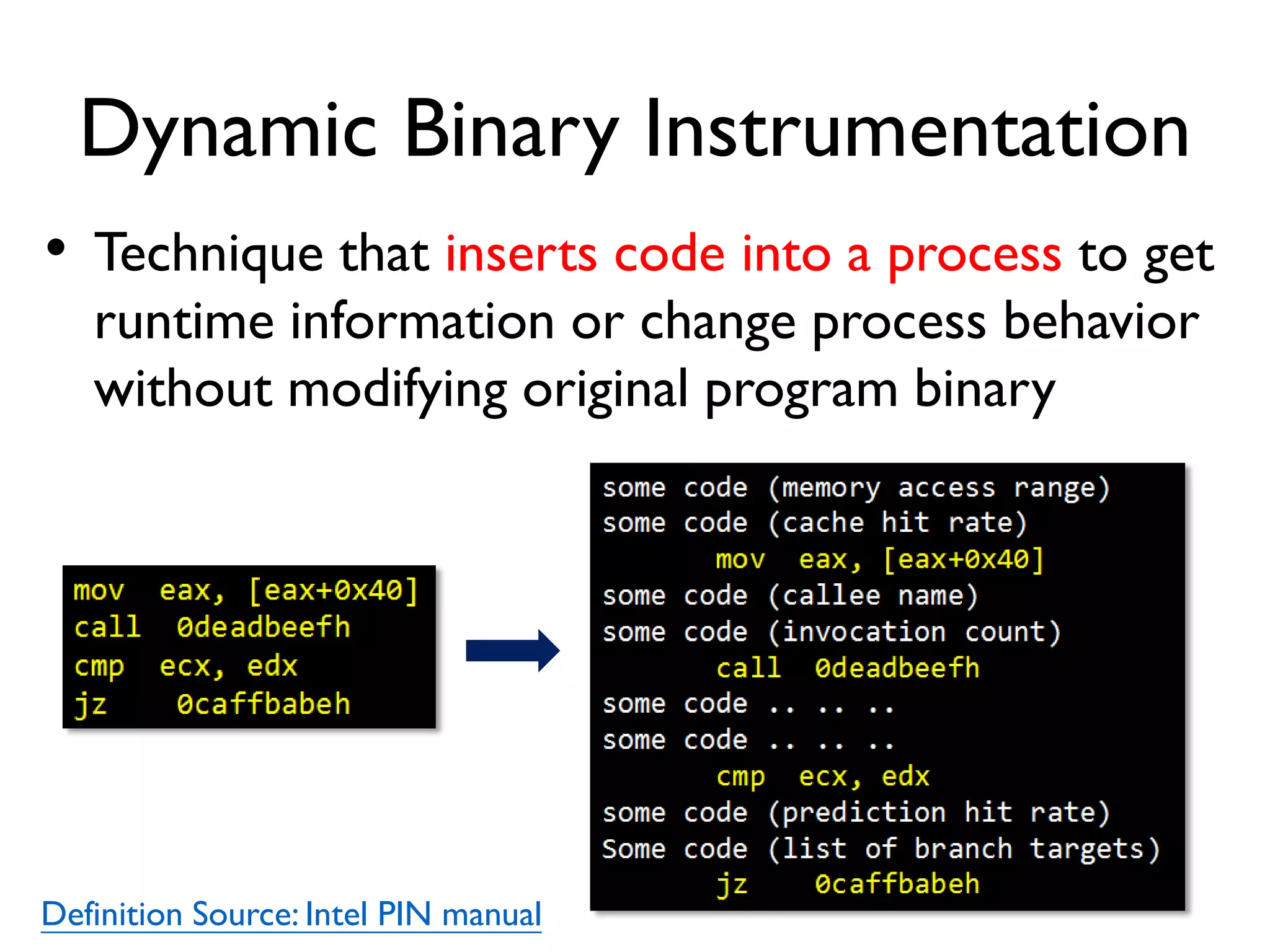
Dynamic Binary Instrumentation
• Technique that inserts code into a process to get
runtime information or change process behavior
without modifying original program binary
Definition Source: Intel PIN manual
DBI Application
• Performance tuning and bug hunting
• Cache performance, memory access footprint
• Behavior tracing and data logging
• API call sequence, code block control flow relation
• Changing process behavior on the fly
• Execution path exploration, product hacking
DBI for Android App
• Current Android app is mainly coded with Java
and run on custom Java runtime named ART
• Due to semantic gap, prefer Java level DBI rather
than instrumentation directly on native ISA
• Class field and object content inspection
• Method call sequence and parameter profiling
• Changing Java artifacts on the fly
Inspiring Work
• ADBI and DDI introduced by Collin Mulliner
• https://github.com/crmulliner/adbi
• https://github.com/crmulliner/ddi
• DBI framework based on Dalvik runtime
• Demonstrate how to hook interested Java method
and manipulate class field
And now ProbeDroid, targeting on ART
runtime with enhanced user interface
Intro to ProbeDroid
Instrument Kit
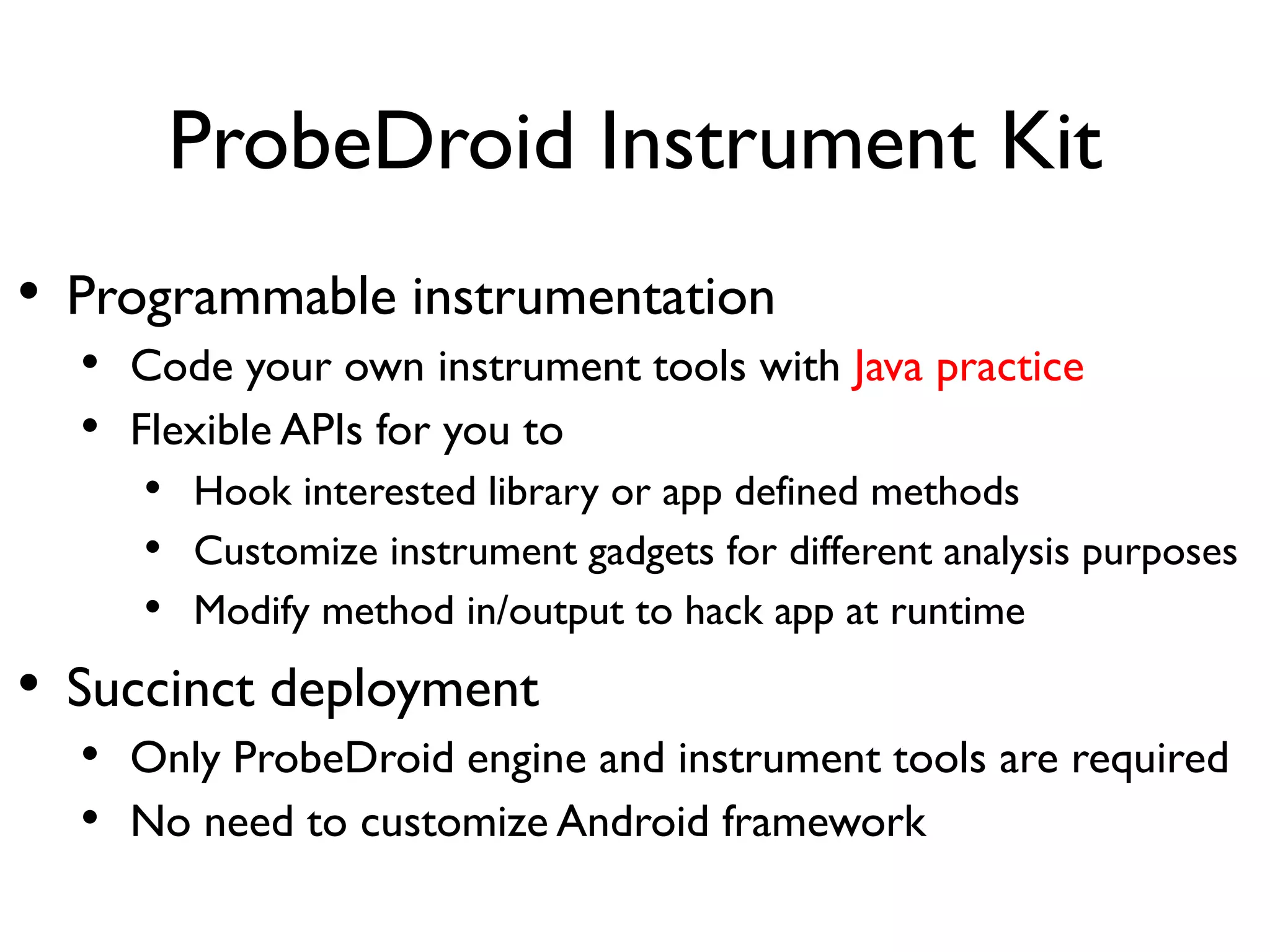
ProbeDroid Instrument Kit
• Programmable instrumentation
• Code your own instrument tools with Java practice
• Flexible APIs for you to
• Hook interested library or app defined methods
• Customize instrument gadgets for different analysis purposes
• Modify method in/output to hack app at runtime
• Succinct deployment
• Only ProbeDroid engine and instrument tools are required
• No need to customize Android framework
https://github.com/ZSShen/ProbeDroid
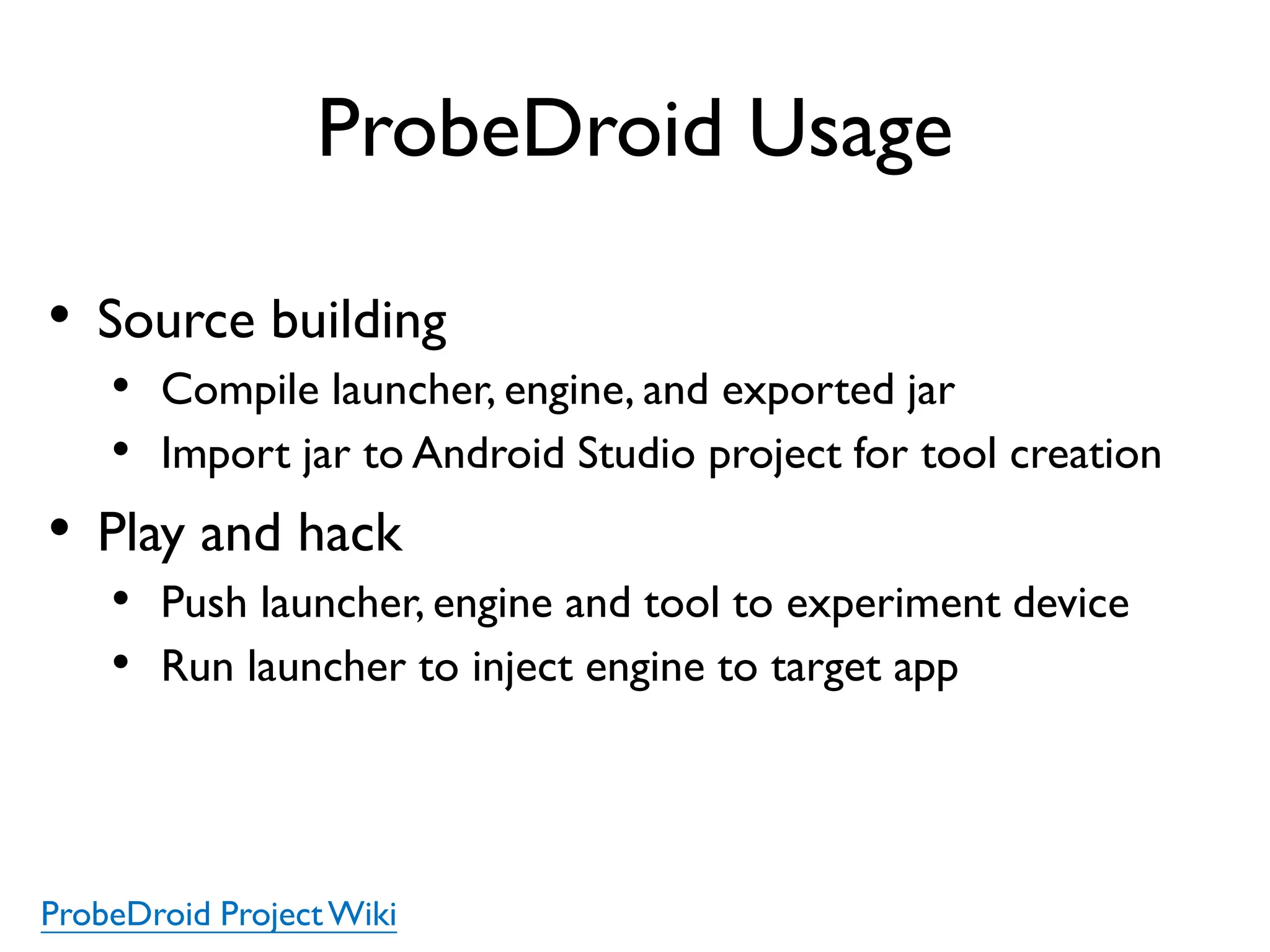
ProbeDroid Usage
• Source building
• Compile launcher, engine, and exported jar
• Import jar to Android Studio project for tool creation
• Play and hack
• Push launcher, engine and tool to experiment device
• Run launcher to inject engine to target app
ProbeDroid ProjectWiki
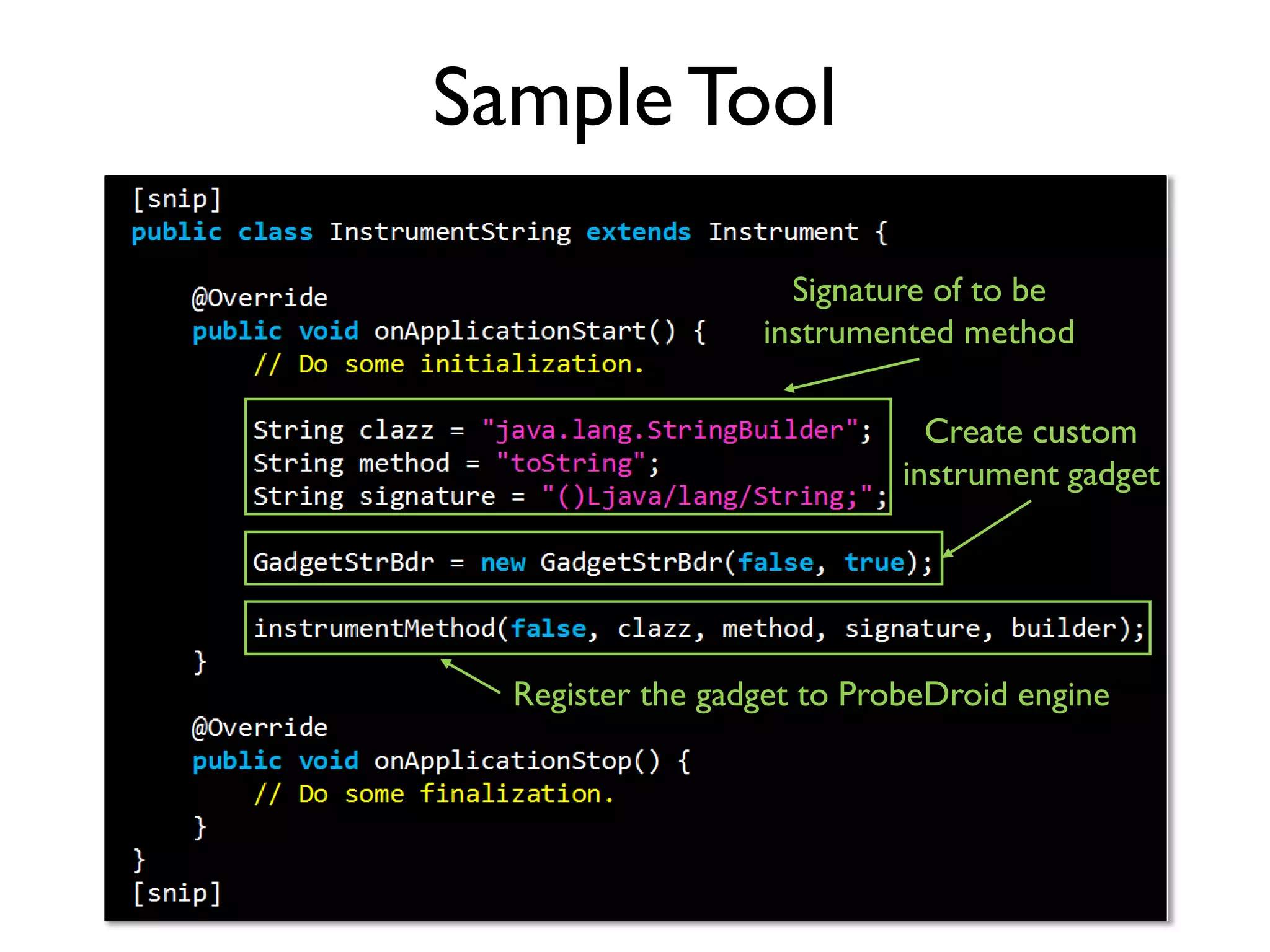
Sample Tool
Signature of to be
instrumented method
Create custom
instrument gadget
Register the gadget to ProbeDroid engine
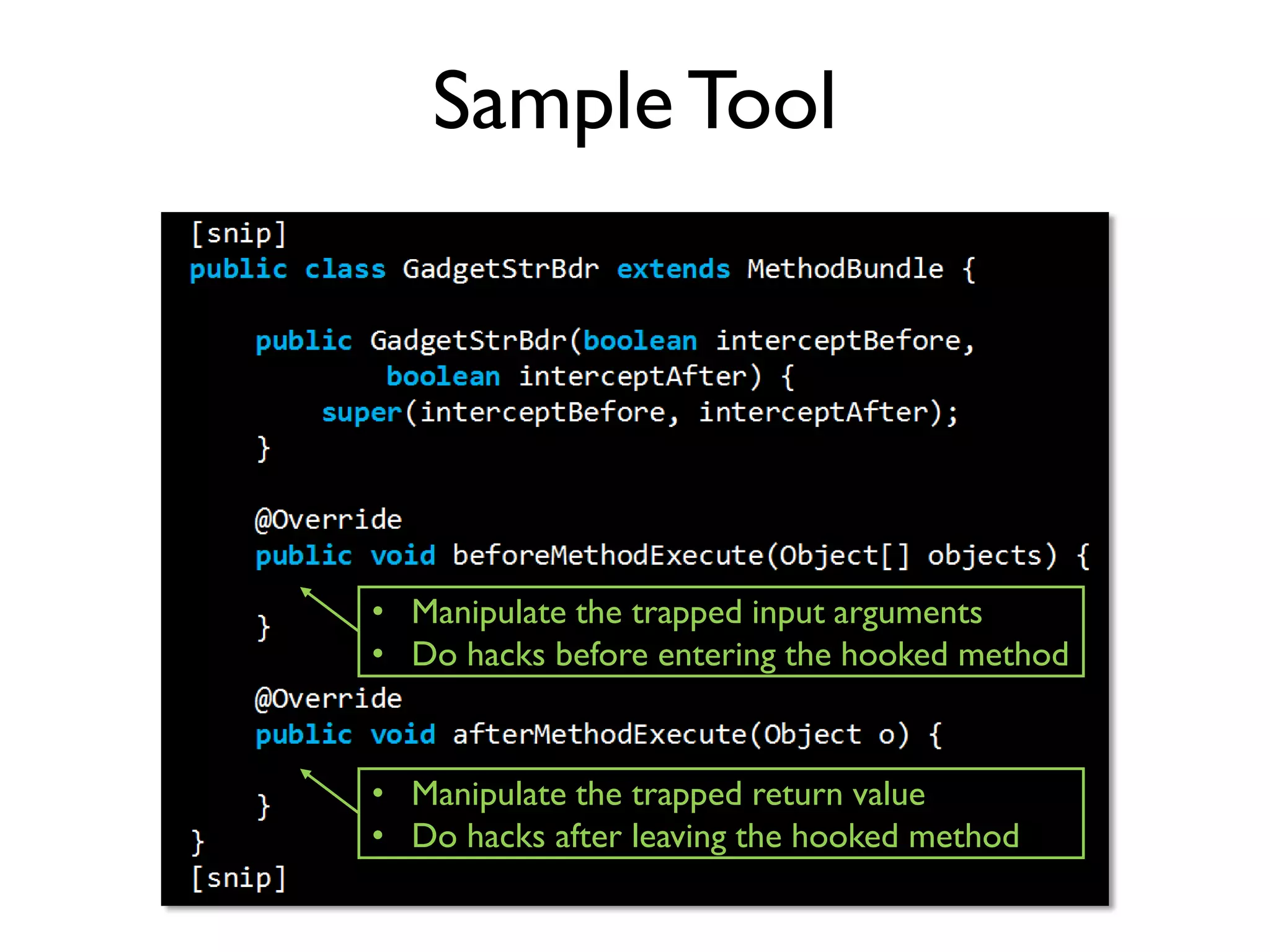
Sample Tool
• Manipulate the trapped input parameters
• Do hacks before entering the hooked method
• Manipulate the trapped return value
• Do hacks after leaving the hooked method
• Be injected into the target app process
• Work as a mini runtime
• Load and execute the instrument tool
• Hook the specified methods and install gadgets
• Marshal control flow for hooked methods and gadgets
ProbeDroid Tasks
Currently support X86 & ARM ISAs and Lollipop 5.0
ProbeDroid Design
and Implementation
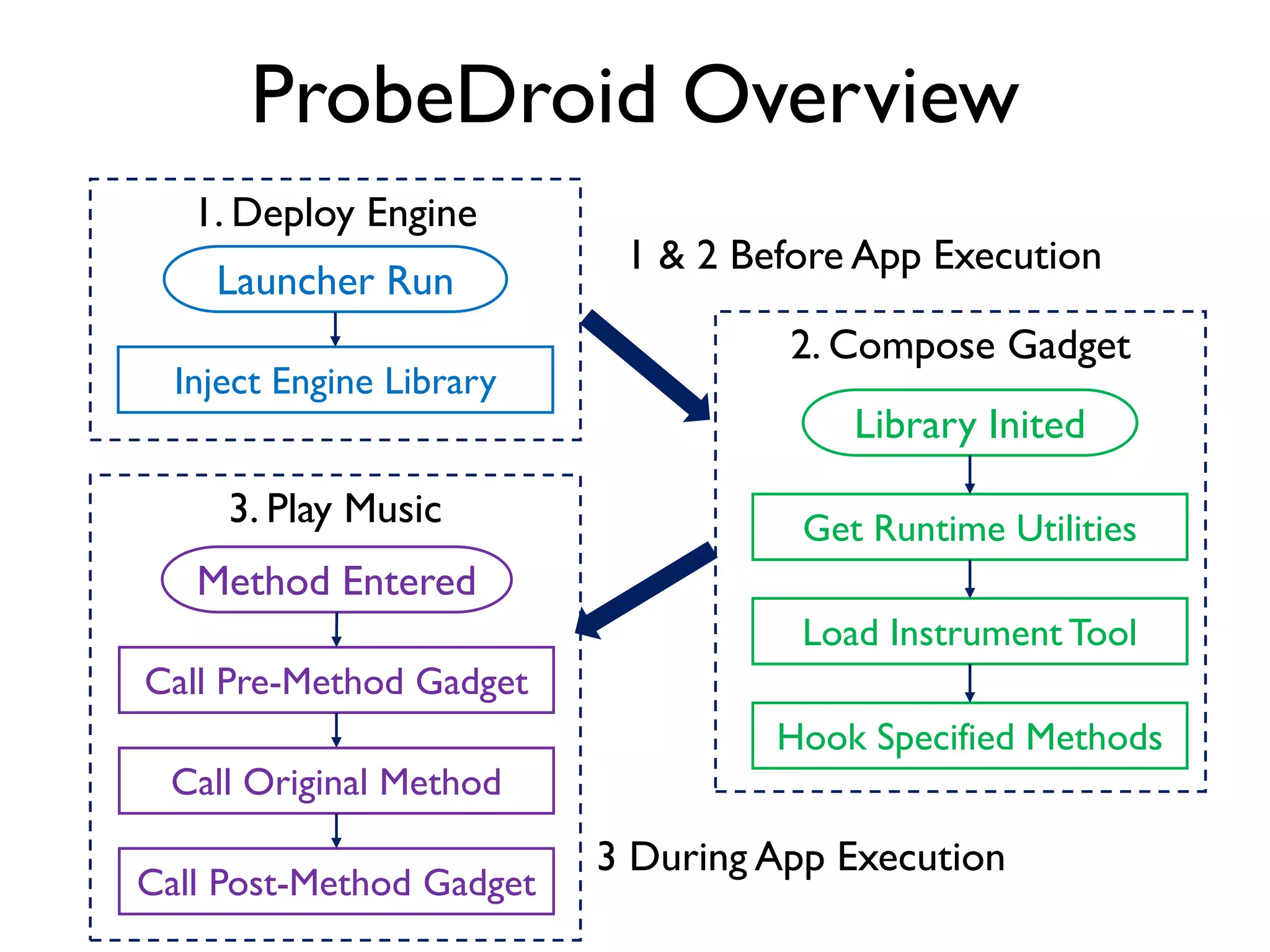
ProbeDroid Overview
Inject Engine Library
Launcher Run
Library Inited
Load Instrument Tool
Get Runtime Utilities
Hook Specified Methods
Method Entered
Call Pre-Method Gadget
Call Original Method
Call Post-Method Gadget
3. Play Music
2. Compose Gadget
1. Deploy Engine
1 & 2 Before App Execution
3 During App Execution
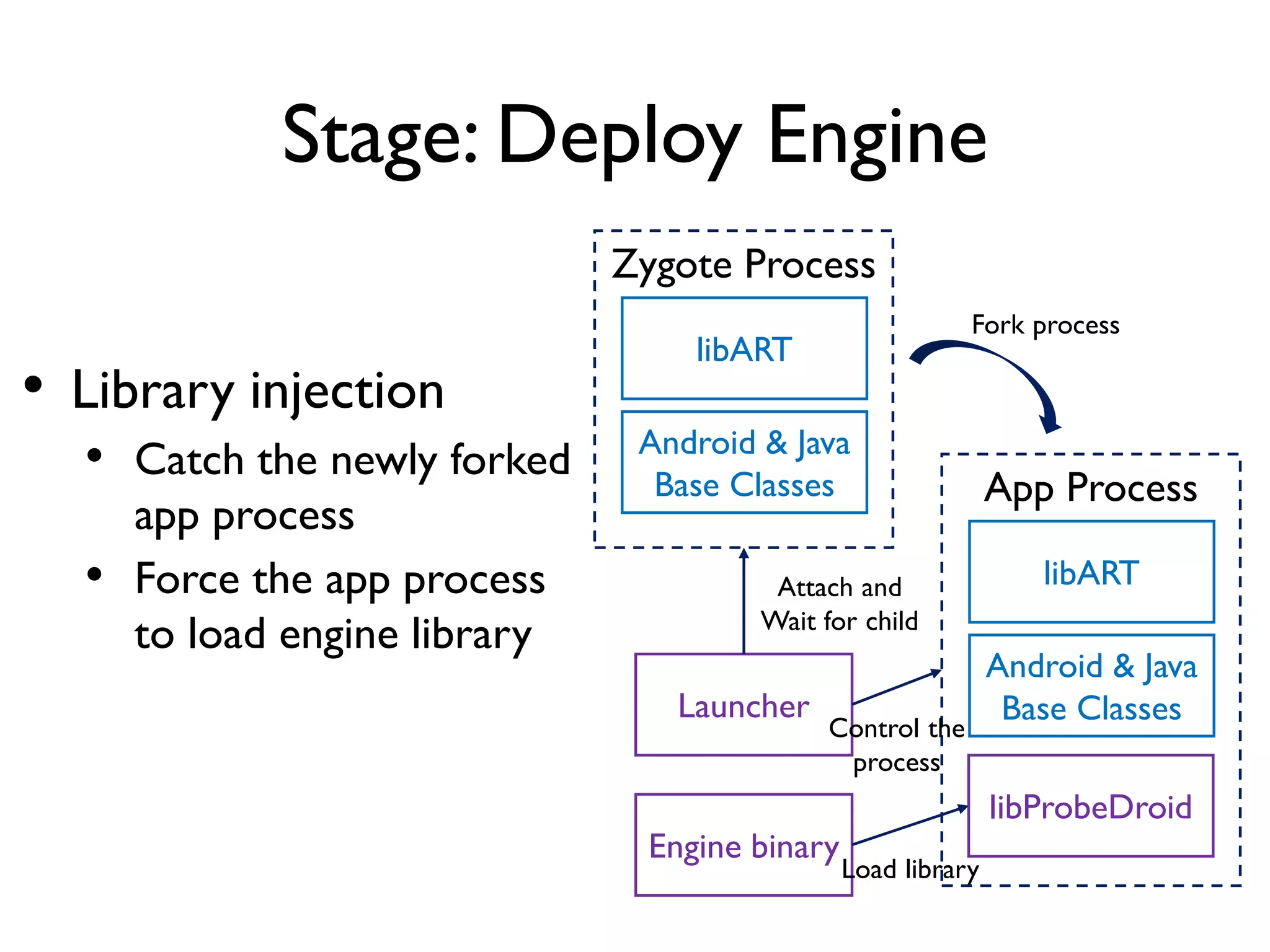
Stage: Deploy Engine
libART
Android & Java
Base Classes
libProbeDroid
Launcher
App Process
libART
Android & Java
Base Classes
Zygote Process
Attach and
Wait for child
Control the
process
Fork process
• Library injection
• Catch the newly forked
app process
• Force the app process
to load engine library
Engine binary
Load library
Library Injection
• No convenient APIs like WriteProcessMemory()
and CreateRemoteThread() dedicated forWindows
• Manually crafting ptrace() operation sequence to
simulate the procedure on Android
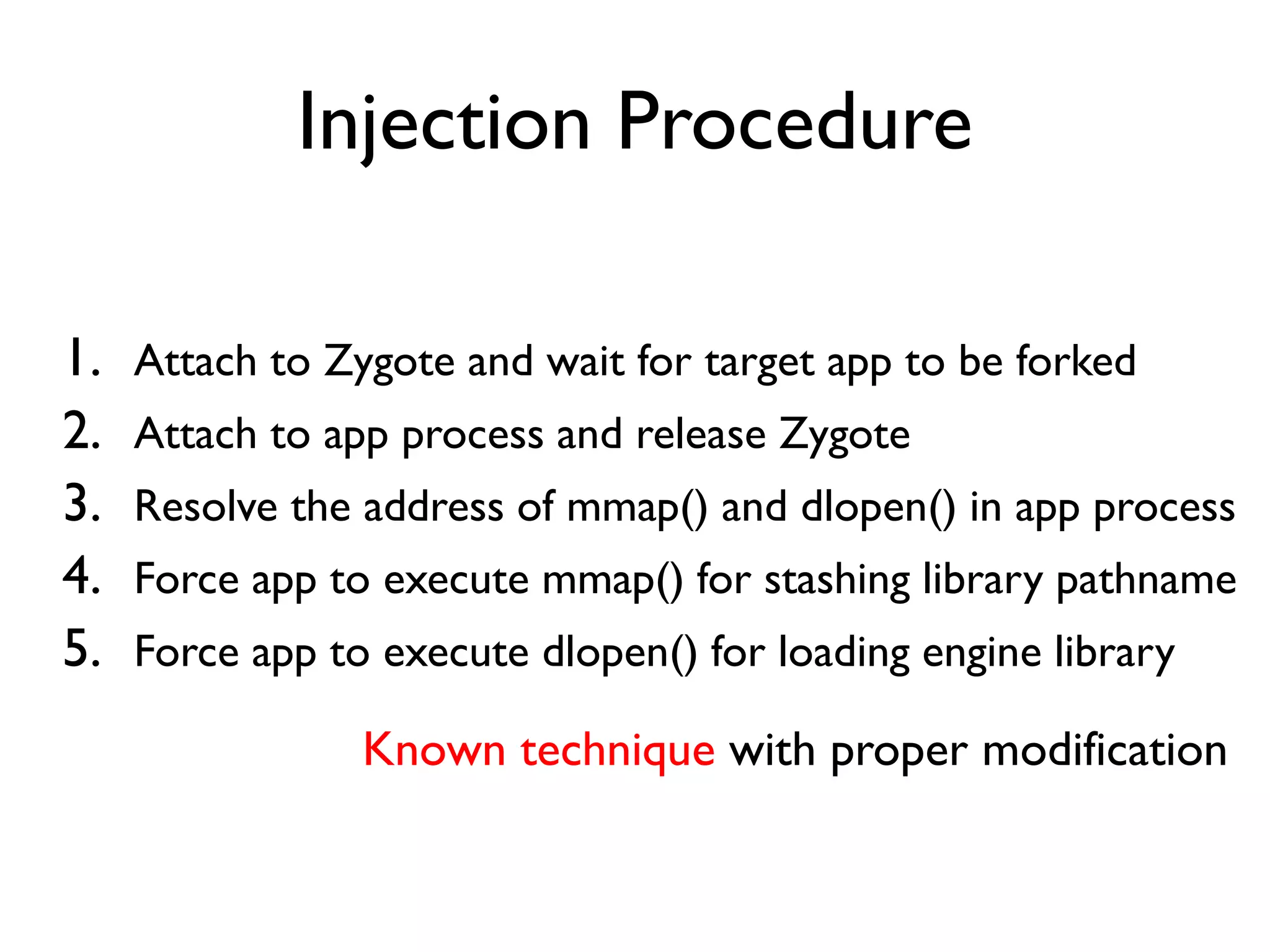
Injection Procedure
1. Attach to Zygote and wait for target app to be forked
2. Attach to app process and release Zygote
3. Resolve the address of mmap() and dlopen() in app process
4. Force app to execute mmap() for stashing library pathname
5. Force app to execute dlopen() for loading engine library
Known technique with proper modification
Resolve Function Address
/system/lib/libc.so
… …
… …
mmap
… …
/system/bin/linker
… …
… …
dlopen
… …
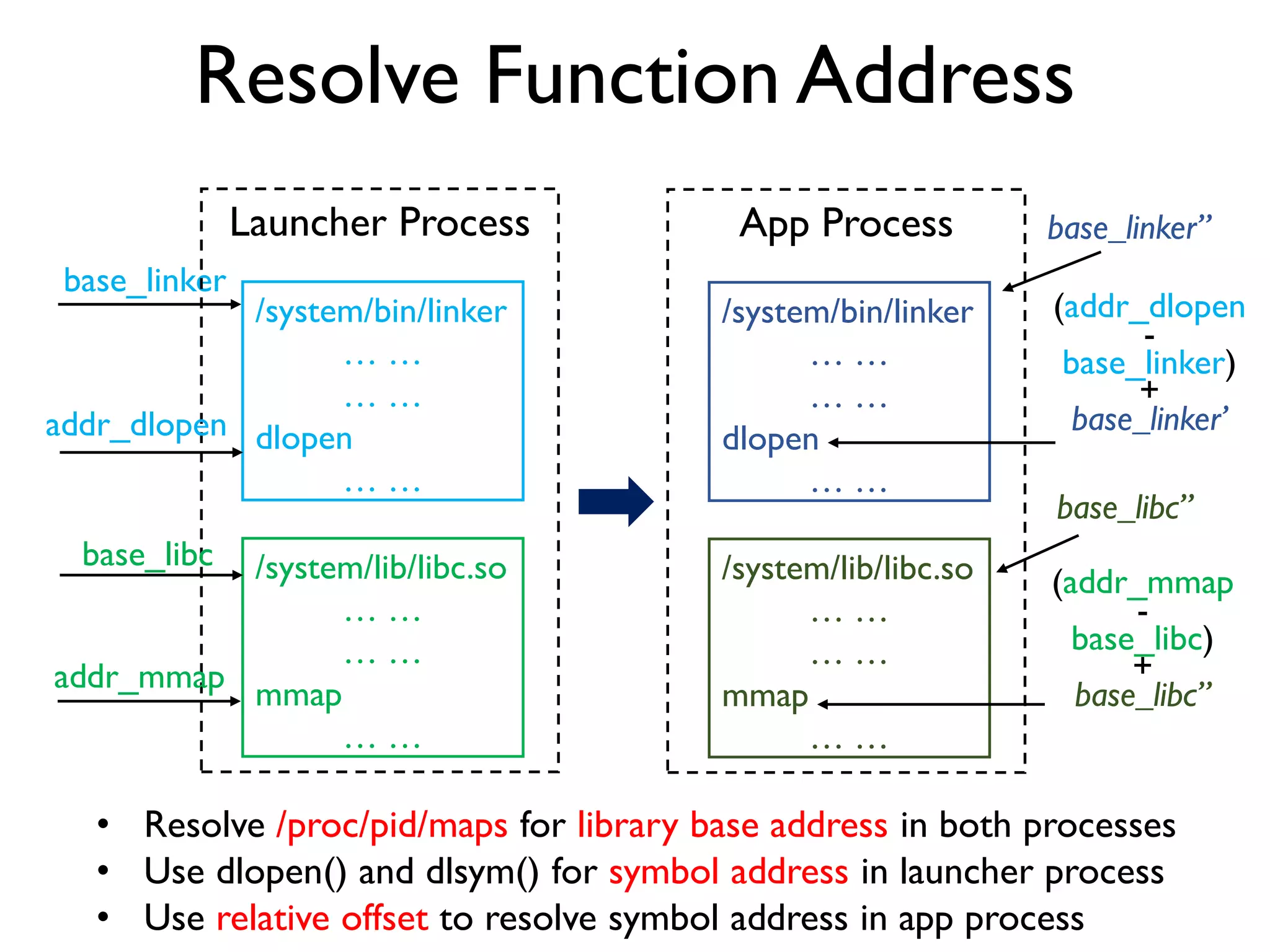
• Resolve /proc/pid/maps for library base address in both processes
• Use dlopen() and dlsym() for symbol address in launcher process
• Use relative offset to resolve symbol address in app process
base_linker
Launcher Process
addr_dlopen
base_libc
addr_mmap
/system/lib/libc.so
… …
… …
mmap
… …
/system/bin/linker
… …
… …
dlopen
… …
App Process
(addr_dlopen
-
base_linker)
+
base_linker’
base_linker’’
base_libc’’
(addr_mmap
-
base_libc)
+
base_libc’’
Remote Function Call
0
0
4096
PROT_READ|WRITE
MAP_ANONYMOUS
0
0
base_stack
Invalid return
address
esp  base_stack
eip  mmap()
eax  addr_libpath
0
4096
PROT_READ|WRITE
MAP_ANONYMOUS
0
0
base_stack
ARM_sp  base_stack
ARM_pc  mmap()
ARM_r0  addr_libpath
ARM_lr  0
Invalid return
address
0
addr_libpath
RTLD_NOW
Invalid return
address
base_stack
esp  base_stack
eip  dlopen()
eax  handle_lib
ARM_lr  0
addr_libpath
RTLD_NOW
Invalid return
address
base_stack
ARM_sp  base_stack
ARM_pc  dlopen()
ARM_r0  handle_lib
• Invoke mmap() to allocate space for library path
• Invoke dlopen() to load the specified library
Force SIGSEGV
for wait()
Stage: Compose Gadget
libART
Android & Java
Base Classes
App Classes
Instrument
Classes
libProbeDroid
Instrument
Tool APK
App Oat
App Process
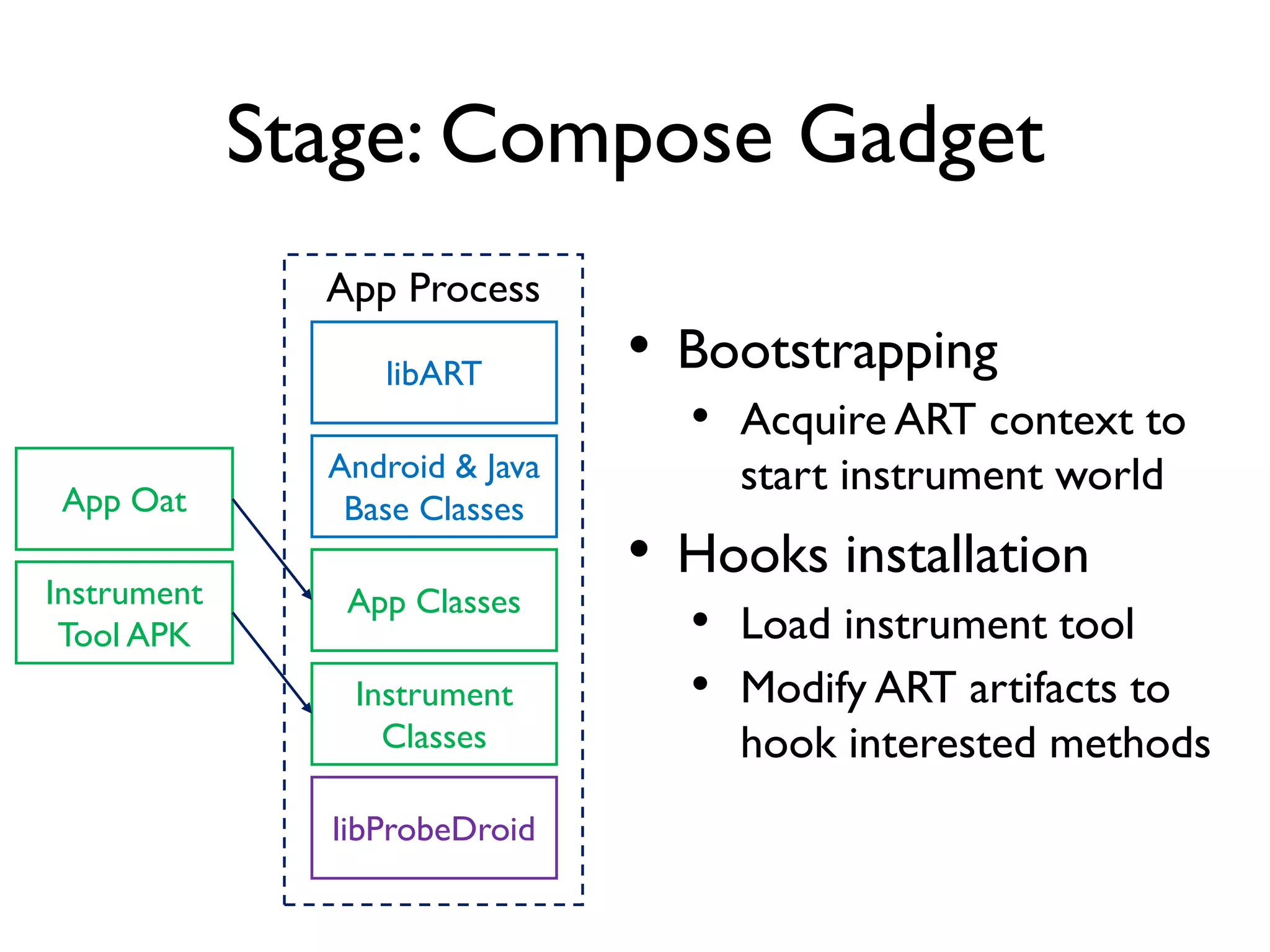
• Bootstrapping
• Acquire ART context to
start instrument world
• Hooks installation
• Load instrument tool
• Modify ART artifacts to
hook interested methods
Bootstrapping
• JNI exports helpful utilities for native code to
access Java runtime features
• ProbeDroid must acquire JNI interface pointer
for all the instrument related tasks
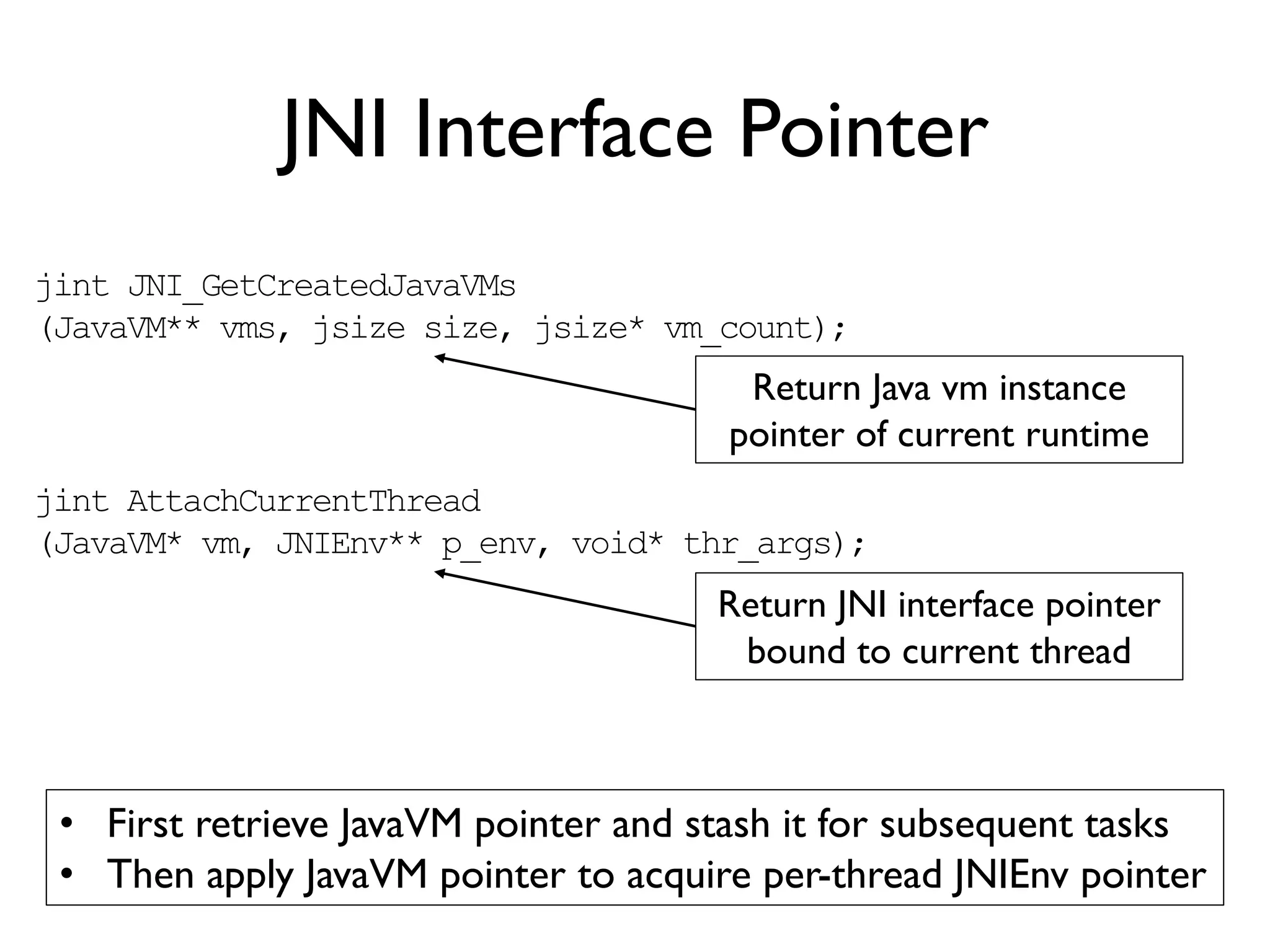
JNI Interface Pointer
jint JNI_GetCreatedJavaVMs
(JavaVM** vms, jsize size, jsize* vm_count);
Return Java vm instance
pointer of current runtime
• First retrieve JavaVM pointer and stash it for subsequent tasks
• Then apply JavaVM pointer to acquire per-thread JNIEnv pointer
jint AttachCurrentThread
(JavaVM* vm, JNIEnv** p_env, void* thr_args);
Return JNI interface pointer
bound to current thread
Install Hooks
• Load instrument gadgets defined in tool APK
• Modify ART artifacts to divert the control flow to
our space when the specified methods are called
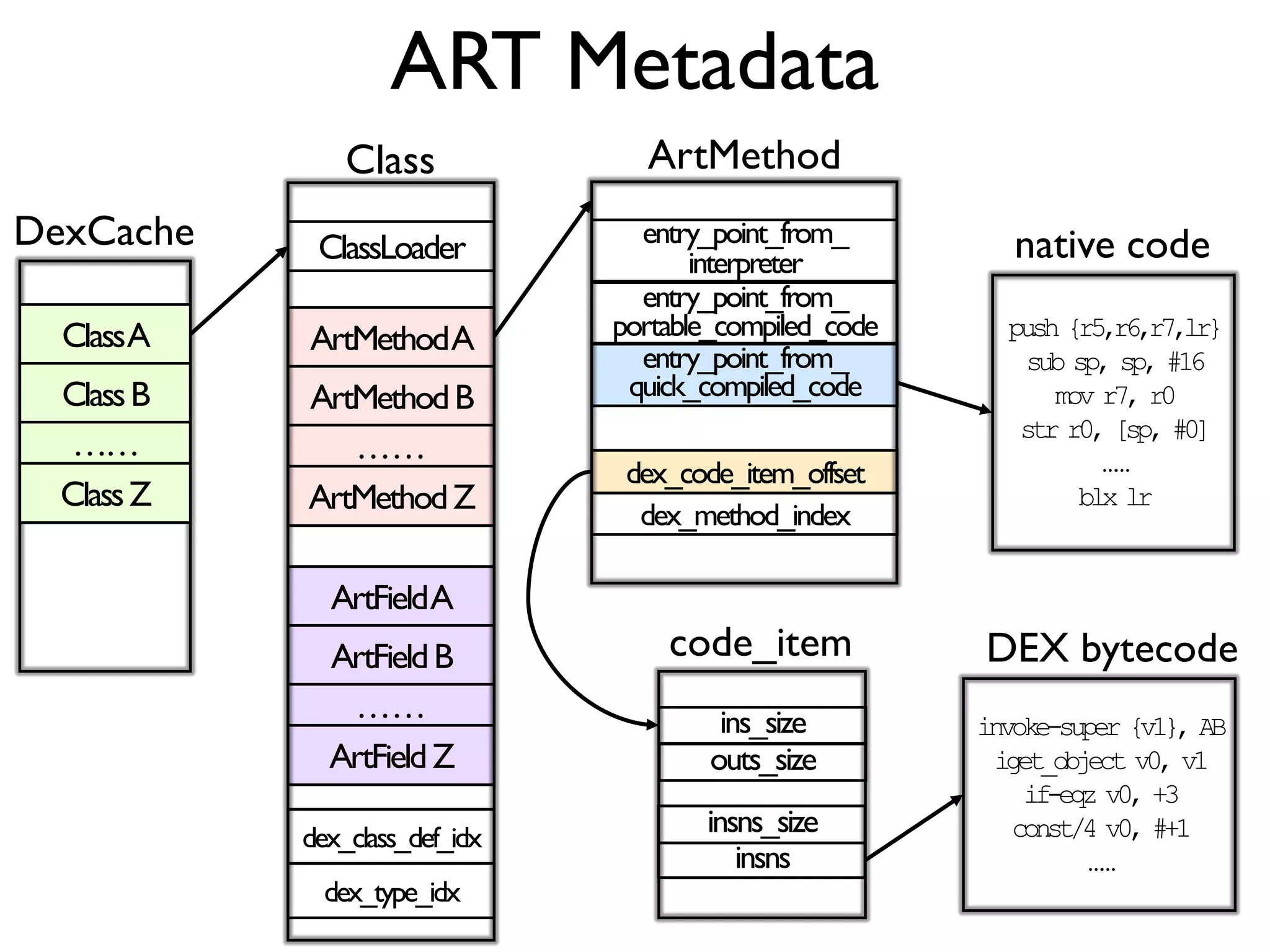
ART Metadata
ClassA
ClassB
ClassZ
……
DexCache
ArtMethodA
ArtMethodB
ArtMethodZ
……
ArtFieldA
ArtFieldB
ArtFieldZ
……
ClassLoader
dex_class_def_idx
dex_type_idx
Class
entry_point_from_
interpreter
entry_point_from_
portable_compiled_code
entry_point_from_
quick_compiled_code
dex_code_item_offset
dex_method_index
ArtMethod
push {r5,r6,r7,lr}
sub sp, sp, #16
mov r7, r0
str r0, [sp, #0]
……
blx lr
code_item
ins_size
outs_size
insns_size
insns
invoke-super {v1}, AB
iget_object v0, v1
if-eqz v0, +3
const/4 v0, #+1
……
native code
DEX bytecode
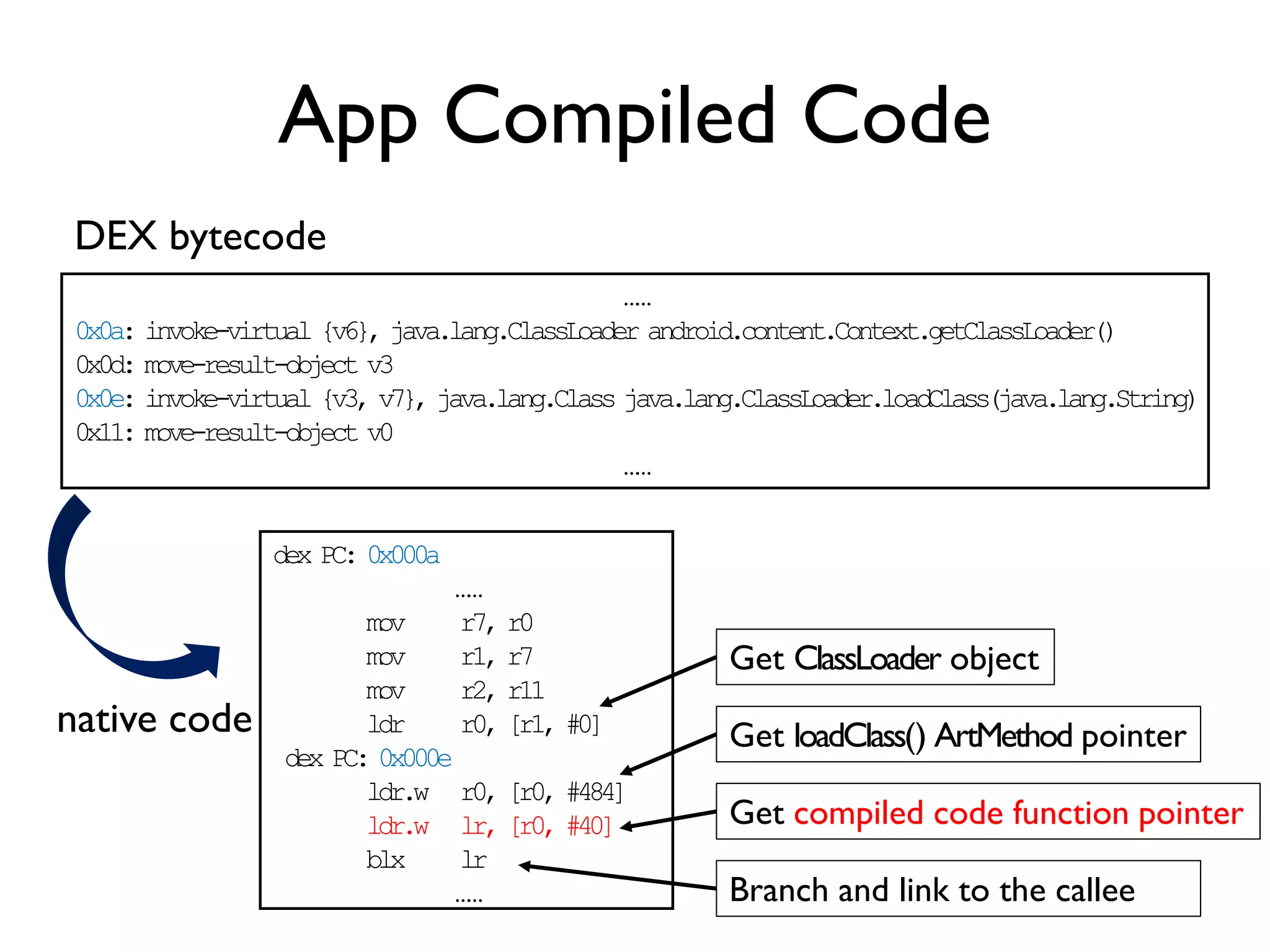
App Compiled Code
……
0x0a: invoke-virtual {v6}, java.lang.ClassLoader android.content.Context.getClassLoader()
0x0d: move-result-object v3
0x0e: invoke-virtual {v3, v7}, java.lang.Class java.lang.ClassLoader.loadClass(java.lang.String)
0x11: move-result-object v0
……
DEX bytecode
dex PC: 0x000a
……
mov r7, r0
mov r1, r7
mov r2, r11
ldr r0, [r1, #0]
dex PC: 0x000e
ldr.w r0, [r0, #484]
ldr.w lr, [r0, #40]
blx lr
……
native code
Get ClassLoader object
Get loadClass() ArtMethod pointer
Get compiled code function pointer
Branch and link to the callee
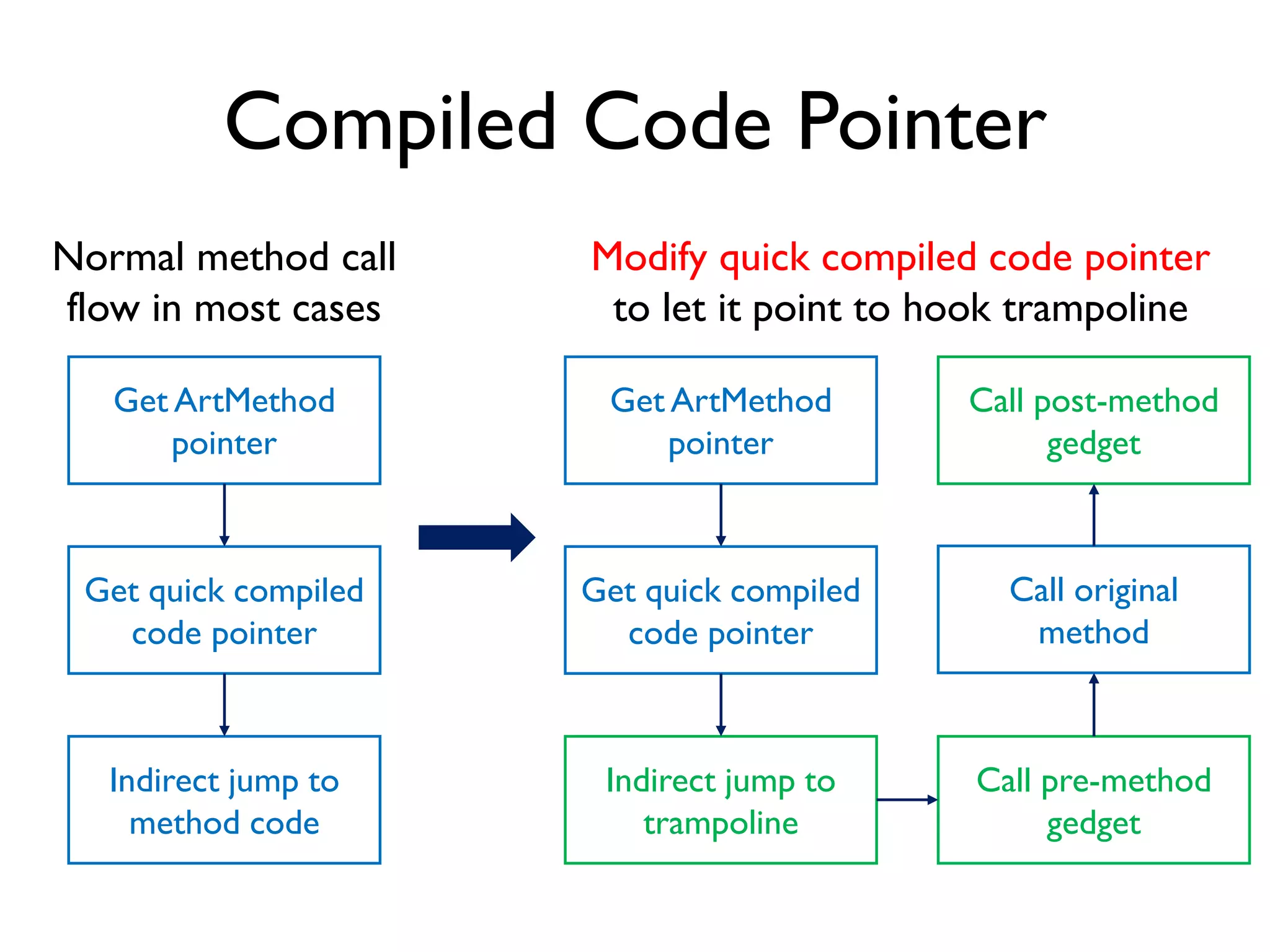
Compiled Code Pointer
Normal method call
flow in most cases
Get ArtMethod
pointer
Get quick compiled
code pointer
Indirect jump to
method code
Modify quick compiled code pointer
to let it point to hook trampoline
Get ArtMethod
pointer
Get quick compiled
code pointer
Indirect jump to
trampoline
Call pre-method
gedget
Call original
method
Call post-method
gedget
ArtMethod Pointer
jmethodID (*GetMethodID) (JNIEnv*, jclass, const char*, const char*);
jmethodID (*GetStaticMethodID)(JNIEnv*, jclass, const char*, const char*);
jclass (*FindClass)(JNIEnv*, const char*);
Get loaded class id by
specifying class name
Get method id by specifying class
id, method name and signature
• jmethodID is actually the pointer to ArtMethod class
• Refer to art/runtime/art_method.h for ArtMethod class definition
and resolve member offset for entry_point_from_quick_compiled_code
About Install Timing
• Must be done before the execution of app code
• How early is that moment ?
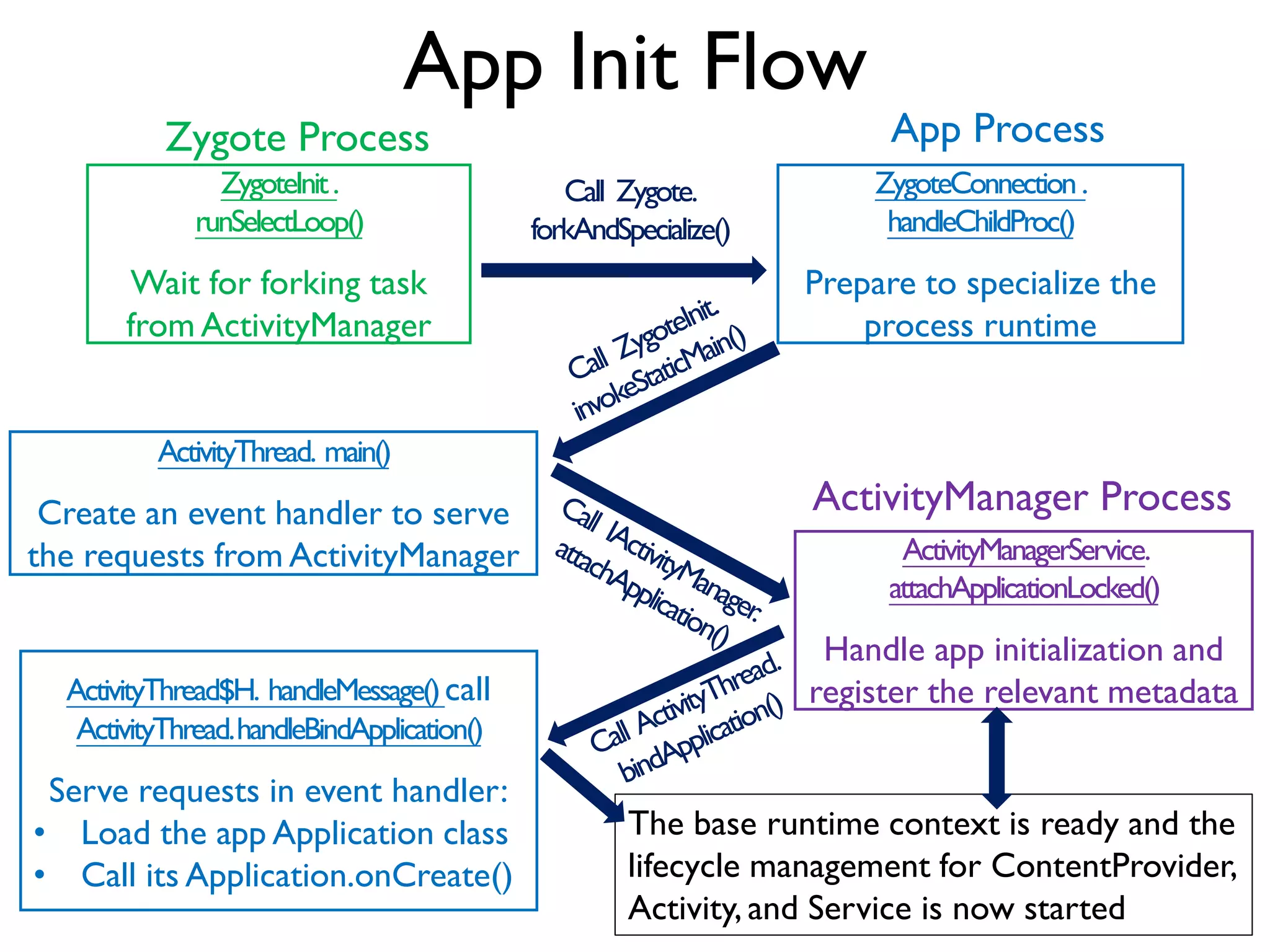
App Init Flow
ZygoteInit.
runSelectLoop()
Wait for forking task
from ActivityManager
ActivityManagerService.
attachApplicationLocked()
Handle app initialization and
register the relevant metadata
ZygoteConnection.
handleChildProc()
Prepare to specialize the
process runtime
Call Zygote.
forkAndSpecialize()
ActivityThread. main()
Create an event handler to serve
the requests from ActivityManager
ActivityThread$H. handleMessage()call
ActivityThread.handleBindApplication()
Serve requests in event handler:
• Load the app Application class
• Call its Application.onCreate()
Zygote Process App Process
ActivityManager Process
The base runtime context is ready and the
lifecycle management for ContentProvider,
Activity, and Service is now started
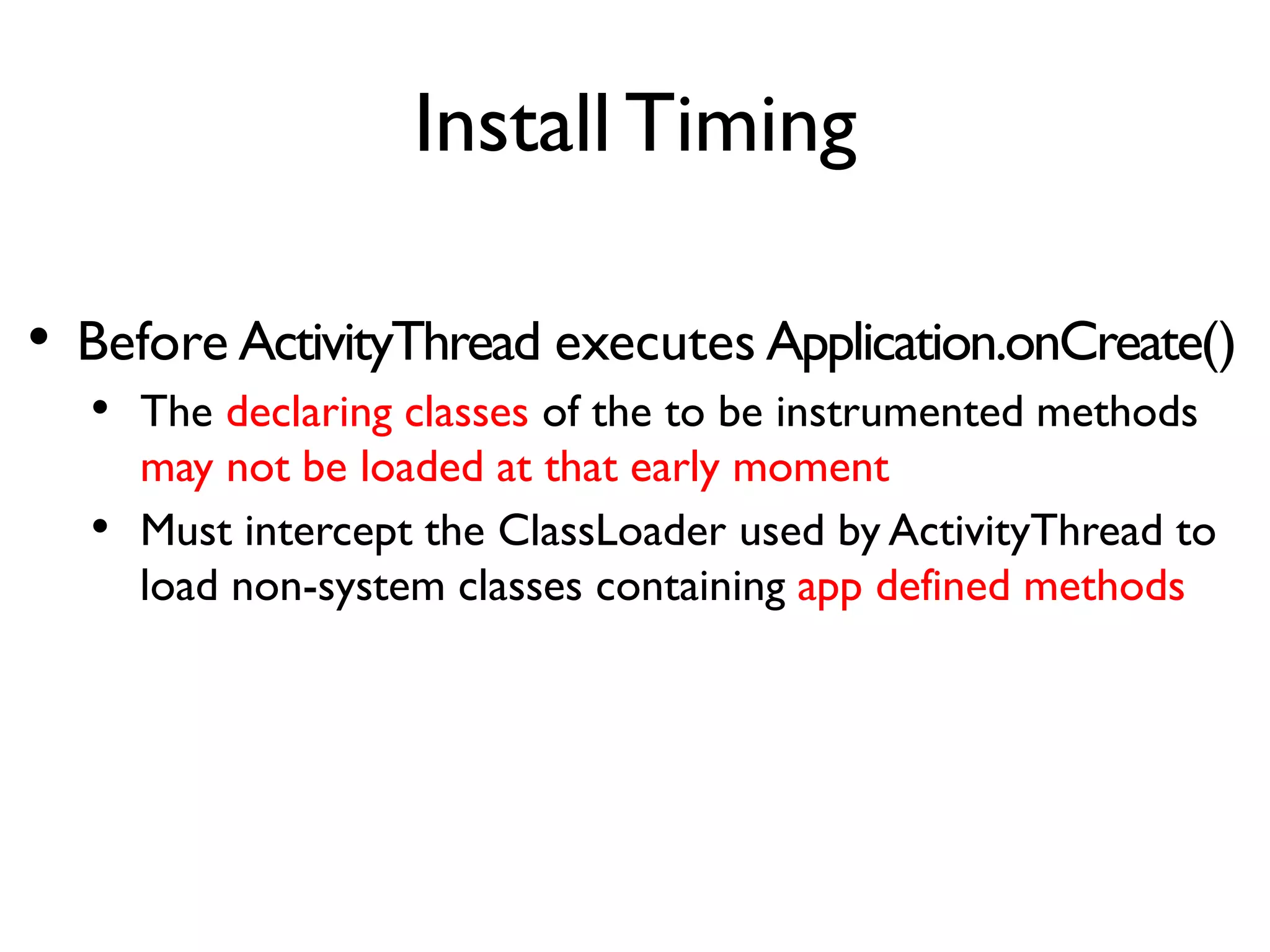
Install Timing
• Before ActivityThread executes Application.onCreate()
• The declaring classes of the to be instrumented methods
may not be loaded at that early moment
• Must intercept the ClassLoader used by ActivityThread to
load non-system classes containing app defined methods
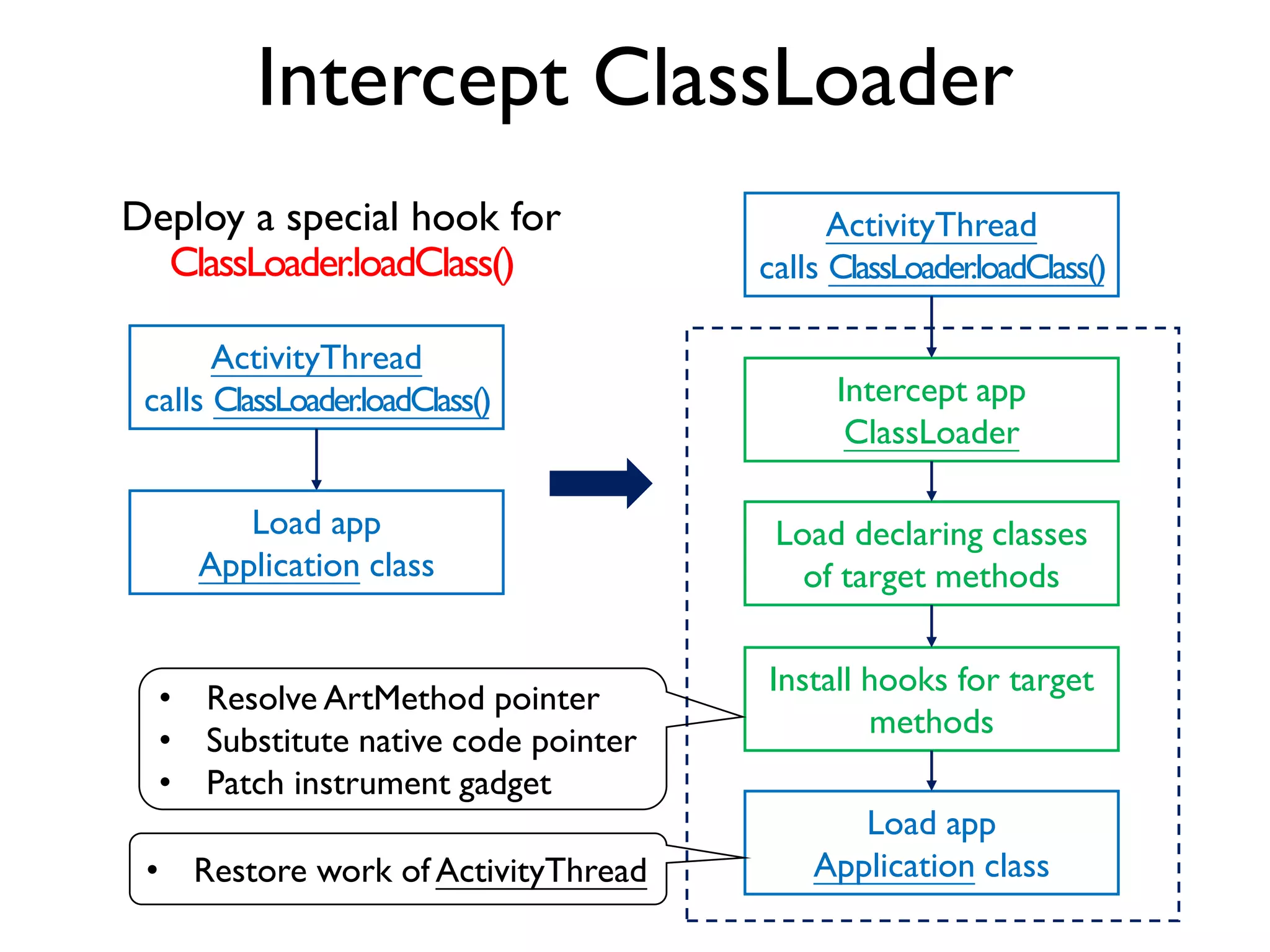
Intercept ClassLoader
Deploy a special hook for
ClassLoader.loadClass()
ActivityThread
calls ClassLoader.loadClass()
Load app
Application class
ActivityThread
calls ClassLoader.loadClass()
Intercept app
ClassLoader
Load declaring classes
of target methods
Install hooks for target
methods
Load app
Application class• Restore work of ActivityThread
• Resolve ArtMethod pointer
• Substitute native code pointer
• Patch instrument gadget
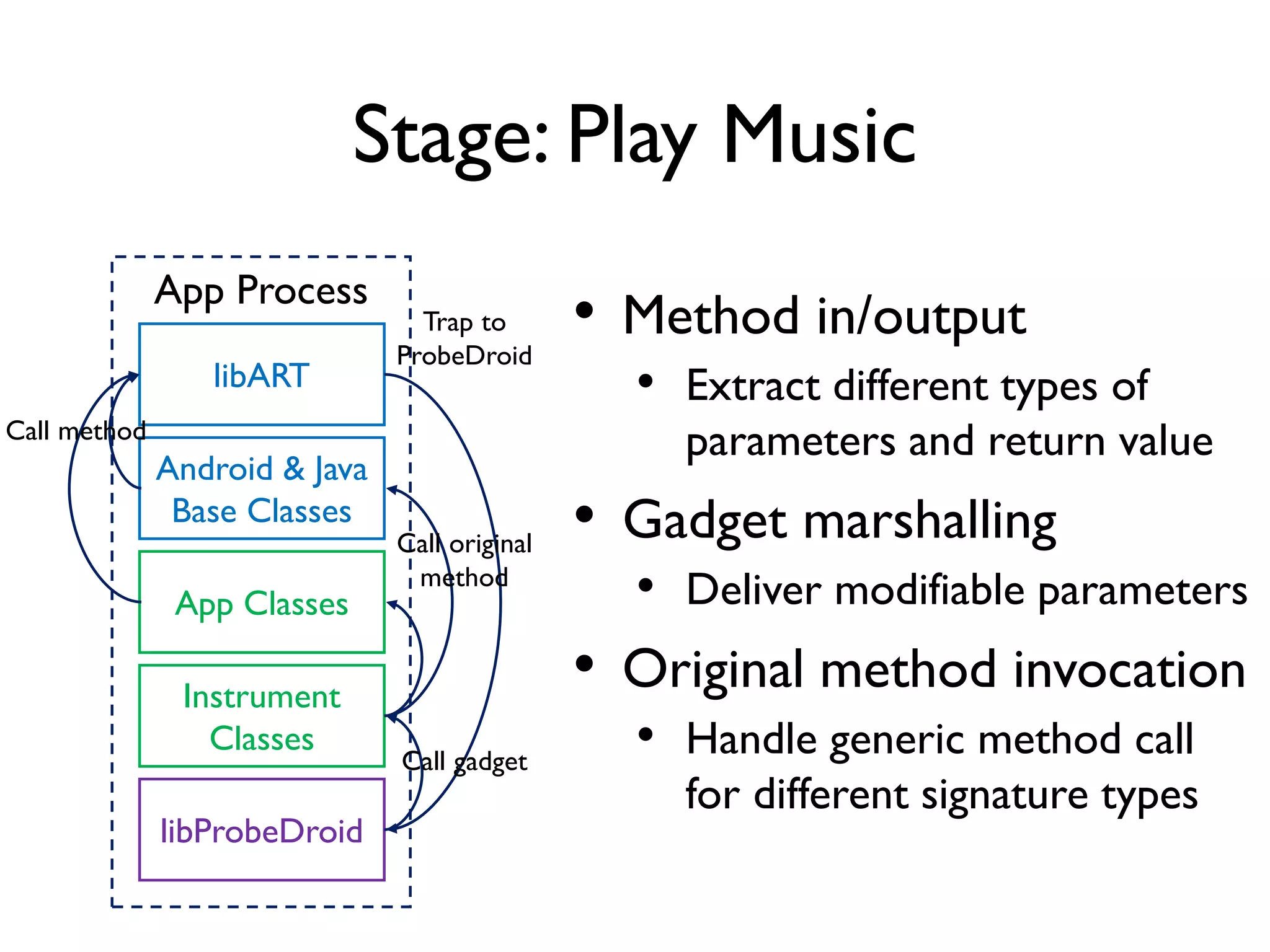
Stage: Play Music
libART
Android & Java
Base Classes
App Classes
Instrument
Classes
libProbeDroid
App Process
• Method in/output
• Extract different types of
parameters and return value
• Gadget marshalling
• Deliver modifiable parameters
• Original method invocation
• Handle generic method call
for different signature types
Call method
Trap to
ProbeDroid
Call gadget
Call original
method
Extract In/Output
• Control flow is trapped into trampoline
• Extract input parameters for gadget and pass them to
the original method
• Return from original method
• Extract return value for gadget and pass it to caller
• How to extract correct data on different ISAs?
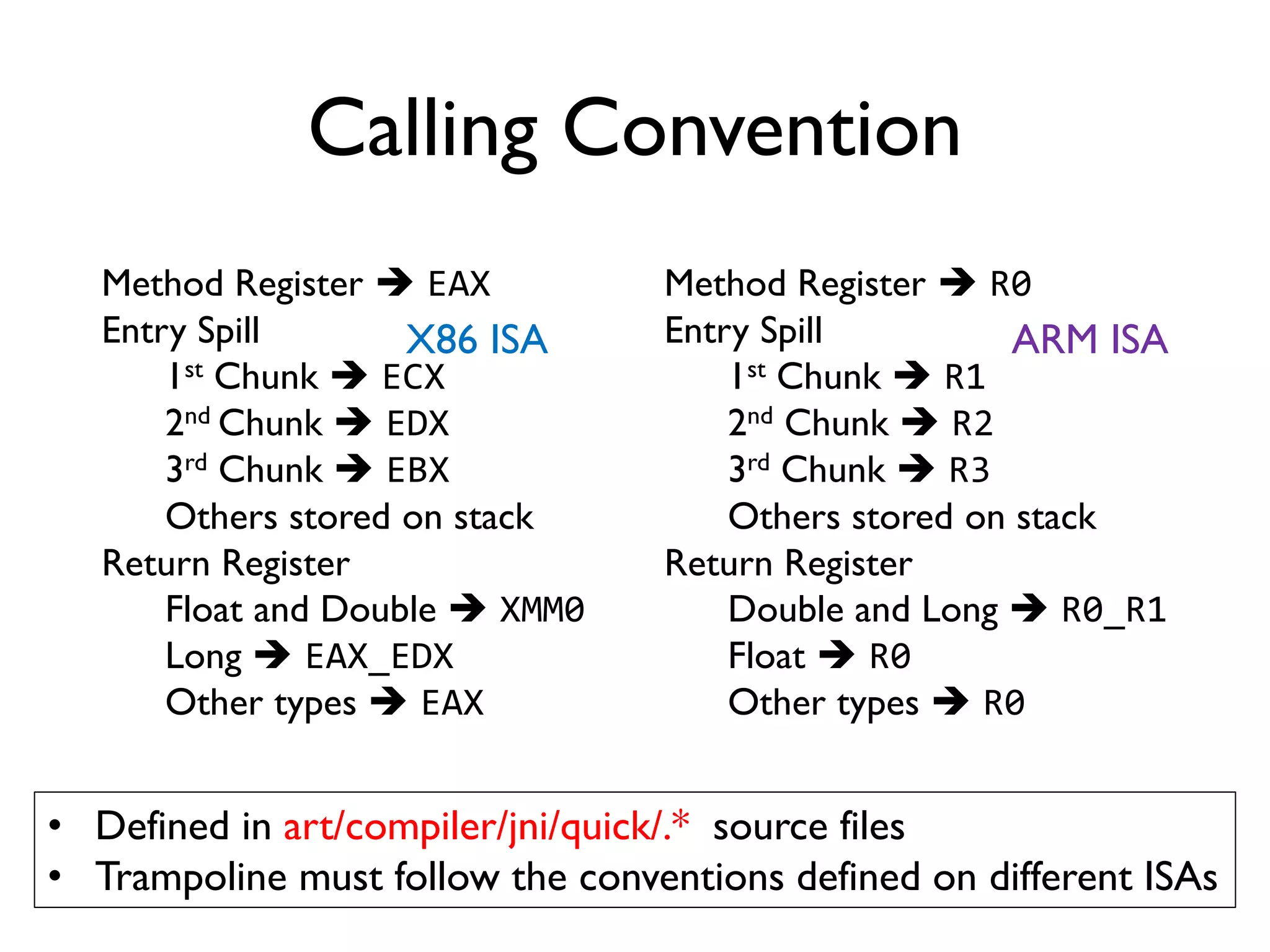
Calling Convention
Method Register  EAX
Entry Spill
1st Chunk  ECX
2nd Chunk  EDX
3rd Chunk  EBX
Others stored on stack
Return Register
Float and Double  XMM0
Long  EAX_EDX
Other types  EAX
Method Register  R0
Entry Spill
1st Chunk  R1
2nd Chunk  R2
3rd Chunk  R3
Others stored on stack
Return Register
Double and Long  R0_R1
Float  R0
Other types  R0
X86 ISA ARM ISA
• Defined in art/compiler/jni/quick/.* source files
• Trampoline must follow the conventions defined on different ISAs
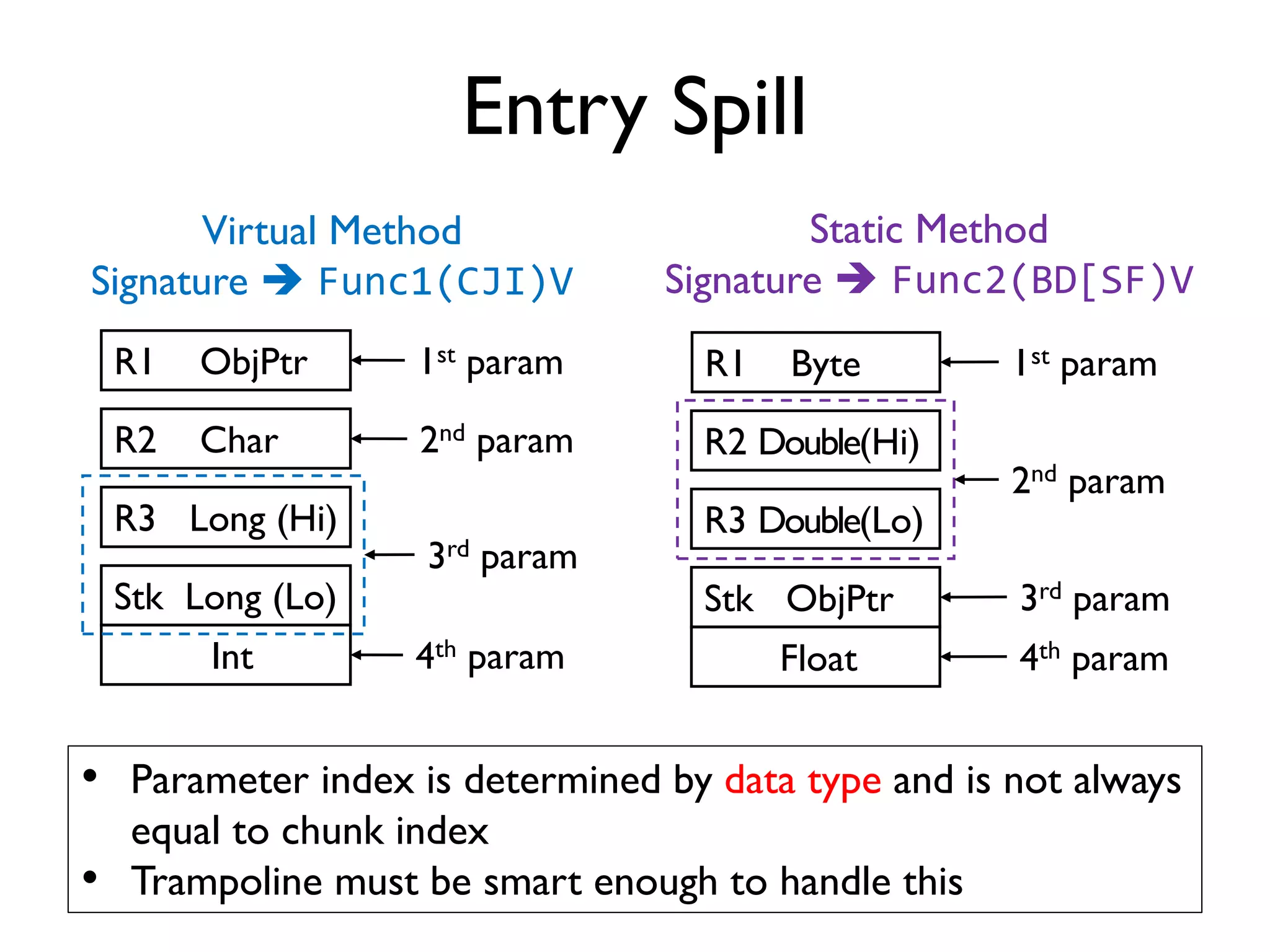
Entry Spill
R1 ObjPtr
R2 Char
R3 Long (Hi)
Stk Long (Lo)
Int
Virtual Method
Signature  Func1(CJI)V
1st param
4th param
3rd param
2nd param
R1 Byte
R2 Double(Hi)
R3 Double(Lo)
Stk ObjPtr
Float
Static Method
Signature  Func2(BD[SF)V
1st param
4th param
3rd param
2nd param
• Parameter index is determined by data type and is not always
equal to chunk index
• Trampoline must be smart enough to handle this
Marshal Gadgets
• Deliver modifiable method in/output for gadgets
• Manage object pointer and reference in trampoline
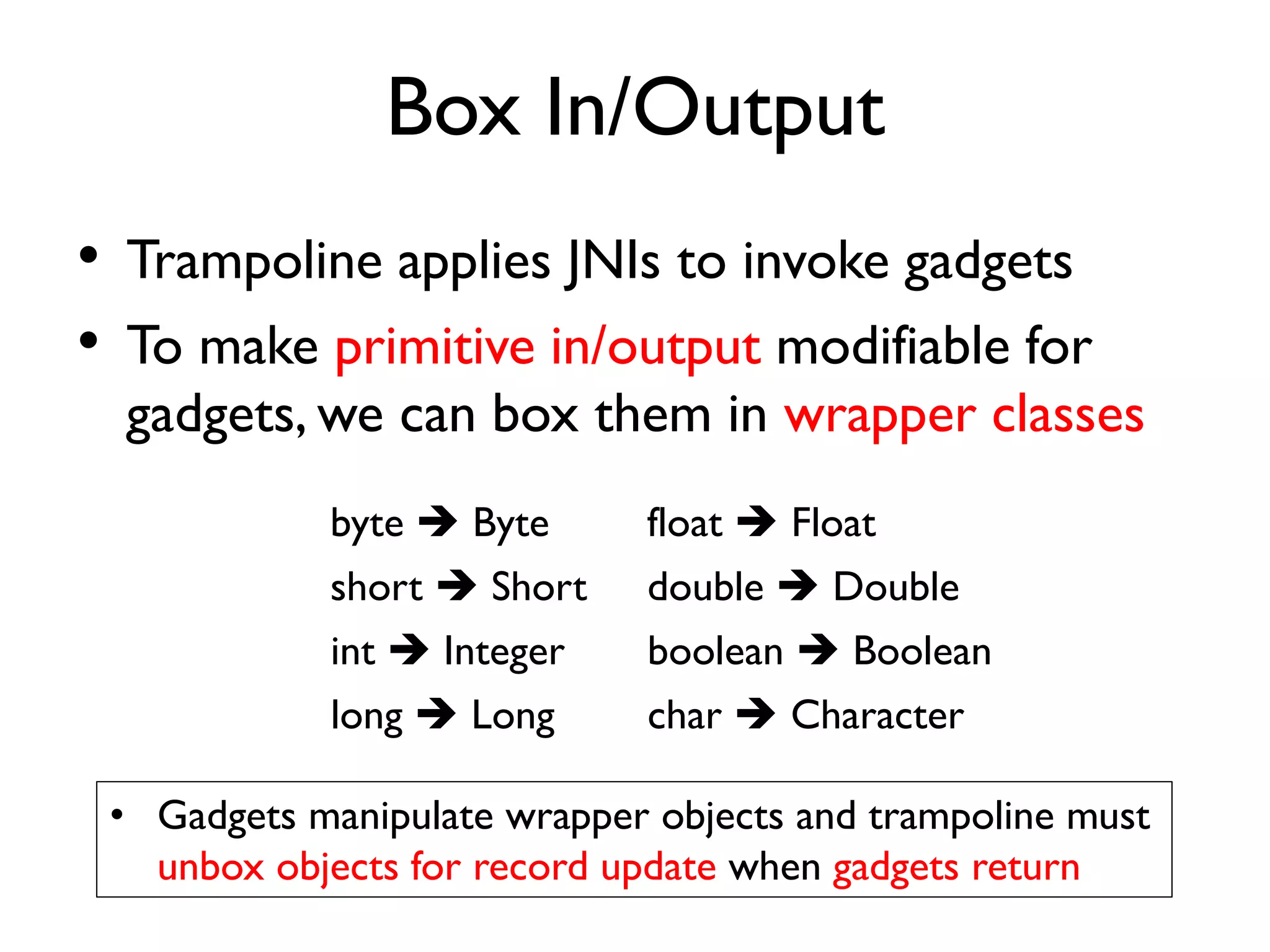
Box In/Output
• Trampoline applies JNIs to invoke gadgets
• To make primitive in/output modifiable for
gadgets, we can box them in wrapper classes
byte  Byte
short  Short
int  Integer
long  Long
float  Float
double  Double
boolean  Boolean
char  Character
• Gadgets manipulate wrapper objects and trampoline must
unbox objects for record update when gadgets return
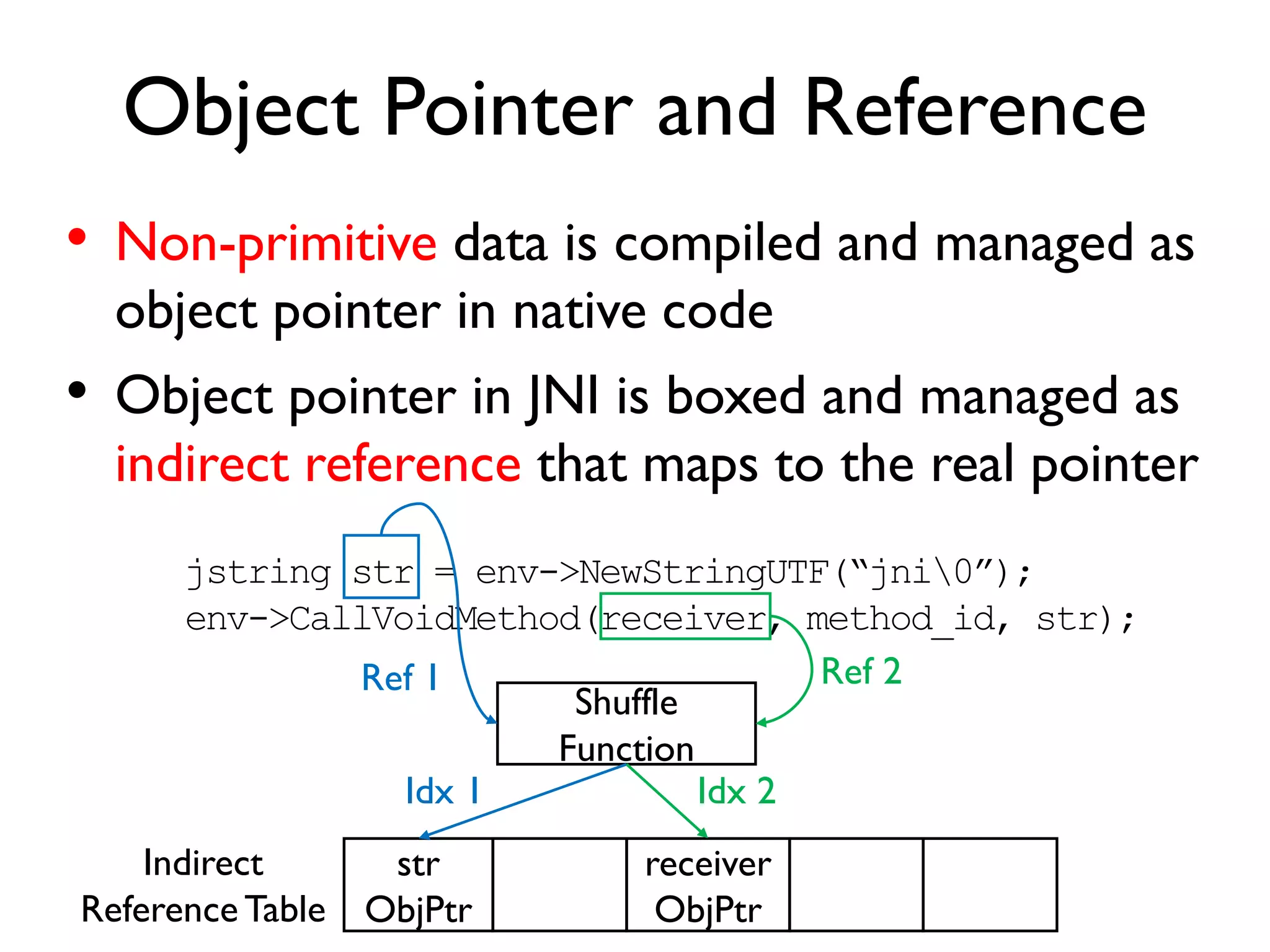
Object Pointer and Reference
• Non-primitive data is compiled and managed as
object pointer in native code
• Object pointer in JNI is boxed and managed as
indirect reference that maps to the real pointer
jstring str = env->NewStringUTF(“jni0”);
env->CallVoidMethod(receiver, method_id, str);
Shuffle
Function
str
ObjPtr
receiver
ObjPtr
Indirect
Reference Table
Ref 1
Idx 1
Ref 2
Idx 2
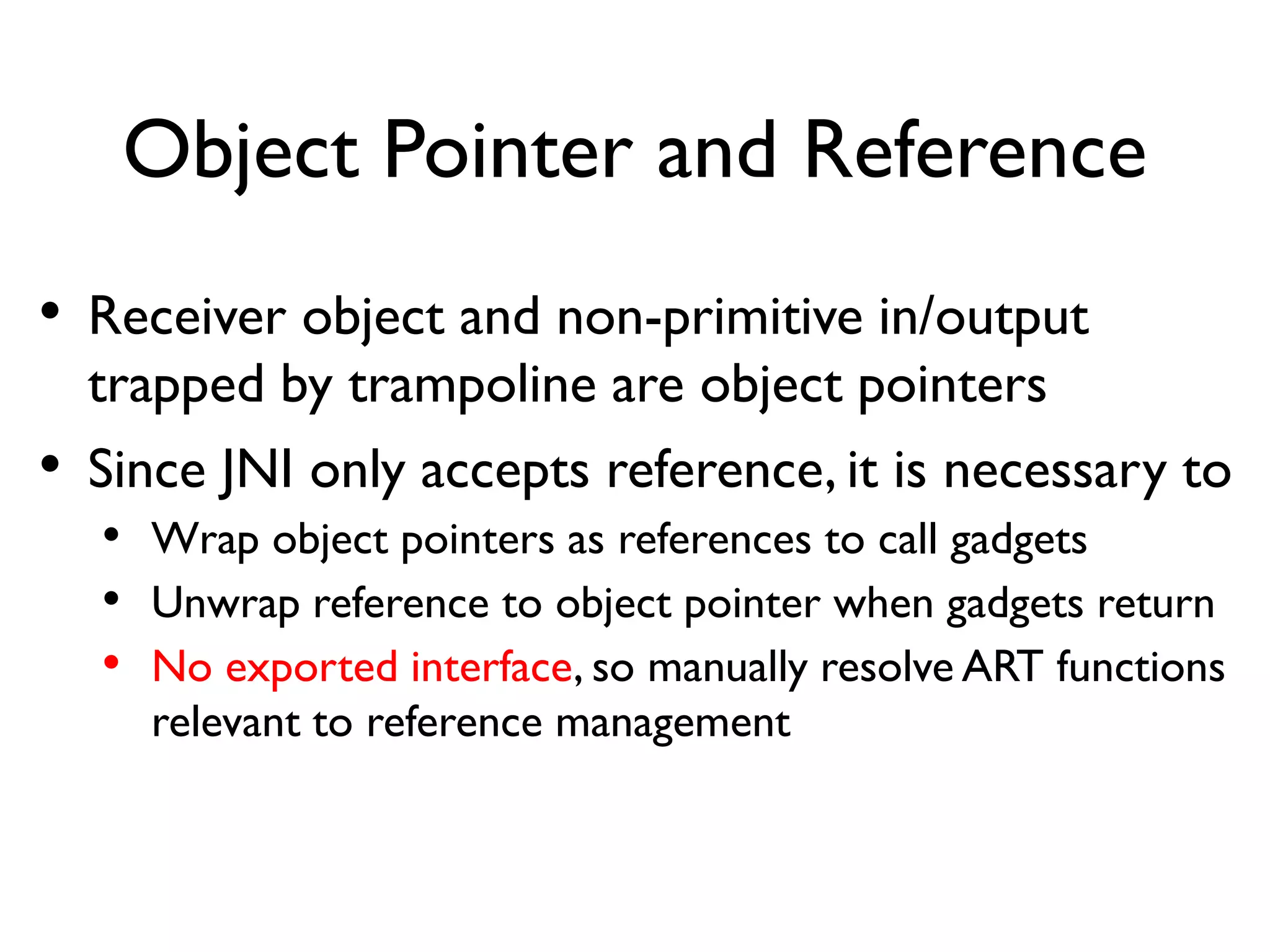
• Receiver object and non-primitive in/output
trapped by trampoline are object pointers
• Since JNI only accepts reference, it is necessary to
• Wrap object pointers as references to call gadgets
• Unwrap reference to object pointer when gadgets return
• No exported interface, so manually resolve ART functions
relevant to reference management
Object Pointer and Reference
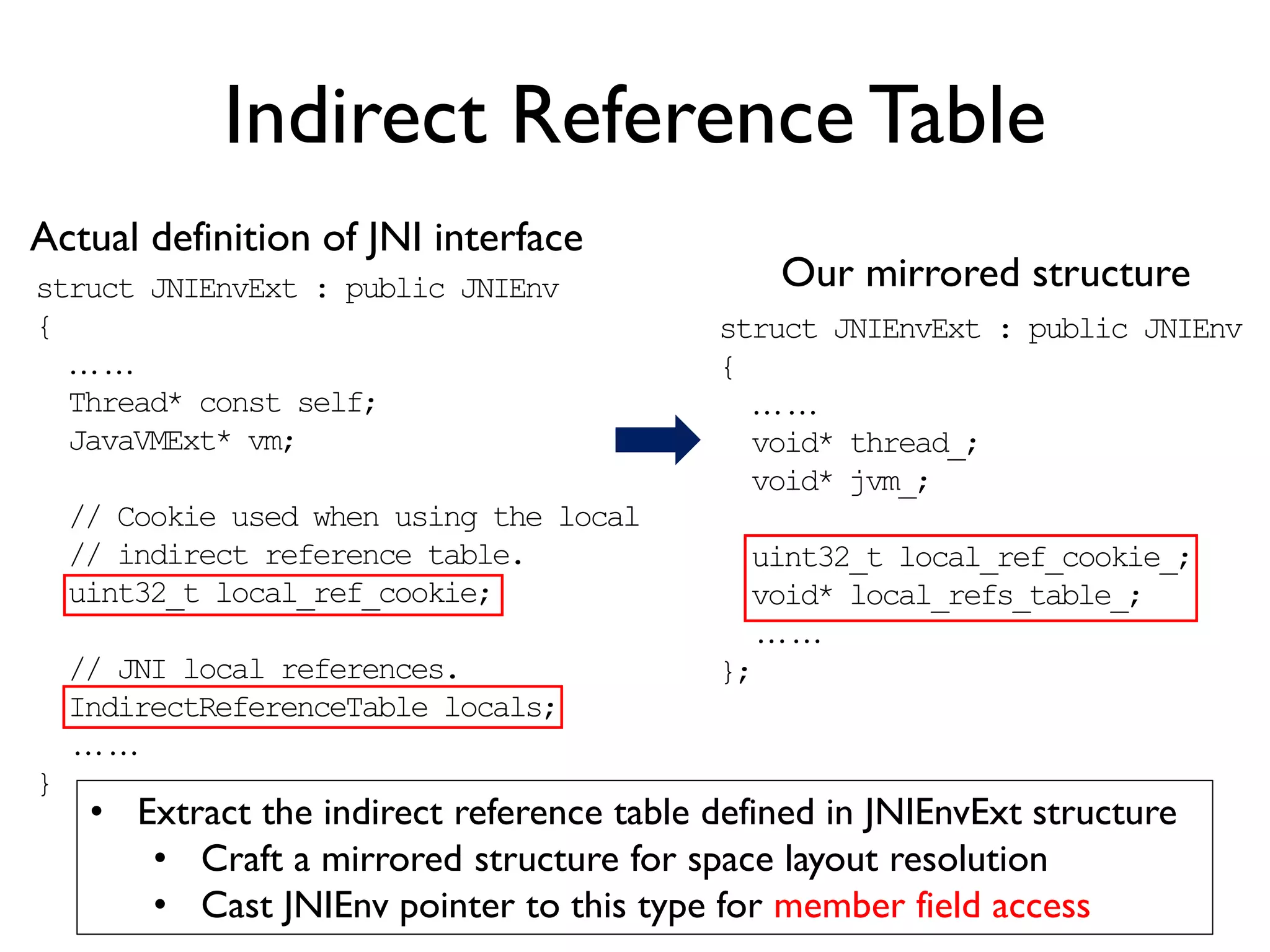
Indirect Reference Table
struct JNIEnvExt : public JNIEnv
{
……
void* thread_;
void* jvm_;
uint32_t local_ref_cookie_;
void* local_refs_table_;
……
};
Actual definition of JNI interface
struct JNIEnvExt : public JNIEnv
{
……
Thread* const self;
JavaVMExt* vm;
// Cookie used when using the local
// indirect reference table.
uint32_t local_ref_cookie;
// JNI local references.
IndirectReferenceTable locals;
……
}
Our mirrored structure
• Extract the indirect reference table defined in JNIEnvExt structure
• Craft a mirrored structure for space layout resolution
• Cast JNIEnv pointer to this type for member field access
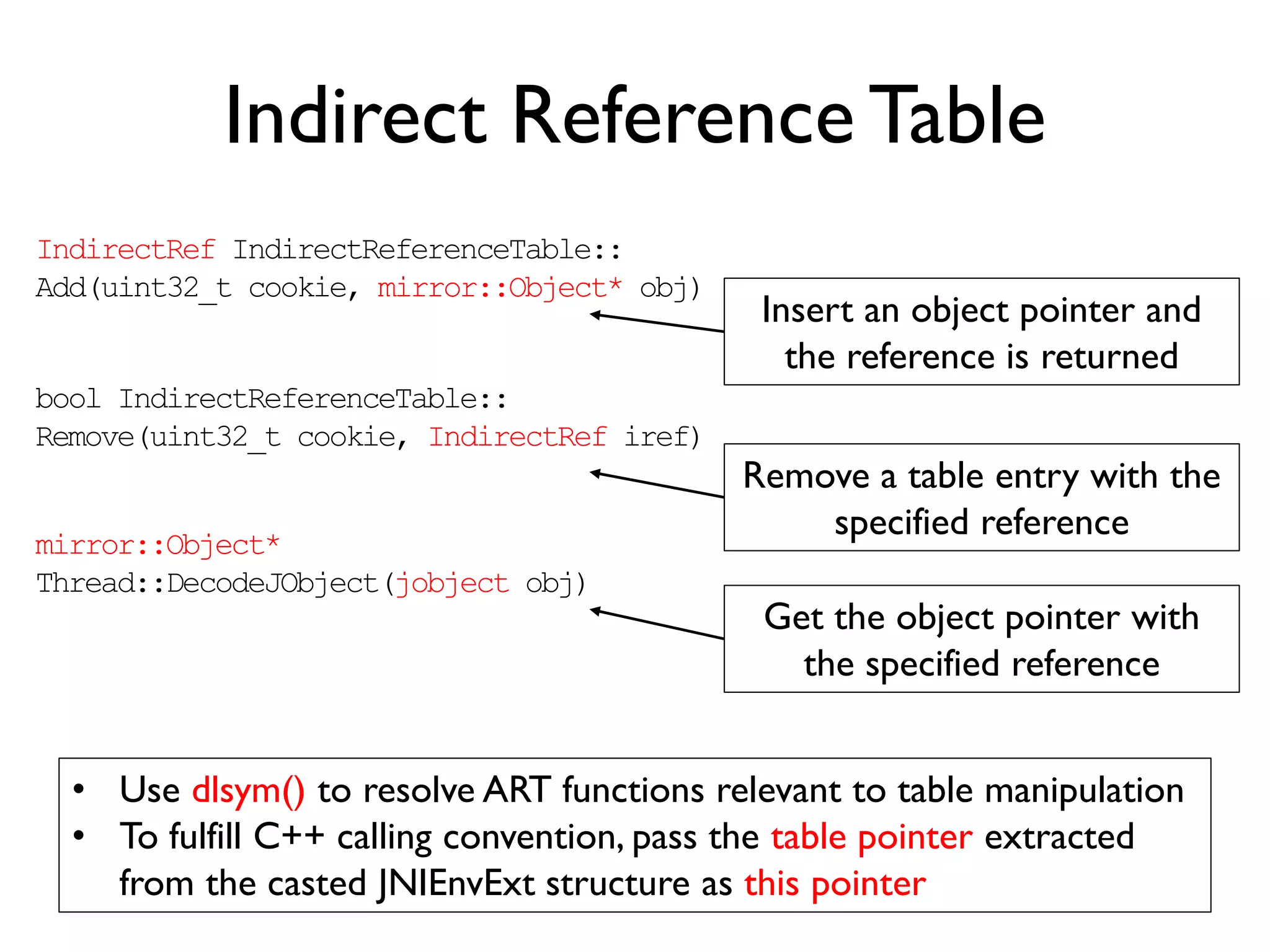
IndirectRef IndirectReferenceTable::
Add(uint32_t cookie, mirror::Object* obj)
bool IndirectReferenceTable::
Remove(uint32_t cookie, IndirectRef iref)
Indirect Reference Table
mirror::Object*
Thread::DecodeJObject(jobject obj)
Insert an object pointer and
the reference is returned
Remove a table entry with the
specified reference
Get the object pointer with
the specified reference
• Use dlsym() to resolve ART functions relevant to table manipulation
• To fulfill C++ calling convention, pass the table pointer extracted
from the casted JNIEnvExt structure as this pointer
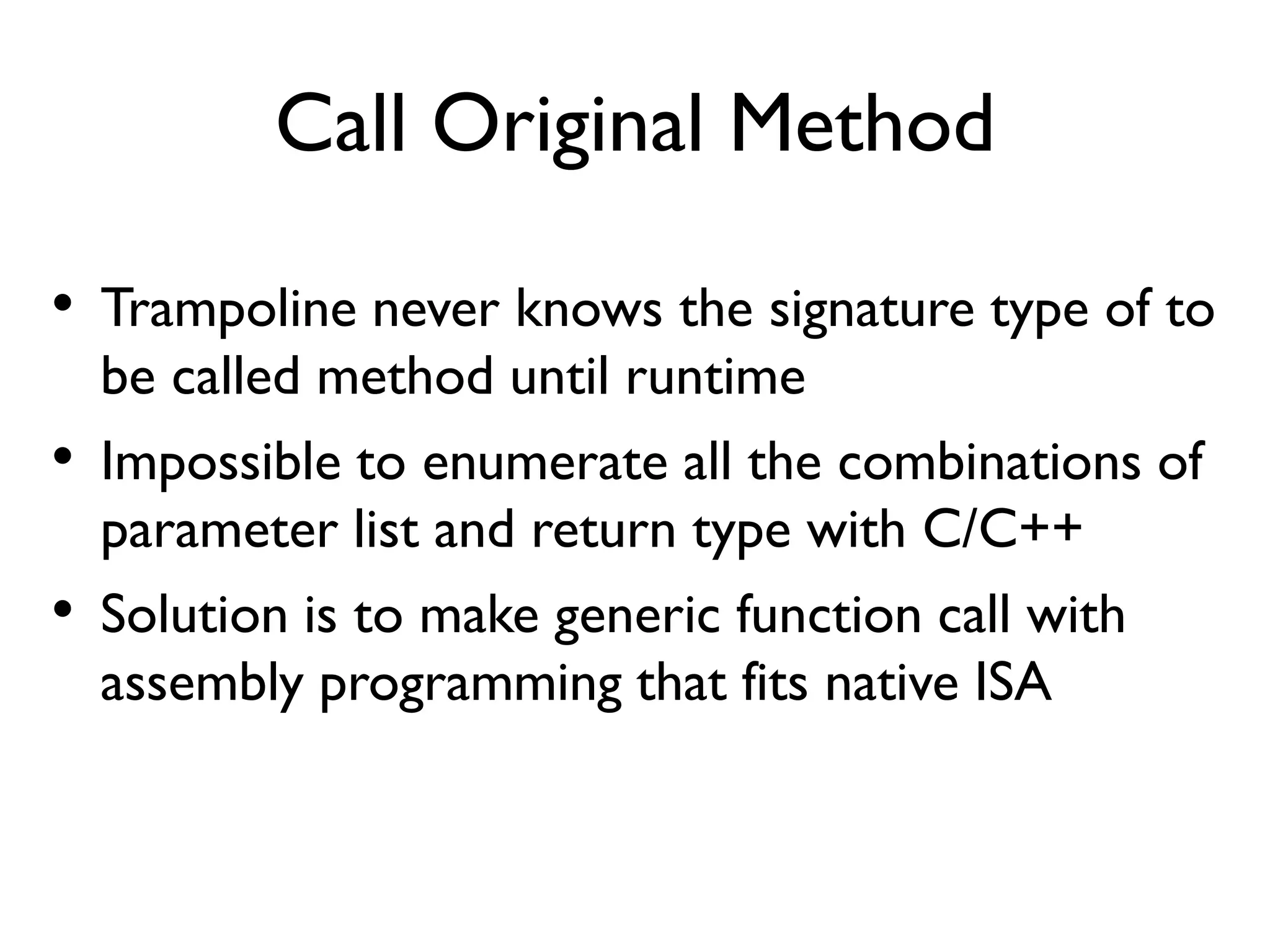
Call Original Method
• Trampoline never knows the signature type of to
be called method until runtime
• Impossible to enumerate all the combinations of
parameter list and return type with C/C++
• Solution is to make generic function call with
assembly programming that fits native ISA
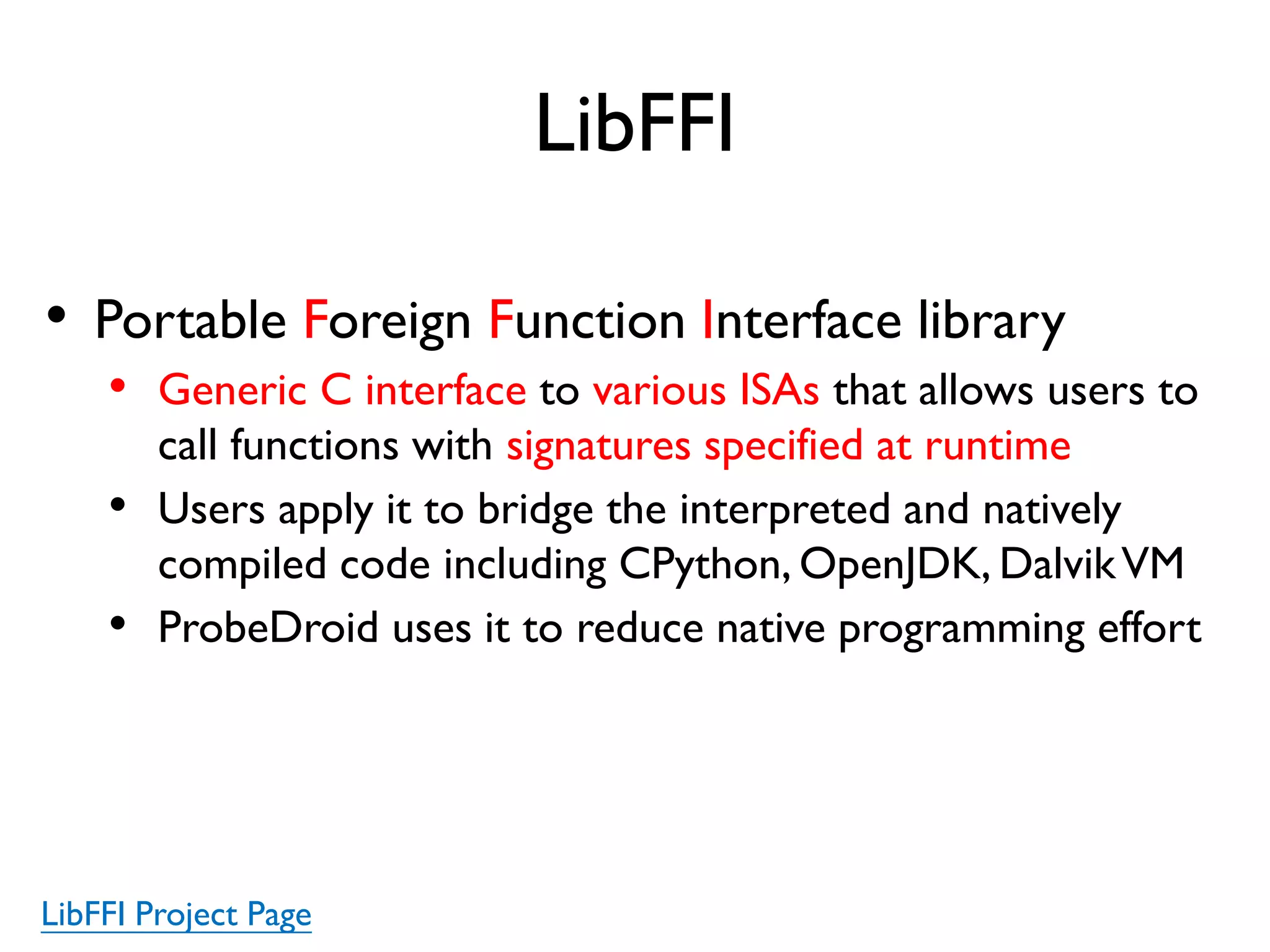
LibFFI
• Portable Foreign Function Interface library
• Generic C interface to various ISAs that allows users to
call functions with signatures specified at runtime
• Users apply it to bridge the interpreted and natively
compiled code including CPython, OpenJDK, DalvikVM
• ProbeDroid uses it to reduce native programming effort
LibFFI Project Page
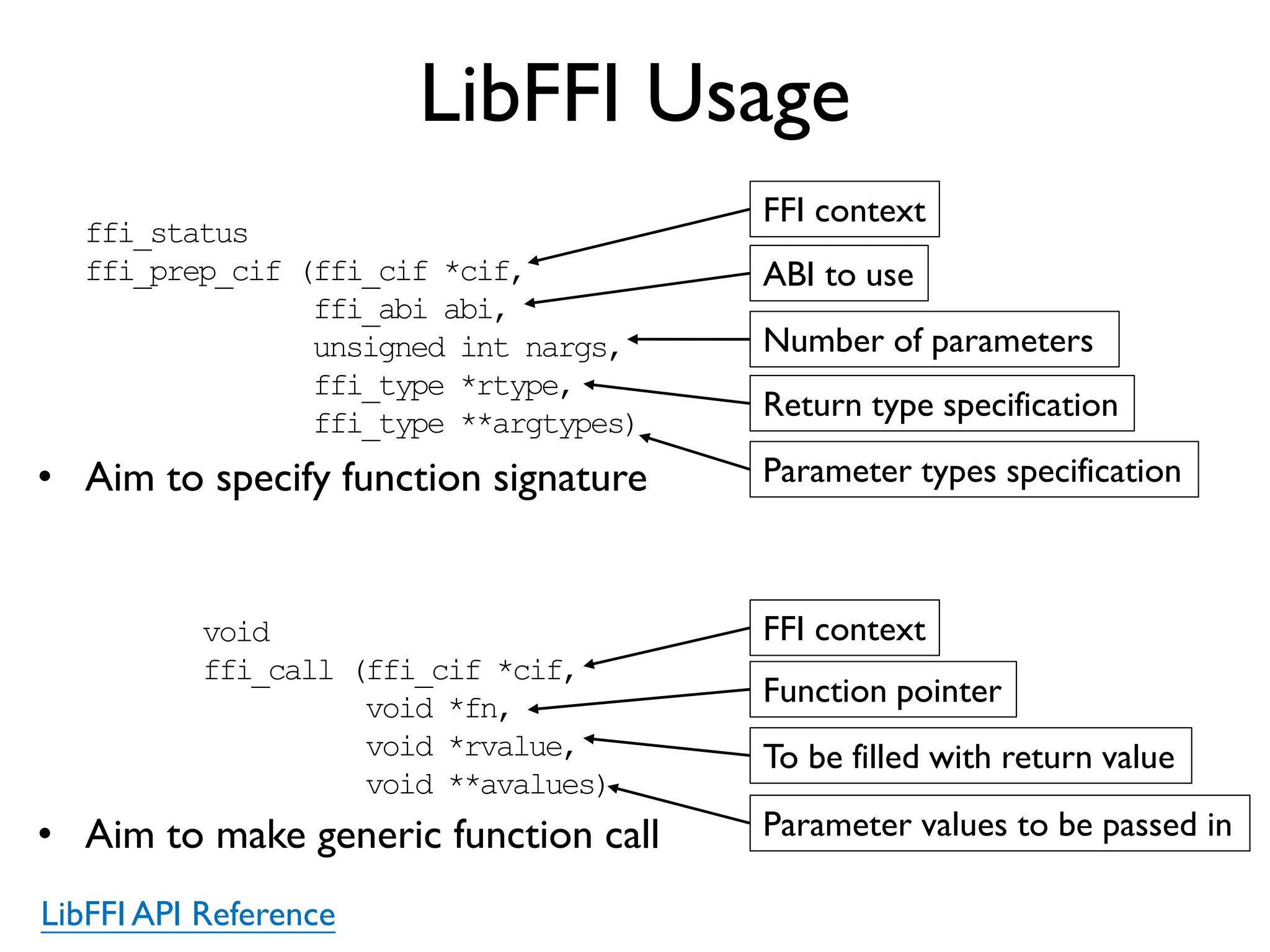
LibFFI Usage
ffi_status
ffi_prep_cif (ffi_cif *cif,
ffi_abi abi,
unsigned int nargs,
ffi_type *rtype,
ffi_type **argtypes)
void
ffi_call (ffi_cif *cif,
void *fn,
void *rvalue,
void **avalues)
FFI context
ABI to use
Number of parameters
Return type specification
Parameter types specification
FFI context
Function pointer
To be filled with return value
Parameter values to be passed in
• Aim to specify function signature
• Aim to make generic function call
LibFFI API Reference
Generate Function Call at Runtime
boolean
String.startsWith(String, int)
JniEnv*
ObjPtr*
jmethodID*
ObjPtr*
Int*
ffi_type_
pointer
ffi_type_
pointer
ffi_type_
pointer
ffi_type_
pointer
ffi_type_
sint32
Mini Interpreter
FFI parameter
value array
Craft FFI call payload
bool* ffi_type_
uint8
FFI parameter
type array
return value return type
App Analysis with
Custom Tools
(To be fine tuned with more demo and samples)
Google Maps Demo
Forensics for the strings converted from StringBuffer and
StringBuilder buffer with tool
Click the Picture for demo link
StringInspector
Obfuscated App
• Detect dynamic code loading and intercept the payload
DexClassLoader
<init>(String dexPath, String optimizedDirectory,
String librarySearchPath, ClassLoader parent)
More relevant methods … …
Field Class.getDeclaredField(String name)
Method Class.getDeclaredMethod(String name)
Object Field.get(Object object)
Object Method.invoke(Object receiver, Object[] args)
More relevant methods … …
• Resolve the method and field mutated via Java reflection
Instant Messaging App
javax.crypto.Cipher.* relevant methods
• Useful to analyze crypto algorithm
• Resolve app credential (evil ?)
android.net.http.* relevant methods
• Useful to analyze authentication protocol
• Resolve message content (evil ?)
And more app analysis result …

ProbeDroid - Crafting Your Own Dynamic Instrument Tool on Android for App Behavior Exploration

  • 1.
    ProbeDroid: CraftingYour Own DynamicInstrument Tool on Android for App Behavior Exploration ZongXian Shen
  • 2.
    About Me www.zsshen.org • PassionateSecurity Researcher and Developer • Earned Master in CS from NCTU,Taiwan • Involved in DSNS Lab andy.zsshen@gmail.com ZSShen @AndyZSShen
  • 3.
    Disclaimer • A researchproject run in my spare time • Still a lot of features to enhance • Slide is the design memo and hack notes
  • 4.
    Outline • Intro todynamic binary instrumentation • Intro to ProbeDroid instrument kit • Design and implementation of ProbeDroid • App analysis with custom instrument tools
  • 5.
    Intro to Dynamic BinaryInstrumentation
  • 6.
    Dynamic Binary Instrumentation •Technique that inserts code into a process to get runtime information or change process behavior without modifying original program binary Definition Source: Intel PIN manual
  • 7.
    DBI Application • Performancetuning and bug hunting • Cache performance, memory access footprint • Behavior tracing and data logging • API call sequence, code block control flow relation • Changing process behavior on the fly • Execution path exploration, product hacking
  • 8.
    DBI for AndroidApp • Current Android app is mainly coded with Java and run on custom Java runtime named ART • Due to semantic gap, prefer Java level DBI rather than instrumentation directly on native ISA • Class field and object content inspection • Method call sequence and parameter profiling • Changing Java artifacts on the fly
  • 9.
    Inspiring Work • ADBIand DDI introduced by Collin Mulliner • https://github.com/crmulliner/adbi • https://github.com/crmulliner/ddi • DBI framework based on Dalvik runtime • Demonstrate how to hook interested Java method and manipulate class field And now ProbeDroid, targeting on ART runtime with enhanced user interface
  • 10.
  • 11.
    ProbeDroid Instrument Kit •Programmable instrumentation • Code your own instrument tools with Java practice • Flexible APIs for you to • Hook interested library or app defined methods • Customize instrument gadgets for different analysis purposes • Modify method in/output to hack app at runtime • Succinct deployment • Only ProbeDroid engine and instrument tools are required • No need to customize Android framework https://github.com/ZSShen/ProbeDroid
  • 12.
    ProbeDroid Usage • Sourcebuilding • Compile launcher, engine, and exported jar • Import jar to Android Studio project for tool creation • Play and hack • Push launcher, engine and tool to experiment device • Run launcher to inject engine to target app ProbeDroid ProjectWiki
  • 13.
    Sample Tool Signature ofto be instrumented method Create custom instrument gadget Register the gadget to ProbeDroid engine
  • 14.
    Sample Tool • Manipulatethe trapped input parameters • Do hacks before entering the hooked method • Manipulate the trapped return value • Do hacks after leaving the hooked method
  • 15.
    • Be injectedinto the target app process • Work as a mini runtime • Load and execute the instrument tool • Hook the specified methods and install gadgets • Marshal control flow for hooked methods and gadgets ProbeDroid Tasks Currently support X86 & ARM ISAs and Lollipop 5.0
  • 16.
  • 17.
    ProbeDroid Overview Inject EngineLibrary Launcher Run Library Inited Load Instrument Tool Get Runtime Utilities Hook Specified Methods Method Entered Call Pre-Method Gadget Call Original Method Call Post-Method Gadget 3. Play Music 2. Compose Gadget 1. Deploy Engine 1 & 2 Before App Execution 3 During App Execution
  • 18.
    Stage: Deploy Engine libART Android& Java Base Classes libProbeDroid Launcher App Process libART Android & Java Base Classes Zygote Process Attach and Wait for child Control the process Fork process • Library injection • Catch the newly forked app process • Force the app process to load engine library Engine binary Load library
  • 19.
    Library Injection • Noconvenient APIs like WriteProcessMemory() and CreateRemoteThread() dedicated forWindows • Manually crafting ptrace() operation sequence to simulate the procedure on Android
  • 20.
    Injection Procedure 1. Attachto Zygote and wait for target app to be forked 2. Attach to app process and release Zygote 3. Resolve the address of mmap() and dlopen() in app process 4. Force app to execute mmap() for stashing library pathname 5. Force app to execute dlopen() for loading engine library Known technique with proper modification
  • 21.
    Resolve Function Address /system/lib/libc.so …… … … mmap … … /system/bin/linker … … … … dlopen … … • Resolve /proc/pid/maps for library base address in both processes • Use dlopen() and dlsym() for symbol address in launcher process • Use relative offset to resolve symbol address in app process base_linker Launcher Process addr_dlopen base_libc addr_mmap /system/lib/libc.so … … … … mmap … … /system/bin/linker … … … … dlopen … … App Process (addr_dlopen - base_linker) + base_linker’ base_linker’’ base_libc’’ (addr_mmap - base_libc) + base_libc’’
  • 22.
    Remote Function Call 0 0 4096 PROT_READ|WRITE MAP_ANONYMOUS 0 0 base_stack Invalidreturn address esp  base_stack eip  mmap() eax  addr_libpath 0 4096 PROT_READ|WRITE MAP_ANONYMOUS 0 0 base_stack ARM_sp  base_stack ARM_pc  mmap() ARM_r0  addr_libpath ARM_lr  0 Invalid return address 0 addr_libpath RTLD_NOW Invalid return address base_stack esp  base_stack eip  dlopen() eax  handle_lib ARM_lr  0 addr_libpath RTLD_NOW Invalid return address base_stack ARM_sp  base_stack ARM_pc  dlopen() ARM_r0  handle_lib • Invoke mmap() to allocate space for library path • Invoke dlopen() to load the specified library Force SIGSEGV for wait()
  • 23.
    Stage: Compose Gadget libART Android& Java Base Classes App Classes Instrument Classes libProbeDroid Instrument Tool APK App Oat App Process • Bootstrapping • Acquire ART context to start instrument world • Hooks installation • Load instrument tool • Modify ART artifacts to hook interested methods
  • 24.
    Bootstrapping • JNI exportshelpful utilities for native code to access Java runtime features • ProbeDroid must acquire JNI interface pointer for all the instrument related tasks
  • 25.
    JNI Interface Pointer jintJNI_GetCreatedJavaVMs (JavaVM** vms, jsize size, jsize* vm_count); Return Java vm instance pointer of current runtime • First retrieve JavaVM pointer and stash it for subsequent tasks • Then apply JavaVM pointer to acquire per-thread JNIEnv pointer jint AttachCurrentThread (JavaVM* vm, JNIEnv** p_env, void* thr_args); Return JNI interface pointer bound to current thread
  • 26.
    Install Hooks • Loadinstrument gadgets defined in tool APK • Modify ART artifacts to divert the control flow to our space when the specified methods are called
  • 27.
  • 28.
    App Compiled Code …… 0x0a:invoke-virtual {v6}, java.lang.ClassLoader android.content.Context.getClassLoader() 0x0d: move-result-object v3 0x0e: invoke-virtual {v3, v7}, java.lang.Class java.lang.ClassLoader.loadClass(java.lang.String) 0x11: move-result-object v0 …… DEX bytecode dex PC: 0x000a …… mov r7, r0 mov r1, r7 mov r2, r11 ldr r0, [r1, #0] dex PC: 0x000e ldr.w r0, [r0, #484] ldr.w lr, [r0, #40] blx lr …… native code Get ClassLoader object Get loadClass() ArtMethod pointer Get compiled code function pointer Branch and link to the callee
  • 29.
    Compiled Code Pointer Normalmethod call flow in most cases Get ArtMethod pointer Get quick compiled code pointer Indirect jump to method code Modify quick compiled code pointer to let it point to hook trampoline Get ArtMethod pointer Get quick compiled code pointer Indirect jump to trampoline Call pre-method gedget Call original method Call post-method gedget
  • 30.
    ArtMethod Pointer jmethodID (*GetMethodID)(JNIEnv*, jclass, const char*, const char*); jmethodID (*GetStaticMethodID)(JNIEnv*, jclass, const char*, const char*); jclass (*FindClass)(JNIEnv*, const char*); Get loaded class id by specifying class name Get method id by specifying class id, method name and signature • jmethodID is actually the pointer to ArtMethod class • Refer to art/runtime/art_method.h for ArtMethod class definition and resolve member offset for entry_point_from_quick_compiled_code
  • 31.
    About Install Timing •Must be done before the execution of app code • How early is that moment ?
  • 32.
    App Init Flow ZygoteInit. runSelectLoop() Waitfor forking task from ActivityManager ActivityManagerService. attachApplicationLocked() Handle app initialization and register the relevant metadata ZygoteConnection. handleChildProc() Prepare to specialize the process runtime Call Zygote. forkAndSpecialize() ActivityThread. main() Create an event handler to serve the requests from ActivityManager ActivityThread$H. handleMessage()call ActivityThread.handleBindApplication() Serve requests in event handler: • Load the app Application class • Call its Application.onCreate() Zygote Process App Process ActivityManager Process The base runtime context is ready and the lifecycle management for ContentProvider, Activity, and Service is now started
  • 33.
    Install Timing • BeforeActivityThread executes Application.onCreate() • The declaring classes of the to be instrumented methods may not be loaded at that early moment • Must intercept the ClassLoader used by ActivityThread to load non-system classes containing app defined methods
  • 34.
    Intercept ClassLoader Deploy aspecial hook for ClassLoader.loadClass() ActivityThread calls ClassLoader.loadClass() Load app Application class ActivityThread calls ClassLoader.loadClass() Intercept app ClassLoader Load declaring classes of target methods Install hooks for target methods Load app Application class• Restore work of ActivityThread • Resolve ArtMethod pointer • Substitute native code pointer • Patch instrument gadget
  • 35.
    Stage: Play Music libART Android& Java Base Classes App Classes Instrument Classes libProbeDroid App Process • Method in/output • Extract different types of parameters and return value • Gadget marshalling • Deliver modifiable parameters • Original method invocation • Handle generic method call for different signature types Call method Trap to ProbeDroid Call gadget Call original method
  • 36.
    Extract In/Output • Controlflow is trapped into trampoline • Extract input parameters for gadget and pass them to the original method • Return from original method • Extract return value for gadget and pass it to caller • How to extract correct data on different ISAs?
  • 37.
    Calling Convention Method Register EAX Entry Spill 1st Chunk  ECX 2nd Chunk  EDX 3rd Chunk  EBX Others stored on stack Return Register Float and Double  XMM0 Long  EAX_EDX Other types  EAX Method Register  R0 Entry Spill 1st Chunk  R1 2nd Chunk  R2 3rd Chunk  R3 Others stored on stack Return Register Double and Long  R0_R1 Float  R0 Other types  R0 X86 ISA ARM ISA • Defined in art/compiler/jni/quick/.* source files • Trampoline must follow the conventions defined on different ISAs
  • 38.
    Entry Spill R1 ObjPtr R2Char R3 Long (Hi) Stk Long (Lo) Int Virtual Method Signature  Func1(CJI)V 1st param 4th param 3rd param 2nd param R1 Byte R2 Double(Hi) R3 Double(Lo) Stk ObjPtr Float Static Method Signature  Func2(BD[SF)V 1st param 4th param 3rd param 2nd param • Parameter index is determined by data type and is not always equal to chunk index • Trampoline must be smart enough to handle this
  • 39.
    Marshal Gadgets • Delivermodifiable method in/output for gadgets • Manage object pointer and reference in trampoline
  • 40.
    Box In/Output • Trampolineapplies JNIs to invoke gadgets • To make primitive in/output modifiable for gadgets, we can box them in wrapper classes byte  Byte short  Short int  Integer long  Long float  Float double  Double boolean  Boolean char  Character • Gadgets manipulate wrapper objects and trampoline must unbox objects for record update when gadgets return
  • 41.
    Object Pointer andReference • Non-primitive data is compiled and managed as object pointer in native code • Object pointer in JNI is boxed and managed as indirect reference that maps to the real pointer jstring str = env->NewStringUTF(“jni0”); env->CallVoidMethod(receiver, method_id, str); Shuffle Function str ObjPtr receiver ObjPtr Indirect Reference Table Ref 1 Idx 1 Ref 2 Idx 2
  • 42.
    • Receiver objectand non-primitive in/output trapped by trampoline are object pointers • Since JNI only accepts reference, it is necessary to • Wrap object pointers as references to call gadgets • Unwrap reference to object pointer when gadgets return • No exported interface, so manually resolve ART functions relevant to reference management Object Pointer and Reference
  • 43.
    Indirect Reference Table structJNIEnvExt : public JNIEnv { …… void* thread_; void* jvm_; uint32_t local_ref_cookie_; void* local_refs_table_; …… }; Actual definition of JNI interface struct JNIEnvExt : public JNIEnv { …… Thread* const self; JavaVMExt* vm; // Cookie used when using the local // indirect reference table. uint32_t local_ref_cookie; // JNI local references. IndirectReferenceTable locals; …… } Our mirrored structure • Extract the indirect reference table defined in JNIEnvExt structure • Craft a mirrored structure for space layout resolution • Cast JNIEnv pointer to this type for member field access
  • 44.
    IndirectRef IndirectReferenceTable:: Add(uint32_t cookie,mirror::Object* obj) bool IndirectReferenceTable:: Remove(uint32_t cookie, IndirectRef iref) Indirect Reference Table mirror::Object* Thread::DecodeJObject(jobject obj) Insert an object pointer and the reference is returned Remove a table entry with the specified reference Get the object pointer with the specified reference • Use dlsym() to resolve ART functions relevant to table manipulation • To fulfill C++ calling convention, pass the table pointer extracted from the casted JNIEnvExt structure as this pointer
  • 45.
    Call Original Method •Trampoline never knows the signature type of to be called method until runtime • Impossible to enumerate all the combinations of parameter list and return type with C/C++ • Solution is to make generic function call with assembly programming that fits native ISA
  • 46.
    LibFFI • Portable ForeignFunction Interface library • Generic C interface to various ISAs that allows users to call functions with signatures specified at runtime • Users apply it to bridge the interpreted and natively compiled code including CPython, OpenJDK, DalvikVM • ProbeDroid uses it to reduce native programming effort LibFFI Project Page
  • 47.
    LibFFI Usage ffi_status ffi_prep_cif (ffi_cif*cif, ffi_abi abi, unsigned int nargs, ffi_type *rtype, ffi_type **argtypes) void ffi_call (ffi_cif *cif, void *fn, void *rvalue, void **avalues) FFI context ABI to use Number of parameters Return type specification Parameter types specification FFI context Function pointer To be filled with return value Parameter values to be passed in • Aim to specify function signature • Aim to make generic function call LibFFI API Reference
  • 48.
    Generate Function Callat Runtime boolean String.startsWith(String, int) JniEnv* ObjPtr* jmethodID* ObjPtr* Int* ffi_type_ pointer ffi_type_ pointer ffi_type_ pointer ffi_type_ pointer ffi_type_ sint32 Mini Interpreter FFI parameter value array Craft FFI call payload bool* ffi_type_ uint8 FFI parameter type array return value return type
  • 49.
    App Analysis with CustomTools (To be fine tuned with more demo and samples)
  • 50.
    Google Maps Demo Forensicsfor the strings converted from StringBuffer and StringBuilder buffer with tool Click the Picture for demo link StringInspector
  • 51.
    Obfuscated App • Detectdynamic code loading and intercept the payload DexClassLoader <init>(String dexPath, String optimizedDirectory, String librarySearchPath, ClassLoader parent) More relevant methods … … Field Class.getDeclaredField(String name) Method Class.getDeclaredMethod(String name) Object Field.get(Object object) Object Method.invoke(Object receiver, Object[] args) More relevant methods … … • Resolve the method and field mutated via Java reflection
  • 52.
    Instant Messaging App javax.crypto.Cipher.*relevant methods • Useful to analyze crypto algorithm • Resolve app credential (evil ?) android.net.http.* relevant methods • Useful to analyze authentication protocol • Resolve message content (evil ?)
  • 53.
    And more appanalysis result …