This document discusses different data types in C/C++ including character, integer, and real (float) data types. It explains that character data can be signed or unsigned and occupies 1 byte, integer data represents whole numbers using the int type, and float data represents decimal numbers. The document also covers numeric and non-numeric constants in C/C++ such as integer, octal, hexadecimal, floating point, character, and string constants.
Introduction of three data types: Character, Integer, and Real (float) types. Details on character data types, including signed/unsigned char ranges and example code.
Description of integer data types, declaration examples, and example code for showing integers.
Concept of constants in programming, divided into numeric and non-numeric types with definitions.
Discussion on numeric constants such as Integer, Floating, Exponential, Octal, Hexadecimal definitions.
Explanation of non-numeric constants in C/C++, divided into Character and String constants.
Presentation details including the author's name, class number, subject, and instructor's name.
In CC++ ,data are mainly divided into
three different types. These are:
1. Character type data
2. Integer type data
3. Real data type
2.
1. Character datatype:
Characters (letters, digits and
punctuation character)
Are represented by the “char” data type.
The “short” data type is the same size as
“ char” ,usually one byte.
3.
Character data type:
Character data type must be signed and unsigned
(either short or long). Both occupying one byte each,
but have different ranges. To begin with, it might
appear strange as to how a char can have a sign.
Consider the statement
Char ch=‘A’
Char ty=‘B’
Char ze=‘D’ etc.
4.
Character data type:
A signed char is same as an ordinary char and has a
range from -128 to +127: where as, unsigned char has
a range from 0 to 255. let us now see a program below
#include<conio.h>
#include<stdio.h>
#include<stdlib.h>
Void main()
{
Char ch=291;
Printf(“n%c”,ch);
Getch();
}
5.
2. Integer datatype:
Integer data type (whole numbers) are represented by
“int”.
Some time, we know in advance that the value stored
in a given integer variable will always be positive when
it is being used to only count things.
We can declared it as below.
Int a=20;
Int b=40;
Int c=30; etc
6.
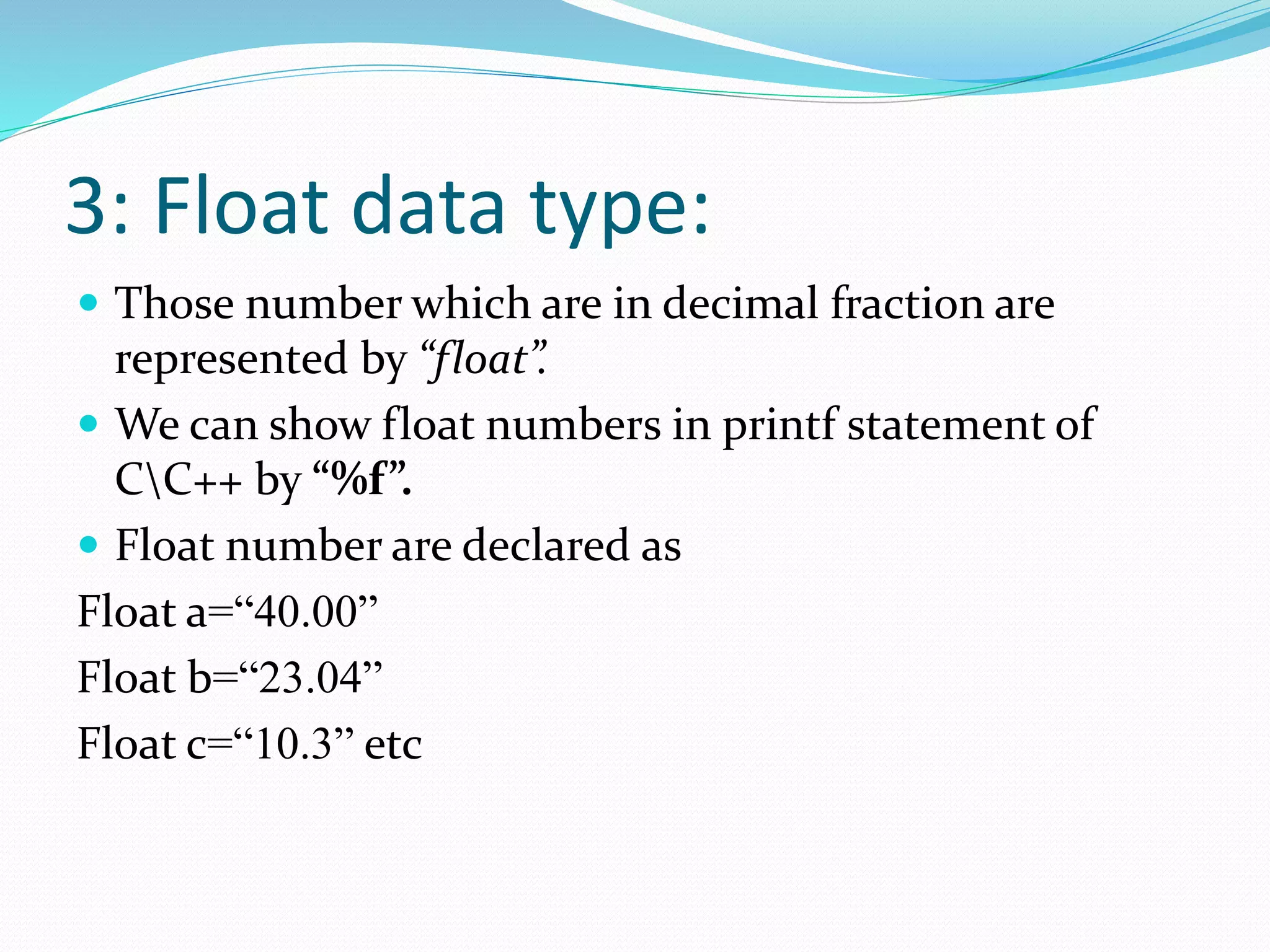
3: Float datatype:
Those number which are in decimal fraction are
represented by “float”.
We can show float numbers in printf statement of
CC++ by “%f”.
Float number are declared as
Float a=“40.00”
Float b=“23.04”
Float c=“10.3” etc
7.
Float data type:
We can write a program as:
#include<conio.h>
#include<stdio.h>
#include<stdlib.h>
Void main()
{
Float a=29.1;
Printf(“n%f”,a);
Getch();
}
8.
Integer data type:
We can write a program in CC++ are as shown below.
#include<conio.h>
#include<stdio.h>
#include<stdlib.h>
Void main()
{
Int a=291;
Printf(“n%d”,a);
Getch();
}
We can show the integer data type in C|C++ by “%d” in
printf statement.
9.
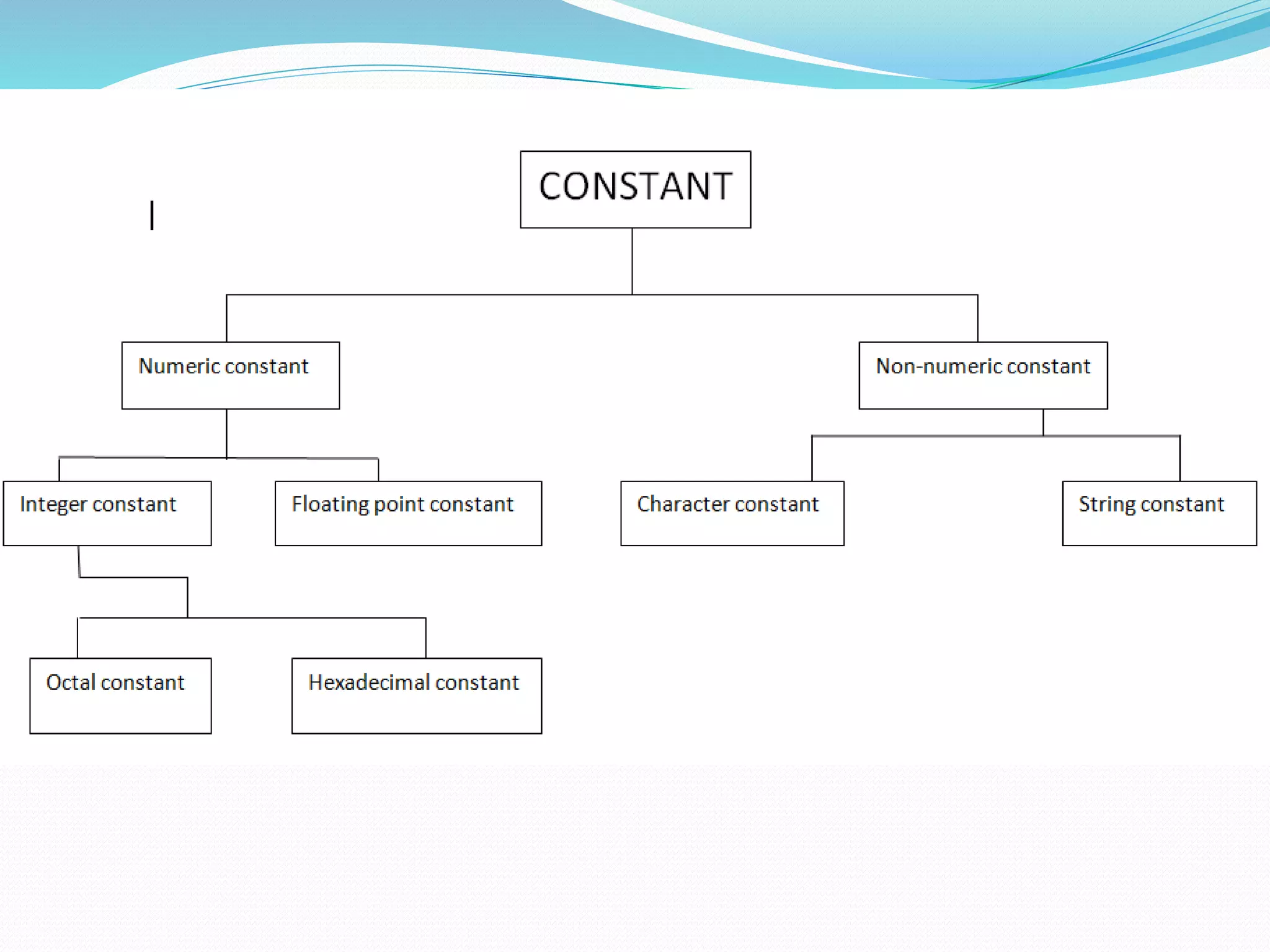
CONSTANTS:
Unlike variable,a constant is a fixed value that does
not change during the execution of program. We can
say that constant is a values while variable are holders
of these values. In C|C++, a constant may be divided
into main two types.
1. Numeric constant.
2. Non-numeric constant.
10.
NUMERIC CONSTANT:
Numbersare referred to as numeric constants.
Numeric constants are used for numeric purposes. It
contain:
Numeric digits 0 to 9.
Plus(+) or minus(-) signs.
Decimal points
It is important to that note no commas or blanks are
allowed in numeric constants.
11.
In C|C++,numeric constant can be represented in
three ways.
Integer constant
Floating constant
Exponential real constant
13.
OCTAL INTEGER CONSTANT:
In C|C++ , any integer constant with a leading 0, is
interpreted as Octal constant an octal constant is a
base 8 numbers system and valid digits in octal system
are only 0 through 7. it is important to note that in
C|C++ , decimal integer constant cannot start with a
leading 0.
14.
HEXADECIMAL INTEGER CONSTANT
In CC++ any integer constant, which begins with 0x
or 0X, is interpreted as hexadecimal integer constant.
An hexadecimal constant is a base -16 number and
valid digit in hexadecimal system are 0 through
9,A,B,C,D,E and F.
15.
FLOATING POINT CONSTANT:
The numeric constant, which does not contain a
decimal point is known as floating point constant.
Like integer constant, floating points could either be
positive or negative.
16.
NON NUMERIC CONSTANT:
Non numeric constant are used for non numeric
purposes. Such as to produce output reports, heading
or printing messages etc, non numeric constant are
divided into two types.
Character constant
String constant
17.
EXPONENTIAL REAL CONSTANT:
Floating point constant can also be represented in the
E-notation form, and this type of numeric constant is
known as exponential real constant.
18.
CHARACTER CONSTANT:
InCC++, character constant are enclosed within
single quotes. It is important to note that the single
quotes are not part of the character constant, but they
serve to delimit it.
19.
STRING CONSTANT:
Anycharacter or sequence of character between
double quotes is known as string constant or simply a
string.
20.
ZAHID HUSSAIN
Classno : 322
Subject : Data types, Constants
Shift : Evening
Submitted to UMAR ALI SIR