TVIS’ TECHNOLOGY PROFICIENCY
& IDENTIFICATION WITH A
COMMUNITY OF PRACTICE
YUE-TING SIU
VALERIE MORASH
UC BERKELEY
@TVI_ting #CSUN14
Background
TVI = Teacher of Students with Visual Impairments
AT = Assistive technology
¨  Ting: 12 years’ experience as a TVI and background in
training TVIs how to use technology with students
¨  More tech use in general education
Students with VI must be prepared to work in
digital environment.
¨  AT use Improved postsecondary outcomes,
employment
¨  Concern: Bridge gaps between tech innovations and
teacher adoption for classroom implementation
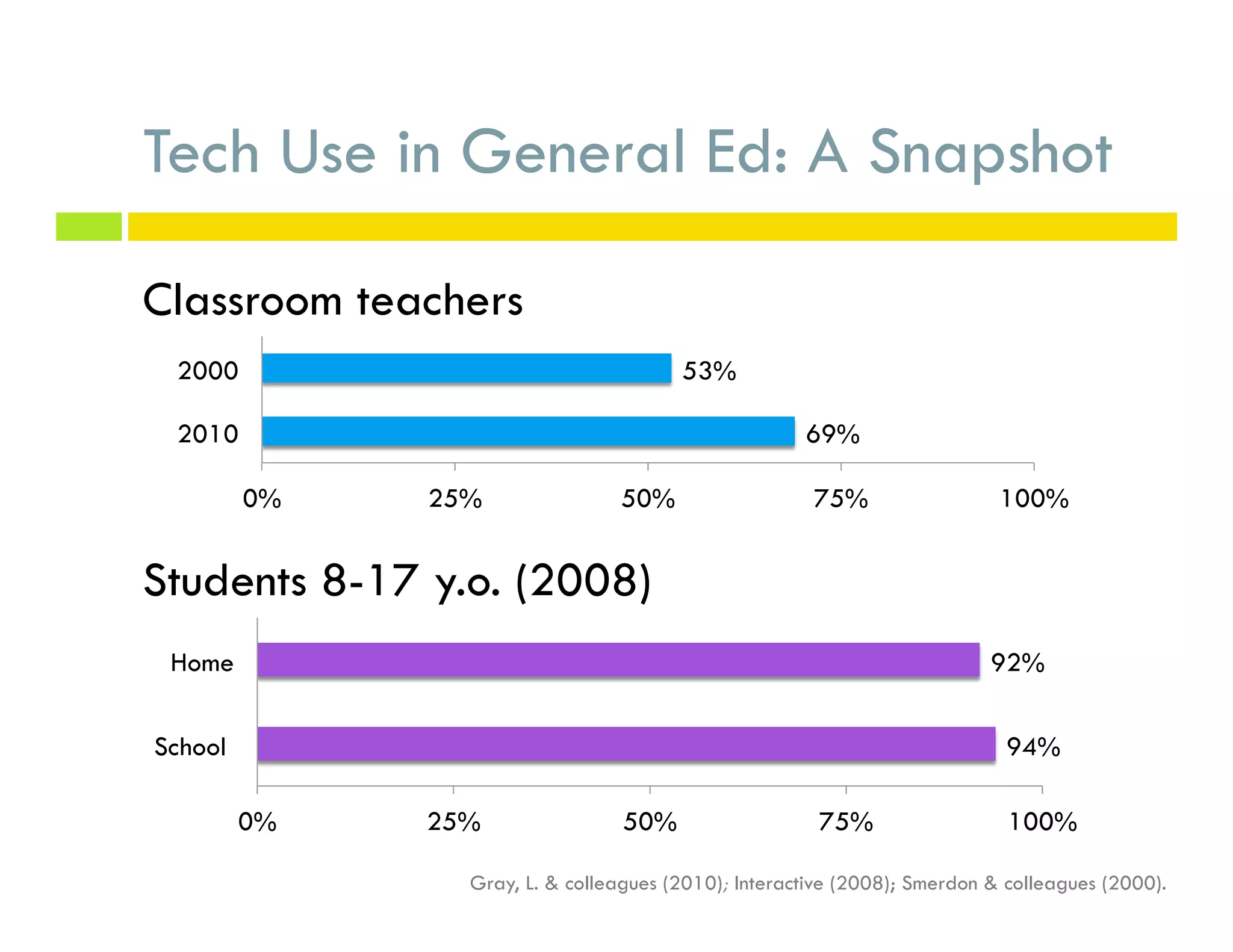
Tech Use in General Ed: A Snapshot
Classroom teachers
69%
53%
0% 25% 50% 75% 100%
2010
2000
94%
92%
0% 25% 50% 75% 100%
School
Home
Students 8-17 y.o. (2008)
Gray, L. & colleagues (2010); Interactive (2008); Smerdon & colleagues (2000).
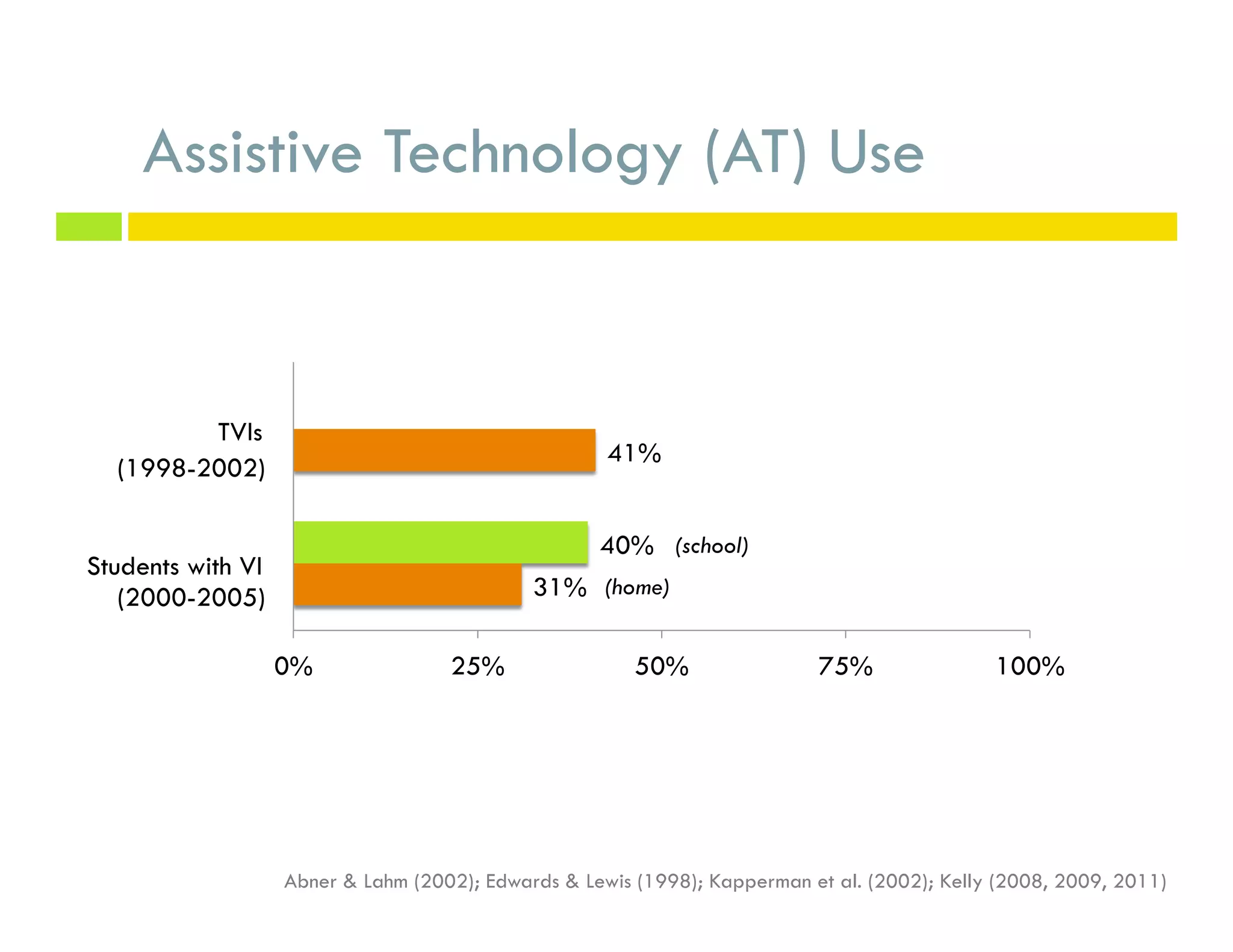
Assistive Technology (AT) Use
Abner & Lahm (2002); Edwards & Lewis (1998); Kapperman et al. (2002); Kelly (2008, 2009, 2011)
31%
41%
40%
0% 25% 50% 75% 100%
Students with VI
TVIs
(1998-2002)
(2000-2005)
(school)
(home)
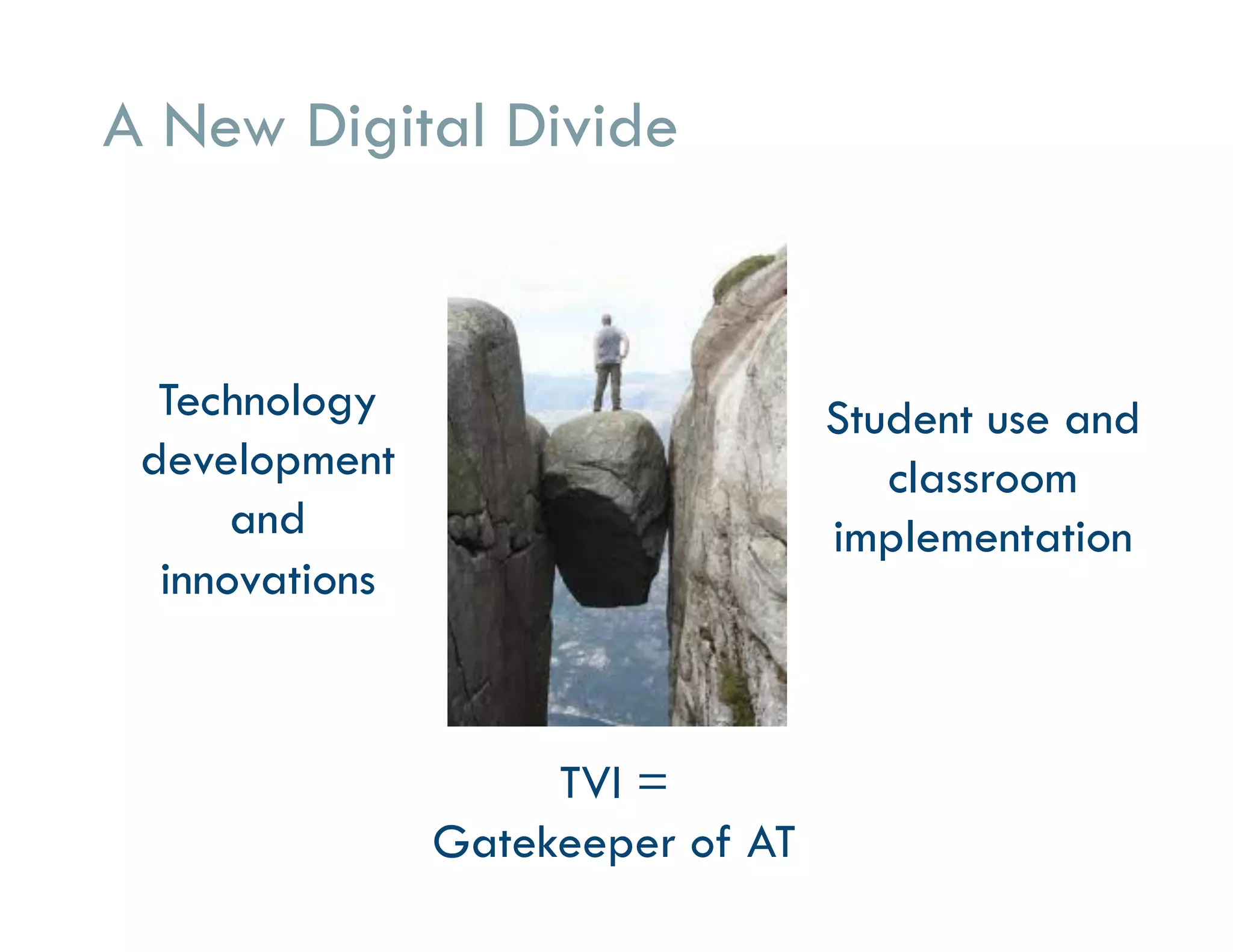
A New Digital Divide
Technology
development
and
innovations
Student use and
classroom
implementation
TVI =
Gatekeeper of AT
Differentiated needs of TVIs
¨  Itinerant TVIs = travel between several school sites
depending on where students are located
¨  Challenges of itinerant teaching:
¤  Teaching in isolation
¤  Lack of professional learning community
¤  Lack of access to relevant professional development (PD)
¨  Challenges of teaching with AT:
¤  Modification of mainstream tech to suit student needs
¤  Speed of innovation requires ongoing PD
¤  AT as a tool to learning, not an objective unto itself.
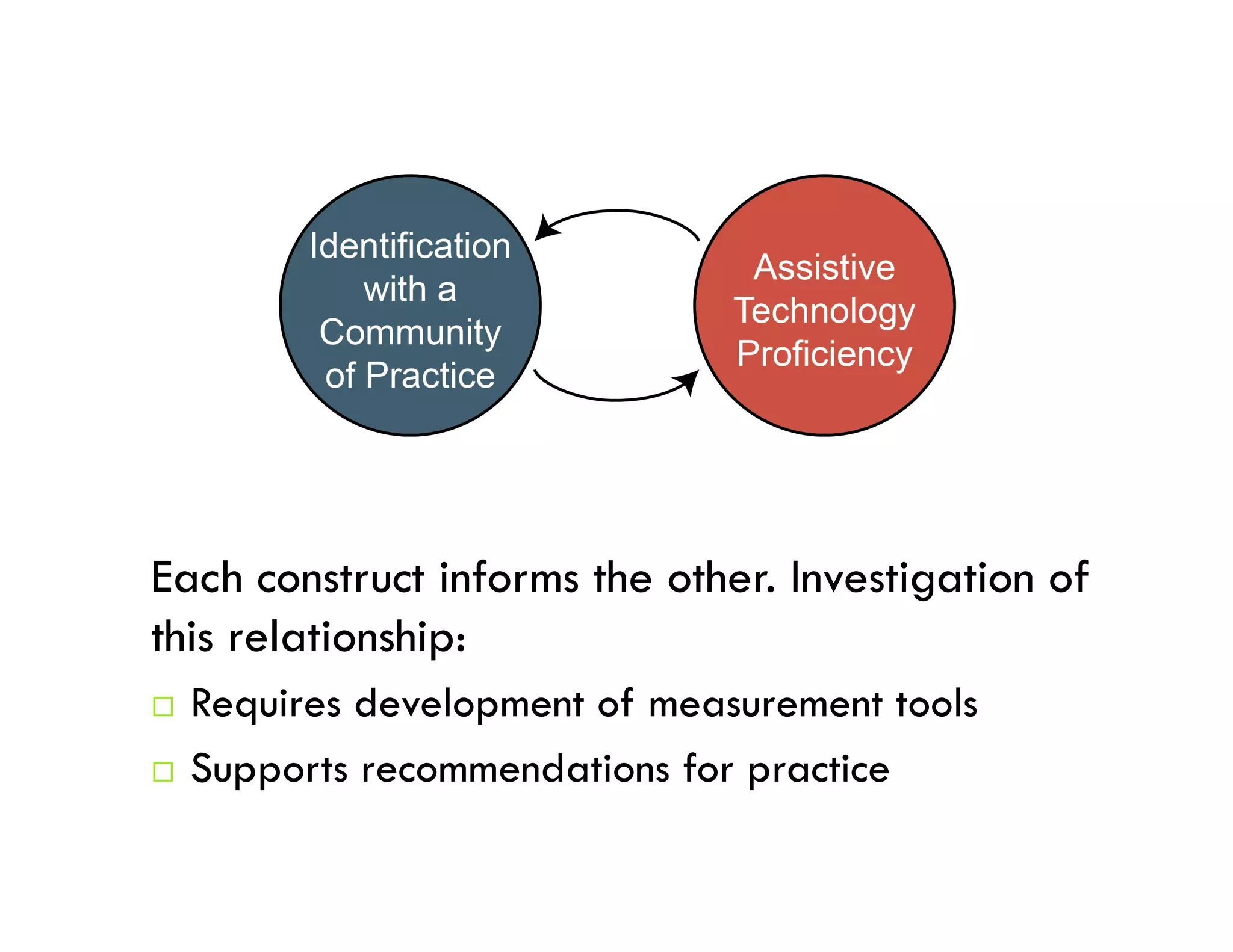
Each construct informs the other. Investigation of
this relationship:
¨  Requires development of measurement tools
¨  Supports recommendations for practice
Community of Practice (CoP)
Consists of 3 dimensions:
¨  Domain of interest: Members of a CoP invest in a shared
collection of knowledge, goals, and purpose to their actions.
These mutual interests inform their actions.
¨  Community: Members interact with one another by sharing
ideas, posing questions, and responding to others’ issues.
Members mutually respect the exchange of information.
¨  Practice: Members share the same “toolkit” comprised of tools,
information, anecdotes, and resources. The community develops
and maintains this body of knowledge, and leverages it to
inform the domain of interest.
(Wenger, 1999)
AT Proficiency
Siu & Morash (in press) re-conceptualized Smith et al.’s
(2009) competencies into 4 dimensions:
¨  Choosing: Ability to choose AT for a student
¨  Funding: Ability to secure funding for AT
¨  Personal capabilities: Ability to use/troubleshoot AT
¨  Teaching integration: Ability to use AT for a variety of
purposes
Abating the digital divide
¨  Build communities of practice to support teacher
adoption and classroom implementation.
¨  Integrated responsibility of professional
development AND technology developers
Students’ use of AT is the ultimate outcome measure!
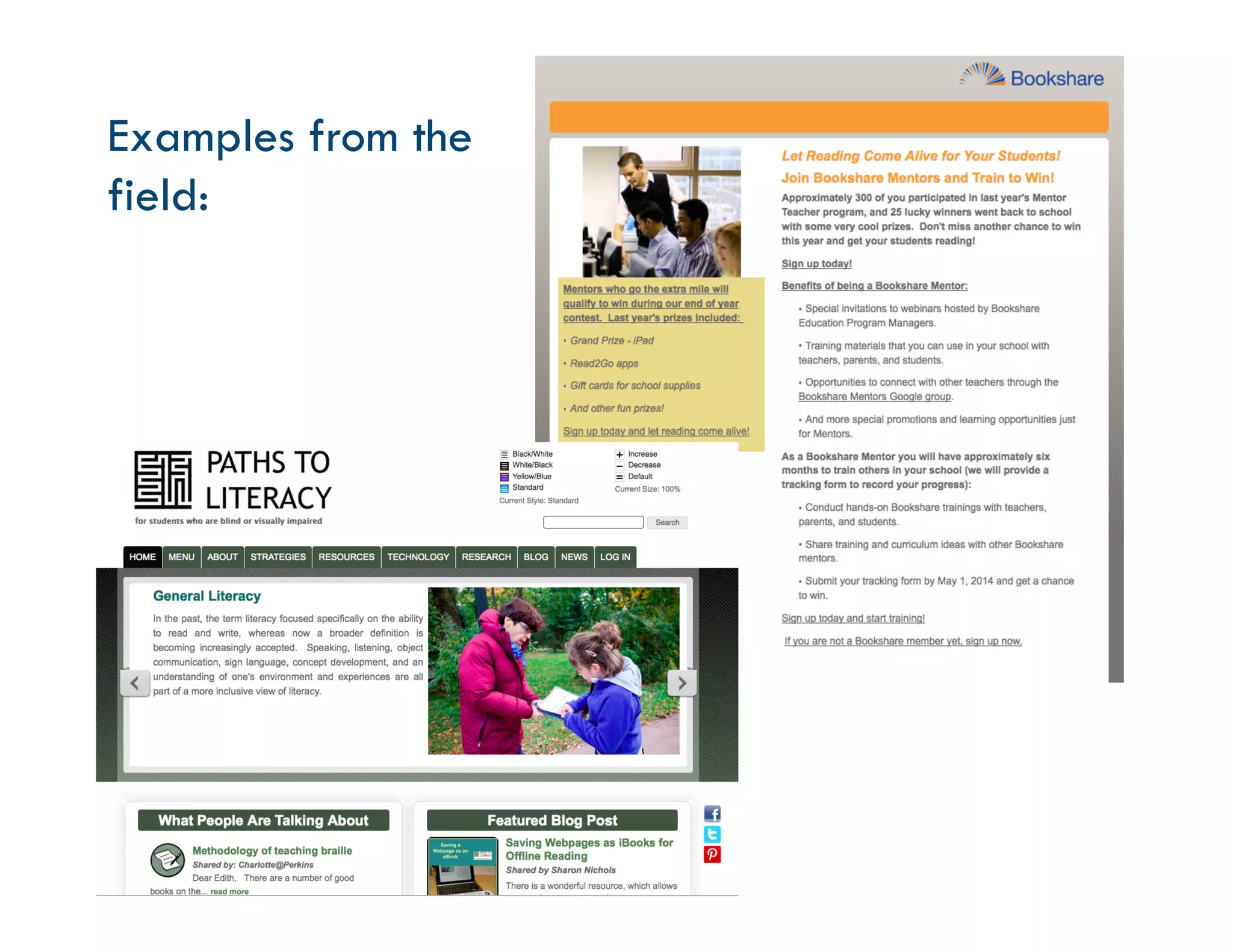
Examples from the
field:
For further contact
Ting Siu, TVI
¨  ysiu@berkeley.edu
¨  facebook.com/yuetingsiu
¨  twitter: TVI_ting
Val Morash
¨  valmo@berkeley.edu

TVIs' AT Proficiency and Communities of Practice: Bridging tech innovations and classroom implementation

  • 1.
    TVIS’ TECHNOLOGY PROFICIENCY &IDENTIFICATION WITH A COMMUNITY OF PRACTICE YUE-TING SIU VALERIE MORASH UC BERKELEY @TVI_ting #CSUN14
  • 2.
    Background TVI = Teacherof Students with Visual Impairments AT = Assistive technology ¨  Ting: 12 years’ experience as a TVI and background in training TVIs how to use technology with students ¨  More tech use in general education Students with VI must be prepared to work in digital environment. ¨  AT use Improved postsecondary outcomes, employment ¨  Concern: Bridge gaps between tech innovations and teacher adoption for classroom implementation
  • 3.
    Tech Use inGeneral Ed: A Snapshot Classroom teachers 69% 53% 0% 25% 50% 75% 100% 2010 2000 94% 92% 0% 25% 50% 75% 100% School Home Students 8-17 y.o. (2008) Gray, L. & colleagues (2010); Interactive (2008); Smerdon & colleagues (2000).
  • 4.
    Assistive Technology (AT)Use Abner & Lahm (2002); Edwards & Lewis (1998); Kapperman et al. (2002); Kelly (2008, 2009, 2011) 31% 41% 40% 0% 25% 50% 75% 100% Students with VI TVIs (1998-2002) (2000-2005) (school) (home)
  • 5.
    A New DigitalDivide Technology development and innovations Student use and classroom implementation TVI = Gatekeeper of AT
  • 6.
    Differentiated needs ofTVIs ¨  Itinerant TVIs = travel between several school sites depending on where students are located ¨  Challenges of itinerant teaching: ¤  Teaching in isolation ¤  Lack of professional learning community ¤  Lack of access to relevant professional development (PD) ¨  Challenges of teaching with AT: ¤  Modification of mainstream tech to suit student needs ¤  Speed of innovation requires ongoing PD ¤  AT as a tool to learning, not an objective unto itself.
  • 7.
    Each construct informsthe other. Investigation of this relationship: ¨  Requires development of measurement tools ¨  Supports recommendations for practice
  • 8.
    Community of Practice(CoP) Consists of 3 dimensions: ¨  Domain of interest: Members of a CoP invest in a shared collection of knowledge, goals, and purpose to their actions. These mutual interests inform their actions. ¨  Community: Members interact with one another by sharing ideas, posing questions, and responding to others’ issues. Members mutually respect the exchange of information. ¨  Practice: Members share the same “toolkit” comprised of tools, information, anecdotes, and resources. The community develops and maintains this body of knowledge, and leverages it to inform the domain of interest. (Wenger, 1999)
  • 9.
    AT Proficiency Siu &Morash (in press) re-conceptualized Smith et al.’s (2009) competencies into 4 dimensions: ¨  Choosing: Ability to choose AT for a student ¨  Funding: Ability to secure funding for AT ¨  Personal capabilities: Ability to use/troubleshoot AT ¨  Teaching integration: Ability to use AT for a variety of purposes
  • 10.
    Abating the digitaldivide ¨  Build communities of practice to support teacher adoption and classroom implementation. ¨  Integrated responsibility of professional development AND technology developers Students’ use of AT is the ultimate outcome measure!
  • 11.
  • 12.
    For further contact TingSiu, TVI ¨  ysiu@berkeley.edu ¨  facebook.com/yuetingsiu ¨  twitter: TVI_ting Val Morash ¨  valmo@berkeley.edu

Editor's Notes

  • #5 23-38% (pre-adolescents/teens) for email/chat rooms