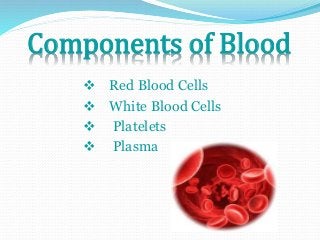
There are 4 components of blood. They are Red Blood Cells, White Blood Cells, Platelets and Plasma. This presentation will reveal more details about them.
Read the blog post here
→ http://www.smartsciencepro.com/human-blood-components/
Blood is ahomogeneous fluid.
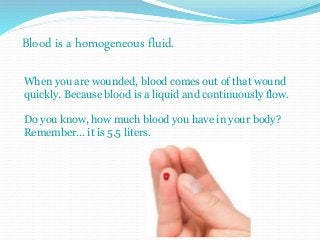
When you are wounded, blood comes out of that wound
quickly. Because blood is a liquid and continuously flow.
Do you know, how much blood you have in your body?
Remember… it is 5.5 liters.
3.
Components of Blood
Red Blood Cells
White Blood Cells
Platelets
Plasma
4.
How to SeeComponents of Blood?
Use a microscope, because of these components
can’t see with naked eyes.
Then you would see lots of cells floating here. Most
of them are red color. They are Red Blood Cells.
Now add a little drop of dilute Acetic Acid.
Now you can see other blood cells. They are White
Blood Cells.
5.
Red Blood Cells
Red blood cells also known as Red Blood Corpuscles or
Erythrocytes.
Erythrocytes have bi-concave shape with a movement.
Red blood cells are bigger in size.
Red color of the red blood cells is coming from
Hemoglobin.
Hemoglobin is made from a Haematin that consist of
iron and protein.
OxyHemoglobin is formed by the oxygen and
hemoglobin in red blood cells.
6.
White Blood Cells
This is larger than red blood cells, however
the amount of white blood cells is low. This
is also known as, Leukocytes.
1 white blood cell in 600 red blood cells
White blood cells are colorless and have
nucleus.
1 ml blood = 4000-11000 white blood cells
7.
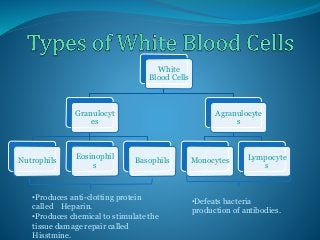
•Defeats bacteria
productionof antibodies.
White
Blood Cells
Granulocyt
es
Nutrophils
Eosinophil
s
Basophils
Agranulocyte
s
Monocytes Lympocyte
s
•Produces anti-clotting protein
called Heparin.
•Produces chemical to stimulate the
tissue damage repair called
Hisstmine.
8.
Phagocytes
Phagocytes arecells that protect the body
by harmful foreign particles, bacteria and
dead or dying cells,
Phagocytosis
Certain leukocytes display an amoeboid
movement, they engulf bacteria and viruses
that enter to your body. This process of
killing bad stuffs is known as Phagocytosis.
9.
Platelets
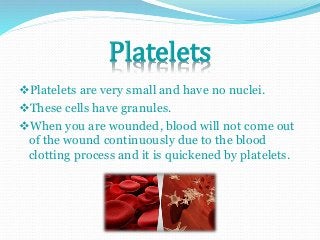
Platelets arevery small and have no nuclei.
These cells have granules.
When you are wounded, blood will not come out
of the wound continuously due to the blood
clotting process and it is quickened by platelets.
10.
Blood Plasma
Bloodplasma is a liquid yellow color portion.
It is around the blood cells.
Blood plasma contains,
• Blood 55%
• Water 92%
Blood got a fluid nature because of blood
plasma and it is helping to regulate the body
temperature.