PUPPET MODULES:
AN HOLISTIC APPROACH
    PuppetCamp Dublin 2012

     Alessandro Franceschi
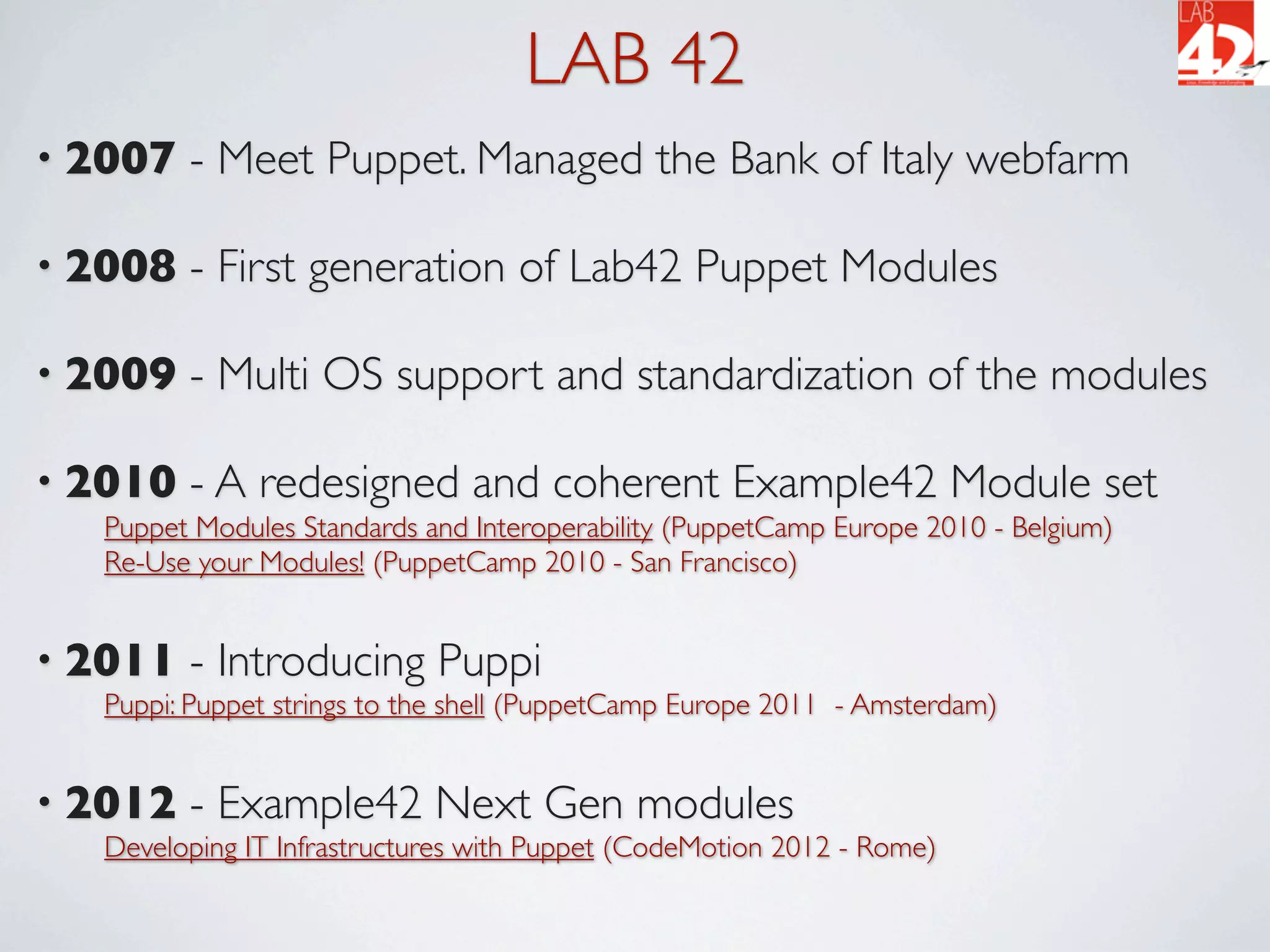
LAB 42
• 2007   - Meet Puppet. Managed the Bank of Italy webfarm

• 2008   - First generation of Lab42 Puppet Modules

• 2009   - Multi OS support and standardization of the modules

• 2010   - A redesigned and coherent Example42 Module set
  Puppet Modules Standards and Interoperability (PuppetCamp Europe 2010 - Belgium)
  Re-Use your Modules! (PuppetCamp 2010 - San Francisco)


• 2011   - Introducing Puppi
  Puppi: Puppet strings to the shell (PuppetCamp Europe 2011 - Amsterdam)


• 2012   - Example42 Next Gen modules
  Developing IT Infrastructures with Puppet (CodeMotion 2012 - Rome)
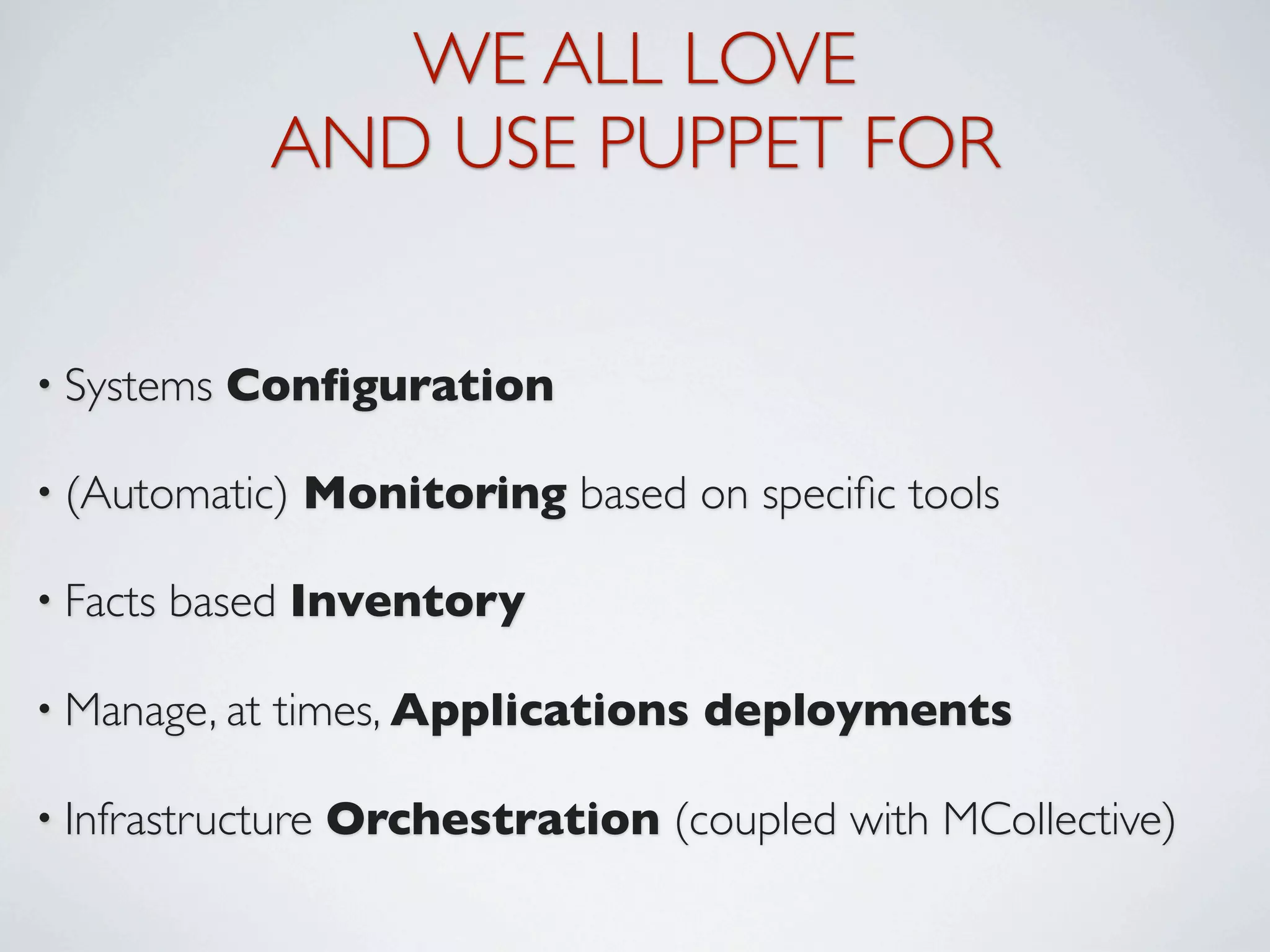
WE ALL LOVE
               AND USE PUPPET FOR


• Systems   Configuration

• (Automatic)   Monitoring based on specific tools

• Facts   based Inventory

• Manage, at   times, Applications deployments

• Infrastructure   Orchestration (coupled with MCollective)
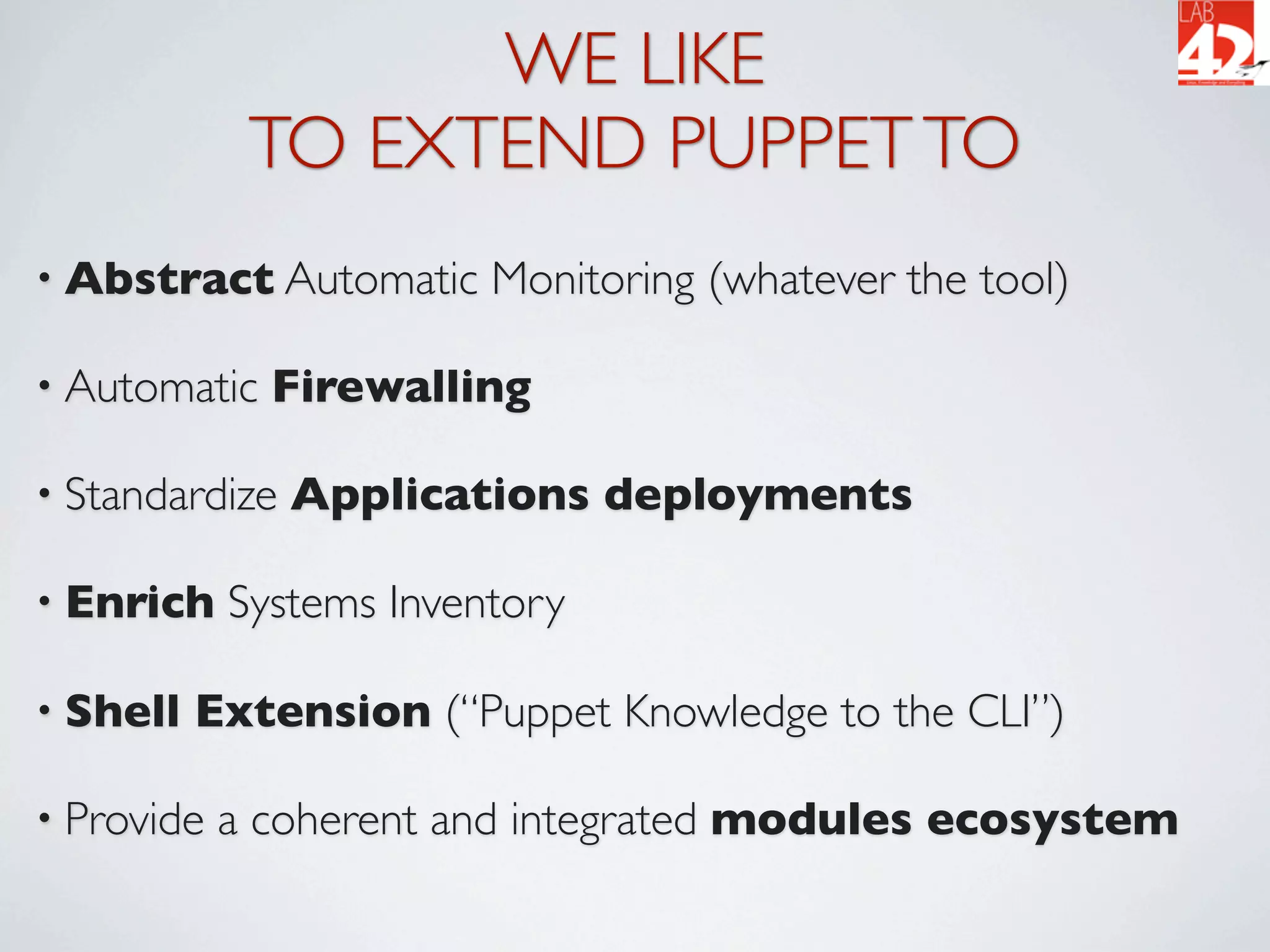
WE LIKE
             TO EXTEND PUPPET TO
• Abstract Automatic     Monitoring (whatever the tool)

• Automatic   Firewalling

• Standardize   Applications deployments

• Enrich    Systems Inventory

• Shell   Extension (“Puppet Knowledge to the CLI”)

• Provide   a coherent and integrated modules ecosystem
PUPPET MODULES MANTRAS
•   Data Separation
    •   Configuration data is defined outside the module (or Puppet manifests)
    •   Module’s behavior is managed via APIs
•   Reusability
    •   ReUse the same module in different shops
    •   Customize its behavior without changing its code
    •   Do not force how configurations are provided
•   Standardization
    •   Follow PuppetLabs layout guidelines (puppet-lint)
    •   Have a coherent, predictable and intuitive interface
    •   Provide contextual documentation (puppet-doc)
•   Interoperability
    •   Limit dependencies. Allow modules’ cherry picking
    •   Be self contained, do not interfere with other modules’ resources
•   Cross Operating System support
    •   Provide sensible defaults for different OSes
    •   Allow easy implementation of support of new OSes
EXAMPLE42 NEXT GEN
•   Coherent and Standardized structure
•   Best Practices module design (with some tweaks...)
•   Easily extendable Cross OS support
•   Complete API exposure via parameters
•   Extreme Customizations options
•   Alternative Data Separation options
•   Complete Decommissioning features
•   Optional Automatic Monitoring Abstraction
•   Optional Automatic Firewalling
•   Optional Puppi support to enhance the CLI experience
•   Exhaustive PuppetDoc documentation
•   Integrated Rspec-Puppet tests
•   Code Puppet-Lint compliant
•   Quick module scaffolding based on different templates


                                                       ... not exactly easy to read....
BASIC USAGE
• One    Module. One Application. One main class.

• Install   openssh with default settings:
  class { 'openssh': }

• Equivalent    to:
  include openssh

• Default    behavior:
  •   Install package
  •   Run and enable service
  •   Do not alter configurations
DATA INPUT ALTERNATIVES
• Set   (top scope/ENC) variables and include classes:
 $::openssh_template = 'site/openssh/openssh.conf.erb'
 include openssh

• Use   Hiera:
 hiera(‘openssh_template’)
 include openssh

• Use   parametrized classes:
 class { 'openssh':
    template => 'site/openssh/openssh.conf.erb',
 }

• Happily   mix different patterns:
 $::monitor = true
 $::monitor_tool = [ 'nagios' , 'munin' , 'puppi' ]
 class { 'openssh':
    template => 'site/openssh/openssh.conf.erb',
 }
DECOMMISSIONING
• Disable   openssh service:
 class { 'openssh':
   disable => true
 }

• Disable   openssh service only at boot time:
 class { 'openssh':
   disableboot => true
 }

• Remove    openssh (package and files):
 class { 'openssh':
   absent => true
 }

• Monitoring   and firewalling resources removal is automatically
 managed
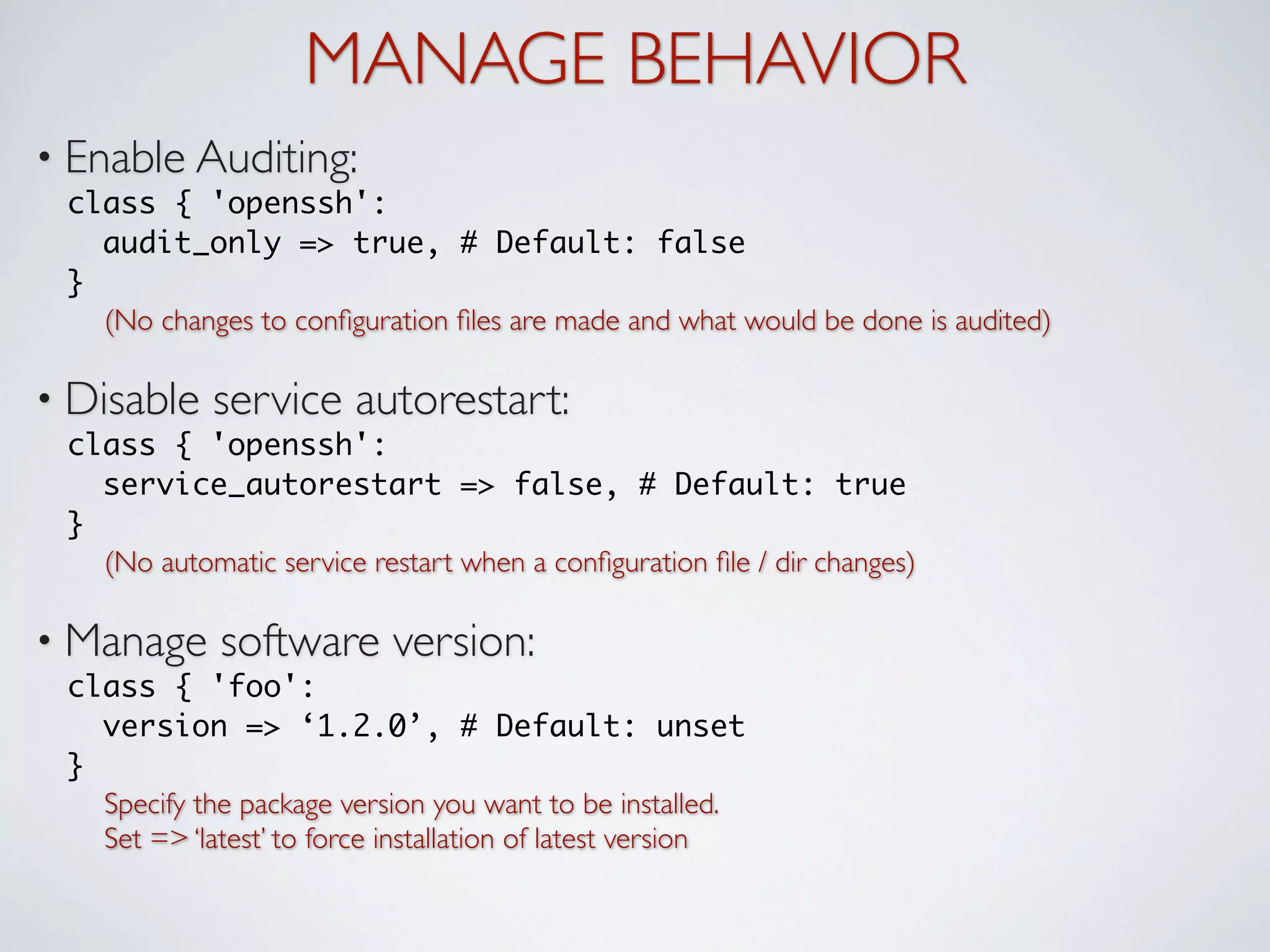
MANAGE BEHAVIOR
• Enable Auditing:
 class { 'openssh':
   audit_only => true, # Default: false
 }
   (No changes to configuration files are made and what would be done is audited)

• Disable    service autorestart:
 class { 'openssh':
   service_autorestart => false, # Default: true
 }
   (No automatic service restart when a configuration file / dir changes)

• Manage     software version:
 class { 'foo':
   version => ‘1.2.0’, # Default: unset
 }
   Specify the package version you want to be installed.
   Set => ‘latest’ to force installation of latest version
CUSTOMIZE: CONFIGURATION FILE
• Provide   configuration as a static file ...
 class { 'openssh':
   source => ‘puppet:///modules/site/ssh/sshd.conf’,
 }

• an   array of files looked up on a first match logic ...
 class { 'openssh':
   source => ["puppet:///modules/site/ssh/sshd.conf-${fqdn}",
               "puppet:///modules/site/ssh/openssh.conf"],
 }

• As   an erb template:
 class { 'openssh':
   template => ‘site/ssh/sshd.conf.erb’,
 }

• Config    File Path is defined in params.pp (can be overriden):
   config_file = >’/etc/ssh/sshd_config’,
CUSTOM OPTIONS
•   With templates you can provide an hash of custom options:
     class { 'openssh':
       template => ‘site/ssh/sshd.conf.erb’,
       options => {
          'LogLevel' => 'INFO',
          'UsePAM'   => 'yes',
       },
     }

•   Alternative ways to use the options hash in an erb template:
    •   Direct but not safe (you must always provide all the used options)
     UsePAM <%= options['UsePAM'] %>

    •   Failsafe with defaults (verbose but safe)
     <% if scope.lookupvar("openssh::options['UsePAM']") then -%>
     UsePAM <%= options['UsePAM'] %>
     <% else -%>
     UsePAM no
     <% end -%>

    •   Show what you have (useful for config files has defaults for every option)
     <% scope.lookupvar("openssh::options").sort_by {|key, value| key}.each do |key,
     value| -%>
     <%= key %> <%= value %>
     <% end -%>
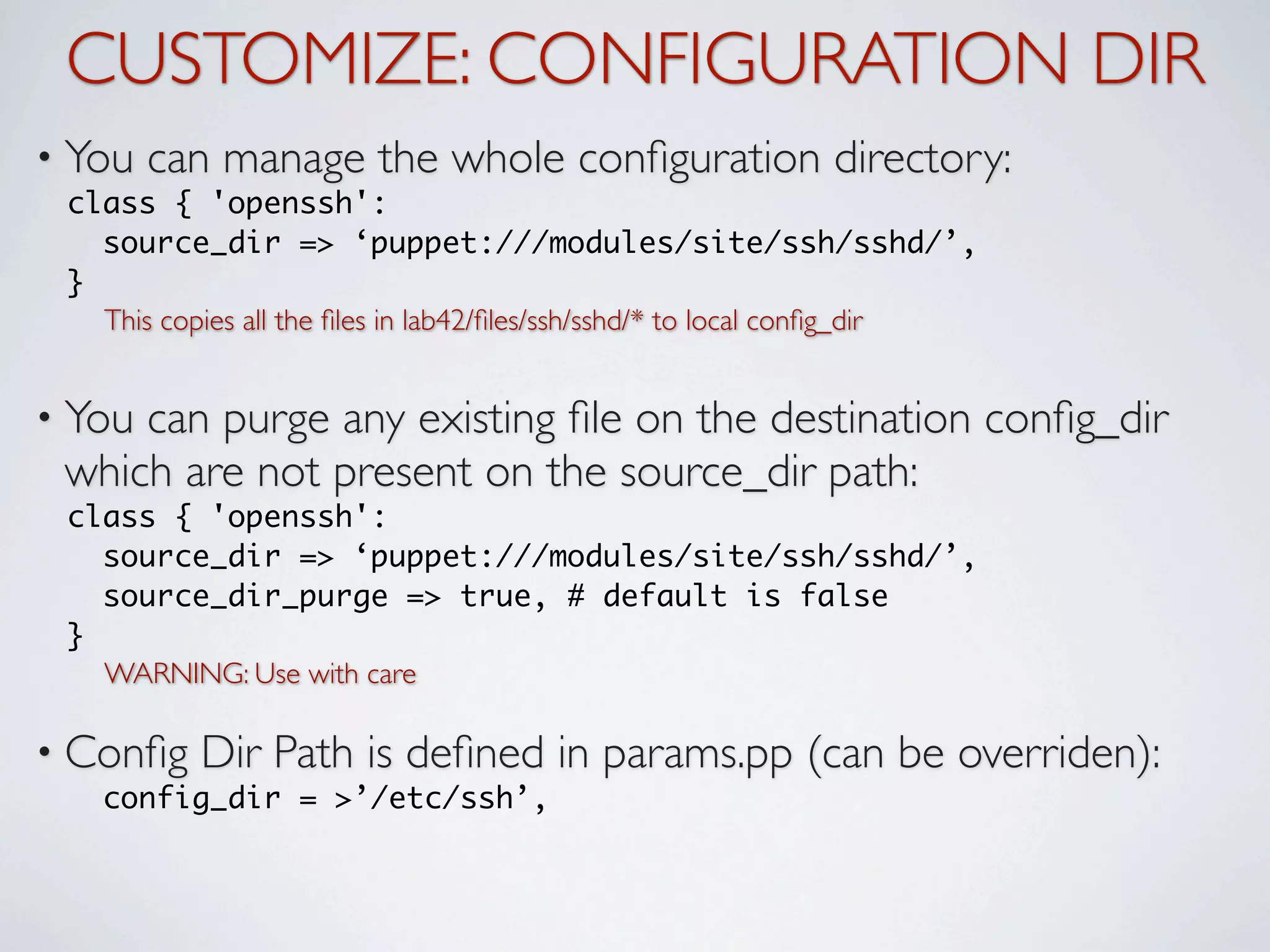
CUSTOMIZE: CONFIGURATION DIR
• You   can manage the whole configuration directory:
 class { 'openssh':
   source_dir => ‘puppet:///modules/site/ssh/sshd/’,
 }
   This copies all the files in lab42/files/ssh/sshd/* to local config_dir


• Youcan purge any existing file on the destination config_dir
 which are not present on the source_dir path:
 class { 'openssh':
   source_dir => ‘puppet:///modules/site/ssh/sshd/’,
   source_dir_purge => true, # default is false
 }
   WARNING: Use with care

• Config    Dir Path is defined in params.pp (can be overriden):
   config_dir = >’/etc/ssh’,
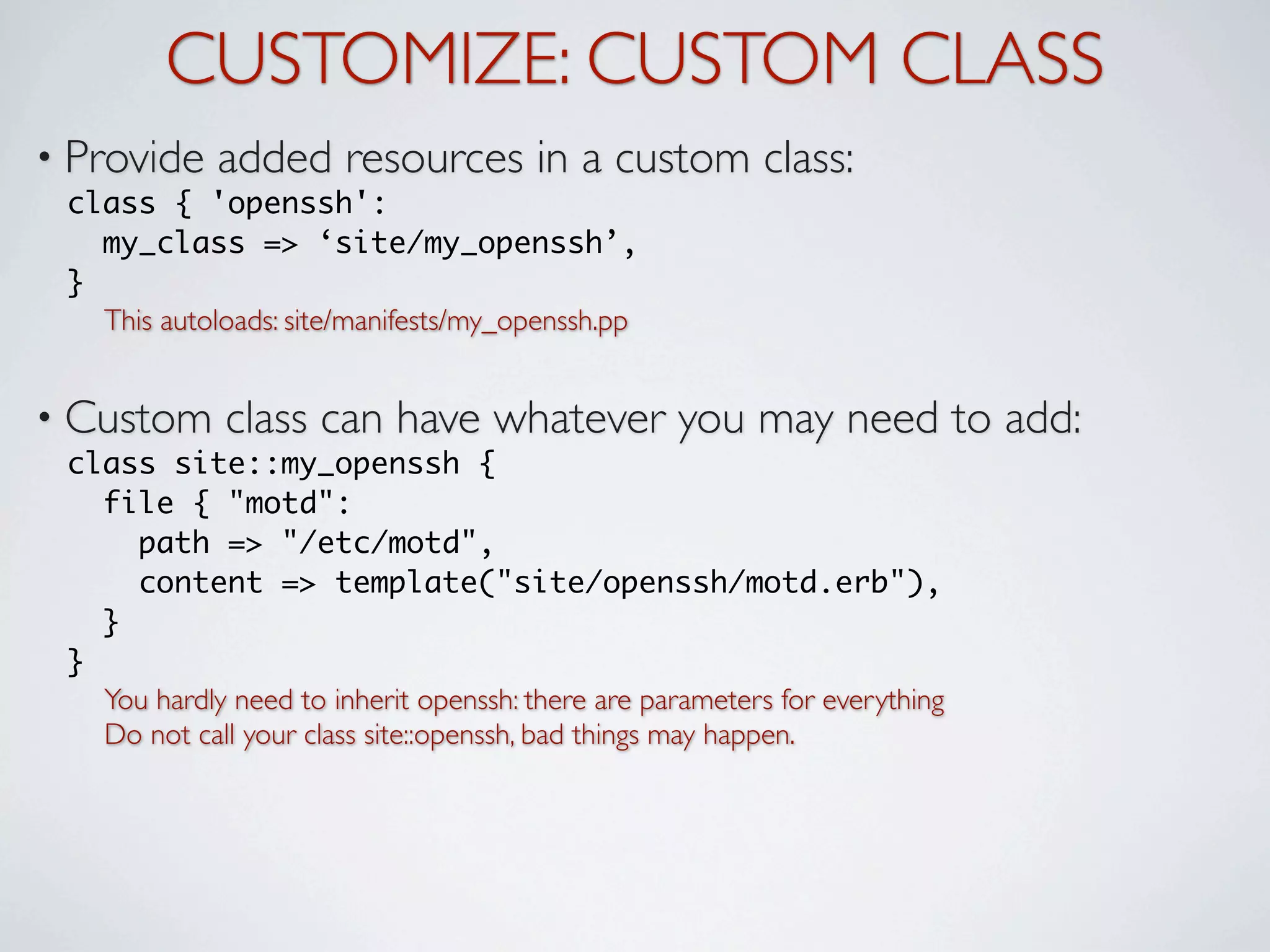
CUSTOMIZE: CUSTOM CLASS
• Provide    added resources in a custom class:
 class { 'openssh':
   my_class => ‘site/my_openssh’,
 }
   This autoloads: site/manifests/my_openssh.pp


• Custom      class can have whatever you may need to add:
 class site::my_openssh {
   file { "motd":
     path => "/etc/motd",
     content => template("site/openssh/motd.erb"),
   }
 }
   You hardly need to inherit openssh: there are parameters for everything
   Do not call your class site::openssh, bad things may happen.
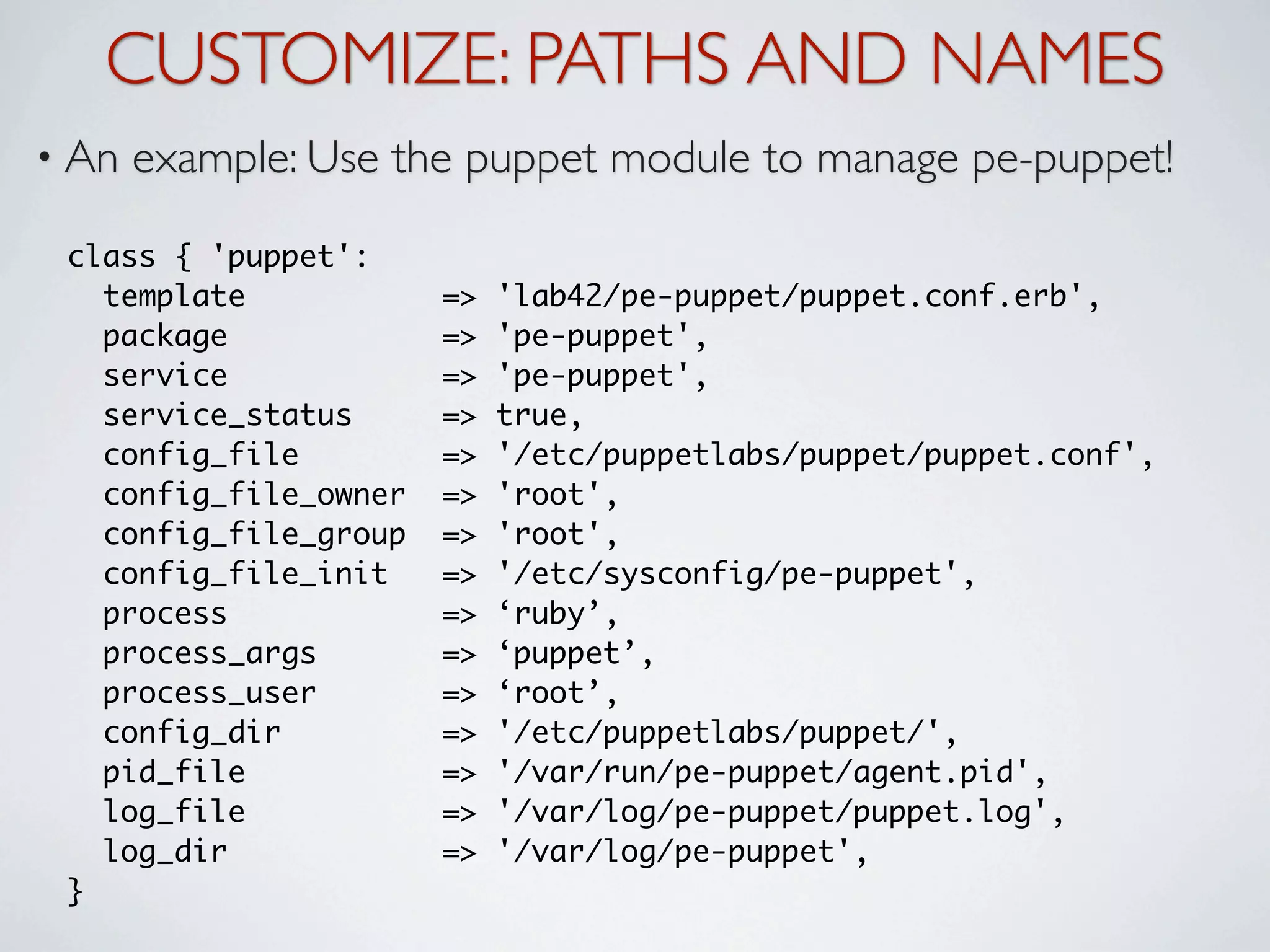
CUSTOMIZE: PATHS AND NAMES
• An   example: Use the puppet module to manage pe-puppet!

 class { 'puppet':
   template            =>   'lab42/pe-puppet/puppet.conf.erb',
   package             =>   'pe-puppet',
   service             =>   'pe-puppet',
   service_status      =>   true,
   config_file         =>   '/etc/puppetlabs/puppet/puppet.conf',
   config_file_owner   =>   'root',
   config_file_group   =>   'root',
   config_file_init    =>   '/etc/sysconfig/pe-puppet',
   process             =>   ‘ruby’,
   process_args        =>   ‘puppet’,
   process_user        =>   ‘root’,
   config_dir          =>   '/etc/puppetlabs/puppet/',
   pid_file            =>   '/var/run/pe-puppet/agent.pid',
   log_file            =>   '/var/log/pe-puppet/puppet.log',
   log_dir             =>   '/var/log/pe-puppet',
 }
EXTEND: MONITOR
• Manage    automatic monitoring:
 class { 'openssh':
   monitor      => true,
   monitor_tool => [ ‘nagios’,‘puppi’,‘monit’ ],
   monitor_target => $::ip_addess # Default
 }


• Monitoring     is based on parameters defined in params.pp:
   port               =>   ‘22’,
   protocol           =>   ‘tcp’,
   service            =>   ‘ssh[d]’, # According to OS
   process            =>   ‘sshd’,
   process_args       =>   ‘‘,
   process_user       =>   ‘root‘,
   pid_file           =>   ‘/var/run/sshd.pid’,

• Abstraction     is managed in the Example42 monitor module
   Here “connectors” for different monitoring tools are defined and can be added (also using 3rd
   party modules).
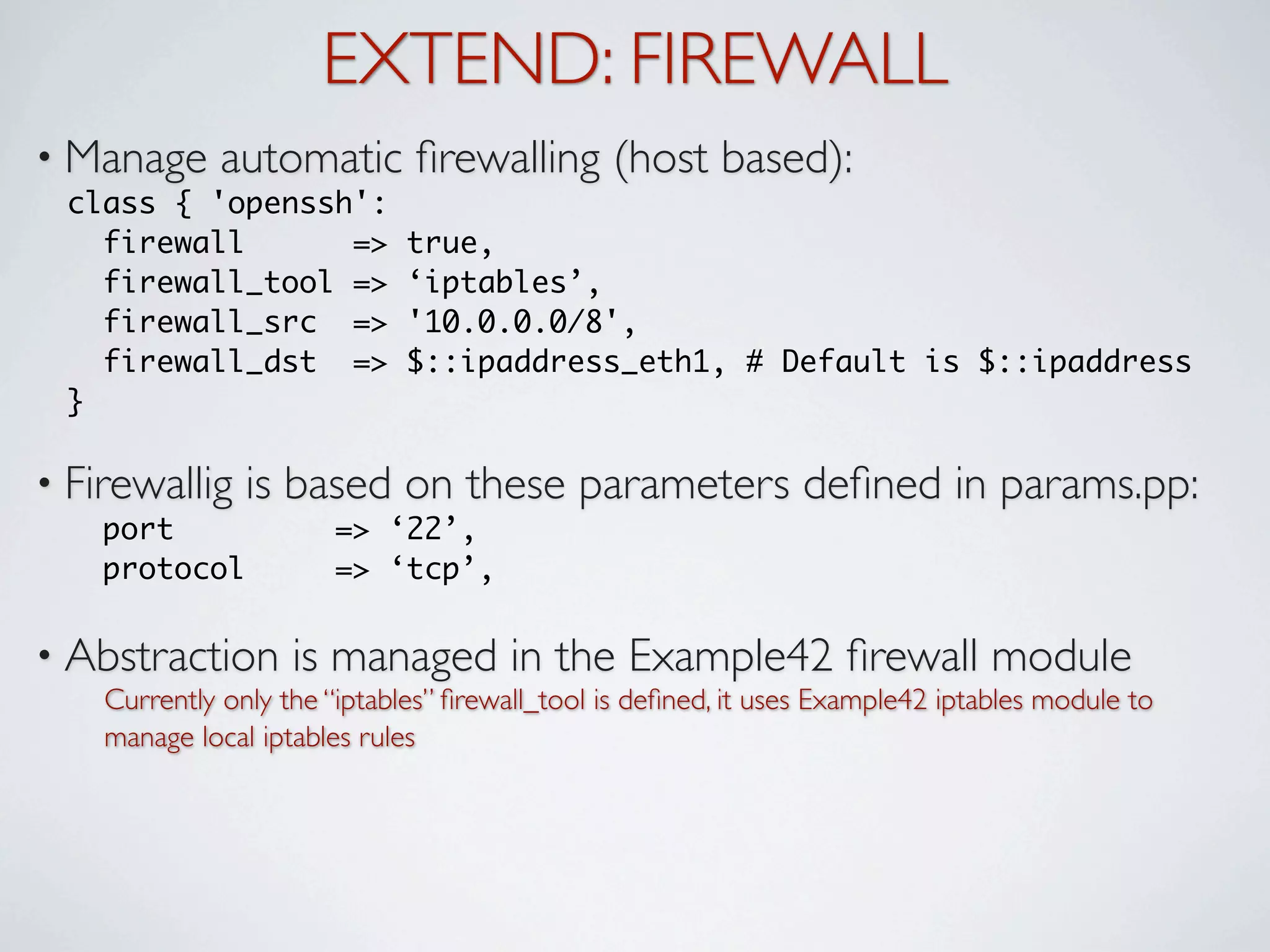
EXTEND: FIREWALL
• Manage     automatic firewalling (host based):
 class { 'openssh':
   firewall      =>          true,
   firewall_tool =>          ‘iptables’,
   firewall_src =>           '10.0.0.0/8',
   firewall_dst =>           $::ipaddress_eth1, # Default is $::ipaddress
 }

• Firewallig    is based on these parameters defined in params.pp:
    port               => ‘22’,
    protocol           => ‘tcp’,

• Abstraction       is managed in the Example42 firewall module
    Currently only the “iptables” firewall_tool is defined, it uses Example42 iptables module to
    manage local iptables rules
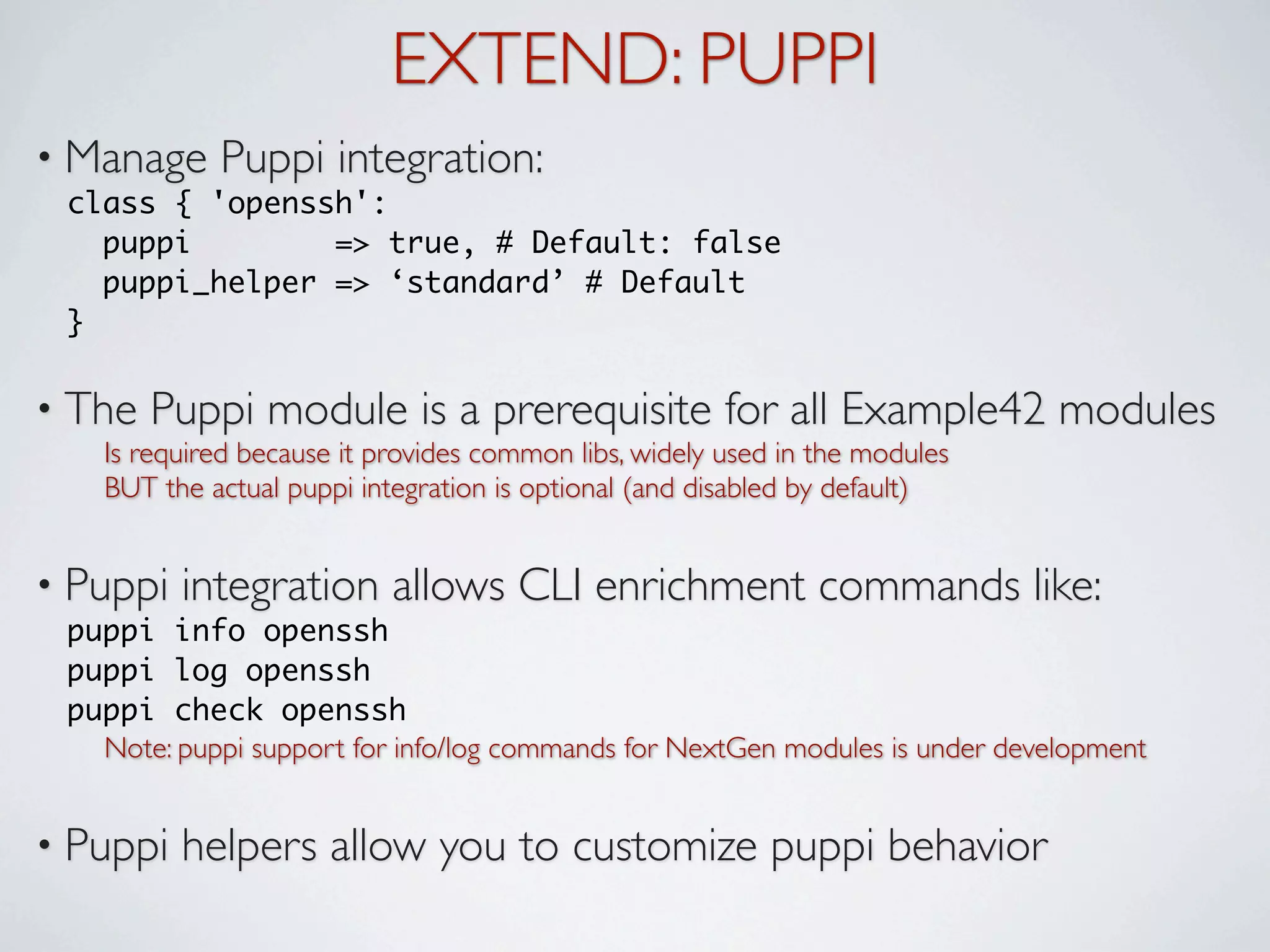
EXTEND: PUPPI
• Manage    Puppi integration:
 class { 'openssh':
   puppi        => true, # Default: false
   puppi_helper => ‘standard’ # Default
 }

• The   Puppi module is a prerequisite for all Example42 modules
   Is required because it provides common libs, widely used in the modules
   BUT the actual puppi integration is optional (and disabled by default)


• Puppi   integration allows CLI enrichment commands like:
 puppi info openssh
 puppi log openssh
 puppi check openssh
   Note: puppi support for info/log commands for NextGen modules is under development


• Puppi   helpers allow you to customize puppi behavior
PARAMS_LOOKUP EVERYWHERE
•   Each parameter on NextGen class is passed via params_lookup
class openssh (
[...] # openssh module specific parameters ...
  $my_class            = params_lookup( 'my_class' ),
  $source              = params_lookup( 'source' ),
  $source_dir          = params_lookup( 'source_dir' ),
  $source_dir_purge    = params_lookup( 'source_dir_purge' ),
  $template            = params_lookup( 'template' ),
  $service_autorestart = params_lookup( 'service_autorestart' , 'global' ),
  $options             = params_lookup( 'options' ),
  $version             = params_lookup( 'version' ),
  $absent              = params_lookup( 'absent' ),
  $disable             = params_lookup( 'disable' ),
  $disableboot         = params_lookup( 'disableboot' ),
  $monitor             = params_lookup( 'monitor' , 'global' ),
  $monitor_tool        = params_lookup( 'monitor_tool' , 'global' ),
  $monitor_target      = params_lookup( 'monitor_target' , 'global' ),
[...] # Other common parameters
  ) inherits openssh::params {
[...]
}


•   Different kind of params that:
    •   Are module specific (no one defined in this openssh module)
    •   Allow customizations (my_class, source, template ...)
    •   Affect module’s behavior (absent, disable, service_autorestart, audit_only ...)
    •   Manage extensions (monitor, monitor_tool, firewall, puppi ...)
    •   Define application data (port, config_file, process, package ... )
PARAMS.PP
•   Each module has a params class where defaults are set for different OS
class openssh::params {
  ### Application related parameters
  $package = $::operatingsystem ? {
    default => 'openssh-server',
  }
  $service = $::operatingsystem ? {
    /(?i:Debian|Ubuntu|Mint)/ => 'ssh',
    default                   => 'sshd',
  }
  $process = $::operatingsystem ? {
    default => 'sshd',
  }
  [...]
  $port = '22'
  $protocol = 'tcp'

  # General Settings
  $my_class = ''
  $source = ''
  $source_dir = ''
  $source_dir_purge = ''
  [...]

  ### General module variables that can have a site or per module default
  $monitor = false
  $monitor_tool = ''
  $monitor_target = $::ipaddress
  $firewall = false
  $firewall_tool = ''
  $firewall_src = '0.0.0.0/0'
  [...]

}
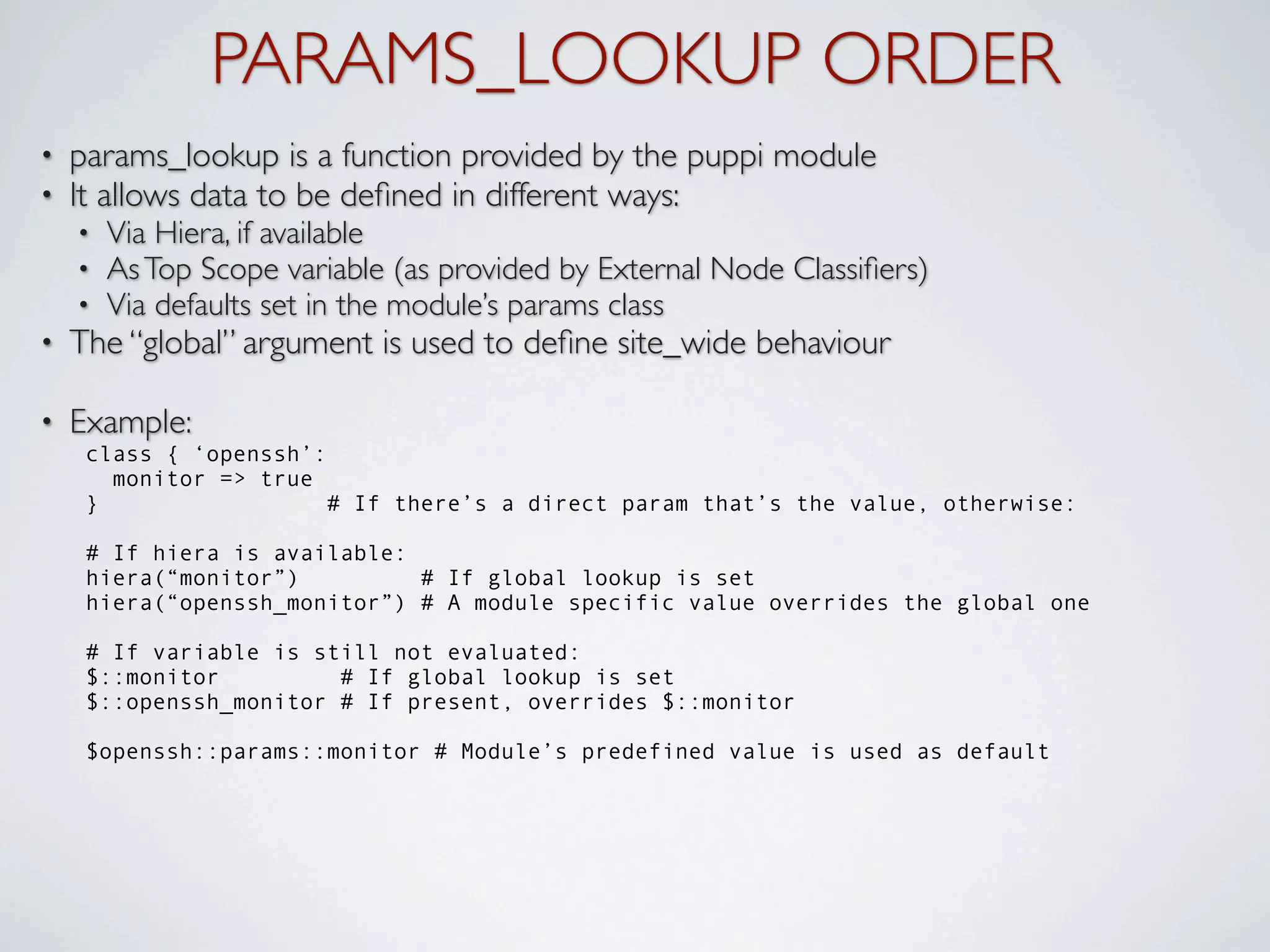
PARAMS_LOOKUP ORDER
•   params_lookup is a function provided by the puppi module
•   It allows data to be defined in different ways:
    •   Via Hiera, if available
    •   As Top Scope variable (as provided by External Node Classifiers)
    •   Via defaults set in the module’s params class
•   The “global” argument is used to define site_wide behaviour

•   Example:
     class { ‘openssh’:
       monitor => true
     }                  # If there’s a direct param that’s the value, otherwise:

     # If hiera is available:
     hiera(“monitor”)         # If global lookup is set
     hiera(“openssh_monitor”) # A module specific value overrides the global one

     # If variable is still not evaluated:
     $::monitor         # If global lookup is set
     $::openssh_monitor # If present, overrides $::monitor

     $openssh::params::monitor # Module’s predefined value is used as default
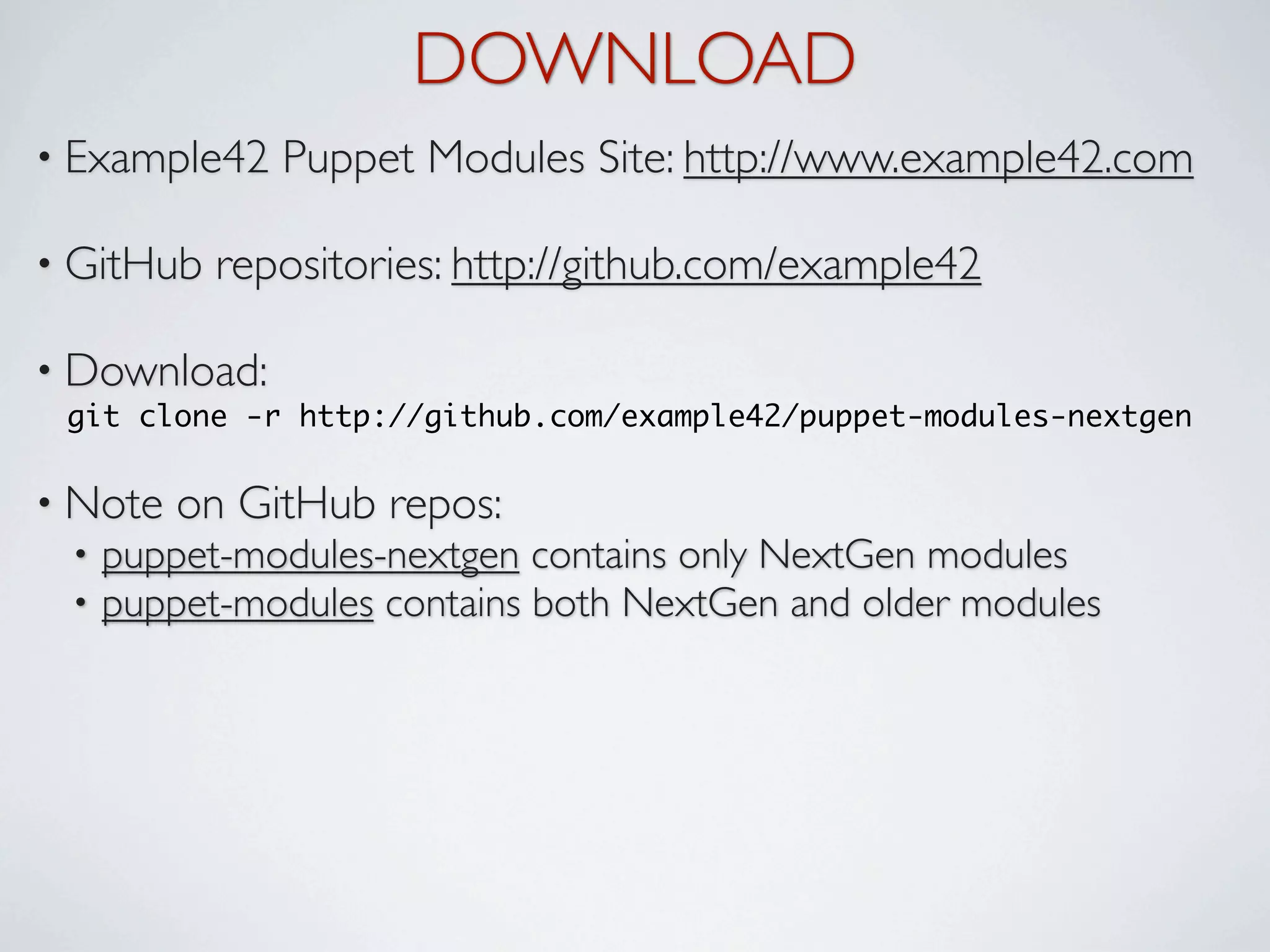
DOWNLOAD
• Example42   Puppet Modules Site: http://www.example42.com

• GitHub   repositories: http://github.com/example42

• Download:
 git clone -r http://github.com/example42/puppet-modules-nextgen

• Note   on GitHub repos:
 •   puppet-modules-nextgen contains only NextGen modules
 •   puppet-modules contains both NextGen and older modules
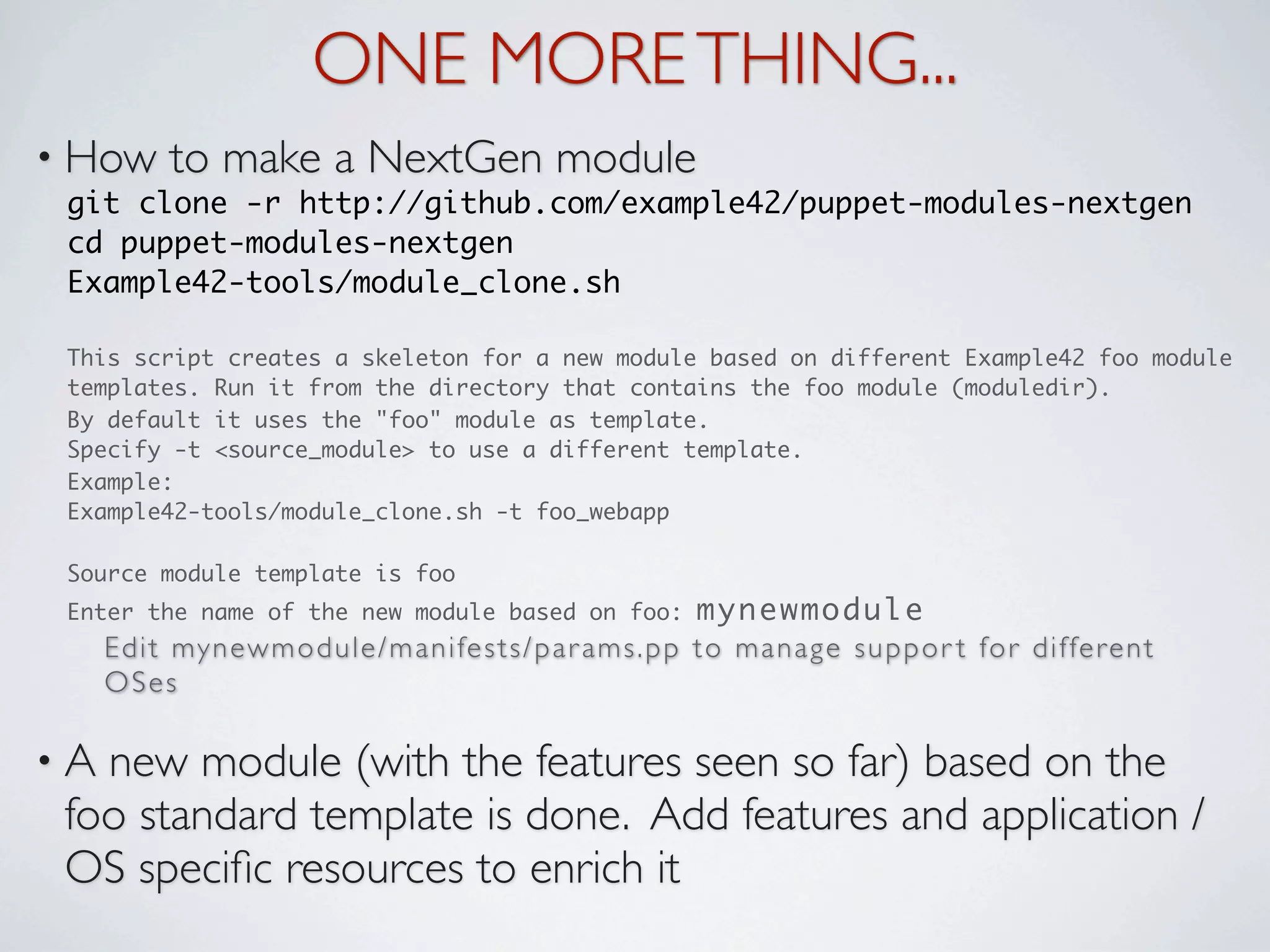
ONE MORE THING...
• How       to make a NextGen module
 git clone -r http://github.com/example42/puppet-modules-nextgen
 cd puppet-modules-nextgen
 Example42-tools/module_clone.sh

 This script creates a skeleton for a new module based on different Example42 foo module
 templates. Run it from the directory that contains the foo module (moduledir).
 By default it uses the "foo" module as template.
 Specify -t <source_module> to use a different template.
 Example:
 Example42-tools/module_clone.sh -t foo_webapp

 Source module template is foo
 Enter the name of the new module based on foo:                          mynewmodule
     E d i t my n e w m o d u l e / m a n i fe s t s / p a r a m s . p p t o m a n a g e s u p p o r t fo r d i f fe r e n t
     OSes

•A new module (with the features seen so far) based on the
 foo standard template is done. Add features and application /
 OS specific resources to enrich it

Puppet Modules: An Holistic Approach - Alessandro Franceschi of Lab42 - PuppetCamp Dublin '12

  • 1.
    PUPPET MODULES: AN HOLISTICAPPROACH PuppetCamp Dublin 2012 Alessandro Franceschi
  • 2.
    LAB 42 • 2007 - Meet Puppet. Managed the Bank of Italy webfarm • 2008 - First generation of Lab42 Puppet Modules • 2009 - Multi OS support and standardization of the modules • 2010 - A redesigned and coherent Example42 Module set Puppet Modules Standards and Interoperability (PuppetCamp Europe 2010 - Belgium) Re-Use your Modules! (PuppetCamp 2010 - San Francisco) • 2011 - Introducing Puppi Puppi: Puppet strings to the shell (PuppetCamp Europe 2011 - Amsterdam) • 2012 - Example42 Next Gen modules Developing IT Infrastructures with Puppet (CodeMotion 2012 - Rome)
  • 3.
    WE ALL LOVE AND USE PUPPET FOR • Systems Configuration • (Automatic) Monitoring based on specific tools • Facts based Inventory • Manage, at times, Applications deployments • Infrastructure Orchestration (coupled with MCollective)
  • 4.
    WE LIKE TO EXTEND PUPPET TO • Abstract Automatic Monitoring (whatever the tool) • Automatic Firewalling • Standardize Applications deployments • Enrich Systems Inventory • Shell Extension (“Puppet Knowledge to the CLI”) • Provide a coherent and integrated modules ecosystem
  • 5.
    PUPPET MODULES MANTRAS • Data Separation • Configuration data is defined outside the module (or Puppet manifests) • Module’s behavior is managed via APIs • Reusability • ReUse the same module in different shops • Customize its behavior without changing its code • Do not force how configurations are provided • Standardization • Follow PuppetLabs layout guidelines (puppet-lint) • Have a coherent, predictable and intuitive interface • Provide contextual documentation (puppet-doc) • Interoperability • Limit dependencies. Allow modules’ cherry picking • Be self contained, do not interfere with other modules’ resources • Cross Operating System support • Provide sensible defaults for different OSes • Allow easy implementation of support of new OSes
  • 6.
    EXAMPLE42 NEXT GEN • Coherent and Standardized structure • Best Practices module design (with some tweaks...) • Easily extendable Cross OS support • Complete API exposure via parameters • Extreme Customizations options • Alternative Data Separation options • Complete Decommissioning features • Optional Automatic Monitoring Abstraction • Optional Automatic Firewalling • Optional Puppi support to enhance the CLI experience • Exhaustive PuppetDoc documentation • Integrated Rspec-Puppet tests • Code Puppet-Lint compliant • Quick module scaffolding based on different templates ... not exactly easy to read....
  • 7.
    BASIC USAGE • One Module. One Application. One main class. • Install openssh with default settings: class { 'openssh': } • Equivalent to: include openssh • Default behavior: • Install package • Run and enable service • Do not alter configurations
  • 8.
    DATA INPUT ALTERNATIVES •Set (top scope/ENC) variables and include classes: $::openssh_template = 'site/openssh/openssh.conf.erb' include openssh • Use Hiera: hiera(‘openssh_template’) include openssh • Use parametrized classes: class { 'openssh':  template => 'site/openssh/openssh.conf.erb', } • Happily mix different patterns: $::monitor = true $::monitor_tool = [ 'nagios' , 'munin' , 'puppi' ] class { 'openssh':  template => 'site/openssh/openssh.conf.erb', }
  • 9.
    DECOMMISSIONING • Disable openssh service: class { 'openssh': disable => true } • Disable openssh service only at boot time: class { 'openssh': disableboot => true } • Remove openssh (package and files): class { 'openssh': absent => true } • Monitoring and firewalling resources removal is automatically managed
  • 10.
    MANAGE BEHAVIOR • EnableAuditing: class { 'openssh': audit_only => true, # Default: false } (No changes to configuration files are made and what would be done is audited) • Disable service autorestart: class { 'openssh': service_autorestart => false, # Default: true } (No automatic service restart when a configuration file / dir changes) • Manage software version: class { 'foo': version => ‘1.2.0’, # Default: unset } Specify the package version you want to be installed. Set => ‘latest’ to force installation of latest version
  • 11.
    CUSTOMIZE: CONFIGURATION FILE •Provide configuration as a static file ... class { 'openssh': source => ‘puppet:///modules/site/ssh/sshd.conf’, } • an array of files looked up on a first match logic ... class { 'openssh': source => ["puppet:///modules/site/ssh/sshd.conf-${fqdn}", "puppet:///modules/site/ssh/openssh.conf"], } • As an erb template: class { 'openssh': template => ‘site/ssh/sshd.conf.erb’, } • Config File Path is defined in params.pp (can be overriden): config_file = >’/etc/ssh/sshd_config’,
  • 12.
    CUSTOM OPTIONS • With templates you can provide an hash of custom options: class { 'openssh': template => ‘site/ssh/sshd.conf.erb’, options => { 'LogLevel' => 'INFO', 'UsePAM' => 'yes', }, } • Alternative ways to use the options hash in an erb template: • Direct but not safe (you must always provide all the used options) UsePAM <%= options['UsePAM'] %> • Failsafe with defaults (verbose but safe) <% if scope.lookupvar("openssh::options['UsePAM']") then -%> UsePAM <%= options['UsePAM'] %> <% else -%> UsePAM no <% end -%> • Show what you have (useful for config files has defaults for every option) <% scope.lookupvar("openssh::options").sort_by {|key, value| key}.each do |key, value| -%> <%= key %> <%= value %> <% end -%>
  • 13.
    CUSTOMIZE: CONFIGURATION DIR •You can manage the whole configuration directory: class { 'openssh': source_dir => ‘puppet:///modules/site/ssh/sshd/’, } This copies all the files in lab42/files/ssh/sshd/* to local config_dir • Youcan purge any existing file on the destination config_dir which are not present on the source_dir path: class { 'openssh': source_dir => ‘puppet:///modules/site/ssh/sshd/’, source_dir_purge => true, # default is false } WARNING: Use with care • Config Dir Path is defined in params.pp (can be overriden): config_dir = >’/etc/ssh’,
  • 14.
    CUSTOMIZE: CUSTOM CLASS •Provide added resources in a custom class: class { 'openssh': my_class => ‘site/my_openssh’, } This autoloads: site/manifests/my_openssh.pp • Custom class can have whatever you may need to add: class site::my_openssh { file { "motd": path => "/etc/motd", content => template("site/openssh/motd.erb"), } } You hardly need to inherit openssh: there are parameters for everything Do not call your class site::openssh, bad things may happen.
  • 15.
    CUSTOMIZE: PATHS ANDNAMES • An example: Use the puppet module to manage pe-puppet! class { 'puppet': template => 'lab42/pe-puppet/puppet.conf.erb', package => 'pe-puppet', service => 'pe-puppet', service_status => true, config_file => '/etc/puppetlabs/puppet/puppet.conf', config_file_owner => 'root', config_file_group => 'root', config_file_init => '/etc/sysconfig/pe-puppet', process => ‘ruby’, process_args => ‘puppet’, process_user => ‘root’, config_dir => '/etc/puppetlabs/puppet/', pid_file => '/var/run/pe-puppet/agent.pid', log_file => '/var/log/pe-puppet/puppet.log', log_dir => '/var/log/pe-puppet', }
  • 16.
    EXTEND: MONITOR • Manage automatic monitoring: class { 'openssh': monitor => true, monitor_tool => [ ‘nagios’,‘puppi’,‘monit’ ], monitor_target => $::ip_addess # Default } • Monitoring is based on parameters defined in params.pp: port => ‘22’, protocol => ‘tcp’, service => ‘ssh[d]’, # According to OS process => ‘sshd’, process_args => ‘‘, process_user => ‘root‘, pid_file => ‘/var/run/sshd.pid’, • Abstraction is managed in the Example42 monitor module Here “connectors” for different monitoring tools are defined and can be added (also using 3rd party modules).
  • 17.
    EXTEND: FIREWALL • Manage automatic firewalling (host based): class { 'openssh': firewall => true, firewall_tool => ‘iptables’, firewall_src => '10.0.0.0/8', firewall_dst => $::ipaddress_eth1, # Default is $::ipaddress } • Firewallig is based on these parameters defined in params.pp: port => ‘22’, protocol => ‘tcp’, • Abstraction is managed in the Example42 firewall module Currently only the “iptables” firewall_tool is defined, it uses Example42 iptables module to manage local iptables rules
  • 18.
    EXTEND: PUPPI • Manage Puppi integration: class { 'openssh': puppi => true, # Default: false puppi_helper => ‘standard’ # Default } • The Puppi module is a prerequisite for all Example42 modules Is required because it provides common libs, widely used in the modules BUT the actual puppi integration is optional (and disabled by default) • Puppi integration allows CLI enrichment commands like: puppi info openssh puppi log openssh puppi check openssh Note: puppi support for info/log commands for NextGen modules is under development • Puppi helpers allow you to customize puppi behavior
  • 19.
    PARAMS_LOOKUP EVERYWHERE • Each parameter on NextGen class is passed via params_lookup class openssh ( [...] # openssh module specific parameters ...   $my_class = params_lookup( 'my_class' ),   $source = params_lookup( 'source' ),   $source_dir = params_lookup( 'source_dir' ),   $source_dir_purge = params_lookup( 'source_dir_purge' ),   $template = params_lookup( 'template' ),   $service_autorestart = params_lookup( 'service_autorestart' , 'global' ),   $options = params_lookup( 'options' ),   $version = params_lookup( 'version' ),   $absent = params_lookup( 'absent' ),   $disable = params_lookup( 'disable' ),   $disableboot = params_lookup( 'disableboot' ),   $monitor = params_lookup( 'monitor' , 'global' ),   $monitor_tool = params_lookup( 'monitor_tool' , 'global' ),   $monitor_target = params_lookup( 'monitor_target' , 'global' ), [...] # Other common parameters   ) inherits openssh::params { [...] } • Different kind of params that: • Are module specific (no one defined in this openssh module) • Allow customizations (my_class, source, template ...) • Affect module’s behavior (absent, disable, service_autorestart, audit_only ...) • Manage extensions (monitor, monitor_tool, firewall, puppi ...) • Define application data (port, config_file, process, package ... )
  • 20.
    PARAMS.PP • Each module has a params class where defaults are set for different OS class openssh::params { ### Application related parameters   $package = $::operatingsystem ? {     default => 'openssh-server',   }   $service = $::operatingsystem ? {     /(?i:Debian|Ubuntu|Mint)/ => 'ssh',     default => 'sshd',   }   $process = $::operatingsystem ? {     default => 'sshd',   } [...] $port = '22'   $protocol = 'tcp' # General Settings   $my_class = ''   $source = ''   $source_dir = ''   $source_dir_purge = '' [...] ### General module variables that can have a site or per module default   $monitor = false   $monitor_tool = ''   $monitor_target = $::ipaddress   $firewall = false   $firewall_tool = ''   $firewall_src = '0.0.0.0/0' [...] }
  • 21.
    PARAMS_LOOKUP ORDER • params_lookup is a function provided by the puppi module • It allows data to be defined in different ways: • Via Hiera, if available • As Top Scope variable (as provided by External Node Classifiers) • Via defaults set in the module’s params class • The “global” argument is used to define site_wide behaviour • Example: class { ‘openssh’: monitor => true } # If there’s a direct param that’s the value, otherwise: # If hiera is available: hiera(“monitor”) # If global lookup is set hiera(“openssh_monitor”) # A module specific value overrides the global one # If variable is still not evaluated: $::monitor # If global lookup is set $::openssh_monitor # If present, overrides $::monitor $openssh::params::monitor # Module’s predefined value is used as default
  • 22.
    DOWNLOAD • Example42 Puppet Modules Site: http://www.example42.com • GitHub repositories: http://github.com/example42 • Download: git clone -r http://github.com/example42/puppet-modules-nextgen • Note on GitHub repos: • puppet-modules-nextgen contains only NextGen modules • puppet-modules contains both NextGen and older modules
  • 23.
    ONE MORE THING... •How to make a NextGen module git clone -r http://github.com/example42/puppet-modules-nextgen cd puppet-modules-nextgen Example42-tools/module_clone.sh This script creates a skeleton for a new module based on different Example42 foo module templates. Run it from the directory that contains the foo module (moduledir). By default it uses the "foo" module as template. Specify -t <source_module> to use a different template. Example: Example42-tools/module_clone.sh -t foo_webapp Source module template is foo Enter the name of the new module based on foo: mynewmodule E d i t my n e w m o d u l e / m a n i fe s t s / p a r a m s . p p t o m a n a g e s u p p o r t fo r d i f fe r e n t OSes •A new module (with the features seen so far) based on the foo standard template is done. Add features and application / OS specific resources to enrich it