Nicol van Dyk
Rehabilitation Department
Aspetar Sports Medicine and Orthopaedic Hospital
Criteria based progression
Rehabilitation Protocol
for
Hamstring Strain Injury
Acknowledgment
• Concurrent study with large RCT
• Main contributors
– Patrice Muxart
– Philipp Jacobsen
– Anne van der Made
– Arnlaug Wangensteen
– Rod Whiteley
Outline of this presentation
Criteria based progression algorhythm
Clinical predictors for RTS
Re-injury risk
Outline of this presentation
Criteria based progression algorhythm
Clinical predictors for RTS
Re-injury risk
Case presentation
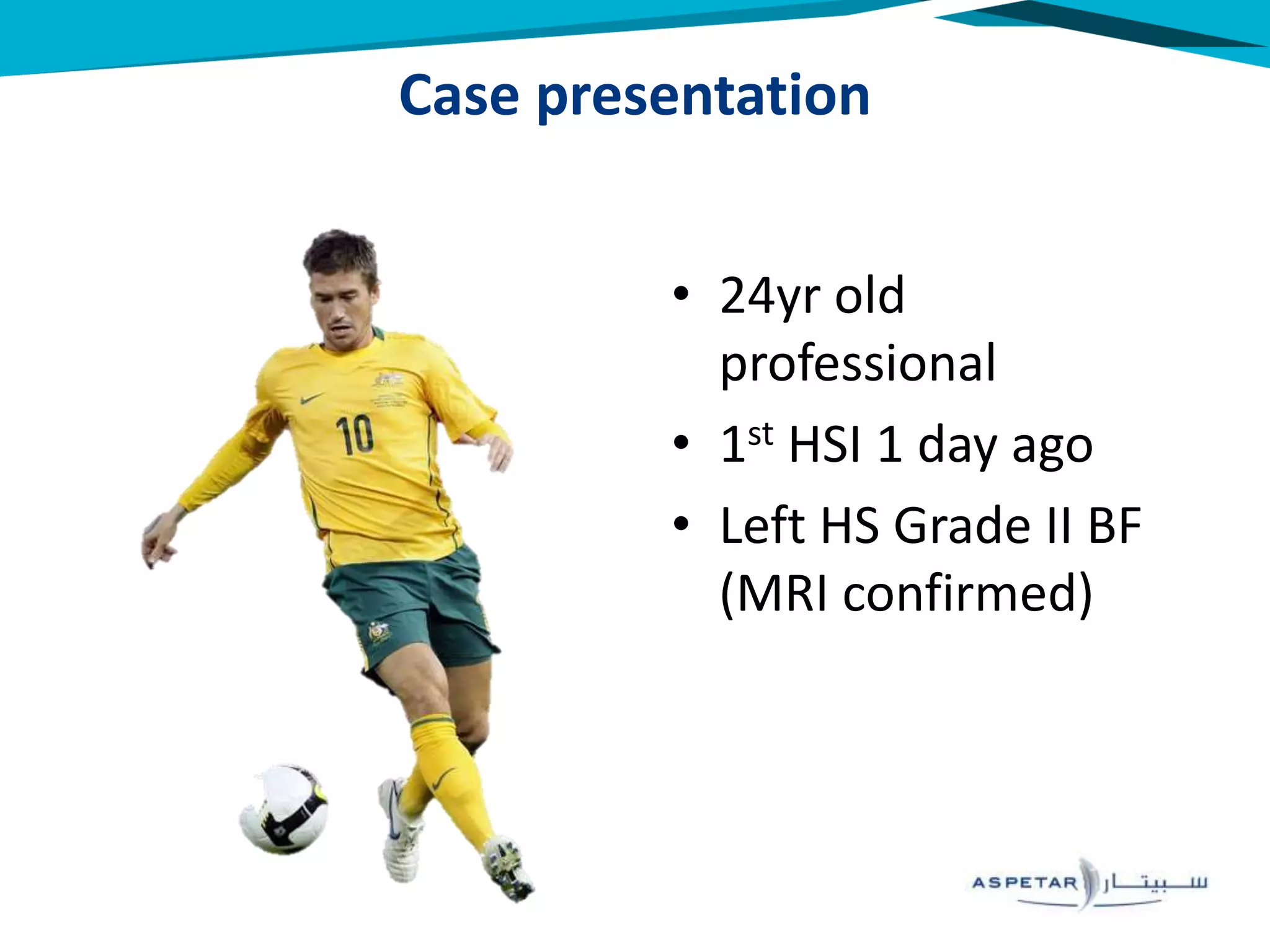
• 24yr old
professional
• 1st HSI 1 day ago
• Left HS Grade II BF
(MRI confirmed)
Rehabilitation Protocol
• Options:
– Time based
– Criteria based
Overview
• What we did
– CRITERIA BASED PROGRESSION
– Assessment protocol
– Treatment protocol
•HSI Grade I & II
What we measure and why
Clinical reasoning for progression
n>150
RTS ~23 days (15-31)
6% recurrence
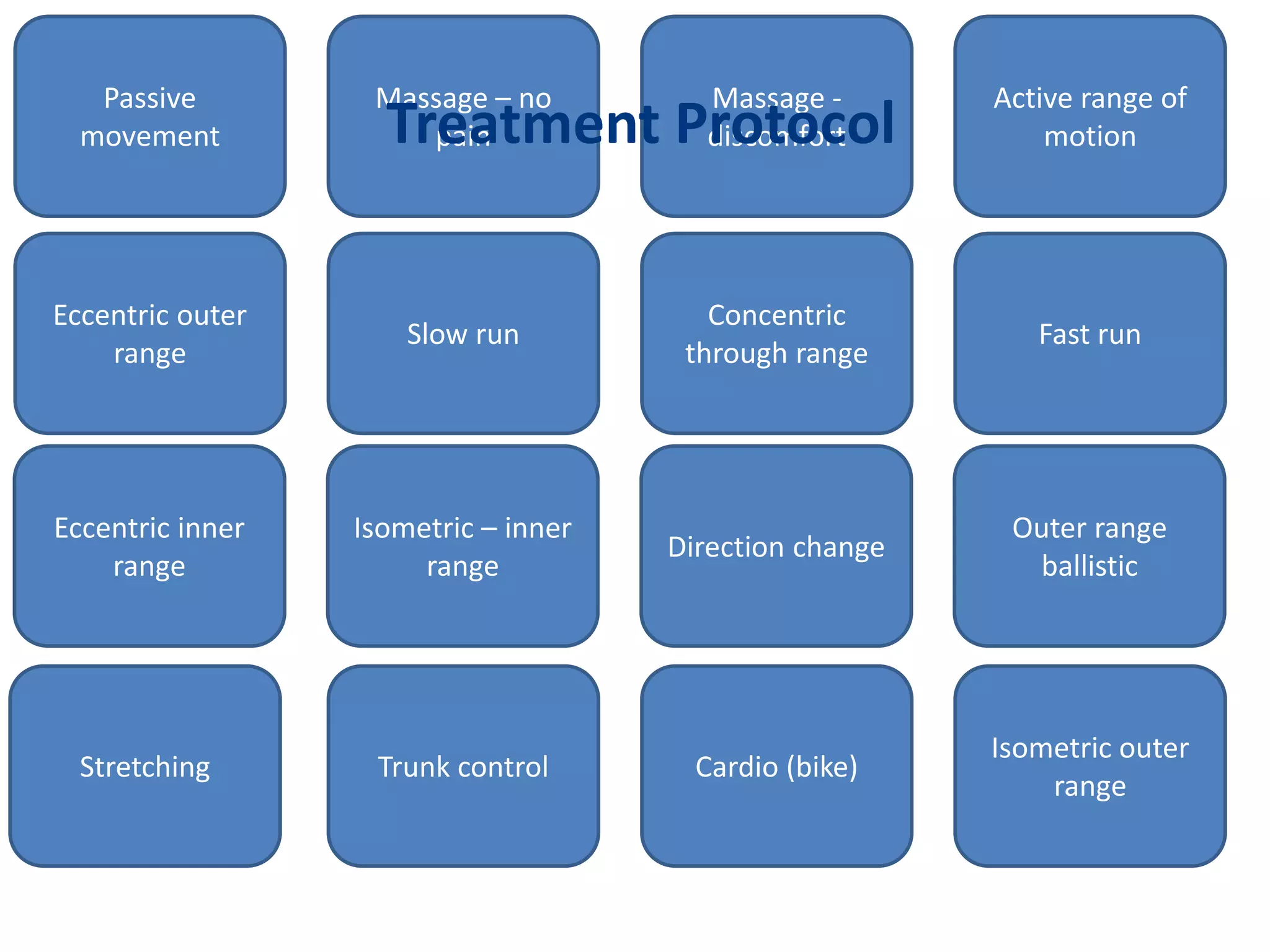
Passive
movement
Massage – no
pain
Massage -
discomfort
Active range of
motion
Eccentric outer
range
Slow run
Concentric
through range
Fast run
Eccentric inner
range
Isometric – inner
range
Direction change
Outer range
ballistic
Stretching Trunk control Cardio (bike)
Isometric outer
range
Treatment Protocol
Cardio (bike)
Massage -
discomfort
Eccentric outer
range
Slow run
Concentric
through range
Fast run
Eccentric inner
range
Isometric – inner
range
Direction change
Outer range
ballistic
StretchingTrunk control
Isometric outer
range
2Run > 70%
ROM SLR & HS Θ > 75%
3100% running
Painless direction change
Passive
movement
Massage – no
pain
Active range of
motion
1Painless single leg squat
Painless bike 2XBW, 5 mins
Full knee Ext supine
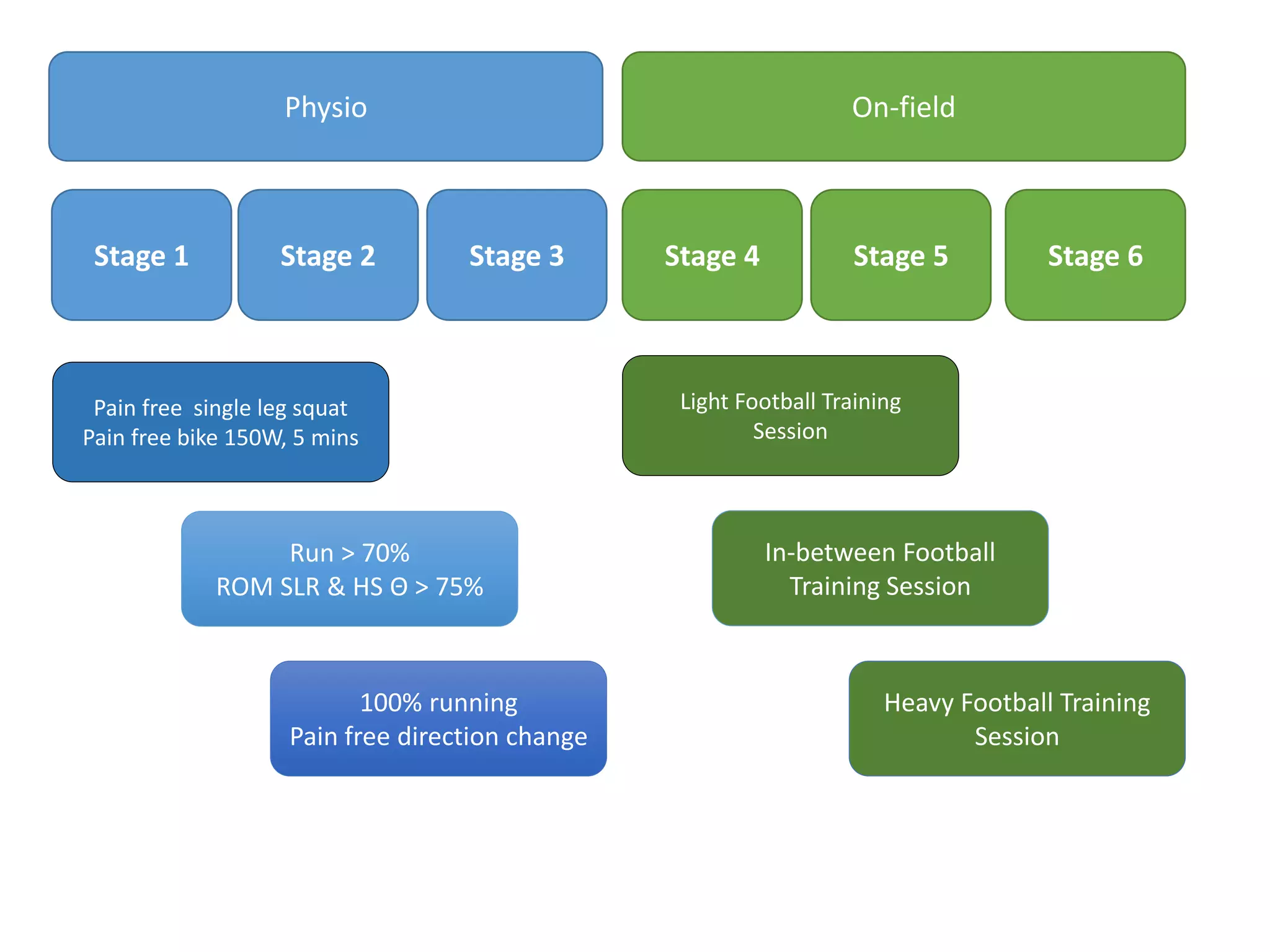
Physio On-field
Stage 1 Stage 2 Stage 3 Stage 4 Stage 5 Stage 6
Pain free single leg squat
Pain free bike 150W, 5 mins
Run > 70%
ROM SLR & HS Θ > 75%
100% running
Pain free direction change
Light Football Training
Session
In-between Football
Training Session
Heavy Football Training
Session
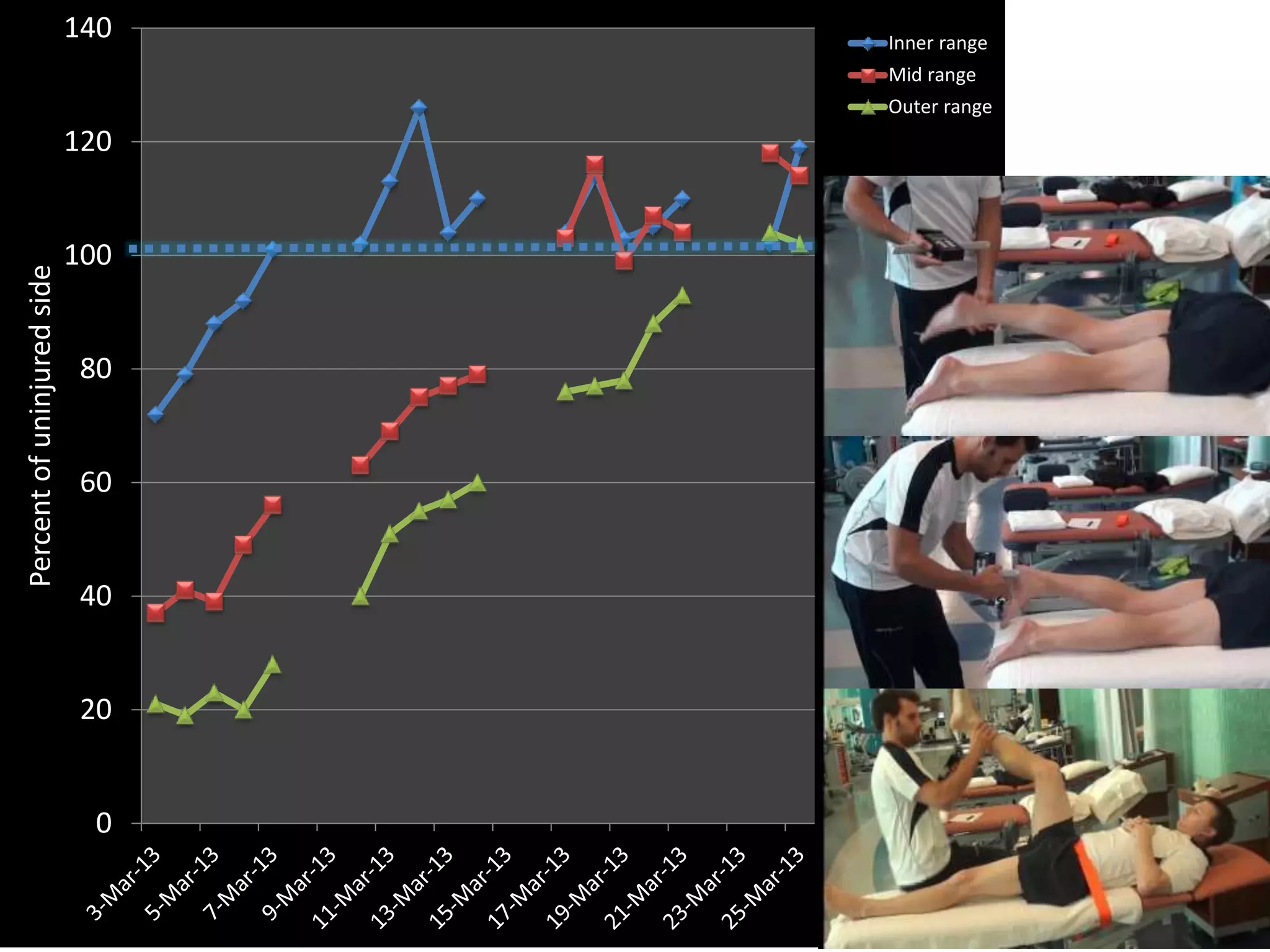
Principles (after experience)
• Reassess and
compare:
• Same or better –
Push Harder!
• Worse –
Too Much!
0
20
40
60
80
100
120
140Percentofuninjuredside Inner range
Mid range
Outer range
The problem is the solution
• Sports-specific replication of running:
– Volume
– Intensity
– Mechanics
Gait
• Walk
• Jog
• Run
• Triple extension
• Late swing (“A
drill”)
• Direction change
4 laps =8 ‘sprints’ X 3 sets
~ 700m
11s → 3.1 s
10% → 100%
3 reps
12s → 9s
60% → 100%
Physio On-field
Stage 1 Stage 2 Stage 3 Stage 4 Stage 5 Stage 6
Painless single leg squat
Painless bike 150W, 5 mins
Run > 70%
ROM SLR & HS Θ > 75%
100% running
Painless direction change
Light Football Training
Session
In-between Football
Training Session
Heavy Football Training
Session
Criteria based progression algorhythm
Clinical predictors for RTS
Re-injury risk
Outline of this presentation
“When can I play again?”
Study N Intervention Control
PEDro
score Effect
Cibulka (1986) 20 SI manipulation No 5/10 =
Kronberg & Lew (1989) 28 SLUMP stretching ‘Normal’ stretching 3/10 +
Malliaropoulos (2004) 80 ‘Intensive’ stretching ‘Normal’ stretching 4/10 +
Sherry & Best (2004) 24 Core stability + agility Stretching+ strength 7/10 +
Silder et al. (2013) 31 Core stability + agility Running + eccentric 5/10 =
Askling et al. (2013) 75 Lengthening exercises Conventional 6/10 +
Askling et al. (2014) 65 6/10 +
Cochrane (2012)
Stretching
(daily)
Intensive stretching
(4x daily) =
323
Return to Sport (RTS) after HSI
• Similar Grading
• Similar sporting requirements
1 - >50weeks reported
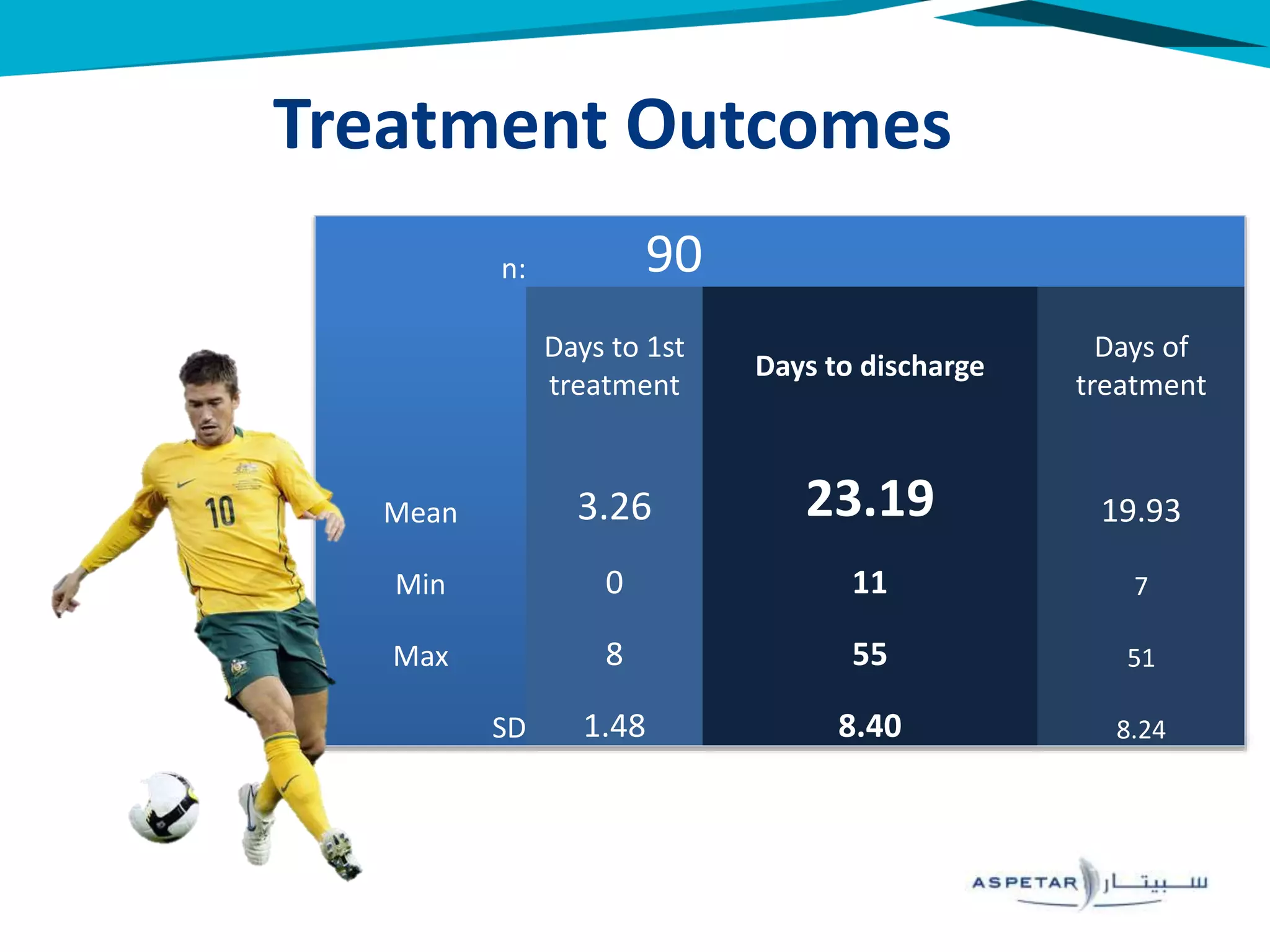
Treatment Outcomes
n: 90
Days to 1st
treatment
Days to discharge
Days of
treatment
Mean 3.26 23.19 19.93
Min 0 11 7
Max 8 55 51
SD 1.48 8.40 8.24
Regression Analysis
• Best subsets
• Adjusted R2
• Overfitting
Regression Analysis
• Initial Exam
– 50.3% variance explained (± 23 days)
• MRI parameters
– 8.6% variance explained (± 40 days)
• Initial Exam & MRI
–3% extra variance explained
Results
X
X
X
Results
Week 1 Exam
97%variance explained (± 5 days)
`
√
Outer
Range P
with strength test
Max P @ injury
Delay start of treatment
Peak Torque HS CON 60°/s
Playing football
Single leg
Bridge
Week 1∆ Mid Range Strength
Inner range strength
injured leg
Outer Range
strength %
Pain free walking
Regression Equation Week 1
Outline of this presentation
Criteria based progression algorhythm
Clinical predictors for RTS
Re-injury risk
Predictors of Recurrence?
• 6/90 (6%)
50
100
150
200
250
300
1 2
PeakTorque(N.m)
Isokinetic Strength at discharge
(Recurrence/No Recurrence)
Quads 60°/s Con Uninj
Quads 60°/s Con Inj
Hams 60°/s Con Uninj
Hams 60°/s Con Inj
Hams 60°/s Ecc Uninj
Take home message
• Start treatment early
• Length of pain
(palpation)
• Max P at the time of
injury
• Strength Mid Range
• (outer if you can)
• Length of pain
(palpation)
• Single leg bridge
• Hamstring strength
(compared to other
side) and P
• Strength Outer Range
INITIAL EXAM
WEEK 1 EXAM
• Askling C, Saartok T, Thorstensson A. Type of acute hamstring strain affects flexibility, strength, and time
• to return to pre-injury level. Br J Sports Med 2006; 40(1):40-44.
• Askling CM, Nilsson J, Thorstensson A. A new hamstring test to complement the common clinical
• examination before return to sport after injury. Knee Surg Sports Traumatol Arthrosc 2010; 18(12):1798-
• 1803.
• Opar, DA, Piatkowski, T, Williams, MD, Shield, AJ. A Novel Device Using the Nordic Hamstring Exercise to
• Asess Eccentric
• Reurink G, Goudswaard GJ, Oomen HG, et al. Reliability of the Active and Passive Knee Extension Test in
• Acute Hamstring Injuries. Am J Sports Med Published Online First: 4 June 2013.
• doi:10.1177/0363546513490650
• Pincivero, Lephart, & Karunakara, 1997
• Schneider-Kolsky ME, Hoving JL, Warren P, Connell DA. A comparison between clinical assessment and
• magnetic resonance imaging of acute hamstring injuries. Am J Sports Med 2006; 34(6):1008-1015.
• Thorborg K, Bandholm T, Holmich P. Hip- and knee-strength assessments using a hand-held
• dynamometer with external belt-fixation are inter-tester reliable. Knee Surg Sports Traumatol Arthrosc
• 2013; 21(3):550-555.
• Tol et al 2014
• Whiteley et al (2012)_ Correlation of isokinetic and novel hand-held dynamometry measures of knee
• flexion and extension strength testing JSAMS
References

Sma 2015 hamstring symposium

  • 1.
    Nicol van Dyk RehabilitationDepartment Aspetar Sports Medicine and Orthopaedic Hospital Criteria based progression Rehabilitation Protocol for Hamstring Strain Injury
  • 3.
    Acknowledgment • Concurrent studywith large RCT • Main contributors – Patrice Muxart – Philipp Jacobsen – Anne van der Made – Arnlaug Wangensteen – Rod Whiteley
  • 4.
    Outline of thispresentation Criteria based progression algorhythm Clinical predictors for RTS Re-injury risk
  • 5.
    Outline of thispresentation Criteria based progression algorhythm Clinical predictors for RTS Re-injury risk
  • 6.
    Case presentation • 24yrold professional • 1st HSI 1 day ago • Left HS Grade II BF (MRI confirmed)
  • 7.
    Rehabilitation Protocol • Options: –Time based – Criteria based
  • 8.
    Overview • What wedid – CRITERIA BASED PROGRESSION – Assessment protocol – Treatment protocol •HSI Grade I & II What we measure and why Clinical reasoning for progression n>150 RTS ~23 days (15-31) 6% recurrence
  • 9.
    Passive movement Massage – no pain Massage- discomfort Active range of motion Eccentric outer range Slow run Concentric through range Fast run Eccentric inner range Isometric – inner range Direction change Outer range ballistic Stretching Trunk control Cardio (bike) Isometric outer range Treatment Protocol
  • 10.
    Cardio (bike) Massage - discomfort Eccentricouter range Slow run Concentric through range Fast run Eccentric inner range Isometric – inner range Direction change Outer range ballistic StretchingTrunk control Isometric outer range 2Run > 70% ROM SLR & HS Θ > 75% 3100% running Painless direction change Passive movement Massage – no pain Active range of motion 1Painless single leg squat Painless bike 2XBW, 5 mins Full knee Ext supine
  • 11.
    Physio On-field Stage 1Stage 2 Stage 3 Stage 4 Stage 5 Stage 6 Pain free single leg squat Pain free bike 150W, 5 mins Run > 70% ROM SLR & HS Θ > 75% 100% running Pain free direction change Light Football Training Session In-between Football Training Session Heavy Football Training Session
  • 13.
    Principles (after experience) •Reassess and compare: • Same or better – Push Harder! • Worse – Too Much!
  • 14.
  • 15.
    The problem isthe solution • Sports-specific replication of running: – Volume – Intensity – Mechanics
  • 16.
    Gait • Walk • Jog •Run • Triple extension • Late swing (“A drill”) • Direction change 4 laps =8 ‘sprints’ X 3 sets ~ 700m 11s → 3.1 s 10% → 100% 3 reps 12s → 9s 60% → 100%
  • 17.
    Physio On-field Stage 1Stage 2 Stage 3 Stage 4 Stage 5 Stage 6 Painless single leg squat Painless bike 150W, 5 mins Run > 70% ROM SLR & HS Θ > 75% 100% running Painless direction change Light Football Training Session In-between Football Training Session Heavy Football Training Session
  • 18.
    Criteria based progressionalgorhythm Clinical predictors for RTS Re-injury risk Outline of this presentation
  • 19.
    “When can Iplay again?”
  • 21.
    Study N InterventionControl PEDro score Effect Cibulka (1986) 20 SI manipulation No 5/10 = Kronberg & Lew (1989) 28 SLUMP stretching ‘Normal’ stretching 3/10 + Malliaropoulos (2004) 80 ‘Intensive’ stretching ‘Normal’ stretching 4/10 + Sherry & Best (2004) 24 Core stability + agility Stretching+ strength 7/10 + Silder et al. (2013) 31 Core stability + agility Running + eccentric 5/10 = Askling et al. (2013) 75 Lengthening exercises Conventional 6/10 + Askling et al. (2014) 65 6/10 + Cochrane (2012) Stretching (daily) Intensive stretching (4x daily) = 323
  • 22.
    Return to Sport(RTS) after HSI • Similar Grading • Similar sporting requirements 1 - >50weeks reported
  • 23.
    Treatment Outcomes n: 90 Daysto 1st treatment Days to discharge Days of treatment Mean 3.26 23.19 19.93 Min 0 11 7 Max 8 55 51 SD 1.48 8.40 8.24
  • 24.
  • 25.
    • Best subsets •Adjusted R2 • Overfitting Regression Analysis
  • 26.
    • Initial Exam –50.3% variance explained (± 23 days) • MRI parameters – 8.6% variance explained (± 40 days) • Initial Exam & MRI –3% extra variance explained Results X X X
  • 27.
    Results Week 1 Exam 97%varianceexplained (± 5 days) ` √
  • 29.
    Outer Range P with strengthtest Max P @ injury Delay start of treatment Peak Torque HS CON 60°/s Playing football Single leg Bridge Week 1∆ Mid Range Strength Inner range strength injured leg Outer Range strength % Pain free walking Regression Equation Week 1
  • 30.
    Outline of thispresentation Criteria based progression algorhythm Clinical predictors for RTS Re-injury risk
  • 31.
    Predictors of Recurrence? •6/90 (6%) 50 100 150 200 250 300 1 2 PeakTorque(N.m) Isokinetic Strength at discharge (Recurrence/No Recurrence) Quads 60°/s Con Uninj Quads 60°/s Con Inj Hams 60°/s Con Uninj Hams 60°/s Con Inj Hams 60°/s Ecc Uninj
  • 32.
    Take home message •Start treatment early • Length of pain (palpation) • Max P at the time of injury • Strength Mid Range • (outer if you can) • Length of pain (palpation) • Single leg bridge • Hamstring strength (compared to other side) and P • Strength Outer Range INITIAL EXAM WEEK 1 EXAM
  • 33.
    • Askling C,Saartok T, Thorstensson A. Type of acute hamstring strain affects flexibility, strength, and time • to return to pre-injury level. Br J Sports Med 2006; 40(1):40-44. • Askling CM, Nilsson J, Thorstensson A. A new hamstring test to complement the common clinical • examination before return to sport after injury. Knee Surg Sports Traumatol Arthrosc 2010; 18(12):1798- • 1803. • Opar, DA, Piatkowski, T, Williams, MD, Shield, AJ. A Novel Device Using the Nordic Hamstring Exercise to • Asess Eccentric • Reurink G, Goudswaard GJ, Oomen HG, et al. Reliability of the Active and Passive Knee Extension Test in • Acute Hamstring Injuries. Am J Sports Med Published Online First: 4 June 2013. • doi:10.1177/0363546513490650 • Pincivero, Lephart, & Karunakara, 1997 • Schneider-Kolsky ME, Hoving JL, Warren P, Connell DA. A comparison between clinical assessment and • magnetic resonance imaging of acute hamstring injuries. Am J Sports Med 2006; 34(6):1008-1015. • Thorborg K, Bandholm T, Holmich P. Hip- and knee-strength assessments using a hand-held • dynamometer with external belt-fixation are inter-tester reliable. Knee Surg Sports Traumatol Arthrosc • 2013; 21(3):550-555. • Tol et al 2014 • Whiteley et al (2012)_ Correlation of isokinetic and novel hand-held dynamometry measures of knee • flexion and extension strength testing JSAMS References

Editor's Notes

  • #2 Thank you David and Tony for the invitation to be part of this symposium today. Its wonderful to be here, and thoroughly impressed by the researchers yesterday. Some wonderful work to aspire to. I will be giving you the run down of our criteria for progression in our rehab protocol.
  • #7 Now let’s imagine we have this scenario. Harry is a 24yr old football player with… What else would you like to know? What would you measure at the initial assessment, and perhaps one week later? How long do you think it would take for him to return to sport? 10d? 20d? 40d? Hold on to that thought and I’ll show you what we’ve come up with.
  • #9 The article on thi
  • #10 So we pooled together all the possible treatment modalities we could think we would use to treat HSI. Then we arranged them from easiest to hardest And it seemed like these exercises/treatments grouped themselves in 3 main stages Passive (soft tissue) Passive movement Active movement Stretching Strengthening Eccentric & Concentric Running Progression Functional
  • #11 So we pooled together all the possible treatment modalities we could think we would use to treat HSI. Then we arranged them from easiest to hardest And it seemed like these exercises/treatments grouped themselves in 3 main stages Passive (soft tissue) Passive movement Active movement Stretching Strengthening Eccentric & Concentric Running Progression Functional
  • #12 The actual program ended up being 6 stages
  • #13 Additionally we measure daily a number of features, all of which our regression equations showed to be useful. The strongest predictors are highlighted, and our clinical decisions (progress, ISQ, regress) are based on these features
  • #15 Daily monitoring of strength has been extremely useful to document the player’s recovery and later in rehabilitation the response to training
  • #18 The constraints of a randomized controlled trial forced us to include a lot of “on-field” work in the clinic (running progression in particular) bear this in mind. Here are our 6 stages and the criteria to progress between them
  • #20 Well, this is the question we are always asked, and usually it’s not only the player, but also the coach and the team management. How do we answer this question? Now I have already shown you our average time to return to sport was 23 days. Now how much play would you accept around that time prediction? 6 months? 3 months? 1 month? 2 weeks? 1 week? Less? If I say our average return to sport was around 23 days, how much
  • #22 PEDro score is
  • #23 In the literature, that is actually there is also a relatively broad answer. Now, do actually know why we measure certain things? Do we know if what we measure are important? This is exactly what we wanted to answer, and it is this question that we would like to focus on today: What do we measure, what measurements do we have to focus on?
  • #24 So remember this guy? How long did you think he would take to get back? Now if we had to say to him on day 1, we would say this based on the 90 subjects we have included.
  • #25 I am not sure how many stats junkies we have here today (I myself have to admit are fast becoming one), but I am not going to go into the statistical model too much. I do want to just explain it briefly.
  • #26 R-squared or the coefficient of determinination is used to denote how well data fit a specific model. In other words, does what I predict will happen actually happen? The VARIANCE is of course when it doesn’t work out exactly as predicted, and we often express how much of this variance we can explain also. In our case, we used a best subsets approach (which means we tried to determine which variables should be included by doing scatter plots of each one and depending on the kurtosis of the data, mean, medians and various measures of variance). But then we definitely overfitted the data. So as you can see here, we came up with a “too good to be true” scenario. So this is the one limitation to this analysis.
  • #27 So we looked at 3 different scenario’s, and this is what we could explain.
  • #29 What does this mean for us clinically?
  • #30 So this seems to be the indicators that we need to pay attention too. Now from that initial slide where we had all of them, these are the ones to pay attention to. Now, on the basis of 90 patients, I won’t tell you to discount 100 years of clinical experience, and at this stage we are still considering that. Although I would suggest that these are the ones we need to pay more attention to.