Please do us a favor…


 link us to a keyword.
            (c) New Leaves Clinic
Join us!
                        e-mail list
                       Sign up at New Leaves Clinic.com
            Notices of ASD professional & teen meetings


                   Facebook pages
                 New Leaves Clinic (LD, ADHD & ASD)
                             Karla’s ASD Page (ASD)


                     Copies of slides
        This set will be posted on NewLeavesClinic.com
     Educational Materials / Password: neurodiversity
                          (c) New Leaves Clinic
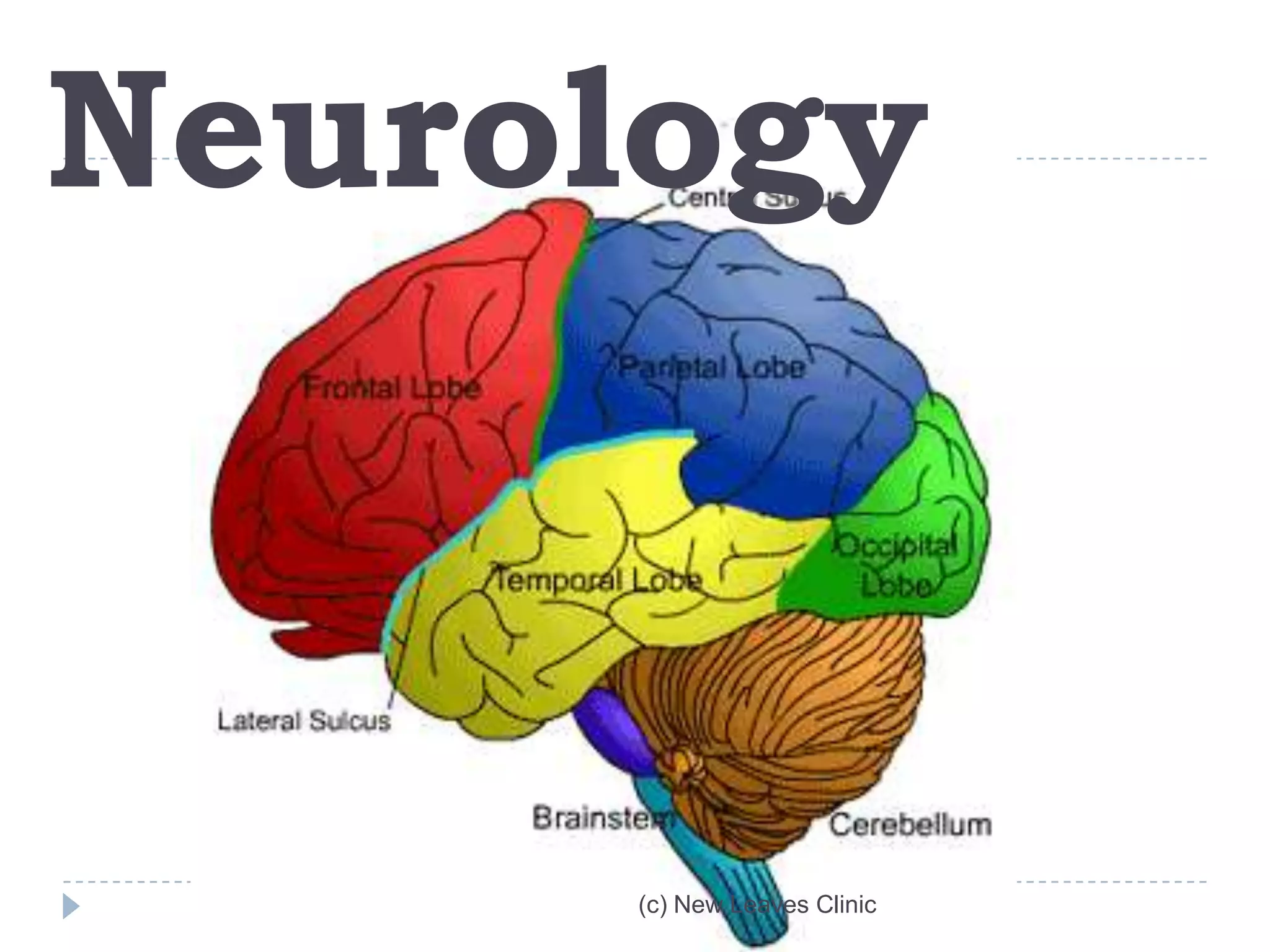
Neurology


      (c) New Leaves Clinic
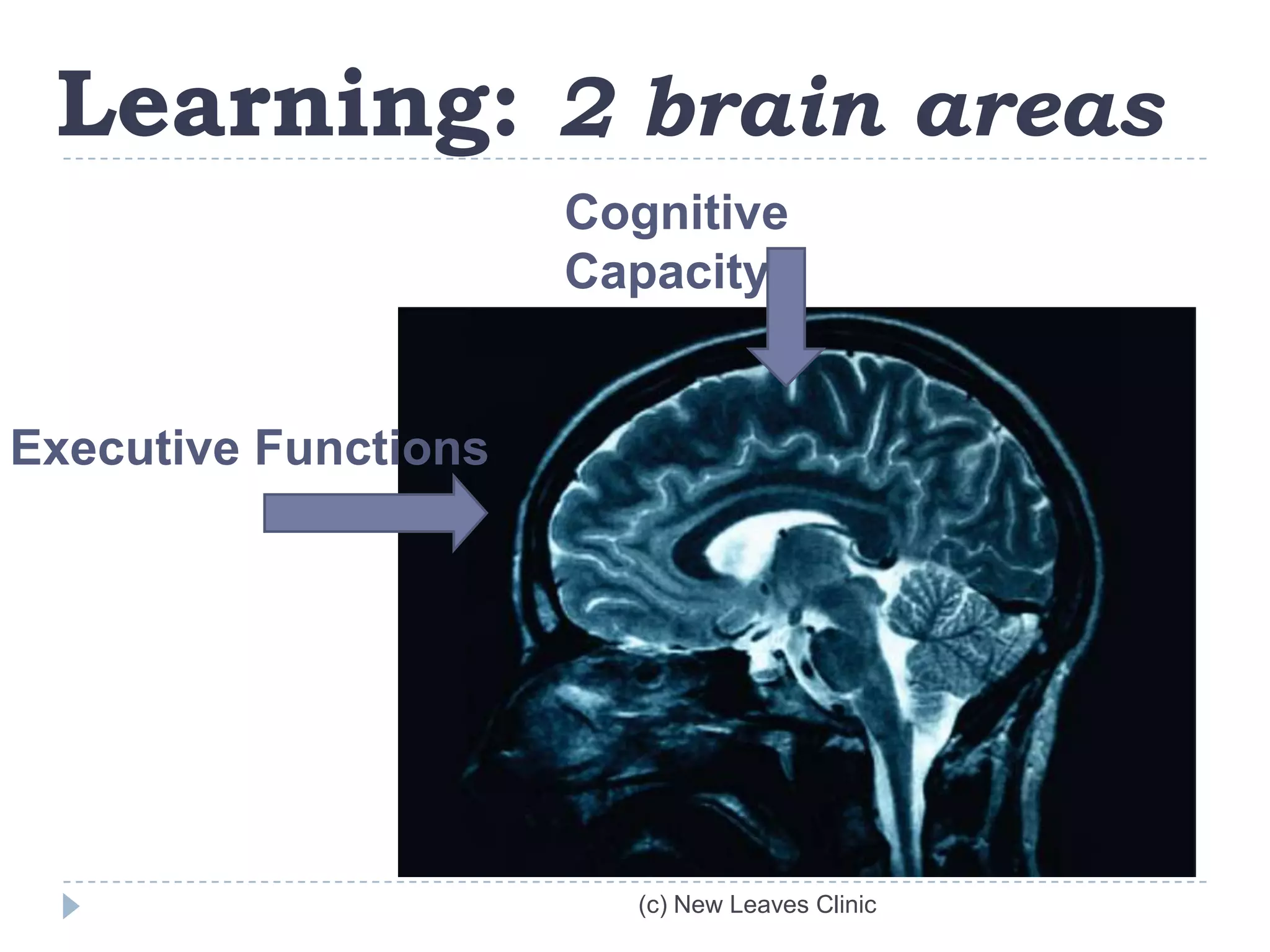
Learning: 2 brain areas
                      Cognitive
                      Capacity


Executive Functions


                        (c) New Leaves Clinic
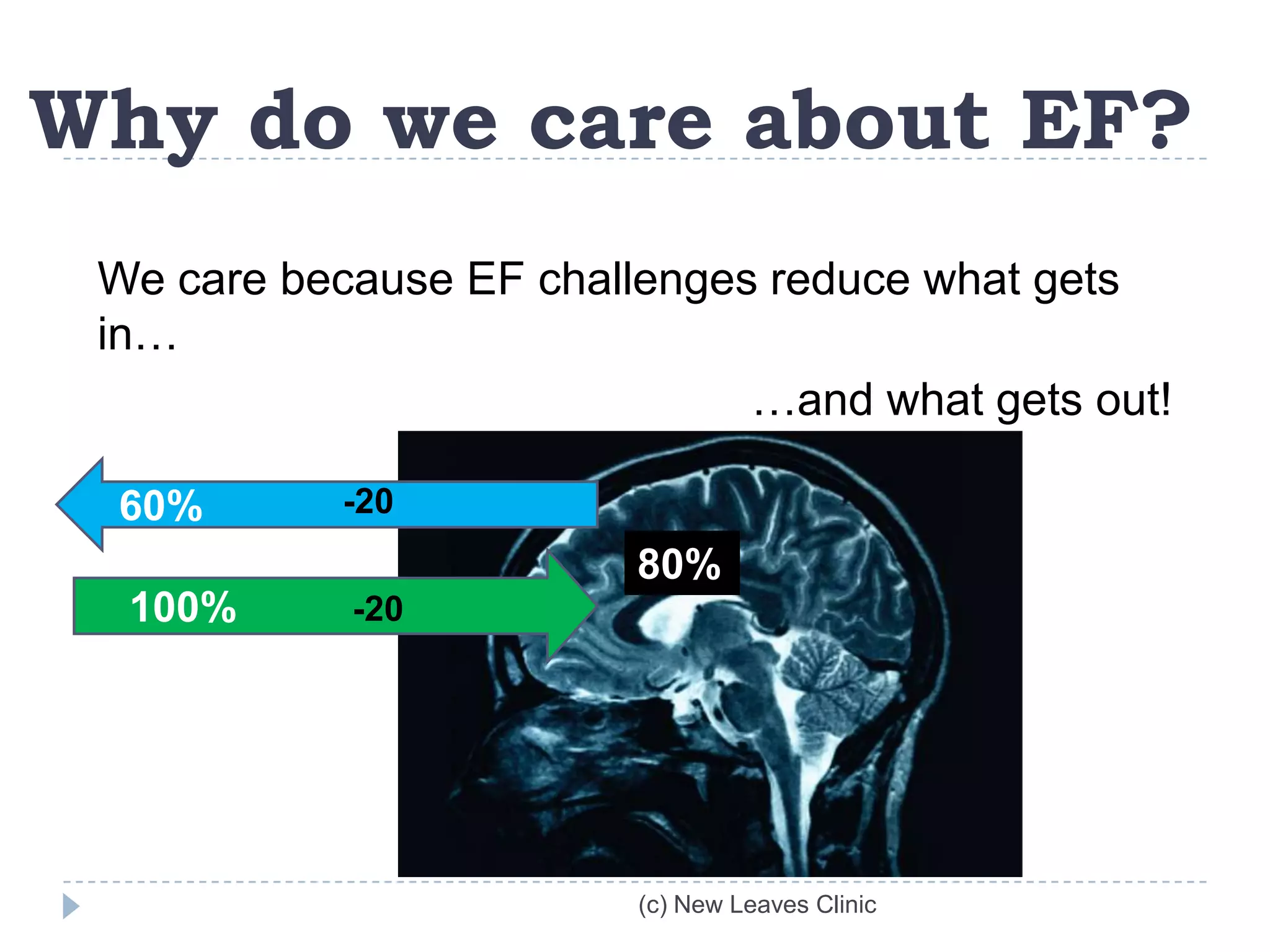
Why do we care about EF?
 We care because EF challenges reduce what gets
 in…
                              …and what gets out!

 60%       -20
                         80%
  100%      -20


                         (c) New Leaves Clinic
© New Leaves Clinic


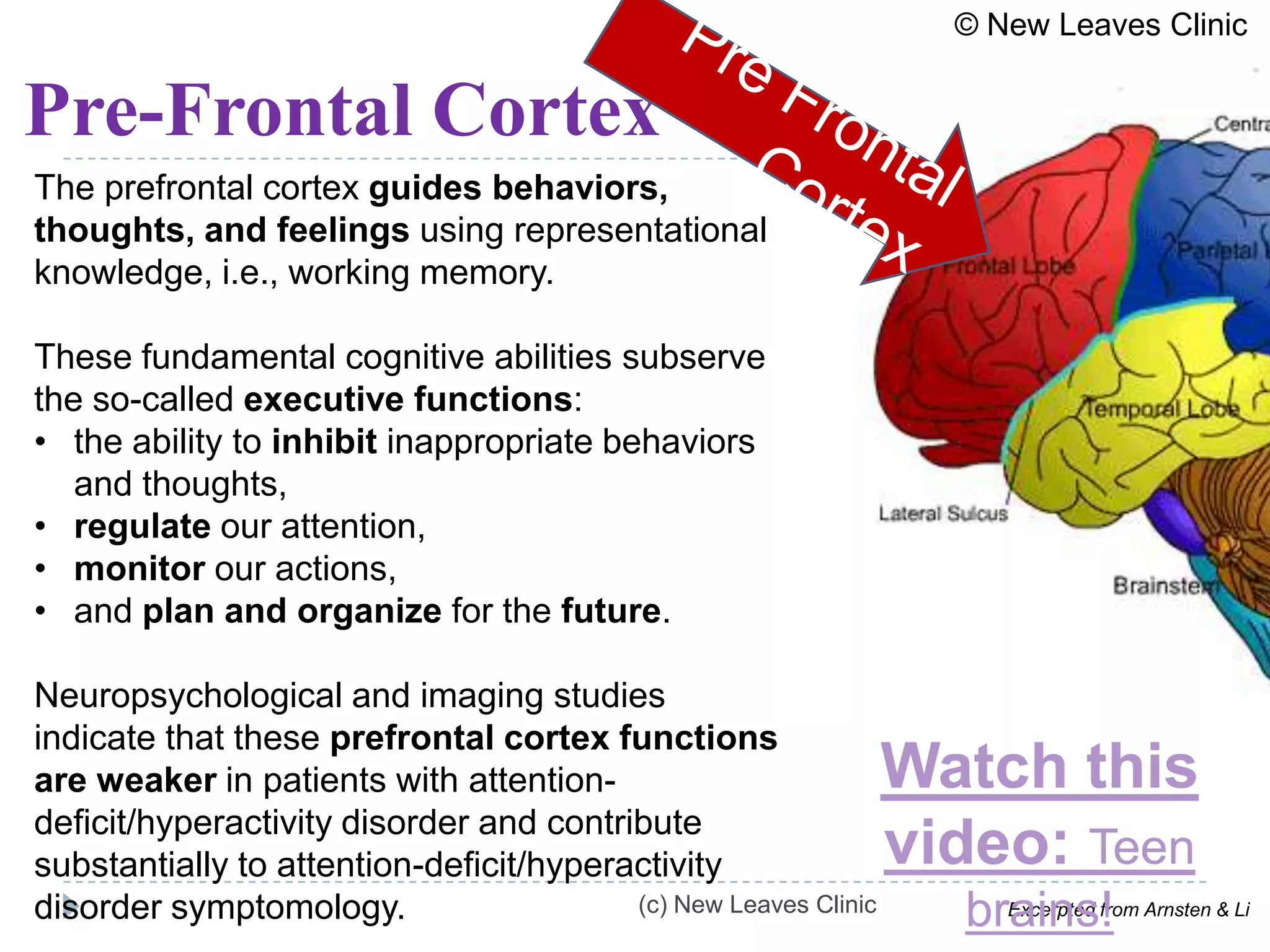
Pre-Frontal Cortex
The prefrontal cortex guides behaviors,
thoughts, and feelings using representational
knowledge, i.e., working memory.

These fundamental cognitive abilities subserve
the so-called executive functions:
• the ability to inhibit inappropriate behaviors
   and thoughts,
• regulate our attention,
• monitor our actions,
• and plan and organize for the future.

Neuropsychological and imaging studies
indicate that these prefrontal cortex functions
are weaker in patients with attention-                           Watch this
deficit/hyperactivity disorder and contribute
substantially to attention-deficit/hyperactivity                 video: Teen
disorder symptomology.                   (c) New Leaves Clinic
                                                                   brains!
                                                                      Excerpted from Arnsten & Li
© New Leaves Clinic


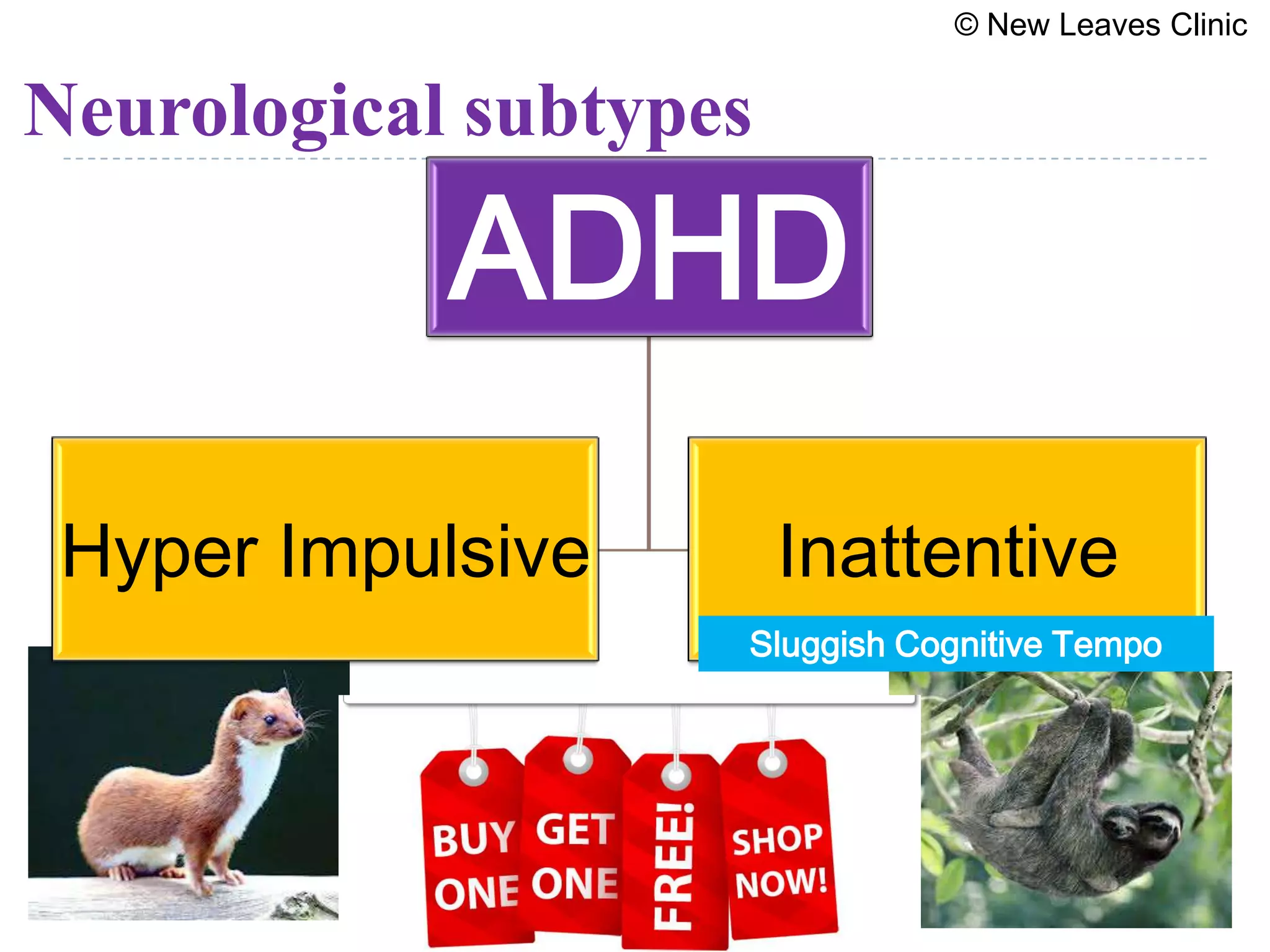
Neurological subtypes

            ADHD
 Hyper Impulsive        Inattentive
                    Sluggish Cognitive Tempo
© New Leaves Clinic


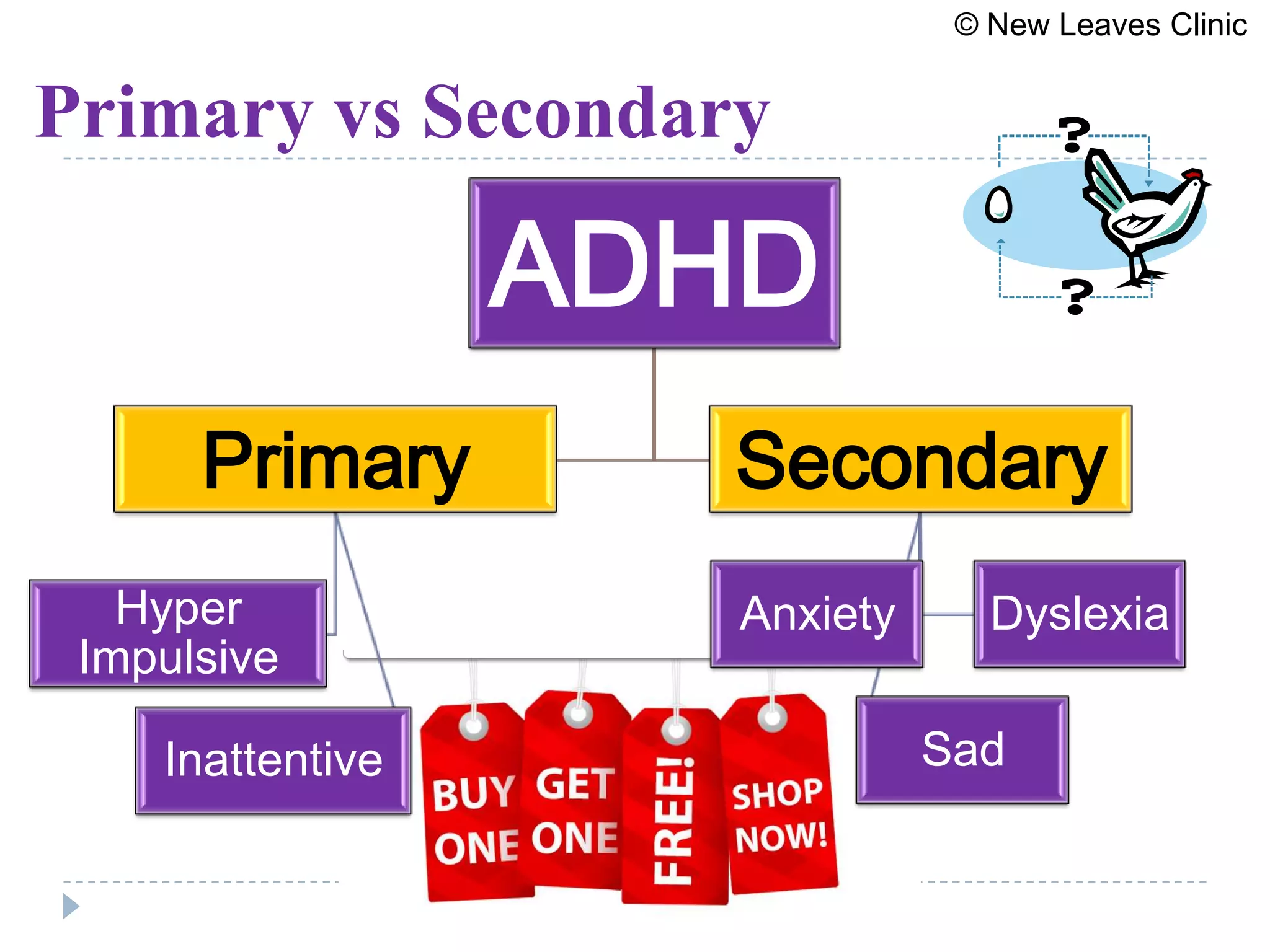
Primary vs Secondary

                  ADHD
      Primary       Secondary
   Hyper             Anxiety      Dyslexia
 Impulsive

    Inattentive                Sad
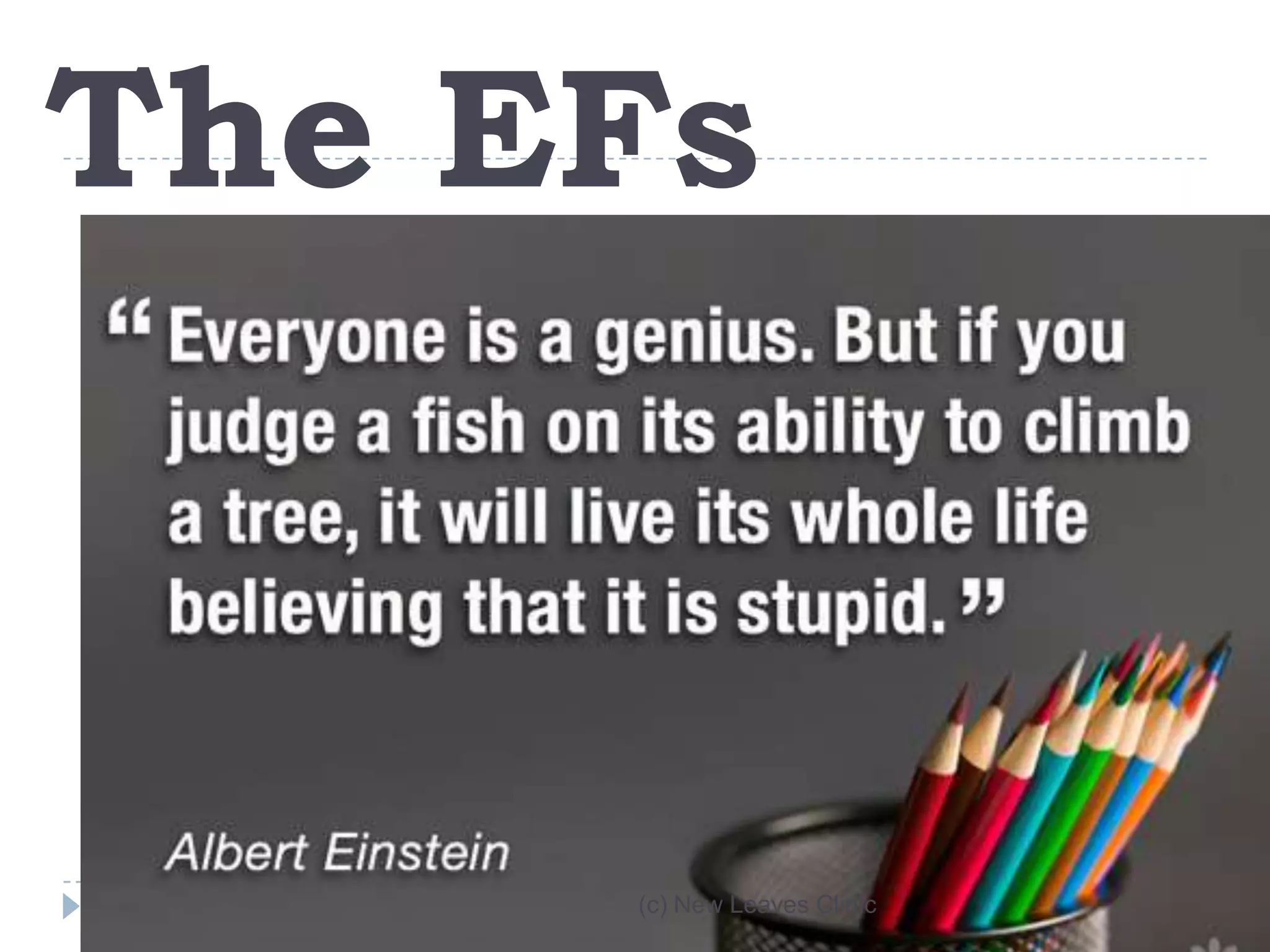
The EFs


     (c) New Leaves Clinic
© New Leaves Clinic

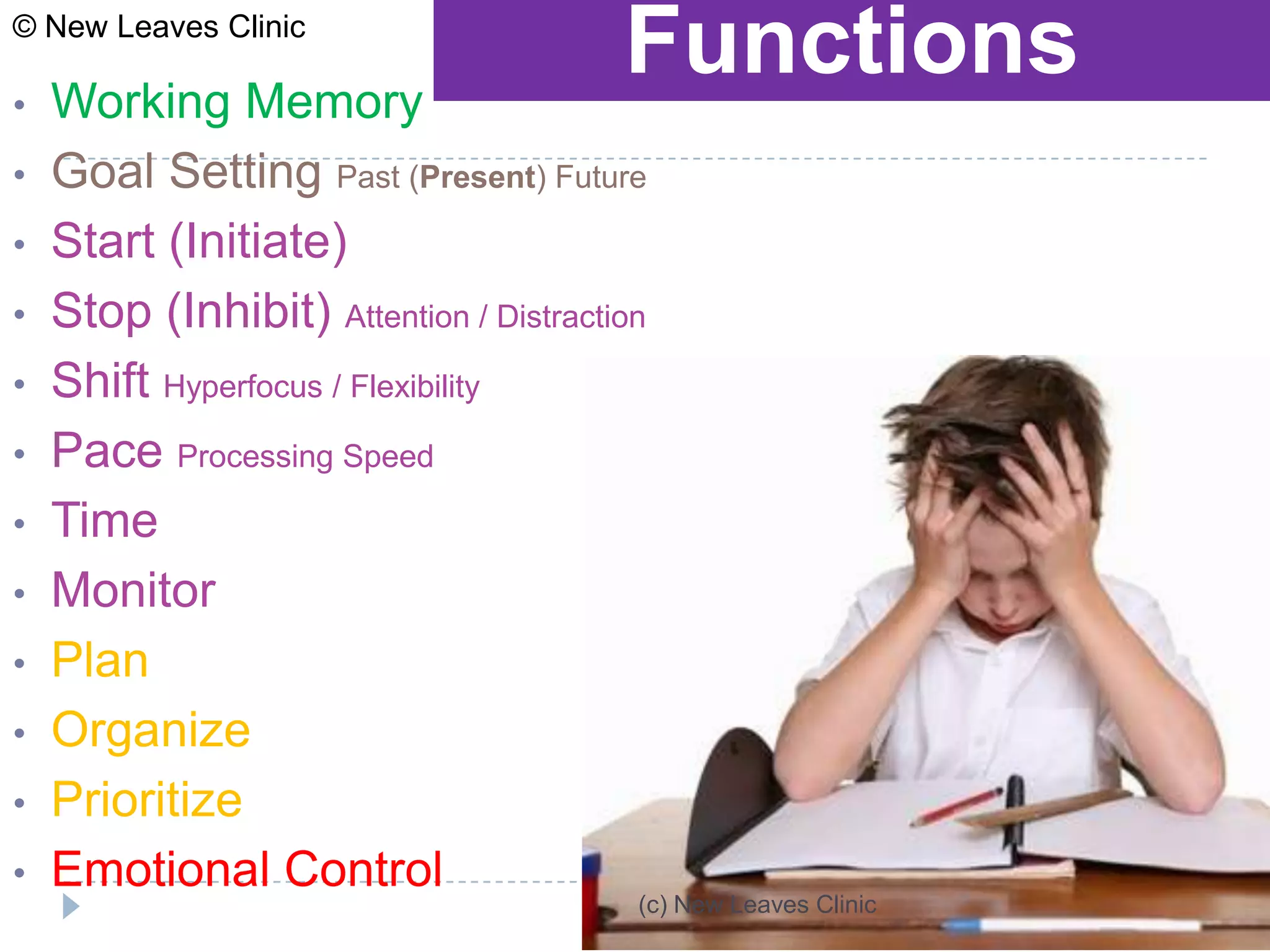
•   Working Memory
                                        Functions
•   Goal Setting Past (Present) Future
•   Start (Initiate)
•   Stop (Inhibit) Attention / Distraction
•   Shift Hyperfocus / Flexibility
•   Pace Processing Speed
•   Time
•   Monitor
•   Plan
•   Organize
•   Prioritize
•   Emotional Control
                                         (c) New Leaves Clinic
© New Leaves Clinic


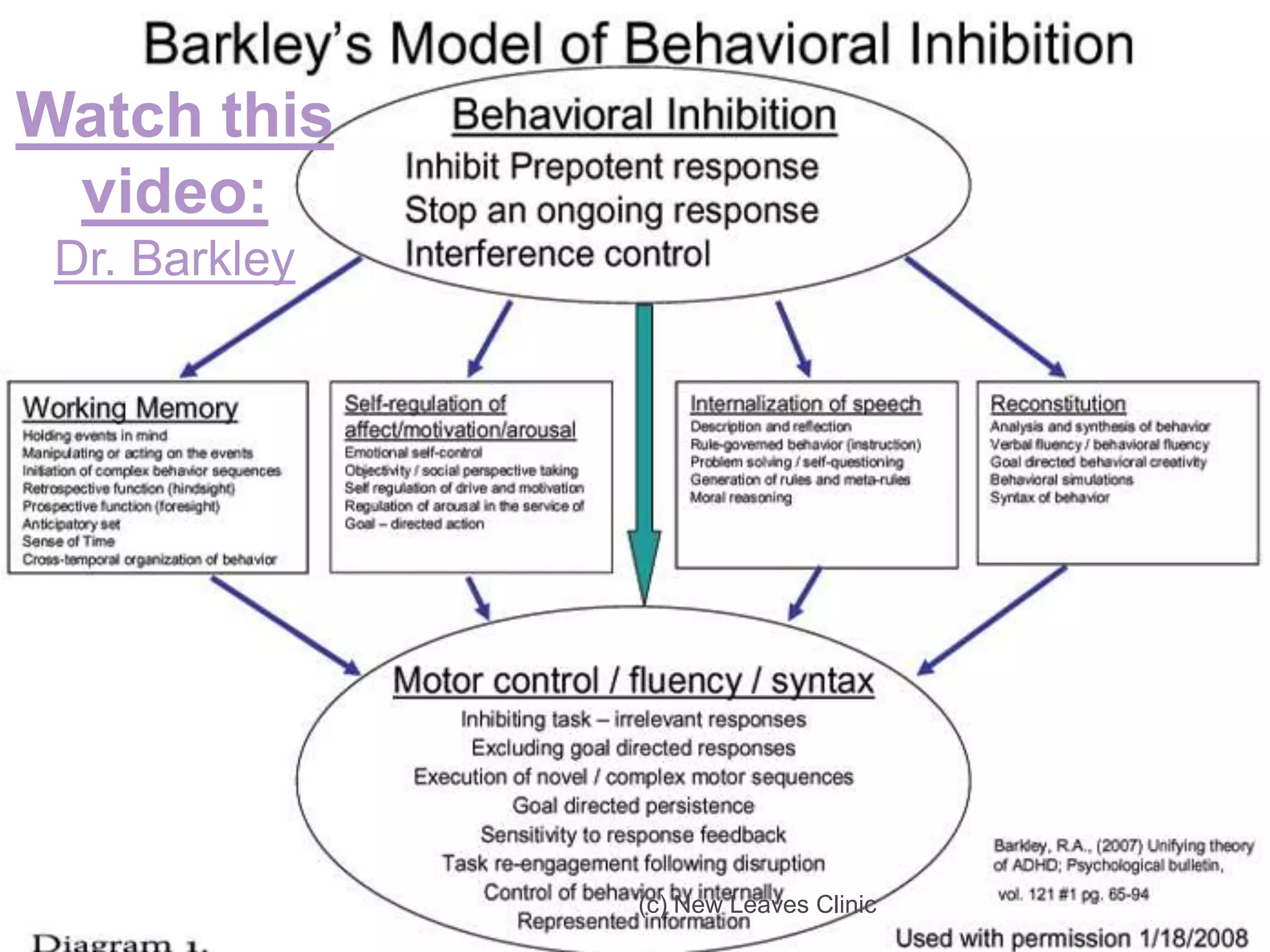
Watch this
 video:
 Dr. Barkley


               (c) New Leaves Clinic
© New Leaves Clinic


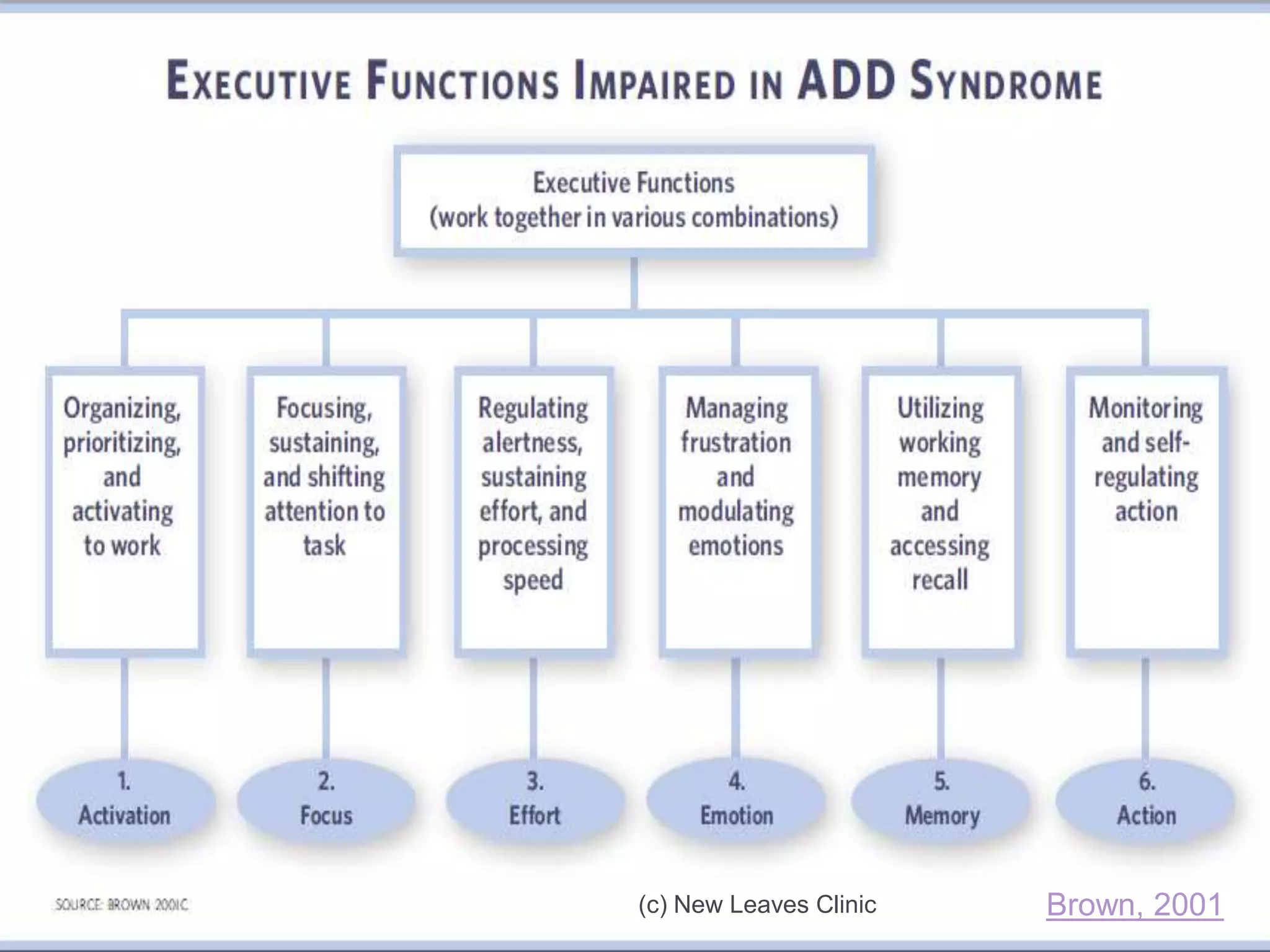
(c) New Leaves Clinic        Brown, 2001
© New Leaves Clinic
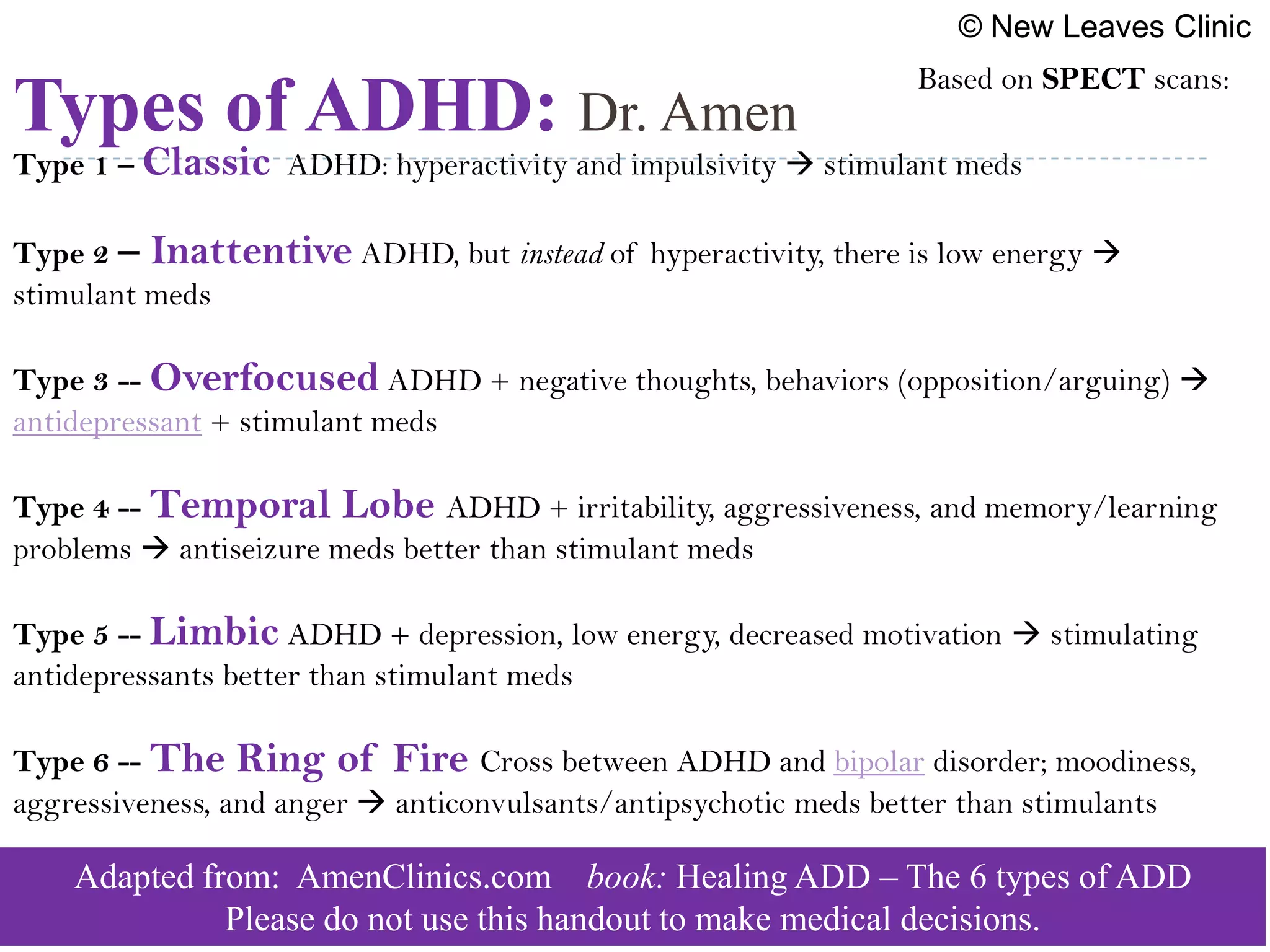
                                                                Based on SPECT scans:
Types of ADHD: Dr. Amen
Type 1 – Classic ADHD: hyperactivity and impulsivity  stimulant meds

Type 2 – Inattentive ADHD, but instead of hyperactivity, there is low energy 
stimulant meds

Type 3 -- Overfocused ADHD + negative thoughts, behaviors (opposition/arguing) 
antidepressant + stimulant meds

Type 4 -- Temporal Lobe ADHD + irritability, aggressiveness, and memory/learning
problems  antiseizure meds better than stimulant meds

Type 5 -- Limbic ADHD + depression, low energy, decreased motivation  stimulating
antidepressants better than stimulant meds

Type 6 -- The Ring of Fire Cross between ADHD and bipolar disorder; moodiness,
aggressiveness, and anger  anticonvulsants/antipsychotic meds better than stimulants

    Adapted from: AmenClinics.com book: Healing ADD – The 6 types of ADD
              Please do not use this handout to make medical decisions.
dys
Regulation
© New Leaves Clinic


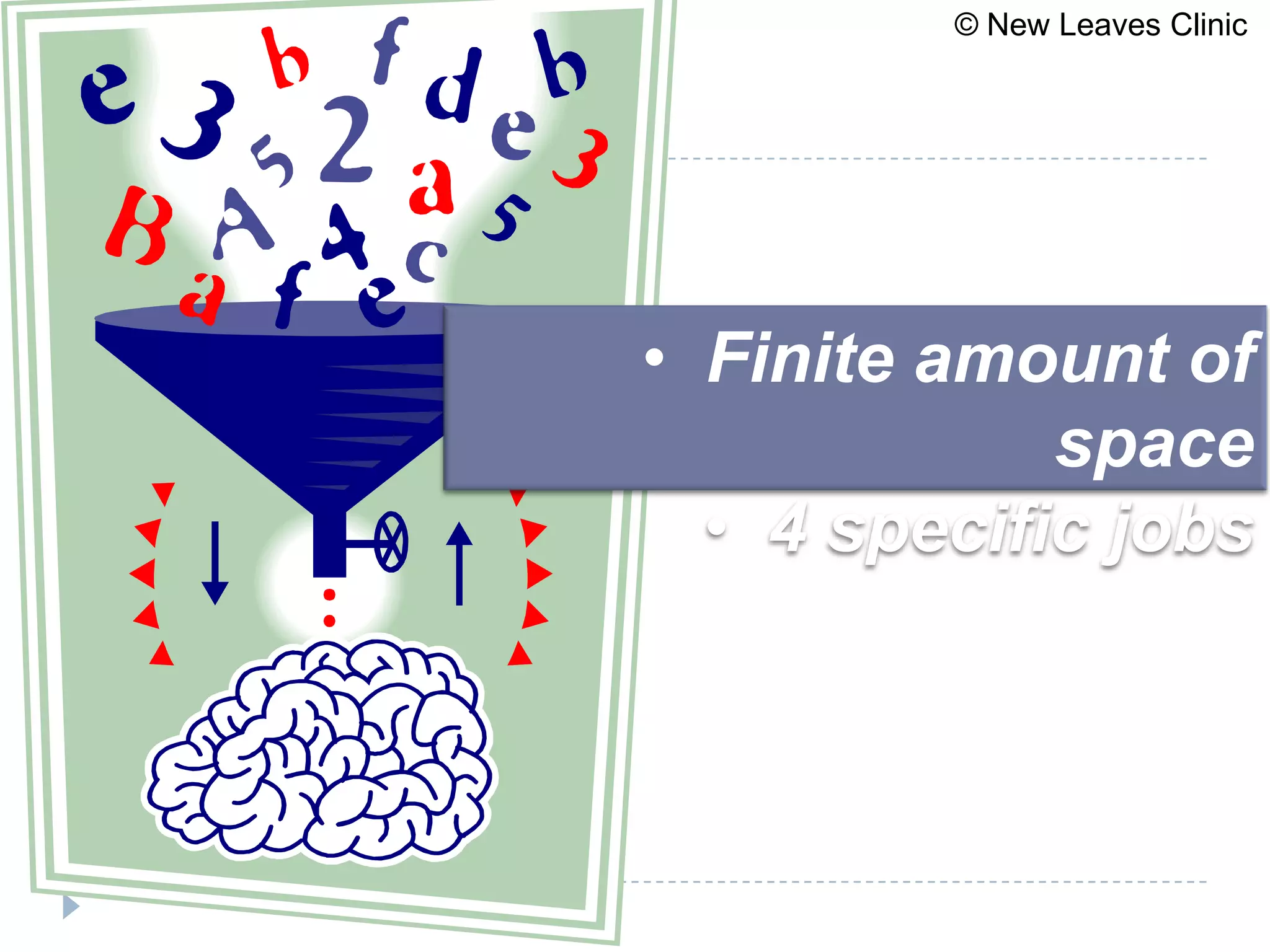
• Finite amount of
             space
  • 4 specific jobs
© New Leaves Clinic

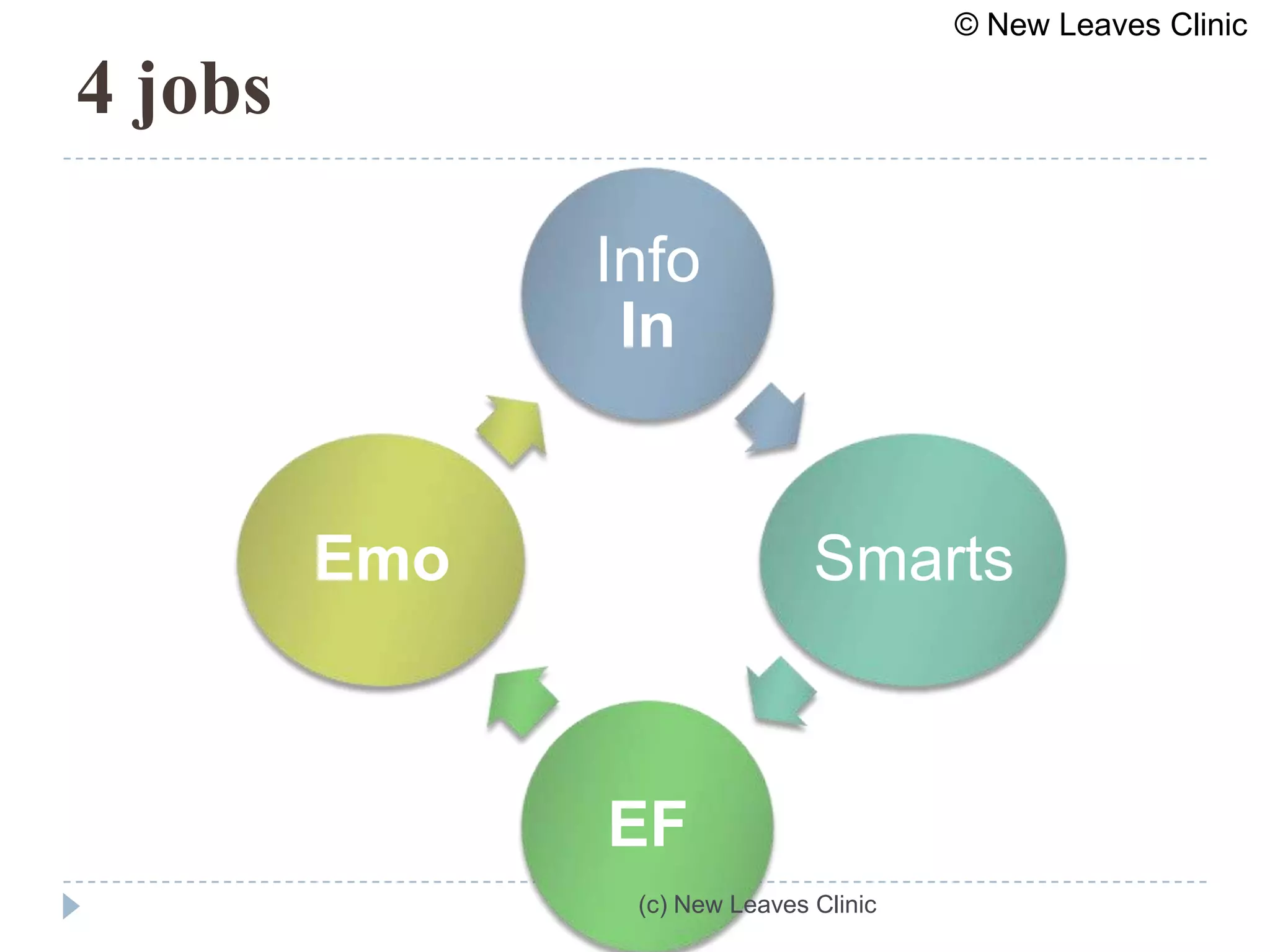
4 jobs

               Info
                In


         Emo                   Smarts


               EF
                (c) New Leaves Clinic
© New Leaves Clinic

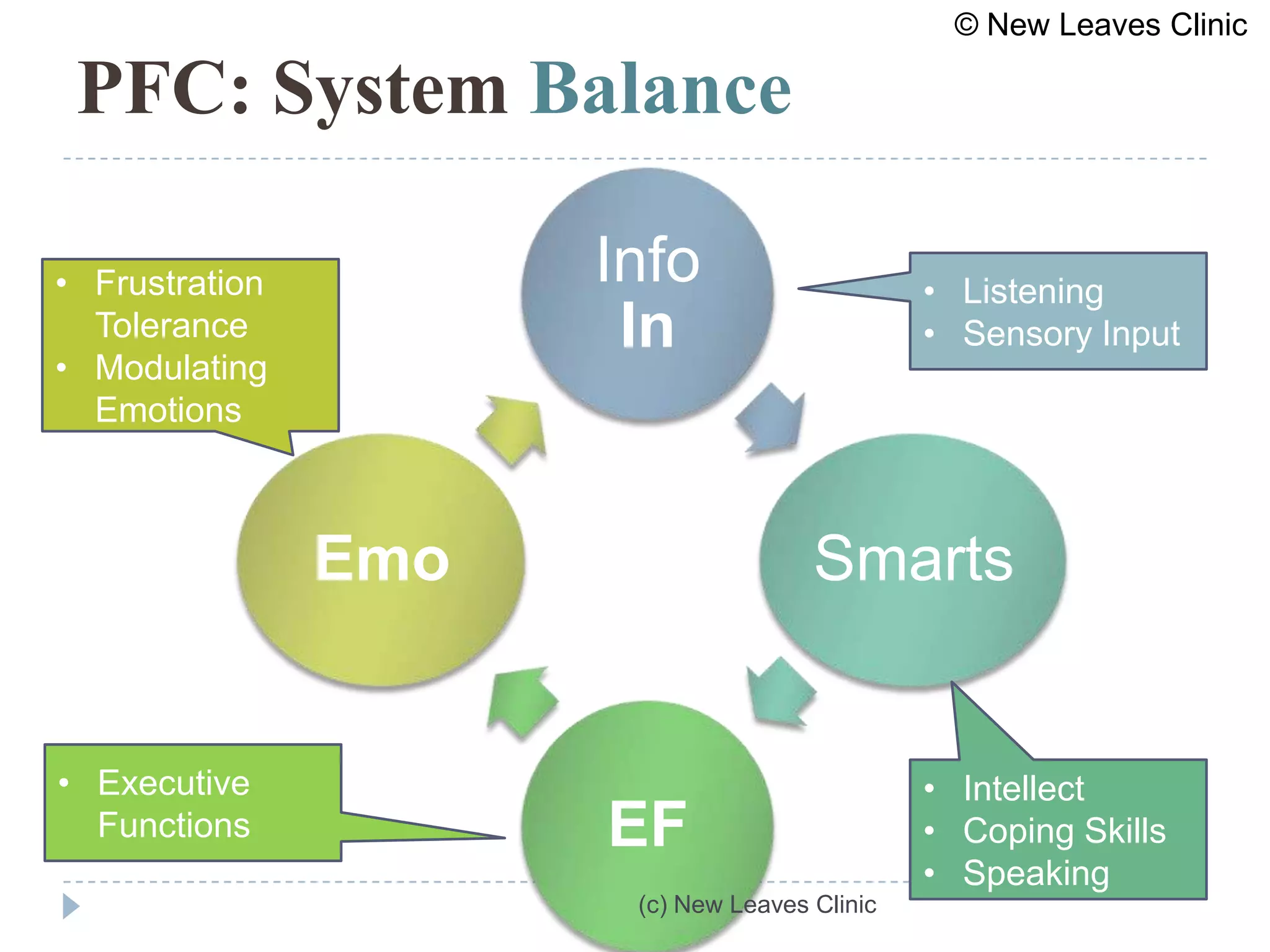
 PFC: System Balance

• Frustration         Info                     • Listening
  Tolerance            In                      • Sensory Input
• Modulating
  Emotions


                Emo                   Smarts


• Executive                                    • Intellect
  Functions           EF                       • Coping Skills
                                               • Speaking
                       (c) New Leaves Clinic
© New Leaves Clinic

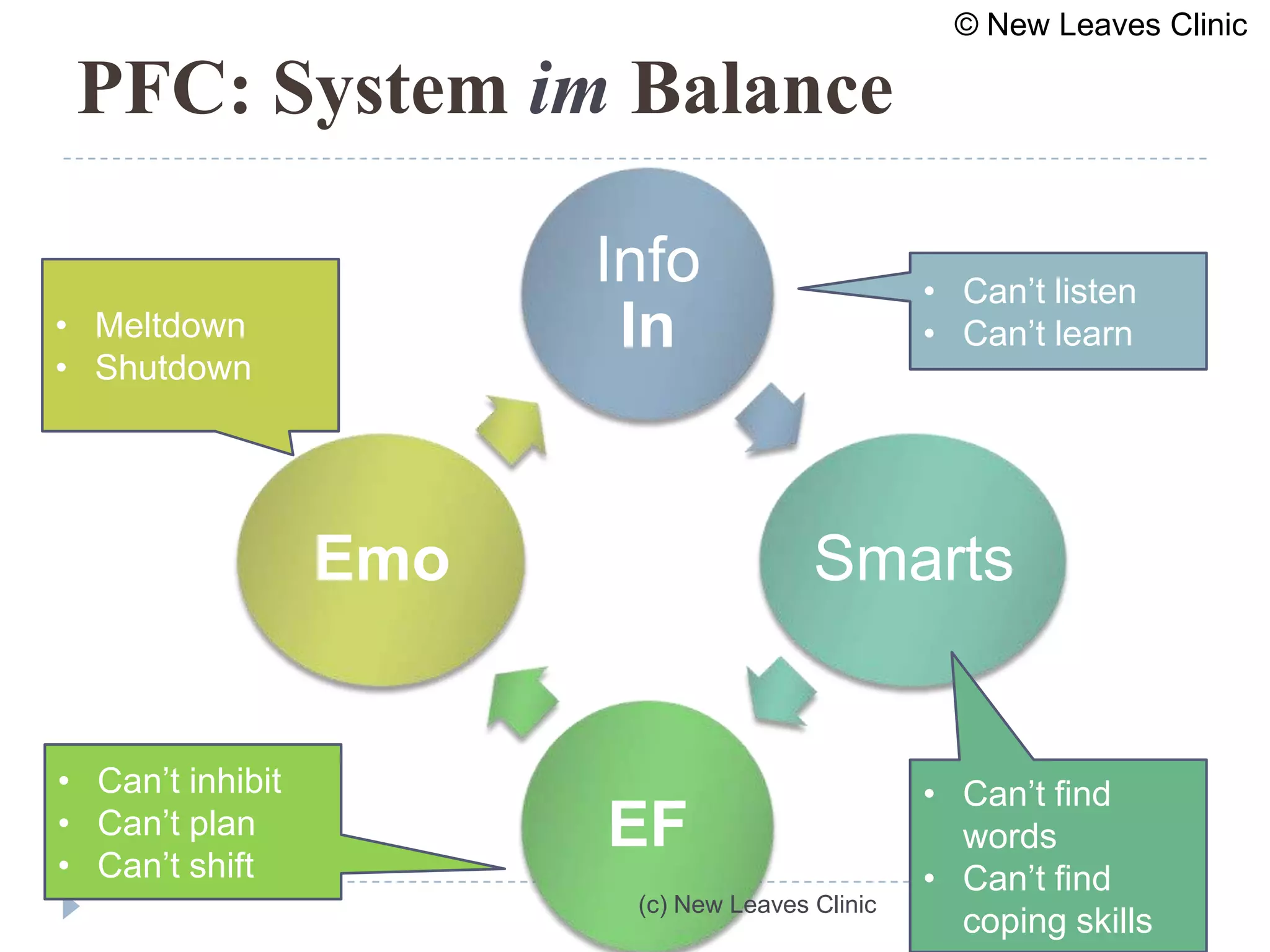
 PFC: System im Balance

                        Info                     • Can’t listen
• Meltdown               In                      • Can’t learn
• Shutdown


                  Emo                   Smarts


• Can’t inhibit                                  • Can’t find
• Can’t plan
• Can’t shift
                        EF                         words
                                                 • Can’t find
                         (c) New Leaves Clinic
                                                   coping skills
© New Leaves Clinic


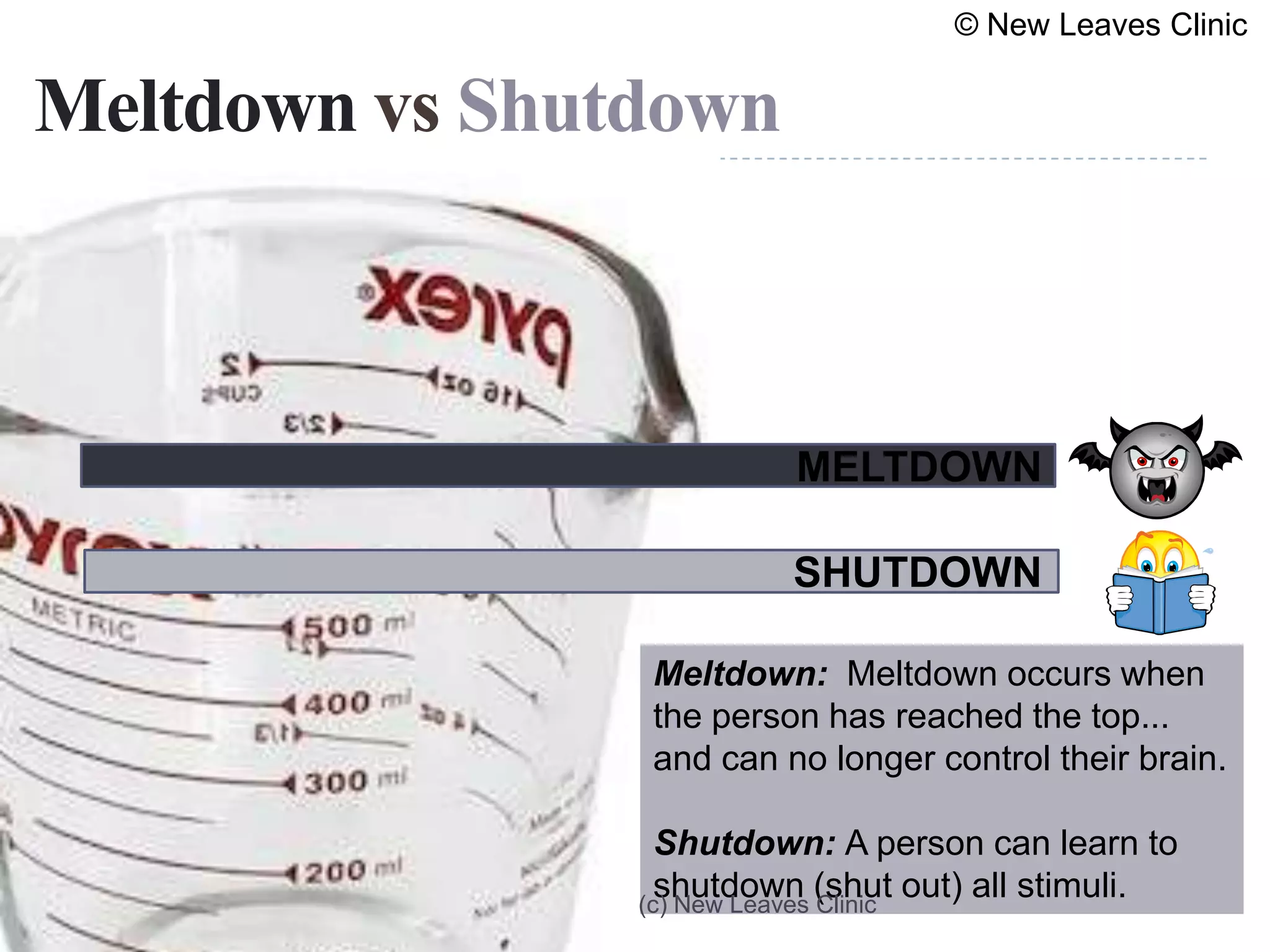
Meltdown vs Shutdown


                         MELTDOWN

                         SHUTDOWN

                Meltdown: Meltdown occurs when
                the person has reached the top...
                and can no longer control their brain.

                  Shutdown: A person can learn to
                  shutdown (shut out) all stimuli.
                (c) New Leaves Clinic
© New Leaves Clinic


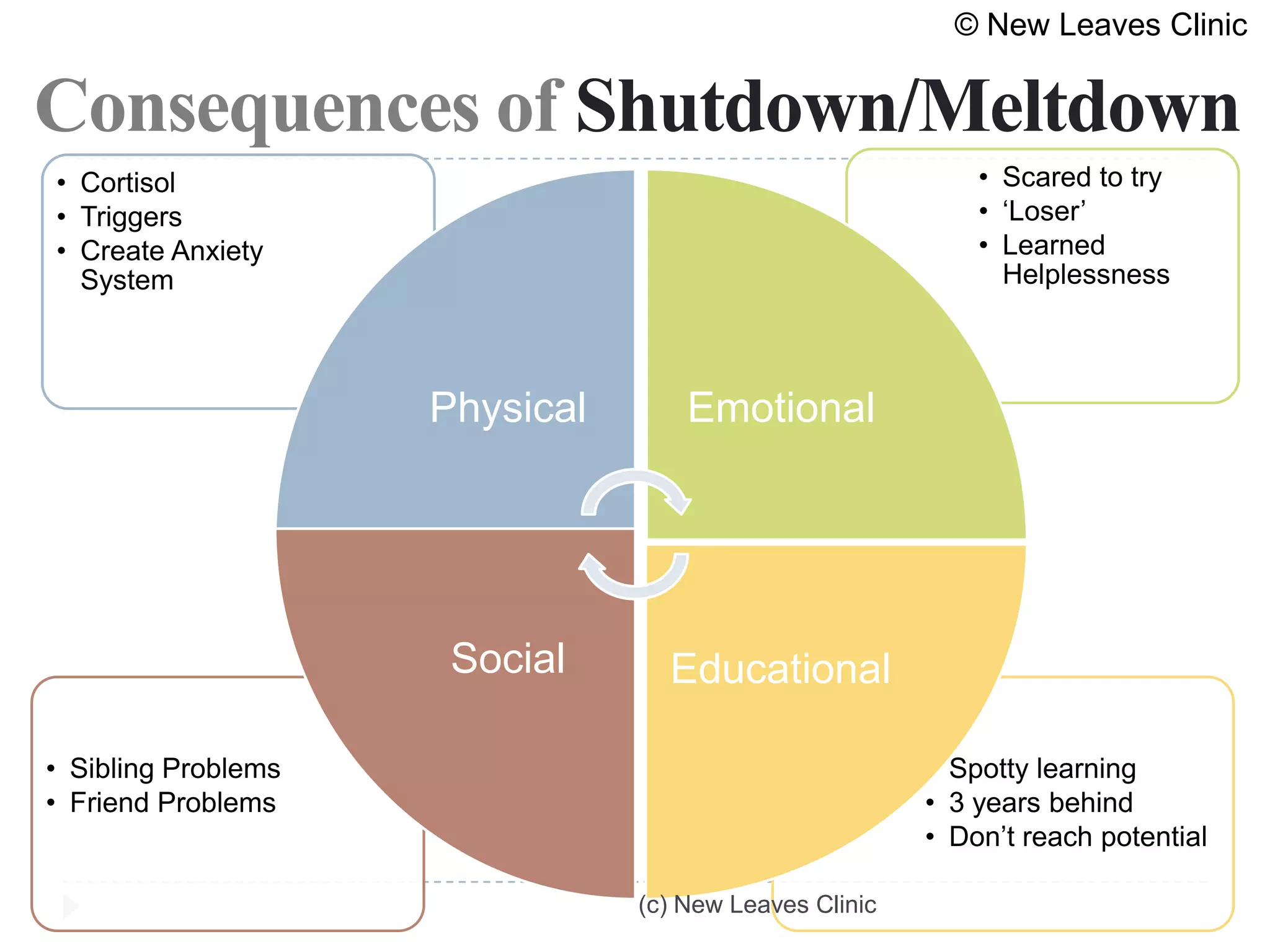
Consequences of Shutdown/Meltdown
• Cortisol                                                  • Scared to try
• Triggers                                                  • ‘Loser’
• Create Anxiety                                            • Learned
  System                                                      Helplessness


                     Physical       Emotional


                      Social      Educational

• Sibling Problems                                      • Spotty learning
• Friend Problems                                       • 3 years behind
                                                        • Don’t reach potential

                                (c) New Leaves Clinic
(c) New Leaves Clinic


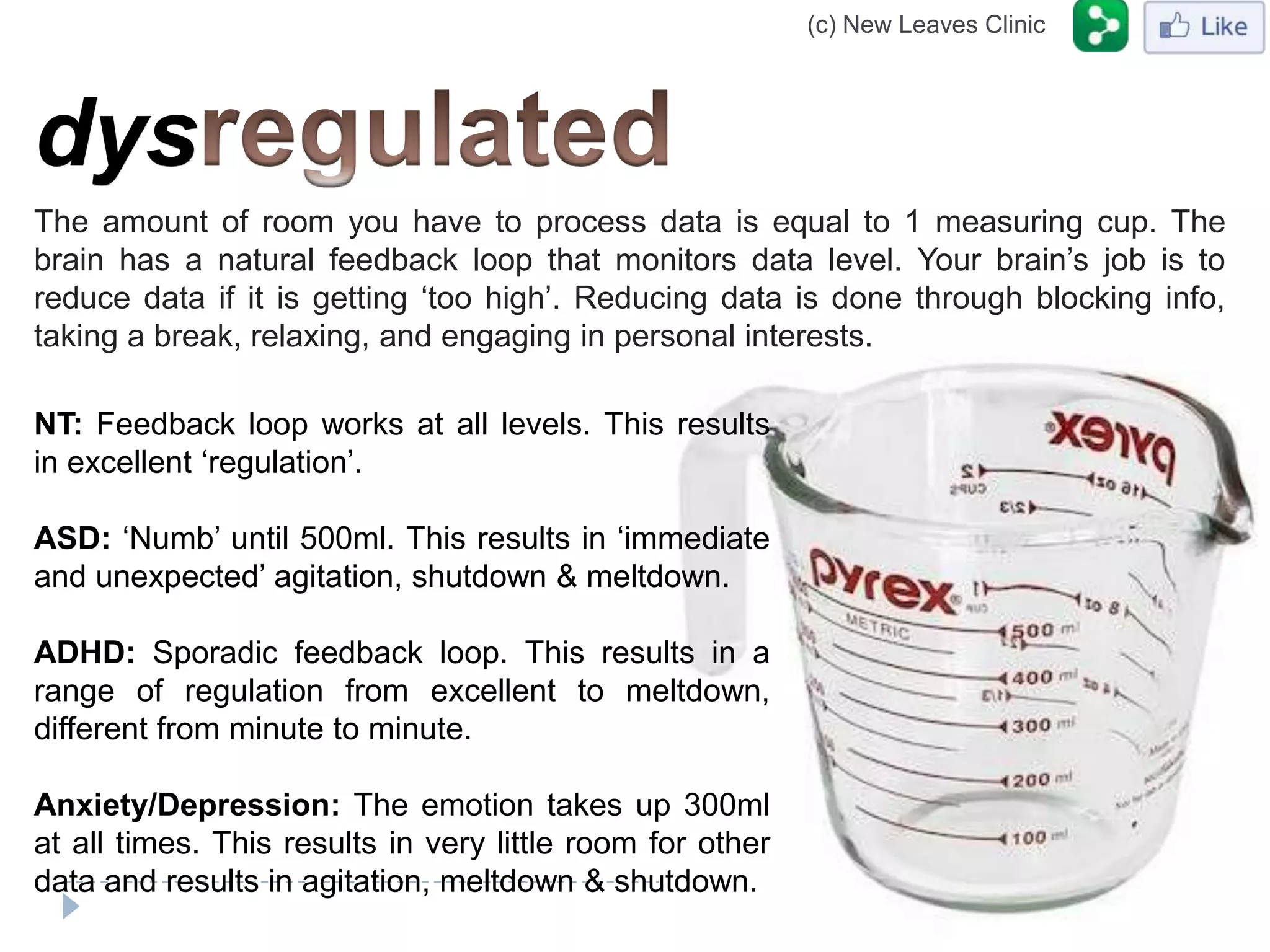
dys
The amount of room you have to process data is equal to 1 measuring cup. The
brain has a natural feedback loop that monitors data level. Your brain’s job is to
reduce data if it is getting ‘too high’. Reducing data is done through blocking info,
taking a break, relaxing, and engaging in personal interests.

NT: Feedback loop works at all levels. This results
in excellent ‘regulation’.

ASD: ‘Numb’ until 500ml. This results in ‘immediate
and unexpected’ agitation, shutdown & meltdown.

ADHD: Sporadic feedback loop. This results in a
range of regulation from excellent to meltdown,
different from minute to minute.

Anxiety/Depression: The emotion takes up 300ml
at all times. This results in very little room for other
data and results in agitation, meltdown & shutdown.
Fun Stuff


            (c) New Leaves Clinic
Treatment
© New Leaves Clinic


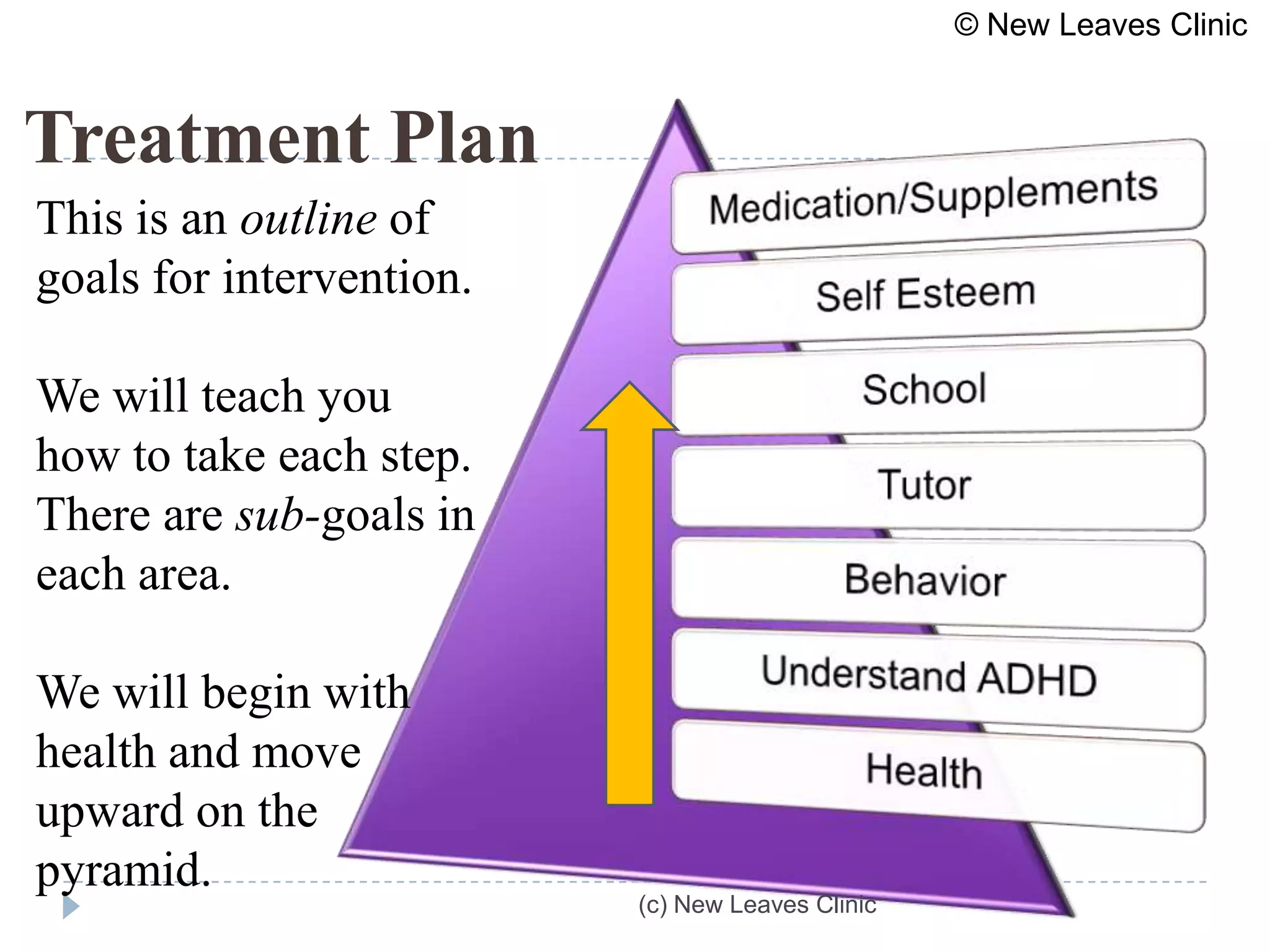
Treatment Plan
This is an outline of
goals for intervention.

We will teach you
how to take each step.
There are sub-goals in
each area.

We will begin with
health and move
upward on the
pyramid.
                          (c) New Leaves Clinic
(c) New Leaves Clinic


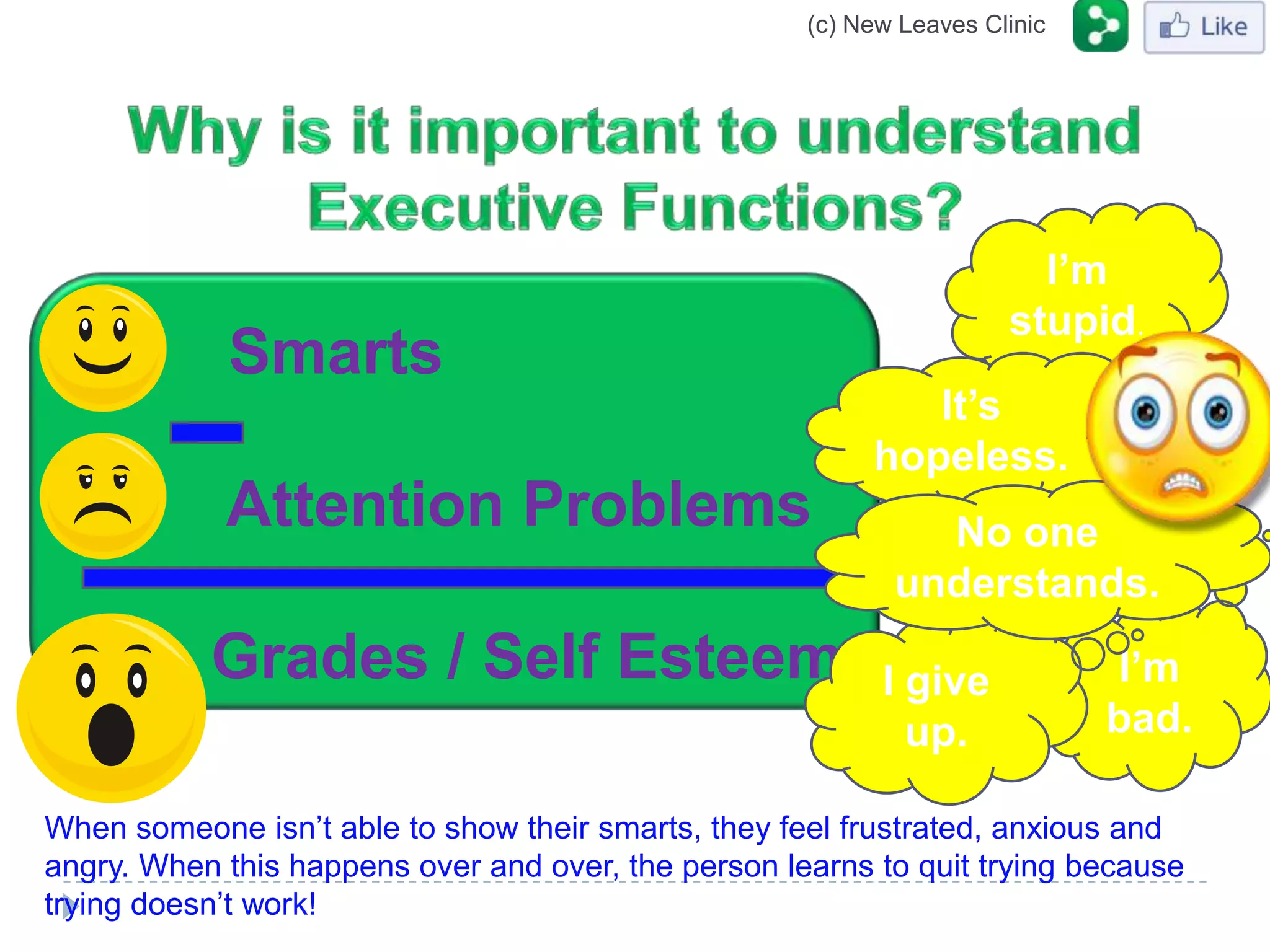
                                                                        I’m
                                                                      stupid.
             Smarts
                                                             It’s
         -                                                hopeless.
             Attention Problems                               No one
                                                            understands.
             Grades / Self Esteem                          I give            I’m
                                                             up.             bad.

When someone isn’t able to show their smarts, they feel frustrated, anxious and
angry. When this happens over and over, the person learns to quit trying because
trying doesn’t work!
(c) New Leaves Clinic


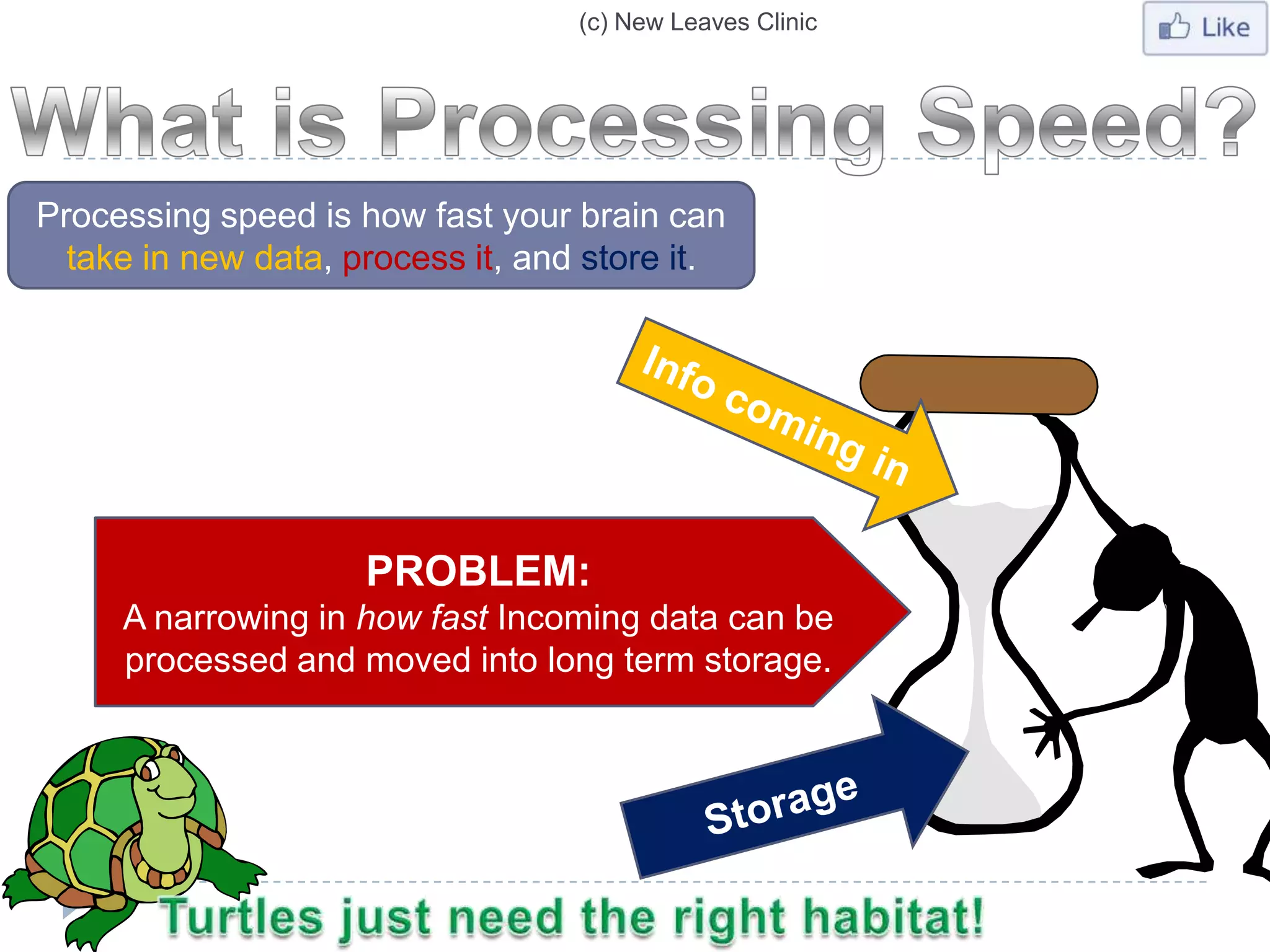
Processing speed is how fast your brain can
  take in new data, process it, and store it.


                     PROBLEM:
     A narrowing in how fast Incoming data can be
     processed and moved into long term storage.
(c) New Leaves Clinic


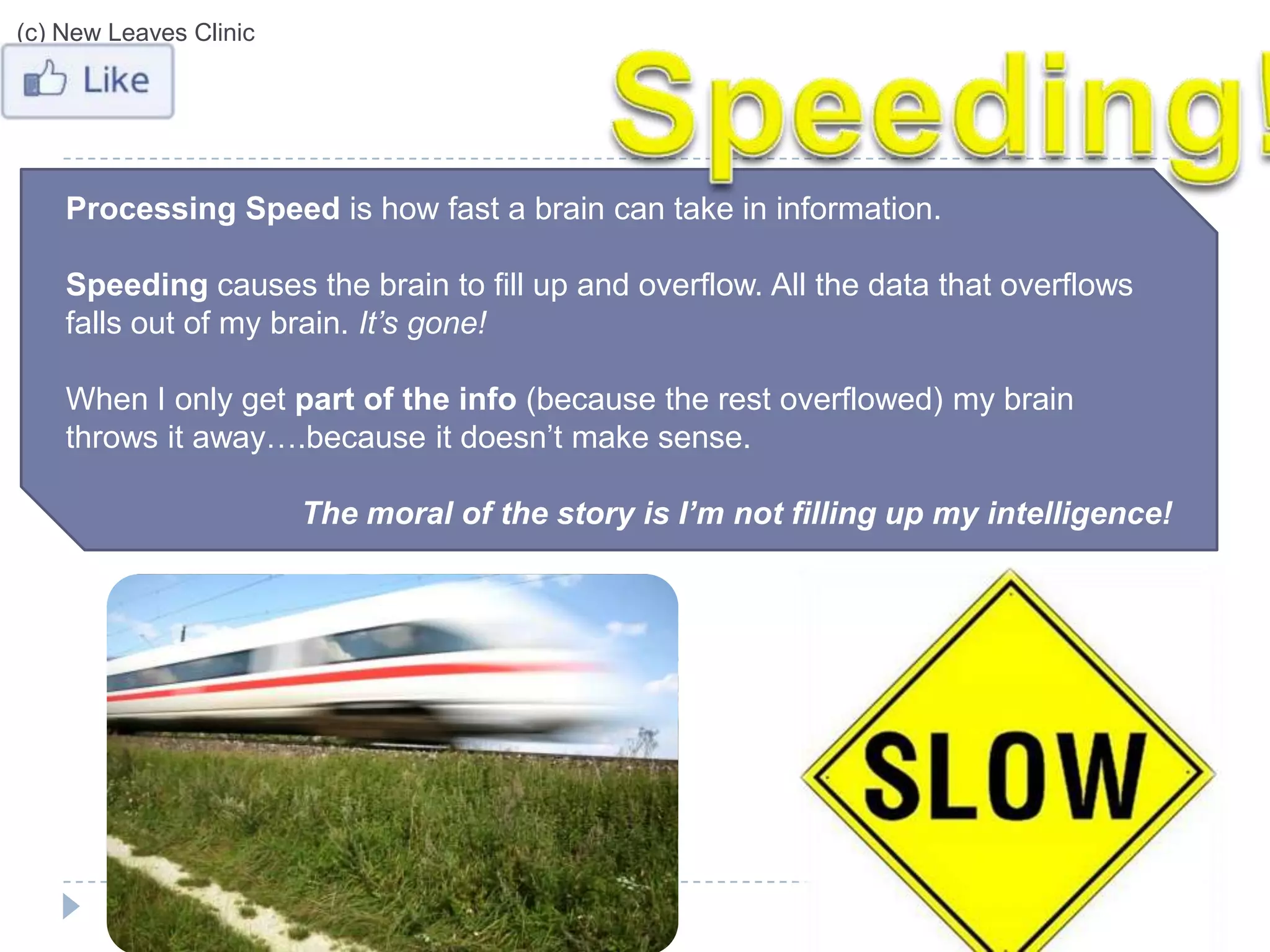
    Processing Speed is how fast a brain can take in information.

    Speeding causes the brain to fill up and overflow. All the data that overflows
    falls out of my brain. It’s gone!

    When I only get part of the info (because the rest overflowed) my brain
    throws it away….because it doesn’t make sense.

                        The moral of the story is I’m not filling up my intelligence!
© New Leaves Clinic

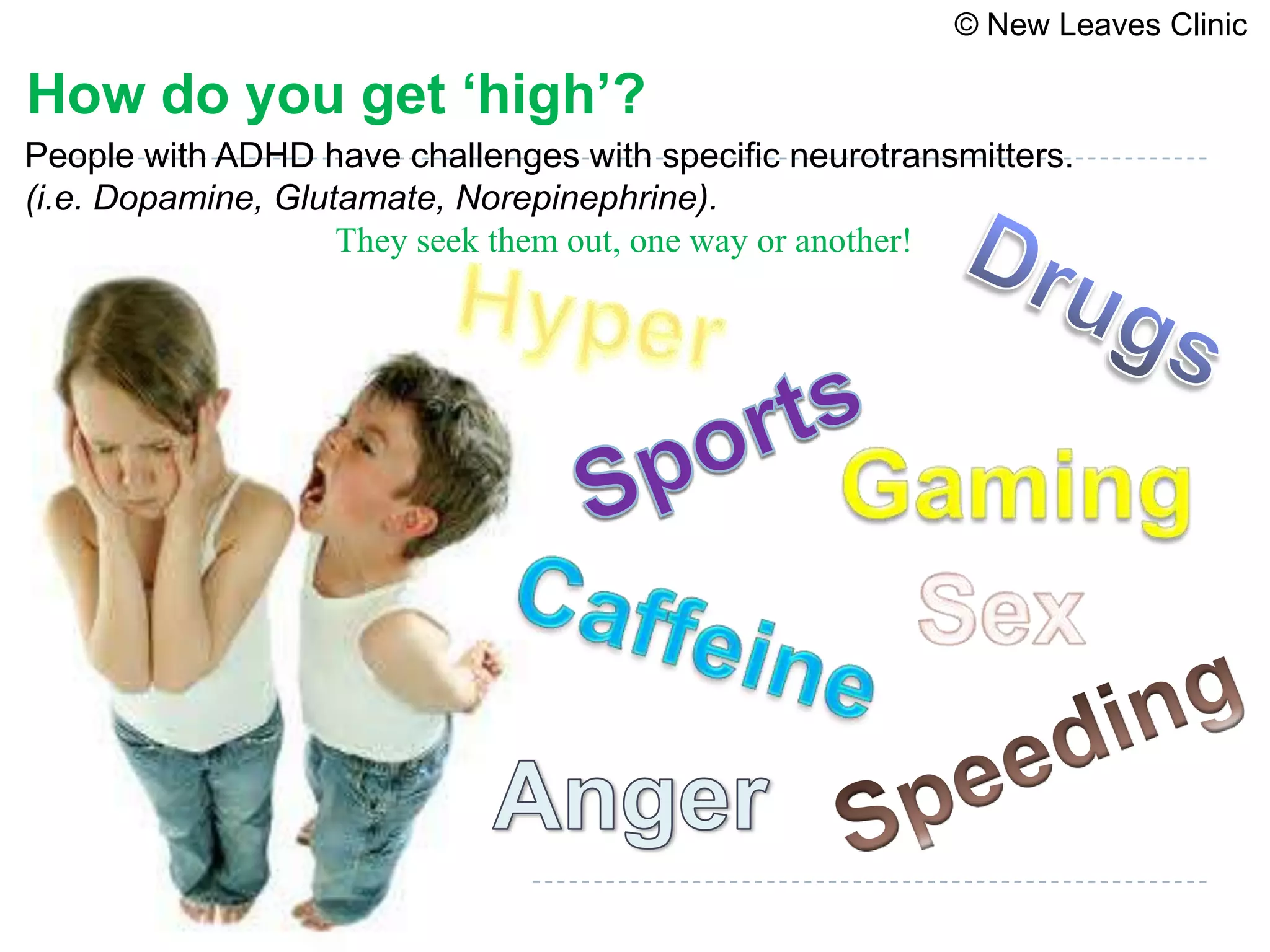
How do you get ‘high’?
People with ADHD have challenges with specific neurotransmitters.
(i.e. Dopamine, Glutamate, Norepinephrine).
                    They seek them out, one way or another!
(c) New Leaves Clinic


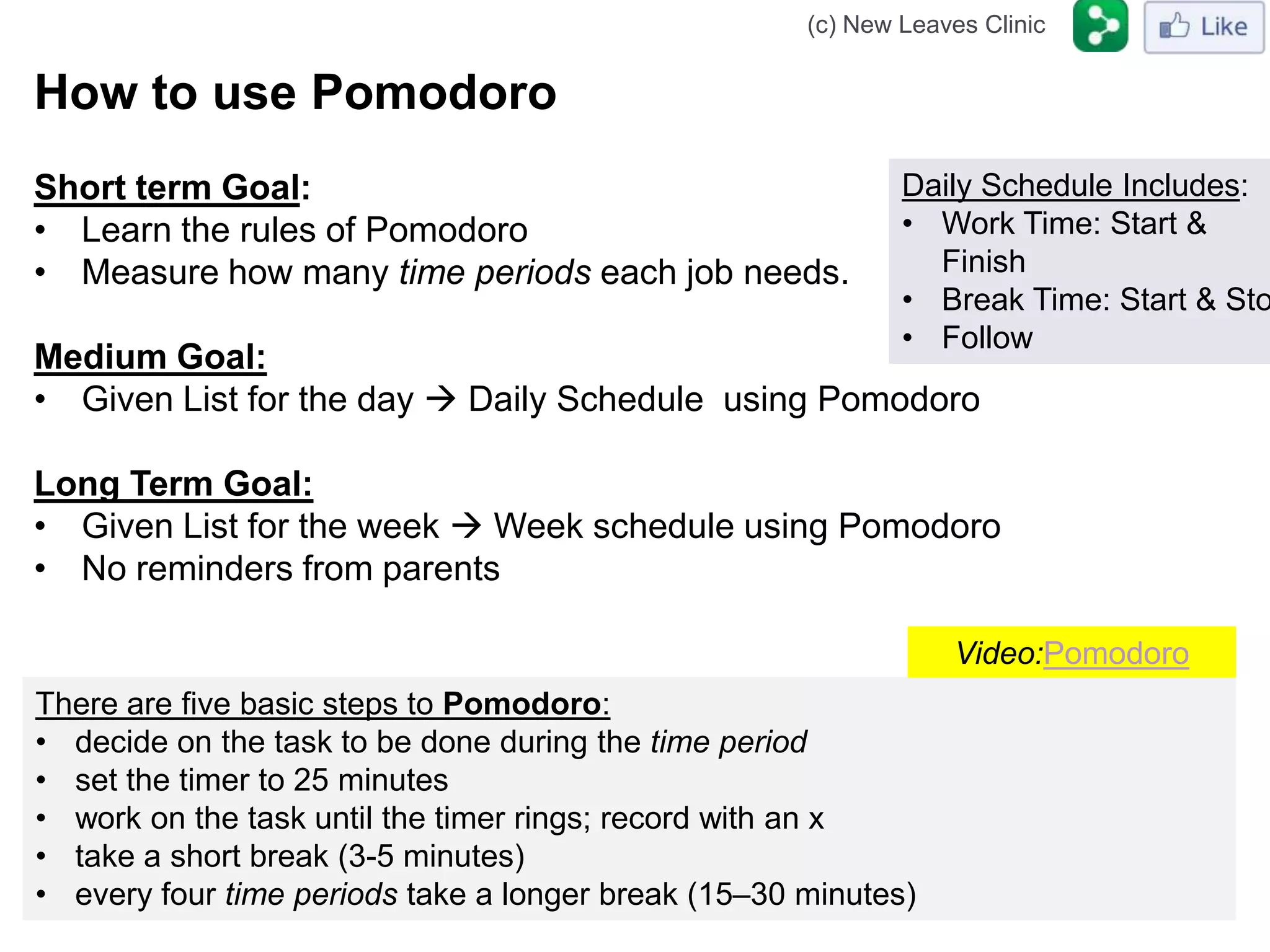
How to use Pomodoro
Short term Goal:                                             Daily Schedule Includes:
• Learn the rules of Pomodoro                                • Work Time: Start &
• Measure how many time periods each job needs.                Finish
                                                             • Break Time: Start & Sto
                                                             • Follow
Medium Goal:
• Given List for the day  Daily Schedule using Pomodoro

Long Term Goal:
• Given List for the week  Week schedule using Pomodoro
• No reminders from parents

                                                                 Video:Pomodoro
There are five basic steps to Pomodoro:
• decide on the task to be done during the time period
• set the timer to 25 minutes
• work on the task until the timer rings; record with an x
• take a short break (3-5 minutes)
• every four time periods take a longer break (15–30 minutes)
(c) New Leaves Clinic
© New Leaves Clinic

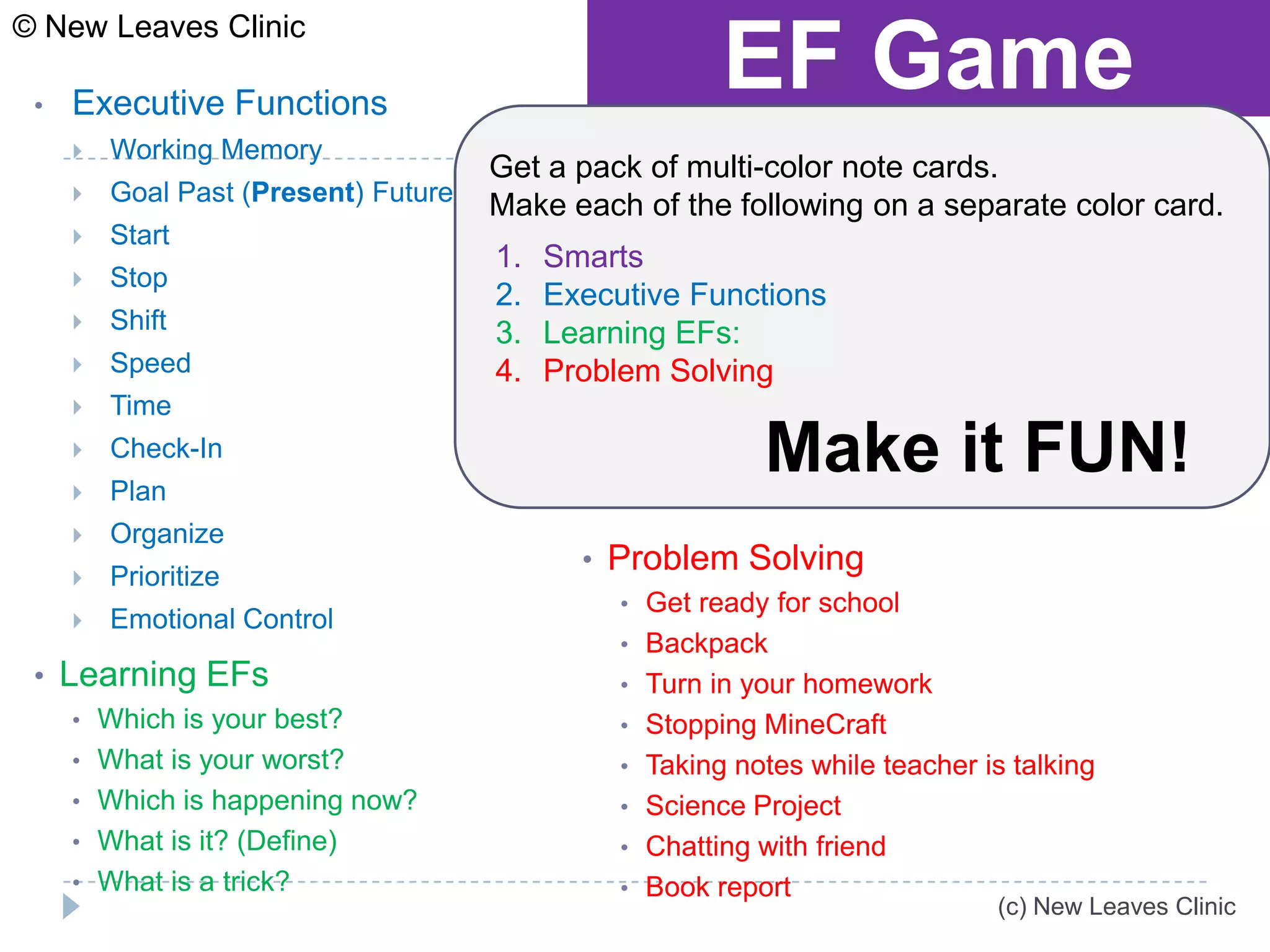
 •   Executive Functions
                                                        EF Game
        Working Memory
                                      Get a pack of multi-color note cards.
        Goal Past (Present) Future   Make each of the following on a separate color card.
        Start
                                      1.   Smarts
        Stop
                                      2.   Executive Functions
        Shift                        3.   Learning EFs:
        Speed                        4.   Problem Solving
        Time
     
     
         Check-In
         Plan
                                                           Make it FUN!
        Organize
                                             • Problem Solving
        Prioritize
                                                • Get ready for school
        Emotional Control
                                                • Backpack
 • Learning EFs                                 • Turn in your homework
     • Which is your best?                      • Stopping MineCraft
     • What is your worst?                      • Taking notes while teacher is talking
     • Which is happening now?                  • Science Project
     • What is it? (Define)                     • Chatting with friend
     • What is a trick?                         • Book report
                                                                              (c) New Leaves Clinic
© New Leaves Clinic

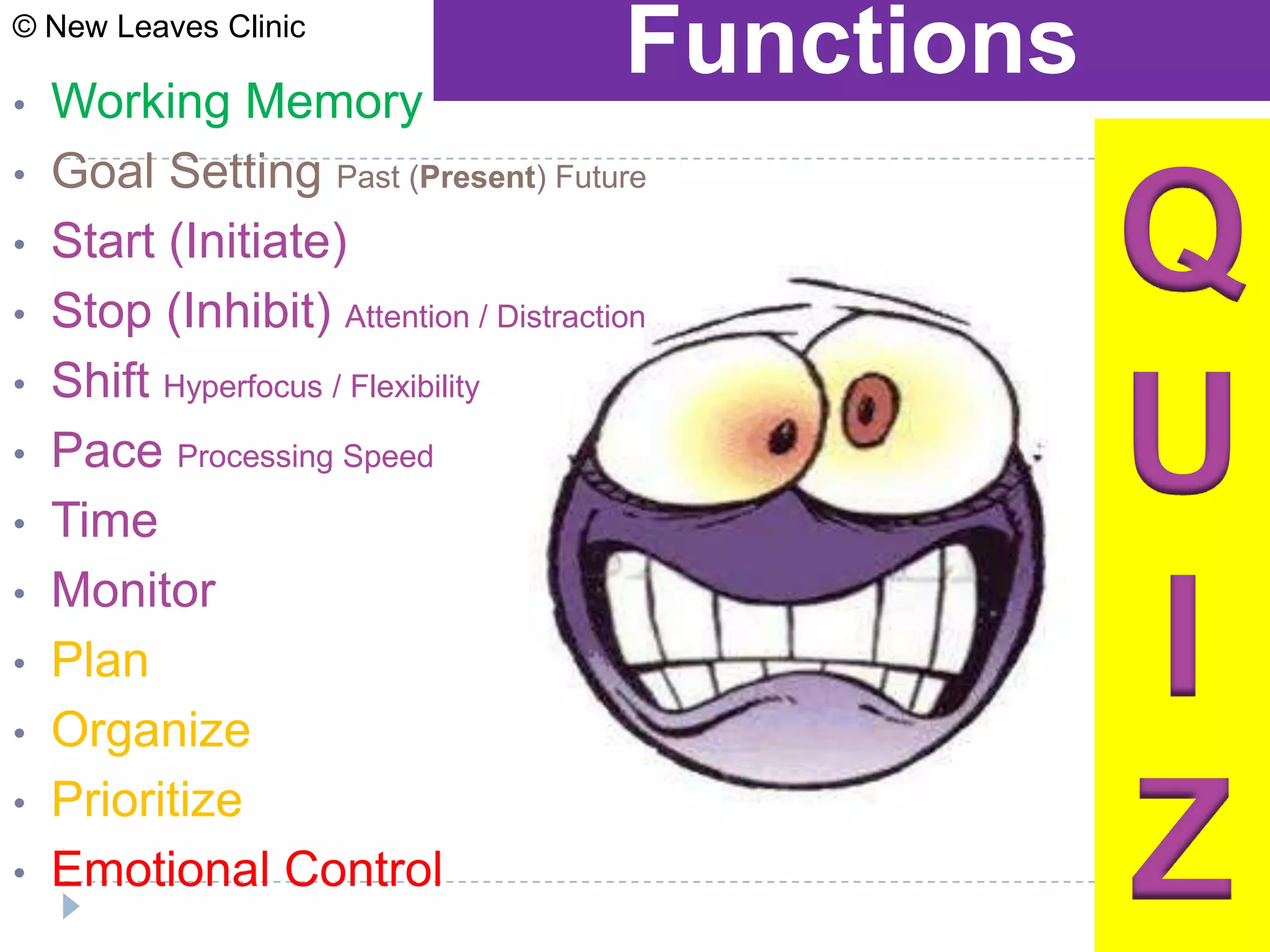
•   Working Memory
                                        Functions
•   Goal Setting Past (Present) Future
•
•
    Start (Initiate)
    Stop (Inhibit) Attention / Distraction
                                                    Q
•   Shift Hyperfocus / Flexibility
•
•
    Pace Processing Speed
    Time
                                                    U
•   Monitor
•
•
    Plan
    Organize
                                                    I
•
•
    Prioritize
    Emotional Control                               Z
© New Leaves Clinic


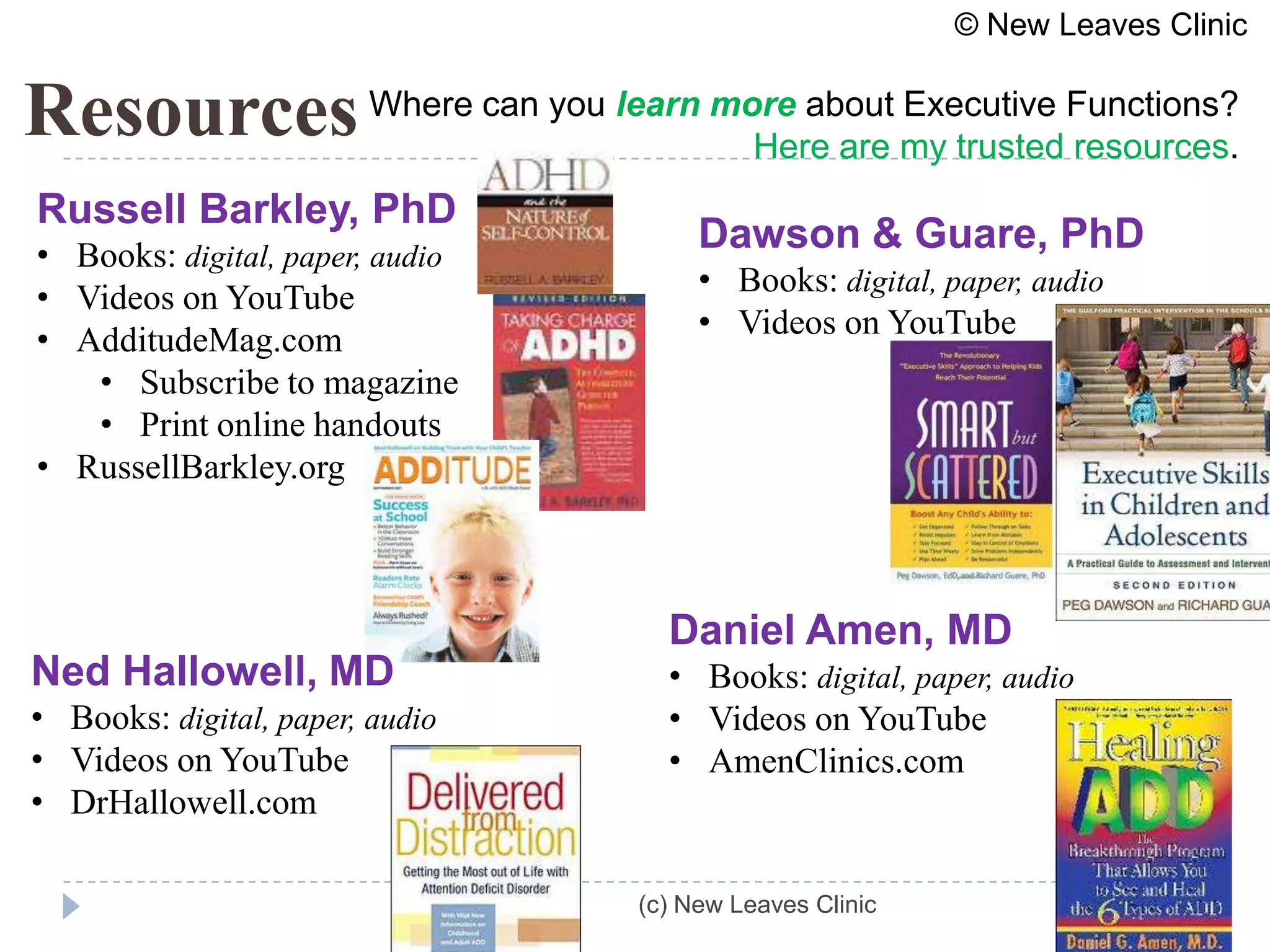
Resources Where can you learn more about my trustedFunctions?
                                Here are
                                         Executive
                                                   resources.
Russell Barkley, PhD
• Books: digital, paper, audio
                                      Dawson & Guare, PhD
• Videos on YouTube                   • Books: digital, paper, audio
• AdditudeMag.com                     • Videos on YouTube
   • Subscribe to magazine
   • Print online handouts
• RussellBarkley.org


                                   Daniel Amen, MD
Ned Hallowell, MD                  • Books: digital, paper, audio
• Books: digital, paper, audio     • Videos on YouTube
• Videos on YouTube                • AmenClinics.com
• DrHallowell.com

                                 (c) New Leaves Clinic

Executive Functioning: for teachers

  • 1.
    Please do usa favor… link us to a keyword. (c) New Leaves Clinic
  • 2.
    Join us! e-mail list Sign up at New Leaves Clinic.com Notices of ASD professional & teen meetings Facebook pages New Leaves Clinic (LD, ADHD & ASD) Karla’s ASD Page (ASD) Copies of slides This set will be posted on NewLeavesClinic.com Educational Materials / Password: neurodiversity (c) New Leaves Clinic
  • 3.
    Neurology (c) New Leaves Clinic
  • 4.
    Learning: 2 brainareas Cognitive Capacity Executive Functions (c) New Leaves Clinic
  • 5.
    Why do wecare about EF? We care because EF challenges reduce what gets in… …and what gets out! 60% -20 80% 100% -20 (c) New Leaves Clinic
  • 6.
    © New LeavesClinic Pre-Frontal Cortex The prefrontal cortex guides behaviors, thoughts, and feelings using representational knowledge, i.e., working memory. These fundamental cognitive abilities subserve the so-called executive functions: • the ability to inhibit inappropriate behaviors and thoughts, • regulate our attention, • monitor our actions, • and plan and organize for the future. Neuropsychological and imaging studies indicate that these prefrontal cortex functions are weaker in patients with attention- Watch this deficit/hyperactivity disorder and contribute substantially to attention-deficit/hyperactivity video: Teen disorder symptomology. (c) New Leaves Clinic brains! Excerpted from Arnsten & Li
  • 7.
    © New LeavesClinic Neurological subtypes ADHD Hyper Impulsive Inattentive Sluggish Cognitive Tempo
  • 8.
    © New LeavesClinic Primary vs Secondary ADHD Primary Secondary Hyper Anxiety Dyslexia Impulsive Inattentive Sad
  • 9.
    The EFs (c) New Leaves Clinic
  • 10.
    © New LeavesClinic • Working Memory Functions • Goal Setting Past (Present) Future • Start (Initiate) • Stop (Inhibit) Attention / Distraction • Shift Hyperfocus / Flexibility • Pace Processing Speed • Time • Monitor • Plan • Organize • Prioritize • Emotional Control (c) New Leaves Clinic
  • 11.
    © New LeavesClinic Watch this video: Dr. Barkley (c) New Leaves Clinic
  • 12.
    © New LeavesClinic (c) New Leaves Clinic Brown, 2001
  • 13.
    © New LeavesClinic Based on SPECT scans: Types of ADHD: Dr. Amen Type 1 – Classic ADHD: hyperactivity and impulsivity  stimulant meds Type 2 – Inattentive ADHD, but instead of hyperactivity, there is low energy  stimulant meds Type 3 -- Overfocused ADHD + negative thoughts, behaviors (opposition/arguing)  antidepressant + stimulant meds Type 4 -- Temporal Lobe ADHD + irritability, aggressiveness, and memory/learning problems  antiseizure meds better than stimulant meds Type 5 -- Limbic ADHD + depression, low energy, decreased motivation  stimulating antidepressants better than stimulant meds Type 6 -- The Ring of Fire Cross between ADHD and bipolar disorder; moodiness, aggressiveness, and anger  anticonvulsants/antipsychotic meds better than stimulants Adapted from: AmenClinics.com book: Healing ADD – The 6 types of ADD Please do not use this handout to make medical decisions.
  • 14.
  • 15.
    © New LeavesClinic • Finite amount of space • 4 specific jobs
  • 16.
    © New LeavesClinic 4 jobs Info In Emo Smarts EF (c) New Leaves Clinic
  • 17.
    © New LeavesClinic PFC: System Balance • Frustration Info • Listening Tolerance In • Sensory Input • Modulating Emotions Emo Smarts • Executive • Intellect Functions EF • Coping Skills • Speaking (c) New Leaves Clinic
  • 18.
    © New LeavesClinic PFC: System im Balance Info • Can’t listen • Meltdown In • Can’t learn • Shutdown Emo Smarts • Can’t inhibit • Can’t find • Can’t plan • Can’t shift EF words • Can’t find (c) New Leaves Clinic coping skills
  • 19.
    © New LeavesClinic Meltdown vs Shutdown MELTDOWN SHUTDOWN Meltdown: Meltdown occurs when the person has reached the top... and can no longer control their brain. Shutdown: A person can learn to shutdown (shut out) all stimuli. (c) New Leaves Clinic
  • 20.
    © New LeavesClinic Consequences of Shutdown/Meltdown • Cortisol • Scared to try • Triggers • ‘Loser’ • Create Anxiety • Learned System Helplessness Physical Emotional Social Educational • Sibling Problems • Spotty learning • Friend Problems • 3 years behind • Don’t reach potential (c) New Leaves Clinic
  • 21.
    (c) New LeavesClinic dys The amount of room you have to process data is equal to 1 measuring cup. The brain has a natural feedback loop that monitors data level. Your brain’s job is to reduce data if it is getting ‘too high’. Reducing data is done through blocking info, taking a break, relaxing, and engaging in personal interests. NT: Feedback loop works at all levels. This results in excellent ‘regulation’. ASD: ‘Numb’ until 500ml. This results in ‘immediate and unexpected’ agitation, shutdown & meltdown. ADHD: Sporadic feedback loop. This results in a range of regulation from excellent to meltdown, different from minute to minute. Anxiety/Depression: The emotion takes up 300ml at all times. This results in very little room for other data and results in agitation, meltdown & shutdown.
  • 22.
    Fun Stuff (c) New Leaves Clinic
  • 23.
  • 24.
    © New LeavesClinic Treatment Plan This is an outline of goals for intervention. We will teach you how to take each step. There are sub-goals in each area. We will begin with health and move upward on the pyramid. (c) New Leaves Clinic
  • 25.
  • 26.
    (c) New LeavesClinic I’m stupid. Smarts It’s - hopeless. Attention Problems No one understands. Grades / Self Esteem I give I’m up. bad. When someone isn’t able to show their smarts, they feel frustrated, anxious and angry. When this happens over and over, the person learns to quit trying because trying doesn’t work!
  • 27.
    (c) New LeavesClinic Processing speed is how fast your brain can take in new data, process it, and store it. PROBLEM: A narrowing in how fast Incoming data can be processed and moved into long term storage.
  • 28.
    (c) New LeavesClinic Processing Speed is how fast a brain can take in information. Speeding causes the brain to fill up and overflow. All the data that overflows falls out of my brain. It’s gone! When I only get part of the info (because the rest overflowed) my brain throws it away….because it doesn’t make sense. The moral of the story is I’m not filling up my intelligence!
  • 29.
    © New LeavesClinic How do you get ‘high’? People with ADHD have challenges with specific neurotransmitters. (i.e. Dopamine, Glutamate, Norepinephrine). They seek them out, one way or another!
  • 30.
    (c) New LeavesClinic How to use Pomodoro Short term Goal: Daily Schedule Includes: • Learn the rules of Pomodoro • Work Time: Start & • Measure how many time periods each job needs. Finish • Break Time: Start & Sto • Follow Medium Goal: • Given List for the day  Daily Schedule using Pomodoro Long Term Goal: • Given List for the week  Week schedule using Pomodoro • No reminders from parents Video:Pomodoro There are five basic steps to Pomodoro: • decide on the task to be done during the time period • set the timer to 25 minutes • work on the task until the timer rings; record with an x • take a short break (3-5 minutes) • every four time periods take a longer break (15–30 minutes)
  • 31.
  • 32.
  • 33.
    © New LeavesClinic • Executive Functions EF Game  Working Memory Get a pack of multi-color note cards.  Goal Past (Present) Future Make each of the following on a separate color card.  Start 1. Smarts  Stop 2. Executive Functions  Shift 3. Learning EFs:  Speed 4. Problem Solving  Time   Check-In Plan Make it FUN!  Organize • Problem Solving  Prioritize • Get ready for school  Emotional Control • Backpack • Learning EFs • Turn in your homework • Which is your best? • Stopping MineCraft • What is your worst? • Taking notes while teacher is talking • Which is happening now? • Science Project • What is it? (Define) • Chatting with friend • What is a trick? • Book report (c) New Leaves Clinic
  • 34.
    © New LeavesClinic • Working Memory Functions • Goal Setting Past (Present) Future • • Start (Initiate) Stop (Inhibit) Attention / Distraction Q • Shift Hyperfocus / Flexibility • • Pace Processing Speed Time U • Monitor • • Plan Organize I • • Prioritize Emotional Control Z
  • 35.
    © New LeavesClinic Resources Where can you learn more about my trustedFunctions? Here are Executive resources. Russell Barkley, PhD • Books: digital, paper, audio Dawson & Guare, PhD • Videos on YouTube • Books: digital, paper, audio • AdditudeMag.com • Videos on YouTube • Subscribe to magazine • Print online handouts • RussellBarkley.org Daniel Amen, MD Ned Hallowell, MD • Books: digital, paper, audio • Books: digital, paper, audio • Videos on YouTube • Videos on YouTube • AmenClinics.com • DrHallowell.com (c) New Leaves Clinic

Editor's Notes

  • #5 ADHD is a pejorative term and highly misunderstood  Executive FunctionEF: skills like overlapping clouds that are named differently by each researcherDevelopment: Longest part of the brain to develop – finish near 23-25
  • #6 Data In / Data Out:Data is deleted going in (like a bad keyboard)When the data is messed up going in, LTM often dumps it completely. (3 years behind academically by end of HS)Going out, a portion is stolen, yet again.Pejorative statements:He just isn’t trying.He could do it if he would focus.His grades don’t match how smart he is…I know he is smarter than he seems.He can do it when he wants to.He isn’t motivated.
  • #7 Basic Anatomy:PFC: Prefrontal Cortex  literally the brain region where EFs are housedEFvs ADD vs ADHD vsPFC damage  all saying the same thing….WATCH THIS VIDEO! TED talk summarizing challenge with teen EF  14 minutes.
  • #8 DSM: Says there are 2 types that are different.Instead, think of challenges more like on a pole: Hyper on 1 end – Hypo at the other endSome people do stay at one end of the pole, but the vast majority slide up and down…at random….within seconds, minutes, hours.SCT: Sluggish Cognitive TempoResearches believe that true SCT (what used to be ADD with no hyperactivity) is a distinct brain pattern unrelated to what we think of as ADHD.Poles: Think of it as astonomicallyunderactivated (ie after 2 glasses of wine, 2 Benadryl, being awoken at 2 am)SCT tends to be BFFs with: anxiety, slow processing speed, and being an air head (what?)
  • #9 Functional understanding of impairment1. You could have: Primary, Secondary or Primary & Secondary2. Primary: PFC problems3. Secondary: LD, Emo problems (that make than car run rough, like a flat tire)4. BOTH: ex: ADHD & dyslexia or SCT and Depression-------------------- This is why we REALLY want to see testing. Treating the wrong…creating more failure…causes hopelessness.
  • #11 Working MemoryMental note padGoalsPast PRESENT FuturePast: this is why punishments don’t work well – just demoralizeFuture: forget what they are bothering to persist with a boring taskPresent: HIGHLY CHARISMATIC …or DEPRESSEDStart (Initiate)(gas pedal)(Projects, chores, homework)Often caused by a combo of multiple EFsStop (Inhibit)(Thoughts, words, body, behavior)sensesShift (slippy gear shifter)Switching too fast – losing data (distraction)hyperfocusPacing (no cruise control)Processing SpeedUp/Down Roller CoasterTimeNo internal clock2 problems:Procrastinate: think you have enough time when you don’t.Forever: think you have been working forever when you haven’tMonitoring self(thoughts, words, body, behavior)Causes problems with friends – friends assume you disrespected them on purposePlanningBreaking things down into manageable partsOrganizing(Thoughts, words, body, writing)Literally creating systems that organize your stuff (ie backpack)Too much – losing bitsthrowing bits fast as possible to grab other bitsPrioritize“no depth perception” for importanceEmotional ControlToo full – all/some topple outNot enough gradationsfrozen
  • #12 Russell Barkley, PhD is a world leader in ADHD/EF.This is his model on how they all work together. Video – 3 minutes: Basic summary of what EFs are…
  • #13 Have you heard of the Brown scales of ADHD? This is how he thinks they work….
  • #14 Dr. Daniel AmenMD - a world renowned expert in brain scienceTrained in psychiatryHe overtly disrespects psychiatry as “the one medical field that does not bother to look at the body part they are treating”He began with ADHD – did thousands of SPECT scans1 scan while relaxing2 scan while concentrating (literally doing a CPT)so he could literally see how brain areas are being utilized in real time.He found 6 TYPES of ADHD…and wrote a famous book about it. *********He has literally saved the lives of several of many very challenged teens who had seen a dozen + docs of all types. They simply had very unusal brain styles and when drug A was given, it messed with area B….When area B med was given, it messed with area A.His focus: We are actively harming our brains without knowing it. We can literally heal many problems, or at least greatly reduce them through:Sleep (dementia)Diet (Protein)Exercise (increases blood flow which heals, as well as increases activity in slow areas)Blood Panel (if you are low in certain vitamins/minerals you can’t MAKE neurotransmitters….and for some, you can’t metabolize the med you may be on and are considered ‘treatment resistent’.Brain Training: Braingystics, CogMed, CBT were are neuroplasticMeds: but only after the above to reduce and clarify amount neededI see his focus is: RD (dietician), ND (naturopath), MD truly holisticSince then he has found multiple types of every psychiatric label…..and has been a genius and clarifying brain disorders no one else could pinpoint. We are the only psychological practice in Oregon that is an educational provider for Amen Clinics. Which means we provide follow up care, coordination with MD/ND at Amen Clinics and continue the process toward science based brain health.If they want to know more about the types, they are nicely laid out on his website at the bottom of the ADHD page.
  • #32 You better be… or their brain is going to go to sleep!
  • #34 Inhibit(Thoughts, words, body, behavior)PacingProcessing SpeedUp/Down Roller CoasterShiftSwitching too fast – losing data (distraction)hyperfocusEmotional ControlToo full – all/some come outNot enough gradationsInitiating(Projects, chores, homework)PlanningBreaking things down into manageable partsPrioritizingTime BlindOrganizing(Thoughts, words, body, writing)Too much – losing bitsToo much – throwing bits fast as possible to grab other bitsToo much - frozenMonitoring self(thoughts, words, body, behavior)Processing SpeedTime Management
  • #35 Working MemoryMental note padGoalsPast PRESENT FuturePast: this is why punishments don’t work well – just demoralizeFuture: forget what they are bothering to persist with a boring taskPresent: HIGHLY CHARISMATIC …or DEPRESSEDStart (Initiate)(gas pedal)(Projects, chores, homework)Often caused by a combo of multiple EFsStop (Inhibit)(Thoughts, words, body, behavior)sensesShift (slippy gear shifter)Switching too fast – losing data (distraction)hyperfocusPacing (no cruise control)Processing SpeedUp/Down Roller CoasterTimeNo internal clock2 problems:Procrastinate: think you have enough time when you don’t.Forever: think you have been working forever when you haven’tMonitoring self(thoughts, words, body, behavior)Causes problems with friends – friends assume you disrespected them on purposePlanningBreaking things down into manageable partsOrganizing(Thoughts, words, body, writing)Literally creating systems that organize your stuff (ie backpack)Too much – losing bitsthrowing bits fast as possible to grab other bitsPrioritize“no depth perception” for importanceEmotional ControlToo full – all/some topple outNot enough gradationsfrozen