Welcome
MUMO MAKASA
BIO-MEDICAL ENGINEER
+256 773 299 154
+256 706 232 079
COOPER SURGICAL FETAL MONITOR
KEEPING YOU AT THE FOREFRONT
OF WOMEN’S HEALTH CARE™
CooperSurgical Fetal Monitor
MODEL F9
BUTTONS AND FUNCTIONS
1. START: Start monitoring return to the main interface when entering maternal
information
2. SILENCE: Enabledisable the alarm audio.
3. AUTO ZERO: Adjust the external TOCO contractions trace or value
4. MARK: used to mark an event. A mark symbol will appear on the monitor trace and on
the record paper to record an event.
5. PRINT: press this button to start or stop printing.
6. CHANNEL: Switch the channel. The monitor default fetal heart audio is USI. When two
ultrasound transducers are connected to the monitor, press this button to switch the
audio to US2,press it again to switch the audio to USI.
7. NIBP: star or stop NIBP measurement. This button is not active unless optional NIBP
feature is enabled.
8. CONTROL KNOB: adjust volume, set up, input maternal information and review
settings. Rotate and or press to operate.
Benefits of CooperSurgical
Fetal Monitor include:
 Touch-screen display facilitates operator interface
 Large real-time color monitor provides instantaneous
feedback to the staff and facilitates patient interaction
 A 12-crystal, wide-beam, 1 MHz transducer yields industry
leading signal acquisition and maintenance of FHR, even in
challenging situations
 Signal Overlap Verification provides visual and audible
indications when synchronous heart-rate signals are detected
 Configured to monitor twins for cost efficiency
 Insight™ software permits transfer of patient data to a
personal computer for study review and record storage
 EMR capatibility
 24-hour data storage facilitates data transfer or reprinting
Fetal Monitor System
Components:
• 2 ultrasound transducers
• 1 TOCO transducer
• 1 Event marker
• 2 reusable belts
• Ultrasound gel
• Printer paper
• Power cord
• Insight™ software
• System and software user
manuals
• RS232 and Ethernet cables
• Rechargeable lithium--ion
battery (optional)
CooperSurgical®
F9 Fetal Monitor
Bpm - Breaths Per Minute
EFM - Electronic Fetal Monitoring
FHR - Fetal Heart Rate
NICHD – National Institute of Child Health and Human Development
SIA – Structured Intermitted Auscultation
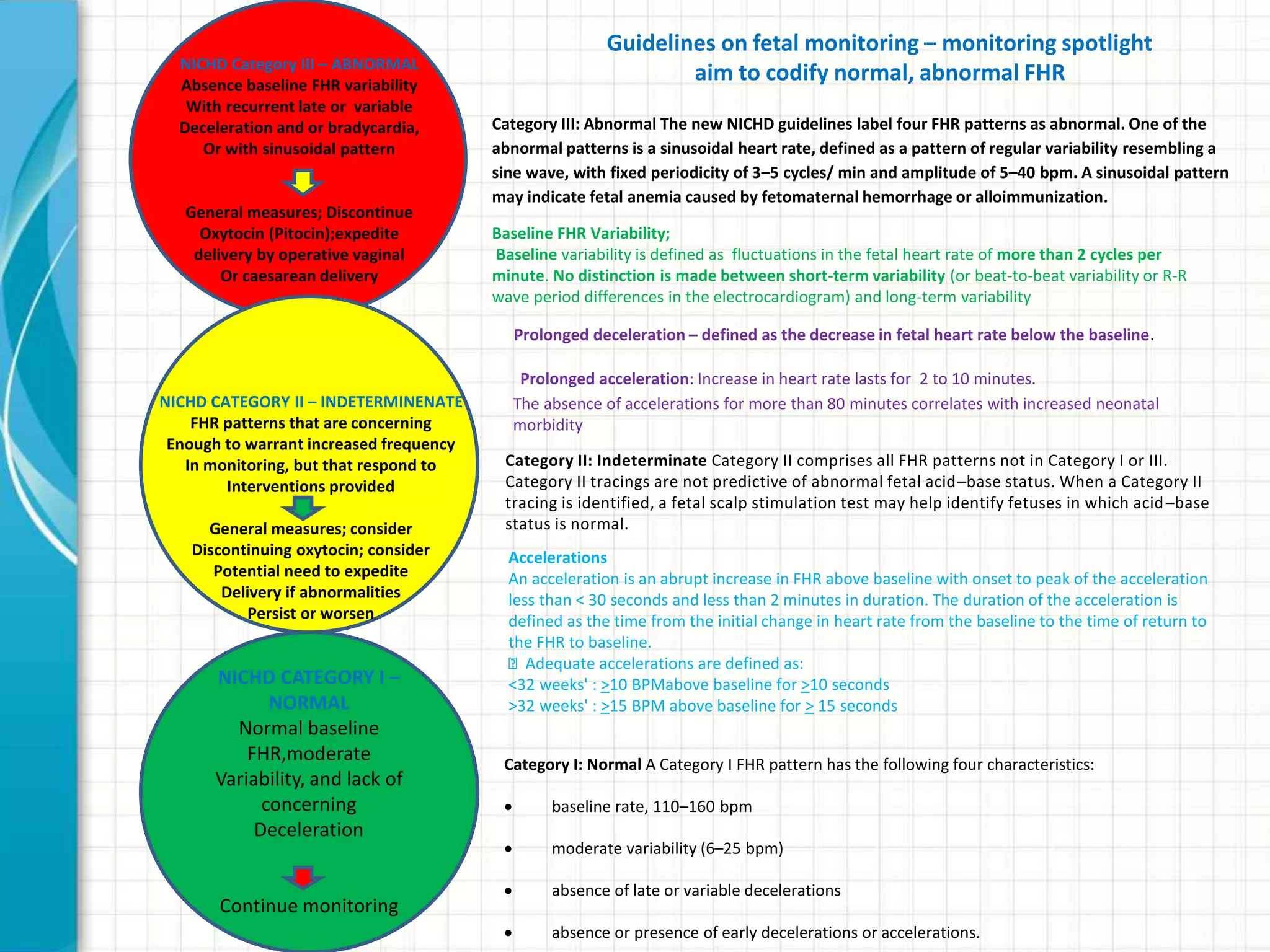
NICHD Category III – ABNORMAL
Absence baseline FHR variability
With recurrent late or variable
Deceleration and or bradycardia,
Or with sinusoidal pattern
General measures; Discontinue
Oxytocin (Pitocin);expedite
delivery by operative vaginal
Or caesarean delivery
NICHD CATEGORY II – INDETERMINENATE
FHR patterns that are concerning
Enough to warrant increased frequency
In monitoring, but that respond to
Interventions provided
General measures; consider
Discontinuing oxytocin; consider
Potential need to expedite
Delivery if abnormalities
Persist or worsen
NICHD CATEGORY I –
NORMAL
Normal baseline
FHR,moderate
Variability, and lack of
concerning
Deceleration
Continue monitoring
Category I: Normal A Category I FHR pattern has the following four characteristics:
 baseline rate, 110–160 bpm
 moderate variability (6–25 bpm)
 absence of late or variable decelerations
 absence or presence of early decelerations or accelerations.
Category II: Indeterminate Category II comprises all FHR patterns not in Category I or III.
Category II tracings are not predictive of abnormal fetal acid–base status. When a Category II
tracing is identified, a fetal scalp stimulation test may help identify fetuses in which acid–base
status is normal.
Category III: Abnormal The new NICHD guidelines label four FHR patterns as abnormal. One of the
abnormal patterns is a sinusoidal heart rate, defined as a pattern of regular variability resembling a
sine wave, with fixed periodicity of 3–5 cycles/ min and amplitude of 5–40 bpm. A sinusoidal pattern
may indicate fetal anemia caused by fetomaternal hemorrhage or alloimmunization.
Guidelines on fetal monitoring – monitoring spotlight
aim to codify normal, abnormal FHR
Baseline FHR Variability;
Baseline variability is defined as fluctuations in the fetal heart rate of more than 2 cycles per
minute. No distinction is made between short-term variability (or beat-to-beat variability or R-R
wave period differences in the electrocardiogram) and long-term variability
Accelerations
An acceleration is an abrupt increase in FHR above baseline with onset to peak of the acceleration
less than < 30 seconds and less than 2 minutes in duration. The duration of the acceleration is
defined as the time from the initial change in heart rate from the baseline to the time of return to
the FHR to baseline.
Adequate accelerations are defined as:
<32 weeks' : >10 BPMabove baseline for >10 seconds
>32 weeks' : >15 BPM above baseline for > 15 seconds
Prolonged acceleration: Increase in heart rate lasts for 2 to 10 minutes.
The absence of accelerations for more than 80 minutes correlates with increased neonatal
morbidity
Prolonged deceleration – defined as the decrease in fetal heart rate below the baseline.
• Familiarize yourself with
your new equipment1
• Understand settings and
use of all knobs/keys2
• Teach new colleagues
how to operate and use
the equipment
3
Today’s Overview
General measures includes vaginal
examination, checking maternal vital signs, giving
O2,changing maternal positions, administering
intravenous fluids and assessing fetal PH with
acoustic or fetal scalp stimulation.
GOOD EQUIPMENT USE & PRACTICES
1. Don’t Drop the transducers.
2. Don’t use the cables when coiled - un-coil them.
3. Don’t use ultrasound gel to TOCO transducer or transducer contact area.
4. Clean the transducers after each use and keep the equipment clean.
5. Call the engineer incase of anything that you are doubting.
6. Don’t use  connect a faulty equipment on a patient.
7. Always ensure that the battery is fully charged to avoid disturbances incase of
power black out.
8. Avoid using a pen to activate or operate the touch screen..! Its capacitive – too
sensitive and senses your finger touch.
QUESTIONS ??
THANKS
Cooper Surgical Fetal Monitor

Cooper Surgical Fetal Monitor

  • 1.
  • 2.
    COOPER SURGICAL FETALMONITOR KEEPING YOU AT THE FOREFRONT OF WOMEN’S HEALTH CARE™
  • 3.
  • 4.
    BUTTONS AND FUNCTIONS 1.START: Start monitoring return to the main interface when entering maternal information 2. SILENCE: Enabledisable the alarm audio. 3. AUTO ZERO: Adjust the external TOCO contractions trace or value 4. MARK: used to mark an event. A mark symbol will appear on the monitor trace and on the record paper to record an event. 5. PRINT: press this button to start or stop printing. 6. CHANNEL: Switch the channel. The monitor default fetal heart audio is USI. When two ultrasound transducers are connected to the monitor, press this button to switch the audio to US2,press it again to switch the audio to USI. 7. NIBP: star or stop NIBP measurement. This button is not active unless optional NIBP feature is enabled. 8. CONTROL KNOB: adjust volume, set up, input maternal information and review settings. Rotate and or press to operate.
  • 5.
    Benefits of CooperSurgical FetalMonitor include:  Touch-screen display facilitates operator interface  Large real-time color monitor provides instantaneous feedback to the staff and facilitates patient interaction  A 12-crystal, wide-beam, 1 MHz transducer yields industry leading signal acquisition and maintenance of FHR, even in challenging situations  Signal Overlap Verification provides visual and audible indications when synchronous heart-rate signals are detected  Configured to monitor twins for cost efficiency  Insight™ software permits transfer of patient data to a personal computer for study review and record storage  EMR capatibility  24-hour data storage facilitates data transfer or reprinting
  • 6.
    Fetal Monitor System Components: •2 ultrasound transducers • 1 TOCO transducer • 1 Event marker • 2 reusable belts • Ultrasound gel • Printer paper • Power cord • Insight™ software • System and software user manuals • RS232 and Ethernet cables • Rechargeable lithium--ion battery (optional)
  • 7.
    CooperSurgical® F9 Fetal Monitor Bpm- Breaths Per Minute EFM - Electronic Fetal Monitoring FHR - Fetal Heart Rate NICHD – National Institute of Child Health and Human Development SIA – Structured Intermitted Auscultation
  • 8.
    NICHD Category III– ABNORMAL Absence baseline FHR variability With recurrent late or variable Deceleration and or bradycardia, Or with sinusoidal pattern General measures; Discontinue Oxytocin (Pitocin);expedite delivery by operative vaginal Or caesarean delivery NICHD CATEGORY II – INDETERMINENATE FHR patterns that are concerning Enough to warrant increased frequency In monitoring, but that respond to Interventions provided General measures; consider Discontinuing oxytocin; consider Potential need to expedite Delivery if abnormalities Persist or worsen NICHD CATEGORY I – NORMAL Normal baseline FHR,moderate Variability, and lack of concerning Deceleration Continue monitoring Category I: Normal A Category I FHR pattern has the following four characteristics:  baseline rate, 110–160 bpm  moderate variability (6–25 bpm)  absence of late or variable decelerations  absence or presence of early decelerations or accelerations. Category II: Indeterminate Category II comprises all FHR patterns not in Category I or III. Category II tracings are not predictive of abnormal fetal acid–base status. When a Category II tracing is identified, a fetal scalp stimulation test may help identify fetuses in which acid–base status is normal. Category III: Abnormal The new NICHD guidelines label four FHR patterns as abnormal. One of the abnormal patterns is a sinusoidal heart rate, defined as a pattern of regular variability resembling a sine wave, with fixed periodicity of 3–5 cycles/ min and amplitude of 5–40 bpm. A sinusoidal pattern may indicate fetal anemia caused by fetomaternal hemorrhage or alloimmunization. Guidelines on fetal monitoring – monitoring spotlight aim to codify normal, abnormal FHR Baseline FHR Variability; Baseline variability is defined as fluctuations in the fetal heart rate of more than 2 cycles per minute. No distinction is made between short-term variability (or beat-to-beat variability or R-R wave period differences in the electrocardiogram) and long-term variability Accelerations An acceleration is an abrupt increase in FHR above baseline with onset to peak of the acceleration less than < 30 seconds and less than 2 minutes in duration. The duration of the acceleration is defined as the time from the initial change in heart rate from the baseline to the time of return to the FHR to baseline. Adequate accelerations are defined as: <32 weeks' : >10 BPMabove baseline for >10 seconds >32 weeks' : >15 BPM above baseline for > 15 seconds Prolonged acceleration: Increase in heart rate lasts for 2 to 10 minutes. The absence of accelerations for more than 80 minutes correlates with increased neonatal morbidity Prolonged deceleration – defined as the decrease in fetal heart rate below the baseline.
  • 9.
    • Familiarize yourselfwith your new equipment1 • Understand settings and use of all knobs/keys2 • Teach new colleagues how to operate and use the equipment 3 Today’s Overview
  • 10.
    General measures includesvaginal examination, checking maternal vital signs, giving O2,changing maternal positions, administering intravenous fluids and assessing fetal PH with acoustic or fetal scalp stimulation.
  • 11.
    GOOD EQUIPMENT USE& PRACTICES 1. Don’t Drop the transducers. 2. Don’t use the cables when coiled - un-coil them. 3. Don’t use ultrasound gel to TOCO transducer or transducer contact area. 4. Clean the transducers after each use and keep the equipment clean. 5. Call the engineer incase of anything that you are doubting. 6. Don’t use connect a faulty equipment on a patient. 7. Always ensure that the battery is fully charged to avoid disturbances incase of power black out. 8. Avoid using a pen to activate or operate the touch screen..! Its capacitive – too sensitive and senses your finger touch.
  • 12.