
Notice
• This power point is made by Mitsuru
  Nakazawa, NOT an original author, for paper
  introduction of ECCV2012


                                                1
Presenter: Mitsuru NAKAZAWA


 Performance Capture of Interacting
  Characters with Handheld Kinects

       Genzhi Ye1 Yebin Liu1 Nils Hasler2
 Xiangyang Ji1 Qionghai Dai1 Christian Theobalt2
              1: Deptartment of Automation, Tsinghua University
    2: Graphics, Vision & Video Group, Max-Planck Institute for Informatics


ECCV2012 paper introduction                                                   2
Introduction movie


URL: http://media.au.tsinghua.edu.cn/yegenzhi/HandheldKinectsMocap_ECCV2012.jsp
(Accessed on 26th Nov. 2012)


                                                                                  3
Related works
Multi-view motion capture approaches
   Reconstruct a skeletal motion model & detailed
    dynamic surface geometry
   Deal with people wide apparel
   Require controlled studio setup (many number
    of sync video cameras)

Marker-less motion capture from a single range
sensor
   Estimate complex poses at real-time frame rates
   Difficult to capture 3D, complex, detailed model
                                                       4
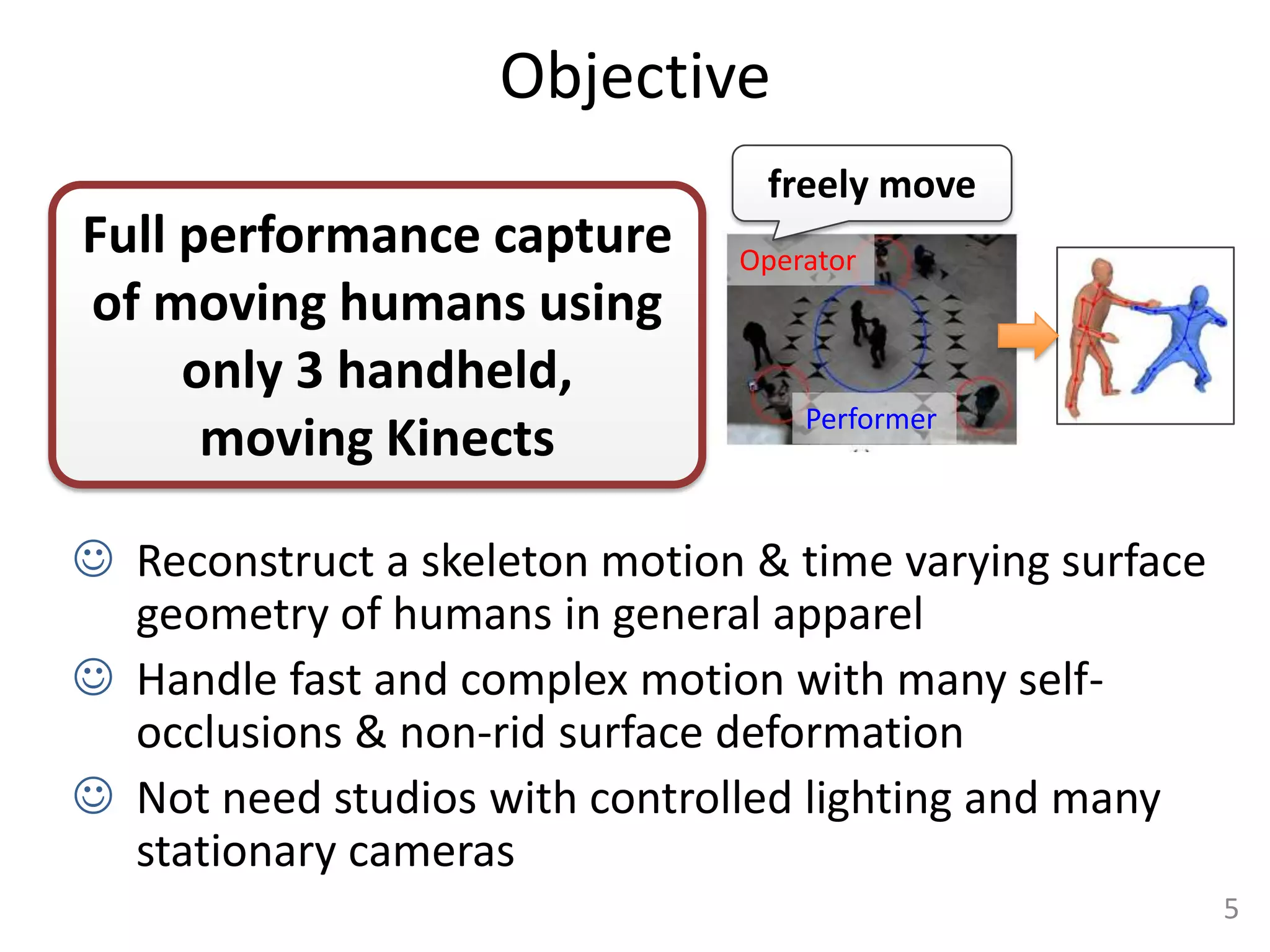
Objective
                                 freely move
Full performance capture       Operator
of moving humans using
     only 3 handheld,
                                   Performer
      moving Kinects

 Reconstruct a skeleton motion & time varying surface
  geometry of humans in general apparel
 Handle fast and complex motion with many self-
  occlusions & non-rid surface deformation
 Not need studios with controlled lighting and many
  stationary cameras
                                                         5
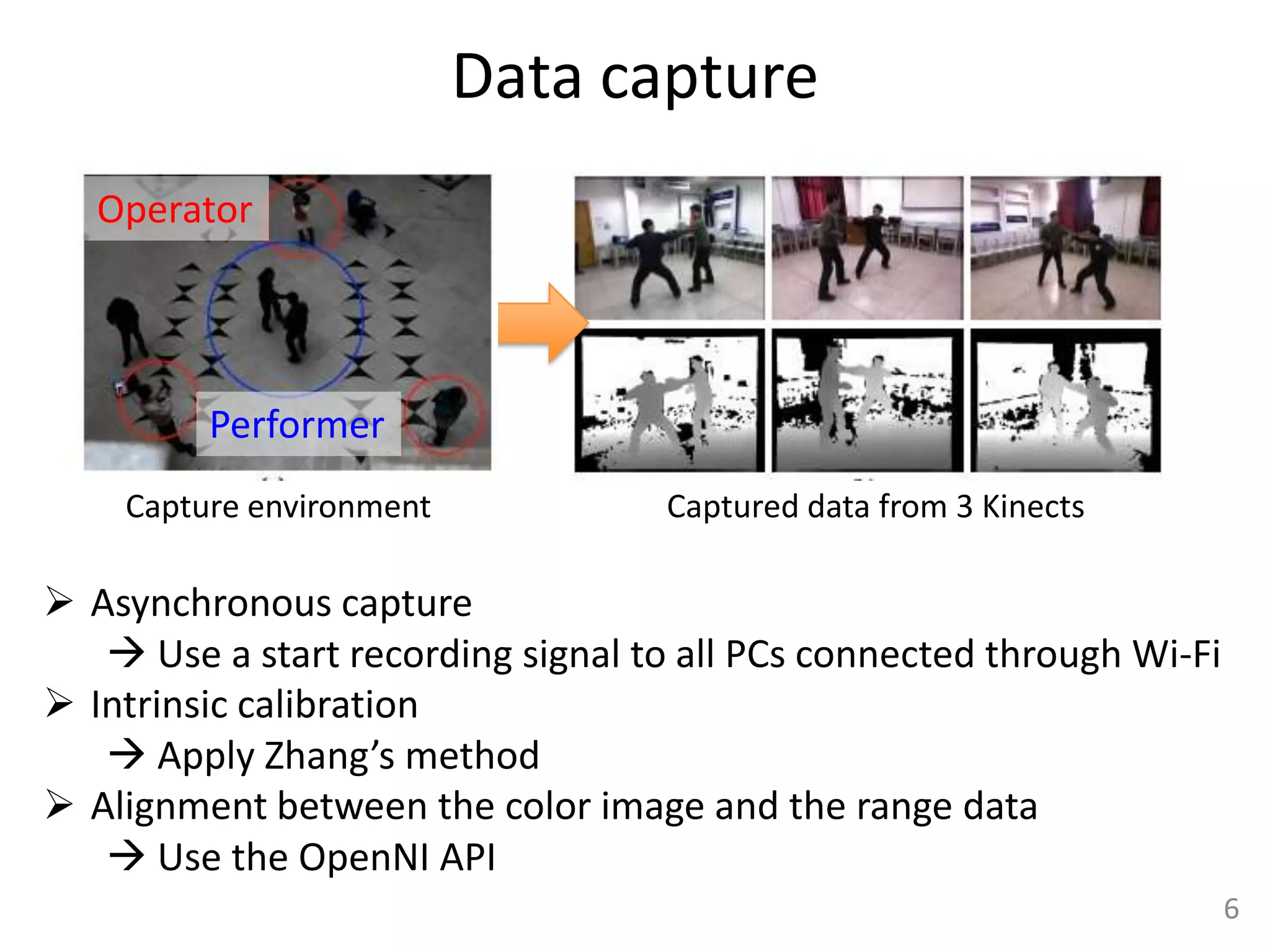
Data capture
   Operator


         Performer
    Capture environment             Captured data from 3 Kinects

 Asynchronous capture
    Use a start recording signal to all PCs connected through Wi-Fi
 Intrinsic calibration
    Apply Zhang’s method
 Alignment between the color image and the range data
    Use the OpenNI API
                                                                       6
Scene models at time t
       • Human model
              – Laser scanner provide a static mesh with embedded
                skeleton of each performer
                                         [*]

                                                            • 5,000 vertices of meshes
                                                            • k-th performer’s Skeleton with
                                                              31 degrees of freedom: C tk
                           GND (r=3m)

         • Ground plane model (fixed)
                – Center of Environment
                – Planar mesh with circular boundary
         • Camera extrinsic parameters of i-th Kinect
                – Translation, rotation: L tk
                                                                                                                      7
[*] F. Remondino: “3-D reconstruction of static human body shape from image sequence,” CVIU, Vol.93, No.1. pp.65-85
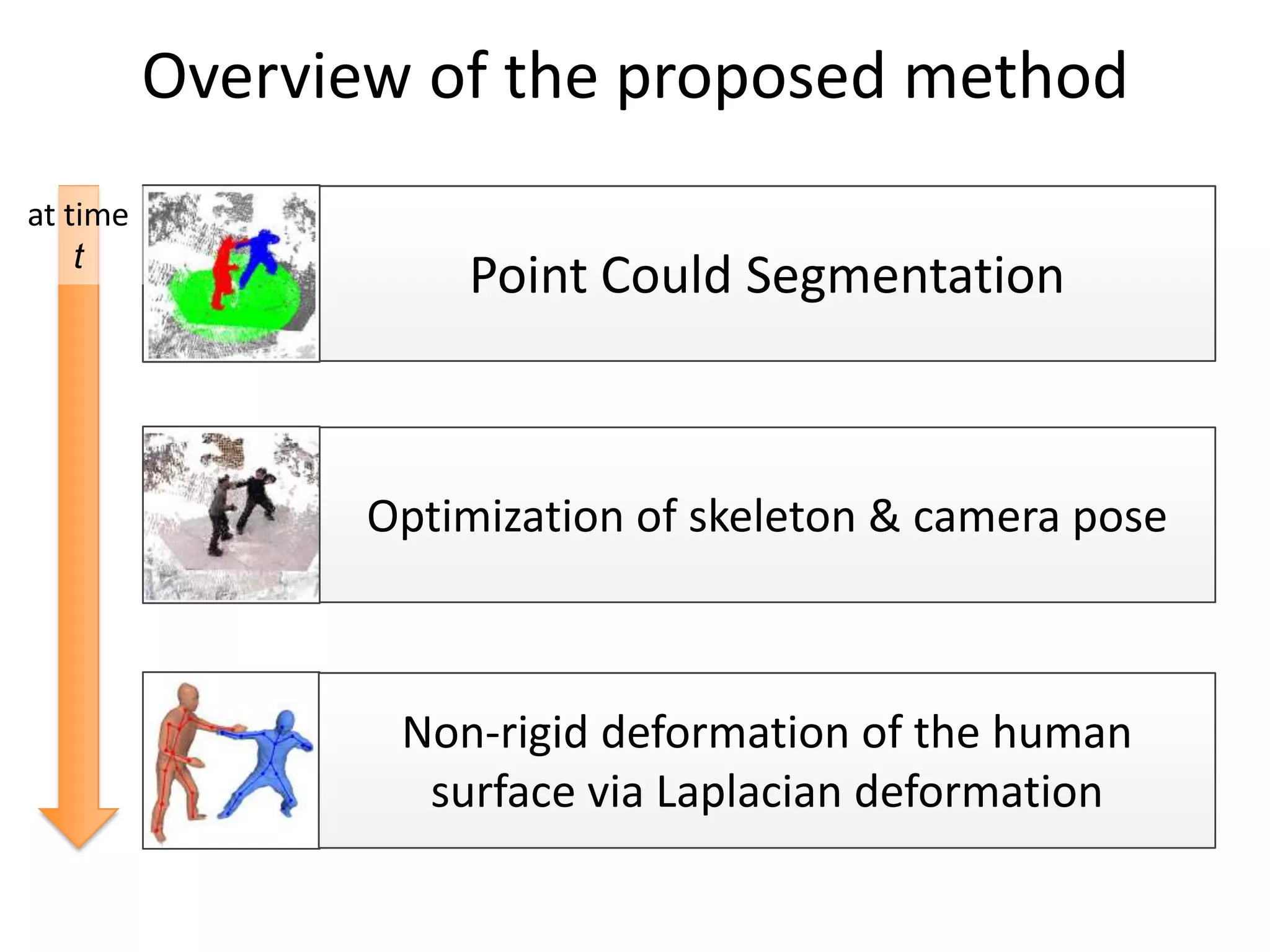
Overview of the proposed method
at time
    t            Geometric matching of Kinect point to
                    Point Could Segmentation
                     vertices of a human model


                 Optimization of skeleton & camera pose


                  Non-rigid deformation of the human
                   surface via Laplacian deformation
                                                          8
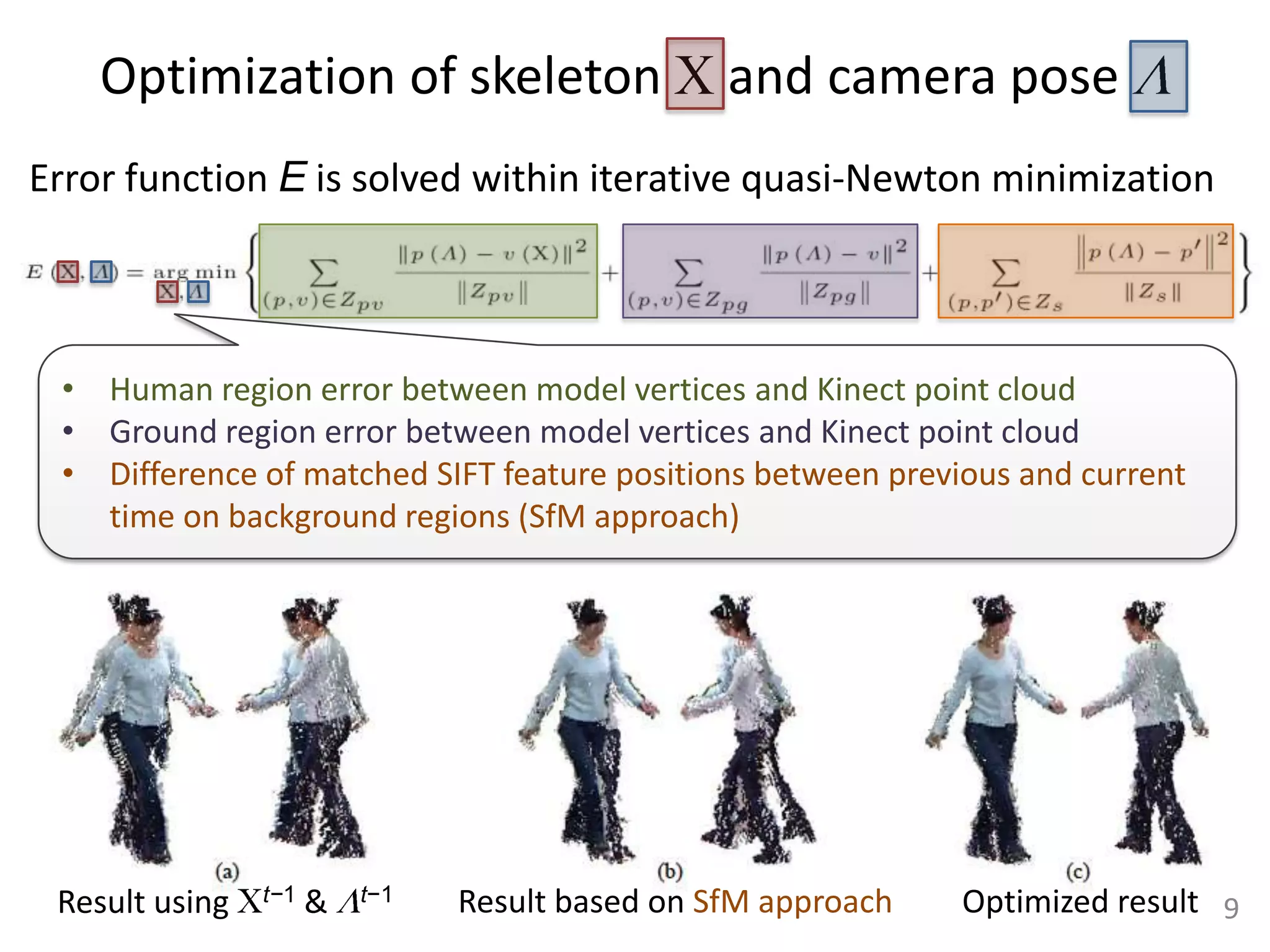
Optimization of skeleton                     and camera pose
Error function E is solved within iterative quasi-Newton minimization


 • Human region error between model vertices and Kinect point cloud
 • Ground region error between model vertices and Kinect point cloud
 • Difference of matched SIFT feature positions between previous and current
   time on background regions (SfM approach)


 Result using   t−1   &   t−1   Result based on SfM approach   Optimized result 9
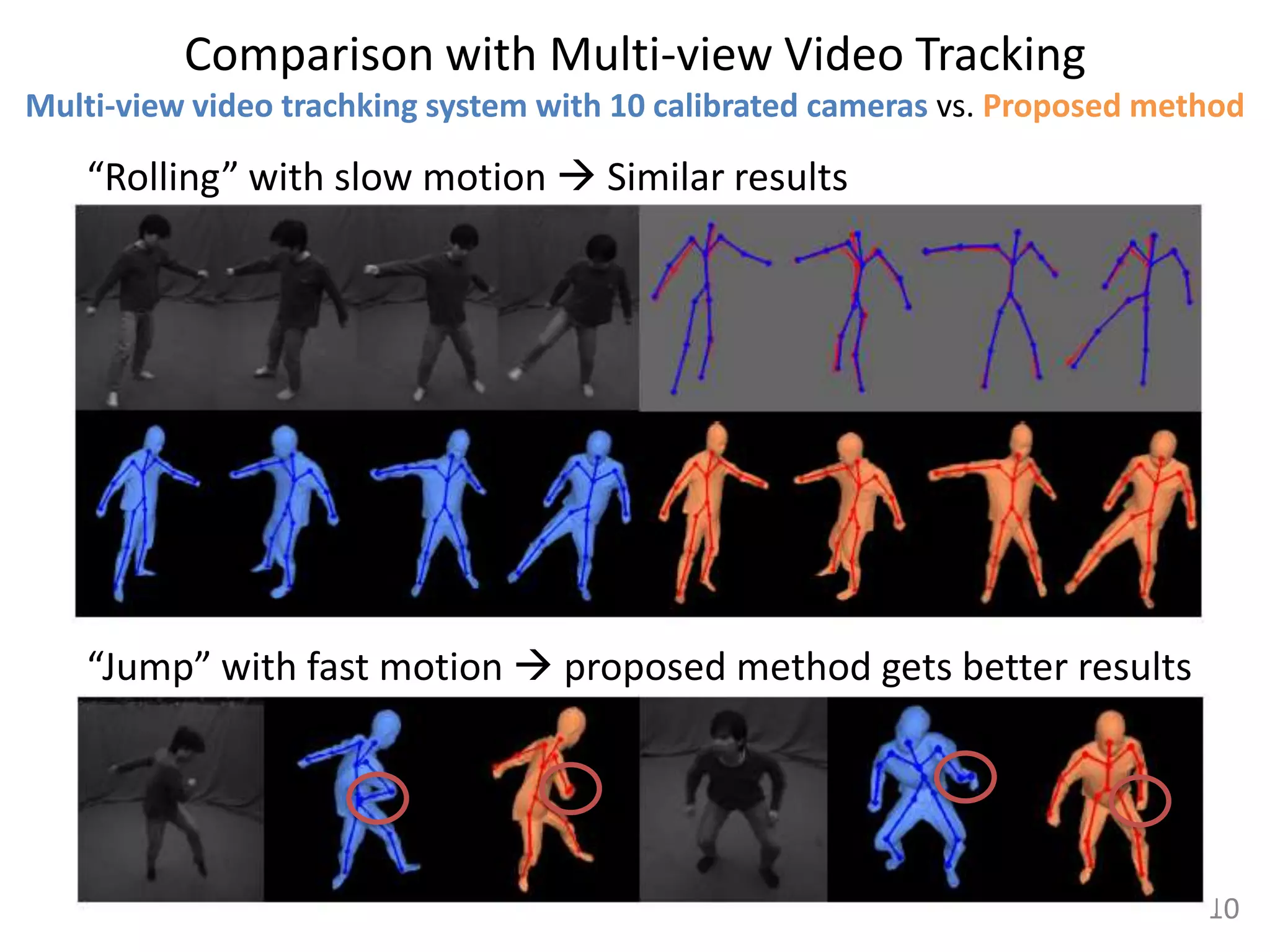
Comparison with Multi-view Video Tracking
Multi-view video trachking system with 10 calibrated cameras vs. Proposed method

    “Rolling” with slow motion  Similar results


    “Jump” with fast motion  proposed method gets better results


                                                                             10
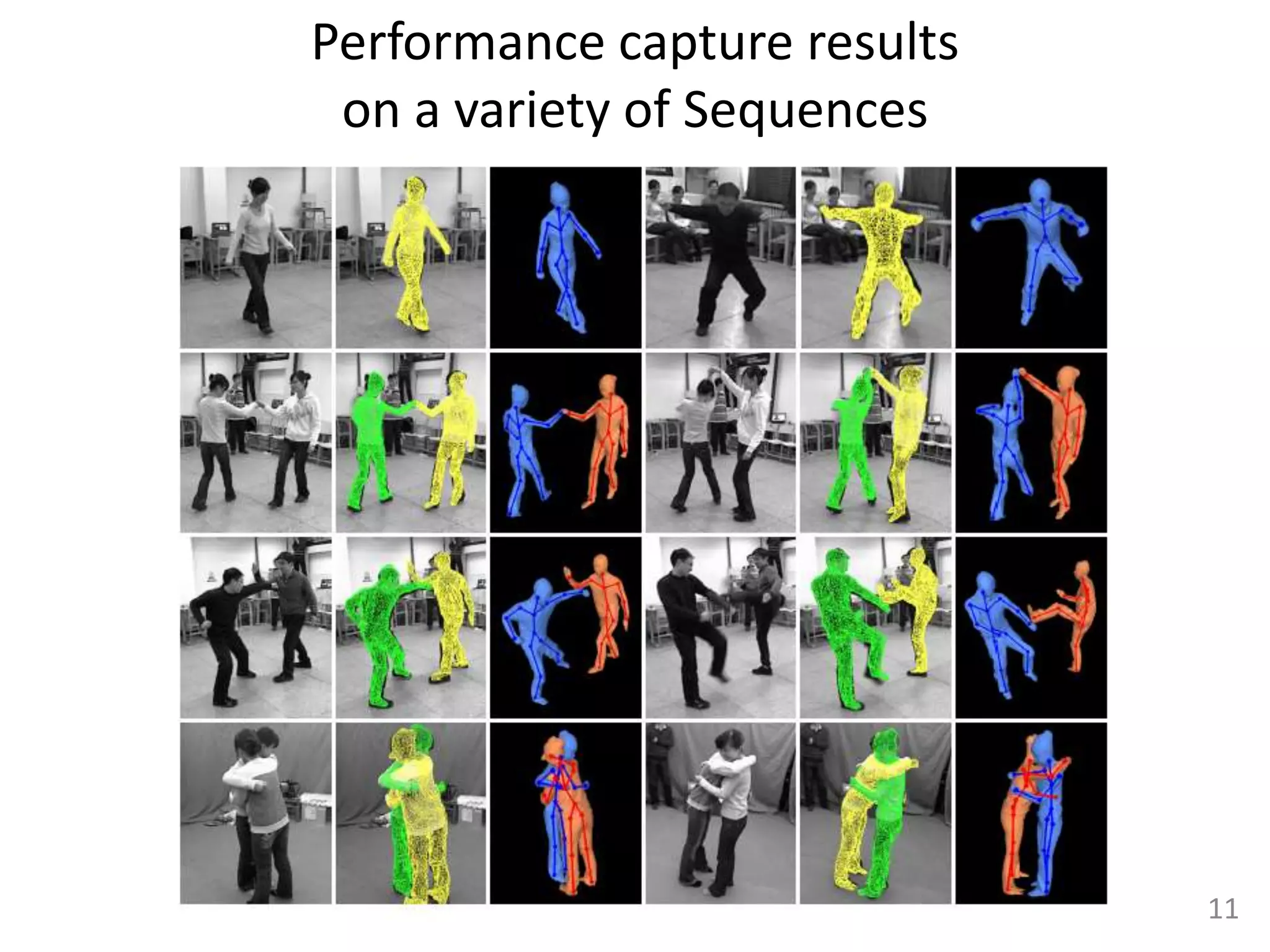
Performance capture results
 on a variety of Sequences


                              11
Conclusion
• Simultaneously marker-less performance
  capture system with several hand-held Kinects
  – Iterative robust matching of tracked 3D models
    and input Kinect data


                                                     12
References
• Linear Blend Skinning (Accessed on Nov. 25th 2012 )
   – http://bit.ly/RaijkQ
• Motion Capture Using Joint Skeleton Tracking and
  Surface Estimation (Accessed on Nov. 26th 2012)
   – http://www.vision.ee.ethz.ch/~gallju/projects/skelsurf/ind
     ex.html


                                                                  13

[Paper introduction] Performance Capture of Interacting Characters with Handheld Kinects

  • 1.
    Notice • This powerpoint is made by Mitsuru Nakazawa, NOT an original author, for paper introduction of ECCV2012 1
  • 2.
    Presenter: Mitsuru NAKAZAWA Performance Capture of Interacting Characters with Handheld Kinects Genzhi Ye1 Yebin Liu1 Nils Hasler2 Xiangyang Ji1 Qionghai Dai1 Christian Theobalt2 1: Deptartment of Automation, Tsinghua University 2: Graphics, Vision & Video Group, Max-Planck Institute for Informatics ECCV2012 paper introduction 2
  • 3.
  • 4.
    Related works Multi-view motioncapture approaches  Reconstruct a skeletal motion model & detailed dynamic surface geometry  Deal with people wide apparel  Require controlled studio setup (many number of sync video cameras) Marker-less motion capture from a single range sensor  Estimate complex poses at real-time frame rates  Difficult to capture 3D, complex, detailed model 4
  • 5.
    Objective freely move Full performance capture Operator of moving humans using only 3 handheld, Performer moving Kinects  Reconstruct a skeleton motion & time varying surface geometry of humans in general apparel  Handle fast and complex motion with many self- occlusions & non-rid surface deformation  Not need studios with controlled lighting and many stationary cameras 5
  • 6.
    Data capture Operator Performer Capture environment Captured data from 3 Kinects  Asynchronous capture  Use a start recording signal to all PCs connected through Wi-Fi  Intrinsic calibration  Apply Zhang’s method  Alignment between the color image and the range data  Use the OpenNI API 6
  • 7.
    Scene models attime t • Human model – Laser scanner provide a static mesh with embedded skeleton of each performer [*] • 5,000 vertices of meshes • k-th performer’s Skeleton with 31 degrees of freedom: C tk GND (r=3m) • Ground plane model (fixed) – Center of Environment – Planar mesh with circular boundary • Camera extrinsic parameters of i-th Kinect – Translation, rotation: L tk 7 [*] F. Remondino: “3-D reconstruction of static human body shape from image sequence,” CVIU, Vol.93, No.1. pp.65-85
  • 8.
    Overview of theproposed method at time t Geometric matching of Kinect point to Point Could Segmentation vertices of a human model Optimization of skeleton & camera pose Non-rigid deformation of the human surface via Laplacian deformation 8
  • 9.
    Optimization of skeleton and camera pose Error function E is solved within iterative quasi-Newton minimization • Human region error between model vertices and Kinect point cloud • Ground region error between model vertices and Kinect point cloud • Difference of matched SIFT feature positions between previous and current time on background regions (SfM approach) Result using t−1 & t−1 Result based on SfM approach Optimized result 9
  • 10.
    Comparison with Multi-viewVideo Tracking Multi-view video trachking system with 10 calibrated cameras vs. Proposed method “Rolling” with slow motion  Similar results “Jump” with fast motion  proposed method gets better results 10
  • 11.
    Performance capture results on a variety of Sequences 11
  • 12.
    Conclusion • Simultaneously marker-lessperformance capture system with several hand-held Kinects – Iterative robust matching of tracked 3D models and input Kinect data 12
  • 13.
    References • Linear BlendSkinning (Accessed on Nov. 25th 2012 ) – http://bit.ly/RaijkQ • Motion Capture Using Joint Skeleton Tracking and Surface Estimation (Accessed on Nov. 26th 2012) – http://www.vision.ee.ethz.ch/~gallju/projects/skelsurf/ind ex.html 13