© 2016 by Markus Winand
Transactions
What they are good for and how they work
( )
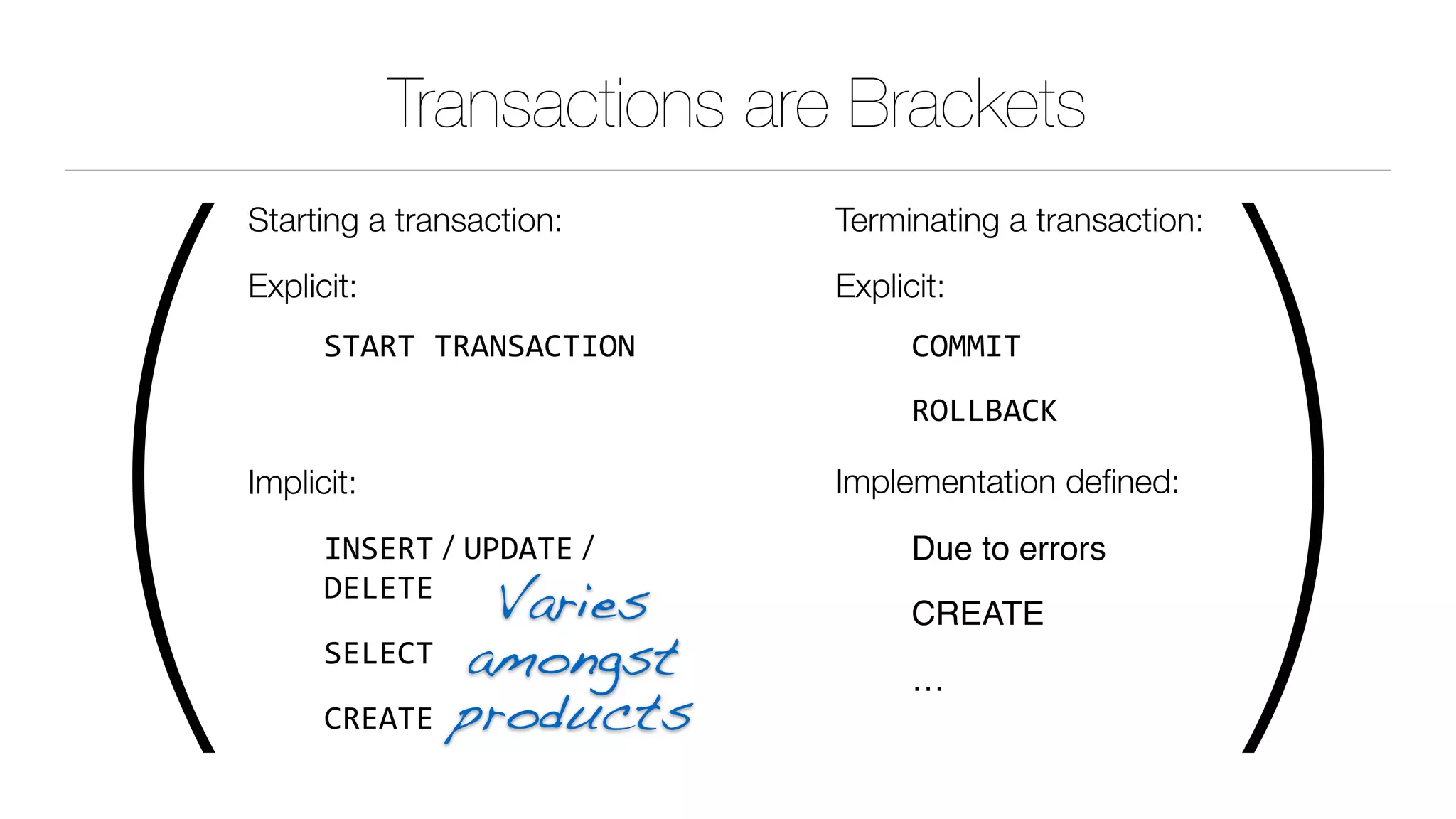
Transactions are Brackets
Starting a transaction:
Explicit:
START	TRANSACTION		
Implicit:
INSERT / UPDATE /
DELETE

SELECT	
CREATE
Terminating a transaction:
Explicit:
COMMIT	
ROLLBACK	
Implementation defined:
Due to errors
CREATE
…	
Varies

amongst

products
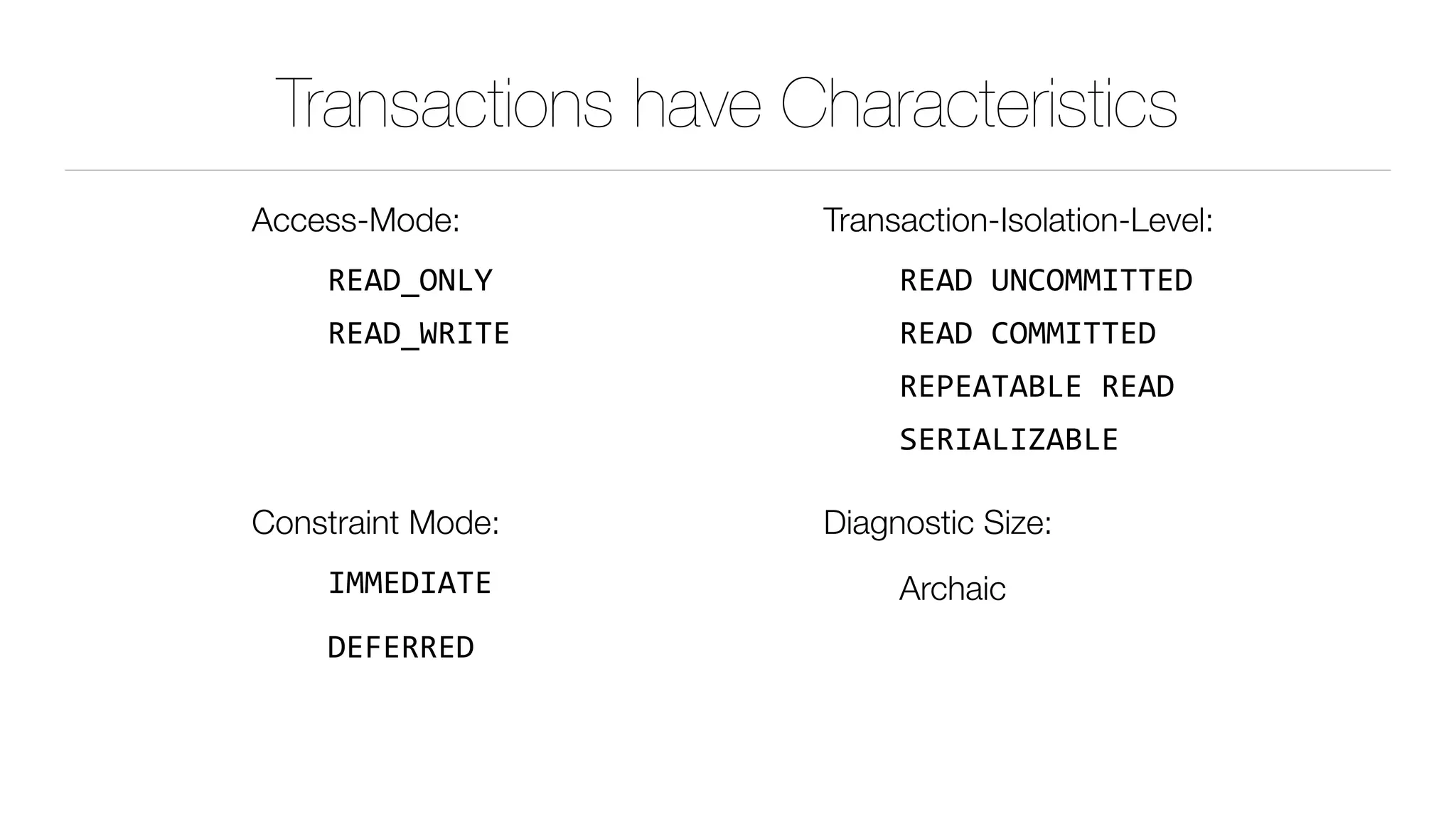
Transactions have Characteristics
Access-Mode:
READ_ONLY	
READ_WRITE	
Constraint Mode:
IMMEDIATE	
DEFERRED
Transaction-Isolation-Level:
READ	UNCOMMITTED	
READ	COMMITTED	
REPEATABLE	READ	
SERIALIZABLE	
Diagnostic Size:
Archaic
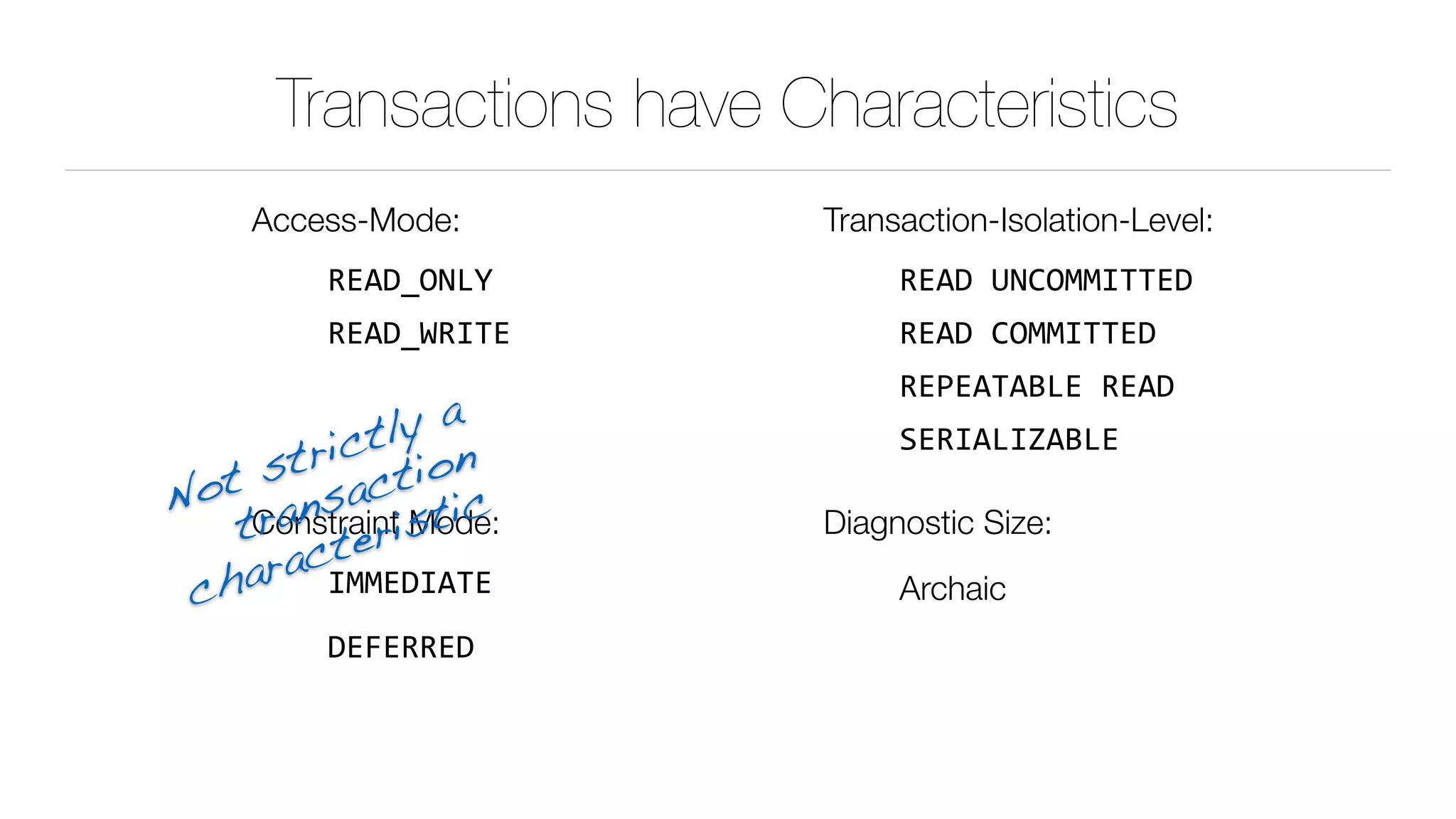
Transactions have Characteristics
Access-Mode:
READ_ONLY	
READ_WRITE	
Constraint Mode:
IMMEDIATE	
DEFERRED
Transaction-Isolation-Level:
READ	UNCOMMITTED	
READ	COMMITTED	
REPEATABLE	READ	
SERIALIZABLE	
Diagnostic Size:
Archaic
Not strictly a

transaction


characteristic
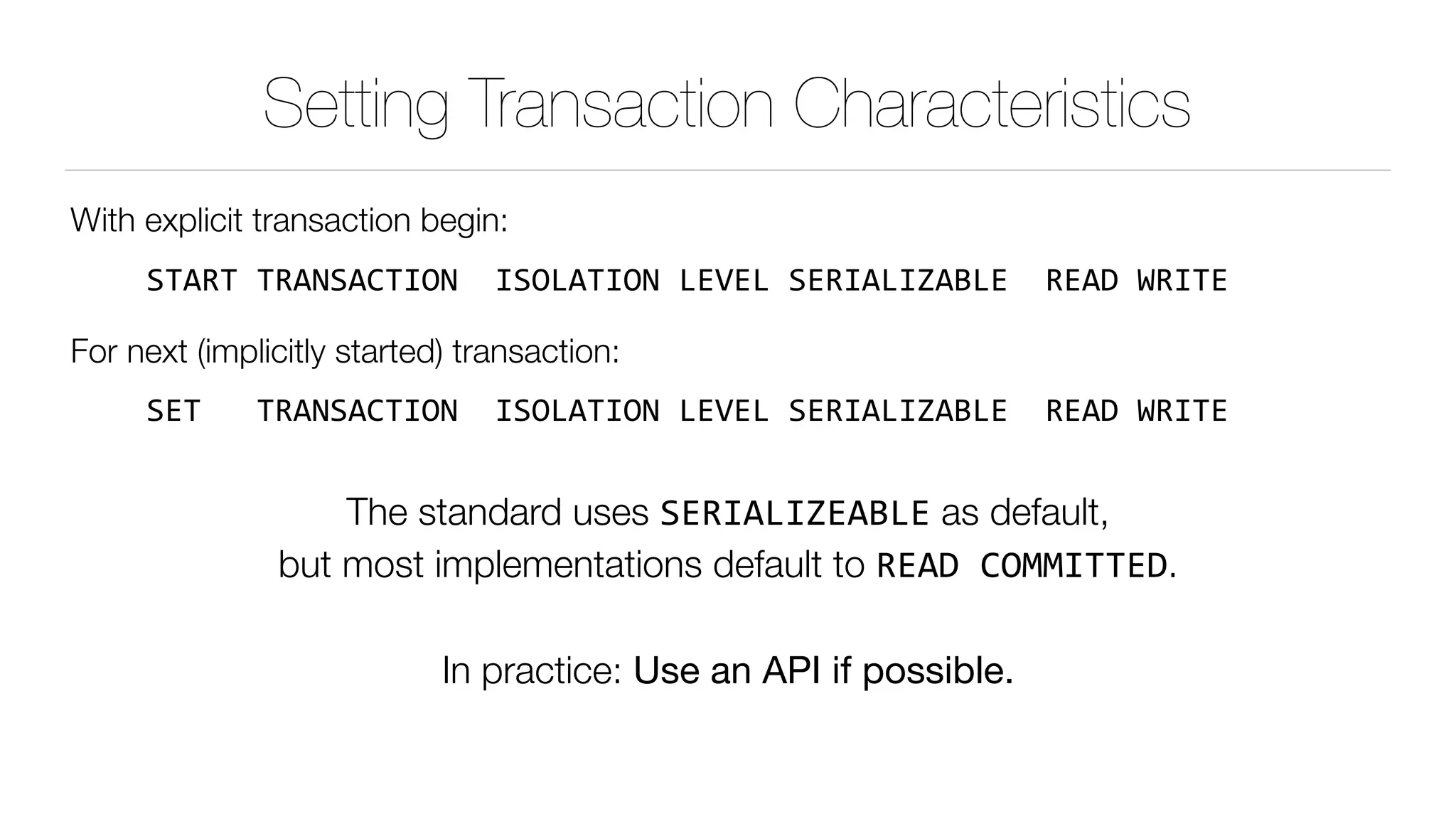
Setting Transaction Characteristics
With explicit transaction begin:
START	TRANSACTION		ISOLATION	LEVEL	SERIALIZABLE		READ	WRITE	
For next (implicitly started) transaction:
SET			TRANSACTION		ISOLATION	LEVEL	SERIALIZABLE		READ	WRITE	
The standard uses SERIALIZEABLE as default,

but most implementations default to READ	COMMITTED.
In practice: Use an API if possible.
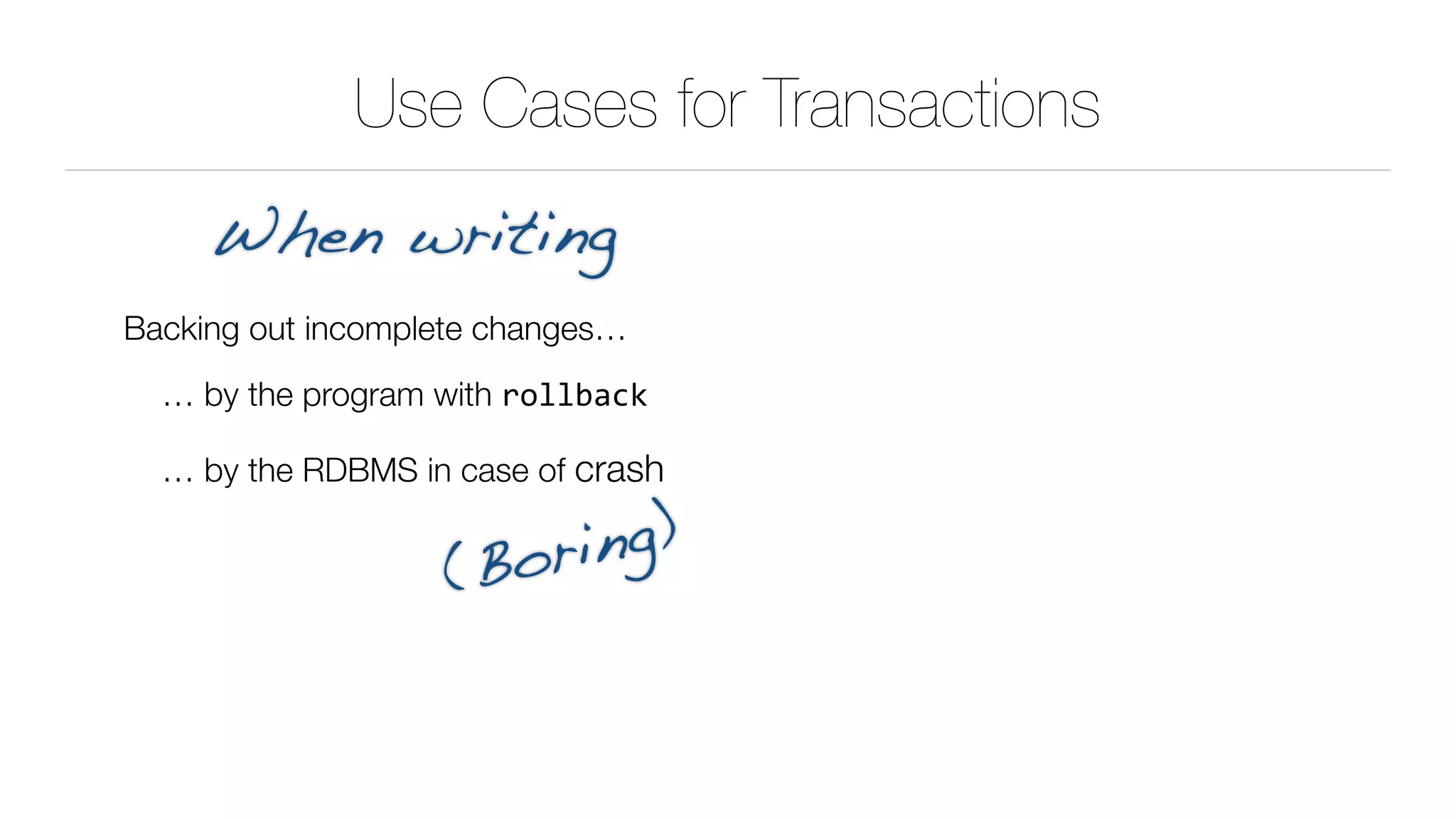
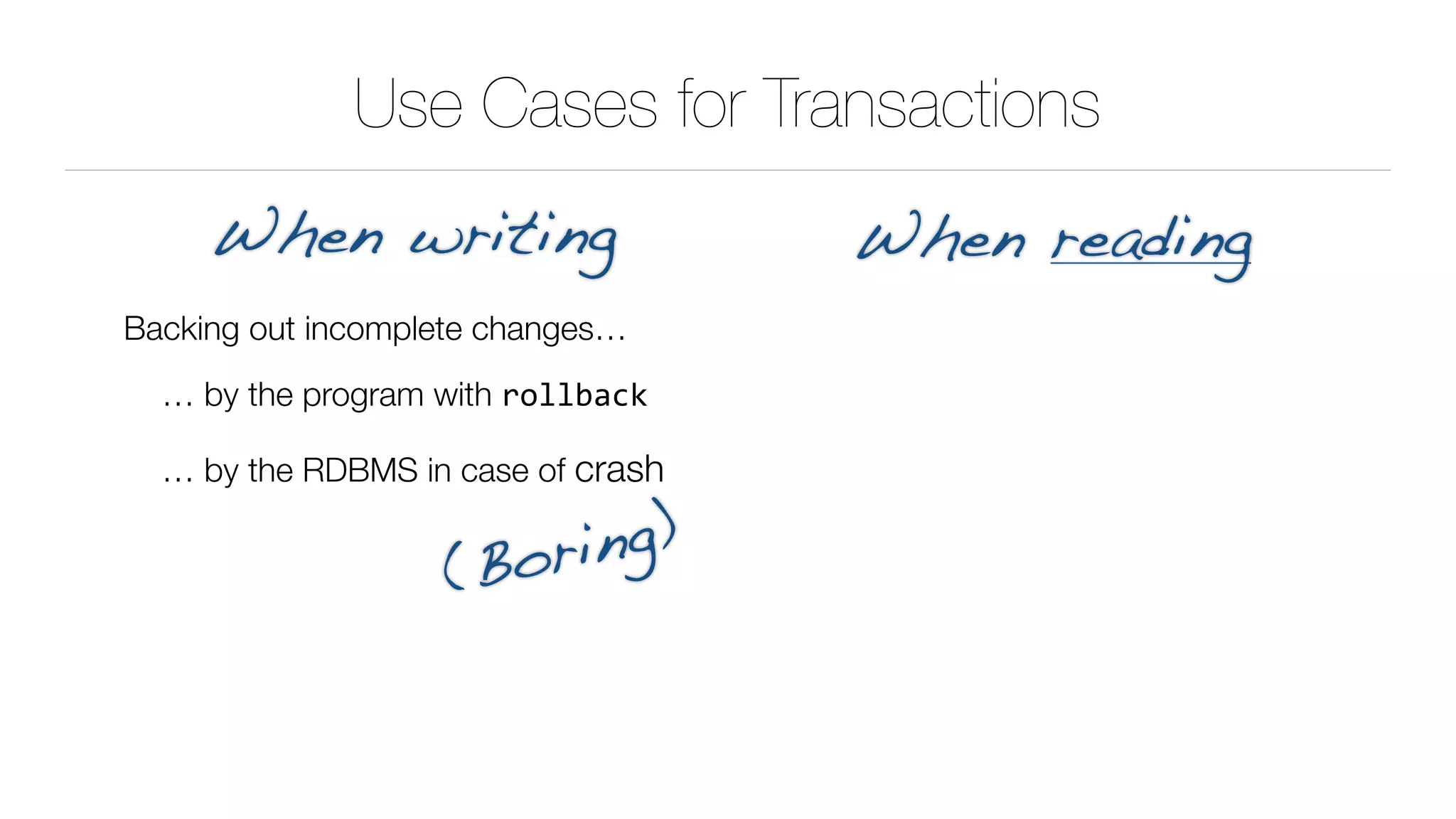
Use Cases for Transactions
When writing
Use Cases for Transactions
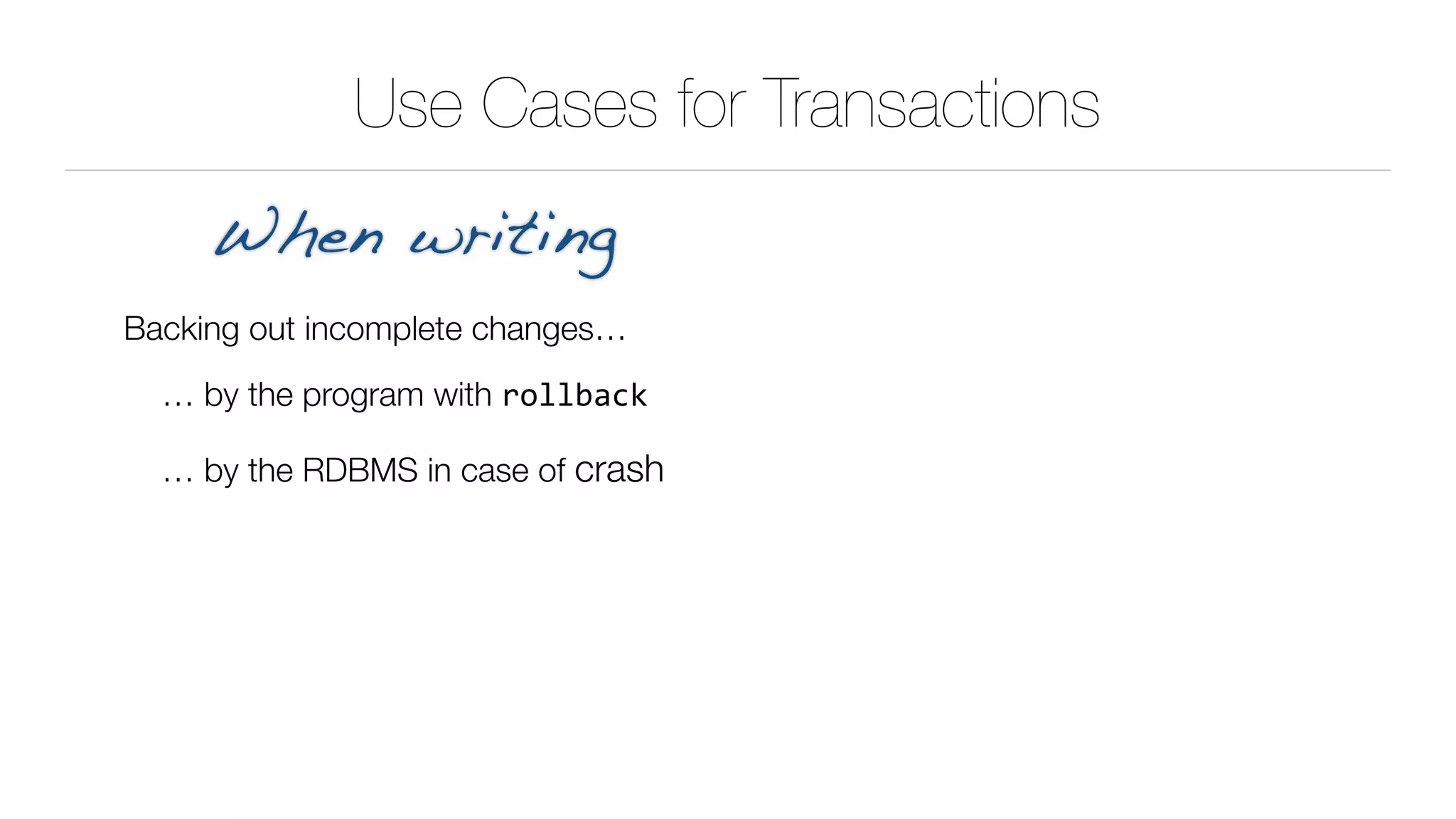
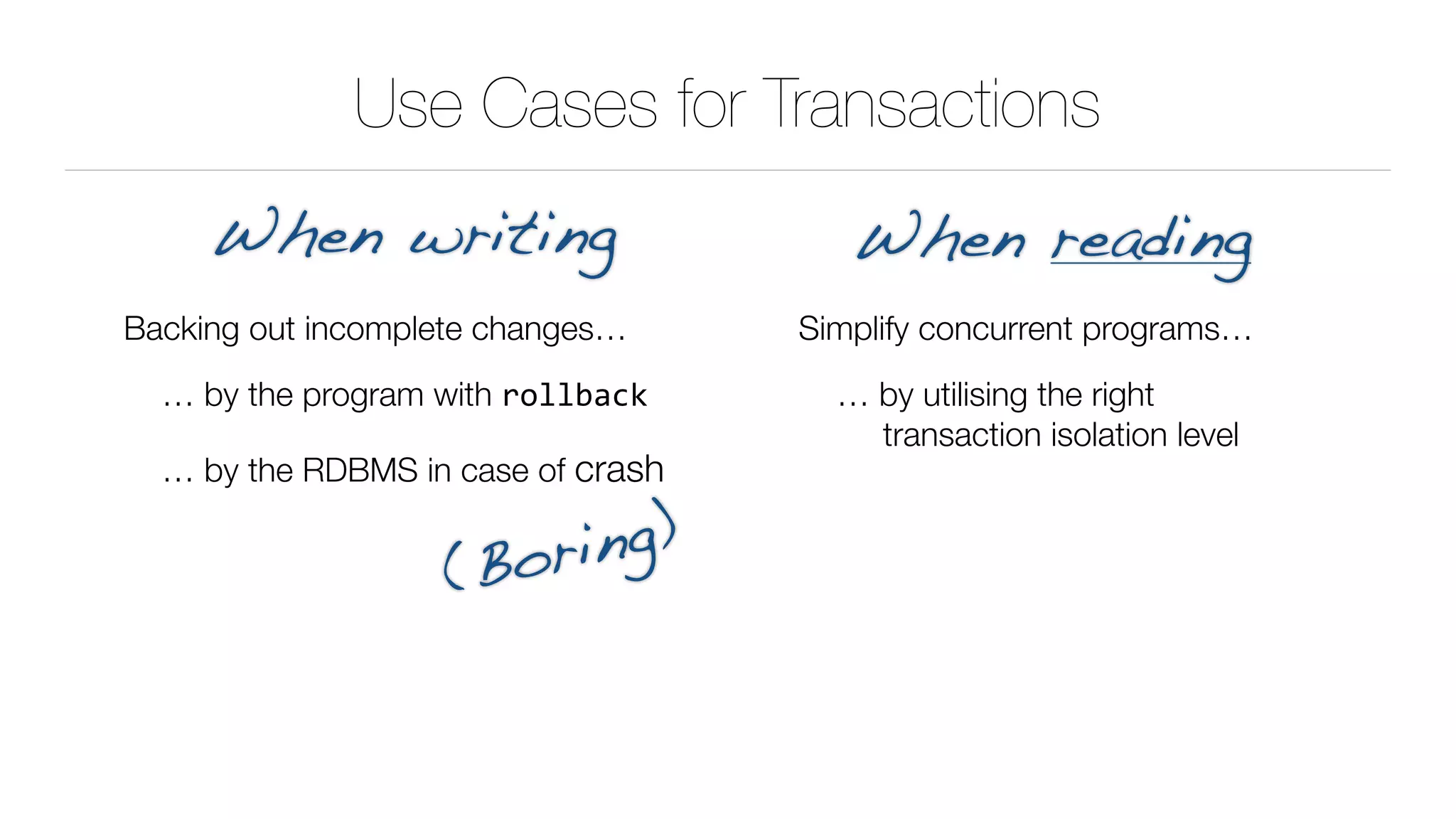
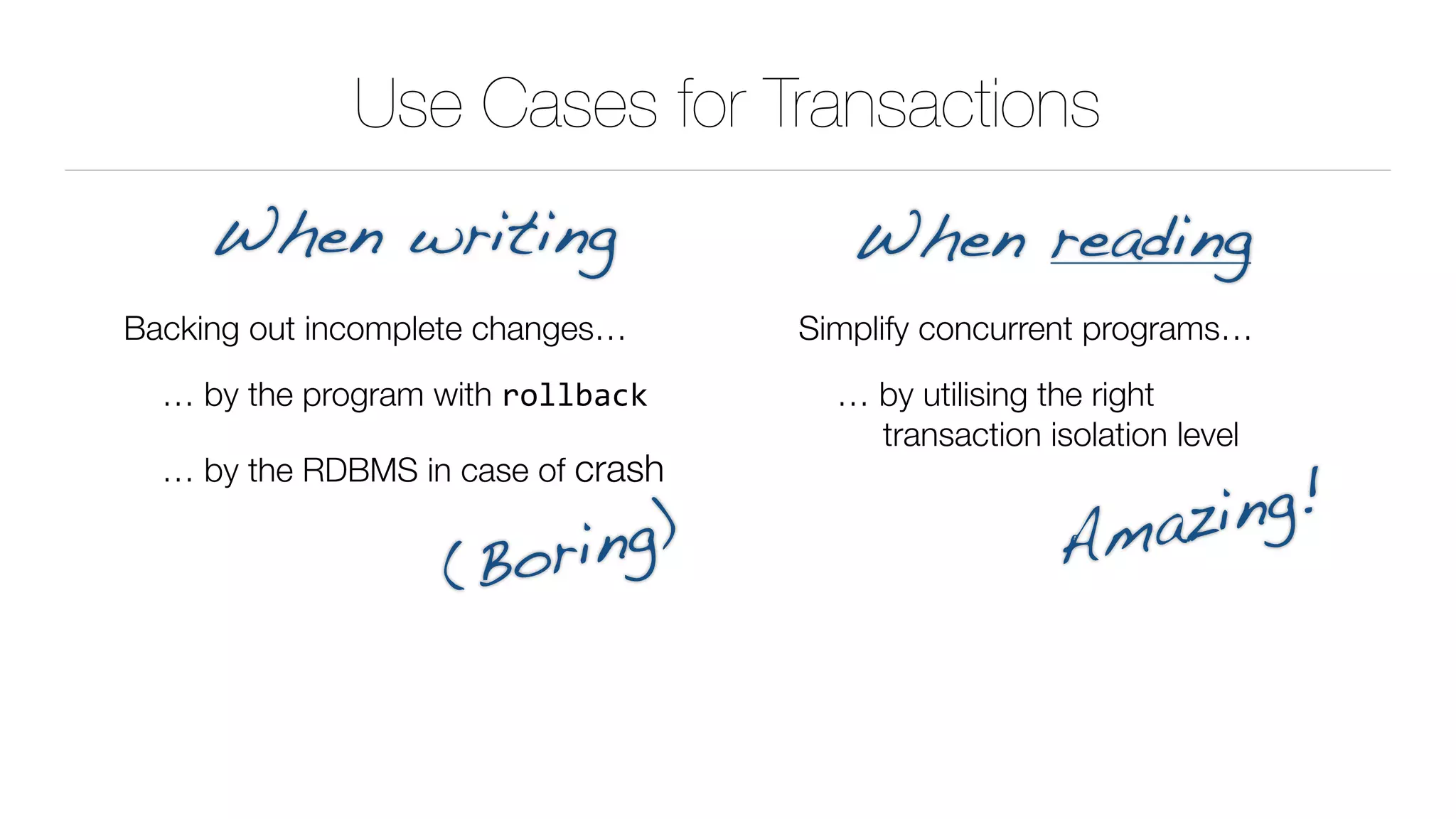
Backing out incomplete changes…
… by the program with rollback
… by the RDBMS in case of crash
When writing
Use Cases for Transactions
Backing out incomplete changes…
… by the program with rollback
… by the RDBMS in case of crash
When writing
(Boring)
Use Cases for Transactions
Backing out incomplete changes…
… by the program with rollback
… by the RDBMS in case of crash
When writing When reading
(Boring)
Use Cases for Transactions
Backing out incomplete changes…
… by the program with rollback
… by the RDBMS in case of crash
When writing When reading
Simplify concurrent programs…
… by utilising the right

transaction isolation level
(Boring)
Use Cases for Transactions
Backing out incomplete changes…
… by the program with rollback
… by the RDBMS in case of crash
When writing When reading
Simplify concurrent programs…
… by utilising the right

transaction isolation level
(Boring) Amazing!
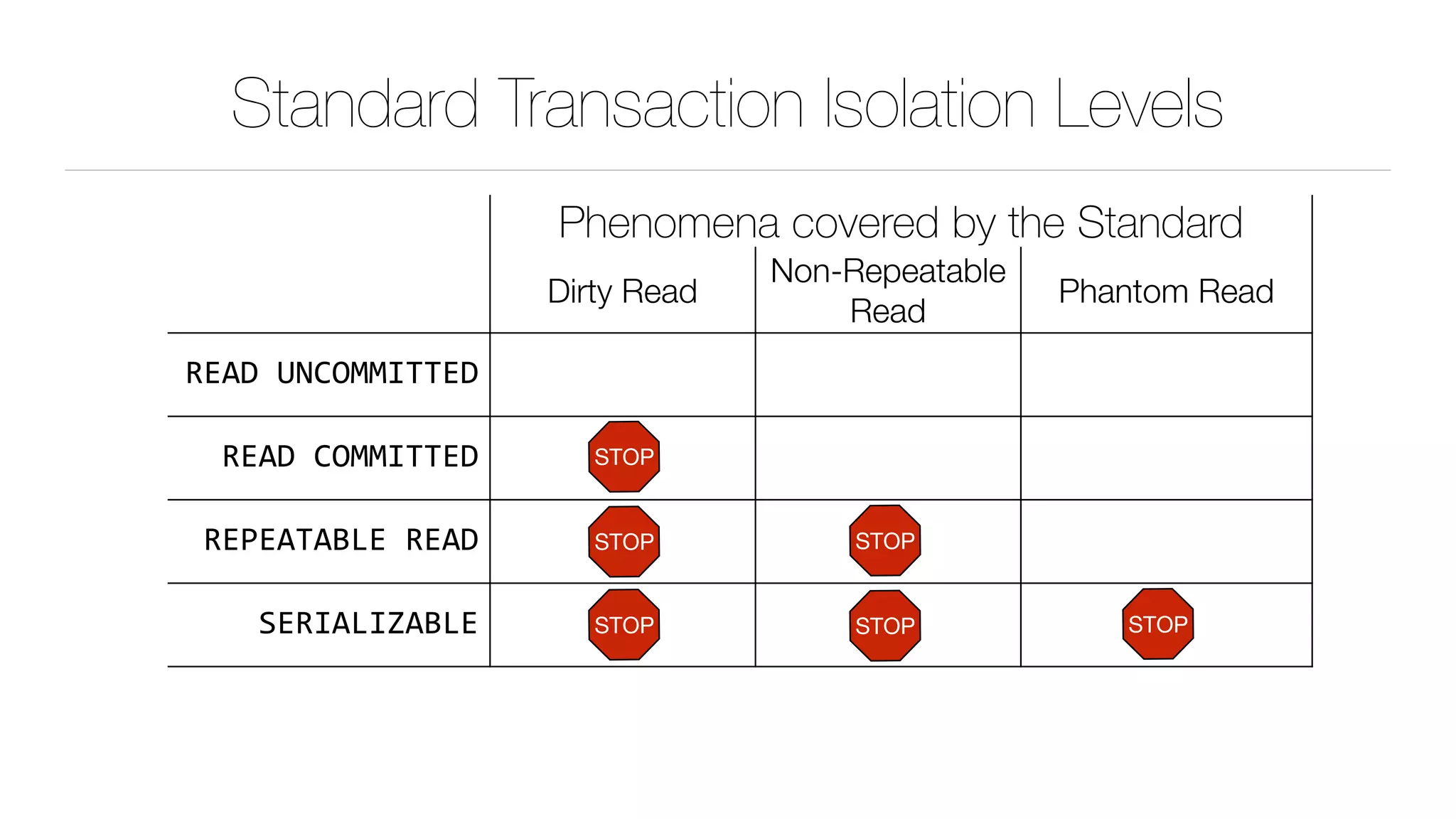
Standard Transaction Isolation Levels
Phenomena covered by the Standard
Dirty Read
Non-Repeatable
Read
Phantom Read
READ	UNCOMMITTED
READ	COMMITTED
REPEATABLE	READ
SERIALIZABLE
STOP
STOP STOP
STOPSTOPSTOP
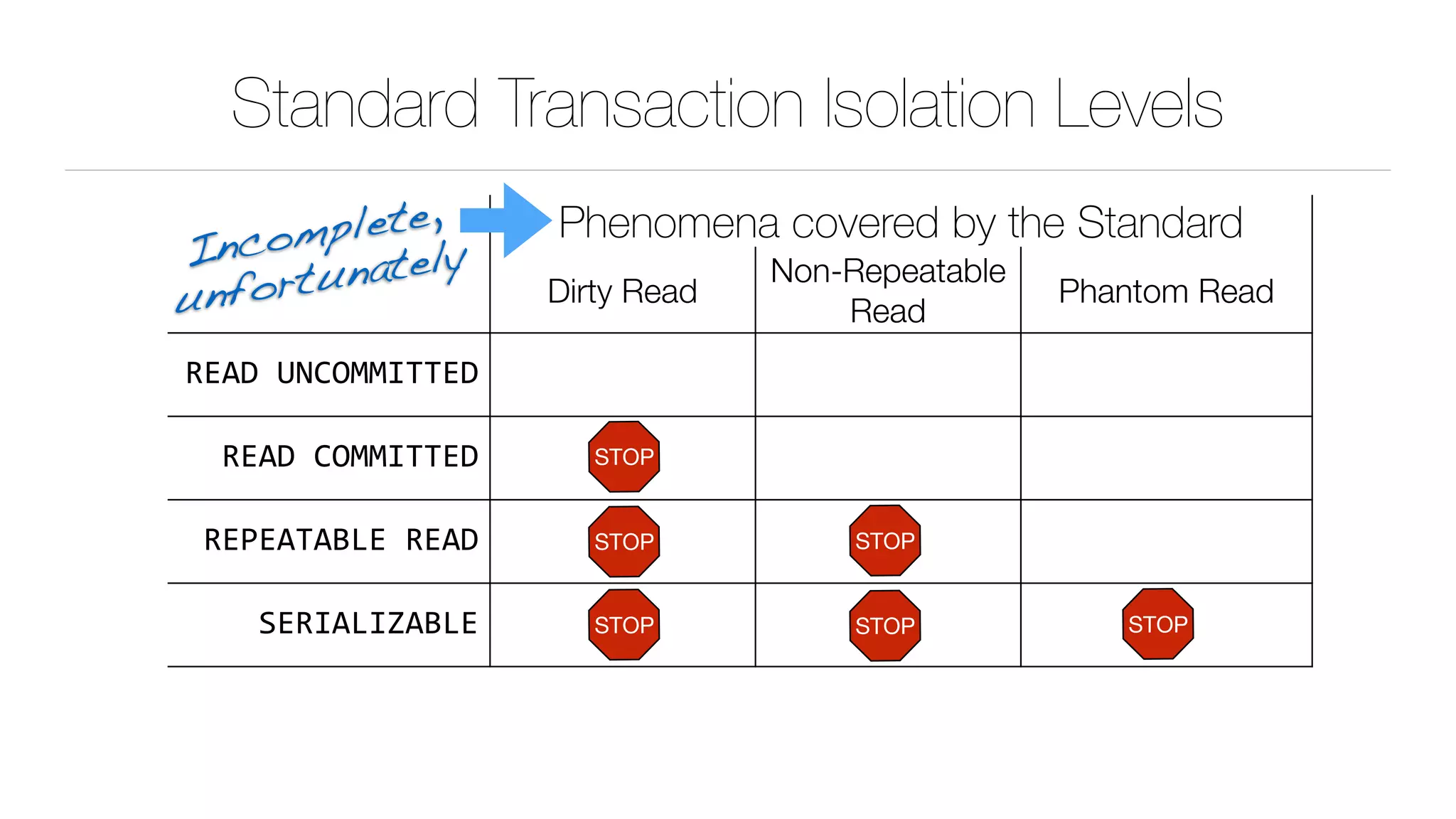
Standard Transaction Isolation Levels
Phenomena covered by the Standard
Dirty Read
Non-Repeatable
Read
Phantom Read
READ	UNCOMMITTED
READ	COMMITTED
REPEATABLE	READ
SERIALIZABLE
STOP
STOP STOP
STOPSTOPSTOP
Incomplete,

unfortunately
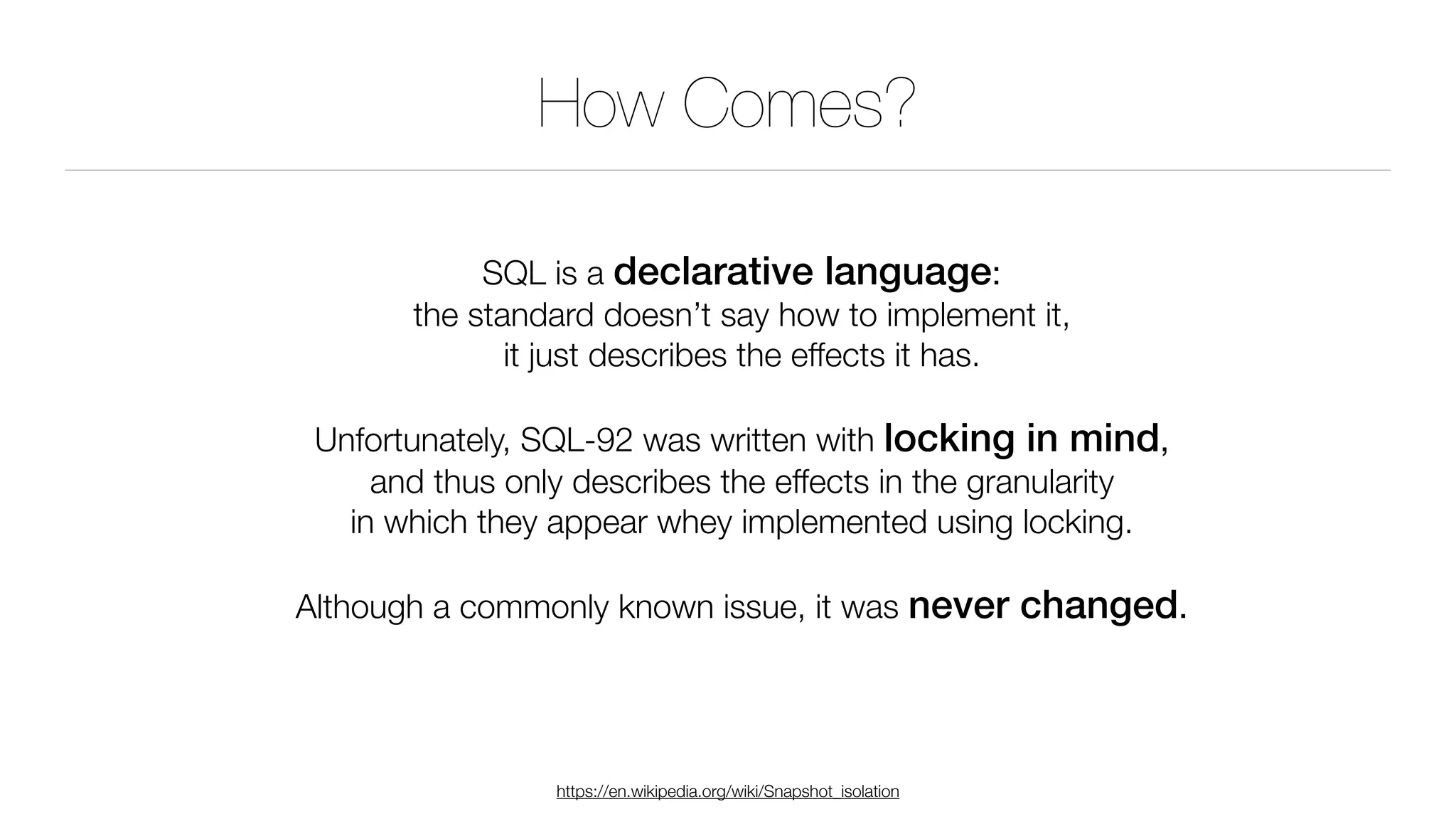
How Comes?
SQL is a declarative language:

the standard doesn’t say how to implement it,

it just describes the effects it has.
Unfortunately, SQL-92 was written with locking in mind,

and thus only describes the effects in the granularity

in which they appear whey implemented using locking.
Although a commonly known issue, it was never changed.
https://en.wikipedia.org/wiki/Snapshot_isolation
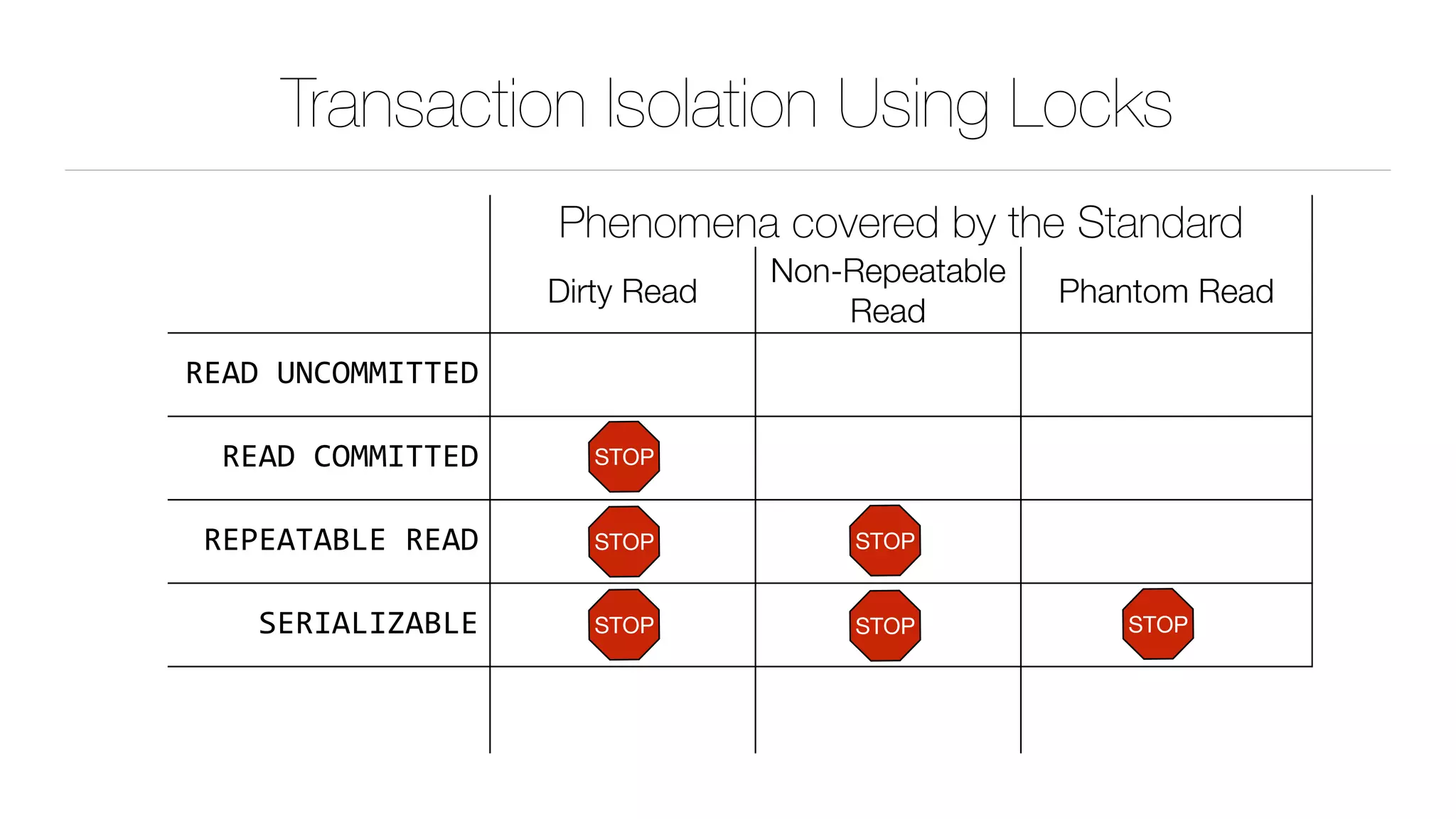
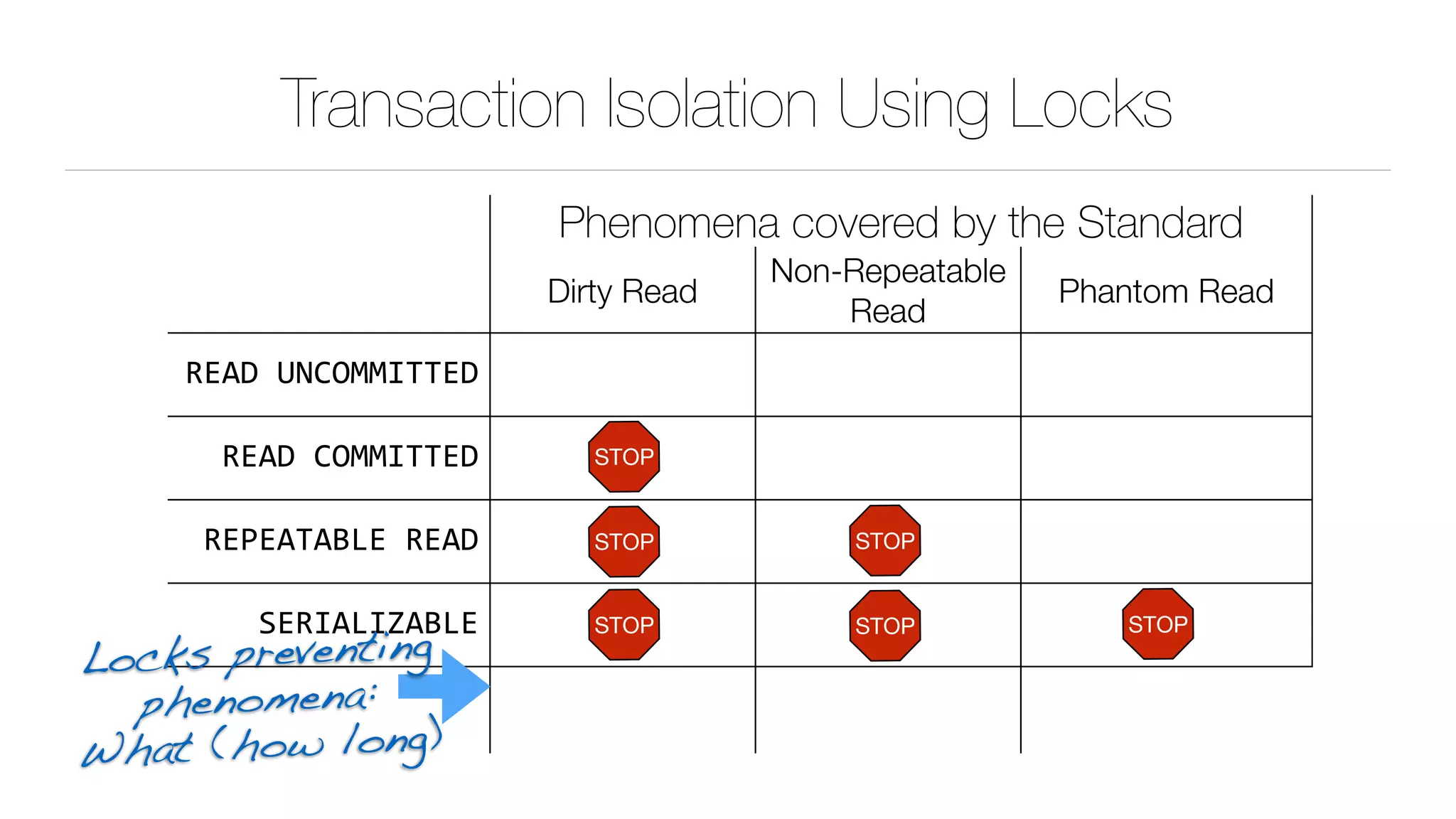
Transaction Isolation Using Locks
Phenomena covered by the Standard
Dirty Read
Non-Repeatable
Read
Phantom Read
READ	UNCOMMITTED
READ	COMMITTED
REPEATABLE	READ
SERIALIZABLE
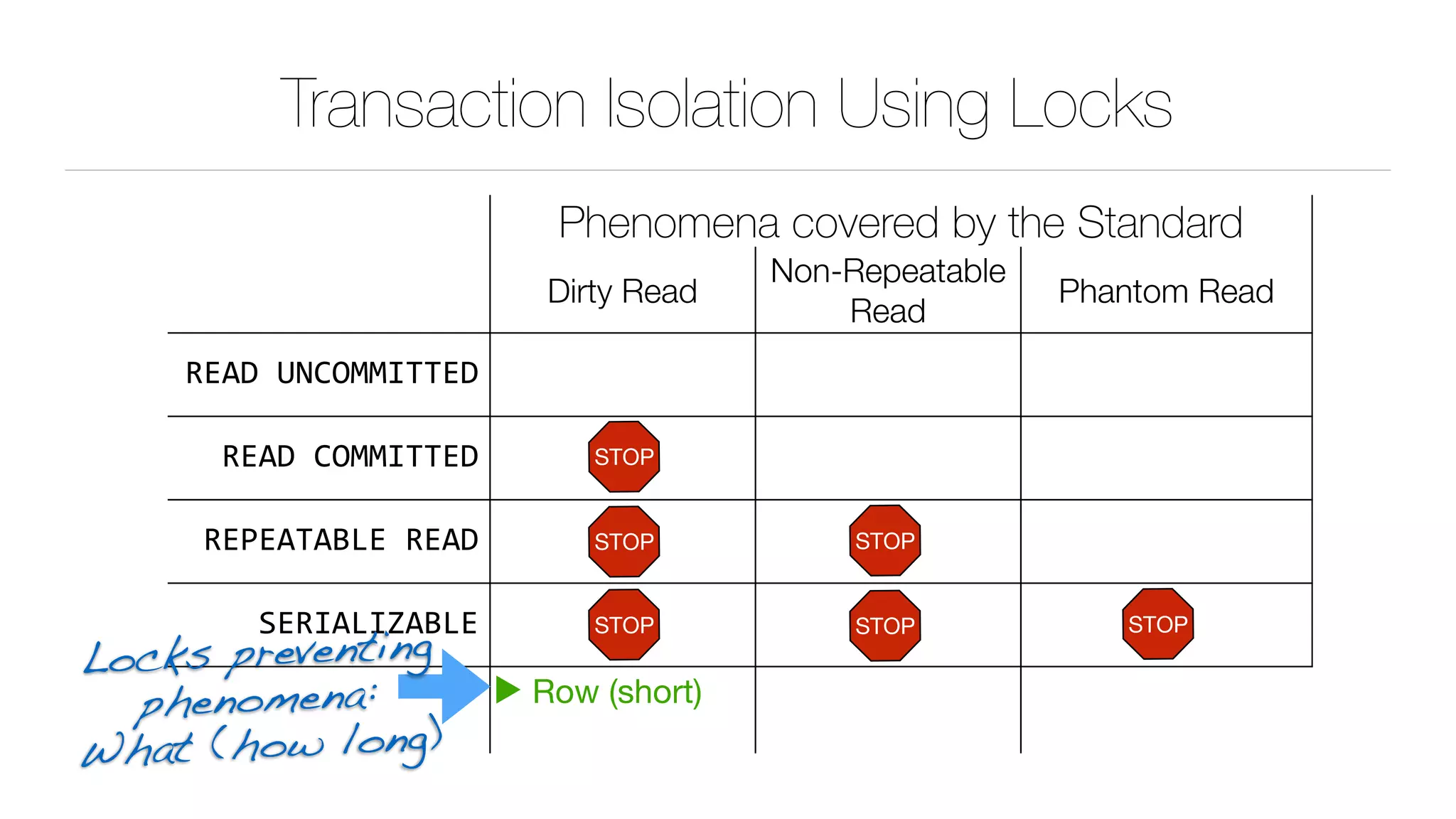
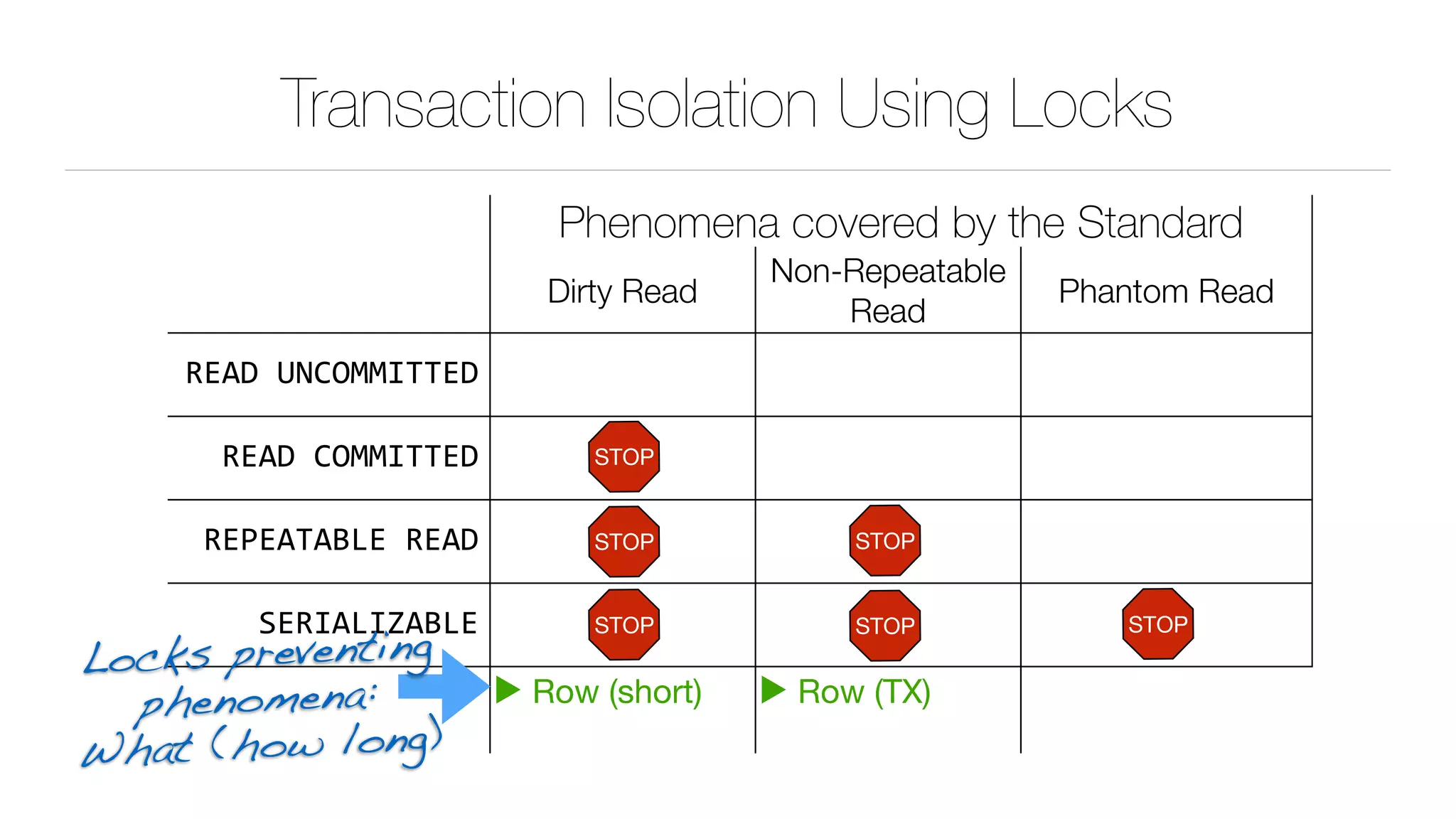
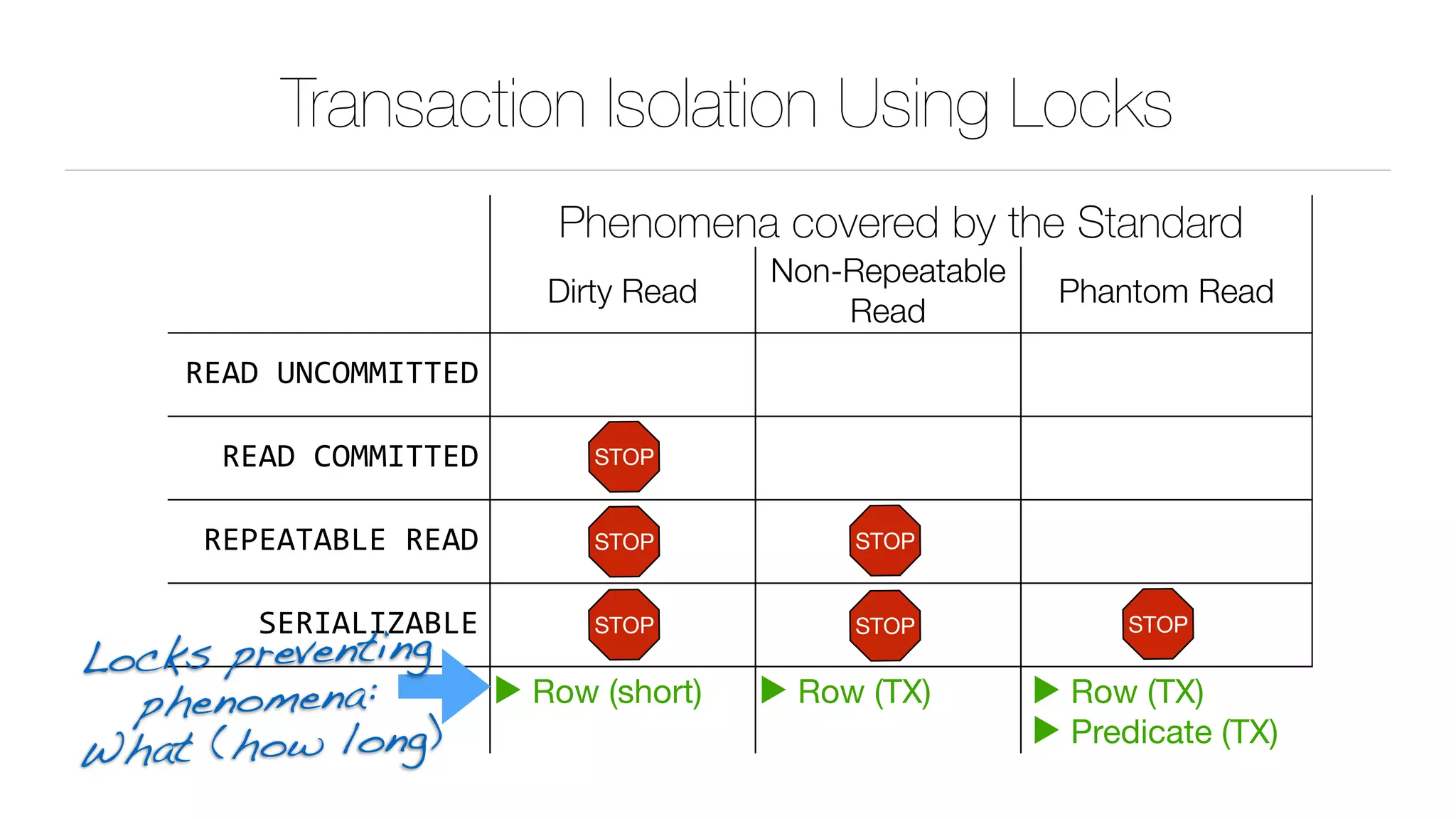
▶ Row (short) ▶ Row (TX) ▶ Row (TX)

▶ Predicate (TX)
STOP
STOP STOP
STOPSTOPSTOP
Transaction Isolation Using Locks
Phenomena covered by the Standard
Dirty Read
Non-Repeatable
Read
Phantom Read
READ	UNCOMMITTED
READ	COMMITTED
REPEATABLE	READ
SERIALIZABLE
▶ Row (short) ▶ Row (TX) ▶ Row (TX)

▶ Predicate (TX)
STOP
STOP STOP
STOPSTOPSTOP
Locks preventing

phenomena:

What (how long)
Transaction Isolation Using Locks
Phenomena covered by the Standard
Dirty Read
Non-Repeatable
Read
Phantom Read
READ	UNCOMMITTED
READ	COMMITTED
REPEATABLE	READ
SERIALIZABLE
▶ Row (short) ▶ Row (TX) ▶ Row (TX)

▶ Predicate (TX)
STOP
STOP STOP
STOPSTOPSTOP
Locks preventing

phenomena:

What (how long)
Transaction Isolation Using Locks
Phenomena covered by the Standard
Dirty Read
Non-Repeatable
Read
Phantom Read
READ	UNCOMMITTED
READ	COMMITTED
REPEATABLE	READ
SERIALIZABLE
▶ Row (short) ▶ Row (TX) ▶ Row (TX)

▶ Predicate (TX)
STOP
STOP STOP
STOPSTOPSTOP
Locks preventing

phenomena:

What (how long)
Transaction Isolation Using Locks
Phenomena covered by the Standard
Dirty Read
Non-Repeatable
Read
Phantom Read
READ	UNCOMMITTED
READ	COMMITTED
REPEATABLE	READ
SERIALIZABLE
▶ Row (short) ▶ Row (TX) ▶ Row (TX)

▶ Predicate (TX)
STOP
STOP STOP
STOPSTOPSTOP
Locks preventing

phenomena:

What (how long)
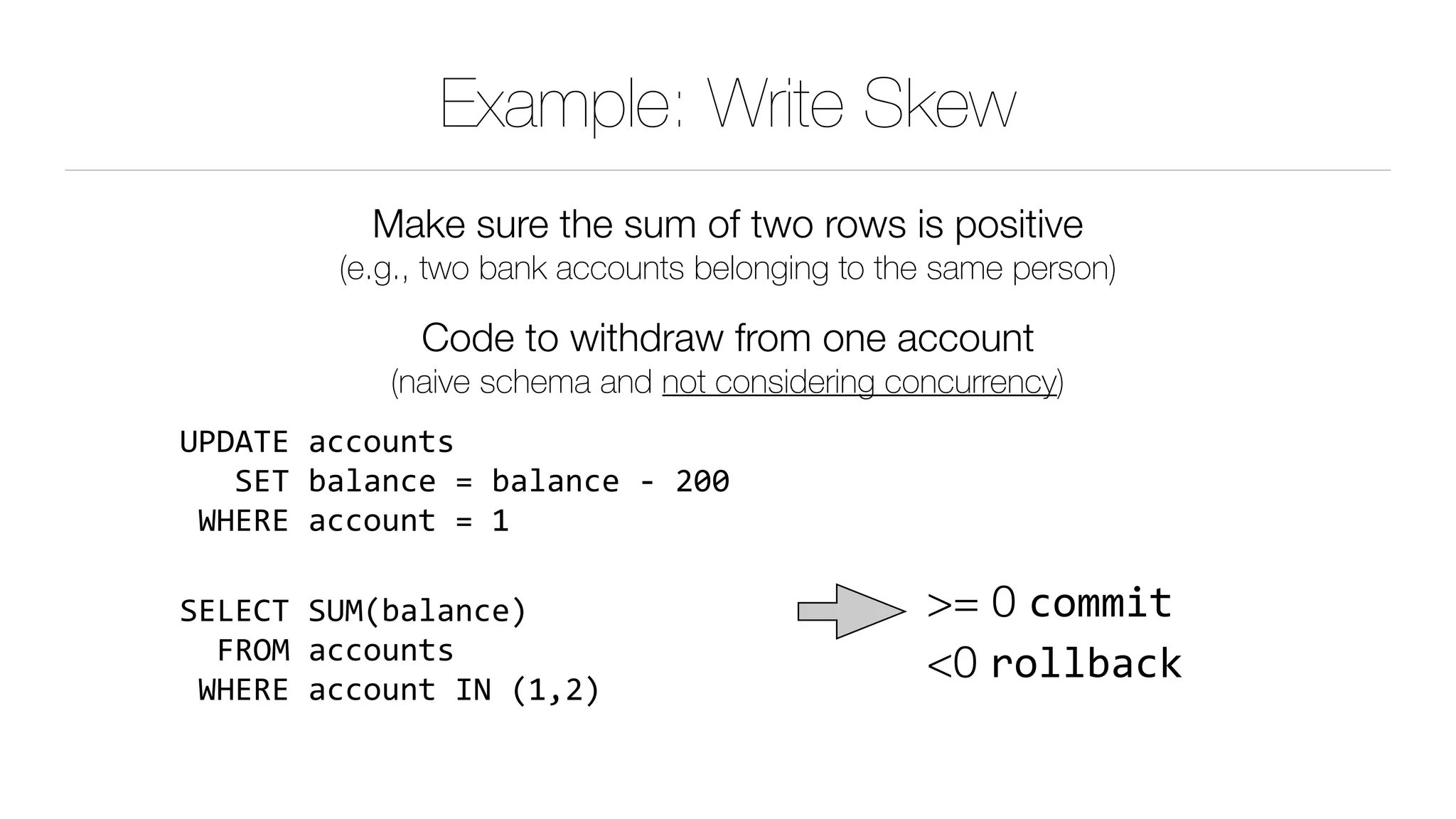
Example: Write Skew
Make sure the sum of two rows is positive

(e.g., two bank accounts belonging to the same person)
Code to withdraw from one account

(naive schema and not considering concurrency)

UPDATE	accounts

			SET	balance	=	balance	-	200

	WHERE	account	=	1	
SELECT	SUM(balance)

		FROM	accounts

	WHERE	account	IN	(1,2)
>= 0 commit					

<0 rollback
Examples: Disclaimer
The following examples just demonstrate

one possible way two transactions could interact.
The examples are by no means exhaustive.
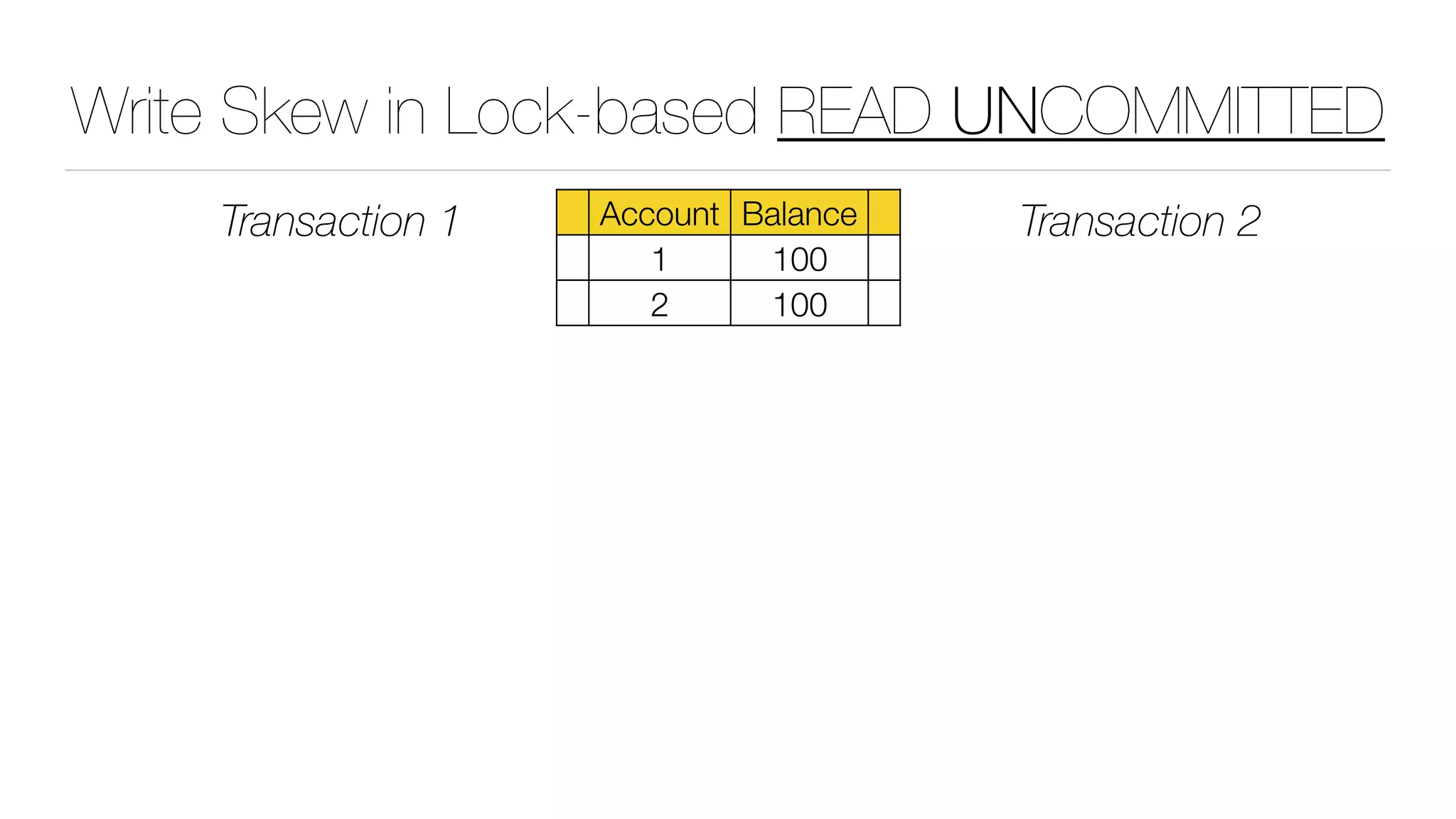
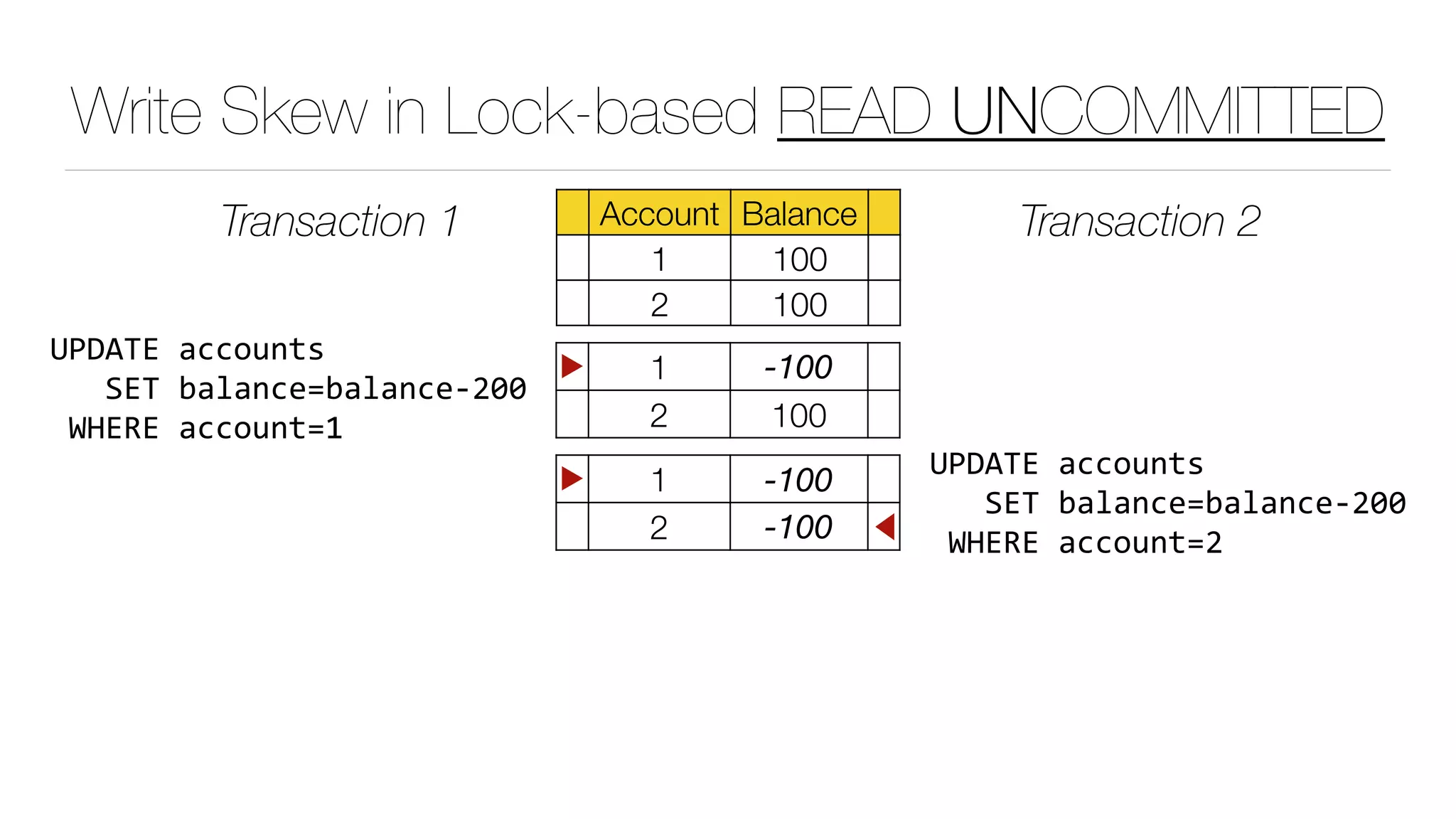
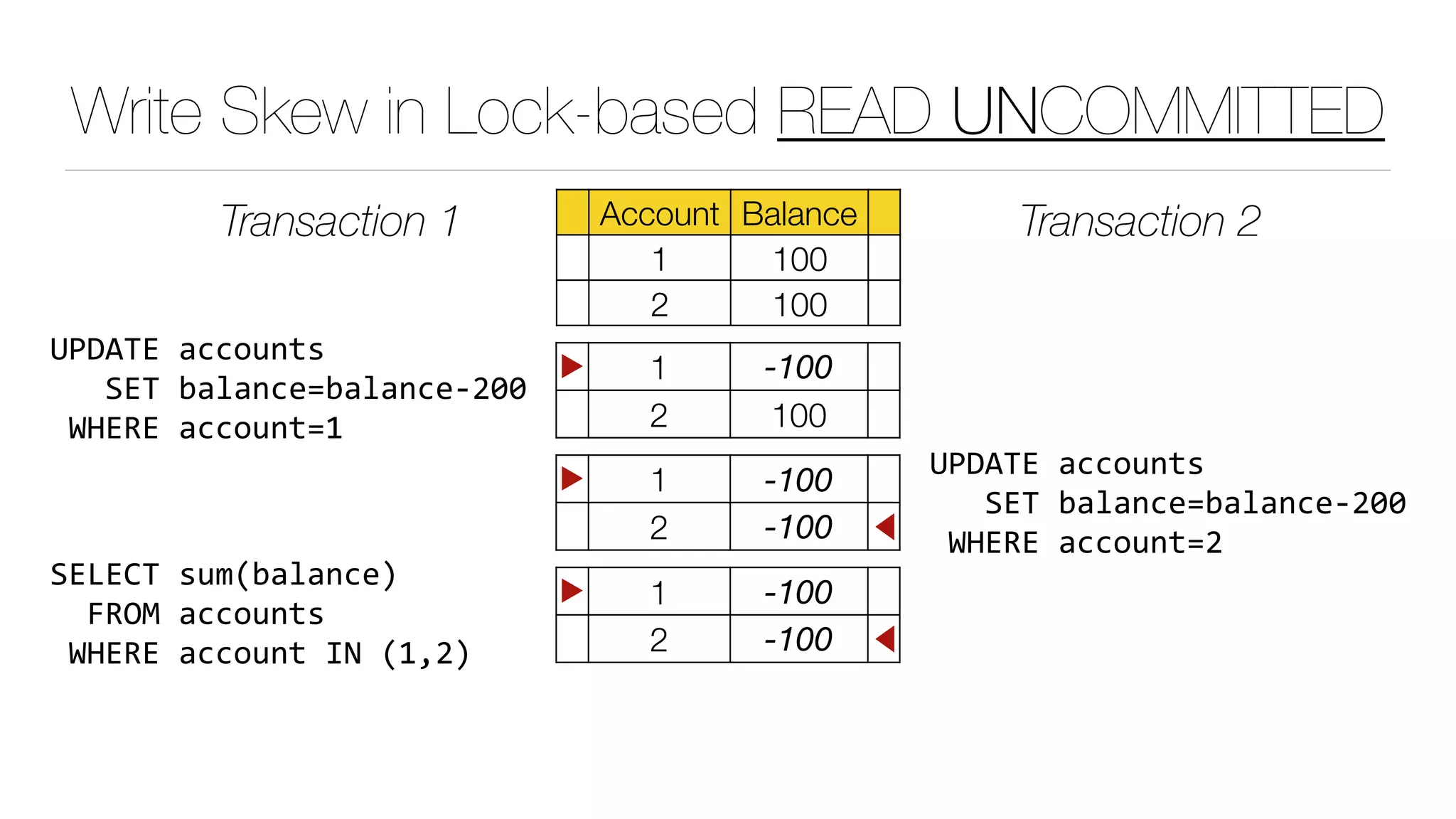
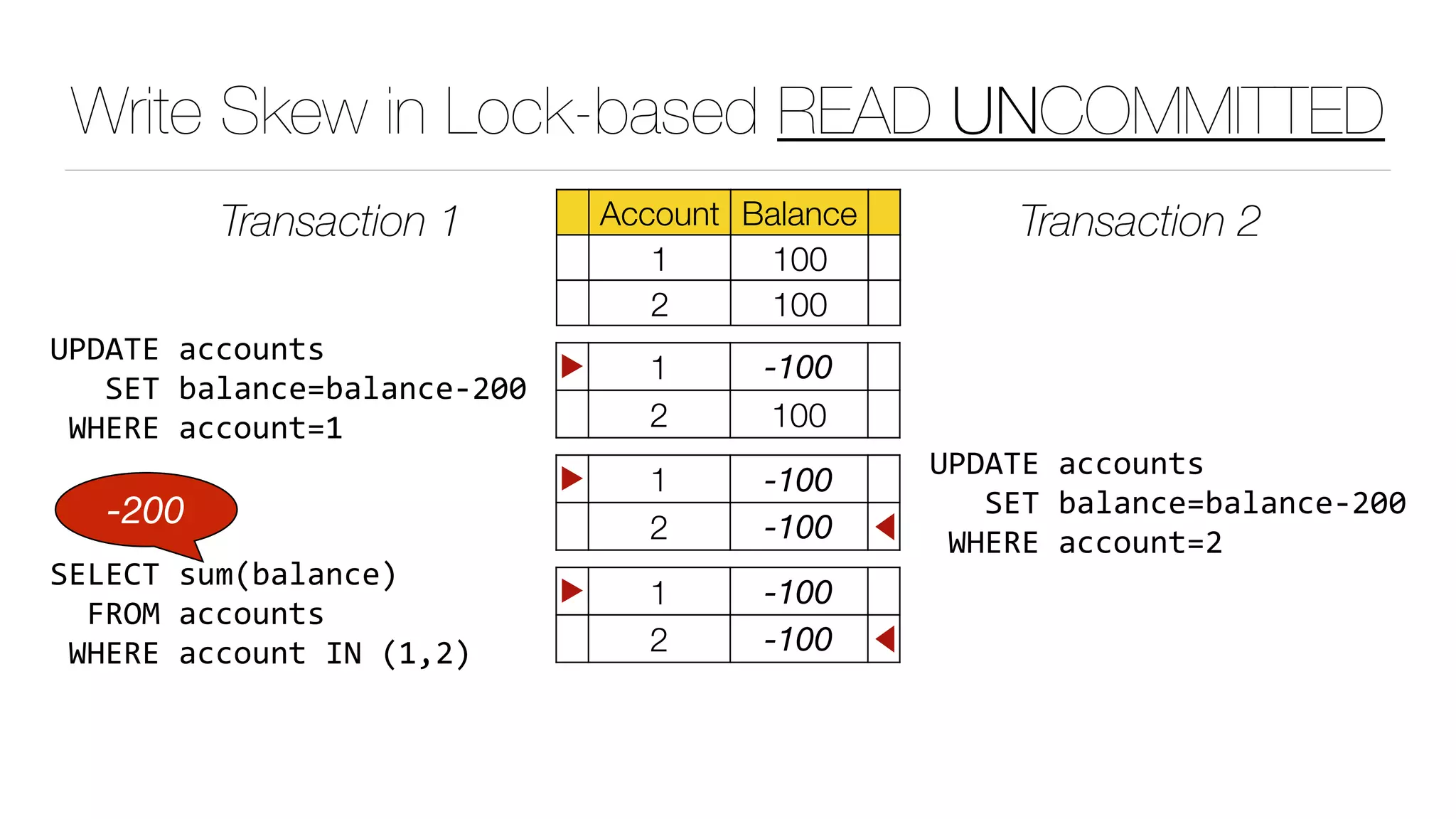
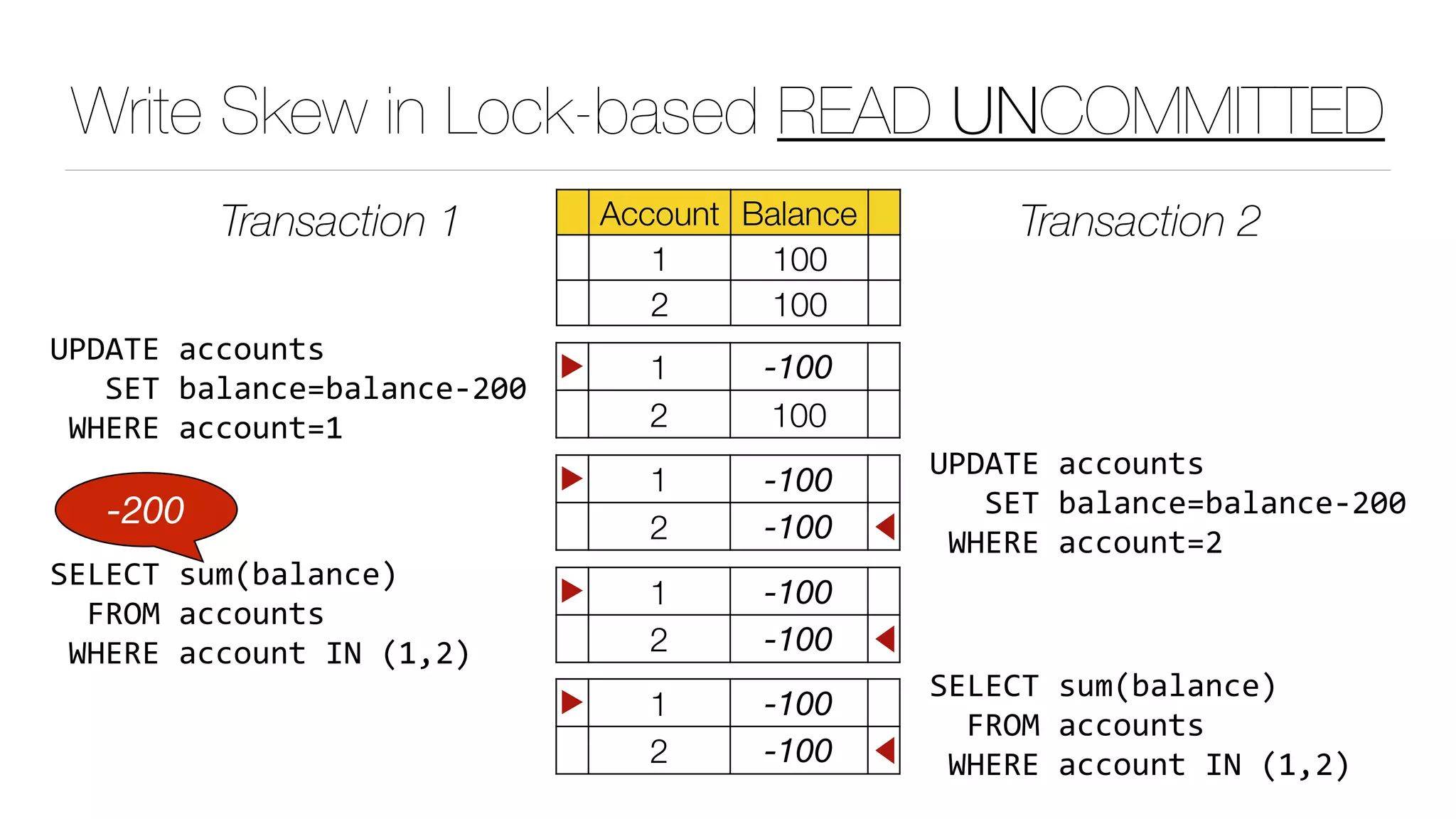
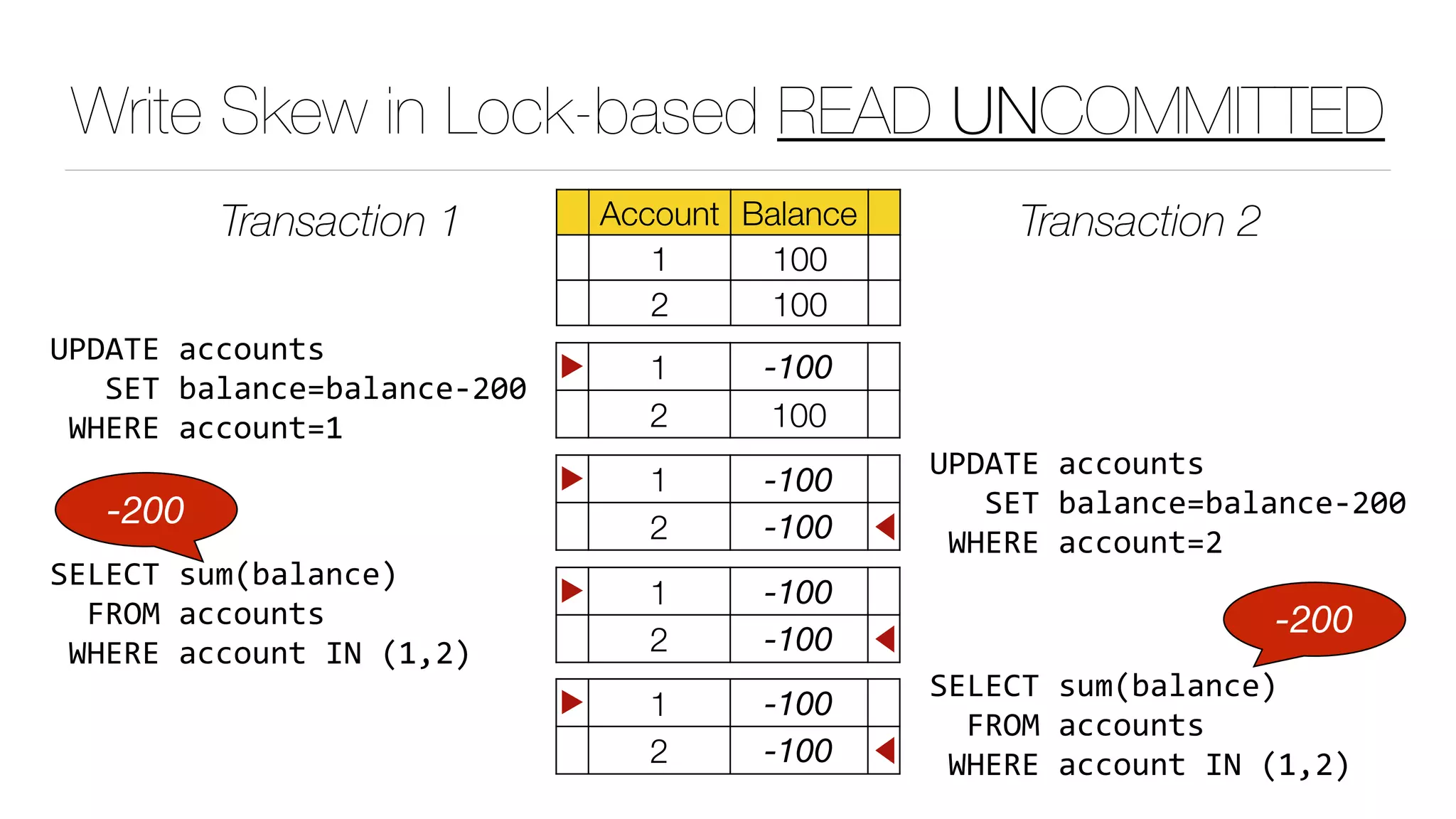
Write Skew in Lock-based READ UNCOMMITTED
Account Balance
1 100
2 100
Transaction 1 Transaction 2
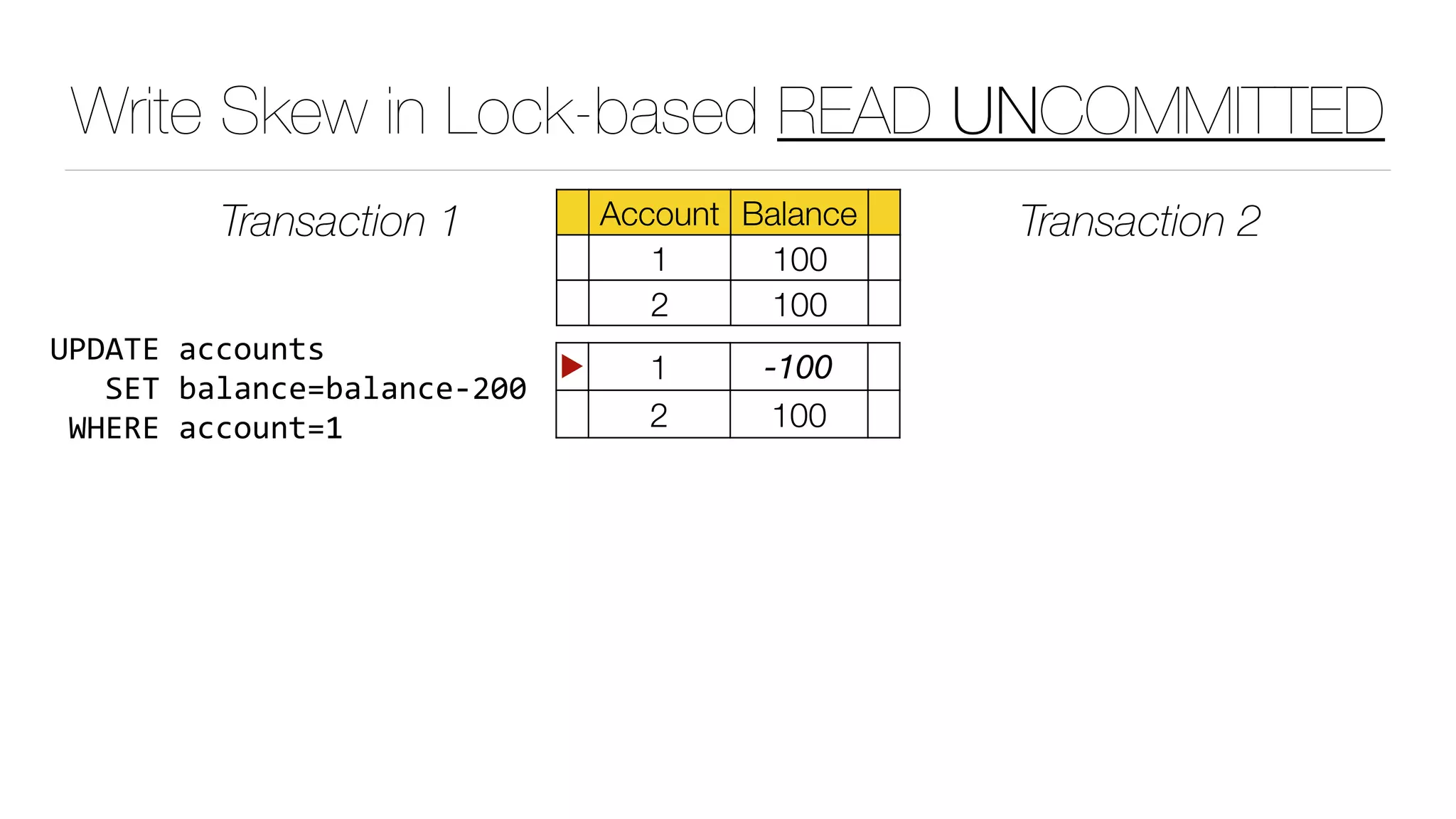
Write Skew in Lock-based READ UNCOMMITTED
Account Balance
1 100
2 100
Transaction 1 Transaction 2
▶ 1 -100
2 100
UPDATE	accounts	
			SET	balance=balance-200	
	WHERE	account=1
Write Skew in Lock-based READ UNCOMMITTED
Account Balance
1 100
2 100
Transaction 1 Transaction 2
▶ 1 -100
2 100
UPDATE	accounts	
			SET	balance=balance-200	
	WHERE	account=1
▶ 1 -100
2 -100 ◀
UPDATE	accounts	
			SET	balance=balance-200	
	WHERE	account=2
Write Skew in Lock-based READ UNCOMMITTED
Account Balance
1 100
2 100
Transaction 1 Transaction 2
▶ 1 -100
2 100
UPDATE	accounts	
			SET	balance=balance-200	
	WHERE	account=1
▶ 1 -100
2 -100 ◀
UPDATE	accounts	
			SET	balance=balance-200	
	WHERE	account=2
▶ 1 -100
2 -100 ◀
SELECT	sum(balance)	
		FROM	accounts	
	WHERE	account	IN	(1,2)
Write Skew in Lock-based READ UNCOMMITTED
Account Balance
1 100
2 100
Transaction 1 Transaction 2
▶ 1 -100
2 100
UPDATE	accounts	
			SET	balance=balance-200	
	WHERE	account=1
▶ 1 -100
2 -100 ◀
UPDATE	accounts	
			SET	balance=balance-200	
	WHERE	account=2
▶ 1 -100
2 -100 ◀
SELECT	sum(balance)	
		FROM	accounts	
	WHERE	account	IN	(1,2)
-200
Write Skew in Lock-based READ UNCOMMITTED
Account Balance
1 100
2 100
Transaction 1 Transaction 2
▶ 1 -100
2 100
UPDATE	accounts	
			SET	balance=balance-200	
	WHERE	account=1
▶ 1 -100
2 -100 ◀
UPDATE	accounts	
			SET	balance=balance-200	
	WHERE	account=2
▶ 1 -100
2 -100 ◀
SELECT	sum(balance)	
		FROM	accounts	
	WHERE	account	IN	(1,2)
▶ 1 -100
2 -100 ◀
SELECT	sum(balance)	
		FROM	accounts	
	WHERE	account	IN	(1,2)
-200
Write Skew in Lock-based READ UNCOMMITTED
Account Balance
1 100
2 100
Transaction 1 Transaction 2
▶ 1 -100
2 100
UPDATE	accounts	
			SET	balance=balance-200	
	WHERE	account=1
▶ 1 -100
2 -100 ◀
UPDATE	accounts	
			SET	balance=balance-200	
	WHERE	account=2
▶ 1 -100
2 -100 ◀
SELECT	sum(balance)	
		FROM	accounts	
	WHERE	account	IN	(1,2)
▶ 1 -100
2 -100 ◀
SELECT	sum(balance)	
		FROM	accounts	
	WHERE	account	IN	(1,2)
-200
-200
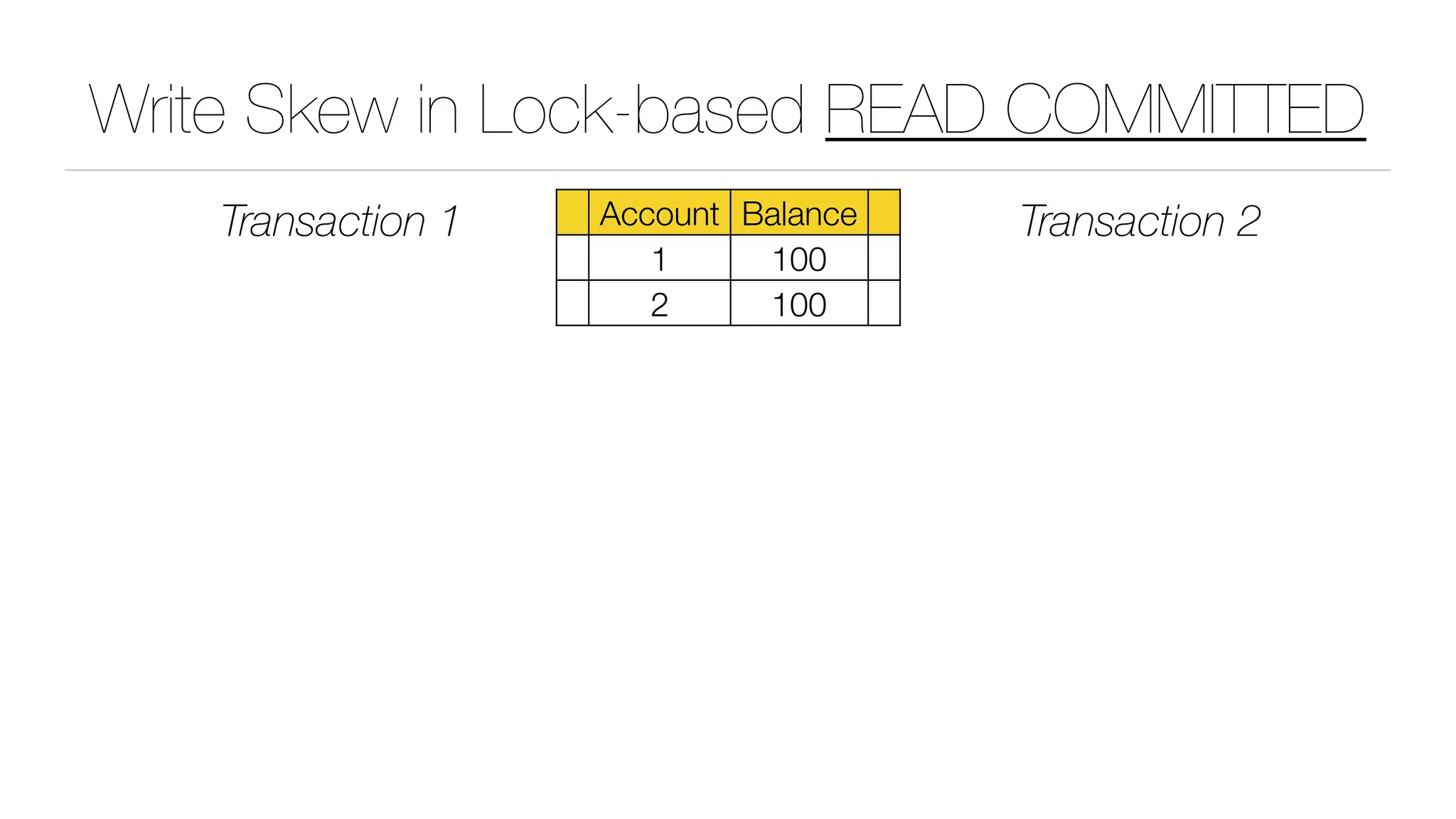
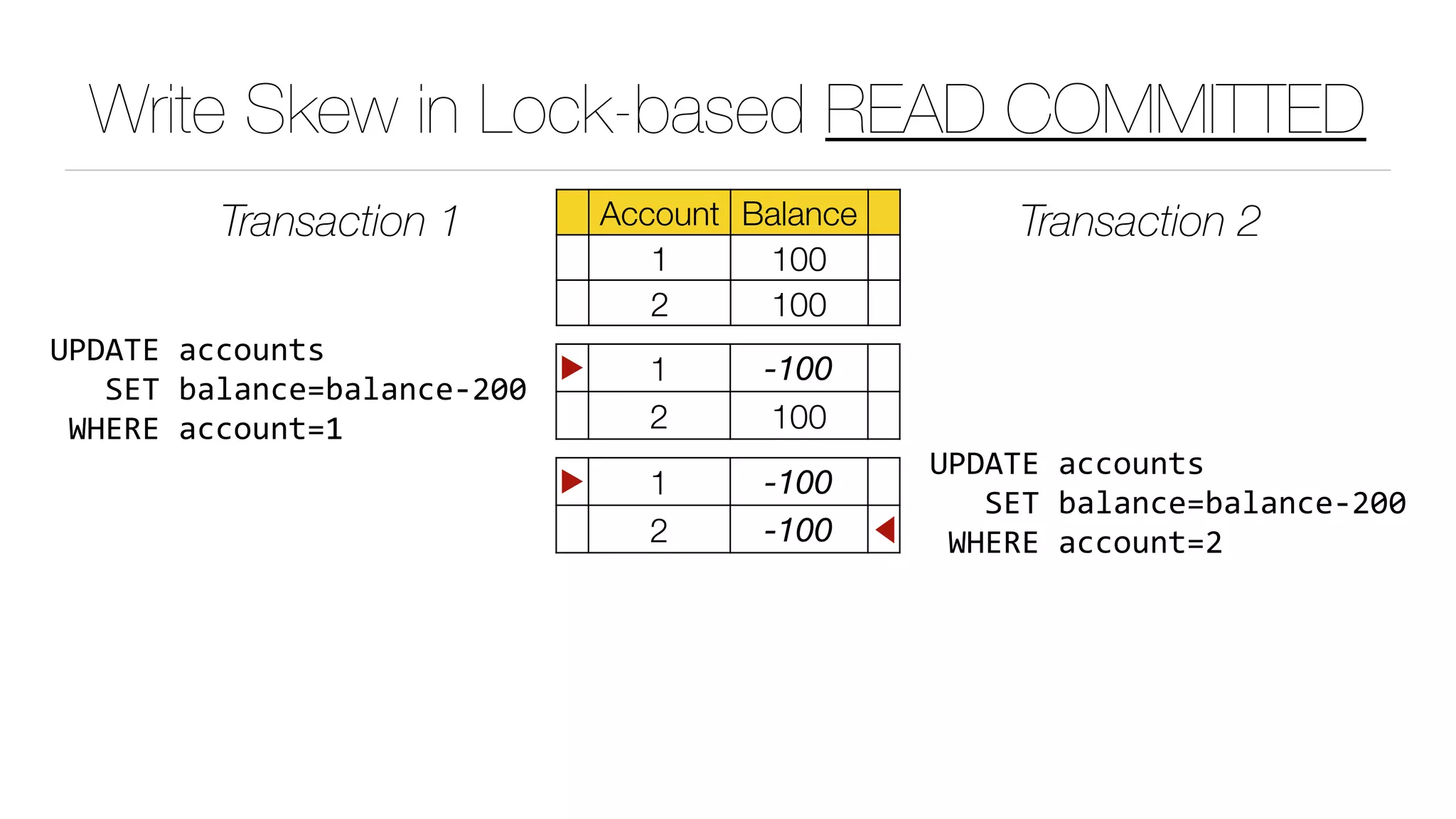
Write Skew in Lock-based READ COMMITTED
Account Balance
1 100
2 100
Transaction 1 Transaction 2
Write Skew in Lock-based READ COMMITTED
Account Balance
1 100
2 100
Transaction 1 Transaction 2
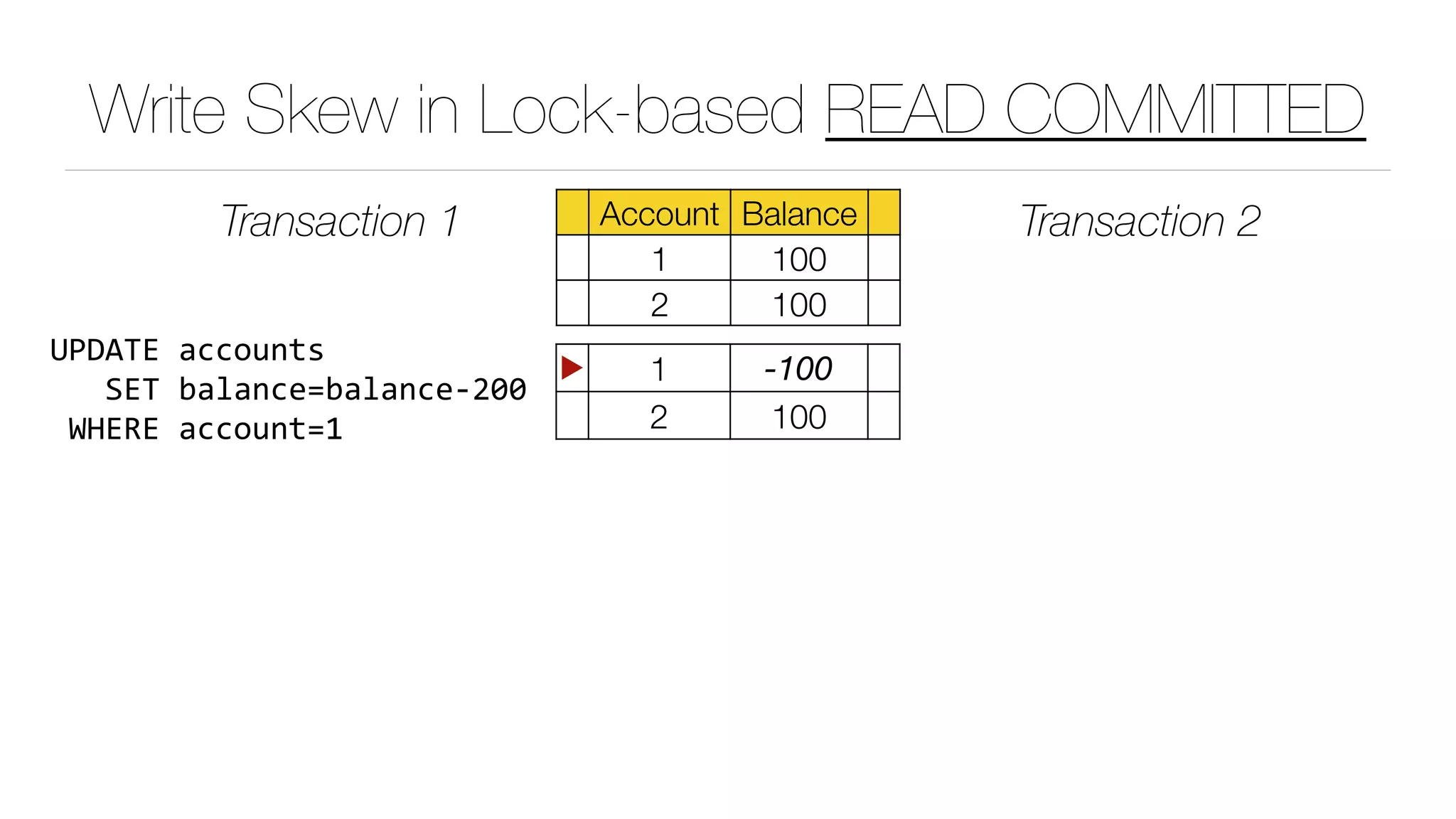
▶ 1 -100
2 100
UPDATE	accounts	
			SET	balance=balance-200	
	WHERE	account=1
Write Skew in Lock-based READ COMMITTED
Account Balance
1 100
2 100
Transaction 1 Transaction 2
▶ 1 -100
2 100
UPDATE	accounts	
			SET	balance=balance-200	
	WHERE	account=1
▶ 1 -100
2 -100 ◀
UPDATE	accounts	
			SET	balance=balance-200	
	WHERE	account=2
Write Skew in Lock-based READ COMMITTED
Account Balance
1 100
2 100
Transaction 1 Transaction 2
▶ 1 -100
2 100
UPDATE	accounts	
			SET	balance=balance-200	
	WHERE	account=1
▶ 1 -100
2 -100 ◀
UPDATE	accounts	
			SET	balance=balance-200	
	WHERE	account=2
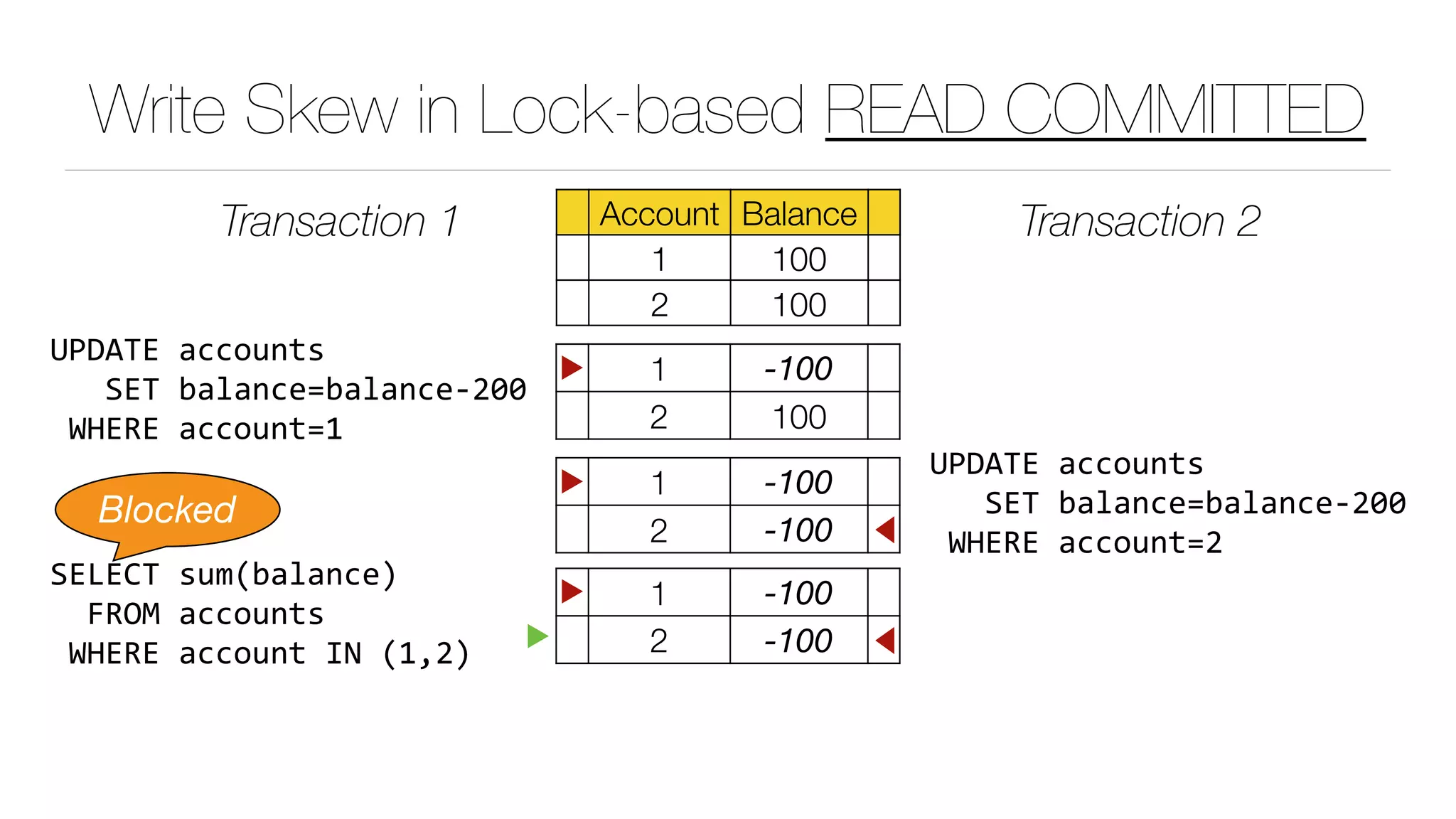
▶ 1 -100
2 -100 ◀
SELECT	sum(balance)	
		FROM	accounts	
	WHERE	account	IN	(1,2)
Blocked
▶
Write Skew in Lock-based READ COMMITTED
Account Balance
1 100
2 100
Transaction 1 Transaction 2
▶ 1 -100
2 100
UPDATE	accounts	
			SET	balance=balance-200	
	WHERE	account=1
▶ 1 -100
2 -100 ◀
UPDATE	accounts	
			SET	balance=balance-200	
	WHERE	account=2
▶ 1 -100
2 -100 ◀
SELECT	sum(balance)	
		FROM	accounts	
	WHERE	account	IN	(1,2)
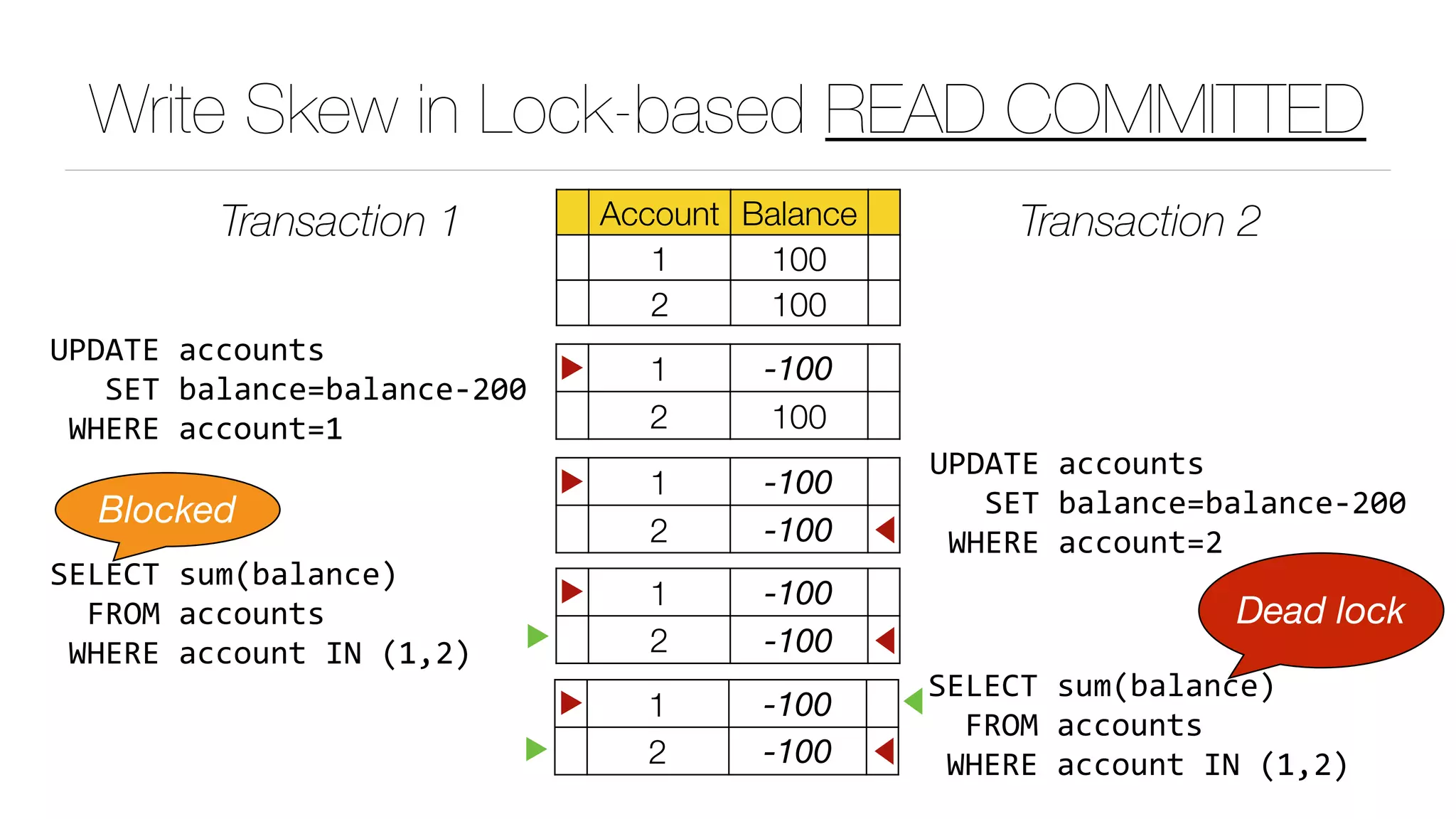
Blocked
Dead lock
▶
◀▶ 1 -100
2 -100 ◀
SELECT	sum(balance)	
		FROM	accounts	
	WHERE	account	IN	(1,2)▶
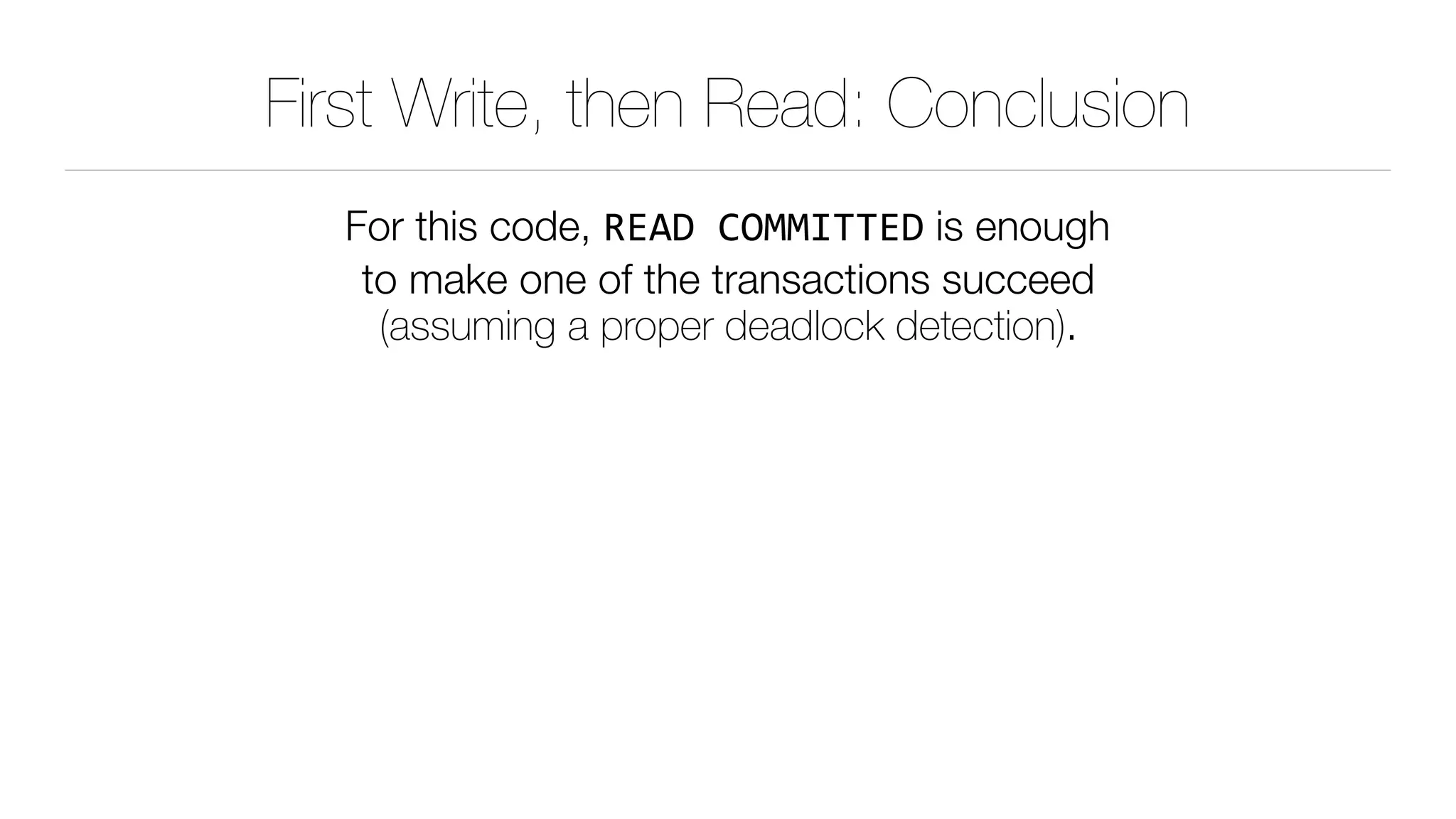
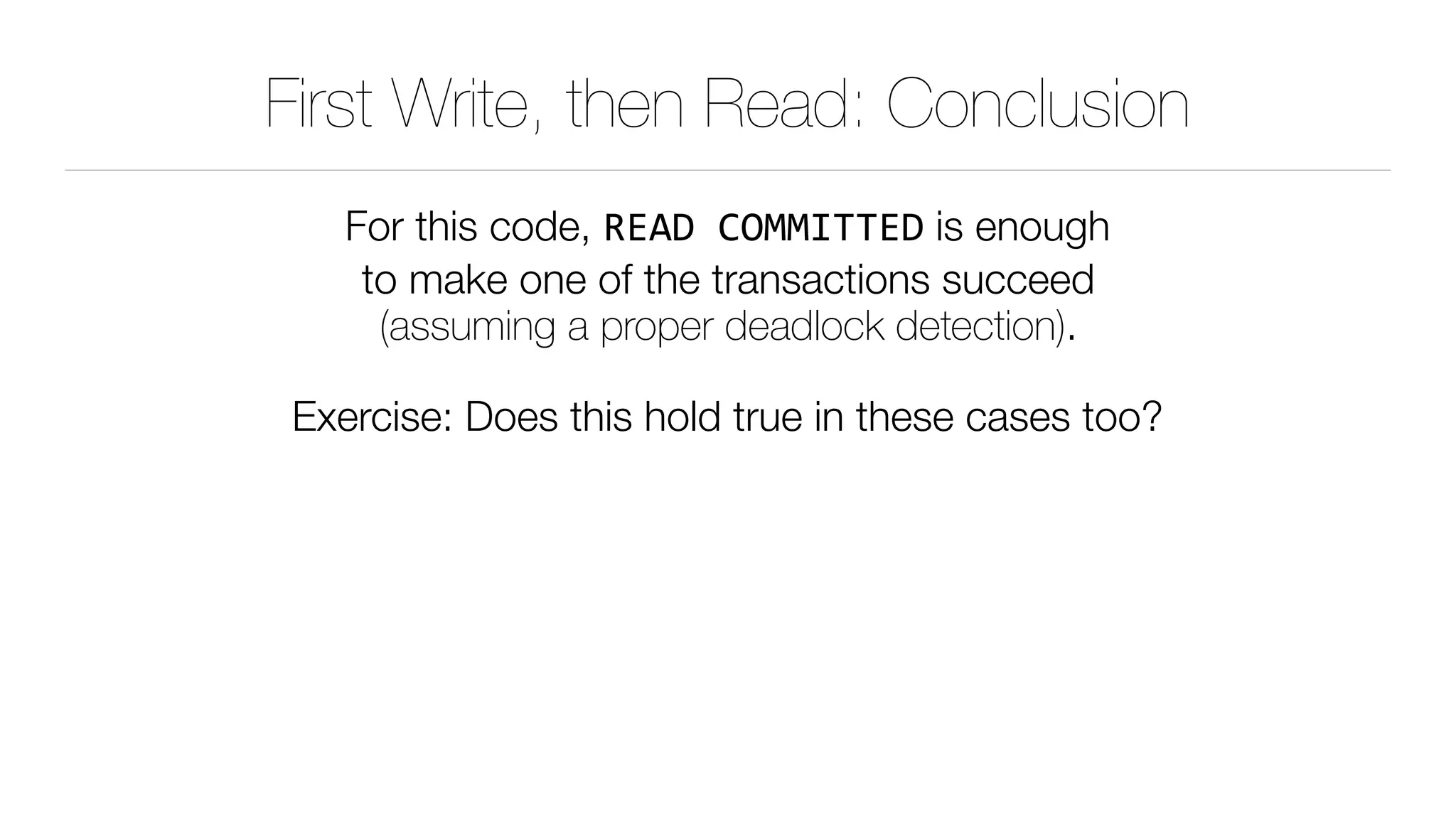
First Write, then Read: Conclusion
For this code, READ	COMMITTED is enough

to make one of the transactions succeed

(assuming a proper deadlock detection).
First Write, then Read: Conclusion
For this code, READ	COMMITTED is enough

to make one of the transactions succeed

(assuming a proper deadlock detection).
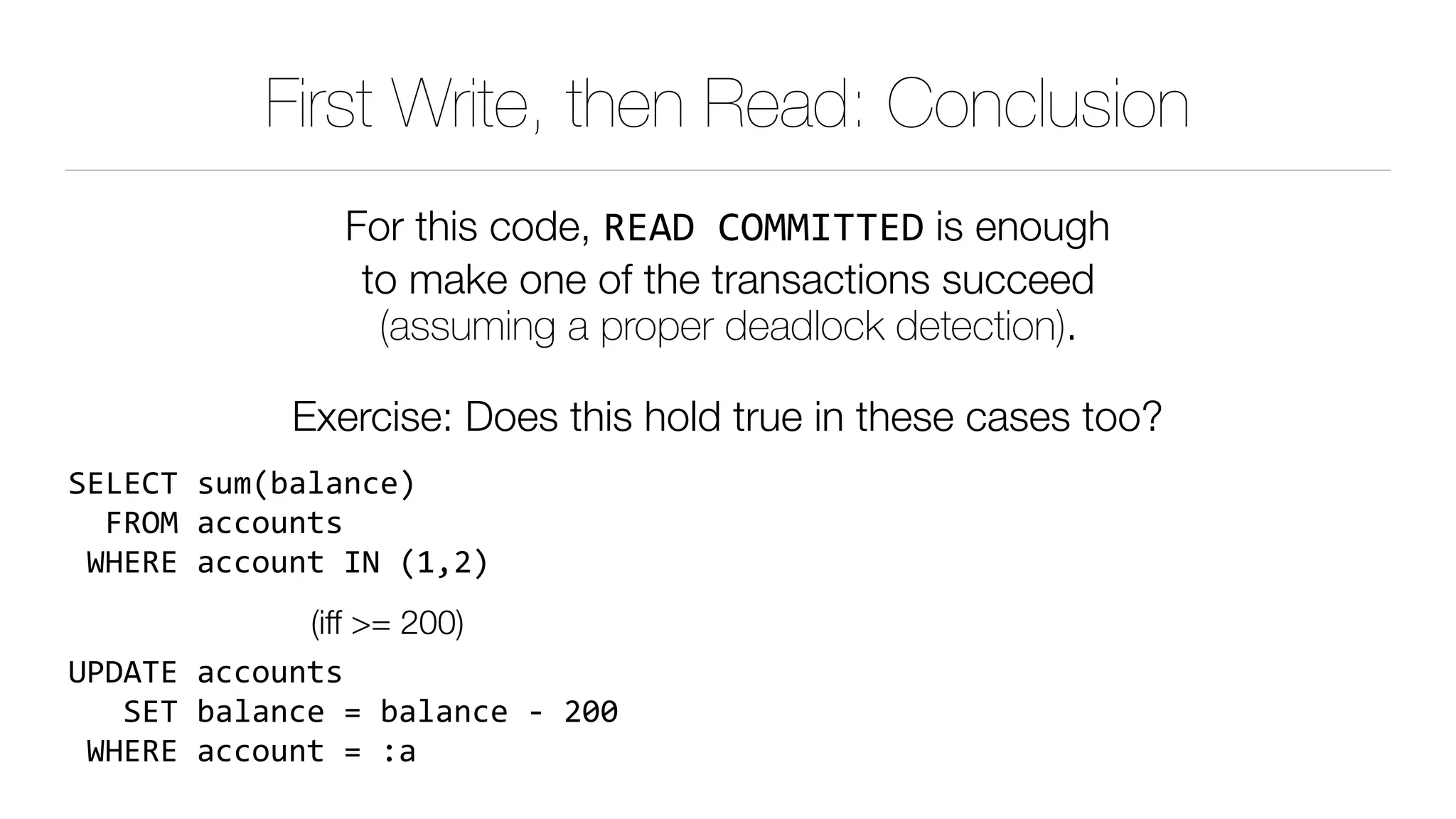
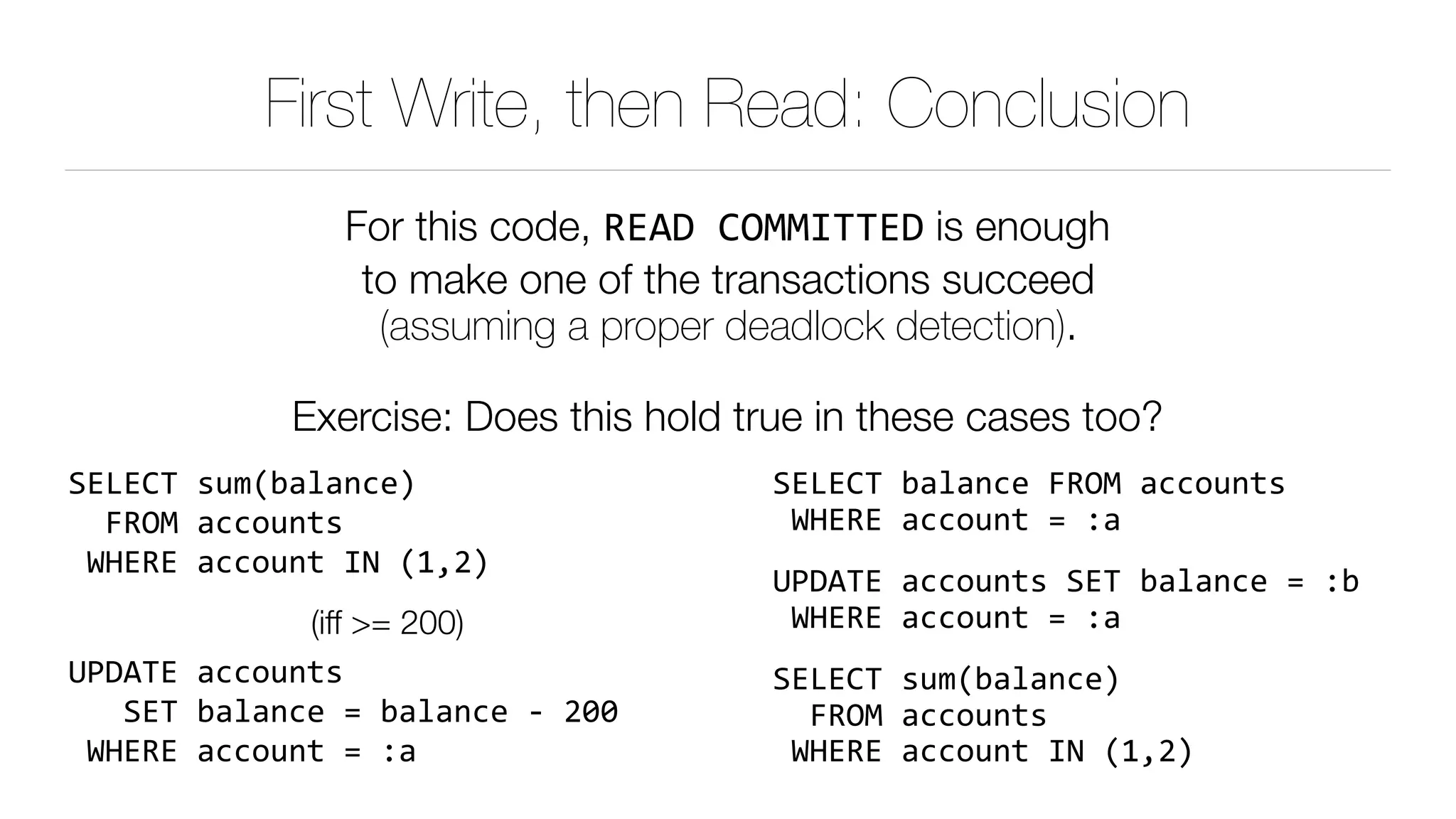
Exercise: Does this hold true in these cases too?
First Write, then Read: Conclusion
For this code, READ	COMMITTED is enough

to make one of the transactions succeed

(assuming a proper deadlock detection).
Exercise: Does this hold true in these cases too?
SELECT	sum(balance)

		FROM	accounts

	WHERE	account	IN	(1,2)	
(iff >= 200)
UPDATE	accounts

			SET	balance	=	balance	-	200

	WHERE	account	=	:a
First Write, then Read: Conclusion
For this code, READ	COMMITTED is enough

to make one of the transactions succeed

(assuming a proper deadlock detection).
Exercise: Does this hold true in these cases too?
SELECT	sum(balance)

		FROM	accounts

	WHERE	account	IN	(1,2)	
(iff >= 200)
UPDATE	accounts

			SET	balance	=	balance	-	200

	WHERE	account	=	:a
SELECT	balance	FROM	accounts

	WHERE	account	=	:a	
UPDATE	accounts	SET	balance	=	:b

	WHERE	account	=	:a	
SELECT	sum(balance)

		FROM	accounts

	WHERE	account	IN	(1,2)
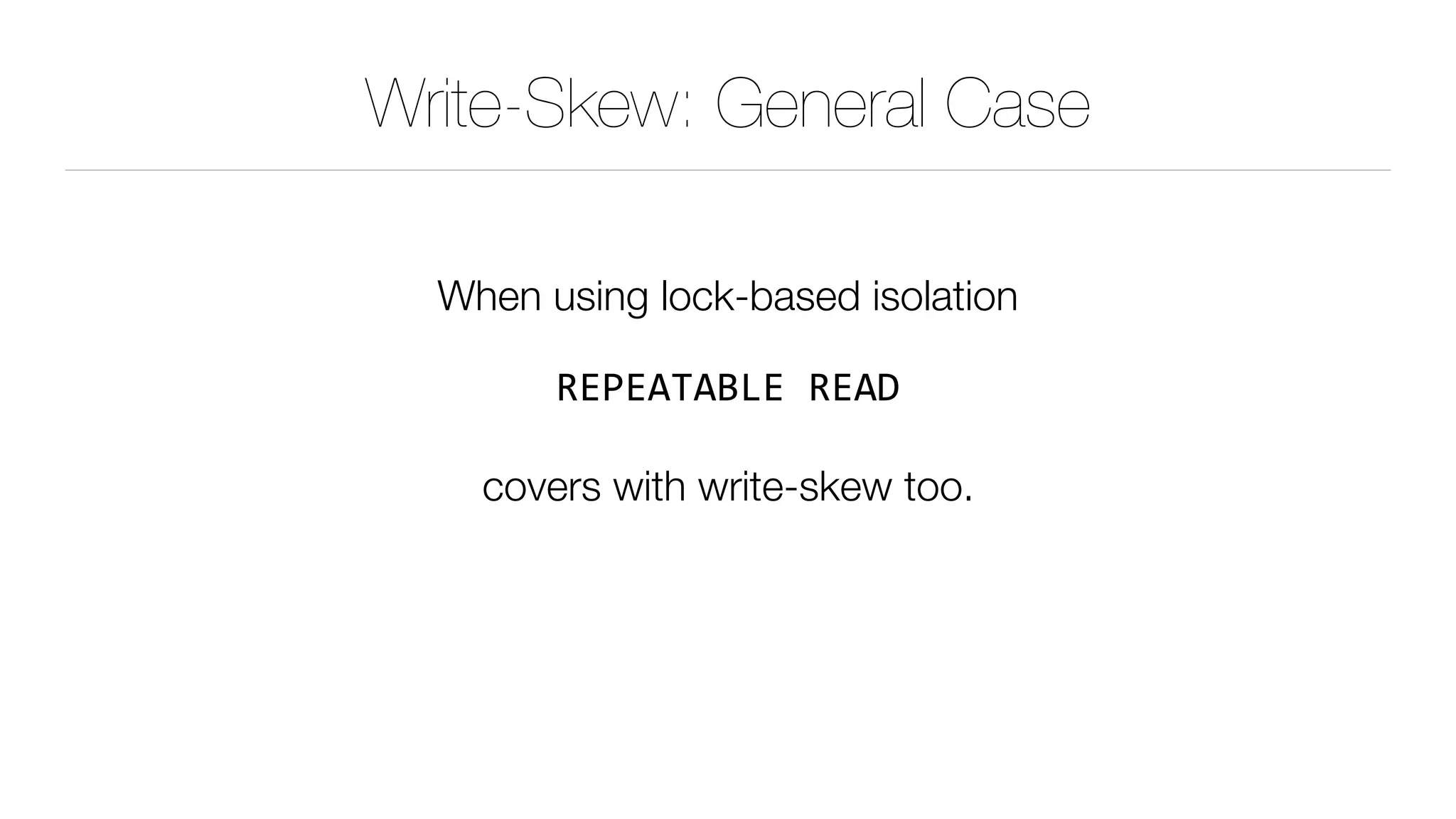
Write-Skew: General Case
When using lock-based isolation 

REPEATABLE	READ

covers with write-skew too.
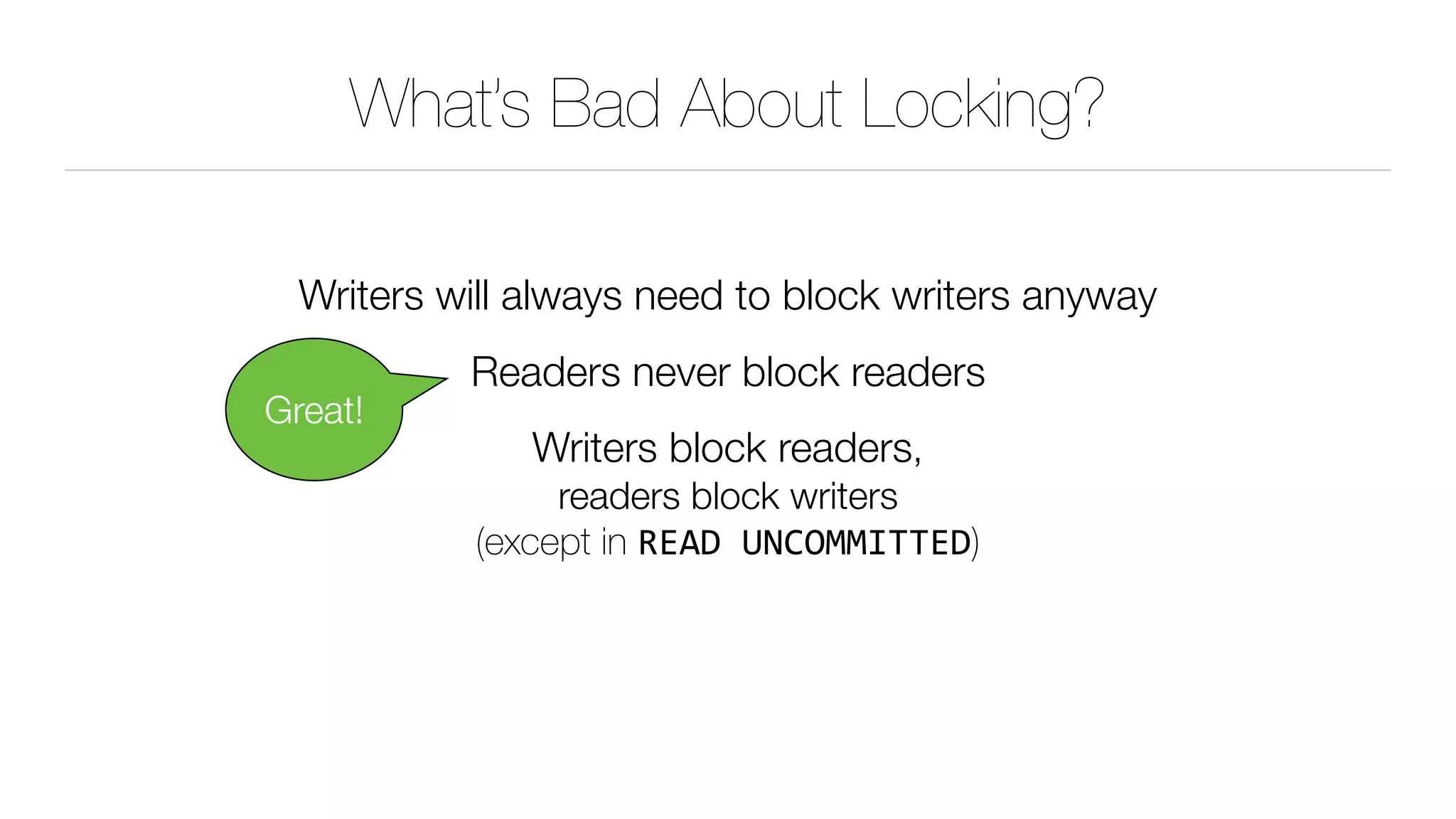
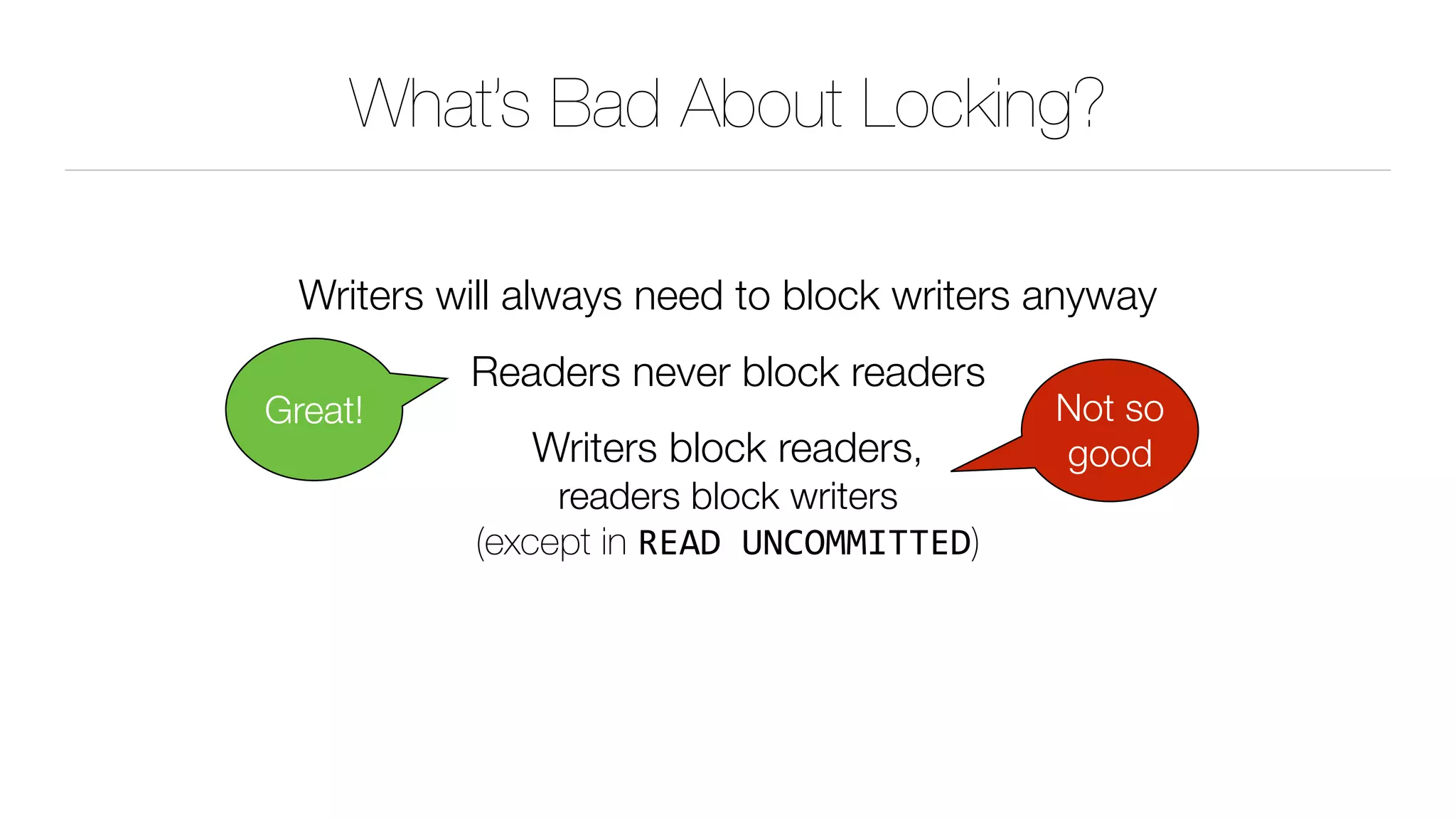
What’s Bad About Locking?
Writers will always need to block writers anyway
What’s Bad About Locking?
Writers will always need to block writers anyway
Readers never block readers
What’s Bad About Locking?
Writers will always need to block writers anyway
Readers never block readers
Writers block readers,

readers block writers

(except in READ	UNCOMMITTED)
What’s Bad About Locking?
Writers will always need to block writers anyway
Readers never block readers
Writers block readers,

readers block writers

(except in READ	UNCOMMITTED)
Great!
What’s Bad About Locking?
Writers will always need to block writers anyway
Readers never block readers
Writers block readers,

readers block writers

(except in READ	UNCOMMITTED)
Not so
good
Great!
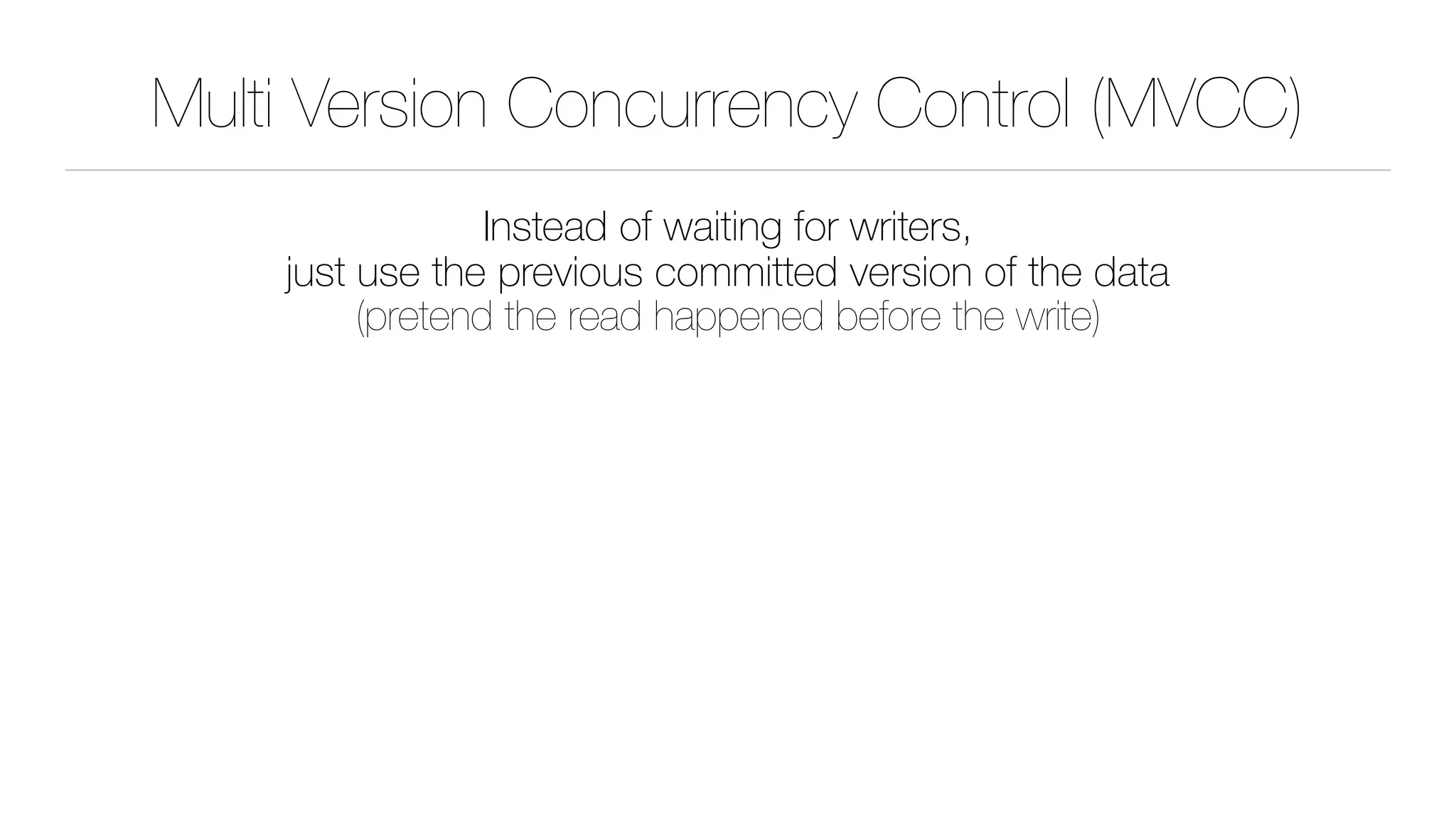
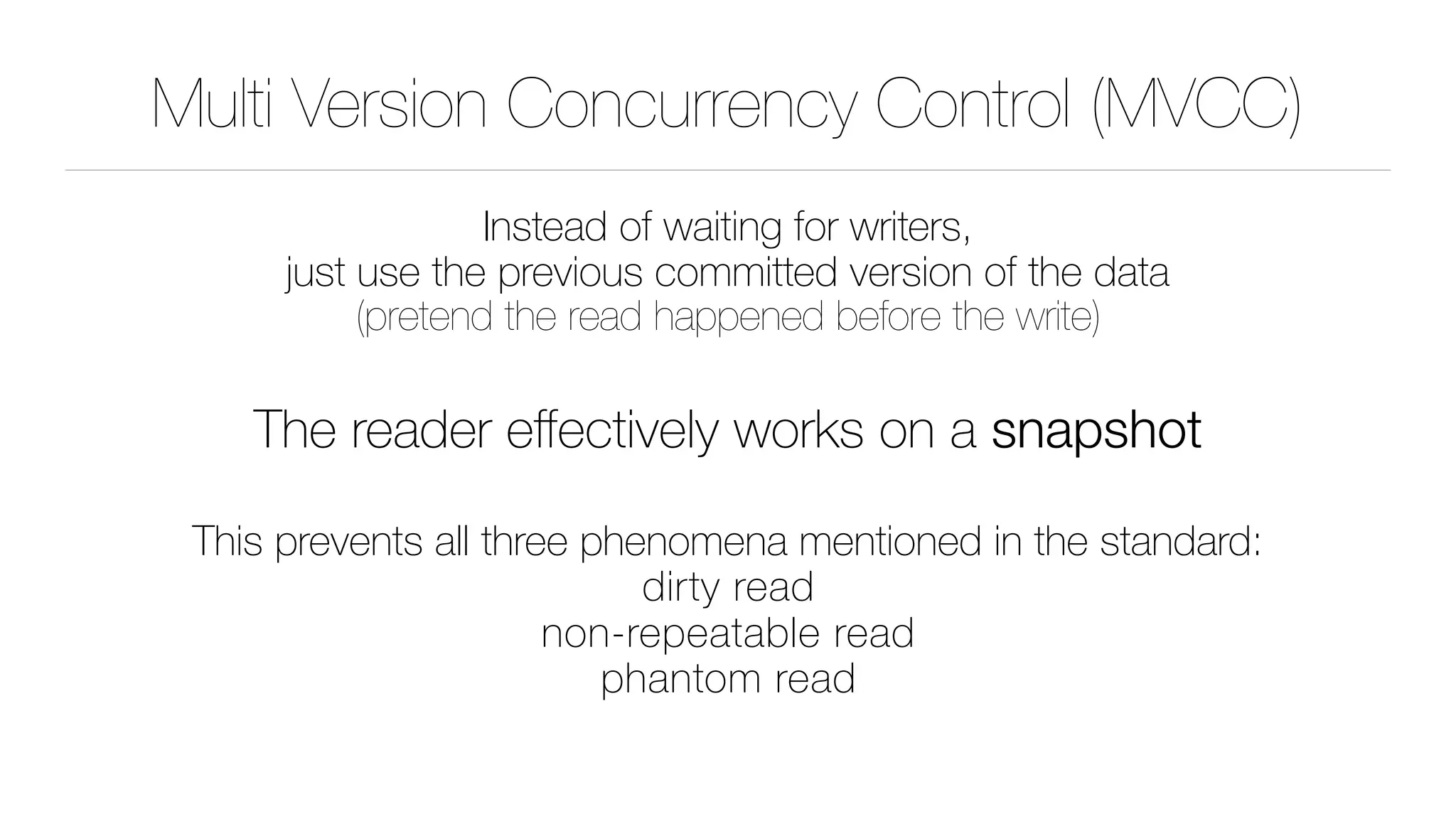
Multi Version Concurrency Control (MVCC)
Instead of waiting for writers,

just use the previous committed version of the data

(pretend the read happened before the write)
Multi Version Concurrency Control (MVCC)
Instead of waiting for writers,

just use the previous committed version of the data

(pretend the read happened before the write)
The reader effectively works on a snapshot
Multi Version Concurrency Control (MVCC)
Instead of waiting for writers,

just use the previous committed version of the data

(pretend the read happened before the write)
The reader effectively works on a snapshot
This prevents all three phenomena mentioned in the standard:

dirty read

non-repeatable read

phantom read
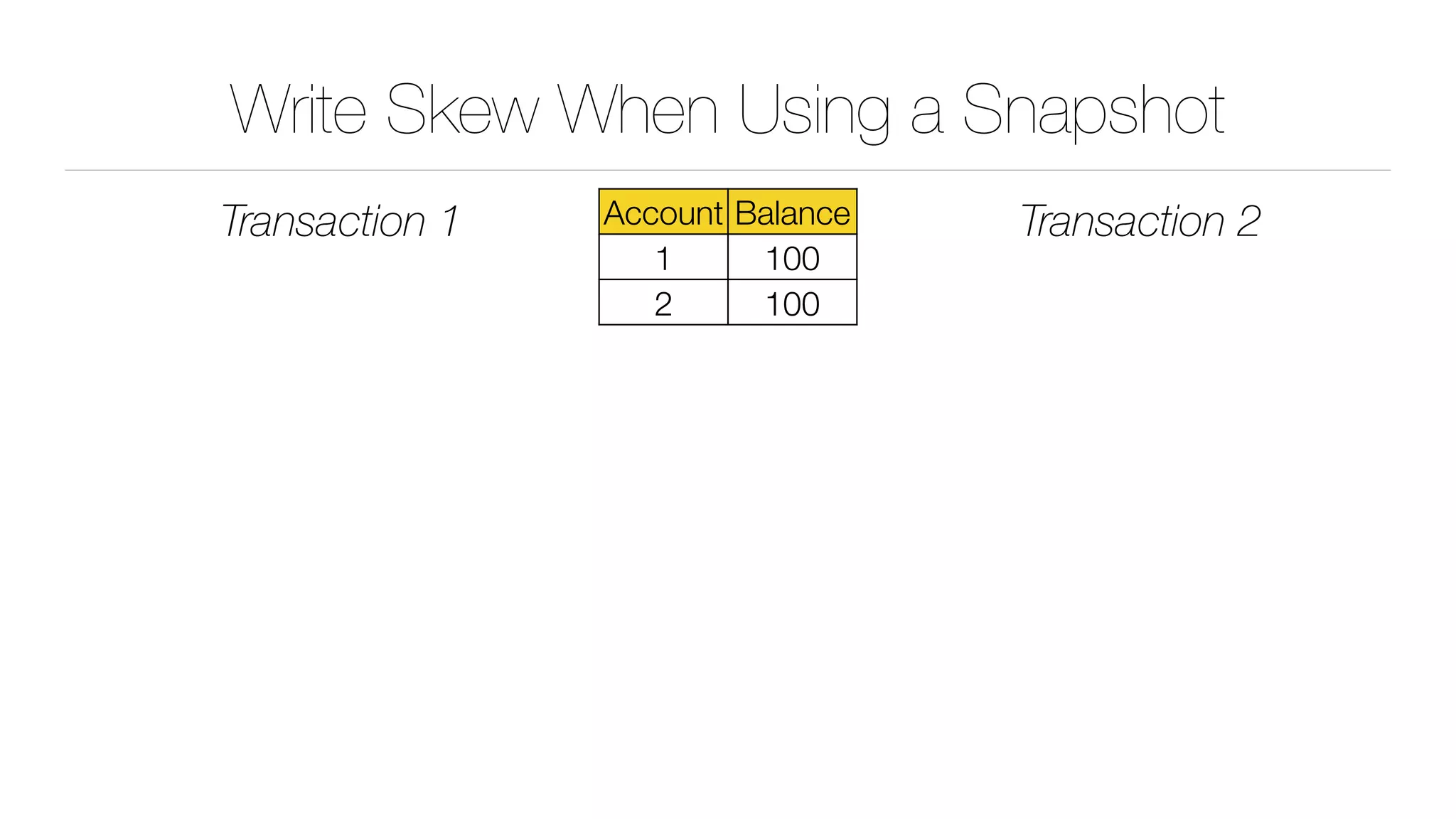
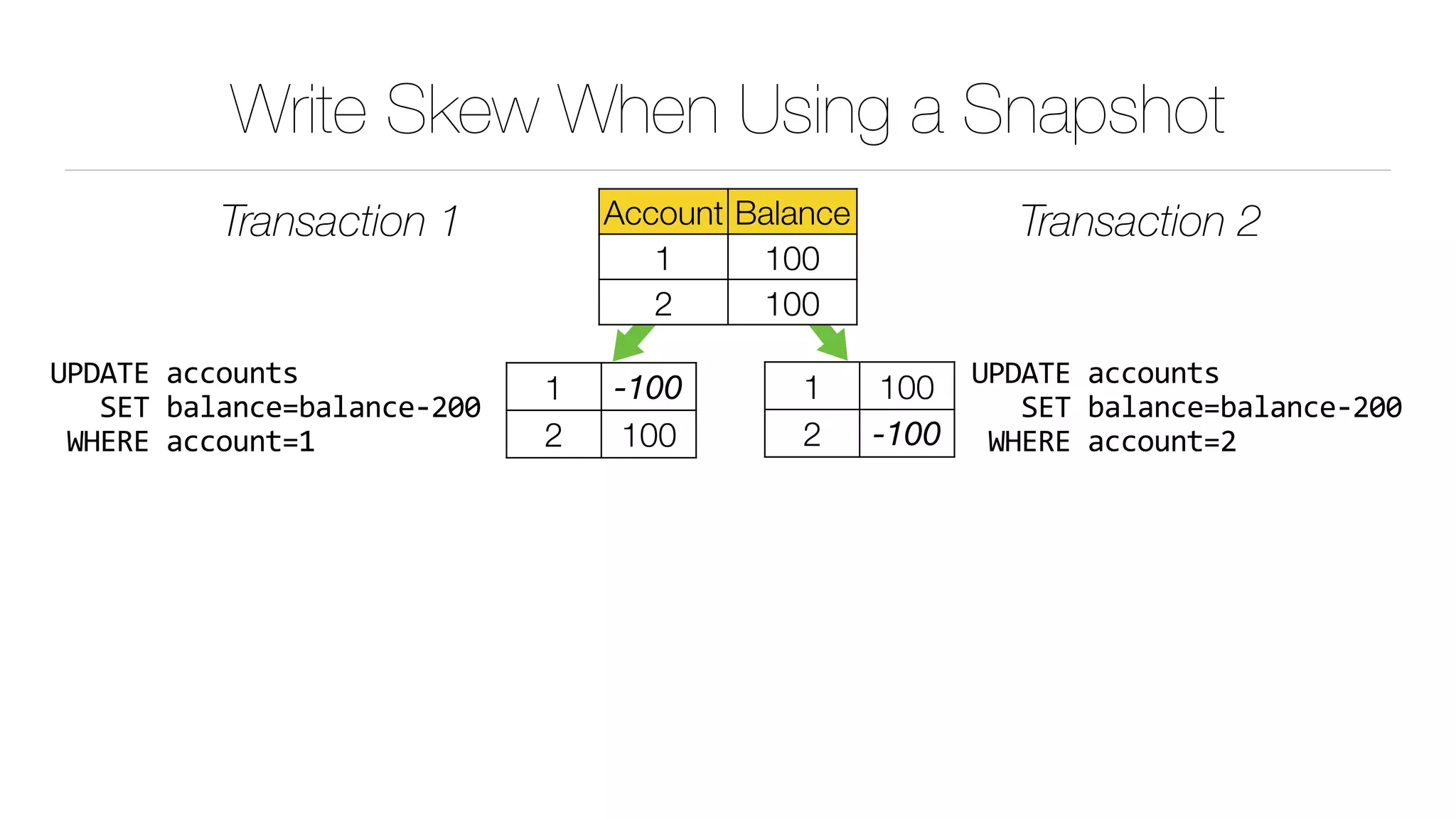
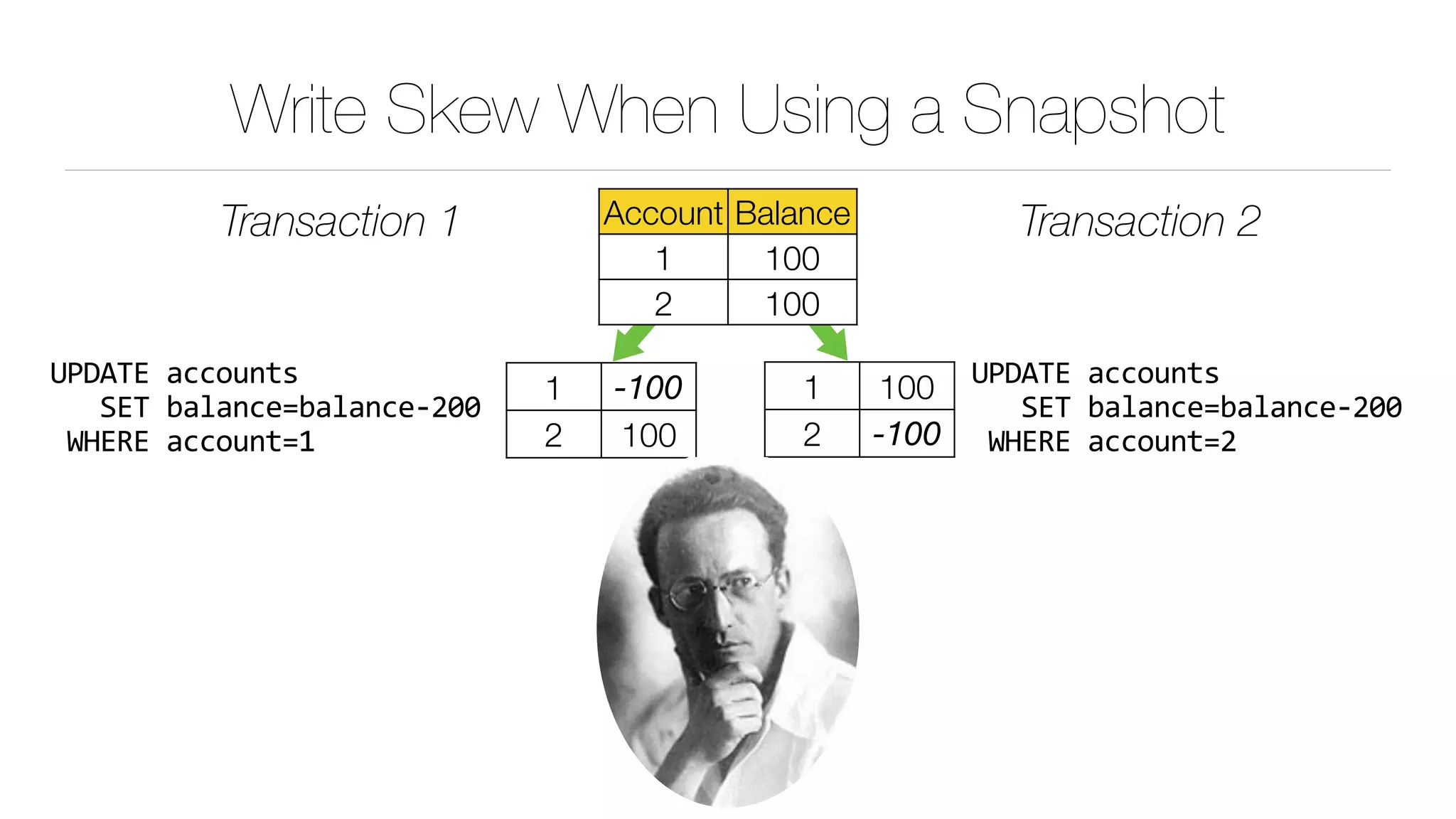
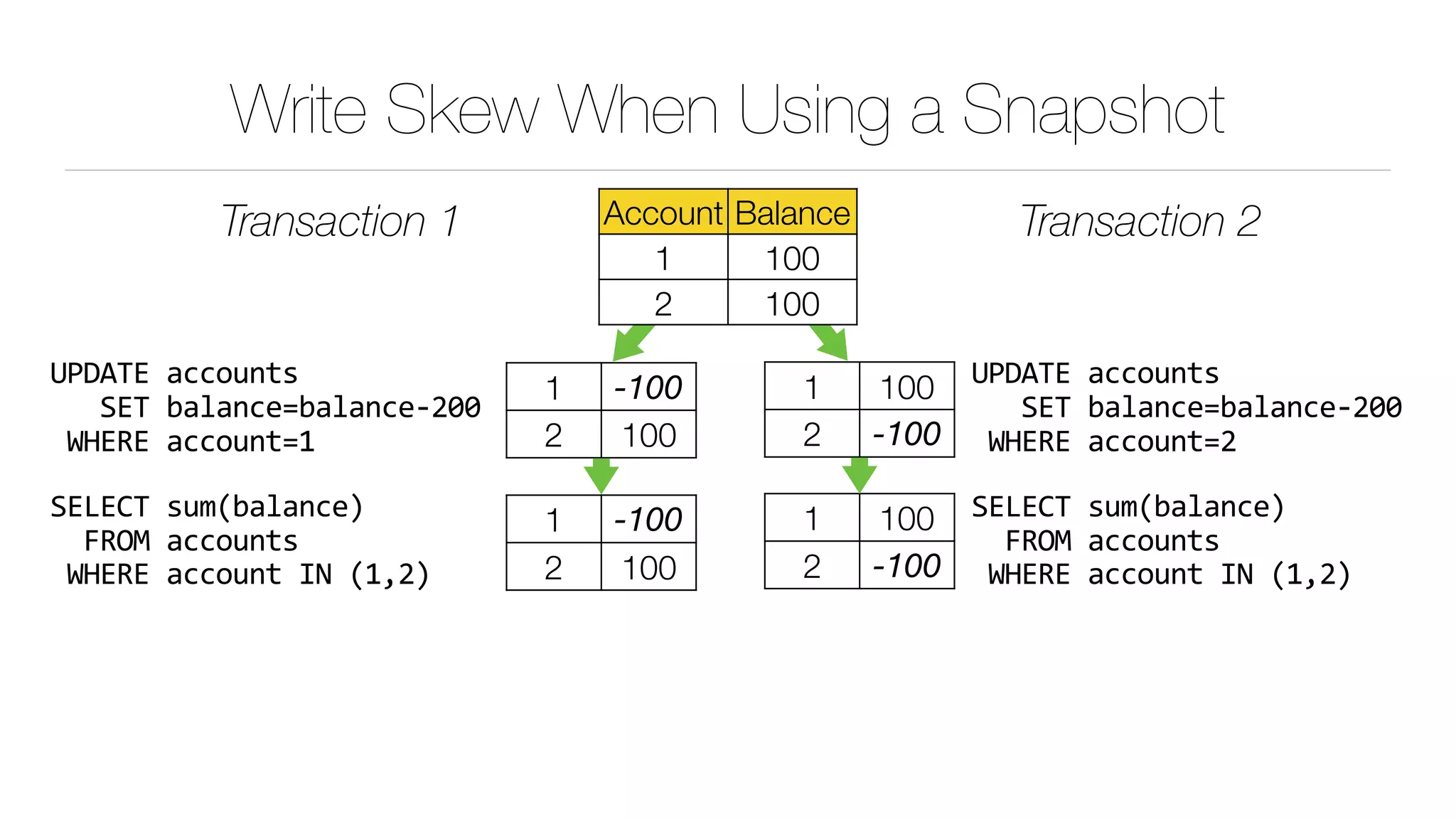
Write Skew When Using a Snapshot
Transaction 1 Transaction 2Account Balance
1 100
2 100
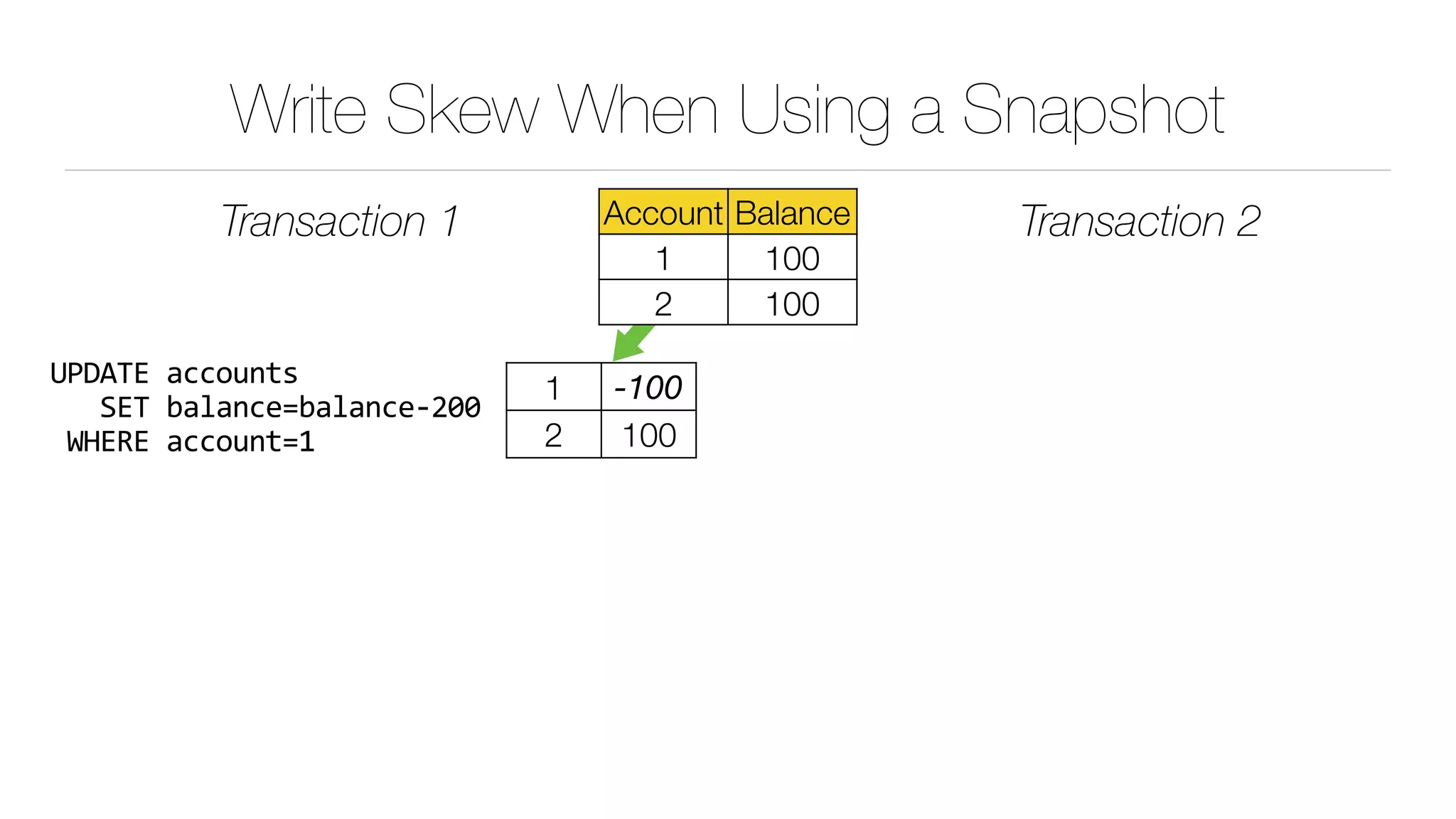
Write Skew When Using a Snapshot
Transaction 1 Transaction 2
1 -100
2 100
UPDATE	accounts	
			SET	balance=balance-200	
	WHERE	account=1
Account Balance
1 100
2 100
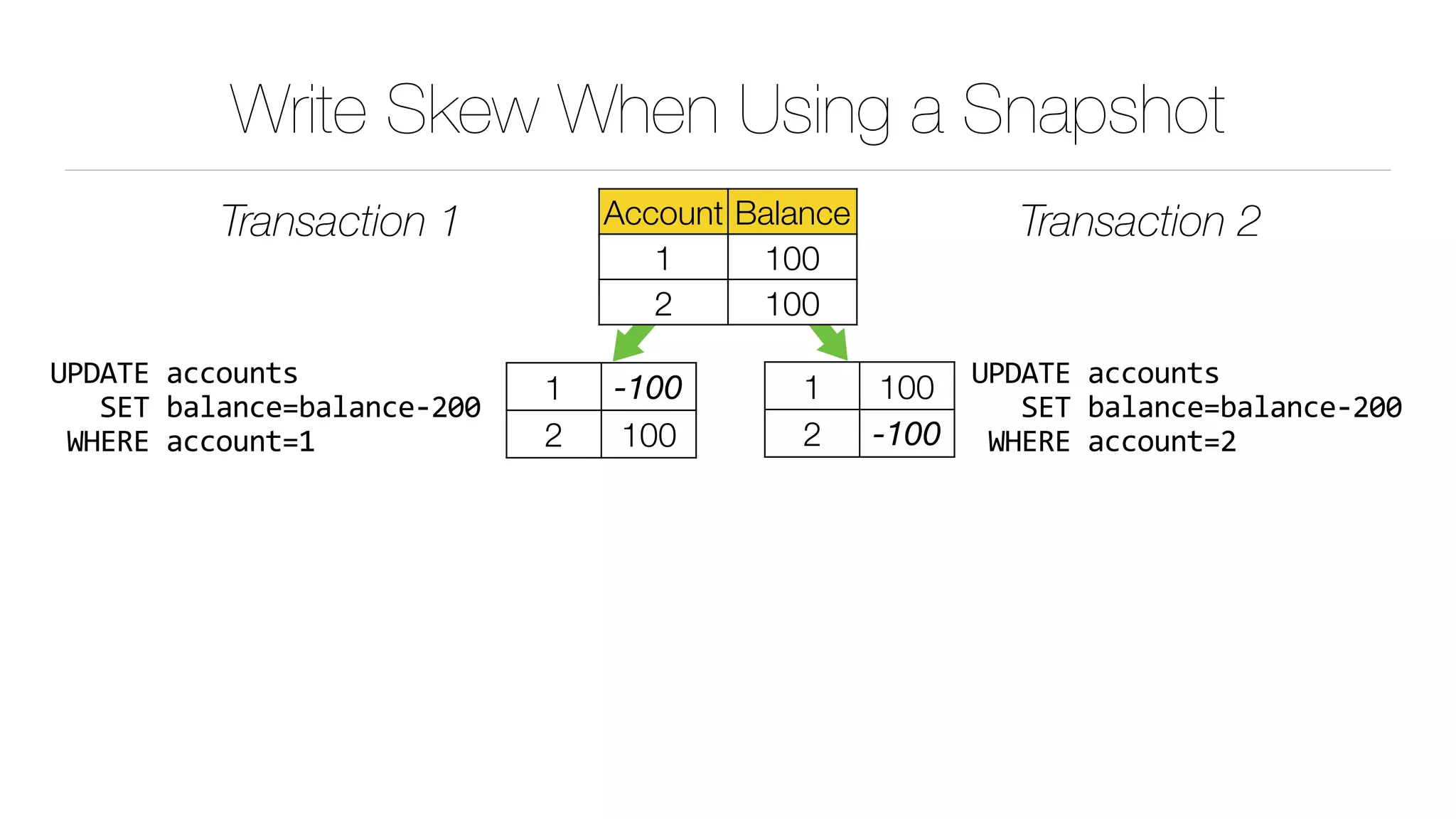
Write Skew When Using a Snapshot
Transaction 1 Transaction 2
1 100
2 -100
UPDATE	accounts	
			SET	balance=balance-200	
	WHERE	account=2
1 -100
2 100
UPDATE	accounts	
			SET	balance=balance-200	
	WHERE	account=1
Account Balance
1 100
2 100
Write Skew When Using a Snapshot
Transaction 1 Transaction 2
1 100
2 -100
UPDATE	accounts	
			SET	balance=balance-200	
	WHERE	account=2
1 -100
2 100
UPDATE	accounts	
			SET	balance=balance-200	
	WHERE	account=1
Account Balance
1 100
2 100
Write Skew When Using a Snapshot
Transaction 1 Transaction 2
1 100
2 -100
UPDATE	accounts	
			SET	balance=balance-200	
	WHERE	account=2
1 -100
2 100
UPDATE	accounts	
			SET	balance=balance-200	
	WHERE	account=1
Account Balance
1 100
2 100
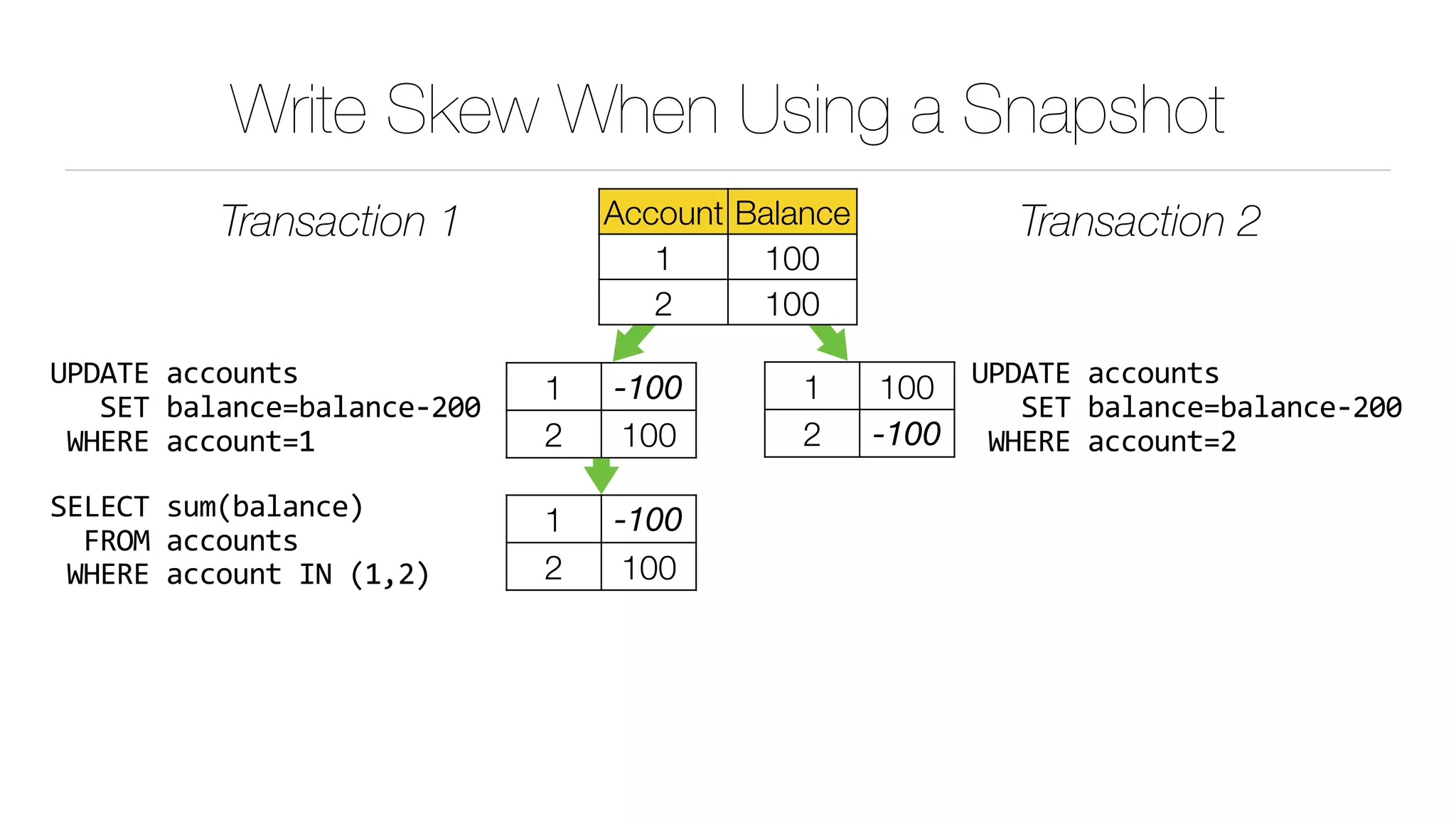
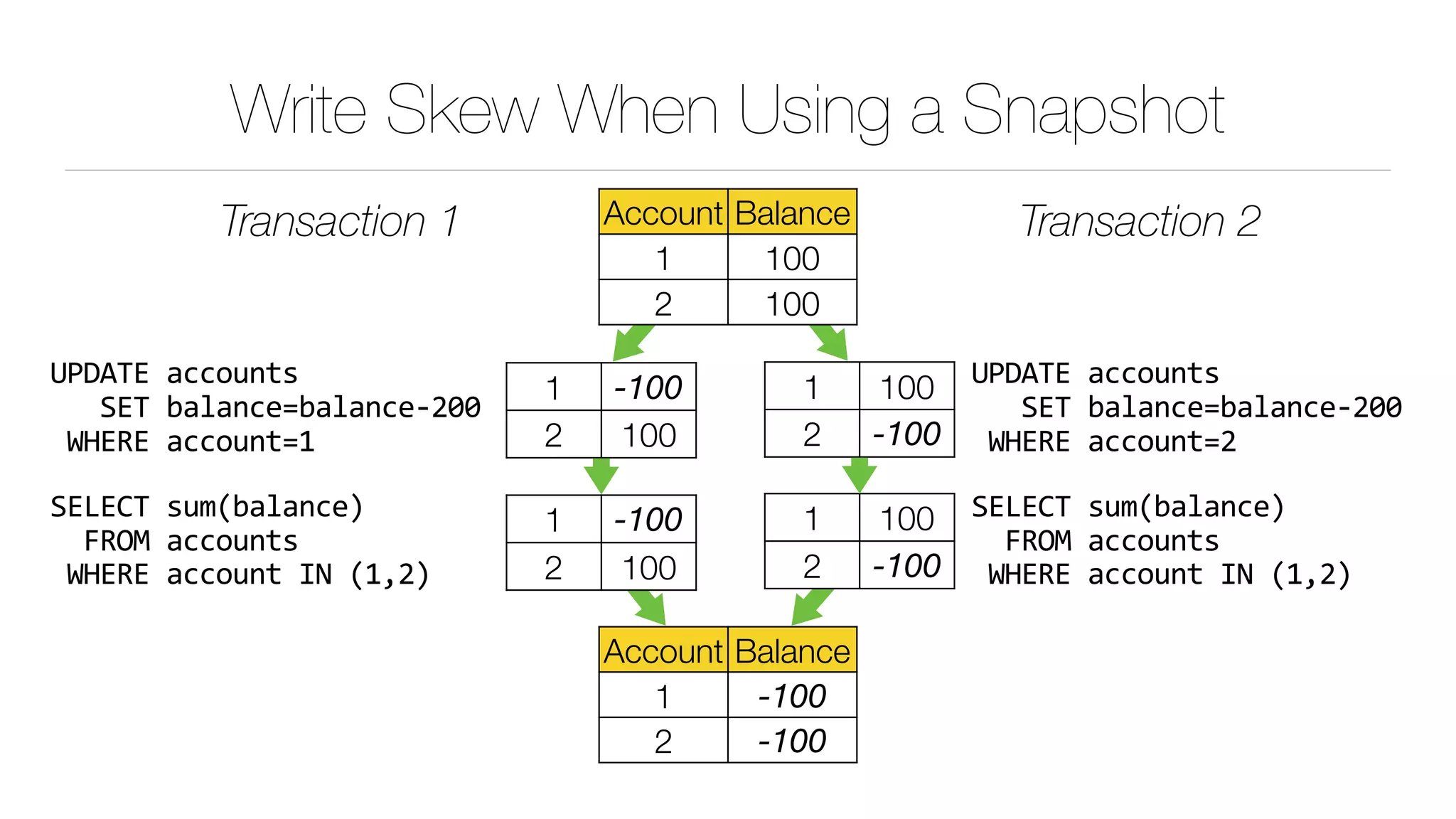
Write Skew When Using a Snapshot
Transaction 1 Transaction 2
1 100
2 -100
UPDATE	accounts	
			SET	balance=balance-200	
	WHERE	account=2
1 -100
2 100
UPDATE	accounts	
			SET	balance=balance-200	
	WHERE	account=1
Account Balance
1 100
2 100
SELECT	sum(balance)	
		FROM	accounts	
	WHERE	account	IN	(1,2)
1 -100
2 100
Write Skew When Using a Snapshot
Transaction 1 Transaction 2
1 100
2 -100
UPDATE	accounts	
			SET	balance=balance-200	
	WHERE	account=2
1 -100
2 100
UPDATE	accounts	
			SET	balance=balance-200	
	WHERE	account=1
Account Balance
1 100
2 100
SELECT	sum(balance)	
		FROM	accounts	
	WHERE	account	IN	(1,2)
1 -100
2 100
1 100
2 -100
SELECT	sum(balance)	
		FROM	accounts	
	WHERE	account	IN	(1,2)
Write Skew When Using a Snapshot
Transaction 1 Transaction 2
1 100
2 -100
UPDATE	accounts	
			SET	balance=balance-200	
	WHERE	account=2
Account Balance
1 -100
2 -100
1 -100
2 100
UPDATE	accounts	
			SET	balance=balance-200	
	WHERE	account=1
Account Balance
1 100
2 100
SELECT	sum(balance)	
		FROM	accounts	
	WHERE	account	IN	(1,2)
1 -100
2 100
1 100
2 -100
SELECT	sum(balance)	
		FROM	accounts	
	WHERE	account	IN	(1,2)
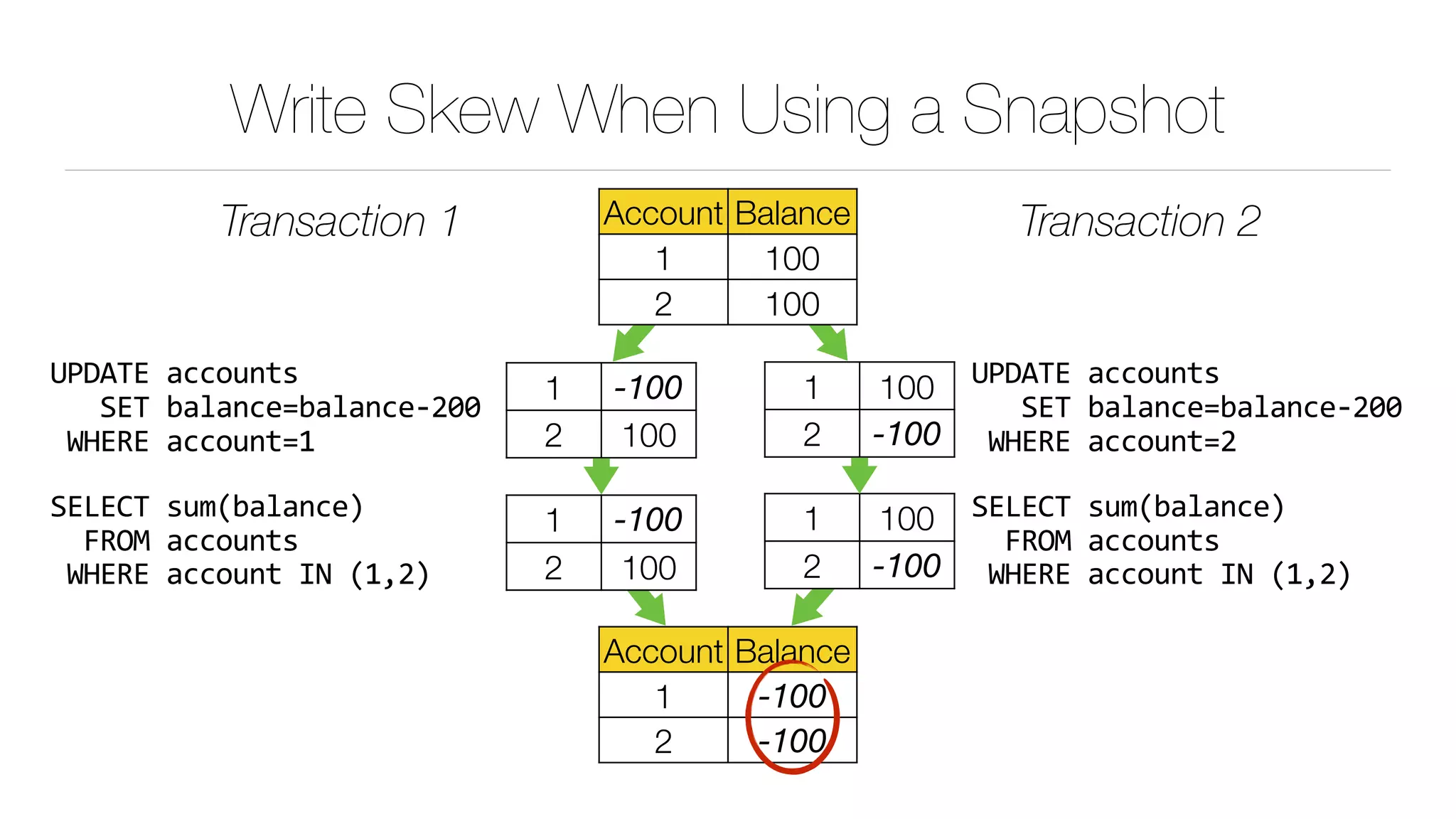
Write Skew When Using a Snapshot
Transaction 1 Transaction 2
1 100
2 -100
UPDATE	accounts	
			SET	balance=balance-200	
	WHERE	account=2
Account Balance
1 -100
2 -100
1 -100
2 100
UPDATE	accounts	
			SET	balance=balance-200	
	WHERE	account=1
Account Balance
1 100
2 100
SELECT	sum(balance)	
		FROM	accounts	
	WHERE	account	IN	(1,2)
1 -100
2 100
1 100
2 -100
SELECT	sum(balance)	
		FROM	accounts	
	WHERE	account	IN	(1,2)
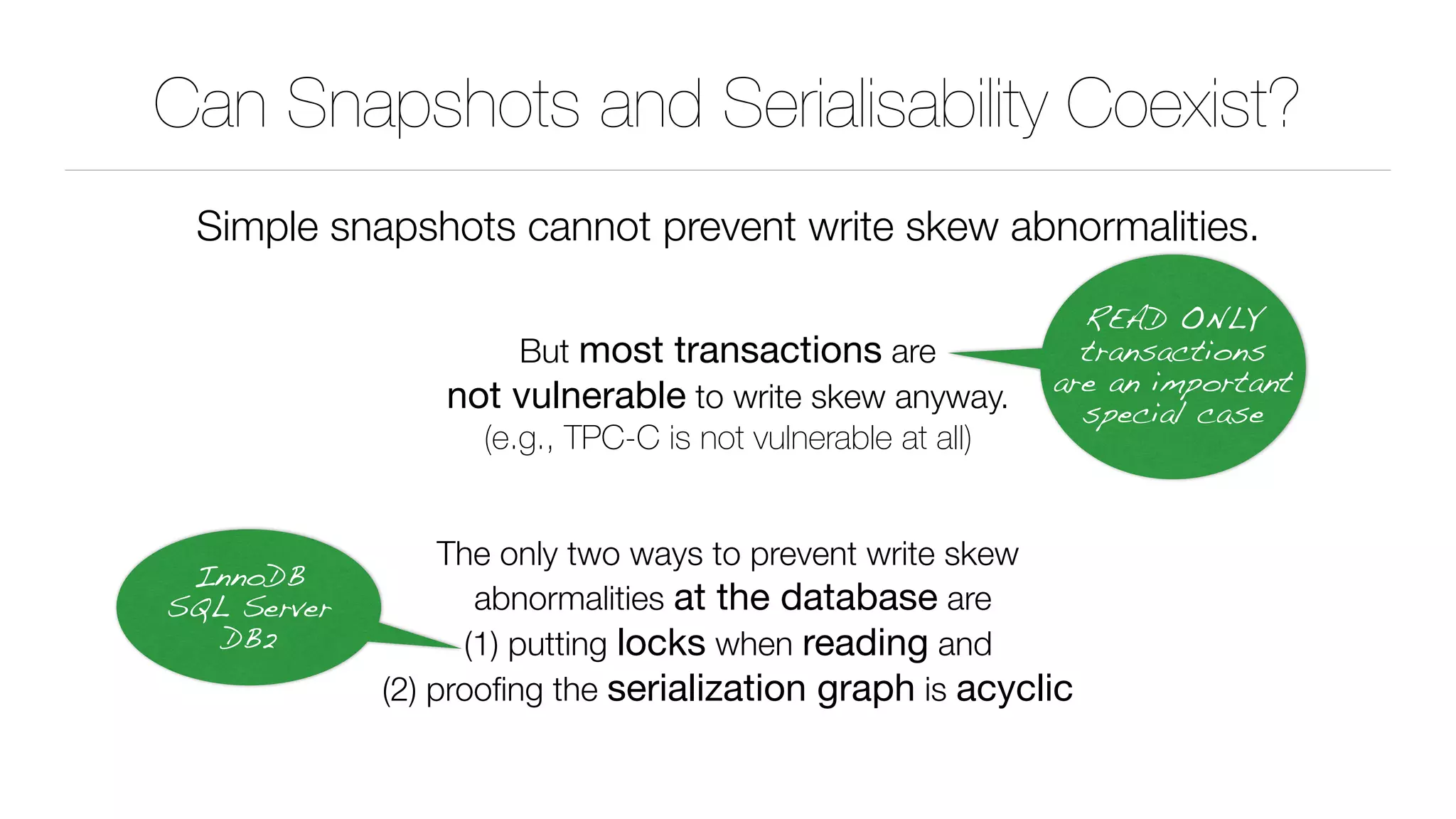
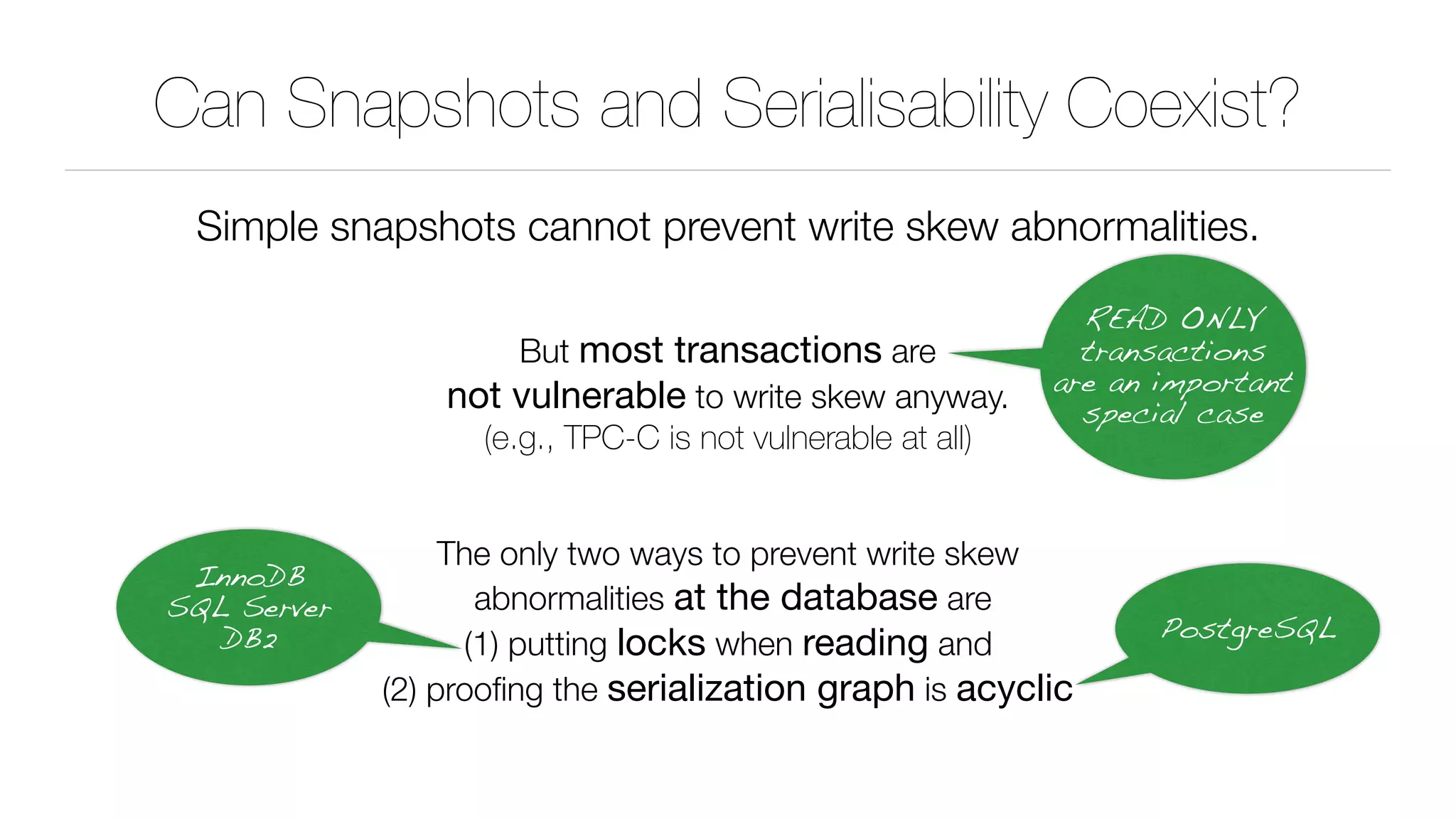
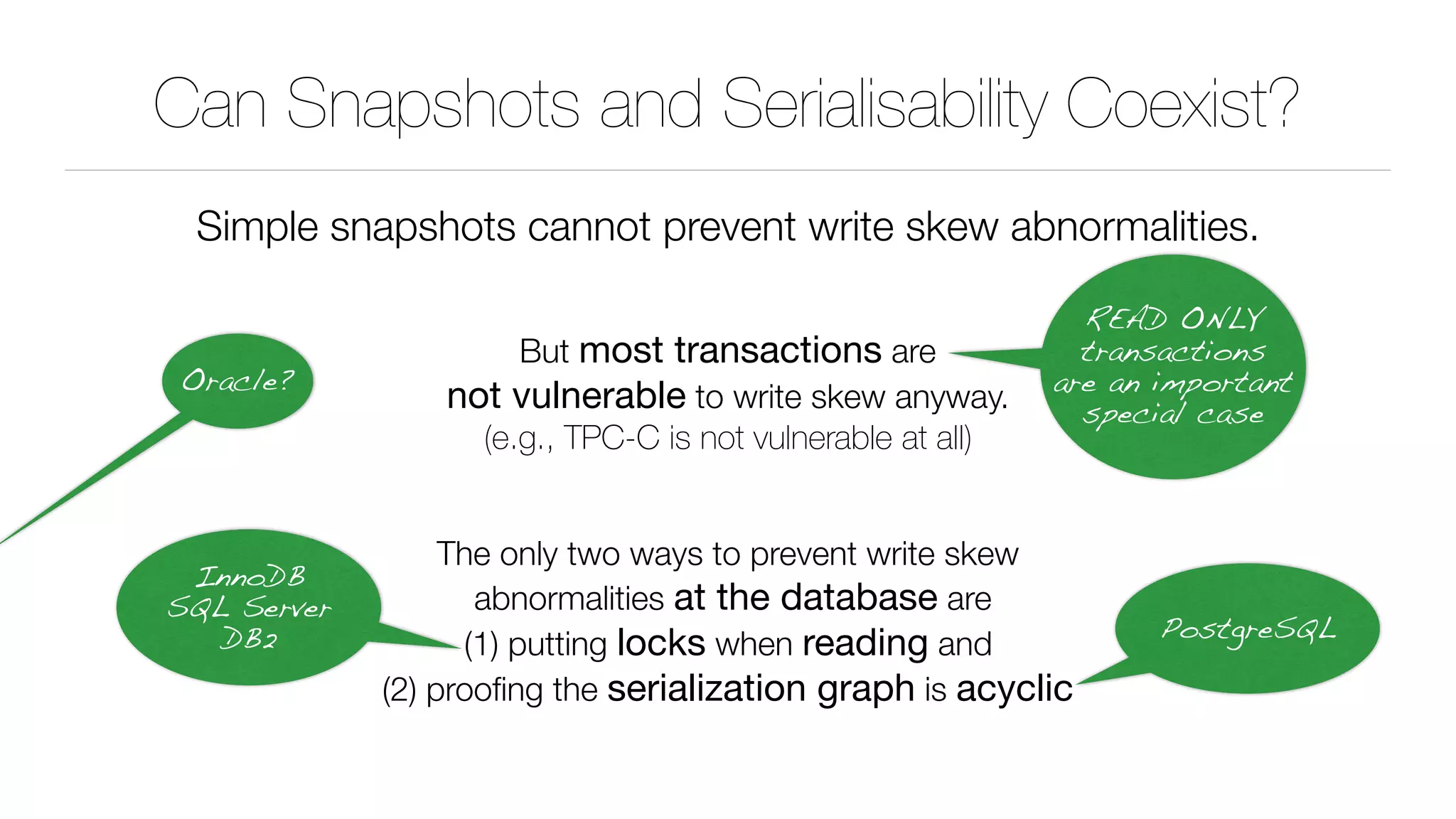
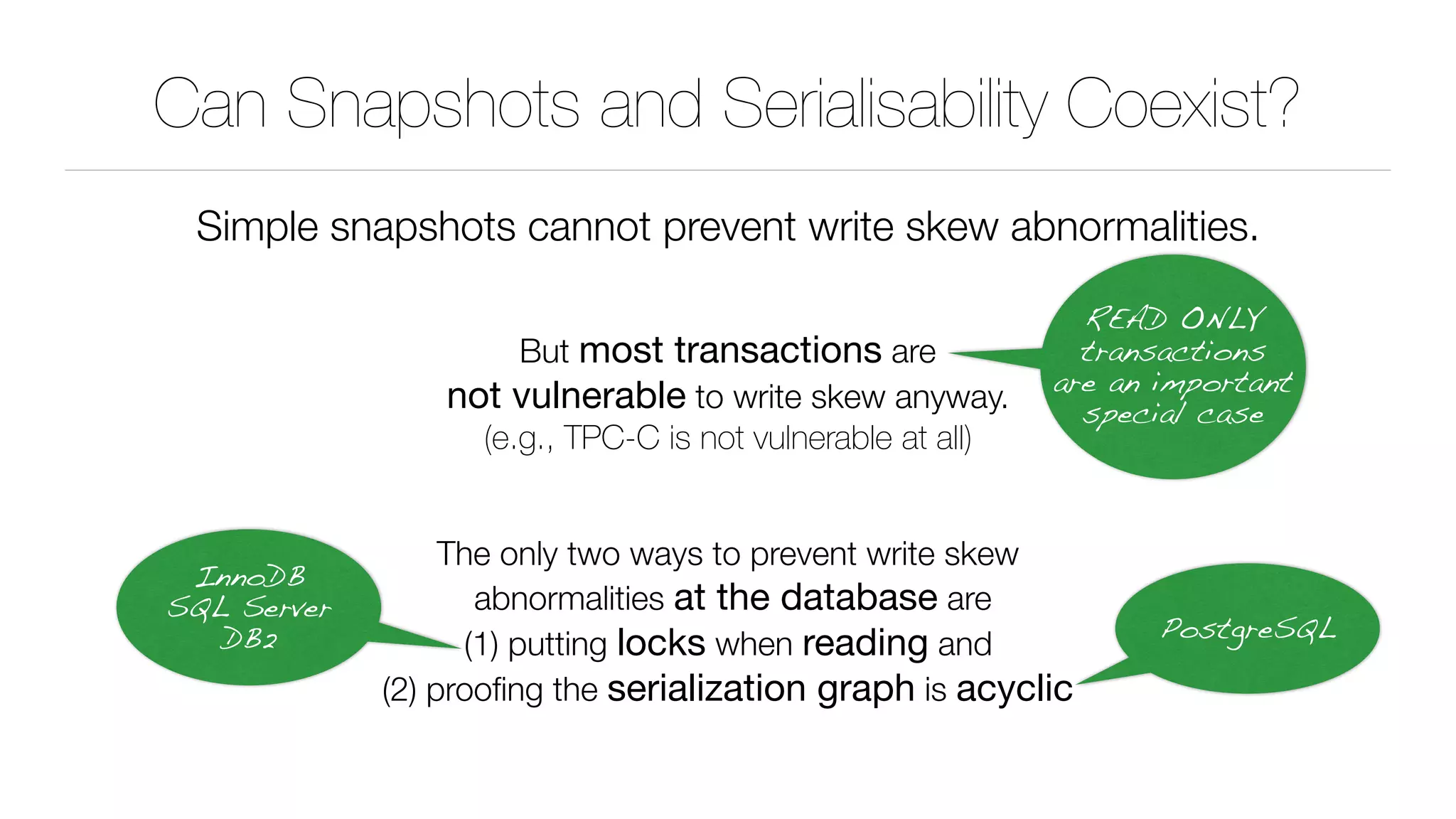
Can Snapshots and Serialisability Coexist?
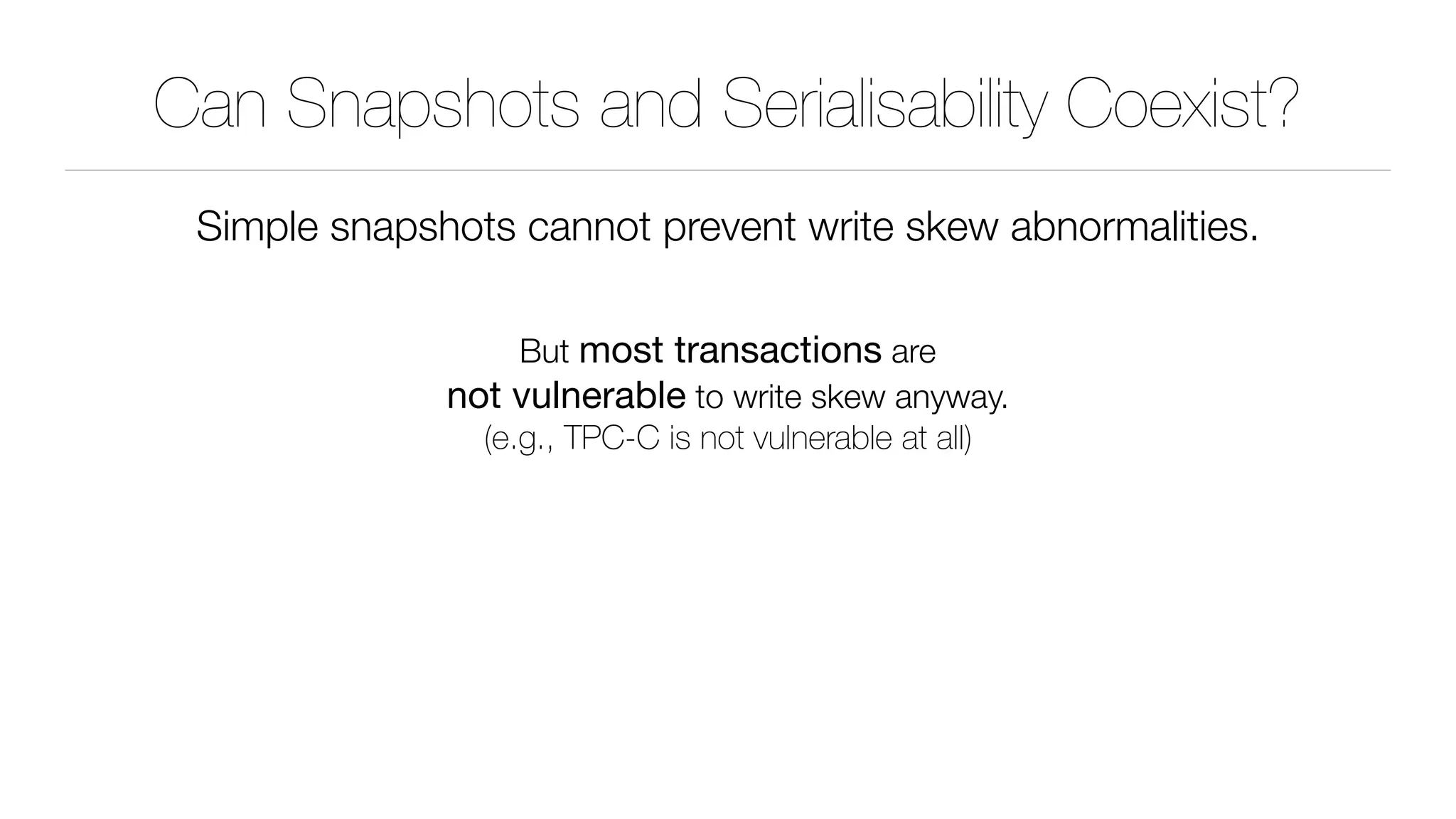
Simple snapshots cannot prevent write skew abnormalities.
Can Snapshots and Serialisability Coexist?
Simple snapshots cannot prevent write skew abnormalities.
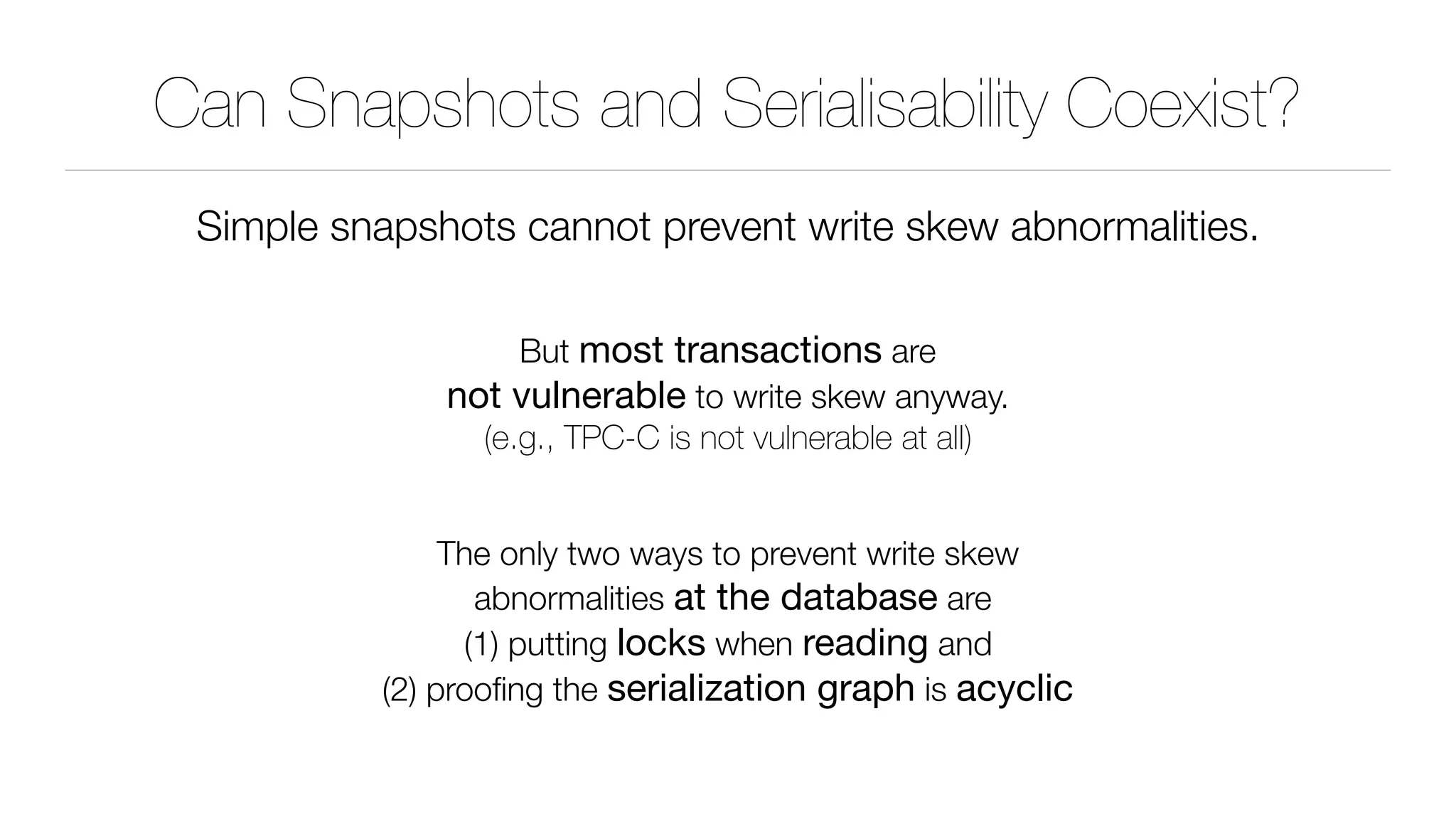
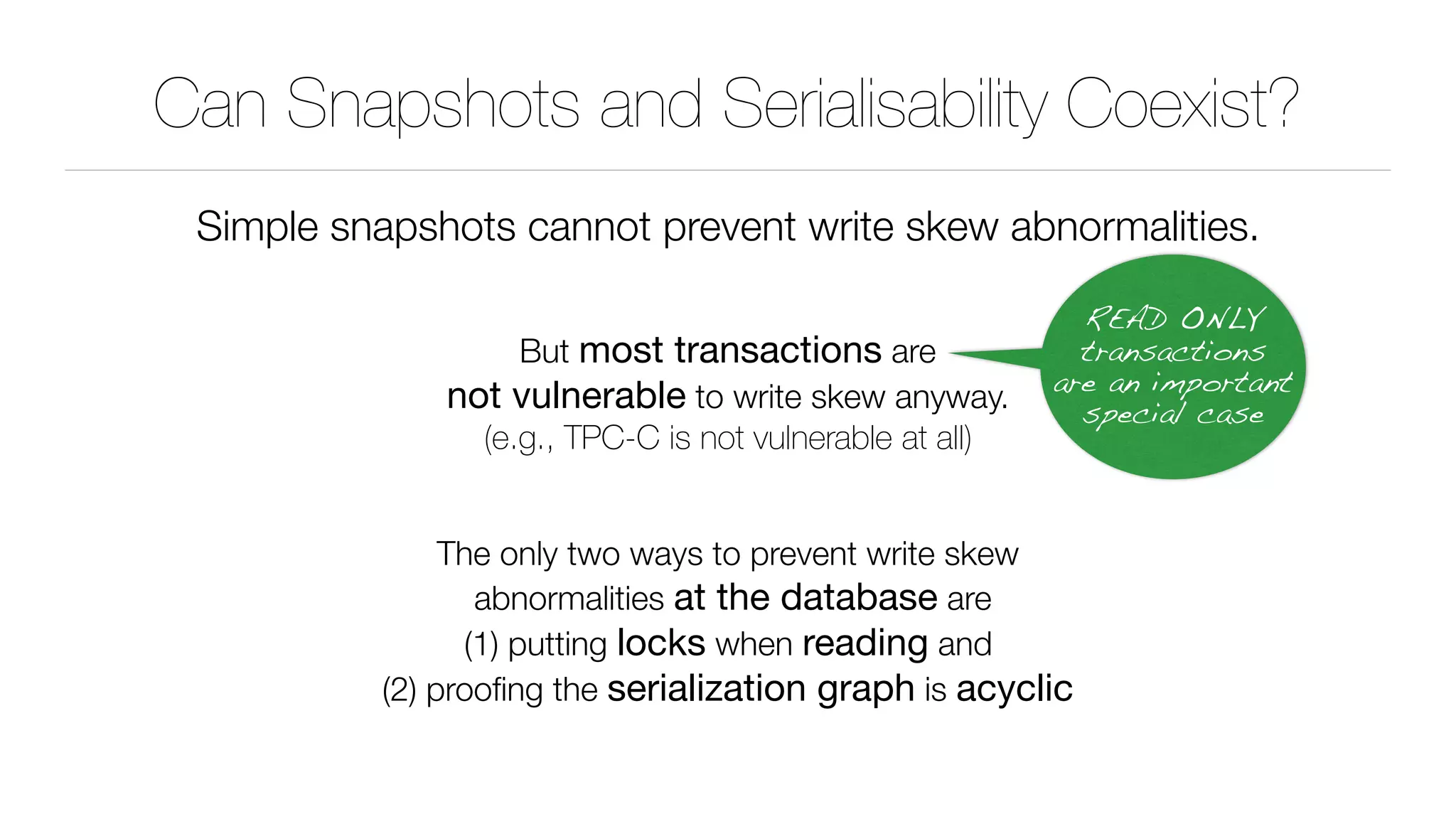
But most transactions are

not vulnerable to write skew anyway.

(e.g., TPC-C is not vulnerable at all)
Can Snapshots and Serialisability Coexist?
Simple snapshots cannot prevent write skew abnormalities.
But most transactions are

not vulnerable to write skew anyway.

(e.g., TPC-C is not vulnerable at all)
The only two ways to prevent write skew

abnormalities at the database are

(1) putting locks when reading and

(2) proofing the serialization graph is acyclic
Can Snapshots and Serialisability Coexist?
Simple snapshots cannot prevent write skew abnormalities.
But most transactions are

not vulnerable to write skew anyway.

(e.g., TPC-C is not vulnerable at all)
The only two ways to prevent write skew

abnormalities at the database are

(1) putting locks when reading and

(2) proofing the serialization graph is acyclic
READ ONLY
transactions
are an important
special case
Can Snapshots and Serialisability Coexist?
Simple snapshots cannot prevent write skew abnormalities.
But most transactions are

not vulnerable to write skew anyway.

(e.g., TPC-C is not vulnerable at all)
The only two ways to prevent write skew

abnormalities at the database are

(1) putting locks when reading and

(2) proofing the serialization graph is acyclic
READ ONLY
transactions
are an important
special case
InnoDB

SQL Server

DB2
Can Snapshots and Serialisability Coexist?
Simple snapshots cannot prevent write skew abnormalities.
But most transactions are

not vulnerable to write skew anyway.

(e.g., TPC-C is not vulnerable at all)
The only two ways to prevent write skew

abnormalities at the database are

(1) putting locks when reading and

(2) proofing the serialization graph is acyclic
READ ONLY
transactions
are an important
special case
InnoDB

SQL Server

DB2 PostgreSQL
Can Snapshots and Serialisability Coexist?
Simple snapshots cannot prevent write skew abnormalities.
But most transactions are

not vulnerable to write skew anyway.

(e.g., TPC-C is not vulnerable at all)
The only two ways to prevent write skew

abnormalities at the database are

(1) putting locks when reading and

(2) proofing the serialization graph is acyclic
READ ONLY
transactions
are an important
special case
InnoDB

SQL Server

DB2 PostgreSQL
Oracle?
Can Snapshots and Serialisability Coexist?
Simple snapshots cannot prevent write skew abnormalities.
But most transactions are

not vulnerable to write skew anyway.

(e.g., TPC-C is not vulnerable at all)
The only two ways to prevent write skew

abnormalities at the database are

(1) putting locks when reading and

(2) proofing the serialization graph is acyclic
READ ONLY
transactions
are an important
special case
InnoDB

SQL Server

DB2 PostgreSQL
Can Snapshots and Serialisability Coexist?
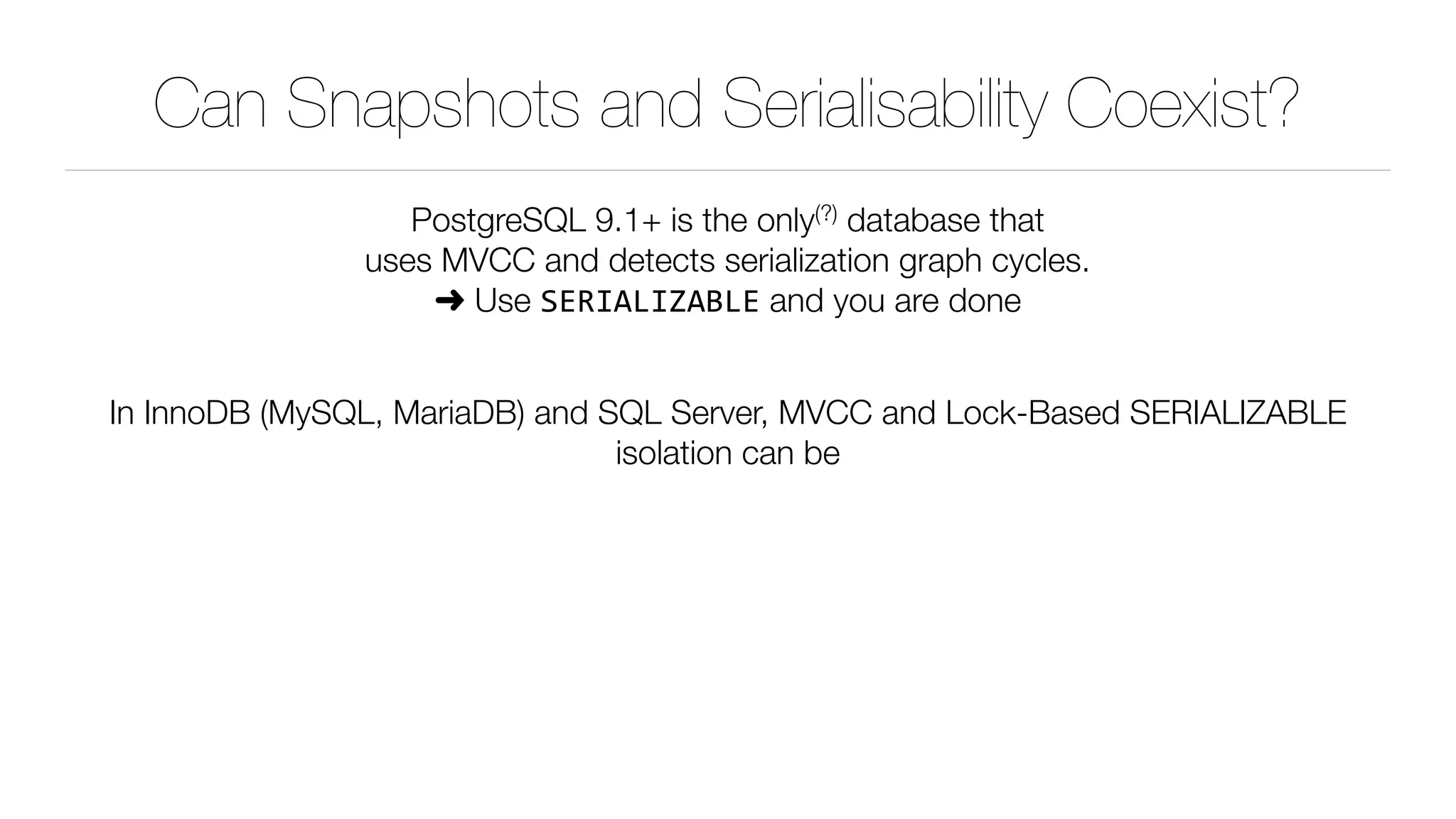
PostgreSQL 9.1+ is the only(?) database that

uses MVCC and detects serialization graph cycles.

➜ Use SERIALIZABLE and you are done

In InnoDB (MySQL, MariaDB) and SQL Server, MVCC and Lock-Based SERIALIZABLE
isolation can be
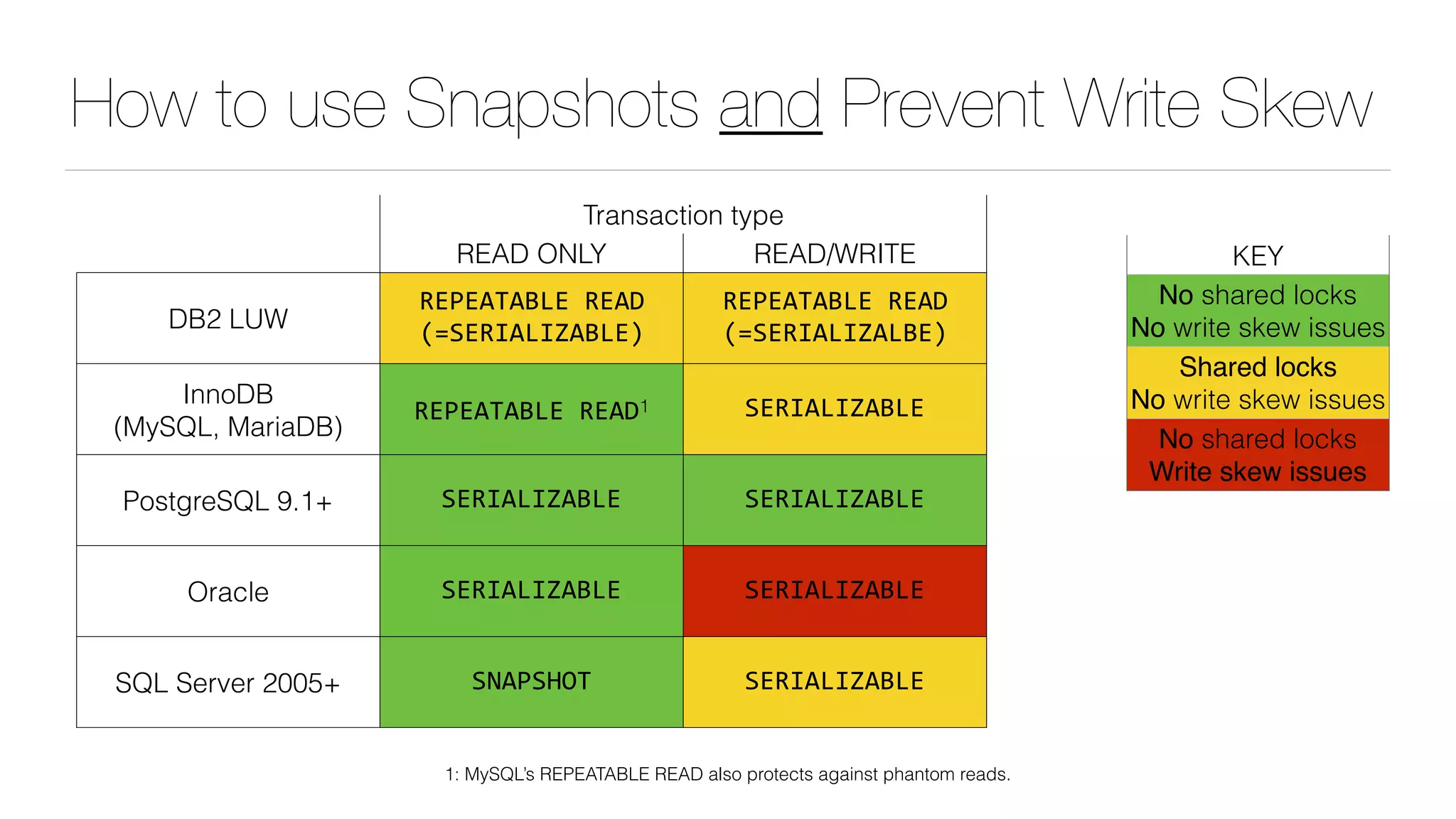
How to use Snapshots and Prevent Write Skew
Transaction type
READ ONLY READ/WRITE
DB2 LUW
REPEATABLE	READ

(=SERIALIZABLE)
REPEATABLE	READ

(=SERIALIZALBE)
InnoDB

(MySQL, MariaDB)
REPEATABLE	READ1 SERIALIZABLE
PostgreSQL 9.1+ SERIALIZABLE SERIALIZABLE
Oracle SERIALIZABLE SERIALIZABLE
SQL Server 2005+ SNAPSHOT SERIALIZABLE
1: MySQL’s REPEATABLE READ also protects against phantom reads.
KEY
No shared locks

No write skew issues
Shared locks

No write skew issues
No shared locks

Write skew issues
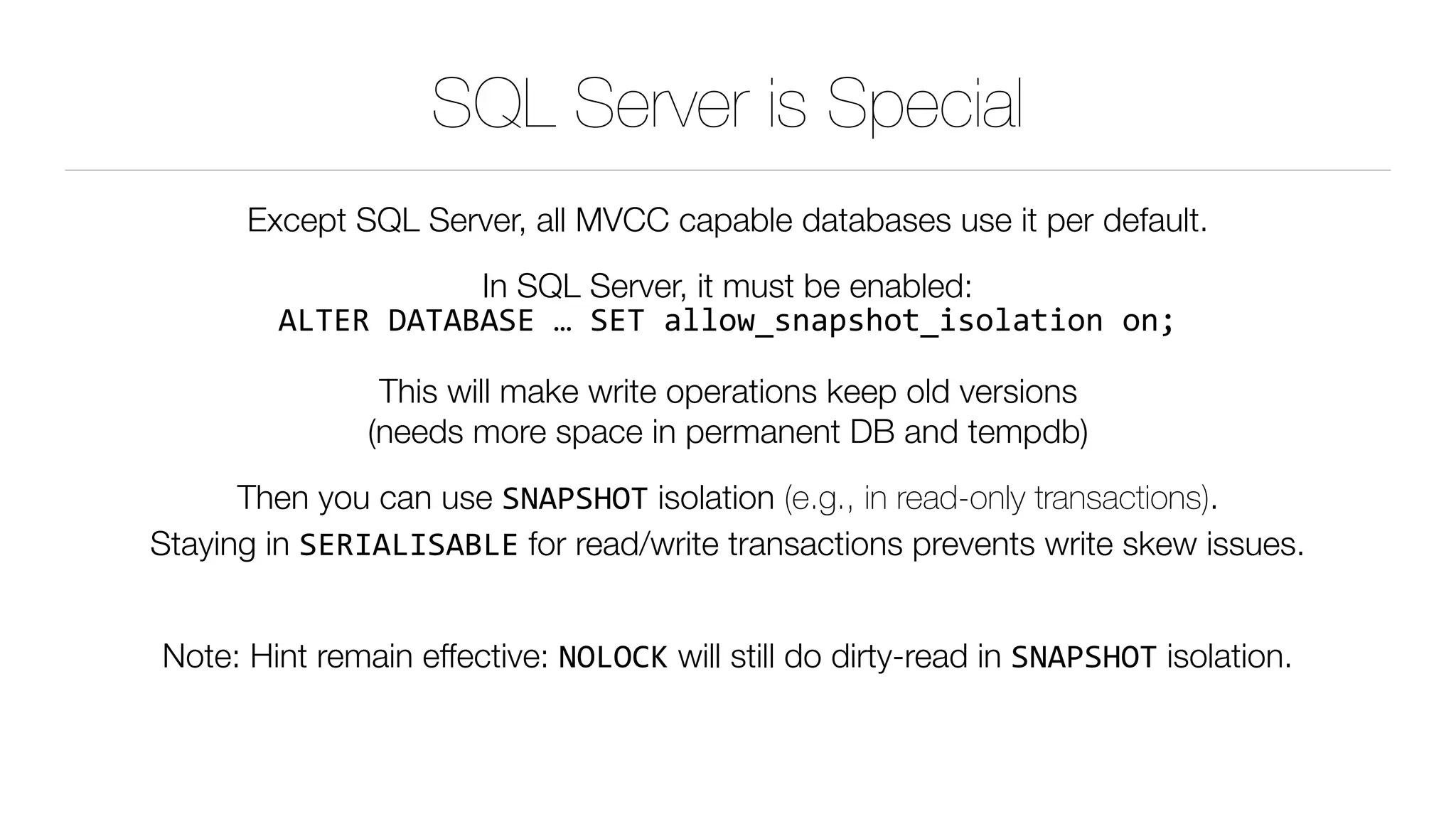
SQL Server is Special
Except SQL Server, all MVCC capable databases use it per default.
In SQL Server, it must be enabled:

ALTER	DATABASE	…	SET	allow_snapshot_isolation	on;
This will make write operations keep old versions

(needs more space in permanent DB and tempdb)
Then you can use SNAPSHOT isolation (e.g., in read-only transactions).

Staying in SERIALISABLE for read/write transactions prevents write skew issues.

Note: Hint remain effective: NOLOCK will still do dirty-read in SNAPSHOT isolation.
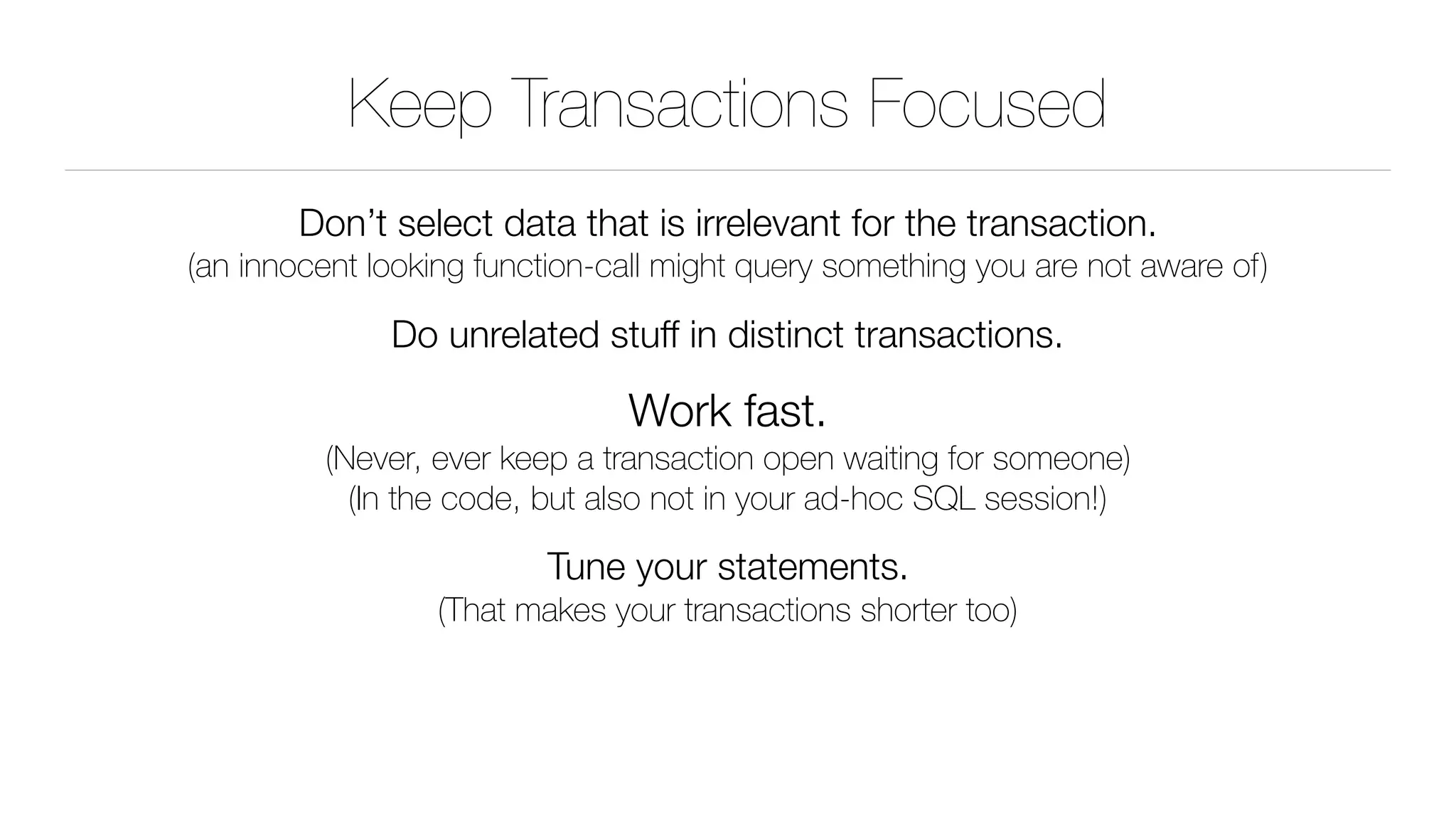
Keep Transactions Focused
Don’t select data that is irrelevant for the transaction.

(an innocent looking function-call might query something you are not aware of)
Do unrelated stuff in distinct transactions.
Work fast.

(Never, ever keep a transaction open waiting for someone)

(In the code, but also not in your ad-hoc SQL session!)
Tune your statements.

(That makes your transactions shorter too)

SQL Transactions - What they are good for and how they work

  • 1.
    © 2016 byMarkus Winand Transactions What they are good for and how they work
  • 2.
    ( ) Transactions areBrackets Starting a transaction: Explicit: START TRANSACTION Implicit: INSERT / UPDATE / DELETE SELECT CREATE Terminating a transaction: Explicit: COMMIT ROLLBACK Implementation defined: Due to errors CREATE … Varies
 amongst
 products
  • 3.
    Transactions have Characteristics Access-Mode: READ_ONLY READ_WRITE ConstraintMode: IMMEDIATE DEFERRED Transaction-Isolation-Level: READ UNCOMMITTED READ COMMITTED REPEATABLE READ SERIALIZABLE Diagnostic Size: Archaic
  • 4.
    Transactions have Characteristics Access-Mode: READ_ONLY READ_WRITE ConstraintMode: IMMEDIATE DEFERRED Transaction-Isolation-Level: READ UNCOMMITTED READ COMMITTED REPEATABLE READ SERIALIZABLE Diagnostic Size: Archaic Not strictly a
 transaction 
 characteristic
  • 5.
    Setting Transaction Characteristics Withexplicit transaction begin: START TRANSACTION ISOLATION LEVEL SERIALIZABLE READ WRITE For next (implicitly started) transaction: SET TRANSACTION ISOLATION LEVEL SERIALIZABLE READ WRITE The standard uses SERIALIZEABLE as default,
 but most implementations default to READ COMMITTED. In practice: Use an API if possible.
  • 6.
    Use Cases forTransactions
  • 7.
    Use Cases forTransactions When writing
  • 8.
    Use Cases forTransactions Backing out incomplete changes… … by the program with rollback … by the RDBMS in case of crash When writing
  • 9.
    Use Cases forTransactions Backing out incomplete changes… … by the program with rollback … by the RDBMS in case of crash When writing (Boring)
  • 10.
    Use Cases forTransactions Backing out incomplete changes… … by the program with rollback … by the RDBMS in case of crash When writing When reading (Boring)
  • 11.
    Use Cases forTransactions Backing out incomplete changes… … by the program with rollback … by the RDBMS in case of crash When writing When reading Simplify concurrent programs… … by utilising the right
 transaction isolation level (Boring)
  • 12.
    Use Cases forTransactions Backing out incomplete changes… … by the program with rollback … by the RDBMS in case of crash When writing When reading Simplify concurrent programs… … by utilising the right
 transaction isolation level (Boring) Amazing!
  • 13.
    Standard Transaction IsolationLevels Phenomena covered by the Standard Dirty Read Non-Repeatable Read Phantom Read READ UNCOMMITTED READ COMMITTED REPEATABLE READ SERIALIZABLE STOP STOP STOP STOPSTOPSTOP
  • 14.
    Standard Transaction IsolationLevels Phenomena covered by the Standard Dirty Read Non-Repeatable Read Phantom Read READ UNCOMMITTED READ COMMITTED REPEATABLE READ SERIALIZABLE STOP STOP STOP STOPSTOPSTOP Incomplete,
 unfortunately
  • 15.
    How Comes? SQL isa declarative language:
 the standard doesn’t say how to implement it,
 it just describes the effects it has. Unfortunately, SQL-92 was written with locking in mind,
 and thus only describes the effects in the granularity
 in which they appear whey implemented using locking. Although a commonly known issue, it was never changed. https://en.wikipedia.org/wiki/Snapshot_isolation
  • 16.
    Transaction Isolation UsingLocks Phenomena covered by the Standard Dirty Read Non-Repeatable Read Phantom Read READ UNCOMMITTED READ COMMITTED REPEATABLE READ SERIALIZABLE ▶ Row (short) ▶ Row (TX) ▶ Row (TX) ▶ Predicate (TX) STOP STOP STOP STOPSTOPSTOP
  • 17.
    Transaction Isolation UsingLocks Phenomena covered by the Standard Dirty Read Non-Repeatable Read Phantom Read READ UNCOMMITTED READ COMMITTED REPEATABLE READ SERIALIZABLE ▶ Row (short) ▶ Row (TX) ▶ Row (TX) ▶ Predicate (TX) STOP STOP STOP STOPSTOPSTOP Locks preventing
 phenomena:
 What (how long)
  • 18.
    Transaction Isolation UsingLocks Phenomena covered by the Standard Dirty Read Non-Repeatable Read Phantom Read READ UNCOMMITTED READ COMMITTED REPEATABLE READ SERIALIZABLE ▶ Row (short) ▶ Row (TX) ▶ Row (TX) ▶ Predicate (TX) STOP STOP STOP STOPSTOPSTOP Locks preventing
 phenomena:
 What (how long)
  • 19.
    Transaction Isolation UsingLocks Phenomena covered by the Standard Dirty Read Non-Repeatable Read Phantom Read READ UNCOMMITTED READ COMMITTED REPEATABLE READ SERIALIZABLE ▶ Row (short) ▶ Row (TX) ▶ Row (TX) ▶ Predicate (TX) STOP STOP STOP STOPSTOPSTOP Locks preventing
 phenomena:
 What (how long)
  • 20.
    Transaction Isolation UsingLocks Phenomena covered by the Standard Dirty Read Non-Repeatable Read Phantom Read READ UNCOMMITTED READ COMMITTED REPEATABLE READ SERIALIZABLE ▶ Row (short) ▶ Row (TX) ▶ Row (TX) ▶ Predicate (TX) STOP STOP STOP STOPSTOPSTOP Locks preventing
 phenomena:
 What (how long)
  • 21.
    Example: Write Skew Makesure the sum of two rows is positive
 (e.g., two bank accounts belonging to the same person) Code to withdraw from one account
 (naive schema and not considering concurrency) UPDATE accounts
 SET balance = balance - 200
 WHERE account = 1 SELECT SUM(balance)
 FROM accounts
 WHERE account IN (1,2) >= 0 commit 
 <0 rollback
  • 22.
    Examples: Disclaimer The followingexamples just demonstrate
 one possible way two transactions could interact. The examples are by no means exhaustive.
  • 23.
    Write Skew inLock-based READ UNCOMMITTED Account Balance 1 100 2 100 Transaction 1 Transaction 2
  • 24.
    Write Skew inLock-based READ UNCOMMITTED Account Balance 1 100 2 100 Transaction 1 Transaction 2 ▶ 1 -100 2 100 UPDATE accounts SET balance=balance-200 WHERE account=1
  • 25.
    Write Skew inLock-based READ UNCOMMITTED Account Balance 1 100 2 100 Transaction 1 Transaction 2 ▶ 1 -100 2 100 UPDATE accounts SET balance=balance-200 WHERE account=1 ▶ 1 -100 2 -100 ◀ UPDATE accounts SET balance=balance-200 WHERE account=2
  • 26.
    Write Skew inLock-based READ UNCOMMITTED Account Balance 1 100 2 100 Transaction 1 Transaction 2 ▶ 1 -100 2 100 UPDATE accounts SET balance=balance-200 WHERE account=1 ▶ 1 -100 2 -100 ◀ UPDATE accounts SET balance=balance-200 WHERE account=2 ▶ 1 -100 2 -100 ◀ SELECT sum(balance) FROM accounts WHERE account IN (1,2)
  • 27.
    Write Skew inLock-based READ UNCOMMITTED Account Balance 1 100 2 100 Transaction 1 Transaction 2 ▶ 1 -100 2 100 UPDATE accounts SET balance=balance-200 WHERE account=1 ▶ 1 -100 2 -100 ◀ UPDATE accounts SET balance=balance-200 WHERE account=2 ▶ 1 -100 2 -100 ◀ SELECT sum(balance) FROM accounts WHERE account IN (1,2) -200
  • 28.
    Write Skew inLock-based READ UNCOMMITTED Account Balance 1 100 2 100 Transaction 1 Transaction 2 ▶ 1 -100 2 100 UPDATE accounts SET balance=balance-200 WHERE account=1 ▶ 1 -100 2 -100 ◀ UPDATE accounts SET balance=balance-200 WHERE account=2 ▶ 1 -100 2 -100 ◀ SELECT sum(balance) FROM accounts WHERE account IN (1,2) ▶ 1 -100 2 -100 ◀ SELECT sum(balance) FROM accounts WHERE account IN (1,2) -200
  • 29.
    Write Skew inLock-based READ UNCOMMITTED Account Balance 1 100 2 100 Transaction 1 Transaction 2 ▶ 1 -100 2 100 UPDATE accounts SET balance=balance-200 WHERE account=1 ▶ 1 -100 2 -100 ◀ UPDATE accounts SET balance=balance-200 WHERE account=2 ▶ 1 -100 2 -100 ◀ SELECT sum(balance) FROM accounts WHERE account IN (1,2) ▶ 1 -100 2 -100 ◀ SELECT sum(balance) FROM accounts WHERE account IN (1,2) -200 -200
  • 30.
    Write Skew inLock-based READ COMMITTED
  • 31.
    Write Skew inLock-based READ COMMITTED Account Balance 1 100 2 100 Transaction 1 Transaction 2
  • 32.
    Write Skew inLock-based READ COMMITTED Account Balance 1 100 2 100 Transaction 1 Transaction 2 ▶ 1 -100 2 100 UPDATE accounts SET balance=balance-200 WHERE account=1
  • 33.
    Write Skew inLock-based READ COMMITTED Account Balance 1 100 2 100 Transaction 1 Transaction 2 ▶ 1 -100 2 100 UPDATE accounts SET balance=balance-200 WHERE account=1 ▶ 1 -100 2 -100 ◀ UPDATE accounts SET balance=balance-200 WHERE account=2
  • 34.
    Write Skew inLock-based READ COMMITTED Account Balance 1 100 2 100 Transaction 1 Transaction 2 ▶ 1 -100 2 100 UPDATE accounts SET balance=balance-200 WHERE account=1 ▶ 1 -100 2 -100 ◀ UPDATE accounts SET balance=balance-200 WHERE account=2 ▶ 1 -100 2 -100 ◀ SELECT sum(balance) FROM accounts WHERE account IN (1,2) Blocked ▶
  • 35.
    Write Skew inLock-based READ COMMITTED Account Balance 1 100 2 100 Transaction 1 Transaction 2 ▶ 1 -100 2 100 UPDATE accounts SET balance=balance-200 WHERE account=1 ▶ 1 -100 2 -100 ◀ UPDATE accounts SET balance=balance-200 WHERE account=2 ▶ 1 -100 2 -100 ◀ SELECT sum(balance) FROM accounts WHERE account IN (1,2) Blocked Dead lock ▶ ◀▶ 1 -100 2 -100 ◀ SELECT sum(balance) FROM accounts WHERE account IN (1,2)▶
  • 36.
    First Write, thenRead: Conclusion For this code, READ COMMITTED is enough
 to make one of the transactions succeed
 (assuming a proper deadlock detection).
  • 37.
    First Write, thenRead: Conclusion For this code, READ COMMITTED is enough
 to make one of the transactions succeed
 (assuming a proper deadlock detection). Exercise: Does this hold true in these cases too?
  • 38.
    First Write, thenRead: Conclusion For this code, READ COMMITTED is enough
 to make one of the transactions succeed
 (assuming a proper deadlock detection). Exercise: Does this hold true in these cases too? SELECT sum(balance)
 FROM accounts
 WHERE account IN (1,2) (iff >= 200) UPDATE accounts
 SET balance = balance - 200
 WHERE account = :a
  • 39.
    First Write, thenRead: Conclusion For this code, READ COMMITTED is enough
 to make one of the transactions succeed
 (assuming a proper deadlock detection). Exercise: Does this hold true in these cases too? SELECT sum(balance)
 FROM accounts
 WHERE account IN (1,2) (iff >= 200) UPDATE accounts
 SET balance = balance - 200
 WHERE account = :a SELECT balance FROM accounts
 WHERE account = :a UPDATE accounts SET balance = :b
 WHERE account = :a SELECT sum(balance)
 FROM accounts
 WHERE account IN (1,2)
  • 40.
    Write-Skew: General Case Whenusing lock-based isolation 
 REPEATABLE READ
 covers with write-skew too.
  • 41.
  • 42.
    What’s Bad AboutLocking? Writers will always need to block writers anyway
  • 43.
    What’s Bad AboutLocking? Writers will always need to block writers anyway Readers never block readers
  • 44.
    What’s Bad AboutLocking? Writers will always need to block writers anyway Readers never block readers Writers block readers,
 readers block writers
 (except in READ UNCOMMITTED)
  • 45.
    What’s Bad AboutLocking? Writers will always need to block writers anyway Readers never block readers Writers block readers,
 readers block writers
 (except in READ UNCOMMITTED) Great!
  • 46.
    What’s Bad AboutLocking? Writers will always need to block writers anyway Readers never block readers Writers block readers,
 readers block writers
 (except in READ UNCOMMITTED) Not so good Great!
  • 47.
  • 48.
    Multi Version ConcurrencyControl (MVCC) Instead of waiting for writers,
 just use the previous committed version of the data
 (pretend the read happened before the write)
  • 49.
    Multi Version ConcurrencyControl (MVCC) Instead of waiting for writers,
 just use the previous committed version of the data
 (pretend the read happened before the write) The reader effectively works on a snapshot
  • 50.
    Multi Version ConcurrencyControl (MVCC) Instead of waiting for writers,
 just use the previous committed version of the data
 (pretend the read happened before the write) The reader effectively works on a snapshot This prevents all three phenomena mentioned in the standard:
 dirty read
 non-repeatable read
 phantom read
  • 51.
    Write Skew WhenUsing a Snapshot Transaction 1 Transaction 2Account Balance 1 100 2 100
  • 52.
    Write Skew WhenUsing a Snapshot Transaction 1 Transaction 2 1 -100 2 100 UPDATE accounts SET balance=balance-200 WHERE account=1 Account Balance 1 100 2 100
  • 53.
    Write Skew WhenUsing a Snapshot Transaction 1 Transaction 2 1 100 2 -100 UPDATE accounts SET balance=balance-200 WHERE account=2 1 -100 2 100 UPDATE accounts SET balance=balance-200 WHERE account=1 Account Balance 1 100 2 100
  • 54.
    Write Skew WhenUsing a Snapshot Transaction 1 Transaction 2 1 100 2 -100 UPDATE accounts SET balance=balance-200 WHERE account=2 1 -100 2 100 UPDATE accounts SET balance=balance-200 WHERE account=1 Account Balance 1 100 2 100
  • 55.
    Write Skew WhenUsing a Snapshot Transaction 1 Transaction 2 1 100 2 -100 UPDATE accounts SET balance=balance-200 WHERE account=2 1 -100 2 100 UPDATE accounts SET balance=balance-200 WHERE account=1 Account Balance 1 100 2 100
  • 56.
    Write Skew WhenUsing a Snapshot Transaction 1 Transaction 2 1 100 2 -100 UPDATE accounts SET balance=balance-200 WHERE account=2 1 -100 2 100 UPDATE accounts SET balance=balance-200 WHERE account=1 Account Balance 1 100 2 100 SELECT sum(balance) FROM accounts WHERE account IN (1,2) 1 -100 2 100
  • 57.
    Write Skew WhenUsing a Snapshot Transaction 1 Transaction 2 1 100 2 -100 UPDATE accounts SET balance=balance-200 WHERE account=2 1 -100 2 100 UPDATE accounts SET balance=balance-200 WHERE account=1 Account Balance 1 100 2 100 SELECT sum(balance) FROM accounts WHERE account IN (1,2) 1 -100 2 100 1 100 2 -100 SELECT sum(balance) FROM accounts WHERE account IN (1,2)
  • 58.
    Write Skew WhenUsing a Snapshot Transaction 1 Transaction 2 1 100 2 -100 UPDATE accounts SET balance=balance-200 WHERE account=2 Account Balance 1 -100 2 -100 1 -100 2 100 UPDATE accounts SET balance=balance-200 WHERE account=1 Account Balance 1 100 2 100 SELECT sum(balance) FROM accounts WHERE account IN (1,2) 1 -100 2 100 1 100 2 -100 SELECT sum(balance) FROM accounts WHERE account IN (1,2)
  • 59.
    Write Skew WhenUsing a Snapshot Transaction 1 Transaction 2 1 100 2 -100 UPDATE accounts SET balance=balance-200 WHERE account=2 Account Balance 1 -100 2 -100 1 -100 2 100 UPDATE accounts SET balance=balance-200 WHERE account=1 Account Balance 1 100 2 100 SELECT sum(balance) FROM accounts WHERE account IN (1,2) 1 -100 2 100 1 100 2 -100 SELECT sum(balance) FROM accounts WHERE account IN (1,2)
  • 60.
    Can Snapshots andSerialisability Coexist?
  • 61.
    Can Snapshots andSerialisability Coexist? Simple snapshots cannot prevent write skew abnormalities.
  • 62.
    Can Snapshots andSerialisability Coexist? Simple snapshots cannot prevent write skew abnormalities. But most transactions are
 not vulnerable to write skew anyway.
 (e.g., TPC-C is not vulnerable at all)
  • 63.
    Can Snapshots andSerialisability Coexist? Simple snapshots cannot prevent write skew abnormalities. But most transactions are
 not vulnerable to write skew anyway.
 (e.g., TPC-C is not vulnerable at all) The only two ways to prevent write skew
 abnormalities at the database are
 (1) putting locks when reading and
 (2) proofing the serialization graph is acyclic
  • 64.
    Can Snapshots andSerialisability Coexist? Simple snapshots cannot prevent write skew abnormalities. But most transactions are
 not vulnerable to write skew anyway.
 (e.g., TPC-C is not vulnerable at all) The only two ways to prevent write skew
 abnormalities at the database are
 (1) putting locks when reading and
 (2) proofing the serialization graph is acyclic READ ONLY transactions are an important special case
  • 65.
    Can Snapshots andSerialisability Coexist? Simple snapshots cannot prevent write skew abnormalities. But most transactions are
 not vulnerable to write skew anyway.
 (e.g., TPC-C is not vulnerable at all) The only two ways to prevent write skew
 abnormalities at the database are
 (1) putting locks when reading and
 (2) proofing the serialization graph is acyclic READ ONLY transactions are an important special case InnoDB
 SQL Server
 DB2
  • 66.
    Can Snapshots andSerialisability Coexist? Simple snapshots cannot prevent write skew abnormalities. But most transactions are
 not vulnerable to write skew anyway.
 (e.g., TPC-C is not vulnerable at all) The only two ways to prevent write skew
 abnormalities at the database are
 (1) putting locks when reading and
 (2) proofing the serialization graph is acyclic READ ONLY transactions are an important special case InnoDB
 SQL Server
 DB2 PostgreSQL
  • 67.
    Can Snapshots andSerialisability Coexist? Simple snapshots cannot prevent write skew abnormalities. But most transactions are
 not vulnerable to write skew anyway.
 (e.g., TPC-C is not vulnerable at all) The only two ways to prevent write skew
 abnormalities at the database are
 (1) putting locks when reading and
 (2) proofing the serialization graph is acyclic READ ONLY transactions are an important special case InnoDB
 SQL Server
 DB2 PostgreSQL Oracle?
  • 68.
    Can Snapshots andSerialisability Coexist? Simple snapshots cannot prevent write skew abnormalities. But most transactions are
 not vulnerable to write skew anyway.
 (e.g., TPC-C is not vulnerable at all) The only two ways to prevent write skew
 abnormalities at the database are
 (1) putting locks when reading and
 (2) proofing the serialization graph is acyclic READ ONLY transactions are an important special case InnoDB
 SQL Server
 DB2 PostgreSQL
  • 69.
    Can Snapshots andSerialisability Coexist? PostgreSQL 9.1+ is the only(?) database that
 uses MVCC and detects serialization graph cycles.
 ➜ Use SERIALIZABLE and you are done
 In InnoDB (MySQL, MariaDB) and SQL Server, MVCC and Lock-Based SERIALIZABLE isolation can be
  • 70.
    How to useSnapshots and Prevent Write Skew Transaction type READ ONLY READ/WRITE DB2 LUW REPEATABLE READ
 (=SERIALIZABLE) REPEATABLE READ
 (=SERIALIZALBE) InnoDB
 (MySQL, MariaDB) REPEATABLE READ1 SERIALIZABLE PostgreSQL 9.1+ SERIALIZABLE SERIALIZABLE Oracle SERIALIZABLE SERIALIZABLE SQL Server 2005+ SNAPSHOT SERIALIZABLE 1: MySQL’s REPEATABLE READ also protects against phantom reads. KEY No shared locks
 No write skew issues Shared locks
 No write skew issues No shared locks
 Write skew issues
  • 71.
    SQL Server isSpecial Except SQL Server, all MVCC capable databases use it per default. In SQL Server, it must be enabled:
 ALTER DATABASE … SET allow_snapshot_isolation on; This will make write operations keep old versions
 (needs more space in permanent DB and tempdb) Then you can use SNAPSHOT isolation (e.g., in read-only transactions).
 Staying in SERIALISABLE for read/write transactions prevents write skew issues.
 Note: Hint remain effective: NOLOCK will still do dirty-read in SNAPSHOT isolation.
  • 72.
    Keep Transactions Focused Don’tselect data that is irrelevant for the transaction.
 (an innocent looking function-call might query something you are not aware of) Do unrelated stuff in distinct transactions. Work fast.
 (Never, ever keep a transaction open waiting for someone)
 (In the code, but also not in your ad-hoc SQL session!) Tune your statements.
 (That makes your transactions shorter too)