Hazelcast Distributed Lock
Jadson Santos
Problem
• Some times you need a critical region in your system
where 2 threads can not access this part of code
concurrently, or something wrong will happen
•
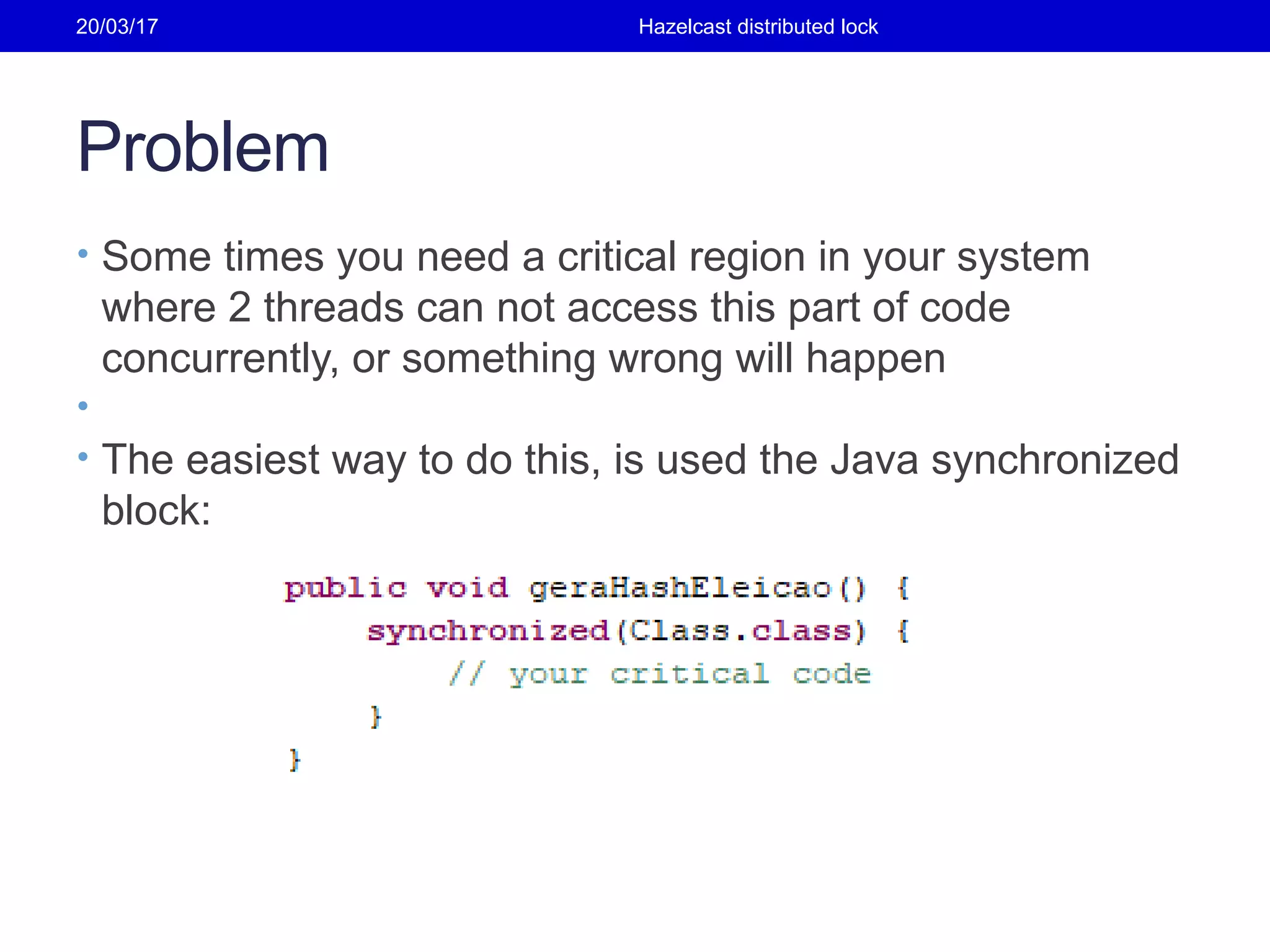
• The easiest way to do this, is used the Java synchronized
block:
20/03/17 Hazelcast distributed lock
Problem
• The problem with this approach is that it just work in the
same Java Virtual Machine.
•
• What can we do if we have several instances of our
application running?
•
20/03/17 Hazelcast distributed lock
DataBase Distributed Lock
• The first option is use database based lock
•
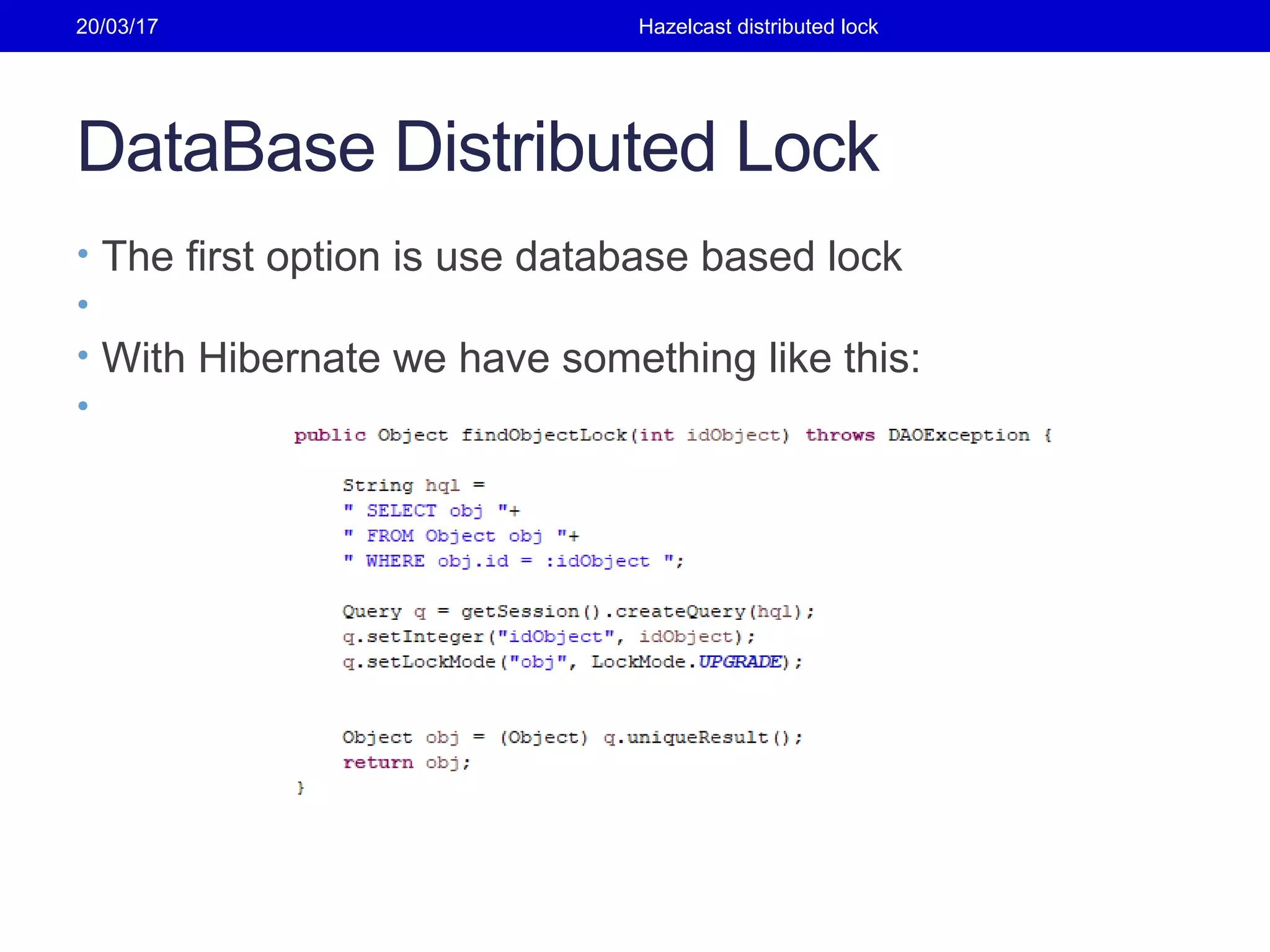
• With Hibernate we have something like this:
•
20/03/17 Hazelcast distributed lock
DataBase Distributed Lock
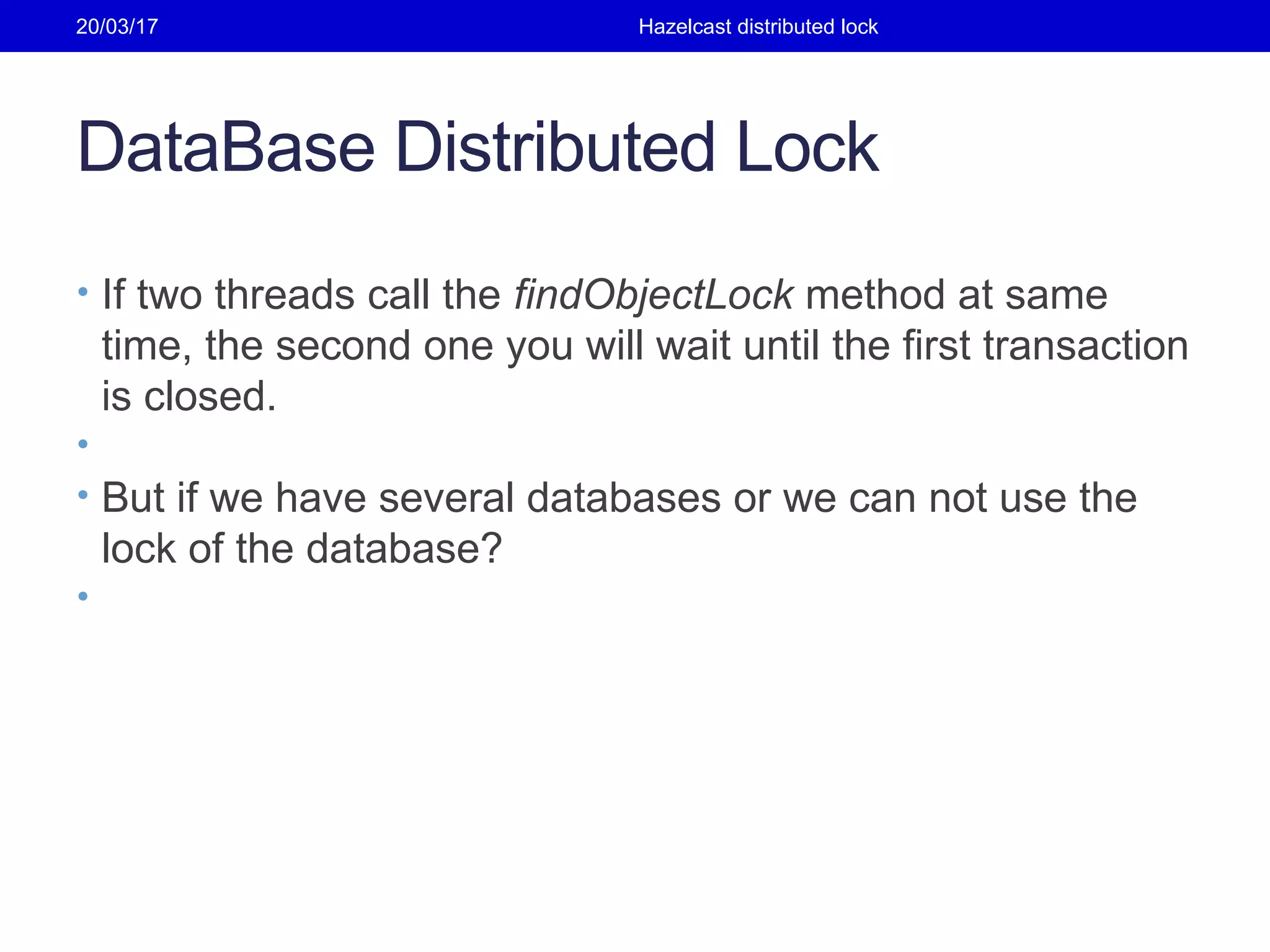
• If two threads call the findObjectLock method at same
time, the second one you will wait until the first transaction
is closed.
•
• But if we have several databases or we can not use the
lock of the database?
•
20/03/17 Hazelcast distributed lock
HazelCast Distributed Lock
• The Hazelcast IMDG operational in-memory computing
platform helps leading companies worldwide manage their
data and distribute processing using in-memory storage
and parallel execution for breakthrough application speed
and scale [1].
•
• Hazelcast implement a distributed version of some Java
data structures like Maps, Set, Lists, Queue and Lock
•
20/03/17 Hazelcast distributed lock
HazelCast Distributed Lock
• ILock is the distributed implementation of
java.util.concurrent.locks.Lock. Meaning if you lock using
an ILock, the critical section that it guards is guaranteed
to be executed by only one thread in the entire cluster [2].
•
20/03/17 Hazelcast distributed lock
Configuring HazelCast
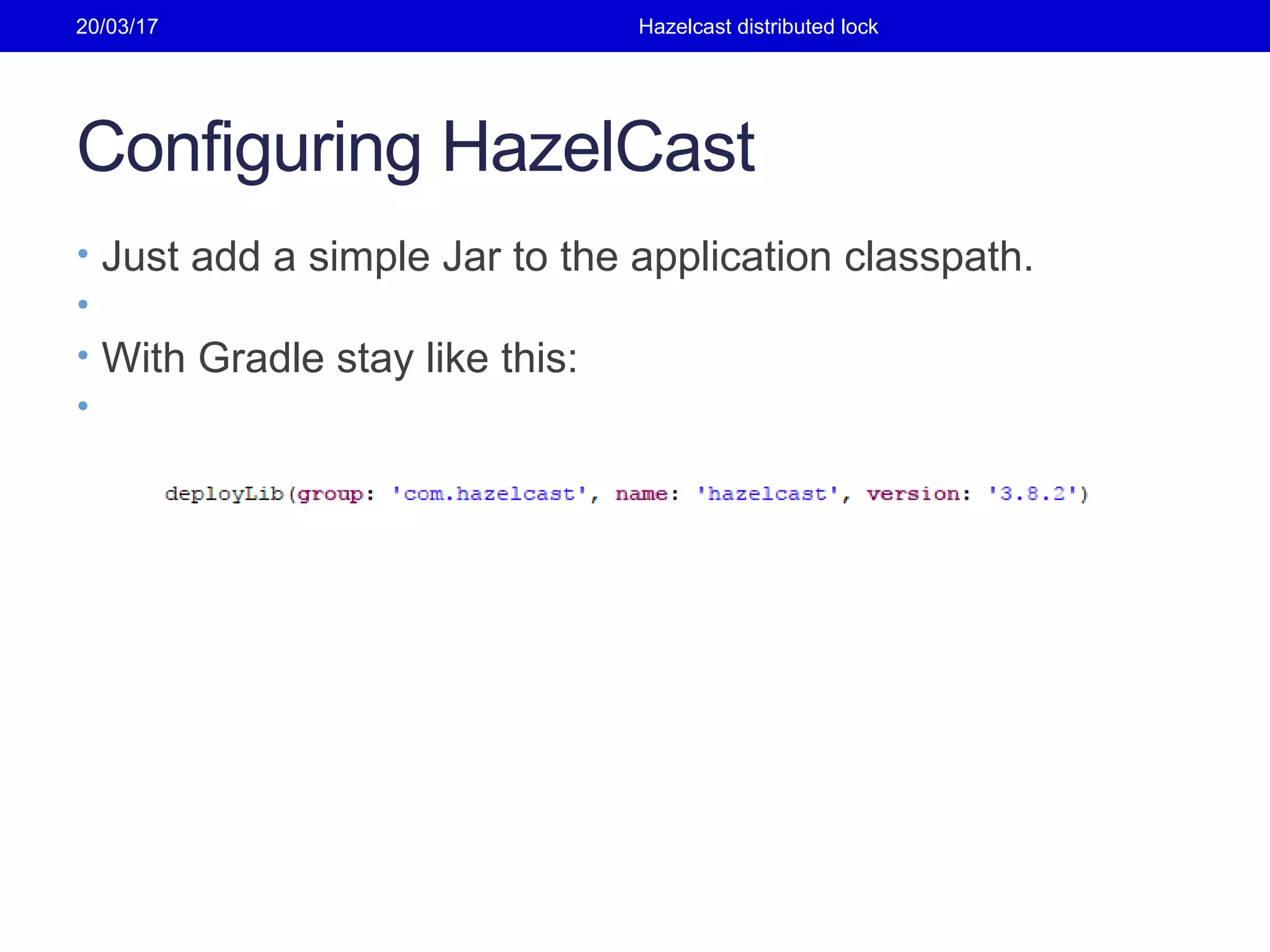
• Just add a simple Jar to the application classpath.
•
• With Gradle stay like this:
•
20/03/17 Hazelcast distributed lock
Configuring HazelCast Cluster
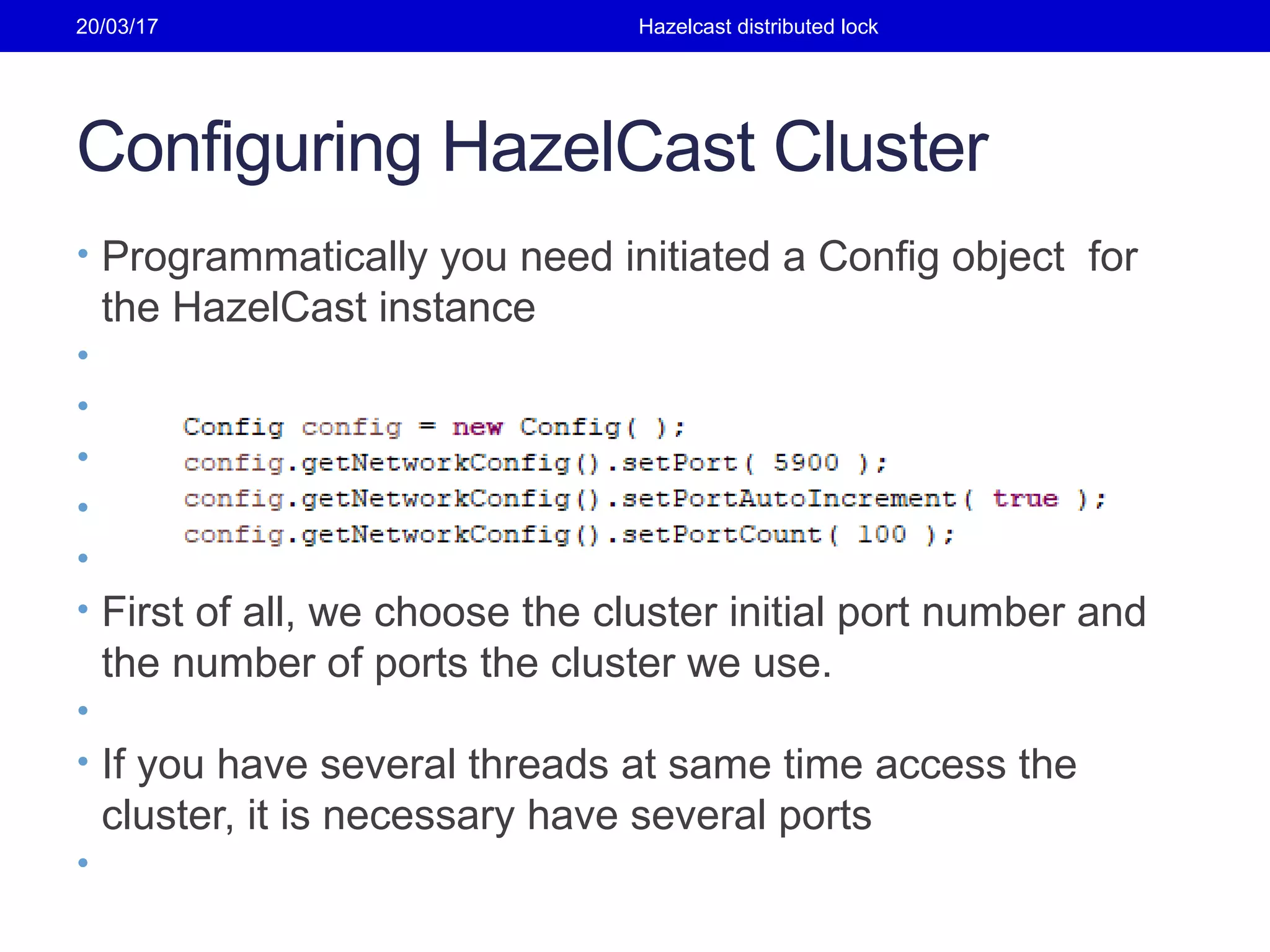
• Programmatically you need initiated a Config object for
the HazelCast instance
•
•
•
•
•
• First of all, we choose the cluster initial port number and
the number of ports the cluster we use.
•
• If you have several threads at same time access the
cluster, it is necessary have several ports
•
20/03/17 Hazelcast distributed lock
Configuring HazelCast Cluster
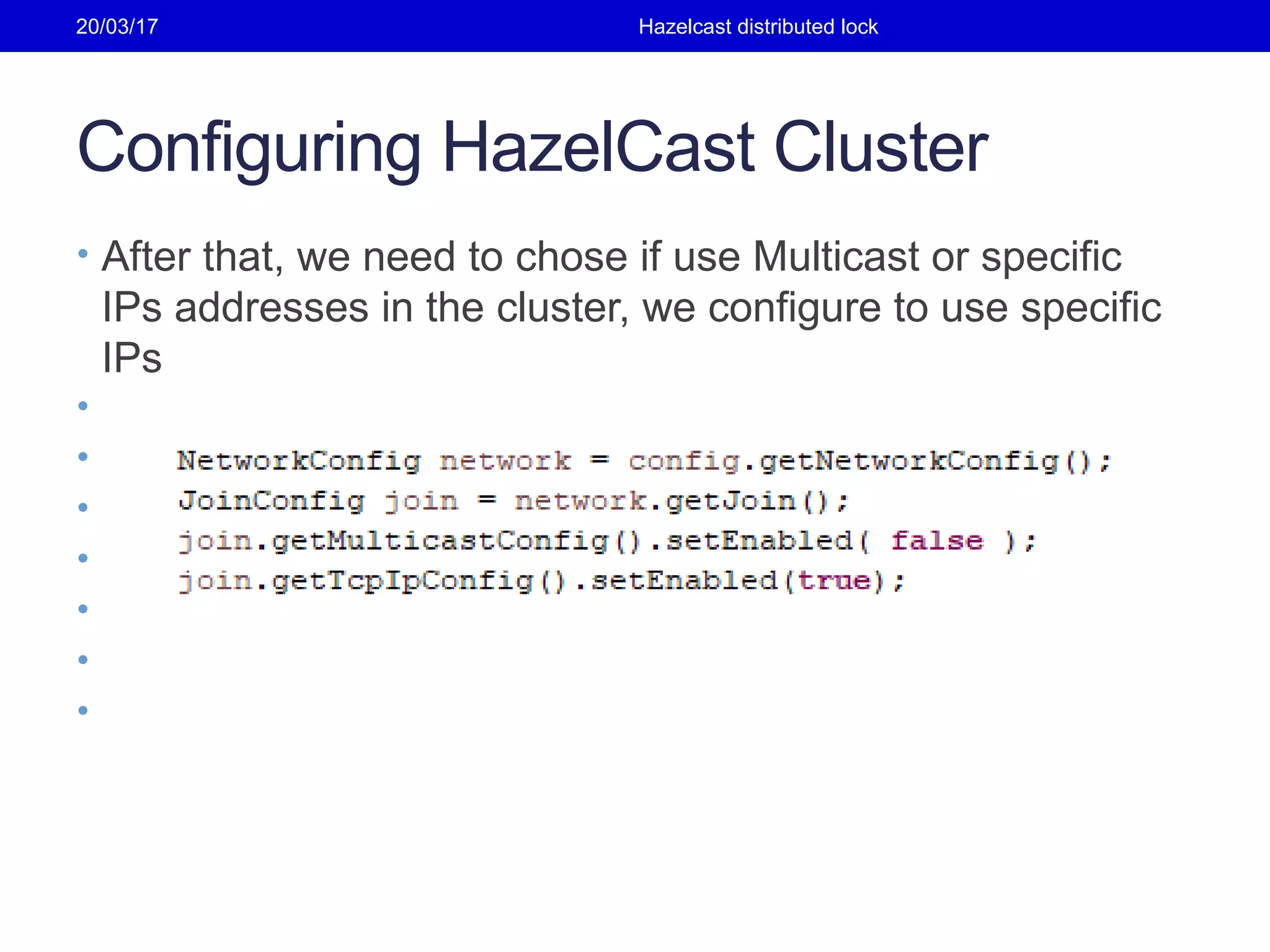
• After that, we need to chose if use Multicast or specific
IPs addresses in the cluster, we configure to use specific
IPs
•
•
•
•
•
•
•
20/03/17 Hazelcast distributed lock
Configuring HazelCast Cluster
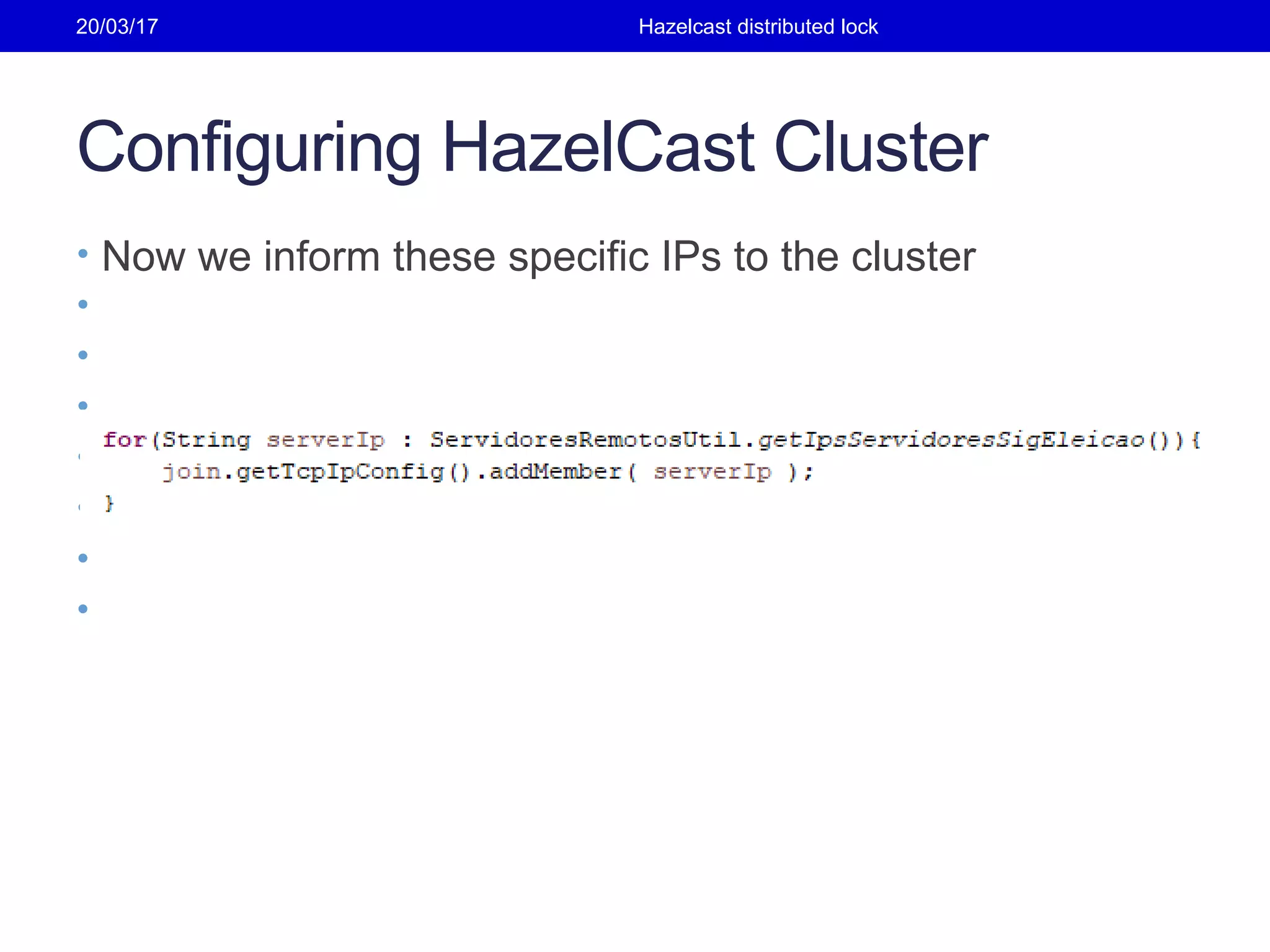
• Now we inform these specific IPs to the cluster
•
•
•
•
•
•
•
20/03/17 Hazelcast distributed lock
Configuring HazelCast Cluster
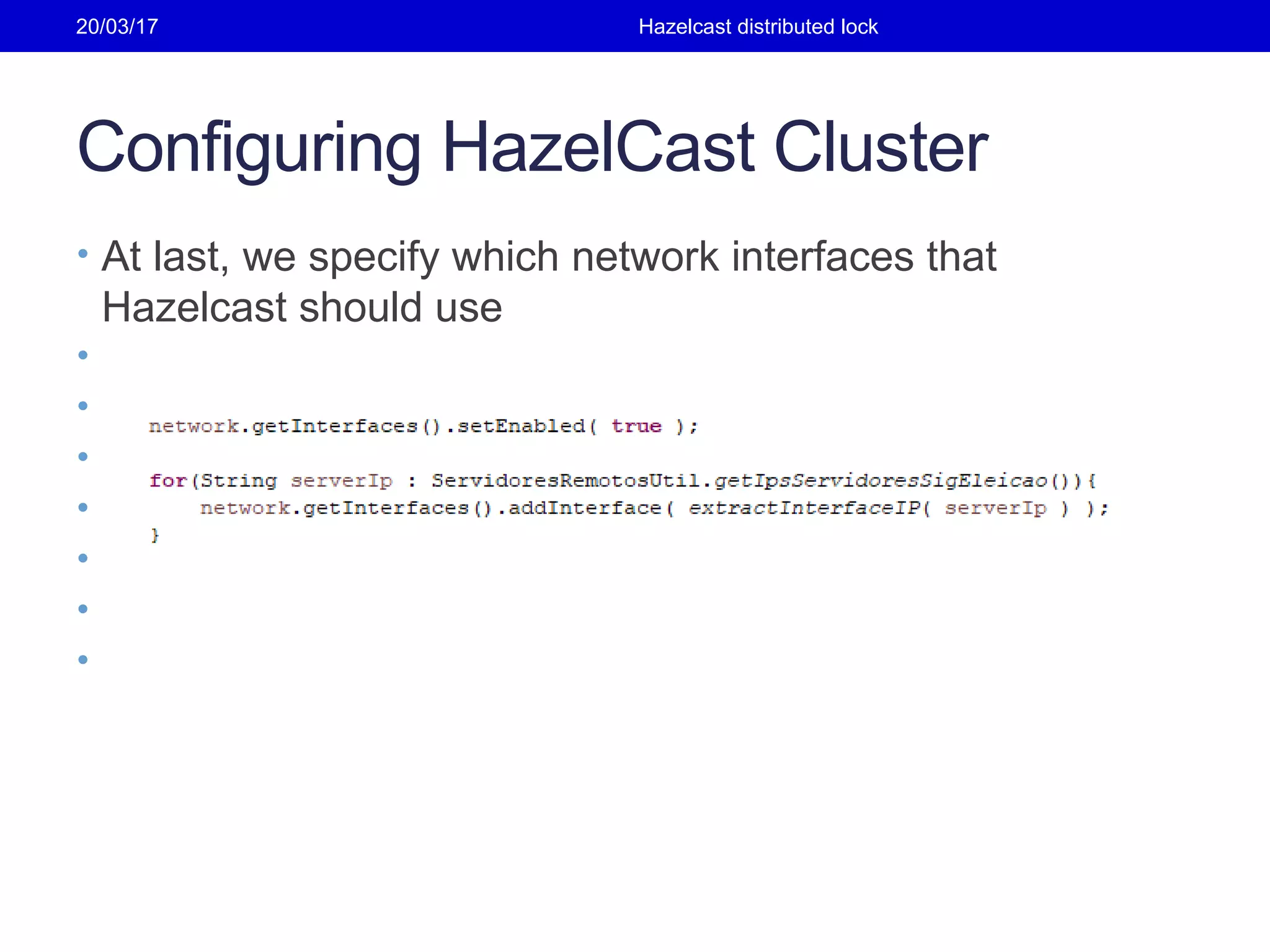
• At last, we specify which network interfaces that
Hazelcast should use
•
•
•
•
•
•
•
20/03/17 Hazelcast distributed lock
Configuring HazelCast Cluster
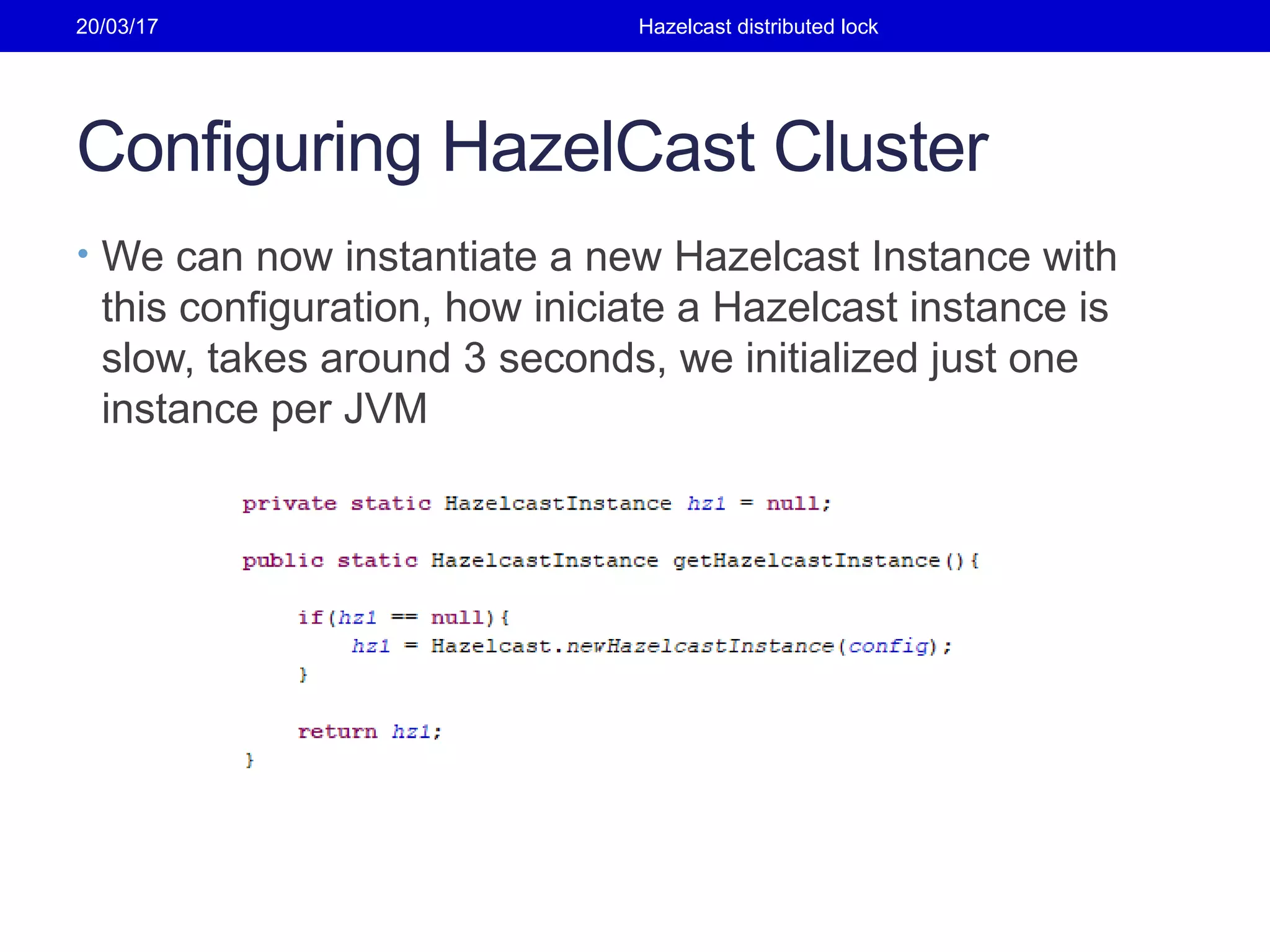
• We can now instantiate a new Hazelcast Instance with
this configuration, how iniciate a Hazelcast instance is
slow, takes around 3 seconds, we initialized just one
instance per JVM
20/03/17 Hazelcast distributed lock
Configuring HazelCast Cluster
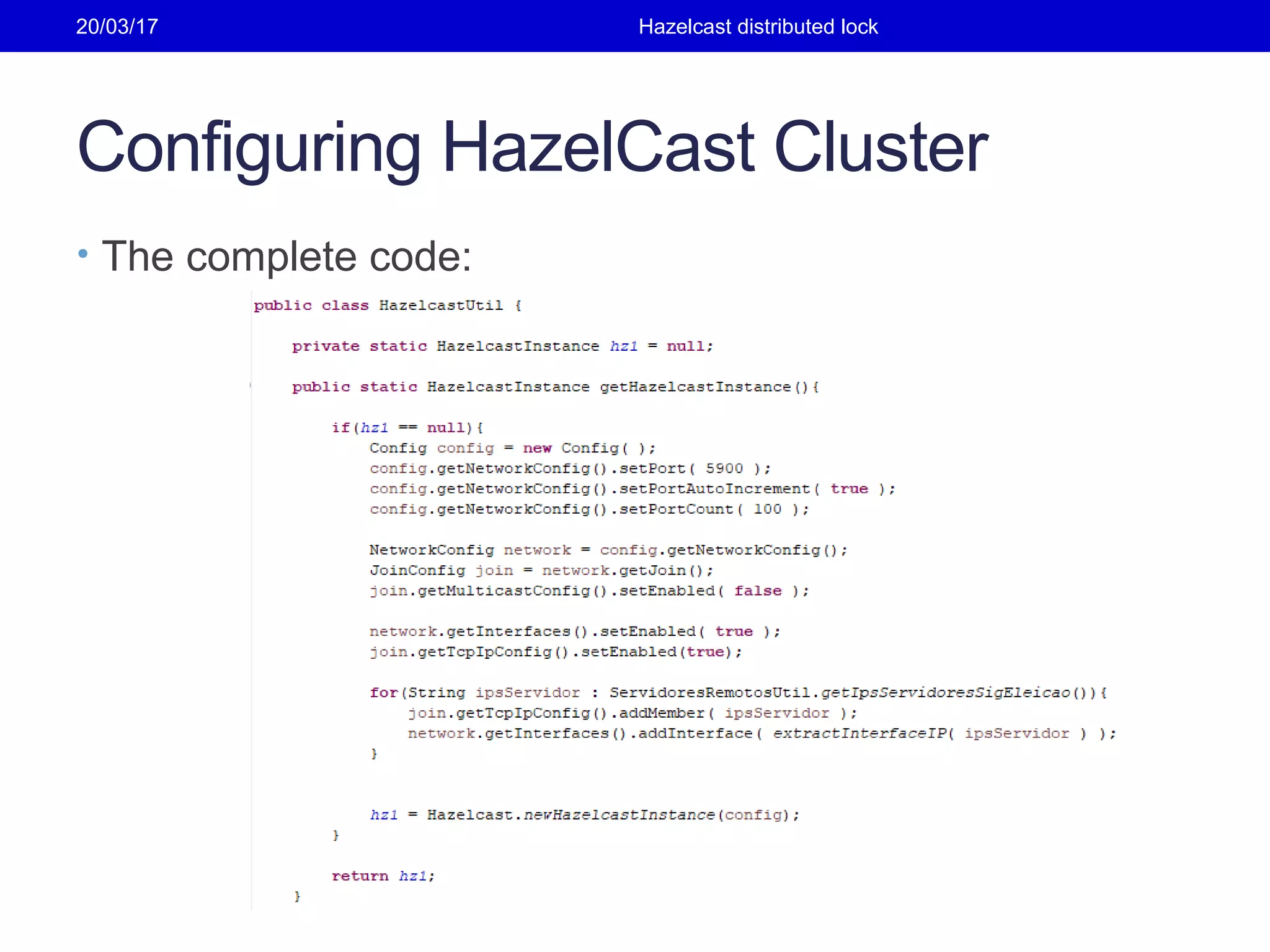
• The complete code:
20/03/17 Hazelcast distributed lock
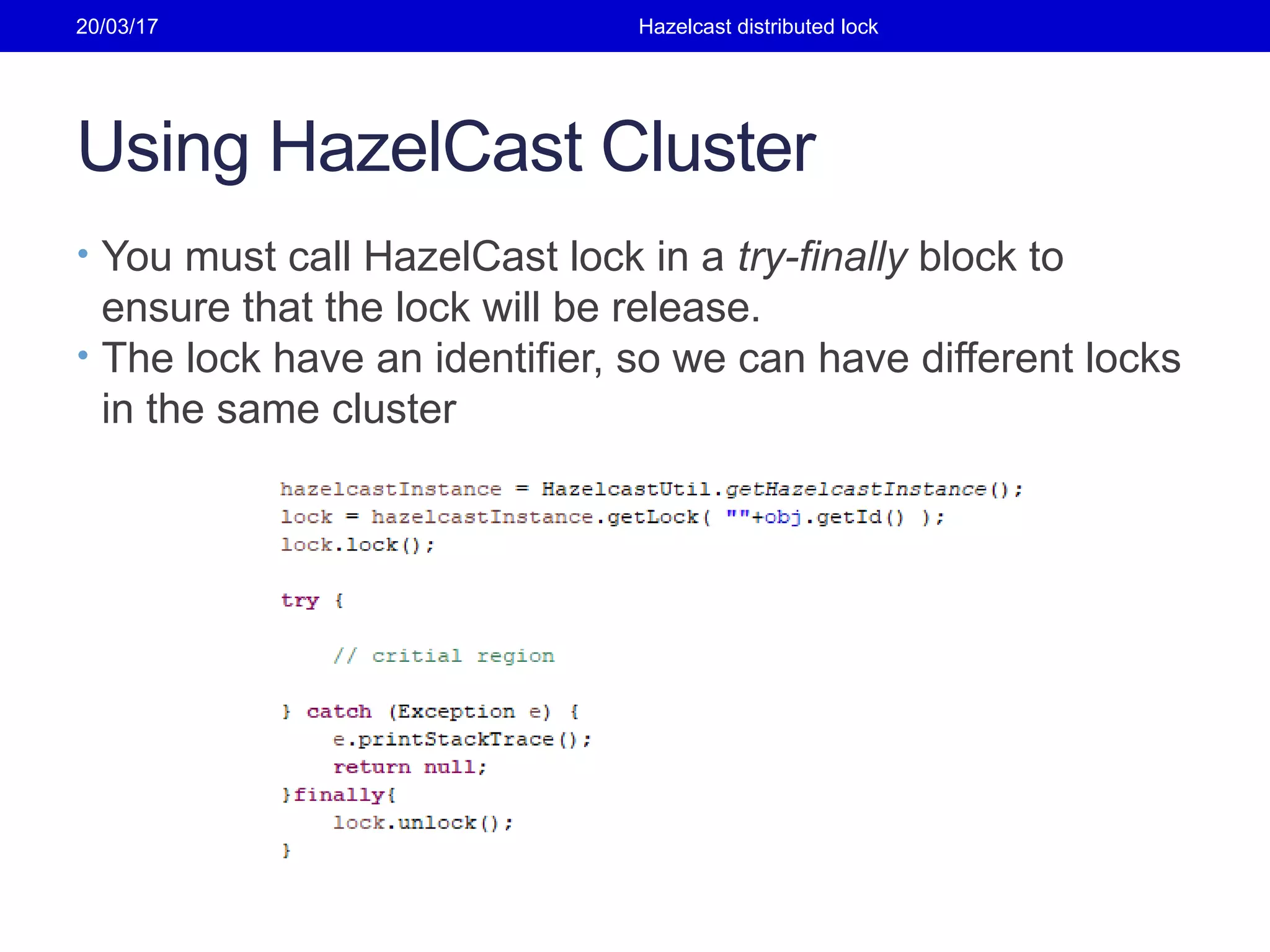
Using HazelCast Cluster
• You must call HazelCast lock in a try-finally block to
ensure that the lock will be release.
• The lock have an identifier, so we can have different locks
in the same cluster
20/03/17 Hazelcast distributed lock
References
• [1] Hazelcast IMDG. The Leading Open Source In-
Memory Data Grid. https://hazelcast.org/
•
• [2] Lock
http://docs.hazelcast.org/docs/3.5/manual/html/lock.html
20/03/17 Hazelcast distributed lock

Hazelcast Distributed Lock

  • 1.
  • 2.
    Problem • Some timesyou need a critical region in your system where 2 threads can not access this part of code concurrently, or something wrong will happen • • The easiest way to do this, is used the Java synchronized block: 20/03/17 Hazelcast distributed lock
  • 3.
    Problem • The problemwith this approach is that it just work in the same Java Virtual Machine. • • What can we do if we have several instances of our application running? • 20/03/17 Hazelcast distributed lock
  • 4.
    DataBase Distributed Lock •The first option is use database based lock • • With Hibernate we have something like this: • 20/03/17 Hazelcast distributed lock
  • 5.
    DataBase Distributed Lock •If two threads call the findObjectLock method at same time, the second one you will wait until the first transaction is closed. • • But if we have several databases or we can not use the lock of the database? • 20/03/17 Hazelcast distributed lock
  • 6.
    HazelCast Distributed Lock •The Hazelcast IMDG operational in-memory computing platform helps leading companies worldwide manage their data and distribute processing using in-memory storage and parallel execution for breakthrough application speed and scale [1]. • • Hazelcast implement a distributed version of some Java data structures like Maps, Set, Lists, Queue and Lock • 20/03/17 Hazelcast distributed lock
  • 7.
    HazelCast Distributed Lock •ILock is the distributed implementation of java.util.concurrent.locks.Lock. Meaning if you lock using an ILock, the critical section that it guards is guaranteed to be executed by only one thread in the entire cluster [2]. • 20/03/17 Hazelcast distributed lock
  • 8.
    Configuring HazelCast • Justadd a simple Jar to the application classpath. • • With Gradle stay like this: • 20/03/17 Hazelcast distributed lock
  • 9.
    Configuring HazelCast Cluster •Programmatically you need initiated a Config object for the HazelCast instance • • • • • • First of all, we choose the cluster initial port number and the number of ports the cluster we use. • • If you have several threads at same time access the cluster, it is necessary have several ports • 20/03/17 Hazelcast distributed lock
  • 10.
    Configuring HazelCast Cluster •After that, we need to chose if use Multicast or specific IPs addresses in the cluster, we configure to use specific IPs • • • • • • • 20/03/17 Hazelcast distributed lock
  • 11.
    Configuring HazelCast Cluster •Now we inform these specific IPs to the cluster • • • • • • • 20/03/17 Hazelcast distributed lock
  • 12.
    Configuring HazelCast Cluster •At last, we specify which network interfaces that Hazelcast should use • • • • • • • 20/03/17 Hazelcast distributed lock
  • 13.
    Configuring HazelCast Cluster •We can now instantiate a new Hazelcast Instance with this configuration, how iniciate a Hazelcast instance is slow, takes around 3 seconds, we initialized just one instance per JVM 20/03/17 Hazelcast distributed lock
  • 14.
    Configuring HazelCast Cluster •The complete code: 20/03/17 Hazelcast distributed lock
  • 15.
    Using HazelCast Cluster •You must call HazelCast lock in a try-finally block to ensure that the lock will be release. • The lock have an identifier, so we can have different locks in the same cluster 20/03/17 Hazelcast distributed lock
  • 16.
    References • [1] HazelcastIMDG. The Leading Open Source In- Memory Data Grid. https://hazelcast.org/ • • [2] Lock http://docs.hazelcast.org/docs/3.5/manual/html/lock.html 20/03/17 Hazelcast distributed lock