
About SIP


   An introduction to
Transactions & Dialogs
       Jonas Borjesson


                         @borjessonjonas
NOTE
●   This version has been adapted to be viewed
    without transitions.
●   Go to aboutsip.com to download the original
    version.
●   Also be sure to check out vimeo.com/aboutsip
    for any recorded presentations.
●   Follow @borjessonjonas to receive updates.


                                          @borjessonjonas
re
                                       ca
                    SIP Messages            p

●   SIP – Request/Response model
    ●   UAC sends the request, UAS responds
●   Two types of responses
    ●   Provisional (1xx)
    ●   Final (2xx - 6xx)


                                                @borjessonjonas
Transactions
●   SIP is a transactional protocol.
●   Every request & response goes within a
    transaction.
●   Transactions are independent of each other.
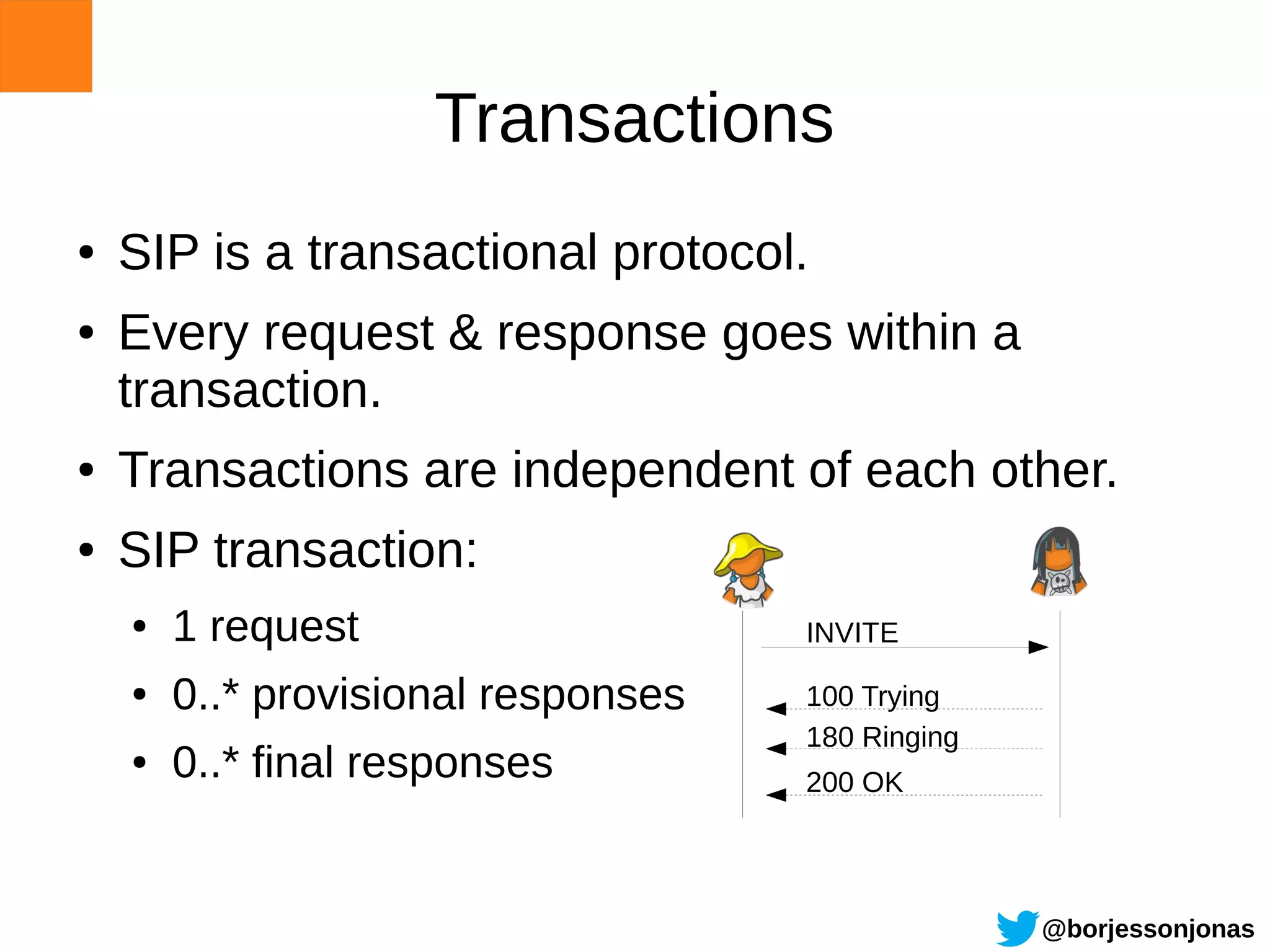
●   SIP transaction:
    ●   1 request                    INVITE
    ●   0..* provisional responses   100 Trying
                                     180 Ringing
    ●   0..* final responses         200 OK


                                                   @borjessonjonas
Client Transactions
●   Responsible for:
    ●   Receiving request from the TU it and...
    ●   Deliver requests reliably to the server transaction
    ●   Processing responses:
        –   Filter out retransmissions
        –   Filter out disallowed responses
        –   Pass response to the TU
    ●   Generating ACK for non 2xx final responses to
        INVITE transactions


                                                     @borjessonjonas
Server Transactions
●   Responsible for:
    ●   Receive requests and pass them up the TU
    ●   Filter out any retransmissions
    ●   Accepts responses from the TU and sends them.
    ●   Absorbing the ACK request for non 2xx final
        responses on invite transactions


                                                      @borjessonjonas
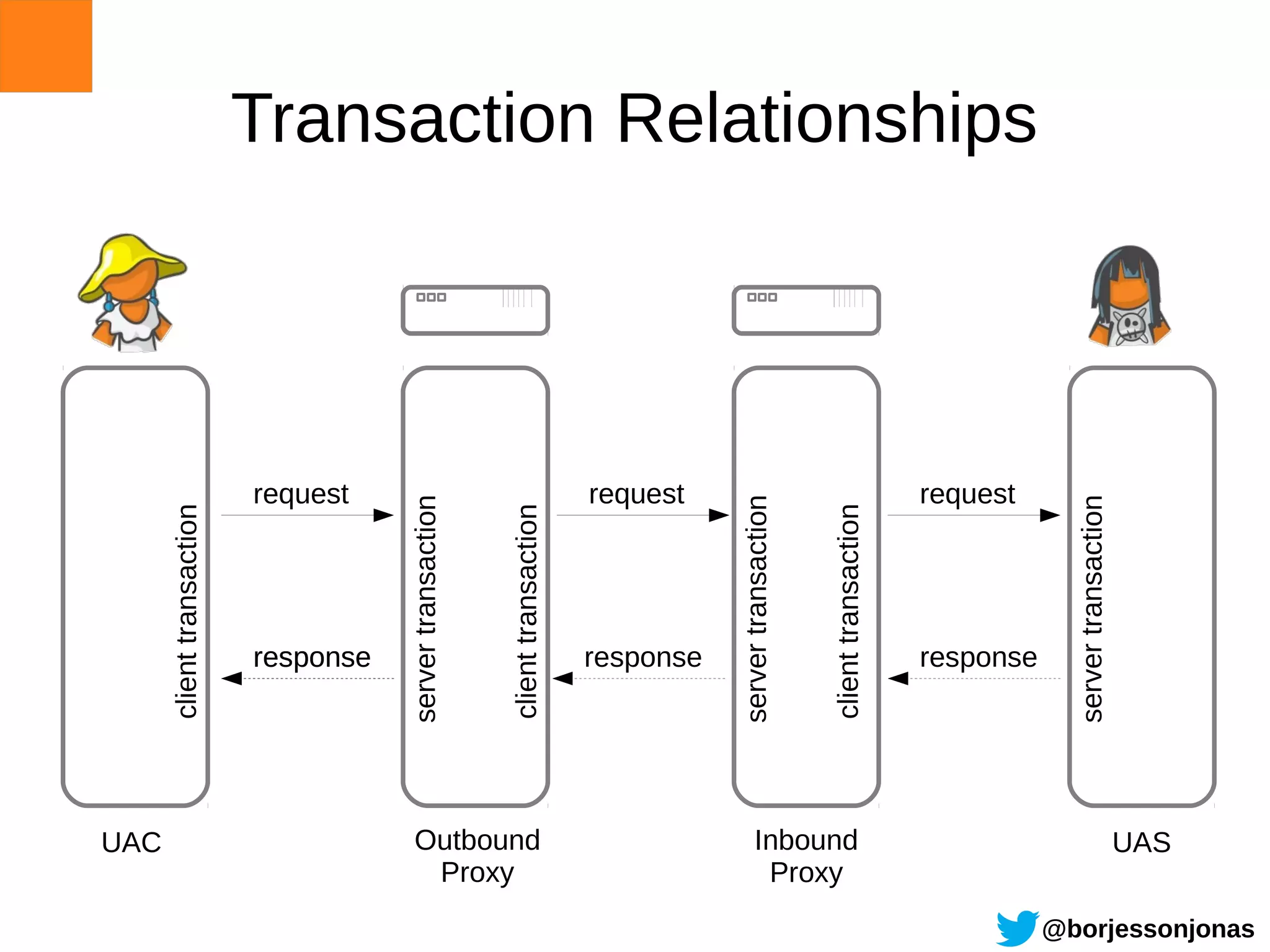
Transaction Relationships


                           request                                              request                                              request
                                      server transaction


                                                                                           server transaction


                                                                                                                                                  server transaction
                                                                                                                client transaction
      client transaction


                                                           client transaction


                           response                                             response                                             response


UAC                                      Outbound                                                  Inbound                                                             UAS
                                          Proxy                                                     Proxy
                                                                                                                                                @borjessonjonas
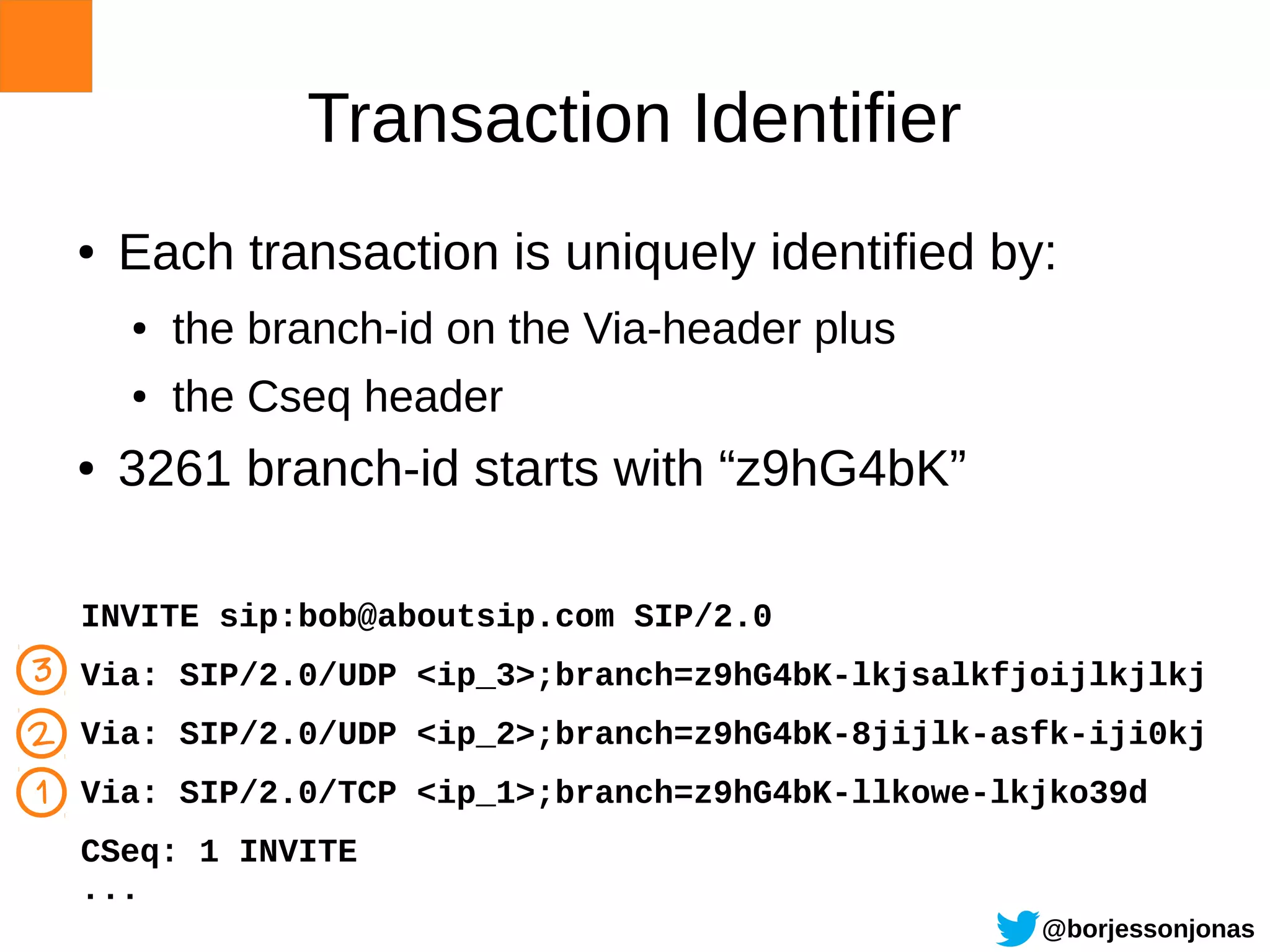
Transaction Identifier
  ●   Each transaction is uniquely identified by:
      ●   the branch-id on the Via-header plus
      ●   the Cseq header
  ●   3261 branch-id starts with “z9hG4bK”

  INVITE sip:bob@aboutsip.com SIP/2.0
3 Via: SIP/2.0/UDP <ip_3>;branch=z9hG4bK-lkjsalkfjoijlkjlkj
2 Via: SIP/2.0/UDP <ip_2>;branch=z9hG4bK-8jijlk-asfk-iji0kj
1 Via: SIP/2.0/TCP <ip_1>;branch=z9hG4bK-llkowe-lkjko39d
  CSeq: 1 INVITE
  ...
                                                  @borjessonjonas
Transaction Lifecycle
●    Slightly different depending on:
      ●    Server or client transaction
      ●    Invite or non-invite transaction
      ●    Reliable vs. non-reliable transport (e.g. udp vs tcp)
●    To summarize them all*
      ●    Starts when request is sent or received
      ●    Final responses takes it to completed state
      ●    Timer fires and moves it to terminated state.

    *You can't really group them together like this. Please view this information as a very generic
    summary of the life cycle of a SIP transaction. In reality, it is much more complicated.
                                                                                                      @borjessonjonas
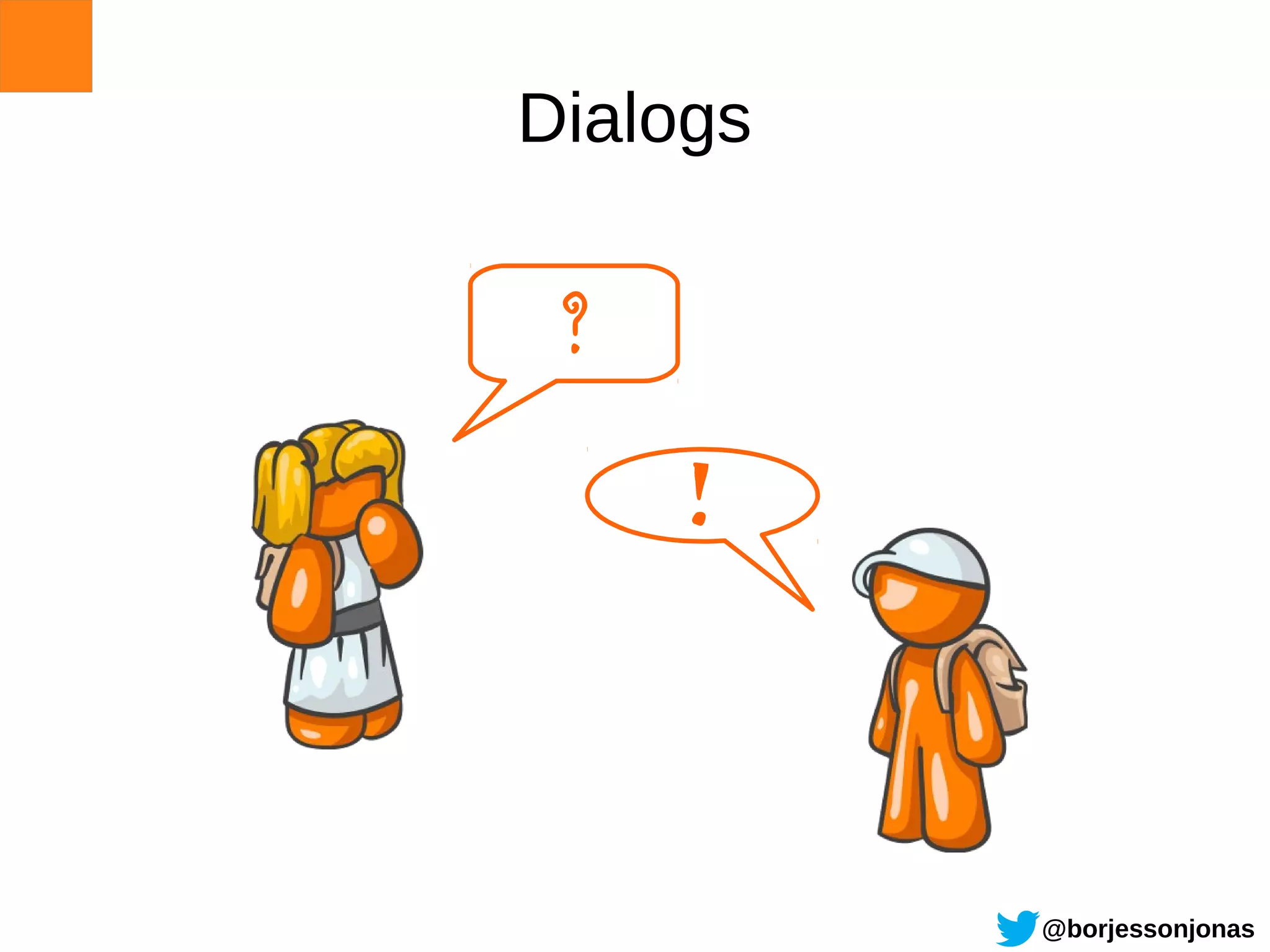
Dialogs

 ?

     !


          @borjessonjonas
Dialogs
●   Dialogs are extremely important within SIP
●   A dialog:
    ●   represent a p2p relation between two SIP
        endpoints.
    ●   exists for some time
    ●   contains important routing information
    ●   facilitates proper sequencing of messages
    ●   consists of a sequence of transactions


                                                    @borjessonjonas
Dialog establishing methods
●   Not all methods establish a dialog!
●   The ones that do are:
    ●   INVITE (RFC 3261)
        –   For establishing a dialog
    ●   SUBSCRIBE (RFC 3265)
        –   Creates a subscription. Used e.g. in presence scenarios
    ●   REFER (RFC 3515)
        –   Also a subscription but only for the refer event-package.
            Used e.g. for call transfer


                                                            @borjessonjonas
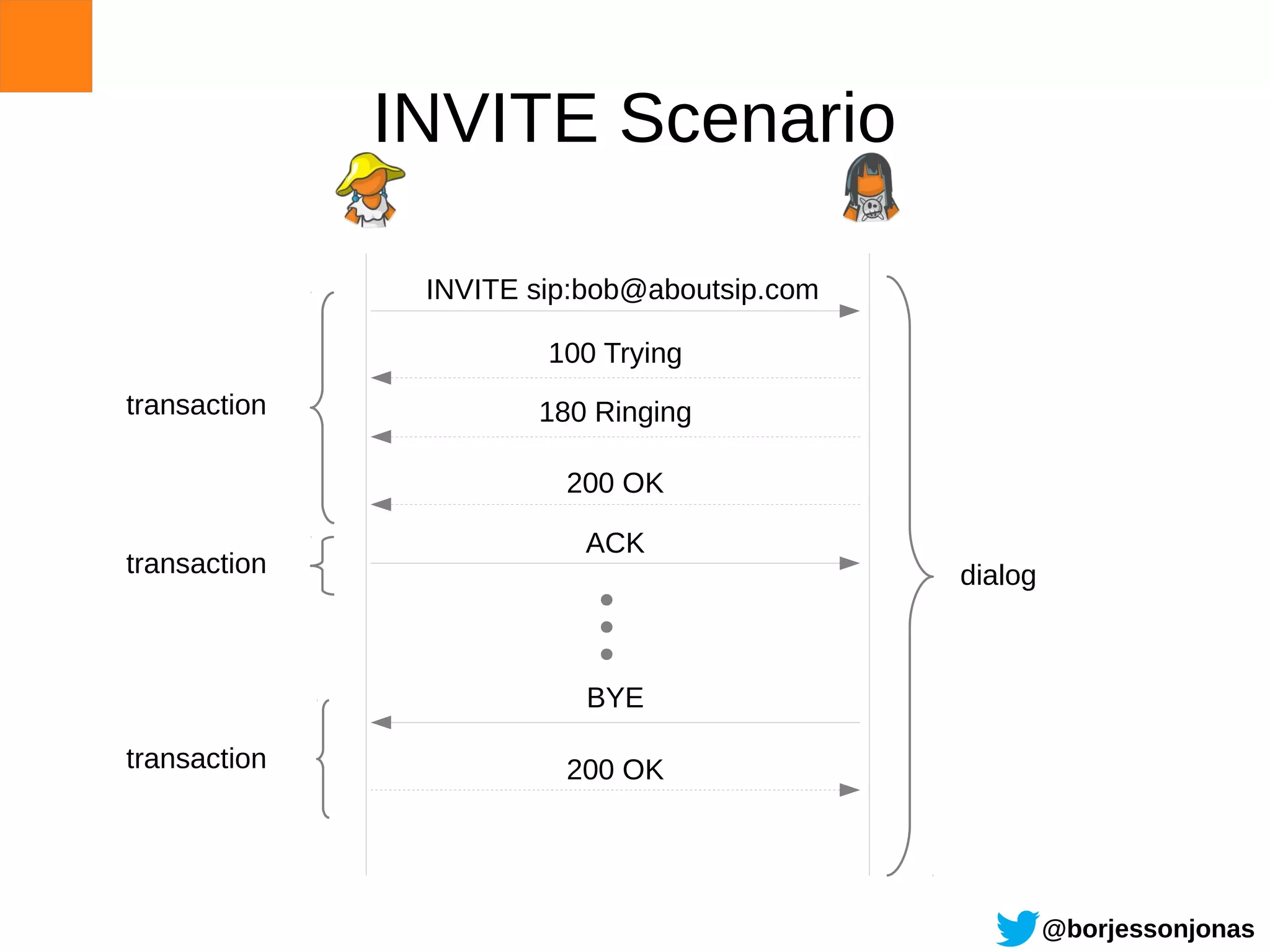
INVITE Scenario

               INVITE sip:bob@aboutsip.com

                       100 Trying
transaction           180 Ringing

                        200 OK

                         ACK
transaction                                  dialog


                          BYE

transaction             200 OK


                                                      @borjessonjonas
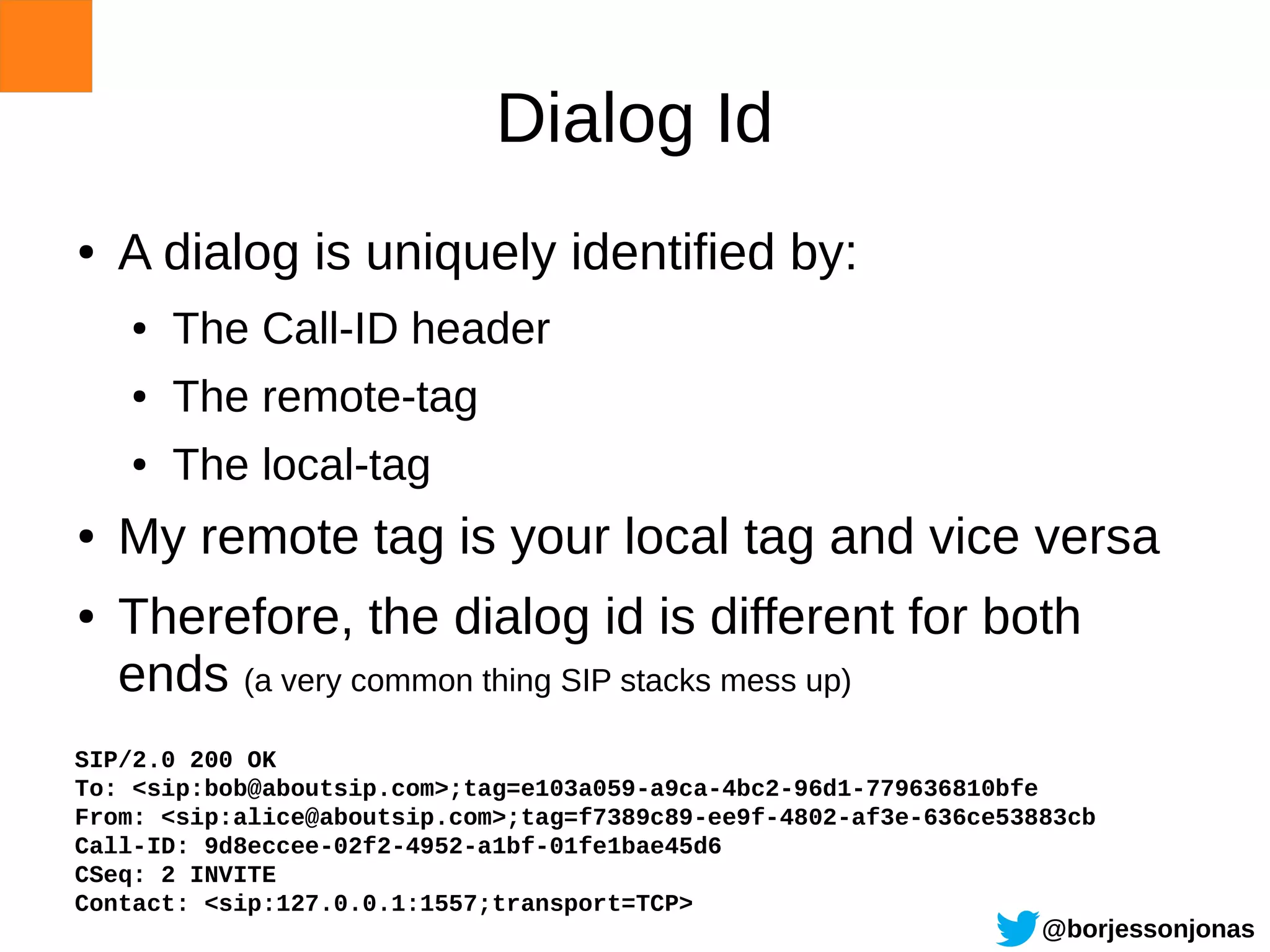
Dialog Id
●   A dialog is uniquely identified by:
    ●   The Call-ID header
    ●   The remote-tag
    ●   The local-tag
●   My remote tag is your local tag and vice versa
●   Therefore, the dialog id is different for both
    ends (a very common thing SIP stacks mess up)
SIP/2.0 200 OK
To: <sip:bob@aboutsip.com>;tag=e103a059-a9ca-4bc2-96d1-779636810bfe
From: <sip:alice@aboutsip.com>;tag=f7389c89-ee9f-4802-af3e-636ce53883cb
Call-ID: 9d8eccee-02f2-4952-a1bf-01fe1bae45d6
CSeq: 2 INVITE
Contact: <sip:127.0.0.1:1557;transport=TCP>
                                                                   @borjessonjonas
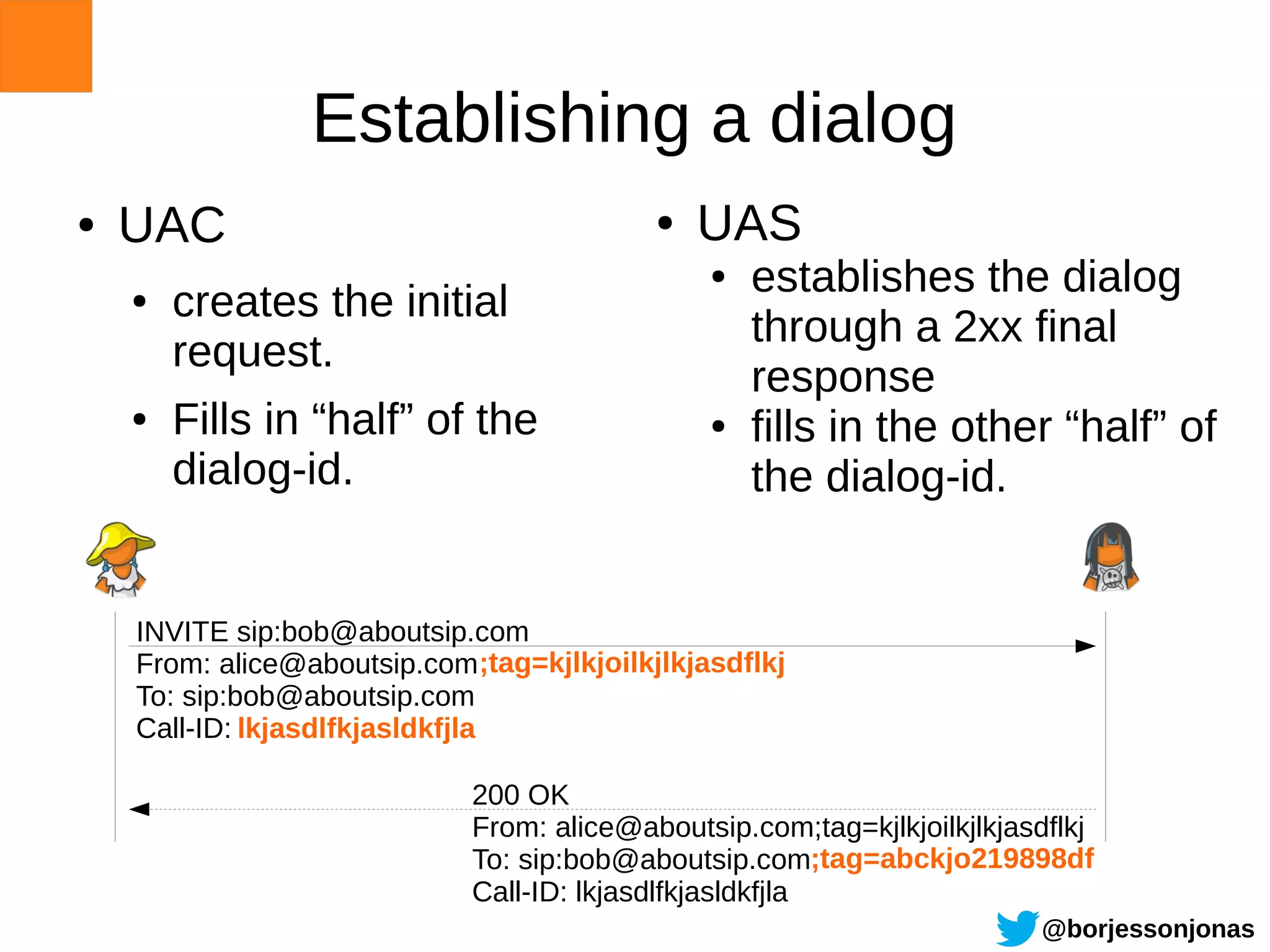
Establishing a dialog
●   UAC                                     ●   UAS
                                                ●   establishes the dialog
    ●   creates the initial
                                                    through a 2xx final
        request.
                                                    response
    ●   Fills in “half” of the                  ●   fills in the other “half” of
        dialog-id.                                  the dialog-id.


    INVITE sip:bob@aboutsip.com
    From: alice@aboutsip.com ;tag=kjlkjoilkjlkjasdflkj
    To: sip:bob@aboutsip.com
    Call-ID: lkjasdlfkjasldkfjla

                             200 OK
                             From: alice@aboutsip.com;tag=kjlkjoilkjlkjasdflkj
                             To: sip:bob@aboutsip.com;tag=abckjo219898df
                             Call-ID: lkjasdlfkjasldkfjla
                                                                         @borjessonjonas
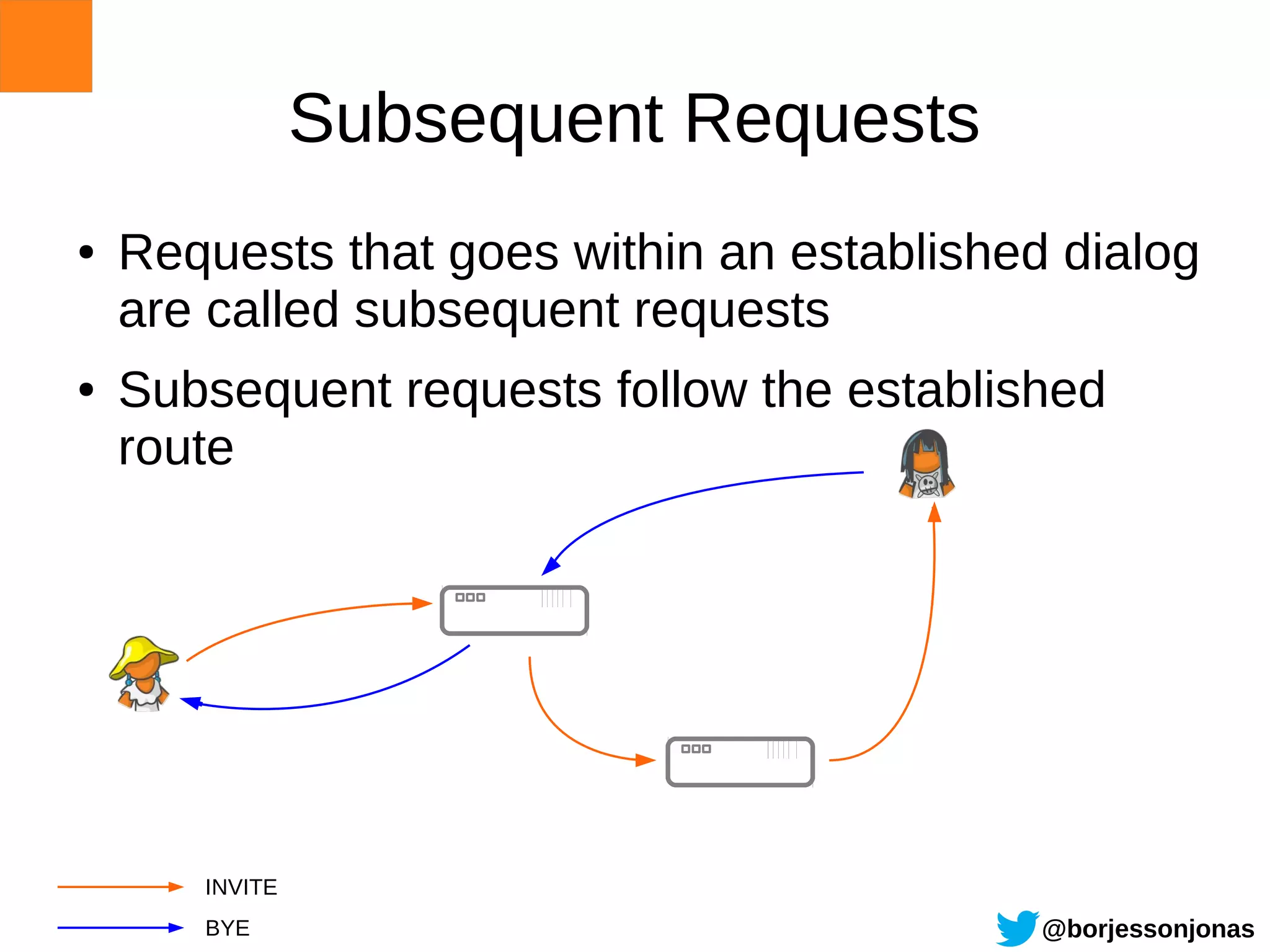
Subsequent Requests
●   Requests that goes within an established dialog
    are called subsequent requests
●   Subsequent requests follow the established
    route


       INVITE
       BYE                                  @borjessonjonas
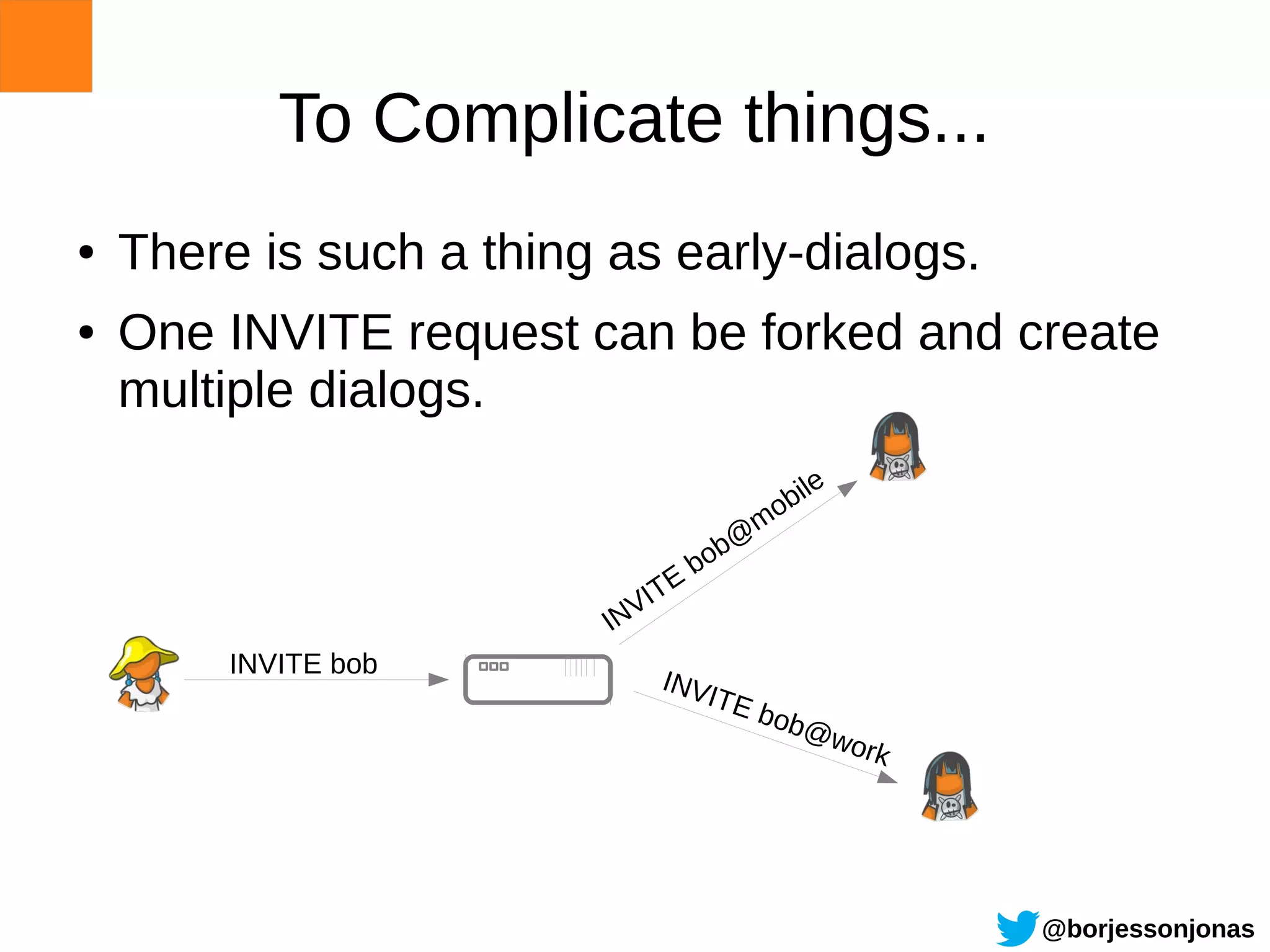
To Complicate things...
●   There is such a thing as early-dialogs.
●   One INVITE request can be forked and create
    multiple dialogs.
                                              e
                                           bil
                                         mo
                                        @
                                     bob
                                 E
                            V IT
                          IN
         INVITE bob
                               INV
                                  ITE
                                         bob
                                               @w
                                                  or   k


                                                           @borjessonjonas
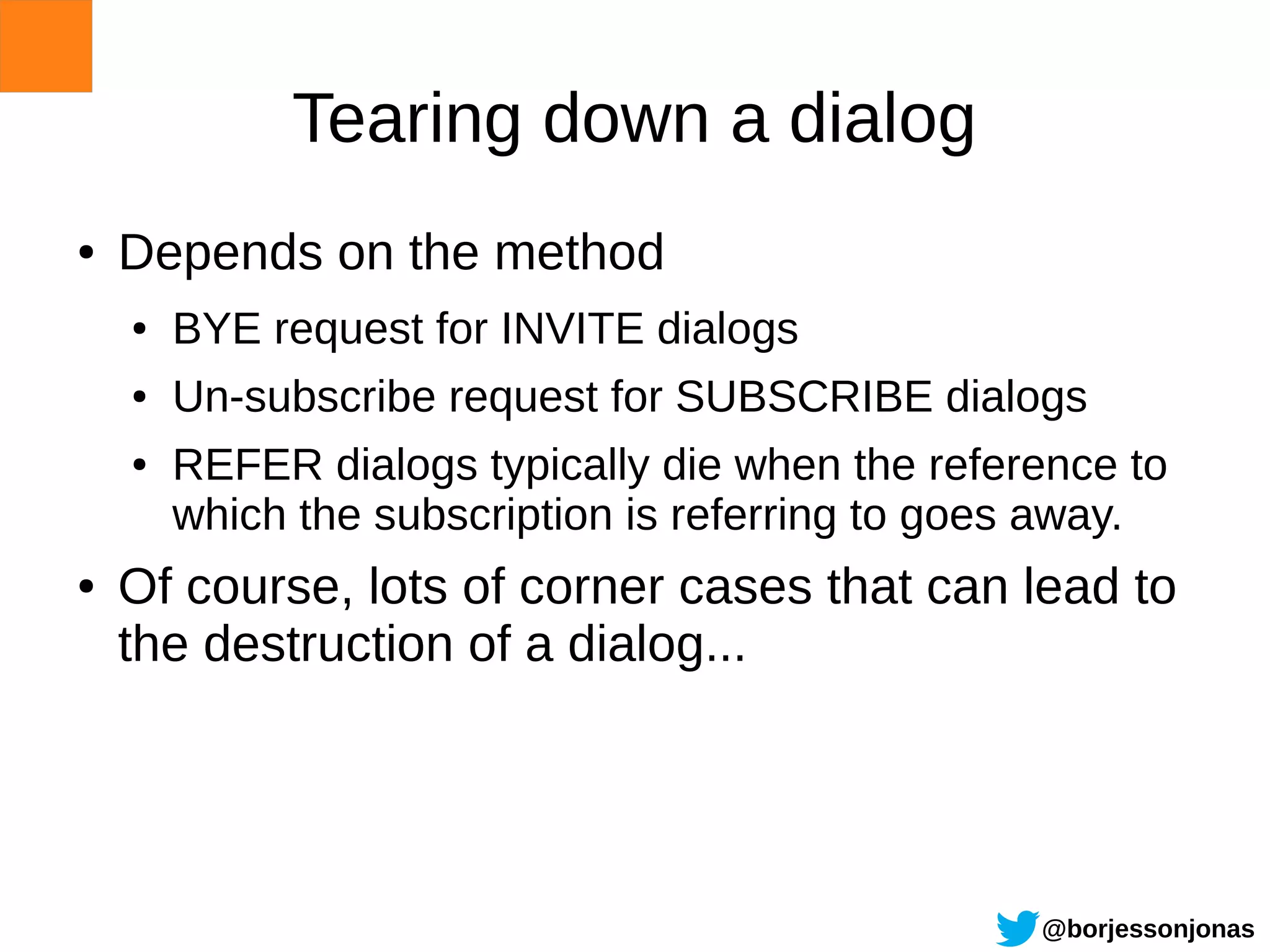
Tearing down a dialog
●   Depends on the method
    ●   BYE request for INVITE dialogs
    ●   Un-subscribe request for SUBSCRIBE dialogs
    ●   REFER dialogs typically die when the reference to
        which the subscription is referring to goes away.
●   Of course, lots of corner cases that can lead to
    the destruction of a dialog...


                                                  @borjessonjonas
Summary


          @borjessonjonas
Transactions
●   Consists of 1 request and 0..* responses
●   Two types of transactions:
    ●   Invite transactions
    ●   Non-Invite transactions
●   The branch-id on the Via uniquely identifies the
    transaction (plus the Cseq)


                                               @borjessonjonas
Dialogs
●   Consists of a sequence of transactions
●   Not all methods establish dialogs.
●   Represent a p2p relation between two SIP
    endpoints.
●   Contains routing information.
●   The dialog-id is different for the two parties.


                                                @borjessonjonas
More presentations and material
        at aboutsip.com

           Thanks!


                                  @borjessonjonas

Aboutsip - intro to transactions and dialogs

  • 1.
    About SIP An introduction to Transactions & Dialogs Jonas Borjesson @borjessonjonas
  • 2.
    NOTE ● This version has been adapted to be viewed without transitions. ● Go to aboutsip.com to download the original version. ● Also be sure to check out vimeo.com/aboutsip for any recorded presentations. ● Follow @borjessonjonas to receive updates. @borjessonjonas
  • 3.
    re ca SIP Messages p ● SIP – Request/Response model ● UAC sends the request, UAS responds ● Two types of responses ● Provisional (1xx) ● Final (2xx - 6xx) @borjessonjonas
  • 4.
    Transactions ● SIP is a transactional protocol. ● Every request & response goes within a transaction. ● Transactions are independent of each other. ● SIP transaction: ● 1 request INVITE ● 0..* provisional responses 100 Trying 180 Ringing ● 0..* final responses 200 OK @borjessonjonas
  • 5.
    Client Transactions ● Responsible for: ● Receiving request from the TU it and... ● Deliver requests reliably to the server transaction ● Processing responses: – Filter out retransmissions – Filter out disallowed responses – Pass response to the TU ● Generating ACK for non 2xx final responses to INVITE transactions @borjessonjonas
  • 6.
    Server Transactions ● Responsible for: ● Receive requests and pass them up the TU ● Filter out any retransmissions ● Accepts responses from the TU and sends them. ● Absorbing the ACK request for non 2xx final responses on invite transactions @borjessonjonas
  • 7.
    Transaction Relationships request request request server transaction server transaction server transaction client transaction client transaction client transaction response response response UAC Outbound Inbound UAS Proxy Proxy @borjessonjonas
  • 8.
    Transaction Identifier ● Each transaction is uniquely identified by: ● the branch-id on the Via-header plus ● the Cseq header ● 3261 branch-id starts with “z9hG4bK” INVITE sip:bob@aboutsip.com SIP/2.0 3 Via: SIP/2.0/UDP <ip_3>;branch=z9hG4bK-lkjsalkfjoijlkjlkj 2 Via: SIP/2.0/UDP <ip_2>;branch=z9hG4bK-8jijlk-asfk-iji0kj 1 Via: SIP/2.0/TCP <ip_1>;branch=z9hG4bK-llkowe-lkjko39d CSeq: 1 INVITE ... @borjessonjonas
  • 9.
    Transaction Lifecycle ● Slightly different depending on: ● Server or client transaction ● Invite or non-invite transaction ● Reliable vs. non-reliable transport (e.g. udp vs tcp) ● To summarize them all* ● Starts when request is sent or received ● Final responses takes it to completed state ● Timer fires and moves it to terminated state. *You can't really group them together like this. Please view this information as a very generic summary of the life cycle of a SIP transaction. In reality, it is much more complicated. @borjessonjonas
  • 10.
    Dialogs ? ! @borjessonjonas
  • 11.
    Dialogs ● Dialogs are extremely important within SIP ● A dialog: ● represent a p2p relation between two SIP endpoints. ● exists for some time ● contains important routing information ● facilitates proper sequencing of messages ● consists of a sequence of transactions @borjessonjonas
  • 12.
    Dialog establishing methods ● Not all methods establish a dialog! ● The ones that do are: ● INVITE (RFC 3261) – For establishing a dialog ● SUBSCRIBE (RFC 3265) – Creates a subscription. Used e.g. in presence scenarios ● REFER (RFC 3515) – Also a subscription but only for the refer event-package. Used e.g. for call transfer @borjessonjonas
  • 13.
    INVITE Scenario INVITE sip:bob@aboutsip.com 100 Trying transaction 180 Ringing 200 OK ACK transaction dialog BYE transaction 200 OK @borjessonjonas
  • 14.
    Dialog Id ● A dialog is uniquely identified by: ● The Call-ID header ● The remote-tag ● The local-tag ● My remote tag is your local tag and vice versa ● Therefore, the dialog id is different for both ends (a very common thing SIP stacks mess up) SIP/2.0 200 OK To: <sip:bob@aboutsip.com>;tag=e103a059-a9ca-4bc2-96d1-779636810bfe From: <sip:alice@aboutsip.com>;tag=f7389c89-ee9f-4802-af3e-636ce53883cb Call-ID: 9d8eccee-02f2-4952-a1bf-01fe1bae45d6 CSeq: 2 INVITE Contact: <sip:127.0.0.1:1557;transport=TCP> @borjessonjonas
  • 15.
    Establishing a dialog ● UAC ● UAS ● establishes the dialog ● creates the initial through a 2xx final request. response ● Fills in “half” of the ● fills in the other “half” of dialog-id. the dialog-id. INVITE sip:bob@aboutsip.com From: alice@aboutsip.com ;tag=kjlkjoilkjlkjasdflkj To: sip:bob@aboutsip.com Call-ID: lkjasdlfkjasldkfjla 200 OK From: alice@aboutsip.com;tag=kjlkjoilkjlkjasdflkj To: sip:bob@aboutsip.com;tag=abckjo219898df Call-ID: lkjasdlfkjasldkfjla @borjessonjonas
  • 16.
    Subsequent Requests ● Requests that goes within an established dialog are called subsequent requests ● Subsequent requests follow the established route INVITE BYE @borjessonjonas
  • 17.
    To Complicate things... ● There is such a thing as early-dialogs. ● One INVITE request can be forked and create multiple dialogs. e bil mo @ bob E V IT IN INVITE bob INV ITE bob @w or k @borjessonjonas
  • 18.
    Tearing down adialog ● Depends on the method ● BYE request for INVITE dialogs ● Un-subscribe request for SUBSCRIBE dialogs ● REFER dialogs typically die when the reference to which the subscription is referring to goes away. ● Of course, lots of corner cases that can lead to the destruction of a dialog... @borjessonjonas
  • 19.
    Summary @borjessonjonas
  • 20.
    Transactions ● Consists of 1 request and 0..* responses ● Two types of transactions: ● Invite transactions ● Non-Invite transactions ● The branch-id on the Via uniquely identifies the transaction (plus the Cseq) @borjessonjonas
  • 21.
    Dialogs ● Consists of a sequence of transactions ● Not all methods establish dialogs. ● Represent a p2p relation between two SIP endpoints. ● Contains routing information. ● The dialog-id is different for the two parties. @borjessonjonas
  • 22.
    More presentations andmaterial at aboutsip.com Thanks! @borjessonjonas