Feb 2015
NewSQL Overview
Ivan Glushkov
@gliush
ivan.glushkov@gmail.com
❖ MIPT
❖ MCST, Elbrus compiler project
❖ Echo, real-time social platform (PaaS)
❖ DevZen podcast (http://devzen.ru)
About myself
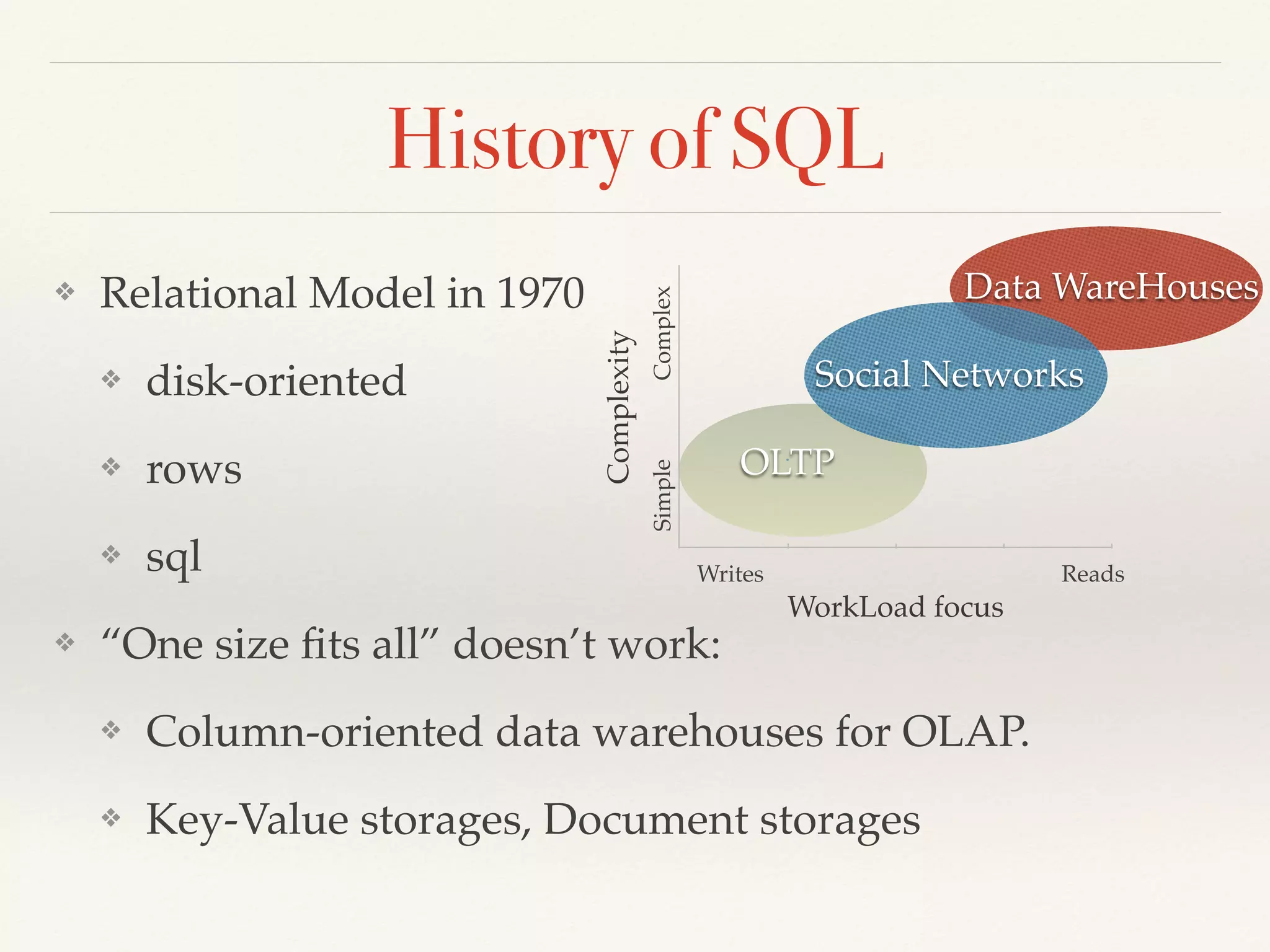
❖ Relational Model in 1970
❖ disk-oriented
❖ rows
❖ sql
❖ “One size fits all” doesn’t work:
❖ Column-oriented data warehouses for OLAP.
❖ Key-Value storages, Document storages
Complexity WorkLoad focus
Data WareHouses
Social Networks
OLTP
Writes Reads
SimpleComplex
History of SQL
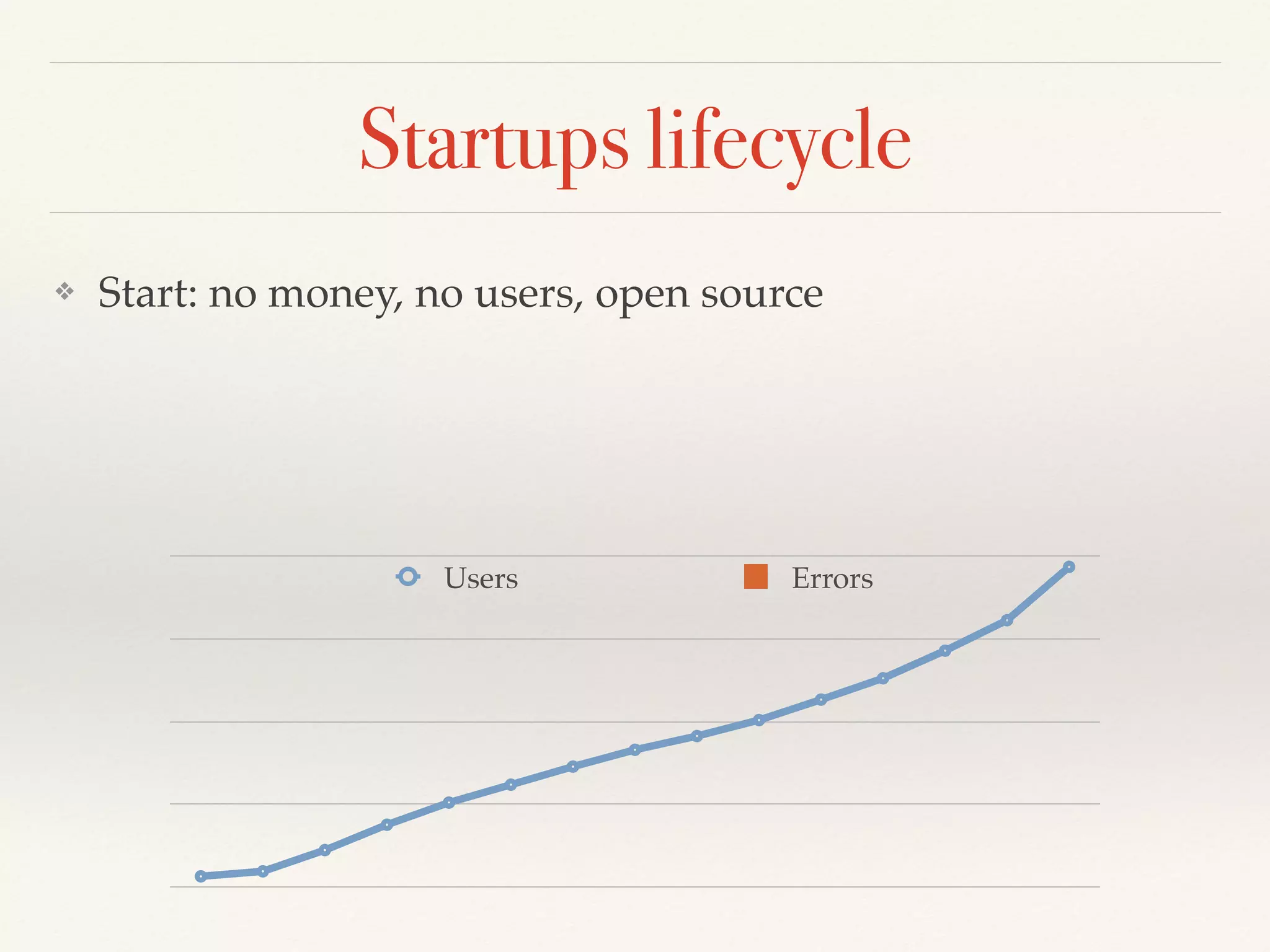
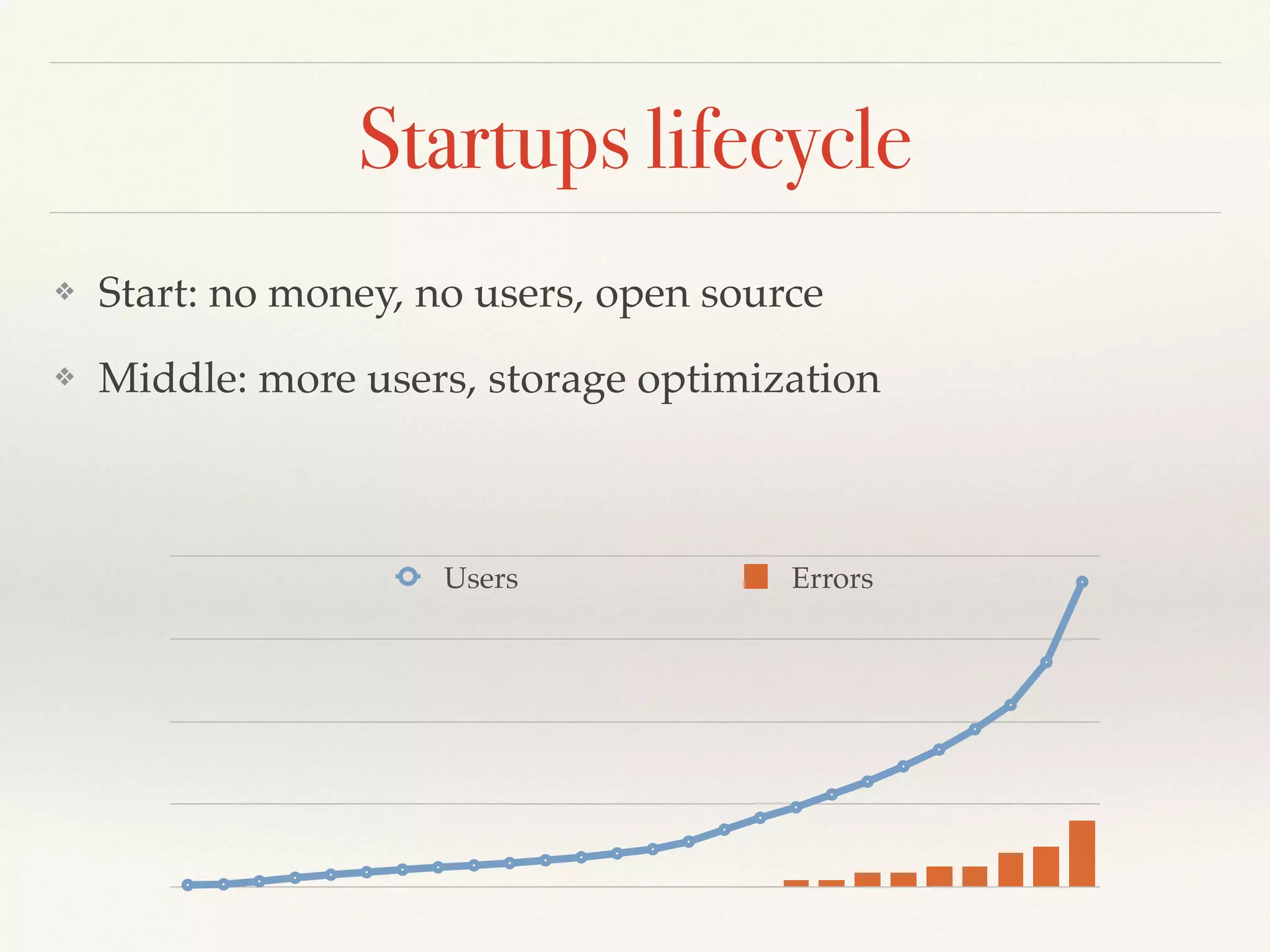
Startups lifecycle
Users Errors
❖ Start: no money, no users, open source
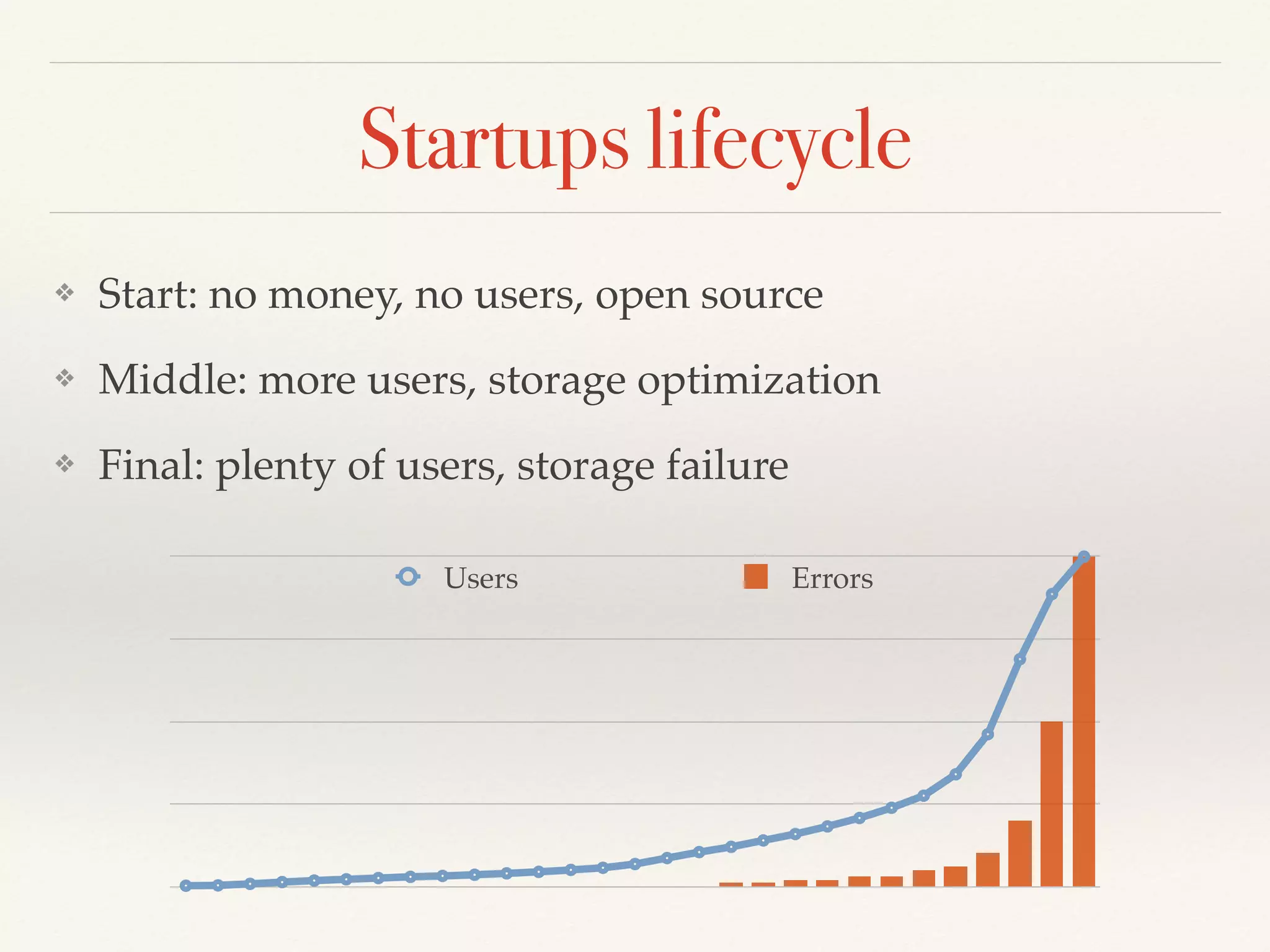
Startups lifecycle
Users Errors
❖ Start: no money, no users, open source
❖ Middle: more users, storage optimization
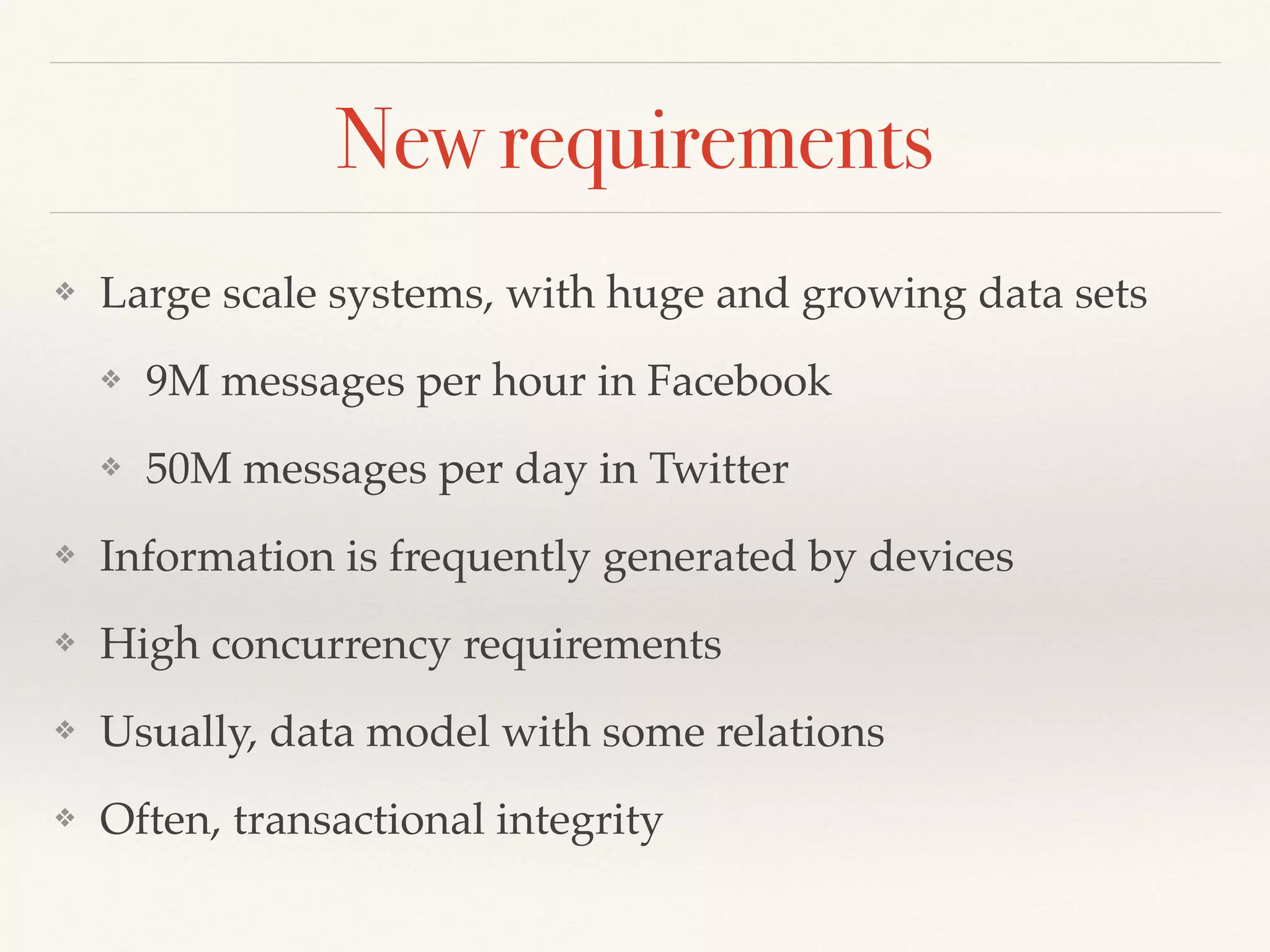
Startups lifecycle
❖ Start: no money, no users, open source
❖ Middle: more users, storage optimization
❖ Final: plenty of users, storage failure
Users Errors
New requirements
❖ Large scale systems, with huge and growing data sets
❖ 9M messages per hour in Facebook
❖ 50M messages per day in Twitter
❖ Information is frequently generated by devices
❖ High concurrency requirements
❖ Usually, data model with some relations
❖ Often, transactional integrity
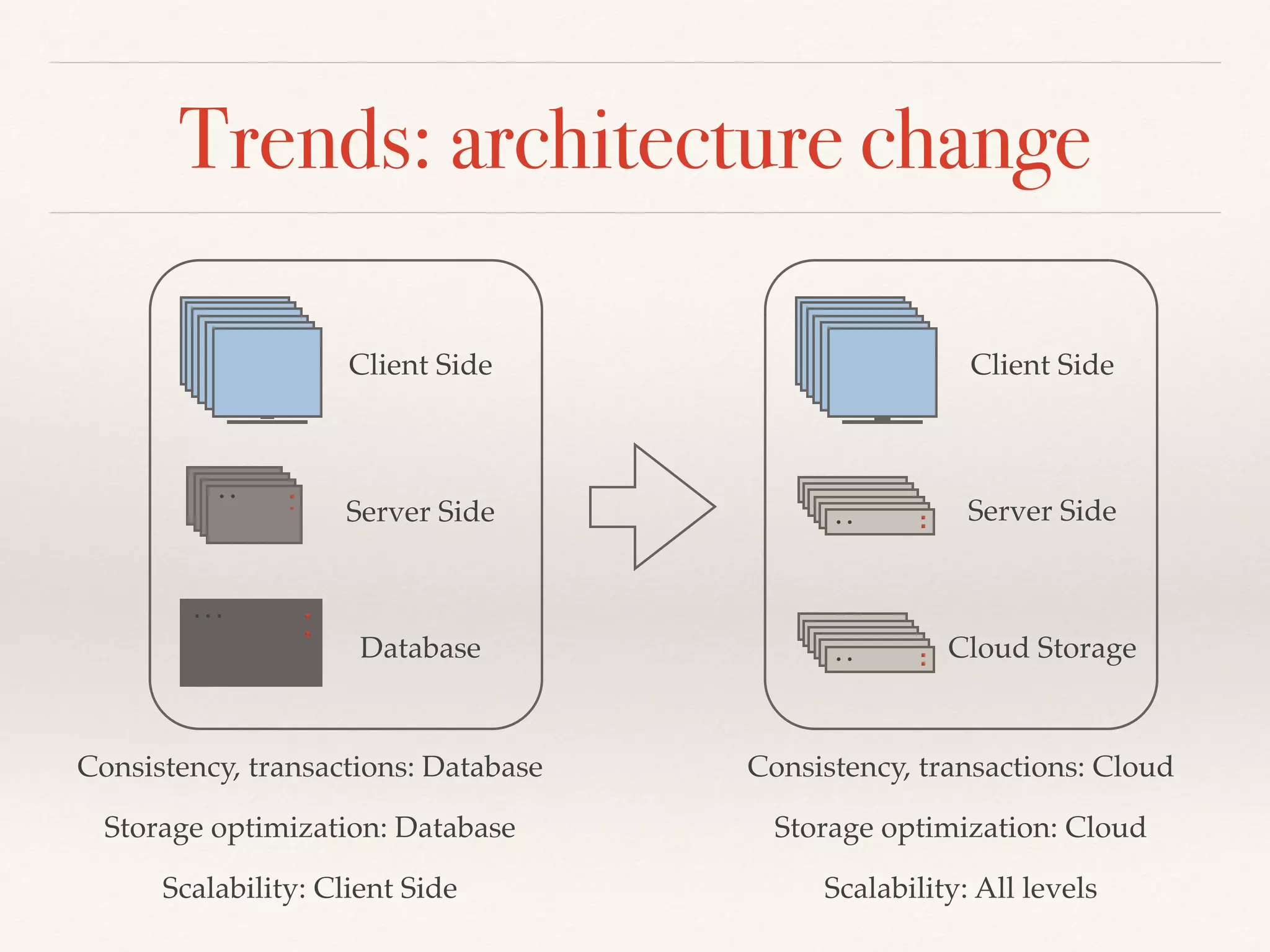
Trends: architecture change
Client Side
Server Side
Cloud Storage
Client Side
Server Side
Database
Consistency, transactions: Database
Storage optimization: Database
Scalability: Client Side
Consistency, transactions: Cloud
Storage optimization: Cloud
Scalability: All levels
Trends: architecture change
❖ CAP: consistency, availability, partitioning
❖ ACID: atomicity, consistency, isolation, durability
❖ BASE: basically available, soft state, eventual
consistency
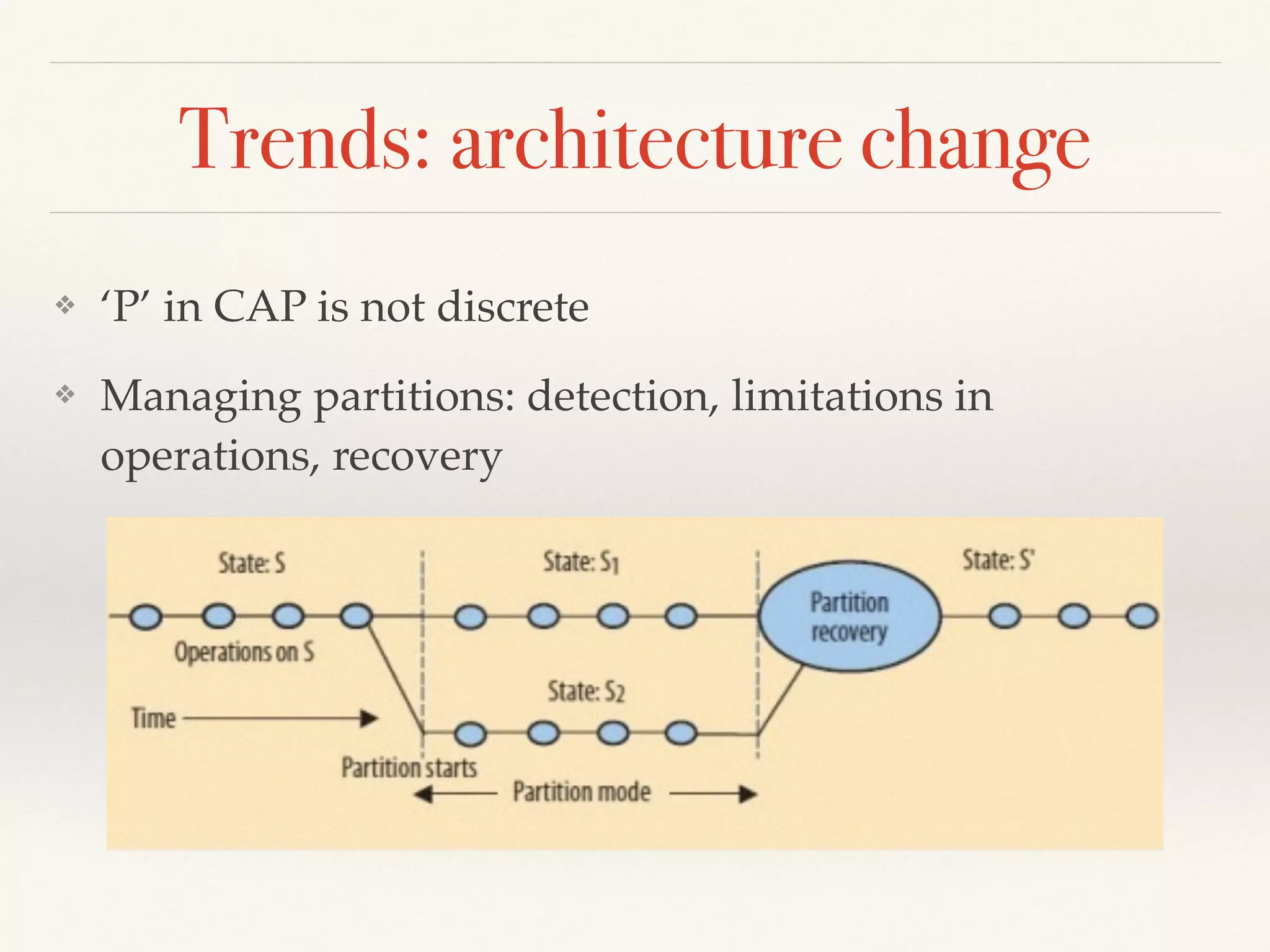
Trends: architecture change
❖ ‘P’ in CAP is not discrete
❖ Managing partitions: detection, limitations in
operations, recovery
NoSQL
❖ CAP: first ‘A’, then ‘C’: finer control over availability
❖ Horizontal scaling
❖ Not a “relational model”, custom API
❖ Schemaless
❖ Types: Key-Value, Document, Graph, …
Application-level sharding
❖ Additional application-level logic
❖ Difficulties with cross-sharding transactions
❖ More servers to maintain
❖ More components — higher prob for breakdown
NewSQL: definition
“A DBMS that delivers the scalability
and flexibility promised by NoSQL
while retaining the support for SQL
queries and/or ACID, or to improve
performance for appropriate workloads.”
451 Group
NewSQL: definition
❖ SQL as the primary interface
❖ ACID support for transactions
❖ Non-locking concurrency control
❖ High per-node performance
❖ Scalable, shared nothing architecture
Michael Stonebraker
Shared nothing architecture
❖ No single point of failure
❖ Each node is independent and self-sufficient
❖ No shared memory or disk
❖ Scale infinitely
❖ Data partitioning
❖ Slow multi-shards requests
Column-oriented DBMS
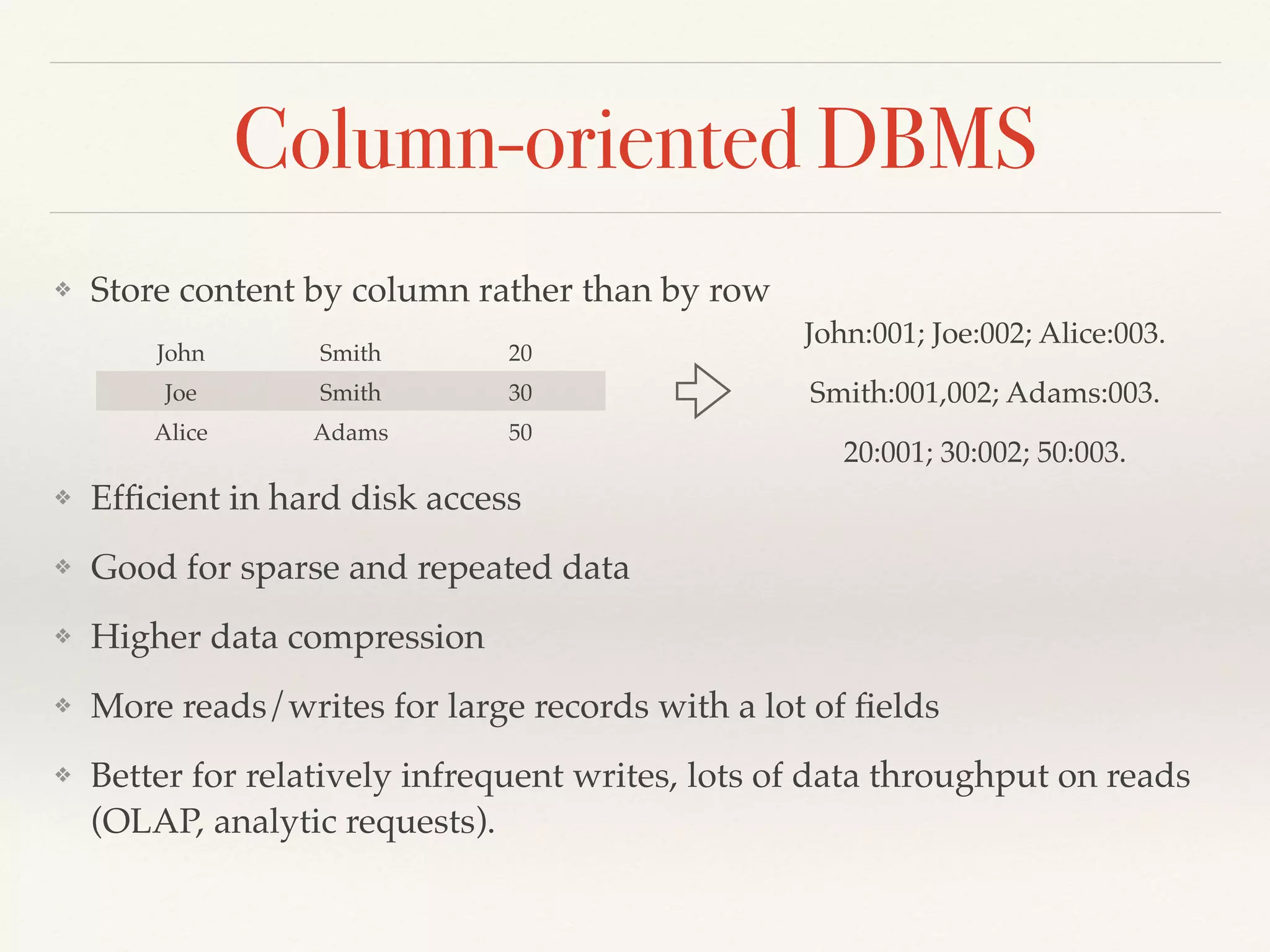
❖ Store content by column rather than by row
❖ Efficient in hard disk access
❖ Good for sparse and repeated data
❖ Higher data compression
❖ More reads/writes for large records with a lot of fields
❖ Better for relatively infrequent writes, lots of data throughput on reads
(OLAP, analytic requests).
John Smith 20
Joe Smith 30
Alice Adams 50
John:001; Joe:002; Alice:003.
Smith:001,002; Adams:003.
20:001; 30:002; 50:003.
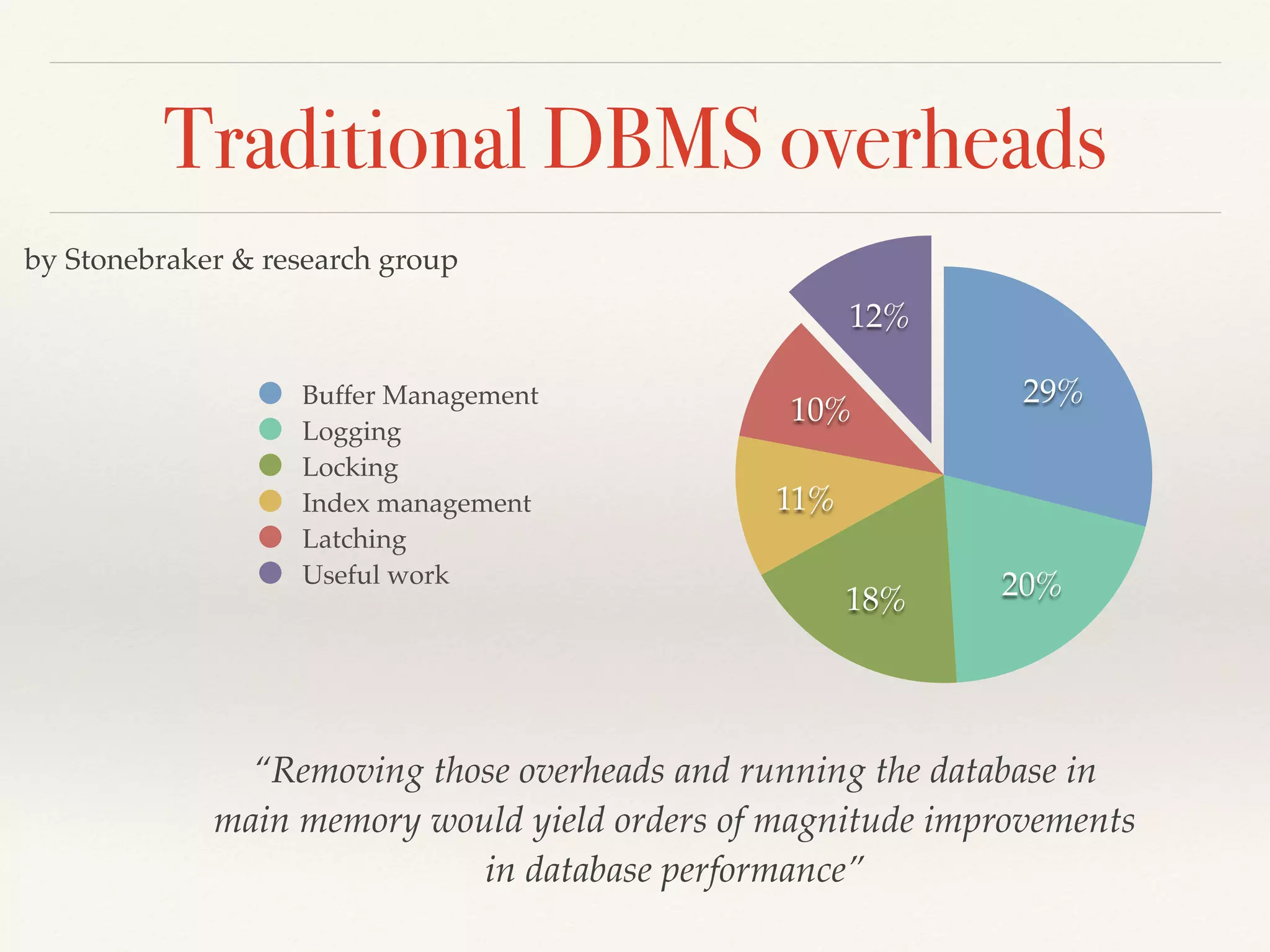
Traditional DBMS overheads
12%
10%
11%
18% 20%
29%Buffer Management
Logging
Locking
Index management
Latching
Useful work
“Removing those overheads and running the database in
main memory would yield orders of magnitude improvements
in database performance”
by Stonebraker & research group
In-memory storage
❖ High throughput
❖ Low latency
❖ No Buffer Management
❖ If serialized, no Locking or Latching
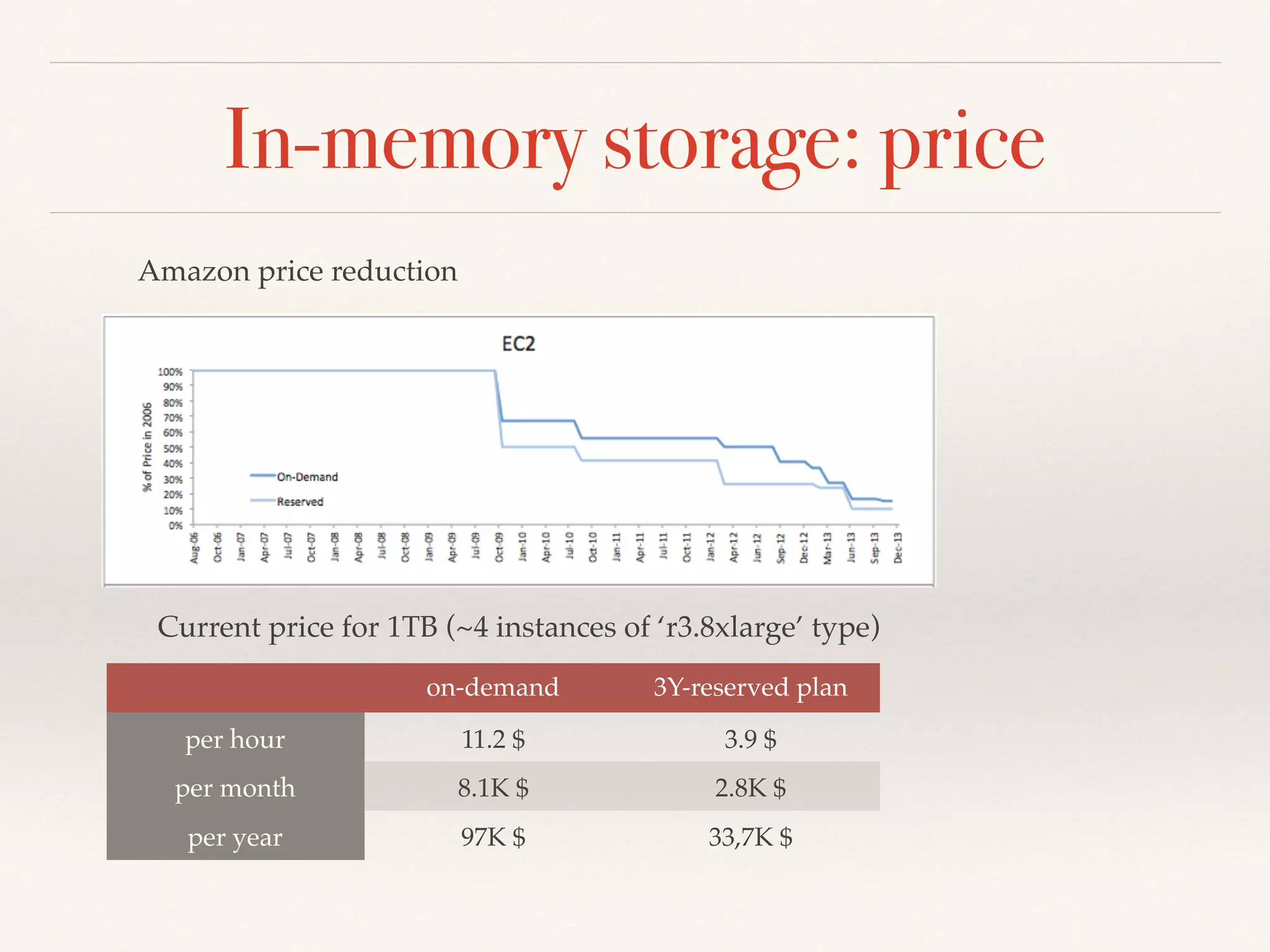
In-memory storage: price
on-demand 3Y-reserved plan
per hour 11.2 $ 3.9 $
per month 8.1K $ 2.8K $
per year 97K $ 33,7K $
Amazon price reduction
Current price for 1TB (~4 instances of ‘r3.8xlarge’ type)
NewSQL: categories
❖ New approaches: VoltDB, Clustrix, NuoDB
❖ New storage engines: TokuDB, ScaleDB
❖ Transparent clustering: ScaleBase, dbShards
NuoDB
❖ Multi-tier architecture:
❖ Administrative: managing, stats, cli, web-ui
❖ Transactional: ACID except ‘D’, cache
❖ Storage: key-value store (‘D’ from ACID)
NuoDB
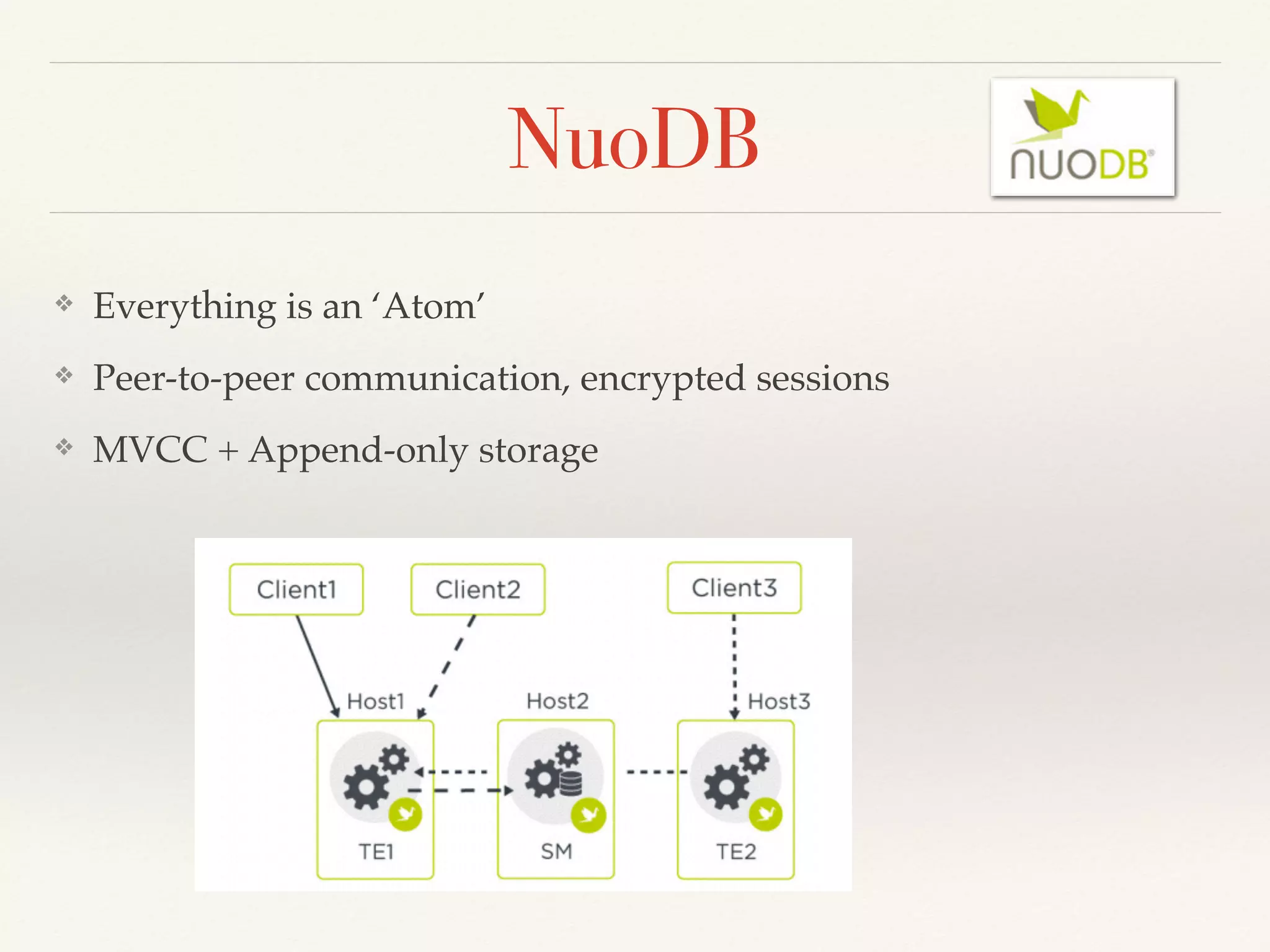
❖ Everything is an ‘Atom’
❖ Peer-to-peer communication, encrypted sessions
❖ MVCC + Append-only storage
NuoDB: CAP & ACID
❖ `CP` system. Need majority of nodes to work
❖ If split to two equal parts -> stop
❖ Several consistency modes including ‘consistent_read’
YCSB
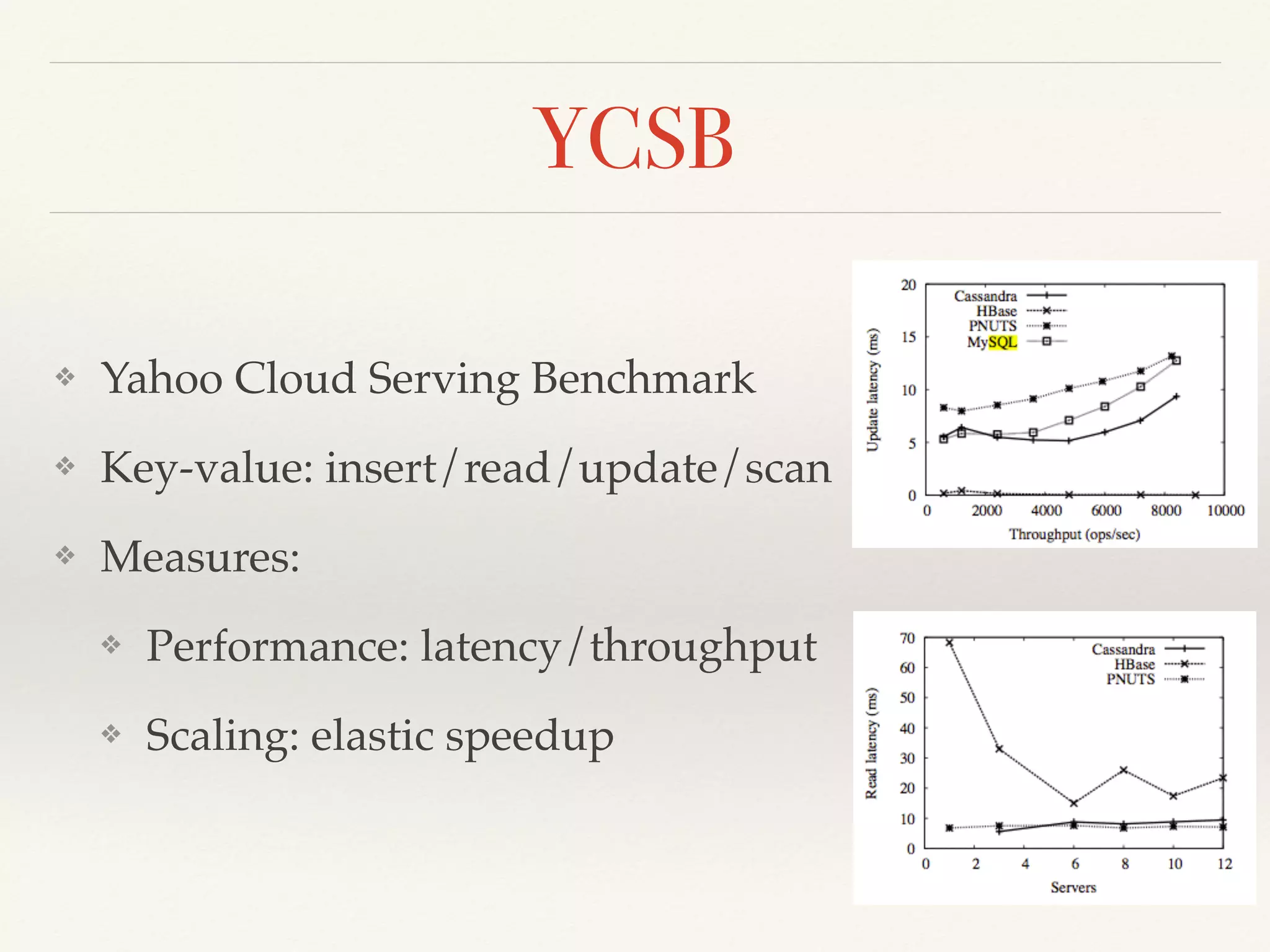
❖ Yahoo Cloud Serving Benchmark
❖ Key-value: insert/read/update/scan
❖ Measures:
❖ Performance: latency/throughput
❖ Scaling: elastic speedup
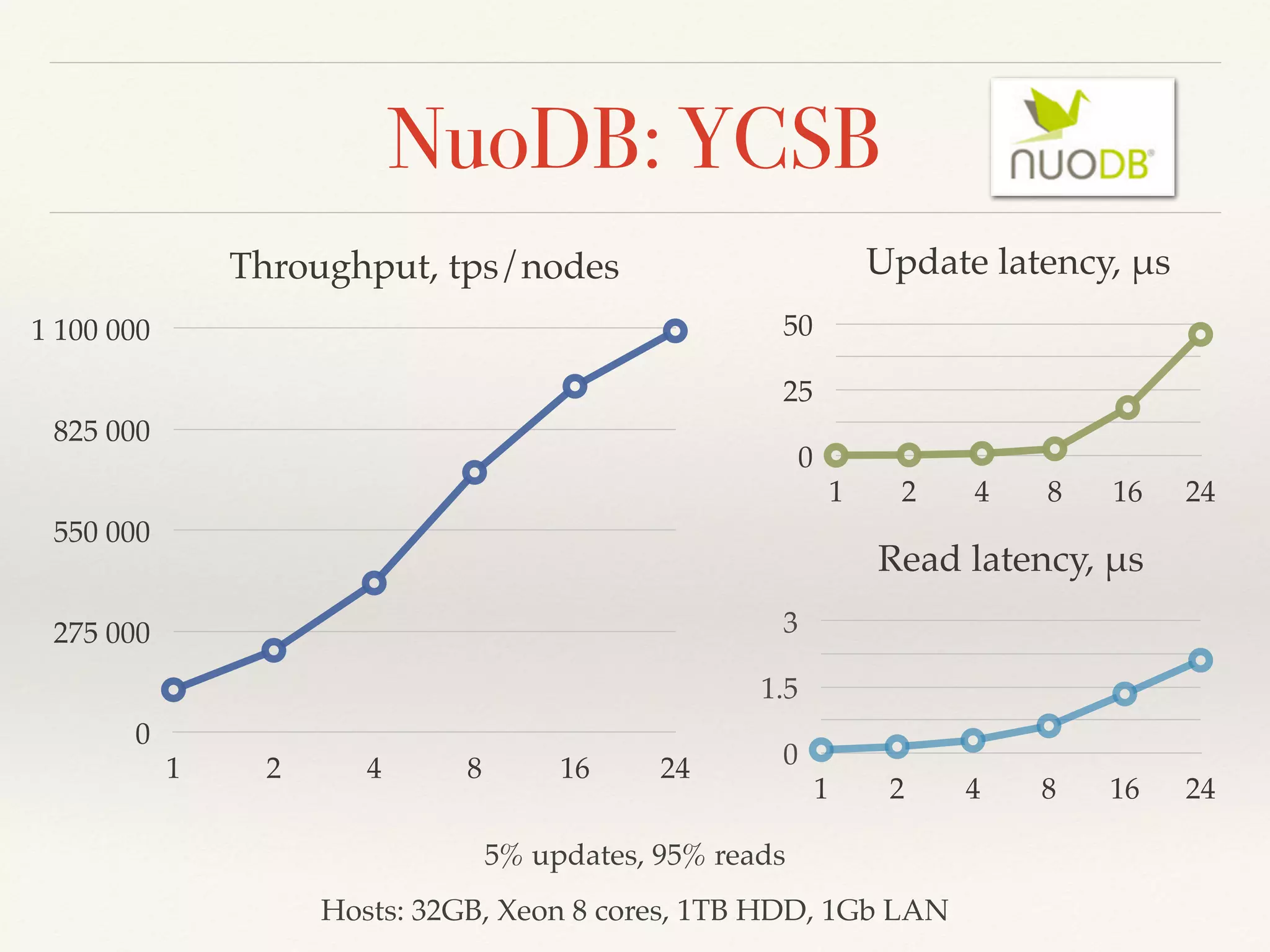
NuoDB: YCSB
Throughput, tps/nodes
0
275 000
550 000
825 000
1 100 000
1 2 4 8 16 24
Update latency, "s
0
25
50
1 2 4 8 16 24
Read latency, "s
0
1.5
3
1 2 4 8 16 24
Hosts: 32GB, Xeon 8 cores, 1TB HDD, 1Gb LAN
5% updates, 95% reads
VoltDB
❖ In-memory storage
❖ Stored procedure interface, async/sync proc execution
❖ Serializing all data access
❖ Horizontal partitioning
❖ Multi-master replication (“K-safety”)
❖ Snapshots + Command Logging
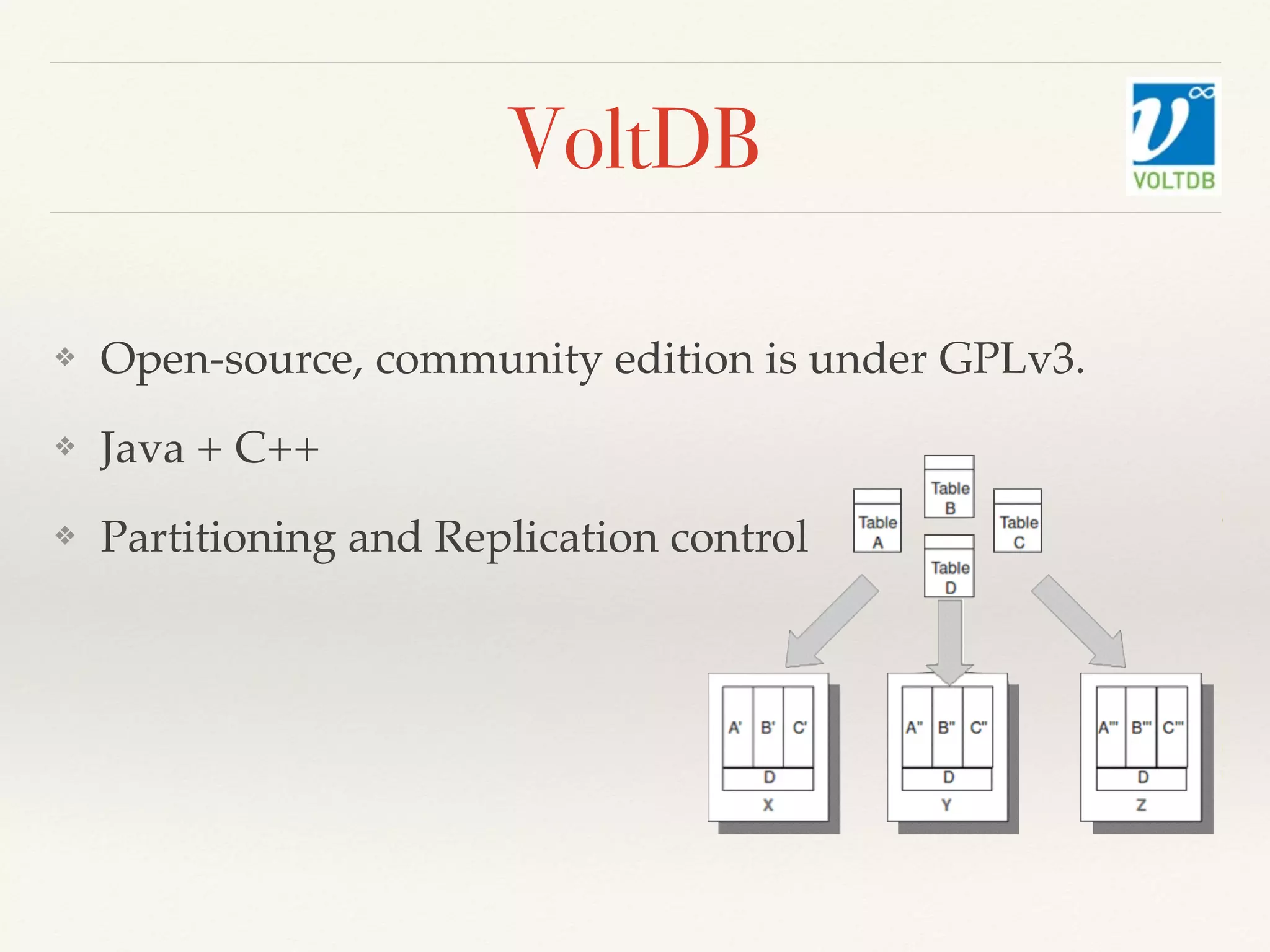
VoltDB
❖ Open-source, community edition is under GPLv3.
❖ Java + C++
❖ Partitioning and Replication control
VoltDB: CAP & ACID
❖ Without K-safety, any node fail break the whole DB
❖ Snapshot and shutdown minor segments during
network paritions
❖ Single-partition transactions are very fast
❖ Multi-partition transactions are slower (manager), try to
avoid (1000s tps in ’13, no updates since)
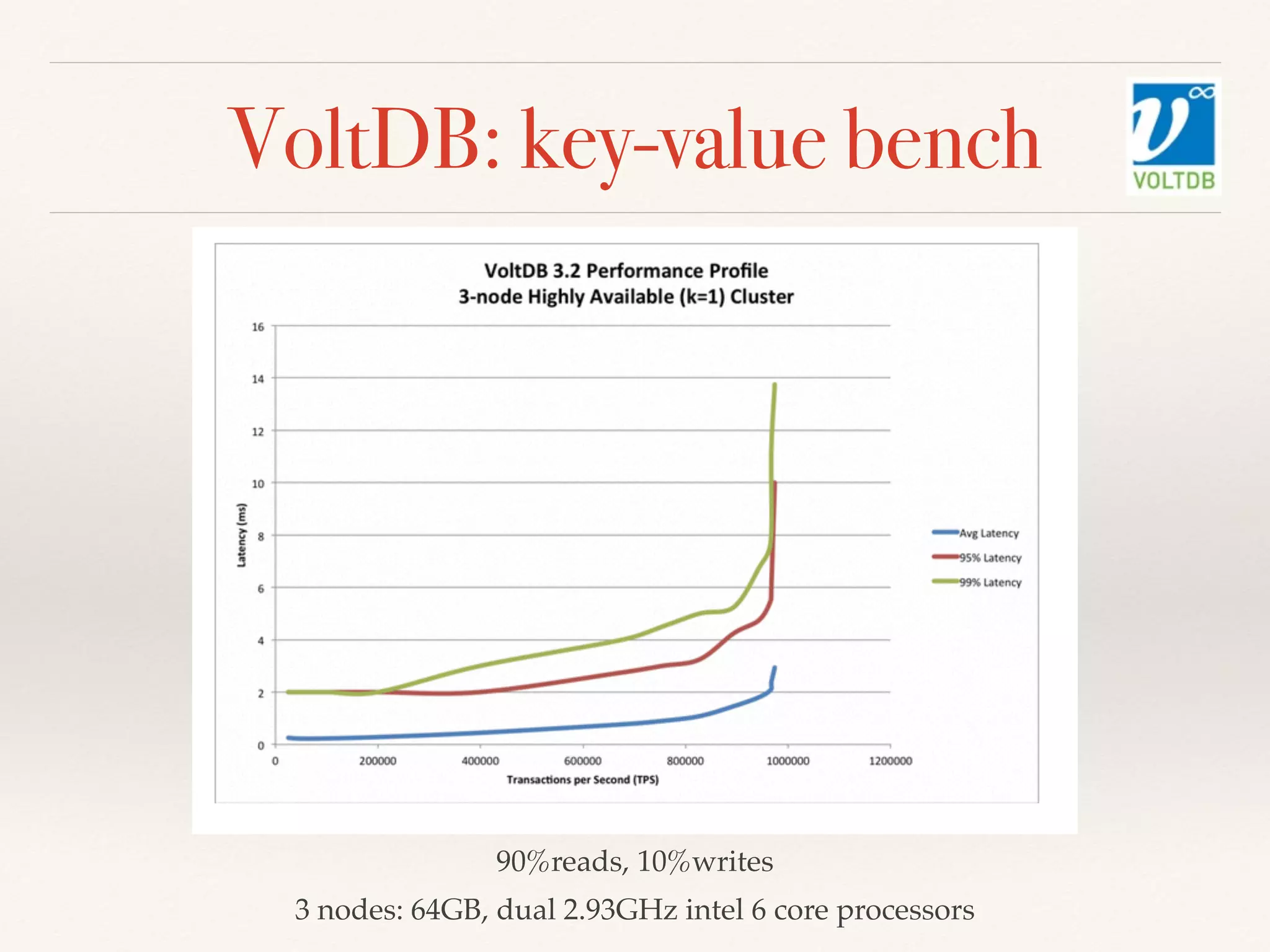
VoltDB: key-value bench
90%reads, 10%writes
3 nodes: 64GB, dual 2.93GHz intel 6 core processors
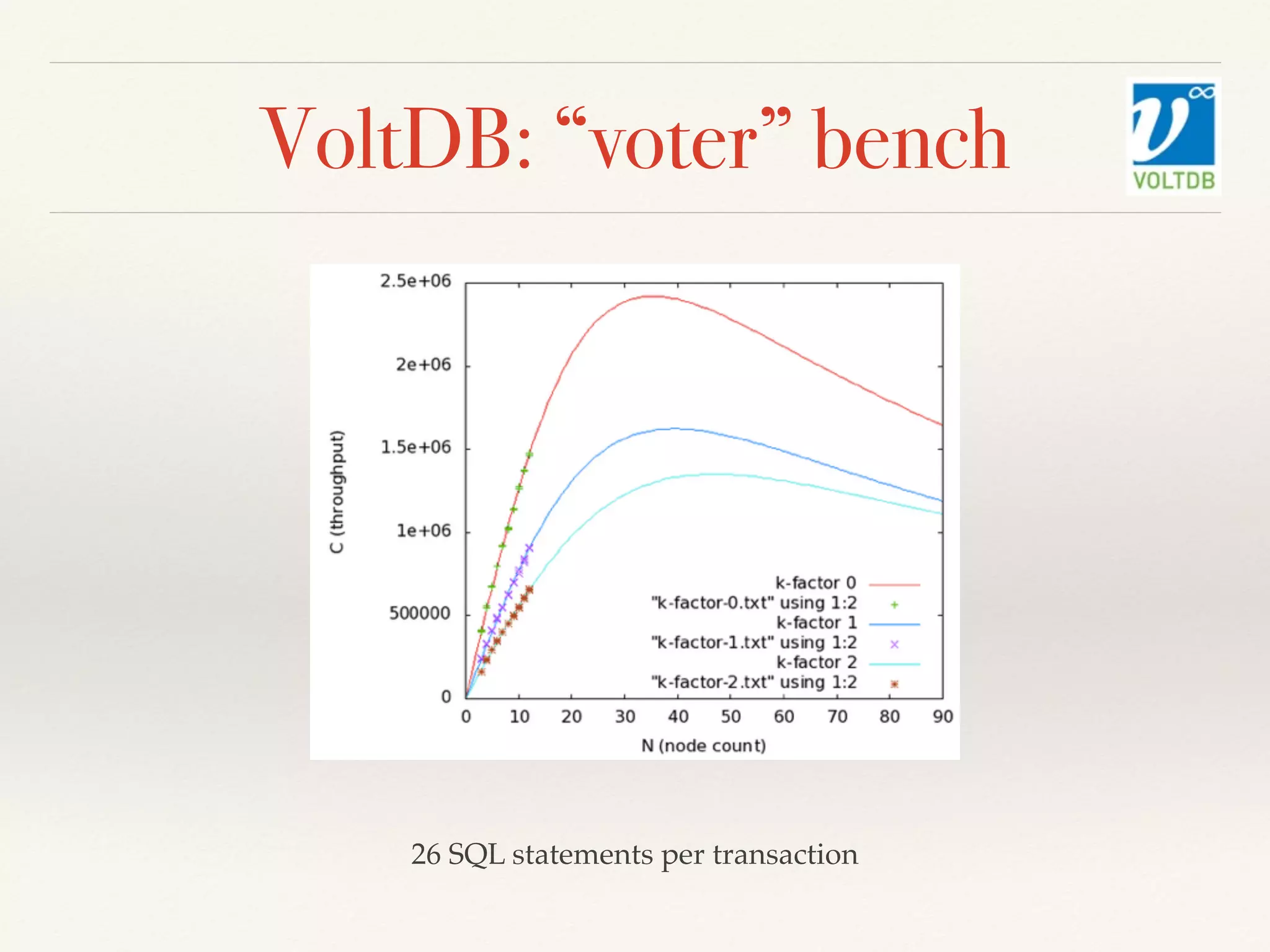
VoltDB: “voter” bench
26 SQL statements per transaction
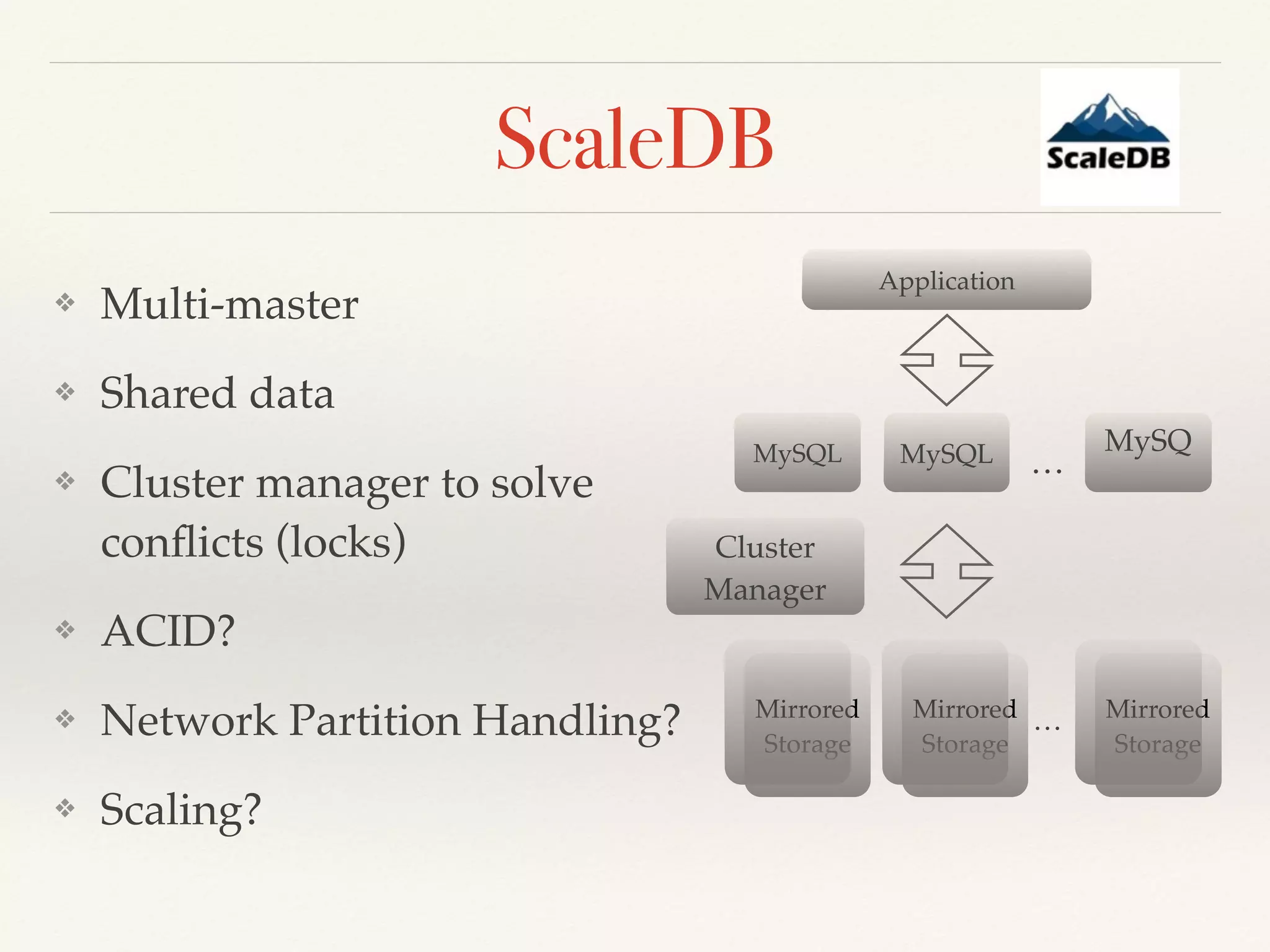
❖ Multi-master
❖ Shared data
❖ Cluster manager to solve

conflicts (locks)
❖ ACID?
❖ Network Partition Handling?
❖ Scaling?
ScaleDB
MySQL MySQL MySQ
…
Mirrored
Storage
…
Application
Cluster
Manager
Mirrored
Storage
Mirrored
Storage
ClustrixDB
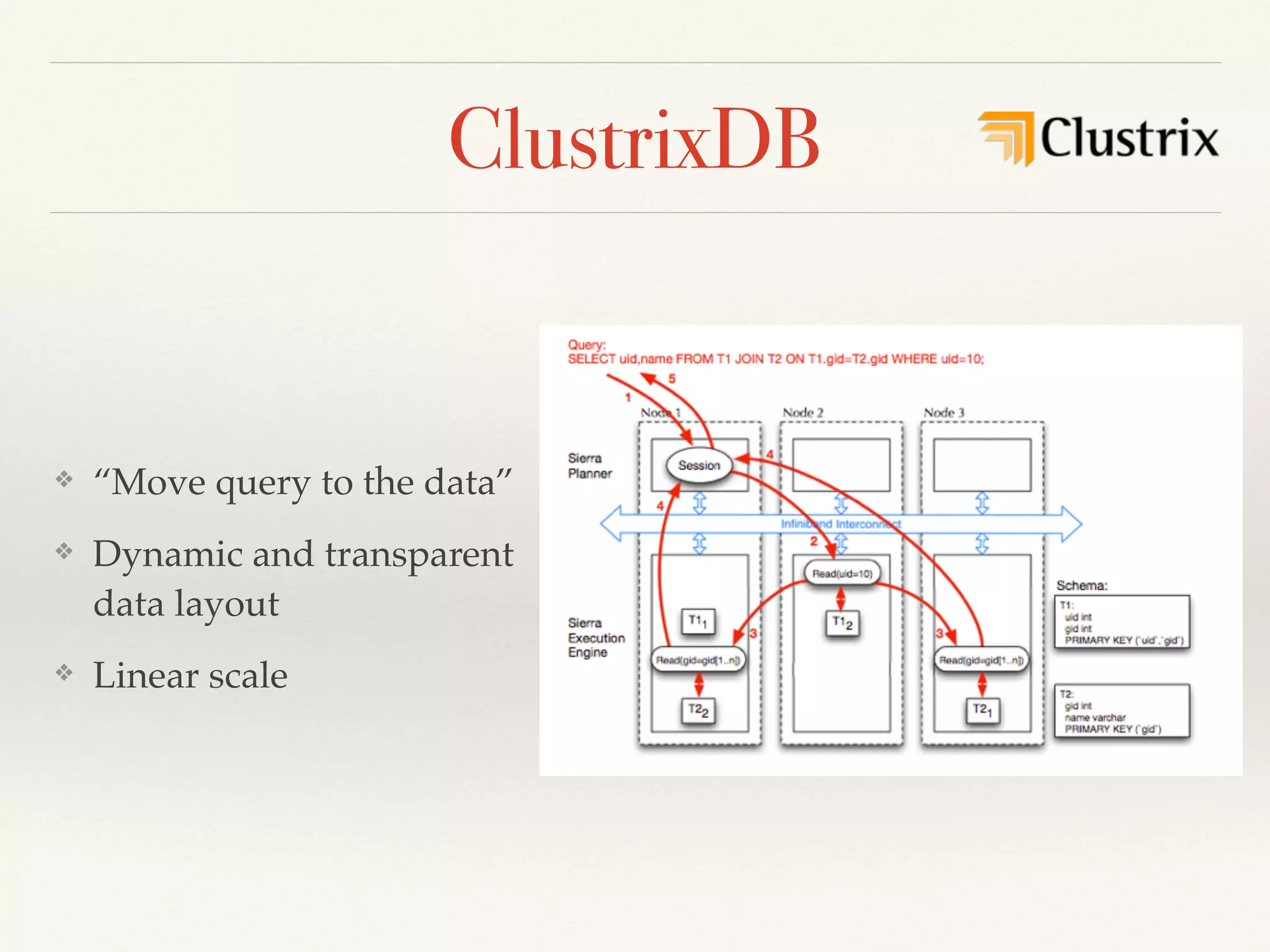
❖ “Query fragment” - basic primitive of the system:
❖ read/write/ execute function
❖ modify control flow
❖ perform synchronisation
❖ send rows to query fragments on another nodes
❖ Data partitions: “slices” split and moved transparently
❖ Replication: master slice for reads + slave for redundancy
ClustrixDB
❖ “Move query to the data”
❖ Dynamic and transparent
data layout
❖ Linear scale
ClustrixDB: CAP & ACID
❖ `CP` system. Need majority of nodes to work
❖ Only ‘Repeatable Read’ isolation level

(so, ‘fantom reads’ are possible)
❖ Distributed Lock Manager for writer-writer locks (on
each node)
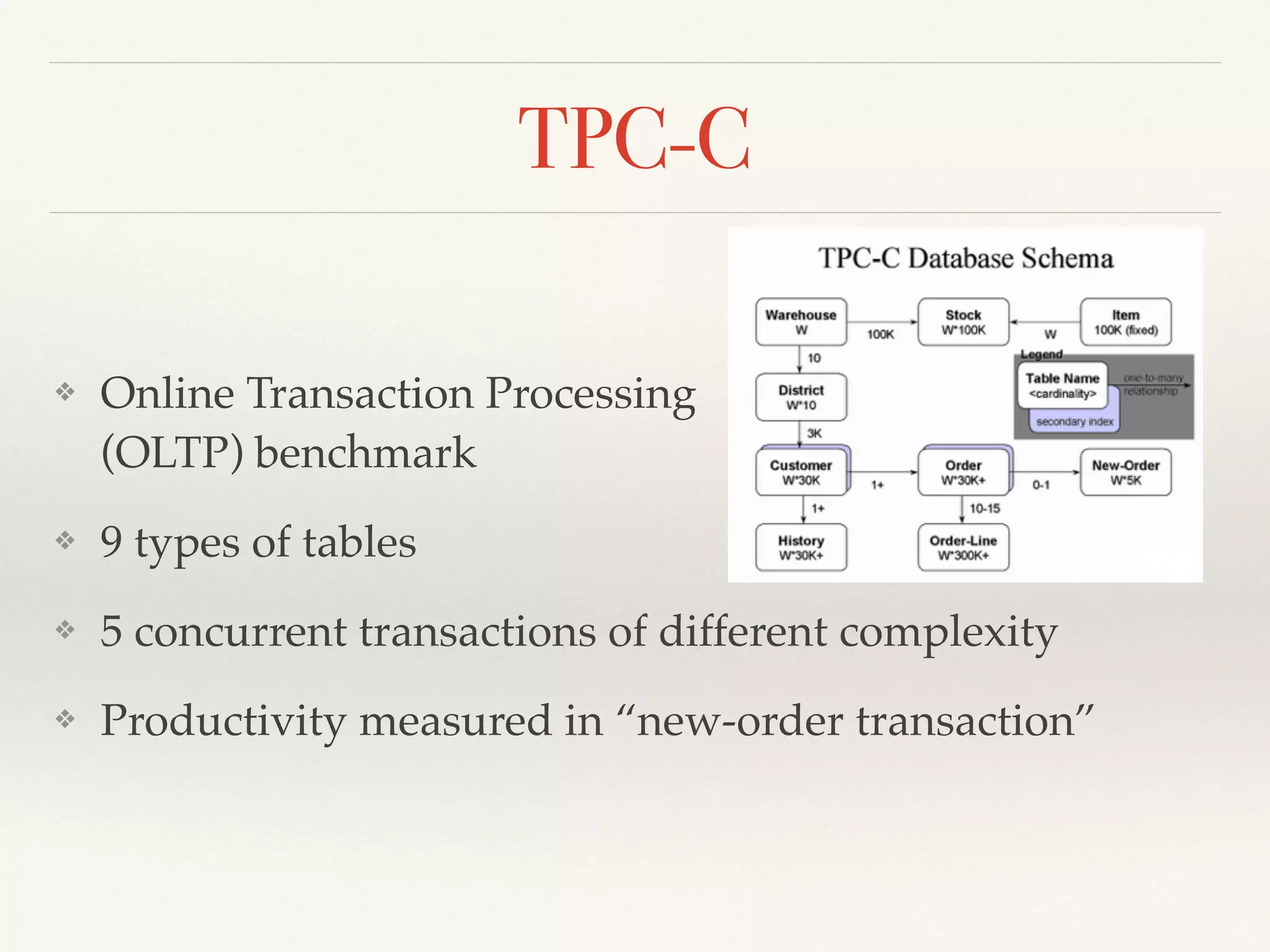
TPC-C
❖ Online Transaction Processing 

(OLTP) benchmark
❖ 9 types of tables
❖ 5 concurrent transactions of different complexity
❖ Productivity measured in “new-order transaction”
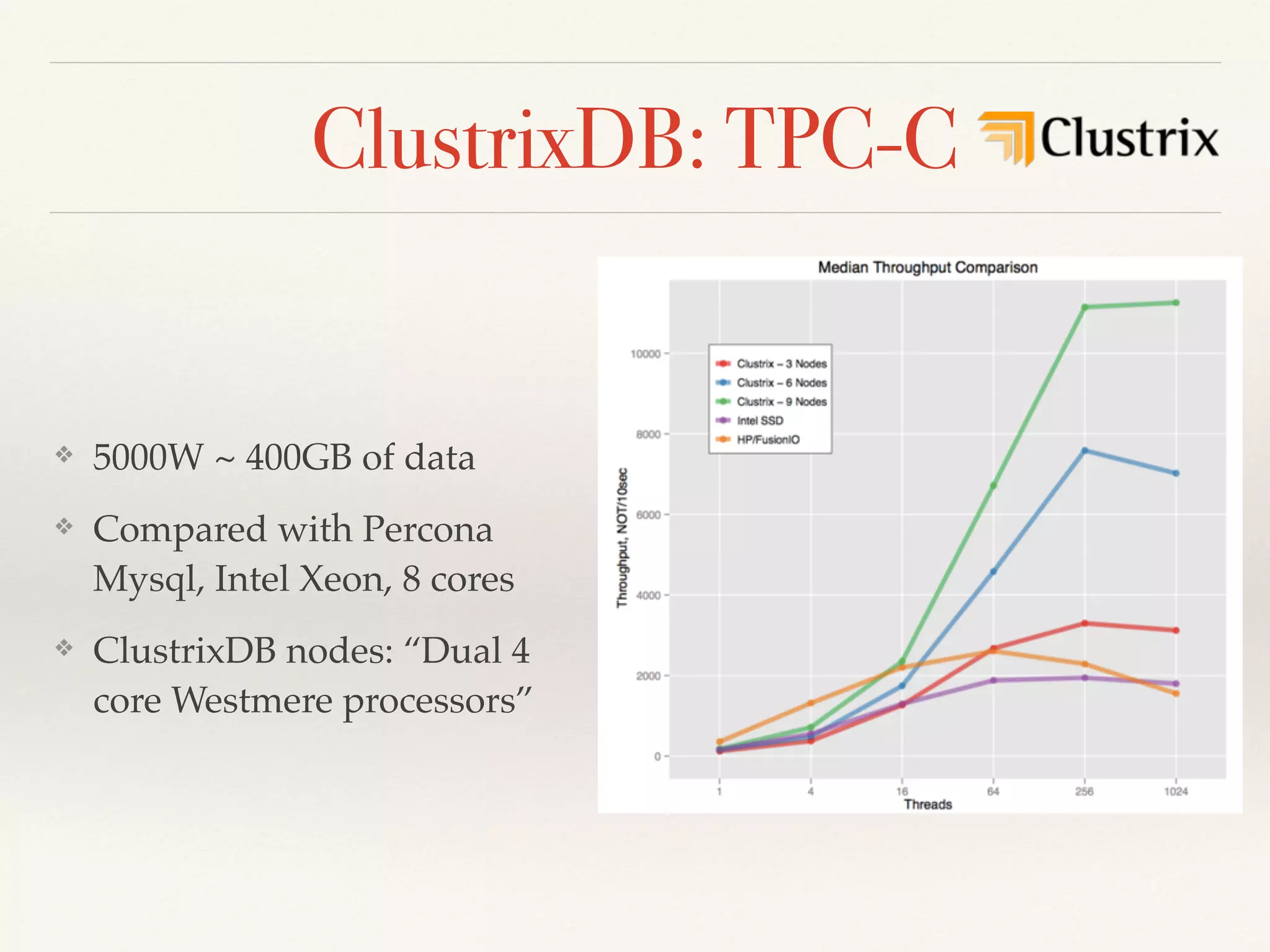
ClustrixDB: TPC-C
❖ 5000W ~ 400GB of data
❖ Compared with Percona
Mysql, Intel Xeon, 8 cores
❖ ClustrixDB nodes: “Dual 4
core Westmere processors”
ClustrixDB: example
❖ 30M users, 10M logins per day
❖ 4.4B transactions per day
❖ 1.08/4.69 Petabytes per month writes/reads
❖ 42 nodes, 336 cores, 2TB memory, 46TB SSD
FoundationDB
❖ KV store, ordered keys
❖ Paxos for cluster coordination
❖ Global ACID transactions, range operations
❖ Lock-free, optimistic concurrency, MVCC
❖ Good testing (deterministic simulation)
❖ Fault-tolerance (replication)
❖ SQL Layer (similar to Google F1 on top of Spanner)
FoundationDB
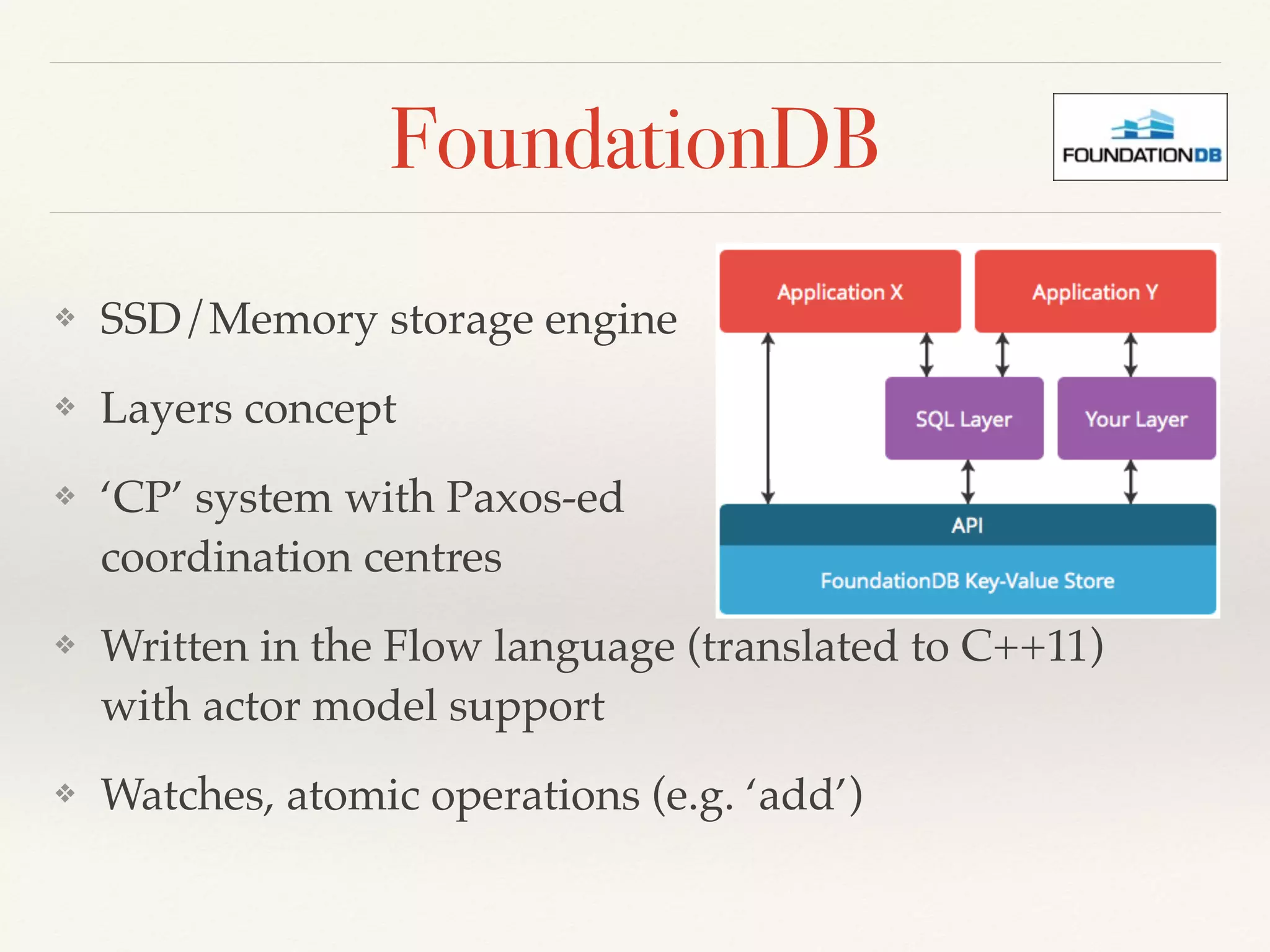
❖ SSD/Memory storage engine
❖ Layers concept
❖ ‘CP’ system with Paxos-ed

coordination centres
❖ Written in the Flow language (translated to C++11)

with actor model support
❖ Watches, atomic operations (e.g. ‘add’)
FoundationDB: CAP and ACID
❖ Serializable isolation with optimistic concurrency
❖ > 100 wps to the same key? Use another DB!
❖ ‘CP system’ (Paxos)

Need majority of coordination center to work
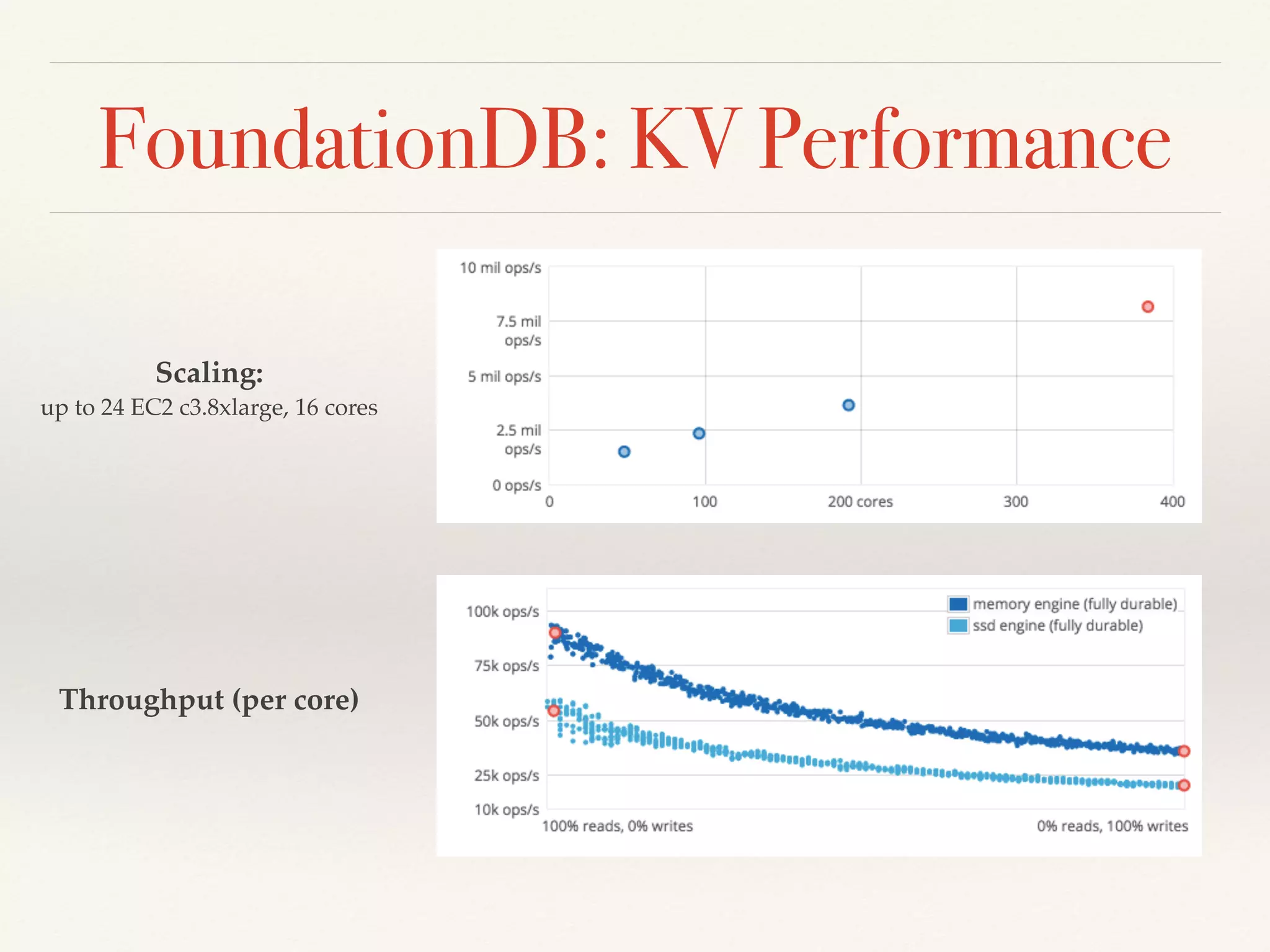
FoundationDB: KV Performance
Scaling:

up to 24 EC2 c3.8xlarge, 16 cores
Throughput (per core)
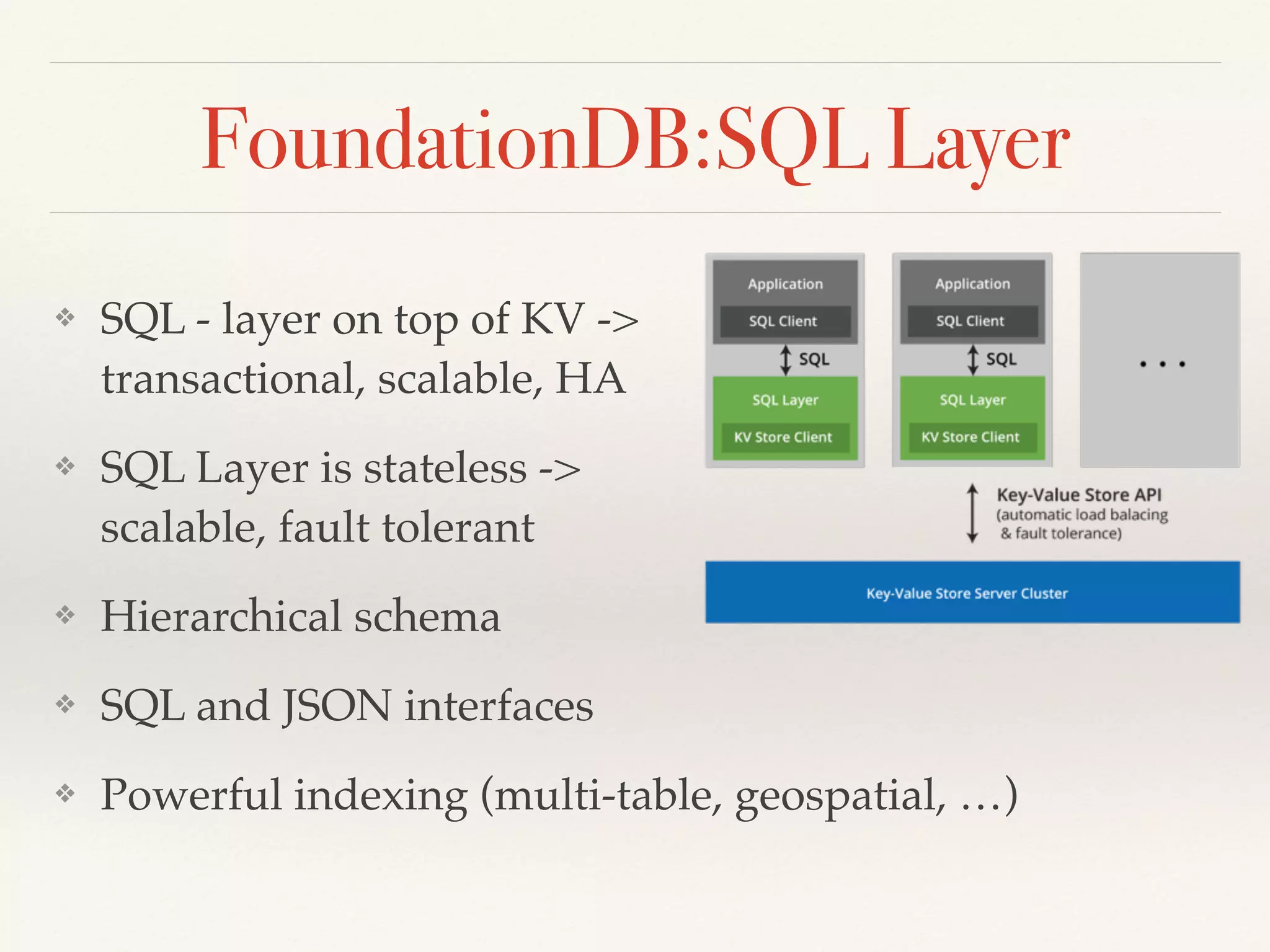
FoundationDB:SQL Layer
❖ SQL - layer on top of KV ->

transactional, scalable, HA
❖ SQL Layer is stateless -> 

scalable, fault tolerant
❖ Hierarchical schema
❖ SQL and JSON interfaces
❖ Powerful indexing (multi-table, geospatial, …)
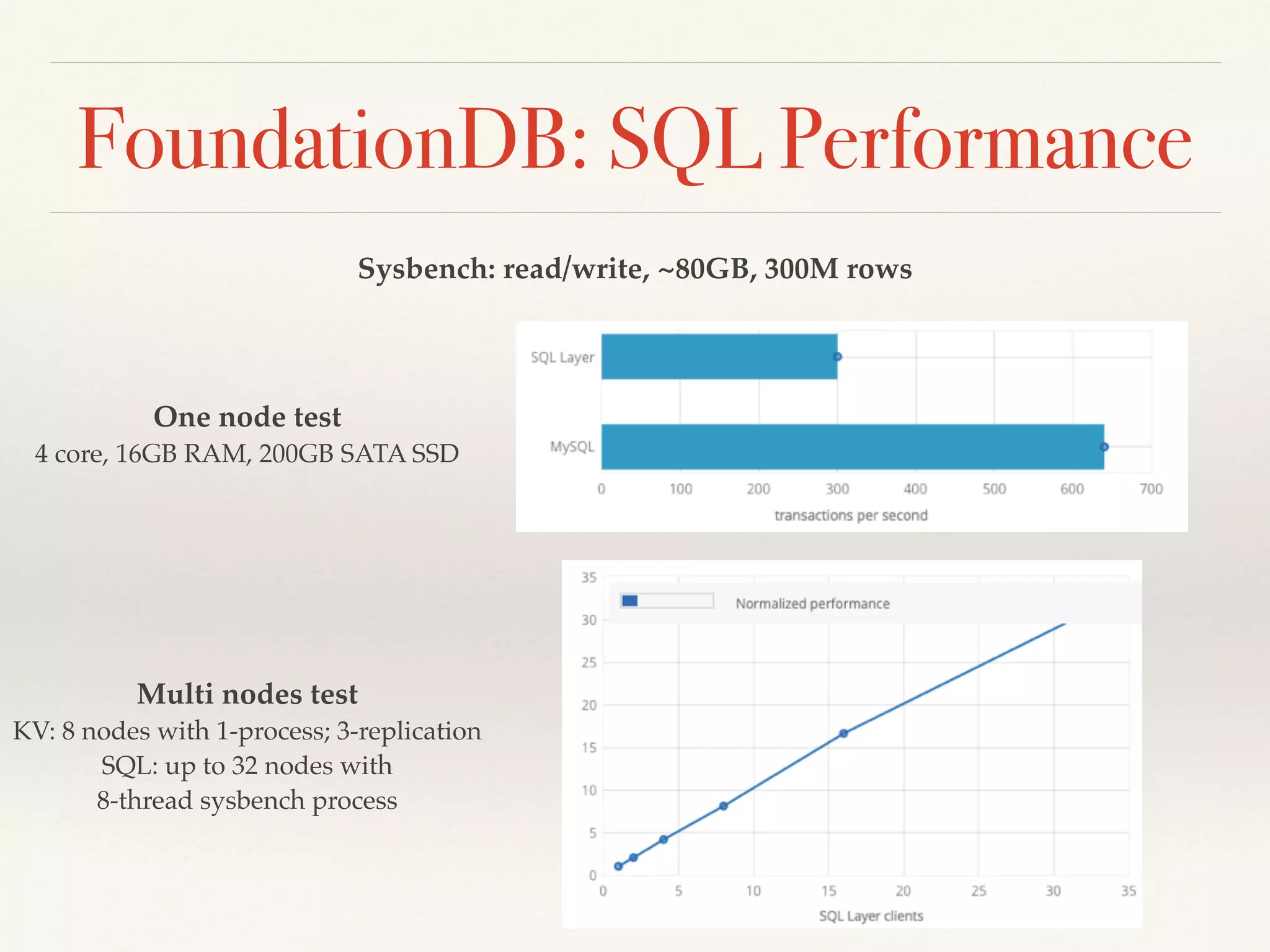
FoundationDB: SQL Performance
Sysbench: read/write, ~80GB, 300M rows
One node test

4 core, 16GB RAM, 200GB SATA SSD
Multi nodes test

KV: 8 nodes with 1-process; 3-replication

SQL: up to 32 nodes with 

8-thread sysbench process
MemSQL
❖ In-Memory Storage for OLTP
❖ Column-oriented Storage for OLAP
❖ Compiled Query Execution Plans (+cache)
❖ Local ACID transactions (no global txs for distributed)
❖ Lock-free, MVCC
❖ Fault tolerance, automatic replication, 

redundancy (=2 by default)
❖ [Almost] no penalty for replica creation
MemSQL
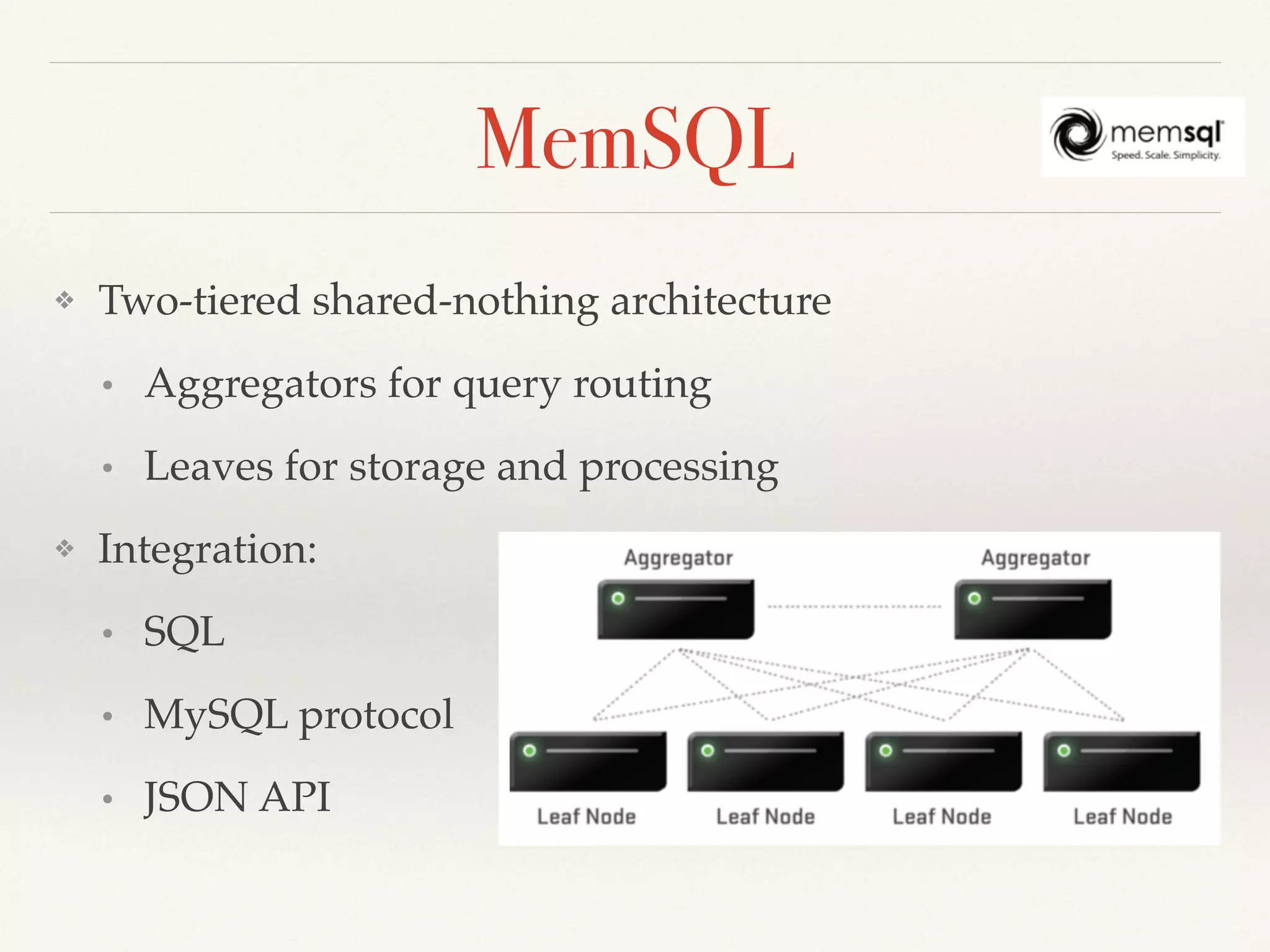
❖ Two-tiered shared-nothing architecture
• Aggregators for query routing
• Leaves for storage and processing
❖ Integration:
• SQL
• MySQL protocol
• JSON API
MemSQL: CAP & ACID
❖ `CP` system. Need majority of nodes (or half with
master) to work
❖ Only ‘Read Committed’ isolation level

(‘fantom reads’, ‘non-repeatable reads’ are possible)
❖ Manual Master Aggregator management
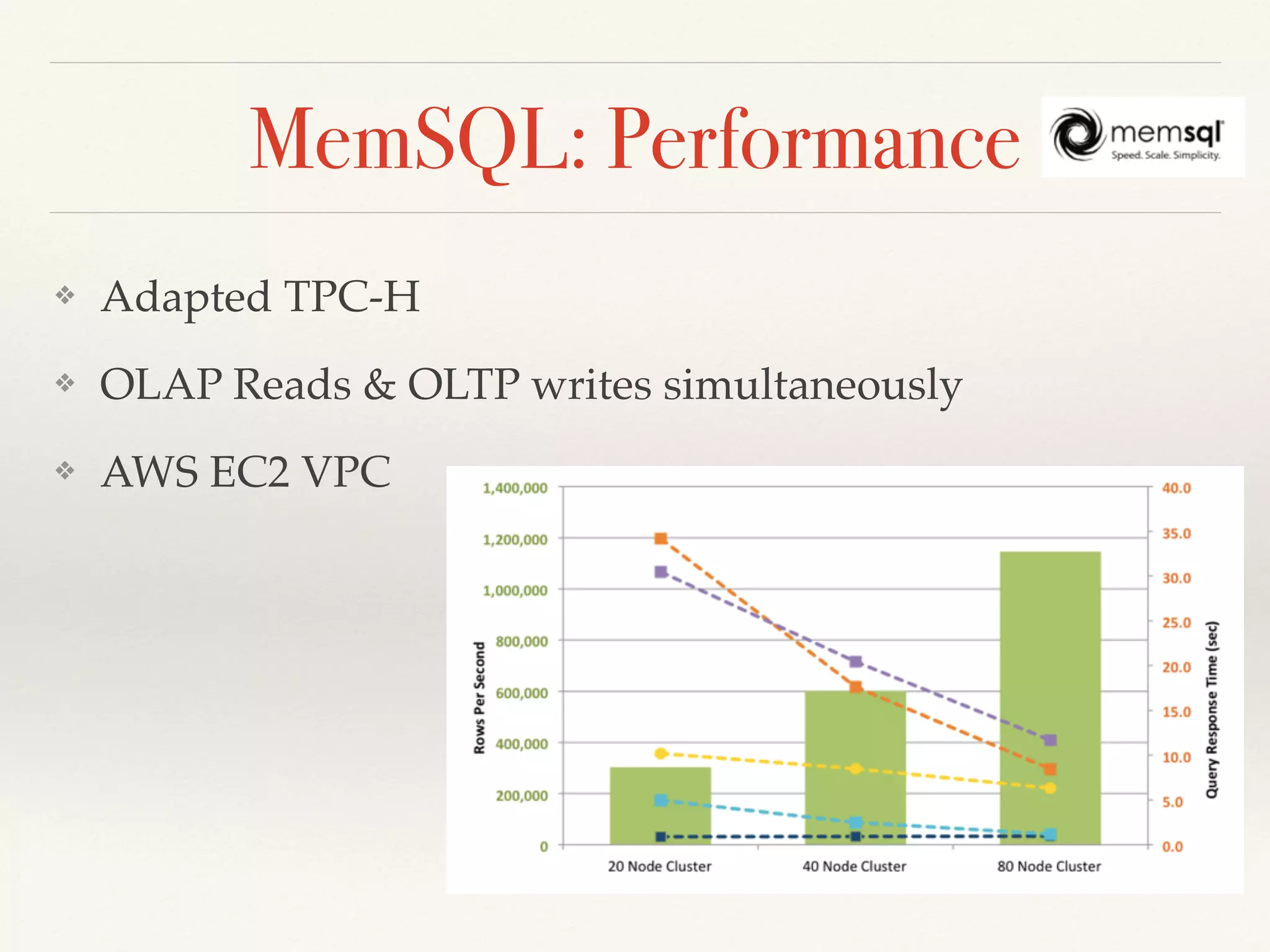
MemSQL: Performance
❖ Adapted TPC-H
❖ OLAP Reads & OLTP writes simultaneously
❖ AWS EC2 VPC
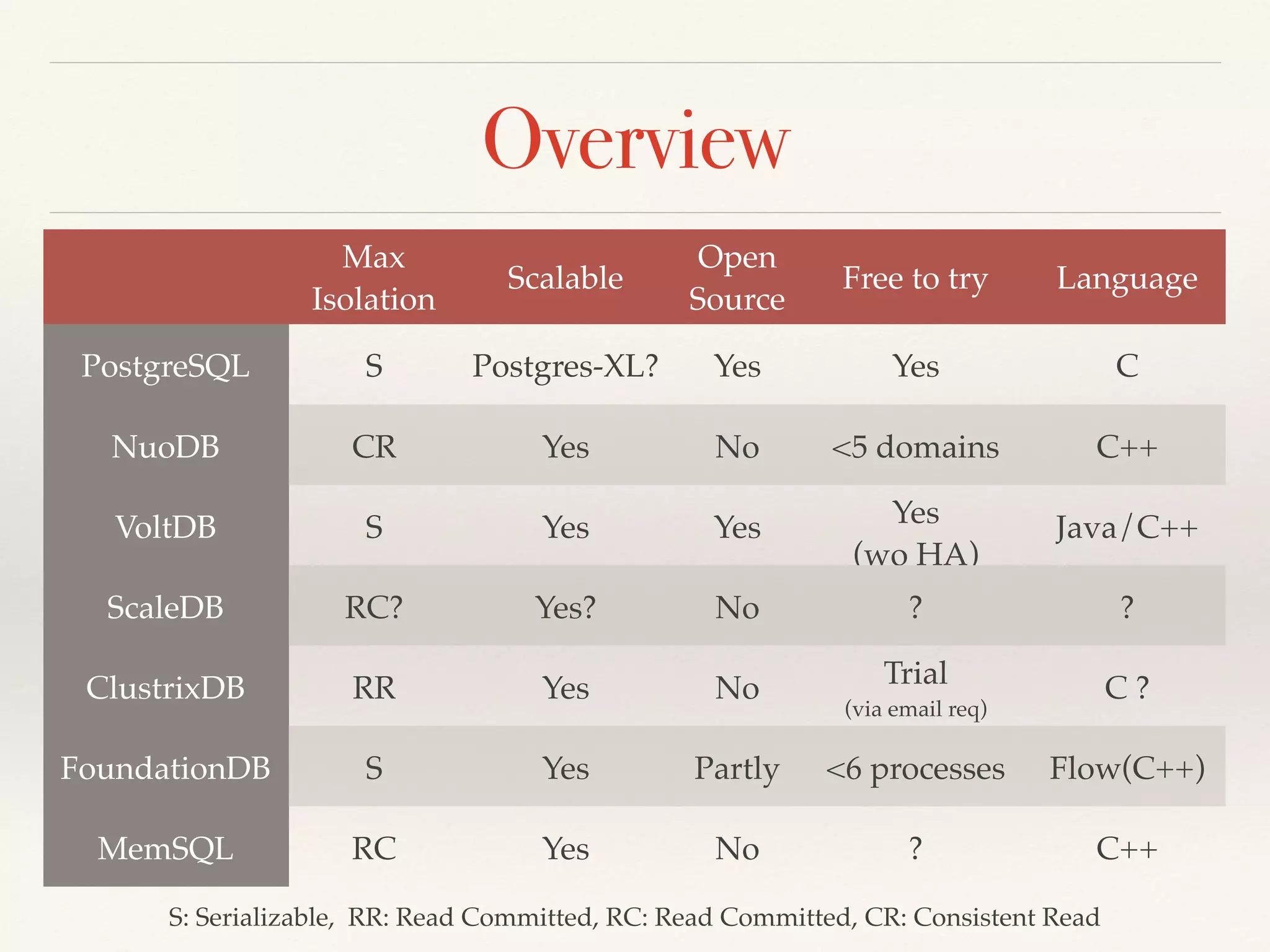
Overview
Max

Isolation
Scalable
Open
Source
Free to try Language
PostgreSQL S Postgres-XL? Yes Yes C
NuoDB CR Yes No <5 domains C++
VoltDB S Yes Yes Yes 

(wo HA)
Java/C++
ScaleDB RC? Yes? No ? ?
ClustrixDB RR Yes No Trial

(via email req)
C ?
FoundationDB S Yes Partly <6 processes Flow(C++)
MemSQL RC Yes No ? C++
S: Serializable, RR: Read Committed, RC: Read Committed, CR: Consistent Read
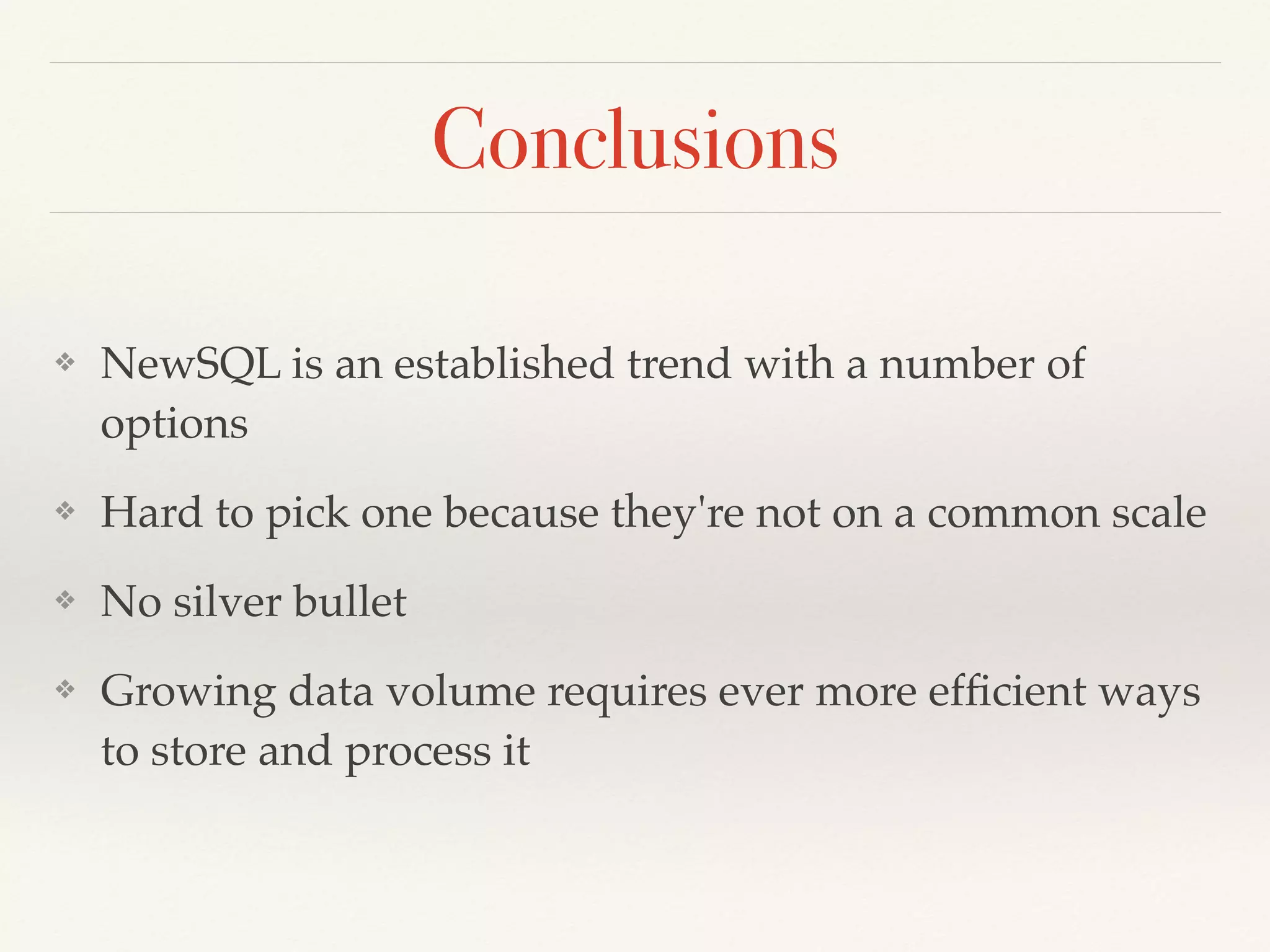
Conclusions
❖ NewSQL is an established trend with a number of
options
❖ Hard to pick one because they're not on a common scale
❖ No silver bullet
❖ Growing data volume requires ever more efficient ways
to store and process it
Questions?
Links: General concepts
❖ CAP explanation from Brewer, 12 years later
❖ Scalable performance, simple explanation
❖ What is NewSQL
❖ Overview about NoSQL databases
❖ Performance loss in OLTP systems
❖ Memory price trends
❖ (wiki) Shared Nothing Architecture
❖ (wiki) Column oriented DBMS
❖ How NewSQL handles big data
❖ What is YCSB benchmark
❖ What is TPC benchmark
❖ Transactional isolation levels
Links: NuoDB
❖ http://www.infoq.com/articles/nuodb-architecture-1/
❖ http://www.infoq.com/articles/nuodb-architecture-2/
❖ http://stackoverflow.com/questions/14552091/nuodb-and-hdfs-as-
storage
❖ http://go.nuodb.com/rs/nuodb/images/NuoDB_Benchmark_Report.pdf
❖ NuoDB white paper (google has you :)
❖ https://aphyr.com/posts/292-call-me-maybe-nuodb
❖ http://dev.nuodb.com/techblog/failure-detection-and-network-partition-
management-nuodb
Links: VoltDB
❖ White paper, Technical overview (google has you)
❖ https://github.com/VoltDB/voltdb-client-erlang/blob/master/
doc/BENCHMARK1.md
❖ http://www.mysqlperformanceblog.com/2011/02/28/is-voltdb-
really-as-scalable-as-they-claim/
❖ https://voltdb.com/blog/voltdb-3-x-performance-
characteristics/
❖ http://docs.voltdb.com/UsingVoltDB/KsafeNetPart.php
❖ https://news.ycombinator.com/item?id=6639127
Links: ScaleDB
❖ http://scaledb.com/pdfs/TechnicalOverview.pdf
❖ http://www.scaledb.com/pdfs/
scaledb_multitenant.pdf
❖ http://www.percona.com/live/mysql-
conference-2013/sites/default/files/slides/
DB_Vistualization_for_PublicPrivate_Clouds.pdf
Links: Clustrix
❖ http://www.clustrix.com/wp-content/uploads/2013/10/Clustrix_A-New-
Approach_WhitePaper.pdf
❖ http://www.clustrix.com/wp-content/uploads/2013/10/Clustrix_Driving-the-
New-Wave_WP.pdf
❖ http://www.clustrix.com/wp-content/uploads/2013/10/Clustrix_AWS_WP.pdf
❖ http://www.clustrix.com/wp-content/uploads/2013/10/
Clustrix_TPCC_Percona.pdf
❖ http://sergei.clustrix.com/2011/01/mongodb-vs-clustrix-comparison-
part-1.html
❖ http://docs.clustrix.com/display/CLXDOC/Consistency%2C+Fault+Tolerance
%2C+and+Availability
Links: FoundationDB
❖ https://foundationdb.com/key-value-store/white-papers
❖ http://blog.foundationdb.com/call-me-maybe-foundationdb-vs-jepsen
❖ https://foundationdb.com/acid-claims
❖ https://foundationdb.com/key-value-store/performance
❖ https://foundationdb.com/layers/sql/documentation/Concepts
❖ https://foundationdb.com/layers/sql/documentation/SQL/indexes.html
❖ https://foundationdb.com/layers/sql/performance
❖ https://foundationdb.com/key-value-store/features
❖ https://foundationdb.com/key-value-store/documentation/configuration.html
❖ https://foundationdb.com/key-value-store/documentation/beta1/developer-
guide.html
❖ https://foundationdb.com/layers/sql/documentation/Concepts/
known.limitations.html
Links: MemSQL
❖ MemSQL Whitepaper "The Modern Database
Landscape"
❖ MemSQL Whitepaper "ESG Lab Benchmark of
MemSQL's Performance”
❖ MemSQL Whitepaper “Technical overview”
❖ http://developers.memsql.com/docs/latest/concepts/
dev_concepts.html
❖ http://developers.memsql.com/docs/2.6/admin/
high_availability.html

NewSQL overview, Feb 2015

  • 1.
    Feb 2015 NewSQL Overview IvanGlushkov @gliush ivan.glushkov@gmail.com
  • 2.
    ❖ MIPT ❖ MCST,Elbrus compiler project ❖ Echo, real-time social platform (PaaS) ❖ DevZen podcast (http://devzen.ru) About myself
  • 3.
    ❖ Relational Modelin 1970 ❖ disk-oriented ❖ rows ❖ sql ❖ “One size fits all” doesn’t work: ❖ Column-oriented data warehouses for OLAP. ❖ Key-Value storages, Document storages Complexity WorkLoad focus Data WareHouses Social Networks OLTP Writes Reads SimpleComplex History of SQL
  • 4.
    Startups lifecycle Users Errors ❖Start: no money, no users, open source
  • 5.
    Startups lifecycle Users Errors ❖Start: no money, no users, open source ❖ Middle: more users, storage optimization
  • 6.
    Startups lifecycle ❖ Start:no money, no users, open source ❖ Middle: more users, storage optimization ❖ Final: plenty of users, storage failure Users Errors
  • 7.
    New requirements ❖ Largescale systems, with huge and growing data sets ❖ 9M messages per hour in Facebook ❖ 50M messages per day in Twitter ❖ Information is frequently generated by devices ❖ High concurrency requirements ❖ Usually, data model with some relations ❖ Often, transactional integrity
  • 8.
    Trends: architecture change ClientSide Server Side Cloud Storage Client Side Server Side Database Consistency, transactions: Database Storage optimization: Database Scalability: Client Side Consistency, transactions: Cloud Storage optimization: Cloud Scalability: All levels
  • 9.
    Trends: architecture change ❖CAP: consistency, availability, partitioning ❖ ACID: atomicity, consistency, isolation, durability ❖ BASE: basically available, soft state, eventual consistency
  • 10.
    Trends: architecture change ❖‘P’ in CAP is not discrete ❖ Managing partitions: detection, limitations in operations, recovery
  • 11.
    NoSQL ❖ CAP: first‘A’, then ‘C’: finer control over availability ❖ Horizontal scaling ❖ Not a “relational model”, custom API ❖ Schemaless ❖ Types: Key-Value, Document, Graph, …
  • 12.
    Application-level sharding ❖ Additionalapplication-level logic ❖ Difficulties with cross-sharding transactions ❖ More servers to maintain ❖ More components — higher prob for breakdown
  • 13.
    NewSQL: definition “A DBMSthat delivers the scalability and flexibility promised by NoSQL while retaining the support for SQL queries and/or ACID, or to improve performance for appropriate workloads.” 451 Group
  • 14.
    NewSQL: definition ❖ SQLas the primary interface ❖ ACID support for transactions ❖ Non-locking concurrency control ❖ High per-node performance ❖ Scalable, shared nothing architecture Michael Stonebraker
  • 15.
    Shared nothing architecture ❖No single point of failure ❖ Each node is independent and self-sufficient ❖ No shared memory or disk ❖ Scale infinitely ❖ Data partitioning ❖ Slow multi-shards requests
  • 16.
    Column-oriented DBMS ❖ Storecontent by column rather than by row ❖ Efficient in hard disk access ❖ Good for sparse and repeated data ❖ Higher data compression ❖ More reads/writes for large records with a lot of fields ❖ Better for relatively infrequent writes, lots of data throughput on reads (OLAP, analytic requests). John Smith 20 Joe Smith 30 Alice Adams 50 John:001; Joe:002; Alice:003. Smith:001,002; Adams:003. 20:001; 30:002; 50:003.
  • 17.
    Traditional DBMS overheads 12% 10% 11% 18%20% 29%Buffer Management Logging Locking Index management Latching Useful work “Removing those overheads and running the database in main memory would yield orders of magnitude improvements in database performance” by Stonebraker & research group
  • 18.
    In-memory storage ❖ Highthroughput ❖ Low latency ❖ No Buffer Management ❖ If serialized, no Locking or Latching
  • 19.
    In-memory storage: price on-demand3Y-reserved plan per hour 11.2 $ 3.9 $ per month 8.1K $ 2.8K $ per year 97K $ 33,7K $ Amazon price reduction Current price for 1TB (~4 instances of ‘r3.8xlarge’ type)
  • 20.
    NewSQL: categories ❖ Newapproaches: VoltDB, Clustrix, NuoDB ❖ New storage engines: TokuDB, ScaleDB ❖ Transparent clustering: ScaleBase, dbShards
  • 21.
    NuoDB ❖ Multi-tier architecture: ❖Administrative: managing, stats, cli, web-ui ❖ Transactional: ACID except ‘D’, cache ❖ Storage: key-value store (‘D’ from ACID)
  • 22.
    NuoDB ❖ Everything isan ‘Atom’ ❖ Peer-to-peer communication, encrypted sessions ❖ MVCC + Append-only storage
  • 23.
    NuoDB: CAP &ACID ❖ `CP` system. Need majority of nodes to work ❖ If split to two equal parts -> stop ❖ Several consistency modes including ‘consistent_read’
  • 24.
    YCSB ❖ Yahoo CloudServing Benchmark ❖ Key-value: insert/read/update/scan ❖ Measures: ❖ Performance: latency/throughput ❖ Scaling: elastic speedup
  • 25.
    NuoDB: YCSB Throughput, tps/nodes 0 275 000 550 000 825 000 1 100 000 12 4 8 16 24 Update latency, "s 0 25 50 1 2 4 8 16 24 Read latency, "s 0 1.5 3 1 2 4 8 16 24 Hosts: 32GB, Xeon 8 cores, 1TB HDD, 1Gb LAN 5% updates, 95% reads
  • 26.
    VoltDB ❖ In-memory storage ❖Stored procedure interface, async/sync proc execution ❖ Serializing all data access ❖ Horizontal partitioning ❖ Multi-master replication (“K-safety”) ❖ Snapshots + Command Logging
  • 27.
    VoltDB ❖ Open-source, communityedition is under GPLv3. ❖ Java + C++ ❖ Partitioning and Replication control
  • 28.
    VoltDB: CAP &ACID ❖ Without K-safety, any node fail break the whole DB ❖ Snapshot and shutdown minor segments during network paritions ❖ Single-partition transactions are very fast ❖ Multi-partition transactions are slower (manager), try to avoid (1000s tps in ’13, no updates since)
  • 29.
    VoltDB: key-value bench 90%reads,10%writes 3 nodes: 64GB, dual 2.93GHz intel 6 core processors
  • 30.
    VoltDB: “voter” bench 26SQL statements per transaction
  • 31.
    ❖ Multi-master ❖ Shareddata ❖ Cluster manager to solve
 conflicts (locks) ❖ ACID? ❖ Network Partition Handling? ❖ Scaling? ScaleDB MySQL MySQL MySQ … Mirrored Storage … Application Cluster Manager Mirrored Storage Mirrored Storage
  • 32.
    ClustrixDB ❖ “Query fragment”- basic primitive of the system: ❖ read/write/ execute function ❖ modify control flow ❖ perform synchronisation ❖ send rows to query fragments on another nodes ❖ Data partitions: “slices” split and moved transparently ❖ Replication: master slice for reads + slave for redundancy
  • 33.
    ClustrixDB ❖ “Move queryto the data” ❖ Dynamic and transparent data layout ❖ Linear scale
  • 34.
    ClustrixDB: CAP &ACID ❖ `CP` system. Need majority of nodes to work ❖ Only ‘Repeatable Read’ isolation level
 (so, ‘fantom reads’ are possible) ❖ Distributed Lock Manager for writer-writer locks (on each node)
  • 35.
    TPC-C ❖ Online TransactionProcessing 
 (OLTP) benchmark ❖ 9 types of tables ❖ 5 concurrent transactions of different complexity ❖ Productivity measured in “new-order transaction”
  • 36.
    ClustrixDB: TPC-C ❖ 5000W~ 400GB of data ❖ Compared with Percona Mysql, Intel Xeon, 8 cores ❖ ClustrixDB nodes: “Dual 4 core Westmere processors”
  • 37.
    ClustrixDB: example ❖ 30Musers, 10M logins per day ❖ 4.4B transactions per day ❖ 1.08/4.69 Petabytes per month writes/reads ❖ 42 nodes, 336 cores, 2TB memory, 46TB SSD
  • 38.
    FoundationDB ❖ KV store,ordered keys ❖ Paxos for cluster coordination ❖ Global ACID transactions, range operations ❖ Lock-free, optimistic concurrency, MVCC ❖ Good testing (deterministic simulation) ❖ Fault-tolerance (replication) ❖ SQL Layer (similar to Google F1 on top of Spanner)
  • 39.
    FoundationDB ❖ SSD/Memory storageengine ❖ Layers concept ❖ ‘CP’ system with Paxos-ed
 coordination centres ❖ Written in the Flow language (translated to C++11)
 with actor model support ❖ Watches, atomic operations (e.g. ‘add’)
  • 40.
    FoundationDB: CAP andACID ❖ Serializable isolation with optimistic concurrency ❖ > 100 wps to the same key? Use another DB! ❖ ‘CP system’ (Paxos)
 Need majority of coordination center to work
  • 41.
    FoundationDB: KV Performance Scaling:
 upto 24 EC2 c3.8xlarge, 16 cores Throughput (per core)
  • 42.
    FoundationDB:SQL Layer ❖ SQL- layer on top of KV ->
 transactional, scalable, HA ❖ SQL Layer is stateless -> 
 scalable, fault tolerant ❖ Hierarchical schema ❖ SQL and JSON interfaces ❖ Powerful indexing (multi-table, geospatial, …)
  • 43.
    FoundationDB: SQL Performance Sysbench:read/write, ~80GB, 300M rows One node test
 4 core, 16GB RAM, 200GB SATA SSD Multi nodes test
 KV: 8 nodes with 1-process; 3-replication
 SQL: up to 32 nodes with 
 8-thread sysbench process
  • 44.
    MemSQL ❖ In-Memory Storagefor OLTP ❖ Column-oriented Storage for OLAP ❖ Compiled Query Execution Plans (+cache) ❖ Local ACID transactions (no global txs for distributed) ❖ Lock-free, MVCC ❖ Fault tolerance, automatic replication, 
 redundancy (=2 by default) ❖ [Almost] no penalty for replica creation
  • 45.
    MemSQL ❖ Two-tiered shared-nothingarchitecture • Aggregators for query routing • Leaves for storage and processing ❖ Integration: • SQL • MySQL protocol • JSON API
  • 46.
    MemSQL: CAP &ACID ❖ `CP` system. Need majority of nodes (or half with master) to work ❖ Only ‘Read Committed’ isolation level
 (‘fantom reads’, ‘non-repeatable reads’ are possible) ❖ Manual Master Aggregator management
  • 47.
    MemSQL: Performance ❖ AdaptedTPC-H ❖ OLAP Reads & OLTP writes simultaneously ❖ AWS EC2 VPC
  • 48.
    Overview Max
 Isolation Scalable Open Source Free to tryLanguage PostgreSQL S Postgres-XL? Yes Yes C NuoDB CR Yes No <5 domains C++ VoltDB S Yes Yes Yes 
 (wo HA) Java/C++ ScaleDB RC? Yes? No ? ? ClustrixDB RR Yes No Trial
 (via email req) C ? FoundationDB S Yes Partly <6 processes Flow(C++) MemSQL RC Yes No ? C++ S: Serializable, RR: Read Committed, RC: Read Committed, CR: Consistent Read
  • 49.
    Conclusions ❖ NewSQL isan established trend with a number of options ❖ Hard to pick one because they're not on a common scale ❖ No silver bullet ❖ Growing data volume requires ever more efficient ways to store and process it
  • 50.
  • 51.
    Links: General concepts ❖CAP explanation from Brewer, 12 years later ❖ Scalable performance, simple explanation ❖ What is NewSQL ❖ Overview about NoSQL databases ❖ Performance loss in OLTP systems ❖ Memory price trends ❖ (wiki) Shared Nothing Architecture ❖ (wiki) Column oriented DBMS ❖ How NewSQL handles big data ❖ What is YCSB benchmark ❖ What is TPC benchmark ❖ Transactional isolation levels
  • 52.
    Links: NuoDB ❖ http://www.infoq.com/articles/nuodb-architecture-1/ ❖http://www.infoq.com/articles/nuodb-architecture-2/ ❖ http://stackoverflow.com/questions/14552091/nuodb-and-hdfs-as- storage ❖ http://go.nuodb.com/rs/nuodb/images/NuoDB_Benchmark_Report.pdf ❖ NuoDB white paper (google has you :) ❖ https://aphyr.com/posts/292-call-me-maybe-nuodb ❖ http://dev.nuodb.com/techblog/failure-detection-and-network-partition- management-nuodb
  • 53.
    Links: VoltDB ❖ Whitepaper, Technical overview (google has you) ❖ https://github.com/VoltDB/voltdb-client-erlang/blob/master/ doc/BENCHMARK1.md ❖ http://www.mysqlperformanceblog.com/2011/02/28/is-voltdb- really-as-scalable-as-they-claim/ ❖ https://voltdb.com/blog/voltdb-3-x-performance- characteristics/ ❖ http://docs.voltdb.com/UsingVoltDB/KsafeNetPart.php ❖ https://news.ycombinator.com/item?id=6639127
  • 54.
    Links: ScaleDB ❖ http://scaledb.com/pdfs/TechnicalOverview.pdf ❖http://www.scaledb.com/pdfs/ scaledb_multitenant.pdf ❖ http://www.percona.com/live/mysql- conference-2013/sites/default/files/slides/ DB_Vistualization_for_PublicPrivate_Clouds.pdf
  • 55.
    Links: Clustrix ❖ http://www.clustrix.com/wp-content/uploads/2013/10/Clustrix_A-New- Approach_WhitePaper.pdf ❖http://www.clustrix.com/wp-content/uploads/2013/10/Clustrix_Driving-the- New-Wave_WP.pdf ❖ http://www.clustrix.com/wp-content/uploads/2013/10/Clustrix_AWS_WP.pdf ❖ http://www.clustrix.com/wp-content/uploads/2013/10/ Clustrix_TPCC_Percona.pdf ❖ http://sergei.clustrix.com/2011/01/mongodb-vs-clustrix-comparison- part-1.html ❖ http://docs.clustrix.com/display/CLXDOC/Consistency%2C+Fault+Tolerance %2C+and+Availability
  • 56.
    Links: FoundationDB ❖ https://foundationdb.com/key-value-store/white-papers ❖http://blog.foundationdb.com/call-me-maybe-foundationdb-vs-jepsen ❖ https://foundationdb.com/acid-claims ❖ https://foundationdb.com/key-value-store/performance ❖ https://foundationdb.com/layers/sql/documentation/Concepts ❖ https://foundationdb.com/layers/sql/documentation/SQL/indexes.html ❖ https://foundationdb.com/layers/sql/performance ❖ https://foundationdb.com/key-value-store/features ❖ https://foundationdb.com/key-value-store/documentation/configuration.html ❖ https://foundationdb.com/key-value-store/documentation/beta1/developer- guide.html ❖ https://foundationdb.com/layers/sql/documentation/Concepts/ known.limitations.html
  • 57.
    Links: MemSQL ❖ MemSQLWhitepaper "The Modern Database Landscape" ❖ MemSQL Whitepaper "ESG Lab Benchmark of MemSQL's Performance” ❖ MemSQL Whitepaper “Technical overview” ❖ http://developers.memsql.com/docs/latest/concepts/ dev_concepts.html ❖ http://developers.memsql.com/docs/2.6/admin/ high_availability.html