Issac Goldstand
margol@beamartyr.net
Background
• Replacement for
IPv4
• Proposed in 1999
• Still not
significantly used
IPv4 vs. IPv6
• 32bit addressing VS
128bit addressing
• 0.0.0.0 VS :: (or 0::0)
• 127.0.0.1 VS ::1
• BIG subnet space
(64bits)
• Auto-discovery
• Link-local + Site-local
fe80 BLAH
• Link-local prefix – similar to
10./192.168./etc in IPv4 (but NOT the
same)
• (Actually is the same idea as
169.254/16 defined by RFC3330, as
used by Microsoft)
• Shared by all machines sharing a
LAN segment (network link)
• Commonly used in IPv6
Autodiscovery
20::
• Public allocated address
space is 20::/8
• The majority of the IPv6
address space is reserved
by the IANA “for a rainy
day”
IPv6 Subnetting
•
•
•
•
•

It’s there. It’s supported…
But it’s not “supposed” to be used
ISPs get a /32 subnet
“End user sites” get a /48 subnet
Smallest “allocation” is typically a /64
subnet
• Although subnets *could* be more or
less than 64-bits, the IETF recommends
always subnetting exactly 64 bits (even
for a point-to-point link between only 2
devices)
6 to 4 Tunnels
• Any IPv4 address can
be tunneled into the
IPv6 network
• Hurricane Electric is
probably the most
popular tunnel broker
• Anyone with an IPv4
user can set up a
tunnel to fully access
IPv6
IPv4 and IPv6 Co-Existence
• Most modern OS-es allow for
“dual stack”
• IPv6 is preferred, and IPv4 used as
fallback
• Servers and clients both follow
the same rules
Security Considerations
• NAT blocks your internal network
from the public Internet
• IPv6 addressing is (hypothetically)
publicly routable
• NAT hides your internal network
structure
• IPv6 address could theoretically
contain machine-specific
identification
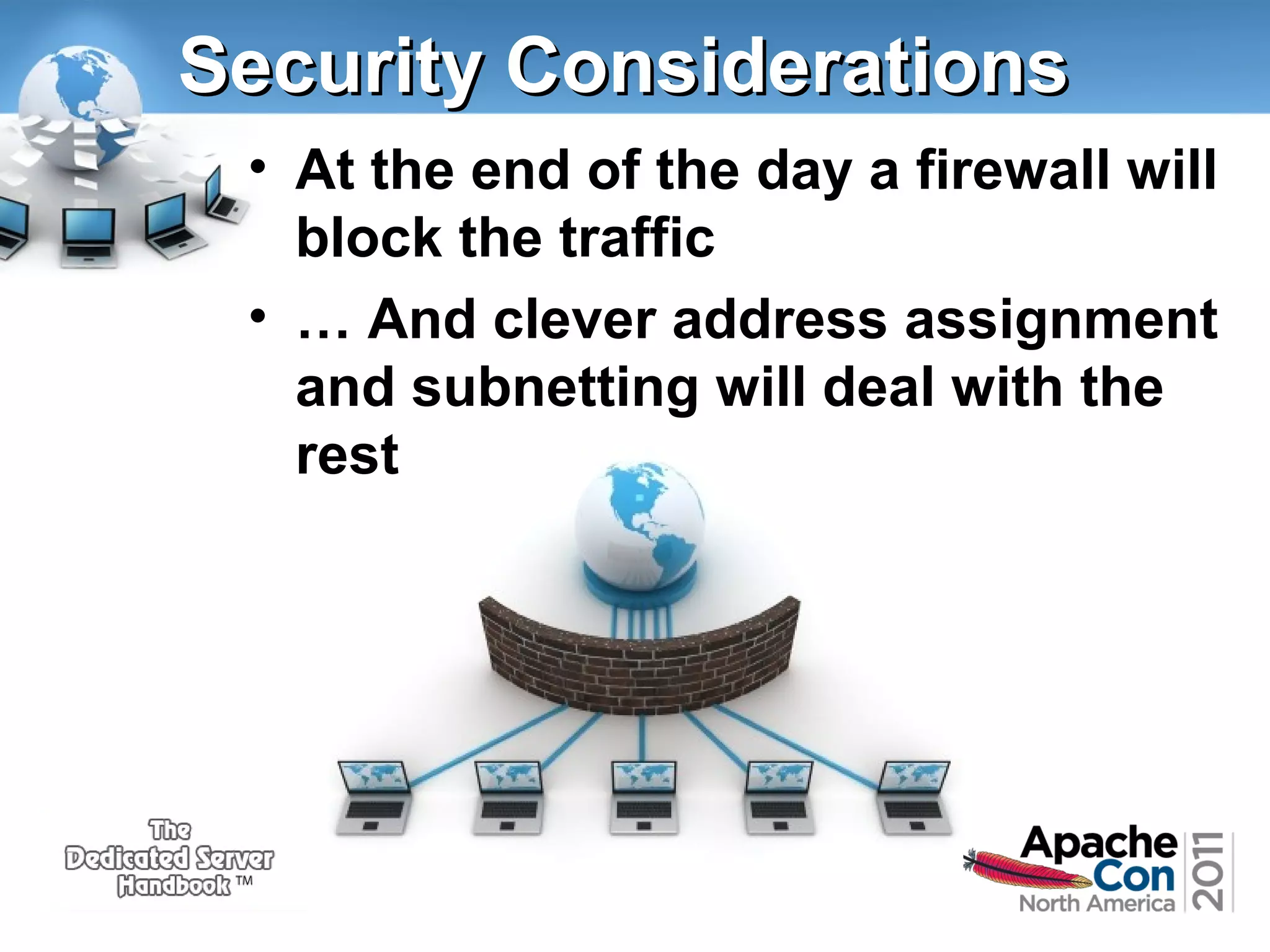
Security Considerations
• At the end of the day a firewall will
block the traffic
• … And clever address assignment
and subnetting will deal with the
rest
That’s All Interesting, But…
Apache HTTP Server
• Supports IPv6 since 2001 (and
documented since 2002)
• 1.3 Supported IPv6 too via an
unofficial patch
• Supports dual-stacking in
VirtualHost directive
• Don’t forget to Listen and
NameVirtualHost too
• That’s all there is to it 
Example Configuration
Thank You!

All About IPv6

  • 1.
  • 2.
    Background • Replacement for IPv4 •Proposed in 1999 • Still not significantly used
  • 3.
    IPv4 vs. IPv6 •32bit addressing VS 128bit addressing • 0.0.0.0 VS :: (or 0::0) • 127.0.0.1 VS ::1 • BIG subnet space (64bits) • Auto-discovery • Link-local + Site-local
  • 4.
    fe80 BLAH • Link-localprefix – similar to 10./192.168./etc in IPv4 (but NOT the same) • (Actually is the same idea as 169.254/16 defined by RFC3330, as used by Microsoft) • Shared by all machines sharing a LAN segment (network link) • Commonly used in IPv6 Autodiscovery
  • 5.
    20:: • Public allocatedaddress space is 20::/8 • The majority of the IPv6 address space is reserved by the IANA “for a rainy day”
  • 6.
    IPv6 Subnetting • • • • • It’s there.It’s supported… But it’s not “supposed” to be used ISPs get a /32 subnet “End user sites” get a /48 subnet Smallest “allocation” is typically a /64 subnet • Although subnets *could* be more or less than 64-bits, the IETF recommends always subnetting exactly 64 bits (even for a point-to-point link between only 2 devices)
  • 7.
    6 to 4Tunnels • Any IPv4 address can be tunneled into the IPv6 network • Hurricane Electric is probably the most popular tunnel broker • Anyone with an IPv4 user can set up a tunnel to fully access IPv6
  • 8.
    IPv4 and IPv6Co-Existence • Most modern OS-es allow for “dual stack” • IPv6 is preferred, and IPv4 used as fallback • Servers and clients both follow the same rules
  • 9.
    Security Considerations • NATblocks your internal network from the public Internet • IPv6 addressing is (hypothetically) publicly routable • NAT hides your internal network structure • IPv6 address could theoretically contain machine-specific identification
  • 10.
    Security Considerations • Atthe end of the day a firewall will block the traffic • … And clever address assignment and subnetting will deal with the rest
  • 11.
  • 12.
    Apache HTTP Server •Supports IPv6 since 2001 (and documented since 2002) • 1.3 Supported IPv6 too via an unofficial patch • Supports dual-stacking in VirtualHost directive • Don’t forget to Listen and NameVirtualHost too • That’s all there is to it 
  • 13.
  • 14.

Editor's Notes

  • #7 RFC4291 RFC3627-section4