Collect data on IP ‘structure’ elements 
through structured interviews of IP 
facilitators or secretariat 
Refer to the IP’s objec<ves as determined 
by its members to iden<fy ‘performance’ 
elements 
Conduct focus groups of IP members to 
iden<fy: 
•  Field‐relevant statements to 
characterize elements of IP ‘conduct’ 
and ‘performance’ 
•  Locally relevant thresholds for a five‐
point indicator of wealth 
•  Qualita<ve narra<ves to illustrate the 
conceptual framework 
Individual survey of IP members to collect 
individual ‘structure’ elements and rank 
their agreement with statements 
characterizing ‘conduct’ and ‘performance’ 
on 5‐rank Likert scale 
Unlocking livestock development potential through science, influence and capacity development
ILRI APM, Addis Ababa, 15-17 May 2013
Developing capacity Influencing decisions
Field tes<ng an econometric conceptual framework for 
innova<on plaHorm impact assessment 
This document is licensed for use under a Crea3ve Commons A6ribu3on‐Noncommercial‐Share Alike 3.0 Unported Lisence        May 2013 
3 strategic lessons on: 
1.  ILRI research fellows will obtain their 
MSc degree 
2.  Local field partners will get more 
familiar with IP evalua<on methods 
3.  IP members will become aware of the 
importance of evalua<ng their ac<vi<es 
1.  IP facilitators can invest their scarce 
resources on facilita<ng elements that 
most affect  IP performance 
2.  Evidence to beneficiaries that IPs work 
3.  Evidence to donors that IPs are a good 
investment to reach outcomes 
Jean‐Joseph CADILHON, Agricultural Economist, Policy Trade and Value Chains Program, ILRI –  j.cadilhon@cgiar.org 
Delivering science
ILRI has been establishing IPs as equitable, 
dynamic spaces designed to bring 
heterogeneous actors together to 
exchange knowledge and take ac<on to 
solve a common problem 
Methods to assess the impact of IPs have 
mainly used qualita<ve methods or cost–
benefit analysis 
There are no previous examples of using 
quan<ta<ve econometric tools to evaluate 
the impact of innova<on plaHorms  
1.  More robust results expected from 
informa<on triangula<on 
2.  First a^empt to evaluate IPs with 
quan<ta<ve method 
3.  Scien<fic research with high impact & 
publica<on poten<al 
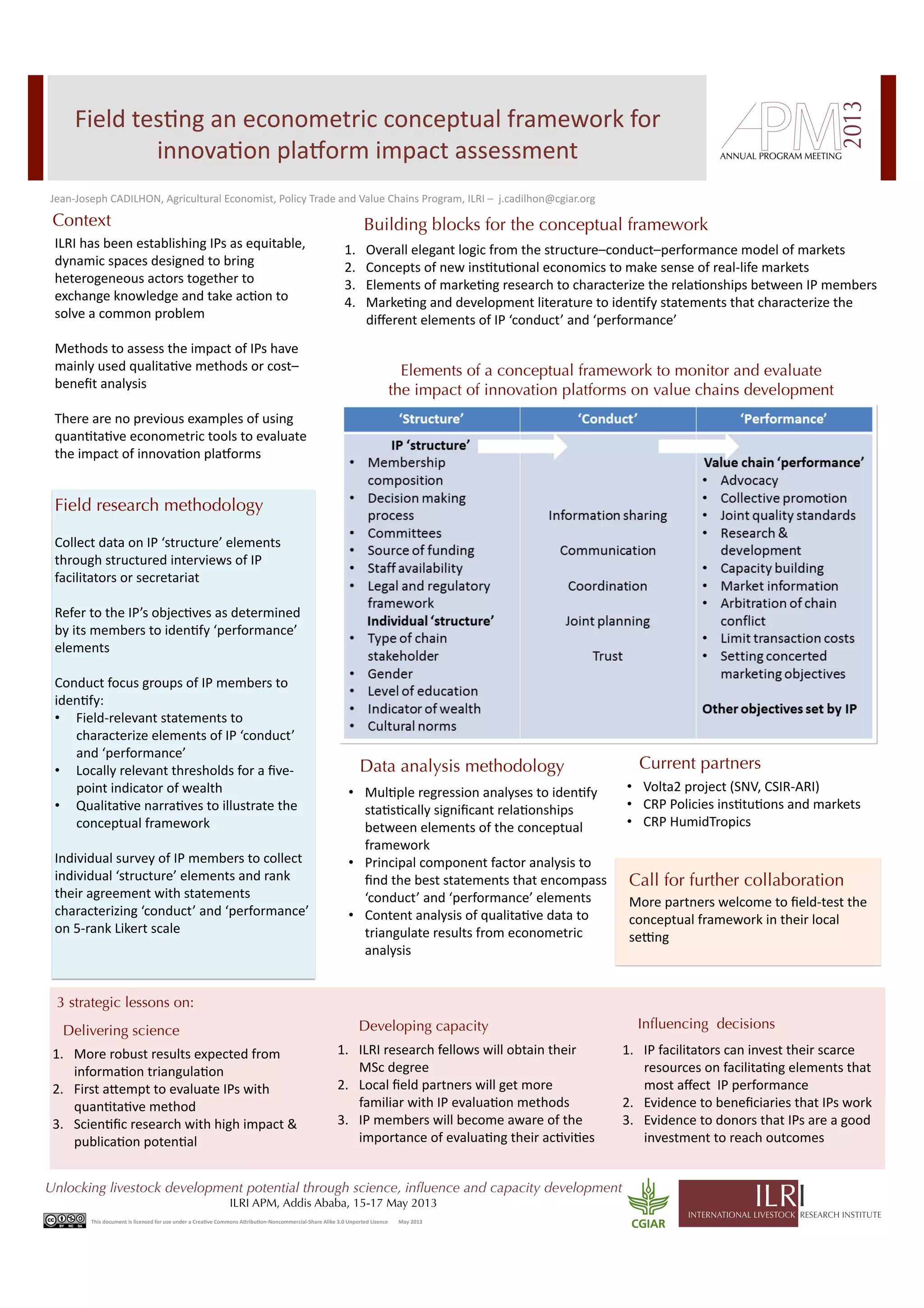
Elements of a conceptual framework to monitor and evaluate 
the impact of innovation platforms on value chains development
Context
•  Mulple regression analyses to idenfy 
stascally significant relaonships 
between elements of the conceptual 
framework 
•  Principal component factor analysis to 
find the best statements that encompass 
‘conduct’ and ‘performance’ elements 
•  Content analysis of qualitave data to 
triangulate results from econometric 
analysis 
1.  Overall elegant logic from the structure–conduct–performance model of markets 
2.  Concepts of new instuonal economics to make sense of real‐life markets 
3.  Elements of markeng research to characterize the relaonships between IP members 
4.  Markeng and development literature to idenfy statements that characterize the 
different elements of IP ‘conduct’ and ‘performance’ 
Building blocks for the conceptual framework
Field research methodology
•  Volta2 project (SNV, CSIR‐ARI) 
•  CRP Policies instuons and markets 
•  CRP HumidTropics 
Data analysis methodology Current partners
Call for further collaboration
More partners welcome to field‐test the 
conceptual framework in their local 
secng 

Field testing an econometric conceptual framework for innovation platform impact assessment

  • 1.
    Collect data on IP ‘structure’ elements  through structured interviews of IP  facilitators or secretariat  Refer to the IP’s objec<ves as determined  by its members to iden<fy ‘performance’  elements  Conduct focus groups of IP members to  iden<fy:  •  Field‐relevant statements to  characterize elements of IP ‘conduct’  and ‘performance’  •  Locally relevant thresholds for a five‐ point indicator of wealth  • Qualita<ve narra<ves to illustrate the  conceptual framework  Individual survey of IP members to collect  individual ‘structure’ elements and rank  their agreement with statements  characterizing ‘conduct’ and ‘performance’  on 5‐rank Likert scale  Unlocking livestock development potential through science, influence and capacity development ILRI APM, Addis Ababa, 15-17 May 2013 Developing capacity Influencing decisions Field tes<ng an econometric conceptual framework for  innova<on plaHorm impact assessment  This document is licensed for use under a Crea3ve Commons A6ribu3on‐Noncommercial‐Share Alike 3.0 Unported Lisence        May 2013  3 strategic lessons on:  1.  ILRI research fellows will obtain their  MSc degree  2.  Local field partners will get more  familiar with IP evalua<on methods  3.  IP members will become aware of the  importance of evalua<ng their ac<vi<es  1.  IP facilitators can invest their scarce  resources on facilita<ng elements that  most affect  IP performance  2.  Evidence to beneficiaries that IPs work  3.  Evidence to donors that IPs are a good  investment to reach outcomes  Jean‐Joseph CADILHON, Agricultural Economist, Policy Trade and Value Chains Program, ILRI –  j.cadilhon@cgiar.org  Delivering science ILRI has been establishing IPs as equitable,  dynamic spaces designed to bring  heterogeneous actors together to  exchange knowledge and take ac<on to  solve a common problem  Methods to assess the impact of IPs have  mainly used qualita<ve methods or cost– benefit analysis  There are no previous examples of using  quan<ta<ve econometric tools to evaluate  the impact of innova<on plaHorms   1.  More robust results expected from  informa<on triangula<on  2.  First a^empt to evaluate IPs with  quan<ta<ve method  3.  Scien<fic research with high impact &  publica<on poten<al  Elements of a conceptual framework to monitor and evaluate the impact of innovation platforms on value chains development Context •  Mulple regression analyses to idenfy  stascally significant relaonships  between elements of the conceptual  framework  •  Principal component factor analysis to  find the best statements that encompass  ‘conduct’ and ‘performance’ elements  •  Content analysis of qualitave data to  triangulate results from econometric  analysis  1.  Overall elegant logic from the structure–conduct–performance model of markets  2.  Concepts of new instuonal economics to make sense of real‐life markets  3.  Elements of markeng research to characterize the relaonships between IP members  4.  Markeng and development literature to idenfy statements that characterize the  different elements of IP ‘conduct’ and ‘performance’  Building blocks for the conceptual framework Field research methodology •  Volta2 project (SNV, CSIR‐ARI)  •  CRP Policies instuons and markets  •  CRP HumidTropics  Data analysis methodology Current partners Call for further collaboration More partners welcome to field‐test the  conceptual framework in their local  secng