Francesco Sylos Labini
Science and Crisis
• What am I doing here ?
• The European crisis
• The Italian crisis
• The international crisis
• The Harvard here model
• Excellence versus Reality
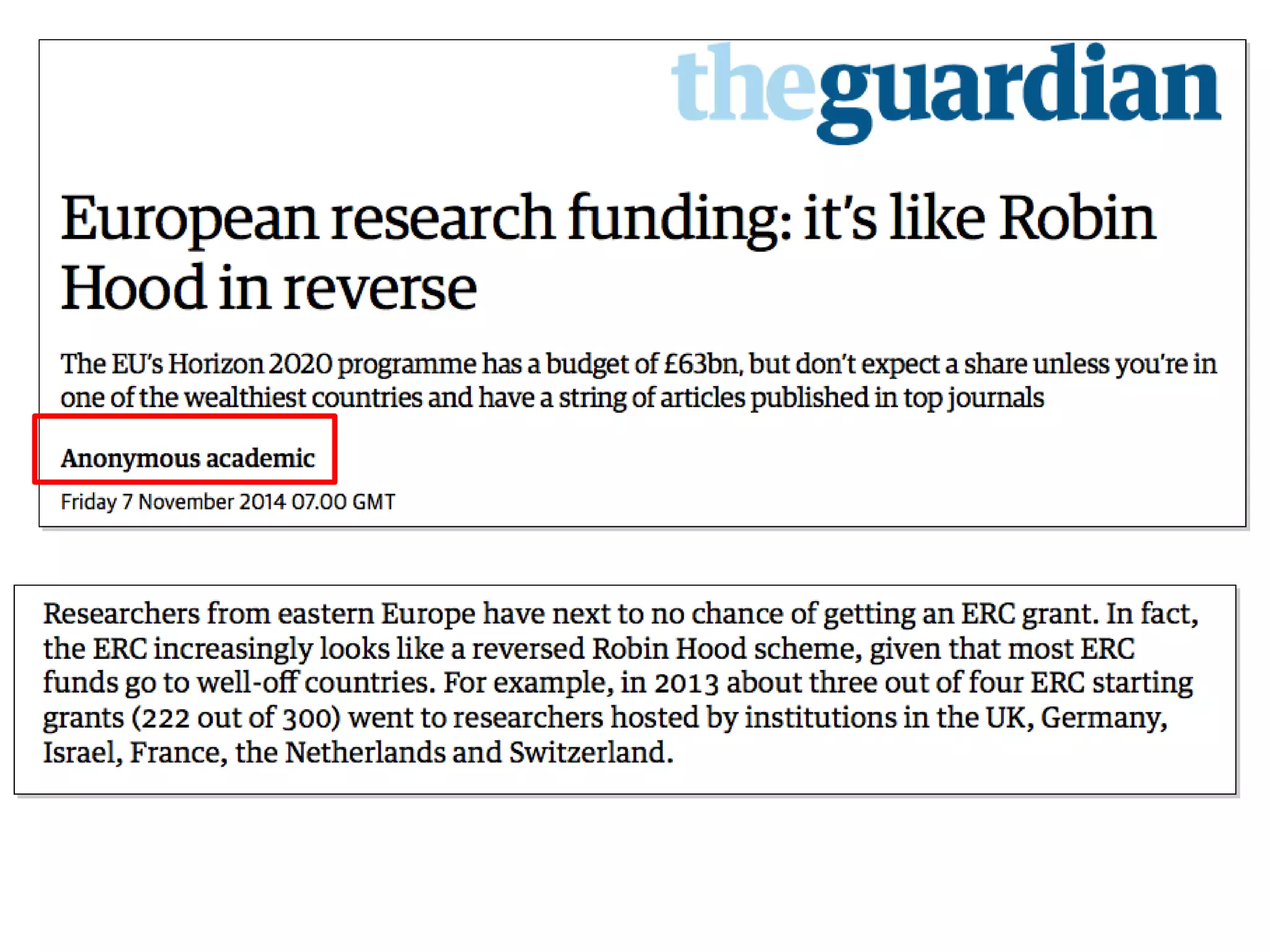
• The EC science policy: Robin Hood in reverse
• Research and risk
• Perspectives
Outline
• What am I doing here ?
• The European crisis
• The Italian crisis
• The international crisis
• The Harvard here model
• Excellence versus Reality
• The EC science policy: Robin Hood in reverse
• Research and risk
• Perspectives
Outline
• Founded by 8 scientists (hard/social science, humanities)
• 14 editors (HS, SS, Hum + students, librarian, journalist)
• About 200 contributors
• In three years 2100 articles (1-2 articles per day)
• More than 30,000 comments
• More than 11 millions visits
• Average 10,000 visits/day - peak value 35,000 visits/day
• About 3,000 followers on Twitter
• About 10,000 members in the Facebook group  
http://openletter.euroscience.org/
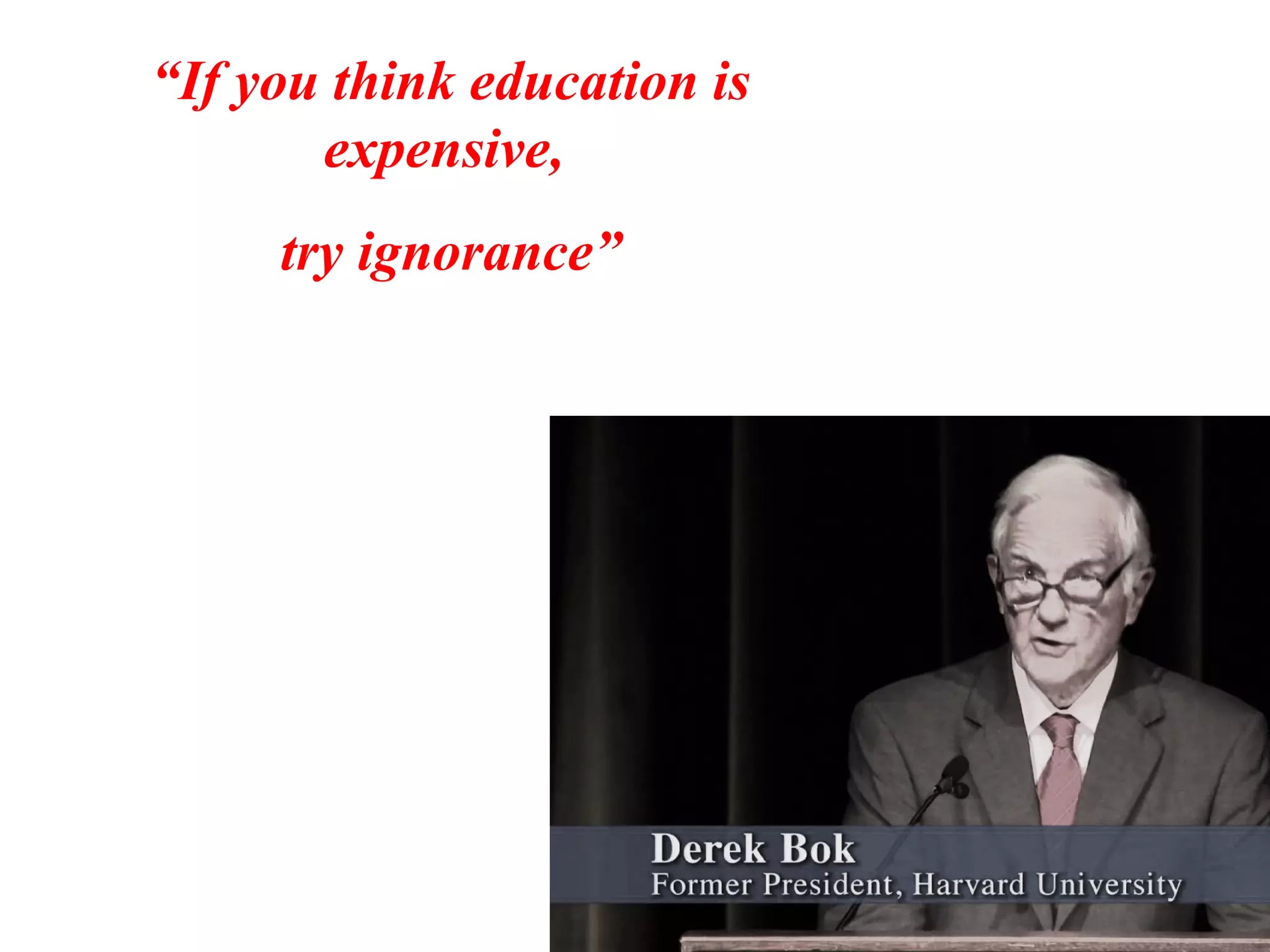
“If you think education is
expensive,
try ignorance”
• What am I doing here ?
• The European crisis
• The Italian crisis
• The international crisis
• The Harvard here model
• Excellence versus Reality
• The EC science policy: Robin Hood in reverse
• Research and risk
• Perspectives
Outline
• Its aim was to make the EU “the most competitive and dynamic
knowledge-based economy in the world capable of sustainable
economic growth with more and better jobs and greater social
cohesion”, by 2010
• Leveraging investment in R&D became a key element of this
strategy following the Barcelona European Council’s objective to
raise overall R&D investment to 3% of GDP by 2010.
The Lisbon Strategy (March 2000)
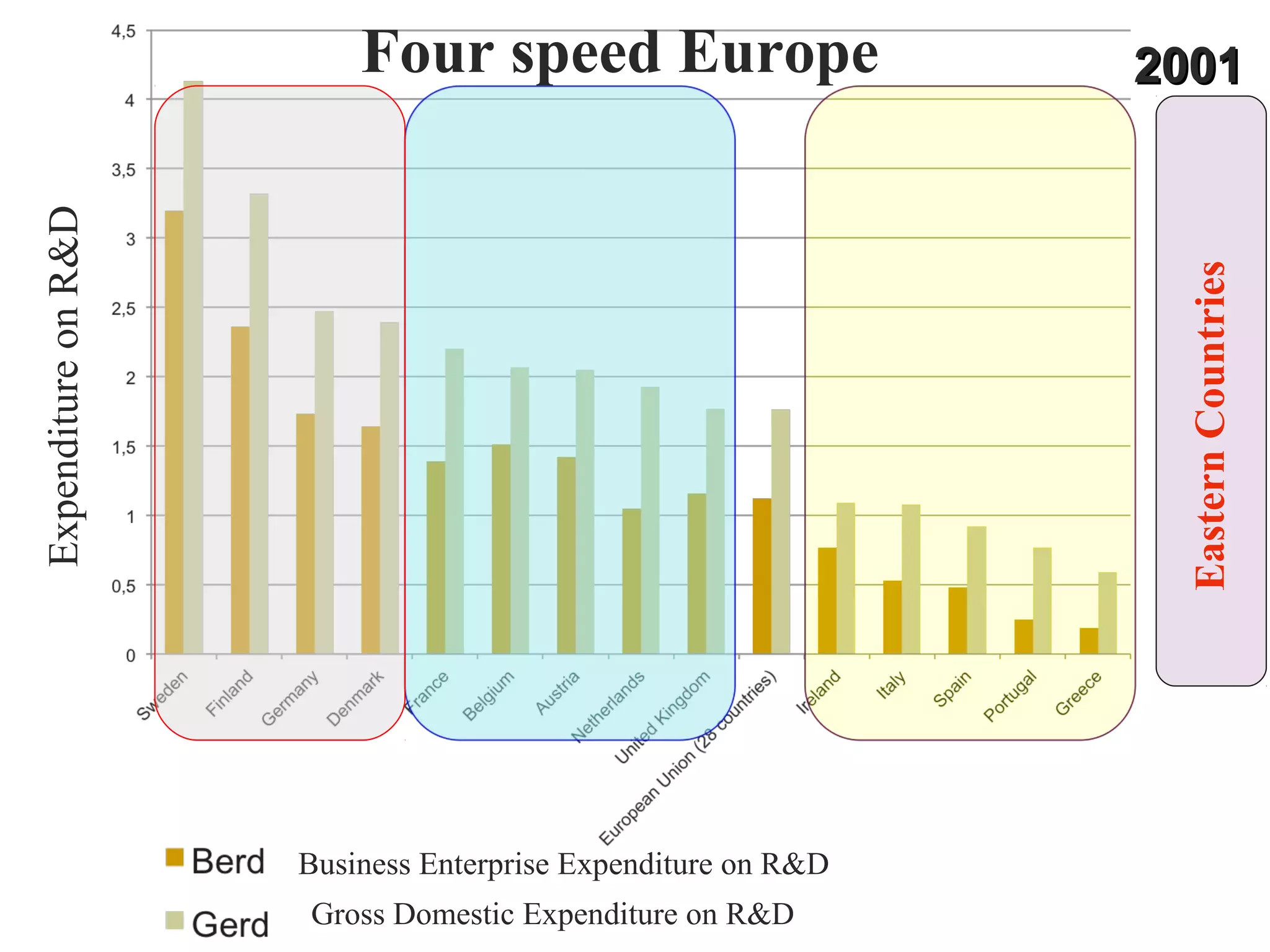
20012001
Gross Domestic Expenditure on R&D
Business Enterprise Expenditure on R&D
ExpenditureonR&D
EasternCountries
Four speed Europe
20122012
ExpenditureonR&D
EasternCountries
Four speed Europe
Researchers/1000 workers in business enterprises
Finland
Danmark
Sweden
France
Austria
Ireland
Belgium
Germany
EU15
Netherland
EU28
UK
Spain
Portugal
Italy
Greece
Finland
Danmark
Sweden
France
Austria
Ireland
Belgium
Germany
EU15
Netherland
EU28
UK
Spain
Portugal
Italy
Greece
Total unemployment
Youth
Unemployment
> 45%
30%-45%
20%-30%
<10%
NonEU
10%-20%
• What am I doing here ?
• The European crisis
• The Italian crisis
• The international crisis
• The Harvard here model
• Excellence versus Reality
• The EC science policy: Robin Hood in reverse
• Research and risk
• Perspectives
Outline
• Reformation process of higher education
• Heavy financial cuts
• Introduction of a research evaluation agency (ANVUR) that
performed a controversial research assessment exercise and
played a key role in the definition of the new hiring rules for
academic staff and in the distribution of funding to the
“excellence poles”.
(see FSL http://www.euroscientist.com/sake-italian-science-culture/)
The Italian crisis
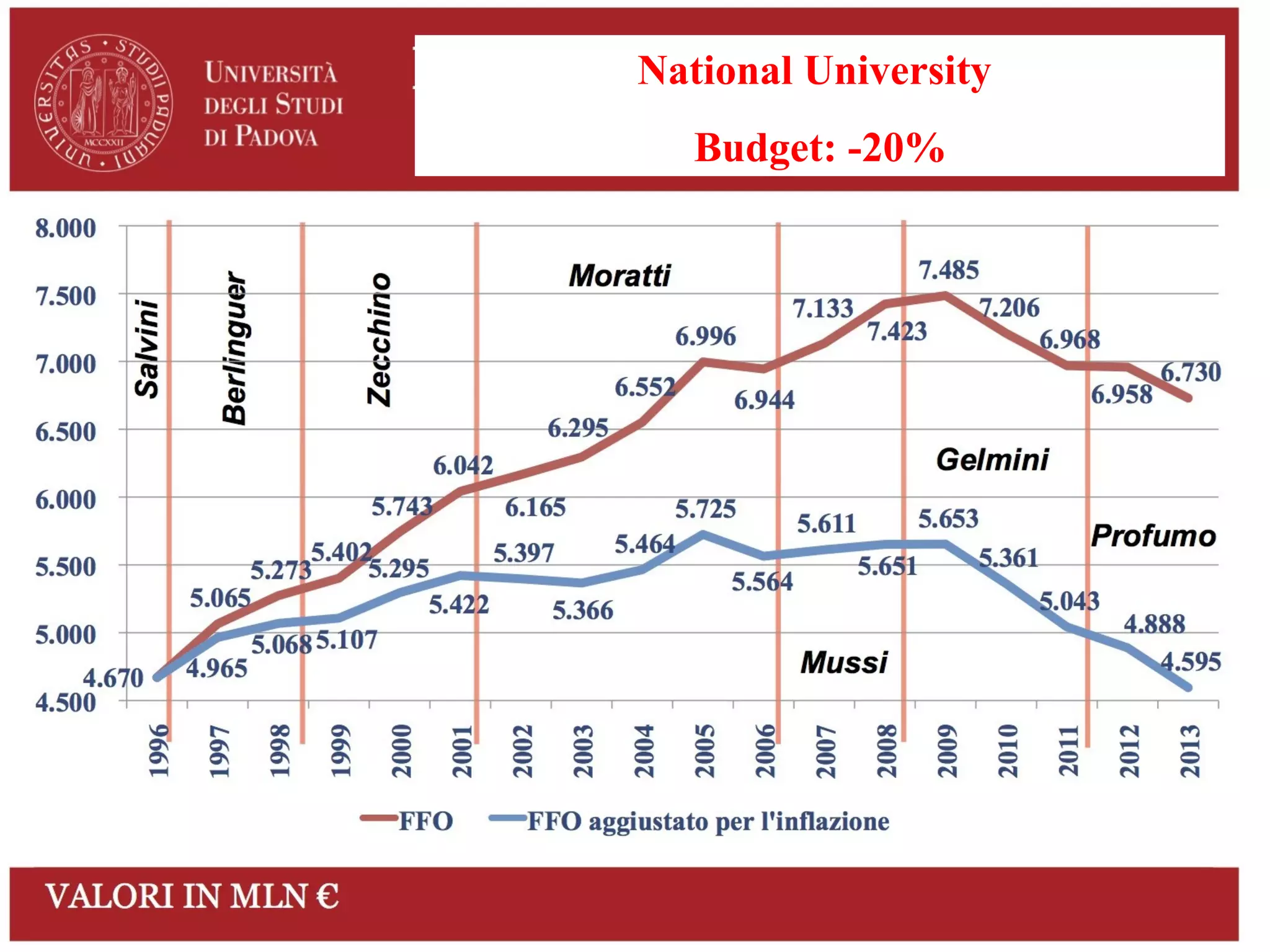
National University
Budget: -20%
Budget for curiosity driven
research projects: -100 %
Roma 21 febbraio 2014 Paolo Rossi 26
Number of professors+researchers:
-20%
Roma 21 febbraio 2014 Paolo Rossi 27
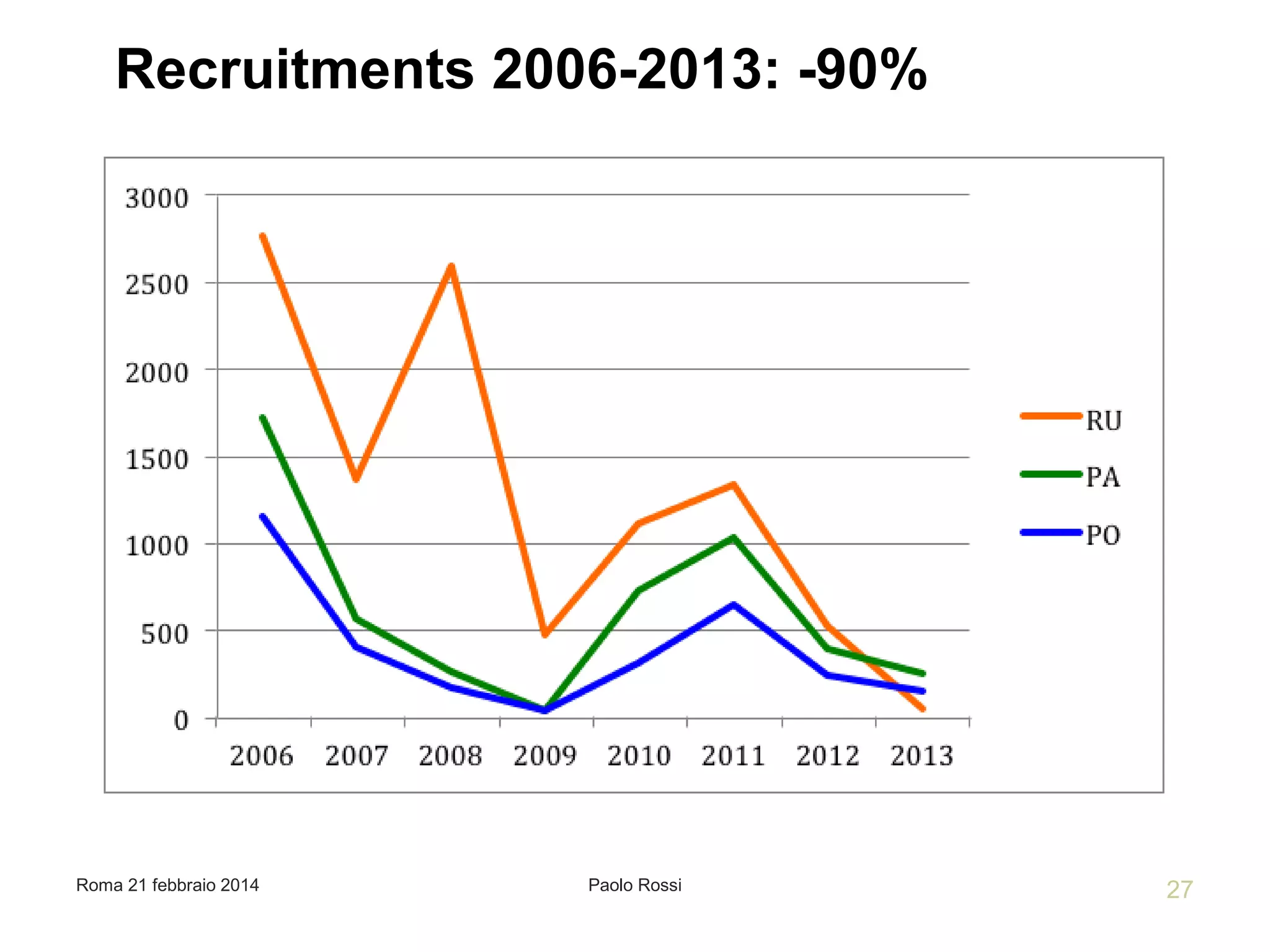
Recruitments 2006-2013: -90%
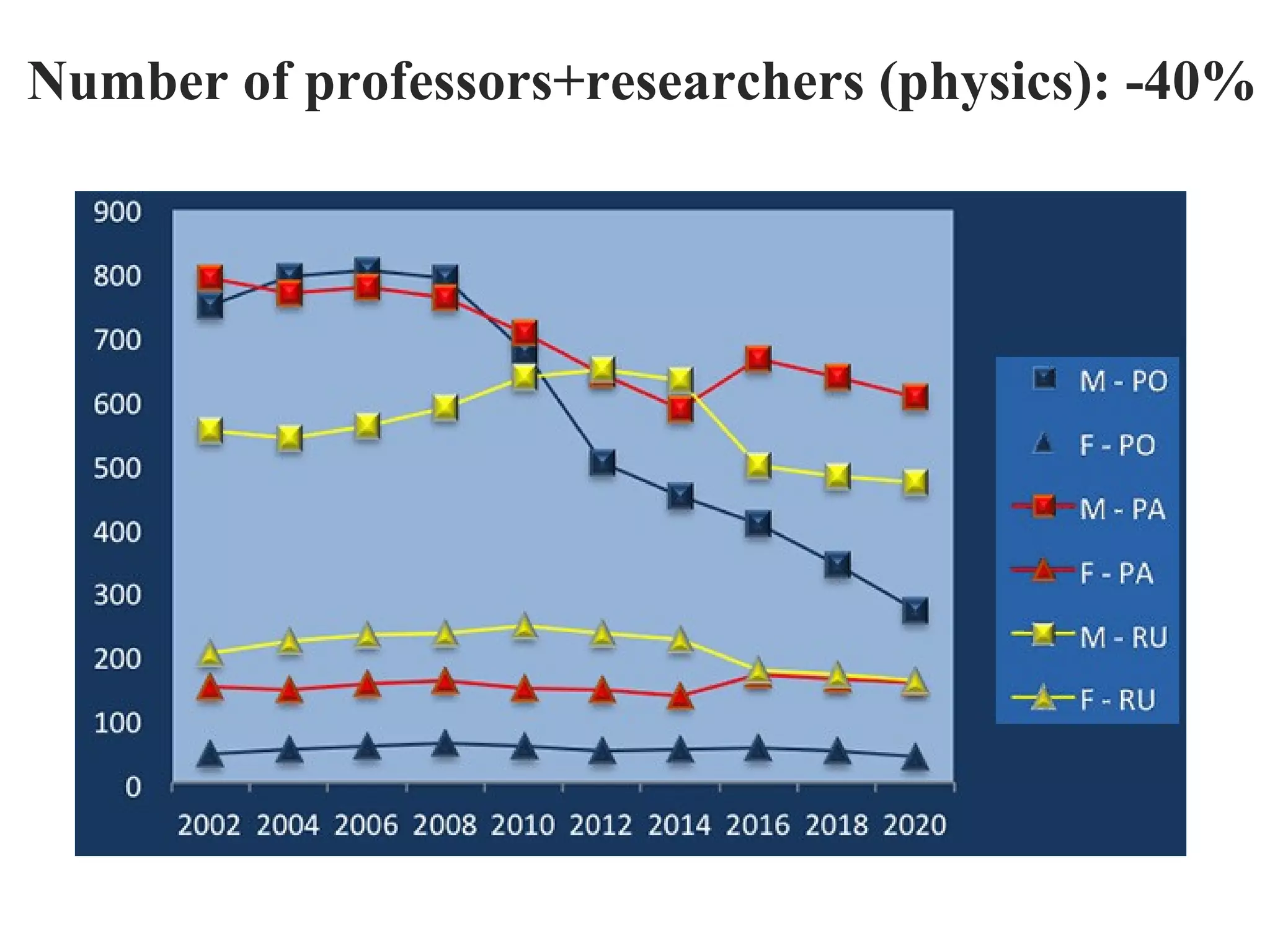
Number of professors+researchers (physics): -40%
29
Number of non permanent staff: : + 100%
Number of tenure tracks -90%
• What am I doing here ?
• The European crisis
• The Italian crisis
• The international crisis
• The Harvard here model
• Excellence versus Reality
• The EC science policy: Robin Hood in reverse
• Research and risk
• Perspectives
Outline
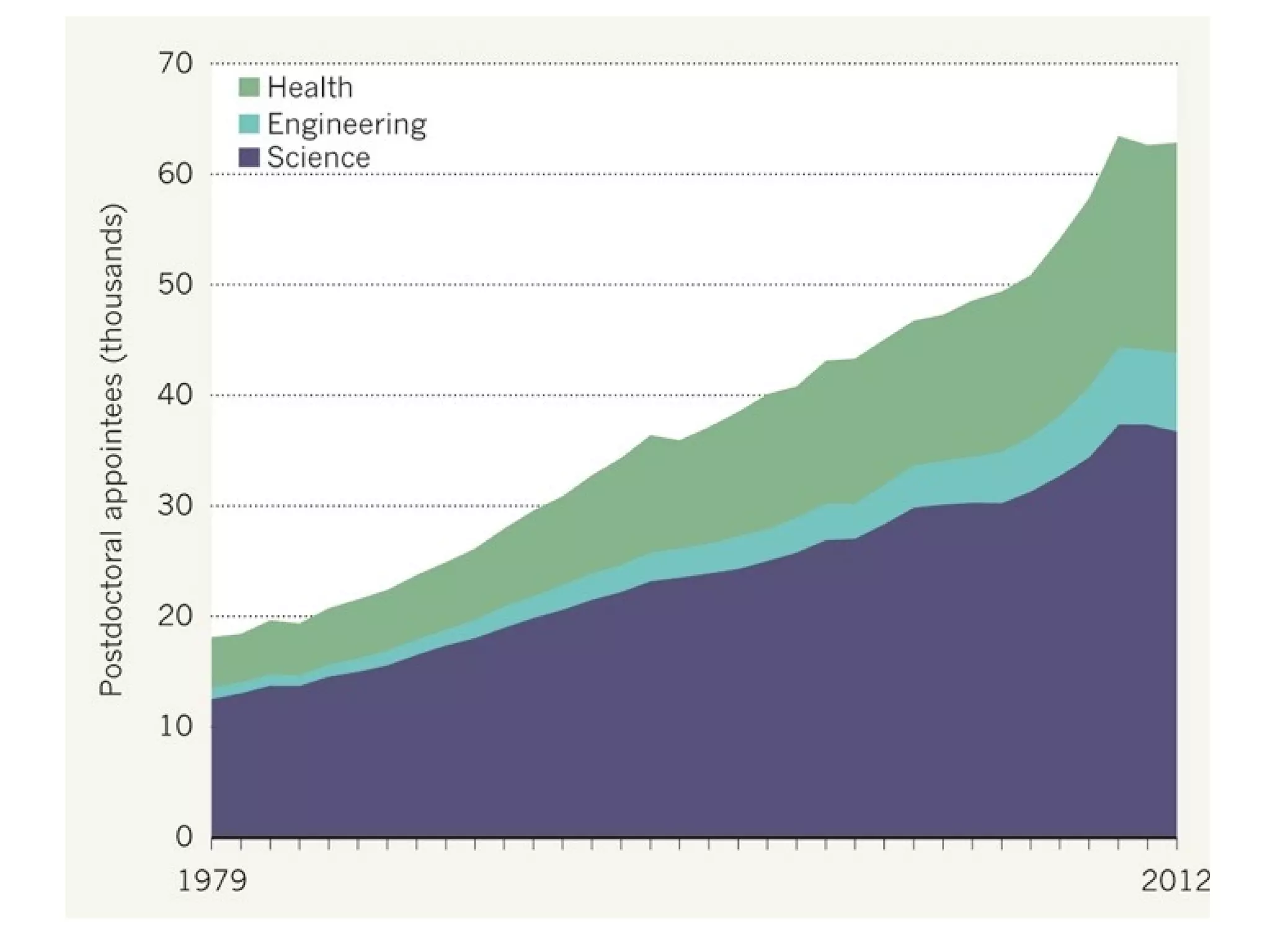
• Increasing number of scientific articles but more rapid
increasing number of retractions
• Increasing role of tecno-evaluation
• Large number of PhD and Postdoc with low salaries
and little possibility of obtaining a permanent position
• Small number of élite researchers
The international crisis:
some evidences
• What am I doing here ?
• The European crisis
• The Italian crisis
• The international crisis
• The Harvard here model
• Excellence versus Reality
• The EC science policy: Robin Hood in reverse
• Research and risk
• Perspectives
Outline
Present day higher
education and
research policy
“The rich gets
richer and the poor
gets poorer”
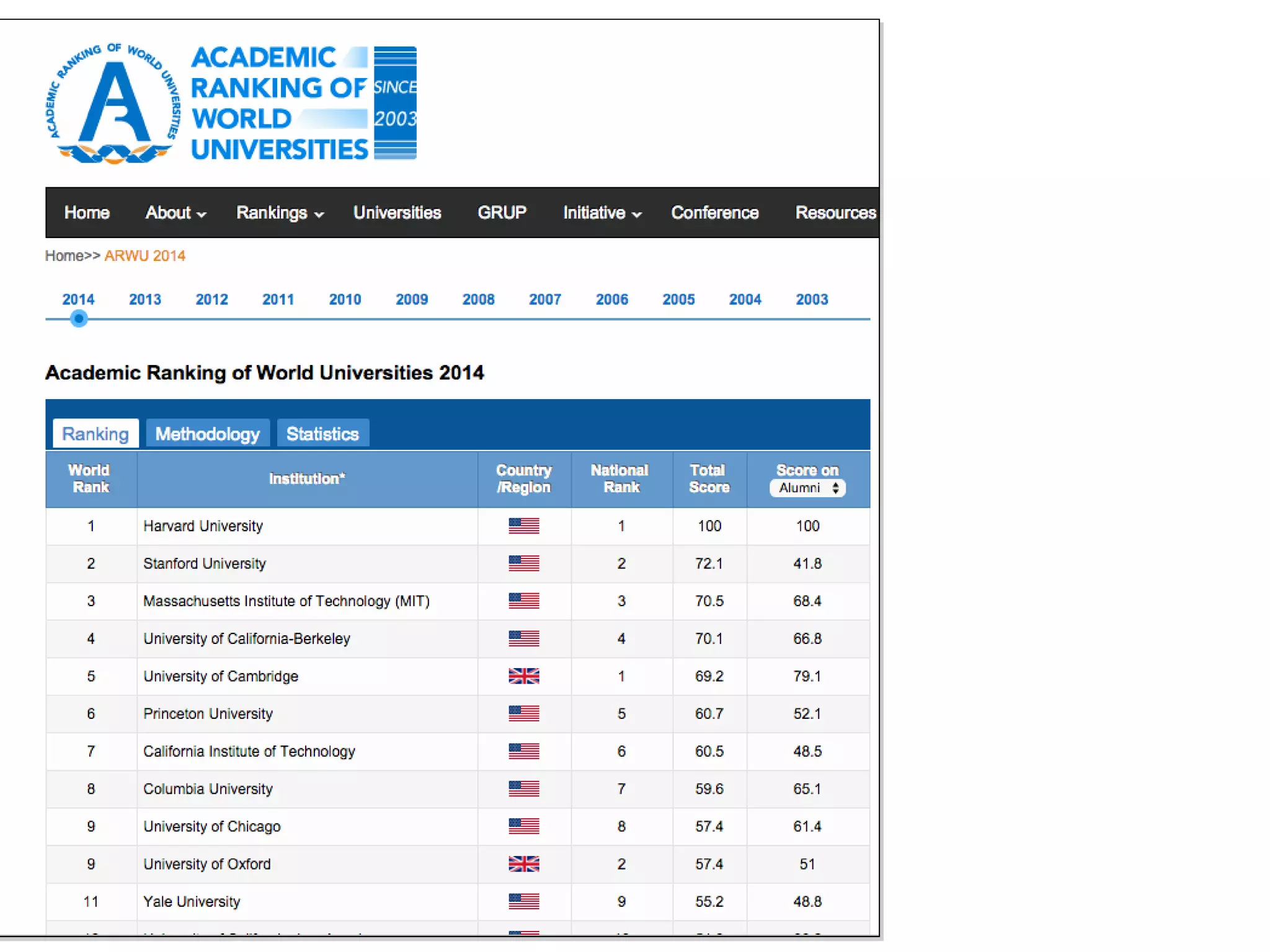
‘Harvard Here’ Model
• For many governments, the world­class university has become
the panacea for ensuring success in the global economy. This is
especially true in the aftermath of the global financial crisis,
albeit the trends were apparent before this.
‘Harvard Here’ Model
• For many governments, the world­class university has become
the panacea for ensuring success in the global economy. This is
especially true in the aftermath of the global financial crisis,
albeit the trends were apparent before this.
• Institutions and nations are constantly measured against each
other using indicators of global capacity and potential in which
comparative and competitive advantages come into play, as part
of a wider geo-political struggle.
‘Harvard Here’ Model
• For many governments, the world­class university has become
the panacea for ensuring success in the global economy. This is
especially true in the aftermath of the global financial crisis,
albeit the trends were apparent before this.
• Institutions and nations are constantly measured against each
other using indicators of global capacity and potential in which
comparative and competitive advantages come into play, as part
of a wider geo-political struggle.
• These factors are driving governments and institutions to make
profound changes to their higher education systems, pursue
more elite agendas, alter their education programmes and
privilege some disciplines and fields of inquiry in order to
conform to indicators set by global rankings.
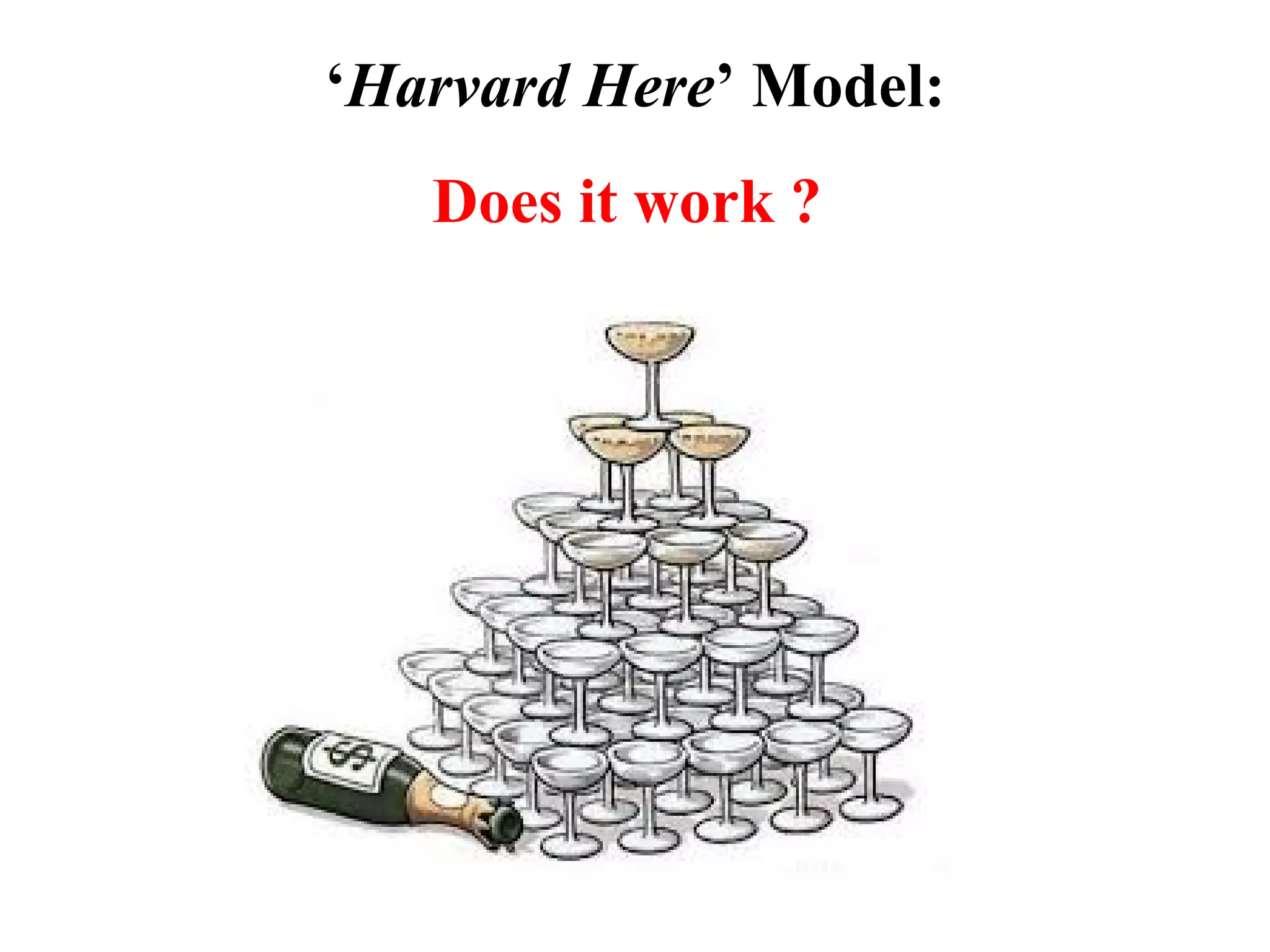
‘Harvard Here’ Model:
Does it work ?
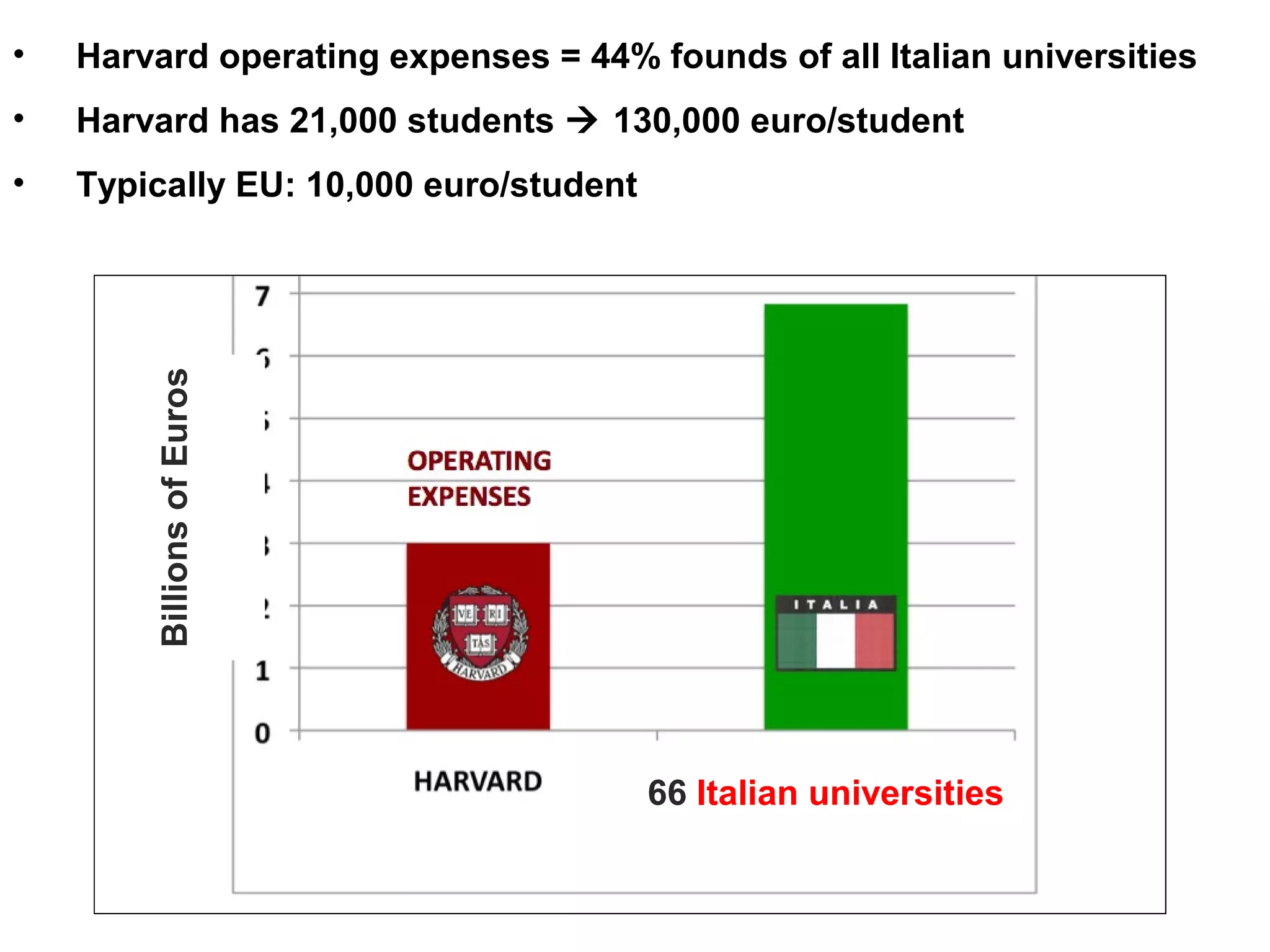
• Harvard operating expenses = 44% founds of all Italian universities
• Harvard has 21,000 students  130,000 euro/student
• Typically EU: 10,000 euro/student
66 Italian universities
BillionsofEuros
Number of universities per million people
Other research institutes
Universities
Other research institutes
Universities
USA FR DE NL UK ES IT
‘Harvard Here’ Model
• What am I doing here ?
• The European crisis
• The Italian crisis
• The international crisis
• The Harvard here model
• Excellence versus Reality
• The EC science policy: Robin Hood in reverse
• Research and risk
• Perspectives
Outline
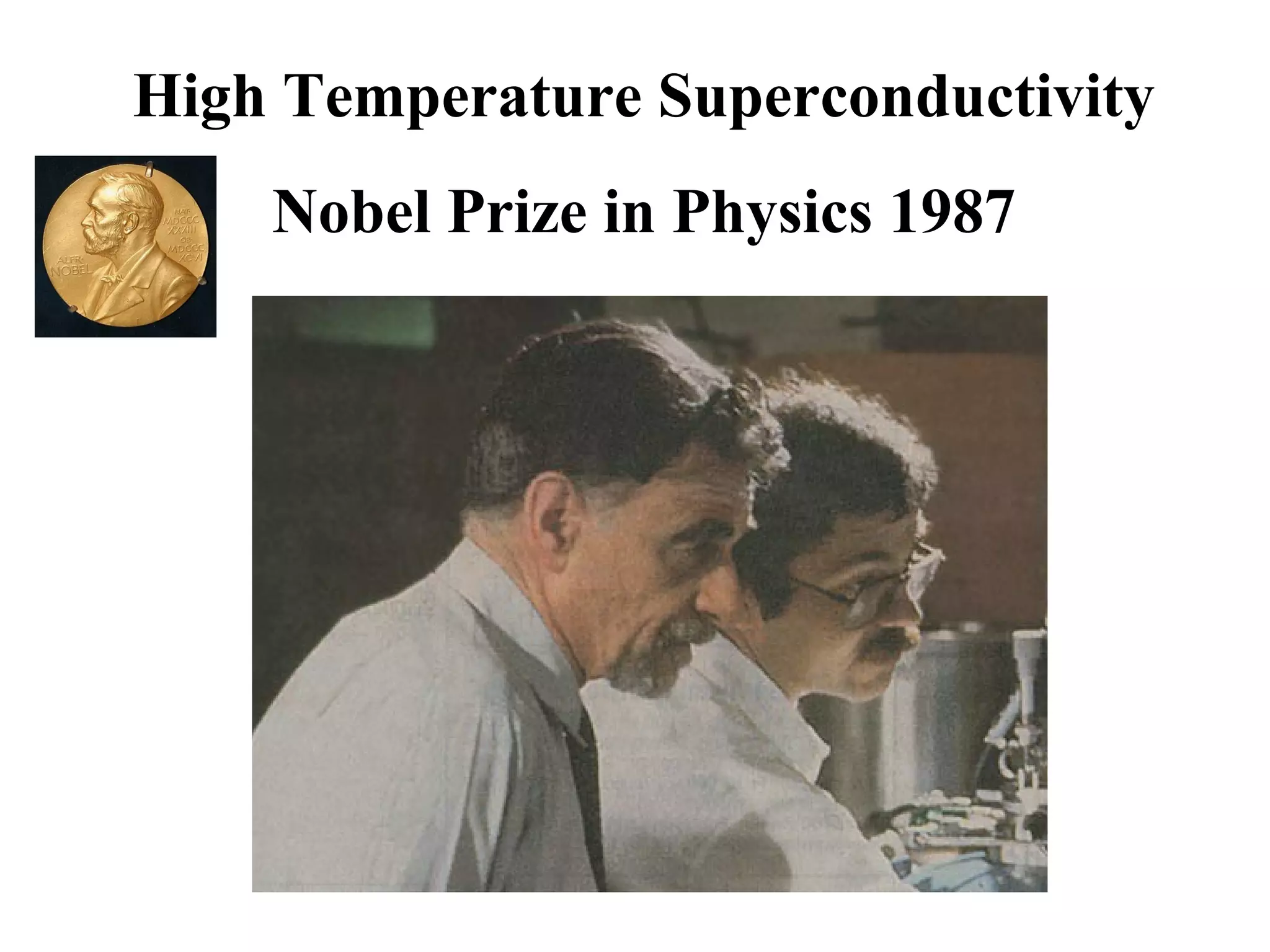
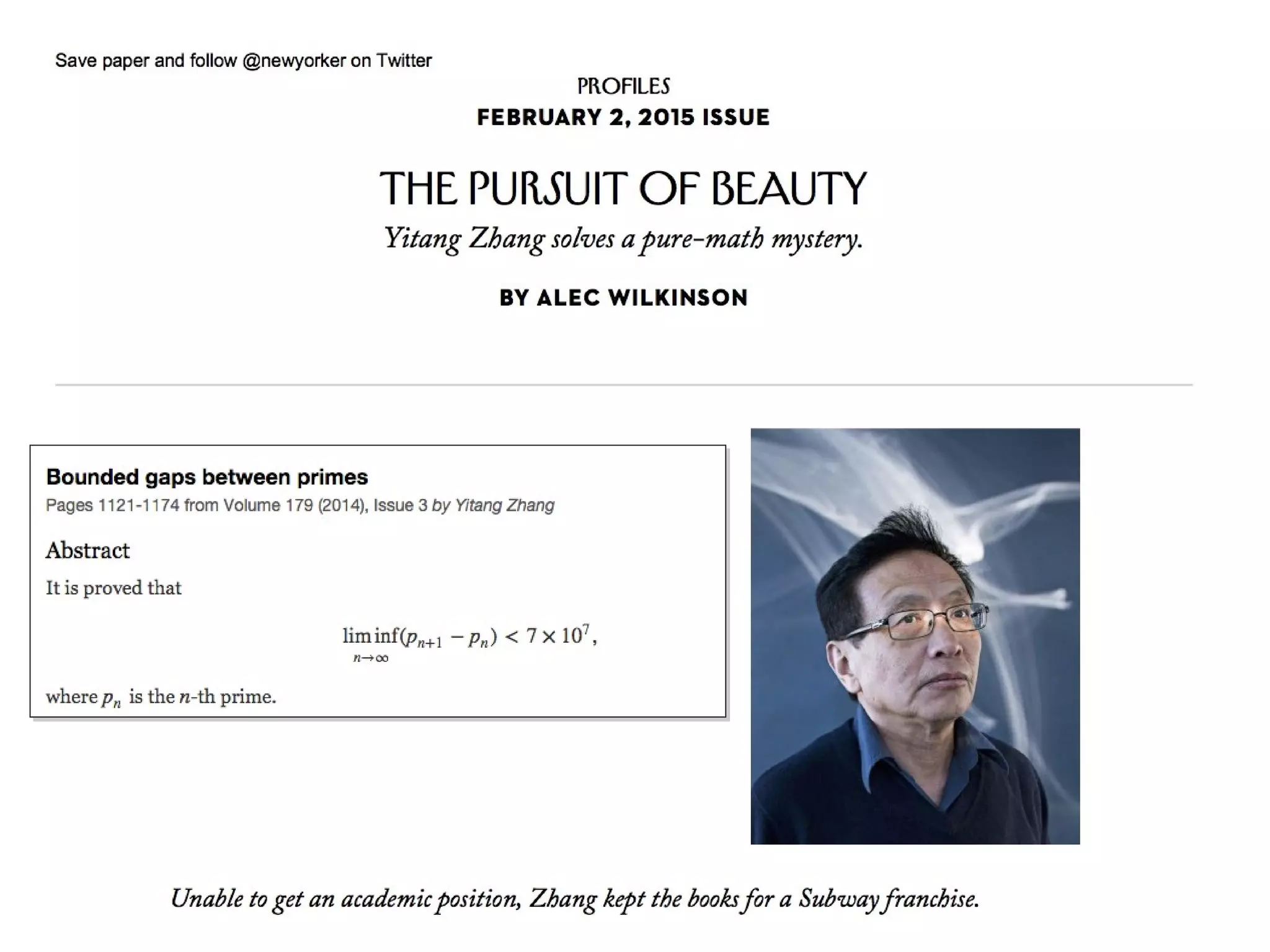
High Temperature Superconductivity
Nobel Prize in Physics 1987
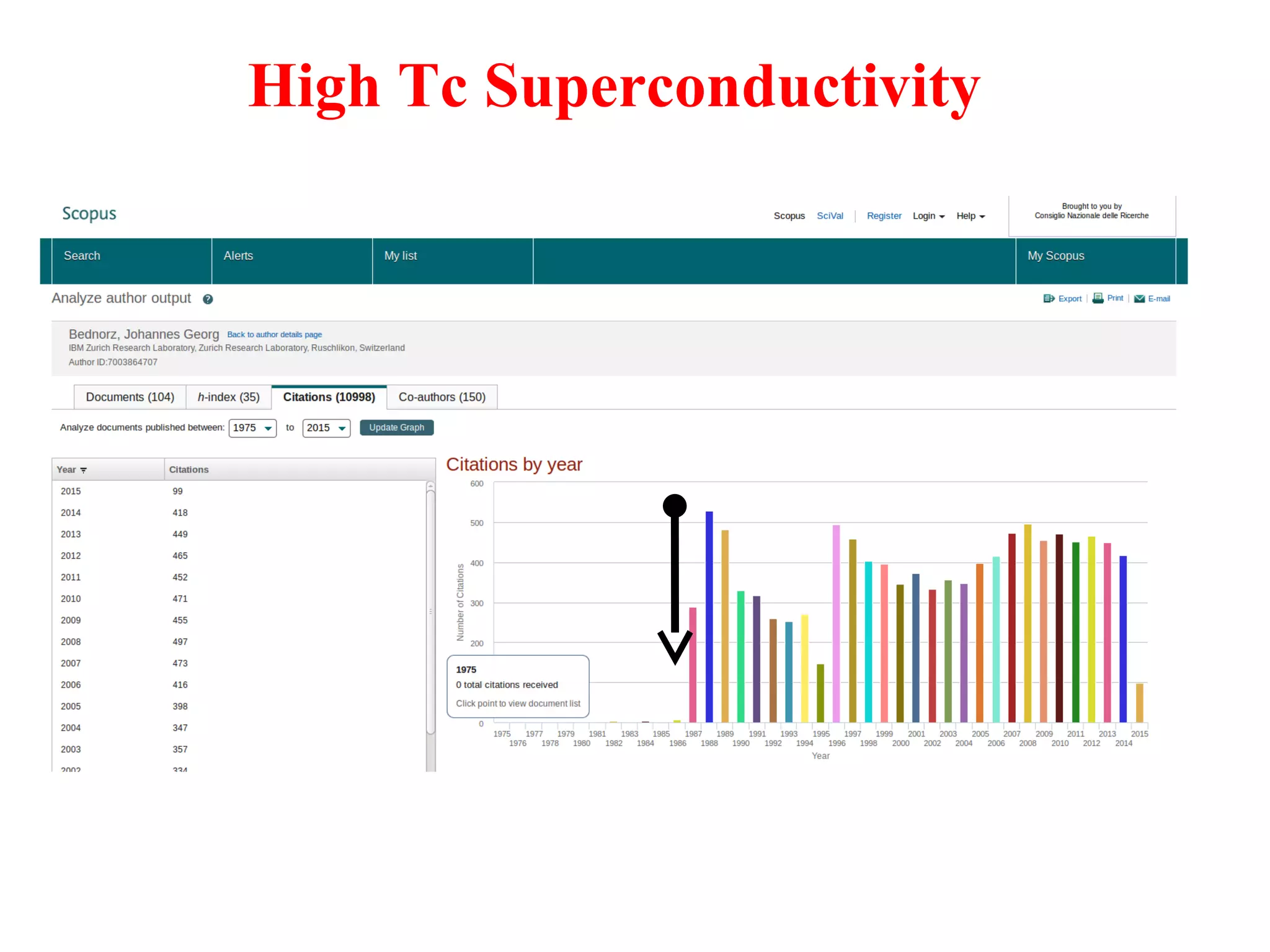
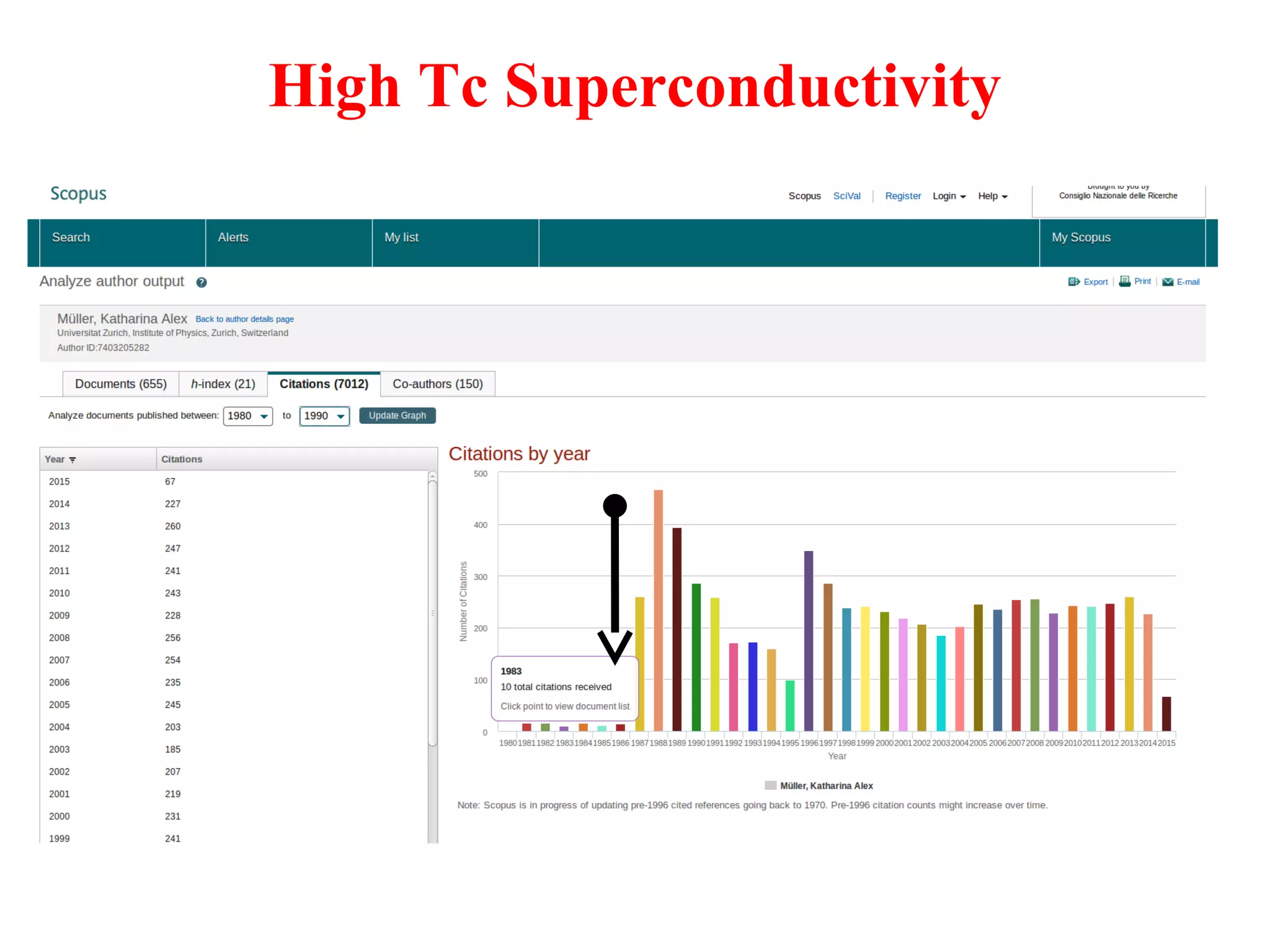
High Tc Superconductivity
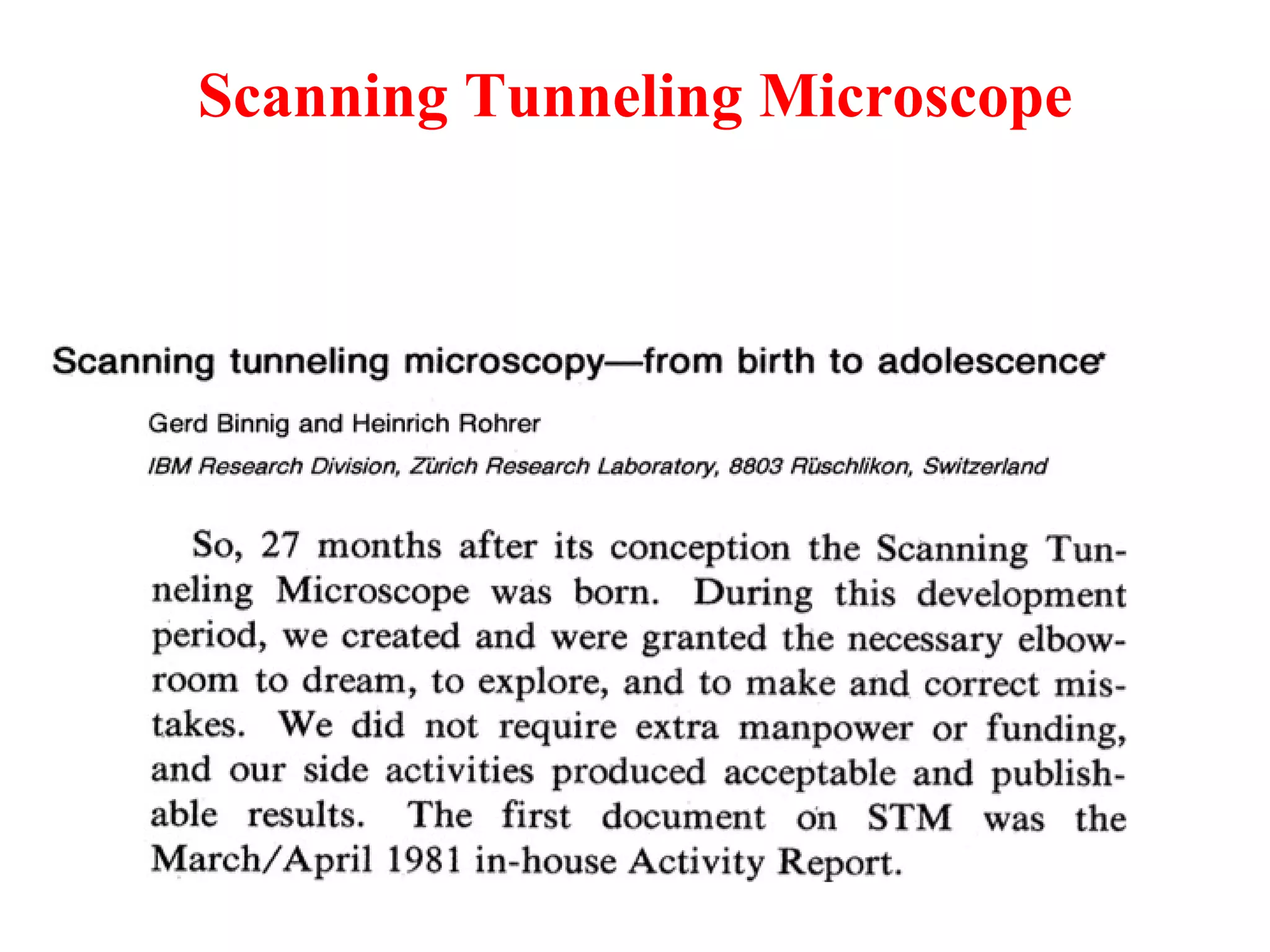
Scanning Tunneling microscope
Nobel Prize in Physics 1986
Scanning Tunneling Microscope
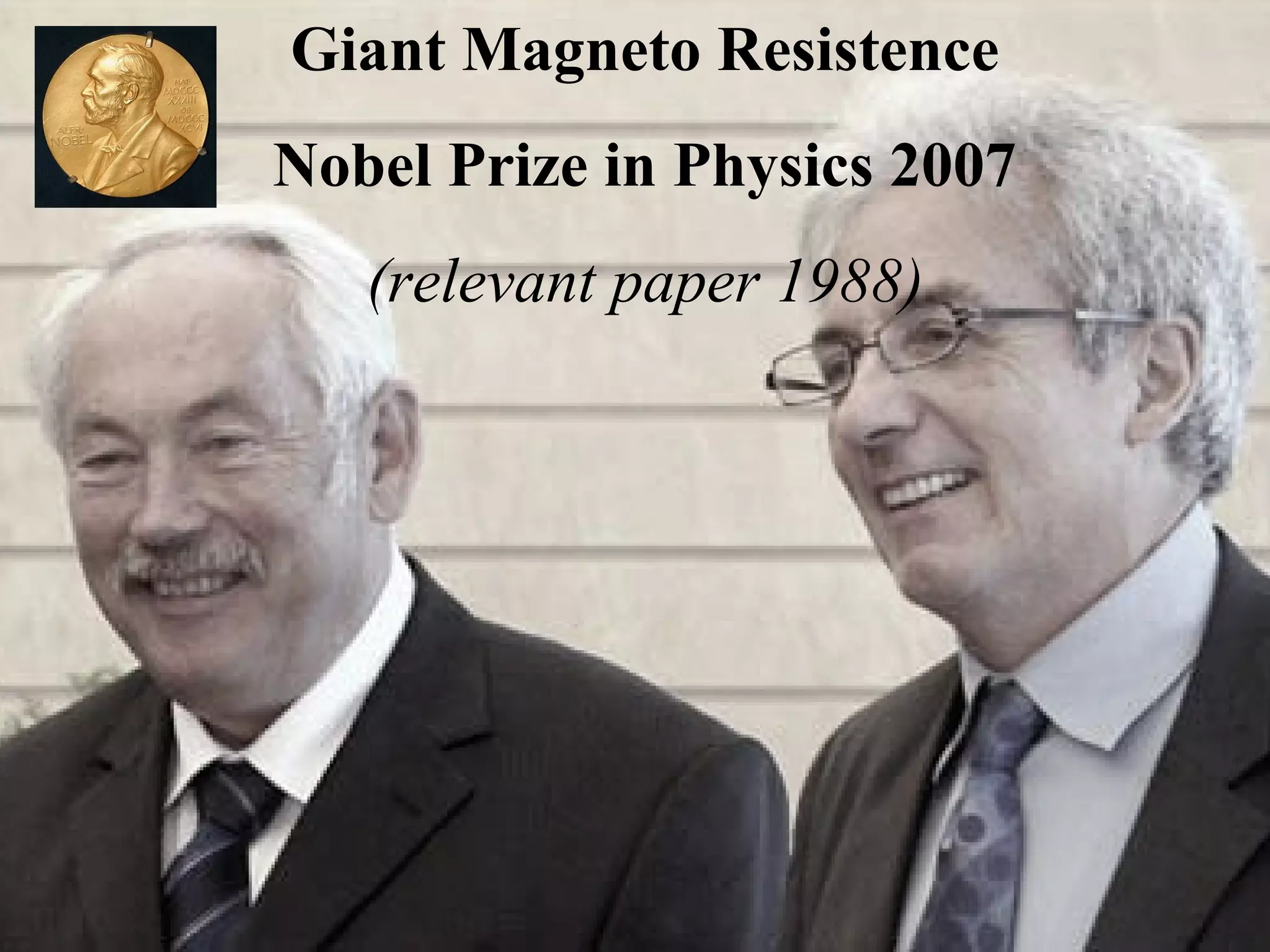
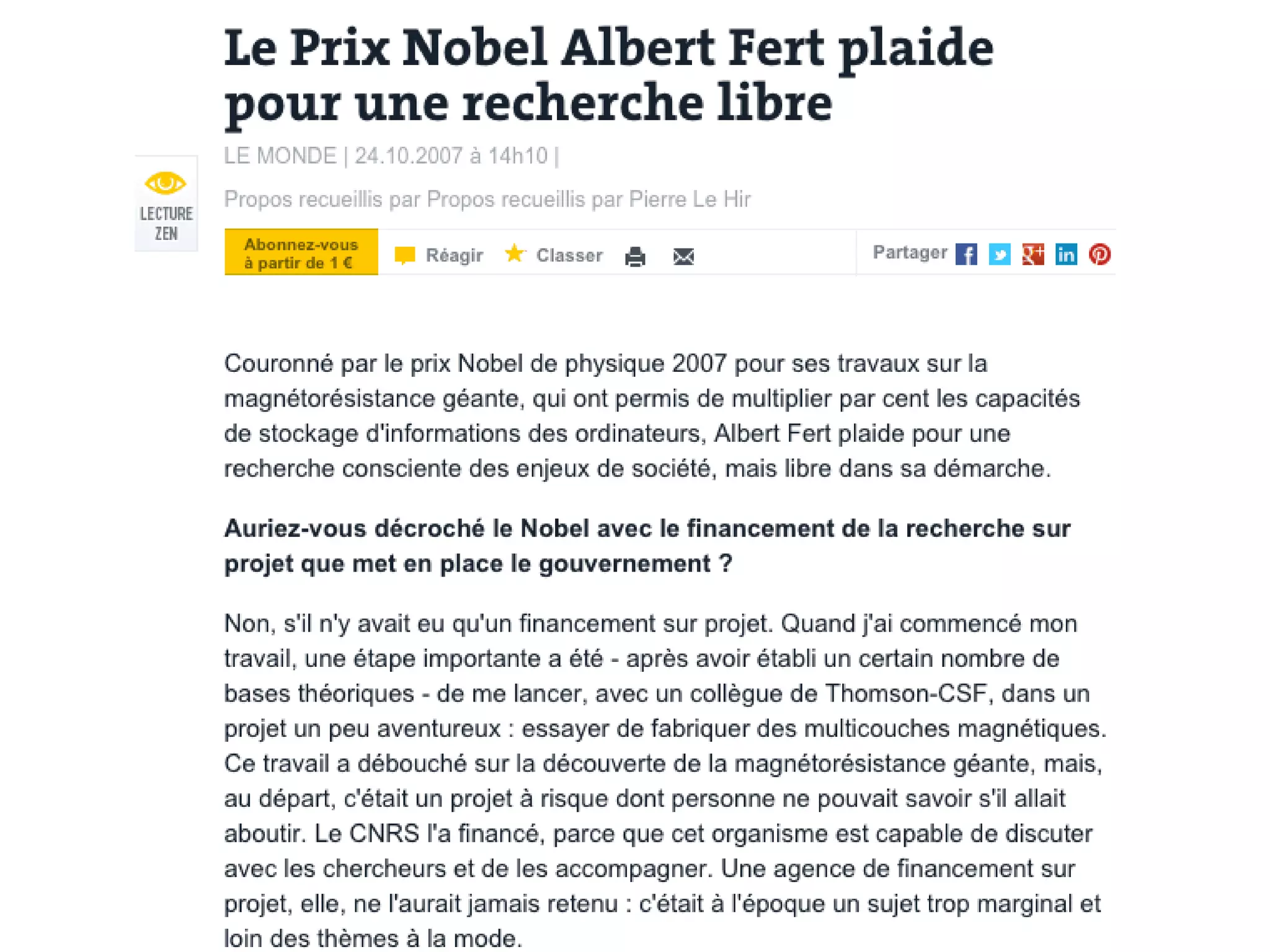
Giant Magneto Resistence
Nobel Prize in Physics 2007
(relevant paper 1988)
Giant Magneto Resistence
Scanning Tunneling Microscope
Giant Magneto Resistence
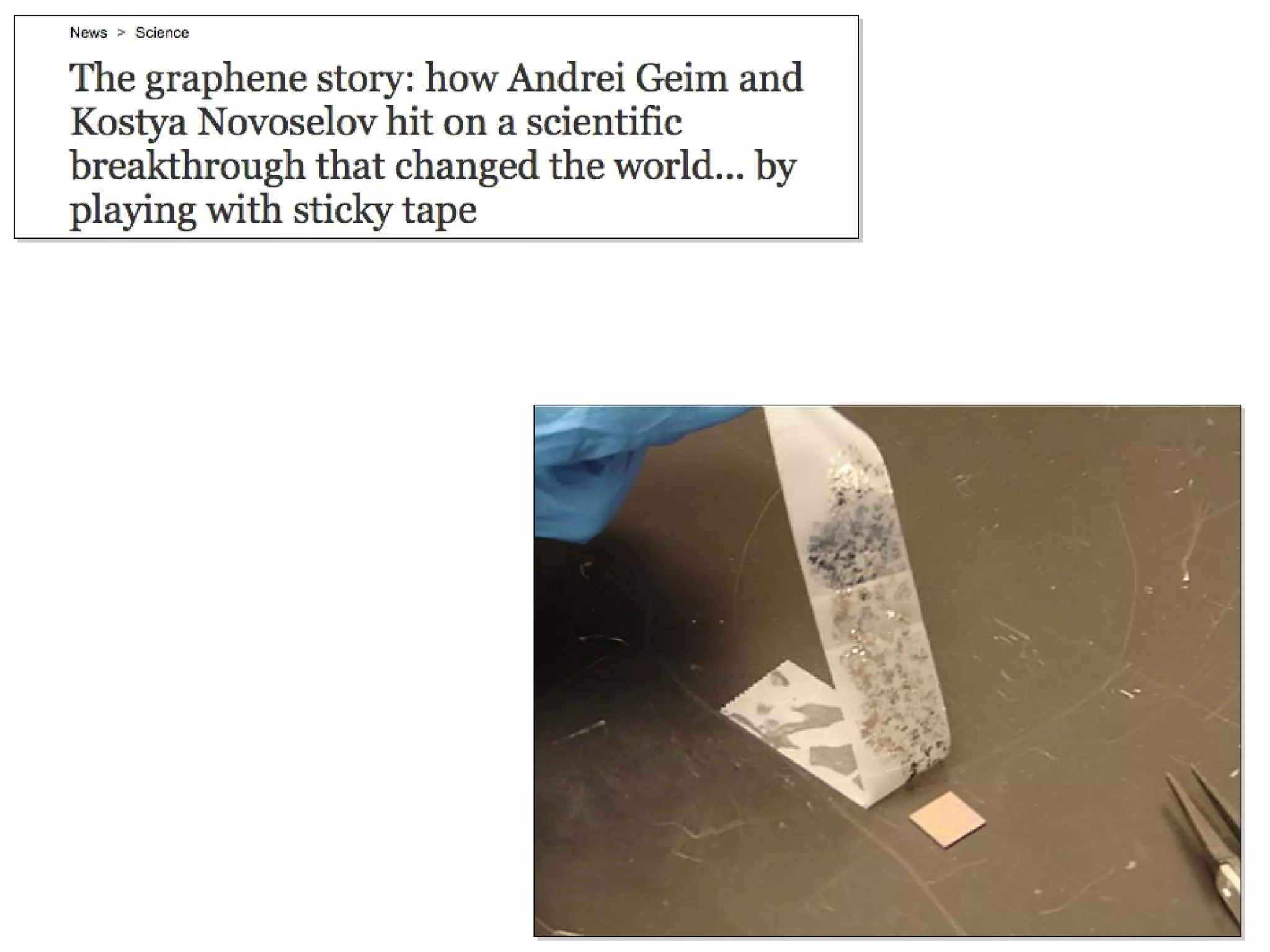
Graphene
Nobel prize in physics 2010
2010
Graphene
2010
Graphene
2010
Graphene
Rischio e Ricerca
Rischio e Ricerca
Rischio e Ricerca
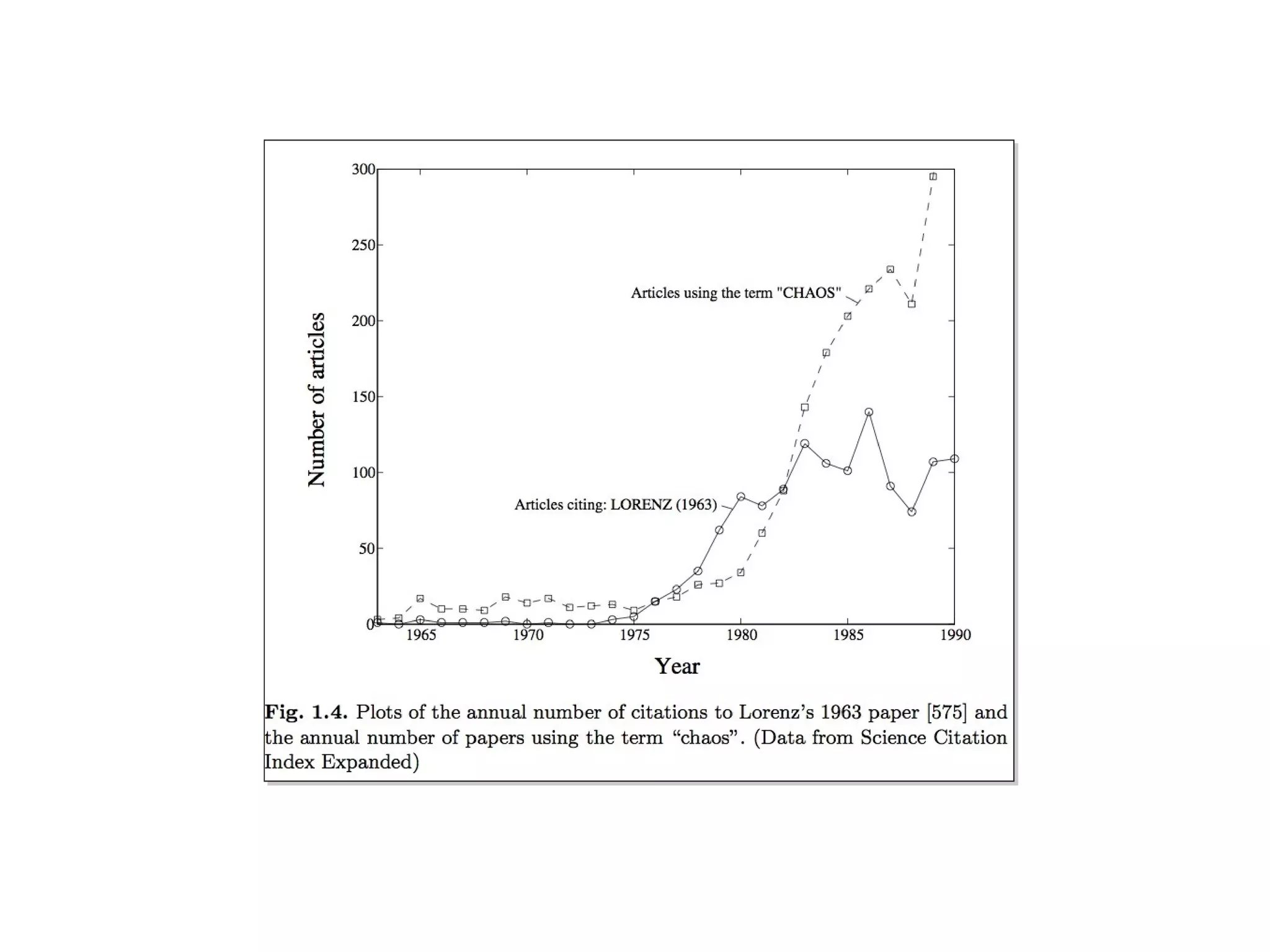
“The history of science has been and should be a history of competing
research programmes ... the sooner the competition starts, the better
for progress.”
(1970, Imre Lakatos)
Research is risk
Rewarding what is today recognised as excellence is
trivial !
See FSL:
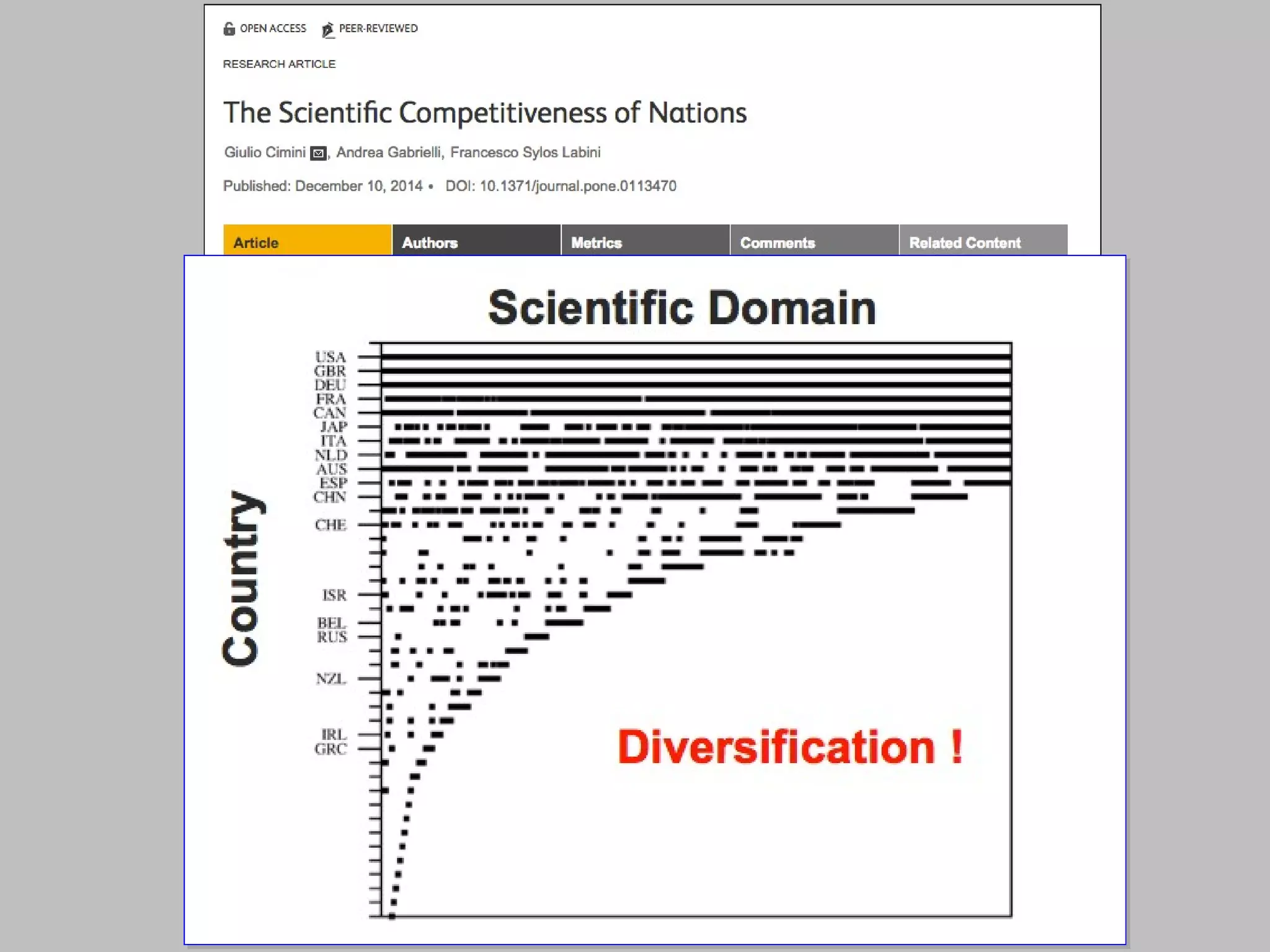
•http://blog.euroscientist.com/diversification-of-nations-research-systems/
•http://www.euroscientist.com/evaluation-dogma-of-excellence-replaced-by-scientific-d
“Reinforce excellence, dynamism and
creativity of European research"
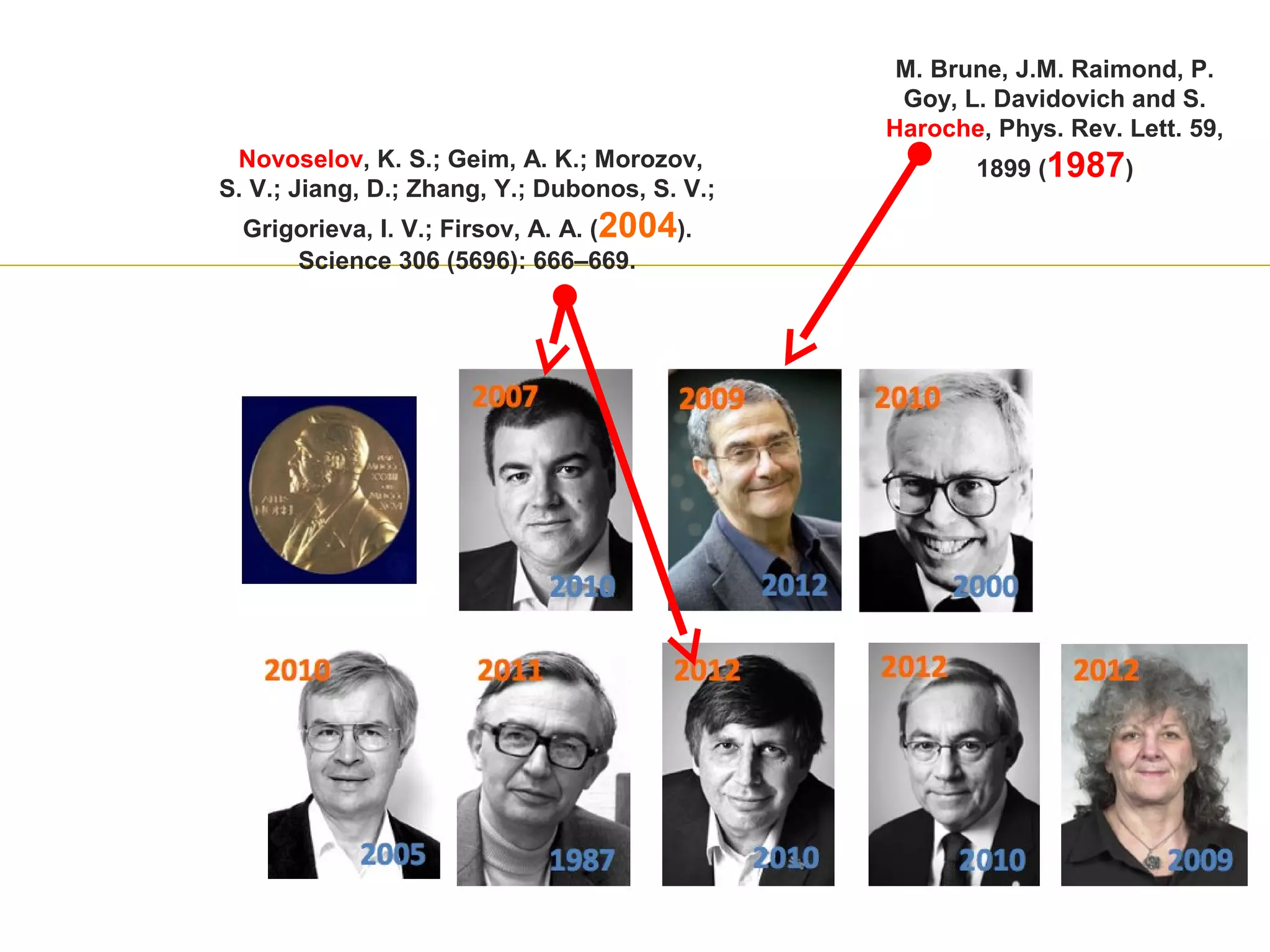
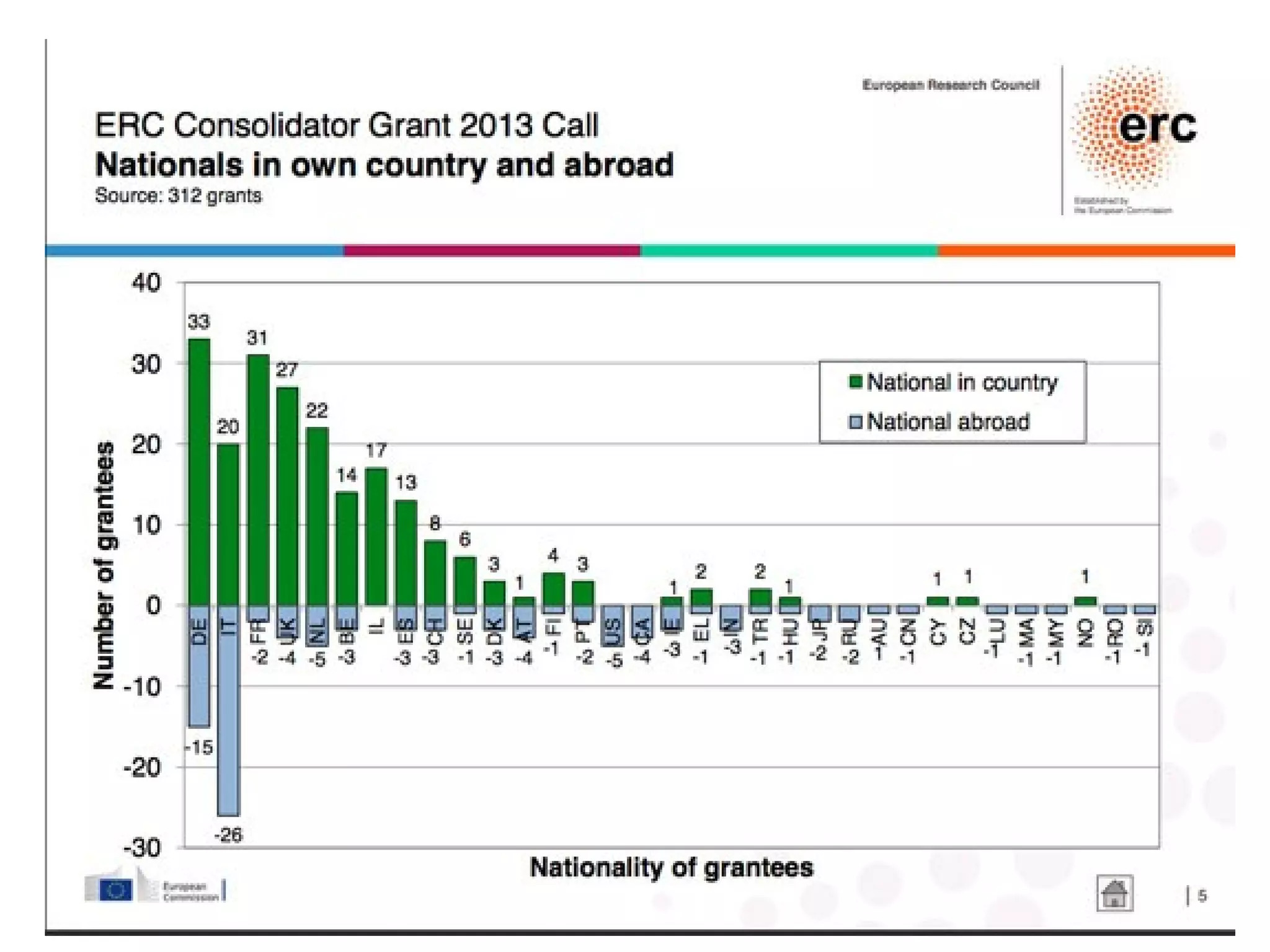
“ERC funds excellent researchers”
ERC
Nobel Prize
Novoselov, K. S.; Geim, A. K.; Morozov,
S. V.; Jiang, D.; Zhang, Y.; Dubonos, S. V.;
Grigorieva, I. V.; Firsov, A. A. (2004).
Science 306 (5696): 666–669.
M. Brune, J.M. Raimond, P.
Goy, L. Davidovich and S.
Haroche, Phys. Rev. Lett. 59,
1899 (1987)
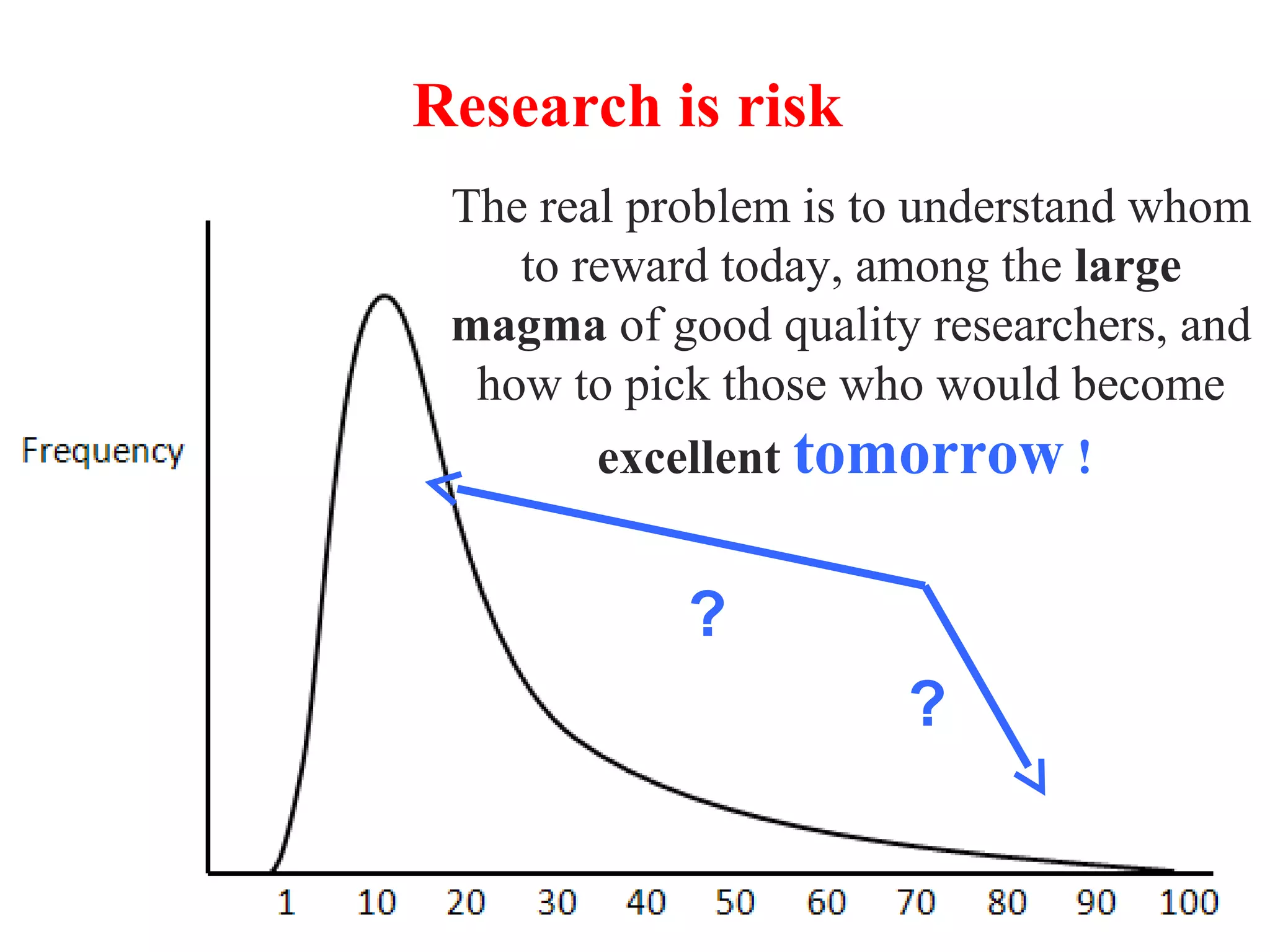
Research is risk
The real problem is to understand whom
to reward today, among the large
magma of good quality researchers, and
how to pick those who would become
excellent tomorrow !
?
?
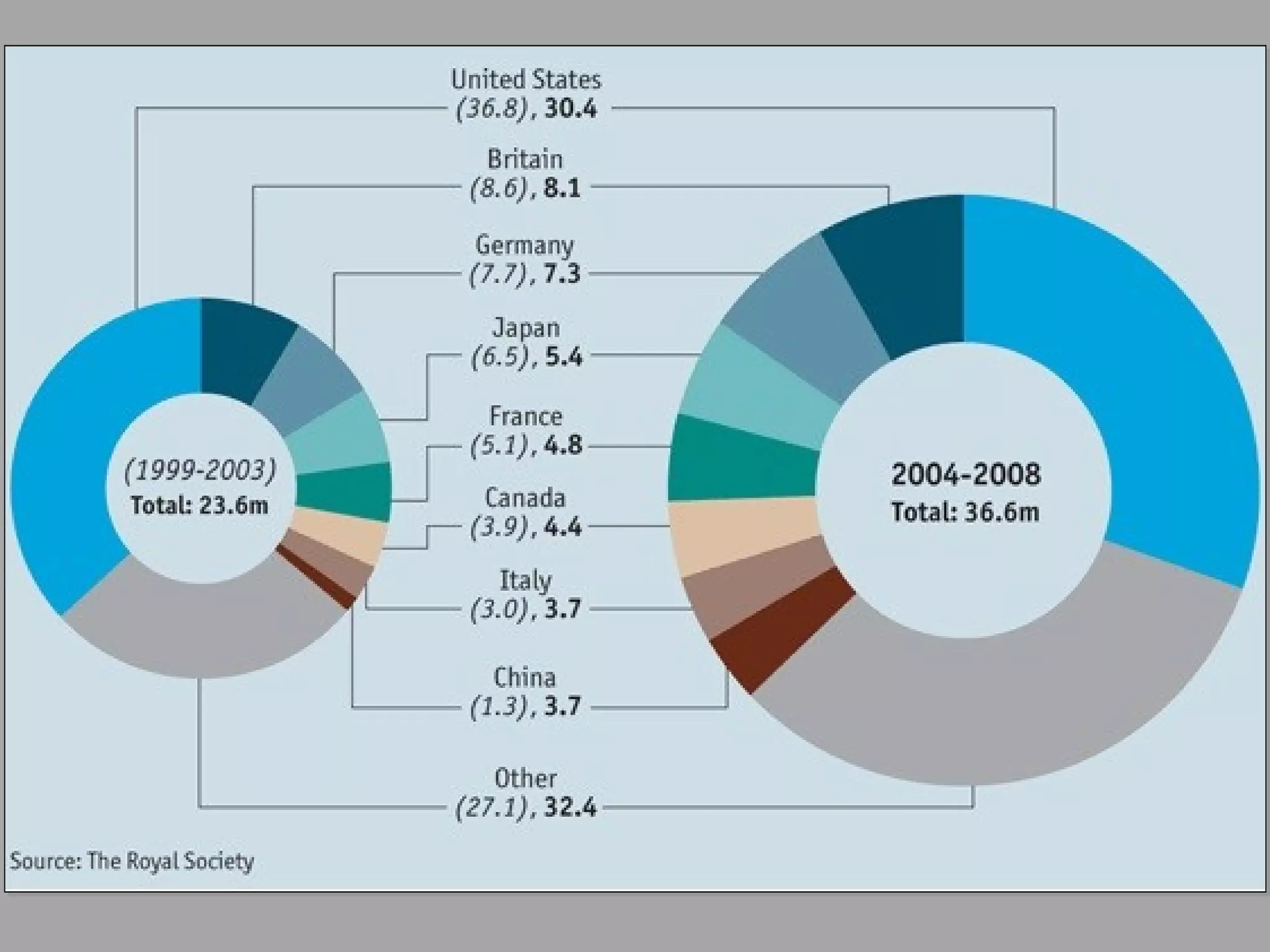
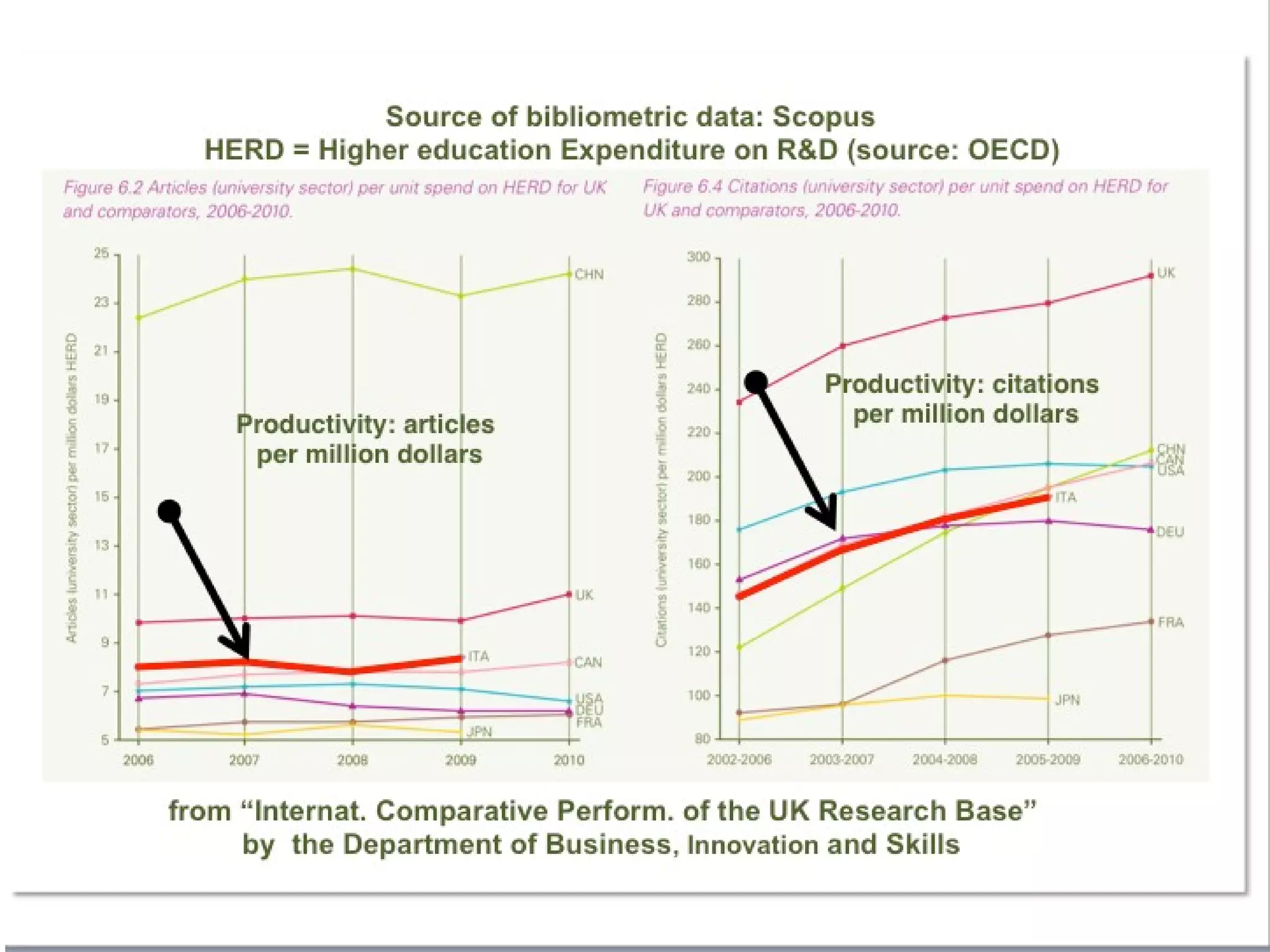
We conclude that scientific impact (as reflected by
publications) is only weakly limited by funding.
We suggest that funding strategies that
target diversity, rather than “excellence”, are likely
to prove to be more productive.
Research is risk
Research is risk
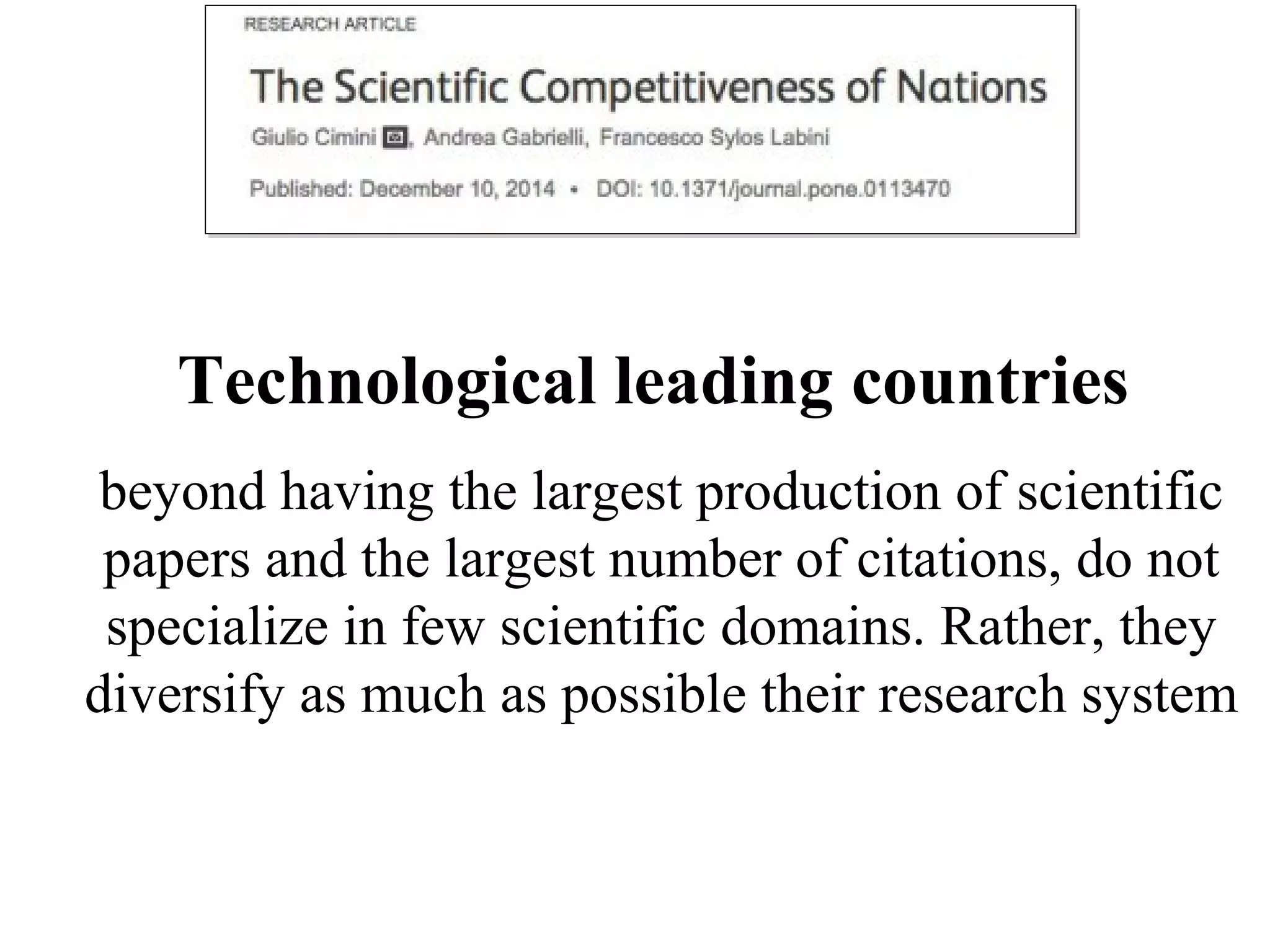
Technological leading countries
beyond having the largest production of scientific
papers and the largest number of citations, do not
specialize in few scientific domains. Rather, they
diversify as much as possible their research system
Diversification
thus represents the key element that
correlates with scientific and
technological competitiveness
• What am I doing here ?
• The European crisis
• The Italian crisis
• The international crisis
• The Harvard here model
• Excellence versus Reality
• The EC science policy: Robin Hood in reverse
• Research and risk
• Perspectives
Outline
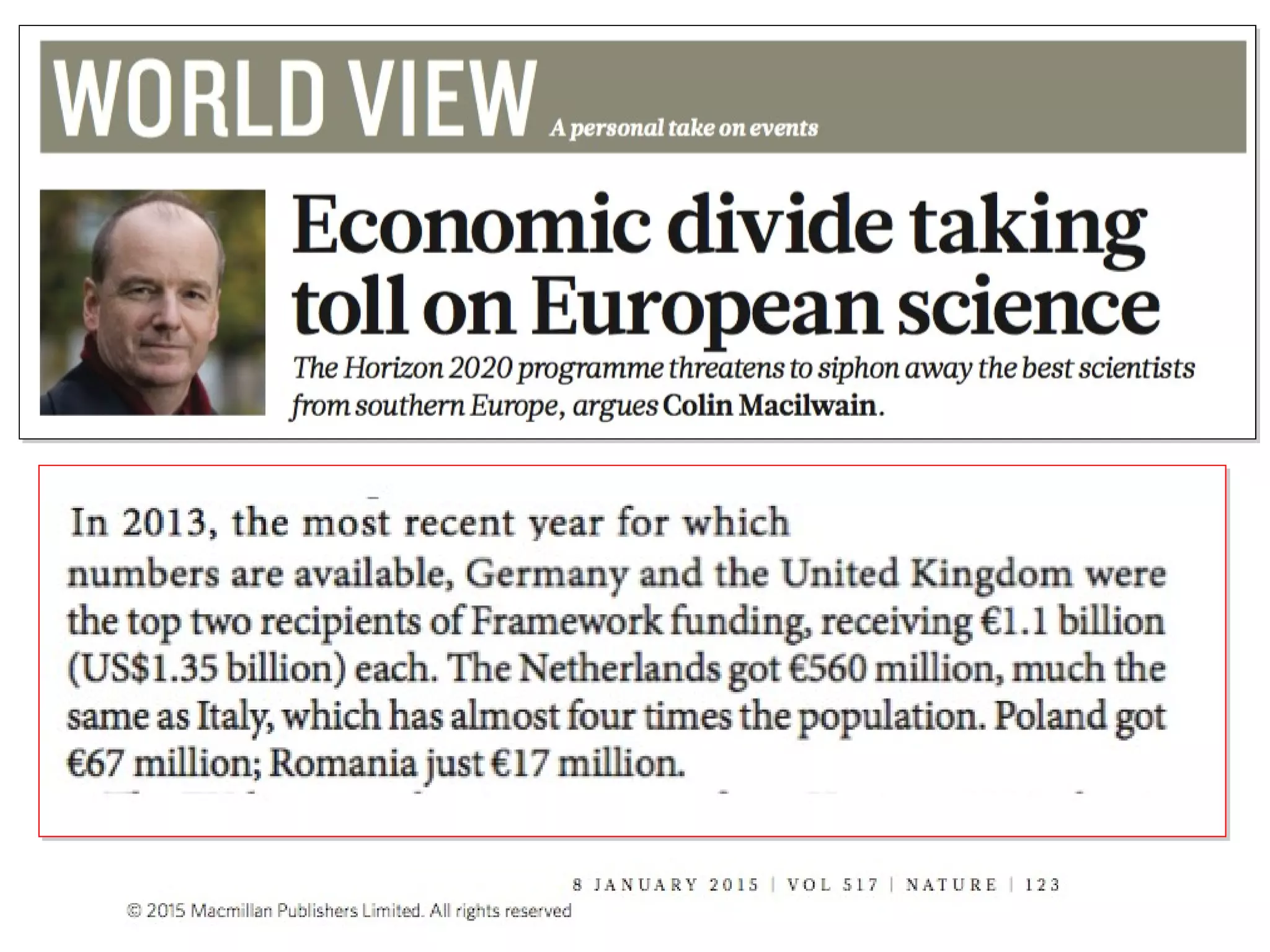
EC research funding
• About 10% of National funding
• Imitation at the National level of the EC “best practices”
• Horizon 2020 (60 billions euros)
• Top-down research lines
• Curiosity driven programs: ERC / Marie Curie fellowships
Are these really “best practices” for science?
See FSL:
• http://blog.euroscientist.com/european-science-policy-research-risk/
• http://www.researchresearch.com/index.php?option=com_news&template=rr_2col
• What am I doing here ?
• The European crisis
• The Italian crisis
• The international crisis
• The Harvard here model
• Excellence versus Reality
• The EC science policy: Robin Hood in reverse
• Research and risk
• Perspectives
Outline
Science can be effective in the national welfare only as a member of a
team, whether the conditions be peace or war. But without scientific
progress no amount of achievement in other direction can insure our
health, prosperity and security as a nation in the modern world
Science The Endless Frontier
A Report to the President by Vannevar Bush, Director of the Office of
Scientific Research and Development, July 1945
Presidential Address: What's So Special About Science And How Much Should We Spend on It?
William H. Press (Science 15 November 2013)
The exponential growth
As a factor of production, technology
produces wealth and produces more
technological progress, enabling a virtuous
cycle of exponential growth …investments in
basic research are variously estimated as
ultimately returning between 20% and 60%
per year
WilliamH.Press
(Science15November2013)
The invisible hand is visible and working hard !WilliamH.Press
(Science15November2013)
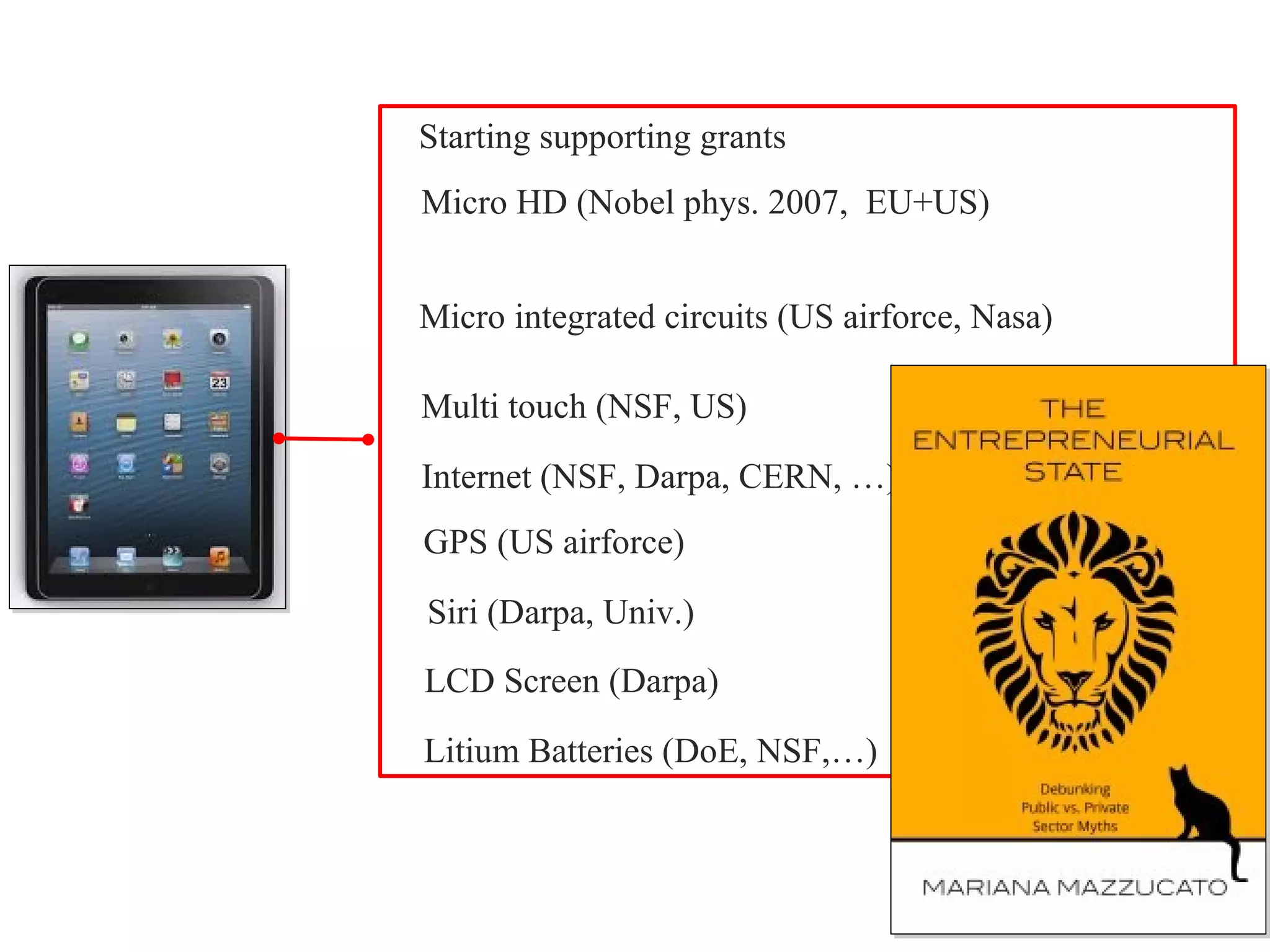
Starting supporting grants
Micro HD (Nobel phys. 2007, EU+US)
Micro integrated circuits (US airforce, Nasa)
Multi touch (NSF, US)
Internet (NSF, Darpa, CERN, …)
GPS (US airforce)
Siri (Darpa, Univ.)
LCD Screen (Darpa)
Litium Batteries (DoE, NSF,…)
Risk and Innovation
“The important thing for government is not to do things which
individuals are doing already, and to do them a little better or
a little worse; but to do those things which at present are not
done at all.”
John Maynard Keynes, The End of Laissez-Faire (1926)
Innovation requires risk
The key role of the visible hand is to build the
infrastructures that are necessary but not sufficient
for the economic development
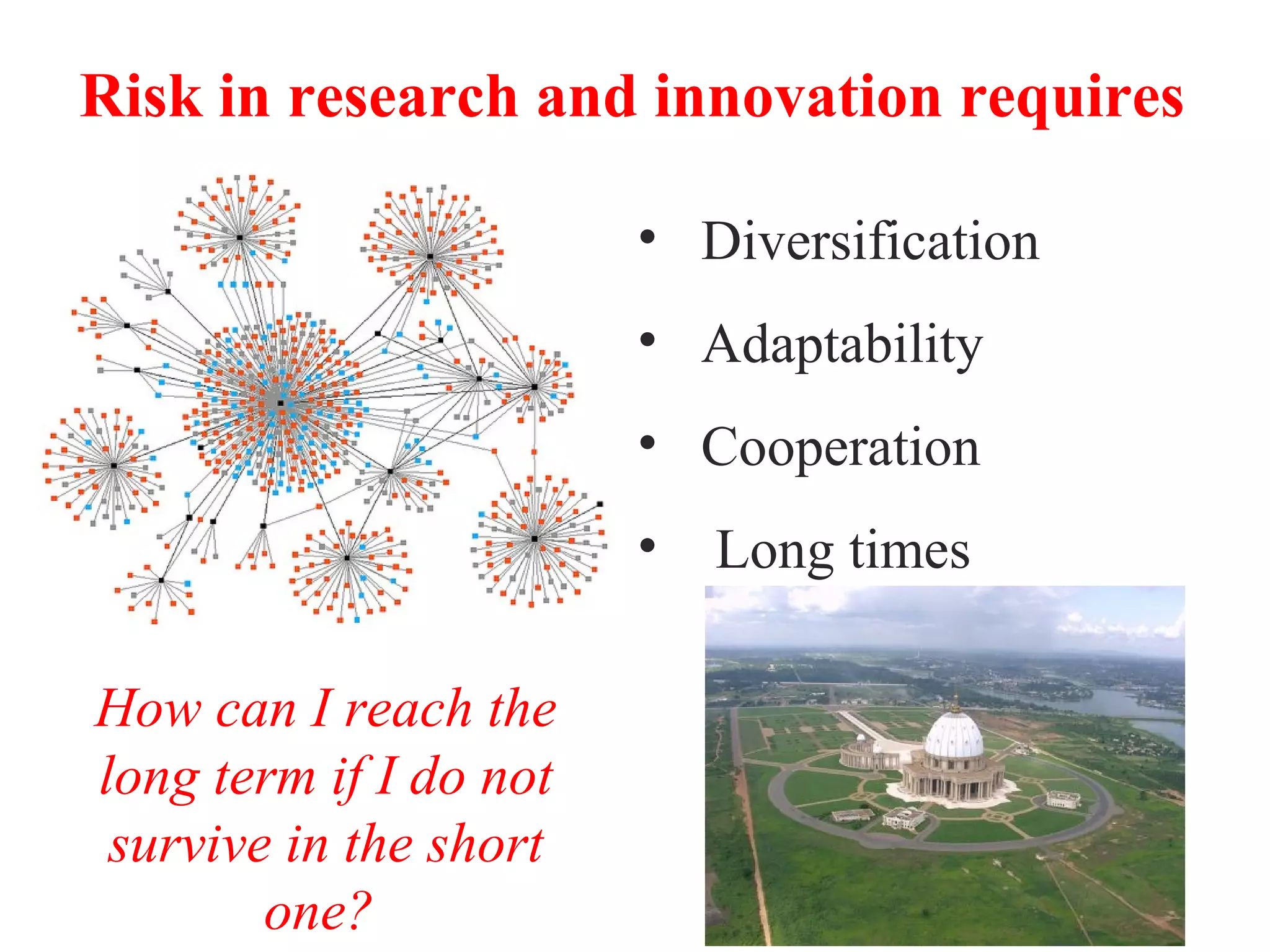
Risk in research and innovation requires
• Diversification
• Adaptability
• Cooperation
• Long times
How can I reach the
long term if I do not
survive in the short
one?
• What am I doing here ?
• The European crisis
• The Italian crisis
• The international crisis
• The Harvard here model
• Excellence versus Reality
• The EC science policy: Robin Hood in reverse
• Research and risk
• Perspectives
Outline
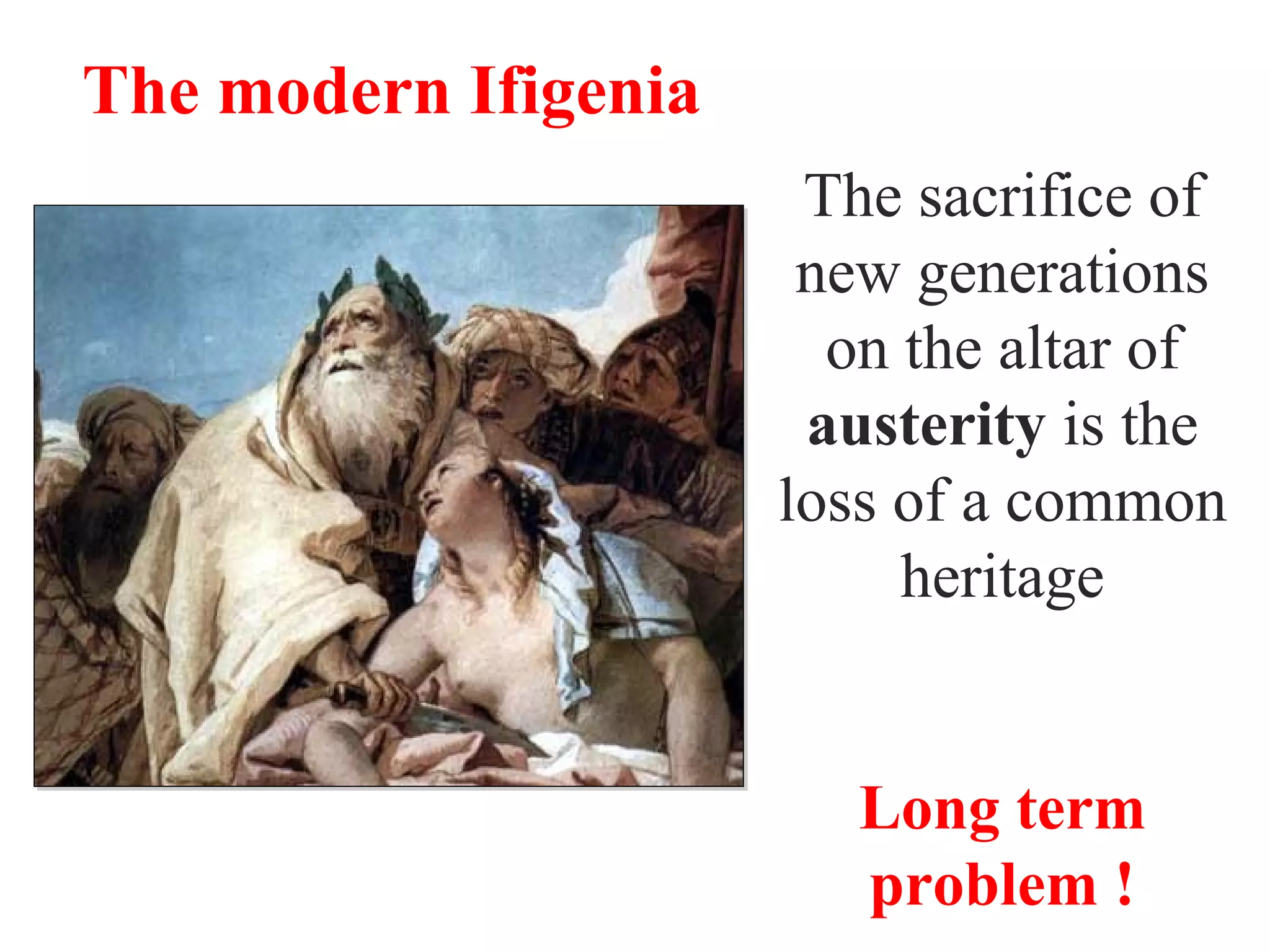
The sacrifice of
new generations
on the altar of
austerity is the
loss of a common
heritage
Long term
problem !
The modern Ifigenia
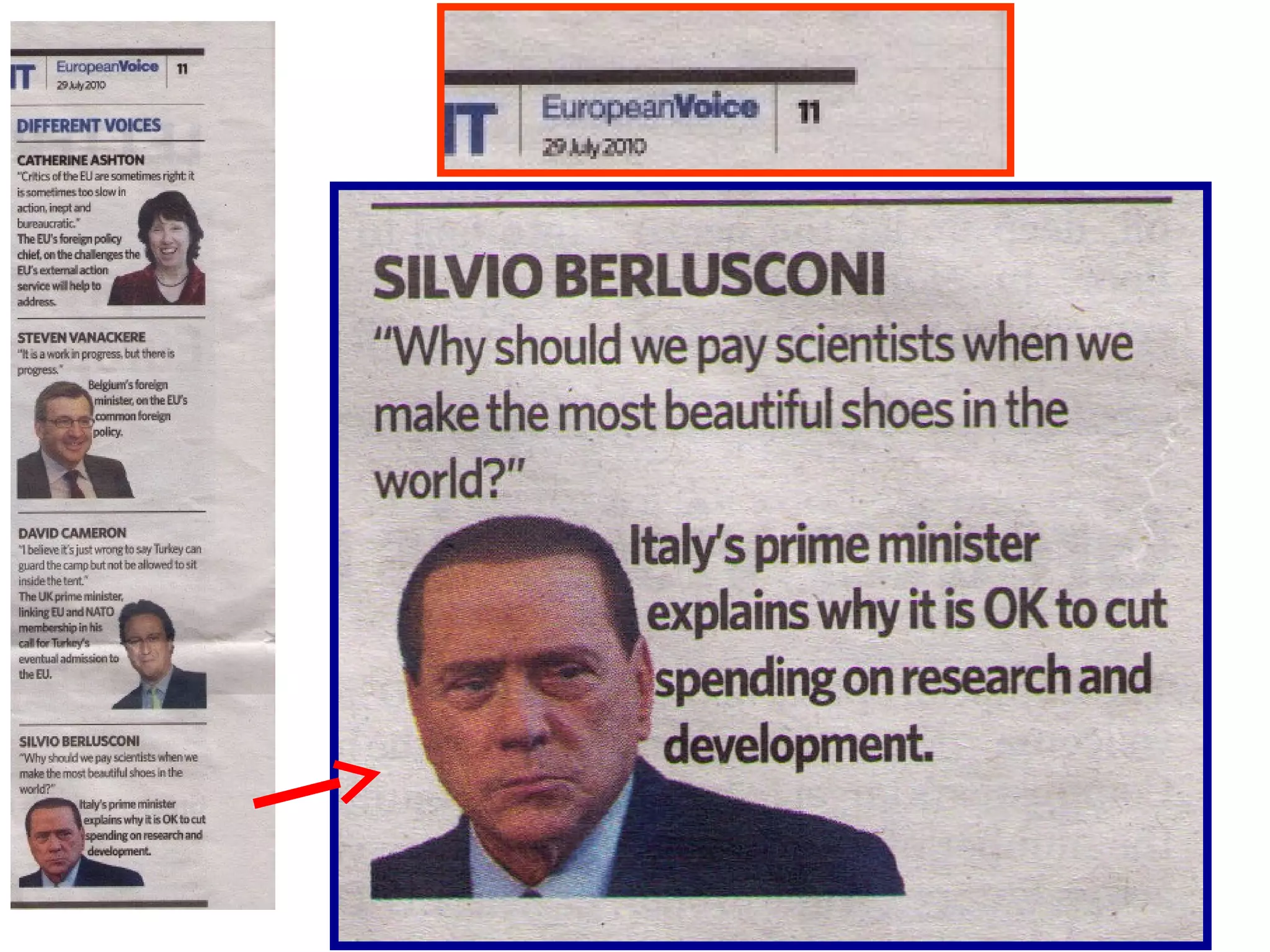
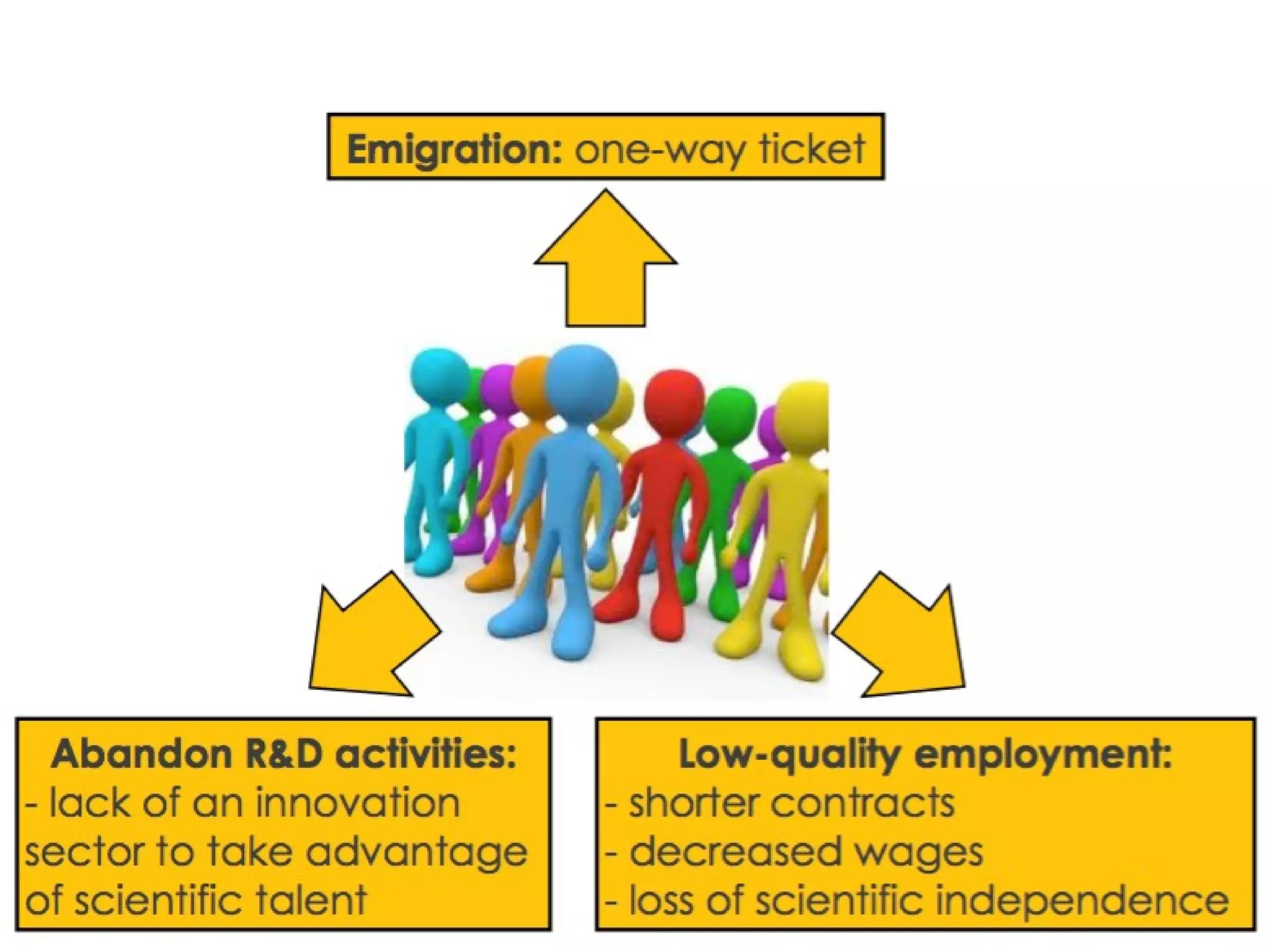
 There is no effort to cure the R&D lag neither at
the national level nor at the European level
 There is a net transfer of human and financial
resources from South to North
 Austerity measures make things worst both
on the short and long term
 Human resources
 Infrastructures
Only a massive state investment at the
European level in R&D can invert the
trend
•focus on basic research as the core of post-
austerity policies
•diversification of research systems,
•human resources,
•infrastructures,
•on the filters between “basic” and “applied”
research.
Scientists from different European countries describe in this
letter that, despite marked heterogeneity in the situation of
scientific research in their respective countries, there are
strong similarities in the destructive policies being followed.
This critical analysis, highlighted in Nature and
simultaneously published in a number of newspapers across
Europe, is a wake-up call to policy makers to correct their
course, and to researchers and citizens to defend the
essential role of science in society.
The national policymakers of an increasing number of
Member States, along with European leaders, have
completely lost touch with the reality of research.
They have chosen to ignore, but we are determined to remind
them because their ignorance can cost us the future. As
researchers and citizens, we form an international network
used to exchange information and propositions. And we are
engaging in a series of initiatives at the national and
European level to strongly oppose the systematic destruction
of national R&D infrastructures and to contribute to the
construction of a bottom-up social Europe.
We call on researchers and citizens to defend this position
with us.
There is no alternative.
We owe it to our children, and to the children of
our children.
Thank you ! And thanks to JMG !

Science and Crisis

  • 1.
  • 3.
    • What amI doing here ? • The European crisis • The Italian crisis • The international crisis • The Harvard here model • Excellence versus Reality • The EC science policy: Robin Hood in reverse • Research and risk • Perspectives Outline
  • 4.
    • What amI doing here ? • The European crisis • The Italian crisis • The international crisis • The Harvard here model • Excellence versus Reality • The EC science policy: Robin Hood in reverse • Research and risk • Perspectives Outline
  • 5.
    • Founded by8 scientists (hard/social science, humanities) • 14 editors (HS, SS, Hum + students, librarian, journalist) • About 200 contributors • In three years 2100 articles (1-2 articles per day) • More than 30,000 comments • More than 11 millions visits • Average 10,000 visits/day - peak value 35,000 visits/day • About 3,000 followers on Twitter • About 10,000 members in the Facebook group  
  • 6.
  • 7.
    “If you thinkeducation is expensive, try ignorance”
  • 10.
    • What amI doing here ? • The European crisis • The Italian crisis • The international crisis • The Harvard here model • Excellence versus Reality • The EC science policy: Robin Hood in reverse • Research and risk • Perspectives Outline
  • 11.
    • Its aimwas to make the EU “the most competitive and dynamic knowledge-based economy in the world capable of sustainable economic growth with more and better jobs and greater social cohesion”, by 2010 • Leveraging investment in R&D became a key element of this strategy following the Barcelona European Council’s objective to raise overall R&D investment to 3% of GDP by 2010. The Lisbon Strategy (March 2000)
  • 12.
    20012001 Gross Domestic Expenditureon R&D Business Enterprise Expenditure on R&D ExpenditureonR&D EasternCountries Four speed Europe
  • 15.
  • 16.
    Researchers/1000 workers inbusiness enterprises Finland Danmark Sweden France Austria Ireland Belgium Germany EU15 Netherland EU28 UK Spain Portugal Italy Greece Finland Danmark Sweden France Austria Ireland Belgium Germany EU15 Netherland EU28 UK Spain Portugal Italy Greece
  • 17.
  • 18.
  • 22.
    • What amI doing here ? • The European crisis • The Italian crisis • The international crisis • The Harvard here model • Excellence versus Reality • The EC science policy: Robin Hood in reverse • Research and risk • Perspectives Outline
  • 23.
    • Reformation processof higher education • Heavy financial cuts • Introduction of a research evaluation agency (ANVUR) that performed a controversial research assessment exercise and played a key role in the definition of the new hiring rules for academic staff and in the distribution of funding to the “excellence poles”. (see FSL http://www.euroscientist.com/sake-italian-science-culture/) The Italian crisis
  • 24.
  • 25.
    Budget for curiositydriven research projects: -100 %
  • 26.
    Roma 21 febbraio2014 Paolo Rossi 26 Number of professors+researchers: -20%
  • 27.
    Roma 21 febbraio2014 Paolo Rossi 27 Recruitments 2006-2013: -90%
  • 28.
  • 29.
    29 Number of nonpermanent staff: : + 100% Number of tenure tracks -90%
  • 33.
    • What amI doing here ? • The European crisis • The Italian crisis • The international crisis • The Harvard here model • Excellence versus Reality • The EC science policy: Robin Hood in reverse • Research and risk • Perspectives Outline
  • 34.
    • Increasing numberof scientific articles but more rapid increasing number of retractions • Increasing role of tecno-evaluation • Large number of PhD and Postdoc with low salaries and little possibility of obtaining a permanent position • Small number of élite researchers The international crisis: some evidences
  • 39.
    • What amI doing here ? • The European crisis • The Italian crisis • The international crisis • The Harvard here model • Excellence versus Reality • The EC science policy: Robin Hood in reverse • Research and risk • Perspectives Outline
  • 40.
    Present day higher educationand research policy “The rich gets richer and the poor gets poorer”
  • 41.
    ‘Harvard Here’ Model •For many governments, the world­class university has become the panacea for ensuring success in the global economy. This is especially true in the aftermath of the global financial crisis, albeit the trends were apparent before this.
  • 42.
    ‘Harvard Here’ Model •For many governments, the world­class university has become the panacea for ensuring success in the global economy. This is especially true in the aftermath of the global financial crisis, albeit the trends were apparent before this. • Institutions and nations are constantly measured against each other using indicators of global capacity and potential in which comparative and competitive advantages come into play, as part of a wider geo-political struggle.
  • 43.
    ‘Harvard Here’ Model •For many governments, the world­class university has become the panacea for ensuring success in the global economy. This is especially true in the aftermath of the global financial crisis, albeit the trends were apparent before this. • Institutions and nations are constantly measured against each other using indicators of global capacity and potential in which comparative and competitive advantages come into play, as part of a wider geo-political struggle. • These factors are driving governments and institutions to make profound changes to their higher education systems, pursue more elite agendas, alter their education programmes and privilege some disciplines and fields of inquiry in order to conform to indicators set by global rankings.
  • 44.
  • 47.
    • Harvard operatingexpenses = 44% founds of all Italian universities • Harvard has 21,000 students  130,000 euro/student • Typically EU: 10,000 euro/student 66 Italian universities BillionsofEuros
  • 48.
    Number of universitiesper million people Other research institutes Universities Other research institutes Universities USA FR DE NL UK ES IT
  • 49.
  • 53.
    • What amI doing here ? • The European crisis • The Italian crisis • The international crisis • The Harvard here model • Excellence versus Reality • The EC science policy: Robin Hood in reverse • Research and risk • Perspectives Outline
  • 54.
  • 55.
  • 56.
  • 57.
  • 58.
  • 59.
  • 60.
  • 61.
  • 62.
  • 63.
  • 64.
  • 65.
    Giant Magneto Resistence NobelPrize in Physics 2007 (relevant paper 1988)
  • 66.
  • 67.
  • 68.
  • 69.
  • 70.
  • 71.
  • 72.
  • 74.
  • 75.
  • 76.
  • 77.
  • 79.
    “The history ofscience has been and should be a history of competing research programmes ... the sooner the competition starts, the better for progress.” (1970, Imre Lakatos)
  • 80.
    Research is risk Rewardingwhat is today recognised as excellence is trivial ! See FSL: •http://blog.euroscientist.com/diversification-of-nations-research-systems/ •http://www.euroscientist.com/evaluation-dogma-of-excellence-replaced-by-scientific-d
  • 81.
    “Reinforce excellence, dynamismand creativity of European research"
  • 82.
    “ERC funds excellentresearchers” ERC Nobel Prize
  • 83.
    Novoselov, K. S.;Geim, A. K.; Morozov, S. V.; Jiang, D.; Zhang, Y.; Dubonos, S. V.; Grigorieva, I. V.; Firsov, A. A. (2004). Science 306 (5696): 666–669. M. Brune, J.M. Raimond, P. Goy, L. Davidovich and S. Haroche, Phys. Rev. Lett. 59, 1899 (1987)
  • 84.
    Research is risk Thereal problem is to understand whom to reward today, among the large magma of good quality researchers, and how to pick those who would become excellent tomorrow ! ? ?
  • 85.
    We conclude thatscientific impact (as reflected by publications) is only weakly limited by funding. We suggest that funding strategies that target diversity, rather than “excellence”, are likely to prove to be more productive. Research is risk
  • 86.
  • 89.
    Technological leading countries beyondhaving the largest production of scientific papers and the largest number of citations, do not specialize in few scientific domains. Rather, they diversify as much as possible their research system
  • 90.
    Diversification thus represents thekey element that correlates with scientific and technological competitiveness
  • 91.
    • What amI doing here ? • The European crisis • The Italian crisis • The international crisis • The Harvard here model • Excellence versus Reality • The EC science policy: Robin Hood in reverse • Research and risk • Perspectives Outline
  • 92.
    EC research funding •About 10% of National funding • Imitation at the National level of the EC “best practices” • Horizon 2020 (60 billions euros) • Top-down research lines • Curiosity driven programs: ERC / Marie Curie fellowships Are these really “best practices” for science? See FSL: • http://blog.euroscientist.com/european-science-policy-research-risk/ • http://www.researchresearch.com/index.php?option=com_news&template=rr_2col
  • 96.
    • What amI doing here ? • The European crisis • The Italian crisis • The international crisis • The Harvard here model • Excellence versus Reality • The EC science policy: Robin Hood in reverse • Research and risk • Perspectives Outline
  • 97.
    Science can beeffective in the national welfare only as a member of a team, whether the conditions be peace or war. But without scientific progress no amount of achievement in other direction can insure our health, prosperity and security as a nation in the modern world Science The Endless Frontier A Report to the President by Vannevar Bush, Director of the Office of Scientific Research and Development, July 1945
  • 99.
    Presidential Address: What'sSo Special About Science And How Much Should We Spend on It? William H. Press (Science 15 November 2013) The exponential growth As a factor of production, technology produces wealth and produces more technological progress, enabling a virtuous cycle of exponential growth …investments in basic research are variously estimated as ultimately returning between 20% and 60% per year
  • 100.
  • 101.
    The invisible handis visible and working hard !WilliamH.Press (Science15November2013)
  • 102.
    Starting supporting grants MicroHD (Nobel phys. 2007, EU+US) Micro integrated circuits (US airforce, Nasa) Multi touch (NSF, US) Internet (NSF, Darpa, CERN, …) GPS (US airforce) Siri (Darpa, Univ.) LCD Screen (Darpa) Litium Batteries (DoE, NSF,…)
  • 103.
    Risk and Innovation “Theimportant thing for government is not to do things which individuals are doing already, and to do them a little better or a little worse; but to do those things which at present are not done at all.” John Maynard Keynes, The End of Laissez-Faire (1926)
  • 104.
    Innovation requires risk Thekey role of the visible hand is to build the infrastructures that are necessary but not sufficient for the economic development
  • 105.
    Risk in researchand innovation requires • Diversification • Adaptability • Cooperation • Long times How can I reach the long term if I do not survive in the short one?
  • 106.
    • What amI doing here ? • The European crisis • The Italian crisis • The international crisis • The Harvard here model • Excellence versus Reality • The EC science policy: Robin Hood in reverse • Research and risk • Perspectives Outline
  • 107.
    The sacrifice of newgenerations on the altar of austerity is the loss of a common heritage Long term problem ! The modern Ifigenia
  • 109.
     There isno effort to cure the R&D lag neither at the national level nor at the European level  There is a net transfer of human and financial resources from South to North  Austerity measures make things worst both on the short and long term  Human resources  Infrastructures
  • 111.
    Only a massivestate investment at the European level in R&D can invert the trend •focus on basic research as the core of post- austerity policies •diversification of research systems, •human resources, •infrastructures, •on the filters between “basic” and “applied” research.
  • 113.
    Scientists from differentEuropean countries describe in this letter that, despite marked heterogeneity in the situation of scientific research in their respective countries, there are strong similarities in the destructive policies being followed. This critical analysis, highlighted in Nature and simultaneously published in a number of newspapers across Europe, is a wake-up call to policy makers to correct their course, and to researchers and citizens to defend the essential role of science in society. The national policymakers of an increasing number of Member States, along with European leaders, have completely lost touch with the reality of research.
  • 114.
    They have chosento ignore, but we are determined to remind them because their ignorance can cost us the future. As researchers and citizens, we form an international network used to exchange information and propositions. And we are engaging in a series of initiatives at the national and European level to strongly oppose the systematic destruction of national R&D infrastructures and to contribute to the construction of a bottom-up social Europe. We call on researchers and citizens to defend this position with us. There is no alternative. We owe it to our children, and to the children of our children.
  • 115.
    Thank you !And thanks to JMG !