
Overview of the NAP Technical Guidelines
Rohini Kohli
UNDP
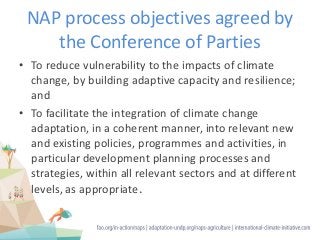
NAP process objectives agreed by
the Conference of Parties
• To reduce vulnerability to the impacts of climate
change, by building adaptive capacity and resilience;
and
• To facilitate the integration of climate change
adaptation, in a coherent manner, into relevant new
and existing policies, programmes and activities, in
particular development planning processes and
strategies, within all relevant sectors and at different
levels, as appropriate.
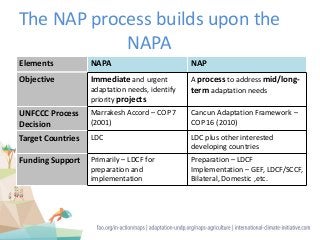
The NAP process builds upon the
NAPA
Elements NAPA NAP
Objective Immediate and urgent
adaptation needs, identify
priority projects
A process to address mid/long-
term adaptation needs
UNFCCC Process
Decision
Marrakesh Accord – COP 7
(2001)
Cancun Adaptation Framework –
COP 16 (2010)
Target Countries LDC LDC plus other interested
developing countries
Funding Support Primarily – LDCF for
preparation and
implementation
Preparation – LDCF
Implementation – GEF, LDCF/SCCF,
Bilateral, Domestic ,etc.
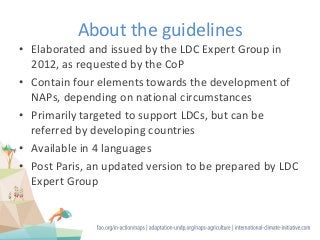
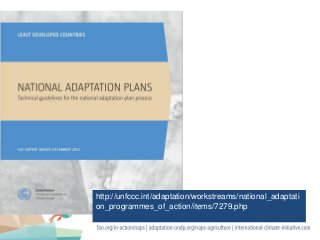
About the guidelines
• Elaborated and issued by the LDC Expert Group in
2012, as requested by the CoP
• Contain four elements towards the development of
NAPs, depending on national circumstances
• Primarily targeted to support LDCs, but can be
referred by developing countries
• Available in 4 languages
• Post Paris, an updated version to be prepared by LDC
Expert Group
http://unfccc.int/adaptation/workstreams/national_adaptati
on_programmes_of_action/items/7279.php
• A. Laying the groundwork
and addressing gaps
• 1. Initiating and launching of the NAP process
• 2. Stocktaking: identifying available information on
climate change impacts, vulnerability and
adaptation and assessing gaps and needs of the
enabling environment for the NAP process
• 3. Addressing capacity gaps and weaknesses in
undertaking the NAP process
• 4. Comprehensively and iteratively assessing
development needs and climate vulnerabilities
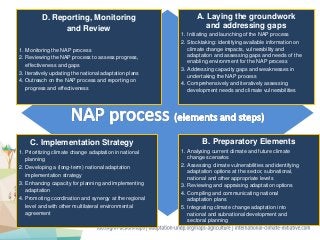
A. Laying the groundwork
and addressing gaps
1. Initiating and launching of the NAP process
2. Stocktaking: identifying available information on
climate change impacts, vulnerability and
adaptation and assessing gaps and needs of the
enabling environment for the NAP process
3. Addressing capacity gaps and weaknesses in
undertaking the NAP process
4. Comprehensively and iteratively assessing
development needs and climate vulnerabilities
B. Preparatory Elements
1. Analysing current climate and future climate
change scenarios
2. Assessing climate vulnerabilities and identifying
adaptation options at the sector, subnational,
national and other appropriate levels
3. Reviewing and appraising adaptation options
4. Compiling and communicating national
adaptation plans
5. Integrating climate change adaptation into
national and subnational development and
sectoral planning
C. Implementation Strategy
1. Prioritizing climate change adaptation in national
planning
2. Developing a (long-term) national adaptation
implementation strategy
3. Enhancing capacity for planning and implementing
adaptation
4. Promoting coordination and synergy at the regional
level and with other multilateral environmental
agreement
D. Reporting, Monitoring
and Review
1. Monitoring the NAP process
2. Reviewing the NAP process to assess progress,
effectiveness and gaps
3. Iteratively updating the national adaptation plans
4. Outreach on the NAP process and reporting on
progress and effectiveness
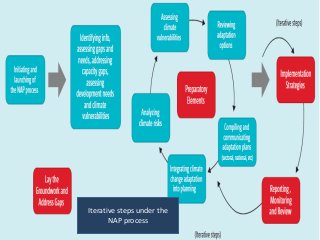
Iterative steps under the
NAP process
Overview of the NAP Technical Guidelines

Overview of the NAP Technical Guidelines

  • 1.
    Overview of theNAP Technical Guidelines Rohini Kohli UNDP
  • 2.
    NAP process objectivesagreed by the Conference of Parties • To reduce vulnerability to the impacts of climate change, by building adaptive capacity and resilience; and • To facilitate the integration of climate change adaptation, in a coherent manner, into relevant new and existing policies, programmes and activities, in particular development planning processes and strategies, within all relevant sectors and at different levels, as appropriate.
  • 3.
    The NAP processbuilds upon the NAPA Elements NAPA NAP Objective Immediate and urgent adaptation needs, identify priority projects A process to address mid/long- term adaptation needs UNFCCC Process Decision Marrakesh Accord – COP 7 (2001) Cancun Adaptation Framework – COP 16 (2010) Target Countries LDC LDC plus other interested developing countries Funding Support Primarily – LDCF for preparation and implementation Preparation – LDCF Implementation – GEF, LDCF/SCCF, Bilateral, Domestic ,etc.
  • 4.
    About the guidelines •Elaborated and issued by the LDC Expert Group in 2012, as requested by the CoP • Contain four elements towards the development of NAPs, depending on national circumstances • Primarily targeted to support LDCs, but can be referred by developing countries • Available in 4 languages • Post Paris, an updated version to be prepared by LDC Expert Group
  • 5.
  • 6.
    • A. Layingthe groundwork and addressing gaps • 1. Initiating and launching of the NAP process • 2. Stocktaking: identifying available information on climate change impacts, vulnerability and adaptation and assessing gaps and needs of the enabling environment for the NAP process • 3. Addressing capacity gaps and weaknesses in undertaking the NAP process • 4. Comprehensively and iteratively assessing development needs and climate vulnerabilities A. Laying the groundwork and addressing gaps 1. Initiating and launching of the NAP process 2. Stocktaking: identifying available information on climate change impacts, vulnerability and adaptation and assessing gaps and needs of the enabling environment for the NAP process 3. Addressing capacity gaps and weaknesses in undertaking the NAP process 4. Comprehensively and iteratively assessing development needs and climate vulnerabilities B. Preparatory Elements 1. Analysing current climate and future climate change scenarios 2. Assessing climate vulnerabilities and identifying adaptation options at the sector, subnational, national and other appropriate levels 3. Reviewing and appraising adaptation options 4. Compiling and communicating national adaptation plans 5. Integrating climate change adaptation into national and subnational development and sectoral planning C. Implementation Strategy 1. Prioritizing climate change adaptation in national planning 2. Developing a (long-term) national adaptation implementation strategy 3. Enhancing capacity for planning and implementing adaptation 4. Promoting coordination and synergy at the regional level and with other multilateral environmental agreement D. Reporting, Monitoring and Review 1. Monitoring the NAP process 2. Reviewing the NAP process to assess progress, effectiveness and gaps 3. Iteratively updating the national adaptation plans 4. Outreach on the NAP process and reporting on progress and effectiveness
  • 7.
    Iterative steps underthe NAP process