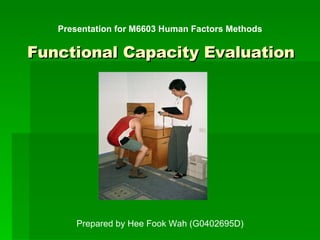
Functional Capacity Evaluation

Loading...

Flash Player 9 (or above) is needed to view presentations.
We have detected that you do not have it on your computer. To install it, go here.

5 comments

Comments 1 - 5 of 5 previous next Post a comment

  • + guest8b6db7b guest8b6db7b 9 months ago
    This is absolutly true. I had a FCE the lady was totally against me. She was so unprofessional that she inquired about soliciting employment from my employer.
  • + guest69eb45 guest69eb45 2 years ago
    I have to agree with questba5348. The FCE test is tyically used by insurance companies to return an injured worker back to work. This is the only interest the insurance company has getting someone back to work. The focus should be on getting the injured worker back to 100% capacity for the work that was being performed prior to the injury. Focus should always be on supplying excellent medical treatment for a totally recovery........not partial recovery. If you have a complaint about the treatment you are getting from your insurance company........you owe it to yourself to run as quickly as possible to an attorney that is a specialist in Workers Comp cases. They will direct you in the proper direction......the insurance company is not your friend.......never forget that fact.

    Terry
  • + guest90b0e7 guest90b0e7 2 years ago
    i WOULD LIKE T SEE THE SLIDE SHOW AS WELL, OR A TEXT COPY....THANK YOU. I AM PREPARING AN APPEAL AND I HAVE MANY QUESTIONS REGARDING MY OWN TEST.
  • + guesta4ec86 guesta4ec86 3 years ago
    powerpoint slides are very good & nice.

  • + guestba5348 guestba5348 3 years ago
    Ergo Science’s Functional Capacity Evaluation does not, in any way replicate an 8-hr workday. All the excercises are performed for only 5 minutes each. Anyone who is requested by their insurance carrier to have this kind of test performed, needs to secure a lawyer immediately. (You are walking in to a lion’s den) Especially, if for example you have difficulty sitting due to herniated disks in your neck, or a neck injury, because you are only tested for 5 minutes of sitting! These facilities that offer these tests work for the insurance company and make their living administering these tests for them. Think about it, they wouldn’t be in business if their tests results weren’t returning clients back to work.
Post a comment
Embed Video
Edit your comment Cancel

4 Favorites

Functional Capacity Evaluation - Presentation Transcript

  1. Functional Capacity Evaluation Presentation for M6603 Human Factors Methods Prepared by Hee Fook Wah (G0402695D)
  2. Introduction … traditional physical evaluation procedure such as testing muscle strength, measuring joint range of motion, radiographic findings and recording medical signs and symptoms are not good predictors of functional abilities .... functional capacity evaluation have developed from a need for a more objective measure of a person’s physical abilities to perform work… Lechner et al. (1994)
  3. What is FCE?
    • … is a systematic process of assessing an individual's physical capacities and functional abilities.
    • AOTA (2005)
  4. Injury or Illness Medical Management Return to Work Return to Desired Activity Rehabilitation
  5. Successful Return to Desired Activity / Work Patients’ Abilities Activity/Job Demands ? MATCH
  6. Successful Return to Desired Activity / Work Functional Capacity Evaluation Activity/Job Analysis ? MATCH
  7. Purpose and Use of FCE
    • To determine the individual's ability to safely return to work full time or on modified duty.
    • To determine if work restrictions, job modifications, or reasonable accommodations are necessary to prevent further injury.
  8. Purpose and Use of FCE
    • To determine the extent to which impairments exist, or the degree of physical disability for compensation purposes.
    • To predict the potential ability to perform work following acute rehabilitation or a work- hardening/work- conditioning program.
  9. Table 1: Types of FCE 1 1 From “A Critical Review of Functional Capacity Evaluations” by P.M. King, N. Tuckwell and T.E. Barrett, 1998, p.855.
  10. Physical Work Performance Evaluation (PWPE)
    • Developed by ErgoScience
    • The test items include the testing of the 20 physical demands as defined by the Department of Labour (U.S.A.) in the Dictionary of Occupational Titles.
    • lifting
    • standing
    • walking
    • sitting
    • carrying
    • pushing
    • pulling
    • climbing
    • balancing
    • stooping
    • kneeling
    • crouching
    • crawling
    • reaching
    • handling
    • fingering
    • feeling
    • talking
    • hearing
    • seeing
    DICTIONARY OF OCCUPATIONAL TITLES PHYSICAL DEMANDS OF WORK
    • Dynamic strength
    • Position tolerance
    • Mobility
    • Endurance
    • Fine motor skills
    • Balance
    • Coordination
    Evaluate 36 Tasks in 7 Sections Physical Work Performance Evaluation (PWPE)
  11. Dynamic Strength Section
    • Floor to waist lift
    • Waist to eye-level lift
    • Bilateral carry
    • Unilateral carry
    • Push
    • Pull
    • Push & Pull
    Dynamic Strength Section
  12. Dynamic Strength Scoring
    • Time
    • Weight handled
    • Heart rate
    • 0-10 pain score
    • Specific signs of maximal performance
      • Changes in heart rate
      • Changes in time to complete repetition
  13. Position Tolerance
    • Sitting
    • Standing
    • Overhead work in standing
    • Lowered work in standing
    • Kneeling
    • Lowered work in sitting
    • Squatting
    • Overhead work in supine
  14. Position Tolerance
    • Overhead work in standing
  15. Position Tolerance
    • Lowered work in standing
  16. Position Tolerance Scoring
    • Time position tolerated
    • Number of position adjustments
    • Deviations from normally expected position (WNL, minimal, moderate, or severe deviations)
    • Pain score (0-10)
  17. Mobility Section
    • Stair climbing
    • Repetitive squatting
    • Walking
    • Crawling
    • Ladder climbing
    • Repetitive trunk rotation - sitting
    • Repetitive trunk rotation - standing
  18. Mobility Section
    • Stair climbing
  19. Mobility Scoring
    • Number of repetitions performed or distance ambulated
    • Heart rate
    • Deviations from normally expected movement pattern (WNL, minimal, moderate, or severe deviations)
    • Pain score (0-10)
  20. Fine Motor Section
    • Isometric Grip Strength
    • Perdue Pegboard
    • O’Conner Tweezer Dexterity Test
    • Minnesota Dexterity Test
    • Hand Tool Dexterity Test
  21. Fine Motor Section
    • Perdue Pegboard
    • Measures two types of activities: gross movements of hands, fingers and arms, and "fingertip" dexterity in an assembly task.
    • Norm referencing.
  22. Balance & Coordination Section
    • Screening sections only
    • Used to determine need for further testing
    • Performed only on those that:
      • Have sustained brain trauma
      • Jobs that require beam and scaffold work
      • Jobs that require rapid work with machinery
  23. Balancing Balance & Coordination Section
  24. Endurance Section
    • First three tasks of test are most demanding
    • Repeat the tasks at the end of the test
    • Measure change in heart rate response
    • Measure change in performance
    • Developed algorithm to determine whether the client can tolerate an 8-hr day at a given level
  25. Results
    • Overall level of work
    • Tolerance for 8 hour day
    • Level of cooperation with testing
    • Specific limitations
    • Whether abilities match job demands
    • Interventions for consideration
    • The overall level of work ability of the worker with injury can be assessed and classified as:
      • unable to work;
      • able to perform sedentary work;
      • able to perform light work;
      • able to perform medium work;
      • able to perform heavy work or able to perform very heavy work
    Results
  26. Validity and Reliability
    • Innes, E. & Straker, L. (1999). Reliability of work-related assessments. Work,13 , 107-124.
    • Innes, E. & Straker, L. (1999). Validity of work-related assessments. Work,13 , 125-152.
    • King, P. M., Tuckwell, N. & Barrett, T. E. (1998). A critical review of functional capacity evaluations. Physical Therapy, 78 (8), 852-866.
  27. Validity and Reliability
    • Most FCEs have limited evidence of validity and reliability.
    • Literature review did not show strong scientific evidence to support or justify the approach and rationale of evaluation.
  28. Validity and Reliability
    • Face and content validity rarely formally establish for the majority of FCE.
    • Most consider if the 20 physical demands of DOT are covered, then there is adequate face and content validity.
    • No strong support or justification for the acceptance of the criteria.
    • In USA, the Social Security Administration (SSA) requires the FCE to address 3 areas:
    • Physical abilities: limitations regarding physical activities.
    • Mental limitation: limitations in understanding, remembering, and following through on instructions.
    • Non-exertional impairment: info on pain, environmental restrictions, need for rest break and any side effect of medication.
    Claim for Social Security Disability Benefit
  29. Issues in FCE Development
    • Safety
    • Prevention of further injury during testing
    • To stop or not to stop?
    • Who initiate to stop the assessment?
  30. Issues in FCE Development
    • Length of assessment
    • 2 days vs 1 day assessment.
    • Pressure from external group to shorten the length of assessment.
    • Need min. duration to assess endurance for a normal working hours.
    • No proven formula to project the test performance to actual working hours
    • Medico-legal Implications
    • FCEs are used in legal proceedings to determine ability vs disability in settlements
    • scrutiny of test standardisation
    • objectivity of the assessment is therefore vital
    Issues in FCE Development
  31. Conclusions
    • More research can be done to improve the validity and reliability of FCE.
    • HFE can contribute to the development of FCE.
    • Good FCE may allow HFE practitioner to understand the users better.

+ ESSESS, 3 years ago

custom

14881 views, 4 favs, 1 embeds more stats

Hee Fook Wah

More info about this document

© All Rights Reserved

Go to text version

  • Total Views 14881
    • 14880 on SlideShare
    • 1 from embeds
  • Comments 5
  • Favorites 4
  • Downloads 0
Most viewed embeds
  • 1 views on http://damarkine.blogspot.com

more

All embeds
  • 1 views on http://damarkine.blogspot.com

less

Flagged as inappropriate Flag as inappropriate
Flag as inappropriate

Select your reason for flagging this presentation as inappropriate. If needed, use the feedback form to let us know more details.

Cancel
File a copyright complaint
Having problems? Go to our helpdesk?

Categories