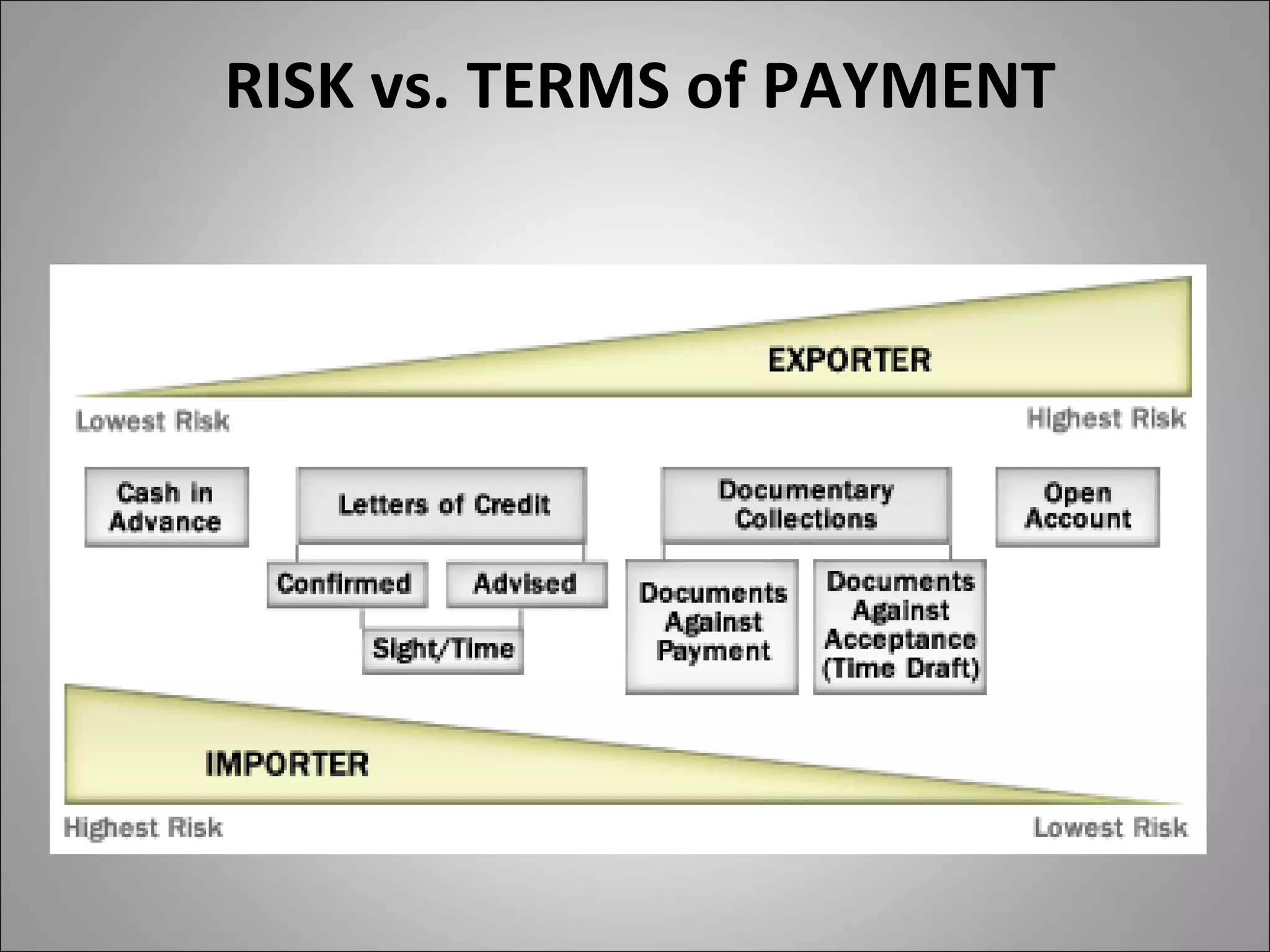
The document discusses various payment terms used in international trade: cash in advance, letter of credit, documentary collection, consignment, and open account. It provides details on the process and risks involved for exporters and importers for each payment method. A letter of credit is described as the most secure option, where payment is guaranteed by the importer's bank within a specified time upon presentation of shipping documents. The risks shift from the exporter to the importer the further down the list the payment terms move from cash in advance to open account.
In this document
Powered by AI
Overview of common payment methods in international trade: Cash in Advance, Documents against Payment, Open Account, Letter of Credit.
Details on cash in advance payment, including methods like Telegraphic Transfer and Demand Draft, and conditions for use.
Explanation of Documents Against Payment, where payment is made upon receiving shipping documents.
Description of Documents Against Acceptance, where importer commits to pay at a later date.
Open Account method involves shipping goods directly to buyer with documents sent afterward, awaiting payment.
Definition and function of a Letter of Credit, a formal payment guarantee communicated through banks.
Key participants in a Letter of Credit transaction: Applicant/Importer, Exporter, Issuing Bank, and Confirming Bank.
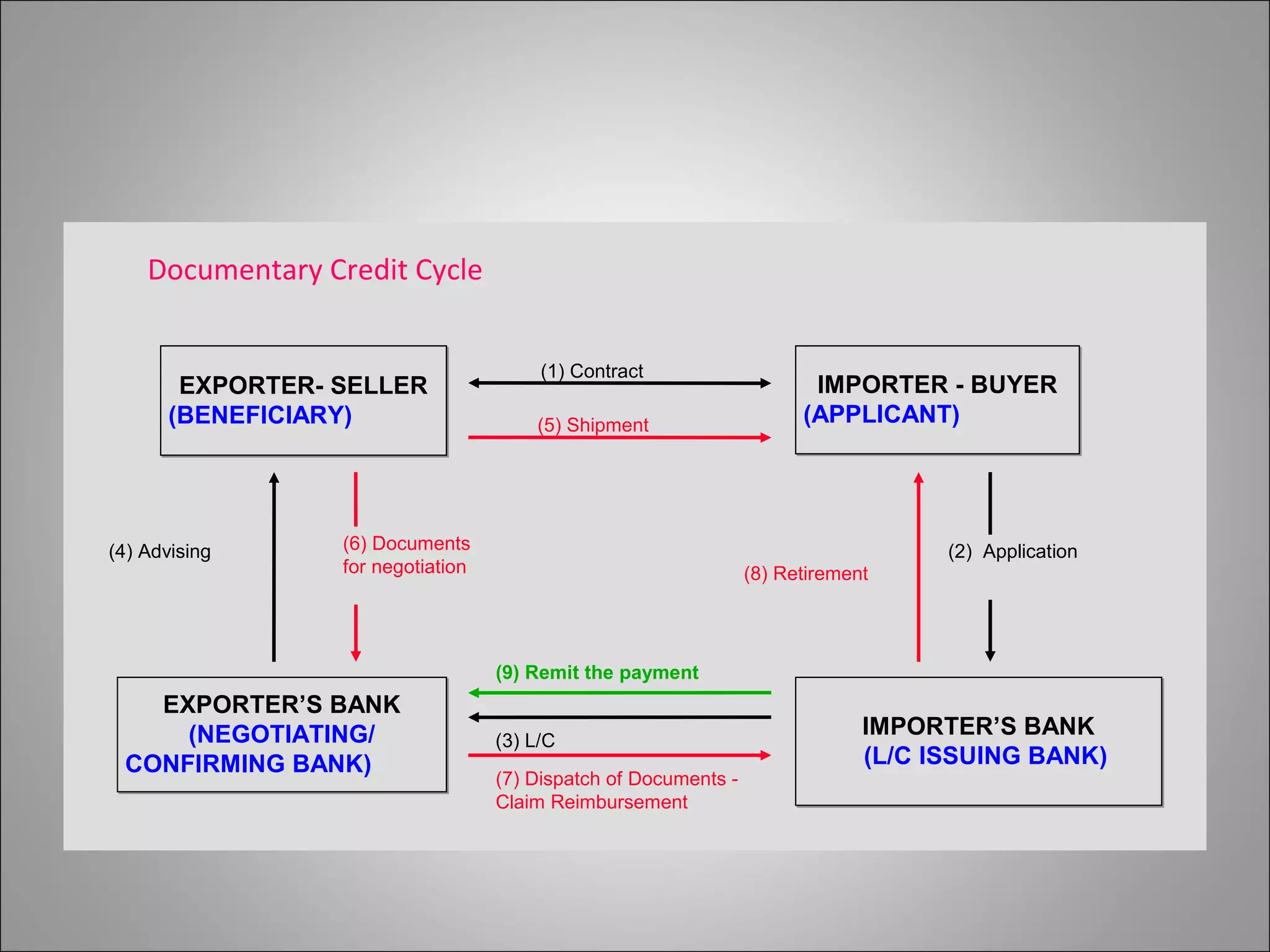
Illustrative cycle of Documentary Credit including contracts, shipment, advising, and payment processes.
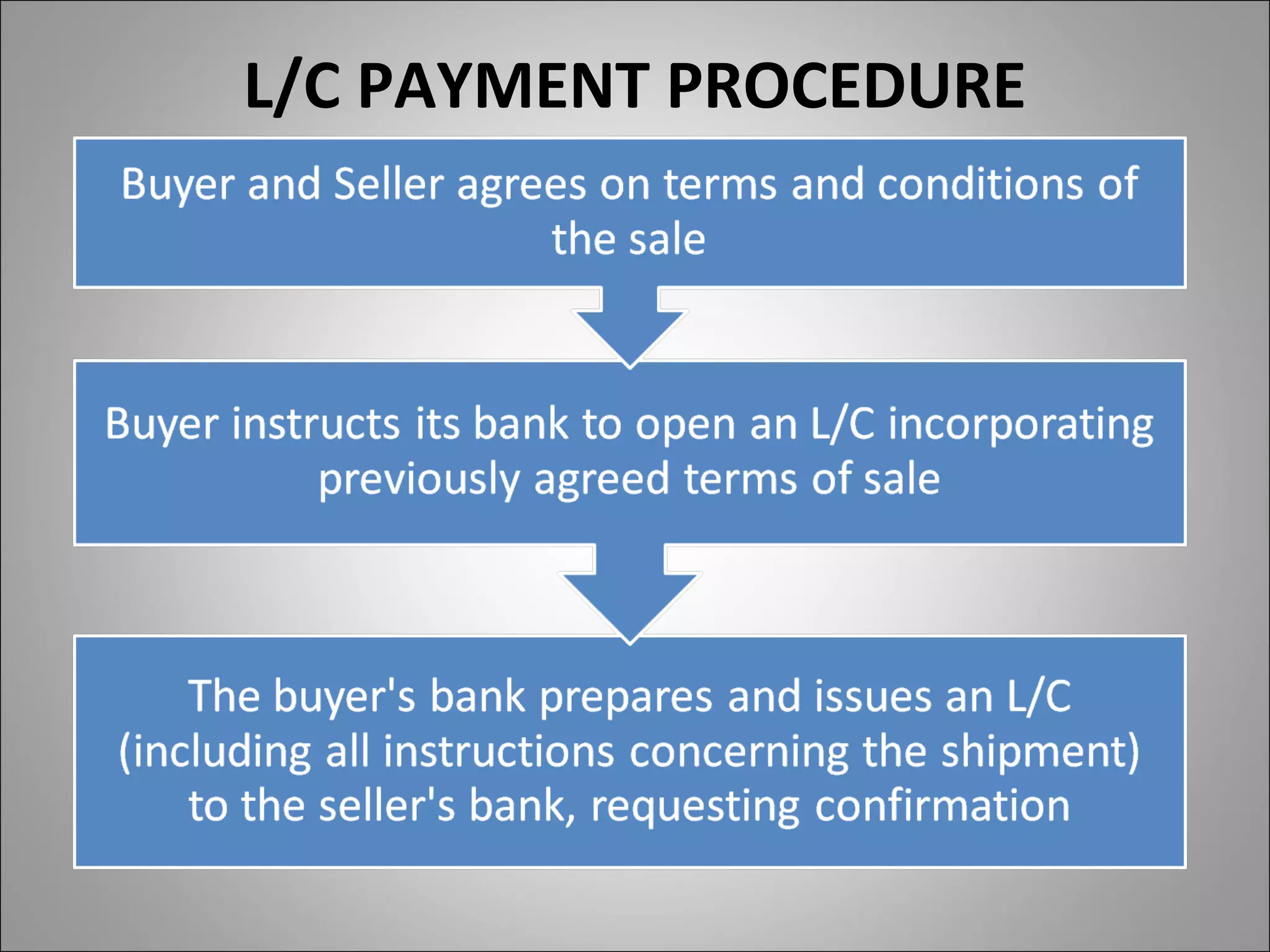
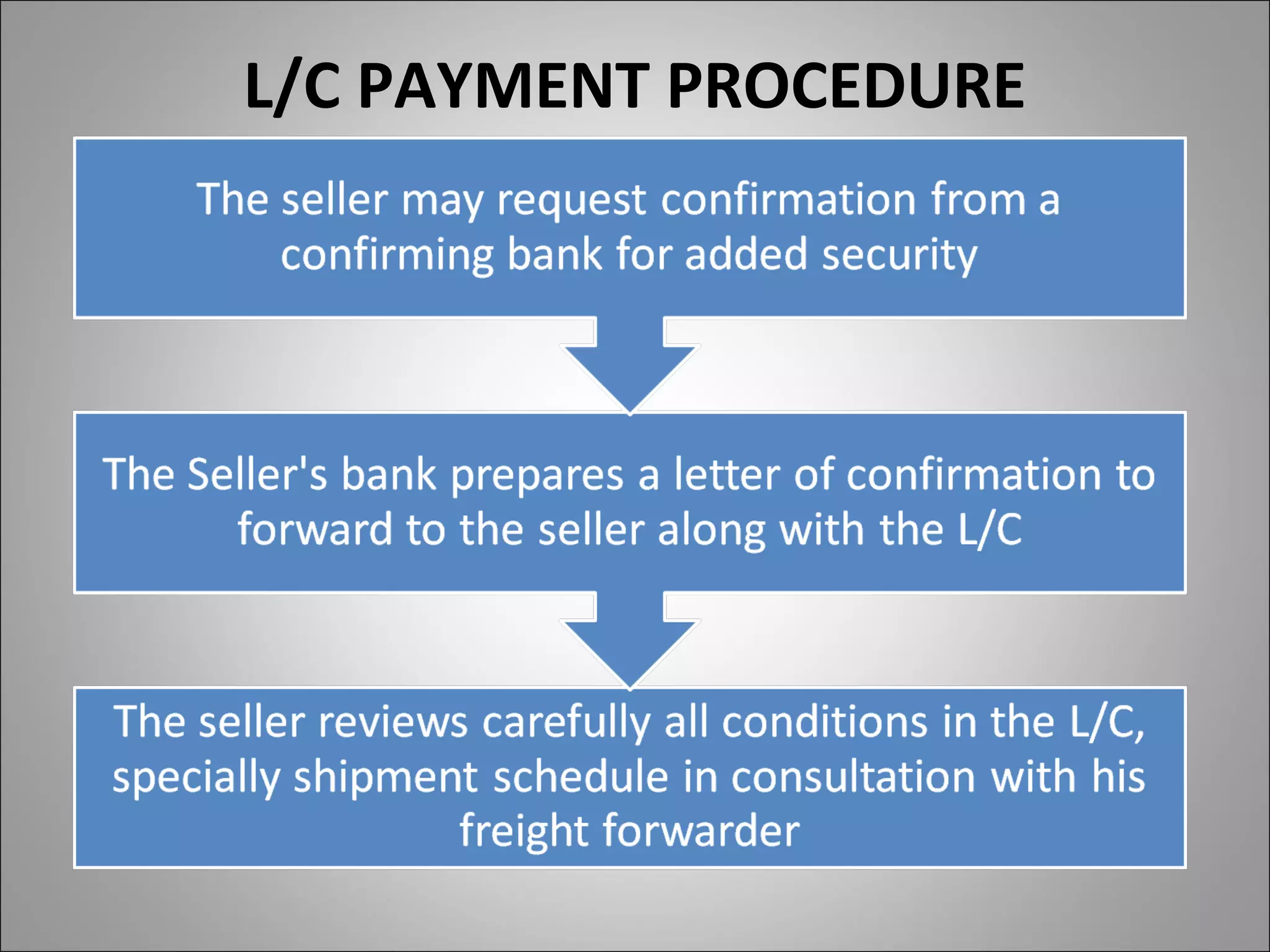
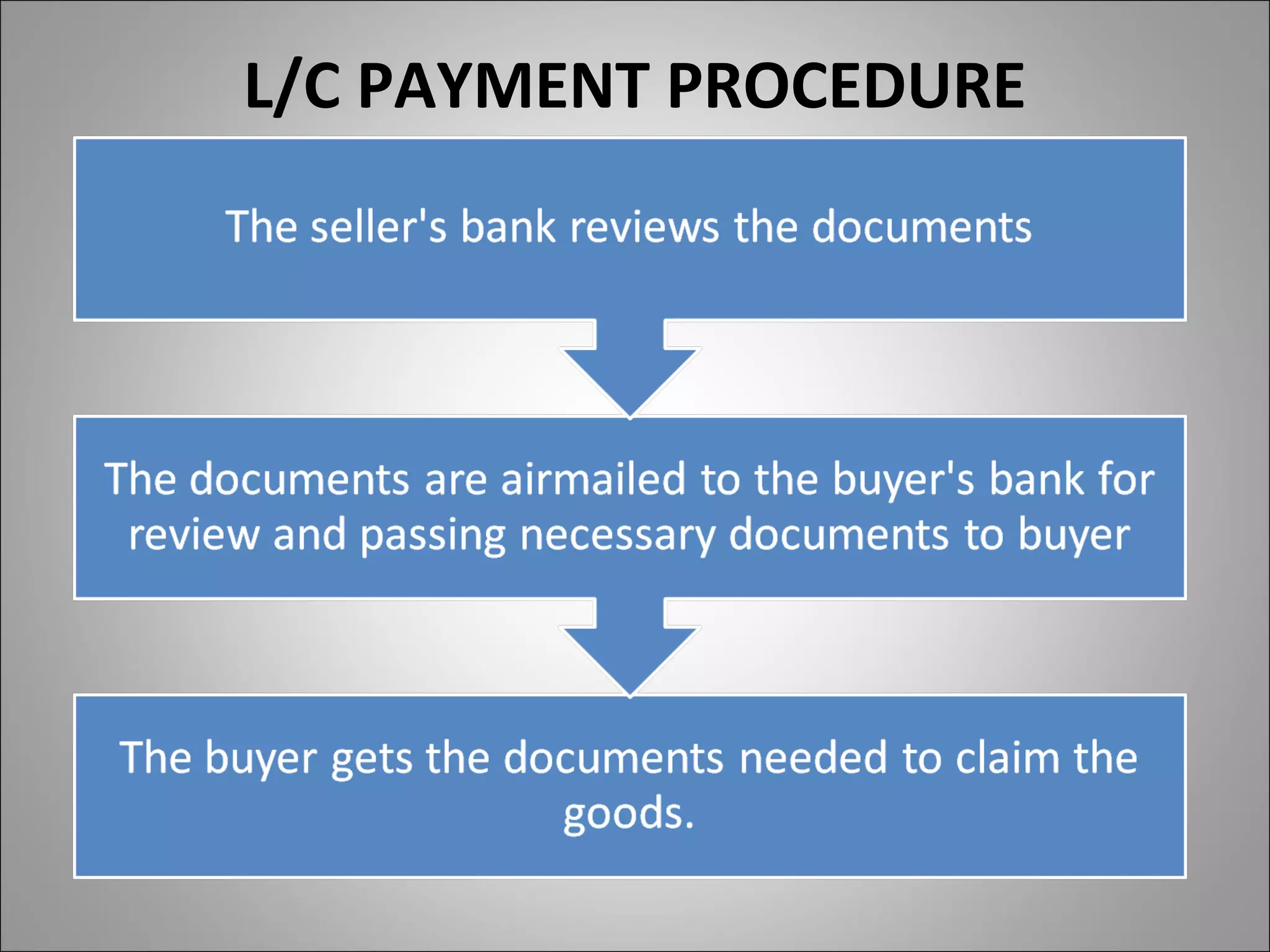
Step-by-step explanation of the Letter of Credit payment procedure, providing clear guidelines for execution.
Various types of Letters of Credit including Sight, Usance, Revocable, Irrevocable, and others with specific clauses.
Analysis of risk associated with different payment methods in international trade.
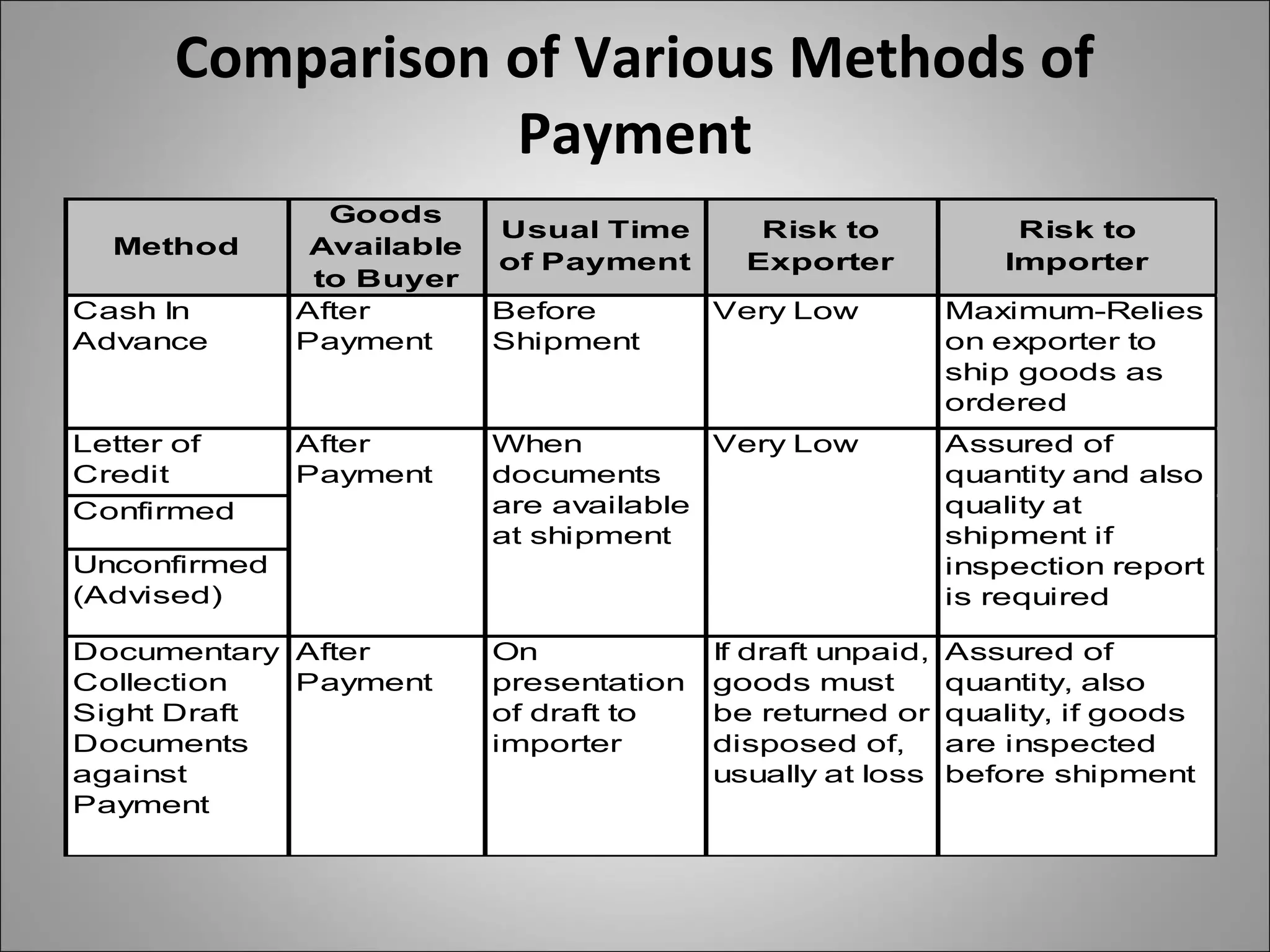
Detailed comparison of various payment methods highlighting availability, payment timings, and associated risks for exporters and importers.
COMMON PAYMENT TERMS
• Cash in Advance
• Documents against Payment/DA
• Open Account
• Letter of Credit
3.
CASH IN ADVANCE
•Receive cash from the buyer before shipping
– Telegraphic Transfer
– Demand Draft
• In case of HUGE payments (importer may
demand a bank guarantee)
• Followed if exporter is in a strong trading
position & particular product is not available
4.
DOCUMENTS AGAINST PAYMENT
•When the importer’s bank sends a collection
notice to the importer, the importer pays thus
taking the possession of documents
5.
DOCUMENTS AGAINST ACCEPTANCE
•When the importer’s bank sends a collection
notice to the importer, the importer gives the
‘acceptance’ to pay at a later date I/O making
payment upon receiving the collection notice
6.
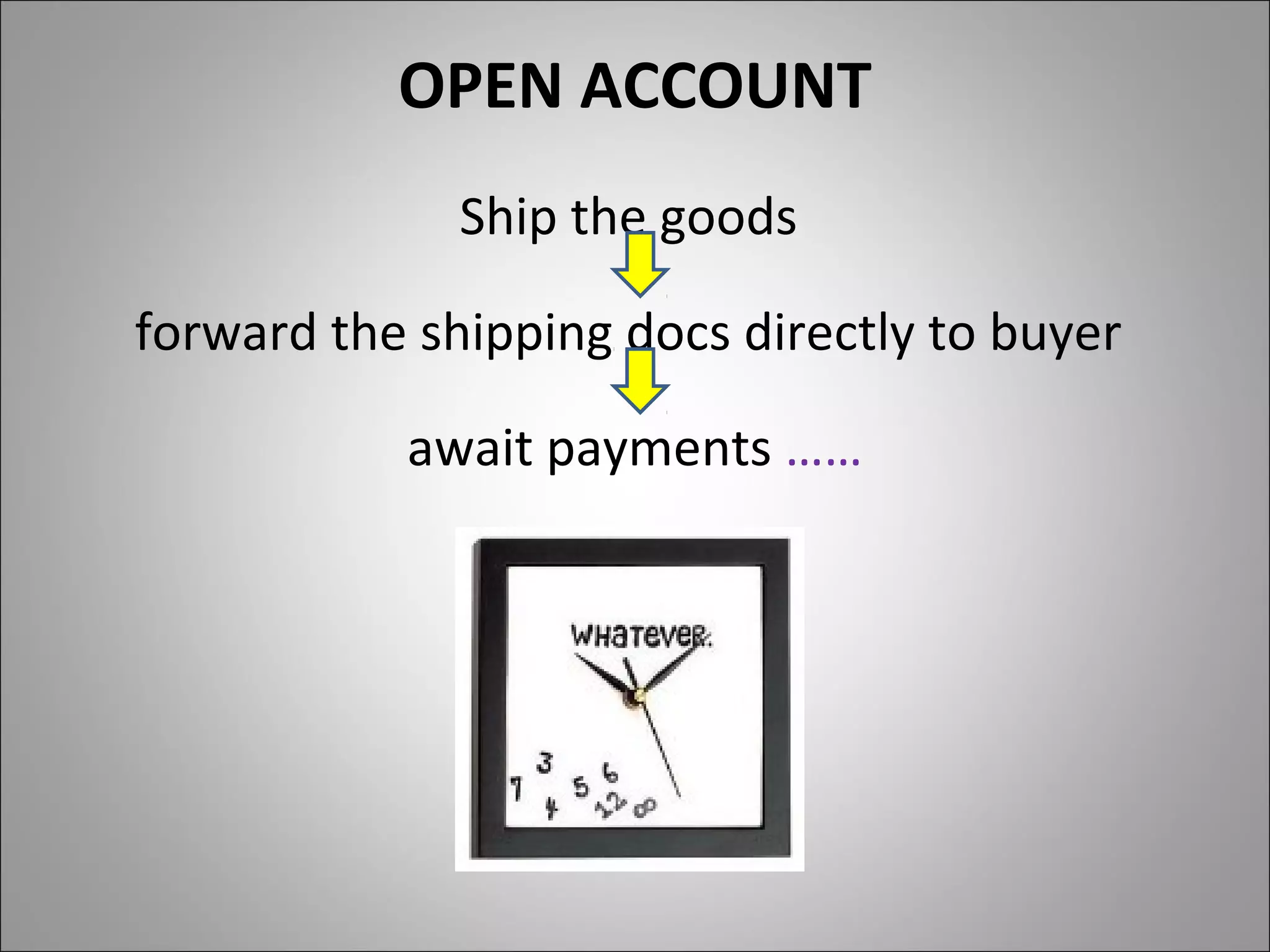
OPEN ACCOUNT
Ship the goods
forward the shipping docs directly to buyer
await payments ……
7.
A LETTER OFCREDIT
A L/C is A formal document of payment
Opened by a party wishing to import
Communicated through banking channels
Paid by the opening bank within a specified
timeframe upon presentation of docs
8.
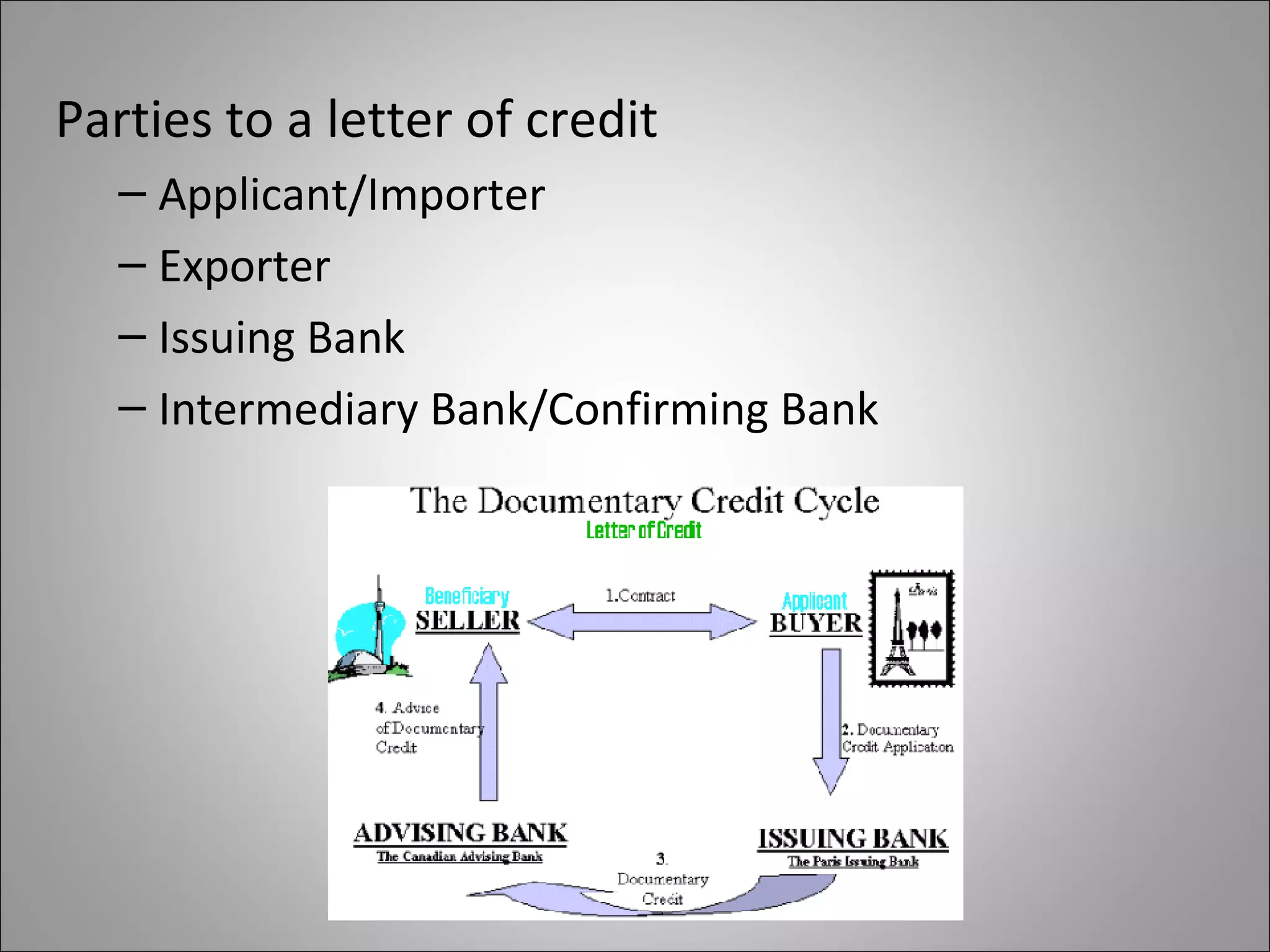
Parties to aletter of credit
– Applicant/Importer
– Exporter
– Issuing Bank
– Intermediary Bank/Confirming Bank
9.
Documentary Credit Cycle
(1) Contract
EXPORTER- SELLER IMPORTER - BUYER
(BENEFICIARY) (5) Shipment (APPLICANT)
(4) Advising (6) Documents (2) Application
for negotiation (8) Retirement
(9) Remit the payment
EXPORTER’S BANK
(NEGOTIATING/ IMPORTER’S BANK
(3) L/C
CONFIRMING BANK) (L/C ISSUING BANK)
(7) Dispatch of Documents -
Claim Reimbursement
Comparison of VariousMethods of
Payment
Goods
Usual Time Risk to Risk to
Method Available
of Payment Exporter Importer
to Buyer
Cash In After Before Very Low Maximum-Relies
Advance Payment Shipment on exporter to
ship goods as
ordered
Letter of After When Very Low Assured of
Credit Payment documents quantity and also
Confirmed are available quality at
at shipment shipment if
Unconfirmed inspection report
(Advised) is required
Documentary After On If draft unpaid, Assured of
Collection Payment presentation goods must quantity, also
Sight Draft of draft to be returned or quality, if goods
Documents importer disposed of, are inspected
against usually at loss before shipment
Payment
18.
Comparison of VariousMethods of
Payment
Goods
Usual Time Risk To Risk To
Method Available To
Of Payment Exporter Importer
Buyer
Documentary Before payment On maturity of Relies on importer Minimal—Can check
Collection Time Draft draft to pay draft shipment for
Documents against quantity and quality
Acceptance before payment
Consignment Before payment, After use; Substantial risk Very Low
exporter retains inventory and unless through
title until goods warehousing cost foreign branch or
are sold or used to exporter subsidiary
Open Account Before payment As agreed Relies on importer Very Low
to pay as agreed -
complete risk