10 years of open access at BioMed Central

Loading...

Flash Player 9 (or above) is needed to view presentations.
We have detected that you do not have it on your computer. To install it, go here.
0 comments

Post a comment

    Post a comment
    Embed Video
    Edit your comment Cancel

    2 Favorites

    10 years of open access at BioMed Central - Presentation Transcript

    1. 10 years of Open Access at BioMed Central Matthew Cockerill Managing Director, BioMed Central
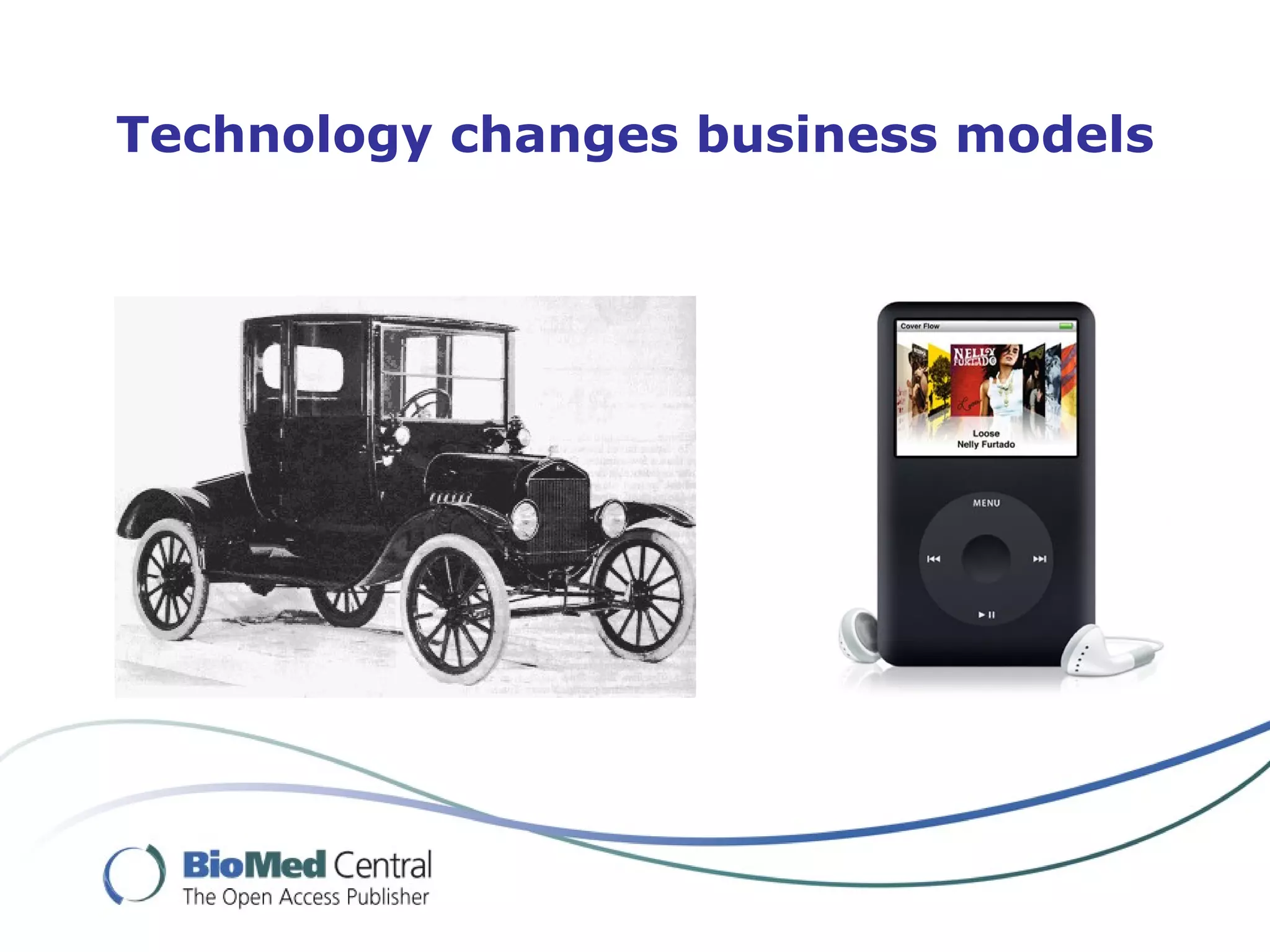
    2. Technology changes business models
    3. What is fundamentally different about the Open Access publishing business model?
    4. Traditional research publishing  The research community transfers the rights to the research to the publisher  The publisher covers costs by selling access to the content
    5. Open Access research publishing  No barriers to access  No exclusive rights  Publisher receives payment for the service of publication
    6. About BioMed Central  Largest publisher of peer-reviewed open access journals  Launched first open access journal in 2000  Now publishes 199 OA titles  >50,000 peer-reviewed OA articles published  All research articles published under Creative Commons licence  Costs covered by 'article processing charge' (APC)
    7. Three key types of journal  BMC-series (~60 titles) – Largely in-house editorial process – Systematic coverage of all areas of biology and medicine – Aims to publish all scientifically sound research – BMC Biology and BMC Medicine highlight top research – BMC Research Notes publishes incremental results, datasets etc.  Independent journals (~135 titles) – External Editors-in-Chief – External editorial process (with option of in-house support) – Some are broad, some focus on a specific niche – Often society-affiliated  Hybrid journals (~6 titles) – In-house editorial process – Commissioned content available to subscribers – All research open access
    8. BioMed Central revenue streams  Publication fees – From authors – From meeting organizers – From sponsoring organizations  Subscription content (e.g. reviews)  Services (e.g. Open Repository)  Advertising / sponsorship
    9. OA Publication Fees
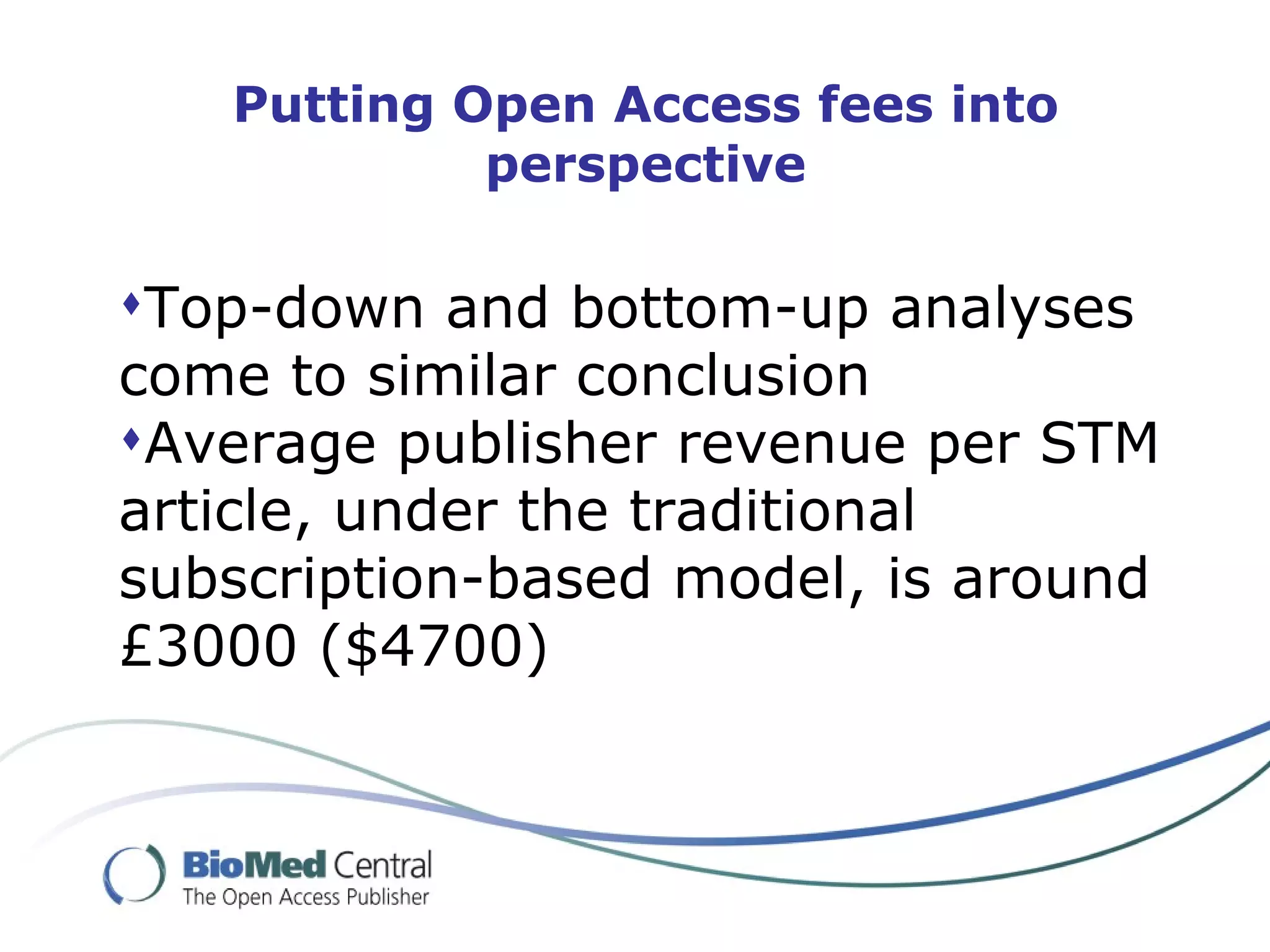
    10. Putting Open Access fees into perspective Top-down and bottom-up analyses come to similar conclusion Average publisher revenue per STM article, under the traditional subscription-based model, is around £3000 ($4700)
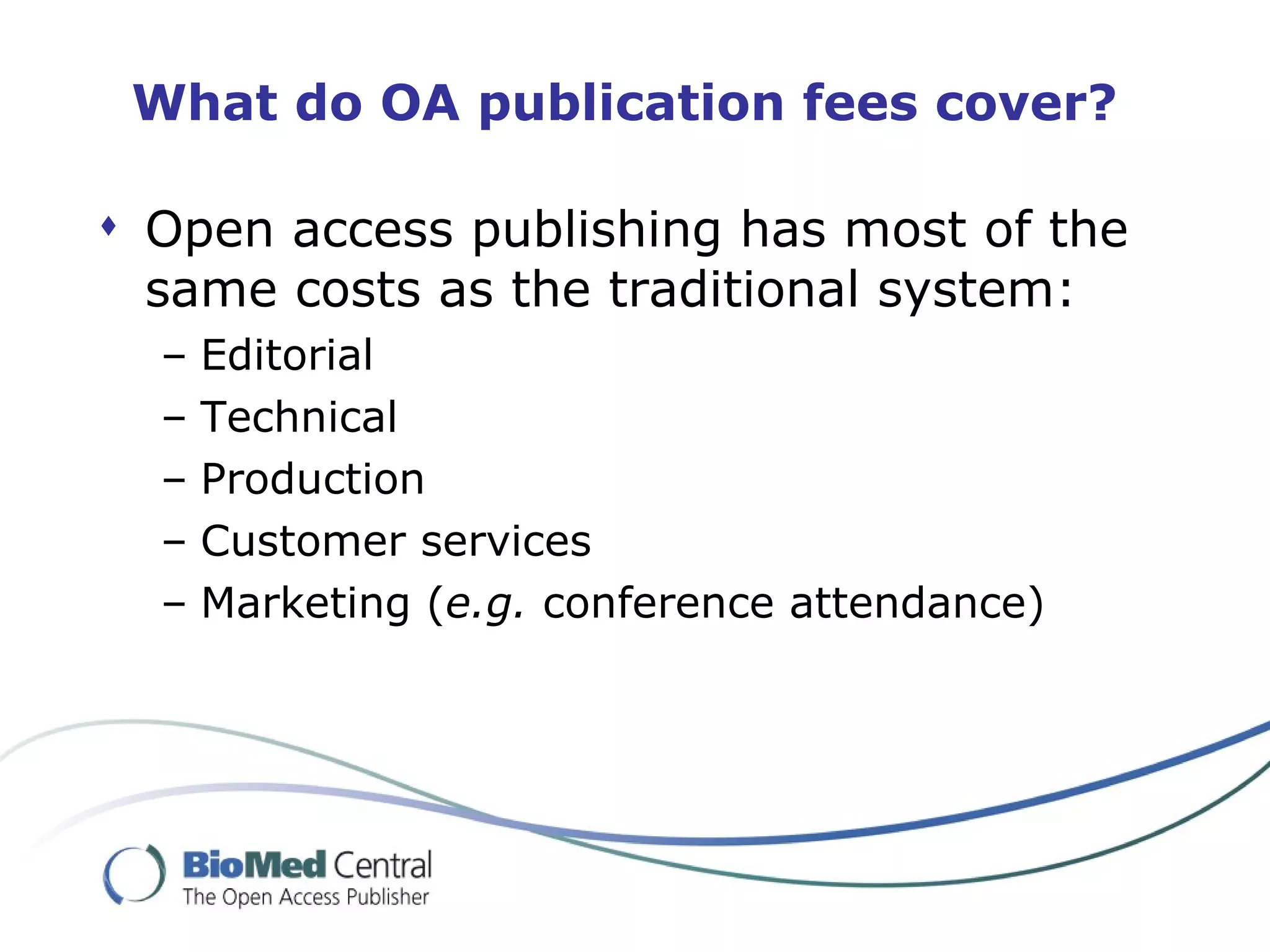
    11. What do OA publication fees cover?  Open access publishing has most of the same costs as the traditional system: – Editorial – Technical – Production – Customer services – Marketing (e.g. conference attendance)
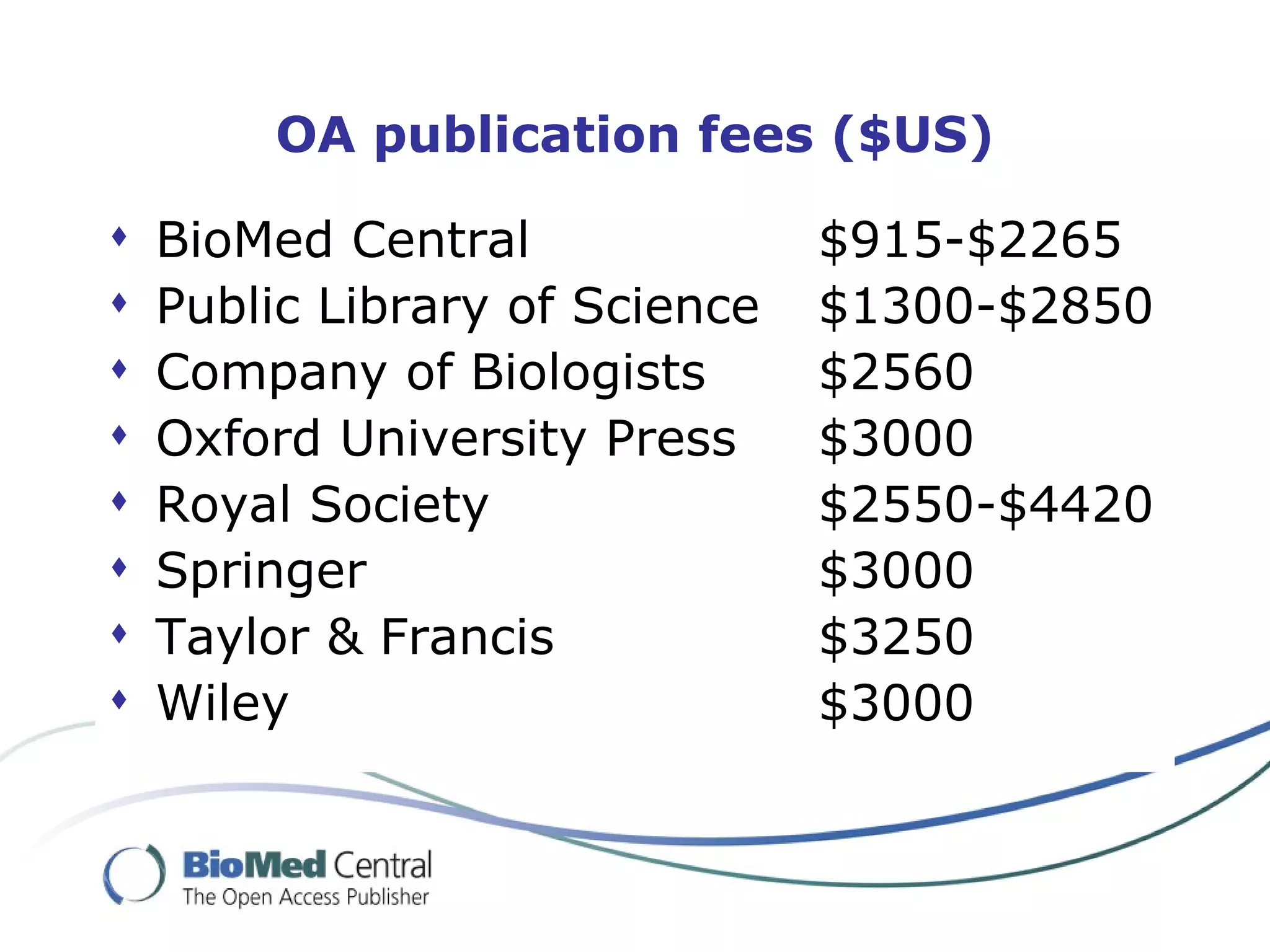
    12. OA publication fees ($US)  BioMed Central $915-$2265  Public Library of Science $1300-$2850  Company of Biologists $2560  Oxford University Press $3000  Royal Society $2550-$4420  Springer $3000  Taylor & Francis $3250  Wiley $3000
    13. How do OA publication fees get paid?  Authors may pay out of grant funds  Some funders provide dedicated funds for open access publishing costs  Institutions may cover costs centrally (via open access funds and/or membership arrangements with OA publishers)  Some journals are run by organizations which cover costs themselves
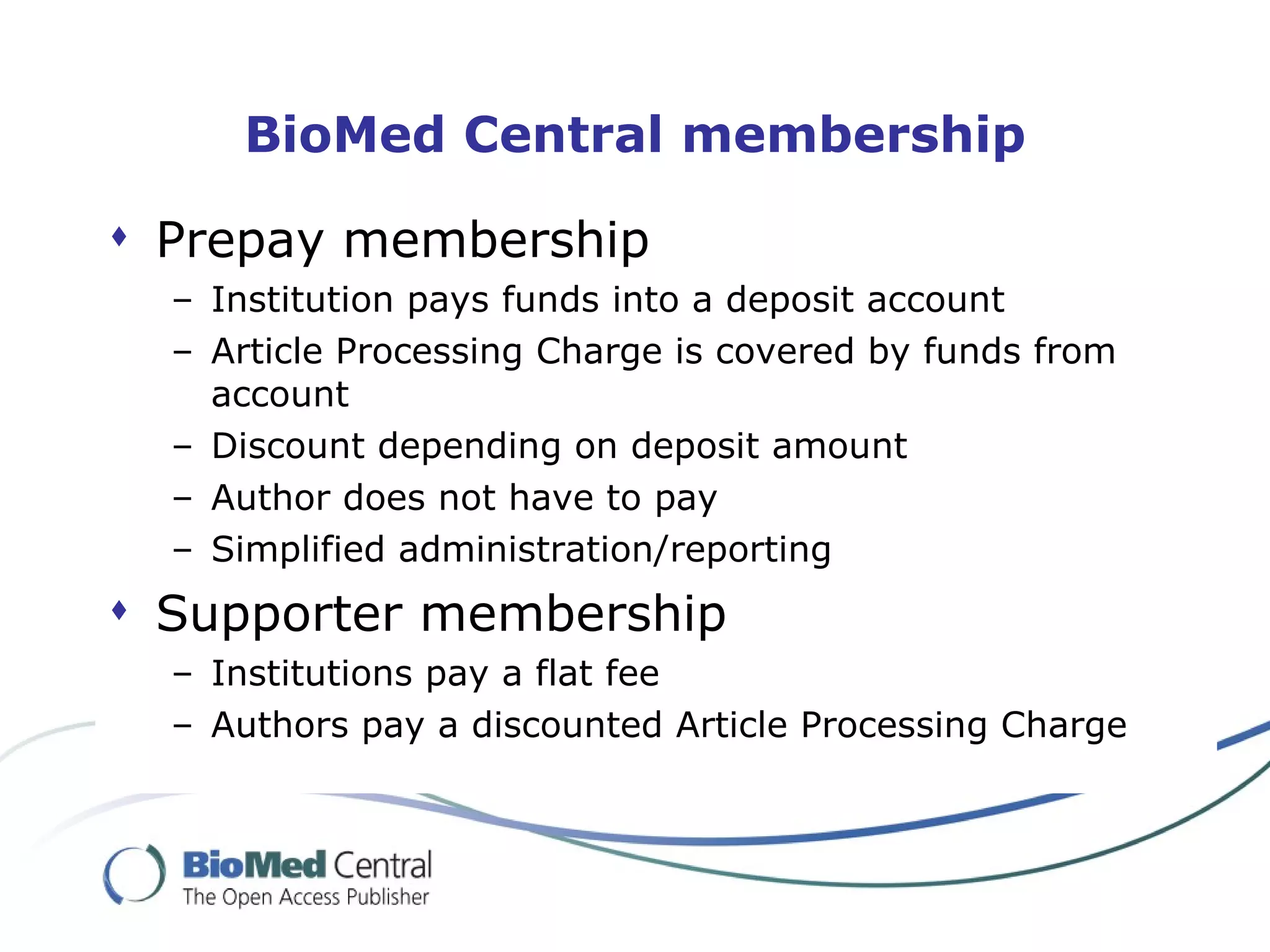
    14. BioMed Central membership  Prepay membership – Institution pays funds into a deposit account – Article Processing Charge is covered by funds from account – Discount depending on deposit amount – Author does not have to pay – Simplified administration/reporting  Supporter membership – Institutions pay a flat fee – Authors pay a discounted Article Processing Charge
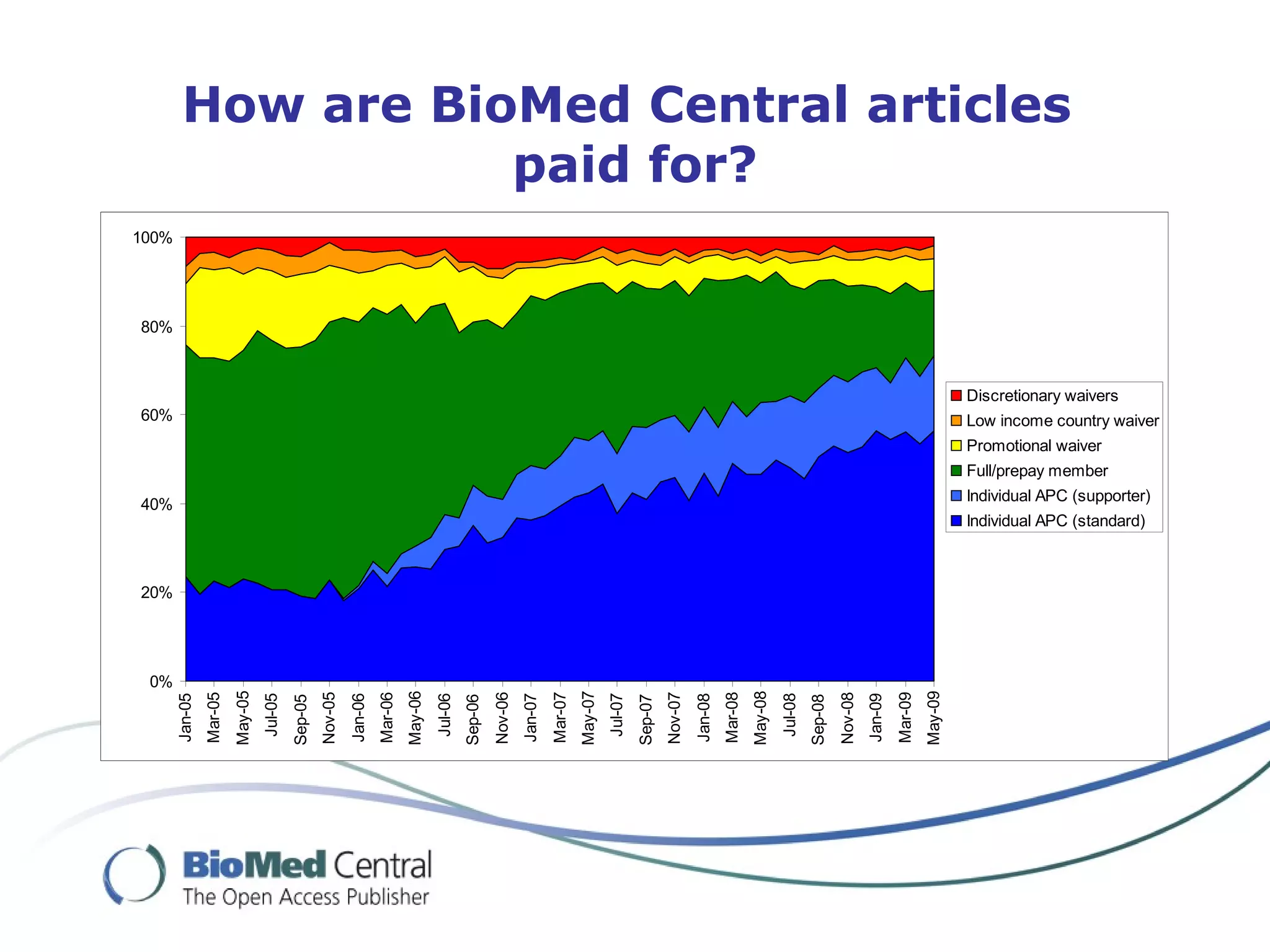
    15. How are BioMed Central articles paid for? 100% 80% Discretionary waivers 60% Low income country waiver Promotional waiver Full/prepay member Individual APC (supporter) 40% Individual APC (standard) 20% 0% May-05 May-06 May-07 May-08 May-09 Nov-05 Nov-06 Mar-07 Nov-07 Mar-08 Mar-09 Mar-05 Mar-06 Nov-08 Jul-07 Jul-08 Jan-05 Jul-05 Jan-06 Jul-06 Jan-07 Jan-08 Jan-09 Sep-06 Sep-07 Sep-08 Sep-05
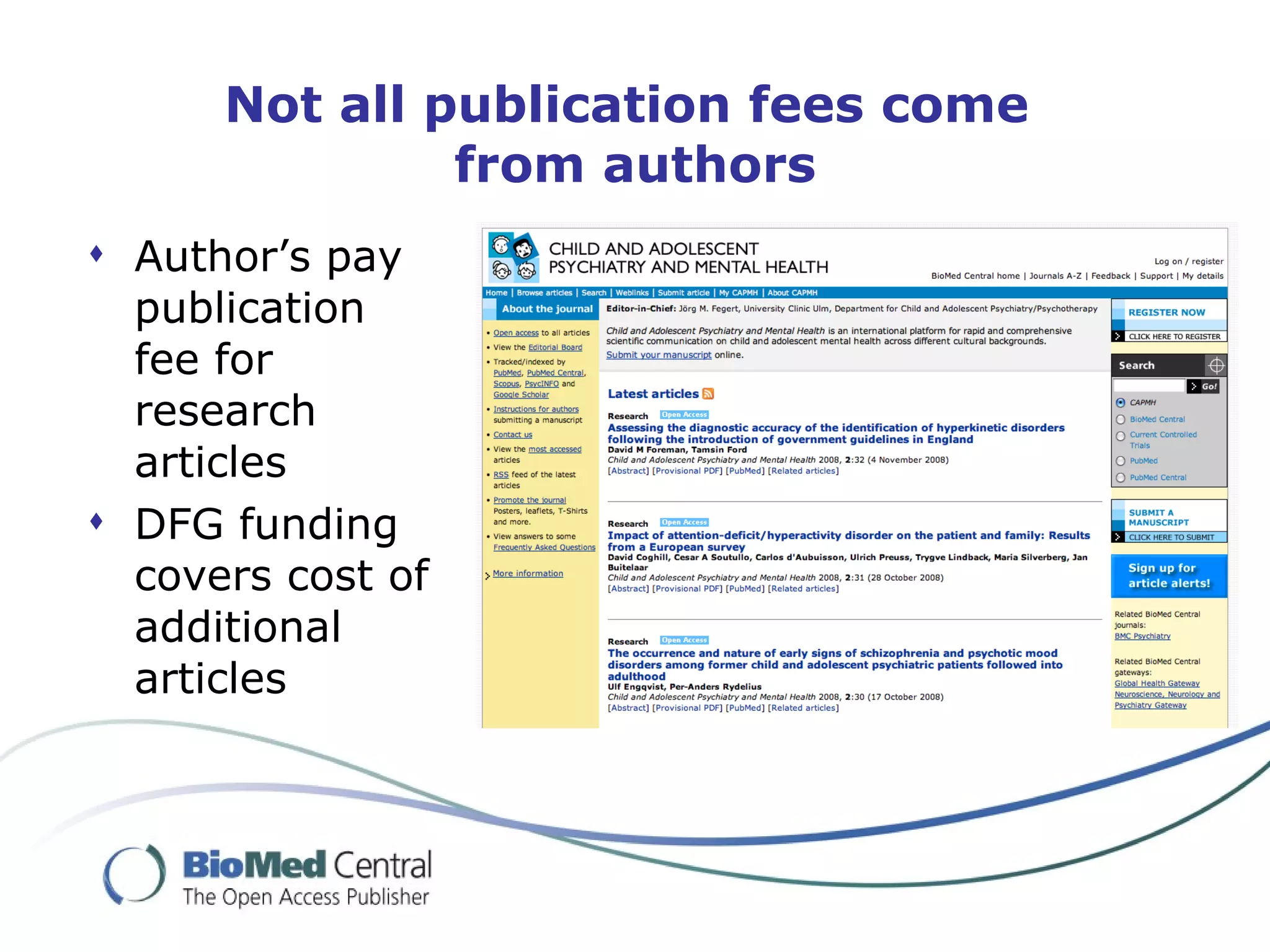
    16. Not all publication fees come from authors  Author’s pay publication fee for research articles  DFG funding covers cost of additional articles
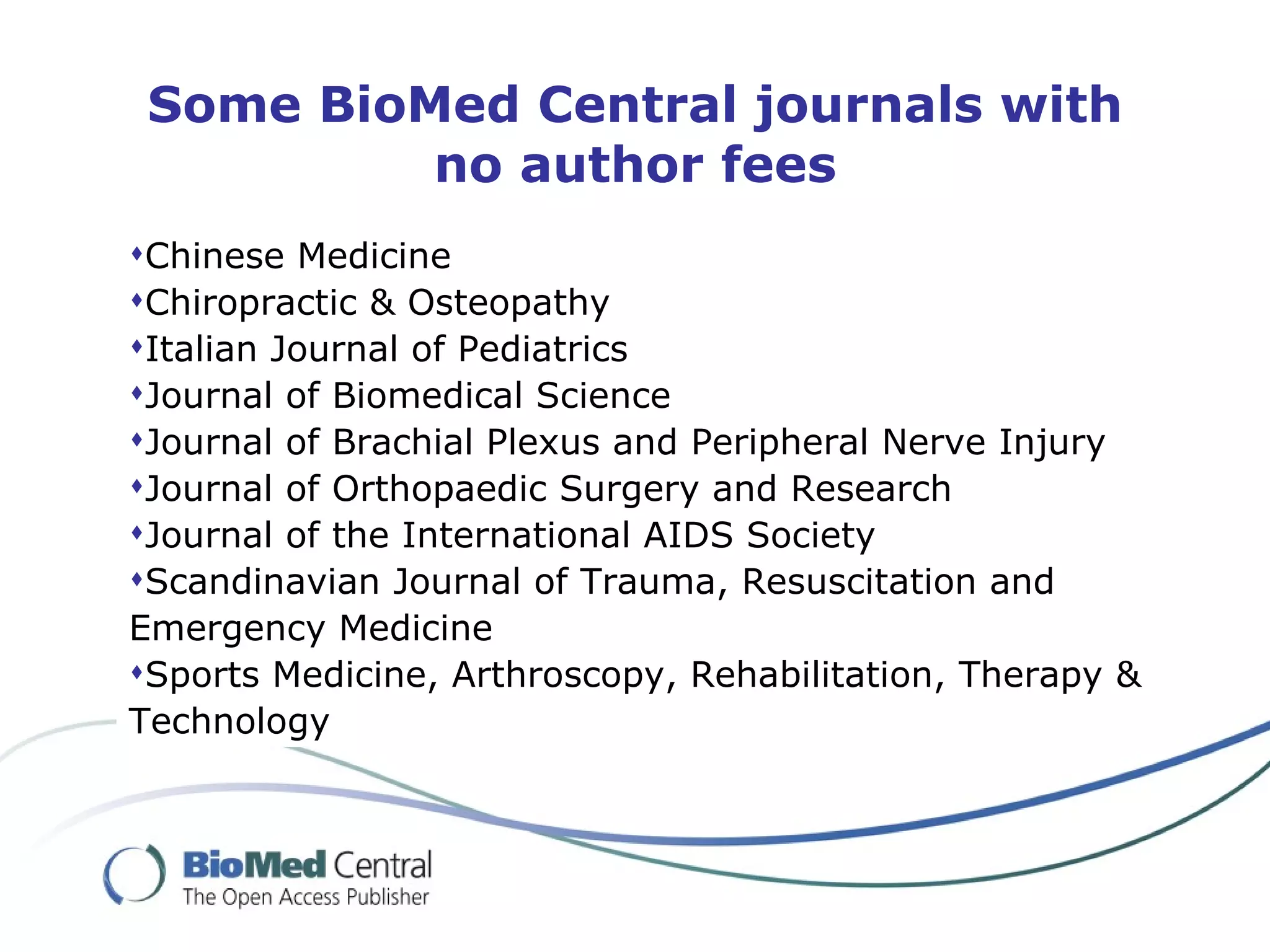
    17. Some BioMed Central journals with no author fees Chinese Medicine Chiropractic & Osteopathy Italian Journal of Pediatrics Journal of Biomedical Science Journal of Brachial Plexus and Peripheral Nerve Injury Journal of Orthopaedic Surgery and Research Journal of the International AIDS Society Scandinavian Journal of Trauma, Resuscitation and Emergency Medicine Sports Medicine, Arthroscopy, Rehabilitation, Therapy & Technology
    18. Making peer review more efficient
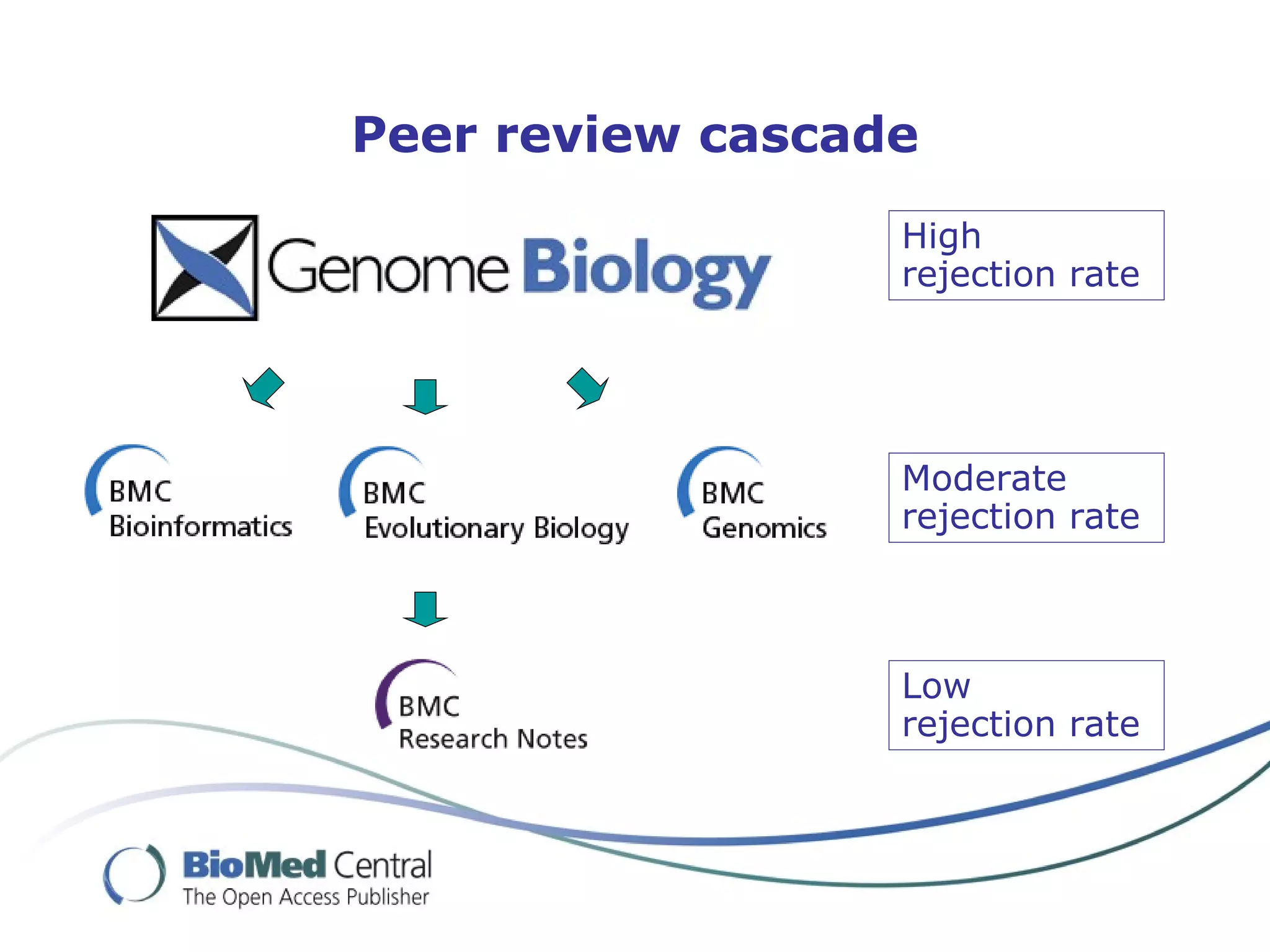
    19. Peer review cascade High rejection rate Moderate rejection rate Low rejection rate
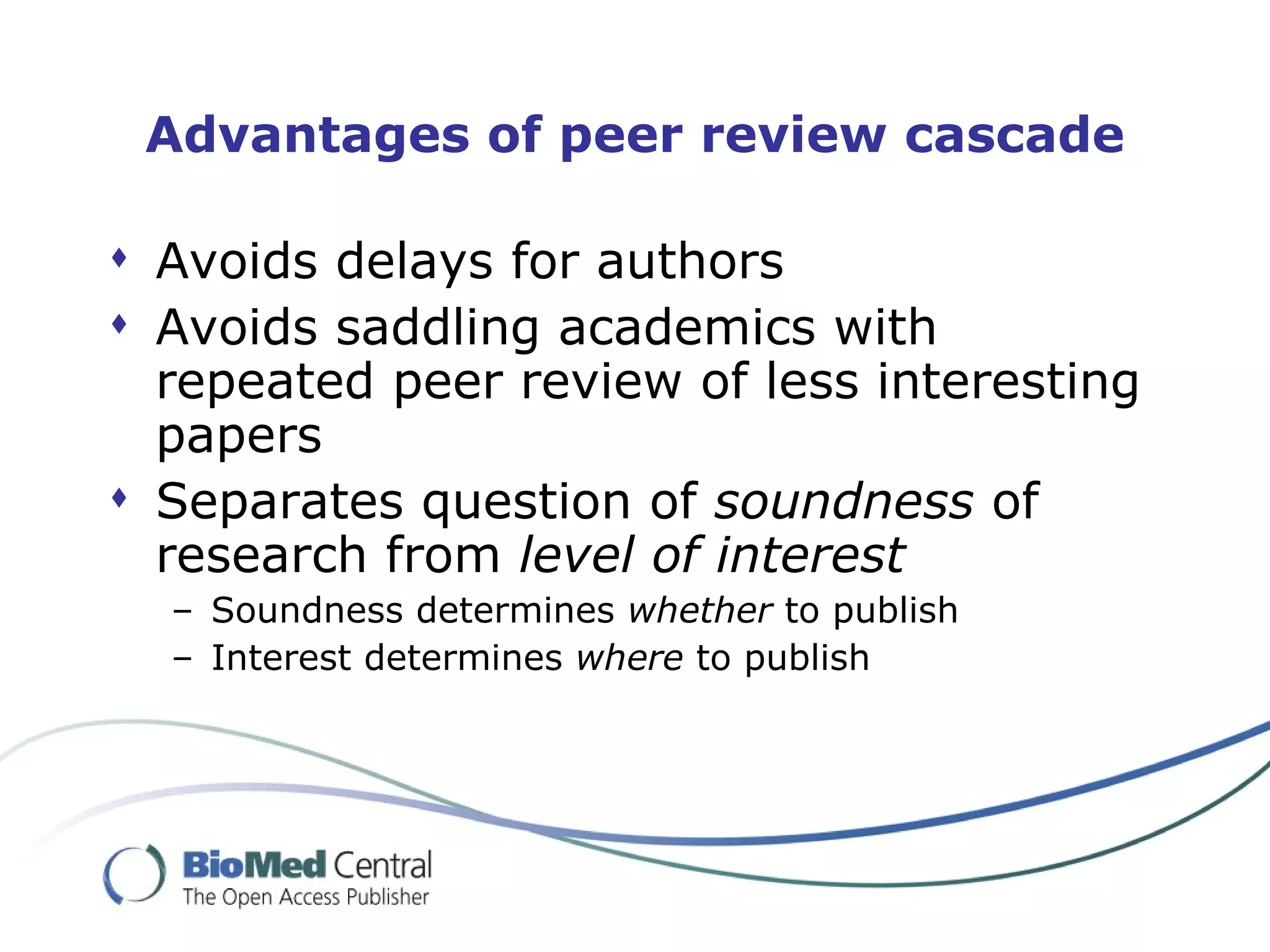
    20. Advantages of peer review cascade  Avoids delays for authors  Avoids saddling academics with repeated peer review of less interesting papers  Separates question of soundness of research from level of interest – Soundness determines whether to publish – Interest determines where to publish
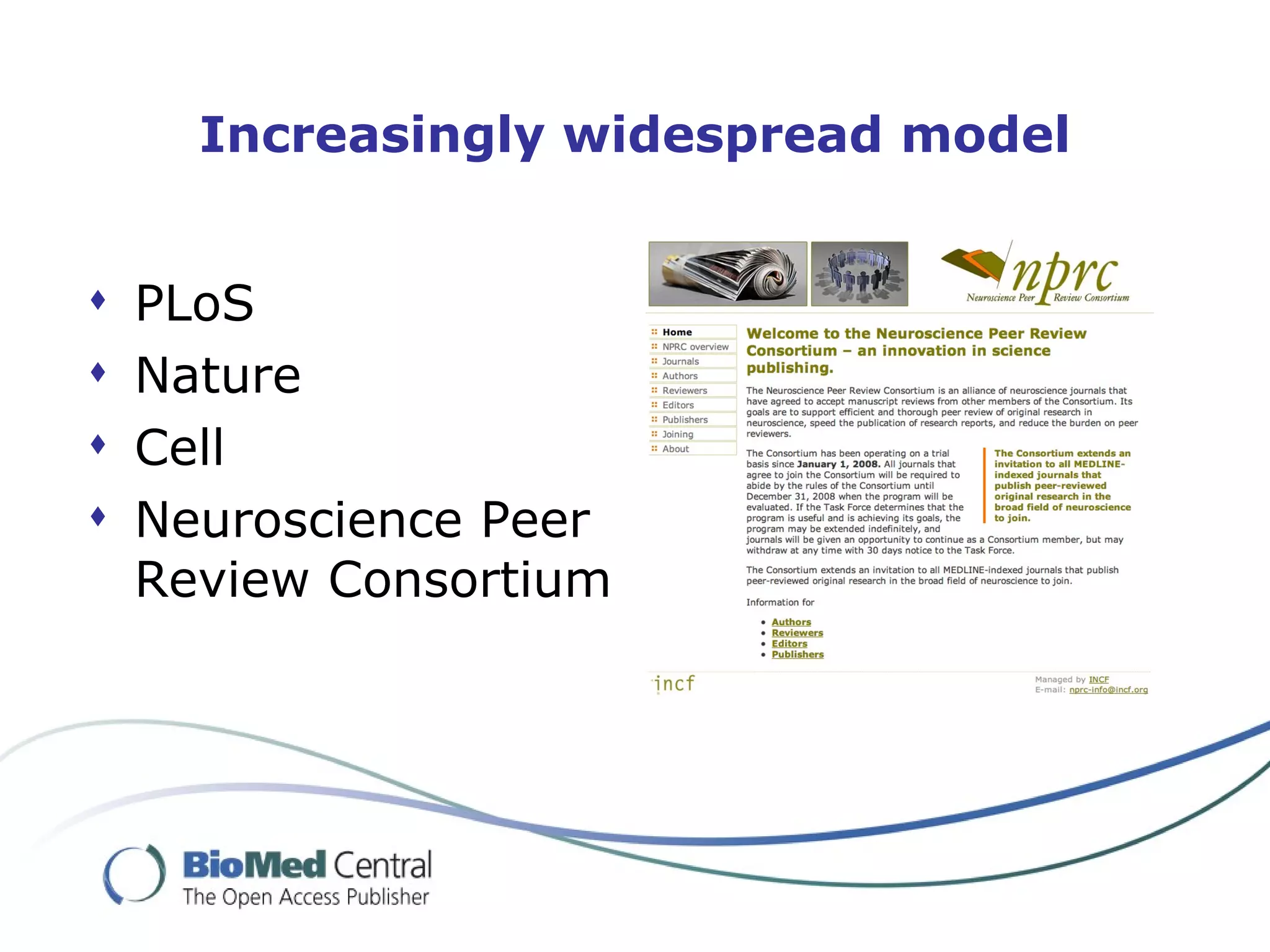
    21. Increasingly widespread model  PLoS  Nature  Cell  Neuroscience Peer Review Consortium
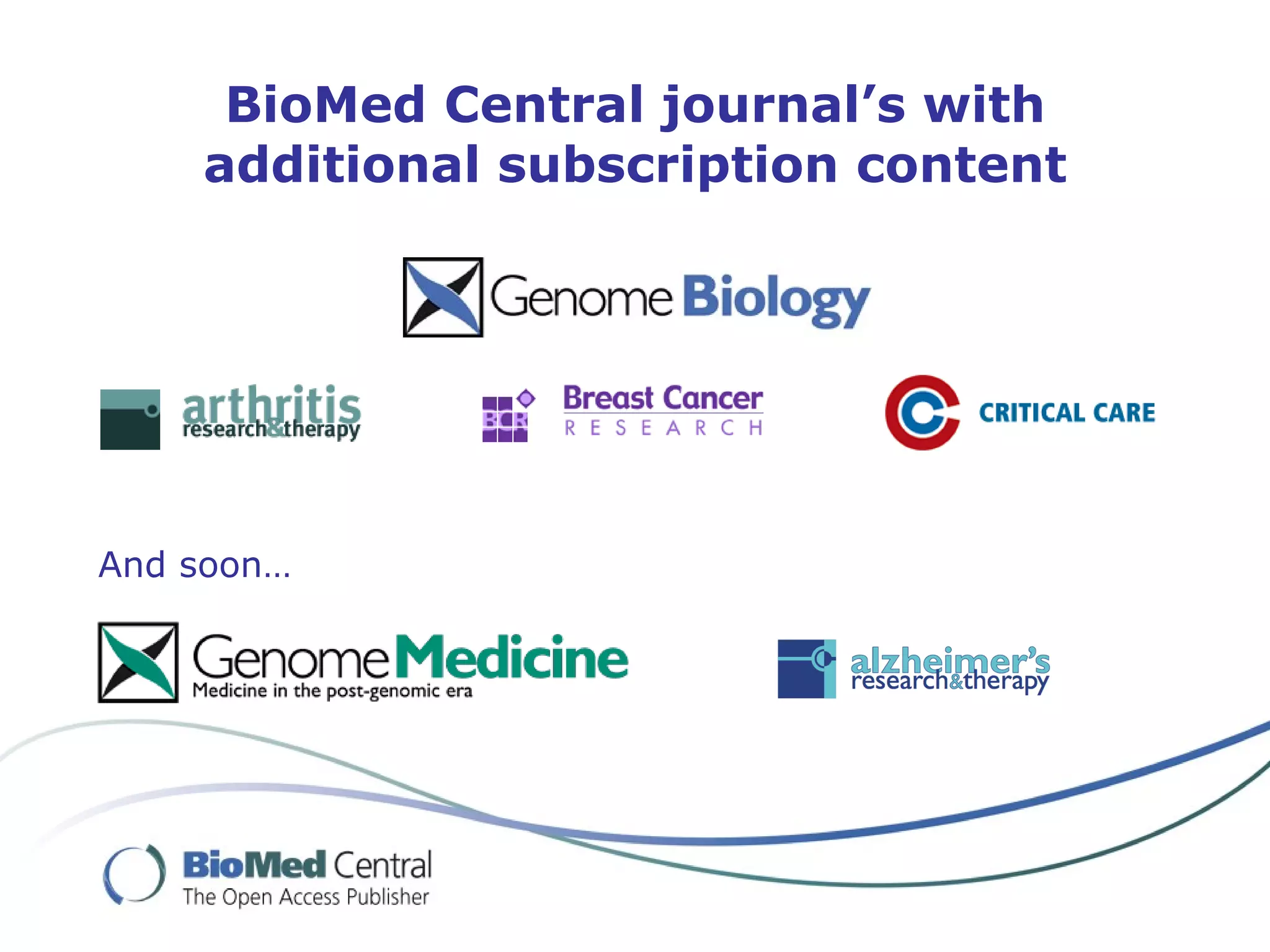
    22. BioMed Central journal’s with additional subscription content And soon…
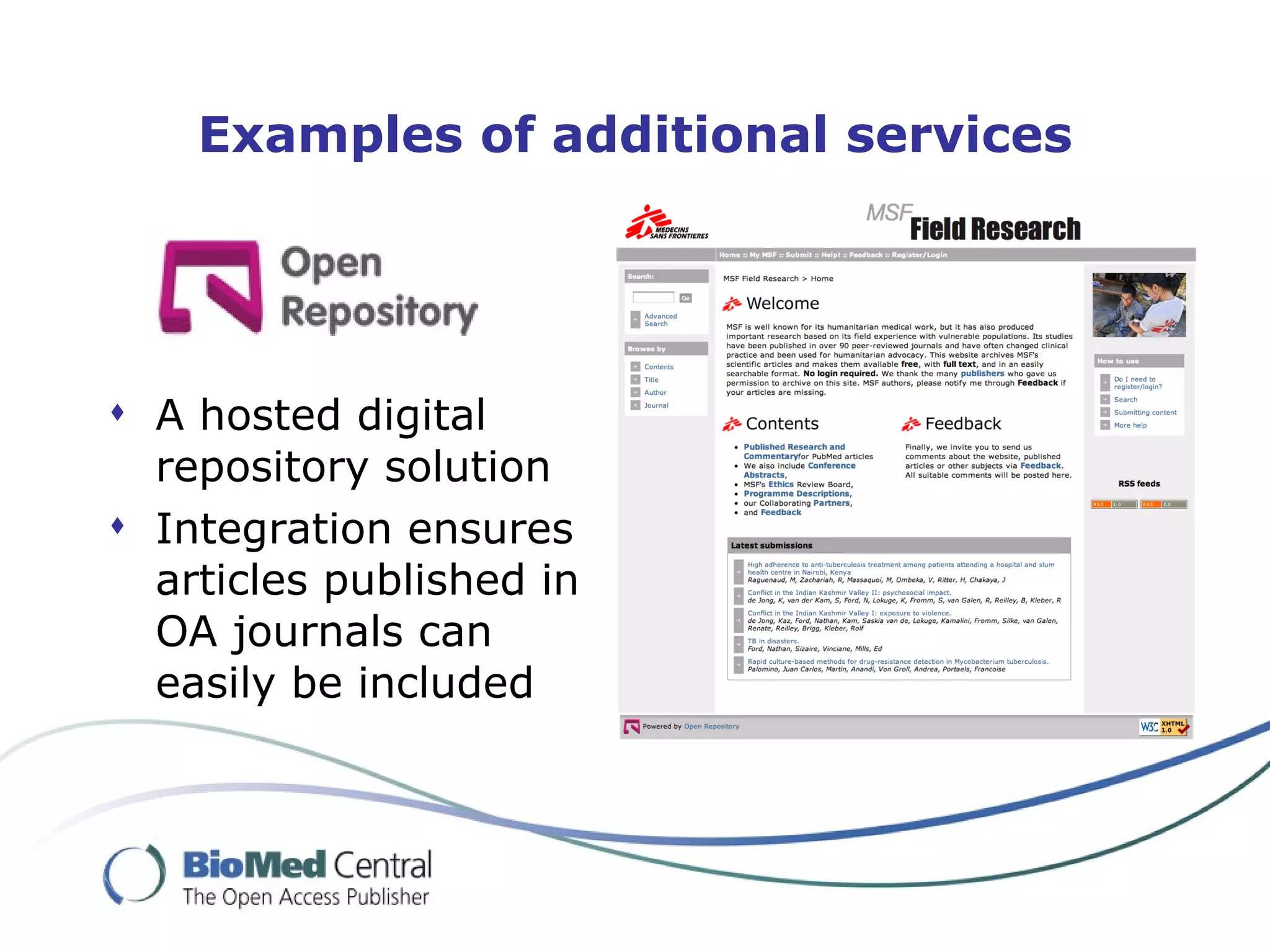
    23. Examples of additional services  A hosted digital repository solution  Integration ensures articles published in OA journals can easily be included
    24. Advertising  Common question from would-be journal editors: “Can we support a journal entirely with advertising?”  Unlikely - advertising is small fraction of revenue for BioMed Central journals
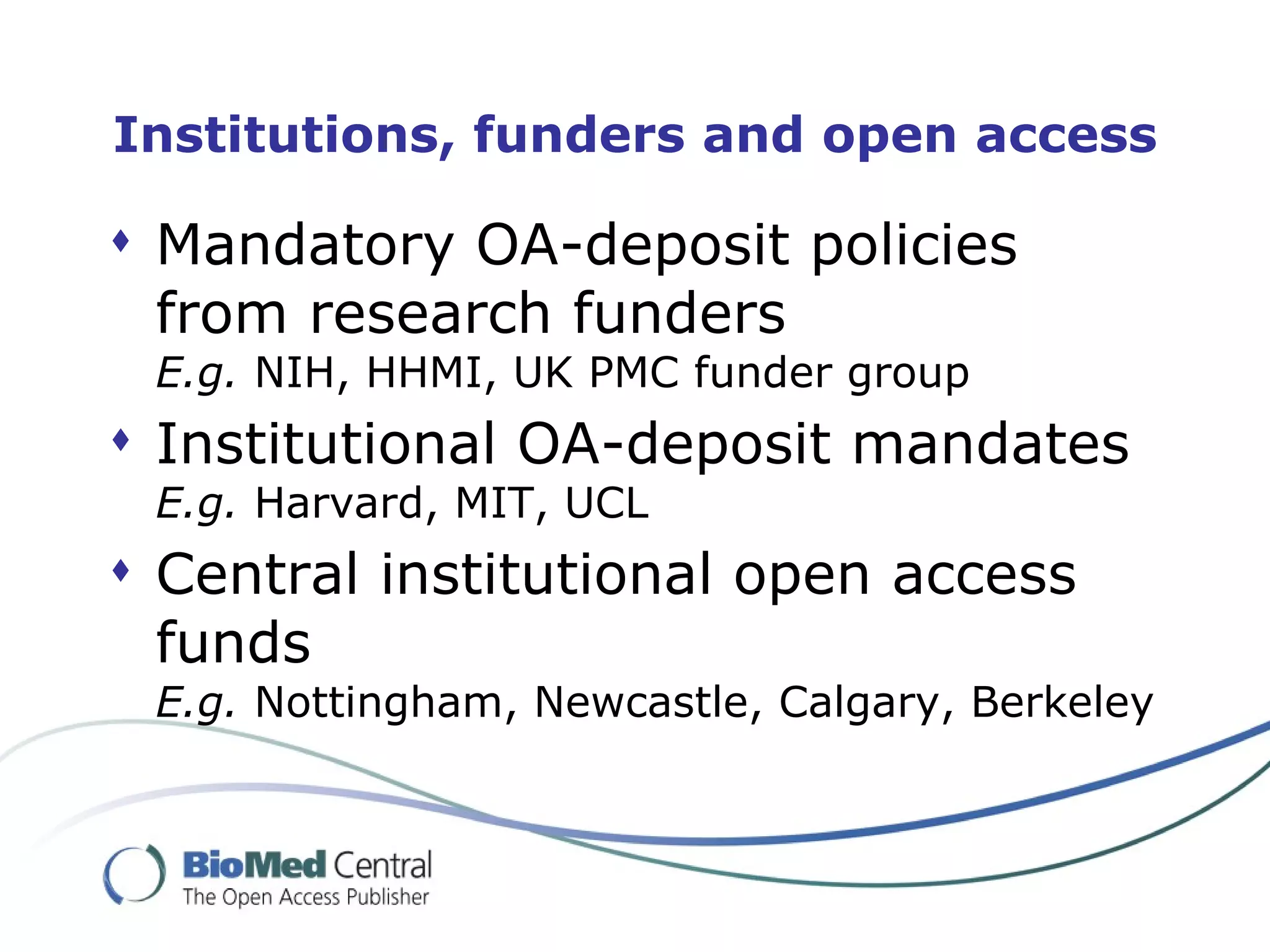
    25. Institutions, funders and open access  Mandatory OA-deposit policies from research funders E.g. NIH, HHMI, UK PMC funder group  Institutional OA-deposit mandates E.g. Harvard, MIT, UCL  Central institutional open access funds E.g. Nottingham, Newcastle, Calgary, Berkeley
    26. Growth of BioMed Central
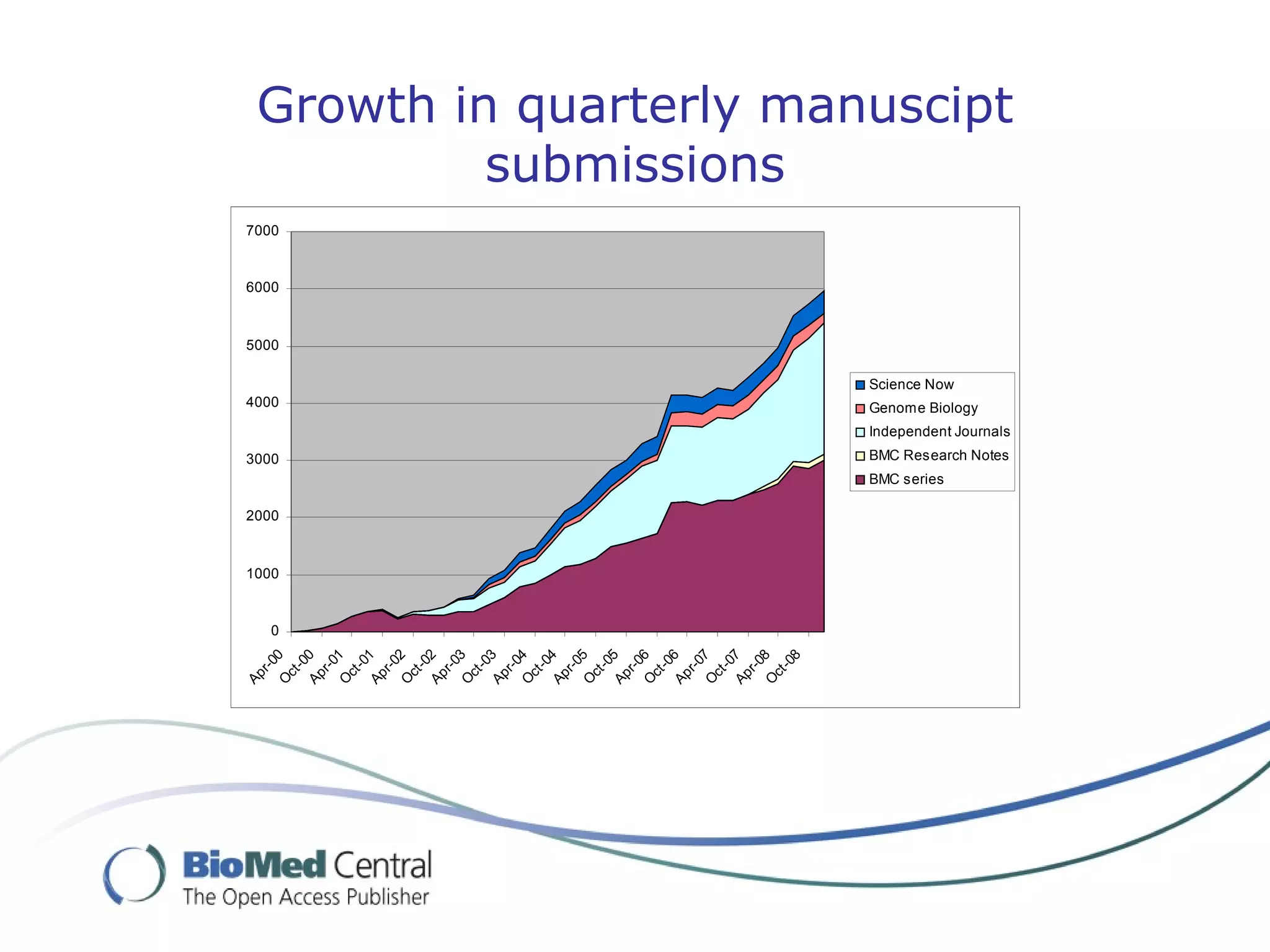
    27. Growth in quarterly manuscipt submissions 7000 6000 5000 Science Now 4000 Genome Biology Independent Journals 3000 BMC Research Notes BMC series 2000 1000 0 O 0 Ap 0 O 1 Ap 1 O 2 Ap 2 O 3 Ap 3 O 4 Ap 4 O 5 Ap 5 O 6 Ap 6 O 7 Ap 7 8 O 8 r-0 r-0 -0 -0 r-0 r-0 -0 -0 r-0 -0 -0 -0 r-0 -0 r-0 r-0 -0 r-0 ct ct ct ct ct ct ct ct ct Ap
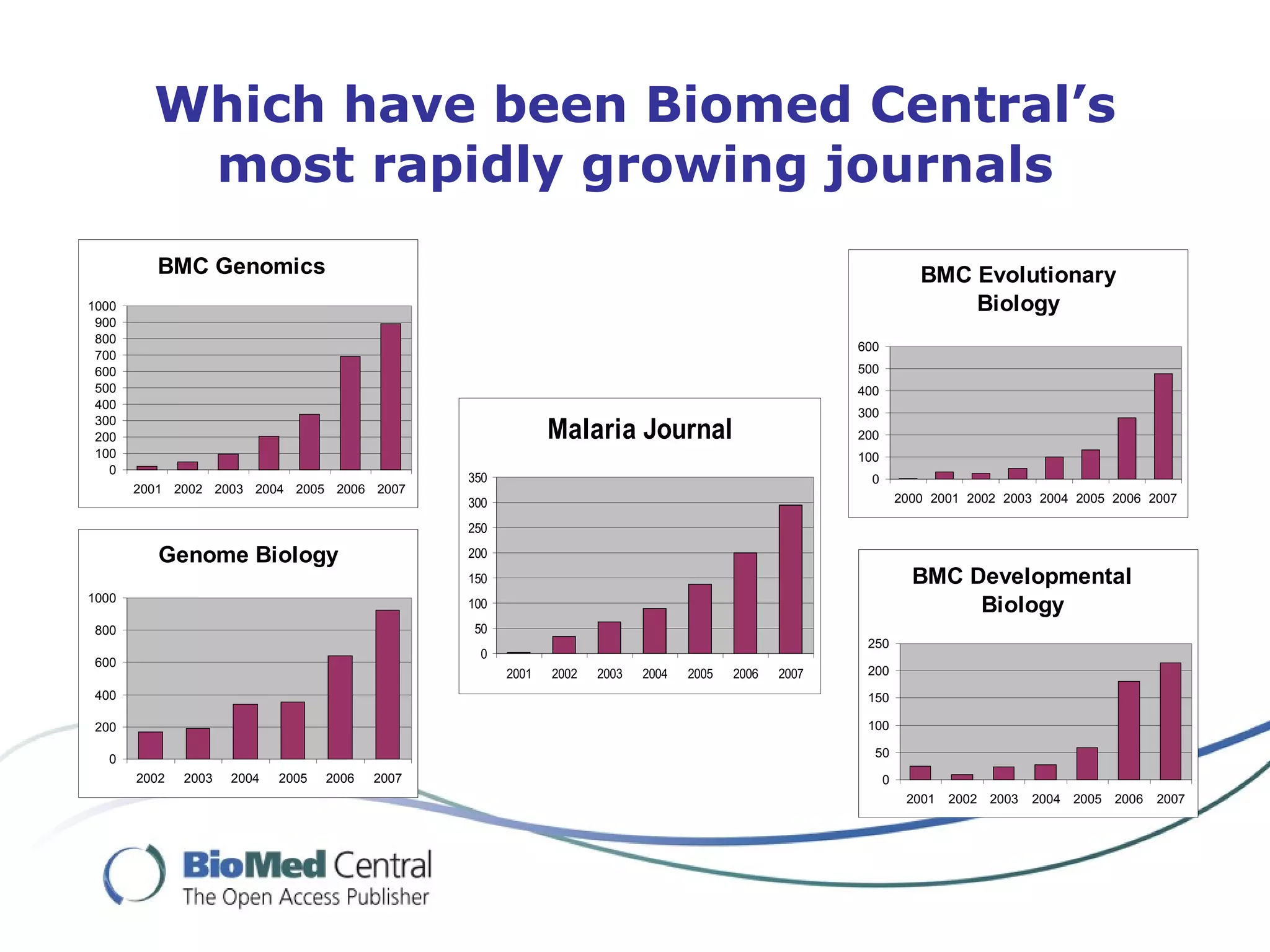
    28. Which have been Biomed Central’s most rapidly growing journals BMC Genomics BMC Evolutionary 1000 Biology 900 800 600 700 600 500 500 400 400 300 300 200 Malaria Journal 200 100 100 0 350 0 2001 2002 2003 2004 2005 2006 2007 300 2000 2001 2002 2003 2004 2005 2006 2007 250 Genome Biology 200 150 BMC Developmental 1000 100 Biology 800 50 250 0 600 2001 2002 2003 2004 2005 2006 2007 200 400 150 200 100 0 50 2002 2003 2004 2005 2006 2007 0 2001 2002 2003 2004 2005 2006 2007
    29. What do these journals have in common?
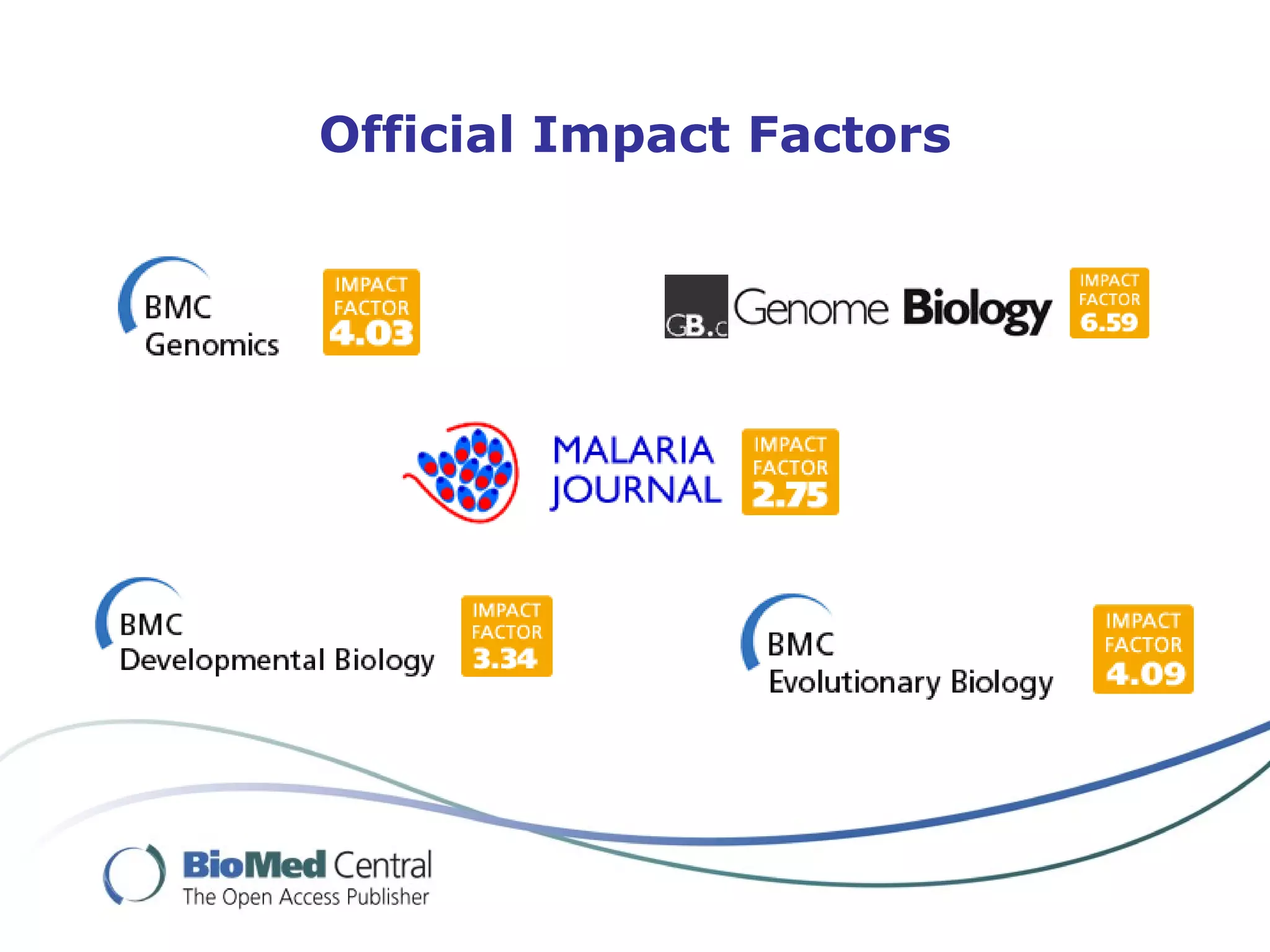
    30. Official Impact Factors
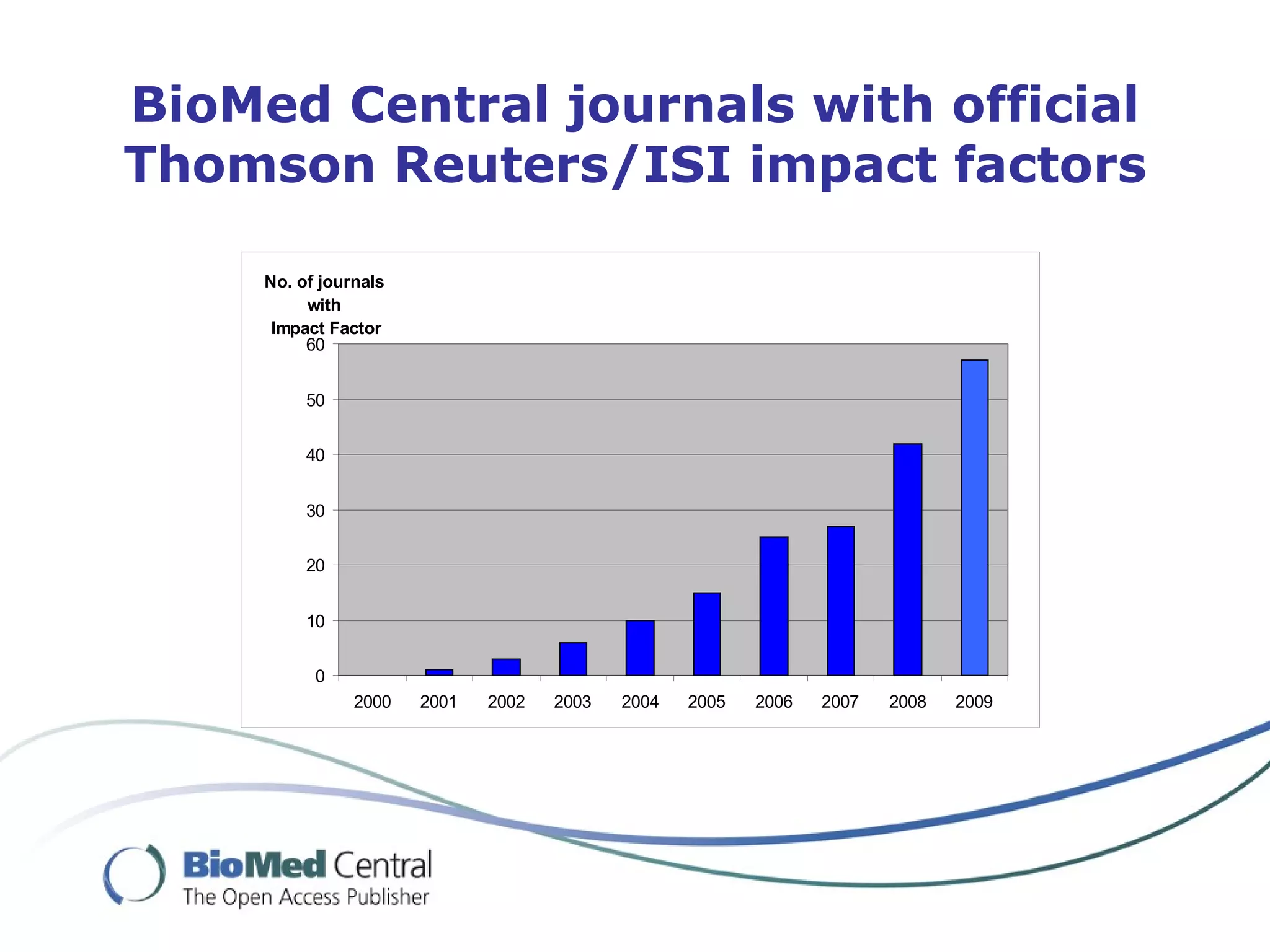
    31. BioMed Central journals with official Thomson Reuters/ISI impact factors No. of journals with Impact Factor 60 50 40 30 20 10 0 2000 2001 2002 2003 2004 2005 2006 2007 2008 2009
    32. ‘New journals’ vs ‘Transfer journals’
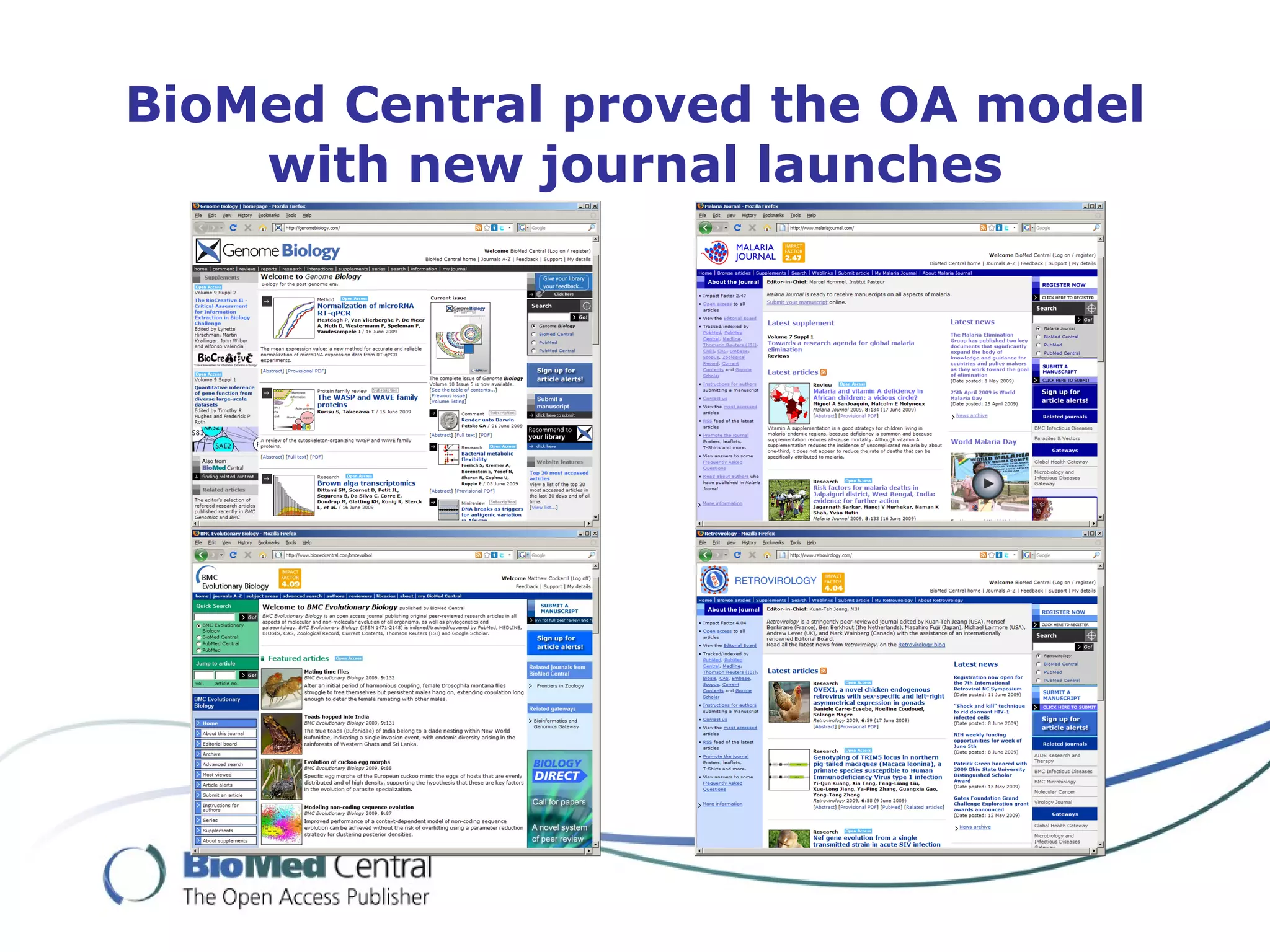
    33. BioMed Central proved the OA model with new journal launches
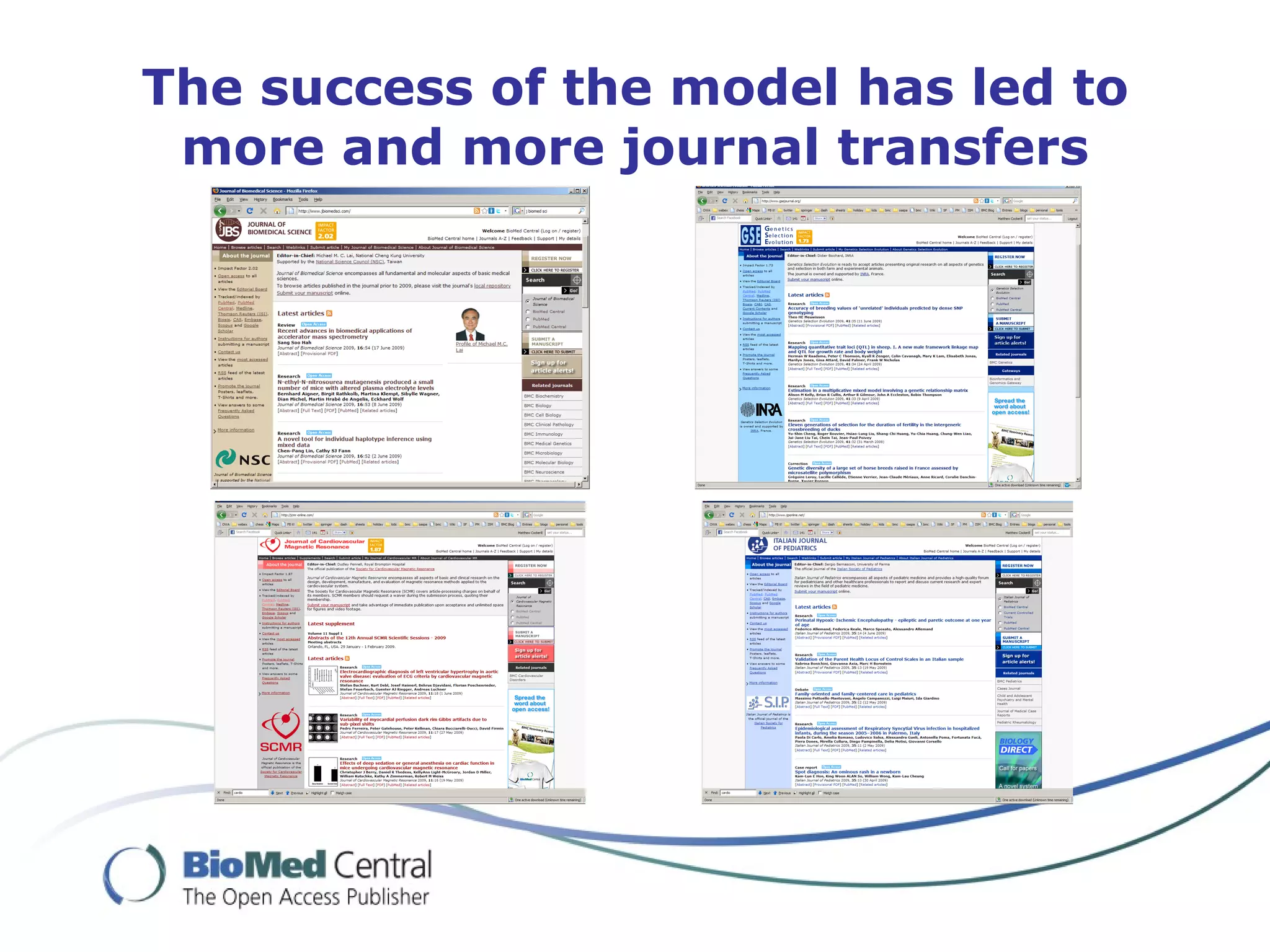
    34. The success of the model has led to more and more journal transfers
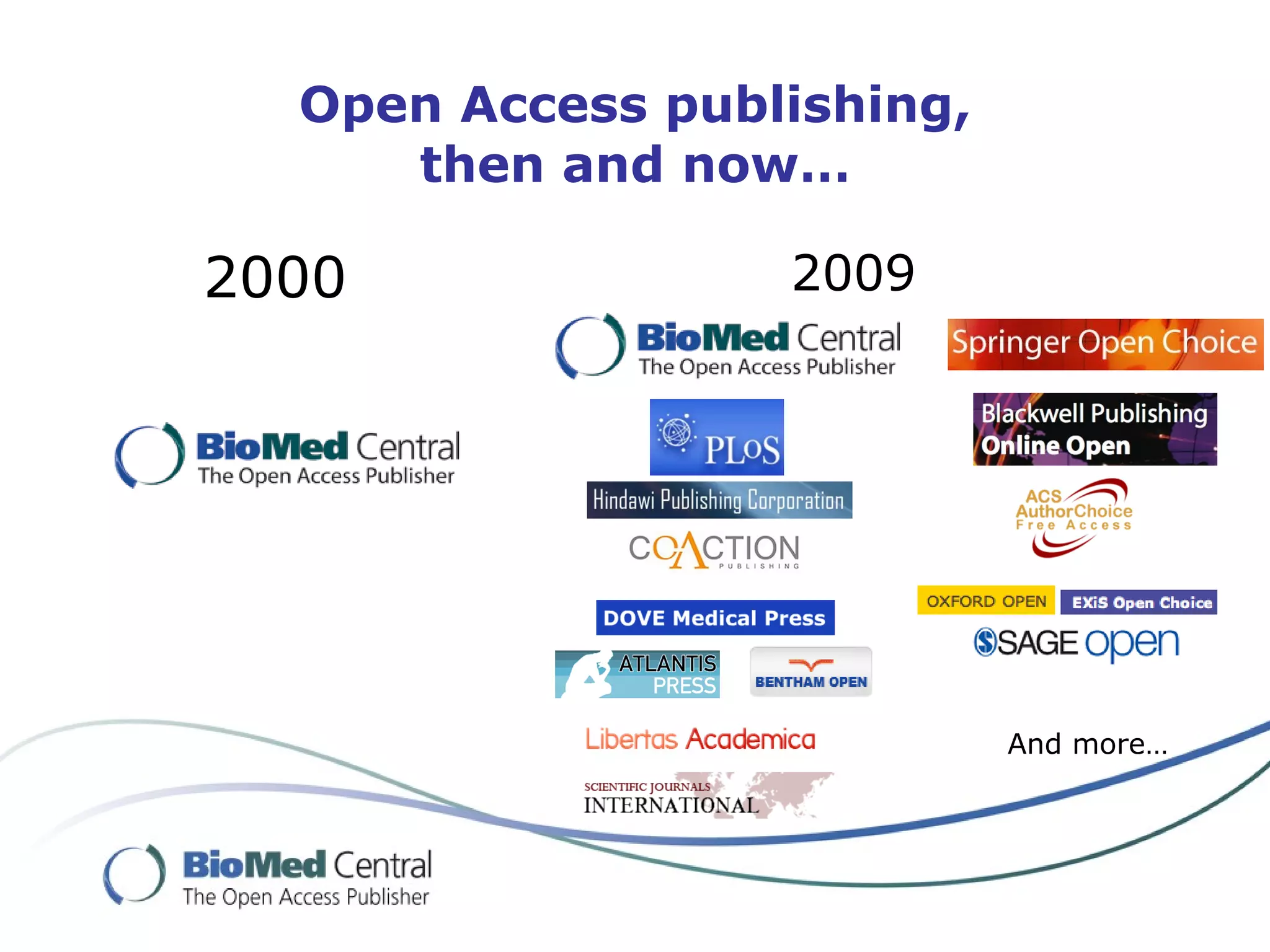
    35. Open Access publishing, then and now… 2000 2009 And more…
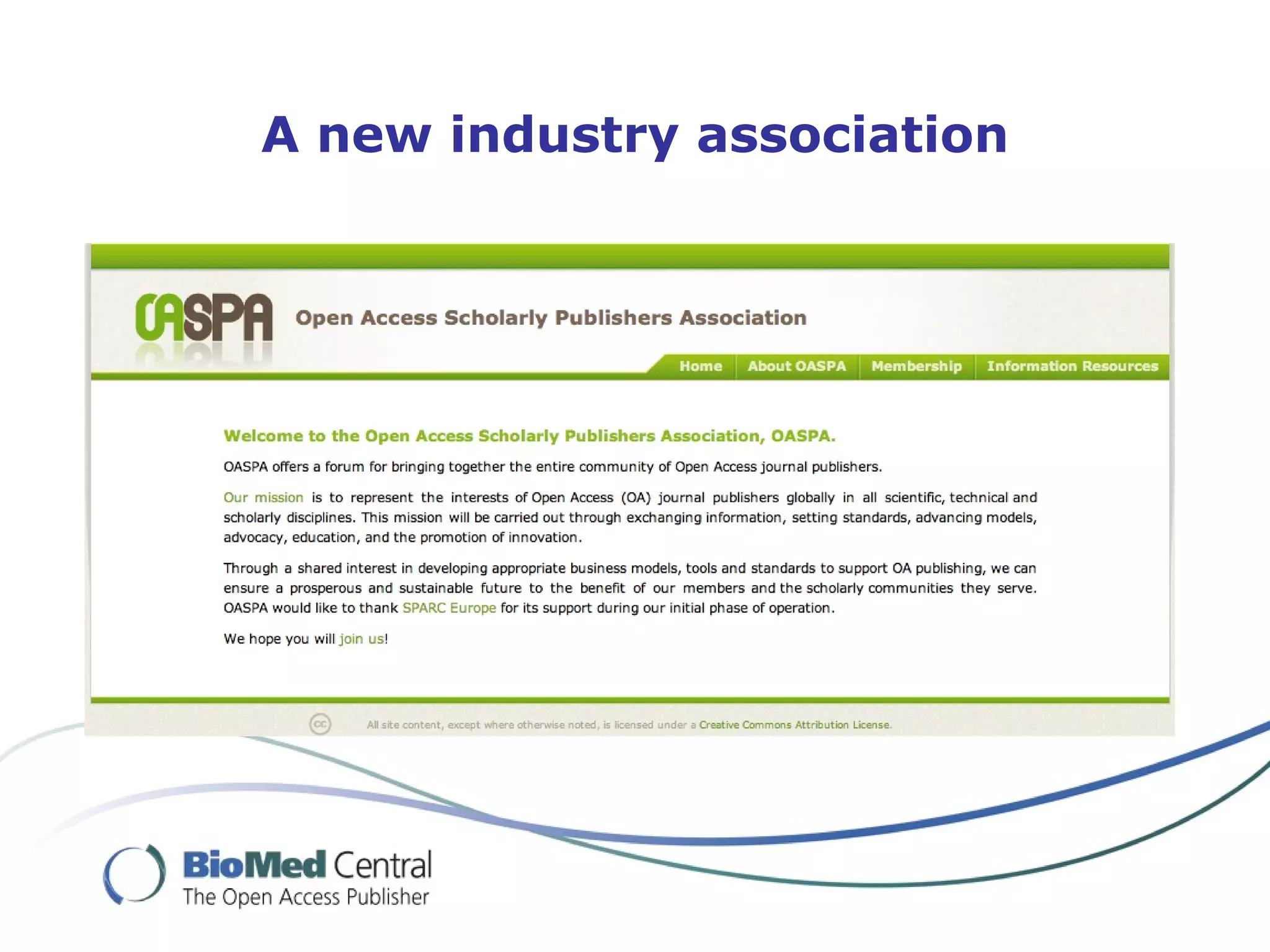
    36. A new industry association
    37. Goals of OASPA  Represents Open Access publishers  Agree common definition of Open Access  Establish and enforce good standards of editorial and business practices amongst members  Identify guidelines and best practices for publishers and institutions in managing payment of publication fees
    38. Springer’s acquisition of BioMed Central +
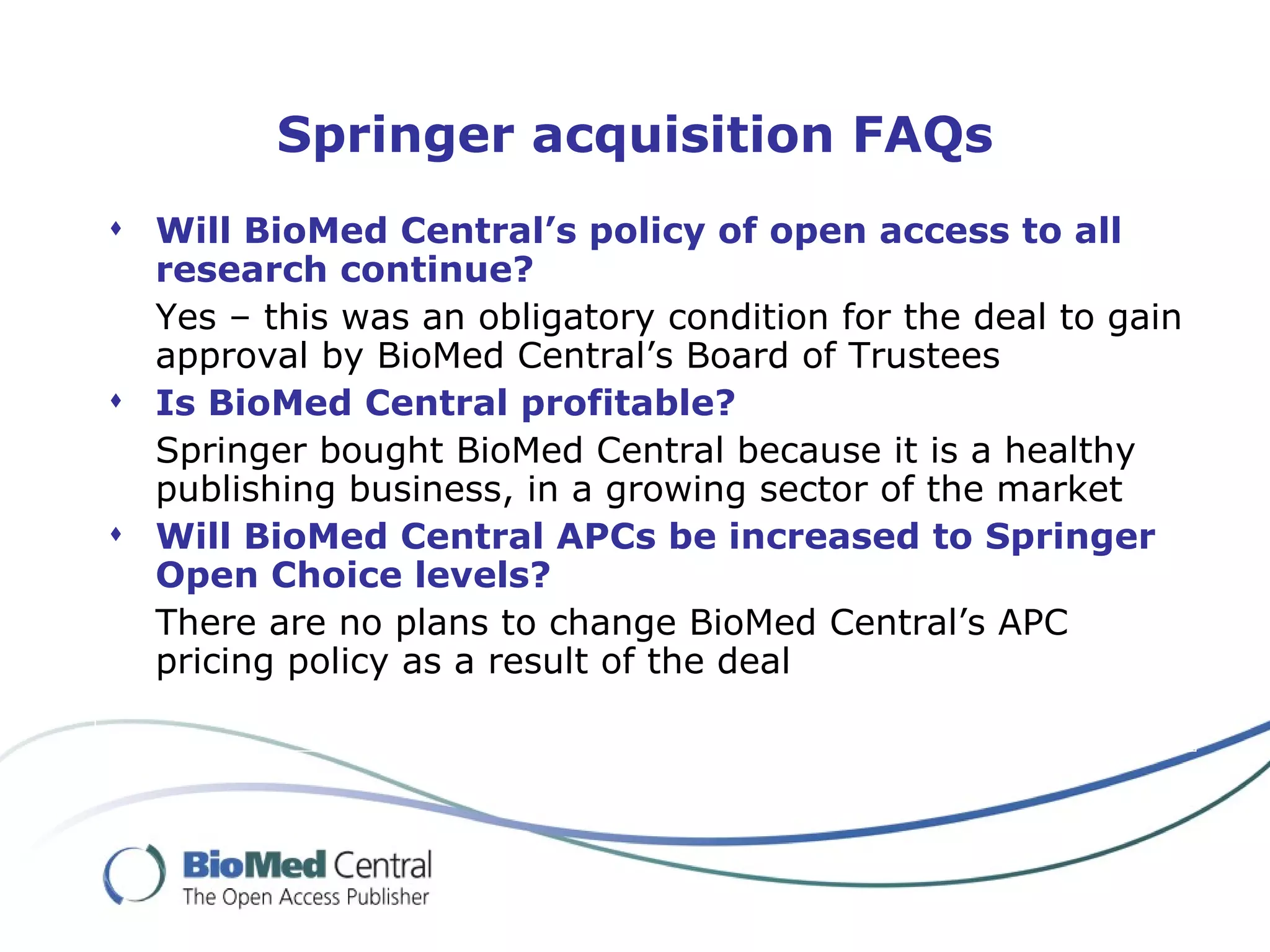
    39. Springer acquisition FAQs  Will BioMed Central’s policy of open access to all research continue? Yes – this was an obligatory condition for the deal to gain approval by BioMed Central’s Board of Trustees  Is BioMed Central profitable? Springer bought BioMed Central because it is a healthy publishing business, in a growing sector of the market  Will BioMed Central APCs be increased to Springer Open Choice levels? There are no plans to change BioMed Central’s APC pricing policy as a result of the deal
    40. What does the acquisition mean for BioMed Central?  BioMed Central remains an autonomous operating unit within Springer  Springer’s global infrastructure and market presence is helping BioMed Central to expand its activities  Springer has a wealth of experience in society publishing  As part of Springer, BioMed Central is ideally placed to publish open access society journals

    + BioMedCentralBioMedCentral, 4 months ago

    custom

    741 views, 2 favs, 3 embeds more stats

    Matthew Cockerill, Managing Director, BioMed Centra more

    More info about this document

    © All Rights Reserved

    Go to text version

    • Total Views 741
      • 634 on SlideShare
      • 107 from embeds
    • Comments 0
    • Favorites 2
    • Downloads 12
    Most viewed embeds
    • 98 views on http://blogs.openaccesscentral.com
    • 8 views on http://xrefer.blogspot.com
    • 1 views on file://

    more

    All embeds
    • 98 views on http://blogs.openaccesscentral.com
    • 8 views on http://xrefer.blogspot.com
    • 1 views on file://

    less

    Flagged as inappropriate Flag as inappropriate
    Flag as inappropriate

    Select your reason for flagging this presentation as inappropriate. If needed, use the feedback form to let us know more details.

    Cancel
    File a copyright complaint
    Having problems? Go to our helpdesk?

    Categories

    Tags