Strategies for bioanalysis of proteins
using LC-MS
Anne Kleinnijenhuis
anne.kleinnijenhuis@triskelion.nl
General workflow
1. Sample purification / pre-processing
2. Analyte processing
3. Liquid Chromatography – Mass Spectrometry (LC-MS)
Parallel:target selection and stable isotope labeled internal
standard (SIL IS) synthesis
Triskelion general workflow for development of protein
LC-MS methods
1. Sample purification / pre-processing
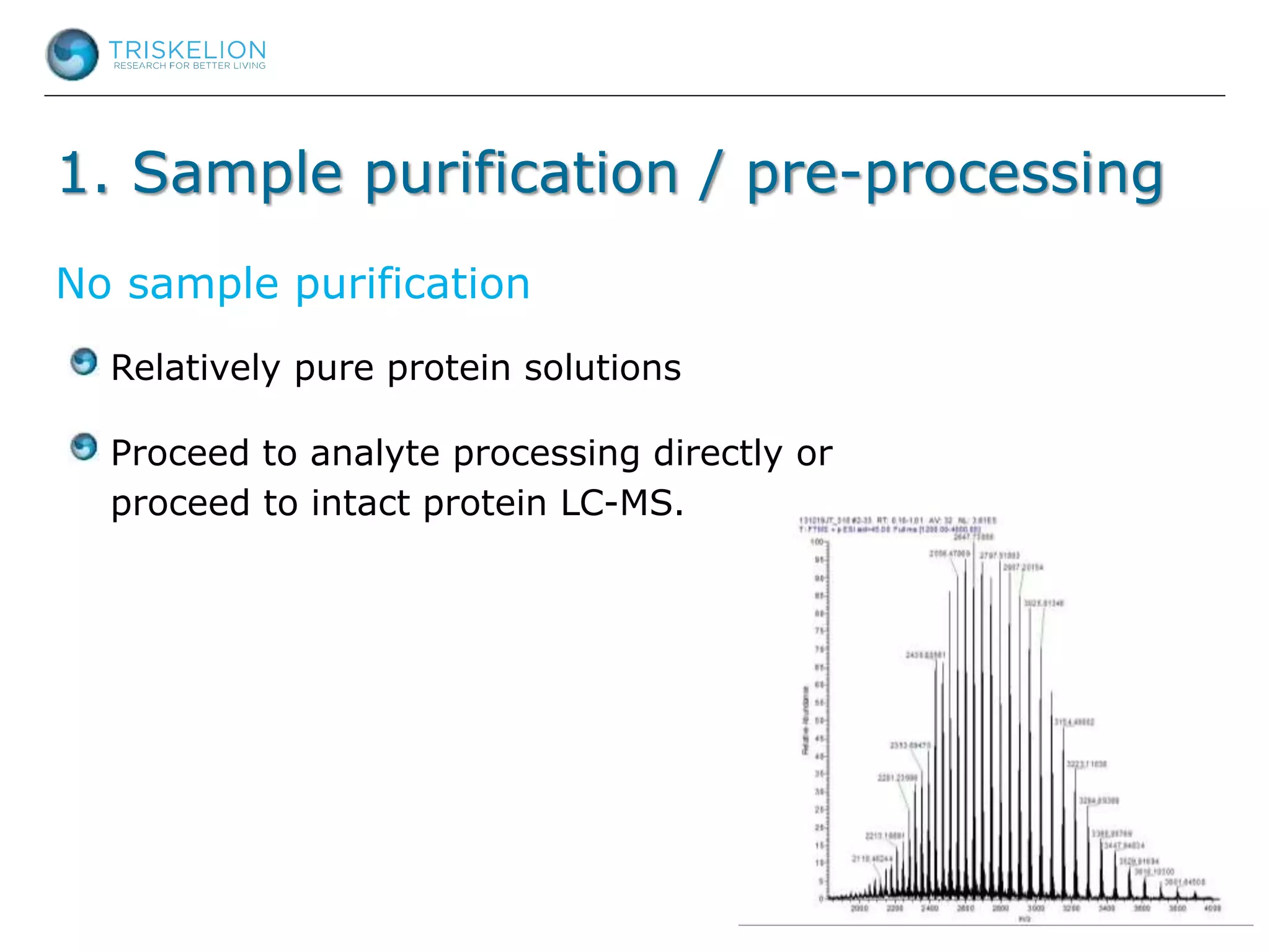
Relatively pure protein solutions
Proceed to analyte processing directly or
proceed to intact protein LC-MS.
No sample purification
1. Sample purification / pre-processing
Protein precipitation
Solid phase extraction
Molecular cut-off filter
SDS-PAGE
Various types of chromatography
Depletion
Less to moderately selective purification
1. Sample purification / pre-processing
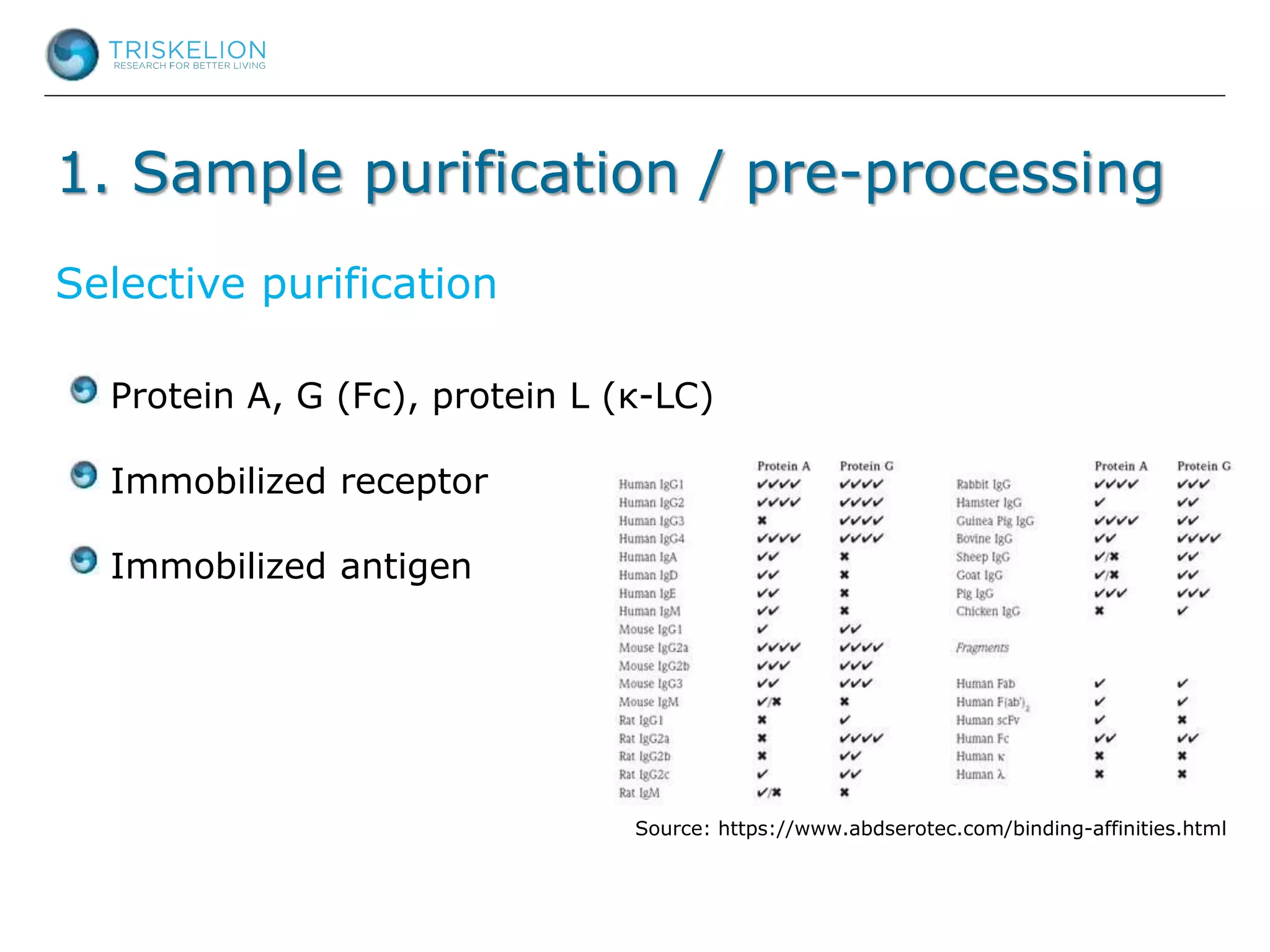
Protein A, G (Fc), protein L (κ-LC)
Immobilized receptor
Immobilized antigen
Selective purification
Source: https://www.abdserotec.com/binding-affinities.html
1. Sample purification / pre-processing
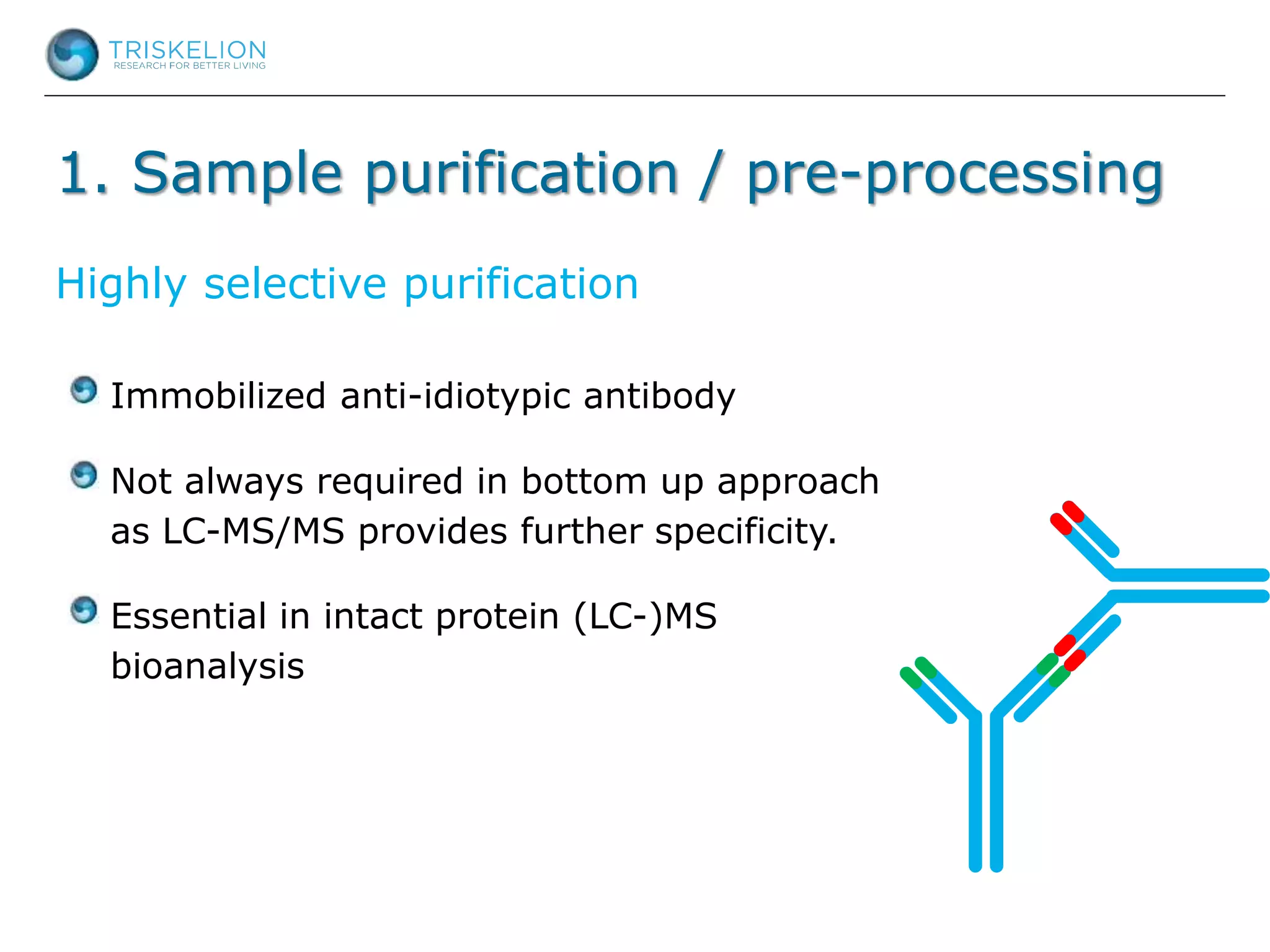
Immobilized anti-idiotypic antibody
Not always required in bottom up approach
as LC-MS/MS provides further specificity.
Essential in intact protein (LC-)MS
bioanalysis
Highly selective purification
1. Sample purification / pre-processing
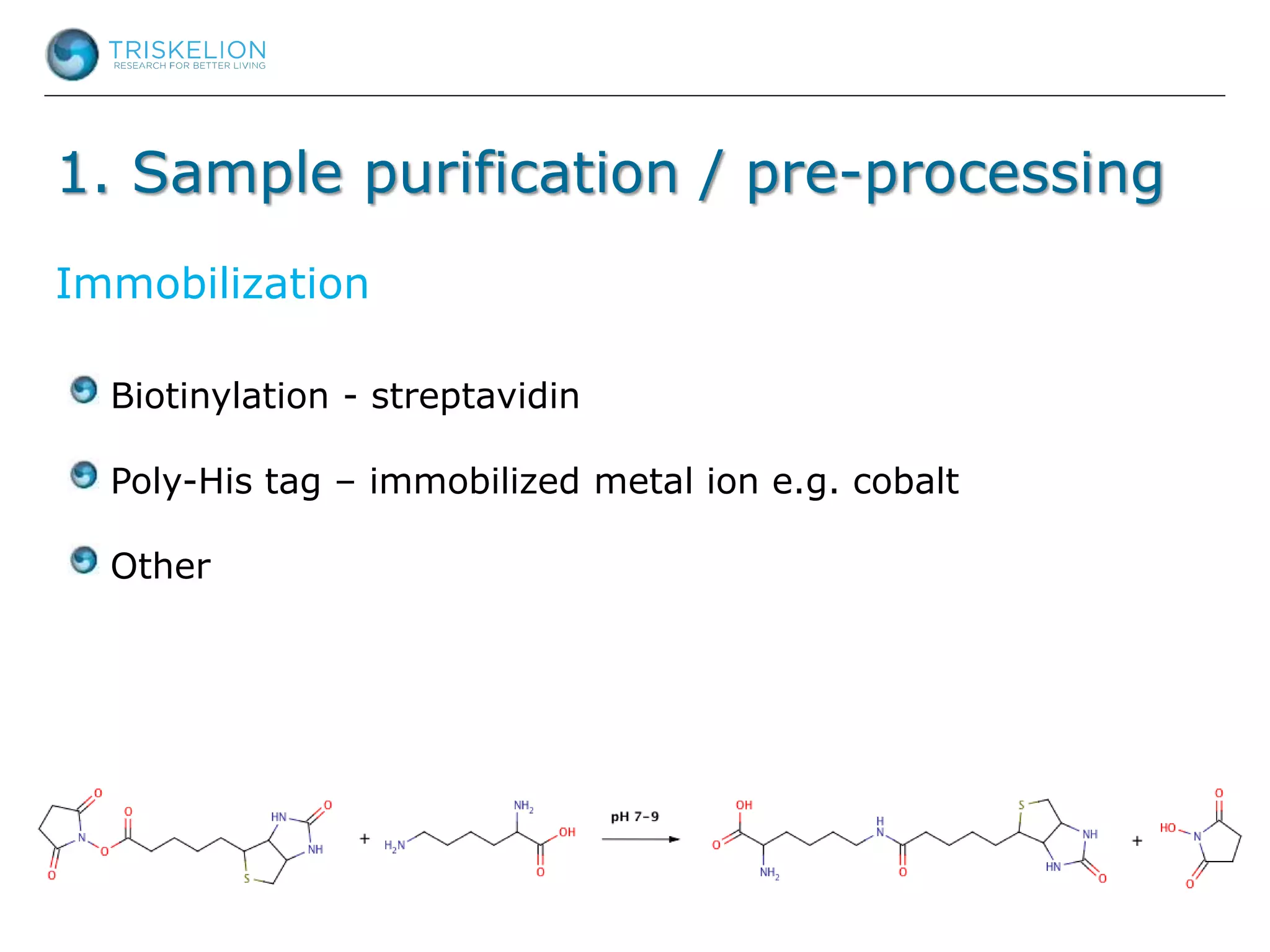
Biotinylation - streptavidin
Poly-His tag – immobilized metal ion e.g. cobalt
Other
Immobilization
1. Sample purification / pre-processing
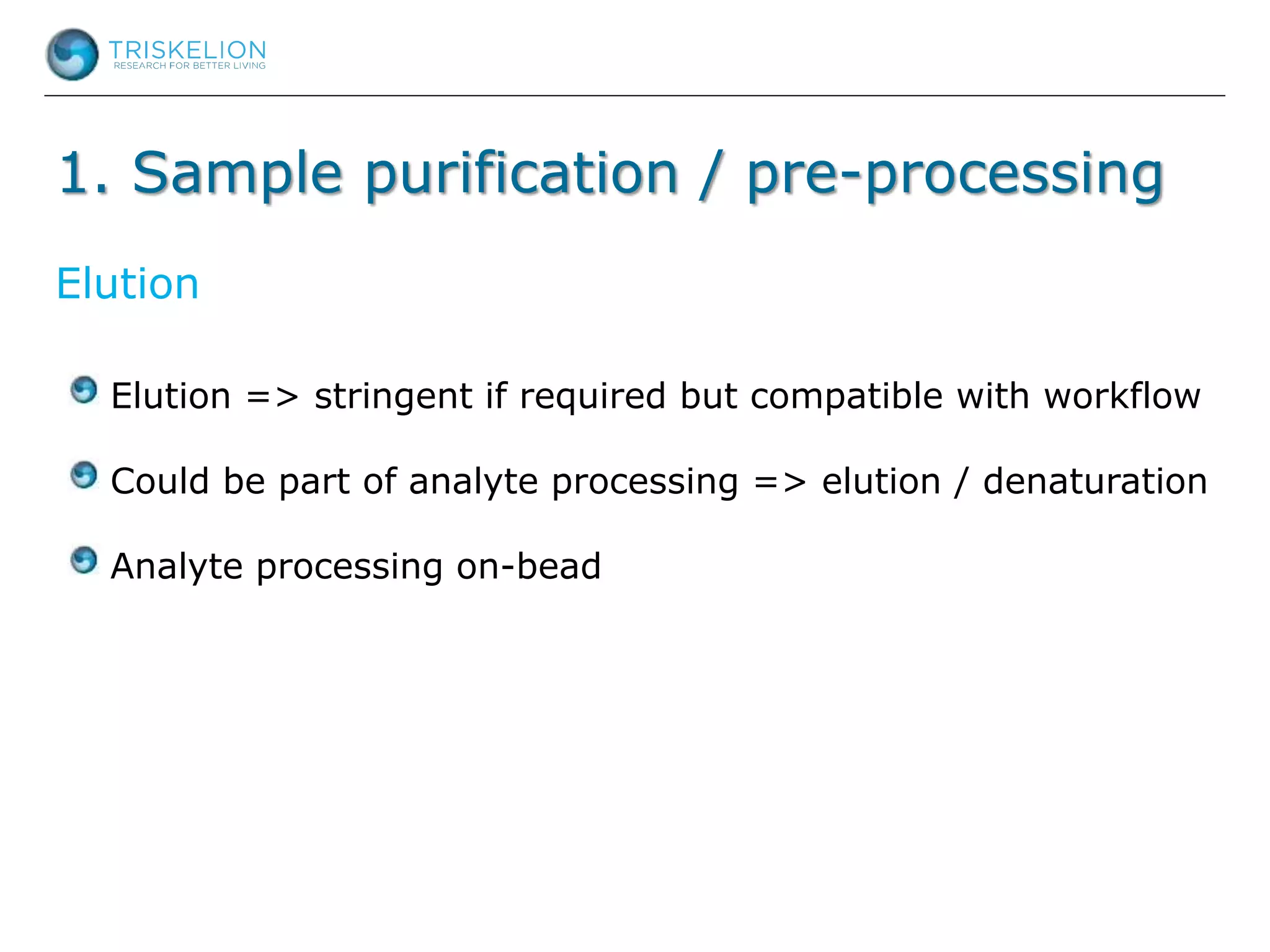
Magnetic beads – highly flexible
Column format off-line (e.g. micro-tips)
Column format on-line
Purification format
1. Sample purification / pre-processing
Elution => stringent if required but compatible with workflow
Could be part of analyte processing => elution / denaturation
Analyte processing on-bead
Elution
1. Sample purification / pre-processing
Solubilization
Harsh chemical conditions, solvent, pH, reductor
Sonification
High / low temperature
Dispomix
Grinding in liquid nitrogen
Surfactant
Desalting
Addition of protease inhibitors
Other pre-processing
2. Analyte processing
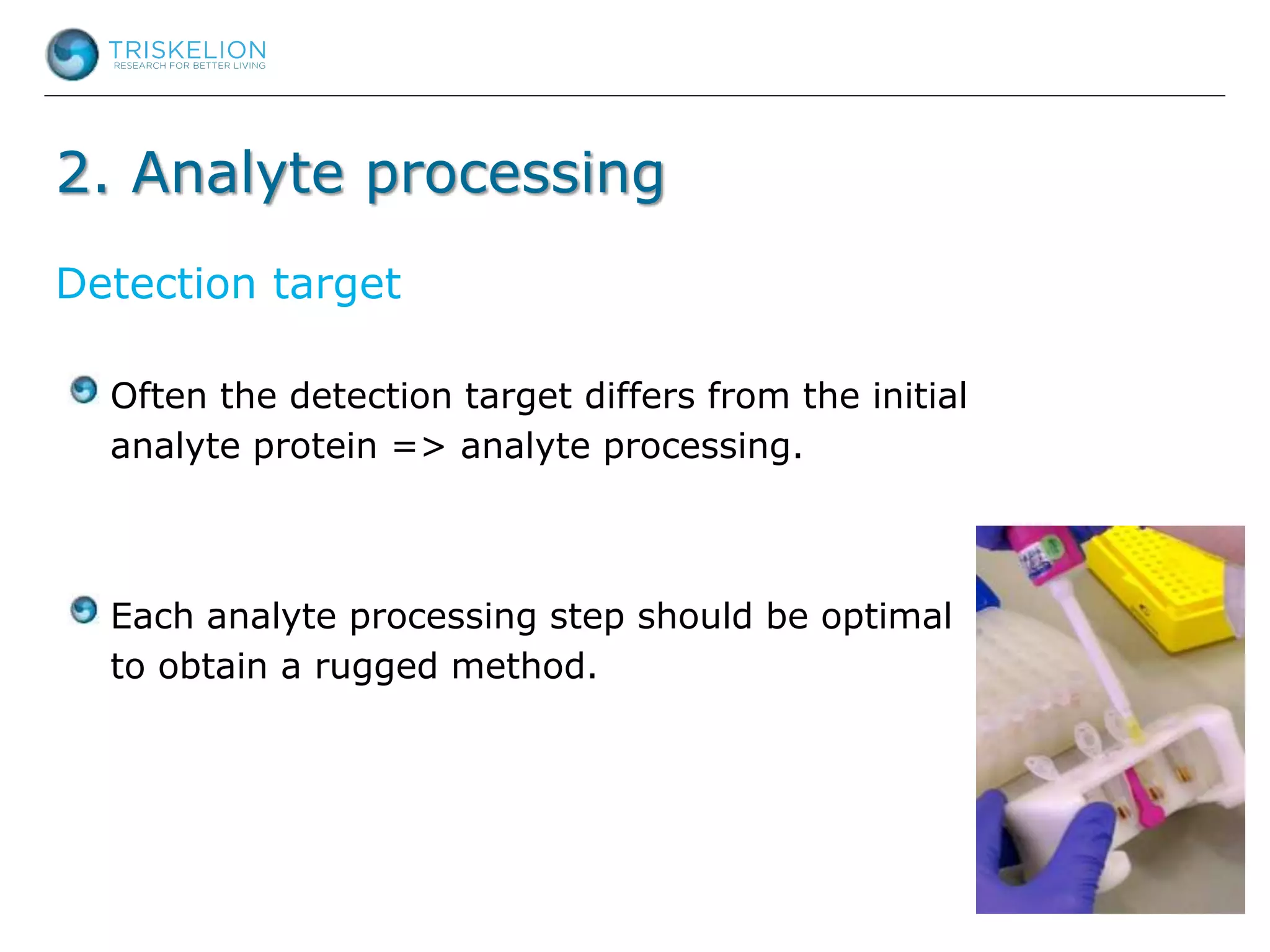
Often the detection target differs from the initial
analyte protein => analyte processing.
Each analyte processing step should be optimal
to obtain a rugged method.
Detection target
2. Analyte processing
None => (intact / native (LC-)MS). Top down.
Deglycosylation => focus signal
Payload cleavage (ADC) => determine conjugated payload /
DAR
Denaturation => make protein accessible to further processing:
heat, chemical, surfactant
Reduction => cleave S-S bridges
Alkylation => modify free SH
Examples
2. Analyte processing
Digestion => several enzymes possible. Trypsin very
compatible with MS, release signature or generic peptide.
Multiple cycles => for resistant / cross-linked proteins
Examples
Name Cleave Does not
cleave
N or C
term
Trypsin KR P C
Chymotrypsin FYWL C
CNBr M C
Lys-C K P C
Glu-C E (and D) P C
Asp-N D N
3. LC-MS
Conventional UPLC (typical ID 2.1 mm)
Robust, fast
Microflow or µLC (typical ID 0.15 mm)
Sensitive
Special sample requirements
Sample composition vs. peptide properties and
chromatographic performance.
NanoLC (typical ID 0.05 mm)
Chromatography
3. LC-MS
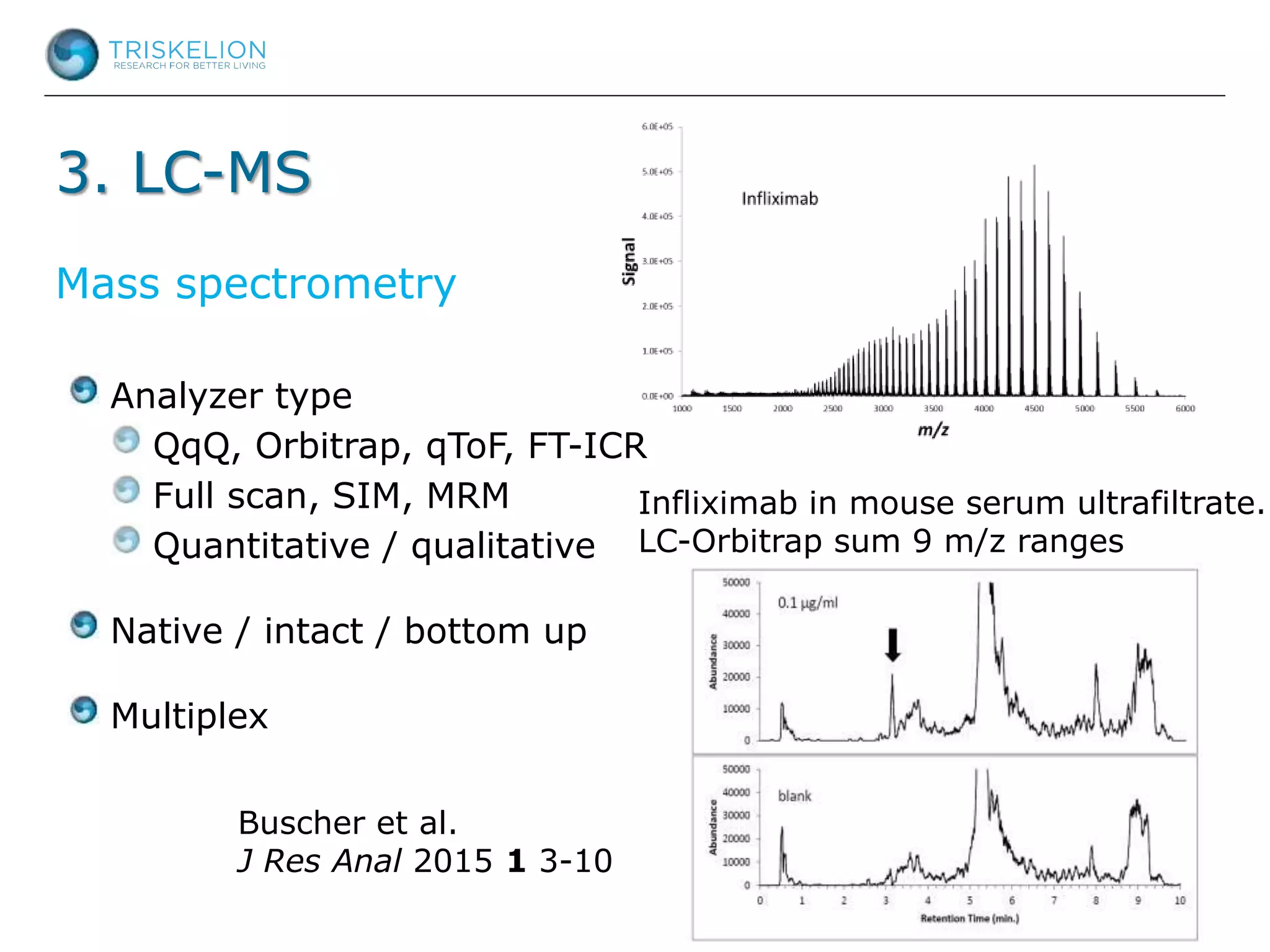
Analyzer type
QqQ, Orbitrap, qToF, FT-ICR
Full scan, SIM, MRM
Quantitative / qualitative
Native / intact / bottom up
Multiplex
Mass spectrometry
Buscher et al.
J Res Anal 2015 1 3-10
Infliximab in mouse serum ultrafiltrate.
LC-Orbitrap sum 9 m/z ranges
3. LC-MS
Fragmentation method CID / ETD
CID: intense b, y ions, immonium ions
ETD: less selective cleavage, c, z ions
Peptide mapping (PTMs)
Fragmentation prediction or experimental assessment
MS/MS
3. LC-MS
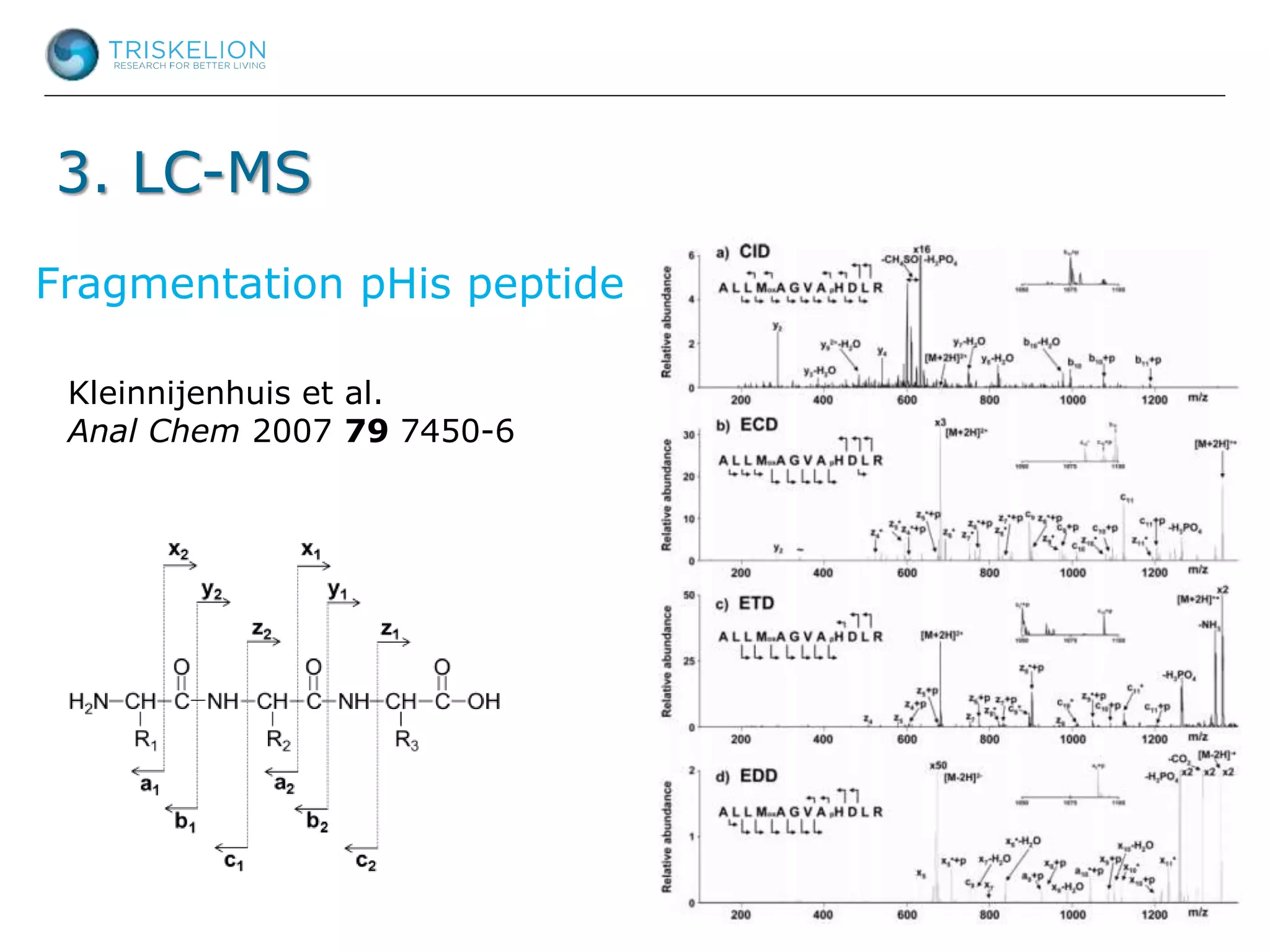
Fragmentation pHis peptide
Kleinnijenhuis et al.
Anal Chem 2007 79 7450-6
3. LC-MS
Sample purity
Separation of peptide species and peak shape
Ionization efficiency
Targeted / full scan / tandem MS
Fragmentation channels
Chemical noise level
Sensitivity
Linearity / dynamic range
Summary LC-MS/MS considerations
Parallel: target selection and SIL IS
Bottom up – intact / native
Peptide requirements
SIL IS peptide vs. SIL IS protein vs. combined
internal standardization (non-labeled protein +
SIL IS peptide)
Preferably 13C / 15N K or R
Target selection
Parallel: target selection and SIL IS
Peptide requirements (optional)
Peptide length (6 to ~20-25)
No adjacent cleavage sites
No methionine (M) and cysteine (C)
No asparagine (N) and glutamine (Q)
(Hyper)variable domain for signature peptide
No conjugation sites (PTM, payload)
Many more, study-specific
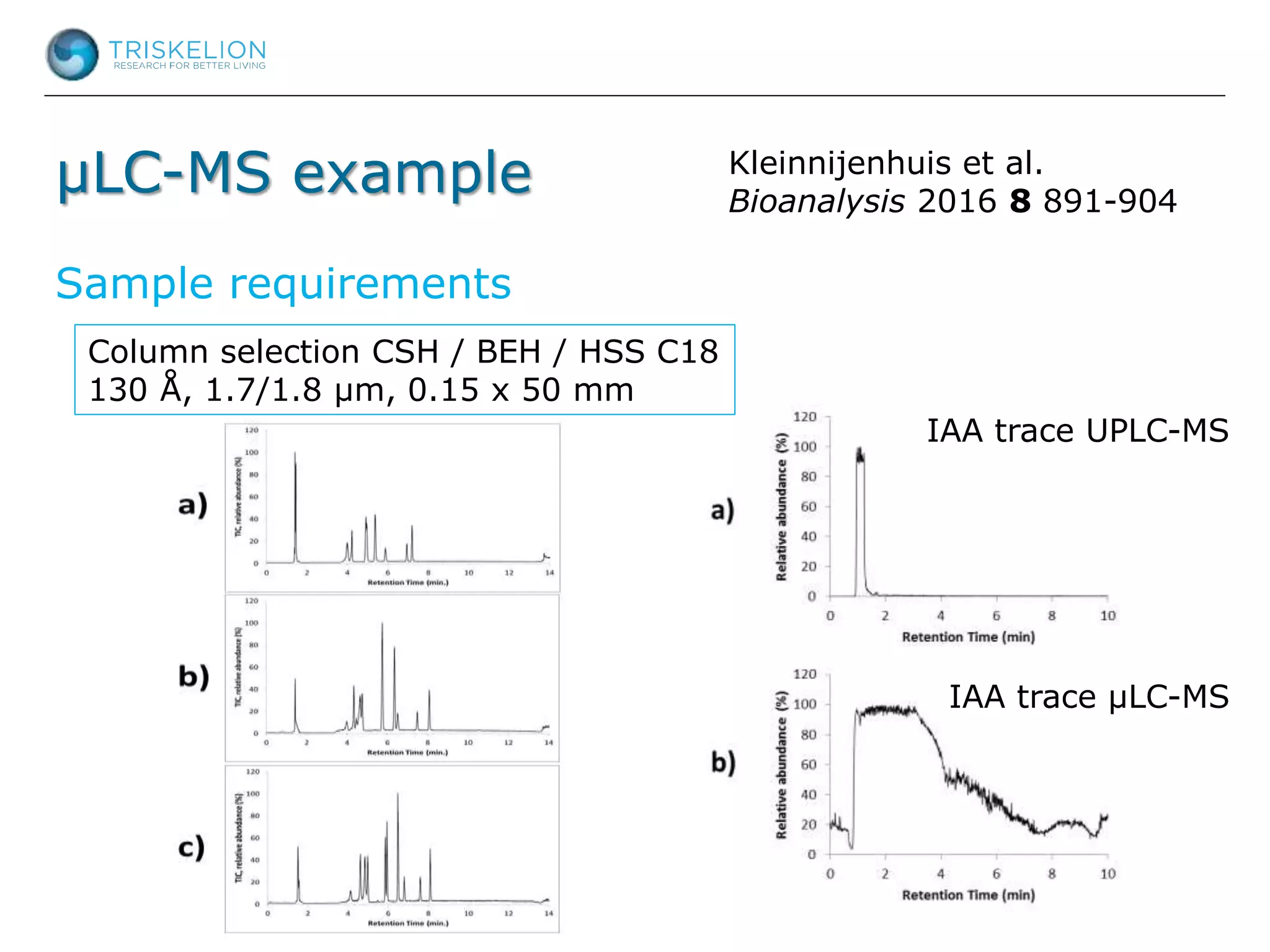
µLC-MS example Kleinnijenhuis et al.
Bioanalysis 2016 8 891-904
Sample requirements
IAA trace UPLC-MS
IAA trace µLC-MS
Column selection CSH / BEH / HSS C18
130 Å, 1.7/1.8 µm, 0.15 x 50 mm
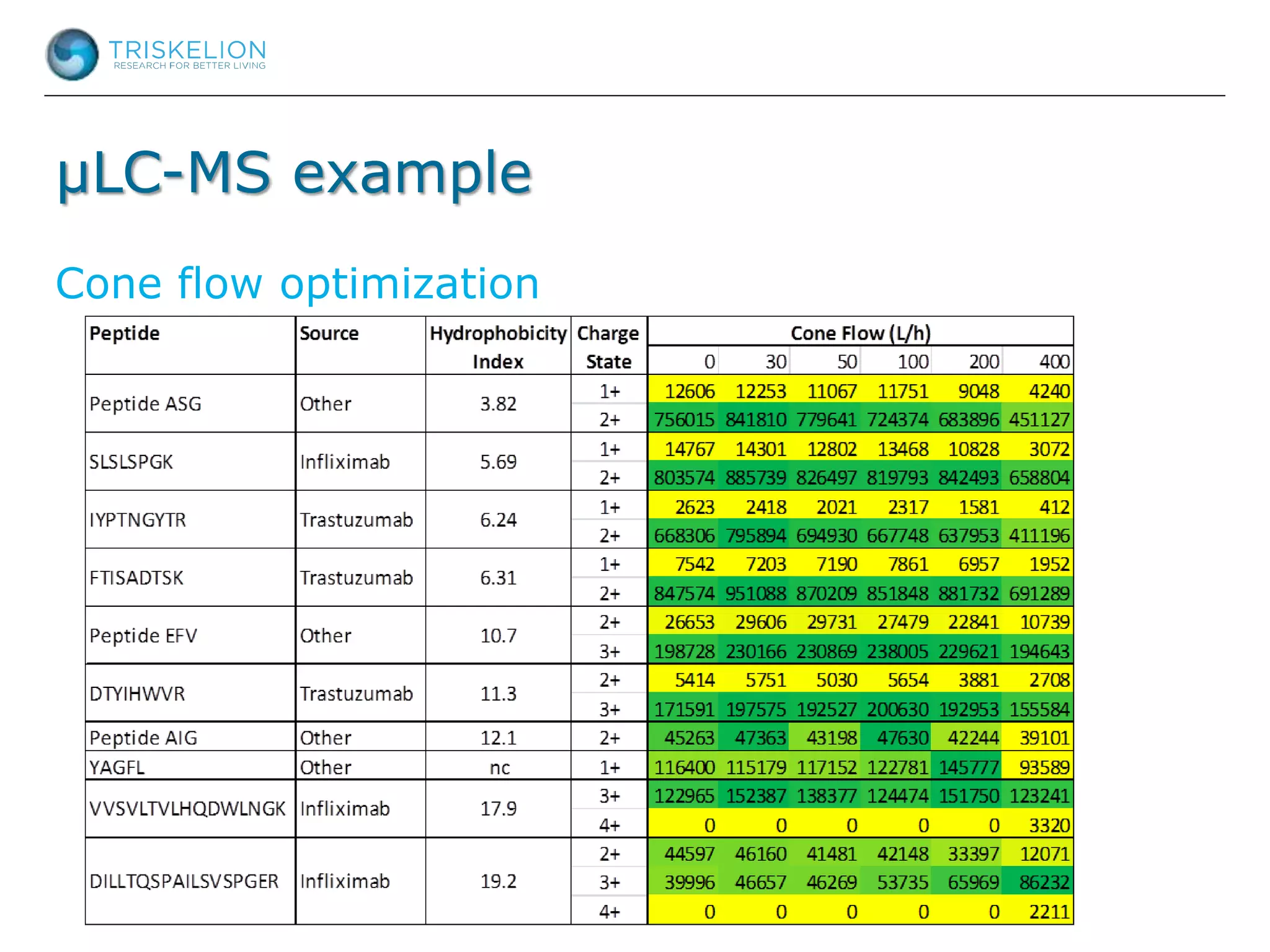
Cone flow optimization
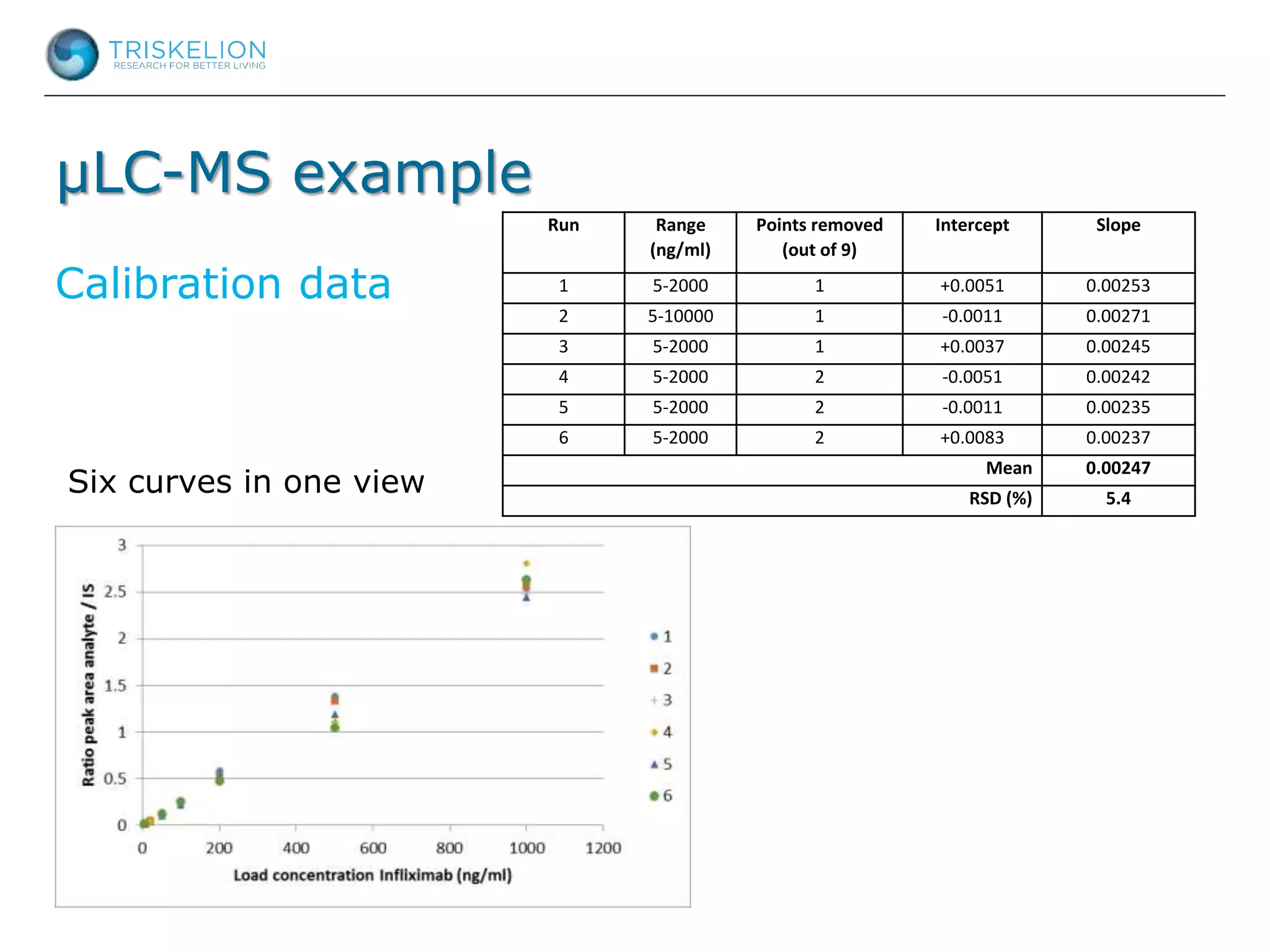
µLC-MS example
Calibration data
Run Range
(ng/ml)
Points removed
(out of 9)
Intercept Slope
1 5-2000 1 +0.0051 0.00253
2 5-10000 1 -0.0011 0.00271
3 5-2000 1 +0.0037 0.00245
4 5-2000 2 -0.0051 0.00242
5 5-2000 2 -0.0011 0.00235
6 5-2000 2 +0.0083 0.00237
Mean 0.00247
RSD (%) 5.4
µLC-MS example
Six curves in one view
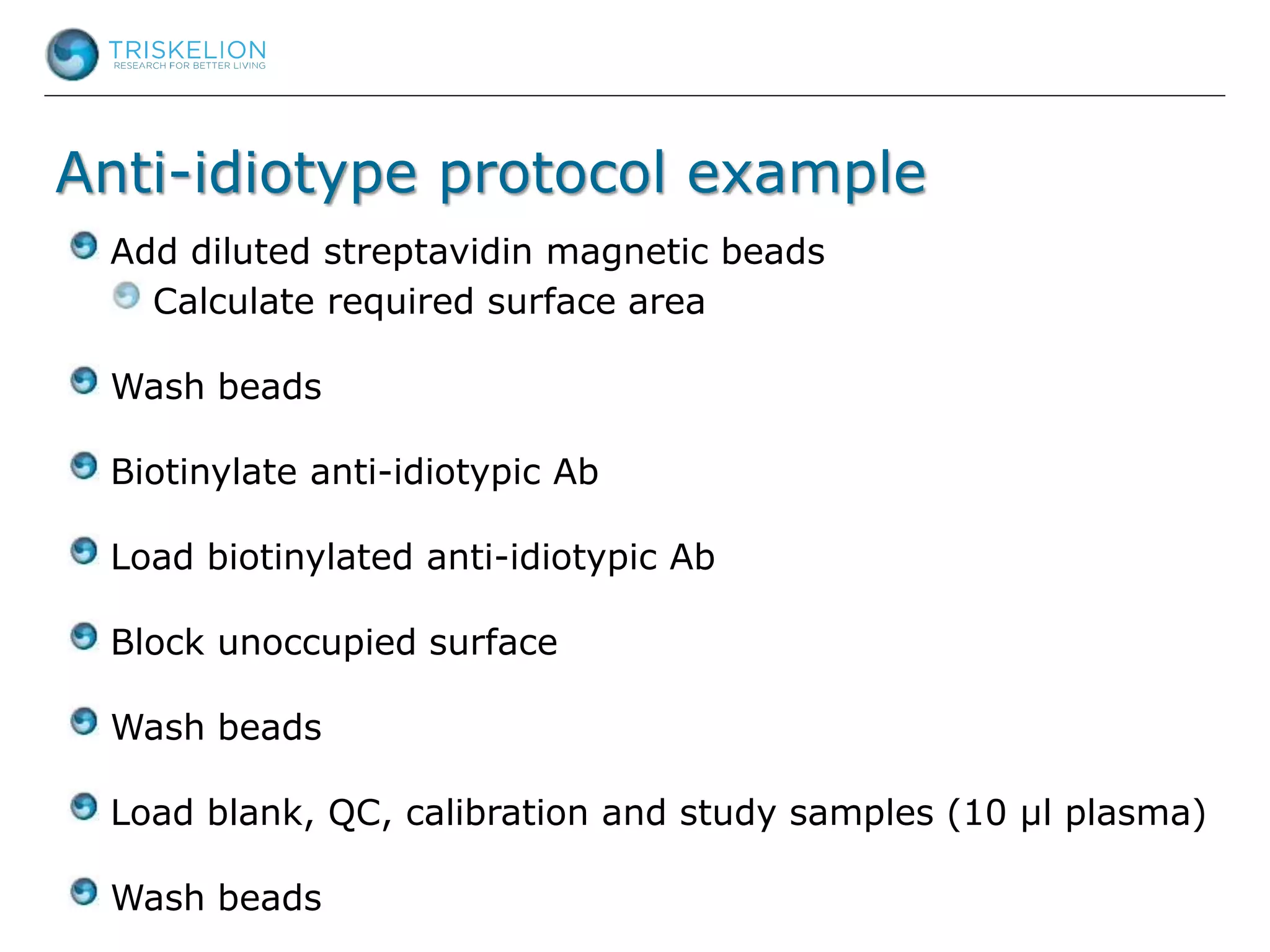
Anti-idiotype protocol example
Add diluted streptavidin magnetic beads
Calculate required surface area
Wash beads
Biotinylate anti-idiotypic Ab
Load biotinylated anti-idiotypic Ab
Block unoccupied surface
Wash beads
Load blank, QC, calibration and study samples (10 µl plasma)
Wash beads
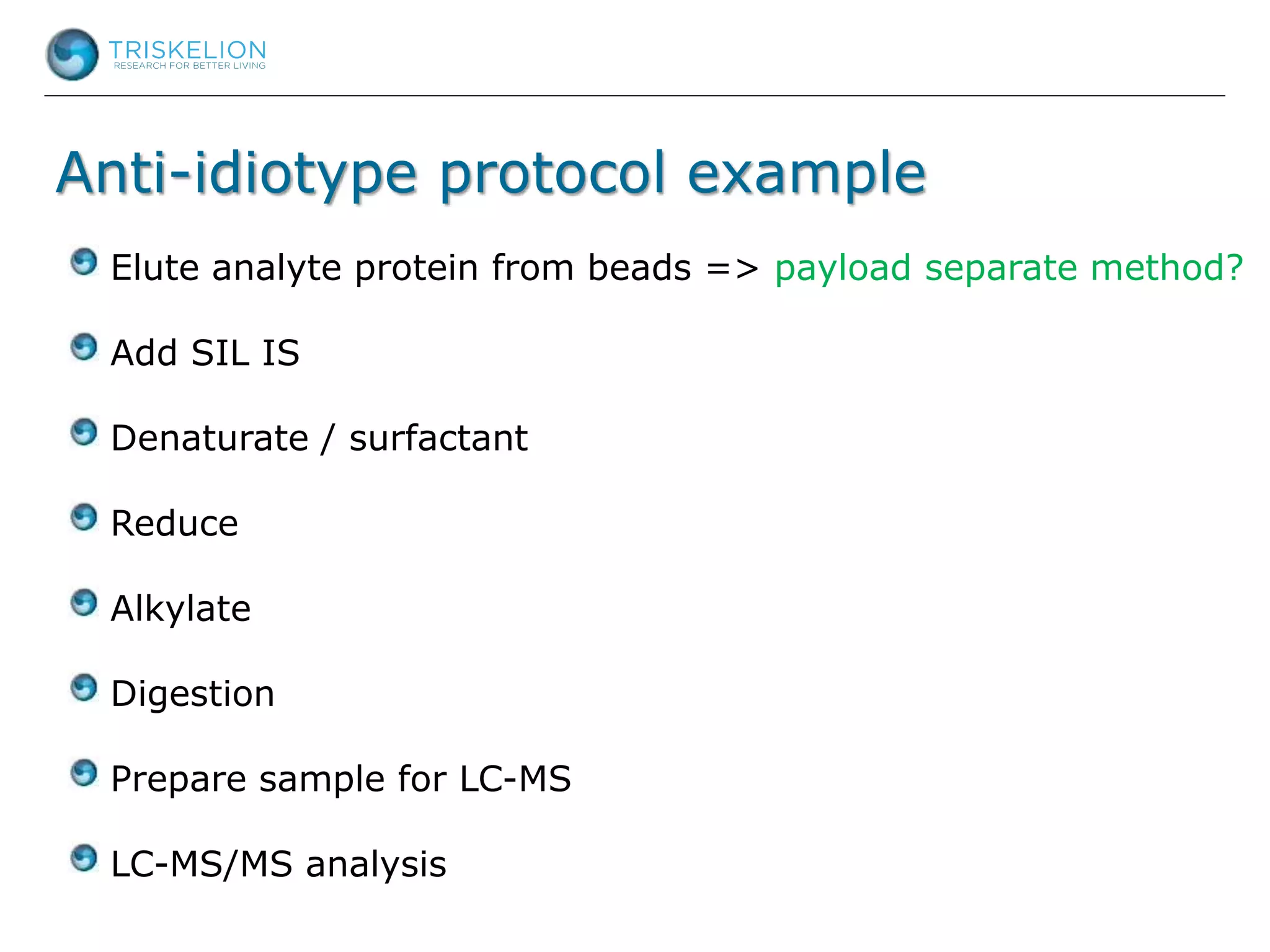
Anti-idiotype protocol example
Elute analyte protein from beads => payload separate method?
Add SIL IS
Denaturate / surfactant
Reduce
Alkylate
Digestion
Prepare sample for LC-MS
LC-MS/MS analysis
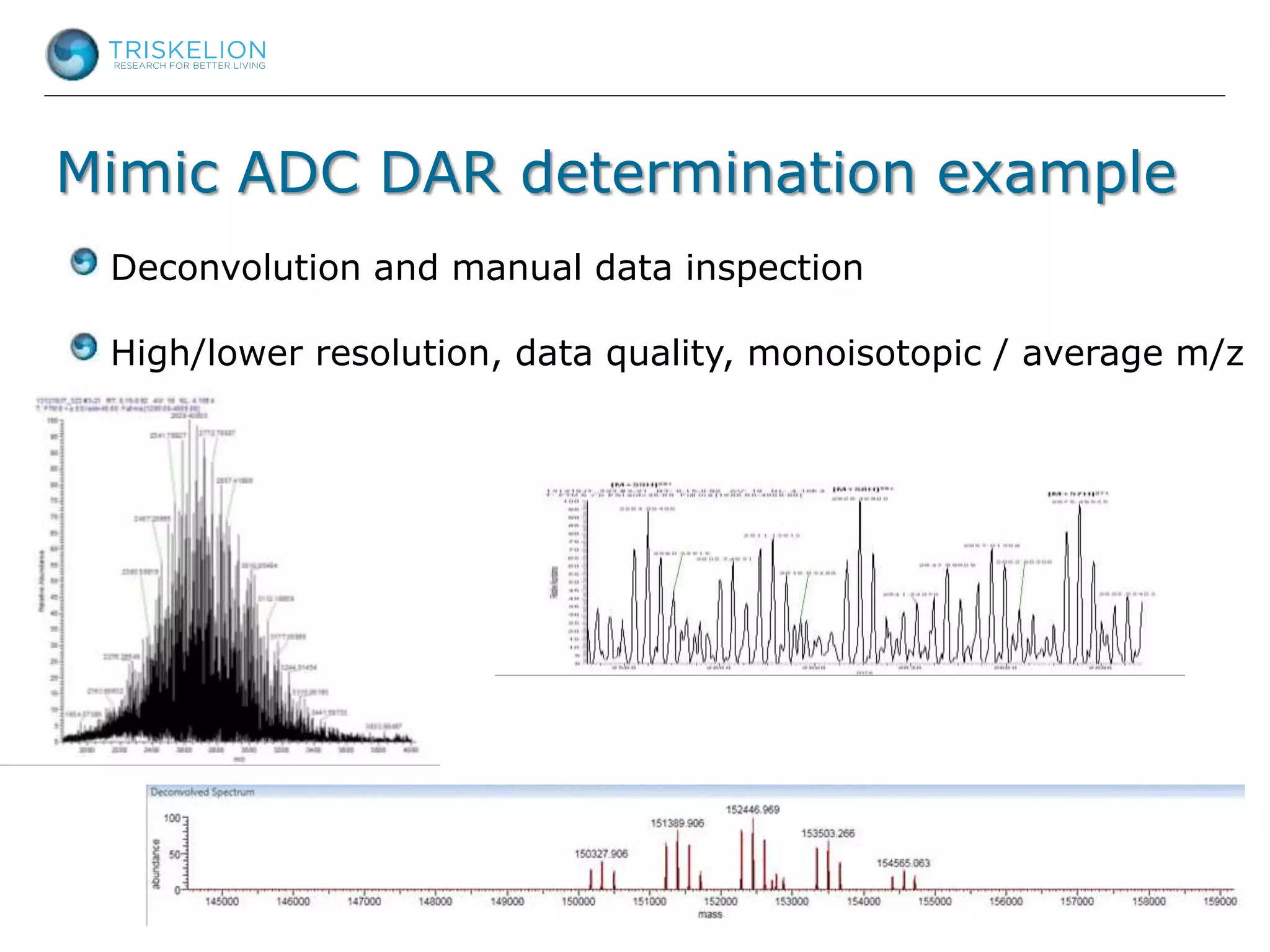
Mimic ADC DAR determination example
Deconvolution and manual data inspection
High/lower resolution, data quality, monoisotopic / average m/z
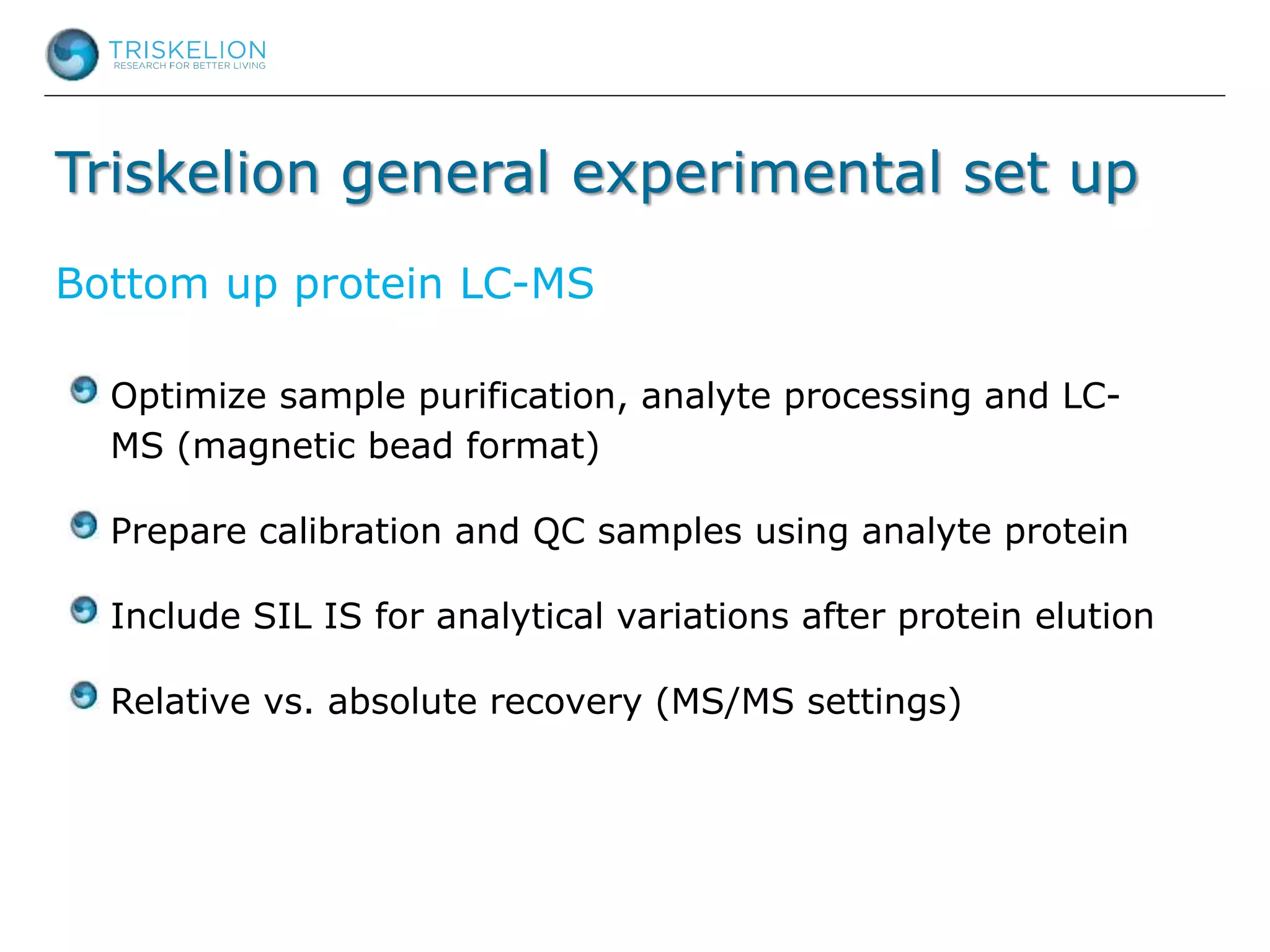
Triskelion general experimental set up
Optimize sample purification, analyte processing and LC-
MS (magnetic bead format)
Prepare calibration and QC samples using analyte protein
Include SIL IS for analytical variations after protein elution
Relative vs. absolute recovery (MS/MS settings)
Bottom up protein LC-MS
Triskelion general experimental set up
Absolute recovery
𝐶𝐸𝑖𝑠 =
𝑉𝐿 𝑖𝑠
𝑉𝐸 𝑖𝑠
𝐶𝐿𝑖𝑠𝐶𝐸 𝑝𝑒𝑝 =
𝑀𝑊𝑝𝑒𝑝 × 2
𝑀𝑊𝑝𝑟𝑜𝑡
𝑉𝐿 𝑝𝑟𝑜𝑡
𝑉𝐸 𝑝𝑟𝑜𝑡
𝐶𝐿 𝑝𝑟𝑜𝑡
𝑦 =
𝐶𝐸 𝑝𝑒𝑝
𝐶𝐸𝑖𝑠
𝑦 = 𝑎𝑥 + 𝑏
Corrections isotopic
disturbance / molar
𝑎 =
2 × 𝑉𝐿 𝑝𝑟𝑜𝑡 × 𝑀𝑊𝑖𝑠
𝑀𝑊𝑝𝑟𝑜𝑡 × 𝑉𝐿𝑖𝑠 × 𝐶𝐿𝑖𝑠
𝐹1 𝑝𝑒𝑝
𝐹1 𝑖𝑠
DILLTQSPAILSVSPGER
DILLTQSPAILSVSPGE[R_13C6
15N4]
[M+3H]3+
633.0 634.0 635.0 636.0 637.0 638.0m/z
0
50
100
RelativeAbundance
636.024
636.357
633.022632.689
636.690633.356
633.690 637.024
635.691 637.358634.024
𝑥 = 𝐶𝐿 𝑝𝑟𝑜𝑡
Triskelion protein MS applications
Monoclonal, bispecific antibodies, multiplex (GLP)
Antibody-drug conjugates (quantification, DAR, intact)
Bottom up and intact
Glycosylation pattern
Collagen & elastin
Milk protein
Food protein authenticity
(Therapeutic) peptide analysis
Food enzyme quantification

Strategies for bioanalysis of proteins using LC-MS

  • 1.
    Strategies for bioanalysisof proteins using LC-MS Anne Kleinnijenhuis anne.kleinnijenhuis@triskelion.nl
  • 2.
    General workflow 1. Samplepurification / pre-processing 2. Analyte processing 3. Liquid Chromatography – Mass Spectrometry (LC-MS) Parallel:target selection and stable isotope labeled internal standard (SIL IS) synthesis Triskelion general workflow for development of protein LC-MS methods
  • 3.
    1. Sample purification/ pre-processing Relatively pure protein solutions Proceed to analyte processing directly or proceed to intact protein LC-MS. No sample purification
  • 4.
    1. Sample purification/ pre-processing Protein precipitation Solid phase extraction Molecular cut-off filter SDS-PAGE Various types of chromatography Depletion Less to moderately selective purification
  • 5.
    1. Sample purification/ pre-processing Protein A, G (Fc), protein L (κ-LC) Immobilized receptor Immobilized antigen Selective purification Source: https://www.abdserotec.com/binding-affinities.html
  • 6.
    1. Sample purification/ pre-processing Immobilized anti-idiotypic antibody Not always required in bottom up approach as LC-MS/MS provides further specificity. Essential in intact protein (LC-)MS bioanalysis Highly selective purification
  • 7.
    1. Sample purification/ pre-processing Biotinylation - streptavidin Poly-His tag – immobilized metal ion e.g. cobalt Other Immobilization
  • 8.
    1. Sample purification/ pre-processing Magnetic beads – highly flexible Column format off-line (e.g. micro-tips) Column format on-line Purification format
  • 9.
    1. Sample purification/ pre-processing Elution => stringent if required but compatible with workflow Could be part of analyte processing => elution / denaturation Analyte processing on-bead Elution
  • 10.
    1. Sample purification/ pre-processing Solubilization Harsh chemical conditions, solvent, pH, reductor Sonification High / low temperature Dispomix Grinding in liquid nitrogen Surfactant Desalting Addition of protease inhibitors Other pre-processing
  • 11.
    2. Analyte processing Oftenthe detection target differs from the initial analyte protein => analyte processing. Each analyte processing step should be optimal to obtain a rugged method. Detection target
  • 12.
    2. Analyte processing None=> (intact / native (LC-)MS). Top down. Deglycosylation => focus signal Payload cleavage (ADC) => determine conjugated payload / DAR Denaturation => make protein accessible to further processing: heat, chemical, surfactant Reduction => cleave S-S bridges Alkylation => modify free SH Examples
  • 13.
    2. Analyte processing Digestion=> several enzymes possible. Trypsin very compatible with MS, release signature or generic peptide. Multiple cycles => for resistant / cross-linked proteins Examples Name Cleave Does not cleave N or C term Trypsin KR P C Chymotrypsin FYWL C CNBr M C Lys-C K P C Glu-C E (and D) P C Asp-N D N
  • 14.
    3. LC-MS Conventional UPLC(typical ID 2.1 mm) Robust, fast Microflow or µLC (typical ID 0.15 mm) Sensitive Special sample requirements Sample composition vs. peptide properties and chromatographic performance. NanoLC (typical ID 0.05 mm) Chromatography
  • 15.
    3. LC-MS Analyzer type QqQ,Orbitrap, qToF, FT-ICR Full scan, SIM, MRM Quantitative / qualitative Native / intact / bottom up Multiplex Mass spectrometry Buscher et al. J Res Anal 2015 1 3-10 Infliximab in mouse serum ultrafiltrate. LC-Orbitrap sum 9 m/z ranges
  • 16.
    3. LC-MS Fragmentation methodCID / ETD CID: intense b, y ions, immonium ions ETD: less selective cleavage, c, z ions Peptide mapping (PTMs) Fragmentation prediction or experimental assessment MS/MS
  • 17.
    3. LC-MS Fragmentation pHispeptide Kleinnijenhuis et al. Anal Chem 2007 79 7450-6
  • 18.
    3. LC-MS Sample purity Separationof peptide species and peak shape Ionization efficiency Targeted / full scan / tandem MS Fragmentation channels Chemical noise level Sensitivity Linearity / dynamic range Summary LC-MS/MS considerations
  • 19.
    Parallel: target selectionand SIL IS Bottom up – intact / native Peptide requirements SIL IS peptide vs. SIL IS protein vs. combined internal standardization (non-labeled protein + SIL IS peptide) Preferably 13C / 15N K or R Target selection
  • 20.
    Parallel: target selectionand SIL IS Peptide requirements (optional) Peptide length (6 to ~20-25) No adjacent cleavage sites No methionine (M) and cysteine (C) No asparagine (N) and glutamine (Q) (Hyper)variable domain for signature peptide No conjugation sites (PTM, payload) Many more, study-specific
  • 21.
    µLC-MS example Kleinnijenhuiset al. Bioanalysis 2016 8 891-904 Sample requirements IAA trace UPLC-MS IAA trace µLC-MS Column selection CSH / BEH / HSS C18 130 Å, 1.7/1.8 µm, 0.15 x 50 mm
  • 22.
  • 23.
    Calibration data Run Range (ng/ml) Pointsremoved (out of 9) Intercept Slope 1 5-2000 1 +0.0051 0.00253 2 5-10000 1 -0.0011 0.00271 3 5-2000 1 +0.0037 0.00245 4 5-2000 2 -0.0051 0.00242 5 5-2000 2 -0.0011 0.00235 6 5-2000 2 +0.0083 0.00237 Mean 0.00247 RSD (%) 5.4 µLC-MS example Six curves in one view
  • 24.
    Anti-idiotype protocol example Adddiluted streptavidin magnetic beads Calculate required surface area Wash beads Biotinylate anti-idiotypic Ab Load biotinylated anti-idiotypic Ab Block unoccupied surface Wash beads Load blank, QC, calibration and study samples (10 µl plasma) Wash beads
  • 25.
    Anti-idiotype protocol example Eluteanalyte protein from beads => payload separate method? Add SIL IS Denaturate / surfactant Reduce Alkylate Digestion Prepare sample for LC-MS LC-MS/MS analysis
  • 26.
    Mimic ADC DARdetermination example Deconvolution and manual data inspection High/lower resolution, data quality, monoisotopic / average m/z
  • 27.
    Triskelion general experimentalset up Optimize sample purification, analyte processing and LC- MS (magnetic bead format) Prepare calibration and QC samples using analyte protein Include SIL IS for analytical variations after protein elution Relative vs. absolute recovery (MS/MS settings) Bottom up protein LC-MS
  • 28.
    Triskelion general experimentalset up Absolute recovery 𝐶𝐸𝑖𝑠 = 𝑉𝐿 𝑖𝑠 𝑉𝐸 𝑖𝑠 𝐶𝐿𝑖𝑠𝐶𝐸 𝑝𝑒𝑝 = 𝑀𝑊𝑝𝑒𝑝 × 2 𝑀𝑊𝑝𝑟𝑜𝑡 𝑉𝐿 𝑝𝑟𝑜𝑡 𝑉𝐸 𝑝𝑟𝑜𝑡 𝐶𝐿 𝑝𝑟𝑜𝑡 𝑦 = 𝐶𝐸 𝑝𝑒𝑝 𝐶𝐸𝑖𝑠 𝑦 = 𝑎𝑥 + 𝑏 Corrections isotopic disturbance / molar 𝑎 = 2 × 𝑉𝐿 𝑝𝑟𝑜𝑡 × 𝑀𝑊𝑖𝑠 𝑀𝑊𝑝𝑟𝑜𝑡 × 𝑉𝐿𝑖𝑠 × 𝐶𝐿𝑖𝑠 𝐹1 𝑝𝑒𝑝 𝐹1 𝑖𝑠 DILLTQSPAILSVSPGER DILLTQSPAILSVSPGE[R_13C6 15N4] [M+3H]3+ 633.0 634.0 635.0 636.0 637.0 638.0m/z 0 50 100 RelativeAbundance 636.024 636.357 633.022632.689 636.690633.356 633.690 637.024 635.691 637.358634.024 𝑥 = 𝐶𝐿 𝑝𝑟𝑜𝑡
  • 29.
    Triskelion protein MSapplications Monoclonal, bispecific antibodies, multiplex (GLP) Antibody-drug conjugates (quantification, DAR, intact) Bottom up and intact Glycosylation pattern Collagen & elastin Milk protein Food protein authenticity (Therapeutic) peptide analysis Food enzyme quantification