Download to read offline
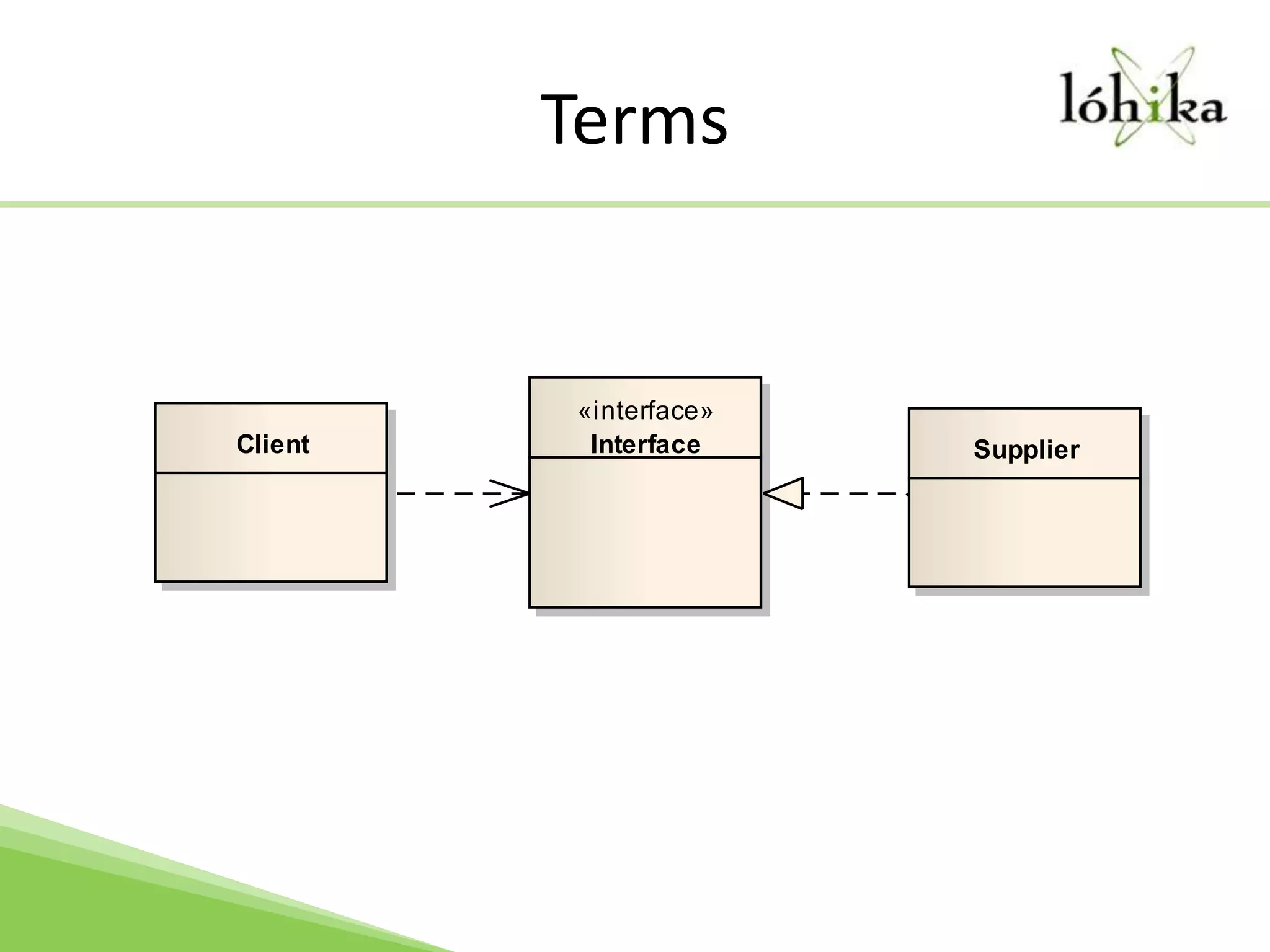
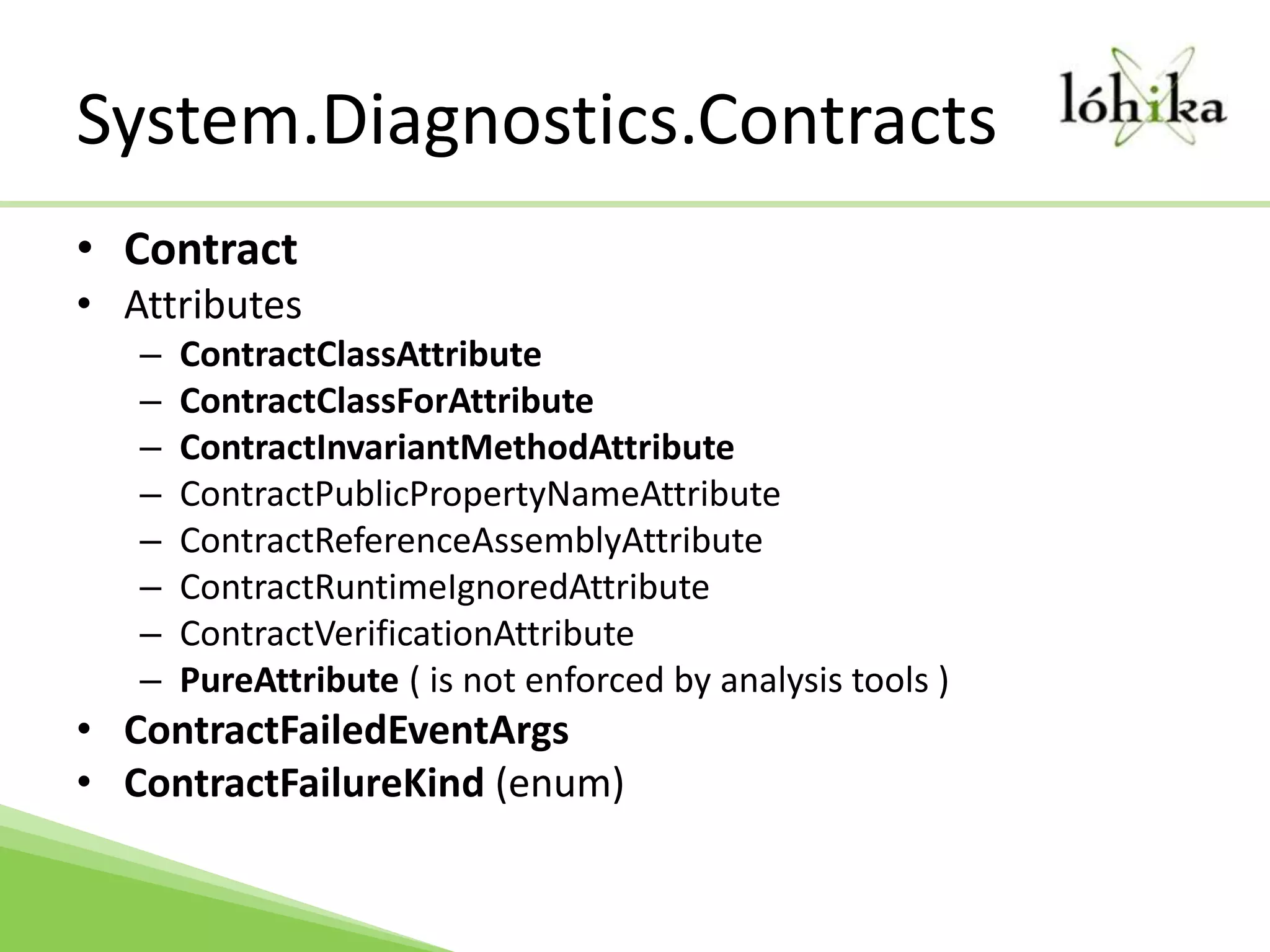
![ContractContract is precise and verifiable interface specifications for software components, which extend the ordinary definition of abstract data types with preconditions, postconditions and invariants. [8]](https://image.slidesharecdn.com/code-contracts-110315065317-phpapp01/75/Code-contracts-by-Dmytro-Mindra-8-2048.jpg)
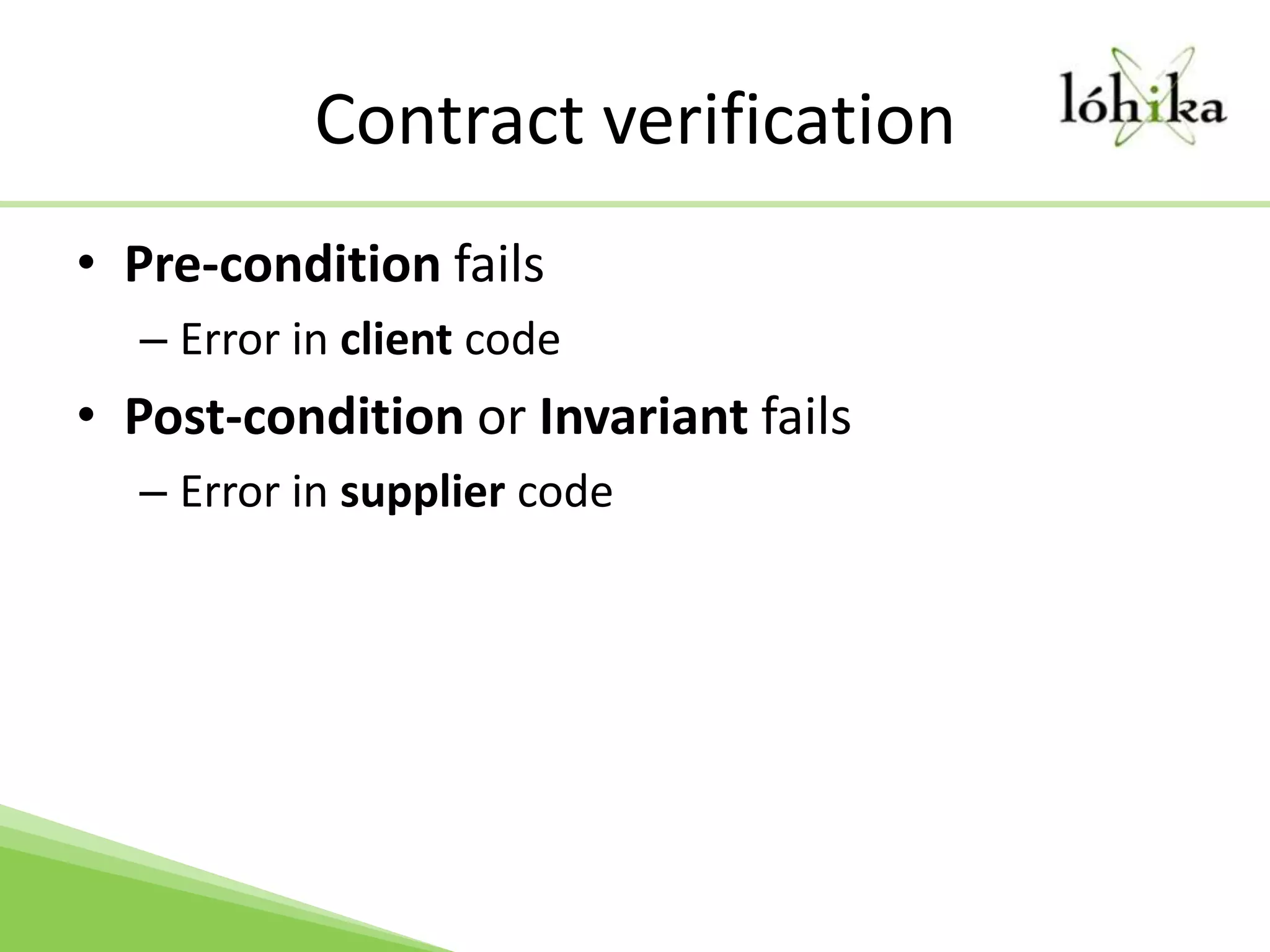
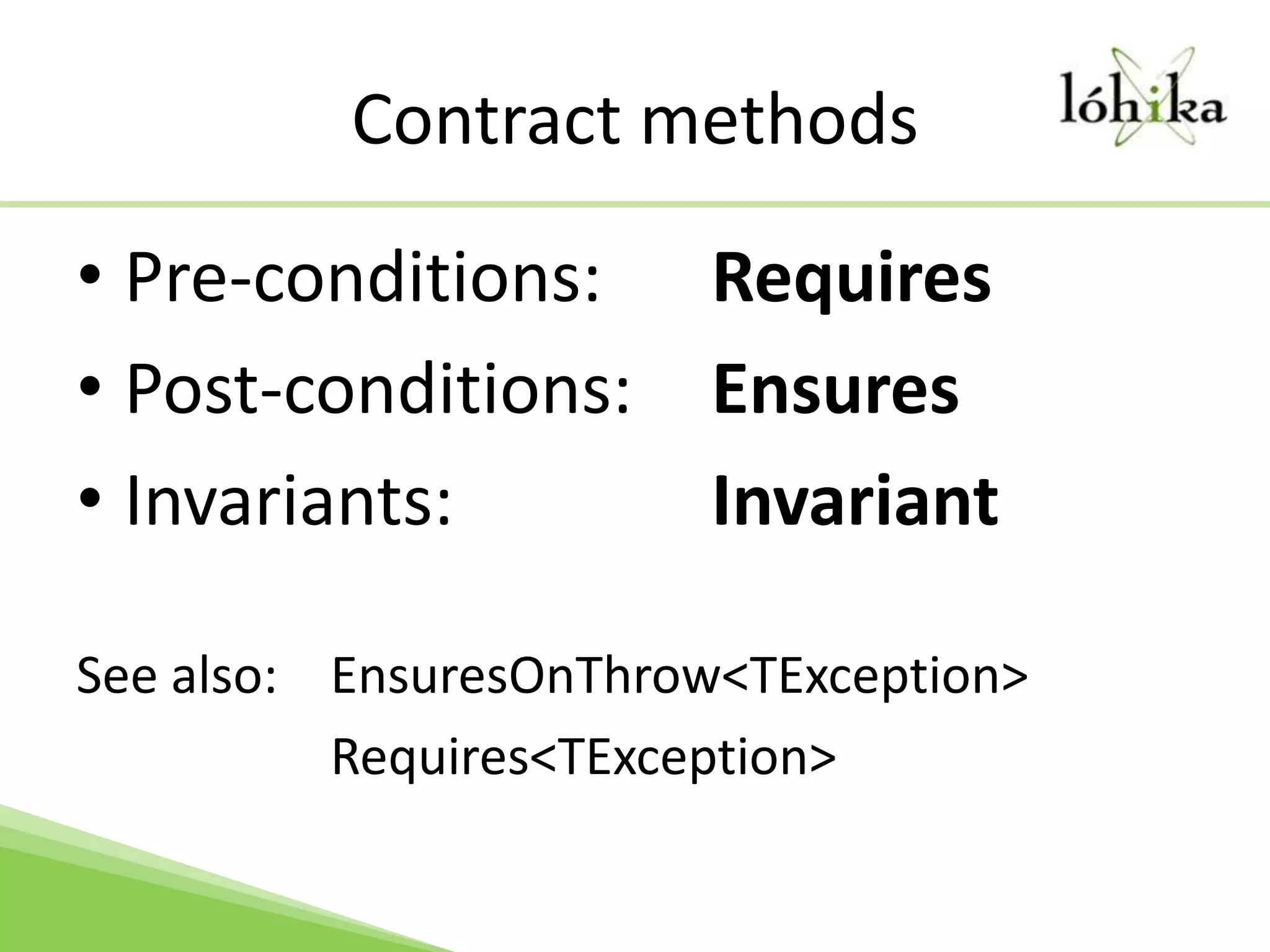
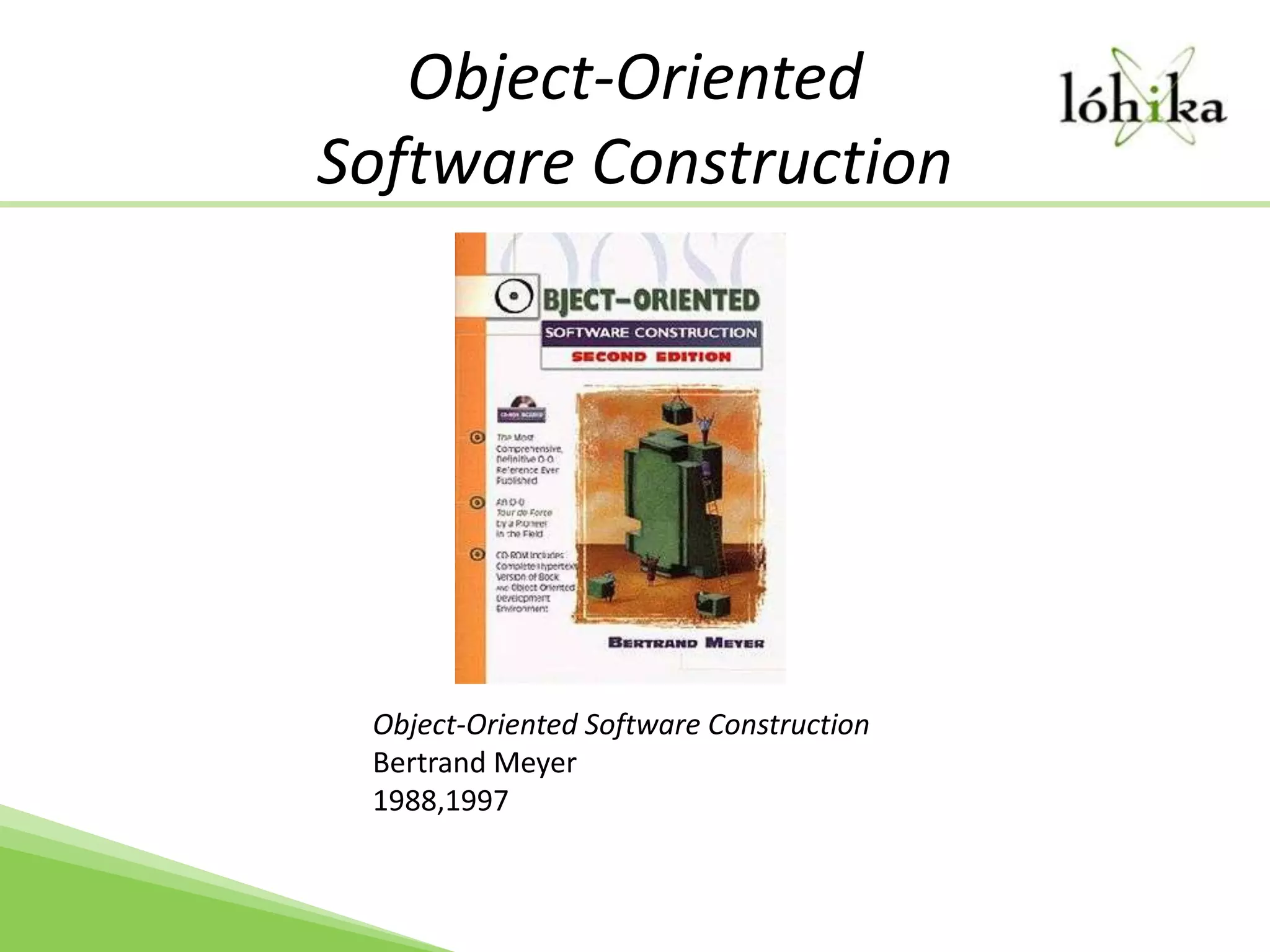
![ContractPre-conditions [9]In computer programming, a precondition is a condition or predicate that must always be true just prior to the execution of some section of code or before an operation in a formal specification.Post-conditions [10] In computer programming, a postcondition is a condition or predicate that must always be true just after the execution of some section of code or after an operation in a formal specification.Invariants[11]In computer science, a predicate is called an invariant to a sequence of operations provided that: if the predicate is true before starting the sequence, then it is true at the end of the sequence.](https://image.slidesharecdn.com/code-contracts-110315065317-phpapp01/75/Code-contracts-by-Dmytro-Mindra-9-2048.jpg)
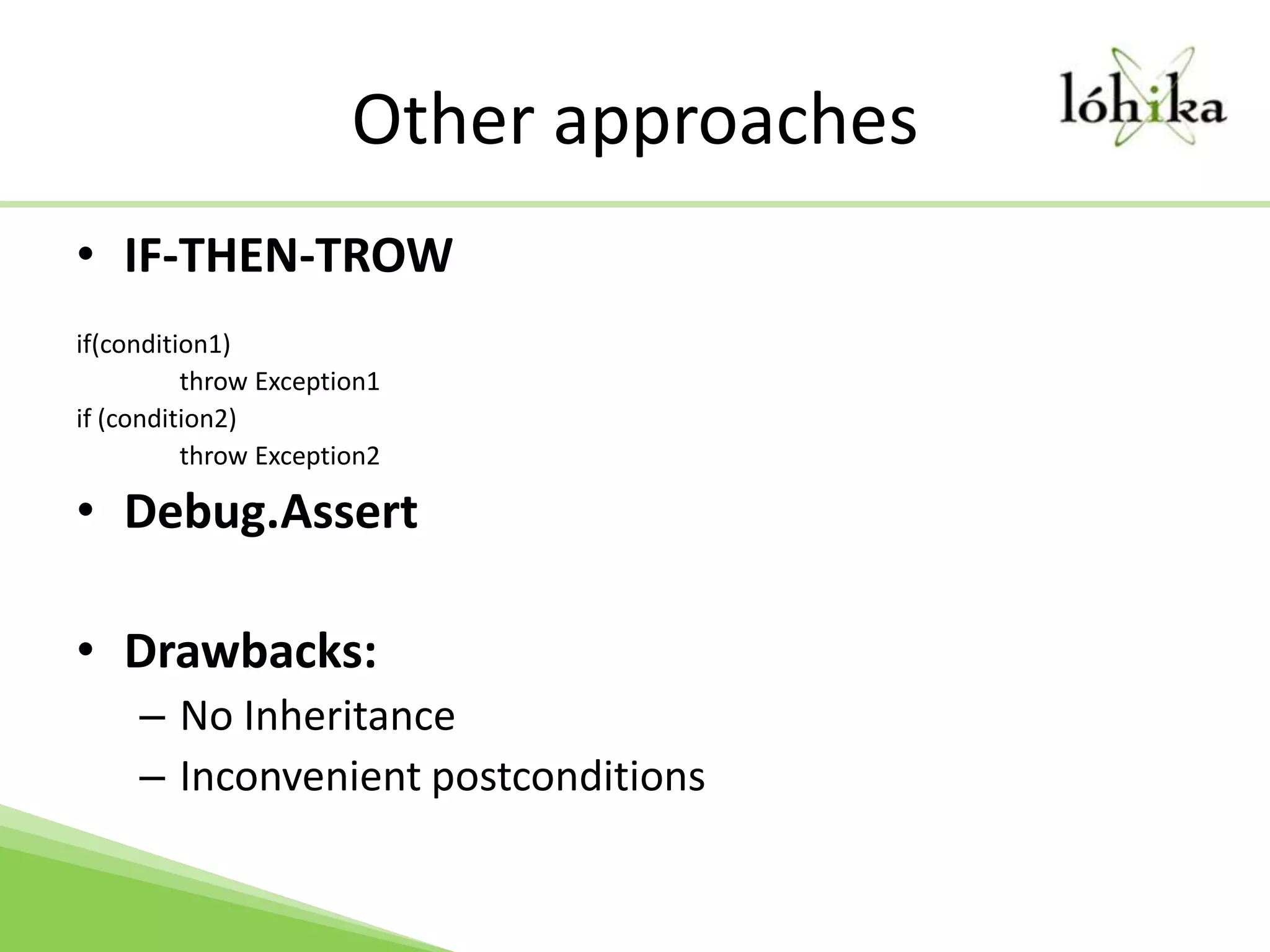
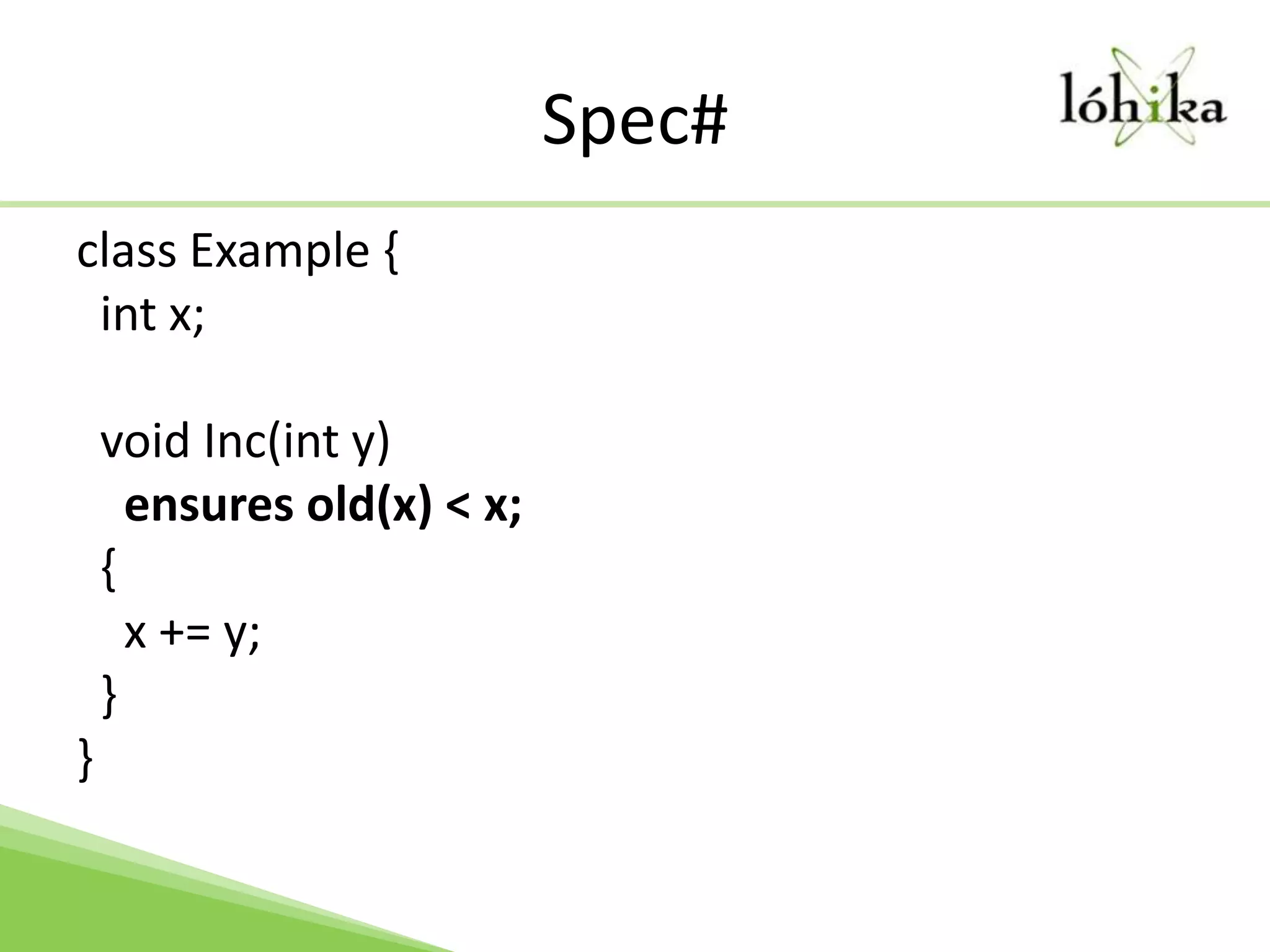
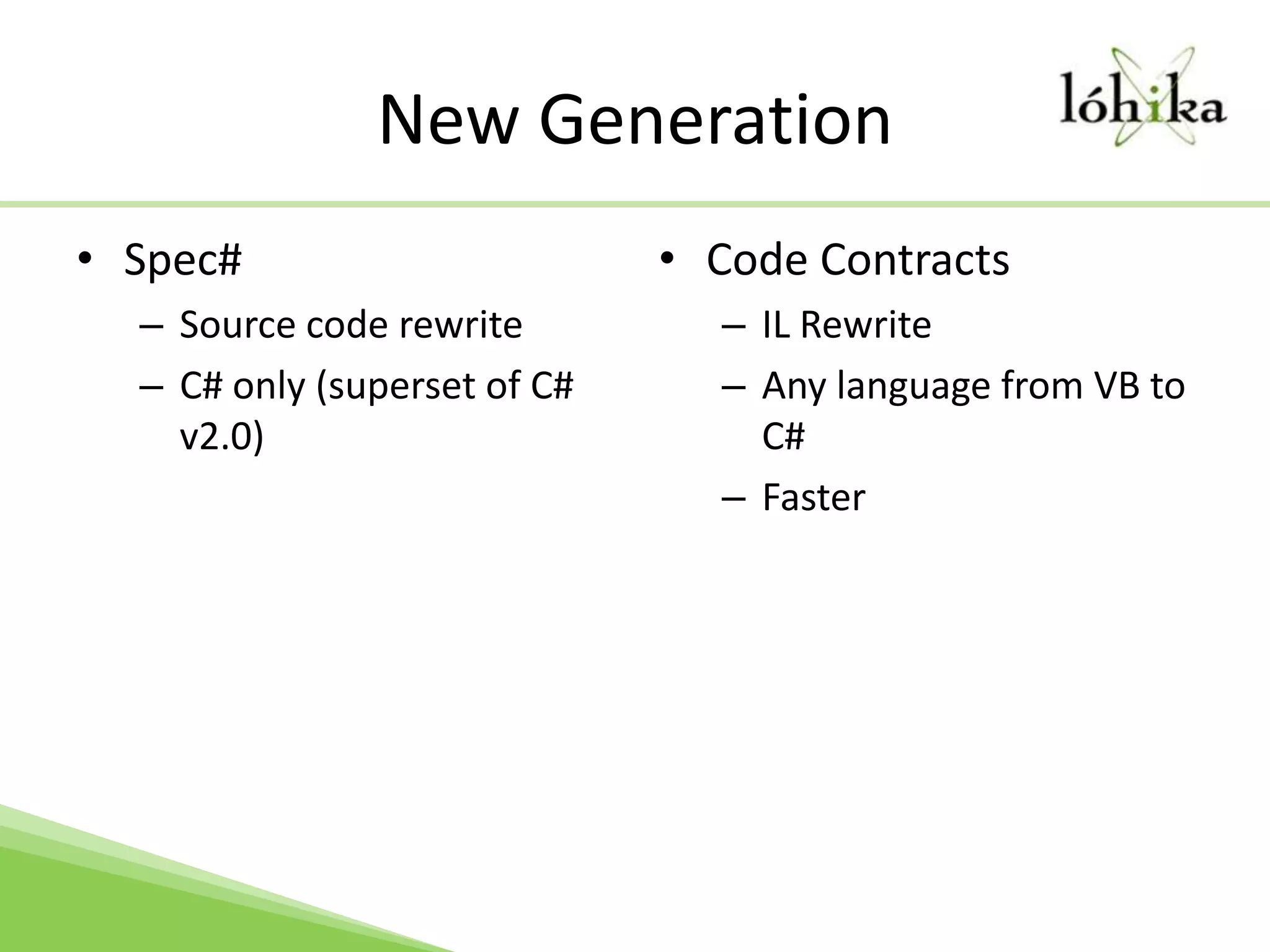
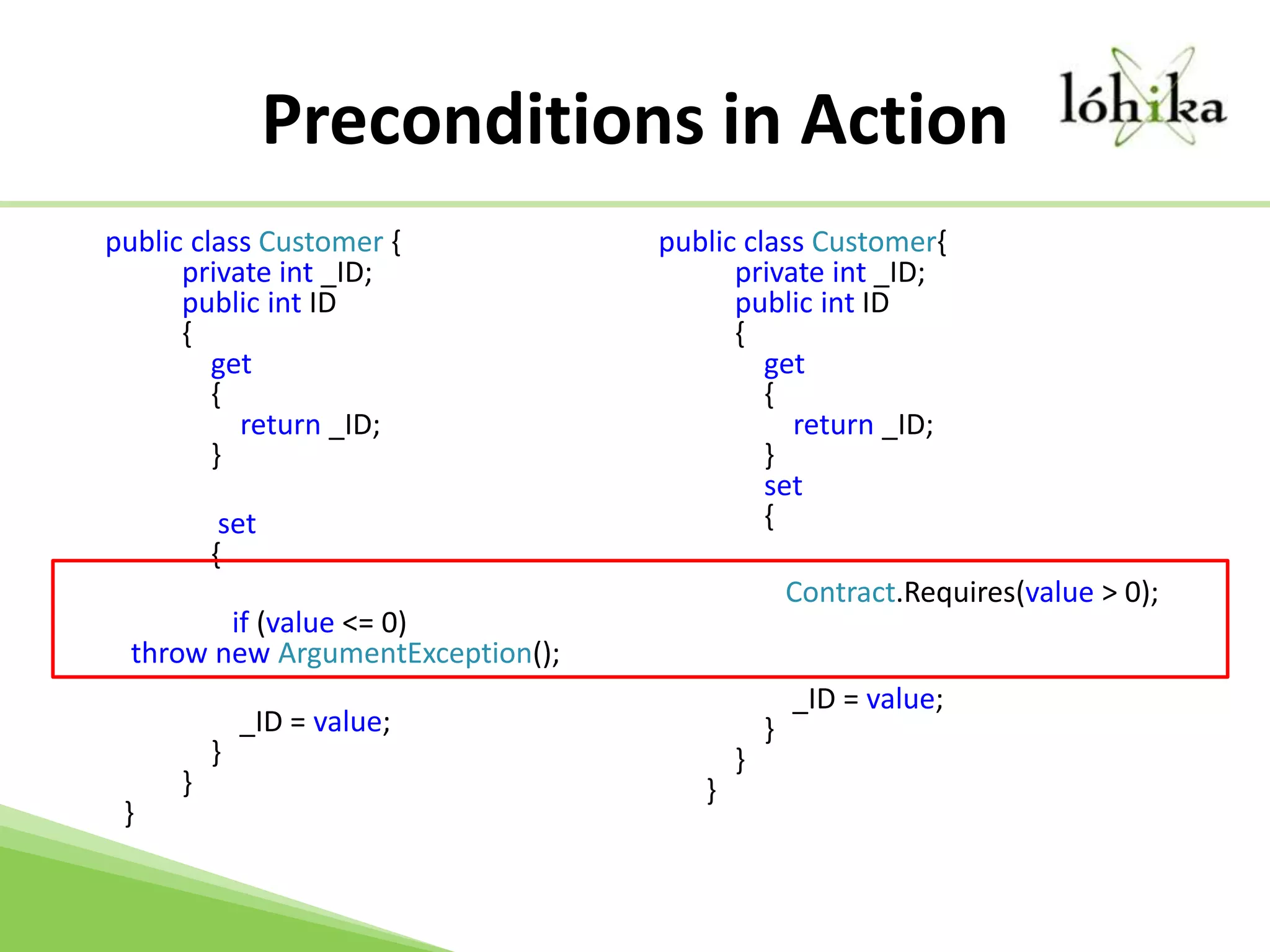
![Visual Studio 2010Declarative contracts are included in .NET 4.0 (System.Diagnostics.Contracts)Tools are needed to generate runtime checking from the contracts(ccrewrite)do a static check that verifies contracts at compile-time (cccheck)add contracts to the XML documentation files (ccdoc)LOCATION: [Program Files]\Microsoft\Contracts\Bin\](https://image.slidesharecdn.com/code-contracts-110315065317-phpapp01/75/Code-contracts-by-Dmytro-Mindra-16-2048.jpg)
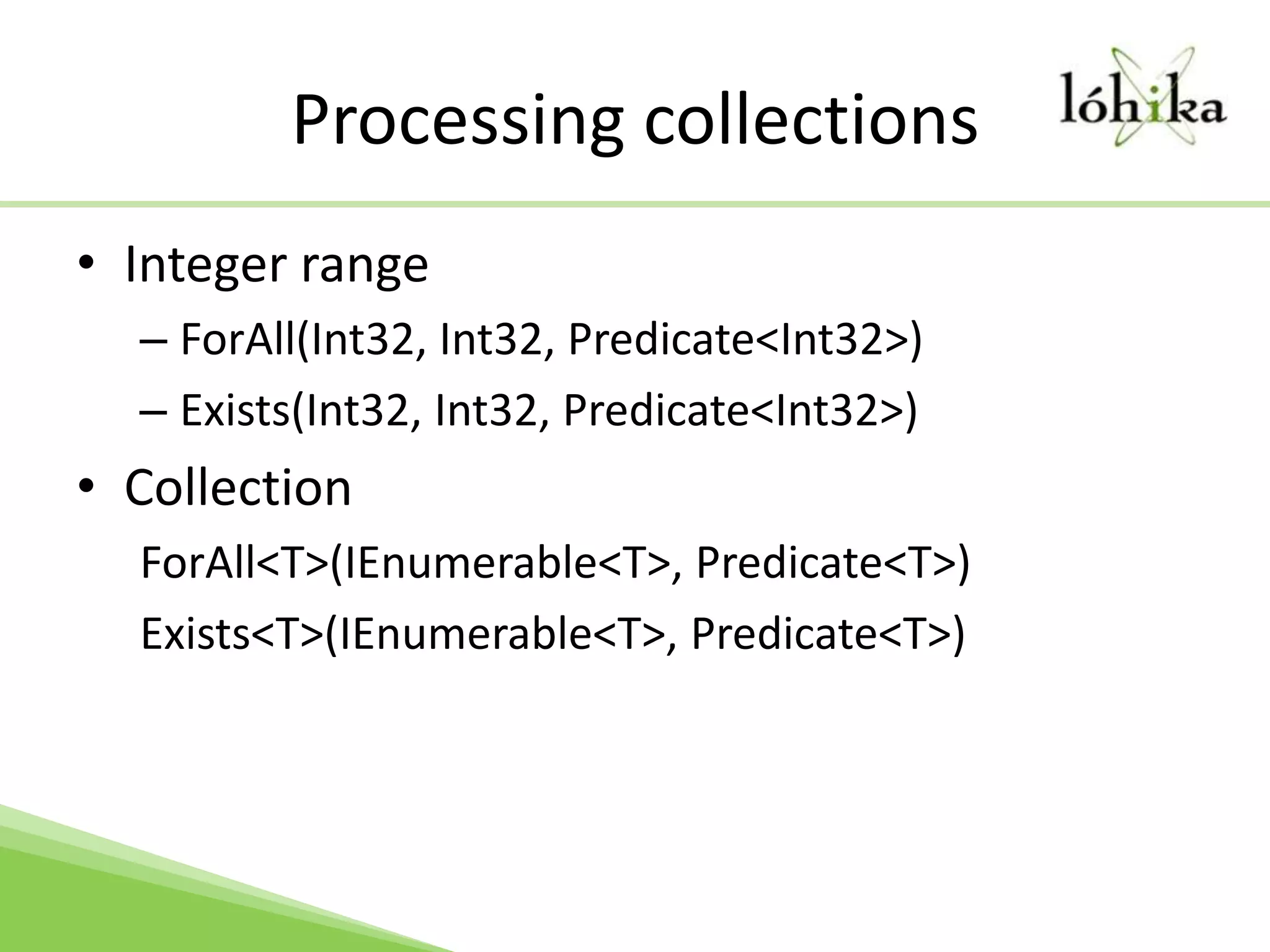

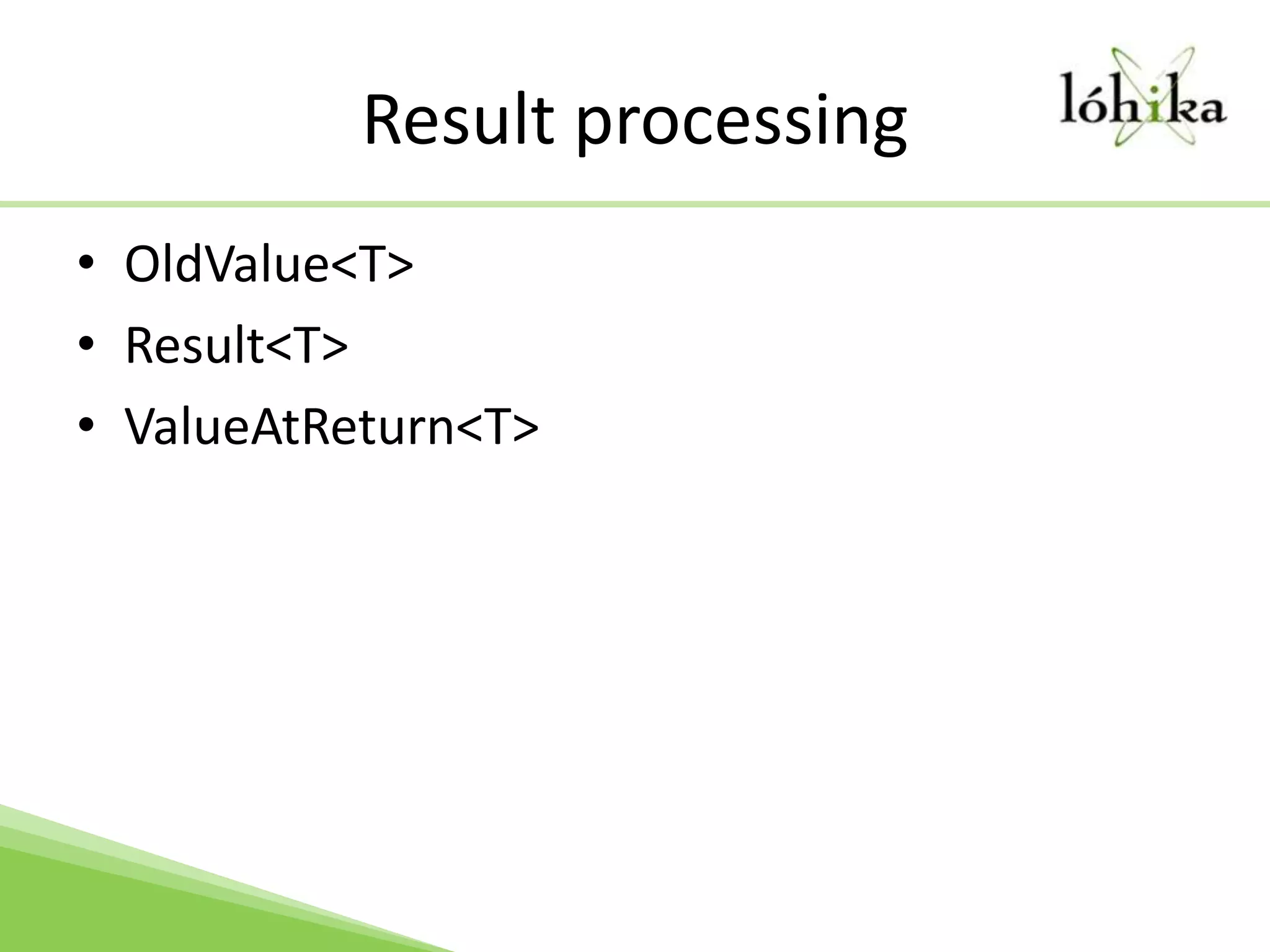

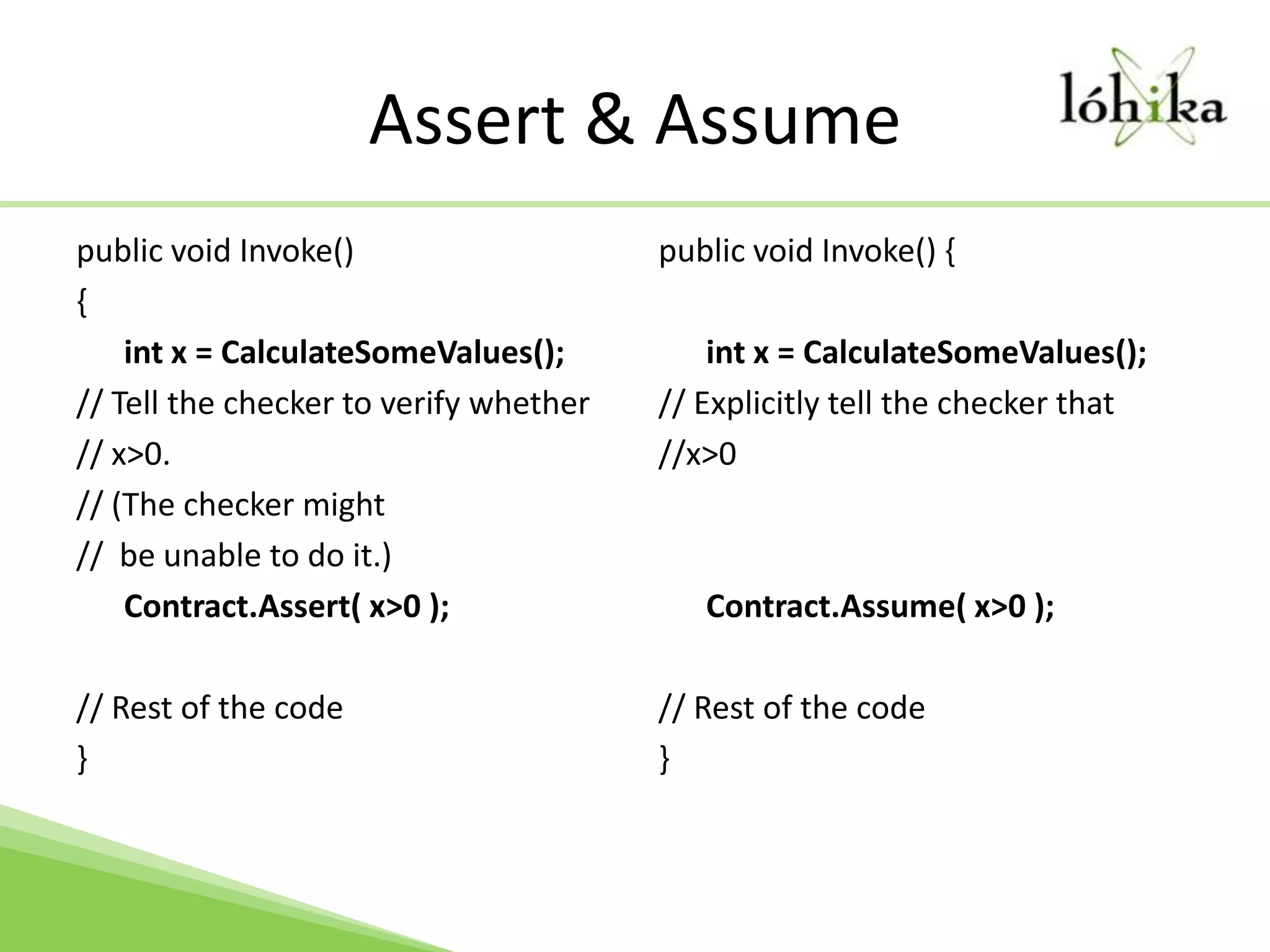
![OtherAssert - Checks for a conditionAssume - Instructs code analysis tools to assume that the specified condition is true, even if it cannot be statically proven to always be true. Only for static checks. In runtime is treated like Assert. [3]EndContractBlock - for legacy contracts](https://image.slidesharecdn.com/code-contracts-110315065317-phpapp01/75/Code-contracts-by-Dmytro-Mindra-25-2048.jpg)
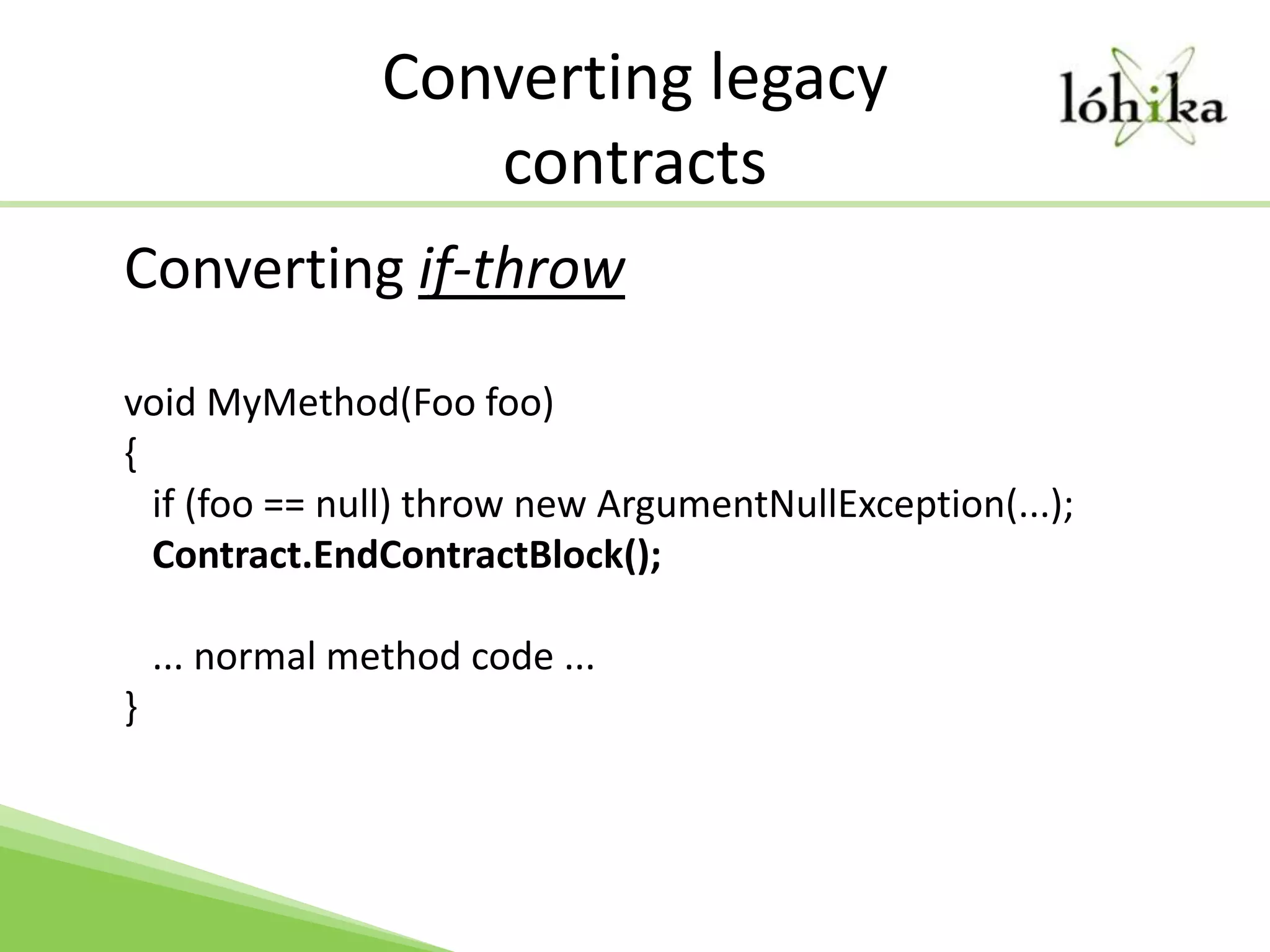
![InheritanceTwo rules[7]:When you override a method (or implement an interface method) you inherit its contracts.You can't add extra preconditions to inherited ones, but you can make invariants and postconditions stronger. E.g was require x>10Added require x>100Now x = 20 fulfills 1st require but violates 2nd;](https://image.slidesharecdn.com/code-contracts-110315065317-phpapp01/75/Code-contracts-by-Dmytro-Mindra-27-2048.jpg)

![custom contracts &custom rewriters methodspublic static class RuntimeFailureMethods { public static void Requires(bool cond, string userMsg, string condText) { } public static void Ensures(bool cond, string userMsg, string condText) { }…}See user manual 7.7. (page 34) [12]](https://image.slidesharecdn.com/code-contracts-110315065317-phpapp01/75/Code-contracts-by-Dmytro-Mindra-31-2048.jpg)
![Code snippetscrContract.Requires(...);ce Contract.Ensures(...);ci Contract.Invariant(...);More in user manual 6.3. (page 26) [12]](https://image.slidesharecdn.com/code-contracts-110315065317-phpapp01/75/Code-contracts-by-Dmytro-Mindra-32-2048.jpg)

![References[1] Design by Contract - A Conversation with Bertrand Meyer, Part II by Bill Vennershttp://www.artima.com/intv/contracts.html[2] Defensive programminghttp://en.wikipedia.org/wiki/Defensive_programming[3] Dino Esposito, Code Contracts Preview: Preconditionshttp://dotnetslackers.com/articles/net/Code-Contracts-Preview-Preconditions.aspx[4] Dino Esposito, Code Contracts Preview: PostConditionshttp://dotnetslackers.com/articles/net/Code-Contracts-Preview-PostConditions.aspx[5] Dino Esposito, Code Contracts Preview: Invariantshttp://dotnetslackers.com/articles/net/Code-Contracts-Preview-Invariants.aspx[6] Dino Esposito, Code Contracts Preview: Assert & Assumehttp://dotnetslackers.com/articles/net/Code-Contracts-Preview-Assert-Assume.aspx[7] Jon Skeet, Code Contracts in C#http://www.infoq.com/articles/code-contracts-csharp](https://image.slidesharecdn.com/code-contracts-110315065317-phpapp01/75/Code-contracts-by-Dmytro-Mindra-38-2048.jpg)
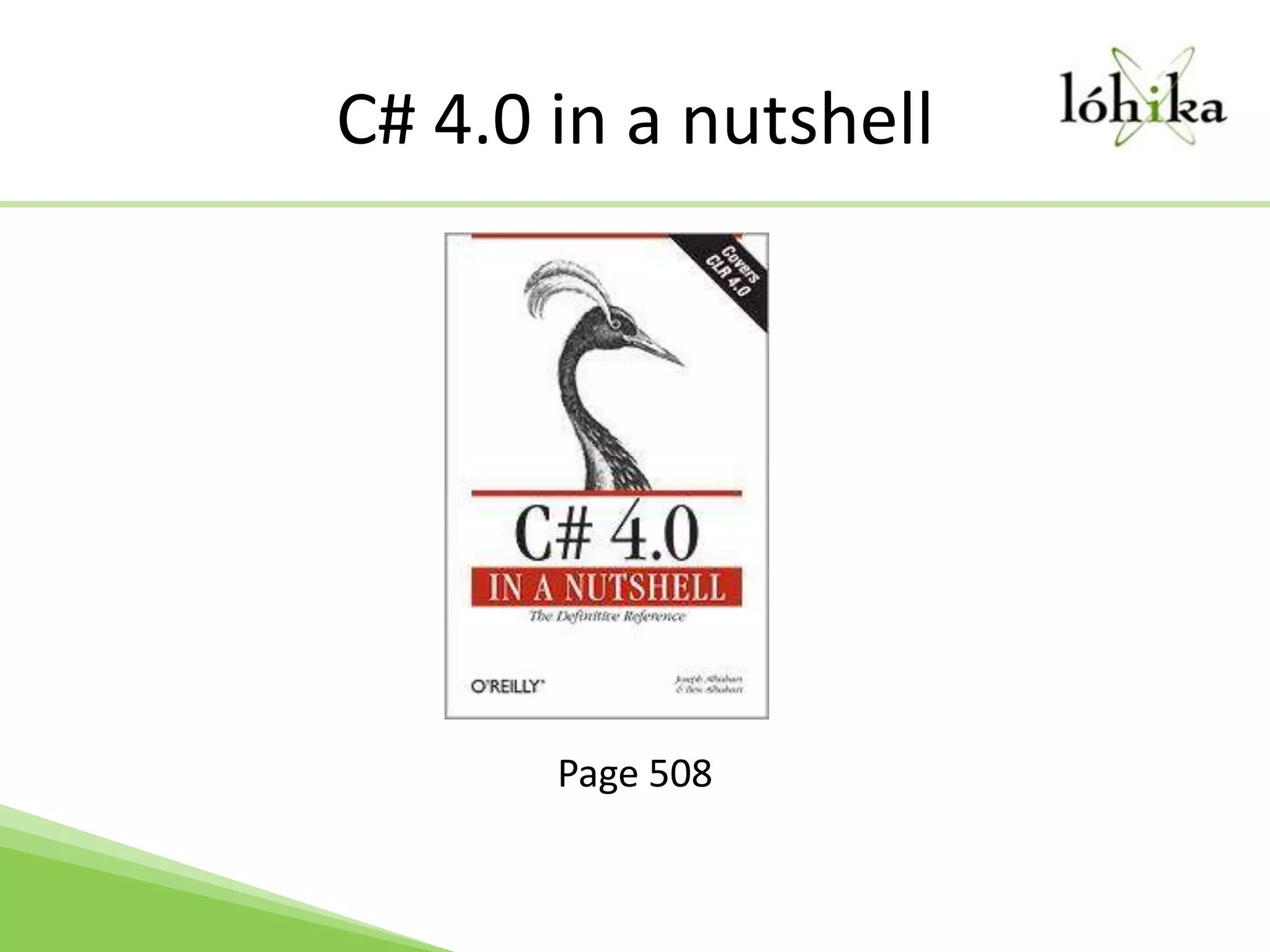
![References[8] Design by Contract - Wikipediahttp://en.wikipedia.org/wiki/Design_by_contract[9] Precondition - Wikipediahttp://en.wikipedia.org/wiki/Precondition[10] Postcondition - Wikipediahttp://en.wikipedia.org/wiki/Postcondition[11] Invariant - Wikipediahttp://en.wikipedia.org/wiki/Invariant_(computer_science)[12] Code Contracts User Manualhttp://research.microsoft.com/en-us/projects/contracts/userdoc.pdf[13] Code contracts and inheritancehttp://stefanoricciardi.com/2009/07/17/code-contracts-and-inheritance/[14] Assertions in Managed Codehttp://msdn.microsoft.com/en-us/library/ttcc4x86.aspx](https://image.slidesharecdn.com/code-contracts-110315065317-phpapp01/75/Code-contracts-by-Dmytro-Mindra-39-2048.jpg)


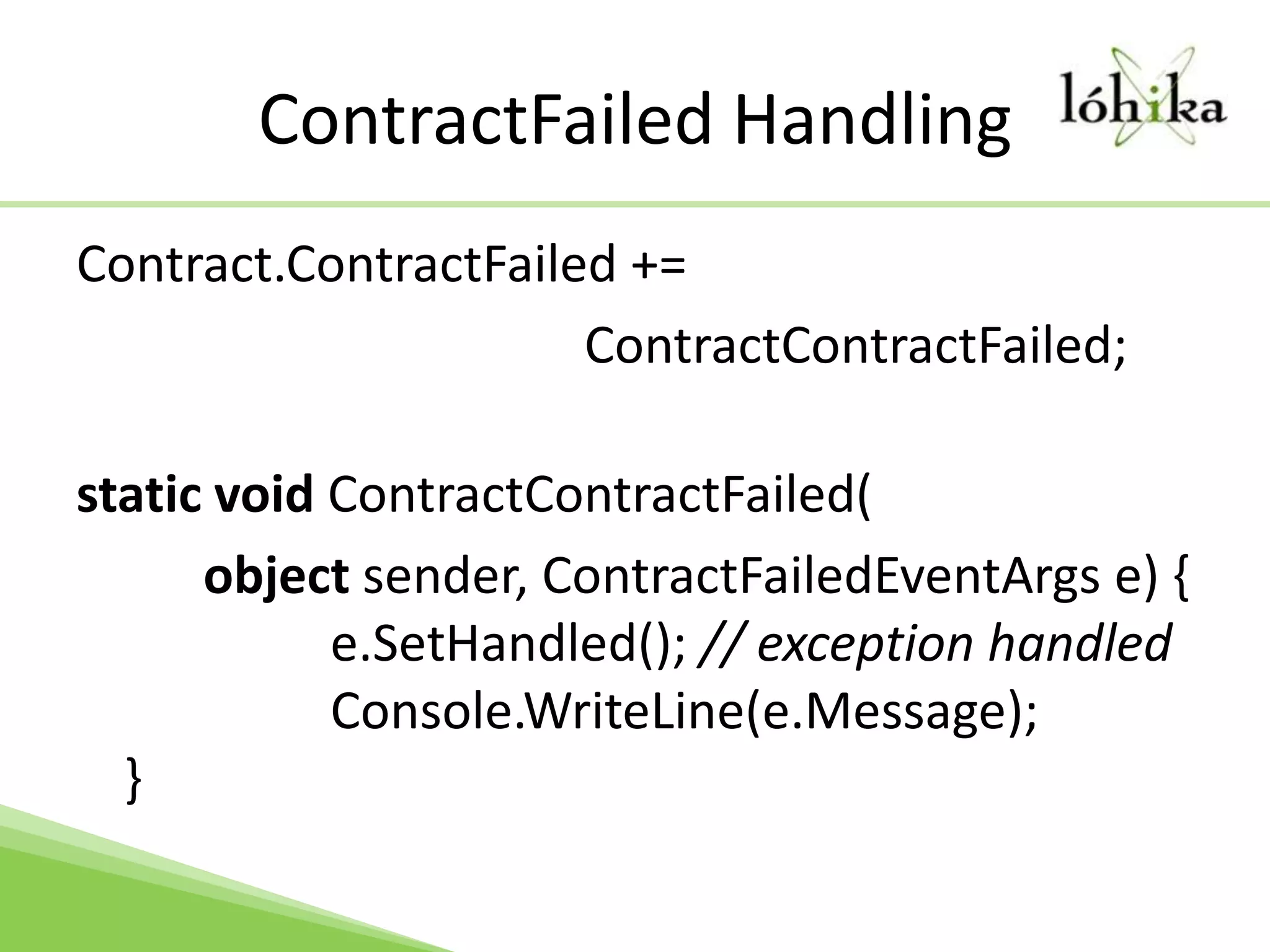
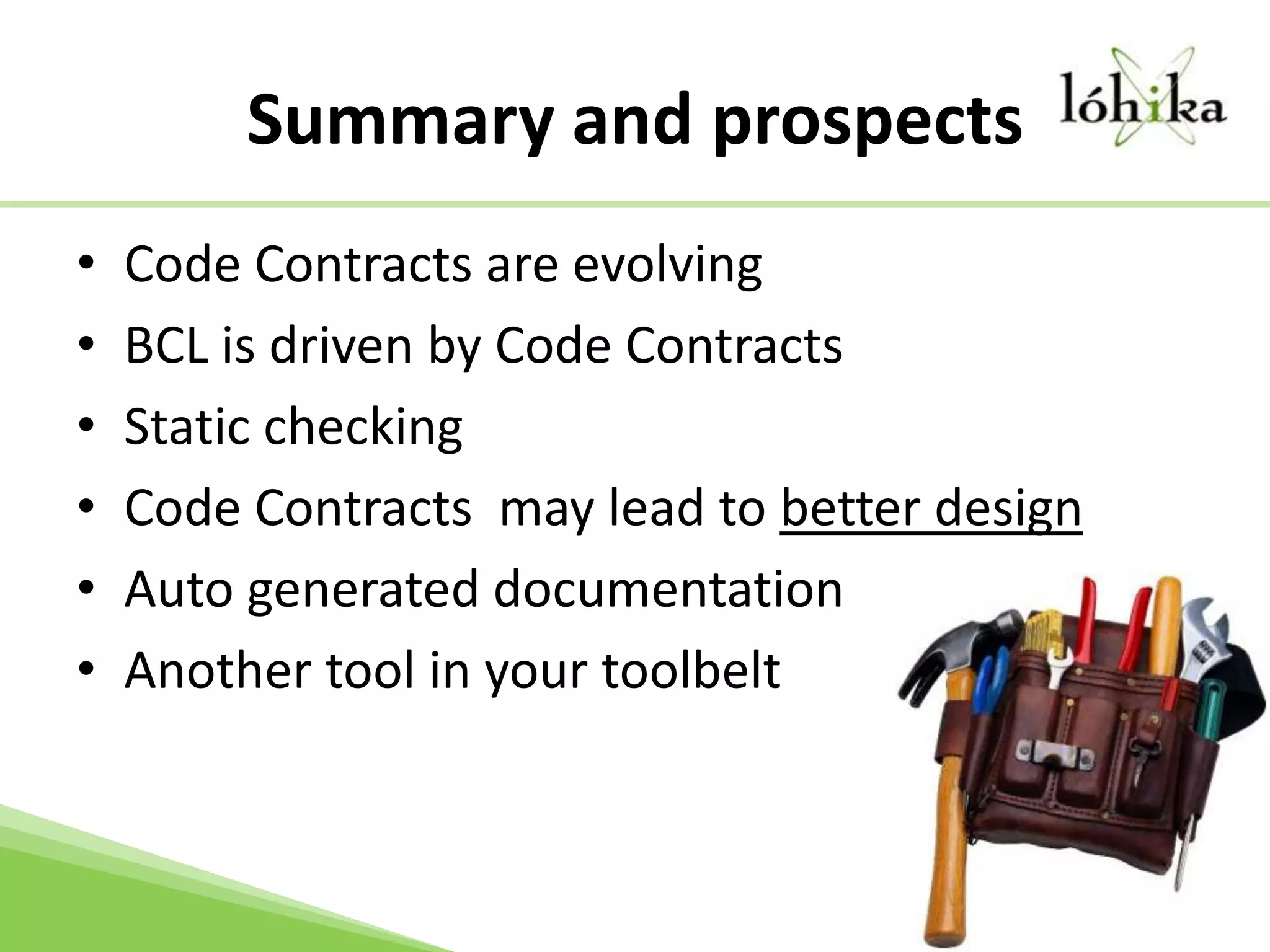
This document discusses code contracts, which extend abstract data types with preconditions, postconditions, and invariants. Code contracts allow programmers to specify conditions that must be true before, after, and during execution. The document outlines key contract terms like preconditions, postconditions, and invariants. It also discusses how to add contracts to code using Code Contracts in .NET and demonstrates contract verification, inheritance of contracts, and handling contract failures at runtime. Code Contracts allow formal specification and static/dynamic checking of interface behaviors to help catch errors and improve code quality.


