
SECURING REACT APPS
SHIELDS UP
December 8, 2017
SHIELDS UP - SECURING REACT APPS
ABOUT US
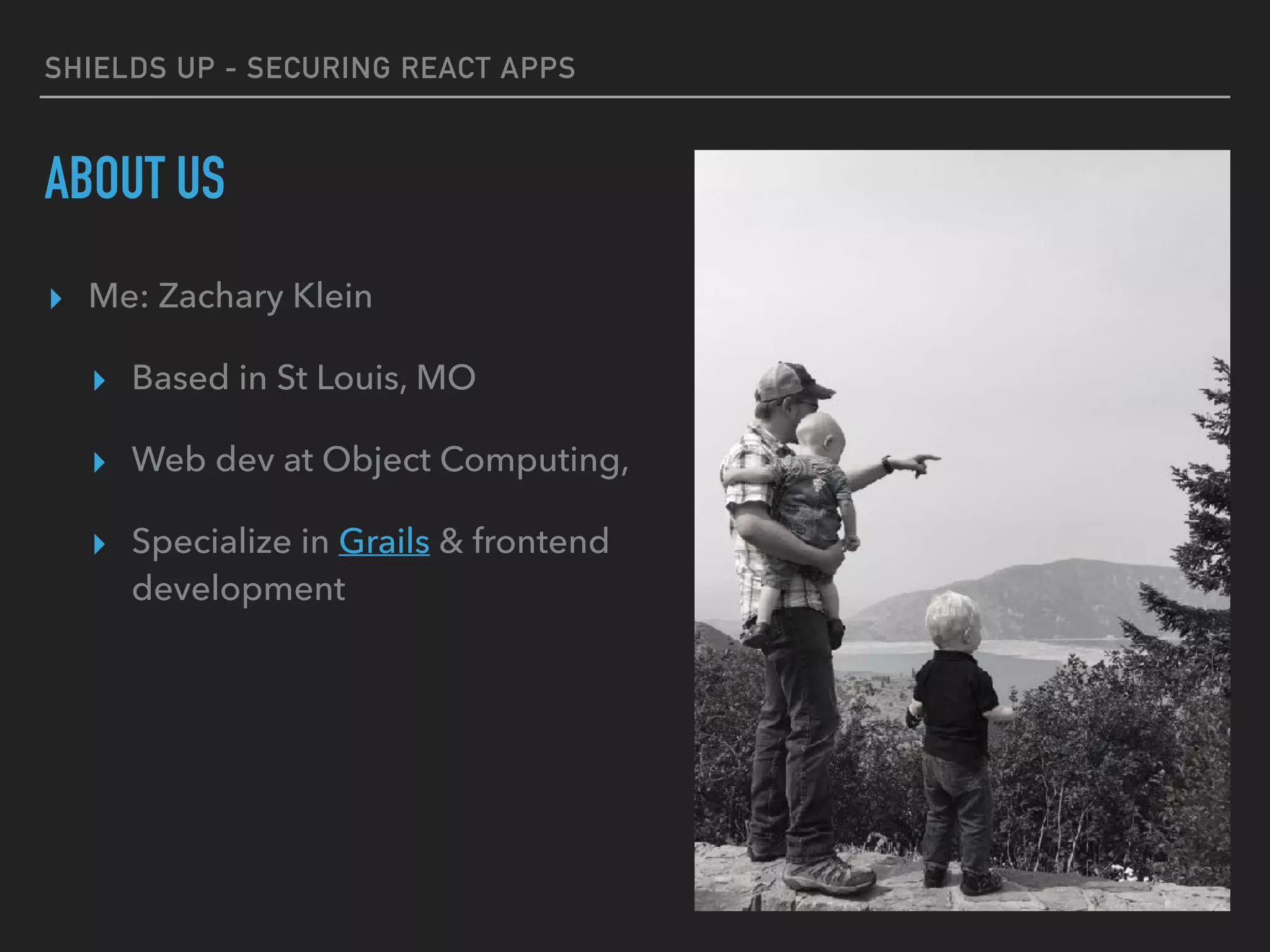
▸ Me: Zachary Klein
▸ Based in St Louis, MO
▸ Web dev at Object Computing,
▸ Specialize in Grails & frontend
development
SHIELDS UP - SECURING REACT APPS
ABOUT US
▸ My company: Object Computing,
Inc
▸ Based in St Louis, MO
▸ Consulting and training
provider (24+ years experience)
▸ Corporate sponsor to the Grails
framework and Groovy
language
▸ https://objectcomputing.com
SHIELDS UP - SECURING REACT APPS
ABOUT US
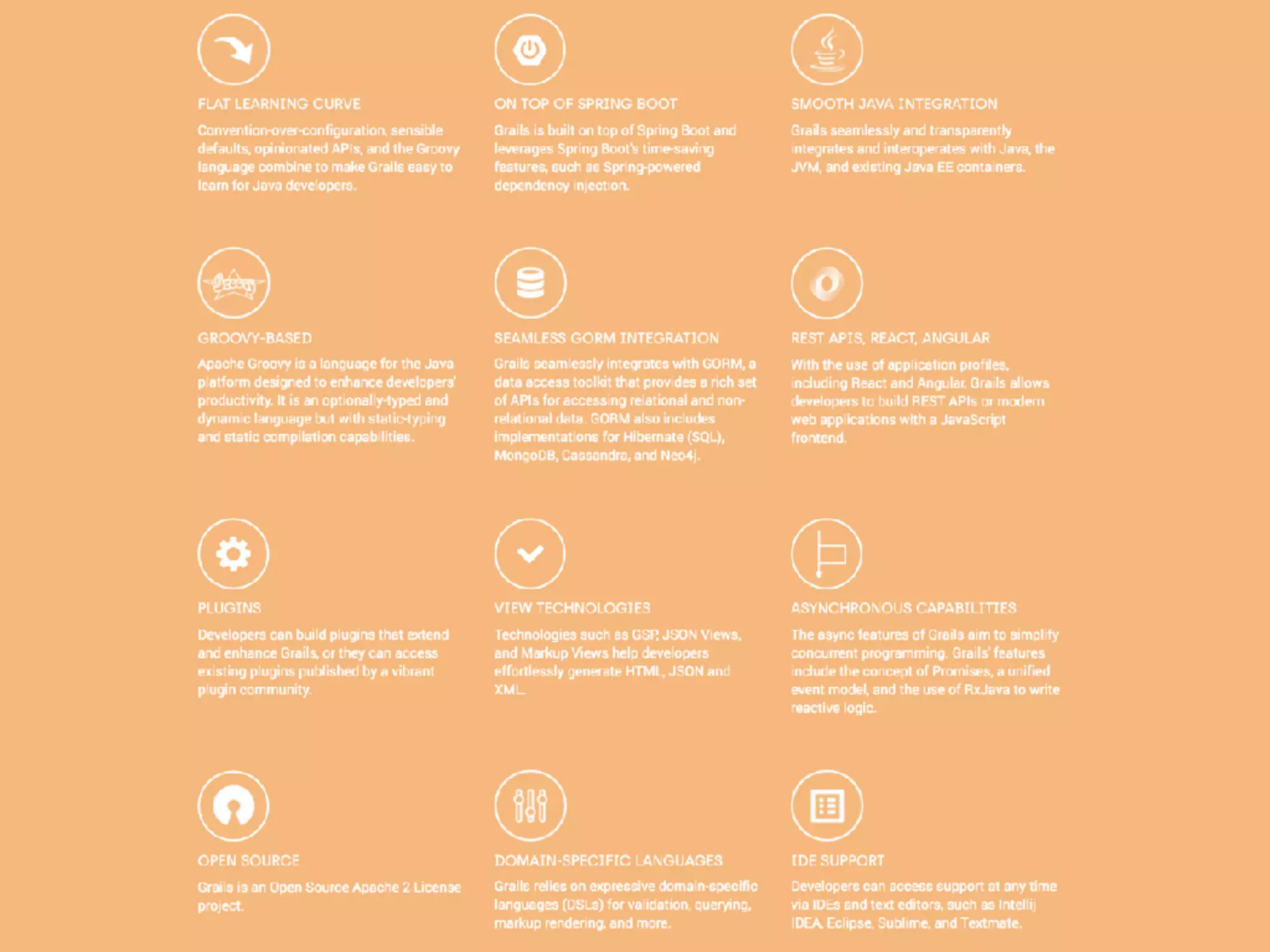
▸ Grails: A dynamic, flexible web application framework
▸ Built on top of Spring Boot
▸ First-class support for REST APIs
▸ Profiles for building applications using React,
Angular, Webpack, and RESTful backends
▸ Powerful persistence layer with GORM - supports
Hibernate, MongoDb, Neo4J, GraphQL, and more
▸ Rich plugin ecosystem: 200+ plugins and growing
▸ Active community and commercial support available.
▸ https://grails.org
SHIELDS UP - SECURING REACT APPS
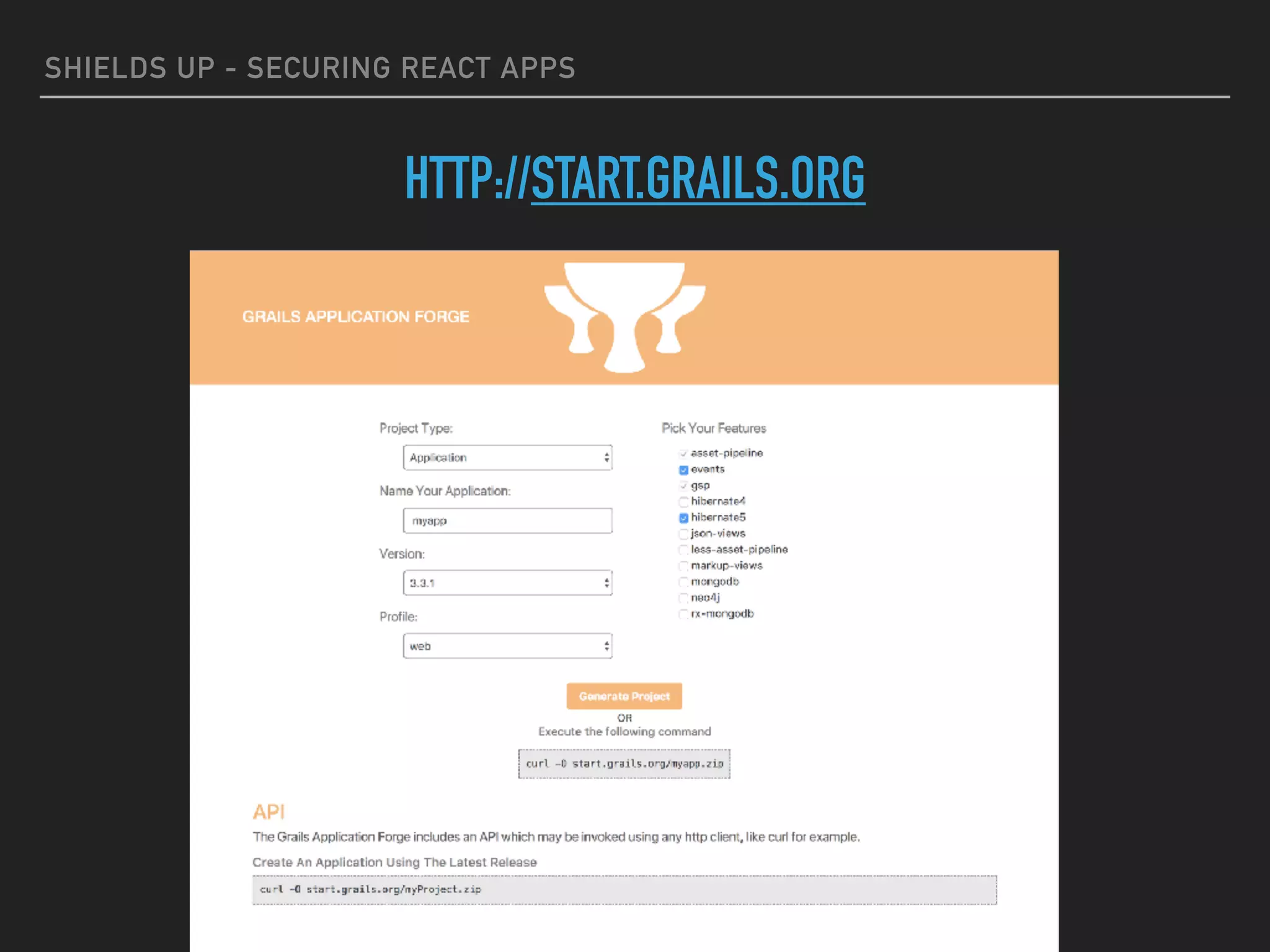
HTTP://START.GRAILS.ORG
SHIELDS UP - SECURING REACT APPS
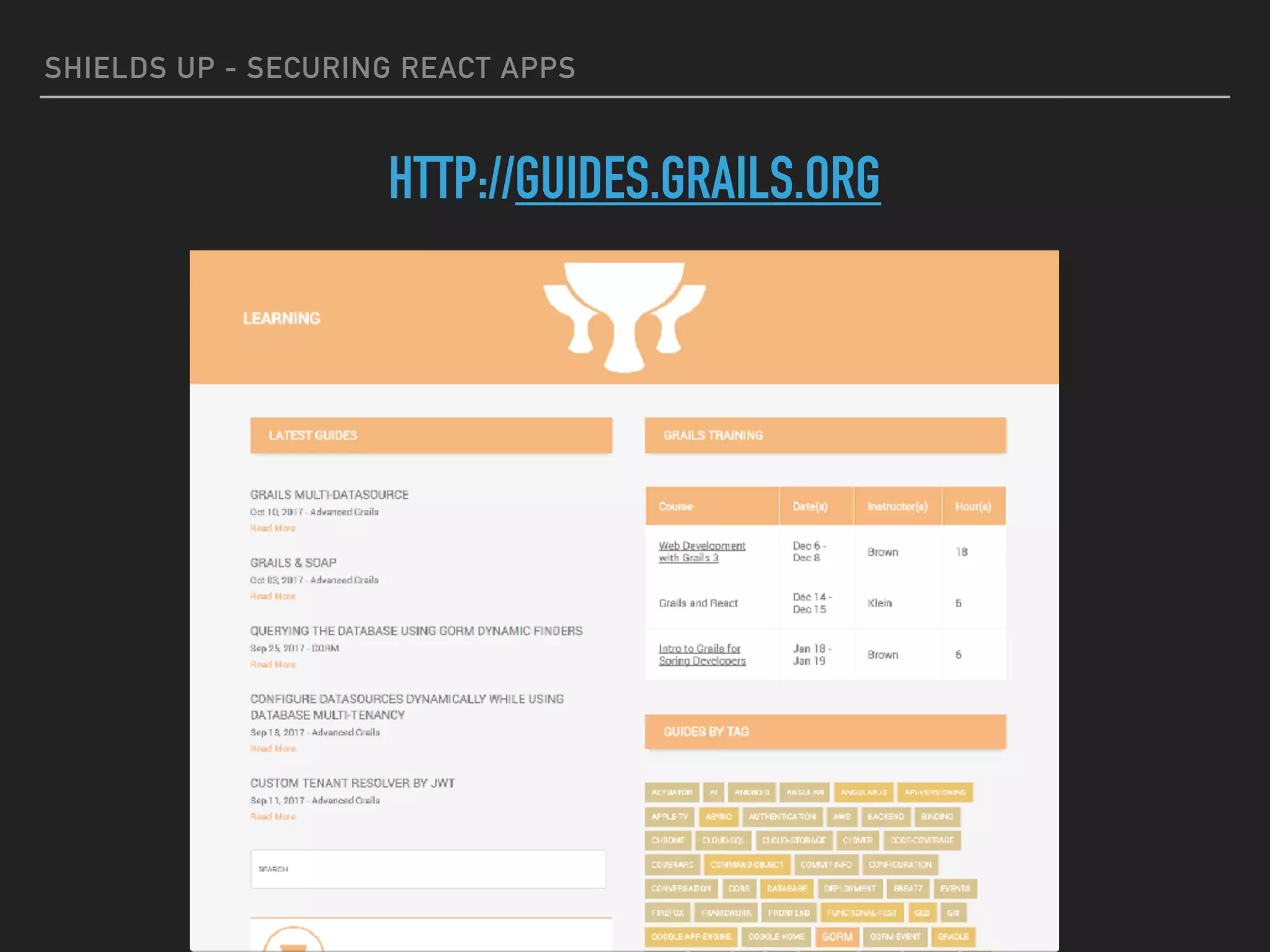
HTTP://GUIDES.GRAILS.ORG
SHIELDS UP - SECURING REACT APPS
ABOUT US
▸ You:
▸?
SHIELDS UP - SECURING REACT APPS
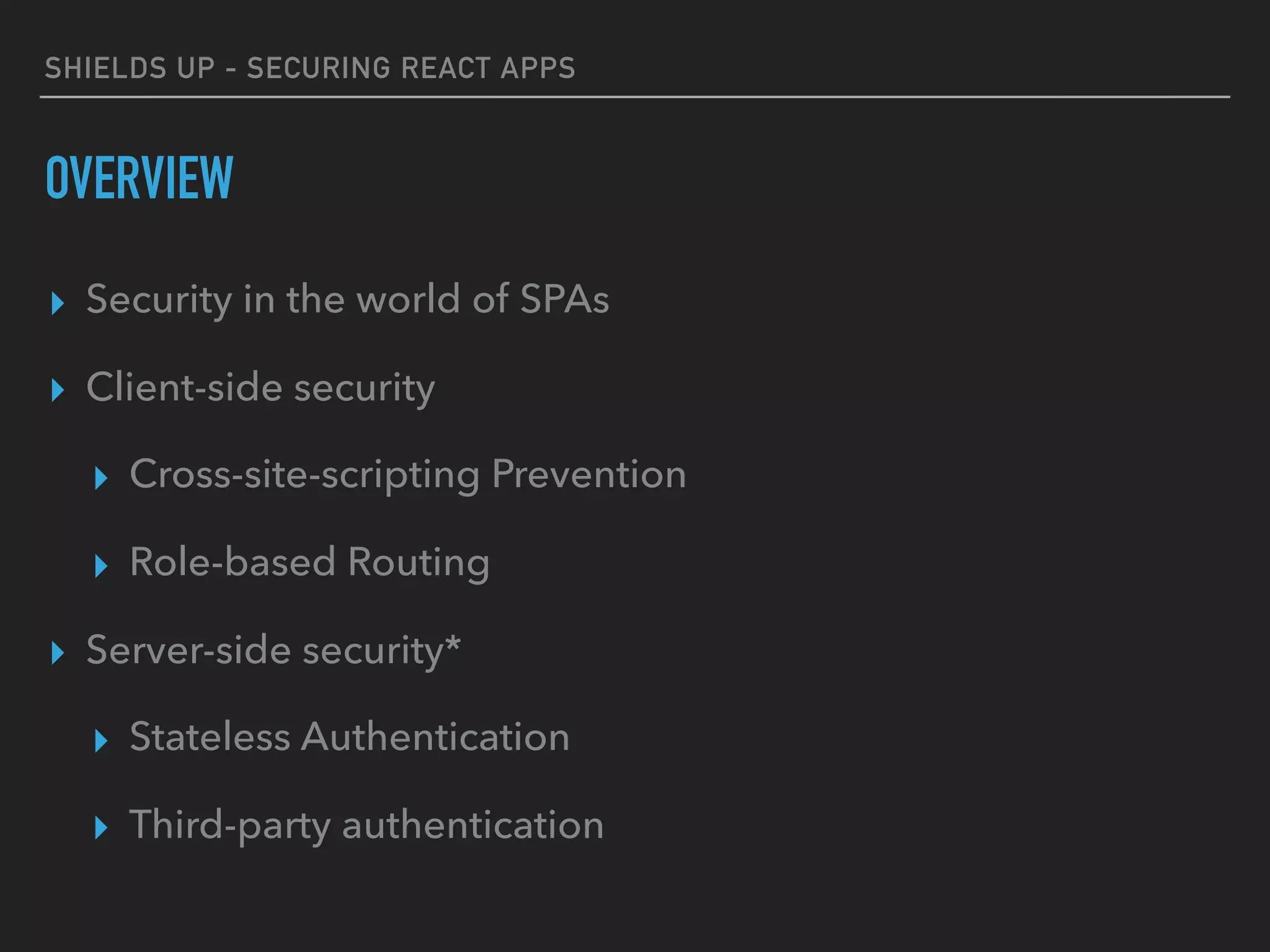
OVERVIEW
▸ Security in the world of SPAs
▸ Client-side security
▸ Cross-site-scripting Prevention
▸ Role-based Routing
▸ Server-side security*
▸ Stateless Authentication
▸ Third-party authentication
SHIELDS UP - SECURING REACT APPS
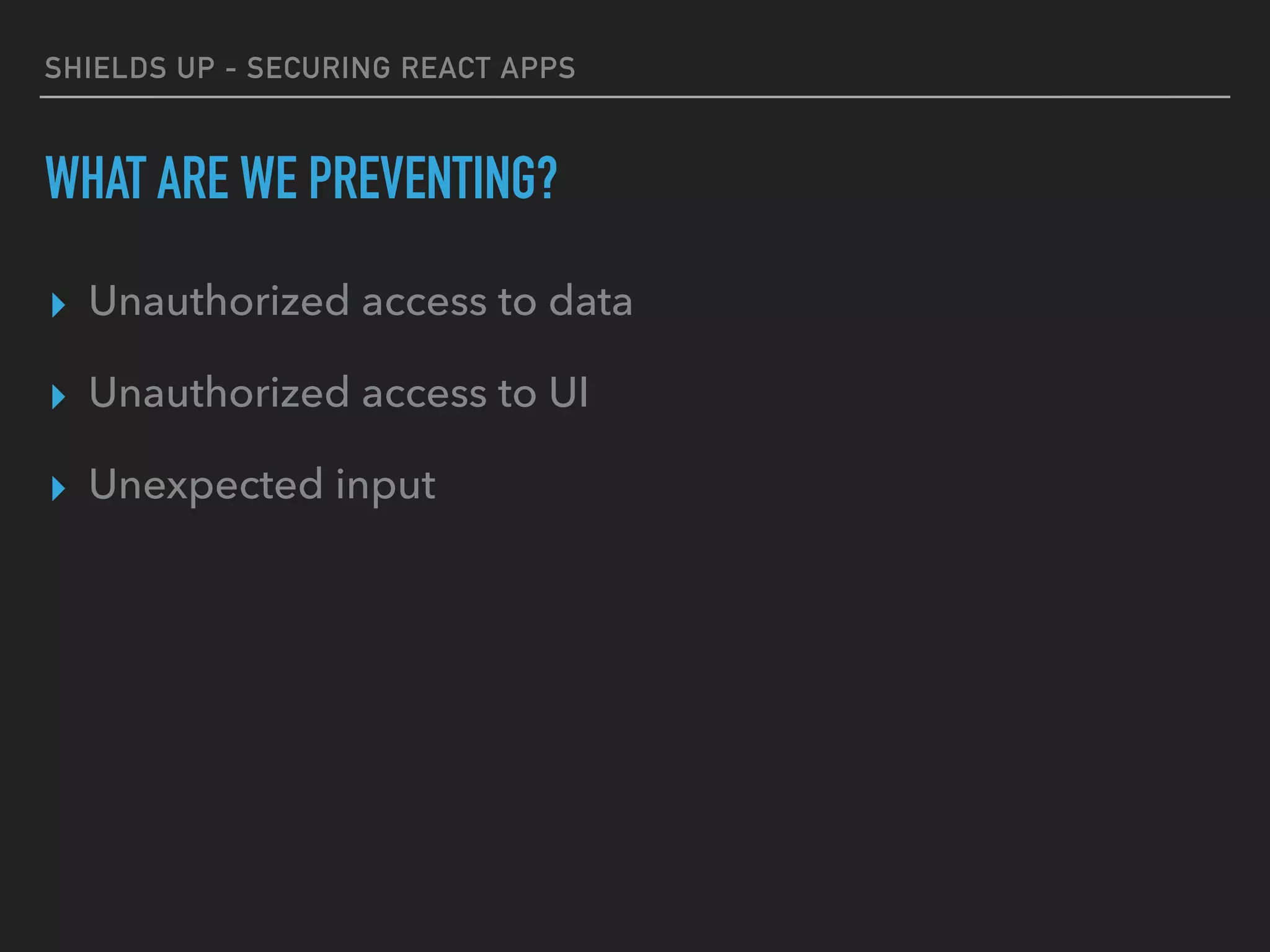
WHAT ARE WE PREVENTING?
▸ Unauthorized access to data
▸ Unauthorized access to UI
▸ Unexpected input
SHIELDS UP - SECURING REACT APPS
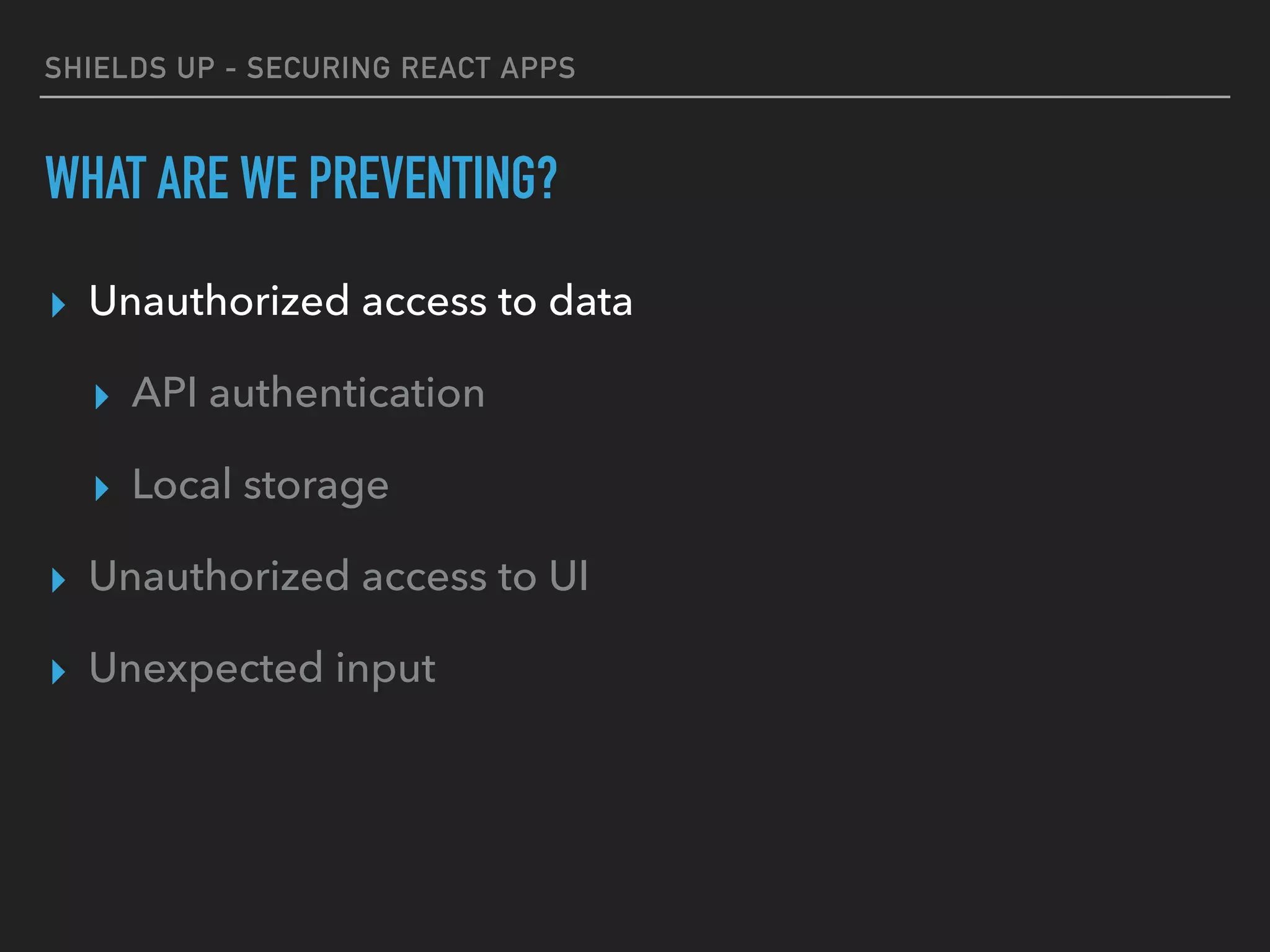
WHAT ARE WE PREVENTING?
▸ Unauthorized access to data
▸ API authentication
▸ Local storage
▸ Unauthorized access to UI
▸ Unexpected input
SHIELDS UP - SECURING REACT APPS
WHAT ARE WE PREVENTING?
▸ Unauthorized access to data
▸ API authentication
▸ Local storage
▸ Unauthorized access to UI
▸ Role-based Routing
▸ Unexpected input
SHIELDS UP - SECURING REACT APPS
WHAT ARE WE PREVENTING?
▸ Unauthorized access to data
▸ API authentication
▸ Local storage
▸ Unauthorized access to UI
▸ Role-based Routing
▸ Unexpected input
▸ Cross-site scripting (XSS)
SHIELDS UP - SECURING REACT APPS
WHAT ARE WE PREVENTING?
▸ Unauthorized access to data
▸ API authentication
▸ Local Storage
▸ Unauthorized access to UI
▸ Role-based Routing
▸ Unexpected input
▸ Cross-site scripting (XSS)
SHIELDS UP - SECURING REACT APPS
WHAT ARE WE PREVENTING?
▸ Unauthorized access to data
▸ API authentication
▸ Local Storage
▸ Unauthorized access to UI
▸ Role-based Routing
▸ Unexpected input
▸ Cross-site scripting (XSS)
SHIELDS UP - SECURING REACT APPS
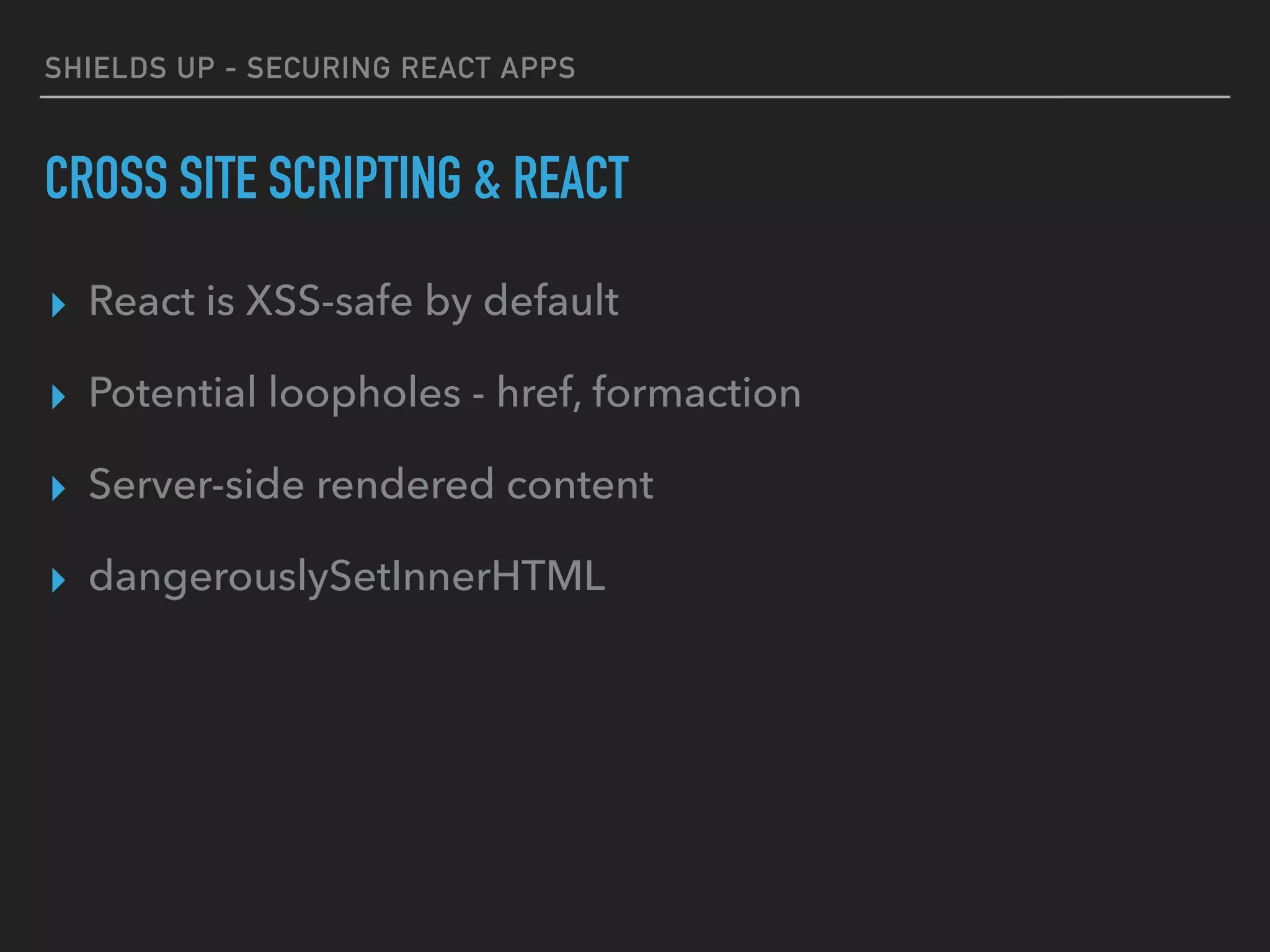
CROSS SITE SCRIPTING & REACT
▸ React is XSS-safe by default
▸ Potential loopholes - href, formaction
▸ Server-side rendered content
▸ dangerouslySetInnerHTML
SHIELDS UP - SECURING REACT APPS
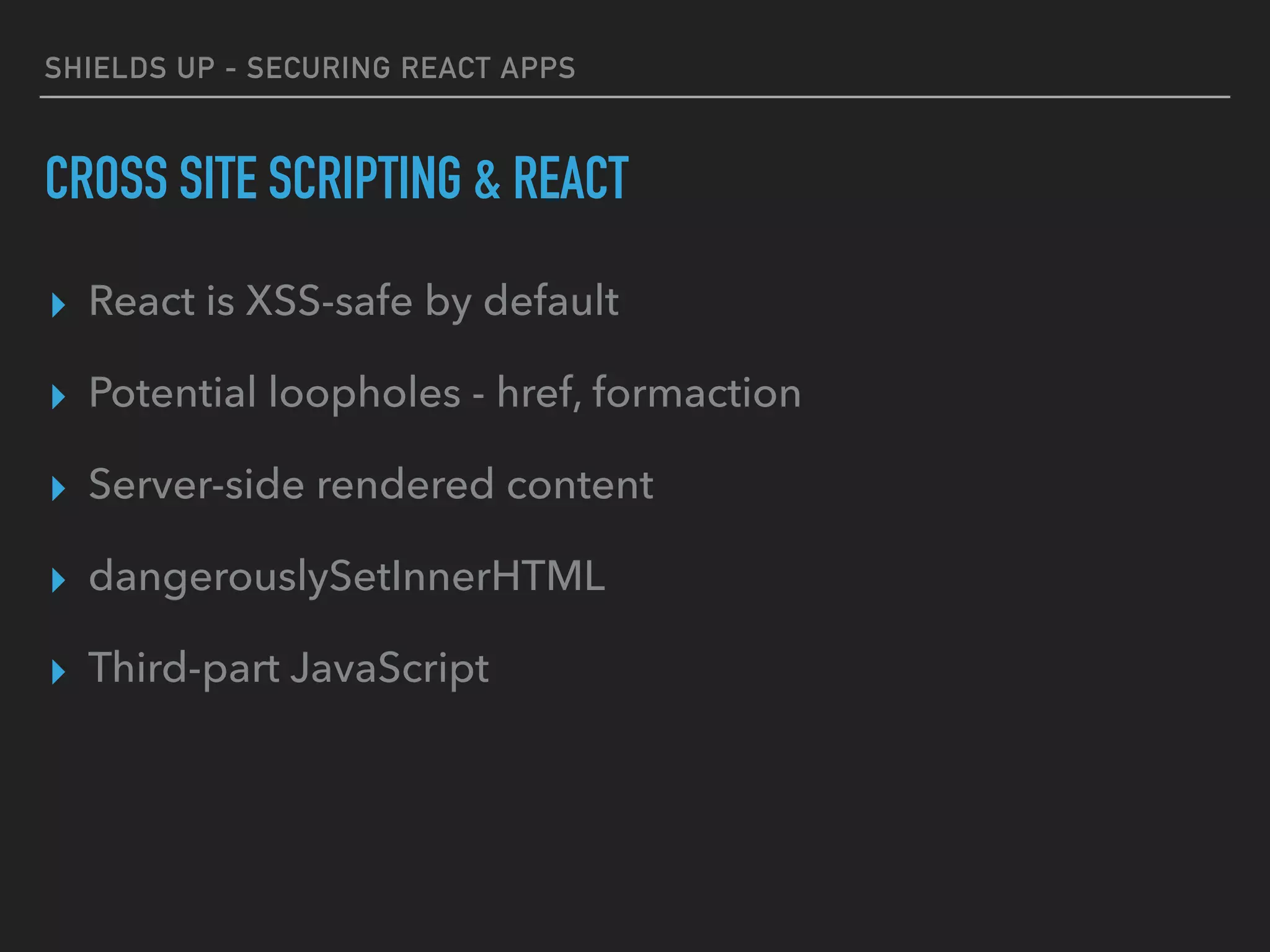
CROSS SITE SCRIPTING & REACT
▸ React is XSS-safe by default
▸ Potential loopholes - href, formaction
▸ Server-side rendered content
▸ dangerouslySetInnerHTML
▸ Third-part JavaScript
SHIELDS UP - SECURING REACT APPS
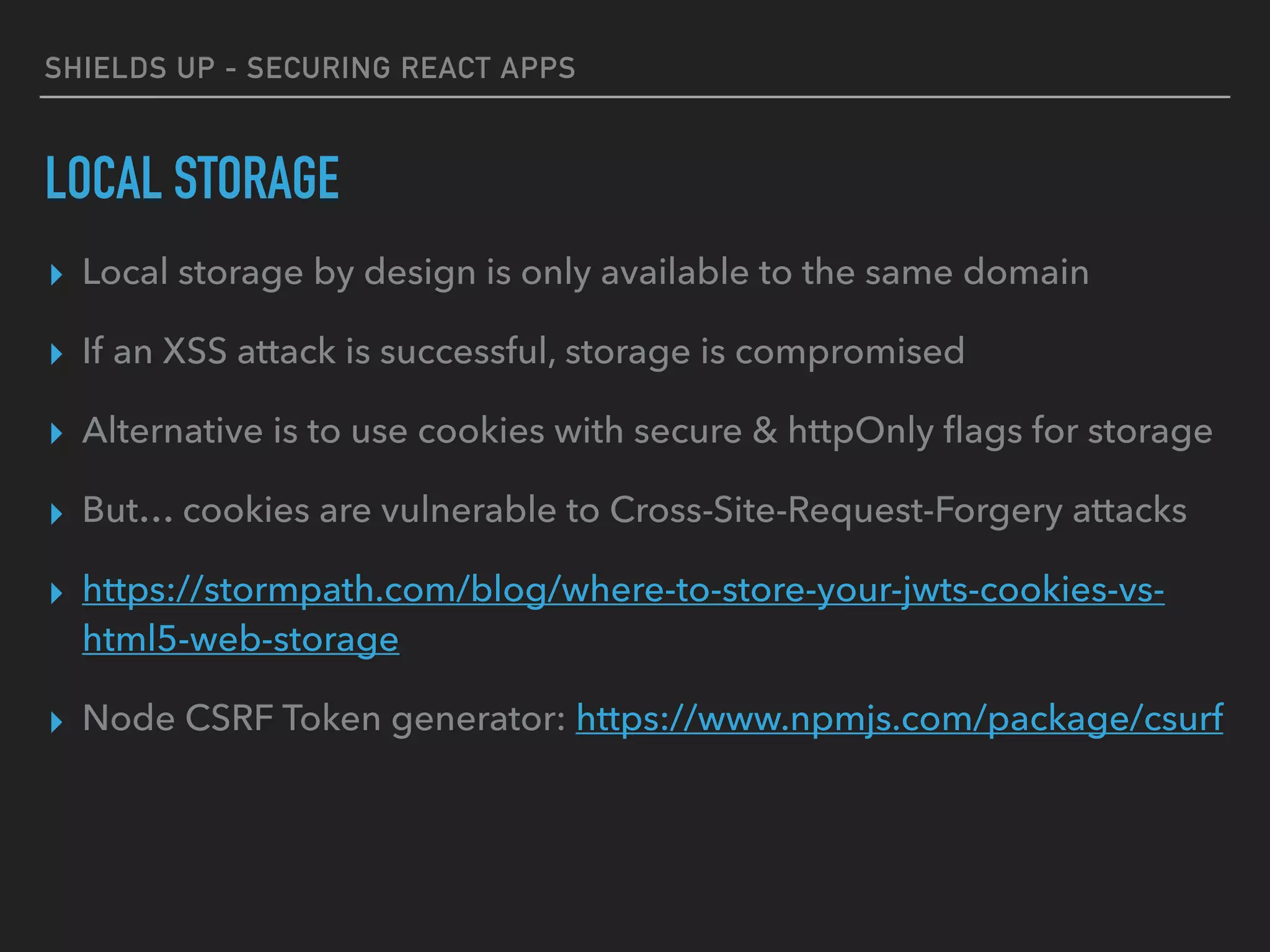
LOCAL STORAGE
▸ Local storage by design is only available to the same domain
▸ If an XSS attack is successful, storage is compromised
▸ Alternative is to use cookies with secure & httpOnly flags for storage
▸ But… cookies are vulnerable to Cross-Site-Request-Forgery attacks
▸ https://stormpath.com/blog/where-to-store-your-jwts-cookies-vs-
html5-web-storage
▸ Node CSRF Token generator: https://www.npmjs.com/package/csurf
SHIELDS UP - SECURING REACT APPS
CROSS SITE SCRIPTING & REACT
DEMO
SHIELDS UP - SECURING REACT APPS
ROLE-BASED AUTHORIZATION & ROUTING
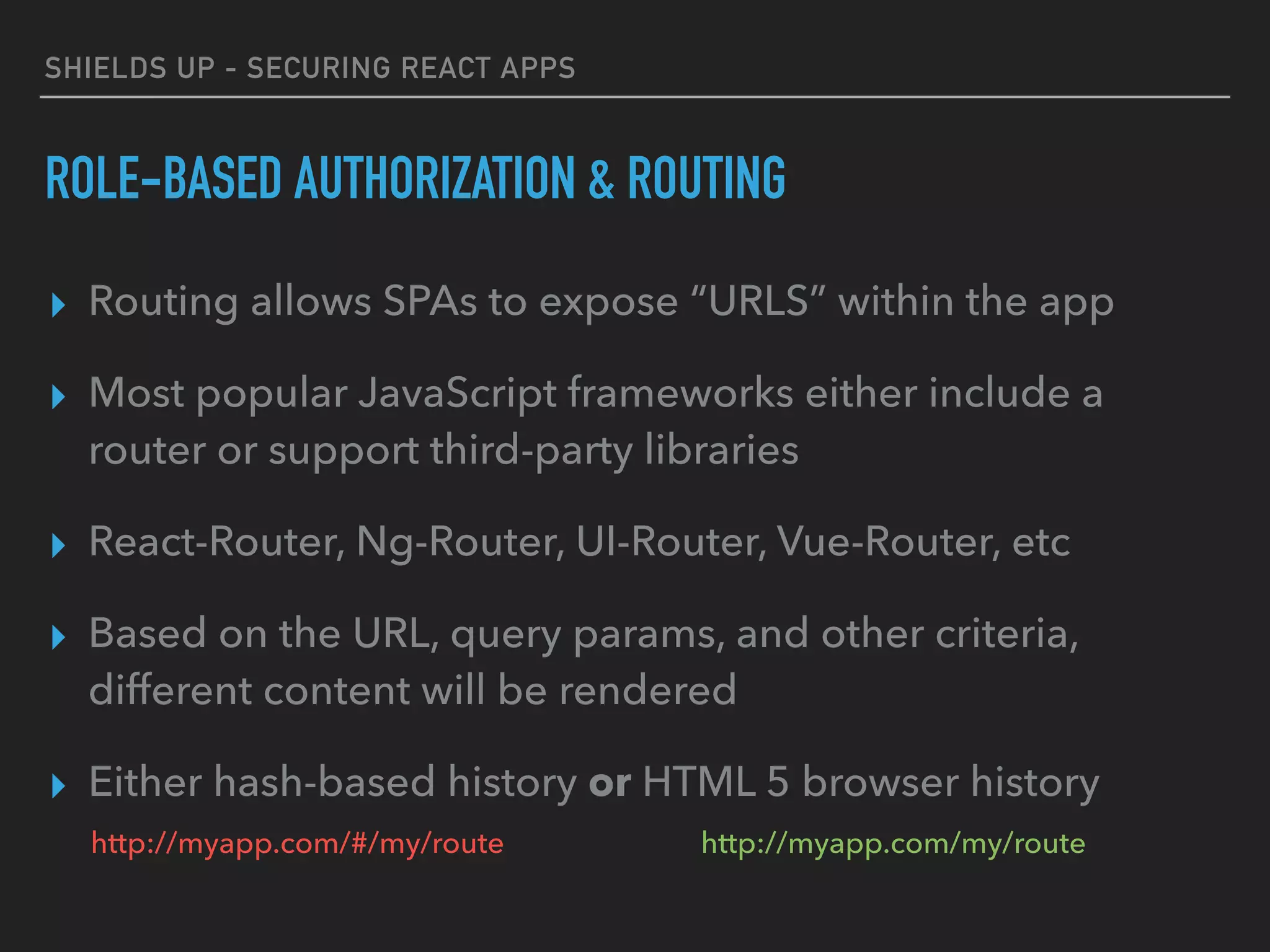
▸ Routing allows SPAs to expose “URLS” within the app
▸ Most popular JavaScript frameworks either include a
router or support third-party libraries
▸ React-Router, Ng-Router, UI-Router, Vue-Router, etc
▸ Based on the URL, query params, and other criteria,
different content will be rendered
▸ Either hash-based history or HTML 5 browser history
http://myapp.com/#/my/route http://myapp.com/my/route
SHIELDS UP - SECURING REACT APPS
ROLE-BASED AUTHORIZATION & ROUTING
▸ User authorization vs authentication
▸ Some content should only be available to certain users
▸ E.g, admin screens, payroll management…
▸ Resources need to be secured at the server
▸ UI functionality and routes may still need to be secured
SHIELDS UP - SECURING REACT APPS
ROLE-BASED AUTHORIZATION & ROUTING
▸ Simple Approach
▸ Store current user roles in state
▸ Wrap routes/components in a container component
▸ Container component accepts list of required roles &
conditionally renders component
SHIELDS UP - SECURING REACT APPS
ROLE-BASED AUTHORIZATION & ROUTING
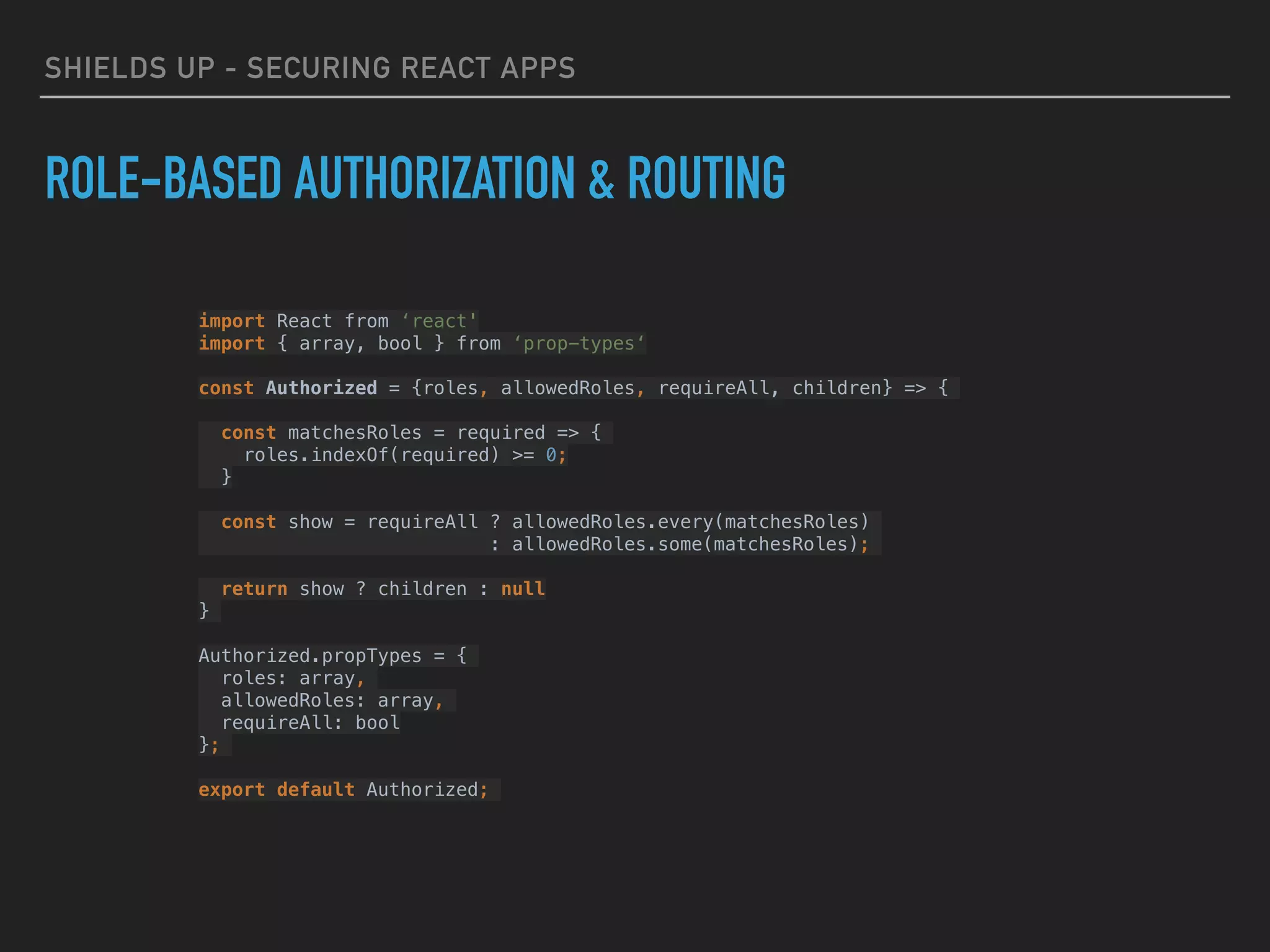
import React from ‘react'
import { array, bool } from ‘prop-types‘
const Authorized = {roles, allowedRoles, requireAll, children} => {
const matchesRoles = required => {
roles.indexOf(required) >= 0;
}
const show = requireAll ? allowedRoles.every(matchesRoles)
: allowedRoles.some(matchesRoles);
return show ? children : null
}
Authorized.propTypes = {
roles: array,
allowedRoles: array,
requireAll: bool
};
export default Authorized;
SHIELDS UP - SECURING REACT APPS
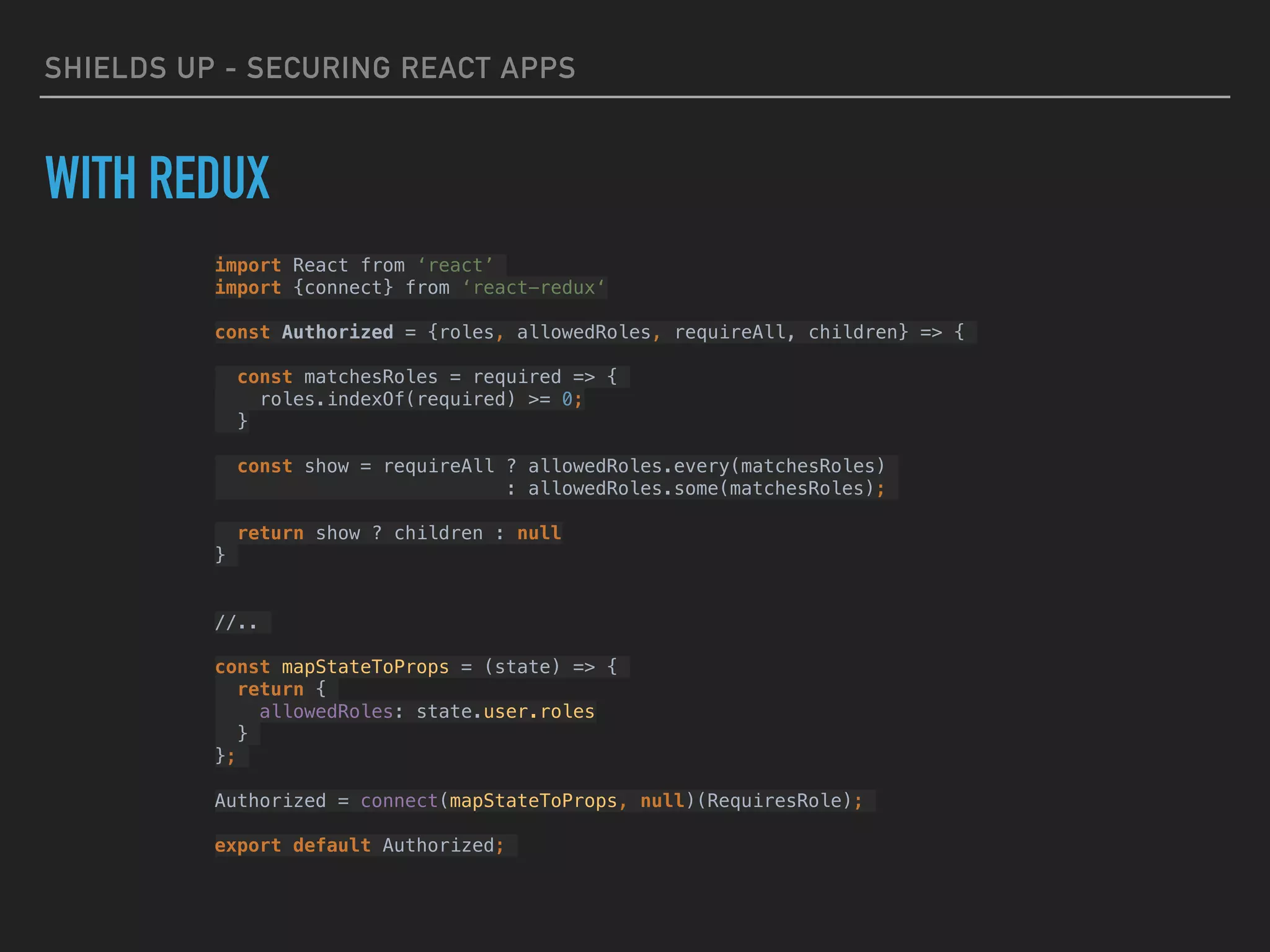
WITH REDUX
import React from ‘react’
import {connect} from ‘react-redux‘
const Authorized = {roles, allowedRoles, requireAll, children} => {
const matchesRoles = required => {
roles.indexOf(required) >= 0;
}
const show = requireAll ? allowedRoles.every(matchesRoles)
: allowedRoles.some(matchesRoles);
return show ? children : null
}
//..
const mapStateToProps = (state) => {
return {
allowedRoles: state.user.roles
}
};
Authorized = connect(mapStateToProps, null)(RequiresRole);
export default Authorized;
SHIELDS UP - SECURING REACT APPS
ROLE-BASED AUTHORIZATION & ROUTING
<Authorized allowedRoles={[‘ROLE_ADMIN', 'ROLE_ADMIN', 'ROLE_USER']}>
<Profile user={user} />
</Authorized>
<Authorized allowedRoles={['ROLE_ADMIN', 'ROLE_MANAGER']}>
<ManageEmployees />
</Authorized>
<Authorized allowedRoles={['ROLE_ADMIN', ‘ROLE_MANAGER']} requireAll={true}>
<ManageDatabase />
</Authorized>
SHIELDS UP - SECURING REACT APPS
ROLE-BASED AUTHORIZATION & ROUTING
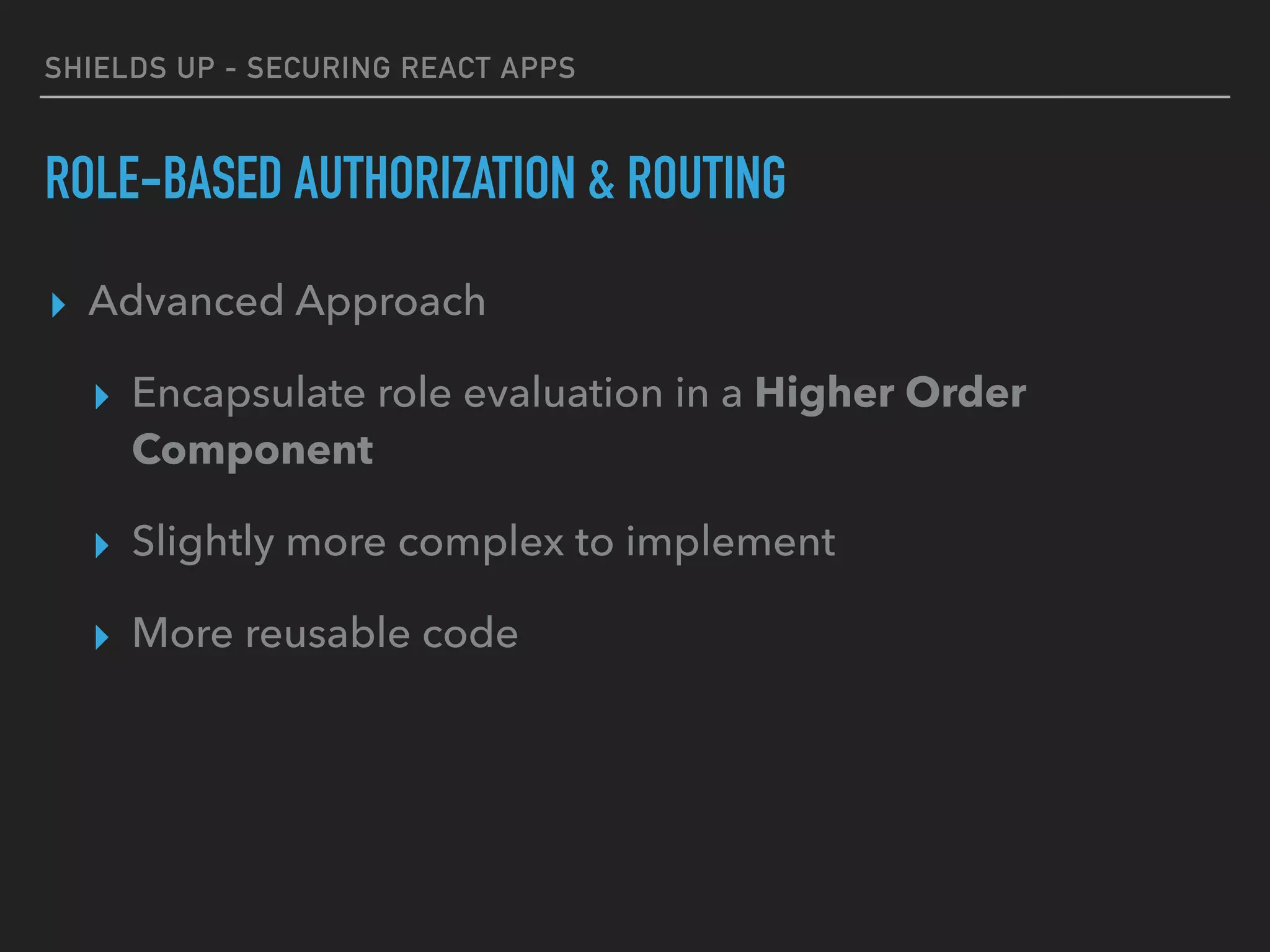
▸ Advanced Approach
▸ Encapsulate role evaluation in a Higher Order
Component
▸ Slightly more complex to implement
▸ More reusable code
SHIELDS UP - SECURING REACT APPS
HIGHER ORDER COMPONENTS
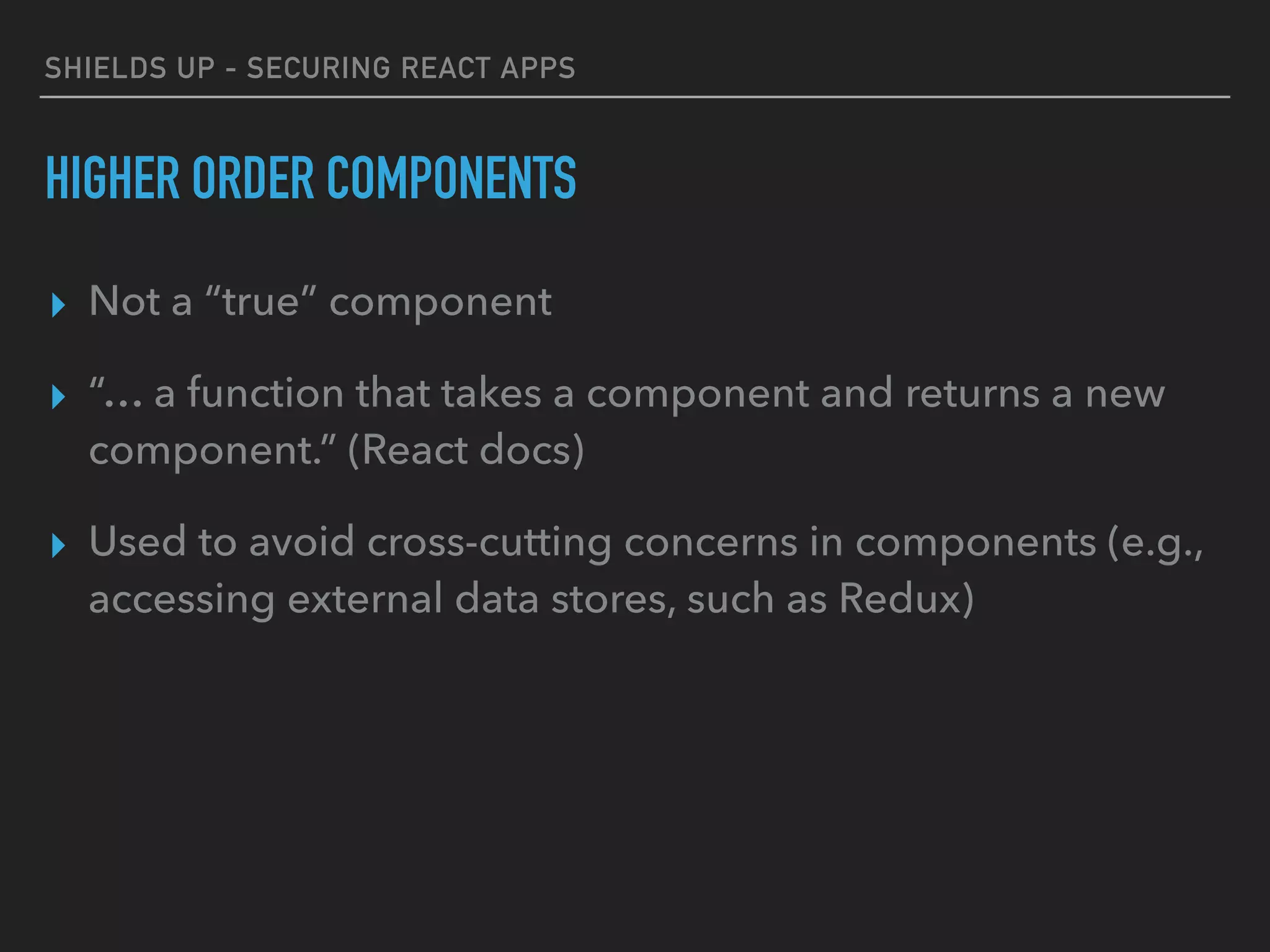
▸ Not a “true” component
▸ “… a function that takes a component and returns a new
component.” (React docs)
▸ Used to avoid cross-cutting concerns in components (e.g.,
accessing external data stores, such as Redux)
SHIELDS UP - SECURING REACT APPS
HIGHER ORDER COMPONENTS
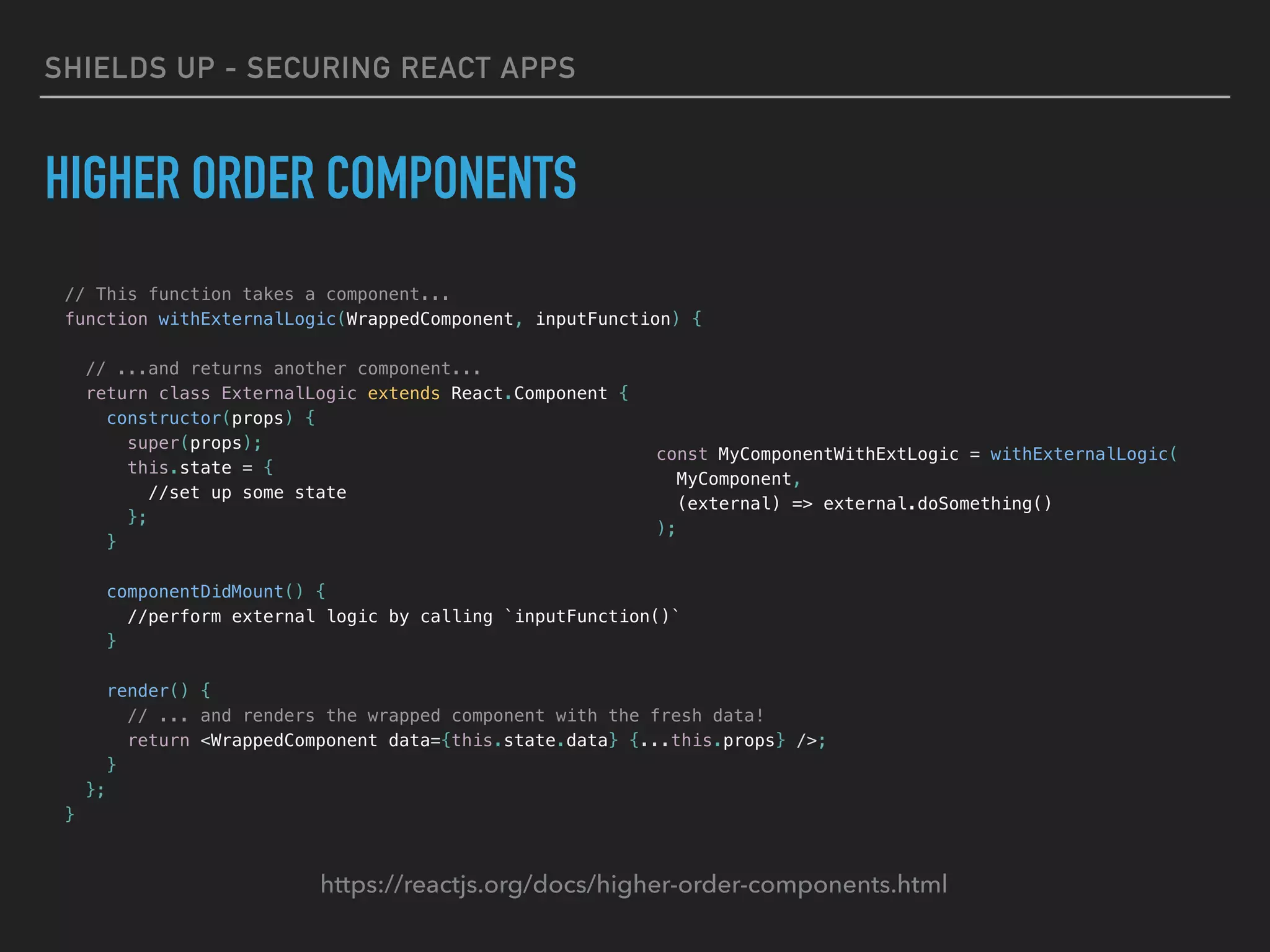
// This function takes a component...
function withExternalLogic(WrappedComponent, inputFunction) {
// ...and returns another component...
return class ExternalLogic extends React.Component {
constructor(props) {
super(props);
this.state = {
//set up some state
};
}
componentDidMount() {
//perform external logic by calling `inputFunction()`
}
render() {
// ... and renders the wrapped component with the fresh data!
return <WrappedComponent data={this.state.data} {...this.props} />;
}
};
}
const MyComponentWithExtLogic = withExternalLogic(
MyComponent,
(external) => external.doSomething()
);
https://reactjs.org/docs/higher-order-components.html
SHIELDS UP - SECURING REACT APPS
HIGHER ORDER COMPONENTS
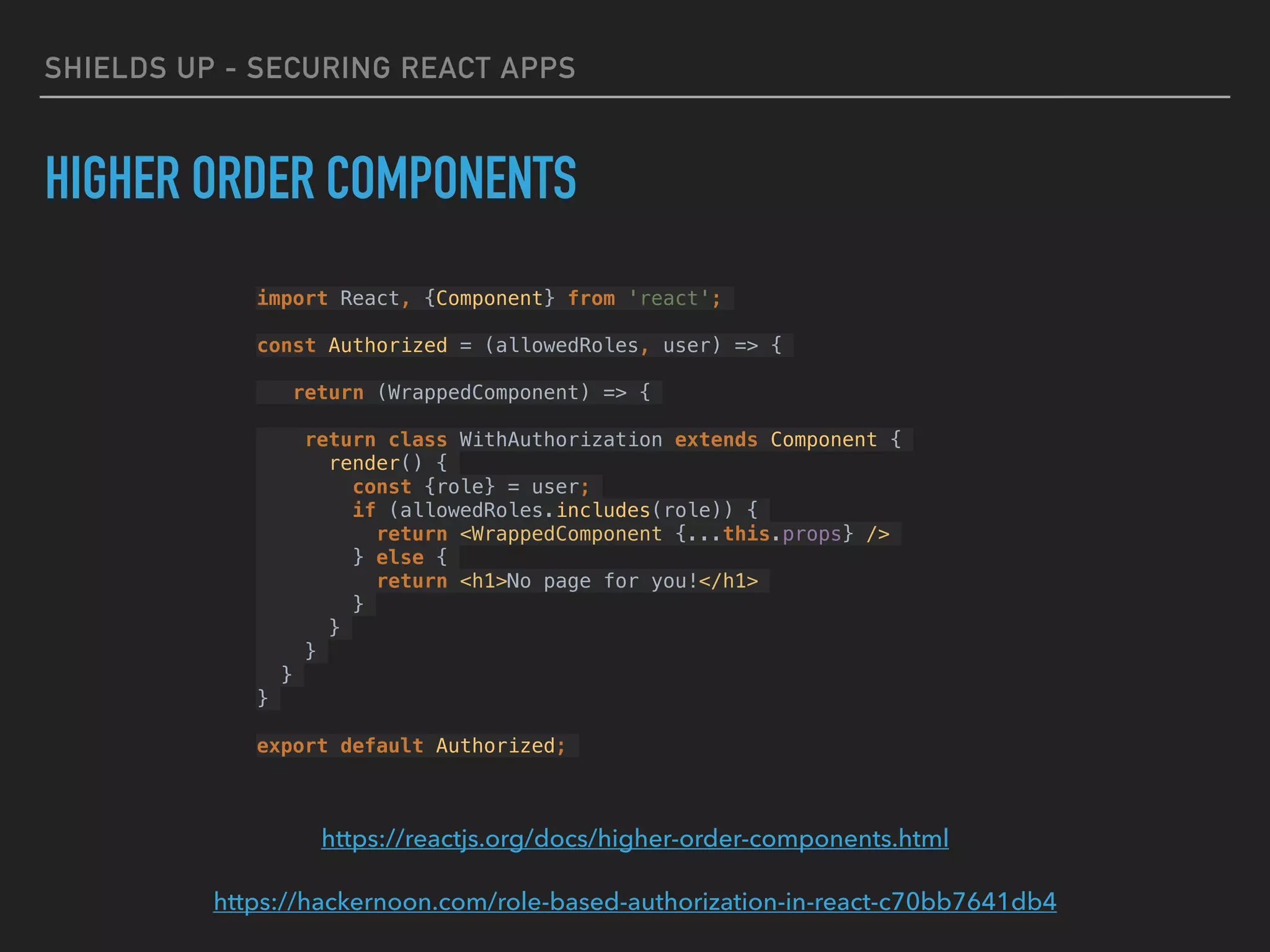
https://reactjs.org/docs/higher-order-components.html
https://hackernoon.com/role-based-authorization-in-react-c70bb7641db4
import React, {Component} from 'react';
const Authorized = (allowedRoles, user) => {
return (WrappedComponent) => {
return class WithAuthorization extends Component {
render() {
const {role} = user;
if (allowedRoles.includes(role)) {
return <WrappedComponent {...this.props} />
} else {
return <h1>No page for you!</h1>
}
}
}
}
}
export default Authorized;
SHIELDS UP - SECURING REACT APPS
HIGHER ORDER COMPONENTS
https://reactjs.org/docs/higher-order-components.html
import Authorized from "./Authorized";
render() {
const {user, loggedIn} = this.state;
const withAdminRole = Authorized(['admin'], user);
const withUserRole = Authorized(['user', 'admin'], user);
return (
<Router>
<Route path="/restricted" component={withUserRole(Restricted)}/>
<Route path="/admin" component={withAdminRole(Admin)}/>
</Router>
);
SHIELDS UP - SECURING REACT APPS
API AUTHENTICATION
▸ Once data makes it to the UI, it’s too late to secure
▸ Authorization needs to be checked at every endpoint
▸ In a microservice architecture, each service boundary
should be secured
▸ Always use HTTPS
SHIELDS UP - SECURING REACT APPS
SESSION AUTHENTICATION
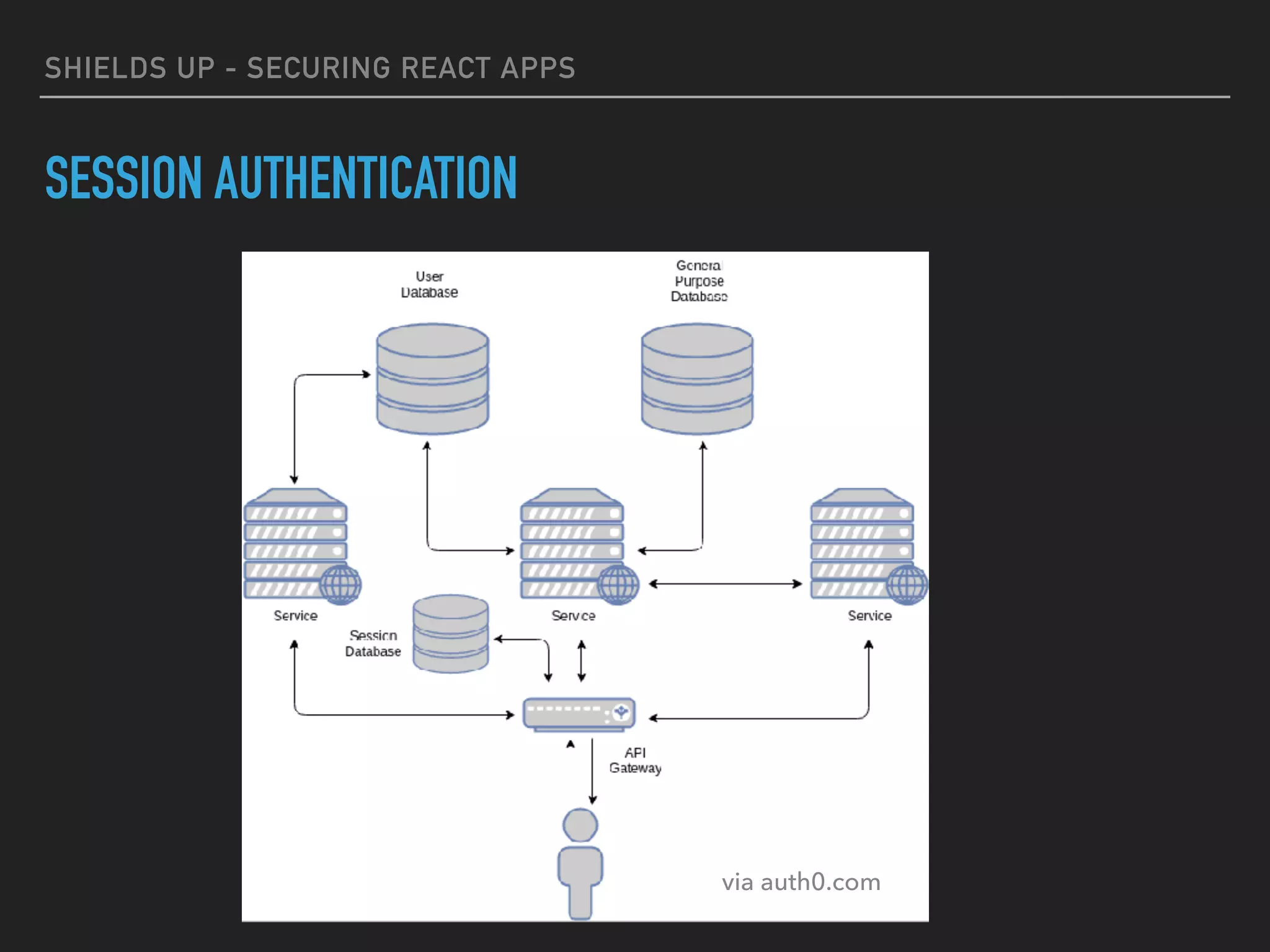
▸ Session-based security relies on the server to store state
▸ Usually a session cookie is provided to the client
▸ Ensures that sensitive data is stored only on the server
▸ Server controls session lifetime, timeouts, etc
▸ Typically requires interaction with data layer to verify user
identity, session state, etc
SHIELDS UP - SECURING REACT APPS
SESSION AUTHENTICATION
via auth0.com
SHIELDS UP - SECURING REACT APPS
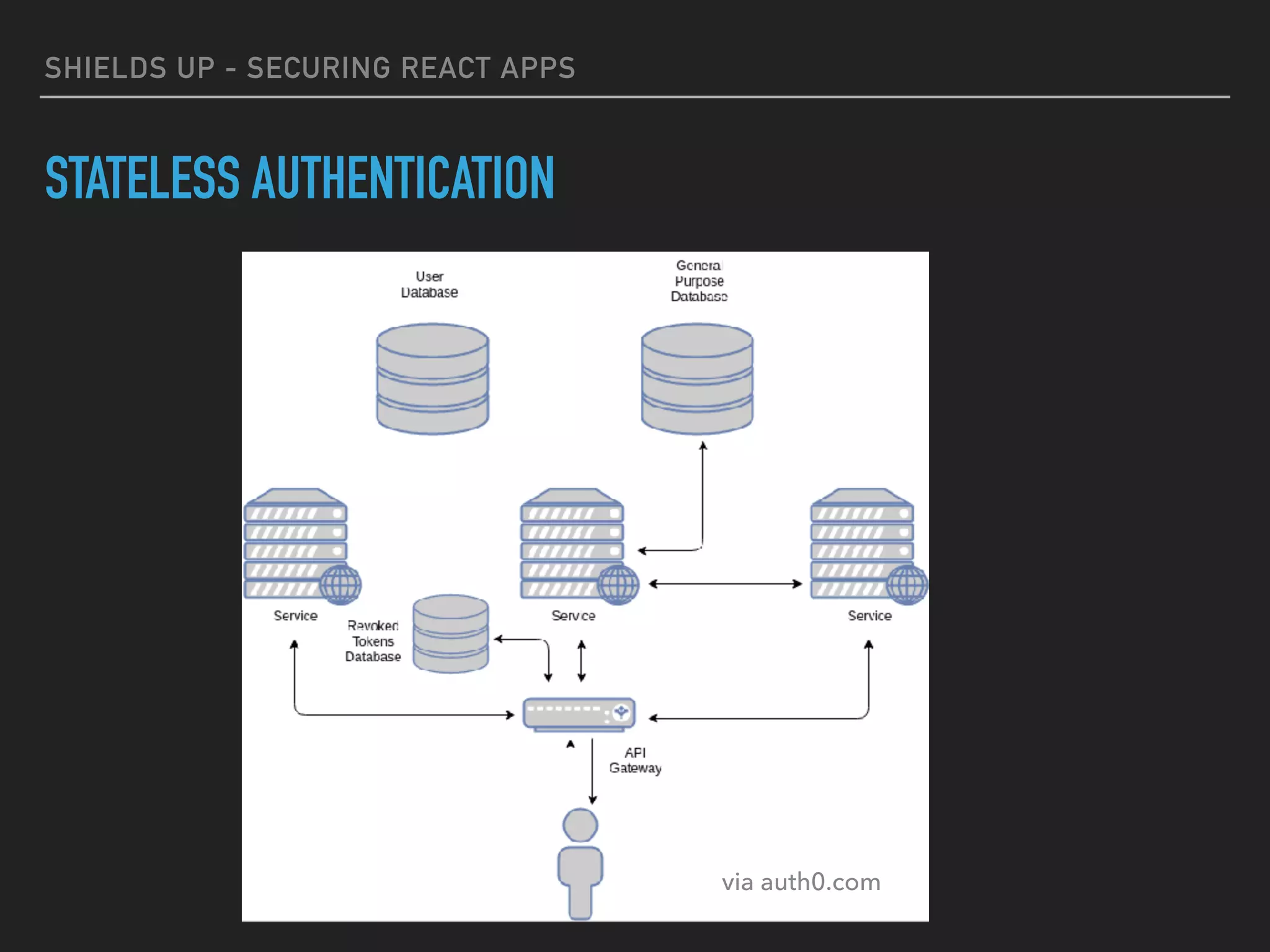
STATELESS AUTHENTICATION
▸ Stateless authentication typically relies on encrypting
session details in a token
▸ Token is provided to client upon successful login
▸ Token can contain its own expiration date, user details,
roles (scopes)
▸ Client includes token in API requests
▸ Server can verify client’s identity/authorization via token
SHIELDS UP - SECURING REACT APPS
STATELESS AUTHENTICATION
via auth0.com
SHIELDS UP - SECURING REACT APPS
STATELESS AUTHENTICATION
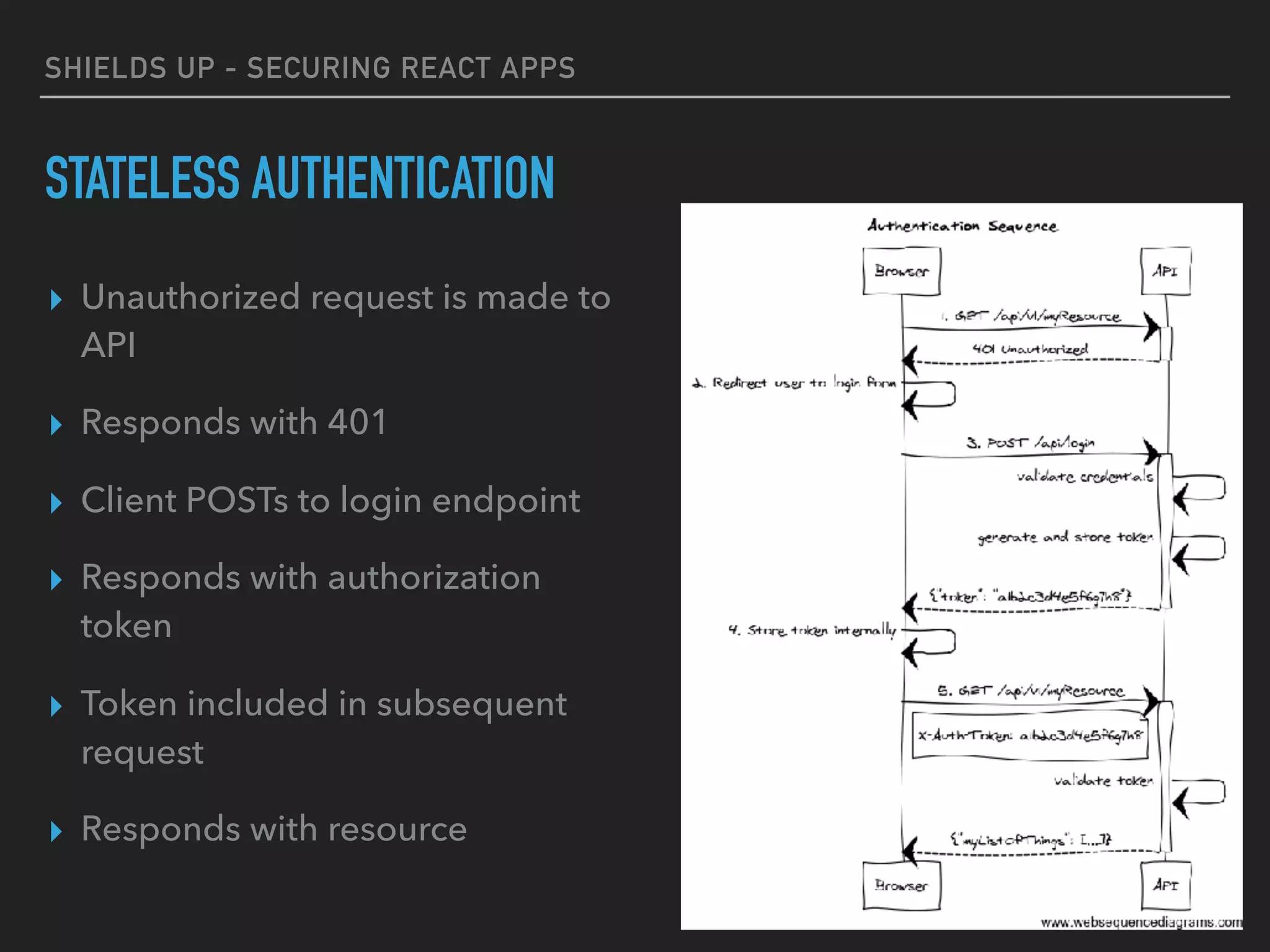
▸ Unauthorized request is made to
API
▸ Responds with 401
▸ Client POSTs to login endpoint
▸ Responds with authorization
token
▸ Token included in subsequent
request
▸ Responds with resource
SHIELDS UP - SECURING REACT APPS
JSON WEB TOKENS
▸ https://jwt.io
▸ Open, industry-standard method for representing claims
securely between two parties
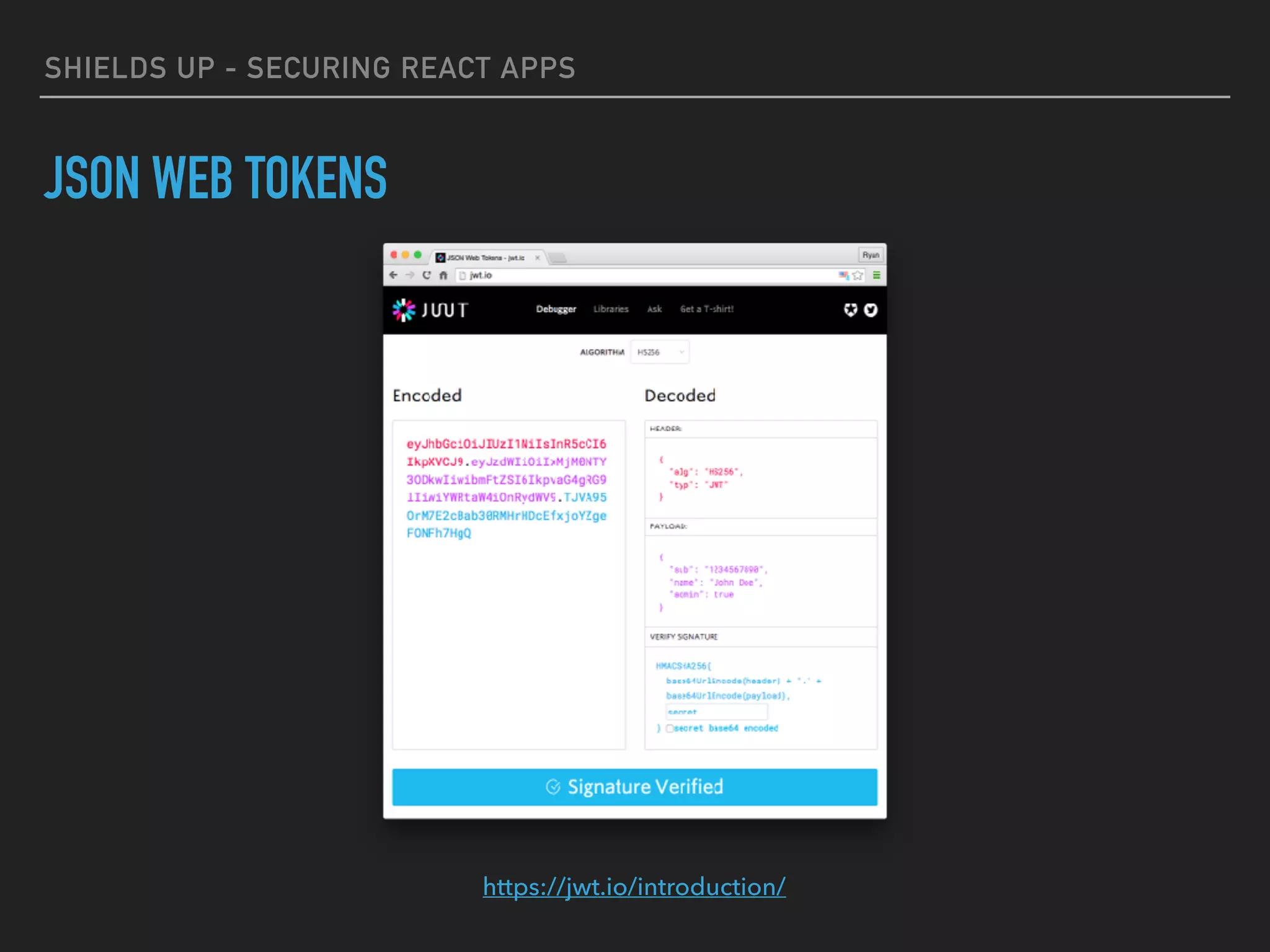
▸ Typically consist of a header, payload, and signature
SHIELDS UP - SECURING REACT APPS
JSON WEB TOKENS
https://jwt.io/introduction/
SHIELDS UP - SECURING REACT APPS
STATELESS AUTH WITH JWT
DEMO
SHIELDS UP - SECURING REACT APPS
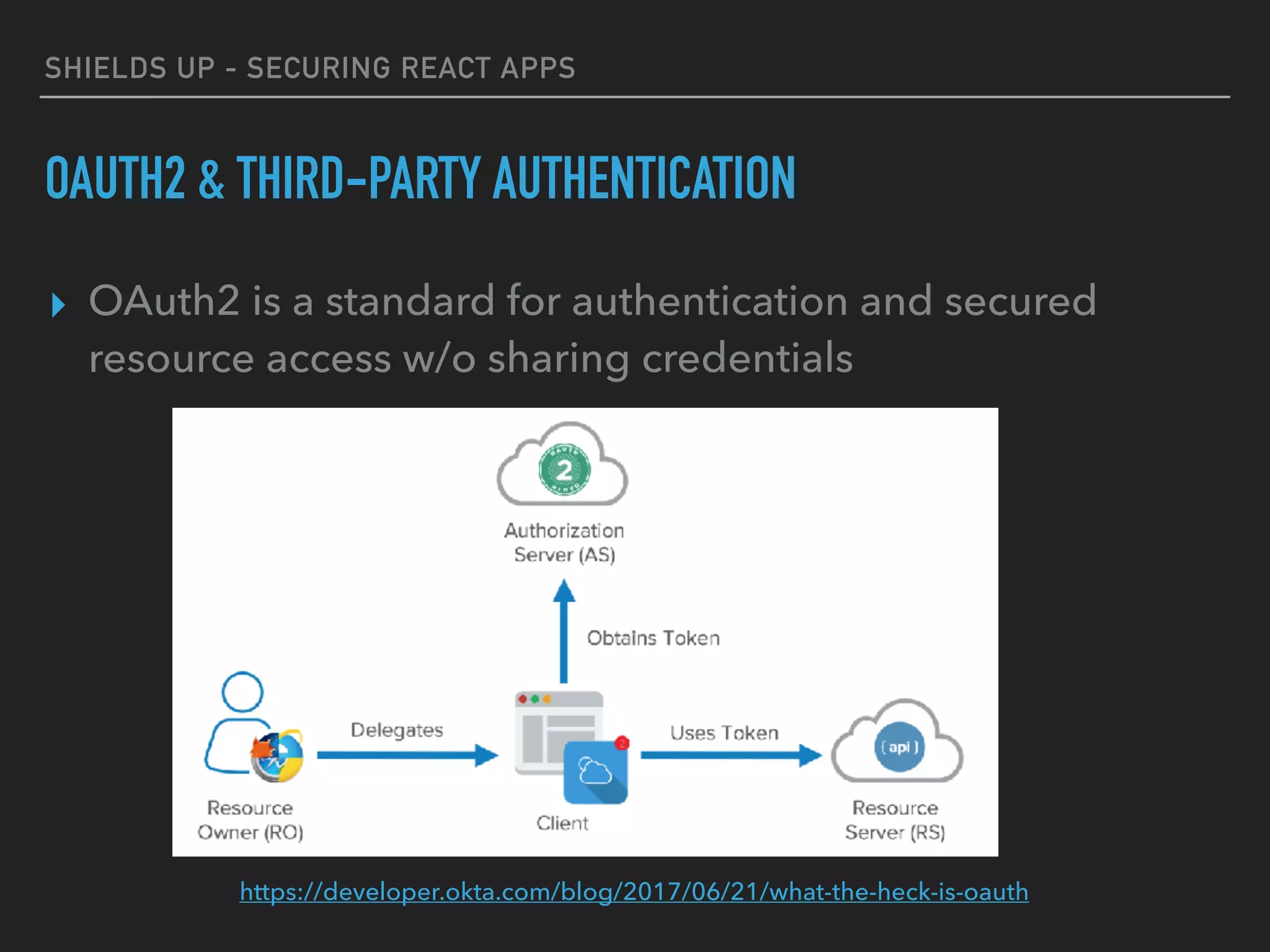
OAUTH2 & THIRD-PARTY AUTHENTICATION
▸ OAuth2 is a standard for authentication and secured
resource access w/o sharing credentials
https://developer.okta.com/blog/2017/06/21/what-the-heck-is-oauth
SHIELDS UP - SECURING REACT APPS
OAUTH2 & THIRD-PARTY AUTHENTICATION
▸ OAuth2 is a standard flow for authentication and secured
resource access w/o sharing credentials
▸ Many third party authentication providers on the market
▸ Doesn’t usually make sense to stand up your own
▸ https://hackernoon.com/authentication-as-a-service-an-
honest-review-of-auth0-315277abcba1
▸ https://hackernoon.com/dev-rant-stop-reinventing-user-
auth-1193b138772
SHIELDS UP - SECURING REACT APPS
AUTH0
▸ https://auth0.com/docs/quickstart/spa/react/01-login
▸ https://auth0.com/blog/reactjs-authentication-tutorial
SHIELDS UP - SECURING REACT APPS
OKTA
▸ https://developer.okta.com/blog/2017/03/30/react-okta-
sign-in-widget
▸ https://developer.okta.com/blog/2017/12/06/bootiful-
development-with-spring-boot-and-react
SHIELDS UP - SECURING REACT APPS
THIRD-PARTY AUTHENTICATION
DEMO
SHIELDS UP - SECURING REACT APPS
SUMMARY
▸ React is largely very safe client-side attacks
▸ Always validate user input
▸ Plan routing strategies
▸ Secure your API first
▸ Don’t re-invent the wheel - leverage existing platforms for
authentication/authorization
▸ Keep checking behind your back
SHIELDS UP - SECURING REACT APPS
LINKS
▸ http://www.jamesward.com/2013/05/13/securing-single-page-apps-and-
rest-services
▸ http://guides.grails.org/react-spring-security/guide
▸ https://hackernoon.com/authentication-as-a-service-an-honest-review-of-
auth0-315277abcba1
▸ https://hackernoon.com/dev-rant-stop-reinventing-user-auth-1193b138772
▸ https://medium.com/dailyjs/exploiting-script-injection-flaws-in-
reactjs-883fb1fe36c1
▸ https://stormpath.com/blog/where-to-store-your-jwts-cookies-vs-html5-web-
storage
THANK YOU
Twitter: @ZacharyAKlein. Github: @ZacharyKlein. Email: zak@silver-chalice.com

Shields Up! Securing React Apps

  • 1.
    SECURING REACT APPS SHIELDSUP December 8, 2017
  • 2.
    SHIELDS UP -SECURING REACT APPS ABOUT US ▸ Me: Zachary Klein ▸ Based in St Louis, MO ▸ Web dev at Object Computing, ▸ Specialize in Grails & frontend development
  • 3.
    SHIELDS UP -SECURING REACT APPS ABOUT US ▸ My company: Object Computing, Inc ▸ Based in St Louis, MO ▸ Consulting and training provider (24+ years experience) ▸ Corporate sponsor to the Grails framework and Groovy language ▸ https://objectcomputing.com
  • 5.
    SHIELDS UP -SECURING REACT APPS ABOUT US ▸ Grails: A dynamic, flexible web application framework ▸ Built on top of Spring Boot ▸ First-class support for REST APIs ▸ Profiles for building applications using React, Angular, Webpack, and RESTful backends ▸ Powerful persistence layer with GORM - supports Hibernate, MongoDb, Neo4J, GraphQL, and more ▸ Rich plugin ecosystem: 200+ plugins and growing ▸ Active community and commercial support available. ▸ https://grails.org
  • 6.
    SHIELDS UP -SECURING REACT APPS
  • 7.
  • 8.
  • 9.
    SHIELDS UP -SECURING REACT APPS ABOUT US ▸ You: ▸?
  • 10.
    SHIELDS UP -SECURING REACT APPS OVERVIEW ▸ Security in the world of SPAs ▸ Client-side security ▸ Cross-site-scripting Prevention ▸ Role-based Routing ▸ Server-side security* ▸ Stateless Authentication ▸ Third-party authentication
  • 11.
    SHIELDS UP -SECURING REACT APPS WHAT ARE WE PREVENTING? ▸ Unauthorized access to data ▸ Unauthorized access to UI ▸ Unexpected input
  • 12.
    SHIELDS UP -SECURING REACT APPS WHAT ARE WE PREVENTING? ▸ Unauthorized access to data ▸ API authentication ▸ Local storage ▸ Unauthorized access to UI ▸ Unexpected input
  • 13.
    SHIELDS UP -SECURING REACT APPS WHAT ARE WE PREVENTING? ▸ Unauthorized access to data ▸ API authentication ▸ Local storage ▸ Unauthorized access to UI ▸ Role-based Routing ▸ Unexpected input
  • 14.
    SHIELDS UP -SECURING REACT APPS WHAT ARE WE PREVENTING? ▸ Unauthorized access to data ▸ API authentication ▸ Local storage ▸ Unauthorized access to UI ▸ Role-based Routing ▸ Unexpected input ▸ Cross-site scripting (XSS)
  • 15.
    SHIELDS UP -SECURING REACT APPS WHAT ARE WE PREVENTING? ▸ Unauthorized access to data ▸ API authentication ▸ Local Storage ▸ Unauthorized access to UI ▸ Role-based Routing ▸ Unexpected input ▸ Cross-site scripting (XSS)
  • 16.
    SHIELDS UP -SECURING REACT APPS WHAT ARE WE PREVENTING? ▸ Unauthorized access to data ▸ API authentication ▸ Local Storage ▸ Unauthorized access to UI ▸ Role-based Routing ▸ Unexpected input ▸ Cross-site scripting (XSS)
  • 17.
    SHIELDS UP -SECURING REACT APPS CROSS SITE SCRIPTING & REACT ▸ React is XSS-safe by default ▸ Potential loopholes - href, formaction ▸ Server-side rendered content ▸ dangerouslySetInnerHTML
  • 18.
    SHIELDS UP -SECURING REACT APPS CROSS SITE SCRIPTING & REACT ▸ React is XSS-safe by default ▸ Potential loopholes - href, formaction ▸ Server-side rendered content ▸ dangerouslySetInnerHTML ▸ Third-part JavaScript
  • 19.
    SHIELDS UP -SECURING REACT APPS LOCAL STORAGE ▸ Local storage by design is only available to the same domain ▸ If an XSS attack is successful, storage is compromised ▸ Alternative is to use cookies with secure & httpOnly flags for storage ▸ But… cookies are vulnerable to Cross-Site-Request-Forgery attacks ▸ https://stormpath.com/blog/where-to-store-your-jwts-cookies-vs- html5-web-storage ▸ Node CSRF Token generator: https://www.npmjs.com/package/csurf
  • 20.
    SHIELDS UP -SECURING REACT APPS CROSS SITE SCRIPTING & REACT DEMO
  • 21.
    SHIELDS UP -SECURING REACT APPS ROLE-BASED AUTHORIZATION & ROUTING ▸ Routing allows SPAs to expose “URLS” within the app ▸ Most popular JavaScript frameworks either include a router or support third-party libraries ▸ React-Router, Ng-Router, UI-Router, Vue-Router, etc ▸ Based on the URL, query params, and other criteria, different content will be rendered ▸ Either hash-based history or HTML 5 browser history http://myapp.com/#/my/route http://myapp.com/my/route
  • 22.
    SHIELDS UP -SECURING REACT APPS ROLE-BASED AUTHORIZATION & ROUTING ▸ User authorization vs authentication ▸ Some content should only be available to certain users ▸ E.g, admin screens, payroll management… ▸ Resources need to be secured at the server ▸ UI functionality and routes may still need to be secured
  • 23.
    SHIELDS UP -SECURING REACT APPS ROLE-BASED AUTHORIZATION & ROUTING ▸ Simple Approach ▸ Store current user roles in state ▸ Wrap routes/components in a container component ▸ Container component accepts list of required roles & conditionally renders component
  • 24.
    SHIELDS UP -SECURING REACT APPS ROLE-BASED AUTHORIZATION & ROUTING import React from ‘react' import { array, bool } from ‘prop-types‘ const Authorized = {roles, allowedRoles, requireAll, children} => { const matchesRoles = required => { roles.indexOf(required) >= 0; } const show = requireAll ? allowedRoles.every(matchesRoles) : allowedRoles.some(matchesRoles); return show ? children : null } Authorized.propTypes = { roles: array, allowedRoles: array, requireAll: bool }; export default Authorized;
  • 25.
    SHIELDS UP -SECURING REACT APPS WITH REDUX import React from ‘react’ import {connect} from ‘react-redux‘ const Authorized = {roles, allowedRoles, requireAll, children} => { const matchesRoles = required => { roles.indexOf(required) >= 0; } const show = requireAll ? allowedRoles.every(matchesRoles) : allowedRoles.some(matchesRoles); return show ? children : null } //.. const mapStateToProps = (state) => { return { allowedRoles: state.user.roles } }; Authorized = connect(mapStateToProps, null)(RequiresRole); export default Authorized;
  • 26.
    SHIELDS UP -SECURING REACT APPS ROLE-BASED AUTHORIZATION & ROUTING <Authorized allowedRoles={[‘ROLE_ADMIN', 'ROLE_ADMIN', 'ROLE_USER']}> <Profile user={user} /> </Authorized> <Authorized allowedRoles={['ROLE_ADMIN', 'ROLE_MANAGER']}> <ManageEmployees /> </Authorized> <Authorized allowedRoles={['ROLE_ADMIN', ‘ROLE_MANAGER']} requireAll={true}> <ManageDatabase /> </Authorized>
  • 27.
    SHIELDS UP -SECURING REACT APPS ROLE-BASED AUTHORIZATION & ROUTING ▸ Advanced Approach ▸ Encapsulate role evaluation in a Higher Order Component ▸ Slightly more complex to implement ▸ More reusable code
  • 28.
    SHIELDS UP -SECURING REACT APPS HIGHER ORDER COMPONENTS ▸ Not a “true” component ▸ “… a function that takes a component and returns a new component.” (React docs) ▸ Used to avoid cross-cutting concerns in components (e.g., accessing external data stores, such as Redux)
  • 29.
    SHIELDS UP -SECURING REACT APPS HIGHER ORDER COMPONENTS // This function takes a component... function withExternalLogic(WrappedComponent, inputFunction) { // ...and returns another component... return class ExternalLogic extends React.Component { constructor(props) { super(props); this.state = { //set up some state }; } componentDidMount() { //perform external logic by calling `inputFunction()` } render() { // ... and renders the wrapped component with the fresh data! return <WrappedComponent data={this.state.data} {...this.props} />; } }; } const MyComponentWithExtLogic = withExternalLogic( MyComponent, (external) => external.doSomething() ); https://reactjs.org/docs/higher-order-components.html
  • 30.
    SHIELDS UP -SECURING REACT APPS HIGHER ORDER COMPONENTS https://reactjs.org/docs/higher-order-components.html https://hackernoon.com/role-based-authorization-in-react-c70bb7641db4 import React, {Component} from 'react'; const Authorized = (allowedRoles, user) => { return (WrappedComponent) => { return class WithAuthorization extends Component { render() { const {role} = user; if (allowedRoles.includes(role)) { return <WrappedComponent {...this.props} /> } else { return <h1>No page for you!</h1> } } } } } export default Authorized;
  • 31.
    SHIELDS UP -SECURING REACT APPS HIGHER ORDER COMPONENTS https://reactjs.org/docs/higher-order-components.html import Authorized from "./Authorized"; render() { const {user, loggedIn} = this.state; const withAdminRole = Authorized(['admin'], user); const withUserRole = Authorized(['user', 'admin'], user); return ( <Router> <Route path="/restricted" component={withUserRole(Restricted)}/> <Route path="/admin" component={withAdminRole(Admin)}/> </Router> );
  • 32.
    SHIELDS UP -SECURING REACT APPS API AUTHENTICATION ▸ Once data makes it to the UI, it’s too late to secure ▸ Authorization needs to be checked at every endpoint ▸ In a microservice architecture, each service boundary should be secured ▸ Always use HTTPS
  • 33.
    SHIELDS UP -SECURING REACT APPS SESSION AUTHENTICATION ▸ Session-based security relies on the server to store state ▸ Usually a session cookie is provided to the client ▸ Ensures that sensitive data is stored only on the server ▸ Server controls session lifetime, timeouts, etc ▸ Typically requires interaction with data layer to verify user identity, session state, etc
  • 34.
    SHIELDS UP -SECURING REACT APPS SESSION AUTHENTICATION via auth0.com
  • 35.
    SHIELDS UP -SECURING REACT APPS STATELESS AUTHENTICATION ▸ Stateless authentication typically relies on encrypting session details in a token ▸ Token is provided to client upon successful login ▸ Token can contain its own expiration date, user details, roles (scopes) ▸ Client includes token in API requests ▸ Server can verify client’s identity/authorization via token
  • 36.
    SHIELDS UP -SECURING REACT APPS STATELESS AUTHENTICATION via auth0.com
  • 37.
    SHIELDS UP -SECURING REACT APPS STATELESS AUTHENTICATION ▸ Unauthorized request is made to API ▸ Responds with 401 ▸ Client POSTs to login endpoint ▸ Responds with authorization token ▸ Token included in subsequent request ▸ Responds with resource
  • 38.
    SHIELDS UP -SECURING REACT APPS JSON WEB TOKENS ▸ https://jwt.io ▸ Open, industry-standard method for representing claims securely between two parties ▸ Typically consist of a header, payload, and signature
  • 39.
    SHIELDS UP -SECURING REACT APPS JSON WEB TOKENS https://jwt.io/introduction/
  • 40.
    SHIELDS UP -SECURING REACT APPS STATELESS AUTH WITH JWT DEMO
  • 41.
    SHIELDS UP -SECURING REACT APPS OAUTH2 & THIRD-PARTY AUTHENTICATION ▸ OAuth2 is a standard for authentication and secured resource access w/o sharing credentials https://developer.okta.com/blog/2017/06/21/what-the-heck-is-oauth
  • 42.
    SHIELDS UP -SECURING REACT APPS OAUTH2 & THIRD-PARTY AUTHENTICATION ▸ OAuth2 is a standard flow for authentication and secured resource access w/o sharing credentials ▸ Many third party authentication providers on the market ▸ Doesn’t usually make sense to stand up your own ▸ https://hackernoon.com/authentication-as-a-service-an- honest-review-of-auth0-315277abcba1 ▸ https://hackernoon.com/dev-rant-stop-reinventing-user- auth-1193b138772
  • 43.
    SHIELDS UP -SECURING REACT APPS AUTH0 ▸ https://auth0.com/docs/quickstart/spa/react/01-login ▸ https://auth0.com/blog/reactjs-authentication-tutorial
  • 44.
    SHIELDS UP -SECURING REACT APPS OKTA ▸ https://developer.okta.com/blog/2017/03/30/react-okta- sign-in-widget ▸ https://developer.okta.com/blog/2017/12/06/bootiful- development-with-spring-boot-and-react
  • 45.
    SHIELDS UP -SECURING REACT APPS THIRD-PARTY AUTHENTICATION DEMO
  • 46.
    SHIELDS UP -SECURING REACT APPS SUMMARY ▸ React is largely very safe client-side attacks ▸ Always validate user input ▸ Plan routing strategies ▸ Secure your API first ▸ Don’t re-invent the wheel - leverage existing platforms for authentication/authorization ▸ Keep checking behind your back
  • 47.
    SHIELDS UP -SECURING REACT APPS LINKS ▸ http://www.jamesward.com/2013/05/13/securing-single-page-apps-and- rest-services ▸ http://guides.grails.org/react-spring-security/guide ▸ https://hackernoon.com/authentication-as-a-service-an-honest-review-of- auth0-315277abcba1 ▸ https://hackernoon.com/dev-rant-stop-reinventing-user-auth-1193b138772 ▸ https://medium.com/dailyjs/exploiting-script-injection-flaws-in- reactjs-883fb1fe36c1 ▸ https://stormpath.com/blog/where-to-store-your-jwts-cookies-vs-html5-web- storage
  • 48.
    THANK YOU Twitter: @ZacharyAKlein.Github: @ZacharyKlein. Email: zak@silver-chalice.com