Anatomy of the Acetabulum
Dr Zahid Askar
MBBS, FCPS(Ortho),FRCS(Tr & Ortho)
Prof. of Orthopaedics
Khyber Medical College
Peshawer
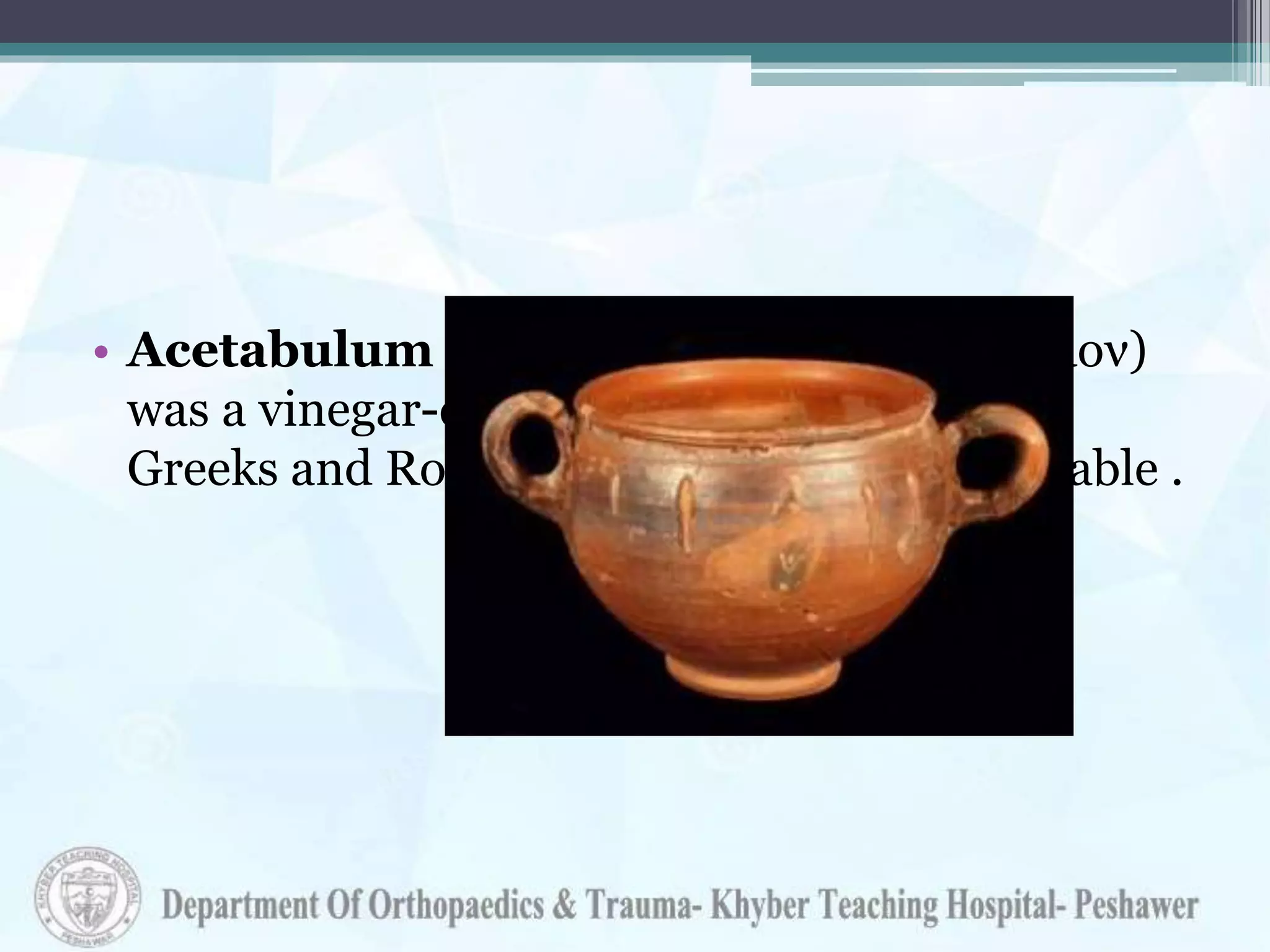
• Acetabulum (Gr: ὀξίς, ὀξύβαφον, ὀξυβάφιον)
was a vinegar-cup, used by
Greeks and Romans placed on the dining-table .
• The acetabulum is the point where the three
components of the pelvis (ilium, ischium, and
pubis) meet.
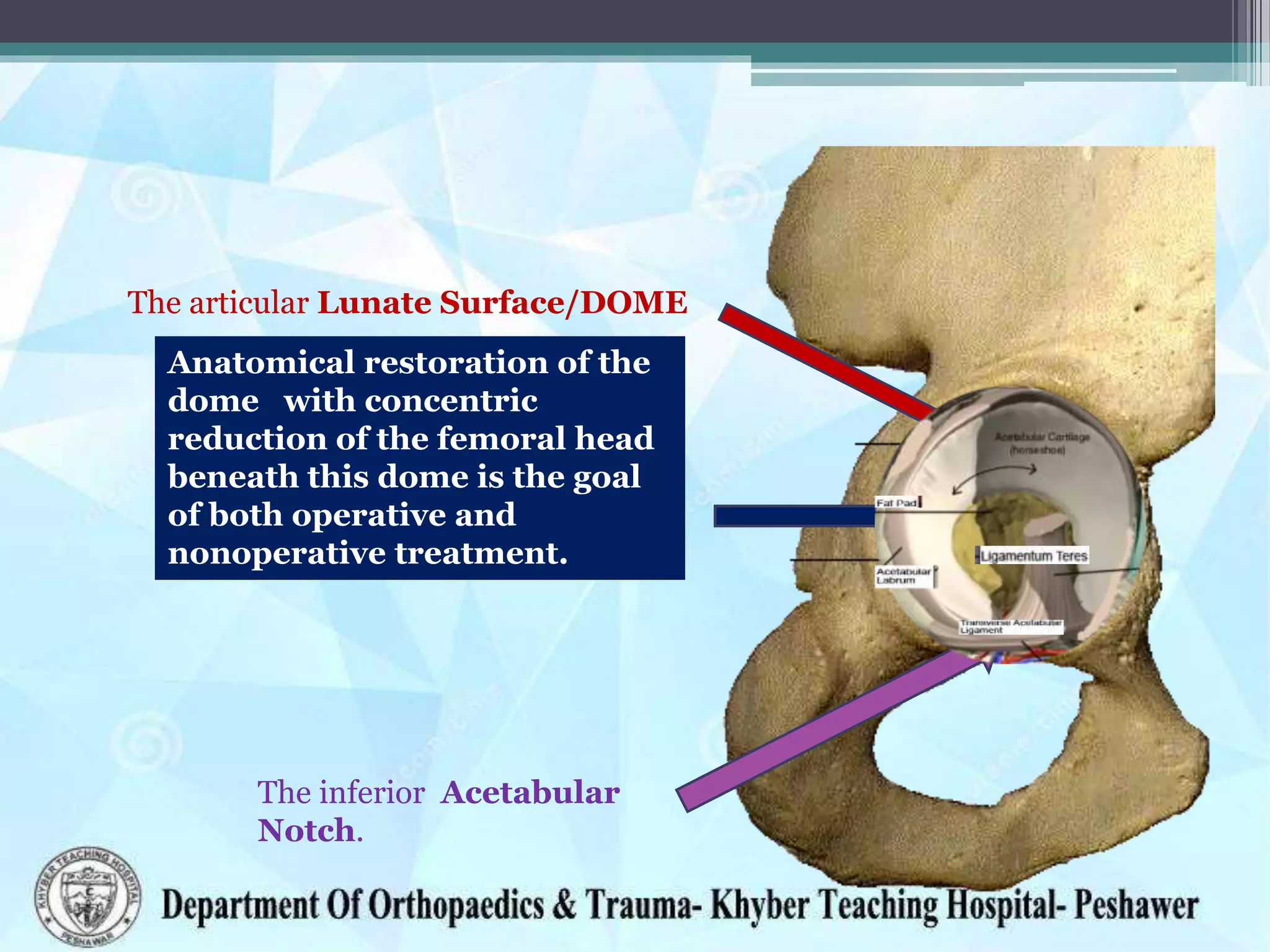
The articular Lunate Surface/DOME
The nonarticular Acetabular
Fossa
The inferior Acetabular
Notch.
Anatomical restoration of the
dome with concentric
reduction of the femoral head
beneath this dome is the goal
of both operative and
nonoperative treatment.
Embryology
• At 4 to 6 gestational weeks, the hip joint
develops from the cartilaginous analogue -
• By 7 weeks a cleft appears
• By 11 weeks, hip joint formation is mostly
complete
• At late gestation, femoral head grows more
rapidly
• At birth the femoral head is < 50% covered
• Acetabulum continues to grow till 7 years with
maximum growth is in the first 4 years.
ASIS
AIIS
Ischial Tuberosity
Pubis
Ischial Spine
tendon of obturator internus m.
internal pudendal a.
internal pudendal v.
pudendal n.
nerve to obturator internus
- 7 nerves:
- Sciatic Nerve
- Superior Gluteal Nerve
- Inferior Gluteal Nerve
- Internal Pudendal Nerve:
- Posterior Femoral Cutaneous Nerve
- Nerve to Quadratus Femoris
- Nerve to Obturator Externus
- 3 Vessel Sets:
- Superior Gluteal Artery & Vein
- Inferior Gluteal Artery & vein
- Internal Pudendal Artery & vein
- 1 Muscle:
- Piriformis
Forces Across The Hip Joint
• Walking upto 4 times BW
• Running upto 7 times BW
• Supported gait (w/ a walker or a cane) 2-3 BW
Wednesday,
December 17,
2014
8
Supine straight leg raising 2 times BW.
Getting on & off bed pan 4 times BW
Jogging and very fast walking both raised the forces to about 5.5 BW.
Stumbling on one occasion caused magnitudes of 7.20 BW
1. promontory of
sacrum
2. ala of sacrum
3. arcuate line of
ilium
4. pecten pubis
(pectineal line)
5. pubic crest
6. pubic symphysis
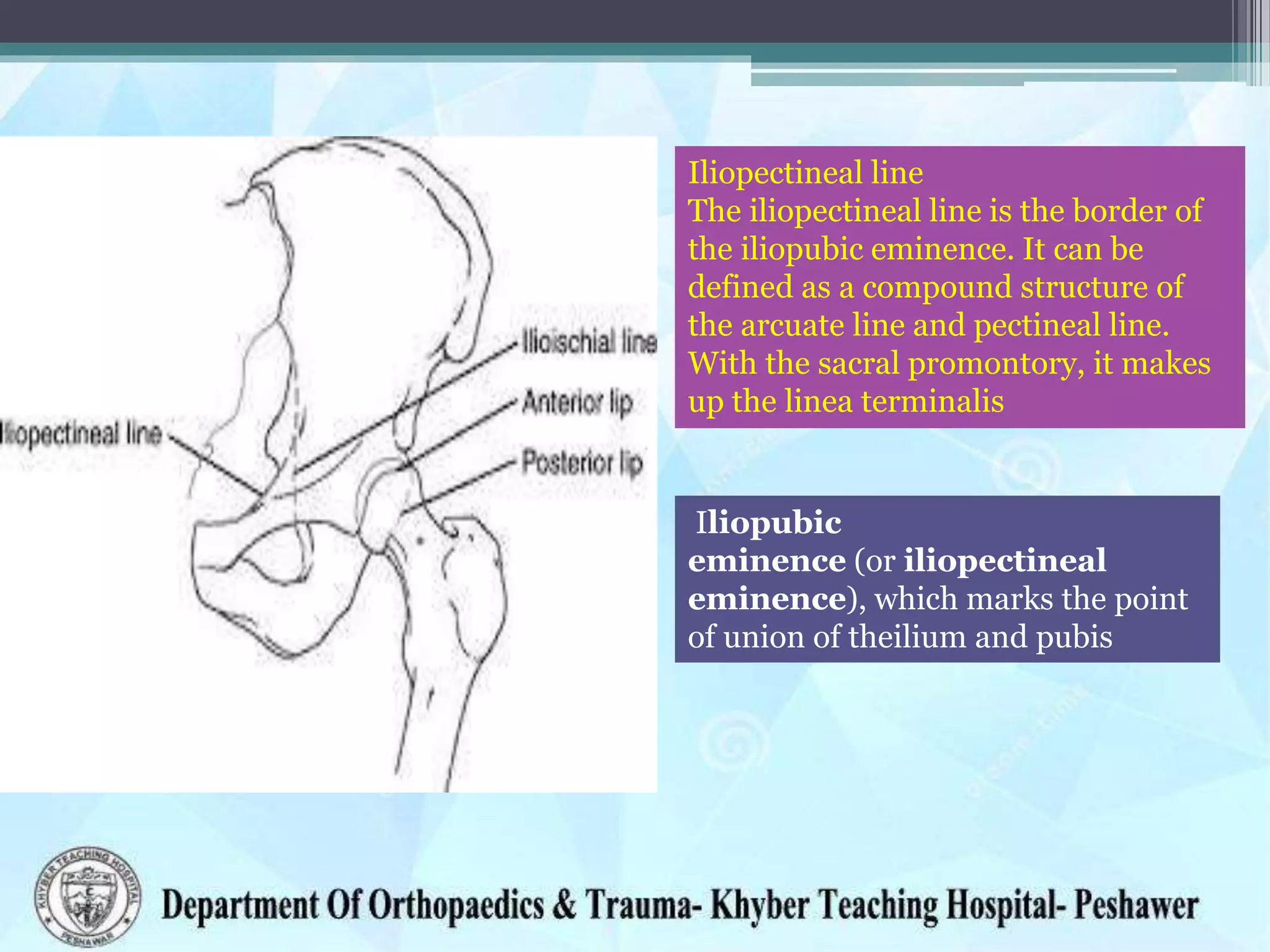
Iliopectineal line
The iliopectineal line is the border of
the iliopubic eminence. It can be
defined as a compound structure of
the arcuate line and pectineal line.
With the sacral promontory, it makes
up the linea terminalis
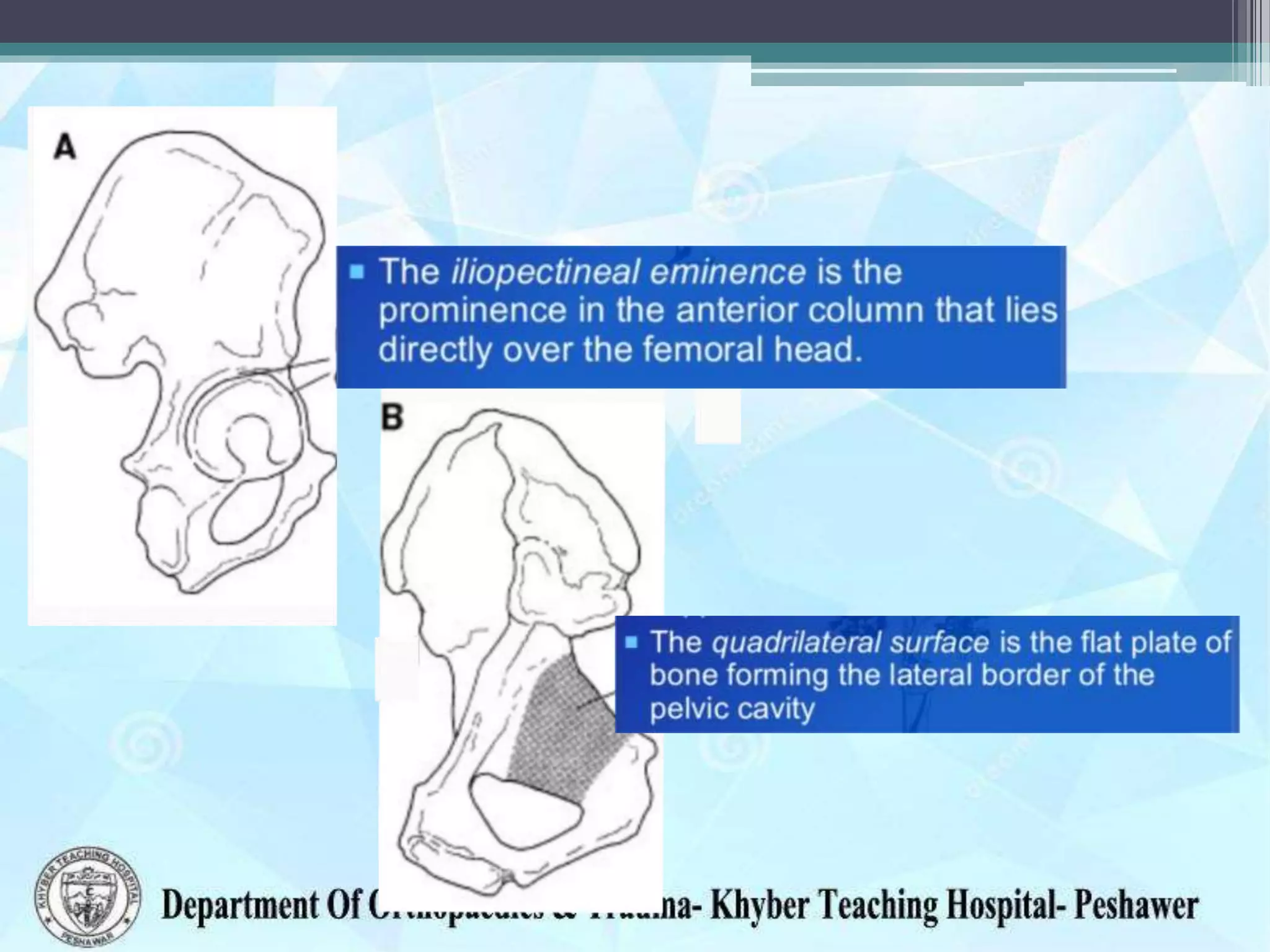
Iliopubic
eminence (or iliopectineal
eminence), which marks the point
of union of theilium and pubis
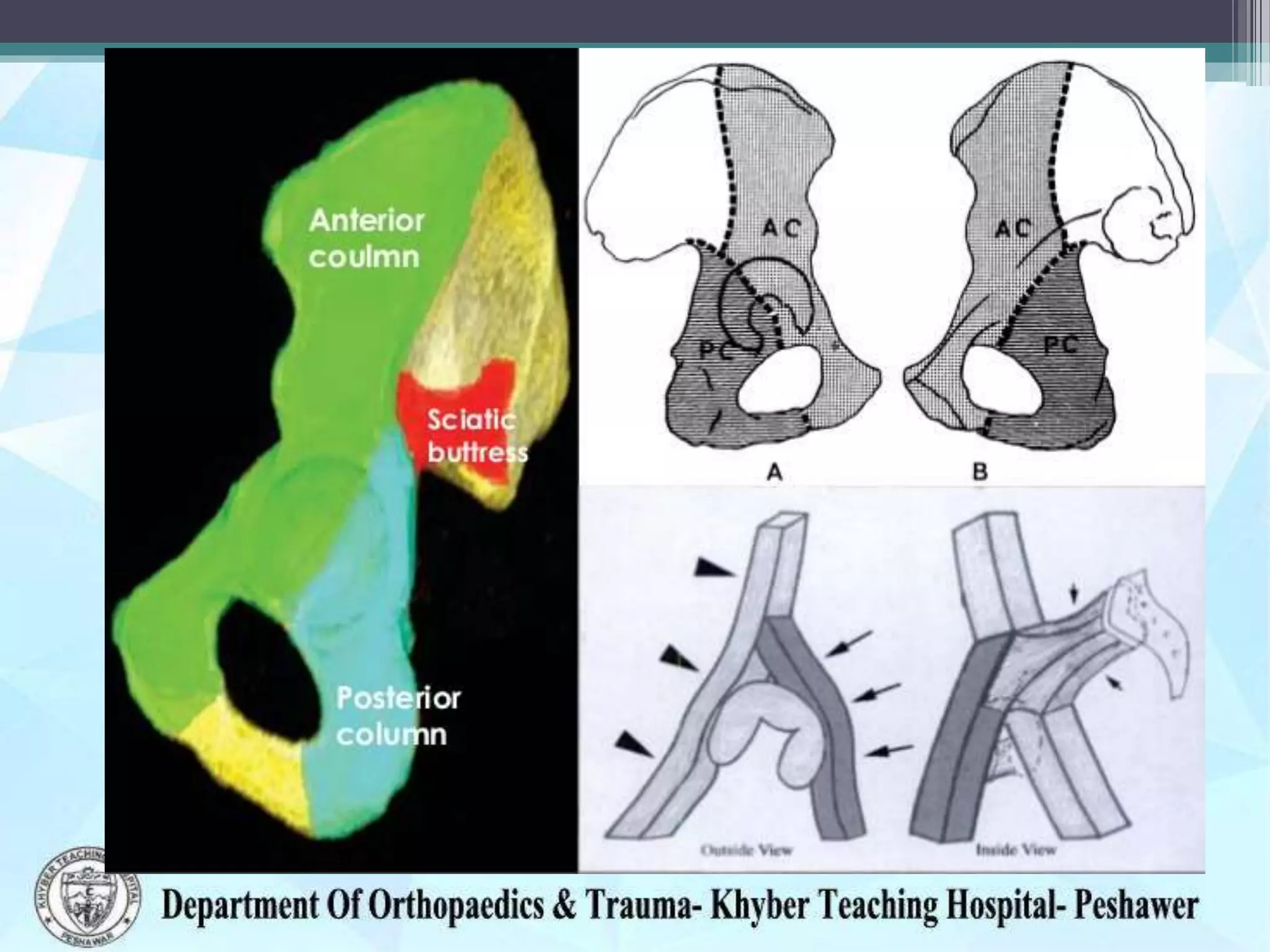
Ant. Column
The two Columns
Post. Column
Acetabulum
These two columns serve as
struts, mechanically
representing the coalescence of
bony trabeculae along lines of
stress
Anterior Column (white)
Consists of
• Anterior half of the Iliac crest,
• The Iliac spines,
• Anterior half of the acetabulum, and the pubis. ;
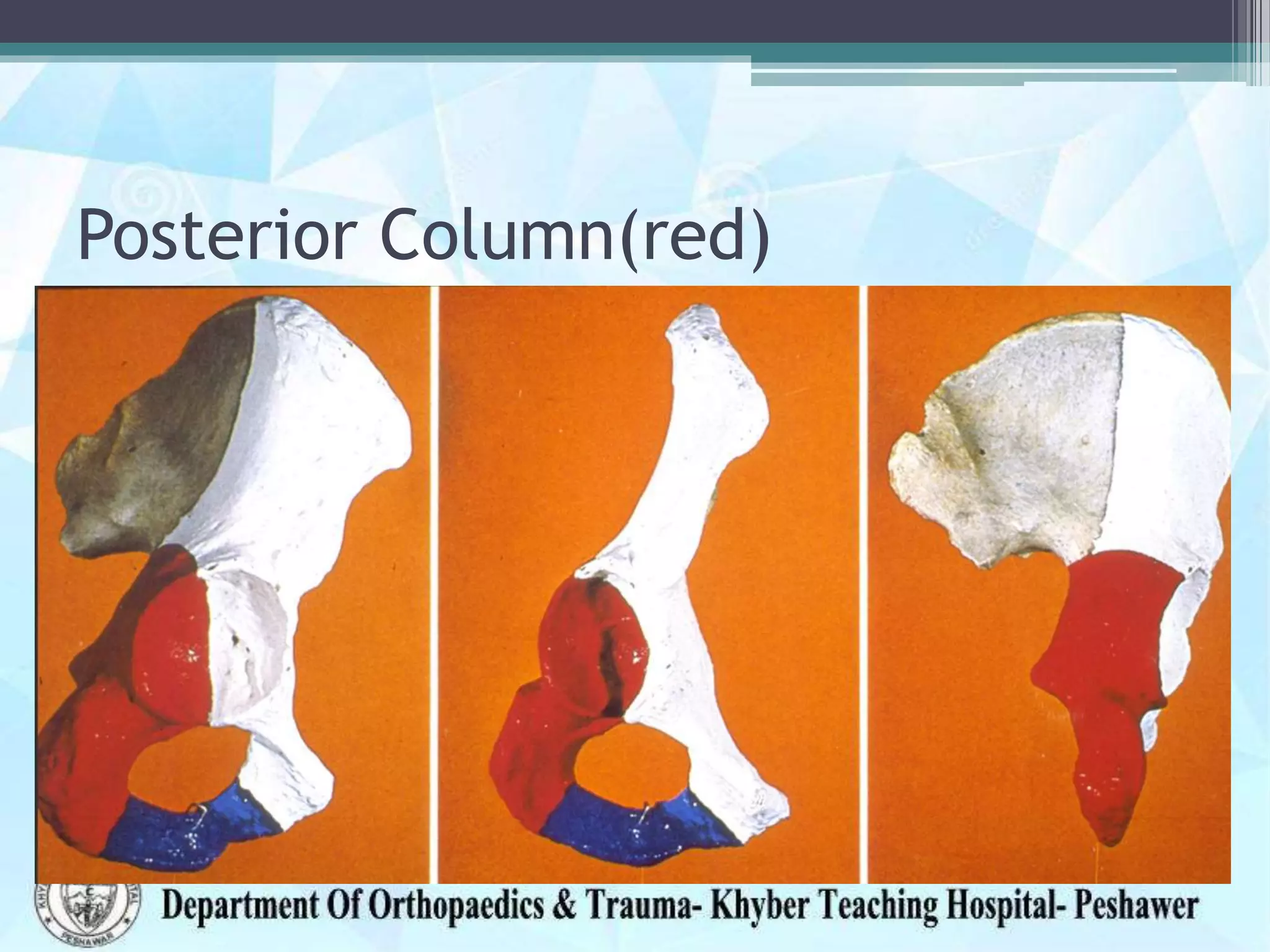
Posterior Column(red)
• Consists of:
• Ischium,
• the ischial spine,
• the posterior half of the acetabulum,
• the dense bone forming the sciatic notch.
• The posterior column ends at its intersection
with the anterior column at the top of the sciatic
notch
Post
Post
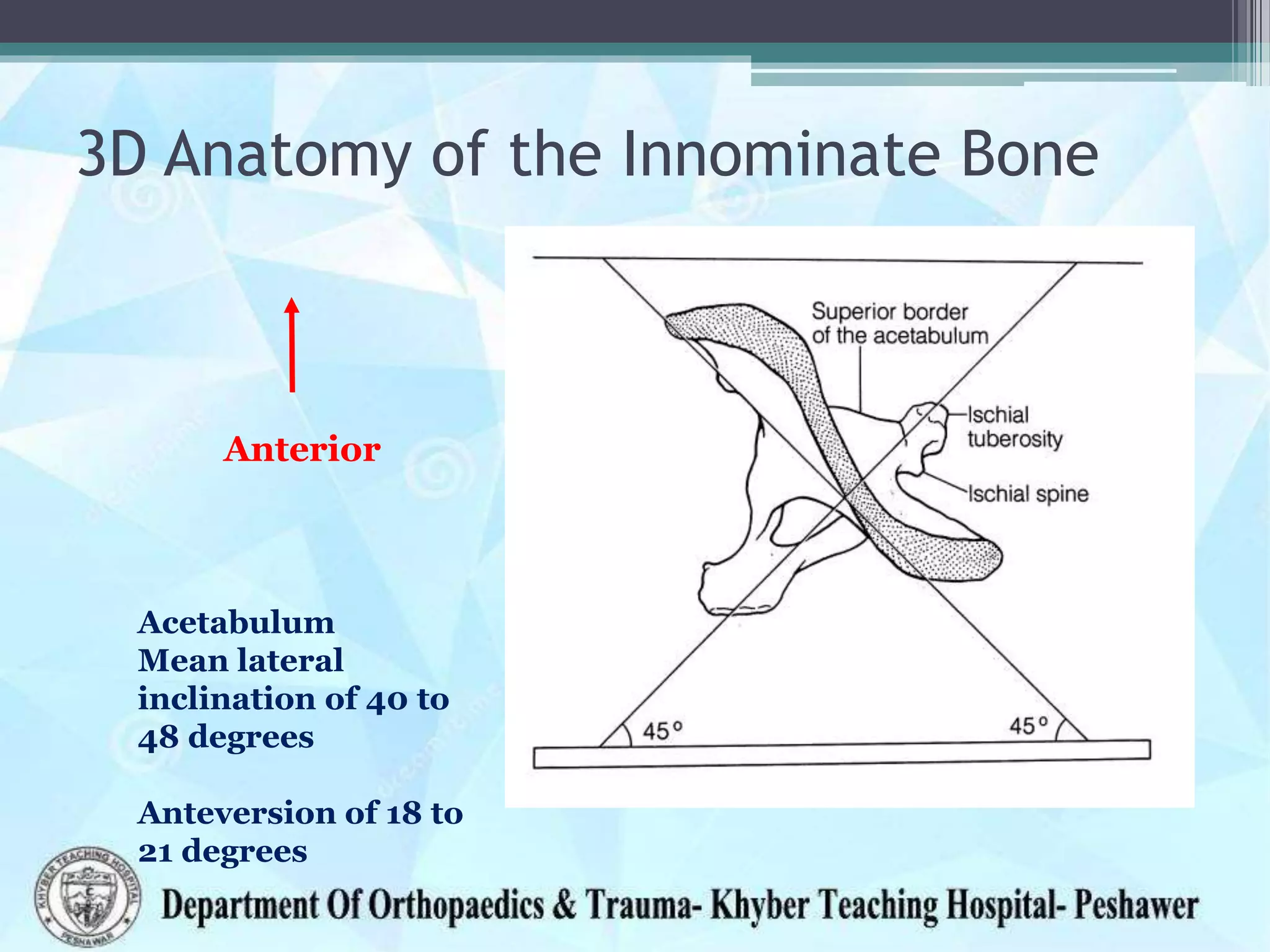
3D Anatomy of the Innominate Bone
Anterior
Acetabulum
Mean lateral
inclination of 40 to
48 degrees
Anteversion of 18 to
21 degrees
G. Maximus
G. Medius
G. Minimus
Quadratus
• Sciatic Nerve
• Superior/Inf Gluteal N.V Bundle
• Corona mortis
Sciatic Nerve
• The largest and longest nerve in the body
• Arises from the lumber and sacral plexus
• Comes out of the pelvis through the Sciatic
Notch
• Runs anterior (deep) to Piriformis and lies
posterior (superficial) to the short external
rotators
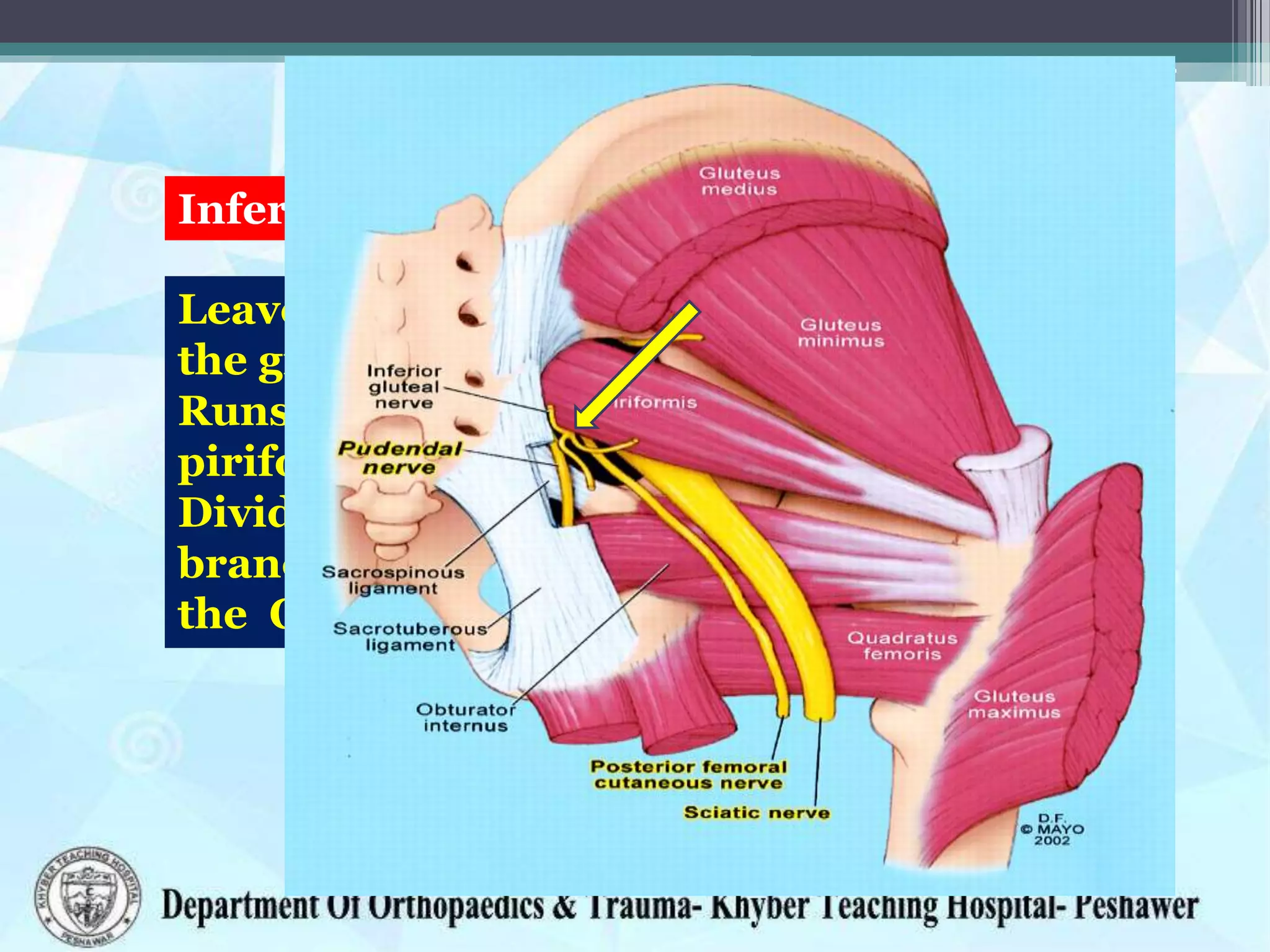
Leaves pelvis through the
greater sciatic notch along-
with superior gluteal artery
and vein
It runs over the piriformis
between the gluteus medius
and minimus supplying
these muscles
Superior Gluteal Nerve
Do not split gluteus medius
more than 5-7 cm proximal
to greater trochanter due to
risk of denervating the
muscle at risk during the
lateral (Hardinge)
approach to the hip
Leaves the pelvis through
the greater sciatic foramen
Runs underneath the
piriformis
Divides into muscular
branches to supply
the Gluteus Maximus
Inferior Gluteal Nerve
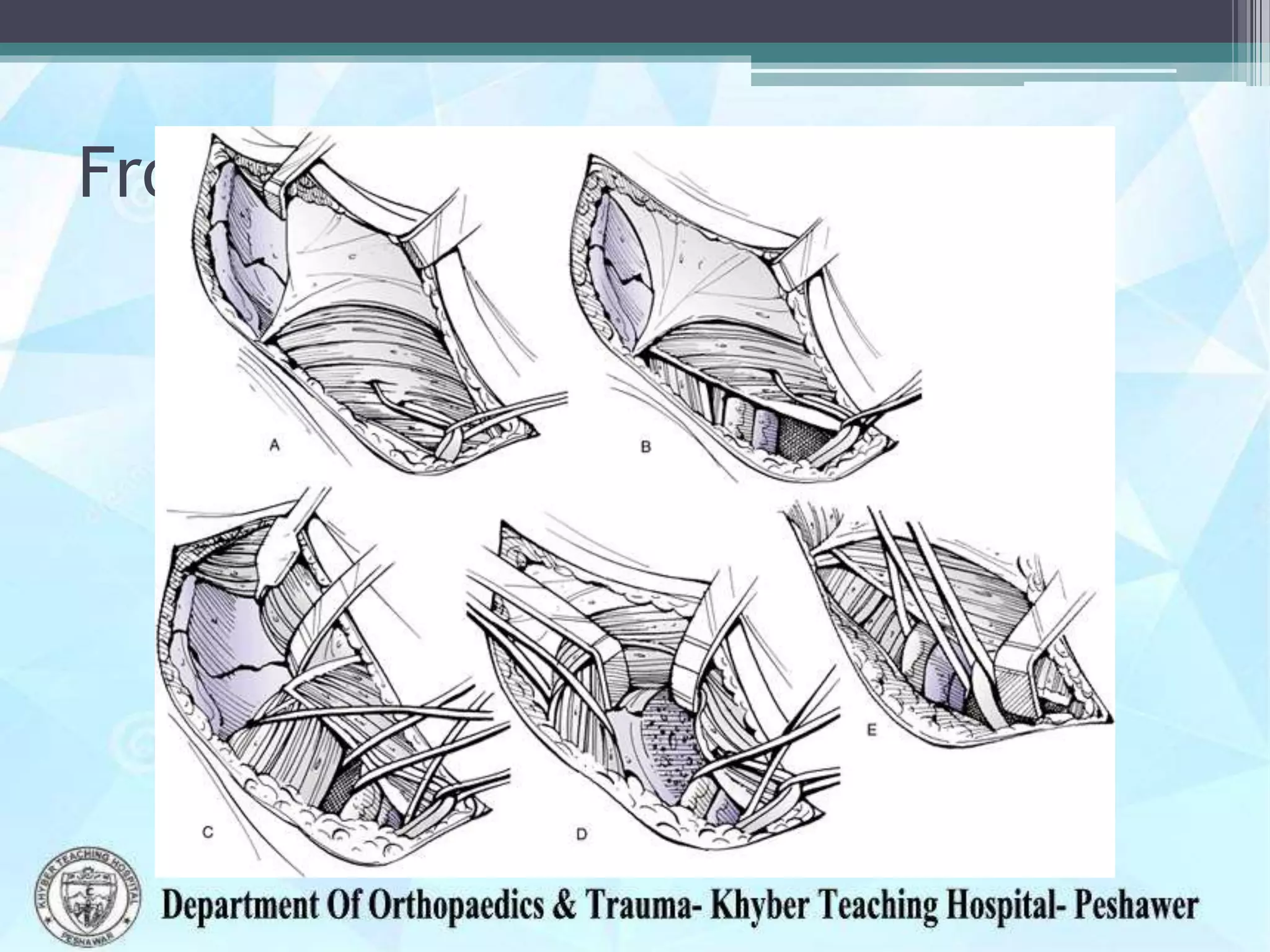
From the front
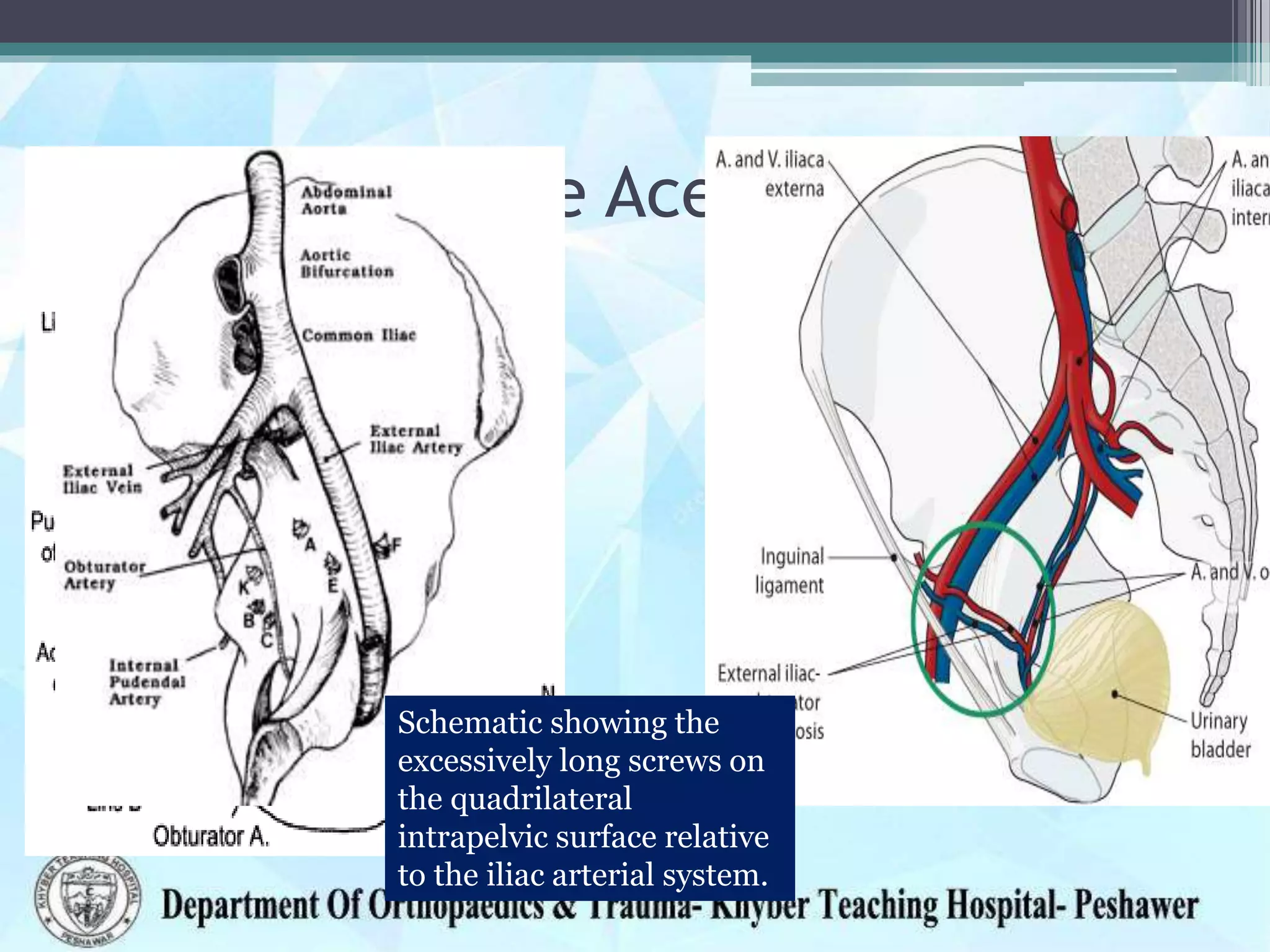
Vessels near the Acetabulum
Schematic showing the
excessively long screws on
the quadrilateral
intrapelvic surface relative
to the iliac arterial system.
corona mortis
"corona mortis" or crown of death
Chances of significant hemorrhage
An anastomosis between the
obturator and the external iliac or
inferior epigastric arteries or veins.
Located behind the superior pubic
ramus at a variable distance from
the symphysis pubis (range 40-96
mm).
60% had a large diameter (>3 mm)
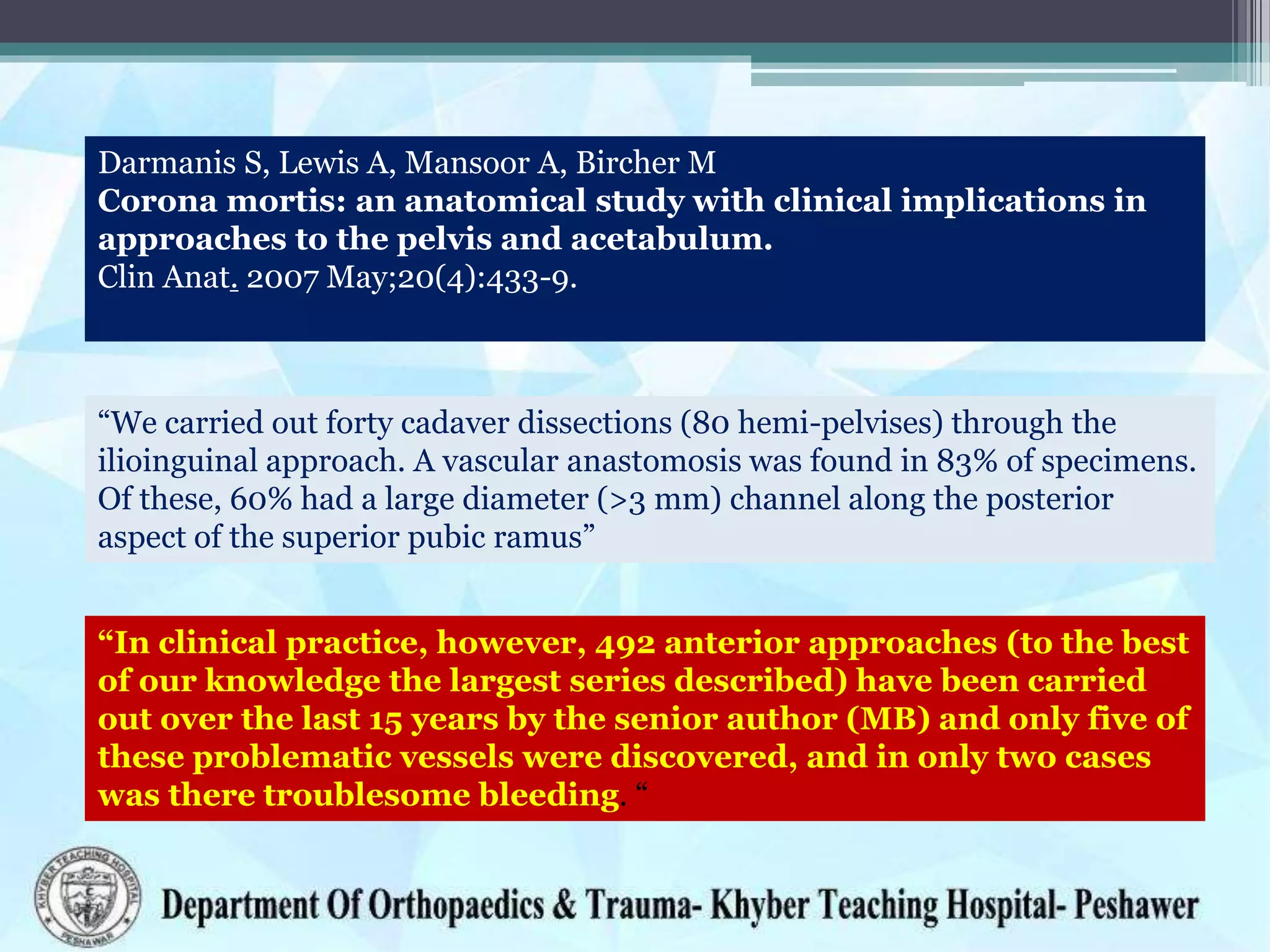
“We carried out forty cadaver dissections (80 hemi-pelvises) through the
ilioinguinal approach. A vascular anastomosis was found in 83% of specimens.
Of these, 60% had a large diameter (>3 mm) channel along the posterior
aspect of the superior pubic ramus”
“In clinical practice, however, 492 anterior approaches (to the best
of our knowledge the largest series described) have been carried
out over the last 15 years by the senior author (MB) and only five of
these problematic vessels were discovered, and in only two cases
was there troublesome bleeding. “
Darmanis S, Lewis A, Mansoor A, Bircher M
Corona mortis: an anatomical study with clinical implications in
approaches to the pelvis and acetabulum.
Clin Anat. 2007 May;20(4):433-9.
Where to put the screws???
•Thank You !!!

Acetabulum anatomy

  • 1.
    Anatomy of theAcetabulum Dr Zahid Askar MBBS, FCPS(Ortho),FRCS(Tr & Ortho) Prof. of Orthopaedics Khyber Medical College Peshawer
  • 2.
    • Acetabulum (Gr:ὀξίς, ὀξύβαφον, ὀξυβάφιον) was a vinegar-cup, used by Greeks and Romans placed on the dining-table .
  • 3.
    • The acetabulumis the point where the three components of the pelvis (ilium, ischium, and pubis) meet.
  • 4.
    The articular LunateSurface/DOME The nonarticular Acetabular Fossa The inferior Acetabular Notch. Anatomical restoration of the dome with concentric reduction of the femoral head beneath this dome is the goal of both operative and nonoperative treatment.
  • 5.
    Embryology • At 4to 6 gestational weeks, the hip joint develops from the cartilaginous analogue - • By 7 weeks a cleft appears • By 11 weeks, hip joint formation is mostly complete
  • 6.
    • At lategestation, femoral head grows more rapidly • At birth the femoral head is < 50% covered • Acetabulum continues to grow till 7 years with maximum growth is in the first 4 years.
  • 7.
    ASIS AIIS Ischial Tuberosity Pubis Ischial Spine tendonof obturator internus m. internal pudendal a. internal pudendal v. pudendal n. nerve to obturator internus - 7 nerves: - Sciatic Nerve - Superior Gluteal Nerve - Inferior Gluteal Nerve - Internal Pudendal Nerve: - Posterior Femoral Cutaneous Nerve - Nerve to Quadratus Femoris - Nerve to Obturator Externus - 3 Vessel Sets: - Superior Gluteal Artery & Vein - Inferior Gluteal Artery & vein - Internal Pudendal Artery & vein - 1 Muscle: - Piriformis
  • 8.
    Forces Across TheHip Joint • Walking upto 4 times BW • Running upto 7 times BW • Supported gait (w/ a walker or a cane) 2-3 BW Wednesday, December 17, 2014 8 Supine straight leg raising 2 times BW. Getting on & off bed pan 4 times BW Jogging and very fast walking both raised the forces to about 5.5 BW. Stumbling on one occasion caused magnitudes of 7.20 BW
  • 9.
    1. promontory of sacrum 2.ala of sacrum 3. arcuate line of ilium 4. pecten pubis (pectineal line) 5. pubic crest 6. pubic symphysis
  • 10.
    Iliopectineal line The iliopectinealline is the border of the iliopubic eminence. It can be defined as a compound structure of the arcuate line and pectineal line. With the sacral promontory, it makes up the linea terminalis Iliopubic eminence (or iliopectineal eminence), which marks the point of union of theilium and pubis
  • 11.
    Ant. Column The twoColumns Post. Column Acetabulum These two columns serve as struts, mechanically representing the coalescence of bony trabeculae along lines of stress
  • 12.
    Anterior Column (white) Consistsof • Anterior half of the Iliac crest, • The Iliac spines, • Anterior half of the acetabulum, and the pubis. ;
  • 13.
    Posterior Column(red) • Consistsof: • Ischium, • the ischial spine, • the posterior half of the acetabulum, • the dense bone forming the sciatic notch.
  • 14.
    • The posteriorcolumn ends at its intersection with the anterior column at the top of the sciatic notch
  • 15.
  • 17.
    3D Anatomy ofthe Innominate Bone Anterior Acetabulum Mean lateral inclination of 40 to 48 degrees Anteversion of 18 to 21 degrees
  • 18.
    G. Maximus G. Medius G.Minimus Quadratus
  • 19.
    • Sciatic Nerve •Superior/Inf Gluteal N.V Bundle • Corona mortis
  • 20.
    Sciatic Nerve • Thelargest and longest nerve in the body • Arises from the lumber and sacral plexus • Comes out of the pelvis through the Sciatic Notch • Runs anterior (deep) to Piriformis and lies posterior (superficial) to the short external rotators
  • 22.
    Leaves pelvis throughthe greater sciatic notch along- with superior gluteal artery and vein It runs over the piriformis between the gluteus medius and minimus supplying these muscles Superior Gluteal Nerve Do not split gluteus medius more than 5-7 cm proximal to greater trochanter due to risk of denervating the muscle at risk during the lateral (Hardinge) approach to the hip
  • 23.
    Leaves the pelvisthrough the greater sciatic foramen Runs underneath the piriformis Divides into muscular branches to supply the Gluteus Maximus Inferior Gluteal Nerve
  • 24.
  • 25.
    Vessels near theAcetabulum Schematic showing the excessively long screws on the quadrilateral intrapelvic surface relative to the iliac arterial system.
  • 26.
    corona mortis "corona mortis"or crown of death Chances of significant hemorrhage An anastomosis between the obturator and the external iliac or inferior epigastric arteries or veins. Located behind the superior pubic ramus at a variable distance from the symphysis pubis (range 40-96 mm). 60% had a large diameter (>3 mm)
  • 27.
    “We carried outforty cadaver dissections (80 hemi-pelvises) through the ilioinguinal approach. A vascular anastomosis was found in 83% of specimens. Of these, 60% had a large diameter (>3 mm) channel along the posterior aspect of the superior pubic ramus” “In clinical practice, however, 492 anterior approaches (to the best of our knowledge the largest series described) have been carried out over the last 15 years by the senior author (MB) and only five of these problematic vessels were discovered, and in only two cases was there troublesome bleeding. “ Darmanis S, Lewis A, Mansoor A, Bircher M Corona mortis: an anatomical study with clinical implications in approaches to the pelvis and acetabulum. Clin Anat. 2007 May;20(4):433-9.
  • 28.
    Where to putthe screws???
  • 29.