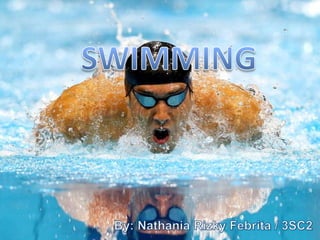
What is Swimming?
One of the most popular
recreational sport that can be
enjoyed by all ages and both gende
“Self propulsion of a person through
the water”
Breath-holding
History
1. Has been practiced in early 2500 BC
2. Greece and Rome, education for
males.
3. Japan, evidence of swimming races
during 1st Century and 17th century
Origins
Purpose
Recreation
Health
Sport
Occupation
Locomotion
Physic
Relies on the natural
buoyancy of the human body.
Floating
Move -> Propulsion
Risk
Panic
Exhaustion
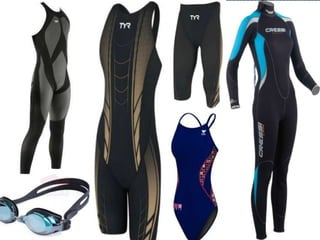
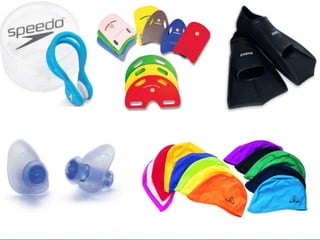
Clothing Equipment
Main:
Swimsuit /
Wetsuit
Goggles
Nose-clips
Swim caps
Swimming boards
Ear plugs
Swimfins
Strokes
A method of
moving the
arms and legs
to push against
the water and
propel the
swimmer
forward.
• Doggy Paddle
• Main:
– Front Crawl
– Breast-stroke
– Back-stroke
– Butterfly
• Other
Competitive Swimming
• Started aroud 1800 in Europe
• Breast-stroke
• 1873, John Arthur Trudgen introduced swimming
competitions
• 1896, Swimming included in Olympic Games in Athens
• 1908, FINA
Michael Phelps
–June 10th 1985
–Olympic gold medalist
–43 awards and honors
–39 world records
Benefits
•Social
•Physical
•Physicological
Nutrition
• It requires a large amount of
carbohydrates
• Consume a light meal before
• Consume well-balanced meal
afterwards
Long Distance Swimming
• Matthew Web, 1st person to swim across
the English channel without any aid. 21
hours and 45 minutes.
• Gertrude Ederle, 1st woman to swim the
English Channel. 14 hours and 31 minutes
at the age of 19.
• Guy Delage, 1st person to swim across the
Atlantic Ocean with the help of board
• Benoit Lecomte, 1st man to swim across
the Atlantic without any board in 1998.
Lesson
• Compulsory part
of the educational
curriculum
• Independently > 4
years old
• Supported by
government
• Swimming
instruction
programs for
live-saving in
Great Britain (19th
Century)
• US, American Red
Cross started to
Countries
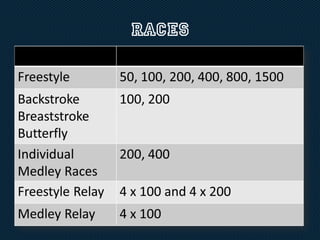
Races
Front-Crawl
• Fastest movement
• Long axis stroke
• Referred to as the
American crawl or
Australian crawl
Back-stroke
• Long axis stroke
• Develop in 20th
century
• Motion:
– Roll your
shoulders one at a
time
– One foot kicks
after another
Butterfly
• Fly style
• Short axis stroke
• Simple but use
most energy
• Motion:
– Pull both arms
down towards
yourself
– Chest press down
to the bottom of
the pool
– Legs come up to
• Mostly used in
competition
Breast-stroke
• Complicated
• Oldest
• Motion:
–Frog kick
movement
–Arms bend
backwards
–Short axis

Swimming