SWIMMING
What is Swimming?
- Swimming the action or activity of making progress unsupported through water
using the arms and legs, whether for pleasure, exercise or sport. It is said that
your burn 700 calories in an hour when swimming.
BRIEF HISTORY OF SWIMMING
 The word “swimming” is derived from the Old English term “swimmin.” although
the origin of swimming is not really known, people probably learned how to swim
from watching animals.
 Mosaic unearthed in Pompeii show men navigating water under their own power,
and as a bas-relief in a tomb from the 2000 B.C. period in Egypt shows a swimmer
doing what appears to be a crawl stroke
 The English were the first people of modern times to compete in swimming as a
sport.
 Records shows that competitive swimming began about 1837 in London.
 Early English swimmers used the breaststroke and the sidestroke
 In 1844 North America Indians entered a swimming meet in London. Flying Gull
defeated Tobacco by swimming the length of a 130-foot in thirty seconds.
 The style of swimming used by the Indians was similar to a windmill action. Each
arm thrashed the water violently in a circular motion while the feet beat the water
in an up-and-down action. This type of action was a form of the crawl stroke.
 In 1873, J. Arthur Trudgen introduced an overhand stroke using the scissors kick
which was to become known as the “Trudgen crawl”- this stroke has recently been
restored to competitive swimming, and some modern distance swimmers have set
new records using it.
 J.H. Derbyshire swam 100 yards in sixty seconds for the word record.
 In 1878, Frederick Cavill, An Englishman, went to Australia. After observing that the
natives flutter kick leg action resulted in exceptional speed, he combined it with the
double overhand stroke known as “Australian crawl.”
 Frederick Cavill set a new world record of 58.4 seconds for 100 yards in the 1902
world championships
 1905, Charles M. Daniels, a swimmer for the New York Athletic Club, introduced the
“American crawl” and used it to set a word record of 54.8 seconds in the 100 yard
swim in 1910.
 The American Red Cross first published a nationwide water safety program which
have been developed by Wilbert E Longfellow in 1914.
GLOSSARY OF TERMS
 Aquatics – pertaining to water or activities performed in water
 Buoyancy – the upward force of water on a submersed object
 Cardiopulmonary resuscitation-CPR – a means of external heart massage that
may be used to revive persons experiencing heart failure
 Finning – an action of the arms like the fins of a fish, resulting mostly from the
movement of the elbow and the wrist in and out from the body, in a press and
recovery action
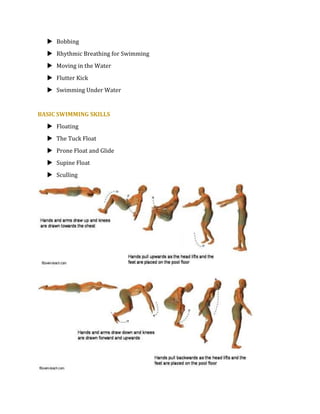
 Float
To be suspended in the water
a. Tuck float. To float with your hips and knees flexed and with your hands holding
your shins, with your head down in the water, and your rounded back bobbing
above the surface
b. Prone float. To float face down with arms and legs extended
c. Supine float. To float face up. Position of arms and legs, and the degree of
horizontal or vertical positioning is determined by the density of the floaters body
 Glide – a period in which the body is moving in an extended position as a
result of prior propulsion through water
 Gutter – the edge of the pool at water level. Water from the surface splashes
over the gutter and is drained away.
 Kick
To propel the body through the water with the legs
A. Dolphin – both legs moving up and down together
B. Flutter – both legs moving up and down alternately
C. Scissors – a bending of the knees and extension of the legs forward and
backward in relation to the body, then a hard squeeze to a stretch position.
D. Whip – a recovery or power kick in which the knees are bent as the ankles are
flexed, and the toes are rotated outward on the recovery, then the feet and legs
press out and down into extension on the power phase.
 Sculling – a means of propelling oneself through the water with the hands
and forearms executing a figure eight action
 Stretch – to extend the body into a straight line with arms and leg
extended, toes pointed and back straight
 Stroke – a complete cycle of the arms and legs in a coordinated manner to
propel a person through the water
 Tuck – a body position with the knees bent, the hips bent, and the chest
on the knees .
Beginning Techniques for the Nonswimmer
 Entering the water
 Relaxing in the water
 Submerging
 Breath Control
 Bobbing
 Rhythmic Breathing for Swimming
 Moving in the Water
 Flutter Kick
 Swimming Under Water
BASIC SWIMMING SKILLS
 Floating
 The Tuck Float
 Prone Float and Glide
 Supine Float
 Sculling
Swimming on the Surface
 Prone Glide and Flutter Kick
 Supine Float and Flutter Kick
 Finning
 Turning over from Prone to Supine Positions
 Treading Water
 Survival Floating
TYPES OF STROKES
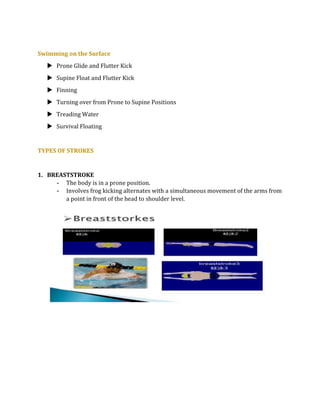
1. BREASTSTROKE
- The body is in a prone position.
- Involves frog kicking alternates with a simultaneous movement of the arms from
a point in front of the head to shoulder level.
2. SWIMMING STROKE
- Is a method of moving the arms and legs to push against the water and propel
the swimmer forward.
3. CRAWL
-Front or Back
-The body is in a prone position.
-Involves alternating over arm strokes and the flutter kick.
4. BACKSTROKE
-Involves alternate over-the-head arm strokes and a flutter kick in a supine position.
-When swimming competitively, only 15 meters can be spent underwater
from the start or from each turn.
5. BUTTERFLY STROKE
-The most difficult and exhausting stroke.
-Involves the dolphin-kick with a windmill-like movement of both arms in unison.
BEGINNING DIVING
 Jumping and Diving
 Jumping and Leveling off
 Deck Diving
 Advanced Techniques
 Diving from a Board
 Stationary Diving
 The Forward Approach and Hurdle
 The Forward Dive in Pike Position
 The Back Dive

SWIMMING.docx

  • 1.
    SWIMMING What is Swimming? -Swimming the action or activity of making progress unsupported through water using the arms and legs, whether for pleasure, exercise or sport. It is said that your burn 700 calories in an hour when swimming. BRIEF HISTORY OF SWIMMING  The word “swimming” is derived from the Old English term “swimmin.” although the origin of swimming is not really known, people probably learned how to swim from watching animals.  Mosaic unearthed in Pompeii show men navigating water under their own power, and as a bas-relief in a tomb from the 2000 B.C. period in Egypt shows a swimmer doing what appears to be a crawl stroke  The English were the first people of modern times to compete in swimming as a sport.  Records shows that competitive swimming began about 1837 in London.  Early English swimmers used the breaststroke and the sidestroke  In 1844 North America Indians entered a swimming meet in London. Flying Gull defeated Tobacco by swimming the length of a 130-foot in thirty seconds.  The style of swimming used by the Indians was similar to a windmill action. Each arm thrashed the water violently in a circular motion while the feet beat the water in an up-and-down action. This type of action was a form of the crawl stroke.  In 1873, J. Arthur Trudgen introduced an overhand stroke using the scissors kick which was to become known as the “Trudgen crawl”- this stroke has recently been restored to competitive swimming, and some modern distance swimmers have set new records using it.  J.H. Derbyshire swam 100 yards in sixty seconds for the word record.  In 1878, Frederick Cavill, An Englishman, went to Australia. After observing that the natives flutter kick leg action resulted in exceptional speed, he combined it with the double overhand stroke known as “Australian crawl.”  Frederick Cavill set a new world record of 58.4 seconds for 100 yards in the 1902 world championships  1905, Charles M. Daniels, a swimmer for the New York Athletic Club, introduced the “American crawl” and used it to set a word record of 54.8 seconds in the 100 yard swim in 1910.  The American Red Cross first published a nationwide water safety program which have been developed by Wilbert E Longfellow in 1914.
  • 2.
    GLOSSARY OF TERMS Aquatics – pertaining to water or activities performed in water  Buoyancy – the upward force of water on a submersed object  Cardiopulmonary resuscitation-CPR – a means of external heart massage that may be used to revive persons experiencing heart failure  Finning – an action of the arms like the fins of a fish, resulting mostly from the movement of the elbow and the wrist in and out from the body, in a press and recovery action  Float To be suspended in the water a. Tuck float. To float with your hips and knees flexed and with your hands holding your shins, with your head down in the water, and your rounded back bobbing above the surface b. Prone float. To float face down with arms and legs extended c. Supine float. To float face up. Position of arms and legs, and the degree of horizontal or vertical positioning is determined by the density of the floaters body  Glide – a period in which the body is moving in an extended position as a result of prior propulsion through water  Gutter – the edge of the pool at water level. Water from the surface splashes over the gutter and is drained away.  Kick To propel the body through the water with the legs A. Dolphin – both legs moving up and down together B. Flutter – both legs moving up and down alternately C. Scissors – a bending of the knees and extension of the legs forward and backward in relation to the body, then a hard squeeze to a stretch position. D. Whip – a recovery or power kick in which the knees are bent as the ankles are flexed, and the toes are rotated outward on the recovery, then the feet and legs press out and down into extension on the power phase.  Sculling – a means of propelling oneself through the water with the hands and forearms executing a figure eight action
  • 3.
     Stretch –to extend the body into a straight line with arms and leg extended, toes pointed and back straight  Stroke – a complete cycle of the arms and legs in a coordinated manner to propel a person through the water  Tuck – a body position with the knees bent, the hips bent, and the chest on the knees .
  • 4.
    Beginning Techniques forthe Nonswimmer  Entering the water  Relaxing in the water  Submerging  Breath Control
  • 5.
     Bobbing  RhythmicBreathing for Swimming  Moving in the Water  Flutter Kick  Swimming Under Water BASIC SWIMMING SKILLS  Floating  The Tuck Float  Prone Float and Glide  Supine Float  Sculling
  • 6.
    Swimming on theSurface  Prone Glide and Flutter Kick  Supine Float and Flutter Kick  Finning  Turning over from Prone to Supine Positions  Treading Water  Survival Floating TYPES OF STROKES 1. BREASTSTROKE - The body is in a prone position. - Involves frog kicking alternates with a simultaneous movement of the arms from a point in front of the head to shoulder level.
  • 7.
    2. SWIMMING STROKE -Is a method of moving the arms and legs to push against the water and propel the swimmer forward. 3. CRAWL -Front or Back -The body is in a prone position. -Involves alternating over arm strokes and the flutter kick. 4. BACKSTROKE -Involves alternate over-the-head arm strokes and a flutter kick in a supine position. -When swimming competitively, only 15 meters can be spent underwater from the start or from each turn. 5. BUTTERFLY STROKE -The most difficult and exhausting stroke. -Involves the dolphin-kick with a windmill-like movement of both arms in unison. BEGINNING DIVING  Jumping and Diving  Jumping and Leveling off  Deck Diving  Advanced Techniques  Diving from a Board  Stationary Diving  The Forward Approach and Hurdle  The Forward Dive in Pike Position
  • 8.