1941 – 1945
• Between 1941-1945,
Philippine Literature was interrupted in its
development when we were again conquered
by another foreign country, Japan.
• Philippine literature in English came to a halt.
• Except for the Tribune and the Philippine
Review, Pillars, Free Philippines, and
Filipina, almost all newspapers in English
were stopped by the Japanese.
• During this time,
there was no freedom of speech and of the
press.
• Victoria Abelardo has described Filipino
writing during the Japanese occupation as
being pessimistic and bitter.
• There were some efforts at escapist
literature, but in general, the literary output
was minor and insignificant. Because of strict
censorship, few literary works were printed
during the war years.
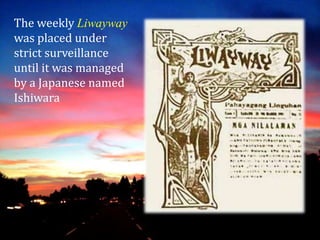
The weekly Liwayway
was placed under
strict surveillance
until it was managed
by a Japanese named
Ishiwara
• The only contact with the outside world was
done with utmost secrecy through the
underground radio program called
“Voice of Freedom”.
• Tagalog was favored by the
Japanese military authority
and writing in English was
consigned to a limbo.
• Japanese were able to
influence and encourage
the Filipino in developing
the vernacular literature.
• The only Filipino
writers who could
write freely were
those who were
living in the United
States.
• Most writers and
authors were lead to
either go
underground or
write in Tagalog.
• So, Filipino
literature was given
a break during this
period.
• Filipino literature
also experienced
renewed attention
because writers in
English turned to
writing in Filipino.
-The drama experienced a lull during the Japanese
period because movie houses showing American
films were closed.
- The big movie houses were just made to show
stage shows. Many of the plays were
reproductions of English plays to Tagalog.
-The translators were Francisco Soc Rodrigo,
Alberto Concio, and Narciso Pimentel.
-They also founded the organization of Filipino
players named .
A few of the playwriters
were:
1. Jose Ma. Hernandez –
wrote PANDAY PIRA
2.Francisco Soc
Rodrigo – wrote
sa PULA, SA PUTI
3.Clodualdo del Mundo –
wrote BULAGA (an
expression in the game
Hide and Seek).
4. Julian Cruz Balmaceda
– wrote SINO BA KAYO?,
DAHIL SA ANAK, and
HIGANTE NG PATAY.
• Three types of poems emerged during this
period.
– a poem of free verse that the Japanese liked.
It is made up of seventeen (17) syllables
divided into three (3) lines. The first line has
five, the second – seven and the third – five. It
is allegorical in meaning, short and covers a
wide scope in meaning.
- like the haiku, it is short, but has measure
and rhyme. Each line has seventeen
syllables and is also allegorical in meaning.
(Usual Form)
– the usual and common form of poetry
-The field of the short story widened during the
Japanese Occupation.
Many wrote short stories.
-Among them were:
Brigido Batungbakal Macario Pineda
Serafin Guinigindo Liwayway Arceo,
Narciso Ramos NVM Gonzales,
Alicia Lopez Lim Ligaya Perez
Gloria Guzman
The best writings in
1945 were selected by
a group of judges
composed of
Francisco Icasiano,
Jose Esperanza Cruz,
Antonio Rosales,
Clodualdo del Mundo
and Teodoro Santos.
As a result of this selection,
the following got the first three prizes:
First Prize:
Narciso Reyes with his LUPANG TINUBUAN
Second Prize:
Liwayway Arceo’s
UHAW ANG TIGANG NA LUPA
Third Prize:
NVM Gonzales’
LUNSOD NAYON AT DAGAT-DAGATAN
Noteworthy writer of the period
was Carlos P. Romulo who won the Pulitzer
Prize for his bestsellers
I SAW THE FALL OF THE PHILIPPINES,
I SEE THE PHILIPPINES RISE and his MOTHER
AMERICA AND MY BROTHER AMERICANS.
Journalists include Salvador P. Lopez, Leon Ma.
Geurrero, Raul Manglapuz and Carlos Bulosan.
Nick Joaquin produced THE WOMAN WHO
LOOKED LIKE LAZARUS. Fred Ruiz Castro
wrote a few poems.
LITERATURE AND SOCIETY
by Salvador P. Lopez (Essay)
HIS NATIVE SOIL – by Juan Laya (Novel)
President Manuel L. Quezon’s autobiography
THE GOOD FIGHT was published posthumously.
Other writers of this period were Juan Collas
(19440, Tomas Confesor (1945), Roman A. de la
Cruz and Elisa Tabuñar.
Japanese Period of the Philippine Literature

Japanese Period of the Philippine Literature

  • 1.
  • 2.
    • Between 1941-1945, PhilippineLiterature was interrupted in its development when we were again conquered by another foreign country, Japan. • Philippine literature in English came to a halt. • Except for the Tribune and the Philippine Review, Pillars, Free Philippines, and Filipina, almost all newspapers in English were stopped by the Japanese.
  • 3.
    • During thistime, there was no freedom of speech and of the press. • Victoria Abelardo has described Filipino writing during the Japanese occupation as being pessimistic and bitter. • There were some efforts at escapist literature, but in general, the literary output was minor and insignificant. Because of strict censorship, few literary works were printed during the war years.
  • 4.
    The weekly Liwayway wasplaced under strict surveillance until it was managed by a Japanese named Ishiwara
  • 5.
    • The onlycontact with the outside world was done with utmost secrecy through the underground radio program called “Voice of Freedom”.
  • 6.
    • Tagalog wasfavored by the Japanese military authority and writing in English was consigned to a limbo. • Japanese were able to influence and encourage the Filipino in developing the vernacular literature.
  • 7.
    • The onlyFilipino writers who could write freely were those who were living in the United States. • Most writers and authors were lead to either go underground or write in Tagalog.
  • 8.
    • So, Filipino literaturewas given a break during this period. • Filipino literature also experienced renewed attention because writers in English turned to writing in Filipino.
  • 9.
    -The drama experienceda lull during the Japanese period because movie houses showing American films were closed. - The big movie houses were just made to show stage shows. Many of the plays were reproductions of English plays to Tagalog. -The translators were Francisco Soc Rodrigo, Alberto Concio, and Narciso Pimentel. -They also founded the organization of Filipino players named .
  • 10.
    A few ofthe playwriters were: 1. Jose Ma. Hernandez – wrote PANDAY PIRA 2.Francisco Soc Rodrigo – wrote sa PULA, SA PUTI
  • 11.
    3.Clodualdo del Mundo– wrote BULAGA (an expression in the game Hide and Seek). 4. Julian Cruz Balmaceda – wrote SINO BA KAYO?, DAHIL SA ANAK, and HIGANTE NG PATAY.
  • 12.
    • Three typesof poems emerged during this period. – a poem of free verse that the Japanese liked. It is made up of seventeen (17) syllables divided into three (3) lines. The first line has five, the second – seven and the third – five. It is allegorical in meaning, short and covers a wide scope in meaning.
  • 13.
    - like thehaiku, it is short, but has measure and rhyme. Each line has seventeen syllables and is also allegorical in meaning. (Usual Form) – the usual and common form of poetry
  • 14.
    -The field ofthe short story widened during the Japanese Occupation. Many wrote short stories. -Among them were: Brigido Batungbakal Macario Pineda Serafin Guinigindo Liwayway Arceo, Narciso Ramos NVM Gonzales, Alicia Lopez Lim Ligaya Perez Gloria Guzman
  • 15.
    The best writingsin 1945 were selected by a group of judges composed of Francisco Icasiano, Jose Esperanza Cruz, Antonio Rosales, Clodualdo del Mundo and Teodoro Santos.
  • 16.
    As a resultof this selection, the following got the first three prizes: First Prize: Narciso Reyes with his LUPANG TINUBUAN Second Prize: Liwayway Arceo’s UHAW ANG TIGANG NA LUPA Third Prize: NVM Gonzales’ LUNSOD NAYON AT DAGAT-DAGATAN
  • 17.
    Noteworthy writer ofthe period was Carlos P. Romulo who won the Pulitzer Prize for his bestsellers I SAW THE FALL OF THE PHILIPPINES, I SEE THE PHILIPPINES RISE and his MOTHER AMERICA AND MY BROTHER AMERICANS. Journalists include Salvador P. Lopez, Leon Ma. Geurrero, Raul Manglapuz and Carlos Bulosan. Nick Joaquin produced THE WOMAN WHO LOOKED LIKE LAZARUS. Fred Ruiz Castro wrote a few poems.
  • 18.
    LITERATURE AND SOCIETY bySalvador P. Lopez (Essay) HIS NATIVE SOIL – by Juan Laya (Novel) President Manuel L. Quezon’s autobiography THE GOOD FIGHT was published posthumously. Other writers of this period were Juan Collas (19440, Tomas Confesor (1945), Roman A. de la Cruz and Elisa Tabuñar.