MONEY IS BROKEN; 
ITS FUTURE IS NOT 
CAMERON WINKLEVOSS @winklevoss 
TYLER WINKLEVOSS @tylerwinklevoss
PART I 
UNDERSTANDING MONEY
Money is the most widely used yet misunderstood 
technology in the world. 
“One reason why money is a mystery to so many is 
the role of myth or fiction or convention...the money 
around us, the money that we grow up with, appears 
the only “real” money to us.” 
-Milton Friedman, Money Mischief
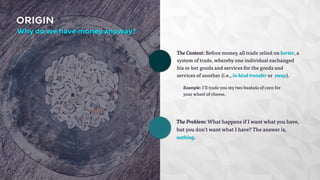
The Context: Before money, all trade relied on barter, a 
system of trade, whereby one individual exchanged 
his or her goods and services for the goods and 
services of another (i.e., in-kind transfer or swap). 
ORIGIN 
Why do we have money anyway? 
Example: I’ll trade you my two bushels of corn for 
your wheel of cheese. 
The Problem: What happens if I want what you have, 
but you don’t want what I have? The answer is, 
nothing.
Trade Problem 
Why do we have money anyway? 
This trade deadlock is known as the Coincidence of 
Wants Dilemma, whereby two people must want what 
each other have, otherwise a trade will not occur. 
Other limitations of barter are portability (difficult to 
transport 10 oxen to the marketplace); divisibility (cannot 
trade half of a horse); measure of value (no common way to 
measure the value of goods against each other); and 
storage (perishables like fruit do not last long). 
The Solution: Invent a common “medium of exchange”, or 
what we colloquially refer to as money. 
The Answer: We have money because money solves a 
trade problem.
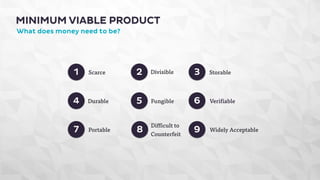
1 Scarce 
2 3 
4 5 6 
Durable Verifiable 
Portable 
Divisible 
Fungible 
Storable 
Difficult to 
Counterfeit 7 8 
9 Widely Acceptable 
MINIMUM VIABLE PRODUCT 
What does money need to be?
WHAT COULD WE USE FOR MONEY 
IN A PRE-INDUSTRIAL WORLD?
FAILING FAST 
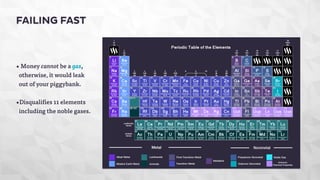
• Money cannot be a gas, 
otherwise, it would leak 
out of your piggybank. 
•Disqualifies 11 elements 
including the noble gases.
FAILING FAST 
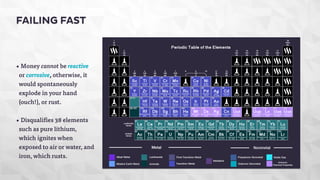
• Money cannot be reactive 
or corrosive, otherwise, it 
would spontaneously 
explode in your hand 
(ouch!), or rust. 
• Disqualifies 38 elements 
such as pure lithium, 
which ignites when 
exposed to air or water, and 
iron, which rusts.
FAILING FAST 
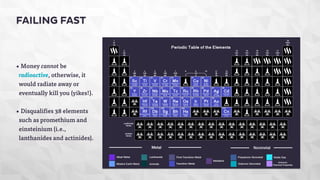
• Money cannot be 
radioactive, otherwise, it 
would radiate away or 
eventually kill you (yikes!). 
• Disqualifies 38 elements 
such as promethium and 
einsteinium (i.e., 
lanthanides and actinides).
FAILING FAST 
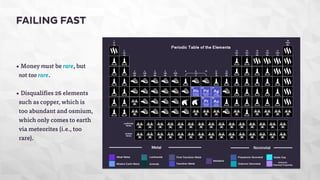
• Money must be rare, but 
not too rare. 
• Disqualifies 26 elements 
such as copper, which is 
too abundant and osmium, 
which only comes to earth 
via meteorites (i.e., too 
rare).
FAILING FAST 
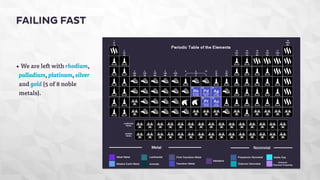
• We are left with rhodium, 
palladium, platinum, silver 
and gold (5 of 8 noble 
metals).
FAILING FAST 
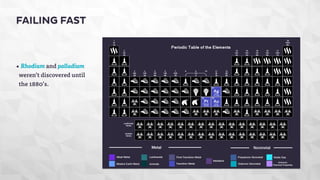
• Rhodium and palladium 
weren’t discovered until 
the 1880’s.
FAILING FAST 
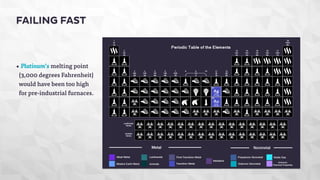
• Platinum’s melting point 
(3,000 degrees Fahrenheit) 
would have been too high 
for pre-industrial furnaces.
FAILING FAST 
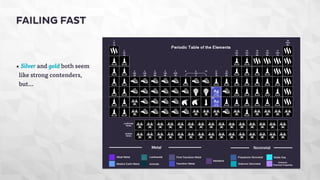
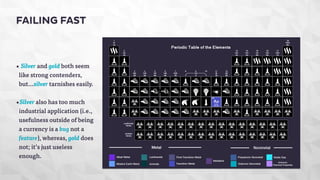
• Silver and gold both seem 
like strong contenders, 
but...
FAILING FAST 
Text 
• Silver and gold both seem 
like strong contenders, 
but...silver tarnishes easily. 
•Silver also has too much 
industrial application (i.e., 
usefulness outside of being 
a currency is a bug not a 
feature), whereas, gold does 
not; it’s just useless 
enough.
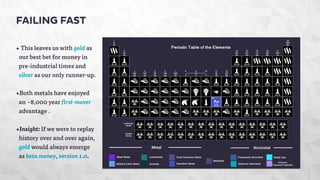
FAILING FAST 
• This leaves us with gold as 
our best bet for money in 
pre-industrial times and 
silver as our only runner-up. 
•Both metals have enjoyed 
an ~8,000 year first-mover 
advantage . 
•Insight: If we were to replay 
history over and over again, 
gold would always emerge 
as beta money, version 1.0.
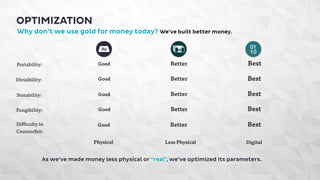
OPTIMIZATION 
We’ve built better money. 
Why don’t we use gold for money today? 
Portability: 
Divisibility: 
Storability: 
Fungibility: 
Difficulty to 
Counterfeit: 
Good Better Best 
Good Better Best 
Good Better Best 
Good Better Best 
Good Better Best 
Physical Less Physical Digital 
As we’ve made money less physical or “real”, we’ve optimized its parameters.
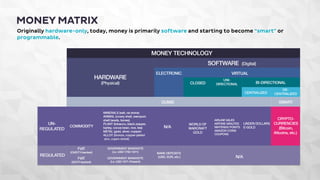
MONEY MATRIX 
Originally hardware-only, today, money is primarily software and starting to become “smart” or 
programmable.
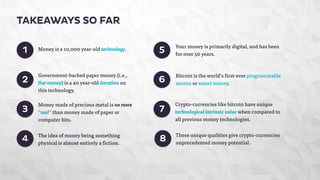
1 
2 
3 
4 
5 
6 
Money is a 10,000 year-old technology. 
Government-backed paper money (i.e., 
fiat money) is a 40 year-old iteration on 
this technology. 
Your money is primarily digital, and has been 
for over 50 years. 
Money made of precious metal is no more 
“real” than money made of paper or 
computer bits. 
Crypto-currencies like bitcoin have unique 
technological intrinsic value when compared to 
all previous money technologies. 
These unique qualities give crypto-currencies 
unprecedented money potential. 
TAKEAWAYS SO FAR 
7 
8 
Bitcoin is the world’s first-ever programmable 
money or smart money. 
The idea of money being something 
physical is almost entirely a fiction.
PART II 
THE PROBLEM WITH MONEY TODAY
THESIS 
Money is, and always has been, a technology that 
facilitates trade. 
It does so by helping people exchange value more 
easily (i.e., reduces friction). But today... 
Money is no longer facilitating trade; it’s holding 
it back!
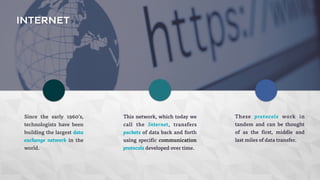
INTERNET 
These protocols work in 
tandem and can be thought 
of as the first, middle and 
last miles of data transfer. 
This network, which today we 
call the Internet, transfers 
packets of data back and forth 
using specific communication 
protocols developed over time. 
Since the early 1960’s, 
technologists have been 
building the largest data 
exchange network in the 
world.
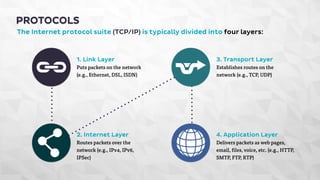
PROTOCOLS 
The Internet protocol suite (TCP/IP) is typically divided into four layers: 
1. Link Layer 
Puts packets on the network 
(e.g., Ethernet, DSL, ISDN) 
2. Internet Layer 
Routes packets over the 
network (e.g., IPv4, IPv6, 
IPSec) 
3. Transport Layer 
Establishes routes on the 
network (e.g., TCP, UDP) 
4. Application Layer 
Delivers packets as web pages, 
email, files, voice, etc. (e.g., HTTP, 
SMTP, FTP, RTP)
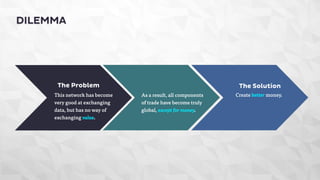
DILEMMA 
This network has become 
very good at exchanging 
data, but has no way of 
exchanging value. 
As a result, all components 
of trade have become truly 
global, except for money. 
The Solution 
Create better money. 
The Problem
Good news: The Internet already has a value 
transfer protocol, it’s called “Bitcoin” with a 
capital “B”. It also already has a digital asset that 
can be transferred over this protocol, it’s called 
“bitcoin” with a lowercase “b”. 
MONEY OVER IP 
The Internet needs a value transfer protocol (VTP) 
that can transfer digital value between users. In 
other words, the Internet needs Internet money!
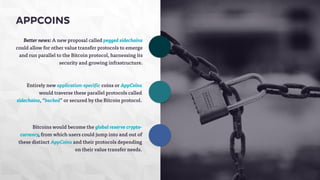
Better news: A new proposal called pegged sidechains 
could allow for other value transfer protocols to emerge 
and run parallel to the Bitcoin protocol, harnessing its 
security and growing infrastructure. 
Entirely new application-specific coins or AppCoins 
would traverse these parallel protocols called 
sidechains, “backed” or secured by the Bitcoin protocol. 
Bitcoins would become the global reserve crypto-currency, 
from which users could jump into and out of 
these distinct AppCoins and their protocols depending 
on their value transfer needs. 
APPCOINS
PART III 
THE FUTURE OF MONEY
FUTURE OF TRADE 
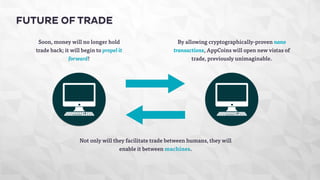
Soon, money will no longer hold 
trade back; it will begin to propel it 
forward! 
By allowing cryptographically-proven nano 
transactions, AppCoins will open new vistas of 
trade, previously unimaginable. 
Not only will they facilitate trade between humans, they will 
enable it between machines.
SMART INTERNET 
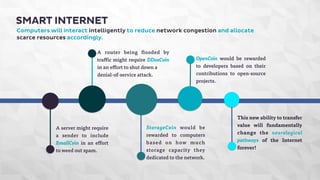
Computers will interact intelligently to reduce network congestion and allocate 
scarce resources accordingly. 
A router being flooded by 
traffic might require DDosCoin 
in an effort to shut down a 
denial-of-service attack. 
A server might require 
a sender to include 
EmailCoin in an effort 
to weed out spam. 
OpenCoin would be rewarded 
to developers based on their 
contributions to open-source 
projects. 
StorageCoin would be 
rewarded to computers 
based on how much 
storage capacity they 
dedicated to the network. 
This new ability to transfer 
value will fundamentally 
change the neurological 
pathways of the Internet 
forever!
AUTONOMOUS AGENTS 
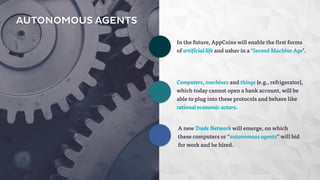
In the future, AppCoins will enable the first forms 
of artificial life and usher in a ‘Second Machine Age’. 
Computers, machines and things (e.g., refrigerator), 
which today cannot open a bank account, will be 
able to plug into these protocols and behave like 
rational economic actors. 
A new Trade Network will emerge, on which 
these computers or “autonomous agents” will bid 
for work and be hired.
AUTONOMOUS AGENTS 
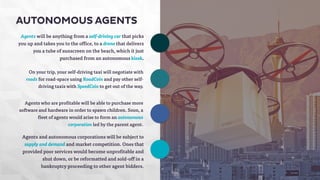
Agents will be anything from a self-driving car that picks 
you up and takes you to the office, to a drone that delivers 
you a tube of sunscreen on the beach, which it just 
purchased from an autonomous kiosk. 
On your trip, your self-driving taxi will negotiate with 
roads for road-space using RoadCoin and pay other self-driving 
taxis with SpeedCoin to get out of the way. 
Agents who are profitable will be able to purchase more 
software and hardware in order to spawn children. Soon, a 
fleet of agents would arise to form an autonomous 
corporation led by the parent agent. 
Agents and autonomous corporations will be subject to 
supply and demand and market competition. Ones that 
provided poor services would become unprofitable and 
shut down, or be reformatted and sold-off in a 
bankruptcy proceeding to other agent bidders.
TRADE SINGULARITY 
A Trade Singularity will be occur, whereby trade 
between computers, machines and things, will exceed 
trade between humans. 
Uncreative tasks, both blue-collar and white-collar, 
will become primarily automated. 
Goods and services will become much cheaper and 
living standards will be much higher. 
Long-Term Trend: Humans who are creative will 
win the day.
SMART CONTRACTS 
Agents can be viewed as public goods because no one will 
profit directly from them, but everyone will profit indirectly 
(e.g., lighthouse, highway). As a result, there will be a funding 
dilemma or free-rider problem. 
So, how will we fund these public goods? Taxation is too 
inefficient, but lightweight digital assurance contracts are not. 
People will send PledgeCoin to a pre-defined digital escrow 
address that will only use the funds when a certain target is 
met, otherwise, it will return the PledgeCoins to their senders. 
In the future, entire sectors of public goods will be built out by 
these digital assurance contracts, which will come to replace a 
lot of taxation. Want a better taxi? Create a smart contract!
IF WE FIX MONEY, 
THE COMPUTER BITS ARE THE LIMIT 
THANK YOU
REFERENCES IMAGES 
Slide 1: FamZoo | Flickr 
Slide 2: Nicki Mannix | Flickr 
Slide 3: Omer Wazer | Flickr 
Slide 21: Tax Credits | Flickr 
Slide 22: Joanna De Silva | Flickr 
Slide 27: Dustin Gaffke | Flickr 
Slide 34: Museum of Photographic Arts | Flickr 
Vectors: The Noun Project & FlatIcon 
NPR | A Chemist Explains Why Gold Beat Out 
Lithium, Osmium, Einsteinium… 
Mike Hearn | The Future of Money 
European Central Bank | Virtual Currency Schemes

Money Is Broken; Its Future Is Not

  • 1.
    MONEY IS BROKEN; ITS FUTURE IS NOT CAMERON WINKLEVOSS @winklevoss TYLER WINKLEVOSS @tylerwinklevoss
  • 2.
  • 3.
    Money is themost widely used yet misunderstood technology in the world. “One reason why money is a mystery to so many is the role of myth or fiction or convention...the money around us, the money that we grow up with, appears the only “real” money to us.” -Milton Friedman, Money Mischief
  • 4.
    The Context: Beforemoney, all trade relied on barter, a system of trade, whereby one individual exchanged his or her goods and services for the goods and services of another (i.e., in-kind transfer or swap). ORIGIN Why do we have money anyway? Example: I’ll trade you my two bushels of corn for your wheel of cheese. The Problem: What happens if I want what you have, but you don’t want what I have? The answer is, nothing.
  • 5.
    Trade Problem Whydo we have money anyway? This trade deadlock is known as the Coincidence of Wants Dilemma, whereby two people must want what each other have, otherwise a trade will not occur. Other limitations of barter are portability (difficult to transport 10 oxen to the marketplace); divisibility (cannot trade half of a horse); measure of value (no common way to measure the value of goods against each other); and storage (perishables like fruit do not last long). The Solution: Invent a common “medium of exchange”, or what we colloquially refer to as money. The Answer: We have money because money solves a trade problem.
  • 6.
    1 Scarce 23 4 5 6 Durable Verifiable Portable Divisible Fungible Storable Difficult to Counterfeit 7 8 9 Widely Acceptable MINIMUM VIABLE PRODUCT What does money need to be?
  • 7.
    WHAT COULD WEUSE FOR MONEY IN A PRE-INDUSTRIAL WORLD?
  • 8.
    FAILING FAST •Money cannot be a gas, otherwise, it would leak out of your piggybank. •Disqualifies 11 elements including the noble gases.
  • 9.
    FAILING FAST •Money cannot be reactive or corrosive, otherwise, it would spontaneously explode in your hand (ouch!), or rust. • Disqualifies 38 elements such as pure lithium, which ignites when exposed to air or water, and iron, which rusts.
  • 10.
    FAILING FAST •Money cannot be radioactive, otherwise, it would radiate away or eventually kill you (yikes!). • Disqualifies 38 elements such as promethium and einsteinium (i.e., lanthanides and actinides).
  • 11.
    FAILING FAST •Money must be rare, but not too rare. • Disqualifies 26 elements such as copper, which is too abundant and osmium, which only comes to earth via meteorites (i.e., too rare).
  • 12.
    FAILING FAST •We are left with rhodium, palladium, platinum, silver and gold (5 of 8 noble metals).
  • 13.
    FAILING FAST •Rhodium and palladium weren’t discovered until the 1880’s.
  • 14.
    FAILING FAST •Platinum’s melting point (3,000 degrees Fahrenheit) would have been too high for pre-industrial furnaces.
  • 15.
    FAILING FAST •Silver and gold both seem like strong contenders, but...
  • 16.
    FAILING FAST Text • Silver and gold both seem like strong contenders, but...silver tarnishes easily. •Silver also has too much industrial application (i.e., usefulness outside of being a currency is a bug not a feature), whereas, gold does not; it’s just useless enough.
  • 17.
    FAILING FAST •This leaves us with gold as our best bet for money in pre-industrial times and silver as our only runner-up. •Both metals have enjoyed an ~8,000 year first-mover advantage . •Insight: If we were to replay history over and over again, gold would always emerge as beta money, version 1.0.
  • 18.
    OPTIMIZATION We’ve builtbetter money. Why don’t we use gold for money today? Portability: Divisibility: Storability: Fungibility: Difficulty to Counterfeit: Good Better Best Good Better Best Good Better Best Good Better Best Good Better Best Physical Less Physical Digital As we’ve made money less physical or “real”, we’ve optimized its parameters.
  • 19.
    MONEY MATRIX Originallyhardware-only, today, money is primarily software and starting to become “smart” or programmable.
  • 20.
    1 2 3 4 5 6 Money is a 10,000 year-old technology. Government-backed paper money (i.e., fiat money) is a 40 year-old iteration on this technology. Your money is primarily digital, and has been for over 50 years. Money made of precious metal is no more “real” than money made of paper or computer bits. Crypto-currencies like bitcoin have unique technological intrinsic value when compared to all previous money technologies. These unique qualities give crypto-currencies unprecedented money potential. TAKEAWAYS SO FAR 7 8 Bitcoin is the world’s first-ever programmable money or smart money. The idea of money being something physical is almost entirely a fiction.
  • 21.
    PART II THEPROBLEM WITH MONEY TODAY
  • 22.
    THESIS Money is,and always has been, a technology that facilitates trade. It does so by helping people exchange value more easily (i.e., reduces friction). But today... Money is no longer facilitating trade; it’s holding it back!
  • 23.
    INTERNET These protocolswork in tandem and can be thought of as the first, middle and last miles of data transfer. This network, which today we call the Internet, transfers packets of data back and forth using specific communication protocols developed over time. Since the early 1960’s, technologists have been building the largest data exchange network in the world.
  • 24.
    PROTOCOLS The Internetprotocol suite (TCP/IP) is typically divided into four layers: 1. Link Layer Puts packets on the network (e.g., Ethernet, DSL, ISDN) 2. Internet Layer Routes packets over the network (e.g., IPv4, IPv6, IPSec) 3. Transport Layer Establishes routes on the network (e.g., TCP, UDP) 4. Application Layer Delivers packets as web pages, email, files, voice, etc. (e.g., HTTP, SMTP, FTP, RTP)
  • 25.
    DILEMMA This networkhas become very good at exchanging data, but has no way of exchanging value. As a result, all components of trade have become truly global, except for money. The Solution Create better money. The Problem
  • 26.
    Good news: TheInternet already has a value transfer protocol, it’s called “Bitcoin” with a capital “B”. It also already has a digital asset that can be transferred over this protocol, it’s called “bitcoin” with a lowercase “b”. MONEY OVER IP The Internet needs a value transfer protocol (VTP) that can transfer digital value between users. In other words, the Internet needs Internet money!
  • 27.
    Better news: Anew proposal called pegged sidechains could allow for other value transfer protocols to emerge and run parallel to the Bitcoin protocol, harnessing its security and growing infrastructure. Entirely new application-specific coins or AppCoins would traverse these parallel protocols called sidechains, “backed” or secured by the Bitcoin protocol. Bitcoins would become the global reserve crypto-currency, from which users could jump into and out of these distinct AppCoins and their protocols depending on their value transfer needs. APPCOINS
  • 28.
    PART III THEFUTURE OF MONEY
  • 29.
    FUTURE OF TRADE Soon, money will no longer hold trade back; it will begin to propel it forward! By allowing cryptographically-proven nano transactions, AppCoins will open new vistas of trade, previously unimaginable. Not only will they facilitate trade between humans, they will enable it between machines.
  • 30.
    SMART INTERNET Computerswill interact intelligently to reduce network congestion and allocate scarce resources accordingly. A router being flooded by traffic might require DDosCoin in an effort to shut down a denial-of-service attack. A server might require a sender to include EmailCoin in an effort to weed out spam. OpenCoin would be rewarded to developers based on their contributions to open-source projects. StorageCoin would be rewarded to computers based on how much storage capacity they dedicated to the network. This new ability to transfer value will fundamentally change the neurological pathways of the Internet forever!
  • 31.
    AUTONOMOUS AGENTS Inthe future, AppCoins will enable the first forms of artificial life and usher in a ‘Second Machine Age’. Computers, machines and things (e.g., refrigerator), which today cannot open a bank account, will be able to plug into these protocols and behave like rational economic actors. A new Trade Network will emerge, on which these computers or “autonomous agents” will bid for work and be hired.
  • 32.
    AUTONOMOUS AGENTS Agentswill be anything from a self-driving car that picks you up and takes you to the office, to a drone that delivers you a tube of sunscreen on the beach, which it just purchased from an autonomous kiosk. On your trip, your self-driving taxi will negotiate with roads for road-space using RoadCoin and pay other self-driving taxis with SpeedCoin to get out of the way. Agents who are profitable will be able to purchase more software and hardware in order to spawn children. Soon, a fleet of agents would arise to form an autonomous corporation led by the parent agent. Agents and autonomous corporations will be subject to supply and demand and market competition. Ones that provided poor services would become unprofitable and shut down, or be reformatted and sold-off in a bankruptcy proceeding to other agent bidders.
  • 33.
    TRADE SINGULARITY ATrade Singularity will be occur, whereby trade between computers, machines and things, will exceed trade between humans. Uncreative tasks, both blue-collar and white-collar, will become primarily automated. Goods and services will become much cheaper and living standards will be much higher. Long-Term Trend: Humans who are creative will win the day.
  • 34.
    SMART CONTRACTS Agentscan be viewed as public goods because no one will profit directly from them, but everyone will profit indirectly (e.g., lighthouse, highway). As a result, there will be a funding dilemma or free-rider problem. So, how will we fund these public goods? Taxation is too inefficient, but lightweight digital assurance contracts are not. People will send PledgeCoin to a pre-defined digital escrow address that will only use the funds when a certain target is met, otherwise, it will return the PledgeCoins to their senders. In the future, entire sectors of public goods will be built out by these digital assurance contracts, which will come to replace a lot of taxation. Want a better taxi? Create a smart contract!
  • 35.
    IF WE FIXMONEY, THE COMPUTER BITS ARE THE LIMIT THANK YOU
  • 36.
    REFERENCES IMAGES Slide1: FamZoo | Flickr Slide 2: Nicki Mannix | Flickr Slide 3: Omer Wazer | Flickr Slide 21: Tax Credits | Flickr Slide 22: Joanna De Silva | Flickr Slide 27: Dustin Gaffke | Flickr Slide 34: Museum of Photographic Arts | Flickr Vectors: The Noun Project & FlatIcon NPR | A Chemist Explains Why Gold Beat Out Lithium, Osmium, Einsteinium… Mike Hearn | The Future of Money European Central Bank | Virtual Currency Schemes