teamsteverhyner.com http://www.teamsteverhyner.com/why-bitcoin-matters/
Steven L.
Rhyner
Why Bitcoin Matters
The most epochal financial
transaction of this century, to date,
occurred on May 22, 2010. It did not
involve Wall Street, or the City of
London; it took place in Jacksonville,
Florida. It did not feature collateralized debt obligations, or credit default swaps. It was a purchase of two Papa John’s
pizzas, in exchange for a payment whose present value currently exceeds US $4 million.
But the most remarkable thing about that transaction was the decision by the provider of the pizza, 18-year-old
Jeremy Sturdivant, that the compensation he received—10,000 units of a newly birthed currency, one called into
being from the ether of the Internet, and backed by no bank or nation—was worth real bread and cheese. Those
pepperoni pizzas were the first real-world bitcoin transaction.
Blockchain Buzzword Bingo
It has become de rigueur over the last year to speak approvingly of blockchains, the technology on which Bitcoin is
built, and dismissively of Bitcoin itself. The Financial Timeswrites breathlessly about banks “racing to harness the
power of the blockchain.” Forbes enthuses: “everyone seems to agree that the technology will disrupt financial
services.” But Bitcoin itself? It’s the weird sister, the ugly stepchild, the player to be named later. One gets the distinct
sense that everyone would feel better if it would just go away.
To software engineers like me, this all seems very strange and surreal. A blockchain is just a data structure. A
fascinating and powerful one, granted, but not revolutionary in and of itself. Imagine headlines extolling “linked-list
startups” or proclaiming “B-trees will transform banking.” Aren’t we supposed to be the ones who confuse interesting
technology with valuable applications?
Allow me to suggest a heretical thought, a violation of the new conventional wisdom. What if Bitcoin is more important
than the blockchain? What if decentralized, permissionless Bitcoin is to financial-services blockchains almost exactly
what the Internet was to corporate intranets twenty years ago?
The Bitcoin Mistake
Why is bitcoin valuable? For the same reason that gold is valuable. Why is gold valuable? Not for itself. Those who
speak of “the gold standard” as if its worth were axiomatic, rather than a collective hallucination, forget that the value
of an ounce of gold is vastly more imputed than intrinsic. If we valued gold only for its shine, malleability, and
conductivity, it would be worth much less.
What has made gold so valuable over so many centuries is that it is good at being valuable, something which, it turns
out, is extraordinarily difficult. Gold is hard to counterfeit; easy to refine, merge, subdivide, and transport; and
exceedingly scarce. (All the gold ever minedwould not fill four Olympic-sized swimming pools.) It is these attributes,
and only these attributes, which make gold an effective medium of exchange, unit of account, and store of value … or,
more succinctly, money.
Please note that Bitcoin meets all of these criteria, too, in spades.
Cypherpunk alchemists have quested for the digital equivalent of gold for decades. Now that it has been discovered,
we expect ordinary people to understand its significance. This is a mistake. Most people shouldn’t use bitcoin. They
don’t use gold. They have no need (yet) for “smart contracts,” Bitcoin’s most original and interesting aspect. The only
reason for an ordinary person to use bitcoin in their day-to-day life is if they have been betrayed by their nation and its
currency.
But that doesn’t mean Bitcoin doesn’t matter. Because every so often, even ordinary people catch a glimpse of the
rusting, sputtering, 20th-century machinery beneath the sleek facade of the global financial system, and Bitcoin is
poised to do to that system what the Internet did to long-distance telephone calls.
Unglobalized
The steampunk inadequacy of that system is most apparent when we travel. Have you ever had to transfer money
internationally, and been whacked with both a sizable fee and a terrible exchange rate? Have you ever tried to
understand why such transfers take many hours or even several days, when ATMs function instantaneously? …And
then, when you douse an international ATM, have you found yourself paying five-dollar fees, on top of evenworse
exchange rates?
It gets worse. Have you ever encountered people who cannot use their debit cards outside of their own nation? Have
you ever been to a country where the overwhelming majority of the population is unbanked? Have you ever had to
change money on the black market? Have you ever left a country and found yourself with a fistful of currency that was
essentially worthless, unexchangeable, once you left its border behind? Have you ever had to deal with export
controls, or hyperinflation?
I’ve seen all of these things–I’ve spent many months traveling in the developing world–and I’ve seen how billions of
people have to deal with them. (Both China and India impose currency controls. The World Bank estimates that the
planet’s 250 million international migrants remitted $583 billion in 2014.)
Do you know what essentially immunizes you from all of the above? Gold. And, increasingly, bitcoin. What’s more,
bitcoin can do many things that gold can’t … like travel across the world, from one person to another, with no
intermediaries, in a matter of minutes.
Killer Apps
Perhaps the financial industry will, in its infinite wisdom, build a blockchain killer app. I don’t rule it out. But it seems
very strange to ignore the fact that one already exists, and has quite literally created $6 billion of value out of nothing.
So I’m not particularly interested in most big-bank or corporate-consortium blockchain initiatives, or other applications
that claim to be revolutionary because they use a particular data structure. (I am interested in genuinely
transformative initiatives such as Ethereum, but that is far more than just a blockchain.) Nor am I interested in
applications which expect ordinary people to use bitcoin.
What I am interested in are applications which seek to use Bitcoin to supplant our sclerotic, duct-taped global
financial plumbing. Freemit, headed by TechCrunch’s own John Biggs. Align Commerce, funded by Kleiner Perkins.
Blockstream, a company devoted to broadening the bounds of all things bitcoin, and the first iteration of their
fascinating sidechains initiative. Don’t look to big banks’ blockchain initiatives for the future of payments. Look to
startups like these.
Re-posted from www.techcrunch.com January 2, 2016 by Jon Evans
This is a very good article explaining Bitcoin and its possibilities as compared to what the author calls “our
sclerotic, duct-taped global financial plumbing”. Well put Mr. Evans. Then there’s the opportunity to profit
from Bitcoin and if you believe, as I do, that the financial system is due for a complete overall whether it
includes Bitcoin or not and as such there could be trouble for those with dollar denominated assets.
Consider mining Bitcoin and using 70% of the proceeds to purchase gold, silver or other hard assets to
protect your portfolio when the coming changes occur. For more information click here. Or send me an
email: steve@prplus.us
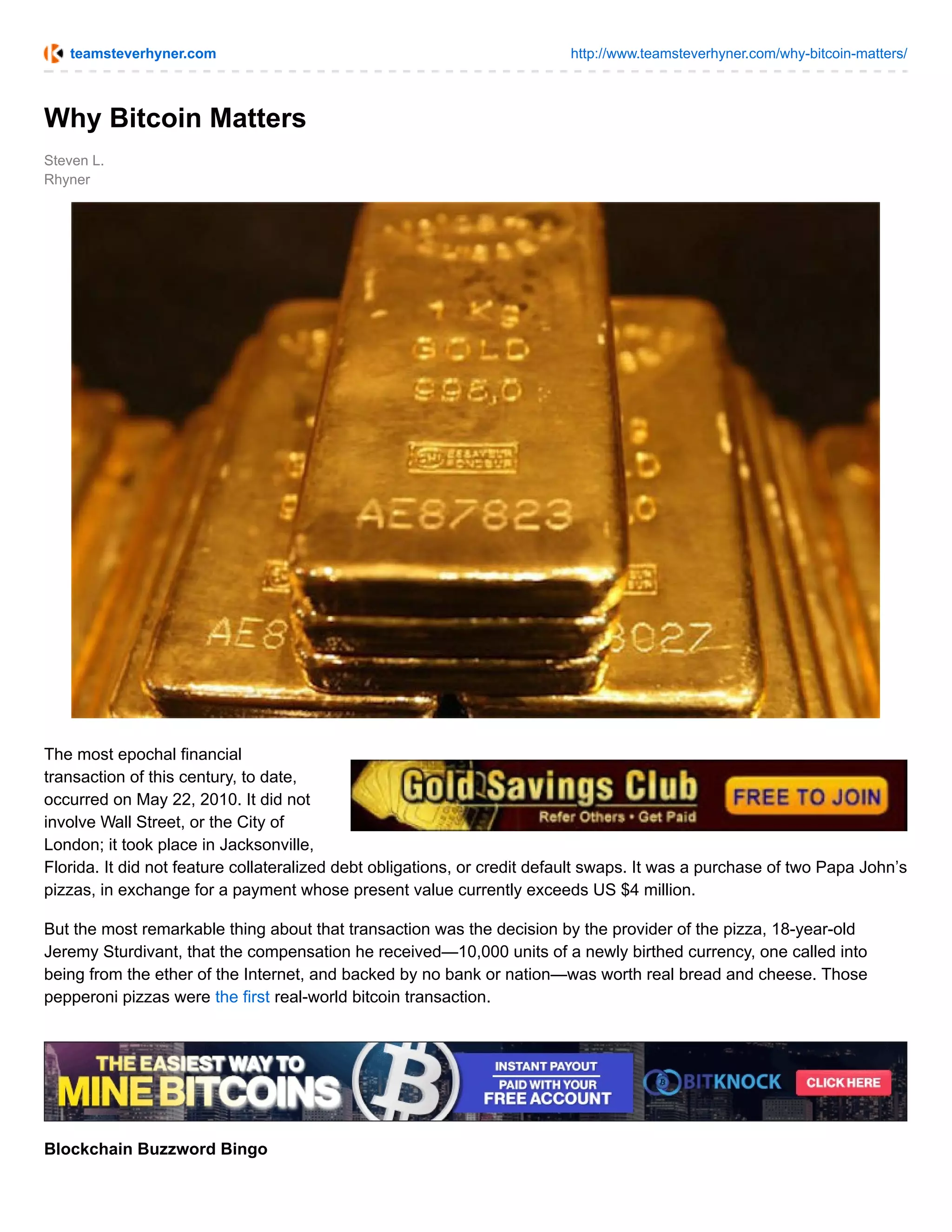
FEATURED IMAGE: AGNICO-EAGLE/WIKIMEDIA COMMONS UNDER A CC0 1.0 UNIVERSAL PUBLIC DOMAIN LICENSE
Share this post and help spread the love!
Thank you for reading my posts! If you would like to connect, reach out to me on
Facebook.

Why Bitcoin Matters

  • 1.
    teamsteverhyner.com http://www.teamsteverhyner.com/why-bitcoin-matters/ Steven L. Rhyner WhyBitcoin Matters The most epochal financial transaction of this century, to date, occurred on May 22, 2010. It did not involve Wall Street, or the City of London; it took place in Jacksonville, Florida. It did not feature collateralized debt obligations, or credit default swaps. It was a purchase of two Papa John’s pizzas, in exchange for a payment whose present value currently exceeds US $4 million. But the most remarkable thing about that transaction was the decision by the provider of the pizza, 18-year-old Jeremy Sturdivant, that the compensation he received—10,000 units of a newly birthed currency, one called into being from the ether of the Internet, and backed by no bank or nation—was worth real bread and cheese. Those pepperoni pizzas were the first real-world bitcoin transaction. Blockchain Buzzword Bingo
  • 2.
    It has becomede rigueur over the last year to speak approvingly of blockchains, the technology on which Bitcoin is built, and dismissively of Bitcoin itself. The Financial Timeswrites breathlessly about banks “racing to harness the power of the blockchain.” Forbes enthuses: “everyone seems to agree that the technology will disrupt financial services.” But Bitcoin itself? It’s the weird sister, the ugly stepchild, the player to be named later. One gets the distinct sense that everyone would feel better if it would just go away. To software engineers like me, this all seems very strange and surreal. A blockchain is just a data structure. A fascinating and powerful one, granted, but not revolutionary in and of itself. Imagine headlines extolling “linked-list startups” or proclaiming “B-trees will transform banking.” Aren’t we supposed to be the ones who confuse interesting technology with valuable applications? Allow me to suggest a heretical thought, a violation of the new conventional wisdom. What if Bitcoin is more important than the blockchain? What if decentralized, permissionless Bitcoin is to financial-services blockchains almost exactly what the Internet was to corporate intranets twenty years ago? The Bitcoin Mistake Why is bitcoin valuable? For the same reason that gold is valuable. Why is gold valuable? Not for itself. Those who speak of “the gold standard” as if its worth were axiomatic, rather than a collective hallucination, forget that the value of an ounce of gold is vastly more imputed than intrinsic. If we valued gold only for its shine, malleability, and conductivity, it would be worth much less. What has made gold so valuable over so many centuries is that it is good at being valuable, something which, it turns out, is extraordinarily difficult. Gold is hard to counterfeit; easy to refine, merge, subdivide, and transport; and exceedingly scarce. (All the gold ever minedwould not fill four Olympic-sized swimming pools.) It is these attributes, and only these attributes, which make gold an effective medium of exchange, unit of account, and store of value … or, more succinctly, money. Please note that Bitcoin meets all of these criteria, too, in spades. Cypherpunk alchemists have quested for the digital equivalent of gold for decades. Now that it has been discovered, we expect ordinary people to understand its significance. This is a mistake. Most people shouldn’t use bitcoin. They don’t use gold. They have no need (yet) for “smart contracts,” Bitcoin’s most original and interesting aspect. The only reason for an ordinary person to use bitcoin in their day-to-day life is if they have been betrayed by their nation and its currency. But that doesn’t mean Bitcoin doesn’t matter. Because every so often, even ordinary people catch a glimpse of the rusting, sputtering, 20th-century machinery beneath the sleek facade of the global financial system, and Bitcoin is poised to do to that system what the Internet did to long-distance telephone calls. Unglobalized The steampunk inadequacy of that system is most apparent when we travel. Have you ever had to transfer money internationally, and been whacked with both a sizable fee and a terrible exchange rate? Have you ever tried to understand why such transfers take many hours or even several days, when ATMs function instantaneously? …And then, when you douse an international ATM, have you found yourself paying five-dollar fees, on top of evenworse
  • 3.
    exchange rates? It getsworse. Have you ever encountered people who cannot use their debit cards outside of their own nation? Have you ever been to a country where the overwhelming majority of the population is unbanked? Have you ever had to change money on the black market? Have you ever left a country and found yourself with a fistful of currency that was essentially worthless, unexchangeable, once you left its border behind? Have you ever had to deal with export controls, or hyperinflation? I’ve seen all of these things–I’ve spent many months traveling in the developing world–and I’ve seen how billions of people have to deal with them. (Both China and India impose currency controls. The World Bank estimates that the planet’s 250 million international migrants remitted $583 billion in 2014.) Do you know what essentially immunizes you from all of the above? Gold. And, increasingly, bitcoin. What’s more, bitcoin can do many things that gold can’t … like travel across the world, from one person to another, with no intermediaries, in a matter of minutes. Killer Apps Perhaps the financial industry will, in its infinite wisdom, build a blockchain killer app. I don’t rule it out. But it seems very strange to ignore the fact that one already exists, and has quite literally created $6 billion of value out of nothing. So I’m not particularly interested in most big-bank or corporate-consortium blockchain initiatives, or other applications that claim to be revolutionary because they use a particular data structure. (I am interested in genuinely transformative initiatives such as Ethereum, but that is far more than just a blockchain.) Nor am I interested in applications which expect ordinary people to use bitcoin. What I am interested in are applications which seek to use Bitcoin to supplant our sclerotic, duct-taped global financial plumbing. Freemit, headed by TechCrunch’s own John Biggs. Align Commerce, funded by Kleiner Perkins. Blockstream, a company devoted to broadening the bounds of all things bitcoin, and the first iteration of their fascinating sidechains initiative. Don’t look to big banks’ blockchain initiatives for the future of payments. Look to startups like these. Re-posted from www.techcrunch.com January 2, 2016 by Jon Evans This is a very good article explaining Bitcoin and its possibilities as compared to what the author calls “our sclerotic, duct-taped global financial plumbing”. Well put Mr. Evans. Then there’s the opportunity to profit from Bitcoin and if you believe, as I do, that the financial system is due for a complete overall whether it includes Bitcoin or not and as such there could be trouble for those with dollar denominated assets. Consider mining Bitcoin and using 70% of the proceeds to purchase gold, silver or other hard assets to protect your portfolio when the coming changes occur. For more information click here. Or send me an email: steve@prplus.us FEATURED IMAGE: AGNICO-EAGLE/WIKIMEDIA COMMONS UNDER A CC0 1.0 UNIVERSAL PUBLIC DOMAIN LICENSE Share this post and help spread the love!
  • 4.
    Thank you forreading my posts! If you would like to connect, reach out to me on Facebook.