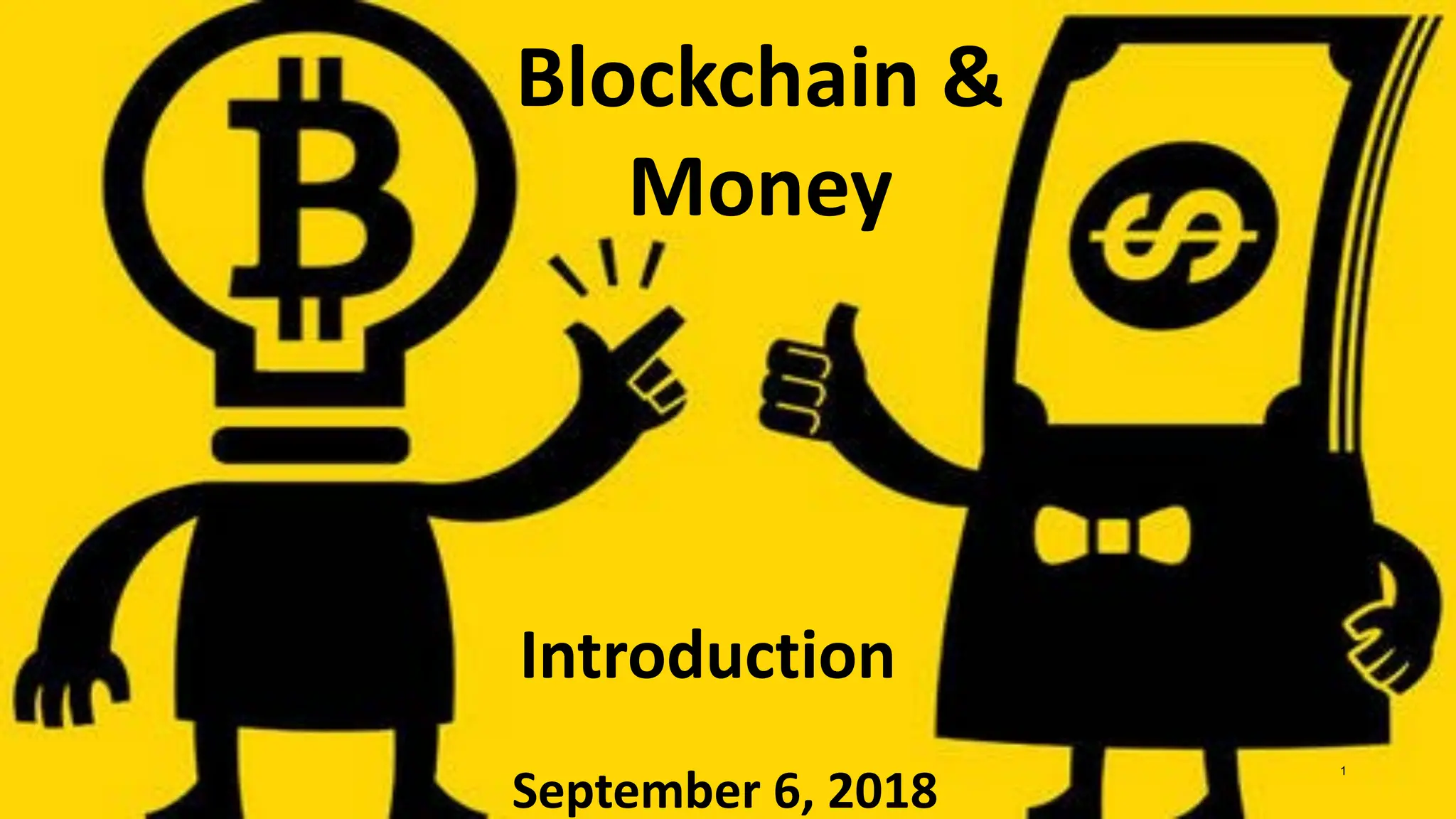
Blockchain &
Money
Introduction
September 6, 2018
1
Intro Class: Study Questions
• What is blockchain technology and why might it be a catalyst
for change for the financial sector?
• What you as a student wish to learn from this course,
‘Blockchain and Money’?
Note: This course has been selected by The MIT Golub Center
for Finance and Policy for recording. 2
Intro Class: Readings
• ‘How blockchain can solve the payments riddle’ Gensler
• ‘The blockchain catalyst for change’ Vox
3
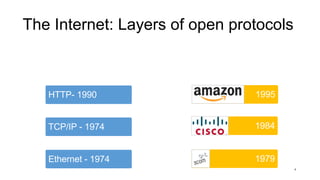
The Internet: Layers of open protocols
Ethernet - 1974
TCP/IP - 1974
HTTP- 1990
1979
1984
1995
4
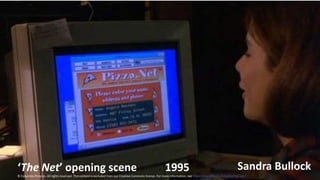
‘The Net’ opening scene 1995 Sandra Bullock
5
© Columbia Pictures. All rights reserved. This content is excluded from our Creative Commons license. For more information, see https://ocw.mit.edu/help/faq-fair-use/
5
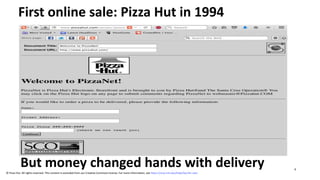
First online sale: Pizza Hut in 1994
But money changed hands with delivery
© Pizza Hut. All rights reserved. This content is excluded from our Creative Commons license. For more information, see https://ocw.mit.edu/help/faq-fair-use/
6
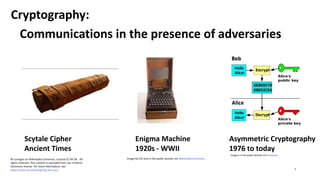
Cryptography:
Communications in the presence of adversaries
Scytale Cipher Enigma Machine Asymmetric Cryptography
Ancient Times 1920s - WWII 1976 to today
Image is in the public domain via Wikipedia.
© Luringen on Wikimedia Commons. License CC BY-SA. All Image by CIA and in the public domain via Wikimedia Commons.
rights reserved. This content is excluded from our Creative
Commons license. For more information, see
https://ocw.mit.edu/help/faq-fair-use/ 7
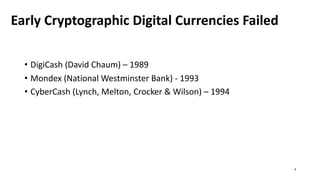
Early Cryptographic Digital Currencies Failed
• DigiCash (David Chaum) – 1989
• Mondex (National Westminster Bank) - 1993
• CyberCash (Lynch, Melton, Crocker & Wilson) – 1994
8
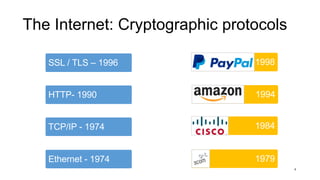
The Internet: Cryptographic protocols
Ethernet - 1974
TCP/IP - 1974
HTTP- 1990
SSL / TLS – 1996
1979
1984
1994
1998
9
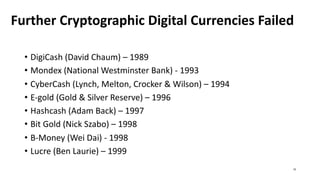
Further Cryptographic Digital Currencies Failed
• DigiCash (David Chaum) – 1989
• Mondex (National Westminster Bank) - 1993
• CyberCash (Lynch, Melton, Crocker & Wilson) – 1994
• E-gold (Gold & Silver Reserve) – 1996
• Hashcash (Adam Back) – 1997
• Bit Gold (Nick Szabo) – 1998
• B-Money (Wei Dai) - 1998
• Lucre (Ben Laurie) – 1999
10
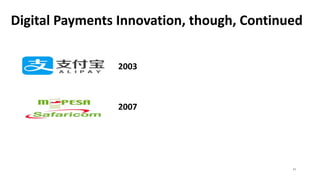
Digital Payments Innovation, though, Continued
2003
2007
11
The Riddle Remained
How to move value
peer-to-peer
without any
trusted central intermediary
12
Bitcoin: A Peer-to-Peer Electronic Cash System
•From: Satoshi Nakamoto <satoshi <at> vistomail.com>
Subject: Bitcoin P2P e-cash paper
Newsgroups: gmane.comp.encryption.general
Date: Friday 31st October 2008 18:10:00 UTC
•“I've been working on a new electronic cash system
that's fully peer-to-peer, with no trusted third party.”
13
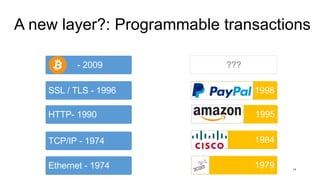
A new layer?: Programmable transactions
- 2009 ???
Ethernet - 1974
TCP/IP - 1974
HTTP- 1990
SSL / TLS - 1996
1979
1984
1995
1998
14
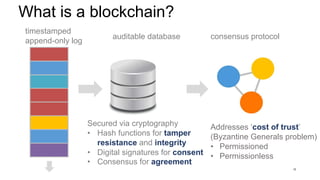
What is a blockchain?
timestamped
auditable database consensus protocol
append-only log
Secured via cryptography Addresses ‘cost of trust’
• Hash functions for tamper (Byzantine Generals problem)
resistance and integrity • Permissioned
• Digital signatures for consent • Permissionless
• Consensus for agreement
15
Pizza for bitcoins?
May 18, 2010, 12:35:20 AM
• “I'll pay 10,000 bitcoins for a couple of pizzas.. like maybe 2 large ones so I have some
left over for the next day. I like having left over pizza to nibble on later. You can make
the pizza yourself and bring it to my house or order it for me from a delivery place, but
what I'm aiming for is getting food delivered in exchange for bitcoins where I don't have
to order or prepare it myself, kind of like ordering a 'breakfast platter' at a hotel or
something, they just bring you something to eat and you're happy!
• I like things like onions, peppers, sausage, mushrooms, tomatoes, pepperoni, etc.. just
standard stuff no weird fish topping or anything like that. I also like regular cheese
pizzas which may be cheaper to prepare or otherwise acquire.
• If you're interested please let me know and we can work out a deal.
• Thanks,
Laszlo” 16
Re: Pizza for bitcoins?
May 21, 2010, 07:06:58 PM
• “So nobody wants to buy me pizza? Is the bitcoin amount I'm offering
too low?”
17
Re: Pizza for bitcoins?
May 22, 2010, 07:17:26 PM
• “I just want to report that I successfully traded 10,000 bitcoins for
pizza.
Pictures: http://heliacal.net/~solar/bitcoin/pizza/
Thanks jercos!”
18
Medium of Exchange:
10,000 Bitcoins for 2 Pizzas
• Value:
• May 22, 2010 - $41
• $20.50 per pizza
• September 5, 2018 - $66 million
• $33 million per pizza
19
Blockchain Technology
• Verifiably moves ‘data’ on a decentralized network
• The ‘data’ can represent value or computer code
• Thus it goes directly to the plumbing of the financial sector and money
• Broad adoption rests on addressing technical, commercial and public
policy hurdles
• It can be a catalyst for change in the world of finance and money
20
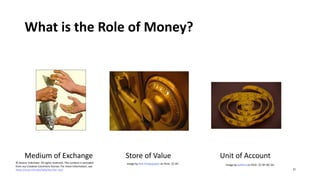
What is the Role of Money?
Medium of Exchange Store of Value Unit of Account
© Source Unknown. All rights reserved. This content is excluded
from our Creative Commons license. For more information, see
Image by Rob Pongsajapan on flickr. CC BY. Image by ajalfaro on flickr. CC BY-NC-SA.
https://ocw.mit.edu/help/faq-fair-use/ 21
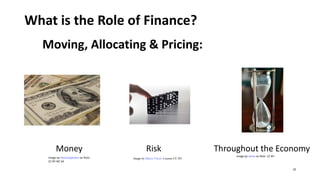
What is the Role of Finance?
Moving, Allocating & Pricing:
Money Throughout the Economy
Image by Jamie on flickr. CC BY.
Image by thomasjphotos on flickr.
CC BY-NC-SA
Risk
Image by Marco Verch. License CC BY
22
Financial Sector Challenges =>
Blockchain Potential Opportunities
• Repeated crises and instability
• Fiat currency instabilities associated with unsound policies
• Centralized intermediaries’ concentrate risks & economic rents
• Central Bank legacy payment systems
• Clearing & settlement costs & counterparty risks
• Financial inclusion
• Payment system costs: ½ - 1 % of Global GDP
• Financial sector costs: 7 ½ % of U.S. GDP 23
Financial Sector Issues with
Blockchain Technology
• Performance, Scalability, & Efficiency
• Privacy & Security
• Interoperability
• Governance
• Commercial Use Cases
• Public Policy & Legal Frameworks 24
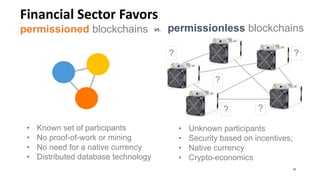
Financial Sector Favors
permissioned blockchains vs. permissionless blockchains
?
? ?
?
?
• Known set of participants • Unknown participants
• No proof-of-work or mining • Security based on incentives;
• No need for a native currency • Native currency
• Distributed database technology • Crypto-economics
25
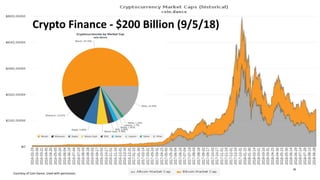
Crypto Finance - $200 Billion (9/5/18)
Courtesy of Coin Dance. Used with permission.
26
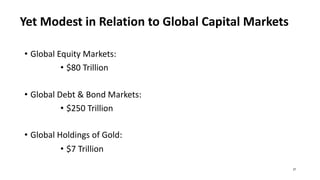
Yet Modest in Relation to Global Capital Markets
• Global Equity Markets:
• $80 Trillion
• Global Debt & Bond Markets:
• $250 Trillion
• Global Holdings of Gold:
• $7 Trillion
27
Public Policy Framework
•Guarding against Illicit Activity
•Financial Stability
•Protecting the Investing Public
28
The Duck Test
“When I see a bird that walks like a duck and
swims like a duck and quacks like a duck, I
call that bird a duck.”
James Whitcomb Riley, poet
29
Incumbents Eying Crypto Finance
• Crypto’s market cap, trading volume, volatility and spreads are drawing attention
• So has Coinbase’s 20 million accounts, about as many as Fidelity Investments, twice
Charles Schwab and nearly as many as Vanguard
• Startups more willing to beg for forgiveness while incumbents often need ask for
permission
• Incumbents interested to serve customer interest; gain a share of profits; & protect
their franchises
• Exchanges – CME; Eurex; Intercontinental Exchange; Nasdaq
• Asset Managers – Fidelity
• Investment Banks – Goldman Sachs 30
Financial Sector Potential Use Cases
• Payment Systems - Cross border, Large interbank, & Retail
• Central Bank Digital Currency & Private Sector Stable Value Tokens
• Secondary Market Trading – Crypto-exchanges & custody
• Venture Capital - Crowdfunding through Initial Coin Offerings
• Clearing, Settlement and Processing – Securities & Derivatives
• Trade Finance & Supply Chain - Digitizing paper-based processes
• Digital IDs and Data Reporting 31
Blockchain & Money 15.S12
• For those wishing to explore:
• Blockchain technology fundamentals
• Blockchain technology economics &
• Potential use to change the world of money and finance
• For those who wish to gain critical reasoning skills:
• Understanding the ‘ground truths’ of blockchain technology &
• Separate rigorous analysis from mere assertion and hype
32
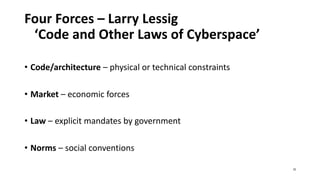
Four Forces – Larry Lessig
‘Code and Other Laws of Cyberspace’
• Code/architecture – physical or technical constraints
• Market – economic forces
• Law – explicit mandates by government
• Norms – social conventions
33
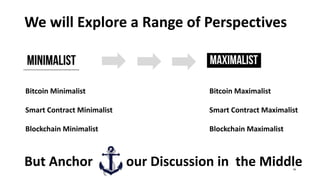
We will Explore a Range of Perspectives
Bitcoin Minimalist
Smart Contract Minimalist
Blockchain Minimalist
Bitcoin Maximalist
Smart Contract Maximalist
Blockchain Maximalist
But Anchor our Discussion in the Middle
34
Requirements
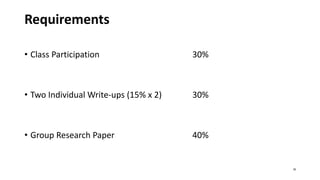
• Class Participation 30%
• Two Individual Write-ups (15% x 2) 30%
• Group Research Paper 40%
35
Act 1: Blockchain & Money Fundamentals
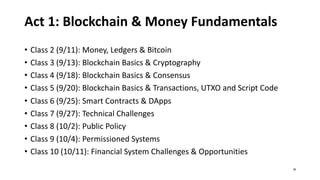
• Class 2 (9/11): Money, Ledgers & Bitcoin
• Class 3 (9/13): Blockchain Basics & Cryptography
• Class 4 (9/18): Blockchain Basics & Consensus
• Class 5 (9/20): Blockchain Basics & Transactions, UTXO and Script Code
• Class 6 (9/25): Smart Contracts & DApps
• Class 7 (9/27): Technical Challenges
• Class 8 (10/2): Public Policy
• Class 9 (10/4): Permissioned Systems
• Class 10 (10/11): Financial System Challenges & Opportunities
36
Act 2: Blockchain & Use Case Economics
• Class 11 (10/16): Blockchain Economics
• Class 12 (10/18): Assessing Use Cases
37
Act 3: Financial Sector Use Cases
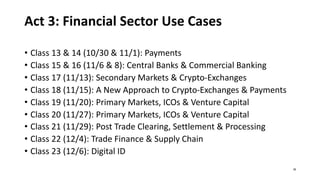
• Class 13 & 14 (10/30 & 11/1): Payments
• Class 15 & 16 (11/6 & 8): Central Banks & Commercial Banking
• Class 17 (11/13): Secondary Markets & Crypto-Exchanges
• Class 18 (11/15): A New Approach to Crypto-Exchanges & Payments
• Class 19 (11/20): Primary Markets, ICOs & Venture Capital
• Class 20 (11/27): Primary Markets, ICOs & Venture Capital
• Class 21 (11/29): Post Trade Clearing, Settlement & Processing
• Class 22 (12/4): Trade Finance & Supply Chain
• Class 23 (12/6): Digital ID
38
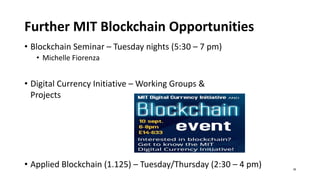
Further MIT Blockchain Opportunities
• Blockchain Seminar – Tuesday nights (5:30 – 7 pm)
• Michelle Fiorenza
• Digital Currency Initiative – Working Groups &
Projects
• Applied Blockchain (1.125) – Tuesday/Thursday (2:30 – 4 pm) 39
Class 2 (9/11): Study Questions
• What do the roles and characteristics of money mean historically and
in today’s digital economy?
• What is fiat currency, what are its ledgers and how it fits within the
history of money?
• How does Bitcoin fit within the history of money, the emergence of
the Internet and failed attempts of cryptographic payment systems?
40
Class 2 (9/11): Readings
• ’Conflict reigns over the history and origins of money’ Science News
• ‘A Brief History of Money’ IEEE Spectrum
• ‘What is Money? An Artist’s Make and Take’ Wall Street Journal video
• ‘A Brief History of Ledgers’ LLFOURN, Medium
• ‘Bitcoin and Cryptocurrency Technologies, Preface — The Long Road to
Bitcoin’ Clark (pages 3 – 21)
• ‘Bitcoin P2P e-cash paper’ Nakamoto (cover e-mail only)
41
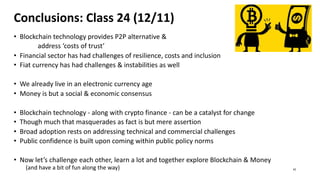
Conclusions: Class 24 (12/11)
• Blockchain technology provides P2P alternative &
address ‘costs of trust’
• Financial sector has had challenges of resilience, costs and inclusion
• Fiat currency has had challenges & instabilities as well
• We already live in an electronic currency age
• Money is but a social & economic consensus
• Blockchain technology - along with crypto finance - can be a catalyst for change
• Though much that masquerades as fact is but mere assertion
• Broad adoption rests on addressing technical and commercial challenges
• Public confidence is built upon coming within public policy norms
• Now let’s challenge each other, learn a lot and together explore Blockchain & Money
(and have a bit of fun along the way) 42
MIT OpenCourseWare
https://ocw.mit.edu/
15.S12 Blockchain and Money
Fall 2018
For information about citing these materials or our Terms of Use, visit: https://ocw.mit.edu/terms.
43

Blockchain & Money MIT from MIT courses.

  • 1.
  • 2.
    Intro Class: StudyQuestions • What is blockchain technology and why might it be a catalyst for change for the financial sector? • What you as a student wish to learn from this course, ‘Blockchain and Money’? Note: This course has been selected by The MIT Golub Center for Finance and Policy for recording. 2
  • 3.
    Intro Class: Readings •‘How blockchain can solve the payments riddle’ Gensler • ‘The blockchain catalyst for change’ Vox 3
  • 4.
    The Internet: Layersof open protocols Ethernet - 1974 TCP/IP - 1974 HTTP- 1990 1979 1984 1995 4
  • 5.
    ‘The Net’ openingscene 1995 Sandra Bullock 5 © Columbia Pictures. All rights reserved. This content is excluded from our Creative Commons license. For more information, see https://ocw.mit.edu/help/faq-fair-use/ 5
  • 6.
    First online sale:Pizza Hut in 1994 But money changed hands with delivery © Pizza Hut. All rights reserved. This content is excluded from our Creative Commons license. For more information, see https://ocw.mit.edu/help/faq-fair-use/ 6
  • 7.
    Cryptography: Communications in thepresence of adversaries Scytale Cipher Enigma Machine Asymmetric Cryptography Ancient Times 1920s - WWII 1976 to today Image is in the public domain via Wikipedia. © Luringen on Wikimedia Commons. License CC BY-SA. All Image by CIA and in the public domain via Wikimedia Commons. rights reserved. This content is excluded from our Creative Commons license. For more information, see https://ocw.mit.edu/help/faq-fair-use/ 7
  • 8.
    Early Cryptographic DigitalCurrencies Failed • DigiCash (David Chaum) – 1989 • Mondex (National Westminster Bank) - 1993 • CyberCash (Lynch, Melton, Crocker & Wilson) – 1994 8
  • 9.
    The Internet: Cryptographicprotocols Ethernet - 1974 TCP/IP - 1974 HTTP- 1990 SSL / TLS – 1996 1979 1984 1994 1998 9
  • 10.
    Further Cryptographic DigitalCurrencies Failed • DigiCash (David Chaum) – 1989 • Mondex (National Westminster Bank) - 1993 • CyberCash (Lynch, Melton, Crocker & Wilson) – 1994 • E-gold (Gold & Silver Reserve) – 1996 • Hashcash (Adam Back) – 1997 • Bit Gold (Nick Szabo) – 1998 • B-Money (Wei Dai) - 1998 • Lucre (Ben Laurie) – 1999 10
  • 11.
    Digital Payments Innovation,though, Continued 2003 2007 11
  • 12.
    The Riddle Remained Howto move value peer-to-peer without any trusted central intermediary 12
  • 13.
    Bitcoin: A Peer-to-PeerElectronic Cash System •From: Satoshi Nakamoto <satoshi <at> vistomail.com> Subject: Bitcoin P2P e-cash paper Newsgroups: gmane.comp.encryption.general Date: Friday 31st October 2008 18:10:00 UTC •“I've been working on a new electronic cash system that's fully peer-to-peer, with no trusted third party.” 13
  • 14.
    A new layer?:Programmable transactions - 2009 ??? Ethernet - 1974 TCP/IP - 1974 HTTP- 1990 SSL / TLS - 1996 1979 1984 1995 1998 14
  • 15.
    What is ablockchain? timestamped auditable database consensus protocol append-only log Secured via cryptography Addresses ‘cost of trust’ • Hash functions for tamper (Byzantine Generals problem) resistance and integrity • Permissioned • Digital signatures for consent • Permissionless • Consensus for agreement 15
  • 16.
    Pizza for bitcoins? May18, 2010, 12:35:20 AM • “I'll pay 10,000 bitcoins for a couple of pizzas.. like maybe 2 large ones so I have some left over for the next day. I like having left over pizza to nibble on later. You can make the pizza yourself and bring it to my house or order it for me from a delivery place, but what I'm aiming for is getting food delivered in exchange for bitcoins where I don't have to order or prepare it myself, kind of like ordering a 'breakfast platter' at a hotel or something, they just bring you something to eat and you're happy! • I like things like onions, peppers, sausage, mushrooms, tomatoes, pepperoni, etc.. just standard stuff no weird fish topping or anything like that. I also like regular cheese pizzas which may be cheaper to prepare or otherwise acquire. • If you're interested please let me know and we can work out a deal. • Thanks, Laszlo” 16
  • 17.
    Re: Pizza forbitcoins? May 21, 2010, 07:06:58 PM • “So nobody wants to buy me pizza? Is the bitcoin amount I'm offering too low?” 17
  • 18.
    Re: Pizza forbitcoins? May 22, 2010, 07:17:26 PM • “I just want to report that I successfully traded 10,000 bitcoins for pizza. Pictures: http://heliacal.net/~solar/bitcoin/pizza/ Thanks jercos!” 18
  • 19.
    Medium of Exchange: 10,000Bitcoins for 2 Pizzas • Value: • May 22, 2010 - $41 • $20.50 per pizza • September 5, 2018 - $66 million • $33 million per pizza 19
  • 20.
    Blockchain Technology • Verifiablymoves ‘data’ on a decentralized network • The ‘data’ can represent value or computer code • Thus it goes directly to the plumbing of the financial sector and money • Broad adoption rests on addressing technical, commercial and public policy hurdles • It can be a catalyst for change in the world of finance and money 20
  • 21.
    What is theRole of Money? Medium of Exchange Store of Value Unit of Account © Source Unknown. All rights reserved. This content is excluded from our Creative Commons license. For more information, see Image by Rob Pongsajapan on flickr. CC BY. Image by ajalfaro on flickr. CC BY-NC-SA. https://ocw.mit.edu/help/faq-fair-use/ 21
  • 22.
    What is theRole of Finance? Moving, Allocating & Pricing: Money Throughout the Economy Image by Jamie on flickr. CC BY. Image by thomasjphotos on flickr. CC BY-NC-SA Risk Image by Marco Verch. License CC BY 22
  • 23.
    Financial Sector Challenges=> Blockchain Potential Opportunities • Repeated crises and instability • Fiat currency instabilities associated with unsound policies • Centralized intermediaries’ concentrate risks & economic rents • Central Bank legacy payment systems • Clearing & settlement costs & counterparty risks • Financial inclusion • Payment system costs: ½ - 1 % of Global GDP • Financial sector costs: 7 ½ % of U.S. GDP 23
  • 24.
    Financial Sector Issueswith Blockchain Technology • Performance, Scalability, & Efficiency • Privacy & Security • Interoperability • Governance • Commercial Use Cases • Public Policy & Legal Frameworks 24
  • 25.
    Financial Sector Favors permissionedblockchains vs. permissionless blockchains ? ? ? ? ? • Known set of participants • Unknown participants • No proof-of-work or mining • Security based on incentives; • No need for a native currency • Native currency • Distributed database technology • Crypto-economics 25
  • 26.
    Crypto Finance -$200 Billion (9/5/18) Courtesy of Coin Dance. Used with permission. 26
  • 27.
    Yet Modest inRelation to Global Capital Markets • Global Equity Markets: • $80 Trillion • Global Debt & Bond Markets: • $250 Trillion • Global Holdings of Gold: • $7 Trillion 27
  • 28.
    Public Policy Framework •Guardingagainst Illicit Activity •Financial Stability •Protecting the Investing Public 28
  • 29.
    The Duck Test “WhenI see a bird that walks like a duck and swims like a duck and quacks like a duck, I call that bird a duck.” James Whitcomb Riley, poet 29
  • 30.
    Incumbents Eying CryptoFinance • Crypto’s market cap, trading volume, volatility and spreads are drawing attention • So has Coinbase’s 20 million accounts, about as many as Fidelity Investments, twice Charles Schwab and nearly as many as Vanguard • Startups more willing to beg for forgiveness while incumbents often need ask for permission • Incumbents interested to serve customer interest; gain a share of profits; & protect their franchises • Exchanges – CME; Eurex; Intercontinental Exchange; Nasdaq • Asset Managers – Fidelity • Investment Banks – Goldman Sachs 30
  • 31.
    Financial Sector PotentialUse Cases • Payment Systems - Cross border, Large interbank, & Retail • Central Bank Digital Currency & Private Sector Stable Value Tokens • Secondary Market Trading – Crypto-exchanges & custody • Venture Capital - Crowdfunding through Initial Coin Offerings • Clearing, Settlement and Processing – Securities & Derivatives • Trade Finance & Supply Chain - Digitizing paper-based processes • Digital IDs and Data Reporting 31
  • 32.
    Blockchain & Money15.S12 • For those wishing to explore: • Blockchain technology fundamentals • Blockchain technology economics & • Potential use to change the world of money and finance • For those who wish to gain critical reasoning skills: • Understanding the ‘ground truths’ of blockchain technology & • Separate rigorous analysis from mere assertion and hype 32
  • 33.
    Four Forces –Larry Lessig ‘Code and Other Laws of Cyberspace’ • Code/architecture – physical or technical constraints • Market – economic forces • Law – explicit mandates by government • Norms – social conventions 33
  • 34.
    We will Explorea Range of Perspectives Bitcoin Minimalist Smart Contract Minimalist Blockchain Minimalist Bitcoin Maximalist Smart Contract Maximalist Blockchain Maximalist But Anchor our Discussion in the Middle 34
  • 35.
    Requirements • Class Participation30% • Two Individual Write-ups (15% x 2) 30% • Group Research Paper 40% 35
  • 36.
    Act 1: Blockchain& Money Fundamentals • Class 2 (9/11): Money, Ledgers & Bitcoin • Class 3 (9/13): Blockchain Basics & Cryptography • Class 4 (9/18): Blockchain Basics & Consensus • Class 5 (9/20): Blockchain Basics & Transactions, UTXO and Script Code • Class 6 (9/25): Smart Contracts & DApps • Class 7 (9/27): Technical Challenges • Class 8 (10/2): Public Policy • Class 9 (10/4): Permissioned Systems • Class 10 (10/11): Financial System Challenges & Opportunities 36
  • 37.
    Act 2: Blockchain& Use Case Economics • Class 11 (10/16): Blockchain Economics • Class 12 (10/18): Assessing Use Cases 37
  • 38.
    Act 3: FinancialSector Use Cases • Class 13 & 14 (10/30 & 11/1): Payments • Class 15 & 16 (11/6 & 8): Central Banks & Commercial Banking • Class 17 (11/13): Secondary Markets & Crypto-Exchanges • Class 18 (11/15): A New Approach to Crypto-Exchanges & Payments • Class 19 (11/20): Primary Markets, ICOs & Venture Capital • Class 20 (11/27): Primary Markets, ICOs & Venture Capital • Class 21 (11/29): Post Trade Clearing, Settlement & Processing • Class 22 (12/4): Trade Finance & Supply Chain • Class 23 (12/6): Digital ID 38
  • 39.
    Further MIT BlockchainOpportunities • Blockchain Seminar – Tuesday nights (5:30 – 7 pm) • Michelle Fiorenza • Digital Currency Initiative – Working Groups & Projects • Applied Blockchain (1.125) – Tuesday/Thursday (2:30 – 4 pm) 39
  • 40.
    Class 2 (9/11):Study Questions • What do the roles and characteristics of money mean historically and in today’s digital economy? • What is fiat currency, what are its ledgers and how it fits within the history of money? • How does Bitcoin fit within the history of money, the emergence of the Internet and failed attempts of cryptographic payment systems? 40
  • 41.
    Class 2 (9/11):Readings • ’Conflict reigns over the history and origins of money’ Science News • ‘A Brief History of Money’ IEEE Spectrum • ‘What is Money? An Artist’s Make and Take’ Wall Street Journal video • ‘A Brief History of Ledgers’ LLFOURN, Medium • ‘Bitcoin and Cryptocurrency Technologies, Preface — The Long Road to Bitcoin’ Clark (pages 3 – 21) • ‘Bitcoin P2P e-cash paper’ Nakamoto (cover e-mail only) 41
  • 42.
    Conclusions: Class 24(12/11) • Blockchain technology provides P2P alternative & address ‘costs of trust’ • Financial sector has had challenges of resilience, costs and inclusion • Fiat currency has had challenges & instabilities as well • We already live in an electronic currency age • Money is but a social & economic consensus • Blockchain technology - along with crypto finance - can be a catalyst for change • Though much that masquerades as fact is but mere assertion • Broad adoption rests on addressing technical and commercial challenges • Public confidence is built upon coming within public policy norms • Now let’s challenge each other, learn a lot and together explore Blockchain & Money (and have a bit of fun along the way) 42
  • 43.
    MIT OpenCourseWare https://ocw.mit.edu/ 15.S12 Blockchainand Money Fall 2018 For information about citing these materials or our Terms of Use, visit: https://ocw.mit.edu/terms. 43