Designing Complex Systems
Karen Cham
Digital Transformation Design Consultant
Rhizometric Design Ltd www.rhizometricdesign.com
Professor of Digital Transformation Design
Academic Lead, Digital Catapult Centre Brighton
Academic Lead, Connected Futures
University of Brighton
Digital Transformation Design
DTD is a digital first, design lead, user centred
industrial method for engineering transformation of
complex human centred systems e.g.
• multi-platform global marketing campaigns
• large organizational infrastructures
• multiplatform markets & distibuted economies
• virtual worlds & simulations
Gen X Digital Grandma
• 1994 Website
• 1994 Touchscreen
• 1996 Microbusiness Model
• 1996 Live Locative Game
• 1997 AI
• 1998 Pan European Website PS2
• 1998 Interactive TV
• 1999 Sprint0 etc
Technical Experience
Sectors & Clients
my skillset is domain agnostic and I have
worked across the public, private and third
sectors, including :
• technology
• media & entertainment
• arts & heritage
• education & training
• health & wellbeing
• public sector & local government
• national & inter/national security & defence
Simultaneously
• design and build digital artefacts
• develop digital production methods
• establish digital business, management and migration models
• devise transformational strategies
Defining Complexity
Complex or Complicated ?
In popular dialogues, describing a
system as 'complex' is often the
point of resignation, inferring that
the system cannot be sufficiently
described, predicted nor
managed
• transport networks
• management infrastructure
• supply chain logistics
2007 Cham, K.L. and Johnson, J.H., ‘Complexity Theory; a Science of
Cultural Systems?’, ‘M/C Journal’, Complex, 10: 3, J. Cahir and S. James
(eds.), http://journal.media-culture.org.au/0706/08-cham-johnson.php
In socio-cultural terms 'complex' is
used to describe those humanistic
systems that are
‘intricate, involved, complicated,
dynamic, multi-dimensional,
interconnected systems [such as]
transnational citizenship,
communities, identities, multiple
belongings, overlapping geographies
and competing histories’
(Cahir & Johnson, 2004)
Complex or Messy ?
Complex Systems Science
The study of complex systems is very interdisciplinary and encompasses
more than one theoretical framework, and has arisen from work in :
• artificial intelligence and robotics research
• thermodynamics
• biology
• sociology
• physics
• economics
• law
Complex Systems Theory
Complexity theory grew out of
General Systems Theory, an holistic
approach to analysis that views
whole systems based upon :
• the links and interactions between
the component parts
• their relationship to each other
• the environment within they exists
General Systems Theory
Bertalanfys 1969 ‘General Systems Theory’
allows us to have a common theoretical
perspective on diverse types of systems
such as :
• the mechanical systems of a car engine
• the biological system of a human heart
• the social systems of a school
(Bertalanfly, 1969)
Mother of All Models
Systems Thinking
More broadly, ‘‘systems thinking’ is best recognised as a dialectical
method that breaks with logical and causal analyses to emphasize
relationships within a whole
It can be traced from Socrates through Hegel to pragmatics as a
means of identifying systemic principles common to different
‘systems’ from different perspectives
Design is ’The Science of the Artificial’ Herbert Simon (1969)
“Professional designers are masters of complexity. They create systems that did not
previously exist, creating new knowledge about those systems. They deal with clients
who don't know what they want or what is possible within their constraints. They know
about system parts and the processes that can assemble parts to form new wholes with
desirable emergent properties. They know about regulations and deal with regulators and
authorities. They forecast and manage costs in the face of great uncertainty.”
Some designed system are complicated but do not have the hallmark features of complexity
Standing On The Shoulders of Giants
Professor George Rzevski is an academic,
entrepreneur and consultant. He is
Professor Emeritus, Department of Design
and Innovation at The Open University,
Milton Keynes, UK and Visiting Professor of
Multi-Agent Systems at Cologne University
of Applied Sciences, Germany and
Moratuwa University, Colombo, Sri Lanka,
where he is involved in a number of
advanced research projects in the fields of
Complexity and Multi-Agent Systems.
Professor Nigel Cross is a British academic, a design
researcher and educator, Emeritus Professor of Design
Studies at The Open University and Editor-in-Chief of
the journal Design Studies. He is one of the founder
members of the Design Research Society In 1982 Cross
published a journal article 'Designerly Ways of
Knowing',[7] drawing on design research to show
Design as having its own intellectual and practical
culture as a basis for education, and contrasting it with
cultures of Science and Arts and Humanities,
culminating in the book Design Thinking (2011).[9]
Founder & Director, Complexity Research Group,
London School of Economics & Political Science,
London, UK; Senior Fellow in LSE IDEAS, Centre for the
Study of International Affairs, Diplomacy & Grand
Strategy; Visiting Professor at the Open University.
Member of the World Economic Forum Global Agenda
Council on Complex Systems (2012-2014). British Civil
Service, Department of Trade & Industry (1967-1983)
UK and international policy and negotiation of EU
Directives
Logical Causalities
Systems theory stands in stark contrast to
conventional science which, based upon
Descartes’s reductionism, aims to analyse
systems by reducing phenomena to its
component parts (Wilson, 1998)
Reductionism is most easily understood in the
context of the ‘natural sciences’ where the
nature of complicated phenomena is
understood by reducing them to a more
fundamental form, for example,
matter >molecule>atom>nucleus
Management, Communication, Logistics & Production
Pipelines
Top Down, Mass Communications
Siloes
An Industrial Manufacturing Model
Linear Business Models
Convergence
agile, human centred eco-systems that are in constant flux
the convergence of telecommunications, television and computing means
Non Linear Eco-Systems
companies that don’t adapt find that
digital disrupts livelihoods, marketplaces and economies
Pivot..Or Not
Complex Systems Attributes (Mittleton-Kelly, 2003)
• self-organisation (autopoeisis)
• emergence
• interdependence
• feedback
• space of possibilities
• co-evolving
• creation of new order
Embracing Comlexity in Design
• ‘Embracing Complexity in Design’ (ECiD) is a research project funded
by EPSRC(Engineering and Physical Sciences Research Council) and AHRC (Arts
and Humanities Research Council) under the ‘Designing for the 21st Century’
initiative. ECiD is a unique research programme with the objective of
understanding the part played by complexity science in design, and increasingly,
the potential for design to play a major role in the emerging science of complex
systems.
• In June 2007, a three day event was convened, in collaboration with the
University of Brighton, to explore the question of what contribution the arts
might make to the science of complex systems. An international, interdisciplinary
group of artists, scientists, mathematicians, musicians, poets and performers
were invited to explore the question from an academic research perspective and
were given an open opportunity to describe, present, install, perform, screen,
sing or dance their response to the brief below for open debate.
The Art of Complexity
• Complex systems are generally diverse and made up of multiple
interconnected elements. They are adaptive in that they have the capacity
to change and learn from events. The scientific study of complex adaptive
systems encompasses more than one theoretical framework and is highly
interdisciplinary, seeking the answers to some fundamental questions
about living, adaptable, changeable systems.
• Art is interpreted in its widest sense. It includes diverse media, from
painting to music and dance, from digital art to poetry and theatre, from
sculpture to opera and photography. There are precedents for exploring
interactions between art and science, and many art works can be viewed as
complex systems. For this event the specific question concerns the science
of complexity systems. Can art generate new ideas and help to solve
problems? Can give means of communicating complexity? Can art provide
new methods of scientific inquiry? Can art … ?
Disruptors
small catalysts can cause
large changes and that a
change in one area of a
system can adversely affect
another area of the system eg
The Jyllands-
Posten Muhammad cartoons
controversy (2006) to Charlie
Hebdo (2016)
A fairly straightforward Arabic writing of the name “Muhammad,”
accompanied, in much smaller letters, by the formula that typically follows
mention of his name by devout Muslims: “Blessings and peace be upon him”
Biomimesis
‘language is of the
universe, like galaxies and
eco-systems, it
participates in what it
represents’
Between Science and
Literature: AN
INTRODUCTION TO
AUTOPOETICS (2005)
Ira Livingston
A Little Light Reading
‘Reconstruction Theory, Designing the Space of
Possibility in Complex Media’ (2007)
in Special Issue: Performance Play: Technologies of presence in performance, gaming & experience design, International Journal of
Performance Arts & Digital Media, Vol 2&3: 3, Lizbeth Goodman, Deverill, Esther MacCallum-Stewart & Alec Robertson (eds),
Intellect http://www.tandfonline.com/doi/abs/10.1386/padm.3.2-3.253_1?journalCode=rpdm20
• A digital interface may, for example, allow multiple ‘authors’ and
multiple ‘readers’ to participate in a simultaneous and instantaneous
reproduction and dissemination of their divergent interpretations of
an artifact as part of a networked participatory process
• ‘reconstruction theory’ - a design methodology for the ‘space of
possibility’ in ‘complex media’
‘Reality Jamming; Beyond Complex Causality in
Mediated Systems’(2008)
2008 Cham,K.L., ISEA 08, Singapore http://www.isea2008singapore.org/abstract/i-l/p338.html
It is clear through experience that there is some significant relationship between
media representations and cultural effects. Yet as practice leads theory through the
sheer velocity of technological change, experience outstrips theoretical
understanding of the relationship between the sign and the signified, the
simulation and the social, the model and the real
The proliferation of digital media means it is increasingly important to
understand interaction per se, especially the interaction between systems of
signification and the real
…all representational systems have a performative capacity for transformation of
the real and that signification is a dynamic intermediate realm between the real
and the conceptual
‘The Art of Complex Systems Science’ (2009)
• 2009 Cham, KL., In: Alexiou, Katerina , Johnson, Jeffrey and Zamenopoulos, Theodore, (eds.) Embracing Complexity in
Design. Abingdon, U.K.: Routledge. pp. 121-‐142 http://www.routledge.com/books/details/9780415497008/
The scientific study of complex systems encompasses more than one
theoretical framework, as it is has had to be highly interdisciplinary in
seeking answers to fundamental questions about adaptable,
changeable systems.
This paper aims to set out the proposal that a post-structuralist
approach can deliver ontological bases that will provide complex
systems science not simply with diagrams and maps, nor even with the
workable metaphors of visualisation, simulation and embodiment but
with visualisability; that most elusive and 'scientific' of representations
that shares a generative semantic relation with that which it represents
‘Architecture of the Image’ (2011)
2011 Cham, K.L., Electronic Visualisation in the Arts, EVA Conferences International, British Computer Society,
London http://ewic.bcs.org/content/ConWebDoc/40614
as the abstractions of synergetic brand architectures and designed
identity systems are used more and more to underpin user
experiences, a type of distributed, networked, ‘cloud semantics’ can be
recognised as the soft engineering of participatory semantic systems,
where the emergent actual behaviours are the intentional result of
generating metaphoric ‘virtual’ avatars for us all to involuntarily inhabit
as part of the natural ‘autopoetics’ of the digital age
‘A Semiotic Systems Approach to User
Experience Design’ (2012)
• 2012 Cham, K.L., 1st International Conference on Semiotics & Visual Communication, the Department of Multimedia and Graphic Arts, Cyprus University of
Technology, Cyprus http://www.cut.ac.cy/icsvc/
This paper argues that the designer must successfully integrate visual
communication design, information architecture and usability by
purposefully designing for semiotic autopoesis
a fundamental dialectic between structure and function must be
designed into the system and its use
This proposal requires good UX designers to design
diachronic grammatical structures that can adapt and
evolve whilst consistently providing a coherent
synchronic experience under multitudinous variables
Good user experience design ..requires
designers to paint with language and
leave it wet
Designing Complexity
analysis of the whole nested system
your brand, your company, your marketplace, your product or service and value chain
defining the users, user stories and user journeys
your individual employees, clients, prospects and shareholders
understanding contexts, deployments and situations
how all this pans out in deployment, in micro and macro contexts including legal, geographical, social, technical
Complex Dive
existing behaviours, both socio-cultural and digital
such as in communications, manually taking minutes; using SAP, texting colleagues, CRMs, water cooler moments
stakeholders review and modelling complex relationships
between staff, managers, shareholders, partners, investors, collaborators, clients, prospects etc
holistic review of micro and macro interdependencies
systems analysis of ‘butterfly effect’ small to large /large to small scale dependencies
Complex Mapping
current and future opportunities and threats across the marketplace
future facing marketplace review isolating potential for dynamic change
current strengths and weaknesses of competitors
full competitor review, analysis and benchmarking of key competitors
aims & functionalities of all touchpoints
how your current and future touchpoints, internal and external, micro and macro perform in context
Micros and Macros
isolate the opportunities for change, both socio-cultural and technical
recommendations on embedding engagement and motivation
define the digital transformation blueprint
taking an agile, quick and dirty approach to picking up on the most dynamic points for quick and yet strategic wins
design and build of the bespoke digital intervention feedback loop
bespoke intervention that scrapes data from key touchpoints and accelerates migration towards full transformation
Designing The Space of Possibility
IoT FOG, AR/VR & 5G
Internet/Cloud/Servers
Core
Network/Routers/regional
Access Edge Nodes
(neighbourhood)
Gateway CPE
(building street)
Endpoint / Things
What makes sense of all the ‘things’ ?
Internet/Cloud/Servers
Core Network/Routers/regional
Access Edge Nodes
(neighbourhood)
Gateway CPE
(building street)
Endpoint / Things
INTERFACE
USER
CUX in the FOG/AR/VR
Realtime,
Connected and a
Responsive
Feedback loop,
driven by an
intelligent
architecture
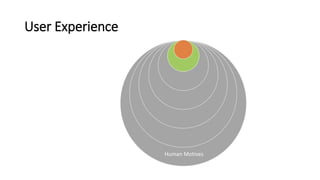
Users Experience
User Experience
Human Motives
Value Mechanics
Consumer as Producer; Value
Mechanics in Digital Transformation
Design, Process, Practice and
Outcomes
in 'Cultural Policy, Innovation and the
Creative
Economy', Palgrave McMillan http://
www.palgrave.com/de/book/978134
9951116
R&D into cognitive UX patterns, data driven behaviour change
and how we might enable navigation by instinct in immersive
and mixed realities
23rd November, Marylebone

Designing Complex Systems - Karen Cham

  • 1.
    Designing Complex Systems KarenCham Digital Transformation Design Consultant Rhizometric Design Ltd www.rhizometricdesign.com
  • 2.
    Professor of DigitalTransformation Design Academic Lead, Digital Catapult Centre Brighton Academic Lead, Connected Futures University of Brighton
  • 3.
    Digital Transformation Design DTDis a digital first, design lead, user centred industrial method for engineering transformation of complex human centred systems e.g. • multi-platform global marketing campaigns • large organizational infrastructures • multiplatform markets & distibuted economies • virtual worlds & simulations
  • 4.
    Gen X DigitalGrandma • 1994 Website • 1994 Touchscreen • 1996 Microbusiness Model • 1996 Live Locative Game • 1997 AI • 1998 Pan European Website PS2 • 1998 Interactive TV • 1999 Sprint0 etc
  • 5.
  • 6.
    Sectors & Clients myskillset is domain agnostic and I have worked across the public, private and third sectors, including : • technology • media & entertainment • arts & heritage • education & training • health & wellbeing • public sector & local government • national & inter/national security & defence
  • 7.
    Simultaneously • design andbuild digital artefacts • develop digital production methods • establish digital business, management and migration models • devise transformational strategies
  • 8.
  • 9.
    Complex or Complicated? In popular dialogues, describing a system as 'complex' is often the point of resignation, inferring that the system cannot be sufficiently described, predicted nor managed • transport networks • management infrastructure • supply chain logistics 2007 Cham, K.L. and Johnson, J.H., ‘Complexity Theory; a Science of Cultural Systems?’, ‘M/C Journal’, Complex, 10: 3, J. Cahir and S. James (eds.), http://journal.media-culture.org.au/0706/08-cham-johnson.php
  • 10.
    In socio-cultural terms'complex' is used to describe those humanistic systems that are ‘intricate, involved, complicated, dynamic, multi-dimensional, interconnected systems [such as] transnational citizenship, communities, identities, multiple belongings, overlapping geographies and competing histories’ (Cahir & Johnson, 2004) Complex or Messy ?
  • 11.
    Complex Systems Science Thestudy of complex systems is very interdisciplinary and encompasses more than one theoretical framework, and has arisen from work in : • artificial intelligence and robotics research • thermodynamics • biology • sociology • physics • economics • law
  • 12.
    Complex Systems Theory Complexitytheory grew out of General Systems Theory, an holistic approach to analysis that views whole systems based upon : • the links and interactions between the component parts • their relationship to each other • the environment within they exists
  • 13.
    General Systems Theory Bertalanfys1969 ‘General Systems Theory’ allows us to have a common theoretical perspective on diverse types of systems such as : • the mechanical systems of a car engine • the biological system of a human heart • the social systems of a school (Bertalanfly, 1969)
  • 14.
  • 15.
    Systems Thinking More broadly,‘‘systems thinking’ is best recognised as a dialectical method that breaks with logical and causal analyses to emphasize relationships within a whole It can be traced from Socrates through Hegel to pragmatics as a means of identifying systemic principles common to different ‘systems’ from different perspectives
  • 16.
    Design is ’TheScience of the Artificial’ Herbert Simon (1969) “Professional designers are masters of complexity. They create systems that did not previously exist, creating new knowledge about those systems. They deal with clients who don't know what they want or what is possible within their constraints. They know about system parts and the processes that can assemble parts to form new wholes with desirable emergent properties. They know about regulations and deal with regulators and authorities. They forecast and manage costs in the face of great uncertainty.” Some designed system are complicated but do not have the hallmark features of complexity
  • 17.
    Standing On TheShoulders of Giants Professor George Rzevski is an academic, entrepreneur and consultant. He is Professor Emeritus, Department of Design and Innovation at The Open University, Milton Keynes, UK and Visiting Professor of Multi-Agent Systems at Cologne University of Applied Sciences, Germany and Moratuwa University, Colombo, Sri Lanka, where he is involved in a number of advanced research projects in the fields of Complexity and Multi-Agent Systems. Professor Nigel Cross is a British academic, a design researcher and educator, Emeritus Professor of Design Studies at The Open University and Editor-in-Chief of the journal Design Studies. He is one of the founder members of the Design Research Society In 1982 Cross published a journal article 'Designerly Ways of Knowing',[7] drawing on design research to show Design as having its own intellectual and practical culture as a basis for education, and contrasting it with cultures of Science and Arts and Humanities, culminating in the book Design Thinking (2011).[9] Founder & Director, Complexity Research Group, London School of Economics & Political Science, London, UK; Senior Fellow in LSE IDEAS, Centre for the Study of International Affairs, Diplomacy & Grand Strategy; Visiting Professor at the Open University. Member of the World Economic Forum Global Agenda Council on Complex Systems (2012-2014). British Civil Service, Department of Trade & Industry (1967-1983) UK and international policy and negotiation of EU Directives
  • 18.
    Logical Causalities Systems theorystands in stark contrast to conventional science which, based upon Descartes’s reductionism, aims to analyse systems by reducing phenomena to its component parts (Wilson, 1998) Reductionism is most easily understood in the context of the ‘natural sciences’ where the nature of complicated phenomena is understood by reducing them to a more fundamental form, for example, matter >molecule>atom>nucleus
  • 19.
  • 20.
    Top Down, MassCommunications
  • 21.
  • 22.
    An Industrial ManufacturingModel Linear Business Models
  • 23.
  • 24.
    agile, human centredeco-systems that are in constant flux the convergence of telecommunications, television and computing means
  • 25.
  • 26.
    companies that don’tadapt find that digital disrupts livelihoods, marketplaces and economies
  • 27.
  • 28.
    Complex Systems Attributes(Mittleton-Kelly, 2003) • self-organisation (autopoeisis) • emergence • interdependence • feedback • space of possibilities • co-evolving • creation of new order
  • 29.
    Embracing Comlexity inDesign • ‘Embracing Complexity in Design’ (ECiD) is a research project funded by EPSRC(Engineering and Physical Sciences Research Council) and AHRC (Arts and Humanities Research Council) under the ‘Designing for the 21st Century’ initiative. ECiD is a unique research programme with the objective of understanding the part played by complexity science in design, and increasingly, the potential for design to play a major role in the emerging science of complex systems. • In June 2007, a three day event was convened, in collaboration with the University of Brighton, to explore the question of what contribution the arts might make to the science of complex systems. An international, interdisciplinary group of artists, scientists, mathematicians, musicians, poets and performers were invited to explore the question from an academic research perspective and were given an open opportunity to describe, present, install, perform, screen, sing or dance their response to the brief below for open debate.
  • 30.
    The Art ofComplexity • Complex systems are generally diverse and made up of multiple interconnected elements. They are adaptive in that they have the capacity to change and learn from events. The scientific study of complex adaptive systems encompasses more than one theoretical framework and is highly interdisciplinary, seeking the answers to some fundamental questions about living, adaptable, changeable systems. • Art is interpreted in its widest sense. It includes diverse media, from painting to music and dance, from digital art to poetry and theatre, from sculpture to opera and photography. There are precedents for exploring interactions between art and science, and many art works can be viewed as complex systems. For this event the specific question concerns the science of complexity systems. Can art generate new ideas and help to solve problems? Can give means of communicating complexity? Can art provide new methods of scientific inquiry? Can art … ?
  • 32.
    Disruptors small catalysts cancause large changes and that a change in one area of a system can adversely affect another area of the system eg The Jyllands- Posten Muhammad cartoons controversy (2006) to Charlie Hebdo (2016) A fairly straightforward Arabic writing of the name “Muhammad,” accompanied, in much smaller letters, by the formula that typically follows mention of his name by devout Muslims: “Blessings and peace be upon him”
  • 33.
    Biomimesis ‘language is ofthe universe, like galaxies and eco-systems, it participates in what it represents’ Between Science and Literature: AN INTRODUCTION TO AUTOPOETICS (2005) Ira Livingston
  • 34.
  • 35.
    ‘Reconstruction Theory, Designingthe Space of Possibility in Complex Media’ (2007) in Special Issue: Performance Play: Technologies of presence in performance, gaming & experience design, International Journal of Performance Arts & Digital Media, Vol 2&3: 3, Lizbeth Goodman, Deverill, Esther MacCallum-Stewart & Alec Robertson (eds), Intellect http://www.tandfonline.com/doi/abs/10.1386/padm.3.2-3.253_1?journalCode=rpdm20 • A digital interface may, for example, allow multiple ‘authors’ and multiple ‘readers’ to participate in a simultaneous and instantaneous reproduction and dissemination of their divergent interpretations of an artifact as part of a networked participatory process • ‘reconstruction theory’ - a design methodology for the ‘space of possibility’ in ‘complex media’
  • 36.
    ‘Reality Jamming; BeyondComplex Causality in Mediated Systems’(2008) 2008 Cham,K.L., ISEA 08, Singapore http://www.isea2008singapore.org/abstract/i-l/p338.html It is clear through experience that there is some significant relationship between media representations and cultural effects. Yet as practice leads theory through the sheer velocity of technological change, experience outstrips theoretical understanding of the relationship between the sign and the signified, the simulation and the social, the model and the real The proliferation of digital media means it is increasingly important to understand interaction per se, especially the interaction between systems of signification and the real …all representational systems have a performative capacity for transformation of the real and that signification is a dynamic intermediate realm between the real and the conceptual
  • 37.
    ‘The Art ofComplex Systems Science’ (2009) • 2009 Cham, KL., In: Alexiou, Katerina , Johnson, Jeffrey and Zamenopoulos, Theodore, (eds.) Embracing Complexity in Design. Abingdon, U.K.: Routledge. pp. 121-‐142 http://www.routledge.com/books/details/9780415497008/ The scientific study of complex systems encompasses more than one theoretical framework, as it is has had to be highly interdisciplinary in seeking answers to fundamental questions about adaptable, changeable systems. This paper aims to set out the proposal that a post-structuralist approach can deliver ontological bases that will provide complex systems science not simply with diagrams and maps, nor even with the workable metaphors of visualisation, simulation and embodiment but with visualisability; that most elusive and 'scientific' of representations that shares a generative semantic relation with that which it represents
  • 38.
    ‘Architecture of theImage’ (2011) 2011 Cham, K.L., Electronic Visualisation in the Arts, EVA Conferences International, British Computer Society, London http://ewic.bcs.org/content/ConWebDoc/40614 as the abstractions of synergetic brand architectures and designed identity systems are used more and more to underpin user experiences, a type of distributed, networked, ‘cloud semantics’ can be recognised as the soft engineering of participatory semantic systems, where the emergent actual behaviours are the intentional result of generating metaphoric ‘virtual’ avatars for us all to involuntarily inhabit as part of the natural ‘autopoetics’ of the digital age
  • 39.
    ‘A Semiotic SystemsApproach to User Experience Design’ (2012) • 2012 Cham, K.L., 1st International Conference on Semiotics & Visual Communication, the Department of Multimedia and Graphic Arts, Cyprus University of Technology, Cyprus http://www.cut.ac.cy/icsvc/ This paper argues that the designer must successfully integrate visual communication design, information architecture and usability by purposefully designing for semiotic autopoesis a fundamental dialectic between structure and function must be designed into the system and its use
  • 40.
    This proposal requiresgood UX designers to design diachronic grammatical structures that can adapt and evolve whilst consistently providing a coherent synchronic experience under multitudinous variables
  • 41.
    Good user experiencedesign ..requires designers to paint with language and leave it wet
  • 42.
  • 43.
    analysis of thewhole nested system your brand, your company, your marketplace, your product or service and value chain defining the users, user stories and user journeys your individual employees, clients, prospects and shareholders understanding contexts, deployments and situations how all this pans out in deployment, in micro and macro contexts including legal, geographical, social, technical Complex Dive
  • 44.
    existing behaviours, bothsocio-cultural and digital such as in communications, manually taking minutes; using SAP, texting colleagues, CRMs, water cooler moments stakeholders review and modelling complex relationships between staff, managers, shareholders, partners, investors, collaborators, clients, prospects etc holistic review of micro and macro interdependencies systems analysis of ‘butterfly effect’ small to large /large to small scale dependencies Complex Mapping
  • 45.
    current and futureopportunities and threats across the marketplace future facing marketplace review isolating potential for dynamic change current strengths and weaknesses of competitors full competitor review, analysis and benchmarking of key competitors aims & functionalities of all touchpoints how your current and future touchpoints, internal and external, micro and macro perform in context Micros and Macros
  • 46.
    isolate the opportunitiesfor change, both socio-cultural and technical recommendations on embedding engagement and motivation define the digital transformation blueprint taking an agile, quick and dirty approach to picking up on the most dynamic points for quick and yet strategic wins design and build of the bespoke digital intervention feedback loop bespoke intervention that scrapes data from key touchpoints and accelerates migration towards full transformation Designing The Space of Possibility
  • 47.
    IoT FOG, AR/VR& 5G Internet/Cloud/Servers Core Network/Routers/regional Access Edge Nodes (neighbourhood) Gateway CPE (building street) Endpoint / Things What makes sense of all the ‘things’ ?
  • 48.
    Internet/Cloud/Servers Core Network/Routers/regional Access EdgeNodes (neighbourhood) Gateway CPE (building street) Endpoint / Things INTERFACE USER
  • 49.
    CUX in theFOG/AR/VR Realtime, Connected and a Responsive Feedback loop, driven by an intelligent architecture Users Experience
  • 50.
  • 51.
    Value Mechanics Consumer asProducer; Value Mechanics in Digital Transformation Design, Process, Practice and Outcomes in 'Cultural Policy, Innovation and the Creative Economy', Palgrave McMillan http:// www.palgrave.com/de/book/978134 9951116
  • 53.
    R&D into cognitiveUX patterns, data driven behaviour change and how we might enable navigation by instinct in immersive and mixed realities 23rd November, Marylebone