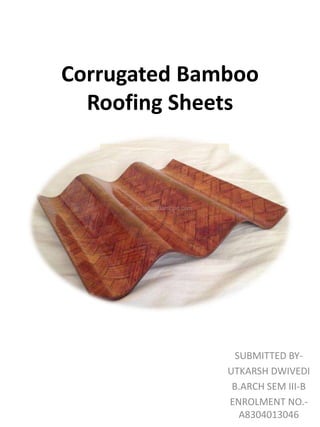
Corrugated Bamboo 
Roofing Sheets 
SUBMITTED BY-UTKARSH 
DWIVEDI 
B.ARCH SEM III-B 
ENROLMENT NO.- 
A8304013046
What are Corrugated Bamboo 
Roofing Sheets? 
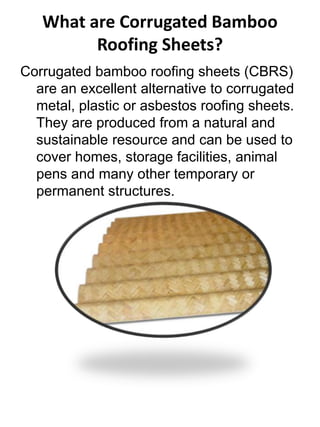
Corrugated bamboo roofing sheets (CBRS) 
are an excellent alternative to corrugated 
metal, plastic or asbestos roofing sheets. 
They are produced from a natural and 
sustainable resource and can be used to 
cover homes, storage facilities, animal 
pens and many other temporary or 
permanent structures.
How are Corrugated Bamboo 
Roofing Sheets Made? 
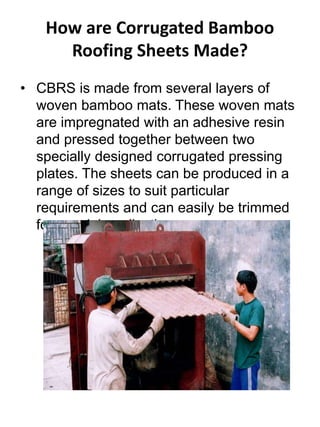
• CBRS is made from several layers of 
woven bamboo mats. These woven mats 
are impregnated with an adhesive resin 
and pressed together between two 
specially designed corrugated pressing 
plates. The sheets can be produced in a 
range of sizes to suit particular 
requirements and can easily be trimmed 
for special applications.
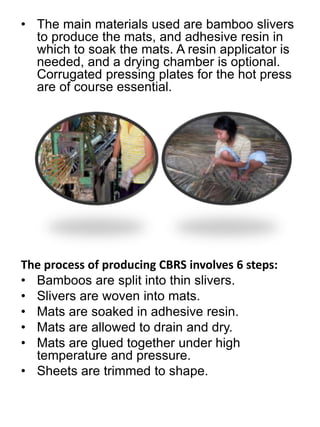
• The main materials used are bamboo slivers 
to produce the mats, and adhesive resin in 
which to soak the mats. A resin applicator is 
needed, and a drying chamber is optional. 
Corrugated pressing plates for the hot press 
are of course essential. 
The process of producing CBRS involves 6 steps: 
• Bamboos are split into thin slivers. 
• Slivers are woven into mats. 
• Mats are soaked in adhesive resin. 
• Mats are allowed to drain and dry. 
• Mats are glued together under high 
temperature and pressure. 
• Sheets are trimmed to shape.
PRECAUTION 
• An important precaution to be taken in 
making mats for BMCS production is that 
slivers with the glossy (epidermal) layer 
should be avoided as they are resistant to 
bonding. Such slivers can however be 
used in basketry etc. 
• The moisture content (m.c) of freshly 
woven mats is in the range of 40% -50%. 
On drying them in sun, the m.c is 
generally about 12% - 15%. If transport 
and or storage is more than one month it 
is advisable to undertake prophylactic 
treatment. The simplest and significantly 
effective treatment for mats, provided 
they are not exposed to drying, is 
spraying with 1% solution of mixture of 
boric acid and borax in the ratio of 1:1. 
Spraying can be done by hand or 
knapsack sprayer. This will not have any 
adverse effect on bonding. The mats 
should be dried after prophylactic
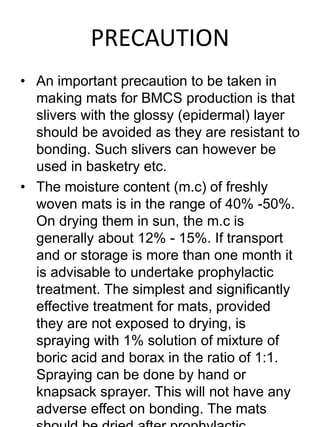
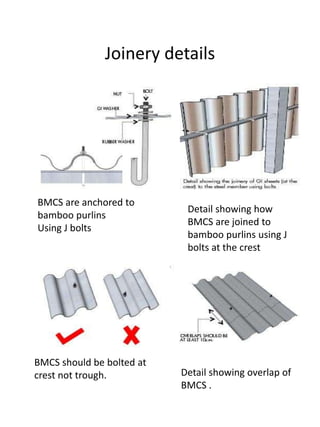
Joinery details 
BMCS are anchored to 
bamboo purlins 
Using J bolts 
Detail showing how 
BMCS are joined to 
bamboo purlins using J 
bolts at the crest 
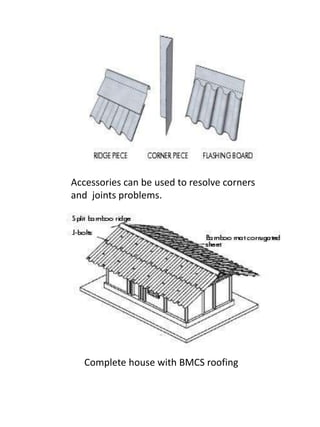
BMCS should be bolted at 
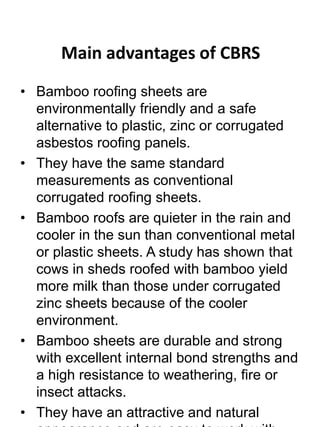
crest not trough. Detail showing overlap of 
BMCS .
Accessories can be used to resolve corners 
and joints problems. 
Complete house with BMCS roofing
Main advantages of CBRS 
• Bamboo roofing sheets are 
environmentally friendly and a safe 
alternative to plastic, zinc or corrugated 
asbestos roofing panels. 
• They have the same standard 
measurements as conventional 
corrugated roofing sheets. 
• Bamboo roofs are quieter in the rain and 
cooler in the sun than conventional metal 
or plastic sheets. A study has shown that 
cows in sheds roofed with bamboo yield 
more milk than those under corrugated 
zinc sheets because of the cooler 
environment. 
• Bamboo sheets are durable and strong 
with excellent internal bond strengths and 
a high resistance to weathering, fire or 
insect attacks. 
• They have an attractive and natural 
appearance and are easy to work with
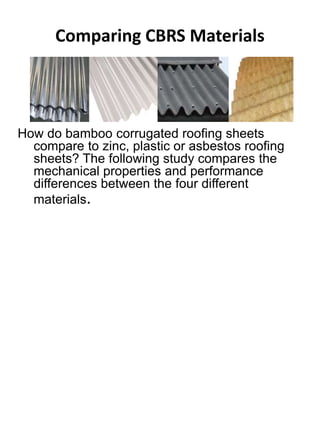
Comparing CBRS Materials 
How do bamboo corrugated roofing sheets 
compare to zinc, plastic or asbestos roofing 
sheets? The following study compares the 
mechanical properties and performance 
differences between the four different 
materials.
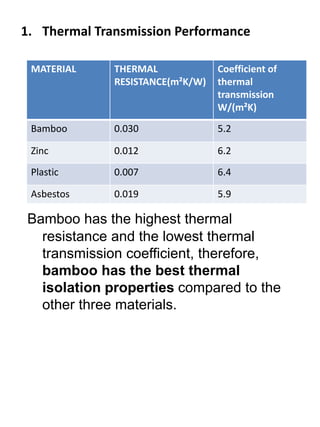
1. Thermal Transmission Performance 
MATERIAL THERMAL 
RESISTANCE(m²K/W) 
Coefficient of 
thermal 
transmission 
W/(m²K) 
Bamboo 0.030 5.2 
Zinc 0.012 6.2 
Plastic 0.007 6.4 
Asbestos 0.019 5.9 
Bamboo has the highest thermal 
resistance and the lowest thermal 
transmission coefficient, therefore, 
bamboo has the best thermal 
isolation properties compared to the 
other three materials.
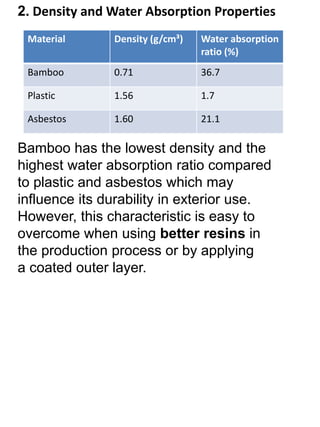
2. Density and Water Absorption Properties 
Material Density (g/cm³) Water absorption 
ratio (%) 
Bamboo 0.71 36.7 
Plastic 1.56 1.7 
Asbestos 1.60 21.1 
Bamboo has the lowest density and the 
highest water absorption ratio compared 
to plastic and asbestos which may 
influence its durability in exterior use. 
However, this characteristic is easy to 
overcome when using better resins in 
the production process or by applying 
a coated outer layer.
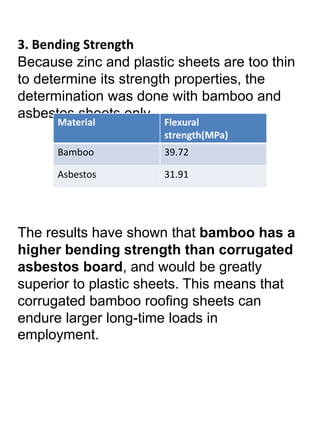
3. Bending Strength 
Because zinc and plastic sheets are too thin 
to determine its strength properties, the 
determination was done with bamboo and 
asbestos sheets only. 
Material Flexural 
strength(MPa) 
Bamboo 39.72 
Asbestos 31.91 
The results have shown that bamboo has a 
higher bending strength than corrugated 
asbestos board, and would be greatly 
superior to plastic sheets. This means that 
corrugated bamboo roofing sheets can 
endure larger long-time loads in 
employment.
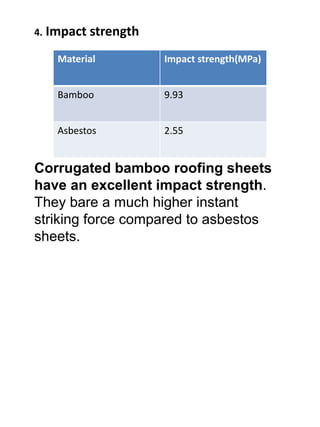
4. Impact strength 
Material Impact strength(MPa) 
Bamboo 9.93 
Asbestos 2.55 
Corrugated bamboo roofing sheets 
have an excellent impact strength. 
They bare a much higher instant 
striking force compared to asbestos 
sheets.
Building Materials & Technology 
Promotion Council (BMTPC) 
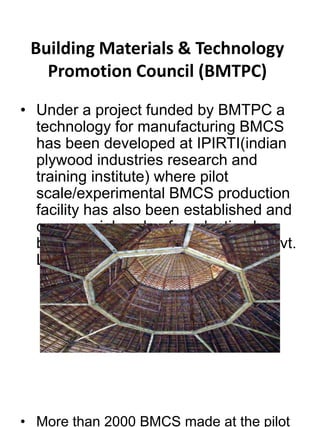
• Under a project funded by BMTPC a 
technology for manufacturing BMCS 
has been developed at IPIRTI(indian 
plywood industries research and 
training institute) where pilot 
scale/experimental BMCS production 
facility has also been established and 
commercial scale of production has 
been established at M/s. Timpack Pvt. 
Ltd., Byrnihat, Meghalaya. 
• More than 2000 BMCS made at the pilot
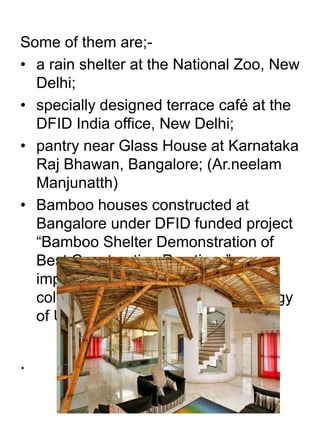
Some of them are;- 
• a rain shelter at the National Zoo, New 
Delhi; 
• specially designed terrace café at the 
DFID India office, New Delhi; 
• pantry near Glass House at Karnataka 
Raj Bhawan, Bangalore; (Ar.neelam 
Manjunatth) 
• Bamboo houses constructed at 
Bangalore under DFID funded project 
“Bamboo Shelter Demonstration of 
Best Construction Practices” 
implemented by IPIRTI in 
collaboration with TRADA Technology 
of UK. 
.

Corrugated bamboo roofing sheets

  • 1.
    Corrugated Bamboo RoofingSheets SUBMITTED BY-UTKARSH DWIVEDI B.ARCH SEM III-B ENROLMENT NO.- A8304013046
  • 2.
    What are CorrugatedBamboo Roofing Sheets? Corrugated bamboo roofing sheets (CBRS) are an excellent alternative to corrugated metal, plastic or asbestos roofing sheets. They are produced from a natural and sustainable resource and can be used to cover homes, storage facilities, animal pens and many other temporary or permanent structures.
  • 3.
    How are CorrugatedBamboo Roofing Sheets Made? • CBRS is made from several layers of woven bamboo mats. These woven mats are impregnated with an adhesive resin and pressed together between two specially designed corrugated pressing plates. The sheets can be produced in a range of sizes to suit particular requirements and can easily be trimmed for special applications.
  • 4.
    • The mainmaterials used are bamboo slivers to produce the mats, and adhesive resin in which to soak the mats. A resin applicator is needed, and a drying chamber is optional. Corrugated pressing plates for the hot press are of course essential. The process of producing CBRS involves 6 steps: • Bamboos are split into thin slivers. • Slivers are woven into mats. • Mats are soaked in adhesive resin. • Mats are allowed to drain and dry. • Mats are glued together under high temperature and pressure. • Sheets are trimmed to shape.
  • 5.
    PRECAUTION • Animportant precaution to be taken in making mats for BMCS production is that slivers with the glossy (epidermal) layer should be avoided as they are resistant to bonding. Such slivers can however be used in basketry etc. • The moisture content (m.c) of freshly woven mats is in the range of 40% -50%. On drying them in sun, the m.c is generally about 12% - 15%. If transport and or storage is more than one month it is advisable to undertake prophylactic treatment. The simplest and significantly effective treatment for mats, provided they are not exposed to drying, is spraying with 1% solution of mixture of boric acid and borax in the ratio of 1:1. Spraying can be done by hand or knapsack sprayer. This will not have any adverse effect on bonding. The mats should be dried after prophylactic
  • 6.
    Joinery details BMCSare anchored to bamboo purlins Using J bolts Detail showing how BMCS are joined to bamboo purlins using J bolts at the crest BMCS should be bolted at crest not trough. Detail showing overlap of BMCS .
  • 7.
    Accessories can beused to resolve corners and joints problems. Complete house with BMCS roofing
  • 8.
    Main advantages ofCBRS • Bamboo roofing sheets are environmentally friendly and a safe alternative to plastic, zinc or corrugated asbestos roofing panels. • They have the same standard measurements as conventional corrugated roofing sheets. • Bamboo roofs are quieter in the rain and cooler in the sun than conventional metal or plastic sheets. A study has shown that cows in sheds roofed with bamboo yield more milk than those under corrugated zinc sheets because of the cooler environment. • Bamboo sheets are durable and strong with excellent internal bond strengths and a high resistance to weathering, fire or insect attacks. • They have an attractive and natural appearance and are easy to work with
  • 9.
    Comparing CBRS Materials How do bamboo corrugated roofing sheets compare to zinc, plastic or asbestos roofing sheets? The following study compares the mechanical properties and performance differences between the four different materials.
  • 10.
    1. Thermal TransmissionPerformance MATERIAL THERMAL RESISTANCE(m²K/W) Coefficient of thermal transmission W/(m²K) Bamboo 0.030 5.2 Zinc 0.012 6.2 Plastic 0.007 6.4 Asbestos 0.019 5.9 Bamboo has the highest thermal resistance and the lowest thermal transmission coefficient, therefore, bamboo has the best thermal isolation properties compared to the other three materials.
  • 11.
    2. Density andWater Absorption Properties Material Density (g/cm³) Water absorption ratio (%) Bamboo 0.71 36.7 Plastic 1.56 1.7 Asbestos 1.60 21.1 Bamboo has the lowest density and the highest water absorption ratio compared to plastic and asbestos which may influence its durability in exterior use. However, this characteristic is easy to overcome when using better resins in the production process or by applying a coated outer layer.
  • 12.
    3. Bending Strength Because zinc and plastic sheets are too thin to determine its strength properties, the determination was done with bamboo and asbestos sheets only. Material Flexural strength(MPa) Bamboo 39.72 Asbestos 31.91 The results have shown that bamboo has a higher bending strength than corrugated asbestos board, and would be greatly superior to plastic sheets. This means that corrugated bamboo roofing sheets can endure larger long-time loads in employment.
  • 13.
    4. Impact strength Material Impact strength(MPa) Bamboo 9.93 Asbestos 2.55 Corrugated bamboo roofing sheets have an excellent impact strength. They bare a much higher instant striking force compared to asbestos sheets.
  • 14.
    Building Materials &Technology Promotion Council (BMTPC) • Under a project funded by BMTPC a technology for manufacturing BMCS has been developed at IPIRTI(indian plywood industries research and training institute) where pilot scale/experimental BMCS production facility has also been established and commercial scale of production has been established at M/s. Timpack Pvt. Ltd., Byrnihat, Meghalaya. • More than 2000 BMCS made at the pilot
  • 15.
    Some of themare;- • a rain shelter at the National Zoo, New Delhi; • specially designed terrace café at the DFID India office, New Delhi; • pantry near Glass House at Karnataka Raj Bhawan, Bangalore; (Ar.neelam Manjunatth) • Bamboo houses constructed at Bangalore under DFID funded project “Bamboo Shelter Demonstration of Best Construction Practices” implemented by IPIRTI in collaboration with TRADA Technology of UK. .