REINTERPRETING ETHICS AS PEDAGOGICAL REFERENCE: A META-SYNTHESIS
A Research Paper
Paper presentation on the occasion of the
2017 National Philosophy Conference
By:
WILSON TEMPORAL
GARRY TABUGON
April, 2017
ABSTRACT
Ethics as the ‘general inquiry into what is good’ poses some questions concerning what sort
of actions can bind humans. What constitutes ‘good’ or what is an unacceptable action in given
situation is tantamount in saying that the subject matter of Ethics is essential. Teaching Ethics in
College Education as a New General Education Core Course under the New Curriculum
explores some of the important theories on the constitution of what is an ethical action,
acceptable and binding in all societies which call for impartiality in decision making. In this
paper, the authors expose the course description of the new Ethics ‘which deals with principles
of ethical behavior in modern society at the level of the person, society, and interaction with the
environment and other shared resources (CMO 20 S 2013). The paper is organized according
to the three main themes of the reviewed studies: Ontological, Teleological, and Normative
background of Ethics, The Ethical Scrutiny, and Moral Pedagogy in Ethics.
Keywords: Reason, Will, Impartiality, Virtue Ethics, Ethical principles, Values, Morality, Moral
Dilemma
INTRODUCTION:
The subject matter of Ethics poses some questions in relation to answering moral
judgment, like ‘What is our criteria or standard of morality'?, 'What can account actions as ‘good’
and ‘right’ or ‘good’ as ‘pleasurable’ or ‘pleasurable’ as ‘good actions’?, 'Who has the right to
determine what is moral or ethical'?, 'With regard the applicability of an action, when can we
consider it as good or moral?, and the like.
Society’s morality calls for a standard which serves as a ‘guiding principle’ of all actions
which answers the question of what is ‘good’ and ‘right’ or ‘bad’ and ‘unacceptable’. Actions are
good or acceptable when they satisfy the standards or ethical codes of a society while they are
unacceptable when they fail to follow its principles, though these principles or ethical codes are
subject to question because they are either arbitrary or inspired by a god. Any social customs
which are free from arbitrary principles might be inspired by a divine command and when moral
actions are agreed by the many is also open to inquiry. Socrates presupposes this point when
he asked, “Is conduct right because the gods command it, or do the gods command it because
it is right?” (Rachels, 2003). If good actions are ‘good’ independent from a god then, what
constitutes such goodness?
Voluntary actions which are termed as ‘good’ or ‘right’ ‘bad’ or ‘evil’ are moral judgments
relative to ethical principles. This concerns philosophers to explore the constitution of the term
‘good’. They (Moral Philosophers) agree that the subject matter of Ethics is important not only in
the realm of building a moral society but also in answering the question on the purpose of life.
Hence, if human beings aim for something greater than all the luxuries of the material things to
which humans are aspiring, for example, the existence of high tech gadgets and sophisticated
stuffs, it reflects the modern times as some of the man’s longing of what they call as the modern
understanding of living life. The inclusion of what is a moral and ethical life has something to say
in defense of something greater than the world is offering. But a moral life or good life
constitutes a certain standard in Ethics which primarily based on the notion of ‘good’ actions.
The complicity of these terms understood as ‘good’ is in need of justification if we are to
highlight the subject matter of Ethics. The problem is that moral philosophers and their Ethical
principles sometimes disagree on the contention of what is ‘good’.
For Plato, the account of ‘good’, as it manifests from beauty and goodness of one’s soul
through the recollection of the previous knowledge (the knowledge from the world of forms as
Plato viewed it) on the immutability of the eternal, is that actions should conform to what is fitting
to the rationality of a human being. Aristotle, on the other hand, gives importance on the values
of knowledge in becoming a virtuous but he goes beyond by emphasizing that being moral is
when one knows that an action is appropriate to a given situation.
Immanuel Kant believes that moral consideration necessitates the existence of freedom
otherwise, the subject matter of morality will be in vain, in effect, if god’s commands are rational,
it should be upon the realization of self-determination and determined by one’s rationality,
because human beings are rational, therefore, they should act rationally. This now advances the
understanding of moral actions in which only voluntary ones are moral, whereas involuntary
actions cannot be considered as moral because of the absence of freedom. Jeremy Bentham,
as well, thinks that actions can be viewed as acceptable when it produces the greatest
happiness of all or when it produces the greatest quantity of happiness to everyone who is
concerned or affected by an action. An action as a means of the desired goal is ‘good’
regardless of its intention that it contends. An action is evil or bad when it produces greatest
suffering or pain to all who are directly or indirectly affected by an action.
So what is now the stand of what is morally acceptable? Who among the moral
philosophers or Ethicists should be considered as most reliable (if needed to ask such
question)? Or which Ethical Principles are worth considering? This research aims to shed light
to the educators who intend to teach Ethics as a new General Education Core Course in
College in the Philippine educational system.
Research Objectives/Questions:
Generally, this paper aimed to meta-synthesize the concepts and interpretations on ethics
as framework reference for the teaching of Ethics as a new General Education core course in
college.
Specifically, it sought to answer the following questions:
1. What are the themes of the reviewed studies?
2. What interpretations can be made on the themes in the reviewed studies?
3. What theory can be developed in the light of the themes and interpretations of the
reviewed studies?
This study made use of meta-synthesis method which is defined as an intentional and
coherent approach to analyzing data across qualitative studies. In this paper, it became a
process reference for the researchers to search for, select, appraise, summarize, and combine
qualitative evidence to address the research question on what and how should teaching of
Ethics be like as new General Education core course offered in college. This paper covered a
range of meta-synthesis methods including critical interpretive synthesis and thematic analysis.
Although this is not a new research approach in other fields, the authors suggest that it can offer
a promising practice in arriving at a theory development in Teaching of Ethics as a new General
Education core subject in college.
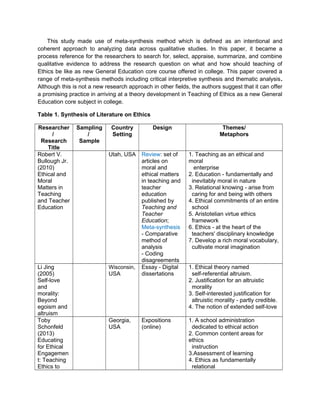
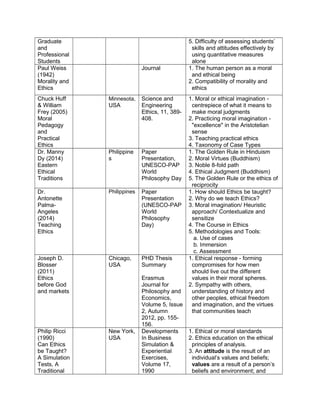
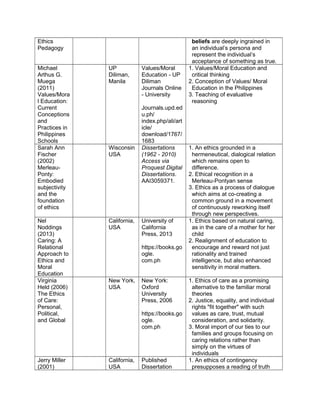
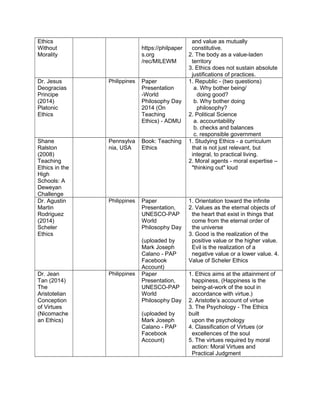
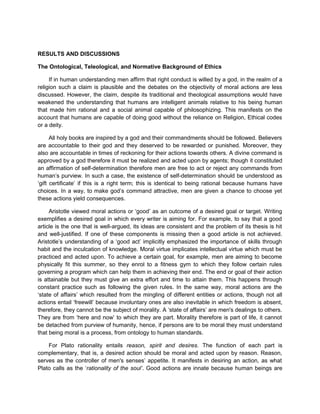
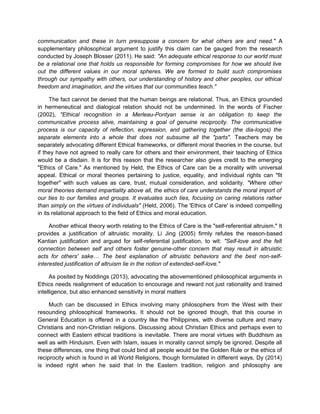
Table 1. Synthesis of Literature on Ethics
Researcher
/
Research
Title
Sampling
/
Sample
Country
Setting
Design Themes/
Metaphors
Robert V.
Bullough Jr.
(2010)
Ethical and
Moral
Matters in
Teaching
and Teacher
Education
Utah, USA Review: set of
articles on
moral and
ethical matters
in teaching and
teacher
education
published by
Teaching and
Teacher
Education;
Meta-synthesis
- Comparative
method of
analysis
- Coding
disagreements
1. Teaching as an ethical and
moral
enterprise
2. Education - fundamentally and
inevitably moral in nature
3. Relational knowing - arise from
caring for and being with others
4. Ethical commitments of an entire
school
5. Aristotelian virtue ethics
framework
6. Ethics - at the heart of the
teachers' disciplinary knowledge
7. Develop a rich moral vocabulary,
cultivate moral imagination
Li Jing
(2005)
Self-love
and
morality:
Beyond
egoism and
altruism
Wisconsin,
USA
Essay - Digital
dissertations
1. Ethical theory named
self-referential altruism.
2. Justification for an altruistic
morality
3. Self-interested justification for
altruistic morality - partly credible.
4. The notion of extended self-love
Toby
Schonfeld
(2013)
Educating
for Ethical
Engagemen
t: Teaching
Ethics to
Georgia,
USA
Expositions
(online)
1. A school administration
dedicated to ethical action
2. Common content areas for
ethics
instruction
3.Assessment of learning
4. Ethics as fundamentally
relational
Graduate
and
Professional
Students
5. Difficulty of assessing students’
skills and attitudes effectively by
using quantitative measures
alone
Paul Weiss
(1942)
Morality and
Ethics
Journal 1. The human person as a moral
and ethical being
2. Compatibility of morality and
ethics
Chuck Huff
& William
Frey (2005)
Moral
Pedagogy
and
Practical
Ethics
Minnesota,
USA
Science and
Engineering
Ethics, 11, 389-
408.
1. Moral or ethical imagination -
centrepiece of what it means to
make moral judgments
2. Practicing moral imagination -
"excellence" in the Aristotelian
sense
3. Teaching practical ethics
4. Taxonomy of Case Types
Dr. Manny
Dy (2014)
Eastern
Ethical
Traditions
Philippine
s
Paper
Presentation,
UNESCO-PAP
World
Philosophy Day
1. The Golden Rule in Hinduism
2. Moral Virtues (Buddhism)
3. Noble 8-fold path
4. Ethical Judgment (Buddhism)
5. The Golden Rule or the ethics of
reciprocity
Dr.
Antonette
Palma-
Angeles
(2014)
Teaching
Ethics
Philippines Paper
Presentation
(UNESCO-PAP
World
Philosophy
Day)
1. How should Ethics be taught?
2. Why do we teach Ethics?
3. Moral imagination/ Heuristic
approach/ Contextualize and
sensitize
4. The Course in Ethics
5. Methodologies and Tools:
a. Use of cases
b. Immersion
c. Assessment
Joseph D.
Blosser
(2011)
Ethics
before God
and markets
Chicago,
USA
PHD Thesis
Summary
Erasmus
Journal for
Philosophy and
Economics,
Volume 5, Issue
2, Autumn
2012, pp. 155-
156.
1. Ethical response - forming
compromises for how men
should live out the different
values in their moral spheres.
2. Sympathy with others,
understanding of history and
other peoples, ethical freedom
and imagination, and the virtues
that communities teach
Philip Ricci
(1990)
Can Ethics
be Taught?
A Simulation
Tests, A
Traditional
New York,
USA
Developments
In Business
Simulation &
Experiential
Exercises,
Volume 17,
1990
1. Ethical or moral standards
2. Ethics education on the ethical
principles of analysis.
3. An attitude is the result of an
individual’s values and beliefs;
values are a result of a person’s
beliefs and environment; and
Ethics
Pedagogy
beliefs are deeply ingrained in
an individual’s persona and
represent the individual’s
acceptance of something as true.
Michael
Arthus G.
Muega
(2011)
Values/Mora
l Education:
Current
Conceptions
and
Practices in
Philippines
Schools
UP
Diliman,
Manila
Values/Moral
Education - UP
Diliman
Journals Online
- University
Journals.upd.ed
u.ph/
index.php/ali/art
icle/
download/1767/
1683
1. Values/Moral Education and
critical thinking
2. Conception of Values/ Moral
Education in the Philippines
3. Teaching of evaluative
reasoning
Sarah Ann
Fischer
(2002)
Merleau-
Ponty:
Embodied
subjectivity
and the
foundation
of ethics
Wisconsin
USA
Dissertations
(1962 - 2010)
Access via
Proquest Digital
Dissertations.
AAI3059371.
1. An ethics grounded in a
hermeneutical, dialogical relation
which remains open to
difference.
2. Ethical recognition in a
Merleau-Pontyan sense
3. Ethics as a process of dialogue
which aims at co-creating a
common ground in a movement
of continuously reworking itself
through new perspectives.
Nel
Noddings
(2013)
Caring: A
Relational
Approach to
Ethics and
Moral
Education
California,
USA
University of
California
Press, 2013
https://books.go
ogle.
com.ph
1. Ethics based on natural caring,
as in the care of a mother for her
child
2. Realignment of education to
encourage and reward not just
rationality and trained
intelligence, but also enhanced
sensitivity in moral matters.
Virginia
Held (2006)
The Ethics
of Care:
Personal,
Political,
and Global
New York,
USA
New York:
Oxford
University
Press, 2006
https://books.go
ogle.
com.ph
1. Ethics of care as a promising
alternative to the familiar moral
theories
2. Justice, equality, and individual
rights "fit together" with such
values as care, trust, mutual
consideration, and solidarity.
3. Moral import of our ties to our
families and groups focusing on
caring relations rather than
simply on the virtues of
individuals
Jerry Miller
(2001)
California,
USA
Published
Dissertation
1. An ethics of contingency
presupposes a reading of truth
Ethics
Without
Morality
https://philpaper
s.org
/rec/MILEWM
and value as mutually
constitutive.
2. The body as a value-laden
territory
3. Ethics does not sustain absolute
justifications of practices.
Dr. Jesus
Deogracias
Principe
(2014)
Platonic
Ethics
Philippines Paper
Presentation
-World
Philosophy Day
2014 (On
Teaching
Ethics) - ADMU
1. Republic - (two questions)
a. Why bother being/
doing good?
b. Why bother doing
philosophy?
2. Political Science
a. accountability
b. checks and balances
c. responsible government
Shane
Ralston
(2008)
Teaching
Ethics in the
High
Schools: A
Deweyan
Challenge
Pennsylva
nia, USA
Book: Teaching
Ethics
1. Studying Ethics - a curriculum
that is not just relevant, but
integral, to practical living.
2. Moral agents - moral expertise –
"thinking out" loud
Dr. Agustin
Martin
Rodriguez
(2014)
Scheler
Ethics
Philippines Paper
Presentation,
UNESCO-PAP
World
Philosophy Day
(uploaded by
Mark Joseph
Calano - PAP
Facebook
Account)
1. Orientation toward the infinite
2. Values as the eternal objects of
the heart that exist in things that
come from the eternal order of
the universe
3. Good is the realization of the
positive value or the higher value.
Evil is the realization of a
negative value or a lower value. 4.
Value of Scheler Ethics
Dr. Jean
Tan (2014)
The
Aristotelian
Conception
of Virtues
(Nicomache
an Ethics)
Philippines Paper
Presentation,
UNESCO-PAP
World
Philosophy Day
(uploaded by
Mark Joseph
Calano - PAP
Facebook
Account)
1. Ethics aims at the attainment of
happiness, (Happiness is the
being-at-work of the soul in
accordance with virtue.)
2. Aristotle’s account of virtue
3. The Psychology - The Ethics
built
upon the psychology
4. Classification of Virtues (or
excellences of the soul
5. The virtues required by moral
action: Moral Virtues and
Practical Judgment
RESULTS AND DISCUSSIONS
The Ontological, Teleological, and Normative Background of Ethics
If in human understanding men affirm that right conduct is willed by a god, in the realm of a
religion such a claim is plausible and the debates on the objectivity of moral actions are less
discussed. However, the claim, despite its traditional and theological assumptions would have
weakened the understanding that humans are intelligent animals relative to his being human
that made him rational and a social animal capable of philosophizing. This manifests on the
account that humans are capable of doing good without the reliance on Religion, Ethical codes
or a deity.
All holy books are inspired by a god and their commandments should be followed. Believers
are accountable to their god and they deserved to be rewarded or punished. Moreover, they
also are accountable in times of reckoning for their actions towards others. A divine command is
approved by a god therefore it must be realized and acted upon by agents; though it constituted
an affirmation of self-determination therefore men are free to act or reject any commands from
human’s purview. In such a case, the existence of self-determination should be understood as
‘gift certificate’ if this is a right term; this is identical to being rational because humans have
choices. In a way, to make god’s command attractive, men are given a chance to choose yet
these actions yield consequences.
Aristotle viewed moral actions or ‘good’ as an outcome of a desired goal or target. Writing
exemplifies a desired goal in which every writer is aiming for. For example, to say that a good
article is the one that is well-argued, its ideas are consistent and the problem of its thesis is hit
and well-justified. If one of these components is missing then a good article is not achieved.
Aristotle’s understanding of a ‘good act’ implicitly emphasized the importance of skills through
habit and the inculcation of knowledge. Moral virtue implicates intellectual virtue which must be
practiced and acted upon. To achieve a certain goal, for example, men are aiming to become
physically fit this summer, so they enrol to a fitness gym to which they follow certain rules
governing a program which can help them in achieving their end. The end or goal of their action
is attainable but they must give an extra effort and time to attain them. This happens through
constant practice such as following the given rules. In the same way, moral actions are the
‘state of affairs’ which resulted from the mingling of different entities or actions, though not all
actions entail ‘freewill’ because involuntary ones are also inevitable in which freedom is absent,
therefore, they cannot be the subject of morality. A ‘state of affairs’ are men's dealings to others.
They are from ‘here and now’ to which they are part. Morality therefore is part of life, it cannot
be detached from purview of humanity, hence, if persons are to be moral they must understand
that being moral is a process, from ontology to human standards.
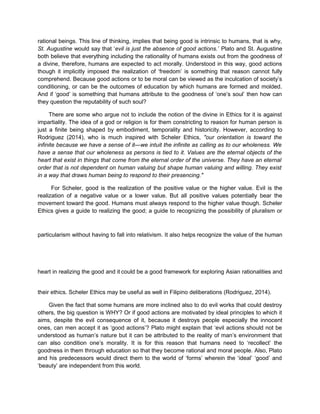
For Plato rationality entails reason, spirit and desires. The function of each part is
complementary, that is, a desired action should be moral and acted upon by reason. Reason,
serves as the controller of men's senses’ appetite. It manifests in desiring an action, as what
Plato calls as the ‘rationality of the soul’. Good actions are innate because human beings are
rational beings. This line of thinking, implies that being good is intrinsic to humans, that is why,
St. Augustine would say that ‘evil is just the absence of good actions.’ Plato and St. Augustine
both believe that everything including the rationality of humans exists out from the goodness of
a divine, therefore, humans are expected to act morally. Understood in this way, good actions
though it implicitly imposed the realization of ‘freedom’ is something that reason cannot fully
comprehend. Because good actions or to be moral can be viewed as the inculcation of society’s
conditioning, or can be the outcomes of education by which humans are formed and molded.
And if ‘good’ is something that humans attribute to the goodness of ‘one’s soul’ then how can
they question the reputability of such soul?
There are some who argue not to include the notion of the divine in Ethics for it is against
impartiality. The idea of a god or religion is for them constricting to reason for human person is
just a finite being shaped by embodiment, temporality and historicity. However, according to
Rodriguez (2014), who is much inspired with Scheler Ethics, "our orientation is toward the
infinite because we have a sense of it—we intuit the infinite as calling as to our wholeness. We
have a sense that our wholeness as persons is tied to it. Values are the eternal objects of the
heart that exist in things that come from the eternal order of the universe. They have an eternal
order that is not dependent on human valuing but shape human valuing and willing. They exist
in a way that draws human being to respond to their presencing."
For Scheler, good is the realization of the positive value or the higher value. Evil is the
realization of a negative value or a lower value. But all positive values potentially bear the
movement toward the good. Humans must always respond to the higher value though. Scheler
Ethics gives a guide to realizing the good; a guide to recognizing the possibility of pluralism or
particularism without having to fall into relativism. It also helps recognize the value of the human
heart in realizing the good and it could be a good framework for exploring Asian rationalities and
their ethics. Scheler Ethics may be useful as well in Filipino deliberations (Rodriguez, 2014).
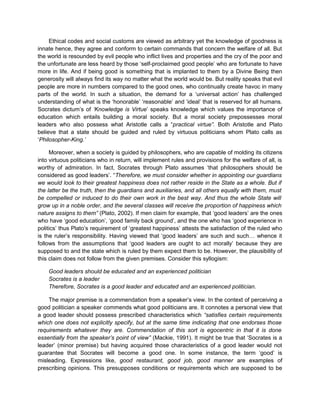
Given the fact that some humans are more inclined also to do evil works that could destroy
others, the big question is WHY? Or if good actions are motivated by ideal principles to which it
aims, despite the evil consequence of it, because it destroys people especially the innocent
ones, can men accept it as ‘good actions’? Plato might explain that ‘evil actions should not be
understood as human’s nature but it can be attributed to the reality of man’s environment that
can also condition one’s morality. It is for this reason that humans need to ‘recollect’ the
goodness in them through education so that they become rational and moral people. Also, Plato
and his predecessors would direct them to the world of ‘forms’ wherein the ‘ideal’ ‘good’ and
‘beauty’ are independent from this world.
Ethical codes and social customs are viewed as arbitrary yet the knowledge of goodness is
innate hence, they agree and conform to certain commands that concern the welfare of all. But
the world is resounded by evil people who inflict lives and properties and the cry of the poor and
the unfortunate are less heard by those ‘self-proclaimed good people’ who are fortunate to have
more in life. And if being good is something that is implanted to them by a Divine Being then
generosity will always find its way no matter what the world would be. But reality speaks that evil
people are more in numbers compared to the good ones, who continually create havoc in many
parts of the world. In such a situation, the demand for a ‘universal action’ has challenged
understanding of what is the ‘honorable’ ‘reasonable’ and ‘ideal’ that is reserved for all humans.
Socrates dictum’s of ‘Knowledge is Virtue’ speaks knowledge which values the importance of
education which entails building a moral society. But a moral society prepossesses moral
leaders who also possess what Aristotle calls a “practical virtue”. Both Aristotle and Plato
believe that a state should be guided and ruled by virtuous politicians whom Plato calls as
‘Philosopher-King.’
Moreover, when a society is guided by philosophers, who are capable of molding its citizens
into virtuous politicians who in return, will implement rules and provisions for the welfare of all, is
worthy of admiration. In fact, Socrates through Plato assumes ‘that philosophers should be
considered as good leaders’. “Therefore, we must consider whether in appointing our guardians
we would look to their greatest happiness does not rather reside in the State as a whole. But if
the latter be the truth, then the guardians and auxiliaries, and all others equally with them, must
be compelled or induced to do their own work in the best way. And thus the whole State will
grow up in a noble order, and the several classes will receive the proportion of happiness which
nature assigns to them” (Plato, 2002). If men claim for example, that ‘good leaders’ are the ones
who have ‘good education’, ‘good family back ground’, and the one who has ‘good experience in
politics’ thus Plato’s requirement of ‘greatest happiness’ attests the satisfaction of the ruled who
is the ruler’s responsibility. Having viewed that ‘good leaders’ are such and such… whence it
follows from the assumptions that ‘good leaders are ought to act morally’ because they are
supposed to and the state which is ruled by them expect them to be. However, the plausibility of
this claim does not follow from the given premises. Consider this syllogism:
Good leaders should be educated and an experienced politician
Socrates is a leader
Therefore, Socrates is a good leader and educated and an experienced politician.
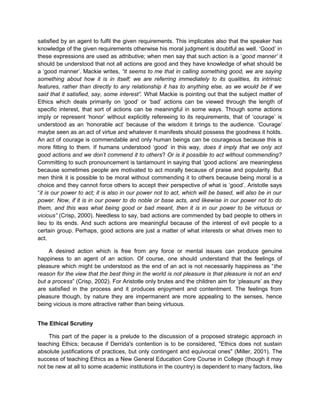
The major premise is a commendation from a speaker’s view. In the context of perceiving a
good politician a speaker commends what good politicians are. It connotes a personal view that
a good leader should possess prescribed characteristics which “satisfies certain requirements
which one does not explicitly specify, but at the same time indicating that one endorses those
requirements whatever they are. Commendation of this sort is egocentric in that it is done
essentially from the speaker’s point of view” (Mackie, 1991). It might be true that ‘Socrates is a
leader’ (minor premise) but having acquired those characteristics of a good leader would not
guarantee that Socrates will become a good one. In some instance, the term ‘good’ is
misleading. Expressions like, good restaurant, good job, good manner are examples of
prescribing opinions. This presupposes conditions or requirements which are supposed to be
satisfied by an agent to fulfil the given requirements. This implicates also that the speaker has
knowledge of the given requirements otherwise his moral judgment is doubtful as well. ‘Good’ in
these expressions are used as attributive; when men say that such action is a ‘good manner’ it
should be understood that not all actions are good and they have knowledge of what should be
a ‘good manner’. Mackie writes, “it seems to me that in calling something good, we are saying
something about how it is in itself; we are referring immediately to its qualities, its intrinsic
features, rather than directly to any relationship it has to anything else, as we would be if we
said that it satisfied, say, some interest”. What Mackie is pointing out that the subject matter of
Ethics which deals primarily on ‘good’ or ‘bad’ actions can be viewed through the length of
specific interest, that sort of actions can be meaningful in some ways. Though some actions
imply or represent ‘honor’ without explicitly refereeing to its requirements, that of ‘courage’ is
understood as an ‘honorable act’ because of the wisdom it brings to the audience. ‘Courage’
maybe seen as an act of virtue and whatever it manifests should possess the goodness it holds.
An act of courage is commendable and only human beings can be courageous because this is
more fitting to them. If humans understood ‘good’ in this way, does it imply that we only act
good actions and we don’t commend it to others? Or is it possible to act without commending?
Committing to such pronouncement is tantamount in saying that ‘good actions’ are meaningless
because sometimes people are motivated to act morally because of praise and popularity. But
men think it is possible to be moral without commending it to others because being moral is a
choice and they cannot force others to accept their perspective of what is ‘good’. Aristotle says
“it is our power to act; it is also in our power not to act, which will be based, will also be in our
power. Now, if it is in our power to do noble or base acts, and likewise in our power not to do
them, and this was what being good or bad meant, then it is in our power to be virtuous or
vicious” (Crisp, 2000). Needless to say, bad actions are commended by bad people to others in
lieu to its ends. And such actions are meaningful because of the interest of evil people to a
certain group. Perhaps, good actions are just a matter of what interests or what drives men to
act.
A desired action which is free from any force or mental issues can produce genuine
happiness to an agent of an action. Of course, one should understand that the feelings of
pleasure which might be understood as the end of an act is not necessarily happiness as “the
reason for the view that the best thing in the world is not pleasure is that pleasure is not an end
but a process” (Crisp, 2002). For Aristotle only brutes and the children aim for ‘pleasure’ as they
are satisfied in the process and it produces enjoyment and contentment. The feelings from
pleasure though, by nature they are impermanent are more appealing to the senses, hence
being vicious is more attractive rather than being virtuous.
The Ethical Scrutiny
This part of the paper is a prelude to the discussion of a proposed strategic approach in
teaching Ethics; because if Derrida's contention is to be considered, "Ethics does not sustain
absolute justifications of practices, but only contingent and equivocal ones" (Miller, 2001). The
success of teaching Ethics as a New General Education Core Course in College (though it may
not be new at all to some academic institutions in the country) is dependent to many factors, like
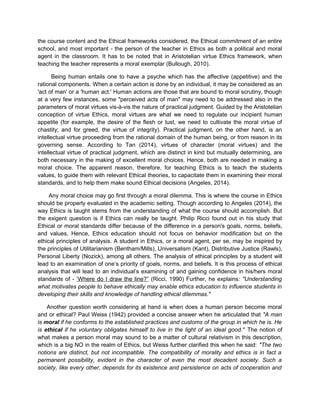
the course content and the Ethical frameworks considered, the Ethical commitment of an entire
school, and most important - the person of the teacher in Ethics as both a political and moral
agent in the classroom. It has to be noted that in Aristotelian virtue Ethics framework, when
teaching the teacher represents a moral exemplar (Bullough, 2010).
Being human entails one to have a psyche which has the affective (appetitive) and the
rational components. When a certain action is done by an individual, it may be considered as an
'act of man' or a 'human act.' Human actions are those that are bound to moral scrutiny, though
at a very few instances, some "perceived acts of man" may need to be addressed also in the
parameters of moral virtues vis-à-vis the nature of practical judgment. Guided by the Aristotelian
conception of virtue Ethics, moral virtues are what we need to regulate our incipient human
appetite (for example, the desire of the flesh or lust, we need to cultivate the moral virtue of
chastity; and for greed, the virtue of integrity). Practical judgment, on the other hand, is an
intellectual virtue proceeding from the rational domain of the human being, or from reason in its
governing sense. According to Tan (2014), virtues of character (moral virtues) and the
intellectual virtue of practical judgment, which are distinct in kind but mutually determining, are
both necessary in the making of excellent moral choices. Hence, both are needed in making a
moral choice. The apparent reason, therefore, for teaching Ethics is to teach the students
values, to guide them with relevant Ethical theories, to capacitate them in examining their moral
standards, and to help them make sound Ethical decisions (Angeles, 2014).
Any moral choice may go first through a moral dilemma. This is where the course in Ethics
should be properly evaluated in the academic setting. Though according to Angeles (2014), the
way Ethics is taught stems from the understanding of what the course should accomplish. But
the exigent question is if Ethics can really be taught. Philip Ricci found out in his study that
Ethical or moral standards differ because of the difference in a person's goals, norms, beliefs,
and values. Hence, Ethics education should not focus on behavior modification but on the
ethical principles of analysis. A student in Ethics, or a moral agent, per se, may be inspired by
the principles of Utilitarianism (Bentham/Mills), Universalism (Kant), Distributive Justice (Rawls),
Personal Liberty (Nozick), among all others. The analysis of ethical principles by a student will
lead to an examination of one’s priority of goals, norms, and beliefs. It is this process of ethical
analysis that will lead to an individual’s examining of and gaining confidence in his/hers moral
standards of - ‘Where do I draw the line?” (Ricci, 1990) Further, he explains: "Understanding
what motivates people to behave ethically may enable ethics education to influence students in
developing their skills and knowledge of handling ethical dilemmas."
Another question worth considering at hand is when does a human person become moral
and or ethical? Paul Weiss (1942) provided a concise answer when he articulated that "A man
is moral if he conforms to the established practices and customs of the group in which he is. He
is ethical if he voluntary obligates himself to live in the light of an ideal good." The notion of
what makes a person moral may sound to be a matter of cultural relativism in this description,
which is a big NO in the realm of Ethics, but Weiss further clarified this when he said: "The two
notions are distinct, but not incompatible. The compatibility of morality and ethics is in fact a
permanent possibility, evident in the character of even the most decadent society. Such a
society, like every other, depends for its existence and persistence on acts of cooperation and
communication and these in turn presuppose a concern for what others are and need." A
supplementary philosophical argument to justify this claim can be gauged from the research
conducted by Joseph Blosser (2011). He said: "An adequate ethical response to our world must
be a relational one that holds us responsible for forming compromises for how we should live
out the different values in our moral spheres. We are formed to build such compromises
through our sympathy with others, our understanding of history and other peoples, our ethical
freedom and imagination, and the virtues that our communities teach."
The fact cannot be denied that the human beings are relational. Thus, an Ethics grounded
in hermeneutical and dialogical relation should not be undermined. In the words of Fischer
(2002), "Ethical recognition in a Merleau-Pontyan sense is an obligation to keep the
communicative process alive, maintaining a goal of genuine reciprocity. The communicative
process is our capacity of reflection, expression, and gathering together (the dia-logos) the
separate elements into a whole that does not subsume all the "parts". Teachers may be
separately advocating different Ethical frameworks, or different moral theories in the course, but
if they have not agreed to really care for others and their environment, their teaching of Ethics
would be a disdain. It is for this reason that the researcher also gives credit to the emerging
"Ethics of Care." As mentioned by Held, the Ethics of Care can be a morality with universal
appeal. Ethical or moral theories pertaining to justice, equality, and individual rights can "fit
together" with such values as care, trust, mutual consideration, and solidarity. "Where other
moral theories demand impartiality above all, the ethics of care understands the moral import of
our ties to our families and groups. It evaluates such ties, focusing on caring relations rather
than simply on the virtues of individuals" (Held, 2006). The 'Ethics of Care' is indeed compelling
in its relational approach to the field of Ethics and moral education.
Another ethical theory worth relating to the Ethics of Care is the "self-referential altruism." It
provides a justification of altruistic morality. Li Jing (2005) firmly refutes the reason-based
Kantian justification and argued for self-referential justification, to wit: "Self-love and the felt
connection between self and others foster genuine-other concern that may result in altruistic
acts for others' sake… The best explanation of altruistic behaviors and the best non-self-
interested justification of altruism lie in the notion of extended-self-love."
As posited by Noddings (2013), advocating the abovementioned philosophical arguments in
Ethics needs realignment of education to encourage and reward not just rationality and trained
intelligence, but also enhanced sensitivity in moral matters
Much can be discussed in Ethics involving many philosophers from the West with their
resounding philosophical frameworks. It should not be ignored though, that this course in
General Education is offered in a country like the Philippines, with diverse culture and many
Christians and non-Christian religions. Discussing about Christian Ethics and perhaps even to
connect with Eastern ethical traditions is inevitable. There are moral virtues with Buddhism as
well as with Hinduism. Even with Islam, issues in morality cannot simply be ignored. Despite all
these differences, one thing that could bind all people would be the Golden Rule or the ethics of
reciprocity which is found in all World Religions, though formulated in different ways. Dy (2014)
is indeed right when he said that In the Eastern tradition, religion and philosophy are
interrelated, in the sense that philosophy and life are one. For him, a tradition is alive if it
provides a basis of making the right decisions to the problems of the day.
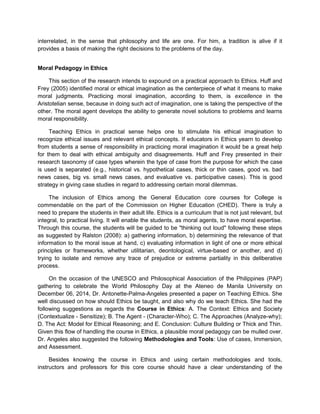
Moral Pedagogy in Ethics
This section of the research intends to expound on a practical approach to Ethics. Huff and
Frey (2005) identified moral or ethical imagination as the centerpiece of what it means to make
moral judgments. Practicing moral imagination, according to them, is excellence in the
Aristotelian sense, because in doing such act of imagination, one is taking the perspective of the
other. The moral agent develops the ability to generate novel solutions to problems and learns
moral responsibility.
Teaching Ethics in practical sense helps one to stimulate his ethical imagination to
recognize ethical issues and relevant ethical concepts. If educators in Ethics yearn to develop
from students a sense of responsibility in practicing moral imagination it would be a great help
for them to deal with ethical ambiguity and disagreements. Huff and Frey presented in their
research taxonomy of case types wherein the type of case from the purpose for which the case
is used is separated (e.g., historical vs. hypothetical cases, thick or thin cases, good vs. bad
news cases, big vs. small news cases, and evaluative vs. participative cases). This is good
strategy in giving case studies in regard to addressing certain moral dilemmas.
The inclusion of Ethics among the General Education core courses for College is
commendable on the part of the Commission on Higher Education (CHED). There is truly a
need to prepare the students in their adult life. Ethics is a curriculum that is not just relevant, but
integral, to practical living. It will enable the students, as moral agents, to have moral expertise.
Through this course, the students will be guided to be "thinking out loud" following these steps
as suggested by Ralston (2008): a) gathering information, b) determining the relevance of that
information to the moral issue at hand, c) evaluating information in light of one or more ethical
principles or frameworks, whether utilitarian, deontological, virtue-based or another, and d)
trying to isolate and remove any trace of prejudice or extreme partiality in this deliberative
process.
On the occasion of the UNESCO and Philosophical Association of the Philippines (PAP)
gathering to celebrate the World Philosophy Day at the Ateneo de Manila University on
December 06, 2014, Dr. Antonette-Palma-Angeles presented a paper on Teaching Ethics. She
well discussed on how should Ethics be taught, and also why do we teach Ethics. She had the
following suggestions as regards the Course in Ethics: A. The Context: Ethics and Society
(Contextualize - Sensitize); B. The Agent - (Character-Who); C. The Approaches (Analyze-why);
D. The Act: Model for Ethical Reasoning; and E. Conclusion: Culture Building or Thick and Thin.
Given this flow of handling the course in Ethics, a plausible moral pedagogy can be mulled over.
Dr. Angeles also suggested the following Methodologies and Tools: Use of cases, Immersion,
and Assessment.
Besides knowing the course in Ethics and using certain methodologies and tools,
instructors and professors for this core course should have a clear understanding of the
conception of Values/Moral Education in the Philippines. We are one nation with a majority of
Christians, who experienced, in one way or the other, religious values transmission or
inculcation, though there may be non-religious values as well. Muega (2011) said that: "It is not
unusual for morals and values to be imposed on people by certain, often dominant, entity or
interest groups whose attitude, more often than not, seems to lean, if not border on, dogmatism.
Such groups could be a political or religious institution/organization." In his paper, Muega does
not agree to simply persuading the students to imbibe values out of manipulation, indoctrination,
and conditioning. For him, this is anti-intellectual and anti-education as it violates the kind of
principle of freedom, that is, to question or doubt before one accepts or rejects a value or belief.
The teaching of evaluative reasoning in Ethics or Values/Moral Education is really the
contention of any good Ethicist or moralist. Ethics is not just simply a matter of memorizing
'who-said- what-principle.' Students should be expected to learn, among other things, how to:
(1) engage in clear thinking; (2) distinguish between factual and value judgments; (3) analyse
moral principles and rules; (4) tell the differences between moral frameworks, like teleological
and deontological morality, in clear and logical terms; (5) detect faulty reasoning; (5) construct
and evaluate arguments; and (6) compose well-argued resolutions (Muega, 2011).
Students (as moral agents) may have a lot of questions in their minds everyday on pressing
issues that confront them. Hence, they need to be introduced as well to applied Ethics - that is,
to the philosophy of morality as it applies to practical moral needs. By giving attention to moral
concerns of everyday life, more than on abstract ethical theories or general social issues, moral
character is explored in all its dimension: "virtues and vices, commitments and attitudes, and
personal relationships and community involvement, in addition to right and wrong conduct"
(Martin, 2007).
CONCLUSION
Human understanding to what is good, right, or moral may depend on their personal
convictions, customs and traditions or culture, and also on religious affiliations. It can be said
that an act is good if it gives pleasure; but nonetheless if it would cause pain to others, it may be
otherwise. No one has the absolute manipulation to determine what is moral or ethical. Humans
are conventional and rational beings who can discuss on the table that which is virtuous or not.
They can deliberate moral acts which have lasting good effects, not only for themselves, but for
the whole of humanity as well.
In a world of decadence, moralists need to bother people into doing what is good. Ethics is
a moral enterprise. Philosophers from the past to the present postulate different ethical
principles that would explain how humans should manage their state of affairs. Some had
recourse to metaphysical justifications - to a Being that determines the kind of life that one
should live, while others simply had to agree to form government that would determine the
common good undermining an Absolute Ideal.
This course in Ethics will help explore in the minds of students different ethical frameworks
to work upon, but the immense questions remains the same: Will they end up living a good or
benevolent life? Will they end up gathering a positive energy in doing always the right thing after
the course? Definitely these questions cannot be answered in a vacuum. Not any specific
ethical principle can guarantee how the students have really learned. "Given that ethics is
fundamentally relational, it can be difficult to assess students’ skills and attitudes effectively by
using quantitative measures alone" (Schonfeld, 2013). Regardless of the approach to teaching
Ethics, assessment of learning remains a challenge. It does not mean, however, that teachers
just have to treat this course like all other General Education courses. Professors in Ethics play
a major role in the formation of good and noble moral agents. 'Integrity can only be
demonstrated through ethical action' hence we need zealous mentors to guide the students by
being the role-models of virtue themselves.
The Commission on Higher Education (CHED) through the different Delivering Higher
Educational Institutions (DHEIs) needs a mechanism to check any institutional, hierarchical,
social, or economic challenges that would hamper the successful inclusion of this course in the
Curriculum. The 'Ethics of Care' should be at the core being of the Faculty who will handle this
course. A noble philosopher-mentor serves well to the academe by the integrity that he would
manifest.
Recommendations:
Ethics in the academic setting should help make a difference in the country. Moral agents
(also in the persons of the teachers) should start thinking and reflecting on the content of their
instruction, but not merely to focus on the content, rather to the outcomes that would give
students wisdom in life. It is recommended that once in every two years, CHED will sponsor a
gathering of Coordinators or teachers in Ethics to discuss common content areas for ethics
instruction (what one should teach), as well as to issues of ethics pedagogy (how one should
teach). Content dictates form; that is, what one teaches ought to dictate how one teaches. In the
said gathering or assembly, research papers in Ethics may also be presented.
REFERENCES
Books:
Crisp, R. 2000. The Nichomachean Ethics. Cambridge University Press (translated and
edited by Roger Crisp)
Mackie, J.L . 1990. Inventing Right and Wrong.England: Penguin Books, Ltd.
Martin, M. 2007. Everyday Morality: An Introduction to Applied Ethics, 4th Ed. Canada:
Thomson Wadsworth.
Moore, G.E. 1902. Principia Ethica. http://fair-use.org/g-e-moore/principia-ethica (Book
accessed online on February 11, 2017)
Rachels, J. 1997. The Elements of Moral Philosophy, 4th Ed. University of Alabama and
Birmingham, Mc Graw Hill.
Plato, 2002. The Republic. Google Book: Spark Pub (Book accessed online on February
11, 2017)
Online References:
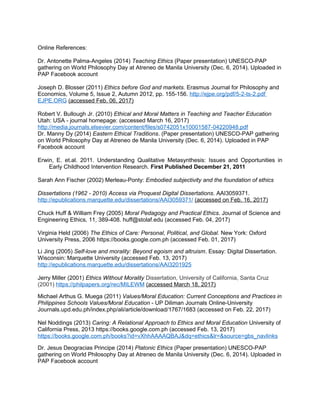
Dr. Antonette Palma-Angeles (2014) Teaching Ethics (Paper presentation) UNESCO-PAP
gathering on World Philosophy Day at Atreneo de Manila University (Dec. 6, 2014). Uploaded in
PAP Facebook account
Joseph D. Blosser (2011) Ethics before God and markets. Erasmus Journal for Philosophy and
Economics, Volume 5, Issue 2, Autumn 2012, pp. 155-156. http://ejpe.org/pdf/5-2-ts-2.pdf
EJPE.ORG (accessed Feb. 06, 2017)
Robert V. Bullough Jr. (2010) Ethical and Moral Matters in Teaching and Teacher Education
Utah: USA - journal homepage: (accessed March 16, 2017)
http://media.journals.elsevier.com/content/files/s0742051x10001587-04220948.pdf
Dr. Manny Dy (2014) Eastern Ethical Traditions. (Paper presentation) UNESCO-PAP gathering
on World Philosophy Day at Atreneo de Manila University (Dec. 6, 2014). Uploaded in PAP
Facebook account
Erwin, E. et.al. 2011. Understanding Qualitative Metasynthesis: Issues and Opportunities in
Early Childhood Intervention Research. First Published December 21, 2011
Sarah Ann Fischer (2002) Merleau-Ponty: Embodied subjectivity and the foundation of ethics
Dissertations (1962 - 2010) Access via Proquest Digital Dissertations. AAI3059371.
http://epublications.marquette.edu/dissertations/AAI3059371/ (accessed on Feb. 16, 2017)
Chuck Huff & William Frey (2005) Moral Pedagogy and Practical Ethics. Journal of Science and
Engineering Ethics, 11, 389-408. huff@stolaf.edu (accessed Feb. 04, 2017)
Virginia Held (2006) The Ethics of Care: Personal, Political, and Global. New York: Oxford
University Press, 2006 https://books.google.com.ph (accessed Feb. 01, 2017)
Li Jing (2005) Self-love and morality: Beyond egoism and altruism. Essay: Digital Dissertation.
Wisconsin: Marquette University (accessed Feb. 13, 2017)
http://epublications.marquette.edu/dissertations/AAI3201925
Jerry Miller (2001) Ethics Without Morality Dissertation, University of California, Santa Cruz
(2001) https://philpapers.org/rec/MILEWM (accessed March 18, 2017)
Michael Arthus G. Muega (2011) Values/Moral Education: Current Conceptions and Practices in
Philippines Schools Values/Moral Education - UP Diliman Journals Online-University
Journals.upd.edu.ph/index.php/ali/article/download/1767/1683 (accessed on Feb. 22, 2017)
Nel Noddings (2013) Caring: A Relational Approach to Ethics and Moral Education University of
California Press, 2013 https://books.google.com.ph (accessed Feb. 13, 2017)
https://books.google.com.ph/books?id=vXhhAAAAQBAJ&dq=ethics&lr=&source=gbs_navlinks
Dr. Jesus Deogracias Principe (2014) Platonic Ethics (Paper presentation) UNESCO-PAP
gathering on World Philosophy Day at Atreneo de Manila University (Dec. 6, 2014). Uploaded in
PAP Facebook account
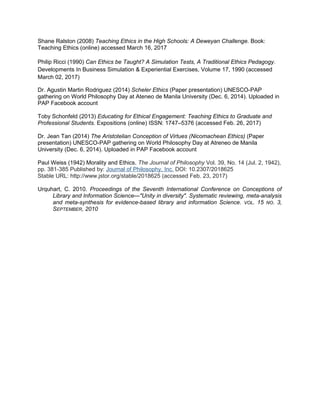
Shane Ralston (2008) Teaching Ethics in the High Schools: A Deweyan Challenge. Book:
Teaching Ethics (online) accessed March 16, 2017
Philip Ricci (1990) Can Ethics be Taught? A Simulation Tests, A Traditional Ethics Pedagogy.
Developments In Business Simulation & Experiential Exercises, Volume 17, 1990 (accessed
March 02, 2017)
Dr. Agustin Martin Rodriguez (2014) Scheler Ethics (Paper presentation) UNESCO-PAP
gathering on World Philosophy Day at Ateneo de Manila University (Dec. 6, 2014). Uploaded in
PAP Facebook account
Toby Schonfeld (2013) Educating for Ethical Engagement: Teaching Ethics to Graduate and
Professional Students. Expositions (online) ISSN: 1747–5376 (accessed Feb. 26, 2017)
Dr. Jean Tan (2014) The Aristotelian Conception of Virtues (Nicomachean Ethics) (Paper
presentation) UNESCO-PAP gathering on World Philosophy Day at Atreneo de Manila
University (Dec. 6, 2014). Uploaded in PAP Facebook account
Paul Weiss (1942) Morality and Ethics. The Journal of Philosophy Vol. 39, No. 14 (Jul. 2, 1942),
pp. 381-385 Published by: Journal of Philosophy, Inc. DOI: 10.2307/2018625
Stable URL: http://www.jstor.org/stable/2018625 (accessed Feb. 23, 2017)
Urquhart, C. 2010. Proceedings of the Seventh International Conference on Conceptions of
Library and Information Science—"Unity in diversity". Systematic reviewing, meta-analysis
and meta-synthesis for evidence-based library and information Science. VOL. 15 NO. 3,
SEPTEMBER, 2010

REINTERPRETING ETHICS AS PEDAGOGICAL REFERENCE: A META-SYNTHESIS

  • 1.
    REINTERPRETING ETHICS ASPEDAGOGICAL REFERENCE: A META-SYNTHESIS A Research Paper Paper presentation on the occasion of the 2017 National Philosophy Conference By: WILSON TEMPORAL GARRY TABUGON April, 2017
  • 2.
    ABSTRACT Ethics as the‘general inquiry into what is good’ poses some questions concerning what sort of actions can bind humans. What constitutes ‘good’ or what is an unacceptable action in given situation is tantamount in saying that the subject matter of Ethics is essential. Teaching Ethics in College Education as a New General Education Core Course under the New Curriculum explores some of the important theories on the constitution of what is an ethical action, acceptable and binding in all societies which call for impartiality in decision making. In this paper, the authors expose the course description of the new Ethics ‘which deals with principles of ethical behavior in modern society at the level of the person, society, and interaction with the environment and other shared resources (CMO 20 S 2013). The paper is organized according to the three main themes of the reviewed studies: Ontological, Teleological, and Normative background of Ethics, The Ethical Scrutiny, and Moral Pedagogy in Ethics. Keywords: Reason, Will, Impartiality, Virtue Ethics, Ethical principles, Values, Morality, Moral Dilemma INTRODUCTION: The subject matter of Ethics poses some questions in relation to answering moral judgment, like ‘What is our criteria or standard of morality'?, 'What can account actions as ‘good’ and ‘right’ or ‘good’ as ‘pleasurable’ or ‘pleasurable’ as ‘good actions’?, 'Who has the right to determine what is moral or ethical'?, 'With regard the applicability of an action, when can we consider it as good or moral?, and the like. Society’s morality calls for a standard which serves as a ‘guiding principle’ of all actions which answers the question of what is ‘good’ and ‘right’ or ‘bad’ and ‘unacceptable’. Actions are good or acceptable when they satisfy the standards or ethical codes of a society while they are unacceptable when they fail to follow its principles, though these principles or ethical codes are subject to question because they are either arbitrary or inspired by a god. Any social customs which are free from arbitrary principles might be inspired by a divine command and when moral actions are agreed by the many is also open to inquiry. Socrates presupposes this point when he asked, “Is conduct right because the gods command it, or do the gods command it because it is right?” (Rachels, 2003). If good actions are ‘good’ independent from a god then, what constitutes such goodness? Voluntary actions which are termed as ‘good’ or ‘right’ ‘bad’ or ‘evil’ are moral judgments relative to ethical principles. This concerns philosophers to explore the constitution of the term ‘good’. They (Moral Philosophers) agree that the subject matter of Ethics is important not only in the realm of building a moral society but also in answering the question on the purpose of life. Hence, if human beings aim for something greater than all the luxuries of the material things to which humans are aspiring, for example, the existence of high tech gadgets and sophisticated stuffs, it reflects the modern times as some of the man’s longing of what they call as the modern understanding of living life. The inclusion of what is a moral and ethical life has something to say
  • 3.
    in defense ofsomething greater than the world is offering. But a moral life or good life constitutes a certain standard in Ethics which primarily based on the notion of ‘good’ actions. The complicity of these terms understood as ‘good’ is in need of justification if we are to highlight the subject matter of Ethics. The problem is that moral philosophers and their Ethical principles sometimes disagree on the contention of what is ‘good’. For Plato, the account of ‘good’, as it manifests from beauty and goodness of one’s soul through the recollection of the previous knowledge (the knowledge from the world of forms as Plato viewed it) on the immutability of the eternal, is that actions should conform to what is fitting to the rationality of a human being. Aristotle, on the other hand, gives importance on the values of knowledge in becoming a virtuous but he goes beyond by emphasizing that being moral is when one knows that an action is appropriate to a given situation. Immanuel Kant believes that moral consideration necessitates the existence of freedom otherwise, the subject matter of morality will be in vain, in effect, if god’s commands are rational, it should be upon the realization of self-determination and determined by one’s rationality, because human beings are rational, therefore, they should act rationally. This now advances the understanding of moral actions in which only voluntary ones are moral, whereas involuntary actions cannot be considered as moral because of the absence of freedom. Jeremy Bentham, as well, thinks that actions can be viewed as acceptable when it produces the greatest happiness of all or when it produces the greatest quantity of happiness to everyone who is concerned or affected by an action. An action as a means of the desired goal is ‘good’ regardless of its intention that it contends. An action is evil or bad when it produces greatest suffering or pain to all who are directly or indirectly affected by an action. So what is now the stand of what is morally acceptable? Who among the moral philosophers or Ethicists should be considered as most reliable (if needed to ask such question)? Or which Ethical Principles are worth considering? This research aims to shed light to the educators who intend to teach Ethics as a new General Education Core Course in College in the Philippine educational system. Research Objectives/Questions: Generally, this paper aimed to meta-synthesize the concepts and interpretations on ethics as framework reference for the teaching of Ethics as a new General Education core course in college. Specifically, it sought to answer the following questions: 1. What are the themes of the reviewed studies? 2. What interpretations can be made on the themes in the reviewed studies? 3. What theory can be developed in the light of the themes and interpretations of the reviewed studies?
  • 4.
    This study madeuse of meta-synthesis method which is defined as an intentional and coherent approach to analyzing data across qualitative studies. In this paper, it became a process reference for the researchers to search for, select, appraise, summarize, and combine qualitative evidence to address the research question on what and how should teaching of Ethics be like as new General Education core course offered in college. This paper covered a range of meta-synthesis methods including critical interpretive synthesis and thematic analysis. Although this is not a new research approach in other fields, the authors suggest that it can offer a promising practice in arriving at a theory development in Teaching of Ethics as a new General Education core subject in college. Table 1. Synthesis of Literature on Ethics Researcher / Research Title Sampling / Sample Country Setting Design Themes/ Metaphors Robert V. Bullough Jr. (2010) Ethical and Moral Matters in Teaching and Teacher Education Utah, USA Review: set of articles on moral and ethical matters in teaching and teacher education published by Teaching and Teacher Education; Meta-synthesis - Comparative method of analysis - Coding disagreements 1. Teaching as an ethical and moral enterprise 2. Education - fundamentally and inevitably moral in nature 3. Relational knowing - arise from caring for and being with others 4. Ethical commitments of an entire school 5. Aristotelian virtue ethics framework 6. Ethics - at the heart of the teachers' disciplinary knowledge 7. Develop a rich moral vocabulary, cultivate moral imagination Li Jing (2005) Self-love and morality: Beyond egoism and altruism Wisconsin, USA Essay - Digital dissertations 1. Ethical theory named self-referential altruism. 2. Justification for an altruistic morality 3. Self-interested justification for altruistic morality - partly credible. 4. The notion of extended self-love Toby Schonfeld (2013) Educating for Ethical Engagemen t: Teaching Ethics to Georgia, USA Expositions (online) 1. A school administration dedicated to ethical action 2. Common content areas for ethics instruction 3.Assessment of learning 4. Ethics as fundamentally relational
  • 5.
    Graduate and Professional Students 5. Difficulty ofassessing students’ skills and attitudes effectively by using quantitative measures alone Paul Weiss (1942) Morality and Ethics Journal 1. The human person as a moral and ethical being 2. Compatibility of morality and ethics Chuck Huff & William Frey (2005) Moral Pedagogy and Practical Ethics Minnesota, USA Science and Engineering Ethics, 11, 389- 408. 1. Moral or ethical imagination - centrepiece of what it means to make moral judgments 2. Practicing moral imagination - "excellence" in the Aristotelian sense 3. Teaching practical ethics 4. Taxonomy of Case Types Dr. Manny Dy (2014) Eastern Ethical Traditions Philippine s Paper Presentation, UNESCO-PAP World Philosophy Day 1. The Golden Rule in Hinduism 2. Moral Virtues (Buddhism) 3. Noble 8-fold path 4. Ethical Judgment (Buddhism) 5. The Golden Rule or the ethics of reciprocity Dr. Antonette Palma- Angeles (2014) Teaching Ethics Philippines Paper Presentation (UNESCO-PAP World Philosophy Day) 1. How should Ethics be taught? 2. Why do we teach Ethics? 3. Moral imagination/ Heuristic approach/ Contextualize and sensitize 4. The Course in Ethics 5. Methodologies and Tools: a. Use of cases b. Immersion c. Assessment Joseph D. Blosser (2011) Ethics before God and markets Chicago, USA PHD Thesis Summary Erasmus Journal for Philosophy and Economics, Volume 5, Issue 2, Autumn 2012, pp. 155- 156. 1. Ethical response - forming compromises for how men should live out the different values in their moral spheres. 2. Sympathy with others, understanding of history and other peoples, ethical freedom and imagination, and the virtues that communities teach Philip Ricci (1990) Can Ethics be Taught? A Simulation Tests, A Traditional New York, USA Developments In Business Simulation & Experiential Exercises, Volume 17, 1990 1. Ethical or moral standards 2. Ethics education on the ethical principles of analysis. 3. An attitude is the result of an individual’s values and beliefs; values are a result of a person’s beliefs and environment; and
  • 6.
    Ethics Pedagogy beliefs are deeplyingrained in an individual’s persona and represent the individual’s acceptance of something as true. Michael Arthus G. Muega (2011) Values/Mora l Education: Current Conceptions and Practices in Philippines Schools UP Diliman, Manila Values/Moral Education - UP Diliman Journals Online - University Journals.upd.ed u.ph/ index.php/ali/art icle/ download/1767/ 1683 1. Values/Moral Education and critical thinking 2. Conception of Values/ Moral Education in the Philippines 3. Teaching of evaluative reasoning Sarah Ann Fischer (2002) Merleau- Ponty: Embodied subjectivity and the foundation of ethics Wisconsin USA Dissertations (1962 - 2010) Access via Proquest Digital Dissertations. AAI3059371. 1. An ethics grounded in a hermeneutical, dialogical relation which remains open to difference. 2. Ethical recognition in a Merleau-Pontyan sense 3. Ethics as a process of dialogue which aims at co-creating a common ground in a movement of continuously reworking itself through new perspectives. Nel Noddings (2013) Caring: A Relational Approach to Ethics and Moral Education California, USA University of California Press, 2013 https://books.go ogle. com.ph 1. Ethics based on natural caring, as in the care of a mother for her child 2. Realignment of education to encourage and reward not just rationality and trained intelligence, but also enhanced sensitivity in moral matters. Virginia Held (2006) The Ethics of Care: Personal, Political, and Global New York, USA New York: Oxford University Press, 2006 https://books.go ogle. com.ph 1. Ethics of care as a promising alternative to the familiar moral theories 2. Justice, equality, and individual rights "fit together" with such values as care, trust, mutual consideration, and solidarity. 3. Moral import of our ties to our families and groups focusing on caring relations rather than simply on the virtues of individuals Jerry Miller (2001) California, USA Published Dissertation 1. An ethics of contingency presupposes a reading of truth
  • 7.
    Ethics Without Morality https://philpaper s.org /rec/MILEWM and value asmutually constitutive. 2. The body as a value-laden territory 3. Ethics does not sustain absolute justifications of practices. Dr. Jesus Deogracias Principe (2014) Platonic Ethics Philippines Paper Presentation -World Philosophy Day 2014 (On Teaching Ethics) - ADMU 1. Republic - (two questions) a. Why bother being/ doing good? b. Why bother doing philosophy? 2. Political Science a. accountability b. checks and balances c. responsible government Shane Ralston (2008) Teaching Ethics in the High Schools: A Deweyan Challenge Pennsylva nia, USA Book: Teaching Ethics 1. Studying Ethics - a curriculum that is not just relevant, but integral, to practical living. 2. Moral agents - moral expertise – "thinking out" loud Dr. Agustin Martin Rodriguez (2014) Scheler Ethics Philippines Paper Presentation, UNESCO-PAP World Philosophy Day (uploaded by Mark Joseph Calano - PAP Facebook Account) 1. Orientation toward the infinite 2. Values as the eternal objects of the heart that exist in things that come from the eternal order of the universe 3. Good is the realization of the positive value or the higher value. Evil is the realization of a negative value or a lower value. 4. Value of Scheler Ethics Dr. Jean Tan (2014) The Aristotelian Conception of Virtues (Nicomache an Ethics) Philippines Paper Presentation, UNESCO-PAP World Philosophy Day (uploaded by Mark Joseph Calano - PAP Facebook Account) 1. Ethics aims at the attainment of happiness, (Happiness is the being-at-work of the soul in accordance with virtue.) 2. Aristotle’s account of virtue 3. The Psychology - The Ethics built upon the psychology 4. Classification of Virtues (or excellences of the soul 5. The virtues required by moral action: Moral Virtues and Practical Judgment
  • 8.
    RESULTS AND DISCUSSIONS TheOntological, Teleological, and Normative Background of Ethics If in human understanding men affirm that right conduct is willed by a god, in the realm of a religion such a claim is plausible and the debates on the objectivity of moral actions are less discussed. However, the claim, despite its traditional and theological assumptions would have weakened the understanding that humans are intelligent animals relative to his being human that made him rational and a social animal capable of philosophizing. This manifests on the account that humans are capable of doing good without the reliance on Religion, Ethical codes or a deity. All holy books are inspired by a god and their commandments should be followed. Believers are accountable to their god and they deserved to be rewarded or punished. Moreover, they also are accountable in times of reckoning for their actions towards others. A divine command is approved by a god therefore it must be realized and acted upon by agents; though it constituted an affirmation of self-determination therefore men are free to act or reject any commands from human’s purview. In such a case, the existence of self-determination should be understood as ‘gift certificate’ if this is a right term; this is identical to being rational because humans have choices. In a way, to make god’s command attractive, men are given a chance to choose yet these actions yield consequences. Aristotle viewed moral actions or ‘good’ as an outcome of a desired goal or target. Writing exemplifies a desired goal in which every writer is aiming for. For example, to say that a good article is the one that is well-argued, its ideas are consistent and the problem of its thesis is hit and well-justified. If one of these components is missing then a good article is not achieved. Aristotle’s understanding of a ‘good act’ implicitly emphasized the importance of skills through habit and the inculcation of knowledge. Moral virtue implicates intellectual virtue which must be practiced and acted upon. To achieve a certain goal, for example, men are aiming to become physically fit this summer, so they enrol to a fitness gym to which they follow certain rules governing a program which can help them in achieving their end. The end or goal of their action is attainable but they must give an extra effort and time to attain them. This happens through constant practice such as following the given rules. In the same way, moral actions are the ‘state of affairs’ which resulted from the mingling of different entities or actions, though not all actions entail ‘freewill’ because involuntary ones are also inevitable in which freedom is absent, therefore, they cannot be the subject of morality. A ‘state of affairs’ are men's dealings to others. They are from ‘here and now’ to which they are part. Morality therefore is part of life, it cannot be detached from purview of humanity, hence, if persons are to be moral they must understand that being moral is a process, from ontology to human standards. For Plato rationality entails reason, spirit and desires. The function of each part is complementary, that is, a desired action should be moral and acted upon by reason. Reason, serves as the controller of men's senses’ appetite. It manifests in desiring an action, as what Plato calls as the ‘rationality of the soul’. Good actions are innate because human beings are
  • 9.
    rational beings. Thisline of thinking, implies that being good is intrinsic to humans, that is why, St. Augustine would say that ‘evil is just the absence of good actions.’ Plato and St. Augustine both believe that everything including the rationality of humans exists out from the goodness of a divine, therefore, humans are expected to act morally. Understood in this way, good actions though it implicitly imposed the realization of ‘freedom’ is something that reason cannot fully comprehend. Because good actions or to be moral can be viewed as the inculcation of society’s conditioning, or can be the outcomes of education by which humans are formed and molded. And if ‘good’ is something that humans attribute to the goodness of ‘one’s soul’ then how can they question the reputability of such soul? There are some who argue not to include the notion of the divine in Ethics for it is against impartiality. The idea of a god or religion is for them constricting to reason for human person is just a finite being shaped by embodiment, temporality and historicity. However, according to Rodriguez (2014), who is much inspired with Scheler Ethics, "our orientation is toward the infinite because we have a sense of it—we intuit the infinite as calling as to our wholeness. We have a sense that our wholeness as persons is tied to it. Values are the eternal objects of the heart that exist in things that come from the eternal order of the universe. They have an eternal order that is not dependent on human valuing but shape human valuing and willing. They exist in a way that draws human being to respond to their presencing." For Scheler, good is the realization of the positive value or the higher value. Evil is the realization of a negative value or a lower value. But all positive values potentially bear the movement toward the good. Humans must always respond to the higher value though. Scheler Ethics gives a guide to realizing the good; a guide to recognizing the possibility of pluralism or particularism without having to fall into relativism. It also helps recognize the value of the human heart in realizing the good and it could be a good framework for exploring Asian rationalities and their ethics. Scheler Ethics may be useful as well in Filipino deliberations (Rodriguez, 2014). Given the fact that some humans are more inclined also to do evil works that could destroy others, the big question is WHY? Or if good actions are motivated by ideal principles to which it aims, despite the evil consequence of it, because it destroys people especially the innocent ones, can men accept it as ‘good actions’? Plato might explain that ‘evil actions should not be understood as human’s nature but it can be attributed to the reality of man’s environment that can also condition one’s morality. It is for this reason that humans need to ‘recollect’ the goodness in them through education so that they become rational and moral people. Also, Plato and his predecessors would direct them to the world of ‘forms’ wherein the ‘ideal’ ‘good’ and ‘beauty’ are independent from this world.
  • 10.
    Ethical codes andsocial customs are viewed as arbitrary yet the knowledge of goodness is innate hence, they agree and conform to certain commands that concern the welfare of all. But the world is resounded by evil people who inflict lives and properties and the cry of the poor and the unfortunate are less heard by those ‘self-proclaimed good people’ who are fortunate to have more in life. And if being good is something that is implanted to them by a Divine Being then generosity will always find its way no matter what the world would be. But reality speaks that evil people are more in numbers compared to the good ones, who continually create havoc in many parts of the world. In such a situation, the demand for a ‘universal action’ has challenged understanding of what is the ‘honorable’ ‘reasonable’ and ‘ideal’ that is reserved for all humans. Socrates dictum’s of ‘Knowledge is Virtue’ speaks knowledge which values the importance of education which entails building a moral society. But a moral society prepossesses moral leaders who also possess what Aristotle calls a “practical virtue”. Both Aristotle and Plato believe that a state should be guided and ruled by virtuous politicians whom Plato calls as ‘Philosopher-King.’ Moreover, when a society is guided by philosophers, who are capable of molding its citizens into virtuous politicians who in return, will implement rules and provisions for the welfare of all, is worthy of admiration. In fact, Socrates through Plato assumes ‘that philosophers should be considered as good leaders’. “Therefore, we must consider whether in appointing our guardians we would look to their greatest happiness does not rather reside in the State as a whole. But if the latter be the truth, then the guardians and auxiliaries, and all others equally with them, must be compelled or induced to do their own work in the best way. And thus the whole State will grow up in a noble order, and the several classes will receive the proportion of happiness which nature assigns to them” (Plato, 2002). If men claim for example, that ‘good leaders’ are the ones who have ‘good education’, ‘good family back ground’, and the one who has ‘good experience in politics’ thus Plato’s requirement of ‘greatest happiness’ attests the satisfaction of the ruled who is the ruler’s responsibility. Having viewed that ‘good leaders’ are such and such… whence it follows from the assumptions that ‘good leaders are ought to act morally’ because they are supposed to and the state which is ruled by them expect them to be. However, the plausibility of this claim does not follow from the given premises. Consider this syllogism: Good leaders should be educated and an experienced politician Socrates is a leader Therefore, Socrates is a good leader and educated and an experienced politician. The major premise is a commendation from a speaker’s view. In the context of perceiving a good politician a speaker commends what good politicians are. It connotes a personal view that a good leader should possess prescribed characteristics which “satisfies certain requirements which one does not explicitly specify, but at the same time indicating that one endorses those requirements whatever they are. Commendation of this sort is egocentric in that it is done essentially from the speaker’s point of view” (Mackie, 1991). It might be true that ‘Socrates is a leader’ (minor premise) but having acquired those characteristics of a good leader would not guarantee that Socrates will become a good one. In some instance, the term ‘good’ is misleading. Expressions like, good restaurant, good job, good manner are examples of prescribing opinions. This presupposes conditions or requirements which are supposed to be
  • 11.
    satisfied by anagent to fulfil the given requirements. This implicates also that the speaker has knowledge of the given requirements otherwise his moral judgment is doubtful as well. ‘Good’ in these expressions are used as attributive; when men say that such action is a ‘good manner’ it should be understood that not all actions are good and they have knowledge of what should be a ‘good manner’. Mackie writes, “it seems to me that in calling something good, we are saying something about how it is in itself; we are referring immediately to its qualities, its intrinsic features, rather than directly to any relationship it has to anything else, as we would be if we said that it satisfied, say, some interest”. What Mackie is pointing out that the subject matter of Ethics which deals primarily on ‘good’ or ‘bad’ actions can be viewed through the length of specific interest, that sort of actions can be meaningful in some ways. Though some actions imply or represent ‘honor’ without explicitly refereeing to its requirements, that of ‘courage’ is understood as an ‘honorable act’ because of the wisdom it brings to the audience. ‘Courage’ maybe seen as an act of virtue and whatever it manifests should possess the goodness it holds. An act of courage is commendable and only human beings can be courageous because this is more fitting to them. If humans understood ‘good’ in this way, does it imply that we only act good actions and we don’t commend it to others? Or is it possible to act without commending? Committing to such pronouncement is tantamount in saying that ‘good actions’ are meaningless because sometimes people are motivated to act morally because of praise and popularity. But men think it is possible to be moral without commending it to others because being moral is a choice and they cannot force others to accept their perspective of what is ‘good’. Aristotle says “it is our power to act; it is also in our power not to act, which will be based, will also be in our power. Now, if it is in our power to do noble or base acts, and likewise in our power not to do them, and this was what being good or bad meant, then it is in our power to be virtuous or vicious” (Crisp, 2000). Needless to say, bad actions are commended by bad people to others in lieu to its ends. And such actions are meaningful because of the interest of evil people to a certain group. Perhaps, good actions are just a matter of what interests or what drives men to act. A desired action which is free from any force or mental issues can produce genuine happiness to an agent of an action. Of course, one should understand that the feelings of pleasure which might be understood as the end of an act is not necessarily happiness as “the reason for the view that the best thing in the world is not pleasure is that pleasure is not an end but a process” (Crisp, 2002). For Aristotle only brutes and the children aim for ‘pleasure’ as they are satisfied in the process and it produces enjoyment and contentment. The feelings from pleasure though, by nature they are impermanent are more appealing to the senses, hence being vicious is more attractive rather than being virtuous. The Ethical Scrutiny This part of the paper is a prelude to the discussion of a proposed strategic approach in teaching Ethics; because if Derrida's contention is to be considered, "Ethics does not sustain absolute justifications of practices, but only contingent and equivocal ones" (Miller, 2001). The success of teaching Ethics as a New General Education Core Course in College (though it may not be new at all to some academic institutions in the country) is dependent to many factors, like
  • 12.
    the course contentand the Ethical frameworks considered, the Ethical commitment of an entire school, and most important - the person of the teacher in Ethics as both a political and moral agent in the classroom. It has to be noted that in Aristotelian virtue Ethics framework, when teaching the teacher represents a moral exemplar (Bullough, 2010). Being human entails one to have a psyche which has the affective (appetitive) and the rational components. When a certain action is done by an individual, it may be considered as an 'act of man' or a 'human act.' Human actions are those that are bound to moral scrutiny, though at a very few instances, some "perceived acts of man" may need to be addressed also in the parameters of moral virtues vis-à-vis the nature of practical judgment. Guided by the Aristotelian conception of virtue Ethics, moral virtues are what we need to regulate our incipient human appetite (for example, the desire of the flesh or lust, we need to cultivate the moral virtue of chastity; and for greed, the virtue of integrity). Practical judgment, on the other hand, is an intellectual virtue proceeding from the rational domain of the human being, or from reason in its governing sense. According to Tan (2014), virtues of character (moral virtues) and the intellectual virtue of practical judgment, which are distinct in kind but mutually determining, are both necessary in the making of excellent moral choices. Hence, both are needed in making a moral choice. The apparent reason, therefore, for teaching Ethics is to teach the students values, to guide them with relevant Ethical theories, to capacitate them in examining their moral standards, and to help them make sound Ethical decisions (Angeles, 2014). Any moral choice may go first through a moral dilemma. This is where the course in Ethics should be properly evaluated in the academic setting. Though according to Angeles (2014), the way Ethics is taught stems from the understanding of what the course should accomplish. But the exigent question is if Ethics can really be taught. Philip Ricci found out in his study that Ethical or moral standards differ because of the difference in a person's goals, norms, beliefs, and values. Hence, Ethics education should not focus on behavior modification but on the ethical principles of analysis. A student in Ethics, or a moral agent, per se, may be inspired by the principles of Utilitarianism (Bentham/Mills), Universalism (Kant), Distributive Justice (Rawls), Personal Liberty (Nozick), among all others. The analysis of ethical principles by a student will lead to an examination of one’s priority of goals, norms, and beliefs. It is this process of ethical analysis that will lead to an individual’s examining of and gaining confidence in his/hers moral standards of - ‘Where do I draw the line?” (Ricci, 1990) Further, he explains: "Understanding what motivates people to behave ethically may enable ethics education to influence students in developing their skills and knowledge of handling ethical dilemmas." Another question worth considering at hand is when does a human person become moral and or ethical? Paul Weiss (1942) provided a concise answer when he articulated that "A man is moral if he conforms to the established practices and customs of the group in which he is. He is ethical if he voluntary obligates himself to live in the light of an ideal good." The notion of what makes a person moral may sound to be a matter of cultural relativism in this description, which is a big NO in the realm of Ethics, but Weiss further clarified this when he said: "The two notions are distinct, but not incompatible. The compatibility of morality and ethics is in fact a permanent possibility, evident in the character of even the most decadent society. Such a society, like every other, depends for its existence and persistence on acts of cooperation and
  • 13.
    communication and thesein turn presuppose a concern for what others are and need." A supplementary philosophical argument to justify this claim can be gauged from the research conducted by Joseph Blosser (2011). He said: "An adequate ethical response to our world must be a relational one that holds us responsible for forming compromises for how we should live out the different values in our moral spheres. We are formed to build such compromises through our sympathy with others, our understanding of history and other peoples, our ethical freedom and imagination, and the virtues that our communities teach." The fact cannot be denied that the human beings are relational. Thus, an Ethics grounded in hermeneutical and dialogical relation should not be undermined. In the words of Fischer (2002), "Ethical recognition in a Merleau-Pontyan sense is an obligation to keep the communicative process alive, maintaining a goal of genuine reciprocity. The communicative process is our capacity of reflection, expression, and gathering together (the dia-logos) the separate elements into a whole that does not subsume all the "parts". Teachers may be separately advocating different Ethical frameworks, or different moral theories in the course, but if they have not agreed to really care for others and their environment, their teaching of Ethics would be a disdain. It is for this reason that the researcher also gives credit to the emerging "Ethics of Care." As mentioned by Held, the Ethics of Care can be a morality with universal appeal. Ethical or moral theories pertaining to justice, equality, and individual rights can "fit together" with such values as care, trust, mutual consideration, and solidarity. "Where other moral theories demand impartiality above all, the ethics of care understands the moral import of our ties to our families and groups. It evaluates such ties, focusing on caring relations rather than simply on the virtues of individuals" (Held, 2006). The 'Ethics of Care' is indeed compelling in its relational approach to the field of Ethics and moral education. Another ethical theory worth relating to the Ethics of Care is the "self-referential altruism." It provides a justification of altruistic morality. Li Jing (2005) firmly refutes the reason-based Kantian justification and argued for self-referential justification, to wit: "Self-love and the felt connection between self and others foster genuine-other concern that may result in altruistic acts for others' sake… The best explanation of altruistic behaviors and the best non-self- interested justification of altruism lie in the notion of extended-self-love." As posited by Noddings (2013), advocating the abovementioned philosophical arguments in Ethics needs realignment of education to encourage and reward not just rationality and trained intelligence, but also enhanced sensitivity in moral matters Much can be discussed in Ethics involving many philosophers from the West with their resounding philosophical frameworks. It should not be ignored though, that this course in General Education is offered in a country like the Philippines, with diverse culture and many Christians and non-Christian religions. Discussing about Christian Ethics and perhaps even to connect with Eastern ethical traditions is inevitable. There are moral virtues with Buddhism as well as with Hinduism. Even with Islam, issues in morality cannot simply be ignored. Despite all these differences, one thing that could bind all people would be the Golden Rule or the ethics of reciprocity which is found in all World Religions, though formulated in different ways. Dy (2014) is indeed right when he said that In the Eastern tradition, religion and philosophy are
  • 14.
    interrelated, in thesense that philosophy and life are one. For him, a tradition is alive if it provides a basis of making the right decisions to the problems of the day. Moral Pedagogy in Ethics This section of the research intends to expound on a practical approach to Ethics. Huff and Frey (2005) identified moral or ethical imagination as the centerpiece of what it means to make moral judgments. Practicing moral imagination, according to them, is excellence in the Aristotelian sense, because in doing such act of imagination, one is taking the perspective of the other. The moral agent develops the ability to generate novel solutions to problems and learns moral responsibility. Teaching Ethics in practical sense helps one to stimulate his ethical imagination to recognize ethical issues and relevant ethical concepts. If educators in Ethics yearn to develop from students a sense of responsibility in practicing moral imagination it would be a great help for them to deal with ethical ambiguity and disagreements. Huff and Frey presented in their research taxonomy of case types wherein the type of case from the purpose for which the case is used is separated (e.g., historical vs. hypothetical cases, thick or thin cases, good vs. bad news cases, big vs. small news cases, and evaluative vs. participative cases). This is good strategy in giving case studies in regard to addressing certain moral dilemmas. The inclusion of Ethics among the General Education core courses for College is commendable on the part of the Commission on Higher Education (CHED). There is truly a need to prepare the students in their adult life. Ethics is a curriculum that is not just relevant, but integral, to practical living. It will enable the students, as moral agents, to have moral expertise. Through this course, the students will be guided to be "thinking out loud" following these steps as suggested by Ralston (2008): a) gathering information, b) determining the relevance of that information to the moral issue at hand, c) evaluating information in light of one or more ethical principles or frameworks, whether utilitarian, deontological, virtue-based or another, and d) trying to isolate and remove any trace of prejudice or extreme partiality in this deliberative process. On the occasion of the UNESCO and Philosophical Association of the Philippines (PAP) gathering to celebrate the World Philosophy Day at the Ateneo de Manila University on December 06, 2014, Dr. Antonette-Palma-Angeles presented a paper on Teaching Ethics. She well discussed on how should Ethics be taught, and also why do we teach Ethics. She had the following suggestions as regards the Course in Ethics: A. The Context: Ethics and Society (Contextualize - Sensitize); B. The Agent - (Character-Who); C. The Approaches (Analyze-why); D. The Act: Model for Ethical Reasoning; and E. Conclusion: Culture Building or Thick and Thin. Given this flow of handling the course in Ethics, a plausible moral pedagogy can be mulled over. Dr. Angeles also suggested the following Methodologies and Tools: Use of cases, Immersion, and Assessment. Besides knowing the course in Ethics and using certain methodologies and tools, instructors and professors for this core course should have a clear understanding of the
  • 15.
    conception of Values/MoralEducation in the Philippines. We are one nation with a majority of Christians, who experienced, in one way or the other, religious values transmission or inculcation, though there may be non-religious values as well. Muega (2011) said that: "It is not unusual for morals and values to be imposed on people by certain, often dominant, entity or interest groups whose attitude, more often than not, seems to lean, if not border on, dogmatism. Such groups could be a political or religious institution/organization." In his paper, Muega does not agree to simply persuading the students to imbibe values out of manipulation, indoctrination, and conditioning. For him, this is anti-intellectual and anti-education as it violates the kind of principle of freedom, that is, to question or doubt before one accepts or rejects a value or belief. The teaching of evaluative reasoning in Ethics or Values/Moral Education is really the contention of any good Ethicist or moralist. Ethics is not just simply a matter of memorizing 'who-said- what-principle.' Students should be expected to learn, among other things, how to: (1) engage in clear thinking; (2) distinguish between factual and value judgments; (3) analyse moral principles and rules; (4) tell the differences between moral frameworks, like teleological and deontological morality, in clear and logical terms; (5) detect faulty reasoning; (5) construct and evaluate arguments; and (6) compose well-argued resolutions (Muega, 2011). Students (as moral agents) may have a lot of questions in their minds everyday on pressing issues that confront them. Hence, they need to be introduced as well to applied Ethics - that is, to the philosophy of morality as it applies to practical moral needs. By giving attention to moral concerns of everyday life, more than on abstract ethical theories or general social issues, moral character is explored in all its dimension: "virtues and vices, commitments and attitudes, and personal relationships and community involvement, in addition to right and wrong conduct" (Martin, 2007). CONCLUSION Human understanding to what is good, right, or moral may depend on their personal convictions, customs and traditions or culture, and also on religious affiliations. It can be said that an act is good if it gives pleasure; but nonetheless if it would cause pain to others, it may be otherwise. No one has the absolute manipulation to determine what is moral or ethical. Humans are conventional and rational beings who can discuss on the table that which is virtuous or not. They can deliberate moral acts which have lasting good effects, not only for themselves, but for the whole of humanity as well. In a world of decadence, moralists need to bother people into doing what is good. Ethics is a moral enterprise. Philosophers from the past to the present postulate different ethical principles that would explain how humans should manage their state of affairs. Some had recourse to metaphysical justifications - to a Being that determines the kind of life that one should live, while others simply had to agree to form government that would determine the common good undermining an Absolute Ideal.
  • 16.
    This course inEthics will help explore in the minds of students different ethical frameworks to work upon, but the immense questions remains the same: Will they end up living a good or benevolent life? Will they end up gathering a positive energy in doing always the right thing after the course? Definitely these questions cannot be answered in a vacuum. Not any specific ethical principle can guarantee how the students have really learned. "Given that ethics is fundamentally relational, it can be difficult to assess students’ skills and attitudes effectively by using quantitative measures alone" (Schonfeld, 2013). Regardless of the approach to teaching Ethics, assessment of learning remains a challenge. It does not mean, however, that teachers just have to treat this course like all other General Education courses. Professors in Ethics play a major role in the formation of good and noble moral agents. 'Integrity can only be demonstrated through ethical action' hence we need zealous mentors to guide the students by being the role-models of virtue themselves. The Commission on Higher Education (CHED) through the different Delivering Higher Educational Institutions (DHEIs) needs a mechanism to check any institutional, hierarchical, social, or economic challenges that would hamper the successful inclusion of this course in the Curriculum. The 'Ethics of Care' should be at the core being of the Faculty who will handle this course. A noble philosopher-mentor serves well to the academe by the integrity that he would manifest. Recommendations: Ethics in the academic setting should help make a difference in the country. Moral agents (also in the persons of the teachers) should start thinking and reflecting on the content of their instruction, but not merely to focus on the content, rather to the outcomes that would give students wisdom in life. It is recommended that once in every two years, CHED will sponsor a gathering of Coordinators or teachers in Ethics to discuss common content areas for ethics instruction (what one should teach), as well as to issues of ethics pedagogy (how one should teach). Content dictates form; that is, what one teaches ought to dictate how one teaches. In the said gathering or assembly, research papers in Ethics may also be presented. REFERENCES Books: Crisp, R. 2000. The Nichomachean Ethics. Cambridge University Press (translated and edited by Roger Crisp) Mackie, J.L . 1990. Inventing Right and Wrong.England: Penguin Books, Ltd. Martin, M. 2007. Everyday Morality: An Introduction to Applied Ethics, 4th Ed. Canada: Thomson Wadsworth. Moore, G.E. 1902. Principia Ethica. http://fair-use.org/g-e-moore/principia-ethica (Book accessed online on February 11, 2017) Rachels, J. 1997. The Elements of Moral Philosophy, 4th Ed. University of Alabama and Birmingham, Mc Graw Hill. Plato, 2002. The Republic. Google Book: Spark Pub (Book accessed online on February 11, 2017)
  • 17.
    Online References: Dr. AntonettePalma-Angeles (2014) Teaching Ethics (Paper presentation) UNESCO-PAP gathering on World Philosophy Day at Atreneo de Manila University (Dec. 6, 2014). Uploaded in PAP Facebook account Joseph D. Blosser (2011) Ethics before God and markets. Erasmus Journal for Philosophy and Economics, Volume 5, Issue 2, Autumn 2012, pp. 155-156. http://ejpe.org/pdf/5-2-ts-2.pdf EJPE.ORG (accessed Feb. 06, 2017) Robert V. Bullough Jr. (2010) Ethical and Moral Matters in Teaching and Teacher Education Utah: USA - journal homepage: (accessed March 16, 2017) http://media.journals.elsevier.com/content/files/s0742051x10001587-04220948.pdf Dr. Manny Dy (2014) Eastern Ethical Traditions. (Paper presentation) UNESCO-PAP gathering on World Philosophy Day at Atreneo de Manila University (Dec. 6, 2014). Uploaded in PAP Facebook account Erwin, E. et.al. 2011. Understanding Qualitative Metasynthesis: Issues and Opportunities in Early Childhood Intervention Research. First Published December 21, 2011 Sarah Ann Fischer (2002) Merleau-Ponty: Embodied subjectivity and the foundation of ethics Dissertations (1962 - 2010) Access via Proquest Digital Dissertations. AAI3059371. http://epublications.marquette.edu/dissertations/AAI3059371/ (accessed on Feb. 16, 2017) Chuck Huff & William Frey (2005) Moral Pedagogy and Practical Ethics. Journal of Science and Engineering Ethics, 11, 389-408. huff@stolaf.edu (accessed Feb. 04, 2017) Virginia Held (2006) The Ethics of Care: Personal, Political, and Global. New York: Oxford University Press, 2006 https://books.google.com.ph (accessed Feb. 01, 2017) Li Jing (2005) Self-love and morality: Beyond egoism and altruism. Essay: Digital Dissertation. Wisconsin: Marquette University (accessed Feb. 13, 2017) http://epublications.marquette.edu/dissertations/AAI3201925 Jerry Miller (2001) Ethics Without Morality Dissertation, University of California, Santa Cruz (2001) https://philpapers.org/rec/MILEWM (accessed March 18, 2017) Michael Arthus G. Muega (2011) Values/Moral Education: Current Conceptions and Practices in Philippines Schools Values/Moral Education - UP Diliman Journals Online-University Journals.upd.edu.ph/index.php/ali/article/download/1767/1683 (accessed on Feb. 22, 2017) Nel Noddings (2013) Caring: A Relational Approach to Ethics and Moral Education University of California Press, 2013 https://books.google.com.ph (accessed Feb. 13, 2017) https://books.google.com.ph/books?id=vXhhAAAAQBAJ&dq=ethics&lr=&source=gbs_navlinks Dr. Jesus Deogracias Principe (2014) Platonic Ethics (Paper presentation) UNESCO-PAP gathering on World Philosophy Day at Atreneo de Manila University (Dec. 6, 2014). Uploaded in PAP Facebook account
  • 18.
    Shane Ralston (2008)Teaching Ethics in the High Schools: A Deweyan Challenge. Book: Teaching Ethics (online) accessed March 16, 2017 Philip Ricci (1990) Can Ethics be Taught? A Simulation Tests, A Traditional Ethics Pedagogy. Developments In Business Simulation & Experiential Exercises, Volume 17, 1990 (accessed March 02, 2017) Dr. Agustin Martin Rodriguez (2014) Scheler Ethics (Paper presentation) UNESCO-PAP gathering on World Philosophy Day at Ateneo de Manila University (Dec. 6, 2014). Uploaded in PAP Facebook account Toby Schonfeld (2013) Educating for Ethical Engagement: Teaching Ethics to Graduate and Professional Students. Expositions (online) ISSN: 1747–5376 (accessed Feb. 26, 2017) Dr. Jean Tan (2014) The Aristotelian Conception of Virtues (Nicomachean Ethics) (Paper presentation) UNESCO-PAP gathering on World Philosophy Day at Atreneo de Manila University (Dec. 6, 2014). Uploaded in PAP Facebook account Paul Weiss (1942) Morality and Ethics. The Journal of Philosophy Vol. 39, No. 14 (Jul. 2, 1942), pp. 381-385 Published by: Journal of Philosophy, Inc. DOI: 10.2307/2018625 Stable URL: http://www.jstor.org/stable/2018625 (accessed Feb. 23, 2017) Urquhart, C. 2010. Proceedings of the Seventh International Conference on Conceptions of Library and Information Science—"Unity in diversity". Systematic reviewing, meta-analysis and meta-synthesis for evidence-based library and information Science. VOL. 15 NO. 3, SEPTEMBER, 2010