Group Members:
Angel Gupta
Azad Thapa
Bipana Lamichhane
Laxmi Thapa Magar
Krisha Shrestha
Mandeep Shrestha
Manisha Kumari Shah
Nishu Shrestha
Prabal Dahal
Namaskar!
Good Morning!
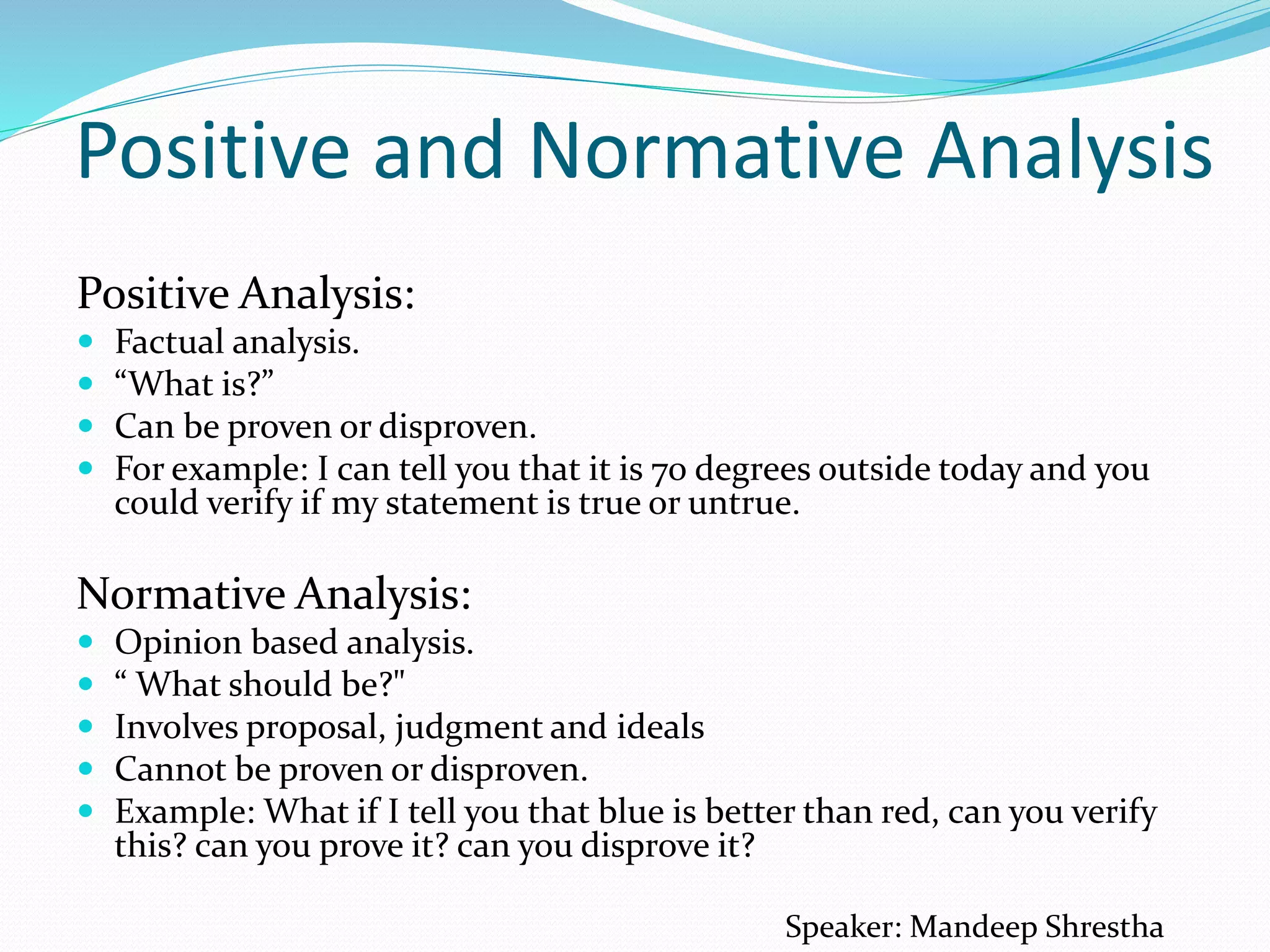
Positive and Normative Analysis
Positive Analysis:
 Factual analysis.
 “What is?”
 Can be proven or disproven.
 For example: I can tell you that it is 70 degrees outside today and you
could verify if my statement is true or untrue.
Normative Analysis:
 Opinion based analysis.
 “ What should be?"
 Involves proposal, judgment and ideals
 Cannot be proven or disproven.
 Example: What if I tell you that blue is better than red, can you verify
this? can you prove it? can you disprove it?
Speaker: Mandeep Shrestha
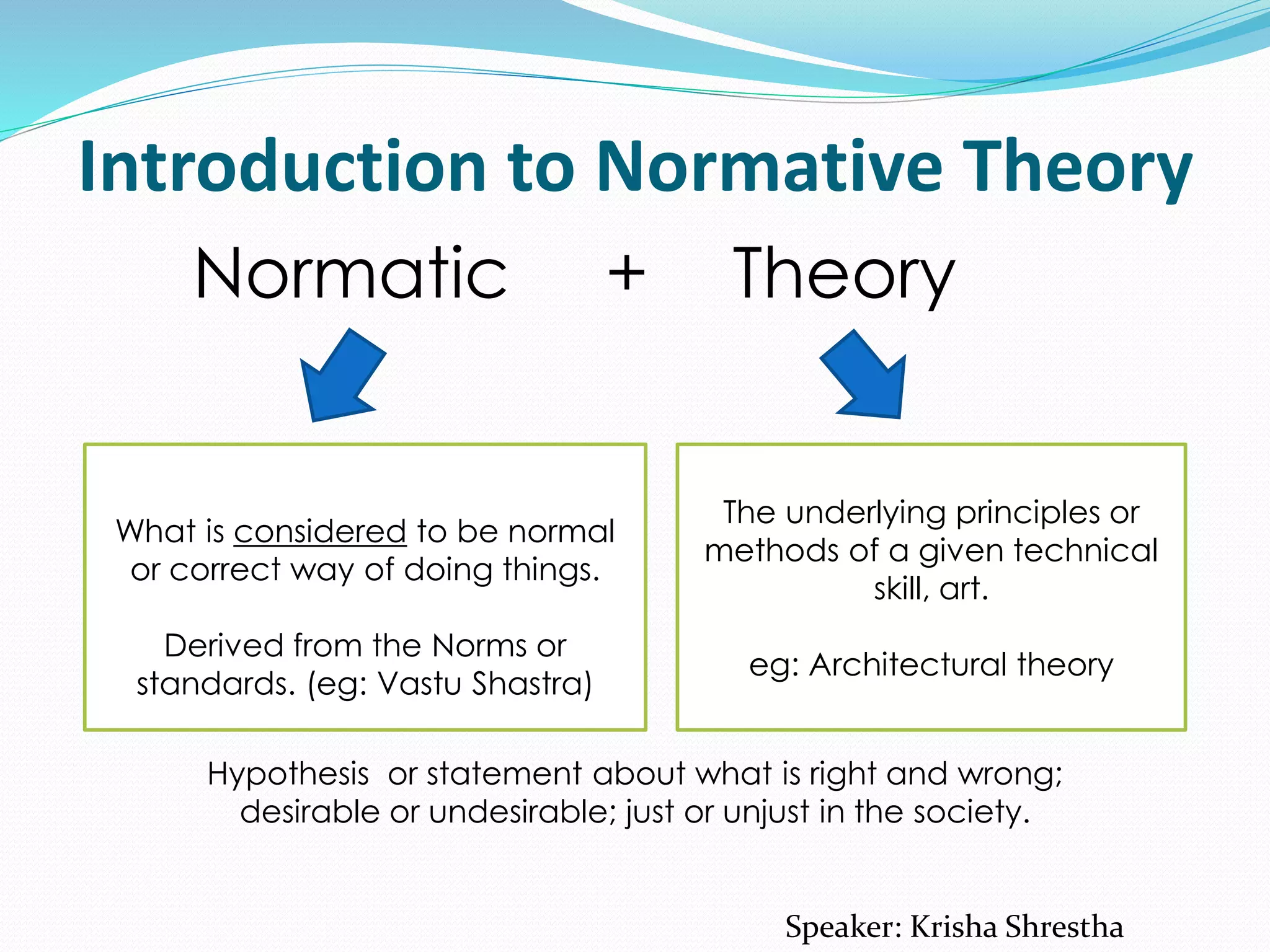
Introduction to Normative Theory
Normatic
What is considered to be normal
or correct way of doing things.
Derived from the Norms or
standards. (eg: Vastu Shastra)
The underlying principles or
methods of a given technical
skill, art.
eg: Architectural theory
Hypothesis or statement about what is right and wrong;
desirable or undesirable; just or unjust in the society.
+ Theory
Speaker: Krisha Shrestha
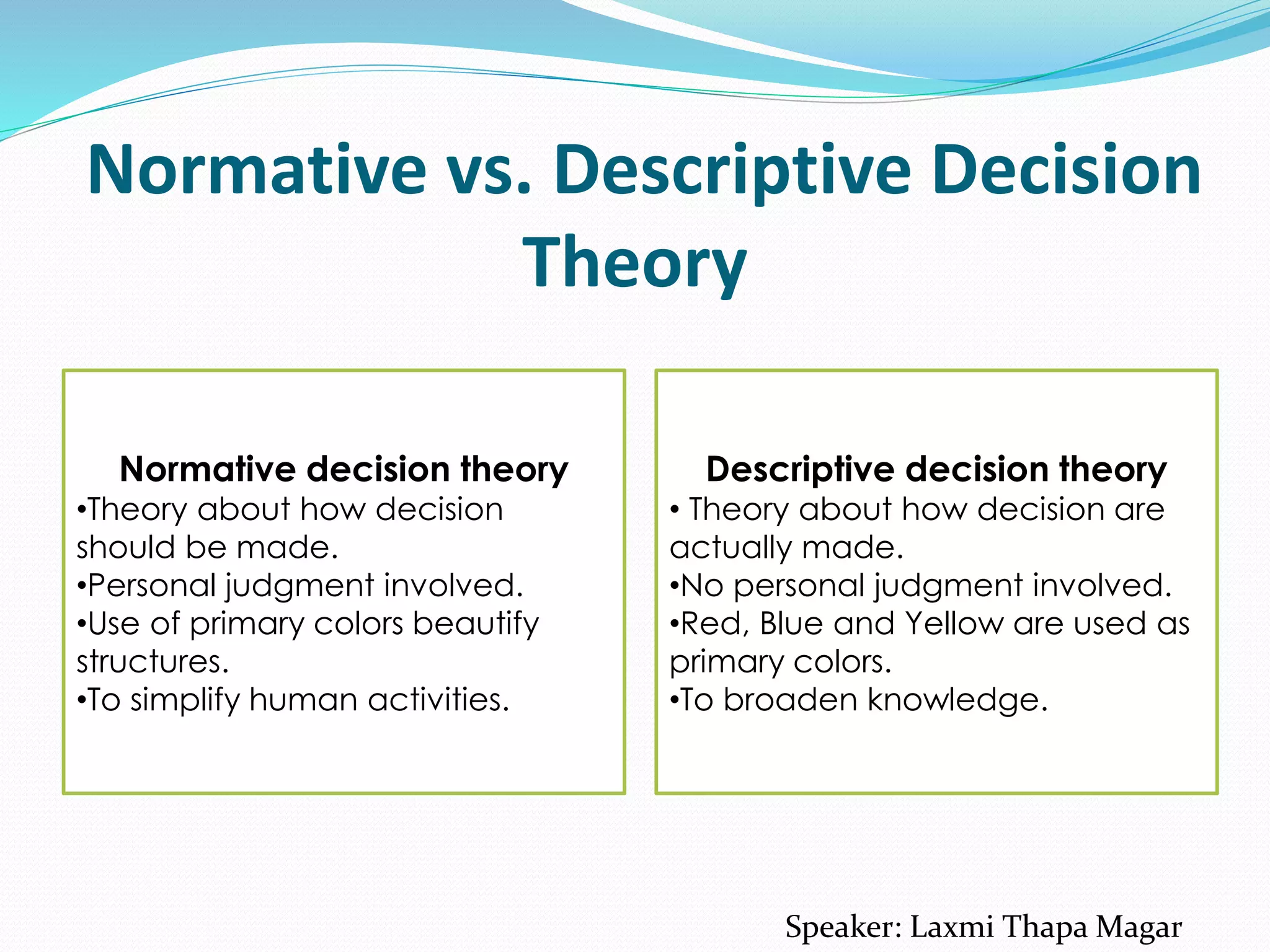
Normative vs. Descriptive Decision
Theory
Normative decision theory
•Theory about how decision
should be made.
•Personal judgment involved.
•Use of primary colors beautify
structures.
•To simplify human activities.
Descriptive decision theory
• Theory about how decision are
actually made.
•No personal judgment involved.
•Red, Blue and Yellow are used as
primary colors.
•To broaden knowledge.
Speaker: Laxmi Thapa Magar
Normative Theory as Opposed to
Descriptive Theory
• Merriam Webster defines Normative as “based on what is
considered to be the usual or correct way of doing something”. It
is derived from Latin word norma translated to norms meaning
standard of proper acceptable behavior.
• Descriptive on the other hand means giving information about
how something / someone is perceived be it sensations of smell,
touch, vision, audibility or mental perceptions.
• The main deference can be clarified by the words “what really
is” and “what ought to be”.
 As a example,
 Descriptive theory: Reality is world has terrorism.
 Normative theory: World is ought to be peaceful.
 Normative = prescriptive = how to comply
 Informative = descriptive = help with conceptual understanding
Speaker: Azad Thapa
RATIONALITY
Evolution of Normative Theory
 To help understand the role of theory of practice .
 Tacit wisdom stores in memory of their elders is followed
by younger according to tradition.
 Adaptation depends on simple fact that the process
towards equilibrium is irreversible.
 “Skill without knowledge nothing worth”
 In Vitruvius book addressed to Emperor Augustus:
 “I have drawn up definite rules to enable you [Caesar] to
have personal knowledge of quality both of existing
building and yet building constructed.
 An important factor in evolution, to respond to the
requirement of society/how internal system detect external
needs.
Speaker: Manisha Kumari Sah
Importance of Normative Theory
 Practiced since ancient times.
 Helps derive solutions to various design problems. For
instance: Where is a good position for the living room
in the house?
 Invites discussion. The more we discuss, the deeper we
understand.
 Respect of the human norms and values: sign of
civilization.
Speaker: Angel Gupta
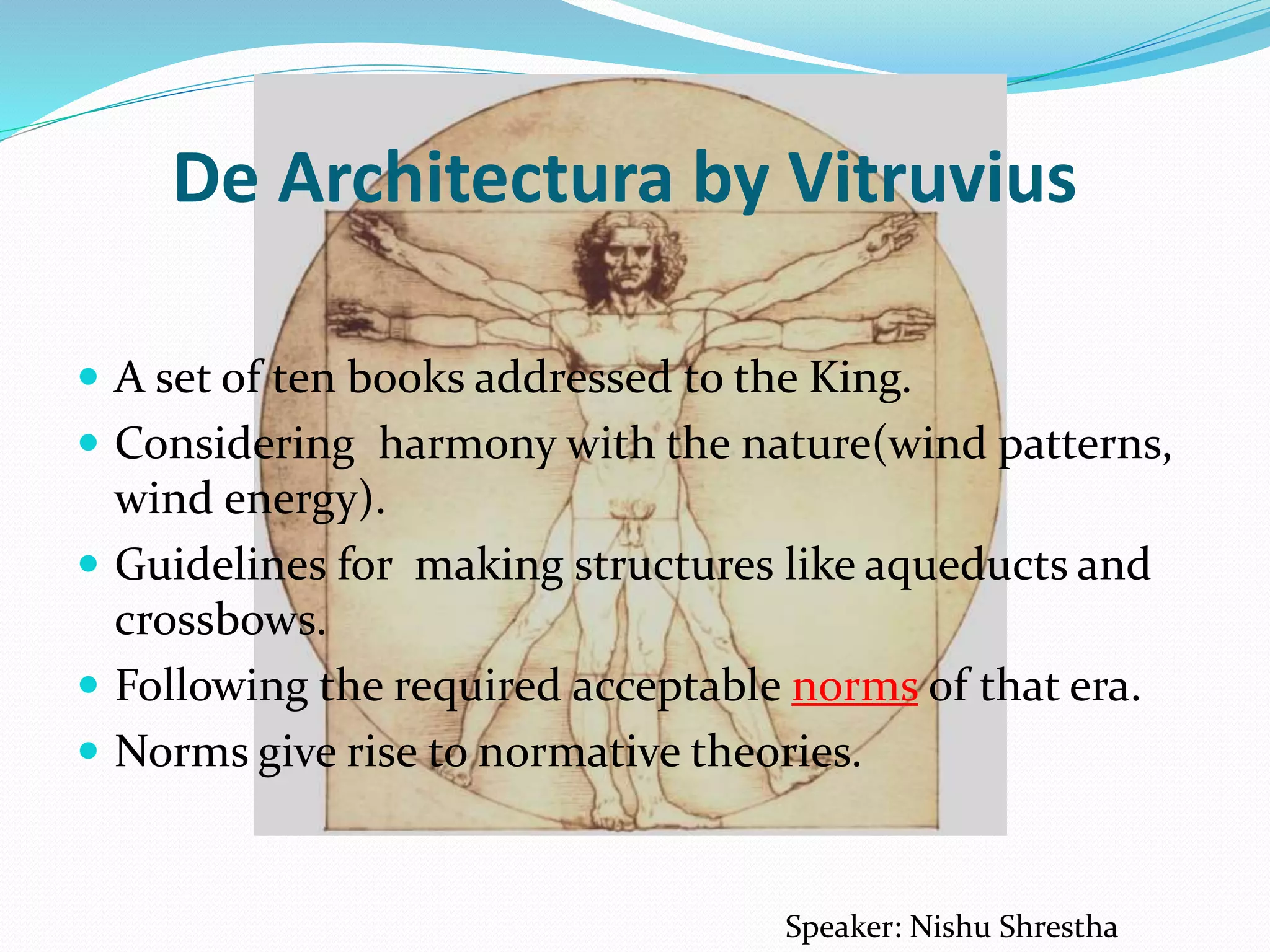
De Architectura by Vitruvius
 A set of ten books addressed to the King.
 Considering harmony with the nature(wind patterns,
wind energy).
 Guidelines for making structures like aqueducts and
crossbows.
 Following the required acceptable norms of that era.
 Norms give rise to normative theories.
Speaker: Nishu Shrestha
Vastu Shastra and Feng Shui
 People were concerned about the balance of natural
energies.
 Created to balance natural elements in surrounding
and the human body.
 The location, orientation of the buildings are guided
by Vastu Shastra and Feng Shui even today.
 Living in Harmony with nature, respecting natural
resources and energy flow is the value/norm of people.
 Normative Theories are derived from the norms.
Speaker: Bipana Lamichhane
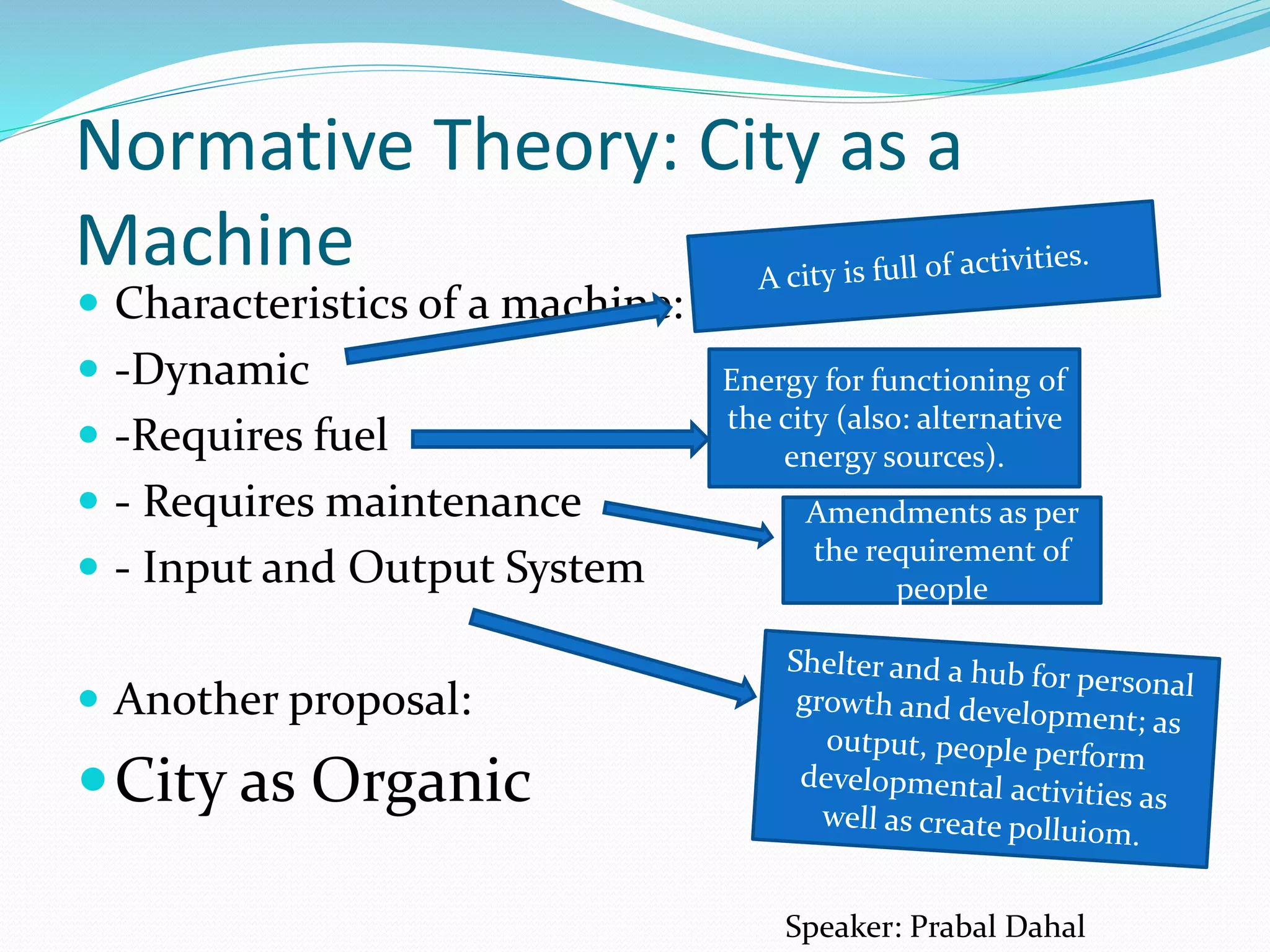
Normative Theory: City as a
Machine
 Characteristics of a machine:
 -Dynamic
 -Requires fuel
 - Requires maintenance
 - Input and Output System
 Another proposal:
City as Organic
Speaker: Prabal Dahal
Energy for functioning of
the city (also: alternative
energy sources).
Amendments as per
the requirement of
people
Thank You!

Normative theory

  • 1.
    Group Members: Angel Gupta AzadThapa Bipana Lamichhane Laxmi Thapa Magar Krisha Shrestha Mandeep Shrestha Manisha Kumari Shah Nishu Shrestha Prabal Dahal Namaskar! Good Morning!
  • 2.
    Positive and NormativeAnalysis Positive Analysis:  Factual analysis.  “What is?”  Can be proven or disproven.  For example: I can tell you that it is 70 degrees outside today and you could verify if my statement is true or untrue. Normative Analysis:  Opinion based analysis.  “ What should be?"  Involves proposal, judgment and ideals  Cannot be proven or disproven.  Example: What if I tell you that blue is better than red, can you verify this? can you prove it? can you disprove it? Speaker: Mandeep Shrestha
  • 3.
    Introduction to NormativeTheory Normatic What is considered to be normal or correct way of doing things. Derived from the Norms or standards. (eg: Vastu Shastra) The underlying principles or methods of a given technical skill, art. eg: Architectural theory Hypothesis or statement about what is right and wrong; desirable or undesirable; just or unjust in the society. + Theory Speaker: Krisha Shrestha
  • 4.
    Normative vs. DescriptiveDecision Theory Normative decision theory •Theory about how decision should be made. •Personal judgment involved. •Use of primary colors beautify structures. •To simplify human activities. Descriptive decision theory • Theory about how decision are actually made. •No personal judgment involved. •Red, Blue and Yellow are used as primary colors. •To broaden knowledge. Speaker: Laxmi Thapa Magar
  • 5.
    Normative Theory asOpposed to Descriptive Theory • Merriam Webster defines Normative as “based on what is considered to be the usual or correct way of doing something”. It is derived from Latin word norma translated to norms meaning standard of proper acceptable behavior. • Descriptive on the other hand means giving information about how something / someone is perceived be it sensations of smell, touch, vision, audibility or mental perceptions. • The main deference can be clarified by the words “what really is” and “what ought to be”.  As a example,  Descriptive theory: Reality is world has terrorism.  Normative theory: World is ought to be peaceful.  Normative = prescriptive = how to comply  Informative = descriptive = help with conceptual understanding Speaker: Azad Thapa RATIONALITY
  • 6.
    Evolution of NormativeTheory  To help understand the role of theory of practice .  Tacit wisdom stores in memory of their elders is followed by younger according to tradition.  Adaptation depends on simple fact that the process towards equilibrium is irreversible.  “Skill without knowledge nothing worth”  In Vitruvius book addressed to Emperor Augustus:  “I have drawn up definite rules to enable you [Caesar] to have personal knowledge of quality both of existing building and yet building constructed.  An important factor in evolution, to respond to the requirement of society/how internal system detect external needs. Speaker: Manisha Kumari Sah
  • 7.
    Importance of NormativeTheory  Practiced since ancient times.  Helps derive solutions to various design problems. For instance: Where is a good position for the living room in the house?  Invites discussion. The more we discuss, the deeper we understand.  Respect of the human norms and values: sign of civilization. Speaker: Angel Gupta
  • 8.
    De Architectura byVitruvius  A set of ten books addressed to the King.  Considering harmony with the nature(wind patterns, wind energy).  Guidelines for making structures like aqueducts and crossbows.  Following the required acceptable norms of that era.  Norms give rise to normative theories. Speaker: Nishu Shrestha
  • 9.
    Vastu Shastra andFeng Shui  People were concerned about the balance of natural energies.  Created to balance natural elements in surrounding and the human body.  The location, orientation of the buildings are guided by Vastu Shastra and Feng Shui even today.  Living in Harmony with nature, respecting natural resources and energy flow is the value/norm of people.  Normative Theories are derived from the norms. Speaker: Bipana Lamichhane
  • 10.
    Normative Theory: Cityas a Machine  Characteristics of a machine:  -Dynamic  -Requires fuel  - Requires maintenance  - Input and Output System  Another proposal: City as Organic Speaker: Prabal Dahal Energy for functioning of the city (also: alternative energy sources). Amendments as per the requirement of people
  • 11.