NEGOTIABLE INSTRUMENTS
ACT,1881
Presented By
• Name Roll No.
• Ujal Bhandare 03
• Sanjay Burkul 05
• Chiranjiv Karkera 20
• Kashika Parikh 35
• Vedika Salunke 45
• Steve Mathews 54
MEANING OF NEGOTIABLE INSTRUMENT
The word negotiable means ‘transferable by delivery’, and word
instrument means ‘a written document by which a right is
created in favour of some person. Thus, the term “negotiable
instrument” means “a written document transferable by
delivery”.
According to Section 13 (1) of the Negotiable
Instruments Act, “A negotiable instrument means a promissory
note, bill of exchange, or cheque payable either to order or to
bearer”. “A negotiable instrument may be made payable to two
or more payees jointly, or it may be made payable in the
alternative to one of two, or one or some of several payees”
[Section 13(2)].
1) Writing And Signature
2) Money
3) Freely Transferable
4) Title Of Holder Free From All Defects
5) Notice
6) Special Procedure
7) Popularity
8) Evidence
FEATURES OF NEGOTIABLE
INSTRUMENTS
TYPES OF NEGOTIABLE INSTRUMENTS
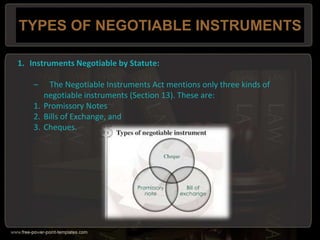
1. Instruments Negotiable by Statute:
– The Negotiable Instruments Act mentions only three kinds of
negotiable instruments (Section 13). These are:
1. Promissory Notes
2. Bills of Exchange, and
3. Cheques.
PROMISSORY NOTES
Section 4 of the Act defines, “A promissory note is an instrument
in writing (not being a bank-note or a currency note) containing
an unconditional undertaking, signed by the maker, to pay a
certain sum of money to or to the order of a certain person, or to
the bearer of the instruments.”
The person who makes the promissory note and
promises to pay is called the maker. The person to whom the
payment is to be made is called the payee.
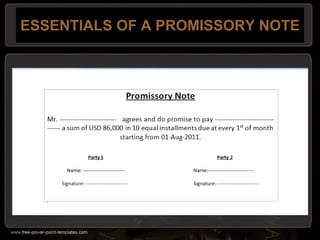
ESSENTIALS OF A PROMISSORY NOTE
EXAMPLES OF PROMISSORY NOTE
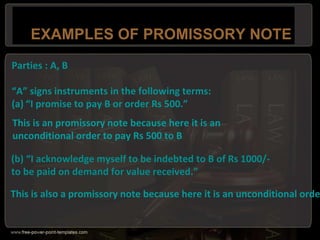
Parties : A, B
“A” signs instruments in the following terms:
(a) “I promise to pay B or order Rs 500.”
This is an promissory note because here it is an
unconditional order to pay Rs 500 to B
(b) “I acknowledge myself to be indebted to B of Rs 1000/-
to be paid on demand for value received.”
This is also a promissory note because here it is an unconditional orde
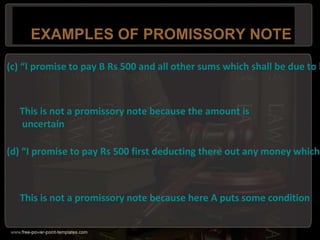
EXAMPLES OF PROMISSORY NOTE
(c) “I promise to pay B Rs 500 and all other sums which shall be due to h
This is not a promissory note because the amount is
uncertain
(d) “I promise to pay Rs 500 first deducting there out any money which
This is not a promissory note because here A puts some condition
ESSENTIALS OF A PROMISSORY NOTE
• It is an Instrument in Writing
• It is a Promise to Pay
• Signed by the Maker
• Other Formalities
• Definite and Unconditional Promise
• Promise to Pay Money Only
• Maker must be a Certain Person
• Payee must be Certain
• Sum Payable must be Certain
• It may be Payable on Demand or After a Definite Period of Time
• It cannot be Made Payable to Bearer on Demand
PARTIES TO A PROMISSORY NOTE
• Maker:
Maker is the person who promises to pay the amount stated in
the note.
• Payee:
Payee is the person to whom the amount of the note is payable.
• Holder:
He is either the payee or the person to whom the note may have
been endorsed.
BILLS OF EXCHANGE
According to Section 5 of the act, A bill of exchange is “an
instrument in writing containing an unconditional order signed by
the maker, directing a certain person to pay a certain sum of
money only to, or to the order of, a certain person or to the
bearer of the instrument”. It is also called a Draft.
Special Benefits of Bill of Exchange:
•A bill of exchange is a double secured instrument.
•In case of immediate requirement, a Bill may be discounted with
a bank.
ESSENTIAL ELEMENTS OF BILL OF
EXCHANGE
• It must be in Writing.
• Order to pay
• Drawee
• Signature of the Drawer
• Unconditional Order
• Parties
• Certainty of Amount
• Payment in Kind is not Valid
• Stamping
• Cannot be made Payable to Bearer on Demand
PARTIES TO A BILL OF EXCHANGE
• Drawer:
The maker of a bill of exchange is called the drawer.
• Drawee:
The person directed to pay the money by the drawer is called the
drawee.
• Payee:
The person named in the instrument, to whom or to whose order
the money are directed to be paid by the instruments are
called the payee.
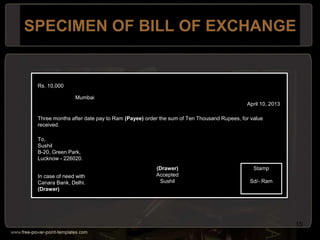
SPECIMEN OF BILL OF EXCHANGE
15
Rs. 10,000
Mumbai
April 10, 2013
Three months after date pay to Ram (Payee) order the sum of Ten Thousand Rupees, for value
received.
To,
Sushil
B-20, Green Park,
Lucknow - 226020.
Stamp
Sd/- Ram
In case of need with
Canara Bank, Delhi.
(Drawer)
(Drawer)
Accepted
Sushil
CLASSIFICATION OF BILL OF
EXCHANGE
• Inland and Foreign Bills [Section 11 and 12]
– Inland Bill:
• It is drawn in India on a person residing in India
whether payable in or outside India; or
• It is drawn in India on a person residing outside India
but payable in India.
– Foreign Bill:
• A bill drawn in India on a person residing outside India
and made payable outside India.
• Drawn upon a person who is the resident of a foreign
country.
CHEQUE
According to Section 6 of the act, A cheque is “a bill of exchange
drawn on a specified banker and not expressed to be payable
otherwise than on demand”. A cheque is also, therefore, a bill of
exchange with two additional qualification:
– It is always drawn on a specified banker.
– It is always payable on demand.
PARTIES TO A CHEQUE
• Drawer:
Drawer is the person who draws the cheque.
• Drawee:
Drawee is the drawer’s banker on whom the cheque has been
drawn.
• Payee:
Payee is the person who is entitled to receive the payment of a
cheque.
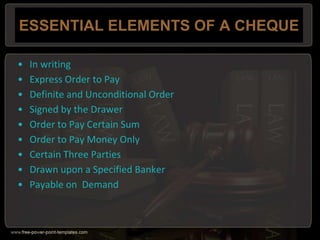
ESSENTIAL ELEMENTS OF A CHEQUE
• In writing
• Express Order to Pay
• Definite and Unconditional Order
• Signed by the Drawer
• Order to Pay Certain Sum
• Order to Pay Money Only
• Certain Three Parties
• Drawn upon a Specified Banker
• Payable on Demand
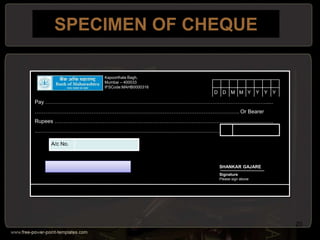
SPECIMEN OF CHEQUE
20
Pay ……………………………………………………………………………………………………………......
……………………………………………………………………………………………………. Or Bearer
Rupees ……………………………………………………………………………………………………………
……………………………………………………………………………………………Rs.
Kapoorthala Bagh,
Mumbai – 400033
IFSCode:MAHB0000316
A/c No.
“ΙΙ473792ΙΙ” 000240000 000000 10
SHANKAR GAJARE
Signature
Please sign above
D D M M Y Y Y Y
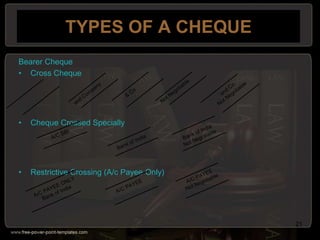
TYPES OF A CHEQUE
Bearer Cheque
• Cross Cheque
• Cheque Crossed Specially
• Restrictive Crossing (A/c Payee Only)
21
NEGOTIATION
According to section 14 of the Act, ‘when a promissory note,
bill of exchange or cheque is transferred to any person so as to
constitute that person the holder thereof, the instrument is said to be
negotiated.’ The main purpose and essence of negotiation is to make
the transferee of a promissory note, a bill of exchange or a cheque the
holder there of.
Negotiation thus requires two conditions to be fulfilled, namely:
•There must be a transfer of the instrument to another person; and
•The transfer must be made in such a manner as to constitute the
transferee the holder of the instrument.
MODES OF NEGOTIATION
• Negotiation by delivery (Sec. 47):
When a promissory note or a bill of exchange or a cheque is
payable to a bearer, it may be negotiated by delivery thereof.
Example: A the holder of a negotiable instrument payable to
bearer, delivers it to B’s agent to keep it for B. The instrument
has been negotiated.
• Negotiation by endorsement and delivery (Sec. 48):
A promissory note, a cheque or a bill of exchange payable to
order can be negotiated only be endorsement and delivery.
Unless the holder signs his endorsement on the instrument and
delivers it, the transferee does not become a holder. If there are
more payees than one, all must endorse it.
NEGOTIATION AND DISHONOUR
OF CHEQUE
Obligation of Drawee on dishonour of a cheque (sec 31)
The drawee of a cheque must compensate the drawer for any
loss or damage caused by non-payment if the following three
condition are fulfilled:
• If the drawee has sufficent funds of the drawer in his hands
• If the funds are properly appicable to such payment
• If the drawee is duly required to pay the cheque.
NEGOTIATION AND DISHONOUR OF
CHEQUE
Obligation of drawers on dishonour of a cheque (sec138) On
dishonour of a cheque, the drawer is punishable with imprisonment for a term not
exceeding 2 years or with fine not exceeding twice the amount of the cheque or with
both if the following condition are fulfilled:
• If the cheque was drawn to discharge a legally enforceable debt or other liability;
• If the cheque is returned by the bank unpaid due to insufficiency of funds in account
of drawer;
• If the cheque has been presented to the bank within a period of 6 months from the
date on which it is drawn or within the period of its validity, whichever is earlier
• If the payee or the holder in due course of the cheque has made a demand for the
payment of the said amount of money by giving a notice in writing to the drawer of
the cheque within 30 days of the receipt of information by him from the bank
regarding the returns of the cheque as unpaid
NEGOTIATION AND DISHONOUR
OF CHEQUE
Obligation of banker for dishonour of cheque
A banker must honour its customer cheque. A bank because of its
contractual relationship with the customer, is duty bound to do this. A
bank has to have a valid reason for reusing payment. If bank dishonours a
cheque without reason, it has to compensate its customer, the drawer
When banker “must refuse” payment of his customer’s cheque.
• Stop payment
• Garnishee order
• Death
• Insolvency
• Defect of title
• Notice of closure
ENDORSEMENT [SECTION 15]
The word ‘endorsement’ in its literal sense means, writing on the back of an
instrument. But under the Negotiable Instruments Act it means, the writing of
one’s name on the back of the instrument or any paper attached to it with the
intention of transferring the rights therein. Thus, endorsement is signing a
negotiable instrument for the purpose of negotiation. The person who effects
an endorsement is called an ‘endorser’, and the person to whom negotiable
instrument is transferred by endorsement is called the ‘endorsee’.
Who may Endorse / Negotiate [Section 51]:
Every Sole maker, drawer, payee or endorsee, or all of
several joint makers, drawers, payees or endorsees of a negotiable instrument
may endorse and negotiate the same if the negotiability of such instrument
has not been restricted or excluded as mentioned in Section 50.
ENDORSEMENT (Cont….)
Essentials of a Valid Endorsement:
•It must be on the back or face of instrument or on a slip of paper annexed
thereto.
•It must be signed by the endorser.
•It must be completed by the delivery of the instrument.
•It must be made by the holder of the instrument.
Kinds of Endorsement:
•Blank or General Endorsement
•Full or Special Endorsement
•Partial Endorsement
•Restrictive Endorsement
•Conditional Endorsement
Negotiable Instruments Act, 1881

Negotiable Instruments Act, 1881

  • 1.
  • 2.
    Presented By • NameRoll No. • Ujal Bhandare 03 • Sanjay Burkul 05 • Chiranjiv Karkera 20 • Kashika Parikh 35 • Vedika Salunke 45 • Steve Mathews 54
  • 3.
    MEANING OF NEGOTIABLEINSTRUMENT The word negotiable means ‘transferable by delivery’, and word instrument means ‘a written document by which a right is created in favour of some person. Thus, the term “negotiable instrument” means “a written document transferable by delivery”. According to Section 13 (1) of the Negotiable Instruments Act, “A negotiable instrument means a promissory note, bill of exchange, or cheque payable either to order or to bearer”. “A negotiable instrument may be made payable to two or more payees jointly, or it may be made payable in the alternative to one of two, or one or some of several payees” [Section 13(2)].
  • 4.
    1) Writing AndSignature 2) Money 3) Freely Transferable 4) Title Of Holder Free From All Defects 5) Notice 6) Special Procedure 7) Popularity 8) Evidence FEATURES OF NEGOTIABLE INSTRUMENTS
  • 5.
    TYPES OF NEGOTIABLEINSTRUMENTS 1. Instruments Negotiable by Statute: – The Negotiable Instruments Act mentions only three kinds of negotiable instruments (Section 13). These are: 1. Promissory Notes 2. Bills of Exchange, and 3. Cheques.
  • 6.
    PROMISSORY NOTES Section 4of the Act defines, “A promissory note is an instrument in writing (not being a bank-note or a currency note) containing an unconditional undertaking, signed by the maker, to pay a certain sum of money to or to the order of a certain person, or to the bearer of the instruments.” The person who makes the promissory note and promises to pay is called the maker. The person to whom the payment is to be made is called the payee.
  • 7.
    ESSENTIALS OF APROMISSORY NOTE
  • 8.
    EXAMPLES OF PROMISSORYNOTE Parties : A, B “A” signs instruments in the following terms: (a) “I promise to pay B or order Rs 500.” This is an promissory note because here it is an unconditional order to pay Rs 500 to B (b) “I acknowledge myself to be indebted to B of Rs 1000/- to be paid on demand for value received.” This is also a promissory note because here it is an unconditional orde
  • 9.
    EXAMPLES OF PROMISSORYNOTE (c) “I promise to pay B Rs 500 and all other sums which shall be due to h This is not a promissory note because the amount is uncertain (d) “I promise to pay Rs 500 first deducting there out any money which This is not a promissory note because here A puts some condition
  • 10.
    ESSENTIALS OF APROMISSORY NOTE • It is an Instrument in Writing • It is a Promise to Pay • Signed by the Maker • Other Formalities • Definite and Unconditional Promise • Promise to Pay Money Only • Maker must be a Certain Person • Payee must be Certain • Sum Payable must be Certain • It may be Payable on Demand or After a Definite Period of Time • It cannot be Made Payable to Bearer on Demand
  • 11.
    PARTIES TO APROMISSORY NOTE • Maker: Maker is the person who promises to pay the amount stated in the note. • Payee: Payee is the person to whom the amount of the note is payable. • Holder: He is either the payee or the person to whom the note may have been endorsed.
  • 12.
    BILLS OF EXCHANGE Accordingto Section 5 of the act, A bill of exchange is “an instrument in writing containing an unconditional order signed by the maker, directing a certain person to pay a certain sum of money only to, or to the order of, a certain person or to the bearer of the instrument”. It is also called a Draft. Special Benefits of Bill of Exchange: •A bill of exchange is a double secured instrument. •In case of immediate requirement, a Bill may be discounted with a bank.
  • 13.
    ESSENTIAL ELEMENTS OFBILL OF EXCHANGE • It must be in Writing. • Order to pay • Drawee • Signature of the Drawer • Unconditional Order • Parties • Certainty of Amount • Payment in Kind is not Valid • Stamping • Cannot be made Payable to Bearer on Demand
  • 14.
    PARTIES TO ABILL OF EXCHANGE • Drawer: The maker of a bill of exchange is called the drawer. • Drawee: The person directed to pay the money by the drawer is called the drawee. • Payee: The person named in the instrument, to whom or to whose order the money are directed to be paid by the instruments are called the payee.
  • 15.
    SPECIMEN OF BILLOF EXCHANGE 15 Rs. 10,000 Mumbai April 10, 2013 Three months after date pay to Ram (Payee) order the sum of Ten Thousand Rupees, for value received. To, Sushil B-20, Green Park, Lucknow - 226020. Stamp Sd/- Ram In case of need with Canara Bank, Delhi. (Drawer) (Drawer) Accepted Sushil
  • 16.
    CLASSIFICATION OF BILLOF EXCHANGE • Inland and Foreign Bills [Section 11 and 12] – Inland Bill: • It is drawn in India on a person residing in India whether payable in or outside India; or • It is drawn in India on a person residing outside India but payable in India. – Foreign Bill: • A bill drawn in India on a person residing outside India and made payable outside India. • Drawn upon a person who is the resident of a foreign country.
  • 17.
    CHEQUE According to Section6 of the act, A cheque is “a bill of exchange drawn on a specified banker and not expressed to be payable otherwise than on demand”. A cheque is also, therefore, a bill of exchange with two additional qualification: – It is always drawn on a specified banker. – It is always payable on demand.
  • 18.
    PARTIES TO ACHEQUE • Drawer: Drawer is the person who draws the cheque. • Drawee: Drawee is the drawer’s banker on whom the cheque has been drawn. • Payee: Payee is the person who is entitled to receive the payment of a cheque.
  • 19.
    ESSENTIAL ELEMENTS OFA CHEQUE • In writing • Express Order to Pay • Definite and Unconditional Order • Signed by the Drawer • Order to Pay Certain Sum • Order to Pay Money Only • Certain Three Parties • Drawn upon a Specified Banker • Payable on Demand
  • 20.
    SPECIMEN OF CHEQUE 20 Pay……………………………………………………………………………………………………………...... ……………………………………………………………………………………………………. Or Bearer Rupees …………………………………………………………………………………………………………… ……………………………………………………………………………………………Rs. Kapoorthala Bagh, Mumbai – 400033 IFSCode:MAHB0000316 A/c No. “ΙΙ473792ΙΙ” 000240000 000000 10 SHANKAR GAJARE Signature Please sign above D D M M Y Y Y Y
  • 21.
    TYPES OF ACHEQUE Bearer Cheque • Cross Cheque • Cheque Crossed Specially • Restrictive Crossing (A/c Payee Only) 21
  • 22.
    NEGOTIATION According to section14 of the Act, ‘when a promissory note, bill of exchange or cheque is transferred to any person so as to constitute that person the holder thereof, the instrument is said to be negotiated.’ The main purpose and essence of negotiation is to make the transferee of a promissory note, a bill of exchange or a cheque the holder there of. Negotiation thus requires two conditions to be fulfilled, namely: •There must be a transfer of the instrument to another person; and •The transfer must be made in such a manner as to constitute the transferee the holder of the instrument.
  • 23.
    MODES OF NEGOTIATION •Negotiation by delivery (Sec. 47): When a promissory note or a bill of exchange or a cheque is payable to a bearer, it may be negotiated by delivery thereof. Example: A the holder of a negotiable instrument payable to bearer, delivers it to B’s agent to keep it for B. The instrument has been negotiated. • Negotiation by endorsement and delivery (Sec. 48): A promissory note, a cheque or a bill of exchange payable to order can be negotiated only be endorsement and delivery. Unless the holder signs his endorsement on the instrument and delivers it, the transferee does not become a holder. If there are more payees than one, all must endorse it.
  • 24.
    NEGOTIATION AND DISHONOUR OFCHEQUE Obligation of Drawee on dishonour of a cheque (sec 31) The drawee of a cheque must compensate the drawer for any loss or damage caused by non-payment if the following three condition are fulfilled: • If the drawee has sufficent funds of the drawer in his hands • If the funds are properly appicable to such payment • If the drawee is duly required to pay the cheque.
  • 25.
    NEGOTIATION AND DISHONOUROF CHEQUE Obligation of drawers on dishonour of a cheque (sec138) On dishonour of a cheque, the drawer is punishable with imprisonment for a term not exceeding 2 years or with fine not exceeding twice the amount of the cheque or with both if the following condition are fulfilled: • If the cheque was drawn to discharge a legally enforceable debt or other liability; • If the cheque is returned by the bank unpaid due to insufficiency of funds in account of drawer; • If the cheque has been presented to the bank within a period of 6 months from the date on which it is drawn or within the period of its validity, whichever is earlier • If the payee or the holder in due course of the cheque has made a demand for the payment of the said amount of money by giving a notice in writing to the drawer of the cheque within 30 days of the receipt of information by him from the bank regarding the returns of the cheque as unpaid
  • 26.
    NEGOTIATION AND DISHONOUR OFCHEQUE Obligation of banker for dishonour of cheque A banker must honour its customer cheque. A bank because of its contractual relationship with the customer, is duty bound to do this. A bank has to have a valid reason for reusing payment. If bank dishonours a cheque without reason, it has to compensate its customer, the drawer When banker “must refuse” payment of his customer’s cheque. • Stop payment • Garnishee order • Death • Insolvency • Defect of title • Notice of closure
  • 27.
    ENDORSEMENT [SECTION 15] Theword ‘endorsement’ in its literal sense means, writing on the back of an instrument. But under the Negotiable Instruments Act it means, the writing of one’s name on the back of the instrument or any paper attached to it with the intention of transferring the rights therein. Thus, endorsement is signing a negotiable instrument for the purpose of negotiation. The person who effects an endorsement is called an ‘endorser’, and the person to whom negotiable instrument is transferred by endorsement is called the ‘endorsee’. Who may Endorse / Negotiate [Section 51]: Every Sole maker, drawer, payee or endorsee, or all of several joint makers, drawers, payees or endorsees of a negotiable instrument may endorse and negotiate the same if the negotiability of such instrument has not been restricted or excluded as mentioned in Section 50.
  • 28.
    ENDORSEMENT (Cont….) Essentials ofa Valid Endorsement: •It must be on the back or face of instrument or on a slip of paper annexed thereto. •It must be signed by the endorser. •It must be completed by the delivery of the instrument. •It must be made by the holder of the instrument. Kinds of Endorsement: •Blank or General Endorsement •Full or Special Endorsement •Partial Endorsement •Restrictive Endorsement •Conditional Endorsement